
Submitted:
20 November 2025
Posted:
21 November 2025
You are already at the latest version
Abstract
In Greek philosophy, symmetry was closely tied to the concepts of harmony, beauty, and unity of Nature. Modern physics reveals that the integrity of the Universe is intimately linked to concepts of symmetry and relativity. In philosophy, the idea that a single set of laws and principles governs all forms of existence is called monism. In physics, this conjecture was first articulated by Galileo as the relativity principle (RP). Thus, it is fair to say that Galileo is the father of relativity.
The historical perspective unveils that the most generalized manifestation of RP is the unity of the Universe. All subsequent evolutions of RP were unfolding of this foundational idea. The evolution of the RP was closely tied to the refinement of the mathematical formulation of space-time geometry and symmetry. Euclidean geometry was gradually displaced from the status of absolute to the role of an initial approximation of physical space determinants. At present, it becomes evident that perceptual indistinguishability of uniform motion, articulated by Galileo, is a consequence of fundamental determinants of existence - space-time symmetry and relativity (STSR). Remarkable, but the nature of elementary (smallest) constituents, the evolution of the largest scales of the Universe, and human behavior follow the same fundamental physical principles.
The review is written in a language comprehensible to physicists, mathematicians, biologists, and philosophers (students and teachers).
Prerequisite: The biologists should be familiar with the fundamental aspects of geometry, and physicist with the origin and evolution of life.
Keywords:
bilaterian
; bio-chirality
; molecular chirality
; mirror reflection symmetry
; relativity principle
; space-time relativity
; reference frame
Introduction
The sensitivity of human perception of symmetry is restricted only to a subset of the symmetries realizable in physical space. As a result, the seemingly transparent and easy-to-perceive concept of symmetry becomes one of the most sophisticated, challenging, and fundamental determinants of Nature. Considering space-time symmetry, we will primarily cover space symmetry, as more developed and easier to comprehend intuitively. The Euclidean geometry (EG) was the first draft of the scientific view on the integrity of the Universe, based on self-evident (intuitive) truths or assumptions, called axioms or postulates [1]. Galileo (1564–1642) advanced EG to relativity and equivalence principles (RP and EP) [2], based, as it became evident later, on the principle of space-time symmetry. Kant's declaration that space and time are fundamental and inseparable forms of existence, becomes a prologue to Minkowski's mathematical description of the four-dimensional space-time continuum [3]. Galileo defended the principle of relativity facing opposition from the Holy Office of the Catholic Church (Figure 1. A). Galileo's intuitive insights regarding the RP and equivalence principle (EP) initiates progress in mathematical formalism, from Newson’s classical mechanics to quantum mechanics (QM) contributed by great physicists including Maxwell (1831–1879), Einstein (1879 – 1955), Bohr (1885 -1962), Schrödinger (1887–1961), Pauly (1900–1958), Heisenberg (1901-1976) and many other [4].
The Tails of Galileo Ideas
The unity of the Universe (UU), reflected in the unity of life, science, and art, rests on the idea that a single set of laws and principles governs all forms of existence. In ancient times, Greek philosophers advanced the intuitive idea of UU to the atomic theory of Democritus and the geometry of Epicurus. The spirit of the sane idea was the hidden force of Galilean inspiration in formulating the relativity principle (RP), and Quantum Physics reveals new forms of universal integrity through space-time symmetry and relativity (SPSR) [5]. Galileo's ideas were far ahead of their time, The concerns of motion relativity associated with the RP and EP were behind Einstein’s recognition of Galileo as the “father of modern physics-indeed, of modern science altogether” [6]. The hypothesis that "principles of equivalence, invariance, and preservation have an intimate relation to the concept of symmetry" is the most persistent feature of the human mind, from ancient philosophy to modern science. The family of these principles expresses something we believe but do not yet understand the mechanism of action. An illustrative example is the EP, which, as a criterion of identity, has an immediate relation to the space-time symmetry [7,8,9,10,11,12]. Origin of EP, dating back to Galileo, progresses through general theory of relativity (GTR) [13,14,15] to quantum physics. Indeed, Galileo's law of free fall, assuming the equivalence of inertial and gravitational mass, known as the equivalence principle (EP), was realized by Einstein as a key tool for expanding RP to systems moving with acceleration. The transfer from SRT to GRT is performed based on two essential principles: -the generalized RP (equating the laws of physics in accelerated reference frames) and–Hilbert principle of least action (PLA) I allow the interpretation of the gravitational force as space-time curvature [16]. Notable that most promising attempts to merge GRT and quantum mechanics (QM) into a unified view of the Universe are made on the grounds of space-time curvature (multidimensional Hilbert geometry [17]) inherently linked to space-time symmetry and relativity (STSR).
From Galileo to Quantum Physics
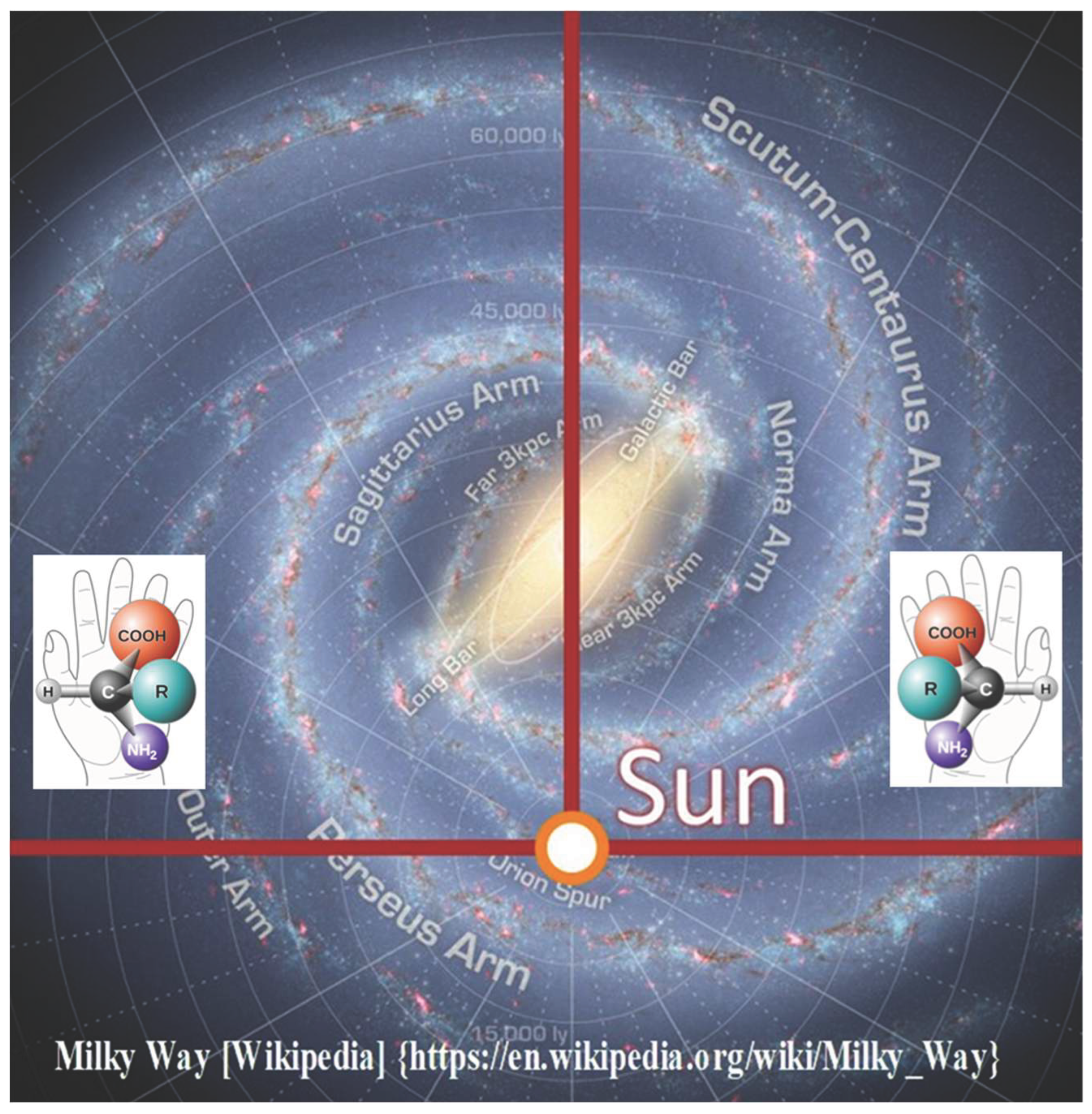
Most publications devoted to Galilei's contribution to modern physics are suffering from the lack of generalized view reflecting the demand of philosophical transaction [2,18,19,20]. This review aims to fill this gap can be considered complementary to the book “Galileo Unbound” [21]. Galilean RP was grounded on EG created by a distinctive faculty of sensory perception and human imagination as a pragmatics approximation of reality. The most fundamental Euclidean assumption was absolute space characterized by attributes of homogeneity and isotropy. The visual foundations of EG link its axioms and postulates to the primary cognitive ability and psychological function of the organism [19,22]. From the platform of currently accumulated knowledge, concepts of space isotropy and homogeneity have become unconvincing. It isn't easy to imagine the spiral structure of our galaxy (background spacetime structure) does not contribute to the reference frames (RFs) geometrical properties (such as symmetry) (Figure 2). Euclidian axioms, postulates, and theorems were under permanent attack by mathematical genius, including Lobachevsky (1972–1856), Reimann, (1826–1866), Hilbert (1862 – 1943) and Noether (1888 – 1935)}. Symmetry preservations and symmetry breaking are experimentally observed in the various condensed matter, molecular, atomic, and elementary particle physics quantum effects [23,24,25], suggesting the relative nature of symmetry determinants. In the post Newton time, a pleades of talented physicists initiated the penetration of new geometric ideas in theoretical and experimental physics. Among them are Maxwell (1831 – 1879), Michelson (1852 – 1931), Lorentz (1853 – 1928), Curie (1859 – 1906), Minkowski (1864 – 1909), Rutherford (1871 – 1937); Einstein (1879 – 1955), Schrödinger (1887–1961), Pauly (1900 1958), Heisenberg (1901 – 1976), and Dirac (1902 – 1984). Galilei's work on RP accompanied by unsuccessful attempt to measure the speed of light brings Galileo to conclusion that it is limited but too fast for available measured tools. In 1676 Rømer (1644 – 1710) experimentally confirm assumptions of Galilei. Analyzing the conclusions of Aristotle and Copernicus, Galileo generated several hypotheses, many of which he evaluated experimentally. Among them are the principle of inertia and low of constant acceleration induced by constant force (independent of the body mass) finalized by the RP. His objective was to formulate the laws of movement in the most general form, resulting in the first RP potentially covering relations between space, time, and the concept of symmetry. Galileo, his contemporaries, and several generations of scientists did not realize that they had caught the tail of the most powerful law of Nature. Galileo transformed ancient intuitions regarding space, time, and symmetry into the principle of equivalence of all inertial RFs. Notably, Galileo (as well as Newton and Einstein) did not explicitly comment on the fundamental association of relativity-symmetry. However, in a broad sense, Galileo's Relativity principle means that the equivalence of all inertial systems indicates their equal relation to something fundamentally common, i.e., to the rest of the world. It is the reason why the question of how relativity, equivalence, Le Shatelier’s (1850-1936), and Curie’s principles, underlying a relativistic understanding of the Universe, are related to space-time symmetry has increasingly attracted attention in physics and philosophy [26,27]. In the development of Galilean intuition, classical mechanics held two competing views on space and time. One is based on the distinctive faculty of sensory perception (evolutionary first), and the second–is on the synthetic judgment of higher cognitive functions. Galileian the fundamental determinants of physical objects, space, time, symmetry, and relativity constantly acquire a broader spectrum of meaning. The historical examples includeadaptation of the Galilean RP to Newton's mechanics. An essential break-through in the natural evolution of ideas belongs to Minkowski, who replaced the sensory-perception-based view on space and time relations as absolute and separated forms of existence by the mathematical formulation of a four-dimensional (3+1) continuum [28]. A new interpretation of space-time geometry (Minkowski's space-time diagrams) provides an opportunity to visually represent the claims of the special theory of relativity (STR), substituted by the general theory of relativity (GTR), following the branching network of specifications and generalizations. The parade of Galilean, Newtonian, STR, and GTR evolution of RP gained new direction of development after formulation of Noether’s theorems pointing to the link between symmetry transformations and preservation of distinct physical parameters [29,30]. Inspired by Hilbert's application of the last action principle (LAP) to GRT and the challenges of energy conservation in GRT, explore the Klein theoretical framework of (invariance under a group of transformations) Noether contracted famous theorems, providing a broader (not only for GRT but also for quantum systems) underlying mathematical basis applicable to any theory formulated with the LAP [31]. The contribution of Noether was signified by the consecutive transfer of some specific symmetry transformation from the category of absolute to a relative. The breaking of Galilean invariance disregards/dismisses the concept of absolute symmetry for many physical appearances, including mirror symmetry associated with the effect of chirality (handedness or lack of mirror symmetry) [32]. Hand chirality (asymmetry), depicted by the curiosity of ancient Greeks as a specific form of spatial asymmetry, does not influence the formulation of Galileo’s and Newton’s relativity principle. Until Pasteur (1822–1895) discovered molecular chirality (1848), physical science did not pay much attention to this curious phenomenon. However, now it becomes a common-sense axiom that chirality pervades the natural world (including physical and biological matter), reviling enigmatic preferences of fundamental forces [33,34], the helices traced out by the arms of galaxies [35], and all hierarchal levels of biological chirality [34,35]. Chirality and handedness, viewed from the general sense, have different relations to the object/observer dimensionality and the object's physical nature (electron, photon, or mechanical structure) [36]. The most intriguing scientific discovery reveals that any form of RP, beginning from Galileo, is associated with the concept of symmetry. The discovery of the violation of parity in 1956 [33] became the basis for the final rejection of the Galilei-Newtonian time regarding the abstract ideas of homogeneity and isotropy of physical space. Relativity of Space-Time Symmetry (R-STS) has become the driving force in the development of physical and, consequently, in biological sciences.
Philosophy and intuition are necessary instruments of comprehension Nature. It is way physics has been an evolving narrative. This is relevant to evolution of Galileo's relativity principle in contemporary physics. The generalization of RP to the Quantum Principle of Relativity (QPR) is currently running a streamlined process. In short, QPR postulates (suggests) statistical nature predictions of quantum systems' evolution associated with the structure (symmetry) of space-time itself [37,38,39,40]. Space-time structure mediates the interaction of the system of interest with the rest of the world [40]. In other words, if the equation describing a quantum system does not contain the time-dependent impact of the external world on the system of interest, then the price is the randomness of the theory's prediction.
I. The principle of least action (PLA) states that a physical system's path through space and time minimizes a quantity called "action". The implementation of this philosophical principle in mathematics enables Hilbert to derive a system's equations of motion (field equations) without requiring any additional postulates. The field equation (in the language of geometry) describes how matter (mass or gravity) and energy warp space-time. Geometric properties of space-time may include parameters such as distance, volume, dimensionality, curvature, and symmetry. The Hilbert field equation (HFE) serves as a mathematical prototype of the Eastmain field equation (EFE) in GRT.
Figure 1.
(A, B, C). A. Painting depicts Galileo during his trial for blasphemy by the Holy Office of the Catholic Church. B. Chiral-centric view on biological evolution. B. The integrity of the universe thesis is the most generalized form of RP. C. Biological relativity [41]. Chiral-centric view on biological evolution and biological relativity [42,43]. A phylogenetic tree (Tree of Life) represents a scientific hypothesis about the congruence (correspondence, relevancy, relativity) between the diversity of organisms. Biological relativity (bio-chirality) is evident in chirality transfer between all levels of biological organization. Chain of chirality transfer (simplified version) reflecting 5 distinct hierarchical stages: prevalent molecular chirality (I), bilateral motor skills and sensory perception (II), vertebrate’s literality (III), mammals’ pyramidal neurons (IV), and human brain /mind handedness (V) are present on the ground of phylogenetic tree.
Figure 1.
(A, B, C). A. Painting depicts Galileo during his trial for blasphemy by the Holy Office of the Catholic Church. B. Chiral-centric view on biological evolution. B. The integrity of the universe thesis is the most generalized form of RP. C. Biological relativity [41]. Chiral-centric view on biological evolution and biological relativity [42,43]. A phylogenetic tree (Tree of Life) represents a scientific hypothesis about the congruence (correspondence, relevancy, relativity) between the diversity of organisms. Biological relativity (bio-chirality) is evident in chirality transfer between all levels of biological organization. Chain of chirality transfer (simplified version) reflecting 5 distinct hierarchical stages: prevalent molecular chirality (I), bilateral motor skills and sensory perception (II), vertebrate’s literality (III), mammals’ pyramidal neurons (IV), and human brain /mind handedness (V) are present on the ground of phylogenetic tree.
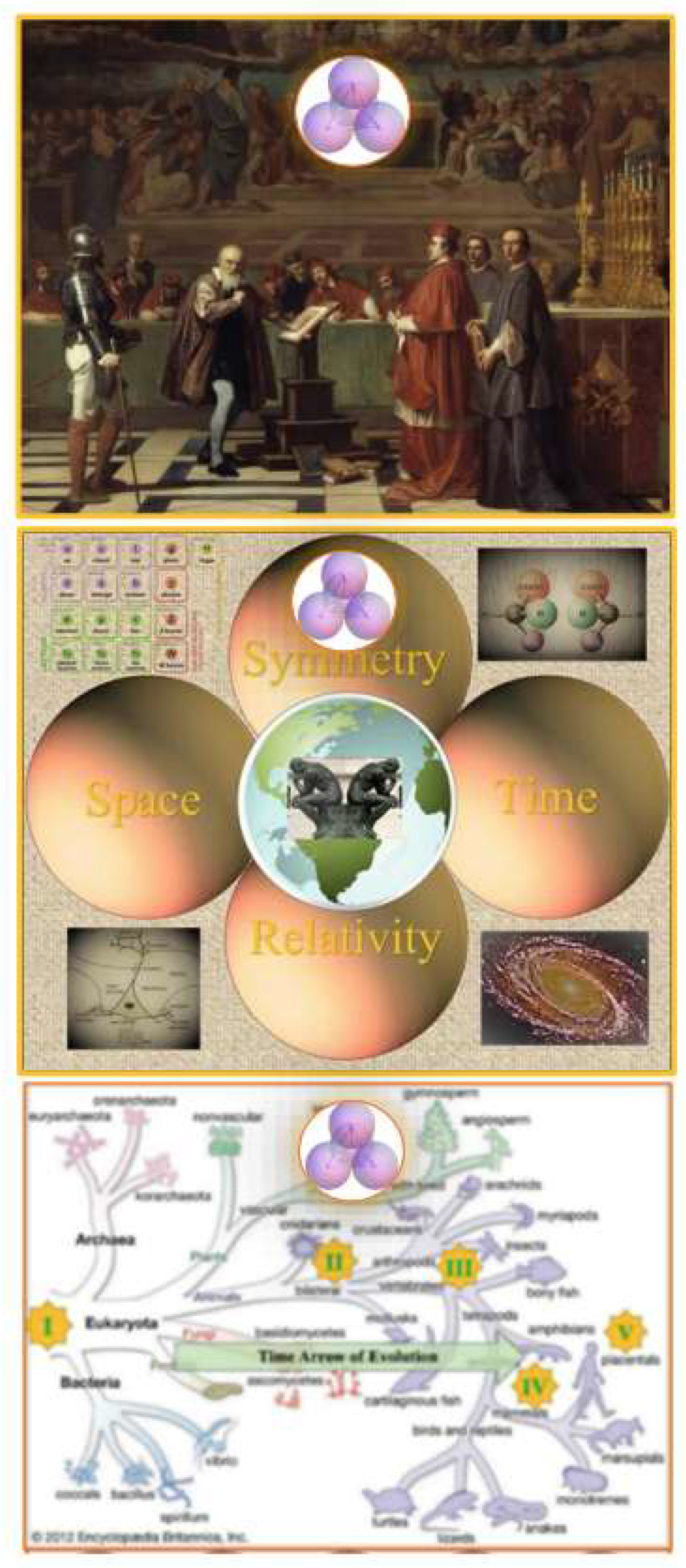
Figure 2.
Spiral structure of our galaxy.
Biological Relativity
RP is associated with movement. The movement permeates the features of the universe, and therefore, the attributes of life. Consequently, spatial and temporal scales of movement, in all levels of biological organization, from the molecular, cellular [44,45] to cognitive and psychological [46,47,48]. suggest a crucial role of fundamental space-time parameters – symmetry and relativity.
Indeed, life is compatible with two basic principles, which are the non-equilibrium state and breaking the mirror symmetry (biological chirality and handedness) [37,43,49]. Mental space gradually acquires functional structure from perceptual space of infancy. Filled during a life-time by the experience of gratifying and adverse events of the physical environment, self, and social domain, it holds relations to physical space, movement, and symmetry. The essential structural elements of mental space are perceptual [50], cognitive [51], and psychological [52] space. Left–right asymmetry is a phenomenon having broad manifestation in biology, including, anatomy, development, evolution, and psychology because it is a morphological feature of organisms that spans scales of size and levels
of an organization [53,54]. Bohr [1885 – 1962] pays attention to the fact that we are spectators and actors in the great drama of existence [55]. This notion of duality brings us to understanding the psychological domain of our experience. The physics arrow of time (and space-time symmetry in general), directed by the expanded universe (higher levels of cosmological strictures), propagates impact on lower-level structures, including planetary systems, geology, and biology [56,57,58,59,60,61,62,63]. Biological relativity is grounded on three interlinked domains of sciences: phase transition PhTr; scale relativity, and FR relativity. Let’s briefly consider each of them.
Phase Transition (Physics and Biology)
The early evolution of universe and biological evolution are described in the PhTr accompanied by breaking and restoration of phase symmetry [64,65,66,67,68,69,70]. Spontaneous PhTrs are the key elements of fundamentals of physics underlying understanding all (without exception) aspects of biology. Non- equilibrium PhTr play a critical role in maintaining this dynamic condition. STR distinguishing two meanings for the concept of mass, rest mass and relativistic mass (declaration of mass relativity) (see Appendix IV). Theoretical prediction of mass relativity in spontaneous symmetry breaking (SSB) open aspect of mass relativity linked to the geometry of interaction of physical objects with the external environment [67,71]. The phenomenological core of the theory of PhTs chiefly concerned with the symmetry of the system, link non-equilibrium physics (from solid matter to cosmic scale events) [72,73,74] with biology (biological aging) [75,76,77]. The symmetry bridge GRT, quantum field theory and bio-chirality [78,79].
Scale Relativity (Physics and Biology)
The comparison of spatial and temporal scales of Life and the Universe serves as helpful introduction and background [41]. The origin, evolution, and maintenance of bio-specific effects, including biochirality, follow nature’s fundamental laws [80]. The illustrative examples are the theory of scale relativity (TSR) [81,82,83] and Gestalt psychology [84]. The transformation of entropy has a non-trivial association with the symmetry of the system [83,84]. Notably, that specific form of global STS, characterized by scale-invariance, reflects the dynamics of energy/matter at all levels of the organizational hierarchy, from elementary particles through cells and organisms to the Universe as a whole [85,86].
Biological Frame of Reference
According to Schopenhauer, we experience the world through hierarchical levels of cognitive power, Sensation (S), Understanding (U), and Reason (R) evoked to action by the Will (W) (of action)–the concepts paving the way to modern psychology and idea of psychological RF [87,88,89,90,91,92,93,94,95,96,97,98,99,100,101,102,103,104,105,106,107,108,109,110,111,112,113,114,115,116,117,118,119,120,121]. The origin, continuation, and consequences of stereospecificity in biological systems are under the long-term attention of biologists [87]. In all animals, the ability and necessity of efficient movement relies on the prevalent molecular chirality (1), which, in the higher animals, shapes the stem cell differentiation, morphology of neuronal cells, bilateral geometry (2) of the body, and handedness of sensory perception (2) ang higher cognitive functions (3) [88,89,90,91]. In humans, all three elements shaping space perception are involved in evolutionary selected cognitive and psychological adaptation. From this point, animal physiology, ameliorated by life-time experience, James (1842 – 1910), and Freud (1856–1939) and Pavlov (among many others) began trying to explain the link between physiology, perception, cognition, and action, which constitute the body of psychological functions [92,93,94,95,96,97,98,99,100,101,102,103,104,105,106,107,108,109,110,111,112,113,114,115,116,117,118,119,120,121]. –
Conclusion
The observer-dependent interaction of light and matter quantum subsystems means that the correlation of two parts behaviors can be perceived differently from different RF [121]. However, some families of RF exhibit consistency in the perception of light-matter interaction – the feature
interpreted as symmetry [122] Unfortunately, this apparent link is frequently overlooked (with rare exceptions [123,124]. Philosophy of symmetry demands attention. The significance of Galileo’s RP in his association with the integrity of the Universe. An idea supported by the commonly accepted paradigm that quantum fluctuations in chiral elementary particles (the smallest structures in the Universe) cause handedness in clusters of galaxies (the largest structures in the Universe) [125,126,127,128,129]. The well-known prevalent chirality in elementary particles (e.g., L-neutrinos), organic molecules (e.g., L-amino acids and D-sugars), and galaxy rotation suggests the existence of an unknown (yet) not-trivial mechanism of symmetrical transfer consistent with the idea of universal integrity. The elucidation of causal relations within the range of hierarchical events remains one of the challenging questions in modern physics. The significance of the subject matter: “SPACE-TIME-SYMMETRY- RELATIVITY (STSR)” is reflected in several high-quality publications (such as [130,131]). STSR projects its power far forward by interpreting the space-time structure through spinor geometry and algebra. Prior to Dirac, it was a common assumption that scalars, vectors, and tensors provide a mathematical description of reality. Nevertheless, the Dirac equation reveals that the particles with spin 1/2 (fermions) are described by mathematical objects called spinors, which are neither scalars, vectors, nor tensors [132,133,134]. The study of STSR points to possible connection between the quantum property of electron spin and macroscopic rotation at the galaxy scale. Despite the apparent challenges, the human mind assumes the existence of such a link [135,136]. See Appendix I.
Appendix I.
Proposed by Maxwell, a fundamental physical theory of electromagnetism, revealed that the speed of light is a constant value, and was the first call for the generalization of Galilean transformations and the initial variant of the relativity principle (RP). The laws of electromagnetism obey new forms of symmetry that are not consistent with Galilean transformations. Lorentz (1853–1928) formulated new transformations required by Maxwell's theory, showing that the velocity of light is the same with respect to all inertial frames of reference. The Lorentz transformation, interpreted as a "rotation" in Minkowski's four-dimensional continuum, was the first attempt to reconsider the structure of space-time associated with symmetry and left-right discrimination. The invariance of the speed of light under Lorentz transformations breaks the invariance (absolute meaning) of time-space intervals/distance, compromising the concept of event simultaneity. Notably, in the interaction of massless and massive elementary particles and light-matter effects, Lorentz transformations allow distinguishing chirality and helicity parameters and discriminating left and right sides (in the space-time continuum) [137]. Einstein, recognizing the significance of emerging developments, integrated them under the umbrella of the set of axiomatic principles (postulates) in his special theory of relativity (SRT), which has received numerous experimental confirmations. However, Einstein concluded that SRT could not be applied to gravity or to an object undergoing acceleration [138,139]. The project to overcome these limitations is known as the general theory of relativity (GRT), which fundamentally redefined gravity not as a force but as the curvature of spacetime caused by mass and energy. Notably, GRT incorporates the results of mathematical brain-storm re-initiated by the Maxwell field equations.
Abbreviations
Euclid geometry (EG); Eastmain field equation (EFE); Hilbert field equation (HFE); Phase transition (PhTrs); Principle of least action (PLA), Quantum mechanics (QM); Quantum principle of relativity (QPR); Relativity principle (RP); Relativity of space-time symmetry (R-STS); Special theory of relativity (STR); General theory of relativity (GTR); Space-time symmetry and relativity (STSR); Reference frame (RF); Spontaneous symmetry breaking (SSB); Sensation (S); Understanding (U); and Reason (R); Unity of Universe (UU).
References
- [Euclid. 2022] Book by Euclid (Author), Dana Densmore (Editor), T.L. Heath (Translator). Publisher: Green Lion Press 2022. 529 pg.
- Galileo, 1632–Gailei, G. “Dialogue Concerning the Two Chief World Systems” Modern Library Science Classics ed.). 1632. 586 pg.
- [Thompson. 1996] Book by Thompson, A, C. Minkowski Geometry. Cambridge: Cambridge University Press, 1996. 368 pg.
- [Cropper. 2004] Book by Cropper, W.H. Great Physicists. The Life and Times of Leading Physicists from Galileo to Hawking. 512 pg.
- [Pas. 2023] Book by Heinrich Päs. The One: How Ancient Idea Holds the Future of Physics. Publisher: Basic Books 2023.
- Einstein, 1954–Einstein, A. “Ideas and Opinions by Albert Einstain”. Pg. 271 New York: Crown Publishers, Inc. NY. 1954, 1985. 80 pg.
- Wigner, 1967–Winger E.P. Scientific Essays “Symmetries and Reflections: Studies in History and Philosophy of Science Part A 1967. Pg. 193-207.
- Samaroo, 2018–Samaroo. R. “The principle of equivalence as a criterion of identity” Synthese. 2018, 197(8):3481–3505. [CrossRef]
- Brading et al. 2023–Brading, K.; Castellani, E. and Teh, N. “Symmetry and Symmetry Breaking”. Stanford Encycl. of Philosophy Archive. {https://plato.stanford.edu/archives/fall2024/index.html) Published in. 2023.
- Fay, 2015–Fay, S. “An easy journey from Galilean to General Relativity”. arXiv:1511.07485v1 [physics.pop-ph], 2015. [CrossRef]
- Shahen, 2015–Shahen, H. “Galileo and the equivalence principle: a faulty argument with the correct conclusion”. European Journal of Physics, 2015, 36(6), 065044. [CrossRef]
- Ciufolini et al. 2019–Ciufolini, I.; Matzner, R., Paolozzi, A. et al. “Satellite Laser-Ranging as a probe of fundamental physics”. Sci. Reports 2019, 9, 15881. [CrossRef]
- Norton, 1985–Norton, J. “What was Einstein’s Principle of Equivalence?” John Norton Studies in History and Philosophy of Science Part A 1985, 16 (3), 203, 203-246, Printed in Great Britain. [CrossRef]
- Smarandache, 2013–Smarandache, F. “Unsolved Problems in Special and General Relativity (22 collected papers). Education Publishing ISBN: 9781599732206, 2013.
- Blennow. 2021–Blennow, M. “300 Problems in Special and General Relativity” 1st Edition Publisher: Cambridge University Press 2021.
- Cai, Y.Q. and Papini, G. The effect of space-time curvature on Hilbert space. General Relativity and Gravitation 1990, 22(3), 259-267, Y. Q. Cai and Giorgio Papini. [CrossRef]
- Hilbert "Die Grundlagen der Physik" [Foundations of Physics], Nachrichten von der Gesellschaft der Wissenschaften zu Göttingen – Mathematisch-Physikalische Klasse (in German), 2015, 3: 395–407.
- Browne, 2020–Browne, K.M. “Galilei proposed the principle of relativity, but not the “Galilean transf7rmation” Am. J. Phys. 2020, 88, 207–213. [CrossRef]
- Machamer & Miller, 2021–Machamer, P. and Miller, D.M. “Galileo Galilei”. Stanford Encyclopedia of Philosophy {https://plato.stanford.edu/entries/galileo/} First published 2005; substantive revision, 2021.
- Ramírez, 2024–Ramírez, S.M. “Galileo’s Ship and The Relativity Principle.” Nous.2024. [CrossRef]
- [Nolte. 2018] Book by Nolte, D.D. Galileo Unbound (Science Answers Why. A Path Across Life, the Universe and Everything. Oxford University Press 2018.
- Gray & Ferreirós, 2021–Gray, J. and Ferreirós, J.” Epistemology of Geometry”. Stanford Encycl. Of Philosophy. First published 2013; substantive revision in 2021.
- [Gibson & Pollard. 1980] Book by Gibson, W.M. and Pollard, B.R. Symmetry principles in elementary particle physics. Cambridge University Press. 1980. 402 pg.
- Thorngren & Else, 2018–Thorngren R. and Else, D.V. “Gauging Spatial Symmetries and the Classification of Topological Crystalline Phases”. Phys. Rev. X 2018, 8, 011040. [CrossRef]
- Chowdhury & Perdew, 2021–Chowdhury, S.T.R. and Perdew, J.P. “Spherical vs non-spherical and symmetry-preserving vs symmetry-breaking densities of open-shell atoms in density functional theory”. J. Chem. Phys. 2021, 155, 234110. [CrossRef]
- Wesson, 2003–Wesson, P.S. “The Equivalence Principle as a Symmetry”. Gen.Rel.Grav. 2003, 35 (2003) 307-317. [CrossRef]
- Wolkowski, 2008–Wolkowski, Z.W. “Symmetry and its consequences: from Pierre Curie to transdisciplinarity”. Annales de la Fondation Louis de Broglie, 2008, 33(1-2) 193–196 2008.
- Petkov, 2012–Petkov, V. (Editor). Space and Time. Minkowsky Papers on Relativity. Translated by Lewertoff F. and Petkov, V. Translated by Robert D. Martin. Publisher: Minkowski Inst. Press 2012.
- Editorial. 2018–Editorial. “Celebrate the mathematics of Emmy Noether. Nature. 2018, 561, 149-150. [CrossRef]
- Book Lee Phillips.” Einstein’s Tutor”. The Story of Emmy Noetter and the Invention of Modern Physics. Publisher: PublicAffairs. First Edition 2024.
- [Yousef. 2019] Book by Yousef, M.H. Time Chest: Particle-Wave Duality: from Time Confinement to Space Transendence. Publisher: Independently published 2019.
- Zhao et al. 2023–Zhao, D.; Xu, M.; Dai, K.; Liu, H.; Jiao, Y. and Xiao, X. “The preparation of chiral carbon dots and the study on their antibacterial abilities: Materials Chemistry and Physics 2023, 295, 127144. [CrossRef]
- Lee & Yang, 1956–Lee, T.D and Yang, C.N. “Question of Parity Conservation in Weak Interactions”. Physical Review 1956, 104, 254. [CrossRef]
- Wu et al. 1957–Wu CS, Ambler E, Hayward RW, Hoppes DD, Hudson RP. “Experimental test of parity conservation in beta decay”. Phys. Rev. 1957, 105, 1413–1415. [CrossRef]
- Kondepudi & Durand, 2001–Kondepudi D.K. and Durand D.J. “Chiral asymmetry in spiral galaxies? “ Chirality 2001, 13, 351–356. [CrossRef]
- Popa et al. 2010–Popa, R.; Cimpoiasu, V.M. and Scorei, I-r. Consequences of expanding chirality to include spin isomery (The dilemma of broadening chirality into handedness). Annals of the University of Craiova, Physics 2010, 20(1):64-72.
- Djordje and Chia-Hsiung, 2004–Djordje, M. and Chia-Hsiung. T. A general theory of quantum relativity. Physics Letters B, 2004, 581(1-2), 111-118. [CrossRef]
- Daus et al. 2020–Daus, T.; Hebecker, A.; Leonhardt, S. and March-Russell, J. “Towards a Swampland Global Symmetry Conjecture using weak gravity”. Nuclear Physics B 2020, 960, 115167. [CrossRef]
- Dragan & Ekert, 2020–Dragan, A. and Ekert, A. ‘Quantum Principle of Relativity.” New Journal of Physics 2020, 22, 033038. [CrossRef]
- Wetzel et al. 2013–Wetzel, A.R.; Tinker, J.L.; Conroy, C. and Bosch, F.C. “Galaxy evolution in groups and clusters: satellite star formation histories and quenching time-scales in a hierarchical Universe”. Monthly Notices of the Royal Astronomical Society 2013, 432(1)1, 336–358. [CrossRef]
- Dyakin, 2023–Dyakin, V.V. “Fundamental Cause of Bio-Chirality: Space-Time Symmetry—Concept Review”. Symmetry 2022, 15(1):79. [CrossRef]
- [Knoflacher. 2024] Book by Knoflacher, M. Relativity of Evolution. Translation of an updated and revised version of the original German work: Relativität der Evolution, ISBN 978-3-662-63936-8. 2024.
- Glattfelder, 2019–Glattfelder, J.B. “The Unification Power of Symmetry”. Chapter in thr book Information—Consciousness—Reality. The Frontiers Collection. Springer, Cham. 2019. [CrossRef]
- Frattolin et al. 2021– Frattolin, J.; Watson, D.J.; Bonneuil, W.V.; Russell, M.J.; Masci, F.; Bandara, M.; Brook, B.S.; Nibbs, R.J.B. and Moore, Jr.,J.E. “The Critical Importance of Spatial and Temporal Scales in Designing and Interpreting Immune Cell Migration Assays”. Cells 2021, 10(12), 3439. [CrossRef]
- Sampathkumar & Nakamura, 2025–Sampathkumar, A. and Nakamura, M. Editorial overview: “Spatial and temporal regulation of molecular and cell biological process across biological scales”. Current Opinion in Plant Biology 2025, 83, 102675. [CrossRef]
- Hansson & Åkesson, 2014–Book by Hansson, L-A. and Åkesson, S. (Edotors). Animal Movement Across Scales. Publisher: Oxford University Press 2014. 294 pg.
- Hameroff & Penrose, 2014–Hameroff, S. and Penrose, R. Review. “Consciousness in the universe: A review of the ‘Orch OR’ theory”. Physics of Life Reviews 2014, 11(1) 39-78. [CrossRef]
- Mondal & Kolomeisky, 2025–Mondal, A. and Kolomeisky, A.B. Review. “Microscopic origin of the spatial and temporal precision in biological systems”. Biophysical Reports, 2025, 5(1),100197. [CrossRef]
- Shkursky, 2025–Shkursky, A. “Generalized Theory of Cognitive Relativity: Bridging Philosophical Tradition, Cognitive Science, and Artificial Intelligence through Pure Reason”. OSF PREPRINT 2025 {https://osf.io/preprints/osf/8kanm v1} See Phil ArXive.
- Zaidi et al, 2013–Zaidi, Q.; Victor, J.; McDermott, J. Geffen, M.; Bensmaia, S. and Cleland., T.A. “Perceptual Spaces: Mathematical Structures to Neural Mechanisms”. J Neurosci. 2013, 33(45), 17597–17602. [CrossRef]
- Pizzolant et al. 2024–Pizzolante, M., Bartolotta, S., Sarcinella, E.D. et al. “Virtual vs. real: exploring perceptual, cognitive and affective dimensions in design product experiences”. BMC Psychol 12, 10 (2024). [CrossRef]
- Ahamed, 2017–Ahamed, S.A. “Quantum Flow Theory of Knowledge, Chapter in Evolution of Knowledge Science. Psychological Space. Science Direct. 2017 {https://www.sciencedirect.com/topics/computer-}.
- Ferreira & Vermo, 2017–Ferreira, R.R and Vermot, J. Review. “The balancing roles of mechanical forces during left-right patterning and asymmetric morphogenesis”. Mechanisms of Development 2017, 144, Part A, 71-80. [CrossRef]
- Levin et al, 2016–Levin, M.; Klar, A.J.S. and Ramsdell, A.F. Introduction to provocative questions in left–right asymmetry. Philos Trans R Soc Lond B Biol Sci. 2016, 371(1710):20150399. [CrossRef]
- [Bohr. 1958/2010] Book by Niels Bohr (Author)Atomic Physics and Human Knowledge Publisher: Dover Publications 2010. 112 pg.
- Ellis, 2013–Ellis, G.F.R. The arrow of time and the nature of spacetime. Studies in History and Philosophy of Science Part B: Studies in History and Philosophy of Modern Physics 2013, 44(3)242-262. [CrossRef]
- Jiang & Moubayidin, 2022–Jiang, Y. and Moubayidin, L. Floral symmetry: the geometry of plant reproduction. Emerg Top Life Sci 2022, 6(3), 259–269. [CrossRef]
- Lim & Lee, 2022–Lim, S. and Lee, S. Chemical Modulators for Targeting Autism Spectrum Disorders: From Bench to Clinic. Molecules 2022, 27(16), 5088. [CrossRef]
- Conway et al. 2016–Conway, L.G.; Repke, M.A. and Houck, S.C. Psychological Spacetime: Implications of Relativity Theory for Time Perception. SAGE Open 2016, 1-14. [CrossRef]
- Pillai & Jirsa, 2017–Pillai, A.S. and Jirsa. V.K. Perspective. Symmetry Breaking in Space-Time Hierarchies Shapes Brain Dynamics and Behavior. Neuron. 2017, 94(5), 1010-1026. [CrossRef]
- Glicksoh, 2022 -,Glicksoh, J. From illusion to reality and back in time perception. Front Psychol. 2022; 13: 1031564. [CrossRef]
- Buzsáki & Llinás, 2017–Buzsáki, G. and Llinás, R. Space and time in the brain. Science. 2017, 358(6362): 482–485. [CrossRef]
- Rosandić & Paar, 2023–Rosandić, M. and Paar, V. The Supersymmetry Genetic Code Table and Quadruplet Symmetries of DNA Molecules Are Unchangeable and Synchronized with Codon-Free Energy Mapping during Evolution. Genes (Basel) 2023, 14(12), 2200. [CrossRef]
- Harlander et al. 2023–Harlander R, Martinez JP, Schiemann G. "The end of the particle era?" The European Physical Journal H. 2023 48(1):6. [CrossRef]
- Dyakin et al. 2021–Dyakin VV, Wisniewski TM, Lajtha A. (2021). “Racemization in Post-Translational Modifications Relevance to Protein Aging, Aggregation and Neurodegeneration: Tip of the Iceberg”. Symmetry. 2021, 13, 455. [CrossRef]
- Blackmond DG, Klussmann, 2007–Blackmond DG, Klussmann M. (2007). “Spoilt for choice: assessing phase behavior models for the evolution of homochirality”. Chemical Communications. 2007, 39, 3990–3996. [CrossRef]
- Whitesides & Boncheva, 2002–Whitesides GM, Boncheva M. (2002). “Beyond molecules: Self-assembly of mesoscopic and macroscopic component”s. Proc Natl Acad Sci U S A. 2002, 99(8):4769–4774. [CrossRef]
- Jeffery & Rovelli, 2020–Jeffery K.J. and Rovelli C. (2020). “Transitions in Brain Evolution: Space, Time and Entropy”. Trends Neurosci. 2020, 43(7), 467–474. [CrossRef]
- Pietruszka, 2021–Pietruszka MA. (2021).” Non-equilibrium phase transition at a critical point of human blood”. Scientific Reports. 2021, 11(1),22398. [CrossRef]
- Englert & Brout, 1964–Englert F and Brout R. (1964). “Broken Symmetry and the Mass of Gauge Vector Mesons”. Physical Review Letters. 1964, 13(9), 321–323. [CrossRef]
- Higgs, 1964 – Higgs. PW. “Broken Symmetries and the Masses of Gauge Bosons”. Physical Review Letters. 1964, 13(16):508–509. [CrossRef]
- Stokes et al. 2023–Stokes, A.; Riley, H. and Nazir, A. “The gauge-relativity of quantum light, matter, and information”. Open Systems & Information Dynamics 2023, 30, 2350016. [CrossRef]
- De Andrade Gomes, 2025–De Andrade Gomes, H. Gauge “Theory and the Geometrisation of Physics” Series: Elements in the Philosophy of Physics. Cambridge Elements 2025. Publisher: Cambridge University Press. 2025 Henrique De Andrade Gomes.
- Guralnik et al. 2025–Guralnik GS, Hagen CR, Kibble TWB. "Global Conservation Laws and Massless Particles." Physical Review Letters. 13(20):585–587. [CrossRef]
- Kuno et al. 2022–Kuno J, Ledos N, Bouit PA, Kawai T, Hissler M, Nakashima T. (2022). “Chirality Induction at the Helically Twisted Surface of Nanoparticles Generating Circularly Polarized Luminescence”. Chemistry of Materials. 2022, 34(20), 9111–9118. [CrossRef]
- Anlas & Trivedi, 2021–Anlas K and Trivedi V. (2021). Studying evolution of the primary body axis in vivo and in vitro. eLife. 2021, 10, e69066. [CrossRef]
- Landau et al.1980–Landau L.D ; Lifshitz EM, et al. Statistical Physics (Course of Theoretical Physics. 1980, 5(1). 3rd ed. Oxford: Butterworth-Heinemann. 1980.
- Livio, 2012–Livio M. (2012). “Why symmetry matters”. Nature. 2012, 490:472–473. [CrossRef]
- Dyakin, 2021–Dyakin VV, Dyakina-Fagnano NV, Mcintire LB, Uversky VN. (2021). "Fundamental Clock of Biological Aging: Convergence of Molecular, Neurodegenerative, Cognitive and Psychiatric Pathways: Non-Equilibrium Thermodynamics Meet Psychology. Int J Mol Sci. 2021, 23(1),285. [CrossRef]
- Grimes D.T. and Burdine, 2017–Grimes D.T. and Burdine R.D. (2017). Left–Right Patterning: Breaking Symmetry to Asymmetric Morphogenesis. Trends in Genetics. 2017, 33(9), 616–628. [CrossRef]
- Dyakin & Dyakina-Fagnano, 2024–Dyakin V.V, Dyakina-Fagnano NV. (2024). "Enigma of Pyramidal Neurons: Chirality-Centric View on Biological Evolution. Congruence to Molecular, Cellular, Physiological, Cognitive, and Psychological Functions”. Symmetry. 2024, 16(3):355. [CrossRef]
- Gross, 1996–Gross, D.J. The role of symmetry in fundamental physics. Proc. Natl. Acad. Sci. USA 1996, 93, 14256–1425. [CrossRef]
- Auffray & Nottale, 2008–Auffray, C. and Nottale, L. Review. “Scale relativity theory and integrative systems biology: 1: Founding principles and scale laws”. Progress in Biophysics and Molecular Biology 2008, 97(1), 79-114. [CrossRef]
- Pinna et al. 2022–Pinna, B.; Porcheddu, D. and Skilters, J. Similarity and Dissimilarity in Perceptual Organization: On the Complexity of the Gestalt Principle of Similarity. Vision, (MDPI) 2022, 6(3), 39. [CrossRef]
- Lin,1996–Lin S-K. “Correlation of Entropy with Similarity and Symmetry”. J. Chem. Inf. Comput. Sci. 1996, 36, 3, 367–376. [CrossRef]
- Adam et al. 2022–Adlam, E.; Uribarri, L. and Allen, N. “Symmetry and control in thermodynamics”. AVS Quantum Sci. 2022, 4, 022001. [CrossRef]
- Holl, 2015–Holl, G. “A new paradigm for animal symmetry”. Interface Focus. 2015. 5(6): 20150032. [CrossRef]
- Segal, 1972–Segal, H.L. “On the origin of stereospecificity in biological systems”. FEBS Lett. 1972 20(2), 255-256. [CrossRef]
- Savin, 2010–Savin, D.N.; Tseng, S-C. and Morton, S.M. “Bilateral Adaptation During Locomotion Following a Unilaterally Applied Resistance to Swing in Nondisabled Adults”. J. Neurophysiol. 2010, 104(6), 3600–3611. [CrossRef]
- Biazzi, 2023–Biazzi, R.B.; Fujita, A. And Takahashi, D.Y. “Convergent Evolution in Silico Reveals Shape and dynamic principles of directed locomotion”. eLife. 2023. [CrossRef]
- Watanabe, 2014–Watanabe, H.; Schmidt, H.A.; Kuhn, A.; Höger, S.K.; Kocagöz, Y.; Laumann-Lipp, N.; Ozbek, S. and Holstein, T.W. “Nodal signaling determines biradial asymmetry in Hydra”. Nature 2014, 515(7525), 112–115. [CrossRef]
- Will, 2014–Will, B. “Hypothesis and Theory article. Moving from hand to mouth: ech0 phonology and the origin of language”. Front. Psychol. Sec. Psychology of Language 2014, 5. [CrossRef]
- Wertheim, 2008–Wertheim, A. “Perceiving motion: relativity, illusions and the nature of perception”. Netherlands Journal of Psychology Dordrecht 2008, 64(3), 119-125. [CrossRef]
- Falter & Bailey, 2012–Falter, C.M. and Bailey, A.J. “Perception of mirror symmetry in autism spectrum disorders”. Autism. 2012. 16(6):622-6. [CrossRef]
- Herzog & Öğmen, 2013, Herzog M.H. and Öğmen, H. Edited by Johan Wagemans. “Apparent motion and reference frames”. Oxford Handbook of Perceptual Organization. Oxford University Press 2013.
- Dokic & Pacherie, 2006–Dokic, J. and Pacherie, E. “On the very idea of a frame of reference. M. Hickmann &S. Robert. Space in Languages: Linguistic systems and cognitive categories. Typological Studies in Language 2006, 66, 259–280. [CrossRef]
- Xie, 2009–Xie, C-X.; Liu, Q.; Li, A-J.; Tao, WD. and Sun, H-J. “Frame of reference in the mental representation of object layout”. Acta Psychologica Sinica, 2009, 41(5), 414–423. [CrossRef]
- Robinson., 2010–Robinson, D.K. (2010). “Fechner's "inner psychophysics." History of Psychology, 2010, 13(4), 424–433. [CrossRef]
- Marks, 2011–Marks, L.E. “Brief History of Sensation and Reward.” Chapter 2A in the book Neurobiology of Sensation and Reward. Gottfried JA, editor. Boca Raton (FL): CRC Press/Taylor & Francis; 2011.
- Aitken, 2020–Aitken, F.; Turner, G. and Kok, P. Prior “Expectations of Motion Direction Modulate Early Sensory Processing”. The J. of Neurosci. 2020, 40(33): 6389–6397. [CrossRef]
- Haarsma, et al. 2020–Haarsma, J.; Knolle, F.; Griffin, J.D.; Taverne, H.; Mada, M.; Goodyer, I.M. et al. “Influence of Prior Beliefs on Perception in Early Psychosis: Effects of Illness Stage and Hierarchical Level of Belief”. J Abnorm Psychol. 2020, 129(6): 581–598. [CrossRef]
- Cowan & Furnstahl, 2022–Cowan, J.A. and Furnstahl, R.L. “Origin of Chirality in the Molecules of Life”. ACS Earth Space Chem. 2022, 6, 11, 2575–2581. [CrossRef]
- Wan et al. 2016–Wan, L.Q.; Chin, A.S.; Worley, K.E. and and Ray, P. “Cell chirality: Emergence of asymmetry from cell culture.” Philosophical Transactions B 2016, 371(1710), 20150413. [CrossRef]
- Levin & Mercola, 1998–Levin, M and Mercola, M. ‘The compulsion of chirality: toward an understanding of SM–right asymmetry”. Genes & Dev. 1998. 12: 763-769 12:763–769. [CrossRef]
- Petrov et al. 2015–Petrov, A.S.; Gulen, B.; Norris, A.M.; Kovacs, N.A.; Bernier, C.R.; Lanier, K.A.; Fox, G.E. et al. History of the ribosome and the origin of translation. Proc Natl Acad Sci (PNAS) U S A. 2015, 112(50): 15396–15401. [CrossRef]
- Torday & Miller, 2016–Torday, J.S. and Miller, Jr., W.B. “Biologic Relativity: Who is the observer and what is observed?” Prog Biophys Mol Biol. 2016, 121(1):29-34. [CrossRef]
- Book George Mather. “Foundations of Perception”. Publisher: Psychology Press. 2006.
- Drissi-Daoudi et al. 2021 -Drissi-Daoudi, L.; Öğmen, H. and Herzog, M.H. “Features integrate along a motion trajectory when object integrity is preserved”. J Vis. 2021, (12):4. [CrossRef]
- Zadra & Clore, 2011–Zadra, J.R. and Clore, G.L. “Emotion and Perception: The Role of Affective Information”. Wiley Interdiscip Rev Cogn Sci. 2011, 2(6): 676–685. [CrossRef]
- Nanno & Yanagisawa, 2019–Nanno, D. and Yanagisawa, H. “Effect of assistive method on the sense of fulfillment with agency: Modeling with flow and attribution theory”. arXiv:1907.01934 [cs.HC], 2019. [CrossRef]
- Giovannoli, 2024–Giovannoli, J. Lung cancer screening: focus on some psychological aspects, preliminary results. The J. of Tobacco Science 2024, 22(2), 12-22. [CrossRef]
- Oosterwijk et al. 2009–Oosterwijk, S.; Lindquist, K.A.; Anderson, E.; Dautoff, R.; Moriguchi, Y. and Barretta, L.F. “States of mind: Emotions, body feelings, and thoughts share distributed neural networks.” Neuroimage. 2012, 62(3):2110-28. [CrossRef]
- Koonin, 2009–Koonin EV. “Darwinian evolution in the light of genomics”. Nucleic Acids Res. 2009, 37, 1011–1034. [CrossRef]
- Smith, 1963–Smith, G.W. “Process — “A Biological Frame of Reference for The Study of Behavior.” Scandinavian J. of Pschology. 1963, 4(1), 44-54. [CrossRef]
- Kersten et al. 2004–Kersten, D.; Mamassian, P. and Yuille, A. “Object Perception as Bayesian Inference”. Annu. Rev. Psychol. 2004:55:271-304. [CrossRef]
- Buhusi & Meck. 2009–Buhusi, C.V. and Meck, W.H. “Relativity Theory and Time Perception: Single or Multiple Clocks?” PLOS ONE 2009. [CrossRef]
- Book by Rochelle Forrester. “Sense Perception and Reality–A theory of Perceptual Relativity, Quantum Mechanics and the Observer Dependent Universe”. Publisher: Best Publications Limited; Second Edition. 2013. [CrossRef]
- Lanzerath 2016 -,Lanzerath, D. (2016). Life Sciences, Philosophy of. In the book by ten Have, H. (eds) Encyclopedia of Global Bioethics. Springer, Cham. [CrossRef]
- Rodne, 2022–Rodne, B. “Origin of Life Resulting from General Relativity, with Neo-Darwinist Reference to Human Evolution.” 2022). Available at SSRN: https://ssrn.com/abstract=4133390 or http://dx.doi.org/10.2139/ssrn.4133390. [CrossRef]
- Lori, 2022–Lori, N. Darwinian standard model of physics obtains general relativity. Quantum Information processing 2022, 21(112). [CrossRef]
- Laurent et al. 2021–Laurent, G.; Lacoste, D.; Gaspard, P. “Emergence of homochirality in large molecular systems.” Proc. Natl. Acad. Sci. USA 2021, 118, e2012741118. [CrossRef]
- Fewster, 2025–Fewster, C.J.; Janssen, D.W.; Loveridge, L.D.; Rejzner, K. & James Waldron, J. Quantum Reference Frames, Measurement Schemes and the Type of Local Algebras in Quantum Field Theory. Commun. Math. Phys. 2025, 406, 19. [CrossRef]
- Kurakin, 2011–Kurakin, A. “The self-organizing fractal theory as a universal discovery method: The phenomenon of life”. Theor. Biol. Med. Model. 2011, 8(4). [CrossRef]
- Giacomini et al. 2019–Giacomini, F., Castro-Ruiz, E. & Brukner, Č. “Quantum mechanics and the covariance of physical laws in quantum reference frames. Nat Commun 2019, 10, 494. [CrossRef]
- Capozziello & Lattanzi, 2006–Capozziello, S. and Lattanzi, A.” Spiral Galaxies as Enantiomers: Chirality, an Underlying Feature in Chemistry and Astrophysics”. Chirality 2006, 18(1), 17-23. [CrossRef]
- Helman. 2018. Galactic distribution of chirality sources of organic molecules. Acta Astronautica 2018, 151, 595-602 Daniel S. Helman.
- [Bostic, 2025] Book by Devin Bostick. “Quantum Resonance Dynamics (QRD): A Reframing of Quantum Mechanics Through Structured Resonance: The Hidden Structure Behind Mass, Energy, and the Chiral Nature of Reality.” 2025.
- Alexeev, 2017–Alexeev, B.V. “The Dark Matter Problem” (4.3.1 Galaxy Rotation Curves). Chapter 4 Nonlocal Astrophysics (Dark Matter, Dark Energy and Physical Vacuum) 2017, 141-176. [CrossRef]
- Nelson & William. 2024–Nelson, A.H. and William, P.R. “Recent observations of the rotation of distant galaxies and the implication for dark matter”. Astronomy & Astrophysics (A&A) 2024, 687, A261. [CrossRef]
- Brading & Castellani, 2007–Brading, K. and Castellani, E. “Symmetries and Invariances in Classical Physics”. Chapter In Philosophy of Physics Handbook of the Philosophy of Science 2007, Pg. 1331-1367.
- Huggett, et al. 2021–Huggett, N.; Carl Hoefer, C. and James Read, J. “Absolute and Relational Space and Motion: Post-Newtonian Theories”. Stanford Encycl. of Phil. 2021.
- Kind, 2008 -] Kind, S. “Spinor Relativity”. Int J Theor Phys 2008, 47, 3341–3390. [CrossRef]
- Rose. 2023–Rose, H. Chapter One–Novel theory of the structure of elementary particles Adv. in Imaging and Electron Physics 2023, 225, 1-61. [CrossRef]
- Bell & Korté, 2024–Bell, J.L. and Korté, H. “Herman Weyl”. Sanford Encyclopedia of Philosophy. 2024 {https://plato.stanford.edu/entries/weyl/}.
- Chen & Wang.,2024–Chen, D-M. and Wang, L. “Quantum Effects on Cosmic Scales as an Alternative to Dark Matter and Dark Energy”. Universe (MDPI) 2024, 10(8), 333, 1-39. [CrossRef]
- Nath. 2024–Nath, P. “Particle physics and cosmology intertwined”. Entropy (MDPI) 2024, 26(2),110. [CrossRef]
- Genet. 2022–Genet, C. Chiral Light–Chiral Matter Interactions: an Optical Force Perspective. ACS Photonics 2022, 9(2), 319–332. [CrossRef]
- Petelin, & Thumm. 2023 -Petelin, M. and Manfred Thumm. M. On the Ecclesiastes’-Proclus’-Galileo’s Relativistic Approach to the Space-Time-Symmetry. Editor(s) Dr. Jelena Purenovic. Fundamental Research and Application of Physical Science 2023, 2, 98–104. [CrossRef]
- Albert. 2025–Albert, D.Z. The special theory of relativity and the general theory of relativity (GRT) in philosophy of physics in the philosophy of space and time. Britannica {https://www.britannica.com/topic/philosophy-of-physics/The-special-theory-of-relativity }.
Disclaimer/Publisher’s Note: The statements, opinions and data contained in all publications are solely those of the individual author(s) and contributor(s) and not of MDPI and/or the editor(s). MDPI and/or the editor(s) disclaim responsibility for any injury to people or property resulting from any ideas, methods, instructions or products referred to in the content. |
© 2025 by the authors. Licensee MDPI, Basel, Switzerland. This article is an open access article distributed under the terms and conditions of the Creative Commons Attribution (CC BY) license (http://creativecommons.org/licenses/by/4.0/).
Copyright: This open access article is published under a Creative Commons CC BY 4.0 license, which permit the free download, distribution, and reuse, provided that the author and preprint are cited in any reuse.


