

Submitted:
02 April 2026
Posted:
03 April 2026
You are already at the latest version
Abstract
Introduction: Educational systems have historically adapted to incorporate technological innovations, but the success of these processes may vary greatly. Some tools become embedded in established processes, while others lead to radical transformation. In this paper, we examine the development of educational technology and recommend and critique certain technologies that facilitate existing industrial education approaches and others that require the restructuring of how educational aims and methods are defined and implemented. Purpose: This study aims to evaluate this optimization-restructuring schism in a systematic manner. We seek to show, through a century of technological transformation, that 20th-century technologies were primarily appropriated to sustain standardization and efficiency, while 21st century artificial intelligence (AI) is an unassimilable phenomenon in need of epistemological and pedagogical reworking. Method: The methodology of this research uses a Comparative Historical Analysis (CHA) approach of four critical educational technologies: the ballpoint pen, the personal computer, the internet, and artificial intelligence. This analysis is guided by a new six-dimensional architecture assessing impacts on: (1) Access & Equity, (2) Pedagogical Transformation, (3) Epistemological Foundations, (4) Student Agency & Role, (5) Teacher Role & Identity, and (6) Institutional & Systemic Effects. Each dimension was systematically coded for optimization versus restructuring impacts based on historical evidence. Results: In our analysis, we determine a distinct historical stalemate of the gravity of optimization, whereby the transformational potential of the pen, PC, and (to a smaller degree) internet, was expropriated to scale up and institutionalize the industrialized education model. Nonetheless, AI has inherent duality: it may be used as a tool of optimization (automated grading, content generation) or used as an agent of restructuring (co-creation, critical inquiry). Its capacity to generate an epistemic disruption is that it questions the authority of authorship and knowledge, renders standardized assessment somewhat redundant, and reinvents learning as a process of critical analysis and human-AI co-creation. The outcome depends on deliberate institutional choices. Conclusion: The findings suggest that the introduction of AI will have to leave the historical trends of technological assimilation behind. This will require radical policy and pedagogical shifts, such as new paradigms of assessment whose focus is on human skills, the implementation of powerful ethical AI governance systems, and the re-imagining of teacher roles as ethical mentors and facilitators of learning. The future of education relies on steering this restructuring, which is inevitable, with a commitment to equity and human-centric values.
Keywords:
educational technology
; artificial intelligence
; comparative historical analysis
; epistemology
; standardization
; educational policy
Introduction
Educational systems are not passive recipients of technological change (Allmendinger, 1989), but are rather complex ecosystems that absorb, resist, and are transformed by it (Bouska et al., 2022). The history of education is, in part, a history of its instruments; from the slate to the tablet. With every large technological introduction has come a familiar cycle of revolutionary promise and profound skepticism (Keller, 1997), but their outcomes have veered vastly apart. While some new tools became increasingly integrated into the work of teaching, others led to fundamental changes in process and function. So, this article maintains that this discrepancy is no coincidence, but a critical observation; one between technologies that optimize old modes of educational (Peters, 2010) operation and those that restructure them. As an example, the ballpoint pen is not commonly viewed as having revolutionized education so much as being the cornerstone of standardized testing in the 20th century, making standardized testing procedures of mass education convenient.
In the same way, the personal computer, though a transformative technology, was frequently absorbed in what critics have described as “change without difference,”(Reinholz & Andrews, 2020) its usage funneled towards computer-assisted instruction that reinforced, rather than challenged, behaviorist models. They made the system faster, cheaper, more scalable; they were optimization pieces.
On the contrary, the emergence of artificial intelligence (AI) (see the Figure 1 which represents the publication trend of AI/EdTech); generative AI in particular; represents a force that is far less amenable to simple assimilation (K. Kim & Kwon, 2025). Its power not just to retrieve but also to generate content and personalize learning paths in real time goes at the very heart of conventional education (Dhanaraj et al., 2025).
It forces a rethink of basic questions: What constitutes legitimate knowledge? What is the value of original authorship? And why, in an age of intelligent machines, is human teaching so important? The aim is not just to maximize efficiency but a demand for systemic restructuring, an “epistemic rupture” (Tripathi, 2025) that forces a new relationship between the learner and the body of knowledge.
In this paper we systematically analyze this optimization-restructuring divide through a comparative historical analysis of four pivotal educational technologies: the ballpoint pen, the personal computer, the internet, and artificial intelligence. The analysis is guided by a six-dimensional framework that evaluates impacts on:
- Access and Equity
- Pedagogical Transformation
- Epistemological Foundations
- Student Agency and Role
- Teacher Role and Professional Identity
- Institutional and Systemic Effects
This multifaceted model goes beyond mere metrics of adoption or efficiency, revealing how technology touches the deepest levels of education. The central thesis of this paper is that whereas 20th-century technologies (Goldin & Katz, 2008) were mostly leveraged to optimize and scale up the industrialized education model (Gorina et al., 2023), thereby reinforcing standardization and path dependency, 21st-century technologies (Erviana & Rahmawati, 2025), culminating in AI, are inherently disruptive, necessitating a restructuring of educational goals, methods, and metrics. This reorganization puts in action not just ways but also demands that educational goals, methods and metrics be reconfigured. This means changing from a static knowledge transmission to the critical evaluation, contextual application, and ethical co-creation of knowledge in partnership with technology (Rizun et al., 2025).
This makes analysis a more pressing issue in the rapidly accelerating shift to AI learning environments, whose policy vacuum reflects, amongst others, growing concerns about algorithmic bias, data privacy, and ethical governance (Nurhayati et al., 2025). Through an understanding of the historical trajectory of technological assimilation; when the “optimization gravity” of existing systems generally neutralized transformative potential; policymakers, educators and institutions can consciously make choices that support these types of approaches (Zha et al., 2024). We want to make sure AI delivers on its promise: as a catalyst for genuine and equitable restructuring, rather than becoming another tool that merely automates the paradigms of the past.
The paper is a conceptual work that is based on Comparative Historical Analysis. It constructs and uses a six-dimensional analytical system on four technological case studies not as a quantitative empirical study but as a theoretically informed explanation of historical trends. We intend to build theory: we want to come up with conceptual instruments, such as optimization gravity, epistemological rupture, that will make sense of the existing decisions available to educational institutions in the era of AI.
The section II of the paper introduces the theoretical framework and methodology of comparative historical analysis. Subsequent sections III provide detailed case studies of the ballpoint pen, personal computer, internet, and AI, respectively. Section IV makes a synthetic comparison, sketching continuities and ruptures between the cases. Finally, Section V concludes with policy and practice implications: it becomes clear that the future of education depends on identifying and guiding that fundamental restructuring, which is currently underway.
Theoretical and Analytical Frameworks
To systematically illuminate the optimization-restructuring divide, our paper adopts a dual-framework strategy: a conventional methodological foundation in Comparative Historical Analysis (CHA) (Mahoney & Thelen, 2015) and a novel six-dimensional analytical frame. This blend enables discovery of macro-historical trends as well as fine-lensed analysis of technology-related effects within the educational ecosystem.
2.1. Methodological Foundation: Comparative Historical Analysis
This research is built on Comparative Historical Analysis (CHA) that offers a framework adapted to specially explaining large-scale institutional outcomes and policy transitions by identifying sequences of events and configurations across contexts (Kulanovic et al., 2025). CHA is not just recounting the events chronologically but is rather an organization of search mechanisms, like path dependency; where initial decision (e.g., the use of the ballpoint pen to standardize assessment) leads to self-reinforcing pathways that constrain future options; and critical junctures; times where technological disruption unlocks opportunities for material institutional change.
This work is framed in light of the logic of John Stuart Mill’s (Mill, 2022) methods of agreement and difference for comparison. The Method of Difference is employed to untangle the peculiar characteristics of generative AI that are of differential generative value: generative capacity; active collaboration or an active partner in education that provides different results to those of the pen, PC, or internet, respectively, which, in turn, confirms the qualitative restructuring. On the other hand, the Method of Agreement (Gebre-Medhin, 2025) helps reveal the consistent themes that are common to all four technological advances, including initial resistance, unanticipated equity challenges, and the strong institutional momentum for optimizing existing practices. This systematic comparison reframes the analysis beyond technological determinism or anecdotal history to a more generalizable theory of technological assimilation in education.
2.2. The Six-Dimensional Analytical Framework
In order to achieve a multi-dimensional evaluation that includes both immediate and deeper implications, this paper applies a uniform six-dimensional research model to the case studies. This framework aims to pressure further than the usual access- and test score-oriented metrics that prefer the goal of optimization, towards systems-wide, systemic shifts in educational philosophy and practice.
- Access & Equity: This dimension differentiates between the technological accessibility as a material (access), and as a service that provides differentiated resources, and support that is designed to assure that all students benefit (equity). To evaluate how a technology may contribute to inclusive education, we look at how effectively barriers to meaningful participation are removed, and how many perspectives can be incorporated; how many participants engage (Giannini, 2025).
- Pedagogical Transformation: This dimension measures a significant transformation in teaching methodologies, learning objectives, and the interaction of students in the classroom. It traces the shift from classroom models that are static and structured and instructor-centered (e.g., lectures or rote learning) to a modern model that is individualized, constructivist-oriented, collaborative-oriented (facilitated by technology) (Lee & Chang, 2025; Nguyen et al., 2025).
- Epistemological Impact: It is the key dimension in affirming the central thesis as it touches upon the most basic questions: What constitutes valid knowledge? and Who is a legitimate knower? Changes in this dimension represent a genuine restructuring in which not only is the relationship between learner and teacher and knowledge that is challenged it is fundamentally disrupted (Eubanks, 2025).
- Student Agency & Role: This dimension investigates the student’s formation of an identity and autonomy to do something. It describes stages that progress from being a receptacle for intelligence, to the user of the application, to a collaborator in an action, to critique maker, and even to co-composer, in a human-AI connection (Luckin, 2025).
- Teacher Role & Professional Identity: Teachers work at levels where their job status as professional change depending on the job role and need and at the very top level the educator’s professional identity. It examines a movement from knowledge transmitter and assessor, to instructional designer and tech expert, to facilitator, curator and, by the end, ethical guide, and learning guide (Ceallaigh et al., 2025; Gorina et al., 2023).
- Institutional & Systemic Effects: This dimension examines macro effects such as: policy changes, demands for infrastructure, economic arguments for investment, and development of new governance challenges including but not limited to data ethics, algorithmic accountability, automation of administrative responsibilities (Singh & Gupta, 2025).
This study utilizes a dynamic, dual-framework approach integrating Comparative Historical Analysis (CHA) and our six-dimensional analytical lens. As shown in Figure 1, it is not a linear process, but part of an interactive system of moving the case studies through the temporal, the analytical and the synthetic dimensions. We use Mill’s Method of Difference horizontally to isolate the impact of each of the technologies while through the Method of Agreement vertically, we find the stubborn Optimization Gravity Well in the historical pattern of institutional inertia that has drawn transformative technologies on to reinforce the old order. As a result, this flexible yet structured method can help us consistently track not only the continuities and ruptures in our four case studies, but also underpins the fundamental theory of paradigm change: shifting from optimization to restructuring.
2.3. Theoretical Evolution: From Behaviorism to Connectivism and Beyond
The technical changes described are interdependent with the development of learning theory, which in turn impacted and was impacted by the new tools. For instance, the analysis of the personal computer era is rooted in Behaviorism and is also an explicit reflection of Computer-Assisted Instruction (CAI), in which drill, practice, and mastery based on predefined objectives were paramount. Constructivism, which holds that learners construct knowledge through authentic learning experiences (often social), emerged as a paradigm influence as multimedia and more open-ended software proliferated and flourished (Fletcher-Flinn & Gravatt, 1995).
Figure 2.
The Dual-Framework Architecture: From Optimization Gravity Well to Epistemological Rupture.
Figure 2.
The Dual-Framework Architecture: From Optimization Gravity Well to Epistemological Rupture.
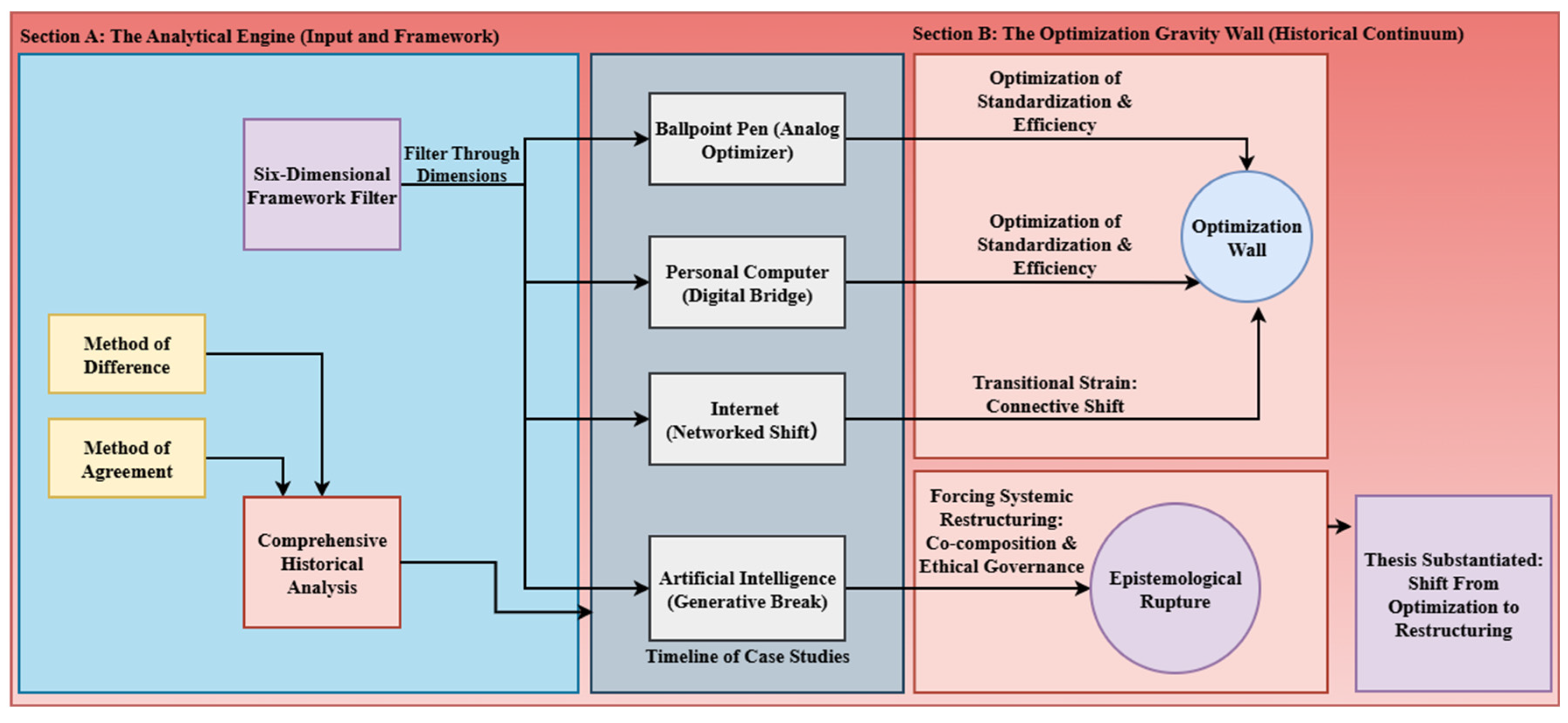
The internet era necessitated a new theory: Connectivism. This framework posits that learning happens in the connections that exist within a network and that spotting correlations and navigation of information is more important than the current state of knowing (Brown & Foster, 2023). Applying these parameters to our model leads to a revealing finding: 20th-century technologies controlled in major part the impact on Institutional Effects and Access, to enable the system to operate at scale. On the other hand, 21st-century technologies, and AI in particular, impact Epistemological Impact and Student Agency profoundly, questioning the very fabric of the system itself (Tsao et al., 2025). The stark contrast between optimization and restructuring is empirically substantiated by comparing impact across these dimensions. For more comparative analysis see Table 1.
2.4. Operationalizing the Six-Dimensional Framework: Coding Protocol
To ensure analytical transparency, we developed a systematic coding protocol for classifying technological impacts as either “Optimization” (O) or “Restructuring” (R). This protocol was applied consistently across all four case studies.
Definitional Criteria:
Optimization (O): A technology is classified as primarily optimizing when its implementation:
- Increases the efficiency, speed, or scale of existing educational practices without altering their fundamental structure
- Reinforces established power relationships (teacher as transmitter, student as receiver)
- Preserves existing epistemological assumptions (knowledge as fixed, objective, transmissible)
- Is justified through metrics of productivity, cost-effectiveness, or workforce preparation
- Leaves unchanged the core institutional logic of standardization and batch-processing of students
Restructuring (R): A technology is classified as primarily restructuring when its implementation:
- Enables or necessitates new pedagogical forms (e.g., networked learning, co-creation)
- Alters the fundamental roles of teachers and/or students
- Challenges existing epistemological assumptions (e.g., distributed authority, synthetic knowledge)
- Is justified through qualitatively different aims (e.g., critical thinking, ethical reasoning)
- Requires changes to institutional structures, policies, or governance models
Application Protocol:
For each dimension (Access & Equity, Pedagogical Transformation, etc.), we examined:
- The dominant historical pattern of the technology’s implementation (based on historiographical evidence)
- The technology’s inherent affordances and constraints (based on technical analysis)
- The primary rationales offered by policymakers and institutions for adoption (based on policy documents and contemporary literature)
2.5. Conceptual Clarifications: Epistemological Rupture and Knowledge Transformation
In order to prevent the inflation of our concepts, we should differentiate our important epistemological terms and their associated notions. Based on L’archéologie du savoir (Foucault & Kremer-Marietti, 1969), the epistemological rupture can be defined as a radical separation of assumptions about what counts as legitimate knowledge, those who have the right to do so and in what ways the truth is proven. This in the education context is interpreted as a transition of stable canons to generative algorithms, a displacement of role of knower off of receptivity to co-creativity, and validation off of authoritative correspondence to adequacy relative.
Although the Internet (Web 1.0/2.0) has democratized access through the distribution of knowledge power, it still maintained a logic of retrieval and recombination in which man had been the biggest synthesizer of existing information. However, synthetic knowledge authority is brought about by generative AI. It creates new contents by predicting patterns without citing them directly but as a co-creative companion that contradicts traditional authorship. It is not just the redistribution of power but the redefining of the same; the learning outcomes are now the products of the so-called co-composed dialogues between the human intent and ethical judgment and the synthesis performed by AI.
2.6. Situating the Study: Engaging with EdTech Historiography
The analysis is based on the basic research in the history of educational technology. The legendary work of (Cuban, 1986), Teachers and Machines, recorded the way the previous technology such as film, radio, and television succumbed to an expected pattern of hype, limited adoption, and subsequent marginalization. The latter was later characterized by (Tyack & Cuban, 1995) as tinkering towards utopia because schools can remarkably take in innovations without fundamentally altering them. Our notion of optimization gravity is based on this, and the particular mechanisms, which we call path dependency, institutional inertia, and economic rationales that lead to such absorption. The technological determinism that is typical of EdTech has also been critiqued by (Selwyn, 2011) who states that the social, political, economic contexts always influence the actual impact of technology. This is fulfilled by our six-dimensional framework that places technical analysis in the context of sociometrical perspectives which considers equity, agency and institutional influence. Instead of foreseeing predetermined results, we consider such developments as a flow of possibilities and threats that require a strategic institutional reaction.
The historical evidence indicates that institutional policy (Systemic Effects) often serves as the principal braking mechanism on radical pedagogical change (Pedagogical Transformation) (Goodman, 1995). The existential danger of AI to the utility of standardized, high-volume testing; the metric system inherited from the Pen era; makes restructuring necessary (Madaus & O’Dwyer, 1999). If institutions continue to use AI for nothing more than optimizing their work, as with automated curriculum updates, they risk automating the educational process without improving learning goals (J. Kim et al., 2025). The economic logic of educational technology also presents a paradox (global competitiveness): Industry needs ethically oriented critical thinkers, yet education remains grounded in 20th-century models of assessment. If schools persist in evaluating output using analog tools, the environment will reward the procedural use of AI (regurgitation) instead of the critical co-creation required for future workforce demands (Pallant et al., 2025). For the Historical Patterns of Resistance and Assimilation comparison see Table 2.
Case Studies
In this analysis, we will look at three key educational tech nologies that included the ballpoint pen, the personal computer, and the internet to pursue a historical line of systemic optimization to a restructuring threshold. Both technologies were, in their own way, transformative, but both technologies were, to a large extent, enveloped by what we refer to as an “optimization gravity well” which is a strong institutional inertia that propels the innovative tools to the norms of supporting the pre-existing paradigms of standardization and efficiency in the industrial age, rather than causing disruption.
3.1. Case Study Selection and Rationale
To conduct this study, we have examined 4 key technologies; 1) ballpoint pen, 2) personal computer, 3) internet and 4) artificial intelligence. The main reasons to select these 4 technologies are:
- Historical Significance: Each technology represents a watershed moment in educational practice, marking a substantial shift in the tools available for teaching and learning.
- Temporal Distribution: The technologies span approximately one century (1930s-2020s), enabling analysis of both continuity and change across different technological eras.
- Analytical Contrast: The cases exhibit varying degrees of “assimilability”—from the relatively straightforward absorption of the pen to the potentially unassimilable character of AI—allowing comparative testing of our optimization-restructuring thesis.
3.2. The Ballpoint Pen: Architect of Standardized Assessment
As a primitive analogue tool, the ballpoint pen was an op timizer of mass education of the 20 th century. It is im portant not due to its innovation in pedagogy, but because it is a strong enabler of administrative and assessment mechanics. The low cost and low reliability of the pen made physical writing more democratic and universalized, which helped to spread the requirement of an educational system (Huey, 2025). This equality of access, however, was not the equality of outcome; it created a model of superficial equality.
The history of pen and standardized testing shows that they co-evolved. The growth of multiple choice testing, first with Frederick J. Kelly and his Kansas Silent Reading Test (Kelly, 1916) and then institutionalized by the College Board and Educational Testing Service (founded 1947) came just in time with the mass use of the ballpoint (Resnick & Resnick, 1982). The permanence of the pen gave the so-called architectural seal, the stamp of objective testing: now millions of exams could be given, gathered, and scored with some certainty of integrity of response. According to (Madaus & O’Dwyer, 1999), the pencil (and subsequently the ballpoint pen) technology and the optical scanner allowed multiple-choice testing on a large scale and in a cost-effective manner.
This access had the effect of giving what can be called formal equality but not substantive equity. Although the number of students who could now write was equal, the pen strengthened an approach in which grades were determined through rote reproduction of predesigned responses. The epistemological implication was very severe: knowledge was placed in the form of what could be labeled as correct or incorrect on a multiple choice test. The role of the student became a crystallized response of a passive recorder, of reproduction and not of construction of meaning.
3.3. The Personal Computer: The Co-Opted Digital Bridge
The PC as a digital bridge was a potential restructuring, but the history of the world indicates that it was vastly co-opted to perfect the already existing industrial classroom. The first usage of PCs was as part of Computer-Assisted Instruction (CAI) and Computer-Based Training (CBT) systems which were based on behaviorist interpretations of learning and focused on drill-and-practice activities (Fletcher-Flinn & Gravatt, 1995). This enhanced rote learning, accelerated and individualized instructional processes with no challenge to fundamental pedagogical or epistemological principles.
The policies of the federal and state in this epoch predetermined the approach to the adoption of computers in terms of efficiency and competitiveness of the workforce. A report commissioned in 1983 A Nation at Risk made an explicit correlation between educational technology and economic competitiveness, which stated that the schools had to create professionals with high skills to work in high-tech economy (Education, 1983). As a result, schools defended the PC purchases by their purported gains in test scores and efficiency in administration, rather than pedagogical change (Cuban, 2001).
By 1999 more than 99 percent of U.S. schools were connected to the internet, but a longitudinal study by (Cuban et al., 2001) reported that teachers were much more inclined to use computers to support existing rather than change them (p. 96). The PC in effect computerized the drill sheet and the gradebook but retained the industrial classroom system. The Digital Divide became the issue of the time, and the focus of the concern changed to inequality in the quality of devices, connectivity, and digital literacy (Warschauer, 2003).
3.4. The Internet: The First Epistemological Rupture
With the integration of the internet, pure optimization was shunned and the first major epistemological challenge to the standardized model was launched. The internet started to disrupt the educational underpinnings, unlike the PC, through the formation of a decentralized, networked knowledge system. It disintermediated the old power of the teacher and the textbook, democratized access to information by providing access to resources such as Google and Wikipedia and led to the emergence of the theory of learning known as Connected (Brown & Foster, 2023). According to this framework, learning is the capability to cross and integrate information networks and educational stress is no longer on what a student knows but rather how he/she may locate, appraise, and utilize knowledge.
This change in epistemology has allowed an increased agency of the student, project-based learning, collaboration, and student-initiated research by leveraging Open Educational Resources (OERs) and MOOCs. The “optimization gravity well” remained on the institutional level, however. The massive use of Learning Management Systems (LMSs) had a tendency to computerize and automate traditional course management instead of rethinking pedagogy. The drive towards “21st Century Skills” was often hijacked as an optimization goal to the competitiveness of the work force. Moreover, the internet converted the Digital Divide into a Connection Divide, with more strata of unequal access, determined by the quality of bandwidth and digital navigation capabilities. In synthesis, the internet played the inseparable precondition of restructuring, able to effectively challenge the epistemology of fixed knowledge but its complete transformative promise was suppressed by the institutional inertia, the scene was laid for the more radical challenge of Artificial Intelligence.
Results
A systematic narrative emerges by applying the six-dimensional analytical framework across four technological eras: a fundamental evolution from technologies that optimized the industrialized education model to those that restructure it. Drawing on existing evidence, this chapter synthesizes the evidence to conduct a comparative analysis that not only visually but also analytically elucidates this paradigmatic shift, illustrating the historical patterns that have been consistent in the past while illuminating the singular, disruptive impact of Artificial Intelligence.
4.1. The Quantitative Shift: A Comparative Framework Analysis
Our analysis reveals a more nuanced picture than a simple binary opposition. Whereas the pen and the PC were overwhelmingly appropriated to serve the purpose of optimization, scoring consistently in that category, the internet and AI offer what we call contested terrain. The possibilities of the internet to reconfigure epistemology and student agency was offset by the institutional appropriation by LMS where course management became optimized.
Likewise, AI has an inherent dual character: it can be used as a strong optimization engine (automating grading, generating standardized content, predictive analytics for admin) or introduced as a reorganization driver (co-creation, personalized learning, critical thinking). This duality is reflected in the scoring in Table 3 where the abbreviation R/O represents that the final result will be a choice once an institution makes, not technological determinism. This narrows down our main argument: AI is not unconditionally unassimilable, but on account of its generative ability it has structural resistance to total assimilation, forming an actual choice point - a genuine critical juncture- where path dependency can be crossed.
Table 3 Analysis: The trajectory of the data is clear. In all dimensions, the pen and PC are overwhelmingly the agents of Optimization, reinforcing existing systems. Through the Internet, we build a bridge and see the very first major restructuring impacts, particularly in Epistemology and Student Agency. AI, on the other hand, is quite different, scoring as a force in restructuring within all six dimensions, a point which supports its place as a systemic disruptor and not just a means.
4.2. The Qualitative Rupture: Epistemology and Economics
The quantitative shift is underpinned by a qualitative rupture in the core purpose of education. The chart that follows visualizes this rupture by mapping the technologies based on their primary epistemological and economic impact.
Figure 3.
The Evolution of Educational Technology: Epistemological and Economic Impact.
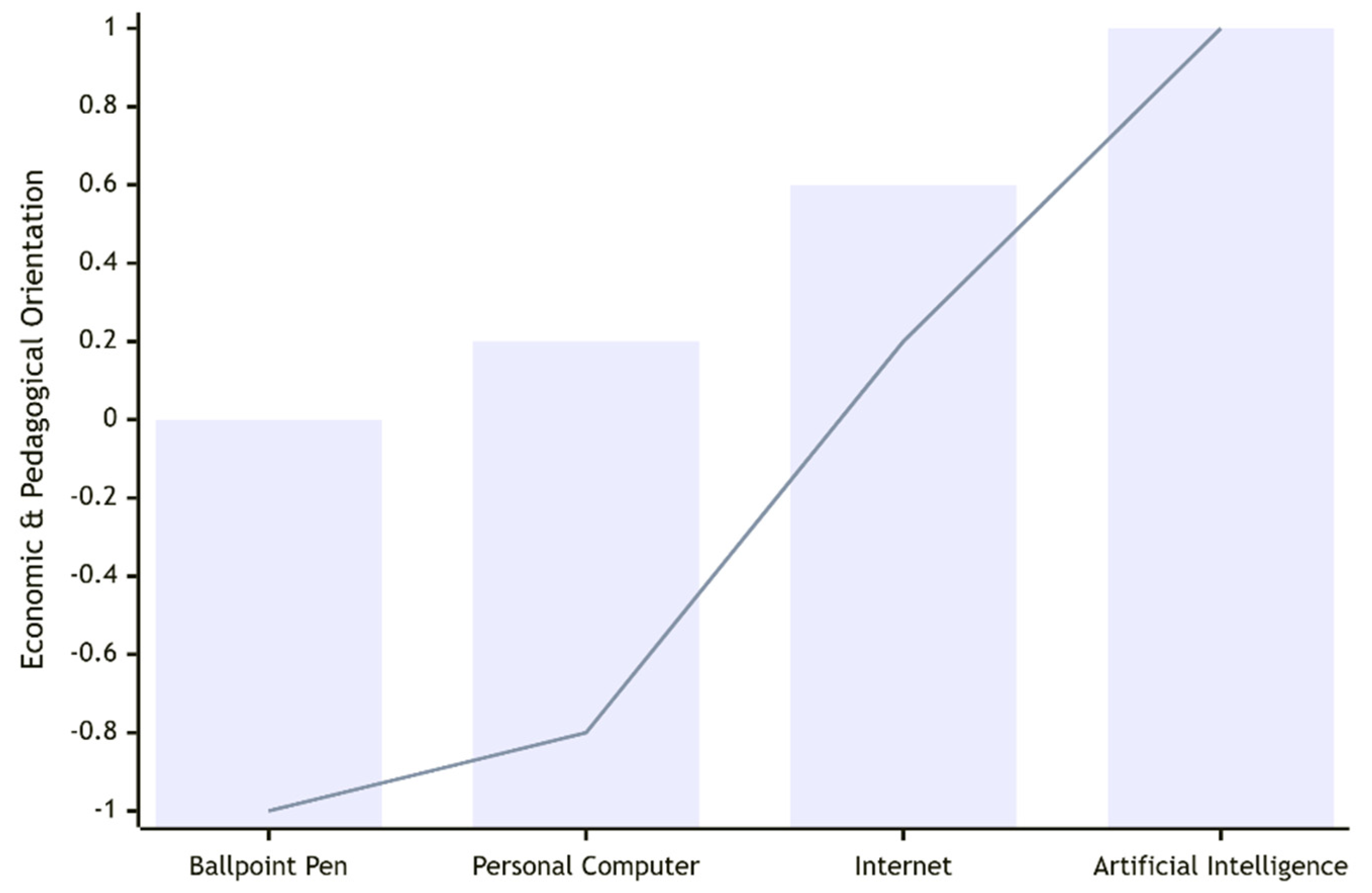
Chart Analysis: The visualization reveals two key trends:
- The Shift in Knowledge Authority (Bar Chart): There is a steady progression from the singular, fixed knowledge authority of the Pen and PC era toward the distributed and now synthetic knowledge authority of the Internet and AI. This represents the epistemological rupture.
- The Shift in Economic Rationale (Line Chart): The economic rationale for technology investment begins firmly in the realm of standardization and efficiency (negative territory for Pen/PC) and, with AI, crosses into the realm of personalization and adaptation (positive territory). This indicates that AI is fundamentally incompatible with the old economic model of education.
4.3. Historical Patterns and the “Optimization Gravity Well”
An overall pattern across time is the trend of the “Optimization Gravity Well,” an incredibly potent institutional inertia which urges technologies to serve the entrenched habits. These enduring resistive and assimilative patterns are summarised in the subsequent table.
Table 4 Analysis: The pattern is consistent: each technology faced resistance, was defended through a combination of practical and economic rationales, and had unintended consequences that became equity problems. The ‘Final Outcome’ is the key difference.
4.4. Bibliometric Framing of the AI Era
The explosive growth noted in the Introduction (Figure 1) is coupled with a rapid convergence of attention to research interests and outlets. Analyzing bibliometric material for a bibliographic method as shown in Table 5, draws upon a systematic cross-site literature review to identify key themes in current debates on AI in education.
It demonstrates that the historical data shows that institutional policy (Systemic Effects) often acts as the major brake against radical pedagogical change (Pedagogical Transformation). AI is an existential threat to how highly standardized, top-of-the-line testing; the metric system inherited from the Pen era; matters, requiring restructuring. In effect, if institutions continue to implement AI as a mere optimization mechanism (e.g., automated curriculum updates) then they might automate their educational processes without improving learning outcomes (see Figure 4 and Figure 5).
4.5. Conclusion: The Incompatibility of AI and the Old Paradigm—A Choice Point
The analysis of evidence has resulted in an essential conclusion the historical model of education as a scale and standardization-optimized system is challenged fundamentally by artificial intelligence. Nevertheless, this difficulty does not make results. Instead, it establishes a point of crisis, a point in which the institutional decisions made will determine whether AI will be a further instrument in streamlining the industrial model, or a source of real restructuring.
AI is not a more effective pen or a quicker computer in providing drills. Its generation potential facilitates customized tutoring, collaborative knowledge generation, and dynamism. However, these identical capabilities can be--and are increasingly being--primarily used in optimization modes: automating grading, creating standardized curriculum, predictive behavior tracking using analytics.
This discussion indicates that any effort to make AI completely fall into the previous paradigm would be a repeat of the change without any difference of the PCs, but possibly with higher stakes. The reorganization that we locate is not a necessity; it is an eventuality that needs an institutional agency. The next chapter presents the responses in policy and pedagogy to sail through this decision point.
Conclusion and Implications
Here this comparative historical analysis has shown that this journey from the ballpoint pen to artificial intelligence constitutes more than just a record of technological adoption; it is the story of an educational system that is almost at its limits. The path dependency of optimization, established by the pen, created a solid but rigid model of how you would move and create value. Although the internet started a critical epistemological shift that involved the decentralizing of knowledge, it was only partially successful at reconstituting this system. But artificial intelligence is not merely the next step in that evolution. It is the catalyst that reveals that the paradigm cannot be reconciled with the future, calling for nothing less than an overhaul of education’s goals, methods and metrics.
5.1. Review of Key Findings
Our empirical work, informed by a six-dimensional framework, produced three guiding principles:
- The Optimization-Restructuring Gap is There and it’s Real and It’s Measurable: The survey showed that 20th-century technologies universally score highest in terms of optimization and are valid on all dimensions, thus optimizing the present model. By contrast, AI was a restructuring force on all six axes in the comparison and the internet played the part of a transitional bridge. It is not that the assessment is subjective but a conclusion arrived at by the application of our analytical framework.
- Epistemology is the Theater of Core Struggles: The most fundamental battleground created by AI is epistemological. It moves education away from the sending and receiving of static knowledge; the model reproduced in the pen and PC; to co-creation, critical evaluation, and ethical practice of knowledge. This epistemic rupture is the redefinition of the goal of learning from knowing to contextualizing and synthesizing.
- Institutional Inertia is The Most Common Roadblock to a Change: The historical context of the ‘optimization gravity well’ reinforces that without targeted and decisive intervention, educational systems will simply revert to using new tech to reproduce existing operations. The inability to realize personal computer’s full potential as a tool for transformative power is a cautionary tale in the AI age.
5.2. Implications for Policy and Practice
Our historical analysis yields three findings with direct implications for policy and practice. Each recommendation below is explicitly linked to the analytical findings from our comparative case studies.
Three Core Findings from Historical Analysis
Finding 1: Path Dependency (Ballpoint Pen). The ballpoint pen established self-perpetuating channels of action self-standardized testing, administrative efficiency indices, that defined the further adoption of technology. Once in place, such pathways limited the range of choices in the future: subsequent technologies were being judged by the standards (scalability, cost-effectiveness, measurable results) that the very pen served to institutionalize.
Finding 2: Optimization Gravity Well (Personal Computer). Transformative potential of the PC was hijacked since the implementation was based on the current efficiency measures (test scores, workforce preparation). It had managed to make the current system quicker and more scalable; which strengthened the structures which it could have changed, change without difference.
Finding 3: Epistemological Rupture as Choice point (Internet and AI). The internet brought about an epistemological change by spreading authority over knowledge over networks, but its transformational possibility was already entrenched in institutional appropriation (e.g., LMS platforms which digitized the course management). The generative power of AI essentially puts into question the inherent assumptions of knowledge and authorship, this provides a critical place where institutions will need to either take this challenge and restructure themselves or control it by optimization.
Implications for Stakeholders
1. For Policymakers: Govern for Long-Term Trajectories, Not Short-Term Adoption
The policymakers should appreciate that the present AI investments will give rise to self-affirming channels, similar to the institutionalization of the ballpoint pen in the occurrence of standardized testing. New assessment paradigms should be required in order to be not transported to the endless technical reflections of the past. The existing accountability indicators, which include standardized test results and graduation percentages, are the products of an industrial model that AI has made inadequate. Instead, we should build competency-based models which can quantify critical thinking, collaboration with human beings, and ethical reasoning, which the PC era did not emphasize on but which AI has now made fundamental. Moreover, since AI has generative potential, systemic risks such as algorithmic bias and data privacy loss are inevitable, which requires strong ethical regulation. This constitutes setting up transparency requirements, compulsory bias audits and equity impact evaluations to any educational systems. Lastly, leaders should establish a rich equity infrastructure; history of inequality has demonstrated that being digitally connected and connected without the basis of equity merely recreates inequality.
2. For Institutional Leaders: Resist Optimization Gravity
Institutions will automatically fall into the default of optimization gravity when they allow AI to try to automate the existing and outdated processes in the organization, such as grading or curriculum generation, and repeat the PC pattern of change without a change. In response, leaders need to visibly invest in the area of pedagogical innovation by creating grants to faculty to develop AI-enhanced models that place more emphasis on project-based learning and human-AI interaction than plain administrative effectiveness. This involves changing the professional development of teachers towards more than mere technical training to pedagogical development. Educators should be ready to be moral compasses who would assist students to question AI products and review systemic biases. Concurrently, institutional accountability measures are to be updated to address the need to substitute the efficiency-based logic with adaptive learning and critical thinking measures which the optimization logic of the 20th century was unwilling to include.
3. For Educators: Embrace the Ethical Mentor Role
The epistemological break that has occurred now undermines the knowledge authority and redefines the role of the teacher; they are not becoming irrelevant; their role is radically changing. With AI synthesizing information, capabilities that humans alone have including empathy, morality, and situational judgment will become very more valuable. Teachers need to focus more on these abilities and leave the repetitious work to AI, thus recovering their time to be able to focus on profound interpersonal growth and creativity. The teacher in this new world is an advisor of AI-era and can teach students to question computer programs and consume knowledge with caution.
5.3. Concluding Reflection
The Ballpoint Pen optimized education for the industrial age. The personal computer promised a revolution but was co-opted to serve the same industrial model. The internet began to dismantle the walls of the traditional classroom. Now, artificial intelligence presents a final, compelling choice: continue to use technology to refine a breaking model, or have the courage to build a new one. The historical analysis conducted in this paper reveals that the former path leads to irrelevance and inequity. The latter, though challenging, leads to an education system that is finally adaptive, personalized, and capable of preparing learners not for the standardized past, but for a complex, co-created future. The restructuring is not on the horizon; it is already underway. The task at hand is to steer it with wisdom, ethics, and an unwavering commitment to the human elements of learning.
Funding
This research did not receive any specific grant from funding agencies in the public, commercial, or not-for-profit sectors.
Ethical approval
Not applicable.
Consent to participate
Not applicable.
Consent to publish
Not applicable.
Data Availability Statement
The datasets used and/or analysed during the current study are available from the corresponding author on reasonable request.
Acknowledgments
Not applicable.
Conflicts of Interest
The authors declare that they have no conflict of interest.
Clinical trial number
Not applicable.
Abbreviations
| Abbreviation | Full Form |
| AI | Artificial Intelligence |
| CHA | Comparative Historical Analysis |
| CAI | Computer-Assisted Instruction |
| CBT | Computer-Based Training |
| ISD | Instructional Systems Design |
| OERs | Open Educational Resources |
| MOOCs | Massive Open Online Courses |
| LMSs | Learning Management Systems |
| PC | Personal Computer |
| EdTech | Educational Technology |
| WoS | Web of Science |
| TPACK | Technological Pedagogical Content Knowledge |
| UNESCO | United Nations Educational, Scientific and Cultural Organization |
References
- Allmendinger, J. (1989). Educational systems and labor market outcomes. European Sociological Review, 5(3), 231–250.
- Bouska, K. L., De Jager, N. R., & Houser, J. N. (2022). Resisting-Accepting-Directing: Ecosystem Management Guided by an Ecological Resilience Assessment. Environmental Management, 70(3), 381–400. [CrossRef]
- Brown, G., & Foster, C. (2023). The Use of Virtual Learning Environments in Higher Education—Content, Community and Connectivism—Learning from Student Users. In H. Jahankhani, A. Jamal, G. Brown, E. Sainidis, R. Fong, & U. J. Butt (Eds.), AI, Blockchain and Self-Sovereign Identity in Higher Education (pp. 125–142). Springer Nature Switzerland. [CrossRef]
- Ceallaigh, T. J. Ó., Brien, E. O., Tømte, C., Kulaksız, T., & Connolly, C. (2025). Rethinking teacher education in an AI world: Perceptions, readiness and institutional support for generative AI integration. European Journal of Teacher Education, 0(0), 1–20. [CrossRef]
- Cuban, L. (1986). Teachers and machines: The classroom of technology since 1920. Teachers college press.
- Cuban, L. (2001). How can I fix it?: Finding solutions and managing dilemmas: An educator’s road map. Teachers College Press.
- Cuban, L., Kirkpatrick, H., & Peck, C. (2001). High access and low use of technologies in high school classrooms: Explaining an apparent paradox. American Educational Research Journal, 38(4), 813–834.
- Dhanaraj, R. K., Krishnasamy, B., Rajendran, U., Sellappan, S., & Jaikumar, R. (2025). Generative AI for Personalized Learning: Foundations, Trends, and Future Challenges. CRC Press.
- Education, U. S. N. C. on E. in. (1983). A nation at risk: The imperative for educational reform. National Commission on Excellence in Education.
- Erviana, V. Y., & Rahmawati, A. C. (2025). The Influence of 21st Century Professional Competence on the Implementation of TPACK by Elementary School Teachers in Jetis District, Yogyakarta. Proceeding Internasional Conference on Child Education, 1(1), 14–23.
- Eubanks, V. (2025). Automating inequality: How high-tech tools profile, police, and punish the poor. Macmillan+ ORM.
- Fletcher-Flinn, C. M., & Gravatt, B. (1995). The efficacy of computer assisted instruction (CAI): A meta-analysis. Journal of Educational Computing Research, 12(3), 219–241. [CrossRef]
- Foucault, M., & Kremer-Marietti, A. (1969). L’archéologie du savoir (Vol. 1). Gallimard Paris.
- Gebre-Medhin, D. L. (2025). Reluctant acceptance of legal solutions to territorial disputes as signals of foreign policy reorientation. Journal of International Relations and Development, 1–27. [CrossRef]
- Giannini, S. (2025). Reimagining the futures of education. PROSPECTS, 1–9. [CrossRef]
- Goldin, C. D., & Katz, L. F. (2008). The race between education and technology. harvard university press.
- Goodman, J. (1995). Change without difference: School restructuring in historical perspective. Harvard Educational Review, 65(1), 1–30. [CrossRef]
- Gorina, L., Gordova, M., Khristoforova, I., Sundeeva, L., & Strielkowski, W. (2023). Sustainable Education and Digitalization through the Prism of the COVID-19 Pandemic. Sustainability, 15(8), 6846. [CrossRef]
- Huey, C. E. (2025). The Influence of Storytelling in Art: Mythology and Fairytales. Mississippi College.
- Keller, E. (1997). Producing Petty Gods: Margaret Cavendish’s Critique of Experimental Science. ELH, 64(2), 447–471. [CrossRef]
- Kelly, F. J. (1916). The Kansas Silent Reading Tests. Journal of Educational Psychology, 7(2), 63.
- Kim, J., Park, S., Moukhliss, S. H., Song, K., & Koo, D. (2025). Perceptions of Artificial Intelligence (AI) in the Construction Industry Among Undergraduate Construction Management Students: Case Study—A Study of Future Leaders. [CrossRef]
- Kim, K., & Kwon, K. (2025). A systematic review of the evaluation in K-12 artificial intelligence education from 2013 to 2022. Interactive Learning Environments, 33(1), 103–131. [CrossRef]
- Kulanovic, A., Raghunatha, A., Nordensvärd, J., & Thollander, P. (2025). Analyzing discursive policy leadership using regime narratives in Sweden’s emerging drone transport for sustainability transition. Sustainable Futures, 10, 101387. [CrossRef]
- Lee, D.-C., & Chang, C.-Y. (2025). Evaluating self-directed learning competencies in digital learning environments: A meta-analysis. Education and Information Technologies, 30(6), 6847–6868. [CrossRef]
- Luckin, R. (2025). Nurturing human intelligence in the age of AI: rethinking education for the future. Development and Learning in Organizations: An International Journal, 39(1), 1–4. [CrossRef]
- Madaus, G. F., & O’Dwyer, L. M. (1999). A short history of performance assessment: Lessons learned. Phi Delta Kappan, 80(9), 688.
- Mahoney, J., & Thelen, K. (2015). Advances in comparative-historical analysis. Cambridge University Press.
- Mill, J. S. (2022). The Collected Works of John Stuart Mill. DigiCat.
- Nguyen, A., Gul, F., Dang, B., Huynh, L., & Tuunanen, T. (2025). Designing embodied generative artificial intelligence in mixed reality for active learning in higher education. Innovations in Education and Teaching International, 1–16. [CrossRef]
- Nurhayati, S., Taufikin, T., Judijanto, L., & Musa, S. (2025). Towards Effective Artificial Intelligence-Driven Learning in Indonesian Child Education: Understanding Parental Readiness, Challenges, and Policy Implications. Educational Process. International Journal, 15, 1–29. [CrossRef]
- Pallant, J. L., Blijlevens, J., Campbell, A., & Jopp, R. (2025). Mastering knowledge: The impact of generative AI on student learning outcomes. Studies in Higher Education, 1–22. [CrossRef]
- Peters, R. S. (2010). What is an educational process? In The Concept of Education (International Library of the Philosophy of Education Volume 17) (pp. 1–16). Routledge.
- Reinholz, D. L., & Andrews, T. C. (2020). Change theory and theory of change: What’s the difference anyway? International Journal of STEM Education, 7(1), 2. [CrossRef]
- Resnick, L. B., & Resnick, D. P. (1982). Testing in America: The current challenge. International Review of Applied Psychology.
- Rizun, N., Edelmann, N., Janowski, T., & Revina, A. (2025). AI-enabled co-creation for evidence-based policymaking: A conceptual model. Conference on Digital Government Research, 1. [CrossRef]
- Selwyn, N. (2011). Digitally distanced learning: A study of international distance learners’(non) use of technology. Distance Education, 32(1), 85–99.
- Singh, A., & Gupta, P. P. (2025). Perspective of Generative AI for UNESCO Inclusive Education (SSRN Scholarly Paper No. 5181859). Social Science Research Network. [CrossRef]
- Tripathi, P. (2025). Initiating an Epistemic Rupture: Exploring Contraceptive Awareness in Janhit Mein Jaari (2022) and Chhatriwali (2023). Journal of International Women’s Studies, 27(1), 11.
- Tsao, J., Heinrichs, D. H., & Camit, M. (2025). Artificial intelligence and epistemic interoperability: Towards a sympoietic approach. Discourse: Studies in the Cultural Politics of Education, 1–13. [CrossRef]
- Tyack, D., & Cuban, L. (1995). Tinkering with utopia: A century of public school reform. Cambridge, MA.
- Warschauer, M. (2003). Dissecting the” digital divide”: A case study in Egypt. The Information Society, 19(4), 297–304.
- Zha, R., Sun, Y., Qin, C., Zhang, L., Xu, T., Zhu, H., & Chen, E. (2024). Towards unified representation learning for career mobility analysis with trajectory hypergraph. ACM Transactions on Information Systems, 42(4), 1–28. [CrossRef]
Figure 1.
Publication Trend of AI/EdTech Papers (WoS) – Focus on Last Two Decades (2005-2025).
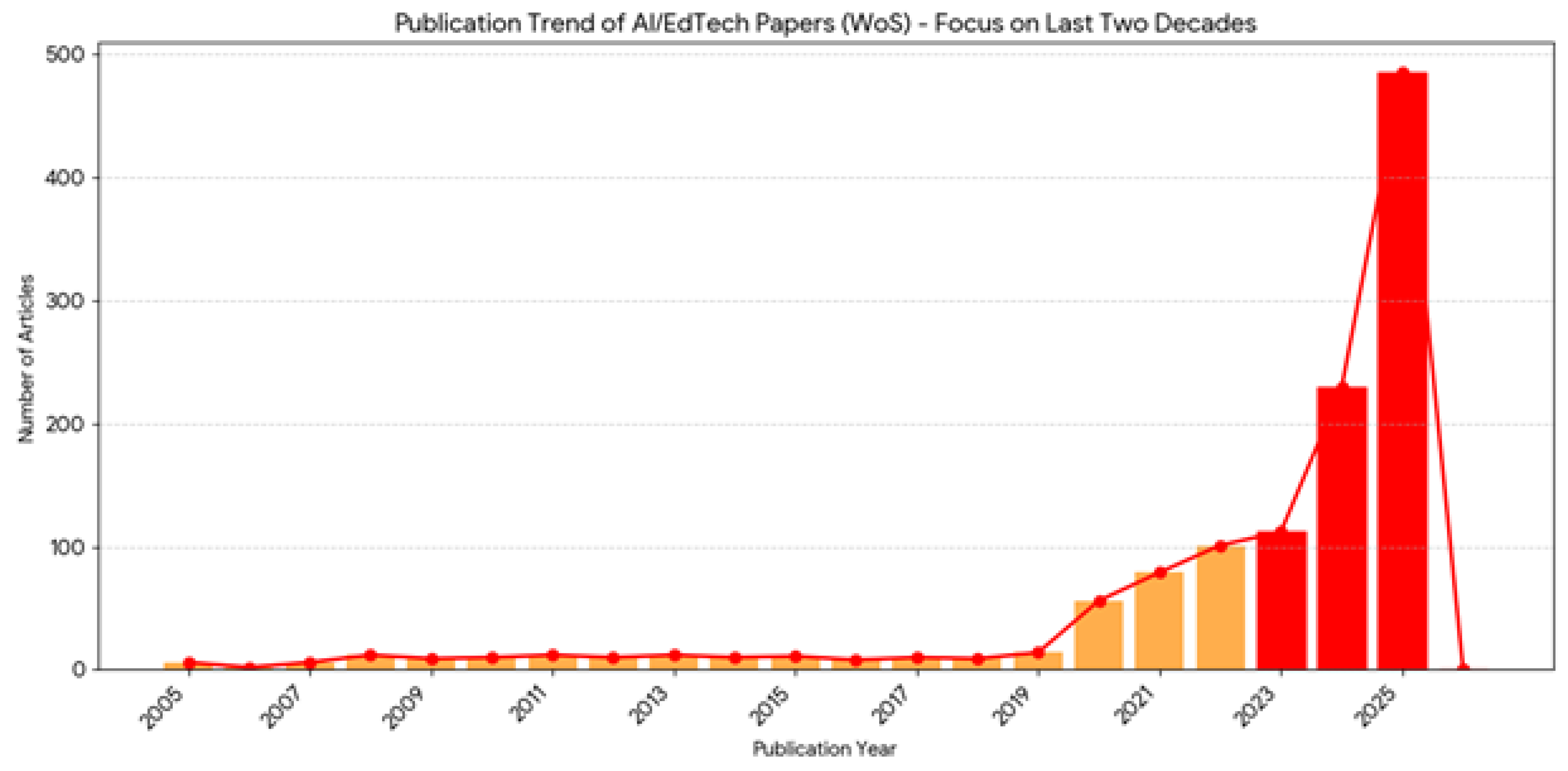
Figure 4.
Top 15 Keywords in Web of Science Titles (After Stop-Word Removal).
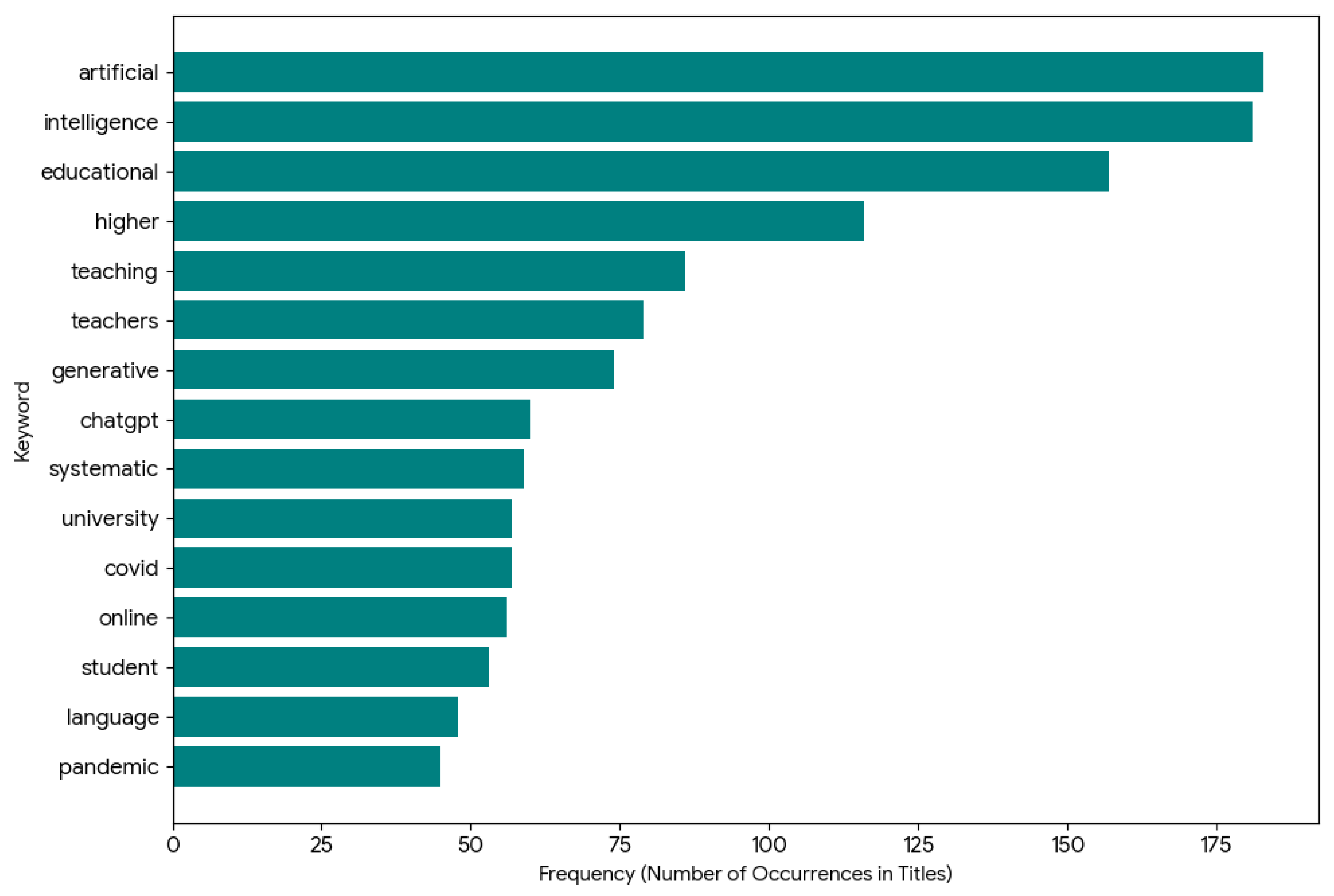
Figure 5.
Top 15 Publishing Sources for AI/EdTech Research.
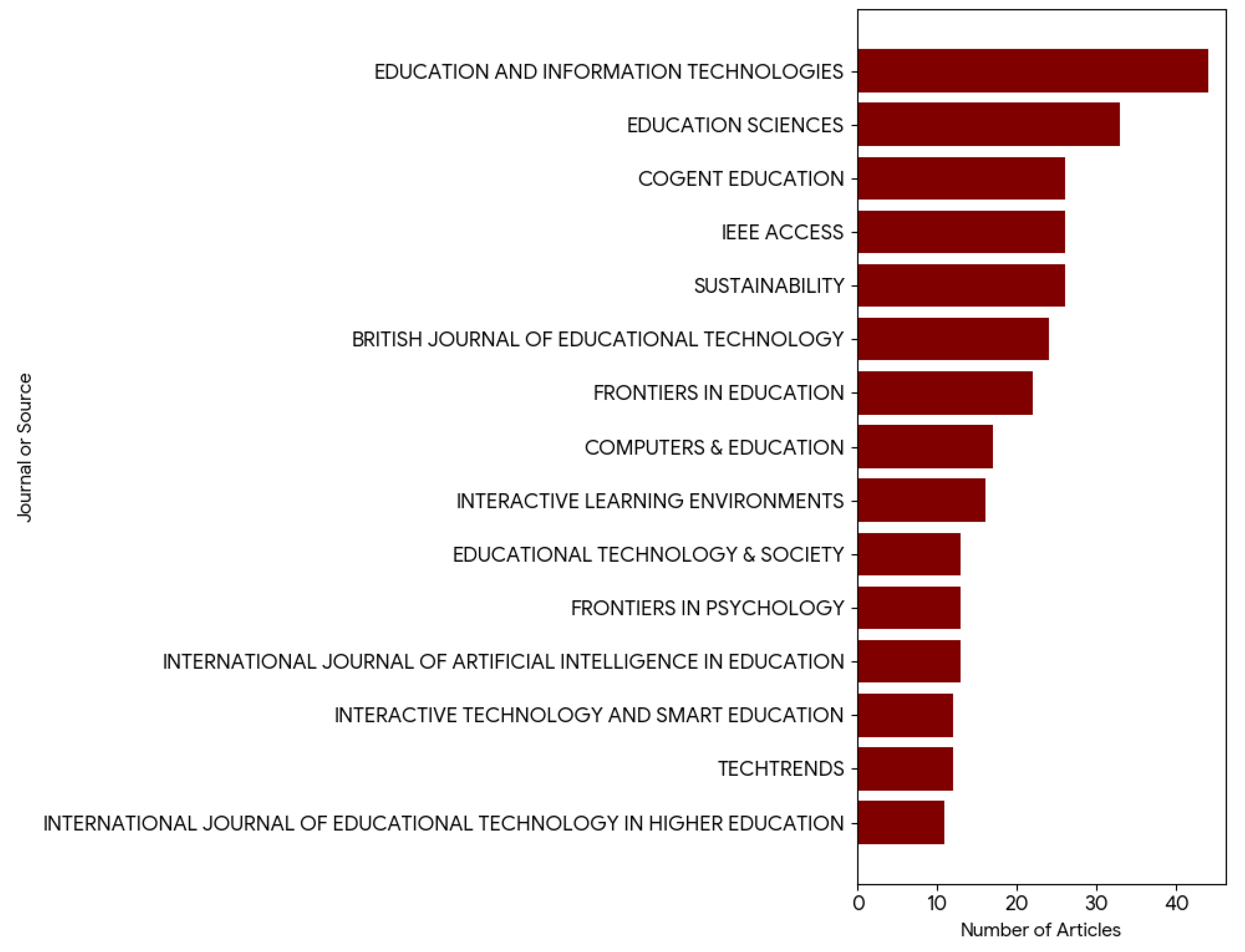

Table 1.
Comparative Analysis of Educational Technologies Across Six Dimensions.
| Dimension | Ballpoint Pen (20th C) | Personal Computer (20th C) | Internet (21st C Bridge) |
Artificial Intelligence (21st C) |
| Access & Equity | Democratization of writing tool; Universal standard for output. | Emergence of Digital Divide; access linked to efficiency metrics. | Global connectivity; access to OERs/MOOCs; geographical equity. | Personalized adaptation; risk of data surveillance/bias reinforcement. |
| Pedagogical Transformation | Supported lecture/rote learning; scalable testing. | Enabled CAI/CBT, anchored in behaviorist ISD; structured learning paths. | Connectivism; shift to collaborative, network-based learning; participatory approaches. | Real-time adaptive learning paths; generative feedback loops; shift from transmission to adaptation. |
| Epistemological Impact | Reinforced singular, fixed knowledge and objective assessment. | Knowledge remained hierarchical; retrieval focused. | Knowledge is situated in networks; authority is distributed (decentralization). | Epistemic rupture; shift to co-composition; blurred authorship and knowledge synthesis. |
| Student Agency & Role | Passive recorder/recipient in lecture hall. | Tool user; passive consumption of pre-programmed software (early CAI). | Active information seeker; digital contributor/collaborator. | Critical evaluator; co-creator/partner in knowledge production; focus on applied knowledge. |
| Teacher Role & Identity | Maintainer of standardization; scalable assessor of fixed outputs. | Instructional designer; manager of technology infrastructure; trainer. | Curator of digital resources; facilitator of online interaction; network architect. | Ethical mentor; human contextualizer; analyst of AI-driven insights; focusing on empathy/care. |
| Institutional & Systemic Effects | Enabled standardization of testing and administrative efficiency (Optimization). | Justified by efficiency/productivity goals; reinforced existing systems (Optimization). | Globalized education market; mandated digital skills policy. | Demands new governance (Responsible AI); necessity for system redesign focused on adaptation (Restructuring). |
Table 2.
Historical Patterns of Resistance and Assimilation.
| Pattern Type | Ballpoint Pen | Personal Computer | Internet |
Artificial Intelligence |
| Initial Resistance Focus | Writing quality/legibility; institutional inertia regarding new tools. | Cost, infrastructure failure, screen time, behavioral distraction. | Information reliability; digital distraction; plagiarism risk. | Fear of cheating; job displacement; loss of human interaction. |
| Normalization Rationale | Universal accessibility; affordability; administrative reliability. | Skill development mandates; administrative efficiency metrics. | Essential for 21st-century workforce skills; global connectivity. | Necessity for hyper-personalization; critical evaluation skills; ethical responsibility. |
| Assimilation Outcome | Standardization of assessment (Optimization). | Digital efficiency and administrative tracking (Optimization). | Decentralization of knowledge/Resource Access (Partial Restructuring). | Fundamental redefinition of knowledge and authorship (Epistemological Rupture). |
Table 3.
Primary Impact Analysis of Educational Technologies.
| Dimension | Ballpoint Pen (20th C) |
Personal Computer (20th C) |
Internet (21st C Bridge) |
Artificial Intelligence (21st C) |
| Access & Equity | O: Democratized tool access | O: Created Digital Divide | O/R: Connectivity Divide & OERs | R/O: Hyper-personalization vs. data bias/automation of inequity |
| Pedagogical Transformation | O: Supported rote learning | O: CAI & drill exercises | R: Connectivism & collaboration | R/O: Real-time adaptive paths vs. automated content delivery |
| Epistemological Impact | O: Fixed, transmitted knowledge | O: Hierarchical, retrieved knowledge | R: Decentralized, networked knowledge | R: Co-composed, synthetic knowledge (epistemic rupture) |
| Student Agency & Role | O: Passive recipient | O: User of pre-programmed software | R: Active seeker & collaborator | R/O: Critical evaluator/co-creator vs. passive AI consumer |
| Teacher Role & Identity | O: Scalable assessor | O: Technology manager & designer | R: Curator & facilitator | R/O: Ethical mentor/contextualizer vs. process automator |
| Institutional & Systemic Effects | O: Standardized testing & admin | O: Efficiency & workforce metrics | O/R: Scalable MOOCs & digital policy | R/O: Demands new ethical governance vs. algorithmic management |
| Note: O = Primary impact is optimization of existing systems; R = Primary impact enables/requires restructuring; R/O indicates the technology contains both potentials, with outcomes depending on institutional choices. | ||||
Table 4.
Historical Patterns of Technological Assimilation in Education.
| Pattern | Ballpoint Pen | Personal Computer | Internet | Artificial Intelligence |
| Initial Resistance | Decline of penmanship; cost | Cost; distraction; “edutainment” | Plagiarism; digital distraction | Cheating; job displacement; bias |
| Assimilation Rationale | Administrative reliability & scalability | Workforce skills; efficiency gains | 21st-century skills; global access | Hyper-personalization; necessity for future skills |
| Unintended Consequence | Entrenched standardized testing | The Digital Divide | The Connectivity Divide | Algorithmic bias; data surveillance |
| Final Outcome | Optimized standardization | Optimized digital efficiency | Partially Restructured knowledge access | Forcing Restructuring of core paradigms |
Note: The gravity well remained steady for the Pen and PC, which was why optimization was performed. The Internet started to strain it. AI is breaking into the above cycle because of its nature. It is impossible, once it does not change the system itself, to completely assimilate with things.
Table 5.
Historical Patterns of Technological Assimilation in Education.
| Parameter | Details |
| Search Database | Web of Science (WoS) Core Collection |
| Search String (TS) | ((“artificial intelligence” OR “AI” OR “generative AI” OR “machine learning”) AND (“education” OR “learn” OR “teach” OR “student” OR “pedagog*”)) |
| Timespan | 2005–2025 (Inclusive) |
| Document Types | Articles, Review Papers |
| Citation Indexes | SCI-EXPANDED, SSCI, A&HCI, ESCI |
| Date of Search | October 15, 2025 |
Disclaimer/Publisher’s Note: The statements, opinions and data contained in all publications are solely those of the individual author(s) and contributor(s) and not of MDPI and/or the editor(s). MDPI and/or the editor(s) disclaim responsibility for any injury to people or property resulting from any ideas, methods, instructions or products referred to in the content. |
© 2026 by the authors. Licensee MDPI, Basel, Switzerland. This article is an open access article distributed under the terms and conditions of the Creative Commons Attribution (CC BY) license (http://creativecommons.org/licenses/by/4.0/).
Copyright: This open access article is published under a Creative Commons CC BY 4.0 license, which permit the free download, distribution, and reuse, provided that the author and preprint are cited in any reuse.


