

Submitted:
20 November 2025
Posted:
21 November 2025
You are already at the latest version
Abstract
ABO3 perovskite oxides are a versatile class of materials whose surfaces and interfaces play essential roles in sustainable energy technologies, including catalysis, solid oxide fuel and electrolysis cells, thermoelectrics, and energy-relevant oxide electronics. The interplay between point defects and surface reconstructions strongly affects interfacial stability, charge transport, and catalytic activity under operating conditions. This review summarizes recent progress in understanding how oxygen vacancies, cation nonstoichiometry, and electronic defects couple to atomic-scale surface rearrangements in representative perovskite systems. We first revisit Tasker’s classification of ionic surfaces and clarify how defect chemistry provides compensation mechanisms that stabilize otherwise polar or metastable terminations. We then discuss experimental and theoretical insights into defect-mediated reconstructions on perovskite surfaces and how they influence the performance of energy conversion devices. Finally, we conclude with a perspective on design strategies that leverage defect engineering and surface control to enhance functionality in energy applications, aiming to connect fundamental surface science with practical materials solutions for the transition to sustainable energy.
Keywords:
epitaxial thin films
; ABO3 perovskite oxides
; surface reconstruction
; surface stabilization
; oxygen vacancies
; cation stoichiometry
; sustainable energy applications
1. Introduction
To meet global sustainability goals, much effort focuses on developing materials that can efficiently convert, store, and transport energy in harsh chemical and thermal environments [1,2,3,4]. Complex oxides, particularly ABO3 perovskites, are central to this effort. Owing to their chemical flexibility, electronic tunability, and thermal robustness, ABO3 perovskites are used in a wide range of energy technologies, including solid oxide fuel and electrolysis cells, photoelectrocatalysis, thermoelectrics, and energy-relevant oxide electronics [4,5,6,7,8,9,10]. Functional responses depend not only on bulk chemistry but also on the atomic-scale structure and stoichiometry at surfaces and interfaces, where broken coordination creates new structural and electronic states.
At such surfaces and interfaces, point defects (e.g., oxygen vacancies, cation nonstoichiometry, electronic carriers) and surface reconstructions are not merely imperfections but critically determine material stability and functionality. For instance, oxygen vacancies at surfaces strongly influence oxygen exchange kinetics in solid oxide fuel cells [7,11], redox chemistry in photoelectrocatalysis [12,13], and band alignment in oxide heterojunctions [14,15]. Similarly, surface reconstructions can stabilize polar terminations, modulate electronic transport, and create catalytically active sites [16]. Compared with bulk oxides, our understanding of surfaces has advanced more slowly, owing to the difficulty of preparing well-controlled single-crystal terminations. Recent advances in pulsed-laser deposition (PLD) [17,18,19,20] and molecular-beam epitaxy (MBE) [21,22,23,24,25] now provide atomically precise epitaxial templates, enabling systematic study and control of oxide surfaces.
Along the <001> directions, ABO3 perovskites contain alternating AO and BO2 planes. Depending on the valence states of A and B-site cations, surfaces can be polar with charged (AO)+ or (AO)- and (BO2)- or (BO2)+ layers or non-polar with neutral (AO)0 and (BO2)0 layers. Ideally, cut surfaces of ABO3 are generally energetically unstable as bond breaking at the surface incurs a high surface energy [26]. Polar terminations are especially unstable due to a non-zero repeat-unit dipole. Consequently, oxide surfaces undergo relaxation, rumpling, and reconstruction to minimize surface energy and achieve stabilization [27]. Reconstructions, in particular, change surface periodicity, symmetry, and stoichiometry relative to the bulk, and therefore strongly govern functional properties.
Surface reconstructions in ABO3 oxides depend sensitively on preparation conditions such as chemical etching and annealing. Buffered hydrofluoric acid (BHF) etching with post-annealing is widely used to create an atomically ordered surface on single crystal oxide substrates [28], such as SrTiO3 (STO) and LaAlO3 (LAO). However, diverse reconstructions still emerge as a function of temperature and oxygen partial pressure (pO2) [29,30,31]. For TiO2-terminated STO (001), for example, reconstruction phase fields correlate strongly with temperature and pO2 [32].
Nevertheless, the influence of these factors on the surface reconstructions in perovskite oxides remains controversial. Such controversies mainly originate from insufficient consideration of surface cation and oxygen nonstoichiometry. Stoichiometric changes are central to polar compensation and surface stabilization. Modulating the A/B cation ratio can redistribute plane charges and neutralize dipoles on polar surfaces [33], while temperature and pO2 control the surface oxygen chemical potential, yielding families of reconstructions through oxygen nonstoichiometry [34]. Because polar terminations are intrinsically prone to compensation, their reconstructions are often highly sensitive and metastable, leaving open questions about structure–property relationships under realistic environments.
Here, we focus on how cation and oxygen nonstoichiometry control surface reconstructions in epitaxial ABO3 thin films and their impact on sustainable energy technologies. We begin with general principles for oxide surfaces and reconstruction mechanisms, then review representative systems: titanates, aluminates, cobaltates, manganites, vanadates, and stannates to show how stoichiometric variations dictate surface structures. We conclude with perspectives on leveraging defect–reconstruction coupling with epitaxy and strain to design energy-relevant oxide surfaces. Topics such as detailed termination control and polarity classification have been reviewed elsewhere and are not the focus here [35,36,37,38]. By explicitly connecting atomic-scale phenomena with energy applications, we aim to provide a framework for translating surface science into practical materials solutions for the global transition to sustainable energy.
2. Properties of Oxide Surfaces
According to the classical surface model proposed by Tasker [39], oxide surfaces are classified into three types based on the net charge (Q) of planes parallel to the surface and the dipole moment (μ) of a neutral repeat unit perpendicular to the surface (Figure 1). Type-1 (non-polar) surfaces consist of neutral planes (Q = 0), and therefore have μ = 0. Type-2 (quadrupolar) surfaces consist of charged planes (Q ≠ 0) that can be grouped into a mirror-symmetric three-plane repeat unit, for example (–q, +2q, –q), so that μ = 0 and no long-range dipole forms. Type-3 (polar) surfaces consist of alternating positively and negatively charged planes, for example (+q, –q), yielding μ ≠ 0 and, in the ideal ionic limit, a diverging electrostatic energy unless compensated by reconstruction, electronic charge rearrangement, or defects.
The surface energies of Type-1 and Type-2 terminations are typically much lower than those of Type-3 terminations. However, polar surfaces can be stabilized by modifying the charge or stoichiometry of the outermost layers relative to the bulk [36]. For example, deviations of the surface composition from bulk stoichiometry can compensate excess or deficient surface charge via structural reconstruction, while nominally stoichiometric polar surfaces may be stabilized by electronic charge redistribution driven by the built-in electrostatic field. Because polar perovskite surfaces are highly unstable and reactive, adsorption of atoms or ions can also provide charge compensation. In energy-related oxides, these different compensation mechanisms determine which surface terminations are accessible under operating conditions and, in turn, influence surface activity and interfacial charge transport in devices.
In principle, cleaving a crystal along any crystallographic plane yields an ideal termination preserving bulk atomic positions. In practice, only selected cleavage planes result in stable surfaces. For example, certain orientations, such as (111) surfaces of perovskite oxides, are polar, and thus exhibit high surface energies [40]. The number and type of cation–oxygen bonds also influence surface stability. Breaking these bonds generates forces that displace atoms from their ideal bulk positions, resulting in structural distortions, commonly described as relaxation, rumpling, and reconstruction (Figure 2) [27].
All of these distortions are driven by surface energy minimization. Relaxation modifies the interlayer spacing of near-surface layers. Rumpling occurs when cations and anions in the same plane are displaced in opposite directions normal to the surface, driven by different electrostatic forces. Both relaxation and rumpling change interatomic distances but preserve the bulk periodicity. In contrast, reconstruction produces a new periodicity and often a modified stoichiometry relative to the bulk. Reconstructions are especially prevalent in ABO3 perovskites and can extend several unit cells (up to ~10 layers) into the subsurface. Because reactions and transport in many energy devices are governed within a few nanometers of the surface [41,42,43,44], such reconstructions can strongly affect local electronic structure, adsorption energetics, and ion exchange pathways.
3. Influence of Cation and Oxygen Nonstoichiometry on Surface Reconstructions of Perovskite Oxides
Oxygen nonstoichiometry provides a powerful degree of freedom for tuning the structural and functional properties of perovskite oxides. Since no oxide surface is ideally infinite or defect-free, oxygen vacancies are prevalent and often dominate surface chemistry. In ABO3 perovskites, oxygen vacancies are key point defects that strongly influence structural, electronic, optical, and electrochemical behavior [45,46,47,48,49]. Ordered arrangements of surface oxygen vacancies can serve as charge compensating configurations and directly drive surface reconstructions [50]. Oxygen vacancies also modify the surface electronic structure, which in turn affects surface polarity and stability [51].
Cation nonstoichiometry plays an equally important role. Unlike oxygen defects, which can often be annihilated or replenished by O2 annealing, deviations in cation stoichiometry are much more difficult to compensate in perovskites. Small cation deviations may be accommodated by point defects such as cation vacancies, whereas larger deviations commonly generate extended defects or even new surface phases [52,53,54]. Film growth conditions, such as temperature, pO2, and cation flux, govern cation nonstoichiometry, and certain A-site cations (e.g., Sr2+, Ba2+, Pb2+) are particularly prone to segregate to the surface, modulating termination and thereby inducing reconstruction [55]. For example, La1-xSrxMnO3 (LSM) often exhibits surface Sr enrichment that modifies the near-surface stoichiometry and induces new reconstruction phases. Similarly, adjusting the Ti/Sr ratio in STO (110) surfaces yields different reconstructions and terminations [33]. Although cation nonstoichiometry is frequently invoked to stabilize polar surfaces, it can also alter reconstructions even on nominally non-polar terminations.
Thus, oxygen and cation nonstoichiometry should be understood and controlled jointly to manipulate surface behavior and stability in ABO3 oxides. In practice, oxygen vacancy concentration and cation ratios can be tuned by thermal treatments and epitaxial growth parameters such as temperature, laser fluence, and pO2, enabling access to a wide variety of reconstructions and terminations. In the following subsections, the effects of stoichiometric control on surface reconstructions are discussed for representative perovskite oxide systems that are particularly relevant to renewable energy applications.
3.1. Titanate Surfaces
Titanate perovskites, especially STO, are widely used as photocatalysts [56,57,58], dielectrics [59,60,61] and oxide electronic platforms, and substrates for complex-oxide heterostructures [62,63,64,65,66,67]. In these contexts, control over oxygen vacancies and cation stoichiometry is essential for optimizing light absorption, charge separation, and interfacial stability.
On STO (001), oxygen nonstoichiometry and A-site volatility couple strongly to surface reconstructions. BHF etching followed by thermal annealing is commonly used to obtain TiO2-terminated (001) surfaces. A recent study demonstrated that (2×2) reconstructions on STO (001) can also be stabilized through pO2-controlled CO2-laser annealing at ~1300 °C without BHF etching over a pO2 range of 7.5×10⁻³ to 7.5×10⁻² Torr [68]. Homoepitaxial STO films grown on these substrates inherit the same reconstruction, indicating that high-temperature annealing promotes TiO2 terminations due to preferential SrO sublimation. Comparison with O2-annealed (√13×√13) R33.7°-reconstructed surfaces [31] suggests that laser-annealed STO (001) exhibits strong Sr enrichment at or near the surface. Subsequent homoepitaxial growth at pO2 = 7.5×10⁻² Torr clarified the evolution from (√13×√13) R33.7° to (2×2) reconstructions with increasing Sr excess [69]. Above a critical thickness (~38 nm), rock-salt-type SrO double-layer islands form, creating SrO-rich domains embedded in a TiO2-terminated matrix and establishing a direct link between Sr nonstoichiometry and the (2×2) reconstruction (Figure 3).
Compared to STO (001), the polar STO (011) and STO (111) surfaces exhibit a different balance between oxygen vacancies and cation rearrangements. On STO (011), homoepitaxial growth under ultra-high vacuum on Nb-doped substrates preserves a well-defined (4×1) reconstruction while continuously generating oxygen vacancies [70]. In this regime, oxygen supplied from subsurface layers feeds the growing film, and the reconstructed surface acts as a reservoir for vacancy formation (Figure 4). Thermally stimulated depolarization current measurements and density functional theory (DFT) calculations indicate that STO (011) hosts a higher oxygen vacancy concentration than the (001) and (111) surfaces, consistent with a TiO-terminated topmost layer [71]. On STO (110), varying surface cation coverage yields two distinct reconstruction families, (n×1) and (2×n), that can be reversibly tuned by selectively depositing Ti or Sr followed by annealing [72]. Increasing Ti coverage drives a transition from (n×1) to (2×n) structures associated with a Ti-rich overlayer whose local coordination evolves from corner-sharing tetrahedra to edge-sharing octahedra as packing density increases. Modulating laser fluence during PLD growth provides an additional handle on the A/B-site ratio. Ti-rich films grown at high fluence exhibit (2×4) reconstructions and surface roughening, whereas Sr-enriched films obtained at low fluence favor mixtures of (n×1) structures [73].
On STO (111), a series of reconstructions, including (2×2), (3×3), (4×4), (√7×√7) R19.1°, and (√13×√13) R13.9°, emerges as a function of annealing temperature and pO2 [34]. Transitions among these reconstructions correlate with changes in TiO2 enrichment, with higher annealing temperatures producing surfaces with lower TiO2 excess [34]. DFT and scanning tunneling microscopy (STM) identified the atomic structures of the (√7×√7) R19.1° and (√13×√13) R13.9° reconstructions as single-layer TiO2 terminations containing fewer excess TiO2 units than earlier (2×2) models [74]. These single-layer terminations, in contrast to the TiO2 double-layer reconstructions on STO (001), indicate that Sr depletion and the resulting cation vacancies stabilize low–excess-TiO2 configurations on STO (111).
Overall, titanate surfaces demonstrate how coupled oxygen and cation nonstoichiometry generate families of reconstructions, (√13×√13), (2×2), (n×1), (2×n), and related motifs, that act as polarity-compensating structures. These reconstructions, in turn, control interfacial electronic states, defect reservoirs, and chemical reactivity, making stoichiometric engineering a central design strategy for titanate-based photocatalysts and oxide-electronic interfaces.
3.2. Aluminate Surfaces
Aluminates, such as LAO, are central to polar oxide heterointerfaces, where defect–reconstruction coupling governs electronic conductivity and interfacial confinement [63,75]. These effects are increasingly exploited in transparent conducting oxides and oxide electronics with potential roles in sustainable energy and information technologies.
On LAO (001), both cation and oxygen nonstoichiometry participate in polarity compensation. Atomically flat, singly AlO2-terminated surfaces can be produced by high-temperature annealing followed by deionized-water leaching, which dissolves La-rich species and yields a uniform AlO2 termination that remains stable during thin-film growth [76]. As shown in Figure 5, cross-sectional high-angle annular dark-field scanning transmission electron microscopy (HAADF-STEM) of an SrRuO3/LAO (001) heterostructure reveals the RuO2–SrO–AlO2–LaO stacking sequence across the interface and a one-unit-cell surface step, confirming an AlO2-terminated LAO (001) substrate and an atomically sharp interface. Coaxial impact-collision ion scattering spectroscopy on water-leached LAO (001) further indicates that ≥120 min leaching yields a singly AlO2-terminated surface (normalized La:Al ≈ 1:105), whereas a 1-min leached surface loses single termination upon 700 °C annealing. Thus, extended leaching provides a robust, growth-relevant termination [76]. Aberration-corrected TEM combined with DFT also shows that La–O-terminated reconstructions can also be energetically favorable over a wide range of oxygen chemical potentials. In those structures, La vacancies in the top La–O layer compensate the polar charge, and a (√2×√2) R45° (LaO)1/2 model emerges as a particularly stable configuration [77].
For other orientations, such as LAO (011), the balance between surface polarity and cation nonstoichiometry leads to distinct reconstructions. After annealing at 1050 – 1250 °C in dry oxygen, an Al-terminated (2×1) structure is observed on LAO (011), whereas LAO (111) does not exhibit the same reconstruction [78]. Earlier work reported a (3×1) reconstruction on LAO (011) [79], suggesting that multiple Al-rich compensation structures are accessible depending on thermal history. X-ray photoelectron spectroscopy (XPS) indicates additional AlOx components on the (011)-terminated surface and significant Al enrichment on LAO (111), again pointing to cation nonstoichiometry as a primary compensation mechanism for polar aluminates.
Collectively, aluminate surfaces show that subtle variations in A-site occupancy and oxygen content stabilize different reconstructions and terminations, which in turn influence band alignment, interfacial conductivity, and growth templates for subsequent perovskite layers. Precise control of La/Al ratios and oxygen chemical potential is therefore crucial for engineering LAO-based heterostructures for oxide electronics and energy applications.
3.3. Cobaltate Surfaces
Cobaltate perovskites, such as LaCoO3 (LCO) and (La,Sr)CoO3 (LSC), are leading candidates for oxygen evolution and reduction electrocatalysts in solid oxide fuel cells and electrolysis cells [80,81,82,83,84,85,86,87]. Their surface reconstructions, driven by oxygen nonstoichiometry and cation redistribution, directly impact catalytic turnover frequencies and long-term stability in oxidizing and reducing environments [88,89,90,91].
In cobaltates, oxygen vacancies can be generated by reduction of Co3+ to Co2+ (LCO) or by substitution of Sr2+ for La3+ (LSC), with each oxygen vacancy acting as a doubly charged defect in Kröger–Vink notation. Atomistic simulations predict that, for LCO and LSC, families of (2n×1) reconstructions (n = 1–5) are more stable than simpler (√2×√2) structures on the (001), (011), and (111) surfaces [90]. This is consistent with experimental observations on epitaxial LCO (111) thin films [92]. For (001) surfaces, the most stable terminations were identified as O–Co–O (LCO) and O–La (LSC), with oxygen vacancies located between Co2+/Sr2+ cations in the first and third layers. Photoemission measurements on LCO (001) reported O–Co–O termination [93], in good agreement with these predictions. For (011) surfaces of LCO/LSC, the most stable structure was an O-terminated surface with two Co2+/Sr2+ cations in the second layer and an oxygen vacancy in the first layer. For (111) surfaces, the lowest-energy terminations were a Co-terminated surface for LCO and a La–O–O–O–terminated surface (LaOOO) for LSC.
Experimentally, surface-sensitive probes corroborate this picture and highlight pronounced A-site segregation in Sr-containing cobaltates. Low-energy ion scattering (LEIS), XPS, and coherent Bragg rod analysis (COBRA) on LSC films reveal Sr-rich surface layers after high-temperature treatment [88,89,91,94]. As shown in Figure 6, LEIS depth profiles for an as-deposited LSC film and for films annealed at 600 °C for 1 h and 16 h reveal a Sr-enriched, Co-depleted termination that persists after annealing, indicating that the Sr-rich surface is stable under these oxidizing conditions [91]. COBRA revealed that the top perovskite layer of LSC films can have an A-site Sr fraction of ~60 %, and that discrete particles epitaxially grown on the film surface may approach a SrCoO3-δ–like composition, with their outermost regions covered by electrochemically less active Sr-rich phases [88]. DFT calculations found that the most stable LSC (001) surface is an AO-terminated layer containing approximately 75 % Sr on the A site, and that an AO surface with 100 % Sr can become stable at sufficiently high oxygen chemical potentials [42].
These defect-driven reconstructions directly influence the activity and durability of the oxygen reduction and oxygen evolution reactions. Sr-rich, vacancy-stabilized surfaces can initially enhance oxygen exchange by providing mobile oxygen species and active Co sites, but they also promote the formation of secondary Sr-rich phases and passivating overlayers under prolonged operation. As a result, controlling the balance between surface Sr enrichment, oxygen vacancy concentration, and reconstruction type is critical for designing cobaltate electrodes with both high activity and long-term stability in fuel cell and electrolysis environments.
3.4. Manganite Surfaces
Manganite perovskites such as LaMnO3 and LSM are widely used as solid oxide cell cathodes and in solar thermochemical redox cycles. Their ability to accommodate oxygen defects and surface reconstructions governs oxygen exchange kinetics and, consequently, device efficiency in clean fuel generation and electrochemical energy conversion [44,95,96,97,98].
In LSM, surface Sr enrichment is a prominent manifestation of cation nonstoichiometry. DFT calculations for LSM with x = 0.25 show that, under reducing conditions, Sr-enriched surfaces become thermodynamically favored and lead to partial SrO terminations in which a SrO layer only partially covers the underlying MnO2 [99]. This stabilization is attributed to an increased formation of positively charged oxygen vacancies at the surface, which are locally charge-compensated by Sr2+. Experimental studies on epitaxial LSM (Sr = 0.3) films grown on STO (001) substrates confirm surface Sr segregation using LEIS and XPS [100], directly linking A-site nonstoichiometry to modified surface terminations and reconstructions.
Beyond Sr enrichment, variations in the A/B-site ratio can drive rich reconstruction behavior on polar manganite surfaces. For epitaxial LSM (Sr = 0.2) films grown on STO (011), LEIS, XPS, and STM reveal a sequence of reconstructions as the La/Mn ratio is tuned [101]. La-rich surfaces exhibit a (1×1) reconstruction, while increasing Mn content leads to phase separation and the emergence of (n×2) reconstructions. Further Mn enrichment produces characteristic “fishbone” morphologies and ultimately a (2×1) reconstruction without phase separation (Figure 7). These structures are interpreted as polarity-compensating arrangements on LSM (011), stabilized by cation nonstoichiometry and associated oxygen defects, and they demonstrate how tuning the A/B ratio can systematically navigate between La-rich and Mn-rich reconstructions.
Oxygen nonstoichiometry independently modulates surface structure in manganites. For epitaxial La5/8Ca3/8MnO3 (LCM) films grown on STO (001) by PLD, changing the oxygen pressure during growth from 50 to 20 mTorr transforms a relatively disordered surface with a large fraction of A-site termination into a nearly atomically ordered surface with a larger B-site fraction [102]. At 50 mTorr, a (√2×√2) R45° reconstruction dominates, whereas at 20 mTorr a mixed reconstruction combining (√2×√2) R45° and (1×1) structures appears. Subsequent analysis associates the (√2×√2) R45° reconstruction with (La,Ca)O-terminated regions and the (1×1) reconstruction with MnO2-terminated regions, accompanied by Ca enrichment in the top MnO2 layer (Figure 8). These results emphasize that pO2-dependent changes in Mn mobility and vacancy formation can reconfigure both termination and reconstruction on LCM surfaces.
Taken together, manganites show how coupled oxygen and cation nonstoichiometry produce a spectrum of polarity-compensating reconstructions through Sr segregation, La/Mn ratio tuning, and oxygen pressure control, that strongly influence oxygen exchange kinetics and cathode degradation. Rational cathode design therefore requires explicit consideration of nonstoichiometry-driven surface reconstructions, not just bulk composition.
3.5. Other Systems: Vanadate and Stannate Surfaces
Beyond canonical titanates, aluminates, cobaltates, and manganites, emerging perovskite systems such as SrVO3 (SVO) and BaSnO3 (BSO) offer additional opportunities to study and exploit nonstoichiometry-driven surface reconstructions [103,104,105]. These materials are of growing interest as conducting electrodes, transparent conductors, and high-mobility oxide semiconductors in energy and electronic applications [106,107,108,109].
For SVO, oxygen nonstoichiometry and film thickness strongly influence surface reconstructions and terminations. Epitaxial SVO films grown on Nb-doped STO (001) exhibit a (√2×√2) R45° reconstructed surface associated with a VO2-terminated top layer bearing ~50% apical-oxygen coverage (a VO2.5-like termination) [110]. Using an Sr2V2O7 target supplies additional oxygen during growth and enables apical-O adsorption on the VO2 layer. As shown in Figure 9, STM resolves the (√2×√2) lattice, and angle-dependent photoemission indicates an enhanced V5+ fraction at the surface, consistent with partial oxidation in the VO2.5-like termination. In ultrathin SVO films (3–5.7 nm) grown on reconstructed STO (001) substrates, STM and scanning tunneling spectroscopy reveal the coexistence of (√2×√2) R45° and (√5×√5) R26.6° reconstructions for thicknesses below ~3.8 nm, while thicker films (5.7 nm) exhibit predominantly the (√5×√5) R26.6° structure [46]. These observations point to interfacial oxygen vacancies and thickness-dependent screening as key factors stabilizing different reconstruction motifs. Additional studies show a reduction in vanadium oxidation state within the first few unit cells near the film/substrate interface, implying significant oxygen vacancy concentrations that likely underpin the vacancy-induced reconstructions [111]. More recently, hybrid MBE using volatile metalorganic precursors has enabled growth of stoichiometric SVO films on (LaAlO3)0.3(Sr2TaAlO6)0.7 (LSAT) (001) with well-defined (2×2) reconstructions [112,113], highlighting the role of controlled oxygen and cation fluxes in tailoring surface structure.
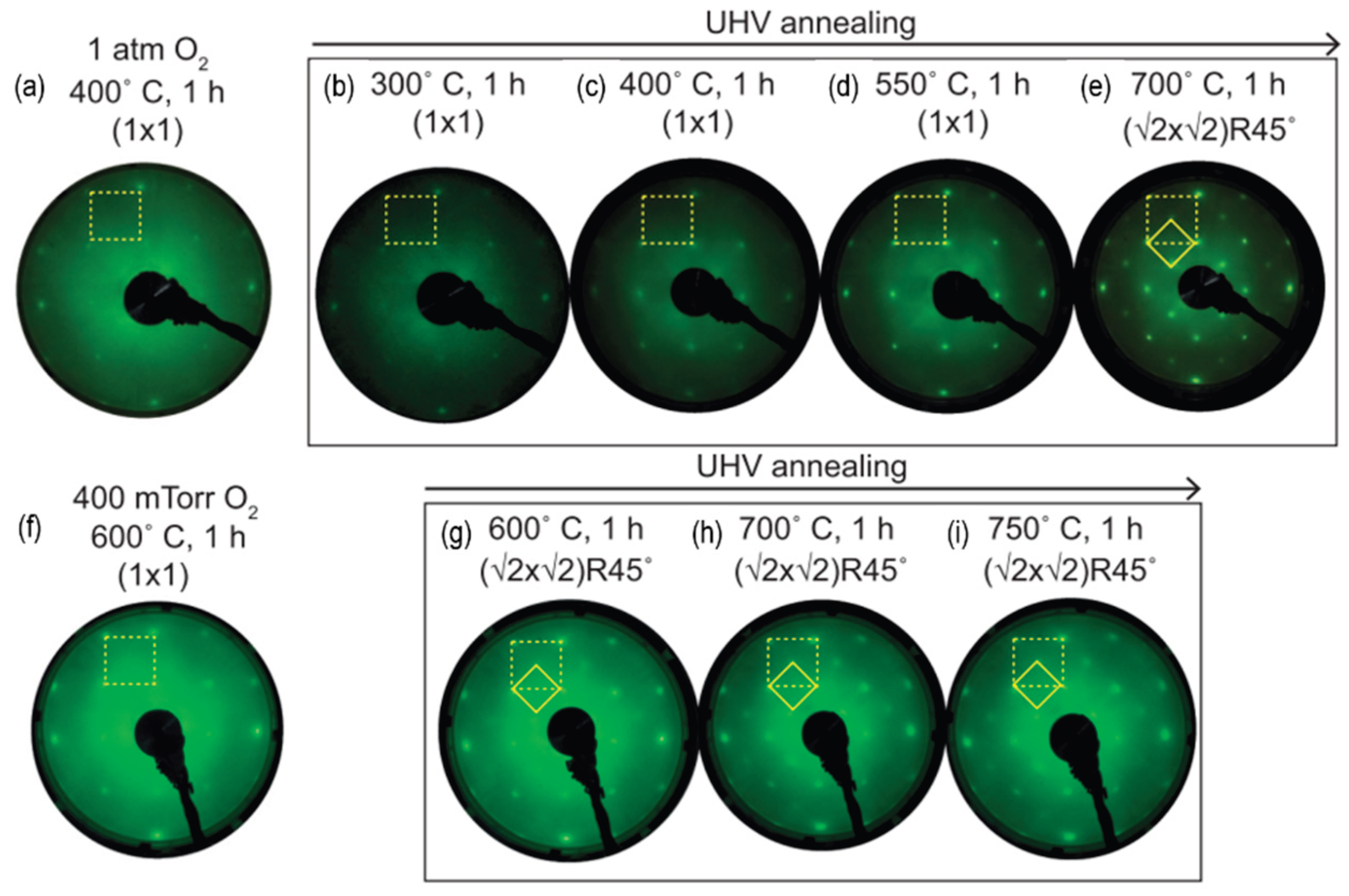
In BSO, a wide-bandgap (~3.1 eV) and high electron mobility make this stannate attractive for oxide electronics and transparent conducting layers [50], but its surface properties are only beginning to be explored. Atomically flat BSO single crystals can be prepared by deionized-water leaching followed by O2 annealing at temperatures above ~1250 °C, yielding wide terraces with predominantly SnO2-terminated surfaces and minor BaOx contributions attributed to Ba segregation [114]. On epitaxial BSO films grown on STO (001), oxygen vacancies drive reversible changes between (1×1) and (√2×√2) R45° reconstructions: UHV annealing at up to 550 °C preserves a (1×1) surface, whereas annealing at 700 °C induces a (√2×√2) R45° reconstruction that can be switched back to (1×1) by annealing in oxygen and re-established by subsequent UHV annealing (Figure 10) [115]. This reversibility demonstrates that oxygen vacancies are essential for stabilizing reconstructed BSO surfaces and that their concentration can be modulated by redox cycling without strong substrate influence.
MBE studies further map the relationship between growth conditions, nonstoichiometry, and BSO surface reconstructions. By synthesizing La-doped BSO films on DyScO3(001) under an excess SnO2 flux, these studies constructed a phase diagram in pO2–temperature space that delineates BaO-, Ba2SnO4-, BSO-, and SnO2-rich regimes (Figure 11) [116]. Stoichiometric BSO films grown in the stability region show (1×1) surfaces, whereas Ba-rich conditions yield (2×1) reconstructions associated with disordered Ruddlesden–Popper phases, and Sn-rich conditions lead to rough, three-dimensional morphologies. Similar (1×1) surfaces without additional reconstructions are observed for La-doped BSO grown on Si (001) using STO buffer layers [117], indicating that near-stoichiometric BSO favors unreconstructed terminations under appropriate growth conditions.
These vanadate and stannate systems underscore that nonstoichiometry-driven reconstructions are not limited to classical perovskites: oxygen vacancies, cation excesses, and film thickness can stabilize distinct surface motifs that, in turn, control conductivity, transparency, and interfacial transport. As these materials are integrated into energy-relevant devices, systematic control of cation and oxygen stoichiometry at their surfaces will be essential for realizing their full functional potential.
4. Future Perspectives
The aforementioned perovskites demonstrate that cation and oxygen nonstoichiometry, coupled to surface reconstructions, are key design parameters for energy-relevant oxides. Three directions are particularly promising: leveraging epitaxial strain, harnessing ultrathin-film and octahedral-rotation effects, and integrating operando measurements with data-driven modeling.
First, controlled epitaxial growth offers a practical route to systematically tune nonstoichiometry. Growth temperature, pO2, and cation flux set cation ratios and oxygen-vacancy concentrations, while lattice-mismatch strain shifts defect formation energies and reconstruction stability. Strain engineering is already widely used to tailor electronic structure, oxygen transport, and defect chemistry in perovskite films [47,118,119,120,121] accessible via substrate choice or by thickness variation on a single substrate. For example, strain-induced defects can alter STO (011) reconstructions [122] and thermal mismatch between STO and Si has been used to continuously tune tensile strain and break inversion symmetry at STO (001) surfaces [123]. Mapping strain–nonstoichiometry–reconstruction phase diagrams for key materials would provide a practical design framework.
Second, ultrathin films only a few unit cells thick introduce additional symmetry breaking and interfacial constraints that can qualitatively change surface reconstructions. A previous study showed that octahedral rotations in ultrathin SrIrO3 on STO (001) drive thickness-dependent transitions between (2×2), (√2×√2) R45°, and (1×1) surfaces [124]. In contrast, DFT calculations indicate that c (4×4)-like reconstructions can remain favorable for CaTiO3 and STO (001) even when octahedral rotations are varied [125]. This contrast highlights open questions about the interplay among octahedral distortions, thickness, and nonstoichiometry. Systematic studies tracking rotations, defect distributions, and reconstructions versus strain, thickness, and redox conditions could enable rotations to serve as an additional programmable “knob” for surface structure and function.
Finally, most atomic-scale information still comes from ultra-high vacuum conditions, whereas real devices operate in high pO2, humid, or electrochemical environments. Expanding in situ and operando methods, such as ambient-pressure XPS [126,127], environmental TEM [128,129], in situ LEED and STEM [130,131], and synchrotron-based methods [132,133], on well-controlled epitaxial films will be crucial for connecting specific reconstructions to oxygen exchange kinetics and catalytic activity under realistic conditions. Coupling such data to high-throughput DFT calculations [134,135] and machine-learning models [136,137] for surfaces and defects can deliver multi-scale descriptions, in which reconstruction-dependent defect concentrations and reaction energetics feed directly into kinetic models of oxygen reduction and evolution reactions, oxygen transport, and degradation. In the long term, this combination of epitaxial control, ultrathin-film engineering, and data-driven modeling could enable inverse design of oxide surfaces and interfaces tailored for the global energy transition.
5. Conclusions
Cation and oxygen nonstoichiometry, together with the surface reconstructions they stabilize, are key design parameters for perovskite and related oxide surfaces in sustainable-energy technologies. Across titanates, aluminates, cobaltates, manganites, and emerging vanadate and stannate systems, polarity compensation and near-surface defect chemistry are inseparable from functional responses such as oxygen exchange kinetics, catalytic activity, and interfacial transport. The case studies discussed here show that controlling growth temperature, pO2, and cation flux in epitaxial films enables families of reconstructions that are difficult to realize in bulk crystals. Combining stoichiometric control with epitaxial strain and ultrathin-film engineering offers a route to bias which reconstructions and defect configurations are stabilized at oxide surfaces. Realizing this potential will require in situ and operando measurements under realistic environments, linked to multiscale and data-driven models that connect specific reconstructions to device-level performance. Together, these approaches can turn nonstoichiometry and surface reconstruction from complications into practical levers for designing oxide materials for sustainable energy applications.
Author Contributions
Conceptualization and supervision, D.L.; investigation, H.R.C., E.S., G.Y., and M.E.; writing—original draft preparation, G.Y. and M.E.; writing—review and editing, D.L.; visualization, H.R.C. and E.S. All authors have read and agreed to the published version of the manuscript.
Funding
This research was funded by the National Science Foundation under NSF Award Number DMR-2340234.
Data Availability Statement
No new data were created or analyzed in this study. Data sharing is not applicable to this article.
Conflicts of Interest
The authors declare no competing financial interest.
References
- Bertaglia, T., et al., Eco-friendly, sustainable, and safe energy storage: a nature-inspired materials paradigm shift. Materials Advances, 2024. 5(19): p. 7534-7547. [CrossRef]
- Srivastava, A., et al., Recycling of waste into useful materials and their energy applications, in Microbial Niche Nexus Sustaining Environmental Biological Wastewater and Water-Energy-Environment Nexus. 2025, Springer. p. 251-296.
- Worku, A.K., et al., Recent advances and challenges of hydrogen production technologies via renewable energy sources. Advanced Energy and Sustainability Research, 2024. 5(5): p. 2300273. [CrossRef]
- Loubani, M.E., et al., Multifunctional Electrocatalysts for Low-temperature Solid Oxide Fuel Cells. 2024.
- El Loubani, M., et al., Influence of redox engineering on the trade-off relationship between thermopower and electrical conductivity in lanthanum titanium based transition metal oxides. Materials Advances, 2024. 5(22): p. 9007-9017. [CrossRef]
- Yang, G., et al., Achieving Fast Oxygen Reduction on Oxide Electrodes by Creating 3D Multiscale Micro-Nano Structures for Low-Temperature Solid Oxide Fuel Cells. ACS Applied Materials & Interfaces, 2023. 15(43): p. 50427-50436. [CrossRef]
- Yang, G., et al., Understanding the influence of strain-modified oxygen vacancies and surface chemistry on the oxygen reduction reaction of epitaxial La0. 8Sr0. 2CoO3-δ thin films. Solid State Ionics, 2023. 393: p. 116171. [CrossRef]
- Humayun, M., et al., Perovskite type ABO3 oxides in photocatalysis, electrocatalysis, and solid oxide fuel cells: State of the art and future prospects. Chemical Reviews, 2025. 125(6): p. 3165-3241. [CrossRef]
- Maggard, P.A., Capturing metastable oxide semiconductors for applications in solar energy conversion. Accounts of Chemical Research, 2021. 54(16): p. 3160-3171. [CrossRef]
- Park, J., et al., Applicability of Allen–Heine–Cardona theory on Mo x metal oxides and ABO3 perovskites: Toward high-temperature optoelectronic applications. Chemistry of Materials, 2022. 34(13): p. 6108-6115.
- Yang, G., et al., Control of crystallographic orientation in Ruddlesden-Popper for fast oxygen reduction. Catalysis Today, 2023. 409: p. 87-93. [CrossRef]
- Lou, S.N., et al., Designing Eco-functional redox conversions integrated in environmental photo (electro) catalysis. ACS ES&T Engineering, 2022. 2(6): p. 1116-1129. [CrossRef]
- Huang, H., K.A. Steiniger, and T.H. Lambert, Electrophotocatalysis: combining light and electricity to catalyze reactions. Journal of the American Chemical Society, 2022. 144(28): p. 12567-12583. [CrossRef]
- Chen, N., et al., Universal band alignment rule for perovskite/organic heterojunction interfaces. ACS Energy Letters, 2023. 8(3): p. 1313-1321. [CrossRef]
- Chrysler, M., et al., Tuning band alignment at a semiconductor-crystalline oxide heterojunction via electrostatic modulation of the interfacial dipole. Physical Review Materials, 2021. 5(10): p. 104603. [CrossRef]
- Guo, Z., et al., Surface coverage and reconstruction analyses bridge the correlation between structure and activity for electrocatalysis. Chemical Communications, 2024. [CrossRef]
- Blank, D.H., M. Dekkers, and G. Rijnders, Pulsed laser deposition in Twente: from research tool towards industrial deposition. Journal of physics D: applied physics, 2013. 47(3): p. 034006. [CrossRef]
- Yu, J., et al., Recent Advances on Pulsed Laser Deposition of Large-Scale Thin Films. Small Methods, 2024. 8(7): p. 2301282. [CrossRef]
- Mostafa, A.M., The Influence of various parameters on the ablation and deposition mechanisms in pulsed laser deposition. Plasmonics, 2025: p. 1-19. [CrossRef]
- Lu, X., et al., Review on preparation of perovskite solar cells by pulsed laser deposition. Inorganics, 2024. 12(5): p. 128. [CrossRef]
- Prakash, A., et al., Hybrid molecular beam epitaxy for the growth of stoichiometric BaSnO3. Journal of Vacuum Science & Technology A: Vacuum, Surfaces, and Films, 2015. 33(6): p. 060608. [CrossRef]
- Hidayat, W. and M. Usman, Applications of molecular beam epitaxy in optoelectronic devices: an overview. Physica Scripta, 2024. [CrossRef]
- Nunn, W., T.K. Truttmann, and B. Jalan, A review of molecular-beam epitaxy of wide bandgap complex oxide semiconductors. Journal of materials research, 2021. 36(23): p. 4846-4864. [CrossRef]
- Rimal, G. and R.B. Comes, Advances in complex oxide quantum materials through new approaches to molecular beam epitaxy. Journal of Physics D: Applied Physics, 2024. 57(19): p. 193001. [CrossRef]
- Choudhary, R. and B. Jalan, Atomically precise synthesis of oxides with hybrid molecular beam epitaxy. Device, 2025. [CrossRef]
- Ruvireta, J., L. Vega, and F. Viñes, Cohesion and coordination effects on transition metal surface energies. Surface Science, 2017. 664: p. 45-49. [CrossRef]
- Noguera, C., Physics and chemistry at oxide surfaces. 1996: Cambridge University Press.
- Kawasaki, M., et al., Atomic Control of the SrTiO3 Crystal Surface. Science, 1994. 266(5190): p. 1540-1542.
- Kubo, T. and H. Nozoye, Surface structure of SrTiO3(100). Surface Science, 2003. 542(3): p. 177-191.
- Castell, M.R., Nanostructures on the SrTiO3(001) surface studied by STM. Surface Science, 2002. 516(1): p. 33-42. [CrossRef]
- Ohsawa, T., et al., Negligible Sr segregation on SrTiO3(001)-( 13×13)-R33.7° reconstructed surfaces. Applied Physics Letters, 2016. 108(16): p. 161603.
- Hesselberth, M., S. van der Molen, and J. Aarts, The surface structure of SrTiO3 at high temperatures under influence of oxygen. Applied Physics Letters, 2014. 104(5): p. 051609. [CrossRef]
- Wang, Z., et al., Evolution of the surface structures on SrTiO 3 (110) tuned by Ti or Sr concentration. Physical Review B, 2011. 83(15): p. 155453.
- Marks, L., et al., Transition from order to configurational disorder for surface reconstructions on SrTiO 3 (111). Physical review letters, 2015. 114(22): p. 226101.
- Goniakowski, J., F. Finocchi, and C. Noguera, Polarity of oxide surfaces and nanostructures. Reports on Progress in Physics, 2007. 71(1): p. 016501. [CrossRef]
- Claudine, N., Polar oxide surfaces. J. Phys, 2000. 12: p. R367.
- Druce, J., et al., Surface termination and subsurface restructuring of perovskite-based solid oxide electrode materials. Energy & Environmental Science, 2014. 7(11): p. 3593-3599. [CrossRef]
- Biswas, A., et al., Atomically flat single terminated oxide substrate surfaces. Progress in Surface Science, 2017. 92(2): p. 117-141. [CrossRef]
- Tasker, P., The stability of ionic crystal surfaces. Journal of Physics C: Solid State Physics, 1979. 12(22): p. 4977. [CrossRef]
- Torrelles, X., et al., Electronic and structural reconstructions of the polar (111) SrTiO 3 surface. Physical Review B, 2019. 99(20): p. 205421.
- May, K.J., et al., Thickness-dependent photoelectrochemical water splitting on ultrathin LaFeO3 films grown on Nb: SrTiO3. The Journal of Physical Chemistry Letters, 2015. 6(6): p. 977-985.
- Lee, D., et al., Oxygen surface exchange kinetics and stability of (La, Sr) 2 CoO 4±δ/La 1− x Sr x MO 3− δ (M= Co and Fe) hetero-interfaces at intermediate temperatures. Journal of Materials Chemistry A, 2015. 3(5): p. 2144-2157.
- Lim, H., et al., Nature of the surface space charge layer on undoped SrTiO 3 (001). Journal of Materials Chemistry C, 2021. 9(38): p. 13094-13102. [CrossRef]
- Lee, D., et al., Enhanced oxygen surface exchange kinetics and stability on epitaxial La0. 8Sr0. 2CoO3− δ thin films by La0. 8Sr0. 2MnO3− δ decoration. The Journal of Physical Chemistry C, 2014. 118(26): p. 14326-14334.
- Gurylev, V., C.-Y. Su, and T.-P. Perng, Surface reconstruction, oxygen vacancy distribution and photocatalytic activity of hydrogenated titanium oxide thin film. Journal of Catalysis, 2015. 330: p. 177-186. [CrossRef]
- Oka, H., et al., Two distinct surface terminations of SrVO3 (001) ultrathin films as an influential factor on metallicity. Applied Physics Letters, 2018. 113(17): p. 171601. [CrossRef]
- Herklotz, A., et al., Strain coupling of oxygen non-stoichiometry in perovskite thin films. Journal of Physics: Condensed Matter, 2017. 29(49): p. 493001. [CrossRef]
- Zhu, K., et al., The roles of oxygen vacancies in electrocatalytic oxygen evolution reaction. Nano energy, 2020. 73: p. 104761. [CrossRef]
- Hwang, J., et al., Tuning perovskite oxides by strain: Electronic structure, properties, and functions in (electro) catalysis and ferroelectricity. Materials Today, 2019. 31: p. 100-118. [CrossRef]
- Prakash, A. and B. Jalan, Wide bandgap perovskite oxides with high room-temperature electron mobility. Advanced Materials Interfaces, 2019. 6(15): p. 1900479. [CrossRef]
- Tung, I.-C., et al., Polarity-driven oxygen vacancy formation in ultrathin LaNiO 3 films on SrTiO 3. Physical Review Materials, 2017. 1(5): p. 053404.
- Riva, M., et al., Pushing the detection of cation nonstoichiometry to the limit. Physical Review Materials, 2019. 3(4): p. 043802. [CrossRef]
- Tokuda, Y., et al., Growth of Ruddlesden-Popper type faults in Sr-excess SrTiO3 homoepitaxial thin films by pulsed laser deposition. Applied Physics Letters, 2011. 99(17): p. 173109. [CrossRef]
- Ohnishi, T., et al., Defects and transport in complex oxide thin films. Journal of Applied Physics, 2008. 103(10): p. 103703. [CrossRef]
- Li, Y., et al., Controlling cation segregation in perovskite-based electrodes for high electro-catalytic activity and durability. Chemical Society Reviews, 2017. 46(20): p. 6345-6378. [CrossRef]
- Aravinthkumar, K., et al., Investigation on SrTiO3 nanoparticles as a photocatalyst for enhanced photocatalytic activity and photovoltaic applications. Inorganic Chemistry Communications, 2022. 140: p. 109451. [CrossRef]
- Fadlallah, M.M. and D. Gogova, Theoretical study on electronic, optical, magnetic and photocatalytic properties of codoped SrTiO3 for green energy application. Micro and Nanostructures, 2022. 168: p. 207302. [CrossRef]
- Guan, X., et al., Efficient photocatalytic hydrogen production under visible-light irradiation on SrTiO3 without noble metal: dye-sensitization and earth-abundant cocatalyst modification. Materials Today Chemistry, 2022. 26: p. 101018. [CrossRef]
- Tang, Q., et al., Layered SrTiO3/BaTiO3 composites with significantly enhanced dielectric permittivity and low loss. Ceramics International, 2023. 49(14): p. 23326-23333. [CrossRef]
- Pradhan, J., et al., Enhanced optical and dielectric properties of rare-earth co-doped SrTiO3 ceramics. Journal of Materials Science: Materials in Electronics, 2021. 32(10): p. 13837-13849. [CrossRef]
- Luo, L., et al., High dielectric permittivity and ultralow dielectric loss in Nb-doped SrTiO3 ceramics. Ceramics International, 2022. 48(19): p. 28438-28443. [CrossRef]
- Li, M., et al., Review on fabrication methods of SrTiO3-based two dimensional conductive interfaces. The European Physical Journal Applied Physics, 2021. 93(2): p. 21302. [CrossRef]
- Chen, S., et al., LaAlO3/SrTiO3 heterointerface: 20 years and beyond. Advanced Electronic Materials, 2024. 10(3): p. 2300730.
- Zhang, Z., et al., Tuning the magnetic anisotropy of La0. 67Sr0. 33MnO3 by CaTiO3 spacer layer on the platform of SrTiO3. Journal of Magnetism and Magnetic Materials, 2022. 554: p. 169299. [CrossRef]
- Ji, J., et al., Heterogeneous integration of high-k complex-oxide gate dielectrics on wide band-gap high-electron-mobility transistors. Communications Engineering, 2024. 3(1): p. 15. [CrossRef]
- Eom, K., et al., Electronically reconfigurable complex oxide heterostructure freestanding membranes. Science Advances, 2021. 7(33): p. eabh1284. [CrossRef]
- Kim, Y., et al., Low-frequency noise behaviors of quasi-two-dimensional electron systems based on complex oxide heterostructures. Current Applied Physics, 2024. 59: p. 129-135. [CrossRef]
- Jäger, M., et al., Independence of surface morphology and reconstruction during the thermal preparation of perovskite oxide surfaces. Applied Physics Letters, 2018. 112(11): p. 111601. [CrossRef]
- Xu, C., et al., Formation mechanism of Ruddlesden-Popper-type antiphase boundaries during the kinetically limited growth of Sr rich SrTiO3 thin films. Scientific Reports, 2016. 6(1): p. 38296. [CrossRef]
- Li, F., et al., δ-Doping of oxygen vacancies dictated by thermodynamics in epitaxial SrTiO3 films. AIP Advances, 2017. 7(6): p. 065001. [CrossRef]
- Qu, H., et al., Thermally stimulated relaxation and behaviors of oxygen vacancies in SrTiO3 single crystals with (100), (110) and (111) orientations. Materials Research Express, 2020. 7(4): p. 046305. [CrossRef]
- Wang, Z., et al., Transition from Reconstruction toward Thin Film on the (110) Surface of Strontium Titanate. Nano Letters, 2016. 16(4): p. 2407-2412. [CrossRef]
- Riva, M., et al., Epitaxial growth of complex oxide films: Role of surface reconstructions. Physical Review Research, 2019. 1(3): p. 033059. [CrossRef]
- Andersen, T.K., et al., Single-layer TiOx reconstructions on SrTiO3 (111): (√7 × √7)R19.1°, (√13 × √13)R13.9°, and related structures. Surface Science, 2018. 675: p. 36-41.
- Song, K., et al., Electronic and Structural Transitions of LaAlO3/SrTiO3 Heterostructure Driven by Polar Field-Assisted Oxygen Vacancy Formation at the Surface. Advanced Science, 2021. 8(14): p. 2002073.
- Kim, J.R., et al., Experimental realization of atomically flat and Al O 2-terminated LaAl O 3 (001) substrate surfaces. Physical Review Materials, 2019. 3(2): p. 023801.
- Sha, H., et al., Surface termination and stoichiometry of LaAlO3(001) surface studied by HRTEM. Micron, 2020. 137: p. 102919. [CrossRef]
- Koirala, P., et al., Al rich (111) and (110) surfaces of LaAlO3. Surface Science, 2018. 677: p. 99-104.
- Kienzle, D., P. Koirala, and L.D. Marks, Lanthanum aluminate (110) 3×1 surface reconstruction. Surface Science, 2015. 633: p. 60-67. [CrossRef]
- Altaf, A., et al., Enhanced electrocatalytic activity of amorphized LaCoO3 for oxygen evolution reaction. Chemistry–An Asian Journal, 2024. 19(16): p. e202300870. [CrossRef]
- Mahmoudi, E., et al., LaCoO3-BaCoO3 porous composites as efficient electrocatalyst for oxygen evolution reaction. Chemical Engineering Journal, 2023. 473: p. 144829. [CrossRef]
- Parwaiz, S., et al., Recent advances in LaCoO3-based perovskite nanostructures for electrocatalytic and photocatalytic applications. Critical Reviews in Solid State and Materials Sciences, 2025: p. 1-42. [CrossRef]
- Xia, B., et al., Optimized conductivity and spin states in N-doped LaCoO3 for oxygen electrocatalysis. ACS Applied Materials & Interfaces, 2021. 13(2): p. 2447-2454. [CrossRef]
- Ingavale, S., et al., Strategic design and insights into lanthanum and strontium perovskite oxides for oxygen reduction and oxygen evolution reactions. Small, 2024. 20(19): p. 2308443. [CrossRef]
- Kim, D., et al., An efficient and robust lanthanum strontium cobalt ferrite catalyst as a bifunctional oxygen electrode for reversible solid oxide cells. Journal of Materials Chemistry A, 2021. 9(9): p. 5507-5521. [CrossRef]
- Zhang, C., et al., Cobalt-based perovskite electrodes for solid oxide electrolysis cells. Inorganics, 2022. 10(11): p. 187. [CrossRef]
- Yang, G., et al., Controlling the oxygen electrocatalysis on perovskite and layered oxide thin films for solid oxide fuel cell cathodes. Applied Sciences, 2019. 9(5): p. 1030. [CrossRef]
- Feng, Z., et al., Revealing the atomic structure and strontium distribution in nanometer-thick La 0.8 Sr 0.2 CoO 3− δ grown on (001)-oriented SrTiO 3. Energy & Environmental Science, 2014. 7(3): p. 1166-1174. [CrossRef]
- Wen, Y., et al., Temporal and thermal evolutions of surface Sr-segregation in pristine and atomic layer deposition modified La 0.6 Sr 0.4 CoO 3− δ epitaxial films. Journal of Materials Chemistry A, 2018. 6(47): p. 24378-24388.
- Khan, S., et al., A computational modelling study of oxygen vacancies at LaCoO 3 perovskite surfaces. Physical Chemistry Chemical Physics, 2006. 8(44): p. 5207-5222. [CrossRef]
- Rupp, G.M., et al., Surface chemistry of La 0.6 Sr 0.4 CoO 3− δ thin films and its impact on the oxygen surface exchange resistance. Journal of Materials Chemistry A, 2015. 3(45): p. 22759-22769.
- Hu, M., et al., Reconstruction-stabilized epitaxy of LaCoO3/SrTiO3 (111) heterostructures by pulsed laser deposition. Applied Physics Letters, 2018. 112(3): p. 031603. [CrossRef]
- Halilov, S., et al., Surface, final state, and spin effects in the valence-band photoemission spectra of LaCoO 3 (001). Physical Review B, 2017. 96(20): p. 205144.
- Crumlin, E.J., et al., Surface strontium enrichment on highly active perovskites for oxygen electrocatalysis in solid oxide fuel cells. Energy & Environmental Science, 2012. 5(3): p. 6081-6088. [CrossRef]
- Ashok, A., et al., Enhancing the electrocatalytic properties of LaMnO3 by tuning surface oxygen deficiency through salt assisted combustion synthesis. Catalysis Today, 2021. 375: p. 484-493. [CrossRef]
- Du, D., et al., A-site cationic defects induced electronic structure regulation of LaMnO3 perovskite boosts oxygen electrode reactions in aprotic lithium–oxygen batteries. Energy Storage Materials, 2021. 43: p. 293-304. [CrossRef]
- Cheng, Q., et al., Achieving efficient toluene mineralization over ordered porous LaMnO3 catalyst: the synergistic effect of high valence manganese and surface lattice oxygen. Applied Surface Science, 2023. 615: p. 156248. [CrossRef]
- Shao-Horn, Y., Thickness dependence of oxygen reduction reaction kinetics on strontium-substituted lanthanum manganese perovskite thin-film microelectrodes. Electrochemical and Solid-State Letters, 2009. 12(5): p. B82. [CrossRef]
- Hess, F. and B. Yildiz, Polar or not polar? The interplay between reconstruction, Sr enrichment, and reduction at the La 0.75 Sr 0.25 MnO 3 (001) surface. Physical review materials, 2020. 4(1): p. 015801. [CrossRef]
- Chen, L., et al., Surface and interface properties of L a 2/3 S r 1/3 Mn O 3 thin films on SrTiO 3 (001). Physical Review Materials, 2019. 3(4): p. 044407.
- Franceschi, G., et al., Atomically resolved surface phases of La0.8Sr0.2MnO3(110) thin films. Journal of Materials Chemistry A, 2020.
- Vasudevan, R.K., et al., Surface reconstructions and modified surface states in L a 1− x C ax Mn O 3. Physical Review Materials, 2018. 2(10): p. 104418.
- Roth, J., et al., Self-regulated growth of [111]-oriented perovskite oxide films using hybrid molecular beam epitaxy. APL Materials, 2021. 9(2). [CrossRef]
- Mochizuki, Y., et al., Chemical trends of surface reconstruction and band positions of nonmetallic perovskite oxides from first principles. Chemistry of Materials, 2023. 35(5): p. 2047-2057. [CrossRef]
- Li, Y., et al., First-Principles Study of Dominant Surface Terminations on BaSnO3 (001) Surface: Implications for Precise Control of Semiconductor Thin Films. ACS Applied Nano Materials, 2024. 7(10): p. 11995-12002. [CrossRef]
- Cheikh, A., et al., Tuning the transparency window of SrVO3 transparent conducting oxide. ACS Applied Materials & Interfaces, 2024. 16(36): p. 47854-47865. [CrossRef]
- Sanchela, A.V., et al., Optoelectronic properties of transparent oxide semiconductor ASnO3 (A= Ba, Sr, and Ca) epitaxial films and thin film transistors. Journal of Vacuum Science & Technology A, 2022. 40(2). [CrossRef]
- Song, X., et al., Oxide perovskite BaSnO3: a promising high-temperature thermoelectric material for transparent conducting oxides. ACS Applied Energy Materials, 2023. 6(18): p. 9756-9763. [CrossRef]
- Ngabonziza, P. and A.P. Nono Tchiomo, Epitaxial films and devices of transparent conducting oxides: La: BaSnO3. APL Materials, 2024. 12(12). [CrossRef]
- Okada, Y., et al., Quasiparticle interference on cubic perovskite oxide surfaces. Physical review letters, 2017. 119(8): p. 086801. [CrossRef]
- Wang, G., et al., Role of disorder and correlations in the metal-insulator transition in ultrathin SrVO 3 films. Physical Review B, 2019. 100(15): p. 155114.
- Brahlek, M., et al., Accessing a growth window for SrVO3 thin films. Applied Physics Letters, 2015. 107(14): p. 143108. [CrossRef]
- Eaton, C., et al., Growth of SrVO3 thin films by hybrid molecular beam epitaxy. Journal of Vacuum Science & Technology A, 2015. 33(6): p. 061504. [CrossRef]
- Lee, W.-J., et al., Realization of an atomically flat BaSnO3(001) substrate with SnO2 termination. Applied Physics Letters, 2017. 111(23): p. 231604. [CrossRef]
- Soltani, S., et al., 2× 2 R 45∘ surface reconstruction and electronic structure of BaSnO 3 film. Physical Review Materials, 2020. 4(5): p. 055003.
- Paik, H., et al., Adsorption-controlled growth of La-doped BaSnO3 by molecular-beam epitaxy. APL Materials, 2017. 5(11): p. 116107. [CrossRef]
- Wang, Z., et al., Epitaxial integration of high-mobility La-doped BaSnO3 thin films with silicon. APL Materials, 2019. 7(2). [CrossRef]
- Lee, D., et al., Stretching epitaxial La0. 6Sr0. 4CoO3− δ for fast oxygen reduction. The Journal of Physical Chemistry C, 2017. 121(46): p. 25651-25658.
- Cai, Z., et al., Surface electronic structure transitions at high temperature on perovskite oxides: the case of strained La0. 8Sr0. 2CoO3 thin films. Journal of the American Chemical Society, 2011. 133(44): p. 17696-17704.
- Mayeshiba, T. and D. Morgan, Strain effects on oxygen migration in perovskites. Physical Chemistry Chemical Physics, 2015. 17(4): p. 2715-2721. [CrossRef]
- Aschauer, U., et al., Strain-controlled oxygen vacancy formation and ordering in CaMnO 3. Physical Review B—Condensed Matter and Materials Physics, 2013. 88(5): p. 054111.
- Wang, Z., et al., Strain-induced defect superstructure on the SrTiO 3 (110) surface. Physical review letters, 2013. 111(5): p. 056101.
- Zhang, L., et al., Continuously Tuning Epitaxial Strains by Thermal Mismatch. ACS Nano, 2018. 12(2): p. 1306-1312. [CrossRef]
- Guo, W., et al., Engineering of octahedral rotations and electronic structure in ultrathin SrIrO 3 films. Physical Review B, 2020. 101(8): p. 085101.
- Sung, H.-J., Y. Mochizuki, and F. Oba, Surface reconstruction and band alignment of nonmetallic A (II) B (IV) O 3 perovskites. Physical Review Materials, 2020. 4(4): p. 044606.
- Tao, F., Development of New Methods of Studying Catalyst and Materials Surfaces with Ambient Pressure Photoelectron Spectroscopy. Accounts of Chemical Research, 2024. 58(1): p. 11-23. [CrossRef]
- Larsson, A., et al., In situ quantitative analysis of electrochemical oxide film development on metal surfaces using ambient pressure X-ray photoelectron spectroscopy: Industrial alloys. Applied Surface Science, 2023. 611: p. 155714. [CrossRef]
- Frey, H., et al., Dynamic interplay between metal nanoparticles and oxide support under redox conditions. Science, 2022. 376(6596): p. 982-987. [CrossRef]
- Sit, I., H. Wu, and V.H. Grassian, Environmental aspects of oxide nanoparticles: probing oxide nanoparticle surface processes under different environmental conditions. Annual Review of Analytical Chemistry, 2021. 14(1): p. 489-514. [CrossRef]
- Cheng, H.W., et al., Insights into heterogeneous catalysts under reaction conditions by in situ/operando electron microscopy. Advanced Energy Materials, 2022. 12(38): p. 2202097. [CrossRef]
- Wu, Z.-P., et al., Applications of in situ electron microscopy in oxygen electrocatalysis. Microstructures, 2022. 2(1): p. N/A-N/A. [CrossRef]
- Cao, L., et al., Uncovering the nature of active sites during electrocatalytic reactions by in situ synchrotron-based spectroscopic techniques. Accounts of Chemical Research, 2022. 55(18): p. 2594-2603. [CrossRef]
- Qian, G., et al., Structural and chemical evolution in layered oxide cathodes of lithium-ion batteries revealed by synchrotron techniques. National Science Review, 2022. 9(2): p. nwab146. [CrossRef]
- Schindler, P., et al., Discovery of Stable Surfaces with Extreme Work Functions by High-Throughput Density Functional Theory and Machine Learning. Advanced Functional Materials, 2024. 34(19): p. 2401764. [CrossRef]
- Yohannes, A.G., et al., Combined high-throughput DFT and ML screening of transition metal nitrides for electrochemical CO2 reduction. ACS Catalysis, 2023. 13(13): p. 9007-9017. [CrossRef]
- Li, H., et al., Data-driven machine learning for understanding surface structures of heterogeneous catalysts. Angewandte Chemie International Edition, 2023. 62(9): p. e202216383. [CrossRef]
- Mikhaylov, A. and M.L. Grilli, Machine learning methods and sustainable development: metal oxides and multilayer metal oxides. 2022, MDPI. p. 836. [CrossRef]
Figure 1.
Schematics of Type 1 (Q = 0, μ = 0), Type 2 (Q ≠ 0, μ = 0) and Type 3 (Q ≠ 0, μ ≠ 0).
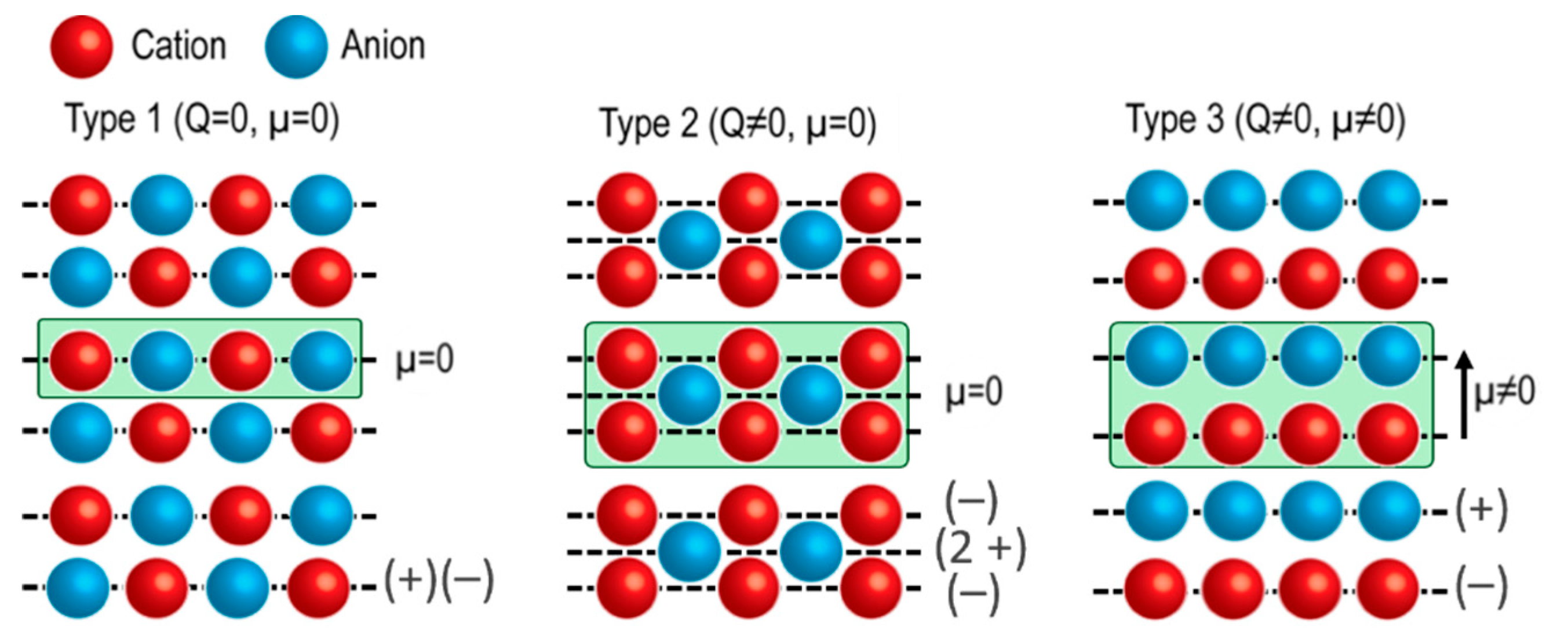
Figure 2.
Schematics of surface relaxation, rumpling and reconstruction.
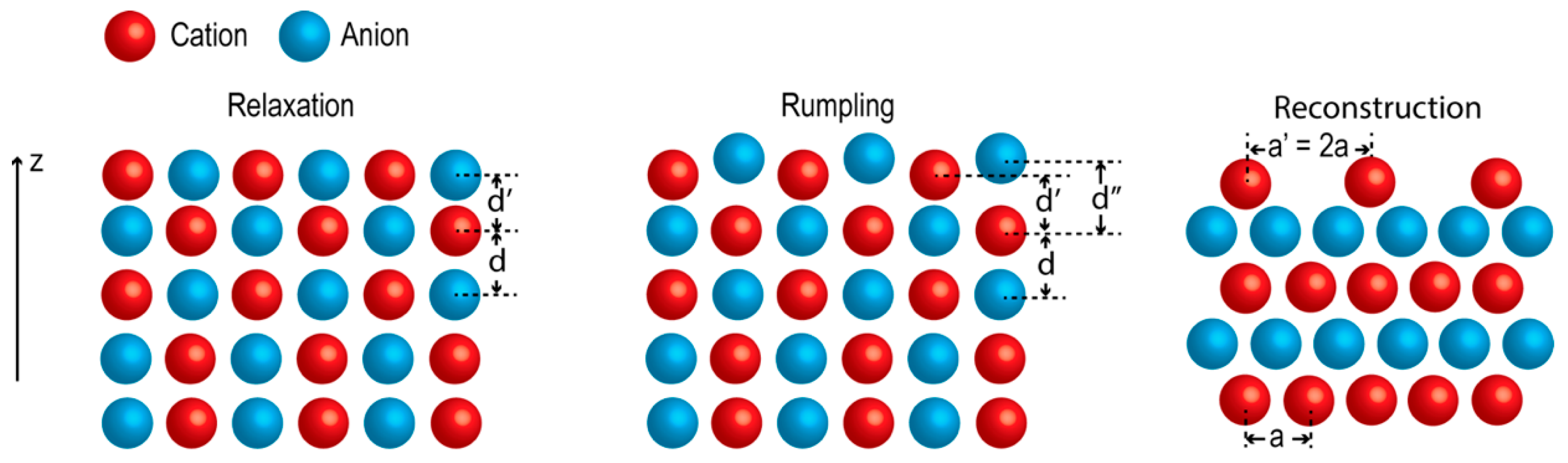
Figure 3.
Schematic of (a) surface rock-salt-type SrO double layer island surrounded by a SrO single layer and (b) formation of antiphase boundaries in (001) and (010) direction. (c) Surface morphology of 20 nm STO thin film determined by in situ atomic force microscopy. Reprinted from Ref. [69] with permission of Springer Nature.
Figure 3.
Schematic of (a) surface rock-salt-type SrO double layer island surrounded by a SrO single layer and (b) formation of antiphase boundaries in (001) and (010) direction. (c) Surface morphology of 20 nm STO thin film determined by in situ atomic force microscopy. Reprinted from Ref. [69] with permission of Springer Nature.
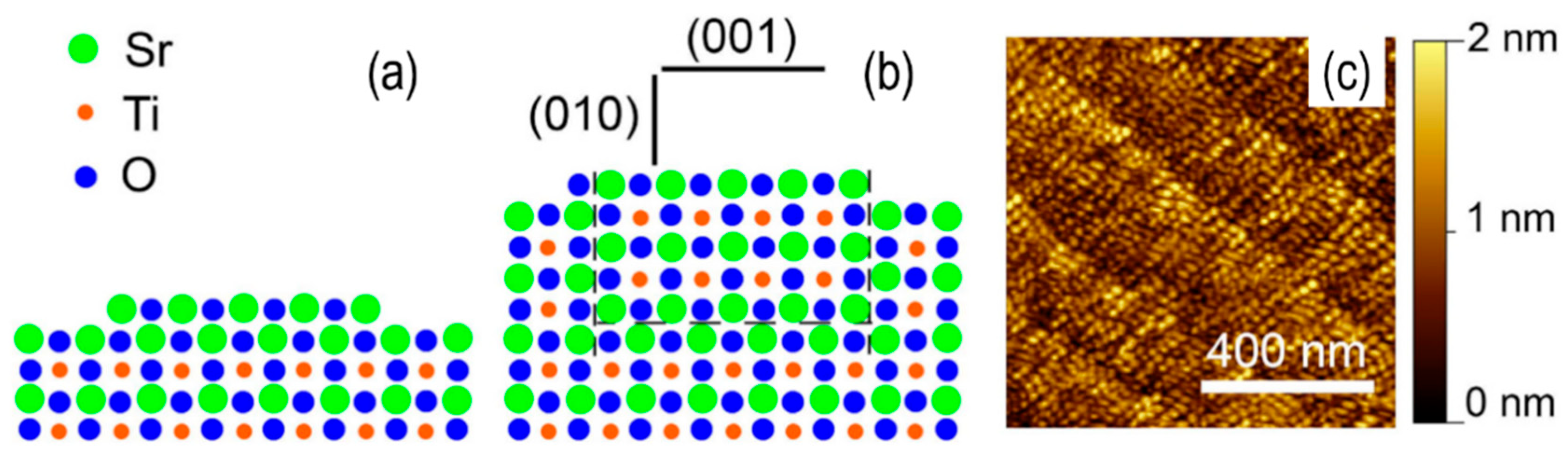
Figure 4.
High concentration of oxygen vacancies located near the surface (layer 2 which is highlighted in red) of the 15 monolayer STO film determined by (a) high angle annular dark field (HAADF) and (b) annular bright field (ABF) images. Reprinted from Ref. [70] with permission of AIP Publishing.
Figure 4.
High concentration of oxygen vacancies located near the surface (layer 2 which is highlighted in red) of the 15 monolayer STO film determined by (a) high angle annular dark field (HAADF) and (b) annular bright field (ABF) images. Reprinted from Ref. [70] with permission of AIP Publishing.
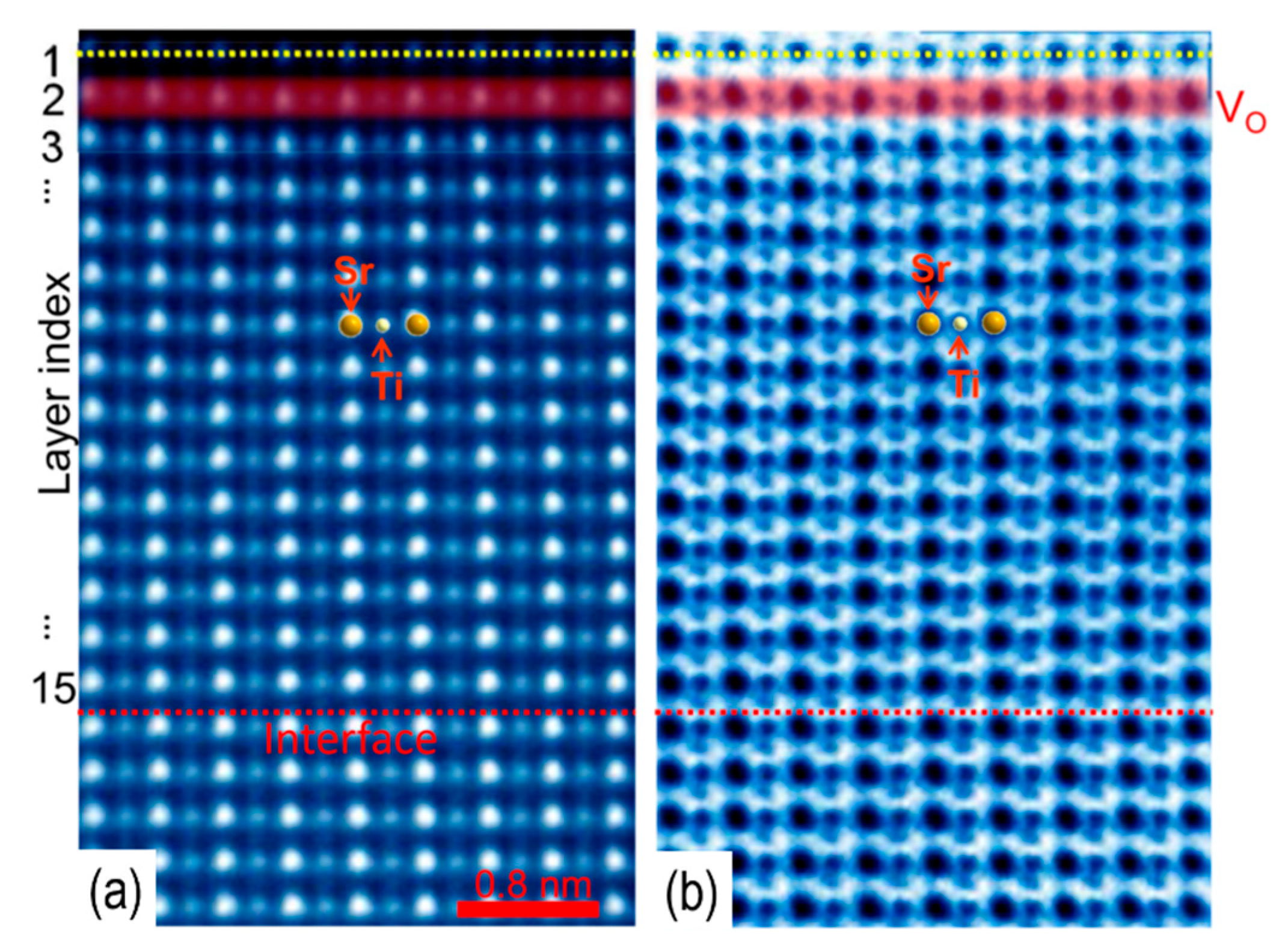
Figure 5.
Cross-sectional STEM analysis on SrRuO3 /LAO (001) interfaces. (a) HAADF-STEM image measured along the [100] zone axis of LAO. The scale bar corresponds to 10 nm. (b) Zoomed-in HAADF-STEM image from the area marked by the solid box in (a). Both images show a sharp SrO-AlO2-terminated interface and a one-unit-cell-high step. The interfaces in the left- and right-hand sides of (b) are marked by solid arrows. (c) Line profiles of HAADF-STEM intensity along the dashed boxes marked in (b). Reprinted from [76] with permission of the American Physical Society.
Figure 5.
Cross-sectional STEM analysis on SrRuO3 /LAO (001) interfaces. (a) HAADF-STEM image measured along the [100] zone axis of LAO. The scale bar corresponds to 10 nm. (b) Zoomed-in HAADF-STEM image from the area marked by the solid box in (a). Both images show a sharp SrO-AlO2-terminated interface and a one-unit-cell-high step. The interfaces in the left- and right-hand sides of (b) are marked by solid arrows. (c) Line profiles of HAADF-STEM intensity along the dashed boxes marked in (b). Reprinted from [76] with permission of the American Physical Society.
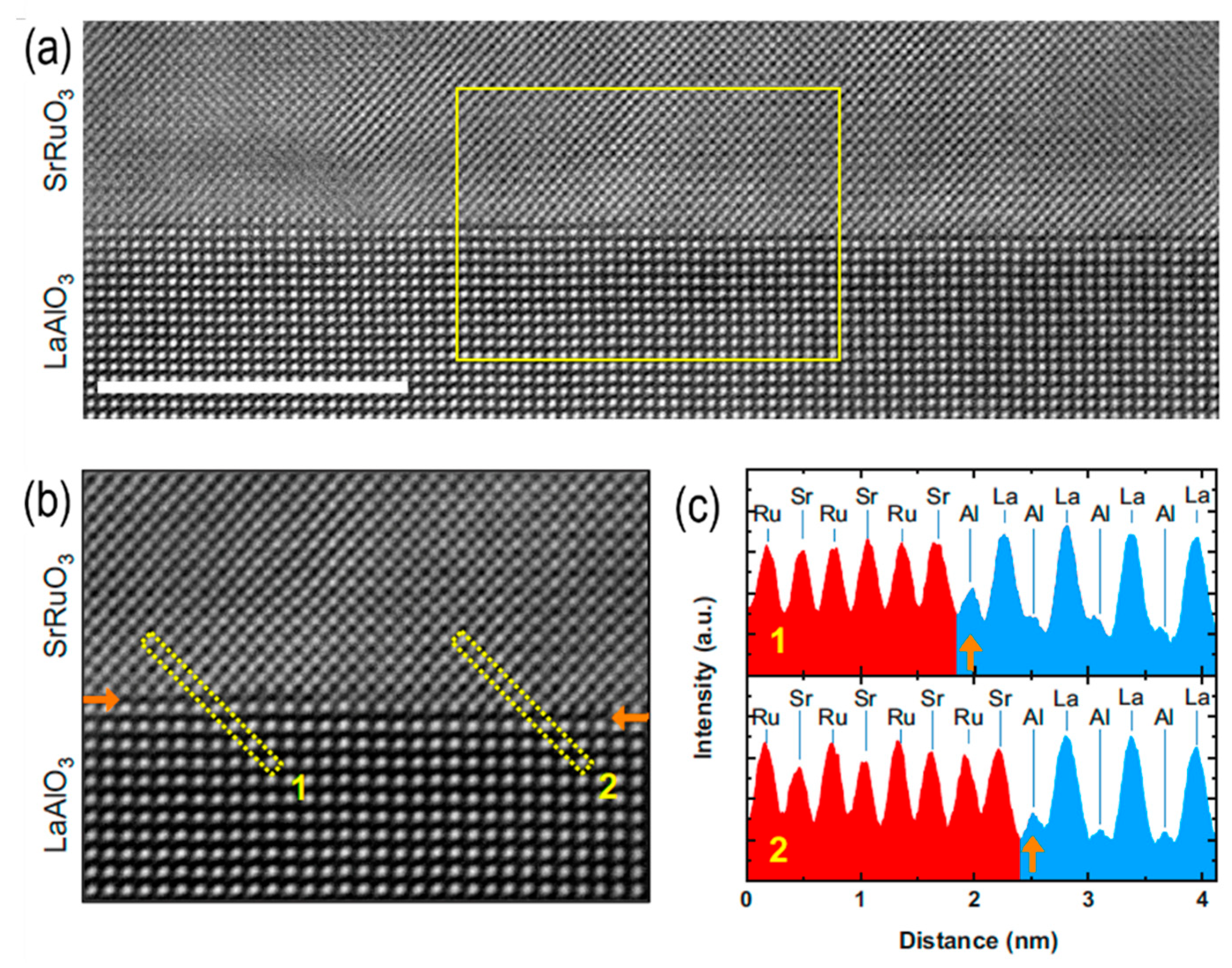
Figure 6.
LEIS depth profiles showing the Sr/A-site (a) and the Co/A-site (b) ratio of an as-grown LSC sample and of two LSC samples that were annealed at 600 °C for 1 and 16 h. Reprinted from ref. [91] with permission of the Royal Society of Chemistry.
Figure 6.
LEIS depth profiles showing the Sr/A-site (a) and the Co/A-site (b) ratio of an as-grown LSC sample and of two LSC samples that were annealed at 600 °C for 1 and 16 h. Reprinted from ref. [91] with permission of the Royal Society of Chemistry.
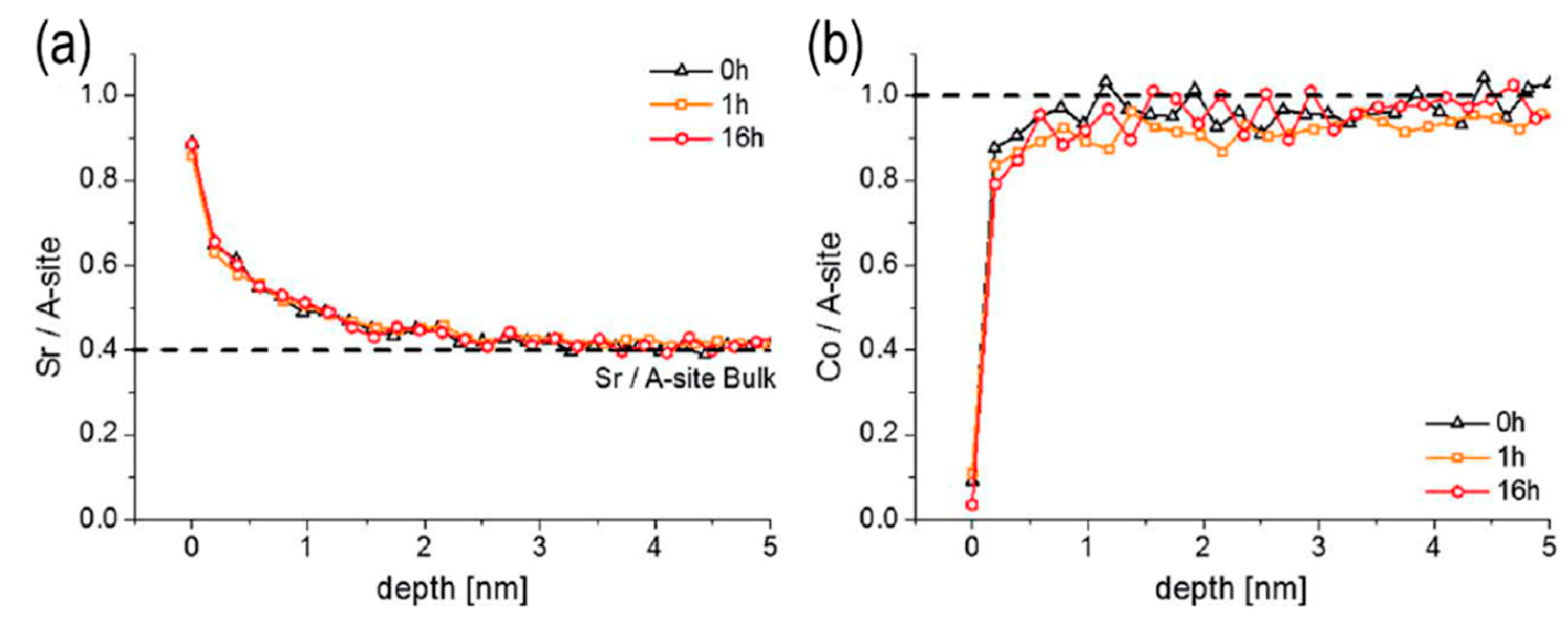
Figure 7.
The surface reconstructions of LSM (011) are shown by STM with (a1)-(d1) large scale (40 × 28 nm2), (a2)-(d2) closed-up (12 × 12 nm2) images and (a3)-(d3) low energy electron diffraction (LEED) patterns. The unit cells are highlighted in (a2)-(d2) and (a3)-(d3). Reprinted from ref. [101] with permission of the Royal Society of Chemistry.
Figure 7.
The surface reconstructions of LSM (011) are shown by STM with (a1)-(d1) large scale (40 × 28 nm2), (a2)-(d2) closed-up (12 × 12 nm2) images and (a3)-(d3) low energy electron diffraction (LEED) patterns. The unit cells are highlighted in (a2)-(d2) and (a3)-(d3). Reprinted from ref. [101] with permission of the Royal Society of Chemistry.
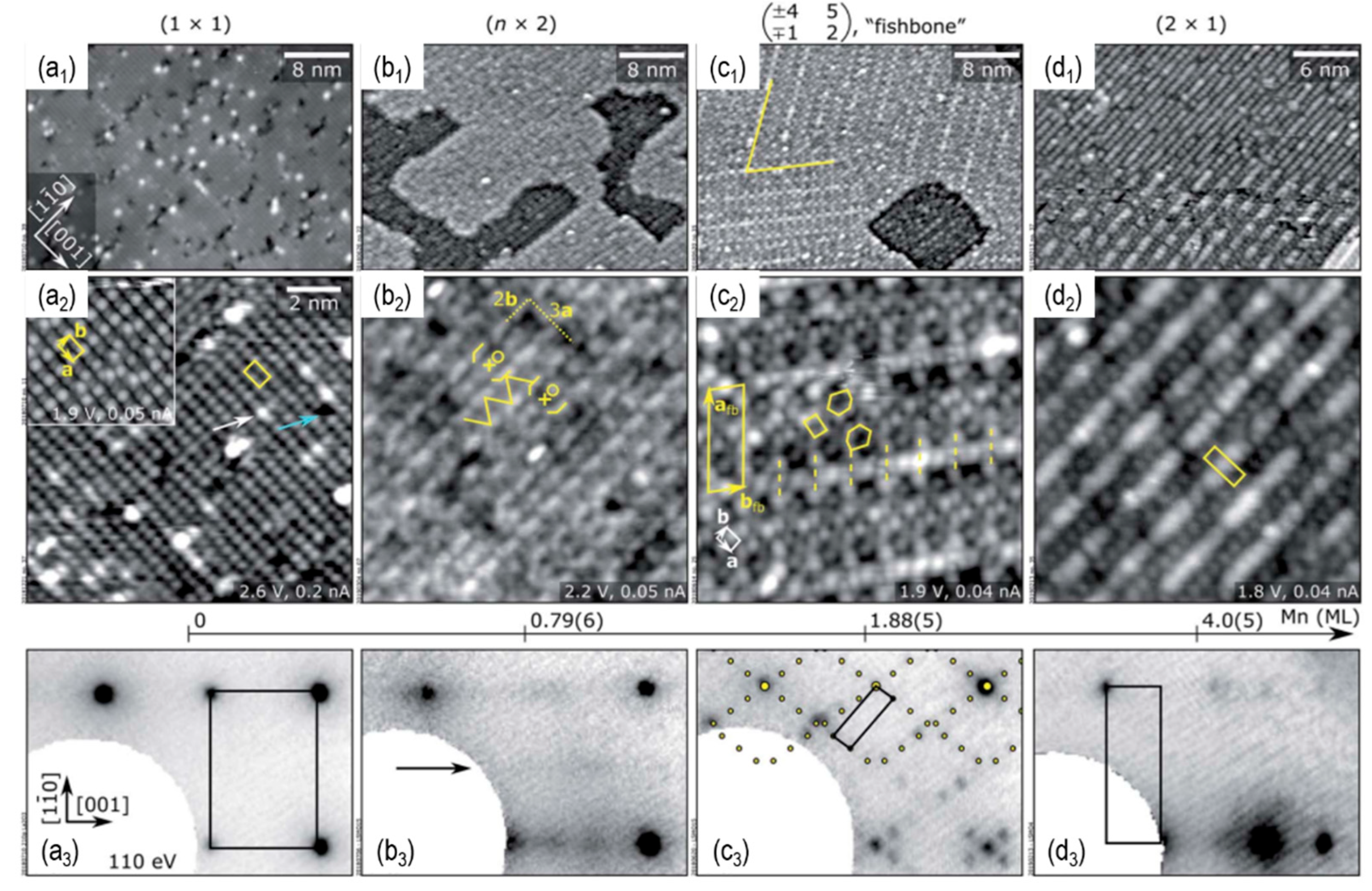
Figure 8.
(a) Large scale STM topography of the surface of LCM film and (b) two distinct terminations with different reconstructions shown by atomically resolved image of the surface. Two different lattice structures are highlighted by fast Fourier transform (FFT) of the white box regions in the inset of (b) with 4nm-1 scale bar. Half-unit-cell intervals are shown by (c) height distribution and (d) line profile of line “1” in (a). Schematic of (1 × 1) and (√2 × √2) R45° surfaces for (e) (La, Ca)O and (f) MnO2 termination. Black lines, green, red, and purple atoms are representing the unit cell, La/Ca, O, and Mn, respectively. Reprinted from ref. [102] with permission of AIP Publishing.
Figure 8.
(a) Large scale STM topography of the surface of LCM film and (b) two distinct terminations with different reconstructions shown by atomically resolved image of the surface. Two different lattice structures are highlighted by fast Fourier transform (FFT) of the white box regions in the inset of (b) with 4nm-1 scale bar. Half-unit-cell intervals are shown by (c) height distribution and (d) line profile of line “1” in (a). Schematic of (1 × 1) and (√2 × √2) R45° surfaces for (e) (La, Ca)O and (f) MnO2 termination. Black lines, green, red, and purple atoms are representing the unit cell, La/Ca, O, and Mn, respectively. Reprinted from ref. [102] with permission of AIP Publishing.
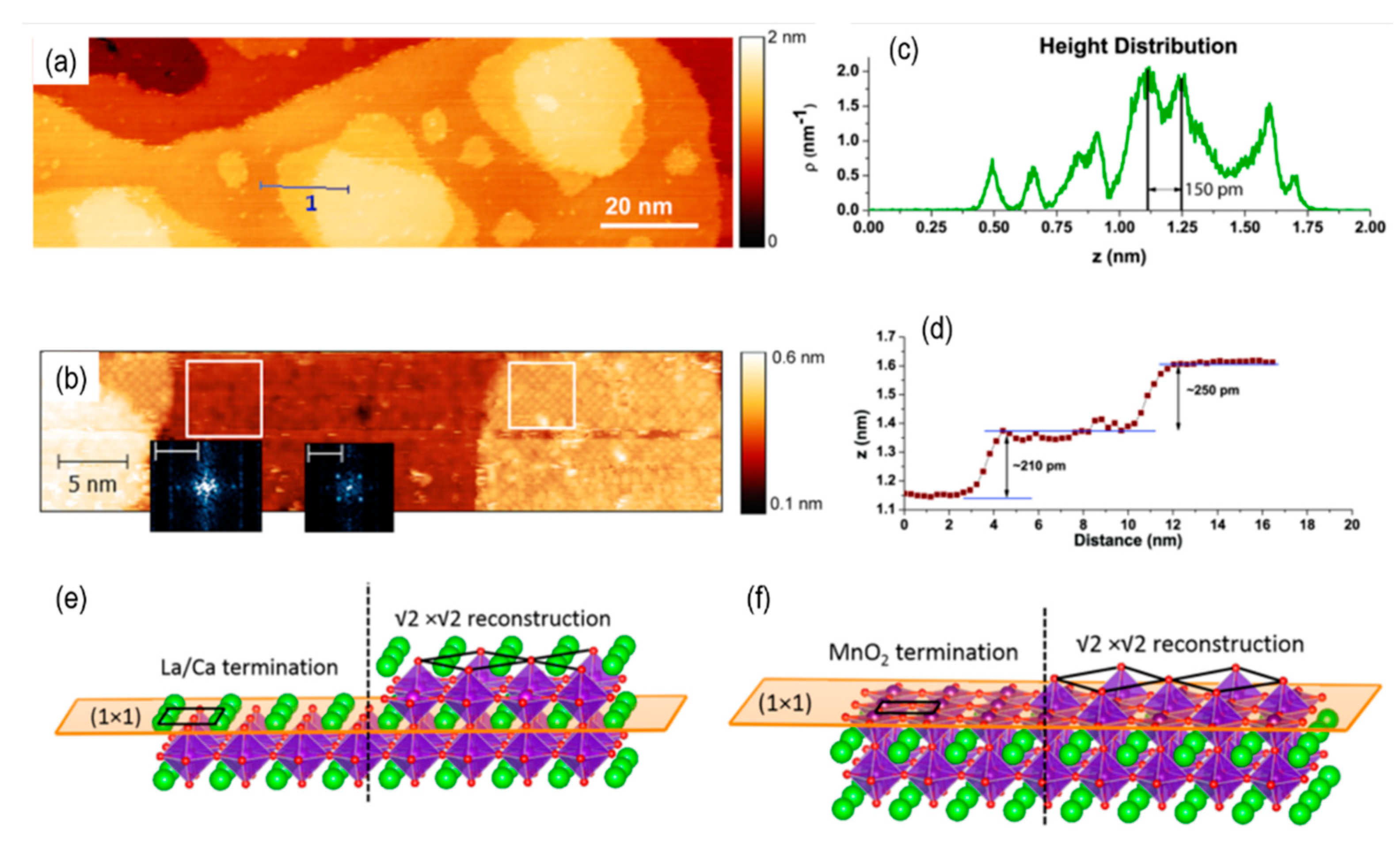
Figure 9.
Typical topographic images of SVO (001) surface and metallic tunneling spectra (110-nm-thick film). (a), (b) Topographic images with sample bias voltage Vs = −100 mV (a); the enlarged image in (b) shows the (√2 × √2) R45° structure. (c) The model used to generate the topographic image with a (√2 × √2) R45° structure. (d) Spatially averaged tunneling spectra (dI/dV) obtained from the surface. Reprinted from ref. [110] with permission of the American Physical Society.
Figure 9.
Typical topographic images of SVO (001) surface and metallic tunneling spectra (110-nm-thick film). (a), (b) Topographic images with sample bias voltage Vs = −100 mV (a); the enlarged image in (b) shows the (√2 × √2) R45° structure. (c) The model used to generate the topographic image with a (√2 × √2) R45° structure. (d) Spatially averaged tunneling spectra (dI/dV) obtained from the surface. Reprinted from ref. [110] with permission of the American Physical Society.
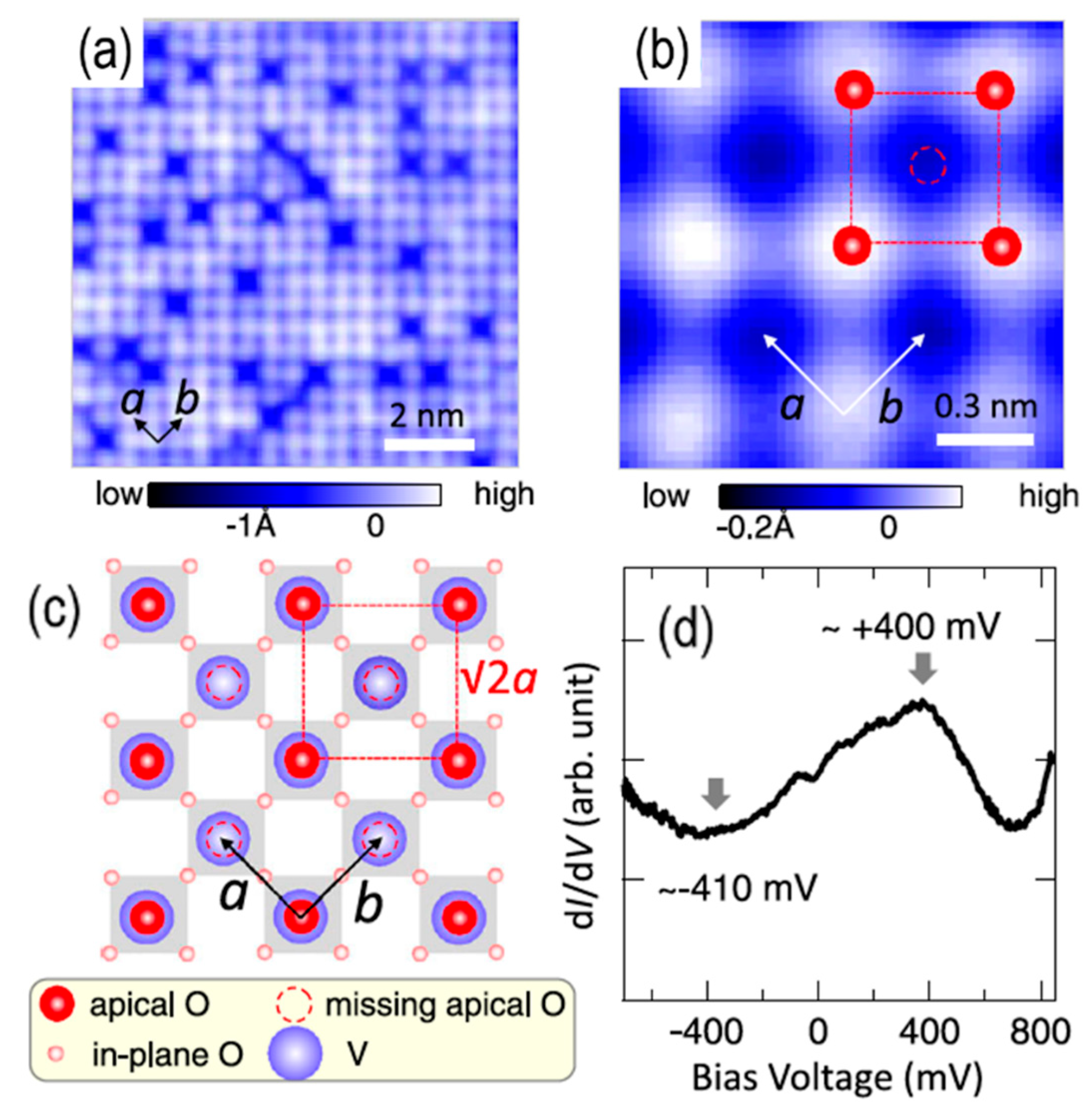
Figure 10.
LEED patterns of BSO thin films after annealing at various conditions. (1 × 1) reconstructed surface shown at (a) 400 °C in 1 atm oxygen, (b)-(d) 300, 400, and 550 °C in UHV condition, respectively. (1 × 1) surface changed to (√2 × √2) R45° reconstructed surface at (e) 700 °C in UHV condition. The reversibly switching of (√2 × √2) R45° reconstructed surface back to the (1 × 1) surface was represented at (f) 600 °C in 400 mTorr oxygen. (g)-(i) (√2 × √2) R45° reconstructed surface is reproduced by additional UHV annealing. Reprinted from ref. [115] with permission of the American Physical Society.
Figure 10.
LEED patterns of BSO thin films after annealing at various conditions. (1 × 1) reconstructed surface shown at (a) 400 °C in 1 atm oxygen, (b)-(d) 300, 400, and 550 °C in UHV condition, respectively. (1 × 1) surface changed to (√2 × √2) R45° reconstructed surface at (e) 700 °C in UHV condition. The reversibly switching of (√2 × √2) R45° reconstructed surface back to the (1 × 1) surface was represented at (f) 600 °C in 400 mTorr oxygen. (g)-(i) (√2 × √2) R45° reconstructed surface is reproduced by additional UHV annealing. Reprinted from ref. [115] with permission of the American Physical Society.
Disclaimer/Publisher’s Note: The statements, opinions and data contained in all publications are solely those of the individual author(s) and contributor(s) and not of MDPI and/or the editor(s). MDPI and/or the editor(s) disclaim responsibility for any injury to people or property resulting from any ideas, methods, instructions or products referred to in the content. |
© 2025 by the authors. Licensee MDPI, Basel, Switzerland. This article is an open access article distributed under the terms and conditions of the Creative Commons Attribution (CC BY) license (https://creativecommons.org/licenses/by/4.0/).
Copyright: This open access article is published under a Creative Commons CC BY 4.0 license, which permit the free download, distribution, and reuse, provided that the author and preprint are cited in any reuse.


