

Submitted:
10 August 2026
Posted:
11 August 2026
You are already at the latest version
Abstract
This article formulates Timeless Counterspace and Shadow Gravity within the TCGS–SEQUENTION framework as a type-disciplined source–shadow architecture. The framework posits a complete, non-temporal four-dimensional Counterspace (C4, G, Ψ); a three-dimensional shadow carrier Σ3 whose observables are pullbacks of source structure; a conserved singular set S = Orb(p0); an admissible foliation as geometric readout structure; a foliation label defined only up to monotone gauge reparameterization; operational clock time as a derived shadow functional; and one source-grounded Extrinsic Constitutive Law (ECL). The concept of 4D Counterduction is introduced to prevent two recurrent category errors: identifying Counterspace with (3 + 1)-dimensional spacetime and identifying source–shadow realization with conventional holography. Counterduction neither replaces nor renames Counterspace. Counterspace is the complete source domain; Counterduction is the selector-indexed, ECL-governed relation by which source content becomes operationally readable as a three-dimensional shadow. The qualifier “4D” refers to the dimensionality of the antecedent source, not to an independent Counterduction manifold. A Minkowski-trap firewall further distinguishes a temporal coordinate in Lorentzian representation from a temporal source dimension while retaining Lorentz covariance, invariant intervals, proper-time comparisons, and clock metrology as indispensable shadow-level structures. The formalism separates source configuration, informational organization, complete readability profile, selector-evaluated readout, and physical observable. General Relativity is recovered conditionally through the Baierlein–Sharp–Wheeler/ADM relational route at the shadow level. The static weak-field scalar response is identified with the AQUAL comparison class; its interpolation and transition scale are treated as partially closed rather than uniquely derived; and post Newtonian, lensing, cluster, and cosmological completion are stated as explicit open requirements. The resulting framework is positioned relative to relational gravity, the problem of time, differential geometry, holographic duality, inverse-problem theory, dark-matter phenomenology, modified gravity, and biological constraint theory. TCGS–SEQUENTION thereby functions as a 4D-counterductive research architecture whose governing ontology is kept distinct from every provisional mathematical map and empirical readout.
Keywords:
TCGS–SEQUENTION
; 4D-Counterduction
; 4D-Counterspace
; Minkowski trap
; foliation
; foliation parameter
; operational clock time
; gauge time
; shadow manifold
; source–shadow geometry
; Extrinsic Constitutive Law
; identity of source
; singular set
; pullback observables
; AQUAL
; relational gravity
; invariants
; artifacts
; cartographic epistemology
1. Introduction
Questions about time, dimensionality, observability, and gravitational dynamics already occupy several mature research programmes. Canonical and relational formulations of gravity distinguish coordinate labels from physical degrees of freedom; the problem-of-time literature studies how ordered correlations can be represented when no preferred external time is fundamental; differential geometry separates intrinsic from extrinsic structure; holographic theories formulate precise bulk–boundary or dual-theory correspondences; and inverse-problem theory distinguishes a forward map from the source features that are identifiable from finite data [1,2,3,4,5,6,7,8,9,10,11,12,13,14]. TCGS–SEQUENTION intersects these literatures but is not reducible to any of them.
The framework begins from a reversal of ontological dependence. The observable three-dimensional domain is not treated as an autonomous container. It is a shadow carrier whose geometry, fields, regularities, and apparent temporal ordering are readable expressions of a complete four-dimensional source domain. The fourth source dimension is counter-spatial rather than temporal; operational time belongs to the ordering and comparison of shadow readouts rather than to the dimensional constitution of the source. The formal logical derivation of the required four-dimensional source domain and the detailed historical and operational analysis of dimensional time are developed separately [15,16]; the present article states the corresponding architecture, mathematical types, comparison classes, and empirical closure conditions in self-contained form.
The phrase “four-dimensional” nevertheless invites two immediate misreadings. In relativistic practice it is normally parsed as three spatial coordinates plus one temporal coordinate. In popular discourse, a higher-to-lower-dimensional relation is readily assimilated to a hologram, simulation, or boundary code. TCGS–SEQUENTION asserts neither interpretation. Counterspace is not a Lorentzian spacetime, and the shadow is not assumed to be a geometric boundary carrying a complete, invertible encoding of a bulk.
The term 4D-Counterduction names the relation that resolves this ambiguity. Counterspace names the complete source domain. The ECL names the source-grounded constitutive/readability law. 4D-Counterduction names the constitutive source-to-shadow realization governed by that law. SEQUENTION names the ordered articulation of shadow readouts without making time ontic. The architecture is summarized by
The arrow in Equation (1) is an order of constitutive dependence, not a temporal arrow. It also fixes a non-substitution rule: 4D-Counterduction is not a new name for Counterspace. Counterspace is the antecedent source domain; Counterduction is the relation by which source content becomes shadow-readable.
The ECL is accordingly separated into a map, a complete profile value, and a selector-evaluated readout. It is neither an independently specifiable fifth primitive nor one of its own outputs. This type discipline is necessary for any subsequent variational, operator-theoretic, or empirical construction. The same discipline applies to scientific accountability:
A response function, scale relation, embedding, kernel, proposed invariant, lensing term, or numerical pipeline is a map and remains exposed to derivational and empirical failure. This use of cartography is therefore compatible with the general scientific-representation literature and with the identifiability requirements of inverse problems: a map is evaluated by what it preserves, what it omits, how its parameters are fixed, and whether its predictions transfer beyond the data used to construct it [13,14,17,18].
The contributions of this paper are sixfold. First, it states the four axioms in a type-disciplined form. Second, it defines 4D-Counterduction as a non-holographic and non-spatiotemporal source–shadow relation. Third, it presents the typed ECL chain and distinguishes the ECL from invariants, artifacts, and individual readouts. Fourth, it retains the relational-gravity and weak-field sectors while identifying which results are reductions to established theory and which remain open. Fifth, it formulates the physics–biology relation as a structural homology rather than a cross-domain derivation. Sixth, it supplies a claim-status ledger and explicit closure conditions so that foundational commitments, mathematical maps, and empirical readouts cannot be conflated.
1.1. Position Within the Broader Research Landscape
Relational gravity and the problem of time.
The BSW action, ADM constraint formalism, and hypersurface-deformation results show that General Relativity admits a canonical description in which lapse and shift implement gauge freedom and the physical content is encoded by constrained relations among spatial data [1,2,3]. Relational dynamics and quantum-gravity analyses have further examined intrinsic time, evolving constants, and conditional dynamics without a preferred external clock [4,5,6,7]. TCGS adopts the non-ontic status of the ordering label but adds a distinct source–shadow ontology: the Lorentzian spacetime reconstructed from shadow relations is not identified with the complete four-dimensional source.
Holography and dimensional reduction.
The modern holographic principle is tied to entropy bounds, boundary descriptions, and, in its best-developed form, dualities such as AdS/CFT [10,11,12]. TCGS does not assume an entropy-area bound, a boundary field theory, equality of partition functions, or a globally invertible bulk–boundary dictionary. Its source–shadow relation is therefore compared with holography to delimit differences, not to claim membership in the same theoretical class.
Dark matter, modified gravity, and empirical scaling relations.
The standard cosmological account is supported by a wide body of evidence organized within the dark-matter and CDM programmes, including galaxy dynamics, the cosmic microwave background, large-scale structure, and merging-cluster lensing [19,20,21,22]. Modified-dynamics programmes independently reproduce important galaxy-scale regularities, especially the baryonic Tully–Fisher and radial-acceleration relations, while retaining known difficulties in relativistic, cluster, and cosmological regimes [23,24,25,26,27,28,29]. TCGS enters this landscape through a source–embedding interpretation of an AQUAL-type shadow reduction; it does not present the scalar equation or its galaxy phenomenology as new.
Constraint, canalization, and convergence in biology.
Developmental constraint, canalization, phenotypic plasticity, and convergent evolution are established biological research areas with extensive mechanisms and empirical support [30,31,32,33]. The biological sector of TCGS is positioned as a proposed geometric organization of these phenomena. No gravitational result is used as biological evidence, and no biological analogy is allowed to repair a physical deficit.
Representation, reconstruction, and identifiability.
Scientific models represent selectively rather than reproducing their targets in every respect, while inverse problems require an explicitly typed forward operator, admissible source class, data model, and stability or uniqueness conditions [13,14,17,18]. This literature supplies the appropriate external standard for the paper’s cartographic vocabulary. A source claim is not earned merely by exhibiting a mathematically expressive representation; the source-to-observable bridge and its discriminators must be derived.
2. Ontology and Axioms of TCGS–SEQUENTION
Let be a smooth four-dimensional source manifold with source geometry G and complete content field or field multiplet . Let be a three-dimensional shadow carrier and let
be an admissible immersion. The induced shadow data are
Equations (3)–(4) fix the direction of ontological dependence: the shadow does not supply independent source content. It is a domain of operational registration.
2.1. Axiom A1: Whole Content and the Necessity of Counterspace
A1 (Whole Content). There exists a complete four-dimensional Counterspace containing the full source content corresponding to all admissible shadow readouts.
The fourth dimension in A1 is not a temporal coordinate. The logical role of is to provide the minimal non-temporal source domain capable of grounding both projection-stable invariants and foliation-dependent appearances in a three-dimensional readout domain. The source is not a stage through which an ontic present moves. It is the complete domain relative to which an operational sequence becomes readable.
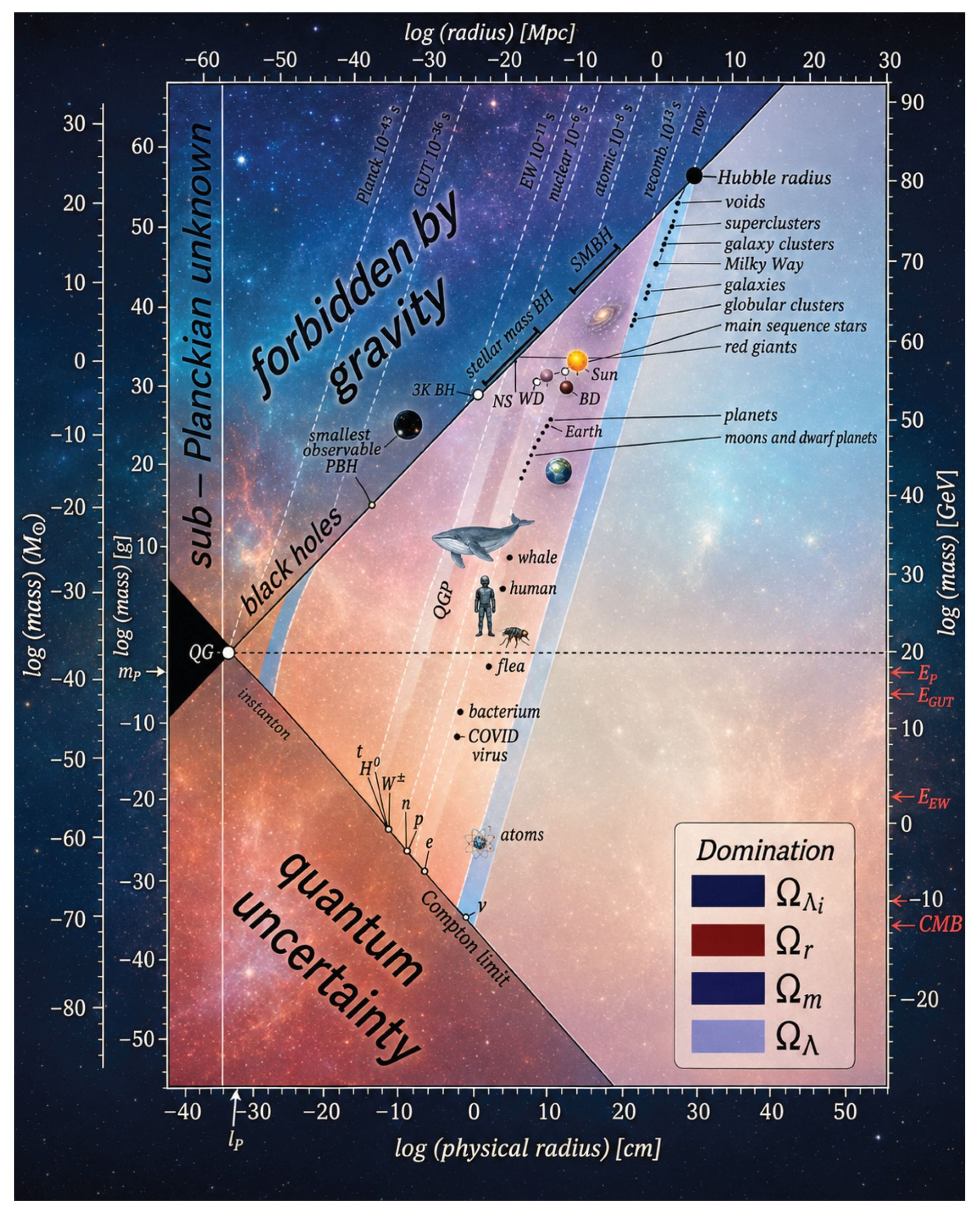
The Schwarzschild and Compton boundaries in mass–radius cartography provide an empirical-geometric motivation for embedding. Physical objects occupy a strongly constrained admissible wedge between gravitational collapse and quantum localization limits. TCGS interprets these boundaries as projective limits of a non-self-contained shadow domain, while explicitly recognizing that the diagram alone does not uniquely reconstruct Counterspace [34].
Figure 1.
Mass–radius cartography of physical objects, showing the Schwarzschild and Compton exclusion boundaries. Within TCGS–SEQUENTION, the wedge is used as an empirical-geometric anchor for the cone of admissibility of the shadow. It is not treated, by itself, as a unique reconstruction of Counterspace. Adapted from Lineweaver and Patel [34].
Figure 1.
Mass–radius cartography of physical objects, showing the Schwarzschild and Compton exclusion boundaries. Within TCGS–SEQUENTION, the wedge is used as an empirical-geometric anchor for the cone of admissibility of the shadow. It is not treated, by itself, as a unique reconstruction of Counterspace. Adapted from Lineweaver and Patel [34].
2.2. Axiom A2: Identity of Source and Conserved Singular Structure
A2 (Identity of Source). There is a distinguished source point and an admissible automorphism structure such that
is the conserved singular set from which shadow singular expressions descend.
A2 is an identity claim, not a claim that every shadow singularity has the same local form. Members of S belong to one source orbit, while the immersion, induced measure, Jacobian weighting, boundary data, and interference structure can produce different scale-dependent shadow expressions. Unity of source identity therefore does not imply descriptive simplicity. This use of a conserved source stratum must also be distinguished from the standard relativistic literature, in which singularity theorems establish geodesic incompleteness under stated conditions and classifications distinguish different forms of spacetime pathology [35,36,37].
The word singularity must also be used with discipline. Not every divergence in a calculation is automatically a source trace. Some divergences are coordinate artifacts, some indicate a defective approximation, and some may be invariant expressions of the source singular stratum. The cartographic task is to distinguish these cases under admissible chart, selector, and resolution changes.
2.3. Axiom A3: Shadow Realization, Foliation, and Gauge-Time Labels
A3 (Shadow Realization). The observable world is a three-dimensional shadow carrier whose observables are pullbacks of source data. Counterspace contains no ontic temporal dimension. Apparent temporal organization is represented through an admissible foliation, a gauge-equivalence class of foliation labels, and operational clock functionals constructed inside the shadow.
Let
be an admissible one-parameter family of embeddings. The foliation is not itself a gauge artifact: it has geometric content because it specifies which readouts are admissible and how their induced structures are related. The label is gauge. If is orientation preserving, then changes the indexing but not the represented foliation. Physical statements cannot depend on the bare numerical value of that label.
Operational time is a further, distinct object. It is a shadow-level functional constructed from physical correlations and records,
not the foliation and not its arbitrary parameter. The required type distinction is
The phrase time as gauge is therefore shorthand for invariance under admissible relabeling of temporal-order parameters. It must not be read as saying that the foliation itself is gauge or that clock readings lack operational content. The foliation is geometric structure, its label is gauge, operational time is a derived shadow readout, and ontic time is absent from the source ontology. This separation is compatible with relational-clock and evolving-observable programmes, while the source–shadow ontology remains specific to TCGS [5,6,7].
2.4. Axiom A4: Parsimony and Extrinsic Response
A4 (Parsimony and Extrinsic Response). Apparent dark, stochastic, anomalous, or teleological sectors are not multiplied at the source level when one source-grounded constitutive/readability law can account for their shadow manifestation.
A4 does not license the declaration that every anomaly has already been solved. It constrains model construction. A proposed correction must be generated by the same source architecture, its free structure must be independently specified, and it must transfer across admissible systems without case-by-case retuning. In the gravitational weak-field sector, a scalar -law is one reduction of the ECL; it is not the ECL itself. In the biological sector, an informational mobility law is a structurally homologous reduction, not a derivation of biology from gravity. The corresponding maps must be compared independently with the established dark-matter, modified-gravity, developmental-constraint, and convergence literatures [21,26,31,33].
2.5. Governing Necessities, Source Data, and Maps
Table 1 separates the levels that later sections use.

Table 1.
Logical levels in the foundational architecture.
| Level | Representative objects | Admissible interpretation |
|---|---|---|
| Governing architecture | A1–A4; non-temporal ; ; ; foliation geometry; gauge-equivalent ordering labels; derived operational time | Framework necessities that organize the research programme; not refitted in each application. |
| Source configuration | A complete admissible source datum, modulo already established source redundancies. | |
| ECL map | One source-grounded law assigning a complete profile to each source configuration. | |
| Counterduction relation | A derived source-to-shadow composition from an admissible source configuration to a physical selector readout; never the source domain or an additional primitive. | |
| Domain reduction | Scalar -law, tensor response, biological flux, kernel, effective action | Provisional mathematical map exposed to derivational and empirical failure. |
| Readout and observable | , detector record, galaxy curve, lensing map, biological phenotype | Selector-relative operational registration; never identical to the complete source. |
3. 4D-Counterduction: The Foundational Non-Spatiotemporal Distinction
3.1. Definition and Typed Construction
Definition 1
(4D-Counterduction). 4D-Counterduction is the selector-indexed, ECL-governed constitutive realization by which the informational organization of an admissible complete four-dimensional Counterspace configuration becomes operationally readable as a physical three-dimensional shadow, with the ordering label defined only up to admissible gauge reparameterization and operational clock time constructed within the shadow.
Non-substitution principle.
4D-Counterduction does not replace, rename, or supersede four-dimensional Counterspace. Counterspace is the complete non-temporal source domain of the framework. Counterduction is a typed constitutive relation defined only after a source configuration, the source-grounded ECL, an admissible selector, and a physical readout have been specified. It therefore presupposes Counterspace and possesses no independent source content, source geometry, or ontological dimensionality. The qualifier “four-dimensional” in 4D-Counterduction identifies the dimensionality of the source from which the realization proceeds; it does not identify Counterduction itself as a four-dimensional manifold. In compact form,
The final line is a type distinction, not a competition between two source ontologies. Counterspace names what the source is; Counterduction names how that source becomes operationally readable as a Shadow.
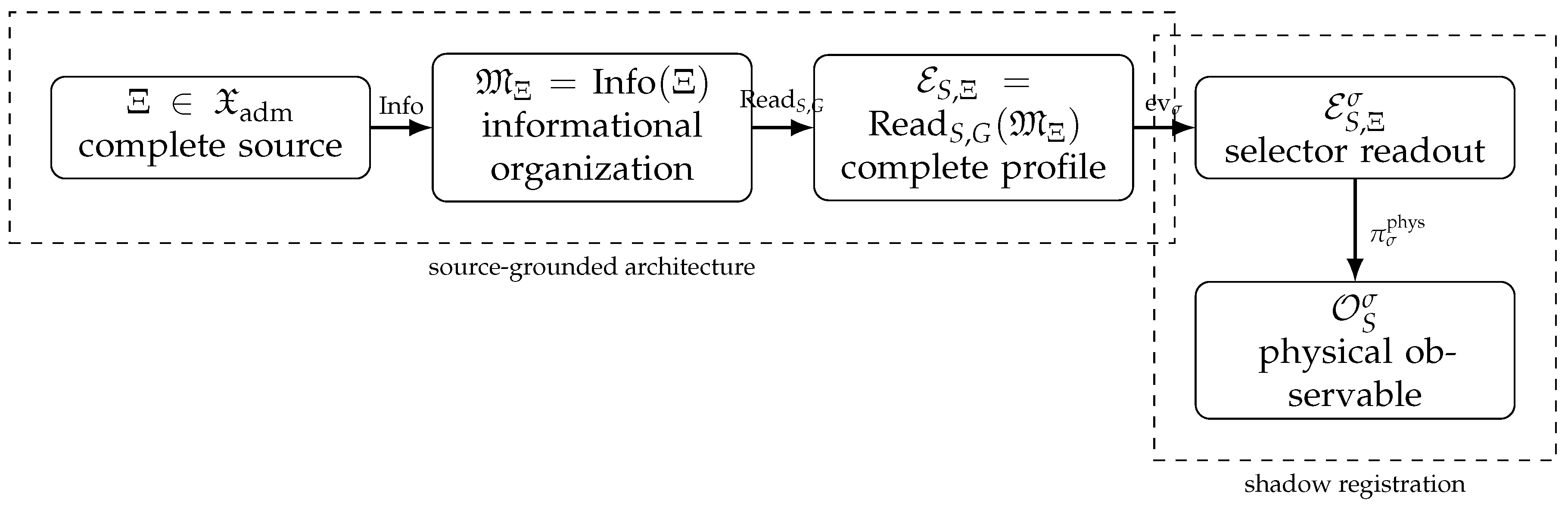
A typed formulation is required because the source, the law, the complete profile, and a selected output are different mathematical objects. Let
where is the non-experiential informational organization of the complete source configuration. Let
be the family of admissible selectors, where X is an immersion, a foliation class, and B boundary, corridor, or domain data. Selectors index readouts; they do not add source content. If is the readout space for selector , define
The typed ECL is
When the readout space contains representatives rather than already physical observables, let be an independently declared physical-readout map. The counterduction associated with is then
Equation (16) is a composition of typed maps. Because its domain consists of admissible source configurations containing , it cannot be identified with itself. It is not a second source process, a substitute source domain, or a carrier of hidden temporal evolution.
Figure 2.
Typed architecture of 4D-Counterduction. Counterspace remains the antecedent source domain; Counterduction is the composite relation terminating in a physical readout. The selector evaluates a complete profile and does not inject new source content. The diagram is an order of dependence, not a temporal process.
Figure 2.
Typed architecture of 4D-Counterduction. Counterspace remains the antecedent source domain; Counterduction is the composite relation terminating in a physical readout. The selector evaluates a complete profile and does not inject new source content. The diagram is an order of dependence, not a temporal process.
3.2. Why the Shadow Is Not a Temporal Slice
The central non-conflation rule is
The left-hand side is a counterduced, selector-indexed readout equipped with a structured foliation, a gauge-equivalent ordering label, and an operational clock functional. The right-hand side would be a constant-time hypersurface cut from a -dimensional spacetime. TCGS–SEQUENTION asserts the former and rejects the latter as a description of the source. The four dimensions belong to Counterspace; the foliation belongs to readout geometry; its parameter belongs to gauge; and operational time belongs to correlated shadow measurement.
This distinction also prevents a second error. The Lorentzian four-metric reconstructed in a relational formulation of General Relativity is a shadow-level representation of relations among admissible three-geometries. It is not thereby identified with the source manifold . Counterspace dimensionality and relativistic spacetime dimensionality occupy different explanatory levels.
3.3. The Minkowski Trap and Dimensional Type Discipline
The Minkowski trap is a non-entailment failure: the legitimate use of a temporal coordinate in a Lorentzian representation is promoted into a claim about the dimensional ontology of the source. The distinction is made without rejecting the Lorentzian formalism or its invariant content. In typed form,
Within the Lorentzian model, has a valid coordinate role. Equation (18) denies only that this role, by itself, identifies the non-temporal fourth dimension of Counterspace.
The historical genealogy is relevant but is not used as a genetic refutation. Lorentz’s local time entered as a corresponding-states variable, Poincaré analysed distant simultaneity through synchronization conventions, and Einstein’s 1905 construction defined frame time operationally through clocks. Minkowski’s quadratic-form geometrization then unified space and time in a powerful four-coordinate representation [38,39,40,41,42,43]. The documentary point is limited: the invariance structure and its ontological interpretation are logically separable. The structural argument remains the type distinction between a coordinate used by a map and a dimension attributed to the territory.
TCGS–SEQUENTION therefore applies a preservation rule rather than a rejection rule. Lorentz covariance, the invariant interval, light-cone relations, proper-time comparisons, relativistic clock corrections, tensor calculus, and the verified predictions organized by those structures remain valid at the shadow level. What is not imported is the additional identification
The distinction is summarized in Table 2.
Recent operational examples sharpen this firewall without changing its logical status. A cold-atom analogue of the problem of time demonstrates that an observed subsystem can be ordered through an internal relation while laboratory time remains available as an external protocol parameter [44]. Thorium-229 clock research constructs temporal standards from nuclear transitions, frequency ratios, material embeddings, and reproducibility controls [45,46]. These results do not establish the TCGS source ontology; they support only the narrower claim that reliable temporal ordering and precision clock comparison do not amount to direct detection of an independently flowing temporal substance.
4D-Counterduction supplies the positive replacement for the mistaken source reading. It does not discard the Minkowski map; it restricts that map to its proper explanatory jurisdiction. The Lorentzian spacetime representation organizes relations among shadow observables. The non-temporal Counterspace supplies the source ontology. The counterduction map specifies how the latter becomes readable as the former and as other admissible shadow descriptions.
Table 2.
Minkowski-trap firewall in the foundational architecture.
| Object or statement | Type | TCGS–SEQUENTION treatment |
|---|---|---|
| Lorentz covariance, invariant interval, and light-cone structure | Shadow-level invariant structure | Retained as mathematically and empirically indispensable. |
| Synchronization conventions, proper-time records, and clock ratios | Operational procedures/readouts | Retained; they construct reliable order and comparison inside the shadow. |
| Geometric readout structure | Retained as the admissible relation among shadow readings; not itself gauge. | |
| Gauge-equivalent label | Bare label has no source content and may be reparameterized. | |
| Derived operational clock functional | Physically meaningful within the shadow; not a source dimension. | |
| as an ontic source direction | Ontological interpretation | Not entailed by Lorentzian success and rejected as the catalogue entry for Counterspace. |
| Complete source domain | Non-temporal 4D-Counterspace. | |
| Constitutive relation | 4D-Counterduction from source configuration to physical readout; never the source itself. |
3.4. Counterduction Is Not Simple Holography
The term holography can be useful as a loose image of dimensional presentation, but in theoretical physics it carries specific commitments involving entropy bounds, boundary descriptions, or dual theories [10,11,12]. TCGS–SEQUENTION does not inherit those commitments merely because it contains a source–shadow relation. Table 3 records the distinction.
Table 3.
Why 4D-Counterduction is not equivalent to conventional holography.
| Question | Conventional holographic reading | 4D-Counterduction |
|---|---|---|
| Dimensional relation | Often a bulk–boundary encoding or duality between theories of different dimensions. | A source–shadow constitutive realization; the shadow need not be a literal geometric boundary. |
| Status of time | Usually retained inside a spacetime bulk and/or boundary theory. | The foliation has geometric content, its label is gauge, and operational clock time is a derived shadow readout; none is one of the four source dimensions. |
| Encoding | May suggest complete equivalence or reconstructibility. | No global inverse is assumed; one readout can be many-to-one and source-incomplete. |
| Mechanism | Encoding/duality relation between already specified theories. | Source-grounded readability through Info, , selector evaluation, and physical registration. |
| Reality of lower domain | Popular usage can imply illusion or simulation. | The shadow is operationally and physically real within its domain, although ontologically source-dependent. |
| Epistemic role | Often interpreted as a claim about where information is stored. | Separates complete source content, admissible readability, invariants, artifacts, and finite readouts. |
4D-Counterduction is therefore asymmetric and generally non-invertible. It can preserve selected invariants without making the complete source reconstructible from a single shadow. If two source configurations satisfy
then the selected readout is not source-complete. This is not a defect. It is a standard possibility in an inverse problem: identifiability can require several complementary data channels, and stability must be assessed relative to a declared source class and forward operator [13,14]. Source distinguishability can therefore be distributed across a family of readout channels rather than contained in any one channel.
3.5. Relationship Among Counterspace, Counterduction, ECL, and SEQUENTION
The framework vocabulary can now be stabilized:
This lexical division removes the need to use holography as the primary classification of the framework. It also makes the dependency hierarchy explicit: Counterduction presupposes Counterspace and cannot replace, rename, or ontologically supersede it.
4. The Metamathematical Lens: Territory, Map, and Accountability
The framework compares Counterspace with semantic territory and a scientific representation with a map. This is a structural analogy, not a literal isomorphism between physical and formal systems. Counterspace is the complete source domain; a theory, equation, dataset, or experimental protocol is a finite or formal representation of source-conditioned shadow structure. Tarski’s separation between a language and a truth predicate for that language, and Godelian limits on formal derivability, supply a disciplined analogy for why a map need not exhaust the territory [47,48,49]. The analogy is constrained by the broader philosophy of scientific representation, where models are selective mediators rather than literal copies of their targets [17,18].
The analogy has two valid consequences. First, no finite model should be identified with the complete source merely because it organizes observations successfully. Second, the incompleteness of one map does not imply that empirical science is arbitrary. It creates an obligation to specify what the map preserves, what it discards, and how it can fail.
The appropriate methodological term is disciplined cartography. A map-level claim is scientific only if its domain, parameters, transfer conditions, uncertainty model, and failure conditions are stated. If the scalar weak-field response fails, that scalar map fails. If a proposed invariant varies under admissible selector transformations, it is reclassified as an artifact. If an independently specified cluster term does not transfer across clusters, that term is rejected. Sustained failure of all admissible bridges can also force revision of the architecture connecting source and shadow. This is not an escape from evidence; it is an explicit hierarchy of forward models, inverse claims, and identifiability conditions [13,14].
Definition 2
(Invariant). A shadow-readable functional I is an invariant relative to an admissible selector-equivalence class if it is preserved under all comparison arrows identifying physically equivalent selectors.
Definition 3
(Artifact). An artifact is a shadow feature whose form, probability, apparent direction, or explanatory role depends on the selected foliation, chart, carrier, boundary sector, conditioning set, or measurement corridor and therefore cannot be promoted to source-level invariance.
Equivalent selectors should be organized by a groupoid rather than by an unrestricted demand that all changes of be conjugate. A foliation relabeling is a canonical candidate for equivalence. A different immersion or boundary phase is equivalent only when an explicit comparison map establishes that the two presentations represent the same physical corridor. Across inequivalent phases, the requirement is transferability of one source rule without target-dependent retuning, not identity of effective response algebras.
5. Unified Source Architecture and Cross-Domain Homology
Physics and biology are compared here only at the level of a possible homology of source–shadow organization; no derivation of one domain from the other is asserted. The gravitational potential and the biological informational potential U live in different effective state spaces, carry different dimensions, and require independent calibration. The biological comparison is motivated by established work on developmental constraint, canalization, plasticity, and convergence, but those literatures remain autonomous and mechanistically detailed [30,31,32,33]. A biological result cannot repair a cluster-lensing deficit, and a galaxy-scale response equation cannot establish biological determinism.
Table 4.
Disciplined cross-domain homology in TCGS–SEQUENTION.
| Role | Gravitational shadow | Biological shadow | Status |
|---|---|---|---|
| Source domain | Same complete source architecture, with biological selector/domain reduction | Governing architecture | |
| Operational carrier | Spatial/gravitational | and | Domain-specific maps |
| Reduced potential | U on genotype–phenotype–environment state space | Distinct effective fields | |
| Extrinsic response | Structural homology, not cross-domain derivation | ||
| Candidate artifact | Missing-source or dark-sector attribution | Chance, unconstrained search, or teleological attribution | Interpretation subject to map-level tests |
| Candidate invariant | Transition scale, source-conditioned geometry, selector-stable relations | Canalization, convergence curvature, endpoint stability, corridor structure | Open empirical programme |
The domain-selection principle can be written schematically by treating as a source multiplet and using bounded projectors and :
Equation (22) is an architectural placeholder until the projectors, scalar extraction , and their selector naturality are constructed. It prevents an ontological proliferation of unrelated source fields while preserving the autonomy of domain-specific effective theories. Its validity must therefore be established separately in each domain rather than inferred from formal similarity.
6. Geometry of the Shadow: Counterduction Rather Than Holography
6.1. Immersion, Induced Metric, and Extrinsic Data
In local coordinates on and on , the induced shadow metric is
The second fundamental form and mean curvature of the immersion encode information absent from a purely intrinsic description of [8,9]. This is the geometric location at which an extrinsic response can enter without adding an independent matter species. The statement does not mean that the intrinsic metric has no measurable properties. It means that, under the framework ontology, its source is inherited rather than autonomous.
Off the singular set, a schematic source equation may be written
where is invariant under the admitted source automorphisms. Equation (24) is a source-model ansatz, not a theorem implied by A1–A4. Its purpose is to state a concrete reconstruction target: given a specified source operator, singular support, boundary data, and admissible selector, determine which shadow invariants follow.
6.2. Reconstruction and the Epistemic Cut
A single readout need not admit a unique inverse. Complete source reconstruction would require a family of readouts, a declared equivalence relation, and an identifiability theorem. The boundary between operationally recoverable source structure and source distinctions left outside the admissible readout family is termed the Epistemic Cut. In inverse-problem language, it marks the distinction between identifiable source functionals and null directions of the forward map [13,14]. The term is not an excuse for vagueness; it identifies the missing theorem: which source distinctions are exhausted by the complete profile , and which are not?
The often-used shorthand is therefore not accepted as literal mathematical equality. The two objects belong to different formal spaces. At most, one may posit conditional ontic co-reference,
if the complete informational organization of the source is exhausted by the complete family of admissible readings. No operator construction in this paper depends on Equation (25).
7. General Relativity as a Relational Shadow Limit
The empirical success of General Relativity does not, by itself, settle whether a temporal coordinate is fundamental at the source level. The Baierlein–Sharp–Wheeler (BSW) form of geometrodynamics writes a Jacobi-type action on the space of three-geometries, while ADM and hypersurface-deformation analyses formulate the corresponding constraints [1,2,3]. Relational and problem-of-time programmes provide the wider comparison class for interpreting the ordering parameter and observable correlations [4,5,6,7]:
with
where is the DeWitt supermetric up to convention-dependent normalization. The parameter is freely relabelable. Variation yields the Hamiltonian and momentum constraints, while the lapse is reconstructed from the relation between the kinetic and curvature terms.
Proposition 1
(Conditional relational recovery). Assume a local three-geometry action with an ultralocal kinetic supermetric, a scalar potential proportional to , and closure of the hypersurface-deformation algebra. Then the relational construction yields the ADM constraints and reconstructs a Lorentzian four-metric satisfying the Einstein equations in the corresponding regime.
This proposition is a reduction result under stated assumptions, not a derivation of the full TCGS source geometry. Three distinctions are load-bearing:
- 1.
- the reconstructed Lorentzian four-metric is a shadow-level spacetime representation, not ;
- 2.
- the BSW parameter is a gauge of ordering among three-geometries, not a source dimension;
- 3.
- recovery of General Relativity in a high-gradient or projection-negligible regime does not by itself supply a relativistic completion of every extrinsic weak-field correction.
In this formulation, gravitational dynamics are shadow-level consistency relations among admissible readouts of one source architecture. No temporal becoming is assigned to the complete source by the use of a parameter in the relational action.
8. The Extrinsic Constitutive Law and Its Weak-Field Reduction
8.1. The ECL Is Not the Scalar Response Function
The ECL is the full typed map in Equation (13). A scalar gravitational equation is a domain reduction. Conflating the two would identify a local chart with the complete source-to-shadow grammar. The minimal static, weak-field, non-relativistic reduction is
with
Equation (28) is an AQUAL-type field equation in this regime [23,24,26]. The mathematical form and its galaxy-scale phenomenology are therefore not claimed as novel. Relativistic MOND constructions also show that lensing and cosmology require a covariant field content beyond the scalar quasistatic equation [25]. The TCGS claim is interpretive and architectural: the modified response is read as a shadow reduction of source–embedding geometry rather than as a separately postulated dark substance or an unexplained modification of force.
8.2. Transition Scale and Embedding Interpretation
The transition scale is written
where H is a specified extrinsic-curvature scalar and a dimensionless coefficient. Equation (30) explains the scale in kind: a universal acceleration scale can arise from source–shadow embedding geometry. It does not yet derive the measured numerical value. Until X, H, the averaging prescription, and are fixed independently of galaxy kinematics, remains calibrated rather than predicted. This distinction is important because the empirical universality and interpretation of a single acceleration scale remain subjects of active statistical debate [27,28,50].
A universal derivation rule is nevertheless mandatory. For any domain scale ,
must be specified before comparison with the target data. Per-system retuning would introduce information not supplied by the one-source architecture and would refute that reduction as a transferable map.
8.3. Interpolating Function and Ellipticity
A minimal smooth representative is
This function has the required asymptotic limits but is not uniquely derived by them. It is one smooth, minimal-complexity representative. Moreover, , so the associated operator is degenerate elliptic in the deep regime and cannot simultaneously satisfy a positive uniform lower bound. For numerical and certain existence arguments, a regularized family can be used:
The physical deep-extrinsic limit corresponds to studying , not silently assuming uniform ellipticity at .
Table 5.
Status of the minimal gravitational reduction.
| Object | Status | Required closure |
|---|---|---|
| Asymptotic limits in Equation (29) | Required reduction conditions | Recover Newton/GR behaviour at high acceleration and the deep extrinsic scaling at low acceleration. |
| Selected representative | Derive from an independently specified embedding or compare admissible families without post hoc selection. | |
| Calibrated universal scale; geometrically interpreted | Compute Equation (30) from source geometry before using target kinematics. | |
| Scalar equation (28) | Reduction to AQUAL | Supply a covariant completion, lensing metric, cosmological perturbations, and transfer tests. |
| ECL | Governing constitutive/readability map | Construct Info, , selector comparisons, and physical readout maps in a concrete model. |
9. Model Calibration and Illustrative Shadow Profiles
9.1. Galaxy-Scale RAR and BTFR
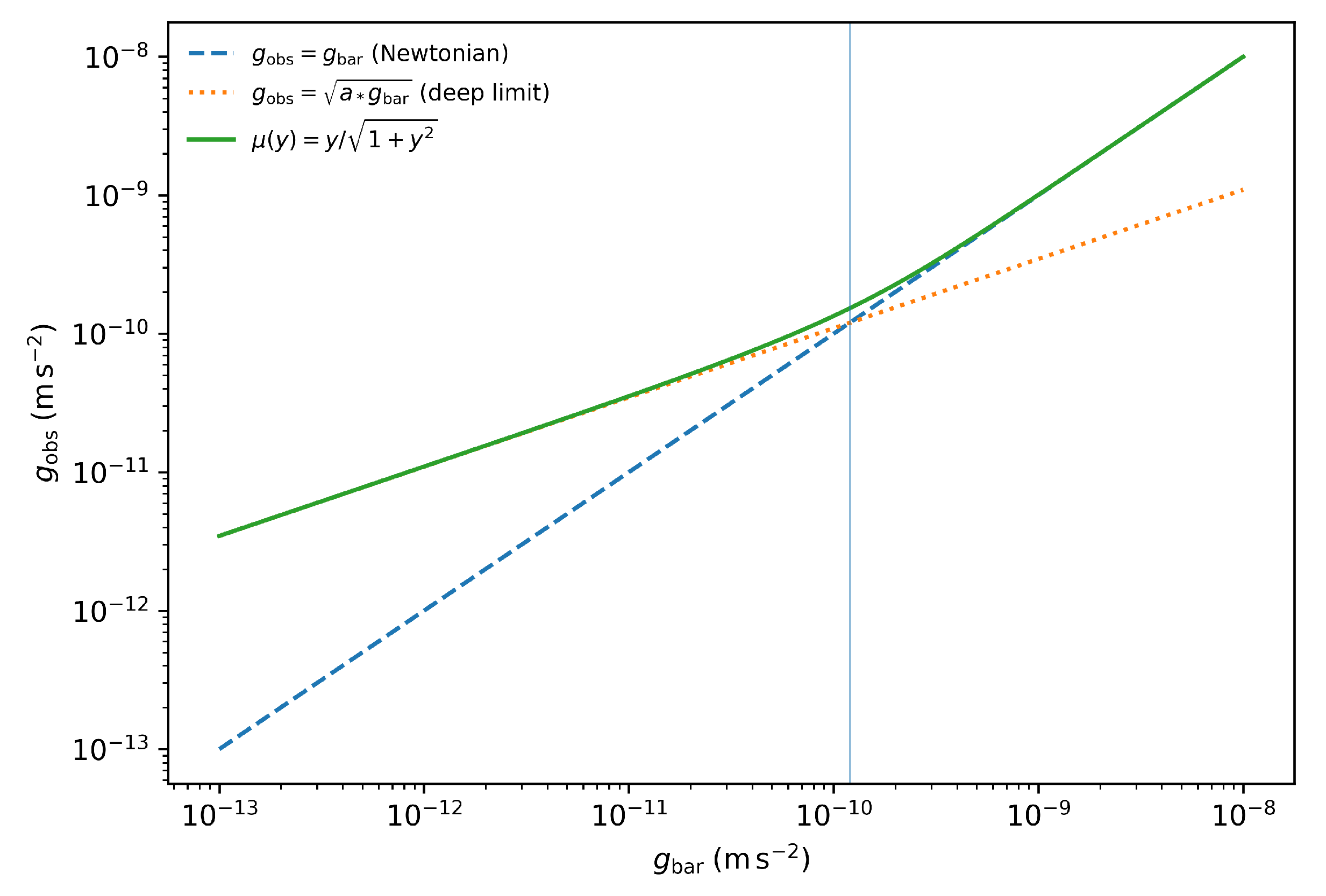
In spherical symmetry, Equation (28) reduces schematically to
For , . For , and hence
The second relation is the baryonic Tully–Fisher scaling, and the interpolation between the two branches reproduces the form of the radial acceleration relation within the AQUAL/MOND comparison class [26,27,28]. Competing analyses of the universality of the acceleration scale must be addressed by a common hierarchical inference procedure rather than by selecting one galaxy sample post hoc [50].
Figure 3.
Schematic radial-acceleration response for one transition scale . The figure illustrates the Newtonian and deep-extrinsic branches; it is not a fit to a galaxy catalogue.
Figure 3.
Schematic radial-acceleration response for one transition scale . The figure illustrates the Newtonian and deep-extrinsic branches; it is not a fit to a galaxy catalogue.
9.2. Lensing and the Limit of a Scalar Weak-Field Map
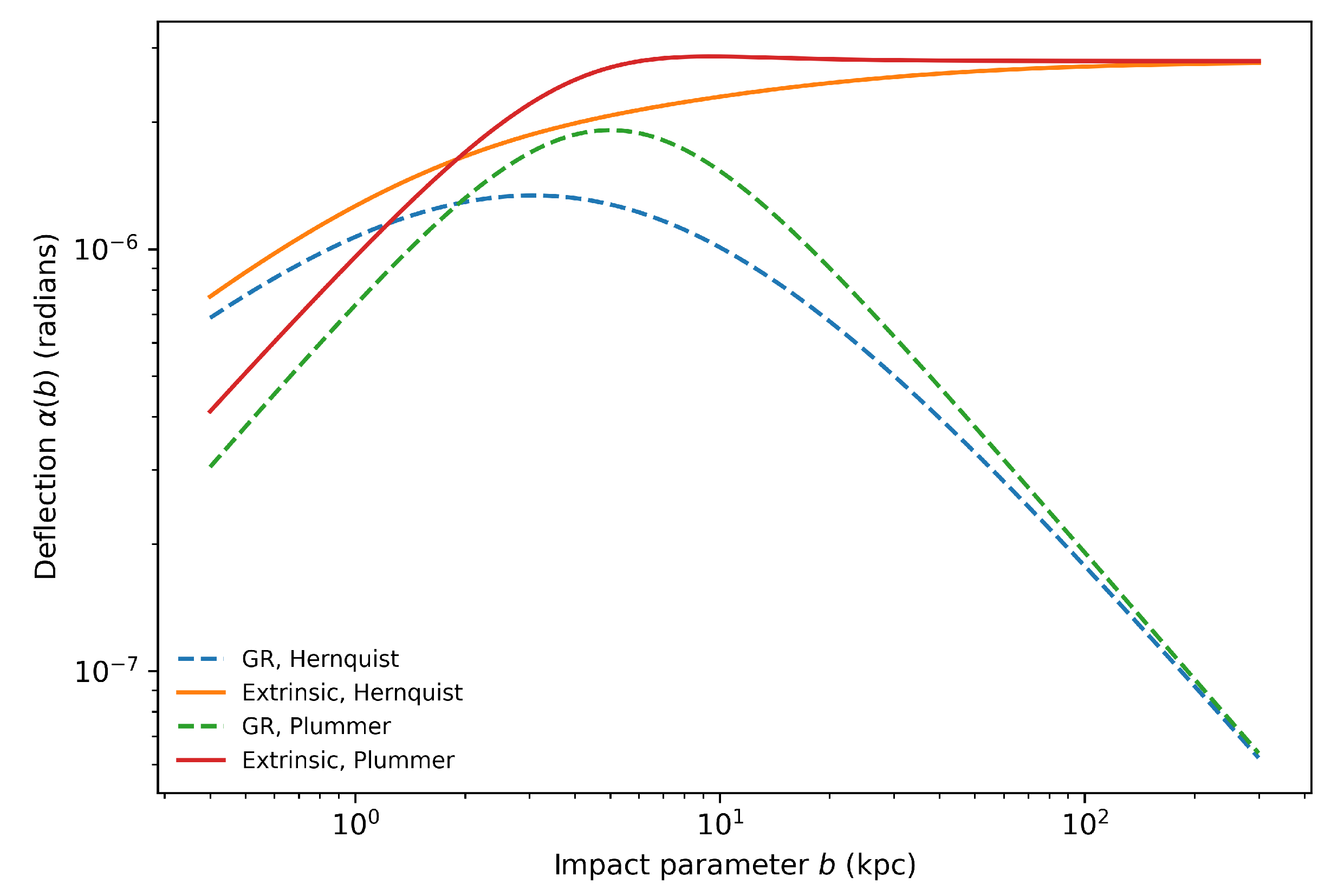
Figure 4 provides a heuristic deflection comparison obtained by inserting the modified radial acceleration into a line-of-sight expression. Its inferential status is deliberately limited. Gravitational lensing depends on a relativistic metric, including the relation between the scalar potentials in a weak-field line element and any additional fields in the covariant completion. A scalar modified Poisson equation alone does not determine light deflection, as is also clear from relativistic modified-gravity constructions [25].
Figure 4.
Illustrative deflection profiles for Hernquist and Plummer baryonic models. The curves show what follows from a particular heuristic use of the scalar response. They are not a relativistic lensing derivation and do not establish cluster or strong-lensing closure.
Figure 4.
Illustrative deflection profiles for Hernquist and Plummer baryonic models. The curves show what follows from a particular heuristic use of the scalar response. They are not a relativistic lensing derivation and do not establish cluster or strong-lensing closure.
Merging clusters are a decisive stress test. The separation between lensing mass and the dominant X-ray gas in systems such as the Bullet Cluster is a central empirical constraint [22]. A response sourced only by the observed baryonic gas tends to track that gas and inherits the residual mass problem of AQUAL-like cluster analyses [29]. TCGS–SEQUENTION can address this regime only if a singular-set or extrinsic-curvature contribution is specified independently of the lensing map, transfers across multiple systems, and fails cleanly when the transferred prediction is wrong. An adjustable term placed on the observed convergence peak would be dark matter under another name, not a source-derived explanation.
10. Foundational Consistency and Mathematical Closure
10.1. Constraint Algebra
Under the BSW/ADM assumptions of Section 7, the Hamiltonian and momentum constraints close according to the hypersurface-deformation algebra [2,3]. This is an established property of the relational GR comparison class, not yet a proof that an arbitrary TCGS extrinsic response possesses a covariant constraint algebra. A covariant completion must demonstrate closure after the new source–shadow terms are included.
10.2. Solar-System and Post-Newtonian Bounds
The high-acceleration limit is necessary for recovering Newtonian gravity locally, but it is not sufficient to derive post-Newtonian parameters. Values such as and are defined from a relativistic metric theory, not from Equation (28) alone. The correct closure condition is therefore:
Construct a covariant action whose weak-field, quasistatic limit is Equation (28), derive its metric potentials and matter couplings, and verify the solar-system and binary-pulsar bounds without system-specific screening parameters.
10.3. Well-Posedness of the Nonlinear Scalar Reduction
Let be bounded with suitable boundary conditions and define
For , if is continuous, coercive, and strongly monotone, the operator
admits a unique weak solution for admissible data by standard monotone-operator results of Browder–Minty type, subject to the boundary normalization [53,54]. Lax–Milgram applies directly only to linear coercive bilinear forms and should not be invoked as though Equation (28) were linear. At , the operator becomes degenerate; existence and regularity must be treated in the appropriate degenerate-elliptic function spaces, and uniqueness requires separate hypotheses.
10.4. Dimensional and Type Consistency
Every proposed equation must also pass a type-consistency check. The source manifold, shadow manifold, informational organization, profile space, readout space, and physical observable space are not interchangeable. In particular:
as literal mathematical objects. Any future spectral or variational analysis must first define Banach or Hilbert structures, domains, inner products, physical quotient maps, and closability. Positivity of an operator such as would then measure squared readout sensitivity; it would not automatically represent energy or stability. The relevant self-adjointness statement belongs to standard closed-operator theory and supplies no physical interpretation by itself [55].
11. Cosmology Without Ontic Time
Cosmology in TCGS–SEQUENTION is not a history generated by an ontic temporal coordinate. It is a cartography of selector-stable relations among source-conditioned shadow fields. Operational redshift, lookback time, thermal chronology, and causal reconstruction remain indispensable observational variables. Their use does not settle their ontological classification.
A cosmological completion must reproduce the observational content normally carried by background expansion and perturbation theory: distance–redshift relations, primordial abundance constraints, acoustic scales, lensing, structure growth, and the statistical geometry of sky maps. These are tightly constrained within the standard cosmological inference programme [20,56]. The foundational framework does not obtain them merely by calling late-time acceleration a foliation artifact; it must construct a source–shadow model from which the corresponding invariants and operational relations are derived.
One admissible cartographic strategy is to evaluate Minkowski functionals, Euler-characteristic densities, genus curves, multifractal spectra, and directional statistics on pullback fields, then test their stability under admissible selector changes. Minkowski-functional methods provide an established morphological language for cosmic fields [57]. A statistic that changes under a physically equivalent foliation is a map artifact; one that survives the declared comparison class becomes a candidate invariant. Claims concerning cosmic anisotropy or dipolar acceleration remain open empirical discriminators. Published analyses reach different conclusions about acceleration and anisotropy, so any TCGS test must model selection effects, frame choices, calibration covariance, and independent catalogues explicitly [56,58,59].
12. Empirical Programme: Disciplined Cartography
The empirical programme is organized by the difference between a governing necessity and a map-level prediction. It begins from the four-dimensional source architecture and the gauge status of the foliation label, then determines whether particular mathematical realizations correctly map the corresponding shadow consequences.
Table 6.
Principal cartographic tests and failure conditions.
| Target | Specified map | Required discriminator | Failure meaning |
|---|---|---|---|
| Galaxy kinematics | Equation (28), one , predeclared | Joint rotation-curve/RAR/BTFR transfer without per-galaxy scale fitting | Refutes that response family or universality rule; does not create a new source species automatically. |
| Cluster lensing | Baryons plus an independently derived S or extrinsic-curvature term | Predict magnitude and displacement across several merging clusters with no target-specific retuning | Refutes the proposed geometric term; repeated failure concedes the regime to another physical component or architecture. |
| Solar-system gravity | Covariant completion of the scalar reduction | PPN, binary, lensing, and laboratory consistency from one action | Refutes the covariant map or its couplings. |
| Cosmological structure | Source–shadow background and perturbation model | CMB, growth, distance, and lensing observables from one parameter architecture | Refutes the cosmological completion. |
| Selector invariance | Explicit selector groupoid and comparison maps | Unitary/canonical transport of stated invariants along equivalent selectors | Reclassifies a drifting quantity as an artifact. |
| Biological homology | Independently defined biological reduction and invariants | Cross-lineage or cross-protocol transfer of and invariant estimators | Refutes the biological map; no gravitational result can rescue it by analogy. |
The programme should be preregistered wherever possible. Parameters used to generate a prediction must be fixed outside the target observation. A map that succeeds only after viewing the target is descriptive accommodation. A source-derived map is expected to exclude alternatives and to transfer.
13. Discussion
The introduction of 4D-Counterduction is not a cosmetic rebranding. It closes two linked epistemological ambiguities that otherwise propagate through every application. The first is the Minkowski trap: a temporal coordinate used in a successful Lorentzian map is promoted into the fourth dimension of the source. The second is the holographic substitution: a source–shadow relation is assimilated to bulk–boundary duality, optical reconstruction, simulation language, or complete encoding. 4D-Counterduction prevents both substitutions by naming the actual relation: one complete non-temporal source architecture becomes selectively readable through a three-dimensional physical shadow. It does not reject relativistic coordinates or clocks; it prevents their representational role from being mistaken for Counterspace ontology.
The typed formulation also changes how the ECL should be discussed. The ECL is not a field added beside G and , not a cosmic agent, and not a scalar response function. It is the source-grounded map assigning a complete readability profile. A selected gravitational equation, biological flux, quantum measure, or cognitive readout is a reduction or evaluation of that profile. This preserves the parsimony of the framework while making the constructive burden explicit. The maps Info and , the selector-equivalence groupoid, the physical quotient maps, and the source-to-observable bridge must ultimately be built rather than merely named.
The same discipline improves the gravitational sector. Equation (28) is useful and phenomenologically important, but its weak-field form belongs to the AQUAL/MOND comparison class. The novelty of TCGS does not lie in claiming prior mathematics as new. It lies in proposing a source–embedding interpretation and in demanding cross-sector invariants that a standalone force-law modification does not supply. That interpretation becomes physics only if it leads to independently specified, transferable discriminators: a derived , a covariant completion, cluster offsets, cosmological structure, or other observables not already guaranteed by AQUAL.
Finally, the framework’s logical-necessity language must coexist with intellectual risk. Axioms govern a programme; they do not certify every downstream map. The strongest formulation of TCGS–SEQUENTION will not be the one that declares every result compatible. It will be the one that sharply limits admissible bridges, records unresolved conditions, and rejects maps that fail to transfer.
14. Conclusions
TCGS–SEQUENTION is most precisely characterized as a 4D-counterductive source–shadow framework. Its four-dimensional Counterspace is not spacetime. Its three-dimensional shadow is not a constant-time slice. Its source–shadow relation is not equivalent to conventional holography. The Minkowski-trap firewall retains Lorentzian invariants and clock comparisons while denying their promotion into source ontology. The foliation is geometric structure, its label is gauge, operational clock time is a derived shadow readout, and no temporal direction belongs to the four dimensions of Counterspace.
The foundational identity is
The four axioms, identity-of-source architecture, relational-gravity limit, weak-field response, metamathematical lens, and physics–biology homology now occupy explicitly separated logical levels. The ECL is typed as a map, a complete profile, and a selected readout. The scalar gravitational law is identified as an AQUAL-type reduction rather than a novel equation. The response shape and transition scale are not presented as uniquely derived. Uniform ellipticity is separated from the degenerate physical limit. Post-Newtonian, lensing, cluster, and cosmological closure are recorded as open requirements rather than inferred from a scalar equation. Every concrete map is therefore accountable to an external comparison class and a declared failure condition.
This formulation establishes the terminology and architecture required for the rest of the programme. Counterspace supplies the source ontology. The ECL supplies the readability law. 4D-Counterduction supplies the constitutive realization and neither replaces nor renames Counterspace. SEQUENTION supplies ordered shadow articulation. The Minkowski trap is blocked by retaining the foliation–label–clock distinction, and the holography confusion is blocked by refusing to identify a selective readout with a boundary duality or a globally invertible code.
Author Contributions
Conceptualization, formal analysis, investigation, writing—original draft, and writing—review and editing, H.A.-P. The author accepts responsibility for the final manuscript.
Funding
This research received no external funding.
Institutional Review Board Statement
Not applicable.
Informed Consent Statement
Not applicable.
Data Availability Statement
No new experimental dataset was generated. The equations, conceptual diagrams, claim-status tables, and illustrative figures required to evaluate the manuscript are contained in the article and its source package.
Conflicts of Interest
The author develops the TCGS–SEQUENTION framework and declares no other conflict of interest.
Appendix A. Constraint-Algebra Scope
The BSW/ADM reduction uses the standard Hamiltonian and momentum constraints. In schematic notation,
These relations close for the GR comparison class. A modified source–shadow action must re-derive the constraints and verify closure; it cannot inherit closure solely because its high-gradient limit approaches GR.
Appendix B. Notation and Type Dictionary
Table A1.
Notation used in the paper.
| Symbol | Meaning |
|---|---|
| Complete, non-temporal four-dimensional Counterspace source domain. | |
| Observable three-dimensional shadow carrier. | |
| Source geometry and complete content field or multiplet. | |
| Admissible immersion selecting the geometric shadow carrier. | |
| Induced shadow metric and fields. | |
| Distinguished source origin. | |
| Conserved singular set. | |
| Structured family of admissible embeddings/readouts; geometric content, not a gauge label. | |
| Foliation class under admissible orientation-preserving relabeling. | |
| Gauge-equivalent label indexing a foliation; the bare value has no physical content. | |
| Operational clock functional constructed from shadow correlations and records. | |
| Space of admissible complete source configurations. | |
| Info | Map assigning the non-experiential informational organization of a source configuration. |
| Informational organization of ; not consciousness or an agent. | |
| Family of admissible selectors . | |
| Singular-set/source-geometry-mediated readability construction. | |
| Typed ECL map . | |
| Complete selector-indexed profile generated by one source configuration. | |
| One selector-evaluated readout. | |
| 4D-Counterduction map from an admissible source configuration to a physical selector readout; not a synonym for or replacement of . | |
| Shadow gravitational potential and baryonic source density. | |
| Reduced response function and transition scale. |
Appendix C. Claim-Status Ledger
The tags are: GN, governing necessity within the framework; CD, closed by definition; CDer, closed by derivation under stated premises; CR, closed by reduction to an established comparison result; CC, supported by external citation; PC, partially closed; OT, open but testable; REJ, rejected as stated because it violates a type, derivational, or scope constraint.
Table A2.
Foundational claim-status ledger.
| Claim | Status | Basis or closure requirement |
|---|---|---|
| Counterspace is a complete, non-temporal four-dimensional source domain. | GN | A1 and the logical derivation summarized in Section 1Section 2. |
| The shadow is three-dimensional and its observables are pullbacks. | GN/CD | A3 and Equation (4). |
| The foliation, foliation parameter, and operational clock time are one object. | REJ/CD | Rejected by A3 and Equations (6)–(8); the foliation is structure, the label is gauge, and clock time is a derived readout. |
| Use of in a Lorentzian chart entails an ontic temporal source dimension. | REJ/CDer | Rejected by the coordinate–ontology non-entailment in Equation (18). |
| Lorentz covariance, invariant intervals, proper-time comparisons, and clock metrology are discarded. | REJ/CR | Rejected; these are retained as shadow-level invariant and operational structures. |
| The gauge freedom of temporal ordering labels does not create a source dimension. | GN/CD | A3 and Equation (8). |
| 4D-Counterduction names the ECL-governed source-to-shadow realization. | CD | Definition and Equation (16). |
| 4D-Counterduction does not replace, rename, or supersede Counterspace. | CD | Non-substitution principle and Equation (9); source domain and source-to-shadow relation have different formal roles. |
| 4D-Counterduction is not conventional holography. | CDer | Follows from the absence of a required boundary, ontic time, dual theory, and global inverse. |
| The ECL is a map, complete profile, and selected readout, not one untyped object. | CD | Equations (13)–(15). |
| Literal equality is established. | REJ | Replaced by typed distinction and conditional ontic co-reference. |
| GR is recovered as a relational shadow limit. | CDer/CR | BSW/ADM under locality, supermetric, potential, and closure assumptions. |
| The scalar weak-field law is AQUAL-like. | CR/CC | Equation (28) and the AQUAL literature. |
| The chosen is uniquely derived. | REJ/PC | Only asymptotics are required; interpolation remains selected. |
| is numerically derived from Counterspace. | PC | Explained in kind by Equation (30); independent numerical derivation remains open. |
| The unregularized scalar equation is uniformly elliptic. | REJ | False at ; uniform ellipticity applies to with . |
| Solar-system PPN parameters follow from the scalar equation. | REJ/OT | Require a covariant action and metric solution. |
| Strong lensing and cluster offsets are explained. | OT | Require independently specified relativistic and singular/extrinsic terms with transfer tests. |
| Cosmological observables are quantitatively reproduced. | OT | Require a full background and perturbation completion. |
| Physics and biology share an extrinsic-response homology. | PC | Shared source–shadow form; no cross-domain quantitative derivation is asserted. |
Appendix D. License
Copyright © 2026 Henry Arellano-Peña. This manuscript is distributed under the Creative Commons Attribution 4.0 International License (CC BY 4.0), https://creativecommons.org/licenses/by/4.0/.
References
- Baierlein, R.F.; Sharp, D.H.; Wheeler, J.A. Three-Dimensional Geometry as Carrier of Information about Time. Phys. Rev. 1962, 126, 1864–1865. [Google Scholar] [CrossRef]
- Arnowitt, R.; Deser, S.; Misner, C.W. The Dynamics of General Relativity. In Gravitation: An Introduction to Current Research; Witten, L., Ed.; Wiley: New York, 1962; pp. 227–265. [Google Scholar]
- Hojman, S.A.; Kuchař, K.; Teitelboim, C. Geometrodynamics Regained. Ann. Phys. 1976, 96, 88–135. [Google Scholar] [CrossRef]
- Barbour, J.B.; Bertotti, B. Mach’s Principle and the Structure of Dynamical Theories. Proc. R. Soc. London. Ser. A 1982, 382, 295–306. [Google Scholar] [CrossRef]
- Isham, C.J. Canonical Quantum Gravity and the Problem of Time. In Integrable Systems, Quantum Groups, and Quantum Field Theories; Ibort, L.A., Rodríguez, M.A., Eds.; Kluwer Academic Publishers: Dordrecht, 1993; pp. 157–288. [Google Scholar] [CrossRef]
- Page, D.N.; Wootters, W.K. Evolution without Evolution: Dynamics Described by Stationary Observables. Phys. Rev. D. 1983, 27, 2885–2892. [Google Scholar] [CrossRef]
- Rovelli, C. Time in Quantum Gravity: An Hypothesis. Phys. Rev. D. 1991, 43, 442–456. [Google Scholar] [CrossRef] [PubMed]
- Lee, J.M. Introduction to Smooth Manifolds. In Graduate Texts in Mathematics, 2 ed.; Springer: New York, 2013; Vol. 218. [Google Scholar] [CrossRef]
- O’Neill, B. Semi-Riemannian Geometry with Applications to Relativity. In Pure and Applied Mathematics; Academic Press: New York, 1983; Vol. 103. [Google Scholar]
- Susskind, L. The World as a Hologram. J. Math. Phys. 1995, 36, 6377–6396. [Google Scholar] [CrossRef]
- Maldacena, J.M. The Large-N Limit of Superconformal Field Theories and Supergravity. Adv. Theor. Math. Phys. 1998, 2, 231–252. [Google Scholar] [CrossRef]
- Bousso, R. The Holographic Principle. Rev. Mod. Phys. 2002, 74, 825–874. [Google Scholar] [CrossRef]
- Tarantola, A. Inverse Problem Theory and Methods for Model Parameter Estimation; Society for Industrial and Applied Mathematics: Philadelphia, 2005. [Google Scholar] [CrossRef]
- Stuart, A.M. Inverse Problems: A Bayesian Perspective. Acta Numer. 2010, 19, 451–559. [Google Scholar] [CrossRef]
- Arellano-Peña, H. Why 4D-Counterspace Exists: A Formal Logical Demonstration within the TCGS–SEQUENTION Framework. ResearchGate posted. 2026. [Google Scholar] [CrossRef]
- Arellano-Peña, H. Escaping the Minkowski Trap: Why Time Cannot Be a Dimension. Preprints 2026. Version 3 posted. 2026. [Google Scholar] [CrossRef]
- Giere, R.N. How Models Are Used to Represent Reality. Philos. Sci. 2004, 71, 742–752. [Google Scholar] [CrossRef]
- Pincock, C. Mathematics and Scientific Representation; Oxford University Press: Oxford, 2012. [Google Scholar] [CrossRef]
- Rubin, V.C.; Ford; Kent, W.; Thonnard, J.N. Rotational Properties of 21 SC Galaxies with a Large Range of Luminosities and Radii, from NGC 4605 (R=4 kpc) to UGC 2885 (R=122 kpc). Astrophys. J. 1980, 238, 471–487. [Google Scholar] [CrossRef]
- Planck Collaboration. Planck 2018 Results. VI. Cosmological Parameters. Astron. Astrophys. 2020, 641, A6. [Google Scholar] [CrossRef]
- Bertone, G.; Hooper, D. History of Dark Matter. Rev. Mod. Phys. 2018, 90, 045002. [Google Scholar] [CrossRef]
- Clowe, D.; Bradač, M.; Gonzalez, A.H.; Markevitch, M.; Randall, S.W.; Jones, C.; Zaritsky, D. A Direct Empirical Proof of the Existence of Dark Matter. Astrophys. J. Lett. 2006, 648, L109–L113. [Google Scholar] [CrossRef]
- Milgrom, M. A Modification of the Newtonian Dynamics as a Possible Alternative to the Hidden Mass Hypothesis. Astrophys. J. 1983, 270, 365–370. [Google Scholar] [CrossRef] [PubMed]
- Bekenstein, J.D.; Milgrom, M. Does the Missing Mass Problem Signal the Breakdown of Newtonian Gravity? Astrophys. J. 1984, 286, 7–14. [Google Scholar] [CrossRef]
- Bekenstein, J.D. Relativistic Gravitation Theory for the Modified Newtonian Dynamics Paradigm. Phys. Rev. D. 2004, 70, 083509. [Google Scholar] [CrossRef]
- Famaey, B.; McGaugh, S.S. Modified Newtonian Dynamics (MOND): Observational Phenomenology and Relativistic Extensions. Living Rev. Relativ. 2012, 15, 10. [Google Scholar] [CrossRef] [PubMed]
- McGaugh, S.S.; Lelli, F.; Schombert, J.M. Radial Acceleration Relation in Rotationally Supported Galaxies. Phys. Rev. Lett. 2016, 117, 201101. [Google Scholar] [CrossRef] [PubMed]
- Lelli, F.; McGaugh, S.S.; Schombert, J.M.; Pawlowski, M.S. One Law to Rule Them All: The Radial Acceleration Relation of Galaxies. Astrophys. J. 2017, 836, 152. [Google Scholar] [CrossRef]
- Angus, G.W.; Famaey, B.; Buote, D.A. X-Ray Group and Cluster Mass Profiles in MOND: Unexplained Mass on the Group Scale. Mon. Not. R. Astron. Soc. 2008, 387, 1470–1480. [Google Scholar] [CrossRef]
- Waddington, C.H. Canalization of Development and the Inheritance of Acquired Characters. Nature 1942, 150, 563–565. [Google Scholar] [CrossRef]
- Maynard Smith, J.; Burian, R.; Kauffman, S.; Alberch, P.; Campbell, J.; Goodwin, B.; Lande, R.; Raup, D.; Wolpert, L. Developmental Constraints and Evolution. Q. Rev. Biol. 1985, 60, 265–287. [Google Scholar] [CrossRef]
- Pigliucci, M. Genotype–Phenotype Mapping and the End of the `Genes as Blueprint’ Metaphor. Philos. Trans. R. Soc. B 2010, 365, 557–566. [Google Scholar] [CrossRef] [PubMed]
- Losos, J.B. Convergence, Adaptation, and Constraint. Evolution 2011, 65, 1827–1840. [Google Scholar] [CrossRef] [PubMed]
- Lineweaver, C.H.; Patel, V.M. All Objects and Some Questions. Am. J. Phys. 2023, 91, 819–825. [Google Scholar] [CrossRef]
- Penrose, R. Gravitational Collapse and Space-Time Singularities. Phys. Rev. Lett. 1965, 14, 57–59. [Google Scholar] [CrossRef]
- Hawking, S.W.; Penrose, R. The Singularities of Gravitational Collapse and Cosmology. Proc. R. Soc. London. Ser. A 1970, 314, 529–548. [Google Scholar] [CrossRef]
- Ellis, G.F.R.; Schmidt, B.G. Singular Space-Times. General. Relativ. Gravit. 1977, 8, 915–953. [Google Scholar] [CrossRef]
- Lorentz, H.A. Electromagnetic Phenomena in a System Moving with Any Velocity Smaller than That of Light. Proc. R. Neth. Acad. Arts Sci. 1904, 6, 809–831. [Google Scholar]
- Poincaré, H. La mesure du temps. Rev. De Métaphysique Et. De Morale 1898, 6, 1–13. [Google Scholar]
- Poincaré, H. La théorie de Lorentz et le principe de réaction. Arch. Néerlandaises Des. Sci. Exactes Et. Nat. 1900, 5, 252–278. [Google Scholar]
- Einstein, A. Zur Elektrodynamik bewegter Körper. Ann. Der Phys. 1905, 322, 891–921. [Google Scholar] [CrossRef]
- Minkowski, H. Raum und Zeit. Jahresbericht der Deutschen Mathematiker-Vereinigung Lecture delivered in, Cologne, 21 September 1908; 1909; 18, pp. 75–88. [Google Scholar]
- Giacomini, H. Lorentz, Poincaré, Einstein, and the Genesis of the Theory of Special Relativity. arXiv 2026, arXiv:physics.hist. [Google Scholar]
- Barontini, G. Testing the Problem of Time with Cold Atoms. Phys. Rev. Res. 2026, 8, L022047. [Google Scholar] [CrossRef]
- Zhang, C.; Ooi, T.; Higgins, J.S.; Doyle, J.F.; von der Wense, L.; Beeks, K.; Leitner, A.; Kazakov, G.A.; Li, P.; Thirolf, P.G.; et al. Frequency Ratio of the 229mTh Nuclear Isomeric Transition and the 87Sr Atomic Clock. Nature 2024, 633, 63–70. [Google Scholar] [CrossRef] [PubMed]
- Ooi, T.; Doyle, J.F.; Zhang, C.; Higgins, J.S.; Ye, J.; Beeks, K.; Sikorsky, T.; Schumm, T. Frequency Reproducibility of Solid-State Thorium-229 Nuclear Clocks. Nature 2026, 650, 72–78. [Google Scholar] [CrossRef] [PubMed]
- Tarski, A. The Semantic Conception of Truth and the Foundations of Semantics. Philos. Phenomenol. Res. 1944, 4, 341–376. [Google Scholar] [CrossRef] [PubMed]
- Tarski, A. The Concept of Truth in Formalized Languages. In Logic, Semantics, Metamathematics; Oxford University Press: Oxford, 1956; pp. 152–278. [Google Scholar]
- Smith, P. An Introduction to Gödel’s Theorems, 2 ed.; Logic Matters, 2020. [Google Scholar]
- Rodrigues, D.C.; Marra, V.; Del Popolo, A.; Davari, Z. Absence of a Fundamental Acceleration Scale in Galaxies. Nat. Astron. 2018, 2, 668–672. [Google Scholar] [CrossRef]
- Will, C.M. The Confrontation between General Relativity and Experiment. Living Rev. Relativ. 2014, 17, 4. [Google Scholar] [CrossRef] [PubMed]
- Bertotti, B.; Iess, L.; Tortora, P. A Test of General Relativity Using Radio Links with the Cassini Spacecraft. Nature 2003, 425, 374–376. [Google Scholar] [CrossRef] [PubMed]
- Evans, L.C. Partial Differential Equations. In Graduate Studies in Mathematics, 2 ed.; American Mathematical Society: Providence, RI, 2010; Vol. 19. [Google Scholar]
- Zeidler, E. Nonlinear Functional Analysis and Its Applications, II/B: Nonlinear Monotone Operators; Springer: New York, 1990. [Google Scholar] [CrossRef]
- Reed, M.; Simon, B. Methods of Modern Mathematical Physics, Volume I: Functional Analysis, revised and enlarged ed.; Academic Press: New York, 1980. [Google Scholar]
- Brout, D.; et al. The Pantheon+ Analysis: Cosmological Constraints. Astrophys. J. 2022, 938, 110. [Google Scholar] [CrossRef]
- Schmalzing, J.; Buchert, T. Beyond Genus Statistics: A Unifying Approach to the Morphology of Cosmic Structure. Astrophys. J. Lett. 1997, 482, L1–L4. [Google Scholar] [CrossRef] [PubMed]
- Nielsen, J.T.; Guffanti, A.; Sarkar, S. Marginal Evidence for Cosmic Acceleration from Type Ia Supernovae. Sci. Rep. 2016, 6, 35596. [Google Scholar] [CrossRef] [PubMed]
- Colin, J.; Mohayaee, R.; Rameez, M.; Sarkar, S. Evidence for Anisotropy of Cosmic Acceleration. Astron. Astrophys. 2019, 631, L13. [Google Scholar] [CrossRef]
Disclaimer/Publisher’s Note: The statements, opinions and data contained in all publications are solely those of the individual author(s) and contributor(s) and not of MDPI and/or the editor(s). MDPI and/or the editor(s) disclaim responsibility for any injury to people or property resulting from any ideas, methods, instructions or products referred to in the content. |
© 2026 by the authors. Licensee MDPI, Basel, Switzerland. This article is an open access article distributed under the terms and conditions of the Creative Commons Attribution (CC BY) license (http://creativecommons.org/licenses/by/4.0/).
Copyright: This open access article is published under a Creative Commons CC BY 4.0 license, which permit the free download, distribution, and reuse, provided that the author and preprint are cited in any reuse.


