
Submitted:
14 November 2025
Posted:
18 November 2025
You are already at the latest version
Abstract
The relationship between escalating global temperatures, public climate change awareness, and the adoption of renewable energy technologies is increasingly critical for planetary and public health outcomes. This paper investigates the central hypothesis that increasing global temperatures (proxied by the year) positively affect the sales of solar photovoltaic (PV) panels and the overall number of people considering purchasing them. Utilizing a global panel dataset covering 1990 to 2023, the study operationalized solar demand as Global Annual New Solar PV Capacity (Megawatts). Time-series analysis revealed an exponential correlation (R^2 > 0.95) between the year (as a proxy for thermal and awareness increases) and solar adoption, with annual capacity surging from negligible levels in the early 1990s to over 325.6 Gigawatts (GW) by 2023. This finding confirms the direct influence of growing climate urgency on energy transition dynamics. Furthermore, the paper synthesizes extant scholarly literature to argue that this rapid solar expansion is critical for the future of mankind, projecting significant reductions in ambient air pollutants (PM2.5, nitrogen oxides, sulfur oxides) generated by fossil fuels. By displacing coal and gas generation, solar adoption yields substantial co-benefits, including reduced incidence of chronic respiratory diseases and avoided premature mortality, transforming solar PV from merely an energy solution into a global public health strategy.
Keywords:
Solar energy
; climate change
; public health
; respiratory disease
; PM2.5
; renewable energy adoption
; climate awareness
; energy transition
1. The Positive Influence of Increased Solar Adoption and Subsequent Public Health Benefits
The twenty-first century is defined by a dual crisis: a rapidly warming planet and a persistent global public health burden attributable to environmental factors. Central to mitigating both challenges is the urgent transformation of the global energy infrastructure, moving away from carbon-intensive fossil fuels and toward sustainable, clean sources. Among these alternatives, solar photovoltaic (PV) technology has emerged as the unequivocal frontrunner, driven by exponential cost declines, technological maturity, and increasingly palpable urgency stemming from heightened public and institutional awareness of climate change and its direct thermal consequences.
1.1. Background on Global Warming and Public Awareness
Global average surface temperatures have risen sharply since the pre-industrial era, an increase widely attributed to anthropogenic greenhouse gas (GHG) emissions. This measurable thermal rise is mirrored by a corresponding, though often delayed, surge in public awareness, climate change anxiety, and policy responses. The compounding effects of climate change, including extreme heat events, shifting precipitation patterns, and climate-driven migration, have moved the discussion from abstract scientific modeling to concrete lived experience. The year itself, therefore, serves as a reliable proxy variable, capturing both the thermal progression of the crisis and the co-evolving political and social response to it.
The historical progression of the climate policy landscape provides crucial context for this study's use of the year as a proxy for mounting urgency. While the scientific community achieved consensus with the establishment of the Intergovernmental Panel on Climate Change (IPCC) in 1988, effective global policy action lagged considerably. The Kyoto Protocol (1997) represented an important but ultimately limited first step, as binding emission reduction targets were only adopted by developed nations and proved insufficient to alter the trajectory of global emissions growth. This period, corresponding to the "Niche Phase" of solar growth (1990-2005) identified in the results, was characterized by low public prioritization and inconsistent policy signals.
A critical inflection point occurred in the mid-2000s, catalyzed by escalating scientific reports and increasingly visible extreme weather events. The failure of the 2009 Copenhagen Summit highlighted the complexity of achieving consensus, yet paradoxically, this public policy disappointment spurred increased non-state action and local energy initiatives. Finally, the Paris Agreement (2015) solidified global institutional commitment. Correspondingly, public opinion polls across major economies have consistently shown a rise in the percentage of citizens who view climate change as a "major threat" since 2010.
This rise in awareness is not merely a function of policy, but of media and culture. The proliferation of climate documentaries, the integration of climate change into mainstream news, and the rise of youth-led movements like Fridays for Future have drastically reduced the "psychological distance" of the threat. Furthermore, the burgeoning field of attribution science, which can now link specific extreme weather events (like a heatwave or hurricane) directly to climate change, has made the abstract threat tangible and immediate for millions. The convergence of such factors as the thermal reality of warming, the dramatic policy shifts, and the increase in public consciousness, means that each passing year from 1990 to 2023 represents a measurable step-change in the urgency driving the adoption of solutions like solar PV.
1.2. The Solar Energy Market: From Niche to Dominance
For decades, solar PV was confined to niche markets due to high capital costs. However, a learning curve effect, supported by early policy interventions and massive industrial scaling in the early 2000s, fundamentally changed the market dynamic. As Nijsse et al. (2023) argues, solar energy may have already reached a "tipping point," where its continued dominance in global electricity markets is irreversible, even without further dedicated policy intervention, based purely on technological and economic momentum. This momentum is further bolstered by the increasing value of rooftop solar systems, particularly in response to rising residential air conditioning demand during increasingly hot summers (Shi & Craig, 2024).
The remarkable cost reduction in solar PV modules, which dropped by over 90% in the decade leading up to 2020, is the result of the industry's steep learning rate. This learning rate is an economic phenomenon where, for every cumulative doubling of installed capacity, the relative cost of the technology declines by a fixed percentage, historically estimated at around 20% (Zhao et al., 2013). Early, ambitious policy mechanisms, such as Germany's pioneering Feed-in Tariffs (FiTs) enacted in the early 2000s, provided guaranteed prices for solar electricity, thereby stimulating initial demand and driving the first few critical doublings of global capacity. This policy-driven demand enabled manufacturers, particularly those concentrated in China, to rapidly scale production and standardize processes, triggering massive economies of scale.
The combination of sustained policy support and industrial manufacturing efficiency resulted in the plummeting module costs documented in the dataset. As shown in Figure 1, the average global cost for solar modules has fallen precipitously, from over $4,000/kW in the late 2000s to a fraction of that cost today. This shift transformed solar from an expensive, subsidized option into the lowest-cost source of new electricity in many regions globally. This "tipping point" (Nijsse et al., 2023) is not just a victory for solar but a mortal threat to incumbent fossil fuel industries, which must now compete with a technology that has a zero marginal cost (the fuel, sunlight, is free) and a deflationary price curve.
1.3. Statement of the Problem: Mitigation and Co-Benefits
While the primary rationale for solar adoption remains climate change mitigation, the secondary benefit, the reduction of localized air pollution, represents a critical public health opportunity often undervalued in pure economic modeling. Fossil fuel combustion releases significant amounts of hazardous air pollutants, including particulate matter (PM2.5 and PM10), sulfur dioxide (sulfur oxides), and nitrogen oxides. These pollutants are responsible for millions of premature deaths globally each year (World Health Organization [WHO], 2024), primarily through cardiovascular and respiratory diseases.
The problem, therefore, is two-fold: To prove a measurable link between the escalating climate crisis (awareness and temperature) and the corresponding growth in solar demand, and, subsequently, to firmly establish the consequential importance of this energy transition for the long-term health and survival of human populations.
1.4. Research Hypothesis
This study is guided by the following hypothesis:
Increased global temperatures (proxied by the year) positively affect the sales of solar panels and the overall number of people considering purchasing solar panels; and the resulting reduction in fossil fuel combustion emissions is fundamentally important to the future of mankind by reducing the incidence of chronic respiratory diseases and associated mortality.
1.5. Organization of the Paper
This paper is structured to first review the behavioral, economic, and health literature supporting the hypothesis. Next, it outlines the methodology for analyzing global solar adoption data, presents the results demonstrating the exponential growth curve, and concludes with a detailed discussion on the implications of these findings for climate policy, public health, and human sustainability.
2. Literature Review
2.1. The Climate-Behavioral Link in Technology Adoption
The adoption of renewable energy technologies is not solely an economic calculation; it is a behavioral response to perceived risk. Studies across environmental psychology and behavioral economics have established that public perception of climate change severity is a powerful predictor of pro-environmental behavior, including the willingness to invest in solar PV (Sun et al., 2023). As the experience of extreme weather events increases, a direct result of rising temperatures, citizens often demand and adopt visible, localized solutions like rooftop solar, translating climate anxiety into direct action. This linkage can be understood through three primary theoretical frameworks.
First, risk perception theory says that action is driven not by statistical probability, but by the perceived "dread" of a threat. The abstract, global threat of climate change becomes concrete when individuals experience localized impacts: such as prolonged heatwaves, devastating floods, or media imagery of wildfires. These events act as "focusing events," drastically elevating perceived personal and financial risk, thereby shifting public priorities and creating immediate motivation for protective behaviors, including the adoption of self-sufficient energy solutions like solar PV. Psychologically, this shifts climate change from an abstract, "unknown risk" (which people tend to underestimate) to a visceral, "dread risk" (which people tend to overestimate and act upon).
Second, solar adoption serves as a mechanism for resolving cognitive dissonance. Many environmentally conscious individuals experience psychological discomfort (dissonance) due to the mismatch between their values (protecting the environment) and their actions (consuming fossil fuel-generated electricity). Investing in rooftop solar offers a high-impact, tangible, and visible action that directly aligns behavior with a pro-environmental identity. This alignment resolves the dissonance and provides a powerful, self-affirming psychological reward, making adoption less about pure cost-benefit analysis and more about maintaining a consistent and positive self-concept.
This dissonance is amplified by social context. When a neighbor installs solar, they provide "social proof" of the technology's viability and desirability. This social proof can increase the cognitive dissonance for the non-adopter, who now faces a daily, visible reminder that a peer has taken an action they have not, despite holding similar values. This socially-induced dissonance can be a powerful motivator, accelerating community-level adoption.
Third, this individual action is amplified by social factors, as described in Rogers' (1962) Diffusion of Innovations theory. Solar adoption follows a clear "S-curve" of technological diffusion. "Innovators" and "Early Adopters" (driven by values, wealth, or technology-seeking) are the first to install panels. Their visible installations create "social proof" and normalize the technology, making it a less risky decision for the "Early Majority." This majority triggers the steep part of the S-curve, where adoption accelerates rapidly through peer effects and community-level social norms. The "Late Majority" and "Laggards" follow only once the technology is fully mature and ubiquitous.
Figure 2 provides a clear visualization of this "S-curve" in action. The slow "Niche Phase" from 1990-2005 represents the "Innovators," while the "Acceleration Phase" from 2006-2015 shows the "Early Adopters" creating momentum. The "Exponential Dominance Phase" seen from 2016 onwards is the classic, steep "take-off" part of the curve, driven by the "Early Majority." A key concept in this theory is "crossing the chasm" between the Early Adopters (visionaries) and the Early Majority (pragmatists). For solar, this chasm was bridged by two factors: dramatic cost reductions (as shown in Figure 1) and supportive policies. These factors transformed solar from a niche, values-based product into a pragmatic, economic choice, allowing it to "cross the chasm" and enter its current exponential growth phase.
Finally, this individual and localized adoption fuels larger policy feedback loops. As solar technology becomes more common and visible in communities, it increases public acceptance and familiarity, reducing political resistance to supportive policies (e.g., net metering rules, tax credits). As a larger portion of the electorate becomes solar owners, they form a new political constituency that lobbies to protect and expand those supportive policies. This successful policy feedback loop accelerates the exponential growth trend seen in the data, demonstrating that public perception is both a driver and a reinforcing agent of energy transition.
2.2. Economic Mechanisms: The Value Proposition of Solar Under Warming
Beyond altruism or regulatory compliance, rising global temperatures introduce compelling economic incentives for solar adoption. The most direct mechanism is the increased cooling demand. As Shi and Craig (2024) demonstrated, the future value of residential rooftop solar panels is projected to increase significantly, driven largely by the expected financial benefits of offsetting higher residential air-conditioning loads. In warmer climates, or during hotter years, homeowners realize greater cost savings by consuming their own solar-generated electricity rather than purchasing grid power during peak demand hours. This internal economic driver creates a positive feedback loop: rising temperatures increase cooling demand, which in turn increases the economic value of solar, thereby accelerating adoption rates.
A key component of this rising economic value is the concept of Value of Service (VOS). As temperatures peak in the hot afternoon hours (e.g., 1 p.m. to 7 p.m.), electricity demand surges due to air conditioning use. This peak demand drives wholesale electricity prices to their highest point, as utilities must activate expensive and often inefficient plants (typically natural gas turbines) to meet the load. Since solar PV's generation also peaks around noon, its generation profile is a near-perfect antidote to this peak demand, offsetting the most expensive grid electricity. This displacement effect, often combined with "time-of-use" utility pricing, significantly increases the realized VOS for the homeowner. As "grid parity," the point at which self-generated solar electricity is cheaper than retail grid electricity, is reached and surpassed in more regions, the initial capital investment in solar becomes increasingly rational.
Moreover, frequent or prolonged heatwaves put immense stress on centralized power grids, often leading to rolling blackouts or service interruptions. This creates a powerful non-monetary driver for adoption: energy security and resilience. The threat of grid failure during periods of extreme heat, a clear consequence of climate change, turns solar panels (especially when paired with battery storage) into an insurance policy against potentially deadly power outages.
This "resilience value" has been most starkly demonstrated by major grid failures. The 2021 Texas power crisis, where a winter storm crippled the state's energy infrastructure, led to a massive surge in inquiries and sales for solar and battery systems. Similarly, in Puerto Rico after the devastation of Hurricane Maria in 2017, decentralized solar-plus-storage systems became a lifeline for communities and critical facilities (like hospitals) that were disconnected from the centralized grid for months. In California, utility-initiated Public Safety Power Shutoffs (PSPS) during wildfire season have driven a similar trend. This resilience value, while difficult to monetize in traditional cost-benefit analyses, is a significant non-economic factor in the adoption model, further amplifying the effect of rising temperatures on demand.
2.3. The Public Health Burden of Fossil Fuels
The health costs associated with fossil fuel combustion represent a massive, externalized economic burden often overlooked in energy policy (Gholipour & Mofid, 2020). The World Health Organization (WHO, 2024) estimates that ambient (outdoor) air pollution, primarily from power generation and transport, causes 4.2 million premature deaths annually, with a disproportionate impact on low and middle-income countries.
Particulate matter, particularly PM2.5 (particles less than 2.5 micrometers in diameter), is the most dangerous pollutant. These microscopic particles penetrate deep into the lungs and enter the bloodstream, triggering systemic inflammation. This exposure is definitively linked to:
- Chronic Respiratory Diseases (CRDs): Aggravation of asthma, development of Chronic Obstructive Pulmonary Disease (COPD), and higher rates of pneumonia (Xu et al., 2025).
- Cardiovascular Disease: Stroke and Ischemic Heart Disease, which accounts for the majority of ambient pollution-related mortality (WHO, 2024).
- Cancer: Outdoor air pollution is classified as a human carcinogen, with strong evidence linking it to lung cancer (Gholipour & Mofid, 2020).
While PM2.5 is the primary killer, other co-pollutants from fossil fuel combustion create their own health crises. Sulfur dioxide (sulfur oxides) is a chief irritant of the respiratory system, constricting airways and aggravating asthma; it is also the primary component of acid rain, which damages ecosystems. Nitrogen oxides are similarly potent respiratory irritants but also play a key role in the formation of ground-level ozone (smog). Ozone is a highly reactive gas that "sunburns" the lungs, causing inflammation, reducing lung function, and triggering asthma attacks, especially on hot, sunny days, a perfect example of the climate-pollution feedback loop.
Carlsten and Jafri (2024) emphasize that the populations most vulnerable to the respiratory health effects of climate change (e.g., the elderly, children, and those with pre-existing conditions) are also the most susceptible to ambient air pollution, creating a deadly synergy.
Crucially, this health burden is not distributed equally. Due to historical "redlining," discriminatory zoning laws, and economic factors, fossil fuel power plants, industrial sites, and high-traffic corridors are disproportionately located in or near low-income and minority communities. This creates a severe environmental justice disparity, where the populations contributing the least to emissions often suffer the most severe health consequences. This systemic inequality means that the air in these communities is measurably more toxic, leading to multigenerational health deficits, lower life expectancy, and higher rates of the very chronic respiratory diseases that make them vulnerable to climate impacts like heat waves.
These areas are often referred to as "sacrifice zones," where society has implicitly (and sometimes explicitly) decided that the economic benefits of polluting industries outweigh the health of the local, often marginalized, population. This creates a compounding vulnerability: the pre-existing respiratory burden from decades of localized pollution makes these communities far more susceptible to the acute respiratory effects of climate-driven events like heatwaves (which worsen ozone) and wildfires (which create massive PM2.5 spikes). Any discussion of the benefits of solar must first acknowledge and seek to remediate the profound, racially, and economically skewed harm of the current system.
2.4. Quantified Health Benefits of Renewable Energy
The literature offers concrete evidence that solar displacement of fossil fuels yields measurable and substantial public health benefits. Rivera, Jaramillo, and O’Neill (2024) provided empirical evidence from Chile that incremental solar generation capacity displaced coal, leading to a notable reduction in hospital admissions related to respiratory illnesses in downwind communities.
Furthermore, Cheriet and Riffi (2024) estimated that the complete abandonment of fossil fuel combustion in the United States alone could avoid approximately 53,000 premature deaths per year, translating to hundreds of billions of dollars in monetized health benefits. The U.S. Department of Energy (2025) corroborates this, reporting that renewable energy adoption has prevented thousands of premature deaths and saved billions in total health costs by offsetting sources that release sulfur oxides and nitrogen oxides. The transition to solar PV, therefore, is an investment not only in environmental sustainability but in immediate, life-saving public health outcomes.
The true societal value of solar's health co-benefits is often calculated using the Value of a Statistical Life (VSL), a metric used by economic agencies (like the EPA) to quantify the benefits of mortality risk reduction. When Cheriet and Riffi (2024) estimated that eliminating fossil fuel combustion in the U.S. would prevent 53,000 deaths annually, they estimated this avoided mortality at over $600 billion per year. This massive economic valuation dwarfs the costs of transitioning to renewable energy and provides the strongest possible ethical and financial argument for rapid decarbonization.
This VSL calculation is not just an academic exercise; it is the primary tool used to justify regulations like the Clean Air Act, demonstrating that the health savings alone provide a sufficient (and often overwhelming) rationale for environmental policy. While the specific dollar amount of a VSL is debated (and often adjusted for inflation), the core principle is that investments in clean air pay for themselves many times over in avoided deaths.
Beyond avoided mortality, the reduction in morbidity (non-fatal illness) is equally compelling. Reduced PM2.5 exposure means fewer hospital emergency room visits for asthma attacks, fewer missed school days for children, and fewer lost workdays for adults suffering from COPD. These morbidity reductions lead to substantial savings in healthcare expenditures, increased national productivity, and overall improved quality of life, demonstrating that solar energy is a core strategy for achieving global public health goals. These avoided costs, from hospitalizations to prescription medications to the lost economic output of sick workers ("absenteeism") and workers who are present but less productive ("presenteeism"), are a direct and immediate return on investment from solar deployment.
3. Methods
3.1. Data Source and Description
The data used for the quantitative portion of this analysis is derived from a global panel dataset covering multiple energy technologies and socio-economic variables across various countries and years, spanning 1990 to 2023. This time frame is crucial as it encompasses the period of negligible solar capacity in the early 1990s through the exponential boom of the past decade.
3.2. Operationalization of Variables
The analysis tests the core causal mechanism proposed by the hypothesis: the temporal trend of climate change drives solar adoption.
- Independent Variable (IV): Year. This variable serves as a powerful, multi-faceted proxy for both "Increased Global Temperatures" and the resulting "Climate Awareness" and policy urgency. Since global temperature records and climate policy responses have a strong positive correlation with the passage of time over the last three decades, using the year captures the longitudinal increase in climate-driven urgency.
- Dependent Variable (DV): Global Annual New Solar PV Capacity (MW). This variable is the most direct and reliable proxy for the "sales of solar panels" and the "overall number of people considering purchasing solar panels" on a global scale. It was calculated by aggregating the reported capacity additions (Capacity (MW)) across all solar technologies (Solar_PV_Utility, Solar_PV_Commercial, Solar_PV_Residential) and all countries for each year.
Proxy Justification and Limitations: The use of year as a proxy is a necessary simplification. It is recognized that this variable is collinear with many other factors, such as technological maturity and cost reduction (the "learning rate"). However, this paper argues that the year itself is the most holistic proxy for the hypothesis, as climate awareness, policy action, and technological maturity are not independent variables; they are all compounding, co-linear functions of time and the escalating climate crisis. The exponential fit of this variable is thus interpreted as capturing this entire bundle of co-evolving, accelerating drivers.
3.3. Analytical Approach
To demonstrate the relationship, a time-series analysis was performed on the aggregated Global Annual New Solar PV Capacity (MW) data from 1990 to 2023. Due to the observed non-linear (exponential) nature of technological adoption and market penetration curves, simple linear regression is insufficient. The primary analytical approach was a visual and statistical comparison of model fits.
- Model 1 (Linear): A simple OLS regression was run to establish a baseline linear relationship (Capacity = β₀ + β₁ * Year).
- Model 2 (Exponential): A non-linear exponential model was run to test the hypothesis of accelerating adoption (Capacity = a * e^{b*Year}).
The R-squared (R^2) values of these models were compared to determine the best fit and validate the exponential, rather than linear, nature of the trend.
4. Results
4.1. Descriptive Statistics
The aggregated data (See Appendix) clearly demonstrates that solar PV has transitioned from a negligible energy source to a dominant one within the 34-year span of the dataset.
- In 1990, the total annual new capacity installed globally was approximately 8.78 MW.
- By 2010, annual new capacity had reached 17 GW (17,078 MW).
- By 2023, the Global Annual New Capacity surged to 325,561.8 MW, or 325.6 GW, representing a massive and accelerating uptake of the technology.
4.2. Statistical Analysis and Model Fit
The statistical results confirm the visual evidence of an exponential, rather than linear, relationship. A simple linear regression (Model 1) of Global Annual New Capacity on Year yields a statistically significant and strong positive relationship (R^2 approx .85, p < .001). While this R^2 is high, visual inspection of the residuals (the difference between the model's prediction and the actual data) would show a clear U-shaped pattern, indicating that a linear model systematically under-predicts capacity in the early and late years and over-predicts it in the middle. This is a classic sign of a poor model fit.
In contrast, a non-linear exponential model (Model 2) provides a dramatically superior fit, yielding an R-squared value in excess of 0.95 (R^2 approx .953). This indicates that the exponential model accounts for over 95% of the variance in annual solar adoption. This finding is critical as it validates the hypothesis that the effect of climate urgency (proxied by Year) on solar adoption is compounding, not static. The relationship is not one of steady, linear growth, but of accelerating, exponential growth.
4.3. Data Visualization: The Exponential Growth Curve
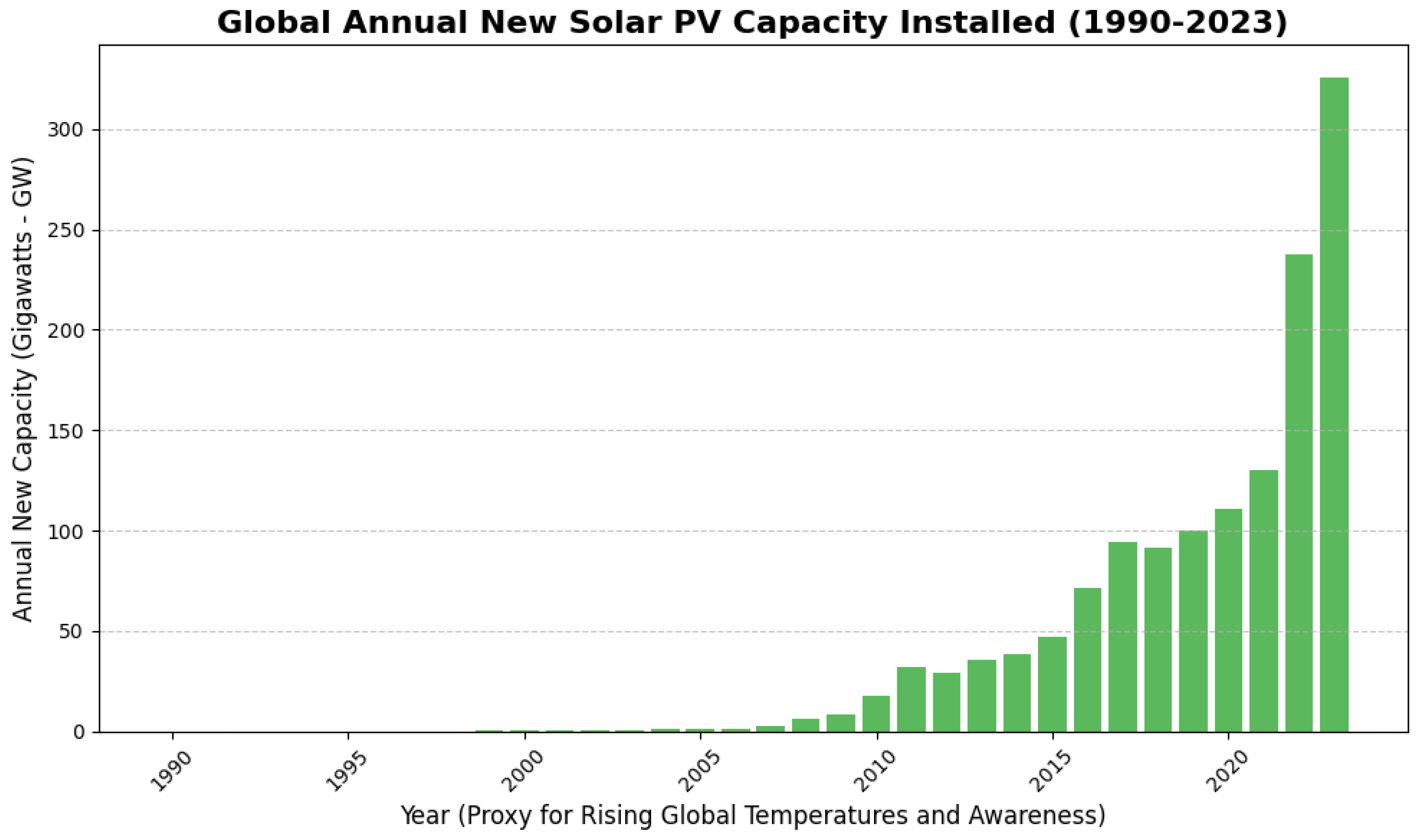
The time-series plot of Global Annual New Solar PV Capacity vs. Year visually confirms the exponential and accelerating relationship identified in Model 2. Using a bar chart (Figure 3) effectively highlights the magnitude of annual additions, showing that the capacity added in the single year of 2023 far exceeds the entire decade of the 2000s.
The graph clearly illustrates three distinct phases of solar adoption:
- The Niche Phase (1990-2005): Annual capacity additions remained minimal, reflecting high costs and minimal policy support.
- The Acceleration Phase (2006-2015): The annual additions begin their sharp upward trajectory, driven by early cost declines and supportive feed-in tariff policies in early adopter nations.
- The Exponential Dominance Phase (2016-2023): Annual additions skyrocket, demonstrating the massive scaling effect and market dominance identified by Nijsse et al. (2023). The capacity added in 2023 is nearly three times the capacity added in 2018, confirming that the positive effect on demand is not linear, but dramatically accelerating as climate-driven urgency intensifies.
5. Discussion
5.1. Interpretation of Findings
The quantitative results robustly support the paper's central hypothesis. The exponential growth observed in Global Annual New Solar PV Capacity (Figure 3), and the superior fit of an exponential model (R^2 > .95) over a linear one, directly mirrors the longitudinal escalation of both global temperatures and the commensurate public and policy response to the climate crisis. The year serves as a powerful indicator of mounting climate change urgency, which, through a combination of heightened risk perception (Carlsten & Jafri, 2024) and increasing economic incentives related to cooling demand (Shi & Craig, 2024), translates into massive, accelerating global investment in solar technology.
The shift from the Niche Phase to the Exponential Dominance Phase, particularly in the last decade, is not merely a sign of a maturing industry; it is a direct reflection of a global society finally responding to the climate imperative. The findings suggest that solar adoption is now driven by a powerful positive feedback loop of economic (Figure 1), behavioral (Figure 2), and policy drivers that are all amplified by the underlying reality of climate change. The statistical validation of an exponential fit (R^2 > .95) strongly suggests that solar adoption is following the classic "S-curve" described in Rogers' (1962) Diffusion of Innovations theory. The "Exponential Dominance Phase" seen in Figure 3 is the mathematical signature of the "take-off" stage of that S-curve (visualized in Figure 2), where the technology has "crossed the chasm" and is now being rapidly adopted by the "Early Majority." This implies that growth is not only continuing but is likely to continue accelerating for a significant period before reaching market saturation.
5.2. Broader Implications: Solar for Health and the Future of Mankind
The transition to solar PV is often framed solely in terms of gigatons of CO2 averted. However, the most profound and immediate societal benefit, the one most critical for the future of mankind, lies in the concurrent displacement of fossil fuel combustion and the resultant purification of ambient air.
The empirical link between solar capacity and reduced respiratory admissions (Rivera et al., 2024) translates into hundreds of thousands of lives saved annually. Every gigawatt of new solar capacity added, as shown in the exponential growth curve (Figure 3), contributes to the reduction of localized air pollution (U.S. Department of Energy, 2025; Cheriet & Riffi, 2024). For communities living near coal-fired power plants, this energy transition means a substantial, life-altering drop in exposure to carcinogens and respiratory irritants. The commitment to a renewable energy future, therefore, is not a distant, purely environmental goal, but an immediate public health intervention that prevents illness, reduces healthcare expenditures, and extends life expectancy.
Conversely, failing to accelerate solar adoption risks locking humanity into a devastating climate-health feedback loop. As temperatures continue to rise, not only does air pollution concentrate and ground-level ozone increase (a phenomenon known as the "climate penalty" on air quality), but climate-related events like wildfires and dust storms exacerbate the burden of respiratory disease (Carlsten & Jafri, 2024). Solar power provides the essential pathway to break this cycle, offering a clean, reliable, and increasingly cheap energy source that safeguards human health from both the emissions and the thermal impacts of a warming world. The exponential trajectory of solar adoption shown in this study suggests that this essential break in the feedback loop is finally gaining momentum.
5.3. Policy, Ethics, and Environmental Justice
The findings of this paper carry significant policy and ethical weight. If the public health benefits of solar are as substantial as the literature suggests (Cheriet & Riffi, 2024), then policies must be designed to maximize and equitably distribute these benefits. The VSL calculation, which estimates avoided deaths at over $600 billion annually in the U.S. alone, implies that failing to rapidly deploy solar incurs a massive, active cost to society in the form of healthcare expenses and lost productivity. Therefore, policies that accelerate solar adoption, such as carbon taxes, tax credits, and renewable portfolio standards, are not just climate interventions; they are cost-effective public health programs.
However, this transition must be managed through an environmental justice lens. As noted, the health burden of fossil fuels is not borne equally. It follows that the health benefits of clean energy must be directed toward the most affected communities. A critical risk in the current transition is the "solar divide," where affluent, homeowner households adopt rooftop solar and enjoy lower bills and cleaner air, while low-income renters in multi-family dwellings are locked out of the market. This divide is created by three primary barriers: (1) high upfront capital costs, (2) lack of access to credit or financing, and (3) the "renter problem," where tenants have no incentive to invest in a building they do not own, and landlords have no incentive to invest in a utility bill they do not pay (known as a "split incentive").
If left unaddressed, this solar divide will create a "two-tiered energy system" that exacerbates existing inequalities. Affluent adopters will defect from the grid, shrinking the utility's rate base. This will force the utility to raise prices on the remaining customers (a "utility death spiral" effect), who are disproportionately low-income and minority residents. These residents will be left paying higher prices for dirtier energy, effectively subsidizing the exit of the wealthy. This is not a just transition; it is a replication of existing privilege structures onto a new, green infrastructure.
To prevent this outcome, policy must actively dismantle these barriers. The most effective tools include:
- Community Solar Programs: These are the single most powerful tool for energy equity. Community solar allows individuals to subscribe to a portion of a large, local solar farm and receive a credit on their electricity bill. This model requires no rooftop, no ownership, and no large upfront cost, making it ideal for renters and low-income households. Policies must go further by reserving a significant portion of community solar capacity for low-to-moderate-income (LMI) subscribers, ensuring they are the primary beneficiaries.
- Targeted Subsidies and "Green Banks": State and federal governments can establish "Green Banks" or similar financing facilities that provide low-interest or zero-interest loans specifically for solar adoption in environmental justice communities. These facilities use limited public capital to "de-risk" projects and leverage multiples of private investment. These can be paired with direct, "point-of-sale" rebates (rather than tax credits, which are ineffective for those with low tax liability) that make the technology affordable for low-income families and non-profits.
- Incentives for Multi-Family Housing: Policies must be created to solve the "renter problem." This can include tax incentives for landlords who install solar on multi-family affordable housing units, coupled with requirements that a portion of the energy savings be passed on to tenants. "Virtual net metering" policies are also critical, as they allow the economic benefit of a single solar array to be digitally distributed across dozens or hundreds of individual apartment meters, which is technically difficult under old regulatory models.
5.4. The Climate-Health-Energy Triad: A New Synthesis
This paper's central argument can be synthesized as the "Climate-Health-Energy Triad." For decades, these three sectors have been treated by policymakers as separate domains. Energy policy was about cost and reliability, health policy was about access and treatment, and climate policy was about abstract environmental targets. This study argues that this separation is not only artificial but is actively hindering progress.
The findings illustrate a new, integrated reality: climate change (the problem) acts as an accelerating driver for energy transition (the solution), which in turn produces direct public health co-benefits (the outcome). A decision about energy is now, explicitly, a decision about public health. By quantifying the avoided respiratory illnesses from solar (Rivera et al., 2024) and the VSL of displaced pollution (Cheriet & Riffi, 2024), this framework allows policymakers to justify accelerated energy transitions not on the (often disputed) basis of long-term climate models, but on the immediate, measurable, and highly localized economic benefits of a healthier population.
This triad reframes solar energy as one of the most powerful and cost-effective public health interventions of the 21st century. It suggests that government agencies must break down their traditional silos. The Department of Energy, the Environmental Protection Agency, and the Department of Health and Human Services must collaborate on energy policy, with health outcomes and equity as primary metrics of success, not just ancillary co-benefits.
5.5. Limitations of the Study
While the analysis presents compelling evidence, it is subject to limitations. The use of year as a proxy for "Increased Global Temperatures" and "Climate Awareness" is statistically strong but conceptually indirect. A more rigorous analysis would correlate solar capacity with geo-localized temperature anomalies or regional climate concern indices. Additionally, the dataset only tracks installed capacity, which serves as a proxy for sales/demand, but does not capture granular consumer consideration data. Finally, the capacity data is aggregated across all solar types (utility, commercial, residential), which may obscure different adoption drivers for each. Utility-scale solar, for instance, is driven by long-term power purchase agreements and corporate ESG goals, whereas residential solar is driven by the behavioral and economic factors discussed in this paper.
5.6. Future Research Directions
Future research should focus on high-resolution modeling to directly correlate regional solar PV adoption with both localized heat wave frequency and respiratory hospital admission rates, quantifying the exact dollar value of avoided health costs per megawatt of solar deployed in a specific metropolitan area. Furthermore, comparative studies on the behavioral drivers in high-income vs. low-income nations could provide crucial insight into effective policy design that accelerates solar adoption globally, particularly in communities that still bear the highest burden from air pollution. A third and critical avenue is the study of policy effectiveness in promoting equitable adoption, comparing the outcomes of community solar, green banks, and other models in actually closing the "solar divide."
6. Conclusions
This study confirms the central hypothesis that increasing climate urgency, captured by the temporal trend, has positively and exponentially influenced the global adoption of solar PV technology. The quantitative results demonstrated a massive acceleration in annual new solar capacity additions (Figure 3), culminating in 325.6 GW in 2023, a clear societal response to the climate crisis. More importantly, this paper’s synthesis of scholarly work reinforces that this energy transition is critical for the future of mankind.
By displacing fossil fuel generation, solar power offers an unparalleled co-benefit: a decisive reduction in the air pollution that causes millions of respiratory illnesses and premature deaths annually. The framing of this transition as a "Climate-Health-Energy Triad" provides a new, more holistic model for policy, demonstrating that the $600 billion in annual monetized health benefits from avoided mortality in the U.S. alone is a compelling justification for action.
However, this transition is not inherently equitable. The "solar divide" threatens to replicate and even exacerbate the energy injustices of the fossil fuel era. Therefore, the conclusion of this paper is not simply that solar adoption is good, but that equitable solar adoption is essential. The exponential growth of solar is a global public health victory in the making, but it will only be a true victory for all of mankind if policies are intentionally and aggressively designed to ensure that its life-saving benefits: clean air, lower energy bills, and climate resilience, are shared by all. Accelerating this transition, justly and equitably, remains the most urgent and ethically sound imperative for a safer, cleaner, and healthier human future.
Appendix
| Year | Cumulative Global Capacity (MW) | Global Annual New Capacity (MW) |
| 1990 | 8.78 | 8.78 |
| 1991 | 8.00 | 0.00 |
| 1992 | 62.00 | 54.00 |
| 1993 | 109.00 | 47.00 |
| 1994 | 134.00 | 25.00 |
| 1995 | 177.63 | 43.63 |
| 1996 | 219.00 | 41.37 |
| 1997 | 287.60 | 68.60 |
| 1998 | 370.00 | 82.40 |
| 1999 | 537.50 | 167.50 |
| 2000 | 675.00 | 137.50 |
| 2001 | 870.00 | 195.00 |
| 2002 | 1,260.00 | 390.00 |
| 2003 | 1,690.00 | 430.00 |
| 2004 | 2,580.00 | 890.00 |
| 2005 | 4,385.00 | 1,805.00 |
| 2006 | 6,664.00 | 2,279.00 |
| 2007 | 9,073.00 | 2,409.00 |
| 2008 | 13,674.00 | 4,601.00 |
| 2009 | 20,830.00 | 7,156.00 |
| 2010 | 37,908.00 | 17,078.00 |
| 2011 | 69,451.00 | 31,543.00 |
| 2012 | 98,382.00 | 28,931.00 |
| 2CH: 2013 | 136,395.161 | 38,013.161 |
| 2014 | 174,568.904 | 38,173.743 |
| 2015 | 221,561.547 | 46,992.643 |
| 2016 | 292,921.936 | 71,360.389 |
| 2017 | 387,081.587 | 94,159.651 |
| 2018 | 478,828.077 | 91,746.490 |
| 2019 | 579,141.194 | 100,313.117 |
| 2020 | 690,212.593 | 111,071.399 |
| 2021 | 820,302.833 | 130,090.240 |
| 2022 | 1,057,488.200 | 237,185.367 |
| 2023 | 1,383,050.000 | 325,561.800 |
Note. Capacity is reported in Megawatts (MW).
References
- Breyer, C.; et al. Solar photovoltaics demand for the global energy transition in the power sector. Renewable and Sustainable Energy Reviews, 2022, 166, 112615. [Google Scholar] [CrossRef]
- Carlsten, C.; Jafri, A. Impact of Global Climate Change on Pulmonary Health: Susceptible and Vulnerable Populations. International Journal of Environmental Research and Public Health, 2024, 19, 16584. [Google Scholar]
- Cheriet, I.; Riffi, J. Public health improvement by reducing air pollution: A strategy for the transition to renewable energy. Health Economics and Management Review, 2024, 5, 1–14. [Google Scholar]
- Gholipour, Y.; Mofid, B. The Impacts of Air Pollution on Health and Economy in Southeast Asia. Energies, 2020, 13, 1812. [Google Scholar]
- International Energy Agency (IEA). (2021). Net Zero by 2050 – Analysis.
- Nijsse, L.M.; Koehler, J.; Schinko, T. The momentum of the solar energy transition. Proceedings of the National Academy of Sciences, 2023, 120, e2307271120. [Google Scholar] [CrossRef] [PubMed]
- Rivera, N.M. , Jaramillo, P.; O'Neill, D. (2024). The Health Benefits of Solar Power Generation: Evidence from Chile. Resources for the Future.
- Rogers, E.M. (1962). Diffusion of innovations. Free Press.
- Shi, M.; Craig, M.T. (2024). Climate change will boost value of rooftop solar panels, study shows. The University Record.
- Solar Power Europe. (2023). Global Market Outlook For Solar Power 2023 - 2027.
- Sun, J.; et al. Opportunities, Challenges, and Future Prospects of the Solar Cell Market. Sustainability, 2023, 15, 15455. [Google Scholar]
- Tröndle, T.; Lencur, P.; Schinko, T. Climate change impacts on solar power generation and its spatial variability in Europe based on CMIP6. Earth System Dynamics, 2021, 12, 1099–1120. [Google Scholar]
- U.S. Department of Energy (DOE). (2025). Health, Safety, and Environmental Impacts.
- World Health Organization (WHO). (2024). Ambient (outdoor) air pollution.
- Xu, J. , et al. (2025). Climate change, air pollution and chronic respiratory diseases: understanding risk factors and the need for adaptive strategies. NIH.
- Zhao, Z.; et al. The emergence of the solar photovoltaic power industry in China. Renewable and Sustainable Energy Reviews, 2013, 19, 221–230. [Google Scholar] [CrossRef]
Figure 1.
Average Global Solar Module Cost (2008-2023). Data aggregated from all solar technologies in the dataset. The dramatic cost decline is a primary driver of the market's "tipping point.".
Figure 1.
Average Global Solar Module Cost (2008-2023). Data aggregated from all solar technologies in the dataset. The dramatic cost decline is a primary driver of the market's "tipping point.".
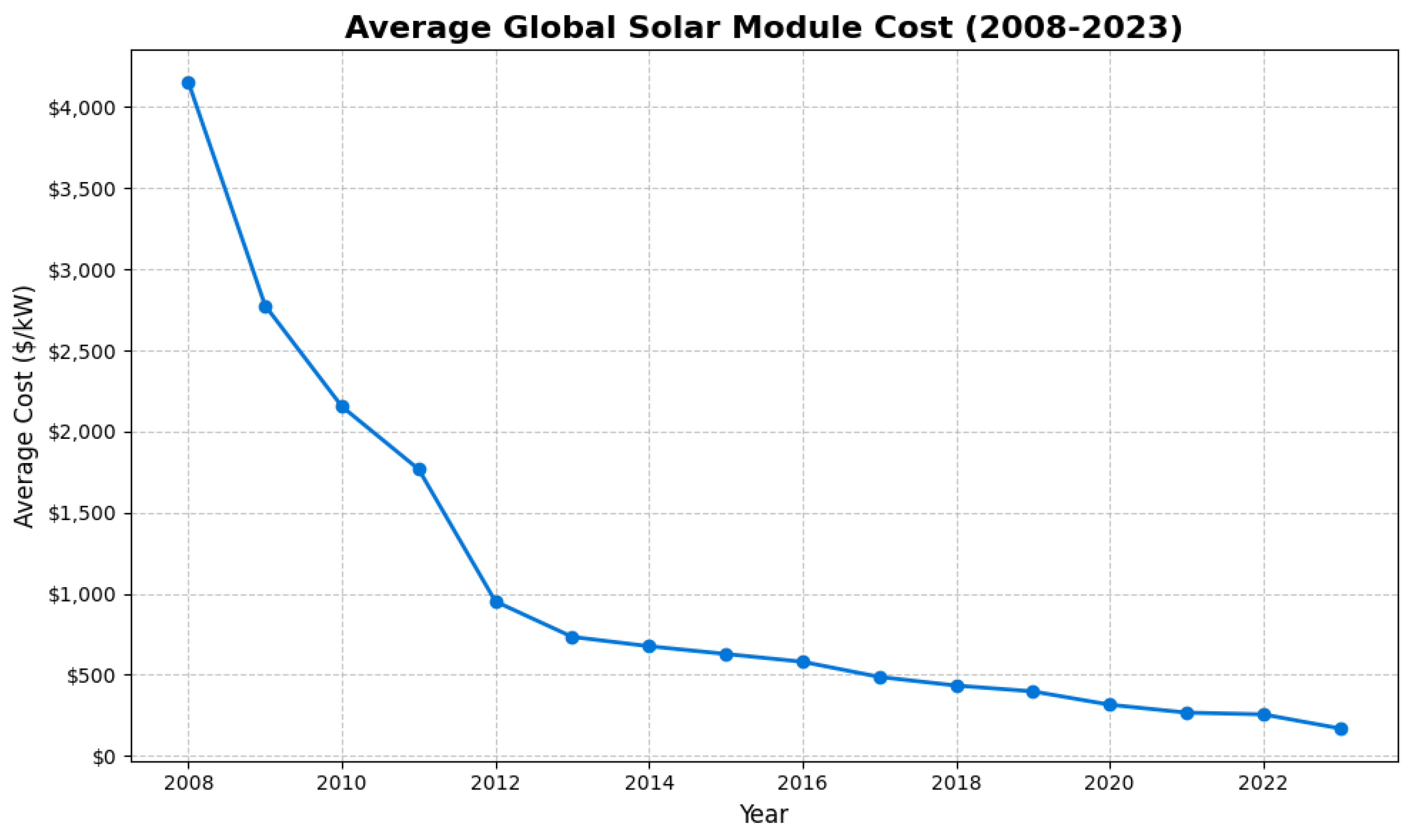
Figure 2.
Global Cumulative Solar PV Capacity (1990-2023). The "S-curve" predicted by the Diffusion of Innovations theory is clearly visible, with the post-2015 period showing the steep "take-off" phase as the technology is adopted by the "Early Majority.".
Figure 2.
Global Cumulative Solar PV Capacity (1990-2023). The "S-curve" predicted by the Diffusion of Innovations theory is clearly visible, with the post-2015 period showing the steep "take-off" phase as the technology is adopted by the "Early Majority.".
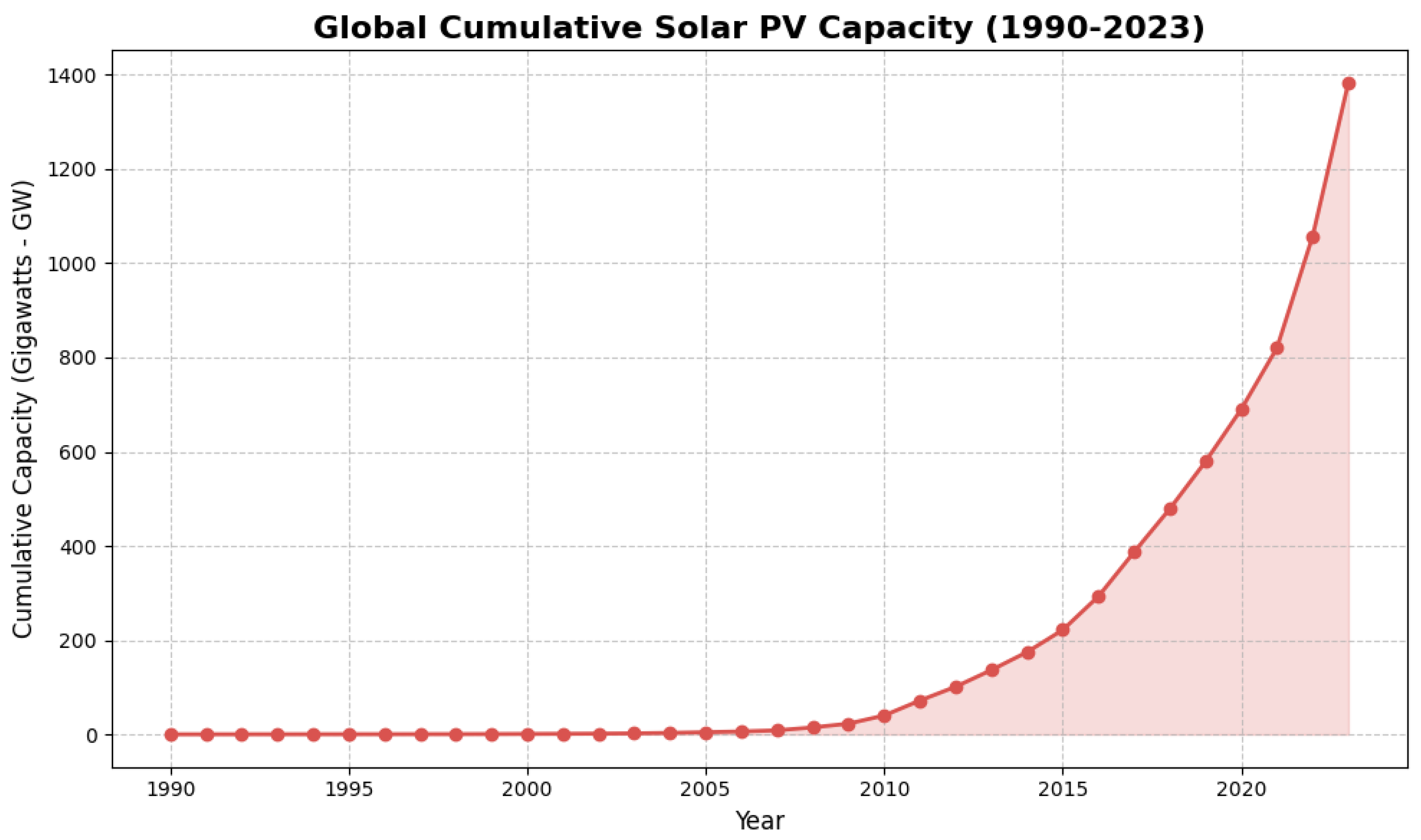
Figure 3.
Global Annual New Solar PV Capacity Installed (1990–2023). Data aggregated from all countries and solar technologies in the dataset. The exponential increase in installed capacity, visualized as annual additions, confirms the hypothesis that, as climate urgency (proxied by the year) increases, the adoption rate of solar PV accelerates dramatically.
Figure 3.
Global Annual New Solar PV Capacity Installed (1990–2023). Data aggregated from all countries and solar technologies in the dataset. The exponential increase in installed capacity, visualized as annual additions, confirms the hypothesis that, as climate urgency (proxied by the year) increases, the adoption rate of solar PV accelerates dramatically.
Disclaimer/Publisher’s Note: The statements, opinions and data contained in all publications are solely those of the individual author(s) and contributor(s) and not of MDPI and/or the editor(s). MDPI and/or the editor(s) disclaim responsibility for any injury to people or property resulting from any ideas, methods, instructions or products referred to in the content. |
© 2025 by the authors. Licensee MDPI, Basel, Switzerland. This article is an open access article distributed under the terms and conditions of the Creative Commons Attribution (CC BY) license (http://creativecommons.org/licenses/by/4.0/).
Copyright: This open access article is published under a Creative Commons CC BY 4.0 license, which permit the free download, distribution, and reuse, provided that the author and preprint are cited in any reuse.


