
Submitted:
15 November 2025
Posted:
18 November 2025
You are already at the latest version
Abstract
This study investigates how cause-related marketing (CRM) contributes to sustainable relationship management in the food and beverage (F&B) industry by integrating perceived CRM, psychological distance, relationship quality, and customer involvement. It explores how socially responsible initiatives enhance customer trust and loyalty while addressing evolving consumer expectations for ethical and sustainable practices. Based on 400 valid responses from chain and independent restaurants in Taipei, structural equation modeling was used to test the proposed framework. The results indicate that CRM significantly improves relationship quality, with customer involvement amplifying this relationship. Moreover, shorter psychological distance further strengthens the effects of CRM on relationship outcomes. The findings highlight CRM as an effective strategic tool for promoting sustainable customer engagement, reinforcing brand authenticity, and achieving long-term competitive advantage in the hospitality and tourism sectors.
Keywords:
cause-related marketing
; sustainable management
; relationship quality
; psychological distance
; consumer behavior
; food and beverage industry
1. Introduction
In the era of sustainability-driven consumption, food and beverage (F&B) enterprises increasingly recognize that cultivating long-term, high-quality customer relationships represents a vital foundation for sustainable competitive advantage. Such relational capabilities—rooted in trust, commitment, and shared values—are difficult for competitors to replicate and thus serve as strategic assets that enhance organizational resilience. Strong customer–firm relationships not only improve loyalty and retention but also create co-creative environments where customers participate in product innovation, quality improvement, and sustainable value generation.
Within this context, cause-related marketing (CRM) has emerged as a strategic approach that aligns social responsibility with corporate performance. Defined by Kotler (2000) as a planned process that integrates social causes into marketing strategies, CRM enables firms to pursue profitability while addressing societal needs. By linking consumption with social good, CRM supports both brand differentiation and sustainable relationship building. In the F&B industry—where consumers are increasingly sensitive to ethical sourcing, food safety, and sustainability—CRM serves as a means to communicate brand authenticity and foster long-term engagement.
From a psychological perspective, construal level theory (CLT) provides insight into how consumers interpret CRM initiatives based on perceived psychological distance. When psychological distance is high, consumers construe messages abstractly, focusing on general societal benefits; conversely, a lower distance promotes concrete and personal interpretations. Thus, consumers’ proximity to the cause influences their emotional and cognitive engagement with CSR and CRM campaigns. Understanding this psychological mechanism is essential for designing CRM strategies that effectively connect with consumers’ sustainability values.
Additionally, relationship quality (RQ)—reflected in satisfaction, trust, and commitment—serves as a key indicator of how consumers perceive firms’ ethical orientation and service behavior. The strength of this relationship may depend on customer involvement, which determines how personally relevant or meaningful consumers find a dining experience or social initiative. High involvement amplifies emotional connection and deepens the relational impact of CRM activities, making it a crucial moderating factor in sustainability-oriented marketing.
Building on these perspectives, this study proposes an integrated model linking CRM, psychological distance, customer involvement, and relationship quality within the F&B industry. The research aims to explore how socially responsible marketing practices contribute to sustainable relationship management and how consumer psychology shapes these outcomes. By clarifying the mechanisms through which CRM enhances trust and loyalty, this study offers both theoretical insights and managerial implications for promoting sustainable brand-consumer relationships in hospitality and tourism contexts.
2. Literature Review
2.1. Relationship Quality in the Food and Beverage Industry
Customer relationship quality (RQ) is widely recognized as a critical determinant of sustainable business performance, particularly in service sectors where relational exchanges and consumer experiences drive brand equity. In the food and beverage (F&B) industry, RQ reflects not only transactional efficiency but also the emotional and ethical dimensions of consumer engagement. It encompasses attributes such as respect, empathy, competence, and benevolence, which collectively shape customers’ long-term perceptions of relational value and trust.
Kristof et al. (2001) conceptualized RQ as comprising three interrelated dimensions—satisfaction, trust, and commitment—that together represent the depth and stability of customer–firm relationships. Subsequent studies (Keating, Rugimbana, & Quazi, 2003; Roberts & Varki, 2003) extended this model, emphasizing the role of communication, cooperation, and perceived value in sustaining trust-based relationships. From a sustainability perspective, these dimensions mirror the social capital embedded in repeated exchanges, reflecting ethical responsibility, fairness, and shared value creation.
Satisfaction captures both the emotional and cognitive outcomes of repeated interactions, while trust reflects consumers’ belief in the firm’s integrity and reliability—particularly relevant in food safety and ethical sourcing contexts. Commitment represents the highest level of relational attachment, denoting a long-term willingness to maintain the relationship despite competitive alternatives. Collectively, satisfaction, trust, and commitment form the relational foundation for sustainable customer loyalty in the F&B industry, enabling firms to strengthen competitiveness while supporting responsible consumption and ethical management.
2.2. Cause-Related Marketing in the Food and Beverage Industry
Cause-related marketing (CRM) has evolved from a philanthropic practice to a strategic instrument of sustainable management that aligns business objectives with social responsibility. Originating from American Express’s 1981 campaign for the San Francisco Arts Festival, CRM is defined as a “win–win” strategy linking corporate performance with societal benefit. In the F&B sector—where transparency, ethics, and social value increasingly shape consumer decisions—CRM represents a powerful mechanism for building trust and enhancing relational value.
Kotler (2000) categorized CRM into four forms: (1) corporate issue promotion, (2) joint issue promotion, (3) sales-related fundraising, and (4) licensing. These formats can be broadly divided into public issue promotion and profit-related fundraising. In hospitality and F&B contexts, firms often employ CRM to promote food safety awareness, support community causes, or integrate donations into sales transactions. Empirical studies have consistently shown that CRM enhances brand image, customer trust, and loyalty (Berglind & Nakata, 2005; Lichtenstein, Drumwright, & Braig, 2004).
Importantly, CRM extends beyond ethical goodwill—it reinforces brand authenticity and demonstrates alignment with the values of socially conscious consumers. As sustainability becomes a core determinant of brand competitiveness, CRM provides a means to communicate commitment to ethical consumption and social impact. Accordingly, the following hypothesis is proposed:
H1:
Perceived cause-related marketing in the food and beverage industry positively affects relationship quality.
2.3. Food and Beverage Involvement
Consumer involvement reflects the level of cognitive and emotional engagement individuals invest in evaluating and experiencing products or services (Zaichkowsky, 1985). In the F&B domain, involvement captures the personal relevance of dining decisions, shaped by lifestyle, cultural identity, and sustainability consciousness. High-involvement consumers often engage deeply in information search, evaluate ethical and environmental dimensions, and demonstrate strong loyalty toward brands aligned with their values.
As F&B consumption increasingly intersects with issues such as health, sustainability, and ethics, consumer involvement extends beyond product preference to include value-driven consumption. High-involvement consumers are thus more attuned to the authenticity and societal impact of corporate initiatives, particularly CRM campaigns. Consequently, they respond more positively to firms demonstrating transparent and socially responsible practices.
H2:
The degree of consumer involvement moderates the relationship between perceived cause-related marketing and relationship quality.
2.4. Psychological Distance
Psychological distance, derived from construal level theory (CLT), describes how individuals perceive the proximity of events, people, or issues in cognitive and emotional space (Liberman, Trope, & Wakslak, 2007). When distance is high, individuals process information abstractly, focusing on broad values and long-term outcomes; when distance is low, they engage concretely with immediate and tangible aspects.
In the F&B industry, psychological distance plays a crucial role in how consumers interpret CRM messages. For example, campaigns promoting global hunger relief may feel abstract (high distance), while initiatives supporting local farmers evoke proximity and personal relevance (low distance). Reducing psychological distance enhances consumer empathy and perceived authenticity, increasing engagement with sustainability-related actions.
H3:
Psychological distance moderates the relationship between perceived cause-related marketing and relationship quality.
2.5. Combined Effects of Involvement and Psychological Distance
While involvement captures direct cognitive and emotional engagement, psychological distance reflects abstract perception and interpretive framing. Their interaction provides a holistic understanding of how consumers process CRM initiatives. High involvement combined with low psychological distance leads to stronger emotional resonance, trust, and long-term relationship commitment—key indicators of sustainable relationship quality.
From a managerial perspective, firms should simultaneously increase consumer involvement through participatory experiences and reduce psychological distance by communicating authenticity and local relevance. This strategic synergy enhances the perceived sincerity of sustainability-driven initiatives.
H4:
The interaction between consumer involvement and psychological distance significantly influences relationship quality.
3. Research Methodology
3.1. Research Framework
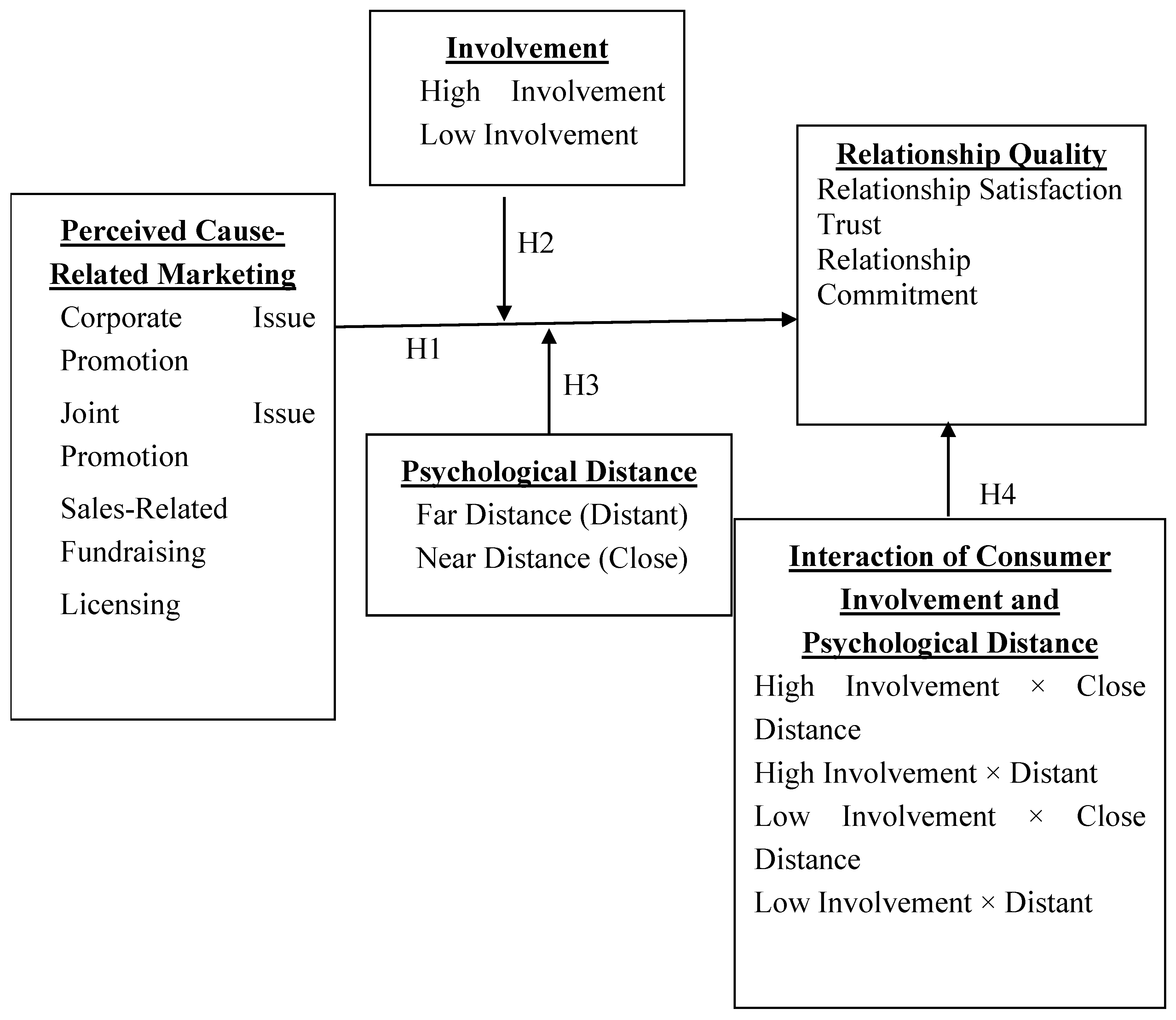
Based on the findings of the literature review, it is evident that perceived cause-related marketing (CRM) in the food and beverage (F&B) industry is closely associated with relationship quality. This study aims to construct a systematic model to explain how perceived CRM influences relationship quality, with psychological distance and consumer involvement serving as moderating variables.
Drawing upon the theoretical foundation of cause-related marketing, the proposed research framework incorporates four major constructs: perceived CRM, psychological distance, consumer involvement, and relationship quality. The framework illustrates the hypothesized pathways through which CRM affects relationship quality, as well as the moderating effects of psychological distance and involvement.
Figure 1.
Research Framework (with dimensions).
3.2. Measurement of Variables
All constructs in this study—including perceived cause-related marketing (CRM), psychological distance, relationship quality, and consumer involvement—were measured using a five-point Likert scale ranging from 1 (“strongly disagree”) to 5 (“strongly agree”). The operationalization of each construct is described below.
Relationship Quality. Drawing on Kristof et al. (2001), relationship quality was conceptualized as comprising three dimensions: satisfaction, trust, and commitment. A total of 13 measurement items were employed to capture these dimensions.
Perceived Cause-Related Marketing. This construct was assessed based on Kotler’s (2000) framework, which defines CRM as any corporate resource allocation or effort that simultaneously supports nonprofit objectives and enhances sales. Kotler’s typology of CRM includes four dimensions: corporate issue promotion, joint issue promotion, sales-related fundraising, and licensing. A total of 8 items were developed to measure these four aspects.
Consumer Involvement. Following Zaichkowsky (1985), involvement was defined as the degree of personal relevance or importance a consumer attaches to a product, advertisement, or purchase decision. In this study, four items were used to measure involvement. Based on the mean score, consumers were classified into high- and low-involvement groups for comparative analysis.
Psychological Distance. Psychological distance was conceptualized according to Liberman, Trope, and Wakslak (2007), who identified four dimensions: temporal distance, spatial distance, social distance, and hypotheticality. For the purposes of this study, psychological distance was operationalized as either “near” or “far,” and two restaurant scenarios were designed to reflect these conditions (see Table 1).
3.3. Data Collection
The respondents of this study were restaurant consumers in Taipei, and data were collected through a structured questionnaire survey conducted in ten restaurants. Using a quota sampling method, a total of 400 questionnaires were distributed, with approximately 40 distributed at each restaurant. To minimize potential time bias, the survey was administered across different time periods during the day. The questionnaire was designed with five sections, beginning with a psychological distance scenario setting, followed by measurement items for relationship quality, perceived cause-related marketing (CRM), and consumer involvement, and concluding with demographic information. Questionnaires with incomplete responses were treated as invalid and excluded from the final dataset to ensure the reliability of the analysis.
4. Research Results
4.1. Sample Collection and Analysis
This study targeted restaurant consumers in Taiwan, distributing questionnaires proportionally across both chain and independent restaurants in Taipei City. Ultimately, six chain restaurants and four independent restaurants were selected for quota sampling. To examine the moderating effect of psychological distance, two scenario-based questionnaires were designed: Version A represented a distant psychological distance, while Version B represented a close psychological distance. A total of 400 questionnaires were distributed, with 200 copies of each version (A and B). At each of the ten restaurants, 40 questionnaires were administered, equally divided between the two versions.
Regarding the response rate, Version A achieved 199 valid responses out of 200 distributed (99.5%), while Version B yielded 197 valid responses out of 200 distributed (98.5%). The overall valid response rate was 99%. The demographic structure of the samples (gender, age, education, marital status, occupation, and monthly income) was analyzed to confirm the representativeness of the data.
For gender, Version A consisted of 77 male respondents (38.6%) and 122 female respondents (61.3%). Version B consisted of 65 male respondents (33.0%) and 132 female respondents (67.0%). In total, 142 males (35.9%) and 254 females (64.1%) were surveyed. The sample distribution indicated a slightly higher proportion of female respondents, consistent with the demographic profile of Taipei City, thereby confirming representativeness.
For age, respondents were categorized into six groups: under 20, 20–29, 30–39, 40–49, 50–64, and 65 years and above. The age distribution between Versions A and B was found to be highly comparable, ensuring meaningful cross-version comparisons.
For marital status, three categories were used: unmarried, married without children, and married with children. In Version A, 148 respondents were unmarried (75.1%), 15 were married without children (7.6%), and 36 were married with children (18.3%). In Version B, 136 respondents were unmarried (69.0%), 17 were married without children (8.6%), and 43 were married with children (21.8%). These results indicate structural similarity across the two groups.
For education, five levels were considered: below junior high school, high school, college, university, and postgraduate degree. In Version A, 2 respondents had below-junior-high education (1.0%), 34 had a high school diploma (17.3%), 19 had a college degree (9.6%), 123 held a university degree (62.4%), and 21 had postgraduate education (10.7%). In Version B, the corresponding figures were 1 (0.5%), 36 (18.3%), 11 (5.6%), 117 (59.4%), and 30 (15.2%), respectively. These distributions further demonstrate strong comparability between the two samples.
In summary, the demographic analysis reveals that Versions A and B are highly similar across all key variables. This suggests that the sampling process was rigorous and representative, thereby strengthening the validity of subsequent comparisons between the two psychological distance scenarios.
4.2. Reliability and Validity Analysis
The reliability of the questionnaire items was assessed using Cronbach’s α coefficients. The results for each construct were as follows: relationship quality (0.872), perceived cause-related marketing (0.862), and consumer involvement (0.874). All coefficients exceeded the recommended threshold of 0.70, indicating high internal consistency. Furthermore, Cronbach’s α values for each dimension also exceeded 0.70, suggesting that the questionnaire items appropriately represented their respective constructs and thus demonstrated a high level of reliability.
This study included three latent variables—relationship quality, perceived cause-related marketing, and consumer involvement—with a total of twenty-five observed variables. Confirmatory factor analysis (CFA) was conducted using AMOS to examine construct validity, which consists of convergent validity and discriminant validity.
The Kaiser-Meyer-Olkin (KMO) measure of sampling adequacy was 0.851, indicating that the data were suitable for factor analysis. The standardized factor loadings ranged from 0.744 to 0.304 for relationship quality, 0.493 to 0.862 for perceived cause-related marketing, and 0.606 to 0.831 for consumer involvement. With the exception of items V12, V13, and V21, all factor loadings exceeded 0.50, thus confirming convergent validity for the three constructs.
4.3. Hypothesis Testing
4.3.1. Effect of Perceived Cause-Related Marketing on Relationship Quality (H1)
Hypothesis H1 stated: “Perceived cause-related marketing positively influences relationship quality.” Path analysis results indicated a standardized coefficient of 0.392 (t = 8.464, p < 0.001). The coefficient was positive and significant, thereby supporting H1.
Additionally, perceived cause-related marketing was divided into four sub-dimensions: corporate issue promotion, joint issue promotion, sales-related fundraising, and licensing. Regression analysis results (Table 4.10) showed that all four sub-dimensions yielded positive and highly significant standardized coefficients. Among them, corporate issue promotion demonstrated the highest coefficient (0.385), suggesting it was the most influential CRM strategy in enhancing relationship quality.
4.3.2. Moderating Effect of Consumer Involvement (H2)
Hypothesis H2 stated: “Consumer involvement moderates the relationship between perceived cause-related marketing and relationship quality.” Median-split regression analysis was conducted, with the median score of 3.75 used as the cutoff point. Respondents scoring above 3.75 were categorized as high-involvement consumers (n = 185, coded as 1), while those scoring below 3.75 were categorized as low-involvement consumers (n = 152, coded as 0).
A multiple regression analysis was performed with relationship quality as the dependent variable and consumer involvement, perceived CRM, and their interaction term as independent variables. Results revealed that the interaction term (Involvement × Perceived CRM) was significant, with a standardized coefficient of 0.307 (t = 6.297, p < 0.001). This indicates that consumer involvement positively moderated the effect of perceived CRM on relationship quality, thus supporting H2.
4.3.3. Moderating Effect of Psychological Distance (H3)
Hypothesis H3 stated: “Psychological distance moderates the relationship between perceived cause-related marketing and relationship quality.” To test this, the survey was designed with two scenarios: Version A represented a distant psychological distance, while Version B represented a close psychological distance. A dummy variable was coded (1 = close, 0 = distant).
Multiple regression results showed that the interaction term (Psychological Distance × Perceived CRM) had a standardized coefficient of 0.015 (t = 0.315, p = 0.753), which was not statistically significant. This finding indicates that psychological distance did not moderate the relationship between perceived CRM and relationship quality. Therefore, H3 was not supported.
4.3.4. Interaction Effect of Consumer Involvement and Psychological Distance (H4)
Hypothesis H4 stated: “The combination of consumer involvement and psychological distance has a significant effect on relationship quality.” To test this, respondents were divided into four groups:
- High involvement × Close distance (n = 85, 25.2%)
- High involvement × Distant (n = 67, 19.9%)
- Low involvement × Close distance (n = 85, 25.2%)
- Low involvement × Distant (n = 100, 29.7%)
A one-way ANOVA was conducted to compare relationship quality across these groups. Results indicated significant group differences (F = 16.672, p < 0.001). Mean relationship quality scores were: high involvement × close distance (3.96), high involvement × distant (3.89), low involvement × close distance (3.56), and low involvement × distant (3.60). Levene’s test for homogeneity of variance was non-significant (F = 0.187, p > 0.05), indicating no variance differences across groups.
The post-hoc analysis revealed that both high-involvement groups (close and distant) reported significantly higher relationship quality than the two low-involvement groups. This demonstrates that the combination of consumer involvement and psychological distance significantly affects relationship quality, thereby supporting H4.

Table 2.
Grouping of Consumer Involvement and Psychological Distance.
| Group | Description | Sample Size (n) | Percentage (%) |
|---|---|---|---|
| 1 | High Involvement × Close Distance | 85 | 25.2% |
| 2 | High Involvement × Distant | 67 | 19.9% |
| 3 | Low Involvement × Close Distance | 85 | 25.2% |
| 4 | Low Involvement × Distant | 100 | 29.7% |
| Total | — | 337 | 100.0% |
Table 3.
One-Way ANOVA of Consumer Involvement × Psychological Distance on Relationship Quality.
| Dependent Variable | Levene’s Test for Homogeneity of Variance | Test of Between-Subjects Effects |
|---|---|---|
| F | p | |
| Relationship Quality | 0.187 | 0.905 |
| Dimension – Satisfaction | 0.796 | 0.497 |
| Dimension – Trust | 0.924 | 0.429 |
| Dimension – Commitment | 0.422 | 0.737 |
*Note: *p < 0.05; **p < 0.01; **p < 0.001.
A one-way analysis of variance (ANOVA) was conducted across the four groups to examine differences in relationship quality. The mean scores for each group were as follows: high involvement × close distance (M = 3.96), high involvement × distant (M = 3.89), low involvement × close distance (M = 3.56), and low involvement × distant (M = 3.60). Levene’s test for homogeneity of variance was not significant (Levene = 0.187, p > 0.05), indicating that the assumption of equal variances across groups was satisfied.
The ANOVA results revealed a statistically significant difference in relationship quality among the four groups (F = 16.672, p < 0.001), suggesting that the combined effects of consumer involvement and psychological distance significantly influence perceived relationship quality. Therefore, Hypothesis H4 was supported.
Post-hoc comparisons further indicated that the high involvement × close distance group reported significantly higher relationship quality than both the low involvement × close distance and low involvement × distant groups. Similarly, the high involvement × distant group also exhibited significantly higher relationship quality compared with the low involvement × close distance and low involvement × distant groups.
These findings demonstrate that consumers with higher levels of involvement tend to evaluate relationship quality more positively, regardless of whether psychological distance is perceived as close or distant. This suggests that involvement plays a more dominant role than psychological distance in shaping consumers’ relational evaluations within the food and beverage context.
Table 4.
Post-hoc Comparison of Consumer Involvement × Psychological Distance on Relationship Quality.
Table 4.
Post-hoc Comparison of Consumer Involvement × Psychological Distance on Relationship Quality.
| Source of Variation | SS | df | MS | F | Post-hoc Comparison | η² |
| Between Groups | 10.708 | 3 | 3.569 | 16.672*** | 1 > 3, 1 > 4; 2 > 3, 2 > 4 | 0.131 |
| Within Groups | 71.298 | 333 | 0.214 | |||
| Total | 82.006 | 336 |
Note: 1 = High Involvement × Close Distance; 2 = High Involvement × Distant; 3 = Low Involvement × Close Distance; 4 = Low Involvement × Distant. *Significance levels: *p < 0.05; **p < 0.01; **p < 0.001.
Table 5.
Results of Hypothesis Testing.
| Hypothesis | Statement | Result |
| H1 | Perceived cause-related marketing positively influences relationship quality. | Supported |
| H2 | Consumer involvement moderates the relationship between perceived CRM and relationship quality. | Supported |
| H3 | Psychological distance moderates the relationship between perceived CRM and relationship quality. | Not Supported |
| H4 | The combination of consumer involvement and psychological distance significantly influences relationship quality. | Supported |
5. Conclusion and Discussion
With intensifying competition and increasing consumer awareness of ethical and environmental issues, sustainability has become a strategic imperative for the food and beverage (F&B) industry. Recent food safety incidents and growing concerns over ingredient sourcing and corporate transparency have prompted consumers to evaluate restaurants not only by product quality but also by their social values and sustainability commitments. In this context, fostering positive consumer relationships and developing long-term relational capital are crucial for achieving sustainable business performance.
This study proposed and empirically tested a model integrating cause-related marketing (CRM), consumer involvement, and psychological distance to explain how sustainable marketing practices influence relationship quality in the F&B sector. The findings contribute to the understanding of sustainable relationship management by demonstrating that socially responsible initiatives can strengthen trust, loyalty, and emotional attachment—key drivers of long-term competitiveness in the hospitality and tourism industries.
5.1. Research Contributions
This study provides three major contributions to the literature on CRM, relationship marketing, and sustainable management.
First, the findings confirm that CRM initiatives effectively enhance corporate image and relationship quality by aligning marketing communication with ethical and social causes. When F&B enterprises promote initiatives that reflect genuine organizational values—such as local sourcing, waste reduction, or community support—consumers respond more favorably. These initiatives foster identification with the brand and strengthen consumer–firm trust, thereby contributing to sustainable customer relationships and social impact.
Second, consumer involvement emerged as a critical factor amplifying the impact of CRM. Highly involved consumers, who actively engage in dining decisions and value authenticity, perceive socially responsible activities as more credible and meaningful. Their deeper engagement reinforces satisfaction, trust, and commitment—three pillars of relationship quality—and supports the creation of long-term relational sustainability.
Third, the interaction between involvement and psychological distance reveals that these constructs are interdependent mechanisms shaping sustainable relationship outcomes. When consumers perceive both high personal relevance (high involvement) and close psychological proximity to a brand’s social initiatives, they demonstrate the strongest relational attachment. This finding extends sustainability and marketing theory by illustrating how psychological and behavioral drivers jointly influence ethical consumption patterns and relationship maintenance.
5.2. Managerial Implications
From a managerial standpoint, the results offer actionable insights for achieving sustainability through relationship marketing in hospitality and F&B management.
First, CRM should be positioned not as short-term philanthropy but as a core element of strategic sustainable management. Integrating CRM into long-term brand strategy and corporate social responsibility (CSR) agendas can enhance credibility, foster consumer trust, and create shared value between firms and society.
Second, managers should design strategies that enhance consumer involvement through experiential engagement, participatory campaigns, and transparent communication. Activities such as farm-to-table experiences, sustainability storytelling, and community-based events deepen consumer identification and transform customers into advocates for ethical and sustainable brands.
Third, managing psychological distance is essential for reinforcing authenticity and emotional connection. Firms can reduce perceived distance by localizing CRM initiatives, using relatable narratives, and engaging customers through digital storytelling. When high involvement is paired with perceived closeness, consumers are more likely to perceive brands as trustworthy and aligned with their sustainability values, thereby fostering enduring loyalty and competitive advantage.
5.3. Research Limitations and Future Directions
Despite its theoretical and managerial contributions, this study has several limitations that open avenues for future research.
First, the data were collected from a limited sample of chain and independent restaurants in the Greater Taipei area. Future studies should expand the geographic scope and include cross-cultural comparisons within the broader hospitality and tourism sectors to enhance generalizability.
Second, although psychological distance demonstrated significant interaction effects with involvement, its independent moderating role was not fully supported. Future research could integrate additional constructs such as perceived service quality, brand authenticity, or emotional value to better capture the mechanisms linking psychological distance and sustainable consumer behavior.
Finally, longitudinal or experimental designs could further validate the causal relationships proposed in this model and assess the long-term impact of CRM initiatives on sustainable relationship quality. Integrating digital engagement and cross-platform consumer analytics would also provide deeper insights into the evolving patterns of sustainability-oriented consumer trends.
References
- Bagozzi, R. P.; Yi, Y. On the evaluation of structural equation models. Journal of the Academy of Marketing Science 1988, 16(1), 74–94. [Google Scholar] [CrossRef]
- Berglind, M.; Nakata, C. Cause-related marketing: More buck than bang? Business Horizons 2005, 48(5), 443–453. [Google Scholar] [CrossRef]
- Caesar, P. Cause-related marketing: The new face of corporate philanthropy. Business and Society Review 1986, 59(1), 15–19. [Google Scholar]
- Chen, C.; Myagmarsuren, O. Brand equity, relationship quality, relationship value, and customer loyalty: Evidence from the telecommunications services. Total Quality Management & Business Excellence 2011, 22(9), 957–974. [Google Scholar] [CrossRef]
- Cronbach, L. J. Coefficient alpha and the internal structure of tests. Psychometrika 1951, 16(3), 297–334. [Google Scholar] [CrossRef]
- Du, L.; Hou, J.; Huang, Y. Mechanisms of power and action for cause-related marketing: Perspectives of enterprise and non-profit organizations. Business and Management Journal 2008, 3(1), 92–104. [Google Scholar] [CrossRef]
- Hair, J. F., Jr.; Black, W. C.; Babin, B. J.; Anderson, R. E. Multivariate data analysis: A global perspective, 7th ed.; Pearson Prentice Hall, 2010. [Google Scholar]
- Hamlin, R. P.; Wilson, T. The impact of cause branding on consumer reactions to products: Does product/cause “fit” really matter? Journal of Marketing Management 2004, 20(7–8), 663–681. [Google Scholar] [CrossRef]
- Kotler, P. Strategic marketing for nonprofit organizations, 5th ed.; Prentice Hall, 2000. [Google Scholar]
- Liberman, N.; Trope, Y.; Wakslak, C. Construal level theory and psychological distance: Effects on representation, prediction, evaluation, and behavior. Journal of Consumer Psychology 2007, 17(2), 83–95. [Google Scholar] [CrossRef]
- Lichtenstein, D. R.; Drumwright, M. E.; Braig, B. M. The effect of corporate social responsibility on customer donations to corporate-supported nonprofits. Journal of Marketing 2004, 68(4), 16–32. [Google Scholar] [CrossRef]
- Likert, R. A technique for the measurement of attitudes. Archives of Psychology 1932, 22(140), 1–55. [Google Scholar]
- Zaichkowsky, J. L. Measuring the involvement construct. Journal of Consumer Research 1985, 12(3), 341–352. [Google Scholar] [CrossRef]
Table 1.
Psychological Distance Scenario Design.
| Distance | Scenario | Source |
|---|---|---|
| Far | The restaurant will collaborate with the “Wheelchair Association” (a relatively less-known nonprofit organization) to host a “Charity Buffet” on February 14, 2025 (Sunday). All proceeds will be donated to disadvantaged groups. Participants will have the chance to win NT$100,000 (one winner), with results announced two weeks later on the event website. | Liberman, Trope, & Wakslak (2007) |
| Near | The restaurant will collaborate with the Red Cross this week to host a “Charity Buffet.” All proceeds will be donated to the Taiwan Fund for Children and Families to support disadvantaged children. Participants will have the chance to win NT$1,000 (100 winners), with the lottery held on-site and prizes distributed immediately. |
Disclaimer/Publisher’s Note: The statements, opinions and data contained in all publications are solely those of the individual author(s) and contributor(s) and not of MDPI and/or the editor(s). MDPI and/or the editor(s) disclaim responsibility for any injury to people or property resulting from any ideas, methods, instructions or products referred to in the content. |
© 2025 by the authors. Licensee MDPI, Basel, Switzerland. This article is an open access article distributed under the terms and conditions of the Creative Commons Attribution (CC BY) license (http://creativecommons.org/licenses/by/4.0/).
Copyright: This open access article is published under a Creative Commons CC BY 4.0 license, which permit the free download, distribution, and reuse, provided that the author and preprint are cited in any reuse.


