

Submitted:
16 November 2025
Posted:
18 November 2025
You are already at the latest version
Abstract
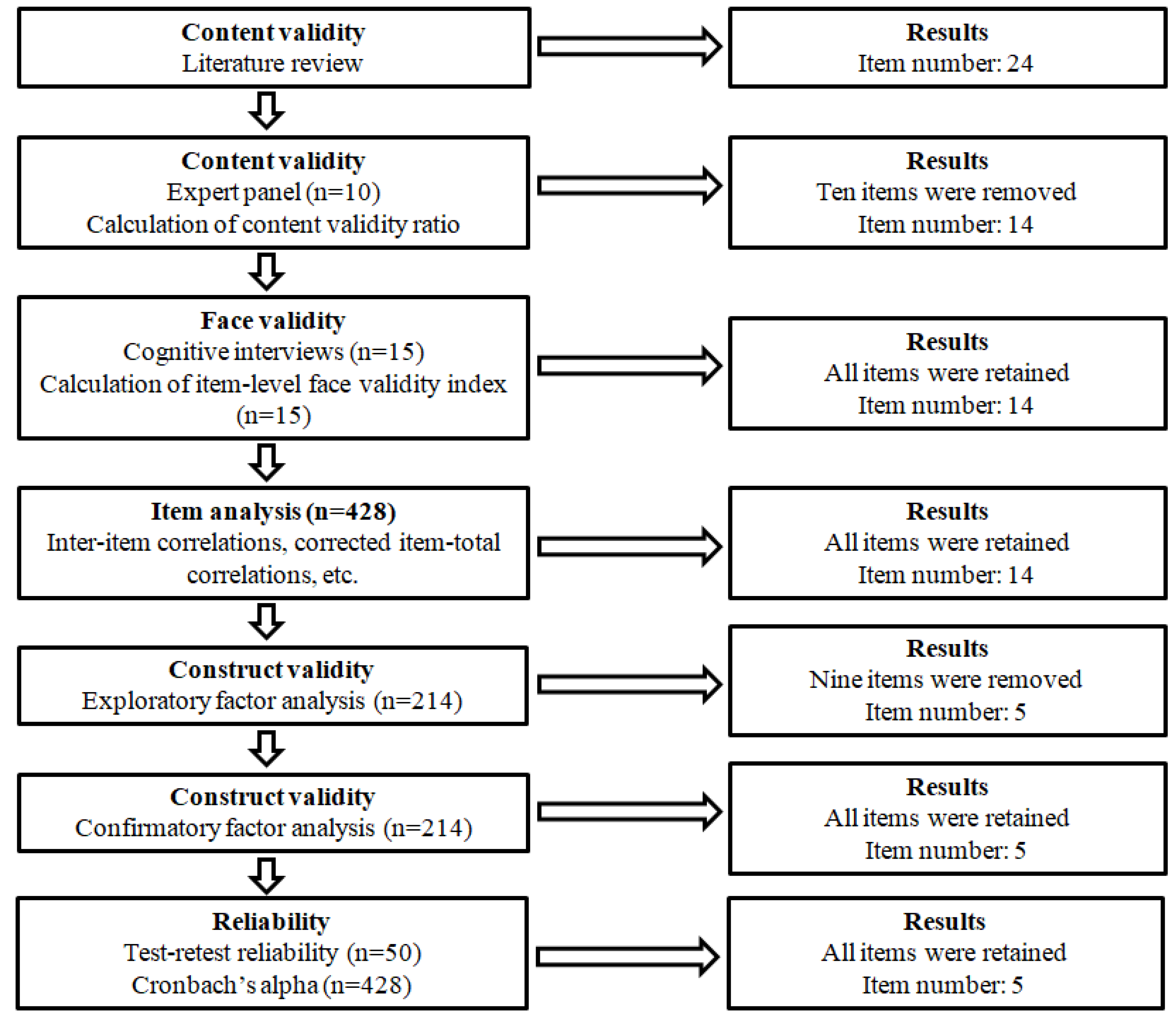
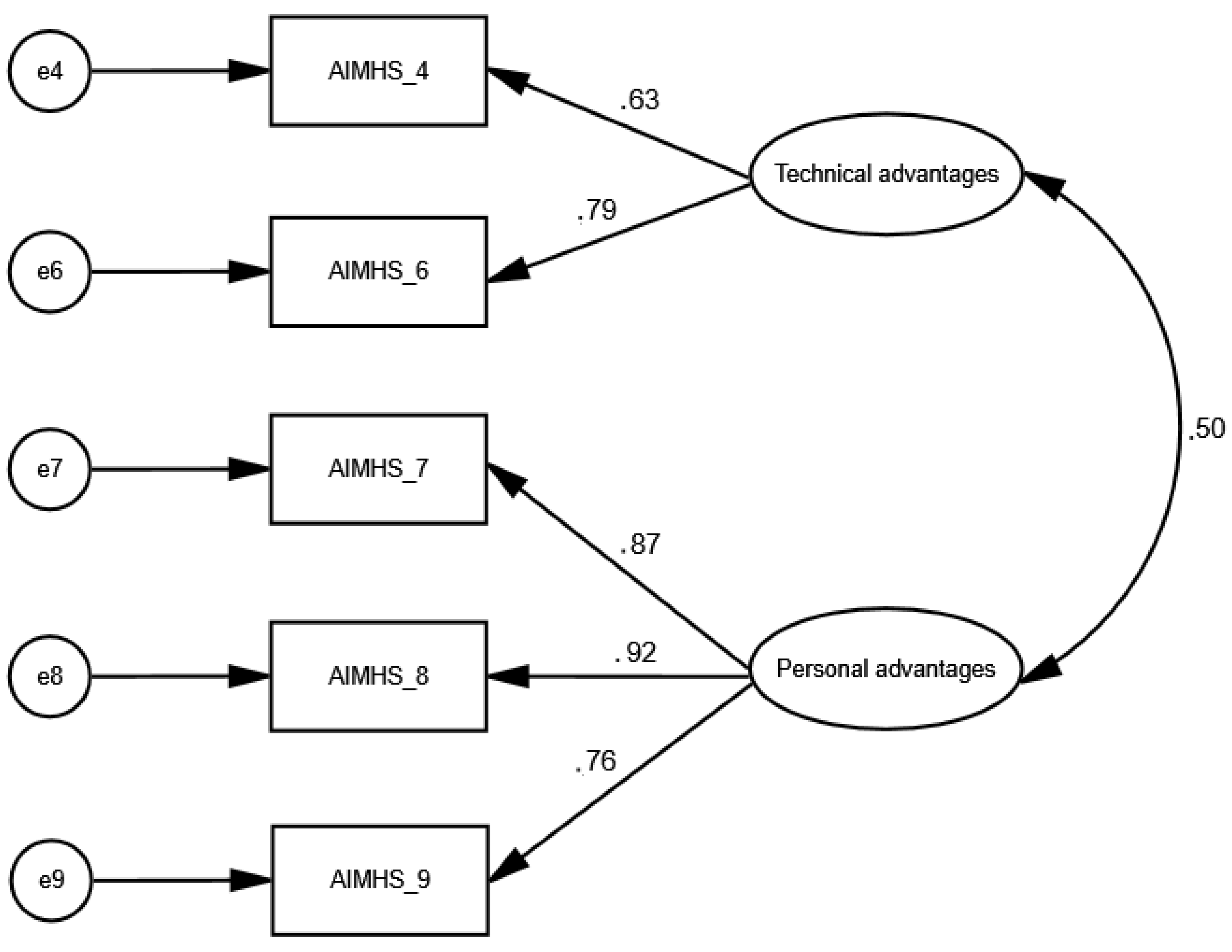
Background/Objectives: Measuring attitudes toward the use of Artificial Intelligence (AI)-based chatbots for mental health support is highly important, especially as these technologies become more integrated into clinical and therapeutic settings. The aim of our study was to develop and validate a scale to measure attitudes toward the use of AI-based chatbots for mental health support, i.e., the Artificial Intelligence in Mental Health Scale (AIMHS). Methods: A multidisciplinary panel of experts assessed the content validity of items that were developed after an extensive literature review. To confirm face validity, we carried out cognitive interviews and calculated the item-level face validity index. Furthermore, we applied both exploratory and confirmatory factor analyses to verify the construct structure of the AIMHS. Moreover, we assessed measurement invariance across demographic subgroups, specifically examining differences by gender, age, and daily use of AI chatbots, social media platforms, and websites. Concurrent validity was evaluated using three instruments: the Artificial Intelligence Attitude Scale (AIAS-4), the Attitudes Towards Artificial Intelligence Scale (ATAI), and the Short Trust in Automation Scale (S-TIAS). Finally, reliability was tested through Cronbach’s alpha, Cohen’s kappa, and the intraclass correlation coefficient. Results: Exploratory and confirmatory factor analyses supported a two-factor model -technical personal advantages- that explained 81.28% of the variance. Moreover, the AIMHS demonstrated strong concurrent validity, evidenced by statistically significant correlations with AIAS-4, ATAI, and S-TIAS. Configural measurement invariance and metric invariance were supported by our findings. Cronbach’s alpha for the AIMHS was 0.798, and intraclass correlation coefficient was 0.938. Cohen’s kappa for the five items ranged from 0.760 to 0.848. Conclusions: The AIMHS is a psychometrically sound and user-friendly instrument for assessing attitudes toward the utilization of AI-based chatbots in mental health support.
Keywords:
1. Introduction
2. Materials and Methods
2.1. Development of the Scale
2.2. Participants and Procedure
2.3. Item Analysis
2.4. Construct Validity
2.5. Concurrent Validity
2.6. Reliability
2.7. Ethical Issues
2.8. Statistical Analysis
3. Results
3.1. Item Analysis
3.2. Exploratory Factor Analysis
3.3. Confirmatory Factor Analysis
3.4. Measurement Invariance
3.5. Concurrent Validity
3.6. Reliability
4. Discussion
4.1. Limitations
5. Conclusions
Supplementary Materials
Author Contributions
Funding
Institutional Review Board Statement
Informed Consent Statement
Data Availability Statement
Conflicts of Interest
Abbreviations
| AAAW | Attitudes Towards Artificial Intelligence at Work |
| AI | Artificial Intelligence |
| AIAS | Artificial Intelligence Anxiety Scale |
| AIAS-4 | Artificial Intelligence Attitude Scale |
| AIMHS | Artificial Intelligence in Mental Health Scale |
| ASUAITIN | Attitude Scale Towards the Use of Artificial Intelligence Technologies in Nursing |
| ATAI | Attitudes Towards Artificial Intelligence Scale |
| ATTARI--12 | Attitudes Towards Artificial Intelligence Scale |
| CFA | Confirmatory Factor Analysis |
| CFI | Comparative Fit Index |
| CVR | Content Validity Ratio |
| EFA | Exploratory Factor Analysis |
| GAAIS | General Attitudes Towards Artificial Intelligence Scale |
| GFI | Goodness of Fit Index |
| KMO | Kaiser-Meyer-Olkin |
| NFI | Normed Fit Index |
| RMSEA | Root Mean Square Error of Approximation |
| SPSS | Statistical Package for Social Sciences |
| S-TIAS | Short Trust in Automation Scale |
| TAI | Treats of Artificial Intelligence Scale |
| WHO | World Health Organization |
References
- Sheikh, H.; Prins, C.; Schrijvers, E. Artificial Intelligence: Definition and Background. In Mission AI; Research for Policy; Springer International Publishing: Cham, 2023; ISBN 978-3-031-21447-9. [Google Scholar]
- Kamel Rahimi, A.; Canfell, O.J.; Chan, W.; Sly, B.; Pole, J.D.; Sullivan, C.; Shrapnel, S. Machine Learning Models for Diabetes Management in Acute Care Using Electronic Medical Records: A Systematic Review. International Journal of Medical Informatics 2022, 162, 104758. [Google Scholar] [CrossRef] [PubMed]
- Martinez-Millana, A.; Saez-Saez, A.; Tornero-Costa, R.; Azzopardi-Muscat, N.; Traver, V.; Novillo-Ortiz, D. Artificial Intelligence and Its Impact on the Domains of Universal Health Coverage, Health Emergencies and Health Promotion: An Overview of Systematic Reviews. International Journal of Medical Informatics 2022, 166, 104855. [Google Scholar] [CrossRef] [PubMed]
- D’Alfonso, S. AI in Mental Health. Current Opinion in Psychology 2020, 36, 112–117. [Google Scholar] [CrossRef]
- Milne-Ives, M.; De Cock, C.; Lim, E.; Shehadeh, M.H.; De Pennington, N.; Mole, G.; Normando, E.; Meinert, E. The Effectiveness of Artificial Intelligence Conversational Agents in Health Care: Systematic Review. J Med Internet Res 2020, 22, e20346. [Google Scholar] [CrossRef]
- Boucher, E.M.; Harake, N.R.; Ward, H.E.; Stoeckl, S.E.; Vargas, J.; Minkel, J.; Parks, A.C.; Zilca, R. Artificially Intelligent Chatbots in Digital Mental Health Interventions: A Review. Expert Review of Medical Devices 2021, 18, 37–49. [Google Scholar] [CrossRef]
- Koulouri, T.; Macredie, R.D.; Olakitan, D. Chatbots to Support Young Adults’ Mental Health: An Exploratory Study of Acceptability. ACM Trans. Interact. Intell. Syst. 2022, 12, 1–39. [Google Scholar] [CrossRef]
- Lim, S.M.; Shiau, C.W.C.; Cheng, L.J.; Lau, Y. Chatbot-Delivered Psychotherapy for Adults With Depressive and Anxiety Symptoms: A Systematic Review and Meta-Regression. Behavior Therapy 2022, 53, 334–347. [Google Scholar] [CrossRef]
- Sachan, D. Self-Help Robots Drive Blues Away. The Lancet Psychiatry 2018, 5, 547. [Google Scholar] [CrossRef]
- Greer, S.; Ramo, D.; Chang, Y.-J.; Fu, M.; Moskowitz, J.; Haritatos, J. Use of the Chatbot “Vivibot” to Deliver Positive Psychology Skills and Promote Well-Being Among Young People After Cancer Treatment: Randomized Controlled Feasibility Trial. JMIR Mhealth Uhealth 2019, 7, e15018. [Google Scholar] [CrossRef]
- Drouin, M.; Sprecher, S.; Nicola, R.; Perkins, T. Is Chatting with a Sophisticated Chatbot as Good as Chatting Online or FTF with a Stranger? Computers in Human Behavior 2022, 128, 107100. [Google Scholar] [CrossRef]
- De Gennaro, M.; Krumhuber, E.G.; Lucas, G. Effectiveness of an Empathic Chatbot in Combating Adverse Effects of Social Exclusion on Mood. Front. Psychol. 2020, 10, 3061. [Google Scholar] [CrossRef]
- Denecke, K.; Vaaheesan, S.; Arulnathan, A. A Mental Health Chatbot for Regulating Emotions (SERMO) - Concept and Usability Test. IEEE Trans. Emerg. Topics Comput. 2021, 9, 1170–1182. [Google Scholar] [CrossRef]
- Inkster, B.; Sarda, S.; Subramanian, V. An Empathy-Driven, Conversational Artificial Intelligence Agent (Wysa) for Digital Mental Well-Being: Real-World Data Evaluation Mixed-Methods Study. JMIR Mhealth Uhealth 2018, 6, e12106. [Google Scholar] [CrossRef] [PubMed]
- Fitzpatrick, K.K.; Darcy, A.; Vierhile, M. Delivering Cognitive Behavior Therapy to Young Adults With Symptoms of Depression and Anxiety Using a Fully Automated Conversational Agent (Woebot): A Randomized Controlled Trial. JMIR Ment Health 2017, 4, e19. [Google Scholar] [CrossRef] [PubMed]
- Burns, J.M.; Davenport, T.A.; Durkin, L.A.; Luscombe, G.M.; Hickie, I.B. The Internet as a Setting for Mental Health Service Utilisation by Young People. Medical Journal of Australia 2010, 192. [Google Scholar] [CrossRef] [PubMed]
- Eagly, A.; Chaiken, S. The Psychology of Attitudes; Harcourt Brace Jovanovich College Publishers: Texas, 1993. [Google Scholar]
- Ajzen, I. Nature and Operation of Attitudes. Annu. Rev. Psychol. 2001, 52, 27–58. [Google Scholar] [CrossRef]
- Dehbozorgi, R.; Zangeneh, S.; Khooshab, E.; Nia, D.H.; Hanif, H.R.; Samian, P.; Yousefi, M.; Hashemi, F.H.; Vakili, M.; Jamalimoghadam, N.; et al. The Application of Artificial Intelligence in the Field of Mental Health: A Systematic Review. BMC Psychiatry 2025, 25, 132. [Google Scholar] [CrossRef]
- Stein, J.-P.; Messingschlager, T.; Gnambs, T.; Hutmacher, F.; Appel, M. Attitudes towards AI: Measurement and Associations with Personality. Sci Rep 2024, 14, 2909. [Google Scholar] [CrossRef]
- Sindermann, C.; Sha, P.; Zhou, M.; Wernicke, J.; Schmitt, H.S.; Li, M.; Sariyska, R.; Stavrou, M.; Becker, B.; Montag, C. Assessing the Attitude Towards Artificial Intelligence: Introduction of a Short Measure in German, Chinese, and English Language. Künstl Intell 2021, 35, 109–118. [Google Scholar] [CrossRef]
- Schepman, A.; Rodway, P. The General Attitudes towards Artificial Intelligence Scale (GAAIS): Confirmatory Validation and Associations with Personality, Corporate Distrust, and General Trust. International Journal of Human–Computer Interaction 2023, 39, 2724–2741. [Google Scholar] [CrossRef]
- Stein, J.-P.; Liebold, B.; Ohler, P. Stay Back, Clever Thing! Linking Situational Control and Human Uniqueness Concerns to the Aversion against Autonomous Technology. Computers in Human Behavior 2019, 95, 73–82. [Google Scholar] [CrossRef]
- Grassini, S. Development and Validation of the AI Attitude Scale (AIAS-4): A Brief Measure of General Attitude toward Artificial Intelligence. Front. Psychol. 2023, 14, 1191628. [Google Scholar] [CrossRef]
- Krägeloh, C.U.; Melekhov, V.; Alyami, M.M.; Medvedev, O.N. Artificial Intelligence Attitudes Inventory (AIAI): Development and Validation Using Rasch Methodology. Curr Psychol 2025, 44, 12315–12327. [Google Scholar] [CrossRef]
- Park, J.; Woo, S.E.; Kim, J. Attitudes towards Artificial Intelligence at Work: Scale Development and Validation. J Occupat & Organ Psyc 2024, 97, 920–951. [Google Scholar] [CrossRef]
- Kieslich, K.; Lünich, M.; Marcinkowski, F. The Threats of Artificial Intelligence Scale (TAI): Development, Measurement and Test Over Three Application Domains. Int J of Soc Robotics 2021, 13, 1563–1577. [Google Scholar] [CrossRef]
- Wang, Y.-Y.; Wang, Y.-S. Development and Validation of an Artificial Intelligence Anxiety Scale: An Initial Application in Predicting Motivated Learning Behavior. Interactive Learning Environments 2022, 30, 619–634. [Google Scholar] [CrossRef]
- McGrath, M.J.; Lack, O.; Tisch, J.; Duenser, A. Measuring Trust in Artificial Intelligence: Validation of an Established Scale and Its Short Form. Front. Artif. Intell. 2025, 8, 1582880. [Google Scholar] [CrossRef]
- Yılmaz, D.; Uzelli, D.; Dikmen, Y. Psychometrics of the Attitude Scale towards the Use of Artificial Intelligence Technologies in Nursing. BMC Nurs 2025, 24, 151. [Google Scholar] [CrossRef] [PubMed]
- El-Hachem, S.S.; Lakkis, N.A.; Osman, M.H.; Issa, H.G.; Beshara, R.Y. University Students’ Intentions to Seek Psychological Counseling, Attitudes toward Seeking Psychological Help, and Stigma. Soc Psychiatry Psychiatr Epidemiol 2023, 58, 1661–1674. [Google Scholar] [CrossRef]
- Lannin, D.G.; Vogel, D.L.; Brenner, R.E.; Abraham, W.T.; Heath, P.J. Does Self-Stigma Reduce the Probability of Seeking Mental Health Information? Journal of Counseling Psychology 2016, 63, 351–358. [Google Scholar] [CrossRef]
- Vogel, D.L.; Wade, N.G.; Hackler, A.H. Perceived Public Stigma and the Willingness to Seek Counseling: The Mediating Roles of Self-Stigma and Attitudes toward Counseling. Journal of Counseling Psychology 2007, 54, 40–50. [Google Scholar] [CrossRef]
- Algumaei, A.; Yaacob, N.M.; Doheir, M.; Al-Andoli, M.N.; Algumaie, M. Symmetric Therapeutic Frameworks and Ethical Dimensions in AI-Based Mental Health Chatbots (2020–2025): A Systematic Review of Design Patterns, Cultural Balance, and Structural Symmetry. Symmetry 2025, 17, 1082. [Google Scholar] [CrossRef]
- Casu, M.; Triscari, S.; Battiato, S.; Guarnera, L.; Caponnetto, P. AI Chatbots for Mental Health: A Scoping Review of Effectiveness, Feasibility, and Applications. Applied Sciences 2024, 14, 5889. [Google Scholar] [CrossRef]
- Hornstein, S.; Zantvoort, K.; Lueken, U.; Funk, B.; Hilbert, K. Personalization Strategies in Digital Mental Health Interventions: A Systematic Review and Conceptual Framework for Depressive Symptoms. Front. Digit. Health 2023, 5, 1170002. [Google Scholar] [CrossRef] [PubMed]
- Chakraborty, C.; Pal, S.; Bhattacharya, M.; Dash, S.; Lee, S.-S. Overview of Chatbots with Special Emphasis on Artificial Intelligence-Enabled ChatGPT in Medical Science. Front. Artif. Intell. 2023, 6, 1237704. [Google Scholar] [CrossRef] [PubMed]
- Chin, H.; Song, H.; Baek, G.; Shin, M.; Jung, C.; Cha, M.; Choi, J.; Cha, C. The Potential of Chatbots for Emotional Support and Promoting Mental Well-Being in Different Cultures: Mixed Methods Study. J Med Internet Res 2023, 25, e51712. [Google Scholar] [CrossRef] [PubMed]
- Laymouna, M.; Ma, Y.; Lessard, D.; Schuster, T.; Engler, K.; Lebouché, B. Roles, Users, Benefits, and Limitations of Chatbots in Health Care: Rapid Review. J Med Internet Res 2024, 26, e56930. [Google Scholar] [CrossRef]
- Moilanen, J.; Van Berkel, N.; Visuri, A.; Gadiraju, U.; Van Der Maden, W.; Hosio, S. Supporting Mental Health Self-Care Discovery through a Chatbot. Front. Digit. Health 2023, 5, 1034724. [Google Scholar] [CrossRef]
- Ogilvie, L.; Prescott, J.; Carson, J. The Use of Chatbots as Supportive Agents for People Seeking Help with Substance Use Disorder: A Systematic Review. Eur Addict Res 2022, 28, 405–418. [Google Scholar] [CrossRef]
- DeVellis, R.F.; Thorpe, C.T. Scale Development: Theory and Applications; Fifth edition.; SAGE Publications, Inc: Thousand Oaks, California, 2022; ISBN 978-1-5443-7934-0. [Google Scholar]
- Johnson, R.L.; Morgan, G.B. Survey Scales: A Guide to Development, Analysis, and Reporting; The Guilford Press: New York, 2016; ISBN 978-1-4625-2696-3. [Google Scholar]
- Saris, W.E. Design, Evaluation, and Analysis of Questionnaires for Survey Research; Second Edition.; Wiley: Hoboken, New Jersey, 2014; ISBN 978-1-118-63461-5. [Google Scholar]
- Gnambs, T.; Stein, J.-P.; Appel, M.; Griese, F.; Zinn, S. An Economical Measure of Attitudes towards Artificial Intelligence in Work, Healthcare, and Education (ATTARI-WHE). Computers in Human Behavior: Artificial Humans 2025, 3, 100106. [Google Scholar] [CrossRef]
- Klarin, J.; Hoff, E.; Larsson, A.; Daukantaitė, D. Adolescents’ Use and Perceived Usefulness of Generative AI for Schoolwork: Exploring Their Relationships with Executive Functioning and Academic Achievement. Front. Artif. Intell. 2024, 7, 1415782. [Google Scholar] [CrossRef]
- Beck, A.; Ward, C.; Mendelson, M.; Mock, J.; Erbaugh, J. An Inventory for Measuring Depression. Arch Gen Psychiatry 1961, 4, 561. [Google Scholar] [CrossRef] [PubMed]
- Beck, A.T.; Epstein, N.; Brown, G.; Steer, R.A. An Inventory for Measuring Clinical Anxiety: Psychometric Properties. Journal of Consulting and Clinical Psychology 1988, 56, 893–897. [Google Scholar] [CrossRef]
- Hamilton, M. The Assessment of Anxiety States by Rating. British Journal of Medical Psychology 1959, 32, 50–55. [Google Scholar] [CrossRef] [PubMed]
- Kroenke, K.; Spitzer, R.L.; Williams, J.B.W.; Lowe, B. An Ultra-Brief Screening Scale for Anxiety and Depression: The PHQ-4. Psychosomatics 2009, 50, 613–621. [Google Scholar] [CrossRef]
- Kroenke, K.; Spitzer, R.L.; Williams, J.B. The PHQ-9: Validity of a Brief Depression Severity Measure. J Gen Intern Med 2001, 16, 606–613. [Google Scholar] [CrossRef]
- Mughal, A.Y.; Devadas, J.; Ardman, E.; Levis, B.; Go, V.F.; Gaynes, B.N. A Systematic Review of Validated Screening Tools for Anxiety Disorders and PTSD in Low to Middle Income Countries. BMC Psychiatry 2020, 20, 338. [Google Scholar] [CrossRef]
- Spitzer, R.L.; Kroenke, K.; Williams, J.B.W.; Löwe, B. A Brief Measure for Assessing Generalized Anxiety Disorder: The GAD-7. Arch Intern Med 2006, 166, 1092–1097. [Google Scholar] [CrossRef]
- Zigmond, A.S.; Snaith, R.P. The Hospital Anxiety and Depression Scale. Acta Psychiatr Scand 1983, 67, 361–370. [Google Scholar] [CrossRef]
- Ayre, C.; Scally, A.J. Critical Values for Lawshe’s Content Validity Ratio: Revisiting the Original Methods of Calculation. Measurement and Evaluation in Counseling and Development 2014, 47, 79–86. [Google Scholar] [CrossRef]
- Meadows, K. Cognitive Interviewing Methodologies. Clin Nurs Res 2021, 30, 375–379. [Google Scholar] [CrossRef]
- Yusoff, M.S.B. ABC of Response Process Validation and Face Validity Index Calculation. EIMJ 2019, 11, 55–61. [Google Scholar] [CrossRef]
- Costello, A.B.; Osborne, J. Best Practices in Exploratory Factor Analysis: Four Recommendations for Getting the Most from Your Analysis. Pract Assess Res Eval 2005, 10, 1–9. [Google Scholar] [CrossRef]
- DeVon, H.A.; Block, M.E.; Moyle--Wright, P.; Ernst, D.M.; Hayden, S.J.; Lazzara, D.J.; Savoy, S.M.; Kostas--Polston, E. A Psychometric Toolbox for Testing Validity and Reliability. J of Nursing Scholarship 2007, 39, 155–164. [Google Scholar] [CrossRef] [PubMed]
- De Vaus, D. Surveys in Social Research; 5th ed.; Routledge: London, 2004.
- Yusoff, M.S.B.; Arifin, W.N.; Hadie, S.N.H. ABC of Questionnaire Development and Validation for Survey Research. EIMJ 2021, 13, 97–108. [Google Scholar] [CrossRef]
- Hair, J.; Black, W.; Babin, B; Anderson, R. Multivariate Data Analysis; 7th ed.; Prentice Hall: New Jersey, 2017. [Google Scholar]
- De Winter, J.C.F.; Dodou, D.; Wieringa, P.A. Exploratory Factor Analysis With Small Sample Sizes. Multivariate Behavioral Research 2009, 44, 147–181. [Google Scholar] [CrossRef]
- Kaiser, H.F. An Index of Factorial Simplicity. Psychometrika 1974, 39, 31–36. [Google Scholar] [CrossRef]
- Bland, J.M.; Altman, D.G. Statistics Notes: Cronbach’s Alpha. BMJ 1997, 314, 572–572. [Google Scholar] [CrossRef] [PubMed]
- Baumgartner, H.; Homburg, C. Applications of Structural Equation Modeling in Marketing and Consumer Research: A Review. International Journal of Research in Marketing 1996, 13, 139–161. [Google Scholar] [CrossRef]
- Hu, L.; Bentler, P.M. Fit Indices in Covariance Structure Modeling: Sensitivity to Underparameterized Model Misspecification. Psychological Methods 1998, 3, 424–453. [Google Scholar] [CrossRef]
- Putnick, D.L.; Bornstein, M.H. Measurement Invariance Conventions and Reporting: The State of the Art and Future Directions for Psychological Research. Developmental Review 2016, 41, 71–90. [Google Scholar] [CrossRef]
- Katsiroumpa, A.; Moisoglou, I.; Gallos, P.; Galani, O.; Tsiachri, M.; Lialiou, P.; Konstantakopoulou, O.; Lamprakopoulou, K.; Galanis, P. Artificial Intelligence Attitude Scale: Translation and Validation in Greek. Arch Hell Med Under press. 2025. [Google Scholar]
- Konstantakopoulou, O.; Katsiroumpa, A.; Moisoglou, I.; Gallos, P.; Galani, O.; Tsiachri, M.; Lialiou, P.; Lamprakopoulou, K.; Galanis, P. Attitudes Towards Artificial Intelligence Scale: Translation and Validation in Greek. Arch Hell Med Under press. 2025. [Google Scholar]
- Katsiroumpa, A.; Moisoglou, I.; Gallos, P.; Galani, O.; Tsiachri, M.; Lialiou, P.; Konstantakopoulou, O.; Lamprakopoulou, K.; Galanis, P. Short Trust in Automation Scale: Translation and Validation in Greek. Arch Hell Med Under press. 2025. [Google Scholar]
- World Medical Association World Medical Association Declaration of Helsinki: Ethical Principles for Medical Research Involving Human Subjects. JAMA 2013, 310, 2191. [CrossRef] [PubMed]
- World Health Organization Mental Health: Strengthening Our Response; 2024.
- World Health Organization Depression and Other Common Mental Disorders: Global Health Estimates; 2024.
- Grand View Research AI In Mental Health Market Size, Share & Trends Analysis Report; 2025.
- Data Bridge Market Research Global Mental Health Chatbot Services Market Size, Share, and Trends Analysis Report – Industry Overview and Forecast to 2032; 2025.

| Artificial intelligence chatbots … | Mean (standard deviation) | Corrected item-total correlation | Floor effect (%) | Ceiling effect (%) | Skewness | Kurtosis | Cronbach’s alpha if item deleted | Item exclusion or retention |
|
2.36 (0.94) | 0.543 | 19.4 | 0.5 | 0.21 | -0.67 | 0.882 | Retained |
|
2.91 (0.94) | 0.587 | 7.7 | 1.6 | -0.28 | -0.52 | 0.879 | Retained |
|
2.77 (0.79) | 0.566 | 7.0 | 0.5 | -0.37 | 0.13 | 0.881 | Retained |
|
1.76 (0.79) | 0.491 | 42.5 | 0.1 | 0.85 | 0.41 | 0.884 | Retained |
|
2.30 (1.02) | 0.492 | 25.9 | 0.5 | 0.26 | -0.93 | 0.884 | Retained |
|
1.95 (0.81) | 0.541 | 32.2 | 0.5 | 0.49 | -0.11 | 0.882 | Retained |
|
3.29 (0.96) | 0.672 | 5.8 | 4.7 | -0.70 | 0.01 | 0.875 | Retained |
|
3.43 (0.90) | 0.708 | 4.2 | 6.5 | -0.75 | 0.52 | 0.874 | Retained |
|
3.44 (0.93) | 0.611 | 4.4 | 7.9 | -0.70 | 0.40 | 0.878 | Retained |
|
3.08 (1.02) | 0.460 | 7.5 | 4.2 | -0.33 | -0.69 | 0.886 | Retained |
|
3.03 (0.80) | 0.501 | 4.0 | 0.9 | -0.41 | 0.12 | 0.883 | Retained |
|
3.07 (0.82) | 0.559 | 4.7 | 0.9 | -0.54 | 0.13 | 0.881 | Retained |
|
2.72 (0.92) | 0.625 | 9.6 | 0.9 | -0.09 | -0.60 | 0.878 | Retained |
|
2.69 (0.90) | 0.582 | 9.8 | 0.7 | -0.10 | -0.57 | 0.880 | Retained |
| Artificial intelligence chatbots … | Factors | Communalities | ||
|
First (items #4, #6) |
Second (items #7, #8, #9) |
Third (items #3, #12) |
||
|
0.344 | 0.578 | 0.399 | 0.463 |
|
0.536 | 0.437 | 0.491 | 0.467 |
|
0.361 | 0.471 | 0.601 | 0.403 |
|
0.226 | 0.831 | 0.263 | 0.536 |
|
0.410 | 0.537 | 0.348 | 0.348 |
|
0.302 | 0.745 | 0.381 | 0.488 |
|
0.815 | 0.425 | 0.472 | 0.655 |
|
0.933 | 0.388 | 0.489 | 0.730 |
|
0.792 | 0.233 | 0.486 | 0.592 |
|
0.511 | 0.277 | 0.544 | 0.341 |
|
0.355 | 0.294 | 0.483 | 0.250 |
|
0.403 | 0.280 | 0.778 | 0.404 |
|
0.483 | 0.586 | 0.552 | 0.481 |
|
0.438 | 0.549 | 0.552 | 0.450 |
| Eigenvalues | 5.604 | 1.632 | 1.130 | |
| % of variance | 40.030 | 11.655 | 8.073 | |
| Cumulative % of variance | 40.030 | 51.685 | 59.758 | |
| Artificial intelligence chatbots … | Factors | Communalities | |
|
First (items #7, #8, #9) |
Second (items #4, #6) |
||
| 3. cannot provide correct information on mental health issues | 0.370 | 0.473 | 0.330 |
| 4. cannot achieve empathy levels comparable to those of a human therapist | 0.248 | 0.775 | 0.438 |
| 6. can demonstrate better problem-solving skills compared to a human therapist | 0.321 | 0.806 | 0.445 |
| 7. can expand access to mental health care by reducing geographic barriers | 0.811 | 0.385 | 0.617 |
| 8. can expand access to mental health care by providing continuous access (24/7 availability) | 0.938 | 0.368 | 0.714 |
| 9. can expand access to mental health care by reducing financial barriers | 0.783 | 0.208 | 0.568 |
| 12. can offer up to date information on mental health issues | 0.391 | 0.294 | 0.292 |
| Eigenvalues | 3.211 | 1.423 | |
| % of variance | 45.870 | 20.329 | |
| Cumulative % of variance | 45.870 | 66.199 | |
| Artificial intelligence chatbots … | Factors | Communalities | |
|
First (items #4, #6) |
Second (items #7, #8, #9) |
||
| 4. cannot achieve empathy levels comparable to those of a human therapist | 0.982 | 0.215 | 0.415 |
| 6. can demonstrate better problem-solving skills compared to a human therapist | 0.649 | 0.293 | 0.420 |
| 7. can expand access to mental health care by reducing geographic barriers | 0.353 | 0.799 | 0.606 |
| 8. can expand access to mental health care by providing continuous access (24/7 availability) | 0.314 | 0.958 | 0.710 |
| 9. can expand access to mental health care by reducing financial barriers | 0.161 | 0.771 | 0.556 |
| Eigenvalues | 2.696 | 1.368 | |
| % of variance | 53.922 | 27.357 | |
| Cumulative % of variance | 53.922 | 81.280 | |
| Model | RMSEA | GFI | NFI | CFI |
| Gender | <0.001 | 0.987 | 0.985 | 1.000 |
| Age | <0.001 | 0.987 | 0.985 | 1.000 |
| Daily use of artificial intelligence chatbots, social media platforms, and websites | <0.001 | 0.988 | 0.987 | 1.000 |
| Artificial Intelligence in Mental Health Scale | ||
| Pearson’s correlation coefficient | P-value | |
| Artificial Intelligence Attitude Scale | 0.405 | <0.001 |
| Attitudes Towards Artificial Intelligence Scale (acceptance subscale) | 0.401 | <0.001 |
| Attitudes Towards Artificial Intelligence Scale (fear subscale) | -0.151 | 0.002 |
| Short Trust in Automation Scale | 0.450 | <0.001 |
Disclaimer/Publisher’s Note: The statements, opinions and data contained in all publications are solely those of the individual author(s) and contributor(s) and not of MDPI and/or the editor(s). MDPI and/or the editor(s) disclaim responsibility for any injury to people or property resulting from any ideas, methods, instructions or products referred to in the content. |
© 2025 by the authors. Licensee MDPI, Basel, Switzerland. This article is an open access article distributed under the terms and conditions of the Creative Commons Attribution (CC BY) license (http://creativecommons.org/licenses/by/4.0/).