
Submitted:
13 November 2025
Posted:
17 November 2025
You are already at the latest version
Abstract
Based on the trans-Planckian quantum origin of the universe, as developed by Norma Sanchez, and on the conformal cyclic cosmology proposed by Penrose, we demonstrate the possibility for the LIGO-Virgo-KAGRA-LISA detectors to observe the signal from the memory effect of gravitational waves emitted by phantom black holes, as well as that from the cosmic microwave background, using the theory of general relativity. In this study, we refer to the models developed by authors J. Defo and K. Kuetche, \( {\it JETP} {\bf 135} \) 3 (2022) and arXiv:2506.10053, who suggest that it is conceivable, from a coupling of \( ‘’+'‘ \) and \( ’'\times'' \) polarizations, to generate a gravitational wave signal analogous to that detected by LIGO-Virgo-KAGRA. We use this framework to explore and extract information from the Trans-Planckian quantum universe in the form of gravitational waves , while clarifying the notion of accelerating expansion of the universe without recourse to dark energy.
Keywords:
gravitational waves
; trans-planckian quantum universe
; dark energy
1. Introduction
The Standard Model , in its current configuration, raises several questions relating to its fundamental postulates, notably dark matter, dark energy and the cosmological constant . These elements are essential parameters for understanding the universe and its evolution, integrating other phenomena which, in the experimental framework, are proving unsatisfactory [1,2]. It therefore appears necessary to adopt a new paradigm in order to deepen our understanding of the parameters derived from the Standard Model in our contemporary universe, without resorting to new physics [2,3]. Exploring the lack of a new physics clarifying the above phenomena, Rovelli [2] recently suggested that it was possible to consider the use of quantum gravity to better examine the manifestations of dark energy and the cosmological constant on the Planck scale. By adopting the quantum gravity hypothesis, it becomes necessary to rely on the approach proposed by Sanchez [4], according to which gravitational waves constitute a relevant argument for apprehending the behaviour of gravity at the subatomic scale, in opposition to modified theories of gravitation which are deficient on several points. The method advocated by Sanchez [4]to establish a link between these two theories, which have been antagonistic for several decades, consists in integrating quantum physics within gravity. This approach inevitably leads us to consider phenomena such as the expansion of the Universe, both in its early days and in contemporary times, as well as gravitational waves from black holes and experimental systems reproducing gravity in the laboratory. In this unifying perspective of the two opposing theories, Sanchez [5] has succeeded in elaborating a quantum theory of black holes as well as properties covering the following domains of gravity: classical, semi-classical and quantum. In this remarkable study, Sanchez [5] demonstrates that the interior of black holes always remains quantum and Transplanckian, with a constant curvature, irrespective of the size of the black hole in the astrophysical domain. This observation offers a new perspective on dark energy, which originates in the trans-Planckian vacuum of the black hole in conjunction with the regularity of spacetime, reflecting the absence of a singularity in the initial Big Bang. It is clear from the results presented by Sanchez [5,6,7,8,9,10], notably concerning a clarification of dark energy and the cosmological constant , which can be assimilated to vacuum energy, that this innovative approach imposes a methodology according to which quantum physics should be used to approach quantum gravity. Within the framework of the model outlined by Sanchez [5,6,7,8,9,10], several fundamental principles are proposed: 1) Quantum gravity must be a finite theory, distinct from a renormalizable theory. There is no cut-off in quantum gravity. 2) Quantum spacetime is described by a quantum algebra of discrete levels. Classical spacetime is found when the quantum operators correspond to the continuum coordinates of classical spacetime (complex numbers), with all commutators canceled. 3) The hyperbolic structure of quantum spacetime gives rise to the quantum light cone, and a new quantum vacuum region appears beyond the Planck scale. This phenomenon applies to all spacetimes, including flat spacetime (Minkowski). Quantum pressure, resulting from the uncertainty principle, deforms the vacuum and induces quantum curvature.
In studying this model [5,6,7,8,9,10], we note a similarity with the CCC [11,12,14], according to which there were universes prior to the Big Bang. The only way of verifying these models is to identify concentric circles on the map of the cosmic microwave background, testifying to the traces left by black holes via Hawking radiation. These two theories inevitably lead to the existence of post-planckian universes, which are difficult to observe due to their small size. Based on these models with their distinct formalisms, it becomes imperative to develop a theory capable of revealing the information contained in these postulates. The aim of this article is to demonstrate the coherence between the two models by using the memory effect of gravitational waves, whose recent theoretical advances have revealed a profound link between the symmetrical structure underlying classical and quantum gravity, as well as the low-frequency structure of scattering amplitudes [15,16,17,18,19].
2. Memory Effect in Spacetime
The observation of gravitational waves by the scientific team LIGO-Virgo [20] , resulting from the collision of two massive black holes, has significantly strengthened the credibility of the theory of general relativity at the expense of modified theories of gravitation, paving the way for gravitational astronomy . This observation revealed the existence of gravitons, offering a rigorous new approach to the quantification of gravitation through the study of gravitational waves [4,21]. This discovery has sparked considerable interest in the analysis of many phenomena, notably those originating in the primordial Universe in cosmology, revealing the limits of the standard model. This approach is therefore essential for understanding the universe, from its genesis to its current evolution [22]. It is clear that the passage of a gravitational wave affects and deforms the structure of spacetime, leaving permanent imprints on the universe after its passage and irreversibly modifying the distances between two points in space. This phenomenon, referred to as gravitational memory, has extremely weak predictions in general relativity due to its little-known properties following the passage of gravitational waves [15,16,17,18,19,23]. Recently, Goncharov et al. [23] pointed out that the detection of this memory effect could provide us with additional information on the spacetime symmetries of the universe, while also offering an opportunity to better understand the unification between general relativity theory and quantum theory. Based on gravitational wave observations, in particular the presence of the + and × polarizations, it is to be expected that spacetime may somehow analogously reproduce the gravitational wave signal as well as the memory effect, as recently suggested by Cheung et al. [15] in data from LIGO-Virgo-KAGRA. The authors [24,25], have demonstrated that it is possible to construct a signal with characteristics similar to those observed by LIGO-Virgo-KAGRA [20]. Returning to the hypothesis put forward by Goncharov et al. [23] according to which the detection of the memory effect could provide valuable clues as to how to access a theory of quantum gravity whose fundamental role would make it possible to obtain concrete information about the Transplanckian quantum universe [5,6,7,8,9,10] as well as on the CCC [11,12,14] model while shedding light on the concepts of dark energy and the cosmological constant derived from the Standard Model [1,2]. In this study, we use the + and × polarizations found in gravitational wave detections to try to better understand the composition of the primordial universe at the time of the Big Bang, by exploiting the memory effect inscribed in the Jordan and Ehlers [26] metric, left by the various traces of black holes. To this end, we introduce the Jordan and Ehlers [26] metric and the Einstein field equations in the following forms:
where represents the cylindrical coordinates and t the time. The different arbitrary functions , and depend on and t. It is also noted that the previous quantities written with comma as subscript denote their partial derivatives with the associated variables.
We emphasize that the configuration of + and × polarizations, derived from the observation of gravitational waves, has revealed its importance in understanding the memory effect of displacement and velocity in spacetime [27]. It should also be noted that the Jordan and Ehlers [26] metric has been successfully applied in modeling gravitational waves similar to those detected by LIGO-VIRGO [24], under the precondition that spacetime is curved and devoid of any singularities. The idea that spacetime is curved is one of Sanchez’s [5,6,7,8,9,10] prerequisites for the elaboration of an ideal quantum theory of gravity, designed to apprehend phenomena linked to the origin of the universe while exploring the unresolved questions of the Standard Model [1,2]. Within this established framework, we will use the memory effect as a tool for cosmological investigation, in an attempt to better understand the structure of the primordial universe.
3. Sanchez’s Quantum Gravity and Conformal Cyclic Cosmology
According to CCC [11,12,14], the Big Bang universe is made up of the remnants of phantom black holes from a very ancient universe. In the description of this theory, the universe follows a continuous cycle in which the old universe is absorbed by the universe in formation, highlighting certain properties such as that of dark energy. According to Penrose [14], dark energy are erebons possessing Planck mass and should appear during each eon, gradually disintegrating in the form of gravitons in accordance with the principles of general relativity. Clearly, the problem of the decay of erbons into gravitons must involve the Planck frequency, and this uncertainty leads us to examine both classical and quantum gravity. In an innovative approach developed by Krzysztof and Penrose [28], it is argued that dark matter from an eon at an instant equivalent to our present epoch should decay into gravitons in such a way that the effects of the cosmological constant do not manifest themselves, thus allowing gravitons to predominate in the final phase of the eon. This further hypothesis is based on the introduction of a massless quantum particle of spin , which is a major argument in favor of quantizing the theory of general relativity on the basis of gravitational waves [29]. Within this theoretical framework [11,12,14,28], it becomes clear that understanding the fate of the cosmological constant during the decay of erebons into gravitons within each eon requires recourse to a quantum theory of gravity.
4. Sanchez’s Quantum Gravity
The introduction of quantum physics into gravity [5,6,7,8,9,10] has overcome some of the obstacles posed by the enigmatic questions surrounding cosmology, in particular those relating to the Standard Model [1,2], characterized by the presence of dark energy, and the cosmological constant , whose sign and value are the subject of much debate among cosmologists. Despite this, a number of alternative theories have been proposed to overcome the limitations of the standard model . Among these, the CCC [11,12,14,28] model suggests that the Big Bang resulted from the remnants of black holes from an eon before the Big Bang. This hypothesis offers an explanation for the matter-antimatter symmetry observed in the CMB [26], although some questions remain, notably concerning the fate of the cosmological constant .
4.1. Cosmological Constant
The persistent questioning of the sign and precise value of the cosmological constant within the framework of the standard model [1,2] as well as in the CCC model [11,12,14,28] finds a more appropriate interpretation when quantum gravity is applied as prescribed by Sanchez [5,6,7,8,9,10]. This phenomenon has its roots in the study of the universe both in its initial phases and in contemporary times. In this analysis, the constant is considered to result from the energy density of the cosmological vacuum, which manifests itself in classical-quantum (or wave-particle) duality via the Planck scale, also known as Planck scale duality. This hypothesis extends to the Planckian and supra-Planckian realms, integrating the classical-quantum duality inherent in quantum theory while incorporating gravitation; this is the classical-quantum gravitational duality, or wave-particle-gravity duality. By adopting this conception of quantum gravity, which offers a deeper understanding of the constant, which obeys what we refer to as the Sanchez [8] quantum numbers, it now seems essential to examine the possibility that the memory effect might enable the universe to be reconstituted in the first phases of its creation. in the form of gravitational waves emitted by each universe, in keeping with the Sanchez [8] quantum numbers.
4.2. Traces of the Post-Planckian Universe
The research work carried out by Goncharov et al. [23] opens up new perspectives on the memory effect as a tool for investigating the universe within its constituent spacetime. They provide a better understanding of so-called asymptotic symmetries, which refer to geometrical operations performed at considerable distances, far from any galaxy or other mass, where gravitational influence becomes negligible. This approach has led to the conclusion that different symmetry patterns generate various forms of memory effect, by allowing varied deformations of spacetime on large scales. The observation reported in ref. [23] invites us to consider the possibility that spacetime may have combined displacement and spin related memory effects in the early universe. To this end, we reformulate the above equations in the following form [26]:
It is worth pointing out that, according to CCC [11,12,14,28], the primordial universe at the time of the Big Bang is composed of traces of ghost holes, the observation of which remains difficult with current technologies. In order to understand the origin of ghost black holes, we rely on Sanchez’s [5,10] principle of quantum gravity, according to which spacetime exhibits curvature on a quantum scale. This framework has been used to demonstrate that the interior of black holes is systematically quantum, trans-Planckian and characterized by constant curvature. This property applies to all black holes, whatever their mass, including the most macroscopic and astrophysical. Consequently, it should be possible to verify these various characteristics from the memory effect [23] based on the quantum numbers proposed by Sanchez [8], which will be replaced here by the gravitational field. To do this, let us take up Eq.(7), Eq.(9) and Eq.(10) and the results established in ref. [26] to obtain the following image:
Figure 1(a) and Figure 1(b) illustrate the behavior of the universe on a post-planckian scale, marked by the presence of black holes whose evolution is governed by the gravitational field. Variations in the latter inevitably lead to an increase in the volume of the universe, manifested by a growth in the absorption and emission of matter by black holes. Note that quantum numbers Sanchez’s [8] are replaced here by the gravitational field, which provides direct information on the size and entropy of the universe, whose values increase as a function of the gravitational field, corresponding to the activation of the gravitational degrees of freedom and ,13,26]. Figure 1(a) and Figure 1(b) demonstrate that the interior of black holes always remains quantum, trans-Planckian and characterized by constant curvature, while providing a solution to Hawking’s information paradox, as clearly established by Hayward [30,31,32], who shows that information entering a black hole is equivalent to that leaving it. Furthermore, it is important to note that, unlike previous work [26], the value of the gravitational field in this study mainly influences the size of the universe shown in Figure 1(a) and Figure 1(b), without affecting the shape or size of the (CMB) shown in Figure 1(c). This demonstrates that the (CMB) is the place where black holes capture and emit matter and antimatter equally, underlining the absence of a singularity at the time of the initial Big Bang.
The behavior of the universe within the framework of quantum gravity raises an additional problem relating to the structure of black holes within classical spacetime [5,8], particularly with regard to phenomena resulting from the evolution of black holes in the Transplankian universe, such as entropy and temperature, which contribute to a better understanding of black hole evaporation. In order to address more precisely this ambiguity linked to black hole behaviors in the Transplankian domain, based on the metric defined by Eq(1), we introduce the following expression [33]:
Using Eq.(11) taking into account the extremely low value of the gravitational field, we study the behavior of black holes in the quantum context, in accordance with the configurations anticipated by quantum gravity [5], which leads us to the following picture:
Figure 2 illustrates the behavior of black hole evaporation in a pure quantum state, within the framework of quantum gravity on the trans-Planckian scale, characterized by the presence of particles, gravitons and [5] radiation. This configuration enables us to understand that it is possible, on the basis of the theory of general relativity, to describe quantum phenomena that are indispensable for understanding certain complex problems that go beyond the framework of the Standard Model .
4.3. Gravitational Wave Memory Signal (LIGO-Virgo-KAGRA-LISA)
The memory effect of gravitational waves in cosmology is a remarkably powerful tool for understanding phenomena derived from the Standard Model , in particular dark energy, due to the fact that this memory is indelibly inscribed over cosmological distances, leaving a singular imprint in spacetime [34]. This fundamental aspect of the memory effect of gravitational waves in spacetime leads us to conduct an in-depth investigation into the behaviour of the remnants of the primordial universe at the time of the Big Bang, as accurately described by the CCC [11,12,14,28] models and Sanchez’s [5,6,7,8,9,10]. The relevant method for validating these different hypotheses is based on the hope that the memory effect induced by a gravitational wave will ensure the permanence of a modification on each spacetime and the corresponding geodesic evolution, dependent on the metric [35]. Although the concept of metric is generally evoked to apprehend the behavior of the universe in these models, we place particular emphasis on the fact that spacetime exhibits both positive and negative curvature via wave propagation, in order to allow the production of particle pairs in an expanding universe [36]. These two models clearly indicate that the pre-Big Bang universe is saturated with black holes that are continuously absorbed and emitted. With this in mind, it becomes conceivable to admit the presence of gravitational waves with the following possibilities: 1) the emission of a small black hole by a more massive black hole and 2) the emission of a small black hole by a larger black hole, followed by its reabsorption [37]. Although we are aware that this possibility is strictly forbidden in general relativity, we will have to rely on quantum gravity to attempt to observe the presence of gravitational waves. To this end, we analyze Eq (9) and Eq(10) under the conditions previously established [24,25,26], and obtain the following representations:
By choosing the value of the gravitational field in the analysis of the phenomena presented in Figure 3(a) and Figure 3(b), we understand that the various memory effects observed, resulting from the passage of gravitational waves, arise from the emission of several small black holes by a more massive black hole, followed by its reabsorption [37]. This process significantly alters the shape of the wave, illustrating how the various signals move in both clockwise and anti-clockwise orbits, acquiring a relative delay induced by the radiative angular momentum flux. It should be pointed out that, in these observations, spin memory effects correspond to gravitons [26,36,37,38,39]. The use of the gravitational field in the observation of the gravitational wave memory effect is of paramount importance, not only for the study of the pre-Big Bang universe, but also for the (CMB) and its anisotropy, with regard to both the variation of the field and the height of the wave potential [40]. Recently, new perspectives have been envisaged to clarify the exact nature of the memory effect of CMB gravitational waves, which originate from energy fluxes [41], likely to be generated by the permanent emission and absorption of black holes. To better understand this possibility, we need to re-examine Eq.(8) with the previously defined conditions, which leads to the following picture:
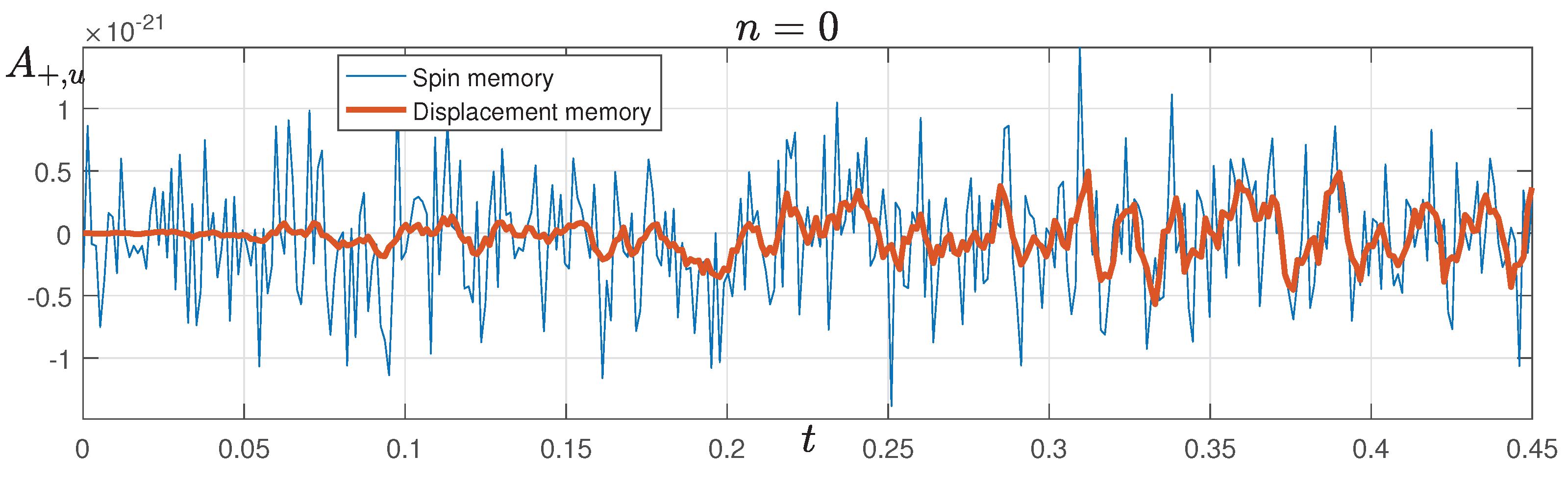
We note that the conditions imposed on the gravitational field are of key importance in the analysis presented in Figure 1(c) and Figure 4, particularly with regard to the size and type of particles present, and require further investigation. Consider the following gravitational field interval: . Applying these different values in accordance with the conditions set out in Figure 1(c) and Figure 4, it appears that the signal from the gravitational wave memory effect remains unchanged, notably without amplitude attenuation, just as the size of the particles present on the (CMB) remains of the order of , including their arrangement as described in ref. [42]. This result validates the following hypotheses [8,37] : (1) the emission of a small black hole by a more massive black hole, (2) this emission followed by the reabsorption of the small black hole,and (3) the interiors of black holes are always quantum, trans-Planckian, including those macroscopic and astrophysical. This idea leads us to understand that the energy fluctuations observed around the CMB result from the presence of the black holes whose configuration is clearly illustrated in Figs. (1a) and Figure (1b), as being at the origin of the gravitational memory effect observed emanating from the [43,44] light cones. The absence of singularities in the space-time studied sheds light on the entanglement phenomenon observed in Figure 1(a), Figure 1(b), Figure 2(a) and Figure 2(b), which generates a thermal spectrum emanating from the interior of black holes. This observation thus clarifies the nature of dark energy and the cosmological constant , which in fact correspond to the energy density of the cosmological vacuum, resulting from the classical-quantum gravitational duality [5,7,8,9,10,45].
5. Conclusion
In this study, we analyzed the ability of the LIGO-Virgo-KAGRA-LISA detectors to observe the memory effect of gravitational waves emitted by phantom black holes as well as by the (CMB), based on the (CCC) [11,12,14,28] model and on the theory of quantum gravity developed by Sanchez [5,6,7,8,9,10]. In the course of this investigation, we have demonstrated that these signals depend on the state of the gravitational field and the and t coordinates that characterize it, representing different configurations of the pre-Big Bang state of the universe. Our analyses have revealed that the concepts of dark energy and cosmological constant are fundamentally explained by the classical-quantum duality of spacetime, which was free of singularities at the time of the initial Big Bang. It is also worth pointing out that the signals observed in Figure 3(a), Figure 3(b) and Figure 4 are obtained by varying the distance from the source; while this is interesting, it poses a serious problem for obtaining signals related to the post-planckian gravitational memory effect. To achieve this, it will be necessary to use the quantum numbers introduced by Sanchez [8], in particular to estimate the distance between the source and the interferometers, as the gravitational field alone will not be sufficient to identify the source of these signals. Unlike Figure 1(c) and Figure 4, which illustrate certain properties of black holes, notably the emission of a small black hole by a massive black hole, followed by its reabsorption [37], a phenomenon occurring in the following gravitational field interval: , where the signal amplitude remains constant. One of the challenges is to determine the exact length needed to capture the first signals emanating from the universe during its initial post-planckian [10] phase, corresponding to a very low value of the gravitational field of the order of , based on the theory of general relativity, which can be seen as a disguised form of quantum gravity reproducing the [36,46] memory effect.
Acknowledgments
We would like to express our deep gratitude to the Ecole Internationale d’Astrophysique et Institut Daniel Chalonge-Hector de Vega for access to the bibliography, and to Professor Norma Sanchez for enriching exchanges.
References
- J. Binney, R. J. Binney, R. Mohayaee, J. Peacock and S. Sarka, Phil. Trans. R. Soc. A 383 20240036 (2025).
- C. arXiv:2111.07828 . arXiv:2111.07828.
- J. Harada, Phys. Rev. D108044031 (2023).
- M. Violaris et al, Nature644867 ( 2025).
- N. Sanchez, Phys. Rev. D107126018 (2023).
- N. Sanchez, Unifying quantum mechanics with Einsteins general relativity.
- N. Sanchez, Int. J. Mod. Phys. D .283 (2019).
- N. Sanchez, Int. J. Mod. Phys. A .3427 (2019).
- N. arXiv:1910.13382v1. arXiv:1910.13382v1.
- N. Sanchez, 10.20944/preprints202411.0679.
- D. An et al, arXiv:1808.01740. arXiv:1808.01740.
- V. Gurzadyan and R. arXiv:1011.3706. arXiv:1011.3706.
- R. Penrose, Found. Phys. 44: 873-890 (2014).
- R. Penrose, Found. Phys. 48: 11771190 (2018).
- Cheung et al, Class. Quantum Grav.41115010 (2024).
- K. Quantum Grav. 41 223001 ( 2024.
- L. Bieri and A. Polnarev, Class. Quantum Grav. 41 135012 (2024).
- A. Grant, Class. Quantum Grav.41175004 (2024).
- A. Sen, Class. Quantum Grav.41143002 (2024).
- F. R. Villatoro, Nonlinear Systems, Vol. 1, Understanding Complex Systems (V. Carmona et al. (eds. 2018.
- M. Parikh, F. M. Parikh, F. Wilczek, and G. arXiv:2005.07211. arXiv:2005.07211.
- R. Roshan and G. White, arXiv:2401. 0438.
- B. Goncharov, L. B. Goncharov, L. Donnay and J. Harms, Phys. Rev. Lett.132 241401 (2024).
- J. Defo and K. Kuetche, arXiv:2506. 1005.
- J. Defo and K. Kuetche, JETP.1353 (2022).
- J. Defo, V. J. Defo, V. Kuetche and T. Bouetou, 10.20944/preprints202508.1276.
- Chakraborty and S. Kar, arXiv:2202.10661. arXiv:2202.10661.
- K. Meissner and R. Penrose, arXiv:2503.24263. arXiv:2503.24263.
- M. Parikh, F. M. Parikh, F. Wilczek, and G. Zahariade, Phys. Rev. Lett 127 081602 (2021).
- S. Hayward, arXiv:gr-qc/0504038.
- S. Hayward, Phys. Rev. Lett96031103 (2006).
- S. Hayward, arXiv:gr-qc/0504037.
- S. Tomizawa and T. Mishima, Phys. Rev. D 91 124058 (2015).
- I. Chakraborty, S. I. Chakraborty, S. Jana, and S. arXiv:2402.18083. arXiv:2402.18083.
- S. Bhattacharya and S. arXiv:2309.04130. arXiv:2309.04130.
- C. Viermann et al, arXiv:2202.10399. arXiv:2202.10399.
- T. Islam, G. T. Islam, G. Khanna and S. arXiv:2407.16989. arXiv:2407.16989.
- K. Mitman et al, arXiv:2007.11562. arXiv:2007.11562.
- S. Pasterski, A. S. Pasterski, A. Strominger and A. arXiv:1502.06120. arXiv:1502.06120.
- D. Lyth, arXiv:hep-ph/9606387.
- Z. Cao, X. He and Z. Zhao, Phys. Lett. B847138313 (2023).
- R. Haasteren and Y. Levin, arXiv:0909.0954. arXiv:0909.0954.
- N. Jokela, K. N. Jokela, K. Kajantie and M. arXiv:2204.06981. arXiv:2204.06981.
- L. Zwick, A& A,694, A95 (2025).
- L. Mertens et al, arXiv:2206.08041. arXiv:2206.08041.
- N. Deppe et al, arXiv:2502.20584. arXiv:2502.20584.
Figure 1.
: represents the size of various virtual black holes from a pre-Big Bang universe emitting equivalent particles of matter and antimatter under the following conditions: = . It has localized features moving in spacetime : represents the size of various virtual black holes from a pre-Big Bang universe emitting equivalent particles of matter and antimatter under the following conditions: = . It has localized features moving in spacetime : represents the total amplitude of matter and antimatter obeying the following conditions: = . It has localized features moving in spacetime
Figure 1.
: represents the size of various virtual black holes from a pre-Big Bang universe emitting equivalent particles of matter and antimatter under the following conditions: = . It has localized features moving in spacetime : represents the size of various virtual black holes from a pre-Big Bang universe emitting equivalent particles of matter and antimatter under the following conditions: = . It has localized features moving in spacetime : represents the total amplitude of matter and antimatter obeying the following conditions: = . It has localized features moving in spacetime
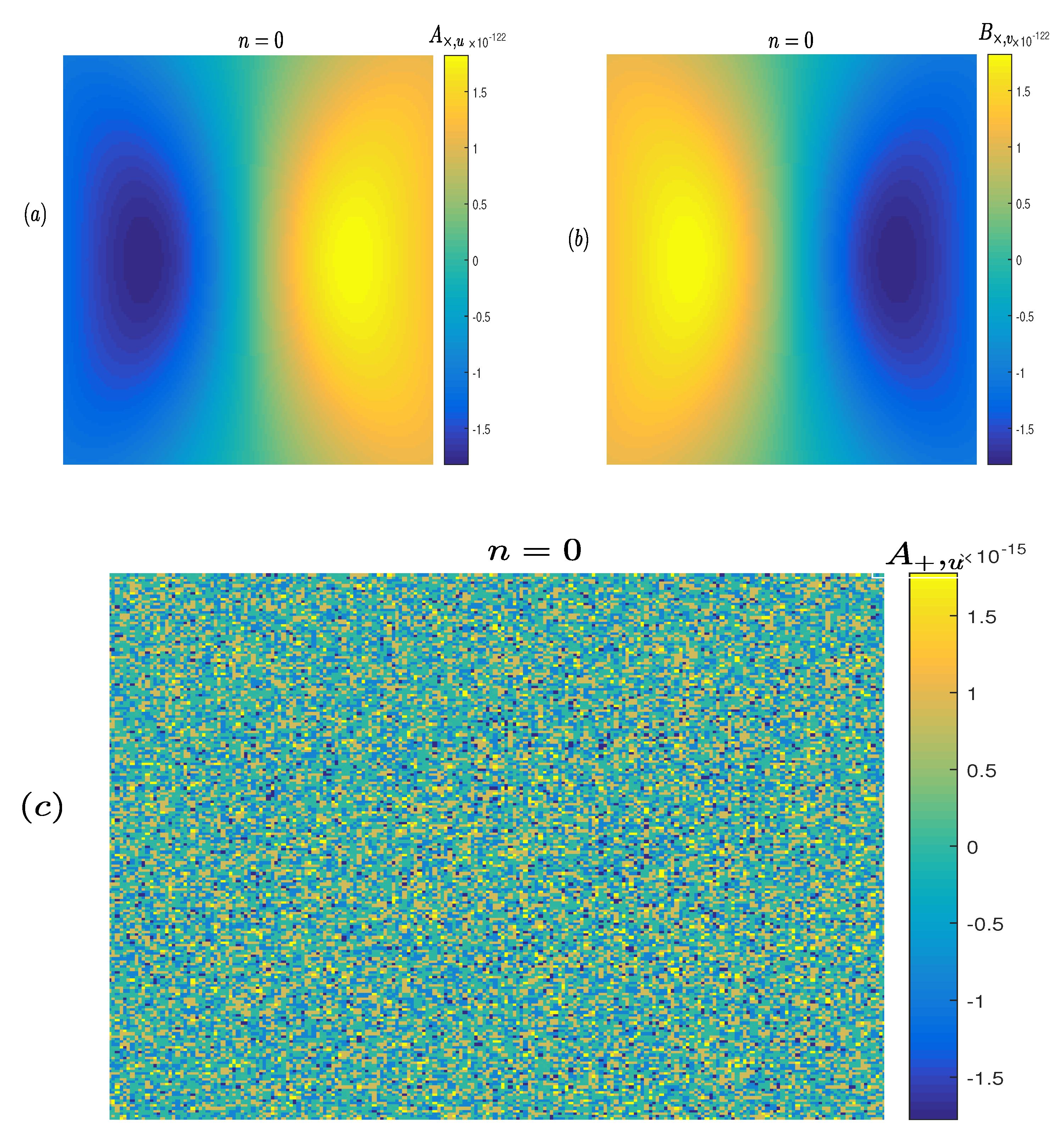
Figure 2.
: denotes the amplitude of the particles emitted by the black hole during its evaporation into spacetime, according to the following conditions: = . It has localized features moving in spacetime .
Figure 2.
: denotes the amplitude of the particles emitted by the black hole during its evaporation into spacetime, according to the following conditions: = . It has localized features moving in spacetime .
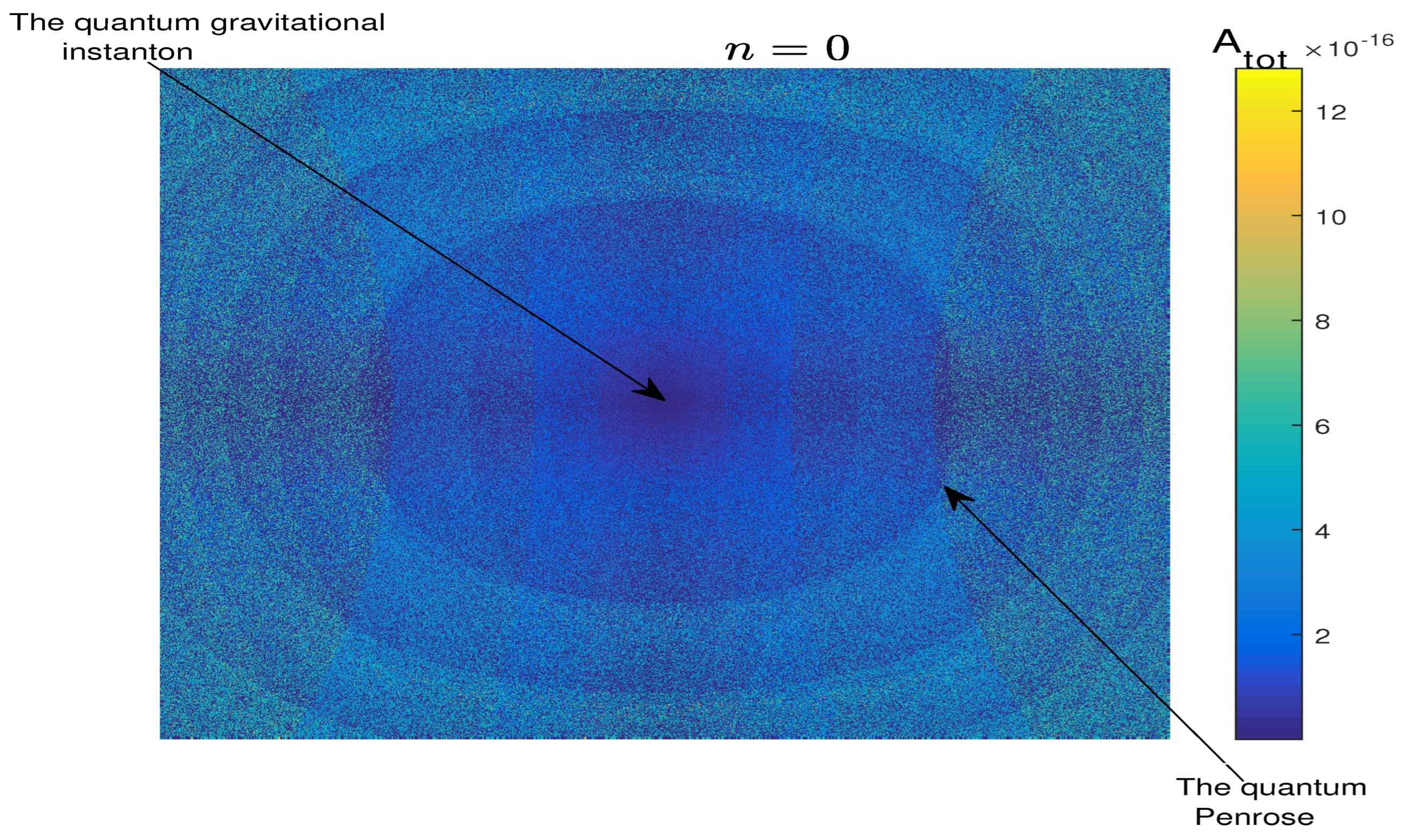
Figure 3.
: Profile representing amplitude signal wave with the introduction of a Gaussian noise of the order of . We use the following parameters: for with . : Profile representing amplitude signal wave with the introduction of a Gaussian noise of the order of . We use the following parameters: for with
Figure 3.
: Profile representing amplitude signal wave with the introduction of a Gaussian noise of the order of . We use the following parameters: for with . : Profile representing amplitude signal wave with the introduction of a Gaussian noise of the order of . We use the following parameters: for with
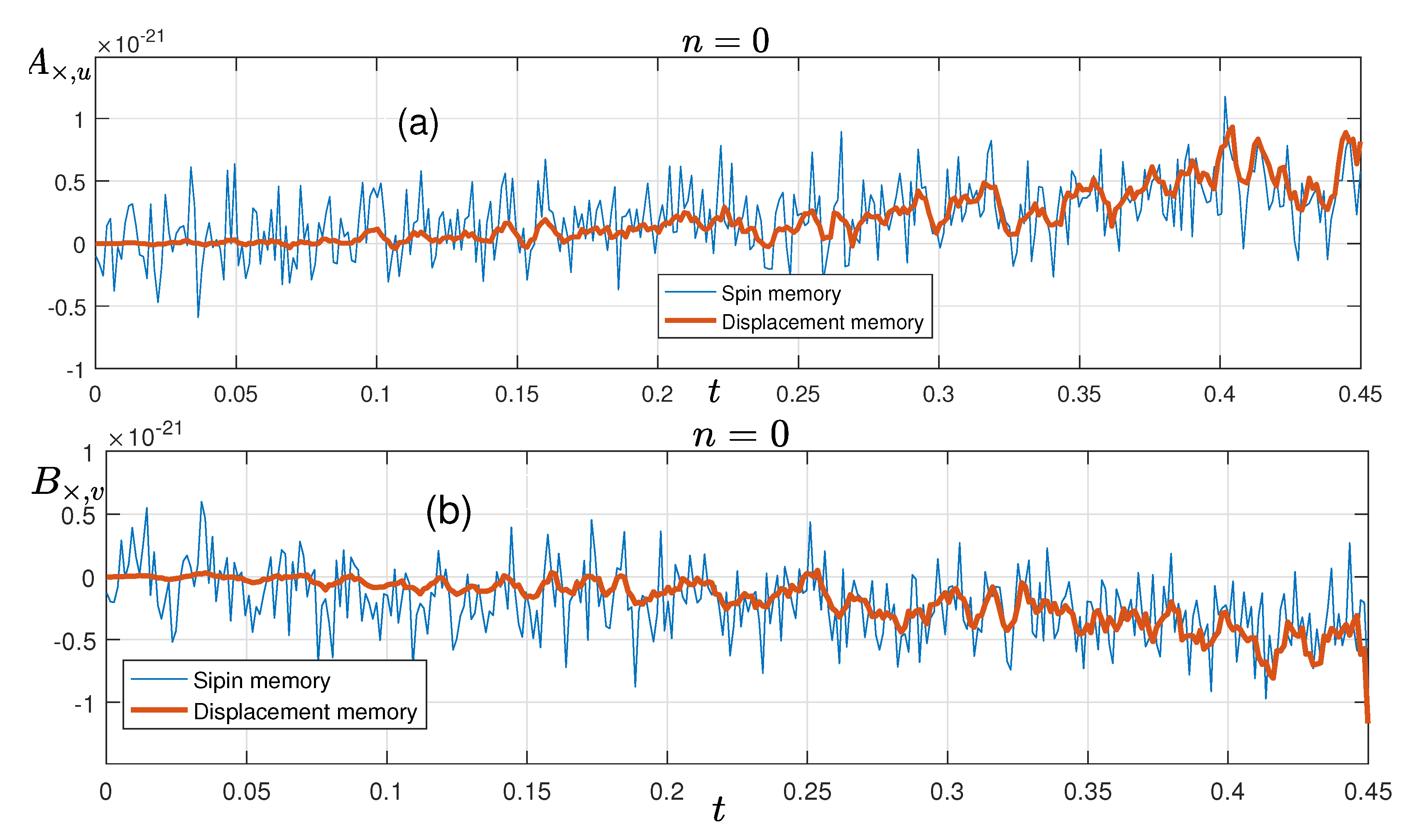
Figure 4.
: Profile representing amplitude signal wave with the introduction of a Gaussian noise of the order of . We use the following parameters: for with .
Figure 4.
: Profile representing amplitude signal wave with the introduction of a Gaussian noise of the order of . We use the following parameters: for with .
Disclaimer/Publisher’s Note: The statements, opinions and data contained in all publications are solely those of the individual author(s) and contributor(s) and not of MDPI and/or the editor(s). MDPI and/or the editor(s) disclaim responsibility for any injury to people or property resulting from any ideas, methods, instructions or products referred to in the content. |
© 2025 by the authors. Licensee MDPI, Basel, Switzerland. This article is an open access article distributed under the terms and conditions of the Creative Commons Attribution (CC BY) license (http://creativecommons.org/licenses/by/4.0/).
Copyright: This open access article is published under a Creative Commons CC BY 4.0 license, which permit the free download, distribution, and reuse, provided that the author and preprint are cited in any reuse.


