
Submitted:
14 November 2025
Posted:
17 November 2025
You are already at the latest version
Abstract
Oil tanker shipwrecks represent both cultural heritage and environmental risk. These wrecks are historically significant as war graves and simultaneously pose long term threats to marine ecosystems through the potential release of petroleum cargo. During World War II, German U boats targeted tankers along the U.S. East Coast, especially during Operation Drumbeat in 1942. Hundreds of tankers were sunk globally, and many of these wrecks remain intact and retain much of their fuel cargo, classifying them as potentially polluting wrecks (PPWs) which could release millions of gallons of oil if hull structures collapse. Tankers developed from modified sailing ships to standardized steel designs, highlighting petroleum’s strategic importance in modern warfare. The wrecks of these vessels exemplify the intersection of maritime archaeology and environmental conservation, demanding urgent interdisciplinary study to safeguard ecosystems while preserving ocean heritage.
Keywords:
shipwrecks
; World War II
; oil tankers
; potentially polluting wrecks
; marine pollution
1. Introduction
Wars are won or lost due to logistics. Merchant vessels comprised the backbone of the war effort during the two world wars, yet their sinkings are overshadowed by grander tales of naval conflict. But merchant vessel ships were the vessel types impacted the most in World War II, particularly in the western Atlantic from a U-boat campaign which preferentially targeted tankers and other shipping (Marx and Delgado 2013a). The wrecks of these liquid cargo carriers tell the stories of single-vessel incidents targeted by an unseen enemy lurking just below the surface; their importance, however, is twofold and lies at the nexus between both historical and environmental conservation. Oil tanker wrecks, to a greater extent than other shipwrecks, are significant to our ocean heritage, as they are “both historic sites of cultural significance and pose a threat to the marine environment, a juxtaposition that complicates protecting both cultural resource and marine ecosystems” (Brennan 2024: 8).
Visual documentation and characterization of shipwreck sites is often conducted for archaeological purposes, and in some cases, is also done for environmental purposes. For oil tanker shipwrecks, these investigations parallel one another as researchers document the same aspects of the wreck but with different objectives. This can include seeking information on the damage from the wrecking event, site formation processes, present day condition of the site, and dimensions and artifacts that can help confirm the identity of the vessel. The identity of the wreck matters for environmental concerns, in addition to its historical significance, as the type and amount of cargo carried is critical information for understanding the pollution risks and potential remediation requirements. Through such work, it is possible to address and remediate pollution threats while documenting historic wrecks and limiting impacts to the sites, many of which are war graves. In this way, potentially polluting wrecks (PPWs), as well as actively polluting wrecks, which are often oil tanker shipwrecks, exemplify the cross between cultural heritage and environmental concerns that comprise our shared ocean heritage (Jarvis, this vol; Brennan 2024).
The interaction between shipwrecks and the environment has been a common topic of study in maritime archaeology. Keith Muckelroy wrote that there is a “degree of correlation between the quality of the archaeological remains and a number of possibly relevant environmental attributes” regarding site formation (Muckelroy 1978: 160). Such lines of inquiry, however, are typically unidirectional, describing how the environment has affected the ship in its process of becoming the modern-day shipwreck. Less so has archaeology addressed how the wreck has impacted the environment, aside from being used as hard substrate as a feature of the ecosystem. Toxic wrecks, in general, are rare. A few examples include SS Richard Montgomery, sunk in shallow water off the Thames and full of unexploded munitions, and U-864, sunk off Norway in 1945 with a cargo of metallic mercury, which has been found to be leaking into the surrounding water (Alexander 2019, Olsvik et al. 2011). However, the vast majority of vessels that sink into the marine environment do not damage the environment, and in fact provide nutrients as organic elements of the vessel’s decay, and hard substrate serving as artificial reefs. Muckelroy also wrote about a ship as a “machine” in that it was designed for movement, of people or goods, and as an “element in a military or economic system” (1978: 219). Tankers function in both systems, as they are always economic and, in many cases, have also had military contexts. Tankers reflect this purpose in their design, but in the case of petroleum products, their cargo not only defines them but also poses an environmental threat that requires remediation in the modern day.
Pollution from the transport of oil is not a new, 21st century problem; the Second World War, especially, already had a great impact on the marine environment. A study was done in 1977 by researchers at Massachusetts Institute of Technology that reviewed U-boat campaigns during World War II to establish the possible resultant pollution events. This study reviewed sinking records off the eastern US and estimated that 484,200 metric tons (3.6 million barrels) of petroleum product were sunk by U-boats targeting oil tankers (Campbell et al. 1977); some of this petroleum spilled into the ocean and some sank with the vessels. The study analyzed oil tanker vessel sinkings along the U.S. East Coast from 1942 and found that “the area around the thirty-fifth degree of north latitude was the site of the largest weight of spilled oil” (Campbell et al. 1977: 16), which corresponds to offshore Cape Hatteras, NC, and was chosen for the focus of the study. This was an area where numerous oil tankers were sunk by U-boats during the initial Operation Drumbeat attacks, targeting the crossroads of maritime shipping along the Eastern Seaboard that became known as the Graveyard of the Atlantic or Torpedo Junction (Gannon 1990, Andriessen 2019). Tankers sunk here include many on a list of PPWs in US waters compiled by the National Oceanic and Atmospheric Administration (NOAA) in 2013, such as Empire Gem, William Rockefeller, Lancing, Paestum, E.M. Clark and Dixie Arrow (Figure 1). While offshore Hatteras was identified as the major area of potential environmental impact, Jacksonville, FL, Norfolk, VA, and Asbury Park, NJ were additional areas of the East Coast that experienced significant numbers of tankers sunk in 1942.
The 2013 PPW study posed the question of whether a rapid succession of small oil spills would cause more environmental damage than several large spills over a few months, an important, but still unanswered question for present-day potentially polluting wrecks. In addition, the type of petroleum cargo and bunkers, ranging from crude oil to refined and processed products like gasoline, kerosene and lubricating oils, makes a large difference in terms of what the environmental consequences could be. The study found that “the potential for a major environmental calamity existed in the Cape Hatteras area during the first six months of 1942” (Campbell et al. 1977: 19). Weather modeling indicated that some oil would have washed ashore and more would have drifted out to sea. Witness interviews indicated that locals recalled small scale oil slicks washing up on beaches north of Cape Hatteras, but much larger amounts washed up to the south. “The general impression was that a sizeable quantity of oil came ashore, particularly on the island of Ocracoke” (Campbell et al. 1977: 29). Nevertheless, while the overall impact on the shoreline was considered minor, damage to the deep-water environment is entirely unknown and has only recently become a topic of study due to the Deepwater Horizon spill. Only in 2023 was a massive deep-water coral reef discovered off South Carolina on the Blake Plateau (Sowers et al. 2024) and there are likely numerous other such habitats yet to be discovered, where settling petroleum product in the past could have caused unwitnessed severe damage; it is also a major reason to address potential pollution from World War II wrecks sooner than later.
The question of pollution during the early 1940s from ships sunk during World War II was again addressed in 2019. Andriessen discussed the potential environmental damage from the 1940s in comparison to better-documented oil spills from the late twentieth century. Large oil spills, of which only two can be connected to tankers, included the grounding of Torrey Canyon off England in 1967, the blowout of the offshore well Ixtoc off Mexico in 1979, the grounding of Exxon Valdez in 1989, impacts of the First Gulf War in 1991 in the Persian Gulf, and most recently the offshore well Deepwater Horizon in the Gulf of Mexico (Andriessen 2019). Responses to some of these earlier spills, like Torrey Canyon, included using detergents and chalk to disperse and sink the oil, leading to further impacts besides the oil itself. The impacts of oil are multiple, including physical, such as coating marine mammals and birds so they are unable to regulate their body temperatures or fly, and chemical, as oil compound toxicity vastly diminishes shellfish and invertebrate populations. Following the Exxon Valdez spill, for example, the toxic impacts lasted for more than a decade. The toxicity itself comes from polycyclic aromatic hydrocarbons (PAH), which disrupt “development, immunity, reproduction, growth and survival of aquatic organisms” (Onwurah et al. 2007: 310). The spills can negatively affect all levels of biological communities and lead to higher risks of mortality, cancer, smothering, changes in abundance and recruitment, and disruptions in predator/prey interactions. The greatest factor is the “altered trophic relationships through the disproportionate loss of smaller organisms” (Sparling 2016: 215).
When it comes to tankers sunk by enemy action in wartime, most of these sinkings occurred further offshore, so slicks and localized impacts likely went unnoticed, masking the true impact (Andriessen 2019). The worst-case scenario is a tanker wreck losing its structural integrity due to corrosion and catastrophically releasing its cargo into the environment all at once. As will be discussed later, this has been reported with the World War I wreck SS Derbent, so the potential for World War II wrecks to do so in the near future is reason for concern. As these wrecks approach 80 years underwater, there could be multiple such events yearly.
What is the scale of the pollution threat from PPWs? An oil tanker cargo is an isolated amount, not like a blown well such as Deepwater Horizon. Let’s take, for example, a T2-SE-A1 tanker from World War II like SS Bloody Marsh. At full cargo capacity, these standard-built tankers could carry 141,200 barrels of oil, which is equal to nearly 6 million gallons (Figure 2). Exxon Valdez, one of the worst oil spills in U.S. history, released 10.8 million gallons of oil into Prince William Sound, which spread to cover 1,300 miles of Alaskan coastline from a surface slick spanning more than 11,000 square miles (Wolfe et al. 1994, Paine et al. 1996). If a T2 tanker were sunk with minimal release of its oil cargo during the sinking event, a worst-case catastrophic collapse discharge could inject more than half of the Exxon Valdez spill into the marine environment at once from a single shipwreck. As there are hundreds of oil tanker wrecks from World War II, many of which have not been located, never examined or assessed for the hull’s condition, and many of these are likely to have more than half their oil remaining on board, the urgency of this problem becomes clearer.
2. Development of Oil Tankers
The advent of the age of petroleum in the late nineteenth century led to the development of specialized methods and vessels to transport petroleum products. The earliest “tankers” were sailing vessels modified to carry oil in cases and casks. The first recoded transport of oil by ship was Elizabeth Watts, a 224-ton wooden brig hired by the Philadelphia firm of Peter Wright & Sons to haul barrels of oil to London (Frear 1945: 135). Early in the twentieth century, some of the sailing ships were modified to transport oil, with the last surviving example afloat being the four-masted steel ship Falls of Clyde. Built in 1878, the ship was modified in 1907 to serve as a sailing oil tanker for the Associated Oil Company of California, with ten riveted steel bulk liquid tanks built into the hold, five to a side, and separated into two levels with larger tanks at the lower level and smaller “summer” tanks atop them. These were ventilated by expansion trunks that ran to the deck, and a small steam boiler was added behind an oil-proof bulkhead to power a 10-inch horizontal reciprocating oil cargo pump that connected to the tanks through a steel-pipe network. In addition to oil and crude, Falls of Clyde also carried molasses in the tanks, and heated the tanks with separate pipelines when transporting molasses or crude oil (Delgado 1988: 3-4). It operated under sail until 1922, when it was sold and turned into a floating oil barge.
The first steamship built specifically to transport petroleum products was Zoroaster, which was launched in 1878 (Frear 1945: 135). The first modern bulk oil tanker was the German-built Glückhauf, launched in 1886, which wrecked off Long Island in 1893. Its remains lie in several meters of water off Fire Island National Seashore, shrouded by sand, but it has never been archaeologically studied. The first American-built bulk oil steamer, SS Standard, was a product of the John Roach & Sons of Philadelphia and was launched in 1888. A general vessel type emerged, so that by 1943 it could be asserted that tankers had not undergone any “fundamental change except in equipment and details in construction,” while at the same time “the financial advantages of carrying oil in bulk had finally become fully recognized” (Frear 1945: 137). From a small fleet of steam tankers numbering twelve in 1886, the number climbed ten-fold within five years.
The first large output of steam-powered steel tankers to a single design were built in World War I as part of the Emergency Fleet Corporation’s (EFC) program. The EFC, formed by the USSB ten days after the U.S. entered World War I on April 16, 1917, was a corporate entity focused on building a merchant fleet. All ships being built in American yards at the time were requisitioned, and the EFC proceeded to issue contracts for a series of uniformly designed steamers following the steel steam schooner model (Hurley 1927: 22-25). In all, some 1,400 contracts were issued to build ships for the EFC. Of these, thirteen Design 1041, steel-hulled tankers, six Design 1045 tankers, and twenty-eight 1047 Design tankers were built and entered service, with some lasting through the 1950s and out of the wartime and postwar fleet of EFC designs that totaled 316 tankers (McKellar 1963: 231a-231b, 233, 234).
After the war, a review of American ship types identified fifty-seven models, nearly all of them working vessels. Among these craft were intercoastal freighters that included tankers, then an emerging type of ship that in carrying “crude oil and refined oil comes in a class by itself” (Hardy 1927: 54, 58-61). These ships included veterans of World War I as well as other tankers that were part of the petroleum industry’s growing fleets as it responded to the shift from coal to oil for industrial purposes and as global markets emerged. By World War II, larger, faster ships were being built, with greater cargo capacity and a trend toward “larger and speedier tankers,” with “welding and lighter compact machinery”. These modern tankers showed an annual carrying capacity of about two and one-quarter times that of tankers built during the period immediately succeeding World War I” (Frear 1945: 140). The advent of welded hull joinery in place of rivets changed tanker construction substantially. “In this type of ship the advantages of welding in attaining and maintaining the degree of watertightness necessary for efficient isolation of various grades of cargo are so outstanding that the process is almost a sine qua non for the building of tankers” (Hughes 1956: 268).
The World War II emergency shipbuilding program, and in particular the T-2, T-2-A, T2-SE-A1, T2-SE-A2, T2-SE-A3, T-3-S-A1 and T2-A-MC-K steel-hulled large capacity tankers, formed the global fleet of tankers after the war and well into the 1970s. These vessels gave way to the rise of the “super-tanker,” especially as 533 T-2s alone were built during the war (Lane 2001). Postwar, larger capacity tankers began to emerge, as well as after the Suez Canal Crisis of 1967 when ship owners ordered larger tankers in a post-Suez era to avoid the risks of being held hostage to another closure. The role of market forces, a shift to fewer vessels with larger cargoes, and improvements in efficiency drove most changes until 1986. The Exxon Valdez disaster, which followed other well-publicized tanker wrecks and large oil spills, resulted in the mandate that all tankers be constructed with double bottoms (Solly 2021).
3. Tankers in World War I: Convoys and the U-Boat Threat
The importance of petroleum in war became paramount during World War I as “oil drove the changes to naval power that contributed to the arms race that culminated in the outbreak of World War I” (Andriessen 2019: 814). Therefore, so too did the sinking of tankers carrying oil. By 1900, most machinery and motor vehicles were increasingly fueled by petroleum. Railroads needed oil as a lubricant, and asphalt, which is a residue of oil, became vital in road building. Even explosives such as TNT, grenades and torpedoes required chemicals produced from oil. And yet, only Russia and the United States had high enough domestic oil production to maintain a surplus and provide for other warring states (Gliech 2015). German railways for troop transport remained powered by coal, but as the war moved on, motor vehicles became essential on the front line, particularly as the western front began to freeze in late 1914. By 1918, “the mobility of Allied troops almost entirely depended on motor vehicles and therefore on North American Oil” (Gliech 2015).
Moving oil to the European front was another challenge. The introduction of the U-boat to the naval battlefront nearly ended the war by cutting off supplies from the United States. From 1914 to 1916, the German submarines waged restricted warfare, where they would surface and allow for the crew to escape the ship before sinking it. As the war waged on, unrestricted warfare was initiated by Germany in early 1917 and allowed U-boats to attack merchant vessels without warning. This, in addition to an increase in the number of operating U-boats, led to an increase in ships sunk (Grove 1957). The Allies, in response, turned to the system of convoys to protect merchant shipping of oil and supplies to Britain and the front. During this time, the only method for detecting a submarine was a hydrophone, leaving U-boats able to easily maneuver around vessels unnoticed. Convoys provided a system of defense for multiple merchant vessels and “the increase in the number of ships convoyed resulted in an increase in the number of U-boats destroyed” as the convoys included ships with means for “immediate counterattack” against the submarines (Grove 1957: 5). Within a single year later in the war, 24 U-boats were sunk by convoys. Some merchant vessels, however, continued to sail along coast routes independently without escorts or convoys, resulting in “avoidable losses or merchant ships” in coastal areas (Grove 1957: 5), especially in and around Britain where U-boats patrolled heavily.
Nevertheless, the rise of petroleum shifted the parameters of warfare over the course of World War I. Most ships, particularly warships, were fueled by coal at the start of the war. A major impedance in coal-fired ships is fueling; oil is pumped into holding tanks relatively quickly and easily, whereas coal had to be shoveled on board by stokers. Oil also increased vessels’ range, doubling how far they could travel before refueling, enabled vessels to sustain higher speeds for longer, and allowed for refueling at sea (Goldrick 2014). The engine room crew on a ship fueled by oil was also drastically reduced as it wouldn’t require the constant shoveling of stokers. The global transition from coal to oil in naval strategy began in 1898. Britain and the United States started converting ships in 1911 and Germany in 1915, but the rate of this transition was largely based on oil supply and so many ships during the war remained coal-powered (Edigar and Bowlus 2019). Aside from supplies in Russia and the Middle East, which Britain worked on securing, the United States had the largest and most secure supply of oil for the Allies. “Britain’s blockade led to food shortages in Germany, which responded by intensifying submarine warfare against Allied shipping lines [sic] in the Atlantic, including against US oil tankers destined for Britain and France. Thereafter oil-powered cruisers escorted tankers across the Atlantic” (Edigar and Bowlus 2019: 448).
4. Tankers in World War II: The Battle of the Atlantic
The Battle of the Atlantic was the ocean-wide conflict of World War II that consisted of Germany’s all out raid on Allied shipping to cut Great Britain off from deliveries of fuel and supplies from the United States and other allies. The long-running campaign included an Allied blockade of Germany and their counter-blockade. The Kriegsmarine conducted raids on shipping with a variety of weaponry, including new surface warships such as the battleships Bismarck and Tirpitz; however, much of the conflict was primarily fought by U-boats targeting merchant ships. Between 1939 and the end of the war in 1945, 3,500 merchant ships and 175 Allied warships were sunk compared to the 47 German surface warships and 783 U-boats lost in the same period. Britain had maintained its supremacy in naval warfare during World War I despite Germany’s introduction of the submarine, which nearly ended Britain’s centuries-long naval reign (Morison 1947: 3). While submarines had initially targeted the British Grand Fleet, they were deployed against merchant shipping later in the war, and this tactic, along with Allied anti-submarine warfare, was reinstituted on a broader scale in World War II.
Despite the lessons learned in the first war, Hitler had not planned on a naval battle and had not built up a fleet of U-boats prior to 1939. Initially hoping to avoid war on the water with Britain until the European mainland was subdued, the German naval fleet initially adhered to the limitations implemented upon it by the 1919 Treaty of Versailles. Therefore, when Britain entered the war in 1940, Germany stepped up “production of submarines from 4 per month to between 20 and 25. Plans were approved by which 300 submarines would be in operation by 1942 and more than 900 by the end of 1943” (Morison 1947: 6). Although these numbers were never met, it explains why the U-boat war began slowly and reached its peak in 1942 and 1943. U-boats were deployed initially against merchant fleets in and around the British Isles and France through early 1940 and expanded to the eastern Atlantic from Iceland to Africa into 1941 with great successes. British destroyer escort numbers were low due to losses and damage during early engagements, thereby making “the summer of 1940… the U-boats’ greatest harvest season of the war. Although the total destruction that they wrought was far less than in 1942, the average tonnage sunk per submarine was almost ten times as great” (Morison 1947: 23).
Still, the war on the water began slowly, with only a handful of ships sunk by U-boats in 1939. The Admirals of the Kriegsmarine, Erich Raeder and Karl Dönitz, became frustrated with the amount of contraband being moved through the North Sea in neutral ships and so they pushed to relax the rules of engagement for U-boats (Blair 1996). Successes in late 1939 included U-47 and U-48’s sinking of a number of freighters, and the tankers Gustaf E. Reuter (27 November off Scottland), Britta (6 December off southwest Britain) and San Alberto (9 December off southwest Britain). As the war moved into 1940, British coastal convoys in the North Sea took a hit from the loss of 15 in the Norway and Dunkirk campaigns with another 27 damaged; this paved the way for the June 1940 “Happy Time” for U-boat commanders (Blair 1996: 166). Some of the vessels included seven ships by U-47, including the tankers San Fernando and Leticia south of Ireland, six by U-38 including the Norwegian tanker Italia south of Ireland, five by U-32 including the tanker Eli Knudsen south of Ireland, and three by U-51 including the tanker Saranac west of Britain. Over the next year, U-boats began expanding their range farther out into the Atlantic, including a patrol line southwest of Iceland. Numerous ships on the Atlantic crossing were sunk in April 1941, including the tankers Castor and British Reliance by U-46, and British Viscount by U-73. The British were “stunned to learn of U-boats attacking so far west” (Blair 1996: 264).
The war on the water expanded to the entire North Atlantic as the United States accelerated supplying Britain with fuel and goods. Fuel was especially critical to the Allied war effort, and therefore oil tankers were especially targeted by U-boats. During the American oil boom, the major producers were oil fields in Texas and Louisiana which shipped fuel to refineries on the east coast. Shipping via sea proved to be more economical than by railroad and so 95 percent of fuel oil came by ship (Blair 1996: 467). Therefore, the targeting of tankers carrying crude oil northbound along the east coast was a major disruptor in the fuel supply provided to the Allied front. The Roosevelt administration knew that the supply of oil, and its movement, would be critical, and thus named Harold I. Ickes the head of the Petroleum Administration for War, tasking him to expand interior petroleum infrastructure. However, by the time America entered the war in late 1941, about 260 tankers were engaged in moving crude oil from the Gulf to the Eastern Seaboard along sea lanes simultaneously used by British tankers moving product from the Caribbean (Blair 1996: 468). Nevertheless, before the end of the war, 61 tankers were sunk in American waters (Marx and Delgado 2013a: 39), and globally, more than 860 tankers were sunk during World War II (Monfils 2005).
January 1942 saw the initiation of Operation Drumbeat (Operation Paukenschlag) by German U-Boats against American shipping and the movement of merchant ships coastwise in American waters. This followed Hitler’s declaration of war against the United States on December 11 after the Japanese attack on Pearl Harbor, and an order to attack the U.S. on December 12. Type IX U-boats were used because the smaller types did not have the range to reach North America and operate. Kapitänleutnant Reinhard Hardegen of U-123 arrived off New England in mid-January and sank the freighter Cyclops on January 12 off Nova Scotia, followed by two tankers off Long Island: Norness on the 14th and Coimbra the following night. The first wave of five submarines conducted attacks over nine days, sinking 27 ships, before returning to port in Germany in early February (Blair 1996, Gannon 1990).
The devastation to merchant shipping in the first few months of 1942 was staggering. The Tanker Committee of the Petroleum industry War Council worried that the supply of oil would “sink to levels ‘intolerable’ both for the domestic economy and for any projected continuation of the war effort” if U-boat attacks remained unchecked, and if merchant seamen were reluctant to take positions, especially in engine rooms on tankers (Gannon 1990: 343). The committee put forth a series of recommendations, including installing swinging guns on all tankers and suppressing shore lights showing seaward that helped silhouette ships for U-boats to spot. One of the first tankers armed with a four-inch 50 SP Mark IX Mod. Gun was the new tanker SS Gulfamerica. Soon after, it was sunk on its maiden voyage from Port Arthur by U-123 in early April off Jacksonville, Florida, the lights of which allowed the U-boat to spot the vessel.
What led to the end of the U-boat domination was the re-implementation of convoys from World War I.
The convoy system that developed as a result of the U-boat threat changed the way goods were moved in order to minimize the chances of being sunk. Ocean going merchant ships, typically freighters and tankers, supplied and fueled the Allied war effort and were vital to the success of strategic campaigns that led to the war’s end. The Allied merchant vessel shipwrecks are significant due to their role as a link between war time goods being produced back home and troops fighting on the front line (Marx and Delgado 2013a: 49).
Early transatlantic convoys in “1939-1941 consisted of 45 to 60 merchant ships in nine to twelve columns” (Morison 1947: 19). Battleships and heavy cruisers were abandoned as protection for convoys early on, as they were of little use against submarines, and the German capital ships rarely appeared to attack convoys. Instead, destroyer escorts, armed with sound gear and depth charges, become the primary defense for the merchant ship columns. Zigzagging was “advised for fast convoys, or for small ones with a narrow front; but large or slow convoys must follow a straight course, because zigzagging diminished the distance made good, caused confusion and straggling, and had proven ineffective in avoiding submarines” (Morison 1947: 100). Merchant ships traveling unescorted did benefit from steaming in a zigzag pattern, while those that did not were easily picked off by U-boats.
The end of the first six months of 1942 left almost 400 vessels on the bottom of the ocean along the East Coast, Caribbean and Gulf of Mexico. It had nearly spelled disaster for the Allies, particularly because much of the cargo lost consisted of petroleum products that could not easily or quickly be replenished (Gannon 1990). While Admiral Doenitz boasted that the submarines were operating close to American shores, by mid-summer 1942, “The sinkings had ceased. Convoys had been instituted” (Grove 1957: 41). Convoys not only protected merchant ships by discouraging U-boat attacks, but they also allowed for fast and efficient hunting of submarines. The convoys were equipped with enough ships to take the offensive against submarines that exposed themselves during an attack. While the U-boat was designed to be elusive, it was ineffective when it came to periscope depth and fire, drawing depth-charge laden destroyers upon it quickly. Following this turn of the tide, while individual ships continued to be lost to submarines, the numbers were far fewer, and supplies began reaching the Allied front again.
The ships sunk as part of the Battle of the Atlantic and Operation Drumbeat are listed in the National Register of Historic Places in the multiple property nomination, “World War II Shipwrecks Along the East Coast and Gulf of Mexico,” completed in 2013. “The vessels engaged in the Battle of the Atlantic, including those sunk as victims of the U-boats represented a variety of ages and types as well as nationalities, but many of them fit into the increasingly specialized types of craft and vessels that resulted from scientific principles of naval architecture and industrialized shipbuilding practices which had emerged in the late 19th century and which took root in the early 20th century” (Marx and Delgado 2013: 16).
5. Potentially Polluting Wrecks
The U.S. Coast Guard, which would coordinate and often contract for the remediation of polluting wrecks, is required under Section 106 of the National Historic Preservation Act (NHPA) to consider adverse effects to these historic properties (Symons et al. 2014: 2024). In an emergency response situation, there is often insufficient time to adequately comply with the NHPA to determine if a wreck warranted mitigation because it was listed in, or was eligible, for the National Register of Historic Places. What was needed was a proactive approach that streamlined the process.
The 2013 study by NOAA on potentially polluting wrecks consisted of a systematic approach to identify and assess the threat of oil pollution stemming from shipwrecks in US waters. This began with a comprehensive database of shipwrecks in US waters using historical records and maritime archives, called the Remediation of Underwater Legacy Environmental Threats (RULET) database. The wrecks included in the database were then evaluated based on their potential to leak oil or other hazardous materials. Factors taken into consideration included the type of cargo, amount of bunker fuel on board, structural integrity of the wreck, and proximity to environmentally sensitive areas. The list was narrowed down to 87 highest priority wrecks based on their risk of causing pollution events (NOAA 2013a). Table 1 lists the World War II oil tanker wrecks on the PPW list including their status. Note that many have never been located.
With these 87 historic wrecks identified as the highest pollution risk, NOAA proposed a best practices approach through a multiple property submission that encompassed the entirety of the geographic and temporal span of the Battle of the Atlantic (Symons et al. 2014: 2026-2028). This was proposed to “proactively test and refine the potential NRHP eligibility well in advance of any oil spill incident” (Symons et al. 2014: 2025). Following meetings with the Keeper of the National Register, who agreed with this approach for the largest MPS nomination ever proposed and undertaken in the history of the National Register, the project proceeded.
The desktop PPW study was limited in what it could determine because many of the wrecks deemed potential polluters had yet to be found, and as Table 1 shows, remain unfound to this day. However, the study put forth a large amount of good historical and environmental information that assisted in informing later remediations, such as Coimbra in 2019 and Munger T. Ball in 2021 (Brennan et al. 2023). The limitations of the research required that some assumptions be made about wrecks, some of which hold true, and some that have been challenged by recent work on other sites.
A Coast Guard investigation report from 1967, following the grounding of the tanker Torrey Canyon, indicated that ships that settle upright on the seabed will lose oil cargo and fuel oil through vents and piping over time. The report suggested that oil would escape through the vessels’ ventilation systems gradually and over an extended period, so much of that which escaped would be assimilated and biodegraded in the environment. The study concluded that “there is indication that a cargo will probably be lost from tanks thru [sic] ventilation or other fittings before plating and other structure corrodes away” (USCG 1967: 11), and that “this project indicates that tankers sunk during World War II do not present a potential pollution threat to the American coastline” (USCG 1967: 10). Using this information, the PPW study further indicated that “ongoing research strongly suggests that deepwater shipwrecks tend to settle upright on the bottom” (NOAA 2013b: 6).
This assumption was put to the test with the wreck of SS Montebello off Monterey Bay, California. The tanker was carrying a cargo of 75,346 barrels of crude oil plus 8,400 barrels of bunkers when it was struck near the bow by a torpedo from Japanese submarine I-21. The wreck was explored in 1996 at a depth of 268 m and was found to be sitting upright on the seabed with the bow section about 100 feet from the wreck. Initial assessments of the wreck suggested that, because the cargo was an asphalt-based crude that was nearly solid at cold temperatures on the seafloor, the fuel would have congealed and not moved, and that removal of the fuel would require heating (Hunter 2002). However, a later neutron backscatter assessment of the hull found little oil remaining on the wreck, indicating that, despite no breached tanks from the torpedo attack and the highly viscous nature of the fuel, the oil must have slowly escaped through vents and piping (NOAA 2013a).
Another assumption in the study was that shipwrecks broken into multiple pieces would have a lower risk of polluting due to the release of oil from the breached tanks and other damage sustained during the sinking event. “Structural Breakup…this risk factor takes into account how many pieces the vessel broke into during the sinking event or since sinking… even vessels broken in three large sections can still have significant pollutants on board if the sections still have some structural integrity” (NOAA 2013a: 31). The risk factors were categorized as Medium if the vessel was in two to three pieces and low if in more than three. While oil is inevitably lost during torpedo-attack sinking events, as Campbell and Andriessen have previously written, it is not a strong reason to write off a wreck as low pollution risk. A set of case studies presented below will challenge these assumptions.
The subject of potentially polluting wrecks has received recent and renewed interest through an international effort, Project Tangaroa, funded and organized by the Lloyd’s Register Foundation and The Ocean Foundation. This project has held three workshops with archaeologists, maritime historians, government representatives, and salvage industry experts to develop a framework for the standards and strategic approaches used to take proactive action against possible pollution threats, emphasizing proactive rather than reactive responses. This effort also produced an academic volume published by Springer, Threats to Our Ocean Heritage: Potentially Polluting Wrecks, that outlines a series of case studies and methodologies for addressing PPWs (Brennan 2024). The book concludes with remarks that highlight that the “resources, technical and financial, will only become available at the level required once there is a clear and widely accepted roadmap to better governance and optimised interventions”, a directive that the project is moving toward (Sousa et al. 2024).
6. The Archaeology of Oil Tanker Shipwrecks
The question of archaeology and archaeological significance of oil tanker shipwrecks has been partly addressed in practice but not in theory (Marx and Delgado 2013a). The archaeology of oil tanker shipwrecks “is unusual in the discipline of maritime archaeology because the construction of the vessels and the manner in which they sank is generally known” (Brennan et al. 2023: 323). I have previously written on the archaeology of discard as it relates to the sinking of old warships following World War II, particularly in terms of Operation Crossroads and the irradiated ships from the nuclear tests at Bikini Atoll (Brennan et al. 2018). This attitude toward sinking old material into the deep sea has changed in recent times, and it is reflected in the out of sight, out of mind mentality that removed liquid cargoes from Allied access by the Kriegsmarine. Due to this outlook of generations past, we are now stuck today with the environmental consequences resulting from this laissez-faire method of warfare; shipwrecks are not lost forever once they sink beneath the waves, and the hazardous materials they carried persist in the modern marine environment. “Oil tanker wrecks fit into the maritime cultural landscape of war, and a landscape of environmental hazards we now face due to the attitude toward maritime assets at the time” (Brennan et al. 2023: 324). The status of these wrecks as war losses and war graves instill a military lens onto merchant vessel wrecks, adding further complexity and significance to these wreck sites around the world.
Archaeological projects involving tanker wrecks have focused on identification of wrecks as part of larger surveys; an early example is the 1930 wreck of the Richfield Oil Company tanker Richfield in the waters of Point Reyes National Seashore and Greater Farallones National Marine Sanctuary, which was relocated and briefly examined in a Phase I Reconnaissance Survey in 1982. The preliminary history of the vessel, built originally as SS Brilliant in 1913, noted its transitional nature as a “modern” tanker with longitudinal framing and bracing, which was introduced after other tankers without that feature had suffered structural failure (Murphy et al. 1983: 73; Morrell 1931). The site was described as “tons of broken, jagged metal wedged in the rocks of the reef” (Murphy et al. 1983: 76). The same approach has been applied by other U.S. agencies with mandates for comprehensive cultural resource surveys. The Bureau of Ocean Energy Management (BOEM) has done this in American coastal waters, notably in the Gulf of Mexico but also along the Atlantic and Pacific Coasts (Irion et al. 2008).
NOAA’s Maritime Heritage Program has assessed a number of World War II losses, including the tanker Montebello, which was torpedoed by a Japanese submarine off California’s southern coast. Most notably, the program has also studied several U-boats and their victims, including tankers, off the coast of North Carolina as part of a larger Battle of the Atlantic submerged battlefield study. (Wagner 2010). Archaeologists from USS Monitor National Marine Sanctuary and partners have also studied the wreck of the WWI tanker, SS Merak, lost to a submarine attack in 1918, and the tanker Kyzikes. Originally a 1900-built bulk freighter and converted into a tanker in 1901 for Sun Oil, Kyzikes was sold in 1927 to Greek owners, renamed, and wrecked in December 1927 on the Outer Banks of North Carolina, with its first initial study taking place in 1996 by East Carolina University. World War II tanker wrecks documented by the NOAA team off North Carolina include the tankers Ario, Askkhabad, Atlas, Australia, British Splendour, Byron D. Benson, Dixie Arrow, E.M. Clark, Empire Gem, Esso Nashville, F.W. Abrams, Naeco, Panam, Papoose, San Delfino, Tamailipas, and W.E. Hutton (Figure 3). Many of these are shallow wrecks frequented by recreational divers and site assessments have determined that they are not a pollution risk. Empire Gem and Panam, however, are among those on the PPW list and are thus considered a threat (NOAA 2013a).
Internationally, PPW examples include the wreck of SS Conch, a British-built 1892 tanker and lost in 1903. The wreck had been assessed by the Sri Lanka Maritime Archeology Unit but was noted “as one of the world’s first oil tankers,” and, “while it is believed to have no archaeologically significant artifacts now – having been stripped of all portable items… a systematic study can yet yield archaeologically significant information about the ship as a whole” (Devendra and Muthucumarana 2013: 60). The WWI tanker Darkdale, sunk in 1941 at St. Helena, was where a detailed archaeological assessment in advance of oil remediation discovered “much… about her role and the impact of this loss on the wider war effort,” as well as aspects of the vessel’s construction, trading pattern “and even the chemical composition of the fuel she was carrying,” and though this, “the gaps in the historical record became very apparent…and whilst it is assumed that these gaps exist for earlier wrecks, the extent of the missing information for a relatively recent wreck was surprising” (Liddell and Skelhorn 2018: 87).
What has begun to emerge is a growing recognition that these sites hold multiple, overlapping values. They represent not only the risk of potentially polluting the marine environment—and, in some cases, actively doing so—but also derive significance from their status as gravesites, memorials, fish-friendly artificial reefs, dive tourism destinations, historic landmarks, and archaeological resources. The cultural aspects of significance, as reflected by the criteria for listing in the National Register of Historic Places, are recognized, and through that mechanism are legally required to be considered by federal agencies. These aspects have been applied through the previously mentioned multiple property submissions. Spanning the Eastern Seaboard of the U.S. to the Gulf of Mexico and limited to waters within the United States Exclusive Economic Zone (EEZ), including State waters, 187 shipwrecks could potentially be included. 163 of them could be merchant vessels, lost between January 13, 1942, and May 6, 1945. To date, eighteen wrecks have been listed in the National Register, and as part of that listing, each vessel has required separate documentation and an argument for its context, significance, and how it meets the criteria for listing (Marx and Delgado 2013).
Therefore, the context for remediation, especially where federal funding or actions are involved, triggers the necessity for consultation with, and adherence to, the National Historic Preservation Act. The historic and archaeological aspects inherent in listing also reflect research-design-based investigations into not only individual vessels but the broader maritime cultural landscape. In most cases, these wrecks are studied through battlefield archaeology, especially given that the Battle of the Atlantic was the largest and longest-running battle of World War II. However, research-design driven archaeology is not the primary focus of mitigation, in line with historic preservation law and policy, when a mitigation is required for a potentially polluting wreck.
Locating and identifying oil tanker wrecks is essential to properly assessing and potentially mitigating any environmental hazard. Incorrect identification could lead to inappropriate remediation methods if, for example, different petroleum products were carried on board in cargo tanks at different spacing. Archival and historical research can inform archaeological documentation and characterization of a site and lead to a positive identification. Research can also lead to the correction of previously assigned identity, as was done on the Munger T. Ball shipwreck off Key West, Florida, originally believed to be that of Joseph M. Cudahy (Brennan et al. 2023). Extensive multibeam mapping and GIS database analysis has also led to the correction of tanker wreck identities in the Irish Sea, including British Viscount, Rotula, RFA Osage, and RFA Vitol (McCartney 2023: 98).
7. Case Studies
There are numerous oil tanker wrecks that have been studied archaeologically as well as evaluated for pollution risk. However, certain examples illustrate important approaches and nuances to these sites, including how oil tankers sink and how and why some contain oil products while others do not. More importantly, these case studies illustrate different approaches to the archaeology of oil tanker wrecks and challenge some previous assumptions about them.
7.1. MV Coimbra
British tanker Coimbra was the second ship sunk during Operation Drumbeat in January 1942 as U-boats began attacking merchant ships along the U.S. east coast. It was built in Kiel, Germany in 1937 and was owned and operated by the British company, Standard Transportation. In 1939, the vessel adjusted its charter to fuel transportation for the British Admiralty, moving product between the U.S. and Britain. It departed New York on 14 January for Liverpool with 81,000 barrels of lubricating oil and was struck by two torpedoes from U-123 south of Long Island. The first struck the tanker amidships, lighting the bridge on fire, and the second struck the engine room under the funnel. The ship took on a starboard list and quickly sank by the stern (Gannon 1990, Brennan et al. 2023).
The Coast Guard assessment of four tanker wrecks along the U.S. east coast in 1967, as previously discussed, included Coimbra, the only intact wreck studied. Gulftrade, R.P. Resor, and Varanger, all sunk in early 1942 off New Jersey, were broken up with large holes in the hull and no intact tanks remaining (USCG 1967). Coimbra, on the other hand, had tanks that appeared to remain intact with a hull in good condition. The report determined that “corrosion has not occurred to an extent which would allow a mass release of entrapped petroleum” but that “her cargo has somehow been released over the years, leaving only the slightest traces of residual oil” (USCG 1967: 2). It is unclear exactly how this determination was made, as intact tanks with a strong, preserved hull are not indicators that oil has been released. Recreational divers, starting in the 1970s, along with later inspections by U.S. Navy divers, continued to vastly underestimate the amount of oil that could remain within the wreck, and “less than 20,000 gallons were estimated to be on board” (Diaz et al. 2021: 2). While the wreck was reportedly observed with an oil slick issuing from its cargo tanks through the years, it was only in 2015 when the Coast Guard began receiving reports of these slicks in satellite imagery, necessitating a closer inspection and reassessment of the wreck (Diaz et al. 2021).
The Coast Guard, in partnership with salvage company Resolve Marine out of Fort Lauderdale, conducted a multi-faceted inspection and assessment of the wreck in May 2019 from the work vessel Shelia Bordelon (Diaz et al. 2021, Brennan et al. 2023). This work included naval architectural modeling of the intact ship and subsequent wreck to locate the placement of cargo tanks, and an ROV site inspection, guided by a maritime archaeologist. This was then followed by commercial divers hot-tapping locations along the hull for the removal of fuel oil. Samples of the oil were collected, and a probe was used to determine if the tankers were full or only contained small amounts of oil. Significantly more oil was found than expected, and unlisted fuel product was found in tanks usually not reserved for this kind of transportation, including heavy fuel oil stored in the forward deep and peak tanks. This cargo eventually required heating to remove from the wreck in a procedure referred to as “hot tapping”. In total, “355,000 gallons of lubricating oil, 103,400 gallons of Heavy Fuel Oil (HFO), and 18,000 gallons of oily mixture” were pumped out of 16 tanks (Diaz et al. 2021: 12).
The wreck of Coimbra lies in three sections on the seabed, which led to the previous assertions that much of the cargo was likely lost during the sinking event. The risk rating developed by NOAA for the PPW study gave medium to low pollution risk scores for wrecks broken into two or three sections. While it is theoretically more accurate that a tanker sunk entirely intact, for example foundered in a storm, would have more of its total cargo remaining within the hull than one struck by two torpedoes, other factors, such as the orientation of the hull sections, are more important in ultimately determining how much oil remains on the wreck. The operation by Resolve Marine and the Coast Guard pumped nearly half a million gallons of fuel product from the wreck, despite multiple tanks being breached and open to the sea. This is due to the hull sections being partially or entirely inverted, trapping the oil against the hull; had the wreck settled upright, that oil would have drifted out through vents and piping over time. While on site, it was also noted that there was more corrosion apparent on hull plates that had seawater on both sides of the metal - i.e., tanks open to the sea - compared to tanks with oil trapped within. Therefore, oil remaining within the wreck can help slow corrosion, serving as an additional indicator of potential oil remaining in a section of a hull (Brennan et al. 2023).
7.2. SS Bloody Marsh
The T2-SE-A1 tanker, Bloody Marsh, was built in 1943 by the Sun Shipbuilding and Dry Dock Company. It departed Houston on 28 June bound for New York with a cargo of 106,496 bbl of navy fuel oil, specific gravity 13 in tanks 2 through 8. On 2 July, Bloody Marsh was offshore South Carolina when it was struck by two torpedoes from U-66, striking the port quarter at the engine room and amidships at tank 3, which broke the ship in two. The stern sank immediately while the bow section floated for 3-5 minutes before sinking (Brennan et al. 2024, NOAA 2013b).
I guided the discovery of Bloody Marsh in 2021 by recommending the target to NOAA Ocean Exploration who had their ship, Okeanos Explorer, map the area after we received information of a repeating slick detected by satellite. The ship then conducted a short ROV dive with its dual vehicle system to identify the sonar target. The wreck is entirely inverted with the engine room and stern blown off and the forward 100 feet or so missing. This section of the ship, which still needs to be located, presumably floated free and drifted in the Gulf Stream before sinking completely. The overturned hull is substantially intact with little visible corrosion, further indicating that much of the wreck remains full of oil (Brennan et al. 2024). At a depth of 465 m, it is too deep for remediation efforts by commercial divers but an ROV based remediation mission could be a potential solution. However, the current is strong at the site, which may prevent effective mitigation measures, and careful timing of operations with current modeling would be required.
The wreck of Bloody Marsh is an important find in the archaeology of oil tanker shipwrecks. The NOAA PPW study rated the wreck at 14 out of a potential score of 21 for both worst case discharge (WCD) and most probable discharge, which is a medium risk score. However, the tanker was carrying one of the larger cargoes of the vessels in the study. The assumption was that, sinking in deep water, the vessel would have settled upright on the seabed, as mentioned above and in the Screening Level Risk Assessment Packages for individual PPWs (NOAA 2013b). This is true for wrecks in deep water that sink intact such as Virginia, Halo, Gulfoil and Gulfpenn, all found in the Gulf. But Bloody Marsh illustrates that this may not be the case for tankers that are broken in two or more pieces, even in deep water. This assumption from the Coast Guard’s 1967 report drove parts of the risk assessment in the PPW study and should be reconsidered (Brennan et al. 2024). This is especially true for wrecks like Bloody Marsh that witnesses reported had broken in half upon sinking. For other wrecks, this determination of pollution risk, including whether oil cargo has leaked out through vents and piping in upright wrecks or remains trapped within the hull of inverted wrecks, can only be accomplished once a wreck is found and documented. This makes our job of prioritizing and mitigating pollution from World War II wrecks more difficult and urgent.
7.3. SS Derbent
Looking further back in time allows us to look to the future. SS Derbent is a World War I wreck, an oil tanker sunk in 1917 in the Irish Sea. This case study is potentially the most important oil tanker wreck yet evaluated, because, as a wreck from the first world war, it shows us what may occur over the next few decades with the vastly more merchant ships sunk in the second world war. Derbent was built at Newcastle-upon-Tyne in 1907 and made voyages through 1914 to ports including New York, Port Arthur, and Rangoon, as well as part of the auxiliary fleet at Gallipoli in 1915, before being requisitioned by the Admiralty. The tanker was en route from Liverpool to Queenstown (Cobh, Ireland) on 30 November 1917 with a cargo of 3,860 tons of fuel oil (28,294 barrels) when it was torpedoed by U-96 off Point Lynus in the Irish Sea. The tanker slowly sank by the stern, which allowed all the crew to get to the lifeboats (U-Boat Project 2018).
The wreck of Derbent has been of concern to the UK Ministry of Defence as a potentially polluting wreck due to its cargo, as well as its proximity to shore. The wreck is known by divers and it was the subject of a multibeam sonar survey by Bangor University in 2014. The survey showed the wreck lying on its starboard side at a depth of 45 m with a large crack running along the entire hull about amidships (Hill et al. 2024). A later survey was conducted by the WAVES Group with an ROV, along with neutron backscatter detection, to determine if oil or water was in each tank. The results indicated that every tank contained seawater, “suggesting the oil was released decades ago” (Hill et al. 2024: 79; Lawrence et al. 2024).
Most importantly, however, the 2022 multibeam data showed significant differences when compared to the 2014 survey data (Figure 4). In the eight years between surveys, almost the entire wreck structure had completely collapsed. Had this occurred while the wreck still contained oil, there would have been a sudden and large release of oil, which is what NOAA modeled as a worst-case discharge. The work on Coimbra indicated that seawater on the inside of the hull increases corrosion, and the tanks on Derbent were full of water, accelerating the weakening of the structure. The catastrophic collapse of Derbent indicates that the failure of a tanker wreck structure is possible and is a major concern for environmental managers. As a World War I wreck, the case of Derbent is a dire warning for what could happen in the next few decades as World War II wrecks continue to corrode.
8. The Need for Exploration
We cannot manage or mitigate a threat we don’t know about. More than half of the wrecks on NOAA’s PPW list have never been found and lie offshore in deep water. Some of the wrecks scored highest in NOAA’s study are those that have yet to be located. This includes tankers like SS William Rockefeller, one of the largest tankers in existence at the time, sunk by U-701 off Cate Hatteras, NC while carrying more than 135,000 barrels of heavy fuel oil (Detlie 2024). Tankers like Rockefeller present the greatest potential risk for pollution; finding and assessing these sites is paramount to determining what that risk is and if remediation of the fuel cargo is possible or necessary.
8.1. Gulfstate
SS Gulfstate was built as Halway in 1920 by the Bathlehem Steel Company in Alameda, California. It was purchased by the Gulf Oil Corporation in 1923 and renamed, and it made numerous voyages in and out of Texas. Its design had nine cargo tanks divided by a longitudinal oil tight bulkhead. Figure 5 shows a map of active merchant vessels on 22 February 1943, including Gulfstate, which was in convoy with SS Gulfbreeze, SS Punca City and SS L.L. Abshire (COMGULFSEAFRON 1943). Early 1943 voyages are shown in Table 2.
Gulfstate departed Corpus Christi, TX on 29 March 1943 with a cargo of 78,000 bbl of high-grade crude oil headed for Portland, ME by way of New York under Captain James Frank Harrell. At 0903 on 3 April, a torpedo from U-155 (Captain Adolf Piening) struck the port side under the bridge and immediately caused fire and flooding and caught the petroleum cargo on fire. The call to abandon ship came and a second torpedo struck the port side in the engine room. Gulfstate sank within three minutes of the first torpedo strike. Survivors jumped into the water without lifeboats, swam through 600 feet of burning oil, and floated on a rubber doughnut raft. A U.S. Navy blimp dropped rubber rafts to them and reported the location. Three wounded were picked up by a U.S. Coast Guard seaplane and the remaining 15 were picked up by USS YP-351 and brought to Miami (Moore 1983).
The log of U-155 further describes the sinking:
“Surface night attack (two targeted single shots) on tanker. Enemy speed 10.5 nm. First detonation after 70 seconds, both torpedoes hit. Hit in the middle and aft mast. Large explosion, tanker burns, breaks through in the middle, sinks after 10 minutes. Full of petrol. Type ‘Andalusia’ (9973 brt). (Clearly visible, bridge quite far in the middle and funnel forward at the edge of poop deck).”
A report from September 1943 describes a large oil slick in the Florida Straits. The pilot of a PAA plane reported the slick, which was described as fresh, about 700 feet long and dark blue to greenish. “This is the latest of several reports of large oil slicks sighted in this area during the past month. It is thought that the source of these slicks is the wreck of the SS GULFSTATE, which was torpedoed, burned, and sunk in approximately Lat. 24-22 N, Long. 80-27 W, on April 3, 1943, in about 300 fathoms of water. The GULFSTATE is known to have carried a cargo of 78,000 barrels of crude oil” (COMGULFSEAFRON 1943: 135).
The wreck of Gulfstate was one of the highest risk wrecks identified by NOAA in the 2013 PPW study. The tanker was carrying a cargo of 78,000 bbl of high-grade crude oil, along with its own fuel bunkers of about 7,000 bbl. At the time of its sinking, the bunkers would not have been completely full, plus two torpedo strikes during the sinking likely breached multiple cargo tanks. However, the risk score rating is based on worst case discharge as well as the more probable one-time discharge of 10% of the cargo. These values were then modeled to determine possible water column and shoreline environmental impact. Gulfstate was not carrying the largest cargo of the tankers reviewed, but its location in the deep waters of the Florida Straits would place its discharge into the Gulf Stream, oiling much of the southeast United States shoreline. Gulfstate was classified as High Risk because “69% of the model runs resulted in contamination of more than 0.2 mi2 of the upper 33 feet of the water column above the threshold of 1 ppb aromatics. It is classified as High Risk for degree of oiling because the mean volume of water contaminated was 252 mi2 of the upper 33 feet of the water column” (NOAA 2013c: 26). Gulfstate received a score of 20 out of 21 for worst case discharge and 17 for most probable discharge.
Various sources have reported oil slicks in the Florida Straits, potentially indicating that Gulfstate continues to leak. The wreck is deep and lies within the swift Gulf Stream current, making AUV or ROV operations potentially difficult, as well as being a few miles over the U.S. border in Cuban waters.
8.2. Carrabulle
Another tanker sunk during World War II that serves as an interesting case study is SS Carrabulle. This ship, sunk on 26 May 1942, is unusual in the archaeology of oil tanker shipwrecks because it carried an uncommon cargo, and additionally, its sinking by U-166 was a notorious event.
Carrabulle was carrying a cargo of 42,307 bbl of liquid asphalt from Good Hope, Louisiana to San Juan, Puerto Rico. Liquid asphalt, or asphalt cement, is the term for bitumen used in the asphalt mix for the pavement of roads, parking areas, and runways. Asphalt for paving typically consists of 4 to 6% bitumen and is the glue that binds together the mineral aggregates in the paving mixture. Bitumen is a hydrocarbon that is insoluble in water; it is produced from the residual heavy fraction of the crude oil distillation process to create lighter fuels such as propane, gasoline, diesel and jet fuel (Bridgelall et al. 2016). Asphalt can also be found naturally in the form of tar, such as at the La Brea tar pits. Asphalt volcanoes have also been found underwater, including in the Bay of Campeche by the submersible Alvin in 2003 (Sahling et al. 2016), and as a tar lily in the Gulf of Mexico by the NOAA Ship Okeanos Explorer in 2014 (MacDonald 2014). When such tar seeps are under pressure and the cold temperatures of the deep sea, the heavy oil is at a transition point between mobile and immobile when it flows; fluid-phase material can spread smoothly over the seafloor and, because its density is initially less than seawater, local bulges and “whips” occur due to buoyancy. After exposure to seawater, the heavy oil solidifies to brittle layers because of weathering processes and loss of volatile hydrocarbons (Sahling et al. 2016: 4492).
This process is illustrated and exemplified by the “tar lily” that shows the isostatic pressure pushing tar to the surface but solidifying as it extrudes.
The transport of high-viscosity petroleum products, such as liquid asphalt, requires heating coil systems installed in tankers’ cargo tanks. These coils ensure uniform heating to liquify the petroleum products to they can be pumped in and out of the cargo tanks (Blanchier 1951). This is done for tankers operating in cold waters carrying crude and other heavy fuels, but also for liquid asphalt or bitumen, which needs to remain liquid and heated, often as high as 300 degrees F. Early efforts “concerned with the heating of high-viscosity oils were engendered by the use and carriage of heavier and more viscous fuel oils in ships; a tendency which produced both heating and pumping problems” (Couchman et al. 1966: 54). Initial studies of heating options for petroleum transport determined that grid heating systems, heated with steam through the piping, installed at the base of tanks was most effective as the heated oil rose and eventually liquified the entirety of the cargo (Couchman et al. 1966). In order to transport liquid asphalt, Carrabulle would have had a steam heating system in its tanks, as did SS Montebello (Hunter 2002).
Carrabulle was a tanker converted in 1921 from a Hog Island freighter built the year before (Moore 1983: 44). It departed Good Hope, Louisiana on 25 May 1942 for San Juan, Puerto Rico, unarmed and unescorted. The next day, at 0400, the tanker was stopped in the middle of the Gulf of Mexico by a siren and a shot across the bow from German submarine, U-106, after having tried to outrun the submarine with a smoke screen. The submarine fired 75-100 shells at the starboard side of the tanker. The Master of Carrabulle, Norris T. Ela, gave the order to abandon ship, and all of the crew got into two lifeboats except the radio operator who continued sending out distress signals.
The first lifeboat was lowered with 15 men in it. Hermann Rasch, the captain of U-106, asked the men of the first lifeboat if the crew was still abandoning the vessel. They said yes, and “upon hearing that there was one more to come, a torpedo was launched almost immediately. The torpedo struck the lifeboat squarely, instantly killing 22 of the 24 men in it, including the Master, and penetrating the engine room beyond” (National Archives 1942). The tanker sank by the stern at 0555. The other lifeboat, containing 15 men, picked up the two survivors. They were rescued by SS Thompson Lykes at 0700 that same morning (Moore 1983). The survivors misstated that the submarine was marked as “U-36” and was presumably corrected to U-106 based on the submarine’s logbooks post-war.
The log of U-106 further describes the sinking:
“Steamer sighted. General course is difficult to determine as the enemy makes wild zigzags of about 190 degrees, sometimes three times in half an hour to one side, then again for an hour on one course, no system can be found. I can't get close in the bright moonlight as I always have to move forward at a very large distance. Ordered to battle stations several times and then let them move away again as the enemy drops back again. After moonset at 10:30 am, approached from the front in the steamer's smoke plume.
The enemy closed, so I got very close and had to back off to avoid being rammed. The submarine turned sharply at 90 degrees and fired. The torpedo passed astern. The enemy obviously saw me, turned sharply and radioed. I didn't turn, fired with the 3.7 cm Flak M2 gun on the outer hull, until the bridge slowed and stopped, which took an hour with an ammunition consumption of 193 rounds. The bridge and superstructure were burning badly.
Fired a coup de grace, hit center. Name: Carrabulle, 5,030 GRT.
Abandoned in a sinking state and burning heavily, because of the radio traffic from the steamer and the light of day prompted me to set off. I consider sinking to be certain. When it got light, a cloud of smoke was still visible, which suddenly disappeared.”
Figure 6 shows Rasch’s sketch of U-106’s route while pursuing and sinking Carrabulle. A sinking card noting the event (Figure 7) indicates the intentional killing of the crew in the lifeboat. Destroyer USS Dahlgren came upon the wreckage and oil slick in the water and observed the name Carrabulle on a bullet hole-ridden lifeboat and one body was recovered. An exhaustive search was made for other survivors of both Carrabulle and SS Atenas, a freighter damaged by U-106 prior to its attack on Carrabulle but learned the Lykes had picked them up (COMGULFSEAFRON 1943).
Carrabulle is just one example of the varied human stories and incidents that make merchant vessel sinkings culturally significant and historically important. While the wreck is less likely to pollute than other tankers – provided its own bunker fuel could still be a factor – the less common liquid asphalt cargo makes for an archaeologically interesting question for site formation processes given what we know about asphalt at the temperature and pressure of the deep Gulf of Mexico.
9. Conclusion
While the main driver for locating and assessing oil tanker shipwrecks is to determine pollution potential, their archaeological significance extends beyond possible spills. These wrecks are the remnants of merchant vessels and grave sites that may not contain military personnel, but were intrinsically linked to the war effort, and are wartime losses due to naval action. This niche of maritime archaeology therefore lies solidly within the concept of ocean heritage at the nexus of protecting historic resources and the marine environment. For the merchant vessels sunk during the Battle of the Atlantic, “the shipwreck remains are part of the larger maritime battlefields and cultural landscapes of America’s participation in World War II which includes waters close to home” (Marx and Delgado 2013a: F48). World War II spanned nearly the entire globe, and merchant vessels carried supplies, particularly oil, to any location that ships were deployed to. This global maritime landscape is now reflected on the seabed; however, the buoyant liquid cargoes retained in their hulls will not remain in place permanently.
While NOAAs PPW study from 2013 was a much needed first step, along with other such desktop studies, it must be noted that making risk assessments of wreck sites that have yet to be located or documented is not only problematic but impossible. The case studies presented above show the essential information required to assess each wreck’s pollution potential. Obtaining such critical information requires archaeological characterization and assessment of each wreck site to avoid assumptions based on broad generalizations that may not apply to individual cases. This highlights the type of data that standardized documentation at PPW sites can help address. For example, the wreck of Bloody Marsh illustrated that sinking in deep water does not guarantee that a vessel will settle upright; instead, the vessel is overturned, trapping its petroleum cargo against the hull, which was found to be remarkably intact (Brennan et al. 2024). This result was contrary to the assumptions made in the PPW assessment of Bloody Marsh, which were based on historic documents rather than the, at the time, undiscovered wreck (NOAA 2013b).
Recent efforts have advanced the discussion around polluting shipwrecks, with new international coalitions working to develop standards and tackle the primary challenge in managing PPWs: funding. Project Tangaroa is contributing to these efforts by establishing a framework to enable funding for the cleanup of PPWs. There is urgency to the matter, however. The case of the World War I tanker SS Derbent shows that these hulls can collapse catastrophically after a century corroding in the marine environment. Thankfully in that case, the oil had leaked out long ago and there was not a major release of oil. However, there are far more World War II tankers on the seabed and span a much larger area of the globe. If tanker wrecks along the Florida and Carolina coasts, for example, start catastrophically failing like the wreck of Derbent did, and do so in close succession, the southeastern coast could face repeated oiling for decades, causing persistent environmental damage to marshes, coastlines, and the tourism industry, and result in costly cleanup. The density of wrecks off the US east coast, as well as in areas of the South Pacific and North Sea, is such that pollution from shipwrecks could become a significant and long-lasting environmental and economic burden.
There are additional reasons beyond pollution to find and document these wrecks. Many represent historically significant wartime losses and serve as grave sites for merchant marine sailors. While there may not be an urgent need to find and assess wrecks like Carrabulle, its unusual cargo and location, tied with its notorious sinking event, makes it a historically significant site. The same can be said for the recently identified wreck of SS Rawleigh Warner off South Pass, Louisiana, which suffered a complete loss of life after being attacked by a U-boat (Brennan 2025). The maritime history of these merchant ships alone justifies efforts to locate these wrecks and tell their stories. The pollution risk they may or may not pose adds urgency to the situation, cultural significance aside.
Setting funding needs aside, a similar challenge is expanding ocean exploration to locate sunken tankers and merchant vessels that still pose pollution risks. Comprehensive review of ocean surface satellite imagery data, broad deep-water autonomous underwater vessel (AUV) survey, and ROV investigations to visually document and assess these wrecks are paramount. This work must be completed before any remediation or pollution mitigation efforts can be considered. Visual inspection has confirmed that many wrecks no longer pose a pollution risk, as they have been found broken up, resting upright on the seabed, or badly corroded. But this initial baseline inspection is essential. Without locating these wrecks in deeper water and obtaining critical data on them, mystery spills with no indications of origin, oil type, or potential extent of spill could become a more regular destructive problem.
Acknowledgments
I’d like to thank James Delgado and Rob Glover for their careful review of this manuscript, and Charlotte Jarvis, Matt Skelhorn, Ben Ferrari, Ole Varmer, and Matt Carter for their work in and support of the PPW effort. Thanks also to The Ocean Foundation, Lloyds Register Foundation, The Waves Group, and all the participants in the Project Tangaroa workshops on Potentially Polluting Wrecks.
References
- Alexander, D.E., 2019. The strange case of the Richard Montgomery: on the evolution of intractable risk. Safety Science 120: 575-582.
- Andriessen, Samuel, 2019. The Battle of the Atlantic: The Environmental Front of World War II. The International Journal of Maritime History 31(4): 814-825.
- Blair, Clay, 1996. Hitler’s U-Boat War: The Hunters 1939-1942. Random House, New York.
- Blanchier, M., 1951. Characteristics and Development of Navy Fuel Oils. The Institute of Marine Engineers Transactions 63(10): 203-216.
- Brennan, Michael L., 2024. Potentially Polluting Wrecks: An Introduction. In, Threats to Our Ocean Heritage: Potentially Polluting Wrecks, Michael L. Brennan, ed. Springer, London, pp. 1-9.
- Brennan, Michael L., 2025. SS Rawleigh Warner, shipwreck and remains. National Register of Historic Places nomination. Bureau of Ocean Energy Management.
- Brennan, Michael L., Frank Cantelas, Kelley Elliott, James P. Delgado, Katherine L.C. Bell, Dwight Coleman, Allison Fundis, Jack Irion, Hans K. Van Tilburg, Robert D. Ballard, 2018. Telepresence-enabled maritime archaeology in the deep. Journal of Maritime Archaeology 13: 97-121.
- Brennan, Michael L., James P. Delgado, Aaron Jozsef, Deborah Marx, Matthew Bierwagen, 2023. Site Formation Processes and Pollution Risk Mitigation of World War II Oil Tanker Shipwrecks: Coimbra and Munger T. Ball. Journal of Maritime Archaeology 18: 321-335.
- Brennan, Michael L., Geoffrey Thiemann, William Jeffery, 2024. Satellite Detection and the Discovery of Bloody Marsh. In, Threats to Our Ocean Heritage: Potentially Polluting Wrecks, Michael L. Brennan, ed. Springer, London, pp. 117-128.
- Bridgelall, R., E. Lee, A.R. Taleqani, 2016, Sourcing Strategy for Asphalt Production Feedstock.
- Considering Multimodal Transport Options. Management Review: An International Journal 11(1): 4-31.
- Campbell, Brad, Ed Kern, Dean Horn, 1977. Impact of Oil Spillage from World War II Tanker Sinkings. Massachusetts Institute of Technology, Department of Ocean Engineering, MIT Sea Grant Program. Report No. MITSG 77-4, Index No. 77-304-Nnt.
- COMGULFSEAFRON, 1943. War Diary, Commander Gulf Sea Frontier. National Archives. https://catalog.archives.gov/id/134109041.
- Couchman, A.A.J., W.F. Dowie, W. McClimont, 1966. Heating of High-Viscosity Oil Cargoes. Transactions 78(1): 53-71.
- Delgado, James P., 1988, National Historic Landmark Study, Falls of Clyde, The Maritime Heritage of the United States NHL Study – Large Vessels, Maritime Heritage Program, National Park Service, Washington, D.C. https://npgallery.nps.gov/AssetDetail/NRIS/73000659.
- Detlie, John, 2024. Searching for a Lost PPW: SS William Rockefeller. In, Threats to Our Ocean Heritage: Potentially Polluting Wrecks, Michael L. Brennan, ed. Springer, London, pp. 129-141.
- Devendra, Somasiri and Rasika Muthucumarana, 2013. Maritime Archaeology and Sri Lanka: Globalization, Immigration, and Transformation in the Underwater Archaeological Record, Historical Archaeology, 47 (1): 50-65.
- Diaz, Jesse, Rodion Mazin, Benjamin McKeathen, 2021. Motor-Tanker Coimbra – The Million Dollar Gamble. 2020 International Oil Spill Conference, 686466.
- Edigar, Volkan S. and John V. Bowlus, 2019. A Farewell to King Coal: Geopolitics, Energy Security, and the Transition to Oil, 1989-1917. The Historical Journal 62(2): 427-449.
- Frear, Hugo P., 1945. History of Tankers, in Society of Naval Architects and Marine Engineers Historical Transactions 1893-1943. Society of Naval Architects and Marine Engineers, New York, 135-144.
- Gannon, Michael, 1990. Operation Drumbeat. HarperPerennial, New York.
- Gliech, Oliver, 2015. Petroleum. In, 1914-1918-online. International Encyclopedia of the First World War, ed. by Ute Daniel, Peter Gatrell, Oliver Janz, Heather Jones, Jennifer Keene, Alan Kramer, and Bill Nasson, issued by Freie Universität Berlin, Berlin 2015-01-07. https://encyclopedia.1914-1918-online.net/article/petroleum Accessed 17 May 2025.
- Goldrick, James, 2014. Coal and the Advent of the First World War at Sea. War in History 21(3): 322-337.
- Grove, Eric J. (ed), 1957. The Defeat of the Enemy Attack on Shipping, 1939-1945. Publications of the Navy Records Society, Vol. 137. Ashgate, Aldershot.
- Hill, Poly Georgiana, Mathew Skelhorn, Freya Goodsir, 2024. Managing Potentially Polluting Wrecks in the United Kingdom. In, Threats to Our Ocean Heritage: Potentially Polluting Wrecks, Michael L. Brennan, ed. Springer, London, pp. 71-83.
- Hughes, W.L., 1956. Modern Merchant Shipbuilding. Transactions 68(1): 261-271.
- Hunter, Jack, 2002. Heritage or Hazard? The Oil Tanker Montebello and Its Potentially Dangerous Cargo. In, International Handbook of Underwater Archaeology, eds. Carol V. Ruppé and Janet Barstad. Kluwer Academic/Plenum Publishers, New York, pp. 727-736.
- Hurley, Edward Nash, 1927. Bridge to France. Lippencott, Philadelphia.
- Irion, Jack B., Dave Ball and Christopher E. Horrell, 2008. The US Government’s Role in Deepwater Archaeology: The Deep Gulf Wrecks Project. International Journal of Historical Archaeology, 12:75-81.
- Lane, Frederic Chapin, 1951. Ships for Victory: A History of Shipbuilding Under the U.S. Maritime Commission in World War II. Johns Hopkins University Press, Baltimore.
- Lawrence, Mark, Stuart Leather, Simon Burnay, 2024. Assessment Methodologies for Potentially Polluting Wrecks: The Need for a Common Approach. In, Threats to Our Ocean Heritage: Potentially Polluting Wrecks, Michael L. Brennan, ed. Springer, London, pp. 143-155.
- Liddell, A. and M. Skelhorn, 2018. Deriving Archaeological Information from Potentially-Polluting Wrecks, in Katy Bell, ed. Bridging the Gap in Maritime Archaeology: Working with Professional and Public Communities. Archaeopress Publishing Ltd., Oxford, 81-89.
- MacDonald, Ian, 2014. The Asphalt Ecosystem of the Gulf of Mexico. Exploration of the Gulf of Mexico 2014, Okeanos Explorer Mission Logs, April 24 Log, NOAA Ocean Exploration. https://oceanexplorer.noaa.gov/okeanos/explorations/ex1402/logs/apr24/apr24.html Accessed 11 June 2025.
- Marx, Deborah and James Delgado, 2013a. World War II shipwrecks along the East Coast and Gulf of Mexico. National Register of Historic Places Multiple Property nomination. NOAA Office of National Marine Sanctuaries.
- Marx, Deborah and James Delgado, 2013b. Coimbra, shipwreck and remains. National Register of Historic Places nomination. NOAA Office of National Marine Sanctuaries.
- Marx, Deborah and James Delgado, 2013c. Dixie Arrow, shipwreck and remains. National Register of Historic Places nomination. NOAA Office of National Marine Sanctuaries.
- McCartney, Innes, 2023. Echoes from the Deep: Investorising shipwrecks at the national scale by the application of marine geophysics and the historical text. Sidestone Press, Leiden.
- McKellar, N.L., 1963. Steel Shipbuilding Under the U.S. Shipping Board, 1917-1921. The Belgian Shiplover, No. 93 (May/June): 229a-320a.
- Monfils, R., 2005. The Global Risk of Marine Pollution from WWII Shipwrecks: Examples from the Seven Seas. International Oil Spill Conference, IOSC 2005. Miami Beach, FL.
- Moore, Arthur R., 1983. A Careless Word… A Needless Sinking. American Merchant Marine Museum. The Knowlton & McLeary Co., Farmington, ME.
- Morison, Samuel Eliot, 1947. History of United States Naval Operations in World War II, Volume I: The Battle of the Atlantic 1939-1943. Little, Brown and Company, Boston.
- Morison, Samuel Eliot, 1956. History of United States Naval Operations in World War II, Volume X: The Atlantic Battle Won May 1943-May 1945. Little, Brown and Company, Boston.
- Muckelroy, Keith, 1978. Maritime Archaeology. Cambridge University Press, Cambridge.
- Murphy, Larry E., ed., 1983. Submerged Cultural Resources Survey: Portions of Point Reyes National Seashore and Point Reyes-Farallon Islands National Marine Sanctuary. Submerged Resources Center Professional Report No. 2, National Park Service, Santa Fe.
- National Archives, 1942. Carrabulle. Available at Maritime Administration (MARAD), United States Department of Transportation. https://vesselhistory.marad.dot.gov/ShipHistory/Detail/7207 Accessed 17 June 2025.
- NOAA 2013a. Risk Assessment for Potentially Polluting Wrecks in U.S. Waters. https://nmssanctuaries.blob.core.windows.net/sanctuaries-prod/media/archive/protect/ppw/pdfs/2013_potentiallypollutingwrecks.pdf Accessed 17 June 2025.
- NOAA 2013b. Screening Level Risk Assessment Package: Bloody Marsh. https://nmssanctuaries.blob.core.windows.net/sanctuaries-prod/media/archive/protect/ppw/pdfs/bloody_marsh.pdf Accessed 6 April 2022.
- NOAA, 2013b. Screening Level Risk Assessment Package: Gulfstate. https://nmssanctuaries.blob.core.windows.net/sanctuaries-prod/media/archive/protect/ppw/pdfs/gulfstate.pdf Accessed 17 June 2025.
- Olsvik, Pål A., Marianne Brattås, Kai K. Lie, Anders Goksøyr, 2011. Transcriptional responses in juvenile Atlantic cod (Gadus morhua) after exposure to mercury-contaminated sediments obtained near the wreck of the German WW2 submarine U-864, and from Bergen Harbor, Western Norway. Chemosphere 83(4): 552-563.
- Onwurah, I.N.E, V.N. Ogugua, N.B. Onyike, A.E. Ochonogor, O.F. Otitoju, 2007. Crude Oil Spills in the Environment: Effects and Some Innovative Clean-Up Biotechnologies. International Journal of Environmental Research 1: 309–10.
- Paine, R.T., Jennifer L. Ruesink, Adrian Sun, Elaine L. Soulanille, Marjorie J. Wonham, Christopher D.G. Harley, Daniel R. Brumbaugh, David L. Secord, 1996. Trouble on Oiled Waters: Lessons from the Exxon Valdez Oil Spill. Annual Review of Ecology, Evolution, and Systematics 27: 197-235.
- Sahling, Heiko, Christian Borowski, Elva Escobar-Briones, Adriana Gaytán-Caballero, Chieh-Wei Hsu, Markus Loher, Ian MacDonald, Yann Marcon, Thomas Pape, Miriam Römer, Maxim Rubin-Blum, Florence Schubotz, Daniel Smrzka, Gunter Wegener, Gerhard Bohrmann, 2016. Massive asphalt deposits, oil seepage, and gas venting support abundant chemosynthetic communities at the Campeche Knolls, southern Gulf of Mexico. Biogeosciences 13: 4491-4512.
- Solly, Ray. 2021. The Development of Crude Oil Tankers: A Historical Miscellany. Pen and Sword, Barnsley.
- Sousa, Joao, Benjamin Ferrari, Michael L. Brennan, Ole Varmer, 2024. Concluding Statement. In, Threats to Our Ocean Heritage: Potentially Polluting Wrecks, Michael L. Brennan, ed. Springer, London, pp. 157-159.
- Sowers, Derek C., Larry A. Mayer, Giuseppe Masetti, Erik Cordes, Ryan Gasbarro, Elizabeth Lobecker, Kasey Cantwell, Samuel Candio, Shannon Hoy, Mashkoor Malik, Michael White and Matthew Dornback, 2024. Mapping and Geomorphic Characterization of the Vast Cold-Water Coral Mounds of the Blake Plateau. Geomatics 4(1): 17-47.
- Sparling, Donald W., 2016. Ecotoxicology Essentials: Environmental Contaminants and Their.
- Biological Effects on Animals and Plants. Academic Press, San Diego.
- Symons, Lisa, James Delgado, Deborah Marx, and Erika Martin Seibert, 2014, A Means to Streamline Historic and Cultural Resource Consultation and Compliance for Pollution Assessment and recovery Activities on Shipwrecks, International Oil Spill Conference Proceedings, 2014, (1): 2024-2036. [CrossRef]
- U-Boat Project, 2018. Derbent. U-Boat Project, Wales. https://uboatproject.wales/wrecks/derbent/ Accessed 19 June 2025.
- U.S. Coast Guard (USCG), 1967. Sunken Tanker Project Report. United States Coast Guard, Department of Transportation.
- Wagner, John M., 2010. Waves of Carnage: A Historical, Archaeological, and Geographical Study of the Battle of Atlantic in North Carolina Waters, M.A. Thesis, east Carolina University, Department of Maritime Studies.
- WAVES (2022). Survey and assessment of remaining hydrocarbons on the wreck of the SS DERBENT. Report for the Ministry of Defence, ref: CW1610.R01.SL, 33 pp.
- Wolfe, D.A., M.J. Hameedi, J.A. Galt, G. Watabayashi, J. Short, C. O’Clair, S. Rice, J. Michel, J. R. Payne, J. Braddock, S. Hanna, D. Sale, 1994. The Fate of the Oil Spilled from the Exxon Valdez. Environmental Science Technology 28:562A.
Figure 1.
Historic photo of tanker Empire Gem (National Archives).

Figure 2.
Line plans for a standard T2 tanker (National Archives).

Figure 3.
Photograph of the stern section of the W.E. Hutton wreck off Cape Hatteras, NC (NOAA).
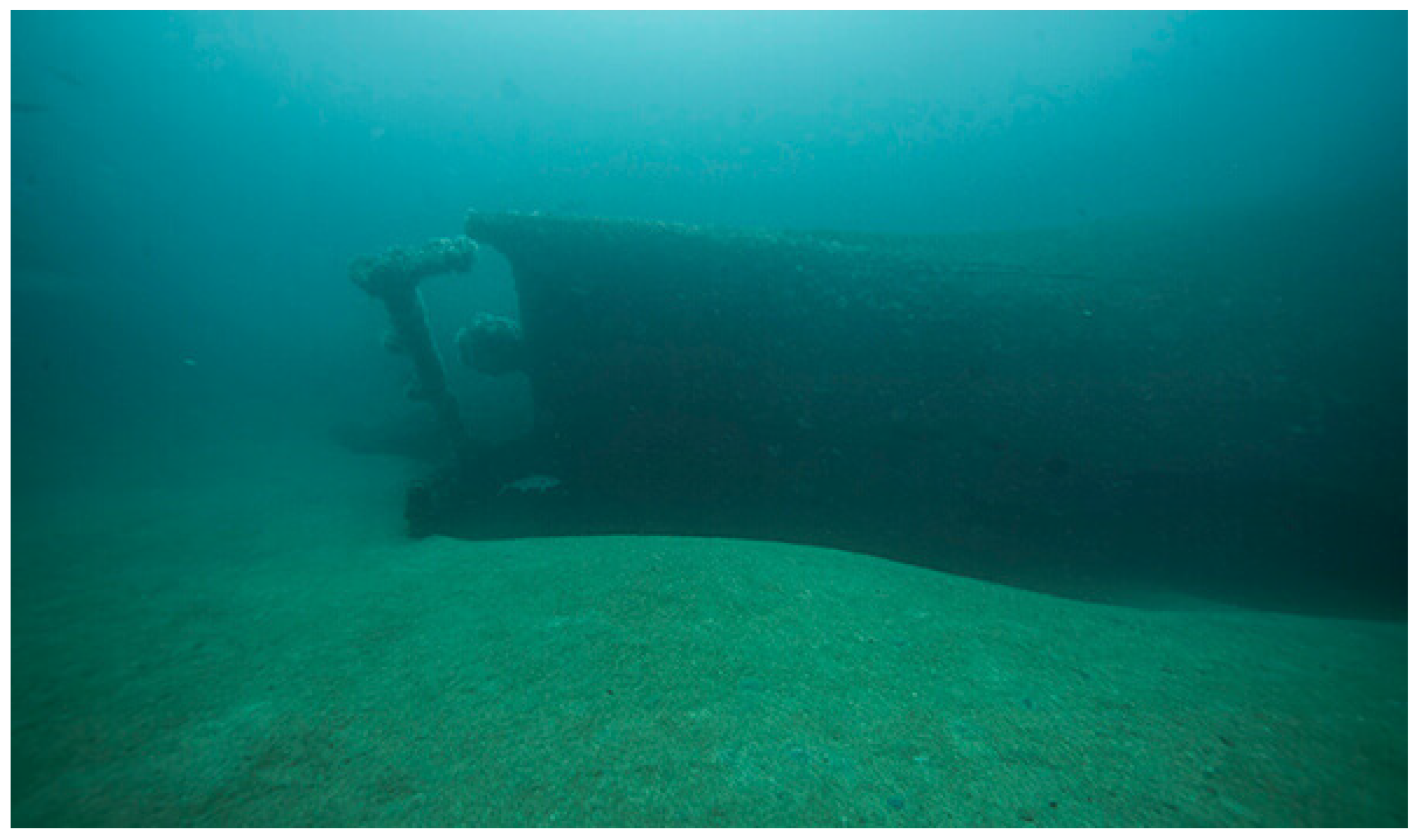
Figure 4.
Multibeam sonar surveys of SS Derbent from 2014 (red) and 2022 (grey) illustrating the collapse of the structure (from WAVES 2022. Courtesy of UK Ministry of Defence. Data collected by School of Ocean Sciences, Bangor University and The Waves Group).
Figure 4.
Multibeam sonar surveys of SS Derbent from 2014 (red) and 2022 (grey) illustrating the collapse of the structure (from WAVES 2022. Courtesy of UK Ministry of Defence. Data collected by School of Ocean Sciences, Bangor University and The Waves Group).

Figure 5.
Map of merchant vessel locations for 22 February 1943 (COMGULFSEAFRON 1943, National Archives).
Figure 5.
Map of merchant vessel locations for 22 February 1943 (COMGULFSEAFRON 1943, National Archives).

Figure 6.
Rasch’s sketch of U-106’s route while pursuing and sinking Carrabulle (COMGULFSEAFRON 1943, National Archives).
Figure 6.
Rasch’s sketch of U-106’s route while pursuing and sinking Carrabulle (COMGULFSEAFRON 1943, National Archives).

Figure 7.
Sinking card for SS Carrabulle (COMGULFSEAFRON 1943, National Archives).


Table 1.
List of World War II oil tanker shipwrecks on NOAA’s PPW list (NOAA 2013a).
| Ship | Sunk | U-Boat | Capacity | Cargo | Found | Sections | Orientation | Est depth | Location |
|---|---|---|---|---|---|---|---|---|---|
| Allan Jackson | Jan 1942 | U-66 | 81,390 bbl | Unknown crude | No | 3,048 m | Atlantic Ocean | ||
| Bloody Marsh | July 1943 | U-66 | 138,330 bbl | Heavy fuel oil | Yes | 2 | Inverted | 465 m | Atlantic Ocean |
| C.O. Stillman | June 1942 | U-68 | 132,000 bbl | Heavy fuel oil | No | 3,658 m | Caribbean Sea | ||
| Camden | Oct 1942 | I-25 | 76,000 bbl | Light fuel oil | No | 95 m | Pacific Ocean | ||
| China Arrow | Feb 1942 | U-103 | 88,800 bbl | Fuel oil | No | 1,980 m | Atlantic Ocean | ||
| Cities Service Toledo | June 1942 | U-158 | 95,000 bbl | Unknown crude | Yes | 2 | Inverted | 27 m | Gulf of Mexico |
| Coimbra | Jan 1942 | U-123 | 64,800 bbl | Lubricating oil | Yes | 3 | Inverted | 44 m | Atlantic Ocean |
| Empire Gem | Jan 1942 | U-66 | 76,982 bbl | Light fuel oil | Yes | 2 | Inverted | 45 m | Atlantic Ocean |
| Esso Gettysburg | June 1943 | U-66 | 138,330 bbl | West Texas crude | No | 700 m | Atlantic Ocean | ||
| Francis E. Powell | Jan 1942 | U-130 | 81,000 bbl | Light fuel oil | Yes | 2 | Inverted | 29 m | Atlantic Ocean |
| Gulfoil | May 1942 | U-506 | 54,178 bbl | Multiple types | Yes | 1 | Upright | 494 m | Gulf of Mexico |
| Gulfpenn | May 1942 | U-507 | 104,181 bbl | Unknown | Yes | 1 | Upright | 555 m | Gulf of Mexico |
| Gulfstate | March 1943 | U-155 | 78,000 bbl | High grade crude | No | 900 m | Caribbean Sea | ||
| Halo | May 1942 | U-506 | 75,000 bbl | Unknown crude | Yes | 1 | Upright | 150 m | Gulf of Mexico |
| Hamlet | May 1942 | U-753 | 64,139 bbl | Unknown crude | No | 42 m | Gulf of Mexico | ||
| India Arrow | Feb 1942 | U-103 | 97,750 bbl | Medium fuel oil | Yes | 1 | Inverted | 58 m | Atlantic Ocean |
| Joseph M. Cudahy | May 1942 | U-507 | 78,000 bbl | Multiple types | Yes | 2 | On side | 127 m | Gulf of Mexico |
| Lancing | April 1942 | U-552 | 64,255 bbl | Light fuel oil | Yes | 1 | Inverted | 42 m | Atlantic Ocean |
| Larry Doheny | Oct 1942 | I-25 | 80,000 bbl | Heavy crude oil | No | 1,370 m | Pacific Ocean | ||
| Lubrafol | May 1942 | U-564 | 67,000 bbl | Light fuel oil | Yes | 1 | Inverted | 55 m | Atlantic Ocean |
| Munger T. Ball | May 1942 | U-507 | 65,000 bbl | Light fuel oil | Yes | 2 | On side | 54 m | Gulf of Mexico |
| Norness | Jan 1942 | U-123 | 105,080 bbl | Light fuel oil | Yes | 2 | On side | 82 m | Atlantic Ocean |
| Panam | May 1943 | U-129 | 79,540 bbl | Unknown | No | 180 m | Atlantic Ocean | ||
| Pan-Massachusetts | Feb 1942 | U-128 | 104,000 bbl | Light fuel oil | Yes | 2 | Inverted | 91 m | Atlantic Ocean |
| Pan-Pennsylvania | April 1944 | U-550 | 157,985 bbl | Gasoline | Yes | 2 | On side | 76 m | Atlantic Ocean |
| Potrero Del Llano | May 1942 | U-564 | 35,000 bbl | Medium fuel oil | No | 390 m | Atlantic Ocean | ||
| R.W. Gallagher | July 1942 | U-67 | 106,715 bbl | Heavy fuel oil | Yes | 1 | Inverted | 27 m | Gulf of Mexico |
| Rawleigh Warner | June 1942 | U-67 | 39,000 bbl | Gasoline | Yes | 2 | Upright | 80 m | Gulf of Mexico |
| Sheherazade | Feb 1942 | U-158 | Unknown | Unknown | Yes | 1 | Inverted | 24 m | Gulf of Mexico |
| Swiftscout | April 1945 | U-857 | 77,718 bbl | Unknown | No | 2,850 m | Atlantic Ocean | ||
| Virginia | May 1942 | U-507 | 180,000 bbl | Light fuel oil | Yes | 1 | Upright/list | 87 m | Gulf of Mexico |
| W.D. Anderson | Feb 1942 | U-504 | 133,360 bbl | Unknown crude | No | 168 m | Atlantic Ocean | ||
| W.L. Steed | Feb 1942 | U-103 | 65,936 bbl | Unknown crude | No | 1,830 m | Atlantic Ocean | ||
| William Rockefeller | June 1942 | U-701 | 138,000 bbl | Heavy fuel oil | No | 260 m | Atlantic Ocean | ||
Table 2.
Logged positions of SS Gulfstate during voyages in early 1943 (COMGULFSEAFRON 1943).
| Date | Route | Position | Notes |
|---|---|---|---|
| February 22, 1943 | To Texas City | At 0000: 27-24 N, 84-23 W | |
| February 23, 1943 | To Texas City | At 0000: 28-20 N, 88-47 W | |
| February 24, 1943 | To Texas City | At 0000: 29-35 N, 93-06 W | Arrived 0500 |
| April 1, 1943 | Galveston to New York | At 0000: 29-30 N, 85-34 W | |
| At 2400: 26-57 N, 82-49 W | Northwest of Punta Gorda | ||
| April 3, 1943 | Galveston to New York | At 0000: 24-18 N, 81-12 W | At 0315 this vessel was torpedoed and sunk in approximate position 24-32 N, 80-15 W |
Disclaimer/Publisher’s Note: The statements, opinions and data contained in all publications are solely those of the individual author(s) and contributor(s) and not of MDPI and/or the editor(s). MDPI and/or the editor(s) disclaim responsibility for any injury to people or property resulting from any ideas, methods, instructions or products referred to in the content. |
© 2025 by the authors. Licensee MDPI, Basel, Switzerland. This article is an open access article distributed under the terms and conditions of the Creative Commons Attribution (CC BY) license (http://creativecommons.org/licenses/by/4.0/).
Copyright: This open access article is published under a Creative Commons CC BY 4.0 license, which permit the free download, distribution, and reuse, provided that the author and preprint are cited in any reuse.


