
Preprint
Review

This version is not peer-reviewed.

Glucose/Potassium Ratio, a Novel Biomarker for the Prognosis of Patients with Subarachnoid Hemorrhage: A Review

A peer-reviewed article of this preprint also exists.

Submitted:

14 November 2025

Posted:

17 November 2025

You are already at the latest version

Abstract

Subarachnoid hemorrhage (SAH) is a life-threatening cerebrovascular event with high mortality and long-term morbidity. While clinical grading scales such as Hunt and Hess or the WFNS score aid in prognosis, their applicability is limited in sedated or unconscious patients. Biomarkers offer an alternative approach for risk stratification. This review examines the prognostic value of the glucose/potassium ratio (GPR) in patients with aneurysmal SAH and its potential integration into future predictive models. A literature review of retrospective studies assessing the association between GPR and clinical outcomes in SAH was conducted. Evidence on the pathophysiological basis of stress-induced hyperglycemia and hypokalemia in SAH is presented, along with findings from five key clinical studies evaluating GPR in relation to mortality, vasospasm, delayed cerebral ischemia, and functional outcomes. Elevated GPR levels were consistently associated with poor short- and long-term outcomes in SAH patients. Studies reported significant correlations between GPR and 30-day mortality, poor Glasgow Outcome Scale (GOS) scores, increased incidence of cerebral vasospasm, and higher rates of rebleeding. The optimal GPR cutoff for predicting adverse outcomes was greater than 37 mg/dL, with multivariate analyses confirming GPR as an independent prognostic factor. GPR is a promising, cost-effective biomarker that integrates two stress-response parameters (glucose and potassium), both of which are independently associated with SAH prognosis. Its incorporation into future predictive models may enhance early risk stratification and guide clinical decision-making. Further prospective studies are warranted to validate its utility and standardize its clinical application.

Keywords: 
;  ;  ;  ;  ;  

1. Introduction

Subarachnoid hemorrhage (SAH) is a subtype of cerebrovascular disease (CeVD), representing 5 to 8% of these, and is known as a neurological emergency [1,2]. The main cause of SAH is traumatic, while the leading cause of non-traumatic SAH is aneurysms, representing 75-80% of spontaneous SAH causes [3,4]. SAH is characterized by the direct passage of blood into the subarachnoid space due to the rupture of an artery or vein [2]. Spontaneous SAH secondary to an aneurysm can occur at any age, and its incidence varies depending on age, gender, and geographical region [2]. In North America, approximately 30,000 cases of SAH are reported annually, with an incidence of 2 to 25 cases per 100,000 inhabitants [2]. Similar numbers have been reported in Finland and Japan, with an incidence of 19 to 23 cases per 100,000 inhabitants [5]. However, lower incidences have been reported in other regions, such as China, with 2 cases per 100,000 inhabitants, and Central and South America, with 4 cases per 100,000 inhabitants [5]. Specifically, in Mexico, 13.5 cases per 100,000 inhabitants were reported in 2019, which is high compared to what is reported in the rest of Latin America [6].
Although the incidence is low compared to other CeVD, the mortality of SAH is very high. It has been reported to reach up to 50% within the first 30 days [7]. Among the studies conducted, it has been observed that most deaths tend to occur within the first week, with 10% during the acute bleeding and 25% within the first 24 hours [2]. Apart from the high mortality, it should be considered that the other 50% of patients who survive mostly develop long-term disability and cognitive impairment, having a significant socio-economic impact on patients and their families [2,8]. Therefore, it is important to identify the diagnosis promptly and, in turn, patients with poor prognosis. For this purpose, scales have been described that have been used to predict the mortality of these patients, such as Hunt and Hess and the World Federation of Neurological Surgeons (WFNS) [9]. However, these scales have their limitations, such as the inability to be measured if the patient is sedated, which has led to investigations into various biomarkers to replace and/or support them with different results, including glucose, potassium, total cholesterol, triglycerides, lactate, D-dimer, S100B peptide, neuron-specific enolase, brain natriuretic peptide (BNP), and C-reactive protein (CRP) [2,8,9].

2. Pathophysiology

In situations that put the body under stress, such as SAH, physiological changes occur, such as increased release of catecholamines, which persists for at least 10 days [10,11]. This leads to an increase in heart rate (HR), myocardial contraction, and blood pressure (BP) [2]. The acceleration and increase in blood flow to the heart and the musculoskeletal system increase cellular metabolism, enhancing glucose metabolism through increased glycogenolysis, gluconeogenesis, lipolysis, and ketogenesis, resulting in hyperglycemia, which has been recognized as stress-induced hyperglycemia (Figure 1) [2,10,12]. At the same time, insulin release is reduced due to the stimulation of pancreatic α-adrenergic receptors, further increasing hyperglycemia [2]. In stressful situations, the transport of glucose to brain cells is compromised. The lack of sufficient glucose supply can hinder energy metabolism in the brain, worsening neuronal injury in cases of hypoglycemia [13]. However, hyperglycemia, on the other hand, induces apoptosis, increases superoxide production, damages the blood-brain barrier (BBB), and causes cerebral edema [4]. Moreover, SAH is accompanied by an increased inflammatory response, which causes the release of cytokines. These, in turn, are directly associated with the appearance of hyperglycemia and insulin resistance [14].
Hyperglycemia has been associated with the severity of SAH measured by the Hunt and Hess scale and the Fisher scale, as well as with the occurrence of vasospasm and late ischemic complications [15,16,17,18,19]. Hyperglycemia has been reported to correlate with neurological deficits and functional prognosis even up to 12 months [1,11,16,17,20,21]. Even after adjusting for other variables such as the grade of Hunt and Hess, aneurysm size, and age, hyperglycemia remains associated with increased rates of complications, prolonged stays in intensive care units (ICU), and mortality [1,17,22,23,24]. It has even been described that higher glucose levels correlate with higher mortality; moderate hyperglycemia has an odds ratio (OR) of 2.61; 95% confidence interval (CI) 1.52-3.06, and severe hyperglycemia has an OR of 3.18; 95% CI 2.24-4.53 [25]. Persistent hyperglycemia is associated with worse functional prognosis than isolated hyperglycemia [26]. Additionally, hyperglycemia in the context of SAH has been linked to complications such as congestive heart failure, acute pulmonary edema, respiratory failure, and the development of infections [17].
On the other hand, stress also activates the hypothalamic-pituitary-adrenal (HPA) axis, increasing the release of corticotropin-releasing hormone, which in turn increases the release of adrenocorticotropic hormones into circulation [2]. One of these is aldosterone, a hormone that regulates extracellular volume and BP. Aldosterone binds to mineralocorticoid receptors on the principal cells of the renal collecting ducts, facilitating sodium reabsorption and potassium excretion [2]. At the same time, catecholamines stimulate β-adrenergic receptors linked to the Na/K ATPase pump membrane, increasing the flow of potassium from extracellular to intracellular (Figure 1) [8]. Hypokalemia has even been observed in some studies as the most frequent of the hydro-electrolytic imbalances, with a frequency of 35 to 50%, correlating with worse functional prognosis in patients with SAH [3,7,27]. Conversely, hyperkalemia has been associated with lower severity of hemorrhage in radiographic scales [3]. It should be noted that hypokalemia is associated with the development of potentially fatal arrhythmias [27].

3. Development of Glucose/Potassium Index

Since hyperglycemia and hypokalemia are the expected responses in a stressful situation, the glucose/potassium ratio (GPR) was proposed as a marker with better utility because it involves two components that individually have a relationship with the prognosis of patients with SAH, assessed throughout several studies (Table 1) [9]. A retrospective study conducted in a Turkish tertiary hospital included 134 patients with SAH, with a mean age of 65.9 ± 16.7 and a mean GPR of 2.2 ± 0.9 mmol/L. The GPR was associated with 30-day mortality in the multivariate logistic regression analysis with an OR 4.041, 95% CI 1.450-26.147, p=0.043 [2]. Another retrospective study was conducted in a Japanese hospital, including 565 patients with SAH with a mean age of 61.5 ± 14.7 and a mean GPR of 52.1 ± 21.1 mg/dL. The GPR was associated with a poor outcome, defined as a Glasgow Outcome Scale (GOS) of 3 or less in the multivariate logistic regression analysis, with an OR not specified in the manuscript, but with a p-value of 0.009 [9]. From this same study group, patients who underwent surgical treatment were taken, which included 333 patients with SAH who were surgically treated, with a mean age of 59.7 and a mean GPR of 49 ± 18 mg/dL. The GPR was associated with the development of cerebral vasospasm in the multivariate logistic regression analysis, similar to the previous one, without a defined OR, but with a p-value of 0.018 [28].
In a retrospective study conducted in a tertiary hospital in South Korea with 553 patients with SAH, the median age was 54 (46-63), and the median GPR was 38.7 mg/dL (32.6-46.6). They described that the best cutoff of GPR for predicting 3-month mortality was 37.8 mg/dL with a sensitivity of 90.2% and specificity of 51%. The GPR was associated with 3-month mortality in the multivariate logistic regression analysis with an OR 1.070, 95% CI 1.047-1.093, p<0.001 [27]. Lastly, a retrospective study conducted in China that included 744 patients diagnosed with SAH had a mean age of 54.89 ± 11.3 and a median GPR of 1.52 mmol/L (1.23-1.94). The suitable cut-off value for GPR as a predictor for rebleeding in SAH was 2.09 mmol/L with a sensitivity of 53.3% and specificity of 83.9%. The GPR was associated with a poor outcome defined as modified Rankin Scale (mRS) 3 to 6 in the multivariate logistic regression analysis with an OR 0.572, 95% CI 0.347-0.944, p=0.029 [29].

4. Future Directions

To improve previously used prediction scores for SAH, quantitative biomarkers associated with SAH were included in prior studies, detailing the modified WFNS 2004 scale and the SAH Physiologic Derangement Score (SAH-PDS). The modified WFNS 2004 scale incorporated age, a history of systemic arterial hypertension, systolic BP at admission, the size and location of the aneurysm, the presence and thickness of the clot, and the presence or absence of vasospasm at admission, which demonstrated better performance with an area under the curve (AUC) of 0.78 compared to 0.74 for the WFNS [33]. However, it also had the drawback of including aneurysm characteristics that are not always known during patient management. Shortly thereafter, Claassen and his collaborators proposed a model that included physiological variables such as the arterio-alveolar gradient, serum bicarbonate, serum glucose, and mean BP. In this model, it was observed that, in addition to the Hunt and Hess grade, factors like the level of consciousness, size of the aneurysm, presence of intraventricular bleeding, and occurrence of rebleeding were considered, leading to the SAH-PDS. This score had an AUC of 0.79 in predicting severe disability or death at 3 months, outperforming scales such as SIRS and APACHE-II; however, it exhibited lower performance than the Glasgow Coma Scale (GCS) on its own [34]. Therefore, new biomarkers have continued to be studied in search of those that offer a greater association with patient outcomes in SAH for the potential development of future prediction scales. Thus, the positive results demonstrated by the GPR in recent studies are remarkable.

5. Conclusions

In conclusion, higher levels of GPR, with values above 37 mg/dL, have been associated with the occurrence of cerebral vasospasm, delayed cerebral ischemia, and rebleeding, which subsequently correlate with poorer prognosis and mortality in patients with SAH. Additional studies are required to continue assessing the utility of this biomarker, which, due to its accessibility in terms of cost and time, has a promising future.

Author Contributions

LE.F.G. conceptualized the study. L.E.F.G., V.A.F.G., and D.M.C. developed the methodology. L.E.F.G., V.A.F.G., D.M.C., V.G.R., A.N.R., and J.J.A.A. conducted formal analysis and investigation. L.E.F.G., V.A.F.G., D.M.C., and V.G.R. managed data curation and validation. L.E.F.G., V.A.F.G., D.M.C., V.G.R., A.N.R., and J.J.A.A. wrote the original draft. L.E.F.G., V.A.F.G., and D.M.C. contributed to the review and editing. L.E.F.G., V.A.F.G., and A.N.R. supported visualization and resources. L.E.F.G. provided supervision and project administration. All authors have read and agreed to the publication of the manuscript.

Funding

This research received no external funding.

Institutional Review Board Statement

Not applicable.

Informed Consent Statement

Not applicable.:

Data Availability Statement

No new data were created or analyzed in this study. Data sharing does not apply to this article.

Acknowledgments

None.

Conflicts of Interest

The authors declare no conflicts of interest.

Abbreviations

The following abbreviations are used in this manuscript:
SAH Subarachnoid hemorrhage
CeVD Cerebrovascular disease
WFNS World Federation of Neurological Surgeons
BNP Brain natriuretic peptide
CRP C-reactive protein
HR Heart rate
BP Blood pressure
BBB Blood-brain barrier
ICU Intensive care unit
OR Odds ratio
CI Confidence interval
HPA Hypothalamic-pituitary-adrenal
GPR Glucose/potassium ratio
GOS Glasgow Outcome Scale
mRS modified Rankin Scale
SAH-PDS Subarachnoid hemorrhage Physiologic Derangement Score
AUC Area under the curve
GCS Glasgow Coma Scale

References

  1. Bian, L.; Liu, L.; Wang, C.; Hussain, M.; Yuan, Y.; Liu, G.; et al. Hyperglycemia within day 14 of aneurysmal subarachnoid hemorrhage predicts 1-year mortality. Clin Neurol Neurosurg. 2013, 115, 959–964. [Google Scholar] [CrossRef] [PubMed]
  2. Alışkan, H.; Kılıç, M.; Ak, R. Usefulness of plasma glucose to potassium ratio in predicting the short-term mortality of patients with aneurysmal subarachnoid hemorrhage. Heliyon. 2024, 10, e38199. [Google Scholar] [CrossRef]
  3. Alimohamadi, M.; Saghafinia, M.; Alikhani, F.; Danial, Z.; Shirani, M.; Amirjamshidi, A. Impact of electrolyte imbalances on the outcome of aneurysmal subarachnoid hemorrhage: A prospective study. Asian J Neurosurg. 2016, 11, 29–33. [Google Scholar] [CrossRef] [PubMed]
  4. Dell’Orto, Z.C.; da Silveira, I.V.; Torres França, L.S.; Ferreira Medeiros, M.S.; Cardoso Gomes, T.; Alves Pinto, B.; et al. The Role of Sodium and Glucose in the Prognosis of Patients with Aneurysmal Subarachnoid Hemorrhage: A Literature Review of New Evidence. Arq Bras Neurocir. 2024, 43, 40–47. [Google Scholar] [CrossRef]
  5. Etminam, N.; Chang, H.S.; Hackenberg, K.; de Rooij, N.K.; Vergouwen, M.D.I.; Rinkel, G.J.E.; et al. Worldwide Incidence of Aneurysmal Subarachnoid Hemorrhage According to Region, Time Period, Blood Pressure, and Smoking Prevalence in the Population. JAMA Neurol. 2019, 76, 588–597. [Google Scholar] [CrossRef] [PubMed]
  6. De la Cruz-Góngora, V.; Chiquete, E.; Gómez-Dantés, H.; Cahuana-Hurtado, L.; Cantú-Brito, C. Trends in the burden of stroke in Mexico: A national and subnational analysis of the global burden of disease 1990-2019. Lancet Reg Health Am. 2022, 10, 100204. [Google Scholar] [CrossRef]
  7. Chen, I.; Mitchell, P. Serum potassium and sodium levels after subarachnoid haemorrhage. Br J Neurosurg. 2016, 30, 554–559. [Google Scholar] [CrossRef]
  8. Cruzalegui-Bazán, C.; Durán-Pecho, A.; Botello-Gonzales, D.; Acha-Sánchez, J.L.; Cabanillas-Lazo, M. Association of serum glucose/potassium index levels with poor long-term prognosis in patients with Aneurysmal Subarachnoid Hemorrhage. Clin Neurol Neurosurg. 2024, 247, 108609. [Google Scholar] [CrossRef]
  9. Fujiki, Y.; Matano, F.; Mizunari, T.; Murai, Y.; Tateyama, K.; Koketsu, K.; et al. Serum glucose/potassium ratio as a clinical risk factor for aneurysmal subarachnoid hemorrhage. J Neurosurg. 2018, 129, 870–875. [Google Scholar] [CrossRef]
  10. Beseoglu, K.; Steiger, H.J. Elevated glycated hemoglobin level; and hyperglycemia after aneurysmal subarachnoid hemorrhage. Clin Neurol Neurosurg. 2017, 163, 128–132. [Google Scholar] [CrossRef]
  11. Juvela, S.; Siironen, J.; Kuhmonen, J. Hyperglycemia, excess weight, and history of hypertension as risk factors for poor outcome and cerebral infarction after aneurysmal subarachnoid hemorrhage. J Neurosurg. 2005, 102, 998–1003. [Google Scholar] [CrossRef]
  12. Alberti, O.; Becker, R.; Benes, L.; Wallenfang, T.; Bertalanffy, H. Initial hyperglycemia as an indicator of severity of the ictus in poor-grade patients with spontaneous subarachnoid hemorrhage. Clin Neurol Neurosurg. 2000, 102, 78–83. [Google Scholar] [CrossRef]
  13. Barletta, J.F.; Figueroa, B.E.; DeShane, R.; Blau, S.A.; McAllen, K.J. High glucose variability increases cerebral infarction in patients with spontaneous subarachnoid hemorrhage. J Crit Care. 2013, 28, 798–803. [Google Scholar] [CrossRef]
  14. Kruyt, N.D.; Biessels, G.J.; DeVries, J.H.; Luitse, M.J.A.; Vermeulen, M.; Rinkel, G.J.E.; et al. Hyperglycemia in aneurysmal subarachnoid hemorrhage: a potentially modifiable risk factor for poor outcome. J Cereb Blood Flow Metab. 2010, 30, 1577–1587. [Google Scholar] [CrossRef]
  15. Bajatia, N.; Topcuoglu, M.A.; Buonanno, F.S.; Smith, E.E.; Nogueira, R.G.; Rordorf, G.A.; et al. Relationship between hyperglycemia and symptomatic vasospasm after subarachnoid hemorrhage. Crit Care Med. 2005, 33, 1603–1609. [Google Scholar] [CrossRef]
  16. Dorhout Mees, S.M.; van Dijk, G.W.; Algra, A.; Kempink, D.R.J.; Rinkel, G.J.E. Glucose levels and outcome after subarachnoid hemorrhage. Neurology. 2003, 61, 1132–1133. [Google Scholar] [CrossRef] [PubMed]
  17. Kerner, A.; Schlenk, F.; Sakowitz, O.; Haux, D.; Sarrafzadeh, A. Impact of hyperglycemia on neurological deficits and extracellular glucose levels in aneurysmal subarachnoid hemorrhage patients. Neurol Res. 2007, 29, 647–653. [Google Scholar] [CrossRef] [PubMed]
  18. Schlenk, F.; Vajkoczy, P.; Sarrafzadeh, A. Inpatient Hyperglycemia Following Aneurysmal Subarachnoid Hemorrhage: Relation to Cerebral Metabolism and Outcome. Neurocrit Care. 2009, 11, 56–63. [Google Scholar] [CrossRef] [PubMed]
  19. Van Donkelaar, C.E.; Dijkland, S.A.; van den Bergh, W.M.; Bakker, J.; Dippel, D.W.; Nijsten, M.; et al. Early Circulating Lactate and Glucose Levels After Aneurysmal Subarachnoid Hemorrhage Correlate With Poor Outcome and Delayed Cerebral Ischemia: A Two-Center Cohort Study. Crit Care Med. 2016, 44, 966–972. [Google Scholar] [CrossRef]
  20. Kruyt, N.D.; Biessels, G.J.; de Haan, R.J.; Vermeulen, M.; Rinkel, G.J.E.; Coert, B.; et al. Hyperglycemia and Clinical Outcome in Aneurysmal Subarachnoid Hemorrhage A Meta-Analysis. Stroke. 2009, 40, e424–e430. [Google Scholar] [CrossRef]
  21. Yajun, Z.; Diqing, O.; Xingwei, L.; Liuyang, T.; Xiaofeng, Z.; Xiaoguo, L.; et al. High levels of blood lipid and glucose predict adverse prognosis in patients with aneurysmal subarachnoid hemorrhage. Heliyon. 2024, 10, e38601. [Google Scholar] [CrossRef]
  22. Okazaki, T.; Hifumi, T.; Kawakita, K.; Shishido, H.; Ogawa, D.; Okauchi, M.; et al. Blood Glucose Variability: A Strong Independent Predictor of Neurological Outcomes in Aneurysmal Subarachnoid Hemorrhage. J Intensive Care Med. 2018, 33, 189–195. [Google Scholar] [CrossRef] [PubMed]
  23. Sadan, O.; Feng, C.; Vidakovic, B.; Mei, Y.; Martin, K.; Samuels, O.; et al. Glucose Variability as Measured by Inter-measurement Percentage Change is Predictive of In-patient Mortality in Aneurysmal Subarachnoid Hemorrhage. Neurocrit Care. 2020, 33, 458–467. [Google Scholar] [CrossRef]
  24. Thiele, R.H.; Pouratian, N.; Zuo, Z.; Scalzo, D.C.; Dobbs, H.A.; Dumont, A.S.; et al. Strict Glucose Control Does Not Affect Mortality after Aneurysmal Subarachnoid Hemorrhage. Anesthesiology. 2009, 110, 603–610. [Google Scholar] [CrossRef]
  25. Jia, L.; Zhang, Y.; Wang, P.; Wang, X.; Nie, X.; Yao, W.; et al. Association between hyperglycemia at admission and mortality in aneurysmal subarachnoid hemorrhage. J Clin Neurosci. 2022, 103, 172–179. [Google Scholar] [CrossRef] [PubMed]
  26. McGirt, M.J.; Woodworth, G.E.; Ali, M.; Than, K.D.; Tamargo, R.J.; Clatterbuck, R.E. Persistent perioperative hyperglycemia as an independent predictor of poor outcome after aneurysmal subarachnoid hemorrhage. J Neurosurg. 2007, 107, 1080–1085. [Google Scholar] [CrossRef]
  27. Jung, H.M.; Paik, J.H.; Kim, S.Y.; Hong, D.Y. Association of Plasma Glucose to Potassium Ratio and Mortality After Aneurysmal Subarachnoid Hemorrhage. Front Neurol. 2021, 12, 661689. [Google Scholar] [CrossRef] [PubMed]
  28. Matano, F.; Fujiki, Y.; Mizunari, T.; Kokeysu, K.; Tamaki, T.; Murai, Y.; et al. Serum Glucose and Potassium Ratio as Risk Factors for Cerebral Vasospasm after Aneurysmal Subarachnoid Hemorrhage. J Stroke Cerebrovasc Dis. 2019, 28, 1951–1957. [Google Scholar] [CrossRef]
  29. Wang, J.; Feng, Q.; Zhang, Y.; Qiu, W.; Gao, H. Elevated Glucose-Potassium Ratio Predicts Preoperative Rebleeding in Patients With Aneurysmal Subarachnoid Hemorrhage. Front Neurol. 2022, 12, 795376. [Google Scholar] [CrossRef]
  30. Hunt, W.E.; Hess, R.M. Surgical risk as related to time of intervention in the repair of intracranial aneurysms. J Neurosurg. 1968, 28, 14–20. [Google Scholar] [CrossRef]
  31. Rosen, D.S.; Macdonald, R.L. Subarachnoid Hemorrhage Grading Scales A Systematic Review. Neurocrit Care. 2005, 2, 110–118. [Google Scholar] [CrossRef] [PubMed]
  32. Drake, C.G. Report of World Federation of Neurological Surgeons Committee on a Universal Subarachnoid Hemorrhage Grading Scale. J Neurosurg. 1988, 68, 985–986. [Google Scholar]
  33. Rosen, D.S.; Macdonald, R.L. Grading of subarachnoid hemorrhage: modification of the World Federation of Neurosurgical Societies scale on basis of data for a large series of patients. Neurosurgery. 2004, 54, 566–575. [Google Scholar] [CrossRef] [PubMed]
  34. Claassen, J.; Vu, A.; Kreiter, K.T.; Kowalski, R.G.; Du, E.Y.; Ostapkovich, N.; et al. Effect of acute physiologic derangements on outcome after subarachnoid hemorrhage. Crit Care Med. 2004, 32, 832–838. [Google Scholar] [CrossRef]
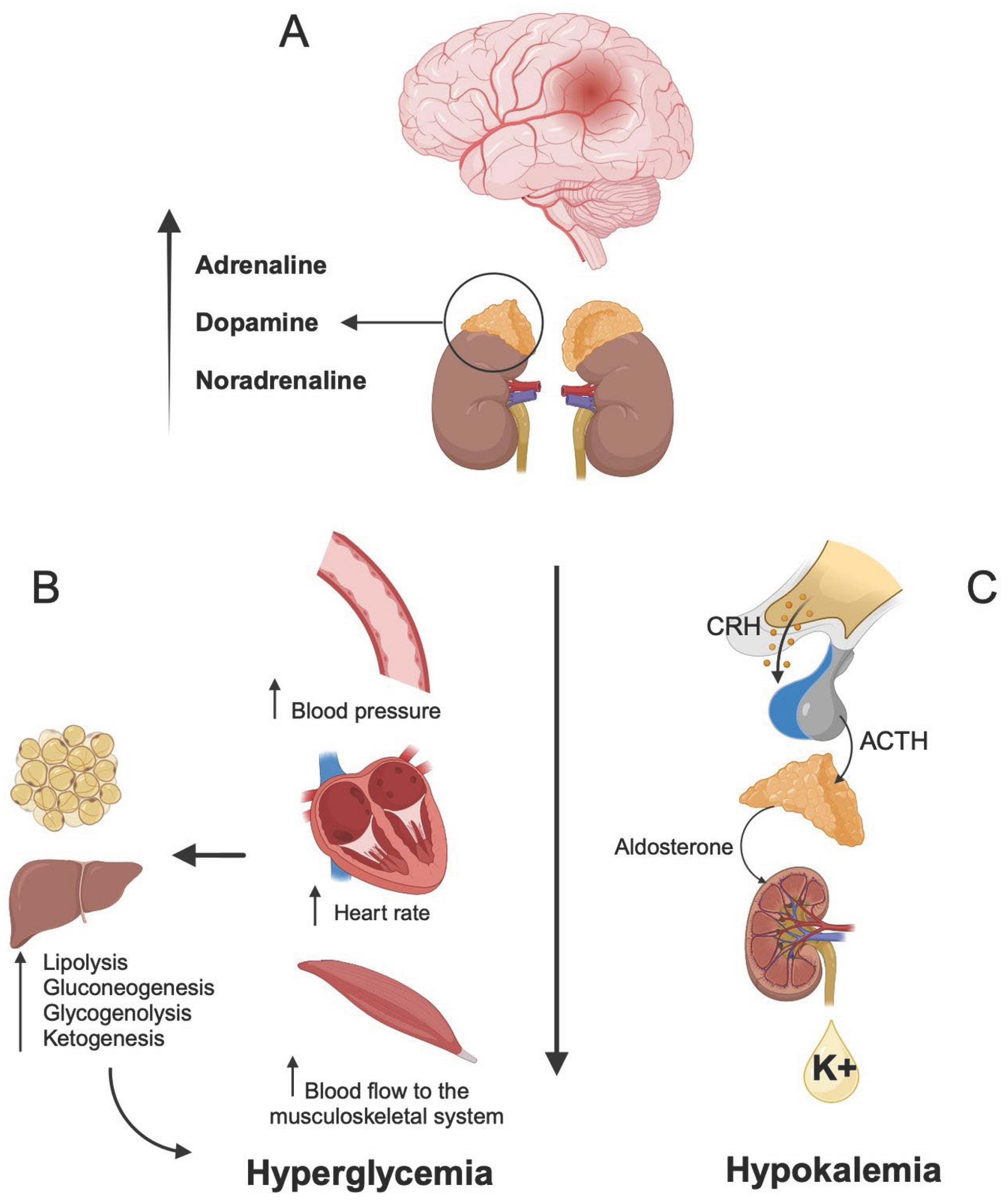
Figure 1. A) In stress situations, such as subarachnoid hemorrhage, there is an increase in the release of catecholamines (adrenaline, dopamine, and noradrenaline). B) The rise in catecholamines leads to an increase in heart rate, blood pressure, and blood flow to the heart and the musculoskeletal system, enhancing glucose metabolism through increased glycogenolysis, gluconeogenesis, lipolysis, and ketogenesis, resulting in stress-induced hyperglycemia. C) Stress also activates the hypothalamic-pituitary-adrenal axis, increasing the release of corticotropin-releasing hormone, which in turn increases the release of aldosterone that finally binds to mineralocorticoid receptors on the kidneys, facilitating sodium reabsorption and potassium excretion.
Preprints 185127 g001
Table 1. Studies carried out to date on the glucose/potassium ratio in subarachnoid hemorrhage.
Study Inclusion criteria Exclusion criteria N Age Sex Primary outcome OR (95% CI), p-value
Fujiki 2017 [9] aSAH None 565 61.5 Female (63.2%) 3 months poor outcome *, 0.009
Matano 2019 [28] aSAH Patients who refused surgery, postoperative angiography, and DWI-MRI 333 59.7 Female (63.1%) Cerebral vasospasm *, 0.018
Jung 2021 [27] Non-traumatic aSAH admitted to the ED within 24 h of symptom onset History of neurological diseases, diabetes, acute or chronic renal failure, malignancy, and liver cirrhosis 553 56 (46-63) Female (57.5%) 3 months mortality 1.070 (1.047-1.093), <0.001
Wang 2022 [29] aSAH and rebleeding within 72 h Diabetes, neurological diseases, multiple intracranial aneurysms, acute or chronic renal failure, malignancy, and liver cirrhosis 744 54.8 ± 11.3 Female (60.5%) 90 days poor outcome 0.572 (0.347-0.944), 0.029
Alişkan 2024 [2] aSAH with a mRS score of ≤2 before Diabetes, and acute or chronic renal failure 134 65.9 ± 16.7 Female (50.7%) All cause 30-day mortality 4.041 [1.450-26.147), 0.043
* Not mentioned in the study. aSAH: aneurysmal Subarachnoid Hemorrhage; DWI-MRI: Diffusion-Weighted Magnetic Resonance Imaging; ED: Emergency Department; mRS: modified Rankin Scale.
Disclaimer/Publisher’s Note: The statements, opinions and data contained in all publications are solely those of the individual author(s) and contributor(s) and not of MDPI and/or the editor(s). MDPI and/or the editor(s) disclaim responsibility for any injury to people or property resulting from any ideas, methods, instructions or products referred to in the content.
Copyright: This open access article is published under a Creative Commons CC BY 4.0 license, which permit the free download, distribution, and reuse, provided that the author and preprint are cited in any reuse.
Prerpints.org logo

Preprints.org is a free preprint server supported by MDPI in Basel, Switzerland.

Subscribe

Disclaimer

Terms of Use

Privacy Policy

Privacy Settings

© 2025 MDPI (Basel, Switzerland) unless otherwise stated
