
Submitted:
13 November 2025
Posted:
17 November 2025
You are already at the latest version
Abstract
Since the dawn of civilization, humanity has looked to the sky seeking to expand knowledge beyond Earth’s boundaries. The last eight decades have witnessed remarkable progress in space exploration paving the way for increasingly longer space journeys and the establishment of human settlements on the Moon and Mars. These achievements have been made possible by advances in multiple scientific disciplines, including the rise of space medicine, astropharmacy, astrobiology, and astrobotany each addressing how bio-logical and technological systems adapt to extraterrestrial environments. Nevertheless, the space environment remains profoundly inhospitable to human life, making the protection of health and the assurance of long-term sustainability a key strategic goal in space ex-ploration programs. Within this multidisciplinary framework, the potential role of me-dicinal plants remains underexplored. Historically central to healthcare, medicinal plants provide a vast repertoire of bioactive compounds and molecular scaffolds, many of which have inspired modern drugs. This review explores how medicinal plants could contribute to human well-being beyond Earth—not only as sources of therapeutic agents to mitigate space-induced ailments but also as biomanufacturing platforms for on-demand produc-tion of pharmaceuticals. Ultimately, medicinal plants could continue to play a pivotal role in supporting human health in space, but it poses new challenges and requires further scientific and technological advances.
Keywords:
medicinal plants
; spaceflight
; microgravity
; space radiation
; astrofarmacy
; space farming
1. Introduction
Since ancient times, mankind has eagerly looked at the sky with curiosity and ambition to expand knowledge beyond the terrestrial boundaries. The quest for knowledge can be traced back to around 3500 BC in Mesopotamia with the first observations and calculations of the movements of celestial bodies and has led to challenging projects in the modern day including a return to the Moon to establish a permanent outpost and the colonization of Mars [1]. It is amazing to observe how in the last 80 years such great scientific and technological results have been achieved, previously unthinkable. Table S1 shows the milestones in the history of space travel. These incredible results have been initially achieved by an imaginary arm wrestling between Russian (SSP, Roscosmos) and American (NASA) space agencies and later sustained and integrated with the effort of further national space agencies such as ESA (Europe), CSA (Canada), JAXA (Japan) and CMSA (China) among the others. In addition, several private space technology companies are also contributing, alone and in collaboration with institutional players, to this field: the main contribution of these companies is the development of spacecrafts and launch vehicles (partially or fully reusable) that make actual and future space travels reliable and affordable, regardless of their purpose (scientific, commercial or touristic) [2]. The emergence of these new actors, funded primarily through private capital and characterized by a for-profit orientation and a weak dependance on government-issued needs, come together under the term “New Space” [3].
The successes achieved in space exploration have gone hand in hand with scientific and technological progress in various areas of knowledge such as physics, engineering and computer science among others. However, progressively venturing into low Earth orbit (LEO) and beyond has posed and poses new problems and challenges. From this criticality new opportunities have arisen, in the form of new scientific disciplines. Overall, these disciplines answer the question of how a “system” behaves under the harsh condition of the extraterrestrial environment; thus, space medicine studies the physiological and neuropsychological alterations occurring during space travels that may negatively affect human health [4,5,6]; astropharmacy studies how the space environment alters the stability and therapeutic efficacy of drugs, developing strategies to mitigate these effects and to produce medicines in space during long-term missions. [7,8,9,10,11]; astrobiology is an interdisciplinary discipline investigating life, in all its aspects, beyond Earth [12,13]; astrobotany studies the physiological adaptations that occur in plants growing in extraterrestrial environmental conditions and develops appropriate horticultural strategies aimed producing fresh food [14,15,16]. These new sciences, far from being independent, are on the contrary interconnected and put in the spotlight the well-being and survival of humans during spaceflights and future space colonization.
In this complex and in making framework, full of stimulating opportunities and perspectives, a theme remains poorly investigated: what role could medicinal plants play in space exploration and colonization? Historically, the use of medicinal plants has in fact represented a valid therapeutic support to conventional medicine in the management of a wide spectrum of ailments. Besides their direct benefits, phytochemicals, and natural products in general, exhibit a massive scaffold assortment and structural complexity representing an inexhaustible source of pharmacologically active ingredients and lead compounds for rational drug design. Consistently, natural or natural-derived products represented an important fraction of the pharmacological agents approved in the last 40 years [17].
Starting from these assumptions, this review article represents the first attempt to collect and summarize information on the prospects of medicinal plants in the context of long-term space exploration missions. To reach this goal, the review has been organized into four sections. The review starts with an introductory section followed section presenting the state of the art regarding the enormous challenges that the human body faces, both physically and mentally, beyond the Earth boundaries. In the third section, we describe how the space environment modifies the established rules of ground-based pharmaceutic and pharmacology, hindering the effectiveness of therapeutic interventions during space missions. In Section 4, we explore the potential role medicinal plants could play in the complex context of space exploration and extra-Earth colonization. Based on current on-Earth knowledge, a tentative proposal will be made regarding which medicinal plants might be useful for alleviating ailments experienced in space. Furthermore, the concept of "medicinal plant" will be used in its broadest sense, discussing the potential use of plants as platforms for biopharmaceutical production on demand. Finally, the concluding section addresses the emerging issues associated with the potential use of medicinal plants in space.
Overall, the opportunity for medicinal plants to maintain a pivotal role also outside Earth boundaries emerges. They may represent both a holistic therapeutic approach consistent with the multifaceted nature of human health risks posed by space exposure and a biomanufacturing tool.
2. Space/Flight Hazards
Human beings have evolved over millions of years within the boundary conditions of Earth. It should therefore not be surprising that environmental conditions in LEO are extremely hostile to the human body and can give rise to several physical and mental dysfunctions. Health consequences depend on distance and duration of spaceflight and are often reversible upon return to Earth [4]. Microgravity and space radiation represent the main environmental stressors that alter normal human physiology. Sleep disturbance and several mental health problems can also arise from the intrinsic features of spaceflight such as isolation, confinement, absence of normal day-night cycle, and the prolonged need to perform high-stakes tasks in forbidding environmental conditions. This complex and interconnected set of environmental and psychosocial factors that humans face during space travel is called space exposome. In the following sections, the current state of knowledge about spaceflight-associated health problems will be presented (Figure 1).
2.1. Impact of Microgravity on Human Physiology and Health
Gravity is the force by which a planet or any body having mass attracts objects toward its center. An object on Earth’s surface is subjected to an acceleration of approximately 1 g (9.81 m/s2). It is north of noting that this physical variable remained unchanged during the last four billion years and for this reason gravity can be considered one of the driving forces that shaped life evolution on Earth [5,18]. In space exploration, on the other hand, this staple is missing. The human body transiently experiences high G force during the launch and landing phases, which can reach remarkable values between 3 G and 7 G [19,20]. On the contrary, inside an orbiting spacecraft, astronauts and objects float in a state of microgravity (approximately 1 x 10⁻⁶ G). Microgravity (µG) can be defined as a condition of weightlessness occurring when an object is in freefall within a gravitational field. In simple terms, gravitational force is significantly less than those experienced on Earth. Besides µG, it should be also considered that, in future missions that contemplate the possible colonization of the Moon and Mars, humans will be exposed to gravities of 0.17 G and 0.38 G respectively. In these prohibitive environmental conditions, the organism is adversely affected and implements a series of adaptations to counteract the absence of gravity. It emphasizes the importance of investigating the consequences of µG on human physiology and health.
2.1.1. Effects of Microgravity on the Cardiovascular System
Exposure to µG during space travel has been correlated with multiple risks to the cardiovascular system [21,22,23,24,25,26]. They ultimately represent a physiological adaptive response of the body and may depend at least in part on spaceflight duration [27].
The most relevant effect caused by µG on the cardiovascular system is a shift in fluid distribution. On Earth, the upright position under the 1 G force of gravity causes a cephalo-caudal pressure gradient, resulting in a mean arterial blood pressure of ~200 mmHg in feet and ~75 mmHg in the head [28,29]. Weightlessness in space causes an immediate redistribution of ~2 liters of blood and fluids from the lower extremities to the upper body, and arterial blood pressure reaches a uniform value of ~100 mmHg [30]. A reduction on circulatory blood volume also occurs due to transcapillary fluid filtration into upper-body interstitial spaces [31,32]. Following these adaptations, the face swells up and the legs becomes slimmer, a phenomenon commonly known as “puffy face and chicken legs”. Fluid redistribution is accompanied by an increase in stroke volume (the volume of blood pumped out of the left ventricle during each systolic contraction) and cardiac output (the amount of blood pumped by the heart/minute) [33,34]. The hemodynamic rearrangement develops rapidly during short-duration spaceflight but becomes more pronounced during long-duration missions [35].
Alteration in heart size is also commonly observed in astronauts; it is interpreted as a consequence of the reduced effort required by heart functioning in µG conditions. Long - as well as short - spaceflights have been found to induce a reduction in left ventricular mass [36,37], and to promote cardiac atrophy [38,39]. Moreover, the normal pinecone shape of the heart turns into a more spherical one in absence of gravity, contributing to its reduced efficiency [40].
Overall, these physiological adaptations are among the leading causes of orthostatic hypotension, a condition experienced by astronauts on stand returning from spaceflights. Orthostatic hypotension is characterized by dizziness, lightheadedness, palpitations, weakness and potentially fainting. Upon returning to Earth, the cardiovascular system fails to rapidly readapt to 1 G gravity. Blood pools in the lower extremities, and the reduced cardiac contractility together with the reduced blood volume prevent the cardiovascular system from maintaining adequate pressure and supplying blood to the brain [26,41]. Inadequate vasoconstriction due to µG-induced dysfunctional autonomic control also contributes to the development of orthostatic hypotension [42,43,44,45]. There is evidence that the likelihood of developing orthostatic hypotension is increased after long-term spaceflights [46].
Some astronauts experienced arrhythmias during spaceflights, which may represent a trigger factor of life-threatening events, specifically for future long-term space missions. A direct causal factor has not been identified yet, but the physiological adaptations induced by µG are responsible, at least in part, in the occurrence of arrhythmia. Biomedical analysis from Apollo, Skylab, Space Shuttle and Mir space programs reported the occurrence of 3 main types of arrhythmias: premature ventricular complexes, ventricular tachycardia and premature atrial complexes [47,48,49,50]. Further electrophysiology disfunctions observed in astronauts are atrial fibrillation [51] and prolongation of QT interval [52], specifically after long-term spaceflights.
2.1.2. Effects of Microgravity on the Hematological System
In weightlessness conditions, the reduction on plasma- and total blood volume, resulting from fluid redistribution, is responsible of the so called “space anemia” [57]. Space anemia is a physiological adaptation to µG characterized by a reduction in erythrocyte and hemoglobin levels, which persist transiently upon return to Earth [58,59,60,61]. The extent of anemia and the time required to recover appear to be positively correlated with time spent in space [60,61]. The possible consequences of space anemia in long-term missions remain a matter of debate but should be carefully examined as it may be responsible for cognitive impairment [62].
2.1.3. Effects of Microgravity on the Musculoskeletal System
Microgravity exposure experienced during both short- and long-term spaceflights results in musculoskeletal deconditioning having detrimental health consequences [63,64]. Short exposure to µG (<30 days) is sufficient to induce lower limbs muscle atrophy [65,66], with a consequent reduction in their functional strength [67,68]. Low back pain [69] and disk herniation [69,70] are additional ailments related to weightlessness. A longer exposure to µG makes the situation even worse [69,71] and a decrease in the performance of upper limps was also observed [72].
Like the musculature, the skeletal system is also compromised [64]. Under normal conditions at 1 G, proper bone structure and function are ensured by a fine-tuned balance between bone resorption and formation, promoted by the coordinated action of osteoclasts and osteoblasts [73]. Conversely, in a µG environment, the lack of mechanical loading disrupts bone homeostasis and bone resorption prevails; this is particularly evident in load-bearing bones. Consistently, a reduction of bone mass and bone mineral density have been observed during long duration missions in space [74,75,76,77,78,79].
Overall, muscle atrophy and accelerated bone loss are two sides of the same coin, as these structures are anatomically and functionally interconnected. Together, they represent a critical medical problem as they can threaten the health and performance of astronauts during long-duration missions and can have long-term consequences upon return to Earth, increasing, among the other, the risk of fracture and osteoporosis. Complete musculoskeletal recovery after spaceflight is body-area specific and dependent on the length of spaceflight; the time of recovery is longer than spaceflight duration [74,78] and may take more than 2 years for some muscles [80]. Several exercise programs have been developed and tested over time to mitigate the effects of µG on the musculoskeletal system, but none have been proven to be fully effective [63,81].
2.1.4. Effects of Microgravity on the Neurologic System
Research over the past decade has demonstrated that µG affects the human brain in terms of both structure and function [82,83]. The upward shift of body fluids observed in weightlessness conditions causes a redistribution of cerebrospinal fluid promoting an expansion of ventricular volume, an increase in intracranial pressure and a depression of pituitary dome [84,85,86,87]. The extent of changes in the brain produced by µG increases with the length of time spent in space [84,87,88]; it has also been found that at least 3 years are required for complete recovery [88]. A shift of the brain upwards within the skull [89], and an alteration of white and gray matter volumes have been also observed in several brain areas following long-duration spaceflights [84,85,89].
In addition to structural changes in the brain, µG-induced cephalic fluid shift is among the causal factors of the so-called spaceflight-associated neuro-ocular syndrome (SANS) [90]. Increasing awareness of SANS and developing appropriate countermeasures to its prevention a priority for space agencies, given its potential debilitating impact on astronaut performance. SANS is in fact a complex syndrome altering astronauts’ vision characterized by a spectrum of ophthalmic abnormalities, specifically, optic disc edema, hyperopic refractive alterations (axial hyperopia), posterior globe flattening, choroidal folds, and cotton wool spots (focal regions of ischemic retina) [91]. The disabling potential of this syndrome is demonstrated by studies showing how some of these structural changes can persist for more than 7 years after returning to Earth [92].
During the first phases of adaptation to µG, humans experience symptoms like seasickness. This phenomenon, called space motion sickness (SMS), is caused by the effects induced by µG on the vestibular system [93]. Under 1G spatial orientation is driven by integrating sensory information coming from vision -, vestibular - and proprioceptive systems [94]. Conversely, weightlessness affects vestibular signaling due to the inability of the otoliths to detect head position. Otoliths deconditioning leads to dizziness, vertigo, headaches, cold sweating, fatigue, nausea, vomiting [95] and overall is also responsible for sensorimotor deficits such as impaired spatial orientation, balance, locomotion, gaze control, and eye–head–hand coordination [96,97,98]. It is worth noting that the brain develops strategies to adapt to weightlessness by increasing the contribution of other sensory systems (visual and somatosensory systems) when vestibular input is compromised [99,100,101,102,103,104]. The reweighting of sensory systems is also accompanied by neuronal connectivity remodeling and by neuroplasticity processes in different areas of the brain [105,106,107,108]. Unfortunately, the neuronal and sensory-functional rearrangements that allow astronauts to adapt to weightlessness have detrimental consequences upon their return to Earth at normal 1G gravity. Consistently, several sensorimotor alterations have been detected postflight such as impairments in balance, posture and locomotion that can increase the risk of fall [109,110,111,112], deficits in manual dexterity, dual-tasking, motion perception, and vehicle operation [113]. Full recovery may take several weeks, specifically after long duration spaceflights [109,111,114].
2.1.5. Effects of Microgravity on the Gastrointestinal System and Gut Microbiome
Exposure to µG has been found to induce several gastrointestinal symptoms such as nausea, vomiting, diarrhea and constipation; however, the data available suggest that these symptoms disappear within the first 30 days of flight [115]. In addition, µG has been found to promote dysregulation of gut microbiome variety. It is a critical finding since an imbalance in the complex ecosystem of microorganisms in the digestive tract is responsible for the pathogenesis of several ailments [116]. Specifically, microorganisms count increases following permanence in a microgravity environment as well as the Fimicutes/Bacteroides ratio [26,117]. It was confirmed both by a preclinical investigation in mice exposed to space-like conditions [118], and by analysis of twin’s gut microbiome [119]. The twin that remained in space for one year showed in fact gut dysbiosis and a reduction on microbiome-derived anti-inflammatory molecules [119]. Permanence under µG conditions was also associated with a reduction of anti-inflammatory bacterial species [120]. Despite this evidence, the potential health consequences of intestinal dysbiosis during long-term space travel still remain to be investigated.
2.2. Impact of Radiation on Human Physiology and Health
One reason why Earth is such a favorable environment for life is the presence of an atmosphere and a geomagnetosphere that protect its surface from space radiation (SR) [121,122]. When humans leave Earth and travel beyond LEO, this protection vanishes, and they are exposed to the harmful effects of SR [123,124,125]. Protecting humans from the harmful effects of SR is therefore considered a critical and priority aspect by NASA’s Human Research Program in view of the ambitious space missions of the future [126,127]. On Earth, humans are exposed mainly to electromagnetic radiation, characterized by packets of photons that have energy but are massless and chargeless; at variance, in outer space, they encounter a different kind of radiation that can be defined particle radiation, characterized by energetic particles having mass with or without charge [128]. The main sources of particle radiation in space include the solar particle events (SPEs), the galactic cosmic rays (GCRs) and the trapped particle radiation (TPR) [129]. SPE, commonly known as solar radiation storm, is a periodic phenomenon triggered by the Sun's natural activity during which protons are accelerated into interplanetary space [130]. GCRs originate outside the solar system, mainly from supernova explosions within Milky way; GCRs are composed of about 86%-91% protons, nearly 8%-13% helium ions and for the remaining part of HZE particles, i.e. ions heavier than helium with high charge and energy [131,132]. TPR consists of protons and electrons trapped by geomagnetic fields around Earth in two regions, an inner belt and an outer belt, collectively known as Van Allen radiation belt. The inner and outer belts consist of high-energy protons and electrons respectively [133].
Crew of extended duration missions in deep space will be particularly exposed to the effects of SR. The equivalent dose of radiation in deep space has been estimated at about 1.84 mSv day-1, about 280-fold that on Earth [134,135]. The sievert (J/kg) is the estimate of the long-term risks associated with radiation exposure; 1 Sv is approximately equivalent to a 5% excess risk of developing a fatal cancer [136]. For this reason, to limit the health risk associated with SR exposure, space agencies have established career exposure limits for astronauts that spam from 600 mSv to 1000 mSv [137]. Additionally, researchers are actively engaged in finding new strategies to monitor SR exposure and protect astronauts from its harmful effects [138].
Particle radiation in space has medium to high linear energy transfer (LET), overall, the pathological consequences of SR exposure arise from the direct and indirect (via production reactive oxygen species) damage caused by radiation at cellular level that bring to mutations, chromosomal aberrations, functional abnormalities, senescence, and cell death [123,139,140]. In the following sections we summarize the most important studies regarding the potential detrimental effects of SR during space missions on the human body. The limited information available stems from the fact that only astronauts on lunar missions were exposed to significant doses of SR.
2.2.1. Acute Radiations Syndromes
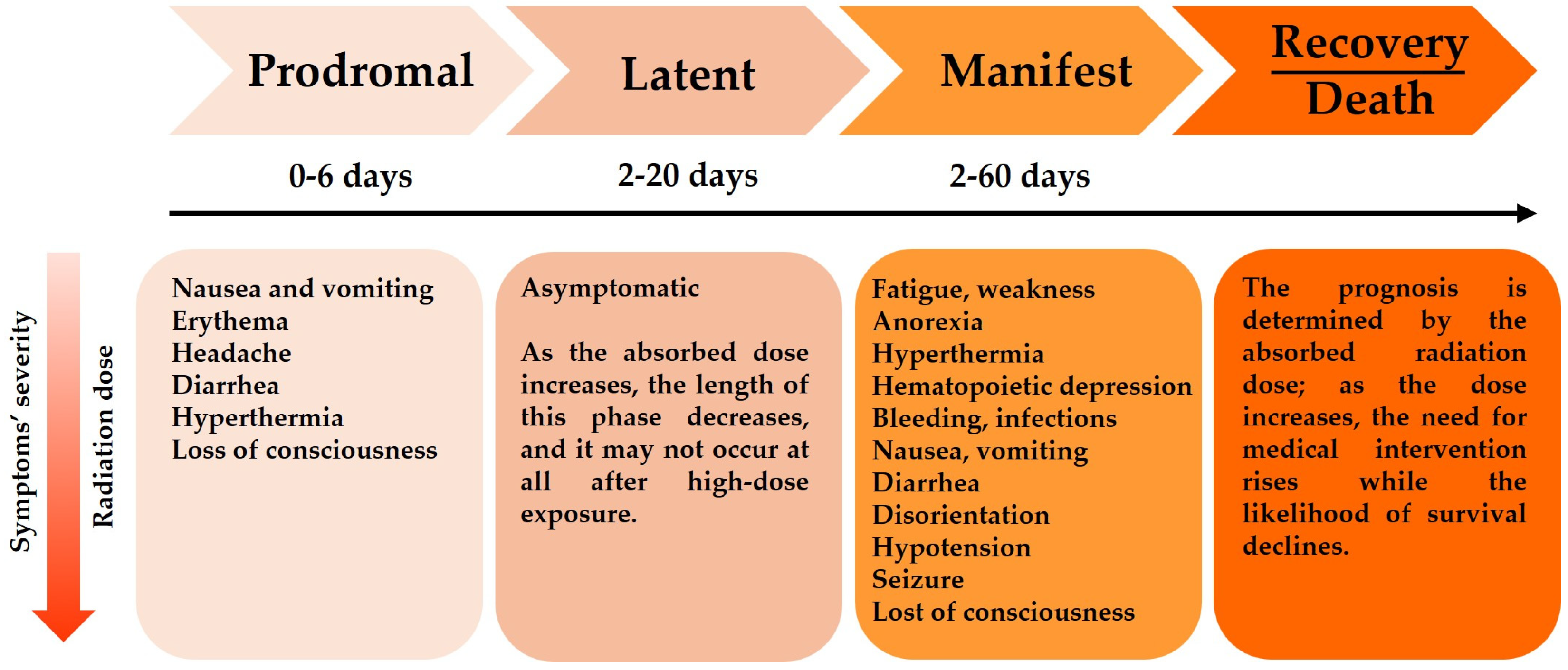
One specific health risk that must be considered when planning long-term missions in deep space is the development of acute radiation syndromes [141,142]. Acute radiation syndrome (ARSs) refers to a group of clinical manifestations developing when the human body, or a significant part of it, is exposed to a high dose of ionizing radiation over a short period [143]. Severity, duration and prognosis of ARSs depend on radiation type, exposure duration and dose rate among the others. The main parts of the body involved in this pathology are skin, hematopoietic –, gastrointestinal – and neurovascular – systems. The development of the ARS is divided into 4 phases (figure 2): prodromal, latent, manifest and recovery or death. It should be emphasized that the available information on the development of ARSs is based on observations and clinical studies conducted on humans exposed accidentally or intentionally to ionizing radiation (mainly gamma- and X-ray exposures). These studies have led to the identification of specific exposure limits below which the risk of developing ARS is negligible. For healthy adults, the threshold whole-body dose of radiation acutely delivered is ≤ 1 Gy but is lower for children and elderly [141,144].
Figure 2.
Progression and clinical manifestations of acute radiation syndromes.
During space missions the potential risk of developing ARS is mainly related to SPE, but the real consequences for human health are unknown and are still the subject of intense debate [142,145]. To account for this level of uncertainty, NASA has set a permissible exposure limit for acute radiation effects on blood-forming organs and the circulatory system at 250 mGy-eq over a 30-day period [146]. Note that Gy-eq (gray equivalent) is a unit that accounts for the different effects induced by different types of particle radiation (protons, heavy ions, etc).
2.2.2. Effects of Space Radiation on the Cardiovascular System
There is currently little direct evidence of the effects of SR on the cardiovascular system [4,21,25,142]. An epidemiological study has shown an increase in mortality due to cardiovascular diseases in Apollo astronauts (the only humans to have ever traveled beyond the geomagnetosphere) compared to non-spaceflight astronauts and astronauts who flew only in LEO [147]. However, the limited sample size does not allow to draw strong conclusions. SR has been also found to promote capillary endothelial disfunctions like age-phenotype [148].
The potential risk for cardiovascular health induced by the prolonged exposure to SR can be inferred by studies conducted on Earth [149]. Exposure to ionizing radiation, as for example, during cancer therapy or in atomic bomb survivors have been found to elicit coronary artery disease, myocardial dysfunction, valvular abnormalities, hypertension, stroke and pericardial disorders [126,150,151,152,153,154]. Preclinical in-vitro and in-vivo studies support these epidemiological and clinical findings by showing the potentially hazardous effects of radiation on cells and tissues of the cardiovascular system [142]. Exposure to Fe⁵⁶HZE ion (a major component of GCRs) has been found to induce aberrant structural and functional changes in the aorta of mice and rats resulting in the development of atherosclerotic lesions [155,156,157]. Moreover, 10 month of ⁵⁶FeHZE ion irradiation reduced angiogenesis in mice [158]. In addition, irradiation with multiple ions, in an attempt to simulate GCRs exposure, induced perivascular cardiac fibrosis in rats [159] but only mild changes in mouse heart [160].
Overall, epidemiological and preclinical studies highlight the urgent need to further deepen our understanding of the biological effects of charged particle radiation on the cardiovascular system in order to mitigate the harmful consequences for human health during and after space exploration missions.
2.2.3. Carcinogenesis Induced by Space Radiation
It is matter of fact that ionizing radiation is mutagenic and carcinogenic [161]. This evidence comes from epidemiological studies in atomic bomb survivors [162], and in people following accidentally [163] or occupationally exposure to ionizing radiation [164]. Carcinogenesis is mainly triggered by radiation-induced direct and indirect damage to nucleic acids [165,166]; if DNA repair mechanisms are overwhelmed or impaired, unrepaired DNA damage can accumulate causing cancer [166,167].
It is reasonable to assume that SR, characterized by higher LET, increases the carcinogenesis risk [168,169]. Predicting the actual risk for future long-term deep space missions is therefore essential in order to reduce cancer morbidity and mortality in astronauts. Unfortunately, this is complicated by the lack of effective predictive and preclinical models, due to the enormous differences between radiation on Earth and that potentially found in space.
A recent epidemiological study evaluated cancer incidence and mortality in 338 astronauts against US general population [170]. Overall, the study found an increase in the incidence of all types of cancer but a statistically significant decrease in mortality, confirming previous research [171,172,173]. However, a more detailed analysis revealed a specific statistically significant increase in the incidence of prostate cancer and melanoma although only in the latter case resulted in an increase also in the rate of mortality [170]. In contrast, the incidence and mortality from lung and colon cancer among astronauts were lower than in the general population. The scientific reasons behind these observations are not fully known or understood and are often not directly related to exposure to SR. For example, the observed increase of melanoma incidence and mortality is comparable to that observed in aircraft pilots [174] and seems to be related to UV radiation exposure rather than SR exposure [170,175]. Nevertheless, these data suggest the urge to increase the understanding of the long-term health risks for astronauts exposed to SR.
In vitro and in vivo studies support the idea that we should be concerned about the effects of SR, demonstrating that medium- and high-LET radiation causes damage to nucleic acid and promotes the development of cancer [168,176]. Consistently, exposure to protons or HZE ions (12C, 16O, 28Si, 48Ti, 56Fe) has been found to induce maladaptive genomic and epigenomic responses responsible for the induction of malignant transformation in several cell lines [177,178,179,180,181]. Moreover, the damages caused by high-LET particle radiation have the ability to propagate neighboring non-irradiated cells throughout a phenomenon known as “bystander effect” [182,183,184].
The carcinogenic activity of particle radiation is confirmed by studies conducted in rodents showing that heavy ion irradiation significantly enhances development and progression of several types of malignancy such as acute myeloid leukemia [185,186,187], lung cancer [188,189,190], ovarian tumors [191,192], hepatocellular carcinoma [186,187,193], intestinal tumors [194,195,196,197], mammary carcinoma [198,199] and brain tumors [189].
Overall, these findings demonstrate that a deeper understanding of the cancer risk from SR is imperative to safeguarding the health of astronauts on interplanetary and other extended missions. Specifically, SR-induced carcinogenesis should be investigated not only alone but also in the general context of space exposome. Indeed, there is evidence demonstrating an additive effect of SR and µG in the production of chromosomal aberrations [200,201].
2.2.4. Effects of Space Radiation on the Central Nervous System
The only known effect of space radiation on the central nervous system (CNS) is the perception of light flashes in condition of darkness [202]. This visual illusion has been repeatedly reported by astronauts in several space missions [203,204,205]; it is the consequence of the interaction of both protons and heavy nuclei with the visual system [206]. Available data suggests that light flashes do not impair astronauts' performance during missions and are not associated with long-term health risks [202].
Besides light flashes, the potential structural and functional alterations of CNS under SR exposure are unknown and unpredictable due to the lack of epidemiological data. A few considerations can be made starting from terrestrial observations of people undergoing cranial radiotherapy or accidentally exposed to radiation, although these data are not easily translatable to the situation in space due to differences in radiation exposure both in terms of type and intensity. The whole brain radiation therapy has been found to cause neurocognitive deficits [207] because of the damaging effects of ionizing radiation on the hippocampus [208]. Furthermore, accidental exposure to ionizing radiation has been associated with an increased risk of Parkinson's disease [209,210].
The potential detrimental effects of SR on cognitive function also come from in vivo studies, in which laboratory animals can be irradiated with heavy ions. Although these studies are affected by technical and procedural limitations, they overwhelmingly reported that exposure to HZE particles disrupt cognitive behaviours in rats and mice [83,211]. Interestingly, cognitive deficits in rodents have been observed not only at high doses but also in the range of doses predicted for a mission to Mars [212,213,214,215,216] based on measures made by the Curiosity rover [135,217]. Overall, these findings suggest that the potential effects of SR on astronauts' cognitive performance deserve greater attention and further investigation to preserve their health and to ensure the success of future long duration Mars missions.
2.3. Other Risk for Human Health Induced by Space Exposome
This section summarizes the risks to human health during space travel that cannot be traced back to a single environmental cause but are caused by the totality of the space exposome. This also includes the stress astronauts face when they have to perform complex tasks and maneuvers in a highly hostile environment, far from home and loved ones, and often with minimal margins for error.
2.3.1. Immunological Dysfunctions Following Spaceflights
The immune system is a structured defense network that evolved on Earth to protect the organism from endogenous and exogenous dangers. [218]. Once in contact with the complex and unknown set of stressors of the space exposome, human immunity reacts abnormally [219,220]. Consistently, during spaceflights several alterations on innate and adaptive immunity have been observed in astronauts, such as change in maturation, proliferation and function of several immune cell lines [221,222,223,224,225,226,227,228,229], dysregulation in cytokine secretion [119,225,228,230,231,232,233,234,235,236], changes in the human antibody repertoire [237], alteration in stress hormones levels [224,234,238]. These immunological dysfunctions occur during both short-duration and long-duration spaceflights, and some have been found to persist even after returning to Earth. Interestingly, there is evidence to suggest that the immune system has the ability to adapt to space conditions after repeated missions [229,239].
The dysregulation of the immune system following spaceflights may have several consequences. Overall, stressful conditions of the space exposome trigger a process of premature immunosenescence [234] characterized by an enhanced pro-inflammatory state resembling that observed during aging, a condition known as inflammaging [240] that may expose the organism to several immune-related diseases. Consistently, several infectious diseases have been reported in post fly medical debriefs [241]. Moreover, the sum of functional immune alterations can be considered responsible, at least in part, for the development of space fever [242] and to the reactivation and shedding of latent viruses in astronauts [233,238,243,244,245,246,247,248,249] who generally remain in asymptomatic state.
Unlike the human body, microbes appear to find a favorable environment in space [250]. Bacteria displayed increased grow rate [251,252] and virulence [253,254,255], as well as, enhanced antibiotic resistance [256,257,258,259] during spaceflight. A similar increase in virulence and resistance to antifungal agents have been observed in several strains of fungi [260,261,262,263].
Overall, the dysregulation of human immune responses, combined with the increased virulence of pathogens observed during spaceflight, poses a serious health risk to astronauts and could hinder the success of long-duration space missions.
2.3.2. Neuro-Behavioural Alterations During Spaceflights
One of the greatest challenges during long-term space missions is the need to maintain high levels of alertness and performance efficiency while dealing with multiple stressors never experienced on Earth. This requires a huge effort and can cause mental health problems [6,264,265,266]. It is important to emphasize that, in this context, the concept of "mental health problems" should not be understood as a true diagnosable mental disorder, but rather as neurobehavioral symptoms that can cause distress in astronauts and have a negative impact on the success of the mission [6]. The main neurobehavioral problems observed during spaceflight are cognitive deficits and sleep disorders. In section 2.2.4, we discussed the potential role of space radiation in altering astronauts' cognitive performance.
Sleep loss and disturbance are symptoms commonly observed during spaceflights [267]. Sleep disturbances are therefore considered a critical factor during long-term missions, as they can negatively impact astronauts' performance, alertness, emotional state and concentration, thus increasing the risk of operational errors and the success of mission objectives [267,268]. This is not surprising considering that sleep homeostasis, regulated both by internal and external factors, has evolved over time to adapt human physiology to terrestrial environmental conditions. Conversely, during spaceflight numerous factors contribute to sleep disruption, such as the lack of the natural 24-hour light-dark cycle, µG, uncomfortable environmental conditions in spacecraft and space stations (light conditions, noise, temperature), the use of uncomfortable sleeping bags, alterations in the circadian pacemaker (body temperature and cortisol levels), cognitive overload and high workload [6,269,270,271,272,273,274,275,276]. Evidence has consistently shown that both the duration and quality of astronauts' sleep are adversely affected during spaceflight. The average daily sleep time measured in astronauts on several space missions was about 6 hours or less, an amount of time lower than that observed pre- and post-flight [268,277,278]. Overall, sleep duration in space is lower than that recommended to maintain good health and optimal performance [279]. Furthermore, sleep during space missions is of poor quality and shallower. Sleep recordings have shown that the structure and duration of REM and NREM sleep have been altered during spaceflight [269,280]. A study also found that sleep during spaceflight was interrupted by an average of 4.6 awakenings per night, lasting an average of 6.5 minutes [272]. Finally, the impact of sleep disorders is confirmed by the high number of astronauts who had to take sleeping pills during space missions [278,281]. Besides pharmacological intervention several countermeasures are under investigation to restore sleep homeostasis during space missions such as optimization of work-rest phases, improvement on spacecraft/spaceship environment, light therapy and human intestinal flora therapy [267,282].
An additional issue that should be considered during long-duration space missions is the emotional response of individuals [266]. Although no data is available reporting emotional impairments in astronauts during spaceflight, evidence from ground-based analogues (submarines, polar stations, or space mission simulations) suggests the potential emergence of emotional and psychosocial disturbance [283,284,285]. Several stressors have been identified as potentially contributing to altered human emotional states and social conflict in space: confinement, social isolation, homesickness, habitat design, cultural barriers, individual personality, and crew dynamics [284,286,287,288,289,290,291].
Overall, scientific research has brought to light the strong impact of space stressors on human mental health and the consequent need to develop appropriate countermeasures in the planning of long-term space missions.
2.3.3. Dermatologic Alterations During Spaceflights
The skin is the largest and outermost organ in the body and performs multiple physical, chemical, physiological, and immunological functions [292]. It is therefore reasonable to expect that the skin is highly sensitive to environmental stressors such as those found in space [293]. The most common dermatologic symptoms evidenced during spaceflight are skin rashes [294,295,296,297], dryness [297,298], itching [297,298], peeling (mainly in hands and feet) [294,297] and skin sensitivity [296,297]. Evidence exists also in the development of erythema and skin sensitivity upon landing after 340 days spent in space [299].
The triggers of skin diseases are not yet fully identified and understood. A clinical case has highlighted the possibility that dermatitis may arise due to the reactivation of the herpes simplex virus (HSV-1) during long-duration spaceflights [300]. Poor hygiene [297], the use of no-rinse personal care products [296,299,301] or disinfecting wipes [302], low humidity in the spacecrafts [296,301], and the prolonged contact with constricting suits used during extravehicular activities [303] are also considered responsible, at least in part, of the dermatologic manifestations observed during space missions.
Two longitudinal studies have attempted to identify changes in skin structure and physiology that might explain astronauts' skin reactions in space: the SkinCare and Skin-B studies. The SkinCare study evidenced a thinning of the stratum corneum (the outermost layer of the epidermis) and a decrease on skin elasticity [304], but unfortunately, the Skin-B study fails to confirm these results [297]. A further study reported a thinning of the living layer of the epidermis, a decrease in melanin concentration and a general decrease in skin cell metabolism [295]. The conflicting results gathered from these 3 studies can be largely attributed to the limited sample size used (1-6 subjects).
Overall, this evidence suggests that much more research is needed to clarify the causes and mechanisms of skin disorders observed in space, although it is worth emphasizing that skin disorders during spaceflight do not currently represent a critical issue that could hinder the success of a space mission.
3. Pharmacological Interventions in Space
In the previous section we described how human physiology, which evolved to adapt to terrestrial environmental conditions, is challenged by the space exposome. As a result, multiple health dysfunctions occur during spaceflights that require appropriate drug treatment [302]. From this need, a new discipline arises, astropharmacy, an emerging interdisciplinary field dedicated to understanding and addressing the pharmaceutical and pharmacological isssues associated with human spaceflight. Broadly speaking, the harsh conditions found in space profoundly affect drug stability, pharmacokinetics (PK), pharmacodynamics (PD), and overall clinical outcomes [8]. Moreover, as human missions extend beyond LEO toward the Moon, Mars, and possibly farther, the capacity to develop, transport, store, protect and even manufacture pharmaceuticals in situ represents critical aspects to support astronaut health during long-duration missions [9].
The traditional pharmaceutical supply chain relies heavily on regular resupply, cold-chain logistics, and stable environmental conditions, all of which are compromised in space. For long-duration missions, autonomous pharmaceutical strategies must replace Earth-dependency. This includes developing formulations with extended shelf life, understanding altered drug metabolism in space, and utilizing advanced technologies such as 3D printing and synthetic biology, [7].
Astropharmacy also intersects with multiple scientific disciplines, such as pharmacology, pharmacognosy, systems biology, materials science, and aerospace engineering. Furthermore, it plays a critical role in safeguarding astronaut health by ensuring medication availability and efficacy for acute and chronic conditions, psychological support, immune regulation, and radioprotection [305]. The field is not only foundational to space medicine but also serves as a testing ground for innovations that may translate back to Earth-based pharmaceutical challenges, especially in remote or extreme environments.
3.1. Medical Care in Spaceflight
On board the International Space Station (ISS), astronauts have access to a carefully designed medical kit intended to address the most common health issues encountered during long-duration missions. The kit is organized into color-coded packages, each serving a specific purpose: white for “convenience” medicines used for frequent conditions, red for “emergency” medicines, purple for “oral” medicines, and brown for “topical and injectable” treatments. Within these kits are FDA-approved drugs, including analgesics, anti-infectives, local anesthetics, antiallergics, corticosteroids, hormones, and medications targeting gastrointestinal, neurological, cardiovascular, and respiratory diseases [10].
The main categories include treatments for motion sickness, such as meclizine and promethazine, and a range of pain relievers including acetaminophen, ibuprofen, hydrocodone, and, in specific situations, ketamine. Sleep disturbances — which occur about ten times more frequently in space than on Earth — are managed with melatonin, zolpidem, and modafinil. Respiratory problems and allergic reactions are treated with decongestants, antihistamines, and injectable epinephrine for emergencies. The kit also contains gastrointestinal drugs such as bismuth subsalicylate, loperamide-based anti-diarrheals, stool softeners, acid reflux medications, and anti-nausea treatments. In addition, it includes antibiotics such as azithromycin and tobramycin, antivirals like valacyclovir, antifungals, corticosteroids, hormones, and medications for chronic or acute conditions such as high blood pressure, seizures, and anxiety (table 1) [306,307].

Table 1.
Spacecraft formulary drugs.
| Category | API (Active Pharmaceutical Ingredients) | Main Uses in Space |
| Motion sickness | Scopolamine; Promethazine; Meclizine; Dimenhydrinate | Prevention and treatment of space motion sickness (nausea, vomiting, dizziness) due to adaptation to microgravity |
| Pain management | Acetaminophen (Paracetamol); Ibuprofen; Aspirin; Tramadol; Oxycodone | Relief of muscle pain, headache, joint or exercise-related pain, and minor acute or chronic pain |
| Sleep aids/Alertness | Zolpidem; Melatonin; Diphenhydramine; Modafinil; Caffeine | Regulation of disturbed circadian rhythms; sleep promotion; alertness maintenance during long shifts or after disrupted sleep |
| Respiratory/allergy | Loratadine; Cetirizine; Pseudoephedrine; Fluticasone; Albuterol (Salbutamol) | Management of allergies, nasal congestion, respiratory irritation, and cough in the closed spacecraft environment |
| Gastrointestinal | Omeprazole; Ranitidine; Loperamide; Ondansetron; Metoclopramide | Treatment of nausea, reflux, diarrhea, constipation, and other digestive disturbances linked to microgravity and space diet |
| Anti-infectives | Amoxicillin; Ciprofloxacin; Azithromycin; Mupirocin; Clotrimazole | Prevention and treatment of bacterial, skin, or urinary infections during space missions |
| Anti-inflammatory / Hormonal | Prednisone; Hydrocortisone; Dexamethasone; Naproxen | Management of acute inflammation, allergic reactions, edema; modulation of immune response in-flight |
| Chronic conditions | Levothyroxine; Insulin; Amlodipine; Metoprolol; Sertraline | Management of preexisting chronic conditions (hypertension, diabetes, hypothyroidism, anxiety/depression) during long-duration missions |
Not all treatments are related to spontaneous symptoms: at least 10% of drug use is necessary to treat consequences linked to specific operational activities, including extravehicular operations, exercise protocols, or adjustments to work schedules [302]. Statistics indicate that the most frequently used medications aboard the ISS are those for insomnia, pain, nasal congestion, and allergies — a trend similar to that seen in Shuttle missions and in terrestrial ambulatory medicine, although with a significantly higher reliance on sleep aids in orbit [268,308]. Certain events, such as two treatment failures in cases of skin rashes, raise questions about the efficacy or suitability of some drugs in microgravity. These findings suggest that operational adjustments — for example, in internal lighting, shift management, or the design of exercise equipment and extravehicular suits — could help reduce the overall need for pharmacological interventions [309].
3.2. Stability and Degradation of Pharmaceutical Compounds in Space
Drug stability is profoundly affected by the extraterrestrial environment. Studies conducted on the ISS have revealed that many medications degrade more rapidly in space than on Earth [310]. Environmental conditions like elevated levels of radiation, variable temperatures, and phase separation triggered by µG can lead to both chemical and physical degradation of pharmaceuticals [311]. In particular, radiation may disrupt molecular structures by breaking chemical bonds and forming reactive oxygen species, which can oxidize active pharmaceutical ingredients (APIs) [312].
Additionally, µG influences sedimentation and dissolution behavior in multi-phase drug formulations, particularly those involving suspensions or emulsions [311]. The degradation of critical medications—including antibiotics, antihistamines, analgesics, and cardiovascular agents—has raised concerns about their long-term efficacy during missions exceeding six months [10]. Research has shown that some drugs fall below potency thresholds within 12–18 months of storage in space [313].
To address these concerns, pharmaceutical packaging is being redesigned with radiation-shielding materials, oxygen-absorbing inserts, and thermal insulation. Lyophilized or powdered formulations are being evaluated as more stable alternatives [312]. Moreover, predictive modeling of drug degradation kinetics under space-like conditions is helping to inform pre-mission planning and pharmaceutical inventory management strategies [7].
3.3. Pharmacokinetics and Pharmacodynamics in Altered Physiology
The human body undergoes profound physiological changes during spaceflight, and these changes strongly influence pharmacokinetics (PK) and pharmacodynamics (PD). Fluid redistribution leads to decreased plasma volume and altered drug concentrations. Gastrointestinal motility and transit time are affected, potentially impacting drug absorption profiles. Additionally, microgravity-induced alterations in hepatic enzyme activity and renal clearance pathways modify drug metabolism and excretion [8].
These alterations complicate dosing regimens and therapeutic monitoring. For example, altered gastric emptying may delay oral drug absorption, while altered cytochrome P450 enzyme expression may unpredictably increase or decrease hepatic metabolism [314]. Intramuscular injections may cause erratic absorption due to alterations in muscle mass and perfusion.
Therefore, space-specific PK/PD data are essential for rational dosing strategies. However, most of the existing data are derived from animal models or short-term human studies [315]. The use of wearable biosensors and point-of-care diagnostic devices can facilitate personalized medicine in space.
These challenges underscore the need to integrate pharmacogenomics, physiologically-based pharmacokinetic (PBPK) modeling, and AI-based simulations to predict individual drug responses in [316] µG. Creating a database of space-adapted drug profiles is a key goal for future missions.
3.4. In-Situ Pharmaceutical Manufacturing
Due to the logistical limitations of resupplying medications from Earth, in-situ pharmaceutical manufacturing (ISPM) is a core focus of astropharmacy. ISPM includes technologies such as 3D printing of oral solid dosage forms, microfluidic synthesis of small molecules, and bioengineered microbial platforms [9]. These systems must be compact, modular, and capable of operating in low-resource environments.
3D printing of personalized tablets has been demonstrated with active ingredients and controlled-release matrices, enabling on-demand medication production tailored to individual astronauts [317]. Microbial production platforms, particularly engineered E. coli, Saccharomyces cerevisiae, and Chlamydomonas reinhardtii, are being designed to synthesize essential drugs such as acetaminophen and insulin [318]. These biotechnological systems offer low-energy, renewable production pathways suitable for closed-loop life support systems.
The use of plants as bioreactors is another promising avenue. By integrating gene circuits into fast-growing crops, it is possible to generate complex molecules like vaccines, hormones, and enzymes [319,320]. This approach, known as molecular pharming, merges with the fields of synthetic biology and astrobotany, and holds promise for decentralizing drug manufacturing during interplanetary travel.
3.5. Regulatory and Operational Challenges
Establishing pharmaceutical manufacturing and usage protocols in space presents a host of regulatory, safety, and operational hurdles. Current pharmacopoeial standards—such as those from the USP, EMA, and WHO—are designed for terrestrial conditions and must be adapted for space. Stability testing, shelf-life validation, and quality control processes must be redefined under microgravity and radiation exposure [7,306].
Moreover, regulatory frameworks need to encompass bioengineered medications and biomanufacturing systems. Issues surrounding microbial containment, gene transfer risks, and biosafety must be addressed, particularly when using genetically modified organisms in closed habitats. Validation protocols for 3D printed or biosynthetically derived pharmaceuticals must ensure reproducibility, sterility, and potency [321,322].
Operationally, space pharmacology requires trained personnel or highly automated systems capable of identifying adverse drug events, preparing formulations, and conducting real-time diagnostics. Artificial intelligence and telemedicine may support clinical decision-making, but onboard systems must also allow for autonomy in case of communication delays [323].
The establishment of a dedicated space pharmacopeia and international regulatory consensus will be essential. NASA, ESA, and other space agencies are currently engaging with pharmacological societies to draft guidelines and protocols for extraterrestrial pharmaceutical operations [323].
4. Role of Medicinal Plants in Space Pharmacy
In section 3, we described how astropharmacy helps astronauts prevent and treat ailments caused by the harmful environmental conditions that can be encountered during space missions [324,325]. Starting from this evidence, we wonder which role medicinal plants can play in maintaining astronauts in good health. We hypothesize that medicinal plants, long utilized on Earth for their therapeutic and symbolic value, may maintain their potential applications also outside Earth boundaries (Figure 3) [326,327]. Their phytochemical diversity, ability to be cultivated in controlled environments, and multifunctional benefits make them suitable candidates for enhancing astronaut health and mission sustainability, specifically in the context of long-term space travels and in the future extraterrestrial colonization missions (Moon and Mars) [328]. Overall, it is expected that the use of medicinal plants, alone or in combination with modern medicine, can result in effective and safer treatments [329]. Accordingly, based on the most common medical problems encountered by astronauts in space and the main drugs used to treat them, we have selected 17 medicinal plants that could have beneficial effects on human health during a space mission (table2) [330]. Ultimately, paragraph 4.1 of the review aims to provide a tentative answer to the question: if you were planning to colonize a distant planet, what medicinal plants would you bring with you?
Section 4.3 emphasized that plants can not only be used as medicines but can also potentially serve as candidates for onboard biomanufacturing platforms through plant genetic engineering and tissue culture techniques [331,332,333]. This could contribute to reduces the dependency on Earth-based pharmaceutical supply chains and opens the door for real-time, mission-specific drug production [334].
The psychological benefits of plants in space environments also deserve emphasis (section 4.4), since it has been found that interaction with plants reduce stress and improve mood in humans [335,336]. Plants could then provide a living connection to Earth, offering multifunctional asset for future space missions by providing nutritional, pharmacological, psychological, and ecological advantages, supporting human health and creating a more hospitable habitat.
4.1. Therapeutic Potential of Phytochemicals in Space Medicine
4.1.1. Use of Medicinal Plants as Alternative Medication for Sleep Disorders
As previously described, sleep disturbance during space missions represents a common and critical concern for astronauts. Consequently, a large proportion of them (70%-80%) reported the acute (≤ 7 days) or recurring (> 7 day) use of sleep-promoting agents [278,302]. Zolpidem, zaleplon, melatonin, temazepam, quetiapine fumarate and eszopiclone are the main hypnotics used by astronauts [278,302].
Starting from evidence coming from folk medicine, it has been found that many phyto-preparations elicit hypnotic effects in preclinical models of insomnia [337,338]. Sleep-promoting activity in plants can arise from many different parts of the plant, including leaves, roots, bark, fruits, seeds, and flowers, and is generally induced by modulation of the GABAergic neurotransmission system. Interestingly, the therapeutic potential of some of these herbs has been confirmed by clinical trials and the most promising are Valeriana officinalis L., Croccus sativus L., Lavandula angustifolia Mill. and Melissa officinalis L. (table 2) [337,338]. The main properties of each plant as well as the preclinical and clinical evidence supporting their therapeutic potential are described in the supplemental materials file.
Numerous preclinical studies support the promising beneficial effects of other medicinal plants in alleviating sleep disorders, but clinical evidence of their efficacy is limited and needs to be further confirmed. Among them the most promising are: Matricaria chamomilla L., Aloysia citrodora Palau, Citrus aurantium L., Lactuca sativa L. and Ziziphus jujuba Mill [337,339].
4.1.2. Use of Medicinal Plants as Alternative Medication for Pain
There is evidence that during space missions, astronauts often experience pain (muscle, joint, and back) and headaches that require medication [302]. Ibuprofen was the most used analgesic followed by acetaminophen and NSAIDs [302].
The plant kingdom has been very generous with pharmacologists, giving them powerful painkillers and anti-inflammatory agents, such as morphine (Papaver somniferum L.), delta(9)-tetrahydrocannabinol and cannabidiol (Cannabis sativa L.) and salicin (Salix alba L.). Despite the potential harmful side effects associated with their use, these natural compounds have represented a real game changer in pain management.
Interestingly, these compounds represent only the tip of the iceberg of the immense repertoire of medicinal plants with potential low to moderate analgesic activity [340,341]. The most promising herbs which may be used ad adjuvant for pain relief are Capsicum annum L., Curcuma longa L., Zingiber officinale Roscoe, Salix genus, Harpagophytum procubens (Burch.) DC. ex Meis, Harpagophytum zeyheri Decne. and Boswellia serrata Roxb. (table 2). The main features of each plant, together with the available preclinical and clinical findings that support their therapeutic potential, are provided in the supplemental materials file.
Finally, although numerous preclinical studies suggest that additional medicinal plants may help relieve pain and inflammation, clinical evidence remains scarce and requires further validation. Among them the most promising are: Arnica montana L. (muscle pain) and Tanacetun parthenium (L.) Sch.Bip. (migraine) [340].
4.1.3. Use of Medicinal Plants as Alternative Medication for Space Motion Sickness
A high percentage of astronauts experience symptoms attributable to SMS, particularly during the first few days in space and upon return to Earth [93]. Current medical approaches to treating SMS primarily involve promethazine and scopolamine (a plant-derived alkaloid from the Solanaceae family), although these medications may cause adverse effects including urinary retention, sedation, drowsiness, and amnesia [93,302].
Table 2.
Medicinal plants selected for their potential therapeutic utility during space missions.
| Ailment | Medicinal plant | Main active ingredients | Pharmacological effects | Clinical studies |
| Sleep disturbance | Valeriana officinalis L. | Sesquiterpenes (valerenic acid), valepotriates, alkaloids [342,343] | Hypnotic, antioxidant, antimicrobial, anti-inflammatory, sedative, anxiolytic, spasmolytic, anticonvulsant, cytoprotective, neuroprotective activity [343] | [344,345,346,347,348,349,350,351] |
| Crocus sativus | Crocin, safranal and picrocrocin [352] | Hypnotic, antioxidant, anti-inflammatory, anxiolytic, antidepressive, antiepileptogenic, neuroprotective activity [353,354] | [355,356,357,358] | |
| Lavandula angustifolis Mill | Linalool, linalyl acetate [359] | Hypnotic, analgesic, stress relieving, anxiolytic, anti-inflammatory activity [360,361] | [362,363,364,365,366,367,368,369,370] | |
| Melissa officinalis L. | Volatile compounds, triterpenes, phenolic acids, and flavonoids [371] | Antioxidant, anti-inflammatory, hypnotic, antidepressive, neuroprotective, nootropic activity [372,373] | [374,375,376,377,378,379] | |
| Pain | Capsinum annum L. | Capsaicin, carotenoids [380] | Analgesic, antioxidant, anti-inflammatory, antifungal, antimicrobial, gastroprotective, antihyperlipidemic, immunomodulatory activity [380] | [381,382,383,384,385,386] |
| Curcuma longa L. | Curcumin, demethoxycurcumi, and bisdemethoxycurcumin [387] | Analgesic, antioxidant, anti-inflammatory, antimicrobial, anti-diabetic, hepatoprotective activity [388,389] | [390,391,392,393] | |
| Zingiber officinale Roscoe | Phenolic compounds (gingerols, shogaols, paradols, zingerone), terpenes (zingiberene, α-curcumene, β-sesquiphellandrene) [394] | Analgesic, antiarthritic, anti-inflammatory, antioxidant, gastroprotective, hepatoprotective activity [395] | [396,397,398,399] | |
| Willow bark | Salicin, flavonoids, tannins proanthocyanidins [400] | Analgesic, antiarthritic, anti-inflammatory, antimicrobial activity [400] | [401,402,403,404] | |
| Harpagophytum procubens (Burch.) DC. | Iridoid glycosides (harpagoside, harpagide, procumbide, 8-O-p-Coumaroylharpagide) [405] | Analgesic, antioxidant, anti-inflammatory, antimicrobial, anti-diabetic activity [406] | [407,408,409,410,411,412] | |
| Boswellia serrata Roxb | Boswellic acid [413] | Analgesic, antiarthritic, anti-inflammatory, antioxidant, anticancer, neuroprotective activity [413] | [414,415,416,417,418] | |
| SMS | Zingiber officinale Roscoe | Phenolic compounds (gingerols, shogaols, paradols, zingerone), terpenes (zingiberene, α-curcumene, β-sesquiphellandrene) [394] | Analgesic, antiarthritic, anti-inflammatory, antioxidant, gastroprotective, hepatoprotective activity [395] | [419,420,421,422,423] |
| Skin diseases | Aloe vera (L.) Burm. f. | Polysaccharides (acemannan), anthraquinones, enzymes, vitamins, minerals [424] | Antioxidant, wound-healing modulatory, immunomodulatory, anti-inflammatory, antimicrobial, gastroprotective [424,425] | [426,427,428,429,430,431] |
| Curcuma longa L. | Curcumin, demethoxycurcumi, and bisdemethoxycurcumin [387] | Analgesic, antioxidant, anti-inflammatory, antimicrobial, anti-diabetic, hepatoprotective activity [388,389] | [432,433,434,435] | |
| Ailment | Medicinal plant | Main active ingredients | Clinical studies | |
| Skin diseases | Calendula officinalis L. | Triterpenoids, flavonoids, saponins, carotenoids, and essential oils [436] | Wound-healing modulatory, anti-inflammatory, antioxidant, antimicrobial, anti-fungal, anti-cancer and analgesic activity [436] | [437,438,439,440,441] |
| Camellia sinensis (L. Kuntze | Polyphenols (epigallocatechin gallate), purine alkaloids [442] | Antioxidant, anticancer, antidiabetic, neuroprotective, immunomodulatory activity [442,443] | [444,445,446,447] | |
| Hypericum perforatum L. | Naphthodianthrones (hypericin), phloroglucinols (hyperforin), flavonoids (rutin, quercetin, hyperoside) [448,449] | Wound-healing modulatory, antioxidant, anti-inflammatory, antimicrobial, anticancer and antidepressant [448,450] | [451,452,453,454] | |
| Stress | Panax ginseng Meyer | Triterpene saponins (ginsenosides), polysaccharides, peptides, alkaloids, polyacetylenes, phenolic compounds [455] | Anti-inflammatory anti-fatigue, antioxidant, immunomodulatory, nootropic, neuro-protective cardioprotective activity [456] | [457,458,459,460,461,462,463] |
| Rhodiola rosea L. | Phenylpropanoids (rosavins), phenylethanoid derivatives (salidroside and tyrosol), flavonoids, monoterpenes, triterpenes, phenolic acids [464,465] | Anti-fatigue, antioxidant, anti-inflammatory, cardioprotective, neuroprotective, anxiolytic, antidepressant and nootropic activity [465]. | [466,467,468,469,470,471,472,473] | |
| Withania somnifera (L.) Dunal | Steroidal lactones (withanolides), alkaloids, sitoindosides, flavonoids, saponins [474] | Anti-inflammatory, antioxidant, anxiolytic, immunomodulatory, neuroprotective, antitumoral and anti-fatigue [475,476,477] | [478,479,480,481,482,483,484,485,486,487,488,489] |
SMS, Space Motion Sickness.
Ginger rhizome extract is a common natural remedy used on Earth to prevent symptoms of motion sickness, and several clinical studies have provided promising evidence of its efficacy [419,420,421,422,423,490]. While the precise mechanism is still not fully understood, ginger may alleviate certain symptoms by preventing gastric dysrhythmias and increasing plasma vasopressin [421].
4.1.4. Use of Medicinal Plants as Alternative Medication for Skin Diseases
Skin diseases, including eczema, psoriasis, acne, dermatitis, and wound infections, are among the most common human disorders and significantly impact physical, social, and psychological well-being [491]. In the context of spaceflight, however, astronauts face additional and distinctive dermatological challenges. During both short- and long-duration missions they report erythema, burning or itching skin, dryness, increased sensitivity, delayed wound healing, thinning of the epidermis and dermis, changes in skin microbiota, and higher susceptibility to infections [293,492,493]. Conventional treatments rely heavily on corticosteroids, antibiotics, antifungals, and immunosuppressants; while effective, they are often associated with adverse reactions such as skin thinning, microbial resistance, and systemic toxicity [494]. In recent decades, there has been a growing interest in the use of medicinal plants as complementary or alternative approaches for skin care and dermatological therapy [495]. Plants are a rich source of bioactive compounds with anti-inflammatory, antioxidant, antimicrobial, and wound-healing properties that can contribute to restoring skin homeostasis.
The most promising medicinal plants used for dermatological conditions are Aloe vera (L.) Burm. f., Calendula officinalis L., Curcuma longa L., Camellia sinensis (L.) Kuntze and Hypericum perforatum L. provide compelling evidence of their dermatological benefits, supported by both traditional use and modern clinical validation (table 2). These plants act through multiple mechanisms, including modulation of inflammatory pathways, enhancement of wound healing, and protection against oxidative stress. The main features of each plant, together with the available preclinical and clinical findings that support their therapeutic potential, are provided in the supplemental materials file.
Finally, despite folk claims and encouraging preclinical findings, clinical evidence for additional medicinal plants in skin health remains insufficient. Among them, the most known are: Matricaria recutita L., Azadirachta indica A. Juss., Oenothera biennis L., Glycyrrhiza glabra L. and Centella asiatica (L.) Urb. [496,497].
4.1.5. Potential Use of Adaptogens to Increase Resilience
In Section 2 we have described as deep space missions pose serious physical and psychological challenges to astronauts. Safeguarding human health and performance is then a critical objective, requiring the development of strategies that enhance mental, physical, and emotional resilience. Adaptogen plants may hold significant promise in this scenario, with their believed ability to boost mental and physical strength. An adaptogenic plant, or adaptogen, is a natural substance, usually derived from herbs, that non-specifically helps the body adapt to stress, restore balance, and improve resilience to physical, emotional, or environmental stressors [498]. Adaptogenic plants are also expected to exhibit minimal side effects and provide a mild stimulatory effect without disrupting sleep quality or excessively accelerating energy metabolism [498]. The adaptogenic effect results from a synergistic interaction among multiple bioactive compounds that act simultaneously engaging various biological pathways. Overall, this multi-targeted mechanism supports homeostasis by modulating the nervous, endocrine, and immune systems, enhancing the body's capacity to adapt to stress and promoting well-being.
The most investigated medicinal herbs for their adaptogenic activity are Panax ginseng Meyer, Rhodiola rosea L. and Withania somnifera (L.) Dunal (table 2). Details on each plant’s properties and supporting preclinical and clinical evidence are available in the supplementary material file.
Other plants have been traditionally recognized for their adaptogenic properties, but the extent of clinical evidence substantiating these claims is minimal. Among them the most relevant and promising are Eleutheroccus senticosus (Rupr. et Maxim.) Maxim. (commonly known as Siberian ginseng) [499] and Schisandra chinensis (Turcz.) Baill. [500].
4.2. Phyto-Biomanufacturing: Synthetic Pharmacognosy for In Situ Production of Active Compounds
Besides the direct use of plant extracts for medicinal purposes, plants could be also useful as biomanufacturing platform. Phyto-biomanufacturing refers to the utilization of plants as biofactories to produce pharmacologically active compounds [331,333,501,502]. In the context of long duration space missions, this concept becomes particularly valuable as a means of ensuring pharmaceutical self-sufficiency [503,504]. Given the high costs, restricted payload capacity, and degradation risks of storing conventional pharmaceuticals in hostile environments, producing therapeutics in situ through plant-based systems could provide a sustainable and flexible alternative, paralleling advances already achieved with microbial platforms [505,506].
The intersection of pharmacognosy and synthetic biology could revolutionize the therapeutic potential of phytopharmaceuticals in space missions [507]. Pharmacognosy provides the foundation for understanding the chemical diversity and pharmacological potential of natural products, it also ensures that the bioactivity, safety, and pharmacokinetics of these engineered compounds are well understood [508]. Analytical tools from pharmacognosy—such as LC-MS/MS, NMR, and bioassays—are essential for characterizing plant extracts, confirming compound identity, and assessing efficacy [509]. The integration of these disciplines ensures a balance between innovation and therapeutic reliability [503,504]. Synthetic biology offers the tools to manipulate and enhance these pathways, enabling precise, scalable, and tailored therapeutic production [510]. Medicinal plants naturally synthesize a wide range of secondary metabolites including alkaloids, terpenoids, and polyphenols, which form the basis of many conventional drugs. Advances in metabolic engineering now enable enhanced synthesis of these compounds by modulating specific biosynthetic pathways. For example, metabolic engineering has been employed to increase artemisinin production in Artemisia annua and morphine precursors in Papaver somniferum [511,512]. These techniques can be extended to compact, fast-growing plants suitable for space cultivation.
In addition, innovative tools such as CRISPR-Cas9 and pathway reconstruction, further expand the possibilities of phyto-biomanufacturing [513]. Plants can be engineered to express therapeutic proteins such as vaccines, antibodies, and hormones [513,514]. Instead of storing large volumes of pre-manufactured drugs, a compact cultivation unit could be used to grow engineered plants that produce specific drugs on demand [333,510]. For instance, plants expressing recombinant human insulin or granulocyte colony-stimulating factor (G-CSF) could become part of a decentralized medical supply strategy during missions to Mars or lunar habitats [515] Likewise, space-grown Nicotiana benthamiana expressing monoclonal antibodies or vaccines could be harvested, purified, and administered to astronauts within a closed-loop system [516,517].
Alongside whole-plant systems, tissue culture and plant cell suspension systems could offer an additional and alternative method of producing bioactive molecules in confined space habitats [518,519]. These systems can operate in bioreactors, providing high yields of specific molecules without the need to grow whole plants [516]. Such approaches minimize biomass requirements and allow for precise control of growth conditions and compound standardization [519]. The development of portable and compact phytoreactors designed for space environments is an active and promising area of research [520].
Overall, phyto-biomanufacturing may then represent a transformative approach to space pharmacy, merging plant science with biotechnology to create efficient and sustainable therapeutic platforms. By leveraging the natural synthetic capacity of plants, future space missions could achieve greater autonomy, reduce mission risk, and enable personalized, mission-specific pharmacotherapy. In other words, the synergy between synthetic biology and pharmacognosy transforms medicinal plants into programmable platforms for space medicine.
4.3. Psychological and Environmental Benefits for Astronauts
In addition to their pharmacological applications, medicinal plants could provide profound psychological and environmental benefits during space missions. As previously described, the confined, isolated, minimalist and monotonous nature of extraterrestrial habitats—such as spacecraft, space stations, or future lunar and Martian outposts—can lead to heightened stress, mood disorders, and cognitive fatigue among astronauts [266]. Integrating green environments into these habitats may significantly alleviate such effects.
Consistently, several studies recommended to include plant life in space habitats of future missions [6,521].
Plants are known to have positive effects on human psychological health [335,336,522,523]. This evidence is one of the founding elements of the concept of biophilia, the innate human tendency to seek connection with nature and other forms of life [524]. Studies in confined and isolated environments on Earth, such as Antarctic stations [525], or during COVID-19 pandemic [526] confirmed this evidence. Even passive interaction with plants—visual contact, scent, or caring for them—has been shown to foster psychological well-being [522]. The act of growing and tending to plants could offers astronauts a form of leisure and emotional grounding, promoting mindfulness and mitigating feelings of isolation [527]. Moreover, as described in the supplemental material file, species like Lavandula angustifolia and Melissa officinalis could contribute to mental wellbeing with their aromatic properties [379,528]. To maximize health benefits provided by plants, it would be desirable to select multipurpose species that combine therapeutic properties with high aesthetic or olfactory value. [336,529]. Future research may then explore genetically enhanced plants designed to emit specific volatile organic compounds (VOCs) for mood enhancement [530].
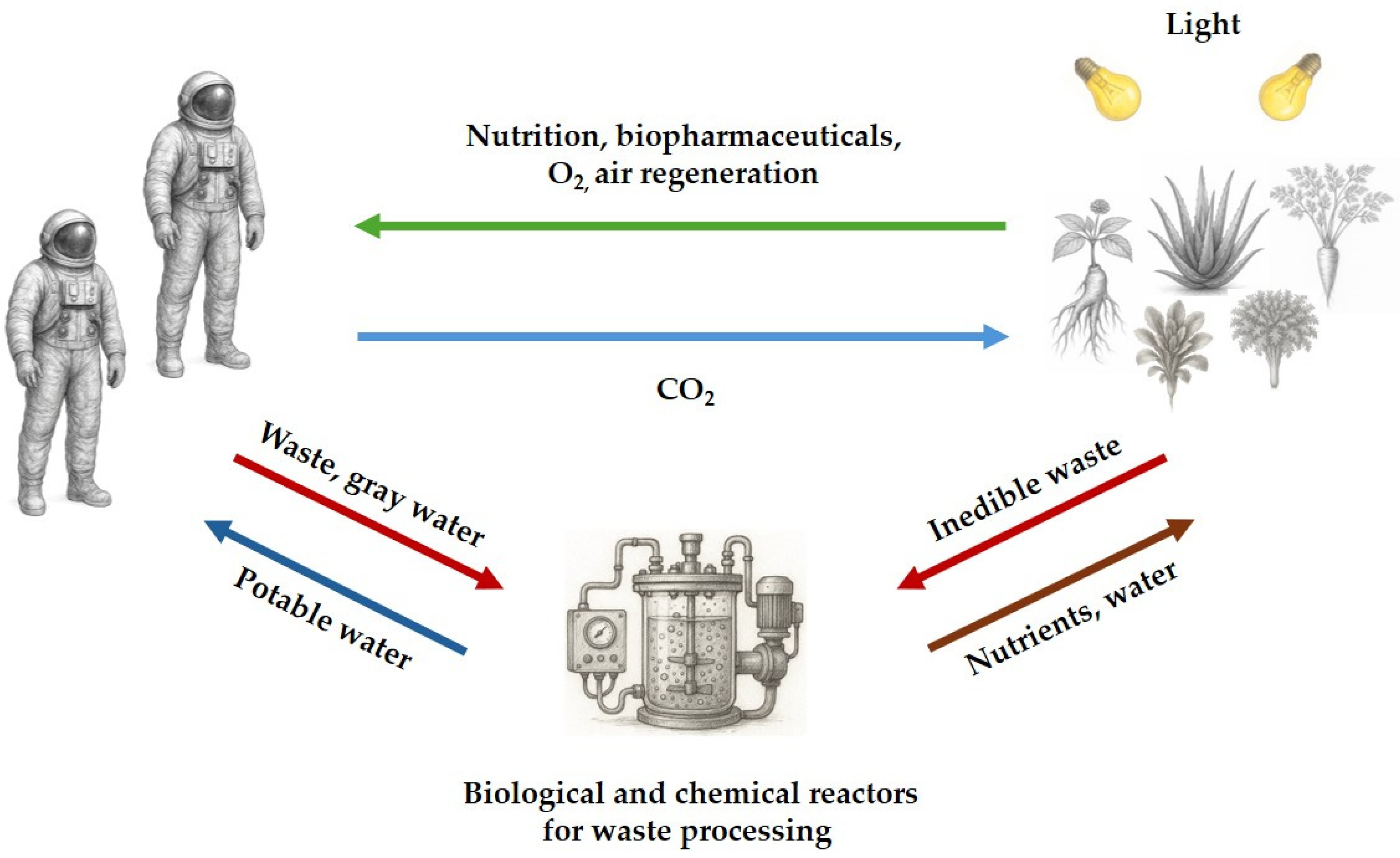
From an environmental standpoint, plants help regulate atmospheric composition. Through photosynthesis, they absorb carbon dioxide and release oxygen, contributing to air revitalization within closed-loop life support systems [531,532]. Moreover, transpiration from plant leaves can contribute to humidity regulation and water recycling [533]. The integration of medicinal plants into Bioregenerative Life Support Systems (BLSS) adds a functional layer to habitat sustainability (figure 4) [532].
In summary, plants can be seen not just as a pharmaceutical or nutritional resource but as a potential integral component of a supportive space habitat. Their contributions to psychological resilience, environmental stability, and multisensory enrichment make them invaluable allies in the human pursuit of long-duration extraterrestrial exploration.
Figure 4.
Schematic diagram of Bioregenerative Life Support Systems (BLSS).
5. Challenges and Future Perspectives
Life in space puts a strain on the physical and mental health of humans. In light of the anticipated rise in space exploration and the potential establishment of human settlements on the Moon and Mars, it is crucial to gain a comprehensive understanding of how the human body responds and adapts to the space environment, as well as to develop effective pharmacological interventions suited to such extreme conditions. Within this scenario, medicinal plants have the potential to continue serving as a natural and effective means of supporting human well-being in extraterrestrial environments. Recognizing the untapped potential of this understudied domain, we have then assembled a preliminary selection of medicinal plants that may offer solutions to the most pressing medical needs reported during space missions and that may be helpful in the first phases of extraterrestrial colonization. Our vision is that this provisional list can be validated and expanded over time based on the progress of clinical trials conducted on Earth with multiple promising medicinal plants from our rich ecosystem.
We recognize that, much like other stages of space missions, incorporating medicinal plants into space-based healthcare presents complex challenges and raises important questions. Some of these issues parallel those already encountered and studied on Earth, others are exclusive to space conditions.
- Beyond traditional claims, the therapeutic use of plant extracts requires rigorous clinical studies to establish both efficacy and safety [534,535]. It is important to note that clinical studies conducted on Earth typically involve either the general population or specific subpopulations of diseased individuals [535]. In contrast, astronauts represent a highly specialized population, and due to the physiological alterations associated with spaceflight, the effectiveness of plant-derived therapies remains to be determined [536]. Future preliminary testing in astronauts during spaceflight are then welcome.
- Studies of plant extracts—both preclinical and clinical—have often shown inconsistent findings in efficacy, dosing, and side effects. These inconsistencies largely stem from variations in plant matrix, cultivation practices, environmental conditions and extraction techniques [537]. Standardization of the entire production process is thus critical to ensure batch-to-batch consistency in terms of active compounds concentrations and reliable pharmacological outcomes, on Earth and ever more so in space.
-
There is also the strategic decision of whether to rely on Earth-manufactured plant preparations or develop the capacity for on-demand production in space. It may mainly depend on the target of the mission and its duration. In short-duration spaceflights or during the early phases of extended missions, the use of Earth-prepared formulations appears to be the more practical and preferred option. It is important to note that, similar to conventional pharmaceuticals [311], plant extracts are susceptible to degradation. However, the stability of plant-derived compounds in space environments remains largely uncharacterized. To fill this gap, future studies should be finalized to verify physical and chemical stability of plant extracts directly in space [538] or in ground-based spaceflight analogues [539]. In the meantime, medicinal extracts may benefit from current strategies under investigation to improve and prolong drug stability in space, such as: the use or radioprotective packaging materials (i.e. high-density polyethylene composites) [7,311,540]; the storage of extracts at low temperatures (≤80°C), since it has been found that cold preserve pharmaceuticals from radiation-induced damages [541,542]. Moreover, it has been demonstrated that some excipients and antioxidants provide protective effects to medicines exposed to radiation [311]; it is then conceivable that the presence of antioxidant-active constituents in medicinal plant extracts mitigates the detrimental influence of space radiation.At variance, in the context of extended space exploration and off-Earth settlements, the autonomous and continuous production of fresh plant material constitutes an asset of considerable strategic importance. Predictably, the magnitude of the challenge is proportional to the importance of the outcome. Within this framework, the possibility of growing plants in the space environment for human alimentation is the most studied aspect, specifically in terms of feasibility [14,15,543]. Physical and storage constraints in both spacecraft and planetary colonies, as well as the costs of transporting materials into space, pose critical problems in space agriculture. Consequently, closed-loop cultivation systems are being designed and studied that can maximize plant biomass yields while minimizing dedicated space and optimizing resources (energy, water, and nutrients) through the almost complete recycling of waste [14,15]. Collectively referred to as BLSS, these systems pursue the ambitious goal of reproducing Earth-like biogeochemical cycles by fostering mutualistic interactions among humans, plants, and microbes in space [544]. Consequently, integrating medicinal plants into BLSS represents a promising avenue for achieving long-term sustainability and crew health on future missions. In other words, cultivating edible vegetables alongside medicinal plants into BLSS could provide a sustainable source of both nutrition and natural therapeutics. However, further progress in understanding the changes in plant physiology induced by the spatial exposome is essential [16,545,546].While growing plants in space is possible, albeit complicated, further challenges remain. Not all medicinal plants are suitable for space farming, at least in this pioneering phase. As an example, fast-growing and compact herbaceous plants are likely easier to cultivate and thus preferable to tree species. However, the greatest gap in knowledge concerns the effects of the space environment on the chemical composition of medicinal plants. Experimental evidence indicates that the exposure of several plant seeds to space environment can induce genetic modifications, leading to alterations in the chemical composition of the plants that develop from them [547,548,549,550,551]. It should be emphasized that in these studies, seed germination and plant cultivation were carried out on Earth once the seeds returned from space. The mutagenic effect of the space environment is so strong that it has given rise to a new technique called space mutation breeding, aimed at artificially improving crops [552]. The influence of extraterrestrial conditions on plant physiology and chemistry is not necessarily adverse but requires it to be fully investigated and understood. To put it differently, future studies will have to investigate the phytochemistry of medicinal plants that have completed their entire life cycle in space, which does not necessarily overlap with that observed on Earth. This will allow the accurate reassessment of the efficacy-to-safety ratio of the plant extracts produced in space.Not least of all, the entire production chain of medicinal plant extracts—including biomass harvesting and processing, solvent extraction, purification, chemical analysis, and storage— constitutes an exceptionally challenging process to implement in the space environment, whether aboard spacecraft or in extraterrestrial habitats. It requires rethinking the entire process to adapt to the different restrictions imposed by space environmental conditions, such as limited space and microgravity, while maintaining efficiency, reliability and reproducibility. Ideally, the process should be fully automated and include an appropriate waste management component aimed at minimizing waste production. This problem can be circumvented at least in part and where possible by using medicinal plants as fresh functional foods (food enriched of biologically active constituents) to supplement the diet of human in space [327].
- From a regulatory perspective, space agencies, product regulators and international health organizations need to develop standards for the safe use of space-grown medicinal products. It will therefore be critical to develop guidelines for herbal product production and classification, biosafety characterization, dosage validation, interaction with conventional therapies, and determination of stability.
6. Conclusions
In conclusion, plants have the potential to become central to future space health and nutrition systems. Their versatility, therapeutic range, safety and compatibility with regenerative life support frameworks make them ideal candidates for deep-space missions to help ensure physical and psychological well-being in a sustainable manner and independent of Earthly supplies. Continued investment in integrative, cross-disciplinary research is, however, essential to unlock their full potential and pave the way for a new era of bio-botanical medicine beyond Earth.
Supplementary Materials
The following supporting information can be downloaded at the website of this paper posted on Preprints.org.
Author Contributions
F.P.: Conceptualization, methodology, investigation, writing—original draft preparation, writing—review and editing. A.O.: Conceptualization, methodology, investigation, writing—original draft preparation, writing—review and editing. All authors have read and agreed to the published version of the manuscript.
Funding
This research received no external funding.
Institutional Review Board Statement
Not applicable.
Informed Consent Statement
Not applicable.
Data Availability Statement
No new data were created or analyzed in this study. Data sharing is not applicable to this article.
Conflicts of Interest
The authors declare no conflicts of interest.
Abbreviations
The following abbreviations are used in this manuscript:
| SSP | Space Soviet Program |
| NASA | National Aeronautics and Space Administration |
| ESA | European Space Agency |
| CSA | Canadian Space Agency |
| JAXA | Japan Aerospace eXploration Agency |
| CMSA | China Manned Space Agency |
| LEO | Low Earth Orbit |
| SANS | Spaceflight-Associated Neuro-ocular Syndrome |
| SMS | Space Motion Sickness |
| µG | Microgravity |
| SR | Space Radiation |
| SPEs | Solar Particle Events |
| GCRs | Galactic Cosmic Rays |
| TPR | Trapped Particle Radiation |
| HZE | high (H), atomic number (Z), and energy (E) |
| LET | Linear Energy Transfer |
| ARSs | Acute Radiation Syndrome |
| CNS | Central Nervous System |
| PK | PharmacoKinetic |
| PD | PharmacoDynamic |
| ISS | International Space Station |
| APIs | Active Pharmaceutical Ingredients |
| PBPK | Physiologically-Based Pharmacokinetic |
| ISPM | In-Situ Pharmaceutical Manufacturing |
| USP | United State Pharmacopeia |
| EMA | European Medicines Agency |
| WHO | World Health Organization |
| NSAIDs | Non-Steroidal Anti-Inflammatory Drugs |
| G-CSF | Granulocyte Colony-Stimulating Factor |
| BLSS | Bioregenerative Life Support Systems |
References
- Wu, J. History of Human Space Exploration. Introduction to Space Science 2021, 9–30. [CrossRef]
- Melamed, A.; Rao, A.; de Rohan Willner, O.; Kreps, S. Going to Outer Space with New Space: The Rise and Consequences of Evolving Public-Private Partnerships. Space Policy 2024, 68, 101626. [CrossRef]
- Paikowsky, D. What Is New Space? The Changing Ecosystem of Global Space Activity. New Space 2017, 5, 84–88. [CrossRef]
- Krittanawong, C.; Singh, N.K.; Scheuring, R.A.; Urquieta, E.; Bershad, E.M.; Macaulay, T.R.; Kaplin, S.; Dunn, C.; Kry, S.F.; Russomano, T.; et al. Human Health during Space Travel: State-of-the-Art Review. Cells 2022, 12, 40. [CrossRef]
- Hart, D.A. Homo Sapiens—A Species Not Designed for Space Flight: Health Risks in Low Earth Orbit and Beyond, Including Potential Risks When Traveling beyond the Geomagnetic Field of Earth. Life (Basel) 2023, 13, 757. [CrossRef]
- Smith, L. Space Station and Spacecraft Environmental Conditions and Human Mental Health: Specific Recommendations and Guidelines. Life Sci Space Res (Amst) 2024, 40, 126–134. [CrossRef]
- Seoane-Viaño, I.; Ong, J.J.; Basit, A.W.; Goyanes, A. To Infinity and beyond: Strategies for Fabricating Medicines in Outer Space. International Journal of Pharmaceutics: X 2022, 4, 100121. [CrossRef]
- Aziz, S.; Raza, M.A.; Noreen, M.; Iqbal, M.Z.; Raza, S.M. Astropharmacy: Roles of Pharmacist in Space. Innov Pharm 2022, 13, 10.24926/iip.v13i3.4956. [CrossRef]
- Sawyers, L.; Anderson, C.; Boyd, M.J.; Hessel, V.; Wotring, V.; Williams, P.M.; Toh, L.S. Astropharmacy: Pushing the Boundaries of the Pharmacists’ Role for Sustainable Space Exploration. Research in Social and Administrative Pharmacy 2022, 18, 3612–3621. [CrossRef]
- Aksoyalp, Z.Ş.; Temel, A.; Karpuz, M. Pharmacological Innovations in Space: Challenges and Future Perspectives. Pharm Res 2024, 41, 2095–2120. [CrossRef]
- Pachiyappan, J.K.; Patel, M.; Roychowdhury, P.; Nizam, I.; Seenivasan, R.; Sudhakar, S.; Jeyaprakash, M.R.; Karri, V.V.S.R.; Venkatesan, J.; Mehta, P.; et al. A Review of the Physiological Effects of Microgravity and Innovative Formulation for Space Travelers. J Pharmacokinet Pharmacodyn 2024, 51, 605–620. [CrossRef]
- d’Ischia, M.; Manini, P.; Moracci, M.; Saladino, R.; Ball, V.; Thissen, H.; Evans, R.A.; Puzzarini, C.; Barone, V. Astrochemistry and Astrobiology: Materials Science in Wonderland? International Journal of Molecular Sciences 2019, 20, 4079. [CrossRef]
- Clément, G. Fundamentals of Space Medicine; Springer, 2025;
- Mortimer, J.C.; Gilliham, M. SpaceHort: Redesigning Plants to Support Space Exploration and on-Earth Sustainability. Current Opinion in Biotechnology 2022, 73, 246–252. [CrossRef]
- Nguyen, M.T.P.; Knowling, M.; Tran, N.N.; Burgess, A.; Fisk, I.; Watt, M.; Escribà-Gelonch, M.; This, H.; Culton, J.; Hessel, V. Space Farming: Horticulture Systems on Spacecraft and Outlook to Planetary Space Exploration. Plant Physiology and Biochemistry 2023, 194, 708–721. [CrossRef]
- Maffei, M.E.; Balestrini, R.; Costantino, P.; Lanfranco, L.; Morgante, M.; Battistelli, A.; Del Bianco, M. The Physiology of Plants in the Context of Space Exploration. Commun Biol 2024, 7, 1311. [CrossRef]
- Newman, D.J.; Cragg, G.M. Natural Products as Sources of New Drugs over the Nearly Four Decades from 01/1981 to 09/2019. J. Nat. Prod. 2020, 83, 770–803. [CrossRef]
- Adamopoulos, K.; Koutsouris, D.; Zaravinos, A.; Lambrou, G.I. Gravitational Influence on Human Living Systems and the Evolution of Species on Earth. Molecules 2021, 26, 2784. [CrossRef]
- Barratt, MichaelR. Physical and Bioenvironmental Aspects of Human Space Flight. In Principles of clinical medicine for space flight; Michael R. Barratt, Ellen S. Baker, & Sam L. Pool. Springer, 2019; pp. 3–37.
- Pollock, R.D.; Hodkinson, P.D.; Smith, T.G. Oh G: The x, y and z of Human Physiological Responses to Acceleration. Experimental Physiology 2021, 106, 2367–2384. [CrossRef]
- Giacinto, O.; Lusini, M.; Sammartini, E.; Minati, A.; Mastroianni, C.; Nenna, A.; Pascarella, G.; Sammartini, D.; Carassiti, M.; Miraldi, F.; et al. Cardiovascular Effects of Cosmic Radiation and Microgravity. J Clin Med 2024, 13, 520. [CrossRef]
- Han, H.; Jia, H.; Wang, Y.-F.; Song, J.-P. Cardiovascular Adaptations and Pathological Changes Induced by Spaceflight: From Cellular Mechanisms to Organ-Level Impacts. Military Med Res 2024, 11, 68. [CrossRef]
- Hariom, S.K.; Nelson, E.J.R. Cardiovascular Adaptations in Microgravity Conditions. Life Sciences in Space Research 2024, 42, 64–71. [CrossRef]
- Hussain, I.; Ullah, R.; Simran, B.F.N.U.; Kaur, P.; Kumar, M.; Raj, R.; Faraz, M.; Mehmoodi, A.; Malik, J. Cardiovascular Effects of Long-duration Space Flight. Health Sci Rep 2024, 7, e2305. [CrossRef]
- Mircea, A.A.; Pistritu, D.V.; Fortner, A.; Tanca, A.; Liehn, E.A.; Bucur, O. Space Travel: The Radiation and Microgravity Effects on the Cardiovascular System. Int J Mol Sci 2024, 25, 11812. [CrossRef]
- Siddiqui, R.; Qaisar, R.; Al-Dahash, K.; Altelly, A.H.; Elmoselhi, A.B.; Khan, N.A. Cardiovascular Changes under the Microgravity Environment and the Gut Microbiome. Life Sciences in Space Research 2024, 40, 89–96. [CrossRef]
- Azariah, J.; Terranova, U. Microgravity and Cardiovascular Health in Astronauts: A Narrative Review. Health Science Reports 2025, 8, e70316. [CrossRef]
- Hargens, A.R.; Richardson, S. Cardiovascular Adaptations, Fluid Shifts, and Countermeasures Related to Space Flight. Respiratory Physiology & Neurobiology 2009, 169, S30–S33. [CrossRef]
- Hinghofer-Szalkay, H. Gravity, the Hydrostatic Indifference Concept and the Cardiovascular System. Eur J Appl Physiol 2011, 111, 163–174. [CrossRef]
- Thornton, W.; Hoffler, G.W.; Rummel, J. Anthropometric Changes and Fluid Shifts.; 1977.
- Leach, C.S.; Alfrey, C.P.; Suki, W.N.; Leonard, J.I.; Rambaut, P.C.; Inners, L.D.; Smith, S.M.; Lane, H.W.; Krauhs, J.M. Regulation of Body Fluid Compartments during Short-Term Spaceflight. Journal of Applied Physiology 1996, 81, 105–116. [CrossRef]
- Watenpaugh, D.E. Fluid Volume Control during Short-Term Space Flight and Implications for Human Performance. J Exp Biol 2001, 204, 3209–3215. [CrossRef]
- Shykoff, B.E.; Farhi, L.E.; Olszowka, A.J.; Pendergast, D.R.; Rokitka, M.A.; Eisenhardt, C.G.; Morin, R.A. Cardiovascular Response to Submaximal Exercise in Sustained Microgravity. Journal of Applied Physiology 1996. [CrossRef]
- Norsk, P.; Damgaard, M.; Petersen, L.; Gybel, M.; Pump, B.; Gabrielsen, A.; Christensen, N.J. Vasorelaxation in Space. Hypertension 2006, 47, 69–73. [CrossRef]
- Norsk, P.; Asmar, A.; Damgaard, M.; Christensen, N.J. Fluid Shifts, Vasodilatation and Ambulatory Blood Pressure Reduction during Long Duration Spaceflight. The Journal of Physiology 2015, 593, 573–584. [CrossRef]
- Perhonen, M.A.; Franco, F.; Lane, L.D.; Buckey, J.C.; Blomqvist, C.G.; Zerwekh, J.E.; Peshock, R.M.; Weatherall, P.T.; Levine, B.D. Cardiac Atrophy after Bed Rest and Spaceflight. Journal of Applied Physiology 2001, 91, 645–653. [CrossRef]
- MacNamara, J.P.; Dias, K.A.; Sarma, S.; Lee, S.M.C.; Martin, D.; Romeijn, M.; Zaha, V.G.; Levine, B.D. Cardiac Effects of Repeated Weightlessness During Extreme Duration Swimming Compared With Spaceflight. Circulation 2021, 143, 1533–1535. [CrossRef]
- Summers, R.L.; Martin, D.S.; Meck, J.V.; Coleman, T.G. Mechanism of Spaceflight-Induced Changes in Left Ventricular Mass. The American Journal of Cardiology 2005, 95, 1128–1130. [CrossRef]
- Fraser, K.S.; Greaves, D.K.; Shoemaker, J.K.; Blaber, A.P.; Hughson, R.L. Heart Rate and Daily Physical Activity with Long-Duration Habitation of the International Space Station. Aviat Space Environ Med 2012, 83, 577–584. [CrossRef]
- May, C.; Borowski, A.; Martin, D.; Popovic, Z.; Negishi, K.; Hussan, J.R.; Gladding, P.; Hunter, P.; Iskovitz, I.; Kassemi, M.; et al. AFFECT OF MICROGRAVITY ON CARDIAC SHAPE: COMPARISON OF PRE- AND IN-FLIGHT DATA TO MATHEMATICAL MODELING. Journal of the American College of Cardiology 2014, 63, A1096. [CrossRef]
- van Loon, L.M.; Steins, A.; Schulte, K.-M.; Gruen, R.; Tucker, E.M. Computational Modeling of Orthostatic Intolerance for Travel to Mars. NPJ Microgravity 2022, 8, 34. [CrossRef]
- Tank, J.; Jordan, J. Mighty Hearts in Space. J Physiol 2015, 593, 485–486. [CrossRef]
- Purdy, R.E.; Kahwaji, C.I. Vascular Adaptation to Microgravity: Extending the Hypothesis. Journal of Applied Physiology 2002, 93, 1181–1182. [CrossRef]
- Meck, J.V.; Waters, W.W.; Ziegler, M.G.; deBlock, H.F.; Mills, P.J.; Robertson, D.; Huang, P.L. Mechanisms of Postspaceflight Orthostatic Hypotension: Low A1-Adrenergic Receptor Responses before Flight and Central Autonomic Dysregulation Postflight. American Journal of Physiology-Heart and Circulatory Physiology 2004, 286, H1486–H1495. [CrossRef]
- Pecaut, M.J.; Mao, X.W.; Bellinger, D.L.; Jonscher, K.R.; Stodieck, L.S.; Ferguson, V.L.; Bateman, T.A.; Mohney, R.P.; Gridley, D.S. Is Spaceflight-Induced Immune Dysfunction Linked to Systemic Changes in Metabolism? PLOS ONE 2017, 12, e0174174. [CrossRef]
- Meck, J.V.; Reyes, C.J.; Perez, S.A.; Goldberger, A.L.; Ziegler, M.G. Marked Exacerbation of Orthostatic Intolerance After Long- vs. Short-Duration Spaceflight in Veteran Astronauts. Biopsychosocial Science and Medicine 2001, 63, 865.
- Johnston, R.S.; Dietlein, L.F.; Berry, C.A.; James F. Parker, J.; West, V.; Jones, W.L. Biomedical Results of Apollo 1975.
- Johnston, R.S.; Dietlein, L.F. Biomedical Results from Skylab 1977.
- Baisden, D.L.; Jones, M.M. Cardiac Dysrhythmia Analysis on Flights STS-1. STS-61C. 1988.
- Anzai, T.; Frey, M.A.; Nogami, A. Cardiac Arrhythmias during Long-Duration Spaceflights. Journal of Arrhythmia 2014, 30, 139–149. [CrossRef]
- Khine, H.W.; Steding-Ehrenborg, K.; Hastings, J.L.; Kowal, J.; Daniels, J.D.; Page, R.L.; Goldberger, J.J.; Ng, J.; Adams-Huet, B.; Bungo, M.W.; et al. Effects of Prolonged Spaceflight on Atrial Size, Atrial Electrophysiology, and Risk of Atrial Fibrillation. Circulation: Arrhythmia and Electrophysiology 2018, 11, e005959. [CrossRef]
- D’Aunno, D.S.; Dougherty, A.H.; DeBlock, H.F.; Meck, J.V. Effect of Short- and Long-Duration Spaceflight on QTc Intervals in Healthy Astronauts. The American Journal of Cardiology 2003, 91, 494–497. [CrossRef]
- Marshall-Goebel, K.; Laurie, S.S.; Alferova, I.V.; Arbeille, P.; Auñón-Chancellor, S.M.; Ebert, D.J.; Lee, S.M.C.; Macias, B.R.; Martin, D.S.; Pattarini, J.M.; et al. Assessment of Jugular Venous Blood Flow Stasis and Thrombosis During Spaceflight. JAMA Network Open 2019, 2, e1915011. [CrossRef]
- Auñón-Chancellor, S.M.; Pattarini, J.M.; Moll, S.; Sargsyan, A. Venous Thrombosis during Spaceflight. New England Journal of Medicine 2020, 382, 89–90. [CrossRef]
- Pavela, J.; Sargsyan, A.; Bedi, D.; Everson, A.; Charvat, J.; Mason, S.; Johansen, B.; Marshall-Goebel, K.; Mercaldo, S.; Shah, R.; et al. Surveillance for Jugular Venous Thrombosis in Astronauts. Vasc Med 2022, 27, 365–372. [CrossRef]
- Elahi, M.M.; Witt, A.N.; Pryzdial, E.L.G.; McBeth, P.B. Thrombotic Triad in Microgravity. Thrombosis Research 2024, 233, 82–87. [CrossRef]
- Lansiaux, E.; Jain, N.; Yatin Chodnekar, S.; Siddiq, A.; Ibrahim, M.; Yèche, M.; Kantane, I. Understanding the Complexities of Space Anaemia in Extended Space Missions: Revelations from Microgravitational Odyssey. Front. Physiol. 2024, 15. [CrossRef]
- Alfrey, C.P.; Udden, M.M.; Huntoon, C.L.; Driscoll, T. Destruction of Newly Released Red Blood Cells in Space Flight. Medicine & Science in Sports & Exercise 1996, 28, 42.
- Smith, S.M. Red Blood Cell and Iron Metabolism during Space Flight. Nutrition 2002, 18, 864–866. [CrossRef]
- Trudel, G.; Shafer, J.; Laneuville, O.; Ramsay, T. Characterizing the Effect of Exposure to Microgravity on Anemia: More Space Is Worse. American Journal of Hematology 2020, 95, 267–273. [CrossRef]
- Trudel, G.; Shahin, N.; Ramsay, T.; Laneuville, O.; Louati, H. Hemolysis Contributes to Anemia during Long-Duration Space Flight. Nat Med 2022, 28, 59–62. [CrossRef]
- Agrawal, S.; Kumar, S.; Ingole, V.; Acharya, S.; Wanjari, A.; Bawankule, S.; Raisinghani, N. Does Anemia Affects Cognitive Functions in Neurologically Intact Adult Patients: Two Year Cross Sectional Study at Rural Tertiary Care Hospital. J Family Med Prim Care 2019, 8, 3005–3008. [CrossRef]
- Moosavi, D.; Wolovsky, D.; Depompeis, A.; Uher, D.; Lennington, D.; Bodden, R.; Garber, C.E. The Effects of Spaceflight Microgravity on the Musculoskeletal System of Humans and Animals, with an Emphasis on Exercise as a Countermeasure: A Systematic Scoping Review. Physiol Res 2021, 70, 119–151. [CrossRef]
- Man, J.; Graham, T.; Squires-Donelly, G.; Laslett, A.L. The Effects of Microgravity on Bone Structure and Function. NPJ Microgravity 2022, 8, 9. [CrossRef]
- Akima, H.; Kawakami, Y.; Kubo, K.; Sekiguchi, C.; Ohshima, H.; Miyamoto, A.; Fukunaga, T. Effect of Short-Duration Spaceflight on Thigh and Leg Muscle Volume. Med Sci Sports Exerc 2000, 32, 1743–1747. [CrossRef]
- Riley, D.A.; Bain, J.L.W.; Thompson, J.L.; Fitts, R.H.; Widrick, J.J.; Trappe, S.W.; Trappe, T.A.; Costill, D.L. Decreased Thin Filament Density and Length in Human Atrophic Soleus Muscle Fibers after Spaceflight. Journal of Applied Physiology 2000, 88, 567–572. [CrossRef]
- Antonutto, G.; Capelli, C.; Giradis, M.; Zamparo, P.; di Prampero, P.E. Effects of Microgravity on Muscular Explosive Power of the Lower Limbs in Humans. Acta Astronautica 1995, 36, 473–478. [CrossRef]
- Antonutto, G.; Bodem, F.; Zamparo, P.; di Prampero, P.E. Maximal Power and EMG of Lower Limbs after 21 Days Spaceflight in One Astronaut. J Gravit Physiol 1998, 5, P63-66.
- Bailey, J.F.; Miller, S.L.; Khieu, K.; O’Neill, C.W.; Healey, R.M.; Coughlin, D.G.; Sayson, J.V.; Chang, D.G.; Hargens, A.R.; Lotz, J.C. From the International Space Station to the Clinic: How Prolonged Unloading May Disrupt Lumbar Spine Stability. Spine J 2018, 18, 7–14. [CrossRef]
- Belavy, D.L.; Adams, M.; Brisby, H.; Cagnie, B.; Danneels, L.; Fairbank, J.; Hargens, A.R.; Judex, S.; Scheuring, R.A.; Sovelius, R.; et al. Disc Herniations in Astronauts: What Causes Them, and What Does It Tell Us about Herniation on Earth? Eur Spine J 2016, 25, 144–154. [CrossRef]
- Chang, D.; Healey, R.; Snyder, A.; Sayson, J.; Macias, B.; Coughlin, D.; Bailey, J.; Parazynski, S.; Lotz, J.; Hargens, A. Lumbar Spine Paraspinal Muscle and Intervertebral Disc Height Changes in Astronauts after Long-Duration Spaceflight on the International Space Station. Spine (Phila Pa 1976) 2016, 41, 1917–1924. [CrossRef]
- Puglia, I.; Balsamo, M.; Vukich, M.; Zolesi, V. Long-Term Microgravity Effects on Isometric Handgrip and Precision Pinch Force with Visual and Proprioceptive Feedback. International Journal of Aerospace Engineering 2018, 2018, 1952630. [CrossRef]
- Kenkre, J.S.; Bassett, J.H. The Bone Remodelling Cycle. 2018. [CrossRef]
- Collet, P.; Uebelhart, D.; Vico, L.; Moro, L.; Hartmann, D.; Roth, M.; Alexandre, C. Effects of 1- and 6-Month Spaceflight on Bone Mass and Biochemistry in Two Humans. Bone 1997, 20, 547–551. [CrossRef]
- Caillot-Augusseau, A.; Lafage-Proust, M.-H.; Soler, C.; Pernod, J.; Dubois, F.; Alexandre, C. Bone Formation and Resorption Biological Markers in Cosmonauts during and after a 180-Day Space Flight (Euromir 95). Clinical Chemistry 1998, 44, 578–585. [CrossRef]
- Vico, L.; Collet, P.; Guignandon, A.; Lafage-Proust, M.-H.; Thomas, T.; Rehailia, M.; Alexandre, C. Effects of Long-Term Microgravity Exposure on Cancellous and Cortical Weight-Bearing Bones of Cosmonauts. The Lancet 2000, 355, 1607–1611. [CrossRef]
- Lang, T.; LeBlanc, A.; Evans, H.; Lu, Y.; Genant, H.; Yu, A. Cortical and Trabecular Bone Mineral Loss From the Spine and Hip in Long-Duration Spaceflight. Journal of Bone and Mineral Research 2004, 19, 1006–1012. [CrossRef]
- Sibonga, J.D.; Evans, H.J.; Sung, H.G.; Spector, E.R.; Lang, T.F.; Oganov, V.S.; Bakulin, A.V.; Shackelford, L.C.; LeBlanc, A.D. Recovery of Spaceflight-Induced Bone Loss: Bone Mineral Density after Long-Duration Missions as Fitted with an Exponential Function. Bone 2007, 41, 973–978. [CrossRef]
- Dana Carpenter, R.; LeBlanc, A.D.; Evans, H.; Sibonga, J.D.; Lang, T.F. Long-Term Changes in the Density and Structure of the Human Hip and Spine after Long-Duration Spaceflight. Acta Astronautica 2010, 67, 71–81. [CrossRef]
- Burkhart, K.; Allaire, B.; Bouxsein, M.L. Negative Effects of Long-Duration Spaceflight on Paraspinal Muscle Morphology. Spine 2019, 44, 879. [CrossRef]
- Stein, T.P. Weight, Muscle and Bone Loss during Space Flight: Another Perspective. Eur J Appl Physiol 2013, 113, 2171–2181. [CrossRef]
- Seidler, R.D.; Mao, X.W.; Tays, G.D.; Wang, T.; Zu Eulenburg, P. Effects of Spaceflight on the Brain. Lancet Neurol 2024, 23, 826–835. [CrossRef]
- Wuyts, F.L.; Deblieck, C.; Vandevoorde, C.; Durante, M. Brains in Space: Impact of Microgravity and Cosmic Radiation on the CNS during Space Exploration. Nat. Rev. Neurosci. 2025, 26, 354–371. [CrossRef]
- Roberts, D.R.; Asemani, D.; Nietert, P.J.; Eckert, M.A.; Inglesby, D.C.; Bloomberg, J.J.; George, M.S.; Brown, T.R. Prolonged Microgravity Affects Human Brain Structure and Function. AJNR Am J Neuroradiol 2019, 40, 1878–1885. [CrossRef]
- Van Ombergen, A.; Jillings, S.; Jeurissen, B.; Tomilovskaya, E.; Rumshiskaya, A.; Litvinova, L.; Nosikova, I.; Pechenkova, E.; Rukavishnikov, I.; Manko, O.; et al. Brain Ventricular Volume Changes Induced by Long-Duration Spaceflight. Proceedings of the National Academy of Sciences 2019, 116, 10531–10536. [CrossRef]
- Kramer, L.A.; Hasan, K.M.; Stenger, M.B.; Sargsyan, A.; Laurie, S.S.; Otto, C.; Ploutz-Snyder, R.J.; Marshall-Goebel, K.; Riascos, R.F.; Macias, B.R. Intracranial Effects of Microgravity: A Prospective Longitudinal MRI Study. Radiology 2020, 295, 640–648. [CrossRef]
- Hupfeld, K.E.; McGregor, H.R.; Lee, J.K.; Beltran, N.E.; Kofman, I.S.; De Dios, Y.E.; Reuter-Lorenz, P.A.; Riascos, R.F.; Pasternak, O.; Wood, S.J.; et al. The Impact of 6 and 12 Months in Space on Human Brain Structure and Intracranial Fluid Shifts. Cereb Cortex Commun 2020, 1, tgaa023. [CrossRef]
- McGregor, H.R.; Hupfeld, K.E.; Pasternak, O.; Beltran, N.E.; De Dios, Y.E.; Bloomberg, J.J.; Wood, S.J.; Mulavara, A.P.; Riascos, R.F.; Reuter-Lorenz, P.A.; et al. Impacts of Spaceflight Experience on Human Brain Structure. Sci Rep 2023, 13, 7878. [CrossRef]
- Koppelmans, V.; Bloomberg, J.J.; Mulavara, A.P.; Seidler, R.D. Brain Structural Plasticity with Spaceflight. npj Microgravity 2016, 2, 1–8. [CrossRef]
- Galdamez, L.A.; Mader, T.H.; Ong, J.; Kadipasaoglu, C.M.; Lee, A.G. A Multifactorial, Evidence-Based Analysis of Pathophysiology in Spaceflight Associated Neuro-Ocular Syndrome (SANS). Eye 2025, 39, 700–709. [CrossRef]
- Mader, T.H.; Gibson, C.R.; Pass, A.F.; Kramer, L.A.; Lee, A.G.; Fogarty, J.; Tarver, W.J.; Dervay, J.P.; Hamilton, D.R.; Sargsyan, A.; et al. Optic Disc Edema, Globe Flattening, Choroidal Folds, and Hyperopic Shifts Observed in Astronauts after Long-Duration Space Flight. Ophthalmology 2011, 118, 2058–2069. [CrossRef]
- Mader, T.H.; Gibson, C.R.; Barratt, M.R.; Miller, N.R.; Subramanian, P.S.; Killer, H.E.; Tarver, W.J.; Sargsyan, A.E.; Garcia, K.; Hart, S.F.; et al. Persistent Globe Flattening in Astronauts Following Long-Duration Spaceflight. Neuroophthalmology 45, 29–35. [CrossRef]
- Buckey, J.C.; Lan, M.; Lewis, L.D. Space Travel-Associated Motion Sickness and Its Treatment. British Journal of Clinical Pharmacology n/a. [CrossRef]
- Mergner, T.; Rosemeier, T. Interaction of Vestibular, Somatosensory and Visual Signals for Postural Control and Motion Perception under Terrestrial and Microgravity Conditions—a Conceptual Model. Brain Research Reviews 1998, 28, 118–135. [CrossRef]
- Khalid, A.; Prusty, P.P.; Arshad, I.; Gustafson, H.E.; Jalaly, I.; Nockels, K.; Bentley, B.L.; Goel, R.; Ferrè, E.R. Pharmacological and Non-Pharmacological Countermeasures to Space Motion Sickness: A Systematic Review. Front Neural Circuits 2023, 17, 1150233. [CrossRef]
- Young, L.R.; Oman, C.M.; Watt, D.G.; Money, K.E.; Lichtenberg, B.K. Spatial Orientation in Weightlessness and Readaptation to Earth’s Gravity. Science 1984, 225, 205–208. [CrossRef]
- Souvestre, P.A.; Landrock, C.K.; Blaber, A.P. Reducing Incapacitating Symptoms during Space Flight: Is Postural Deficiency Syndrome an Applicable Model? Hippokratia 2008, 12, 41–48.
- Harris, L.R.; Jenkin, M.; Jenkin, H.; Zacher, J.E.; Dyde, R.T. The Effect of Long-Term Exposure to Microgravity on the Perception of Upright. npj Microgravity 2017, 3, 1–9. [CrossRef]
- Kornilova, L.N.; Grigorova, V.; Bodo, G. Vestibular Function and Sensory Interaction in Space Flight. J Vestib Res 1993, 3, 219–230.
- Lowrey, C.R.; Perry, S.D.; Strzalkowski, N.D.J.; Williams, D.R.; Wood, S.J.; Bent, L.R. Selective Skin Sensitivity Changes and Sensory Reweighting Following Short-Duration Space Flight. Journal of Applied Physiology 2014, 116, 683–692. [CrossRef]
- Carriot, J.; Jamali, M.; Cullen, K.E. Rapid Adaptation of Multisensory Integration in Vestibular Pathways. Front. Syst. Neurosci. 2015, 9. [CrossRef]
- Clément, G.; Wood, S.J.; Paloski, W.H.; Reschke, M.F. Changes in Gain of Horizontal Vestibulo-Ocular Reflex during Spaceflight. J Vestib Res 29, 241–251. [CrossRef]
- Glukhikh, D.O.; Naumov, I.A.; Schoenmaekers, C.; Kornilova, L.N.; Wuyts, F.L. The Role of Different Afferent Systems in the Modulation of the Otolith-Ocular Reflex After Long-Term Space Flights. Front. Physiol. 2022, 13. [CrossRef]
- Hupfeld, K.E.; McGregor, H.R.; Koppelmans, V.; Beltran, N.E.; Kofman, I.S.; De Dios, Y.E.; Riascos, R.F.; Reuter-Lorenz, P.A.; Wood, S.J.; Bloomberg, J.J.; et al. Brain and Behavioral Evidence for Reweighting of Vestibular Inputs with Long-Duration Spaceflight. Cereb Cortex 2021, 32, 755–769. [CrossRef]
- Demertzi, A.; Van Ombergen, A.; Tomilovskaya, E.; Jeurissen, B.; Pechenkova, E.; Di Perri, C.; Litvinova, L.; Amico, E.; Rumshiskaya, A.; Rukavishnikov, I.; et al. Cortical Reorganization in an Astronaut’s Brain after Long-Duration Spaceflight. Brain Struct Funct 2016, 221, 2873–2876. [CrossRef]
- Pechenkova, E.; Nosikova, I.; Rumshiskaya, A.; Litvinova, L.; Rukavishnikov, I.; Mershina, E.; Sinitsyn, V.; Van Ombergen, A.; Jeurissen, B.; Jillings, S.; et al. Alterations of Functional Brain Connectivity After Long-Duration Spaceflight as Revealed by fMRI. Front. Physiol. 2019, 10. [CrossRef]
- Jillings, S.; Van Ombergen, A.; Tomilovskaya, E.; Rumshiskaya, A.; Litvinova, L.; Nosikova, I.; Pechenkova, E.; Rukavishnikov, I.; Kozlovskaya, I.B.; Manko, O.; et al. Macro- and Microstructural Changes in Cosmonauts’ Brains after Long-Duration Spaceflight. Science Advances 2020, 6, eaaz9488. [CrossRef]
- Jillings, S.; Pechenkova, E.; Tomilovskaya, E.; Rukavishnikov, I.; Jeurissen, B.; Van Ombergen, A.; Nosikova, I.; Rumshiskaya, A.; Litvinova, L.; Annen, J.; et al. Prolonged Microgravity Induces Reversible and Persistent Changes on Human Cerebral Connectivity. Commun Biol 2023, 6, 1–11. [CrossRef]
- Mulavara, A.P.; Feiveson, A.H.; Fiedler, J.; Cohen, H.; Peters, B.T.; Miller, C.; Brady, R.; Bloomberg, J.J. Locomotor Function after Long-Duration Space Flight: Effects and Motor Learning during Recovery. Exp Brain Res 2010, 202, 649–659. [CrossRef]
- Cohen, H.S.; Kimball, K.T.; Mulavara, A.P.; Bloomberg, J.J.; Paloski, W.H. Posturography and Locomotor Tests of Dynamic Balance after Long-Duration Spaceflight. J Vestib Res 2012, 22, 191–196. [CrossRef]
- Wood, S.J.; Paloski, W.H.; Clark, J.B. Assessing Sensorimotor Function Following ISS with Computerized Dynamic Posturography. Aerospace Medicine and Human Performance 2015, 86, A45–A53. [CrossRef]
- Shishkin, N.; Kitov, V.; Sayenko, D.; Tomilovskaya, E. Sensory Organization of Postural Control after Long Term Space Flight. Front. Neural Circuits 2023, 17. [CrossRef]
- Moore, S.T.; Dilda, V.; Morris, T.R.; Yungher, D.A.; MacDougall, H.G.; Wood, S.J. Long-Duration Spaceflight Adversely Affects Post-Landing Operator Proficiency. Sci Rep 2019, 9, 2677. [CrossRef]
- Tays, G.D.; Hupfeld, K.E.; McGregor, H.R.; Salazar, A.P.; De Dios, Y.E.; Beltran, N.E.; Reuter-Lorenz, P.A.; Kofman, I.S.; Wood, S.J.; Bloomberg, J.J.; et al. The Effects of Long Duration Spaceflight on Sensorimotor Control and Cognition. Front. Neural Circuits 2021, 15. [CrossRef]
- Crucian, B.; Babiak-Vazquez, A.; Johnston, S.; Pierson, D.L.; Ott, C.M.; Sams, C. Incidence of Clinical Symptoms during Long-Duration Orbital Spaceflight. Int J Gen Med 2016, 9, 383–391. [CrossRef]
- Lynch, S.V.; Pedersen, O. The Human Intestinal Microbiome in Health and Disease. N Engl J Med 2016, 375, 2369–2379. [CrossRef]
- Siddiqui, R.; Akbar, N.; Khan, N.A. Gut Microbiome and Human Health under the Space Environment. J Appl Microbiol 2021, 130, 14–24. [CrossRef]
- Alauzet, C.; Cunat, L.; Wack, M.; Lanfumey, L.; Legrand-Frossi, C.; Lozniewski, A.; Agrinier, N.; Cailliez-Grimal, C.; Frippiat, J.-P. Impact of a Model Used to Simulate Chronic Socio-Environmental Stressors Encountered during Spaceflight on Murine Intestinal Microbiota. Int J Mol Sci 2020, 21, 7863. [CrossRef]
- Garrett-Bakelman, F.E.; Darshi, M.; Green, S.J.; Gur, R.C.; Lin, L.; Macias, B.R.; McKenna, M.J.; Meydan, C.; Mishra, T.; Nasrini, J.; et al. The NASA Twins Study: A Multidimensional Analysis of a Year-Long Human Spaceflight. Science 2019, 364, eaau8650. [CrossRef]
- Voorhies, A.A.; Mark Ott, C.; Mehta, S.; Pierson, D.L.; Crucian, B.E.; Feiveson, A.; Oubre, C.M.; Torralba, M.; Moncera, K.; Zhang, Y.; et al. Study of the Impact of Long-Duration Space Missions at the International Space Station on the Astronaut Microbiome. Sci Rep 2019, 9, 9911. [CrossRef]
- Borovsky, J.E.; Valdivia, J.A. The Earth’s Magnetosphere: A Systems Science Overview and Assessment. Surv Geophys 2018, 39, 817–859. [CrossRef]
- Christoudias, T.; Kirkby, J.; Stolzenburg, D.; Pozzer, A.; Sommer, E.; Brasseur, G.P.; Kulmala, M.; Lelieveld, J. Earth’s Atmosphere Protects the Biosphere from Nearby Supernovae. Commun Earth Environ 2024, 5, 1–8. [CrossRef]
- Takahashi, A.; Ikeda, H.; Yoshida, Y. Role of High-Linear Energy Transfer Radiobiology in Space Radiation Exposure Risks. Int J Part Ther 2018, 5, 151–159. [CrossRef]
- Restier-Verlet, J.; El-Nachef, L.; Ferlazzo, M.L.; Al-Choboq, J.; Granzotto, A.; Bouchet, A.; Foray, N. Radiation on Earth or in Space: What Does It Change? International Journal of Molecular Sciences 2021, 22, 3739. [CrossRef]
- Fogtman, A.; Baatout, S.; Baselet, B.; Berger, T.; Hellweg, C.E.; Jiggens, P.; La Tessa, C.; Narici, L.; Nieminen, P.; Sabatier, L.; et al. Towards Sustainable Human Space Exploration—Priorities for Radiation Research to Quantify and Mitigate Radiation Risks. NPJ Microgravity 2023, 9, 8. [CrossRef]
- Patel, Z.S.; Brunstetter, T.J.; Tarver, W.J.; Whitmire, A.M.; Zwart, S.R.; Smith, S.M.; Huff, J.L. Red Risks for a Journey to the Red Planet: The Highest Priority Human Health Risks for a Mission to Mars. npj Microgravity 2020, 6, 1–13. [CrossRef]
- Simonsen, L.C.; Slaba, T.C.; Guida, P.; Rusek, A. NASA’s First Ground-Based Galactic Cosmic Ray Simulator: Enabling a New Era in Space Radiobiology Research. PLOS Biology 2020, 18, e3000669. [CrossRef]
- Schwadron, N.A.; Cooper, J.F.; Desai, M.; Downs, C.; Gorby, M.; Jordan, A.P.; Joyce, C.J.; Kozarev, K.; Linker, J.A.; Mikíc, Z.; et al. Particle Radiation Sources, Propagation and Interactions in Deep Space, at Earth, the Moon, Mars, and Beyond: Examples of Radiation Interactions and Effects. Space Sci Rev 2017, 212, 1069–1106. [CrossRef]
- Nelson, G.A. Space Radiation and Human Exposures, A Primer. rare 2016, 185, 349–358. [CrossRef]
- Reames, D.V. Solar Energetic Particles: A Paradigm Shift. Reviews of Geophysics 1995, 33, 585–589. [CrossRef]
- Mewaldt, R.A. Elemental Composition and Energy Spectra of Galactic Cosmic Rays. 1988.
- ACES 2015.
- Li, W.; Hudson, M. k. Earth’s Van Allen Radiation Belts: From Discovery to the Van Allen Probes Era. Journal of Geophysical Research: Space Physics 2019, 124, 8319–8351. [CrossRef]
- Sources and Effects of Ionizing Radiation: UNSCEAR 2008 Report to the General Assembly with Scientific Annexes. Volume 2, Scientific Annexes C, D and E 2011.
- Zeitlin, C.; Hassler, D.M.; Cucinotta, F.A.; Ehresmann, B.; Wimmer-Schweingruber, R.F.; Brinza, D.E.; Kang, S.; Weigle, G.; Böttcher, S.; Böhm, E.; et al. Measurements of Energetic Particle Radiation in Transit to Mars on the Mars Science Laboratory. Science 2013, 340, 1080–1084. [CrossRef]
- Lin, E.C. Radiation Risk From Medical Imaging. Mayo Clin Proc 2010, 85, 1142–1146. [CrossRef]
- Boscolo, D.; Durante, M. Dose Limits and Countermeasures for Mitigating Radiation Risk in Moon and Mars Exploration. Physics 2022, 4, 172–184. [CrossRef]
- Bahadori, A.A. Space Radiation Protection in the Modern Era: New Approaches to Familiar Challenges. Radiation Physics and Chemistry 2024, 221, 111764. [CrossRef]
- Straume, T. Space Radiation Effects on Crew During and After Deep Space Missions. Curr Pathobiol Rep 2018, 6, 167–175. [CrossRef]
- Danho, S.; Thorgrimson, J.; Saary, J. Effects of Space Radiation on Mammalian Cells. In Handbook of Space Pharmaceuticals; Springer, Cham, 2022; pp. 371–388 ISBN 978-3-030-05526-4.
- Hu, S.; Barzilla, J.; Semones, E. Acute Radiation Risk Assessment and Mitigation Strategies in Near Future Exploration Spaceflights. Life Sciences in Space Research 2019, 24. [CrossRef]
- Werneth, C.M.; Huff, J.L. Chapter 2 - The Space Radiation Environment and Human Health Risks. In Precision Medicine for Long and Safe Permanence of Humans in Space; Krittanawong, C., Ed.; Academic Press, 2025; pp. 11–44 ISBN 978-0-443-22259-7.
- Arnautou, P.; Garnier, G.; Maillot, J.; Konopacki, J.; Brachet, M.; Bonnin, A.; Amabile, J.-C.; Malfuson, J.-V. Management of Acute Radiation Syndrome. Transfus Clin Biol 2024, 31, 253–259. [CrossRef]
- Linet, M.S.; Kazzi, Z.; Paulson, J.A.; COUNCIL ON ENVIRONMENTAL HEALTH; Lowry, J.A.; Ahdoot, S.; Baum, C.R.; Bernstein, A.S.; Bole, A.; Byron, L.G.; et al. Pediatric Considerations Before, During, and After Radiological or Nuclear Emergencies. Pediatrics 2018, 142, e20183001. [CrossRef]
- Wu, H.; Huff, J.L.; Casey, R.; Kim, M.-H.; Cucinotta, F.A. Risk of Acute Radiation Syndromes Due to Solar Particle Events.
- NASA Spaceflight Human-System Standard Volume 1, Crew Health | Standards Available online: https://standards.nasa.gov/standard/NASA/NASA-STD-3001_VOL_1 (accessed on 16 June 2025).
- Delp, M.D.; Charvat, J.M.; Limoli, C.L.; Globus, R.K.; Ghosh, P. Apollo Lunar Astronauts Show Higher Cardiovascular Disease Mortality: Possible Deep Space Radiation Effects on the Vascular Endothelium. Sci Rep 2016, 6, 29901. [CrossRef]
- Barravecchia, I.; De Cesari, C.; Forcato, M.; Scebba, F.; Pyankova, O.V.; Bridger, J.M.; Foster, H.A.; Signore, G.; Borghini, A.; Andreassi, M.; et al. Microgravity and Space Radiation Inhibit Autophagy in Human Capillary Endothelial Cells, through Either Opposite or Synergistic Effects on Specific Molecular Pathways. Cell Mol Life Sci 2021, 79, 28. [CrossRef]
- Hughson, R.L.; Helm, A.; Durante, M. Heart in Space: Effect of the Extraterrestrial Environment on the Cardiovascular System. Nat Rev Cardiol 2018, 15, 167–180. [CrossRef]
- Carr, Z.A.; Land, C.E.; Kleinerman, R.A.; Weinstock, R.W.; Stovall, M.; Griem, M.L.; Mabuchi, K. Coronary Heart Disease after Radiotherapy for Peptic Ulcer Disease. International Journal of Radiation Oncology*Biology*Physics 2005, 61, 842–850. [CrossRef]
- Shimizu, Y.; Kodama, K.; Nishi, N.; Kasagi, F.; Suyama, A.; Soda, M.; Grant, E.J.; Sugiyama, H.; Sakata, R.; Moriwaki, H.; et al. Radiation Exposure and Circulatory Disease Risk: Hiroshima and Nagasaki Atomic Bomb Survivor Data, 1950-2003. BMJ 2010, 340, b5349. [CrossRef]
- Sasaki, H.; Wong, F.L.; Yamada, M.; Kodama, K. The Effects of Aging and Radiation Exposure on Blood Pressure Levels of Atomic Bomb Survivors. Journal of Clinical Epidemiology 2002, 55, 974–981. [CrossRef]
- Shrestha, S.; Bates, J.E.; Liu, Q.; Smith, S.A.; Oeffinger, K.C.; Chow, E.J.; Gupta, A.C.; Owens, C.A.; Constine, L.S.; Hoppe, B.S.; et al. Radiation Therapy Related Cardiac Disease Risk in Childhood Cancer Survivors: Updated Dosimetry Analysis from the Childhood Cancer Survivor Study. Radiotherapy and Oncology 2021, 163, 199–208. [CrossRef]
- Wilson, J.; Jun Hua, C.; Aziminia, N.; Manisty, C. Imaging of the Acute and Chronic Cardiovascular Complications of Radiation Therapy. Circ Cardiovasc Imaging 2025, 18, e017454. [CrossRef]
- Yu, T.; Parks, B.W.; Yu, S.; Srivastava, R.; Gupta, K.; Wu, X.; Khaled, S.; Chang, P.Y.; Kabarowski, J.H.; Kucik, D.F. Iron-Ion Radiation Accelerates Atherosclerosis in Apolipoprotein E-Deficient Mice. Radiat Res 2011, 175, 766–773. [CrossRef]
- Soucy, K.G.; Lim, H.K.; Kim, J.H.; Oh, Y.; Attarzadeh, D.O.; Sevinc, B.; Kuo, M.M.; Shoukas, A.A.; Vazquez, M.E.; Berkowitz, D.E. HZE 56Fe-Ion Irradiation Induces Endothelial Dysfunction in Rat Aorta: Role of Xanthine Oxidase. Radiat Res 2011, 176, 474–485. [CrossRef]
- White, C.R.; Yu, T.; Gupta, K.; Babitz, S.K.; Black, L.L.; Kabarowski, J.H.; Kucik, D.F. Early Changes in Vascular Reactivity in Response to 56Fe Irradiation in ApoE-/- Mice. Acta Astronautica 2015, 108, 40–45. [CrossRef]
- Yan, X.; Sasi, S.P.; Gee, H.; Lee, J.; Yang, Y.; Mehrzad, R.; Onufrak, J.; Song, J.; Enderling, H.; Agarwal, A.; et al. Cardiovascular Risks Associated with Low Dose Ionizing Particle Radiation. PLoS ONE 2014, 9, e110269. [CrossRef]
- Lenarczyk, M.; Kronenberg, A.; Mäder, M.; Komorowski, R.; Hopewell, J.W.; Baker, J.E. Exposure to Multiple Ion Beams, Broadly Representative of Galactic Cosmic Rays, Causes Perivascular Cardiac Fibrosis in Mature Male Rats. PLOS ONE 2023, 18, e0283877. [CrossRef]
- Nemec-Bakk, A.S.; Sridharan, V.; Desai, P.; Landes, R.D.; Hart, B.; Allen, A.R.; Boerma, M. Effects of Simulated 5-Ion Galactic Cosmic Radiation on Function and Structure of the Mouse Heart. Life 2023, 13, 795. [CrossRef]
- Ali, Y.F.; Cucinotta, F.A.; Ning-Ang, L.; Zhou, G. Cancer Risk of Low Dose Ionizing Radiation. Front. Phys. 2020, 8. [CrossRef]
- Ozasa, K. Epidemiological Research on Radiation-Induced Cancer in Atomic Bomb Survivors. J Radiat Res 2016, 57, i112–i117. [CrossRef]
- Cardis, E.; Hatch, M. The Chernobyl Accident — an Epidemiological Perspective. Clin Oncol (R Coll Radiol) 2011, 23, 251–260. [CrossRef]
- Richardson, D.B.; Cardis, E.; Daniels, R.D.; Gillies, M.; O’Hagan, J.A.; Hamra, G.B.; Haylock, R.; Laurier, D.; Leuraud, K.; Moissonnier, M.; et al. Risk of Cancer from Occupational Exposure to Ionising Radiation: Retrospective Cohort Study of Workers in France, the United Kingdom, and the United States (INWORKS). 2015. [CrossRef]
- Reisz, J.A.; Bansal, N.; Qian, J.; Zhao, W.; Furdui, C.M. Effects of Ionizing Radiation on Biological Molecules—Mechanisms of Damage and Emerging Methods of Detection. Antioxid Redox Signal 2014, 21, 260–292. [CrossRef]
- Kumar, K.; Kumar, S.; Datta, K.; Fornace, A.J.; Suman, S. High-LET-Radiation-Induced Persistent DNA Damage Response Signaling and Gastrointestinal Cancer Development. Curr Oncol 2023, 30, 5497–5514. [CrossRef]
- Danforth, J.M.; Provencher, L.; Goodarzi, A.A. Chromatin and the Cellular Response to Particle Radiation-Induced Oxidative and Clustered DNA Damage. Front. Cell Dev. Biol. 2022, 10. [CrossRef]
- Guo, Z.; Zhou, G.; Hu, W. Carcinogenesis Induced by Space Radiation: A Systematic Review. Neoplasia 2022, 32, 100828. [CrossRef]
- Muhsen, I.N.; Zubair, A.C.; Niederwieser, T.; Hashmi, S.K. Space Exploration and Cancer: The Risks of Deeper Space Adventures. Leukemia 2024, 38, 1872–1875. [CrossRef]
- Reynolds, R.; Little, M.P.; Day, S.; Charvat, J.; Blattnig, S.; Huff, J.; Patel, Z.S. Cancer Incidence and Mortality in the USA Astronaut Corps, 1959–2017. Occup Environ Med 2021, 78, 869–875. [CrossRef]
- Elgart, S.R.; Little, M.P.; Chappell, L.J.; Milder, C.M.; Shavers, M.R.; Huff, J.L.; Patel, Z.S. Radiation Exposure and Mortality from Cardiovascular Disease and Cancer in Early NASA Astronauts. Sci Rep 2018, 8, 8480. [CrossRef]
- Reynolds, R.J.; Day, S.M.; Reynolds, R.J.; Day, S.M. The Mortality of Space Explorers. In Into Space - A Journey of How Humans Adapt and Live in Microgravity; IntechOpen, 2018 ISBN 978-1-78923-221-9.
- Reynolds, R.J.; Day, S.M. Mortality of US Astronauts: Comparisons with Professional Athletes. Occup Environ Med 2019, 76, 114–117. [CrossRef]
- Miura, K.; Olsen, C.M.; Rea, S.; Marsden, J.; Green, A.C. Do Airline Pilots and Cabin Crew Have Raised Risks of Melanoma and Other Skin Cancers? Systematic Review and Meta-analysis. British Journal of Dermatology 2019, 181, 55–64. [CrossRef]
- Sanlorenzo, M.; Wehner, M.R.; Linos, E.; Kornak, J.; Kainz, W.; Posch, C.; Vujic, I.; Johnston, K.; Gho, D.; Monico, G.; et al. The Risk of Melanoma in Airline Pilots and Cabin Crew: A Meta-Analysis. JAMA Dermatology 2015, 151, 51–58. [CrossRef]
- Beheshti, A.; McDonald, J.T.; Hada, M.; Takahashi, A.; Mason, C.E.; Mognato, M. Genomic Changes Driven by Radiation-Induced DNA Damage and Microgravity in Human Cells. International Journal of Molecular Sciences 2021, 22, 10507. [CrossRef]
- Han, Z.-B.; Suzuki, H.; Suzuki, F.; Suzuki, M.; Furusawa, Y.; Kato, T.; Ikenaga, M. Relative Biological Effectiveness of Accelerated Heavy Ions for Induction of Morphological Transformation in Syrian Hamster Embryo Cells. Journal of Radiation Research 1998, 39, 193–201. [CrossRef]
- Wang, M.; Hada, M.; Huff, J.; Pluth, J.M.; Anderson, J.; O’ Neill, P.; Cucinotta, F.A. Heavy Ions Can Enhance TGFβ Mediated Epithelial to Mesenchymal Transition. Journal of Radiation Research 2012, 53, 51–57. [CrossRef]
- Ding, L.-H.; Park, S.; Xie, Y.; Girard, L.; Minna, J.D.; Story, M.D. Elucidation of Changes in Molecular Signalling Leading to Increased Cellular Transformation in Oncogenically Progressed Human Bronchial Epithelial Cells Exposed to Radiations of Increasing LET. Mutagenesis 2015, 30, 685–694. [CrossRef]
- Kennedy, E.M.; Powell, D.R.; Li, Z.; Bell, J.S.K.; Barwick, B.G.; Feng, H.; McCrary, M.R.; Dwivedi, B.; Kowalski, J.; Dynan, W.S.; et al. Galactic Cosmic Radiation Induces Persistent Epigenome Alterations Relevant to Human Lung Cancer. Sci Rep 2018, 8, 6709. [CrossRef]
- Rodman, C.; Almeida-Porada, G.; George, S.; Moon, J.; Soker, S.; Pardee, T.; Beaty, M.; Guida, P.; Sajuthi, S.; Langefeld, C.; et al. In Vitro and in Vivo Assessment of Direct Effects of Simulated Solar and Galactic Cosmic Radiation on Human Hematopoietic Stem/Progenitor Cells. Leukemia 2017, 31, 1398–1407. [CrossRef]
- Shao, C.; Aoki, M.; Furusawa, Y. Bystander Effect on Cell Growth Stimulation in Neoplastic HSGc Cells Induced by Heavy-Ion Irradiation. Radiat Environ Biophys 2003, 42, 183–187. [CrossRef]
- Buonanno, M.; Toledo, S.M. de; Azzam, E.I. Increased Frequency of Spontaneous Neoplastic Transformation in Progeny of Bystander Cells from Cultures Exposed to Densely Ionizing Radiation. PLOS ONE 2011, 6, e21540. [CrossRef]
- Guracho, A.N.; Strigari, L.; GAlA, G.D.; Paolani, G.; Santoro, M.; Strolin, S.; Bartoloni, A. Space Radiation-Induced Bystander Effect in Estimating the Carcinogenic Risk Due to Galactic Cosmic Rays. J. Mech. Med. Biol. 2023, 23, 2340023. [CrossRef]
- Peng, Y.; Brown, N.; Finnon, R.; Warner, C.L.; Liu, X.; Genik, P.C.; Callan, M.A.; Ray, F.A.; Borak, T.B.; Badie, C.; et al. Radiation Leukemogenesis in Mice: Loss of PU.1 on Chromosome 2 in CBA and C57BL/6 Mice after Irradiation with 1 GeV/Nucleon 56Fe Ions, X Rays or γ Rays. Part I. Experimental Observations. rare 2009, 171, 474–483. [CrossRef]
- Weil, M.M.; Bedford, J.S.; Bielefeldt-Ohmann, H.; Ray, F.A.; Genik, P.C.; Ehrhart, E.J.; Fallgren, C.M.; Hailu, F.; Battaglia, C.L.R.; Charles, B.; et al. Incidence of Acute Myeloid Leukemia and Hepatocellular Carcinoma in Mice Irradiated with 1 GeV/Nucleon 56Fe Ions. rare 2009, 172, 213–219. [CrossRef]
- Weil, M.M.; Ray, F.A.; Genik, P.C.; Yu, Y.; McCarthy, M.; Fallgren, C.M.; Ullrich, R.L. Effects of 28Si Ions, 56Fe Ions, and Protons on the Induction of Murine Acute Myeloid Leukemia and Hepatocellular Carcinoma. PLOS ONE 2014, 9, e104819. [CrossRef]
- Wang, X.; Iii, A.B.F.; Wang, P.; Zhang, X.; Wang, H.; Wang, Y. Relative Effectiveness at 1 Gy after Acute and Fractionated Exposures of Heavy Ions with Different Linear Energy Transfer for Lung Tumorigenesis. rare 2015, 183, 233–239. [CrossRef]
- Finkelstein, S.R.; Patel, R.; Deland, K.; Mercer, J.; Starr, B.; Zhu, D.; Min, H.; Reinsvold, M.; Campos, L.D.S.; Williams, N.T.; et al. 56Fe-Ion Exposure Increases the Incidence of Lung and Brain Tumors at a Similar Rate in Male and Female Mice. rare 2024, 202, 734–744. [CrossRef]
- Luitel, K.; Siteni, S.; Barron, S.; Shay, J.W. Simulated Galactic Cosmic Radiation-Induced Cancer Progression in Mice. Life Sciences in Space Research 2024, 41, 43–51. [CrossRef]
- Watanabe, H.; Ogiu, T.; Nishizaki, M.; Fujimoto, N.; Kido, S.; Ishimura, Y.; Shiraki, K.; Kuramoto, K.; Hirata, S.; Shoji, S.; et al. Induction of Ovarian Tumors by Heavy Ion Irradiation in B6C3F1 Mice. Oncol Rep 1998, 5, 1377–1380. [CrossRef]
- Mishra, B.; Lawson, G.W.; Ripperdan, R.; Ortiz, L.; Luderer, U. Charged-Iron-Particles Found in Galactic Cosmic Rays Are Potent Inducers of Epithelial Ovarian Tumors. Radiat Res 2018, 190, 142–150. [CrossRef]
- Nia, A.M.; Shavkunov, A.; Ullrich, R.L.; Emmett, M.R. 137Cs γ Ray and 28Si Irradiation Induced Murine Hepatocellular Carcinoma Lipid Changes in Liver Assessed by MALDI-MSI Combined with Spatial Shrunken Centroid Clustering Algorithm: A Pilot Study. ACS Omega 2020, 5, 25164–25174. [CrossRef]
- Trani, D.; Datta, K.; Doiron, K.; Kallakury, B.; Fornace, A.J. Enhanced Intestinal Tumor Multiplicity and Grade in Vivo after HZE Exposure: Mouse Models for Space Radiation Risk Estimates. Radiat Environ Biophys 2010, 49, 389–396. [CrossRef]
- Datta, K.; Suman, S.; Kumar, S.; Fornace, A.J. Colorectal Carcinogenesis, Radiation Quality, and the Ubiquitin-Proteasome Pathway. J Cancer 2016, 7, 174–183. [CrossRef]
- Suman, S.; Kumar, S.; Fornace, A.J.; Datta, K. Decreased RXRα Is Associated with Increased β-Catenin/TCF4 in 56Fe-Induced Intestinal Tumors. Front. Oncol. 2015, 5. [CrossRef]
- Suman, S.; Kumar, S.; Moon, B.-H.; Strawn, S.J.; Thakor, H.; Fan, Z.; Shay, J.W.; Fornace, A.J.; Datta, K. Relative Biological Effectiveness of Energetic Heavy Ions for Intestinal Tumorigenesis Shows Male Preponderance and Radiation Type and Energy Dependence in APC1638N/+ Mice. International Journal of Radiation Oncology, Biology, Physics 2016, 95, 131–138. [CrossRef]
- Imaoka, T.; Nishimura, M.; Kakinuma, S.; Hatano, Y.; Ohmachi, Y.; Yoshinaga, S.; Kawano, A.; Maekawa, A.; Shimada, Y. High Relative Biologic Effectiveness of Carbon Ion Radiation on Induction of Rat Mammary Carcinoma and Its Lack of H-Ras and Tp53 Mutations. International Journal of Radiation Oncology, Biology, Physics 2007, 69, 194–203. [CrossRef]
- Illa-Bochaca, I.; Ouyang, H.; Tang, J.; Sebastiano, C.; Mao, J.-H.; Costes, S.V.; Demaria, S.; Barcellos-Hoff, M.H. Densely Ionizing Radiation Acts via the Microenvironment to Promote Aggressive Trp53-Null Mammary Carcinomas. Cancer Research 2014, 74, 7137–7148. [CrossRef]
- Hada, M.; Ikeda, H.; Rhone, J.R.; Beitman, A.J.; Plante, I.; Souda, H.; Yoshida, Y.; Held, K.D.; Fujiwara, K.; Saganti, P.B.; et al. Increased Chromosome Aberrations in Cells Exposed Simultaneously to Simulated Microgravity and Radiation. Int J Mol Sci 2018, 20, 43. [CrossRef]
- Yamanouchi, S.; Rhone, J.; Mao, J.-H.; Fujiwara, K.; Saganti, P.B.; Takahashi, A.; Hada, M. Simultaneous Exposure of Cultured Human Lymphoblastic Cells to Simulated Microgravity and Radiation Increases Chromosome Aberrations. Life (Basel) 2020, 10, 187. [CrossRef]
- Narici, L. Light Flashes and Other Sensory Illusions Perceived in Space Travel and on Ground, Including Proton and Heavy Ion Therapies. Z Med Phys 2023, 34, 44–63. [CrossRef]
- Pinsky, L.S.; Osborne, W.Z.; Bailey, J.V.; Benson, R.E.; Thompson, L.F. Light Flashes Observed by Astronauts on Apollo 11 through Apollo 17. Science 1974, 183, 957–959. [CrossRef]
- Pinsky, L.S.; Osborne, W.Z.; Hoffman, R.A.; Bailey, J.V. Light Flashes Observed by Astronauts on Skylab 4. Science 1975, 188, 928–930. [CrossRef]
- Avdeev, S.; Bidoli, V.; Casolino, M.; De Grandis, E.; Furano, G.; Morselli, A.; Narici, L.; De Pascale, M.P.; Picozza, P.; Reali, E.; et al. Eye Light Flashes on the Mir Space Station. Acta Astronaut 2002, 50, 511–525. [CrossRef]
- Casolino, M.; Bidoli, V.; Morselli, A.; Narici, L.; De Pascale, M.P.; Picozza, P.; Reali, E.; Sparvoli, R.; Mazzenga, G.; Ricci, M.; et al. Dual Origins of Light Flashes Seen in Space. Nature 2003, 422, 680–680. [CrossRef]
- Mesny, E.; Jacob, J.; Noël, G.; Bernier, M.-O.; Ricard, D. Specific Radiosensitivity of Brain Structures (Areas or Regions) and Cognitive Impairment after Focal or Whole Brain Radiotherapy: A Review. Cancer/Radiothérapie 2025, 29, 104625. [CrossRef]
- Surendran, H.P.; Sah, S.K.; Veeralakshmanan, P.; Nair, P.; Ashok, H.P.; Unnikrishnan, M.K.; Kalavagunta, S.; Sasidharan, A.; Chandran, D.; Poornachary, N.M.; et al. Efficacy of Hippocampal Avoidance Whole Brain Radiotherapy to Preserve the Cognitive Functions among Brain Metastasis Patients: Systematic Review and Meta-Analysis. Neurology India 2025, 73, 429. [CrossRef]
- Azizova, T.V.; Bannikova, M.V.; Grigoryeva, E.S.; Rybkina, V.L.; Hamada, N. Occupational Exposure to Chronic Ionizing Radiation Increases Risk of Parkinson’s Disease Incidence in Russian Mayak Workers. International Journal of Epidemiology 2020, 49, 435–447. [CrossRef]
- Dauer, L.T.; Walsh, L.; Mumma, M.T.; Cohen, S.S.; Golden, A.P.; Howard, S.C.; Roemer, G.E.; Boice, J.D. Moon, Mars and Minds: Evaluating Parkinson’s Disease Mortality among U.S. Radiation Workers and Veterans in the Million Person Study of Low-Dose Effects. Z Med Phys 2023, 34, 100–110. [CrossRef]
- Kiffer, F.; Boerma, M.; Allen, A. Behavioral Effects of Space Radiation: A Comprehensive Review of Animal Studies. Life Sci Space Res (Amst) 2019, 21, 1–21. [CrossRef]
- Britten, R.A.; Davis, L.K.; Johnson, A.M.; Keeney, S.; Siegel, A.; Sanford, L.D.; Singletary, S.J.; Lonart, G. Low (20 cGy) Doses of 1 GeV/u (56)Fe--Particle Radiation Lead to a Persistent Reduction in the Spatial Learning Ability of Rats. Radiat Res 2012, 177, 146–151. [CrossRef]
- Haley, G.E.; Yeiser, L.; Olsen, R.H.J.; Davis, M.J.; Johnson, L.A.; Raber, J. Early Effects of Whole-Body 56Fe Irradiation on Hippocampal Function in C57BL/6J Mice. Radiat Res 2013, 179, 590–596. [CrossRef]
- Rabin, B.M.; Poulose, S.M.; Carrihill-Knoll, K.L.; Ramirez, F.; Bielinski, D.F.; Heroux, N.; Shukitt-Hale, B. Acute Effects of Exposure to (56)Fe and (16)O Particles on Learning and Memory. Radiat Res 2015, 184, 143–150. [CrossRef]
- Carr, H.; Alexander, T.C.; Groves, T.; Kiffer, F.; Wang, J.; Price, E.; Boerma, M.; Allen, A.R. Early Effects of 16O Radiation on Neuronal Morphology and Cognition in a Murine Model. Life Sci Space Res (Amst) 2018, 17, 63–73. [CrossRef]
- Howe, A.; Kiffer, F.; Alexander, T.C.; Sridharan, V.; Wang, J.; Ntagwabira, F.; Rodriguez, A.; Boerma, M.; Allen, A.R. Long-Term Changes in Cognition and Physiology after Low-Dose 16O Irradiation. Int J Mol Sci 2019, 20, 188. [CrossRef]
- Hassler, D.M.; Zeitlin, C.; Wimmer-Schweingruber, R.F.; Ehresmann, B.; Rafkin, S.; Eigenbrode, J.L.; Brinza, D.E.; Weigle, G.; Böttcher, S.; Böhm, E.; et al. Mars’ Surface Radiation Environment Measured with the Mars Science Laboratory’s Curiosity Rover. Science 2014, 343, 1244797. [CrossRef]
- Liston, A.; Humblet-Baron, S.; Duffy, D.; Goris, A. Human Immune Diversity: From Evolution to Modernity. Nat Immunol 2021, 22, 1479–1489. [CrossRef]
- Marchal, S.; Choukér, A.; Bereiter-Hahn, J.; Kraus, A.; Grimm, D.; Krüger, M. Challenges for the Human Immune System after Leaving Earth. NPJ Microgravity 2024, 10, 106. [CrossRef]
- Wadhwa, A.; Moreno-Villanueva, M.; Crucian, B.; Wu, H. Synergistic Interplay between Radiation and Microgravity in Spaceflight-Related Immunological Health Risks. Immun Ageing 2024, 21, 50. [CrossRef]
- Konstantinova, I.V.; Rykova, M.; Meshkov, D.; Peres, C.; Husson, D.; Schmitt, D.A. Natural Killer Cells after ALTAIR Mission. Acta Astronaut 1995, 36, 713–718. [CrossRef]
- Mills, P.J.; Meck, J.V.; Waters, W.W.; D’Aunno, D.; Ziegler, M.G. Peripheral Leukocyte Subpopulations and Catecholamine Levels in Astronauts as a Function of Mission Duration. Biopsychosocial Science and Medicine 2001, 63, 886.
- Stowe, R.P.; Sams, C.F.; Mehta, S.K.; Kaur, I.; Jones, M.L.; Feeback, D.L.; Pierson, D.L. Leukocyte Subsets and Neutrophil Function after Short-Term Spaceflight. J Leukoc Biol 1999, 65, 179–186. [CrossRef]
- Stowe, R.P.; Sams, C.F.; Pierson, D.L. Effects of Mission Duration on Neuroimmune Responses in Astronauts. Aviat Space Environ Med 2003, 74, 1281–1284.
- Stowe, R.P.; Sams, C.F.; Pierson, D.L. Adrenocortical and Immune Responses Following Short- and Long-Duration Spaceflight. Aviat Space Environ Med 2011, 82, 627–634. [CrossRef]
- Kaur, I.; Simons, E.R.; Castro, V.A.; Mark Ott, C.; Pierson, D.L. Changes in Neutrophil Functions in Astronauts. Brain Behav Immun 2004, 18, 443–450. [CrossRef]
- Kaur, I.; Simons, E.R.; Castro, V.A.; Ott, C.M.; Pierson, D.L. Changes in Monocyte Functions of Astronauts. Brain Behav Immun 2005, 19, 547–554. [CrossRef]
- Crucian, B.; Stowe, R.P.; Mehta, S.; Quiriarte, H.; Pierson, D.; Sams, C. Alterations in Adaptive Immunity Persist during Long-Duration Spaceflight. npj Microgravity 2015, 1, 15013. [CrossRef]
- Bigley, A.B.; Agha, N.H.; Baker, F.L.; Spielmann, G.; Kunz, H.E.; Mylabathula, P.L.; Rooney, B.V.; Laughlin, M.S.; Mehta, S.K.; Pierson, D.L.; et al. NK Cell Function Is Impaired during Long-Duration Spaceflight. Journal of Applied Physiology 2019, 126, 842–853. [CrossRef]
- Irina, V.; Konstantinova, M.D. Immune Resistance of Man in Space Flights. Acta Astronautica 1991, 23, 123–127. [CrossRef]
- Crucian, B.E.; Cubbage, M.L.; Sams, C.F. Altered Cytokine Production by Specific Human Peripheral Blood Cell Subsets Immediately Following Space Flight. Journal of Interferon & Cytokine Research 2000, 20, 547–556. [CrossRef]
- Crucian, B.E.; Zwart, S.R.; Mehta, S.; Uchakin, P.; Quiriarte, H.D.; Pierson, D.; Sams, C.F.; Smith, S.M. Plasma Cytokine Concentrations Indicate That In Vivo Hormonal Regulation of Immunity Is Altered During Long-Duration Spaceflight. J Interferon Cytokine Res 2014, 34, 778–786. [CrossRef]
- Mehta, S.K.; Crucian, B.E.; Stowe, R.P.; Simpson, R.J.; Ott, C.M.; Sams, C.F.; Pierson, D.L. Reactivation of Latent Viruses Is Associated with Increased Plasma Cytokines in Astronauts. Cytokine 2013, 61, 205–209. [CrossRef]
- Buchheim, J.-I.; Matzel, S.; Rykova, M.; Vassilieva, G.; Ponomarev, S.; Nichiporuk, I.; Hörl, M.; Moser, D.; Biere, K.; Feuerecker, M.; et al. Stress Related Shift Toward Inflammaging in Cosmonauts After Long-Duration Space Flight. Front Physiol 2019, 10, 85. [CrossRef]
- Gertz, M.L.; Chin, C.R.; Tomoiaga, D.; MacKay, M.; Chang, C.; Butler, D.; Afshinnekoo, E.; Bezdan, D.; Schmidt, M.A.; Mozsary, C.; et al. Multi-Omic, Single-Cell, and Biochemical Profiles of Astronauts Guide Pharmacological Strategies for Returning to Gravity. Cell Rep 2020, 33, 108429. [CrossRef]
- Krieger, S.S.; Zwart, S.R.; Mehta, S.; Wu, H.; Simpson, R.J.; Smith, S.M.; Crucian, B. Alterations in Saliva and Plasma Cytokine Concentrations During Long-Duration Spaceflight. Front Immunol 2021, 12, 725748. [CrossRef]
- Buchheim, J.-I.; Ghislin, S.; Ouzren, N.; Albuisson, E.; Vanet, A.; Matzel, S.; Ponomarev, S.; Rykova, M.; Choukér, A.; Frippiat, J.-P. Plasticity of the Human IgM Repertoire in Response to Long-Term Spaceflight. The FASEB Journal 2020, 34, 16144–16162. [CrossRef]
- Rooney, B.V.; Crucian, B.E.; Pierson, D.L.; Laudenslager, M.L.; Mehta, S.K. Herpes Virus Reactivation in Astronauts During Spaceflight and Its Application on Earth. Front Microbiol 2019, 10, 16. [CrossRef]
- Agha, N.H.; Baker, F.L.; Kunz, H.E.; Spielmann, G.; Mylabathula, P.L.; Rooney, B.V.; Mehta, S.K.; Pierson, D.L.; Laughlin, M.S.; Markofski, M.M.; et al. Salivary Antimicrobial Proteins and Stress Biomarkers Are Elevated during a 6-Month Mission to the International Space Station. J Appl Physiol (1985) 2020, 128, 264–275. [CrossRef]
- Fulop, T.; Larbi, A.; Dupuis, G.; Le Page, A.; Frost, E.H.; Cohen, A.A.; Witkowski, J.M.; Franceschi, C. Immunosenescence and Inflamm-Aging As Two Sides of the Same Coin: Friends or Foes? Front. Immunol. 2018, 8. [CrossRef]
- Mermel, L.A. Infection Prevention and Control during Prolonged Human Space Travel. Clin Infect Dis 2013, 56, 123–130. [CrossRef]
- Stahn, A.C.; Werner, A.; Opatz, O.; Maggioni, M.A.; Steinach, M.; von Ahlefeld, V.W.; Moore, A.; Crucian, B.E.; Smith, S.M.; Zwart, S.R.; et al. Increased Core Body Temperature in Astronauts during Long-Duration Space Missions. Sci Rep 2017, 7, 16180. [CrossRef]
- Payne, D.A.; Mehta, S.K.; Tyring, S.K.; Stowe, R.P.; Pierson, D.L. Incidence of Epstein-Barr Virus in Astronaut Saliva during Spaceflight. Aviat Space Environ Med 1999, 70, 1211–1213.
- Cohrs, R.J.; Mehta, S.K.; Schmid, D.S.; Gilden, D.H.; Pierson, D.L. Asymptomatic Reactivation and Shed of Infectious Varicella Zoster Virus in Astronauts. J Med Virol 2008, 80, 1116–1122. [CrossRef]
- Mehta, S.K.; Stowe, R.P.; Feiveson, A.H.; Tyring, S.K.; Pierson, D.L. Reactivation and Shedding of Cytomegalovirus in Astronauts during Spaceflight. The Journal of Infectious Diseases 2000, 182, 1761–1764. [CrossRef]
- Mehta, S.K.; Cohrs, R.J.; Forghani, B.; Zerbe, G.; Gilden, D.H.; Pierson, D.L. Stress-Induced Subclinical Reactivation of Varicella Zoster Virus in Astronauts. Journal of Medical Virology 2004, 72, 174–179. [CrossRef]
- Mehta, S.K.; Laudenslager, M.L.; Stowe, R.P.; Crucian, B.E.; Sams, C.F.; Pierson, D.L. Multiple Latent Viruses Reactivate in Astronauts during Space Shuttle Missions. Brain Behav Immun 2014, 41, 210–217. [CrossRef]
- Mehta, S.K.; Laudenslager, M.L.; Stowe, R.P.; Crucian, B.E.; Feiveson, A.H.; Sams, C.F.; Pierson, D.L. Latent Virus Reactivation in Astronauts on the International Space Station. npj Microgravity 2017, 3, 11. [CrossRef]
- Pierson, D.L.; Stowe, R.P.; Phillips, T.M.; Lugg, D.J.; Mehta, S.K. Epstein-Barr Virus Shedding by Astronauts during Space Flight. Brain Behav Immun 2005, 19, 235–242. [CrossRef]
- McDonagh, F.; Cormican, M.; Morris, D.; Burke, L.; Singh, N.K.; Venkateswaran, K.; Miliotis, G. Medical Astro-Microbiology: Current Role and Future Challenges. J Indian Inst Sci 2023, 1–26. [CrossRef]
- Klaus, D.; Simske, S.; Todd, P.; Stodieck, L. Investigation of Space Flight Effects on Escherichia Coli and a Proposed Model of Underlying Physical Mechanisms. Microbiology 1997, 143, 449–455. [CrossRef]
- Kacena, M.A.; Merrell, G.A.; Manfredi, B.; Smith, E.E.; Klaus, D.M.; Todd, P. Bacterial Growth in Space Flight: Logistic Growth Curve Parameters for Escherichia Coli and Bacillus Subtilis. Appl Microbiol Biotechnol 1999, 51, 229–234. [CrossRef]
- Wilson, J.W.; Ott, C.M.; zu Bentrup, K.H.; Ramamurthy, R.; Quick, L.; Porwollik, S.; Cheng, P.; McClelland, M.; Tsaprailis, G.; Radabaugh, T.; et al. Space Flight Alters Bacterial Gene Expression and Virulence and Reveals a Role for Global Regulator Hfq. Proc Natl Acad Sci U S A 2007, 104, 16299–16304. [CrossRef]
- Crabbé, A.; Schurr, M.J.; Monsieurs, P.; Morici, L.; Schurr, J.; Wilson, J.W.; Ott, C.M.; Tsaprailis, G.; Pierson, D.L.; Stefanyshyn-Piper, H.; et al. Transcriptional and Proteomic Responses of Pseudomonas Aeruginosa PAO1 to Spaceflight Conditions Involve Hfq Regulation and Reveal a Role for Oxygen. Appl Environ Microbiol 2011, 77, 1221–1230. [CrossRef]
- Gilbert, R.; Torres, M.; Clemens, R.; Hateley, S.; Hosamani, R.; Wade, W.; Bhattacharya, S. Spaceflight and Simulated Microgravity Conditions Increase Virulence of Serratia Marcescens in the Drosophila Melanogaster Infection Model. npj Microgravity 2020, 6, 4. [CrossRef]
- Schiwon, K.; Arends, K.; Rogowski, K.M.; Fürch, S.; Prescha, K.; Sakinc, T.; Van Houdt, R.; Werner, G.; Grohmann, E. Comparison of Antibiotic Resistance, Biofilm Formation and Conjugative Transfer of Staphylococcus and Enterococcus Isolates from International Space Station and Antarctic Research Station Concordia. Microb Ecol 2013, 65, 638–651. [CrossRef]
- Singh, N.K.; Bezdan, D.; Checinska Sielaff, A.; Wheeler, K.; Mason, C.E.; Venkateswaran, K. Multi-Drug Resistant Enterobacter Bugandensis Species Isolated from the International Space Station and Comparative Genomic Analyses with Human Pathogenic Strains. BMC Microbiology 2018, 18, 175. [CrossRef]
- Urbaniak, C.; Sielaff, A.C.; Frey, K.G.; Allen, J.E.; Singh, N.; Jaing, C.; Wheeler, K.; Venkateswaran, K. Detection of Antimicrobial Resistance Genes Associated with the International Space Station Environmental Surfaces. Sci Rep 2018, 8, 814. [CrossRef]
- Zhang, B.; Bai, P.; Zhao, X.; Yu, Y.; Zhang, X.; Li, D.; Liu, C. Increased Growth Rate and Amikacin Resistance of Salmonella Enteritidis after One-month Spaceflight on China’s Shenzhou-11 Spacecraft. Microbiologyopen 2019, 8, e00833. [CrossRef]
- Knox, B.P.; Blachowicz, A.; Palmer, J.M.; Romsdahl, J.; Huttenlocher, A.; Wang, C.C.C.; Keller, N.P.; Venkateswaran, K. Characterization of Aspergillus Fumigatus Isolates from Air and Surfaces of the International Space Station. mSphere 2016, 1, e00227-16. [CrossRef]
- Singh, N.K.; Blachowicz, A.; Checinska, A.; Wang, C.; Venkateswaran, K. Draft Genome Sequences of Two Aspergillus Fumigatus Strains, Isolated from the International Space Station. Genome Announc 2016, 4, e00553-16. [CrossRef]
- Urbaniak, C.; van Dam, P.; Zaborin, A.; Zaborina, O.; Gilbert, J.A.; Torok, T.; Wang, C.C.C.; Venkateswaran, K. Genomic Characterization and Virulence Potential of Two Fusarium Oxysporum Isolates Cultured from the International Space Station. mSystems 2019, 4, e00345-18. [CrossRef]
- Nielsen, S.; White, K.; Preiss, K.; Peart, D.; Gianoulias, K.; Juel, R.; Sutton, J.; McKinney, J.; Bender, J.; Pinc, G.; et al. Growth and Antifungal Resistance of the Pathogenic Yeast, Candida Albicans, in the Microgravity Environment of the International Space Station: An Aggregate of Multiple Flight Experiences. Life (Basel) 2021, 11, 283. [CrossRef]
- Arone, A.; Ivaldi, T.; Loganovsky, K.; Palermo, S.; Parra, E.; Flamini, W.; Marazziti, D. The Burden of Space Exploration on the Mental Health of Astronauts: A Narrative Review. Clin Neuropsychiatry 18, 237–246. [CrossRef]
- Oluwafemi, F.A.; Abdelbaki, R.; Lai, J.C.-Y.; Mora-Almanza, J.G.; Afolayan, E.M. A Review of Astronaut Mental Health in Manned Missions: Potential Interventions for Cognitive and Mental Health Challenges. Life Sci Space Res (Amst) 2021, 28, 26–31. [CrossRef]
- Yin, Y.; Liu, J.; Fan, Q.; Zhao, S.; Wu, X.; Wang, J.; Liu, Y.; Li, Y.; Lu, W. Long-Term Spaceflight Composite Stress Induces Depression and Cognitive Impairment in Astronauts—Insights from Neuroplasticity. Transl Psychiatry 2023, 13, 342. [CrossRef]
- Wu, B.; Wang, Y.; Wu, X.; Liu, D.; Xu, D.; Wang, F. On-Orbit Sleep Problems of Astronauts and Countermeasures. Mil Med Res 2018, 5, 17. [CrossRef]
- Flynn-Evans, E.; Gregory, K.; Arsintescu, L.; Whitmire, A. Evidence Report: Performance Decrements and Adverse Health Outcomes Resulting from Sleep-Loss, Circadian Desynchronization, and Work-Overload.; 2016;
- Gundel, A.; Polyakov, V.V.; Zulley, J. The Alteration of Human Sleep and Circadian Rhythms during Spaceflight. J Sleep Res 1997, 6, 1–8. [CrossRef]
- Monk, T.H.; Buysse, D.J.; Billy, B.D.; Kennedy, K.S.; Willrich, L.M. Sleep and Circadian Rhythms in Four Orbiting Astronauts. J Biol Rhythms 1998, 13, 188–201. [CrossRef]
- Monk, T.H.; Kennedy, K.S.; Rose, L.R.; Linenger, J.M. Decreased Human Circadian Pacemaker Influence After 100 Days in Space: A Case Study. Biopsychosocial Science and Medicine 2001, 63, 881.
- Dijk, D.-J.; Neri, D.F.; Wyatt, J.K.; Ronda, J.M.; Riel, E.; Ritz-De Cecco, A.; Hughes, R.J.; Elliott, A.R.; Prisk, G.K.; West, J.B.; et al. Sleep, Performance, Circadian Rhythms, and Light-Dark Cycles during Two Space Shuttle Flights. American Journal of Physiology-Regulatory, Integrative and Comparative Physiology 2001, 281, R1647–R1664. [CrossRef]
- Whitmire, A.M.; Leveton, L.B.; Barger, L.; Brainard, G.; Dinges, D.F.; Klerman, E.; Shea, C. Risk of Performance Errors Due to Sleep Loss, Circadian Desynchronization, Fatigue, and Work Overload.; Houston: NASA Behavioral Health and performance program, Johnson Space Center; 2009;
- Stuster, J. Behavioral Issues Associated With Long Duration Space Expeditions: Review and Analysis of Astronaut Journals (Experiment 01-E104 Final Report); ANACAPA SCIENCES, INC. Santa Barbara, California 93101, 2010;
- Guo, J.-H.; Qu, W.-M.; Chen, S.-G.; Chen, X.-P.; Lv, K.; Huang, Z.-L.; Wu, Y.-L. Keeping the Right Time in Space: Importance of Circadian Clock and Sleep for Physiology and Performance of Astronauts. Mil Med Res 2014, 1, 23. [CrossRef]
- Gonfalone, A. Sleep on Manned Space Flights: Zero Gravity Reduces Sleep Duration. Pathophysiology 2016, 23, 259–263. [CrossRef]
- Kanas, N.; Manzey, D. Space Psychology and Psychiatry; Segundo and Dordrecht: Microcosm Press and Springer, 2008;
- Barger, L.K.; Flynn-Evans, E.E.; Kubey, A.; Walsh, L.; Ronda, J.M.; Wang, W.; Wright, K.P.; Czeisler, C.A. Prevalence of Sleep Deficiency and Hypnotic Use Among Astronauts Before, During and After Spaceflight: An Observational Study. Lancet Neurol 2014, 13, 904–912. [CrossRef]
- Watson, N.F.; Badr, M.S.; Belenky, G.; Bliwise, D.L.; Buxton, O.M.; Buysse, D.; Dinges, D.F.; Gangwisch, J.; Grandner, M.A.; Kushida, C.; et al. Recommended Amount of Sleep for a Healthy Adult: A Joint Consensus Statement of the American Academy of Sleep Medicine and Sleep Research Society. J Clin Sleep Med 2015, 11, 591–592. [CrossRef]
- Gundel, A.; Nalishiti, V.; Reucher, E.; Vejvoda, M.; Zulley, J. Sleep and Circadian Rhythm during a Short Space Mission. Clin Investig 1993, 71, 718–724. [CrossRef]
- Santy, P.A.; Kapanka, H.; Davis, J.R.; Stewart, D.F. Analysis of Sleep on Shuttle Missions. Aviat Space Environ Med 1988, 59, 1094–1097.
- Zong, H.; Fei, Y.; Liu, N. Circadian Disruption and Sleep Disorders in Astronauts: A Review of Multi-Disciplinary Interventions for Long-Duration Space Missions. Int J Mol Sci 2025, 26, 5179. [CrossRef]
- Tafforin, C. The Mars-500 Crew in Daily Life Activities: An Ethological Study. Acta Astronautica 2013, 91, 69–76. [CrossRef]
- Tafforin, C.; Vinokhodova, A.; Chekalina, A.; Gushin, V. Correlation of Etho-Social and Psycho-Social Data from “Mars-500” Interplanetary Simulation. Acta Astronautica 2015, 111, 19–28. [CrossRef]
- Palinkas, L.A.; Suedfeld, P. Psychosocial Issues in Isolated and Confined Extreme Environments. Neuroscience & Biobehavioral Reviews 2021, 126, 413–429. [CrossRef]
- Sandal, G.M. Crew Tension during a Space Station Simulation. Environ Behav 2001, 33, 134–150. [CrossRef]
- Kraft, N.O.; Lyons, T.J.; Binder, H. Intercultural Crew Issues in Long-Duration Spaceflight. Aviat Space Environ Med 2003, 74, 575–578.
- Slobodian, R. Space Psychology: Psychosocial Challenges of Living in Space - Isolation and Culture. 2012.
- Landon, L.B.; Rokholt, C.; Slack, K.J.; Pecena, Y. Selecting Astronauts for Long-Duration Exploration Missions: Considerations for Team Performance and Functioning. REACH 2017, 5, 33–56. [CrossRef]
- Landon, L.B.; Slack, K.J.; Barrett, J.D. Teamwork and Collaboration in Long-Duration Space Missions: Going to Extremes. Am Psychol 2018, 73, 563–575. [CrossRef]
- Bell, S.T.; Brown, S.G.; Mitchell, T. What We Know About Team Dynamics for Long-Distance Space Missions: A Systematic Review of Analog Research. Front. Psychol. 2019, 10. [CrossRef]
- Lefèvre-Utile, A.; Braun, C.; Haftek, M.; Aubin, F. Five Functional Aspects of the Epidermal Barrier. International Journal of Molecular Sciences 2021, 22, 11676. [CrossRef]
- Nguyen, C.N.; Urquieta, E. Contemporary Review of Dermatologic Conditions in Space Flight and Future Implications for Long-Duration Exploration Missions. Life Sci Space Res (Amst) 2023, 36, 147–156. [CrossRef]
- Toback, A.C.; Kohn, S.R. Manifesto of Space Medicine: The next Dermatologic Frontier. J Am Acad Dermatol 1989, 20, 489–495. [CrossRef]
- König, K.; Weinigel, M.; Pietruszka, A.; Bückle, R.; Gerlach, N.; Heinrich, U. Multiphoton Tomography of Astronauts.; March 1 2015; Vol. 9329, p. 93290Q.
- Crucian, B.; Johnston, S.; Mehta, S.; Stowe, R.; Uchakin, P.; Quiriarte, H.; Pierson, D.; Laudenslager, M.L.; Sams, C. A Case of Persistent Skin Rash and Rhinitis with Immune System Dysregulation Onboard the International Space Station. J Allergy Clin Immunol Pract 2016, 4, 759-762.e8. [CrossRef]
- Braun, N.; Binder, S.; Grosch, H.; Theek, C.; Ülker, J.; Tronnier, H.; Heinrich, U. Current Data on Effects of Long-Term Missions on the International Space Station on Skin Physiological Parameters. Skin Pharmacol Physiol 2019, 32, 43–51. [CrossRef]
- Gontcharov, I.B.; Kovachevich, I.V.; Pool, S.L.; Navinkov, O.L.; Barratt, M.R.; Bogomolov, V.V.; House, N. In-Flight Medical Incidents in the NASA-Mir Program. Aviat Space Environ Med 2005, 76, 692–696.
- Law, J.; Gilmore, S.; Kelly, S. Postflight Rash and Skin Sensitivity Following a Year-Long Spaceflight Mission. Aerospace Medicine and Human Performance 2020, 91, 604–607. [CrossRef]
- Mehta, S.K.; Szpara, M.L.; Rooney, B.V.; Diak, D.M.; Shipley, M.M.; Renner, D.W.; Krieger, S.S.; Nelman-Gonzalez, M.A.; Zwart, S.R.; Smith, S.M.; et al. Dermatitis during Spaceflight Associated with HSV-1 Reactivation. Viruses 2022, 14, 789. [CrossRef]
- Rutherford, A.; Glass, D.A.; Savory, S. Dermatology in Orbit: Anticipating Skin Care Requirements in the Space Age. J Am Acad Dermatol 2022, 87, 1223–1224. [CrossRef]
- Wotring, V.E. Medication Use by U.S. Crewmembers on the International Space Station. FASEB J 2015, 29, 4417–4423. [CrossRef]
- Barrat, M.R.; Baker, E.S.; Pool, S.L. Principles of Clinical Medicine for Space Flight | SpringerLink Available online: https://link.springer.com/book/10.1007/978-1-4939-9889-0 (accessed on 18 July 2025).
- Tronnier, H.; Wiebusch, M.; Heinrich, U. Change in Skin Physiological Parameters in Space--Report on and Results of the First Study on Man. Skin Pharmacol Physiol 2008, 21, 283–292. [CrossRef]
- Venugopalan, S.K.; Sri R, S.; N, H.; T, P.; G, U.M.; S, A.S.; Sharon, E.; Singh, A. Challenges and Countermeasures for Ensuring Health and Drug Stability During Long-Term Space Missions. Curr Drug Discov Technol 2025. [CrossRef]
- Blue, R.S.; Bayuse, T.M.; Daniels, V.R.; Wotring, V.E.; Suresh, R.; Mulcahy, R.A.; Antonsen, E.L. Supplying a Pharmacy for NASA Exploration Spaceflight: Challenges and Current Understanding. NPJ Microgravity 2019, 5, 14. [CrossRef]
- Putcha, L.; Berens, K.L.; Marshburn, T.H.; Ortega, H.J.; Billica, R.D. Pharmaceutical Use by U.S. Astronauts on Space Shuttle Missions. Aviat Space Environ Med 1999, 70, 705–708.
- Flynn-Evans, E.E.; Barger, L.K.; Kubey, A.A.; Sullivan, J.P.; Czeisler, C.A. Circadian Misalignment Affects Sleep and Medication Use before and during Spaceflight. npj Microgravity 2016, 2, 15019. [CrossRef]
- Mendt, S.; Gunga, H.-C.; Felsenberg, D.; Belavy, D.L.; Steinach, M.; Stahn, A.C. Regular Exercise Counteracts Circadian Shifts in Core Body Temperature during Long-Duration Bed Rest. npj Microgravity 2021, 7, 1. [CrossRef]
- Du, B.; Daniels, V.R.; Vaksman, Z.; Boyd, J.L.; Crady, C.; Putcha, L. Evaluation of Physical and Chemical Changes in Pharmaceuticals Flown on Space Missions. AAPS J 2011, 13, 299–308. [CrossRef]
- Mehta, P.; Bhayani, D. Impact of Space Environment on Stability of Medicines: Challenges and Prospects. Journal of Pharmaceutical and Biomedical Analysis 2017, 136, 111–119. [CrossRef]
- Simon, Á.; Smarandache, A.; Iancu, V.; Pascu, M.L. Stability of Antimicrobial Drug Molecules in Different Gravitational and Radiation Conditions in View of Applications during Outer Space Missions. Molecules 2021, 26, 2221. [CrossRef]
- Reichard, J.F.; Phelps, S.E.; Lehnhardt, K.R.; Young, M.; Easter, B.D. The Effect of Long-Term Spaceflight on Drug Potency and the Risk of Medication Failure. NPJ Microgravity 2023, 9, 35. [CrossRef]
- Dello Russo, C.; Bandiera, T.; Monici, M.; Surdo, L.; Yip, V.L.M.; Wotring, V.; Morbidelli, L. Physiological Adaptations Affecting Drug Pharmacokinetics in Space: What Do We Really Know? A Critical Review of the Literature. Br J Pharmacol 2022, 179, 2538–2557. [CrossRef]
- Kast, J.; Yu, Y.; Seubert, C.N.; Wotring, V.E.; Derendorf, H. Drugs in Space: Pharmacokinetics and Pharmacodynamics in Astronauts. Eur J Pharm Sci 2017, 109S, S2–S8. [CrossRef]
- Chou, W.-C.; Lin, Z. Machine Learning and Artificial Intelligence in Physiologically Based Pharmacokinetic Modeling. Toxicol Sci 2022, 191, 1–14. [CrossRef]
- Katakam, P.; Bhavaraju, M.L.R.; Narayana, T.V.; Bhandari, K.; Sriram, N.; Sisinty, V.S.; Adiki, S.K. Navigating the Challenges of 3D Printing Personalized Medicine in Space Explorations: A Comprehensive Review. CRT 2024, 41. [CrossRef]
- Zhang, T.; Liu, D.; Zhang, Y.; Chen, L.; Zhang, W.; Sun, T. Biomedical Engineering Utilizing Living Photosynthetic Cyanobacteria and Microalgae: Current Status and Future Prospects. Materials Today Bio 2024, 27, 101154. [CrossRef]
- Shi, Y.; Jiao, Q.; Hu, X.; Jia, T. Recent Advances in Plant-Based Vaccines: From Molecular Farming Innovations to Global Health Applications. Biotechnology Journal 2025, 20, e70120. [CrossRef]
- Schillberg, S.; Finnern, R. Plant Molecular Farming for the Production of Valuable Proteins – Critical Evaluation of Achievements and Future Challenges. Journal of Plant Physiology 2021, 258–259, 153359. [CrossRef]
- Agarwalla, A.; Ahmed, W.; Al-Marzouqi, A.H.; Zaneldin, E.; Rizvi, T.A.; Khan, M. Advancements in Synthetic Polymers for 3D Bioprinting Materials, Applications, and Future Prospects. International Journal of Polymeric Materials and Polymeric Biomaterials 0, 1–39. [CrossRef]
- Ciofani, G.; Bandiera, T.; Corsini, A.; Crescenzi, M.; De Vittorio, M.; Mari, S.; Martinelli, E.; Monici, M.; Piccirillo, S.; Narici, M.; et al. Pharmaceutical and Biomedical Challenges for Crew Autonomy in Health Preservation during Future Exploration Missions. Commun Med (Lond) 2025, 5, 418. [CrossRef]
- Barchetti, K.; Derobertmasure, A.; Boutouyrie, P.; Sestili, P. Redefining Space Pharmacology: Bridging Knowledge Gaps in Drug Efficacy and Safety for Deep Space Missions. Frontiers in Space Technologies 2024, 5, 1456614. [CrossRef]
- Tran, Q.D.; Tran, V.; Toh, L.S.; Williams, P.M.; Tran, N.N.; Hessel, V. Space Medicines for Space Health. ACS Med Chem Lett 2022, 13, 1231–1247. [CrossRef]
- Dakkumadugula, A.; Pankaj, L.; Alqahtani, A.S.; Ullah, R.; Ercisli, S.; Murugan, R. Space Nutrition and the Biochemical Changes Caused in Astronauts Health Due to Space Flight: A Review. Food Chem X 2023, 20, 100875. [CrossRef]
- Sonali, L.; Drisya Raj, M.P.; Pavithra, R.; Kanimozhi, N.V.; Suneetha, C.; Roopa Shri, B.; Sukumar, M. Functional Foods for Astronauts: Enhancing Health and Performance in Microgravity and Extreme Environments. Space Habitation 2025, 1, 100005. [CrossRef]
- Clemente-Villalba, J.; Cerdá-Bernad, D. Functional Food as a Nutritional Countermeasure to Health Risks from Microgravity and Space Radiation in Long-Term Spaceflights: A Review. Applied Sciences 2025, 15, 9220. [CrossRef]
- Mokhtari, M.; Reinsch, S.S.; Barcenilla, B.B.; Ziyaei, K.; Barker, R.J. Space-Driven ROS in Cells: A Hidden Danger to Astronaut Health and Food Safety. npj Microgravity 2025, 11, 52. [CrossRef]
- Wani, A.; Prabhakar, B.; Shende, P. Strategic Aspects of Space Medicine: A Journey from Conventional to Futuristic Requisites. Space: Science & Technology 2024, 4, 0123. [CrossRef]
- Kapoor, P.; Yadav, R.B.; Agrawal, N.; Gaur, S.; Arora, R. Long Duration Space Missions: Challenges and Prospects in Sustaining Humans in Space. Life Sciences in Space Research 2025, 47, 14–31. [CrossRef]
- Shanmugaraj, B.; I. Bulaon, C.J.; Phoolcharoen, W. Plant Molecular Farming: A Viable Platform for Recombinant Biopharmaceutical Production. Plants 2020, 9, 842. [CrossRef]
- De Martinis, D.; Hitzeroth, I.I.; Matsuda, R.; Soto Pérez, N.; Benvenuto, E. Editorial: Engineering the Plant Biofactory for the Production of Biologics and Small-Molecule Medicines-Volume 2. Front Plant Sci 2022, 13, 942746. [CrossRef]
- Buyel, J.F. Plant Molecular Farming – Integration and Exploitation of Side Streams to Achieve Sustainable Biomanufacturing. Front Plant Sci 2019, 9, 1893. [CrossRef]
- Onofri, S.; Moeller, R.; Billi, D.; Balsamo, M.; Becker, A.; Benvenuto, E.; Cassaro, A.; Catanzaro, I.; Cockell, C.S.; Desiderio, A.; et al. Synthetic Biology for Space Exploration. NPJ Microgravity 2025, 11, 41. [CrossRef]
- Lee, M.-S.; Lee, J.; Park, B.-J.; Miyazaki, Y. Interaction with Indoor Plants May Reduce Psychological and Physiological Stress by Suppressing Autonomic Nervous System Activity in Young Adults: A Randomized Crossover Study. J Physiol Anthropol 2015, 34, 21. [CrossRef]
- Han, K.-T.; Ruan, L.-W.; Liao, L.-S. Effects of Indoor Plants on Human Functions: A Systematic Review with Meta-Analyses. Int J Environ Res Public Health 2022, 19, 7454. [CrossRef]
- Hosseini, A.; Mobasheri, L.; Rakhshandeh, H.; Rahimi, V.B.; Najafi, Z.; Askari, V.R. Edible Herbal Medicines as an Alternative to Common Medication for Sleep Disorders: A Review Article. Curr Neuropharmacol 2024, 22, 1205–1232. [CrossRef]
- Ghasemzadeh Rahbardar, M.; Hosseinzadeh, H. Therapeutic Potential of Hypnotic Herbal Medicines: A Comprehensive Review. Phytother Res 2024, 38, 3037–3059. [CrossRef]
- Salame, A.; Mathew, S.; Bhanu, C.; Bazo-Alvarez, J.C.; Bhamra, S.K.; Heinrich, M.; Walters, K.; Frost, R. Over-the-Counter Products for Insomnia in Adults: A Scoping Review of Randomised Controlled Trials. Sleep Medicine 2025, 129, 219–237. [CrossRef]
- Jahromi, B.; Pirvulescu, I.; Candido, K.D.; Knezevic, N.N. Herbal Medicine for Pain Management: Efficacy and Drug Interactions. Pharmaceutics 2021, 13, 251. [CrossRef]
- Hasan, Md.K.; Zanzabil, K.Z.; Ara, I.; Rahman, T.; Kieu, A.; Östlundh, L.; Junaidi, S.; Khan, M.A. Herbal Therapies for Pain Management: A Scoping Review of the Current Evidence. Phytochem Rev 2024, 23, 1065–1116. [CrossRef]
- Patočka, J.; Jakl, J. Biomedically Relevant Chemical Constituents of Valeriana Officinalis. Journal of Applied Biomedicine 2010, 8, 11–18. [CrossRef]
- Nandhini, S.; Narayanan, K.; Ilango, K. VALERIANA OFFICINALIS: A REVIEW OF ITS TRADITIONAL USES, PHYTOCHEMISTRY AND PHARMACOLOGY. Asian Journal of Pharmaceutical and Clinical Research 2018, 11, 36. [CrossRef]
- Dorn, M. [Efficacy and tolerability of Baldrian versus oxazepam in non-organic and non-psychiatric insomniacs: a randomised, double-blind, clinical, comparative study]. Forsch Komplementarmed Klass Naturheilkd 2000, 7, 79–84. [CrossRef]
- Ziegler, G.; Ploch, M.; Miettinen-Baumann, A.; Collet, W. Efficacy and Tolerability of Valerian Extract LI 156 Compared with Oxazepam in the Treatment of Non-Organic Insomnia--a Randomized, Double-Blind, Comparative Clinical Study. Eur J Med Res 2002, 7, 480–486.
- Koetter, U.; Schrader, E.; Käufeler, R.; Brattström, A. A Randomized, Double Blind, Placebo-Controlled, Prospective Clinical Study to Demonstrate Clinical Efficacy of a Fixed Valerian Hops Extract Combination (Ze 91019) in Patients Suffering from Non-Organic Sleep Disorder. Phytotherapy Research 2007, 21, 847–851. [CrossRef]
- Maroo, N.; Hazra, A.; Das, T. Efficacy and Safety of a Polyherbal Sedative-Hypnotic Formulation NSF-3 in Primary Insomnia in Comparison to Zolpidem: A Randomized Controlled Trial. Indian J Pharmacol 2013, 45, 34–39. [CrossRef]
- Zare Elmi, H.K.; Gholami, M.; Saki, M.; Ebrahimzadeh, F. Efficacy of Valerian Extract on Sleep Quality after Coronary Artery Bypass Graft Surgery: A Triple-Blind Randomized Controlled Trial. Chin J Integr Med 2021, 27, 7–15. [CrossRef]
- Hajizadeh, I.; Jamshidi, M.; Kazemi, M.; Kargar, H.; Sadeghi, T. Comparison the Effect of Valerian and Gabapentin on RLS and Sleep Quality in Hemodialysis Patients: A Randomized Clinical Trial. Therapeutic Apheresis and Dialysis 2023, 27, 621–628. [CrossRef]
- Chandra Shekhar, H.; Joshua, L.; Thomas, J.V. Standardized Extract of Valeriana Officinalis Improves Overall Sleep Quality in Human Subjects with Sleep Complaints: A Randomized, Double-Blind, Placebo-Controlled, Clinical Study. Adv Ther 2024, 41, 246–261. [CrossRef]
- Schicktanz, N.; Gerhards, C.; Schlitt, T.; Aerni, A.; Müggler, E.; de Quervain, D.; Papassotiropoulos, A.; Boonen, G.; Drewe, J.; Butterweck, V. Effects of a Valerian-Hops Extract Combination (Ze 91019) on Sleep Duration and Daytime Cognitive and Psychological Parameters in Occasional Insomnia: A Randomized Controlled Feasibility Trial. Brain Behav 2025, 15, e70600. [CrossRef]
- Alavizadeh, S.H.; Hosseinzadeh, H. Bioactivity Assessment and Toxicity of Crocin: A Comprehensive Review. Food and Chemical Toxicology 2014, 64, 65–80. [CrossRef]
- Bej, E.; Volpe, A.R.; Cesare, P.; Cimini, A.; d’Angelo, M.; Castelli, V. Therapeutic Potential of Saffron in Brain Disorders: From Bench to Bedside. Phytother Res 2024, 38, 2482–2495. [CrossRef]
- Ghasemzadeh Rahbardar, M.; Hosseinzadeh, H. A Review of How the Saffron (Crocus Sativus) Petal and Its Main Constituents Interact with the Nrf2 and NF-κB Signaling Pathways. Naunyn-Schmiedeberg’s Arch Pharmacol 2023, 396, 1879–1909. [CrossRef]
- Lopresti, A.L.; Smith, S.J.; Drummond, P.D. An Investigation into an Evening Intake of a Saffron Extract (Affron®) on Sleep Quality, Cortisol, and Melatonin Concentrations in Adults with Poor Sleep: A Randomised, Double-Blind, Placebo-Controlled, Multi-Dose Study. Sleep Medicine 2021, 86, 7–18. [CrossRef]
- Pachikian, B.D.; Copine, S.; Suchareau, M.; Deldicque, L. Effects of Saffron Extract on Sleep Quality: A Randomized Double-Blind Controlled Clinical Trial. Nutrients 2021, 13, 1473. [CrossRef]
- Tajaddini, A.; Roshanravan, N.; Mobasseri, M.; Aeinehchi, A.; Sefid-Mooye Azar, P.; Hadi, A.; Ostadrahimi, A. Saffron Improves Life and Sleep Quality, Glycaemic Status, Lipid Profile and Liver Function in Diabetic Patients: A Double-Blind, Placebo-Controlled, Randomised Clinical Trial. International Journal of Clinical Practice 2021, 75, e14334. [CrossRef]
- Schuster, J.; Mundhenke, C.; Nordsieck, H.; Pouchieu, C.; Pourtau, L.; Hahn, A. Effect of a Saffron Extract on Sleep Quality in Adults with Moderate Insomnia: A Decentralized, Randomized, Double-Blind, Placebo-Controlled Trial. Sleep Med X 2025, 10, 100147. [CrossRef]
- Dobros, N.; Zawada, K.D.; Paradowska, K. Phytochemical Profiling, Antioxidant and Anti-Inflammatory Activity of Plants Belonging to the Lavandula Genus. Molecules 2022, 28, 256. [CrossRef]
- Soares, G.A.B. e; Bhattacharya, T.; Chakrabarti, T.; Tagde, P.; Cavalu, S. Exploring Pharmacological Mechanisms of Essential Oils on the Central Nervous System. Plants (Basel) 2021, 11, 21. [CrossRef]
- de Melo Alves Silva, L.C.; de Oliveira Mendes, F. de C.; de Castro Teixeira, F.; de Lima Fernandes, T.E.; Barros Ribeiro, K.R.; da Silva Leal, K.C.; Dantas, D.V.; Neves Dantas, R.A. Use of Lavandula Angustifolia Essential Oil as a Complementary Therapy in Adult Health Care: A Scoping Review. Heliyon 2023, 9, e15446. [CrossRef]
- Kasper, S.; Gastpar, M.; Müller, W.E.; Volz, H.-P.; Möller, H.-J.; Dienel, A.; Schläfke, S. Silexan, an Orally Administered Lavandula Oil Preparation, Is Effective in the Treatment of “subsyndromal” Anxiety Disorder: A Randomized, Double-Blind, Placebo Controlled Trial. Int Clin Psychopharmacol 2010, 25, 277–287. [CrossRef]
- Woelk, H.; Schläfke, S. A Multi-Center, Double-Blind, Randomised Study of the Lavender Oil Preparation Silexan in Comparison to Lorazepam for Generalized Anxiety Disorder. Phytomedicine 2010, 17, 94–99. [CrossRef]
- Möller, H.-J.; Volz, H.-P.; Dienel, A.; Schläfke, S.; Kasper, S. Efficacy of Silexan in Subthreshold Anxiety: Meta-Analysis of Randomised, Placebo-Controlled Trials. Eur Arch Psychiatry Clin Neurosci 2019, 269, 183–193. [CrossRef]
- Genç, F.; Karadağ, S.; Kılıç Akça, N.; Tan, M.; Cerit, D. The Effect of Aromatherapy on Sleep Quality and Fatigue Level of the Elderly: A Randomized Controlled Study. Holist Nurs Pract 2020, 34, 155–162. [CrossRef]
- Seifritz, E.; Kasper, S.; Möller, H.-J.; Volz, H.-P.; Müller, W.E.; Eckert, A.; Hatzinger, M. Effect of Anxiolytic Drug Silexan on Sleep – a Narrative Review. The World Journal of Biological Psychiatry 2022, 23, 493–500. [CrossRef]
- Kavuran, E.; Yurttaş, A. The Effect of Aromatherapy with Lavender Essential Oil on the Sleep and Fatigue Level of Patients with Multiple Sclerosis in Turkey: A Randomized Controlled Trial. Nigerian Journal of Clinical Practice 2024, 27, 635. [CrossRef]
- Yin, X.-J.; Lin, G.-P.; Wu, X.-Y.; Huang, R.; Xu, C.-J.; Yao, M.-Y. Effects of Lavender Essential Oil Inhalation Aromatherapy on Depression and Sleep Quality in Stroke Patients: A Single-Blind Randomized Controlled Trial. Complementary Therapies in Clinical Practice 2024, 55, 101828. [CrossRef]
- Celik, S.; Nazik, E. The Effect of Aromatherapy Applied to Pregnant Women on Sleep Quality and Fatigue Level: A Randomized Clinical Trial. EXPLORE 2025, 21, 103157. [CrossRef]
- Yildirim, D.; Harman Ozdogan, M.; Erdal, S.; Selcuk, S.; Guneri, A.; Simsek, E.B.; Can, T.B.; Gunduz, H.; Kuni, A. The Efficacy of Lavender Oil on Fatigue and Sleep Quality in Patients with Hematological Malignancy Receiving Chemotherapy: A Single-Blind Randomized Controlled Trial. Support Care Cancer 2025, 33, 79. [CrossRef]
- Petrisor, G.; Motelica, L.; Craciun, L.N.; Oprea, O.C.; Ficai, D.; Ficai, A. Melissa Officinalis: Composition, Pharmacological Effects and Derived Release Systems—A Review. Int J Mol Sci 2022, 23, 3591. [CrossRef]
- Draginic, N.; Andjic, M.; Jeremic, J.; Zivkovic, V.; Kocovic, A.; Tomovic, M.; Bozin, B.; Kladar, N.; Bolevich, S.; Jakovljevic, V.; et al. Anti-Inflammatory and Antioxidant Effects of Melissa Officinalis Extracts: A Comparative Study. Iran J Pharm Res 2022, 21, e126561. [CrossRef]
- Awlqadr, F.H.; Altemimi, A.B.; Qadir, S.A.; Mohammed, O.A.; Saeed, M.N.; Hesarinejad, M.A.; Lakhssassi, N. Bioactive Compounds, Medicinal Benefits, and Contemporary Extraction Methods for Lemon Balm (Melissa Officinalis). Food Science & Nutrition 2025, 13, e70864. [CrossRef]
- Cases, J.; Ibarra, A.; Feuillère, N.; Roller, M.; Sukkar, S.G. Pilot Trial of Melissa Officinalis L. Leaf Extract in the Treatment of Volunteers Suffering from Mild-to-Moderate Anxiety Disorders and Sleep Disturbances. Med J Nutrition Metab 2011, 4, 211–218. [CrossRef]
- Aliakbari, F. The Effectiveness of Melissa Officinalis on Sleep Problem in Patients with Chronic Heart Failure. Journal of Pharmaceutical Negative Results 2018, 9, 55–58.
- Haybar, H.; Javid, A.Z.; Haghighizadeh, M.H.; Valizadeh, E.; Mohaghegh, S.M.; Mohammadzadeh, A. The Effects of Melissa Officinalis Supplementation on Depression, Anxiety, Stress, and Sleep Disorder in Patients with Chronic Stable Angina. Clinical Nutrition ESPEN 2018, 26, 47–52. [CrossRef]
- Heydari, N.; Dehghani, M.; Emamghoreishi, M.; Akbarzadeh, M. Effect of Melissa Officinalis Capsule on the Mental Health of Female Adolescents with Premenstrual Syndrome: A Clinical Trial Study. International Journal of Adolescent Medicine and Health 2019, 31. [CrossRef]
- Soltanpour, A.; Alijaniha, F.; Naseri, M.; Kazemnejad, A.; Heidari, M.R. Effects of Melissa Officinalis on Anxiety and Sleep Quality in Patients Undergoing Coronary Artery Bypass Surgery: A Double-Blind Randomized Placebo Controlled Trial. European Journal of Integrative Medicine 2019, 28, 27–32. [CrossRef]
- Di Pierro, F.; Sisti, D.; Rocchi, M.; Belli, A.; Bertuccioli, A.; Cazzaniga, M.; Palazzi, C.M.; Tanda, M.L.; Zerbinati, N. Effects of Melissa Officinalis Phytosome on Sleep Quality: Results of a Prospective, Double-Blind, Placebo-Controlled, and Cross-Over Study. Nutrients 2024, 16, 4199. [CrossRef]
- Mandal, S.K.; Rath, S.K.; Logesh, R.; Mishra, S.K.; Devkota, H.P.; Das, N. Capsicum Annuum L. and Its Bioactive Constituents: A Critical Review of a Traditional Culinary Spice in Terms of Its Modern Pharmacological Potentials with Toxicological Issues. Phytotherapy Research 2023, 37, 965–1002. [CrossRef]
- Keitel, W.; Frerick, H.; Kuhn, U.; Schmidt, U.; Kuhlmann, M.; Bredehorst, A. Capsicum Pain Plaster in Chronic Non-Specific Low Back Pain. Arzneimittelforschung 2001, 51, 896–903. [CrossRef]
- Frerick, H.; Keitel, W.; Kuhn, U.; Schmidt, S.; Bredehorst, A.; Kuhlmann, M. Topical Treatment of Chronic Low Back Pain with a Capsicum Plaster. Pain 2003, 106, 59–64. [CrossRef]
- Kim, K.S.; Kim, D.W.; Yu, Y.K. The Effect of Capsicum Plaster in Pain after Inguinal Hernia Repair in Children. Pediatric Anesthesia 2006, 16, 1036–1041. [CrossRef]
- Kim, K.S.; Nam, Y.M. The Analgesic Effects of Capsicum Plaster at the Zusanli Point after Abdominal Hysterectomy. Anesth Analg 2006, 103, 709–713. [CrossRef]
- Kim, K.S.; Kim, K.N.; Hwang, K.G.; Park, C.J. Capsicum Plaster at the Hegu Point Reduces Postoperative Analgesic Requirement after Orthognathic Surgery. Anesth Analg 2009, 108, 992–996. [CrossRef]
- Chrubasik, S.; Weiser, T.; Beime, B. Effectiveness and safety of topical capsaicin cream in the treatment of chronic soft tissue pain. Phytotherapy Research 2010, 24, 1877–1885. [CrossRef]
- Zhang, H.A.; Kitts, D.D. Turmeric and Its Bioactive Constituents Trigger Cell Signaling Mechanisms That Protect against Diabetes and Cardiovascular Diseases. Mol Cell Biochem 2021, 476, 3785–3814. [CrossRef]
- Zhang, P.; Liu, H.; Yu, Y.; Peng, S.; Zhu, S. Role of Curcuma Longae Rhizoma in Medical Applications: Research Challenges and Opportunities. Front Pharmacol 2024, 15, 1430284. [CrossRef]
- Tian, W.-W.; Liu, L.; Chen, P.; Yu, D.-M.; Li, Q.-M.; Hua, H.; Zhao, J.-N. Curcuma Longa (Turmeric): From Traditional Applications to Modern Plant Medicine Research Hotspots. Chin Med 2025, 20, 76. [CrossRef]
- Appelboom, T.; Maes, N.; Albert, A. A New Curcuma Extract (Flexofytol®) in Osteoarthritis: Results from a Belgian Real-Life Experience. Open Rheumatol J 2014, 8, 77–81. [CrossRef]
- Wang, Z.; Jones, G.; Winzenberg, T.; Cai, G.; Laslett, L.L.; Aitken, D.; Hopper, I.; Singh, A.; Jones, R.; Fripp, J.; et al. Effectiveness of Curcuma Longa Extract for the Treatment of Symptoms and Effusion–Synovitis of Knee Osteoarthritis. Ann Intern Med 2020, 173, 861–869. [CrossRef]
- Lopresti, A.L.; Smith, S.J.; Jackson-Michel, S.; Fairchild, T. An Investigation into the Effects of a Curcumin Extract (Curcugen®) on Osteoarthritis Pain of the Knee: A Randomised, Double-Blind, Placebo-Controlled Study. Nutrients 2022, 14, 41. [CrossRef]
- Singhal, S.; Hasan, N.; Nirmal, K.; Chawla, R.; Chawla, S.; Kalra, B.S.; Dhal, A. Bioavailable Turmeric Extract for Knee Osteoarthritis: A Randomized, Non-Inferiority Trial versus Paracetamol. Trials 2021, 22, 105. [CrossRef]
- Mao, Q.-Q.; Xu, X.-Y.; Cao, S.-Y.; Gan, R.-Y.; Corke, H.; Beta, T.; Li, H.-B. Bioactive Compounds and Bioactivities of Ginger (Zingiber Officinale Roscoe). Foods 2019, 8, 185. [CrossRef]
- Verma, P.K.; Singh, B.; Sharma, P.; Tukra, S.; Aït-Kaddour, A.; Bhat, Z.F. Mechanistic Advances and Therapeutic Applications of Zingiber Officinale Roscoe. Food Chemistry Advances 2025, 8, 101060. [CrossRef]
- Altman, R.D.; Marcussen, K.C. Effects of a Ginger Extract on Knee Pain in Patients with Osteoarthritis. Arthritis & Rheumatism 2001, 44, 2531–2538. [CrossRef]
- Martins, L.B.; Rodrigues, A.M. dos S.; Rodrigues, D.F.; dos Santos, L.C.; Teixeira, A.L.; Ferreira, A.V.M. Double-Blind Placebo-Controlled Randomized Clinical Trial of Ginger (Zingiber Officinale Rosc.) Addition in Migraine Acute Treatment. Cephalalgia 2019, 39, 68–76. [CrossRef]
- Wilson, P.B. A Randomized Double-Blind Trial of Ginger Root for Reducing Muscle Soreness and Improving Physical Performance Recovery Among Experienced Recreational Distance Runners. J Diet Suppl 2020, 17, 121–132. [CrossRef]
- Broeckel, J.; Estes, L.; Leonard, M.; Dickerson, B.L.; Gonzalez, D.E.; Purpura, M.; Jäger, R.; Sowinski, R.J.; Rasmussen, C.J.; Kreider, R.B. Effects of Ginger Supplementation on Markers of Inflammation and Functional Capacity in Individuals with Mild to Moderate Joint Pain. Nutrients 2025, 17, 2365. [CrossRef]
- Tawfeek, N.; Mahmoud, M.F.; Hamdan, D.I.; Sobeh, M.; Farrag, N.; Wink, M.; El-Shazly, A.M. Phytochemistry, Pharmacology and Medicinal Uses of Plants of the Genus Salix: An Updated Review. Front Pharmacol 2021, 12, 593856. [CrossRef]
- Chrubasik, S.; Eisenberg, E.; Balan, E.; Weinberger, T.; Luzzati, R.; Conradt, C. Treatment of Low Back Pain Exacerbations with Willow Bark Extract: A Randomized Double-Blind Study. The American Journal of Medicine 2000, 109, 9–14. [CrossRef]
- Chrubasik, S.; Künzel, O.; Black, A.; Conradt, C.; Kerschbaumer, F. Potential Economic Impact of Using a Proprietary Willow Bark Extract in Outpatient Treatment of Low Back Pain:An Open Non-Randomized Study. Phytomedicine 2001, 8, 241–251. [CrossRef]
- Chrubasik, S.; Künzel, O.; Model, A.; Conradt, C.; Black, A. Treatment of Low Back Pain with a Herbal or Synthetic Anti-rheumatic: A Randomized Controlled Study. Willow Bark Extract for Low Back Pain. Rheumatology (Oxford) 2001, 40, 1388–1393. [CrossRef]
- Uehleke, B.; Müller, J.; Stange, R.; Kelber, O.; Melzer, J. Willow Bark Extract STW 33-I in the Long-Term Treatment of Outpatients with Rheumatic Pain Mainly Osteoarthritis or Back Pain. Phytomedicine 2013, 20, 980–984. [CrossRef]
- Gxaba, N.; Manganyi, M.C. The Fight against Infection and Pain: Devil’s Claw (Harpagophytum Procumbens) a Rich Source of Anti-Inflammatory Activity: 2011–2022. Molecules 2022, 27, 3637. [CrossRef]
- Mncwangi, N.; Chen, W.; Vermaak, I.; Viljoen, A.M.; Gericke, N. Devil’s Claw—A Review of the Ethnobotany, Phytochemistry and Biological Activity of Harpagophytum Procumbens. Journal of Ethnopharmacology 2012, 143, 755–771. [CrossRef]
- Chantre, P.; Cappelaere, A.; Leblan, D.; Guedon, D.; Vandermander, J.; Fournie, B. Efficacy and Tolerance of Harpagophytum Procumbens versus Diacerhein in Treatment of Osteoarthritis. Phytomedicine 2000, 7, 177–183. [CrossRef]
- Leblan, D.; Chantre, P.; Fournié, B. Harpagophytum Procumbens in the Treatment of Knee and Hip Osteoarthritis. Four-Month Results of a Prospective, Multicenter, Double-Blind Trial versus Diacerhein. Joint Bone Spine 2000, 67, 462–467.
- Laudahn, D.; Walper, A. Efficacy and Tolerance of Harpagophytum Extract LI 174 in Patients with Chronic Non-Radicular Back Pain. Phytotherapy Research 2001, 15, 621–624. [CrossRef]
- Chrubasik, S.; Model, A.; Black, A.; Pollak, S. A Randomized Double-blind Pilot Study Comparing Doloteffin® and Vioxx® in the Treatment of Low Back Pain. Rheumatology (Oxford) 2003, 42, 141–148. [CrossRef]
- Wegener, T.; Lüpke, N.-P. Treatment of Patients with Arthrosis of Hip or Knee with an Aqueous Extract of Devil’s Claw (Harpagophytum Procumbens DC.). Phytotherapy Research 2003, 17, 1165–1172. [CrossRef]
- Warnock, M.; McBean, D.; Suter, A.; Tan, J.; Whittaker, P. Effectiveness and Safety of Devil’s Claw Tablets in Patients with General Rheumatic Disorders. Phytotherapy Research 2007, 21, 1228–1233. [CrossRef]
- Iram, F.; Khan, S.A.; Husain, A. Phytochemistry and Potential Therapeutic Actions of Boswellic Acids: A Mini-Review. Asian Pacific Journal of Tropical Biomedicine 2017, 7, 513–523. [CrossRef]
- Kimmatkar, N.; Thawani, V.; Hingorani, L.; Khiyani, R. Efficacy and Tolerability of Boswellia Serrata Extract in Treatment of Osteoarthritis of Knee – A Randomized Double Blind Placebo Controlled Trial. Phytomedicine 2003, 10, 3–7. [CrossRef]
- Sengupta, K.; Krishnaraju, A.V.; Vishal, A.A.; Mishra, A.; Trimurtulu, G.; Sarma, K.V.; Raychaudhuri, S.K.; Raychaudhuri, S.P. Comparative Efficacy and Tolerability of 5-Loxin® and Aflapin® Against Osteoarthritis of the Knee: A Double Blind, Randomized, Placebo Controlled Clinical Study. Int J Med Sci 2010, 7, 366–377. [CrossRef]
- Kulkarni, P.D.; Damle, N.D.; Singh, S.; Yadav, K.S.; Ghante, M.R.; Bhaskar, V.H.; Hingorani, L.; Gota, V.S. Double-Blind Trial of Solid Lipid Boswellia Serrata Particles (SLBSP) vs. Standardized Boswellia Serrata Gum Extract (BSE) for Osteoarthritis of Knee. Drug Metab Pers Ther 2020, 35, /j/dmdi.2020.35.issue-2/dmpt-2020-0104/dmpt-2020-0104.xml. [CrossRef]
- Karlapudi, V.; Sunkara, K.B.; Konda, P.R.; Sarma, K.V.; Rokkam, M.P. Efficacy and Safety of Aflapin®, a Novel Boswellia Serrata Extract, in the Treatment of Osteoarthritis of the Knee: A Short-Term 30-Day Randomized, Double-Blind, Placebo-Controlled Clinical Study. J Am Nutr Assoc 2023, 42, 159–168. [CrossRef]
- Mohsenzadeh, A.; Karimifar, M.; Soltani, R.; Hajhashemi, V. Evaluation of the Effectiveness of Topical Oily Solution Containing Frankincense Extract in the Treatment of Knee Osteoarthritis: A Randomized, Double-Blind, Placebo-Controlled Clinical Trial. BMC Res Notes 2023, 16, 28. [CrossRef]
- Mowrey, DanielB.; Clayson, DennisE. MOTION SICKNESS, GINGER, AND PSYCHOPHYSICS. The Lancet 1982, 319, 655–657. [CrossRef]
- Grøntved, A.; Brask, T.; Kambskard, J.; Hentzer, E. Ginger Root against Seasickness. A Controlled Trial on the Open Sea. Acta Otolaryngol 1988, 105, 45–49. [CrossRef]
- Lien, H.-C.; Sun, W.M.; Chen, Y.-H.; Kim, H.; Hasler, W.; Owyang, C. Effects of Ginger on Motion Sickness and Gastric Slow-Wave Dysrhythmias Induced by Circular Vection. American Journal of Physiology-Gastrointestinal and Liver Physiology 2003, 284, G481–G489. [CrossRef]
- Nunes, C.P.; Rodrigues, C. de C.; Cardoso, C.A.F.; Cytrynbaum, N.; Kaufman, R.; Rzetelna, H.; Goldwasser, G.; Santos, A.; Oliveira, L.; Geller, M. Clinical Evaluation of the Use of Ginger Extract in the Preventive Management of Motion Sickness. Current Therapeutic Research 2020, 92, 100591. [CrossRef]
- Nunes, C.P.; Rodrigues, C.; Suchmacher, M.; Esteves, C.R.; Gonçalves, K.; Rzetelna, H.; Rodrigues, R.V.; de Vasconcelos, L.R.; Mezitis, S.G.E.; Rabelo, H.; et al. A Combination of Gamma-Aminobutyric Acid, Glutamic Acid, Calcium, Thiamine, Pyridoxine, and Cyanocobalamin vs Ginger Extract in the Management of Chronic Motion Sickness: A Clinical Evaluation. Curr Ther Res Clin Exp 2023, 99, 100719. [CrossRef]
- Matei, C.E.; Visan, A.I.; Cristescu, R. Aloe Vera Polysaccharides as Therapeutic Agents: Benefits Versus Side Effects in Biomedical Applications. Polysaccharides 2025, 6, 36. [CrossRef]
- Brandão, M.L.; Reis, P.R.M.; Araújo, L.A. de; Araújo, A.C.V.; Santos, M.H. de A.S.; Miguel, M.P. Evaluation of Wound Healing Treated with Latex Derived from Rubber Trees and Aloe Vera Extract in Rats. Acta Cir Bras 2016, 31, 570–577. [CrossRef]
- West, D.P.; Zhu, Y.F. Evaluation of Aloe Vera Gel Gloves in the Treatment of Dry Skin Associated with Occupational Exposure. American Journal of Infection Control 2003, 31, 40–42. [CrossRef]
- Reuter, J.; Jocher, A.; Stump, J.; Grossjohann, B.; Franke, G.; Schempp, C.M. Investigation of the Anti-Inflammatory Potential of Aloe Vera Gel (97.5%) in the Ultraviolet Erythema Test. Skin Pharmacol Physiol 2008, 21, 106–110. [CrossRef]
- Tanaka, M.; Yamamoto, Y.; Misawa, E.; Nabeshima, K.; Saito, M.; Yamauchi, K.; Abe, F.; Furukawa, F. Effects of Aloe Sterol Supplementation on Skin Elasticity, Hydration, and Collagen Score: A 12-Week Double-Blind, Randomized, Controlled Trial. Skin Pharmacol Physiol 2017, 29, 309–317. [CrossRef]
- Kaminaka, C.; Yamamoto, Y.; Sakata, M.; Hamamoto, C.; Misawa, E.; Nabeshima, K.; Saito, M.; Tanaka, M.; Abe, F.; Jinnin, M. Effects of Low-dose Aloe Sterol Supplementation on Skin Moisture, Collagen Score and Objective or Subjective Symptoms: 12-week, Double-blind, Randomized Controlled Trial. J Dermatol 2020, 47, 998–1006. [CrossRef]
- Tungkasamit, T.; Chakrabandhu, S.; Samakgarn, V.; Kunawongkrit, N.; Jirawatwarakul, N.; Chumachote, A.; Chitapanarux, I. Reduction in Severity of Radiation-Induced Dermatitis in Head and Neck Cancer Patients Treated with Topical Aloe Vera Gel: A Randomized Multicenter Double-Blind Placebo-Controlled Trial. European Journal of Oncology Nursing 2022, 59. [CrossRef]
- Jimenez-Garcia, C.; Perula-de Torres, L.A.; Villegas-Becerril, E.; Muñoz-Gavilan, J.J.; Espinosa-Calvo, M.; Montes-Redondo, G.; Romero-Rodriguez, E. Efficacy of an Aloe Vera, Chamomile, and Thyme Cosmetic Cream for the Prophylaxis and Treatment of Mild Dermatitis Induced by Radiation Therapy in Breast Cancer Patients: A Controlled Clinical Trial (Alantel Trials). Trials 2024, 25, 84. [CrossRef]
- Bahraini, P.; Rajabi, M.; Mansouri, P.; Sarafian, G.; Chalangari, R.; Azizian, Z. Turmeric Tonic as a Treatment in Scalp Psoriasis: A Randomized Placebo-Control Clinical Trial. Journal of Cosmetic Dermatology 2018, 17, 461–466. [CrossRef]
- Asada, K.; Ohara, T.; Muroyama, K.; Yamamoto, Y.; Murosaki, S. Effects of Hot Water Extract of Curcuma Longa on Human Epidermal Keratinocytes in Vitro and Skin Conditions in Healthy Participants: A Randomized, Double-Blind, Placebo-Controlled Trial. Journal of Cosmetic Dermatology 2019, 18, 1866–1874. [CrossRef]
- Jalalmanesh, S.; Mansouri, P.; Rajabi, M.; Monji, F. Therapeutic Effects of Turmeric Topical Cream in Vitiligo: A Randomized, Double-Blind, Placebo-Controlled Pilot Study. Journal of Cosmetic Dermatology 2022, 21, 4454–4461. [CrossRef]
- Thanawala, S.; Shah, R.; Alluri, K.V.; Bhupathiraju, K.; Salvi, A. Efficacy and Safety of an Oral Low-Dose Water-Dispersible Turmeric Extract Capsule on Facial Skin Health in Healthy Women: A Randomized, Double-Blind, Placebo-Controlled Trial. J Cosmet Dermatol 2025, 24, e70462. [CrossRef]
- Sapkota, B.; Kunwar, P. A Review on Traditional Uses, Phytochemistry and Pharmacological Activities of Calendula Officinalis Linn. Natural Product Communications 2024, 19, 1934578X241259021. [CrossRef]
- Akhtar, N.; Zaman, S.U.; Khan, B.A.; Amir, M.N.; Ebrahimzadeh, M.A. Calendula Extract: Effects on Mechanical Parameters of Human Skin. Acta Pol Pharm 2011, 68, 693–701.
- Sharp, L.; Finnilä, K.; Johansson, H.; Abrahamsson, M.; Hatschek, T.; Bergenmar, M. No Differences between Calendula Cream and Aqueous Cream in the Prevention of Acute Radiation Skin Reactions – Results from a Randomised Blinded Trial. European Journal of Oncology Nursing 2013, 17, 429–435. [CrossRef]
- Sharifi-Heris, Z.; Farahani, L.A.; Haghani, H.; Abdoli-Oskouee, S.; Hasanpoor–Azghady, S.B. Comparison the Effects of Topical Application of Olive and Calendula Ointments on Children’s Diaper Dermatitis: A Triple-Blind Randomized Clinical Trial. Dermatologic Therapy 2018, 31, e12731. [CrossRef]
- Siddiquee, S.; McGee, M.A.; Vincent, A.D.; Giles, E.; Clothier, R.; Carruthers, S.; Penniment, M. Efficacy of Topical Calendula Officinalis on Prevalence of Radiation-Induced Dermatitis: A Randomised Controlled Trial. Australas J Dermatol 2021, 62, e35–e40. [CrossRef]
- Giostri, G.S.; Novak, E.M.; Buzzi, M.; Guarita-Souza, L.C. Treatment of Acute Wounds in Hand with Calendula Officinalis L.: A Randomized Trial. Tissue Barriers 10, 1994822. [CrossRef]
- Zhao, T.; Li, C.; Wang, S.; Song, X. Green Tea (Camellia Sinensis): A Review of Its Phytochemistry, Pharmacology, and Toxicology. Molecules 2022, 27, 3909. [CrossRef]
- Naveed, M.; BiBi, J.; Kamboh, A.A.; Suheryani, I.; Kakar, I.; Fazlani, S.A.; FangFang, X.; kalhoro, S.A.; Yunjuan, L.; Kakar, M.U.; et al. Pharmacological Values and Therapeutic Properties of Black Tea (Camellia Sinensis): A Comprehensive Overview. Biomedicine & Pharmacotherapy 2018, 100, 521–531. [CrossRef]
- Chiu, A.E.; Chan, J.L.; Kern, D.G.; Kohler, S.; Rehmus, W.E.; Kimball, A.B. Double-Blinded, Placebo-Controlled Trial of Green Tea Extracts in the Clinical and Histologic Appearance of Photoaging Skin. Dermatol Surg 2005, 31, 855–860; discussion 860. [CrossRef]
- Mahmood, T.; Akhtar, N.; Khan, B.A.; Khan, H.M.S.; Saeed, T. Outcomes of 3% Green Tea Emulsion on Skin Sebum Production in Male Volunteers. Bosn J Basic Med Sci 2010, 10, 260–264. [CrossRef]
- Mahmood, T.; Akhtar, N.; Khan, B.A.; Shoaib Khan, H.M.; Saeed, T. Changes in Skin Mechanical Properties after Long-Term Application of Cream Containing Green Tea Extract. Aging Clin Exp Res 2011, 23, 333–336. [CrossRef]
- Rhodes, L.E.; Darby, G.; Massey, K.A.; Clarke, K.A.; Dew, T.P.; Farrar, M.D.; Bennett, S.; Watson, R.E.B.; Williamson, G.; Nicolaou, A. Oral Green Tea Catechin Metabolites Are Incorporated into Human Skin and Protect against UV Radiation-Induced Cutaneous Inflammation in Association with Reduced Production of pro-Inflammatory Eicosanoid 12-Hydroxyeicosatetraenoic Acid. British Journal of Nutrition 2013, 110, 891–900. [CrossRef]
- Zhang, R.; Ji, Y.; Zhang, X.; Kennelly, E.J.; Long, C. Ethnopharmacology of Hypericum Species in China: A Comprehensive Review on Ethnobotany, Phytochemistry and Pharmacology. Journal of Ethnopharmacology 2020, 254, 112686. [CrossRef]
- Alahmad, A.; Alghoraibi, I.; Zein, R.; Kraft, S.; Dräger, G.; Walter, J.-G.; Scheper, T. Identification of Major Constituents of Hypericum Perforatum L. Extracts in Syria by Development of a Rapid, Simple, and Reproducible HPLC-ESI-Q-TOF MS Analysis and Their Antioxidant Activities. ACS Omega 2022, 7, 13475–13493. [CrossRef]
- Wölfle, U.; Seelinger, G.; Schempp, C.M. Topical Application of St. Johnʼs Wort (Hypericum Perforatum). Planta Med 2014, 80, 109–120. [CrossRef]
- Schempp, C.M.; Windeck, T.; Hezel, S.; Simon, J.C. Topical Treatment of Atopic Dermatitis with St. John’s Wort Cream--a Randomized, Placebo Controlled, Double Blind Half-Side Comparison. Phytomedicine 2003, 10 Suppl 4, 31–37. [CrossRef]
- Kacerovská, D.; Pizinger, K.; Majer, F.; Šmíd, F. Photodynamic Therapy of Nonmelanoma Skin Cancer with Topical Hypericum Perforatum Extract—A Pilot Study. Photochemistry and Photobiology 2008, 84, 779–785. [CrossRef]
- Samadi, S.; Khadivzadeh, T.; Emami, A.; Moosavi, N.S.; Tafaghodi, M.; Behnam, H.R. The Effect of Hypericum Perforatum on the Wound Healing and Scar of Cesarean. The Journal of Alternative and Complementary Medicine 2010, 16, 113–117. [CrossRef]
- Clewell, A.; Barnes, M.; Endres, J.R.; Ahmed, M.; Ghambeer, D.K.S. Efficacy and Tolerability Assessment of a Topical Formulation Containing Copper Sulfate and Hypericum Perforatum on Patients with Herpes Skin Lesions: A Comparative, Randomized Controlled Trial. J Drugs Dermatol 2012, 11, 209–215.
- Liu, H.; Lu, X.; Hu, Y.; Fan, X. Chemical Constituents of Panax Ginseng and Panax Notoginseng Explain Why They Differ in Therapeutic Efficacy. Pharmacological Research 2020, 161, 105263. [CrossRef]
- Sutopo, N.C.; Qomaladewi, N.P.; Lee, H.W.; Lee, M.S.; Kim, J.H.; Cho, J.Y. Comprehensive Understanding and Underlying Molecular Mechanisms of the Adaptogenic Effects of Panax Ginseng. Journal of Ginseng Research 2025, 49, 356–365. [CrossRef]
- Kim, S.H.; Park, K.S.; Chang, M.J.; Sung, J.H. Effects of Panax Ginseng Extract on Exercise-Induced Oxidative Stress. J Sports Med Phys Fitness 2005, 45, 178–182.
- Kim, H.-G.; Cho, J.-H.; Yoo, S.-R.; Lee, J.-S.; Han, J.-M.; Lee, N.-H.; Ahn, Y.-C.; Son, C.-G. Antifatigue Effects of Panax Ginseng C.A. Meyer: A Randomised, Double-Blind, Placebo-Controlled Trial. PLoS One 2013, 8, e61271. [CrossRef]
- Reay, J.L.; Kennedy, D.O.; Scholey, A.B. Single Doses of Panax Ginseng (G115) Reduce Blood Glucose Levels and Improve Cognitive Performance during Sustained Mental Activity. J Psychopharmacol 2005, 19, 357–365. [CrossRef]
- Reay, J.L.; Kennedy, D.O.; Scholey, A.B. Effects of Panax Ginseng, Consumed with and without Glucose, on Blood Glucose Levels and Cognitive Performance during Sustained “mentally Demanding” Tasks. J Psychopharmacol 2006, 20, 771–781. [CrossRef]
- Reay, J.L.; Scholey, A.B.; Kennedy, D.O. Panax Ginseng (G115) Improves Aspects of Working Memory Performance and Subjective Ratings of Calmness in Healthy Young Adults. Human Psychopharmacology: Clinical and Experimental 2010, 25, 462–471. [CrossRef]
- Flanagan, S.D.; DuPont, W.H.; Caldwell, L.K.; Hardesty, V.H.; Barnhart, E.C.; Beeler, M.K.; Post, E.M.; Volek, J.S.; Kraemer, W.J. The Effects of a Korean Ginseng, GINST15, on Hypo-Pituitary-Adrenal and Oxidative Activity Induced by Intense Work Stress. J Med Food 2018, 21, 104–112. [CrossRef]
- Dormal, V.; Jonniaux, L.; Buchet, M.; Simar, L.; Copine, S.; Deldicque, L. Effect of Hydroponically Grown Red Panax Ginseng on Perceived Stress Level, Emotional Processing, and Cognitive Functions in Moderately Stressed Adults: A Randomized, Double-Blind, Placebo-Controlled Study. Nutrients 2025, 17, 955. [CrossRef]
- Panossian, A.; Wikman, G.; Sarris, J. Rosenroot (Rhodiola Rosea): Traditional Use, Chemical Composition, Pharmacology and Clinical Efficacy. Phytomedicine 2010, 17, 481–493. [CrossRef]
- Ivanova Stojcheva, E.; Quintela, J.C. The Effectiveness of Rhodiola Rosea L. Preparations in Alleviating Various Aspects of Life-Stress Symptoms and Stress-Induced Conditions—Encouraging Clinical Evidence. Molecules 2022, 27, 3902. [CrossRef]
- Darbinyan, V.; Kteyan, A.; Panossian, A.; Gabrielian, E.; Wikman, G.; Wagner, H. Rhodiola Rosea in Stress Induced Fatigue — A Double Blind Cross-over Study of a Standardized Extract SHR-5 with a Repeated Low-Dose Regimen on the Mental Performance of Healthy Physicians during Night Duty. Phytomedicine 2000, 7, 365–371. [CrossRef]
- Bystritsky, A.; Kerwin, L.; Feusner, J.D. A Pilot Study of Rhodiola Rosea (Rhodax) for Generalized Anxiety Disorder (GAD). J Altern Complement Med 2008, 14, 175–180. [CrossRef]
- Olsson, E.M.G.; Schéele, B. von; Panossian, A.G. A Randomised, Double-Blind, Placebo-Controlled, Parallel-Group Study of the Standardised Extract SHR-5 of the Roots of Rhodiola Rosea in the Treatment of Subjects with Stress-Related Fatigue. Planta Medica 2008, 75, 105–112. [CrossRef]
- Ross, S.M. Rhodiola Rosea (SHR-5), Part I: A Proprietary Root Extract of Rhodiola Rosea Is Found to Be Effective in the Treatment of Stress-Related Fatigue. Holist Nurs Pract 2014, 28, 149–154. [CrossRef]
- Cropley, M.; Banks, A.P.; Boyle, J. The Effects of Rhodiola Rosea L. Extract on Anxiety, Stress, Cognition and Other Mood Symptoms. Phytotherapy Research 2015, 29, 1934–1939. [CrossRef]
- Mao, J.J.; Xie, S.X.; Zee, J.; Soeller, I.; Li, Q.S.; Rockwell, K.; Amsterdam, J.D. Rhodiola Rosea versus Sertraline for Major Depressive Disorder: A Randomized Placebo-Controlled Trial. Phytomedicine 2015, 22, 394–399. [CrossRef]
- Ballmann, C.G.; Maze, S.B.; Wells, A.C.; Marshall, M.M.; Rogers, R.R. Effects of Short-Term Rhodiola Rosea (Golden Root Extract) Supplementation on Anaerobic Exercise Performance. J Sports Sci 2019, 37, 998–1003. [CrossRef]
- Marcos-Frutos, D.; Leban, Ž.; Li, Z.; Zhang, X.; Lara, P.M.; Alix-Fages, C.; Jiménez-Martínez, P.; Zebboudji, N.; Caillet, A.; Redondo, B.; et al. The Impact of Rhodiola Rosea Extract on Strength Performance in Alternative Bench-Press and Bench-Pull Exercises Under Resting and Mental Fatigue Conditions: A Randomized, Triple-Blinded, Placebo-Controlled, Crossover Trial. Nutrients 2025, 17, 940. [CrossRef]
- Saleem, S.; Muhammad, G.; Hussain, M.A.; Altaf, M.; Bukhari, S.N.A. Withania Somnifera L.: Insights into the Phytochemical Profile, Therapeutic Potential, Clinical Trials, and Future Prospective. Iran J Basic Med Sci 2020, 23, 1501–1526. [CrossRef]
- Orrù, A.; Casu, M.A.; Tambaro, S.; Marchese, G.; Casu, G.; Ruiu, S. Withania Somnifera (L.) Dunal Root Extract Alleviates Formalin-Induced Nociception in Mice: Involvement of the Opioidergic System. Behav Pharmacol 2016, 27, 57–68. [CrossRef]
- Orrù, A.; Marchese, G.; Ruiu, S. Alkaloids in Withania Somnifera (L.) Dunal Root Extract Contribute to Its Anti-Inflammatory Activity. Pharmacology 2023, 108, 301–307. [CrossRef]
- Khalid, M.U.; Sultan, M.T.; Baig, I.; Abbas, A.; Noman, A.M.; Zinedine, A.; Bartkiene, E.; Rocha, J.M. A Comprehensive Review on the Bioactivity and Pharmacological Attributes of Withania Somnifera. Natural Product Research 0, 1–15. [CrossRef]
- Chandrasekhar, K.; Kapoor, J.; Anishetty, S. A Prospective, Randomized Double-Blind, Placebo-Controlled Study of Safety and Efficacy of a High-Concentration Full-Spectrum Extract of Ashwagandha Root in Reducing Stress and Anxiety in Adults. Indian J Psychol Med 2012, 34, 255–262. [CrossRef]
- Biswal, B.M.; Sulaiman, S.A.; Ismail, H.C.; Zakaria, H.; Musa, K.I. Effect of Withania Somnifera (Ashwagandha) on the Development of Chemotherapy-Induced Fatigue and Quality of Life in Breast Cancer Patients. Integr Cancer Ther 2013, 12, 312–322. [CrossRef]
- Wankhede, S.; Langade, D.; Joshi, K.; Sinha, S.R.; Bhattacharyya, S. Examining the Effect of Withania Somnifera Supplementation on Muscle Strength and Recovery: A Randomized Controlled Trial. J Int Soc Sports Nutr 2015, 12, 43. [CrossRef]
- Choudhary, D.; Bhattacharyya, S.; Bose, S. Efficacy and Safety of Ashwagandha (Withania Somnifera (L.) Dunal) Root Extract in Improving Memory and Cognitive Functions. Journal of Dietary Supplements 2017, 14, 599–612. [CrossRef]
- Ziegenfuss, T.N.; Kedia, A.W.; Sandrock, J.E.; Raub, B.J.; Kerksick, C.M.; Lopez, H.L. Effects of an Aqueous Extract of Withania Somnifera on Strength Training Adaptations and Recovery: The STAR Trial. Nutrients 2018, 10, 1807. [CrossRef]
- Lopresti, A.L.; Smith, S.J.; Malvi, H.; Kodgule, R. An Investigation into the Stress-Relieving and Pharmacological Actions of an Ashwagandha (Withania Somnifera) Extract. Medicine (Baltimore) 2019, 98, e17186. [CrossRef]
- Lopresti, A.L.; Drummond, P.D.; Smith, S.J. A Randomized, Double-Blind, Placebo-Controlled, Crossover Study Examining the Hormonal and Vitality Effects of Ashwagandha (Withania Somnifera) in Aging, Overweight Males. Am J Mens Health 2019, 13, 1557988319835985. [CrossRef]
- Smith, S.J.; Lopresti, A.L.; Fairchild, T.J. Exploring the Efficacy and Safety of a Novel Standardized Ashwagandha (Withania Somnifera) Root Extract (Witholytin®) in Adults Experiencing High Stress and Fatigue in a Randomized, Double-Blind, Placebo-Controlled Trial. J Psychopharmacol 2023, 37, 1091–1104. [CrossRef]
- Leonard, M.; Dickerson, B.; Estes, L.; Gonzalez, D.E.; Jenkins, V.; Johnson, S.; Xing, D.; Yoo, C.; Ko, J.; Purpura, M.; et al. Acute and Repeated Ashwagandha Supplementation Improves Markers of Cognitive Function and Mood. Nutrients 2024, 16, 1813. [CrossRef]
- Pandit, S.; Srivastav, A.K.; Sur, T.K.; Chaudhuri, S.; Wang, Y.; Biswas, T.K. Effects of Withania Somnifera Extract in Chronically Stressed Adults: A Randomized Controlled Trial. Nutrients 2024, 16, 1293. [CrossRef]
- Verma, N.; Gupta, S.K.; Patil, S.; Tiwari, S.; Mishra, A.K. Effects of Ashwagandha ( Withania Somnifera) Standardized Root Extract on Physical Endurance and VO 2max in Healthy Adults Performing Resistance Training: An Eight-Week, Prospective, Randomized, Double-Blind, Placebo-Controlled Study. F1000Res 2024, 12, 335. [CrossRef]
- Coope, O.C.; Reales Salguero, A.; Spurr, T.; Páez Calvente, A.; Domenech Farre, A.; Jordán Fisas, E.; Lloyd, B.; Gooderick, J.; Abad Sangrà, M.; Roman-Viñas, B. Effects of Root Extract of Ashwagandha (Withania Somnifera) on Perception of Recovery and Muscle Strength in Female Athletes. Eur J Sport Sci 2025, 25, e12265. [CrossRef]
- Holtmann, S.; Clarke, A.H.; Scherer, H.; Höhn, M. The Anti-Motion Sickness Mechanism of Ginger. A Comparative Study with Placebo and Dimenhydrinate. Acta Otolaryngol 1989, 108, 168–174. [CrossRef]
- Yew, Y.W.; Kuan, A.H.Y.; Ge, L.; Yap, C.W.; Heng, B.H. Psychosocial Impact of Skin Diseases: A Population-Based Study. PLoS One 2020, 15, e0244765. [CrossRef]
- Farkas, Á.; Farkas, G. Effects of Spaceflight on Human Skin. Skin Pharmacol Physiol 2021, 34, 239–245. [CrossRef]
- Tozzo, P.; Delicati, A.; Caenazzo, L. Skin Microbial Changes during Space Flights: A Systematic Review. Life (Basel) 2022, 12, 1498. [CrossRef]
- Nazerke Bolatkyzy Medicinal Plants for Skin Disorders: Phytochemistry and Pharmacological Insights.
- Israyilova, A.; Peykova, T.Z.; Kittleson, B.; Sprowl, P.C.; Mohammed, T.O.; Quave, C.L. From Plant to Patient: A Historical Perspective and Review of Selected Medicinal Plants in Dermatology. JID Innov 2024, 5, 100321. [CrossRef]
- Dawid-Pać, R. Medicinal Plants Used in Treatment of Inflammatory Skin Diseases. Postepy Dermatol Alergol 2013, 30, 170–177. [CrossRef]
- Ahuja, A.; Gupta, J.; Gupta, R. Miracles of Herbal Phytomedicines in Treatment of Skin Disorders: Natural Healthcare Perspective. Infectious Disorders - Drug Targets 21, 328–338. [CrossRef]
- Esmaealzadeh, N.; Iranpanah, A.; Sarris, J.; Rahimi, R. A Literature Review of the Studies Concerning Selected Plant-Derived Adaptogens and Their General Function in Body with a Focus on Animal Studies. Phytomedicine 2022, 105, 154354. [CrossRef]
- Kos, G.; Czarnek, K.; Sadok, I.; Krzyszczak-Turczyn, A.; Kubica, P.; Fila, K.; Emre, G.; Tatarczak-Michalewska, M.; Latalska, M.; Blicharska, E.; et al. Eleutherococcus Senticosus (Acanthopanax Senticosus): An Important Adaptogenic Plant. Molecules 2025, 30, 2512. [CrossRef]
- Yang, K.; Qiu, J.; Huang, Z.; Yu, Z.; Wang, W.; Hu, H.; You, Y. A Comprehensive Review of Ethnopharmacology, Phytochemistry, Pharmacology, and Pharmacokinetics of Schisandra Chinensis (Turcz.) Baill. and Schisandra Sphenanthera Rehd. et Wils. Journal of Ethnopharmacology 2022, 284, 114759. [CrossRef]
- Obembe, O.O.; Popoola, J.O.; Leelavathi, S.; Reddy, S.V. Advances in Plant Molecular Farming. Biotechnol Adv 2011, 29, 210–222. [CrossRef]
- Chaudhary, S.; Ali, Z.; Mahfouz, M. Molecular Farming for Sustainable Production of Clinical-Grade Antimicrobial Peptides. Plant Biotechnol J 2024, 22, 2282–2300. [CrossRef]
- McNulty, M.J.; Xiong, Y.M.; Yates, K.; Karuppanan, K.; Hilzinger, J.M.; Berliner, A.J.; Delzio, J.; Arkin, A.P.; Lane, N.E.; Nandi, S.; et al. Molecular Pharming to Support Human Life on the Moon, Mars, and Beyond. Crit Rev Biotechnol 2021, 41, 849–864. [CrossRef]
- Eidenberger, L.; Kogelmann, B.; Steinkellner, H. Plant-Based Biopharmaceutical Engineering. Nat Rev Bioeng 2023, 1, 426–439. [CrossRef]
- Lam, K.S.; Gustavson, D.R.; Pirnik, D.L.; Pack, E.; Bulanhagui, C.; Mamber, S.W.; Forenza, S.; Stodieck, L.S.; Klaus, D.M. The Effect of Space Flight on the Production of Actinomycin D by Streptomyces Plicatus. J Ind Microbiol Biotechnol 2002, 29, 299–302. [CrossRef]
- Benoit, M.R.; Li, W.; Stodieck, L.S.; Lam, K.S.; Winther, C.L.; Roane, T.M.; Klaus, D.M. Microbial Antibiotic Production Aboard the International Space Station. Appl Microbiol Biotechnol 2006, 70, 403–411. [CrossRef]
- Zhu, X.; Liu, X.; Liu, T.; Wang, Y.; Ahmed, N.; Li, Z.; Jiang, H. Synthetic Biology of Plant Natural Products: From Pathway Elucidation to Engineered Biosynthesis in Plant Cells. Plant Commun 2021, 2, 100229. [CrossRef]
- Douglas Kinghorn, A. Pharmacognosy in the 21st Century. J Pharm Pharmacol 2001, 53, 135–148. [CrossRef]
- Daduang, R.; Suwanchaikasem, P.; Rattanapisit, K.; Vitayathikornnasak, S.; Srisangsung, T.; Bulaon, C.J.I.; Phoolcharoen, W. LC-MS Determination of Nicotiana Benthamiana Host Plant Proteins in the Drug Products of Recombinant Plant-Produced Pembrolizumab. Sci Rep 2025, 15, 25635. [CrossRef]
- Wang, Y.; Demirer, G.S. Synthetic Biology for Plant Genetic Engineering and Molecular Farming. Trends Biotechnol 2023, 41, 1182–1198. [CrossRef]
- Frick, S.; Kramell, R.; Kutchan, T.M. Metabolic Engineering with a Morphine Biosynthetic P450 in Opium Poppy Surpasses Breeding. Metab Eng 2007, 9, 169–176. [CrossRef]
- Liu, B.; Wang, H.; Du, Z.; Li, G.; Ye, H. Metabolic Engineering of Artemisinin Biosynthesis in Artemisia Annua L. Plant Cell Rep 2011, 30, 689–694. [CrossRef]
- Trujillo, E.; Angulo, C. Perspectives on the Use of the CRISPR System in Plants to Improve Recombinant Therapeutic Protein Production. J Biotechnol 2025, 405, 111–123. [CrossRef]
- Ebrahimi, V.; Hashemi, A. CRISPR-Based Gene Editing in Plants: Focus on Reagents and Their Delivery Tools. Bioimpacts 2025, 15, 30019. [CrossRef]
- Baeshen, N.A.; Baeshen, M.N.; Sheikh, A.; Bora, R.S.; Ahmed, M.M.M.; Ramadan, H.A.I.; Saini, K.S.; Redwan, E.M. Cell Factories for Insulin Production. Microb Cell Fact 2014, 13, 141. [CrossRef]
- Holland, T.; Buyel, J.F. Bioreactor-Based Production of Glycoproteins in Plant Cell Suspension Cultures. Methods Mol Biol 2018, 1674, 129–146. [CrossRef]
- Frigerio, R.; Marusic, C.; Villani, M.E.; Lico, C.; Capodicasa, C.; Andreano, E.; Paciello, I.; Rappuoli, R.; Salzano, A.M.; Scaloni, A.; et al. Production of Two SARS-CoV-2 Neutralizing Antibodies with Different Potencies in Nicotiana Benthamiana. Front Plant Sci 2022, 13, 956741. [CrossRef]
- Verdú-Navarro, F.; Moreno-Cid, J.A.; Weiss, J.; Egea-Cortines, M. The Advent of Plant Cells in Bioreactors. Front Plant Sci 2023, 14, 1310405. [CrossRef]
- Motolinía-Alcántara, E.A.; Castillo-Araiza, C.O.; Rodríguez-Monroy, M.; Román-Guerrero, A.; Cruz-Sosa, F. Engineering Considerations to Produce Bioactive Compounds from Plant Cell Suspension Culture in Bioreactors. Plants (Basel) 2021, 10, 2762. [CrossRef]
- Walther, I. Space Bioreactors and Their Applications. Adv Space Biol Med 2002, 8, 197–213. [CrossRef]
- Yeğen, E. An inquiry of space architecture: design considerations and design process. Master Thesis, Middle East Technical University, 2019.
- Jeong, J.-E.; Park, S.-A. Physiological and Psychological Effects of Visual Stimulation with Green Plant Types. Int J Environ Res Public Health 2021, 18, 12932. [CrossRef]
- Paniccià, M.; Acito, M.; Grappasonni, I. How Outdoor and Indoor Green Spaces Affect Human Health: A Literature Review. Ann Ig 2025, 37, 333–349. [CrossRef]
- Gaekwad, J.S.; Sal Moslehian, A.; Roös, P.B.; Walker, A. A Meta-Analysis of Emotional Evidence for the Biophilia Hypothesis and Implications for Biophilic Design. Front Psychol 2022, 13, 750245. [CrossRef]
- Schlacht, I.L.; Kolrep, H.; Daniel, S.; Musso, G. Impact of Plants in Isolation: The EDEN-ISS Human Factors Investigation in Antarctica. In Proceedings of the Advances in Human Factors of Transportation; Springer, Cham, 2020; pp. 794–806.
- Liu, T.; He, L.; Yu, W.; Freudenreich, T.; Lin, X. Effect of Green Plants on Individuals’ Mental Stress during the COVID-19 Pandemic: A Preliminary Study. Int J Environ Res Public Health 2022, 19, 13541. [CrossRef]
- Li, Z.; Liu, H.; Zhang, W.; Liu, H. Psychophysiological and Cognitive Effects of Strawberry Plants on People in Isolated Environments. J Zhejiang Univ Sci B 2020, 21, 53–63. [CrossRef]
- Manzoor, S.; Rakha, A.; Rasheed, H.; Bhat, Z.F.; Khan, M.S.A.; Abdi, G.; Aadil, R.M. A Comprehensive Review on Anxiolytic Effect of Lavandula Angustifolia Mill. in Clinical Studies. Food Sci Nutr 2025, 13, e70993. [CrossRef]
- Luo, R.; Lun, X.; Gao, R.; Wang, L.; Yang, Y.; Su, X.; Habibullah-Al-Mamun, M.; Xu, X.; Li, H.; Li, J. A Review of Biogenic Volatile Organic Compounds from Plants: Research Progress and Future Prospects. Toxics 2025, 13, 364. [CrossRef]
- Antonelli, M.; Donelli, D.; Barbieri, G.; Valussi, M.; Maggini, V.; Firenzuoli, F. Forest Volatile Organic Compounds and Their Effects on Human Health: A State-of-the-Art Review. Int J Environ Res Public Health 2020, 17, 6506. [CrossRef]
- Doerr, D.F.; Convertino, V.A.; Blue, J.; Wheeler, R.M.; Knott, W.M. Interaction between Exercising Humans and Growing Plants in a Closed Ecological Life Support System. Acta Astronaut 1995, 36, 601–605. [CrossRef]
- Zabel, P.; Bamsey, M.; Schubert, D.; Tajmar, M. Review and Analysis of over 40 Years of Space Plant Growth Systems. Life Sci Space Res (Amst) 2016, 10, 1–16. [CrossRef]
- Galston, A.W. Photosynthesis as a Basis for Life Support on Earth and in Space: Photosynthesis and Transpiration in Enclosed Spaces. Bioscience 1992, 42, 490–493.
- Thornfeldt, C.R. Therapeutic Herbs Confirmed by Evidence-Based Medicine. Clin Dermatol 2018, 36, 289–298. [CrossRef]
- Koonrungsesomboon, N.; Sakuludomkan, C.; Na Takuathung, M.; Klinjan, P.; Sawong, S.; Perera, P.K. Study Design of Herbal Medicine Clinical Trials: A Descriptive Analysis of Published Studies Investigating the Effects of Herbal Medicinal Products on Human Participants. BMC Complement Med Ther 2024, 24, 391. [CrossRef]
- Ullah, H.; Dacrema, M.; Buccato, D.G.; Fayed, M.A.A.; De Lellis, L.F.; Morone, M.V.; Di Minno, A.; Baldi, A.; Daglia, M. A Narrative Review on Plant Extracts for Metabolic Syndrome: Efficacy, Safety, and Technological Advances. Nutrients 2025, 17, 877. [CrossRef]
- Palit, P.; Mandal, S.C. Climate Change, Geographical Location, and Other Allied Triggering Factors Modulate the Standardization and Characterization of Traditional Medicinal Plants: A Challenge and Prospect for Phyto-Drug Development. In Evidence Based Validation of Traditional Medicines; Springer, Singapore, 2021; pp. 359–369 ISBN 978-981-15-8127-4.
- Persaud, T.; Pathak, Y.V. Evaluation of Physical and Chemical Changes in Pharmaceuticals Flown on Space Missions. In Handbook of Space Pharmaceuticals; Springer, Cham, 2022; pp. 179–207 ISBN 978-3-030-05526-4.
- Plante, I.; Daniels, V.; Young, M.; Gaza, R.; Wu, H.; Reichard, J.F. The Long-Term Stability of Solid-State Oral Pharmaceuticals Exposed to Simulated Intravehicular Space Radiation. npj Microgravity 2025, 11, 17. [CrossRef]
- Shin, J.W.; Lee, J.-W.; Yu, S.; Baek, B.K.; Hong, J.P.; Seo, Y.; Kim, W.N.; Hong, S.M.; Koo, C.M. Polyethylene/Boron-Containing Composites for Radiation Shielding. Thermochimica Acta 2014, 585, 5–9. [CrossRef]
- Moyne, P.; Botella, A.; Peyrouset, A.; Rey, L. Sterilization of Injectable Drugs Solutions by Irradiation. Radiation Physics and Chemistry - RADIAT PHYS CHEM 2002, 63, 703–704. [CrossRef]
- Meents, A.; Gutmann, S.; Wagner, A.; Schulze-Briese, C. Origin and Temperature Dependence of Radiation Damage in Biological Samples at Cryogenic Temperatures. Proc Natl Acad Sci U S A 2010, 107, 1094–1099. [CrossRef]
- Oluwafemi, F.A.; De La Torre, A.; Afolayan, E.M.; Olalekan-Ajayi, B.M.; Dhital, B.; Mora-Almanza, J.G.; Potrivitu, G.; Creech, J.; Rivolta, A. Space Food and Nutrition in a Long Term Manned Mission. Advances in Astronautics Science and Technology 2018, 1, 1–21. [CrossRef]
- Lasseur, C. Melissa: The European Project of a Closed Life Support System. 2008.
- Nie, H.; Zhou, W.; Zheng, Z.; Deng, Y.; Zhang, W.; Zhang, M.; Jiang, Z.; Zheng, H.; Yuan, L.; Yang, J.; et al. Exploring Plant Responses to Altered Gravity for Advancing Space Agriculture. Plant Commun 2025, 6, 101370. [CrossRef]
- Hughes, A.M.; Kiss, J.Z. -Omics Studies of Plant Biology in Spaceflight: A Critical Review of Recent Experiments. Front. Astron. Space Sci. 2022, 9. [CrossRef]
- Gao, W.; Li, K.; Yan, S.; Gao, X.; Hu, L. Effects of Space Flight on DNA Mutation and Secondary Metabolites of Licorice (Glycyrrhiza Uralensis Fisch.). Sci China C Life Sci 2009, 52, 977–981. [CrossRef]
- Dong, Y.-Y.; Gao, W.-Y.; Zhang, J.-Z.; Zuo, B.-M.; Huang, L.-Q. Quantification of Four Active Ingredients and Fingerprint Analysis of Licorice (Glycyrrhiza Uralensis Fisch.) after Spaceflight by HPLC–DAD. Res Chem Intermed 2012, 38, 1719–1731. [CrossRef]
- Zhang, J.; Gao, W.; Yan, S.; Zhao, Y. Effects of Space Flight on the Chemical Constituents and Anti-Inflammatory Activity of Licorice (Glycyrrhiza Uralensis Fisch). Iran J Pharm Res 2012, 11, 601–609.
- Xia, P.; Li, Q.; Liang, Z.; Zhang, X.; Yan, K. Spaceflight Breeding Could Improve the Volatile Constituents of Andrographis Paniculata. Industrial Crops and Products 2021, 171, 113967. [CrossRef]
- Kharchenko, V.; Golubkina, N.; Skrypnik, L.; Murariu, O.C.; Vecchietti, L.; Caruso, G. The Effect of One-Year Seed Spaceflight Storage on Yield, Biochemical and Mineral Characteristics of Mature Leafy Vegetables Belonging to Brassicaceae, Apiaceae and Asteraceae Families. Horticulturae 2023, 9, 1073. [CrossRef]
- Mohanta, T.K.; Mishra, A.K.; Mohanta, Y.K.; Al-Harrasi, A. Space Breeding: The Next-Generation Crops. Front Plant Sci 2021, 12, 771985. [CrossRef]
Figure 1.
Main health disturbs induced by space exposome (SANS, Spaceflight-Associated Neuro-ocular Syndrome; SMS, Space Motion Sickness).
Figure 1.
Main health disturbs induced by space exposome (SANS, Spaceflight-Associated Neuro-ocular Syndrome; SMS, Space Motion Sickness).
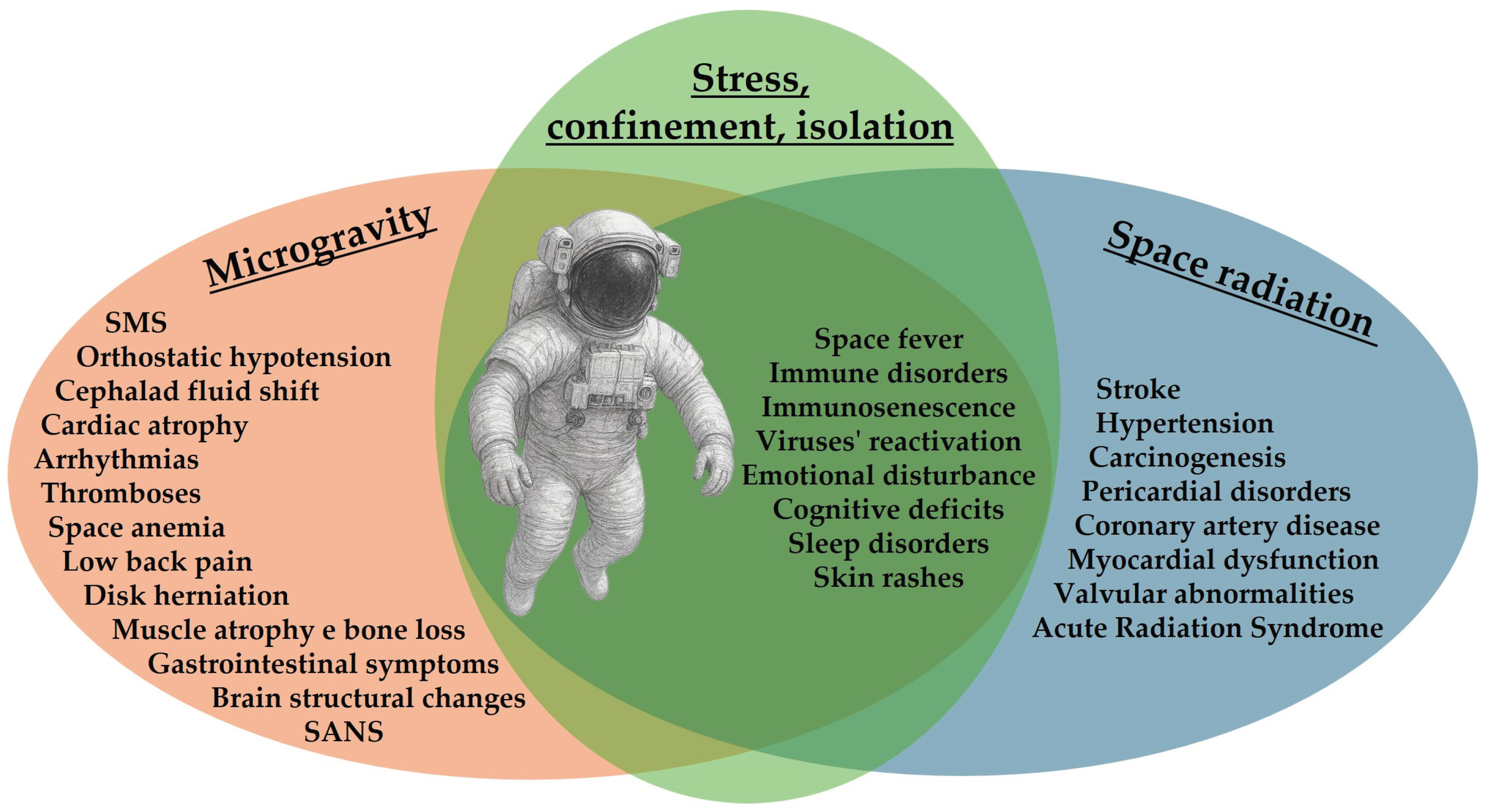
Figure 3.
Advantages and challenges in the use of medicinal plants during spaceflight and long duration space missions.
Figure 3.
Advantages and challenges in the use of medicinal plants during spaceflight and long duration space missions.
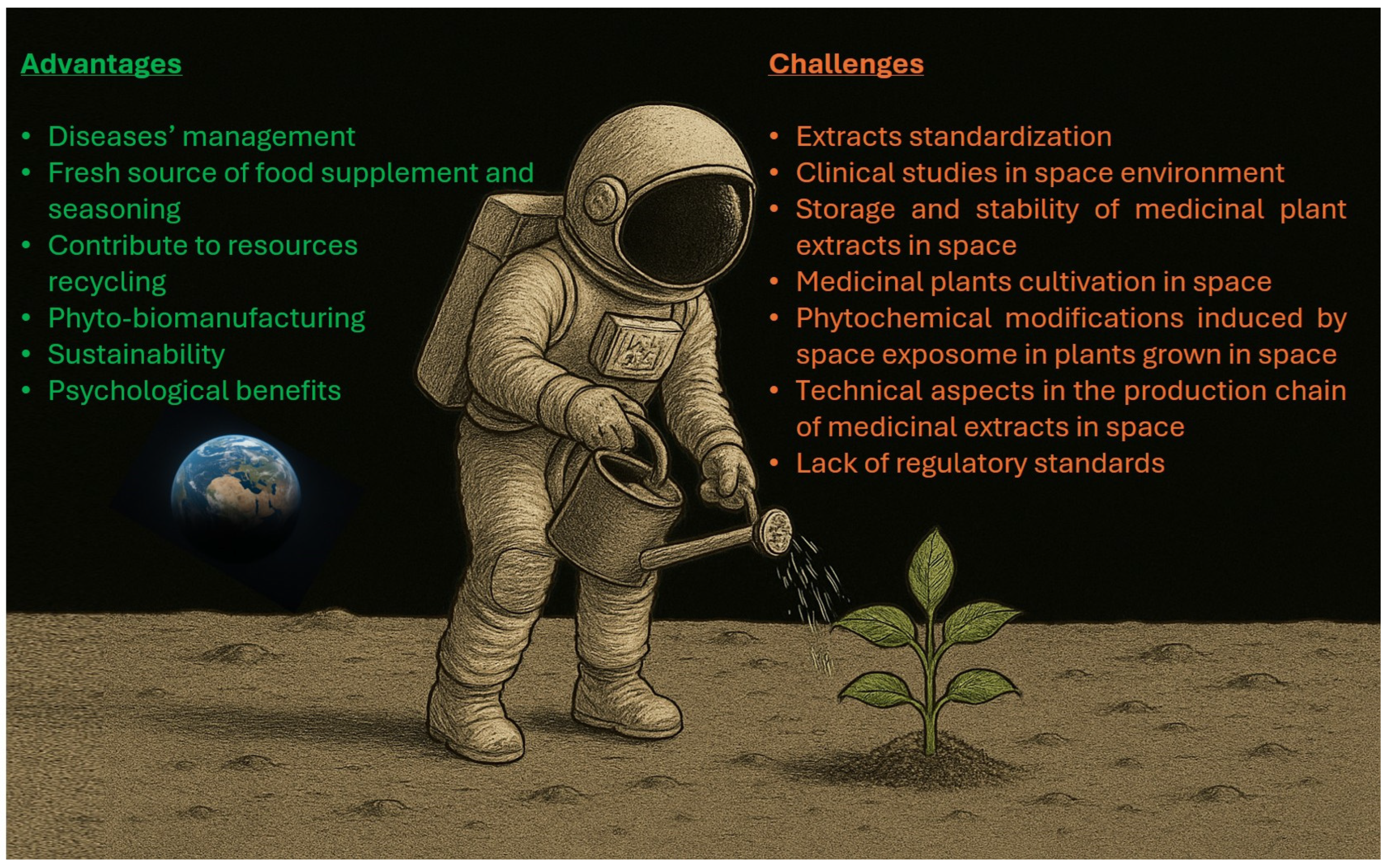
Disclaimer/Publisher’s Note: The statements, opinions and data contained in all publications are solely those of the individual author(s) and contributor(s) and not of MDPI and/or the editor(s). MDPI and/or the editor(s) disclaim responsibility for any injury to people or property resulting from any ideas, methods, instructions or products referred to in the content. |
© 2025 by the authors. Licensee MDPI, Basel, Switzerland. This article is an open access article distributed under the terms and conditions of the Creative Commons Attribution (CC BY) license (http://creativecommons.org/licenses/by/4.0/).
Copyright: This open access article is published under a Creative Commons CC BY 4.0 license, which permit the free download, distribution, and reuse, provided that the author and preprint are cited in any reuse.


