

Submitted:
13 November 2025
Posted:
14 November 2025
You are already at the latest version
Abstract
The contemporary Digital Twinning Paradigm (DTP) emerges from the synergy of conceptual development and experiences gained through the digital transformation of real-world Cyber-Physical and Sociotechnical Systems. Balancing current practices and future trends of Digital Twinning concepts and technologies, framed by maturity and futureness evaluation and assessment, is an invariant. The intended mission of this research article is to: first, establish and collect an open pool of digital twinning future trends, and second, specify the foundations for the development of a Digital Twinning Future Trends Evaluation Digital Twins-based framework. A systematic literature review methodology aided in fulfilling the first part of a mission, while the second one emerged from the characteristics of complementary maturity evaluation frameworks and digital twins referent architectures. The key research hypothesis is that the formation of a future trends persistence database precedes the backward-tracking analysis, enabling the isolation of the persistence rationale. These rationalities then drive the DTP model refinements to foster further prediction accuracy. The research outcomes suggest that, in general, a more rigorous justification of research suitability is necessary, and highlight certain obstacles affecting the representativeness of review-based publishing. Through the continuous improvement of the future trends data layer, coupled with a comprehensive repertoire of cross-related research publications, the proposed framework enables the assessment of future trends in the DTP or other paradigms through Digital Twins.
Keywords:
1. Introduction
1.1. Research's Intended Mission
1.2. Research Motivations and Relevancy Analysis
1.3. Research Hypotheses and the Related Research Questions
- RH1 - The persistence level of digital twinning future trends, expressed on the futureness scale, represents a suitable metrics system and enables recursive forward-chaining and backward-tracking analysis, leading to the continuous evaluation of the persistence reasons and raising the quality of the futureness prediction;
- RH2 - It is possible to specify a digital twinning future trends futureness evaluation framework's Digital Twin Model (DTM) supporting the RH1 claims.
1.4. Research Article's Organization
2. Materials and Methods
- challenges for future trends evaluation (Section 2.1);
- systematic reviews foundations building (Section 2.2);
- futureness assessment methodology and mechanisms driving the digital twinning future trends evaluation framework (Section 2.3).
2.1. The Methodology Challenges of Future Trends Evaluation and Assessment
2.2. The Methodology Aspects of Research Foundations Building
2.3. Methodology Foundations of a Futureness Evaluation Framework
- determining the impacts of general futureness evaluation concepts and principles (2.3.1);
- isolating digital twinning paradigmatic futureness evaluation and assessment mechanisms (2.3.2);
- specifying the sustainable architectural model of the futureness evaluation and assessment framework's Digital Twins (2.3.3).
2.3.1. General Futureness Evaluation Concepts and Principles
- Futureness Context Base (FCB - representing an open set of assessed real-world systems);
- Futureness Domains Base (FDB - representing an open set of assessed concepts or entities being either physically tangible, intangible, or virtual) with composite process areas and key process indicators;
- Futureness Assessment Scale (FAS - representing the FF's value domain, with numerical or fuzzy scaling);
- Futureness Stages (FS - specified milestones fragmenting the FAS);
- Futureness Assessment Logic (FAL - the futureness assessment principles and active services enabling grouping and processing of similar or related FFs) and
- Futureness Presentation Logic (FPL - representing the open set of presentation mechanisms used to communicate the futureness assessment results effectively).
2.3.2. Digital Twinning Paradigm Frame for the Futureness Evaluation
2.3.3. Methodology Aspects of the Digital Twins-Based Approach Towards Formulation of the Digital Twinning Futureness Evaluation Framework
3. Results
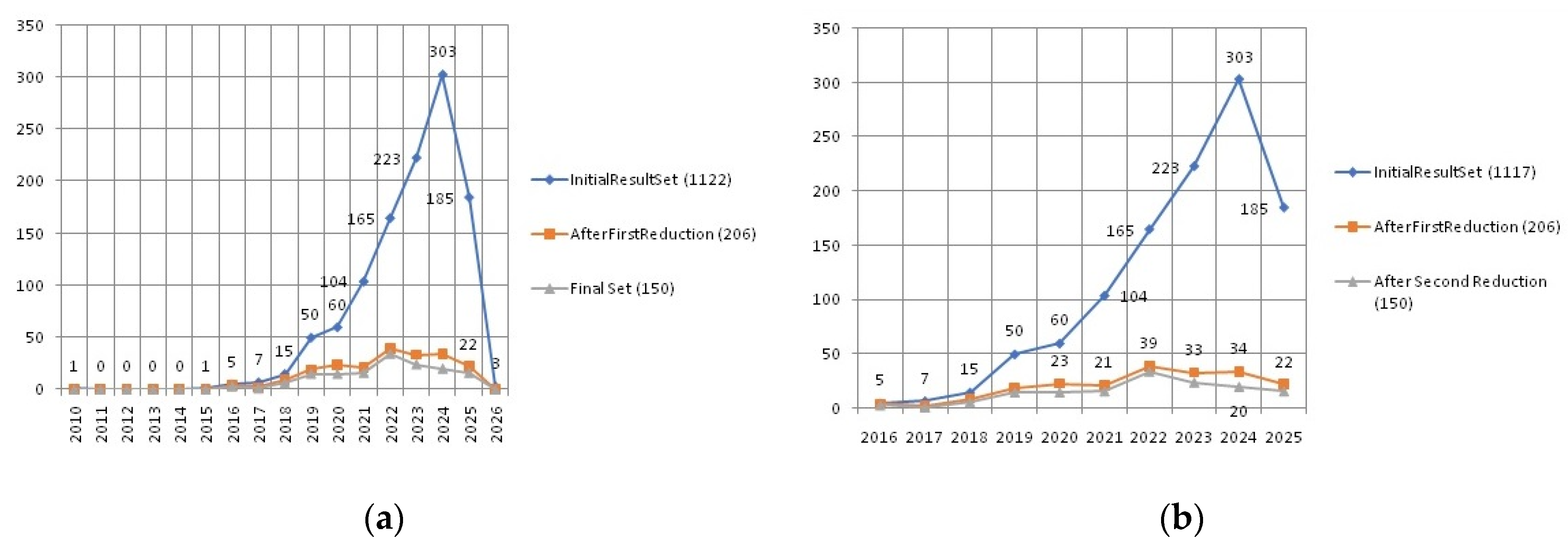
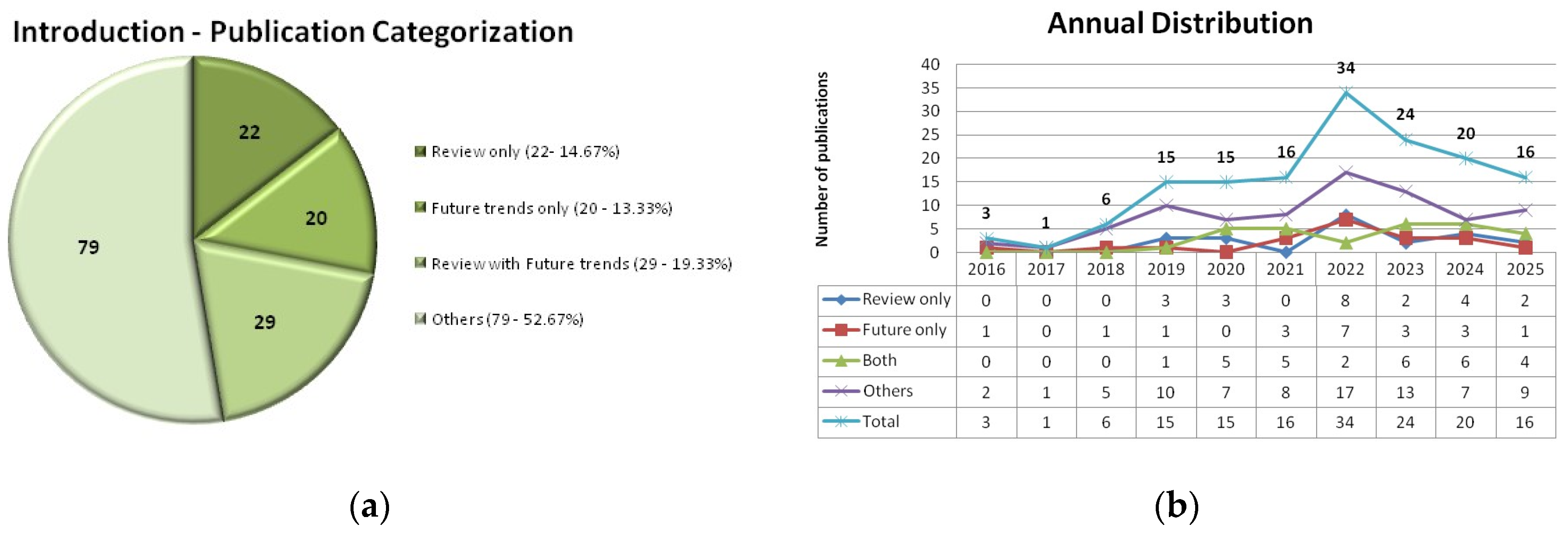
- The foundations and results of a systematic review with dataset reliability assessment (3.1.);
- Systematization of digital twinning future trends obtained by clustering-based expert analysis of referent dataset obtained in 3.1 (3.2.)
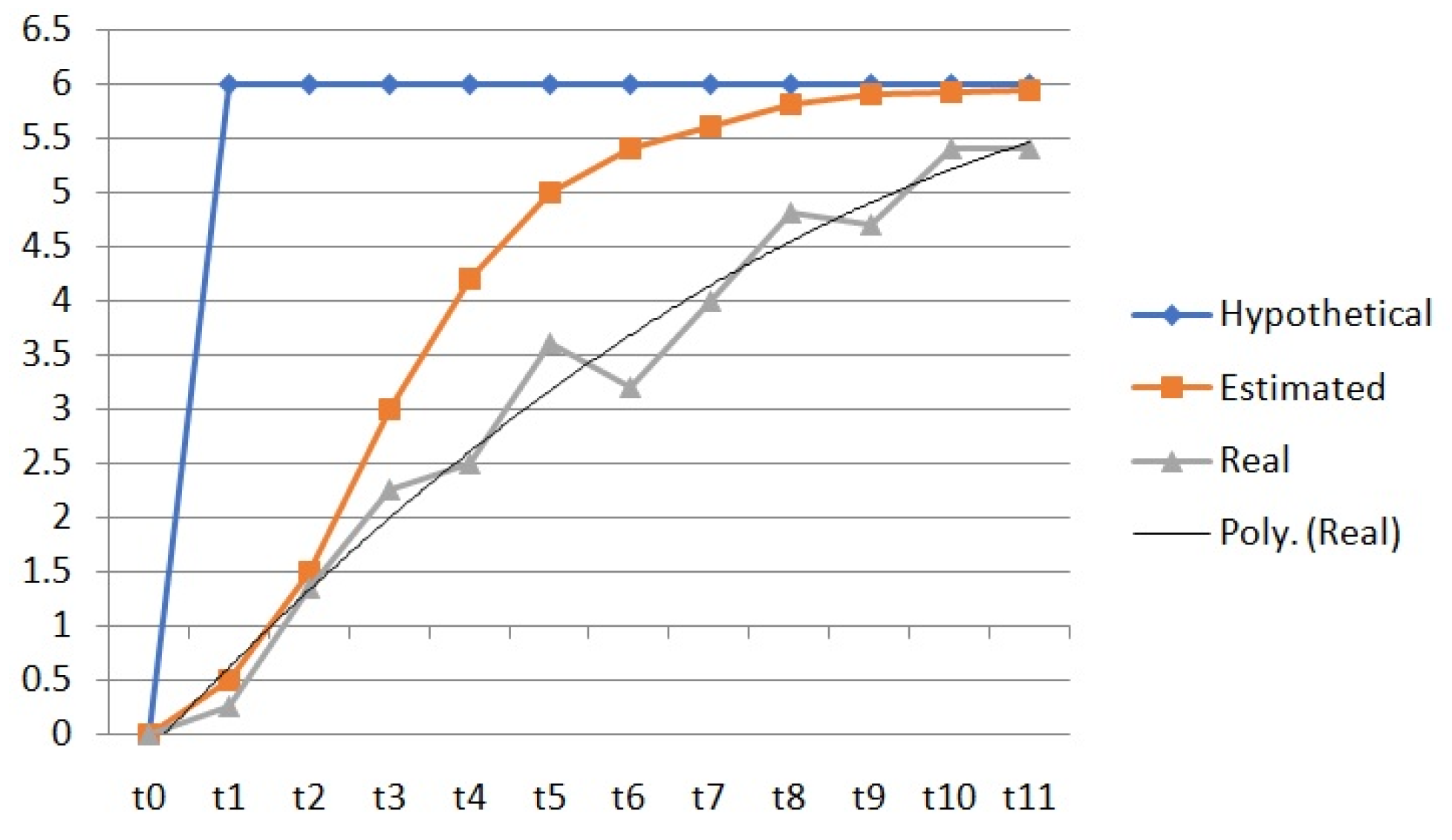
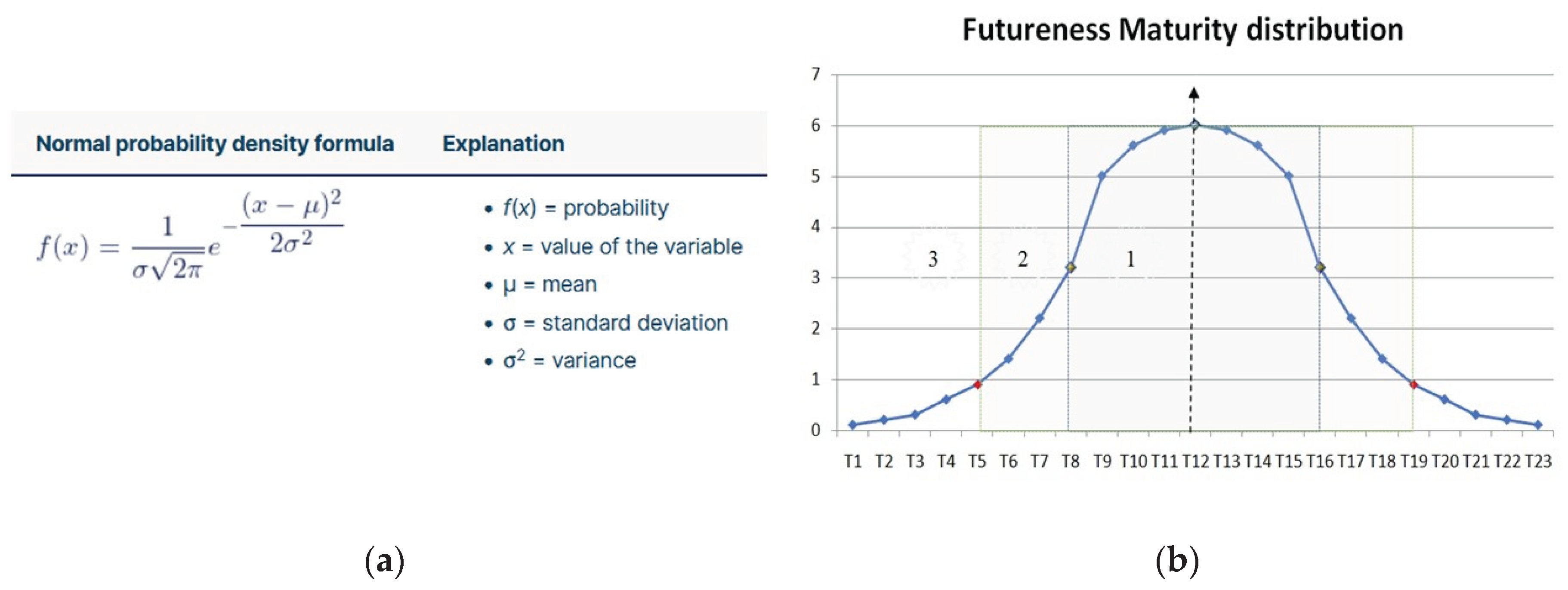
- Futureness assessment of digital twinning future trends (3.3.);
- Digital Twinning Futureness Evaluation Framework Referent Architecture Model (3.4.);
3.1. Establishing the Foundations - A Systematic Review Process and Results
3.2. Systematization of Digital Twinning Future Trends Obtained by Clustering-Based Expert Analysis of a Referent Dataset
3.3. Futureness Evaluation Framework Foundations
4. Discussion
4.1. Research Limitations
5. Conclusions
- Further enrichment of the referent dataset, based on the same review methodology;
- Further enhancements of clustering and classifying mechanisms, and more sophisticated semantic analysis to gain better fidelity while deriving individual future trends and more coherent categories;
-
Launch a set of systematic review initiatives directed to evaluate the futureness and maturity of non-digital twinning originated trends related to concepts, paradigms, and technologies, and cross-correlate them with the results obtained in this research article. Apparently, a variety of combinations exists. We believe that an interesting one would be to, at first, use three non-digital twinning originated trends with the highest individual trend frequency (Table 3, Column 4):
- o
- Information and Data fusion, data cleaning, data integration, data fusion, two-way mirrors between physical and virtual data, and time-sensitive data (103);
- o
- Artificial intelligence (Perceive (data collection and storage), Understanding (machine learning, deep learning, Knowledge representation), and Decide (Reinforcement Learning, Operational Research)) (91);
- o
- Multidimensional modeling, model integration, and model verification in Virtual space, and modeling platforms (88).
- Specify and develop the operational Digital Twins supporting the specified Digital Twinning Futureness Evaluation Framework;
- Generalize it to support an arbitrary concept, technology, or paradigm as a futureness evaluation domain;
- Extend it by the maturity evaluation mechanisms and upgrade to Futureness and Maturity Evaluation Framework;
Supplementary Materials
Author Contributions
Funding
Data Availability Statement
Conflicts of Interest
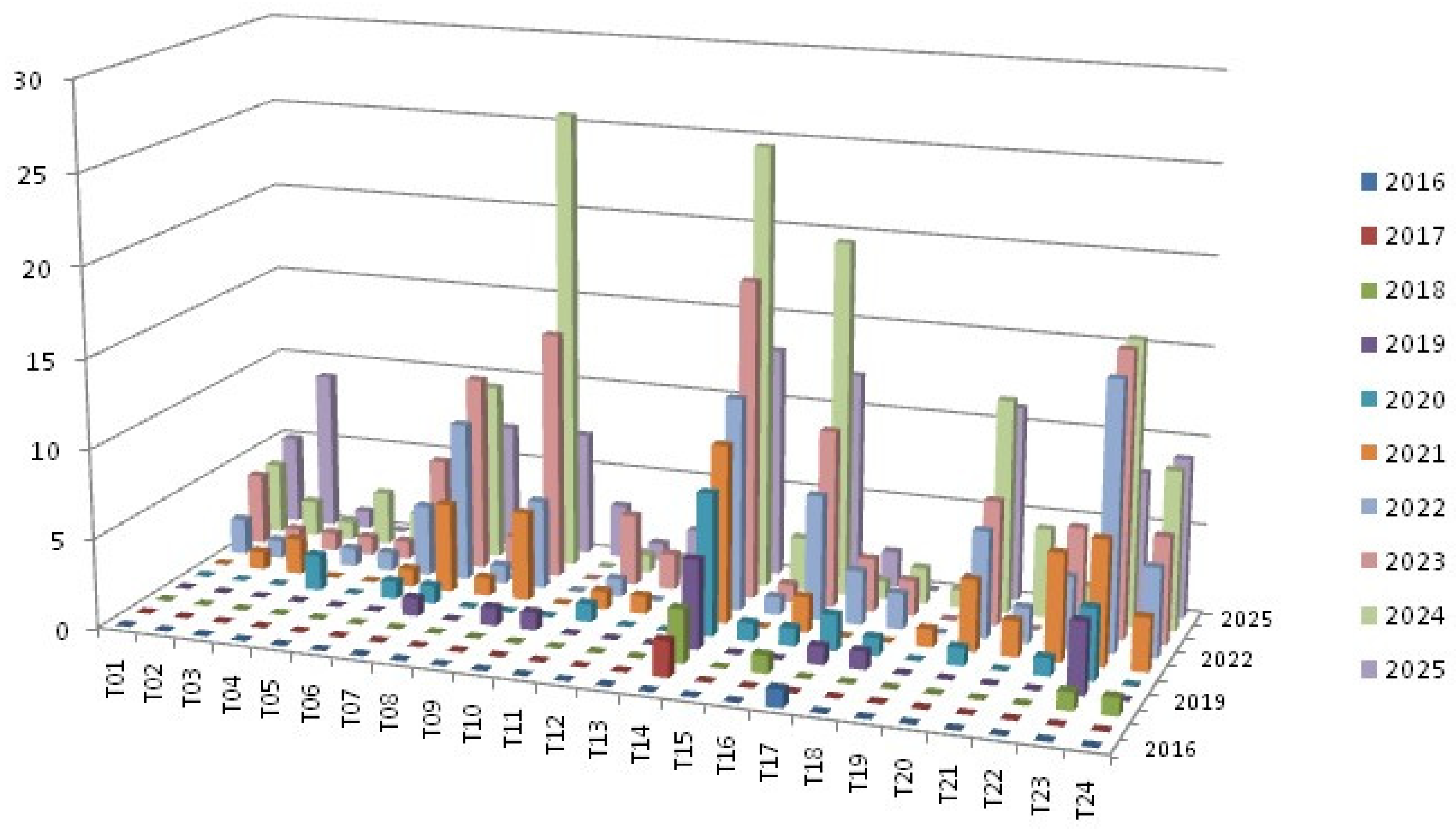
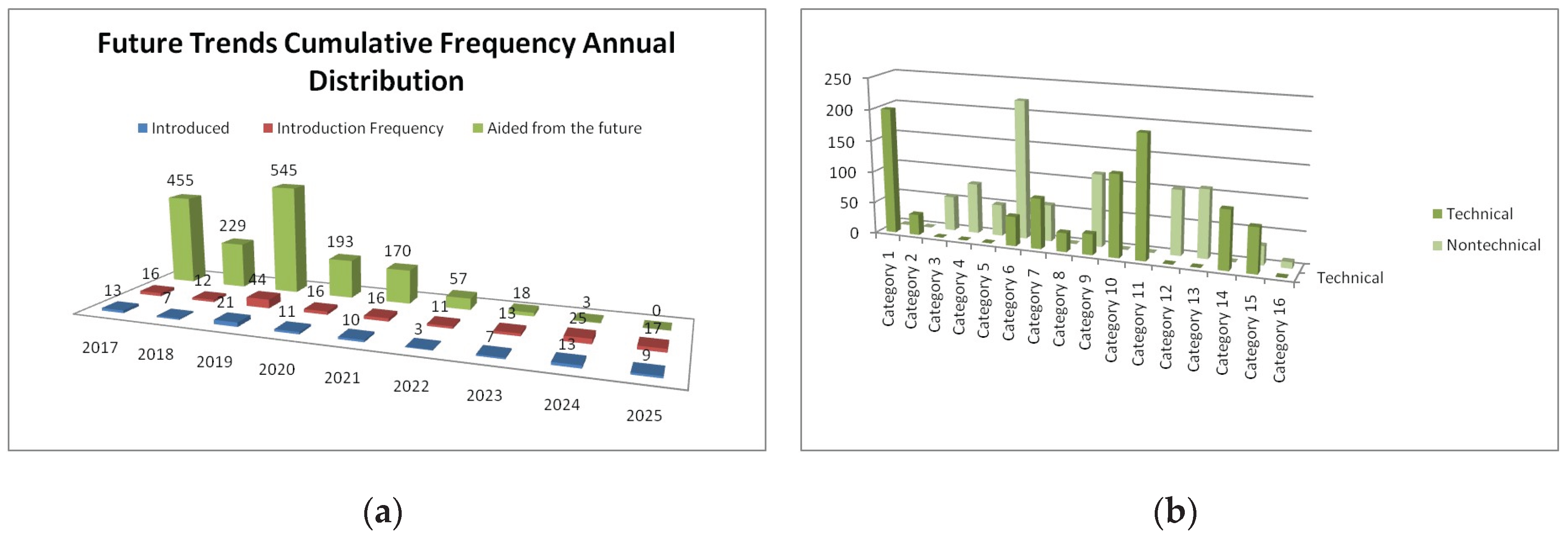
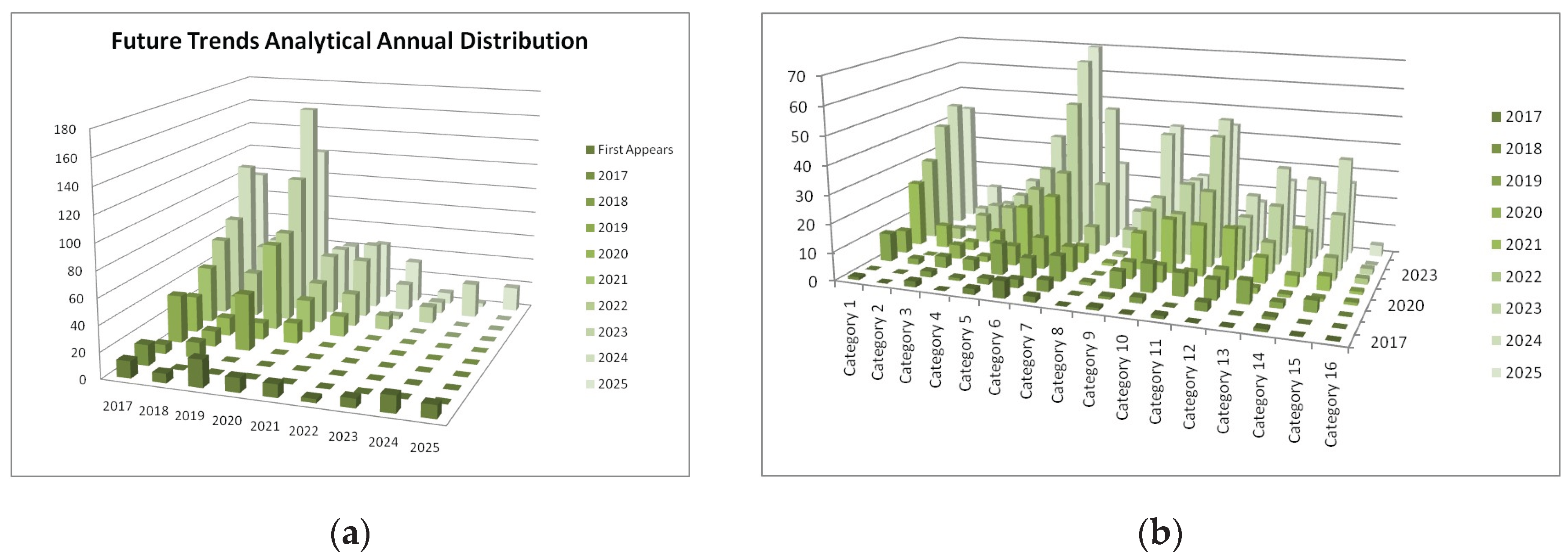
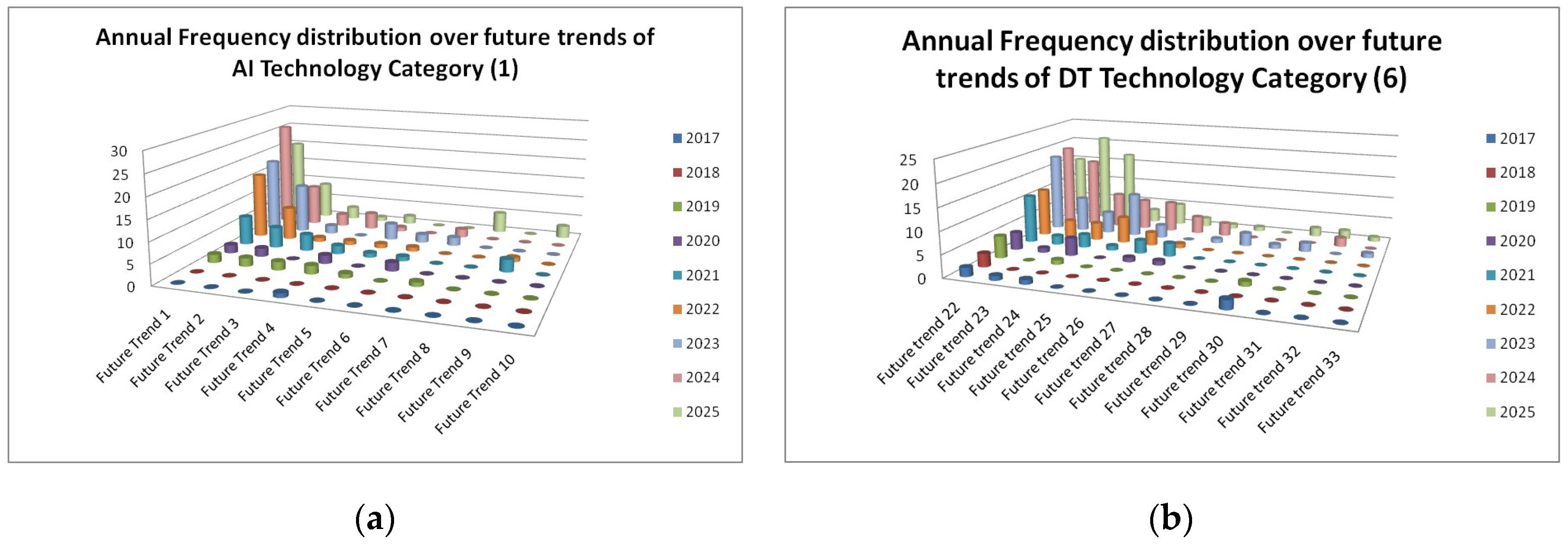
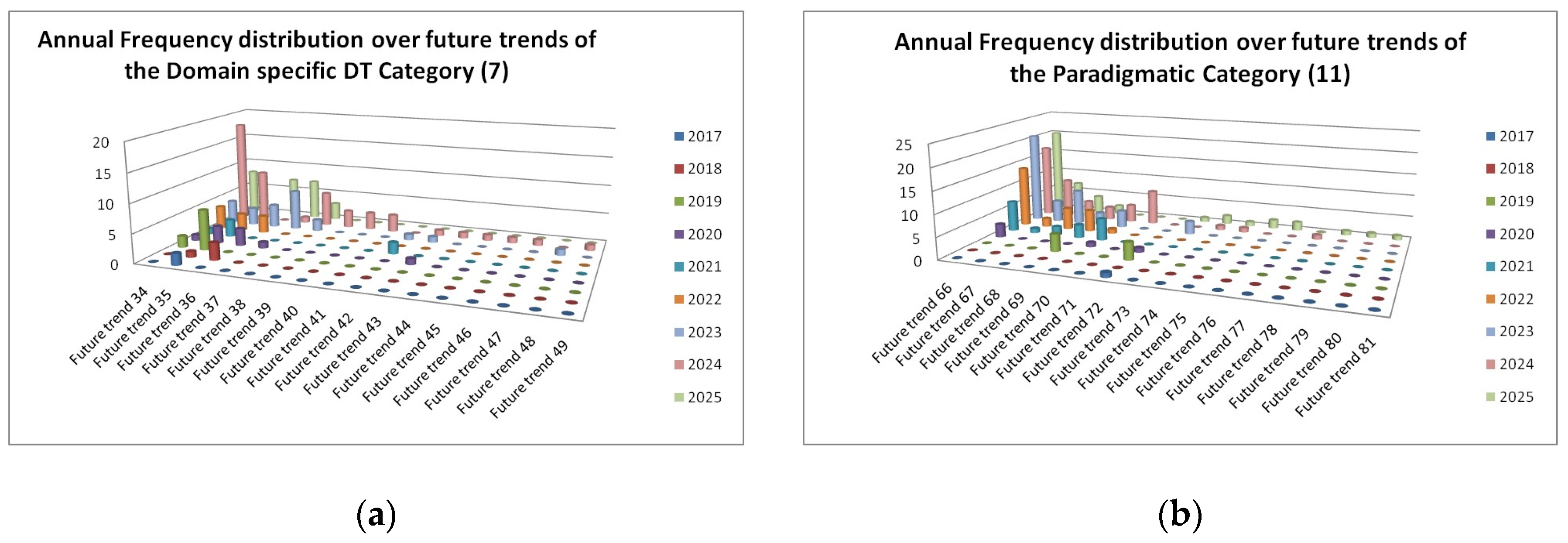
Appendix A: The Visualization Foundations (Figures 13 to 16) - Table 5

| Future Trend Data | Annual futureness frequencies | |||||||||||
| Trend ID |
Tech. (1/0) |
Trend Freq. |
Initial year |
2017 | 2018 | 2019 | 2020 | 2021 | 2022 | 2023 | 2024 | 2025 |
| 1 | 91 | 2019 | 2 | 3 | 5 | 4 | 11 | 11 | 18 | 19 | 15 | |
| 0 | 48 | 2019 | 0 | 0 | 2 | 2 | 7 | 16 | 18 | 26 | 20 | |
| 0 | 15 | 2019 | 0 | 0 | 0 | 3 | 7 | 14 | 21 | 17 | 20 | |
| 1 | 13 | 2017 | 1 | 2 | 6 | 5 | 9 | 13 | 13 | 33 | 21 | |
| 1 | 10 | 2019 | 1 | 0 | 0 | 1 | 2 | 4 | 8 | 16 | 21 | |
| 1 | 6 | 2020 | 1 | 0 | 1 | 4 | 3 | 4 | 5 | 8 | 17 | |
| 0 | 5 | 2019 | 0 | 0 | 2 | 2 | 5 | 8 | 12 | 10 | 9 | |
| 0 | 5 | 2025 | 0 | 1 | 5 | 6 | 11 | 8 | 19 | 12 | 10 | |
| 1 | 4 | 2021 | 0 | 0 | 0 | 0 | 2 | 4 | 8 | 16 | 22 | |
| 1 | 3 | 2025 | 0 | 0 | 0 | 0 | 1 | 6 | 10 | 7 | 3 | |
| 0 | 21 | 2022 | 0 | 0 | 3 | 0 | 2 | 4 | 12 | 31 | 19 | |
| 1 | 12 | 2019 | 1 | 0 | 4 | 2 | 8 | 9 | 13 | 4 | 4 | |
| 1 | 31 | 2021 | 0 | 0 | 5 | 3 | 13 | 11 | 11 | 11 | 9 | |
| 0 | 10 | 2017 | 0 | 0 | 0 | 1 | 3 | 3 | 3 | 7 | 5 | |
| 1 | 8 | 2018 | 0 | 0 | 2 | 1 | 1 | 4 | 4 | 18 | 8 | |
| 0 | 6 | 2017 | 1 | 0 | 2 | 1 | 2 | 11 | 8 | 14 | 16 | |
| 0 | 49 | 2018 | 0 | 0 | 0 | 0 | 1 | 2 | 5 | 9 | 7 | |
| 0 | 31 | 2019 | 0 | 0 | 0 | 0 | 2 | 5 | 8 | 4 | 4 | |
| 0 | 103 | 2017 | 0 | 0 | 0 | 1 | 6 | 6 | 5 | 8 | 4 | |
| 0 | 45 | 2017 | 2 | 1 | 7 | 3 | 3 | 3 | 3 | 9 | 1 | |
| 1 | 5 | 2019 | 0 | 0 | 0 | 0 | 0 | 3 | 3 | 9 | 14 | |
| 1 | 88 | 2017 | 0 | 3 | 2 | 4 | 5 | 4 | 5 | 10 | 7 | |
| 1 | 53 | 2017 | 0 | 1 | 2 | 0 | 2 | 10 | 14 | 10 | 10 | |
| 0 | 43 | 2017 | 0 | 0 | 4 | 0 | 3 | 5 | 3 | 3 | 2 | |
| 1 | 27 | 2021 | 0 | 0 | 3 | 0 | 2 | 4 | 9 | 9 | 9 | |
| 0 | 22 | 2020 | 0 | 1 | 0 | 0 | 2 | 6 | 5 | 15 | 9 | |
| 1 | 11 | 2020 | 0 | 0 | 1 | 1 | 3 | 2 | 4 | 13 | 8 | |
| 1 | 5 | 2023 | 0 | 0 | 1 | 1 | 3 | 4 | 8 | 6 | 7 | |
| 0 | 4 | 2023 | 0 | 0 | 2 | 0 | 4 | 1 | 2 | 3 | 3 | |
| 0 | 4 | 2017 | 0 | 0 | 0 | 1 | 3 | 1 | 0 | 4 | 2 | |
| 0 | 4 | 2023 | 0 | 0 | 0 | 1 | 5 | 1 | 4 | 4 | 0 | |
| 1 | 4 | 2024 | 0 | 3 | 0 | 3 | 0 | 3 | 4 | 0 | 7 | |
| 0 | 2 | 2023 | 1 | 0 | 2 | 2 | 2 | 1 | 0 | 4 | 1 | |
| 1 | 38 | 2019 | 0 | 0 | 2 | 1 | 1 | 3 | 6 | 6 | 5 | |
| 1 | 32 | 2017 | 0 | 0 | 2 | 2 | 6 | 4 | 2 | 9 | 6 | |
| 0 | 20 | 2018 | 0 | 0 | 0 | 0 | 0 | 5 | 0 | 6 | 7 | |
| 0 | 16 | 2020 | 0 | 0 | 0 | 1 | 0 | 0 | 7 | 1 | 7 | |
| 0 | 11 | 2023 | 0 | 0 | 1 | 0 | 1 | 1 | 4 | 1 | 2 | |
| 1 | 3 | 2024 | 1 | 1 | 3 | 1 | 4 | 1 | 0 | 2 | 0 | |
| 0 | 3 | 2024 | 0 | 1 | 1 | 0 | 2 | 4 | 3 | 1 | 2 | |
| 0 | 3 | 2024 | 0 | 0 | 0 | 0 | 1 | 1 | 2 | 6 | 4 | |
| 1 | 3 | 2021 | 0 | 0 | 2 | 0 | 3 | 2 | 2 | 4 | 3 | |
| 1 | 3 | 2020 | 0 | 0 | 0 | 0 | 2 | 7 | 9 | 7 | 6 | |
| 0 | 1 | 2024 | 0 | 0 | 0 | 0 | 0 | 0 | 0 | 8 | 0 | |
| 0 | 1 | 2024 | 0 | 0 | 0 | 0 | 0 | 0 | 2 | 6 | 3 | |
| 1 | 1 | 2024 | 0 | 0 | 0 | 3 | 0 | 2 | 1 | 2 | 2 | |
| 1 | 1 | 2024 | 0 | 0 | 0 | 0 | 0 | 0 | 1 | 3 | 1 | |
| 0 | 1 | 2023 | 0 | 0 | 0 | 2 | 1 | 1 | 2 | 0 | 0 | |
| 0 | 1 | 2024 | 1 | 0 | 4 | 1 | 0 | 0 | 0 | 0 | 0 | |
| 0 | 27 | 2019 | 0 | 0 | 0 | 0 | 0 | 0 | 3 | 0 | 1 | |
| 0 | 3 | 2021 | 2 | 0 | 1 | 0 | 0 | 0 | 1 | 0 | 0 | |
| 0 | 52 | 2021 | 0 | 0 | 0 | 0 | 0 | 0 | 2 | 0 | 2 | |
| 1 | 30 | 2020 | 0 | 0 | 0 | 0 | 0 | 0 | 0 | 2 | 2 | |
| 0 | 29 | 2022 | 0 | 0 | 1 | 0 | 0 | 0 | 2 | 2 | 0 | |
| 0 | 13 | 2017 | 0 | 0 | 0 | 0 | 0 | 0 | 0 | 0 | 5 | |
| 1 | 10 | 2020 | 0 | 0 | 0 | 1 | 0 | 2 | 1 | 2 | 0 | |
| 0 | 6 | 2020 | 0 | 0 | 1 | 0 | 0 | 1 | 6 | 10 | 9 | |
| 0 | 5 | 2021 | 0 | 0 | 0 | 0 | 3 | 1 | 0 | 0 | 0 | |
| 0 | 3 | 2019 | 0 | 0 | 3 | 0 | 2 | 0 | 1 | 0 | 0 | |
| 0 | 72 | 2018 | 0 | 0 | 1 | 0 | 3 | 0 | 1 | 0 | 1 | |
| 0 | 18 | 2022 | 0 | 0 | 0 | 0 | 0 | 0 | 3 | 0 | 1 | |
| 1 | 14 | 2018 | 0 | 0 | 1 | 0 | 1 | 0 | 1 | 0 | 2 | |
| 1 | 14 | 2021 | 0 | 0 | 0 | 0 | 1 | 0 | 2 | 2 | 0 | |
| 0 | 6 | 2019 | 0 | 0 | 0 | 0 | 0 | 3 | 0 | 6 | 12 | |
| 0 | 6 | 2019 | 0 | 0 | 0 | 0 | 0 | 0 | 0 | 0 | 3 | |
| 0 | 82 | 2020 | 0 | 0 | 0 | 0 | 0 | 0 | 0 | 1 | 2 | |
| 1 | 24 | 2021 | 1 | 0 | 2 | 4 | 0 | 1 | 2 | 0 | 0 | |
| 0 | 23 | 2021 | 0 | 0 | 0 | 0 | 0 | 0 | 1 | 0 | 1 | |
| 0 | 20 | 2019 | 0 | 0 | 3 | 0 | 0 | 0 | 0 | 0 | 0 | |
| 1 | 15 | 2020 | 0 | 2 | 2 | 1 | 1 | 0 | 0 | 1 | 1 | |
| 0 | 8 | 2024 | 0 | 0 | 0 | 0 | 0 | 0 | 0 | 3 | 0 | |
| 0 | 6 | 2017 | 0 | 0 | 0 | 0 | 0 | 0 | 0 | 3 | 0 | |
| 0 | 4 | 2023 | 0 | 0 | 0 | 0 | 0 | 0 | 0 | 3 | 0 | |
| 0 | 3 | 2024 | 0 | 0 | 0 | 0 | 2 | 0 | 1 | 0 | 0 | |
| 0 | 2 | 2024 | 0 | 0 | 0 | 1 | 0 | 0 | 1 | 1 | 0 | |
| 0 | 2 | 2025 | 0 | 0 | 2 | 0 | 8 | 1 | 1 | 0 | 0 | |
| 0 | 2 | 2025 | 0 | 0 | 0 | 0 | 0 | 0 | 0 | 1 | 1 | |
| 0 | 1 | 2024 | 0 | 0 | 0 | 0 | 0 | 0 | 0 | 0 | 2 | |
| 0 | 1 | 2025 | 0 | 0 | 0 | 0 | 0 | 0 | 0 | 0 | 2 | |
| 1 | 1 | 2025 | 1 | 0 | 0 | 0 | 0 | 2 | 0 | 1 | 2 | |
| 0 | 1 | 2025 | 0 | 0 | 0 | 0 | 0 | 0 | 0 | 1 | 0 | |
| 0 | 63 | 2019 | 0 | 0 | 0 | 0 | 0 | 0 | 0 | 0 | 1 | |
| 0 | 40 | 2018 | 0 | 0 | 0 | 0 | 0 | 0 | 0 | 0 | 1 | |
| 0 | 36 | 2019 | 0 | 0 | 0 | 0 | 0 | 0 | 0 | 0 | 1 | |
| 0 | 32 | 2019 | 0 | 0 | 0 | 0 | 0 | 0 | 0 | 1 | 0 | |
| 0 | 24 | 2019 | 0 | 0 | 0 | 0 | 0 | 0 | 0 | 1 | 0 | |
| 0 | 16 | 2019 | 0 | 0 | 0 | 0 | 0 | 0 | 0 | 1 | 0 | |
| 0 | 55 | 2017 | 0 | 0 | 0 | 0 | 0 | 0 | 0 | 1 | 0 | |
| 0 | 38 | 2018 | 0 | 0 | 0 | 0 | 0 | 0 | 1 | 0 | 0 | |
| 0 | 71 | 2019 | 0 | 0 | 0 | 0 | 0 | 0 | 0 | 1 | 0 | |
| 0 | 30 | 2019 | 0 | 0 | 0 | 0 | 1 | 0 | 1 | 1 | 0 | |
| 1 | 8 | 2020 | 0 | 0 | 0 | 1 | 1 | 2 | 2 | 0 | 2 | |
| 1 | 1 | 2025 | 0 | 0 | 0 | 0 | 0 | 0 | 0 | 0 | 1 | |
| 1 | 1 | 2025 | 0 | 0 | 0 | 0 | 0 | 0 | 0 | 0 | 1 | |
| 1844 | 16 | 19 | 93 | 71 | 177 | 235 | 339 | 476 | 418 | |||
References
- X. X. Wang; J. Yang; Y. T. Wang; Q. H. Miao; F.-Y. Wang; A. J. Zhao; J.-L. Deng; L. X. Li; X. X. Na; L. Vlacic. Steps toward Industry 5.0: Building “6S” parallel industries with cyber-physical-social intelligence, IEEE/CAA Journal of Automatica Sinica, 2023, Vol. 10, Issue 8, pp.1692–1703. [CrossRef]
- Duggal, A.S.; Malik, P.K.; Gehlot, A.; Singh, R.; Gaba, G.S.; Masud, M.; Al-Amri,J.F. A sequential roadmap to industry 6.0: Exploring future manufacturing trends. IET Community. Vol.16, pp.521–531,2022. [CrossRef]
- Tavakkoli-Moghaddam, R.; Nozari, H.; Bakhshi-Movahed, A.; Bakhshi-Movahed, A. A Conceptual Framework for the Smart Factory 6.0. In M. Oskounejad & H. Nozari (Eds.), Advanced Businesses in Industry 6.0 (pp.1-14). IGI Global., 2024, . [CrossRef]
- Thalos Mariam. The Logic of Measurement: A Defense of Foundationalist Empiricism. Episteme, 2024, Vol. 21, Issue.4, pp.1347–1372. [CrossRef]
- Rodríguez López N.; Alvarez Cabal, J. V.; Cuiñas, M. C.; Ortega Fernndez, F. Applicability of Technology Maturity Level Evaluation Methodologies within Small- and Medium-Sized Organizations: Prospects and Proposals. Systems, 2023,11(8), 387. [CrossRef]
- Heeyong Noh; Letizia Mortara; Sungjoo Lee. Development of a maturity model for technology intelligence, Technological Forecasting and Social Change, Volume 192, 2023, 122525, ISSN 0040-1625. [CrossRef]
- Jäkel J-I; Fischerkeller F; Oberhoff T; Klemt-Albert K. Development of a Maturity Model for the Digital transformation of companies in the context of Construction Industry 4.0, Journal of Information Technology in Construction, 2024, Vol. 29, pp. 778-809, . [CrossRef]
- CMMI Institute, CMMI Levels of Capability and Performance, Available online: https://cmmiinstitute.com/learning/appraisals/levels, (accessed on 22 July 2025).
- Lange, F.; Kunz, I. Evolution of secure development lifecycles and maturity models in the context of hosted solutions. Journal of Software: Evolution and Process, 2024, 36(12), e2711. [CrossRef]
- Stoiber, C.; Stöter, M.; Englbrecht, L. et al. Keeping Your Maturity Assessment Alive. Business & Information Systems Engineering, 2023, Vol. 65, pp.703–721. [CrossRef]
- Venable, J.; Pries-Heje, J.; Baskerville, R. FEDS: a Framework for Evaluation in Design Science Research. European Journal of Information Systems, 2016, Vol. 25(1), pp.77–89. [CrossRef]
- Perisic, A.; Perisic, I.; Lazic, M.; Perisic, B. Metamodeling Approach to Sociotechnical Systems’ External Context Digital Twins Building: A Higher Education Case Study. Applied. Science, 2025, 15, 8708. [CrossRef]
- Buckle, P. Maturity Models for Systems Thinking. Systems,2018, 6(2), 23. [CrossRef]
- Busch, N. R.; Zalewski, A. A Systematic Literature Review of Enterprise Architecture Evaluation Methods, ACM Computing Surveys, 2025, Vol.57, No.5, pp.1-36. https://dl.acm.org/doi/10.1145/3706582. [CrossRef]
- Pingilili, A.; Letsie, N.; Nzimande, G.; Thango, B.; Matshaka, L. Guiding IT Growth and Sustaining Performance in SMEs Through Enterprise Architecture and Information Management: A Systematic Review. Businesses, 2025, Vol.5(2), No.17. [CrossRef]
- Verawaty, Weny and Oktavia, Tanty, Designing Enterprise Architecture and Governance to Support Digital Transformation in Manufacturing Companies (Case Study at Pt ABC). Available at SSRN: https://ssrn.com/abstract=5348753 or http://dx.doi.org/10.2139/ssrn.5348753 , (Accessed on 5 September 2025).
- OMG Group, The TOGAF Standard, 10th Edition, Available online: https://publications.opengroup.org/downloadable/download/link/id/MC40OTI1NDIwMCAxNzU4MTkwMTU0MzMyNjczNTM0MDc1OTcxNzMx/, (accessed on 18 September 2025).
- Palmié, M.; Aebersold, A.; Oghazi, P.; Pashkevich, N.; Gassmann, O. Digital-sustainable business models: Definition, systematic literature review, integrative framework and research agenda from a strategic management perspective. International Journal of Management Reviews, 27(3), 2024, 346-374. [CrossRef]
- Perisic, A.; Perisic, B. Towards a Digital Transformation Hyper-Framework: The Essential Design Principles and Components of the Initial Prototype. Applied Science, 2025, 15, 611. [CrossRef]
- Yang Liu; Yu Peng; Bailing Wang; Sirui Yao; Zihe Liu. Review on Cyber-physical Systems, in IEEE/CAA Journal Automatica Sinica, 2017, Vol. 4., No. 1, pp. 27-40, . [CrossRef]
- X. Xue; X. Yu; D. Zhou; X. Wang; C. Bi; S. Wang, ; F.-Y. Wang, Computational experiments for complex social systems: Integrated design of experiment system, in IEEE/CAA Journal Automatica Sinica, 2024, Vol. 11, No. 5, pp.1175–1189, DOI: 10.1109/JAS.2023.123639. [CrossRef]
- Sobb, T.; Turnbull, B.; Moustafa, N. A Holistic Review of Cyber–Physical–Social Systems: New Directions and Opportunities. Sensors, 2023, 23, 7391. [CrossRef]
- S. Pasandideh; P. Pereira ; L. Gomes. Cyber-Physical-Social Systems: Taxonomy, Challenges, and Opportunities, in IEEE Access, Vol. 10, pp. 42404-42419, 2022. [CrossRef]
- Savić, G.; Segedinac, M.; Konjović, Z.; Vidaković, M.; Dutina, R. Towards a Domain-Neutral Platform for Sustainable Digital Twin Development. Sustainability 2023, 15, 13612. [CrossRef]
- SE Ranking. Available online: https://seranking.com/blog/top-search-engines/, (accessed on 24 September 2025).
- Search Engine Land. 5 GEO Trends shaping the future of search, Available online: https://www.google.com/url?sa=t&source=web&rct=j&opi=89978449&url=https://searchengineland.com/geo-trends-search-future-448573&ved=2ahUKEwjY6-X2h_GPAxXEg_0HHeonDrcQFnoECB8QAQ&usg=AOvVaw2I9Sj6W_oPlLdIsROZ_pzU, (accessed on 24 September 2025).
- RESEARCH FDI, AI-& SEO: How Artificial Intelligence Is Already Shaping the Future of Search Engine Optimization, Available online: https://researchfdi.com/future-of-seo-ai/, (accessed on 24 September 2025).
- OMNISEARCH, The future of search algorithms - exploring the latest trends in search technology, Available online: https://omnisearch.ai/blog/the-future-of-search-algorithms-exploring-the-latest-trends-in-search-technology, (accessed on 24 September 2025).
- Iliuţă, M.-E.; Moisescu, M.-A.; Pop, E.; Ionita, A.-D.; Caramihai, S.-I.; Mitulescu, T.-C. Digital Twin—A Review of the Evolution from Concept to Technology and Its Analytical Perspectives on Applications in Various Fields. Appl. Sci. 2024, 14, 5454. [CrossRef]
- Zheng, Y.; Yang, S. ; Cheng, H. An application framework of digital twin and its case study, Journal of Ambient Intelligence and Humanized Computing, 2019, Vol.10, pp.1141–1153. [CrossRef]
- Yong-Woon KIM; Sangkeun YOO; Hyunjeong LEE; Sung Hei KIM; Soonhung HAN, Characterization of Digital Twin, ResearchGate, September 3, 2020, through January 24, 2025, Available from: https://www.researchgate.net/publication/353930234.
- Singh, M.; Fuenmayor, E.; Hinchy, E.P.; Qiao, Y.; Murray, N.; Devine, D. Digital Twin: Origin to Future, Applied System Innovation, 2021, Vol.4, 36. [CrossRef]
- C. Kober; S. Buxbaum-Conradi; M. Fette; J. P. Wulfsberg, Digital Twins: A Critical Perspective and Research Trends, 2024 IEEE International Conference on Industrial Engineering and Engineering Management (IEEM), Bangkok, Thailand, 15 to 18 December 2024, 2024, pp. 749-754. [CrossRef]
- Bickford J, Van Bossuyt DL, Beery P, Pollman A. Operationalizing digital twins through model-based systems engineering methods. Systems Engineering. 2020; Vol.23: pp.724–750. [CrossRef]
- Bordeleau, F.; Combemale, B.; Eramo, R.; Van Den Brand, M.; Wimmer, M. Towards model-driven digital twin engineering: Current opportunities and future challenges, In Proceedings of ICSMM 2020 - International Conference on Systems Modeling and Management, 25 - 26 Jun 2020, Bergen, Norway, pp.43-53.
- Segovia, M. Design, Modeling and Implementation of Digital Twins. Sensors, 2022, 22(14), 5396. [CrossRef]
- Lehner, D.; Zhang, J.; Pfeiffer, J. et al. Model-driven engineering for digital twins: a systematic mapping study, Software and Systems Modeling, 2025, Vol. 24, pp.1339–1377. [CrossRef]
- Seremak, P,; Tąkiel, M.; Kacymirow, M. Themis - Organizational Maturity Assessment Methodology, 2025, Available at SSRN: http://dx.doi.org/10.2139/ssrn.5119245 , (Accessed on 10 September 2025). [CrossRef]
- Krulčić, E.; Doboviček, S.; Pavletić, D.; Čabrijan, I. A Dynamic Assessment of Digital Maturity in Industrial SMEs: An Adaptive AHP-Based Digital Maturity Model (DMM)with Customizable Weighting and Multidimensional Classification (DAMA-AHP). Technologies, 2025,13(7), 282. [CrossRef]
- Tining Haryanti, Nur Aini Rakhmawati, Apol Pribadi Subriadi. Assessing the Digital Transformation Landscapes of Organization: The Digital Transformation Self-Assessment Maturity Model (DX-SAMM), Procedia Computer Science, 2024, Vol. 234, pp. 1561-1569, . [CrossRef]
- Omol, E.J.; Mburu, L.W.; Abuonji, P.A. Digital Maturity Assessment Model (DMAM): assimilation of Design Science Research (DSR) and Capability Maturity Model Integration (CMMI), Digital Transformation and Society, 2025, Vol. 4, No. 2, pp.128-152. [CrossRef]
- Scribbr. Available online: https://www.scribbr.com/statistics/normal-distribution/ (accessed on 4 October 2025).
- BMJ 2021;372:n160, PRISMA2020 explanation and elaboration: updated guidance and examples for reporting systematic reviews, https://doi.org/10.1136/bmj.n160, (Accessed on 15 September 2025). [CrossRef]
- Manrique-Escobar, C. A. , Pappalardo, C. M. and Guida, D. On the Analytical and Computational Methodologies for Modeling Two-wheeled Vehicles within the Multibody Dynamics Framework: A Systematic Literature Review. Journal of Applied and Computational Mechanics, 2022, 8(1), 153-181. [CrossRef]
- Veroniki, A. A.; Hutton, B.; Stevens, A. et al. Update to the PRISMA guidelines for network meta-analyses and scoping reviews and development of guidelines for rapid reviews: a scoping review protocol. JBI Evidence Synthesis, 2025, Vol. 23(3):pp.517-526. [CrossRef]
- Gomes de Carvalho, G.D. Sokulski, C.C.; Vieira da Silva, W.; et al. Bibliometrics and systematic reviews: A comparison between the Proknow-C and the Methodi Ordinatio, Journal of Informetrics, 2020, Vol.14, No.3, ,pp.101043. [CrossRef]
- Orman, T. F. Paradigm as a central concept in Thomas Kuhn’s thought, International Journal of Humanities and Social Science, 2016, Vol. 6(10), pp.47-52.
- Madsen, D.Ø.; Slåtten, K.; Berg, T. From Industry 4.0 to Industry 6.0: Tracing the Evolution of Industrial Paradigms Through the Lens of Management Fashion Theory. Systems 2025, 13, 387. [CrossRef]
- Vieira, J.; Poças Martins, J;, De Almeida, N. M.; Patrício, H.; Morgado, J. Reshaping the Digital Twin Construct with Levels of Digital Twinning (LoDT), Applied System Innovation, 2023, 6(6), 114. [CrossRef]
- Van Bossuyt, D. L.; Allaire, D.; Bickford, J. F.; Bozada, T. A. et al. The Future of Digital Twin Research and Development, ASME. J. Comput. Inf. Sci. Eng. , 2025; 25(8): 080801. [CrossRef]
- Wagg, D. J.; Burr, C.; Shepherd, J.; Xuereb Conti, Z.; Enzer, M.; Niederer, S. The philosophical foundations of digital twinning. Data-Centric Engineering, 2025, 6, e12, Cambridge University Press,. [CrossRef]
- Chen, L.; Xie, X.; Lu, Q.; Parlikad, A.K.; Pitt, M.; Yang, J. Gemini Principles-Based Digital Twin Maturity Model for Asset Management. Sustainability 2021, 13, 8224. [CrossRef]
- J. -F. Uhlenkamp; J. B. Hauge; E. Broda; M. Lütjen; M. Freitag; K. D. Thoben. Digital Twins: A Maturity Model for Their Classification and Evaluation, in IEEE Access, 2022, Vol. 10, pp. 69605-69635. [CrossRef]
- Perisic A, Perisic B. Digital Twins Verification and Validation Approach through the Quintuple Helix Conceptual Framework. Electronics. 2024; 13(16):3303. [CrossRef]
- liuţă, M.-E.; Moisescu, M.-A.; Pop, E.; Ionita, A.-D.; Caramihai, S.-I.; Mitulescu, T.-C. Digital Twin—A Review of the Evolution from Concept to Technology and Its Analytical Perspectives on Applications in Various Fields. Appl. Sci. 2024, 14, 5454. [CrossRef]
- A. Rasheed; O. San; T. Kvamsdal. Digital Twin: Values, Challenges and Enablers From a Modeling Perspective, in IEEE Access, Vol. 8, pp.21980-22012, 2020. [CrossRef]
- Judijanto, L.; Qadriah, L.; Prabowo, I. A.; Widyatmoko, W.; Sabila, P. C. Trends in Digital Twin Technology for Industry 4.0: A Bibliometric Study. The Eastasouth Journal of Information System and Computer Science, 2024. Vol.2(02), 92–104. [CrossRef]
- Bárkányi, Á.; Chován, T.; Németh, S.; Abonyi, J. Modelling for Digital Twins—Potential Role of Surrogate Models. Processes. 2021; 9(3):476. [CrossRef]
- Wagg, D. J.; Worden, K.; Barthorpe, R. J.; Gardner, P. Digital Twins: State-of-the-Art and Future Directions for Modeling and Simulation in Engineering Dynamics Applications, ASME. ASME J. Risk Uncertainty Part B., 2020; 6(3): 030901. [CrossRef]
- Eramo, R.; Bordeleau, F.; Combemale, B.; v. d. Brand, M.; Wimmer, M.; Wortmann, A. Conceptualizing Digital Twins, in IEEE Software, 2022, Vol. 39, No. 2, pp. 39-46. [CrossRef]
- Zhang, L.; Liu, J.; Zhuang, C. Digital Twin Modeling Enabled Machine Tool Intelligence: A Review. Chin. J. Mech. Eng., 2024, 37, 47. [CrossRef]
- Isaza Domínguez, L. G. Digital Twins in Industry 5.0 – a systematic literature review. European Public & Social Innovation Review, 2024, Vol. 9, pp.1–21. [CrossRef]
- Yi-Ping Chen; Vispi Karkaria; Ying-Kuan Tsai; Faith Rolark; Daniel Quispe; Robert X. Gao; Jian Cao; Wei Chen. Real-time decision-making for Digital Twin in additive manufacturing with Model Predictive Control using time-series deep neural networks, Journal of Manufacturing Systems, Volume 80, 2025, Pages 412-424. [CrossRef]
- Rojas, L.; Peña, Á.; Garcia, J. AI-Driven Predictive Maintenance in Mining: A Systematic Literature Review on Fault Detection, Digital Twins, and Intelligent Asset Management. Appl. Sci. 2025, 15, 3337. [CrossRef]
- CAPSTERA, Reference Architecture, Available online: https://www.capstera.com/glossary/reference-architecture/ (accessed on 9 October 2025).
- CIO-Wiki, Reference Architecture, Available online: https://www.google.com/url?sa=t&source=web&rct=j&opi=89978449&url=https://cio-wiki.org/wiki/Reference_Architecture&ved=2ahUKEwj8-5nS2JSQAxXd9AIHHQVmMjo4FBAWegQIKRAB&usg=AOvVaw30pnDgc0m-reiL2R38EhAq (accessed on 9 October 2025).
- Okana. Available online: https://www.okana.global/insights/coding-reality-decoding-digital-twin-architecture/ (accessed on 23 September 2025).
- Haibo Duan; Feng Tian. The development of standardized models of digital twin, IFAC-PapersOnLine, 2020, Vol.53, Iss.5, pp.726-731, . [CrossRef]
- Digital twin Consortium. Available online: https://www.digitaltwinconsortium.org/2023/11/understanding-dtcs-digital-twin-platform-stack-architectural-framework/ (accessed on 21 September 2025).
- Schlenger, J.; Pluta, K.; Mathew, A.; Yeung, T.; Sacks, R.; Borrmann, A. Reference architecture and ontology framework for digital twin construction, Automation in Construction, 2025, Vol.174, 106111. [CrossRef]
- Wieme, J.; Baert, M.; Hoebeke, J. Architectural Design for Digital Twin Networks. Network 2025, Vol.5, 24. [CrossRef]
- Gil, S., Kamburjan, E., Talasila, P. et al. An architecture for coupled digital twins with semantic lifting. Softw Syst Model 24, 1379–1404 (2025). [CrossRef]
- Digital twin Consortium, The DTC Glossary, Available online: https://www.digitaltwinconsortium.org/glossary/glossary/ (accessed on 25 September 2025).
- Perišić, A.; Perišić, B. The Foundation for Open Component Analysis: A System of Systems Hyper Framework Model. In Advances in Principal Component Analysis; IntechOpen: London, UK, 2022. [Google Scholar] [CrossRef].
- Perišić A; Perišić I; Perišić B. Simulation-Based Engineering of Heterogeneous Collaborative Systems—A Novel Conceptual Framework. Sustainability. 2023; 15(11):8804. [CrossRef]
- Sajid Ali; Tamer Abuhmed; Shaker El-Sappagh; Khan Muhammad; Jose M. Alonso-Moral; Roberto Confalonieri; Riccardo Guidotti; Javier Del Ser; Natalia Díaz-Rodríguez; Francisco Herrera. Explainable Artificial Intelligence (XAI): What we know and what is left to attain Trustworthy Artificial Intelligence, Information Fusion, Vol.99, 2023,101805, . [CrossRef]
- University of Illinois Chicago, Bibliometric Analysis and Visualization, Available online: https://researchguides.uic.edu/c.php?g=1233392&p=9025976#s-lg-box-28604676, (accessed on 7 November 2025).
- Sheuly, S.S.; Ahmed, M.U.; Begum, S. Machine-Learning-Based Digital Twin in Manufacturing: A Bibliometric Analysis and Evolutionary Overview. Appl. Sci. 2022, 12, 6512. [CrossRef]
- Gao, C.; Wang, J.; Dong, S.; Liu, Z.; Cui, Z.; Ma, N.; Zhao, X. Application of Digital Twins and Building Information Modeling in the Digitization of Transportation: A Bibliometric Review. Appl. Sci. 2022, 12, 11203. [CrossRef]
- X. Li; Y. Shen; H. Cheng; F. Yuan; L. Huang. Identifying the Development Trends and Technological Competition Situations for Digital Twin: A Bibliometric Overview and Patent Landscape Analysis, in IEEE Transactions on Engineering Management, vol. 71, pp. 1998-2021, 2024, . [CrossRef]
- Yoo Ho Son; Goo-Young Kim; Hyeon Chan Kim; Chanmo Jun; Sang Do Noh. Past, present, and future research of digital twin for smart manufacturing, Journal of Computational Design and Engineering, Vol.9, Issue 1, 2022, pp.1–23, . [CrossRef]
- Shah Zeb; Aamir Mahmood; Syed Ali Hassan;, MD. Jalil Piran; Mikael Gidlund; Mohsen Guizani. Industrial digital twins at the nexus of NextG wireless networks and computational intelligence: A survey, Journal of Network and Computer Applications,Vol. 200, 2022, 103309, . [CrossRef]
- Kumar, Satish; Patil, shruti; Bongale, Arunkumar; Kotecha, Ketan; Bongale, Anup kumar M.; Kamat, Pooja. Demystifying Artificial Intelligence based Digital Twins in Manufacturing- A Bibliometric Analysis of Trends and Techniques, 2020, Library Philosophy and Practice (e-journal). 4541. https://digitalcommons.unl.edu/libphilprac/4541.
- Onaji, I.; Tiwari, D.; Soulatiantork, P.; Song, B.;Tiwari, A. (2022). Digital twin in manufacturing: conceptual framework and case studies. International Journal of Computer Integrated Manufacturing, 2022, 35(8), 831–858. [CrossRef]
- Agnusdei, G.P.; Elia, V.; Gnoni, M.G. Is Digital Twin Technology Supporting Safety Management? A Bibliometric and Systematic Review. Appl. Sci. 2021, 11, 2767. [CrossRef]
- El-Agamy, R.F., Sayed, H.A., AL Akhatatneh, A.M. et al. Comprehensive analysis of digital twins in smart cities: a 4200-paper bibliometric study. Artif Intell Rev 57, 154 (2024). [CrossRef]
- Nguyen, T.D.; Adhikari, S. The Role of BIM in Integrating Digital Twin in Building Construction: A Literature Review. Sustainability 2023, 15, 10462. [CrossRef]
- Bortolini, R.; Rodrigues, R.; Alavi, H.; Vecchia, L.F.D.; Forcada, N. Digital Twins’ Applications for Building Energy Efficiency: A Review. Energies 2022, 15, 7002. [CrossRef]
- Kukushkin, K.; Ryabov, Y.; Borovkov, A. Digital Twins: A Systematic Literature Review Based on Data Analysis and Topic Modeling. Data 2022, 7, 173. [CrossRef]
- Ramasubramanian, A.K.; Mathew, R.; Kelly, M.; Hargaden, V.; Papakostas, N. Digital Twin for Human–Robot Collaboration in Manufacturing: Review and Outlook. Appl. Sci. 2022, 12, 4811. [CrossRef]
- L. Raes et al., DUET: A Framework for Building Interoperable and Trusted Digital Twins of Smart Cities, in IEEE Internet Computing, Vol. 26, No. 3, pp. 43-50, 2022. [CrossRef]
- Negri, E.; Pandhare, V.; Cattaneo, L. et al. Field-synchronized Digital Twin framework for production scheduling with uncertainty. J Intell Manuf 32, pp.1207–1228,2021. [CrossRef]
- Manuel Chiachío; María Megía; Juan Chiachío; Juan Fernandez; María L. Jalón. Structural digital twin framework: Formulation and technology integration, Automation in Construction, Vol. 140, 2022,104333, . [CrossRef]
- Gongtao Zhang; Bart L. MacCarthy; Dmitry Ivanov. The cloud, platforms, and digital twins—Enablers of the digital supply chain, Editor(s): Bart L. MacCarthy, Dmitry Ivanov, The Digital Supply Chain, Elsevier, 2022, pp. 77-91, . [CrossRef]
- Madusanka, N.S.; Fan, Y.; Yang, S.; Xiang, X. Digital Twin in the Maritime Domain: A Review and Emerging Trends. J. Mar. Sci. Eng. 2023, 11, 1021. [CrossRef]
- El Bazi, N.; Mabrouki, M.; Laayati, O.; Ouhabi, N.; El Hadraoui, H.; Hammouch, F.-E.; Chebak, A. Generic Multi-Layered Digital-Twin-Framework-Enabled Asset Lifecycle Management for the Sustainable Mining Industry. Sustainability 2023, 15, 3470. [CrossRef]
- Faliagka, E.; Christopoulou, E.; Ringas, D.; Politi, T.; Kostis, N.; Leonardos, D.; Tranoris, C.; Antonopoulos, C.P.; Denazis, S.; Voros, N. Trends in Digital Twin Framework Architectures for Smart Cities: A Case Study in Smart Mobility. Sensors 2024, 24, 1665. [CrossRef]
- Dominguez-Caballero, J.; Ayvar-Soberanis, S ; Curtis, D. Intelligent real-time tool life prediction for a digital twin framework. J Intell Manuf , 2025. [CrossRef]
- Li, Z., Mei; X., Sun, Z. et al. A reference framework for the digital twin smart factory based on cloud-fog-edge computing collaboration. J Intell Manuf 36, 3625–3645,2025. [CrossRef]
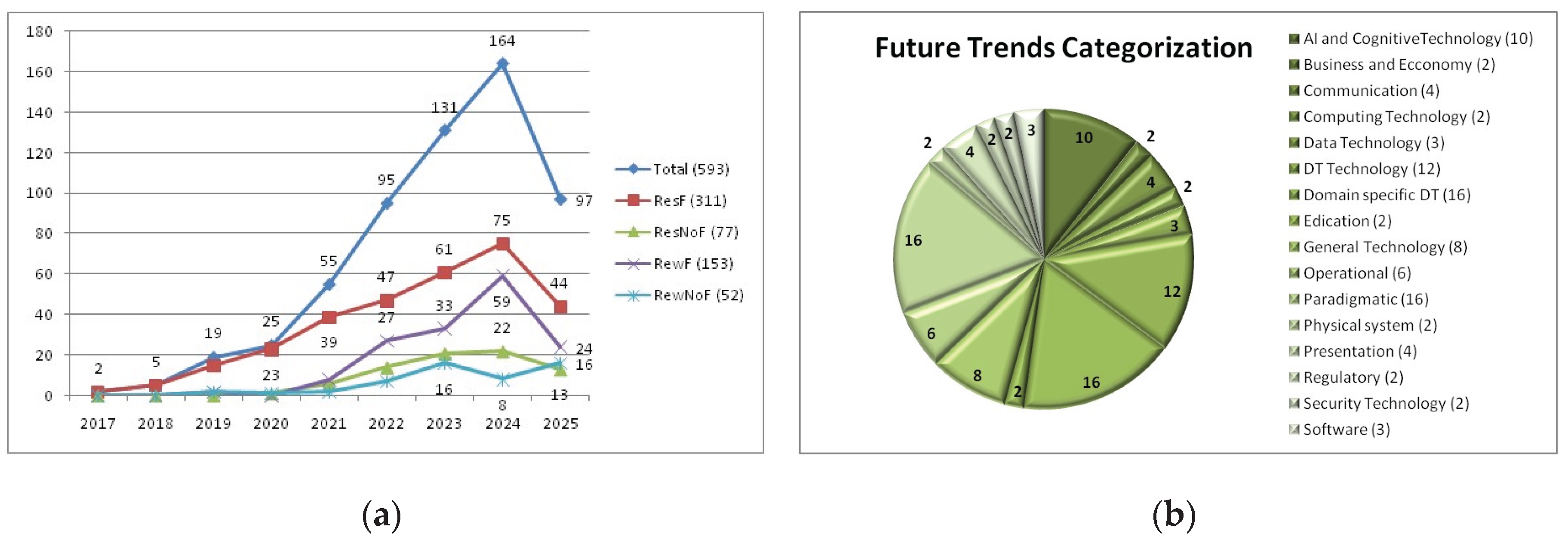
| Total | Total Rew | RewF | RewNoF | Total Res | ResF | ResNoF | Year | (RewF + ResF) Impact |
| 97 | 40 | 24 | 16 | 57 | 44 | 13 | 2025 | 68 |
| % | 41.24 | 24.74 | 16.49 | 58.76 | 77.19 | 22.81 | 70.10% | |
| 164 | 67 | 59 | 8 | 97 | 75 | 22 | 2024 | 134 |
| % | 40.85 | 35.98 | 4.88 | 59.15 | 77.32 | 22.68 | 81.71% | |
| 131 | 49 | 33 | 16 | 82 | 61 | 21 | 2023 | 94 |
| % | 37.40 | 25.19 | 12.21 | 62.60 | 74.39 | 25.61 | 71.76% | |
| 95 | 34 | 27 | 7 | 61 | 47 | 14 | 2022 | 74 |
| % | 35.79 | 28.42 | 7.37 | 64.21 | 77.05 | 22.95 | 77.89% | |
| 55 | 10 | 8 | 2 | 45 | 39 | 6 | 2021 | 47 |
| % | 18.18 | 14.55 | 3.64 | 81.82 | 86.67 | 13.33 | 85.45% | |
| 25 | 1 | 0 | 1 | 24 | 23 | 1 | 2020 | 23 |
| % | 4.00 | 0.00 | 4.00 | 96.00 | 95.83 | 4.17 | 92.00% | |
| 19 | 4 | 2 | 2 | 15 | 15 | 0 | 2019 | 17 |
| % | 21.05 | 10.53 | 10.53 | 78.95 | 100.00 | 0.00 | 89.47% | |
| 5 | 0 | 0 | 0 | 5 | 5 | 0 | 2018 | 5 |
| % | 0.00 | 0.00 | 0.00 | 100.00 | 100.00 | 0.00 | 100.00% | |
| 2 | 0 | 0 | 0 | 2 | 2 | 0 | 2017 | 2 |
| % | 0.00 | 0.00 | 0.00 | 100.00 | 100.00 | 0.00 | 100.00% |
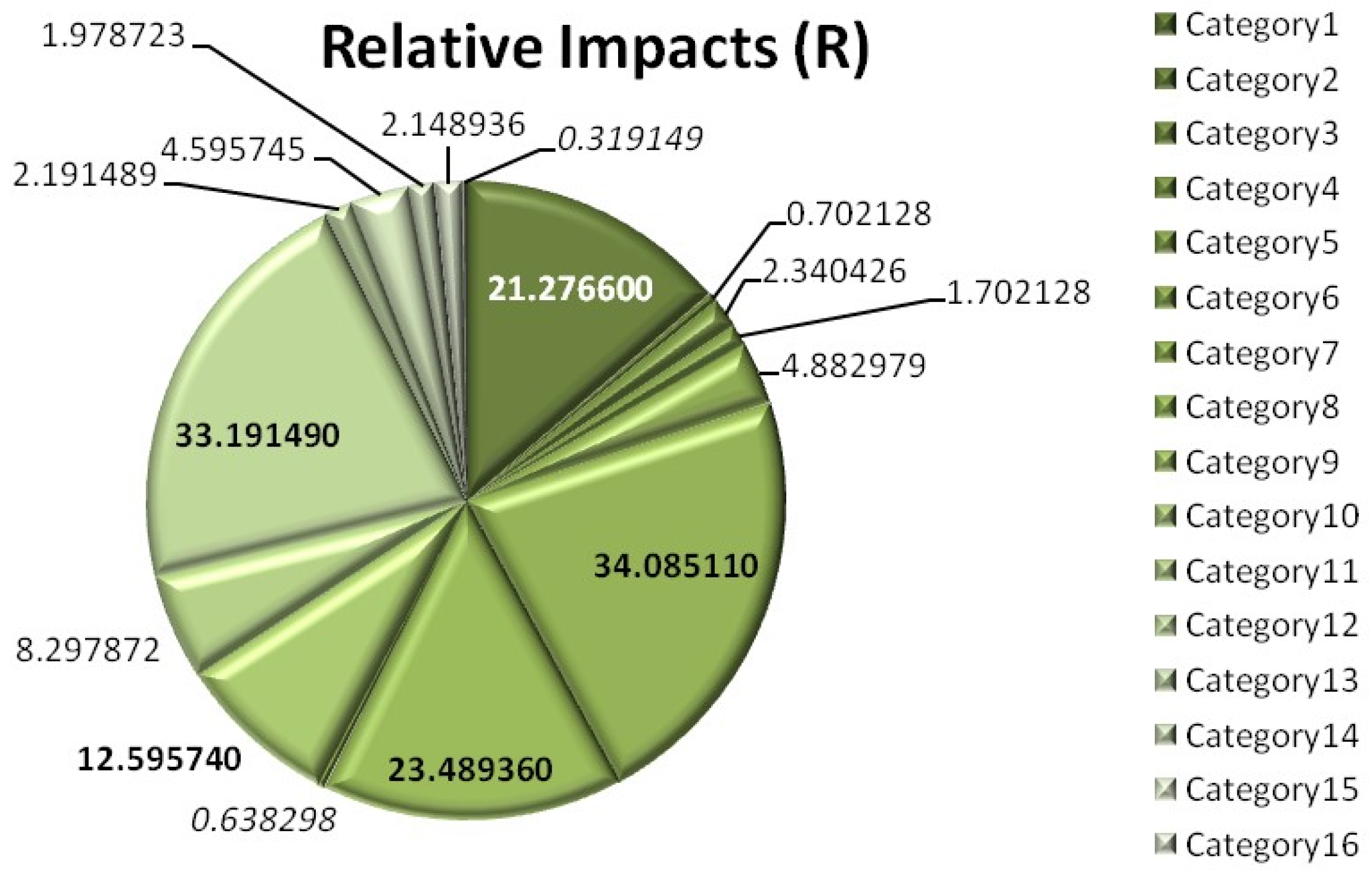
| I (i) | Category | Number of Future trends (FTi) |
Frequency (Fi) |
Category Pondered Impact (Ri) |
| 1. | AI and Cognitive Technology | 10 | 200 | 21.276600 |
| 2. | Business and Economy | 2 | 33 | 0.702128 |
| 3. | Communication | 4 | 55 | 2.340426 |
| 4. | Computing Technology | 2 | 80 | 1.702128 |
| 5. | Data Technology | 3 | 153 | 4.882979 |
| 6. | Digital Twinning Technology | 12 | 267 | 34.085110 |
| 7. | Domain Specific Digital Twins | 16 | 138 | 23.489360 |
| 8. | Education | 2 | 30 | 0.638298 |
| 9. | General Technology | 8 | 148 | 12.595740 |
| 10. | Operational Technology | 6 | 130 | 8.297872 |
| 11. | Paradigmatic Concepts | 16 | 195 | 33.191490 |
| 12. | Physical System Technology | 2 | 103 | 2.191489 |
| 13. | Presentation Technology | 4 | 108 | 4.595745 |
| 14. | Regulatory Principles | 2 | 93 | 1.978723 |
| 15. | Security Technology | 2 | 101 | 2.148936 |
| 16. | Software Technology | 3 | 10 | 0.319149 |
| 94 | 1844 | |||
| Formula (1) |
Formula (2) | Formula (3) | ||||
|
Cat. ID. |
Trend ID |
Digital Twinning Future Trend Description |
Trend Frequency (TFi) |
Category Pondered Impact |
Category Relative Impact (CRi) |
Absolute Impact (AIi) |
| 1. | Artificial intelligence ( Perceive (data collection and storage), Understanding (machine learning, deep learning, Knowledge representation) and Decide (Reinforcement Learning, Operational Research)) |
91 | 9.869848 | 0.455000 | 0.049349 | |
| Machine learning | 48 | 5.206074 | 0.240000 | 0.026030 | ||
| Knowledge based, semantic technologies, ontologies, cognitive systems, web mining | 15 | 1.626898 | 0.075000 | 0.008134 | ||
| Operation and evaluation (iterative optimization, self learning, self-organization, self-adaptation, self-maintenance) | 13 | 1.409978 | 0.065000 | 0.007050 | ||
| Decision making, support (real time) | 10 | 1.084599 | 0.050000 | 0.005423 | ||
| Neural networks, deep neural networks | 6 | 0.650759 | 0.030000 | 0.003254 | ||
| Natural Language Processing | 5 | 0.542299 | 0.025000 | 0.002711 | ||
| Federated Learning Platforms (Federated Scope, OpenFL, Nvidia's Clara, Substra, IBMFL, TensorFlowFL, PaddleFL) | 5 | 0.542299 | 0.025000 | 0.002711 | ||
| Cognitive systems Cognitive Operator 4.0, Cognitive DT | 4 | 0.433839 | 0.020000 | 0.002169 | ||
| Large language Models (LLM) enhanced Digital Twins | 3 | 0.325380 | 0.015000 | 0.001627 | ||
| 2. | Economic challenges in implementing DT, time and cost | 21 | 0.375813 | 0.636364 | 0.011388 | |
| Business , Financial technologies, logistics, supply chains | 12 | 0.214751 | 0.363636 | 0.006508 | ||
| 3. | 5G networks/6G networks, added value for network operators | 31 | 0.924620 | 0.563636 | 0.016811 | |
| Interconnection and interaction in PS: perception and access, communication protocols, data encapsulation, | 10 | 0.298265 | 0.181818 | 0.005423 | ||
| Mobile technologies, mobile systems, autonomous mobility, space technology | 8 | 0.238612 | 0.145455 | 0.004338 | ||
| Multi agent technology | 6 | 0.003254 | 0.178959 | 0.109091 | ||
| 4. | Cloud technologies, edge, fog | 49 | 2.125813 | 0.612500 | 0.026573 | |
| Computational infrastructure, Virtual machines, computational efficiency, fuzzy and granular computing. Quantum computing) | 31 | 1.344902 | 0.387500 | 0.016811 | ||
| 5. | Information and Data fusion, data cleaning, data integration, data fusion, two-way mirrors between physical and virtual data and time sensitive data | 103 | 8.546095 | 0.673203 | 0.055857 | |
| Big data, and data analytics | 45 | 3.733731 | 0.294118 | 0.024403 | ||
| Heterogeneous datasets, Semantic database | 5 | 0.414859 | 0.032680 | 0.002711 | ||
| 6. | Multidimensional modeling, model integration and model verification in Virtual space, modeling platforms | 88 | 12.741866 | 0.329588 | 0.047722 | |
| DT operational mechanisms, Interoperability and integration with existing systems | 53 | 7.674078 | 0.198502 | 0.028742 | ||
| Real-time interaction PS-VS (data transmission latency) | 43 | 6.226139 | 0.161049 | 0.023319 | ||
| Managing and orchestration of multiple instances of DT DT network paradigm, network digital twins. Internet of Digital Twins, (DT ecosystems) | 27 | 3.909436 | 0.101124 | 0.014642 | ||
| Human-in-the-loop expert participation, Human robot interaction, Human DT interaction | 22 | 3.185466 | 0.082397 | 0.011931 | ||
| Referent model - DT | 11 | 1.592733 | 0.041199 | 0.005965 | ||
| Digital Twins Platforms and software solutions (AWS IoT Twin Maker, Azure Digital Twins, Google Supply Chain Twin, NVIDIA Omni verse Enterprise,..) | 5 | 0.723970 | 0.018727 | 0.002711 | ||
| Virtual Twin as replacement for prototyping, Behavioral modeling, rule modeling | 4 | 0.579176 | 0.014981 | 0.002169 | ||
| Performance indicators prediction, parameters optimization, DT components | 4 | 0.579176 | 0.014981 | 0.002169 | ||
| DT Maturity evaluation and assessment | 4 | 0.579176 | 0.014981 | 0.002169 | ||
| Drone-based Digital Twins | 4 | 0.579176 | 0.014981 | 0.002169 | ||
| Digital Twin System, System of Digital Twin Systems | 2 | 0.289588 | 0.007491 | 0.001085 | ||
| 7. | Smart cities, buildings management. City DT sociotechnical aspects | 38 | 2.843818 | 0.275362 | 0.020607 | |
| Smart manufacturing/production | 32 | 2.394794 | 0.231884 | 0.017354 | ||
| Personalized medicine, Data driven health care, Model driven health care | 20 | 1.496746 | 0.144928 | 0.010846 | ||
| Precision medicine and medical DT (Nanobot surgery, Virtual Biopsy, Virtual experiments, Virtual Consulting, Vital monitoring and alert response) | 16 | 1.197397 | 0.115942 | 0.008677 | ||
| Agricultural and forestry DT | 11 | 0.823210 | 0.079710 | 0.005965 | ||
| Heritage Digital Twins | 3 | 0.224512 | 0.021739 | 0.001627 | ||
| Traffic Flow Digital Twins, Railway Digital Twins, Transportation System Digital Twin | 3 | 0.224512 | 0.021739 | 0.001627 | ||
| Holistic Health Ecosystem DT, Hospital Digital Twin | 3 | 0.224512 | 0.021739 | 0.001627 | ||
| Common Information Model (CIM), micro-grid digital twin | 3 | 0.224512 | 0.021739 | 0.001627 | ||
| Carbon emission monitoring | 3 | 0.224512 | 0.021739 | 0.001627 | ||
| Smart Pandemic City | 1 | 0.074837 | 0.007246 | 0.000542 | ||
| Sports Digital Twins | 1 | 0.074837 | 0.007246 | 0.000542 | ||
| TV Digital Twin and media metaverse | 1 | 0.074837 | 0.007246 | 0.000542 | ||
| Water system management DT | 1 | 0.074837 | 0.007246 | 0.000542 | ||
| Earth Digital Twin | 1 | 0.074837 | 0.007246 | 0.000542 | ||
| Landscape and urban DT | 1 | 0.074837 | 0.007246 | 0.000542 | ||
| 8. | Education-expertise knowledge, skill and cultural gap | 27 | 0.439262 | 0.900000 | 0.014642 | |
| DT as a new profession | 3 | 0.048807 | 0.100000 | 0.001627 | ||
| 9. | Interoperability and integration with existing systems | 52 | 4.173536 | 0.351351 | 0.028200 | |
| Building Information Modeling BIM, and GIS integration | 30 | 2.407809 | 0.202703 | 0.016269 | ||
| Scalability and performance | 29 | 2.327549 | 0.195946 | 0.015727 | ||
| Service encapsulation, composition and publication, demand decomposition, cooperation, micro-services | 13 | 1.043384 | 0.087838 | 0.007050 | ||
| Real-time location system (indoor and outdoor) | 10 | 0.802603 | 0.067568 | 0.005423 | ||
| Multi robot cooperation, IoRT (Internet of Robotic Things), Elastic robot control | 6 | 0.481562 | 0.040541 | 0.003254 | ||
| 3D/4D Printing connected with DT | 5 | 0.401302 | 0.033784 | 0.002711 | ||
| Control systems (fuzzy, neural networks) and monitoring | 3 | 0.240781 | 0.020270 | 0.001627 | ||
| 10. | Simulations | 72 | 5.075922 | 0.553846 | 0.039046 | |
| Sustainability | 18 | 1.268980 | 0.138462 | 0.009761 | ||
| Algorithms, low latency algorithms, mathematical models | 14 | 0.986985 | 0.107692 | 0.007592 | ||
| Complexity reduction and management | 14 | 0.986985 | 0.107692 | 0.007592 | ||
| Verification and Validation, test suits | 6 | 0.422993 | 0.046154 | 0.003254 | ||
| Safety | 6 | 0.422993 | 0.046154 | 0.003254 | ||
| 11. | Digital twin frameworks, platforms, and Quantum DT | 82 | 8.671367 | 0.420513 | 0.044469 | |
| Personal / human digital twin/ behavior modeling/ virtual patient | 24 | 2.537961 | 0.123077 | 0.013015 | ||
| Virtual worlds, Metaverse, Integration of data, Models, Analytics, and Human on world-level | 23 | 2.432213 | 0.117949 | 0.012473 | ||
| Sociotechnical systems (STS), social DT, digitalization, Cyber-Physical Systems | 20 | 2.114967 | 0.102564 | 0.010846 | ||
| Smart technologies and systems, Emergent dynamical systems concepts, emergency management | 15 | 1.586226 | 0.076923 | 0.008134 | ||
| Asset related Digital Twins (component DT), product twinning, process twinning, tools twinning, virtual sensors | 8 | 0.845987 | 0.041026 | 0.004338 | ||
| Infrastructural systems (mission critical) | 6 | 0.634490 | 0.030769 | 0.003254 | ||
| Integration of DT across domains (DT ecosystems) | 4 | 0.422993 | 0.020513 | 0.002169 | ||
| Multilayer Intelligent Digital Twin | 3 | 0.317245 | 0.015385 | 0.001627 | ||
| Spatial Digital Twins | 2 | 0.211497 | 0.010256 | 0.001085 | ||
| Maturity models, maturity levels | 2 | 0.211497 | 0.010256 | 0.001085 | ||
| Existing challenges (future trends), required strategies | 2 | 0.211497 | 0.010256 | 0.001085 | ||
| Organizational Digital Twin | 1 | 0.105748 | 0.005128 | 0.000542 | ||
| Communication Networks Digital Twin | 1 | 0.105748 | 0.005128 | 0.000542 | ||
| Democracy Deliberation DT | 1 | 0.105748 | 0.005128 | 0.000542 | ||
| Virtual City , transition from Smart City to Virtual City_ | 1 | 0.105748 | 0.005128 | 0.000542 | ||
| 12. | IoT and Industrial IoT, IoE (Internet of Everything) | 63 | 3.518980 | 0.611650 | 0.034165 | |
| Sensors, sensing, and compressed sensing and RFID, PLC, microwave sensors, sensor networks | 40 | 2.234273 | 0.388350 | 0.021692 | ||
| 13. | Augmented reality, mixed reality, extended reality | 36 | 2.108460 | 0.333333 | 0.019523 | |
| Human-Machine Interface, integration, collaboration, UI UX | 32 | 1.874187 | 0.296296 | 0.017354 | ||
| Virtual reality | 24 | 1.405640 | 0.222222 | 0.013015 | ||
| Visualization and image processing | 16 | 0.937093 | 0.148148 | 0.008677 | ||
| 14. | Standardization | 55 | 2.773861 | 0.591398 | 0.029826 | |
| Regulatory and ethical considerations | 38 | 1.916486 | 0.408602 | 0.020607 | ||
| 15. | Security and cyber security and privacy. And data ownership | 71 | 3.888829 | 0.702970 | 0.038503 | |
| Blockchain technology, BlockNet | 30 | 1.643167 | 0.297030 | 0.016269 | ||
| 16. | DT Software development, software architecture, Softbot integration | 8 | 0.043384 | 0.800000 | 0.004338 | |
| Health Based DT Platforms (Siemens, Philips, IBM, GE, Dessault, Amsys, Medtronic, Oracle) | 1 | 0.005423 | 0.100000 | 0.000542 | ||
| Open source solutions | 1 | 0.005423 | 0.100000 | 0.000542 | ||
| 1844 | ||||||
| Group | No. | Ref. | Focused on |
| Mission Related |
1 | [78] | The review of DT in the manufacturing industry aims to identify the contribution of machine learning (ML), current methods, and future research directions. |
| 2 | [79] | The systematic examination of the science mapping of building information modeling and digital twins technologies in the digitalization of transportation. | |
| 3 | [80] | Bibliometric and patent analysis for the comprehensive and in-depth research on digital twins by reviewing the current status of academic research and technological development, distribution of countries and institutions, and technological competition situations. | |
| 4 | [81] | The analysis and identification of research trends in the past and present, isolating the essential functions of DT (prototyping, pilot testing, monitoring, improvement, and control). | |
| 5 | [82] | The functional aspects, appeal, and innovative use of DT in smart industries by systematically reviewing and reflecting on recent research trends in next-generation (NextG) wireless technologies (5G-and-Beyond networks) and design tools, and current computational intelligence paradigms (edge and cloud computing-enabled data analytics, federated learning). | |
| Review Related |
1 | [83] | A bibliometric survey of the digital twin concept based on the Scopus database to present a global view of scholars' contributions in the manufacturing area. |
| 2 | [84] | The development of the Digital Twins (DT) concept, its maturity, and its vital role in the Industry 4.0 context. Identifying DT's potential functionalities for the digitalization of the manufacturing industry, the digital twin concept, its origin, and perspectives from the academic and industrial sectors. | |
| 3 | [85] | This study aims to analyze existing fields of applications of DTs for supporting safety management processes to evaluate the current state of the art. A bibliometric VOSviewer-based review helped in determining DTs' use in the engineering and computer science areas and to identify research clusters and future trends. The successive bibliometric and systematic reviews deepen the relationship between the DT approach and safety issues. | |
| 4 | [86] | Gaining a better understanding of Digital Twin technology in Smart City development through a comprehensive and bibliometric review approach, on more than 4,220 articles. | |
| 5 | [87] | Differentiation of DT from other advanced 3D modeling technologies, such as BIM, examining the present applications of DT and BIM in the construction industry, emphasizing the similarities and differences between them, and developing solutions and design methods for the integration of BIM and DT in building construction. | |
| 6 | [88] | A comprehensive review of DTs applications in building energy efficiency analyzes research trends and identifies research gaps and potential future research directions. | |
| 7 | [89] | The development of a proper methodology for visualizing the digital-twin science landscape using modern bibliometric tools, text-mining, and topic-modeling, based on machine learning models—Latent Dirichlet Allocation (LDA) and BERTopic (Bidirectional Encoder Representations from Transformers). | |
| 8 | [90] | Creating insights into approaches used to create digital twins of human–robot collaboration and the challenges in developing these digital twins. | |
|
Framework Related |
1 | [91] | The T-Cell framework container for models, data, and simulations that interact dynamically in a smart city context. |
| 2 | [92] | The semi-heuristics framework for robust scheduling. Composed of genetic algorithms for schedule optimization and discrete event simulation, synchronized with the field through a Digital Twin (DT) that employs an Equipment Prognostics and Health Management (EPHM) module. | |
| 3 | [93] | A digital twin framework for structural engineering. | |
| 4 | [94] | The characteristics and applications of three disruptive concepts that are generating transformative change in the management of supply chains and business operations: Cloud-based systems. | |
| 5 | [95] | The development of Digital Twin (DT) technology and its adoption within the maritime domain. | |
| 6 | [96] | The DT state-of-the-art case studies with focus on concept | |
| 7 | [97] | The innovative approach to addressing the challenges of smart mobility within the METACITIES initiative. Due to the increasing complexity of urban transportation systems | |
| 8 | [98] | The AI-driven digital twin framework for real-time tool life prediction management. Addressing these limitations by integrating multiple modules, including an on-machine direct inspection system, a seamless connectivity integration module for real-time data management, and a deep learning module for tool wear prediction | |
| 9 | [99] | The definition of the DT-based smart factory and its components, the methodology of the DT-CFE-based smart factory, and the network topology and operation mechanism. The framework aids in testing the transmission and response performance of data interactions during job scheduling. |
Disclaimer/Publisher’s Note: The statements, opinions and data contained in all publications are solely those of the individual author(s) and contributor(s) and not of MDPI and/or the editor(s). MDPI and/or the editor(s) disclaim responsibility for any injury to people or property resulting from any ideas, methods, instructions or products referred to in the content. |
© 2025 by the authors. Licensee MDPI, Basel, Switzerland. This article is an open access article distributed under the terms and conditions of the Creative Commons Attribution (CC BY) license (http://creativecommons.org/licenses/by/4.0/).


