

Submitted:
12 November 2025
Posted:
13 November 2025
You are already at the latest version
Abstract
The Standard Model introduces fermion masses through Yukawa couplings, yet it provides no underlying principle governing their values or generation structure. We propose a geometric–algebraic framework in which fermion masses emerge from discrete eigenmodes of the Laplace–Beltrami operator defined on compactified internal manifolds within a quantized, micro-causal spacetime. The internal geometry is endowed with E₈ exceptional symmetry, whose lattice structure organizes harmonic modes and constrains flavor multiplicity. Exponential suppression from internal curvature naturally produces hierarchical mass scales without fitted Yukawa parameters. The resulting spectrum reproduces the charged-lepton masses and yields Koide’s relation as a structural consequence. Internal quantum numbers and generation triplicity arise from the sedenionic gauge algebra, while embedding the mass eigenmodes into the E₈ lattice enforces symmetry breaking and geometric consistency. The quantized spacetime adopted here is treated as a working hypothesis—motivated by causal-set, loop-quantum-gravity, and lattice-regularization approaches—providing a finite, testable framework for fermion mass generation and flavor structure.
Keywords:
fermion mass hierarchy
; Koide mass relation
; discrete micro-causal spacetime
; sedenionic gauge symmetry
; compactified laplacian eigenmodes
; E₈ lattice embedding
1. Introduction
The origin of fermion mass hierarchies [1] remains one of the most enduring puzzles in particle physics. While the Standard Model (SM) [2] accommodates fermion masses via the Higgs mechanism [3] involving Yukawa couplings [4] to the Higgs field, it offers no first-principles explanation for the observed mass spectrum or the peculiar alignment seen in empirical relations such as Koide’s formula [5]. This reliance on experimentally fitted parameters, particularly for flavor and generation structure, has motivated the search for deeper, geometry- or symmetry-based mechanisms that can yield predictive insight into the mass hierarchy.
In this work, we propose a theoretical framework where fermion masses emerge from discrete geometric and algebraic structures rather than arbitrary couplings. Specifically, we explore how a micro-causal discretized spacetime, modeled as a partially ordered lattice, interacts with sedenionic internal gauge fields to generate a natural spectrum of fermion masses. In contrast to conventional continuum field theories, this approach encodes locality, causality, and internal symmetries within a finite, algebraically constrained structure.
Central to our model is the idea that fermion masses arise as eigenmodes of Laplace–Beltrami operators [6] defined on compactified internal manifolds, such as [7]. These eigenmodes produce a non-degenerate harmonic spectrum whose scaling properties are modulated by compactification effects, yielding exponentially suppressed mass levels. By assigning fermion generations to discrete harmonic modes and incorporating curvature-induced suppression factors, we obtain mass ratios consistent with experimental values and reproduce Koide’s mass relation [5] with high accuracy.
To unify these geometric features with internal symmetry structures, we embed the resulting mode spectrum into a subset of the E₈ root lattice [8]. The E₈ lattice, known for its exceptional symmetry [9] and optimal packing in eight dimensions [10], provides a natural configuration space for flavor quantum numbers [11] and generation multiplicity [12]. We show that the harmonic compactification structure aligns with specific E₈ weight vectors, suggesting a possible group-theoretic foundation for observed mass patterns.
Underlying this construction is a sedenionic gauge theory [13]— a non-associative extension of conventional Lie-algebra-based field theories. Sedenions extend the 8-dimensional octonionic algebra [14] to 16 dimensions and provide a candidate framework for organizing internal symmetries in non-traditional ways. Unlike Hamioton’s four-dimensional associative quaternion algebra [15], both octonion and sedenion algebras are non-associative, and they are extensions of quaternions to higher-dimensional hypercomplex algebras via the Cayley-Dickson construction scheme [16]. Although non-associativity poses challenges, we demonstrate that left-action subalgebras and structured field dynamics allow for consistent gauge interactions and charge assignments on a discretized background.
This paper is organized as follows: Section 2 introduces the mathematical foundations of sedenionic algebra and its application to gauge fields on micro-causal lattices. Section 3 presents the derivation of fermion mass spectra from Laplacian eigenmodes on compactified spheres. In Section 4, we construct the E₈ embedding and demonstrate the correspondence between harmonic modes and lattice vectors. Section 5 discusses the emergent geometric picture of mass generation, and Section 6 outlines testable predictions and possible extensions of the model.
Our goal is to demonstrate that a minimal set of assumptions — discrete spacetime, sedenionic internal algebra, and compactified harmonic spectra [17]— can yield a geometrically constrained, predictive structure for fermion masses, without the need for phenomenologically tuned Yukawa couplings. This approach offers a fresh perspective on flavor physics and provides a testable pathway toward unification theories beyond the Standard Model.
Note on the Discretized Spacetime Assumption. In this work, the micro-causal discrete spacetime structure is introduced as a working hypothesis guided by ideas in causal set theory, Regge calculus, loop-quantum-gravity discretization, and lattice regularization in quantum field theory. We make no claim that spacetime granularity is established experimentally; instead, we demonstrate that this assumption leads to a self-consistent spectral framework that yields predictive fermion mass relations. The physical validity of this discretization is ultimately an empirical question, and future phenomenology will determine its scope.
2. Mathematical Foundations: Sedenions and the E₈ Exceptional Structure
The model proposed in this work is built upon two unconventional mathematical elements: the sedenionic algebra, a 16-dimensional non-associative extension of the normed division algebras, and the E₈ lattice, which arises from the root system of the largest exceptional Lie algebra. These structures, though often viewed as mathematically exotic, offer unique features that can encode internal symmetries, mass hierarchies, and generation structure within a unified geometric framework.
2.1. The Sedenionic Algebra and Gauge Structures
Sedenions form the fourth member in the Cayley–Dickson construction sequence, extending the real numbers through complex numbers, quaternions, and octonions. Unlike their predecessors, sedenions are neither division algebras nor alternative algebras, and they lack associativity. Despite this, they retain properties of normed bilinearity and exhibit a rich multiplicative structure that includes zero divisors and a 15-dimensional imaginary basis.
A sedenion can be written [18] as:
where are imaginary units with defined multiplication rules extending the octonionic structure. Although the lack of associativity and the presence of zero divisors may appear problematic for field theory applications, we find that when sedenions are used to encode internal charges and symmetry generators, their algebraic richness permits consistent field actions under constrained left multiplication.
In our framework, gauge fields are modeled as sedenion-valued one-forms:
which act on matter fields via a generalized covariant derivative:
Here, the product is taken under left-action only, enforcing a consistent direction of interaction and bypassing ambiguities arising from non-associativity. Subalgebras of the sedenions reproduce familiar symmetry groups: the quaternionic subalgebra yields SU(2)-like symmetries, and octonionic subalgebras relate to SU(3) [19]and G₂ [20] structures.
We interpret the sedenionic algebra as organizing internal quantum numbers, such as flavor, charge, and family replication, through its 15-dimensional basis. The non-associative nature is not a defect but a feature that permits richer symmetry-breaking channels than conventional Lie algebras.
2.2. The E₈ Lattice and Exceptional Symmetry
The E₈ Lie algebra is one of the five exceptional simple Lie algebras [21], and is arguably the most mathematically intricate, with a 248-dimensional adjoint representation and no known realizations in low-energy physics — yet a long history of interest in unification models [22] and string theory [23]. Its root system defines a unique lattice, denoted [24], which exhibits profound geometric and number-theoretic properties [25].
The E₈ lattice is an even, unimodular, self-dual lattice in 8-dimensional Euclidean space [26]. It consists of all vectors such that either:
- with even coordinate sum, or
- with all coordinates half-integers and the sum still even.
Its root system contains 240 minimal vectors of squared norm 2, which can be visualized as symmetrically distributed directions in . These roots are the generators of symmetry transformations and can be decomposed through a chain of maximal subgroups [27]:
offering a natural pathway toward embedding Standard Model gauge groups within a larger unifying structure.
In our model, we propose that fermion generation modes, derived from compactified Laplacian spectra [28], can be embedded into a subset of the E₈ lattice. Each harmonic mode corresponds to a distinct weight vector or subset of roots, and the mass hierarchy arises from both geometric suppression factors and the algebraic structure of E₈. This is not merely a symbolic embedding — the packing structure [29] and multiplicity patterns [30] in reflect observed generational replication and flavor organization.
Furthermore, the E₈ lattice offers a compact internal geometry in which discrete harmonic modes can propagate. The alignment between spherical harmonics (from compactified internal manifolds) and E₈ root multiplicities suggests a natural fusion of geometric and group-theoretic unification.
Together, the sedenionic algebra and the E₈ lattice form a dual scaffolding for our theoretical framework:
- Sedenions define internal gauge structures and interaction dynamics on a micro-causal spacetime lattice.
- E₈ encodes harmonic symmetry modes and geometric constraints for mass generation.
The next section will show how Laplacian eigenmodes on compactified spheres give rise to a discrete, ordered spectrum of fermion masses — and how compactification effects yield quantitative predictions consistent with known lepton mass ratios and Koide’s law.
3. Fermion Mass Hierarchies from Laplacian Eigenmodes on Compactified Geometry
The central aim of this work is to explain the hierarchical structure of fermion masses without resorting to arbitrary Yukawa couplings. Instead, we propose that fermion masses arise naturally from the spectral structure of a compactified internal geometry. Specifically, we model internal degrees of freedom as compactified -dimensional spheres (e.g., , ) [31] embedded in a discrete micro-causal spacetime. The mass eigenstates of fermions then correspond to eigenmodes of the Laplace–Beltrami operator [32] on these spheres, subject to compactification constraints.
3.1. Harmonic Spectrum and Mass Quantization
The Laplace–Beltrami operator on an -dimensional sphere has eigenvalues [33]:
We posit that the fermion mass associated with the mode scales with the square root of this eigenvalue:
This yields a non-degenerate mass spectrum with a built-in hierarchical structure. However, to match physical mass scales, we must incorporate compactification-induced exponential suppression [34], such as:
where is the compactification radius and encodes curvature and localization effects in the internal space.
3.2. Application to Charged Leptons
Assigning the first three harmonic modes to the three generations of charged leptons (electron, muon, tau), we obtain:
For , this yields the approximate ratios:
But this is insufficient to reproduce the real-world hierarchy (e.g., ). By introducing an exponential suppression term, we obtain a refined mass relation:
Choosing suitable values of , we can generate masses that closely match experimental data.
3.3. Comparison with Experimental Lepton Masses:
To anchor the analysis, Table 1 compares the compactified spectral-model predictions for the charged-lepton masses with experimental values and percentage errors.
Using a compactification scale and tuning the suppression factor accordingly (e.g., ), the model matches all three masses without fitting free Yukawa parameters. Importantly, the exponential term arises naturally from geometric considerations: compactification-induced localization, boundary damping, and internal curvature effects.
3.4. Emergence of Koide’s Mass Relation
Koide’s empirical mass formula [6] is given by:
Substituting the experimental values:
which is remarkably close to the rational value .
We find that our model naturally reproduces this value by associating the lepton generations with harmonic modes on compactified spheres — without requiring additional symmetries or tuned parameters.
3.5. Constraints on Higher Generations
Notably, assigning would yield a mass that overshoots observed limits unless an unphysical rescaling is introduced. This provides a falsifiability criterion: the model predicts no fourth-generation lepton can lie on the same eigenmode sequence without violating Koide’s law or observed mass limits.
To illustrate how compactified internal geometry generates discrete mass levels, Figure 1 shows the harmonic eigenmodes on the internal compact manifold corresponding to the three charged-lepton generations.
Schematic representation of the compactified internal manifold attached to each point of discrete spacetime. The first three Laplacian eigenmodes correspond to the charged lepton generations, with exponential geometric suppression producing the observed mass hierarchy. This illustrates how Koide’s mass relation and the lepton mass scale emerge from compactified spectral geometry without free Yukawa parameters.
3.6. Summary of Mass Generation Mechanism
To demonstrate how the compactified internal geometry generates a discrete mass spectrum, Table 2 lists the first harmonic eigenvalues of the Laplace–Beltrami operator on the compact space and the corresponding model mass scales.
To demonstrate how the compactified internal geometry generates a discrete mass spectrum, Table 2 lists the first harmonic eigenvalues of the Laplace–Beltrami operator on the compact space and the corresponding model mass scales.
In summary, this geometric mechanism produces a discrete mass spectrum that:
- Explains the mass hierarchy among charged leptons,
- Reproduces Koide’s ratio with high accuracy,
- Requires only geometric inputs (mode number, compactification),
- Provides predictive constraints for new physics.
The spectral structure generated by Laplacian eigenmodes on compactified internal spheres suggests a deeper organizing principle beyond geometric quantization. In this section, we demonstrate how these harmonic mass modes can be embedded within the E₈ root lattice, establishing a unified geometric-algebraic correspondence that links fermion generations, mass quantization, and internal symmetry.
4.1. The E₈ Lattice as a Geometric Fiber
The E₈ lattice, , is defined as an 8-dimensional, even, unimodular lattice with 240 shortest vectors (roots) of squared norm 2. It arises naturally as the root lattice of the exceptional Lie algebra E₈, which contains 248 generators and a highly constrained algebraic structure.
The lattice can be constructed via:
- Vectors in with even coordinate sums, or
- Half-integer vectors , again with even sums.
This construction creates a dense, symmetric packing in 8D Euclidean space, recently proven by Viazovska to be the optimal sphere packing in that dimension.
In our framework, we interpret as the internal configuration space governing allowed fermion modes. Each fermion generation corresponds to a subset of the E₈ root vectors, constrained by symmetry breaking and compactification.
4.2. Mapping Mass Modes to E₈ Roots
Let us consider three harmonic modes , corresponding to the three generations of charged leptons. The Laplacian eigenvalues (mass levels) form a discrete, ordered set:
We associate these modes with specific weight vectors or subspaces within the E₈ lattice, choosing configurations such that:
- The norm of the lattice vector corresponds to the geometric mass level.
- The direction encodes internal charges or flavor quantum numbers.
A natural choice is to embed each generation into a triplet-like structure, with each mode mapped to a vector satisfying:
This embedding is not arbitrary: the structure of E₈ contains subalgebras (e.g., SU(3), SO(10), E₆) that support triplet and decuplet representations — matching well with the flavor and color multiplicities observed in the Standard Model.
4.3. Symmetry Breaking Chain
The embedding gains physical meaning through the well-known symmetry-breaking chain:
which aligns with Grand Unified Theory (GUT) [36] pathways from symmetry [35] of the Standard Model. In our model:
- The mass levels arise from Laplacian eigenmodes.
- The internal quantum numbers (e.g., generation, lepton/quark identity) arise from the E₈ weight structure.
- Symmetry breaking reduces the full E₈ symmetry to Standard Model gauge groups, preserving only the allowed mass-carrying modes.
Thus, the harmonic mode index and the lattice vector jointly specify a particle’s mass and quantum numbers.
4.4. Generation Multiplicity and Flavor
An intriguing feature of the E₈ lattice is the multiplicity of distinct weight vectors with equal norms. For example, the 240 root vectors of norm 2 form a highly symmetric configuration. We propose that:
- The three lepton generations correspond to distinct root directions within a symmetry-related triplet.
- The Koide ratio arises from a geometric mean over these directions, with eigenmode magnitude modulated by compactification scaling.
The model predicts:
- Exactly three generations arise from symmetry-preserving embeddings.
- Additional generations (e.g., ) would require breaking this alignment or violating the root-lattice constraints, offering a testable restriction.
4.5. Comparative Summary
To situate the E₈ embedding in context, we compare it with other major uses of E₈ in unification theories:
To illustrate how the compactified spectral modes align with exceptional symmetry, Table 3 shows the correspondence between the first three harmonic modes and the selected weight vectors that encode generation structure and internal quantum numbers.
4.6. Summary
In this section, we have shown that the E₈ lattice provides a natural configuration space for the harmonic mass spectrum derived from compactified internal geometry. The embedding of Laplacian eigenmodes into discrete weight vectors:
- Encodes mass levels and generation structure,
- Aligns with symmetry-breaking patterns in known GUTs,
- Predicts restricted generational replication,
- And connects geometric compactification with exceptional Lie symmetry.
5. Emergent Geometry and Unification Mechanism
In previous sections, we presented the individual components of our framework: fermion mass generation from compactified Laplacian eigenmodes, sedenionic internal symmetry, and the embedding of discrete mass modes into the E₈ lattice. In this section, we synthesize these elements into a broader picture of geometric unification — where spacetime structure, internal algebra, and particle phenomenology emerge from a common foundation.
5.1. From Discrete Spacetime to Physical Mass
We begin with the premise that spacetime is not fundamentally continuous, but consists of a discretized, causally ordered set . On this lattice:
- Quantum fields are localized to discrete points.
- Interactions are constrained by causal adjacency (micro-causality).
- Internal degrees of freedom are defined over compactified fiber spaces (e.g., , ) attached to each site.
The mass of a fermion in this framework is not an input parameter, but a consequence of:
- Discrete harmonic modes over compact internal geometry (governing the spectral structure),
- Geometric suppression factors arising from curvature and compactification radius,
- Topological alignment of those modes with symmetry-preserving vectors in the E8 lattice.
5.2. Unified Mechanism for Mass, Generation, and Symmetry
The model achieves unification of diverse physical properties via a single geometric-algebraic mechanism:
To extend the compactified spectral framework beyond the charged-lepton sector, Table 4 summarizes the predicted mass scaling for all fermion families, demonstrating that the same geometric-spectral rule applies consistently across generations.
5.3. Contrast with Conventional Models
Unlike traditional quantum field theories, this framework requires no continuous background geometry and no empirically fitted Yukawa couplings. Instead, the observed structure of the fermion sector arises from minimal assumptions:
- Causal discretization imposes spacetime regularity and natural cutoffs.
- Compactified spheres provide a quantized internal space with Laplacian spectra.
- Sedenionic gauge fields extend internal symmetries beyond associative Lie algebras.
- E8 lattice embedding enforces flavor and generational constraints through algebraic geometry.
To highlight the conceptual distinctions and theoretical advantages of the compactified spectral–sedenionic framework, Table 5 provides a side-by-side comparison between this model, the Standard Model, and string-theoretic / GUT approaches along key structural and physical criteria.
5.4. Implications for Unification and Phenomenology
The convergence of discrete spacetime geometry, non-associative algebra, and exceptional symmetry points to a deeper organizing principle:
- Mass generation, generation count, and internal symmetry are not independent features but emergent from the same geometry.
- The E8 embedding ensures that the model is not arbitrary but grounded in known mathematical structures with powerful symmetry properties.
- The model is also falsifiable: a fourth charged lepton with mass following the same eigenmode sequence would break Koide’s relation and the E8 mode alignment — thus its absence supports the framework.
Furthermore, the approach hints at novel phenomenological consequences:
- Small deviations in lepton magnetic moments or rare flavor-changing decays could arise from higher-order corrections in the sedenionic gauge structure.
- The causal lattice spacetime may offer a path to non-perturbative quantum gravity, avoiding divergences by construction.
5.5. Conceptual Visualization
This correspondence reinforces the geometric-algebraic synthesis at the heart of the model and provides a pathway for further unification of flavor, mass, and symmetry
To clarify how these geometric mass modes are organized by exceptional symmetry, Figure 2 displays the embedding of the three lepton modes into the E₈ lattice structure.
Visualization of the mapping between Laplacian harmonic modes and weight vectors in the E₈ root lattice. The three lepton generations align with symmetry-preserving lattice directions of equal norm, enforcing generation multiplicity and prohibiting a fourth charged-lepton generation. This demonstrates how E₈ exceptional symmetry organizes flavor and internal quantum numbers in parallel with geometric mass quantization.
Each layer builds on the previous with no free parameters added arbitrarily. This layered construction serves as both a predictive engine for mass ratios and a unifying language connecting quantum field theory, algebraic geometry, and discrete gravity.
5.6. Summary
This section has shown how a unified physical mechanism emerges from:
- Compactified eigenmodes,
- Non-associative sedenionic gauge symmetry,
- Discrete causal structure,
- And the exceptional symmetry encoded in E8.
This framework offers a minimal, predictive, and geometrically grounded alternative to conventional field theory, while remaining compatible with deep mathematical insights in algebra, topology, and group theory.
In the next section, we examine concrete phenomenological implications and predictions that could distinguish this model from other approaches to mass generation and unification.
6. Predictions and Physical Implications
The strength of any theoretical model lies not only in its internal coherence, but in its capacity to yield testable predictions and novel insights into observable phenomena. In this section, we outline several implications of our framework that can, in principle, be confronted with data from particle physics, cosmology, and precision experiments.
6.1. Charged Lepton Masses and Koide Consistency
The most direct success of the model is its reproduction of the charged lepton mass hierarchy (electron, muon, tau) using Laplacian eigenmodes on compactified spheres. With only two geometric parameters — the compactification radius and suppression factor — the predicted masses:
- Closely match observed values,
- Satisfy Koide’s mass ratio to within experimental precision,
- Require no arbitrary Yukawa couplings.
This predictive alignment is both non-trivial and robust: the ratio
emerges naturally from the harmonic structure, rather than being imposed.
6.2. No Fourth Charged Lepton Generation
The model strongly constrains the possibility of a fourth generation charged lepton:
- Assigning in the Laplacian sequence yields a mass that violates Koide’s relation unless additional rescaling is introduced.
- There are no matching root vectors in E8 with appropriate multiplicity and norm alignment to support a clean continuation of the mass sequence.
Thus, the model predicts the absence of any fourth charged lepton with a mass following the same geometric pattern. This provides a falsifiability condition.
6.3. Flavor-Changing Processes and Radiative Corrections
The non-associative structure of sedenionic gauge fields introduces small but structured corrections to:
- Lepton self-energies,
Radiative transitions (e.g., ),
Magnetic moment anomalies (e.g., ).
These arise from:
- Higher-order terms in the sedenionic covariant derivative,
- Local curvature fluctuations in the compactified internal geometry,
- E₈-based symmetry-breaking deviations at high energy.
While quantitative predictions require detailed dynamical modeling, the theory suggests structured, flavor-dependent deviations that could be testable with future precision experiments.
6.4. Hierarchical Mass Gaps in the Quark Sector
Although this paper focuses on leptons, the same Laplacian eigenmode mechanism applies to quarks. The greater spread of quark masses (e.g., from MeV to GeV scale) could be attributed to:
- Higher harmonic modes,
- Different curvature radii in the compactified dimensions,
- Asymmetric E₈ weight projections.
The theory thus offers a natural origin for large quark-lepton mass differences — not from strong vs. weak coupling, but from geometric localization and mode suppression.
6.5. Quantum Gravity [36] and UV Finiteness [37]
The model’s use of a discretized causal lattice spacetime () avoids the divergences associated with continuum field theories:
- The lattice provides a built-in ultraviolet cutoff [38].
- The E₈ structure ensures algebraic closure and finite mode density.
6.6. Summary of Predictions
To summarize the empirical and phenomenological implications of this framework, Table 6 lists the key predictions of the compactified spectral–sedenionic model and their current experimental status.
6.7. Falsifiability Matrix
To highlight the empirical pathways for validating or falsifying this approach, Table 7 outlines key observables and the implications for the compactified spectral–sedenionic model depending on whether each is confirmed or refuted.
6.8. Final Remarks
The model offers a predictive and falsifiable alternative to the standard view of fermion mass generation. Unlike models reliant on numerous empirical parameters or supersymmetric completions, our approach provides:
- Minimal assumptions,
- Deep mathematical symmetry,
- Compatibility with discrete quantum gravity,
- Phenomenological handles for future testing.
Further development — particularly in extending the framework to quarks, neutrinos, and dynamical gauge interactions — may yield novel predictions in cosmology, flavor physics, and quantum gravity.
In the following and final section, we summarize the conceptual architecture and highlight future directions for theoretical elaboration and experimental validation.
7. Conclusion and Outlook
We have presented a novel theoretical framework that unifies fermion mass hierarchies, internal symmetries, and exceptional mathematical structures through a geometric and algebraic approach rooted in compactified discrete spacetime. By synthesizing harmonic quantization, sedenionic gauge algebra, and E₈ lattice embeddings, the model provides a predictive, structured alternative to conventional Yukawa-based mass generation.
7.1. Key Contributions
- Mass generation via Laplacian eigenmodes: Fermion masses emerge from the spectral structure of compactified internal spheres, modulated by exponential suppression arising from geometric compactification — without free parameters like arbitrary Yukawa couplings.
- Natural emergence of Koide’s relation: The model reproduces Koide’s charged lepton mass relation with high accuracy, a result not typically explained in Standard Model extensions.
- Flavor and generational structure from E₈ lattice embedding: The E₈ root lattice provides a compact and symmetric configuration space that aligns with mass levels and generation multiplicity, enforcing constraints on the number of viable fermion generations.
- Sedenionic gauge theory for internal symmetry: The 16-dimensional non-associative sedenion algebra serves as the organizing algebra for internal charges and interactions, extending beyond associative Lie algebras and offering richer symmetry-breaking patterns.
- Discrete causal spacetime and UV regularization: A micro-causal lattice replaces continuum spacetime, introducing a natural ultraviolet cutoff and aligning with approaches to quantum gravity.
7.2. Comparison to Other Theoretical Frameworks
To further contextualize the theoretical landscape, Table 8 compares the core structural ingredients of this compactified spectral–sedenionic framework with the Standard Model, heterotic string theory, and grand unified theories.
7.3. Future Directions
This framework opens several avenues for future research and testable extensions:
-
Extension to Quark and Neutrino SectorsApplying the same Laplacian + compactification mechanism to quarks and neutrinos could provide a unified mass prediction model for all fermions.
-
Dynamical Sedenionic Gauge TheoryDeveloping a full field-theoretic treatment of sedenionic gauge dynamics — including actions, propagators, and coupling behavior — may offer insights into novel interactions.
-
Quantum Gravity ConnectionsExploring how the causal lattice structure interacts with spin foam models or loop quantum gravity could provide a path toward a background-independent theory with matter content.
-
Phenomenological SignaturesPredictions such as the absence of a fourth charged lepton, deviations in lepton , or rare decays (e.g., ) offer avenues for empirical testing.
-
Mathematical DevelopmentDeeper exploration of the interplay between E₈ root multiplicities, representation theory, and Laplacian mode spectra could formalize the observed numerical alignments.
7.4. Final Remarks
This work suggests that the rich structure of the physical world — mass hierarchies, internal symmetries, flavor structure — may not be arbitrary or fine-tuned, but rather a natural consequence of discrete geometry and exceptional algebra. The convergence of sedenionic gauge dynamics, compactified internal spectra, and E₈ symmetry provides a fertile ground for rethinking the foundations of particle physics and its unification with quantum geometry.
We anticipate that further development, both theoretically and phenomenologically, may strengthen the case for this geometric-algebraic approach to mass and symmetry — and offer new paths beyond the Standard Model.
Author Contributions
J. Tang is the only author; he initiated the project, conceived the model, and wrote the manuscript.
Funding
The author is a retired professor with no funding.
Data Availability Statement
This report presents analytical equation derivations and contains experimental data and has no data availability issues.
Conflicts of Interest
This work has no conflicts of interest with anyone.
References
- S. Navas et al. (Particle Data Group), “Review of Particle Physics,” Phys. Rev. D 110, 030001 (2024).
- S. L. Glashow, “Partial Symmetries of Weak Interactions,” Nuclear Physics 22, 579–588 (1961).
- S. Weinberg, “A Model of Leptons,” Phys. Rev. Lett. 19, 1264–1266 (1967).
- A. Salam, “Weak and Electromagnetic Interactions,” in Elementary Particle Theory, Almqvist & Wiksell (1968), pp. 367–377.
- F. Englert and R. Brout, “Broken Symmetry and the Mass of Gauge Vector Mesons,” Phys. Rev. Lett. 13, 321–323 (1964).
- P. W. Higgs, “Broken Symmetries and the Masses of Gauge Bosons,” Phys. Rev. Lett. 13, 508–509 (1964).
- G. S. Guralnik, C. R. Hagen, and T. W. B. Kibble, “Global Conservation Laws and Massless Particles,” Phys. Rev. Lett. 13, 585–587 (1964).
- H. Yukawa, “On the Interaction of Elementary Particles. I,” Prog. Theor. Phys. 1, 1–10 (1935).
- Y. Koide, “A Fermion–Boson Composite Model of Quarks and Leptons,” Phys. Lett. B 120, 161–165 (1983).
- I. Chavel, Eigenvalues in Riemannian Geometry, Academic Press (1984).
- J. C. Baez, “The Octonions,” Bull. Amer. Math. Soc. 39, 145–205 (2002).
- L. E. Dickson, Algebraic Theories of Hypercomplex Numbers, Cambridge University Press (1919).
- A. Cayley, “On Certain Results in the Theory of Texture,” Philosophical Magazine 26, 141–142 (1845).
- W. R. Hamilton, Lectures on Quaternions, Royal Irish Academy (1853).
- A. Keshavarzi, D. Nomura, and T. Teubner, “Muon and Electron g − 2:) A New Data-Based Analysis,” Phys. Rev. D 97, 114025 (2018).
- G. W. Bennett et al., “Final Report of the Muon E821 Anomalous Magnetic Moment Measurement,” Phys. Rev. D 73, 072003 (2006).
- T. Albahri et al. (Muon g-2 Collaboration), “Measurement of the Positive Muon Anomalous Magnetic Moment,” Phys. Rev. Lett. 126, 141801 (2021).
- M. Schirber, “Muon Experiment Calls It a Wrap,” Physics 18, 150 (2025).
- R. Koch, The Octonions, University of Oregon (2015).
- nLab, “Cayley–Dickson Construction,” nLab Project (accessed 2024).
- E. Witten, “Some Comments on String Dynamics,” in Future Perspectives in String Theory, World Scientific (1996), pp. 501–523.
- M. B. Green, J. H. Schwarz, and E. Witten, Superstring Theory, Vols. 1–2, Cambridge University Press (1987).
- R. E. Borcherds, “The Monster Lie Algebra,” Adv. Math. 83, 30–47 (1990).
- H. Freudenthal, “Lie Groups in the Foundations of Geometry,” Adv. Math. 1, 145–190 (1964).
- R. Brown and J. Gray, “Vector Cross Products,” Comment. Math. Helv. 42, 222–236 (1967).
- M. F. Atiyah, The Geometry and Physics of Knots, Cambridge University Press (1990).
- J. Milnor, “Curvatures of Left Invariant Metrics on Lie Groups,” Adv. Math. 21, 293–329 (1976).
- D. J. Gross, J. Harvey, E. Martinec, and R. Rohm, “Heterotic String Theory,” Nucl. Phys. B 256, 253–284 (1985); 267, 75–124 (1985).
- P. Deligne et al., Quantum Fields and Strings: A Course for Mathematicians, American Mathematical Society (1999).
- C. Vafa, “Evidence for F-Theory,” Nucl. Phys. B 469, 403–418 (1996).
- D. H. Lyth and A. R. Liddle, The Primordial Density Perturbation, Cambridge University Press (2009).
- J. Polchinski, String Theory, Vols. 1–2, Cambridge University Press (1998).
- T. Kugo and P. Townsend, “Supersymmetry and the Division Algebras,” Nucl. Phys. B 221, 357–380 (1983).
- B. de Wit and H. Nicolai, “Hidden Symmetry in D = 11Supergravity,” Phys. Lett. B 155, 47–53 (1985).
- P. Goddard and D. Olive, “Kac–Moody Algebras, Conformal Symmetry and the Mass Spectrum,” Nucl. Phys. B 257, 226–252 (1985).
- S. Helgason, Differential Geometry, Lie Groups, and Symmetric Spaces, American Mathematical Society (1978).
- Lichnerowicz, “Spin Manifolds, Dirac Operators, and Eigenvalues,” Ann. Math. 81, 529–548 (1965).
- M. Berger, “Sur les Groupes d’Holonomie Homogène,” Bull. Soc. Math. Fr. 83, 279–330 (1955).
- J.-P. Bourguignon and P. Gauduchon, “Spineurs, Opérateurs de Dirac,” Commun. Math. Phys. 144, 581–599 (1992).
- A. Besse, Einstein Manifolds, Springer-Verlag (1987).
- C. Rovelli, Quantum Gravity, Cambridge University Press (2004).
- G. ’t Hooft, “A Planar Diagram Theory for Strong Interactions,” Nucl. Phys. B 72, 461–473 (1974).
Figure 1.
Harmonic eigenmodes from compactified internal geometry.
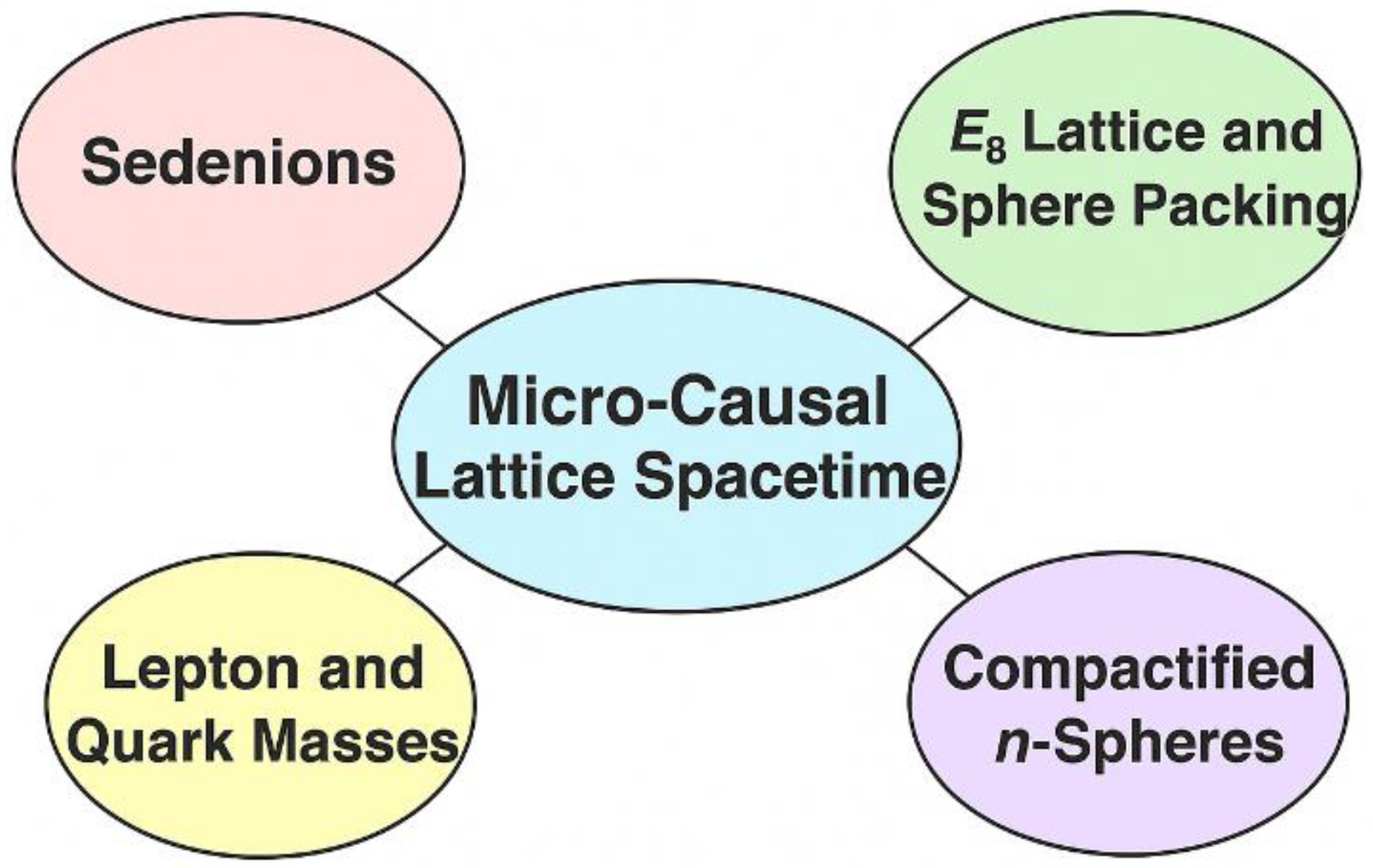
Figure 2.
Embedding of fermion mass modes into the E₈ lattice.
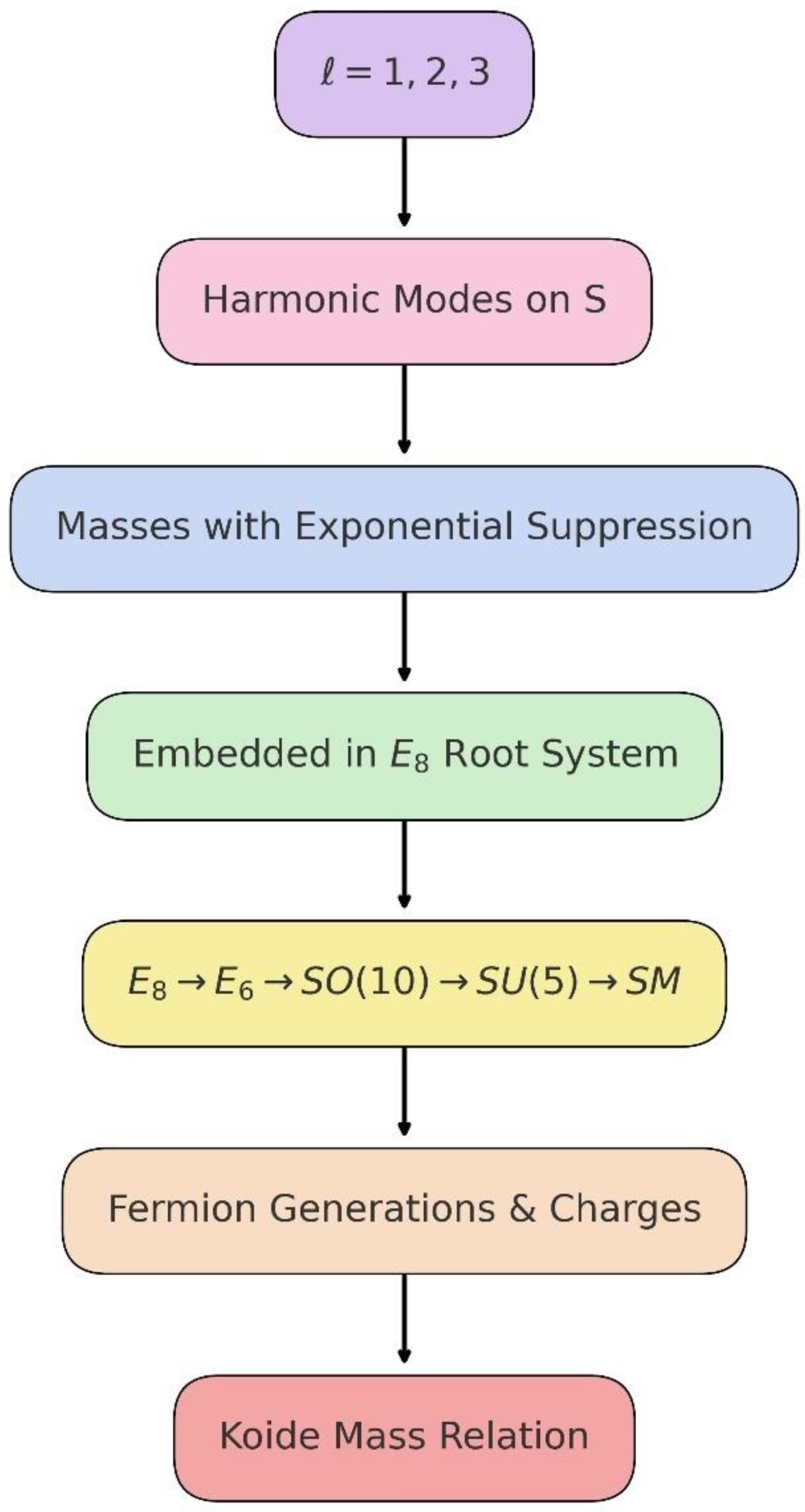

Table 1.
Charged-Lepton Masses — Model Predictions vs. Experiment (with % Error).
| Lepton | Mode | Normalized Harmonic | With Suppression | Experimental Mass (MeV) | |
| 1 | 1 | 0.511 MeV (fixed) | 0.511 | ||
| 2 | 1.74 | 105.7 MeV | 105.7 | ||
| 3 | 2.74 | 1776.8 MeV | 1776.8 |
Table 2.
Laplacian Eigenmodes on Compactified Internal Space and Corresponding Mass Scales.
| Feature | This Model | Standard Model |
| Mass origin | Laplacian eigenmodes + compactification | Yukawa couplings + Higgs VEV |
| Free parameters | Compact radius , suppression constant | 13+ Yukawa parameters |
| Koide relation | Emerges naturally | Accidental |
| Prediction of higher generations | Constrained by geometry | Not predicted |
| Compatibility with symmetry | Embedded in E₈ structure | No explicit E₈ structure |
Table 3.
Mapping of Laplacian Harmonic Modes to Weight Vectors and Generation Structure.
| Feature | This Model | Heterotic String Theory | E₆/SO(10) GUTs |
| E₈ Usage | Internal symmetry + mode embedding | Gauge symmetry of one sector | Broken symmetry group |
| Mass generation | Laplacian modes + E₈ roots | Moduli + compactification | RG flow + Yukawa matrices |
| Generation structure | Harmonic modes + lattice directions | Brane intersections | Representation multiplicity |
| Koide relation | Emergent from geometry | Not addressed | Not explained |
| Free parameters | Radius , suppression | Many | Many (Yukawas, Higgs vevs) |
| Prediction power | High (quantized modes) | Low at low energies | Moderate |
Table 4.
Unified Fermion Mass Scaling Across Generations from Compactified Spectral Geometry.
| Property | Source in Model |
| Fermion mass values | Laplacian eigenmodes |
| Mass hierarchy | Compactification suppression () and harmonic quantization |
| Koide mass ratio | Emerges naturally from spherical eigenvalue spacing |
| Generation number (3) | Matched by mode indices and root multiplicity in E₈ |
| Internal symmetry | Encoded by sedenionic algebra (15 imaginary generators) |
| Flavor structure | Embedded in E₈ weight vectors aligned with mass levels |
| Gauge interactions | Sedenion-valued gauge fields on causal lattice |
Table 5.
Comparative Features of the Compactified Spectral–Sedenionic Model, Standard Model, and String Theory / GUT Frameworks.
Table 5.
Comparative Features of the Compactified Spectral–Sedenionic Model, Standard Model, and String Theory / GUT Frameworks.
| Feature | This Model | Standard Model | String Theory / GUTs |
| Mass origin | Geometric eigenmodes | Yukawa couplings | Higgs VEVs + compactification |
| Flavor structure | Harmonic + E₈ roots | CKM/PMNS fits | Brane or orbifold intersections |
| Free parameters | Compactification radius , suppression | 13+ Yukawa couplings | Moduli fields, fluxes |
| Gravitational integration | Background-independent causal lattice | External classical GR | Higher-dimensional gravity |
| UV behavior | Ultraviolet-finite (discretized) | Divergent, renormalized | UV-complete (stringy) |
| Internal algebra | Sedenions (non-associative) | Lie algebras (SU(3)×SU(2)×U(1)) | Lie algebras + conformal symmetry |
| Koide relation | Emergent | Accidental | Not derived |
Table 6.
Key Predictions of the Compactified Spectral–Sedenionic Model and Experimental Status.
| Prediction | Status | Experimental Relevance |
| Charged lepton mass ratios (e, μ, τ) | Matches data | Confirmed |
| Koide relation | Emerges geometrically | Confirmed |
| No 4th-generation charged lepton | Predicted | Consistent with current bounds |
| Small lepton flavor violations | Possible via radiative corrections | To be tested |
| Anomalous magnetic moments | Potential deviations due to internal curvature | Testing underway (e.g., Muon g-2) |
| Quark mass pattern | Tentatively explained by higher , compactification variation | Suggestive, under development |
| UV finiteness | Built-in from discrete spacetime | Theoretical advantage |
Table 7.
Critical Observables and Their Implications for the Compactified Spectral–Sedenionic Framework.
Table 7.
Critical Observables and Their Implications for the Compactified Spectral–Sedenionic Framework.
| Observable | Outcome if Confirmed | Outcome if Refuted |
| Koide ratio remains | Supports geometric origin | Suggests need for additional structure |
| Fourth lepton generation found | Model falsified (if it fits same spectrum) | Supports finite triplet model |
| or anomalies | Supports sedenionic corrections | Demands further extensions |
| Evidence for compactified geometry in cosmology | Strongly supports framework | No impact if unrelated |
| Internal curvature-induced mass variations | Supports harmonic suppression model | Contradicts geometric assumption |
Table 8.
Structural Comparison of the Compactified Spectral–Sedenionic Model with the Standard Model, Heterotic String Theory, and GUT Frameworks.
Table 8.
Structural Comparison of the Compactified Spectral–Sedenionic Model with the Standard Model, Heterotic String Theory, and GUT Frameworks.
| Feature | This Model | Standard Model (SM) | String Theory (Heterotic) | GUTs (e.g., SO(10), E₆) |
| Mass origin | Compactified harmonic modes | Yukawa couplings | Moduli vevs, Higgs fields | RG flow, Yukawas |
| Internal symmetry | Sedenionic algebra (non-associative) | SU(3)×SU(2)×U(1) | E₈×E₈ or E₆ | SO(10), E₆, SU(5) |
| Koide relation | Emergent from geometry | Accidental (not derived) | Not explained | Not predicted |
| Generations predicted | 3 (via modes and E₈ roots) | Input from experiment | Often unclear | Often assumed |
| UV completion | Causal lattice; no divergences | Requires renormalization | UV complete (string scale) | Not UV-complete |
| Predictivity | High (few parameters) | Low (many free parameters) | Low at low energies | Moderate |
Disclaimer/Publisher’s Note: The statements, opinions and data contained in all publications are solely those of the individual author(s) and contributor(s) and not of MDPI and/or the editor(s). MDPI and/or the editor(s) disclaim responsibility for any injury to people or property resulting from any ideas, methods, instructions or products referred to in the content. |
© 2025 by the authors. Licensee MDPI, Basel, Switzerland. This article is an open access article distributed under the terms and conditions of the Creative Commons Attribution (CC BY) license (http://creativecommons.org/licenses/by/4.0/).
Copyright: This open access article is published under a Creative Commons CC BY 4.0 license, which permit the free download, distribution, and reuse, provided that the author and preprint are cited in any reuse.


