

Submitted:
11 November 2025
Posted:
12 November 2025
You are already at the latest version
Abstract
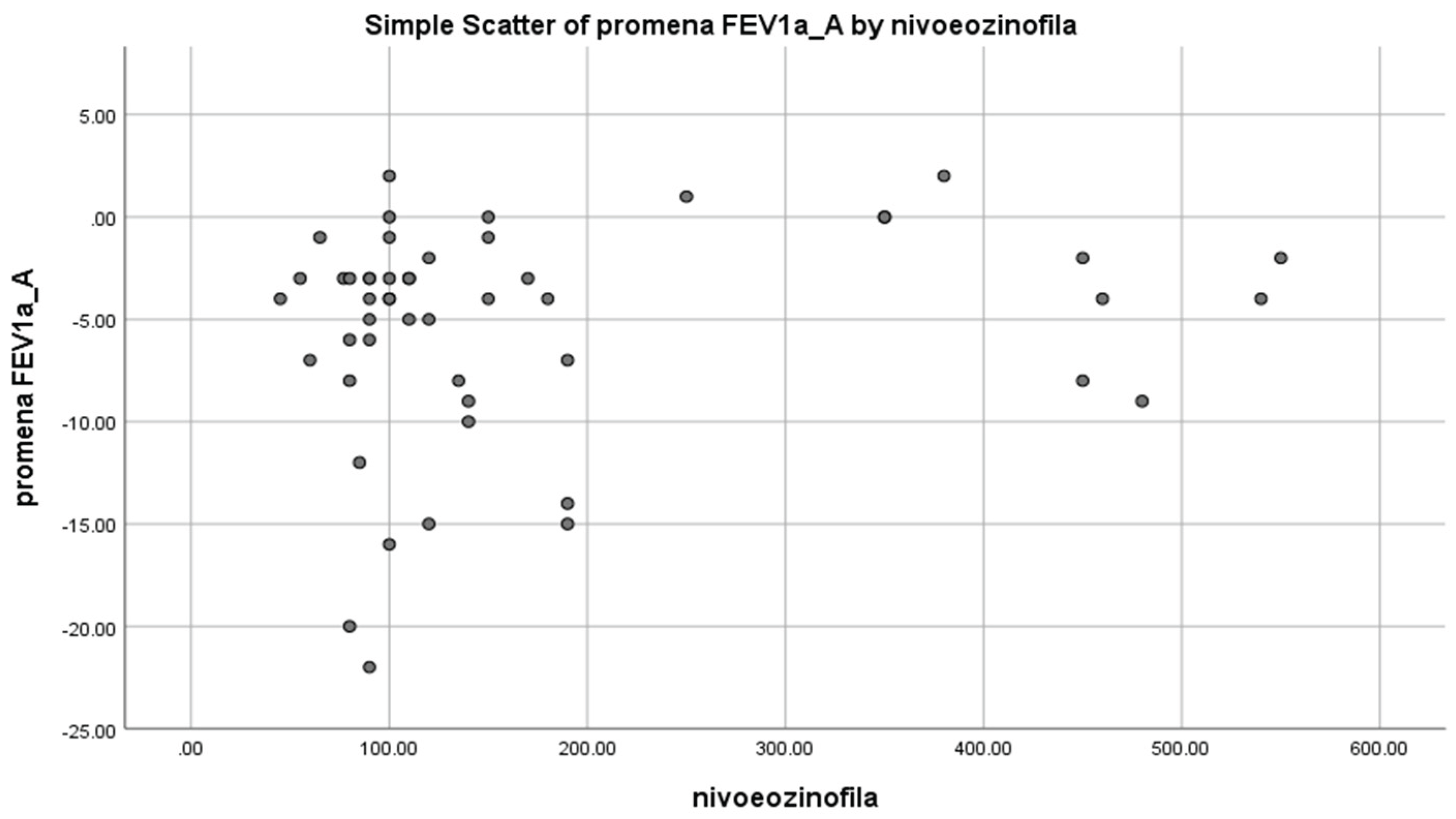
Introduction: Chronic obstructive pulmonary disease (COPD) is a progressive condition and a leading cause of morbidity and mortality worldwide. The rate of forced expiratory volume in one second (FEV1) decline is a key prognostic marker. This study aimed to evaluate the impact of demographic, clinical, and therapeutic factors, including respiratory muscle strength and inhaled corticosteroid (ICS) use, on FEV1 decline.Methods: A prospective study was conducted in 2019 at the Clinic for Pulmonology, Clinical Center of Serbia. Fifty patients with stable COPD underwent spirometry, body plethysmography, respiratory muscle strength testing, and laboratory analyses. Demo-graphic and clinical data were collected via questionnaire. All assessments were repeated after six months of regular inhalation therapy.Results: Significant reductions were observed in FEV1, FVC, TLC, PImax, and PEmax. Lower baseline respiratory muscle strength predicted a faster FEV1 decline. Patients in GOLD stage 2 and those with greater hyperinflation exhibited accelerated functional deterioration. Therapy type affected selected parameters: LABA/ICS and LAMA/LABA/ICS regimens significantly reduced residual volume, but not the rate of FEV1 decline. Higher eosinophil counts were associated with a slower reduction in FEV1, suggesting a potential protective effect of ICS.Conclusion: Respiratory muscle strength, hyperinflation, and eosinophil count represent important predictors of COPD progression. Incorporating these parameters into diagnostic and therapeutic algorithms may improve early risk stratification and support indi-vidualized treatment strategies.
Keywords:
1. Introduction
2. Materials and Methods
3. Results
| Variables | Initial tests N=50 (% of the predicted value, MV±SD) |
Follow-ups N=50 (% of the predicted value, MV±SD) |
Difference between the initial and final value (decline of % points) |
| FVC | 79.7± 20.44 | 70.7±20 | 9.04 ±10.09 |
| FEV1 | 45.14±16.10 | 39.74±14.88 | 5.40 ±5.35 |
| FEV1/FVC | 45.50±12.97 | 45.08±12.64 | 0.42 ±3.85 |
| TLC | 82.28±13.11 | 74.76±14.46 | 7.52 ±5.71 |
| RV | 95.02±22.41 | 95.04±34.20 | 0.02 ±18.51 |
| RV/TLC | 111.96±19.60 | 119.96±38.49 | 8 ±28.01 |
| Pimax | 57.02±16.19 | 44.88±15.23 | 12.14 ±6.95 |
| Pemax | 62.34±16.02 | 52.48±17.23 | 9.86 ±6.81 |
4. Discussion
5. Conclusions
Author Contributions
Funding
Institutional Review Board Statement
Informed Consent Statement
Data Availability Statement
Acknowledgments
Conflicts of Interest
Abbreviations
| COPD GOLD WHO RF FVC FEV1 MSCT BMI TLC RV PImax Pemax |
chronic obstructive pulmonary disease Global Initiative for Chronic Obstructive Lung Disease World Health Organization respiratory function forced vital capacity forced expiratory volume in the first second, multislice scanner of the thoracic cavity body mass index total lung capacity residual volume maximal inspiratory muscle strength maximal expiratory muscle strength |
References
- Plaza, V.; Álvarez, F.; Calle, M.; Casanova, C.; Cosío, B.G.; López-Viña, A.; de Llano, L.P.; Quirce, S.; Román-Rodríguez, M.; Soler-Cataluña, J.J.; et al. Consensus on the Asthma–COPD Overlap (ACO) Between the Spanish COPD Guidelines (GesEPOC) and the Spanish Guidelines on the Management of Asthma (GEMA). Arch. De Bronc- 2017, 53, 443–449. [Google Scholar] [CrossRef] [PubMed]
- Rycroft, C.; Heyes, A.; Lanza, L. ; Karin Epidemiology of chronic obstructive pulmonary disease: a literature review. Int. J. Chronic Obstr. Pulm. Dis. 2012, 7, 457–494. [Google Scholar] [CrossRef] [PubMed]
- Soriano, J.B.; Lamprecht, B.; Ramírez, A.S.; Martinez-Camblor, P.; Kaiser, B.; Alfageme, I.; Almagro, P.; Casanova, C.; Esteban, C.; Soler-Cataluña, J.J.; et al. Mortality prediction in chronic obstructive pulmonary disease comparing the GOLD 2007 and 2011 staging systems: a pooled analysis of individual patient data. Lancet Respir. Med. 2015, 3, 443–450. [Google Scholar] [CrossRef] [PubMed]
- Global Initiative for Chronic Obstructive Lung Disease. Global strategy for the diagnosis, management, and prevention of chronic obstructive pulmonary disease. 2025. Available from: https://goldcopd.org/2025-gold-report/. Accessed: 2025 Sep 09.
- Koblizek, V.; Chlumsky, J.; Zindr, V.; Neumannova, K.; Zatloukal, J.; Zak, J.; Sedlak, V.; Kocianova, J.; Zatloukal, J.; Hejduk, K.; et al. Chronic Obstructive Pulmonary Disease: Official diagnosis and treatment guidelines of the Czech Pneumological and Phthisiological Society; a novel phenotypic approach to COPD with patient-oriented care. Biomed. Pap. 2013, 157, 189–201. [Google Scholar] [CrossRef] [PubMed]
- MURRAY, John F.; NADEL, J. Textbook of respiratory medicine. 1987. P:90-132.
- Baydur, A.; Behrakis, P.; Zin, W.; Jaeger, M.; Milicemili, J. A simple method for assessing the validity of the esophageal balloon technique. Am Rev Respir Dis. 1982, 126, 788–791. [Google Scholar] [PubMed]
- REILLY, John J.; SILVERMAN, Edwin K.; SHAPIRO, Steven D. Chronic obstructive pulmonary disease. Harrisons Principles of Internal Medicine, 2005, 16.2: 1547, 1700-1707.
- Gosker, H.R.; Wouters, E.F.; van der Vusse, G.J.; Schols, A.M. Skeletal muscle dysfunction in chronic obstructive pulmonary disease and chronic heart failure: underlying mechanisms and therapy perspectives. Am. J. Clin. Nutr. 2000, 71, 1033–1047. [Google Scholar] [CrossRef] [PubMed]
- Figueiredo, R.I.N.; Azambuja, A.M.; Cureau, F.V.; Sbruzzi, G. Inspiratory Muscle Training in COPD. Respir. Care 2020, 65, 1189–1201. [Google Scholar] [CrossRef] [PubMed]
- Terzano, C.; Ceccarelli, D.; Conti, V.; Graziani, E.; Ricci, A.; Petroianni, A. Maximal respiratory static pressures in patients with different stages of COPD severity. Respir. Res. 2008, 9, 8–8. [Google Scholar] [CrossRef] [PubMed]
- Nishimura, Y.; Tsutsumi, M.; Nakata, H.; Tsunenari, T.; Maeda, H.; Yokoyama, M. Relationship Between Respiratory Muscle Strength and Lean Body Mass in Men With COPD. Chest 1995, 107, 1232–1236. [Google Scholar] [CrossRef] [PubMed]
- Steuten, L.M.; Creutzberg, E.C.; Vrijhoef, H.J.; Wouters, E.F. COPD as a multicomponent disease: Inventory of dyspnoea, underweight, obesity and fat free mass depletion in primary care. Prim. Care Respir. J. 2006, 15, 84–91. [Google Scholar] [CrossRef] [PubMed]

| Variables | Thoracic cavity multislice scanner findings | |||
| Thickening of interstitium and fibrous changes | Low attenuation and signs of emphysema | |||
| Correlation coefficient | P-value | Correlation coefficient | P-value | |
| FEV1 | 0.115 | 0.152 | 0.153 | 0.098 |
| FVC | 0.252 | 0.060 | 0.301 | 0.060 |
| FEV1/FVC | 0.033 | 0.521 | 1.000 | 1.123 |
| TLC | 0.457 | 0.009 | 0.334 | 0.088 |
| RV | 0.304 | 0.003 | 0.133 | 0.219 |
| RV/TLC | 0.423 | 0.002 | 0.224 | 0.130 |
| Pimax | 0.114 | 0.087 | 0.201 | 0.095 |
| Pemax | 0.219 | 0.088 | 0.199 | 0.078 |
| Inhalation therapy | Number of patients (%) | RV (significance ±SD) |
FEV1 (significance ±SD) |
| LABA/ICS | 15 (30%) | 0.039±3.096 | 0.997±0.06 |
| LAMA/LABA/ICS | 11 (22%) | 0.049±0.266 | 0.991±0.06 |
| LAMA/LABA | 16 (32%) | 0.348±0.289 | 1.00±0.59 |
| LAMA | 8 (16%) | 1.00±0.239 | 0.997±0.06 |
Disclaimer/Publisher’s Note: The statements, opinions and data contained in all publications are solely those of the individual author(s) and contributor(s) and not of MDPI and/or the editor(s). MDPI and/or the editor(s) disclaim responsibility for any injury to people or property resulting from any ideas, methods, instructions or products referred to in the content. |
© 2025 by the authors. Licensee MDPI, Basel, Switzerland. This article is an open access article distributed under the terms and conditions of the Creative Commons Attribution (CC BY) license (http://creativecommons.org/licenses/by/4.0/).