

Submitted:
07 November 2025
Posted:
07 November 2025
You are already at the latest version
Abstract
Sustainable development constitutes a global consensus achieved through humanity's response to environmental imperatives and critical reflections on prevailing development paradigms, serving as a fundamental framework for addressing pressing global challenges. Since the Industrial Revolution, successive technological revolutions have significantly enhanced humanity's capacity to generate material wealth, concurrently driving profound transformations in the global understanding of development—from early notions of "growth theory" to broader "development theory," and ultimately evolving into the contemporary "sustainable development theory." (1) As an emerging ideology and transformative development paradigm, sustainable development has gradually taken shape through sustained introspection and practical exploration in the modern era. Its emergence was prompted by widespread experiences of severe constraints on social progress, including adverse consequences associated with industrialization, rapid economic expansion, population growth, resource depletion, and ecological degradation. Seminal documents such as the Brundtland Report, Agenda 21, the United Nations Millennium Declaration, and the 2030 Agenda for Sustainable Development not only trace the formation and evolution of the sustainable development framework but also articulate its core guiding principles. (2) In the current phase of global development, achieving the United Nations Sustainable Development Goals (SDGs)—comprising 17 goals and 169 specific targets—has become a central priority for nations worldwide during the 2016–2030 period. Governments and regional entities are increasingly integrating the SDGs into national and sub-national development strategies and issuing comprehensive reports to document localized implementation efforts and measurable outcomes. (3) However, current assessments of progress toward the SDGs indicate that global advancement has significantly deviated from the intended trajectory. The resilience and well-being of the Earth system, human societies, ecosystems, and the broader environment are deteriorating, and the realization of the SDGs continues to confront numerous emerging challenges. There is a pressing global imperative to develop and implement more effective mechanisms and national-level measures through innovative approaches. (4) Over the years, China has systematically integrated SDG implementation with its medium- and long-term development strategies, including the 13th Five-Year Plan, the 14th Five-Year Plan, and the Outline of the 2035 Long-Range Objectives. While advancing the vision of a community with a shared future for humanity, China has prioritized the development of an ecological civilization model grounded in harmony between humans and nature, offering Chinese perspectives on addressing global challenges related to sustainable development. As one of the countries demonstrating the most consistent progress in implementing the SDGs, China has reinvigorated international confidence in achieving global sustainability targets. Initiatives such as the Green Belt and Road Initiative and the Global Development Initiative have provided practical frameworks for enhancing international cooperation in sustainable development. To accelerate the achievement of the SDGs, it is essential to: first, accurately understand and respond to the profound global transformations of the present era; second, position the SDGs as the central focus of international cooperation; third, strengthen data governance to support evidence-based decision-making for SDG implementation; fourth, expedite the localization of the SDGs within national and regional contexts; fifth, cultivate new drivers of global sustainable development; and sixth, reinforce institutional mechanisms for effective SDGs follow-up and review.
Keywords:
agenda for sustainable development
; sustainable development goals (SDGs)
; progress review
; implementing measures
; localization
1. Introduction
Over the past two centuries of human industrialization processes, driven by technological advancement, institutional innovation, and advances in management practices, the global economy has undergone unprecedented growth. Social development has advanced by leaps and bounds, and human living conditions and quality of life have been remarkably enhanced [1]. Concurrently, with the sustained accumulation of knowledge and the gradual expansion of cognitive frontiers, the spatial and conceptual domains accessible to humanity have been steadily expanding. The interaction between natural systems and human activities has intensified: planetary ecological deficits have continued to widen, and ecological overshoot has exacerbated pressing challenges such as climate change, deforestation, declining fishery stocks, land degradation, freshwater scarcity, and biodiversity loss. Biophysical constraints on unsustainable human development patterns have grown increasingly apparent, while tensions between the finite carrying capacity of Earth’s ecosystems and the growing demands of socioeconomic development for natural resources have intensified [2,3]. As a result, the environmental foundations essential for human survival are under immense pressure. Humanity cannot exist in isolation from the natural environment, nor can it retreat to a pre-industrial state; therefore, it is imperative to pursue a new development path that fosters harmonious coexistence between humans and nature.
The global evolution of the "development paradigm" has evolved from the "growth theory" to the "development theory," and ultimately to the "sustainable development theory"—a progression that mirrors the deepening of human understanding over time. Since the publication of Silent Spring in the 1960s, environmental concerns have garnered increasing international attention. A growing number of visionary individuals and environmental advocates have undertaken critical reflections and practical efforts aimed at restoring balance in the human-nature nexus. In response to severe setbacks to social development—including those arising from industrialization, rapid economic expansion, population growth, resource depletion, and ecological degradation—humanity has gradually refined sustainable development into a coherent ideology and guiding framework for development through iterative learning and empirical exploration [4]. By the end of the 20th century, sustainable development had gained broad international consensus and emerged as a common goal across nations worldwide.
Since the turn of the 21st century, humanity has faced unprecedented challenges. Western developed countries, having completed their industrialization and modernization processes, are now in a phase of developmental transition, characterized by sluggish economic recovery and significant uncertainty regarding their future trajectories. Over the past hundred years, China has undergone a series of profound transformations—from a prolonged era of national decline to the establishment of the People’s Republic of China, from widespread material scarcity to sustained economic prosperity—and is now entering a critical stage of advancing from economic prosperity to national rejuvenation. As has been emphasized, "China cannot develop in isolation from the world, nor can the world make progress without China." Never before in human history have the destinies of all peoples been so profoundly interconnected.
The world is experiencing changes unparalleled in a century, underscoring the fact that reforming the global governance system and realizing transformative shifts in global development are complex, urgent, and arduous undertakings. In this context, a shared focal point endorsed by the international community is indispensable. The implementation of the 2030 Agenda for Sustainable Development embodies a universal consensus shaped by an increasingly multipolar global order—a commitment explicitly reaffirmed via joint endorsement at the G20 Osaka Summit [5,6]. Sustainable development represents the broadest domain of common interest and the most feasible entry point for multilateral cooperation among all stakeholders; it functions as a foundational framework for addressing pressing global challenges. The 2030 Agenda for Sustainable Development embodies a social compact between the leaders of all nations and their respective peoples, signaling that sustainable development has emerged as the foremost global priority and heralding the dawn of a new era in humanity’s pursuit of sustainability.
Focusing on strategies to advance the future of human sustainable development and the achievement of the goals outlined in the 2030 Agenda, this study undertakes a systematic review of three key aspects: the evolution of the global consensus-building process regarding sustainable development, the progress made in implementing global Sustainable Development Goals (SDGs) alongside the key challenges currently encountered, and the new contextual landscape facing global sustainable development. Drawing on China’s practical experience and addressing its future development requirements, this paper further offers insights into the trends and prospects of global sustainable development.
2. Process and History of Reaching Global Consensus on Sustainable Development
Over the past two centuries of global industrialization, only a small fraction of the world’s population—fewer than one billion people in developed countries—has attained modernization. Notably, this progress has been accompanied by substantial depletion of natural resources and severe environmental degradation [7]. There is a growing consensus that the development model underpinning modern industrial civilization is fundamentally unsustainable. Consequently, environmental issues are increasingly being scrutinized from a global perspective, sparking extensive deliberations on the long-term future of humanity. Historical evidence suggests that developing countries are unable to replicate traditional models of economic growth and development if they aim to achieve sustainable modernization [1]. The recurrent emergence of global crises and complex challenges has further strengthened policymakers’ recognition that conventional development paradigms pursue economic growth at the expense of compromising essential human living conditions. Humanity now stands at a critical crossroads, faced with critical choices regarding its survival and long-term viability. In this context, the path of sustainable development has been formally embraced. First formally articulated in 1987, the concept of sustainable development gained broad international consensus by the late 20th century and has continued to evolve and deepen ever since, as illustrated in Figure 1.
2.1. The Formation Stage of the Sustainable Development Concept (From the Early 17th Century to 1991): From Perception to Concept, Accompanied by the Rise of Environmental Protection Awareness in the Context of Economic Development
The concept of sustainable development traces its origins to sustainable forest management practices that emerged in Europe during the 17th and 18th centuries. In 1662, John Evelyn emphasized that the destructive overexploitation of forests in the United Kingdom had caused a depletion of timber resources, and he proposed legally mandating landowners to implement reforestation measures to mitigate this trend. Subsequently, scholars and policymakers from the United Kingdom, France, and the United States conducted extensive research on forest management and sustained yield principles. This body of work gradually led to the establishment of sustainable forest management—a foundational prototype of the broader sustainable development concept.
Against the backdrop of accelerating industrialization, from the 1950s to the early 1960s, numerous early industrialized countries encountered public health crises of varying magnitudes. These crises posed significant threats to human well-being and even life itself, prompting scholars to publish research from diverse disciplinary perspectives. Their work highlighted the catastrophic consequences of unregulated economic growth and unconstrained exploitation of natural resources, and they called for a fundamental paradigm shift away from nature-degrading development models toward approaches that prioritize the co-preservation of natural ecosystems and human societies.
A pivotal milestone in this discourse emerged in 1962, when American marine biologist Rachel Carson published Silent Spring. In this work, she documented the irreversible impacts of pesticide accumulation on both ecosystems and human health, and put forward the influential proposition that "nature is fighting back." Carson’s research revealed the profound ecological repercussions of environmental pollution and stressed the necessity of forging a relationship of "cooperative harmony" between humanity and the natural world [8].
In 1972, the Club of Rome released its landmark report The Limits to Growth, warning humanity of potential global crises stemming from unsustainable development trajectories. The report conceptualized an ideal state of global equilibrium as "a sustainable world system that avoids sudden and uncontrolled collapse while meeting the basic material needs of all people"—marking the first explicit appearance of the modern sustainable development concept in academic discourse. Later that year, in June, the United Nations Conference on the Human Environment (UNCHE) adopted the Declaration of the United Nations Conference on the Human Environment, which outlined seven shared perspectives and 26 consensually agreed principles. This declaration signified a collective commitment by participating countries and international organizations to "maintain and improve the human environment," establishing foundational guidelines for global environmental governance. Moreover, the conference substantially advanced environmental awareness among governments and the general public worldwide, both in terms of scope and depth.
In 1980, the International Union for Conservation of Nature (IUCN), the United Nations Environment Programme (UNEP), and the World Wildlife Fund (WWF, now officially named the World Wide Fund for Nature) jointly published the World Conservation Strategy. This document formally articulated the sustainable development concept and, for the first time, designated it as a global priority. A definitive step in conceptualizing sustainable development occurred in 1987, when the United Nations World Commission on Environment and Development (WCED) released the report Our Common Future (commonly known as the Brundtland Report). This report provided a formal, widely cited definition of sustainable development: "development that meets the needs of the present without compromising the ability of future generations to meet their own needs" [4]. To date, this definition remains the most globally accepted and has exerted a profound influence on the trajectory of sustainable development initiatives worldwide. Subsequent to the publication of Our Common Future and the clear articulation of the sustainable development concept, a development paradigm centered on balancing economic advancement with environmental conservation began to take form. This paradigm has since garnered sustained attention and commitment from both individual nations and the broader international community.
2.2. The Stage of Consensus Formation and Exploration on Sustainable Development (From 1992 to 2015): From Concept to Action, the Systematic Coordination Concept of Economy, Society and Environment Was Formally Established
From June 3 to 14, 1992, the United Nations Conference on Environment and Development (UNCED) convened in Rio de Janeiro, Brazil. It stands as the largest-scale, highest-level, most widely attended, most extensively prepared, and most far-reaching international conference in UN history, and a historic milestone for addressing environmental and developmental challenges facing human society. The conference adopted three foundational programmatic documents: Agenda 21, the Rio Declaration on Environment and Development, and the Statement of Principles on Forests; it also witnessed the signing of the Convention on Biological Diversity and the United Nations Framework Convention on Climate Change by participating countries [9]. At the conference, the international community reached consensus on key principles, including the inseparability of environment and development, and the necessity of forging a "new and equitable global partnership for global survival." It further endorsed critical frameworks that embody the principles of sustainable development—specifically the Rio Declaration and Agenda 21—and clarified the principle of "common but differentiated responsibilities" between developed and developing nations. In February 1993, the United Nations General Assembly (UNGA) formally approved the establishment of the United Nations Commission on Sustainable Development (UNCSD), a subsidiary body of the United Nations Economic and Social Council (ECOSOC). Its mandates include reviewing progress in implementing Agenda 21 at the national, regional, and global levels, enhancing international cooperation, and rationalizing intergovernmental decision-making mechanisms.
Since the turn of the 21st century, while globalization has created new opportunities for global development, the efforts exerted and benefits accrued by all stakeholders have been neither fair nor equitable—exacerbating the global rich-poor divide. Eradicating poverty has thus emerged as an urgent global imperative. In September 2000, at the UN Millennium Summit, 189 UN Member States adopted the United Nations Millennium Declaration. World leaders unanimously agreed to address poverty, hunger, illiteracy, disease, environmental degradation, and gender-based discrimination against women. This broad vision was subsequently operationalized as the United Nations Millennium Development Goals (MDGs), comprising 8 overarching goals and 21 specific targets. Each target was assigned a 2015 completion deadline, with the objective of providing an exploratory assessment of the effectiveness of sustainable development initiatives in developing countries [10].
From August 26 to September 4, 2002, the inaugural World Summit on Sustainable Development (WSSD) convened in Johannesburg, South Africa. Building on the 1992 UNCED, this summit served as a pivotal platform to comprehensively review and assess progress in implementing Agenda 21 and revitalize the global partnership for sustainable development. It formally enshrined poverty eradication as a core principle of sustainable development and deliberated extensively on developing action-oriented strategies and measures to advance global sustainable development.
At the High-Level Meeting on the MDGs (held during the 65th Session of the UNGA in September 2010), it was proposed that the international community develop a post-2015 global development agenda to succeed the MDGs and guide future global development cooperation. In September 2011, the UN System Task Team on the Post-2015 UN Development Agenda (UNSTT) was established—the first formal mechanism within the UN system dedicated to advancing the "post-2015 agenda." In June 2012 and March 2013, the UNSTT released two landmark reports—Realizing the Future We Want for All and A Renewed Global Partnership for Development—outlining a series of new visions and recommendations for the global development agenda following the MDGs’ 2015 expiration.
In June 2012, the United Nations Conference on Sustainable Development (commonly referred to as the "Rio+20" Summit) reconvened in Rio de Janeiro, Brazil. It centered on two core themes: (1) advancing a green economy within the context of sustainable development and poverty eradication, and (2) strengthening sustainable political governance and institutional frameworks. The conference resolved to develop a set of sustainable development goals (SDGs) anchored in the MDGs, established the UN High-Level Political Forum on Sustainable Development (HLPF), and defined key mandates—including development financing and future work plans for small island developing states (SIDS)—thereby marking a new milestone in shaping the global sustainable development agenda.
In 2013, the UN mandated the establishment of the Open Working Group on Sustainable Development Goals (OWG), tasked with drafting the global SDGs. Following the opening of the 69th Session of the UNGA in September 2014, intergovernmental negotiations on the UN’s post-2015 global development agenda were launched. To facilitate these negotiations and set their strategic direction, UN Secretary-General Ban Ki-moon submitted a report—entitled The Road to Dignity by 2030: Ending Poverty, Transforming All Lives and Protecting the Planet—Synthesis Report on the Post-2015 Development Agenda—to all UN Member States on January 8, 2015.
In July 2015—shortly before the MDG achievement deadline—the UN Department of Economic and Social Affairs (UN DESA) released the Millennium Development Goals Report 2015, which provided a comprehensive assessment of progress toward the MDGs. Through the collective efforts and collaboration of countries worldwide, the MDGs enhanced living standards for millions, fostered innovative new partnerships, and transformed decision-making processes across both developed and developing nations. To address the development of global sustainable development goals and agendas post-MDGs, the 2030 Agenda for Sustainable Development was adopted at a historic summit convened in September 2015.
Guided by the purposes and principles of the UN Charter and grounded in the Universal Declaration of Human Rights (UDHR), the 2030 Agenda for Sustainable Development establishes the global Sustainable Development Goals (SDGs), comprising 17 overarching goals and 169 specific targets [11]. Unlike the MDGs—which focused solely on economic, social, and environmental dimensions—the SDGs integrate justice-related safeguards and implementation mechanisms. They call for building peaceful, inclusive, and well-governed societies; chart the course for national development and international development cooperation over the next 15 years; and signify the transition to a phase of substantive advancement in global sustainable development. This further signifies that the international community has reached two key consensuses regarding the transformation of global development:
(1) The traditional industrialization-driven development model must transition to a new sustainable development paradigm [12]. Amid growing global resource and environmental constraints, human society must adopt innovative approaches to achieve shared development, and the substantive advancement of sustainable development represents an inevitable path for human progress [13];
(2) The existing international discourse system and global order are undergoing profound transformations, and global governance agenda-setting is evolving in tandem with advancements in sustainable development. A new global governance system aligned with the SDGs is therefore needed [14]. Furthermore, the coordinated development of the economy, society, and environment—a key concern of emerging economies and developing countries—has become a priority for global sustainable development [15].
2.3. The Stage of Establishing and Implementing the Sustainable Development Goals (From 2016 to the Present): Global and National Development Actions Centered Around the SDGs Have Continued to Deepen
Since the 2030 Agenda for Sustainable Development officially entered into force on January 1, 2016, the United Nations (UN) system has implemented a series of relevant initiatives and established a review mechanism to facilitate its advancement and implementation. This progress has been enabled by the joint efforts of the UN, national governments, and other stakeholders. Member states have similarly taken proactive steps to integrate the 2030 Agenda into their national strategies and plans, and have since gradually incorporated SDGs into their national development frameworks and monitoring-evaluation systems—catalyzing positive progress toward the global attainment of the SDGs [1].
In September 2016, the G20 Action Plan on the 2030 Agenda was adopted at the G20 Hangzhou Summit (China). The G20 subsequently committed to further aligning its work with the Agenda, established high-level principles for its implementation, and saw active exploration by member states of context-specific implementation approaches and models.
In January 2017, the Cape Town Global Action Plan for Sustainable Development Data was launched at the inaugural UN World Data Forum, held in Cape Town, South Africa. Its core objectives include accelerating progress toward the SDGs, strengthening statistical capacity-building, and facilitating the establishment of resilient national data ecosystems.
The Seville Commitment, adopted in February 2019, emphasized that SDG localization relies heavily on collaboration with local communities, and that truly context-adapted solutions must be developed to tackle global challenges.
In September 2019, UN Secretary-General António Guterres called on all sectors of society to launch a "Decade of Action" initiative focused on three priority areas. This effort was further reinforced by the 2021 report Our Common Agenda (published by the UN Secretary-General), which outlined a shared roadmap for subsequent efforts to uphold the UN Charter and advance a greener, safer, and more prosperous future.
In September 2021, the 76th Session of the UN General Assembly declared 2022 the International Year of Basic Sciences for Sustainable Development—with the aim of leveraging basic sciences to "accelerate" sustainable development and facilitate the establishment of The Local 2030 Coalition. As a collaborative platform, The Local 2030 Coalition integrates local/regional governments, networks of local/regional government associations, national governments, enterprises, community organizations, other local stakeholders, and the UN system. Within the UN system, the Coalition strengthens coordination among UN agencies and expands/deepens partnerships with local actors to effectively advance the SDGs.
During the General Debate of the 76th UN General Assembly, China proposed the Global Development Initiative (GDI), calling on the international community to pursue more robust, greener, and healthier global development, jointly advance it into a new phase of balanced, coordinated, and inclusive growth, and accelerate implementation of the 2030 Agenda. The GDI’s eight priority areas fully encompass all 17 SDGs of the 2030 Agenda. Subsequently, China proposed the Global Civilization Initiative, Global Security Initiative, and Global Governance Initiative in sequence, and has leveraged the Belt and Road Initiative (BRI) as a key platform to develop effective implementation measures for advancing the 2030 Agenda. To date, over 100 countries and international organizations have expressed support for these initiatives, and nearly 70 countries have joined the "Group of Friends of the Global Development Initiative". In June 2023, the Report on the Progress of the Global Development Initiative Implementation was officially published. This report provides a comprehensive overview of the measures implemented and progress achieved by China and its partners over the preceding two years in advancing GDI implementation and promoting the attainment of the UN SDGs.
In September 2023, the UN Sustainable Development Goals Summit reaffirmed its commitment to delivering the core transformation goals of the 2030 Agenda and adopted a political declaration designed to accelerate progress toward the SDGs. In September 2024, the UN Future Summit adopted the Pact for the Future, which outlines a blueprint for the world’s future development trajectory. It covers five key domains: sustainable development and development financing; international peace and security; science, technology, innovation, and digital cooperation; youth and future generations; and global governance reform.
Based on long-term tracking of global and China’s sustainable development initiatives and practices, and from the perspective of sustainable development’s evolution from a conceptual framework to concrete actions, we propose the following perspective: Sustainable development is dedicated to upholding the logical consistency of "development intensity, coordination level, and sustainability degree" across social, economic, and environmental dimensions.
(1) Economic perspective: Sustainable development seeks to ensure that the contribution of scientific and technological advancement offsets or mitigates the law of diminishing marginal returns, thus sustaining the momentum for long-term economic growth.
(2) Ecological and environmental perspective: Sustainable development pursues a rational balance between ecological environmental quality and economic development, while emphasizing the maintenance of high-quality economic growth—specifically, growth that does not come at the expense of ecosystem integrity.
(3) Sociological perspective: Sustainable development aims to balance economic efficiency and social equity, ensuring that all individuals can share in development benefits. It embodies social equity and adheres to the principle of "leaving no one behind".
From a philosophical standpoint, sustainable development unveils the essence of an economic system defined by "development, coordination, and sustainability", reflects the organic unity of "momentum, quality, and equity", and fosters a humanistic social environment marked by "harmony, stability, and security" [16]. In essence, grounded in high-quality economic development, sustainable development seeks the ultimate realization of: (i) the coordinated evolution and harmonious development of "human-nature" and "human-human" relationships; (ii) the maximization of social, economic, and environmental benefits; and (iii) the achievement of win-win outcomes for social, economic, and ecological benefits across both temporal and spatial dimensions.
Building on the Agricultural, Industrial, and Information Revolutions, humanity is currently experiencing a "Fourth Wave" that is reshaping global development paradigms. Industrial and technological innovation driven by green, low-carbon, and circular development is emerging as a key driver and new growth engine for the global economy. This is not only an inevitable outcome of implementing the concept of sustainable development, but also an inherent requirement for high-quality development—one that embodies the developmental characteristics of the sustainable development era.
3. Review and Progress of Sustainable Development Goals
Scientific monitoring and evaluation of progress are essential for underpinning the attainment of SDGs and also constitute a universal challenge faced by countries globally. The 2030 Agenda for Sustainable Development explicitly and emphatically calls on all United Nations (UN) Member States to "recognize the importance of high-quality, accessible, timely, and reliable disaggregated data... to help measure progress and ensure that no one is left behind." In 2017, at the inaugural United Nations World Data Forum, hosted in Cape Town, South Africa, the Cape Town Global Action Plan for Sustainable Development Data was endorsed. This plan aims to enhance national statistical capacity and facilitate the establishment of robust national data ecosystems, thereby supporting the effective execution of the 2030 Agenda [17].
3.1. Global Framework for Sustainable Development Goals
To measure the implementation of the SDGs and their associated indicators, the UN Statistical Commission (UNSC) has been mandated to develop a global indicator framework to underpin follow-up and review processes for the 2030 Agenda for Sustainable Development. To align actions and measures for sustainable development with the Agenda’s objectives, the Inter-Agency and Expert Group on Sustainable Development Goal Indicators (IAEG-SDGs) was formally established in March 2015 during the 46th session of the UNSC. Its core responsibilities include formulating the global indicator framework for SDG Goal and Target monitoring, endeavoring to ensure full implementation of relevant data development initiatives, objectively assessing annual progress toward the SDGs, and identifying existing gaps.
In March 2016, at the 47th UNSC session, the IAEG-SDGs proposed a global indicator framework consisting of 232 indicators, classified into three tiers. This framework was adopted by the UN General Assembly in July 2017, as detailed in the document Work of the Statistical Commission Relating to the 2030 Agenda for Sustainable Development (A/RES/71/313). The Assembly further mandated annual refinements to the framework, alongside comprehensive reviews at the 51st UNSC session (March 2020) and the 56th session (2025). Subsequently, the IAEG-SDGs introduced four annual refinements in 2018, six in 2019, 36 major revisions (for the 2020 comprehensive review) and 20 minor revisions (annual refinements) in 2020, nine refinements in 2021, two in 2022, four in 2023, and eight in 2024 (see Figure 2). Furthermore, in 2024, the IAEG-SDGs launched preparations for the 2025 comprehensive review of the indicator framework, with plans to submit 15 revision proposals for deliberation in December 2025. Currently, the latest global indicator framework—incorporating all prior reviews and annual refinements—includes 234 independent indicators. Each indicator is accompanied by a clear definition and statistical methodology; however, challenges regarding data accessibility persist for specific indicators. Leveraging monitoring data from national governments and relevant international organizations, the UN Economic and Social Council (ECOSOC) has established the “Sustainable Development Goal Indicators Database” (also known as the “Statistics • Indicators Database”, https://unstats.un.org/sdgs/dataportal), which acts as a data foundation for assessing progress in SDG implementation.
3.2. Review and Assessment for Sustainable Development Goals
3.2.1. The High-Level Political Forum (HLPF)
The High-Level Political Forum (HLPF) serves as the core global platform of the United Nations (UN) for monitoring and reviewing the implementation of the 2030 Agenda for Sustainable Development and the SDGs. As established by the 2030 Agenda and UN General Assembly (UNGA) Resolution 70/299, HLPF stands as the apex of the follow-up and review framework for the 2030 Agenda. The HLPF aims to facilitate the sharing of experiences—including successes, challenges, and lessons learned—while providing political leadership, guidance, and recommendations for follow-up actions. Its key functions are as follows:
- Promoting coherence and coordination of system-wide policies on sustainable development;
- Ensuring the 2030 Agenda remains relevant and ambitious, with a focus on assessing progress, achievements, and challenges encountered by both developed and developing countries, as well as emerging issues;
- Establishing effective linkages with the follow-up and review mechanisms of all relevant UN conferences and processes, including those pertaining to Least Developed Countries (LDCs), Small Island Developing States (SIDS), and Landlocked Developing Countries (LLDCs).
Under UNGA Resolution 67/290, the HLPF convenes annually in two formats:
- An 8-day session hosted by the Economic and Social Council (ECOSOC), including a 3-day ministerial segment;
- A 2-day summit at the Head of State/Government level every four years, hosted by the UNGA.
Annually, the ECOSOC-hosted HLPF session (held in July) brings together high-level government representatives and stakeholders to review progress, identify barriers, exchange best practices, and propose new actions to advance the 2030 Agenda and SDGs. Notably, a core feature of the HLPF is the Voluntary National Reviews (VNRs), through which Member States voluntarily present their national-level implementation of the 2030 Agenda and SDGs. The HLPF conducts annual reviews of the VNRs submitted by Member States.
3.2.2. The SDG Summits (HLPF Under the UNGA)
In July 2016, at the ministerial declaration of the United Nations High-level Forum on Sustainable Development, the member states of the United Nations agreed that the "Global Sustainable Development Report (GSDR)" would become a four-year report drafted by an independent scientific group (IGS), regularly assessing and reviewing the global progress of the 2030 Agenda for Sustainable Development and its 17 Sustainable Development Goals (SDGs), and strengthening the connection between science and policy in the field of sustainable development. Correspondingly, the United Nations holds the SDG Summit every four years.
(1) The First SDG Summit (24–25 September 2019)
Hosted by the UNGA in New York, this summit—functioning as the UNGA-hosted HLPF—undertook follow-up actions and a comprehensive review of progress in implementing the 2030 Agenda and 17 SDGs. It adopted the Political Declaration of the SDG Summit, entitled “Getting Ready for the Decade of Action and Delivery for Sustainable Development”. World leaders called for a “Decade of Action” to achieve the SDGs by 2030 and announced their respective actions to advance the Agenda. This Political Declaration was formally approved by the UNGA on 15 October 2019.
(2) The Second SDG Summit (18–19 September 2023)
This summit also reviewed the implementation of the 2030 Agenda and its 17 SDGs, with a focus on addressing the impacts of the world’s multiple, interrelated crises—including the deterioration of key social, economic, and environmental indicators. It prioritized populations with unmet basic needs and explored strategies to address this gap through the 2030 Agenda’s implementation. Ultimately, the summit unanimously adopted the Political Declaration of the High-Level Political Forum on Sustainable Development. The 2023 SDG Summit not only responded to the impacts of overlapping global crises but also marked the launch of a new phase for accelerated SDG implementation, while providing high-level political guidance for transformative, accelerated action toward 2030.
3.2.3. SDG Progress Assessment (Since 2016)
Since the 2030 Agenda entered into implementation in 2016, the UN Secretariat and major international organizations have been dedicated to assessing SDG progress, advancing the global achievement of the SDGs (see Table 1), and exploring solutions to foster inclusive globalization and sustainability.
For the global review of SDG progress, three representative reports have been released:
- The Sustainable Development Goals Report (issued by the UN Economic and Social Council): This report provides a comprehensive assessment of the global implementation progress of the 17 SDGs outlined in the 2030 Agenda, while also presenting the most recent data, analytical findings, and the current global status of the SDGs and selected indicators.
- The Global Sustainable Development Report (produced by the Independent Group of Scientists appointed by the UN Secretary-General): This report provides a comprehensive assessment of the global situation, taking into account regional disparities across the five United Nations regions. It documents and analyzes key issues related to sustainable development and policy implementation. Drawing on extensive consultations with the United Nations system—including regional commissions—as well as scientists, government officials, and stakeholders at all levels, and grounded in the latest scientific literature, the report identifies critical intervention measures aimed at advancing structural transformation and accelerating progress toward the achievement of sustainable development goals.
- The Sustainable Development Report (co-published by the UN Sustainable Development Solutions Network and Bertelsmann Stiftung): This report analyzes the specific progress and trends in the implementation of the 17 SDGs at the national level and conducts a comparative assessment across countries. It serves as a complementary tool to the official United Nations SDG indicators and country-specific voluntary national reviews. Given the complexity of the SDG indicator framework and the challenges associated with data availability, the Sustainable Development Solutions Network (SDSN) and the Bertelsmann Stiftung pioneered the development of a national-level measurement framework based on the global indicator system, comprising SDG indices and SDG dashboards. Aligned with the dynamic updates to indicators and data by the IAEG-SDGs, this framework supports countries in assessing their current performance, identifying priority areas requiring urgent action, and enabling cross-country and regional comparisons toward the achievement of the 2030 Agenda for Sustainable Development.
3.3. Global Progress Towards SDGs
The SDGs face significant challenges, particularly regarding the pace and consistency of progress. According to the Sustainable Development Goals Report 2025, about 35% of targets are on track or making moderate progress, nearly half are progressing slowly, and 18% are regressing [18]. More than 800 million people remain in extreme poverty and face hunger, global atmospheric CO₂ concentrations have reached levels unprecedented in more than two million years, and 2024 was the hottest year on record, with global temperatures exceeding the 1.5 °C threshold on an annual basis [19]. In addition, peace and security have deteriorated, and the number of forcibly displaced people is now roughly twice the 2015 level. These challenges seriously hinder the realization of the SDGs, particularly in low-income and vulnerable regions, further highlighting the fragility of the global sustainable development goals. The report emphasizes that timely and clearly disaggregated data are essential for monitoring progress on the SDGs. Despite global progress in data collection, significant data gaps remain in areas such as gender equality (SDG 5), climate action (SDG 13), and peace and justice (SDG 16) [18]. Underfunding of statistical systems limits countries’ ability to address sustainable development challenges. The report calls for increased investment in data and statistics and proposes six strategic transformation pathways: food systems, energy access, digital transformation, education, employment and social protection, and climate and biodiversity action. Transformation in these areas requires not only policy guarantees but also enhanced international cooperation to promote the provision of global public goods [15,18].
The latest edition of Sustainable Development Report 2025 further highlights stagnant global SDGs progress, with an average score of 68.57 for SDG implementation in 2024, much lower than expected. While most countries have made significant progress in basic services and infrastructure, overall progress remains off track. Currently, none of the 17 goals are on track to be achieved on time [20]. Progress disparities between different groups of countries are significant [21]. As shown in Figure 3, European countries continue to lead in achieving the SDGs, but face challenges in areas such as climate and biodiversity. South-East Asia has made more progress than other regions, particularly on socio-economic goals. However, the lack of fiscal space in many developing countries has limited further SDGs progress. For these countries, access to additional financial support is crucial to advancing SDGs achievement [20].
China participated in the assessment of 17 goals and 95 indicators in the Sustainable Development Report 2025 [20]. According to continuous assessment results, China’s score increased from 61.46 in 2000 to 74.39 in 2024, with its ranking rising from 94th to 55th, making it one of the fastest-growing countries globally in terms of both score and ranking (as illustrated in Figure 4, which compares China’s performance across individual goals and overall, against the global average). Among the 17 goals, China performs particularly well in no poverty (SDG 1) and quality education (SDG 4), earning a green rating, indicating that its progress in these areas aligns with or exceeds 2030 goals. Notably, progress on SDG 1 has yielded significant results, with the score rising from 21.02 to nearly the maximum possible score (98.76), validating China’s successful poverty reduction practices [22]. Additionally, industry, innovation and infrastructure (SDG 9), reducing inequality (SDG 10), good health and well-being (SDG 3), clean water and sanitation (SDG 6), and affordable and clean energy (SDG 7) have made progress, but due to factors such as uneven development and weak infrastructure, these goals appear yellow or orange on the SDG dashboard, indicating potential for improvement. Progress has been slower on several other goals, notably zero hunger (SDG 2), gender equality (SDG 5), responsible consumption and production (SDG 12), life below water (SDG 14), life on land (SDG 15), partnerships for the goals (SDG 17), and sustainable cities and communities (SDG 11) [23]. In particular, the score for Climate Action (SDG 13) dropped by 10.7 points. This trend stems from China’s ultra-rapid economic growth, which has been accompanied by continuous increases in resource consumption and pollutant emissions compared to 2000, while structural and trend pressures on ecological protection remain unresolved [24].
In summary, while global progress in sustainable development has been made, many challenges remain, particularly in finance, data support, and policy coordination. Urgent and coordinated action is required to achieve SDGs. Countries should strengthen policy guarantees and focus on systemic transformation pathways in six key areas to ensure the effective global implementation of reforms and transformations [25,26]. Additionally, adequate financial guarantees must be provided, and large-scale investments are crucial, especially in low-income and developing countries. Reform of the financial architecture is essential and should ensure capital flows to emerging economies and developing countries, while promoting green investment, infrastructure development, and emergency financing [27]. Meanwhile, data statistics and monitoring are the core foundation, and timely, transparent, and actionable data are critical for decision-making and policy adjustments. International cooperation also plays a crucial role, particularly through the rational allocation of global resources, strengthening multilateral cooperation, and leveraging international organizations like the United Nations to guide sustainable development globally [28,29]. These concerted efforts will help achieve the SDGs by 2030 and create a more equitable, inclusive, green, and prosperous world.
3.4. SDGs Localization Practices at the National and Subnational Levels
The 2030 Agenda for Sustainable Development encourages United Nations Member States to take ownership of and contribute to implementing the sustainable development goals at the national and subnational levels. However, due to uneven statistical capacity, differences in statistical systems, and limited data availability, the practices of many countries and localities have not fully aligned with the global indicator framework proposed by the IAEG-SDGs. Instead, they have been localized based on their own circumstances and development aspirations, incorporating the SDGs into local development plans and implementation programmers. These countries and localities have advanced the implementation of the 2030 Agenda through formulating sustainable development plans, releasing progress reports, convening thematic conferences, and other means [30].
The VNR reports provide a scientific basis for countries to monitor SDGs progress and confirm target implementation. By November 2025, 409 VNRs will have been conducted by 191 countries and territories, as shown in Figure 5. In addition, many countries have adopted various methods to complement data gaps in the global indicator framework, particularly in data collection and quality control. National statistical offices in countries like Finland, Malaysia, and Uganda lead national technical working groups on SDGs data, providing methodological advice and ensuring data quality. The 2019 VNR of the United Kingdom adopted a data-driven approach and included a dedicated data chapter. Meanwhile, some countries, such as the Republic of Korea, align SDGs with existing policy and planning documents and conduct assessments based on national realities to ensure local and regional needs are reflected, while maintaining consistency with national strategies. With growing data demand, non-traditional data sources are becoming valuable resources for bridging the data divide. Administrative records, satellite imagery, and citizen-generated data have become integral to SDGs monitoring in many countries. Another key innovation aspect is the integration of multiple data sources. For example, Tanzania’s Statistics Master Plan 2022-2026 prioritizes strengthening administrative data sources from line ministries and incorporating data from non-state actors. In Ghana, data generated by civil society organizations have been repurposed to inform policies on marine litter, helping the country formulate coastal and marine management policies. With support from the “Instant Data” project, Bangladesh generated poverty estimates for smaller geographical areas by combining satellite imagery with household survey data. The adoption of improved data integration and interoperability has led to concerted efforts to build data partnerships and enhance policy coherence among government entities [18,31].
At the subnational level, the Seville Commitment adopted in February 2019 emphasized that localizing the SDGs relies on collaboration with local communities to find localized solutions to global challenges [32]. In his September 2019 address, UN Secretary-General António Guterres called for collective societal action to implement the “Decade of Action” across three dimensions, with local action as a critical component, highlighting the vital role of local governments in achieving the SDGs [33]. The 2021 report Our Common Agenda further reinforced these efforts, emphasizing the pivotal role of local governments in advancing sustainable development. As a key agency driving urban SDG implementation, the UN-Habitat has developed a comprehensive set of methodologies and tools to support national and local governments in localizing the SDGs. In September 2021, the Local 2030 Alliance was established, creating a collaborative platform involving local and regional governments, businesses, community organizations, and other stakeholders. It provides strong support for advancing the SDGs effectively. Practice has shown that reviewing local plans and programs is crucial for formulating local policies, with voluntary local review (VLR) reports emerging as a core tool for monitoring SDG localization [34]. Through VLR reports, local and regional governments showcase their progress toward the SDGs to the world, ensuring local strategies align with the global agenda. VLR reports not only help local governments identify gaps in SDG implementation but also provide evidence-based decision support for policymakers. By reviewing local policies and programs, these reports help local governments strengthen cross-sectoral linkages and ensure alignment with national strategies and global objectives. Over the past two years, the number of VLR reports has increased rapidly, with 276 reports compiled globally by November 2025, as shown in Figure 5.
China places great emphasis on implementing the 2030 Agenda. It follows a people-centered development philosophy, upholds the new development concepts of innovation, coordination, green development, openness, and sharing, advances economic and social progress, and actively contributes solutions to global efforts to achieve the SDGs. Over the past decade, China established a cross-departmental coordination mechanism comprising 45 government agencies. This mechanism integrates the implementation of the 2030 Agenda with strategic plans such as the 13th Five-Year Plan, the 14th Five-Year Plan and the long-term goals for 2035, driving progress across multiple goals. To accommodate diverse regional development contexts, China designated National Sustainable Development Agenda Innovation Demonstration Zones at the local level, exploring exemplary models aligned with urban sustainability trends. Additionally, China shares its implementation experiences with the world. It publishes the China Progress Report on Implementing the 2030 Agenda for Sustainable Development biennially, participates in voluntary national reviews, and continuously improves SDGs data collection through geographic big data tools. Since 2019, it has released the Earth Big Data Report on Supporting Sustainable Development Goals annually. Building on this foundation and guided by the concept of a community with a shared future for mankind, China has proposed and steadily advanced its global initiatives, including the four major global initiatives and the global ecological civilization initiative. These efforts align with the Belt and Road Initiative, transforming China’s solutions into international public goods. Through pragmatic cooperation, including policy dialogue, technical assistance, financial support, and capacity building, China has helped numerous developing countries reduce development gaps and achieve shared prosperity [35]. These efforts demonstrate China’s institutional innovation and responsibility in reforming the global governance system and advancing sustainable development, offering practical pathways for achieving global sustainable development goals.
4. Global Outlook for Sustainable Development in the Future
The question "What is the state of the world, and where is it headed?" poses a profound challenge to the collective wisdom of humanity. In the face of an uncertain future marked by sluggish economic growth, the rising tide of protectionism, unilateralism, and populism, as well as the recurring emergence of conflicts, terrorist attacks, and extreme natural disasters, coupled with persistent global challenges such as governance deficits, trust deficits, peace deficits, and development deficits, the international community faces an urgent need for a coordinated and systematic response to jointly shape a shared future for humankind.
4.1. New Challenges in Achieving the Sustainable Development Goals
Drawing on existing assessments, sustainable development achievement faces a range of practical challenges, including poverty, inequality, climate change, environmental degradation, and gaps in prosperity and access to peace and justice. Among these, climate change and developmental inequality emerge as the primary bottlenecks impeding global sustainability [36]. Currently, the international community is undergoing unprecedented transformations of a magnitude unseen in a century: emerging market economies and developing countries are advancing at an unprecedented rate; the ongoing new round of technological and industrial revolution is generating unprecedented impacts and intense competition; simultaneously, global hotspot issues and local conflicts arise consecutively and persist. The global governance system is currently under substantial strain. Collectively, these evolving trends manifest primarily in the following dimensions:
(1) Inter-country imbalances are worsening, with rising inequality—both between and within nations—requiring urgent attention. Three-quarters of children with stunting reside in South Asia and sub-Saharan Africa, and the extreme poverty rate in rural areas is three times higher than in urban areas. Youth face a higher risk of unemployment than adults; only one-quarter of individuals with severe disabilities have access to disability pensions; while women and girls continue to encounter barriers to gender equality. Owing to pandemic-induced economic instability, 23 million additional people fell into extreme poverty in 2022 relative to 2019, with over 100 million people experiencing hunger. Conflicts and climate change have displaced 120 million individuals globally. Under current trends, 600 million people will remain in extreme poverty globally by 2030, with global hunger levels potentially reverting to 2005 levels [37,38]. Many countries currently confront the dual challenge of malnutrition and overweight.
(2) Against the backdrop of rising trade protectionism, economic globalization faces mounting resistance. Developed economies—including those in Europe and North America—that once actively championed free markets and free trade have also embraced trade protectionism. The global economy, which has remained sluggish since the 2008 financial crisis, now confronts an even more uncertain outlook.
(3) The global governance system established post-World War II exhibits distinct fragility, and its incompatibility and asymmetry with the evolving international landscape are unprecedented. Long-standing international rules and norms are confronting substantial challenges, while international calls for reforming this system are growing increasingly urgent. As the global balance of power shifts and global challenges proliferate, enhancing global governance and advancing reforms to this system have become an irreversible trend.
(4) Over the past few decades, amid the rapid advancement of globalization, the economic, political, social, and cultural interdependence and interpenetration among nations have deepened, and global problems have also escalated. Global issues—including climate change, resource scarcity, cybersecurity risks, the refugee crisis, and terrorism—continue to escalate as nontraditional security threats, exhibiting distinct transnational, uncertain, and abrupt characteristics, thereby posing new challenges to global peace and stability.
(5) Globalization has further deepened economic interdependence and interpenetration among nations, leading to greater common interests alongside growing interest-based conflicts. Global income inequality, unequal development opportunities, and a widening wealth gap are eroding the trust foundation underpinning global cooperative development [39]. According to the Global Wealth Inequality Report released by the World Inequality Lab in early 2025, the top 1% of the global population owns 46.8% of the world's wealth, while the bottom 50% collectively hold only 1.3% [40].Some countries, leveraging their economic prowess, continue to extensively employ interventionist tactics—including economic hegemony and military coercion. Imbalances stemming from globalization dictate that the multipolarization of international politics will be a protracted and tortuous process.
(6) The spatial diffusion of technological progress falls far short of expectations, while the technological gap between nations is widening—further exacerbating developmental inequality between developed and developing countries. Advanced technologies from developed countries exert an "erosion effect" on human capital accumulation in developing countries via mechanisms including rising skill premiums, human capital obsolescence, and technological lock-in and dependence. This not only hinders improvements in human capital levels in developing countries but also challenges their pursuit of independent innovation and efforts to narrow the technological gap [41]. Malignant competition—such as "technological suppression" and "technical barriers"—is intensifying.
(7) The global ecological deficit is steadily expanding, posing significant challenges to the ecological environment sustaining human life. Earth remains the only known planet capable of sustaining human life. WWF’s Living planet report indicates that meeting global human needs currently requires ecological resources equivalent to approximately 1.6 Earths [3]. Under continued current development trends, "we will require four Earths" by 2100. Ecological overshoot further exacerbates climate change, forest degradation, declining fisheries, land degradation, freshwater scarcity, and biodiversity loss. Resource security and ecological security have emerged as core components of national security, shaping the global security landscape. Meanwhile, land degradation and habitat fragmentation increase human-wildlife contact, reduce biodiversity, and elevate the risk of future zoonotic disease transmission. However, from the perspective of economic growth dynamics, the world is unlikely to experience another era of rapid global growth in the foreseeable future. With the slowdown in economic growth, reduced resource use intensity, and advances in new technologies, energy sources, and materials, pressure on Earth’s ecological environment will diminish, potentially alleviating the human-nature contradiction.
Urgent adjustments to actions aimed at achieving the Sustainable Development Goals (SDGs) are required. It is imperative to address deep-rooted inequalities and vulnerabilities across the economic, social, and environmental dimensions of sustainable development, prioritize policies aligned with the "leave no one behind" principle, and address mechanisms that concentrate wealth and power among elite groups. Climate change impacts and rising inequality—both within and between nations—are undermining progress in implementing the sustainable development agenda. Thus, five key risk factors influencing SDG achievement have emerged: economic conditions, employment and inequality, climate change, population growth and migration, and technological change. With fewer than five years remaining until the 2030 Agenda deadline, no country has convincingly met a range of basic human needs while maintaining globally sustainable resource use levels. All of these are, to varying extents, misaligned with the overarching goal of balancing human well-being and a healthy environment. Each nation must adapt its strategies to its unique context and priorities, while abandoning the prevailing growth-over-governance approach.
4.2. Strategies and Suggestions for Enhancing Sustainable Development Goals
Sustainable development is a long-term and enduring endeavor that requires coordinated global efforts to achieve balanced economic, social, and environmental progress and foster high-quality growth. To secure a future of peace and sustainability, national governments must act at the domestic level to expand the provision of public goods. The United Nations and its specialized agencies play a critical role in delivering global public goods and safeguarding global common resources; they should also strengthen their efforts to protect the biosphere, biodiversity, and the essential ecosystems upon which human survival depends [42].
4.2.1. By 2050 and Beyond, SDGs Should Remain Central to Global Cooperation
Sustainable development is fundamentally a long-term investment challenge. It is estimated that achieving the SDGs will require investments amounting to approximately 2% of global GDP, with around 0.4% of official development assistance needed to bridge financing gaps in low-income countries [43]. Countries and regions must develop comprehensive, well-managed, and sustained public and private investment strategies within an improved global financial framework. Priority areas for investment include quality education, universal healthcare, zero-carbon energy systems, sustainable agriculture, resilient urban infrastructure, and digital connectivity. Most low-income and lower-middle-income countries face prohibitively high capital costs and urgently require access to affordable long-term financing, innovative institutional mechanisms, and new forms of global finance, including potential global taxation instruments.
The private sector must serve as a key driver of sustainable development, leading technological innovation in critical sectors such as energy, agriculture, climate adaptation, the digital economy, and urban infrastructure. The original 2030 deadline for achieving the SDGs is unlikely to be met due to several interrelated factors: First, many goals necessitate a longer time horizon extending to 2050. Second, the reform of the global financial architecture remains unrealized, leaving emerging economies chronically underfunded in their efforts to advance the SDGs. Third, a series of overlapping global crises—not only environmental and health emergencies but also geopolitical conflicts—have directly impeded progress on the SDGs while intensifying major-power tensions and eroding the foundation of international cooperation essential for their realization. Fourth, at both global and national levels, SDG governance has been significantly undermined by social polarization, influential lobbying interests, the marginalization or exclusion of civil society and academic institutions, and the rise of inward-looking "national priority" policies.
Therefore, multilateral political forums—including global climate change conferences, biodiversity summits, and the United Nations Sustainable Development Summit—must recognize the pivotal role of the SDGs in aligning national, regional, and global policy agendas and reaffirm their commitment to upholding the SDG framework through 2050. Concurrently, the multilateral trading system under the World Trade Organization should be strengthened and aligned with the objectives of the SDGs and the climate agenda. Finally, the international community must establish follow-up intergovernmental mechanisms to deliberate on post-2030 development goals and ensure the continuation and extension of the sustainable development agenda to mid-century.
4.2.2. To Strengthen Data Governance, Each Country or Region Should Accelerate the Development of Localized, Quantifiable, and Monitorable SDGs Indicator Systems
At the global level, a more robust follow-up and review mechanism for the implementation of the 2030 Agenda for Sustainable Development must be established. This requires a comprehensive framework of indicators and reliable statistical data to track progress, inform policy decisions, ensure accountability among all stakeholders, and provide a clear understanding of the direction and effectiveness of sustainable development policies.
First, international data cooperation should be further strengthened within the framework of the 2030 Agenda, leveraging data governance to support the global implementation of the United Nations’ 2030 Agenda. This includes fostering an open and mutually beneficial international collaboration model in the data domain, generating new momentum for sustainable development. Statistical monitoring should be enhanced in key areas such as climate change, environmental quality, and biodiversity. Data management practices should align with the Cape Town Global Action Plan for Sustainable Development Data, ensuring that national data and statistical systems are responsive to societal needs. Simultaneously, efforts should promote data innovation and cross-border collaboration, unlock data value, improve data credibility, build a resilient data ecosystem, expand data coverage, and refine data granularity—enabling more effective utilization of data across all sectors.
Second, building on the specific circumstances of individual countries and regions, there is a need to expedite the establishment of tailored, measurable, and trackable SDG targets and indicators, accompanied by an annual reporting mechanism. Through rigorous scientific assessment of SDG implementation progress—including voluntary national reviews—policymakers can receive evidence-based guidance to advance the 2030 Agenda. Countries should develop targeted SDG action plans, take concrete measures to address systemic vulnerabilities exposed by global risks, leverage policy insights gained during crises, and accelerate efforts to close gaps and strengthen weaknesses in SDG implementation. By fully mobilizing knowledge, technology, and resources, nations can transform current challenges into opportunities and make substantial progress toward achieving the 2030 Sustainable Development Goals [44].
4.2.3. The Transformation Driven by Emerging Technologies Will Shape New Engines for Global Sustainable Development
Since the advent of industrial civilization, the world economy has undergone twelve growth cycles, primarily propelled by technological revolutions that have triggered successive industrial transformations, enhanced productivity, and sustained economic expansion. It is widely recognized that the invention of the steam engine marked the beginning of the first industrial revolution, the harnessing of electricity initiated the second, and the development of the microprocessor by Intel launched the third. The information technology revolution, which began in the 1960s, has demonstrated remarkable longevity. Through successive waves of innovation—including integrated circuits, personal computers, and the Internet—it has evolved into a high-tech cluster encompassing the Internet, cloud computing, big data, and artificial intelligence. Concurrently, the emergence of genetic engineering in the 1970s catalyzed the biotechnology revolution, giving rise to another advanced technology cluster comprising genomics, genetic breeding, gene editing, and transgenic technologies.
According to Schumpeter’s theory of innovation and economic cycles, the dual breakthroughs and widespread application of information technology and biotechnology—often described as being "led by two geese"—are poised to become major drivers of economic growth. As these next-generation technology clusters are increasingly integrated into industry, agriculture, and the service sector, they are expected to generate new products, processes, business models, and industries, accelerate structural innovation and industrial upgrading, and thereby usher in a new phase of economic expansion that supports global sustainable development [45].
4.2.4. Deepen the Implementation of International Scientific Programs for Sustainable Development Cooperation and Strengthen Collaboration in SDG Implementation
To achieve the 17 SDGs outlined in the 2030 Agenda for Sustainable Development, particularly in accelerating progress toward these goals, it is essential to understand the dynamic mechanisms of the Earth surface system—an integrated framework comprising the natural environment and socioeconomic systems—from the perspective of Earth system science [46]. Through multidisciplinary and interdisciplinary integration, research should focus on the dynamic behaviors of environmental and socioeconomic systems, as well as the interactions among their constituent subsystems, to promote the establishment of inclusive partnerships that bridge science, policy, and society.
In August 2023, the United Nations General Assembly adopted the resolution on the International Decade of Science for Sustainable Development (2024–2033), referred to as the "Science Decade," which presents a unique opportunity for humanity to fully harness the potential of science in advancing sustainable development and ensuring a safe and prosperous future for all. The initiative will equip decision-makers with the analytical tools and data necessary to formulate and effectively implement evidence-based policies, enabling science to play a central role in achieving economic, social, and environmental sustainability.
The global dissemination and success of the Science Decade depend on the coordinated engagement of all stakeholders. By advancing open science, enhancing public scientific literacy, and encouraging individuals and institutions to initiate and implement projects, programs, and initiatives in response to the Science Decade’s call to action, collective efforts can be mobilized to realize a sustainable and equitable future for all.
5. Conclusions
The progress of human society has inherently unfolded through distinct developmental stages characterized by fluctuations, trials, and tribulations. Each stage is defined by its distinct historical context and urgent practical imperatives. Only by aligning with historical trends and the laws of social development, and accurately perceiving the objective reality of the present, can humanity extricate itself from developmental predicaments and advance toward a more sustainable future.
The concept and pathway of sustainable development directly address core developmental challenges, including the mismatch between population reproduction and material reproduction, the disparity between the productive and ecological values of resources, the imbalance between uncompensated appropriation and deliberate conservation of environmental capacity, social instability stemming from misalignment between efficiency and equity, and "institutional and market failures" driven by externalized costs. Its core lies in three critical dimensions:
- Human-nature relationship: Ensuring humanity’s demands for natural resources are balanced by its contributions to safeguarding nature—i.e., the growth of human-made capital must not come at the expense of destroying or depleting natural capital.
- Interpersonal dimension: During economic development, fostering mutually beneficial harmony, co-creation, and benefit-sharing in interpersonal interactions, intergenerational relationships, interregional cooperation, and interest group engagements so as to advance global governance.
- Resource-environment constraint and development transformation dimension: Achieving a fundamental transition in economic activities—from an unsustainable paradigm characterized by high resource intensity, severe environmental pollution, and significant ecological degradation to a sustainable one that minimizes resource input, environmental impact, and ecological damage. Ultimately, this aims to realize the coordinated and sustainable development of the economy, society, and ecological environment.
Global sustainable development represents a pivotal challenge confronting the global community today, and identifying a new pathway for balancing economic growth and ecological protection has become particularly crucial. The 2030 Agenda for Sustainable Development embodies the most extensive consensus of the international community regarding development priorities and serves as the clearest blueprint for humanity’s developmental aspirations.
As global progress toward the SDGs has entered a critical phase, accelerating systemic transitions has become an urgent task. The impacts of climate change and rising inequality—both within and between countries—are undermining progress in the implementation of the sustainable development agenda. Economic imbalances, employment disparities, the climate crisis, pressures from population mobility, and disruptive technological changes have emerged as the five key risk factors affecting the achievement of the SDGs in this new developmental stage. Countries urgently need to address deep-rooted inequalities and vulnerabilities intertwined among economic, social, and environmental sectors through multi-dimensional governance innovations. They must transcend the traditional "growth-first, governance-second" paradigm and adopt differentiated strategies to advance the SDGs.
(1) Economic Reform: Restructure the wealth distribution mechanism by curbing the excessive concentration of capital through progressive tax reforms and inclusive finance policies, while extending green industrial value chains to less economically developed regions. At the global level, this involves gradually establishing a collaborative framework encompassing "top-level design (i.e., policy guidance + fiscal tools) + financial support (i.e., multilateral fund assistance) + implementation and execution."
(2) Social Equity: Establish a life-cycle social security system by improving the linkage mechanism between climate risk assessment and early unemployment warning systems, and prioritizing capacity-building for climate-vulnerable groups (e.g., coastal residents, indigenous peoples) to enhance their adaptive capacity.
(3) Environmental Justice: Implement a Version 2.0 ecological compensation mechanism by incorporating environmental rights and interests—such as carbon emission allowances and access to clean air—into public service frameworks. Developed countries should take the lead in reducing per capita resource use to levels within the ecological carrying capacity, while developing countries need to explore innovative models of "low-carbon welfare societies" (e.g., Brazil’s rainforest carbon sink trading mechanisms and China’s photovoltaic-based poverty alleviation initiatives).
(4) Technology Sharing: Create an enabling environment for the translation and application of science and technology, as well as talent pooling, by enhancing the scientific rigor in development planning and evaluation, exploring policy frameworks for the adoption of appropriate technologies and industrial structure upgrading, and improving the efficiency of resource and infrastructure utilization—all aimed at promoting cross-border technological cooperation and knowledge sharing. UNDP has pioneered the establishment of over 90 Sustainable Development Accelerator Labs worldwide and is gradually developing a global initiative, platform, and network focused on SDG localization. This network has emerged as the world’s largest and fastest-learning platform for sustainable development (https://www.undp.org/acceleratorlabs), providing an effective pathway to advance the SDGs.
Currently, global sustainable development stands at a critical crossroads. One path would culminate in escalating ecological crises, more frequent climate-related disasters, deepening inequalities, proliferating conflicts, and even the deployment of increasingly dangerous new artificial intelligence (AI) technologies for warfare, disinformation, and state-sponsored surveillance. The alternative path would lead to sustainable development, poverty eradication, global peace, and the utilization of digital technologies to advance the progress of all humanity.
In the face of our shared future, we must examine issues from multiple perspectives—including human nature, science, the environment, the economy, and governance—and continue to advance fair, equitable, and effective global governance within the framework of genuine multilateralism. Every country and region should have a voice and representation commensurate with its role in global decision-making institutions and processes. Economic and financial decisions must prioritize the well-being of both humanity and the planet. Governments and the private sector worldwide should steer economic development toward a low-carbon, climate-resilient growth paradigm.
In the journey to achieve the SDGs, every individual’s "small step" will converge to form a "giant leap" for humanity. The future of humanity hinges on every member of the global community, and it is the collective responsibility of all to safeguard the health of Planet Earth and uphold the sustainable development of humanity.
Author Contributions
Conceptualization, C.S.; statistical data, X.Z.; formal analysis, C.S.; data curation, X.Z.; writing, C.S. and S.C.; visualization, X.Z.; supervision, C.S. All authors have read and agreed to the published version of the manuscript.
Funding
This research was funded by Guilin City Science Research and Technology Development Project (NO. 20230102-7).
Institutional Review Board Statement
Not applicable.
Informed Consent Statement
Not applicable.
Data Availability Statement
The data used to support the findings of this study will be made available by the corresponding authors upon request.
Acknowledgments
The authors would like to thank the anonymous reviewers and the editor for their constructive comments and suggestions for this paper.
Conflicts of Interest
The authors declare no conflict of interest.
References
- He, Y.; Shao, C.; Zhou, H. An analysis of the transition of "scarcity types" from the perspective of sustainable development. China population, resources and environment. 2020, 30(12), 38-44.
- Costanza, R.; d’Arge, R.; de Groot, R.; Farber, S.; Grasso, M.; Hannon, B.; Limburg, K.; Naeem, S.; O’Neill, R.V.; Paruelo, J.; et al. The value of the world’s ecosystem services and natural capital. Nature 1997, 387, 253–260. [Google Scholar] [CrossRef]
- World Wildlife Fund. Living Planet Report 2024. Gland, Switzerland: WWF, 2024. Available online: https://livingplanet.panda.org/ (accessed on 4 November 2025).
- Brundtland, G. Our common future—Call for action. Environmental conservation, 1987, 14(4), 291-294.
- OECD; United Nations Development Programme. G20 Contribution to the 2030 Agenda; OECD Publishing: Paris, France, 2019. [Google Scholar]
- United Nations. Transforming our world: The 2030 Agenda for Sustainable Development. New York: United Nations; 2015. Available online: https://sdgs.un.org/2030agenda (accessed on Day Month Year).
- Steffen, W.; Smith, M.S. Planetary boundaries, equity and global sustainability: why wealthy countries could benefit from more equity. Curr. Opin. Environ. Sustain. 2013, 5, 403–408. [Google Scholar] [CrossRef]
- Carson, R. Silent Spring; Houghton Mifflin: New York, NY, USA, 1962. [Google Scholar]
- Su, M.; Fath, B.D.; Yang, Z. Urban ecosystem health assessment: A review. Sci. Total. Environ. 2010, 408, 2425–2434. [Google Scholar] [CrossRef]
- UNDP; World Bank. Transitioning from the MDGs to the SDGs; United Nations Development Programme: New York, NY, USA, 2016. [Google Scholar]
- Griggs, D.; Smith, M.S.; Rockström, J.; Öhman, M.C.; Gaffney, O.; Glaser, G.; Kanie, N.; Noble, I.; Steffen, W.; Shyamsundar, P. An integrated framework for sustainable development goals. Ecol. Soc. 2014, 19. [Google Scholar] [CrossRef]
- Pradhan, P.; Costa, L.; Rybski, D.; Lucht, W.; Kropp, J.P. A Systematic Study of Sustainable Development Goal (SDG) Interactions. Earth's Futur. 2017, 5, 1169–1179. [Google Scholar] [CrossRef]
- Xu, Z; Chau, S. ; Chen, X.; Zhang, J.; Li, Y.; Dietz, T.; Wang, J.; Winkler, J.; Fan, F.; Huang, B.; Li, S.; Wu, S.; Herzberger, A.; Tang, Y.; Hong, D.; Li, Y.; Liu, J. Assessing progress towards sustainable development over space and time. Nature. 2020, 577, (7788), 74–+.
- Independent Group of Scientists Appointed by the Secretary-General. Global Sustainable Development Report 2023: Times of Crisis, Times of Change: Science for Accelerating Transformations to Sustainable Development; United Nations: New York, NY, USA, 2023. [Google Scholar]
- Sachs, J.D.; Schmidt-Traub, G.; Mazzucato, M.; Messner, D.; Nakicenovic, N.; Rockström, J. Six Transformations to achieve the Sustainable Development Goals. Nat. Sustain. 2019, 2, 805–814. [Google Scholar] [CrossRef]
- Niu, W. The theoretical connotation of sustainable development: The 20th Anniversary of UN Conference on Environ-ment and Development in Rio de Janeiro, Brazil. China Popul. Resour. Environ. 2012, 22, 9–14. [Google Scholar]
- Chen, S.; Cui, C.; Dong, J.; Qu, A.; Shao, C. Implementation of the sustainable development goals in urban agglomeration: Progress and synergies. Environ. Impact Assess. Rev. 2025, 116. [Google Scholar] [CrossRef]
- United Nations. The sustainable development goals report 2025; United Nations: New York, NY, USA, 2025. [Google Scholar]
- World Bank. Poverty, Prosperity, and Planet Report 2024: Pathways Out of the Polycrisis; World Bank: Washington, DC, 2024. [Google Scholar]
- Sachs, J.D. , Lafortune, G., Fuller, G., Iablonovski, G. Financing Sustainable Development to 2030 and Mid-Century. Sustainable Development Report 2025; Dublin University Press: Dublin, 2025. [Google Scholar]
- Xu, Z.; Chen, X.; Jiang, Q.; Wu, X.; Bhattarai, N.; Mullen, J.; Li, Z.B.; Gurney, G.G.; Li, S.; Li, C.; et al. Assessing global sustainability performance, imbalance, and coordination over space and time. Nat. Commun. 2025, 16, 1–12. [Google Scholar] [CrossRef]
- Rogers, S.; Li, J.; Lo, K.; Guo, H.; Li, C. China’s rapidly evolving practice of poverty resettlement: Moving millions to eliminate poverty. Dev. Policy Rev. 2019, 38, 541–554. [Google Scholar] [CrossRef]
- Zhang, S.; Chen, W.; Zhang, Q.; Krey, V.; Byers, E.; Rafaj, P.; Nguyen, B.; Awais, M.; Riahi, K. Targeting net-zero emissions while advancing other sustainable development goals in China. Nat. Sustain. 2024, 7, 1107–1119. [Google Scholar] [CrossRef]
- Sun, X.; Ping, Z.-B.; Dong, Z.-F.; Chen, K.-L.; Zhu, X.-D.; Li, B.L.; Tan, X.-Y.; Zhu, B.-K.; Liu, X.; Zhou, C.-C.; et al. Resources and environmental costs of China's rapid economic growth: From the latest theoretic SEEA framework to modeling practice. J. Clean. Prod. 2021, 315. [Google Scholar] [CrossRef]
- Xing, Q.; Wu, C.; Chen, F.; Liu, J.; Pradhan, P.; Bryan, B.A.; Schaubroeck, T.; Carrasco, L.R.; Gonsamo, A.; Li, Y.; et al. Intranational synergies and trade-offs reveal common and differentiated priorities of sustainable development goals in China. Nat. Commun. 2024, 15, 1–12. [Google Scholar] [CrossRef]
- Ding, H.; Zhang, C.; Zhou, T.; Yun, H. Is it possible to determine an internationally applicable optimal Sustainable Development Goal using a priority-based evaluation. Humanit. Soc. Sci. Commun. 2025, 12. [Google Scholar] [CrossRef]
- Afjal, M. Bridging the financial divide: a bibliometric analysis on the role of digital financial services within FinTech in enhancing financial inclusion and economic development. Humanit. Soc. Sci. Commun. 2023, 10, 1–27. [Google Scholar] [CrossRef]
- Filho, W.L.; Wall, T.; Barbir, J.; Alverio, G.N.; Dinis, M.A.P.; Ramirez, J. Relevance of international partnerships in the implementation of the UN Sustainable Development Goals. Nat. Commun. 2022, 13, 1–4. [Google Scholar] [CrossRef]
- You, X.; Lenharo, M.; Basu, M.; Castelvecchi, D.; Tollefson, J. How to fight climate change without the US: a guide to global action. Nature 2025, 647, 20–23. [Google Scholar] [CrossRef]
- Malekpour, S.; Raven, R.; Allen, C.; Moallemi, E.A.; Ningrum, D.; Cuesta-Claros, A.; Grainger-Brown, J.; Trundle, A.; Kestin, T.; Coy, D.; et al. Transformative localization to accelerate the 2030 Agenda. Nat. Sustain. 2024, 7, 516–518. [Google Scholar] [CrossRef]
- United Nations. The sustainable development goals report 2024; United Nations: 2024.
- Masuda, H.; Kawakubo, S.; Okitasari, M.; Morita, K. Exploring the role of local governments as intermediaries to facilitate partnerships for the Sustainable Development Goals. Sustain. Cities Soc. 2022, 82. [Google Scholar] [CrossRef]
- Sever, S.D.; Tok, E.; Sellami, A.L. Sustainable Development Goals in a Transforming World: Understanding the Dynamics of Localization. Sustainability 2025, 17, 2763. [Google Scholar] [CrossRef]
- Ortiz-Moya, F.; Yang, Y. Cities’ review of the sustainable development goals and insights from voluntary local reviews. npj Urban Sustain. 2025, 5, 1–15. [Google Scholar] [CrossRef]
- Li, C.; Zhao, G.; Koh, K.P.; Xu, Z.; Yue, M.; Wang, W.; Tan, Y.; Wu, L. Impact of China’s financial development on the sustainable development goals of the Belt and Road Initiative participating countries. Humanit. Soc. Sci. Commun. 2024, 11, 1–12. [Google Scholar] [CrossRef]
- Xin, S.; Dong, R.; Cui, C.; Yang, T.; Zhan, X.; Wang, F.; Shao, C. Bibliometric Analysis of Research Hotspots and Frontiers in Progress towards the Sustainable Development Goals. Sustainability 2024, 16, 2005. [Google Scholar] [CrossRef]
- United Nations. Global Sustainable Development Report (GSDR) 2023; United Nations: New York, NY, USA, 2023. [Google Scholar]
- United Nations. The Sustainable Development Goals Report 2023; United Nations: New York, NY, USA, 2023. [Google Scholar]
- Chancel, L.; Piketty, T. Global Income Inequality, 1820–2020: the Persistence and Mutation of Extreme Inequality. J. Eur. Econ. Assoc. 2021, 19, 3025–3062. [Google Scholar] [CrossRef]
- Chancel, L.; Mohren, C.; Bothe, P.; Muti, S.; Villaverde, P. Climate Inequality Report 2025. Climate Change: A Capital Challenge. Why Climate Policy Must Tackle Ownership. World Inequality Lab Key Report. 2025.
- Hao, N.; Li, J. Technological progress, "erosion effect" of human capital and international technology gap: Empirical analysis based on multinational panel data from 2001 to 2015. Economist. 2018, 7, 55–62. [Google Scholar]
- Steffen, W.; Richardson, K.; Rockström, J.; Cornell, S.E.; Fetzer, I.; Bennett, E.M.; Biggs, R.; Carpenter, S.R.; De Vries, W.; De Wit, C.A.; et al. Planetary boundaries: Guiding human development on a changing planet. Science 2015, 347, 1259855. [Google Scholar] [CrossRef] [PubMed]
- Sachs, J.; Schmidt-Traub, G.; Lafortune, G. Speaking truth to power about the SDGs. Sustainable Development Solutions Network. 2022. [CrossRef] [PubMed]
- Fu, B.; Zhang, J.; Wang, S.; Zhao, W. Classification–coordination–collaboration: a systems approach for advancing Sustainable Development Goals. Natl. Sci. Rev. 2020, 7, 838–840. [Google Scholar] [CrossRef] [PubMed]
- Ouyang, Y. New Technological Changes and New Driving Forces for Global Sustainable Development. People' s Tribune Frontiers. 2023, 22, 79–85. [Google Scholar]
- Xu, Z.; Chau, S.N.; Chen, X.; Zhang, J.; Li, Y.; Dietz, T.; Wang, J.; Winkler, J.A.; Fan, F.; Huang, B.; et al. Assessing progress towards sustainable development over space and time. Nature 2020, 577, 74–78. [Google Scholar] [CrossRef] [PubMed]
Figure 1.
The formation and evolution process of the sustainable development concept.
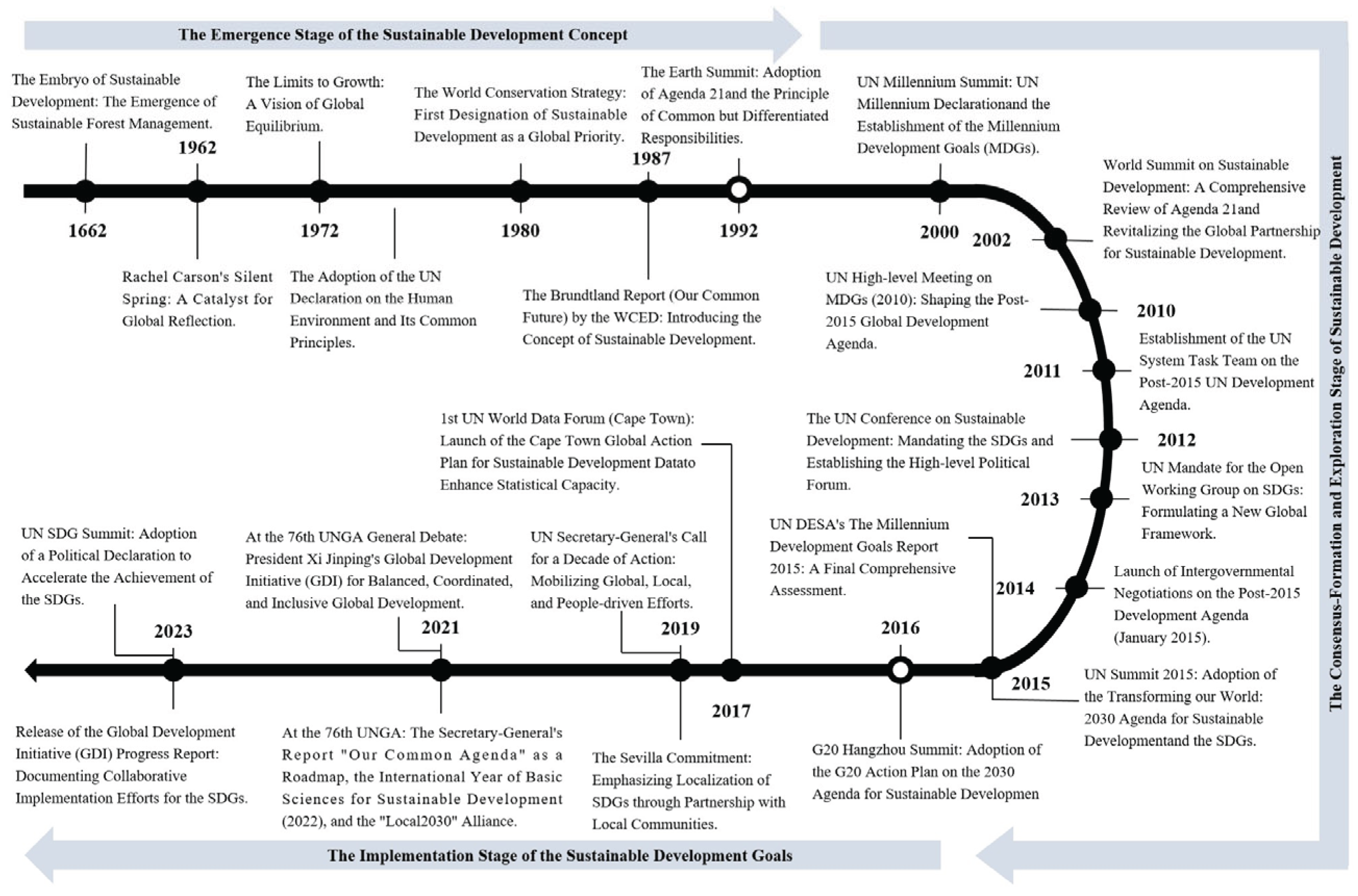
Figure 2.
The establishment and revision process of the global sustainable development goal indicator framework.
Figure 2.
The establishment and revision process of the global sustainable development goal indicator framework.
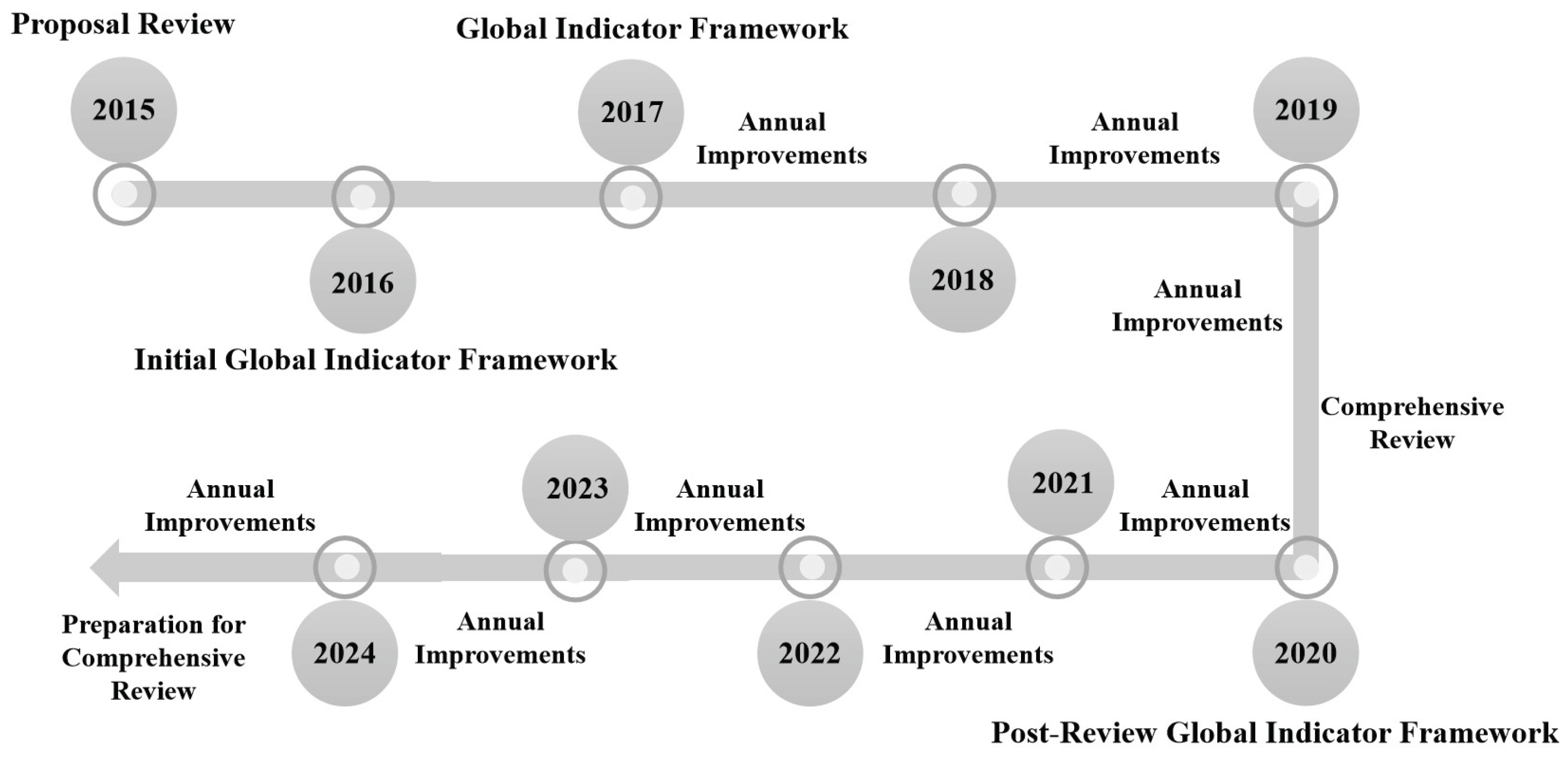
Figure 3.
SDG indices by region and global average, 2000–2024.
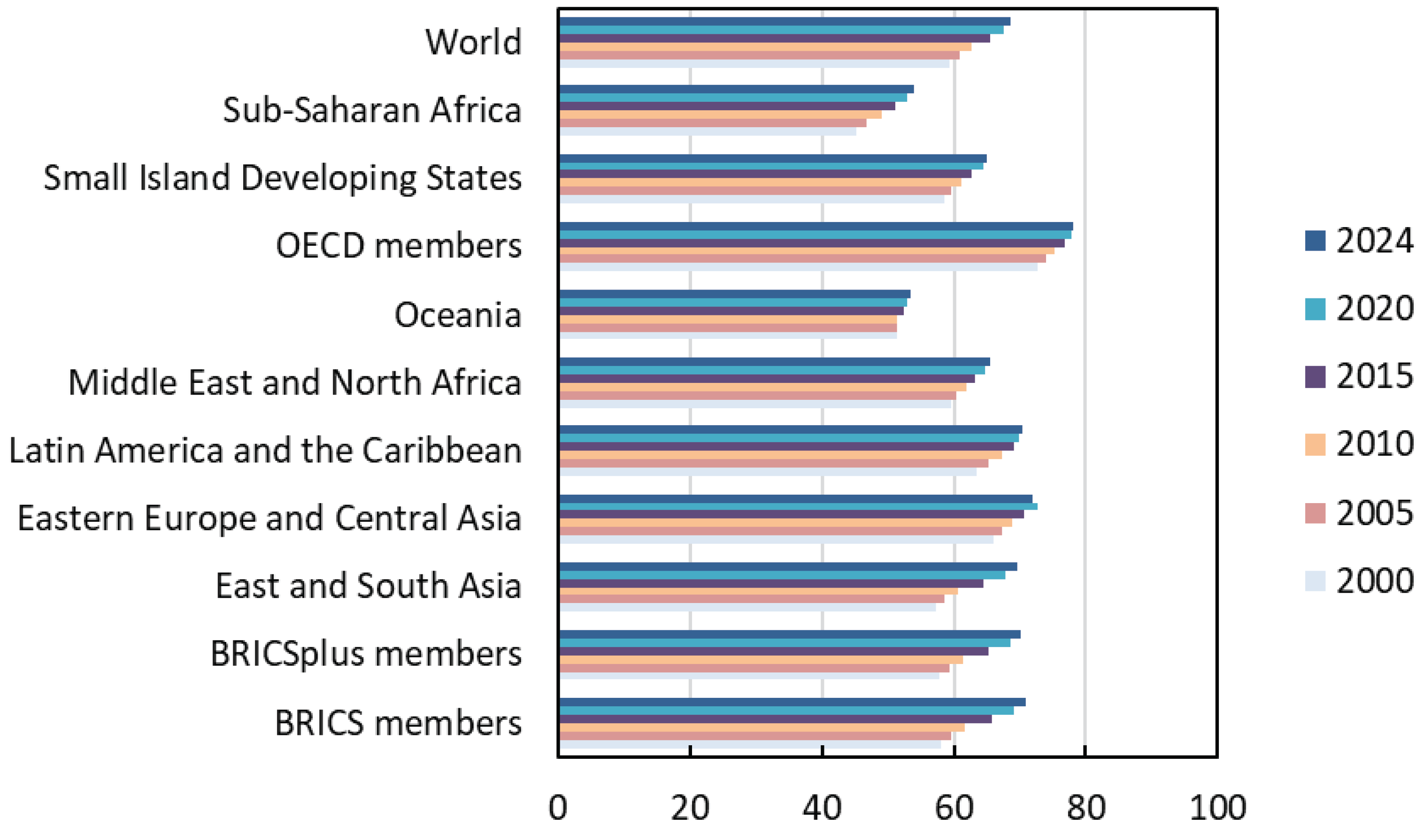
Figure 4.
Comparison of China’s scores for each goal and SDG indices with the global average. To ensure the total height of the bar chart represents the SDG indices, each goal's value in the figure is 1/17th of its original score.
Figure 4.
Comparison of China’s scores for each goal and SDG indices with the global average. To ensure the total height of the bar chart represents the SDG indices, each goal's value in the figure is 1/17th of its original score.
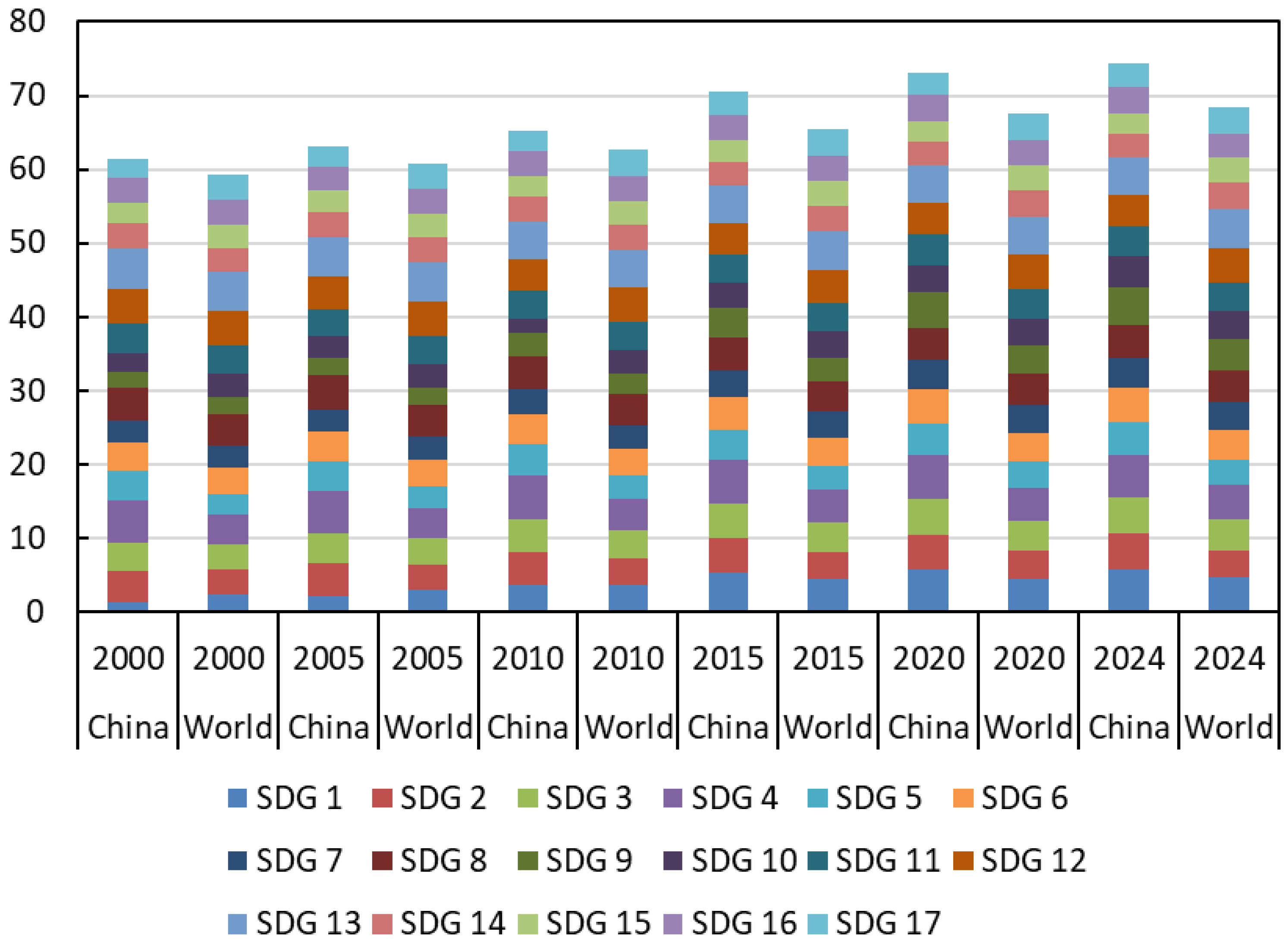
Figure 5.
Comparison of China’s scores for each goal and SDG indices with the global average. To ensure the total height of the bar chart represents the SDG indices, each goal's value in the figure is 1/17th of its original score.
Figure 5.
Comparison of China’s scores for each goal and SDG indices with the global average. To ensure the total height of the bar chart represents the SDG indices, each goal's value in the figure is 1/17th of its original score.
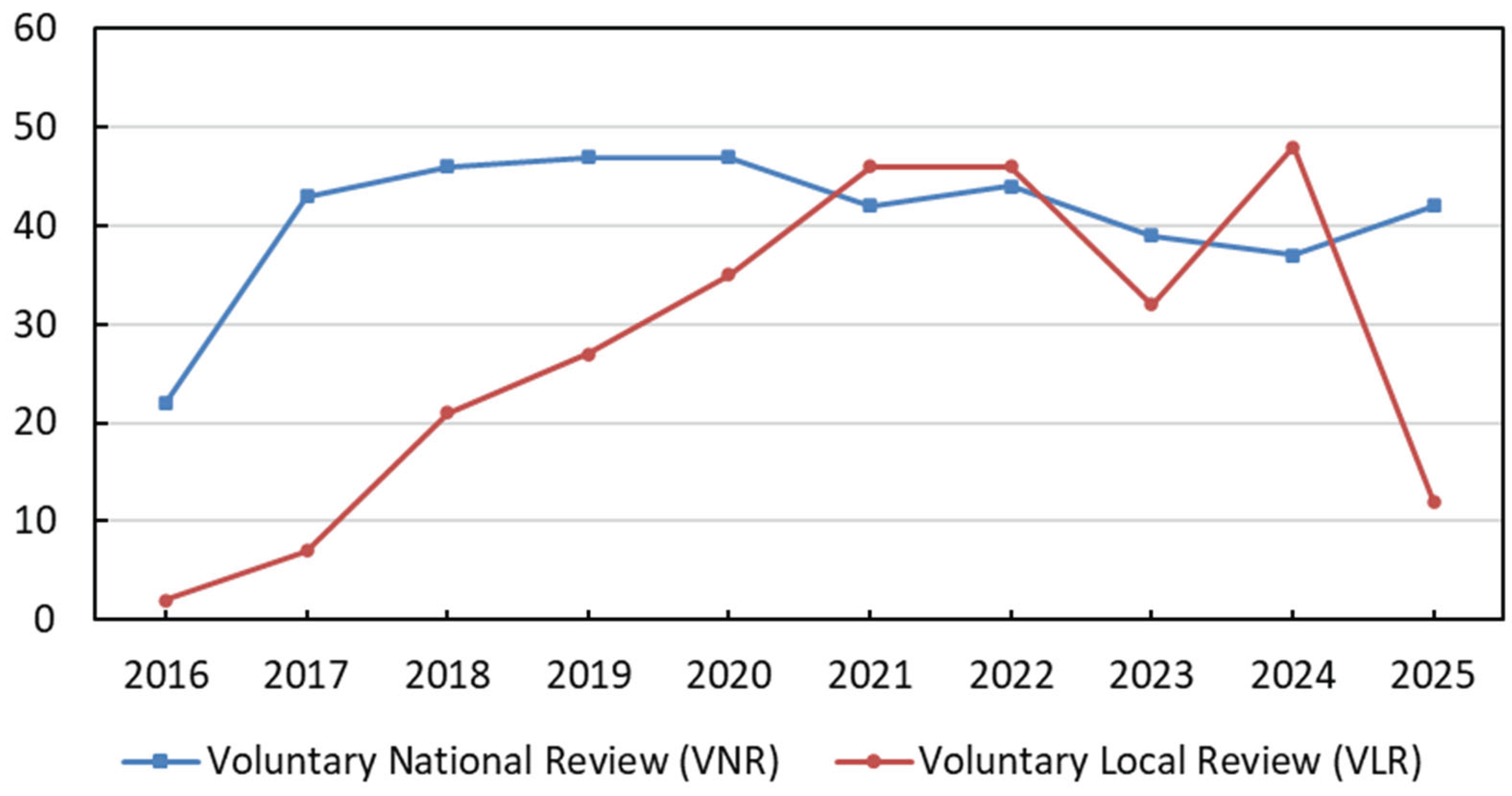

Table 1.
The List of major organizations and reports for global-level research on sustainable development goals.
Table 1.
The List of major organizations and reports for global-level research on sustainable development goals.
| Key organizations | The publicly released report |
|---|---|
| United Nations Economic and Social Council | "Sustainable Development Goals Report" (released every July since 2016) |
| United Nations Independent Scientific Group for Sustainable Development | Global Sustainable Development Report (released every four years, with two editions having been published since 2016 - in 2019 and 2023) |
| The UN Sustainable Development Solutions Network | "The Global Sustainable Development Goals Index and Dashboard Report" (released in June each year since 2016; since 2019, it has been renamed as "Sustainable Development Report") |
| United Nations Development Program | The Localization of ASEAN SDGs: Experience in Policy Formulation and Implementation Pathways |
| The contribution of the G20 to the 2030 Agenda | |
| United Nations Economic and Social Commission for Asia and the Pacific | "Progress Report on Sustainable Development Goals in Asia and the Pacific" (released annually) |
| United Nations Economic Commission for Europe | "Facing Increasingly Severe Challenges in Sustainable Development: Can the United Nations Economic Commission for Europe Region Turn the Situation Around by 2023? " "With Half the Time Left until 2030: How Many Goals Will the United Nations Economic Commission for Europe Region Achieve?" and other series of progress reports (released annually) |
Disclaimer/Publisher’s Note: The statements, opinions and data contained in all publications are solely those of the individual author(s) and contributor(s) and not of MDPI and/or the editor(s). MDPI and/or the editor(s) disclaim responsibility for any injury to people or property resulting from any ideas, methods, instructions or products referred to in the content. |
© 2025 by the authors. Licensee MDPI, Basel, Switzerland. This article is an open access article distributed under the terms and conditions of the Creative Commons Attribution (CC BY) license (http://creativecommons.org/licenses/by/4.0/).
Copyright: This open access article is published under a Creative Commons CC BY 4.0 license, which permit the free download, distribution, and reuse, provided that the author and preprint are cited in any reuse.


