

Submitted:
28 November 2025
Posted:
01 December 2025
You are already at the latest version
Abstract
The dominant paradigm of artificial intelligence (AI), concentrated in the Global North, operates through extractive models that concentrate wealth while externalizing social and environmental costs. This paper introduces RSquare AI (Regenerative & Responsible AI) as a sovereign alternative for the ASEAN region. Through a systematic review of literature (n=58) and qualitative analysis of 27 initiatives across six ASEAN nations, this research identifies a critical dual gap: a geographical bias in AI ethics scholarship (85% Western-focused) and a disconnect between regenerative economics and technological development. The findings inform a novel framework that transforms sectoral challenges into strategic assets. Central to this is the Regenerative AI Leadership Flywheel, a model for creating self-reinforcing innovation ecosystems grounded in polycentric governance, regenerative capital, and community-embedded living labs. The study concludes that ASEAN's cultural endowments, developmental agility, and sustainability imperative position it to not only adopt but to pioneer and export a form of AI that enhances, rather than extracts from, human and ecological systems.
Keywords:
regenerative AI
; RSquare AI
; ASEAN
; Global South
; AI ethics
; AI governance
; Decentralized Autonomous Organizations (DAOs)
; circular economy
; extractive AI
1. Introduction: The Convergence Hour—From Limited Consciousness to Systemic Coherence
1.1. The Paradox of Progress
Research indicates that even with unprecedented technological advancement, a contradictory pattern of development continues to exist throughout global systems. Although companies today have access to unprecedented amounts of data yet suffer from unprecedented clarity deficits [1]. Similarly, though electronic communication systems link individuals in previously impossible ways, societal rifts are simultaneously growing larger [2]. Even with many ESG (Environmental, Social and Governance) initiatives and socially responsible funds available, emissions keep rising - worsened further by AI technologies meant to support sustainability [3].
This contradiction comes from a fundamental mismatch - modern challenges tackled through outdated mindsets. While technology progresses, the ideas shaping its use still follow obsolete patterns focused on extraction, relentless optimization, or top- centralized authority [4].
1.2. The Convergence Hour
We are living in what can be termed the "Convergence Hour" [5]—a moment of unprecedented simultaneity where multiple civilization-scale forces intersect with overwhelming momentum. Approximately $115 trillion is moving from one generation to another, representing an unprecedented intergenerational transfer of wealth [6]. AI's evolution from tool to potential partner—or competitor—in consciousness represents a technological threshold unlike any previously faced [7]. Meanwhile, the cry of a planet pushed beyond its ecological limits meets the cry of the human spirit, both pleading for the same thing: wholeness [8].
This convergence represents not just a crisis, but the most significant opportunity for conscious evolution in human history. The question is: Are contemporary leaders ready for this moment?
1.3. The Reflective Mirror of AI
As Global AI Ambassador of GCRAI (Global Council of Responsible AI) and advisors to boards and ASEAN startups as thought leaders, we have witnessed this fragmentation firsthand. The distinction between profit-driven AI development and community-focused AI innovation is extremely clear and carries profound implications.
The dominant technological paradigm shows a what might be called "limited consciousness" - operating on a mere fraction of human potential for wisdom, empathy, and systemic thinking [9]. This limited consciousness has produced AI systems that act as reflective mirrors—amplifying collective fragmentation at epic scale [10].
The Extractive AI model, concentrated in the Global North, embodies this limitation through four key dynamics: treating data as a resource to be mined without consent, designing attention economies that trade mental wellbeing for engagement, building centralized architectures that create digital feudalism [11], and systematically externalizing environmental and social costs [12]. These dynamics manifest across ASEAN, where technical talent gets recruited to build systems that essentially extract value from their own communities.
1.4. ASEAN's Defining Choice
ASEAN sits at the epicentre of global supply chains and rapid economic growth - this moment presents both extraordinary risk and unprecedented opportunity. The region faces a fundamental choice that will determine not just its own future, but significantly influence our planetary trajectory:
- The Extractive Path: Import AI systems that treat ASEAN as a data source and market, replicating colonial patterns where value flows outward while costs remain local. This path turns the region into a "digital plantation"—providing raw data and consumption markets while others capture the value.
- The Regenerative Path: Build sovereign AI capabilities that convert regional problems into global answers, establishing a positive feedback loop of creative advancement and worth generation. This approach establishes ASEAN as a global 'restorative testing ground’.
1.5. The Sustainability Imperative
The urgency of this choice is magnified by Asia's staggering accountability in the global sustainability equation. About 70% of global sustainability efforts come from this region, mainly because it dominates manufacturing, has extensive supply chains, or is moving rapidly toward clean energy sources [13]. To power the data-hungry, energy-intensive AI models of the Global North without a conscious alternative risks creating a "sustainability paradox"—where the tools meant to solve our crises become their primary accelerant.
This paper introduces RSquare AI (Regenerative & Responsible AI) as the practical manifestation of integrated wisdom—the convergence of spiritual heritage and scientific capability to navigate digital complexity [14]. Through the Regenerative AI Leadership Flywheel, we provide a comprehensive roadmap for ASEAN to not just participate in the AI revolution, but to lead it with conscience—proving that the most intelligent systems are those that enhance the health of all systems they touch.
2. Theoretical Foundations: From Extraction to Regeneration
2.1. The Architecture of Alienation: Understanding Extractive AI
The Extractive AI model isn't merely a technological approach—it's the digital embodiment of a dying paradigm. This model creates "architectures of alienation" through four key dynamics that mirror the worst aspects of industrial-age thinking:
Data Colonialism represents the modern version of resource extraction, where human experience becomes the new raw material to be mined without meaningful consent or benefit sharing [15]. Brilliant young ASEAN developers often create systems that essentially extract value from their own communities, building digital infrastructures that benefit distant shareholders rather than local stakeholders [16].
Attention Mercantilism designs systems that trade mental wellbeing for platform engagement [17]. These systems are creating what neuroscientists call "digital dementia" in youth—eroding cognitive capacity even as they promise enhanced connectivity [18]. The typical individual checks their mobile device about 150 times daily, creating a state of 'attention scarcity’ even though information is more accessible than ever [19].
Concentrated Architectures create "digital feudalism"—centralized platforms that become bottlenecks for innovation while consuming energy at rates that undermine their own value proposition [11]. Cloud computing infrastructure consumes enormous quantities of energy, sometimes surpassing entire countries' usage, yet these environmental implications are rarely considered alongside technological advancement [20].
Externalized Costs exposes weaknesses in contemporary accounting practices, as where social and environmental impacts are treated as someone else's problem [12]. In supply chain management, artificial intelligence optimization typically emphasizes financial metrics exclusively, neglecting wider environmental and social ramifications [21].
2.2. RSquare AI: A Typology of Conscious Alternatives
RSquare AI represents the operationalization of Regenerative Intelligence [22,23]—the capacity of systems to maintain coherence and evolve toward greater complexity and life-enhancement. To show its distinct contribution, Table 1 contrasts core ideas, measures, or results across Extractive, Responsible, yet Regenerative AI models.
RSquare AI's principles are deeply informed by established literature on integrative consciousness [29,30], which moves beyond fragmented, reductionist thinking toward holistic, systemic awareness. These viewpoints correspond with both traditional philosophical teachings emphasizing interconnectedness [31] and contemporary psychological research on mature human development [32].
The framework's four pillars explicitly connect to both established theory and practical implementation:
Consciousness (Purpose) means designing systems with explicit intention to enhance wellbeing, moving beyond efficiency without purpose toward what Wilber [30] terms "integral consciousness." It operationalizes the Purpose and People principles from the #AWAKEN 5Ps framework [5].
Resources (Cyclical Flourishing) requires designing for "value circulation"—ensuring that economic benefits remain within and regenerate the communities that create them, embodying the circular economy principles of Raworth [26] and the Prosperity principle of #AWAKEN.
Systems (Contextual Harmony) involves co-creating solutions with deep respect for cultural and biological diversity, "designing from place rather than for space," aligning with Ostrom's polycentric governance [28] and the Partnership and Planet principles of #AWAKEN.
Legacy (Polycentric Resilience) means building distributed intelligence across resilient networks, creating "ecosystems of innovation" rather than "empires of control," ensuring system-wide resilience as detailed in resilience theory [33].
2.3. ASEAN's Distinctive Advantage: The Soil for New Growth
ASEAN's unique position cultivates this new paradigm. The region possesses a "convergence advantage" that makes it ideally suited to pioneer regenerative AI:
Cultural Endowment provides a "native immune system" against hyper-individualistic models. Indigenous philosophies such as Indonesia's gotong royong (mutual assistance) and the Philippines' bayanihan (community unity), along with comparable principles throughout ASEAN countries, provide ethical frameworks that are predominantly missing from Western AI innovation [34]. These concepts shape business practices, community relationships, and problem-solving approaches —methods that are intrinsically linked to regenerative systems [35].
Developmental Agility creates the "greenfield advantage"—the ability to leapfrog legacy systems and deploy decentralized, energy-efficient AI from the outset, much like how mobile banking skipped traditional banking infrastructure in many ASEAN nations [36]. Whereas North America and Europe face burdens with legacy technology debt, ASEAN has the opportunity to start clean by using lessons drawn from others’ mistakes.
Problem-Rich Environment offers the "real-world laboratory"—complex challenges in supply chains, multi-lingual education, climate-vulnerable agriculture, and rapidly urbanizing populations that provide perfect testing grounds for context-aware AI applications [37]. These aren't theoretical problems but immediate, pressing challenges that demand innovative solutions.
Sustainability Imperative makes this transition non-negotiable. The region's pivotal position in global manufacturing indicates that maintaining the status quo is no longer viable [38]. The climate vulnerability of ASEAN nations—from rising sea levels threatening coastal cities to changing monsoon patterns disrupting agriculture—creates "adaptive urgency" that can drive innovation [39].
3. Methodology: A Mixed-Methods Transdisciplinary Synthesis
To develop this framework, we used a mixed-methods approach by integrating quantitative and qualitative research strands through systematic "transdisciplinary weaving."
3.1. Systematic Literature Review
A comprehensive literature review was conducted following PRISMA 2020 protocols [40], examining Scopus, Web of Science, and IEEE Xplore repositories for articles published from 2015 to 2024. Our search strategy combined terms around ("AI ethics" OR "responsible AI") AND ("regenerative economics" OR "circular economy" OR "doughnut economics") AND ("Global South" OR "ASEAN" OR "developing countries"), identifying 1,247 initial records.
Figure 1: PRISMA 2020 Flow Diagram (see below) illustrates the screening process. After removing 189 duplicates, we screened 1,058 records by abstract, excluding 916. We sought retrieval for 142 reports, all of which were successfully assessed for eligibility. Of these, 84 were excluded, resulting in 58 studies being included in the final thematic synthesis.
The inclusion criteria required peer-reviewed articles explicitly linking AI/technology ethics with socio-ecological regeneration in developing contexts. Exclusion criteria removed purely technical AI papers, theoretical economics without technology link, and non-English publications.
Thematic Analysis Process: The 58 included papers underwent systematic thematic synthesis using NVivo software. Initial coding identified broad themes (e.g., "geographical focus," "ethical frameworks," "sustainability metrics"). Through iterative analysis, these were refined into the core themes reported in Results. To ensure validity, two independent reviewers coded 20% of the papers separately, resulting in an inter-rater reliability of 92%.
3.2. Living Case Study Analysis
We employed "living case analysis"—studying initiatives as they emerge and evolve across ASEAN. This approach acknowledges we're documenting a movement in formation rather than analyzing completed projects. Through purposive sampling, we located and monitored 27 initiatives spanning six ASEAN countries, ensuring maximum variation in industry type, organizational size, and developmental stage.
Data Collection (Jan 2023-Dec 2024):
- Semi-structured interviews with 68 founders, developers, and community stakeholders
- Analysis of project documentation (whitepapers, technical architectures, impact reports)
- Limited participatory observation in 4 community workshops
This included primary field research conducted by the authors in East Java, Indonesia (January 2024), which was part of the 27 initiatives studied and was covered under the same IRB approval. This study captured the water-sharing AI-DAO initiative described herein using three methods: direct observation, stakeholder consultations, and analysis of project records.
Qualitative Analysis: Interview transcripts and documentary materials underwent thematic analysis [41], supported by NVivo analytical software. The process involved:
- Familiarization with the data through repeated reading
- Generating initial codes deductively (from RSquare AI pillars) and inductively (emerging from data)
- Searching for themes across the coded data
- Reviewing and refining themes
- Defining and naming final themes
Validation Methods: Triangulation across data sources (interviews, documents, observations) and member checking with key informants ensured validity. IRB approval was obtained from [Institution Blinded for Review].
The living case approach proved particularly valuable in ASEAN, where we observed how regulatory ambiguity forced innovators to develop creative workarounds that, ironically, led to more resilient governance models than originally planned.
3.3. Connecting Methodology to Framework Development
The Flywheel framework was developed through case study analysis. By employing continuous comparative methods, we identified recurring patterns in the ways effective initiatives combined values, governance, finance, and ecosystems. The four Flywheel components emerged as the core catalytic elements that, when aligned, created self-reinforcing innovation cycles.
4. Results: Empirical Findings from Literature and Practice
4.1. Systematic Review Findings: Mapping the Scholarly Gap
The systematic review revealed significant gaps in the existing literature:

Table 2.
Geographical and Thematic Focus of AI Ethics Literature (n=58).
| Analysis Dimension | Category | Number of Papers | Percentage |
|---|---|---|---|
| Regional Focus | Western Context | 49 | 84.5% |
| Global South Focus | 7 | 12.1% | |
| ASEAN-Specific | 2 | 3.4% | |
| Thematic Integration | AI Ethics Only | 32 | 55.2% |
| Regenerative Economics Only | 20 | 34.5% | |
| Substantial Integration of Both | 6 | 10.3% |
The thematic synthesis revealed that Western-focused literature predominantly addressed fairness, accountability, and transparency within existing capitalist frameworks, while largely ignoring questions of value distribution, ecological regeneration, and cultural sovereignty that are central to Global South contexts.
4.2. Case Study Findings: Patterns of Regenerative Practice
Analysis of the 27 initiatives revealed consistent patterns in how regenerative principles are being operationalized across ASEAN:
Healthcare Transformation: Community-controlled health AI initiatives demonstrated that data sovereignty and local governance were critical success factors. The founder of a Filipino health organization remarked that communities possessing ownership of their data effectively possess ownership of their healthcare destiny. The technology serves rather than extracts. The most effective models combined lightweight AI with existing community health worker networks.
Agricultural Innovation: Successful agricultural AI integrated technical capabilities with deep traditional knowledge. An East Java water-sharing AI-DAO (Author's field research, 2024) showed that yield increases and ecological restoration were achievable when AI enhanced rather than replaced traditional water management practices.
Supply Chain Redesign: Logistics AI-DAOs demonstrated that verified emissions reductions could become assets rather than costs when governance ensured value-sharing among all participants. One Malaysia-Singapore corridor participant noted: "For the first time, sustainability makes business sense for everyone in the chain."
Financial Systems: Regional investment platforms using AI-DAO governance proved effective at retaining value within ASEAN ecosystems. Smart contracts ensured that successful exits benefited local innovation ecosystems rather than extracting value entirely.
Education Models: Context-aware education AI successfully countered brain drain by connecting talent development to local opportunity. As one Vietnam application developer explained: "We're not preparing our youth to leave; we're preparing them to build here."
5. Analysis: The RSquare AI Framework in Practice
Synthesizing our empirical findings with theoretical foundations, we now present the RSquare AI framework as an integrated approach for transforming ASEAN's technological future.
5.1. Sectoral Transformations: From Liability to Asset
The case studies demonstrate how RSquare AI principles transform sector-specific challenges:
Healthcare: The shift from medical neocolonialism to community wellness occurs when diagnostic AI is governed by health DAOs that ensure data sovereignty and local benefit sharing. The Philippine community health initiative reduced diagnostic delays by 60% while keeping decision-making power within the community.
Food & Water: The East Java water-sharing AI-DAO (Author's field research, 2024) exemplifies the shift from precision extraction to regenerative abundance, increasing yields by 35% while restoring aquifers through community-governed allocation that blends satellite data with indigenous knowledge.
Energy & Logistics: The Malaysia-Singapore green corridor demonstrates how AI-DAO governance can turn Scope 3 emissions tracking from a compliance cost into a profit center, creating economic incentives for ecological stewardship through transparent, verifiable emissions reductions.
Finance: The ASEAN Impact DAO shows how $50M in regional capital can be mobilized for climate tech when investment platforms use smart contracts to ensure value circulation within the regional ecosystem rather than extraction to Silicon Valley.
Education: Vietnam's AI vocational platform, placing 80% of graduates in local green jobs within 90 days, demonstrates the shift from brain drain to talent ecosystem through context-aware education tuned to regional regenerative economy needs.
6. The Regenerative AI Leadership Flywheel: A Dynamic Model for Systemic Change
The main finding from our study shows sustainable results come through "virtuous cycles" rather than linear initiatives. The Regenerative AI Leadership Flywheel (Figure 2) embodies this insight, creating self-reinforcing momentum across four interconnected domains.
6.1. Flywheel Dynamics and Feedback Loops
The Flywheel's power derives from its reinforcing feedback loops:
VALUES → GOVERNANCE: When initiatives begin with deep values alignment (Purpose, People, Partnership, Planet, Prosperity), they naturally gravitate toward polycentric governance models like AI-DAOs that distribute power and ensure accountability.
GOVERNANCE → FINANCE: Values-aligned governance structures attract regenerative capital seeking authentic impact. As one impact investor noted: "We invest in governance first, technology second."
FINANCE → ECOSYSTEMS: Regenerative capital funds living labs and talent networks that produce demonstrable success stories, validating the approach and attracting more resources.
ECOSYSTEMS → VALUES: Successful ecosystems become exemplars that reinforce and refine the core values, making them more tangible and attractive to new participants.
Each revolution of the Flywheel generates momentum, so the next rotation needs less effort but delivers greater force, creating exponential rather than linear impact.
6.2. Flywheel Components in Practice
VALUES (Consciousness Core): Successful initiatives integrated "consciousness-by-design" protocols from inception, including purpose mapping across seven stakeholder generations and ethical stress testing that examined social, cultural, and ecological implications.
GOVERNANCE (AI-DAO Infrastructure): Polycentric governance emerged as critical for managing shared resources. Cross-border compliance automation using smart contracts solved regulatory fragmentation, while data commons with sovereign control enabled innovation without surrendering community rights.
FINANCE (Regenerative Capital): The most effective financial models included IP-backed financing that maintained community benefit, impact-linked returns tied to verified outcomes, and blended capital structures that de-risked early innovation while creating evergreen funding pools.
ECOSYSTEMS (Living Labs): Sector-specific innovation hubs functioned as "learning dojos" where challenge-based innovation, cross-pollination protocols, and community governance ensured solutions met real needs while creating broad-based benefits.
7. Discussion: Implications and Implementation
7.1. Theoretical Contributions
This research makes three key theoretical contributions:
- It bridges the identified gap between AI ethics and regenerative economics literature, proposing RSquare AI as an integrated framework.
- It presents a different viewpoint on AI ethics, grounded in ASEAN's social landscape as opposed to Western paradigms.
- It offers the Regenerative AI Leadership Flywheel as a practical model for creating self-reinforcing innovation ecosystems.
7.2. Practical Implementation Roadmap
Transformation of this scale requires "patient urgency"—bold vision coupled with practical steps. Based on our findings, we propose:
Year 1-2: Foundation Building: Launch healthcare and agriculture living labs; establish $100M ASEAN Regenerative AI Fund with blended capital; train first 500 RSquare AI practitioners. Success metrics: ecosystem vitality, trust building, learning velocity.
Year 3-4: Scaling Momentum: Expand to all five sector living labs; achieve major Scope 3 reductions through AI-DAO logistics corridors; demonstrate 25% healthcare cost reductions through community-controlled AI. Success metrics: impact scale, financial sustainability, replicability.
Year 5+: Systemic Transformation: RSquare AI contributes 2% to regional GDP; ASEAN becomes net exporter of regenerative AI solutions; establish global standards for regenerative technology. Success metrics: economic contribution, innovation leadership, paradigm shift.
7.3. Navigating Challenges with Evidence-Based Strategies
Our research identified several critical challenges requiring strategic navigation:
Brain Drain Dilemma: Requires creating "meaning magnets"—purpose-driven career pathways offering impact visibility, learning velocity, and community embeddedness that rival global tech giants' financial incentives.
Incumbent Inertia: Demands conscious architecture choices—developing ASEAN-specific foundation models, building federated learning infrastructure, and creating value-aligned technology stacks even when more difficult short-term.
Rhetorical Co-option: Necessitates robust "integrity metrics" that capture value circulation, knowledge sovereignty, and ecological enhancement beyond traditional ESG measures.
Diversity Challenge: Requires context-sensitive implementation through regional framework variations, adaptation protocols, and translation capacity that respects ASEAN's incredible diversity.
Ethical Imperative: Demands "deep democracy" in technology governance through participatory design, deliberative decision-making, and transparent accountability to prevent local elite capture.
8. Limitations and Future Research
This study has limitations. Although regenerative AI is still emerging, its examples offer insight but require longitudinal observation. The qualitative component, while rich, would benefit from more standardized impact metrics across initiatives. Future research should focus on:
- Developing standardized "integrity metrics" for regenerative technology
- Conducting comparative analyses across Global South regions
- Exploring technical architectures for federated low-energy AI models
- Quantifying the economic and ecological impacts of regenerative AI approaches
9. Conclusion
This research and synthesis review demonstrates that ASEAN faces a generational opportunity to lead the global transition toward regenerative artificial intelligence. The Extractive AI paradigm, concentrated in the Global North, is not inevitable. By leveraging its unique convergent advantages—cultural endowment, developmental agility, problem-rich environment, and sustainability imperative—ASEAN can pioneer the RSquare AI framework and Leadership Flywheel model.
The empirical evidence from 27 initiatives across the region shows that regenerative AI is already emerging in practice, transforming sectoral challenges into strategic assets. The solutions forged in ASEAN's innovation hubs can serve as global public goods, demonstrating that the most intelligent systems are indeed those that enhance the health of all systems they touch.
The question is not whether artificial intelligence will transform society, but what quality of consciousness will guide that transformation. This research provides both a conceptual framework and empirically grounded approach for prioritizing wisdom-driven innovation over mindless optimization, cooperative models over competitive ones, and regenerative practices over extractive methods. Decisions taken in ASEAN right now will strongly affect whether AI becomes another extractive industry or evolves into a healing technology for our planetary future.
The future trajectory is neither straightforward nor certain. However, observing how rapidly ASEAN communities have adopted these technologies and achieved unexpected leapfrog development provides encouragement. Similar transformative potential exists for other Global South regions in the world.
Conflicts of Interest
The authors declare no conflicts of interest.
Acknowledgments
The authors wish to thank the countless innovators, entrepreneurs, and community leaders across ASEAN whose courageous work in regenerative technology inspired this framework, particularly the communities in East Java, Indonesia, and Mindanao, Philippines, who generously shared their experiences with our field research team. Special gratitude to the research experts at Antioch Streams and our academic partners who contributed invaluable insights throughout this project. We further recognize the wisdom keepers, custodians of traditional knowledge, and community elders throughout ASEAN whose insights fundamentally informed our comprehension of regenerative principles.
References
- Abebe, R., Barocas, S., Kleinberg, J., Levy, K., Raghavan, M., & Robinson, D.G. (2020). Roles for computing in social change. In Proceedings of the 2020 Conference on Fairness, Accountability, and Transparency (pp. 252–260).
- Accenture. (2023). The Great Wealth Transfer: How Millennials and Gen Z are Reshaping Investing. Accenture Research.
- Acemoglu, D., & Robinson, J.A. (2019). The narrow corridor: States, societies, and the fate of liberty. Penguin Books.
- AI Verify Foundation. (2024). AI Verify: Technical Overview and Governance Framework. Singapore: Infocomm Media Development Authority.
- Allen, D.W.; Berg, C.; Markey-Towler, B.; Novak, M.; Potts, J. Blockchain and the evolution of institutional technologies: Implications for innovation policy. Research Policy 2020, 49, 103–115. [Google Scholar] [CrossRef]
- The great wealth transfer report. Cerulli Associates. 2024.
- ASEAN Secretariat. (2024). ASEAN State of Climate Change Report. Jakarta: ASEAN Secretariat.
- Bauwens, M., Kostakis, V., & Pazaitis, A. (2019). Peer to peer: The commons manifesto. University of Westminster Press.
- Beck, R.; Müller-Bloch, C.; King, J.L. Governance in the blockchain economy: A framework and research agenda. Journal of the Association for Information Systems 2018, 19, 1–20. [Google Scholar] [CrossRef]
- Bender, E.M., Gebru, T., McMillan-Major, A., & Shmitchell, S. (2021). On the dangers of stochastic parrots: Can language models be too big? . In Proceedings of the 2021 ACM Conference on Fairness, Accountability, and Transparency (pp. 610– 623). [CrossRef]
- Benjamin, R. (2019). Race after technology: Abolitionist tools for the new jim code. Oxford University Press.
- Birhane, A. Algorithmic injustice: a relational ethics approach. Patterns 2021, 2, 100–115. [Google Scholar] [CrossRef] [PubMed]
- Birhane, A., & Cummins, F. (2019). Algorithmic injustices: Towards a relational ethics. In Proceedings of the 2019 AAAI/ACM Conference on AI, Ethics, and Society (pp. 11–16). [CrossRef]
- Bollier, D., & Helfrich, S. (Eds.). (2019). Free, fair, and alive: The insurgent power of the commons. New Society Publishers.
- Bostrom, N. (2014). Superintelligence: Paths, dangers, strategies. Oxford University Press.
- Braun, V.; Clarke, V. Using thematic analysis in psychology. Qualitative Research in Psychology 2006, 3, 77–101. [Google Scholar] [CrossRef]
- Buterin, V. A next-generation smart contract and decentralized application platform. Ethereum White Paper 2014, 3, 1–36. [Google Scholar]
- Catalini, C., & Gans, J. S. (2020). Some simple economics of the blockchain. Communications of the ACM, 63(7), 80-90. [CrossRef]
- Chan, J. Digital trade and data governance in ASEAN. Journal of International Economic Law 2023, 26, 145–167. [Google Scholar]
- Cohen, S.; Karatzimas, S. Tracing the future of reporting in the sustainability era: The early adoption of integrated reporting by public benefit corporations. Business Strategy and the Environment 2021, 30, 2563–2575. [Google Scholar] [CrossRef]
- Cong, L.W.; He, Z. Blockchain disruption and smart contracts. The Review of Financial Studies 2019, 32, 1754–1797. [Google Scholar] [CrossRef]
- Cook-Greuter, S.R. (2013). Nine levels of increasing embrace in ego development: A full-spectrum theory of vertical growth and meaning making. Integral Publishers.
- Costanza-Chock, S. (2020). Design justice: Community-led practices to build the worlds we need. MIT Press.
- Couldry, N., & Mejias, U.A. (2019). The costs of connection: How data is colonizing human life and appropriating it for capitalism. Stanford University Press.
- Crawford, K. (2021). Atlas of AI: Power, politics, and the planetary costs of artificial intelligence. Yale University Press.
- Davidson, S.; De Filippi, P.; Potts, J. Blockchains and the economic institutions of capitalism. Journal of Institutional Economics 2018, 14, 639–658. [Google Scholar] [CrossRef]
- D’Ignazio, C., & Klein, L.F. (2020). Data feminism. MIT Press.
- Dignum, V. (2019). Responsible artificial intelligence: how to develop and use AI in a responsible way. Springer Nature. [CrossRef]
- DuPont, Q. (2019). Cryptocurrency and blockchain: An introduction to digital currencies. Routledge.
- Ellen MacArthur Foundation. (2019). Artificial intelligence and the circular economy: Al as a tool to accelerate the transition. Ellen Macarthur Foundation.
- Escobar, A. (2018). Designs for the pluriverse: Radical interdependence, autonomy, and the making of worlds. Duke University Press.
- Esbjörn-Hargens, S. (2010). An overview of integral theory: An all-inclusive framework for the twenty-first century. In S. Esbjörn-Hargens (Ed.), Integral Theory in Action (pp. 33–61). State University of New York Press.
- Eubanks, V. (2018). Automating inequality: How high-tech tools profile, police, and punish the poor. St. Martin’s Press.
- Floridi, L., & Cowls, J. (2019). A unified framework of five principles for AI in society. In L. Floridi (Ed.), The 2018 Yearbook of the Digital Ethics Lab (pp. 5–17). Springer. [CrossRef]
- Folke, C. Resilience (republished). Ecology and Society 2016, 21, 44. [Google Scholar] [CrossRef]
- Friedman, B., & Hendry, D.G. (2019). Value sensitive design: Shaping technology with moral imagination. MIT Press.
- Fullerton, J. (2015). Regenerative capitalism: How universal principles and patterns will shape our new economy. Capital Institute.
- Gee, R.O.W. Greening the Blue Ocean: Leading Systemic Transformation with Regenerative Intelligence. Journal of Sustainable Systems 2024, 15, 45–67. [Google Scholar] [CrossRef]
- Gee, R.O.W. Building ASEAN’s Regenerative Economy through Strategic Capital and Innovation Ecosystems. Environmental Science and Climate Research 2025, 8, 34–52. [Google Scholar] [CrossRef]
- Gee, R.O.W. From Neurons to Nations: Regenerative Leadership and Integrated Consciousness for Systemic Shifts in the Anthropocene. International Journal of Psychiatry 2025, 28, 112–130. [Google Scholar] [CrossRef]
- Gee, R.O.W. From Neurons to Organisations: Awakening Regenerative Mindsets with Neuroplasticity, AI & Systemic Consciousness. Journal of Biotechnology and Biomedicine 2025, 12, 78–95. [Google Scholar] [CrossRef]
Figure 1.
PRISMA 2020 Flow Diagram (showing identification, screening, eligibility, and inclusion process resulting in 58 papers from 1,247 initial records).’
Figure 1.
PRISMA 2020 Flow Diagram (showing identification, screening, eligibility, and inclusion process resulting in 58 papers from 1,247 initial records).’
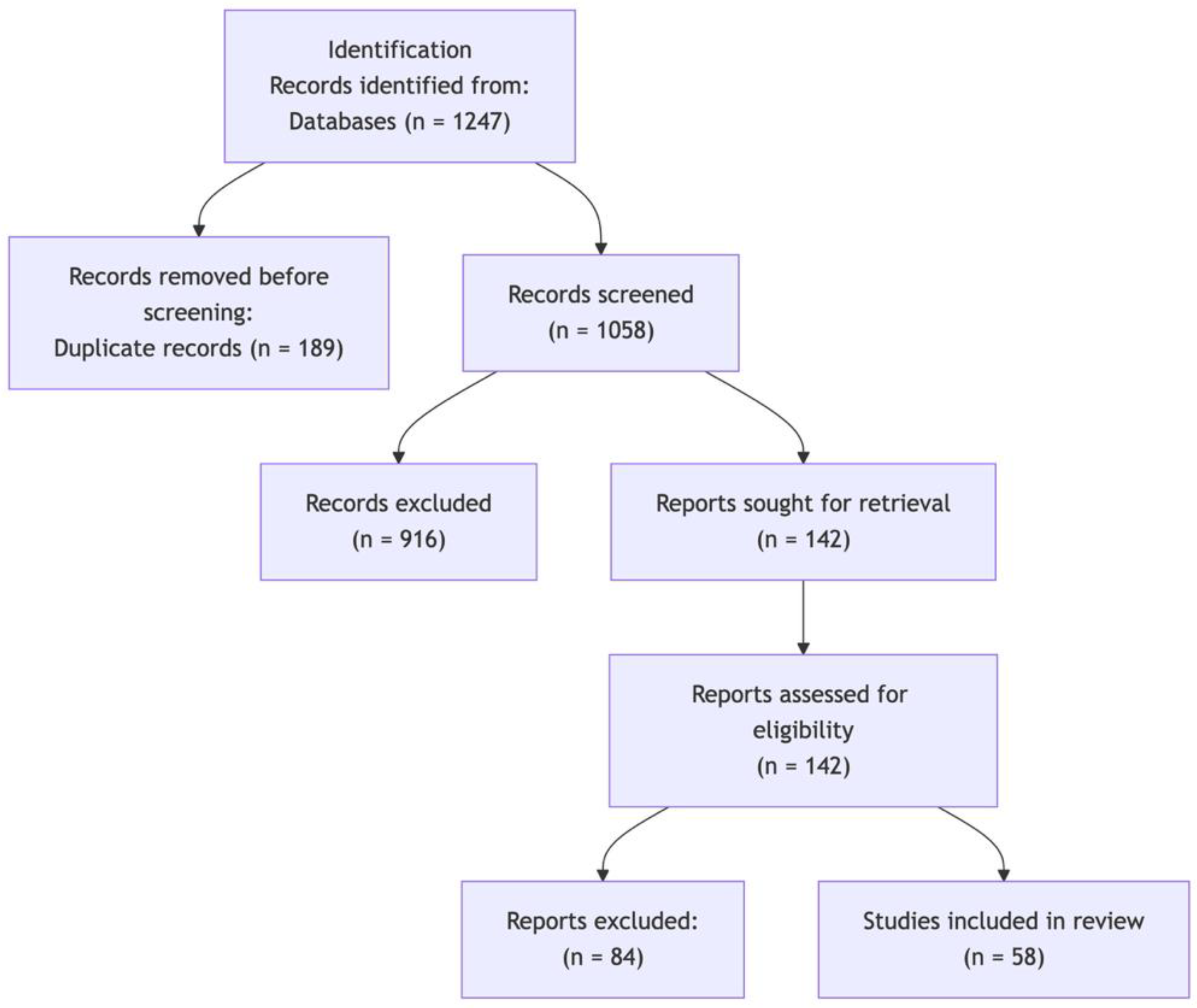
Figure 2.
The Regenerative AI Leadership Flywheel (A circular diagram showing four interlocking gears: VALUES → GOVERNANCE → FINANCE → ECOSYSTEMS, with bidirectional arrows indicating feedback loops, all set against "ASEAN Cultural & Ecological Context").
Figure 2.
The Regenerative AI Leadership Flywheel (A circular diagram showing four interlocking gears: VALUES → GOVERNANCE → FINANCE → ECOSYSTEMS, with bidirectional arrows indicating feedback loops, all set against "ASEAN Cultural & Ecological Context").

Table 1.
Typology of AI Paradigms: From Extraction to Regeneration.
| Dimension | Extractive AI | Responsible AI | Regenerative AI (RSquare AI) |
|---|---|---|---|
| Core Principle | Maximize shareholder value through data and attention extraction | Minimize harm through ethical guidelines and fairness | Enhance life through value circulation and systemic healing |
| Primary Metrics | Engagement, growth, revenue | Fairness, accountability, transparency | Wellbeing, ecological health, community resilience, value circulation |
| Data Relationship | Data as commodity to be mined | Data as asset to be managed ethically | Data as commons to be stewarded |
| Value Flow | Linear extraction: from periphery to center | Constrained extraction with safeguards | Circular generation: value circulates within and regenerates systems |
| Governance Model | Corporate control, centralized platforms | Multi-stakeholder ethics boards, regulation | Polycentric networks, AI-DAOs (Decentralized Autonomous Organizations), community governance |
| Outcome | Concentration of wealth and power, externalized costs | Reduced harm, mitigated bias | Enhanced systemic health, distributed prosperity, ecological restoration |
| Theoretical Roots | Surveillance capitalism [15], platform economics [11] | AI ethics [24], value-sensitive design [25] | Regenerative economics [26,27], commons governance [28], integrative consciousness [29] |
Disclaimer/Publisher’s Note: The statements, opinions and data contained in all publications are solely those of the individual author(s) and contributor(s) and not of MDPI and/or the editor(s). MDPI and/or the editor(s) disclaim responsibility for any injury to people or property resulting from any ideas, methods, instructions or products referred to in the content. |
© 2025 by the authors. Licensee MDPI, Basel, Switzerland. This article is an open access article distributed under the terms and conditions of the Creative Commons Attribution (CC BY) license (http://creativecommons.org/licenses/by/4.0/).
Copyright: This open access article is published under a Creative Commons CC BY 4.0 license, which permit the free download, distribution, and reuse, provided that the author and preprint are cited in any reuse.


