

Submitted:
02 October 2025
Posted:
05 November 2025
You are already at the latest version
Abstract
This study explores the feasibility of developing an AI-powered application, used either independently or with an external device, to predict mood swings in individuals with severe mental illness or a predisposition to mood-related disorders. Beyond prediction, the system is envisioned to support early intervention through art therapy. The methodology integrates insights from the psychology of music and color, psychophysiological monitoring (e.g., polygraphy and fMRI), and machine learning techniques within artificial intelligence frameworks. The study emphasizes the complementary roles of psychology and AI, focusing particularly on the subliminal aspects of human behavior. Importantly, the proposed AI functions as a supportive tool rather than a decision-maker, ensuring a balanced integration of technology and human judgment. By outlining the conceptual and methodological foundations, this research represents an initial step toward innovative mental health technologies with the potential to enhance both prediction and intervention.
Keywords:
artificial intelligence
; machine learning
; innovations
; art therapy
; mood disorders
; color psychology
; music
1. Introduction
Art has always held significant value throughout history, starting from the ancient world and continuing to be important in modern society. With the rise of technology and the increasing pace of life, people are facing more mental health challenges, such as chronic stress, anxiety, and depression. In this context, the role of art becomes crucial. Art therapy has proven effective in psychiatry, helping to improve the lives of patients with various mental illnesses and disorders. Music and color choices play one of the most important roles in this process. While the AI sector has made remarkable advancements in the past decade, there remains potential for further technological improvements in the treatment of psychiatric patients and individuals with psychological issues.
The role of the AI-based innovation discussed in this article is to propose additional solutions to the problem. Artificial intelligence should analyze the user's mental state based on medical data such as pulse rate, respiratory rate, and other relevant metrics. It would then recommend specific types of music to help improve the user's mood.
The design of the AI-based software is based on the following hypothesis: when a person is in a certain state of mind, they tend to listen to music that corresponds to that tone. To improve one's mental state, a user should aim to listen not directly to the opposite tone but rather to something "in the middle" of the opposite. Similarly, the choice of colors operates on the same principle; a person selects or rejects colors based on their current emotional state.
The primary objective of this research is to explore how AI-driven technologies can enhance art therapy, particularly in relation to music and color.
The main contribution includes:
- Examine the role of color and music in mental health.
- Discuss how AI can utilize this role for therapeutic purposes.
- Review the role of the polygraph and fMRI in the AI field.
- Evaluate the effectiveness of the chosen approach and its future impact on psychiatry and society in general.
2. Related Works
Current technologies for mood disorder prediction and management—including bipolar disorder and depression—primarily rely on single-modality monitoring. These include mobile applications and chatbots for tracking mood fluctuations, music platforms that recommend content based on self-reported emotions, and tools analyzing behavioral or facial cues. Clinical studies increasingly explore smartphone-wearable integrations to detect depressive or anxious episodes, and management platforms allow patients to monitor illness progression. Yet, none systematically integrate psychological insights on music and color with physiological monitoring, such as polygraph-inspired signals.
Building on this gap, the present study proposes a novel AI-powered state-of-art technology that combines music and color-based psychological insights with physiological monitoring to predict and support the treatment of mood fluctuations. Unlike existing tools, this approach emphasizes personalized, evidence-based interventions, such as art and music therapy, while ensuring that AI functions as a supportive aid rather than a decision-maker. The following section outlines the conceptual and methodological foundations for developing this integrated system.
3. Materials and Methods
The research is based on several key psychological concepts, including Max Lüscher's theories, the psychology behind music choice and preference, the polygraph's functional principles, the use of fMRI in psychiatry, and the development of a machine learning models. Due to the narrow focus of the subject, the study lacks available datasets and empirical studies. Consequently, the final conclusions of this research are drawn from personal experience.
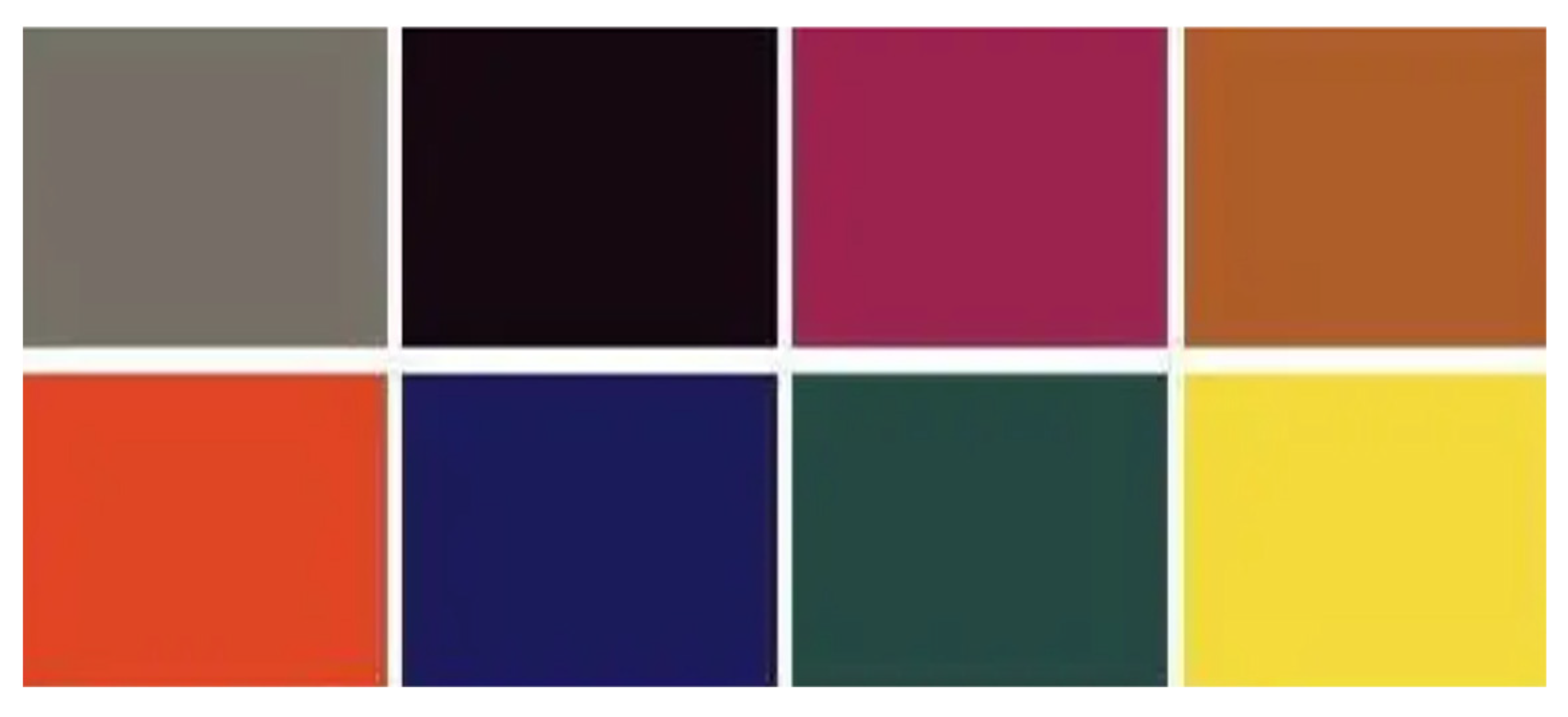
To begin with, Max Lüscher was a renowned psychologist best known for developing the color test, a diagnostic tool designed to assess patients' mental states. The main concept of this test involves having patients arrange color cards from specific sets in an order that reflects their emotional state. Interestingly, patients' choices are not based on personal preferences but on their perceptions of the qualities of the colors. Lüscher's research indicates that emotionally balanced individuals tend to select colors in a similar order. Conversely, the acceptance or rejection of certain colors can reveal underlying psychological issues, as each color carries its own emotional significance. To provide a comprehensive psychological profile for each patient, Max Lüscher developed a detailed color test consisting of several components. [1,2]
Figure 1.
Colors used in Lüscher’s test.
When discussing music psychology, it is evident that music plays a vital role in reducing anxiety, as demonstrated by numerous studies. Many researchers describe music as capable of eliciting transcendent feelings in listeners. In their research paper, “The Psychological Functions of Music Listening,” Schäfer, Sedlmeier, Städtler, and Huron summarize various functions, uses, and meanings of music. They assert that, based on principal components analysis, “people listen to music to achieve self-awareness, social relatedness, and arousal and mood regulation.” Additionally, they propose categorizing musical functions into four dimensions: cognitive, emotional, social/cultural, and physiological/arousal-related. They observe that today people tend to listen to music more for individual purposes rather than social ones, primarily to influence their mood. [3]
In their study, Liljeström, Juslin, and Västfjäll noted that musical emotions arise in specific situations and are influenced by personal preferences. They referenced the 'five-factor model,' which comprises five personality traits: extraversion, agreeableness, openness to experience, neuroticism, and conscientiousness. The researchers assert that self-selected music tends to evoke more positive emotions, particularly when listened to in the company of close friends or like-minded individuals. They also found a correlation between certain emotions and specific personality traits. For instance, individuals with high levels of neuroticism reported experiencing more negative emotions, while those high in extraversion reported more positive emotions. Additionally, individuals scoring high in conscientiousness experienced fewer negative emotions. [4]
Schäfer and Sedlmeier argue that, in addition to its entertainment functions, music can significantly enhance individuals' well-being. They reference various music models, including LeBlanc's (1982) model, which posits that a person's acceptance or rejection of a particular song is influenced by their personality traits. The authors also point out that repetition and familiarity can increase the likelihood of someone enjoying a specific piece of music. According to their research participants, the primary reasons for listening to their chosen music were self-reflection and socialization. [5] Additionally, Kendra Cherry discusses studies that examine the relationship between a person’s preferred music style and their core personality traits, such as openness, self-esteem, and introversion/extroversion. She highlights a study indicating that music preferences can be assessed through three dimensions—arousal, valence, and depth—beyond just the genre of music. [6]
Speaking about the polygraph, it is a device designed to track indicators of autonomic arousal, such as heart rate, respiration, and skin conductivity. Some researchers also monitor cardiac output and skin temperature. However, it is important to note that a polygraph only measures peripheral arousal. [7] Kozel was examining functional MRI scans of the brain to detect deception and found that five regions showed activation when an individual was lying. However, this study was limited by the small size of the group, and all participants were adults who were well-scanned and unmedicated. [8] Another study to bring up briefly, Dr. Daniel Amen developed a technique for scanning his patients’ brains using MRI before making a diagnosis and determining a treatment plan. He discovered that even individuals with similar diagnoses, such as depression, exhibit different brain activity. Therefore, it is essential to tailor therapeutic approaches to each person. [9] Thus, polygraphs and fMRI scans could be utilized to detect mental changes in patients.
Finally, in terms of AI-powered predictions, both regression and classification models from Machine Learning (ML) can be utilized, as discussed in further detail later. All models for this research should be developed from scratch. The regression model will assess the frequency of related cases among patients, while the classification model will help identify the specific type of tool to be used for each case.
To conclude this section, the research explores concepts that are not commonly combined. However, there is potential to integrate this knowledge to develop new tools, which will be discussed further.
4. Results
Based on the materials and studies mentioned above, we suggest a state-of-art technology, which consists of an AI-powered device, along with mobile and web applications, that can help influence mood swings — symptoms associated with various mental conditions and illnesses. This project combines principles from color psychology, music psychology, polygraph and fMRI functioning, and software development, with each aspect playing a crucial role.
To begin with, fMRI and polygraph testing can identify dysfunctions or changes in the body based on various indicators. However, fMRI has limitations; it provides an overview of the brain's current state but cannot detect early mood changes that may precede significant problems. Additionally, it is not suitable for individuals who suffer from claustrophobia. Furthermore, our understanding of the human brain is still limited. On the other hand, polygraph testing can more accurately track subtle mood changes as it monitors frequently changing indicators such as blood pressure, breathing, and skin conductivity. Even changes in pulse can be effective for monitoring an individual over both short and long periods, aiding in the prediction of mood changes. This approach can be utilized to gather physical indicators from users with phobias and process this data for further analysis.
Then it is important to consider color psychology as it provides insight into an individual’s current mental state. As a person’s mood or mental state changes, their color preferences will also shift. Color psychology reveals subliminal meanings that extend beyond basic research, and the Lüscher’s test is a complex tool that explores these concepts in detail. To briefly summarize the psychological meanings of the eight main colors used in the Lüscher’s test: dark blue signifies calmness and satisfaction; forest green represents self-affirmation, confidence, and persistence; red indicates activeness and success; yellow symbolizes stimulation, change, exploration, and a focus on future desires; violet embodies magic and a sense of oneness; grey suggests neutrality and indifference; brown relates to physical sensations; and black signifies negation. [10] By using Max Lüscher’s tests, it is possible to monitor a person’s state of mind based on the colors they choose in their daily life. When developing software for mood tracking, incorporating color preferences should be one of the initial steps. This could serve as a fundamental indicator of mental states, as color choices tend to remain consistent. Ideally, results from a polygraph-like device could be compared with those from color tests to enhance the accuracy of mood assessments.
After collecting primary data from the user, it is possible to connect this information to music notes or genres. The goal is to find a match between physical indicators, color preferences, and musical tonality, as all of these elements reflect a person's mental state. For instance, individuals in a "down" mood tend to choose music that corresponds with their feelings, while those in an "up" mood typically prefer cheerful songs. Observations indicate that people are generally reluctant to switch to a completely opposite genre or tonality. Therefore, for mood correction, it would be beneficial to recommend music with a tonality that lies "in the middle" between their current preference and the opposite. Tailoring these suggestions to their preferences can maximize positive outcomes. In this context, AI could be quite useful.
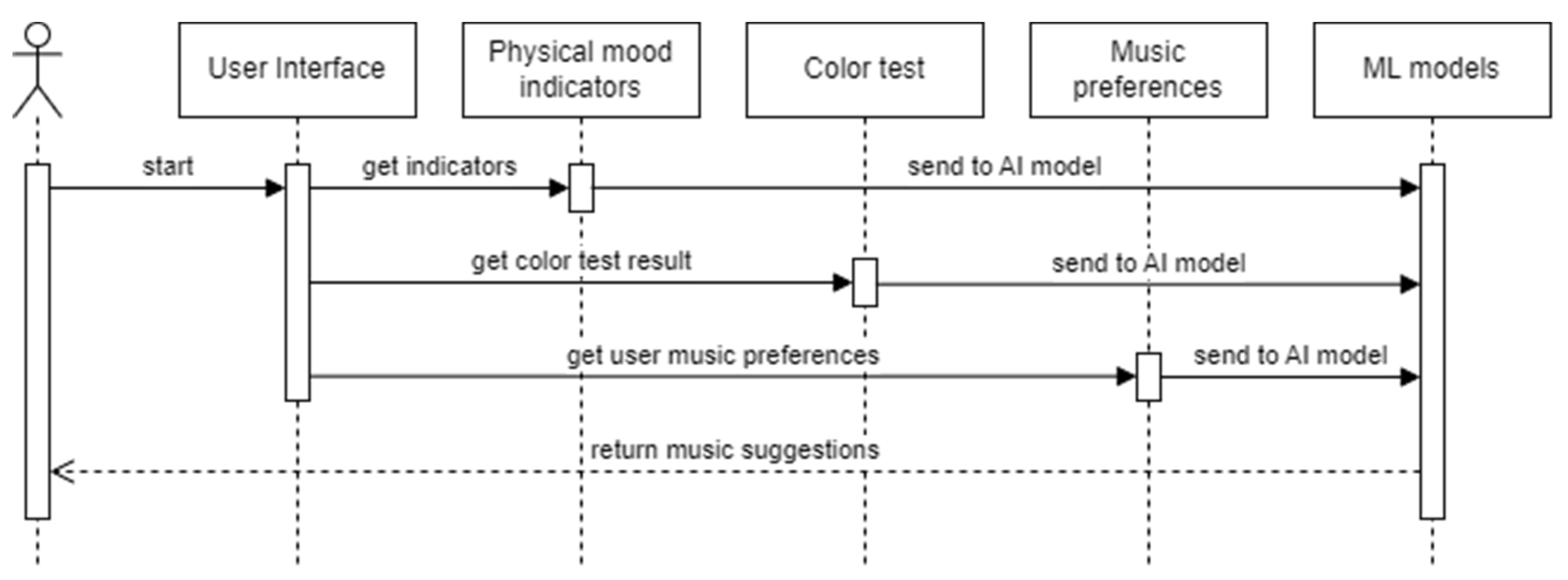
When selecting machine learning (ML) models for processing user data and generating suggestions, it's advisable to develop a couple of models from scratch. An ML regression model should be utilized to predict the most common outcomes in similar cases, serving statistical purposes to track overall clinical trends. Additionally, an ML classification model is needed to compute final recommendations for patients, based on indicators from earlier stages and the user's music preferences. To determine the most appropriate models, the collected datasets should be tested across various approaches. Polynomial regression may be a suitable option, as it can capture complex patterns in the data for making statistical predictions. Meanwhile, a Neural Network or Deep Learning model could be implemented to provide music recommendations to users, as these models are well-suited for more sophisticated solutions. [11,12] Full-stack or desktop application could be used to interact with the user.
Figure 2.
Sequence diagram on how AI-powered application mentioned above can work.
Due to difficulties in obtaining the necessary electrodes and a user dataset that correlates polygraph indicators with corresponding emotions, colors, and music notes, we propose a prototype of the previously mentioned technology. [17] The front-end web application, built with Next.js, will prompt the user to provide pulse input data three times. In a full-scale application, this process can be looped if electrodes are connected. The differences between the pulse input results will be calculated, and a validation will check that these differences are greater than zero, indicating a change in the user's emotional state:
- let pulseResult1 = (pulse1 - pulse2);
- let pulseResult2 = (pulse2 - pulse3);
- let pulseResult3 = (pulse3 - pulse1);
- if (pulseResult1 < 0) { pulseResult1 *= -1; };
- if (pulseResult2 < 0) { pulseResult2 *= -1; };
- if (pulseResult3 < 0) { pulseResult3 *= -1; };
To establish a correlation between color and corresponding music notes, the following variable is used:
- const colorNotePair = {
- grey: "G, bass clef",
- black: "D, bass clef",
- brown: "B, bass clef",
- blue: "F, bass clef",
- green: "G, treble clef",
- orange: "B, treble clef",
- yellow: "F, treble clef",
- violet: "E, treble clef"
- };
Next, the application will calculate the corresponding color and music note by calling the next function three times:
- function specifyMusicNote(pulseResult) {
- if(pulseResult == 0 || pulseResult == 1) return colorNotePair.grey;
- else if(pulseResult < 1) return colorNotePair.black;
- else if(pulseResult < 3 && pulseResult > 2) return colorNotePair.brown;
- else if(pulseResult <= 2 && pulseResult > 1) return colorNotePair.blue;
- else if(pulseResult < 7 && pulseResult >= 5) return colorNotePair.green;
- else if(pulseResult < 10 && pulseResult >= 7) return colorNotePair.yellow;
- else if(pulseResult < 5 && pulseResult >= 3) return colorNotePair.violet;
- else return colorNotePair.orange;
- }
The proposed dataset for training the ML model should resemble the format outlined in Table 1. To establish the recommended colors and musical notes corresponding to user outcomes, a survey should be conducted with at least several hundred participants. The colors suggested for the dataset differ slightly from those used in Lüscher’s test; specifically, red has been replaced with orange. This change is based on the assumption that a higher variation in pulse may indicate a somewhat milder meaning than that associated with strong activity.
When conducting large surveys and clinical trials to gather a real-world dataset, it is important to add an additional column at the end of the table. This column should correspond to the suggested tone of a song aimed at improving the patient's current mood. The primary hypothetical machine learning model trained on this dataset could be structured as follows. For our primary objective, we recommend using the K-Nearest Neighbor (K-NN) classifier [12] as the hypothetical machine learning model trained on this dataset. The K-NN classifier utilizes Euclidean distance to identify the closest data point based on the specified value of k, using the appropriate formula:
where x and y are coordinated of two vector points in two-dimensional space.
d(A, B) =√(x2 – x1)2+(y2 – y1)2,
The primary K-NN model, which is coded in Python, is presented as follows:
- """## Importing the libraries"""
- import numpy as np
- import matplotlib.pyplot as plt
- import pandas as pd
- """## Importing the dataset"""
- dataset = pd.read_csv('dataset.csv')
- X = dataset.iloc[:, :-1].values
- y = dataset.iloc[:, -1].values
- """## Splitting the dataset into the Training set and Test set"""
- from sklearn.model_selection import train_test_split
- X_train, X_test, y_train, y_test = train_test_split(X, y, test_size = 0.25, random_state = 0)
- """## Feature Scaling"""
- from sklearn.preprocessing import StandardScaler
- sc = StandardScaler()
- X_train = sc.fit_transform(X_train)
- X_test = sc.transform(X_test)
- """## Training the K-NN model on the Training set"""
- from sklearn.neighbors import KNeighborsClassifier
- classifier = KNeighborsClassifier(n_neighbors=5, metric='minkowski', p=2)
- classifier.fit(X_train, y_train)
- """## Predicting the Test set results"""
- y_pred = classifier.predict(X_test)
- print(np.concatenate((y_pred.reshape(len(y_pred),1), y_test.reshape(len(y_test),1)),1))
- """## Making the Confusion Matrix"""
- from sklearn.metrics import confusion_matrix, accuracy_score
- cm = confusion matrix(y_test, y_pred)
- accuracy_score(y_test, y_pred)
Thus, a combination of color and music psychology, polygraph principles of functioning with AI-based application could evolve into a technological approach towards diagnostics and treatment of patients with mood-related conditions.
5. Discussion
Individuals with mood disorders often conceal their struggles in order to socialize, particularly in the workplace. Some may not even recognize their mental state, mistakenly attributing it to stress, which has become a common issue in our daily lives. Many attempt to address the problem on their own, as people with mental health issues have historically faced avoidance and stigma. [13,14]
The application mentioned earlier could be beneficial for use in hospitals and at home. Even for individuals who only have a predisposition to depression or mood swings, it can help identify changes in mood and balance emotions through music. Many mental illnesses share similar symptoms with physical conditions, such as fibromyalgia and chronic muscle pain, which can also impact mental health. Taking antidepressant medication may negatively affect work performance, as common side effects like dizziness and drowsiness could further exacerbate mental health issues. For individuals with bipolar disorder, daily medication may, over time, increase the risk of heart failure. Also, patients may need to change their medication periodically, as the one they are used to may eventually stop working effectively. [15] Art therapy has no physical side effects and is positively viewed by society.
One important topic to discuss is whether it is necessary to create brand new machine learning models instead of using existing ones, such as those for image recognition. The answer is yes, and here are the reasons why. First, face image recognition models often struggle to accurately identify a user’s mood, especially since moods can change frequently and involve subtle micro-expressions. Furthermore, facial expressions vary greatly across cultures; for example, individuals from Nordic countries may be adept at concealing their emotions. Even individuals experiencing the same emotion can exhibit different facial expressions, which complicates the effectiveness of existing models. [16] Second, an AI-powered application should not depend heavily on machine learning models; rather, it should prioritize user support. Users should have the opportunity to make their own choices. The role of AI is to assist users by detecting early signs of mood changes and suggesting solutions to help prevent more serious outcomes, but it should not make decisions on behalf of the user.
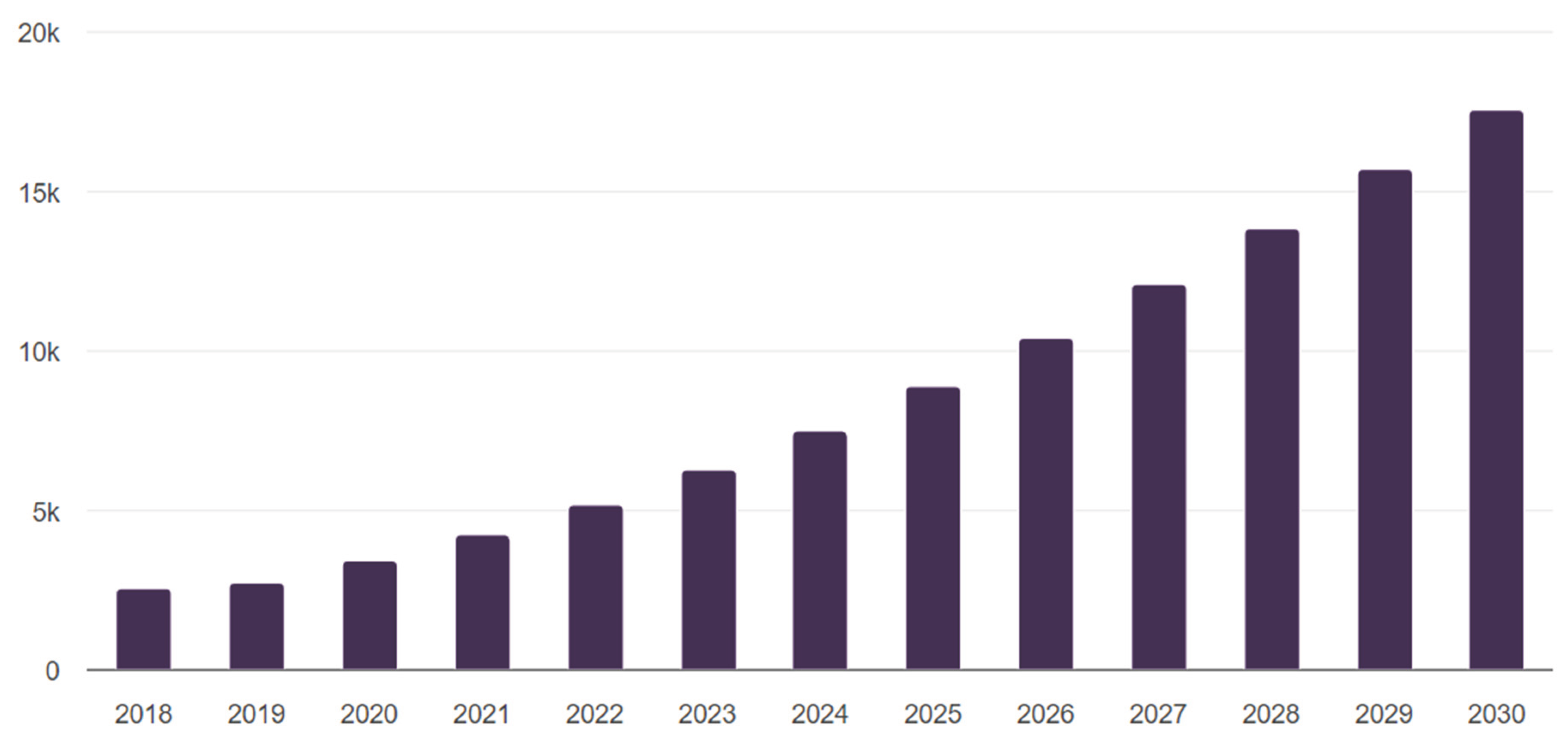
Lastly, considering the rising negative trends and the expanding influence of AI-based technologies, a significant increase in the digitization of mental health tools is expected in the coming years. Below is the data regarding the growing global market share of mental health technologies.
Figure 3.
Global Mental Health Apps Market Size and Outlook, 2018-2030 (US$M). (Source: Horizon Grand View Research).
Figure 3.
Global Mental Health Apps Market Size and Outlook, 2018-2030 (US$M). (Source: Horizon Grand View Research).
An AI-powered application designed to predict and intervene in mood swings, depression, and anxiety has significant potential for personal, clinical, and research use. This application could help predict and prevent severe outcomes such as deep depressive episodes and suicide attempts.
6. Limitations and Future Research
This paper has limitations in its research methods, specifically in conducting social and clinical experiments with a sufficient number of participants and datasets to train an ML model as a result. Such research requires funding, the collection of substantial data, teamwork, and the development of a software component. Therefore, this study relies primarily on theoretical analysis and the author's hypotheses.
7. Conclusion
The studies analyzed in this research emphasize the importance of integrating psychological sciences, art, and artificial intelligence (AI) for the treatment of mental patients with mood disorders, both for predictive purposes and interventions. The findings highlight the need to consider not only the technological aspects of the issue but also the psychological dimensions. In addition to the psychology of color and music, cultural factors must also be taken into account in this complex matter. A thoughtful combination of these elements has the potential to lead to balanced and effective innovations. The integrated components discussed in this research could contribute significantly to advancements in mental health technologies and help prevent complications associated with severe episodes of mental illnesses like major depression and bipolar disorder.
Funding
No funding received.
Conflicts of Interest
No competing interest.
References
- Lüscher, M. and Scott, I.A. (1969) The Lüscher Color Test. New York: Pocket Books.
- Lüscher, M. (1981) Personality Signs. New York: Warner Books.
- Schäfer T., Sedlmeier P., Städtler C. and Huron D. (2013) 'The psychological functions of music listening,' Frontiers in Psychology, 4. [CrossRef]
- Liljeström, S., Juslin, P.N. and Västfjäll, D. (2012) 'Experimental evidence of the roles of music choice, social context, and listener personality in emotional reactions to music,' Psychology of Music, 41(5), pp. 579–599. [CrossRef]
- Schäfer, T. and Sedlmeier, P. (2010) 'What makes us like music? Determinants of music preference.,' Psychology of Aesthetics Creativity and the Arts, 4(4), pp. 223–234. [CrossRef]
- Kendra Cherry, MSEd (2024) Music preferences and your personality, Verywell Mind. Available at: https://www.verywellmind.com/music-and-personality-2795424.
- The Truth About Lie Detectors (aka Polygraph Tests) (2004) American Psychological Association. Available at: https://www.apa.org/topics/cognitive-neuroscience/polygraph.
- Kozel, F.A., Padgett, T.M. and George, M.S. (2004) 'A replication study of the neural correlates of deception.,' Behavioral Neuroscience, 118(4), pp. 852–856. [CrossRef]
- Amen, D.G., MD (2009) The brain in love: 12 Lessons to Enhance Your Love Life. New York: Three Rivers Press.
- Klar, H. (1961) The Lüscher Colour Test – a highly reliable procedure in the psychodiagnostics of functional disorders. Medico (Boehringer Mannheim).
- The MathWorks (no date). What Is a Machine Learning Model? Available at: https://www.mathworks.com/discovery/machine-learning-models.html.
- Scikit-learn: machine learning in Python (no date). Available at: https://scikit-learn.org/stable/.
- Esposito, C.M., Mancini, M., Estradé, A., Rosfort, R., Fusar-Poli, P. and Stanghellini, G. (2024) 'How do depressed people feel perceived by others? A qualitative study from the patient’s perspective,' Journal of Affective Disorders Reports, 16, p. 100776. [CrossRef]
- Farreras, I. (2013). History of mental illness. Available at: https://www.researchgate.net/publication/270703724_History_of_mental_illness.
- Lowe, C. and Cohen, B.M. (2010) Living with someone who’s living with bipolar disorder: A Practical Guide for Family, Friends, and Coworkers. John Wiley & Sons.
- Ting-Toomey, S. and Dorjee, T. (2018) Communicating Across Cultures, second edition. Guilford Publications.
- Source code: https://github.com/Teresa-Konsta/emotions-music-nextjs.

Table 1.
Dataset suggestion for the ML model.
| Pulse difference range | Color | Corresponding music note | Estimated mood |
|---|---|---|---|
| 0 and 1 | grey | G, bass clef | indifference |
| 0-1 | black | D, bass clef | negation |
| 1-2 | blue | F, bass clef | calmness |
| 2-3 | brown | B, bass clef | physical sensations |
| 5-7 | green | G, treble clef | self-affirmation |
| 7-10 | yellow | F, treble clef | stimulation |
| 3-5 | violet | E, treble clef | oneness |
| else | orange | B, treble clef | vital force |
Disclaimer/Publisher’s Note: The statements, opinions and data contained in all publications are solely those of the individual author(s) and contributor(s) and not of MDPI and/or the editor(s). MDPI and/or the editor(s) disclaim responsibility for any injury to people or property resulting from any ideas, methods, instructions or products referred to in the content. |
© 2025 by the authors. Licensee MDPI, Basel, Switzerland. This article is an open access article distributed under the terms and conditions of the Creative Commons Attribution (CC BY) license (http://creativecommons.org/licenses/by/4.0/).
Copyright: This open access article is published under a Creative Commons CC BY 4.0 license, which permit the free download, distribution, and reuse, provided that the author and preprint are cited in any reuse.


