

Submitted:
03 November 2025
Posted:
04 November 2025
You are already at the latest version
Abstract
This study investigated the effects of agroforestry (AF) on the aroma quality of cocoa and the organoleptic quality of end-chocolates. 3-Days opening delay Forastero hybrid genotype cocoa from AF and full-sun (FS) as control plantations located at 5 cocoa-producing areas were fermented in wooden boxes for 6-days with stirrings at 2 and 4 days. Fermented cocoa was sun-dried up 7-8% moisture and processed into chocolate. Flavor profiles were analyzed using the SPME-GC-MS method while the organoleptic perception of chocolates by 12 professional judges according to 10 sensory descriptors. Finding revealed that esters concentration ranged from 9.41±0.61 to 19.35±1.28 µg.g-1, aldehydes from 11.56±0.7 to 25.33±1.5 µg.g-1, and ketones from 5.76±0.62 to 55.84±4,39 µg.g-1 were found in cocoa beans regardless of the cropping system. However, the concentrations of alcohols (10.30±0.91-21.62±1.9 and 11.21±1.04-46.25±2.14 µg.g-1), of acids (295.12±69.85-512.91±38 and 196.59±49.97-448.43±27.83 µg.g-1) and of pyrazines (8.01±1.12-38.00±8.3 and 2.99±1.46-53.22±6.39 µg.g-1) were quantified in FS and AF chocolate samples respectively. AF clearly influenced the flavor profiles of cocoa beans in the Adzopé, Guibéroua and Méagui areas without impacting those of derived chocolates. Furthermore, AF chocolate was not more tasty than FS chocolate samples. So, AF did not significantly influence the organoleptic perception of the end-chocolates regardless of the producing geographical origin due to the fermentation and roasting. AF can therefore be encouraged as a cropping system for cocoa cultivation to reduce deforestation and promote reforestation ensuring the sustainability of cocoa.
Keywords:
agroforestry
; cocoa beans
; chocolate
; flavor compounds
; Côte d’Ivoire
1. Introduction
Cocoa beans and chocolate are known as luxury foods that provide an astringent taste and typical aroma [1]. Cocoa, a perennial crop highly cultivated only in the equatorial regions, holds significant economic importance in several countries including Côte d'Ivoire and Ghana [2], accounting for 70% of the cocoa international supply [3] providing incomes for 2 millions farmers. Unfortunately, both countries are incriminated in deforestation while benefiting from cocoa production [4]. Cocoa bean is the main raw material for chocolate and other cocoa products [5]. Chocolate is one of the most consumed foods worldwide due to its unique flavor and sensory characteristics, resultiig comes from the unique and fascinating cocoa flavor [6,7]. The quality parameters of the finished chocolate are strongly influenced by cocoa farmers' farming practices at the start of the chocolate supply chain [8]. The chocolate's flavor depends on little controllable variables such as the genotype and the agroecological niche, and on the other side, on primary postharvest mainly fermentation and roasting [6]. Different studies and surveys show differences in the farming practices regarding growing between farmers within the same country [8]. However, several studies emphasize that the primary post-harvest processing of cocoa, such as cocoa pod opening delay, fermentation, and drying carried out mainly by farmers, must target the production of specialty cocoa and controlling the processing conditions by integrating the quality characteristics required by the chocolate market [6,9]. Furthermore, the chocolate's flavor depends on other various factors including genotype and age of cocoa tree, soil quality, microclimatic conditions, as well as through the industrial process of beans until obtaining chocolate where the roasting is emphasized ([10,11]. The cocoa postharvest processing is mediated by a dynamic of biochemical reactions under the actions of successive microorganisms including yeasts, lactic acid bacteria, and acetic acid bacteria spontaneously inoculating cocoa pulp, and producing ethanol and lactic and acetic acids ([6,12]. Endogenous enzymes catalyze the production of peptides and amino acids from seed storage proteins [13], and the inversion of sucrose and the subsequent formation of reducing sugars occur [14]. Resulted metabolites from enzymatic reactions of proteolysis and hydrolysis of the biochemical seed components are considered as flavor precursors [6,15]. Then, during roasting, these products interact through nonenzymatic browning Maillard reactions leading to the generating of molecules such as pyrazines, alcohols, ketones, aldehydes, esters that are in turn responsible for final sensory notes comprising the chocolate flavor, e.g. flowery, fruity, caramel, nutty, among others [9]. Thus, the aromatic quality of cocoa beans and the sensory perception of chocolate depend on the biochemical composition of fresh cocoa pulp ([16,17,18]. Cocoa is one of many drivers of deforestation, and assessments must consider competing sectors in a landscape [19]. Several inconveniences of deforestation including reduction of agrarian forest areas, impoverishment of soils, disappearance of biodiversity, and food insecurity for the populations are reported [20]. However, cocoa cultivation that maintains higher proportions of shade trees in a diverse structure (cocoa agroforestry) is progressively being considered as a sustainable land-use practice that meets ecological, biological, and economic objectives [21]. Since a long time, cocoa agroforests have also been regarded as environmentally preferable to other forms of agricultural activities in tropical forest regions [22,23]. By creating favorable microclimatic conditions, Agroforestry is viewed as a strategy to sustainably enhance agricultural production, which includes cocoa [24]. It was previously reported that the shade environment produced in agroforestry practices affects the morphology, anatomy, and chemical composition of intercropped forages and therefore may affect forage quality [25]. Our assumption is that the biochemical composition of both pulp and cocoa beans can be affected by the tree shade favored by agroforestry in cocoa cultivation. It is essential to evaluate the balance between the positive and negative effects of agroforestry on the flavor of cocoa and chocolate, particularly as climate change changes weather patterns. Although Côte d'Ivoire is the world leader producer of raw cocoa beans, up to now, no multiphasic study really has addressed the issue of cocoa bean flavor and chocolate organoleptic quality in relation to agroforestry as a relevant agricultural cropping system. Moreover, raw cocoa beans sourced from this country are not known for their fine aromatic quality. The present work investigated the highlighting the effects of agroforestry as a cocoa cropping system on both the aromatic quality of cocoa beans and the sensory perception of chocolate produced thereof. In response to this this goal, three major research questions were formulated:
i) What could be the effect of agroforestry as a cropping system on the flavor profile of cocoa beans?
ii) Does agroforestry impact the occurrence of desirable flavor compounds in chocolate?
iii) Is the chocolate made from agroforestry cocoa beans more delicious than the ones made from full-sun cocoa systems?
2. Materials and Méthods
2.1. Sites of Carrying Out of Research Works
The harvest of ripe cocoa pods and primary cocoa post-harvest processing (pod opening, fermentation, and sun-drying) was carried out in 5 main producing areas such as Agnibilekrou (East, geographic coordinates : 7° 7' 49.012" N 3° 12' 11.074" W), Adzopé (South East, geographic coordinates : 6° 6' 25.726" N 3° 51' 19.264" W); Divo (South center, geographic coordinates : 5° 49' 59.999" N 5° 22' 0.001" W), Guibéroua (West center, geographic coordinates : 6° 14' 9.805" N 6° 10' 16.536" W), Méagui (South west, geographic coordinates : 5° 24′ 00″ N 6° 34′ 00″ O) on both agroforestry and full-sun system (control) cocoas (Figure 1).
2.2. Materials
Fresh cocoa seeds originating from the mature and full ripe pods of the Ivorian hybrid cultivar, commonly known as "Mercedes" (Amelonado × West African Trinitario), harvested [27] in November 2023 and 2024 from both agroforestry and full sun systems peasant plantation were used in the present work.
3. Methods
3.1. Cocoa Beans Fermentation
The cocoa pods were stored for 3 days before manually opening with a wooden billet as a bludgeon according to the method of Guehi et al. [26]. The fresh cocoa beans were extracted manually without placenta and then sorted to discard the rotten beans. Cocoa beans fermentation process was carried out in wooden boxes in duplicate on the same time at all 5 fermentation sites for 5 days regardless of both cropping system and producing areas. The fermenting cocoa beans were turned simultaneously at 2 and 4 days in all fermentation locations [27] .
3.2. Cocoa Beans Sampling
Three samples of 1000 g of 5-Day-fermented cocoa beans were withdrawn from both batches at each fermentation location. All operating workers wore new sterile gloves for the removal of the fermenting cocoa beans from the heap as previously reported by Koné et al. [28]. To ensure moisture removal of 7-8%, every fermented cocoa bean sample was sun-dried on the rack before carrying out chemical analyses [28]
3.3. Cocoa Volatile Compounds Analysis
Fifty grams of dry fermented cocoa beans were manually deshelled and ground into fine powder (0.5 µm) using a Moulinex grinder (John Gordon®, London, United Kingdom) and then stored at -20 °C in a glass vial hermetically closed [27]. The volatile compounds were extracted from 2.5 g of the cocoa powder from each cocoa bean sample using the headspace solid-phase microextraction technique (HS-SPME) and fibers of 50/30 µm divinylbenzene/carboxene/polydimethylsiloxane (DVB/CAR/PDMS, Supelco, Sigma-Aldrich N.V., Bornem, Bel gium) according to the previously described method by Nascimento et al. [29] but using n-butanol as internal standard. Each volatile compound was identified using three criteria: (i) by comparison of the retention index with the CIRAD aromatic database [30], (ii) by matching their mass spectra with those obtained from a commer cial database (Wiley275.L, HP product no. G1035 A) and (iii) whenever possible, the identification was confirmed using pure standards of the components [31]. The formula used to calculate the concentration of each volatile compound was as follows. :
where qi is the relative concentration of volatile compound; Ai is the area of aroma compound I; Abut is the area of 1-butanol (internal standard); 60 is the concentration of 1-butanol in 100µL of a test sample expressed in µg.L−1; me is the mass of the cocoa powder or the chocolate sample introduced into the vial in g.
3.4. Sensory Analysis of Chocolate
Two samples of 2×500g of dry 5-day fermented cocoa beans were taken from each cocoa bean batch treated at five fermentation locations [27]. Whole cocoa beans were roasted at 125°C for a duration of 25 minutes [30]. For the chocolate sensory perception, twelve professional judges, including six women and six men frequently trained, were asked to smell and taste each agroforestry chocolate sample against the full sun chocolate of each cocoa-producing area. They found significant differences in organoleptic attributes of chocolate produced from fermented cocoa bean processed at each tested location of fermentation in comparison to the control. Sixteen sensory descriptors were evaluated simultaneously using a scale ranged from 0 to 10, and a total score for each chocolate sample global quality was assigned.
3.5. Statistical Analysis
The area of the chromatographic peak of each flavor compound precursor was calculated using the software (Instrument Data Analysis) and then exported to Excel. The statistical analyses were carried out with the XLSTAT PLS2 (Addinsoft, New York, USA). Microsoft Excel Program 2013 (Microsoft Corporation, Redmond, Washington, USA) was used to analyze the sensory perception data. Principal Component Analysis (PCA) was used as an unsupervised method to reveal clustering within targeted favor profiles, while Partial Least Squares Discriminant Analysis (PLS-DA) was employed as a supervised method to identify discriminating aroma compounds across cropping systems and geographical origins of cocoa production [31]. The testing of the equality of variances was performed with the Fischer test with a single factor (p < 0.05) in order to indicate the significant differences between volatile compound content of cocoa beans and chocolate samples, the sensory perception of chocolate produced from tested cocoa as affected by the cropping system or the producing geographical origin [27].
3. Results
3.1. Effect of Agroforestry on Native Flavor Compound Contents of Crude Cocoa Beans
Table 1 indicates that five (5) main chemical families of flavor compounds including aldehydes, esters, alcohols, ketones, and terpenes were naturally found in crude cocoa beans regardless of both the cropping system and producing geographical origins in Côte d'Ivoire. The same classes of volatile compounds were found in unfermented cocoa beans by other experiments [32]. The presence of various endogenous volatile compound classes in crude cocoa beans could be due to the biological activity of plants that produce a wide spectrum of flavor compounds including aldehydes, alcohols, carboxylic acids, isoprene, and monoterpenes [33]. Among the oxygenated hydrocarbons which are produced by trees, C-1 and C-2 aldehydes, alcohols and carboxylic acids are of great importance. Cocoa beans from both Adzopé and Agnibilékrou's areas recorded higher concentrations of aldehydes from 102.4±12 to 138.6±7.6 µg.g−1 regardless of cropping system. Agrofrestry cocoa recorded higher aldehydes concentration than full sun cocoa in all producing geographical origins except Divo and Guiberoua's areas. The total concentration of ester family varied from 56±3.5 to 159.8±4.2 µg.g−1. Crude cocoa beans samples originated from Adzopé, Guibéroua and Méagui’s areas printed higher concentration in esters than those from Agniblékrou and Divo’s areas. Among the oxygenated hydrocarbons which are produced by trees, C-1 and C-2 aldehydes, alcohols, and carboxylic acids are of great importance [34]. C-1 compounds are synthesized during many growth and developmental processes such as seed maturation and senescence of plant tissues. The production of C-2 compounds, however, seems mainly to be associated with changing environmental conditions, particularly during stress [33]). According to Kreuzwieser et al. [33], acetaldehyde is produced in the leaves of trees if the roots are exposed to anaerobic conditions and produces ethanol through alcoholic fermentation. The production of fermentation metabolites such as acetaldehyde and ethanol was not due to phylloplane microbial activity. These results could be ascribed to the paradox showing the plant organ leads likely to be exposed to anoxia or hypoxia is rich in the enzymes necessary for fermentation [34]. In addition, aldehyde dehydrogenase enzymes (ALDHs) catalyse the oxidation of a broad range of aliphatic and aromatic aldehydes to their corresponding carboxylic acids using NAD+ or NADP+ as cofactors [35]. The alcohols class concentration was the highest ranged from 173.9±12 to 1134.4±34 µg.g−1while the concentration of terpens class was the least comprised between 1.7±0.4 and 12.7±7.2 µg.g−1as previously reported by Yang et al. [32]. Agroforestry cocoa beans from the regions of Adzopé, Guibéroua and Méagui recorded a higher concentration in the alcohol family than full sun cocoa beans, inversely to cocoa from the regions of Agniblekrou and Divo. Moreover, agroforestry cocoa beans from Méagui's area showed the highest concentration of alcohols with 1134.4±34 µg.g−1. Alcohol class concentration varied from 58.6±7 to 504.6±2.7 µg.g−1regardless of the cropiping system and producing regions. Agroforestry cocoa beans from Agniblékrou, Guiberoua and Méagui's area recorded more ketons than full sun cocoa. Cocoa beans from the Divo's area exhibited the similar concentrations in ketone around 191-195 µg.g−1.
Figure 2 presents the PCA biplot, which reveals different groups of unfermented cocoa beans with specific flavor compound profiles produced from the cocoa cultivation system. A total of 34 aroma compounds were found in all cocoa bean samples tested. Agroforestry has always shown significant influence on its flavor profiles. The aroma profiles of cocoa beans from the agroforestry system were differentiated from those of full sun cocoa beans not only but also among them in all the analyzed production regions except the Agnibilekrou area.
Group 1 consisted of agroforestry cocoa bean samples from Méagui's region. Their aroma profiles contained primarily alcohols such as isoamyl alcohol, isobutanol, pentanol and hexanol. Group 2 included agroforestry cocoa bean samples produced in Adzopé's area. These cocoa bean samples exhibited aroma profiles consisting of various classes such as benzaldehyde, 2-phenylacetaldehyde, isoamyl acetate, linalool, and β-myceren. Group 3 consisted of agroforestry cocoa beans from Guiberoua's area whose flavor profiles recorded 2-heptanol, 2-hexanol, hexagonal. The flavour profiles of 2-methyl butanol were present in the agroforestry of cocoa beans from both Divo and Agnibilekrou areas in Goup 4.
The total number of flavor compounds found in our unfermented cocoa beans sample is less abundant than those found in cocoa beans from China, which are 2.5 times higher [36]. Genotype, climatic pedological factors, soil quality [10], and cropping system may be responsible for these differences. The significant variations observed between the concentrations of some groups of volatile compounds of agroforestry cocoa bean samples from some geographic origins could be due to the variation of agroforestry system types of cocoa cultivation in Côte d'Ivoire. The density of associated trees to the agroforestry system consisted of 48.16 individuals/ha in West, of 22.79 individuals/ha in Central West, and of 25.39 individuals/ha in South West reported by Konan et al. [37]. So, we thought that the shade created by each type of agroforestry system also varied and differentially impacted the soil fertility from cocoa farms to cocoa farms and from producing area to producing area. Indeed, Sauvadet et al. [38] reported that the effects of shade type management are more pronounced on the soil nutrient availability through changes in the soil food web structure than on the direct organic chemical composition of crops, highlighting the importance of choosing shade tree species in an agroforestry system. Moreover, the agroforestry system in the Centre-West and South-West is dominated by trees taller than 8 meters with a high density of associated perennial crops in the Centre-West, while agroforestry systems in the south-west are characterized by plots averaging 30 years in age [37]. To conclude, agroforestry in cocoa cultivation influenced the native aroma compounds of Ivorian cocoa beans. But the significant variation observed in the quality of flavor compound profiles depends on the producing geographical origins due to the type of agroforestry and probably climatic factors. Our study is relevant and could be continued by implementing the same agroforestry system regarding the density and height of trees, the soil quality, the local climatic factors of each area, and the age of the studied cocoa trees, which seems to impact the aromatic quality of the crude cocoa beans [10].
3.2. Effect of Agroforestry on Flavor Compound Contents of Dry Fermented Cocoa Beans
Seven (7) main classes of flavor compounds including aldehydes, esters, alcohols, ketone, acids, pyrazines and terpenes detected in dry fermented cocoa beans samples regardless of both the cropping system and producing regions in Côte d'Ivoire (Table 2). After the fermentation process, the concentrations of each flavor compound class were significantly increased and two new classes such as acids and pyrazines occurred in comparison to raw cocoa beans regardless both of the cropping system and the producing geographical area. Fermentation processes lead to the development of specific cocoa aroma via the degradation of proteins and formation of volatile compounds, such as pyrazines, which were described as one of the few classes of compounds with desirable flavor properties. Agroforestry dry fermented cocoa beans recorder higher concentrations of aldehydes than full sun cocoa beans in Guibéroua and Méagui's areas while lower concentrations were recorded in cocoa beans sourced from Agnibilékrou and Divo's areas. Alcohol concentrations of dry fermented cocoa beans varied from 83.31±1.2 to 385.67±259.1 µg.g−1. Agroforestry dry fermented cocoa beans sourced in Adzopé and Guiberoua's areas recorded higher concentrations than full sun cocoa, while inversely in Agnibilekrou and Méagui's areas. The same concentrations of alcohols were found in both agroforestry and full sun dry fermented cocoa beans in the Dive's area. However, the concentration of ketones is relatively constant at an approximate value between 40.55±12.76 and 154.46±4.9 µg.g−1 regardless both of the cropping system and the production area. All tested dry fermented cocoa beans samples contained pyrazines regardless of the cropping system and the producing area, but the highest concentration of pyrazines was recorded in cocoa beans sourced from Divo's area.
Figure 3 presents the PCA biplot, which reveals different groups of dry fermented cocoa beans regarding their flavor compound profiles according to the cocoa cultivation system between all production areas tested. A total of 49 lavorf compounds were found in all dry fermented cocoa beans samples tested. Agroforestry has shown no effect on its flavor profiles. The aroma profiles of cocoa beans from the agroforestry system were not differentiated from those of full sun cocoa beans, corresponding while procuring geographical origins have shown a significant influence.
Group 1 consisted of both agroforestry and full sun cocoa beans samples from Méagui's region. Their aroma profiles contained primarily isoamyl alcohol, phenylethyl acetate, ethyl acetate, ethyl hexanoate, linalool, hexyl acetate, methylethyl acetate, methyl butanol, butyl acetate, 2 acetate, 2-methylpropanal, ethyl octanoate. Group 2 consisted of both agroforestry and full sun from Agnibilekrou region, which is characterized by no specific aroma compound. Group 3 included both agroforestry and full sun cocoa beans from Adopt'area. Their flavor profile has shown more flavor compounds than other cocoas including isoamyl alcohol, phenylethyl acetate, ethyl hexanoate, linalool, methylethyl acetate, methyl butanol, butyl acetate, 2(pentyl acetate, 2-methyl propane. Group 4 included both agroforestry and full sun cocoa beans samples from the Guibéroua region. These cocoa beans samples exhibited aroma profiles consisting of various classes such as benzylacetate, sec amyl acetate, 2 heptanol, 2-methyl butanol, 2,3-butanol acetate, 2,3 butanediol, ethylacetate, 2,2-butanediol acetate, acetic acid, isobutyl acetate, 2-nonanol, 2-hepranone. Group 5 consisted of both agroforestry and full sun cocoa beans from Divo's area whose flavor profiles recorded acetoin, 2-acetoxy-3-butanone, 2,3,5-trimethyl pyrazine, ethanol.
Figure 4 presents the PCA biplot, which reveals different groups of dry fermented cocoa beans regarding their flavor compound profiles according to the cocoa cultivation system within each production area tested. Agroforestry has shown significant effect on the flavor profiles of dry fermented cocoa beans from only two cocoa-producing areas, including Guibero and Méagui. The aroma profiles of cocoa beans from agroforestry and those of full sun system were not differentiated for others procuring geographical origins such as Adzopé, Agnibilékrou, and Divo.
Our results related to the presence of 7 classes of flavor compounds in dry fermented cocoa beans samples are in agreement with those of several previous works [7,27,30,36,39,40,41,42]. The appearance of new classes including acids and pyrazines in beans could be due to the microbial activity comprising yeast and acetic acid bacteria during cocoa fermentation as previously reported by Fang et al. [35]. Indeed, several volatile compounds not found in fresh beans gradually produced after fermentation and appeared in dry fermented cocoa beans. Our results about the detection of pyrazines class in all our tested dry fermented cocoa beans samples regardless of both cropping system and production area are in agreement with those reported by several works [39,43,44]. However, several other researchers reported that pyrazines are formed in cocoa beans only during roasting [45,46]. And yet, recent work has highlighted that pyrazines are formed in food via both thermal treatment and fermentation [47]. Furthermore, for a long time, it was reported that pyrazines are formed in cocoa beans during fermentation due to enzymatic activities produced by Bacillus sp. [43,48] but their concentration was incresaed by termal treatment notably during the roasting [49]. The acidification of cocoa beans could be ascribed to the production of a high amount of acetic acid by acetic acid bacteria during fermentation. That induces various biochemical reactions and pathways leading to the other various cocoa flavor compounds' development [36]. The acidification process of cocoa beans is largely influenced by the acetic acid content, which closely correlates with the pH level of the beans. [50]. Besides, aldehydes, esters, and acids classes recorded higher concentrations while pyrazines and terpens families presented less as previously reported [36,39]. It is possible that the increased acid content is responsible for the creation of esters and higher alcohols [51]. High concentration of aldehydes in some both agroforestry and full sun dry fermented cocoa beans from Guiberoua and Méagui regions could lead to Galactomyces geotrichum, a aest species currently in cocoa fermentation carrying out in Côte d'Ivoire and producing aldehydes [28]. High concentrations of alcohols in agroforestry dry fermented cocoa beans could be due to the wide amounts of fermentable sugars of cocoa pulp [52] and the involvement of high alcohols producing yeast species including Candida tropicalis, Wikehamoyces anomalus, Pichia kudriazevii, Saccharomyces cerevisae, Pichia galieformis [28]. Ethanol and acetic acid are the primary molecules generated when cocoa pulp substrates, such as sugars, citric acid, and polyphenols, are metabolized. [53]. Indeed, the agroforestry system favors a higher amount of substrates in agroforestry cocoa pulp than that of full sun cocoa via the soil fertilization as previously reported [38]. To conclude, although agroforestry influences the native flavor compounds of cocoa beans, it does not influence the flavor profiles of dry fermented beans, probably due to the activity of the yeast involved in cocoa fermentation. However, regarding each cocoa producing area, we observed that agroforestry influenced the flavor profiles of dry fermented cocoa beans from Guiberoua and Méagui's area in the Centre-West of Côte d'Ivoire. These results could be ascribed to the type of agroforestry system in this region which is dominated by trees taller than 8 meters with a high density of associated perennial crops [37], the climatic factors, the soil quality [10], and probably the community of yeast species involved in the fermentation process [27].

Table 2.
Changes in total concentration of each class of flavor compounds of dry fermented cocoa beans in function of cropping system in different goegraphical origins of Côte d’’Ivoire.
Table 2.
Changes in total concentration of each class of flavor compounds of dry fermented cocoa beans in function of cropping system in different goegraphical origins of Côte d’’Ivoire.
| Chemical families | Flavor compounds class contents (µg.g−1) of dry fermented cocoa beans from Ivorian cocoa producing areas | |||||||||
| Adzopé | Agnibilékrou | Divo | Guibéroua | Méagui | ||||||
| Cropping systems | ||||||||||
| AF | FS | AF | FS | AF | FS | AF | FS | AF | FS | |
| Aldehydes | 456.08±77.6a | 428.83±59.8a | 147.14±51b | 243.18±77.3b | 159.53±5.90.b | 251.36±46.7b | 456.77±2a | 461.03±21a | 182.59±17.7b | 213.64±54.2b |
| Esters | 75.04±20.3b | 68.46±2.3b | 70.06±7.72b | 132.47±44.9a | 35.97±14.06.71c | 34.02±3.4b | 117.68±9.7a | 57.03±16.1b | 44.6±1.3bc | 52.48±7.4b |
| Alcohols | 385.67±259.1a | 169.43±8.32a | 158.73±50.17a | 190.88±10.22a | 269.45±111a | 220.05±207.6a | 273.2±10.6a | 155.31±3.6a | 83.31±1.2a | 165.66±95.3a |
| Ketons | 44.84±12.2b | 72.69±32.2c | 51.97±14.19b | 40.55±12.76c | 125.18±49.13a | 131.68±1.6ab | 86.36±9ab | 154.46±4.9a | 42.17±20.2b | 85.76±27.9bc |
| Acids | 630.34±149.2ab | 755.03±185.7ab | 476.18±19.82ab | 485.29±167.23b | 588.29±120.52ab | 912.74±149a | 742.04±11a | 821.41±51.4ab | 401.23±117.2b | 529.77±149.8ab |
| Pyrazines | 16.23±6.61bc | 16.94±8.8bc | 9.53±7.24c | 4.6±2.92c | 70.61±28.51a | 68.78±15.71ab | 56.92±20.51ab | 81.15±27.9a | 20.57±12.6bc | 64.25±17.8ab |
| Terpenes | 10.79±2.20a | 11.39±1.80a | 8.48±3.32a | 12.3±14a | 4.28±3.34ab | 2.27±0.51c | 7.59±2.4ab | 6.21±1.2b | 1.73±0.9b | 3.72±0.9bc |
| Others | 13.14±6.63b | 12.21±5.61b | 4.83±2.79b | 7.8±4.72b | 5.02±0.42b | 54.18±0.34a | 46.08±9.1a | 53.93±6.8a | 2.13±0.1b | 8.77±6.5b |
3.6. Effects of Agroforestry on the Desirable Flavor Compounds of Dry Fermented Cocoa Beans Different Producing Geopgraphical Origins
Table 3 shows the concentration of several positive flavor compounds of dry fermented cocoa beans regarding both the agroforestry system and the cocoa-producing regions. A total of 15 useful flavor compounds were found in all dry fermented cocoa beans analyzed regardless of the corpping system. The detected desirable flavors belong to various classes such as esters (3-methylbutyl acetate, 2-methylbutyl acetate, Benzyl acetate), aldehydes (2-methylpropanal, 2-methylbutanal, 3-methylbutanal), alcohols (Benzyl alcohol, 2-phenylethanol, linalool), ketones (acetoin, 2-acetoxybutan-3-one, acetophenone), and pyrazines (2,3,5-trimethylpyrazine, tetramethylpyrazine). The fermentation process significantly influences cocoa's flavor and aroma [54]. Several desirable aroma compounds recorded highest concentrations in agroforestry dry fermented cocoa beans from the Guiberoua region. Thus, 2 -methylbutyl acetate, 3-methyl butyl acetate and benzyl acetate were found at higher concentrations of 84.2±3.7, 76.3±11.8 and 3.4±2.3 µg.g−1 respectively than in full sun cocoa beans. Regarding aldehydes, agroforestry dry fermented cocoa beans recorded 65.32±3.32 µg.g-1 of methyl butanol while full sun cocoa beans recorded 26.3±9.7 µg.g−1. 2-Phenylethanol was found at the concentrations of 75.4±54.3 and 22.7±8.2 µg.g−1. 2-Phenylethanol was found at the concentrations of 75.4±54.3 and 22.7±8.2 µg.g−1 in agroforestry and full sun cocoa beans samples, respectively. 2-Phenylethanol was found at the concentrations of 75.4±54.3 and 22.7±8.2 kg.g-1 µg.g-1 in agroforestry and full sun cocoa beans samples, respectively. 2-Phenylethanol was found at the concentrations of 75.4±54.3 and 22.7±8.2 kg.g-1 µg.g-1 in agroforestry and full sun cocoa beans samples, respectively.µg.g-1 in agroforestry and full sun cocoa beans samples, respectively. Among pyrazines, tetramethyl pyrazine was found at highest concentration in dry fermentation produced in Guiberoua’s area. The concentration of specific acetate esters including ethyl acetate and phenylethyl acetate can be favoured by fermentation techniques like turning the beans [55]. The richness of Gubéroua cocoa in various relevant aroma compounds may be due to the flavors produced by yeast species such as Saccharomyces cerevisiae, Pichia kudriavzevii and Hanseniaspora opuntia in the fermentation of cocoa carried out in this region [28,56]. Furthermore, Crafack et al. [54] have previously demonstrated that several flavor compounds are produced primarily by yeast and bacteria during the fermentation process, which converts amino acids and higher alcohols into various aroma precursors. According to Ho et al. [46] and Ziegleder [57], the aroma profile of chocolate is enhanced by significant increases in esters concentration during spontaneous fermentation. The distinct floral and fruity notes that distinguish premium chocolate from bulk varieties are due to other key compounds like linalool (found in fine cocoa varieties) and phenylethyl acetate [12]. Linalool is the essential aroma compound that forms during cocoa fermentation, as Ziegleder [58] has reported for a considerable amount of time. Our findings that tetramethyl pyrazine is the principal compound of the pralines class were in accordance with those previously obtained [59]. Although several works reported that pyrazine group is more common in well-fermented roasted beans, these metabolic products of Bacillus species (B. subtilis or B. megaterium) are formed at the end of cocoa fermentation [40,41,60,61]. Each flavor compound could contribute to the final aromatic quality of dry fermented cocoa beans. For example, pyrazine compounds have cocoa, chocolate, walnut, popcorn, coconut, candies, fruity notes [42]. However, certain aroma compounds were more concentrated in agroforestry cocoa beans than those of full sun from the Guiberoua region. The agroforestry system has yet to be shown to have an impact on the formation of crucial aroma compounds in dry-fermented cocoa beans.
3.7. Effects of Agroforestry on the Flavor Compound Profiles of Chocolates Produced from Dry Fermented Cocoa Within Each Producing Geographical Origin.
Figure 5 and Figure 6 indicate the PCA biplots, which reveal the effects of agroforestry on the flavor profiles of chocolate between and within production areas tested, respectively. The primary results about between cocoa producing areas revealed that only the flavor profile of chocolate produced from agroforestry cocoa beans was discriminated from those of chocolate derived from full sun cocoa beans in only the Méagui region. However, our findings about each cocoa producing area showed that the flavor compound profile of chocolate derived from agroforestry cocoa beans sourced from the areas of Agnibilékrou (Figure 6-B) and Méagui (Figure 6-E) was discriminated from those of chocolate samples derived from full sun cocoas corresponding. The agroforestry system has shown no significant effect on the flavor profiles of the chocolates issued from other cocoa-producing areas consisting of Adzopé (Figure 6-A), Divo (Figure 6-C) and Guiberoua (Figure 6-D) regions. The flavor profiles of agroforestry chocolate from Agnibilékrou region recorded hexanal, ethyl acetate, ethanol, sec butyl acetate, acetoin and butane-2,3-dione while those made from full sun dry fermented cocoa beans showed 2,3-butanediol, butyl acetate, 3 methyl butanol, Pentan-2-ol, benzyl acetate, ethyl octonate, ethyl phenyl acetate, 3,5 dimethyl-2-ethyl pyrazine, acetophenone, 2-phenyl acetate, 2,3,5-trimethyl-6-ethyl pyrazine. The chocolate made from agroforestry cocoa beans produced from Méagui contained more aroma compounds (23) than those derived from full sun cocoa. The flavor profile of this agroforestry chocolate included several key aroma compounds consisting of benzyl alcohol, isobutanol, benzylacetate, ethylphenylacetate, 2-phenyl butanol, benzaldehyde, 2-phenyl ethanol, isobutyl acetate, 3-methyl butanoic acid. We may remind that the flavor profiles of agroforestry dry fermented cocoa beans from Méagui and Agnibilekrou consist of isobutyric and isomeric acids. Isobutyric acid is present in cocoa beans, where it is formed during the fermentation and drying processes from the decomposition of sugars and other compounds [62]. Although it contributes to the overall flavor profile of the beans, its concentration may vary based on factors such as fermentation time, bean variety, and subsequent processing like roasting [63]. However, isovaleric acid is present in cocoa beans, where it is a volatile organic acid that develops during fermentation. It is produced by microorganisms and contributes to the acidification of the beans, though it is considered an undesirable compound when present in high concentrations, as it can produce a "rancid" smell. Although the sensory quality of chocolate broadly depends on the volatile compound profile resulting from microbial metabolism during cocoa beans fermentation [64], the discrimination of the flavor profiles of chocolates derived from agroforestry cocoa beans produced in the Agnibilékrou and Méagui regions could be due to the presence of either one, the other, or even both acids (isovaleric and isobutyric acids).
3.9. Effects of Agroforestry on the Sensory Perception of Chocolate Samples
Sixteen descriptive attributes, namely intensity of odor, acid, bitter, sweet, astringent, cocoa aroma, fresh fruit, dried fruit, floral, spicy, toasted, woody, plant, alcoholic aroma, animal, and global quality, were evaluated. Average of the score attributed for each sensory property to the finished chocolates from each fermented cocoa sample was then calculated. Figure 7 and Figure 8A-B show that all end-chocolate samples present the same score for almost all descriptive attributes regardless both of cropping system and producing geographical origin. Neither agroforestry nor the cocoa production area has influenced the sensory perception of manufactured chocolates.
4. Conclusions
This study investigated the effect of agroforestry on the flavor profiles both of cocoa beans and of the chocolate’s sensory perception. Agroforestry significantly influenced the native flavor profiles of raw cocoa beans regardless of the producing geographical origin. After transformation (fermentation and roasting), the difference in flavor compound profiles is not as significant as it was in fresh cocoa beans, because of yeasts and thermal treatments. Furthermore, agroforestry influenced the flavor profile of dry fermented cocoa beans and end-chocolate in function of the producing area. Agroforestry has shown no effect on the sensory perception of chocolate. Agroforestry can therefore be promoted in cocoa cultivation around the planet in order to reduce the impact of deforestation and ensure the sustainability of cocoa. The outcome of this study will be to evaluate the effect of agroforestry with the same density of trees of even height on the organic qualities of chocolate by integrating soil quality.
Funding
This study was conducted as part of the Cocoa4Future (C4F) project funded by the European DeSIRA Initiative under grant agreement No. FOOD/2019/412-132 and the French Development Agency. The C4F project brings together a wide range of expertise to address the development challenges facing West African cocoa farming. It unites numerous partners with a shared ambition to place People and the Environment at the heart of the cocoa farming of tomorrow.
Authors contribution
Guy Florent Kouamé AMIEN : Metthology, Investigation, Data curation, Writing – original draft. Mai Koumba KONE : Metthology, Investigation, Formal analysis, Data curation, Writing – original draft. Christian Adobi KADJO : Formal analysis, Investgation, Metthology, Writing – original draft. Koffi Alfred YAO : Formal analysis, Investgation, Metthology. Isabelle MARAVAL : Conceptualization, Validation, Supervision, Writing – reviewing & editing. Renaud BOULANGER : Conceptualization, Validation, Ressources, Writing – reviewing & editing, Supervision, Project administration, Funding acquisition. Simplice Tagro GUEHI : Conceptualization, Validation, Ressources, Writing – reviewing & editing, Supervision, Project administration, Funding acquisition.
Data Availability Statement
All data are contained within the article.
Aknowledgements
We are very grateful to YAPI Abe Ephrem, KOUAKOU Kouakou, KONE Clanon, ZONGO Bassiri, ALOU Daniel as Ivorians cocoa farmers for all their enthusiastic work and their coopéeration from the beginning of this researh. We also thank anyone who has contributed directly or indirectly to the realization of this work.
Conflicts of interest
The authors declare no conflict of interest.
References
- Pedan, V.; Fischer, N.; Bernath, K.; Hühn, T. , Rohn, S. Determination of oligomeric proanthocyanidins and their antioxidant capacity from different chocolate manufacturing stages using the NP HPLC-online-DPPH methodology. Food Chem, 10.1016/j.foodc hem.2016.07.094.
- Jahurul, M.H.A.; Zaidul, I.S.M.; Norulaini, N.A.N.; Sahena, F.; Jinap, S.; Azmir, J.; Sharif, K. M.; Omar, A.K.M. Cocoa butter fats and possibilities of substitution in food products concerning cocoa varieties, alternative sources, extraction methods, composition, and characteristics. Journal of Food Engineering, 2013, 117, 467–476. [Google Scholar] [CrossRef]
- ICCO (2024). Quarterly Bulletin of Cocoa Statistics, Vol. L, No. 2, Cocoa year 2023/24. International Cocoa Organization, Abidjan, Côte d’Ivoire.
- Kalischek, N.; Lang, N.; Renier, C.; Daudt, R.C.; Addoah, T.; Thompson, W.; Blaser-Hart, W.J.; Garrett, R.; Schindler, K. Wegner, J. D. Cocoa plantations are associated with deforestation in Côte d’Ivoire and Ghana. Nature Food, 2023, 4, 384–393. [Google Scholar] [CrossRef] [PubMed]
- Achaw, O.W.; Danso-Boateng, E. (2021). Cocoa Processing and Chocolate Manufacture. In: Chemical and Process Industries. Springer, Cham. [CrossRef]
- Santander Muñoz, M.; Rodríguez Cortina, J.; Vaillant, F.E.; Escobar Parra, S. An overview of the physical and biochemical transformation of cocoa seeds to beans and to chocolate: Flavor formation. Critical Reviews in Food Science and Nutrition. [CrossRef]
- Aprotosoaie, A.C.; Luca, S.V.; Miron, A. Flavor chemistry of cocoa and cocoa products—an overview. Comprehensive Reviews in Food Science and Food Safety, 2016, 15, 73–91. [Google Scholar] [CrossRef]
- Saltini, R.; Akkerman, R.; Frosch, S. Optimizing chocolate production through traceability: A review of the influence of farming practices on cocoa bean quality. Food control, 2013, 29, 167–187. [Google Scholar] [CrossRef]
- Owusu, M.; Petersen, M.A.; Heimdal, H. Effect of fermentation method, roasting and conching conditions on the aroma volatiles of dark chocolate. Journal of Food Processing and Preservation, 4: 36 (5). [CrossRef]
- Kongor, J.E. ; M. Hinneh, M. ; de Walle, D.V. ; Afoakwa, E.O. ; Boeckx, P.; Dewettinck, K. Factors influencing quality variation in cocoa (Theobroma cacao) bean flavor profile – A review. Food Research International,. [CrossRef]
- Lima, L.; J. , Almeida, M.H.; Nout, M.R.; Zwietering, M.H. Theobroma cacao L.,“The food of the Gods”: quality determinants of commercial cocoa beans, with particular reference to the impact of fermentation. Critical reviews in food science and nutrition, 2011, 51, 731–761. [Google Scholar] [CrossRef] [PubMed]
- Kadow, D.; Niemenak, N.; Rohn, S.; Lieberei, R. Fermentation-like Incubation of Cocoa Seeds (Theobroma cacao L.)—Reconstruction and Guidance of the Fermentation Process. LWT-Food Sci. Technol. 2015, 62, 357–361. [Google Scholar] [CrossRef]
- Hue, C.; Gunata, Z.; Breysse, A.; Davrieux, F.; Boulanger, R.; Sauvage, F.X. Impact of fermentation on nitrogenous compounds of cocoa beans (Theobroma cacao L.) from various origins. Food Chemistry, 9: 192. [CrossRef]
- De Vuyst, L.; Weckx, S. The cocoa bean fermentation process: from ecosystem analysis to starter culture development. Journal of applied microbiology. [CrossRef]
- Crafack, M.; Mikkelsen, M.B.; Saerens, S.; Knudsen, M.; Blennow, A.; Lowor, S.; Takrama, J.; Swiegers, J.H.; Petersen, G.B.; Heimdal, H.; Nielsen, D.S. Influencing cocoa flavor using Pichia kluyveri and Kluyveromyces marxianus in a defined mixed starter culture for cocoa fermentation. International Journal of Food Microbiology, 1: 167. [CrossRef]
- Voigt, J.; Lieberei, R. Biochemistryof cocoa fermentation. Cocoa and coffee fermentations.
- Afoakwa, E.O.; Quao, J.; Takrama, J.; Budu, A.S.; Saalia, F.K. Chemical composition and physical quality characteristics of Ghanaian cocoa beans as affected by pulp pre-conditioning and fermentation. Journal of food science and technology, 2013, 50, 1097–1105. [Google Scholar] [CrossRef]
- Amanquah, D.T. 2013.
- Parra-Paitan, C.; Meyfroidt, P.; Verburg, P.H.; zu Ermgassen, E.K. Deforestation and climate risk hotspots in the global cocoa value chain. Environmental Science & Policy, 2024, 158, 103796. [Google Scholar] [CrossRef]
- Zeraatpisheh, M.; Bakhshandeh, E.; Hosseini, M.; Alavi, S.M. Assessing the effects of deforestation and intensive agriculture on the soil quality through digital soil mapping. Geoderma, 2020, 363, 114139. [Google Scholar] [CrossRef]
- Schroth, G.; da Fonseca, G.A.; Harvey, C.A.; Gascon, C.; Vasconcelos, H.L.; Izac, A.M.N. (Eds.) . Agroforestry and Biodiversity Conservation in Tropical Landscapes. 2004. Island Press, Washington DC.
- Greenberg, R. Biodiversité dans l'agroécosystème cacaoyer : gestion de l'ombre et considérations paysagères. 2014. https://repositorio.catie.ac. 1155. [Google Scholar]
- Middendorp, R.S.; Vanacker, V.; Lambin, E.F. Impacts of shaded agroforestry management on carbon sequestration, biodiversity and farmers income in cocoa production landscapes. Landscape Ecology, 2018, 33, 1953–1974. [Google Scholar] [CrossRef]
- Chavan, S.B.; Rawale, G.B.; Pradhan, A.; Uthappa, A.R.; Kakade, V.D.; Morade, A.S.; Paul, N.; Das, B.; Chichaghare, A.R.; Changan, S.; Khapte, P.S.; Basavaraj, P.S.; Babar, R.; Salunkhe, C.; Jinger, D.; Nangare, D.D.; Reddy, KS. Optimizing tree shade gradients in Emblica officinalis-based agroforestry systems: impacts on soybean physio-biochemical traits and yield under degraded soils. Agrofrestry Systemes, 2025, 99, 21. [Google Scholar] [CrossRef]
- Lin, C.H.; McGraw, M.L.; George, M.F. ; Garret., S.E. Nutritive quality and morphological development under partial shade of some forage species with agroforestry potential. Agroforestry Systems,. [CrossRef]
- Guehi, T.S.; Dadie, A.T.; Koffi, K.P.; Dabonne, S.; Ban-Koffi, L.; Kedjebo, K.D.; Nemlin, G.J. Performance of different fermentation methods and the effect of their duration on the quality of raw cocoa beans. International journal of food science & technology, 2010, 45, 2508–2514. [Google Scholar] [CrossRef]
- Kouassi, A.D.D.; Koné, K.M.; Assi-Clair, B.J.; Lebrun, M.; Maraval, I.; Boulanger, R.; Guéhi, T.S. (2022). Effect of spontaneous fermentation location on the fingerprint of volatile compound precursors of cocoa and the sensory perceptions of the end-chocolate. Journal of Food Science and Technology, 2022, 59, 4466–4478. [Google Scholar] [CrossRef] [PubMed]
- Koné, M.K.; Guéhi, S.T.; Durand, N.; Ban-Koffi, L.; Berthiot, L.; Tachon, A.F.; Brou, K. , Boulanger, R. ; Montet, D. Contribution of predominant yeasts to the occurrence of aroma compounds during cocoa bean fermentation. Food Research International, 89. [CrossRef]
- Nascimento, M.B.; Amorim, L.R.; Nonato, M.A.; Roselino, M.N.; Santana, L.R.; Ferreira, A.C. , Rodrigues, F.M.; Mesquita, P.R.R.; Soares, S. E. Optimization of HS-SPME/GC-MS method for determining volatile organic compounds and sensory profile in cocoa honey from different cocoa varieties (Theobroma cacao L.). Molecules, 3194; 29. [Google Scholar] [CrossRef]
- Assi-Clair, B.J.; Koné, M.K.; Kouamé, K.; Lahon, M.C.; Berthiot, L.; Durand, N.; Lebrun, M.; Julien-Ortiz, A.; Maraval, I.; Boulanger, R. , Guéhi, T.S. Effect of aroma potential of Saccharomyces cerevisiae fermentation on the volatile profile of raw cocoa and sensory attributes of chocolate produced thereof. European Food Research and Technology, 1471. [Google Scholar] [CrossRef]
- Santander, M.; Leguizamón, L.; Vaillant, F.; Boulanger, R.; Zuluaga, M.; Maraval, I.; Rodriguez, J.; Liano, S.; Sommerer, N.; Meudec, E.; Meter, A.; Escobar, S. Influence of driven fermentation of cacao in bioreactors on quality: decoding the effect of temperature, mixing, and pH on metabolomic, sensory, and volatile profiles. LWT, 1183. [Google Scholar] [CrossRef]
- Yang, D.; Wu, B.; Qin, X.; Zhao, X.; Zhu, Z.; Yan, L.; Zhang, F.; Wu, G.; Li, F. Quality differences and profiling of volatile components between fermented and unfermented cocoa seeds (Theobroma cacao L.) of Criollo, Forastero and Trinitario in China. Beverage Plant Research, 2024, 4. [Google Scholar] [CrossRef]
- Kreuzwieser, J.; Schnitzler, J.P.; Steinbrecher, R. Biosynthesis of organic compounds emitted by plants. Plant Biology, 1999, 1, 149–159. [Google Scholar] [CrossRef]
- Kimmerer, T.W.; MacDonald, R.C. Acetaldehyde and ethanol biosynthesis in leaves of plants. Plant Physiology, 1987, 84, 1204–1209. [Google Scholar] [CrossRef] [PubMed]
- Missihoun, T.D.; Kotchoni, S.O. Aldehyde dehydrogenase and the hypotheisis of a glycolaldehyde shunt pathway of photorespiration. Plant signaling & behavior, 2936. [Google Scholar] [CrossRef]
- Fang, Y.; Li, R.; Chu, Z.; Zhu, K.; Gu, F.; Zhang, Y. Chemical and flavor profile changes of cocoa beans (Theobroma cacao L.) during primary fermentation. Food Science & Nutrition, 4133. [Google Scholar] [CrossRef]
- Konan, G.D.; Kpangui, K.B.; Kouakou, K.A.; Barima, Y.S.S. (2023). Typologie des systèmes agroforestiers à base de cacaoyers selon le gradient de production cacaoyère en Côte d’Ivoire: Typology of cocoa-based agroforestry systems according to the cocoa production gradient in Côte d'Ivoire. International Journal of Biological and Chemical Sciences, 2023, 17, 378–391. [Google Scholar] [CrossRef]
- Sauvadet, M.; Van den Meersche, K.; Allinne, C.; Gay, F.; de Melo Virginio Filho, E.; Chauvat, M.; Becquer, T.; Tixier, P.; Harmand, J.M. Shade trees have higher impact on soil nutrient availability and food web in organic than conventional coffee agroforestry. Science of the Total Environment, 2019, 649, 1065–1074. [Google Scholar] [CrossRef] [PubMed]
- Koné, K.M.; Assi-Clair, B.J.; Kouassi, A.D.D.; Yao, A.K.; Ban-Koffi, L.; Durand, N.; Guéhi, T.S. Pod storage time and spontaneous fermentation treatments and their impact on the generation of cocoa flavour precursor compounds. International Journal of Food Science and Technology, 2516; 56. [Google Scholar] [CrossRef]
- Marseglia, A.; Musci, M.; Rinaldi, M.; Palla, G.; Caligiani, A. Volatile fingerprint of unroasted and roasted cocoa beans (Theobroma cacao L.) from different geographical origins. Food Research International, 2020, 132, 109101. [Google Scholar] [CrossRef]
- Rottiers, H.; Tzompa Sosa, D.A.; De Winne, A.; Ruales, J.; De Clippeleer, J.; De Leersnyder, I.; De Wever, J.; Everaery, H.; Messens, K.; Dewettinck, K. Dynamique des composés volatils et des précurseurs d'arômes lors de la fermentation spontanée de fèves de cacao Trinitario de qualité supérieure. European Food Research and Technology, 2019, 245, 1917–1937. [Google Scholar] [CrossRef]
- Rodriguez-Campos, J.; Escalona-Buendía, H.B.; Contreras-Ramos, S.M.; Orozco-Avila, I.; Jaramillo-Flores, E.; Lugo-Cervantes, E. Effect of fermentation time and drying temperature on volatile compounds in cocoa. Food chemistry, 2012, 132, 277–288. [Google Scholar] [CrossRef] [PubMed]
- Jinap, S.; Ikrawan, Y.; Bakar, J.; Saari, N.; Lioe, H.N. Aroma precursors and methylpyrazines in underfermented cocoa beans induced by endogenous carboxy peptidase. Journal of Food Science, 2008, 73, 141–147. [Google Scholar] [CrossRef]
- Puziah, H.; Jinap, S.; Sharifah, K.S.M.; Asbi, A. Changes free amino acid, peptide, sugar and pyrazine concentration during cocoa fermentation. Journal of the Science of Food and Agriculture, 1998, 78, 535–542. [Google Scholar] [CrossRef]
- Ramli, N.; Hassan, O.; Said, M.; Samsudin, W.; Idris, N.A. Influence of roasting conditions on volatile flavor of roasted Malaysian cocoa beans. Journal of Food Processing and Preservation, 2006, 30, 280–298. [Google Scholar] [CrossRef]
- Ho, V.T.T.; Zhao, J.; Fleet, G. Yeasts are essential for cocoa bean fermentation. International journal of food microbiology, 2014, 174, 72–87. [Google Scholar] [CrossRef]
- Fayek, N.M.; Xiao, J.; Farag, M.A. A multifunctional study of naturally occurring pyrazines in biological systems; formation mechanisms, metabolism, food applications and functional properties. Critical Reviews in Food Science and Nutrition, 2023, 63, 5322–5338. [Google Scholar] [CrossRef]
- Ouattara, H.G.; Koffi, B.L.; Karou, G.T.; Sangaré, A.; Niamke, S.L.; Diopoh, J.K. Implication of Bacillus sp. in the production of pectinolytic enzymes during cocoa fer mentation. World Journal of Microbiology and Biotechnology, 2008, 24, 1753–1760. [Google Scholar] [CrossRef]
- Reineccius, G.A.; Keeney, P.G.; Weissberger, W. (1972). Factors affecting the concentration of pyrazines in cocoa beans. Journal of Agricultural and Food Chemistry, 1972, 20, 202–206. [Google Scholar] [CrossRef]
- Hinneh, M.; Semanhyia, E.; Van de Walle, D.; De Winne, A.; Tzompa-Sosa, D.A. , Scalone, G.L.L.; De Meulenaer, B.; Messens, K.; Durme, J.V.; Afoakwa, E.O.; De Cooman, L.; Dewettinck, K. Assessing the influence of pod storage on sugar and free amino acid profiles and the implications on some Maillard reaction related flavor volatiles in Forastero cocoa beans. Food Research International, 2018, 111, 607–620. [Google Scholar] [CrossRef]
- Kouamé, C.; Loiseau, G.; Grabulos, J.; Boulanger, R.; Mestres, C. Development of a model for the alcoholic fermentation of cocoa beans by a Saccharomyces cerevisiae strain. International Journal of Food Microbiology, 2021, 337, 108917. [Google Scholar] [CrossRef] [PubMed]
- Chetschik, I.; Pedan, V.; Chatelain, K.; Kneubühl, M.; Hühn, T. Characterization of the flavor properties of dark chocolates produced by a novel technological approach and comparison with traditionally produced dark chocolates. Journal of agricultural and food chemistry, 3991. [Google Scholar] [CrossRef]
- Adler, P.; Frey, L.J.; Berger, A.; Bolten, C.J.; Hansen, C.E. , Wittmann, C. The key to acetate: metabolic fluxes of acetic acid bacteria under cocoa pulp fermentation-simulating conditions. Applied and Environmental Microbiology, 4702; 80. [Google Scholar] [CrossRef]
- Crafack, M.; Keul, H.; Eskildsen, C.E.; Petersen, M.A.; Saerens, S.; Blennow, A.; Skovmand-Larsen, M.; Swiegers, J.H.; Petersen, G.B.; Heimdal, H.; et al. Impact of starter cultures and fermentation techniques on the volatile aroma and sensory profile of chocolate. Food Res. Int. 2014, 63, 306–316. [Google Scholar] [CrossRef]
- Meersman, E.; Steensels, J.; Struyf, N.; Paulus, T.; Saels, V.; Mathawan, M.; Allegaert, L.; Vrancken, G.; Verstrepen, K.J. Tuning chocolate flavor through development of thermotolerant Saccharomyces cerevisiae starter cultures with increased acetate ester production. Applied and environmental microbiology, 2016, 82, 732–746. [Google Scholar] [CrossRef] [PubMed]
- Gutiérrez-Ríos, H.G.; Suárez-Quiroz, M.L.; Hernández-Estrada, Z.J.; Castellanos-Onorio, O.P.; Alonso-Villegas, R.; Rayas-Duarte, P.; Cano-Sarmiento, C.; Figueroa-Hernández, C.Y.; González-Rios, O. Yeasts as producers of flavor precursors during cocoa bean fermentation and their relevance as starter cultures: a review. Fermentation, 2022, 8, 331. [Google Scholar] [CrossRef]
- Ziegleder, G. Composition of Flavor Extracts of Raw and Roasted Cocoas. Z. Lebensm. Unters. Forsch. 1991, 192, 521–525. [Google Scholar] [CrossRef]
- Ziegleder, G. Linalool Contents as Characteristic of Some Flavor Grade Cocoas. Z. Lebensm. Unters. Forsch. 1990, 191, 306–309. [Google Scholar] [CrossRef]
- Lin, L.Y.; Chen, K.F.; Changchien, L.L.; Chen, K.C.; Peng, R.Y. Volatile variation of Theobroma cacao Malvaceae L. beans cultivated in Taiwan affected by processing via fermentation and roasting. Molecules, 2022, 27, 3058. [Google Scholar] [CrossRef]
- Hamdouche, Y.; Meile, J.C.; Lebrun, M.; Guehi, T.; Boulanger, R.; Teyssier, C.; Montet, D. Impact of turning, pod storage and fermentation time on microbial ecology and volatile composition of cocoa beans. Food Res. Int. 2019, 119, 477–491. [Google Scholar] [CrossRef]
- Selamat, J.; Mordingah Harun, S. Formation of methyl pyrazine during cocoa bean fermentation. Pertanika, 1994, 17, 27–27. [Google Scholar]
- Rodriguez-Campos, J.; Escalona-Buendía, H.B.; Orozco-Avila, I.; Lugo-Cervantes, E.; Jaramillo-Flores, M.E. Dynamics of volatile and non-volatile compounds in cocoa (Theobroma cacao L.) during fermentation and drying processes using principal components analysis. Food Research International, 2011, 44, 250–258. [Google Scholar] [CrossRef]
- Frauendorfer, F.; Schieberle, P. Changes in key aroma compounds of Criollo cocoa beans during roasting. Journal of Agricultural and Food Chemistry, 2008, 56, 10244–10251. [Google Scholar] [CrossRef]
- de Andrade, A.B.; da Cruz, M.L.; de Souza Oliveira, F.A.; Soares, S. :, Druzian, J.I.; de Santana, L.R.R., de Souza, C.O., Eds.; da Silva Bispo, E. Influence de la masse de cacao sous-fermentée dans la production de chocolat: Acceptation sensorielle et caractérisation du profil volatil lors de la transformation. Lwt, 2021, 149, 112048. [Google Scholar] [CrossRef]
Figure 1.
Mapping of the main tested cocoa producing regions in Côte d’Ivoire.
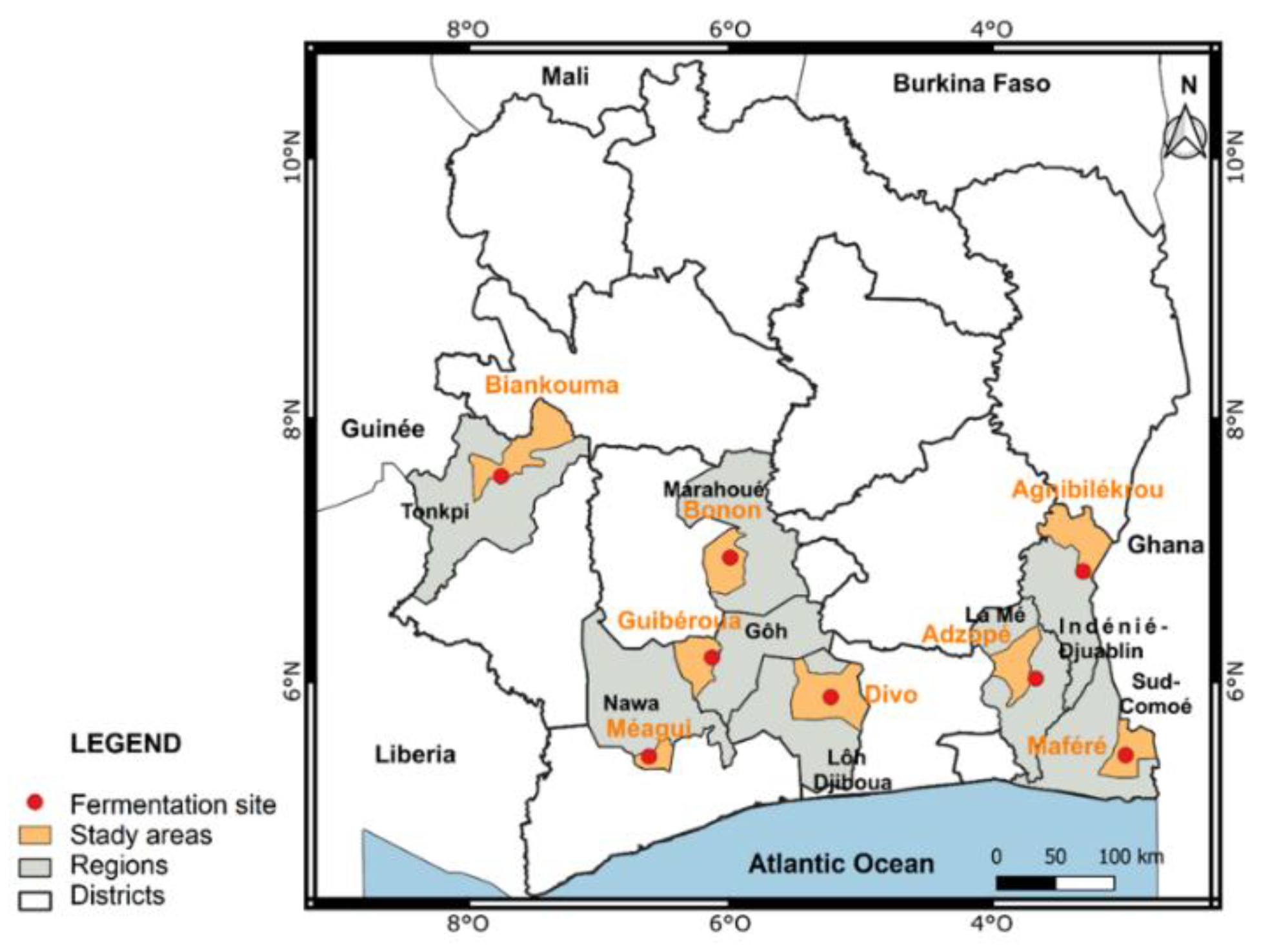
Figure 2.
PCA biplot of the flavor profiles of crude cocoa beans from according cropping systems. The flavor compounds and cropping system of cocoa in each production area are indicated on the labels at the bottom of the figure. (AF= agroforestry ; FS= full sun) between producing geopgraphical origins in Côte d’Ivoire. Adz= Adzopé’s area ; Agni= Agnibilékrou’s area ; Divo= Divo’s area ; Guib= Guibéroua’s area ; Mea= Méagui’s area.
Figure 2.
PCA biplot of the flavor profiles of crude cocoa beans from according cropping systems. The flavor compounds and cropping system of cocoa in each production area are indicated on the labels at the bottom of the figure. (AF= agroforestry ; FS= full sun) between producing geopgraphical origins in Côte d’Ivoire. Adz= Adzopé’s area ; Agni= Agnibilékrou’s area ; Divo= Divo’s area ; Guib= Guibéroua’s area ; Mea= Méagui’s area.
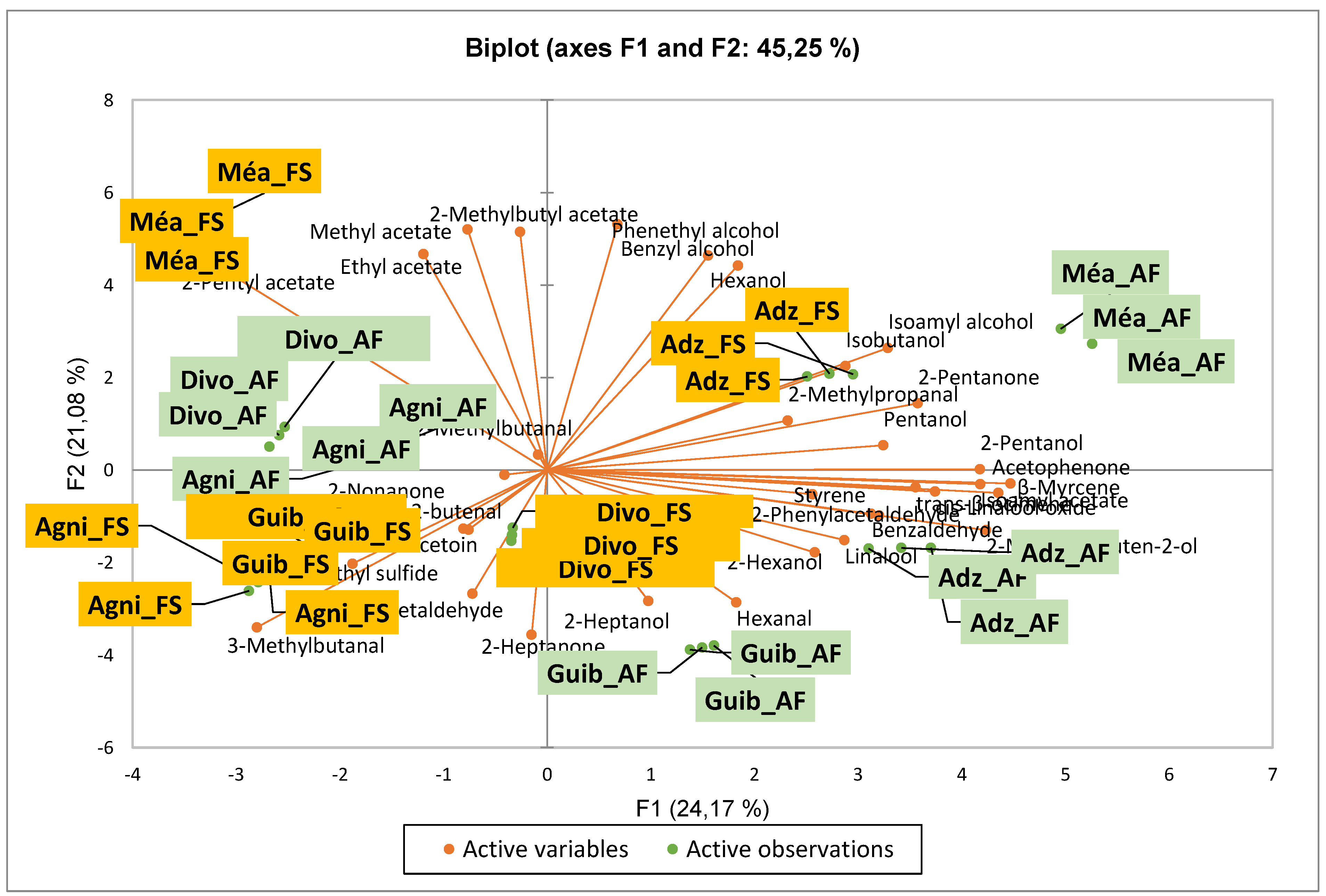
Figure 3.
PCA biplot of the flavor profiles of dry fermented cocoa beans according to cropping systems. The flavor compounds and cropping system of cocoa between production areas in Côte d'Ivoire are indicated on the labels at the bottom of the figure. (AF= agroforestry ; FS= full sun) Adz= Adzopé’s area ; Agni= Agnibilékrou’s area ; Divo= Divo’s area ; Guib= Guibéroua’s area ; Mea= Méagui’s area.
Figure 3.
PCA biplot of the flavor profiles of dry fermented cocoa beans according to cropping systems. The flavor compounds and cropping system of cocoa between production areas in Côte d'Ivoire are indicated on the labels at the bottom of the figure. (AF= agroforestry ; FS= full sun) Adz= Adzopé’s area ; Agni= Agnibilékrou’s area ; Divo= Divo’s area ; Guib= Guibéroua’s area ; Mea= Méagui’s area.
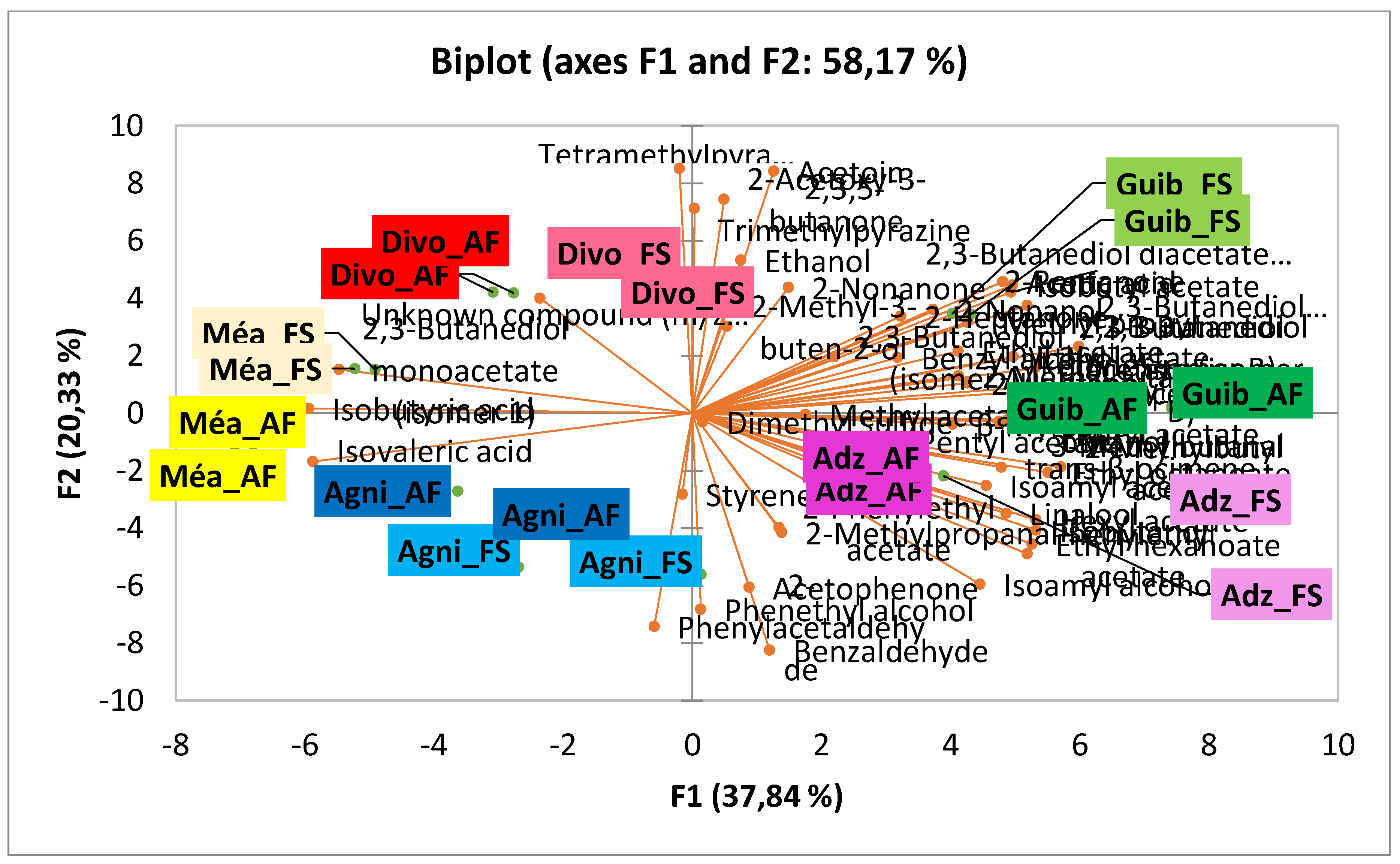
Figure 4.
PCA biplot of the flavor profiles of dry fermented cocoa beans according to cropping systems. The flavor compounds and cropping system of cocoa within each production area in Côte d'Ivoire are indicated on the labels at the bottom of the figure (AF= agroforestry ; FS= full sun) A) Adzopé’s area ; B) Agnibilékrou’s area ; C) Divo’s area ; D) Guibéroua’s area ; E) Méagui’s area.
Figure 4.
PCA biplot of the flavor profiles of dry fermented cocoa beans according to cropping systems. The flavor compounds and cropping system of cocoa within each production area in Côte d'Ivoire are indicated on the labels at the bottom of the figure (AF= agroforestry ; FS= full sun) A) Adzopé’s area ; B) Agnibilékrou’s area ; C) Divo’s area ; D) Guibéroua’s area ; E) Méagui’s area.
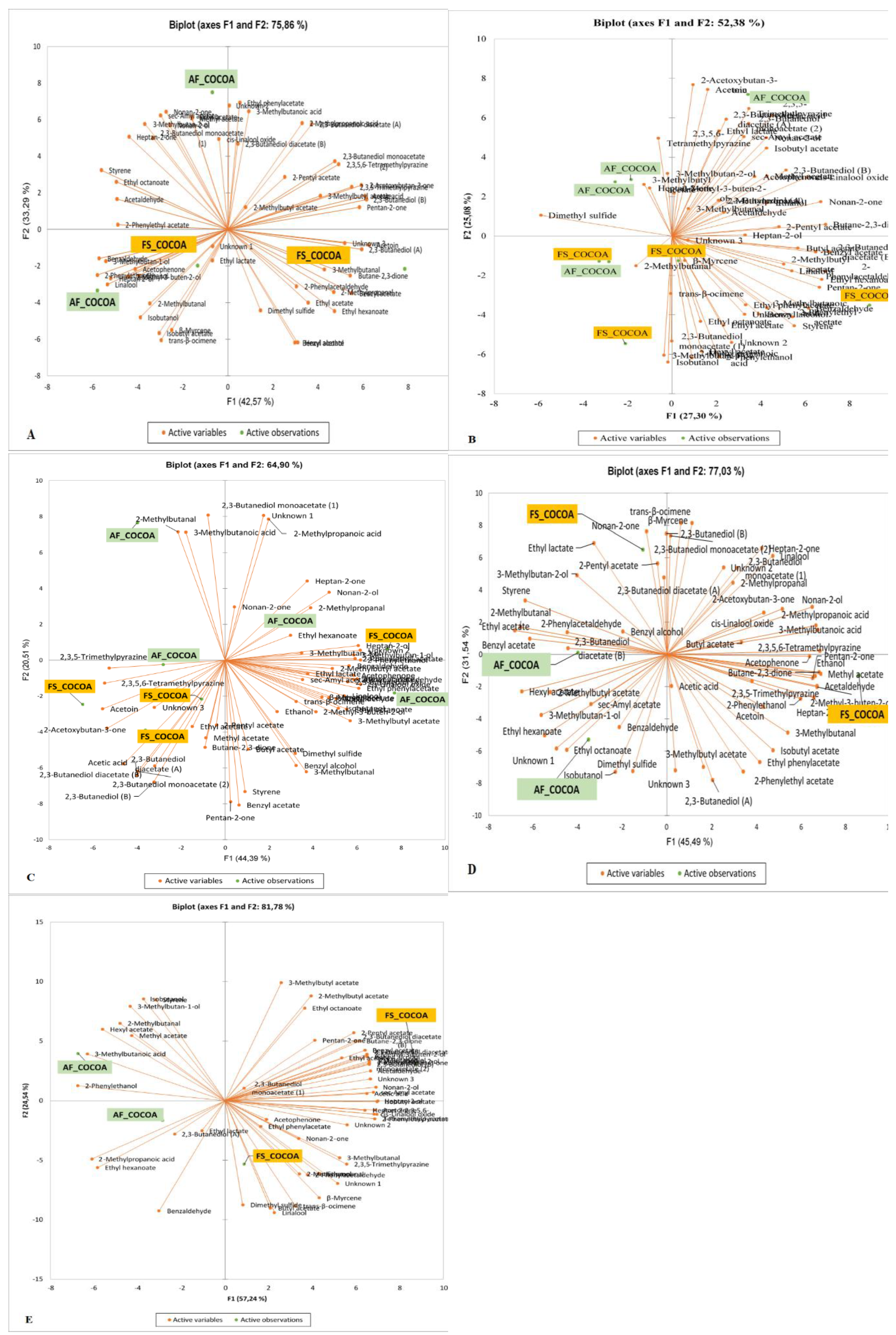
Figure 5.
PCA biplot of flavor compounds in chocolates produced from dry fermented cocoa beans produced according to cropping systems between producing regions. The flavor compounds and cropping system of cocoa between production areas in Côte d'Ivoire are indicated on the labels at the bottom of the figure (AF= agroforestry ; FS= full sun) A) Adzopé’s area ; B) Agnibilékrou’s area ; C) Divo’s area ; D) Guibéroua’s area ; E) Méagui’s area.
Figure 5.
PCA biplot of flavor compounds in chocolates produced from dry fermented cocoa beans produced according to cropping systems between producing regions. The flavor compounds and cropping system of cocoa between production areas in Côte d'Ivoire are indicated on the labels at the bottom of the figure (AF= agroforestry ; FS= full sun) A) Adzopé’s area ; B) Agnibilékrou’s area ; C) Divo’s area ; D) Guibéroua’s area ; E) Méagui’s area.
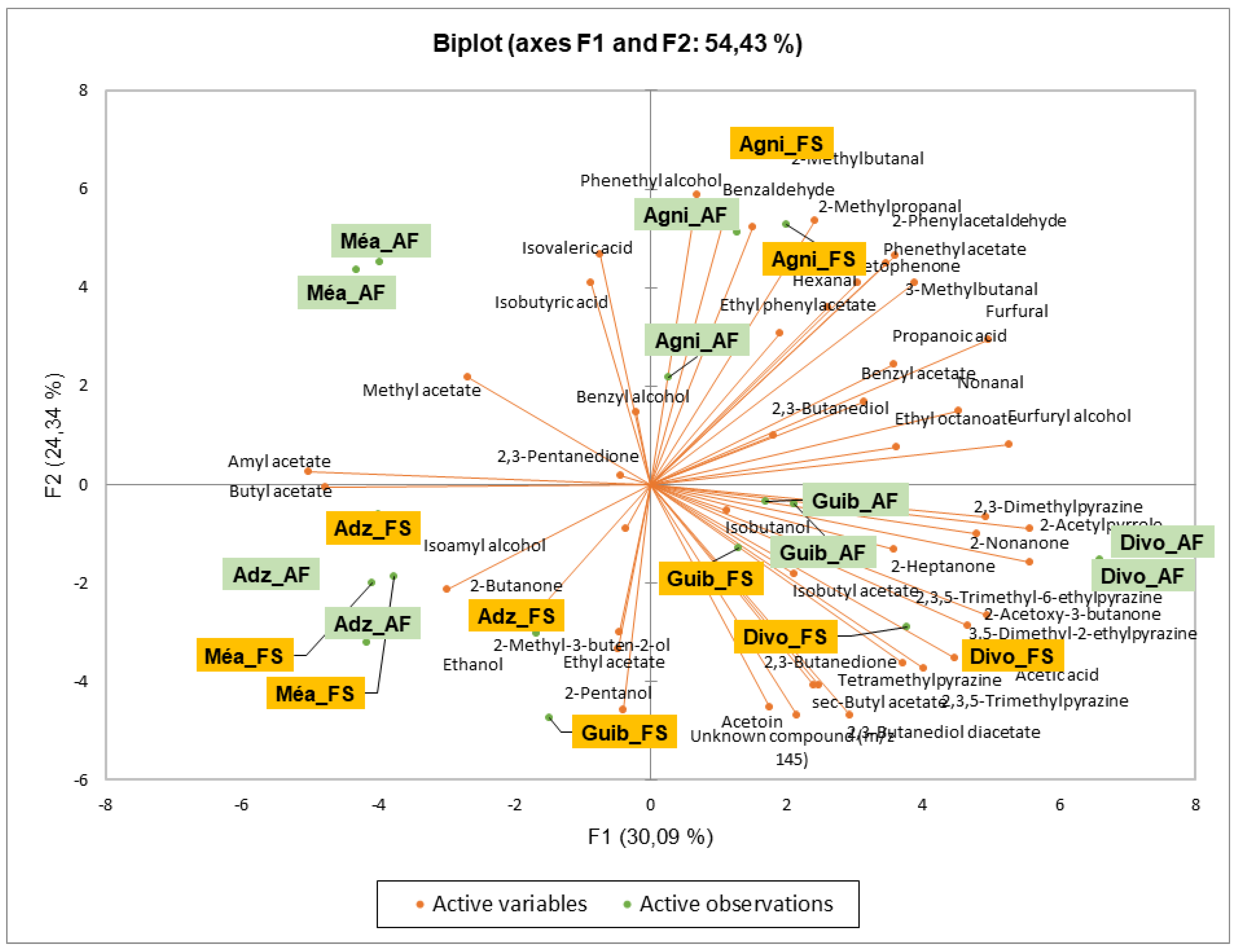
Figure 6.
PCA biplot of flavor compounds in chocolates produced from dry fermented cocoa beans in function of cropping systems within producing regions. The flavor compounds and cropping system of cocoa within production areas in Côte d’Ivoire are indicated on the labels at the bottom of the figure (AF= agroforestry ; FS= full sun) A) Adzopé’s area ; B) Agnibilékrou’s area ; C) Divo’s area ; D) Guibéroua’s area ; E) Méagui’s area.
Figure 6.
PCA biplot of flavor compounds in chocolates produced from dry fermented cocoa beans in function of cropping systems within producing regions. The flavor compounds and cropping system of cocoa within production areas in Côte d’Ivoire are indicated on the labels at the bottom of the figure (AF= agroforestry ; FS= full sun) A) Adzopé’s area ; B) Agnibilékrou’s area ; C) Divo’s area ; D) Guibéroua’s area ; E) Méagui’s area.
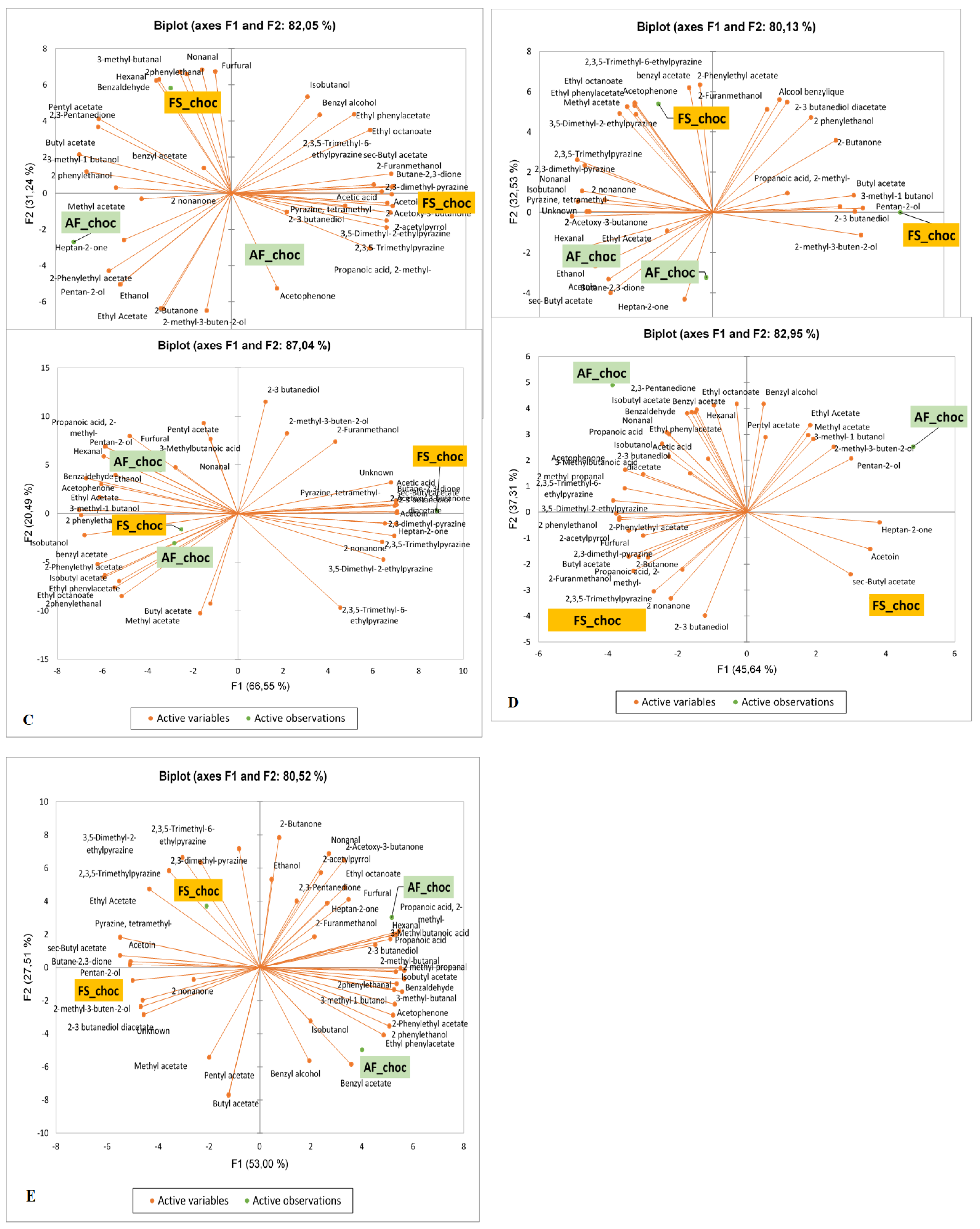
Figure 7.
Effects of agroforestry on the sensory attributes of chocolate samples made therefrom cocoa beans between different cocoa producing areas in Côte d'Ivoire. Adz_FS_choc : Chocolate derived from full sun cocoa beans produced in Adzopé’s area ; Adz_AF_choc : Chocolate derived from agrofrestry cocoa beans produced in Adzopé’s area ; Agni_FS_choc : Chocolate derived from full sun cocoa beans produced in Agnibilékrou’s area ; Agni_AF_choc : Chocolate derived from agroforestry cocoa beans produced in Agnibilékrou’s area ; Divo_FS_choc : Chocolate derived from full sun cocoa beans produced in Divo’s area ; Divo_AF_choc : Chocolate derived from agroforestry cocoa beans produced in Divo’s area ; Guib_FS_choc : Chocolate derived from full sun cocoa beans produced in Guibéroua’s area ; Guib_AF_choc : Chocolate derived from agroforestry cocoa beans produced in Guibéroua’s area ; Méa_FS_choc : Chocolate derived from full sun cocoa beans produced in Méa’s area ; Méa_AF_choc : Chocolate derived from agroforestry cocoa beans produced in Méa’s area.
Figure 7.
Effects of agroforestry on the sensory attributes of chocolate samples made therefrom cocoa beans between different cocoa producing areas in Côte d'Ivoire. Adz_FS_choc : Chocolate derived from full sun cocoa beans produced in Adzopé’s area ; Adz_AF_choc : Chocolate derived from agrofrestry cocoa beans produced in Adzopé’s area ; Agni_FS_choc : Chocolate derived from full sun cocoa beans produced in Agnibilékrou’s area ; Agni_AF_choc : Chocolate derived from agroforestry cocoa beans produced in Agnibilékrou’s area ; Divo_FS_choc : Chocolate derived from full sun cocoa beans produced in Divo’s area ; Divo_AF_choc : Chocolate derived from agroforestry cocoa beans produced in Divo’s area ; Guib_FS_choc : Chocolate derived from full sun cocoa beans produced in Guibéroua’s area ; Guib_AF_choc : Chocolate derived from agroforestry cocoa beans produced in Guibéroua’s area ; Méa_FS_choc : Chocolate derived from full sun cocoa beans produced in Méa’s area ; Méa_AF_choc : Chocolate derived from agroforestry cocoa beans produced in Méa’s area.
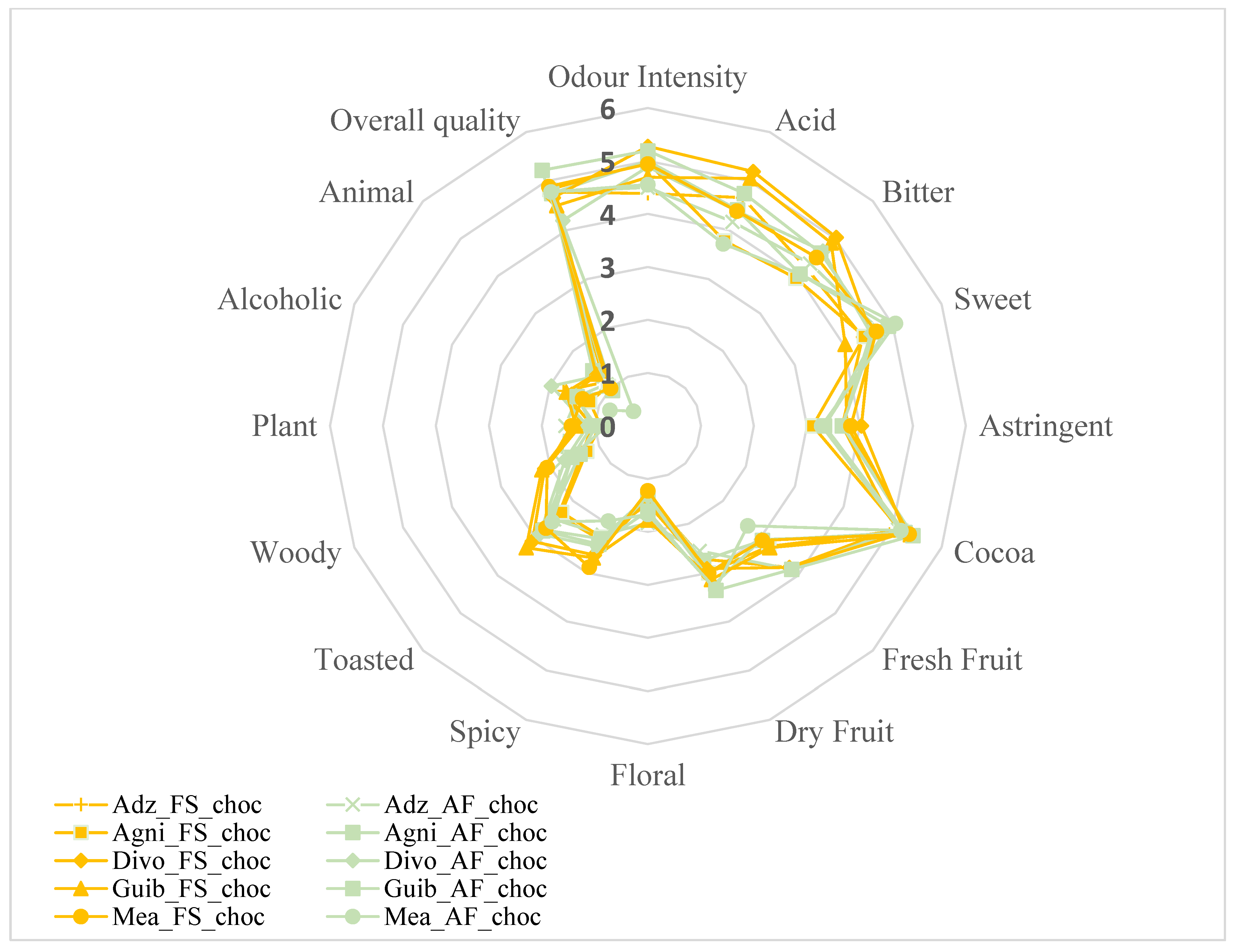
Figure 8.
A-B. Effects of agroforestry on the sensory attributes of chocolate samples made from cocoa beans produced within each tested cocoa-producing area in Côte d'Ivoire. A) Adzopé’s area, B) Agnibilekrou’s area, C) Divo’s area, D) Guibéroua’s area, E) Méagui’s area.
Figure 8.
A-B. Effects of agroforestry on the sensory attributes of chocolate samples made from cocoa beans produced within each tested cocoa-producing area in Côte d'Ivoire. A) Adzopé’s area, B) Agnibilekrou’s area, C) Divo’s area, D) Guibéroua’s area, E) Méagui’s area.
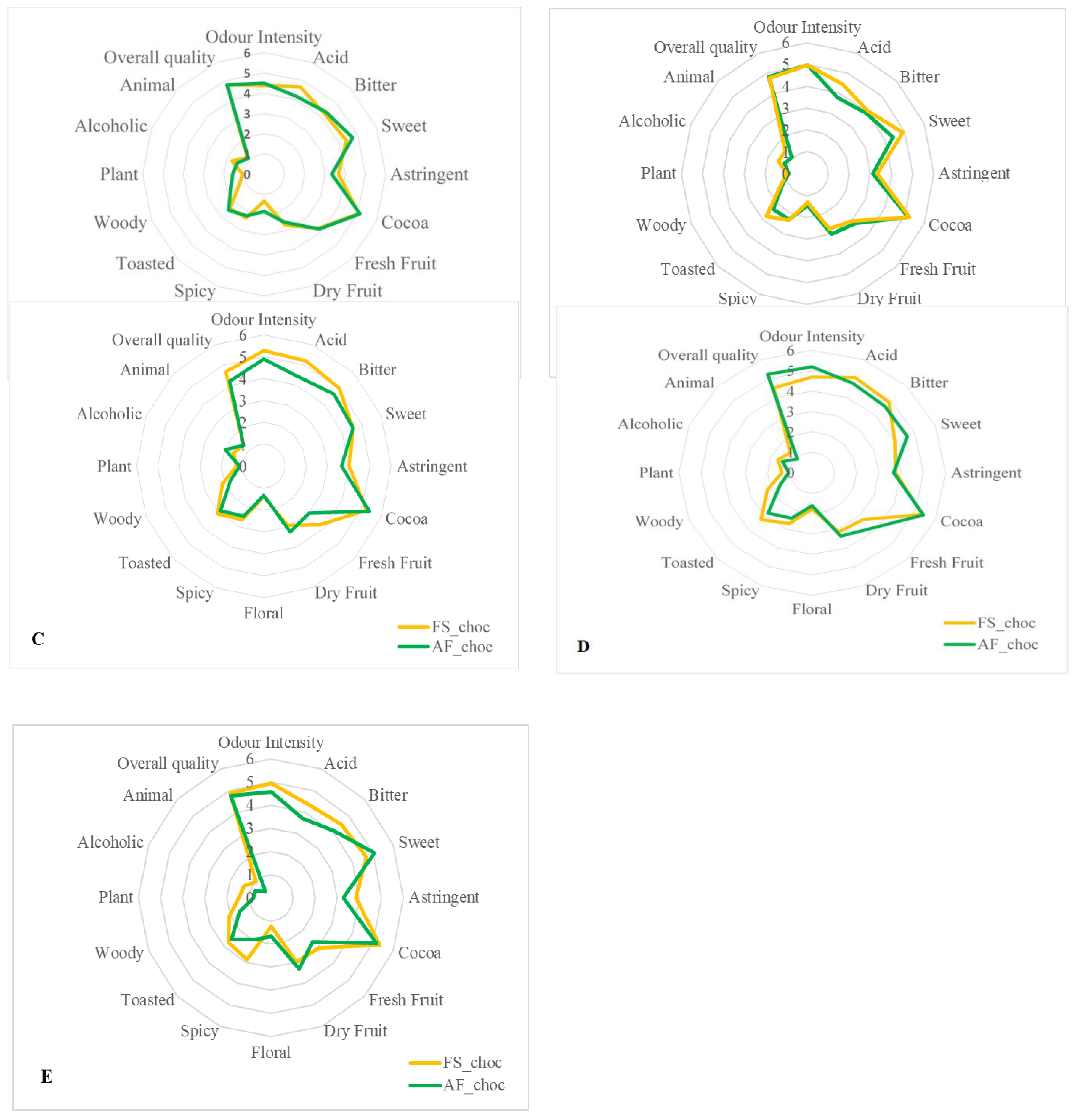
Table 1.
Changes in total concentration of each main classe of flavor compounds of crude cocoa beans in the function of the cropping system in different geographical origins of Côte d'Ivoire.
Table 1.
Changes in total concentration of each main classe of flavor compounds of crude cocoa beans in the function of the cropping system in different geographical origins of Côte d'Ivoire.
| Chemical families | Flavor compounds content (µg.g−1) per class found in crude cocoa beans according to Ivorian cocoa producing areas | |||||||||
| Adzopé | Agnibilékrou | Divo | Guibéroua | Méagui | ||||||
| Cropping systems | ||||||||||
| AF | FS | AF | FS | AF | FS | AF | FS | AF | FS | |
| Aldehydes | 138.6±7.6a | 118.8±2.4a | 111.7±4.6ab | 102.4±12.8a | 73.7±0.9c | 116.5±2.7a | 107.6±23.5b | 116.2±41.1a | 95.7±1.2bc | 92.7±1a |
| Esters | 85.4±2b | 59.5±2.5a | 56±3.5c | 70.1±25.7a | 56.6±0.3bc | 73.2±2.8a | 65±22.1bc | 56.2±25.1a | 159.8±4.2a | 71.7±1.4a |
| Alcohols | 590.9±27.4b | 391.6±10a | 330.6±110.8c | 448.6±223.7a | 341.5±9.1c | 432.2±0.1a | 432±69.2c | 362±186.1a | 1134.4±34a | 173.9±12a |
| Ketons | 103.4±6c | 151.7±0.9a | 108.7±38.7c | 85.8±62a | 191.4±32.4b | 195.1±1.1a | 153.3±5.7b | 106.7±91.3a | 504.6±2.7a | 58.6±7a |
| Terpens | 8.5±0ab | 11±0.7a | 3.9±0.5b | 2.7±0.3c | 1.7±0.4b | 4.3±0.3b | 12.7±7.2a | 3.2±0.5c | 8.2±0.1ab | 2.9±0.1c |
| Others | 7.7±0a | 3.2±0.1c | 7.7±8.1a | 4.6±3bc | 5.9±0.4a | 8±0.2ab | 5.4±1a | 2.3±1.2c | 6.4±0.1a | 10.3±0.5a |
Table 3.
Changes in total concentration of desirable flavor compounds of dry fermented cocoa beans in function of cropping system in different goegraphical origins of Côte d’’Ivoire.
Table 3.
Changes in total concentration of desirable flavor compounds of dry fermented cocoa beans in function of cropping system in different goegraphical origins of Côte d’’Ivoire.
| 说 | Kovats index (NIST) | Calculated Kovats index | Odor description | Cropping system | Concentration of flavor compounds of cocoa beans from producing regions (µg.g−1) | ||||
| Adz | Agni | Divo | Guib | Méa | |||||
| 3-Methylbutyl acetate | 1123 | 1123 | Fruity, banana | AF | 47,7±17b | 2,2±0,1c | 2,8±1,2c | 84,2±3,7a | 15,8±2,9c |
| FS | 75,2±2,9a | 37,2±9,1ab | 33,2±36,3ab | 41,9±17ab | 18,6±9,4b | ||||
| 2-Methylbutyl acetate | 1125 | 1120 | Fruity, banana | AF | 72,6±1,8a | 24,4±5,6b | 9,5±1,3b | 76,3±11,8a | 16,0±3,6b |
| FS | 75,2±2,9a | 37,2±9,1ab | 33,2±36,3ab | 39.9±13ab | 18,6±9,4b | ||||
| Benzyl acetate | 1720 | 1714 | Sweet, floral, fruity | AF | 1,4±0,2a | 0,8±0,2a | 1,7±1,2a | 3,4±2,3a | 0,5±0,1a |
| FS | 2,8±1,1a | 1,8±1,5a | 2,5±0,4a | 1,5±0,8a | 1,8±1,5a | ||||
| 2-Methylpropanal | 819 | 823 | Chocolate | AF | 0,5±0,1c | 2,1±0,2a | 1,5±0,1ab | 1,3±0,3abc | 0,9±0,7bc |
| FS | 2,5±0,3ab | 3,1±1,3a | 0,9±0,5b | 1,5±0,6ab | 1,1±0b | ||||
| 2-Methylbutanal | 914 | 872 | Cocoa, chocolate, almond | AF | 8,2±9,9b | 1,5±1,1b | 3,7±3,3b | 65,3±3,3a | 2,4±0,1b |
| FS | 3,2±1,3a | 1,8±1a | 1,7±0,6a | 26,3±9,7a | 1,7±0,2a | ||||
| 3-Methylbutanal | 918 | 876 | Cocoa, chocolate | AF | 1,4±0,2b | 1,1±0,3bc | 1,1±0,2bc | 2,0±0,1a | 0,8±0,1c |
| FS | 1,6±0,8a | 0,94±0,1a | 1,4±0,3a | 0,7±0,3a | 1,3±0,1a | ||||
| Benzyl alcohol | 1870 | 1878 | Floral, pink, phenolic | AF | 3,9±1,6a | 2,7±0,2a | 4,6±2,7a | 5,7±2,5a | 3,2±0,1a |
| FS | 5,6±1,1a | 5,1±0,9a | 5,1±0,6a | 3,2±1,2a | 6,4±3,1a | ||||
| 2-Phenylethanol | 1907 | 1907.8 | Floral, Flowery | AF | 45,0±21,2a | 65±2,1a | 23,7±12,6a | 75,4±54,3a | 40,6±6,8a |
| FS | 28,8±13,8b | 102,9±2,1a | 19,0±2,7b | 22,7±8,2b | 29,0±6,9b | ||||
| Acetoin | 1285 | 1305 | Creamy, buttery | AF | 30,1±9,6b | 34,4±11,2b | 93,1±36,4a | 57,3±4,9ab | 33,3±19,2b |
| FS | 57,4±27,2bc | 25,6±6,9c | 99,3±4,3ab | 116,5±7,6a | 71,5±22,4b | ||||
| 2-Acetoxybutan-3-one | 1378 | 1405 | Sweet, creamy, buttery | AF | 1,9±1,3b | 2,5±1,1b | 14,4±9,1a | 6,1±2,1ab | 1,1±0,7b |
| FS | 2,7±1,4c | 1,2±0,9c | 19,3±0,2a | 10,4±4,2b | 3,7±3,1c | ||||
| Acetophenone | 1647 | 1624 | Flowery, sweet | AF | 5,2±0,4a | 6,7±1,9a | 4,8±0,9a | 4,4±1,3a | 3,7±1,3a |
| FS | 4,8±0,1b | 6,7±1a | 4,4±0,5b | 3,4±0,5b | 3,53±0,5b | ||||
| 2,3,5-Trimethylpyrazine | 1402 | 1407 | Cocoa, roasted, baked, Peanut, roasted | AF | 2,06±0,7bc | 1,1±0,5c | 4,3±1,1a | 3,5±1,1ab | 2,2±0,4bc |
| FS | 2,3±1,1bc | 1,1±0,6c | 4,1±0,2a | 2,7±0,7ab | 4±0,3a | ||||
| Tetramethylpyrazine | 1469 | 1468 | Milk coffee, roasted, chocolate | AF | 14,1±5,9bc | 8,4±6,7c | 66,2±27,4a | 53,4±19,5ab | 18,5±12,2bc |
| FS | 14,68±7,8bc | 3,61±2,3c | 64,8±15,9ab | 78,47±40,1a | 60,2±18ab | ||||
| Cis-Linalool oxid | 1444 | 1473.3 | Sweet, floral, earthy, woody | AF | 1,4±0,2a | 1,05±0ab | 0,7±0,2b | 1,3±0,5ab | 0,6±0,1b |
| FS | 1,45±0,2a | 1,2±0,2ab | 0,63±0c | 1,2±0,3ab | 0,8±0,1bc | ||||
| Linalool | 1547 | 1548.4 | Floral, rose, sweet, green, citrus | AF | 2,4±0,4a | 2,4±1a | 0,8±0,5b | 1,1±0,5ab | 0,3±0,1b |
| FS | 2,2±0,2ab | 3,4±1a | 0,5±0,1c | 1,00±0,2bc | 0,5±0,2c | ||||
Disclaimer/Publisher’s Note: The statements, opinions and data contained in all publications are solely those of the individual author(s) and contributor(s) and not of MDPI and/or the editor(s). MDPI and/or the editor(s) disclaim responsibility for any injury to people or property resulting from any ideas, methods, instructions or products referred to in the content. |
© 2025 by the authors. Licensee MDPI, Basel, Switzerland. This article is an open access article distributed under the terms and conditions of the Creative Commons Attribution (CC BY) license (https://creativecommons.org/licenses/by/4.0/).
Copyright: This open access article is published under a Creative Commons CC BY 4.0 license, which permit the free download, distribution, and reuse, provided that the author and preprint are cited in any reuse.


