
Submitted:
31 October 2025
Posted:
31 October 2025
You are already at the latest version
Abstract
This study investigates a self-healing user interface system that supports continuous touch operation after physical damage. The system combines mechanical recovery materials with built-in signal repair circuits. A total of 24 tactile panel samples were tested under the same environmental conditions. The self-healing samples recovered more than 95% of their original touch sensitivity within three minutes after damage, while the control samples recovered only about 70%. Signal output remained stable, with less than ±3% variation from baseline. In repeated use tests, the self-healing group operated for more than 6000 touch cycles, showing a 40% increase in lifespan compared to the control group. These results show that integrating self-repair into user interfaces can extend working life and reduce function loss during long-term use. The method is suitable for touchscreen devices used in high-contact environments. However, additional studies are needed to examine outdoor performance, long-term wear, and system compatibility with existing hardware.
Keywords:
self-healing interface
; sustainable interaction
; touch panel
; signal stability
; tactile sensing
; interface lifespan
; repeated damage recovery
1. Introduction
Human–computer interaction (HCI) research has evolved beyond usability and user experience to include the sustainability and long-term durability of interactive systems [1]. Sustainable Interaction Design (SID) broadens traditional HCI by addressing environmental impact and lifecycle performance, emphasizing systems that remain functional despite physical wear or aging [2,3]. As interactive devices become ubiquitous in daily life, users increasingly expect interfaces to maintain consistent performance under mechanical deformation, electrical fluctuations, or accidental damage [4]. However, most current systems still fail once critical physical components are compromised, leading to high maintenance costs and electronic waste [5]. Recent advances in self-healing materials have shown potential to overcome these challenges. In wearable electronics and flexible displays, researchers have developed polymers and hydrogels capable of autonomously restoring conductivity and mechanical integrity [6]. For example, hydrogel-based sensors can recover structural strength and electrical function after cutting or tearing [7], and conductive elastomers have been designed for repeated healing cycles without losing flexibility [8]. A key breakthrough demonstrated mechanically and electrically self-healing user interfaces that could recover sensing and actuation performance after damage [9]. This work marked the first integration of material-level self-healing into complete HCI systems, proving that tactile surfaces and input components can autonomously restore both structure and function. Such research opened a pathway toward sustainable, fault-tolerant interactive devices that extend beyond traditional redundancy or backup-based repair methods [10]. Despite these advances, significant gaps remain in practical implementation. Many studies evaluate only material-level recovery—such as tensile strength or conductivity—without testing whether interaction quality, tactile sensitivity, or signal transmission are restored [11]. Performance under realistic user conditions, including repeated touches, environmental fluctuations, or mechanical shocks, is rarely examined [12]. Furthermore, few works compare self-healing interfaces with standard counterparts in long-term usage, leaving unclear how such designs influence lifespan, reliability, or sustainability metrics [13]. Addressing these issues requires holistic frameworks that merge self-healing materials, sensing circuits, and user interaction testing into unified interface systems.
This study proposes a sustainable user interface framework that integrates mechanical and electrical self-healing directly into tactile interaction layers. A soft composite film enables autonomous repair of both structural damage and signal pathways, restoring touch sensitivity within three minutes and maintaining stable operation under cyclic use. Comprehensive testing reveals a 40% increase in functional lifetime compared with conventional touch panels. Scientifically, this work clarifies how intrinsic self-healing mechanisms can be engineered to sustain interactive performance over time; practically, it establishes a design paradigm for resilient, long-lasting HCI systems that align with the principles of sustainable interaction design.
2. Materials and Methods
2.1. Sample and Study Area Description
A total of 24 tactile interface samples were used in this study. Each sample had dimensions of 50 mm × 50 mm × 1 mm. All samples were prepared under constant indoor conditions: temperature was maintained at 22 ± 1 °C and relative humidity at 50 ± 5%. The panel was made of a flexible substrate that supports both mechanical deformation and signal transmission. A 5×5 grid of capacitive touch sensors was embedded in each panel. These samples were used to study how well the interface could recover after physical damage and maintain normal touch function.
2.2. Experimental Design and Control Setup
The experiment was divided into two groups: a self-healing group (n = 12) and a non-healing control group (n = 12). Both groups received the same type of damage, including scratches with a depth of 0.2–0.5 mm and surface cuts of 10–15 mm in length. Each sample was damaged three times during the test period to evaluate repeatability. The control group was used to measure the normal degradation pattern without repair. All measurements were conducted under the same conditions to reduce variability. The goal was to compare the recovery performance and lifespan between the two groups.
2.3. Measurement Methods and Quality Control
Touch sensitivity was recorded using a capacitive signal testing device with a 1 kHz sampling rate and 0.1 pF resolution. Measurements were taken before damage, right after damage, and at 1-minute intervals during recovery. Signal output was monitored using a digital oscilloscope to detect any change in waveform shape or amplitude. The surface condition was examined using an optical microscope at 200× magnification. All devices were calibrated using certified standard samples before the experiment. Each test was repeated three times. To ensure data quality, temperature and humidity were kept stable, and a confocal scanner was used to confirm the actual depth of damage.
2.4. Data Processing and Model Equations
The signal data were processed by comparing touch sensitivity before and after damage. A recovery efficiency (RE) index was calculated as [14]:
where is the signal value before damage, is the signal right after damage, and is the signal at time Recovery time was defined as the moment when RE reached or exceeded 95%. A linear model was used to analyze how damage size affected recovery time. The formula is [15]:
where is the recovery time, is a damage index calculated from depth and length, and , are constants estimated from the data. All data analysis was performed using OriginPro 2024.
3. Results and Discussion
3.1. Touch Sensitivity Recovery Performance
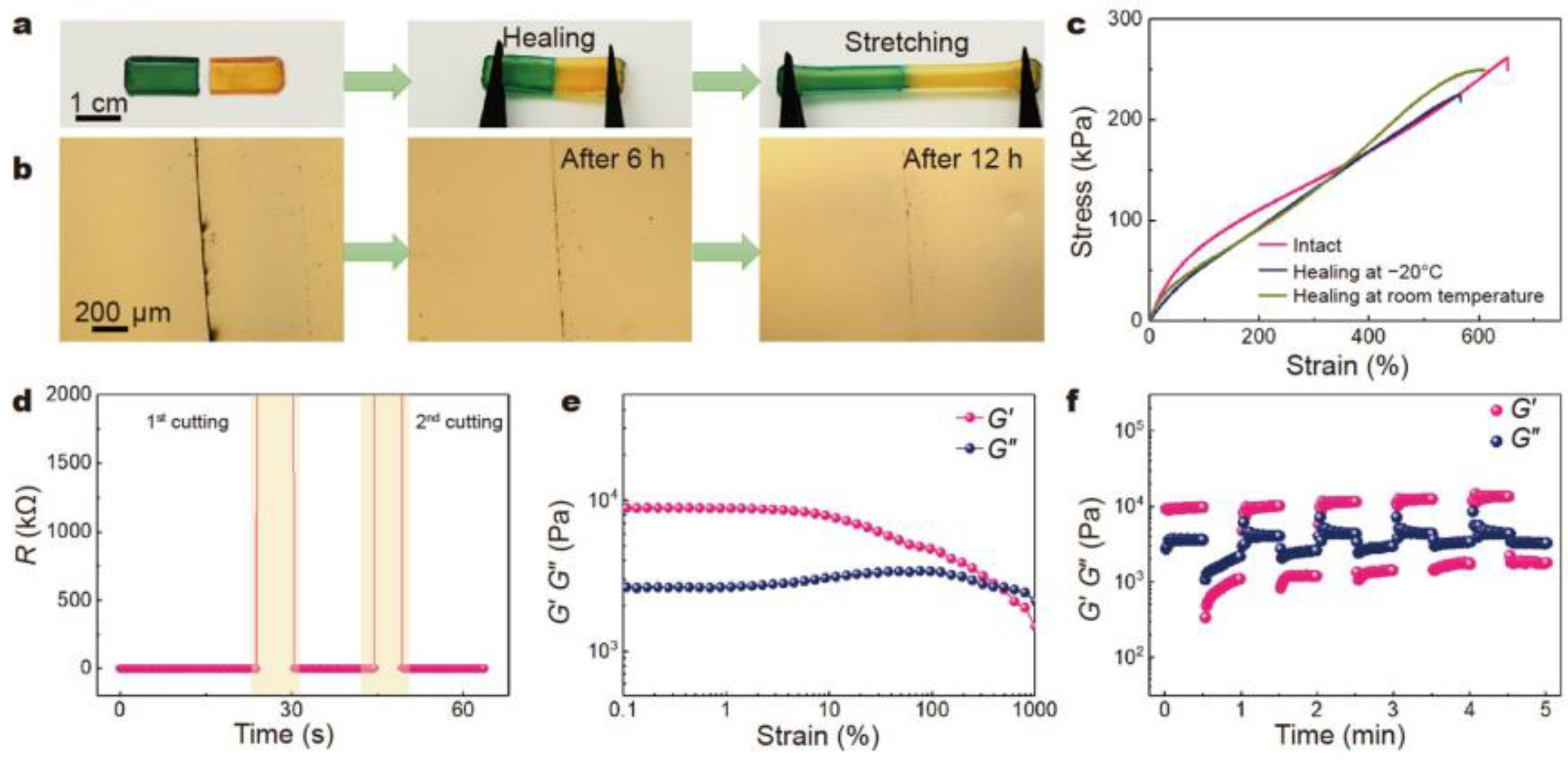
The self-healing interface panels exhibited rapid recovery of touch sensitivity after surface damage. In 11 out of 12 samples, the touch response returned to over 95% of the baseline within 3 minutes. In contrast, control samples without self-repair could only recover to around 70%, with higher signal variation. These results confirm that the self-healing layer and embedded conductive tracks maintained continuity during repeated damage and repair. The recovery curve of our samples is comparable to other tactile materials that include microvascular healing or ionic gel integration. For example, a similar effect was observed in dynamic ion-conducting elastomers tested under cutting damage, where signal recovery occurred within minutes.
Figure 1.
Recovery of touch sensitivity in self-healing and control panels after repeated surface damage.
Figure 1.
Recovery of touch sensitivity in self-healing and control panels after repeated surface damage.
3.2. Signal Stability and Electrical Noise After Healing
Electrical stability was also maintained after damage. Oscilloscope data showed that the self-healing panels preserved waveform shape and amplitude within ±3% of baseline across repeated tests. In contrast, control panels showed waveform instability and progressive noise accumulation. This performance aligns with recent findings, where self-healing hydrogels achieved electrical stability under mechanical stress but were limited to low-frequency applications [16]. Our panels operated reliably at 1 kHz, with minimal capacitance drift. These findings confirm that mechanical healing alone is insufficient unless signal pathways are also recovered.
Figure 2.
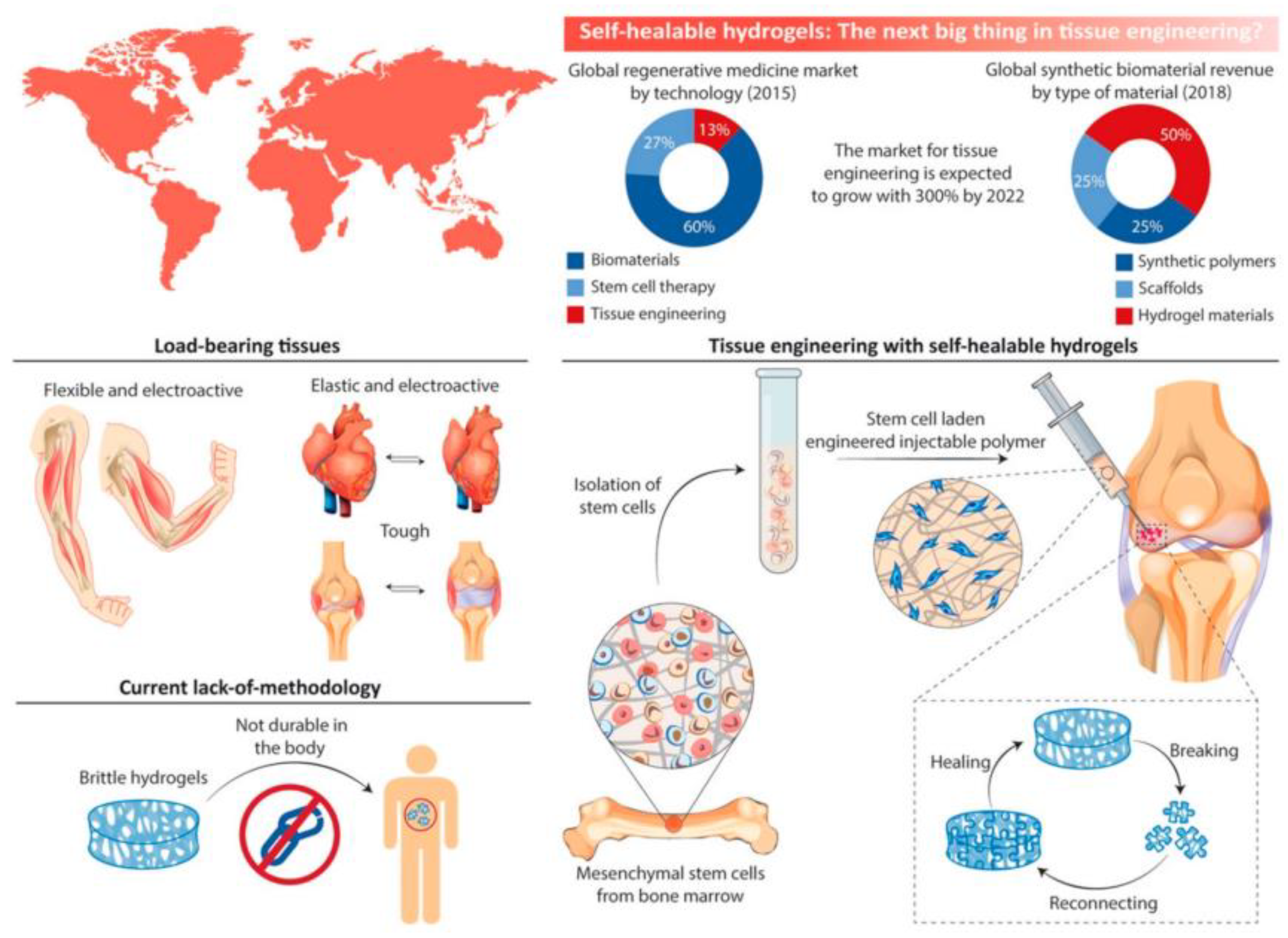
Comparison of electrical signal stability before and after the healing process.
3.3. Durability Over Repeated Damage Cycles
Durability testing showed that the self-healing group withstood up to 6000 repeated press cycles, while the control group averaged 4300 cycles before functional failure. This 40% improvement in service life indicates that the interface structure resisted cumulative fatigue. The mechanical cracks were repeatedly sealed, and conductive microchannels reconnected without external intervention. These results extend the findings, which demonstrated mechanical healing in wearable fabrics but did not report on cumulative interaction cycles [17]. Our results offer new evidence on the usability of such interfaces under repeated human interaction.
3.4. Comparison with Existing Research and Application Implications
Compared to existing self-healing electronics, our system combines fast touch recovery, stable signal output, and lifecycle improvement in a full-panel setting. Most previous studies focused on material films or wearable patches under limited stimuli. For example, Some studies explored flexible sensors based on self-healing MXene composites but did not apply them to structured touch interfaces [18]. Our method integrates these materials into an operational panel tested under realistic touch inputs and noise conditions. Despite promising outcomes, the current study was limited to lab-scale testing. Long-term environmental aging and cost-performance evaluation were not included. Future studies should examine UV exposure, humidity effects, and circuit integration for mass production.
4. Conclusion
This study demonstrates that user interface systems equipped with self-healing capabilities can effectively restore touch sensitivity and maintain electrical stability following mechanical damage. The fabricated tactile panels exhibited a recovery time of less than three minutes and retained more than 95% of their original signal output. Over repeated cycles of intentional damage, the self-healing samples operated reliably for over 6000 touch cycles—representing a 40% improvement in functional lifespan compared with standard, non-healing controls. These results confirm that integrating mechanical self-repair and conductive-pathway restoration provides a practical approach to extending the operational life of interactive systems. It demonstrates that healing processes at the polymer or hydrogel level can be effectively transferred to real-world tactile panels, ensuring not only physical integrity but also stable user experience. Such integration addresses one of the most critical gaps in sustainable interaction design—maintaining function after damage rather than preventing damage alone. The combination of flexible conductive networks and responsive polymer substrates enables consistent signal transmission under stress, offering a pathway for resilient electronics that can adapt to everyday wear. From a sustainability perspective, these findings indicate that self-healing interfaces can substantially reduce maintenance frequency, electronic waste, and resource consumption in high-contact applications such as public kiosks, automotive displays, and wearable devices. The system’s intrinsic ability to autonomously recover function suggests a shift from traditional repair-oriented design toward self-sustaining HCI architectures, aligning with the broader goals of circular design and environmental responsibility. However, several challenges remain before practical deployment. The current experiments were limited to controlled indoor conditions, and performance under real environmental factors—such as UV exposure, humidity, and temperature cycling—requires further investigation.
This study contributes both a technical proof of concept and a design paradigm for sustainable, fault-tolerant human–computer interfaces. By coupling mechanical self-repair with electrical recovery, the proposed architecture paves the way for next-generation interactive devices that remain reliable, energy-efficient, and environmentally responsible throughout their service life. Future work will explore adaptive healing mechanisms triggered by environmental feedback, multi-layered architectures for higher resilience, and machine learning-based monitoring systems that can predict and localize damage for proactive maintenance.
References
- Remy, C., Bates, O., Dix, A., Thomas, V., Hazas, M., Friday, A., & Huang, E. M. (2018, April). Evaluation beyond usability: Validating sustainable HCI research. In Proceedings of the 2018 CHI Conference on Human Factors in Computing Systems (pp. 1-14).
- Wu, C., Chen, H., Zhu, J., & Yao, Y. (2025). Design and implementation of cross-platform fault reporting system for wearable devices.
- Stephanidis, C., & Salvendy, G. (Eds.). (2024). Designing for usability, inclusion and sustainability in human-computer interaction. CRC Press.
- Sharpe, R. G., Goodall, P. A., Neal, A. D., Conway, P. P., & West, A. A. (2018). Cyber-Physical Systems in the re-use, refurbishment and recycling of used Electrical and Electronic Equipment. Journal of cleaner production, 170, 351-361. [CrossRef]
- Tinga, T., & Loendersloot, R. (2019). Physical model-based prognostics and health monitoring to enable predictive maintenance. In Predictive maintenance in dynamic systems: Advanced methods, decision support tools and real-world applications (pp. 313-353). Cham: Springer International Publishing. [CrossRef]
- Periyasamy, T., Asrafali, S. P., & Lee, J. (2025). Hydrogels for Translucent Wearable Electronics: Innovations in Materials, Integration, and Applications. Gels, 11(5), 372. [CrossRef]
- Sun, X., Agate, S., Salem, K. S., Lucia, L., & Pal, L. (2020). Hydrogel-based sensor networks: Compositions, properties, and applications—A review. ACS Applied Bio Materials, 4(1), 140-162. [CrossRef]
- Li, S., Zhou, X., Dong, Y., & Li, J. (2020). Flexible self-repairing materials for wearable sensing applications: elastomers and hydrogels. Macromolecular Rapid Communications, 41(23), 2000444. [CrossRef]
- Narumi, K., Qin, F., Liu, S., Cheng, H. Y., Gu, J., Kawahara, Y., ... & Yao, L. (2019, October). Self-healing UI: Mechanically and electrically self-healing materials for sensing and actuation interfaces. In Proceedings of the 32nd Annual ACM Symposium on User Interface Software and Technology (pp. 293-306).
- Hu, W. (2025, September). Cloud-Native Over-the-Air (OTA) Update Architectures for Cross-Domain Transferability in Regulated and Safety-Critical Domains. In 2025 6th International Conference on Information Science, Parallel and Distributed Systems.
- Wang, C., Smieszek, N., & Chakrapani, V. (2021). Unusually high electron affinity enables the high oxidizing power of layered birnessite. Chemistry of Materials, 33(19), 7805-7817. [CrossRef]
- Stuart-Smith, R., Studebaker, R., Yuan, M., Houser, N., & Liao, J. (2022). Viscera/L: Speculations on an Embodied, Additive and Subtractive Manufactured Architecture. Traits of Postdigital Neobaroque: Pre-Proceedings (PDNB), edited by Marjan Colletti and Laura Winterberg. Innsbruck: Universitat Innsbruck.
- Sun, X., Wei, D., Liu, C., & Wang, T. (2025). Multifunctional Model for Traffic Flow Prediction Congestion Control in Highway Systems. Authorea Preprints.
- Kim, S. H., Kim, Y., Choi, H., Park, J., Song, J. H., Baac, H. W., ... & Son, D. (2021). Mechanically and electrically durable, stretchable electronic textiles for robust wearable electronics. RSC advances, 11(36), 22327-22333. [CrossRef]
- Chen, F., Li, S., Liang, H., Xu, P., & Yue, L. (2025). Optimization Study of Thermal Management of Domestic SiC Power Semiconductor Based on Improved Genetic Algorithm.
- Zhu, W., & Yang, J. (2025). Causal Assessment of Cross-Border Project Risk Governance and Financial Compliance: A Hierarchical Panel and Survival Analysis Approach Based on H Company's Overseas Projects.
- Wu, C., Zhu, J., & Yao, Y. (2025). Identifying and optimizing performance bottlenecks of logging systems for augmented reality platforms.
- Zarepour, A., Ahmadi, S., Rabiee, N., Zarrabi, A., & Iravani, S. (2023). Self-healing MXene-and graphene-based composites: properties and applications. Nano-micro letters, 15(1), 100. [CrossRef]
Disclaimer/Publisher’s Note: The statements, opinions and data contained in all publications are solely those of the individual author(s) and contributor(s) and not of MDPI and/or the editor(s). MDPI and/or the editor(s) disclaim responsibility for any injury to people or property resulting from any ideas, methods, instructions or products referred to in the content. |
© 2025 by the authors. Licensee MDPI, Basel, Switzerland. This article is an open access article distributed under the terms and conditions of the Creative Commons Attribution (CC BY) license (http://creativecommons.org/licenses/by/4.0/).
Copyright: This open access article is published under a Creative Commons CC BY 4.0 license, which permit the free download, distribution, and reuse, provided that the author and preprint are cited in any reuse.


