
Submitted:
27 October 2025
Posted:
28 October 2025
You are already at the latest version
Abstract
Malaria remains one of Africa’s most persistent public-health challenges, but its hidden legacy extends far beyond fever and mortality. However, beyond its acute clinical manifestations, malaria has a more insidious and enduring impact on the developing brain. Emerging evidence indicates that recurrent or severe Plasmodium falciparum infections during childhood can disrupt neurodevelopmental processes, resulting in lasting deficits in cognition, memory, attention, and executive function. These neurocognitive sequelae not only compromise educational achievement and psychosocial well-being, but also have far-reaching economic consequences that persist into adulthood. This review explores the neurocognitive sequelae of recurrent and severe childhood malaria and their long-term economic implications. Using a biopsychosocial lens, we trace the pathway from Plasmodium infection to neural injury, cognitive dysfunction, reduced educational achievement, and diminished national productivity. We highlight the emerging concept of cognitive equity, the right of every child to develop full mental potential free from preventable infections; and propose the Malaria–Cognition–Economy Nexus as an integrated framework for policy and research. Global and African-led evidence from neuroscience, epidemiology, and economics demonstrates that malaria is not only a biomedical crisis but also a developmental and neuroeconomic one. Addressing this hidden burden demands longitudinal research, neuro-rehabilitative interventions, and policies that link malaria control to education, social protection, and sustainable development.
Keywords:
malaria
; neurocognitive impairment
; childhood infections
; economic productivity
; plasmodium falciparum
1. Introduction
For more than a century, malaria has shaped Africa’s health, history, and human development more profoundly than any other infectious disease; through the high rates of illness and death, which have impacted economic growth and productivity (Nosten et al., 2022; McCann, 2023). The disease's significant burden is driven by vectors like the Anopheles gambiae mosquito and the Plasmodium falciparum parasite, with tropical Africa being the epicenter of global malaria. This has led to lower economic growth rates in high-burden countries, as it disproportionately affects vulnerable populations like young children and pregnant women (Gallup and Sach, 2001; Weil, 2014; Ngome, 2025). While major scientific and policy efforts have dramatically reduced mortality, millions of children who survive malaria (particularly cerebral and recurrent infections) face enduring cognitive and behavioural difficulties. These invisible outcomes often translate into life-long educational and economic disadvantages (John et al., 2008; Fernando et al., 2010; Wassmer, 2021; Ssemata et al., 2023; Nandish et al., 2024). In Africa, where over 90% of global malaria cases occur (Zewale et al., 2021; Li et al., 2024; Bashir et al., 2025), the disease’s impact cannot be confined to the domain of parasitology. It must be understood as a biopsychosocial challenge which is biological in its neural injury, psychological in its behavioural sequelae, and social in its long-term economic consequences. This review (as shown in Box 1) advances an African-centred perspective that links malaria to the continent’s cognitive and economic future. By integrating neuroscience, psychology, and policy, we propose a new model—the Malaria–Cognition–Economy Nexus to reframe malaria as a determinant of cognitive equity and sustainable development
Box 1. Highlights — What Makes This Review Different.

| Unique Perspective | Description |
|---|---|
| African-led neurodevelopmental focus | Emphasizes local research and contextual realities of childhood malaria survivors in Africa. |
| Biopsychosocial model | |
| Integrates biological, psychological, and economic dimensions of malaria’s long-term impact. | |
| Introduction of “Cognitive Equity” | Positions malaria control as an issue of neurodevelopmental justice and equal opportunity. |
| Neuroeconomic framing | Links cognitive impairment to reduced productivity and GDP growth. |
| Policy innovation | Advocates for “Brain-Safe Malaria Policy” integrating health, education, and social protection. |
| Future research direction | Calls for African longitudinal neurodevelopmental cohorts using neuroimaging, biomarkers, and Artificial Intelligence. |
2. Beyond the Fever: Malaria’s Hidden Legacy
For more than a century, malaria has remained one of the world’s most formidable infectious diseases, with Plasmodium falciparum accounting for the majority of severe and fatal cases (Onaolapo et al., 2025). Despite substantial global progress in prevention and treatment, malaria continues to exact its heaviest toll on Africa. Children under five years of age bear the greatest burden, with repeated infections occurring during a critical window of brain development (Isiko et al., 2024; Modi et al., 2025). While many survive these episodes due to improved access to diagnostics and antimalarial therapy, the consequences of recurrent malaria extend far beyond the resolution of fever (Milner et al., 2020; Guenther et al., 2021). Traditionally, malaria research and policy have focused on mortality reduction with lives being saved through chemotherapeutic advances, insecticide-treated nets, and vaccination campaigns. However, an equally-pressing dimension of the malaria burden lies in its morbidity as evidenced by an enduring cognitive, behavioural, and neurological sequelae observed among survivors of severe or recurrent infection. Survivors of cerebral and recurrent malaria frequently display deficits in memory, attention, executive function, and emotional regulation. These impairments compromise school performance, social relationships, and later occupational success. Increasing evidence from neuroimaging, neuropsychological assessments (Bangirana et al., 2006; Boivin et al., 2007; Karuiki et al., 2014; Rosa-Gonçalves et al., 2022), and educational studies in Africa suggests that childhood malaria may contribute to subtle but persistent impairments in memory, attention, learning capacity, and executive functioning (Finn et al., 2018). These neurocognitive deficits, though often overlooked, carry significant implications for individual development and societal productivity.
This evolving understanding positions malaria not only as a biomedical disease but as a developmental disorder one that intersects neuroscience, psychology, and public health. The infection’s influence extends beyond acute physiological disturbance, to shaping neuroarchitecture, cognitive potential, and life trajectories of millions of children across endemic regions. Consequently, malaria’s true burden cannot be fully captured by simple morbidity and mortality statistics alone; it must also encompass its long-term effects on education, behaviour, and economic well-being. Malaria therefore represents more than a parasitic infection; it is a potential developmental disorder with implications that extend across the lifespan. Therefore, understanding malaria through this biopsychosocial lens allows us to see its full impact on individuals, families, and societies.
3. Biological Underpinnings: From Infection to Neural Injury
The neurological sequelae of malaria stem from complex interactions (Table 1) between the parasite, host immune system, and the cerebral microvasculature (Idro et al., 2010; Onaolapo et al., 2018; Schiess et al., 2020; Akide Ndunge et al., 2022; Trivedi and Chakravarty, 2022; Comino Garcia Muñoz et al., 2025; Pikor et al., 2025). While the acute presentation of Plasmodium falciparum infection often resolves with treatment, a cascade of pathophysiological events may persist, disrupting brain structure and function long after parasite clearance (Schiess et al., 2020). These effects are particularly pronounced in children, whose developing nervous systems are more vulnerable to metabolic, inflammatory, and hypoxic insults (Patra et al., 2017; Piešová and Mach, 2020). During severe Plasmodium falciparum infection, parasitized erythrocytes adhere to cerebral capillary walls, obstructing blood flow and inducing hypoxia, neuroinflammation, and oxidative stress. Cytokine surges (IL-6, TNF-α) disrupt the blood–brain barrier, while elevated levels of neuronal injury markers (GFAP, NSE) indicate structural damage (Idro et al., 2010; Schiess et al., 2020; Akide Ndunge et al., 2022; Trivedi and Chakravarty, 2022; Comino Garcia Muñoz et al., 2025; Pikor et al., 2025). The hallmark of severe and cerebral malaria lies in the sequestration of parasitized erythrocytes within cerebral microvessels (Idro et al., 2010; Schiess et al., 2020). This leads to vascular congestion, endothelial activation, and local hypoxia, impairing oxygen and nutrient delivery to neurons. The resulting ischemia and microhemorrhages, particularly within the hippocampus, basal ganglia, and prefrontal cortex, can disrupt neurocircuits critical for memory, attention, and executive function (Idro et al., 2010; Schiess et al., 2020).
Malaria-induced immune activation is a double-edged sword. While necessary for parasite clearance, excessive production of pro-inflammatory cytokines such as tumor necrosis factor-alpha (TNF-α), interleukin-1β (IL-1β), and interferon-gamma (IFN-γ) can damage neuronal tissue and disrupt synaptic signaling (Obeagu, 2024). Persistent neuroinflammation may lead to altered synaptic pruning, dendritic retraction, and microglial hyperactivity, which have been linked to cognitive and behavioral impairments. In experimental models, prolonged cytokine exposure during brain maturation correlates with learning and memory deficits that mirror those seen in children recovering from cerebral malaria (Mottahedin et al., 2017).
The intense metabolic activity during malaria infection promotes reactive oxygen species (ROS) generation, leading to oxidative stress and mitochondrial dysfunction within neurons and glial cells (Vasquesz et al., 2021; Gomes et al., 2022). These processes impair cellular energy metabolism and induce apoptosis, further contributing to neuron loss and white matter abnormalities (Idro et al., 2010; Schiess et al., 2020). The hippocampus, a brain region central to learning and memory, appears particularly susceptible to oxidative injury, providing a mechanistic link between malaria pathology and cognitive decline (Idro et al., 2010; Schiess et al., 2020). Inflammatory mediators and parasite-derived molecules compromise blood brain barrier integrity, allowing plasma proteins and immune cells to infiltrate the brain parenchyma (Moreira et al., 2024). This breakdown of neurovascular protection can trigger cerebral edema, ionic imbalance, and neurotoxic accumulation of excitatory neurotransmitters such as glutamate (Idro et al., 2010; Schiess et al., 2020; de Lima et al., 2025). Such excitotoxicity has been associated with altered neuronal plasticity.
Histopathological studies in African children have shown perivascular edema, astrocyte swelling, and neuronal degeneration in these regions, suggesting that vascular injury may underlie the cognitive deficits observed in survivors (Medana et al., 2007; Promeneur et al., 2013; Carvalho et al., 2014). Neuroimaging studies also revealed hippocampal and cortical atrophy in children following cerebral malaria (Potchen et al., 2012). Such structural injuries impair synaptic plasticity and neurotransmission, which are mechanisms essential for learning and memory (Kennedy, 2013). Advances in EEG and MRI technologies, alongside artificial intelligence-driven cognitive testing, are now helping to identify subtle post-infection neurocognitive changes earlier than ever before.
Emerging research suggests that malaria may exert long-term effects through epigenetic mechanisms, modifying gene expression patterns involved in neural growth, stress regulation, and cognition (Cortés and Deitsch, 2017; Reyser et al., 2024). These changes may persist beyond the acute infection, influencing neural network organization and behavioral outcomes into adolescence and adulthood. The interactions amongst malaria-induced inflammation, nutritional deficiencies, and psychosocial stress further compounds these developmental effects; creating a cumulative burden on cognitive health. In summary, the neurobiological impact of childhood malaria arises from intertwined processes of vascular obstruction, immune-mediated injury, oxidative stress, and disrupted neurodevelopment. These mechanisms collectively impair brain function during a period of rapid growth and plasticity, establishing the foundation for the cognitive and behavioral sequelae observed later in life.
4. Neurocognitive and Behavioral Sequelae in Childhood Survivors
While the acute phase of malaria infection often resolves with antimalarial treatment, a growing body of evidence demonstrates that its neurological impact (Table 2) may endure long after the parasite is cleared (National Academies of Sciences, 2020; Wassmer et al., 2021). Children who survive repeated or severe Plasmodium falciparum infections frequently experience a constellation of neurocognitive and behavioral impairments, reflecting both direct neural injury and the secondary effects of inflammation, hypoxia, and social disruption (Idro et al., 2010; Ssenkusu et al., 2016; Schiess et al., 2020). These sequelae may not be immediately apparent, but over time, they influence learning potential, academic achievement, and psychosocial adaptation (Idro et al., 2010; Ssenkusu et al., 2016; Schiess et al., 2020; Ssemata et al., 2023).
Longitudinal studies across endemic African regions, including Uganda, Malawi, Ghana, and Tanzania have consistently reported deficits in attention, working memory, processing speed, language, visuospatial ability, and executive functioning among children with a history of severe malaria (Bangirana et al., 2006, 2013; Knox et al., 2016). For instance, survivors of cerebral malaria often exhibit slower reaction times, reduced memory recall, and impaired problem-solving ability even months to years after recovery (Boivin et al., 2007; Wassmer, 2021). These effects are most profound in children under five years, when the brain undergoes rapid synaptic growth and myelination; and in those who experience recurrent infections within short intervals (Idro et al., 2010; Bangirana et al., 2014; Schiess et al., 2020). Cognitive impairment translates directly into educational disadvantage as malaria-affected children are more likely to experience school absenteeism, grade repetition, and lower test performance compared to their peers. In some communities, teachers and parents describe survivors as “slow learners” or “easily distracted,” reflecting subtle but persistent deficits in attention and concentration (Boivin et al., 2007, Idro et al., 2010; Ssemata et al., 2023). Psychosocially, these children may exhibit increased anxiety, irritability, or social withdrawal, underscoring malaria’s influence on both cognitive and emotional regulation. The broader consequence is a developmental trajectory marked by cumulative disadvantage where early cognitive impairment leads to reduced educational attainment, limited job opportunities, and diminished socioeconomic mobility in adulthood. Thus, malaria’s burden extends from the classroom to the labor market, quietly undermining national productivity.
Of particular concern is the phenomenon of “silent” or subclinical cerebral malaria, in which children without overt neurological symptoms still exhibit cognitive deficits (Idro et al., 2010; Nankabirwa et al., 2013; Mohanty et al., 2022). Neuroimaging and electroencephalographic studies suggest that even moderate malaria episodes may induce microstructural changes in the white matter and cortical regions, subtly impairing neural connectivity (Oliveira et al., 2017; Schiess et al., 2020; Mohanty et al., 2022). These findings challenge the traditional dichotomy of “severe versus uncomplicated” malaria and highlight the need to consider all recurrent childhood infections as potential contributors to long-term neurocognitive compromise. Also, while many children exhibit partial recovery over time, full restitution of cognitive function is uncommon without targeted intervention (Esht et al., 2025). Some degree of neuroplasticity, the brain’s capacity to reorganize and adapt, offers hope for rehabilitation, especially in enriched learning environments (Ramírez-Luzuriaga et al., 2021; Jacob et al., 2024; Esht et al., 2025). Studies integrating cognitive training, nutritional supplementation, and psychosocial support have shown improvements in memory and attention among malaria survivors (Boivin et al., 2019; Esht et al., 2025). Nonetheless, sustained gains depend on the early identification of at-risk children and the integration of neurocognitive screening into post-malaria care and educational systems. In essence, malaria’s neurocognitive and behavioral sequelae represent a hidden but significant dimension of its public health impact. Beyond mortality statistics, the infection disrupts the developmental potential of Africa’s youngest populations, shaping not only individual futures but also the continent’s human capital landscape. Overall, children recovering from malaria often experience attention deficits, slower reaction times, and impaired problem-solving ability. These deficits persist even after parasite clearance and are compounded by malnutrition and poor access to education. Behaviorally, post-malaria fatigue, irritability, and reduced motivation contribute to lower academic performance (Sveinbjornsdottir et al., 2025). Schools in endemic regions thus face a dual challenge: preventing infection while addressing its cognitive aftermath. Recognizing malaria as a contributor to learning difficulties could transform how educational and health systems collaborate to support at-risk children.
Table 3.
Biopsychosocial Model of Malaria’s Long-Term Effects.
| Domain | Key Processes | Outcome Indicators | Interventions / Mitigation |
|---|---|---|---|
| Biological | Neuroinflammation, hypoxia, neural injury | Brain volume loss, EEG/MRI abnormalities | Early treatment, neuroprotective drugs |
| Psychological | Cognitive and emotional dysregulation | Attention deficits, anxiety, irritability | Cognitive rehabilitation, counselling |
| Social / Economic | Poor school performance, family stress | Low educational attainment, income loss | Educational support, social protection |
5. The Economic Ramifications: From Neuronal Injury to National Productivity
The economic impact of malaria extends far beyond the immediate costs of diagnosis and treatment. In regions of high transmission, particularly across sub-Saharan Africa, the disease silently erodes human capital by impairing the cognitive and educational potential of affected children. Neurocognitive injury resulting from recurrent or severe childhood malaria especially cerebral malaria translates into reduced school attendance (estimated at 5-10 lost school days /child /year), poor academic performance, and diminished lifelong productivity (Institute of Medicine, 2004; Boivin et al., 2007, Idro et al., 2010; Urama et al., 2018; Ssemata et al., 2023).
At the household level, families bear direct financial burdens from treatment expenses and lost workdays, as caregivers are often forced to miss employment opportunities to tend to sick children. Indirectly, these repeated health shocks reinforce cycles of poverty, limiting access to education and nutrition, both of which are vital for brain development and resilience. Over time, the compounded effects of impaired cognitive function and constrained economic mobility create a feedback loop that sustains socioeconomic vulnerability within malaria-endemic communities.
At the national level, malaria’s neuroeconomic burden becomes quantifiable. Each episode of malaria-related cognitive loss may reduce lifetime income by 10–15%, translating into billions in lost productivity. Malaria-endemic countries may experience up to a 1.3% annual reduction in GDP growth, largely due to diminished labor and innovation capacities (Gallup and Sachs, 2001; Andrade et al., 2022). At a macroeconomic scale, the loss of cognitive potential translates into measurable productivity deficits. This figure does not fully capture the intangible losses associated with reduced innovation capacity, weakened educational systems, and the long-term developmental costs of a cognitively under-stimulated workforce. Furthermore, the neurodevelopmental consequences of malaria are not uniformly distributed; they disproportionately affect marginalized populations with limited access to healthcare and education. This amplifies existing inequalities, hindering social mobility and perpetuating intergenerational poverty. As such, malaria is not merely a health crisis but a neuroeconomic challenge, as its cognitive scars undermine both individual potential and collective national growth.
Addressing these economic ramifications requires integrated strategies that combine malaria control with policies promoting early childhood education, nutritional supplementation, and neurorehabilitation. By mitigating malaria’s neurocognitive toll, African nations can protect not only their children’s brains but also the economic futures that depend on them. Thus, malaria is not merely a health crisis, it is a neurodevelopmental and economic challenge that limits Africa’s capacity for sustained growth and social mobility.
6. Towards Recovery: Interventions and Policy Implications
Mitigating malaria’s neurocognitive and economic consequences demands a multidimensional response that bridges health, education, and socioeconomic policy. While substantial progress has been made in reducing malaria mortality, attention must now turn toward safeguarding the cognitive and developmental futures of survivors (Table 4). Early detection and aggressive management of severe malaria, particularly cerebral malaria, remain essential. However, beyond acute treatment, post-treatment care should include neurocognitive screening, behaviokral therapy, and targeted rehabilitation. Pilot programs in Uganda and Malawi have demonstrated that cognitive training and enriched learning environments can partially reverse malaria-induced cognitive deficits (Fernando et al., 2010; Bangirana et al., 2011; Boivin et al., 2019; Larrivey et al., 2022; Rosa-Gonçalves et al., 2022). Expanding such interventions across endemic regions could improve long-term outcomes, especially when paired with nutritional and psychosocial support. Schools can become neuroprotective spaces serving as critical platforms for malaria prevention, nutrition, psychosocial support and cognitive recovery. Integrating malaria education, insecticide-treated net distribution, and nutritional supplementation into school health programs can reduce infection recurrence, ensure early detection, and mitigate post-infection learning challenges. Additionally, teacher training to identify cognitive or behavioral difficulties following malaria episodes can facilitate early interventions that minimize learning disruptions.
At the community level, social protection policies including conditional cash transfers, subsidized healthcare, and microeconomic support for caregivers can buffer families against the economic shocks of malaria. Economic stability enables households to afford preventive tools, seek timely care, and maintain educational continuity for affected children, thereby breaking the poverty-malaria cycle. African-led research must continue to explore the neurobiological underpinnings of malaria-related cognitive impairment and their socioeconomic outcomes. Embedding neuroscientific and behavioral metrics within malaria surveillance and health information systems will provide data for evidence-based policymaking. Likewise, partnerships between ministries of health, education, and labor are crucial to developing a unified “malaria–cognition–economy” policy framework.
Ultimately, recovery from malaria’s hidden legacy requires reimagining malaria control as a developmental strategy. By protecting brains as well as bodies, Africa can safeguard its most valuable resource, human capital. Strengthening cognitive resilience among malaria survivors is therefore not only a public health priority but also an investment in national productivity and sustainable development. To move from control to cognitive preservation, malaria policies must evolve toward a “brain-safe” model—protecting both neural integrity and socioeconomic potential. Establishing a Malaria–Brain–Economy Task Force under the African Union and Africa CDC would formalize this integration.
7. Future directions
Malaria’s impact in Africa extends well beyond the fevered child and the mosquito net, as it reaches into classrooms, communities, and national economies. The recurrent neurological insults of childhood malaria silently shape the cognitive and economic trajectories of millions; contributing to cycles of underachievement and poverty. This review has highlighted the need to view malaria not only as a biomedical concern, but also as a neurodevelopmental and economic challenge. Protecting African children from malaria would mean safeguarding the neural foundations of learning, creativity, and productivity. There is a need to establish longitudinal neurodevelopmental cohorts in malaria-endemic regions. Integrating neuroscience, public health, and economic policy provides a new frontier for malaria control, one that values not only survival but the quality of life and potentials that follow (Table 5). By investing in early interventions (such as applying neuroimaging, biomarkers, and artificial intelligence -based testing for early detection of cognitive sequelae), cognitive rehabilitation, and equitable health systems, nations can transform malaria’s legacy from one of loss to one of resilience. There is also a need to include neurocognitive outcomes in vaccine and drug trials.
Bridging neuroscience, economics, and policy in a unified “Brain–Behaviour–Development” research agenda for Africa is key to reversing the neurocognitive deficits due to malaria. The road to a malaria-free Africa, therefore, is also a road toward intellectual and economic renewal. Healing minds is healing nations, and in this, the fight against malaria becomes a fight for Africa’s cognitive and developmental future.
8. The Malaria–Cognition–Economy Nexus: A Framework for Africa’s Cognitive Future
The Malaria–Cognition–Economy Nexus (MCE) captures the continuum from infection to economic impact. It links parasitic disease with neural injury, cognitive decline, and diminished productivity (Figure 1, Table 4). Recognizing this nexus reframes malaria control as an investment in human capital and intellectual resilience. Protecting Africa’s children from malaria is thus a prerequisite for protecting the continent’s creative and economic future.
Table 6.
Future Research Priorities.
| Research Area | Rationale | Proposed Approach | Expected Impact |
|---|---|---|---|
| Longitudinal cohort studies | Track neurodevelopment post-malaria | 5–10-year African cohort | Define critical periods of vulnerability |
| Neuroimaging and biomarkers | Objective markers of injury | MRI, EEG, GFAP, NSE | Early diagnosis and prognosis |
| AI-based cognitive testing | Rapid scalable assessment | Mobile app-based testing | Broader population coverage |
| Integrative modeling | Link cognition, economics, and health | Machine learning on health–wealth data | Policy optimization |
9. Conclusion
Malaria’s reach extends beyond the fever as it shapes the mental and economic architecture of Africa’s future. The neurological scars of childhood malaria contribute to lifelong educational and productivity losses, undermining national development. Viewing malaria through a neurocognitive and economic lens transforms it from a disease of parasites into a disease of potential. Protecting children’s brains is therefore both a moral and economic imperative. By integrating neuroscience, education, and economic policy, Africa can convert malaria control into a vehicle for cognitive justice and developmental renewal. Healing minds is healing nations—and in this, the fight against malaria becomes a fight for Africa’s cognitive future.
References
- Akide Ndunge OB, Kilian N, Salman MM. Cerebral Malaria and Neuronal Implications of Plasmodium Falciparum Infection: From Mechanisms to Advanced Models. Adv Sci 2022, 9, e2202944. [Google Scholar] [CrossRef]
- Andrade MV, Noronha K, Diniz BPC, Guedes G, Carvalho LR, Silva VA, Calazans JA, Santos AS, Silva DN, Castro MC. The economic burden of malaria: a systematic review. Malar J. 2022, 21, 283. [Google Scholar] [CrossRef] [PubMed]
- Bangirana P, Allebeck P, Boivin MJ, John CC, Page C, Ehnvall A, Musisi S. Cognition, behaviour and academic skills after cognitive rehabilitation in Ugandan children surviving severe malaria: a randomised trial. BMC Neurol. 2011, 11, 96. [Google Scholar] [CrossRef] [PubMed]
- Bangirana P, Idro R, John CC, Boivin MJ. Rehabilitation for cognitive impairments after cerebral malaria in African children: strategies and limitations. Trop Med Int Health. 2006, 11, 1341–1349. [Google Scholar] [CrossRef]
- Bangirana P, Menk J, John CC, Boivin MJ, Hodges JS. The association between cognition and academic performance in Ugandan children surviving malaria with neurological involvement. PLoS One. 2013, 8, e55653. [Google Scholar] [CrossRef]
- Bangirana P, Opoka RO, Boivin MJ, Idro R, Hodges JS, Romero RA, Shapiro E, John CC. Severe malarial anemia is associated with long-term neurocognitive impairment. Clin Infect Dis. 2014, 59, 336–344. [Google Scholar] [CrossRef]
- Bashir SG, Ahmed NI, Abdullahi YB, Abdi YH, Abdi MS, Musa MK. The burden of malaria in East Africa: prevalence, risk factors, and control strategies. Malar J. 2025, 24, 255. [Google Scholar] [CrossRef]
- Boivin MJ, Bangirana P, Byarugaba J, Opoka RO, Idro R, Jurek AM, John CC. Cognitive impairment after cerebral malaria in children: a prospective study. Pediatrics. 2007, 119, e360–e366. [Google Scholar] [CrossRef]
- Boivin MJ, Nakasujja N, Sikorskii A, Ruiseñor-Escudero H, Familiar-Lopez I, Walhof K, van der Lugt EM, Opoka RO, Giordani B. Neuropsychological benefits of computerized cognitive rehabilitation training in Ugandan children surviving severe malaria: A randomized controlled trial. Brain Res Bull. 2019, 145, 117–128. [Google Scholar] [CrossRef]
- Carvalho LJ, Moreira Ada S, Daniel-Ribeiro CT, Martins YC. Vascular dysfunction as a target for adjuvant therapy in cerebral malaria. Mem Inst Oswaldo Cruz. 2014, 109, 577–588. [Google Scholar] [CrossRef]
- Comino Garcia Muñoz A, Marfouk O, Michel CP, Varlet I, Royer E, Perles-Barbacaru TA, Viola A. Characterization of experimental cerebral malaria by volumetric MRI A comparative study across the sexes. PLoS One. 2025, 20, e0328693. [Google Scholar] [CrossRef]
- Cortés A, Deitsch KW. Malaria Epigenetics. Cold Spring Harb Perspect Med. 2017, 7, a025528. [Google Scholar] [CrossRef]
- de Lima RMS, Leão LKR, Martins LC, Passos ADCF, Batista EJO, Herculano AM, Oliveira KRHM. Unveiling new perspectives about the onset of neurological and cognitive deficits in cerebral malaria: exploring cellular and neurochemical mechanisms. Front Cell Infect Microbiol. 2025, 15, 1506282. [Google Scholar] [CrossRef]
- Esht V, Sharma A, Alshehri MM, Bautista MJ, Uddin S, Shaphe MA, Qasheesh M, Sanjeevi RR, Hamdi NIA. Neuropsychological and behavioral benefits of virtual cognitive rehabilitation training among pediatric population surviving malaria: A systematic review and meta-analysis. Int J Crit Illn Inj Sci. 2025, 15, 35–43. [Google Scholar] [CrossRef]
- Fernando SD, Rodrigo C, Rajapakse S. The 'hidden' burden of malaria: cognitive impairment following infection. Malar J. 2010, 9, 366. [Google Scholar] [CrossRef]
- Fernando SD, Rodrigo C, Rajapakse S. The 'hidden' burden of malaria: cognitive impairment following infection. Malar J. 2010, 9, 366. [Google Scholar] [CrossRef]
- Gallup JL, Sachs JD. The Economic Burden of Malaria. In: Breman JG, Egan A, Keusch GT, editors. The Intolerable Burden of Malaria: A New Look at the Numbers: Supplement to Volume 64(1) of the American Journal of Tropical Medicine and Hygiene. Northbrook (IL): American Society of Tropical Medicine and Hygiene; 2001 Jan. Available from: https://www.ncbi.nlm.nih. 2624.
- Gallup JL, Sachs JD. The Economic Burden of Malaria. In: Breman JG, Egan A, Keusch GT, editors. The Intolerable Burden of Malaria: A New Look at the Numbers: Supplement to Volume 64(1) of the American Journal of Tropical Medicine and Hygiene. Northbrook (IL): American Society of Tropical Medicine and Hygiene; 2001 Jan. Available from: https://www.ncbi.nlm.nih. 2624.
- Gomes, A.R.Q.; Cunha, N.; Varela, E.L.P.; Brígido, H.P.C.; Vale, V.V.; Dolabela, M.F.; De Carvalho, E.P.; Percário, S. Oxidative Stress in Malaria: Potential Benefits of Antioxidant Therapy. Int. J. Mol. Sci. 2022, 23, 5949. [Google Scholar] [CrossRef]
- Guenther G, Muller D, Moyo D, Postels D. Pediatric Cerebral Malaria. Curr Trop Med Rep. 2021, 8, 69–80. [Google Scholar] [CrossRef]
- Idro R, Marsh K, John CC, Newton CR. Cerebral malaria: mechanisms of brain injury and strategies for improved neurocognitive outcome. Pediatr Res. 2010, 68, 267–274. [Google Scholar] [CrossRef]
- Institute of Medicine (US) Committee on the Economics of Antimalarial Drugs; Arrow KJ, Panosian C, Gelband H, editors. Saving Lives, Buying Time: Economics of Malaria Drugs in an Age of Resistance. Washington (DC): National Academies Press (US); 2004. 7, The Human and Economic Burden of Malaria. Available from: https://www.ncbi.nlm.nih. 2156.
- Isiko I, Nyegenye S, Bett DK, Asingwire JM, Okoro LN, Emeribe NA, Koech CC, Ahgu O, Bulus NG, Taremwa K, Mwesigwa A. Factors associated with the risk of malaria among children: analysis of 2021 Nigeria Malaria Indicator Survey. Malar J. 2024, 23, 109. [Google Scholar] [CrossRef] [PubMed]
- Jacob S, Jatau AA, Darbe JW, Olakunle FJ, Jacob HS, Buhari M, Integrated Intervention on the Linear Growth and Psycho-Cognitive Development of Malnourished Children Aged 6-59 Months in Kanam, Plateau State, Nigeria (, 2024). Education Quarterly Reviews, Vol.7 No.2 (2024), Available at SSRN: https://ssrn. 8 June 4857.
- John CC, Bangirana P, Byarugaba J, Opoka RO, Idro R, Jurek AM, Wu B, Boivin MJ. Cerebral malaria in children is associated with long-term cognitive impairment. Pediatrics. 2008, 122, e92–e99. [Google Scholar] [CrossRef]
- John, C. C. , Bangirana, P., Byarugaba, J., Opoka, R. O., Idro, R., Jurek, A. M.,... & Boivin, M. J. Cerebral malaria in children is associated with long-term cognitive impairment. Pediatrics 2008, 122, e92–e99. [Google Scholar] [CrossRef] [PubMed]
- Kariuki SM, Abubakar A, Newton CR, Kihara M. Impairment of executive function in Kenyan children exposed to severe falciparum malaria with neurological involvement. Malar J. 2014, 13, 365. [Google Scholar] [CrossRef]
- Kennedy, MB. Synaptic Signaling in Learning and Memory. Cold Spring Harb Perspect Biol. 2013, 8, a016824. [Google Scholar] [CrossRef]
- Knox PC, MacCormick IJ, Mbale E, Malewa M, Czanner G, Harding SP. Longitudinal Visuomotor Development in a Malaria Endemic Area: Cerebral Malaria and Beyond. PLoS One. 2016, 11, e0164885. [Google Scholar] [CrossRef]
- Larrivey V, Neva J, Finn K, Sikorskii A, Familiar-Lopez I, Ucheagwu V, Ezeamama A, Ruisenor-Escudero H, Nakasujja N, Boivin M, Giordani B. Daily Training efficiency during computerized cognitive rehabilitation training (CCRT): an analysis from a randomized trial in Ugandan children with and without severe malaria. Child Neuropsychol. 2022, 28, 197–211. [Google Scholar] [CrossRef]
- Li J, Docile HJ, Fisher D, Pronyuk K, Zhao L. Current Status of Malaria Control and Elimination in Africa: Epidemiology, Diagnosis, Treatment, Progress and Challenges. J Epidemiol Glob Health. 2024, 14, 561–579. [Google Scholar] [CrossRef]
- McCann, J. C Malaria in Africa, 2023 doi.org/10.1093/acrefore/9780190277734.013.
- Medana IM, Idro R, Newton CR. Axonal and astrocyte injury markers in the cerebrospinal fluid of Kenyan children with severe malaria. J Neurol Sci. 2007, 258, 93–98. [Google Scholar] [CrossRef]
- Milner EM, Kariger P, Pickering AJ, Stewart CP, Byrd K, Lin A, Rao G, Achando B, Dentz HN, Null C, Fernald LCH. Association between Malaria Infection and Early Childhood Development Mediated by Anemia in Rural Kenya. Int J Environ Res Public Health. 2020, 17, 902. [Google Scholar] [CrossRef]
- Modi D, Musinguzi M, Pita P, Kigongo E, Kabunga A, Kayizzi J, Kasaija D, Khanakwa VA, Alyao OS, Lubangakene J, Murungi T, Oneka CO, Opollo MS. Factors associated with recurrent malaria episodes among children under five at Kayunga Regional Referral Hospital in Kayunga District, Central Uganda. PLoS One. 2025, 20, e0320112. [Google Scholar] [CrossRef]
- Mohanty S, Sahu PK, Pattnaik R, Majhi M, Maharana S, Bage J, Mohanty A, Mohanty A, Bendszus M, Patterson C, Gupta H, Dondorp AM, Pirpamer L, Hoffmann A, Wassmer SC. Evidence of Brain Alterations in Noncerebral Falciparum Malaria. Clin Infect Dis. 2022, 75, 11–18. [Google Scholar] [CrossRef] [PubMed]
- Moreira ET, Lourenço MP, Cunha-Fernandes T, Silva TI, Siqueira LD, Castro-Faria-Neto HC, Reis PA. Minocycline inhibits microglial activation in the CA1 hippocampal region and prevents long-term cognitive sequel after experimental cerebral malaria. J Neuroimmunol. 2024, 397, 578480. [Google Scholar] [CrossRef] [PubMed]
- Mottahedin A, Ardalan M, Chumak T, Riebe I, Ek J, Mallard C. Effect of Neuroinflammation on Synaptic Organization and Function in the Developing Brain: Implications for Neurodevelopmental and Neurodegenerative Disorders. Front Cell Neurosci. 2017, 11, 190. [Google Scholar] [CrossRef] [PubMed]
- Nandish P, B M S, N SN, Shankar G, Tripathi PK, Kashyap H, Jain A, Anvikar A, Chalageri VH. Exploring the hidden mental health consequences of malaria beyond the fever. Front Hum Neurosci. 2024, 18, 1432441. [Google Scholar] [CrossRef]
- Nankabirwa J, Wandera B, Kiwanuka N, Staedke SG, Kamya MR, Brooker SJ. Asymptomatic Plasmodium infection and cognition among primary schoolchildren in a high malaria transmission setting in Uganda. Am J Trop Med Hyg. 2013, 88, 1102–1108. [Google Scholar] [CrossRef]
- National Academies of Sciences, Engineering, and Medicine; Health and Medicine Division; Committee to Review Long-Term Health Effects of Antimalarial Drugs; Board on Population Health and Public Health Practice; Styka AN, Savitz DA, editors. Assessment of Long-Term Health Effects of Antimalarial Drugs When Used for Prophylaxis. Washington (DC): National Academies Press (US); 2020 Feb 25. 2, Background. Available from: https://www.ncbi.nlm.nih. 5565.
- Ngome MD The Burden of Disease: Malaria and the Underdevelopment Of Cameroon And Africa In Comparative Perspective With Latin America and Southeast Asia. International Journal for Research & Innovation in Social Sciences 2025, 9, 3. [CrossRef]
- Nosten F, Richard-Lenoble D, Danis M. A brief history of malaria. Presse Med. 2022, 51, 104130. [Google Scholar] [CrossRef]
- Obeagu, EI. Role of cytokines in immunomodulation during malaria clearance. Ann Med Surg 2024, 86, 2873–2882. [Google Scholar] [CrossRef]
- Oliveira KRHM, Kauffmann N, Leão LKR, Passos ACF, Rocha FAF, Herculano AM, do Nascimento JLM. Cerebral malaria induces electrophysiological and neurochemical impairment in mice retinal tissue: possible effect on glutathione and glutamatergic system. Malar J. 2017, 16, 440. [Google Scholar] [CrossRef]
- Onaolapo AY Onaolapo OJ, Adeyeba AO Malaria, Antimalaria Drugs, Drug/Parasite Interactions, and the Brain: A Review of Impacts on Behaviour, Neurochemistry and Structure. Cent Nerv Syst Agents Med Chem. 2018, 18, 173–192. [CrossRef]
- Onaolapo AY, Onaolapo OJ. Decoding Malaria: An African Perspective of the Journey from Microscopy to Genomics. Preprints, 0251. [CrossRef]
- Patra A, Huang H, Bauer JA, Giannone PJ. Neurological consequences of systemic inflammation in the premature neonate. Neural Regen Res. 2017, 12, 890–896. [Google Scholar] [CrossRef]
- Piešová M, Mach M. Impact of perinatal hypoxia on the developing brain. Physiol Res. 2020, 69, 199–213. [Google Scholar] [CrossRef]
- Pikor D, Hurła M, Banaszek-Hurła N, Drelichowska A, Paul M. Neurovascular Pathophysiology and Emerging Biomarkers in Cerebral Malaria: An Integrative Perspective. Neurol Int. 2025, 17, 149. [Google Scholar] [CrossRef]
- Potchen MJ, Kampondeni SD, Seydel KB, Birbeck GL, Hammond CA, Bradley WG, DeMarco JK, Glover SJ, Ugorji JO, Latourette MT, Siebert JE, Molyneux ME, Taylor TE. Acute brain MRI findings in 120 Malawian children with cerebral malaria: new insights into an ancient disease. AJNR Am J Neuroradiol. 2012, 33, 1740–1746. [Google Scholar] [CrossRef] [PubMed]
- Promeneur D, Lunde LK, Amiry-Moghaddam M, Agre P. Protective role of brain water channel AQP4 in murine cerebral malaria. Proc Natl Acad Sci U S A. 2013, 110, 1035–1040. [Google Scholar] [CrossRef]
- Ramírez-Luzuriaga MJ, DiGirolamo AM, Martorell R, Ramírez-Zea M, Waford R, Stein AD. Influence of enhanced nutrition and psychosocial stimulation in early childhood on cognitive functioning and psychological well-being in Guatemalan adults. Soc Sci Med. 2021, 275, 113810. [Google Scholar] [CrossRef]
- Reyser T, Paloque L, Augereau JM, Di Stefano L, Benoit-Vical F. Epigenetic regulation as a therapeutic target in the malaria parasite Plasmodium falciparum. Malar J. 2024, 23, 44. [Google Scholar] [CrossRef]
- Rosa-Gonçalves P, Ribeiro-Gomes FL, Daniel-Ribeiro CT. Malaria Related Neurocognitive Deficits and Behavioral Alterations. Front Cell Infect Microbiol. 2022, 12, 829413. [Google Scholar] [CrossRef]
- Schiess N, Villabona-Rueda A, Cottier KE, Huether K, Chipeta J, Stins MF. Pathophysiology and neurologic sequelae of cerebral malaria. Malar J. 2020, 19, 266. [Google Scholar] [CrossRef]
- Ssemata AS, Nakitende AJ, Kizito S, Thomas MR, Islam S, Bangirana P, Nakasujja N, Yang Z, Yu Y, Tran TM, John CC, McHenry MS. Association of severe malaria with cognitive and behavioural outcomes in low- and middle-income countries: a meta-analysis and systematic review. Malar J. 2023, 22, 227. [Google Scholar] [CrossRef]
- Ssemata AS, Nakitende AJ, Kizito S, Thomas MR, Islam S, Bangirana P, Nakasujja N, Yang Z, Yu Y, Tran TM, John CC, McHenry MS. Association of severe malaria with cognitive and behavioural outcomes in low- and middle-income countries: a meta-analysis and systematic review. Malar J. 2023, 22, 227. [Google Scholar] [CrossRef] [PubMed]
- Ssenkusu JM, Hodges JS, Opoka RO, Idro R, Shapiro E, John CC, Bangirana P. Long-term Behavioral Problems in Children With Severe Malaria. Pediatrics. 2016, 138, e20161965. [Google Scholar] [CrossRef] [PubMed]
- Sveinbjornsdottir, G.M.; Kabota, S.; Gizurarson, S.; Njardvik, U. Behavioral Consequences Among Survivors of Cerebral Malaria and Acceptability to Different Disciplinary Methods. Int. J. Environ. Res. Public Health 2025, 22, 928. [Google Scholar] [CrossRef] [PubMed]
- Trivedi S, Chakravarty A. Neurological Complications of Malaria. Curr Neurol Neurosci Rep. 2022, 22, 499–513. [Google Scholar] [CrossRef]
- Urama CE, Manasseh C.O, Ukwueze E.R. Journal of Economics and Allied Research, 2018; 2 Issue 2 ISSN: 2536 -7447, 2: in Enugu State Journal of Economics and Allied Research, 2018; 2 Issue 2 ISSN, 2018.
- Vasquez M, Zuniga M, Rodriguez A. Oxidative Stress and Pathogenesis in Malaria. Front Cell Infect Microbiol. 2021, 11, 768182. [Google Scholar] [CrossRef]
- Wassmer S Malaria and the brain – what long-term impact does malaria have on brain function? 2021 https://www.lshtm.ac.
- Weil, DN. The Impact of Malaria on African Development over the Longue Durée. In: Akyeampong E, Bates RH, Nunn N, Robinson J, eds. Africa’s Development in Historical Perspective, 2014. [Google Scholar]
- Zewale TA, Wondmagegn LY, Getahun HA, Tariku MK, Achamyeleh AA, Asemahagn MA, Enbiale W, Mersha TB, Muluneh EK, Temesgen AM. Trends of malaria incidence, prevalence, mortality, and disability-adjusted life years in Eastern Africa region from 1990 to 2021: a systematic analysis from Global Burden of Disease 2021 study. Malar J. 2025, 24, 207. [Google Scholar] [CrossRef]
Figure 1.
This schematic illustrates the progressive relationship between Plasmodium infection and its broader consequences on cognition and economic well-being. Following malaria infection, neuroinflammation, hypoxia, and neural injury contribute to cognitive and behavioral impairments. These neurocognitive deficits lead to educational underachievement, reduced individual productivity, and, cumulatively, a national developmental burden. The cycle is reinforced by a poverty–infection–cognition feedback loop that perpetuates vulnerability within malaria-endemic populations.
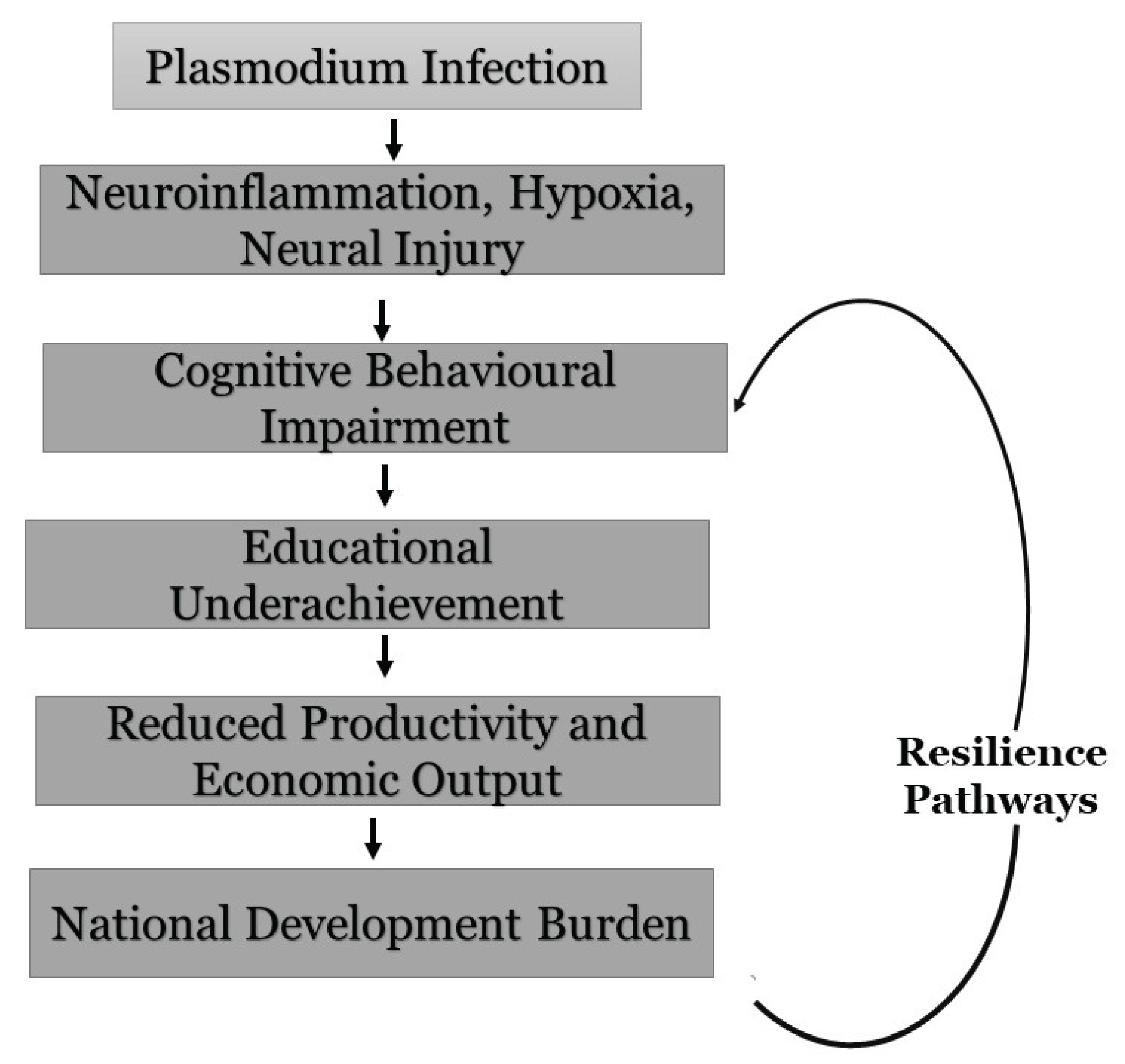
Table 1.
Biological Mechanisms Linking Malaria to Neurocognitive Impairment.
| Mechanism | Description | Supporting Evidence / Biomarkers | Functional Consequence |
|---|---|---|---|
| Cerebral sequestration | Parasite-laden RBCs block microcirculation | MRI hypoperfusion | Localized ischemia, neuronal death |
| Neuroinflammation | Cytokine storm (TNF-α, IL-1β, IL-6) | Elevated serum/plasma cytokines | BBB breakdown, glial activation |
| Oxidative stress | ROS and RNS production | MDA, SOD, GPx alterations | Synaptic injury |
| Excitotoxicity | Excess glutamate release | NAA:Cr ratios ↓ (MR spectroscopy) | Cognitive decline |
| Hypoglycemia and metabolic stress | Glucose depletion in brain | EEG slowing | Reduced neuronal energy metabolism |
RBC: Red blood cells, MRI: Magnetic Resonance Imaging, BBB: Blood brain Barrier, TNF-α, Tumor necrosis factor alpha, IL-1β: Interleukin I beta, IL-6: Interleukin 6, ROS: Reactive oxygen species, RNS: Reactive nitrogen species, MDA: Malondialdehyde, SOD: Superoxide dismutase, GPx: Glutathione peroxidase, NAA: Cr: N-acetylaspartate (NAA) to creatine (Cr).
Table 4.
Economic Impact of Malaria-Related Cognitive Deficits.
| Level | Indicator | Estimated Effect | Source / Context |
|---|---|---|---|
| Individual | Lifetime income | ↓ 10–15% | Economic modeling (Gallup and Sachs, 2001; Andrade et al., 2022) |
| Household | School absenteeism costs | 5–10 lost school days/child/year | Rural African settings |
| National | GDP growth | ↓ 1–1.3% annually | Cross-country regression Gallup et al., 2001; Andrade et al., 2022) |
| Regional | Productivity loss | >$12 billion annually | African Union estimates |
GDP: Gross Domestic Product.
Table 5.
Policy and Intervention Framework for a Brain-Safe Africa.
| Policy Pillar | Target Population | Key Actions | Expected Outcomes |
|---|---|---|---|
| Health Integration | Children under 10 | Post-malaria neurocognitive screening | Early detection of impairment |
| Education Protection | Schools in endemic zones | School health and nutrition programs | Improved learning resilience |
| Economic Safety Nets | Vulnerable households | Cash transfers, subsidized healthcare | Reduced infection and poverty cycles |
| Research Investment | African neuroscience institutions | Longitudinal neurodevelopmental cohorts | Regional data for evidence-based policy |
| Governance / Policy | Ministries of Health, Education, Finance | “Brain-Safe Malaria Policy” | Coordinated cognitive equity agenda |
Disclaimer/Publisher’s Note: The statements, opinions and data contained in all publications are solely those of the individual author(s) and contributor(s) and not of MDPI and/or the editor(s). MDPI and/or the editor(s) disclaim responsibility for any injury to people or property resulting from any ideas, methods, instructions or products referred to in the content. |
© 2025 by the authors. Licensee MDPI, Basel, Switzerland. This article is an open access article distributed under the terms and conditions of the Creative Commons Attribution (CC BY) license (http://creativecommons.org/licenses/by/4.0/).
Copyright: This open access article is published under a Creative Commons CC BY 4.0 license, which permit the free download, distribution, and reuse, provided that the author and preprint are cited in any reuse.