

Submitted:
11 November 2025
Posted:
13 November 2025
Read the latest preprint version here
Abstract
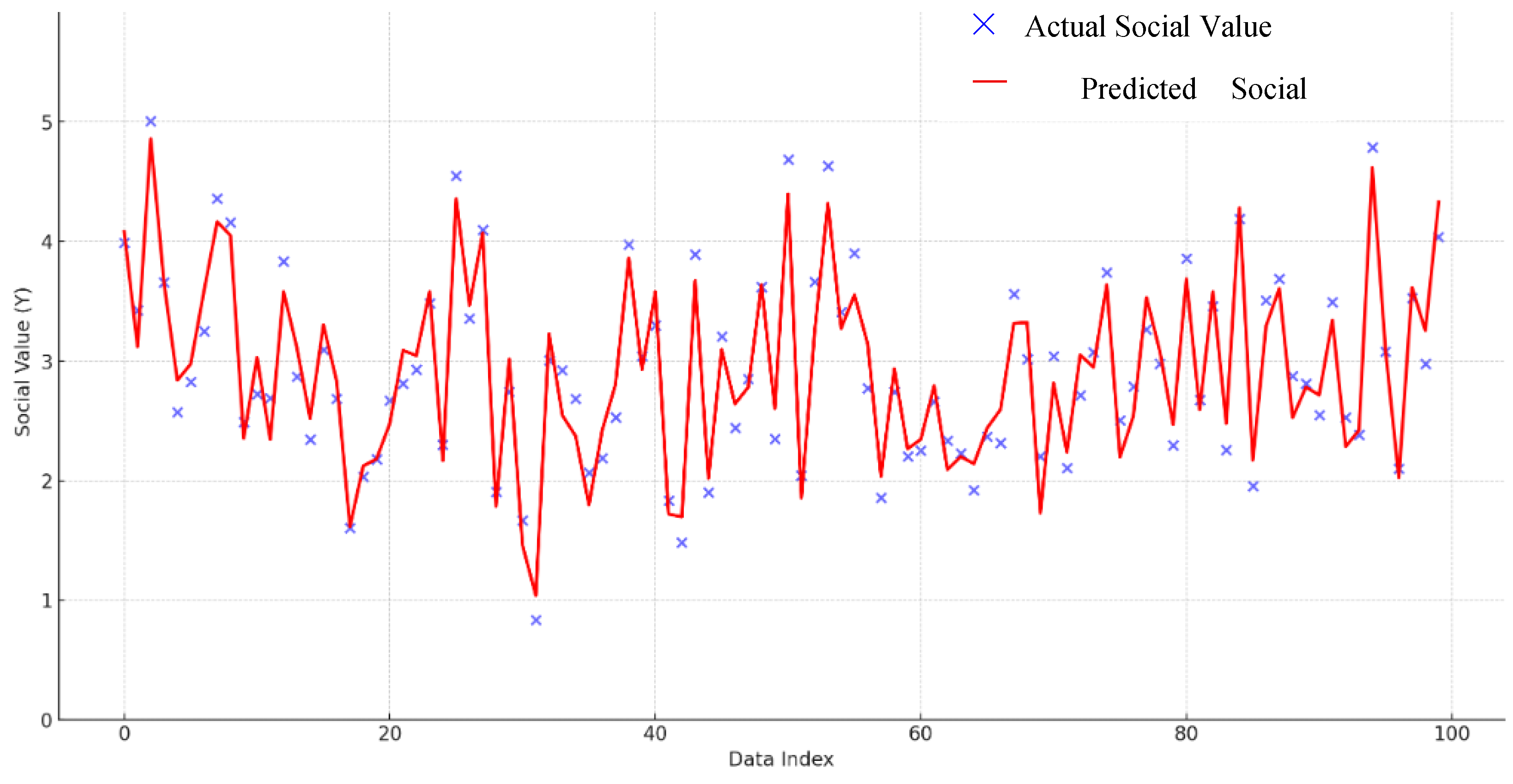
As a representative expression of Dunhuang music and dance culture, the dance drama Silk Road Flower Rain not only embodies the historical and cultural legacy of the ancient Silk Road but also functions as an important vehicle for transmitting traditional Chinese culture and reinforcing cultural confidence. This study quantifies the perceived social value of Silk Road Flower Rain using a penalized linear regression applied to Likert-scale survey data. We estimate standardized effects of community participation and cross-regional exchange on a composite outcome combining social identity and public engagement. Statistical inference for the ridge estimator is obtained via permutation- and bootstrap-based procedures with 10,000 resamples, producing two-sided 95% confidence intervals and family-wise-error-rate–adjusted p-values. Out-of-sample performance was evaluated by repeated 10-fold cross-validation (50 repetitions), yielding a mean CV R² of 0.90 (SD = 0.05) and a mean absolute error of 0.23 (SD = 0.04) on the 1–5 scale. (p value?) Results indicate that all predictors have statistically significant positive effects on social value; social participation is identified as the primary driving factor, while youth cultural education emerges as a critical area in need of targeted improvement. Robustness checks using ordinal logistic regression confirm the consistency of coefficient directions and relative magnitudes across model specifications. Based on these findings, we propose a targeted optimization framework to enhance social value, including establishing a community–university–theater linkage mechanism to strengthen social participation; developing a curriculum–practice–digital integrated system to improve youth cultural education; and leveraging policy support and international exchange to broaden cultural influence. This study fills a gap in the quantitative investigation of the social value of Dunhuang music and dance and provides scientific, practice-oriented guidance for the modern transmission of this cultural form. Based on the findings, we propose a targeted optimization framework to enhance the social value of Silk Road Flower Rain: (1) establish a community–university–theater coordination mechanism to strengthen public social participation; (2) build an integrated curriculum–practice–digital system to improve youth cultural education; and (3) leverage policy support and international exchange to expand the global influence of Dunhuang music and dance culture.
Keywords:
1. Introduction
2. Literature and Research Hypothesis
3. Research Methodology
3.1. Questionnaire Design and Survey
3.2. Data Processing and Variables Definition
3.3. Theoretical Basis and Dimensional Rationality for Cultural Identity and Youth Cultural Education
3.4. Theoretical Basis and Empirical Connection for the Operational Indicators of Social Participation
3.5. Model Selection and Model Test
4. Results and Discussions
4.1. Average Scores of Respondents
4.2. Ridge Regression Model Building
4.3. Ridge Regression Model Test
4.3.1. Overall Fitting Test
4.3.2. Coefficient Significance Test
4.4. Model Interpretation
4.5. Robustness Test
4.6. Impact Analysis of Each Factor on Social Value
4.6.1. Impact of Social Cultural Identity X1
4.6.2. Role in Enhancing Community Cultural Activities X2
4.6.3. Effectiveness in Promoting Cultural Exchanges Between Different Regions X3
4.6.4. Impact on Cultural Education of the Young Generation X4
4.6.5. Social Participation X5
4.6.6. Social Recognition X6
4.7. Results of Research Hypothesis Verification
5. Development Strategies for Social Value of Dunhuang Music and Dance
5.1. Building a Community-University-Theater Linkage Mechanism
5.1.1. Leveraging the Flying Apsara Effect of Silk Road Flower Rain
5.1.2. Breaking Geographical Barriers to Cultural Dissemination
5.1.3. Leveraging the Flying Apsara Brand Effect and Digital Technology Innovation
5.2. Building a Curriculum-Practice-Digital Integrated System
5.2.1. Embedding Dunhuang Culture into Formal Education
5.2.2. Digital Education Expansion
5.2.3. University-Industry-Research Collaboration
5.3. Policy Support and International Promotion
5.3.1. Policy and Financial Guarantee for Cultural Industry Integration
5.3.2. Constructing an International Exchange Platform for Cultural Dissemination
5.4. Forming a Comprehensive Value Enhancement System
5.5. Quantified Expected Outcomes
5.6. Limitations and Future Directions
6. Conclusions
Funding
References
- Chai, J. (1987). Collation and Analysis of Dunhuang Dance Scores (Part 1). Dunhuang Studies.
- Chai, J. (1988). Collation and Analysis of Dunhuang Dance Scores (Part 2). Dunhuang Studies.
- Chai J, Liu J (2019). Dunhuang.
- Chen, Y. (1983). Review of Research on the Dunhuang Music Score. Chinese Music.
- Chen, Y. (1985). Ancient Chinese Music Scores and Their Classification. Journal of Xi'an Conservatory of Music.
- Chen, Y. (1988a). A New Interpretation of the Dunhuang Music Score (Part 1). The Art of Music.
- Chen, Y. (1988b). A New Interpretation of the Dunhuang Music Score (Part 1). The Art of Music.
- Ding, S. (2024). 45 Years of Performing Abroad with Thousands of Shows: Why Silk Road Flower Rain Remains Ever-Fresh—An Interview with Wang Qiong, Vice President of Gansu Provincial Song and Dance Theatre. China News Service. https://gs.ifeng.
- Dong, X. (1979). Thoughts on the Music and Dance Art of Dunhuang Murals. Literature & Art Studies.
- Dong, X. (1982). Dunhuang Murals and Tang Dynasty Dance. Cultural Relics.
- Du, Y. (2024). Silk Road Flower Rain, /: [OL]. Xinmin Evening News. Available at: https, 2024. [Google Scholar]
- Dunhuang Academy (2016). Complete Collection of Dunhuang Grotto Art.
- Fan J, Cai W, Huang W (2011). Archaeological Report on Caves 266-275 of Mogao Grottoes.
- Fan, J. (2014). The Preservation of the Mogao Caves in Dunhuang, 24 January.
- Fan, X. (2024). A Study on the Correlation between University Musical Theatre Performance and Sociocultural Inheritance. Modern Music.
- Gao, J. (2000). The Music and Dance Art of the Dunhuang Caves.
- Gao, J. (2002). Dunhuang Dance Tutorial.
- Gao, D. (2008). Dunhuang Ancient Music and Dance.
- Hastie, T. , Tibshirani, R., & Friedman, J. (2009). The Elements of Statistical Learning: Data Mining, Inference, and Prediction (2nd ed.). Springer.
- He, Y. (2007). The Origin of the Name Dunhuang Dance. Dance.
- He, Y. (2008). The Magical Dance Revived from Dunhuang Murals ——The Leading Actor of Silk Road Flower Rain Talks about the Choreography, Performance and Teaching of Dunhuang Dance. Art Criticsim.
- He, Y. (2009). Dunhuang Dance Training and Performance Tutorial.
- Hu T, Brimblecombe P (2023). Capillary Rise Induced Salt Deterioration on Ancient Wall Paintings at the Mogao Grottoes. Science of the Total Environment, 1634. [CrossRef]
- Li, X. (2020). Unlocking the Dunhuang Dance Code - Remembering Gao Jinrong, Founder of the Dunhuang Dance Teaching System. Gansu Daily. https://www.gswbj.gov.cn/a/2020/01/14/4136.html. 14 January.
- Lin, Y. (2024). Digital Protection of Cultural Relics and Social Participation in Sharing. Cultural Industry.
- Ma Z, Gao S. (2021). Research on Intangible Cultural Heritage and Cultural Identity. ( 2021). Research on Intangible Cultural Heritage and Cultural Identity. Qilu Realm of Arts (Journal of Shandong University of Arts). 4, 109–114.
- Ning, Q. (2004). Art, Religion, and Politics in Medieval China: The Dunhuang Cave of the Zhai Family. University of Hawai'i Press.
- Ning, Q. (2020). Dunhuang Cave Art: A Study of Social History and Style. Cultural Relics Publishing House.
- Niu, L. (1991). A Compendium and Study of Materials on Music History in Dunhuang Murals. Dunhuang Literature and Art Publishing House.
- Peng, M. (2018). The Discovery and Research of Chinese Grottoes and Temple Caves, Chinese Cultural Heritage, 5, 4-13.
- Putnam, R. D (2000). Bowling Alone: The Collapse and Revival of American Community. Simon & Schuster.
- Rong, X. (2024). Eighteen Lectures on Dunhuang.
- Sheng H, (2024).National Dance Drama Silk Road Flower Rain: Endowing Dunhuang Music and Dance with Contemporary Vitality, Guangming Daily, https://news.gmw.cn/2024-06/19/content_37387046.htm.
- Shi, M. (2012). Dunhuang Dance Tutorial: Presentation of the Dance Images of the Musicians. World Book Publishing Company.
- Shi M, Qin K. (2023). Dunhuang Dance Tutorial: Presentation of the Dance Images of the Male Musicians. Cultural Art Publishing House.
- Smith, L. (2006). The Uses of Heritage.
- Su B, Zhang H, et al (2018). A Scientific Investigation of Five Polymeric Materials Used in the Conservation of Murals in Dunhuang Mogao Grottoes. Journal of Cultural Heritage. [CrossRef]
- Sun R, Sun Y. (2001) A Complete Collection of the Dunhuang Caves: Volume on Architectural Painting (Vol. 21). Hong Kong Commercial Press.
- Tajfel H, Turner J. (1979). The Social Identity Theory of Intergroup Behavior.
- Tajfel, H. (1982). Social Identity and Intergroup Relations. [CrossRef]
- Wang, K. (1985). Exploration of Dunhuang dance score fragments. Dance Art.
- Wang, J. (2009). Dunhuang Art: From Original to Regenerated—Also on the 30th Anniversary of the Successful Performance of the Famous Grand Music and Dance Silk Road Flower Rain. Gansu Social Sciences, 5, 25-30.
- Wang J, Yan Z, et al (2016) Experimental research on mechanical ventilation system for Cave 328 in Mogao Grottoes, Dunhuang, China. Energy and Buildings. [CrossRef]
- Wang K, Chai J. (2007). Raiment of Rainbows and Feathers: Music and Dance from the Dunhuang Murals. Gansu Education Publishing House.
- Wang, L. (2019). Silk Road Flower Rain of Eternal Youth: Written on the Occasion of the 40th Anniversary of the Creation of the Classic Dance Drama Silk Road Flower Rain [OL]. Gansu Daily, 22 May 2019. [Google Scholar]
- Wooldridge J., M. (2021). Introductory Econometrics: A Modern Approach.
- Xi, Z. 1983). A Study of Pipa Notation in the Sutra of the Buddha's Conduct: The Uplifted Section—Along with a Discussion on the Translation of Dunhuang Musical Scores. Music Research, -67.
- Xi, Z. (1987). Analysis and Discussion on the Textual Reading and Semantic Interpretation of the Preface of the Tang Dynasty Music and Dance ultimate book (Jueshu) — A Cross-Examination of Dunhuang Dance Scores(Part 1). Musicology in China.
- Xi, Z. (1992a). Research on Ancient Silk Road Music and Dunhuang Dance Scores. Dunhuang Literature & Art Publishing House.
- Xi, Z. (1992b). Dunhuang Ancient Music.
- Xu, D. (2019). Introduction: Dunhuang and Education—The Missing Piece. In: Di, X. (eds) The Dunhuang Grottoes and Global Education. Spirituality, Religion, and Education. Palgrave Macmillan. [CrossRef]
- Ye, D. (1982). Research on Dunhuang Musical Scores. Music Art.
- Ye, D. (1985). Tang Dynasty Music and Ancient Music Notation Translation.
- Yan L, Dong B. (2023). From Cultural Exploration to Cultural Experience: The Formation Mechanism and Educational Path of Cultural Identity. Global Education.
- Yin, F. (1951). Discussion on Tang Dynasty Music and Dance from Dunhuang Murals. Cultural Relics Reference Materials.
- Yin Y, Sun D, et al (2019). Investigation of ancient wall paintings in Mogao Grottoes at Dunhuang using laser-induced breakdown spectroscopy. Optics & Laser Technology. [CrossRef]
- Yuan D, Shi Y, et al (2000). Feature of Fracture-Induced New Activity in Dunhuang Mogao Grottoes Region and Its Effect on Caves. Dunhuang Research.
- Zhang Y, et al (2022). Fast identification of mural pigments at Mogao Grottoes using a LIBS-based spectral matching algorithm. Plasma Science and Technology, 0840. [CrossRef]
- Zhang H, Tang C, et al. (2024). Analysis of cracking behavior of murals in Mogao Grottoes under environmental humidity change. ( 67, 83–193.
- Zheng, R. (1997). The Formation, Categorization and Scheme of Dunhuang Music and Dance Murals. Dunhuang Research.
- Zheng, R. (2002). Research on Dunhuang Music and Dance Murals.
- Zhuang, Z. (1984). Music of the Dunhuang Caves.
- Zhuang, Z. (1998). Mural Musicians at the Western Thousand Buddhas Cave in Dunhuang. Dunhuang Research.

| Dimensions of Social Value | Specific Survey Items | Likert 5-Point Scale Options |
|---|---|---|
| Social cultural identity (X1) | How do you think Silk Road Flower Rain influences the public's sense of belonging and recognition toward Dunhuang culture? | 1=No influence at all; 2=Slight influence; 3=General influence; 4= Significant influence; 5=Extremely significant influence |
| Enhancement of community cultural activities (X2) | How effective do you think Silk Road Flower Rain is in enriching community cultural life and promoting residents' participation in cultural activities? | 1=Extremely ineffective; 2 = Slightly ineffective; 3 = Generally effective; 4 =Significantly effective; 5= Extremely effective |
| Promotion of cross-regional cultural exchanges (X3) | How effective do you think Silk Road Flower Rain is in facilitating cultural communication between different regions and promoting the integration of local cultures? | 1=Extremely ineffective; 2= Slightly ineffective; 3=Generally effective; 4=Significantly effective; 5 =Extremely effective |
| Cultural education for the younger generation (X4) | How important do you think Silk Road Flower Rain is in helping young people understand Dunhuang's historical and cultural connotations and fostering their cultural confidence? | 1=Extremely unimportant; 2= Slightly unimportant; 3=Generally important; 4=Significantly important; 5=Extremely important |
| Demographic Variable | Category | Number of Samples | Proportion (%) |
|---|---|---|---|
| Occupation | University teachers/social scholars | 32 | 32 |
| University students | 35 | 35 | |
| Artists/general workers | 33 | 33 | |
| Gender | Male | 48 | 48 |
| Female | 52 | 52 | |
| Age | 18–25 years old | 36 | 36 |
| 26–45 years old | 42 | 42 | |
| 46–60 years old | 18 | 18 | |
| > 60 years old | 4 | 4 | |
| Region | Northwest China (including Gansu, Shaanxi) | 45 | 45 |
| East China (including Shanghai, Jiangsu) | 23 | 23 | |
| South China (including Guangdong, Fujian) | 18 | 18 | |
| Other regions | 14 | 14 |
| Questions No. | Questions | Mean Score | SD |
| 1 | How do you think Silk Road Flower Rain influences social cultural identity? | 3.06 | 1.406 |
| 2 | How effective do you think Silk Road Flower Rain is in enhancing community cultural activities? | 3.24 | 1.350 |
| 3 | How effective do you think Silk Road Flower Rain is in promoting cultural exchanges between different regions? | 2.98 | 1.531 |
| 4 | How important do you think Silk Road Flower Rain is in educating the younger generation about culture? | 2.82 | 1.384 |
| Predictor | Ordinal Regression (Standardized β) | Ridge Regression (Standardized β) | Consistency |
| Social cultural identity X1 | 0.168 | 0.1734 | High |
| Community cultural activities X2 | 0.197 | 0.2009 | High |
| Cross-regional cultural exchanges X3 | 0.192 | 0.1955 | High |
| Youth cultural education X4 | 0.157 | 0.1607 | High |
| Social participation X5 | 0.275 | 0.2798 | High |
| Social recognition X6 | 0.228 | 0.2302 | High |
Disclaimer/Publisher’s Note: The statements, opinions and data contained in all publications are solely those of the individual author(s) and contributor(s) and not of MDPI and/or the editor(s). MDPI and/or the editor(s) disclaim responsibility for any injury to people or property resulting from any ideas, methods, instructions or products referred to in the content. |
© 2025 by the authors. Licensee MDPI, Basel, Switzerland. This article is an open access article distributed under the terms and conditions of the Creative Commons Attribution (CC BY) license (http://creativecommons.org/licenses/by/4.0/).