
Submitted:
27 October 2025
Posted:
28 October 2025
You are already at the latest version
Abstract
The 4th Industrial Revolution is a phenomenon describing shift from traditional conception of the computer and the machine into reality with intelligent automation and fabrication. Additive manufacturing describes new technologies for production, made possible with the evolution of computational tools, material engineering, robotics. As one of the most common categories of additive manufacturing, 3D printing is a technology already present in architecture, engineering and construction (AEC) industry both on practical and experimental level. Large-scale 3D printing includes fabrication of real-size buildings and as a consequence is a subject of extensive multidisciplinary researches and experimentations. Small-scale 3D printing offers opportunity to reduce cost of experimentation in large-scale printing domain but also to produce useable, real size products that can be applied and used in the construction industry. This paper is intentioned to present examples and discuss the potential of further integration of small-scale 3D printing technology in AEC industry. As a relatively new technology, already being mass adopted by the global population of makers, hobbyists, scientists, small scale 3D printing has a huge potential to contribute to sustainable and efficient progress of 4th Industrial Revolution in the domain of building design and construction.
Keywords:
architecture
; 3d printing
; additive manufacturing
; 3d modelling
1. 4th Industrial Revolution
1.1. 4th Industrial Revolution and AEC
First Industrial Revolution was connected with mechanization based on water and steam power, second with mass production with electricity and the assembly line creation, third with introduction of computer technology and automation in processes and the Fourth Industrial Revolution will be based on the usage of Cyber-Physical Systems (CPS) [1]. Fourth Industrial Revolution also represents beginning of a profound change and beginning of the digital transition [2,3]. In this context Cyber-Physical Systems include development of advanced manufacturing systems, integrated with the development of Artificial Intelligence, blockchain, Internet of Things, and other emerging technologies and hybrid systems. CPS are designed and built to be applicable throughout the industries and are subject of increasing amount of research around the world.
Digital fabrication is a concept describing automated production of digitally designed goods and includes integration of different technologies such as AI and IoT to increase the geometric complexity of nonstandard from while reducing cost and waste. [2,14]. Digital fabrication is the biggest innovation related to new materials and production methods occurred in the 21st century supported by the computer. [15] The idea of digital fabrication is that the production process is performed by the machine or robot from the start till the end without human interference -completely autonomously. [16]. It involves creation of physical 3D objects by placement of consecutive layers of material by the machine in a computer-controlled way [17] At the same time there are significant efforts to integrate construction features of robotic arm into the BIM design process. Such an automated building design and construction methodology needs to accommodate different parameters of the robotic operations such as speed, acceleration, dimensions, or material specifications - with the design constraints. Such integrations and symbioses of different technologies is at the core of successful transformation of AEC industry towards more optimized and sustainable building design, construction and utilization. Design of systems that combine the BIM technology with robotic operations allow for early design modification which in return should enable significant cost savings in each phase of building life – design, construction, operation. [18]
1.2. Additive Manufacturing
Additive Manufacturing (AM) is – as a technology of depositing successive layers of material different from classical manufacturing of material removal and forming. [19] It is a procedure of creating three dimensional objects by successive printing of layers of materials on top of one another. [20] With introduction of computer and information technology it becomes digitalized manufacturing, allowing the disposition of material where it pleases. [16]. At the same time AM is considered one of the core technological advances in the paradigm shift to Industry 4.0. [21] One of roots of the of additive manufacturing lies in the MIT patent by Sachs which describes the process in four steps: 1. Depositing a layer of powder material in a confined region, 2. Applying further layers of powder material which will cause bonding, 3. Repeating steps 1. & 2. 4. Removing unbounded powder. [22]
In the last 3 decades different approaches to additive manufacturing were invented, including stereolithography, selective laser sintering, fused deposition modeling, and inkjet powder printing. Additive manufacturing is defined by ASTM as ‘the process of joining materials to make objects from 3D model data, usually layer upon layer, as opposed to subtractive manufacturing methodologies’. [8,23] In other report it includes seven different categories: binder jetting, directed energy deposition, material extrusion, material jetting, powder bed fusion, sheet lamination and vat photopolymerization. [1]. Extrusion-based technologies (Direct Ink Writing and Fused Filament Fabrication) are used by hobbyists, researchers, teachers, professionals, because of low cost, simple architecture, and availability and access of material feedstocks. [34]. Rapid prototyping, Direct Digital Manufacturing and Layer Manufacturing are some of the technologies included within the term of Additive Manufacturing. [20]
Because of many issues that it solves, additive manufacturing is one of the most promising tools which has potential to renovate the construction process with a sustainable future. [3] Inherent environmental benefits, impact on quality, reducing project delays, safety in construction process, labor and productivity problem in AEC, high costs, and the increasing demand for housing are some of the issues which are being solved or avoided with the use of additive manufacturing in architecture and construction. [1] Additive manufacturing allows direct and accurate construction of customized and multifunctional applicable building components and allows for design and fabrication of high-performance and adaptive structures, promoting lightweight construction [24,25] Regardless the presented potentials of AM to bring benefits to AEC industry, the AM technology have only recently begun to be adopted for construction purposes. [5,21,26] Another obstacle to mass adoption of AM technology in AEC is lack of standardization which require clear standards for materials, processes, calibration, testing and file formats. [26,27,28]
2. Large-Scale 3D Printing
2.1. Concept of 3D Printing
One of the most commonly associated categories of AM is 3D printing (3DP) which is based on material extrusion process and uses materials such as plastics, concrete, sand, resins, or metals. [1,17,29] The earliest records of 3D printing are recorded back in the 1980’s [21]. Since 1983, when Charles W. invented 3D printer, the rapid development and integration of 3D printing technology has been successful in many industries such as automotive, aerospace and space technology and medicine. [30] 3D Printing is application of technology to fabricate complex models in consequent layers, regardless of the shape geometry [29]. It is a type of mechanism which uses a moveable print head and the attached nozzle from which material is extruded [21].
3D printing is defined as an additive manufacturing technology, but in some cases 3D printing and AM are synonyms denoting construction of an object through the successive building of material. [21,31] In other case additive manufacturing, rapid prototyping, 3D printing are all synonyms. [1,29] 3D printing is also known as additive fabrication, additive processes, direct digital manufacturing, rapid manufacturing, layer manufacturing, and solid freeform fabrication. [17]
3D printing plastic materials (PLA, ABS, etc.) had emerged at the beginning of 21st century and were the main contributions for the mass adoption of the technology by the general publics. [16] Among the materials used in small-scale 3DP are plastic (nylon, polymers, acrylonitrile butadiene styrene (ABS) or poly lactic acid (PLA)), ceramic, metal, and wax and these are mainly used for FDM and SLS printers. Hardened liquid photosensitive resins are employed for SLA printers. [12].
3D printing is defined as ‘additive manufacturing process of making three-dimensional solid objects from a digital file’. [20] Process of 3D printing involves three-dimensional modeling using computer software, analysis and preparation of cross-sectional layers of the finished 3D model and conversion of layers into paths which are deposited one over the other from the bottom up. [1] Fast product prototyping, product development, 3D visualization, distributed manufacturing of larger-sized objects such as machine parts are some of its practical applications. [31]
3D printing – or rapid prototyping (RP) – includes technology which is commonly available and accessible such as desktop 3D printers and other in-home equipment. Systems for desktop 3D printers include SLA (stereolithography – oldest of three processes, and it uses a UV laser beam to cure liquid resin into hardened plastic), SLS (selective laser sintering – uses a strong laser beam to cure powdered material) and FDM (fused deposition modeling – the most common method where, melted material is extruded in layers on the printer’s heated bed, creating an object) [12]. During the print filament of thermoplastic material is extruded continuously from a hot nozzle in linear segments that are accumulated to create a shape [14]. FDM 3D printers such as MakerBot or Flashforge are based on gantry systems technology [21]. Fused deposition modeling became the most popular 3D printing technology across the world over the last two decades. [32] Figure 1 shows small scale 3D printer Prusa MK3S+.
2.2. Large-Scale 3D Printing
In 1960s the first robotics and automated systems for construction were developed. [2] Joseph Pegna of the Rensselaer Polytechnic Institute is mostly accredited with first experiments with large-scale 3d printing of cementitious material in the late 1990s (1997). [5,13,16,17] In his consequent paper Pegna refers to 3d printing as a new approach to masonry. [16] In the same year, Khoshnevis (University of South California) published a paper called “Additive fabrication method” which is later coined as “Contour Crafting” technology. Concrete printing (Loughborough University, 2003), D-shape (Dini, 2007) and selective deposition of ultra-high-performance concrete (Gosselin, 2016) are technologies which further develop and all of them can fabricate large-scale building components or whole buildings. [5]
3DP (3D Printing) is relatable to conventional construction methods in terms of shapes such as cantilevers, vaults and domes and as ancestral load-bearing wall systems, such as brick or stone. [13,16] Masonry structures are made of discrete elements (bricks) which have 3 dimensions (height, length and width) and are connected with bonding material which ensures stability after it has set, while 3D printed object is made of a continuous layer defined by 2 dimensions (its height and width). In 3D printing the bonding is provided by the properties of the freshly extruded material which means that the change of the material properties in a limited timeframe is the key for successful printing. [16] Masonry construction method is described as primitive additive manufacturing technology where structures are built by producing layers on top of layers. [26]
Additive manufacturing (3D printing) used in construction is also referred as Additive Construction (AC). [27] Digital technologies and processes, materials science and robotics and automation are three main, distinct categories of digitization and automation in construction industry [1]. Research topics in large-scale 3D printing are divided according to three main aspects: 1. technological solutions of additive fabrication (i.e. the 3D printers themselves), 2. material science challenges, 3. and new building design opportunities. [23] In AM and 3DP all rather distinct and independent sciences are combined together into a wholesome system which is able to independently and automatically produce physical artifacts.
Large-scale 3D printing (additive construction) is a special type of additive manufacturing specialized on production of largescale, heavy, and often permanent structures. [23] Building physics should be designed and manufactured in a way to be able to resist earthquakes and provide seismic safety, but also to comply with fire resistance and other numerous regulations required by the building safety standards – but also comply with the limitations of the 3D printing machine and the printing process itself. [1] 3D printing of large structures requires interdisciplinary approach and collaboration between different research fields including structural engineering, materials science, mechatronics, software engineering, artificial intelligence and architectural engineering. [23] Combination of 3D printing with construction industry is also denoted as “construction 3D printing”. [5]
Unlike the conventional construction process which shows no significant progress in the last decades, 3D printing is already proving to be highly applicable in AEC industry enabling reduction in construction time and waste, mass customization and complex architectural shapes. 3D printing allows for new approach in construction by combining material elaboration and digital management. 3D printing in construction is defined as deposition of successive layers of the composite with rapid hardening and adherence by means of a nozzle suspended on a gantry for movement in three axes or by robotic arm with several axes of freedom. [13].
Advantages of integrating 3D printing technology in the construction industry are significant and include improved environmental and financial strategies and possibility to produce complex customized designs for aesthetic and structural applications. [21,33] Saving of costs and time, safety, on-site security, optimization of material consumption and waste reduction are also some of the advantages possibly delivered by 3D printing technology. Use of 3D printing in construction would extensively reduce the need for scaffoldings which can count up to 30% to 60% of the structure cost for concrete casting. [7,16]
3. Application of Small-Scale 3D Printed Models in AEC
3.1. 3D Modeling
Commonly used AM technologies require use of a computer, a 3D modeling software, machine equipment and the layering material. The object first needs to be digitally modeled, as a CAD file, before it is translated into a code understandable by the machine. [20] Using computer to reduce three-dimensional volume to a series of 2D layers is a fundamental principle of 3D printing. [22] 3D modeling and preparation of computer model is important element of 3D printing technology. 3D modeling in the case of 3DP is different from conventional 3D modeling for games, renders, animations for which commonly available software is used. When designing a 3D model boundary surface of the model must be watertight, with all faces connected with consisted orientation of surface normal. [32] Design of full-scale 3D printable prototype of Nematox façade node required 120 hours of CAD 3D modeling including 10 hours of converting the 3D model geometry data into the appropriate AM file format. [26] The delicacy of the printing process requires careful design and export of the object geometry from the 3D software such as Blender, Rhinoceros3D + Grasshopper, etc. Most of the time when transferring the 3D model between different software, extra steps need to be undertaken in order to clean the model and readjust the parameters. Figure 7 shows the 3D model drawn in Blender and in its 3D printed form. The process of transferring the 3D model to the machine requires translation of 3D model geometry into a machine code, usually done in specially designed software which slices the model into layers of linear toolpaths.
Conventional, 3D digital modeling by drawing of geometry is also being transformed by the use of different optimization and AI software. Variety of digital tools offer architects and designer possibility to reduce the consumption of material, printing times, increase structural properties by letting software calculate specific dimensions, adjust or generate shapes according to predetermined computer algorithms. The use of these tools is becoming rapidly significant since they offer a unique opportunity to empirically optimize and generate designs which can fit structural, functional and other requirements and constraints. [16,21,29] Topology optimization is a methodology which removes the materials from places in the model where there are no forces while only keeping geometry which plays structural role in transition of load forces. Topology of the object can also be optimized according to printer properties such as speed and acceleration. [15] Optimization can be done manually by dimensioning and shaping the object according calculation of structural forces and using intuition or it can be done computationally based on preprogramed form generation and finding software. Design methodology, 3D modeling, machine features, as stages of 3D printing are interconnected and changes in one of the stages directly influences the performance in other stages of the process. Therefore, for a successful integration of 3D printing technology, a designer, architect, engineer should master the whole process from idea until printable object in order to use the 3D printing technology in an optimized and sustainable way.
Design and 3D modeling should be done in accordance of 3D printing process and its limitations taking into consideration printer speed, nozzle dimensions, layer thickness, material behavior and the extrusion capacity of the printer. [20] Different materials require different representations in digital space of 3D modeling software and suitable design and representation tools must be developed which will enable maximal control over the inputs, the process and the outputs. Voxel-based modeling seems to be useful in the design of 3D printable foam forms. [35] Different materials, fabrication methods, designs may be suitable for some of the software and not suitable for other ones, while there are many cases where teams of expert develop their own tools that match the needs of the project.
Small scale 3D printable models provide possibility to practice, learn and eventually utilize the 3D modeling skills which are in the same manner required in large-scale 3D printing. On the level of 3D modeling and printing it is also possible to explore different options that can then be further applied on bigger scales. Required continuity of the 3D printing process from start to end requires that there is no single error in terms of geometry because fragility of the fabrication process. Even if the most of the printing process is successful, a minor mistake in terms of geometry means that the printing process need to start from beginning which in the case of large-scale printing would be quite a setback. In this sense small-scale 3D printing and modeling methods are crucial before prototypes are further developed and scaled.
3D printing is being continuously explored in different ways because it became globally accessible and available to a rapidly growing community. There are growing online platforms for trade, exchange and download of 3D printable models. Even though the plastic material is most commonly used for small scale 3D printable models there is a significant number of examples of functional, useable, non-fragile 3D objects printed in plastics. Structural properties of plastics can also be increased (or decreased) with the overall form of the object but also with parameters such as thickness of the wall. The geometry of the object itself as well as the material properties both influence the overall structural capacities of a 3D printed object. In combination with computational tools it is possible to print structurally stable and strong objects such as helmets, machine parts and other objects which require structural durability. Materials used for small scale 3D printing can be further researched and developed. Figure 9 shows bird houses printed in PLA plastic left outdoors to observe the performance of printed plastics throughout the years of weather conditions changes.
Another geometrical challenge is design of object with interlocking parts which can’t be separated from each other and this topic is an inspiration for numerous creative solutions and products such as chains or flexible platforms. On the other hand, design of objects which can be assembled and dissembled is a design challenge which can also be computationally solved in a way to define pieces which will retain structural strength when combined together [36]. Such challenges require higher skills in understanding the geometry and CAD in order to successfully manage different constraints in terms of dimensions and production process.
3.2. 3D Printing Without Supports
Optimization of building form within the constraints of the 3D printer and the materials is a large field with lot of potential for exploration and development. Designing printable objects without infills, offsets or supports with continuous spiral paths, using an extruder attached to a robotic arm while the object remains static is presented in [14]. Infills, offsets, supports are additional parts of the printed object and serve to provide stability and enable printing of bridges, cantilevers and complex geometrical shapes. Supports and offsets are usually removed from the object after the printing is done, while infill constitutes the interior structure of the printed object and it is an important topic for many aspects of the quality of printed object.
FDM based printers can print shapes with or without having the supports. When printing objects which require supports, printer parallelly prints both the object and the supports from the first layer so that the supports can hold the critical overhangs of the object until the print is done and object becomes a whole. At the end of the process the printed support is easily removed from the printed object. Figure 6 shows the miniature of a bar chair printed with supports and after the removal of support part. On the other hand, SLA and SLS printer technologies can only print the object with the supporting material – each layer is firstly completely covered with powder-based material and then the section which belongs to the object is cured whilst the part which is supposed to be support remains in powder state. This technology always involves removal of the powder which acts as support after the object is printed and becomes a whole.
The limitation of inability to print flat, horizontal surfaces without supports is expressed in three common approaches to constructing roofs of 3D printed housing prototypes. One way is to construct a wooden or steel frames above 3D printed walls and then install roof panels – in the same way it is done in traditional construction. Second approach includes placement of prefabricated concrete slabs and then print or install parapets. Third one includes manual placement of the formwork and binding of rebars of the roof then casting or spraying of the concrete on them. [6] Even though these approaches seem most feasible now, explorations within the domain of design of printable structures which do not require supports or additional manual labor can be very important in further development of automation in construction. Reliability, cost reduction, reduction of need for expert workforce and other advantages of 3D printing are significantly reduced if the automation is strongly intertwined with the manual labor. Exploration of practical and applicable geometry of small-scale models within the constraints of 3D printing presents a huge field for further exploration which can highly benefit the process of printing of larger structures.
In this sense FDM printers provide the possibility to design architectural forms which do not require supports but still can answer to the requirements of their purpose. Design and print of architectural shapes which do not require supports significantly reduce the amount of consumed material and time it takes for print to finish. Figure 7 shows examples of forms which do not require supports in order to be 3D printed. For example, instead of printing a flat roof which immediately requires supports – the dome like shaped house would be more optimal and would not require any supports to be printed. Supports are important (similar to scaffoldings) because they increase the material consumption, time for printing, additional resources and labor, and building forms which do not require supports seems to be more optimal solutions for the 3D printing of buildings on massive scale. Small scale 3D printing technology provides possibilities to explore and experiment with forms which can be then implemented on a larger scale while avoiding unnecessary costs and waste. 3D printing in construction is considered as technology which removes need for formwork and scaffoldings therefore print of designs which require print of support may be paradoxical. That is why research in design, shape and form finding of 3D printable designs may be a very important development for the progress of the 3D printing industry as a whole.
3.3. 3D Printers as Research Tools in Construction
Different categorizations of 3D printing systems can be done according to available literature but based on the criteria of scale of 3D printing systems there are large-scale systems and small-scale systems. [12] Next to making the division based on the size of the machine 3D printing technology it is also possible to divide the possible application of small scale and large-scale 3D printable models. In this paper the small-scale 3D printing is considered as a regular 3D printing concept while large-scale 3D printing is emphasized because of significant differences in dimensions, materials, machines, software, etc.
The tool path of the machine which describes the geometry of the object and the consequent points of material disposure is extremely important topic and small-scale 3D printing can be used for research in this field. The tool path determines the feasibility, cost, machining time, aesthetics and structural properties of a 3D printed object [14]. In this sense the toolpath both determines the micro-structural features such as the interior structure of the wall and the wall profile but also the macro-structural features of the object as a whole. The relationship between the shapes of the building elements and the building as a whole – in the context of continuous 3D printing – is rarely researched or presented. In the large-scale 3D printing, most of the buildings have orthogonal shapes, many of them rounded corners, several use curved walls, few of them spherical. [13]. The same 3D CAD model can produce different results based on AM technology, machine parameters, orientation of the model within the machine boundaries, parameters of translation from geometry to machine code. Assembly, production, geometric freedom needs to be considered for taking full advantage of AM technology which require highly skilled and computer literate engineers. [26]
There is a qualitative difference between the print of large-scale and small-scale 3D models represented through tool paths (lines of motion of 3D printer head as it moves and extrudes the material from the attached nozzle). Large-scale paths spread more and their interruption becomes more challenging as the material deposition rates increase and it has been shown that printing large structures require as few interruptions as possible and with smoother changes in path orientations [14] With scaling also comes the problem of object remaining static during the print process because printing of small-scale models is usually done on a predefined flat platform. Large-scale printing would require possibility to print on terrain surfaces that are not flat and there are already researches which are addressing this issue. [34] With the increase in scale, material properties become increasingly more important while small-scale 3D printed models do not need to have the structural properties of a full-scale structure. [12]
For now, small-scale 3D printed models have a narrow field of application in AEC industry. Very common use of 3D printers is to print miniatures of building designs for exploration or representation purposes. [11,22,28] Important feature of printing small scale objects is that it is commonly available but there are significant structural challenges for its use in full-scale buildings [12]. Even so, 3d printer can be used to print small scale models to study the geometric aspects of the design paths and in one of the cases small scale prototypes with heights ranging from 10 to 40 cm are printed. [14]
There are many common points shared between the large- and small-scale 3D printing. The core concepts of the technology are the same and, in this context, small scale 3D printing systems can be used to conceptually explore large scale 3D printing systems before building them in their actual size. Small scale 3D printers can serve as a miniatures of large-scale 3D printing systems to explore different configurations and relations between the machine movements, the overall geometry of the building, logistical challenges and other scalable issues that can be observed on a small scale and implemented on a large-scale system.
Due to similarities between the machine concepts (extruder motion, extrusion, layering) small-scale 3D printing represents an important tool in developing concepts for 3D printing of large structures. Even though it is hard to simulate the very properties of materials such as concrete, steel or cob, plastics provide close enough quality for small-scale printing to produce similar errors and fails due to gravity, machine parameters, and geometrical features of the printed object. Essentially, most fails which would happen if the concrete or cob was used, would happen with plastic material. In this sense the domain of the machine design and the design geometry can be extensively explored with small 3D printers. [12] In one of the examples of exploration of real-size 3D printable parabolic concrete column small-scale models of concrete molds were printed. Besides the general development of 3D printing process, experimentation with small-scale printed models provided practical experiences with handling and hardening of the material, pouring of the concrete and removal of the formwork. [11]
Printing fails are specific research subject and studies differ based on different materials, equipment and building being printed. Some of the failures such as global instability of the object concerns mainly the geometry of the object, whilst plastic collapse and elastic buckling are linked to material properties. [16] In an example of printing 3D shapes made of hollow cells, three different fail modes are reported: cell collapse, partial cell collapse, and the too dense error -each corresponding to different parameters that are identified to participate in guiding towards the collapse. In the research forms such as Diamond and Gyroid are reported to be less prone to the problem of collapse due to the specific geometrical properties. [3] Print speed, filament extrusion rate, nozzle dimensions, printing path (related to 3D model and translation of 3D data into a tool path), filament height and print height are parameters responsible for the quality of final printed product. Small-scale printable models can play significant role in overseeing the potential fails arousing from geometrical properties when printing large, real size components.
Small-scale printable models are extremely useful in cases where series of prototypes is being made to fine tune different parameters on the level of machine, material and design in order to achieve seamless printing process from the start till the end. Small scale 3D printing has potential to significantly reduce cost of development and operation of large-scale 3D printers. On a smaller scale it is possible to test and experiment with different parameter settings with much lower costs but with output that can be used to improve the large-scale 3D printing process. If it can’t be printed on a small scale – it can’t be printed on a large scale too.
3D printing technology at the same time imposes limitations and constraints but open many new possibilities for construction of architectural forms. Creativity is also required to come up with new ways to use the given technology to fabricate buildings. Due to effects of gravity, elements such as flat lintels or floors cannot be printed without supports or without arched tops. To overcome this issue it is proposed to print lintels and floor beams with the first layers of printing process and then place them when the printing process arrives at the specific height for their placement. Such concept could involve human labor to place the pre-printed (as of pre-fabricated) elements or eventually a robotic arm could be pre-programed and integrated with the printer to place the elements accordingly. [17]
In the same manner the author of the paper had designed and printed small-scale experiments where the columns, beams, slab supports, roof coverings are printed together with the base of the building. The printing process was prepared to stop at specific layer heights to allow for the placement of the elements. Even if it is a small scale print such a process requires very delicate design, planning and machine operation together with the placements of the building elements during the print. (See Figure 2 and Figure 3.) Presented examples have a purpose to visualize the complexity of the challenge present in printing of flat slabs, beams and lintels but also to emphasize the importance of using small scale 3D printers to perform tests and go through the process on a small scale before using or constructing large scale 3D printers. Use of large-scale 3D printing equipment needs to be justified in terms of costs and performing small scale tests can help to optimize the process in terms of possible fails due to geometry, symmetry issues or machine operation parameters.
Experimenting and testing the process of 3D printable buildings on small scale can help to prevent failures on larger scale but also can serve to invent new approaches to 3D printing in AEC. Before significant investment in the research of large-scale 3D printing it would be more beneficial to use the possibilities given by small scale 3D printing to come up with more optimal solutions before actually applying them on the construction site. 3D printing of buildings is a complex process and optimization is possible on many levels and throughout all the phases, especially while the development of 3D printing technology for construction is still in its infancy and there is space for exploration and experimentation with different methods. In such a context, small scale 3D printers are essential tools to explore the possibilities of construction given with the technologies of 4th Industrial Revolution.
One of the problems of 3D concrete 3D printing is poor surface finishes. [8,27] Using small printable models it is possible to examine different micro geometries of the toolpaths in order to both increase the aesthetic and structural values of printed object. With the use of small-scale 3D printing, it is possible to experiment with structural capabilities of printed forms and in this case, the scale is not much of a limitation as loads and material properties can be also scaled to be proportional with the dimensions of the object. Special textures, geometrical shapes can be explored that are able to provide sufficient strength with least consumption of the material. (See Figure 4 and Figure 5.) Design and modeling of a 3D object intentioned for printing is very important for the whole process of 3D printing since a bad model can cause fails, machine issues, and in essence compromise the whole fabrication process. 3D model which is not adequately design and prepared for printing can never give satisfactory results regardless of the material or machine features. On the other hand, design and 3D modeling can extensively optimize the whole process by reducing waste, machine work-time, protection of printing equipment.
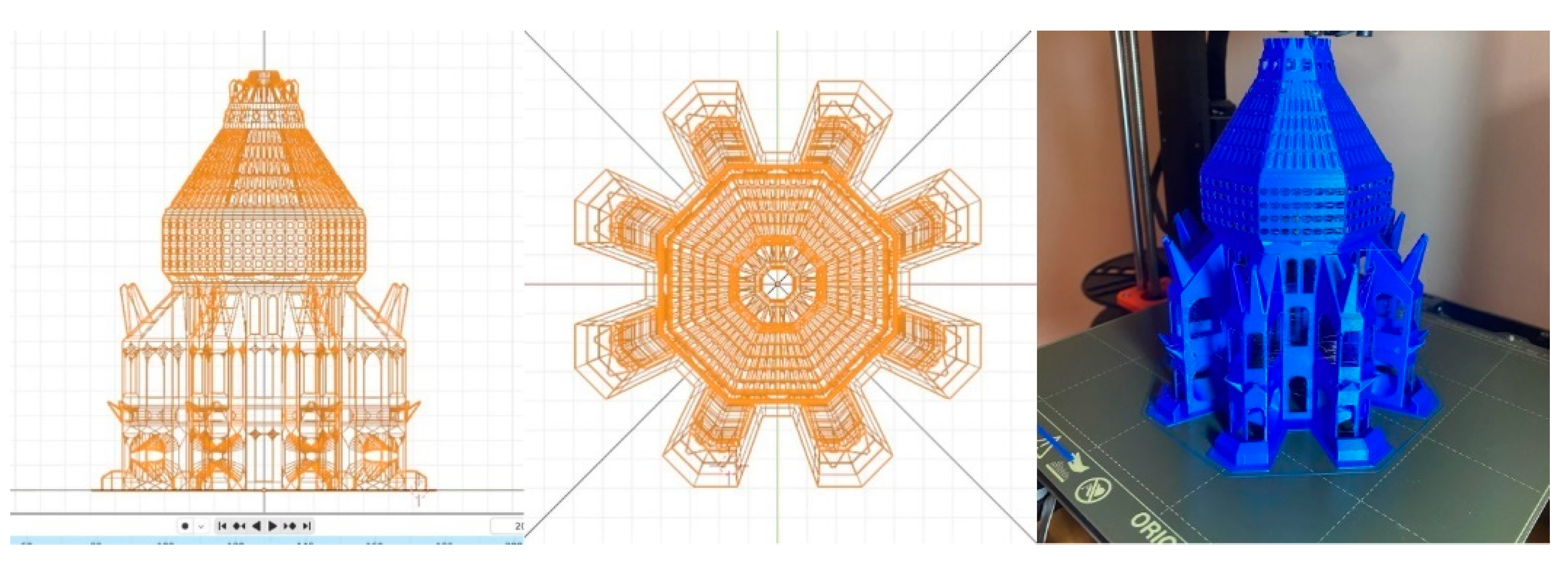
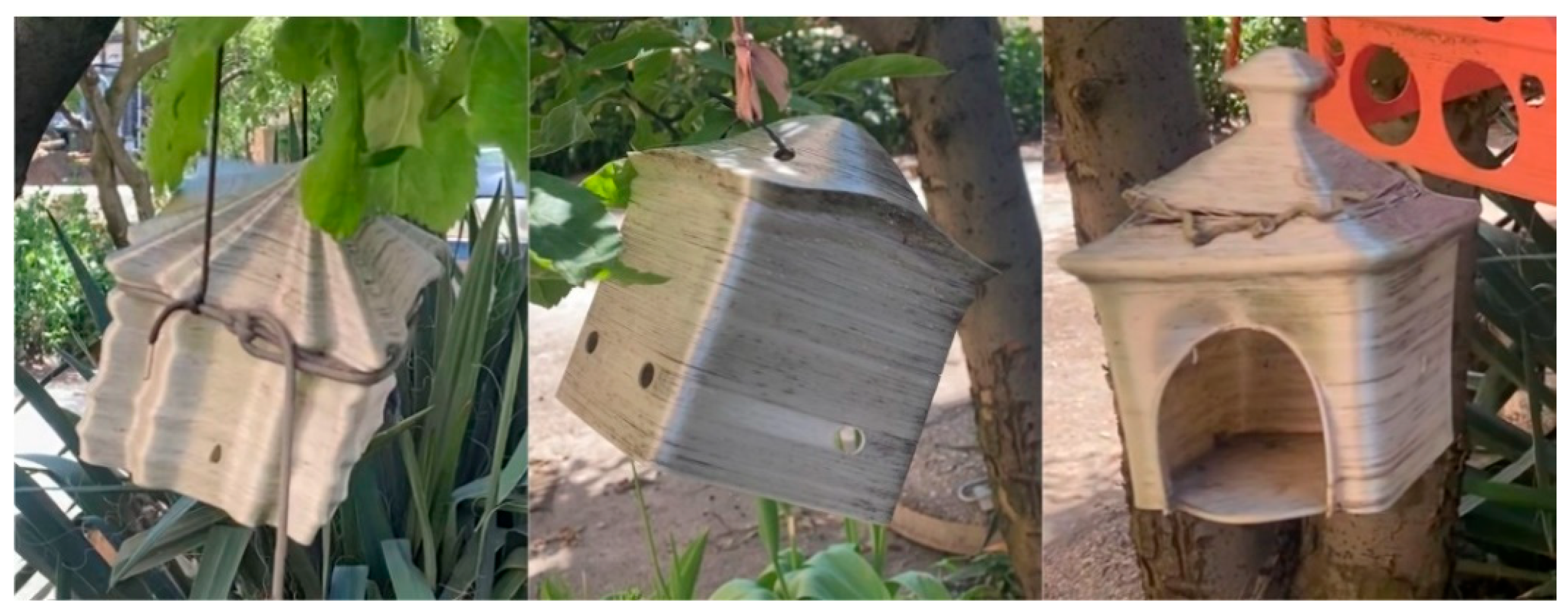
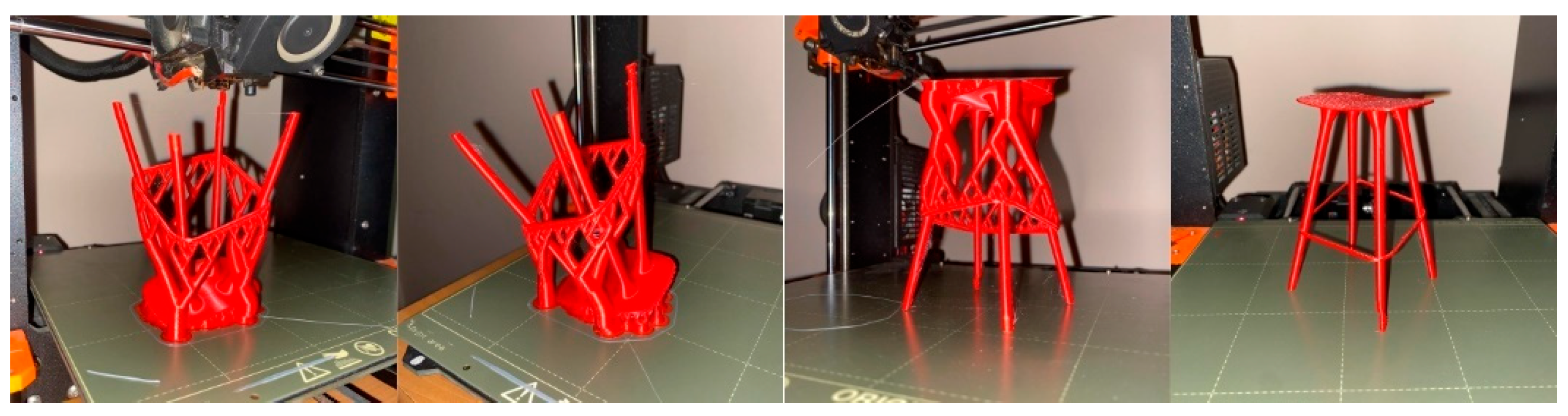
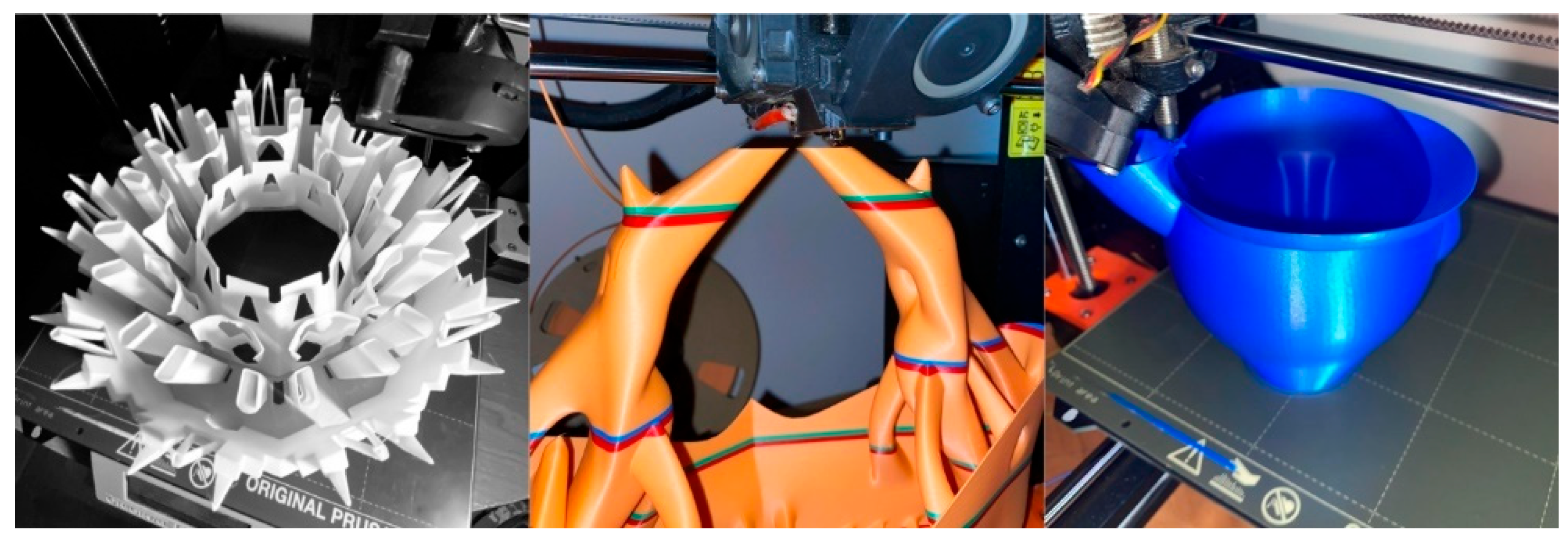
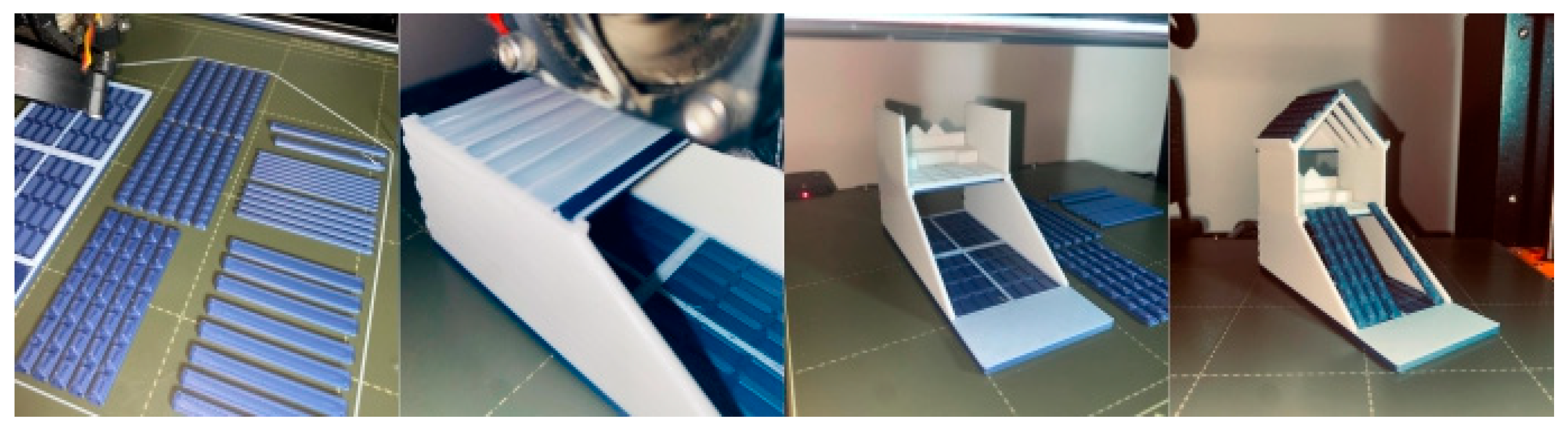
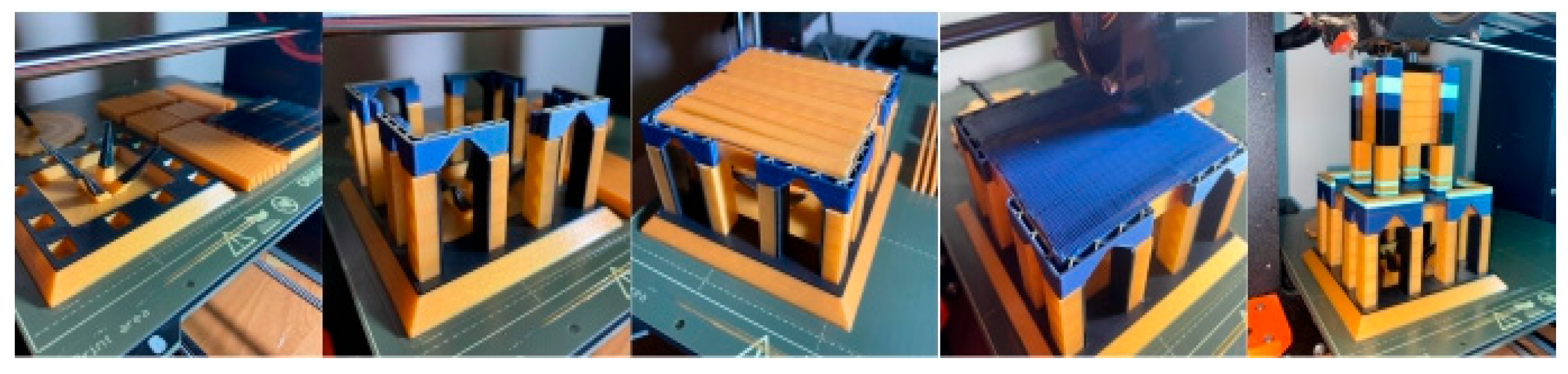
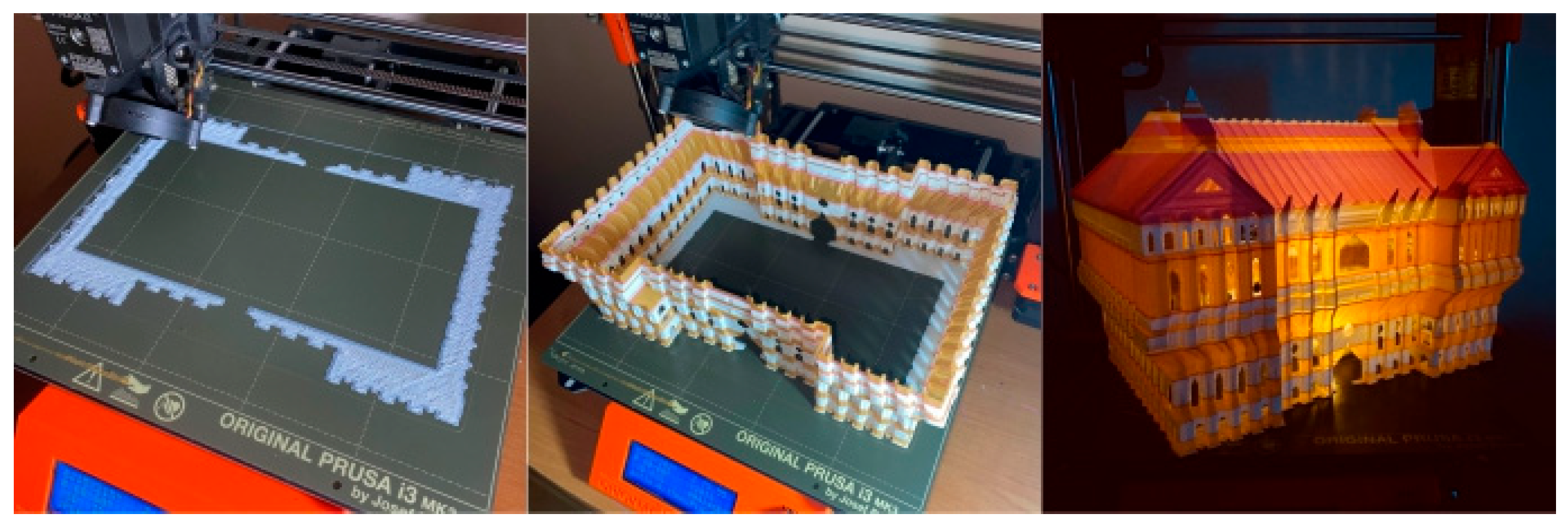
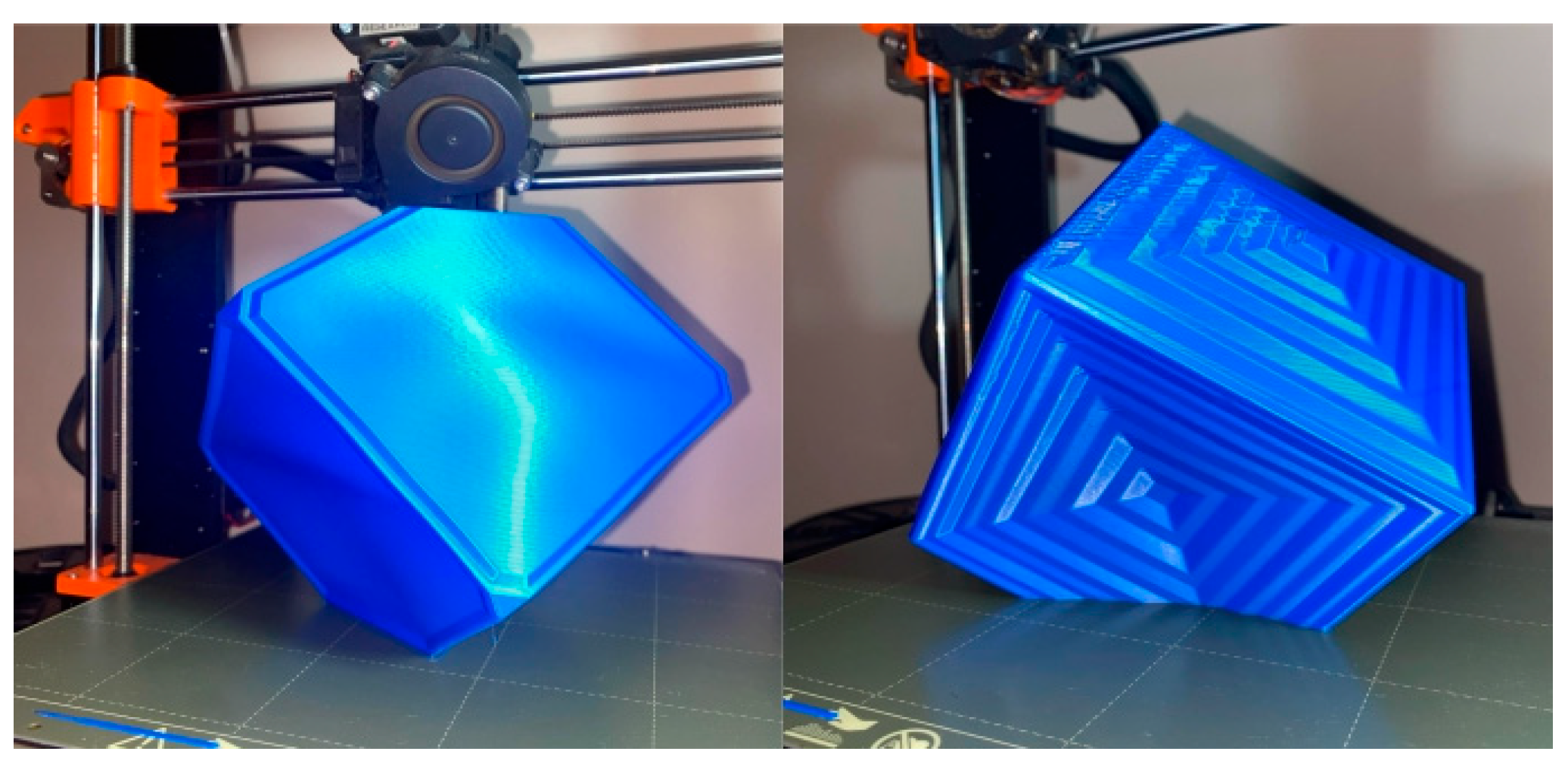
Figure 2.
Architectural prototype miniature 3D modelled in Blender, prepared for printing in Prusa slicer software and 3D printed. Design and print by the author of the paper.
Figure 2.
Architectural prototype miniature 3D modelled in Blender, prepared for printing in Prusa slicer software and 3D printed. Design and print by the author of the paper.
Figure 3.
Visible erosion of birdhouses printed in PLA plastic after spending 3 years outside. Designed and printed by the author of the paper.
Figure 3.
Visible erosion of birdhouses printed in PLA plastic after spending 3 years outside. Designed and printed by the author of the paper.
Figure 4.
Chair miniature printed in a specific position which requires supports that are removed after the printing is finished. Designed and printed by the author of the paper.
Figure 4.
Chair miniature printed in a specific position which requires supports that are removed after the printing is finished. Designed and printed by the author of the paper.
Figure 5.
3D printable shapes which do not require supports. Designed and printed by the author of the paper.
Figure 5.
3D printable shapes which do not require supports. Designed and printed by the author of the paper.
Figure 6.
Printing process showing the printing of building elements in the first layers which are then placed to serve as support for the flat floor slab to be printed on top. In the same manner stairs, roof coverings and wall infill are also printed and mounted. Designed and printed by the author of the paper.
Figure 6.
Printing process showing the printing of building elements in the first layers which are then placed to serve as support for the flat floor slab to be printed on top. In the same manner stairs, roof coverings and wall infill are also printed and mounted. Designed and printed by the author of the paper.
Figure 7.
In this example the columns were also printed and placed in the consequent places at the bottom of the base and then the beams connecting them were printed on top. Slab supports, wall infills were also printed and mounted while printing process was consequently paused and resumed. Designed and printed by the author of the paper.
Figure 7.
In this example the columns were also printed and placed in the consequent places at the bottom of the base and then the beams connecting them were printed on top. Slab supports, wall infills were also printed and mounted while printing process was consequently paused and resumed. Designed and printed by the author of the paper.
Figure 8.
Three-dimensional structure of the wall enables stability of the object during the print. Hollow structure creates architectural space without the need for supports or scaffoldings. Roof is printed by adjusting the slope so the layers can be dispositioned in a way to close the gap. Openings are designed to have different shapes of arches so that they can be eventually bridged with corbelling of consecutive layers. Designed and printed by the author of the paper.
Figure 8.
Three-dimensional structure of the wall enables stability of the object during the print. Hollow structure creates architectural space without the need for supports or scaffoldings. Roof is printed by adjusting the slope so the layers can be dispositioned in a way to close the gap. Openings are designed to have different shapes of arches so that they can be eventually bridged with corbelling of consecutive layers. Designed and printed by the author of the paper.
Figure 9.
Printing of a flat surfaces of the cube may be quite a challenging task because the cube does not have structural capabilities as a whole while it is being printed. Adding texture to the surfaces of the cube increases the stability of the shape before it reaches maximum strength after the printing process is done. Designed and printed by the author of the paper.
Figure 9.
Printing of a flat surfaces of the cube may be quite a challenging task because the cube does not have structural capabilities as a whole while it is being printed. Adding texture to the surfaces of the cube increases the stability of the shape before it reaches maximum strength after the printing process is done. Designed and printed by the author of the paper.
3.4. Production of Real-Size Construction Components
Small-scale 3D printable models can be used as parts that are then assembled into larger structures or they can be used as components together with conventional building materials. This format of planning for design of 3D printable structure has a lot of advantages in terms of reusability, recyclability, modularity, versatility, adaptability, and sustainability and in this way 3DP can be used for printing of larger structures. [31]
FDM (Fused Deposition Modeling) 3D printing technology is used by general public, hobbyists, SMEs to produce parts or whole products, individual designers, but it can also be used in architecture and construction to create façade panels, bespoke floors, molds for concrete casting, full scale pavilions. [14] It can be used to print smaller things such as benches, entrances and art features - both in scale and scaled. [37]
Small scale 3D printing technology has also proven as a great method for fabrication of different building elements prototypes or finished products. Project SPONG3D represents a full-scale façade element printable using FDM technology with PETG plastics [38] On another level there are experiments with 3D printable bricks which can be used in construction. 3D printing of clay bricks involves research focused on the properties of the clay as printable material and the overall brick geometry and structural capabilities of a single brick and when connected with other bricks in a wall surface. Depending on the function of the building elements bricks can be printed for nonstructural walls and divisions, as a component for sunshades and cladding and non-structural brick vaults. Within the field of 3D printing of bricks with clay materials, geometry of the brick – its internal structure, pattern design – is another huge field for possible explorations on the level of design and computational shape optimization and generation. [3] Nematox façade node is another yet 3D printable product where additive manufacturing is leveraged to produce intricate designs of façade nodes which require series of performance demands. Conventionally designed lighting node comprised from up to seven unique machined plates welded to a central tube was redesigned by Arup to take advantage of additive manufacturing technology. [26] Although these examples are printed in metal, similar possibilities exist within the domain of FDM plastic based 3D printer. In this context there are examples of 3D printable joints which are then use to combine existing wooden or metal beams and sticks.
As an experimentation in the same field, the author of the paper designed a concept of 3D printable tool that could be used in conventional construction industry, at the construction site. (Figure 10.) Even though 3D printing technology creates new paths for the construction industry, small-scale 3D printable models could be used to assist and optimize existing construction methods.
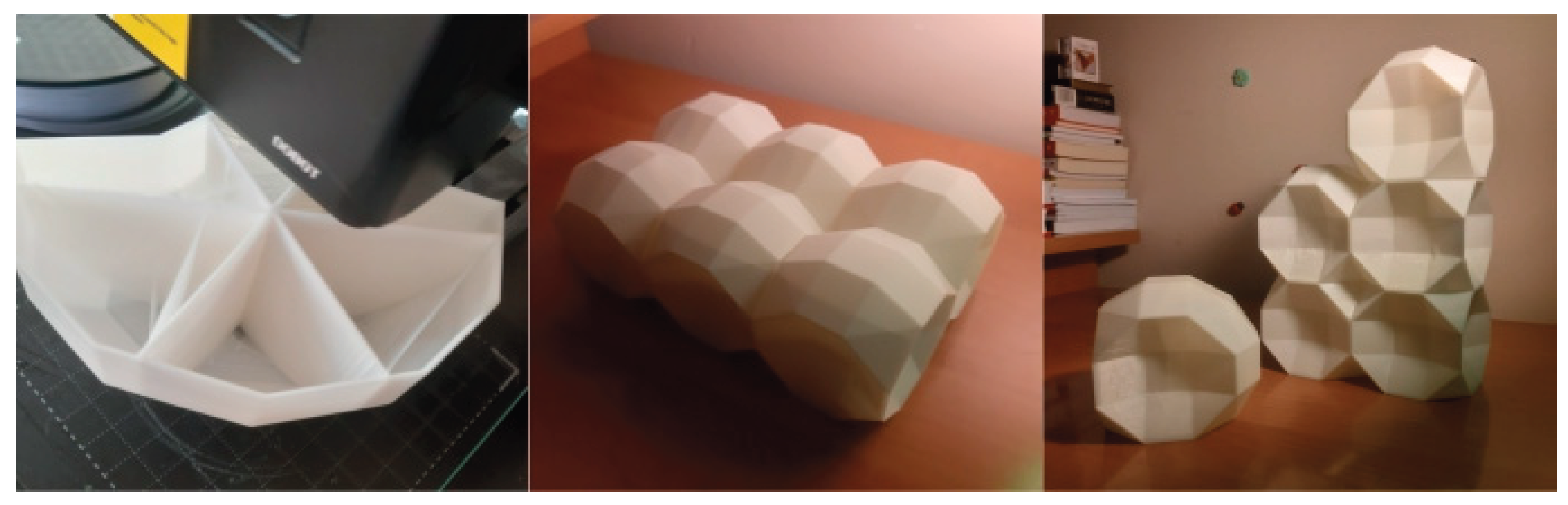
On the other hand, small-scale 3D printing can be used to print real-size animal shelters, bird houses (Figure 11) but also decorative and construction elements for interior design (Figure 12). Endless possibilities of design and 3D printing allows for high customization and also provides excellent way to replace broken parts.
Many architects are already utilizing 3D printing technology in interior design to produce objects which exactly match the specific needs of the interior space. 3D printing allows architects to execute literally any interior design idea. Instead of relying on what is available on the market, the architect has opportunity to design and produce almost any interior architectural component. [20]
4. Conclusions
3D printing technology is an emerging field of interest for the whole Architecture, Engineering and Construction sector. It is a multidisciplinary, multi-scale, and complex field and even though there are already significant results and developments there still exists a huge opportunity for the 3D printing technology to have a bigger impact. There are many potential ways in which the current 3D printing technology can be further optimized and they can be categorized in domains of material science, automation and robotics and actual building design.
Current ideas about building need to be changed in order to fully utilize the benefits of 3D printing in architecture and structural design. Design constraints of 3D printing require a creation of new design language. [15] Application of 3D printing technology within the construction industry have not been rationally evaluated. [5] Even though the application of 3D printing technology to print buildings is limited right now in terms of mobility of printers, additionally required manual labor, structural performance, standardization there still exists a vast space to explore potential applications of 3D printing technology in AEC.
Because of relatively expensive equipment to test and produce large prototypes by constructing large machines and engineering specific mixtures of materials, 3D printing and 3D modeling of small-scale models offers a very cost-effective solution for exploration of different ideas and concepts. Optimization of printable geometry (the machine tool path), is the cheapest of three directions of development (machine, material, geometry). Toolpath and geometry optimization represent a direct contribution to construction automation by shifting labor-intensive activities towards algorithmic and robotic control. Further optimizations of different components of 3D printing (geometry, material, machinery, software) can be significantly and intensively explored through small scale 3D printing in search for optimal solutions or completely new ideas on how to combine different components within automated construction industry. By enabling controlled, repeatable and programmable processes that minimize manual interventions, small-scale 3D printing contributes to automation by preparing the ground for robotic large-scale implementations.
With increasing use of small-scale 3D printers across the globe, by people of different demographics, the number of potential use cases is growing every day. Design education in general, together with education of architectural design and construction is already benefiting from the use of 3D printing technology in student project and studios, and education on the topic of 3D printing from the early years of studies is essential for future direction of the development and application of 3DP technology in architecture, construction engineering. It is important to note that small-scale 3D printing is not limited to printing small scale models but it can be treated as a bridge towards the development of the future of construction automation.
Even there are obvious limitations of small-scale 3D printable models to be directly applied for the construction of real size buildings it is still important to explore the possibilities of its use in the AEC industry because it is highly cost effective, it is very accessible and globally available and offers unique opportunity to explore new possibilities of construction within the context of new industrial revolution. 3D printing of small-scale prototypes or ready to use products can play a significant role in exploration of possibilities for efficient utilization of 3D printing technology in the advancement of the automated construction.
Presented study offers insight into small scale 3D printing technology as a direct contributor to the field of automation in construction, besides conventional use as a cost-effective tool for experimentation, education or small-scale model making. Through toolpath optimization, algorithmic design-to-production workflow testing, and minimization of the need for manual interventions, small-scale 3D printing lays the foundation for automated construction processes. In this way, small scale 3D printing is both a pedagogical instrument and technology driver accelerating integration of automation into the AEC industry.
References
- Pessoa S., Guimarães A. S.: The 3D printing challenge in buildings. E3S Web of Conferences 17 2, 19005 NSB (2020).
- Volpe, S.; Sangiorgio, V.; Petrella, A.; Coppola, A.; Notarnicola, M.; Fiorito, F.: Building Envelope Prefabricated with 3D Printing Technology. Sustainability 13, 8923. (2021). [CrossRef]
- Sangiorgio, V.; Parisi, F.; Fieni, F.; Parisi, N.: The New Boundaries of 3D-Printed Clay Bricks Design: Printability of Complex Internal Geometries. Sustainability 14, 598. (2022). [CrossRef]
- Mechtcherine, V., Nerella, V. N., Will, F., Näther, M., Otto, J., & Krause, M. Large-scale digital concrete construction–CONPrint3D concept for on-site, monolithic 3D-printing. Automation in construction, 107, 102933. (2019). [CrossRef]
- Pan, Y., Zhang, Y., Zhang, D., & Song, Y. 3D printing in construction: state of the art and applications. The International Journal of Advanced Manufacturing Technology, 115(5), 1329-1348. (2021). [CrossRef]
- Xu, W., Huang, S., Han, D., Zhang, Z., Gao, Y., Feng, P., & Zhang, D. Toward automated construction: The design-to-printing workflow for a robotic in-situ 3D printed house. Case Studies in Construction Materials, 17, e01442. (2022). [CrossRef]
- Tay, Y. W. D., Panda, B., Paul, S. C., Noor Mohamed, N. A., Tan, M. J., & Leong, K. F. 3D printing trends in building and construction industry: a review. Virtual and Physical Prototyping, 12(3), 261–276. (2017). [CrossRef]
- Van Woensel, R. N. P., van Oirschot, T., Burgmans, M. J. H., Mohammadi, M., & Hermans, K. Printing architecture: an overview of existing and promising additive manufacturing methods and their application in the building industry. The International Journal of the Constructed Environment, 9(1), 57-81. (2018).
- Perkins, I., & Skitmore, M. Three-dimensional printing in the construction industry: A review. International Journal of Construction Management, 15(1), 1-9. (2015). [CrossRef]
- Kazakis G., Kanellopoulos I., Sotiropoulos S., D. Lagaros N.: Topology optimization aided structural design: Interpretation, computational aspects and 3D printing. Heliyon 3 e00431. (2017). [CrossRef]
- Teizer, J., Blickle, A., King, T., Leitzbach, O., & Guenther, D. Large scale 3D printing of complex geometric shapes in construction. In ISARC. Proceedings of the International Symposium on Automation and Robotics in Construction (Vol. 33, p. 1). IAARC Publications. (2016).
- Žujović M., Obradović R., Rakonjac I., Milošević J.: 3D Printing Technologies in Architectural Design and Construction: A Systematic Literature Review. Buildings 12, 1319. (2022). [CrossRef]
- García-Alvarado, R.; Moroni-Orellana, G.: Banda-Pérez, P. Architectural Evaluation of 3D-Printed Buildings. Buildings 11, 254. (2021). [CrossRef]
- Mitropoulou I., Bernhard M., Dillenburger B.: Nonplanar 3D Printing of Bifurcating Forms. 3D Printing and Additive Manufacturing, Volume 9, Number 3, Mary Ann Liebert, Inc. (2022). [CrossRef]
- Marijnissen, M. P. A. A., & van Der Zee, A. 3D Concrete printing in architecture. A research on the potential benefits of 3D Concrete Printing in Architecture. Material Studies–Methodologies, 2, 299-308. (2017).
- Carneau P., Mesnil R., Roussela N., Baverel O. Additive manufacturing of cantilever - from masonry to concrete 3D printing. Automation in Construction, Volume 116 (2020). [CrossRef]
- Allouzi R., Al-Azhri W., Allouzi R Conventional Construction and 3D Printing: A Comparison Study on Material Cost in Jordan: Hindawi Journal of Engineering Volume 2020, Article ID 1424682, (2020).
- Rocamora A. M., Garcia-Alvarado R., Casanova-Medina E., Gonzalez-Böhme L. F., Auat-Cheein F., Parametric Programming of 3D Printed Curved Walls for Cost-Efficient Building Design. J. Constr. Eng. Manage., 146(5): 04020039, American Society of Civil Engineers. (2020). [CrossRef]
- Waldschmitt, B., Costanzi, C.B., Knaack, U.: 3D printing of column structures for architectural applications. Archit. Struct. Constr. 2, 565–574 (2022). [CrossRef]
- Saleh A. 3D Printing in Architecture, Engineering and Construction (Concrete 3D Printing), Engineering Research Journal 162, A1-A18 (2019).
- Niemeläa M., Shia A., Shirowzhana S., Sepasgozara M. E. S., Liu C.: 3D Printing Architectural Freeform Elements: Challenges and Opportunities in Manufacturing for Industry 4.0. 36th International Symposium on Automation and Robotics in Construction ISARC (2019),.
- Teizer, J., Blickle, A., King, T., Leitzbach, O., Guenther, D., Mattern, H., & König, M. BIM for 3D Printing in Construction. Building Information Modeling: Technology Foundations and Industry Practice, 421-446. (2018).
- Al Jassmi H., Al Najjar F., Mourad Ismail A. H: Large-Scale 3D Printing: The Way Forward. IOP Conf. Series: Materials Science and Engineering 324 012088 IOP Publishing (2018).
- J.S. Cruz P., Knaack U., Figueiredo B., Witte D.: Ceramic 3D printing – The future of brick architecture. In: Bögle A., Grohmann M. (eds.) Proceedings of the IASS Annual Symposium, Hamburg, Germany. (2017).
- Kladeftira M., Leschok M., Skevaki E., Dillenburger B.: Redefining Polyhedral Space Through 3D Printing, Advances in Architectural Geometry, Presses des Ponts (2020).
- Buchanan, C., & Gardner, L.. Metal 3D printing in construction: A review of methods, research, applications, opportunities and challenges. Engineering Structures, 180, 332-348. (2019). [CrossRef]
- Ali, M. H., Issayev, G., Shehab, E., & Sarfraz, S. A critical review of 3D printing and digital manufacturing in construction engineering. Rapid Prototyping Journal, 28(7), 1312-1324. (2022). [CrossRef]
- Ning, X., Liu, T., Wu, C., & Wang, C. 3D printing in construction: current status, implementation hindrances, and development agenda. Advances in Civil Engineering, 2021(1), 6665333. (2021). [CrossRef]
- Feng J., Fu J., Lin Z., Li B. A review of the design methods of complex topology structures for 3D printing. Visual Computing for Industry, Biomedicine, and Art 1:5 (2018).
- Ozturk, G. B. The future of 3D printing technology in the construction industry: a systematic literature review. Eurasian Journal of Civil Engineering and Architecture, 2(2), 10-24. (2018).
- Song P., Fu Z., Liu L., Fu C.W. Printing 3D Objects with Interlocking Parts, Computer Aided Geometric Design, Volumes 35-36, Elsevier (2015).
- Hager, I., Golonka, A., & Putanowicz, R. 3D printing of buildings and building components as the future of sustainable construction?. Procedia Engineering, 51, 292-299. (2016). [CrossRef]
- Gomaa M., Jabi W., Reyes A. V., Soebarto V. 3D printing system for earth-based construction: Case study of cob. Automation in Construction, 2021; 124:103577-1-103577-16 Elsevier B.V. (2021). [CrossRef]
- Armstrong C. D, Montgomery S. M., Yue L., Demoly F., Zhou K., Qi H. J.: Robotic Conformal Material Extrusion 3D Printing for Appending Structures on Unstructured Surfaces. Advanced Intelligent Systems, 6, Wiley-VCH GmbH, (2024).
- Bedarf, P., Dutto, A., Zanini, M., & Dillenburger, B. Foam 3D printing for construction: A review of applications, materials, and processes. Automation in Construction, 130, 103861. (2021).
- Mirkhalaf M., Barthelat F.: Design, 3D printing and testing of architectured materials with bistable interlocks. Extreme Mechanics Letters 11 1-7, Elsevier (2017). [CrossRef]
- Kim, S.; Shin, Y.; Park, J.; Lee, S.-W.: An, K. Exploring the Potential of 3D Printing Technology in Landscape Design Process. Land 10, 259. (2021). [CrossRef]
- Sarakinioti, M. V., Konstantinou, T., Turrin, M., Tenpierik, M., Loonen, R., De Klijn-Chevalerias, M. L., & Knaack, U.: Development and prototyping of an integrated 3D-printed façade for thermal regulation in complex geometries. Journal of Facade Design and Engineering, 6(2), 29-40. (2018).
Figure 1.
Prusa MK3S+: Small scale 3D printers are built in variety of shapes, dimensions, with different capabilities, but usually are sized to be mobile.
Figure 1.
Prusa MK3S+: Small scale 3D printers are built in variety of shapes, dimensions, with different capabilities, but usually are sized to be mobile.

Figure 10.
Small-scale 3D printers can be used for design and print of tools which can be used in the conventional construction process. Design process requires careful approach to structural limitations, interlocking constraints and other parameters responsible for successful print of useable product. Designed and printed by the author of the paper.
Figure 10.
Small-scale 3D printers can be used for design and print of tools which can be used in the conventional construction process. Design process requires careful approach to structural limitations, interlocking constraints and other parameters responsible for successful print of useable product. Designed and printed by the author of the paper.
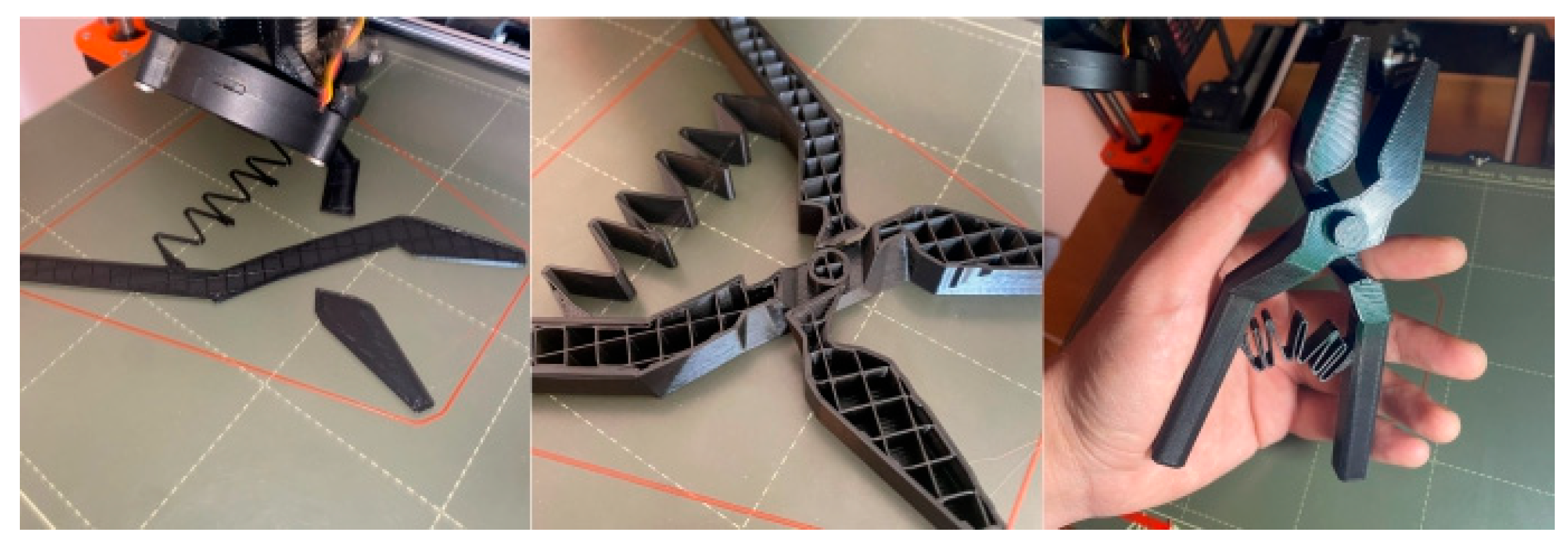
Figure 11.
Birdhouses are among many architectural forms printable on small-scale 3D printers and which can have practical use and can serve as a real-sized product. Designed and printed by the author of the paper.
Figure 11.
Birdhouses are among many architectural forms printable on small-scale 3D printers and which can have practical use and can serve as a real-sized product. Designed and printed by the author of the paper.

Figure 12.
Small-scale 3D printers can be used for printable designs of blocks and bricks which can be assembled to create partitions, fill holes or in other ways in relation to interior design. Designed and printed by the author of the paper.
Figure 12.
Small-scale 3D printers can be used for printable designs of blocks and bricks which can be assembled to create partitions, fill holes or in other ways in relation to interior design. Designed and printed by the author of the paper.
Disclaimer/Publisher’s Note: The statements, opinions and data contained in all publications are solely those of the individual author(s) and contributor(s) and not of MDPI and/or the editor(s). MDPI and/or the editor(s) disclaim responsibility for any injury to people or property resulting from any ideas, methods, instructions or products referred to in the content. |
© 2025 by the authors. Licensee MDPI, Basel, Switzerland. This article is an open access article distributed under the terms and conditions of the Creative Commons Attribution (CC BY) license (http://creativecommons.org/licenses/by/4.0/).
Copyright: This open access article is published under a Creative Commons CC BY 4.0 license, which permit the free download, distribution, and reuse, provided that the author and preprint are cited in any reuse.


