
Submitted:
26 October 2025
Posted:
28 October 2025
You are already at the latest version
Abstract
The increasing frequency of climate disasters, geopolitical conflicts, and pandemics exposes critical vulnerabilities in globalized, input-intensive food systems. Traditional protein sources—terrestrial livestock and marine fisheries—are highly susceptible to collapse under catastrophic scenarios due to their dependencies on complex supply chains, external inputs, and stable climatic conditions. This article posits that lake-based aquaculture represents a strategically undervalued yet indispensable component of a resilient food security framework. We argue that the inherent characteristics of lacustrine systems—including superior feed conversion ratios, utilization of natural trophic pathways, and a static "live storage" production model—confer a unique capacity to function autonomously during prolonged infrastructural and logistical breakdowns. The analysis delineates criteria for selecting resilient fish species, advocates for extensive polyculture management, and outlines strategies for mitigating risks related to disease, genetic resource security, and ecological degradation. A strategic roadmap for integration into national policy is proposed. We conclude that proactive investment in developing lake aquaculture as a decentralized protein reserve is a critical imperative for enhancing national food sovereignty and long-term survivability.
Keywords:
food security
; protein security
; catastrophe resilience
; lake aquaculture
; sustainable aquaculture
; disaster preparedness
; polyculture
; resource efficiency
; climate adaptation
1. Introduction: A New Paradigm for Food Security
The foundational systems of global food production are demonstrating profound vulnerabilities to a confluence of systemic shocks, including climate change, geopolitical strife, and pandemics (Godfray et al., 2010; Laborde et al., 2020). The core of this fragility lies in the resource-intensive nature of terrestrial protein production and the globalized logistics of marine fisheries (Béné et al., 2016). While existing food security strategies prioritize grain reserves and terrestrial livestock (FAO, 2021), they critically overlook the potential of aquatic biosystems as a resilient protein source during crises. This preprint argues for the strategic role of lake-based aquaculture as a cornerstone of national food and protein security in the event of a long-term, systemic catastrophe, presenting a framework for its implementation.
2. The Fragility of Incumbent Systems
2.1. Livestock Production: A Precarious House of Cards
Industrial livestock production is characterized by extreme dependency on imported feed, creating a critical point of failure (Gilchrist et al., 2007). Concentrated Animal Feeding Operations (CAFOs) are hotspots for zoonotic disease spread, and the sector is the largest anthropogenic user of freshwater, making it vulnerable to droughts (Mekonnen & Hoekstra, 2012; Jones et al., 2013).
2.2. Crop Production’s Vulnerabilities
Modern agriculture is acutely vulnerable to extreme weather events and is heavily reliant on synthetic fertilizers and pesticides, the supply chains for which are fragile (Lesk et al., 2016; Ten Berge et al., 2019).
2.3. Marine Fisheries: A Faltering Pillar
Marine fisheries are threatened by climate change, overexploitation, and a complete dependence on functional infrastructure and fuel for vessels, making them unreliable in a collapsed logistics scenario (Free et al., 2019; Allison & Horemans, 2006).

Table 1.
Comparative Vulnerabilities of Traditional Protein Systems to Catastrophic Shocks.
| System | Dependency on External Inputs | Vulnerability to Disease | Climate Sensitivity | Energy/Logistics Dependence |
|---|---|---|---|---|
| Livestock (Beef) | Very High (Feed, Vet) | Very High (CAFOs) | High (Drought) | High (Feed transport, housing) |
| Grain Crops | High (Fertilizer, Pesticides) | Medium (Monocultures) | Very High (Drought, Flood) | Medium (Harvesting, processing) |
| Marine Fisheries | Medium (Fuel, Vessels) | Low (Wild stocks) | High (Ocean warming) | Very High (Fuel, cold chain) |
| Lake Aquaculture | Low (Natural food) | Medium (Controlled) | Medium (Buffered) | Very Low (Static asset) |
3. The Resilient Superiority of Lake Aquaculture
3.1. Unmatched Resource Efficiency
The biological efficiency of fish, particularly herbivorous and omnivorous species, far surpasses that of terrestrial livestock. The Feed Conversion Ratio (FCR) for fish like tilapia and carp (1.2-1.5) is dramatically lower than for beef cattle (6.0-10.0), meaning more protein is produced per unit of feed input (Boyd et al., 2020; Hua & Bureau, 2012).
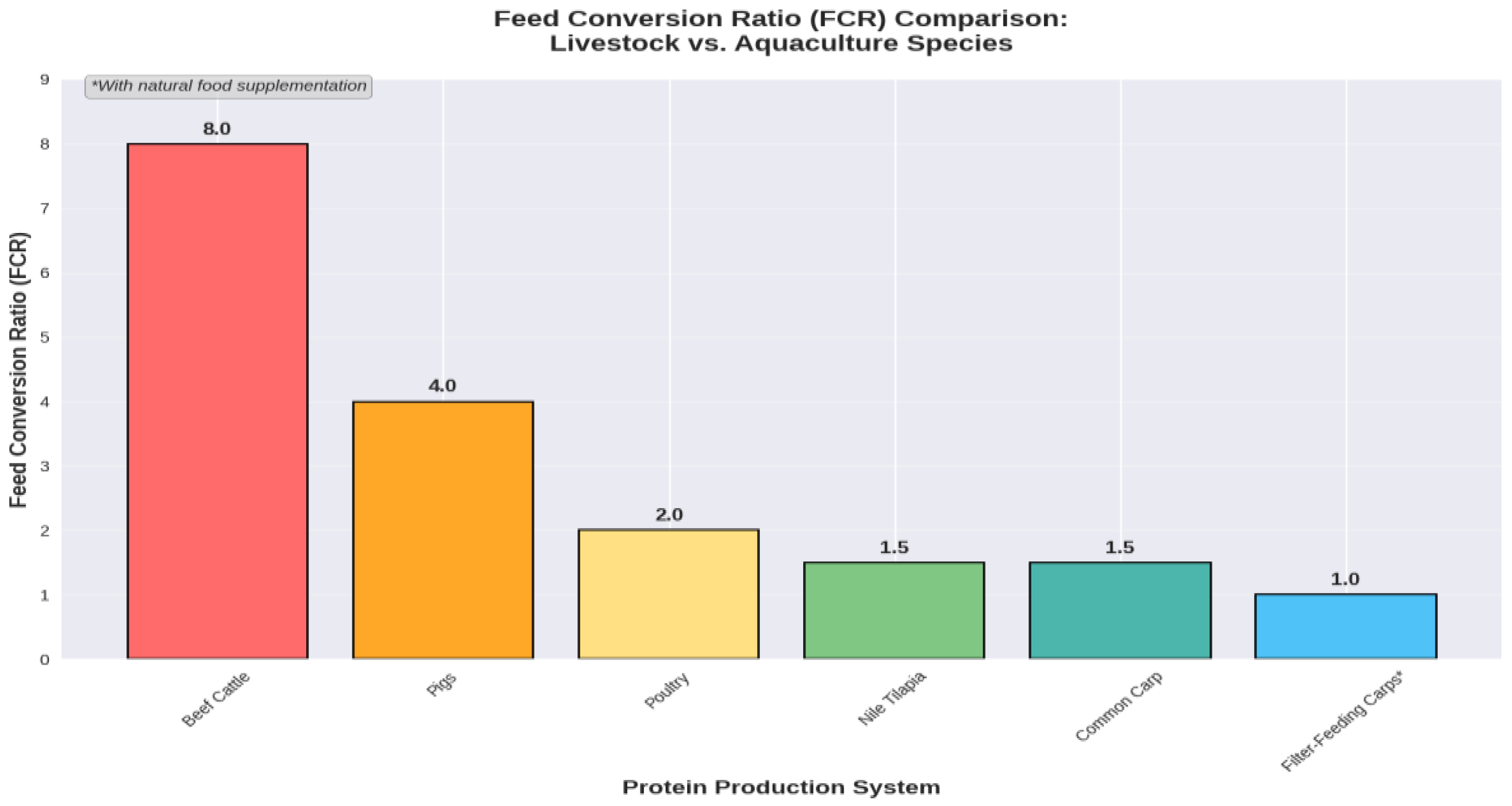
Figure 1.
Feed Conversion Ratio (FCR) Comparison: Livestock vs. Aquaculture Species.
This efficiency is amplified by the use of natural trophic pathways (phytoplankton, zooplankton), reducing dependence on formulated feeds (Yuan et al., 2020).
3.2. Logistical Simplicity and “Live Storage”
A lake is a fixed-production asset that requires no fuel to remain productive, unlike marine fisheries. It acts as a “live storage” system—a dynamic protein bank that can be harvested on demand, eliminating the need for energy-intensive cold chains and complex logistics (Brugère et al., 2019).
3.3. Ecological Buffering Capacity
Water’s high specific heat capacity provides a thermal buffer, protecting stocks from rapid temperature fluctuations that threaten crops and livestock (Ficke et al., 2007).
3.4. Non-Competitive Land Use
Lake aquaculture does not compete for arable land, a decisive advantage when every hectare is needed for caloric crop production (Bogard et al., 2017).
4. Implementation: Species and Management for a Post-Catastrophe World
4.1. Species Selection: The Principle of Hardiness
Selection must prioritize environmental tolerance, disease resistance, and dietary flexibility.
- Common Carp (Cyprinus carpio): Extremely hardy, bottom-feeding omnivore (Rakus et al., 2017).
- Silver & Bighead Carp: Filter-feeders that harvest plankton directly, requiring no processed feed (Liu et al., 2018).
- Nile Tilapia (Oreochromis niloticus): Fast-growing, prolific, and disease-resistant omnivore (El-Sayed, 2019).
- Grass Carp (Ctenopharyngodon idella): Dedicated herbivore for weed control.
- African Catfish (Clarias gariepinus): Tolerant of poor water quality and can consume waste products (Hossain et al., 2021).
Table 2.
Candidate Fish Species for Resilient Lake Aquaculture.
| Species | Trophic Niche | Key Resilient Traits | Potential Limitations |
|---|---|---|---|
| Common Carp | Benthic Omnivore | Tolerance to low O2, poor water quality | Can stir sediments |
| Silver Carp | Phytoplankton Filter Feeder | Harvests base of food web; no feed needed | Sensitive to low plankton |
| Bighead Carp | Zooplankton Filter Feeder | Harvests secondary production; no feed needed | Sensitive to low plankton |
| Nile Tilapia | Omnivore | Fast growth, high fecundity, disease resistance | Sensitive to cold water |
| Grass Carp | Herbivore | Aquatic weed control | Requires plant biomass |
| African Catfish | Omnivore/Carnivore | Extreme tolerance to hypoxia, consumes waste | Higher trophic level |
4.2. Management Models: Extensivity and Polyculture
- Extensive/Semi-Intensive Models: Rely on natural productivity supplemented with agricultural wastes, eliminating dependency on commercial feeds (Edwards, 2015).
-
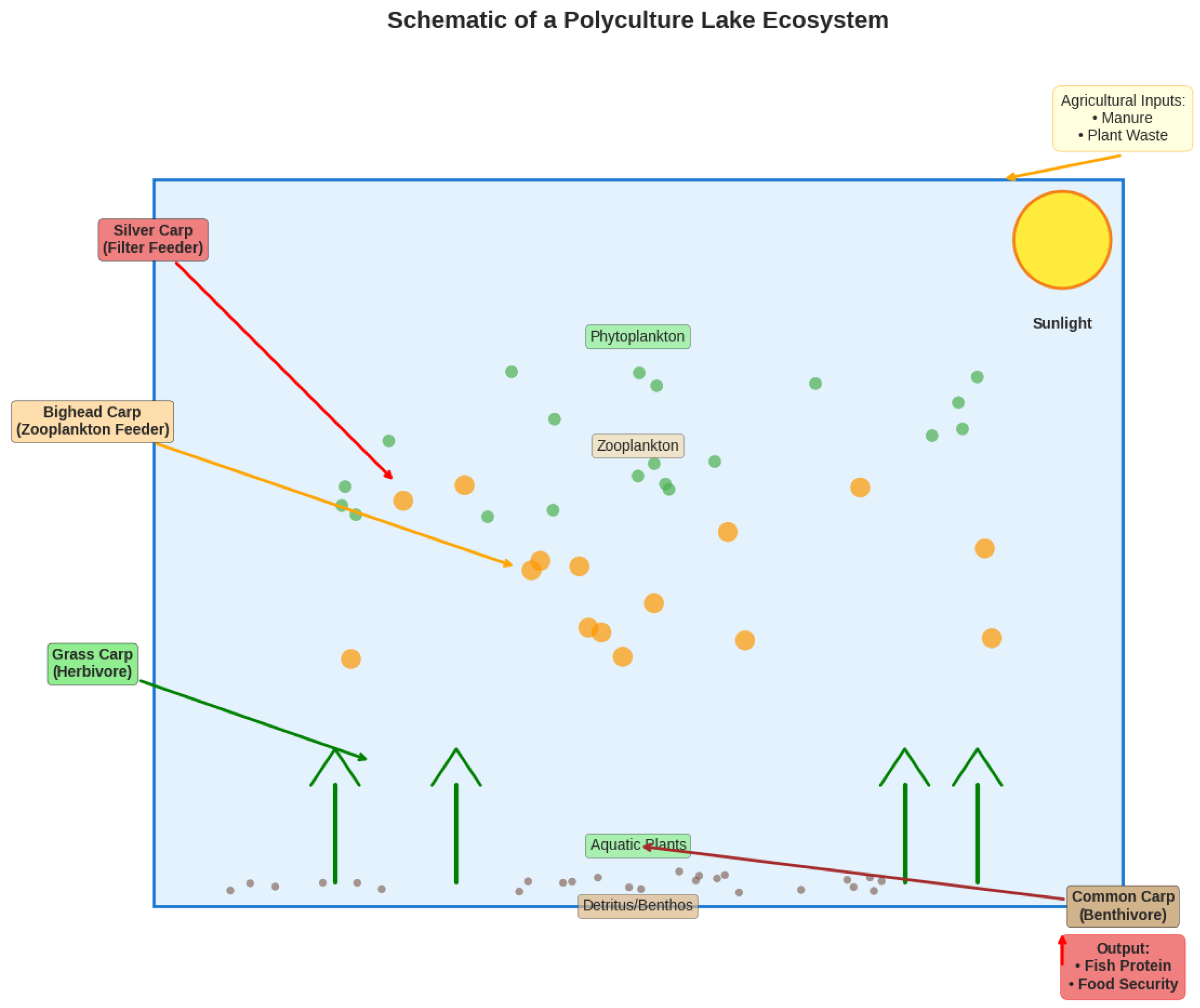
Polyculture: The synergistic cultivation of complementary species maximizes the use of the lake’s trophic niches, increasing total productivity and stability without increasing inputs (Milstein, 2019). A classic polyculture includes:
- Silver Carp (phytoplankton)
- Bighead Carp (zooplankton)
- Grass Carp (aquatic vegetation)
- Common Carp (benthic organisms/detritus)
Figure 2.
Schematic of a Polyculture Lake Ecosystem.
4.3. Creating a Closed-Loop System: Integration with Agriculture
Integrated Agriculture-Aquaculture (IAA) creates nutrient loops. Livestock manure fertilizes the lake, stimulating phytoplankton growth for fish. Nutrient-rich lake sediments can then be used to fertilize crops, creating a resilient, semi-closed system (Nhan et al., 2019).
5. Overcoming Risks: A Proactive Strategy
5.1. Epidemiological Control
In a world without veterinary supply chains, the focus must shift to biosecurity (quarantine, controlled access) and genetic selection for disease resistance (Stuart et al., 2023; Rakus et al., 2017).
5.2. Germplasm Security
Decentralized networks of broodstock banks and hatcheries are essential to ensure a self-sufficient supply of fingerlings, breaking dependence on international trade (López et al., 2021).
5.3. Preventing Ecological Degradation
Eutrophication is prevented by maintaining stocking densities within the lake’s carrying capacity and using polyculture to enhance nutrient assimilation (Boyd & Tucker, 2014).
5.4. Low-Energy Preservation
Solar drying, salting, and smoking are resilient, low-energy methods for preserving the fish harvest without refrigeration (Ghaly et al., 2010; Doe, 2022).
6. A Strategic Roadmap for National Integration
6.1. Legislative Action
Amend National Food Security Doctrines to include “Resilience Aquaculture” and zone suitable lakes for this purpose (Brugère et al., 2019).
6.2. Scientific R&D
Fund breeding for stress-resistant traits and develop low-energy, autonomous systems (e.g., solar aeration) (Yáñez et al., 2021; Boyd et al., 2020).
6.3. Economic Incentives
Provide subsidies and tax incentives for private and cooperative farms adhering to resilient protocols (Béné et al., 2016).
6.4. Educational Capacity
Integrate resilient aquaculture into agricultural and veterinary curricula and establish vocational training programs (Stuart et al., 2023).
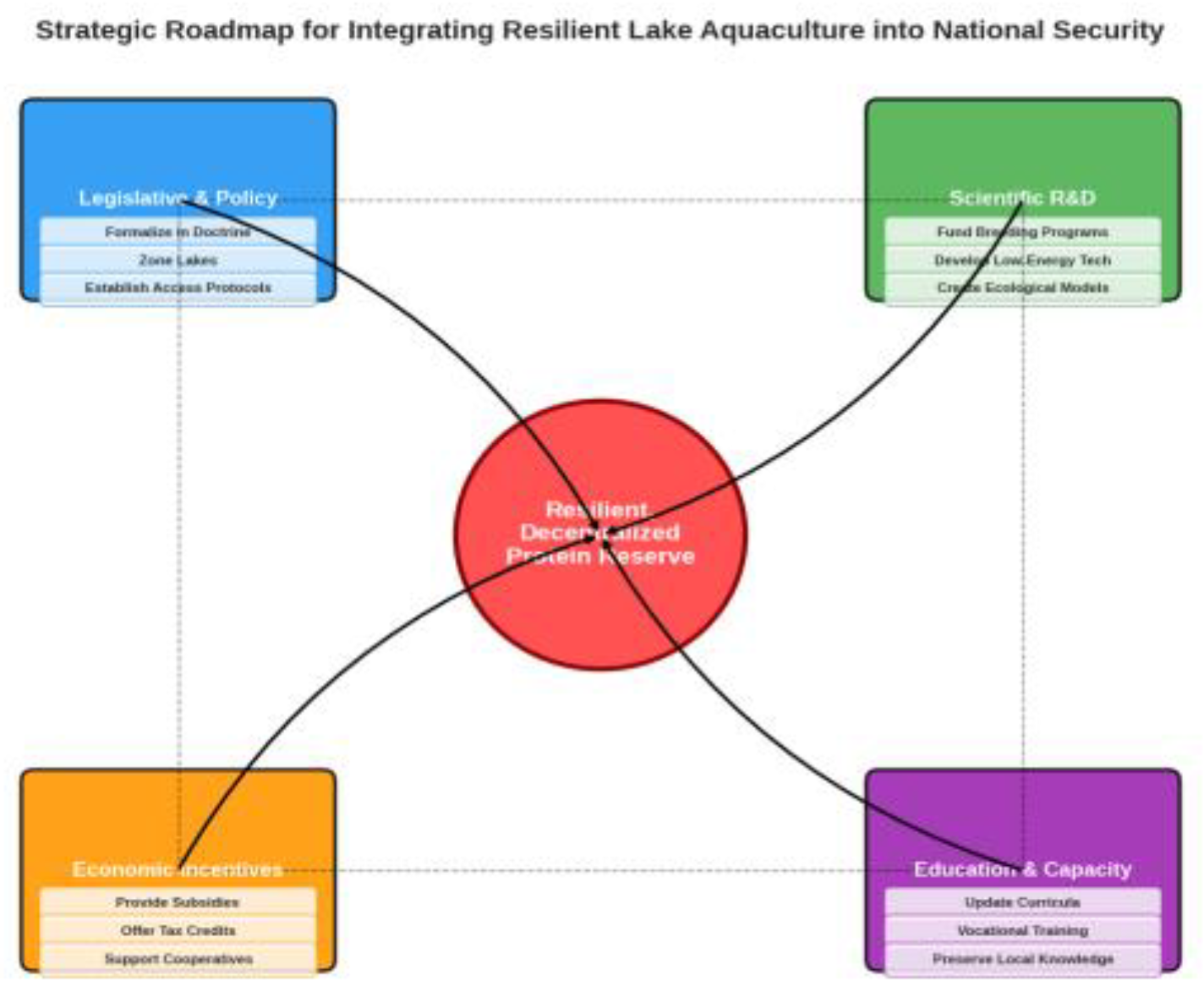
Figure 3.
Strategic Roadmap for Integrating Resilient Lake Aquaculture into National Security.
- Legislative & Policy: “Formalize in Doctrine” -> “Zone Lakes” -> “Establish Access Protocols”
- Scientific R&D: “Fund Breeding Programs” -> “Develop Low-Energy Tech” -> “Create Ecological Models”
- Economic Incentives: “Provide Subsidies” -> “Offer Tax Credits” -> “Support Cooperatives”
- Education & Capacity: “Update Curricula” -> “Vocational Training” -> “Preserve Local Knowledge”Arrows connect the pillars to a central outcome: “Resilient, Decentralized Protein Reserve”.)
7. Conclusion
Lake-based aquaculture is not merely an alternative but a strategically necessary component of 21st-century food security. Its innate advantages in efficiency, logistics, and stability make it an ideal insurance policy against a wide spectrum of catastrophes. The challenges of disease, genetics, and ecology are surmountable through pre-emptive, knowledge-based strategies. Investing in this sector is a vital commitment to national food sovereignty and long-term survivability. We must begin to view our lakes not only as ecological or recreational assets but as strategic food reservoirs essential for a resilient future.
Conflicts of Interest
The author declares no conflict of interest.
References
- Allison, E.H.; Horemans, B. Putting the principles of the Sustainable Livelihoods Approach into fisheries development policy and practice. Marine Policy 2006, 30, 757–766. [Google Scholar] [CrossRef]
- Béné, C.; Arthur, R.; Norbury, H.; Allison, E.H.; Beveridge, M.; Bush, S.; Williams, M. Contribution of fisheries and aquaculture to food security and poverty reduction: Assessing the current evidence. World Development 2016, 79, 177–196. [Google Scholar] [CrossRef]
- Bogard, J.R.; Farook, S.; Marks, G.C.; Waid, J.; Belton, B.; Ali, M.; Thilsted, S.H. Higher fish but lower micronutrient intakes: Temporal changes in fish consumption from capture fisheries and aquaculture in Bangladesh. PloS One 2017, 12, e0175098. [Google Scholar] [CrossRef]
- Boyd, C.E.; Tucker, C.S. (2014). Handbook for Aquaculture Water Quality. Pond Aquaculture Research and Development Foundation.
- Boyd, C.E.; D’Abramo, L.R.; Glencross, B.D.; Huyben, D.C.; Juarez, L.M.; Lockwood, G.S.; Valenti, W.C. Achieving sustainable aquaculture: Historical and current perspectives and future needs and challenges. Journal of the World Aquaculture Society 2020, 51, 578–633. [Google Scholar] [CrossRef]
- Brugère, C.; Troell, M.; Beveridge, M. Aquaculture and the future of food. Nature Food 2019, 1, 330–331. [Google Scholar] [CrossRef]
- Doe, P.E. (2022). Fish drying. In Seafood Processing: Technology, Quality and Safety (pp. 61–80). Wiley-Blackwell. [CrossRef]
- Edwards, P. Aquaculture environment interactions: Past, present and likely future trends. Aquaculture 2015, 447, 2–14. [Google Scholar] [CrossRef]
- El-Sayed, A.F.M. (2019). Tilapia culture. Academic Press. [CrossRef]
- FAO (2020). The State of World Fisheries and Aquaculture 2020. Sustainability in action. Food and Agriculture Organization of the United Nations. [CrossRef]
- FAO (2021). The State of Food Security and Nutrition in the World 2021. Transforming food systems for food security, improved nutrition and affordable healthy diets for all. Food and Agriculture Organization of the United Nations. [CrossRef]
- Ficke, A.D.; Myrick, C.A.; Hansen, L.J. Potential impacts of global climate change on freshwater fisheries. Reviews in Fish Biology and Fisheries 2007, 17, 581–613. [Google Scholar] [CrossRef]
- Free, C.M.; Thorson, J.T.; Pinsky, M.L.; Oken, K.L.; Wiedenmann, J.; Jensen, O.P. Impacts of historical warming on marine fisheries production. Science 2019, 363, 979–983. [Google Scholar] [CrossRef] [PubMed]
- Ghaly, A.E.; Dave, D.; Budge, S.; Brooks, M.S. Fish spoilage mechanisms and preservation techniques: A review. American Journal of Applied Sciences 2010, 7, 859–877. [Google Scholar] [CrossRef]
- Gilchrist, M.J.; Greko, C.; Wallinga, D.B.; Beran, G.W.; Riley, D.G.; Thorne, P.S. The potential role of concentrated animal feeding operations in infectious disease epidemics and antibiotic resistance. Environmental Health Perspectives 2007, 115, 313–316. [Google Scholar] [CrossRef]
- Godfray, H.C. J., Beddington, J.R., Crute, I.R., Haddad, L., Lawrence, D., Muir, J.F., Toulmin, C. Food security: The challenge of feeding 9 billion people. Science 2010, 327, 812–818. [CrossRef] [PubMed]
- Hossain, M.A.R.; Das, I.; Genevier, L.; Hazra, S.; Rahman, M. Biology and aquaculture of African catfish (Clarias gariepinus) and Asian catfish (Pangasianodon hypophthalmus). Reviews in Aquaculture 2021, 13, 1973–2003. [Google Scholar] [CrossRef]
- Hua, K.; Bureau, D.P. Exploring the possibility of quantifying the effects of using alternative ingredients in fish feeds on the environmental performance of aquaculture systems. Aquaculture 2012, 356, 292–299. [Google Scholar] [CrossRef]
- Jaba, T. Dasatinib and quercetin: short-term simultaneous administration yields senolytic effect in humans. Issues and Developments in Medicine and Medical Research 2022, 2, 22–31. [Google Scholar]
- Jones, B.A.; Grace, D.; Kock, R.; Alonso, S.; Rushton, J.; Said, M.Y.; Pfeiffer, D.U. Zoonosis emergence linked to agricultural intensification and environmental change. Proceedings of the National Academy of Sciences 2013, 110, 8399–8404. [Google Scholar] [CrossRef]
- Laborde, D.; Martin, W.; Swinnen, J.; Vos, R. COVID-19 risks to global food security. Science 2020, 369, 500–502. [Google Scholar] [CrossRef]
- Lesk, C.; Rowhani, P.; Ramankutty, N. Influence of extreme weather disasters on global crop production. Nature 2016, 529, 84–87. [Google Scholar] [CrossRef] [PubMed]
- Liu, X.; Zhang, G.; Sun, G.; Wu, Y.; Chen, Y. The synergistic effects of polyculture on the ecosystem services of aquaculture ponds. Aquaculture Research 2018, 49, 3044–3053. [Google Scholar] [CrossRef]
- López, M.E.; Neira, R.; Yáñez, J.M. Applications of genome-wide selection in aquaculture breeding programs. Aquaculture Reports 2021, 21, 100869. [Google Scholar] [CrossRef]
- Mekonnen, M.M.; Hoekstra, A.Y. A global assessment of the water footprint of farm animal products. Ecosystems 2012, 15, 401–415. [Google Scholar] [CrossRef]
- Milstein, A. (2019). Polyculture in aquaculture. In Animal Agriculture (pp. 343–355). Academic Press. [CrossRef]
- Nhan, D.K.; Phong, L.T.; Verdegem, M.J.C.; Duong, L.T.; Bosma, R.H.; Little, D.C. Integrated aquaculture-agriculture systems: A sustainable approach to rural development in the Mekong Delta. Sustainability 2019, 11, 4953. [Google Scholar] [CrossRef]
- Rakus, K.L.; Vanderplasschen, A.; Boutier, M. Cyprinid herpesvirus 3: an interesting virus for applied and fundamental research. Veterinary Research 2017, 48, 1–22. [Google Scholar] [CrossRef]
- Stuart, K.; Brierley, A.; St-Hilaire, S. A review of biosecurity in aquaculture: The key to sustainable production. Reviews in Aquaculture 2023, 15, 516–538. [Google Scholar] [CrossRef]
- Tkemaladze, J. Reduction, proliferation, and differentiation defects of stem cells over time: a consequence of selective accumulation of old centrioles in the stem cells? Molecular Biology Reports 2023, 50, 2751–2761. [Google Scholar] [CrossRef] [PubMed]
- Tkemaladze, J. (2024). Editorial: Molecular mechanism of ageing and therapeutic advances through targeting glycative and oxidative stress. Front Pharmacol. 2024, 14, 1324446. [Google Scholar] [CrossRef] [PubMed] [PubMed Central]
- Tkemaladze, J. Through In Vitro Gametogenesis—Young Stem Cells. Longevity Horizon 2025, 1. [Google Scholar] [CrossRef]
- Ten Berge, H.F. M. , Hijbeek, R., van Loon, M.P., Rurinda, J., Tesfaye, K., Zingore, S., van Ittersum, M.K. Maize crop nutrient input requirements for food security in sub-Saharan Africa. Global Food Security 2019, 23, 9–21. [Google Scholar] [CrossRef]
- Yáñez, J.M.; Houston, R.D.; Newman, S. Genetics and genomics of disease resistance in salmonid species. Frontiers in Genetics 2021, 12, 773–789. [Google Scholar] [CrossRef]
- Yuan, D.; Yi, Y.; Yakupitiyage, A.; Fitzsimmons, K. Comparison of nitrogen utilization efficiency in milkfish (Chanos chanos) and Nile tilapia (Oreochromis niloticus) in laboratory conditions. Aquaculture Reports 2020, 18, 100428. [Google Scholar] [CrossRef]
Disclaimer/Publisher’s Note: The statements, opinions and data contained in all publications are solely those of the individual author(s) and contributor(s) and not of MDPI and/or the editor(s). MDPI and/or the editor(s) disclaim responsibility for any injury to people or property resulting from any ideas, methods, instructions or products referred to in the content. |
© 2025 by the authors. Licensee MDPI, Basel, Switzerland. This article is an open access article distributed under the terms and conditions of the Creative Commons Attribution (CC BY) license (http://creativecommons.org/licenses/by/4.0/).
Copyright: This open access article is published under a Creative Commons CC BY 4.0 license, which permit the free download, distribution, and reuse, provided that the author and preprint are cited in any reuse.


