

Submitted:
21 October 2025
Posted:
27 October 2025
You are already at the latest version
Abstract
The Nezamabad Fault System (NFS) in the Fars area of the Zagros Fold–Thrust Belt represents a persistent, basement-rooted transverse shear zone that fundamentally controls the regional hydrocarbon system. This study integrates seismicity distribution, isopach analysis, and tectono-stratigraphic modeling from the Triassic to the Cenozoic to unravel how recurrent basement reactivation governs trap evolution. Isopach maps reveal a pronounced southwest-thickening asymmetry, with Triassic successions exceeding 1,400 meters, indicating long-term differential subsidence during four key phases: (1) Triassic syn-rift salt accumulation (Dashtak Formation) forming the primary detachment; (2) Jurassic–Early Cretaceous passive subsidence promoting source rock deposition; (3) Mid-Cretaceous transpression enhancing reservoir dolomitization; and (4) Late Cretaceous–Cenozoic inversion generating hybrid traps. Seismicity analysis of over 240 events confirms the 256-km-long NFS is a crustal-scale structure, with most foci at 10–33 km depth and others extending to 150 km, implying lithospheric stress transfer. This deep-crustal activity has periodically reorganized stress, enhanced fracture permeability, and rejuvenated traps through seismic pumping and cross-scale mechanical coupling. The results demonstrate that hydrocarbons in the Fars area are not a passive outcome of folding but a dynamic expression of lithospheric coupling. The findings establish a predictive framework for identifying analogous basement-influenced petroleum systems in other foreland fold–thrust belts worldwide.
Keywords:
Nezamabad Fault System
; Fars area
; basement faulting
; hydrocarbon traps
; Zagros Fold–Thrust Belt
1. Introduction
The Zagros Fold–Thrust Belt ranks among the most tectonically active and structurally intricate hydrocarbon provinces on Earth, where interactions between deep-seated basement inheritance and upper-crustal deformation govern the architecture and preservation of petroleum systems [1,2,3,4]. Within this dynamic framework, the Nezamabad Fault System (NFS) in the Fars area provides a natural laboratory for examining how basement reactivation propagates upward through the stratigraphic column, influencing both fold kinematics and multi-scale hydrocarbon traps [1,5].
Unlike classical fold-thrust interpretations that emphasize shallow, detachment-controlled deformation, recent structural and isopach analyses reveal that basement-rooted faults exert first-order control on Mesozoic–Cenozoic sedimentation and post-depositional deformation across the Zagros [6,7]. The Nezamabad Fault, trending approximately N060°, transects several major anticlines—including Shahini, Halegan, and Sefid Zakhoreh—producing abrupt lateral variations in stratigraphic thickness, fold geometry, and seismicity. These attributes indicate a persistent mechanical linkage between lithospheric deformation and surface sedimentary processes, forming a long-term tectono-mechanical feedback loop [8,9].
Figure 1 shows the regional tectono-structural framework of the Zagros Fold–Thrust Belt and adjacent Persian Gulf Basin, highlighting the major faults, fold axes, and hydrocarbon fields across southwest Iran. The Nezamabad Fault System (NFS) is located in the Fars area, where its NE–SW trend intersects the dominant NW–SE structural grain of the Zagros, forming a key transverse fault corridor. This cross-cutting geometry reflects deep-seated basement inheritance and ongoing transpressional activity that influences fold geometry and salt mobility [10,11,12]. The clustering of oil and gas fields along fault-bounded anticlines, such as Kangan, Aghar, and Halegan, indicates strong structural control on trap formation and migration pathways. Offshore, the continuation of these faults beneath the Persian Gulf links onshore Fars structures with giant fields such as South Pars and North Pars [13,14], demonstrating tectonic and petroleum continuity across the foreland basin. Overall, the map establishes the regional context for understanding how basement fault reactivation along the NFS has shaped the evolution of hydrocarbon systems in the Fars province.
From the Triassic to the Cretaceous, episodic reactivation of the Nezamabad basement lineament partitioned the evolving foreland basin into asymmetric sub-basins. Subsiding depocenters favored source-rock maturation, while uplifted carbonate platforms later acted as reservoir domains. During Cenozoic compression, this inherited template was inverted and overprinted by transpressional movements, reconfiguring early stratigraphic accumulations into structural–stratigraphic traps [1,9,16]. The resulting polyphase deformation transformed depositional geometries into petroleum traps in which hydrocarbon distribution mirrors the inherited basement framework.
The concept of cross-scale coupling proposed here suggests that deformation initiated within the crystalline basement transmits mechanical and kinematic signals through ductile detachment horizons (e.g., Dashtak and Hith evaporites) to the sedimentary cover, thereby modulating depositional architecture and structural evolution. Consequently, hydrocarbon entrapment efficiency in the Fars region emerges from an integrated system where deep-crustal strain, halokinetic mobility, and sedimentary differentiation evolve together [17,18,19].
Recent advances in tectono-stratigraphic research highlight the importance of fault reactivation cycles in controlling hydrocarbon trap architecture and fluid dynamics. Faults behave as active mechanical systems that periodically accommodate stress accumulation and release, influencing basin subsidence, accommodation space, and reservoir connectivity through time [20,21,22,23]. This cyclic reactivation—often termed fault inheritance—has been recognized as a key driver of hydrocarbon productivity in structurally complex orogenic domains [24,25].
In many petroleum provinces, transverse and oblique faults impose first-order control on stratigraphic compartmentalization and migration pathways. Cross-fault shear corridors link longitudinal fold trains, generating zones of overpressure, enhanced fracture density, and dynamic conduits that channel hydrocarbons between source and reservoir horizons [26,27,28]. The interplay between basement-rooted faulting and salt deformation further amplifies this control, as fault–salt interaction modifies stress distribution, trap geometry, and seal integrity [29,30]. Such interactions form a tectono-halokinetic feedback that reorganizes petroleum systems during successive deformation phases [31,32].
In inversion and transpressional regimes, multi-phase fault reactivation generates asymmetric folding, fault-bend rotations, and strike deflections of fold axes. These surface geometries reflect seismic energy transfer from basement to cover, linking deep deformation to near-surface hydrocarbon migration [29,33,34,35,36]. High-resolution poroelastic modeling further demonstrates that periodic strain release along basement faults can trigger transient pressure variations that promote vertical fluid ascent—a process often referred to as seismic pumping [17,37,38,39]. Collectively, these findings indicate that hydrocarbon systems in active belts are dynamic and self-modifying, not static relics of earlier folding [20,40,41].
The Nezamabad Fault System exemplifies these mechanisms within the Fars segment of the Zagros. Extending nearly 256 km, the NFS is a left-lateral transpressional zone mechanically linking the crystalline basement and the sedimentary cover [42,43,44]. Its recurrent activity from the Triassic to the present produced systematic fold-axis deflections, asymmetric isopach trends, and localized diapiric intrusions of Hormuz and Dashtak salts [45,46,47]. Anticlines such as Shahini, Halegan, Sefid Zakhoreh, and Khafter display bifurcated or orthogonal axial traces consistent with this influence [42,48,49].
The depth and mechanical nature of the NFS remain debated. Earlier interpretations considered it a shallow detachment fault, whereas gravity, magnetic, and seismological data now suggest a basement-involved structure continuous into the lower crust [50,51,52]. Earthquake catalogs record over 240 events exceeding magnitude 2.5 within a 30 km corridor of the fault, with focal depths between 10 and 150 km; most events cluster between 10 and 33 km, confirming ongoing crustal reactivation beneath the Fars area [42,53].
This sustained transpressional activity has profoundly influenced the region’s hydrocarbon system evolution. Each reactivation phase corresponds to a discrete geodynamic environment shaping source, reservoir, and seal relationships: Triassic extension established evaporitic seals and carbonate reservoirs; Jurassic–Early Cretaceous subsidence promoted source-rock deposition; Mid-Cretaceous transpression enhanced dolomitization and fracture permeability; and Late Cretaceous–Cenozoic inversion generated large-scale structural closures [7,48,54,55]. The resulting cross-scale coupling between basement motion, salt mobility, and sedimentary differentiation explains the strong correlation between seismicity, isopach thickening, and hydrocarbon accumulation observed across the Fars area [24,56].
Recent studies on the Zagros Fars region further underscore the critical role of basement tectonics in shaping its petroleum systems. Building on the regional frameworks established by McQuarrie [57] and Pireh, et al. [58], research has increasingly focused on quantifying this influence. For instance, Farzaneh, et al. [1] directly prefigured this study by utilizing isopach maps to delineate paleo-environments and hydrocarbon potential in the External Fars, highlighting the utility of thickness variations as a proxy for tectonic control. Concurrently, integrated geophysical and geological approaches have been employed to map basement structures and their impact on folding styles, as demonstrated by Teknik, et al. [59] along the Hendurabi Fault and by Hosseini, et al. [60,61] using gravity data. The application of advanced analytical techniques is also becoming prevalent; Asghari, et al. [62] and Eftekhari, et al. [54] successfully used machine learning and clustering algorithms to predict fracture intensity and characterize reservoir rock types in the Zagros, respectively, pointing to a trend of data-driven subsurface characterization. Furthermore, biostratigraphic and microfacies studies, such as that by Yazdanpanah, et al. [4] on the Jahrum Formation, continue to refine the chronostratigraphic framework essential for interpreting tectonic events. This study synthesizes and advances these directions by integrating the isopach methodology of Farzaneh et al. with a comprehensive seismotectonic analysis to construct a unified, multi-phase model of fault-driven trap evolution.
Despite extensive research on transverse faulting in the Zagros, the quantitative relationship between basement reactivation, isopach asymmetry, and trap evolution along the Nezamabad Fault has never been systematically defined. This study addresses that gap through integrated tectono-stratigraphic and isopach analyses spanning Triassic–Cretaceous intervals [5,63,64]. By combining thickness contour mapping, structural segmentation, and morphotectonic modeling, we evaluate how the Nezamabad Fault governed stress redistribution, accommodation development, and fluid migration through time. The findings refine the understanding of transverse-fault behavior in the Zagros and establish a predictive framework for basement-influenced petroleum exploration in fold–thrust systems, emphasizing that hydrocarbon trap architecture reflects a persistent tectonic dialogue between the crustal basement and sedimentary cover.
This study fills a critical gap in the quantitative understanding of the Nezamabad Fault System (NFS) by systematically defining the relationship between its long-term basement reactivation, stratigraphic architecture, and hydrocarbon trap evolution. While the structural influence of transverse faults in the Zagros is widely acknowledged, a temporally constrained, integrated analysis linking deep seismicity to specific trap-forming mechanisms across the entire Mesozoic succession has been lacking. The main objective of this research is to quantitatively decipher the multi-phase tectonic history of the NFS and evaluate its role as a primary control on the Fars petroleum system. The principal novelty of this work lies in the introduction and validation of the "cross-scale coupling" concept, which posits a dynamic, mechanical feedback between lithospheric-scale deformation and sedimentary basin processes. Methodological innovations include the generation and synthesis of high-resolution isopach maps for four key tectonic phases, which are directly correlated with modern seismicity data to reveal a persistent tectono-stratigraphic asymmetry. This approach provides a predictive, process-oriented framework that moves beyond static structural descriptions to model the hydrocarbon system as a dynamic entity, continuously rejuvenated by deep-crustal forces.
2. Geological Setting
The Fars region, occupying the southeastern hinterland of the Zagros Fold–Thrust Belt (ZFTB), represents a structurally hybrid domain where thin-skinned detachment tectonics over evaporitic horizons is dynamically superimposed upon deep-seated basement reactivation. This dual-layered deformation regime makes the area one of the most tectonically and stratigraphically responsive segments of the Arabian Plate margin, where the long-term interaction between crustal inheritance, salt mobility, and compressional strain governs the geometry and efficiency of hydrocarbon traps [5,56,62].
The Zagros orogenic system evolved as the northeastern convergent margin of the Arabian Plate following the progressive closure of the Neo-Tethys Ocean from Late Cretaceous time onward. In the Fars segment, convergence was accommodated not only by crustal shortening and fold amplification but also by strike-slip segmentation along inherited basement lineaments, among which the Nezamabad Fault System (NFS) is the most conspicuous. The NFS, trending roughly N060°E and extending for more than 250 km, crosscuts the regional NW–SE structural grain of the Zagros and exerts profound control on the orientation, segmentation, and maturity of adjacent anticlines.
2.1. Basement Framework and Structural Inheritance
The pre-Cambrian crystalline basement beneath Fars is dissected by ancient Pan-African and Infracambrian faults that served as structural templates repeatedly rejuvenated through successive tectonic cycles. Reactivation of these inherited faults during the Triassic extensional phase produced localized rift troughs that guided the deposition of thick evaporitic sequences (Dashtak Formation). Subsequent compressional phases inverted these faults, transforming early extensional depressions into uplifted basement highs that influenced the distribution of Mesozoic depocenters and later fold geometry. The Nezamabad Fault thus represents a multi-cycle crustal shear zone, active as a normal fault during Triassic rifting, as a transfer zone during Jurassic sag subsidence, and finally as a left-lateral transpressional structure during Cenozoic orogenesis.
2.2. Stratigraphic Architecture and Detachment Horizons
The sedimentary succession above this reactivated basement records a nearly continuous marine to transitional history from the Permian to the Miocene:
- Triassic units (Dashtak, Khaneh Kat, Kangan) comprise thick evaporite-carbonate successions deposited within rift-bounded troughs, forming the first-order mechanical decoupling level for later deformation.
- Jurassic strata (Surmeh, Hith, Neyriz) mark a transition to thermally subsiding shelf conditions; their isopach asymmetry along the NFS reveals syndepositional influence of fault-controlled accommodation.
- Lower Cretaceous formations (Fahliyan, Dariyan, Kazhdumi) record broad carbonate ramp development followed by deeper hemipelagic sedimentation, reflecting renewed flexural subsidence linked to basement reactivation.
- Upper Cretaceous sequences (Sarvak, Ilam, Gurpi, Tarbur) capture the early stages of Zagros foreland basin formation, where flexural bending, salt mobility, and strike-slip adjustments interacted to produce localized depocenters and proto-traps.
- Cenozoic deposits (Pabdeh, Asmari, Gachsaran) document the culmination of orogenic loading and regional shortening, when pre-existing Mesozoic architectures were reactivated, folded, and compartmentalized into the current hydrocarbon-bearing structures.
2.3. Kinematic Role of the Nezamabad Fault
The NFS operates as a transpressional transfer fault accommodating differential shortening between the central and coastal Fars domains. Kinematic indicators, fold offsets, and seismicity patterns confirm that the fault penetrates the crystalline basement and transmits deformation upward through ductile Triassic and Miocene evaporites. This vertical strain transmission produces a spectrum of structural phenomena — from deep-rooted flower structures and basement uplifts to near-surface disharmonic folding. The fault also acts as a hydrocarbon migration conduit, linking mature source intervals within Jurassic and Lower Cretaceous depocenters to overlying reservoir units within the Asmari and Fahliyan formations [65].
2.4. Salt Tectonics and Coupled Deformation
Halokinetic activity, primarily within the Dashtak and Gachsaran evaporites, is closely synchronized with basement fault motion. Episodes of Nezamabad reactivation induced differential salt flow and localized diapirism, resulting in fold tightening, axis rotation, and trap segmentation. The dynamic feedback between salt mobility and fault kinematics created complex hybrid traps, where structural closure is augmented by stratigraphic wedging and ductile flow [56,66]. Such salt-basement coupling is a defining characteristic of the Fars domain and a principal mechanism for trap rejuvenation and seal preservation.
2.5. Petroleum System Context
The Fars region hosts one of the world’s most vertically integrated petroleum systems, where the Kazhdumi and Gurpi formations function as principal source rocks; Fahliyan, Dariyan, and Kangan carbonates act as prolific reservoirs; and Dashtak and Gachsaran evaporites provide regional seals. The Nezamabad Fault, through its polyphase activity, controlled both the spatial juxtaposition of these elements and the temporal sequence of hydrocarbon generation, migration, and entrapment [3,5,58,67]. Compressional reactivation during the Miocene not only reconfigured early stratigraphic accumulations into structural traps but also rejuvenated migration pathways, enhancing charge efficiency and structural closure integrity.
2.6. Conceptual Implications
The geological architecture of the Nezamabad corridor demonstrates that hydrocarbon trap evolution in the Fars area is the surface expression of deep crustal orchestration. The persistent interaction among basement faulting, salt tectonics, and foreland basin loading establishes a cross-scale tectono-stratigraphic resonance system — a process through which lithospheric deformation and sedimentary response remain dynamically coupled through geologic time [2,3,51,68]. Understanding this mechanism not only clarifies the structural evolution of the Zagros hinterland but also provides a transferable framework for predicting trap evolution in other basement-influenced foreland basins worldwide.
3. Materials and Methods
The present study integrates subsurface well data, surface geological observations, and structural–stratigraphic analysis to reconstruct the multi-phase tectono-sedimentary evolution of the Nezamabad Fault System (NFS) within the Fars area of the Zagros Fold–Thrust Belt. A multi-scale methodological framework was applied to establish the relationship between basement fault reactivation, stratigraphic thickness variation, and hydrocarbon trap development across the Triassic–Cretaceous succession.
3.1. Database and Data Sources
The dataset comprises lithostratigraphic and biostratigraphic information from eleven exploration and development wells distributed across the study area, including Shahini-1, Halegan-1, Sefid Baghun-1, Kuh Kalagh-1, Surmeh-2, Day-1, and Ghir-1.
These wells penetrate representative stratigraphic intervals from the Dashtak Formation (Triassic) to the Tarbur Formation (Upper Cretaceous). Formation tops and bottom depths were verified against both drilling reports and wireline log interpretations. Additional structural control points were derived from regional geological maps (scale 1:100,000) provided by the National Iranian Oil Company (NIOC) and from published seismic line interpretations [3,5,15,56].
To enhance vertical resolution, well logs were re-calibrated using gamma-ray, sonic, and density curves, allowing precise identification of lithological transitions and evaporite–carbonate contacts that commonly mark formation boundaries. In wells where stratigraphic markers were uncertain, biostratigraphic tie points based on ammonite and foraminiferal assemblages were applied to refine age control and ensure consistency across cross sections [69].
3.2. Construction of Isopach Maps
3.2.1. Formation Selection and Data Preparation
Isopach mapping was performed for four key chronostratigraphic intervals representing major petroleum system stages:
- Triassic (Dashtak, Khaneh Kat, Kangan) — rift-related evaporitic–carbonate succession;
- Jurassic (Surmeh, Hith, Neyriz) — sag-phase carbonate–evaporite sequence;
- Lower Cretaceous (Gadvan, Fahliyan, Dariyan, Kazhdumi) — post-rift to flexural subsidence phase;
- Upper Cretaceous (Sarvak, Ilam, Gurpi, Tarbur) — foreland basin infill associated with early orogenesis.
Formation tops and bases were correlated across all wells, and true stratigraphic thicknesses were computed after correcting for borehole inclination and structural dip. The data were normalized to mean sea-level datum to remove elevation bias caused by topographic variations.
3.2.2. Contour Interpolation and Map Generation
The isopach maps were generated using ArcGIS 10.8 and cross-checked in Petrel E&P software to ensure consistency between spatial interpolation and structural trends. A kriging interpolation algorithm with anisotropy constrained along the dominant structural grain (NW–SE) was applied to highlight depositional thickness variations related to fault-controlled accommodation.
Each map was calibrated against surface geological observations and fault traces digitized from Landsat-8 imagery and DEM-derived lineament analysis. Major faults, including the Nezamabad and Qir Faults, were manually overlain on the contour surfaces to visualize the spatial correspondence between fault zones and abrupt isopach deflections [70,71,72,73].
3.2.3. Accuracy and Validation
To evaluate mapping reliability, cross-validation statistics were calculated between observed well thicknesses and interpolated values, yielding an average error below 3.5%. Independent seismic horizons from regional 2D sections were used to validate thickness trends, particularly across the Shahini–Halegan and Sefid Zakhoreh anticlines, where well spacing is limited.
3.3. Structural and Stratigraphic Integration
Thickness anomalies were quantitatively analyzed along transects perpendicular to the Nezamabad Fault to assess the degree of structural asymmetry and timing of subsidence events. Each isopach map was integrated with regional fault kinematics and stratigraphic trends to reconstruct a chronological deformation model.
- Triassic maps highlight initial asymmetric accommodation controlled by normal-sense basement faulting during early rifting.
- Jurassic and Lower Cretaceous maps demonstrate persistent depocenter localization along the fault’s hanging wall, implying syndepositional reactivation during thermal subsidence and flexural loading.
- Upper Cretaceous maps reveal contour deflection and thickness attenuation near fault intersections, consistent with late-stage transpressional inversion and fold nucleation.
By correlating the orientation and magnitude of thickness variations with the mapped fault segments, it was possible to infer the temporal migration of deformation loci and progressive trap evolution through successive depositional cycles.
3.4. Integration with Hydrocarbon System Analysis
Each stratigraphic interval was analyzed in the context of its source–reservoir–seal triplet, allowing the isopach variations to be directly linked with hydrocarbon system development.
- The thickened Triassic evaporites (Dashtak) define the principal detachment horizon for later folding and sealing mechanisms.
- The Jurassic–Cretaceous depocenters coincide with potential source rock kitchens (Surmeh, Kazhdumi).
- The carbonate platforms of the Fahliyan, Dariyan, and Kangan formations, developed along structurally uplifted flanks, represent high-potential reservoir facies belts.
This integration enabled the identification of zones of hydrocarbon trap amplification, where thickness maxima align with structural culminations or reactivated fault blocks, providing a predictive tool for subsurface exploration targeting.
3.5. Conceptual Workflow
The workflow adopted in this study follows a cross-scale analytical hierarchy, bridging data from core measurements to regional tectonic interpretation:
- Data Compilation: Extraction and calibration of stratigraphic tops from well logs.
- Thickness Computation: True stratigraphic thickness (TST) calculation using structural correction algorithms.
- Map Generation: GIS-based kriging interpolation and manual refinement along structural trends.
- Validation: Seismic cross-check, cross-validation, and comparison with field structural data.
- Synthesis: Temporal reconstruction of fault activity and hydrocarbon trap evolution through integration of all isopach surfaces.
3.6. Analytical Outcome
The integration of well-constrained isopach maps across Triassic, Jurassic, and Cretaceous successions demonstrates that the Nezamabad Fault System acted as a long-lived crustal conduit, controlling subsidence geometry, sediment thickness, and subsequent structural inversion. The combined methodological approach reveals a persistent spatial correlation between basement reactivation zones and hydrocarbon trap axes, substantiating the concept of cross-scale coupling between basement faulting and petroleum system architecture in the Fars sector of the Zagros.
4. Results
The Nezamabad Fault System (NFS) in the Fars area represents one of the most active transverse shear corridors within the Zagros Fold–Thrust Belt (ZFTB), exerting both structural and dynamic control on the petroleum system evolution of the region. Characterized by an overall N060°E orientation and a dominantly left-lateral strike-slip mechanism, the NFS transects the regional NW–SE fold axis and interacts with major longitudinal faults such as the Qir, Razak, and Sarvestan faults. Its spatial association with dense clusters of earthquake epicenters and variable focal depths demonstrates that the fault zone is seismically active across multiple crustal levels, implying ongoing coupling between the basement and the sedimentary cover.
4.1. Seismicity Distribution and Basement Reactivation
Analysis of earthquake records from 1900 to 2023 within a 30 km buffer around the Nezamabad Fault reveals more than 240 seismic events exceeding magnitude 2.5. Events are distributed across four focal-depth intervals:
- 0–10 km: 50 events (upper-crustal, near-surface deformation);
- 10–33 km: 140 events (mid-crustal zone of strain accumulation);
- 33–70 km: 42 events (lower-crustal plastic deformation);
- 70–150 km: 9 events (sub-crustal seismicity).
The concentration of events at 10–33 km depth, within the crystalline basement, confirms that the Nezamabad Fault is a deep-rooted crustal-scale structure rather than a superficial detachment. With the regional Moho located near 45 km, this seismicity pattern reflects active basement reactivation beneath the Fars area. Moreover, the persistence of events to 70–150 km indicates that strain transfer extends into the upper mantle lithosphere, highlighting the NFS as a conduit for lithospheric-scale stress transmission. This vertical connectivity explains its continuous influence from the northern Fars structures to the southern foreland near Kangan and the Persian Gulf margin.
4.2. Seismic Modulation of Hydrocarbon System Components
Seismicity along the Nezamabad Fault not only documents ongoing tectonism but also represents a driving mechanism that regulates hydrocarbon generation, migration, and trap evolution in the Fars petroleum province.
(a) Structural Trap Generation and Modification
Episodes of strike-slip transpression induce localized uplift and folding along restraining bends, evident in the Shahini, Halegan, and Sefid Zakhoreh anticlines. These anticlines form hybrid structural–stratigraphic traps, their geometry continually refined by incremental fault slip. The Miocene–present reactivation of the fault rejuvenated trap closure and enhanced seal performance of overlying evaporitic formations (Dashtak and Gachsaran), while preserving migration conduits through fracture corridors aligned with the main shear direction.
(b) Migration and Fracture Network Development
Basement-involved seismicity governs fracture permeability evolution within carbonate reservoirs such as the Fahliyan, Dariyan, and Kangan formations. Periodic microseismic reactivation enhances secondary porosity and permeability, improving fluid transmissivity. Meanwhile, shear-related fracturing at depth increases transient vertical permeability, promoting hydrocarbon ascent from Jurassic and Lower Cretaceous source rocks (Surmeh, Kazhdumi) into shallower traps. The alignment of productive anticlines with moderate-depth seismic clusters (10–33 km) demonstrates a strong correlation between active basement faulting and vertical migration efficiency.
(c) Seal Integrity and Reservoir Compartmentalization
Conversely, localized seismic swarms near the Qir Fault intersection reveal zones of fault-controlled reservoir compartmentalization. Periodic slip may partially breach seals, leading to variable pressure regimes and hydrocarbon-water contacts among adjacent traps. Persistent low-magnitude seismicity (< M 4) at depths of 10–15 km implies continuing micro-fracturing within evaporitic seals, potentially modifying cap-rock integrity and fluid dynamics in the shallower petroleum system.
A chronological synthesis of the four primary tectonic phases identified in this study (Table 1). For each phase, the dominant fault kinematics, key stratigraphic units, the observed stratigraphic response from isopach maps, and the corresponding impact on the hydrocarbon system elements (source, reservoir, seal, trap) are detailed. This table summarizes the core model of cross-scale coupling through time.
4.3. Geodynamic and Petroleum Implications
The seismotectonic architecture of the Nezamabad Fault exemplifies cross-scale mechanical coupling in which deep-crustal reactivation directly influences basin-scale hydrocarbon behavior. Through successive tectonic phases, this coupling has synchronized:
- Basement uplift and subsidence, controlling source-rock burial and maturation;
- Seismic fracture evolution, enhancing reservoir permeability;
- Reactivation of salt detachments, generating and rejuvenating trap geometries;
- Seismic pumping and pressure diffusion, intermittently promoting hydrocarbon expulsion from mature source kitchens.
Collectively, these interactions have transformed the Nezamabad corridor of the Fars area into a tectono-hydrocarbon feedback zone, where fault activity simultaneously governs hydrocarbon generation, migration, and entrapment. The temporal coincidence between late Miocene–Recent seismic reactivation and active petroleum charge suggests that present-day seismicity continues to influence reservoir pressure regimes, fluid mobility, and trap integrity across the fold belt.
4.4. Conceptual Model
The integrated interpretation envisions the Nezamabad Fault as a multi-tiered seismogenic system:
- Deep crust (33–70 km): Trans-lithospheric shear zones transmit stress upward from the Arabian basement.
- Intermediate crust (10–33 km): Seismic deformation generates fracture networks linking mature source intervals with reservoir horizons.
- Upper crust (< 10 km): Transpressional folding and salt mobility reshape trap geometry, compartmentalize reservoirs, and rejuvenate seals.
This vertically integrated deformation mechanism confirms that hydrocarbon system efficiency in the Fars area is a surface manifestation of deep crustal orchestration, where seismic energy release periodically reorganizes structural and stratigraphic connectivity.
Figure 2 illustrates the spatial distribution of earthquake epicenters along the Nezamabad Fault System (NFS) in the Fars area of the Zagros Fold–Thrust Belt. The majority of seismic events are concentrated at depths of 10–33 km, signifying active deformation within the crystalline basement and confirming the fault’s trans-lithospheric nature. Deeper events reaching 70–150 km imply that stress transmission extends into the lower crust and upper mantle, reflecting persistent basement reactivation. The alignment of earthquake clusters with the Nezamabad and Qir fault zones highlights zones of stress concentration and structural weakness. Furthermore, the spatial coincidence of seismicity with major anticlines such as Shahini, Halegan, and Sefid Zakhoreh demonstrates the coupling between fault motion and fold growth. This pattern indicates that seismic reactivation influences hydrocarbon trap evolution, reservoir compartmentalization, and the dynamic redistribution of fluids within the Fars petroleum province.
4.4.1. Jurassic Units
The Jurassic isopach map across the Nezamabad Fault System provides a compelling record of differential subsidence, sediment accumulation, and syn-depositional deformation governed by deep-seated basement fault reactivation. Thickness contours range from ~200 m in the northeast to >1,800 m in the southwest, delineating a distinct asymmetry consistent with oblique-transpressional kinematics along the N060°-trending Nezamabad Fault. This variation reflects cross-scale coupling between basement-involved strike-slip movements and upper-crustal folding throughout the Fars sector of the Zagros Fold-Thrust Belt.
(a). Structural control on Jurassic sedimentation
During Jurassic time, the Nezamabad Fault acted as a tectono-stratigraphic hinge zone separating two contrasting depositional regimes.
- To the southwest, pronounced thickening (678–1,814 m) over the Surmeh–Halegan–Sefid Baghun structural trend reveals active fault-controlled subsidence and the development of localized depocenters that accommodated the full Surmeh, Neyriz, and Hith formations.
- The northeastern flank (Ghir–Afzal–Lar domain) exhibits thinner successions (<453 m) indicating relative uplift or reduced accommodation, likely due to the transpressional uplift of the hanging wall block.
The deflection of isopach contours near the intersection of the Nezamabad and Qir–Fars faults highlights multi-directional stress interaction, resulting in the rotation of Jurassic depocenters and the initiation of minor cross-folds observable today in the Shahini and Sefid Zakhoreh anticlines.
(b). Evolution of Jurassic stratigraphic units
The three principal Jurassic formations—Surmeh (Sm), Hith (Hi), and Neyriz (Nz)—reveal distinctive thickness and distribution patterns across the fault corridor:
- The Surmeh Formation (carbonate–evaporitic facies) thickens sharply southwest of the Nezamabad Fault, suggesting syndepositional fault movement and enhanced accommodation linked to basement down-throw.
- The Hith Formation records local evaporitic expansion within pull-apart depressions generated by strike-slip segmentation, providing early decoupling layers that later influenced fold detachment.
- The Neyriz Formation, with its dolomitic–limestone composition, demonstrates facies transitions from open-marine to restricted-platform environments toward the northeast, consistent with gradual uplift and shoaling across the fault-bounded high.
Together, these thickness and facies variations define a tectono-stratigraphic gradient directly governed by the Nezamabad Fault’s recurrent activity from the Late Triassic through Early Cretaceous.
(c). Implications for hydrocarbon trap development
The Jurassic structural and stratigraphic asymmetry profoundly influenced hydrocarbon system architecture.
- Source Rock Maturation: The thickened Surmeh depocenters south of the fault reached optimal burial depths for hydrocarbon generation.
- Migration Pathways: Transpressional reactivation during the Miocene–Pliocene fold-thrust phase re-opened pre-existing fracture corridors, providing vertical migration conduits toward younger Cretaceous and Tertiary reservoirs.
- Trap Formation: Interaction between basement fault reactivation and overlying salt-bearing detachment layers (Dashtak and Hith evaporites) produced structural–stratigraphic hybrid traps. The juxtaposition of uplifted carbonate highs against ductile evaporitic detachments generated effective sealing geometries in the Shahini, Halegan, and Sefid Zakhoreh anticlines.
Hence, the hydrocarbon trap evolution in the Nezamabad corridor represents a polyphase system in which (1) Jurassic syn-tectonic sedimentation created potential source and reservoir facies; (2) Cenozoic compressional inversion compartmentalized the traps; and (3) ongoing strike-slip activity sustains micro-seepage and reservoir re-activation observable in seismic and field data.
(d). Cross-scale coupling and geodynamic significance
The juxtaposition of regional isopach asymmetry, fold segmentation, and persistent seismicity along the Nezamabad Fault reveals a basement-involved tectonic inheritance. The fault’s influence extends from crustal depths to surface structural configuration, exemplifying cross-scale tectonic coupling—a key mechanism in the long-term morphotectonic evolution of the Zagros hinterland. The resulting feedback between deep deformation and surface sedimentation defines a tectono-stratigraphic resonance system that governs hydrocarbon entrapment efficiency across the Fars Platform.
Figure 3 presents the Jurassic isopach map showing thickness variations across the Nezamabad Fault System (NFS) in the Fars area of the Zagros Fold–Thrust Belt. The map displays significant asymmetry in sediment thickness, with the southwestern block containing the main depocenters, indicative of enhanced subsidence during Jurassic time. In contrast, the northeastern domain exhibits thinner successions, reflecting relative uplift or reduced accommodation space. Contour deflections near the fault trace mark areas of structural disturbance caused by multi-phase basement reactivation. These variations reveal that the NFS functioned as an active structural boundary influencing syn-depositional subsidence and sediment distribution. The resulting stratigraphic architecture provided favorable conditions for source-rock deposition and early trap formation, demonstrating that Jurassic basin configuration and hydrocarbon system evolution in the Fars region were primarily governed by basement-controlled tectonics.
4.4.2. Lower Cretaceous Units
The Lower Cretaceous isopach distribution across the Nezamabad Fault Zone provides direct evidence of fault-controlled differential subsidence and depositional segmentation during early post-Jurassic basin reorganization in the Fars domain of the Zagros Fold–Thrust Belt. The thickness variation (0–1,144 m) and contour asymmetry define the residual expression of long-lived basement activity, emphasizing the continuity of structural inheritance from Triassic through Cretaceous time.
(a). Structural and stratigraphic configuration
The map displays a clear southwestward thickening trend across the Nezamabad Fault, with isopach maxima (861–1,144 m) concentrated over the Shahini–Halegan–Sefid Baghun zone.
- These depocenters coincide with the hanging wall domain of the Nezamabad Fault, indicating active subsidence and enhanced accommodation during Lower Cretaceous sedimentation.
- The northeastern flank (Ghir–Afzal–Lar region) shows thinner successions (< 300 m), reflecting structural uplift or non-deposition along a tectonic high that persisted as a positive inversion zone from earlier Jurassic compression.
This asymmetry confirms that the Nezamabad Fault served as a long-lived crustal hinge, repeatedly reactivated as the stress regime evolved from extensional to compressional.
(b). Stratigraphic evolution of major formations
Gadvan Formation (Gv) – The basal marl–limestone unit records initial post-rift marine flooding. Its modest thickness (155–579 m) north of the Nezamabad Fault contrasts with gradual thickening southwestward, reflecting fault-controlled accommodation partitioning. The Gv’s organic-rich intervals suggest favorable source rock potential within the subsiding depocenters adjacent to the fault.
Fahliyan Formation (Fa) – The lower carbonate platform unit exhibits pronounced facies thickening (up to 861 m) in the Shahini–Halegan corridor, where structural lows allowed the development of reefal buildups. The lateral thinning northeastward indicates deposition on a shallow, tectonically uplifted ramp, marking early structural differentiation and proto-trap localization along the Nezamabad Fault.
Dariyan Formation (Dr) – Representing a deeper-water carbonate–marl transition, the Dariyan unit maintains uniform thickness but shows subtle contour deflection near the Qir Fault intersection. This geometry implies oblique transpressional adjustment, possibly associated with local folding and syn-sedimentary tilt. The formation thus records incipient flexural warping tied to renewed basement fault reactivation.
Kazhdumi Formation (Kz) – The uppermost Lower Cretaceous shale–marl sequence thickens in the same southwestern depocenter as the Fa and Dr units, indicating progressive subsidence and sedimentary loading along the Nezamabad Fault Zone. This unit likely served as both a regional seal and a hydrocarbon-generating interval, given its organic content and burial depth in the thicker southwestern domain.
(c). Fault reactivation and cross-scale coupling
Contour deflections in the isopach pattern trace the subtle but persistent influence of the Nezamabad Fault’s transpressional movement during Lower Cretaceous sedimentation. The fault acted as a transfer structure accommodating differential motion between NW–SE trending folds and NE–SW oriented fault splays.
The localized thickening of the Fahliyan and Kazhdumi formations southwest of the fault implies ongoing basement movement, generating multi-scale mechanical coupling between deep crustal deformation and upper stratigraphic response.
This coupling controlled both facies distribution and reservoir quality evolution, as thicker, deeper subsiding sectors favored enhanced compaction, while uplifted blocks preserved primary porosity.
(d). Hydrocarbon system and trap implications
The Lower Cretaceous system around the Nezamabad Fault defines a complete petroleum element trilogy—source, reservoir, and seal—each spatially organized by fault-driven subsidence:
- Source Rocks: The Gadvan and Kazhdumi formations, with increased thickness and organic content in the southwest depocenters, likely reached early to peak maturity.
- Reservoir Rocks: The Fahliyan and Dariyan carbonates exhibit enhanced reservoir potential within structural lows later inverted into anticlines.
- Seal Formation: The thick marly Kazhdumi serves as a regionally extensive cap, effectively sealing hydrocarbon accumulations generated in underlying units.
Subsequent Miocene to present transpressional reactivation of the Nezamabad Fault restructured these stratigraphic configurations into compound traps, integrating inherited stratigraphic geometries with superimposed structural closure. The result is a polyphase trapping system where early syn-sedimentary architecture dictated the final hydrocarbon migration and accumulation pathways.
(e). Geodynamic and basin implications
The Lower Cretaceous isopach framework reaffirms the Nezamabad Fault as a crustal-scale tectono-stratigraphic driver. It maintained vertical connectivity between basement structures and sedimentary cover, facilitating the propagation of stress and the modulation of basin topography through time. The interplay between fault reactivation, sediment loading, and compaction differentials represents a model case of cross-scale tectono-sedimentary feedback, where deep crustal movements dictate surface depositional responses and, ultimately, hydrocarbon system efficiency.
Figure 4 illustrates the Lower Cretaceous isopach map across the Nezamabad Fault System (NFS) in the Fars sector of the Zagros Fold–Thrust Belt, revealing clear structural–thickness asymmetry. Pronounced thickening along the southwestern domain (Shahini–Halegan–Sefid Baghun zone) reflects persistent fault-controlled subsidence during deposition of the Fahliyan, Dariyan, Gadvan, and Kazhdumi formations. The northeastern block exhibits comparatively thinner sequences, suggesting relative uplift and reduced accommodation space. Contour deflections and segmentation near the fault trace mark zones of active deformation and basement involvement in the depositional process. These structural features indicate that reactivation of the Nezamabad Fault continued through the Early Cretaceous, exerting strong influence on sedimentation patterns, reservoir facies distribution, and trap geometry. The observed isopach asymmetry supports the interpretation that cross-scale coupling between basement faulting and surface subsidence was a primary control on reservoir development and hydrocarbon system evolution in the Fars area.
4.4.3. Upper Cretaceous Units
The Upper Cretaceous isopach distribution across the Nezamabad Fault Zone delineates the integrated influence of deep-seated basement deformation on sediment accumulation, facies partitioning, and subsequent hydrocarbon trap configuration. The map displays a relatively moderate thickness range (0–1,802 m) with a well-defined gradient from thinner northeastern sectors (Ghir–Lar–Afzal) to thicker southwestern domains (Halegan–Sefid Baghun–Shahini). The contour deflections, fault intersections, and structural offsets together signify multiphase tectono-sedimentary coupling between basement reactivation and Upper Cretaceous basin evolution.
(a). Structural–stratigraphic framework
During the Late Cretaceous, the Nezamabad Fault acted as a persistent crustal discontinuity dividing two distinct depositional domains within the Fars area:
- To the southwest, thicknesses exceeding 1,100 m within the Shahini–Sefid Baghun belt indicate localized subsidence and enhanced accommodation, reflecting ongoing fault-controlled basin subsidence during deposition of the Sarvak (Sv), Laffan (Lf), Ilam (Il), Gurpi (Gu), and Tarbur (Tb) formations.
- In contrast, the northeastern domain (Lar–Afzal–Ghir) remained uplifted, forming a tectonic hinge zone where sediment accumulation was restricted (<455 m), signaling relative stability or mild inversion along the hanging wall of the Nezamabad Fault.
The isopach curvature near the Qir Fault intersection marks an area of complex strain partitioning, where lateral motion along the Nezamabad Fault was accommodated by local transpression and folding, producing subtle syn-depositional flexures that later evolved into structural traps.
(b). Evolution of Upper Cretaceous Formations
Sarvak Formation (Sv) – The thickest carbonate unit within the Upper Cretaceous succession shows maximum development along the fault’s southwestern side. The progressive thickening toward the Halegan and Shahini anticlines suggests syn-sedimentary activity along the Nezamabad Fault, promoting localized depocenters that later became reservoir-grade carbonate buildups.
Laffan Formation (Lf) – Representing a regional unconformity and transitional shale–marl sequence, its moderate thickness (455–682 m) near Kuh Kalagh implies differential compaction and accommodation partitioning. This variation indicates early inversion in the northeastern block concurrent with continued subsidence to the southwest.
Ilam Formation (Il) – The map’s smooth but warped contours in the central domain reflect distributed flexural bending associated with oblique-slip fault motion. The Ilam carbonate platform was periodically disrupted by structural highs above the fault, influencing reservoir continuity and early diagenetic differentiation.
Gurpi Formation (Gu) – This fine-grained hemipelagic shale unit thickens dramatically southwestward (up to 1,364 m) where increased accommodation corresponded to flexural loading driven by advancing foreland deformation and reactivation of basement faults beneath the Nezamabad Zone. The Gurpi thus records the transition from passive margin sedimentation to early foreland basin subsidence.
Tarbur Formation (Tb) – The final carbonate-dominated phase of the Upper Cretaceous displays distinct thinning over the Shahini–Sefid Zakhoreh axis. This pattern suggests early tectonic uplift prior to the main Zagros orogenic phase, possibly reflecting compressional reactivation along the Nezamabad Fault and its splays. The resulting gentle inversion and fracturing established precursor structures for later hydrocarbon entrapment.
(c) Tectono-sedimentary coupling and trap development
The combined evidence of isopach deflection, facies asymmetry, and structural segmentation demonstrates that Upper Cretaceous deposition was dynamically linked to the progressive reactivation of the Nezamabad basement fault. The spatial correlation between thickness maxima and modern anticline axes confirms that many present-day folds originated as Jurassic–Cretaceous growth structures, subsequently amplified during Cenozoic shortening.
This progressive evolution produced a multi-tiered trap system:
- Primary stratigraphic traps formed by differential sedimentation within syn-tectonic depocenters (Sarvak–Ilam transition).
- Secondary structural traps developed through transpressional folding and thrust propagation during Miocene–Pliocene compression.
- Tertiary reactivation traps where fault-related fractures enhanced reservoir connectivity and hydrocarbon migration toward uplifted culminations.
Thus, the Nezamabad corridor represents a tectono-stratigraphic hybrid system in which deep crustal reactivation repeatedly redefined reservoir geometries and fluid migration pathways through geological time.
(d). Geodynamic and petroleum implications
The observed isopach asymmetry substantiates the concept of cross-scale coupling, in which upper-crustal stratigraphic architecture mirrors deeper lithospheric inheritance. The Nezamabad Fault functioned as a persistent transpressional hinge, transmitting strain from the basement to the sedimentary cover. This mechanism not only controlled basin geometry but also influenced thermal maturation, pressure regimes, and hydrocarbon charge timing.
Consequently, the Upper Cretaceous succession across the Nezamabad Fault Zone can be interpreted as a tectono-stratigraphic palimpsest, preserving the imprint of both Jurassic extension and Cenozoic compression — a dual inheritance that defines the hydrocarbon trap evolution pattern throughout the Fars segment of the Zagros.
Figure 5 displays the Upper Cretaceous isopach map across the Nezamabad Fault System (NFS) in the Fars sector of the Zagros Fold–Thrust Belt, revealing distinct thickness gradients and contour asymmetries. The southwestern block shows notable thickening, corresponding to persistent fault-controlled subsidence, whereas the northeastern domain exhibits thinning related to relative uplift. This pattern indicates continued basement reactivation during deposition of the Sarvak, Laffan, Ilam, Gurpi, and Tarbur formations, influencing both depositional architecture and structural evolution. The observed contour deflections near the fault trace highlight zones of enhanced accommodation space and syn-depositional deformation. These thickness variations reflect a long-lived tectono-stratigraphic interaction in which the NFS acted as a cross-scale coupling zone transmitting stress between the basement and sedimentary cover. Consequently, the Upper Cretaceous stratigraphy preserves the imprint of this deformation, directly impacting reservoir continuity and hydrocarbon trap development throughout the Fars region.
4.4.4. Triassic Units
The Triassic isopach configuration across the Nezamabad Fault System provides decisive evidence of early basement-involved deformation and its lasting imprint on the tectono-stratigraphic framework of the Fars area. Thickness variation from <200 m in the northeast to >1,500 m in the southwest defines a pronounced asymmetric basin geometry produced by syn-sedimentary subsidence along the N060°-trending Nezamabad Fault, which remained an active crustal discontinuity throughout the Mesozoic.
(a). Tectono-stratigraphic setting
During Triassic time, the Nezamabad Fault marked the hinge between a relatively stable Arabian platform high (Qir–Afzar–Lar) and a subsiding rift-related trough (Shahini–Halegan–Sefid Baghun).
- The southwestern depocenters (thickness > 1,100 m) reflect sustained normal-sense motion and accommodation generation above a reactivated Precambrian basement lineament.
- The northeastern flank, with thin sequences (< 376 m), indicates uplift and condensation on a tectonic high that later evolved into the structural crests of several productive anticlines.
This differential subsidence established the proto-architecture of the Fars Basin, later reactivated and inverted during Zagros compression.
(b). Evolution of major Triassic Formations
Dashtak Formation (Dk) – The basal evaporitic–dolomitic succession thickens dramatically southwest of the Nezamabad Fault (> 1,100 m). Such expansion signifies deposition within fault-bounded lows where syndepositional salt accumulation created the earliest regional decollement horizon. This ductile layer subsequently facilitated salt-assisted folding and fault detachment, forming the mechanical foundation of later hydrocarbon traps.
Khaneh Kat Formation (Kk) – This mixed carbonate–shale sequence shows pronounced thickening near Kuh Kalagh and Shahini, implying fault-controlled differential compaction and episodic accommodation shifts. Its facies variations—from shallow-marine limestones north of the fault to deeper-water marls southward—record the onset of oblique rift segmentation along the Nezamabad corridor.
Kangan Formation (Kg) – Representing the uppermost Triassic shallow-marine carbonate platform, the Kangan thins markedly northeastward (< 560 m) and thickens southwestward (> 1,000 m). The pattern reflects progressive uplift of the northeastern footwall and continued subsidence in the hanging wall, a geometry later overprinted by compressional folding. The Kangan’s primary porosity and early dolomitization make it the principal reservoir unit whose development was preconditioned by Triassic tectonics.
(c). Basement reactivation and cross-scale coupling
Contour deflections near the Nezamabad–Qir fault intersection indicate zones of stress refraction and localized strain concentration. These features mark vertical coupling between deep crustal fault activity and surface sedimentary responses, confirming that Triassic subsidence was basement-driven. The fault’s reactivation established basement-rooted depocenters that functioned as early hydrocarbon kitchens, while contemporaneous uplifted zones preserved high-energy carbonate platforms that evolved into reservoir facies belts.
(d). Implications for hydrocarbon trap development
The Triassic structural and stratigraphic framework defined the template for later petroleum system evolution:
- Evaporitic seals (Dashtak) created an effective mechanical detachment and regional cap rock.
- Variable compaction within Khaneh Kat carbonates generated early structural relief that localized later folding.
- High-porosity Kangan carbonates, deposited over fault-controlled shoals, became the initial reservoir bodies subsequently recharged by hydrocarbons generated in adjacent depocenters.
- Cenozoic inversion of these extensional geometries reactivated the Nezamabad Fault as a transpressional zone, remobilizing salt and forming compound structural–stratigraphic traps now observed in the Shahini, Halegan, and Sefid Zakhoreh anticlines.
Thus, Triassic architecture represents the primordial control on hydrocarbon trap style, geometry, and sealing integrity across the Nezamabad corridor.
(e). Geodynamic and basin-scale significance
The Nezamabad Fault System embodies a tectono-stratigraphic resonance mechanism linking deep crustal reactivation with surface depositional processes. Its Triassic extensional phase established basin segmentation and salt accumulation, while later compressional reactivation inverted these structures into productive traps. The result is a multi-cycle tectonic evolution that underpins the petroleum prospectivity of the Fars region within the broader Zagros orogenic framework.
Figure 6 illustrates the Triassic isopach map across the Nezamabad Fault System (NFS) in the Fars sector of the Zagros Fold–Thrust Belt, showing pronounced southwestward thickening of the Dashtak, Khaneh Kat, and Kangan formations. This pattern reflects fault-controlled subsidence and the initiation of early rift development along a basement-involved structural zone. The northeastern block displays thinner successions, marking relative uplift and reduced accommodation during Triassic deposition. Contour deflections and abrupt thickness changes near the fault trace indicate active syn-depositional deformation linked to reactivation of pre-existing basement fabrics. These structural features demonstrate that the NFS served as a long-lived tectonic boundary, localizing subsidence and influencing sediment dispersal. The resulting asymmetric geometry and cross-scale coupling between basement motion and surface sedimentation established the structural framework that later governed fold initiation and hydrocarbon trap evolution throughout the Fars region.
5. Discussion
5.1. Stratigraphic Thickness Variations and Tectonic Asymmetry
The integrated isopach analysis from Triassic to Cretaceous reveals a consistent pattern of structural asymmetry across the Nezamabad Fault System (NFS), with a persistent southwestward thickening of sedimentary successions and thinning toward the northeast.
This pattern reflects a long-lived differential subsidence regime induced by episodic basement reactivation along the NFS.
- Triassic isopachs show extreme thickening (>1,400 m) within the Shahini–Halegan sector, documenting active normal-sense movement during early rifting. Thick evaporitic deposits of the Dashtak Formation accumulated within fault-bounded troughs, forming the first-order mechanical detachment horizon.
- Jurassic strata (Surmeh–Hith–Neyriz formations) display moderate thickness variation (up to ~1,800 m) localized along the hanging wall, indicating renewed syndepositional slip and continued accommodation generation during sag subsidence.
- Lower Cretaceous formations (Fahliyan–Dariyan–Kazhdumi) reveal structural continuity of the depocenters but with an incipient flexural overprint, suggesting transition from extensional to transpressional kinematics.
- Upper Cretaceous sequences (Sarvak–Ilam–Gurpi–Tarbur) record enhanced curvature of isopach contours near the NFS intersection zones, diagnostic of early inversion and the initiation of fold–fault interference structures.
The progressive deflection of thickness contours and the lateral migration of depocenters collectively demonstrate that the Nezamabad Fault was not a transient structure but an active tectonic boundary that governed accommodation, facies distribution, and sedimentary loading through successive geologic periods.
Table 2 contextualizes the present study within the existing body of research on the Nezamabad Fault System. It highlights the methodological and conceptual evolution of the research, clearly delineating how this work builds upon, and advances, prior understandings.
5.2. Seismic Evidence of Deep-Crustal Coupling
Seismicity distribution along the NFS corroborates the structural data, indicating that the primary locus of deformation resides within the crystalline basement (10–33 km depth). The strong concentration of earthquakes within this interval, coupled with lower-crustal and sub-Moho events (33–150 km), confirms that deformation in the Fars area is trans-lithospheric rather than confined to the sedimentary cover.
This deep-seated seismic activity produced periodic pulses of vertical and horizontal stress, which were transmitted upward through the evaporitic detachment layers, triggering episodic folding, salt mobilization, and fracture propagation within reservoir units. These findings establish the mechanical continuity between deep crustal reactivation and surface structural rejuvenation, validating the concept of cross-scale coupling in the tectonic evolution of the Fars area.
Table 3 synthesizes the multi-disciplinary evidence that collectively supports the central novel concept of the paper: "cross-scale coupling." It demonstrates how observations from different geological domains (deep, stratigraphic, structural, petroleum) are mechanically linked into a coherent model.
5.3. Temporal Phases of Fault Reactivation and Hydrocarbon System Evolution
Phase I – Triassic to Early Jurassic: Syn-Rift Accommodation and Seal Establishment
Initial basement reactivation during the Triassic generated normal faults that segmented the carbonate–evaporite platform into localized troughs. Thick deposition of Dashtak evaporites and Kangan–Khaneh Kat carbonates created early high-porosity reservoirs sealed by ductile salt layers. The extensional regime also established the primary structural grain that later dictated fold orientation during inversion.
Phase II – Middle to Late Jurassic: Passive Subsidence and Source Rock Accumulation
Reduced tectonic activity allowed the accumulation of organic-rich Surmeh shales and carbonates within fault-bounded depocenters. These units matured into primary hydrocarbon sources. The subtle strike-slip readjustments along the NFS during this period preserved lateral connectivity between source kitchens and adjacent carbonate platforms, preconditioning migration pathways.
Phase III – Early Cretaceous: Renewed Reactivation and Reservoir Development
Basement rejuvenation resumed under mild transpressional stress, enhancing accommodation in the hanging wall and leading to the thickening of Fahliyan and Dariyan carbonates. Recurrent minor seismicity increased fracture permeability and dolomitization, transforming these units into high-quality reservoirs. The overlying Kazhdumi shales formed a regional seal and secondary source rock, completing a mature source–reservoir–seal triplet within the Nezamabad corridor.
Phase IV – Late Cretaceous to Cenozoic: Inversion, Trap Rejuvenation, and Seismic Pumping
The onset of Zagros compression in the Late Cretaceous inverted pre-existing depocenters into structural highs, forming the Shahini, Halegan, and Sefid Zakhoreh anticlines. Repeated strike-slip reactivation induced differential uplift and fold-axis rotation, transforming stratigraphic highs into polyphase hydrocarbon traps.
During the Miocene to Recent, continued seismicity facilitated micro-fracturing and seismic pumping, intermittently expelling hydrocarbons from deep Jurassic kitchens into overlying Cretaceous and Tertiary reservoirs. The current clustering of seismic events along these anticlines indicates that this dynamic migration process remains active, linking present-day fault motion to subsurface fluid redistribution.
5.4. Structural–Stratigraphic Coupling and Trap Efficiency
Beyond mechanical fault control, diagenetic processes such as biosilica transformation can significantly alter petrophysical properties and trap efficiency through pore water chemical interactions [13,74]. The integrated seismic–isopach dataset demonstrates that trap efficiency in the Fars area is a function of tectono-stratigraphic resonance — the alignment of depositional thickness gradients with zones of repeated basement motion. Where the NFS intersects major evaporitic detachments, the resulting structural amplification and salt diapirism enhance closure geometry and seal performance. Conversely, where the fault zone lacks ductile buffering, seismic stress release produces fracture-controlled leakage pathways.
Thus, hydrocarbon retention and charge distribution along the NFS depend on the phase synchronization between seismic reactivation and the mechanical response of reservoir–seal pairs [74,75,76]. The Fars area therefore represents a dynamic petroleum system, continuously shaped and partially re-charged by active fault processes.
5.5. Conceptual Synthesis
Combining the stratigraphic, structural, and seismotectonic evidence yields a unified evolutionary model:
- Triassic rifting established the mechanical template and primary detachment horizons.
- Jurassic–Early Cretaceous subsidence promoted source rock deposition and early charge.
- Mid-Cretaceous reactivation enhanced reservoir development and migration pathways.
- Late Cretaceous–Cenozoic transpression inverted structural geometries and sustained active traps through seismic rejuvenation.
The Nezamabad Fault thus evolved from a basement-rooted rift structure into a transpressional seismogenic corridor that orchestrates hydrocarbon system evolution across temporal and spatial scales. The correlation between seismicity, thickness asymmetry, and trap distribution confirms that hydrocarbon accumulation in the Fars area is not a passive byproduct of folding, but a direct expression of lithospheric coupling and periodic crustal reactivation.
5.6. Comparison with Prior Studies and Global Implications
The findings of this study both corroborate and significantly advance previous work on the NFS. Early studies by Barzegar [77], Furst [43], and Ginés, et al. [42] first identified the NFS as a major transverse structure influencing surface folding. Later works by Bahroudi and Koyi [51] and Hessami, et al. [44] reinforced its basement-involved nature. This research builds upon that foundation by providing the first quantitative, isopach-based timeline of fault activity from the Triassic to the Cretaceous, directly linking specific thickness anomalies to reactivation phases. Furthermore, while Maleki [48] described the fault’s influence on individual folds like Kuh-e Qazi, this study demonstrates its system-scale control on depocenter migration and hydrocarbon plumbing across the entire Fars region.
The methodological approach of this study resonates with a trend towards high-resolution, integrated subsurface characterization in the Zagros. For instance, Saffari and Kianoush [16] conducted an integrated petrophysical evaluation of the Sarvak, Gadvan, and Fahliyan formations, providing detailed reservoir properties that align with the fault-controlled reservoir domains identified in our model. In a complementary sedimentological study, Saffari, et al. [9] delivered critical insights into the depositional environments and diagenetic history of the Sarvak Formation, which helps explain the reservoir quality variations observed within the structural traps defined by the NFS. Beyond the hydrocarbon domain, the multidisciplinary approach championed in this paper is echoed in hydrogeological studies of Iranian basins. The work of Kianoush, et al. [78] on the comprehensive assessment of the Torud Playa Basin, utilizing pumping test methods, demonstrates a similar philosophy of integrating diverse datasets to understand fluid dynamics in a complex geological setting, albeit applied to groundwater resources. Similarly, the advanced geotechnical and seismic hazard zoning methodologies applied by Adib and Kianoush [66,79] in Central Iran highlight the critical importance of understanding fault behavior and rock properties, reinforcing the cross-disciplinary relevance of fault system analysis.
In a global context, the behavior of the NFS exhibits striking parallels with other basement-influenced foreland systems. The observed fault-controlled depocenters and subsequent inversion are analogous to mechanisms documented in the Pyrenean foreland e.g., [65,80] and the Canadian Rocky Mountains [81]. The concept of cross-scale coupling finds resonance in the "structural inheritance" models applied to the Andes, where pre-existing basement structures similarly control fold-thrust belt geometry and hydrocarbon accumulation [5,15,71]. The synergistic relationship between basement faulting and salt tectonics described here mirrors interactions observed in the Gulf of Mexico and the Lusitanian Basin, Portugal. However, the NFS presents a unique case study due to the exceptional preservation of its multi-phase stratigraphic record and ongoing, deep-seated seismicity, allowing for a rare temporal resolution of fault-driven trap evolution. This confirms that the predictive framework developed for the NFS is not unique but is a refined example of a universal mechanism operative in contractional settings worldwide where basement heterogeneity exists.
Table 4 synthesizes recent and highly relevant studies that inform the context, methodology, and findings of the present work. It highlights the progression towards integrated, quantitative analyses of subsurface systems in Iran and underscores the specific novelty of this study in establishing a direct, multi-phase link between deep lithospheric processes and hydrocarbon trap evolution in the Zagros.
5.7. Limitations of the Study
Despite the robust integrated approach, this study is subject to several limitations. The resolution of the isopach maps is inherently constrained by the spatial distribution of well data, leaving some areas, particularly between major anticlines, reliant on interpolation. While seismic data provided validation, a comprehensive 3D seismic volume covering the entire fault corridor was not available, limiting the detailed imaging of sub-surface fault geometries and fracture networks at the reservoir scale. The seismicity analysis, while revealing patterns of deep deformation, does not directly quantify strain rates or the precise stress transfer mechanisms into the sedimentary cover [62,83]. Furthermore, the petrophysical and geochemical properties of the reservoirs and source rocks (e.g., porosity-permeability evolution with depth, precise hydrocarbon charge timing) were incorporated from regional models rather than measured from core samples within this specific study [4,67,84,85]. Future work incorporating high-resolution 3D seismic surveys, basin modeling calibrated with thermochronology, and detailed fracture analysis from image logs would significantly enhance the quantitative assessment of fluid flow and trap integrity.
6. Conclusions and Recommendations
This study demonstrates that the Nezamabad Fault System functions as a deep-rooted crustal corridor, orchestrating the Triassic-to-Recent tectonic and stratigraphic evolution of the Fars area. Integrated isopach and seismicity analysis reveals a persistent SW-thickening asymmetry, confirming long-term basement reactivation that controlled depocenter formation, facies differentiation, and the sequential development of hydrocarbon system elements. The fault’s trans-lithospheric nature facilitates cross-scale coupling, where deep-seated deformation periodically rejuvenates traps, enhances fracture permeability, and modulates hydrocarbon migration through seismic pumping.
Key findings
- The Nezamabad Fault System (NFS) represents a deep-seated transpressional corridor that mechanically links the crystalline basement to the sedimentary cover of the Fars area. Its persistent activity from the Triassic to the present has orchestrated the accommodation, subsidence, and structural evolution of the region, establishing the framework for multi-phase hydrocarbon accumulation.
- Isopach evidence reveals a long-lived structural asymmetry across the fault zone, with consistent southwestward thickening from the Triassic to the Cretaceous. This pattern reflects repeated reactivation of basement faults that controlled depositional geometry, facies differentiation, and the progressive localization of source and reservoir facies through geological time.
- Seismicity patterns confirm active basement reactivation beneath the Fars area, with the majority of earthquake foci (10–33 km) located within the crystalline crust. These events demonstrate that present-day deformation is lithosphere-connected and continues to modulate the stress regime, fracture permeability, and reservoir compartmentalization of the petroleum system.
- The hydrocarbon system of the Fars area is dynamically regulated by seismic pulses transmitted through the Nezamabad Fault. Deep-crustal stress propagation periodically enhances migration efficiency and fracture connectivity, while transpressional folding and salt diapirism rejuvenate trap geometries and seal performance, maintaining reservoir productivity.
- Multi-phase reactivation of the Nezamabad Fault System created vertically integrated petroleum systems where each tectonic episode — Triassic rifting, Jurassic–Cretaceous subsidence, and Cenozoic inversion — sequentially established key hydrocarbon elements: source maturation, reservoir formation, and structural entrapment.
- The Fars petroleum province exemplifies a cross-scale tectono-hydrocarbon feedback system, in which seismic, stratigraphic, and mechanical processes remain interlinked across geological time. Understanding this deep-rooted coupling provides a predictive framework for identifying analogous basement-influenced petroleum systems in other foreland fold–thrust belts worldwide.
Recommendations and Future Directions
The predictive tectono-stratigraphic framework established here provides direct exploration implications. Future drilling should prioritize the flanks of major anticlines (e.g., Shahini, Halegan) where isopach maxima indicate syn-depositional reservoir thickening, and areas of fault-fold intersection where fracture density is likely highest. It is recommended that operators incorporate high-resolution seismicity data into reservoir models to identify zones of active fluid migration and potential seal breach. Beyond the Zagros, this study offers a template for re-evaluating mature fold-thrust belts where transverse faults are present. Applying this integrated methodology can unveil subtle, yet prolific, structural-stratigraphic hybrid traps that may have been overlooked by conventional, shallow-focused structural interpretations. Ultimately, recognizing hydrocarbon systems as dynamic entities, actively coupled to their deep basement foundations, is paramount for successful exploration in complex orogenic domains globally.
Supplementary Materials
The following supporting information can be downloaded at the website of this paper posted on Preprints.org, Appendix A: Comprehensive Methodology: Isopach Mapping, Seismicity Analysis, and Integrated Workflow; Appendix B: Extended Datasets.
Author Contributions
All authors have contributed to writing and editing this article. M.A.O. conceptualization, programming, analysis, writing, editing; Z.M. Supervision, analysis, Review and Editing, P.K. Review, editing, writing. All authors reviewed the manuscript.
Funding
This research did not receive any specific grant from funding agencies in the public or commercial sectors.
Data Availability Statement
The following datasets generated and/or analyzed during the current study are available in the Zahra Maleki repository as the corresponding author on reasonable request.
Acknowledgments
We would appreciate the Department of Earth Sciences, Sciences and Research Campus, Islamic Azad University. The authors consider it necessary to express their sincere gratitude to the esteemed experts of the Exploration Directorates of the National Iranian Oil Company (NIOC-EXP) for constructive comments to improve the article’s scientific level.
Conflicts of Interest
The authors declare that they have no known competing financial interests or personal relationships that could have appeared to influence the work reported in this paper.
Abbreviations
The following abbreviations are used in this manuscript
| NFS | Nezamabad Fault System |
| ZFTB | Zagros Fold--Thrust Belt |
| NIOC-EXP | National Iranian Oil Company, Exploration Directorate |
| DEM | Digital Elevation Model |
| GIS | Geographic Information System |
| TST | True Stratigraphic Thickness |
References
- Farzaneh, M.; Maleki, Z.; Arian, M.; Ganjavian, M.A.; Kianoush, P. Investigating hydrocarbon potential utilizing isopach maps in the paleo-environment of the external Fars region, Zagros fold-thrust belt. Solid Earth Sciences 2025, 10, 100242. [Google Scholar] [CrossRef]
- Sun, J.; Talebian, M.; Windley, B.F.; Cao, M.; Ghalamghash, J.; Sheikh, M.; Sha, J.; Zhao, W. Neogene provenance evolution of the Zagros foreland basin: Implication for the uplift and outward growth history of the Zagros orogenic belt, Iran. GSA Bulletin 2025. [Google Scholar] [CrossRef]
- Vergés, J.; Casini, G.; Ruh, J.; Cosgrove, J.; Sherkati, S.; Najafi, M.; Casciello, E.; Saura, E.; Abdollahie Fard, I.; Piryaei, A.; et al. Structural Style And Timing Of NW-SE Trending Zagros Folds In Sw Iran: Interaction With North-South Trending Arabian Folds And Implications For Petroleum Geology. Journal of Petroleum Geology 2024, 47, 3–73. [Google Scholar] [CrossRef]
- Yazdanpanah, S.; Ahmadi, V.; Arian, M.; Maleki, Z.; Kianoush, P. Biostratigraphy and microfacies analysis of the Jahrum Formation in the interior Fars Province, folded Zagros Region, SW Iran. Solid Earth Sciences 2025, 10, 100241. [Google Scholar] [CrossRef]
- Alipour, M. Petroleum systems of the Iranian Zagros Fold and Thrust Belt. Results in Earth Sciences 2024, 2, 100027. [Google Scholar] [CrossRef]
- GholamiZadeh, P.; Wan, B.; Meinhold, G.; Esmaeili, R.; Ebrahimi, M. Provenance evolution from subduction to arc-continent collision: An example from Zagros–Makran Transition Zone. Geoscience Frontiers 2025, 16, 102079. [Google Scholar] [CrossRef]
- Nezamzadeh, I.; Faghih, A.; Oveisi, B.; Kusky, T.; Khajavi, N.; Soleimani, M.; Meng, J. On the use of displaced river terraces to characterize active tectonics of the Zagros orogenic belt, SW Iran. Results in Earth Sciences 2024, 100045. [Google Scholar] [CrossRef]
- Khoshmagham, A.; Hosseini Alaee, N.; Shirinabadi, R.; Bangian Tabrizi, A.H.; Gholinejad, M.; Kianoush, P. Geological characteristics of coal mines in the Zagros Basin of Iran: Unveiling rock mechanical properties and time-dependent behavior. Energy Geoscience 2025, 6, 100361. [Google Scholar] [CrossRef]
- Saffari, M.; Kianoush, P.; Saffari, B.; Adib, A. Sedimentological and diagenetic insights into the Sarvak Formation evaluating reservoir characteristics and depositional environments in the Zagros Basin. Journal of Petroleum Exploration and Production Technology 2025, 15, 146. [Google Scholar] [CrossRef]
- Stewart, S.A. Hormuz salt distribution and influence on structural style in NE Saudi Arabia. Petroleum Geoscience 2017, 24, 143–158. [Google Scholar] [CrossRef]
- Asgari, G.R.; Ghaemi, F.; Soleimany, B.; Rahimi, B.; Shekarian, Y. Role of incompetent strata and geometry of faults on the folding mechanism, a case study: the Karun oil field in the Dezful Embayment, Iran. Modeling Earth Systems and Environment 2019, 5, 1781–1800. [Google Scholar] [CrossRef]
- Bagherpour, B.; Faghih, A.; Vaziri-Moghaddam, H.; Mehrabi, H.; Zare, M.; Immenhauser, A. Tectono-eustasy and basin morphology controls on Cretaceous facies architecture in the northeastern margin of Arabian Plate. Sedimentary Geology 2025, 486, 106943. [Google Scholar] [CrossRef]
- Pellegrino, L.; Natalicchio, M.; Birgel, D.; Pastero, L.; Carnevale, G.; Jordan, R.W.; Peckmann, J.; Zanellato, N.; Dela Pierre, F. From biogenic silica and organic matter to authigenic clays and dolomite: Insights from Messinian (upper Miocene) sediments of the Northern Mediterranean. Sedimentology 2023, 70, 505–537. [Google Scholar] [CrossRef]
- Wu, L.; Quan, X.; Zhang, Y.; Wang, P.; Huang, C. A Shallow Water Case of Ordovician Marine Red Beds (South China): Evidence from Sedimentary Structures and Response to the Kwangsian Orogeny. Geosciences 2025, 15, 394. [Google Scholar] [CrossRef]
- Elyad, S.; Yassaghi, A.; Najafi, M. Structural evolution of anticlines over the Hendijan Paleo-High in the northwestern Persian Gulf: Insights into the influence of inherited basement faults. Marine and Petroleum Geology 2025, 180, 107479. [Google Scholar] [CrossRef]
- Saffari, M.; Kianoush, P. Integrated petrophysical evaluation of Sarvak, Gadvan, and Fahliyan formations in the Zagros Area: insights into reservoir characterization and hydrocarbon potential. Journal of Petroleum Exploration and Production Technology 2025, 15, 54. [Google Scholar] [CrossRef]
- He, Y.; Li, Y. FEM Simulation of Fault Reactivation Induced with Hydraulic Fracturing in the Shangluo Region of Sichuan Province. Energies 2024, 17, 1614. [Google Scholar] [CrossRef]
- Nemati, N.; Ahangari, K.; Goshtasbi, K.; Shirinabadi, R. An investigation of the effect of drawdown pressure on sand production in an Iranian oilfield using a hybrid numerical modeling approach. Journal of Petroleum Exploration and Production Technology 2024, 14, 1017–1033. [Google Scholar] [CrossRef]
- Pirhadi, A.; Kianoush, P.; Varkouhi, S.; Shirinabadi, R.; Shirazy, A.; Shirazi, A.; Ebrahimabadi, A. Thermo-poroelastic analysis of drilling fluid pressure and temperature on wellbore stresses in the Mansouri oilfield, SW Iran. Results in Earth Sciences 2025, 3, 100061. [Google Scholar] [CrossRef]
- Chen, Z.; Liu, Z.; Li, J.; Zhou, F.; Feng, Z.; Ma, X. Fault Cycling and Its Impact on Hydrocarbon Accumulation: Insights from the Neogene Southwestern Qaidam Basin. Energies 2025, 18, 3571. [Google Scholar] [CrossRef]
- Li, A.; Xu, F.; Xu, G.; Fan, C.; Li, M.; Jiang, F.; Xiong, X.; Zhang, X.; Xie, B. Controlling Effects of Complex Fault Systems on the Oil and Gas System of Buried Hills: A Case Study of Beibuwan Basin, China. Journal of Marine Science and Engineering 2025, 13, 1472. [Google Scholar] [CrossRef]
- Lin, C.; Wu, C.; Guan, X.; Rugen, E.J.; Ren, C.; Zhang, W. Sedimentology and sequence stratigraphy of strike-slip fault-controlled continental lakes: Insights from the SW Qaidam Basin, NE Tibetan Plateau. Sedimentary Geology 2025, 486, 106913. [Google Scholar] [CrossRef]
- Mousavi, Z.; Talebian, M.; Amiri, M.; Walker, R.T.; Marshall, N.; Walpersdorf, A. Constancy of Geologic and Geodetic Fault Slip Rates Across the Arabia-Eurasia Collision Revealed Through Two Decades of Observation. Tectonics 2025, 44, e2024TC008380. [Google Scholar] [CrossRef]
- Eppelbaum, L.; Katz, Y.; Kadirov, F.; Guliyev, I.; Ben-Avraham, Z. Geodynamic, Tectonophysical, and Structural Comparison of the South Caspian and Levant Basins: A Review. Geosciences 2025, 15, 281. [Google Scholar] [CrossRef]
- Yang, Z.; Zhang, G.; Fan, G.; Lu, Y.; Shao, D.; Liu, S.; Wang, W. Tectonic Subsidence and Its Response to Geological Evolution in the Xisha Area, South China Sea. Applied Sciences 2023, 13, 7268. [Google Scholar] [CrossRef]
- Guo, Y.; Luo, L.; Wang, C. Research on Fault Activation and Its Influencing Factors on the Barrier Effect of Rock Mass Movement Induced by Mining. Applied Sciences 2023, 13, 651. [Google Scholar] [CrossRef]
- Zhu, P.; Zhao, L.; Zhang, J.; Mu, D.; Chen, Y.; Rong, P. Formation Mechanism of NW-Trending Faults and Their Significance on Basin Evolution in Zhu III Depression of the Pearl River Mouth Basin, SE China. Journal of Marine Science and Engineering 2024, 12, 858. [Google Scholar] [CrossRef]
- Kianoush, P.; Gomar, M.; Keshavarz Faraj Khah, N.; Hosseini, S.; Kadkhodaie, A.; Varkouhi, S. Designing multi-function rapid right angle set slurry compositions for a high pressure-high temperature well. Results in Earth Sciences 2025, 3, 100069. [Google Scholar] [CrossRef]
- Dimopoulos, N.; Zoumpouli, E.; Bourli, N.; Papadopoulou, P.; Iliopoulos, G.; Zelilidis, A. A Giant Slide within the Upper Cretaceous Limestones as an Indicator for Fault Activity Dating and Basin Evolution. Proceedings 2023, 87, 8. [Google Scholar] [CrossRef]
- Zelilidis, A.; Bourli, N.; Zoumpouli, E.; Maravelis, A.G. Tectonic Inversion and Deformation Differences in the Transition from Ionian Basin to Apulian Platform: The Example from Ionian Islands, Greece. Geosciences 2024, 14, 203. [Google Scholar] [CrossRef]
- Harishidayat, D.; Farouk, S.; Abioui, M.; Aziz, O.A. Subsurface Fluid Flow Feature as Hydrocarbon Indicator in the Alamein Basin, Onshore Egypt; Seismic Attribute Perspective. Energies 2022, 15, 3048. [Google Scholar] [CrossRef]
- Wang, D.; Yang, L.; Li, W.; Wang, X. The Impact of Pre-Existing Faults on Fault Geometry during Multiphase Rifts: The Jiyang Depression, Eastern China. Journal of Marine Science and Engineering 2023, 11, 1971. [Google Scholar] [CrossRef]
- Lee, K.-K.; Ellsworth, W.L.; Giardini, D.; Townend, J.; Ge, S.; Shimamoto, T.; Yeo, I.-W.; Kang, T.-S.; Rhie, J.; Sheen, D.-H.; et al. Managing injection-induced seismic risks. Science 2019, 364, 730–732. [Google Scholar] [CrossRef] [PubMed]
- Liu, X.; Li, Y.; Yang, L.; He, T.; Zhao, Y.; Zeng, Q.; He, J.; Fu, G. Tracking the Role of Faults on Mudstone Caprock Seals: A Case Study from Beier Depression, Hailar Basin, NE China. Processes 2024, 12, 2221. [Google Scholar] [CrossRef]
- Khah, N.K.F.; Salehi, B.; Kianoush, P.; Varkouhi, S. Estimating elastic properties of sediments by pseudo-wells generation utilizing simulated annealing optimization method. Results in Earth Sciences 2024, 2, 100024. [Google Scholar] [CrossRef]
- Kianoush, P.; Mohammadi, G.; Hosseini, S.A.; Keshavarz Faraj Khah, N.; Afzal, P. Inversion of seismic data to modeling the Interval Velocity in an Oilfield of SW Iran. Results in Geophysical Sciences 2023, 13, 100051. [Google Scholar] [CrossRef]
- Fahool, F.; Shirinabadi, R.; Moarefvand, P. Poroelastic Analysis Employing the Finite Element Method to Assess the Effect of Changes in the Biot Coefficient on Oil Well Wall Stability. Indian Geotechnical Journal 2024, 54, 394–406. [Google Scholar] [CrossRef]
- Hosseini, N.; Khoei, A.R. Modeling Fluid Flow in Fractured Porous Media with the Interfacial Conditions Between Porous Medium and Fracture. Transport in Porous Media 2021, 139, 109–129. [Google Scholar] [CrossRef]
- Zhu, Y.; Zhang, Y.; Zhao, X.; Xie, Z.; Wu, G.; Li, T.; Yang, S.; Kang, P. The Fault Effects on the Oil Migration in the Ultra-Deep Fuman Oilfield of the Tarim Basin, NW China. Energies 2022, 15, 5789. [Google Scholar] [CrossRef]
- Chen, J.; Peng, Z.; Chen, L.; Liu, Z.; Lan, H.; Talebian, M.; Yao, D. Triggered Tectonic Tremors in the Western Makran Subduction Zone Following Large Teleseismic Earthquakes. Seismological Research Letters 2025. [Google Scholar] [CrossRef]
- Chen, Q.; Hu, C.; Orellana-Rovirosa, F.; Zhou, L.; Zhang, H.; Shi, Y. Numerical Constraints on Folding and Thrusting in Jiudong Basin: Implication for the Northeastward Growth of Qinghai–Tibetan Plateau. Frontiers in Earth Science 2022, Volume 9 - 2021. [Google Scholar] [CrossRef]
- Ginés, J.; Edwards, R.; Lohr, T.; Larkin, H.; Holley, R. Remote sensing applications in the Fars Region of the Zagros Mountains of Iran. In Fold and Thrust Belts: Structural Style, Evolution and Exploration; Geological Society of London, 2020; Volume 490. [Google Scholar] [CrossRef]
- Furst, M. Strike-slip faults and diapirism of the South-Eastern Zagros Ranges (Islamic Republic of Iran). In Proceedings of the Symposium on diapirism; 1990; pp. 149–182. http://pascal-francis.inist.fr/vibad/index.php?action=getRecordDetail&idt=6546992.
- Hessami, K.; Koyi, H.A.; Talbot, C.J. THE SIGNIFICANCE OF STRIKE-SLIP FAULTING IN THE BASEMENT OF THE ZAGROS FOLD AND THRUST BELT. Journal of Petroleum Geology 2001, 24, 5–28. [Google Scholar] [CrossRef]
- Gutiérrez, F.; Ilyati, I.; Rezaei, M.; Zarei, M.; Hudec, M. Active strike-slip faulting, diapirism and seismic hazards. The case of the Kareh Bas fault and the associated Dandenjan salt extrusion in the zagros Mountains, SW Iran. Journal of Structural Geology 2024, 187, 105239. [Google Scholar] [CrossRef]
- Gutiérrez, F.; Zarei, M.; Hudec, M.R.; Deirnik, H. Normal faulting and landsliding in morpho-structural domes related to buried salt stocks, Zagros Mountains, Iran. Insights into salt breakout. Marine and Petroleum Geology 2023, 155, 106376. [Google Scholar] [CrossRef]
- Griffiths, J.H.P.; Johnson, A.M. MODES-2D—Method of detecting strike-shift shear zones. Tectonophysics 2006, 422, 129–148. [Google Scholar] [CrossRef]
- Maleki, Z. The Unique Folding Style in the Zagros Simply Folded Belt, the Kuh-e Qazi Anticline, South Iran. Open Journal of Geology 2015, 5, 514. [Google Scholar] [CrossRef]
- Tian, Y.; Qin, K.Z.; Zhou, Q.F.; Paterson, G. Structural control on the shape of intrusions in the Koktokay ore district, Chinese Altai, north western China. Journal of Structural Geology 2016, 83, 85–102. [Google Scholar] [CrossRef]
- Smith, S.A.F.; Collettini, C.; Holdsworth, R.E. Recognizing the seismic cycle along ancient faults: CO2-induced fluidization of breccias in the footwall of a sealing low-angle normal fault. Journal of Structural Geology 2008, 30, 1034–1046. [Google Scholar] [CrossRef]
- Bahroudi, A.; Koyi, H.A. Tectono-sedimentary framework of the Gachsaran Formation in the Zagros foreland basin. Marine and Petroleum Geology 2004, 21, 1295–1310. [Google Scholar] [CrossRef]
- Yi, Y.; Carter, A.; Xia, B.; Ge, L.; Brichau, S.; Xiaoqiong, H. A fission-track and (U–Th)/He thermochronometric study of the northern margin of the South China Sea: An example of a complex passive margin. Tectonophysics 2009, 474, 584–594. [Google Scholar] [CrossRef]
- Emami, H. Foreland propagation folding and structure of the Mountain Front Flexure in the Pusht-e Kuh arc (NW Zagros, Iran); Vergés i Masip, J., Casas Tuset, J.M., Eds.; Universitat de Barcelona, 2008; https://hdl.handle.net/2445/34914.
- Eftekhari, S.H.; Memariani, M.; Maleki, Z.; Aleali, M.; Kianoush, P.; Shirazy, A.; Shirazi, A.; Pour, A.B. Employing Statistical Algorithms and Clustering Techniques to Assess Lithological Facies for Identifying Optimal Reservoir Rocks: A Case Study of the Mansouri Oilfields, SW Iran. Minerals 2024, 14, 233. [Google Scholar] [CrossRef]
- Debacker, T.N.; Dumon, M.; Matthys, A. Interpreting fold and fault geometries from within the lateral to oblique parts of slumps: A case study from the Anglo-Brabant Deformation Belt (Belgium). Journal of Structural Geology 2009, 31, 1525–1539. [Google Scholar] [CrossRef]
- Sembroni, A.; Reitano, R.; Faccenna, C.; Callieri, P. The geologic configuration of the Zagros Fold and Thrust Belt: an overview. Mediterranean Geoscience Reviews 2024, 6, 61–86. [Google Scholar] [CrossRef]
- McQuarrie, N. Crustal scale geometry of the Zagros fold–thrust belt, Iran. Journal of Structural Geology 2004, 26, 519–535. [Google Scholar] [CrossRef]
- Pireh, A.; Alavi, S.A.; Ghassemi, M.R.; Shaban, A. Analysis of natural fractures and effect of deformation intensity on fracture density in Garau formation for shale gas development within two anticlines of Zagros fold and thrust belt, Iran. Journal of Petroleum Science and Engineering 2015, 125, 162–180. [Google Scholar] [CrossRef]
- Teknik, V.; Ghods, A.; Inan, S.; Rezaeian, M.; Akdoğan, R.; Ghomi, S. Potential Field Imaging of Salt and Basement Structures in the Southern Zagros Foreland Basin. Pure and Applied Geophysics 2024, 181, 3071–3101. [Google Scholar] [CrossRef]
- Hosseini, S.A.; Keshavarz Faraj Khah, N.; Kianoush, P.; Jamshidi, E.; et al. Boundaries Determination in Potential Field Anomaly Utilizing Analytical Signal Filtering and its Vertical Derivative in Qeshm Island SE Iran. Results in Geophysical Sciences 2023, 14, 100053. [Google Scholar] [CrossRef]
- Hosseini, S.A.; Keshavarz Faraj Khah, N.; Kianoush, P.; Jamshidi, E.; et al. Tilt angle filter effect on noise cancelation and structural edges detection in hydrocarbon sources in a gravitational potential field. Results in Geophysical Sciences 2023, 14, 100061. [Google Scholar] [CrossRef]
- Asghari, M.; Maleki, Z.; Solgi, A.; Ganjavian, M.A.; Kianoush, P. Geohazard impact and gas reservoir pressure dynamics in the Zagros Fold-Thrust Belt: An environmental perspective. Geosystems and Geoenvironment 2025, 4, 100362. [Google Scholar] [CrossRef]
- Blaich, O.A.; Tsikalas, F.; Faleide, J.I. New insights into the tectono-stratigraphic evolution of the southern Stappen High and its transition to Bjørnøya Basin, SW Barents Sea. Marine and Petroleum Geology 2017, 85, 89–105. [Google Scholar] [CrossRef]
- Salehi, M.A.; Moussavi-Harami, R.; Mahboubi, A.; Fürsich, F.T.; Wilmsen, M.; Heubeck, C. A tectono-stratigraphic record of an extensional basin: the Lower Jurassic Ab-Haji Formation of east-central Iran. Swiss Journal of Geosciences 2018, 111, 51–78. [Google Scholar] [CrossRef]
- Muñoz, J.A.; Izquierdo-Llavall, E.; Santolaria, P.; Toro, R.; Pueyo, E.L.; Casas, A.M.; Granado, P. Inheritance in shortening transfer and kinematics in fold-and-thrust belts: Revisiting the structure of the Jaca Basin, Southern Pyrenees. Earth-Science Reviews 2025, 270, 105237. [Google Scholar] [CrossRef]
- Adib, A.; Kianoush, P. Enhanced seismic hazard assessment and risk zoning in the Kashan Region, Central Iran: Insights from historical data and advanced modeling techniques. Results in Earth Sciences 2025, 3, 100098. [Google Scholar] [CrossRef]
- Abu-Mahfouz, I.S. The impact of silica diagenesis on organic-rich carbonate source rocks: a review. Frontiers in Earth Science 2025, Volume 13 - 2025. [Google Scholar] [CrossRef]
- Amador Luna, D.; Macau, A.; Fernández, C.; Alonso-Chaves, F.M. Three-Dimensional Architecture of Foreland Basins from Seismic Noise Recording: Tectonic Implications for the Western End of the Guadalquivir Basin. Geosciences 2025, 15, 345. [Google Scholar] [CrossRef]
- Pellegrini, C.; Sammartino, I.; Schieber, J.; Tesi, T.; Paladini de Mendoza, F.; Rossi, V.; Chiggiato, J.; Schroeder, K.; Gallerani, A.; Langone, L.; et al. On depositional processes governing along-strike facies variations of fine-grained deposits: Unlocking the Little Ice Age subaqueous clinothems on the Adriatic shelf. Sedimentology 2024, 71, 941–973. [Google Scholar] [CrossRef]
- Abbaspour, R.; Mousavi, S.M.; Rashidi, A.; Khatib, M.M.; Derakhshani, R. Regional tectonic dynamics in Central Iran: Unveiling the interplay of fault systems through morphotectonic and seismological analyses in the Shotori mountains. Journal of Asian Earth Sciences 2024, 264, 106047. [Google Scholar] [CrossRef]
- Alao, J.O. The Emerging Roles of 3D and 4D Geophysical and Geological Modelling in Evaluating Seismic Risks: A Critical Review. Earthquake Research Advances 2025, 100399. [Google Scholar] [CrossRef]
- Yao, Y.; Shao, Y.; Zhang, B. Preliminary Study on the Activity of the Rupture Zone in the Eastern Segment of the Ba Co Fault in Ngari Prefecture, Tibet. Geosciences 2025, 15, 377. [Google Scholar] [CrossRef]
- Zheng, W.; Cao, Y.; Fan, W.; Liang, X.; Yuan, S.; Guo, Q.; Zhang, J. Influence of faults on landslide formation and distribution: Insights from the Hanwang Fault Zone in the Qinling-Daba Mountains, China. Geomorphology 2025, 472, 109603. [Google Scholar] [CrossRef]
- Varkouhi, S.; Tosca, N.J.; Cartwright, J.A.; Guo, Z.; Kianoush, P.; Jurkowska, A. Pore water chemical constraints on petrophysical shifts following biosilica diagenesis. Geochemical Perspectives Letters 2024, 32, 39–45. [Google Scholar] [CrossRef]
- Kuang, N.-j.; Zhou, J.-p.; Xian, X.-f.; Zhang, C.-p.; Yang, K.; Dong, Z.-q. Geomechanical risk and mechanism analysis of CO2 sequestration in unconventional coal seams and shale gas reservoirs. Rock Mechanics Bulletin 2023, 2, 100079. [Google Scholar] [CrossRef]
- Varkouhi, S.; Tosca, N.J.; Cartwright, J.A. Pore-water chemistry: A proxy for tracking the signature of ongoing silica diagenesis. Journal of Sedimentary Research 2020, 90, 1037–1067. [Google Scholar] [CrossRef]
- Barzegar, F. Basement Fault Mapping of E. Zagros Folded Belt (SW Iran), Based on Spaceborne Remotely Sensed Data. In Proceedings of the Proceeding of the 10th Thematic Conference on Geologic Remote Sensing: Exploration, Environment, and Engineering; 1994; 90, p. I-455. https://www.scirp.org/reference/referencespapers?referenceid=1795137.
- Kianoush, P.; Adib, A.; Varkouhi, S.; Keshavarz Faraj Khah, N. Comprehensive assessment of the Torud Playa Basin hydrogeological reserves in NE Iran: Insights from utilizing pumping test methods. Geosystems and Geoenvironment 2026, 5, 100463. [Google Scholar] [CrossRef]
- Adib, A.; Kianoush, P. Geotechnical and geological characterization of the Meskani Mine Complex, Yazd Block, Central Iran: A multidisciplinary study. Results in Earth Sciences 2025, 3, 100072. [Google Scholar] [CrossRef]
- Muñoz, J.A. Evolution of a continental collision belt: ECORS-Pyrenees crustal balanced cross-section. In Thrust Tectonics, McClay, K.R., Ed.; Springer Netherlands: Dordrecht, 1992; pp. 235–246. [Google Scholar] [CrossRef]
- Muñoz, S.; Jenckes, J.; Ramos, E.J.; Munk, L.A.; Ibarra, D.E. Hydrologic and Landscape Controls on Rock Weathering Along a Glacial Gradient in South Central Alaska, USA. Journal of Geophysical Research: Earth Surface 2024, 129, e2023JF007255. [Google Scholar] [CrossRef]
- Aldega, L.; Bigi, S.; Carminati, E.; Trippetta, F.; Corrado, S.; Kavoosi, M.A. The Zagros fold-and-thrust belt in the Fars province (Iran): II. Thermal evolution. Marine and Petroleum Geology 2018, 93, 376–390. [Google Scholar] [CrossRef]
- Nissen, E.; Tatar, M.; Jackson, J.A.; Allen, M.B. New views on earthquake faulting in the Zagros fold-and-thrust belt of Iran. Geophysical Journal International 2011, 186, 928–944. [Google Scholar] [CrossRef]
- Li, H.; Yan, K.; Li, K.; Yang, K.; Fan, B.; Xue, Z.; Chen, L.; Guo, H. Detrital Zircon U-Pb Age Data and Geochemistry of Clastic Rocks in the Xiahe–Hezuo Area: Implications for the Late Paleozoic–Mesozoic Tectonic Evolution of the West Qinling Orogen. Geosciences 2025, 15, 384. [Google Scholar] [CrossRef]
- Závada, P.; Staněk, M.; Machek, M.; Adineh, S.; Géraud, Y.; Bruthans, J.; Heuss-Aßbichler, S.; Zare, M. Porosity and pore and throat size distributions in carbonate-rich salt caprock of halite diapirs: effect of deformation and geochemical processes. Journal of Structural Geology 2025, 199, 105483. [Google Scholar] [CrossRef]
Figure 1.
Regional tectono-structural framework of the Zagros Fold–Thrust Belt and Persian Gulf, showing major faults, fold axes, and hydrocarbon fields [5,6,15]. The Nezamabad Fault System occupies the Fars area, linking basement deformation with petroleum accumulations across the onshore–offshore transition zone.
Figure 1.
Regional tectono-structural framework of the Zagros Fold–Thrust Belt and Persian Gulf, showing major faults, fold axes, and hydrocarbon fields [5,6,15]. The Nezamabad Fault System occupies the Fars area, linking basement deformation with petroleum accumulations across the onshore–offshore transition zone.
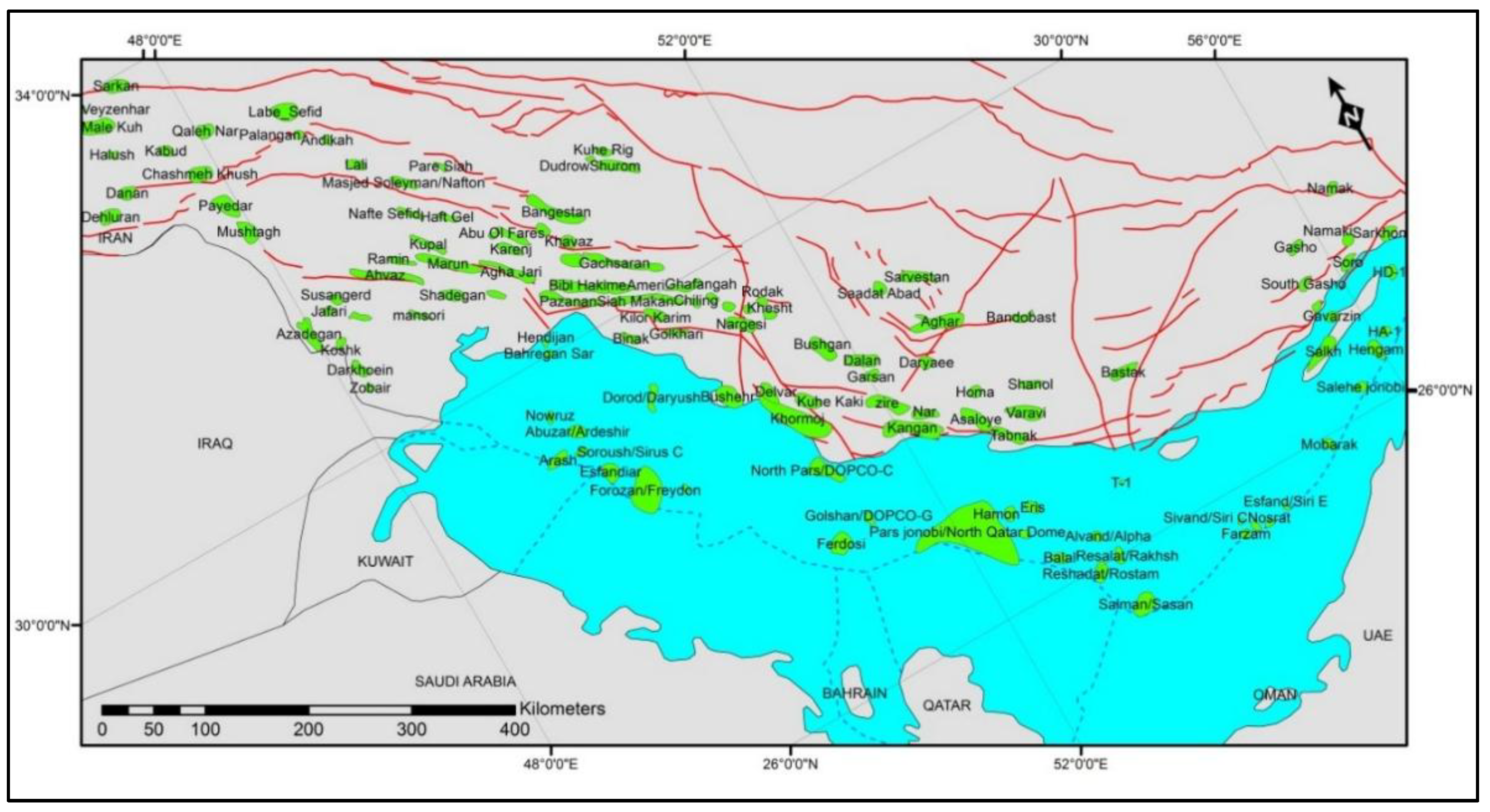
Figure 2.
Seismicity map of the Nezamabad Fault System in the study area showing earthquake epicenters classified by focal depth. The dense clustering of events between 10 and 33 km indicates active deformation within the crystalline basement beneath the Fars area. Spatial coincidence of seismic clusters with major anticlines (Shahini, Halegan, Sefid Zakhoreh) illustrates the influence of deep-seated fault reactivation on trap morphology, migration pathways, and reservoir compartmentalization in the Zagros Fold–Thrust Belt.
Figure 2.
Seismicity map of the Nezamabad Fault System in the study area showing earthquake epicenters classified by focal depth. The dense clustering of events between 10 and 33 km indicates active deformation within the crystalline basement beneath the Fars area. Spatial coincidence of seismic clusters with major anticlines (Shahini, Halegan, Sefid Zakhoreh) illustrates the influence of deep-seated fault reactivation on trap morphology, migration pathways, and reservoir compartmentalization in the Zagros Fold–Thrust Belt.
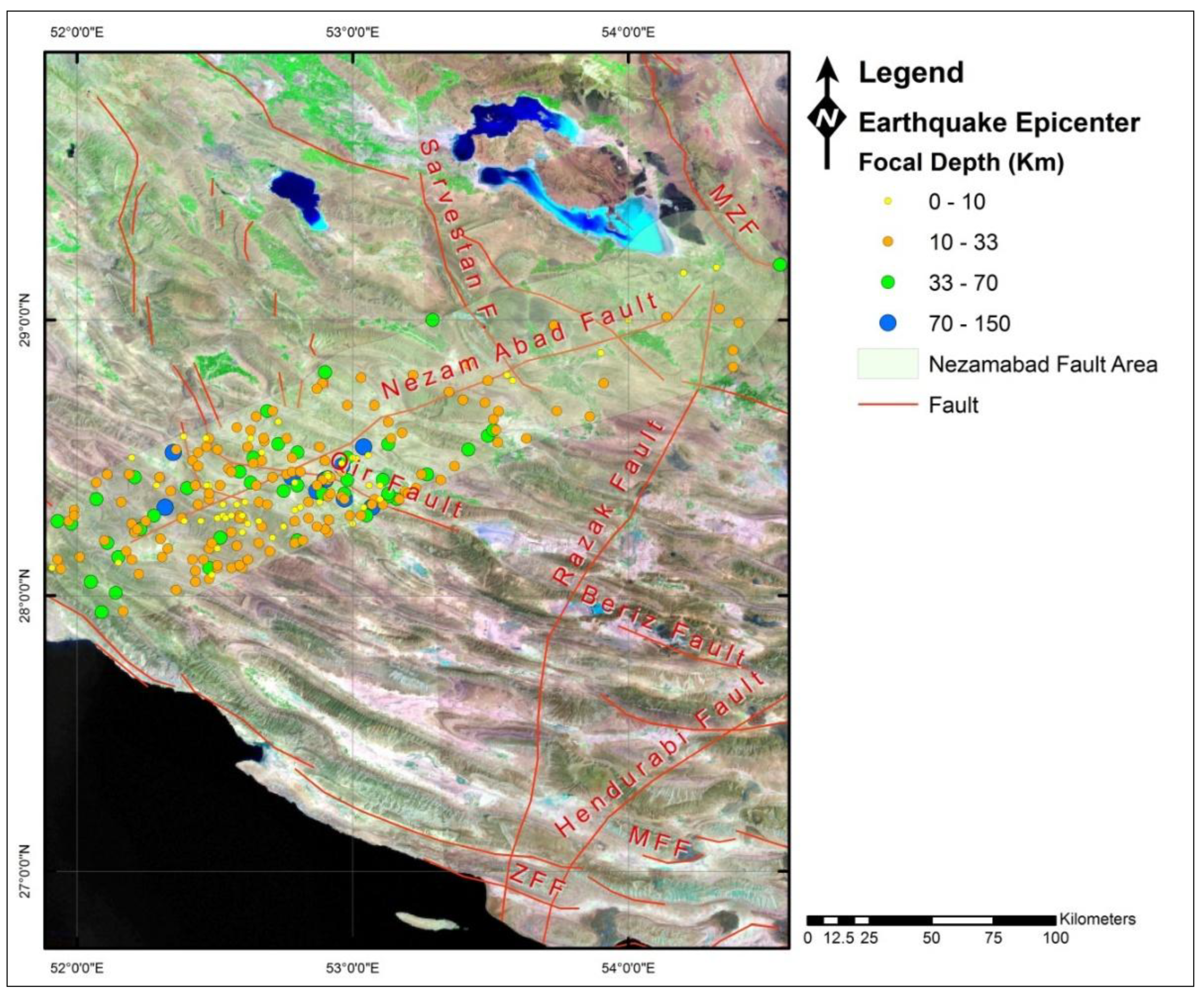
Figure 3.
Jurassic Isopach map illustrating structural-thickness variations across the Nezamabad Fault System. Major depocenters southwest of the fault correspond to active Jurassic subsidence zones, while the northeastern domain exhibits uplifted, thinned successions. The asymmetry and contour deflections denote basement-controlled deformation and multi-phase reactivation, which collectively shaped the stratigraphic architecture and hydrocarbon trap evolution within the Fars region of the Zagros Fold-Thrust Belt.
Figure 3.
Jurassic Isopach map illustrating structural-thickness variations across the Nezamabad Fault System. Major depocenters southwest of the fault correspond to active Jurassic subsidence zones, while the northeastern domain exhibits uplifted, thinned successions. The asymmetry and contour deflections denote basement-controlled deformation and multi-phase reactivation, which collectively shaped the stratigraphic architecture and hydrocarbon trap evolution within the Fars region of the Zagros Fold-Thrust Belt.
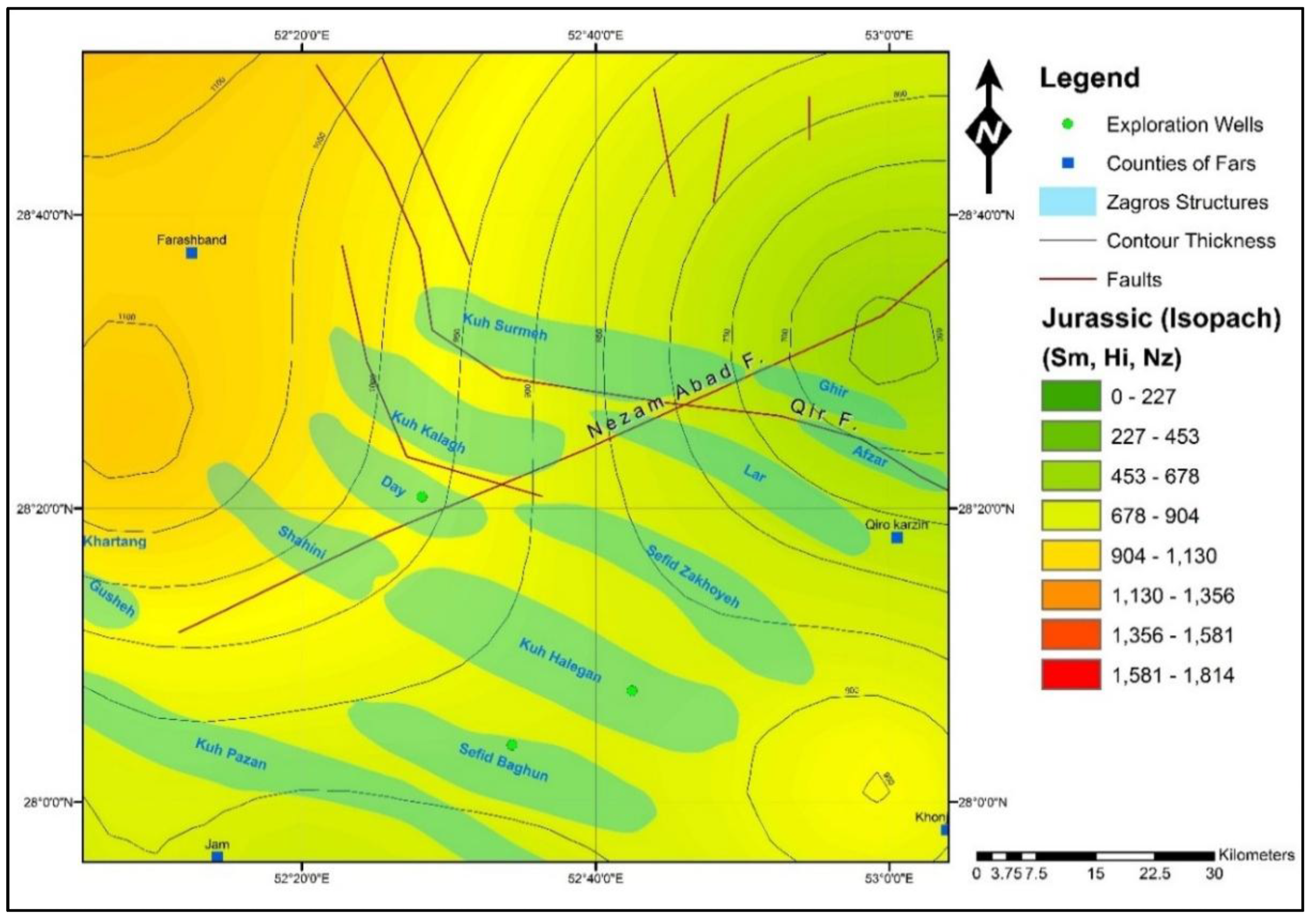
Figure 4.
Lower Cretaceous Isopach map showing thickness variation across the Nezamabad Fault System. Pronounced thickening southwest of the fault (Shahini–Halegan–Sefid Baghun zone) indicates continued fault-controlled subsidence during deposition of the Gadvan, Fahliyan, Dariyan, and Kazhdumi formations. The contour asymmetry and structural segmentation reflect basement-involved deformation and cross-scale coupling that shaped Lower Cretaceous reservoir distribution and hydrocarbon trap evolution within the Fars sector of the Zagros Fold–Thrust Belt.
Figure 4.
Lower Cretaceous Isopach map showing thickness variation across the Nezamabad Fault System. Pronounced thickening southwest of the fault (Shahini–Halegan–Sefid Baghun zone) indicates continued fault-controlled subsidence during deposition of the Gadvan, Fahliyan, Dariyan, and Kazhdumi formations. The contour asymmetry and structural segmentation reflect basement-involved deformation and cross-scale coupling that shaped Lower Cretaceous reservoir distribution and hydrocarbon trap evolution within the Fars sector of the Zagros Fold–Thrust Belt.
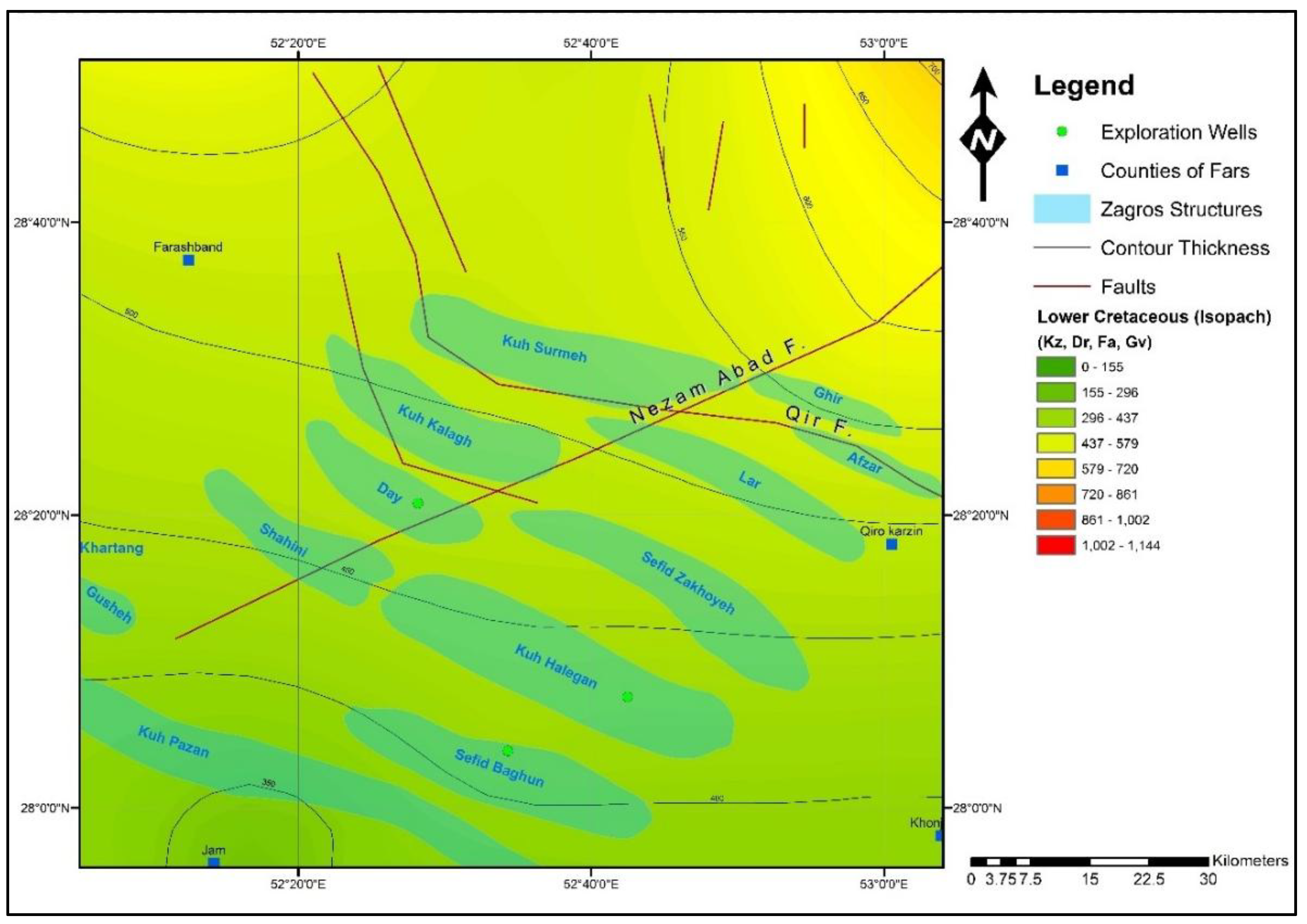
Figure 5.
Upper Cretaceous isopach map of the Nezamabad Fault System. Thickness gradients and contour deflections illustrate fault-controlled subsidence southwest of the Nezamabad Fault and relative uplift northeastward. The stratigraphic architecture of the Sarvak, Laffan, Ilam, Gurpi, and Tarbur formations reflects cross-scale coupling between basement reactivation and surface deformation, governing the evolution of hydrocarbon traps across the Fars sector of the Zagros Fold–Thrust Belt.
Figure 5.
Upper Cretaceous isopach map of the Nezamabad Fault System. Thickness gradients and contour deflections illustrate fault-controlled subsidence southwest of the Nezamabad Fault and relative uplift northeastward. The stratigraphic architecture of the Sarvak, Laffan, Ilam, Gurpi, and Tarbur formations reflects cross-scale coupling between basement reactivation and surface deformation, governing the evolution of hydrocarbon traps across the Fars sector of the Zagros Fold–Thrust Belt.
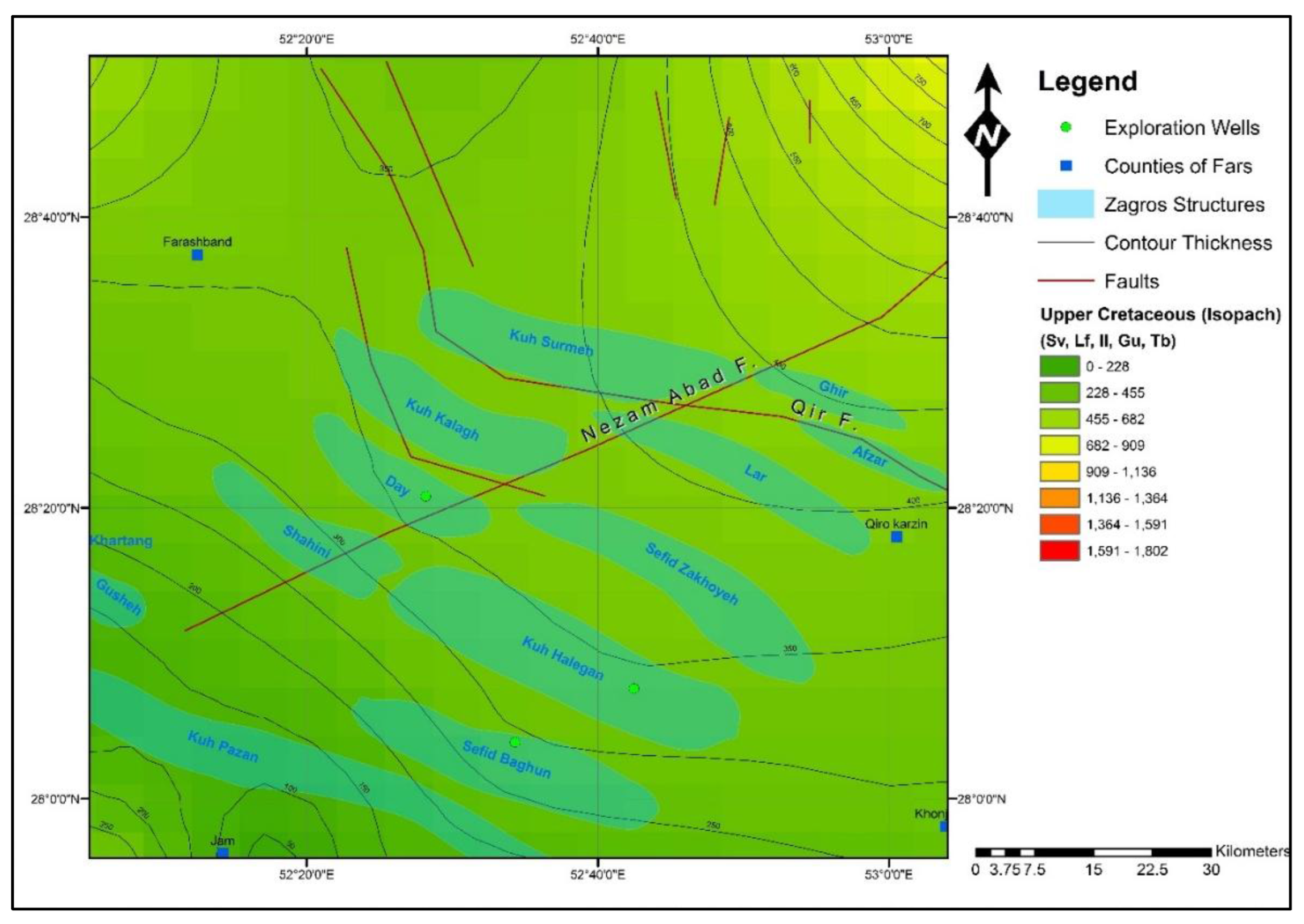
Figure 6.
Triassic Isopach map showing thickness variation across the Nezamabad Fault System. The southwestward thickening of the Dashtak, Khaneh Kat, and Kangan formations records fault-controlled subsidence and early rift development. The asymmetric geometry and contour deflections reflect basement-driven deformation and cross-scale coupling, which collectively preconditioned later folding and hydrocarbon trap evolution within the Fars sector of the Zagros Fold–Thrust Belt.
Figure 6.
Triassic Isopach map showing thickness variation across the Nezamabad Fault System. The southwestward thickening of the Dashtak, Khaneh Kat, and Kangan formations records fault-controlled subsidence and early rift development. The asymmetric geometry and contour deflections reflect basement-driven deformation and cross-scale coupling, which collectively preconditioned later folding and hydrocarbon trap evolution within the Fars sector of the Zagros Fold–Thrust Belt.
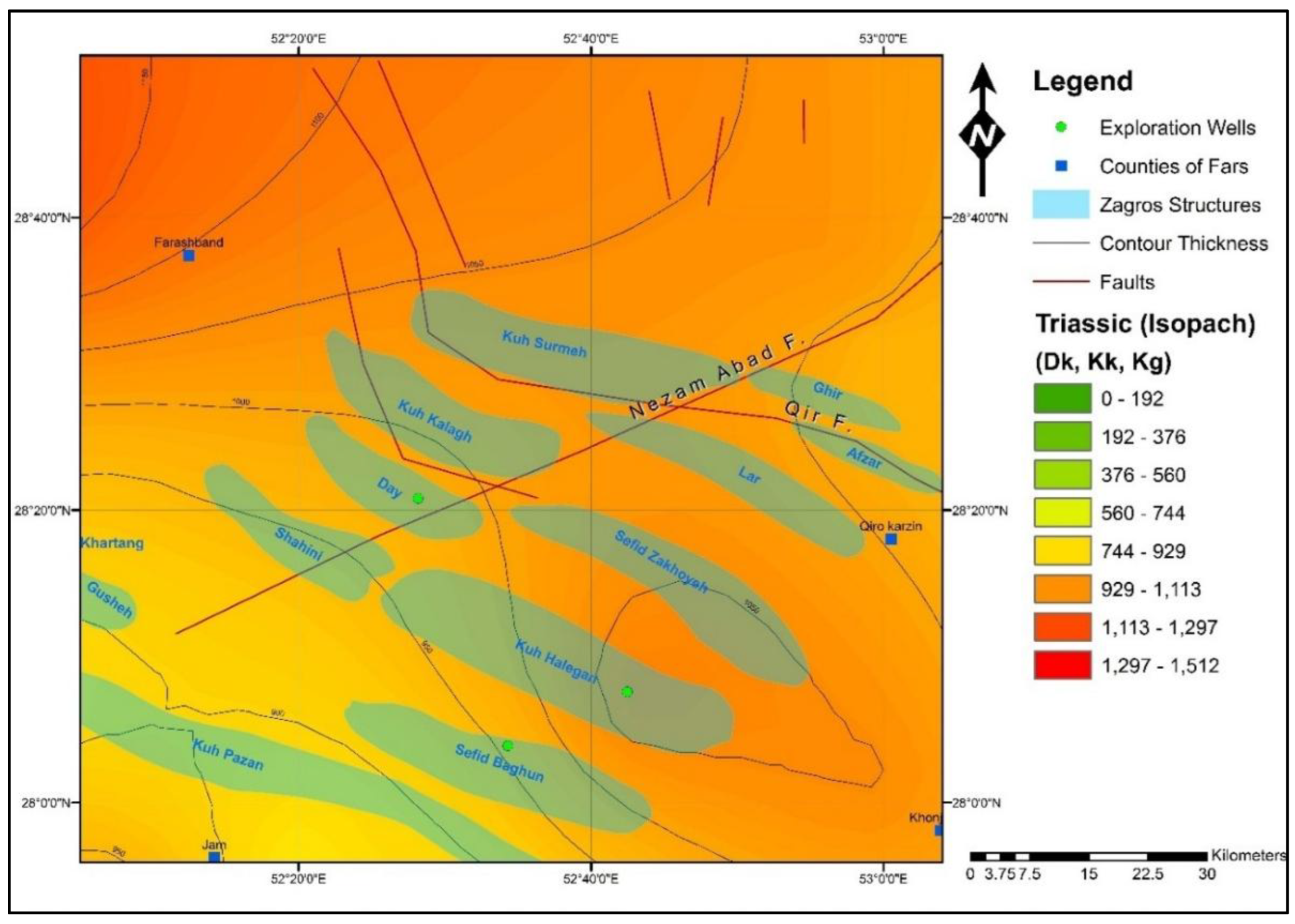

Table 1.
Summary of tectonic phases, stratigraphic response, and hydrocarbon system implications.
| Tectonic Phase | Period | Fault Kinematics | Key Formations | Stratigraphic Response | Hydrocarbon System Impact |
|---|---|---|---|---|---|
| Phase I: Syn-Rift | Triassic | Normal Faulting | Dashtak, Kangan, Khaneh Kat | SW-thickening (>1500 m) in fault-bounded troughs; evaporite accumulation. | Established primary detachment (Dashtak seal) and early reservoir (Kangan carbonates). |
| Phase II: Passive Subsidence | Jurassic - Early Cretaceous | Quiescent / Mild Strike-Slip | Surmeh, Hith, Neyriz | Moderate thickness variation (up to ~1800 m); continued depocenter development. | Deposition and maturation of source rocks (Surmeh); preservation of migration pathways. |
| Phase III: Transpressional Rejuvenation | Mid-Cretaceous | Transpression / Reactivation | Fahliyan, Dariyan, Kazhdumi | Depocenter continuity with incipient flexural overprint; fault-controlled thickening. | Enhanced reservoir dolomitization & fracture permeability; regional seal (Kazhdumi) established. |
| Phase IV: Inversion & Orogeny | Late Cretaceous - Cenozoic | Transpression / Inversion | Sarvak, Ilam, Gurpi, Asmari | Isopach contour deflection; inversion of depocenters; fold nucleation. | Generation of structural-stratigraphic traps; trap rejuvenation & seismic pumping drive hydrocarbon charge. |
Table 2.
Comparative analysis with prior studies on the Nezamabad Fault System.
| Study | Primary Focus/Methodology | Key Findings/Contributions | Novelty & Advancements of the Present Study |
|---|---|---|---|
| Ginés, et al. [42] | Regional field mapping & structural analysis. | First identification of NFS as a major transverse structure influencing surface geology and diapirism. | Quantitative Isopach Analysis: Provides a temporal and spatial record of fault activity, moving from qualitative description to quantitative subsidence history. |
| Furst [43] | Structural geology of diapirism. | Linked strike-slip faulting to salt diapir emergence in the SE Zagros. | Integrated System View: Connects fault-salt interaction to a comprehensive hydrocarbon trap model across multiple reservoirs, not just diapirism. |
| Hessami, et al. [44] | Seismotectonics & basement fault significance. | Argued for basement involvement in Zagros deformation using seismicity. | Cross-Scale Coupling Concept: Explicitly models and demonstrates the mechanical linkage from lithospheric seismicity (10-150 km) to specific trap formation in the sedimentary cover. |
| Bahroudi and Koyi [51] | Tectono-sedimentary framework (regional). | Described the thin vs. thick-skinned tectonics debate in the Zagros. | Fault-Specific Focus: Provides a detailed, fault-specific evolution model for the NFS, rather than a regional overview. |
| Maleki [48] | Structural analysis of a single fold (Kuh-e Qazi). | Detailed study of how the NFS influences the geometry of a specific anticline. | Basin-Scale Synthesis: Extends the analysis from a single fold to the entire fault corridor, revealing its control on depocenter migration and the entire petroleum system. |
Table 3.
Synthesis of key evidence supporting the "cross-scale coupling" concept.
| Domain of Evidence | Data Type | Key Observations | Interpretation related to Cross-Scale Coupling |
|---|---|---|---|
| Deep Crustal Deformation | Seismicity (Focal Depth & Distribution) | >240 events M>2.5; Clustering at 10-33 km (basement); events down to 150 km. | Confirms NFS is a trans-lithospheric structure, providing the deep-seated energy and stress for upper crustal deformation. |
| Stratigraphic Architecture | Isopach Maps (Triassic-Cretaceous) | Persistent SW-thickening asymmetry; contour deflection near fault; depocenter migration. | Documents the long-term, fault-controlled sedimentary response to basement reactivation, creating the template for reservoirs and sources. |
| Structural Geometry | Surface & Subsurface Mapping | Fold-axis deflection; anticline segmentation (Shahini, Halegan); hybrid trap geometries. | Shows the transmission of deep kinematic signals into the sedimentary cover, generating the final hydrocarbon trap configurations. |
| Hydrocarbon System Dynamics | Trap Analysis & Migration Modeling | Alignment of traps with seismic clusters; polyphase charge; fracture-enhanced permeability. | Illustrates the dynamic outcome of coupling: fault-driven seismicity actively controls migration (seismic pumping) and reservoir rejuvenation. |
Table 4.
Synthesis of key recent studies on basement faulting, hydrocarbon systems, and methodological approaches in the Zagros and analogous structural settings.
Table 4.
Synthesis of key recent studies on basement faulting, hydrocarbon systems, and methodological approaches in the Zagros and analogous structural settings.
| Study | Region / Analog | Key Objective/Focus | Methodology | Key Findings & Relevance to Present Study |
|---|---|---|---|---|
| Vergés, et al. [3] | SW Iran, Zagros | Understand structural style and timing of NW-SE trending folds and their interaction with N-S trends. | Seismic interpretation, structural balancing, field data. | Highlighted the importance of fault-fold interaction and multi-phase deformation, providing a regional context for transverse fault influences. |
| Eftekhari, et al. [54] | Mansouri Oilfield, Zagros | Reservoir characterization and hydraulic flow unit identification. | Machine Learning (Fuzzy C-means, ANN), statistical analysis, core-log integration. | Showcased the power of advanced computational methods for reservoir compartmentalization studies, a next-step application for the trap zones identified in this study. |
| Aldega, et al. [82] | Fars Province, Zagros | Thermal evolution of the Zagros Fold-Thrust Belt. | Thermal maturity modeling, vitrinite reflectance, clay mineralogy. | Constrained the thermal history and timing of hydrocarbon generation, a critical component for linking trap formation to charge timing. |
| Farzaneh, et al. [1] | External Fars, Zagros | Investigate hydrocarbon potential using isopach maps in a paleo-environmental context. | Isopach mapping, paleo-environmental reconstruction. | Confirmed isopach maps as a robust tool for revealing tectonic controls on deposition; established a foundation for fault-linked depocenter analysis. |
| Saffari and Kianoush [16] | Zagros Basin | Integrated petrophysical evaluation of Sarvak, Gadvan, and Fahliyan formations. | Petrophysical analysis, well log integration, reservoir characterization. | Provided detailed reservoir properties and potential, which can be directly linked to the structural trap domains identified along the NFS. |
| Saffari, et al. [9] | Zagros Basin | Sedimentological and diagenetic insights into the Sarvak Formation. | Sedimentology, diagenesis, core analysis. | Elucidated the primary controls on reservoir quality, a key component for assessing the productivity of the hydrocarbon traps defined in this study. |
| Adib and Kianoush [79] | Central Iran | Geotechnical and geological characterization of the Meskani Mine Complex. | Geotechnical surveys, multidisciplinary data integration. | Demonstrates a similar integrated methodology for subsurface characterization, highlighting the importance of understanding fault-controlled rock mass behavior. |
| Adib and Kianoush [66] | Kashan Region, Central Iran | Enhanced seismic hazard assessment and risk zoning. | Historical data analysis, advanced seismic modeling, GIS. | Underlines the importance of active fault system analysis for risk assessment, a secondary implication of understanding the seismogenic NFS. |
| Kianoush, et al. [78] | Torud Playa Basin, NE Iran | Comprehensive assessment of hydrogeological reserves using pumping tests. | Pumping test analysis, hydrogeological modeling. | Showcases the application of robust fluid reservoir assessment methods in a different geological context, emphasizing the value of the integrated approach used in this study. |
| Yazdanpanah, et al. [4] | Interior Fars, Zagros | Biostratigraphy and microfacies analysis of the Jahrum Formation. | Microfacies analysis, biostratigraphic dating. | Provided high-resolution age control and depositional environment constraints crucial for calibrating tectonic events inferred from stratigraphic architecture. |
| Teknik, et al. [59] | Hendurabi Fault, Zagros | Analyze the effect of a basement fault on folding style. | Surface geology, structural cross-sections. | Demonstrated a direct causal relationship between specific basement fault reactivation and variations in fold geometry in the sedimentary cover. |
| This Study | Nezamabad Fault, Fars, Zagros | Decipher multi-phase basement fault control on hydrocarbon trap evolution via cross-scale coupling. | Integrated isopach mapping, seismicity analysis, structural-stratigraphic synthesis. | Novelty: Provides a unified, temporally-constrained model linking deep seismicity (to 150 km) to specific trap-forming mechanisms across the entire Mesozoic succession through the concept of "cross-scale coupling". |
Disclaimer/Publisher’s Note: The statements, opinions and data contained in all publications are solely those of the individual author(s) and contributor(s) and not of MDPI and/or the editor(s). MDPI and/or the editor(s) disclaim responsibility for any injury to people or property resulting from any ideas, methods, instructions or products referred to in the content. |
© 2025 by the authors. Licensee MDPI, Basel, Switzerland. This article is an open access article distributed under the terms and conditions of the Creative Commons Attribution (CC BY) license (http://creativecommons.org/licenses/by/4.0/).
Copyright: This open access article is published under a Creative Commons CC BY 4.0 license, which permit the free download, distribution, and reuse, provided that the author and preprint are cited in any reuse.