

Submitted:
22 October 2025
Posted:
24 October 2025
You are already at the latest version
Abstract
Innovation adoption in primary sectors—agriculture, horticulture, forestry, and aquaculture—is essential for addressing pressing global challenges including climate change, resource degradation, and food security. However, a persistent gap exists between innovation potential and actual implementation, with many promising technologies failing to achieve widespread adoption despite substantial research investments. This paper presents the Extended Integrated Adoption Model Framework (EIAMF), a systemic approach that addresses critical gaps in adoption theory by integrating four quadrants: technologies, users, finance, and institutions. The EIAMF explicitly recognizes adoption as a systemic process requiring alignment across multiple dimensions. The framework’s distinctive contribution lies in its emphasis on inter-quadrant relationships, revealing how variables across different domains interact, compound, and cascade to create either enabling conditions or barriers. We demonstrate how the framework can enable practitioners to proactively identify potential adoption barriers early in the innovation development process by providing structured diagnostic protocols that reveal when barriers in multiple quadrants compound to create obstacles, when cascade effects amplify constraints across the system, and where strategic interventions can address multiple barriers simultaneously. We discuss theoretical contributions and practical implications for practitioners and policy designers, highlighting how the EIAMF provides stakeholders with a tool for designing more effective adoption strategies.
Keywords:
innovation adoption
; primary sector
; business models
; institutional readiness
; financial enablers
; systems approach
1. Introduction
Innovation adoption in the primary sector is essential to addressing pressing global challenges. Climate change, resource degradation, evolving market demands, and sustainability imperatives have placed unprecedented pressure on agriculture, forestry, and aquaculture to innovate rapidly and effectively [1]. From precision agriculture technologies that optimize resource efficiency to sustainable forestry practices that balance production with ecosystem services, innovations across these sectors hold great potential for addressing contemporary challenges.
However, the reality of innovation adoption in primary sectors reveals a persistent and problematic gap between innovation potential and actual implementation. Despite substantial investments in research and development, many promising innovations fail to achieve widespread adoption or require decades to diffuse through industry networks [2]. This adoption gap reflects not only the inherent complexity of primary production systems but also the inadequacy of existing theoretical frameworks to capture the multifaceted nature of adoption decisions in these contexts [3,4].
While numerous theoretical models exist to explain innovation adoption, their application in primary sector contexts is often constrained by fragmentation and insufficient integration of key variables [5]. Traditional adoption models, while foundational, frequently focus primarily on technology characteristics and individual user attributes, overlooking critical financial mechanisms, institutional arrangements, and business model innovations that enable or constrain adoption in practice.
Recent reviews highlight this theoretical fragmentation and call for more integrated frameworks that reflect the realities of adoption in complex, networked value chains [6]. The primary sector, characterized by long investment cycles, substantial capital requirements, regulatory complexity, and interdependent value chains, exemplifies these challenges, and demands more sophisticated analytical approaches.
This paper addresses these gaps by presenting an Extended Integrated Adoption Model Framework (EIAMF) that builds upon established theoretical foundations while incorporating insights from business model innovation theory, institutional economics, and financial adoption literature. Our framework extends traditional models by explicitly integrating four key constructs that capture the full complexity of primary sector adoption decisions. Through systematic synthesis of empirical evidence and detailed sectoral applications, we evaluate both the theoretical validity and practical utility of this integrated approach.
2. Theoretical Foundations and Empirical Evidence Base
Innovation adoption in the primary sector is a multifaceted phenomenon influenced by a complex interplay of technological, individual, financial, and institutional factors. While foundational theories have provided significant insights, their application to capital-intensive, networked primary production systems often reveals critical gaps. This section expands on the theoretical underpinnings of innovation adoption, integrating additional perspectives to address these complexities.
2.1. Foundational Theories in Innovation Adoption
Innovation adoption research has been profoundly shaped by several core theoretical perspectives. Everett Rogers’ Diffusion of Innovations (DOI) theory remains the most influential framework, positing that the spread of new ideas and technologies occurs through a social system over time [7]. DOI identifies five key attributes of innovations that influence their adoption rate: relative advantage, compatibility, complexity, trialability, and observability [6,8]. These characteristics have been extensively validated across diverse contexts and continue to offer fundamental insights into how innovations are perceived and adopted by individuals and organizations. Complementing Rogers’ work, Tornatzky and Klein’s meta-analysis further emphasized the consistent importance of compatibility, relative advantage, and complexity in predicting innovation adoption [9,10].
The Theory of Reasoned Action (TRA) [11] and its extension, the Technology Acceptance Model (TAM) [12], focus on the cognitive and social psychological processes underlying adoption decisions. These models suggest that an individual’s intention to adopt a technology is influenced by their attitude toward using the technology and subjective norms (perceived social pressure). Perceived usefulness and perceived ease of use are central constructs in TAM, shaping attitudes and intentions. Both TRA and TAM have seen additional extensions to further explain adoption within, particularly, our increasingly technological and social-media oriented lifestyles.
The Concerns-Based Adoption Model (CBAM) offers a developmental perspective, recognizing that users progress through different stages of concern and use as they engage with innovations [13]. CBAM’s emphasis on implementation stages and the evolving support needs of users provides valuable insights for designing effective adoption interventions.
Institutional theory provides a lens for understanding how formal and informal rules, norms, and cognitive frameworks shape adoption behaviors within organizational and sectoral contexts [14]. This perspective highlights that adoption decisions are not made in a vacuum but are embedded within broader institutional environments that can either facilitate or constrain innovation uptake. Institutional pressures, such as coercive (e.g., regulations), mimetic (e.g., imitation of successful peers), and normative (e.g., professional standards) forces, can significantly influence the adoption trajectory of innovations.
2.2. Emerging Perspectives: Business Models and Financial Enablers
Recent scholarship has increasingly recognized the limitations of individually-focused adoption models, calling for greater attention to systemic, organizational, and institutional factors. Business model innovation theory emphasizes that successful innovation adoption often necessitates complementary changes in how value is created, delivered, and captured [15,16]. This perspective is particularly relevant in primary sectors, where innovations frequently require new partnerships, contractual arrangements, and governance structures to be viable. A novel technology might fail to gain traction if it does not align with or enable a viable business model for the adopter.
Financial adoption barriers have received growing attention, particularly in studies of climate-smart agriculture and digital technology adoption [17]. Research indicates that financial constraints, risk perceptions, and misaligned incentive structures often represent primary barriers to adoption in agricultural contexts. Similarly, studies on digital financial services highlight how transaction costs, affordability, and access to appropriate financing mechanisms critically influence adoption outcomes [18]. The inherent capital intensity and long investment cycles in primary production systems make financial considerations paramount, often overshadowing purely technical or individual-level factors. Some theories and research areas related to business model and finance are:
Investment Theory: This theory provides a framework for understanding how individuals and organizations make decisions about allocating capital to various assets, considering factors such as expected returns, risk, and time horizons. In the primary sector, adoption of new technologies often involves significant upfront investment, making investment theory crucial for analyzing financial readiness and the decision-making process.
Corporate Finance/Innovation Finance: This area of finance focuses on how companies fund their operations and growth, including investments in innovation [19]. It considers various financing mechanisms (e.g., debt, equity, grants), capital structure, and the valuation of innovative projects. Understanding innovation finance is critical for analyzing how primary sector businesses secure the necessary capital for adopting new technologies, especially those with long payback periods or high initial costs.
Risk Management/Insurance Economics: These fields of research address how individuals and organizations identify, assess, and mitigate risks [20]. In agriculture, various risks (e.g., weather, market price volatility, disease) can significantly impact the perceived financial viability of an innovation. The availability and cost of insurance, as well as producer’s risk aversion, play a crucial role in adoption decisions. This perspective helps explain why innovations that reduce risk or offer risk-sharing mechanisms might be more readily adopted.
Tax Policy: Government tax policies, such as depreciation allowances, investment tax credits, or carbon taxes, can significantly influence the financial attractiveness of innovations [21]. Understanding how tax policy interacts with investment decisions is vital for assessing financial enablers and barriers to adoption.
Market Formation Theory: This theory examines how new markets emerge and evolve, often driven by technological innovations. It considers the roles of various actors (e.g., innovators, users, regulators, investors) and the institutional arrangements that facilitate or hinder market development. For primary sector innovations, understanding market formation is crucial for assessing the readiness of the broader ecosystem to support the new technology.
Policy Mix/Systems of Innovation: This perspective emphasizes that innovation is not an isolated event but a systemic process influenced by a combination of policies (e.g., R&D subsidies, regulations, extension services) and institutional arrangements [22]. Analyzing the coherence and effectiveness of the policy mix is essential for understanding the institutional readiness for innovation adoption in the primary sector.
Institutional Entrepreneurship: This area of research focuses on how actors (individuals or organizations) actively shape and change institutional environments to facilitate new practices or innovations. In the context of primary sector innovation, institutional entrepreneurs might advocate for new regulations, create new industry standards, or establish new collaborative platforms to overcome institutional barriers to adoption.
Network Theory: This theory examines the structure and dynamics of relationships between entities. In the primary sector, innovation adoption often depends on strong networks among producers, researchers, extension services, suppliers, and buyers. Network theory helps understand how information flows, trust is built, and collective action is facilitated, all of which are critical for diffusion and adoption [23].
3. The Extended Integrated Adoption Model Framework
Building upon established theoretical foundations while addressing identified gaps, we defined an Extended Integrated Adoption Model Framework, as represented in Figure 1. The EIAMF is structured around four interrelated constructs (referred also as quadrants) that capture a fuller picture of the complexity of primary sector adoption decisions. The framework explicitly recognizes adoption as a systemic process requiring alignment across multiple dimensions rather than a linear individual decision process.
3.1. Empirical Support for Individual Quadrants: Strengths and Limitations
This section includes an analysis of the theoretical foundation for each quadrant and an assessment of their strengths and limitations. We also identify empirical gaps regarding their inter-quadrant integration and propose further research for a systemic analysis of adoption and diffusion.
We also identified a set of variables for each quadrant that could be operationalized for integrated studies, presented in Appendix A. The Technology Characteristics and the User Characteristics and Learning Capacity quadrants include well established and researched variables but also include some less researched variables to reflect on the evolving nature of new technologies. On the other hand, variables in the Financial Readiness and Enablers and the Business Models and Institutional Readiness quadrants have not been widely researched in adoption studies, yet appear to have strong anecdotal relevance to uptake and use behavior.
3.1.1. Technology Characteristics: Robust but Evolving Empirical Base
Empirical support for the influence of Technology Characteristics on innovation adoption is arguably the most robust and well-established. Decades of research, stemming from Rogers’ Diffusion of Innovations theory and meta-analyses like Tornatzky and Klein, consistently demonstrate the predictive power of attributes such as relative advantage, compatibility, and complexity [24]. In the primary sector, studies frequently confirm that innovations offering clear economic benefits (e.g., increased yield, reduced costs) and fitting existing practices are more readily adopted [25,26].
Technology Characteristics represent the foundation of adoption analysis, capturing perceived innovation attributes that influence attractiveness and feasibility for potential users. This quadrant draws primarily from Diffusion of Innovations theory, which identifies core attributes influencing adoption. These factors remain foundational across contexts and have been validated in meta-analyses [4,30]. The Concerns Based Adoption Model (CBAM) further refines understanding of how users move through levels of use, with variables such as reversibility, security concerns and technical performance emerging from this literature [13].
However, empirical research on technology characteristics is evolving. With the advent of digital and data-intensive innovations in the primary sector (e.g., precision agriculture, IoT sensors), new characteristics like data security, interoperability, and technical fit with complex digital ecosystems are gaining prominence [27]. While some studies have begun to explore these, comprehensive empirical evidence on their specific impact across diverse primary sector contexts (agriculture, forestry, aquaculture) is still emerging. For instance, while the importance of data security is acknowledged, there is less empirical work quantifying its direct impact on adoption rates compared to traditional factors like relative advantage. Table A1 shows the variables included in this quadrant.
3.1.2. User Characteristics and Learning Capacities: Well-Explored but Context-Specific Nuances
The empirical evidence for User Characteristics and Learning Capacities is also substantial, drawing from psychology, sociology, and economics. Studies consistently show that factors like risk aversion, openness to change, prior knowledge, and learning orientation significantly influence adoption decisions [28,29]. The role of social networks and peer influence, often termed social contagion or imitation, is empirically well-documented in agricultural contexts, where farmers learn from and are influenced by their neighbors and opinion leaders [23].
Despite this strong empirical base, a gap exists in understanding the context-specific nuances of these characteristics within the primary sector. For example, while risk aversion is a known barrier, the specific types of risks (e.g., production risk, market risk, financial risk) that most influence adoption of particular innovations in different primary sub-sectors (e.g., aquaculture vs. extensive pastoral farming) require more granular empirical investigation. Similarly, we don’t know much about cultural identity and value alignment’s impact on adoption in diverse indigenous or culturally sensitive primary production systems. Table A2 shows the variables included in this quadrant.
3.1.3. Financial Readiness and Enablers: Increasingly Recognized but Under-Quantified
The empirical recognition of Financial Readiness and Enablers as critical determinants of adoption has grown significantly, particularly in capital-intensive sectors like primary production [17]. Studies highlight that upfront capital requirements, access to credit, and the availability of subsidies are major barriers or enablers [30]. The concept of payback time and return on investment (ROI) is empirically shown to be a key decision metric for adopters.
However, a significant empirical gap lies in the detailed quantification and modeling of these financial factors. While many studies qualitatively identify financial constraints, fewer provide robust empirical models that integrate various financial variables (e.g., cost structure fit, revenue model fit, transaction costs, and risk-sharing mechanisms) into a comprehensive framework predicting adoption [17,18]. There is also a need for more empirical work that disentangles the relative importance of different financial enablers (e.g., grants vs. low-interest loans vs. insurance schemes) for different types of innovations and adopter profiles [20,31]. Furthermore, the empirical impact of specific tax policies on innovation adoption in the primary sector remains an area requiring more dedicated research [21]. Table A3 shows the variables included in this quadrant.
3.1.4. Business Models and Institutional Readiness: Emerging but Complex Empirical Landscape
Empirical support for the influence of Business Models and Institutional Readiness is emerging but represents a more complex and less uniformly quantified landscape [14]. Studies increasingly demonstrate that institutional environments, policy support, and the presence of viable business models are crucial for successful innovation uptake [32]. The importance of key partnerships, governance structures (e.g., cooperatives), and trust in institutions is empirically supported in various contexts [33].
Despite this growing recognition, the empirical measurement and causal inference regarding business models and institutional factors are challenging. Many studies are qualitative or case-based, providing rich insights but lacking the ability to be generalized.
There is a need for more quantitative empirical research that measures the impact of specific institutional alignments (e.g., regulatory frameworks, certification standards) or business model innovations (e.g., new value capture mechanisms, novel distribution channels) on adoption rates across larger samples. The dynamic and multi-level nature of institutional factors makes empirical isolation of their effects difficult, leading to a gap in robust, generalized empirical findings compared to the more individual-focused quadrants. Table A4 shows the variables included in this quadrant.
3.2. Lack of a Systemic View of Adoption
While each quadrant demonstrates a critical aspect of innovation adoption, the focus of study within technology-related adoption is heavily skewed towards ensuring relative advantage. For too long, extension programs have sat at the end of the R&D pipeline, where a more holistic study of the system of adoption in terms of technology, user, and the financing and business constraints the technology will enter into could lead to more transdisciplinary methods for technology development and adoption readiness [34]. We contest that many adoption practitioners focus also on the user intention to adopt, rather than looking towards the wider capability to adopt, much of which is centered on the bottom hemisphere functions in our EIAMF, incorporating Financial Readiness and Business Models and Institutional Readiness under which the actors operate.
Where practitioners have been promoting a technology or behavior change for many years with little success, the problem may not lie with either the technology nor the user-oriented compatibility or willingness to adopt, but the ability to adopt given the complexity in the wider system [14]. Land management is a business. In the case of many farmers, orchardists and forestry contractors, it is also a lifestyle choice and tied to family [35,36]. Many adoption frameworks focus on the farmer and the decision-making process of the farmer alone, but fail to identify aspects of the business that impact farmer decisions [3]. Decision-making in a land management context is one of the more complex operating environments in which to purchase and use technology, and where adoption decisions need to deal with the inherent complexity [2]. Like industrial adoption, it is not a personal decision, so any adoption model that places heavy emphasis on the individual user as decisionmaker, and characteristics of the technology itself without equal consideration to the systemic complexity of the decision environment is likely to have limited success [6,37].
There appear to be a limited number of papers that speak to the practice of adoption as part of a systemic decision, with ecosystem impacts [14,17]. In addition, each practice change a producer makes has its own unique pattern of adoption which is not usually a binary decision (there can be dis-adoption and then a later return to the practice as factors change), and whereby different technologies and behaviors are adopted either early of late dependent not solely on the user’s character, but on externalities [38,39]. The complexity of adoption pathways reflects the dynamic nature of farming systems where economic conditions, institutional support, market access, and environmental factors continuously evolve, creating windows of opportunity or constraint that vary over time [23,29].
The EIAMF heavily draws from adoption lessons in the forestry sector. While frameworks and models of adoption in agriculture have been extensively researched, there are very few relating specifically to adoption practices in forestry [40,41]. Forestry has similar complexity in the adoption system to agricultural systems, but also suffers from a low user-base of potential adopters, high investment capital requirements as well as different adoption decision roles within stakeholders (depending on if they are landowners, forest managers, Timber Investment Management Organizations (TiMO) executives or forestry contractors) [42,43]. In Southern Hemisphere plantation forestry, such as New Zealand, forestry contractors take on most of the risk in capital investment and upgrades, while the power base in contractual arrangements sits largely with the forestry management companies [35]. Many of the models that work well for adoption in other primary sectors do not appear to translate well for forestry adoption. Reasons that explain the nuances of forestry adoption include the divergence in contractor versus company-level risk orientation; that decisions around technology uptake are made in light of upcoming contractual arrangements, accessibility of labor, and forestry investment cycles [36]; that forestry goes through boom and bust cycles that impact on the ability to finance and service long-term loans; the high degree of mechanization and increasing automation that has been driving investment in the sector, meaning large sunk costs in existing equipment and technology lock-in [44].
Risks of adoption can often be lower in an integrated value chain arrangement where business models can provide risk sharing arrangements throughout the chain [45]. In contrast, separate businesses often find it more difficult to share the risk across the chain, particularly where an imbalance in power occurs between actors [46]. There is a recognized need for employing different adoption strategies depending on the level of risk sharing and value chain integration in the system, due to the sharp contrast in identified barriers and motivations between highly integrated and highly separated value chains. The fragmented nature of plantation forestry businesses within the Southern Hemisphere requires some level of risk sharing to improve adoption of technology innovation in the sector [47]. Fragmentation occurs due to consolidated plantations versus smaller enterprises, limited integration between large players and smaller growers, insufficient coordination, and a strong reliance on exporting raw or semi-processed materials, low market confidence.
While the decision for adoption by a farmer can occur fairly rapidly, the speed of diffusion across a sector at scale may be quite slow. Most diffusion models look towards locking in early adopters, and reaching the tipping point to drive wider diffusion via the social system. Downes & Nunes [48] emphasize the compression of Roger’s adoption curve into 2 main user classes – initial trial users, and the rest of the market, which can lead to an emphasis on initial adoption rather than ensuring a technology is well embedded in the system to avoid later dis-adoption, through after-sales service and ensuring a focus on continued downstream competitive advantage in the next version of a technology offering [39].
With peak adoption occurring after an average of 16 years in agriculture, this can mean a long lag time before the adoption becomes embedded within the system [2]. Few adoption frameworks account for aspects such as duration of adoption, the extent and frequency of use by the adopter or the degree of intensity of use and also fail to measure and monitor dis-adoption across time [49]. Agribusiness and technology specialists seek fast adoption rates and shorter product life cycles of a product or technology, particularly in the service sector [50].
The significance of the EIAMF’s lower hemisphere quadrants—namely, Financial Readiness and Business Models and Institutional Readiness—in the adoption of innovations within the forestry sector is underscored by their respective roles in mitigating barriers to implementation. Financial Readiness and its associated enablers serve to reduce financial risk for end-users, while Business Models and Institutional Readiness address broader systemic and institutional constraints that may impede sector-wide diffusion.
3.3. Exploring Inter-Quadrant Relationships with the EIAMF
While a varied degree of empirical support exists for individual quadrants, a critical gap remains in the integrated understanding of their interplay, particularly within the unique context of capital-intensive, networked primary production systems. Few adoption models consider explicitly the interplay between variables in different quadrants, such as the ADOPT model, and generally, empirical studies often focus on one or two quadrants, neglecting the systemic nature of innovation adoption in the primary sector. This section further explores these empirical gaps, highlighting areas where further research is needed to provide a more holistic understanding of innovation adoption.
One of the critical benefits of the EIAMF is the ability to provoke thinking to investigate interquadrant connectivity, particularly between the top and bottom hemispheres. Inter-relationships between quadrants can elicit important questions relating to how the criteria from one quadrant will impact or speak to criteria in other quadrants. In particular:
- How can you link variables from different quadrants to understand how they interact, compound, and cascade to create either enabling conditions or barriers?
- Can adoption practitioners use the EIAMF as a diagnosis tool to see interlinked aspects that could hinder adoption of a technology, earlier in the technology development process?
- Can adoption practitioners identify where strategic interventions can address multiple barriers simultaneously?
Often practitioners/business/research community wait until we encounter a problem with technology uptake/adoption before taking action with the stakeholders to find a solution around the barrier or constraint. A major benefit in the EIAMF is that it can be used to identify early in time the possible barriers that might arise, particularly where quadrants intercept, and therefore enable us to ask the right questions from a systemic viewpoint, not quadrant-specific questions. For instance:
Technology-Finance Interplay: While the cost of technology is acknowledged, empirical studies rarely quantify how specific financial mechanisms (e.g., trial financing, risk-sharing) directly mitigate the perceived financial risk or upfront capital requirements of a given technology, thereby influencing its adoption [17]. How does the perceived technical performance of an innovation empirically affect its access to capital or the willingness of financial institutions to provide loans? Research on precision agriculture adoption demonstrates that equipment leasing and pay-per-use models can significantly improve adoption rates by converting capital investments to operational expenses, yet these financing innovations remain underutilized in many primary sector contexts [51,52].
User-Institutional Dynamics: How do user characteristics (e.g., risk aversion, learning orientation) empirically interact with institutional factors (e.g., extension services, policy support) to shape adoption outcomes [22]? For example, does strong institutional support for training empirically reduce the impact of low learning capacity on adoption? Or how do social norms within user groups empirically influence the effectiveness of new policies aimed at promoting sustainable practices, and perceptions about transaction cost [23]? Studies of conservation practice adoption reveal that extension support can partially compensate for low initial farmer knowledge, but cannot fully overcome cultural resistance or peer network effects that reinforce traditional practices [30].
Business Model-Technology Alignment: While business model innovation is theoretically linked to technology adoption [16], there is a lack of empirical studies that quantify how the design of a new business model (e.g., a service-based model for precision agriculture) empirically influences the adoption of the underlying technology by overcoming barriers related to its cost or complexity. How does the strength of a value proposition empirically translate into higher adoption rates, and how is this mediated by the technology’s characteristics [32]?
Business Model-Finance Alignment: Business model innovation can arise from new financing arrangements, and conversely may enable the arrangement of innovative financing methods utilizing the individual strengths of the business partners [31]. Deeply held industry-level norms might in fact constrain the ability to move outside of accepted financing arrangements. Do deep institutional norms in an industry impact on the language and terms of contracts, or the ability of a partner to explore and adopt novel financing arrangements for a recent technology? Would a policy change enable the emergence of new financial products that would drive successful earlier adoption [14]?
Cross-Quadrant Feedback Loops: The integrated model suggests dynamic feedback loops. For example, successful early adoption (influenced by technology and user characteristics) can empirically lead to policy changes or the emergence of new financial products, which in turn facilitate broader adoption [50]. However, empirical studies that track and quantify these multi-directional influences over time are lacking. In general, empirical work provides a snapshot rather than a dynamic analysis of these complex interactions [38].
3.4. The EIAMF as a Structured Diagnosis Tool
Addressing empirical gaps in innovation adoption research requires a shift towards more integrated, multidisciplinary research designs. This includes the use of longitudinal studies, mixed-methods approaches that combine quantitative surveys with qualitative case studies, and econometric models capable of capturing complex interactions and feedback loops. By empirically investigating inter-quadrant relationships, researchers can offer a more comprehensive and actionable understanding of innovation adoption, ultimately supporting more effective strategies for accelerating the uptake of critical innovations in the primary sector.
More critically, applying the EIAMF to a set adoption issue enables practitioners to conceptualize the innovation system holistically. This approach facilitates the identification of key inter-quadrant linkages that influence adoption rates, the success of barrier mitigation strategies, and the development of creative, interconnected solutions. By posing the right questions early in the research, development, and adoption cycle, practitioners can better anticipate and address adoption challenges [3].
For example, recognizing a high level of risk aversion due to the complexity of a technology may necessitate targeted learning support from identified actors to demonstrate its applicability across diverse contexts. However, without concurrent institutional support for training and trialability, actors may lack the confidence to effectively utilize the technology, potentially resulting in elevated rates of dis-adoption [39]. Establishing peer-learning opportunities across use-case scenarios and creating clear pathways for correct technology usage.
Thinking more holistically at the interplay between quadrants can also enable practitioners to identify novel ways to pivot when the adoption path hits a barrier due to any one of the quadrant areas. For example, when “power imbalance” (Institutional) cascades into “risk aversion” (User) and “Cost Structure Fit” (Financial). This allows for better understanding of the complexity of drivers leading to the barrier, and therefore the level of agility and flexibility present in the RD&E system that could be employed to overcome it [34].
3.5. Examples of EIAMF in the Primary Sector
3.5.1. Agriculture: Precision Agriculture Technologies
The adoption of precision agriculture technologies, including GPS-guided equipment, variable rate application systems, and sensor-based monitoring, illustrates the complex interplay among all four EIAMF constructs.
From a Technology Characteristics perspective, these innovations offer clear relative advantage through improved input efficiency and yield optimization. However, their complexity and high observability requirements create adoption challenges, particularly for smaller operations where results may be less visible to peers [27].
User Characteristics play a critical role in precision agriculture adoption. Research demonstrates that adoption is strongly correlated with education levels, technical orientation, and participation in professional networks [51,53]. Farmers with prior experience with computer-based systems and those embedded in progressive peer networks show significantly higher adoption rates. Risk aversion remains a barrier, particularly given the substantial learning investments required for effective implementation [29].
Financial Readiness often represents the primary constraint for precision agriculture adoption [54]. Initial capital requirements for comprehensive systems is very significant, and ongoing software and service costs add substantial annual expenses. However, innovative financing mechanisms including equipment leasing, pay-per-use models, and government cost-share programs have emerged to address these barriers. The development of service-based business models, where technology providers offer precision agriculture services rather than selling equipment, has significantly improved adoption rates among smaller operations [52].
Business Models and Institutional Readiness factors critically influence precision agriculture success. Adoption is facilitated by strong dealer networks that provide technical support, data management services that help farmers utilize information effectively, and industry partnerships that integrate precision agriculture data with broader farm management systems. Institutional factors including data privacy regulations, equipment standards, and extension service support also significantly influence adoption outcomes [22].
A potential mitigation solution: There is a clear financial readiness barrier in initial capital requirements. The barrier could be reduced through utilizing strong dealer networks that would allow joint equipment leasing arrangements.
3.5.2. Forestry: Sustainable Forest Management Certification
The adoption of sustainable forest management certification systems, such as Forest Stewardship Council (FSC) or Program for the Endorsement of Forest Certification (PEFC), demonstrates how institutional and business model factors can drive adoption even when technology characteristics are relatively neutral.
From a Technology Characteristics perspective, certification systems involve moderate complexity and limited trialability, as forest management changes must often be implemented comprehensively to achieve certification. However, observability is high, as certified operations can clearly demonstrate their commitment to sustainable practices to customers and stakeholders [55].
User Characteristics strongly influence certification adoption. Forest owners with strong environmental orientations and those embedded in professional networks that emphasize sustainability show higher adoption rates [40]. However, adoption also occurs among economically-motivated owners when market incentives are sufficient. Learning orientation is critical, as certification requires understanding of complex ecological and social standards [23].
Financial Readiness considerations are complex for forest certification. While direct certification costs are moderate, compliance may require significant management changes that affect operational costs and revenue timing [36]. However, certified products could command price premiums that can offset these costs. The availability of group certification schemes has reduced costs for smaller forest owners by enabling cost-sharing and administrative efficiencies [55,56].
Business Models and Institutional Readiness factors are decisive for certification adoption. Strong market demand from environmentally-conscious consumers and corporate buyers creates economic incentives for certification [57]. Institutional support from government agencies, environmental organizations, and industry associations facilitates adoption by providing technical assistance and market development [22,58]. Trust relationships between forest owners and certification bodies are essential for successful implementation [59].
A potential mitigation solution: Leaning on government agencies to marry the shared values between actors in industry, consumer and brokerage agencies through a set of common policy instruments and trading schemes.
3.5.3. Aquaculture: Recirculating Aquaculture Systems (RAS)
The adoption of recirculating aquaculture systems represents a particularly complex case where all four constructs interact to influence adoption outcomes. RAS technology offers substantial environmental advantages by reducing water use and waste discharge while enabling year-round production in controlled environments.
Technology Characteristics present both opportunities and challenges for RAS adoption. The relative advantage is substantial for operations facing water restrictions or environmental regulations, and the technology offers excellent observability through demonstration facilities. However, complexity is high, requiring sophisticated monitoring and control systems, and trialability is limited due to the substantial infrastructure investments required [60,61].
User Characteristics critically influence RAS adoption success. The technology requires high technical competence and learning orientation, as operators must understand complex biological and engineering systems [37,61]. Former cage or hatchery managers are not necessarily sufficiently qualified to operate commercial scale RAS fattening farms without minimum 6-10 months training on the job, highlighting the specialized knowledge requirements. Additionally, risk tolerance is essential given the substantial investments and operational risks involved. Peer networks play important roles in knowledge sharing and problem-solving, with successful adopters often serving as mentors for new users [61].
Financial Readiness represents a major constraint for RAS adoption. Capital requirements are very significant for commercial-scale systems, and ongoing operating costs are substantially higher than traditional pond-based systems. Table-fish RAS remain far more sensitive to market prices and rising feed and energy input costs than conventional production systems, with unit production costs higher for saltwater than freshwater systems [61]. However, innovative financing approaches including public-private partnerships, equipment leasing, and outcome-based financing have emerged to address these barriers [19,31]. The development of modular systems and shared infrastructure models has also improved financial accessibility [60].
Business Models and Institutional Readiness factors strongly influence RAS viability. Success requires strong partnerships with equipment suppliers, technical service providers, and market outlets. However, many RAS technology suppliers continue to avoid highlighting outstanding technical and economic issues, leaving investors to discover challenges through costly experience [61]. Institutional support through research programs, regulatory frameworks that recognize RAS environmental benefits, and extension services providing technical assistance facilitates adoption [14]. Trust relationships among value chain participants are essential given the technology’s complexity and interdependencies, yet, the poor track record of commercial RAS ventures globally, with many failures occurring within 2-3 years of operation, underscores the importance of comprehensive business planning and realistic economic projections [61].
A potential mitigation solution: The EIAMF in this context highlights the need for increased focus on financial innovations rather than improving on the technological and user related variables to further adoption pathways. Given the expense and risk of such systems, provide an emphasis on innovative leasing arrangements via public -private partnerships, as demonstrated by some European initiatives [31,45,61]. The ability to overcome complexity and high capital cost for adoption introduces the potential for new business models and financing arrangements whereby “mini adoption” might occur through partial trialing of the system. This could be through partnership models allowing a wider range of business partners across the value chain able to invest in the technology, and financial arrangements that provide greater flexibility in securing a portion of an asset at a time [33,56].
3.5.4. Horticulture: Precision Irrigation and Fertigation Systems
The adoption of precision irrigation and fertigation systems in horticultural operations demonstrates the interplay of all four EIAMF constructs, particularly highlighting how water scarcity and regulatory pressures drive innovation adoption while financial and technical barriers constrain implementation.
From a Technology Characteristics perspective, precision irrigation and fertigation systems offer substantial relative advantage through improved water use efficiency, optimized nutrient delivery, reduced fertilizer waste, enhanced crop quality, and potential yield increases [27,62]. However, the technology presents high complexity, requiring integration of multiple components including sensors, controllers, variable rate application equipment, and decision support software. Compatibility varies significantly across different horticultural operations, soil types, and crop systems, with the technology demanding substantial changes to existing irrigation infrastructure and management practices. Despite over 20 years of research and development on site-specific variable rate irrigation systems, adoption by producers has remained at very low levels, with fewer than 200 advanced systems installed in the USA by 2013 [62].
User Characteristics significantly influence adoption patterns. Growers with strong environmental orientations and those facing water scarcity or regulatory restrictions show higher adoption rates. Risk aversion presents a complex dynamic: while the technology reduces production risks associated with water stress and nutrient deficiencies, it introduces new risks related to system failures and dependence on sophisticated equipment [30,62]. Prior knowledge and technical competence in troubleshooting equipment significantly facilitate adoption, as does learning orientation for continuous improvement in sensor interpretation and data-driven decision making [53].
Financial Readiness represents a major constraint, particularly for smaller operations. Upfront capital requirements are substantial, with ongoing costs for sensor maintenance, software subscriptions, and technical support. The relatively high capital cost per hectare may deter adoption, though equipment costs are declining due to technological advances. However, innovative financing mechanisms including equipment leasing, pay-per-use models, and government cost-share programs have emerged to address barriers [21]. Producers generally perceive a lack of sustainable, consistent economic advantages from precision agriculture technologies, with research generally not providing sufficient evidence to support claims of expected benefits [62].
Business Models and Institutional Readiness factors increasingly influence adoption success. Value proposition strength depends heavily on whether water scarcity, regulatory requirements, or market demands create compelling drivers beyond pure economic returns [27,62]. Market infrastructure including equipment dealers, irrigation consultants, and technical service providers significantly facilitates adoption. Key partnerships between growers, equipment suppliers, and water management agencies are critical [33]. Regulatory frameworks addressing water use efficiency and environmental protection create both mandates and incentives for adoption. However, sound decision-making tools for defining management zones, writing prescriptions, and optimal sensor placement remain underdeveloped, representing a critical research gap [62].
A potential mitigation solution: The EIAMF reveals that adoption requires integrated interventions addressing multiple constraint areas simultaneously. Financial barriers could be addressed through innovative service-based business models where specialized providers install, own, and manage systems, charging growers based on water savings achieved rather than requiring upfront capital investment [17]. Public-private partnerships could combine government cost-share programs with equipment supplier financing. Institutional support should prioritize development of regional irrigation management services providing comprehensive technical assistance. Extension programs should facilitate peer learning networks where experienced users mentor new adopters. Policy coherence ensuring that water pricing, environmental regulations, and agricultural support programs align to incentivize water conservation investments is essential. However, addressing these challenges will require substantial research investment to develop the basic tools and decision support systems needed to encourage sustained adoption [62].
Table 1 shows a brief analysis of a selection of studies to illustrate how the model could be operationalized by identifying variables from all quadrants that could be used to have a more systemic perspective of adoption.
4. Discussion
4.1. Theoretical Contributions
The EIAMF provides an analytical perspective that captures the multidimensional nature of adoption decisions in complex, networked production systems. By explicitly incorporating financial and institutional dimensions alongside traditional technology and user characteristics, the framework addresses significant gaps identified in recent literature reviews [6,37].
The EIAMF also recognizes adoption as a systemic process that requires alignment across multiple dimensions rather than a linear individual decision process. This perspective is particularly valuable for understanding adoption in business-to-business contexts where multiple actors must coordinate their decisions and investments for successful innovation diffusion.
We suggest the EIAMF can be used to design research methodologies and lead to model development that can include a more relevant set of variables, and to quantitatively measure (e.g. through path analysis, Structural Equation Modeling etc.) the strengths and co-dependencies between factor variables and quadrants that influence adoption for specific technologies and contexts [5].
The framework also contributes to business model innovation theory by demonstrating how business model alignment represents a critical but often overlooked determinant of technology adoption in primary sectors [16,32]. Traditional adoption models focus primarily on technology characteristics and user attributes, implicitly assuming that viable business models will emerge naturally if technologies are effective and users are motivated. The EIAMF reveals that business model innovation—including new partnership structures, value capture mechanisms, and governance arrangements—often represents a prerequisite for adoption rather than a consequence of it, particularly for innovations requiring fundamental changes to value chain relationships or market structures [17].
Lastly, the EIAMF provides operational specificity that supports empirical research and practical application. The detailed variable specifications and measurement approaches enable researchers to operationalize the framework across diverse contexts while maintaining theoretical coherence. The systematic diagnostic protocols emerging from the framework offer a structured methodology for conducting comprehensive adoption assessments that can be standardized across studies while remaining adaptable to context-specific conditions.
4.2. Implications for Practitioners
For practitioners working to accelerate innovation adoption in primary sectors, the EIAMF offers several insights. First, it emphasizes that successful adoption support requires attention to all four construct areas rather than focusing solely on technology development or user education [64]. Adoption barriers may arise from financial constraints, institutional misalignment, or business model inadequacies even when technologies are technically superior and users are motivated.
Second, the EIAMF provides practitioners with a diagnostic tool for conducting adoption assessments that systematically evaluate each quadrant and their interactions before initiating technology promotion efforts. Traditional adoption approaches typically identify barriers after adoption failures have occurred, leading to costly pivots, wasted resources, and discouraged potential adopters [34]. The framework enables practitioners to identify potential adoption obstacles early in the innovation development and dissemination process, before substantial investments are committed to promoting technologies that face systemic constraints. This proactive diagnostic capability transforms adoption support from reactive problem-solving to strategic system development.
Third, the EIAMF highlights the importance of network and partnership development in facilitating adoption [65]. Many of the variables identified in the institutional readiness construct emphasize relationship quality, trust, and coordination among multiple actors. This suggests that adoption support should focus on building collaborative capacity rather than simply providing information or incentives to individual users. The framework reveals that many adoption barriers cannot be overcome by individual actors regardless of their capabilities or motivations, but require collective action, coordinated investments, and institutional innovation that can only emerge through effective partnerships and governance structures [33].
4.3. Implications for Policy and Intervention Designers
The EIAMF has highlighted implications for policy makers and intervention designers working to support innovation adoption in primary sectors. Traditional approaches that focus primarily on technology development and transfer may be insufficient if financial, institutional, or business model barriers are not addressed [14].
Policy interventions should be designed to address multiple framework dimensions simultaneously. For example, agricultural innovation programs should combine research and development support with financing mechanisms, regulatory reform, and market development initiatives [66]. Similarly, environmental programs that seek to promote sustainable practices should address not only technical and educational needs but also financial incentives and institutional arrangements that enable adoption [4].
5. Conclusions
This paper has presented the Extended Integrated Adoption Model Framework that extends traditional adoption models to better capture the complexities of innovation adoption in primary sector contexts. By incorporating four key constructs—Technology Characteristics, User Characteristics and Learning Capacities, Financial Readiness and Enablers, and Business Models and Institutional Readiness—the framework provides a more comprehensive analytical lens for understanding and supporting innovation diffusion in agriculture, horticulture, forestry, and aquaculture.
The EIAMF’s theoretical foundations draw from established innovation adoption theory while incorporating insights from business model innovation, institutional economics, and financial services literature [14,15,16]. This integration addresses important gaps in existing models that have limited their applicability in complex, networked production systems where financial constraints, institutional arrangements, and business model innovations play decisive roles in adoption outcomes [6].
The operational specifications provided for each construct enable empirical application while maintaining theoretical coherence [37]. The sectoral examples demonstrate the framework’s practical utility for understanding adoption dynamics across diverse primary sector contexts and highlight the importance of integrated approaches that address multiple constraint areas simultaneously [30].
For researchers, the EIAMF provides a foundation for more comprehensive adoption studies that can capture the full range of factors influencing innovation diffusion in primary sectors. For practitioners and policy makers, it offers guidance for designing more effective adoption support interventions that address systemic barriers rather than focusing solely on technology development or user education [22,64].
The primary sector faces unprecedented challenges that demand rapid innovation adoption and adaptation [1]. By providing more comprehensive analytical tools for understanding and supporting adoption processes, the EIAMF contributes to efforts to accelerate beneficial innovation diffusion while ensuring that adoption support interventions address the full range of factors that influence success in complex, networked production systems [14].
6. Future Directions
Several important limitations should be acknowledged in the EIAMF development. First, while the EIAMF provides comprehensive variable specifications, future research should focus on empirical validation across diverse contexts, development of measurement instruments for key variables, and exploration of dynamic adoption processes including adaptation, dis-adoption, and re-innovation [67]. Additionally, testing and adaptation of the EIAMF in both developed and developing countries contexts represents an important priority for expanding its global applicability.
We acknowledge that the EIAMF’s complexity may limit its practical application in resource-constrained settings where comprehensive assessments across all four constructs may not be feasible. Future work should explore simplified versions of the EIAMF that maintain analytical value while reducing assessment requirements. This might include development of rapid assessment protocols that focus on critical inter-quadrant relationships most relevant for specific innovation types, or tiered assessment approaches where initial screening identifies priority areas for detailed analysis [34].
The EAIMF also assumes that adoption is generally desirable, but some innovations may have negative social or environmental consequences that make non-adoption preferable. Future research should explore how the EAIMF can be adapted to assess not just adoption likelihood but also adoption desirability from broader social perspectives. This might involve adding evaluative dimensions that assess who benefits and who bears costs from adoption, and whether adoption patterns exacerbate or reduce existing inequalities [2].
Finally, while the EAIMF acknowledges that adoption is an ongoing process, it does not fully capture the dynamics of adaptation, dis-adoption, and re-innovation that characterize many innovation pathways [38,39]. Future research should explore how the EIAMF can be extended to capture these dynamic processes. This temporal dimension is particularly important in primary sectors where adoption often involves long-term commitments, substantial learning curves, and evolving institutional and market conditions that may fundamentally alter the viability of innovations over time.
Author Contributions
Conceptualization, O.M and K.B.; methodology, O.M and K.B.; investigation, O.M and K.B.; writing—original draft preparation, O.M and K.B.; writing—review and editing, O.M. All authors have read and agreed to the published version of the manuscript.
Funding
This research was partially funded by The Forest Growers Research Primary Growth Partnership Programme: Forestry Work in the Modern Age, Project 5.7 Risk and Benefit Sharing.
Acknowledgments
The authors want to acknowledge the support of Forest Growers Research for the development of this research. During the preparation of this manuscript, the authors used Genspark for the purposes of generating draft text. The authors have reviewed and edited the output and take full responsibility for the content of this publication.
Conflicts of Interest
The authors declare no conflicts of interest.
Abbreviations
The following abbreviations are used in this manuscript:
| EIAMF | Extended Integrated Adoption Model Framework |
| DOI | Diffusion of Innovations |
| TRA | Theory of Reasoned Action |
| TAM | Technology Acceptance Model |
| CBAM | Concerns-Based Adoption Model |
| TiMO | Timber Investment Management Organizations |
| PEFC | Program for the Endorsement of Forest Certification |
| RAS | Recirculating Aquaculture Systems |
Appendix A. Proposed Variables

Table A1.
Technology Characteristics variables.
| Variable | Description/Example | Example Measure | Notes |
|---|---|---|---|
| Relative Advantage | Perceived improvement over current practice, including economic, social, or environmental benefits. | “Compared to current practices, this innovation will improve productivity/profitability/sustainability”; Return on Investment (ROI); Payback Period; Carbon footprint reduction (%); Yield increase. | Crucial for initial interest and sustained adoption. Can be quantitative (e.g., yield increase) or qualitative (e.g., improved quality of life). Measured in terms that matter to the specific users. |
| Compatibility | Perceived consistency with existing values, needs, prior experiences, infrastructure, and operational practices. | “This innovation fits well with my existing equipment and values/farm management system”; Degree of change required in current practices (qualitative assessment); Integration cost with existing systems. | High compatibility reduces perceived disruption and facilitates easier integration. Innovations incompatible with existing values or practices will not be adopted as rapidly. |
| Complexity | Perceived difficulty of understanding, learning, and using the innovation. | “This innovation is difficult to understand and use”; Training hours required; Number of steps in implementation process; Perceived ease of use. | High complexity can be a significant barrier, especially for resource-constrained adopters. |
| Trialability | Ease of experimenting with the innovation on a limited basis before full adoption. | Percentage of users able to test innovation at small scale; Availability of pilot programs or demonstration sites; Cost of trial. | Reduces perceived risk and allows adopters to gain direct experience. |
| Observability | Visibility of the results and benefits of the innovation to others. | “I can easily see the results of this innovation on other farms/forests/aquaculture sites”; Number of demonstration farms; Peer-to-peer learning opportunities. | Facilitates social learning and reduces uncertainty for potential adopters. |
| Reversibility | Ease of switching back to prior practices if the innovation proves unsatisfactory. | “I could easily revert to prior practices if needed”; Cost of dis-adoption; Time required to revert. | Low reversibility increases perceived risk and can deter adoption. |
| Cost (Upfront & Ongoing) | Initial investment costs, operational costs, maintenance costs, and potential hidden costs. | Upfront and ongoing financial cost; Total Cost of Ownership (TCO); Cost per unit of output. | A critical financial barrier, especially in capital-intensive primary sectors. |
| Security | Concerns over data privacy, cybersecurity risks, and physical security implications of the innovation. | “Using this innovation exposes me to data/security risks”; Number of reported security breaches (if applicable); Compliance with data protection regulations. | Increasingly important for digital technologies and data-driven innovations. |
| Uncertainty/Risk (Technical) | Perceived operational risk, reliability, and consistency of the innovation’s performance. | “I am uncertain about the consistent performance of this innovation”; Variance in performance metrics; Frequency of technical failures. | High uncertainty can deter risk-averse adopters. |
| Technical Performance | Objective measures of the innovation’s efficiency, reliability, quality of results, and output. | Objective measures of performance reliability (e.g., uptime, yield increase, disease reduction); Error rate; Throughput. | Directly impacts the perceived benefits and effectiveness of the innovation. |
| Environmental and Social Impact | Perceived positive or negative impacts on the environment and community. | “This innovation has positive impacts on the environment/community”; Reduction in greenhouse gas emissions (%); Water usage reduction (%); Job creation/displacement. | Growing importance due to sustainability concerns and corporate social responsibility. |
| Technical Fit/Interoperability | Compatibility and seamless integration with existing technical systems, equipment, and software. | “This innovation integrates seamlessly with my current systems”; Number of interfaces required; Compatibility standards met. | Essential for avoiding system fragmentation and ensuring smooth operations. |
| Adaptability/Scalability | Ease with which the innovation can be modified, expanded, or adapted to different scales of operation or changing conditions. | Ease of customization (qualitative); Scalability potential (e.g., small farm to large enterprise); Modularity of components. | Important for long-term relevance and broader applicability across diverse primary sector operations. |
Table A2.
User characteristics and Learning Capacities variables.
| Variable | Description/Example | Example Measure | Notes |
|---|---|---|---|
| Profit Orientation | The degree to which an adopter prioritizes financial gains and economic efficiency in decision-making. | Focus on financial outcomes; Investment in profit-maximizing technologies; Use of financial planning tools. | Highly influential in capital-intensive primary sectors. |
| Environmental Orientation | The degree to which an adopter prioritizes environmental sustainability and ecological stewardship. | Focus on sustainability outcomes; Adoption of eco-friendly practices; Certification in environmental standards. | Growing importance due to climate change and consumer demand for sustainable products. |
| Risk Aversion | Tendency to avoid or minimize exposure to uncertainty and potential losses. | “I prefer practices with guaranteed outcomes over potentially higher but uncertain returns”; Insurance uptake; Diversification of activities. | High risk aversion can deter adoption of novel, unproven innovations. |
| Openness to Change | General receptiveness to new ideas, practices, and technologies. | “I am generally open to trying new practices and technologies”; History of early adoption; Participation in innovation workshops. | A key psychological trait influencing willingness to innovate. |
| Prior Knowledge/Experience | Familiarity with similar innovations, technologies, or management practices. | Years of experience with related technologies; Scores on knowledge tests; Participation in training programs. | Reduces perceived complexity and uncertainty, facilitating adoption. |
| Learning Orientation | Willingness and capacity to invest time and effort in acquiring new knowledge and skills. | “I am willing to invest in learning new skills for this innovation”; Participation in extension services; Engagement in peer learning groups. | Crucial for adapting to complex innovations and continuous improvement. |
| Cultural Identity/Value Alignment | The extent to which the innovation aligns with the adopter’s cultural values, beliefs, and social norms. | Alignment with cultural practices (e.g., Māori governance, traditional practices); Perceived impact on community values. | Particularly relevant in diverse cultural contexts within the primary sector. |
| Social Identity/Peer Group Influence | The influence of belonging to specific social or professional groups on adoption decisions. | Alignment with identity groups (e.g., industry peer groups, farmer associations); Perceived adoption by opinion leaders. | Strong influence of social networks and demonstration effects. |
| Peer Network Embeddedness | The degree of participation and integration within informal and formal peer networks. | Number of active memberships in farmer groups; Frequency of interaction with peers; Role as an opinion leader. | Facilitates knowledge exchange, social learning, and trust building. |
| Social Norms | Perceived expectations and behaviors of important others (e.g., family, neighbors, industry leaders). | “Most farmers in my area are adopting this innovation”; Perceived social pressure to adopt. | Can significantly drive or hinder adoption through conformity. |
| Subjective Norms | The perceived social pressure to perform or not perform a behaviors, influenced by specific individuals or groups. | Influence from key opinion leaders; Recommendations from trusted advisors. | Similar to social norms but focuses on specific influential figures. |
| Attitudes toward Innovation | General positive or negative predisposition towards innovations in general or a specific innovation. | “I have a positive attitude towards new technologies in farming”; Affective (emotional) and cognitive (belief) components. | Directly impacts adoption intention and behaviors. |
| Trust in Technology/Providers | Degree of trust in the innovation’s reliability, the provider’s credibility, and the information sources. | “I trust the information provided about this innovation”; Reputation of technology provider; Perceived transparency. | Reduces perceived risk and uncertainty. |
| Self-Efficacy | Perceived ability to successfully perform the actions required to use the innovation. | “I am confident in my ability to use this innovation successfully”; Prior success with similar tasks; Access to training and support. | A strong predictor of adoption and sustained use. |
| Access to Information | The availability and accessibility of relevant, timely, and trustworthy information about the innovation. | Number of information sources accessed; Perceived quality of information; Participation in extension programs. | Crucial for reducing uncertainty and building knowledge. |
| Decision-making power | Accountability level for the decision | “I am accountable for decisions made within my family/ company” | Perceived behavioral control and perceived accountability |
Table A3.
Financial readiness and Enablers variables.
| Variable | Description/Example | Example Measure | Notes |
|---|---|---|---|
| Upfront Capital Requirements | The amount of initial investment needed to acquire and implement the innovation. | Initial investment cost; Percentage of total farm assets required. | A major barrier, especially for small and medium-sized enterprises (SMEs) in the primary sector. |
| Availability of Subsidies/Incentives | Presence and accessibility of financial supports from government, industry, or other organizations. | Amount of grant/subsidy available; Eligibility criteria met; Ease of application process. | Can significantly de-risk and incentivize adoption. |
| Trial Financing/Pilot Funding | Availability of specific financial support for testing or piloting the innovation on a limited scale. | Availability of dedicated trial funds; Success rate of pilot projects. | Reduces the financial risk associated with initial experimentation. |
| Cost Structure Fit | Whether the innovation’s cost structure aligns with the adopter’s existing cash flow, revenue cycles, and financial planning. | Alignment with seasonal cash flow (qualitative); Impact on working capital; Need for external financing. | Mismatch can lead to liquidity issues, even if the innovation is profitable long-term. |
| Revenue Model Fit/Value Capture | How the innovation generates revenue or cost savings for the adopter, and how well this aligns with their existing business model. | New revenue streams generated; Cost savings achieved; Impact on existing revenue streams. | Ensures the innovation is not just technically viable but also economically sustainable. |
| Risk Sharing Mechanisms | Availability of mechanisms to mitigate financial risks associated with the innovation (e.g., insurance, guarantees, joint ventures). | Availability of crop insurance, price insurance; Participation in risk-sharing cooperatives; Public-private partnerships (PPPs). | Crucial for reducing perceived financial risk, especially for novel or climate-sensitive innovations. |
| Perceived Financial Risk | The adopter’s subjective assessment of the financial uncertainty and potential losses associated with the innovation. | “I am uncertain about the financial returns of this innovation”; Perceived variability of returns; Likelihood of financial loss. | Influenced by objective risk but also by individual risk aversion. |
| Transaction Costs (Financial) | Costs associated with accessing finance, such as application fees, legal costs, and time spent on administrative processes. | Time spent on loan applications; Fees for financial services; Complexity of financial agreements. | Can be a hidden barrier, especially for small-scale producers. |
| Affordability/Budget Constraints | The perceived ability of the adopter to bear the financial burden of the innovation within their current budget. | Perceived affordability; Debt-to-equity ratio; Available discretionary income. | Even if profitable, an innovation might be unaffordable if capital is constrained. |
| Payback Time/Return on Investment (ROI) | The expected period to recoup the initial investment, or the financial return generated relative to the investment. | Payback period (years); ROI (%); Net Present Value (NPV); Internal Rate of Return (IRR). | Key metrics for evaluating the financial attractiveness and viability of an investment. |
| Access to Credit/Capital | The availability of and ability to secure loans, equity, or other forms of capital for innovation adoption. | Loan approval rates; Interest rates; Collateral requirements; Relationship with financial institutions. | Direct access to funding is fundamental for capital-intensive innovations. |
| Government Financial Support | Direct financial assistance or tax incentives provided by government bodies to encourage specific innovation adoption. | Tax credits for innovation; Subsidies for sustainable practices; Grants for R&D. | Policy instruments that directly influence the financial landscape for adopters. |
Table A4.
Business Models & Institutional Readiness variables.
| Variable | Description/Example | Example Measure | Notes |
|---|---|---|---|
| Value Proposition Strength | The clarity, attractiveness, and distinctiveness of the value offered by the innovation to various stakeholders in the value chain. | Perceived value by customers/partners; Market demand for the innovation’s output; Differentiation from alternatives. | A strong value proposition is essential for market acceptance and business model viability. |
| Portfolio alignment | The fit with current strategic direction and portfolio | Relatedness to current objectives and product stable | A strong portfolio alignment reduces risk and effort required to reposition in order to adopt |
| Channels/Distribution | How effectively the innovation is promoted, delivered, and made available to target adopters and markets. | Number and effectiveness of distribution channels; Accessibility of the innovation; Marketing reach. | Efficient channels reduce friction in adoption and market penetration. |
| Customer Relationships | The nature and quality of interactions between the innovation provider/adopter and their customers/stakeholders. | Level of customer support and engagement; Customer satisfaction scores; Repeat business. | Strong relationships build trust and facilitate feedback for innovation refinement. |
| Key Partnerships | The presence and effectiveness of collaborations with aligned partners across the value chain (e.g., suppliers, processors, retailers, research institutions). | Number and quality of strategic partnerships; Joint ventures; Collaborative agreements. | Crucial for sharing resources, knowledge, and risks in complex value chains. |
| Governance Structures | The formal and informal rules, decision-making processes, and power dynamics within organizations and networks that influence innovation adoption. | Role of cooperatives, industry associations, iwi trusts, catchment groups; Centralized vs. decentralized decision-making. | Can facilitate or hinder collective action and resource allocation for innovation. |
| Contractual Security/Legal Framework | The existence of clear, enforceable contracts and a supportive legal framework that secures market access, intellectual property, and investment. | Presence of formal contracts; Legal protection for new practices; Regulatory clarity. | Reduces uncertainty and encourages investment in new business models. |
| Certification & Standards Barriers | Requirements, certifications, or standards that may restrict market access or increase the cost/complexity of adoption. | Number of certifications required; Cost of compliance; Time to achieve certification. | Can act as significant non-tariff barriers or enablers depending on alignment. |
| Actor Network Dynamism/Flexibility | How open, flexible, and adaptive the network of actors (e.g., farmers, researchers, policymakers) is to new ideas and collaborations. | Degree of network openness; Speed of information flow; Adaptability to change. | Dynamic networks foster innovation and rapid diffusion. |
| Institutional Alignment/Policy Support | Whether public agencies, policies, and regulatory frameworks actively support and enable the adoption of the innovation. | Presence of supportive policies (e.g., R&D funding, extension services, land use regulations); Policy coherence; Regulatory burden. | Government and institutional support can significantly de-risk and accelerate adoption. |
| Trust in Partners & Institutions | The level of trust among actors within the value chain and in the governing institutions. | Perceived trustworthiness of suppliers, buyers, government agencies; Reputation of industry bodies. | High trust reduces transaction costs and facilitates collaboration. |
| Market Infrastructure Readiness | The availability and quality of physical and digital infrastructure necessary to support the innovation (e.g., broadband, processing facilities, transport). | Access to high-speed internet; Availability of specialized processing plants; Logistics efficiency. | Essential for scaling up and integrating innovations into the broader economy. |
| Social License to Operate | The ongoing acceptance of an innovation or project by local communities and stakeholders. | Community acceptance (qualitative); Public perception surveys; Absence of social opposition. | Crucial for long-term sustainability and avoiding social conflicts. |
References
- Pretty, J.; Sutherland, W.J.; Ashby, J.; Auburn, J.; Baulcombe, D.; Bell, M.; Bentley, J.; Bickersteth, S.; Brown, K.; Burke, J.; et al. The Top 100 Questions of Importance to the Future of Global Agriculture. Int. J. Agric. Sustain. 2010, 8, 219–236. [Google Scholar] [CrossRef]
- Doss, C.R. Analyzing Technology Adoption Using Microstudies: Limitations, Challenges, and Opportunities for Improvement. Agric. Econ. 2006, 34, 207–219. [Google Scholar] [CrossRef]
- Montes de Oca Munguia, O.; Llewellyn, R. The Adopters versus the Technology: Which Matters More When Predicting or Explaining Adoption? Appl. Econ. Perspect. Policy 2020, 42, 80–91. [Google Scholar] [CrossRef]
- Wauters, E.; Mathijs, E. The Adoption of Farm Level Soil Conservation Practices in Developed Countries: A Meta-Analytic Review. Int. J. Agric. Resour. Gov. Ecol. 2014, 10, 78–102. [Google Scholar] [CrossRef]
- Montes de Oca Munguia, O.; Pannell, D.J.; Llewellyn, R. Understanding the Adoption of Innovations in Agriculture: A Review of Selected Conceptual Models. Agronomy 2021, 11, 139. [Google Scholar] [CrossRef]
- van Oorschot, J.A.W.H.; Hofman, E.; Halman, J.I.M. A Bibliometric Review of the Innovation Adoption Literature. Technol. Forecast. Soc. Change 2018, 134, 1–21. [Google Scholar] [CrossRef]
- Rogers, E.M. Diffusion of Innovations.; The Free Press: New York, 1962. [Google Scholar]
- Sahin, I. Detailed Review of Rogers DOI and Educational Technology - Related Studied Based on Rogers Theory. Turkish Online J. Educ. Technol. 2006, 5, 1303–6521. [Google Scholar]
- Kapoor, K.K.; Dwivedi, Y.K.; Williams, M.D. Rogers’ Innovation Adoption Attributes: A Systematic Review and Synthesis of Existing Research. Inf. Syst. Manag. 2014, 31, 74–91. [Google Scholar] [CrossRef]
- Tornatzky, L.; Klein, K. Innovation Characteristics and Innovation Adoption-Implementation: A Meta-Analysis of Findings. IEEE Trans. Eng. Manag. 1982, 29, 28–43. [Google Scholar] [CrossRef]
- Rehman, T.; McKemey, K.; Garforth, C.; Huggins, R.; Yates, C.M.; Cook, R.J.; Tranter, R.B.; Park, J.R.; Dorward, P.T. Theory of Reasoned Action and Its Integration with Economic Modelling in Linking Farmers’ Attitudes and Adoption Behavior - An Illustration from the Analysis of the Uptake of Livestock Technologies in the South West of England. In International Farm Management Congress 2003; 2003; p. 11. [Google Scholar]
- Venkatesh, V.; Davis, F. A Theoretical Extension of the Technology Acceptance Model: Four Longitudinal Field Studies. Manage. Sci. 2000, 46, 186–204. [Google Scholar] [CrossRef]
- Hall, G.E.; Loucks, S.F.; Rutherford, W.L.; Newlove, B.W. Levels of Use of the Innovation: A Framework for Analyzing Innovation Adoption. J. Teach. Educ. 1975, 26, 52–56. [Google Scholar] [CrossRef]
- Webster, A.; Gardner, J. Aligning Technology and Institutional Readiness: The Adoption of Innovation. Technol. Anal. Strateg. Manag. 2019, 31, 1229–1241. [Google Scholar] [CrossRef]
- Chesbrough, H. Business Model Innovation: Opportunities and Barriers. Long Range Plann. 2010, 43, 354–363. [Google Scholar] [CrossRef]
- Baden-Fuller, C.; Haefliger, S. Business Models and Technological Innovation. Long Range Plann. 2013, 46, 419–426. [Google Scholar] [CrossRef]
- Long, T.B.; Blok, V.; Poldner, K. Business Models for Maximising the Diffusion of Technological Innovations for Climate-Smart Agriculture. Int. Food Agribus. Manag. Rev. 2017, 20, 5–23. [Google Scholar] [CrossRef]
- Kajol, K.; Singh, R.; Paul, J. Adoption of Digital Financial Transactions: A Review of Literature and Future Research Agenda. Technol. Forecast. Soc. Change 2022, 184, 121991. [Google Scholar] [CrossRef]
- Allen, F.; Gale, D. Innovations in Financial Services, Relationships, and Risk Sharing. Manage. Sci. 1999, 45, 1239–1253. [Google Scholar] [CrossRef]
- Cole, S.; Giné, X.; Vickery, J. How Does Risk Management Influence Production Decisions? Evidence from a Field Experiment. Rev. Financ. Stud. 2017, 30, 1935–1970. [Google Scholar] [CrossRef]
- Key, N.; Roberts, M.J. Government Payments and Farm Business Survival. Am. J. Agric. Econ. 2006, 88, 382–392. [Google Scholar] [CrossRef]
- Birner, R.; Davis, K.; Pender, J.; Nkonya, E.; Anandajayasekeram, P.; Ekboir, J.; Mbabu, A.; Spielman, D.J.; Horna, D.; Benin, S.; Cohen, M. From Best Practice to Best Fit: A Framework for Designing and Analyzing Pluralistic Agricultural Advisory Services Worldwide. J. Agric. Educ. Ext. 2009, 15, 341–355. [Google Scholar] [CrossRef]
- Prokopy, L.S.; Floress, K.; Arbuckle, J.G.; Church, S.P.; Eanes, F.R.; Gao, Y.; Gramig, B.M.; Ranjan, P.; Singh, A.S. Adoption of Agricultural Conservation Practices in the United States: Evidence from 35 Years of Quantitative Literature. J. Soil Water Conserv. 2019, 74, 520–534. [Google Scholar] [CrossRef]
- Oturakci, M.; Yuregir, O.H. New Approach to Rogers’ Innovation Characteristics and Comparative Implementation Study. J. Eng. Technol. Manag. - JET-M 2018, 47, 53–67. [Google Scholar] [CrossRef]
- Feder, G.; Just, R.E.; Zilberman, D. Adoption of Agricultural Innovations in Developing Countries: A Survey. Econ. Dev. Cult. Chang. 1985, 33, 255–298. [Google Scholar] [CrossRef]
- Feder, G.; Umali, D.L. The Adoption of Agricultural Innovations. A Review; 1993; Vol. 43. [Google Scholar] [CrossRef]
- Fountas, S.; Wulfsohn, D.; Blackmore, B.S.; Jacobsen, H.L.; Pedersen, S.M. A Model of Decision-Making and Information Flows for Information-Intensive Agriculture. Agric. Syst. 2006, 87, 192–210. [Google Scholar] [CrossRef]
- Adesina, A.; Baidu-Forson, J. Farmers’ Perceptions and Adoption of New Agricultural Technology. Agircultural Econ. 1995, 13, 1–9. [Google Scholar] [CrossRef]
- Marra, M.; Pannell, D.J.; Abadi Ghadim, A. The Economics of Risk, Uncertainty and Learning in the Adoption of New Agricultural Technologies: Where Are We on the Learning Curve? Agric. Syst. 2003, 75, (2–3). [Google Scholar] [CrossRef]
- Baumgart-Getz, A.; Prokopy, L.S.; Floress, K. Why Farmers Adopt Best Management Practice in the United States: A Meta-Analysis of the Adoption Literature. J. Environ. Manage. 2012, 96, 17–25. [Google Scholar] [CrossRef]
- Miller, C.; Jones, L. Innovations - Agricultural Value Chain Finance; 2010. [Google Scholar] [CrossRef]
- Haftor, D.M.; Climent Costa, R. Five Dimensions of Business Model Innovation: A Multi-Case Exploration of Industrial Incumbent Firm’s Business Model Transformations. J. Bus. Res. 2023, 154, 113352. [Google Scholar] [CrossRef]
- Barrett, C.B.; Bachke, M.E.; Bellemare, M.F.; Michelson, H.C.; Narayanan, S.; Walker, T.F. Smallholder Participation in Contract Farming: Comparative Evidence from Five Countries. World Dev. 2012, 40, 715–730. [Google Scholar] [CrossRef]
- Kuehne, G.; Llewellyn, R.; Pannell, D.J.; Wilkinson, R.; Dolling, P.; Ouzman, J.; Ewing, M. Predicting Farmer Uptake of New Agricultural Practices: A Tool for Research, Extension and Policy. Agric. Syst. 2017, 156, 115–125. [Google Scholar] [CrossRef]
- Eriksson, M.; LeBel, L.; Lindroos, O. The Effect of Customer-Contractor Alignment in Forest Harvesting Services on Contractor Profitability and the Risk for Relationship Breakdown. Forests 2017, 8, 1–18. [Google Scholar] [CrossRef]
- Jylhä, P.; Rikkonen, P.; Hamunen, K. Size Matters – an Analysis of Business Models and the Financial Performance of Finnish Wood-Harvesting Companies. Silva Fenn. 2020, 54, 1–23. [Google Scholar] [CrossRef]
- Wisdom, J.P.; Chor, K.H.B.; Hoagwood, K.E.; Horwitz, S.M. Innovation Adoption: A Review of Theories and Constructs. Adm. Policy Ment. Heal. Ment. Heal. Serv. Res. 2014, 41, 480–502. [Google Scholar] [CrossRef]
- Montes de Oca Munguia, O.; Pannell, D.J.; Llewellyn, R.; Stahlmann-brown, P. Adoption Pathway Analysis: Representing the Dynamics and Diversity of Adoption for Agricultural Practices. Agric. Syst. 2021, 191. [Google Scholar] [CrossRef]
- Walton, J.C.; Lambert, D.M.; Roberts, R.K.; Larson, J.A.; English, B.; Larkin, S.L.; Martin, S.W.; Marra, M.C.; Paxton; Kenneth, W.; Reeves, J.M. Adoption and Abandonment of Precision Soil Sampling in Cotton Production. J. Agric. Resour. Econ. 2008, 33, 428–448. [Google Scholar]
- Hansen, E.; Nybakk, E.; Panwar, R. Innovation Insights from North American Forest Sector Research: A Literature Review. Forests 2014, 5, 1341–1355. [Google Scholar] [CrossRef]
- Hansen, E.; Korhonen, S.; Rametsteiner, E.; Shook, S. Current State-of-Knowledge: Innovation Research in the Global Forest Sector. J. For. Prod. Bus. Res. 2006, 3, 1–27. [Google Scholar]
- Kronholm, T.; Larsson, I.; Erlandsson, E. Characterization of Forestry Contractors’ Business Models and Profitability in Northern Sweden. Scand. J. For. Res. 2021, 36, 491–501. [Google Scholar] [CrossRef]
- Štěrbová, M.; Kovalčík, M. Typology of Contractors for Forestry Services: Insights from Slovakia. For. Policy Econ. 2020, 115. [Google Scholar] [CrossRef]
- Rosenberg, N.; Ince, P.; Skog, K.; Plantinga, A. Understanding the Adoption of New Technology in the Forest Products Industry. Explor. Black Box 2009, 40, 232–249. [Google Scholar] [CrossRef]
- Hernandez, R.J.; Liu, P.; Shao, Y. Financial Innovation and Aggregate Risk Sharing. Theor. Econ. Lett. 2018, 08, 2182–2198. [Google Scholar] [CrossRef]
- Enstrom, J. Qualitative Aspects of Communication and Relations between the Actors in a Supply Chain for Forest Fuel. In IEEE International Conference on Industrial Engineering and Engineering Management; 2020; Vol. 2020-Dec, pp 842–846. [CrossRef]
- Benjaminsson, F.; Kronholm, T.; Erlandsson, E. A Framework for Characterizing Business Models Applied by Forestry Service Contractors. Scand. J. For. Res. 2019, 34, 779–788. [Google Scholar] [CrossRef]
- Downes, L.; Nunes, P. Finding Your Company’s Second Act: How to Survive the Success. Harv. Bus. Rev. 2018, No. February, 98–108. [Google Scholar]
- Khanna, M. Sequential Adoption of Site-Specific Technologies and Its Implications for Nitrogen Productivity: A Double Selectivity Model. Am. J. Agric. Econ. 2001, 83, 35–51. [Google Scholar] [CrossRef]
- Roos, A.; Lindström, M.; Heuts, L.; Hylander, N.; Lind, E.; Nielsen, C. Innovation Diffusion of New Wood-Based Materials - Reducing the “Time to Market. ” Scand. J. For. Res. 2014, 29, 394–401. [Google Scholar] [CrossRef]
- Isgin, T.; Bilgic, A.; Forster, D.L.; Batte, M.T. Using Count Data Models to Determine the Factors Affecting Farmers’ Quantity Decisions of Precision Farming Technology Adoption. Comput. Electron. Agric. 2008, 62, 231–242. [Google Scholar] [CrossRef]
- Paxton, K.W.; Mishra, A.K.; Chintawar, S.; Roberts, R.K.; Larson, J.A.; English, B.C.; Lambert, D.M.; Marra, M.C.; Larkin, S.L.; Reeves, J.M.; Martin, S.W. Intensity of Precision Agriculture Technology Adoption by Cotton Producers. Agric. Resour. Econ. Rev. 2011, 40, 133–144. [Google Scholar] [CrossRef]
- Batte, M.T.; Arnholt, M.W. Precision Farming Adoption and Use in Ohio: Case Studies of Six Leading-Edge Adopters. Comput. Electron. Agric. 2003, 38, 125–139. [Google Scholar] [CrossRef]
- Castle, M.H.; Lubben, B.D.; Luck, J.D. Factors Influencing the Adoption of Precision Agriculture Technologies by Nebraska Producers. Dep. Agric. Econ. Present. Work. Pap. Gray Lit. 2016. [Google Scholar]
- Bull, L.; Ferguson, I. Factors Influencing the Success of Wood Product Innovations in Australia and New Zealand. For. Policy Econ. 2006, 8, 742–750. [Google Scholar] [CrossRef]
- Hintz, K.S.; Pretzsch, J. Co-Creation of Business Models for Smallholder Forest Farmers’ Organizations: Lessons Learned from Rural Ethiopia and Tanzania. Ann. Public Coop. Econ. 2023, 94, 921–949. [Google Scholar] [CrossRef]
- Toppinen, A.; Autio, M.; Sauru, M.; Berghäll, S. Sustainability-Driven New Business Models in Wood Construction towards 2030. World Sustain. Ser. 2018, 499–516. [Google Scholar] [CrossRef]
- Innes, J.L. The Promotion of ‘Innovation’ in Forestry: A Role for Government or Others? J. Integr. Environ. Sci. 2009, 6, 201–215. [Google Scholar] [CrossRef]
- Triplat, M.; Krajnc, N. A System for Quality Assessment of Forestry Contractors. Croat. J. For. Eng. 2021, 42, 77–90. [Google Scholar] [CrossRef]
- Martins, C.I.M.; Eding, E.H.; Verdegem, M.C.J.; Heinsbroek, L.T.N.; Schneider, O.; Blancheton, J.P.; d’Orbcastel, E.R.; Verreth, J.A.J. New Developments in Recirculating Aquaculture Systems in Europe: A Perspective on Environmental Sustainability. Aquac. Eng. 2010, 43, 83–93. [Google Scholar] [CrossRef]
- Murray, F.; Bostock, J.; Fletcher, D. Review of Recirculation Aquaculture System Technologies and Their Commercial Application; 2014; Vol. 44, Available online: http://hdl.handle.net/1893/21109.
- Evans, R.G.; LaRue, J.; Stone, K.C.; King, B.A. Adoption of Site-Specific Variable Rate Sprinkler Irrigation Systems. Irrig. Sci. 2013, 31, 871–887. [Google Scholar] [CrossRef]
- Taylor, D.L.; Miller, W.L. The Adoption Process and Environmental Innovations: A Case Study of the Government Project. Rural Sociol. 1978, 43, 634–648. [Google Scholar]
- Pratt, B.; Tanner, S.; Thornsbury, S. Behavioral Factors in the Adoption and Diffusion of USDA Innovations; 2021. [Google Scholar]
- Widodo, S.; Asmorowati, S.; Dewi, A.; Wijaya, C.N.; Husniati, C. Communicating the Move towards Social Entrepreneurship: The Role of Key Partners for Women Empowerment Initiative in East Java. Masyarakat, Kebud. dan Polit. 2022, 35, 478–495. [Google Scholar] [CrossRef]
- Byerlee, D.; Spielman, D.J.; Alemu, D.; Gautam, M. Policies to Promote Cereal Intensification in Ethiopia: A Review of Evidence and Experience. IFPRI Discuss. Pap. 2007. No. June, 48. [Google Scholar]
- Zhang, H.; Xiao, H.; Wang, Y.; Shareef, M.A.; Akram, M.S.; Goraya, M.A.S. An Integration of Antecedents and Outcomes of Business Model Innovation: A Meta-Analytic Review. J. Bus. Res. 2021, 131, 803–814. [Google Scholar] [CrossRef]
Figure 1.
The Extended Integrated Adoption Model Framework.
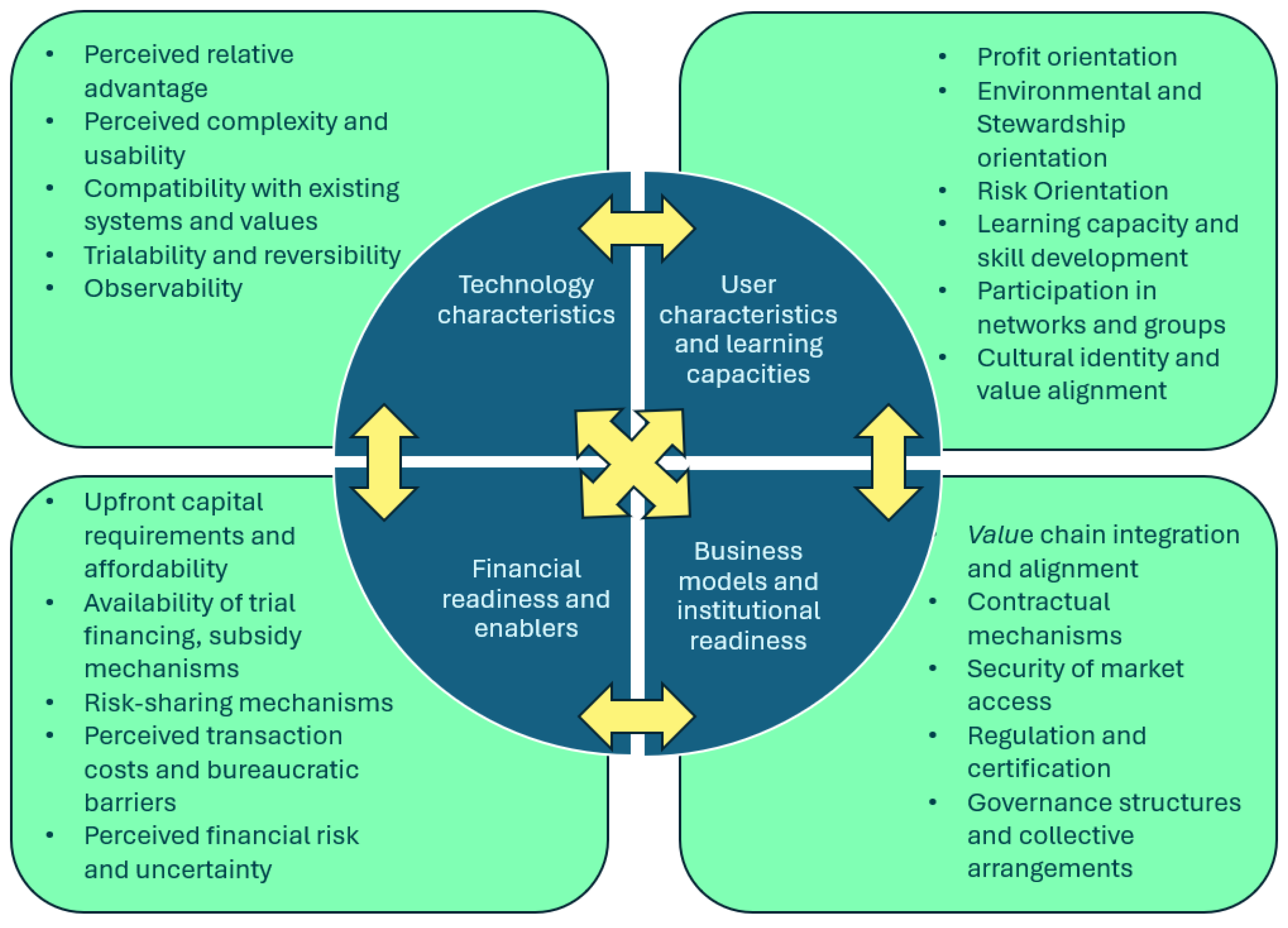
Table 1.
Illustrative sectoral examples of the application of the EIAMF.
| Technology Example | Technology Characteristics | User Characteristics | Financial Readiness | Business Models & Institutional Readiness | Potential mitigation solution |
|---|---|---|---|---|---|
|
Agriculture: Precision Agriculture Technologies Sources: [27,51,52,53,54] |
• Relative advantage: Clear benefits • Complexity: High complexity creates adoption challenges |
• Education: Strongly correlated with adoption • Technical orientation: Critical factor • Networks: Participation increases adoption • Experience: Prior computer system experience beneficial • Risk tolerance: Risk aversion creates barriers |
• Barriers: Primary constraint: initial capital requirements • Solutions: Equipment leasing, pay-per-use models, government cost-share programs • Innovation: Service-based business models |
• Support systems: Strong dealer networks providing technical support • Partnerships: Industry partnerships integrating data • Institutional factors: Data privacy regulations, equipment standards, extension service |
Financial barriers could be addressed through innovative financing mechanisms leveraging dealer networks to create cooperative equipment leasing arrangements and subscription-based service packages that convert capital expenditures into manageable operational expenses. Extension services could develop simplified decision support tools reducing perceived complexity. Business model innovation could include data-sharing cooperatives pooling precision agriculture information for robust management recommendations, and supply chain incentives rewarding efficient resource use. |
|
Forestry: Sustainable Forest Management Certification Sources: [36,40,55,56,57,58,59] |
• Relative advantage: Moderate/neutral • Complexity: Moderate complexity with limited trialability |
• Environmental orientation: Strong environmental values increase adoption • Networks: Professional sustainability-focused networks important • Learning orientation: Critical for understanding complex standards |
• Costs: Potential significant management changes affecting operational costs • Benefits: Certified products can command price premiums • Solutions: Group certification schemes enable |
• Market demand: Strong demand from environmentally-conscious consumers and corporate buyers • Institutional support: Government agencies, environmental organisations, industry associations provide technical assistance • Trust: Essential relationships between forest owners and certification bodies |
Government agencies could facilitate multi-stakeholder partnerships that align shared sustainability values across industry, consumer, and brokerage sectors through integrated policy instruments including payment for ecosystem services, carbon credit schemes, and preferential procurement policies. Financial barriers could be addressed through expanding group certification schemes that enable cost-sharing among smaller forest owners, combined with green financing mechanisms offering preferential loan rates for certified operations. Institutional support through cooperative governance structures could facilitate collective action, knowledge exchange, and shared technical assistance, reducing individual adoption barriers. |
|
Aquacultre: Recirculating Aquaculture Systems (RAS) Sources: [14,19,60,61,63] |
• Relative advantage: Substantial environmental advantages • Complexity: High - requires sophisticated monitoring and control systems • Observability: Excellent through demonstration facilities • Trialability: Limited |
• Technical competence: High level required • Learning orientation: Must understand complex biological and engineering systems • Risk tolerance: Essential • Networks: Peer networks important |
• Barriers: Very significant capital requirements and higher ongoing operating costs • Solutions: Public-private partnerships, equipment leasing, outcome-based financing • Innovation: Modular systems and shared infrastructure models improve accessibility |
• Partnerships: Strong partnerships needed with equipment suppliers, technical service providers • Institutional support: Research programs, regulatory frameworks recognising environmental benefits, extension services • Trust: Essential relationships among value chain participants |
Given the expense and risk of RAS systems, innovative leasing arrangements via public -private partnerships are required. The ability to overcome complexity and high capital cost for adoption introduces the potential for new business models and financing arrangements whereby “mini adoption” might occur through partial trialling of the system. This could be through partnership models allowing a wider range of business partners across the value chain able to invest in the technology, and financial arrangements that provide greater flexibility in securing a portion of an asset at a time. |
|
Horticulture: Precision irrigation and Fertigation Systems Sources: [21,27,30,33,62] |
• Relative advantage: substantial relative advantage through improved water use efficiency • Complexity: high complexity, requiring integration of multiple components • Compatibility: substantial changes required to existing irrigation infrastructure and management practices |
• Environmental orientation: Strong environmental values increase adoption • Risk tolerance: while the technology reduces production risks associated with water stress and nutrient deficiencies, it introduces new risks related to system failures and dependence on sophisticated equipment • Technical competence: High level required • Learning orientation: continuous improvement in sensor interpretation and data-driven decision making |
• Barriers: Upfront capital requirements are substantial, with ongoing costs for sensor maintenance, software subscriptions, and technical support • Solutions: innovative financing mechanisms including equipment leasing, pay-per-use models, and government cost-share programs have emerged to address barriers • Research gap: Producers generally perceive a lack of sustainable, consistent economic advantages from precision agriculture technologies |
• Value proposition: depends heavily on whether water scarcity, regulatory requirements, or market demands create compelling drivers beyond pure economic returns • Market infrastructure: coordinated equipment dealers, irrigation consultants, and technical service providers significantly facilitates adoption • Partnerships: key partnerships between growers, equipment suppliers, and water management agencies are critical |
Financial barriers could be addressed through innovative service-based business models where specialised providers install, own, and manage systems, charging growers based on water savings achieved rather than requiring upfront capital investment. Public-private partnerships could combine government cost-share programs with equipment supplier financing. Institutional support should prioritise development of regional irrigation management services providing comprehensive technical assistance. Policy coherence ensuring that water pricing, environmental regulations, and agricultural support programs align to incentivise water conservation investments is essential. |
Disclaimer/Publisher’s Note: The statements, opinions and data contained in all publications are solely those of the individual author(s) and contributor(s) and not of MDPI and/or the editor(s). MDPI and/or the editor(s) disclaim responsibility for any injury to people or property resulting from any ideas, methods, instructions or products referred to in the content. |
© 2025 by the authors. Licensee MDPI, Basel, Switzerland. This article is an open access article distributed under the terms and conditions of the Creative Commons Attribution (CC BY) license (http://creativecommons.org/licenses/by/4.0/).
Copyright: This open access article is published under a Creative Commons CC BY 4.0 license, which permit the free download, distribution, and reuse, provided that the author and preprint are cited in any reuse.