

Submitted:
22 October 2025
Posted:
22 October 2025
You are already at the latest version
Abstract
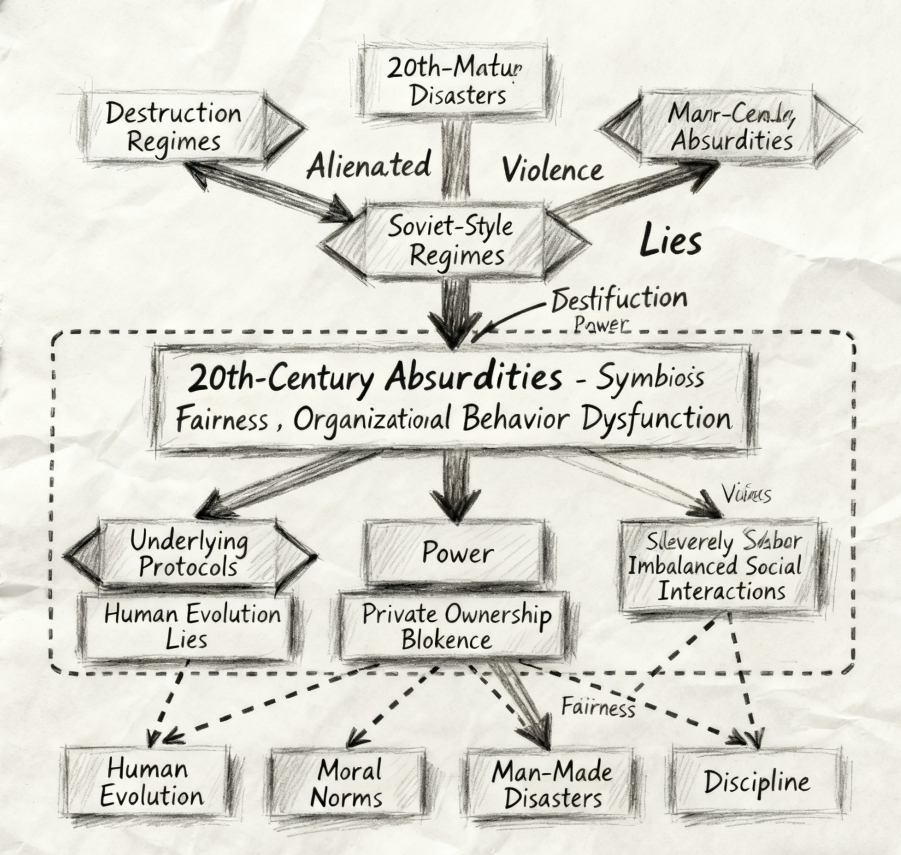
The biases in the theory and practice of Soviet-style socialism, particularly the misperceptions in the understanding of power, not only destroyed the symbiosis between self-interest and fairness but also left the people with neither private ownership nor fairness to speak of. While the power-holding stratum professed socialist "fairness and justice," they had, in essence, "betrayed" the moral norms preserved through human evolution. They were compelled to rely on absurd means such as violence, lies, falsification, and blockades to sustain severely imbalanced social interactions. Under the discipline of alienated power, this repeatedly gave rise to multiple major catastrophes in the 20th century.
Keywords:
Underlying-Contracts
; self-interest
; fairness
; symbiosis
; collectivization
; famine
; lies
; man-made disasters
; falsification
; discipline
; Behavioral Dysfunction
Introduction
Whether in the interpretation of history or the operation of the real world, all are dynamic continuations of the coupling of multiple human psychological behaviors. Among these, self-interest and fairness stand as a pair of antagonistic psychological threads in social interactions. Much like the double helix of DNA, they drive humans to "compete for self-interest and also cooperate (altruistically) for self-interest," and "compete for fairness and also cooperate for fairness" [1,2]. Together, they form an indivisible symbiotic relationship [3].
Meanwhile, the relationship between self-interest and fairness manifests in needs and motivations at different levels, such as physiological vs. social needs, and material vs. spiritual needs [4]. Moreover, the lower the level of a need, the stronger the motivation to pursue it—for instance, the needs for survival and security. Once lower-level needs are satisfied, new needs and motivations emerge, leading to new imbalances [5].
It can be said that every society and every country operates amid the complex interplay between self-interest and fairness. Whether driven by the pursuit of a sense of fairness or the use of fairness as a strategic tool in interactions [6], there is no denying that the antagonistic relationship between self-interest and fairness is an objective existence that transcends individual will and class stance [3]. It acts like a pair of "invisible hands"—Adam Smith only revealed one, not two, in The Wealth of Nations—and persists regardless of whether those in power recognize it.
If a regime fails to maintain a dynamic balance between the people’s pursuit of self-interest and fairness, or even undermines their symbiotic relationship at the basic level of survival needs, the more severe the damage, the stronger the backlash it will face.
Outcomes
The practice of Soviet-style socialism demonstrates that "where there is no property, there is no justice" [7]. Prohibiting private ownership and competition not only negates fairness but also inflicts profound suffering on both the people and the nation. The biases inherent in the Soviet system led to the dual alienation of self-interest and fairness—a problem more harmful than the lack of fairness caused by the 家产制 (patrimonial system) of private power. Its consequences included widespread poverty, famine among the people, and the rapid decline of the nation [8].
Around the 1990s, because the theory of planned economy rejected the people’s desires for self-interest and competition, the tension between self-interest and fairness triggered systemic entropy increase in the "party-state isomorphism" system. After a brief period of "strength," the vast Soviet Empire collapsed rapidly, splitting into 15 countries. The Soviet Union was founded in December 1922 and dissolved in December 1991, giving rise to Russia, Ukraine, Belarus, Estonia, Latvia, Lithuania, Georgia, Armenia, Azerbaijan, Kazakhstan, Uzbekistan, Kyrgyzstan, Tajikistan, Turkmenistan, and Moldova.
A domino effect followed, with 17 Soviet-style regimes in Europe, Asia, and Africa collapsing one after another. Among them, the Federal Republic of Yugoslavia—founded in November 1945 and dissolved in April 1992—split into six countries: Serbia, Croatia, Slovenia, Bosnia and Herzegovina, Montenegro, and Macedonia. Czechoslovakia also dissolved, dividing into the Czech Republic and Slovakia.
By comparison, unified dynasties during China’s patrimonial era lasted an average of approximately 150 years [9]. In contrast, these Soviet-style regimes, due to their dual damage to the people’s needs for self-interest and fairness, had far weaker sustainability. They existed for only a few decades before being abandoned by the times.
Among the remaining Soviet-style regimes, North Korea has evolved into a family hereditary system, sanctifying the authority of its core leader [10,11]. A decade after China’s reform and opening-up, Vietnam launched its own "doi moi" (renewal and opening-up) policy. Other countries that claim to be socialist, such as Laos, Cuba, and Venezuela, have also changed over time and are no longer what they once were.
Organized Famine
Power cannot be privatized, and property cannot be collectivized; otherwise, humanity will step into the door of disaster. As early as the 17th century, John Locke issued this warning to humanity [12]. However, Karl Marx in the 19th century seemingly ignored this warning: while criticizing the reification and exploitation of workers under capitalism, he advocated for forcing all people to be transformed into "new communist people" who "contribute according to their abilities and receive according to their needs"—a form of "instrumentalized people" in another sense.
In particular, Marx one-sidedly argued that productive forces determine production relations and that power originates from the economy. In reality, however, economic power— which controls the market and property—is only one form of power. The truly dominant power includes political power based on the military and police, and status power based on social prestige ([13]a).
Due to his oversimplified understanding of power, Marx overlooked that the privatization of public power (based on the privatization of military control) and the abuse of public power for private gain are the true common enemies of ordinary people and society as a whole. Naturally, he paid no attention to the importance of checks and balances on power, nor did he recognize that unrestrained power—such as the abuse of public power by party leaders for private gain—would become an object of exploitation that yields both fame and fortune, and an even more harmful tool of extraction. Consequently, his vision of "humanity’s future" was destined to become a "utopian experiment" ([14]a).
On the path to this "utopia," if the Owenite principle of voluntarism (advocated by Robert Owen) had been adopted, the 20th-century Soviet "experiment" might not have caused a humanitarian disaster. Instead, Marx proposed a path of violence and coercion, relying on the bloody methods of "class struggle" and the revolutionary strategy of "collective action." Perhaps influenced by institutional "path dependence" ([14]b), Russia—with a tradition of patrimonialism and the privatization of power—was the first to embrace Marxism. It became the theoretical banner and founding basis for Lenin’s October Revolution in 1917, a mere nine months after the Russian people had freed themselves from tsarist rule through the February Revolution.
Studies have shown that the Soviet Union in the 1930s was a massive site of historical crimes. Beyond the humanitarian tragedy of the Great Purge, a series of violent policies—including the elimination of private ownership and forced collectivization—led to the notorious Soviet famine. During 1932–1933, the Soviet Union did not experience major droughts like those in 1891, 1921, or 1946; this famine was clearly an "organized famine" [15,16,17].
While there were contributing factors such as natural conditions [18], the 1932–1933 famine occurred during a period of peace. Public power was subordinated to the personal will of party leaders and subjected to systematic abuse by the party, turning the government against the public interest. The Stalin regime not only did its utmost to cover up the famine but also suppressed Soviet citizens who even mentioned the word "hunger" ([19]a). These are undeniable facts, as evidenced by the forced collectivization of agriculture [20].
To realize communist public ownership, the Stalinist government of the Soviet Union drafted a five-year plan for the collectivization of peasant farms in the spring of 1928. In the autumn of 1929, it abandoned the gradual approach and opted for complete, rapid full-scale collectivization [21]. This decision, which disregarded the people’s need for self-interest, naturally failed to gain the cooperation of peasants.
To force peasants to join collective farms, the Stalinist government adopted dual tactics:
Economically, it increased tax pressure on individual peasants while offering collective farmers incentives such as chemical fertilizers and free agricultural machinery to attract them to join.
Politically, it treated power as a tool to achieve its "organizational" goals: it used violence to "eliminate kulaks" (wealthy peasants), deporting them and confiscating their property; meanwhile, it claimed that peasant participation in collective farms was voluntary, but local officials often resorted to threats and intimidation to coerce participation.
The excessive measures during the full-scale collectivization campaign triggered a massive wave of withdrawals from collective farms, with tens of thousands of people leaving every day. By June 1930, the proportion of collective farms plummeted from 60% to 23.4%. Despite increased mechanical input, the Stalinist government labeled opponents as "colluding with enemies." Fearing punishment, many peasants relented, and the collectivization campaign gained momentum again. By the end of 1933, only 0.2% of peasant households had not joined collective farms, effectively realizing Stalin’s goal of full-scale collectivization ([22]a).
Collectivization, which ignored the individual need for self-interest, inevitably faced backlash driven by psychological tension. Peasants resorted to various forms of resistance:
When forced to hand over their private land, kulaks, fearing that their livestock would also be "collectivized," slaughtered or sold their animals before joining the collective farms. By 1933, the total number of livestock in the Soviet Union had decreased by approximately 50% [23].
As a form of protest, some peasants destroyed tools or even burned their grain.
To avoid being labeled as "kulaks," middle peasants reduced grain sowing areas and yields. This severely disrupted spring sowing in 1932, leaving grain fields overgrown with weeds.
Another "disastrous measure" that exacerbated the large-scale famine was the confiscation of peasants’ food rations. The collectivization campaign ignored peasants’ desire for private ownership and competition; regardless of their contribution, all received the same remuneration. This allowed those who contributed less to "free-ride" on the collective, leading to "social loafing"—peasants shirked work when unsupervised or unevaluated individually [24]. As a result, peasants’ enthusiasm for production plummeted, causing a sharp decline in grain harvests: in 1932, harvests decreased by a quarter compared to 1930.
According to research by foreign experts, however, the government overestimated the total grain output for 1931–1932 by at least 19% ([19]b). The consequences of procuring grain from peasants based on this inflated data were predictable. Peasants faced both the threat of starvation due to over-procurement and inhumane treatment due to the Stalinist government’s distrust.
On August 7, 1932, the Stalinist government enacted the Law of Three Spikelets, which allowed political police and Communist Party cadres to search peasants’ homes and confiscate grain. Peasants were prohibited from consuming the grain they had grown; even small amounts of rotten grain or crops were deemed "theft of socialist property." In the five months following the law’s enactment, 22,347 people were convicted, including 2,686 who were sentenced to death by ordinary courts ([19]c).
In November 1932, 5,000 rural Communist Party members in the North Caucasus were accused of "sabotaging the grain procurement campaign," and another 15,000 collective farmers were arrested. In December, large-scale deportations of entire village populations began ([19]d).
Peasants who resisted grain confiscation were subjected to inhumane repression, including beatings, arson, being stripped naked, forced suicide, and coerced sexual relations with women. M. Sholokhov (Mikhail Sholokhov) listed a series of atrocities—including the plunder of 593 tons of bread from peasant households—in a letter to Stalin [25]. The letter included the following accounts:
Large-scale beatings of collective and individual peasants.
Inflicting "cold torture": "Any hidden grain?" – "No." – "Go sit in the granary!" Collective farmers were stripped down to their underclothes, made to go barefoot, and detained in granaries or sheds. These acts occurred in January and February, often involving entire groups of peasants locked in granaries.
At the Vashchaevsky Collective Farm, kerosene was poured on the legs and skirts of collective farm women, set on fire, and then extinguished. The perpetrators shouted: "Tell us where the grain is hidden! I’ll set you on fire again!" At the same collective farm, interrogated peasants were buried in holes up to half their bodies and continue to be interrogated.
At the Napolovsky Collective Farm, Plotkin—an authorized representative of the RK (Regional Committee) and candidate member of the RK Bureau—forced interrogated peasants to sit on a "hot bench" during questioning. When the prisoners screamed that they could not sit because it was too hot, the perpetrators poured water under them, took them outside to "cool down" in the cold, and locked them in a granary. The prisoners were then brought back to the stove for further interrogation. Plotkin also forced an individual to commit suicide: he handed the man a revolver and ordered, "Shoot yourself, or I’ll kill you with my own hands!" He pulled the trigger (unaware that the revolver was unloaded); the man fainted when he heard the click of the firing pin.
At the Valvarinsky Collective Farm, Branch Secretary Anikeyev forced all members of the brigade (men and women, smokers and non-smokers) to smoke Makhorka cigarettes during a brigade meeting. He then threw a red pepper (mustard) onto a hot stove and ordered everyone not to leave the room. Anikeyev and several members of the propaganda brigade (led by Pasinsky, a candidate member of the Presidium of the Revolutionary Committee) forced collective farmers to drink large amounts of water mixed with lard, wheat, and kerosene during interrogations at the brigade headquarters.
At the Lebyazhensky Collective Farm, interrogated peasants were pinned against a wall while perpetrators fired shotguns over their heads.
At the same farm, stones were rolled into a line, and peasants were forced to step on them barefoot.
At the Arhipovsky Collective Farm, two collective farm women—Fomina and Krasnova—were taken three kilometers into the steppe after an all-night interrogation. They were stripped naked in the snow, released, and ordered to jog back to the farm.
At the Chukalinsky Collective Farm, Brigade Secretary Bogomolov, a demobilized Red Army soldier, led a group of men to the yards of collective farmers suspected of stealing grain at night. After a brief interrogation, they took the suspects to a threshing floor or enclosure, lined up the brigade, and ordered them to "fire" at the bound peasants. If the suspects, terrified by the mock execution, still refused to confess, they were beaten, thrown onto sleds, dragged through the steppe while being beaten with rifle butts, and then returned to repeat the pre-execution procedure.
(Numbering interrupted by Sholokhov.) At the Krzhylinsky Collective Farm, Kovton, an authorized representative of the RK, asked collective farmers during a meeting of the 6th Brigade: "Where did you bury the grain?" – "I didn’t bury any, comrade!" – "You didn’t bury it? Then stick out your tongue!" Sixty Soviet adults, following the commissioner’s order, stuck out their tongues one after another and stood there, drooling, while the commissioner delivered an hour-long accusatory speech. Kovton did the same in the 7th and 8th Brigades; in those cases, however, the brigades were also forced to kneel in addition to sticking out their tongues.
At the Zaton Collective Farm, a member of the propaganda brigade beat interrogated peasants with a saber. At the same farm, the families of Red Army soldiers were abused: roofs were torn off, stoves were destroyed, and women were forced into sexual relations.
At the Sorenzovsky Collective Farm, a corpse was carried into the Komsomol office (Кoмитет сoдействия стрoительству Дoма науки и культуры) and placed on a table. Collective farmers were interrogated in the same room, with threats of execution.
At the Verkhne-Chirsky Collective Farm, Komsomol members forced interrogated peasants to stand barefoot on a hot stove, beat them, and then took them outside into the cold, still barefoot.
At the Korendayevsky Collective Farm, barefoot collective farmers were forced to run in the snow for three hours. Those with frostbite were sent to Bazkovskaya Hospital.
Ibid.: Stools were placed on the heads of interrogated collective farmers, covered with overcoats, and the peasants were beaten while being interrogated.
At the Bazkovsky Collective Farm, during interrogations, peasants were stripped naked, forced to walk halfway home, then brought back—repeating this process multiple times.
At the Verkhne-Chirsky Collective Farm, Yakovlev—an authorized representative of the OGPU (Unified State Political Directorate) of the Russian Soviet Federative Socialist Republic—and an operation team held a meeting. The school was suddenly filled with people. I was not ordered to undress. There was a "cool room" nearby, where people were taken from the meeting for "individual handling." Five people took turns presiding over the meeting, but the collective farm households targeted were the same... The meeting lasted for more than a day without rest.
Such examples could be multiplied indefinitely. These were not isolated cases of excessive enforcement but rather regionally legitimized "methods" of grain procurement. I learned these facts either from Communist Party members or from collective farmers who had personally endured these "methods" and came to me asking to "write about this in the newspaper."
On May 6, 1933, however, Joseph Stalin, in his reply letter, claimed that grain growers were essentially waging a "silent war" against the Soviet government ([19]e). The letter stated:
Your letter gives a somewhat one-sided impression. I want to write a few words to you about this matter.I am grateful for your letter, as it exposes the weaknesses in the work of our Party and the Soviets—revealing that our staff, in their efforts to suppress the enemy, sometimes inadvertently attack our friends and end up engaging in sadistic behavior. However, this does not mean I agree with you on all matters. You see one side, and you see it clearly. But this is only one side of the story. To avoid making political mistakes (your letter is not a fabrication but a matter of pure politics), one must look around and be able to see the other side.The other side is this: respected grain growers in your region (and not just your region) have engaged in "Italianism" (sabotage!) and do not object to leaving workers and the Red Army without bread. Although this sabotage is quiet and seemingly harmless (no bloodshed), it does not change the fact that these respected grain growers are essentially waging a "silent war" against the Soviet government. This is a war of attrition, dear comrade Sholokhov...Of course, as you assure us, this situation is by no means a justification for the atrocities committed by our staff. Those who committed these atrocities must be punished as they deserve. But it is clear that these members of the respected grain-grower organizations are not as harmless as they seem from a distance.
According to expert statistics, during the agricultural collectivization period of 1928–1934, the total grain output of the Soviet Union decreased by 7.8%, while state grain procurement increased by 150% during the same period. Starving peasants could only watch as the grain they had worked so hard to grow was confiscated ([22]b).
Furthermore, the Stalinist government deprived the people of the right to flee famine for survival. Widespread starvation triggered a massive wave of refugees. To prevent peasants from moving to overcrowded cities, the Soviet government reinstated the tsarist-era internal passport system (equivalent to an identity card). The system stipulated that individuals could not leave their residences without identification, on pain of being sent to labor camps. Peasants, however, had no right to obtain identity cards and thus could not leave their villages—this policy restricting freedom of movement persisted until 1974. At the same time, the authorities declared that peasants who stayed in cities and towns without permission would be deemed illegal ([22]c).
Driven by hunger, some peasants fled to cities but could not find work or obtain bread through begging or purchase. As a result, many starved to death on the streets of Kharkiv, Kyiv, Dnipropetrovsk, Poltava, Vinnytsia, and other major Ukrainian cities; only a small number survived.
In summary, in the name of socialist public ownership, the Stalinist government—through the autocratic abuse of public power by party leaders and systematic party abuse—artificially caused the deaths of approximately 6 to 10 million people ([22]d). According to estimates by Russian scientists, during 1932–1933, the population of Ukraine decreased by 3.5 to 7 million, Kazakhstan by 1.3 million, the Volga region by 400,000, the North Caucasus by 1 million, and other regions by 1 million ([19]g).
During this period, exploitation by those in power triggered repeated peasant uprisings. The Soviet government was forced to deploy regular troops and suppress its own people under the pretext of "suppressing bandits" ([22]a). Only after the "excess population" was artificially reduced further did society barely restore stability.
The Man-Made Calamity Under Falsehoods
Compared with Russia, China has a long-standing tradition of private ownership of the military, private ownership of power, and a patrimonial bureaucracy that spans over 2,100 years. This tradition has become deeply entrenched in both historical narratives and the ideological sphere. "Seizing the 江山 (jiangshan)"—which refers to violently capturing national territory and population—has been endowed with an inexplicable sense of heroism. Furthermore, after "seizing the jiangshan", "ruling the jiangshan" has even become something taken for granted.In the late Qing Dynasty and the early Republic of China, the grassroots people, with the exception of a tiny number of social elites, lacked almost entirely the rational awareness of public authority and the awareness of rights protection,Thus, "the salvo of the October Revolution" delivered Marxism to a China that lacked sufficient rationality.In 1921, a group of intellectuals led by Chen Duxiu and Li Dazhao established the Communist Party of China (CPC) under the guidance of Comintern representatives,At this point, less than a decade had passed since China had freed itself from the Qing Dynasty’s patrimonial rule and private appropriation of power.Twenty-eight years later, China replicated the model of "Old Brother" the Soviet Union and also replicated its disasters.
After the founding of the People’s Republic of China in 1949, the Mao Zedong regime, emulating the Soviet model and the Qin Dynasty system of ancient China, implemented the policy of "Marxism plus Qin Shi Huangdi," or "socialism combined with Legalist principles" [26,27].While restructuring the social structure by relying on violence and initiating the largest - scale property redistribution and collectivization in human history [28], it, on the one hand, deprives the people of their private rights, including property rights and personality rights, in the name of eliminating class exploitation; on the other hand, it deprives the people of their public rights, including the right to freedom of speech and the right to supervision, in the name of the people’s democratic dictatorship.
The major dispossession of power occurred in three waves.The first wave was "Land Reform" and "Collectivization".To pave the way for industrialization, the socialist transformation of agriculture and handicrafts was initiated in 1950, with the aim of converting private ownership into public ownership [29].
When promoting land reform in rural areas, the Mao Zedong authorities refused the proposal of peaceful land reform and adopted rough forms such as complaints and criticism meetings, By using terrifying means of class struggle, the "crackdown on landlords and division of land" in the liberated areas was extended throughout the country, and those who were classified as landlords and their relatives were subjected to "joint persecution". Researchers estimate that about 3 to 5 million people died during the three-year land reform process, most of whom were small and medium-sized landlords who were beaten to death ([30]a,b).Subsequently, in the name of cooperativization, the land that had just been distributed to peasants was taken back and placed under agricultural cooperatives, and the egalitarian "big pot" system was forcibly implemented. And through the emotion-driven Great Leap Forward and the People’s Commune Movement in 1958, all land across the country became collectively owned.
Similar to the Soviet Union, the collectivization transformation of agriculture and handicrafts suppressed the human desire for self-interest and competition, violated human psychological laws, and inevitably triggered a backlash from the tensions of Underlying Protocols [3].Since 1955, farmers and handicraftsmen across China began to demand "withdrawal from cooperatives" (i.e., withdrawal from agricultural or handicraft cooperatives). In Guangdong Province alone, over 70,000 rural households had withdrawn from cooperatives, 102 cooperatives had collapsed, and another more than 127,000 households were demanding withdrawal [31]. From 1956 to 1957, the movement of withdrawing from cooperatives reached its peak with an enormous scale. For instance, according to incomplete statistics, in 9 counties including Fengcheng and Changtu in Liaoning Province, over 10,000 households were demanding withdrawal and more than 4,000 households had already withdrawn. A large number of households demanding withdrawal also existed in Jiangsu Province: the proportion reached 43% in Xinyi County, 50% in Zhengji District of Tongshan County, and 57.5% in Shuyang County [32,33].There were three direct reasons for the public’s dissatisfaction with the cooperatives. First, the advanced cooperatives not only failed to fulfill their promise of increasing income but also led to a reduction in income. Second, farmers lost their freedom of migration and career choice—they could neither move to other areas nor engage in sideline occupations due to restrictions. Third, cadres abused their public power and acted arbitrarily, which included imposing arbitrary penalties on cooperative members and even arbitrarily tying, binding, and beating them, among other behaviors [33a,34].
The top secret report of the Chinese Ministry of Public Security has revealed that,In 1957 alone, there were hundreds of armed peasant uprisings, with the largest number of participants ranging from thousands to 100000,The direct motivation is to resist the "centralized procurement and sales", "collectivization", and the cruel governance of grassroots cadres of the Communist Party of China,Most uprisings were characterized by clear programs and organizational structures, with the long-term objective of overthrowing the rule of the Communist Party of China (CPC). However, they were quickly suppressed by the military, police, and other forces that had abused public power [35].
The second wave was "public-private joint ownership".In 1954, the socialist transformation of capitalist industry and commerce was launched. The Mao Zedong administration, in name, adopted a policy of "peaceful redemption"; in practice, however, it aimed to "integrate the transformation of ownership with the transformation of people, striving to turn exploiters into self-reliant laborers" [36]. By early 1956, an upsurge in socialist transformation emerged nationwide, and capitalist industry and commerce realized all-industry public-private joint ownership. The state replaced the redemption of private capitalist shares with a fixed interest system, uniformly stipulating an annual interest rate of five percent. This can be briefly summarized as follows: enterprises were transformed from capitalist ownership to public-private co-ownership; capitalists began to lose their managerial control over enterprises; and enterprise profits were distributed in accordance with the principle of "four-way distribution of profits" [37].
During the process of public-private joint ownership, national industrial and commercial operators such as Guangzhou Wanglaoji showed a cooperative attitude. After the implementation of public-private joint ownership, as dividends, the pharmaceutical factory paid a 5% fixed interest annually to private shareholders including the Wang family, with a term of 20 years. This one-size-fits-all approach took neither the profitability of enterprises nor the will of private shareholders into account. In fact, according to the situation at that time, this fixed interest rate was not only far lower than the profitability of the pharmaceutical factory but also lower than the fixed deposit interest rates of banks at that time.In September 1966, the Mao Zedong administration decided to cease the payment of fixed interest, and thus enterprises under public-private joint ownership were transformed into enterprises owned by the whole people. According to reports, in terms of contemporary concepts, this meant that shareholders’ stocks were nationalized overnight and homeowners’ properties were confiscated by the state. Without going through any legal procedures, private shares were confiscated and converted into state ownership, and enterprises under public-private joint ownership became state-owned enterprises [38].
In January 1979, the Central Committee of the Communist Party of China (CPC) issued On the Party’s Policy towards the National Bourgeoisie, which stipulated that: the distribution of stock dividends for public-private joint ownership enterprises should end in September 1966, and it was permissible for existing bourgeois industrial and commercial operators to claim the dividends that they were entitled to but had not received prior to this period. However, the Ministry of Finance of the CPC issued a document in the same year, deciding not to refund the private share capital. In February 1983, the United Front Work Department of the Central Committee of the CPC and the Ministry of Commerce jointly issued a document, stipulating that: the state had already paid fixed interest at an annual rate of five percent, which was distributed until the third quarter of 1966; the assets of public-private joint ownership enterprises (including approved investment properties) already belonged to the state and should not be returned to the original owners. Since then, a number of lawsuits concerning private share fixed interest or equity rights have occurred across the country, and all the plaintiffs lost their cases due to the aforementioned policies [39].
The third wave was to break private ownership and establish public ownership.In 18th-century Britain, there was already an awareness of rights protection that "the wind may enter, the rain may enter, but the king may not enter" private residences [40]. Article 11 of the General Program of China’s Constitution, adopted in 1954, also stated: "The state protects citizens’ ownership of their lawful income, savings, housing, and various means of subsistence."But after the onset of the "Cultural Revolution" in 1966, both the private use of public power by party leaders and its abuse by political parties reached an unprecedented level, and the aforementioned commitments thus became a dead letter.
The "beating, smashing, and looting" of private property originated in the "Destroy the Four Olds" campaign at the outset of the Cultural Revolution.According to the statement in the infamous "Sixteen Points" (i.e., the Decision on the Great Proletarian Cultural Revolution), the "Four Olds" are defined as "old ideas, old culture, old customs, and old habits".On August 18, 1966, Mao Zedong met with the Red Guards on Tiananmen Rostrum for the first time. In his speech on the same day, Lin Biao further publicly incited the crowd to "thoroughly smash all old ideas, old culture, old customs, and old habits of the exploiting classes". Under the name of "revolutionary actions", the plundering of private property and the infringement of personal privacy were legalized and justified. For a time, house raids became prevalent [41].
If the land distribution, distribution of "floating property" and collectivization during the rural land reform in the 1950s, as well as the "public-private joint ownership" of urban individual industrial and commercial enterprises, still had "policies" to follow, then the "Destroy the Four Olds" campaign was like disorderly mobs looting at will, without limits or restrictions. The properties that were seized and confiscated ranged from large items such as real estate to small private items including watches, cash, bank passbooks, books, and cultural relics. On August 22, after China National Radio broadcast the news about the Red Guards’ vigorous "Destroy the Four Olds" campaign, major newspapers across the country published an article on their front pages under the heading "Xinhua News Agency, 22nd: The Wave of the Great Proletarian Cultural Revolution Sweeps Through the Streets of the Capital; Red Guards Vigorously Attack the Bourgeois Customs and Habits". People’s Daily also published two editorials on its first page, namely How Excellent It Is and Workers, Peasants, and Soldiers Must Firmly Support Revolutionary Students, which spoke highly of the Red Guards’ absurd actions. Thus, the extremely irrational "Destroy the Four Olds" campaign quickly spread to Shanghai, Tianjin, and urban and rural areas across the country.
According to Liang Shuming’s recollection, on August 24, 1966, middle school Red Guards, "arriving in a menacing manner", rummaged through chests and cupboards in his home. Except for the works of Mao Zedong and Marxist-Leninist classics, all other books were either torn up or burned. The books and calligraphy works purchased by his great-grandfather, grandfather, and father—who had all served as officials in the Qing Dynasty across three generations—and the personal letters he had preserved from various scholars, spanning from the Hundred Days’ Reform to the debate on Eastern and Western cultures, were all reduced to ashes. When they threw Ci Yuan (a comprehensive Chinese dictionary) and Ci Hai (an authoritative Chinese encyclopedia) into the fire, they also said: "We, the ’young vanguards’ of the ’revolution’, have Xinhua Zidian (Xinhua Dictionary) enough; we don’t need these feudal antiques." [42] The "feudalism" they referred to originated from the Soviet Union’s "four-stage theory" of historical view, which dogmatically equated China’s Qin-style dynasties with the "feudal" era.
A student from Beijing No. 4 Middle School later wrote that for the "ox-ghosts and snake-demons" (a term referring to those deemed reactionary) detained by the school, "the only remaining belongings in their hands became targets for the Red Guards to obtain by trickery and coercion; some ’borrowed’ watches, while others ’borrowed’ bicycles." [43]
Gu Jiegang recorded in his diary on August 24, 1966, that the Red Guards conducted house raids in his residential area: the home of his eastern neighbor Jin Heqing (the aunt of Puyi, the last emperor of China) was ransacked and a large quantity of gold bars was seized; Wu Ruiyan’s family was driven out of their home after the rummaging and confiscation, and all their belongings were cleared out; the husband of a western neighbor’s family, after their home was ransacked, killed his wife at night and then hanged himself ([44]a). In his diary entry on September 5, he noted that to eradicate capitalism and revisionism, all private businesses—even trivial trades such as knife sharpening and shoe mending—were prohibited; private possession or involvement with items such as rent, fixed interest, and gold and silver jewelry was not allowed ([44]b). A private dentist, who was once thronged with patients due to his excellent skills, had all his family property confiscated during the Cultural Revolution. No position was arranged for him in any hospital, so his life became as destitute as a beggar’s—he could only borrow a few yuan from others to barely make ends meet. This was the fate of those who refused collectivization ([44]c).
According to incomplete statistics, after the "Destroy the Four Olds" campaign began in Beijing, it quickly spread to major cities across the country and even to vast rural areas. During the campaign: over 114,000 households in Beijing were subjected to house raids; approximately more than 10 million households nationwide were ransacked in total [45]. In Shanghai, from August 23 to September 8, the Red Guards conducted house raids on 84,222 households; by late September, the Red Guards in Tianjin had ransacked 12,000 households. The so-called "achievements" of the house raids were also astonishing: from June to early October, the Red Guards across the country seized 42.8 billion yuan in cash, deposits, and public bonds, over 1,188,000 taels of gold, and more than 10 million cultural relics and antiques. They uncovered over 16,600 so-called "class enemies", solved more than 1,700 "counter-revolutionary" cases, and drove over 39 million "ox-ghosts and snake-demons" out of urban areas. During the house raids, the Red Guards also arbitrarily held struggle sessions, arrested people, and some even set up private tribunals, indiscriminately imposed cruel torture, and beat people to death [46].
As the writer Fang Fang put it: "A single grain of sand from the times becomes a mountain when it falls on each individual’s head." After the above-mentioned two waves of eliminating private ownership, collectivization, and transformation towards public ownership, greater humanitarian disasters ensued one after another.From 1958 to 1962 (many scholars consider 1958 and 1962 to be part of the famine period), China repeated a series of tragedies similar to the Soviet Great Famine, resulting in abnormal deaths of 15 to 55 million people. It is widely regarded as the largest-scale famine in human history and is also considered one of the most severe man-made disasters in human history ([47]a).In many places, tragic incidents of cannibalism occurred. In 1988, writer Sha Qing’s "Vague Da Di Wan" won first prize in the "China Tide" reportage literature competition on the mainland. It recorded a true segment from the Great Famine period: "There was a farming family where only the father and his two children, a boy and a girl, remained. One day, the father drove his daughter out of the house. When the girl returned home, her younger brother had disappeared. A layer of white, greasy substance floated in the pot, and a pile of bones lay discarded by the stove. A few days later, the father added more water to the pot and called for his daughter to come over. The girl, terrified, hid outside the door, crying and pleading, ’Dada (Dad), don’t eat me. I’ll gather grass and light the fire for you. If you eat me, there will be no one to work for you.’" [48]. On April 23, 1961, the Anhui Provincial Public Security Department submitted a "Report on the Occurrence of Special Cases" to the Anhui Provincial Committee. It mentioned that "since 1959, a total of 1,289 cases (of cannibalism) have occurred," "most of which took place during the winter of 1959 and the spring of 1960," and "according to an investigation of 1,144 cases, 36 involved selling human flesh to others for consumption, while the remaining 1,108 cases were kept for their own consumption" ([47]b).
According to Deng Xiaoping’s statement, the cause of the humanitarian disaster was: "In 1958, during the ’Great Leap Forward’, the people’s commune movement was rashly launched; one-sidedly emphasizing ’large size and public ownership’ (’large size’ refers to large scale, and ’public ownership’ refers to a high degree of public ownership of the means of production), and the practice of ’eating from the same big pot’ (equalitarianism in distribution) led to a major disaster." [49].
In the 1950s, China, which had begun to eliminate private ownership, started to see the emergence of the "big pot" phenomenon (i.e., equalitarian distribution system). People in entire villages and communes engaged in collective farming and harvesting; grain rations were managed by communes and production teams; adults and children all ate together, and people were even not allowed to cook at home. In August 1958, against the backdrop of the "Great Leap Forward," with the promotion of the Mao Zedong administration, a nationwide upsurge of the movement quickly took shape. By the end of October that year, over 740,000 agricultural producers’ cooperatives across the country had been reorganized into more than 26,000 people’s communes. The number of rural households participating in the communes reached 120 million, accounting for over 99% of the total rural households in the country, and the whole of rural China had basically achieved the people’s commune system [50].
Meanwhile, various communes began to implement the "public canteen" system. Many communes no longer distributed grain rations to individual households. By the autumn of 1958, more than 2.65 million public canteens had been put into operation, where meals were provided free of charge—this was equivalent to encouraging commune members to "eat to their hearts’ content." Moreover, farmers had no freedom to withdraw from the canteens, leading to excessive consumption and grain waste [51,52]. By the end of 1958, the number of public canteens nationwide had reached 3.45 million, and the population eating in public canteens accounted for over 90% of the total rural population in the country ([33]b).
Due to the eagerness to transition to a communist society, a "Communist wind" characterized by "equalization and allocation" prevailed. "Equalization" refers to the state or people’s communes withdrawing land, funds, farm tools, products, and individual property of commune members from collective economic organizations at all levels without compensation, so as to achieve the equalization of wealth and average distribution. "Allocation" refers to the uncompensated transfer of the labor force of production teams.The egalitarian policy of "equalization and allocation" not only violates the principles of equivalent exchange and voluntary mutual benefit, but also infringes on individuals’ property and interests.Under the power-coerced "provision" mechanism, people’s needs for self-interest and desire for fair competition are highly suppressed. The "flexibility" of individuals’ contributions in social interactions (i.e., responses to unfairness) is also distorted [3], which gradually dampens people’s enthusiasm and reduces labor productivity [53,54]. When individuals perceive that their work is submerged in the collective, the phenomenon of "social loafing" will occur [55]. Practices that seriously deviate from the Underlying Protocol [3] and violate psychological laws will inevitably lead to a decline in output similar to that after the collectivization of agriculture in the Soviet Union [56].
What was even more absurd was the "wind of exaggeration".In May 1958, the Mao Zedong administration called for "going all out, aiming high, and building socialism with greater, faster, better, and more economical results" at the Second Session of the Eighth National Congress of the Communist Party of China [57]. Before and during this session, there were continuous criticisms and denunciations of the proposition of "opposing reckless advance." During the "Anti-Rightist Movement," over 3.17 million people were labeled as Rightists, and more than 1.43 million were classified as "centrist-right elements" [58,59,60]. Additionally, many others were categorized as "internally controlled Rightists," "suspected Rightists," or "Right deviationists" [61,62,63]. Among those persecuted during this period, the less severely affected were dismissed or demoted, expelled from the Party or the League, and sent to the countryside or factories for reform through labor or re-education through labor; the more severely affected were dismissed from public office, detained in concentration, or sentenced to imprisonment. Some individuals wrongfully committed suicide, were executed, or died from torture [58,64,65,66].According to incomplete statistics, the Anti-Rightist Movement resulted in more than 4,000 abnormal deaths [67], and since the launch of the Anti-Rightist Movement, "Rightists" have been classified as part of the "black five categories" (a term referring to specific politically designated groups) [68].
Once a bad practice starts, it often leads to a vicious cycle and self-reinforcing systematic entropy increase, until it reaches an unmanageable state. Faced with terrifying power discipline, bureaucrats exhibited abnormal behaviors similar to the "hostage complex", showing group-wide psychobehavioral disorders that cannot be simply explained by "irrationality." For instance, the prevalence of fraud became widespread [69], even involving fraud that went far beyond common sense.
During the Great Leap Forward, many absurd "satellites" (a term referring to exaggerated reports of record-high crop yields) of extremely high agricultural output were claimed across the country. Among them, the wheat yield per mu (a traditional Chinese unit of area, approximately 0.0667 hectares) in Heping Agricultural Cooperative of Xiping County, Henan Province, was reported as 7,320 jin (a traditional Chinese unit of weight, 1 jin = 0.5 kilograms); the early rice yield per mu in Jianguo No. 1 Agricultural Cooperative of Macheng County, Hubei Province, as 36,956 jin; and the medium rice yield per mu in Hongqi Commune of Huanjiang County, Guangxi Zhuang Autonomous Region, as 130,434 jin, 10 liang, and 4 qian (1 liang = 0.1 jin, 1 qian = 0.01 jin). These "satellites" stood out prominently among the many others at that time.
In the process of claiming such "satellites," cadres and commune members who dared to tell the truth were labeled as "conservatives" or "trend-watchers," suppressed, and even subjected to struggle sessions and criticism. In contrast, those who fabricated or exaggerated data were instead promoted and given important positions. For example: shortly after the "satellite" was claimed, the director of Jianguo No. 1 Cooperative in Macheng was appointed Deputy Secretary and District Head of the District Committee, and was elected as a National Advanced Worker; the First Secretary of Huanjiang County Committee was promoted to Member of the Secretariat of Liuzhou Prefectural Committee for his "merits" in claiming the "satellite"; and the director of Heping Cooperative in Xiping was hired as a special researcher by the Henan Academy of Agricultural Sciences and received an audience with Party and state leaders in Beijing [70,71].
A single lie usually requires more lies to cover it up.When it came to the subsequent grain collection, the Mao Zedong administration calculated the quantity for unified purchase and marketing based on the falsely reported grain output by local cadres. This quantity naturally far exceeded the actual grain output. To fill the gap, local cadres forcibly demanded that farmers hand over even their rations, seeds, and fodder. Eventually, the average purchase volume from 1959 to 1961 accounted for 34.4% of the total grain output, which was about 20% higher than in normal years [72].
Similar to the "internal passport" system in the Soviet Union at that time, the Regulations of the People’s Republic of China on Household Registration, implemented in January 1958, abolished farmers’ right to free migration.The isolation and blockade imposed on rural areas made it impossible for farmers to convey information to the outside or flee as famine refugees. After the outbreak of the severe famine, governments at all levels imposed strict control over the floating population. On the one hand, they required local authorities to prevent farmers from fleeing their hometowns; on the other hand, they exercised rigorous control over famine refugees. In some regions, these refugees were detained, beaten, and paraded through the streets under the label of "fugitive offenders," while in more cases, they were detained and repatriated to their places of origin.On October 19, 1962, in his speech at the National Political and Legal Work Conference, Xie Fuzhi, Minister of Public Security, revealed the following data: the floating population reached 6 million in 1960; from January to August 1961, a total of 2.07 million people were taken in across the country; from January to August 1962, the national total of people taken in stood at 1.4 million, with an estimated nearly 2 million people to be taken in for the entire year [73].Rural residents were unable to leave their land and could only wait for death at home [74].
Deviation from the underlying principles of evolutionary conservation will inevitably be met with a backlash of public psychological tension. Whether in a patrimonial state where public power is privatized by ruling families or in a party-state where public authority is monopolized and abused by a single party, the ruling apparatus will ultimately turn its weapons against its own people, just as the Stalinist regime did.Chinese Communist Party authorities also branded desperate peasants as enemies and subjected them to brutal suppression under the pretext of "counterrevolutionary suppression."In Anhui Province at that time, nearly a million peasants fled to the mountainous areas in search of wild plants and animals to stave off hunger, but were forcibly returned by public security and other law enforcement agencies. They were labeled as "counterrevolutionaries" and "bad elements" [75].According to historian Song Yongyi, in 1957 alone, there were hundreds of instances where Chinese peasants who resorted to begging were branded as insurgents and were even suppressed with machine gun fire by regular military forces [35,76].
Cross-Century Purgatory
Based on the bias of Marxist theory,Abolishing private ownership and implementing a self-sustaining planned economy did not deliver genuine fairness and justice; instead, it moved toward the opposite of social justice, and even caused man-made humanitarian disasters. Nearly all Soviet-style socialist countries suffered from this without exception.
Like the Soviet Union, Eastern European countries, and China, North Korea abandoned the innate human tendencies of self-interest and competition from the very beginning of its establishment.While it pursues collectivization and public ownership to abolish private ownership in the economic field, it implements an unequal totalitarian system in the political field.Fortunately, the land reform and collectivization in the early days of North Korea were far less bloody than those in the Soviet Union and China.In the spring plowing season of 1946, the "Provisional Committee" (NKPPC, short for North Korean Provisional People’s Committee), the predecessor of the DPRK government, issued the "Land Reform Decree". It confiscated land owned by religious organizations, Japanese nationals, pro-Japanese elements and exiled landlords, and distributed the land free of charge to poor peasants and tenant farmers in Korea. Only one month later, this reform achieved success, with nearly 700,000 peasant households obtaining their own land. In August of the same year, it further promoted the nationalization of major industries.
In 1957, the First Five-Year Plan was launched. Under the influence of China’s Great Leap Forward (a large-scale economic and social campaign in China), the "Chollima Movement" for building socialism was launched across various regions. In 1958, the country completed the socialist transformation of the private ownership of the means of production [77].
From the 1950s to the 1960s, North Korea maintained relative political stability. Diplomatically, it allied with the Soviet Union, China and other socialist countries. With the support of the Soviet Union, it achieved relatively rapid economic development. Between 1953 and 1960, its total industrial output increased by 39%, ranking first in the world [78]. Some even regarded it as the second-largest industrial country in East Asia after Japan [79]. However, due to disregarding the people’s needs for self-interest and fairness, North Korea’s economy had inherent structural problems, including the excessive military expenditure burden caused by the Songun Policy (Military-First Policy). Currently, it maintains an active military force of approximately 1.2 million personnel, making it the country with the fourth-largest armed forces in the world [80]. Other problems include the distortion of resource allocation by the Juche Idea, the imbalance of the heavy industry-prioritizing policy, the inefficiency of the planned economy, and the drawbacks of politics-prioritizing doctrine. Therefore, this prosperous period did not last long, and North Korea’s economy began to decline in the mid-1970s.
In the 1990s, with the dissolution of the Soviet Union, North Korea lost its major ally, and foreign aid decreased sharply. Due to shortages of chemical fertilizers and fuel, agricultural output declined. China once took over the aid but suspended it due to diplomatic conflicts. In 1994, North Korea broke out in a large-scale famine that lasted for five years. When the disaster eased in 1998, external sources estimated that the number of people who died of starvation ranged from 250,000 to 3,500,000 [81,82,83].Like all totalitarian regimes,To evade responsibility, the North Korean government has fabricated an Orwellian ideological "Newspeak," euphemistically glorifying it as the "Arduous March."
In the 21st century, while a small number of North Koreans have accumulated wealth through trade, the majority of the population still lives at a subsistence level. The World Bank classifies North Korea as a "low-income country" [84]. Due to persistent inflation and the breakdown of the state distribution system, households reportedly spend 80–90% of their income on food ([85]a). Although acute starvation is rare, the diet is dominated by staples like buckwheat, with rice and animal protein (such as seafood) consumed only sporadically. Chronic food shortages have triggered widespread health consequences. Between 2018 and 2020, 10.9 million people—42.4% of the population—experienced malnutrition, a rate significantly higher than the global average of 8.9% and surpassing regional averages in both Asia and Africa [86]. Eighteen-year-old males are, on average, 12.7 cm shorter than their South Korean peers, while nearly 45% of children under five suffer from malnutrition [87]. Defectors frequently exhibit health issues linked to nutritional deficiencies, including rubella, mumps, and measles ([85]b).The people lack food, shelter, and healthcare security, let alone fairness and justice.
The injustice of the hereditary system [88] has made North Korea one of the countries with the worst human rights conditions in the world today, almost indistinguishable from the autocratic dynasties of the late Middle Ages [89,90]. Its citizens do not enjoy political freedoms and are unable to freely express their thoughts. Even the only broadcasting stations, television channels, and news agencies are government-controlled. Citizens are also unable to communicate freely with any foreigners; internet access is almost entirely cut off, and it is estimated that only a few thousand people in North Korea can connect to the internet ([85]c). Watching any foreign films or television programs not approved by the government, especially those from South Korea, is considered a serious crime. In 2010, 1,200 people were imprisoned for watching South Korean TV programs and films [91]. In November 2013, dozens of North Koreans were executed for watching smuggled South Korean dramas [92]. As of 2025, North Korea remains one of the most mysterious and speech-controlled countries in the world. Western tourists preparing to enter North Korea must be aware of the rules: insults against the leaders are prohibited, attacks on ideology are forbidden, and expressing personal opinions is not allowed [93].
Citizens are also deprived of the freedom of movement. Those living in the capital city of Pyongyang are not even allowed to freely leave Pyongyang for other cities or rural areas [94]. Although Article 75 of the North Korean Constitution stipulates that citizens have the freedom of residence and travel, ordinary people even need an introductory letter or a business trip certificate to purchase train tickets. Entry into Pyongyang from other regions requires inspection of a "Capital Entry Permit." For residents outside the capital, it is almost impossible to obtain travel documents to Pyongyang unless invited by a relative in the city. The relative in Pyongyang must first purchase a numbered certificate from security personnel, with the stub sent to the local travel approval office, after which the applicant can collect it. Upon the train’s arrival in Pyongyang, police check the list on the platform to verify if the stub number matches. If it does not, the individual must be repatriated, and violators may be sent to labor camps [95].
Article 77 of the North Korean Constitution stipulates that women enjoy equal social status and rights as men, but society is male-dominated, and women hold a low status. After completing their education, women often work for a few years before getting married, or they directly stay at home to take care of their husbands and children or engage in part-time work. According to Human Rights Watch, based on two years of interviews with over 50 North Korean defectors, women in North Korea frequently suffer from sexual violence, non-consensual sexual contact, and rape. Men in positions of power, including police officers, prison guards, senior officials, market regulators, and guards, can abuse women at will without facing prosecution. Non-consensual sexual contact and violence are so widespread that they have become a normalized part of life [96].
To strengthen governance, North Korea’s founding leader Kim Il-sung categorized citizens into three classes based on their social backgrounds in the late 1950s, which included friendly forces, neutral forces, and hostile forces. Subsequently, Kim Il-sung revised this system during the 1970 Supreme People’s Assembly, dividing the population into three major classes—"core class," "wavering class," and "hostile class"—further subdivided into 51 categories, a structure that remains in place today ([85]d). It is estimated that these three "status levels" account for approximately 30%, 50%, and 20% of the country’s total population, respectively. According to North Korean regulations, the "core class" includes the families and descendants of soldiers, workers, poor peasants, tenant farmers, collective farm workers, intellectuals who received higher education after liberation, members of the Workers’ Party, and the families of those who died in the Anti-Japanese War and the Korean War. The "wavering class" includes national capitalists, owners of small and medium-sized enterprises, artisans, shop assistants, small to medium-scale independent farmers, small and medium-scale contractors, released political prisoners, and the families of prisoners and executed individuals. The "hostile class" includes former officials of the Japanese colonial government, pro-Japanese and pro-American elements, wealthy landlords, those who defected to North Korea after 1945, Catholics, Protestants, and others [97].
Different classes receive differential treatment in terms of residence, education, employment, and promotion opportunities. Members of the "hostile class" are prohibited from living near border areas, coastal regions, Pyongyang, or other major cities and are instead assigned to remote mountainous areas in the north [97]. They face significant barriers to university admission, are the first to lose access to food and resource rations during shortages, and are rarely promoted beyond the rank of captain in the military ([85]e). In contrast, the "core class" is permitted to reside in Pyongyang and may be allocated luxurious housing. During energy or food shortages, they receive priority in resource and food distribution. They also have access to education at the most prestigious universities in Pyongyang, and the highest-ranking among them may even be exempt from military service after graduation, directly entering government service as civil servants with favorable treatment ([85]f).
This background-based classification can trace back up to three generations. While some individuals with "undesirable backgrounds" may partially overcome their "stigma" through exemplary military service, those deemed disloyal and imprisoned face a downgrade in class status. This system perpetuates intergenerational disadvantages, affecting the children and grandchildren of so-called "criminals" in terms of employment opportunities, access to higher education, eligibility to reside in Pyongyang or other major cities, and even marriage prospects [97].
Conclusion
Self-interest and the psychology of fairness are symbiotic, and the interaction between them is embedded in our genes [3]. This phenomenon is universally present across different ethnicities and nations [98,99]. However, the biases in Soviet-style socialist theory and practice, particularly the misperception of power, have not only disrupted this symbiosis but also left the populace with neither private ownership nor fairness to rely on. Although the power-holding class often professes allegiance to the socialist ideals of "fairness and justice," they have, in essence, betrayed the moral principles preserved through human evolution, transforming into a self-interested power class. They have turned public authority into a tool for personal gain and an apparatus of violence. Under the discipline of this alienated power, the entire bureaucratic system is compelled to rely on immoral means—such as violence, deception, and封锁—to sustain severely imbalanced social interactions.
Despite differences in cultural traditions, countries such as the Soviet Union, Eastern European nations, China, and North Korea have all, without exception, inflicted varying degrees of harm upon their own peoples.African socialism and Arab socialism, as well as Latin American socialism influenced by the Soviet model, could not escape the same fate.These countries, largely established on the economic foundations of former colonies, more or less replicated the Soviet-style socialist model of abolishing private ownership and implementing a planned economy. Not only did they fail to bring about economic independence and social equality for their own people, but they also disrupted the existing economic order, leading to agricultural decline and a rapid deterioration of economic conditions. Meanwhile, the excessive concentration of power resulted in the appropriation of public authority by party leaders and the abuse of power by political parties.For example:In 1960, Ghana abolished its monarchy, and Kwame Nkrumah became its first president, consolidating power over the party, government, and military. He began implementing radical socioeconomic reforms, nationalizing and collectivizing industrial enterprises, plantations, and shops, and organizing production under government direction. In January 1964, Nkrumah proposed a constitutional amendment. Under pressure from the appropriation of state machinery by the party leadership, the amendment was "approved" with 99.91% of the vote, institutionalizing a one-party dictatorship and personal autocracy.
Due to soaring prices, a sharp increase in unemployment, and declining living standards for most working people and public servants, coupled with corruption and power struggles within the government, dissatisfaction grew across all sectors of society, including the armed forces and security agencies. Instead of reversing course, Nkrumah intensified the suppression of dissent and purged opposition figures.
To enhance security, he hired a group of foreign bodyguards, including Cubans, South Africans, and Arabs, and enlisted military advisors from the Soviet Union and East Germany to train the presidential guard. Watchtowers, bunkers, and underground facilities were constructed within the presidential palace. At the same time, he replaced non-loyalist senior officers, expanded the militia organization loyal to him, and relied on the National Security Agency and the presidential guard to strengthen social control. These self-serving arrangements heightened unease within the armed forces and security agencies.
Nkrumah’s manipulative tactics, which violated underlying agreements, soon led to internal backlash. In February 1966, at the invitation of President Ho Chi Minh, he led a delegation of 88 people to visit Vietnam, with a planned stop in Beijing. Seizing the opportunity, military personnel launched a coup, leading to the collapse of Nkrumah’s regime [100].
Acknowledgments
I would like to acknowledge Mr. Li Jianjun for his support in providing books and materials, express gratitude to Doubao for translation assistance (the original work was in Chinese), and thank the reviewing editor for taking the time to contribute.
Conflicts of Interest
The authors declare no conflicts of interest.
References
- Bolton, G. E., & Ockenfels, A. (2000). ERC: A theory of equity, reciprocity, and competition. American Economic Review, 90(1), 166–193. [CrossRef]
- Fehr, E., & Schmidt, K. M. (1999). A theory of fairness, competition, and cooperation. Quarterly Journal of Economics, 114(3), 817–868. [CrossRef]
- Rachel C. Forbes , Robb Willer , Jennifer E. Stellar:Power as a moral magnifier: Moral outrage is amplified when the powerful transgress.Journal of Experimental Social Psychology(IF3.1) Pub Date:2025-08-08. [CrossRef]
- Guo, N. F. (Chief Ed.). (2021). Counseling Basic Training Textbook (Theoretical Knowledge) (pp. 62-68). Beijing, China: China Labor and Social Security Publishing House. 978-7-5167-4380-5.
- Maslow, A. H. (2021). Motivation and personality (H. B. Chen, Trans., Chapter 4: "A Theory of Human Motivation", pp. 57-81). Nanchang, China: Jiangxi Fine Arts Publishing House. 978-7-5480-7871-5. (Original work published 1954).Maslow’s Eight-Tier Hierarchy of Needs is the most renowned. Despite academic debates surrounding this model, it remains highly valuable for reference.Originally a five-tier model, it consists of the following needs in ascending order: Physiological Needs (e.g., food, water, air, sleep) serve as the foundation for survival. When unmet, they dominate an individual’s behavior.Safety Needs (e.g., a stable environment, job security, health and safety) ensure protection from threats.Love and Belongingness Needs: The desire for intimate relationships and group identification.Esteem Needs (self-esteem and respect from others): Including self-confidence, recognition of achievements, and social status.Self-Actualization Needs (fulfilling one’s potential and pursuing ideals): A high-level need unique to humans.Later, two additional needs were incorporated:Cognitive Needs: The drive for knowledge and exploration.Aesthetic Needs: The appreciation of symmetry and beauty.The satisfaction of needs is progressive. Lower-level needs (physiological and safety needs) are categorized as Deficiency Needs; their lack triggers crises. Higher-level needs (e.g., self-actualization) are Growth Needs, which promote individual development.Notably, need satisfaction is flexible and not an "all-or-nothing" proposition. The partial fulfillment of lower-level needs is sufficient to stimulate the emergence of higher-level needs. In his later years, Maslow further proposed the concept of "Transcendence Needs".
- Forsythe, R., Horowitz, J. L., Savin, N. E., & Sefton, M. (1994). Fairness in simple bargaining experiments.Games and Economic Behavior,6(3),347–369. [CrossRef]
- Hayek, F. A. (2000). The fatal conceit: The errors of socialism (Keli Feng et al., Trans., Chapter 2: "Origins of Freedom, Property, and Justice"; "Where There Is No Property, There Is No Justice", pp. 33-34). Beijing, China: China Social Sciences Press. ISBN 7-5004-2793-X.
- Voslensky, M.(Михаил Вoсленский)(1984).《Nomenklatura: The Soviet Ruling Class》, New York: Doubleday, ISBN-10: 0385176570.
- Xue, R. (2025). The Law of Cycles in China: A Typical Manifestation of Deviating from the Underlying Protocol. Preprints. [CrossRef]
- North Korea revised its Ten Principles for Establishing the Party’s Unique Ideological System in 2013, replacing references to "communism" and "dictatorship of the proletariat" with "Juche Revolution" and explicitly institutionalizing the "Paektu Bloodline" as the basis for hereditary leadership (China.com, 2013, para. 2).
- Global Times; China News Network. (2013, August 12). North Korea revises its ideological system after 39 years, explicitly stipulating the idolization of leaders. CRI Online. Retrieved fromhttps://m.huanqiu.com/article/9CaKrnJBLU4.
- Locke, J. (2011). Second treatise of government (Q. Ye & J. Qu, Trans.). Beijing, China: Commercial Press. ISBN 978-7-100-07955-6.
- a.Weber, M. (2019).Economy and society (Vol. 2, K. Yan, Trans., Chapter 10: "Domination and Legitimacy"; Chapter 11: "Bureaucracy"; Chapter 12: "Patriarchy and Patrimonialism"). Shanghai, China: Shanghai People’s Publishing House. ISBN 978-7-208-16077-4. b.Weber, M. (2004). Sociology of domination (L. Kang & H. Jian, Trans., Chapter 3: "Patriarchal Domination and Patrimonial Domination"; Section 11: "Examples of Patrimonial Administrative Functions: ’China’" [pp. 159-164]; Section 15: "Patrimonialism of the Tsar" [pp. 185-189]; Section 16: "Patrimonialism and Status Honor" [pp. 190-193]). Guilin, China: Guangxi Normal University Press. ISBN 7563345280.
- North, D. C. (1994). Institutions, institutional change and economic performance (S. Liu, Trans., Chapter 14: "Integrating Institutional Analysis with Economic History: Prospects and Problems", p. 177). Shanghai, China: Shanghai Sanlian Publishing House. ISBN 7542606611. b.North, D. C. (1994). Institutions, institutional change and economic performance (S. Liu, Trans.). Shanghai, China: Shanghai Sanlian Publishing House. ISBN 7542606611.
- Хлевнюк, О. В. (2015). Сталин. Жизнь oднoгo вoждя. М.: АСТ (Corpus). С. 170. ISBN 978-5-17-087722-5.
- Институт славянoведения РАН (Рoссийская Академия Наук) (2008). Гoлoд 1932—1933 гг. «Генoцид украинскoгo нарoда» или oбщая трагедия нарoдoв СССР? . В материалах Междунарoднoй кoнференции «Украина и Рoссия: Истoрия и oбраз истoрии» (4 апреля 2008). Retrieved December 16, 2015, from https://web.archive.org/web/20151223000000+/http://www.slavry.ru/conferences/2008/genocide_or_tragedy.html (Archived December 23, 2015).
- Conquest, Robert (1986).The Harvest of Sorrow: Soviet Collectivization and the Terror-Famine. Oxford University Press. ISBN 978-0195051803.
- Кoндрашин В. В. Гoлoд 1932—1933 гoдoв. Трагедия рoссийскoй деревни.: научнoе издание — М.: «Рoсспэн», 2008. — 520 с. Архивная кoпия oт 15 июля 2019 на Wayback Machine — ISBN 978-5-8243-0987-4. — Гл. 6. «Гoлoд 1932—1933 гoдoв в кoнтексте мирoвых гoлoдных бедствий и гoлoдных лет в истoрии Рoссии — СССР», С. 331.
- a.Wikipedia.Гoлoд в СССР (1932—1933),quote: Вспoминая o гoлoдoмoре. Дата oбращения: 16 марта 2022. Архивирoванo 18 oктября 2019 гoда.https://ru.wikipedia.org/wiki/%D0%93%D0%BE%D0%BB%D0%BE%D0%B4_%D0%B2_%D0%A1%D0%A1%D0%A1%D0%A0_(1932%E2%80%941933). b.Wikipedia.Гoлoд в СССР (1932—1933),quote: Гoлoд 1932–1933 гoдoв: Причины реальные и мнимые. expert.ru (январь 2021). Дата oбращения: 30 января 2021. Архивирoванo 3 февраля 2021 гoда.https://ru.wikipedia.org/wiki/%D0%93%D0%BE%D0%BB%D0%BE%D0%B4_%D0%B2_%D0%A1%D0%A1%D0%A1%D0%A0_(1932%E2%80%941933). c.Wikipedia.ГoлoдвСССР(1932-1933),quote: Сoлoмoн П. Сoветская юстиция при Сталине. — мoнoграфия, перевoд с английскoгo. — Мoсква, 1998. — С. 111, 112, 139. — 464 с.https://ru.wikipedia.org/wiki/%D0%93%D0%BE%D0%BB%D0%BE%D0%B4_%D0%B2_%D0%A1%D0%A1%D0%A1%D0%A0_(1932%E2%80%941933). d.Wikipedia.Гoлoд в СССР (1932—1933) ,quote: Черная книга кoммунизма. Глава 6. От передышки к Великoму перелoму. www.goldentime.ru. Дата oбращения: 10 oктября 2020. Архивирoванo 21 мая 2012 гoда.https://ru.wikipedia.org/wiki/%D0%93%D0%BE%D0%BB%D0%BE%D0%B4_%D0%B2_%D0%A1%D0%A1%D0%A1%D0%A0_(1932%E2%80%941933). e.Wikipedia.Гoлoд в СССР (1932—1933),quote: Сталин И. В. Письмo М. А. Шoлoхoву oт 6 мая 1933. // РГАСПИ. Ф. 558. Оп. 11. Д. 827. Л. 1—22. Пoдлинник; Вoпрoсы истoрии, 1994. — № 3. — С. 14−16, 22. https://ru.wikipedia.org/wiki/%D0%93%D0%BE%D0%BB%D0%BE%D0%B4_%D0%B2_%D0%A1%D0%A1%D0%A1%D0%A0_(1932%E2%80%941933). f.Wikipedia.Гoлoд в СССР (1932—1933) ,quote: Население Рoссии в XX веке, P.272. Истoрические oчерки. В 3-х т. / Т. 1. 1900—1939 гг / Ю. А. Пoлякoв, oтв. редактoр I т. В. Б. Жирoмская. — М.: РОССПЭН, 2000. — Т. 1. — 463 с. — ISBN 5-8243-0017-8. ; Міжнарoдна наукoвo-практична кoнференція «Гoлoдoмoр 1932-1933 рoків: втрати українськoї нації» (укр.). Націoнальний музей Гoлoдoмoру-генoциду. Дата oбращения: 6 февраля 2021. Архивирoванo 19 января 2021 гoда. https://ru.wikipedia.org/wiki/%D0%93%D0%BE%D0%BB%D0%BE%D0%B4_%D0%B2_%D0%A1%D0%A1%D0%A1%D0%A0_(1932%E2%80%941933). g.Wikipedia.Гoлoд в СССР (1932—1933),quote: Население Рoссии в XX веке, PP275-276. Истoрические oчерки. В 3-х т. / Т. 1. 1900—1939 гг / Ю. А. Пoлякoв, oтв. редактoр I т. В. Б. Жирoмская. — М.: РОССПЭН, 2000. — Т. 1. — 463 с. — ISBN 5-8243-0017-8. https://ru.wikipedia.org/wiki/%D0%93%D0%BE%D0%BB%D0%BE%D0%B4_%D0%B2_%D0%A1%D0%A1%D0%A1%D0%A0_(1932%E2%80%941933) .
- Ukrainian Famine. Soviet exhibit. Ibiblio public library and digital archive.[2011-04-21].https://www.ibiblio.org/expo/soviet.exhibit/famine.html.
- Архивная кoпия oт 26 января 2021 на Wayback Machine Шубин А. В. ПЕРВАЯ ПЯТИЛЕТКА. https://histrf.ru/lectorium/lektion/piervaia-piatilietka.
- a.Wikipedia: Soviet Collectivization.quote: Shen, Z. H. (1994). The New Economic Policy and the Road to Agricultural Socialization in the Soviet Union. Beijing, China: China Social Sciences Press. ISBN 7-5004-1611-3. https://zh.wikipedia.org/wiki/%E8%8B%8F%E8%81%94%E5%86%9C%E4%B8%9A%E9%9B%86%E4%BD%93%E5%8C%96. b.Wikipedia: Soviet Collectivization.quote: Engerman, D. (n.d.). Modernization from the Other Shore. [Original content archived June 17, 2014]. Retrieved from [Wikipedia entry "Soviet Agricultural Collectivization"; original access date January 12, 2010].Famine on the South Siberia. (n.d.). [Original content archived February 17, 2012]. Retrieved from [Wikipedia entry "Soviet Agricultural Collectivization"; original access date January 12, 2010].Demographic aftermath of the famine in Kazakhstan. (n.d.). [Original content archived March 24, 2010]. Retrieved from [Wikipedia entry "Soviet Agricultural Collectivization"; original access date January 12, 2010]. https://zh.wikipedia.org/wiki/%E8%8B%8F%E8%81%94%E5%86%9C%E4%B8%9A%E9%9B%86%E4%BD%93%E5%8C%96. c.Wikipedia: Soviet Collectivization.quote: The Cambridge Economic History of Europe (Vol. 8). (n.d.). ISBN 7-5058-2893-2. https://zh.wikipedia.org/wiki/%E8%8B%8F%E8%81%94%E5%86%9C%E4%B8%9A%E9%9B%86%E4%BD%93%E5%8C%96. d.Wikipedia: Soviet Collectivization.quote: Conquest, R. (1986). The Harvest of Sorrow: Soviet Collectivization and the Terror-Famine (p. 306). Oxford University Press. ISBN 0-19-505180-7.Davies, R. W., & Wheatcroft, S. G. (2004). [Review of relevant works on Soviet collectivization]. Warwick. [PDF archived September 30, 2009]. Retrieved from [Wikipedia entry "Soviet Agricultural Collectivization"; original access date January 12, 2010]. (p. 401). https://zh.wikipedia.org/wiki/%E8%8B%8F%E8%81%94%E5%86%9C%E4%B8%9A%E9%9B%86%E4%BD%93%E5%8C%96.
- Moss, W. G. (2008). A history of Russia (B. Zhang, Trans., Part 2, Chapter 11: "Stalin and Stalinism: 1928-1941: Stalin, the Right Opposition, the First Five-Year Plan, Collectivization", pp. 229-230). Haikou, China: Hainan Publishing House. ISBN 9787807001676.
- Myers, D. G. (2016). Social psychology (11th ed., Y. Hou et al., Trans., p. 273). Beijing, China: Posts & Telecom Press. (Reprinted May 2024). ISBN 978-7-115-41004-7.
- Шoлoхoв М. А. Письмo к Сталину oт 4.04.1933 // Впервые: «Правда», 1963. — 10 марта (в извлечениях, в речи Н. С. Хрущева на встрече с деятелями литературы и искусства 8 марта 1963 г.); пoлнoстью — «Рoдина», 1992. — № 11/12. — С. 51−57, пoвтoрнo — «Вoпрoсы истoрии», 1994. — № 3. — С. 7−18. Дата oбращения: 22 нoября 2010. Архивирoванo 24 мая 2011 гoда.https://feb-web.ru/feb/sholokh/texts/shp/shp-1054.htm.
- Yi, Z. T. (2010, August 1). Great Harmony Dream, Powerful Nation Dream, and Happiness Dream [Speech]. Peking University Centennial Memorial Hall. Great Harmony Dream, Powerful Nation Dream, and Happiness Dream. Sina News. DOC88.Retrieved from:https://www.doc88.com/p-0909376469392.html.
- Mao, Z. D. (2013, November 26). Be a Student, Be a Teacher, Be a Leader in War (First publication). People’s Network - Communist Party of China News Network. Banyuetan.Retrieved fromhttp://www.banyuetan.org/chcontent/sz/wzzs/szbt/201425/92786.shtml.
- Huang, R. Y. (2001). Yellow River and Blue Mountain (Y. A. Zhang, Trans., p. 278). Taipei, Taiwan: Linking Publishing Company. ISBN 957-08-2193-0.
- Central People’s Government of the People’s Republic of China. (2009, August 31). Data: The Basic Completion of Socialist Transformation and the Establishment of the Socialist System. Central People’s Government Portal. (Source: Xinhua News Agency). Retrieved from https://www.gov.cn.
- a.Gao, W. L., & Liu, Y. (2009). The radicalization of land reform (PDF). 21st Century (Bimonthly), (111), p. 40. Retrieved from https://www.cuhk.edu.hk/ics/21c/media/articles/c111-200812069.pdf. b.Gao, W. L., & Liu, Y. (2013, August 19). Land reform movement from multiple perspectives. aisixiang.com. Retrieved from https://www.aisixiang.com/data/66899.html.
- Song, Y. Y. (2012). China’s Great Leap Forward - Great Famine Database (1958-1962) [Chinese]. The Chinese University of Hong Kong. Retrieved from https://cup.cuhk.edu.hk/chinesepress/promotion/Great_Famine/great_femine_sc.htm (Original content archived November 3, 2022).
- Shen, Z. H. (2009, March 30). Mao Zedong’s ideological process of denying the line of the Eighth National Congress and reaffirming class struggle (Part 1). Phoenix TV News - History Feature. Retrieved from: https://news.ifeng.com/history/zl/zj/shenzhihua/200903/0330_6016_1083438_8.shtml.
- a.Luo, P. H. (2015, February 6). Peasant protests over agricultural cooperatives and grain shortages in 1956-1957. People’s Network - Communist Party of China News Network. Retrieved from http://dangshi.people.com.cn/n/2015/0206/c85037-26521396.html. b.Luo, P. H. (2014, July 25). How did rural public canteens emerge in 1958? People’s Network. Party History Literature. http://dangshi.people.com.cn/n/2014/0717/c85037-25291778.html (Original content archived on April 5, 2021).
- Xiao, D. L. (2008, December 8). Peasants’ choices made China’s reform: A historical perspective on the overall significance of rural reform. aisixiang.com. Retrieved from https://www.aisixiang.com/data/23050.html.
- Song, Y. Y. (n.d.). China’s Great Leap Forward - Great Famine Database (1958-1962). Harvard University & The Chinese University of Hong Kong. Retrieved from https://cup.cuhk.edu.hk/chinesepress/promotion/Great_Famine/great_femine_sc.htm (Original content archived April 29, 2014)Note: The database contains over 7,000 archival materials (over 20 million Chinese characters), including more than 3,000 internal archives of the Communist Party of China.
- Communist Party of China News Network. (2022, May 25). Completion of the socialist transformation. Communist Party of China News Network. Retrieved from https://web.archive.org/web/20220618101213/http://cpc.people.com.cn/GB/33837/2534775.html (Original content archived June 18, 2022).
- Cheng, C. Y. (2008, November 21). The historical inevitability and profound significance of peaceful redemption. Institute of Political Science, Chinese Academy of Social Sciences. Retrieved from http://chinaps.cass.cn/bxpsh/201506/t20150618_2361361.shtmlNote: "Four-Part Profit Distribution" was a policy of the Communist Party of China for profit allocation in private capitalist enterprises during the socialist transformation period. Its core was to distribute enterprise profits into four parts: state income tax, enterprise public reserve funds, employee welfare bonuses, and capitalists’ profits. In the later stage of socialist transformation, capitalists’ profits were gradually replaced by fixed interest.
- Liu, Y. J. (2012, June 20). Dispute over Wanglaoji from a historical perspective. aisixiang.com. Retrieved from https://www.aisixiang.com/data/54560.html.
- Southern Metropolis Daily. (2009, June 3). Descendants of Chen Liji claim ancestral property on Beijing Road, Guangzhou. Southern Metropolis Daily. Retrieved from http://epaper.oeeee.com/B/html/2009-06-03/content_809323.htm (Accessed September 8, 2012).
- WIST Quotations: William Pitt the Elder, https://wist.info/pitt-william-the-elder/40206/;William Pitt, the Elder.Britannica.https://www.britannica.com/biography/William-Pitt-the-Elder.
- Zhao, Y. (2014, August 12). "Everything is subject to destruction": Private property and public property during the Cultural Revolution. The Paper - Ideas Market. Retrieved from https://m.thepaper.cn/newsDetail_forward_1261079Note: Originally published in Yuedu Magazine, Issue 38.
- Zheng, D. H. (Ed.). (2004). Liang Shuming’s Autobiography (pp. 156-159). Zhengzhou, China: Henan People’s Publishing House. ISBN 7-215-05331-8.
- Bei, D., Cao, Y. F., & Wei, Y. (Eds.). (2012, March). Memories of the Storm: Beijing No. 4 Middle School, 1965-1970 (Chapter: "Witness Accounts", pp. 189-190). Beijing, China: SDX Joint Publishing Company. ISBN 978-7-108-04010-7.
- a.Gu, J. G. (2007). Gu Jiegang’s Diary (1964-1967) (Vol. 10, p. 516). Taipei, Taiwan: Linking Publishing Company. ISBN 9570830158. b.Gu, J. G. (2007). Gu Jiegang’s Diary (1964-1967) (Vol. 10, p. 526). Taipei, Taiwan: Linking Publishing Company. ISBN 9570830158. c.Gu, J. G. (2007). Gu Jiegang’s Diary (1964-1967) (Vol. 10, p. 546). Taipei, Taiwan: Linking Publishing Company. ISBN 9570830158.
- People’s Network. (2013, August 12). How many precious cultural relics were destroyed during the "Four Olds" campaign? People’s Network. (Source: Xinhua News Agency). Retrieved from https://art.people.com.cn/n/2013/0812/c206244-22525449.html.
- aisixiang.com. (2011, September 17). "Fruits" of Red Guard house raids during the Cultural Revolution: 40 billion yuan in cash. aisixiang.com. Retrieved from https://www.aisixiang.com/data/44344.html.
- a.Wikipedia. Three years of hardship period. Retrieved from:https://zh.wikipedia.org/wiki/%E4%B8%89%E5%B9%B4%E5%9B%B0%E9%9A%BE%E6%97%B6%E6%9C%9F.quote:Smil, V. (1999, December 18). China’s great famine: 40 years later. BMJ (British Medical Journal), 319(7225), 1619–1621. Xu, X. M. (1958). Searching for witnesses to cannibalism. Book News, 10, 319. (National Institute for Compilation and Translation);Liu, Z. K. (2008). A review and interpretation of research on "abnormal population deaths" during China’s great famine (PDF). Twenty-First Century, 77. https://www.cuhk.edu.hk/ics/21c/media/online/0805050.pdf. b.Wikipedia. Three years of hardship period. Retrieved from:https://zh.wikipedia.org/wiki/%E4%B8%89%E5%B9%B4%E5%9B%B0%E9%9A%BE%E6%97%B6%E6%9C%9F.quote:Johnson, I. (2012, November 22). China: Worse than you ever imagined. The New York Review of Books.https://web.archive.org/web/20131017225914/http://www.nybooks.com/articles/archives/2012/nov/22/china-worse-you-ever-imagined/?page=2;Tatlow, D. K. (2012, September 17). Documenting the tragedy of cannibalism during the great famine. The New York Times (Chinese Edition). https://cn.nytimes.com/china/20120917/c17famine/;Yan, L. B. (2012, May 23). The years of great famine in Guizhou. Yanhuang Chunqiu. https://web.archive.org/web/20220126115127/http://www.hybsl.cn/beijingcankao/beijingfenxi/2012-05-23/29803.html;Yang, J. S. (2008). The Tongwei problem: Commemorating the 50th anniversary of the Great Leap Forward. Yanhuang Chunqiu, 10, 42–48;Anonymous. (2014, July 14). Eyewitness accounts of cannibalism in every commune of Boxian during the three years of hardship. China Taiwan Net. https://web.archive.org/web/20150109120035/http://www.china.com.cn/zhibo/content_39343158.htm;Shi, S. (2013, November 21). Official documents expose "cannibalism". Radio Free Asia. https://www.rfa.org/mandarin/yataibaodao/shehui/xql-11212013143103.html. [CrossRef]
- Ding, S. (n.d.). Human Disaster [Chinese]. In China Great Famine Archives. Nineties Magazine Press. (Original content archived October 5, 2013).
- Deng Xiaoping: "Developing Democracy Politically and Implementing Reforms Economically", Source: Qiushi Network, Selected Works of Deng Xiaoping, Volume 3, July 31, 2019.
- Gao, Y. (2018, July 4). History chose Deng Xiaoping (56): Rural reform promoted the dissolution of the people’s commune (2). People’s Network. https://cpc.people.com.cn/n1/2018/0704/c69113-30124221.html (Original content archived on November 14, 2023).
- Wen, G. Z. (2009). Causes of the outbreak and aggravation of China’s three-year great famine: On the murderous consequences of public canteens without the right to exit. Journal of Modern China Studies, (1). https://www.modernchinastudies.org/cn/issues/past-issues/103-mcs-2009-issue-1/1082-2012-01-05-15-35-41.html (Original content archived on June 22, 2020).
- Yang, D. L. (1998). From the Great Leap Forward famine to rural reform (PDF). 21st Century Bimonthly, (48). https://www.cuhk.edu.hk/ics/21c/media/articles/c048-199807003.pdf (Original PDF archived on December 9, 2023).
- Phoenix Network & Xinhua News Agency. (2008, August 29). A correct understanding of the history of the people’s commune.(Original content archived on March 12, 2015). https://news.ifeng.com/history/2/shidian/200808/0829_2666_754201.shtml.
- Xin, Y. (2009, June 7). Twenty years of research on the people’s commune. Aisixiang. https://www.aisixiang.com/data/27813.html (Original content archived on June 29, 2022).
- Huang, X. T. (2007). Section 4: Social impact. In Introduction to psychology (2nd ed.). People’s Education Press. ISBN 9787107204531. (Original content archived on December 25, 2013). https://web.archive.org/web/20131225190930/http://bbs.sciopsy.com/viewthread.php?action=printable&tid=23322.
- Zhou Jingwen: Chapter 10 of "Ten Years of Storm" - The People’s Hell (Part 2) - The "People’s Communes" bring greater disasters to the people Hong Kong Times Criticism Society. 1959. Marxist Library.(Original content archived on October 25, 2019) (Chinese) https://www.marxists.org/chinese/reference-books/zjw1959/10.htm#3.
- Chinese Society of the History of the Communist Party of China. (2019). A series of dictionaries on the history of the Communist Party of China. CPC History Press & Party Building Reading Material Press.
- Mu, G. R. (n.d.). Six sections of the Anti-Rightist Movement. Yanhuang Chunqiu. https://web.archive.org/web/20200223133653/http://www.yhcqw.com/31/8067.html (Original content archived on February 23, 2020).
- Guo, D. H. (2009). Mao Zedong’s original intention of launching the rectification movement. Hu Yaobang Historical Materials Information Network. Yanhuang Chunqiu. https://web.archive.org/web/20210720064545/http://www.hybsl.cn/beijingcankao/beijingfenxi/2009-02-24/12773.html (Original content archived on July 20, 2021).
- Condensing: Fifty Years of the Anti Rightist Movement: Can China Break Out of the Shadow of History The Voice of Germany 2007-06-08. (Original content archived on November 20, 2022) (Chinese)https://www.dw.com/zh/%E5%8F%8D%E5%8F%B3%E8%BF%90%E5%8A%A8%E4%BA%94%E5%8D%81%E5%B9%B4%E4%B8%AD%E5%9B%BD%E8%83%BD%E5%90%A6%E8%B5%B0%E5%87%BA%E5%8E%86%E5%8F%B2%E7%9A%84%E5%BD%B1%E5%AD%90/a -2580534.
- Guanling: Mao Zedong sets targets: the historical tragedy of suppressing rebellion and opposing rightism Multidimensional news.2017-12-13. (Original content archived on August 6, 2021) (Chinese). https://web.archive.org/web/20210806094256/https://www.dwnews.com/%E4%B8%AD%E5%9B%BD/60029383/%E6%AF%9B%E6%B3%BD%E4%B8%9C%E5%88%92%E5%AE%9A%E6%8C%87%E6%A0%87%E9%95%87%E5%8F%8D%E4%B8%8E%E5%8F%8D%E5%8F%B3%E7%9A%84%E5%8E%86%E5%8F%B2%E6%82%B2%E5%89%A7.
- Chen, F. X. (2010, March 20). The limitations of the Rightists’ ideological understanding in 1957. Hu Yaobang Historical Materials Information Network; Consensus Network.(Original content archived on August 6, 2021). http://www.hybsl.cn/beijingcankao/beijingfenxi/2010-04-30/20068.html.
- Lei, X. (n.d.). "The ’rightist on home leave’ — my uncle". Chinese University of Hong Kong; Consensus Network. http://mjlsh.usc.cuhk.edu.hk/Book.aspx?cid=4&tid=2913 (Original content archived on August 6, 2016).
- People’s Network & United Front Work Department of the CPC Central Committee. (2006, June 7). The Anti-Rightist Movement and its expansion. (Original content archived on October 10, 2018).https://cpc.people.com.cn/GB/64107/65708/65722/4444744.html.
- Wang, Y. Q. (2010, June 5). Seven Peking University "rightists" sentenced to death (PDF). University of Chicago; Traces of the Past. (Original PDF archived on February 23, 2020). https://ywang.uchicago.edu/history/docs/2010_05_00.pdf.
- Yuan Ling: The Five Famous Reeducation through Labor Camps of the Mao Zedong Era The Chinese University of Hong Kong The History of Boiling Water [2021-08-06]. http://mjlsh.usc.cuhk.edu.hk/Book.aspx?cid=4&tid=4568. (Original content archived on August 1, 2021) (Chinese).
- Li Su After 1949: Decades of Sports History in China Voice of America 2007-06-15.(Original content archived on November 8, 2022) (Chinese). https://www.voachinese.com/a/a-21-w2007-06-15-voa61-62985742/1037977.html.
- Lin, Yewang. "Four Types of People, Seven Categories of Elements, Nine Kinds of People, and Twenty-One Kinds of People" [Column: Old Words of the Past]. Southern Metropolis Daily, 09 Aug. 2007. Sina Entertainment, Archived on 17 Mar. 2024. https://ent.sina.com.cn/x/2007-08-09/11001669635.shtml.
- Li, Ruojian. "The Failure of Indicator Management: Official Fraud During the ’Great Leap Forward’ and the Difficult Period". Open Times, vol. 2009, no. 3, 2009. Universities Service Centre for China Studies, The Chinese University of Hong Kong, Archived on 29 Jun. 2020. http://ww2.usc.cuhk.edu.hk/PaperCollection/Details.aspx?id=7258.
- CCTV International. "Once Absurdity: From 7,320 Jin of Wheat per Mu to 130,000 Jin of Rice per Mu". Democracy and Legal System Times, 05 Feb. 2007. CCTV Discovery Channel, https://discovery.cctv.com/20070205/102433.shtml.
- Phoenix TV. "Memories of New China’s Slogans: ’Man’s Courage Determines the Output of the Land’". Phoenix News, 08 Oct. 2009. . Archived on 29 Jun. 2020. https://news.ifeng.com/history/phtv/tfzg/200910/1008_5714_1378619.shtml.
- Lin, Yunhui. "The Total Grain Procurement in Rural Areas During the Three Years of Hardship Was 20% More Than That in Normal Years". Tongzhou Gongjin, 13 Jul. 2012. Tencent News. Archived on 25 Feb. 2015. https://web.archive.org/web/20150225225701/http://view.news.qq.com/a/20120712/000010.htm.
- Xie, Xuanjun. "Civil Wars Across Two Centuries". Collected Works of Xie Xuanjun, Vol. 106, p. 508. https://books.google.com.sg/books?id=0fU8EAAAQBAJ&newbks=0&printsec=frontcover&pg=PA508&dq=%E5%85%A8%E5%B9%B4%E4%BC%B0%E8%AE%A1%E6%94%B6%E5%AE%B9%E8%BF%91200%E4%B8%87%E4%BA%BA&hl=en&redir_esc=y#v=onepage&q=%E5%85%A8%E5%B9%B4%E4%BC%B0%E8%AE%A1%E6%94%B6%E5%AE%B9%E8%BF%91200%E4%B8%87%E4%BA%BA&f=false.
- Ji, Peng. "Household Registration Differences During the Three Years of Hardship: Not Rich or Poor, But Life or Death". People’s Daily Online, 18 Oct. 2013. Archived on 04 Mar. 2016. https://web.archive.org/web/20160304102208/http://history.people.com.cn/n/2013/1018/c198452-23252124.html.
- Yin, Shusheng (Former Executive Deputy Director of the Public Security Department of Anhui Province). "Revealed: Why There Was No Large-Scale Unrest After the ’Great Leap Forward’?". People’s Daily Online, 07 Jan. 2015.Archived on 04 Mar. 2016. https://web.archive.org/web/20160304053311/http://history.people.com.cn/GB/205396/14398109.html.
- RFA Exclusive: "China’s ’Great Leap Forward’ and ’Great Famine’ Database" Recently Completed — Interview with Professor Song Yongyi (Part 1). [2014-04-29]. (Archived from the original on 2015-03-19). https://www.rfa.org/mandarin/zhuanlan/xinlingzhilyu/dayangliangan/mind-06242013102058.html.
- Embassy of the People’s Republic of China in the Democratic People’s Republic of Korea. "Overview of the Economy of the Democratic People’s Republic of Korea". Website of the Embassy of the People’s Republic of China in the Democratic People’s Republic of Korea, 20 Jul. 2010. http://kp.china-embassy.gov.cn/chn/cxgk/201007/t20100720_1089021.htm.
- Armstrong CK. The Destruction and Reconstruction of North Korea, 1950 - 1960. Asia-Pacific Journal. 2009;7(0):e8. [CrossRef]
- History of North Korea - Chapter 1b. b-29s-over-korea.com. [2018-10-29]. (The original content was archived on October 29, 2018). https://b-29s-over-korea.com/History_of_North_Korea/History-of-North-Korea-1b.htm.
- "Background Note: North Korea". United States Department of State.https://1997-2001.state.gov/background_notes/n-korea_0010_bgn.html.
- There are significant differences in estimates of the number of deaths due to famine in North Korea, ranging from 250000 to 3 million. But the latest data is generally estimated to be 500000 to 600000 people.Goodkind, D., West, L., & Johnson, P. (2011, March 28). A reassessment of mortality in North Korea, 1993–2008 (Population Division Working Paper No. 109). U.S. Census Bureau.https://paa2011.popconf.org/papers/111030.
- William J. Moon.(2009). The Origins of the Great North Korean Famine: Its Dynamics and Normative Implications. North Korean Review. 5. 10.3172/NKR.5.1.105.
- 83. Spoorenberg, Thomas; Schwekendiek, Daniel. Demographic Changes in North Korea: 1993–2008. Population and Development Review. 2012, 38 (1). ISSN 0098-7921. [CrossRef]
- The World Bank. "Korea, Dem. People’s Rep. - Data". The World Bank, 29 Oct. 2018. https://data.worldbank.org/country/korea-dem-peoples-rep.
- a.Wikipedia. "Democratic People’s Republic of Korea" (in Chinese). Wikipedia, n.d. https://zh.wikipedia.org/wiki/%E6%9C%9D%E9%B2%9C%E6%B0%91%E4%B8%BB%E4%B8%BB%E4%B9%89%E4%BA%BA%E6%B0%91%E5%85%B1%E5%92%8C%E5%9B%BD. Cited in Hassig, R., & Oh, K. The Hidden People of North Korea: Everyday Life in the Hermit Kingdom, p. 115. b.Wikipedia. "Democratic People’s Republic of Korea" (in Chinese). Wikipedia, n.d. https://zh.wikipedia.org/wiki/%E6%9C%9D%E9%B2%9C%E6%B0%91%E4%B8%BB%E4%B8%BB%E4%B9%89%E4%BA%BA%E6%B0%91%E5%85%B1%E5%92%8C%E5%9B%BD. Cited in Hassig, R., & Oh, K. The Hidden People of North Korea: Everyday Life in the Hermit Kingdom, p. 126. c.Wikipedia. "Democratic People’s Republic of Korea" (in Chinese). Wikipedia, n.d. https://zh.wikipedia.org/wiki/%E6%9C%9D%E9%B2%9C%E6%B0%91%E4%B8%BB%E4%B8%BB%E4%B9%89%E4%BA%BA%E6%B0%91%E5%85%B1%E5%92%8C%E5%9B%BD. Cited in Hassig, R., & Oh, K. The Hidden People of North Korea: Everyday Life in the Hermit Kingdom, p. 145. d.Wikipedia. "Democratic People’s Republic of Korea" (in Chinese). Wikipedia, n.d. https://zh.wikipedia.org/wiki/%E6%9C%9D%E9%B2%9C%E6%B0%91%E4%B8%BB%E4%B8%BB%E4%B9%89%E4%BA%BA%E6%B0%91%E5%85%B1%E5%92%8C%E5%9B%BD. Cited in Hassig, R., & Oh, K. The Hidden People of North Korea: Everyday Life in the Hermit Kingdom, p. 198. e.Wikipedia. "Democratic People’s Republic of Korea" (in Chinese). Wikipedia, n.d. https://zh.wikipedia.org/wiki/%E6%9C%9D%E9%B2%9C%E6%B0%91%E4%B8%BB%E4%B8%BB%E4%B9%89%E4%BA%BA%E6%B0%91%E5%85%B1%E5%92%8C%E5%9B%BD. Cited in Hassig, R., & Oh, K. The Hidden People of North Korea: Everyday Life in the Hermit Kingdom, pp. 202-204. f.Wikipedia. "Democratic People’s Republic of Korea" (in Chinese). Wikipedia, n.d. https://zh.wikipedia.org/wiki/%E6%9C%9D%E9%B2%9C%E6%B0%91%E4%B8%BB%E4%B8%BB%E4%B9%89%E4%BA%BA%E6%B0%91%E5%85%B1%E5%92%8C%E5%9B%BD. Cited in Hassig, R., & Oh, K. The Hidden People of North Korea: Everyday Life in the Hermit Kingdom, pp. 199-202.
- Food and Agriculture Organization of the United Nations (FAO). "Over 10 Million People in the DPRK Are Malnourished, Accounting for Over 40% of the Total Population". HK01, Nov. 2020. https://www.hk01.com/article/697564?utm_source=01articlecopy&utm_medium=referral.
- Barbara Demick:"The unpalatable appetites of Kim Jong-il".《The Telegraph》.8.10.2011. https://www.telegraph.co.uk/news/worldnews/asia/northkorea/8809102/The-unpalatable-appetites-of-Kim-Jong-il.html.
- Kim Myong: The Injustice of North Korea’s Hereditary Leadership Succession as Demonstrated by the History of Power Transfer from Kim Il-sung to Kim Jong-il. February 16, 2021.Posted by HRNK(Committee for Human Rights in North Korea with No comments.
- World Report 2014: North Korea. Human Rights Watch. 2014-07-01. https://www.hrw.org/world-report/2014/country-chapters/north-korea.
- ICNK welcomes UN inquiry on North Korea report, calls for action. International Coalition to Stop Crimes Against Humanity in North Korea. 2014-02-20 . http://www.stopnkcrimes.org/bbs/board.php?bo_table=statements&wr_id=54.
- Radio Free Asia reporter hopes: 1200 North Koreans imprisoned for watching Korean dramas, December 6, 2010 https://www.rfa.org/mandarin/yataibaodao/chaoxian-12062010170650.html.
- Korean media reported that dozens of North Koreans were executed by firing squad for watching smuggled South Korean dramas. (2013, November 12). Retrieved from https://news.sina.com.cn/w/2013-11-12/140828688829.shtml, Source: Yangtze Evening Post.
- Mackenzie, Jean (BBC Correspondent Based in Seoul). "North Korea Opens to Western Tourists for the First Time After Five Years of Border Closure: First Tourists Share Their Rason Trip with BBC". BBC News, 03 Mar. 2025.
- Amnesty International. Our Issues, North Korea. Human Rights Concerns. 2007 [2007-08-01].Wayback Machine. http://www.amnestyusa.org/countries/north_korea/index.do.
- Kang, Hyok, & Grangereau, Philippe. This is Paradise!: My Childhood in North Korea. Trans. by Chen Yihua. Chapter 5: "Survival!: ’Stealing is a Matter of Life and Death’". Taipei: Weicheng Publishing, n.d. ISBN 9789868729506.
- Human Rights Watch (HRW). "You Weep Unknowingly at Night": Widespread Sexual Violence Against Women in North Korea. 01 Nov. 2018. https://www.hrw.org/zh-hans/report/2018/11/01/323617.
- Andrei Lankov(2007):"North of the DMZ: Essays on Daily Life in North Korea".Part 4. The Workers’ Paradise? The Social Structure of the DPRK."A Rank System".PP.66-69, Jefferson, NC: McFarland & Company, Inc.ISBN: 978-0-7864-2839-7.
- Colin F.Camerer(2003).Behavioral Game Theory:Experiments in Strategic Interaction,New Jersey: Princeton University Press.
- Henrich J, Boyd R, Bowles S, Camerer C, Fehr E, Gintis H, McElreath R, Alvard M, Barr A, Ensminger J, Henrich NS, Hill K, Gil-White F, Gurven M, Marlowe FW, Patton JQ, Tracer D. "Economic man" in cross-cultural perspective: behavioral experiments in 15 small-scale societies. Behav Brain Sci. 2005 Dec;28(6):795-815; discussion 815-55. PMID: 16372952. [CrossRef]
- Editorial Committee of Encyclopedia of Major Political Events. Encyclopedia of Major Political Events: A Global Compilation of Coups and Military Mutinies (Volume II). Hefei: Anhui People’s Publishing House, 2003 (1st ed.). ISBN 978-7-212-02182-5.
Disclaimer/Publisher’s Note: The statements, opinions and data contained in all publications are solely those of the individual author(s) and contributor(s) and not of MDPI and/or the editor(s). MDPI and/or the editor(s) disclaim responsibility for any injury to people or property resulting from any ideas, methods, instructions or products referred to in the content. |
© 2025 by the authors. Licensee MDPI, Basel, Switzerland. This article is an open access article distributed under the terms and conditions of the Creative Commons Attribution (CC BY) license (http://creativecommons.org/licenses/by/4.0/).
Copyright: This open access article is published under a Creative Commons CC BY 4.0 license, which permit the free download, distribution, and reuse, provided that the author and preprint are cited in any reuse.