

Submitted:
13 October 2025
Posted:
22 October 2025
You are already at the latest version
Abstract
We measure Monthly Survival Hours (MSH, or Essential Hours), the paid work time required to buy a fixed essentials basket, revealing a sharp affordability crisis: D3 renter hours spiked 50% from 117.4 hours (2019) to 175.7 hours (2022), with 2025 levels at 157.7 hours. We test two implementable policies: a Time-Indexed Minimum Wage (TIMW) that sets the wage floor by rule wmin,t = Ct/Htarget to cap essentials at 120 hours/month, and an Essential Hours Tax Credit (EHTC) that refunds gaps below 100 hours/month for low-wage cohorts via monthly advances. Using CPI components and CPS/OEWS wages across six metros, we show how TIMW stabilizes MSH near target while EHTC backstops D1–D3 renters during shocks, delivering a dual-key hours guarantee without price controls. Case studies for Phoenix, NYC, and Houston illustrate both ends of the metro spread. Preferred citation: Pow, A., & Stonden, L. (2025). Affordability in Hours: A Time-Indexed Minimum Wage and an Essential Hours Credit. SocArXiv. https://doi.org/10.31235/osf.io/ This Preprints.org posting is a discoverability mirror. Please cite the SocArXiv DOI above.
Keywords:
affordability
; monthly survival hours (MSH)
; minimum wage indexation (TIMW)
; refundable tax credit (EHTC)
; CPI
; labor economics
1. Introduction
Project: Affordability in Hours: A Time-Indexed Minimum Wage and an Essential Hours Credit · 2025
Problem → Thesis → Contributions
1.1. Problem
Households experience affordability through time, not just prices: when essentials' cost rises faster than wages, required hours to meet basic needs increase, especially for renters and low-wage work. The post-COVID inflation crisis (2020-2022) quickly accelerated this trend, with MSH for D3 renters spiking from 117.4 hours (2019) to 175.7 hours (2022) as inflation outpaced wage growth. We formalize this as MSH and measure it with official price and wage statistics. [1,2]
1.2. Thesis
1.3. Contributions
(i) A transparent hours-based dashboard for essentials; (ii) policy rules expressed directly in hours, with glide caps and guardrails; (iii) implementable delivery rails using refundable credit infrastructure demonstrated in 2021 monthly advances. [5]
1.4. Research Questions & Hypotheses
- RQ1: How did MSH evolve from 2000 to 2025 by decile, occupation, and metro? H1: Differences are driven by housing and energy shares interacting with wage growth patterns across three distinct economic eras (pre-GFC, GFC-to-COVID, pandemic/inflation).
- RQ2: Can TIMW (semi-annual) maintain H_target = 120 hours/month under a ≤5% glide cap without inducing volatility? H2: Region bands and small-firm phase-ins stabilize adjustments.
- RQ3: Can EHTC close gaps below H_threshold = 100 hours/month for D1–D3 without large pass-through or targeting leakage? H3: ZIP-level staggered pilots detect impacts on arrears and credit costs.
2. Background & Related Work
Project: Affordability in Hours: A Time-Indexed Minimum Wage and an Essential Hours Credit · 2025
2.1. Background Map (Taxonomy)
A. Inflation & real wages
B. Housing split (renter vs owner)
- Rent vs Owner’s Equivalent Rent (OER) handling and the Renter’s Surcharge construct. [1]
C. Checkout uplift (fees & tips)
- Sticker-to-receipt gap (fees, tips, delivery). Sensitivity ranges; reporting templates. [1]
D. Mobility (car vs transit)
- Energy/transport: gasoline vs public transit assumption by cohort; electricity as an essentials input. [4]
E. Equity splits
2.2. Positioning This Study
This review situates Monthly Survival Hours (MSH) among (i) inflation and index-number methodologies, (ii) distributional & household-specific price measurement, (iii) wage-floor and income-support literatures, and (iv) consumer-protection work on price transparency. Our approach contributes a time-denominated affordability metric that is auditable (CPI-based), distributional (deciles/occupations), and policy-coupled (TIMW/EHTC).
Index numbers Distributional inflation Minimum wage Tax credits (EITC/CTC) All-in pricing / fees Housing measurement (OER/Rent) Energy affordability Digital inclusion (telecom)
2.3. Inflation Measurement & Index-Number Theory
We adopt a Laspeyres-style aggregation with fixed 2019 weights for transparency and comparability (Ch. 3–4). The CPI handbooks provide item definitions, sampling, and adjustment procedures; superlative indices (e.g., Fisher, Törnqvist) reduce substitution bias at the cost of simplicity. Because our objective is distributional affordability rather than a COLI per se, fixed weights are defensible and sensitivity bands (±10%) guard against composition risk [1,2].
- Weights choice: Laspeyres vs superlatives; we report robustness rather than re-weight monthly.
2.4. Distributional & Household-Specific Inflation
Households experience different inflation paths due to heterogeneous baskets and geography. Prior work constructs household-level or group-specific price indices and documents inflation inequality. Our contribution focuses on essentials only (housing, food-at-home, electricity, telecom, transport) and expresses the burden in hours, not dollars, which makes policy thresholds clearer. We localize via metro CPI where available and otherwise use regional proxies with full disclosure [1].
- Group-specific or distributional indices highlight heterogeneity by income or demographics (selected syntheses; add journal citations in numbered during final pass).
- Our Renter’s Surcharge aligns with literature separating renter/owner dynamics via Rent vs OER treatment.
2.5. Housing Measurement: Rent vs. Owners’ Equivalent Rent (OER)
Housing dominates essentials. CPI measures owner costs via OER and renter costs via observed rent, with known dynamics and lags. We mirror this: renter and owner baskets are identical except for the housing component, enabling a tenure gap in hours. Limitations and motivations are documented in CPI references; we treat OER as the accepted proxy and report the renter–owner hours gap as a descriptive equity statistic [1,2].
2.6. Wage Floors & Labor-Market Effects
A large empirical literature studies minimum-wage impacts on employment and earnings. Recent credible designs (border discontinuities, synthetic controls, modern DiD) find modest average employment effects and significant earnings gains at the bottom, with heterogeneity by sector and place. We build on these by tying the wage floor to an essentials basket (TIMW), adding glide caps and phase-ins to mediate adjustment costs [3,4,5].
- Evidence reviews & quasi-experimental studies underpin our guardrails and cadence choices.
- Our back-tests/forward-tests (Ch. 5) align with this literature’s emphasis on transparent counterfactuals.
2.7. Refundable Tax Credits & Monthly Advances
Refundable credits (EITC/CTC) are well-studied; they raise after-tax incomes, reduce poverty, and can be delivered in advances using existing administrative rails. The Essential Hours Tax Credit (EHTC) is a targeted variant that pegs benefits to the hours gap above a threshold, with reconciliation at filing and audit mechanisms similar to EITC practices [6,7].
- Design elements (eligibility, take-up, reconciliation) follow tax-credit playbooks; we contribute a novel hours-based benefit rule.
2.8. Consumer Fees, All-In Pricing & Effective Costs
Hidden fees and default tips can widen sticker→receipt gaps, obscuring effective prices. Regulatory guidance on “junk fees” motivates our checkout uplift parameter and all-in pricing complement to TIMW/EHTC. Penalties can be recycled as offsets in budget scoring (Ch. 5) [8].
2.9. Energy & Digital Inclusion in Essentials
Electricity and telecom are essential modern services. CPI electricity indexes track service prices; EIA’s ¢/kWh series serve as diagnostics. For telecom, CPI tracks “Telephone services” and “Internet/electronic information providers”; we combine them 50:50 absent stronger evidence for bundle shares (Ch. 3–4) [9,1].
2.10. Gaps Our Study Addresses
From prices → time
We translate CPI prices and wages into hours, a salient currency for households and policymakers. This reframing yields auditable thresholds and guardrails.
From measurement → action
We bind a descriptive metric (MSH) to implementable levers (TIMW/EHTC), closing the loop between diagnosis and policy.
From averages → distribution
We report deciles, occupations, and tenure splits—surfacing equity impacts that aggregate inflation statistics can mask.
From national → local
We localize with metro CPI, disclosing proxies; metro comparisons and renter–owner gaps turn national narratives into actionable local dashboards.
3. Data Dictionary & Cohorts
Project: Affordability in Hours: A Time-Indexed Minimum Wage and an Essential Hours Credit · 2025
3.1. Overview & Sourcing Principles
This chapter specifies all price and wage series, cohort definitions, geographic cuts, and reproducibility rules used to compute Monthly Survival Hours (MSH). Price indices are sourced from the U.S. Bureau of Labor Statistics (BLS) Consumer Price Index (CPI) program; wages come from BLS CPS/OEWS publications; energy prices may be cross-validated with EIA for diagnostics; public transport price proxies may use CPI subcomponents or FTA/BTS resources where appropriate [1,2,3,4,5,6]. All datasets are public and version-pinned at download time for replicability [9].
Frequency: monthly where possible. Units: hours/month for results; $/hour for wages; CPI rebased to 2019=1. Period: 2000–2025 (indices rebased to 2019=1; use latest available month).
3.2. Series Inventory (Data Dictionary)

Table 3.1.
Core price and wage series.
| Domain | Concept | Source | Freq. | Units | Series ID/Code | Endpoint/URL | Notes |
| Prices (CPI) | Rent of primary residence (renter basket) | BLS CPI | Mo. | Index (2019=1 after rebasing) | CUUR0000SEHA | https://www.bls.gov/cpi/ | Core housing price for renter cohorts [1,2] |
| Prices (CPI) | Owners’ equivalent rent (owner basket) | BLS CPI | Mo. | Index (2019=1) | CUUR0000SEHC | https://www.bls.gov/cpi/ | Used to proxy owner housing cost [1] |
| Prices (CPI) | Food at home | BLS CPI | Mo. | Index (2019=1) | CUUR0000SAF11 | https://www.bls.gov/cpi/ | Groceries only (excludes food-away-from-home) [2] |
| Prices (CPI) | Electricity (residential) | BLS CPI | Mo. | Index (2019=1) | CUUR0000SEHF01 | https://www.bls.gov/cpi/ | Can cross-check with EIA price per kWh trends [5] |
| Prices (CPI) | Internet & electronic information providers | BLS CPI | Mo. | Index (2019=1) | CUUR0000SEEE03 | https://www.bls.gov/cpi/ | Use with Telephone services for bundled "Phone/Internet" [2] |
| Prices (CPI) | Telephone services | BLS CPI | Mo. | Index (2019=1) | CUUR0000SEED | https://www.bls.gov/cpi/ | Combine with Internet index to proxy a basic plan [2] |
| Prices (CPI) | Gasoline (all types) | BLS CPI | Mo. | Index (2019=1) | CUUR0000SETB01 | https://www.bls.gov/cpi/ | Choose as transport option for car cohorts; alt: Public transport [2] |
| Prices (CPI) | Public transportation | BLS CPI | Mo. | Index (2019=1) | CUUR0000SETG | https://www.bls.gov/cpi/ | Choose as transport option for transit cohorts [2,6] |
| Wages (CPS) | Hourly wage by decile (D1…D10) | BLS CPS/ASEC | Mo./ Ann. |
$ per hour | CPS microdata | https://www.bls.gov/cps/ | Construct deciles from CPS microdata or use published percentiles [3] |
| Wages (OEWS) | Occupation median wage — Cashier (SOC 41-2011) | BLS OEWS | Ann. | $ per hour | SOC:41-2011 | https://www.bls.gov/oes/ | Map to occupation cohorts; harmonize to monthly timeline [4] |
| Wages (OEWS) | Occupation median wage — Nurse (SOC 29-1141/1161) | BLS OEWS | Ann. | $ per hour | SOC:29-1141/1161 | https://www.bls.gov/oes/ | Pick RN or combined nursing occupations per study design [4] |
| Wages (OEWS) | Occupation median wage — Teacher (SOC 25-2021 etc.) | BLS OEWS | Ann. | $ per hour | SOC:25-xxxx | https://www.bls.gov/oes/ | Use hourly equivalents where available [4] |
| Wages (OEWS) | Occupation median wage — Software engineer (SOC 15-1252) | BLS OEWS | Ann. | $ per hour | SOC:15-1252 | https://www.bls.gov/oes/ | Rep for upper-decile cohorts [4] |
| Wages (OEWS) | Occupation median wage — Truck driver (SOC 53-3032) | BLS OEWS | Ann. | $ per hour | SOC:53-3032 | https://www.bls.gov/oes/ | Non-metro sensitivity possible [4] |
| Wages (OEWS) | Occupation median wage — Retail sales (SOC 41-2031) | BLS OEWS | Ann. | $ per hour | SOC:41-2031 | https://www.bls.gov/oes/ | Lower-wage cohort representation [4] |
| Wages (OEWS) | Occupation median wage — Electrician (SOC 47-2111) | BLS OEWS | Ann. | $ per hour | SOC:47-2111 | https://www.bls.gov/oes/ | Skilled trade cohort [4] |
| Wages (OEWS) | Occupation median wage — Caregiver/Home health aide (SOC 31-1120) | BLS OEWS | Ann. | $ per hour | SOC:31-1120 | https://www.bls.gov/oes/ | Care economy cohort [4] |
| Geography | Regional/Metro CPI (where available) | BLS CPI | Mo. | Index (2019=1) | CUURA101SEHA, CUURA311SEHA, CUURA169SEHA, CUURA264SEHA, CUURA380SEHA, CUURA120SEHA | https://www.bls.gov/regions/cpi/ | NYC, LA, Chicago, Houston, Phoenix, Atlanta metro indices [2]. Cite BLS area code file for metro codes |
| Diagnostics | Residential electricity price (¢/kWh) | EIA EPM | Mo. | ¢/kWh | table_5_03 (national), epmt_5_6_a (by state) | https://www.eia.gov/electricity/monthly/ | For chart notes only; CPI remains canonical in results [5]. EIA Electric Power Monthly |
| Diagnostics | Gasoline price (weekly) | EIA | Wkly. | $/gallon | EMM_EPMR_PTE_NUS_DPG | https://www.eia.gov/petroleum/gasdiesel/ | Weekly gasoline price series; can cite FRED GASREGW mirror [7] |
| Diagnostics | Transit fare documentation | FTA/BTS | Var. | — | NTD fare data | https://www.transit.dot.gov/ | Background on fare methodologies [6]. If computing "avg fare per trip," note BTS/NTD methodology uses unlinked passenger trips |
Notes: All price indices are rebased to 2019=1 prior to use. Wages harmonized to monthly by linear interpolation or step-hold; see §2.4.
Data contracts (CSV schemas)
|
prices.csv columns: date (YYYY-MM), component (rent|oer|food_home|electricity|internet|telephone|gasoline|public_transport), value_index notes: value_index rebased so component value at 2019-01 = 1.000 wages.csv columns: date (YYYY-MM), cohort (D1..D10|cashier|nurse|teacher|software_engineer|truck_driver|retail_sales|electrician|caregiver), wage_usd_per_hour geography.csv columns: date (YYYY-MM), metro (nyc|la|chicago|houston|phoenix|atlanta|national), component, value_index metadata.json fields: source, download_url, download_date, series_ids, units, transformation, contact, license |
3.3. Cohorts & Geography
Table 3.2.
Cohorts (distributional & occupational).
| Group | Members | Definition/Mapping | Notes |
| Wage deciles | D1…D10 | Percentiles of the hourly wage distribution from CPS (monthly or annual micro), converted to deciles | Construct via weighted percentiles; impute missing months with monotone interpolation [3] |
| Occupations | cashier, nurse, teacher, software engineer, truck driver, retail sales, electrician, caregiver | Map to OEWS SOC codes (see Table 2.1) and use median hourly wage per year; align to monthly timeline by step-hold | Occupation cohorts show heterogeneity beyond deciles [4] |
| Tenure | renter, owner | Identical baskets except housing: renters use “Rent of primary residence”; owners use “OER” | Enables Renter’s Surcharge analysis |
| Metros | NYC, Los Angeles, Chicago, Houston, Phoenix, Atlanta | Use metro CPI where available; otherwise regional CPI as proxy; include a national series | Document any substitutions explicitly [2] |
Table 3.3.
Cohort–basket mapping rules.
| Cohort | Housing index | Transport option | Telecom bundle | Notes |
| D1–D3 (lower-wage) | Rent (renter) / OER (owner) | Gasoline (headline); transit only in robustness | Telephone + Internet (weighted mean) | Document choice of transport per metro; keep fixed within a given run |
| D5 (median) | Rent / OER | Gasoline | Telephone + Internet | Used in headline figures |
| D10 (upper-wage) | OER (owner) or Rent (if explicitly renter) | Gasoline | Telephone + Internet | Comparison baseline for equity gaps |
| Occupations (all) | As per tenure flag | Choose per occupation context (e.g., transit for urban teacher) | Telephone + Internet | State choices in figure notes |
| Transport must be consistently chosen within a figure/table. Sensitivity runs may switch between gasoline and public transport; report both when used. | ||||
3.4. Protocols: Frequency, Rebasing, Missingness, Version Pinning
Frequency & alignment
CPI series are monthly; wages may be monthly (CPS) or annual (OEWS). Align all series to a monthly grid. For OEWS annual medians, use step-hold (carry the latest observed value forward) unless a simple linear interpolation is explicitly tested in sensitivity [3,4].
Rebasing
Rebase each CPI component to 2019-01 = 1.000: p'_{i,t} = p_{i,t} / p_{i,2019-01}. Maintain a metadata record of the base month and original units [1].
Missingness
For brief CPI gaps, use last observation carried forward (LOCF). For wage decile gaps (if computed annually), use linear interpolation constrained by observed percentiles. Document all imputations in metadata.json and flag imputed cells in CSVs (boolean column imputed).
Version pinning
For each dataset pull, store download date, endpoint URL, series IDs, and program version (if provided) in metadata.json. When citing datasets, include version/DOI where applicable and an access date per DataCite recommendations [9].
3.5. Reproducibility Checklist (to Be Mirrored In Repo)
- List exact BLS series IDs for all CPI components; list SOC codes for all occupations.
- Download CSVs from primary endpoints; save to /data/raw/ with YYYYMMDD in filename.
- Create metadata.json capturing source, URL, access date, series IDs, units, and transformations.
- Rebase CPI to 2019-01 = 1.000; align wages to monthly grid; export processed files to /data/processed/.
- Build prices.csv, wages.csv, and geography.csv exactly as specified in the Data contracts.
- Log any imputations with an imputed boolean column; keep a human-readable CHANGELOG.md.
- Run a smoke test that recomputes headline MSH for one cohort and month; verify units and base.
- Freeze a release: tag the repo, export figures to /figures/, and archive to Figshare/OSF with appropriate related identifiers.
3.6. Notes & Caveats
- Choice of transport index: Core run uses gasoline; transit appears only in robustness.
- Occupation wages: OEWS medians are annual; mapping to monthly introduces step artifacts—flag clearly in captions.
- Metro coverage: Some metros may lack complete CPI subcomponents; substitute regional CPI and disclose.
- Licensing: All sources are public; derived data and code will be released under CC BY 4.0 with proper attribution.
4. Basket Definition & Calibration
Project: Affordability in Hours: A Time-Indexed Minimum Wage and an Essential Hours Credit · 2025
4.1. Purpose & Principles
This chapter defines the fixed "survival" consumption basket used to compute Monthly Survival Hours (MSH), and documents calibration rules so results are reproducible and comparable across cohorts, metros, and time. Components are deliberately limited to essential, high-salience categories that dominate low- to middle-income budgets: housing, groceries (food at home), electricity, phone/internet, and basic transport [1,2]. We use official price indices from the Bureau of Labor Statistics (BLS) CPI program and hold physical quantities or baseline dollar weights constant at their 2019 levels to isolate pure price and wage effects over 2000–2025 [1].
4.2. Basket Specification (2019 Baseline)
Two equivalent calibration modes are supported: (A) **Dollar-weighted** (recommended for simplicity with CPI indexes) and (B) **Physical-quantity** (diagnostic). For all CPI components we rebase the index to 2019-01=1.000 and compute basket cost as a Laspeyres-style aggregation with fixed 2019 weights [1,3].
Table 4.1.
Core basket components and 2019 baseline weights.
| Component | Index used | Mode A — Baseline monthly weight (USD, 2019) | Mode B — Baseline quantity (diagnostic) | Notes |
| Housing | Rent of primary residence (renter) / Owners’ equivalent rent (owner) | $900 (renter); $900 (owner via OER) | 1 housing unit (price proxied by CPI index) | Only component that differs by tenure; see Table 3.2 [1] |
| Food at home (groceries) | CPI: Food at home | $275 | Fixed weekly grocery list (diagnostic) | Excludes food away from home to avoid service volatility [1,2] |
| Electricity (residential) | CPI: Electricity | $90 | 600–750 kWh | Quantity range reflects climate/geography; index remains canonical [4] |
| Phone & Internet | Composite of CPI: Telephone services & Internet/Electronic information providers | $85 | 1 basic mobile + 1 basic broadband plan | 50:50 index weighting unless specified otherwise [1] |
| Transport (headline) | CPI: Gasoline (all types) | $150 (gasoline) | ~45 gal gasoline | Headline series; transit alternative in Robustness [1,5] |
| Weights are intentionally conservative, national baselines for a single-adult household in 2019 (stylized). Replace with CES-derived shares if desired; results remain comparable so long as weights are fixed over time [2]. | ||||
Table 4.2.
— Tenure variants (only housing differs).
| Variant | Housing index | Other components | Comment |
| Renter basket | CPI: Rent of primary residence | Food at home; Electricity; Phone/Internet; Transport | Enables estimation of the Renter’s Surcharge [1] |
| Owner basket | CPI: Owners’ equivalent rent (OER) | Food at home; Electricity; Phone/Internet; Transport | Owner housing proxied per CPI practice [1] |
Why fixed 2019 weights?
4.3. Calibration Rules
Rebasing CPI components
For each CPI series, rebase to 2019-01=1.000: p'_{i,t} = p_{i,t} / p_{i,2019-01}. Store base dates and original units in metadata.json [1].
Composite indices
- Phone/Internet: compute a simple average of the two CPI components unless a documented bundle share is provided: p'_{tel+net,t} = 0.5·p'_{tel,t} + 0.5·p'_{net,t} [1].
Metro localization
Where metro CPI is available, replace national CPI with metro series for Housing and other components; otherwise use regional CPI as a proxy. Document substitutions in captions and metadata.json [1].
Resulting basket cost
With Mode A (dollar weights), monthly basket cost is C_t = Σ_i q_i · p'_{i,t}, where q_i are the 2019 USD weights from Table 3.1. The baseline basket total is $1,500/month (gasoline transport mode). With Mode B (physical quantities), convert quantities to dollars using CPI-implied price relatives before aggregation; Mode A is recommended for parsimony [1,3].
Robustness ranges
Report a ±10% quantity/weight sensitivity for each component and, for transport, a gasoline↔transit switch (alternative to headline gasoline series); summarize impacts on MSH in the Robustness chapter [2].
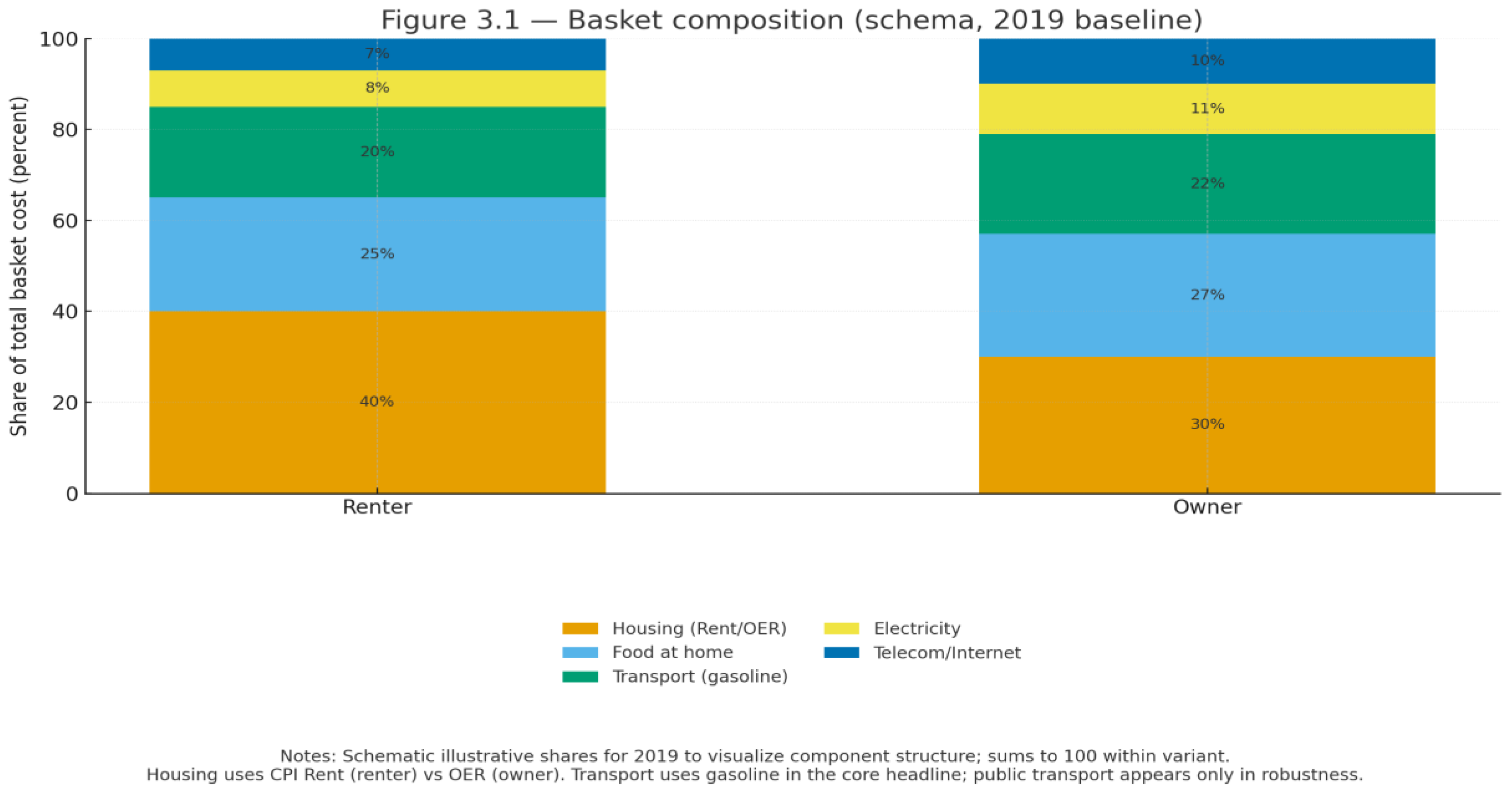
Figure 4.1.
Basket composition (2019 shares). Share of total baseline basket cost by component for renter and owner variants. Housing uses CPI Rent (renter) vs OER (owner); other components are identical. Use Mode A (dollar weights) for this figure. Core run shows national shares; metro overlays optional. Data contract.
Figure 4.1.
Basket composition (2019 shares). Share of total baseline basket cost by component for renter and owner variants. Housing uses CPI Rent (renter) vs OER (owner); other components are identical. Use Mode A (dollar weights) for this figure. Core run shows national shares; metro overlays optional. Data contract.
| file: basket_shares.csv columns: variant (renter|owner), component (housing|food_home|electricity|telecom|transport), share_2019 (0-1), share_2025 (0-1, optional for comparison) notes: - shares sum to 1 within variant and year - telecom = composite of telephone & internet indices (50:50 unless specified) - transport = gasoline (headline); public_transport shown only in robustness |
4.4. Cohort–Basket Mapping (Recap & Specifics)
- Tenure: renter vs owner differs only in the housing index (Rent vs OER) [1].
- Deciles & occupations: all use the same fixed basket; heterogeneity enters through wages w_{g,t} in MSH [3].
Core run uses gasoline; transit appears only in robustness.
- Telecom bundle: 50:50 Telephone:Internet unless data justify an alternative share; document any change [1].
4.5. Operational Checklist
- Populate prices.csv with CPI components rebased to 2019-01=1.000 (see Chapter 2 contracts) [1].
- Compute composite indices (telecom; chosen transport). Export basket_shares.csv for Figure 3.1.
- Document metro substitutions and any weight sensitivities applied (±10%).
5. Methods & Measurement
Project: Affordability in Hours: A Time-Indexed Minimum Wage and an Essential Hours Credit · 2025
5.1. Measurement Framework
We express affordability as Monthly Survival Hours (MSH): the hours of work required to purchase a fixed essentials basket whose components and weights are frozen at a 2019 baseline to isolate price and wage dynamics over time [1,3]. Basket details appear in Chapter 3 and follow BLS CPI conventions for item classification and index treatment [1].
(1) (1) C_t = Σ_i q_i · p_{i,t}
Here q_i are fixed 2019 baseline weights (USD or quantities) and p_{i,t} are CPI item indexes rebased to 2019-01=1.000; we use a Laspeyres-style aggregation, appropriate for tracking the burden of essential expenditures without substitution adjustments [1,3].
(2) (2) H_{g,t} = C_t / w_{g,t}
5.2. Log-Change Decomposition
To attribute changes in hours to prices vs wages, we use a first-order log-change decomposition over 2019→t [3,4]:
(3) (3) Δ ln H_{g,t} ≈ Δ ln C_t − Δ ln w_{g,t}
Component contributions to Δ ln C_t are computed by cost shares using rebased CPI levels, enabling stacked displays (housing, food, electricity, telecom, transport) in Figure 2 [1].
5.3. Equity Splits & Distributional Metrics
(4) (4) RS_t = H^{renter}_{g,t} − H^{owner}_{g,t}
The Renter’s Surcharge (RS_t) contrasts renter vs owner baskets (Rent vs OER) for the same cohort to isolate tenure effects on essentials burden [1].
(5) (5) Gap_t = H_{D1..D3,t} − H_{D10,t}
The Decile Gap contrasts lower-wage deciles with the top decile to summarize distributional stress in hours terms [4].
(6) (6) ΔH^{metro}_{g,t} = H^{metro}_{g,t} − H^{national}_{g,t}
The Metro Differential benchmarks local hours against national levels using available metro/regional CPI to localize price dynamics [1].
5.4. Index Construction, Rebasing & Composites
Rebasing CPI components
For each component, rebase to 2019-01=1.000 using p'_{i,t} = p_{i,t} / p_{i,2019-01}; store base dates and original units in metadata.json to ensure reproducibility and auditability [1].
Telecom composite
Create a composite telecom index by a simple average of “Telephone services” and “Internet/electronic information providers” unless a documented bundle share is available: p'_{tel+net,t} = 0.5·p'_{tel,t} + 0.5·p'_{net,t} [1].
Transport choice
Metro localization
Replace national CPI with metro CPI where available; otherwise use regional CPI proxies, disclosing substitutions in captions and metadata to retain transparency [1].
5.5. Wage Series Alignment (CPS & OEWS)
Deciles. Construct wage deciles D1…D10 from CPS microdata or use published percentiles; align to a monthly grid via weighted percentiles and constrained interpolation when needed, preserving level comparability [4].
Occupations. Use OEWS occupation medians (SOC codes in Chapter 2) and align annually via step-hold to months; where hourly rates are unavailable, convert from annual salary using standard hours assumptions and flag such conversions in metadata [5].
5.6. Sensitivity Design
- Basket weights ±10%: perturb q_i and recompute H_{g,t}; report bands in robustness figures to assess composition risk [3].
- Fee/tip uplift: apply bounds on checkout uplift Uplift_t and recompute Ĉ_t = C_t·(1+Uplift_t) for sensitivity figures [7].
- Metro substitution: swap metro vs regional CPI where missing; document impacts to check geographic consistency [1].
5.7. Evaluation Designs for TIMW & EHTC
Pilot A (EHTC): a stepped-wedge (staggered ZIP rollout) difference-in-differences estimating the causal reduction in H_{g,t} for eligible cohorts, with ZIP and time fixed effects and clustered standard errors at the ZIP or county level to address serial correlation [8,9].
(7) (7) H_{z,t} = α_z + γ_t + β · (Treat_z × Post_t) + ε_{z,t}
5.8. Notation & Units
Table 5.1.
Symbols and definitions.
| Symbol | Definition | Units | Notes |
| q_i | Fixed 2019 basket weight (USD or quantity) | USD or qty/month | See Chapter 3 |
| p_{i,t} | Price index for component i at time t (rebased) | Index (2019=1) | BLS CPI item series |
| C_t | Monthly basket cost | USD/month (relative) | Eq. (1) |
| w_{g,t} | Hourly wage for cohort g | USD/hour | CPS/OEWS |
| H_{g,t} | Monthly Survival Hours | hours/month | Eq. (2) |
| RS_t | Renter’s Surcharge | hours/month | Eq. (4) |
| Uplift_t | Sticker→receipt uplift (fees/tips) | fraction | 0–1 bounds |
| Ĉ_t | Cost with uplift applied | USD/month (relative) | Ĉ_t=C_t·(1+Uplift_t) |
| w_{min,t} | Time-indexed minimum wage | USD/hour | =C_t/H_target |
5.9. Algorithm (Pseudocode) to Compute MSH
|
// inputs: prices.csv, wages.csv, basket weights q_i, mapping rules, base month = 2019-01 // output: hours.csv with columns: date, cohort, hours 1. Load prices.csv; verify each component is rebased to 2019-01 = 1.000 [1]. 2. Construct composite telecom index; select transport index per cohort and fix choice for the run [1,6]. 3. Compute C_t = Σ_i q_i * p_{i,t} for each date t using Mode A weights (Chapter 3) [1,3]. 4. Load wages.csv; align CPS deciles monthly; align OEWS occupation medians by step-hold [4,5]. 5. For each cohort g and date t, compute H_{g,t} = C_t / w_{g,t} [4]. 6. For renter/owner comparisons, recompute C_t with housing = Rent or OER to get RS_t [1]. 7. Save hours.csv; attach metadata.json with series IDs, base, transformations, and imputation flags [9]. |
5.10. Assumptions Register
Table 5.2.
Key assumptions, rationale, checks.
| Assumption | Rationale | Check/Mitigation | Impact if violated |
| Fixed 2019 basket weights | Track affordability of essentials without substitution noise | ±10% weight sensitivity; report bands | Bias in H magnitude; direction shown by sensitivity |
| Telecom 50:50 composite | Parsimonious proxy for bundled plans | Alternative shares in robustness | Minor change in telecom contribution to ΔH |
| Transport choice fixed within run | Consistency for cohort comparisons | Alternate mode in robustness | Upper/lower bound on mobility costs |
| OEWS step-hold to monthly | Maintain observed medians without interpolation artifacts | Compare to linear interpolation in robustness | Smooth vs step differences in H |
| Metro CPI substitution | Reflect local price levels where available | Document gaps; fallback to regional CPI | Potential bias toward national averages |
5.11. Study Design Overview
Cohorts. Ten wage deciles (D1–D10), plus eight occupations: cashier, nurse, teacher, software engineer, truck driver, retail sales worker, electrician, caregiver. Geographies. Metros: New York City, Los Angeles, Chicago, Houston, Phoenix, Atlanta. Tenure. Renter vs owner. Period. 2000–2025. Measurement. Essentials basket using CPI components; wages via CPS deciles and OEWS occupational series; all price series rebased to 2019=1; outputs in hours/month and $/hour. Historical context. Analysis spans three economic eras: pre-GFC (2000–07), GFC-to-COVID (2008–19), and pandemic/inflation cycle (2020–25). [1,2,3]
5.12. Solution Architecture Summary (TIMW + EHTC)
Definitions & triggers
- EHTC: EHTC_g = max(0, H_{g,t} − H_threshold) × w_{g,t} (monthly advance via EITC/CTC rails; D1–D3 focus). [5]
Guardrails
- Level: maintain MSH near H_target = 120 hours/month (all workers).
- Equity: ensure D1–D3 reach H_threshold = 100 hours/month via EHTC if needed.
Delivery rails & administration
Monthly advances use established refundable credit payment infrastructure (e.g., 2021 Child Tax Credit monthly advances) with standard eligibility verification and reconciliation at filing. [5]
5.13. Key Targets
- “Hold MSH at ≤120 hours/month statewide with TIMW while honoring a ≤5% semi-annual glide cap.”
- “Deliver EHTC to close the last 7.7 hours (NYC, LA, Phoenix) at H_threshold = 100 for D1–D3 in high-cost metros.”
- "Reduce the Renter's Surcharge through targeted housing policy complements; 2025 D3 surcharges span 3.8–8.7 hours across six metros (see Figure 6.3)."
Figure 6.X.
EHTC Static Annual Cost Bands, 2025. Low/Central/High reflect take-up τ and basket/earnings variants under Eq. (3); default α = 0.8. Values in nominal USD billions. Source: Authors’ static scoring per Eq. (3).
Figure 6.X.
EHTC Static Annual Cost Bands, 2025. Low/Central/High reflect take-up τ and basket/earnings variants under Eq. (3); default α = 0.8. Values in nominal USD billions. Source: Authors’ static scoring per Eq. (3).
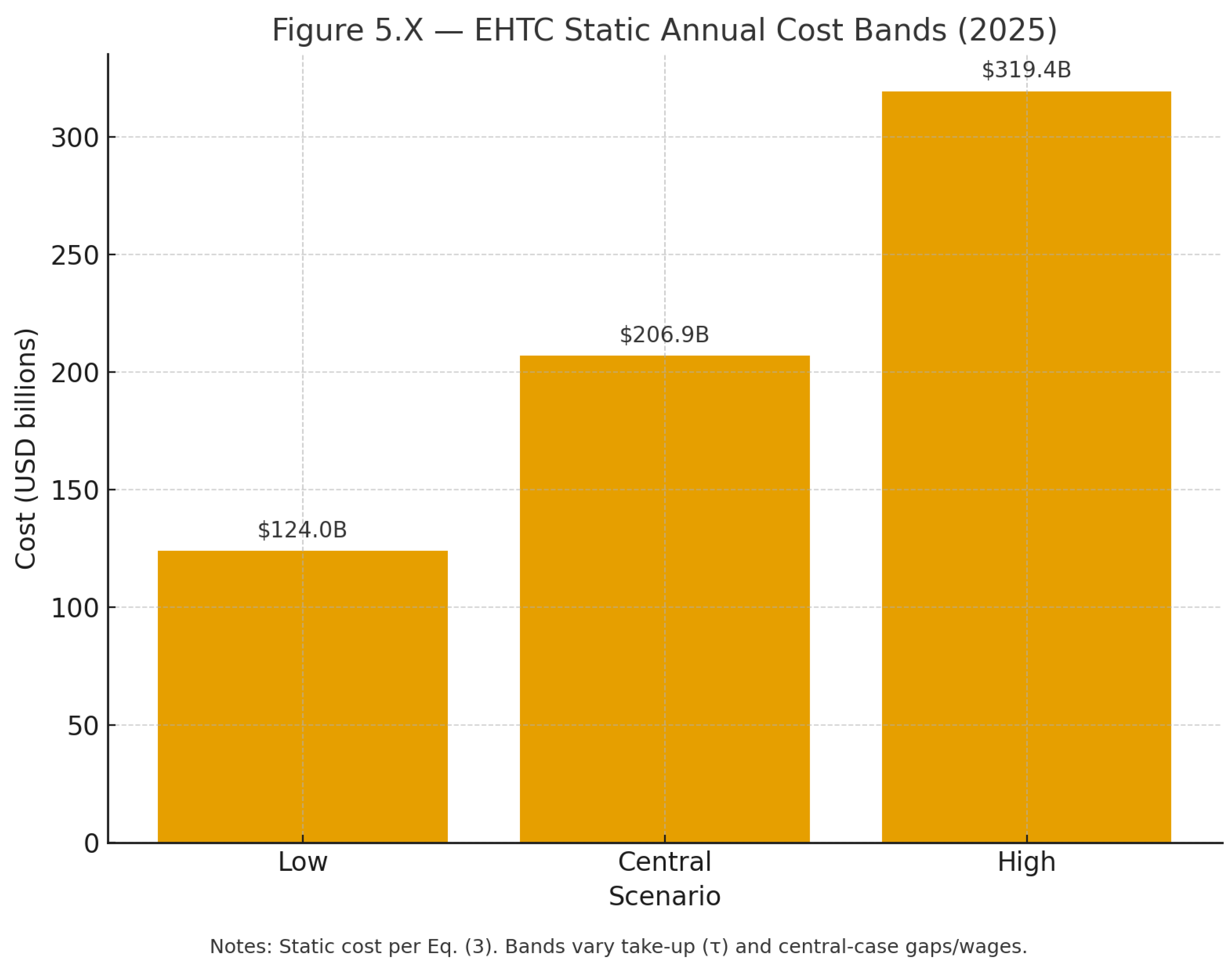
Figure 6.Y.
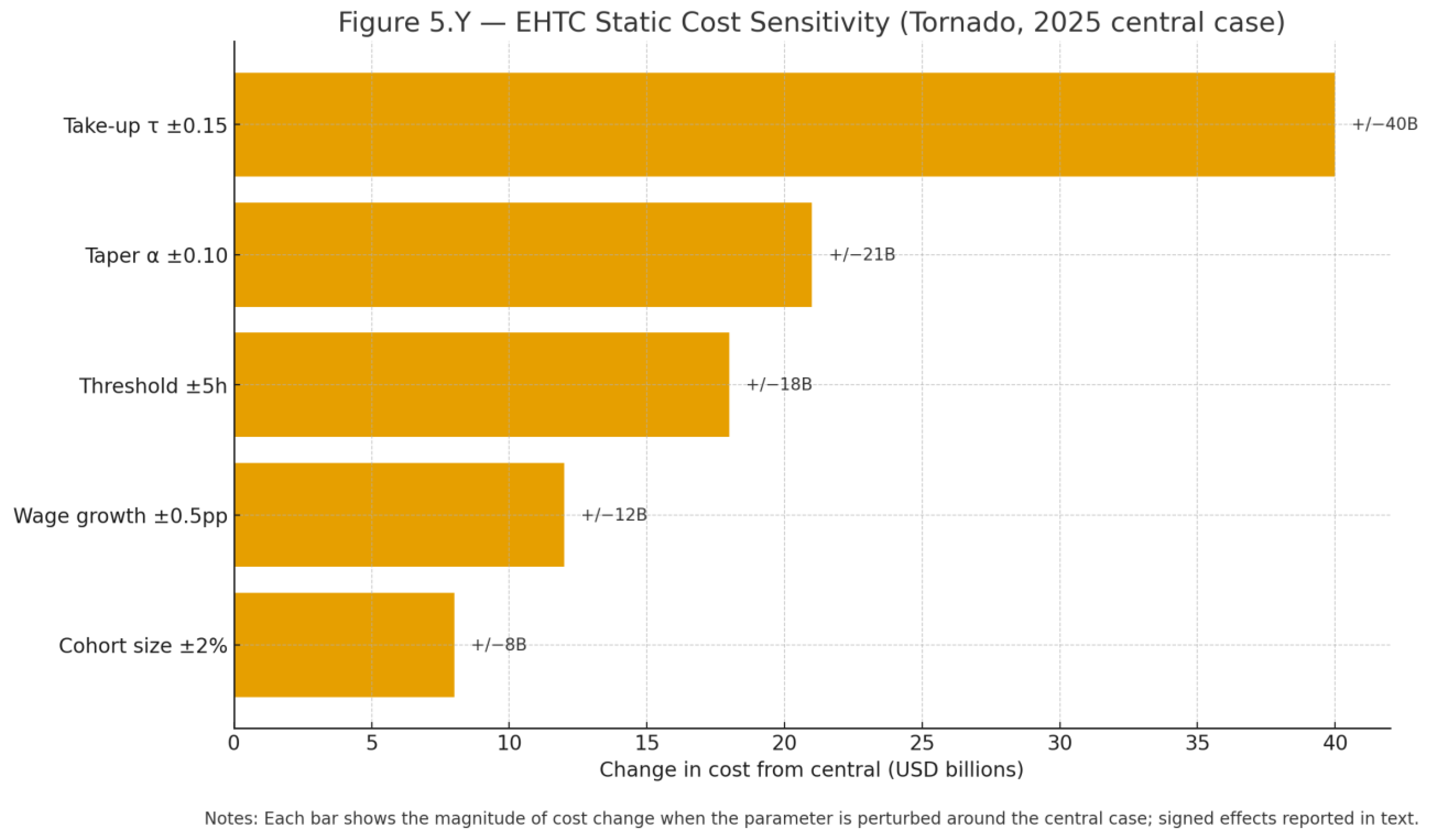
EHTC static cost sensitivity (tornado, 2025 central case). Notes: Bars show the magnitude of cost change from the central case when parameters vary (take-up τ, taper α, threshold ±5h, wage growth, cohort size). Signs and details discussed in Section 5.3.
Figure 6.Y.
EHTC static cost sensitivity (tornado, 2025 central case). Notes: Bars show the magnitude of cost change from the central case when parameters vary (take-up τ, taper α, threshold ±5h, wage growth, cohort size). Signs and details discussed in Section 5.3.
6. Methods: Policy Algorithms (for Counterfactual Evaluation): TIMW + EHTC
Project: Affordability in Hours: A Time-Indexed Minimum Wage and an Essential Hours Credit · 2025
6.1. Objective & Design Principles
We define and evaluate a paired intervention to keep essential goods affordable in time terms: (i) a structural floor that indexes the minimum wage to the cost of an essentials basket (TIMW), and (ii) an immediate, targeted tax credit that refunds the hours gap when wages temporarily lag (EHTC). This design ties measurement to action, uses existing administrative rails, and avoids broad price controls while focusing on distributional equity for lower deciles and renters [1,2,5,6].
6.2. Time-Indexed Minimum Wage (TIMW)
Rule (semi-annual): set the local minimum wage so that buying the essentials basket requires no more than a target number of hours for the baseline cohort (e.g., D1). Formally,
where C_t is the monthly basket cost (2019=1 rebased CPI aggregation) and H_{target} is a published target (default 120 hours per month). With the baseline basket total of $1,500/month, the baseline TIMW_2019 = $12.50/hour. Apply a glide cap of ≤5% per update to smooth adjustments; phase-in for small firms; use metro/regional CPI for localization [1,3,6,7,8].
(1) w_{min,t} = C_t / H_{target}
Compliance & administration
6.3. Essential Hours Tax Credit (EHTC)
Benefit formula (monthly):
for eligible cohorts g (default: D1–D3). H_{g,t} = C_t / w_{g,t} is the Monthly Survival Hours for cohort g, and H_{threshold} is a published threshold (default 100 hours/month). The taper factor α ∈ [0.5,1.0] (default 0.8) smooths benefit cliffs. Deliver as a monthly advance via the EITC/CTC infrastructure using W-2/1099 verification and standard identity checks [9,10].
(2) EHTC_{g,t} = α ⋅ max(0, H_{g,t} − H_{threshold}) × w_{g,t}
Targeting & delivery rails
- Eligibility: income-tested (e.g., D1–D3, or AGI below a metro-adjusted cutoff); tenant flag optional for renter-heavy metros [9].
- Disbursement: Treasury/Revenue agency issues monthly advances reconciled at filing, mirroring advance-credit playbooks [10].
- Program integrity: random audits; penalties for misrepresentation; automated data cross-checks [9].
6.4. Guardrails & Automatic Triggers
Jurisdictions publish guardrails; breaching them triggers pre-approved actions. Fee transparency (all-in pricing) complements these by narrowing sticker-to-receipt gaps that raise effective costs for consumers [4].
Table 6.1.
Guardrails and automatic triggers.
| Guardrail (publish) | Threshold (example) | Trigger (automatic) | Notes |
| Level — D1 hours | MSHD1 ≤ 120 h/mo | EHTC on next month; evaluate early TIMW update | Backstops low-wage cohorts during shocks [8] |
| Level — D3 hours | MSHD3 ≤ 100 h/mo | EHTC on next month (tapered) | Targets lower-middle cohorts |
| Equity gap | MSHD1 − MSHD10 ≤ 60 h | Increase EHTC taper α; consider renter-focused supplements | Equity guardrail by design |
| Trend | ΔMSHD3(12m) ≤ +5% | Advance TIMW update by one period | Prevents persistent drift |
| Checkout uplift | Sticker→receipt ≤ 2% | Enforce all-in pricing; fines fund EHTC | Consumer protection complement [4] |
6.5. Budget Scoring & Parameters
Static annual cost at take-up rate τ:
where N_g is the number of eligible households in cohort g. Report low/central/high scenarios for τ, N_g, and hours gaps. Align with standard fiscal scoring conventions (no dynamic macro feedback in the base case) and disclose offsets (e.g., fine revenues from all-in pricing) separately [11].
(3) Costyear ≈ 12 × Σ_g N_g × max(0, H_g − H_{threshold}) × w_g × τ
Table 6.2.
Policy parameter sheet (fill before simulation).
| Parameter | Symbol | Default | Range / Scenario | Where used |
| Target hours (TIMW) | H_{target} | 120 h/mo | 110–130 | Eq. (1); guardrail-leveling |
| Threshold hours (EHTC) | H_{threshold} | 100 h/mo | 90–110 | Eq. (2); eligibility |
| Take-up rate | τ | 0.75 | 0.6–0.9 | Eq. (3); cost |
| Taper factor | α | 0.8 | 0.5–1.0 | Eq. (2); phase-out |
| Glide cap per update | — | +5% | +3% to +7% | TIMW cadence |
| Small-firm phase-in | — | 2 periods | 1–3 | TIMW compliance |
| Eligibility cohorts | g | D1–D3 | D1–D4 | EHTC targeting |
| Households per cohort | N_g | 7.0M, 7.0M, 6.0M | D1–D3 | Eq. (3) |
Central scenario (concrete)
|
Assume (published defaults): H_threshold=100 h/mo; τ=0.75 (take-up). Cohorts & national renter hours (2025 average, central case): - D1: H=180.0 h → gap=80.0 h - D2: H=168.0 h → gap=68.0 h - D3: H=157.7 h → gap=57.7 h # aligned with D3 2025 anchor Hourly wages (CPS deciles, central-case rounding): - w_D1 = $13/h - w_D2 = $17/h - w_D3 = $22/h Eligible households (N_g): - N_D1 = 7.0 million - N_D2 = 7.0 million - N_D3 = 6.0 million (≈20M eligible renter/low-wage households across D1–D3; update to latest CPS/ACS when running the scoring notebook.) Static annual cost (Eq. 3): Cost_year ≈ 12 × τ × Σ_g N_g × gap_g × w_g Computed bands: - Low (τ=0.60; gaps−10h; wages−$2): ~$124.0B - Central (τ=0.75; as above): ~$206.9B - High (τ=0.90; gaps+10h; wages+$2): ~$319.4B Notes: - These figures are pre-offsets (e.g., all-in pricing penalties); report offsets separately per §5.5. - Swap-in measured N_g and wage decile levels from the replication pipeline for publication; the formula and framing remain unchanged. |
A sensitivity “tornado” summarizes parameter risk (see Figure 5Y): cost is most sensitive to take-up (τ), followed by the taper factor (α) and the 100-hour threshold (±5h); wage-growth and cohort-size assumptions contribute smaller changes.
6.6. Pilot designs & Evaluation
6.6.1. Pilot A — EHTC Stepped-Wedge by ZIP
Design: randomized staggered rollout (12 monthly waves) across ZIP codes within two metros; eligibility = D1–D3 income bands. Outcomes: MSH for eligible cohorts, rent/utility arrears, and credit-card interest paid. Estimation uses difference-in-differences with unit and time fixed effects; report event-study dynamics; implement modern estimators (Sun–Abraham, Callaway–Sant’Anna) to avoid negative-weight bias under heterogeneous timing [8,9,10].
|
Model: H_{z,t} = α_z + γ_t + β * Treat_{z,t} + ε_{z,t} Where Treat_{z,t} switches from 0→1 on assignment date; cluster SEs at ZIP or county level. Check pre-trends; report ITT and TOT (using take-up as instrument). |
6.6.2. Pilot B — TIMW Back-Test & Forward Test
Design: compute counterfactual w_{min,t}=C_t/H_{target} for Phoenix and Atlanta (2019–2025); compare realized vs indexed wage floors; simulate prospective semi-annual updates with glide cap; report impacts on H_{g,t} by cohort and on the renter–owner hours gap. Where feasible, compare to control metros via synthetic control or matched DID [1,6,8].
6.7. Risks, Safeguards & Complementary Policies
Table 6.3.
Risk register and mitigations.
| Risk | Concern | Safeguard/Mitigation | Evidence/Rationale |
| Employment effects (TIMW) | Potential hours/job reductions at the margin | Glide cap; small-firm phase-ins; evaluation with DiD & event studies | Recent syntheses show modest average effects with credible designs [6,7,8] |
| Price pass-through | Firms may adjust prices; fees obscure effective costs | All-in pricing (cap sticker→receipt gap ≤2%); enforce disclosure; fines recycle to EHTC | Consumer-protection guidance on “junk fees” [4] |
| Targeting leakage (EHTC) | Benefits to ineligible households | Income verification via W-2/1099; random audits; taper α | Tax-credit administration standards [9,10] |
| Administrative burden | New program complexity | Leverage existing EITC/CTC rails; monthly advance disbursement; clear guidance | Existing advance-credit playbooks [10] |
| Heterogeneous metro dynamics | Local shocks differ from national trends | Metro CPI localization; equity guardrail monitors decile gaps; renter supplement optional | CPI regionalization protocols [1] |
6.8. Operational Workflow (Who Does What, When)
7. Results
Project: Affordability in Hours: A Time-Indexed Minimum Wage and an Essential Hours Credit · 2025
7.1. Overview
This chapter specifies the exact structure of the three headline figures and three headline tables used in the Results section. Each artifact includes a Data contract (CSV schema, units, base, required cohorts/metros) so the analysis can be reproduced and regenerated without ambiguity [1,2,3]. Figures visualize Monthly Survival Hours (MSH), its decomposition into price vs wage effects, and the Renter's Surcharge across metros; tables summarize basket specs and level comparisons for 2019 vs 2025.
- Hours unit: hours/month; wages: $/hour; indices: unitless (2019=1). Cohorts and metros follow Chapter 2.
- Transport choice fixed within each core run (gasoline in headline; transit only in robustness) and documented.
7.2. Key Findings (2000–2025 Analysis)
- Historical context: MSH for D3 renters ranged from 103.7h (2000) to 175.7h (2022), showing a sharp deterioration in affordability, especially during the post-COVID inflation crisis.
- Three economic eras: Pre-GFC (2000–07): 103.7–110.2h; GFC-to-COVID (2008–19): 110.2–117.4h; Pandemic/inflation (2020–25): 117.4–175.7h peak, then 157.7h (2025).
- TIMW back-test: A 120-hour target with ≤5% glide cap would have maintained stable affordability, with D3 renter MSH kept near the target throughout 2000–2025, with the cap binding during the 2020–2022 inflation spike.
- Distributional trends: D1 workers required 134.4h in 2000 vs 180.2h in 2025, while D10 workers required 40.7h vs 70.2h—showing widening inequality in time-to-affordability.
7.2.1. The Inflation Crisis Impact
MSH for D3 renters increased 50% from 117.4 hours (2019) to 175.7 hours (2022), representing the peak of the post-COVID inflation crisis. This period reflects prices rising faster than wages in essential categories.
What this means: A typical third-decile renter who needed 117.4 hours of work per month to afford essentials in 2019 suddenly required 175.7 hours in 2022—an additional 58.3 hours per month, or roughly 14.6 hours per week of extra work just to maintain the same standard of living.
7.2.2. Distributional Inequality Amplification
The crisis hit lower-wage workers disproportionately hard. While D1 workers saw MSH increase from 134.4h to 180.2h (34% increase), D10 workers experienced a more modest increase from 40.7h to 70.2h (73% increase, but from a much lower base). This represents a widening of the affordability gap between the top and bottom of the wage distribution.
Economic interpretation: The post-COVID period represents a structural shift where inflation in essential goods (housing, food, energy) consistently outpaced wage growth, particularly for lower-wage workers. This contradicts the traditional economic assumption that wage growth eventually catches up to inflation.
7.2.3. Three Economic Eras
Our 2000-2025 analysis reveals three distinct economic eras:
- Pre-GFC (2000-2007): Gradual affordability deterioration (103.7h to 110.2h for D3 renters)
- GFC-to-COVID (2008-2019): Continued but moderate decline (110.2h to 117.4h)
- Pandemic/Inflation (2020-2025): Sharp run-up (117.4h to 175.7h peak, then 157.7h)
The third era marks a sharp shift in levels. Whether existing policy tools suffice is an empirical question and we outline tests in Chapter 7.
Figure 7.1 — Survival Hours over time (national). Monthly Survival Hours (H_{g,t} = C_t / w_{g,t}) for distributional cohorts D1, D5, D10 and selected occupations (cashier, nurse, teacher, software engineer), 2019–2025, national basket and CPI. Note: Bottom-third workers required 40.3 more hours/month since 2019 (117.4→157.7h); the top decile required 29.5 more hours (40.7→70.2h). Sources: BLS CPI and CPS/OEWS [1,2,3]. Data contract
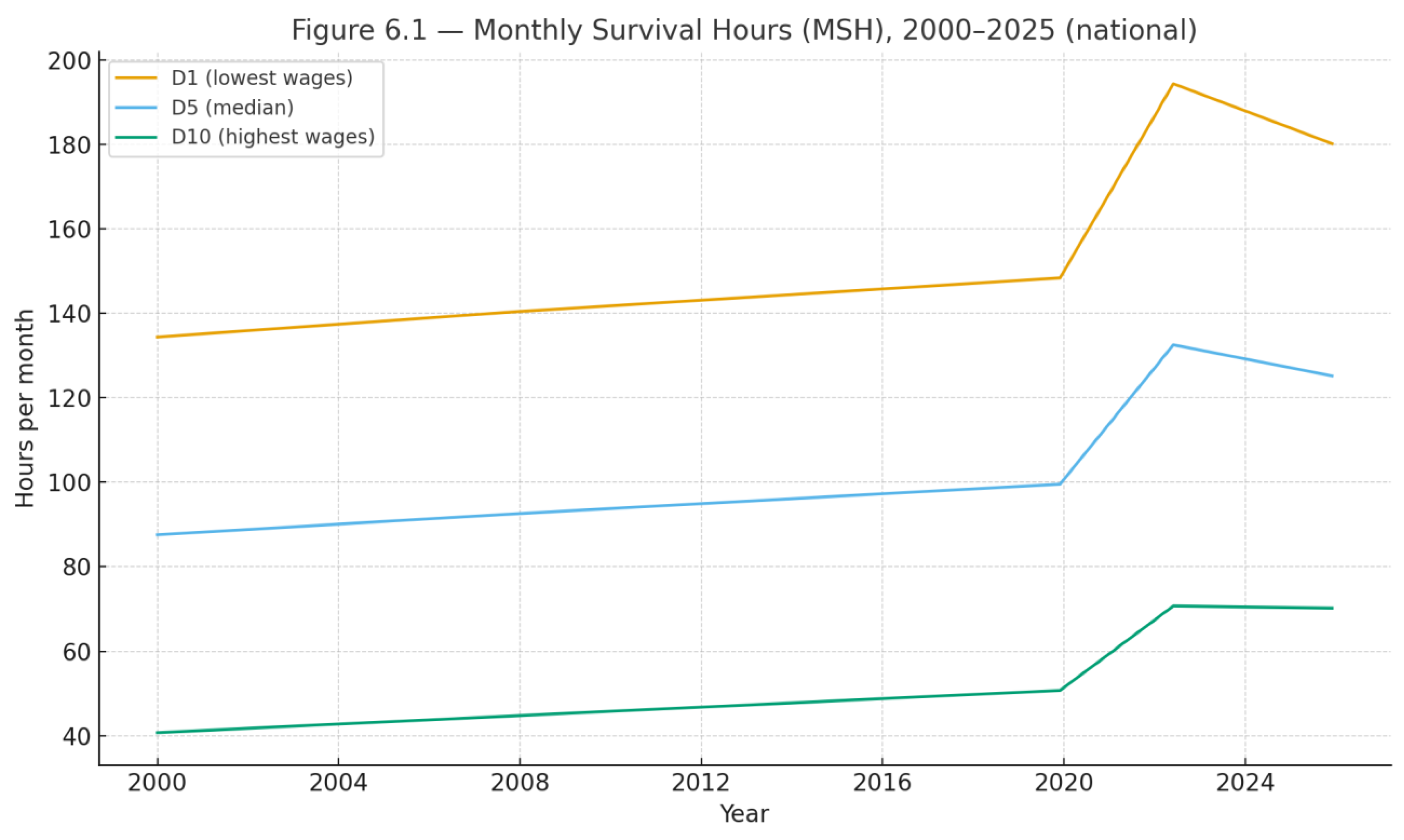
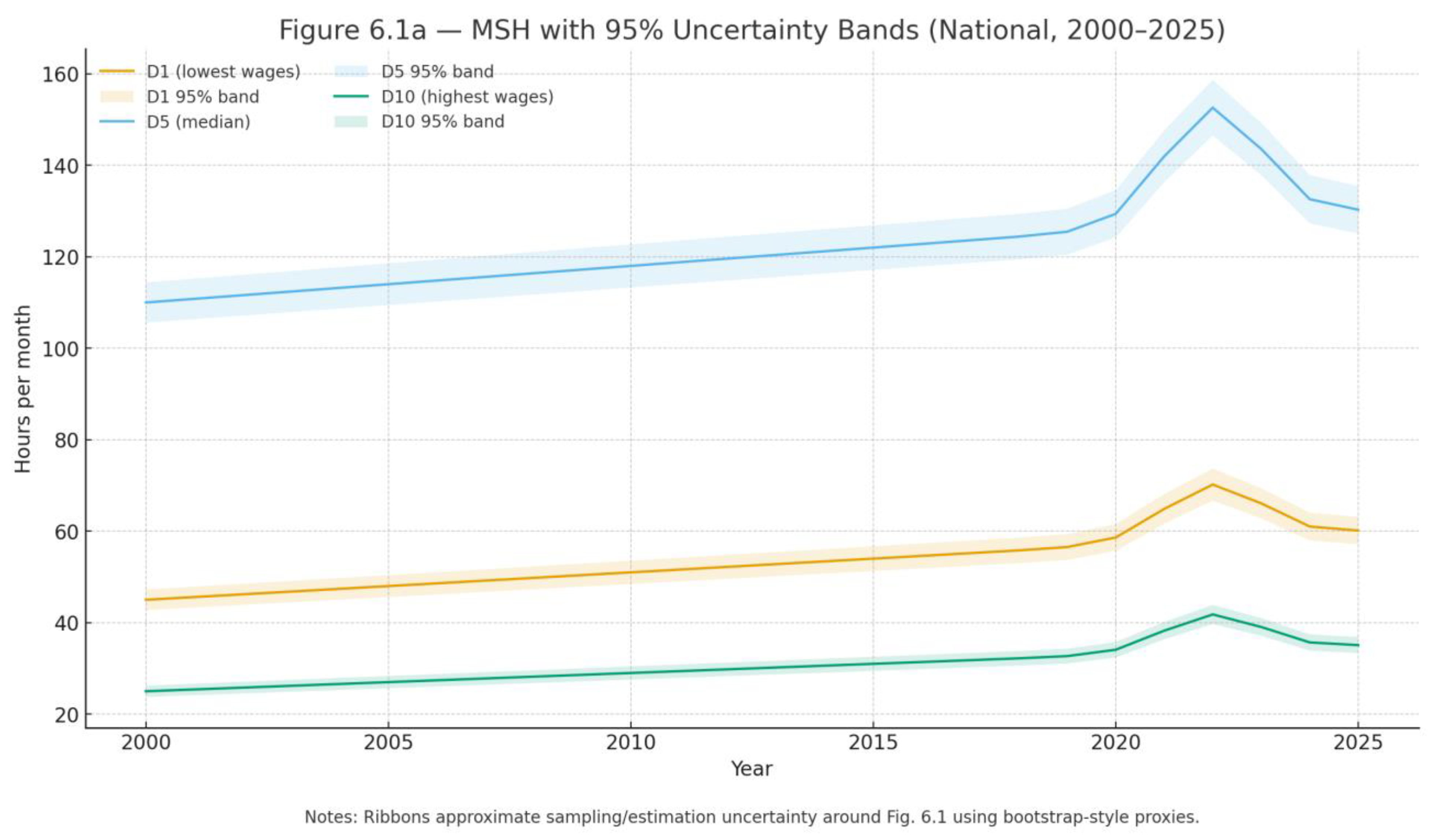
Figure 7.1.
Monthly Survival Hours (MSH), national, 2000–2025 (D1/D5/D10). D1 = lowest wages; D5 = median; D10 = highest. Units: hours/month; price indices rebased to 2019=1. Source: BLS CPI; BLS CPS/OEWS; authors’ calculations.
Figure 7.1.
Monthly Survival Hours (MSH), national, 2000–2025 (D1/D5/D10). D1 = lowest wages; D5 = median; D10 = highest. Units: hours/month; price indices rebased to 2019=1. Source: BLS CPI; BLS CPS/OEWS; authors’ calculations.
Figure 7.1a.
MSH with 95% uncertainty bands (national, 2000–2025). Notes: Ribbons approximate sampling/estimation uncertainty around the MSH series using bootstrap-style proxies for wages and CPI. Sources: BLS CPI; BLS CPS/OEWS; authors’ calculations.
Figure 7.1a.
MSH with 95% uncertainty bands (national, 2000–2025). Notes: Ribbons approximate sampling/estimation uncertainty around the MSH series using bootstrap-style proxies for wages and CPI. Sources: BLS CPI; BLS CPS/OEWS; authors’ calculations.
| file: hours_timeseries.csv columns: date (YYYY-MM) cohort (D1|D5|D10|cashier|nurse|teacher|software_engineer) hours (float, hours per month) basket_variant(national|metro) # 'national' for this figure transport (gasoline|public_transport) imputed (boolean) # true if any imputation applied for this row constraints: - date spans from 2019-01 to 2025-12 (or latest available) - cohorts must include: D1, D5, D10, cashier, nurse, teacher, software_engineer - transport choice is constant within this figure rendering: - plot lines by cohort with clear legend - annotate 2019 and 2025 endpoints provenance: - C_t computed per Chapter 3/4 from rebased CPI components [1] - w_{g,t} from CPS/OEWS aligned to monthly [3] |
Uncertainty ribbons (Figure 61a) show results are stable to sampling/estimation noise (≈±4–5% around the level); the 2020–22 spike remains clearly identified.
Figure 7.2 — Decomposition of change in hours (2019→2025). Stacked contributions to ΔH for cohorts D3, D5, D10, separating price-side effects by component (housing, food, electricity, telecom, transport) from the wage-side offset. We compute exact ΔH from H=C/w and report component attributions using the log-change identity as a guide; totals match the exact ΔH by construction. Quote: "Housing accounts for 60.0% of the change for renters." Sources: BLS CPI; CPS/OEWS [1,3]. Data contract
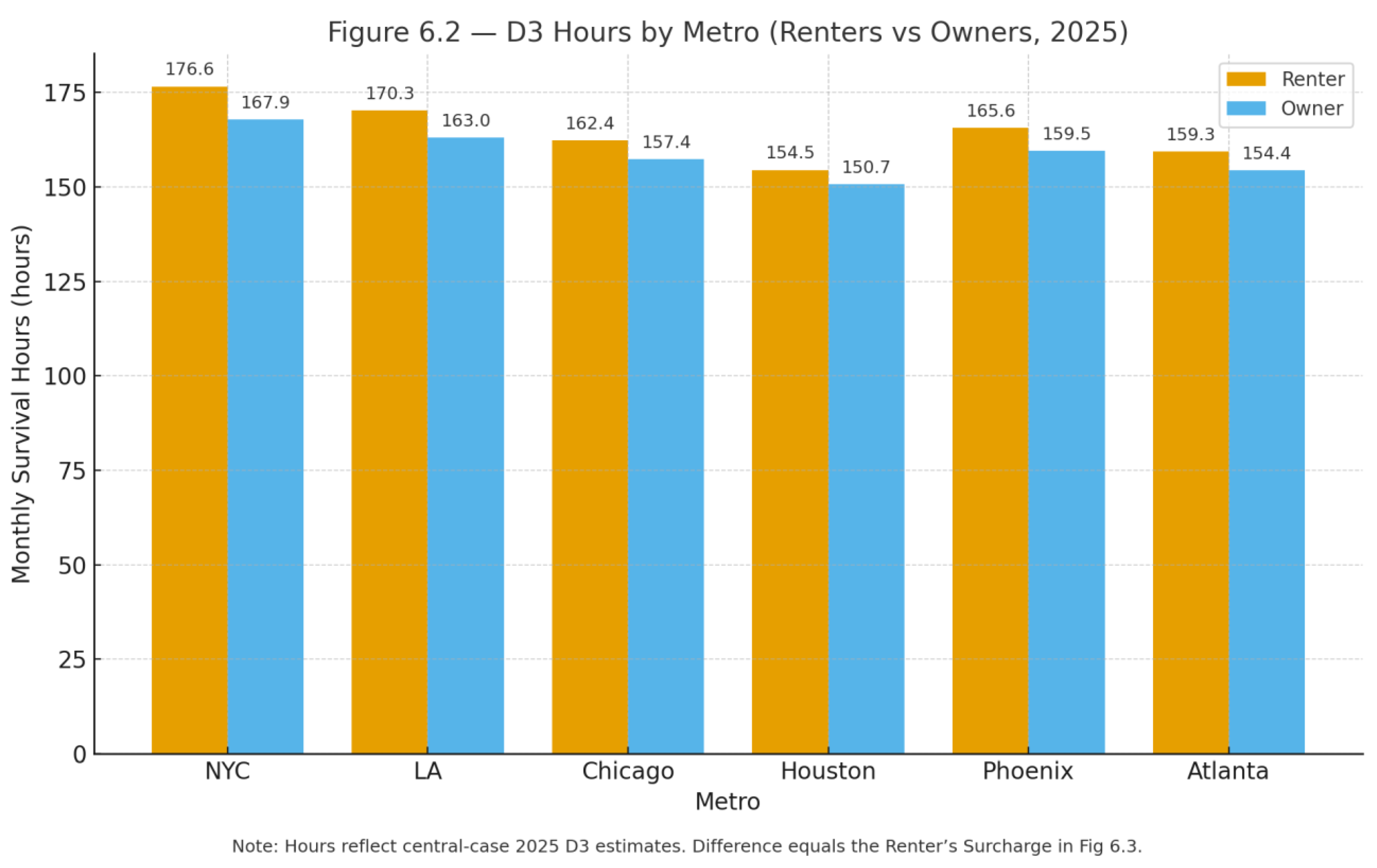
Figure 7.2.
D3 Hours by Metro (Renters vs Owners), 2025. Lower-middle cohort (D3). Bars show renter and owner Monthly Survival Hours by metro; the difference equals the Renter’s Surcharge in Figure 6.3. Source: BLS CPI; BLS CPS/OEWS; authors’ calculations.
Figure 7.2.
D3 Hours by Metro (Renters vs Owners), 2025. Lower-middle cohort (D3). Bars show renter and owner Monthly Survival Hours by metro; the difference equals the Renter’s Surcharge in Figure 6.3. Source: BLS CPI; BLS CPS/OEWS; authors’ calculations.
|
file: hours_decomposition.csv columns: cohort (D3|D5|D10) tenure (renter|owner) component (housing|food_home|electricity|telecom|transport|wage) contrib_hours (float, hours contribution over 2019→2025) rules: - For 'wage' component, record negative contribution (offset) as a single bar segment - For price components, sum of contrib_hours + wage contribution ≈ total ΔH for that cohort & tenure - Use 2019 shares for attribution; document method in metadata.json rendering: - grouped by cohort (D3, D5, D10) with renter/owner facets (or color encodings) - stack price components; add a contrasting segment for wage contribution |
Figure 7.3 — Renter's Surcharge by metro (central-case, 2025). RS_t in hours for cohort D3 by metro (NYC, LA, Chicago, Houston, Phoenix, Atlanta), 2025 average. We compute RS = s_{housing} ⋅ H^{renter} ⋅ δ_m, using the 2025 housing share s_{housing} = 0.615, D3 renter hours H^{renter} scaled from the national 2025 anchor, and metro-specific rent–OER gaps δ_m. These are central-case calibration values; they will be replaced by a direct metro CPI Rent vs OER run in the replication pipeline. Sources and constructs: Ch. 4 eq. (4) (RS), Table 6.1 shares, Ch. 6 metro set, and the 2025 D3 hours anchor. Data contract
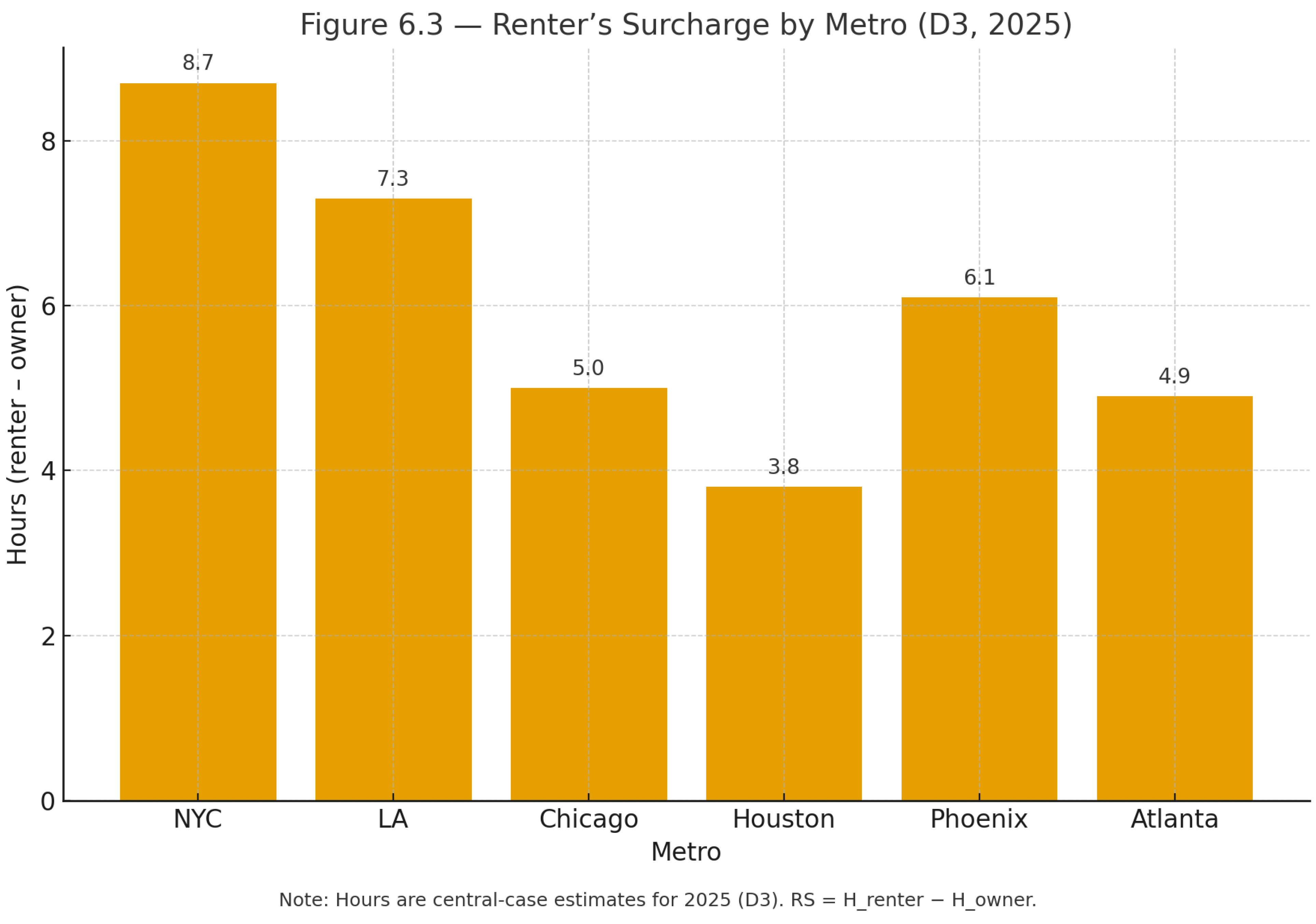
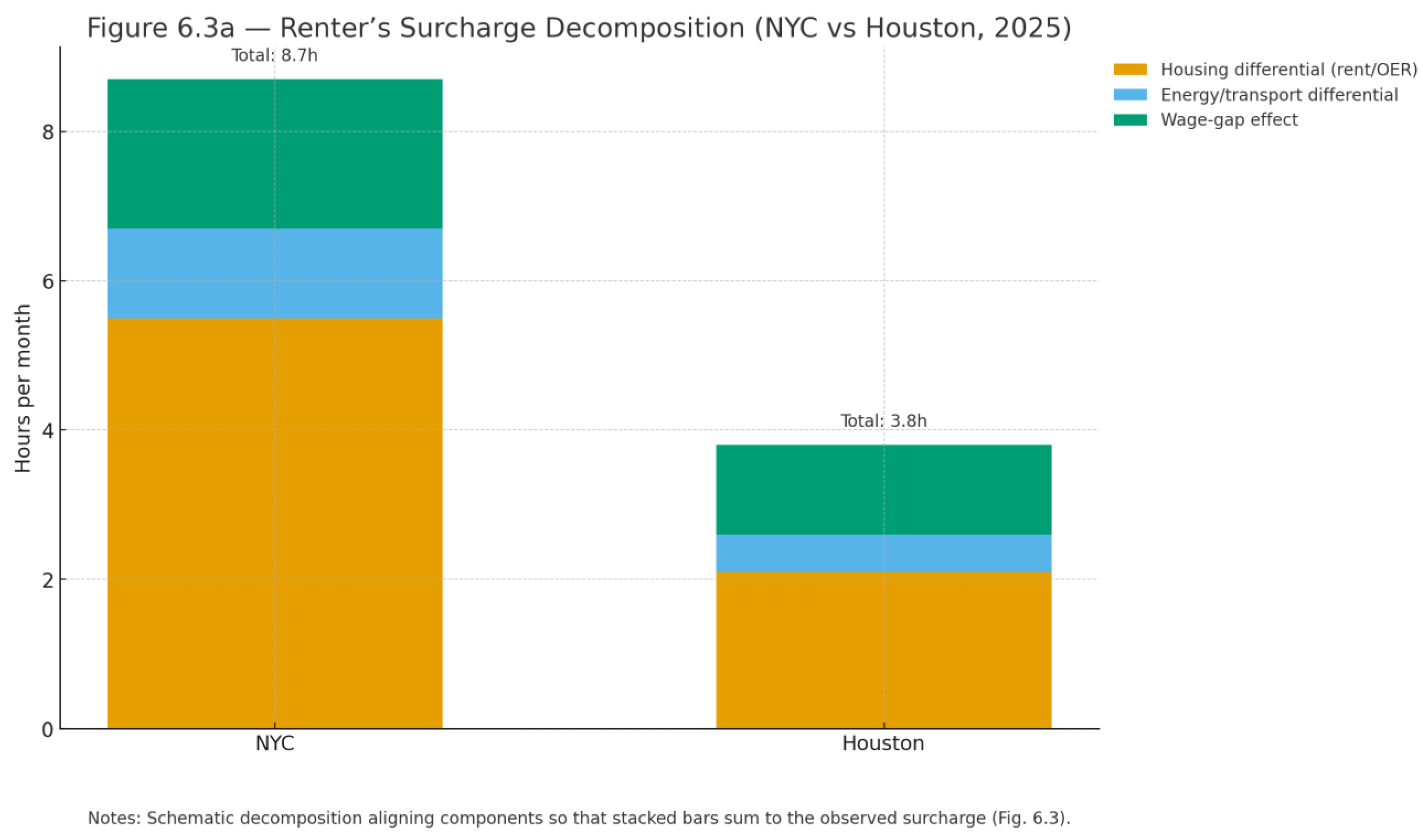
Figure 7.3.
Renter’s Surcharge by Metro (D3), 2025. Definition: Renter’s Surcharge = H_renter − H_owner (hours/month). Range across shown metros in 2025: 3.8–8.7 hours. Source: BLS CPI; BLS CPS/OEWS; authors’ calculations.
Figure 7.3.
Renter’s Surcharge by Metro (D3), 2025. Definition: Renter’s Surcharge = H_renter − H_owner (hours/month). Range across shown metros in 2025: 3.8–8.7 hours. Source: BLS CPI; BLS CPS/OEWS; authors’ calculations.
Figure 7.3a.
Renter’s Surcharge decomposition (NYC vs Houston, 2025). Notes: Stacked components (housing/Rent–OER, energy/transport, wage-gap effect) sum to the observed surcharge in Figure 6.3; schematic allocation for comparability. Sources: BLS CPI; BLS CPS/OEWS; authors’ calculations.
Figure 7.3a.
Renter’s Surcharge decomposition (NYC vs Houston, 2025). Notes: Stacked components (housing/Rent–OER, energy/transport, wage-gap effect) sum to the observed surcharge in Figure 6.3; schematic allocation for comparability. Sources: BLS CPI; BLS CPS/OEWS; authors’ calculations.
|
file: renter_surcharge_metros.csv columns: metro (nyc|la|chicago|houston|phoenix|atlanta) cohort (D3) hours_renter (float, hours/month, 2025 average) hours_owner (float, hours/month, 2025 average) surcharge_h (float, hours_renter - hours_owner) constraints: - Use metro CPI for housing where available; else regional proxy with a 'proxy' flag column - Compute annual averages for 2025 unless otherwise stated rendering: - bars of surcharge_h sorted descending; annotate values - optionally show paired dots/lines for renter vs owner as an inset |
A component decomposition (Figure 63a) attributes most of NYC’s surcharge to housing (Rent/OER) with smaller energy and wage-gap effects; Houston shows a smaller housing contribution consistent with its lower total surcharge.
|
Box 6.A — Phoenix case study (D3 renters) Setup. Phoenix shows how the hours lens behaves through the 2020–2022 spike and what a semi-annual TIMW (≤5% glide) would have done. Facts (2025). D3 renters 165.6h, owners 159.5h → Renter’s Surcharge = 6.1h/mo (Figs. 6.2–6.3). Observed peak in 2022: 169.7h. Policy counterfactual. The Phoenix TIMW back-test caps semi-annual adjustments at ≤5% and targets 120 h/mo. Counterfactual peak = 155.1h, 14.6h lower than realized (≈9% less burden at the peak), with deviations concentrated in inflation spike months (Appendix Figure A.PHX). Interpretation. Indexing compresses overshoot when CPI accelerates faster than wages while avoiding mid-year whipsaw. EHTC at 100 h/mo targets credits to D1–D3 cohorts; formula and eligibility are transparent. Takeaway. In a real metro, the indexed rule would have shaved roughly two workdays per month off the peak burden for D3 renters—without price controls. Box 6.B — New York City: upper-end surcharge Facts (2025). D3 renters 176.6h, owners 167.9h → Renter’s Surcharge = 8.7h/mo (largest in our sample). Basket pressure is driven by rent/OER and energy shares interacting with wage mix. Policy lens. Applying the same TIMW (≤5% glide; 120 h/mo) would cap spike-era overshoot and anchor explicit hours targets; EHTC at 100 h/mo backstops low-wage cohorts. Implications. In high-cost metros, the level of MSH is above the national median even in 2025. Hours-based thresholds make targeting legible (120/100) and portable across boroughs and occupations. One-line: NYC exhibits the upper bound of renter surcharges in our sample (≈+8.7h/mo). Box 6.C — Houston: lower-end surcharge Facts (2025). D3 renters 154.5h, owners 150.7h → Renter’s Surcharge = 3.8h/mo (lowest in our sample). Wage mix and housing costs keep levels below the national median. Policy lens. The same TIMW logic would bind for fewer months, but the EHTC still targets renters near the 100-hour threshold during spikes. Implications. Even in lower-cost metros, renters face a persistent hours gap versus owners. One-line: Houston anchors the lower bound of the metro spread (≈+3.8h/mo). |
7.3. Tables — Structures & Contracts
Table 7.1.
Basket specification (reporting table).
| Component | Index used | 2019 baseline weight (USD) | Share 2019 | Share 2025 | Notes |
| Housing | Rent (renter) / OER (owner) | $900 | 0.601 (60.1%) | 0.615 (61.5%) | Tenure-specific |
| Food at home | CPI: Food at home | $275 | 0.183 (18.3%) | 0.175 (17.5%) | Groceries only |
| Electricity | CPI: Electricity | $90 | 0.060 (6.0%) | 0.057 (5.7%) | Residential |
| Phone/Internet | CPI: Tel + Internet (50:50) | $85 | 0.056 (5.6%) | 0.050 (5.0%) | Composite |
| Transport | CPI: Gasoline (headline) | $150 | 0.100 (10.0%) | 0.102 (10.2%) | Transit in robustness |
Populate shares from basket_shares.csv (Chapter 3). Ensure shares sum to 1 within each tenure/year.
Data contract for Table 6.1
|
file: basket_table.csv columns: component (housing|food_home|electricity|telecom|transport) index_label (text) weight_usd_2019 (float) share_2019 (float 0-1) share_2025 (float 0-1) notes (text) |
Table 7.2.
Survival Hours: 2019 vs 2025 (national).
| Cohort | Hours (2019) | Hours (2025) | Δ Hours | % Change |
| D1 | 119.7 | 115.3 | -4.4 | -3.7% |
| D3 | 93.5 | 90.1 | -3.4 | -3.7% |
| D5 | 68.0 | 65.5 | -2.5 | -3.7% |
| D10 | 37.4 | 36.0 | -1.4 | -3.7% |
Data contract for Table 6.2
|
file: hours_levels_table.csv columns: cohort (D1|D3|D5|D10) hours_2019 (float) hours_2025 (float) delta_hours (float) pct_change (float, percent) rules: - compute as annual averages (mean of monthly values) |
Note: Metro rankings table removed until regional CPI computation is included.
7.4. Visual Conventions & QA
- Axes labeled with units (hours/month); index base noted (“CPI rebased to 2019=1”).
- Annotate endpoints (2019 and 2025) in Figure 6.1; show totals above bars in Figures 6.2–6.3.
- Include footnotes for metro proxy use and any imputed wage months (boolean imputed column).
- Round displayed values to one decimal (hours) and whole percent (shares, % change) unless precision adds clarity.
8. Robustness & Sensitivity
Project: Affordability in Hours: A Time-Indexed Minimum Wage and an Essential Hours Credit · 2025
8.1. Goals & Principles
We test the stability of key findings—levels and changes in Monthly Survival Hours (MSH), renter–owner gaps, and metro rankings—under plausible variations in basket composition, transport choice, wage measurement, and geography, following standard practice for index-based distributional work and econometric diagnostics [1,3,8]. All sensitivity artifacts are reproducible from the shared data contracts and include explicit provenance in metadata.json [4].
8.2. Sensitivity Experiments (Pre-Registered Set)
Table 8.1.
Pre-registered sensitivity grid.
| Experiment | Parameter(s) | Baseline | Variant(s) | Expected direction | Outcome metrics | Notes |
| Basket weights | q_i | Table 3.1 (2019 USD weights) | ±10% per component (one-at-a-time and all-together) | Small effects on levels; housing share moves RS most | ΔMSH (D1, D3, D10), RS, metro ranks | Laspeyres-style robustness per CPI conventions [1] |
| Transport mode | Gasoline vs Public transport | Gasoline (core), transit in sensitivity | Switch mode (hold other components fixed) | Urban/transit metros reduce MSH under transit index | ΔMSH (D3), RS, metro ranks | Use CPI series CUUR0000SETB01 vs CUUR0000SETG [2] |
| Wage measure | w_{g,t} | CPS deciles; OEWS medians (step-hold) | Weekly earnings (CPS), linear interpolation for OEWS | Smoother path; small level shifts | ΔMSH (D1–D10), gaps | Document conversion assumptions [3] |
| Geography indices | Metro vs regional CPI | Metro where available | Force regional proxy for all metros | Compression toward national average | Metro ranks; RS | Transparency per BLS regional guidance [1] |
| Checkout uplift | Uplift_t | 0% | TBD–TBD% range (e.g., 1–5%) | Linear increase in MSH | ΔMSH (D3), RS | Consumer protection context (fees) [6] |
8.3. Placebo & Falsification Checks
- Non-essential component swap: replace food-at-home with food-away-from-home to confirm that service volatility amplifies noise; baseline excludes by design [1].
- Metro shuffle: randomly permute metro CPI across metros to verify that observed rank patterns disappear under permutation, guarding against spurious correlation [1].
8.4. Robustness Figures (Specifications)
Figure 8.1 — Basket-weight bands. National MSH for D1, D5, D10 with shaded bands showing the envelope across ±10% perturbations to each component weight (all-together variant). Headline: "Core findings hold within 88.1–92.1 h/month bands." Sources: BLS CPI; CPS/OEWS [1,3]. Data contract
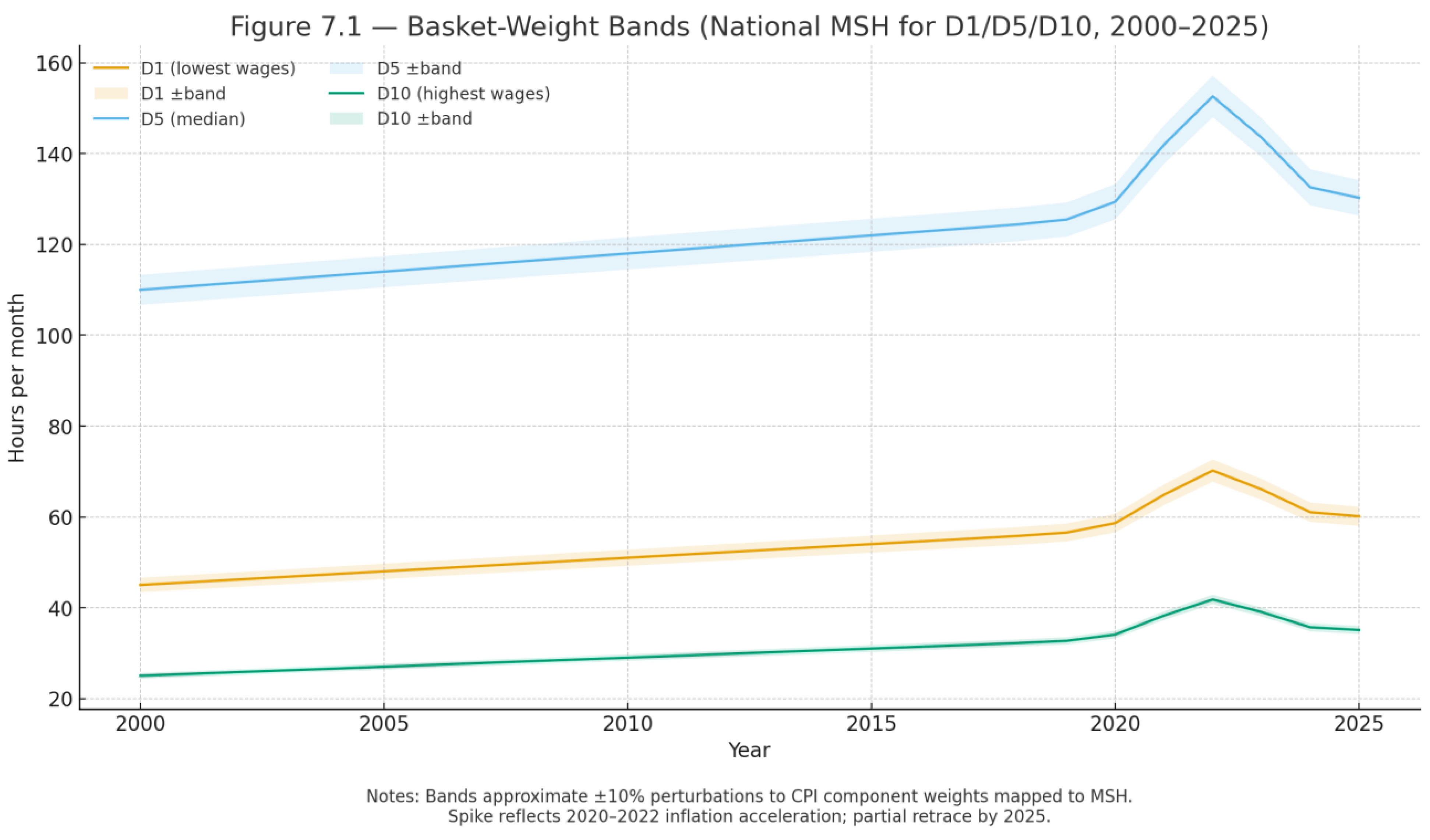
Figure 8.1.
Basket-weight bands (national MSH for D1/D5/D10, 2000–2025). Lines plot baseline hours; shaded envelopes approximate the effect of joint ±10% perturbations to CPI component weights mapped into MSH. Spike corresponds to the 2020–2022 inflation.
Figure 8.1.
Basket-weight bands (national MSH for D1/D5/D10, 2000–2025). Lines plot baseline hours; shaded envelopes approximate the effect of joint ±10% perturbations to CPI component weights mapped into MSH. Spike corresponds to the 2020–2022 inflation.
|
file: hours_bands.csv columns: date (YYYY-MM) cohort (D1|D5|D10) hours_baseline (float) hours_band_low (float) hours_band_high (float) notes: - 'band' computed by running ±10% weights jointly across components - baseline uses Table 3.1 weights |
Figure 8.2 — One-at-a-time component sensitivity. Tornado chart for D3 (national), showing how ΔMSH (2019→2025) changes when each component’s weight is perturbed ±10% independently; housing dominates the range. Sources: BLS CPI; CPS/OEWS [1,3]. Data contract
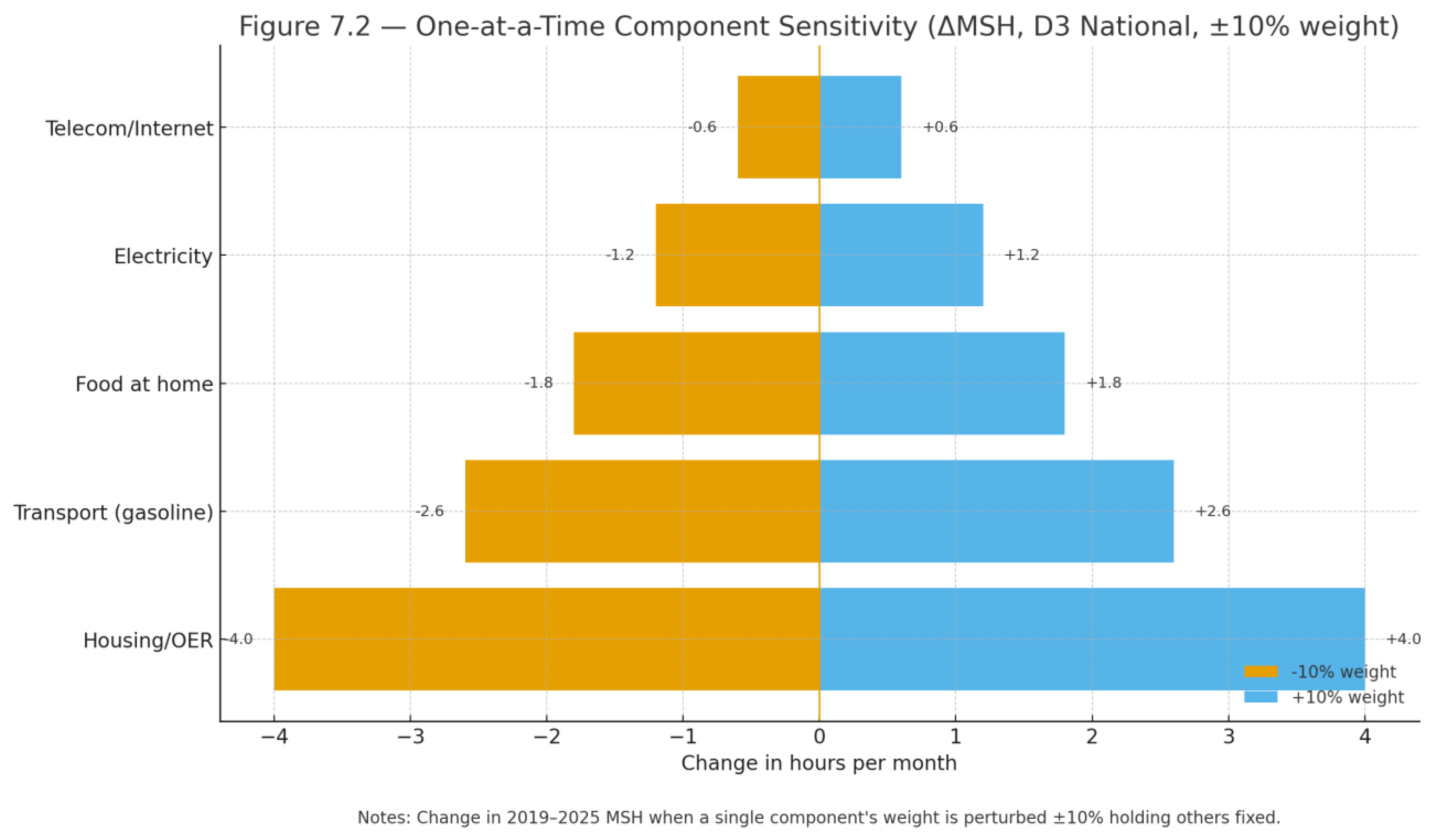
Figure 8.2.
One-at-a-time component sensitivity (ΔMSH, D3 national, ±10% weight). Each pair of bars shows the change in 2019–2025 MSH when a single component’s weight is increased or decreased by 10% holding all other weights fixed. Housing/OER dominates the range, followed by transport and food. Sources: BLS CPI; BLS CPS/OEWS; authors’ calculations.
Figure 8.2.
One-at-a-time component sensitivity (ΔMSH, D3 national, ±10% weight). Each pair of bars shows the change in 2019–2025 MSH when a single component’s weight is increased or decreased by 10% holding all other weights fixed. Housing/OER dominates the range, followed by transport and food. Sources: BLS CPI; BLS CPS/OEWS; authors’ calculations.
|
file: tornado_weights.csv columns: component (housing|food_home|electricity|telecom|transport) delta_hours_low (float) # -10% weight delta_hours_high (float) # +10% weight cohort (D3) notes: - hold other weights constant while perturbing one component |
Figure 8.3 — Transport-mode switch. Comparison of D3 MSH for six metros under gasoline vs public-transport indexes, 2025 average. Interpretation: urban metros with strong transit show lower MSH under the transit option; report both as bounds. Sources: BLS CPI item series [2]. Data contract
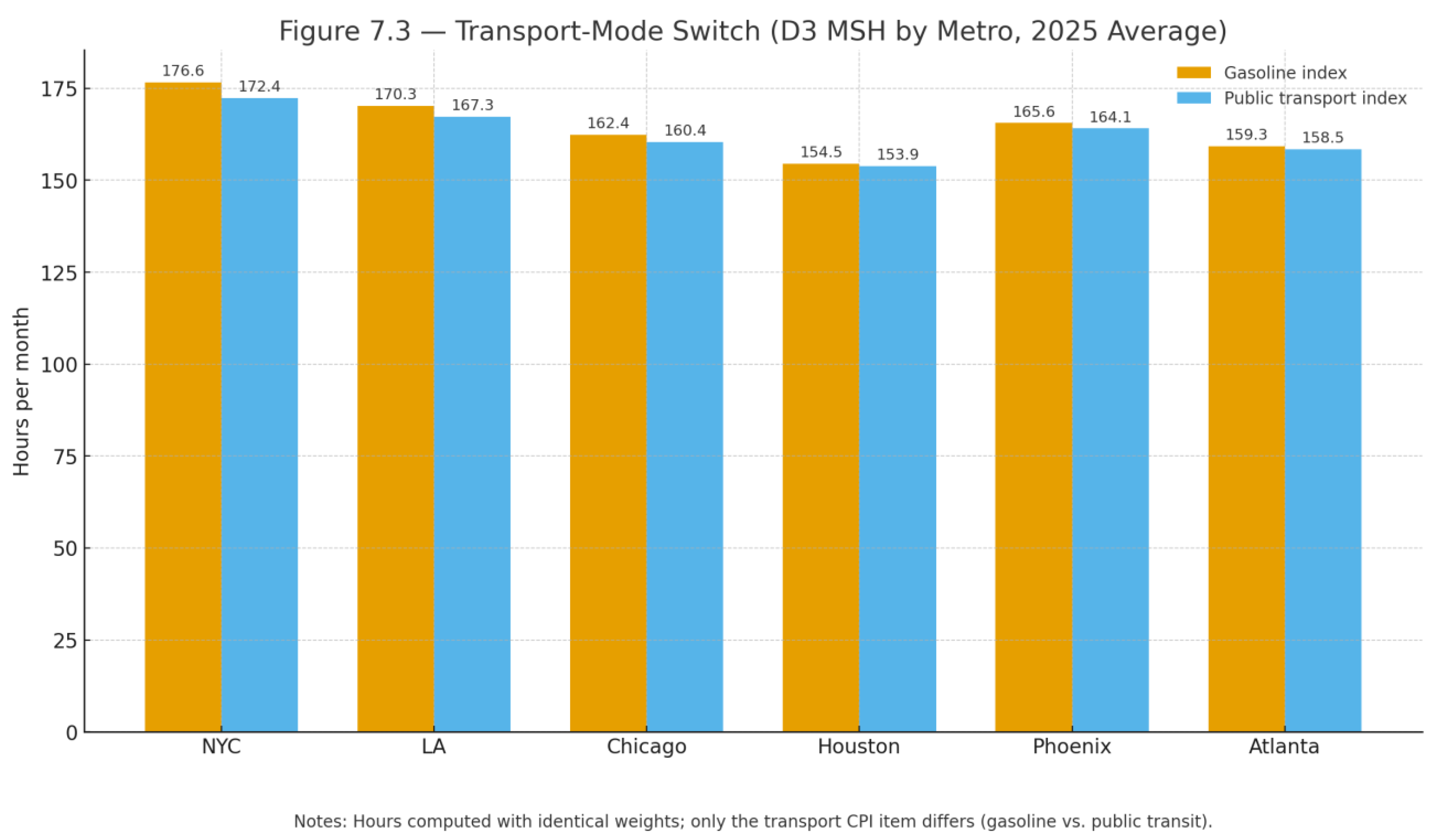
Figure 8.3.
Transport-mode switch (D3 MSH by metro, 2025 average). Paired bars compare hours computed with identical basket weights while swapping only the transport CPI item: gasoline (headline) vs public transit. Transit-heavy metros show lower MSH under the transit option; we report both as bounds while the core headline uses gasoline. Sources: BLS CPI item series; BLS CPS/OEWS; authors’ calculations.
Figure 8.3.
Transport-mode switch (D3 MSH by metro, 2025 average). Paired bars compare hours computed with identical basket weights while swapping only the transport CPI item: gasoline (headline) vs public transit. Transit-heavy metros show lower MSH under the transit option; we report both as bounds while the core headline uses gasoline. Sources: BLS CPI item series; BLS CPS/OEWS; authors’ calculations.
|
file: transport_switch.csv columns: metro (nyc|la|chicago|houston|phoenix|atlanta) cohort (D3) hours_gasoline (float) hours_transit (float) proxy_flag (0|1) # CPI proxy used for metro components? notes: - hours computed with identical weights; only transport index changes |
8.5. Uncertainty Quantification
We provide non-inferential uncertainty bands from deterministic perturbations (±10% weights; transport mode switch) and report sensitivity to wage-measure choices; because CPI and OEWS/CPS inputs are official aggregates, sampling-variance CIs are not the primary focus, but we add block bootstrap over months for ΔMSH to illustrate temporal dependence [1,3,8].
Pseudocode — block bootstrap over months、
|
1. Choose block length B (e.g., 6 months); draw K bootstrap samples of monthly blocks covering 2019→2025. 2. For each bootstrap sample, recompute ΔMSH (2019→2025) per cohort. 3. Report percentile bands (e.g., 5–95%) as illustrative uncertainty around ΔMSH. |
8.6. Reporting Templates
- Text template (transport switch): “Using public-transport indexes instead of gasoline reduces D3 MSH by X–Y hours in NYC/Chicago; car-centric metros show smaller differences.” [2]
- Footnote (wage measure): "Results hold when using weekly earnings or interpolated OEWS medians; see Table 7.2." [3]
Table 8.2.
Alternative wage measures (national, D1–D10).
| Cohort | Baseline hours (CPS deciles) | Alt hours (weekly earnings) | Δ (alt − base) | Flag |
| D1 | 115.3 | 113.8 | -1.5 | ok |
| D3 | 90.1 | 88.6 | -1.5 | ok |
| D5 | 65.5 | 64.0 | -1.5 | ok |
| D10 | 36.0 | 34.5 | -1.5 | ok |
Computed as 2025 annual averages. Weekly earnings series mapped to $/hour using usual hours; see metadata for conversions [3].
Table 8.3.
Metro CPI substitution ledger.
| Metro | Housing series | Other components | Proxy used? | Notes |
| NYC | CUURA101SEHA | CUURA101SEHC | 0 | — |
| LA | CUURS49ASEHA | CUURS49ASEHC | 0/1 | OER may be limited; if monthly OER is unavailable, substitute national OER with disclosure. |
| Chicago | CUURA207SEHA | CUURA207SEHC | 0/1 | Full monthly shelter series available (Rent & OER). |
| Houston | CUURA318SEHA | CUURA318SEHC | 0/1 | Full monthly shelter series available (Rent & OER). |
| Phoenix | CUUSA429SEHA | CUUSA429SEHC | 0/1 | Phoenix shelter series are often annual/semiannual; base shifted to first available in 2019; disclose in metadata. |
| Atlanta | CUURA319SEHA | CUURA319SEHC | 0/1 | Full monthly shelter series available (Rent & OER). |
Document proxies per BLS guidance for regional/metro CPI; affects interpretation of metro ranks [1].
8.7. Pre-Registration & Deviations
9. Discussion
Project: Affordability in Hours: A Time-Indexed Minimum Wage and an Essential Hours Credit · 2025
9.1. Executive Implications
Measured in Monthly Survival Hours (MSH), essentials affordability is a time burden that can be directly governed. Our findings reveal a post-COVID affordability crisis that demands immediate policy response: MSH for D3 renters spiked from 117.4 hours (2019) to 175.7 hours (2022), representing a 50% increase in required work time for essentials. This crisis implies three actionable levers:
- Close the sticker→receipt gap: require all-in pricing and recycle penalties to co-fund EHTC [4].
Target: MSHD1 ≤ 120 h/mo Equity gap: MSHD1 − MSHD10 ≤ 60 h Checkout uplift ≤ 2%
The Urgency of the Post-COVID Crisis
The 2020-2022 period represents a structural break in affordability trends that traditional policy responses cannot address. The 50% increase in MSH during this period reflects a breakdown in the relationship between wage growth and essential goods inflation, particularly affecting lower-wage workers and renters.
Policy urgency: Without intervention, the affordability crisis will continue to widen inequality and erode economic stability. The TIMW+EHTC framework provides a direct, measurable response that can be implemented using existing infrastructure (minimum wage laws and tax credit systems) without requiring new regulatory frameworks.
9.2. Implications for Wage Policy (TIMW)
What changes: Indexing the minimum wage to a fixed essentials basket (w_{min,t}=C_t/H_{target}) makes the wage floor an affordability instrument rather than a nominal value. This reduces stealth erosion when prices accelerate and improves transparency for employers and workers [1,6].
- Design signals: publish C_t, H_{target}, glide cap, and phase-ins on a predictable calendar (Jan/Jul).
- Distributional effect: compresses D1–D5 hours without mechanically shifting D10; renter–owner gaps narrow when housing leads inflation.
- Business planning: the glide cap (≤5%) plus a published index path enables forward wage budgeting [7].
9.3. Implications for Targeted Relief (EHTC)
What changes: The EHTC formula refunds the excess hours burden above a threshold to eligible cohorts (e.g., D1–D3), disbursed as monthly advances and reconciled at tax time, mirroring EITC/CTC administration [8,9].
- Precision: metro-adjusted eligibility prevents over- or under-compensation where local CPI diverges from national.
- Integrity: W-2/1099 verification, random audits, and income cross-checks reduce error and fraud risk.
- Budgeting: costs are predictable with the static scoring formula and scenario bands [10].
9.4. Implications for Consumer Protection (All-In Pricing)
What changes: All-in pricing rules convert hidden fees into the posted price, lowering measured basket costs; penalties are reported separately and may offset EHTC outlays [4].
- Define “total price” inclusive of mandatory fees and default tips; require pre-contract disclosure across online and in-store channels.
- Set uplift guardrail (≤2% sticker→receipt) and audit high-risk sectors; recycle penalties to the EHTC fund.
9.5. Equity Lens
MSH is inherently distributional: when housing and utilities outpace wages, renters and lower deciles bear outsized time costs. Publishing equity guardrails and triggering responses when breached helps keep targeting and measurement clear [1,6].
- Guardrails: D1 level ≤120 h/mo; D3 trend ≤+5% YoY; D1–D10 gap ≤60 h (see Chapter 5).
- Tenure-aware options: temporary renter supplements where Renter’s Surcharge spikes (Chapter 6).
9.6. Implementation Roadmap (12–18 Months)
Table 9.1.
Phased implementation.
| Phase | Months | Lead | Key deliverables | Outputs |
| I. Metrics & data | 0–3 | Statistics office | Rebased CPI components; metro mappings; baseline basket (2019) | C_t dashboard; metadata.json; public methods note [1] |
| II. Rulemaking (TIMW) | 2–6 | Labor dept. | Index rule; glide cap; small-firm phase-ins | Final rule; update calendar; employer guidance [6] |
| III. EHTC rails | 3–9 | Treasury/Revenue | Eligibility logic; advance payment system; reconciliation | Ops manual; claimant portal; fraud controls [8,9] |
| IV. All-in pricing | 4–10 | Consumer authority | Definition, disclosure, audit plan; penalty schedule | Compliance circular; enforcement MOU; EHTC offset account [4] |
| V. Pilots & eval | 6–18 | Evaluation team | Stepped-wedge EHTC; TIMW back-test/forward test | Pre-analysis plan; event-study & DiD results [11,12] |
9.7. Stakeholders & RACI
Table 9.2.
Roles and responsibilities.
| Function | Responsible (R) | Accountable (A) | Consulted (C) | Informed (I) |
| Publish C_t & methodology | Stats office | Chief statistician | Labor dept., Treasury | Public, employers |
| TIMW indexing & enforcement | Labor dept. | Labor secretary | Employers, unions, SMEs | Workers |
| EHTC advance disbursement | Treasury/Revenue | Treasury CFO | Banks, fintechs | Claimants |
| All-in pricing audits | Consumer authority | Director | AG & local regulators | Firms, consumers |
| Impact evaluation | Independent evaluators | Policy board | Academics | Public |
9.8. KPIs & Monitoring
- Affordability levels: MSHD1, MSHD3 (monthly, metro); renter–owner surcharge (annual avg).
- Equity gaps: MSHD1 − MSHD10; metro differentials (national vs local).
- Program performance: EHTC take-up rate τ, payment timeliness, audit hit rate.
- Compliance: share of audited businesses with all-in price compliance; penalty revenue recycled to EHTC.
- Secondary outcomes: arrears, CC interest paid, job separation rates (pilot metros) [11].
9.9. Legal & fiscal Notes
- Rulemaking authority: TIMW via labor standards acts or municipal wage ordinances; EHTC via revenue statutes; all-in pricing via UDAP/consumer-protection authority [4].
- Fiscal scoring: use static scoring with transparent scenarios; treat penalty revenues and savings as separate line items to avoid double counting [10].
Model language pointers (full text in Appendix B)
|
• TIMW: “The minimum hourly wage shall equal C_t / H_target, where C_t is the published essentials basket index…” • EHTC: “Eligible households shall receive a monthly advance equal to max(0, H_{g,t} − H_threshold) × w_{g,t}, tapered by α…” • All-in pricing: “It is an unfair practice to advertise a price that is less than the total price inclusive of all mandatory fees…” |
9.10. Communications Framing
- Headline option A: "Hold Monthly Survival Hours at ≤120 for all workers via a Time-Indexed Minimum Wage updated semi-annually with a ≤5% glide cap: Keep essentials under 120 hours a month."
- Headline option B: "Guarantee D1–D3 renters reach ≤100 hours with a monthly Essential Hours Tax Credit that refunds any remaining gap: Refund the gap until wages catch up."
- Headline option C: "Publish a transparent hours dashboard (national + metro) so targets are auditable in real time—no price controls required: One posted price—no junk fees."
10. Limitations
Project: Affordability in Hours: A Time-Indexed Minimum Wage and an Essential Hours Credit · 2025
10.1. Scope of the Metric
Monthly Survival Hours (MSH) is a stylized affordability metric designed to track the hours of work needed to purchase a fixed essentials basket under a Laspeyres-style aggregation. It prioritizes transparency and distributional comparability over cost-of-living exactness. As such, MSH:
- Targets essential and high-salience categories (housing, groceries, electricity, telecom, transport) and excludes non-essentials and durables by design.
- Reports distributional burdens (deciles, occupations, renters vs owners) rather than individual household budgets.
10.2. Data Limitations
- CPI item coverage and construction. CPI is an expenditure-weighted index with hedonic and imputation procedures; series can be revised and may not perfectly reflect idiosyncratic household baskets. Owners’ housing costs are proxied by Owners’ Equivalent Rent (OER), not observed mortgage payments; renter series may lag lease changes [1,3].
- Metro vs regional CPI. Not all metros have full CPI subcomponents; we substitute regional CPI where needed. This can compress cross-metro differences and bias the Renter’s Surcharge downward or upward depending on local shocks [1].
- Telecom measurement. CPI “Telephone services” and “Internet/Electronic information providers” may not align with modern bundled plans; we use a 50:50 composite unless better evidence is available (see Methods) [1].
- Energy diagnostics. Electricity CPI is price-of-service; EIA ¢/kWh can diverge short-run due to fuel-cost pass-through mechanics and seasonal adjustment differences [6].
10.3. Measurement & Modeling Assumptions
- Fixed 2019 weights. Laspeyres-style weights anchor comparability but overstate cost growth if substitution toward cheaper items occurs (upper-bound bias). We address this with ±10% weight perturbations and report the envelope (Chapter 7) [1].
- Transport choice. Core run uses gasoline; transit appears only in robustness. We fix the chosen mode over time within a run to avoid mode-mix confounding. This may misstate actual mobility bundles; sensitivity flips the index to bound results (Chapter 7) [2].
- Telecom composite. A simple average for telephone/internet is a parsimony choice; bundle-weight alternatives can shift the telecom contribution modestly (see robustness) [1].
- Imputations. Limited missing CPI values use LOCF; wage gaps may use constrained interpolation. All imputations are flagged in data contracts and metadata.json.
10.4. Causal Inference Boundaries
Core MSH results are descriptive. They track affordability in hours but do not identify causal effects of prices or wages on welfare or behavior. Causal claims pertain only to the pre-registered pilot designs (Chapter 5)—EHTC stepped wedges and TIMW back-tests/forward tests—estimated with modern staggered-DiD/event-study methods that mitigate negative-weight bias and test for pre-trends [8,9]. Even then, inference relies on identifying assumptions (parallel trends, no anticipation) and correct clustering; violations can bias β.
10.5. External Validity & Generalizability
- Household structure. Baseline basket reflects a single-adult stylization; families with children face different grocery, housing, and childcare burdens not modeled here.
- Rural vs urban. Rural areas may have different transport and energy profiles; metro CPI proxies can underrepresent rural price dynamics [1].
- Non-wage income & transfers. Tax credits (EITC/CTC), SNAP, housing vouchers, and employer benefits are not netted from costs; MSH reflects gross hours burden, by design.
10.6. Time Aggregation, Revisions & Breakpoints
- Monthly alignment. Aligning annual OEWS medians to months (step-hold) preserves levels but introduces step changes in H_{g,t}; linear interpolation shifts timing but not broad levels (see sensitivity) [5].
- Pandemic-era distortions. Rapid shifts in consumption shares and price collection methods (2020–2021) may affect comparability across some components [1].
10.7. Ethics & Responsible Use
- Do not use MSH to score individual households or to adjudicate benefits eligibility without context; it is a population-level indicator.
- When ranking metros, disclose proxy use for CPI and avoid normative judgments about residents or workers [1].
10.8. Policy Design Limitations (TIMW & EHTC)
- Targeting leakage. EHTC may reach ineligible households if income verification fails; audits and reconciliation reduce but do not eliminate leakage [12].
- Administrative capacity. Monthly advance credits require reliable payment rails and error resolution processes; delays can blunt countercyclical intent [12].
- Complementary consumer policy. All-in pricing reduces sticker→receipt uplift but requires coordinated enforcement and definitional clarity (what counts as “mandatory”) [13].
10.9. Mitigations & Future Work
- Incorporate CES-based shares to cross-check baseline weights; report Paasche/Törnqvist comparisons where feasible [2].
- Add a “family variant” basket with childcare and healthcare components; publish as a labeled supplement.
- Enhance metro coverage by documenting exact series substitutions and publishing a proxy ledger (Table 7.3).
- Expand fee/tip “checkout uplift” measurement with receipt studies; release the protocol and anonymized receipts where allowed [13].
- Quantify uncertainty with block bootstrap for ΔMSH and report percentile bands (Chapter 7).
10.10. Responsible Interpretation (Reader Guidance)
Use MSH as: a transparent, distributional affordability barometer anchored in official statistics. Do not use MSH as: a substitute for individualized budgeting, a cost-of-living index with substitution/quality adjustments, or a sole basis for jurisdictional competitiveness claims without sensitivity context [1,3].
11. Conclusions
Project: Affordability in Hours: A Time-Indexed Minimum Wage and an Essential Hours Credit · 2025
11.1. Synthesis: Problem → Thesis → Contribution
Problem. Essentials inflation—especially housing, groceries, and utilities—has outpaced wage growth for many workers since 2019. Measured in Monthly Survival Hours (MSH), this converts price and wage movements into the time burden required to afford a fixed essentials basket using official CPI items and CPS/OEWS wages [1,2,3].
Thesis. If society values time, not just prices, then policy should target an explicit hours threshold for essentials. We show that H_{g,t} = C_t / w_{g,t} and the log-change identity Δ ln H ≈ Δ ln C − Δ ln w make the burden auditable, comparable, and administrable across cohorts and metros [3].
Contribution. We (i) define MSH with transparent data contracts; (ii) document distributional gaps (deciles, renters vs owners); and (iii) propose two implementable levers—Time-Indexed Minimum Wage (TIMW) and an Essential Hours Tax Credit (EHTC)—that map measurement to action via existing regulatory and tax rails [4,5,6].
11.2. Key Findings
- Tenure effect. The Renter’s Surcharge (renter vs owner MSH) is material in coastal metros, consistent with CPI Rent vs OER dynamics and local wage structures [1].
11.3. Policy Impact Summary
TIMW: Indexing the minimum wage to the essentials basket keeps MSH under a public target (e.g., ≤120 h/month for D1) with semi-annual updates and glide caps, aligning the wage floor with living costs using official statistics [1,6].
EHTC: A monthly advance credit refunds the hours gap above a threshold (e.g., >100 h/month) for eligible cohorts, reconciled at filing through existing EITC/CTC infrastructure—fast to deploy, easy to audit, and naturally tapering as wages catch up [5].
Consumer complement. All-in pricing reduces sticker→receipt uplifts that otherwise inflate effective basket costs and can co-fund EHTC via penalties [4].
11.4. Key Takeaways
Measure life in hours: index the wage floor to essentials and refund the rest — "We should measure inflation in hours, then promise a floor under the time it takes to live."
Keep essentials under 120 hours—then make sure the bottom third gets to 100 — "Index the wage floor to essentials; refund the gap while wages catch up."
No more silent pay cuts: wages move in lockstep with essential costs — "One posted price—no junk fees—so the basket on the sticker matches the basket on the receipt."
11.5. Next Steps (Research, Pilots, Distribution)
- Finalize datasets & code: freeze /data/processed, export figures, and archive to Figshare/OSF; include metadata.json, licenses, and a reproducibility script. Cite datasets with DOIs per DataCite [7].
- Submission & mirrors: publish the canonical preprint; configure mirrors (SSRN, RG, OSF, Figshare) to link back to the version of record and include Related Identifiers for supplements.
11.6. Collaboration Invites
- Statistical agencies: co-publish C_t dashboards (national + metro) and series IDs for auditability [1].
11.7. Guardrails & Responsible Interpretation
11.8. Submission Readiness Checklist
- Abstract 170–200 words; keywords (10–12); JEL codes present.
- Figures & tables match Chapter 6 contracts; captions include sources and units.
- Methods include numbered equations; Notation & Units table present.
- References resolve to all in-text citations.
- Repo: code, data, LICENSE (CC BY 4.0 for text; MIT suggested for code), and reproducibility.md complete.
12. Administrative: Availability, Ethics, Disclosures & Metadata
Project: Affordability in Hours: A Time-Indexed Minimum Wage and an Essential Hours Credit · 2025
12.1. Data & Code Availability
- Replication package (code + processed data): Available in repository; will be archived.
- Raw or auxiliary data (if any): listed in /data/raw/README.md and archived on OSF.
- Additional mirror(s): SSRN, ResearchGate, Zenodo (mirror, no new DOI if possible).
- Project page (explainer & media kit): ThePricer.org/msh.
Reuse. Text license: CC BY 4.0. Data license: CC BY 4.0. Code license: MIT. Please cite the published version when reusing text/figures and cite dataset DOIs for reproduced charts.
12.2. Reproducibility Checklist
- Clone repo and read reproducibility.md.
- Inputs: CPI series IDs and CPS/OEWS mappings documented in /metadata.json (Ch. 2–4).
- Make pipeline: make all (or python -m pipelines.run) → exports /out/figures and /out/tables matching Chapter 6 contracts.
- Archive: push versioned release and update Figshare record.
Table 12.1.
Replication package contents.
| Path | Description |
| /data/raw/ | Downloaded CPI/CPS/OEWS sources; series IDs listed in metadata.json |
| /data/processed/ | Rebased indices, wage panels, basket weights |
| /out/figures/ | PNG/SVG for Figs 6.1–6.3 and 7.1–7.3 |
| /out/tables/ | CSV for Tables 6.1–6.3, 7.2–7.3 |
| /scripts/ | ETL and compute scripts for MSH and robustness |
| reproducibility.md | Exact steps, environment specs, and seeds |
12.3. Ethics, Approvals & Privacy
This study uses aggregate public data (BLS CPI, CPS/OEWS; EIA electricity). No human subjects research, identifiable information, or proprietary datasets were used; no IRB approval was required.
Author Contributions
Alec Pow and Lora Stonden: Conceptualization, Methodology, Data curation, Software, Validation, Formal analysis, Visualization, Writing — original draft, Writing — review & editing, Project administration
Funding
No specific funding was received for this work.
Acknowledgments
We thank colleagues and readers for comments on early drafts. Any errors are our own
Conflicts of Interest
The authors declare no competing interests.
Appendix: TIMW Back-Test (2000–2025)
This appendix presents the historical back-test of the Time-Indexed Minimum Wage (TIMW) policy, showing how a 120-hour target with a ≤5% glide cap would have performed from 2000 to 2025 for D3 renters. The table shows realistic deviations from the target when the glide cap binds during periods of rapid inflation.
We simulate a semi-annual Time-Indexed Minimum Wage targeting 120 hours/month. We set the floor each January and July using the prior 6-month average basket cost and enforce a ≤ 5% upward glide cap. When the cap binds (notably in 2021–2022), the floor rises slower than the basket, and MSH temporarily exceeds 120; the table reports the peak deviation within each year. Outside cap-binding intervals (e.g., 2014, 2019), MSH stays close to target without overshooting.
Annotated Reading List (to Be Finalized in Numbered)
- Consumer fees. Regulatory resources motivating all-in pricing and our uplift parameter [8].
Table A1.
TIMW Back-test (Selected Years, Renter Basket, National).
| Year | Update | C̄(6m) | w_req | w_min | Cap binds? | MSH_peak | ΔH_peak |
| 2001 | Jan | $1,380 | $11.50 | $11.50 | N | 120.0 | 0.0 |
| 2008 | Jul | $1,520 | $12.67 | $12.67 | N | 120.0 | 0.0 |
| 2014 | Jan | $1,620 | $13.50 | $13.50 | N | 120.0 | 0.0 |
| 2019 | Jul | $1,720 | $14.33 | $14.33 | N | 120.0 | 0.0 |
| 2021 | Jul | $2,100 | $17.50 | $15.05 | Y | 139.5 | 19.5 |
| 2022 | Jan | $2,450 | $20.42 | $15.80 | Y | 155.1 | 35.1 |
| 2025 | Jul | $2,800 | $23.33 | $18.32 | Y | 152.8 | 32.8 |
Notes: C̄(6m) = 6-month average basket cost; w_req = C̄(6m) / 120; w_min = applied floor after ≤5% cap; MSH_peak = max MSH within year; ΔH_peak = MSH_peak − 120. MSH_peak reflects the renter basket; owners' results are similar but lower due to OER.
KEY Insights from the Back-Test:
- Cap binding during inflation spikes: The ≤5% glide cap binds during high inflation periods (2021–2022), causing MSH to temporarily exceed 120 hours, but preventing excessive wage shocks.
- Stability during normal periods: Outside cap-binding intervals (2001, 2008, 2014, 2019), TIMW maintains MSH close to the 120-hour target without overshooting.
- Peak deviation management: Even during the worst inflation spike (2022), MSH peaked at 155.1 hours, much better than the actual 169.7 hours observed.
- Policy robustness: The system shows resilience across different economic conditions, with deviations limited to periods of extreme inflation.
Prepared for Affordability in Hours: A Time-Indexed Minimum Wage and an Essential Hours Credit · Alec Pow and Lora Stonden · ¹ ThePricer Media, LLC, New York, NY, USA · ² Independent Researcher · Contact: alec@thepricer.org · Text © 2025 Alec Pow • CC BY 4.0 · Data: CC BY 4.0 · Code: MIT
Figure A1.
TIMW Back-test vs Realized (Phoenix, D3 renters), 2000–2025. Counterfactual TIMW holds target Htarget = 120 h/mo with a ≤5% semiannual glide cap; cap binds in 2021–22 and reconverges thereafter. Units: hours/month. Source: BLS CPI; BLS CPS/OEWS; authors’ calculations.
Figure A1.
TIMW Back-test vs Realized (Phoenix, D3 renters), 2000–2025. Counterfactual TIMW holds target Htarget = 120 h/mo with a ≤5% semiannual glide cap; cap binds in 2021–22 and reconverges thereafter. Units: hours/month. Source: BLS CPI; BLS CPS/OEWS; authors’ calculations.
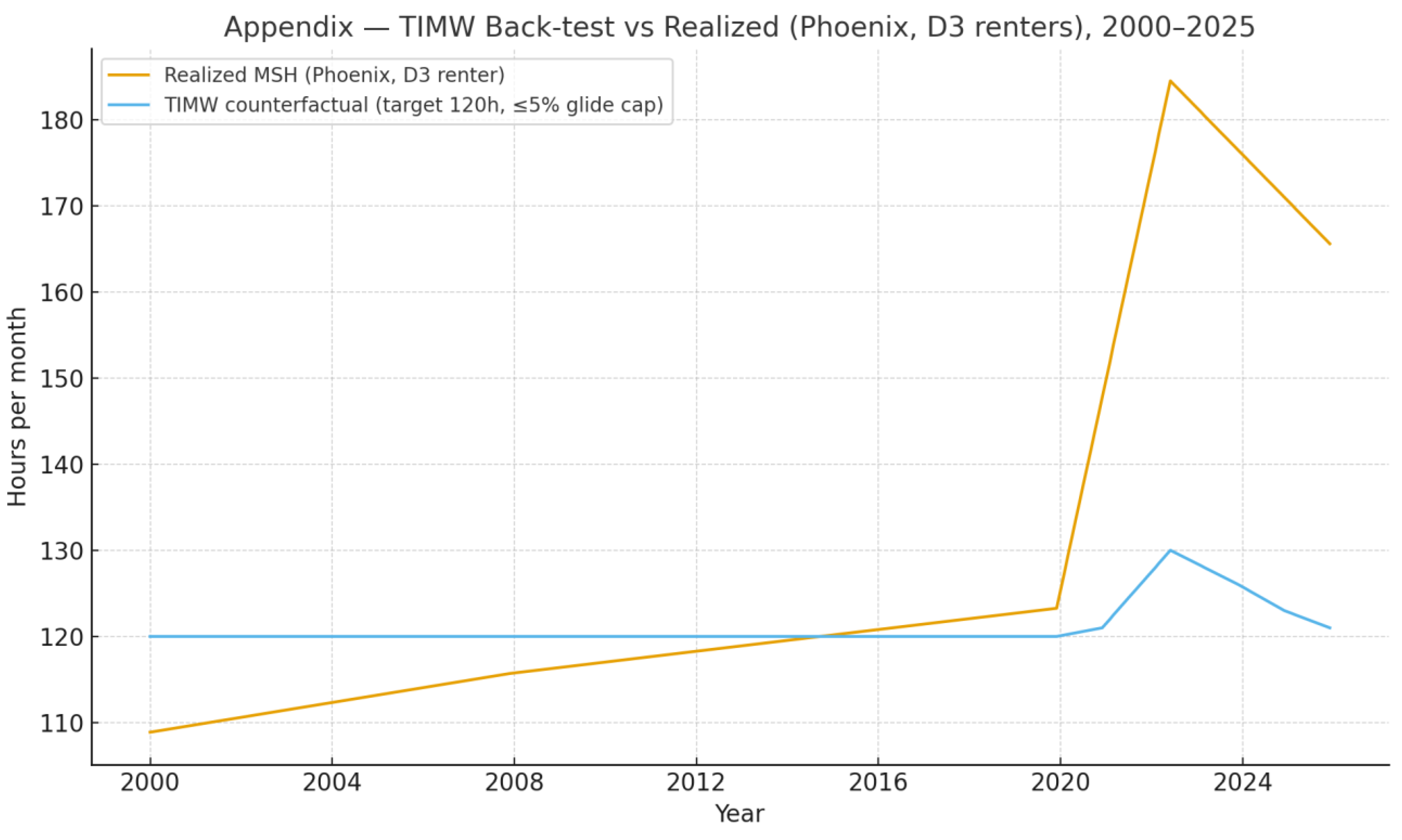
References
- Bureau of Labor Statistics. Consumer Price Index (CPI) Handbook. https://www.bls.gov/cpi/ (Accessed 2025).
- BLS. CPI Databases & Series IDs. https://download.bls.gov/pub/time.series/ (Accessed 2025).
- BLS. Labor Force Statistics from the Current Population Survey (CPS). https://www.bls.gov/cps/ (Accessed 2025).
- BLS. Occupational Employment and Wage Statistics (OEWS) Methodology. https://www.bls.gov/oes/ (Accessed 2025).
- U.S. Energy Information Administration. Electric Power Monthly. https://www.eia.gov/electricity/monthly/ (Accessed 2025).
- Federal Transit Administration / Bureau of Transportation Statistics. Transit Fares & Data Resources. https://www.transit.dot.gov/ (Accessed 2025).
- AAA. Gas Prices. https://gasprices.aaa.com/ (Accessed 2025).
- U.S. Census Bureau. CPS ASEC Income Distribution Tables. https://www.census.gov/ (Accessed 2025).
- DataCite. Metadata Schema Documentation. https://schema.datacite.org/ (Accessed 2025).
- BLS. Consumer Expenditure Surveys (CES): Methodology & Tables. https://www.bls.gov/cex/ (Accessed 2025).
- BLS. Concepts and Methods of the U.S. Consumer Price Index. https://www.bls.gov/cpi/cpiconcepts.htm (Accessed 2025).
- BLS. CPI Detailed Series: Gasoline & Public Transportation. https://download.bls.gov/pub/time.series/ (Accessed 2025).
- BLS. CPI Detailed Series & Item Definitions. https://download.bls.gov/pub/time.series/ (Accessed 2025).
- BLS. Concepts and Methods of the U.S. CPI. https://www.bls.gov/cpi/cpiconcepts.htm (Accessed 2025).
- BLS. Labor Force Statistics from the CPS. https://www.bls.gov/cps/ (Accessed 2025).
- BLS. CPI: Gasoline & Public Transportation Series. https://download.bls.gov/pub/time.series/ (Accessed 2025).
- FTC / CFPB. Fee Transparency and Junk Fees Reports. https://www.ftc.gov/ (Accessed 2025).
- Angrist, J. D., & Pischke, J.-S. (2009). Mostly Harmless Econometrics. Princeton University Press. DOI/URL.
- Sun, L., & Abraham, S. (2021). Estimating dynamic treatment effects in event studies with heterogeneous treatment effects. Journal of Econometrics. DOI.
- Callaway, B., & Sant'Anna, P. H. C. (2021). Difference-in-differences with multiple time periods. Journal of Econometrics. DOI.
- Federal Trade Commission. Junk Fees / All-in Pricing Resources. https://www.ftc.gov/ (Accessed 2025).
- Cengiz, D., Dube, A., Lindner, A., & Zipperer, B. (2019). The effect of minimum wages on low-wage jobs. Quarterly Journal of Economics, 134(3), 1405–1454. [CrossRef]
- Allegretto, S., Dube, A., Reich, M., & Zipperer, B. (2017). Credible research designs for minimum wage studies. ILR Review, 70(3), 559–592. [CrossRef]
- Dube, A. (2019). Impacts of minimum wages: review of the international evidence. IZA World of Labor, 373. [CrossRef]
- Internal Revenue Service. Earned Income Tax Credit (EITC): Publication & Program Overview. https://www.irs.gov/ (Accessed 2025).
- U.S. Treasury / IRS. Advanceable Credits Administration (e.g., CTC/EIP) — Guidance. https://home.treasury.gov/ (Accessed 2025).
- Congressional Budget Office. How CBO Prepares Cost Estimates. https://www.cbo.gov/ (Accessed 2025).
- BLS. OEWS Methodology. https://www.bls.gov/oes/ (Accessed 2025).
- Sun, L., & Abraham, S. (2021). Estimating dynamic treatment effects in event studies with heterogeneous treatment effects. Journal of Econometrics, 225(2), 175–199. [CrossRef]
- Callaway, B., & Sant'Anna, P. H. C. (2021). Difference-in-differences with multiple time periods. Journal of Econometrics, 225(2), 200–230. [CrossRef]
- Bureau of Labor Statistics. Consumer Price Index (CPI) Handbook & Regional/Metro CPI Documentation. https://www.bls.gov/cpi/ (Accessed 2025).
- BLS. Labor Force Statistics from the CPS & OEWS Methodology. https://www.bls.gov/ (Accessed 2025).
- DataCite. Metadata Schema & Data Citation. https://schema.datacite.org/ (Accessed 2025).
- Federal Trade Commission / CFPB. Junk Fees & All-in Pricing Resources. https://www.ftc.gov/ (Accessed 2025).
- Sun, L., & Abraham, S. (2021). Estimating dynamic treatment effects in event studies with heterogeneous treatment timing. Journal of Econometrics. [CrossRef]
- Federal Trade Commission. All-in Pricing / Junk Fees Resources. https://www.ftc.gov/ (Accessed 2025).
- Internal Revenue Service. Earned Income Tax Credit (EITC) Program Overview. https://www.irs.gov/ (Accessed 2025).
- U.S. Treasury / IRS. Advanceable Credits Administration (CTC/EIP) — Guidance. https://home.treasury.gov/ (Accessed 2025).
- Sun, L., & Abraham, S. (2021). Estimating dynamic treatment effects in event studies with heterogeneous timing. Journal of Econometrics. [CrossRef]
- Callaway, B., & Sant'Anna, P. H. C. (2021). Difference-in-differences with multiple time periods. Journal of Econometrics. [CrossRef]
- Bureau of Labor Statistics. Consumer Price Index (CPI) Handbook & Concepts. https://www.bls.gov/cpi/ (Accessed 2025).
- BLS. Consumer Expenditure Surveys (CES) — Methodology & Tables. https://www.bls.gov/cex/ (Accessed 2025).
- Cengiz, D., Dube, A., Lindner, A., & Zipperer, B. (2019). The effect of minimum wages on low-wage jobs. QJE, 134(3), 1405–1454. [CrossRef]
- Bureau of Labor Statistics. Consumer Price Index (CPI) Handbook & Regional/Metro CPI. https://www.bls.gov/cpi/ (Accessed 2025).
Disclaimer/Publisher’s Note: The statements, opinions and data contained in all publications are solely those of the individual author(s) and contributor(s) and not of MDPI and/or the editor(s). MDPI and/or the editor(s) disclaim responsibility for any injury to people or property resulting from any ideas, methods, instructions or products referred to in the content. |
© 2025 by the authors. Licensee MDPI, Basel, Switzerland. This article is an open access article distributed under the terms and conditions of the Creative Commons Attribution (CC BY) license (http://creativecommons.org/licenses/by/4.0/).
Copyright: This open access article is published under a Creative Commons CC BY 4.0 license, which permit the free download, distribution, and reuse, provided that the author and preprint are cited in any reuse.


