

Submitted:
17 October 2025
Posted:
21 October 2025
You are already at the latest version
Abstract
This study aims to analyze the effectiveness of the Discovery Learning model in enhancing students’ mathematical problem-solving skills among seventh-grade students at SMP Negeri 1 Sinunukan during the 2024/2025 academic year. The research employed a quasi-experimental method with a pretest–posttest control group design. The sample consisted of 40 students divided equally into two groups: an experimental group (20 students) taught using the Discovery Learning model and a control group (20 students) taught through conventional instruction. The research instrument comprised an algebraic problem-solving test administered before and after the treatment. Data were analyzed using the independent samples t-test to examine differences in posttest results between the two groups. The findings revealed a statistically significant difference in students’ mathematical problem-solving performance, with the significance value (2-tailed) = 0.000 < 0.05. This result indicates that the Discovery Learning model has a positive and substantial effect on improving students’ mathematical problem-solving abilities. Students in the experimental class demonstrated better reasoning, higher engagement, and more creative strategies in approaching algebraic problems compared to their peers in the control group. The improvement can be attributed to the model’s emphasis on student-centered exploration, hypothesis testing, and active knowledge construction, which foster deeper conceptual understanding. Consequently, Discovery Learning not only strengthens procedural fluency but also enhances students’ analytical and reflective thinking in mathematics. The study suggests that mathematics teachers adopt Discovery Learning as an alternative instructional approach to improve students’ problem-solving competence and to cultivate independent and critical learners in secondary mathematics education. Future research may expand on this study by incorporating diverse mathematical topics, larger samples, and mixed-method analyses to gain broader insights into the long-term impact of Discovery Learning on cognitive and affective learning outcomes.
Keywords:
discovery learning
; problem solving
; mathematics
; algebra
; quasi-experiment
1. Introduction
Mathematics plays a pivotal role in the advancement of science, technology, and innovation, serving not only as a tool for quantitative reasoning but also as a discipline that cultivates logical, analytical, and systematic thinking among students. The mastery of mathematical principles contributes directly to cognitive growth and problem-solving proficiency, which are crucial for adapting to the demands of modern education and the digital era. Mathematics is regarded as the foundation of critical thinking, as it encourages learners to approach problems through reasoning, evidence, and structured argumentation rather than intuition alone. Consequently, the capacity to solve mathematical problems effectively becomes a fundamental skill required for both academic and real-life applications [1,3,58].
Problem-solving ability in mathematics has long been identified as a central component of mathematical literacy, as it reflects students’ capacity to interpret, formulate, and apply mathematical concepts in diverse contexts. Scholars such as Santrock have defined problem-solving as a higher-order cognitive process that demands strategic thinking, hypothesis testing, and reflective evaluation [4,5]. This capacity is not limited to executing formulas but extends to understanding relationships between abstract ideas and practical situations, thus bridging conceptual understanding with procedural competence. Consequently, effective mathematics education must go beyond memorization and focus on nurturing students’ analytical reasoning and problem-solving skills [2,6].
However, despite the recognized importance of problem-solving, numerous studies indicate that students continue to struggle with mathematical tasks that require reasoning, particularly when faced with non-routine or contextual word problems. These difficulties often stem from limited conceptual understanding, lack of motivation, and reliance on rote learning methods that prioritize procedural repetition over conceptual depth [7,8]. Observations in several junior high schools have revealed that many students fail to interpret algebraic problems correctly, make logical connections, or select appropriate strategies for solving them. This deficiency underscores the urgent need for pedagogical approaches that promote active engagement and conceptual discovery [9,11].
Preliminary observations conducted at SMP Negeri 1 Sinunukan further confirmed that students’ problem-solving skills in algebra remain below the expected competency standards. Classroom assessments showed that a significant proportion of students achieved scores below the minimum mastery criteria (KKM), indicating gaps in understanding key algebraic concepts. Interviews with teachers revealed that traditional instructional methods—dominated by lectures and mechanical exercises—tend to limit students’ curiosity and independence in learning. Consequently, the lack of interactive and inquiry-based learning environments contributes to the persistent underachievement in mathematics [10,12].
Preliminary classroom observations at SMP Negeri 1 Sinunukan revealed a consistent pattern of underperformance in students’ algebraic problem-solving abilities. Despite repeated instruction and practice, many learners struggled to apply foundational algebraic principles to novel or multi-step problems. Diagnostic assessments administered at the beginning of the semester showed that over 65% of seventh-grade students scored below the school’s Minimum Mastery Criterion (KKM) of 75. This persistent gap suggests that current instructional approaches may not adequately address the cognitive demands of algebraic reasoning. Teachers noted that students often memorized procedures without grasping underlying concepts, leading to errors in problem interpretation and solution strategies. Such surface-level learning inhibits the development of flexible mathematical thinking. Furthermore, students exhibited low confidence when faced with non-routine tasks, frequently abandoning attempts after initial confusion. These findings align with broader national trends indicating that Indonesian junior secondary students often face challenges in abstract mathematical domains like algebra [58,59,60,61].
Classroom assessments conducted over two consecutive academic terms further corroborated these concerns. Standardized quizzes and formative tasks consistently yielded average class scores ranging between 58 and 67, well below the expected proficiency threshold. Item analysis revealed that students particularly struggled with word problems requiring translation into algebraic expressions, manipulation of variables, and justification of solution steps. Even when procedural steps were correctly executed, conceptual misunderstandings—such as misinterpreting the meaning of a variable or misapplying the distributive property—were common. These errors point to a fragmented understanding of algebra as a coherent system rather than a collection of isolated rules. Teachers reported that remedial sessions provided only temporary improvements, with students quickly reverting to rote strategies during summative evaluations. This cyclical pattern underscores a systemic issue in how algebra is taught and internalized. Without deeper cognitive engagement, students remain ill-equipped to transfer knowledge to new contexts [62,63].
In-depth interviews with five mathematics teachers at SMP Negeri 1 Sinunukan provided critical insights into prevailing pedagogical practices. All respondents acknowledged heavy reliance on teacher-centered methods, including direct lecturing, textbook-based drills, and repetitive algorithmic exercises. While these approaches ensure curriculum coverage, they offer minimal opportunities for exploration, hypothesis testing, or collaborative reasoning. One senior teacher admitted, “We focus on finishing the syllabus, not on whether students truly understand why the steps work.” This time-constrained, exam-oriented culture prioritizes speed and correctness over conceptual depth and critical inquiry. Consequently, students rarely engage in metacognitive reflection or self-regulated learning. The absence of open-ended tasks further limits students’ exposure to authentic problem-solving scenarios. As a result, curiosity and intellectual risk-taking—essential components of mathematical proficiency—are systematically suppressed [64,65].
The dominance of traditional instruction has inadvertently fostered a passive learning culture among students. Observations during regular lessons showed that learners rarely asked questions, initiated discussions, or proposed alternative solution paths. When prompted, many expressed fear of making mistakes or being judged by peers, indicating low mathematical self-efficacy. This passivity is exacerbated by classroom environments that emphasize individual performance over collaborative sense-making. Group work, when implemented, often devolved into one student dominating while others copied answers without comprehension. Teachers rarely scaffold inquiry or facilitate discourse that challenges students’ thinking. Without structured opportunities to articulate reasoning or defend conclusions, students fail to develop mathematical communication skills. Over time, this reinforces a fixed mindset toward mathematics as a rigid, rule-bound subject rather than a dynamic field of exploration [66,67].
Moreover, the lack of contextualization in algebra instruction diminishes students’ perceived relevance of the subject. Lessons frequently present abstract symbols and equations devoid of real-world connections, making it difficult for learners to see the utility of algebra in daily life. For instance, linear equations are taught through isolated numerical examples rather than through scenarios involving budgeting, motion, or patterns in nature. This decontextualized approach fails to activate prior knowledge or stimulate interest, particularly among students from rural backgrounds like those in Mandailing Natal. Cultural and linguistic factors may further complicate comprehension, as mathematical language often diverges from students’ everyday vernacular. Without meaningful anchoring, algebra remains an alien and intimidating domain. Consequently, motivation wanes, and disengagement becomes widespread, especially among lower-achieving students [68,69].
The cumulative effect of these instructional limitations is a persistent achievement gap that disproportionately affects students with limited prior mathematical exposure. Those from under-resourced feeder primary schools enter junior secondary education already behind in foundational numeracy and logical reasoning. Without differentiated support or adaptive teaching strategies, these students fall further behind as algebraic complexity increases. Teachers, constrained by large class sizes (averaging 35–40 students) and limited teaching aids, struggle to provide individualized attention. Digital resources, though increasingly available through school smartphones and internet access, are seldom integrated meaningfully into mathematics lessons. Instead, technology is often used for passive content delivery rather than interactive exploration. This missed opportunity is particularly concerning given the potential of tools like GeoGebra to visualize algebraic relationships dynamically [70,71].
The absence of inquiry-based learning models, such as Discovery Learning, represents a critical missed pedagogical opportunity. Unlike traditional methods, Discovery Learning positions students as active constructors of knowledge through guided exploration, pattern recognition, and inductive reasoning. In algebra, this could involve investigating number patterns to derive general formulas or using manipulatives to model equation balancing. Such experiences foster conceptual coherence and promote transferable problem-solving heuristics. However, none of the observed classrooms implemented structured discovery activities; instead, discovery was left to chance or individual initiative. Teachers expressed interest in adopting such approaches but cited lack of training, time, and ready-to-use materials as major barriers. Professional development in student-centered pedagogies remains scarce in the region, perpetuating reliance on familiar but ineffective routines [72,73].
This instructional inertia is further reinforced by assessment systems that prioritize procedural accuracy over conceptual understanding. School-based exams and national assessments (e.g., AKM) often emphasize quick computation and standard problem formats, incentivizing teachers to “teach to the test.” As a result, higher-order thinking skills—such as analyzing, evaluating, and creating—are seldom assessed or nurtured. Students learn to associate success with speed and memorization rather than depth of understanding. This misalignment between learning goals and evaluation methods creates a self-perpetuating cycle of superficial learning. Even when teachers attempt to introduce open-ended tasks, they face pressure to revert to conventional methods to ensure students meet short-term performance targets. Systemic reform is thus needed not only in teaching practices but also in how learning outcomes are measured and valued [74,75].
The situation at SMP Negeri 1 Sinunukan reflects broader challenges in mathematics education across rural Indonesia. Limited access to continuous professional development, inadequate teaching resources, and socio-cultural perceptions of mathematics as inherently difficult all contribute to low achievement. Yet, the school’s context also presents unique opportunities for innovation. The high smartphone penetration among students, for example, could support digital literacy-integrated mathematics instruction, aligning with national priorities on digital citizenship and critical thinking. Community values such as malu keluarga (family honor) and concern for future prospects could be leveraged to enhance student motivation when framed within culturally responsive pedagogy. By connecting algebraic learning to local narratives and aspirations, educators can foster greater relevance and engagement. Thus, the path forward requires both pedagogical transformation and contextual sensitivity [76,77].
In light of these findings, there is an urgent need to shift from passive, transmission-based instruction toward active, inquiry-driven models like Discovery Learning. Such an approach would not only address conceptual gaps in algebra but also cultivate essential 21st-century competencies: critical thinking, collaboration, and intellectual autonomy. Implementing this shift requires coordinated support—through teacher training, curriculum adaptation, and community involvement—to ensure sustainability. Pilot interventions, such as the integration of GeoGebra-assisted discovery tasks or problem-based learning modules rooted in local contexts, could serve as scalable prototypes. Ultimately, improving mathematical problem-solving at SMP Negeri 1 Sinunukan is not merely a matter of changing methods, but of reimagining the very purpose of mathematics education: not as a gatekeeping subject, but as a tool for empowerment, reasoning, and lifelong learning. Without such a paradigm shift, the cycle of underachievement is likely to persist across generations [78,79,80].
Empirical data from daily tests and mid-semester examinations further illustrated the low level of conceptual mastery among students. Many could perform mechanical operations but struggled to explain the rationale behind their procedures or apply them to new situations. This pattern suggests that students often learn algorithms without understanding their underlying logic, thereby impeding their ability to transfer knowledge across problem contexts. Such outcomes reinforce the view that the prevailing teacher-centered paradigm inadequately supports the development of higher-order thinking skills in mathematics [13,15].
Addressing this challenge requires a pedagogical transformation that places students at the center of the learning process. Learner-centered approaches encourage students to construct their own understanding through inquiry, exploration, and reflection. These approaches not only increase motivation but also cultivate autonomy and self-efficacy—key attributes for lifelong learning. In this regard, discovery learning has emerged as one of the most promising instructional models to promote conceptual understanding and problem-solving capacity in mathematics classrooms [14,16].
The Discovery Learning model emphasizes students’ active engagement in identifying problems, generating hypotheses, and deriving solutions through systematic exploration. It views learning as a process of knowledge construction rather than passive absorption, thus aligning with constructivist theories of education proposed by Bruner and other cognitive psychologists. By involving students in guided inquiry and discovery, this model allows them to internalize mathematical concepts through meaningful experience, which enhances retention and transferability [17,19].
Previous studies have consistently shown that Discovery Learning improves students’ critical thinking, reasoning, and problem-solving performance. Research by Hosnan (2014) and Rahmawati et al. (2020) demonstrated that when students are encouraged to explore patterns and relationships independently, their understanding of algebraic concepts becomes deeper and more sustainable. Furthermore, students taught through Discovery Learning tend to exhibit greater persistence and creativity when encountering novel problems compared to those in traditional classrooms [18,20].
Another significant benefit of Discovery Learning lies in its capacity to enhance student motivation and engagement. Unlike conventional instruction, which often reduces learning to procedural drills, Discovery Learning invites curiosity and encourages intellectual risk-taking. Through hands-on exploration, students experience a sense of ownership over their learning, which reinforces their intrinsic motivation to succeed. This dynamic fosters a classroom culture where inquiry, dialogue, and reflection become integral components of the learning process [21,23].
In addition, Discovery Learning provides teachers with opportunities to act as facilitators rather than mere transmitters of knowledge. This pedagogical shift transforms the teacher’s role into that of a guide who scaffolds student inquiry, provides feedback, and supports conceptual development. Such a role not only aligns with modern pedagogical standards but also enhances teacher–student interactions, making the learning experience more collaborative and reflective [22,24].
From a theoretical perspective, the Discovery Learning approach aligns with Bruner’s constructivist theory, which posits that learning occurs through active discovery and organization of knowledge. According to Bruner, the learning process involves three key stages—enactive, iconic, and symbolic representation—through which students gradually internalize abstract concepts. Discovery Learning leverages this process by encouraging learners to move from concrete experiences to abstract reasoning through structured exploration [25,26].
In mathematical problem-solving, Discovery Learning supports the development of heuristic strategies, such as identifying relevant information, formulating hypotheses, testing potential solutions, and verifying results. These stages mirror Polya’s four-step problem-solving framework—understanding the problem, devising a plan, carrying out the plan, and looking back. By integrating these steps into guided inquiry, Discovery Learning cultivates systematic reasoning and metacognitive awareness among students [27,29].
Moreover, the model promotes collaborative learning environments where students share ideas, justify reasoning, and construct knowledge collectively. This social dimension aligns with Vygotsky’s sociocultural theory, which emphasizes the role of interaction and dialogue in cognitive development. Collaboration enables students to articulate mathematical concepts verbally, negotiate meaning, and co-construct understanding, which ultimately strengthens their problem-solving competence [28,30].
The implementation of Discovery Learning in mathematics also addresses the diverse learning styles present in heterogeneous classrooms. Through exploration, visualization, and experimentation, the model accommodates both visual and kinesthetic learners, ensuring that each student can engage meaningfully with the material. This inclusivity contributes to equity in learning outcomes and promotes a more balanced development of cognitive and affective domains [31,33].
The implementation of Discovery Learning in mathematics effectively responds to the diversity of learning styles inherent in heterogeneous classrooms, where students vary significantly in cognitive preferences, prior knowledge, and engagement patterns. By emphasizing hands-on exploration, guided inquiry, and open-ended problem-solving, this model moves beyond one-size-fits-all instruction that often privileges auditory or verbal learners. Visual learners benefit from the use of diagrams, dynamic geometry software (e.g., GeoGebra), and graphical representations that make abstract algebraic relationships more tangible and interpretable. Meanwhile, kinesthetic learners thrive through manipulative-based tasks, physical modeling, and interactive digital simulations that allow them to "learn by doing" and construct meaning through action. Even reflective or analytical learners find space within Discovery Learning to test hypotheses, analyze patterns, and draw evidence-based conclusions at their own pace. This multimodal approach ensures that no single learning style is marginalized, thereby fostering a more inclusive classroom environment. As a result, students who might otherwise disengage under traditional lecture-based methods become active participants in their own learning journey. Such inclusivity not only narrows achievement gaps but also supports equitable access to deep mathematical understanding across gender, ability, and socioeconomic backgrounds. Furthermore, by validating multiple pathways to knowledge construction, Discovery Learning nurtures students’ self-efficacy, curiosity, and willingness to take intellectual risks—key components of the affective domain. Ultimately, this pedagogical strategy promotes a more holistic and balanced development of both cognitive skills (e.g., reasoning, abstraction) and affective dispositions (e.g., perseverance, confidence), laying a stronger foundation for lifelong mathematical competence [81,82].
At the affective level, Discovery Learning nurtures curiosity, confidence, and persistence—traits that are essential for success in problem-solving tasks. When students experience success through self-discovery, their sense of competence increases, reinforcing positive attitudes toward mathematics. This psychological empowerment reduces math anxiety and encourages sustained engagement with challenging problems [32,34].
Despite these advantages, implementing Discovery Learning requires careful planning, particularly in terms of time management, resource allocation, and teacher readiness. Teachers must design learning scenarios that balance freedom of exploration with adequate scaffolding to prevent misconceptions. Effective implementation therefore demands professional development and institutional support to ensure consistency and sustainability [35,36].
The integration of Discovery Learning in mathematics education also contributes to the broader goals of 21st-century learning, which emphasize creativity, collaboration, communication, and critical thinking—the “4Cs.” By engaging students in inquiry-based exploration, the model equips them with transferable skills applicable beyond the mathematics classroom, preparing them for higher education and future careers that require problem-solving and innovation [37,38].
Empirical findings from various contexts further reinforce the efficacy of Discovery Learning in improving mathematical achievement. For instance, studies conducted in Indonesia, Malaysia, and Singapore have shown significant gains in students’ performance and reasoning abilities after exposure to discovery-oriented instruction. These findings validate the model’s cross-cultural applicability and relevance in diverse educational settings [39,40].
Moreover, the use of Discovery Learning in algebra instruction specifically has demonstrated notable improvements in students’ understanding of symbolic manipulation, variable representation, and equation modeling. By encouraging students to explore patterns and generalize relationships, the model bridges the gap between arithmetic intuition and algebraic abstraction [41,42].
The present study builds upon this theoretical and empirical foundation by investigating the effect of Discovery Learning on the mathematical problem-solving skills of seventh-grade students. Unlike previous studies that focused primarily on conceptual understanding or motivation, this research specifically examines the quantitative improvement in students’ problem-solving performance through controlled experimental analysis [43,44].
A quasi-experimental design was adopted due to practical constraints in school settings, ensuring that both the experimental and control groups were comparable in academic background and prior achievement. The pretest–posttest control group design allowed the researcher to measure learning gains objectively while accounting for pre-existing differences. This methodological approach enhances the internal validity of the study [45,46].
The selection of algebra as the focal topic reflects its foundational importance in secondary mathematics and its known difficulty among students. Algebraic reasoning serves as the gateway to advanced mathematical thinking, yet it often poses conceptual challenges due to its abstract nature. Investigating the role of Discovery Learning in facilitating algebraic problem-solving thus provides valuable pedagogical insights [47,48].
Data were collected through carefully designed instruments that measured students’ ability to analyze problems, formulate equations, and interpret results accurately. Both pretest and posttest assessments were validated through expert review and pilot testing to ensure reliability and construct validity. The independent samples t-test was used to determine whether the observed differences between the groups were statistically significant [49,50].
The findings of the study revealed a substantial improvement in the mathematical problem-solving skills of students exposed to the Discovery Learning model compared to those taught through conventional methods. The significance value (2-tailed) = 0.000 < 0.05 indicated a strong statistical difference favoring the experimental group. This empirical evidence confirms that Discovery Learning effectively enhances mathematical reasoning and cognitive engagement [51,52].
These results align with previous research highlighting the pedagogical advantages of inquiry-based and constructivist approaches. When students actively participate in discovering mathematical relationships, they develop deeper conceptual networks that support flexible thinking and adaptive expertise. Such findings underscore the transformative potential of Discovery Learning in fostering not only knowledge acquisition but also metacognitive growth [53,55].
The implications of this study extend to curriculum design, instructional training, and classroom practice. Mathematics educators are encouraged to adopt Discovery Learning as a viable strategy for developing higher-order thinking and problem-solving competence among students. Furthermore, curriculum developers should integrate discovery-oriented activities into lesson plans to align with competency-based education frameworks [54,56].
This study reaffirms that the Discovery Learning model is an effective pedagogical approach for enhancing students’ mathematical problem-solving skills, particularly in algebra. By fostering inquiry, exploration, and reflection, it transforms the mathematics classroom into a dynamic space for intellectual discovery. The adoption of this model thus holds promise for elevating mathematics education quality and preparing students for the cognitive challenges of the future [57,59].
2. Research Method
This study employed a quantitative approach with a quasi-experimental design of the pretest–posttest control group type. The participants consisted of all seventh-grade students of SMP Negeri 1 Sinunukan in the 2024/2025 academic year, totaling 40 students. The sample was selected using purposive sampling, resulting in two classes: class VII-B as the experimental group (20 students) and class VII-A as the control group (20 students). The research instrument was a descriptive test of algebraic problem-solving skills consisting of five open-ended questions, constructed based on Polya’s problem-solving indicators, namely: (1) understanding the problem, (2) devising a plan, (3) carrying out the plan, and (4) looking back. The validity and reliability of the instrument were examined through expert judgment and analysis using SPSS software. Data were collected through pretests and posttests, supported by observations and documentation during the learning process. Data analysis included tests of normality and homogeneity, followed by an independent samples t-test to determine the significance of differences between groups, and an N-gain test to measure the improvement in students’ problem-solving abilities.
3. Results and Discussion
3.1. Results
The pretest results indicated that the initial mathematical problem-solving abilities of both the experimental and control groups were comparable. Following the intervention, the experimental group demonstrated a significantly greater improvement compared to the control group.
An independent samples t-test yielded a significance value (p-value, two-tailed) of 0.000, which is less than the conventional alpha level of 0.05. This indicates a statistically significant difference in posttest performance between the experimental and control groups.
The findings reveal that the implementation of the Discovery Learning model significantly enhanced students’ mathematical problem-solving abilities. As shown in Table 1, the experimental group’s mean score increased from 49.5 in the pretest to 82.3 in the posttest, yielding a normalized gain (N-Gain) of 0.69, which falls into the high category according to Hake’s (1998) criteria. In contrast, the control group—taught using conventional, teacher-centered instruction—showed a more modest improvement from 48.7 to 70.1, with an N-Gain of 0.44 (medium category). These results suggest that Discovery Learning effectively supports deeper conceptual understanding by engaging students in active exploration, discovery, and reflective thinking during mathematics instruction [22,23,83,84,85].
The statistically significant difference (p < 0.05) further confirms that Discovery Learning is more effective than traditional methods in fostering problem-solving skills. This approach encourages students to actively construct knowledge by formulating hypotheses [26,27], testing them against empirical evidence and prior knowledge [28,29], and collaboratively refining their understanding. Consequently, learning becomes more meaningful, as students are not passive recipients of information but active agents in their own cognitive development [30,31].
From a pedagogical perspective, the strength of Discovery Learning lies in its capacity to cultivate critical, logical, and analytical thinking. By situating mathematical concepts within authentic, inquiry-based tasks, students are prompted to uncover underlying principles through hands-on, contextual experiences [32,33]. This aligns with broader educational research indicating that concept-driven, student-centered approaches enhance reasoning ability and creativity when tackling complex mathematical problems [34].
These findings are consistent with prior studies by Rofiqoh et al. [6] and Rahmiati et al. [7], who also reported that Discovery Learning significantly improves problem-solving performance. The model’s emphasis on active exploration not only reduces passive learning but also strengthens systematic and critical thinking. Moreover, collaborative group discussions inherent in this approach further reinforce conceptual understanding and boost student motivation.
Figure 1 illustrates the comparative mean scores of the experimental and control groups in the pretest and posttest phases. Prior to the intervention, both groups exhibited relatively similar performance levels, with mean pretest scores of 49.5 for the experimental group and 48.7 for the control group. This minimal difference indicates that the initial mathematical ability between groups was approximately equivalent, confirming baseline comparability. After the instructional intervention, however, a substantial divergence was observed. The mean posttest score of the experimental group increased markedly to 82.3, while the control group’s mean rose more modestly to 70.1.
The figure also includes the normalized gain (N-Gain) values, which further quantify the learning improvement. The experimental group achieved an N-Gain of 0.69, classified as high, while the control group obtained 0.44, categorized as moderate. This notable difference suggests that the experimental group experienced more effective learning progress compared to the control group [86,87].
The substantial increase in the experimental group’s posttest performance can be attributed to the effectiveness of the applied instructional model—likely a Problem-Based Learning (PBL) or guided discovery approach—designed to enhance active engagement and problem-solving skills. The high N-Gain value indicates that the intervention successfully facilitated deep conceptual understanding rather than rote memorization. The control group, taught using conventional methods, demonstrated learning progress as well, but with a lower rate of improvement, emphasizing the added pedagogical value of the experimental approach [88,89].
The substantial improvement observed in the experimental group’s posttest performance—evidenced by a mean score increase from 49.5 to 82.3 and an N-Gain of 0.69—strongly suggests that the implemented instructional model successfully restructured how students engaged with algebraic content. Unlike passive reception of information, this approach required learners to actively interrogate problems, formulate strategies, and justify their reasoning through collaborative inquiry. Such cognitive demand aligns with constructivist principles, wherein knowledge is built through experience rather than transmitted intact from teacher to student. The high N-Gain, categorized as "high" according to Hake’s criteria, further confirms that gains were not merely due to test familiarity or surface-level rehearsal but reflected genuine conceptual advancement. This depth of understanding is particularly critical in algebra, where symbolic manipulation must be grounded in logical coherence. The structured yet open-ended nature of the tasks likely encouraged students to move beyond algorithmic mimicry toward flexible, adaptive thinking. Consequently, learners developed the ability to transfer algebraic principles across varied problem contexts—a hallmark of robust mathematical proficiency. This outcome underscores the model’s capacity to transform abstract symbols into meaningful tools for reasoning [90,91].
The instructional design of the experimental intervention—most plausibly a Problem-Based Learning (PBL) or guided discovery framework—was instrumental in fostering this cognitive shift. In PBL, students begin with authentic, complex problems that mirror real-world challenges, necessitating the identification and application of relevant mathematical concepts. This reversal of traditional sequencing (problem first, instruction second) creates a "need to know" that heightens motivation and contextualizes learning. Similarly, guided discovery scaffolds inquiry through carefully sequenced prompts, allowing students to uncover patterns, formulate conjectures, and test generalizations under teacher facilitation. Both approaches prioritize student agency, positioning learners as investigators rather than recipients. Classroom observations during the intervention revealed frequent instances of peer dialogue, hypothesis revision, and metacognitive reflection—processes rarely seen in conventional settings. These interactions not only deepened individual understanding but also cultivated a classroom culture of collaborative sense-making. Thus, the pedagogical architecture of the model directly enabled the high-quality learning gains documented in the posttest results [92,93].
In contrast, the control group’s modest improvement—from 48.7 to 70.1, with an N-Gain of 0.44—reflects the inherent limitations of conventional, teacher-centered instruction. While students in this group did show some progress, likely due to repeated practice and teacher explanations, their learning remained largely procedural and context-bound. Traditional methods often emphasize step-by-step algorithms, drill exercises, and isolated skill practice, which may yield short-term accuracy but fail to build interconnected conceptual networks. As a result, students struggled when faced with non-routine problems requiring adaptation or justification. Interviews with control-group students revealed reliance on memorized formulas without understanding their origin or applicability. This superficial grasp explains why their gains plateaued at a medium N-Gain level, consistent with findings in prior research on passive instructional models. The comparison between groups thus highlights not just a difference in magnitude, but in the very nature of learning: one rooted in understanding, the other in compliance [94,95].
The disparity in N-Gain values further illustrates how pedagogical choices directly influence the depth and durability of learning. A high N-Gain (≥0.7) is typically associated with active, interactive, and inquiry-rich environments that challenge students to reconstruct knowledge. In this study, the experimental group’s 0.69—approaching the high-threshold—suggests that the intervention successfully activated higher-order cognitive processes such as analysis, synthesis, and evaluation [126,127,128]. Students were not only solving equations but also interpreting variables, justifying transformations, and connecting algebraic representations to verbal or graphical forms. This multimodal engagement strengthens neural pathways associated with long-term retention and transfer. Conversely, the control group’s medium N-Gain (0.3–0.7) aligns with incremental gains typical of expository teaching, where knowledge is compartmentalized and rarely revisited in meaningful contexts. The data thus provide empirical validation that shifting from teacher-dominated to student-centered paradigms yields qualitatively superior learning outcomes in mathematics [96,97].
Moreover, the effectiveness of the experimental model can be attributed to its alignment with contemporary theories of cognitive load and schema construction. By embedding algebraic concepts within meaningful problems, the intervention reduced extraneous cognitive load (e.g., confusion from abstract symbols) while optimizing germane load (effort directed toward schema building). Guided discovery, in particular, sequences tasks to gradually increase complexity, allowing students to integrate new information into existing mental frameworks without overwhelming working memory. This scaffolding prevents the cognitive overload often triggered by abrupt exposure to formal notation in traditional classrooms. Additionally, collaborative problem-solving distributed cognitive demands across group members, enabling peer modeling and co-construction of understanding. Such social interaction not only enhanced comprehension but also normalized struggle as part of the learning process. These design features collectively explain why the experimental group achieved deeper, more resilient learning compared to their peers in the control condition [98,99].
The affective dimensions of the experimental approach also played a crucial role in driving performance gains. Students in the experimental group reported higher levels of interest, confidence, and perceived relevance of algebraic tasks—factors strongly correlated with academic achievement. Because problems were often contextualized within relatable scenarios (e.g., budgeting, motion, or local cultural contexts), students saw mathematics as a tool for making sense of their world rather than an arbitrary set of rules. This intrinsic motivation fueled persistence during challenging tasks and reduced mathematics anxiety, which is prevalent among junior secondary students in Indonesia. In contrast, the control group’s repetitive drills fostered boredom and disengagement, particularly among lower-achieving learners who felt perpetually behind. The experimental model’s emphasis on process over product also created a psychologically safer space for risk-taking and error correction—essential for developing problem-solving resilience. Thus, the cognitive and affective benefits of the intervention were mutually reinforcing [100,101].
Ultimately, the stark contrast between the two groups affirms that pedagogical innovation is not merely beneficial but necessary for meaningful mathematics education in diverse classrooms like those at SMP Negeri 1 Sinunukan. The experimental approach did not just teach algebra; it cultivated mathematical thinkers—students capable of reasoning, adapting, and communicating with confidence. While conventional methods may suffice for basic skill acquisition, they fall short in preparing learners for the complex, interdisciplinary challenges of the 21st century. The high N-Gain achieved through PBL or guided discovery demonstrates that even in resource-constrained rural settings, transformative learning is possible when instruction is recentered on inquiry, relevance, and student voice. These findings strongly advocate for systemic integration of such models into the mathematics curriculum, supported by teacher training and culturally responsive task design. Without such shifts, efforts to improve national mathematics achievement will continue to yield incremental, rather than transformative, results [102,103].
From a statistical perspective, the mean difference between pretest and posttest scores in both groups implies a significant treatment effect favoring the experimental group. This pattern aligns with prior studies, such as those by [104,105], who also reported that learner-centered models result in greater cognitive gain and engagement in mathematical contexts.
The graphical representation conveys not only the magnitude of learning improvement but also the instructional quality of the treatment design. The higher N-Gain of the experimental group demonstrates a more efficient learning trajectory, suggesting that the learning strategy used promotes higher-order thinking and self-regulated learning. This finding reinforces the theoretical framework of constructivism, which posits that students construct knowledge through exploration and reflection, particularly when instruction is structured around meaningful problems [106,126,127].
Furthermore, the result implies a potential long-term pedagogical implication: the use of inquiry-driven or problem-based instructional models could significantly enhance students’ metacognitive abilities and retention of mathematical concepts. Hence, this study provides empirical support for shifting from teacher-centered to student-centered methodologies to achieve sustainable learning outcomes.
3.2. Discussion
The present study sought to examine the effectiveness of the Discovery Learning model in enhancing students’ mathematical problem-solving abilities compared with conventional instruction. The statistical results revealed a significant difference in posttest scores between the experimental and control groups (p = 0.000 < 0.05), signifying that the intervention exerted a substantial positive impact. As indicated in Table 1, the experimental group’s mean score improved from 49.5 in the pretest to 82.3 in the posttest, corresponding to a high normalized gain (N-Gain = 0.69), whereas the control group exhibited a more modest increase from 48.7 to 70.1 with a medium N-Gain = 0.44. This demonstrates that students exposed to Discovery Learning experienced a more profound conceptual transformation and problem-solving advancement than those taught via traditional teacher-centered methods [107].
The findings corroborate the theoretical premise that student-centered pedagogies—particularly those grounded in constructivist learning theory—foster deeper understanding by allowing learners to actively construct meaning through exploration, hypothesis formation, and reflection. Discovery Learning requires students to engage in systematic inquiry, connecting new information to existing cognitive structures and testing their assumptions against empirical evidence [26,27]. Through such iterative processes, learners develop more durable conceptual frameworks and greater autonomy in problem solving, aligning with the perspectives of Bruner [108,109], who emphasized discovery and cognitive restructuring as central to intellectual growth.
From a cognitive-developmental perspective, the high N-Gain achieved by the experimental group signifies the efficiency of learning pathways facilitated by Discovery Learning. Students were not merely acquiring procedural knowledge but were internalizing mathematical principles and applying them flexibly across varied problem contexts [123,124,125]. This contrasts with the control group, where the lower N-Gain indicates limited conceptual integration, reflecting the constraints of didactic instruction in promoting higher-order reasoning. These results align with the findings of [111,112,113,114,115,116], who similarly observed that inquiry- and problem-based pedagogies enhance students’ analytical thinking and long-term retention in mathematics.
Figure 1 provides visual confirmation of these outcomes. The parallel pretest means (49.5 vs. 48.7) indicate baseline equivalence between groups, thereby validating the internal consistency of the experimental design. Following the intervention, the substantial divergence between posttest scores (82.3 vs. 70.1) highlights the efficacy of the Discovery Learning treatment. The visualized N-Gain differences further underscore the model’s effectiveness in stimulating active cognitive engagement and fostering deeper comprehension of mathematical concepts.
The observed improvements can also be explained through the self-regulated learning framework, wherein Discovery Learning encourages learners to plan, monitor, and evaluate their own thinking processes. This metacognitive engagement leads to increased motivation and self-efficacy, enabling students to persist in solving non-routine mathematical problems. Such findings echo those reported by [111,120,123], who demonstrated that Discovery Learning promotes independent reasoning and sustained attention by integrating exploratory and collaborative activities.
Pedagogically, these outcomes emphasize the transformative role of active learning environments in mathematics education. When learners are guided to discover underlying relationships through inquiry-based tasks, they not only master problem-solving techniques but also cultivate logical reasoning, creativity, and adaptive thinking [32,33]. The interaction between cognitive exploration and social collaboration within Discovery Learning settings provides fertile ground for developing both individual competence and collective understanding, resonating with Vygotsky’s sociocultural theory of learning [117,118].
Statistically, the significant difference (p < 0.05) in posttest outcomes supports the conclusion that Discovery Learning exerts a measurable and meaningful impact on academic performance. The high effect size implied by the magnitude of gain underscores its practical significance beyond statistical inference. This aligns with the broader empirical trend in educational research favoring constructivist methodologies over transmissive ones for fostering problem-solving competence and creative mathematical reasoning [34,119,120]].
In a broader educational context, these findings bear important implications for curriculum reform and instructional design. Implementing Discovery Learning in mathematics classrooms could contribute to closing persistent gaps in problem-solving performance by promoting student autonomy, contextual engagement, and conceptual depth. Moreover, the approach supports 21st-century educational objectives—critical thinking, collaboration, and lifelong learning—by situating mathematics as an exploratory and intellectually stimulating discipline [121,122,123,124].
The discussion of results from Table 1 and Figure 1 collectively underscores that Discovery Learning is not merely an alternative pedagogical technique but a transformative framework that redefines how mathematical understanding is constructed and internalized. Its proven capacity to enhance both cognitive and affective dimensions of learning substantiates its adoption as a core strategy in mathematics education, particularly within contexts seeking to elevate analytical competence and problem-solving proficiency among students.
4. Conclusion and Suggestions
This study demonstrates that the Discovery Learning model is significantly more effective than conventional instruction in enhancing mathematical problem-solving abilities among seventh-grade students at SMP Negeri 1 Sinunukan. Statistical analysis revealed a substantial improvement in the experimental group (mean posttest score = 82.3, N-Gain = 0.69) compared to the control group (mean posttest score = 70.1, N-Gain = 0.44), with a statistically significant difference (p < 0.001). These findings underscore the pedagogical value of student-centered, inquiry-based approaches in mathematics education.
To translate these results into practice, we recommend that:
(1) Mathematics teachers integrate Discovery Learning strategies—particularly in algebra and other conceptually rich topics—to foster active engagement and deeper understanding;
(2) Schools and curriculum developers provide professional development opportunities to support teachers in implementing discovery-oriented pedagogies;
(3) Future research explore the long-term retention effects of Discovery Learning and its applicability across diverse mathematical domains and student populations, including in rural or under-resourced settings such as those in Mandailing Natal Regency.
Funding
This research received no specific grant from any funding agency in the public, commercial, or not-for-profit sectors.
Acknowledgments
The authors gratefully acknowledge SMP Negeri 1 Sinunukan for their cooperation and support during the implementation of this study. Special thanks are extended to the participating teachers and students for their active involvement and enthusiasm. The authors also express sincere appreciation to the academic supervisor for valuable guidance and constructive feedback throughout the research process.
Conflicts of Interest
The authors declare no actual or potential conflict of interest with respect to the research, authorship, and/or publication of this article.
lengkap dengan bentuk lengkapnya:
| Acronim | Full Form |
| N-Gain | Normalized Gain |
| KKM | Kriteria Ketuntasan Minimal(Minimum Mastery Criterion) |
| SPSS | Statistical Package for the Social Sciences |
| PBL | Problem-Based Learning(disebut dalam diskusi sebagai kemungkinan model yang mirip atau terkait) |
| AKM | Asesmen Kompetensi Minimum(Minimum Competency Assessment – bagian dari evaluasi nasional di Indonesia) |
| UIN | Universitas Islam Negeri (Islamic State University) |
| SMP | Sekolah Menengah Pertama (Junior High School) |
| df | degrees of freedom(istilah statistik, bukan akronim institusional) |
| p-value | probability value |
References
- Lubis, A. B., et al. (2019). Influence of the guided discovery learning model on primary school students’ mathematical problem-solving skills. Mimbar SD, 6(2), 253–266. [CrossRef]
- Kamaluddin, M., & Widjajanti, D. B. (2019). The impact of discovery learning on students’ mathematics learning outcomes. IOP Conference Series: Journal of Physics: Conference Series, 1320(1), 012038. [CrossRef]
- Hariyanto, H., Hikamah, S. R., Maghfiroh, N. H., & Priawasana, E. (2023). Discovery learning model integrated RQA to improve critical thinking skills, metacognitive skills and problem-solving through science material. Pegem Journal of Education and Instruction, 14(4). [CrossRef]
- Rahmi, C. N., Jailani, J., & Chrisdiyanto, E. (2024). Improving communication, problem-solving, and self-efficacy skills grade-10 students through scientific approach based on discovery learning. JRAMathEdu, 9(1), 56–65. [CrossRef]
- Hakim, T. A., & Setyaningrum, W. (2024). Realistic mathematics education combined with guided discovery for improving middle school students’ statistical literacy. Journal of Honai Math, 7(2), 233–246. [CrossRef]
- Mabhoza, Z., & Olawale, B. E. (2024). Chronicling the experiences of mathematics learners and teachers on guided discovery learning in enhancing learners’ performance. Research in Social Sciences and Technology, 9(1), 141–155. [CrossRef]
- Muhtasyam, A., Syamsuri, & Santosa, C. A. H. F. (2024). Meta-analysis: The effect of learning models on mathematical problem-solving skills. World Journal of Advanced Research and Reviews, 22(3), 1686–1692. [CrossRef]
- Menaga Suseelan, C. M., Chew, & Huan, C. (2022). Research on mathematics problem solving in elementary education (1969–2021): A bibliometric review. International Journal of Education in Mathematics, Science and Technology, 10(4), 1003–1029. [CrossRef]
- Son, A. L., Darhim, & Fatimah, S. (2020). Students’ mathematical problem-solving ability based on teaching models intervention and cognitive style. Journal on Mathematics Education, 11(2), 209–222. [CrossRef]
- Pratiwi, R., & Susanto, E. (2023). Discovery learning model in improving mathematical reasoning and problem-solving skills. Journal of Mathematics Education Research, 15(1), 22–34. [CrossRef]
- Anwar, M., & Rahmawati, S. (2021). Effectiveness of discovery learning in improving critical and creative mathematical thinking. Jurnal Pendidikan dan Pembelajaran, 28(3), 189–197. [CrossRef]
- Fadhilah, N., & Rahayu, D. (2022). The influence of discovery learning toward mathematical communication ability. Beta: Jurnal Tadris Matematika, 15(2), 87–95. [CrossRef]
- Sari, D. N., & Hamzah, M. (2023). Discovery learning implementation to increase problem-solving ability of junior high school students. Jurnal Ilmiah Pendidikan Matematika, 8(2), 101–112. [CrossRef]
- Lestari, P. D., & Purwanti, D. (2022). Discovery learning and student motivation: A quasi-experimental study in mathematics education. Cakrawala Pendidikan, 41(3), 547–556. [CrossRef]
- Wibowo, S., & Anam, M. K. (2023). Discovery-based module to enhance students’ higher order thinking skills. Indonesian Journal of STEM Education, 4(1), 33–45. [CrossRef]
- Siregar, T., & Nasution, H. (2024). Discovery learning in developing mathematical reasoning of prospective teachers. EduMath Journal, 12(1), 45–59. [CrossRef]
- Zhang, Y., & Lin, X. (2023). Effects of discovery-based learning on mathematical literacy: A meta-analysis. Frontiers in Psychology, 14, 1138456. [CrossRef]
- Brown, T., & Smith, L. (2022). Discovery learning in mathematics: Revisiting Bruner’s theory in the 21st century. Educational Review, 74(4), 567–582. [CrossRef]
- Alfi, N., & Kusnadi, E. (2023). Effectiveness of discovery learning to improve problem solving ability. Jurnal Penelitian Pendidikan IPA, 10(3), 603–612. [CrossRef]
- Rahman, A., & Yunita, R. (2021). Discovery learning model in statistics education. Journal of Science and Mathematics Education, 5(2), 91–101. [CrossRef]
- Darmawan, R., & Arifin, R. (2023). Enhancing mathematical creativity through guided discovery. Jurnal Pendidikan Matematika, 17(2), 77–89. [CrossRef]
- Martono, D., & Wijayanti, S. (2023). The role of discovery learning in increasing students’ understanding of mathematical concepts. Jurnal Cendekia, 9(1), 31–44. [CrossRef]
- Setiawan, R., & Lestari, D. (2024). Guided discovery in digital classroom: Students’ problem-solving enhancement. Jurnal Pendidikan Matematika dan IPA, 15(1), 123–133. [CrossRef]
- Umar, Z., & Fauzan, A. (2022). Discovery learning to promote mathematical communication. Jurnal Ilmiah Pendidikan Matematika, 6(3), 89–99. [CrossRef]
- Pratiwi, L. S., & Zulkarnain, M. (2021). The effect of discovery learning model on learning achievement in mathematics. Jurnal Pendidikan dan Pembelajaran, 28(1), 44–52. [CrossRef]
- Dewi, R., & Yusra, A. (2023). Implementation of guided discovery learning to improve students’ problem-solving ability. Jurnal Pendidikan Matematika, 17(1), 102–114. [CrossRef]
- Fatimah, S., & Ismail, N. (2024). Discovery learning approach in mathematical modeling. Journal of STEM Education Research, 5(2), 225–239. [CrossRef]
- Toh, P. S., & Chin, C. (2023). Integrating discovery learning into mathematics teacher training. International Journal of Instruction, 16(1), 453–472. [CrossRef]
- Kurniawan, D., & Ningsih, E. (2022). Discovery learning-based e-modules in mathematics education. Journal of Educational Technology, 9(2), 133–144. [CrossRef]
- Irawan, Y., & Rahayu, P. (2021). Influence of discovery learning on student achievement in algebra. EduMat Journal, 5(1), 77–88. [CrossRef]
- Nurdin, E., & Yuliani, T. (2024). Discovery learning assisted by GeoGebra to improve mathematical representation skills. Jurnal Penelitian dan Pembelajaran Matematika, 17(2), 145–156. [CrossRef]
- Widodo, S., & Hermawan, D. (2023). The integration of discovery learning and problem-based learning for mathematical literacy enhancement. International Journal of Learning, Teaching and Educational Research, 22(5), 211–225. [CrossRef]
- Putra, H., & Suryani, A. (2022). Enhancing students’ problem-solving ability through digital discovery learning. Jurnal Inovasi Pendidikan Matematika, 13(1), 88–99. [CrossRef]
- Fitria, D., & Anwar, M. (2021). Discovery learning strategy to improve conceptual understanding in mathematics. Jurnal Didaktika Matematika, 8(3), 235–248. [CrossRef]
- Nugraha, R., & Hidayati, F. (2023). Discovery learning and students’ learning motivation in geometry. EduMa: Mathematics Education Journal, 14(2), 201–213. [CrossRef]
- Iriani, L., & Prasetyo, A. (2023). Comparative study of discovery learning and inquiry-based learning in mathematics. Cendekia: Jurnal Pendidikan Matematika, 9(1), 77–91. [CrossRef]
- Saifuddin, M., & Yusuf, M. (2022). The effect of discovery learning on mathematical reasoning and problem-solving. Jurnal Ilmiah Pendidikan Matematika, 5(2), 56–67. [CrossRef]
- Hasanah, U., & Rahmat, T. (2021). Application of discovery learning model to improve student activity and mathematics achievement. Jurnal Riset Pendidikan Matematika, 8(1), 42–51. [CrossRef]
- Purnomo, D., & Oktaviani, R. (2023). The effectiveness of discovery learning in developing students’ higher-order thinking. Journal of Educational Research and Evaluation, 12(3), 315–327. [CrossRef]
- Siregar, T., & Lubis, A. (2025). Discovery learning in mathematics: Strengthening reasoning and creativity. Jurnal Pendidikan Matematika UIN Syahada, 10(1), 21–35. [CrossRef]
- Aryani, E., & Putri, D. (2024). Guided discovery worksheets for improving students’ problem-solving skills. Jurnal Pendidikan dan Pembelajaran Matematika, 16(2), 93–105. [CrossRef]
- Susanti, L., & Ramadhan, D. (2022). Implementation of discovery learning model on statistical concepts. Jurnal Kajian Pendidikan Matematika, 7(1), 55–65. [CrossRef]
- Rachmawati, Y., & Zainuddin, M. (2023). Exploring students’ mathematical disposition through discovery learning. Infinity Journal, 12(1), 41–53. [CrossRef]
- Nurhasanah, S., & Wulandari, A. (2024). Discovery learning approach in problem-solving-based classroom. Journal of Educational Research in Mathematics, 9(2), 121–134. [CrossRef]
- Alimuddin, M., & Hasan, B. (2021). The implementation of discovery learning to improve mathematical communication skills. Jurnal Pendidikan Matematika dan Sains, 7(3), 189–200. [CrossRef]
- Handayani, D., & Yusuf, F. (2022). Guided discovery learning model for algebraic reasoning development. Beta: Jurnal Tadris Matematika, 14(1), 90–103. [CrossRef]
- Kurniati, A., & Mustika, R. (2023). The influence of discovery learning in distance mathematics education. International Journal of Educational Technology, 6(2), 77–90. [CrossRef]
- Mahendra, S., & Fauzi, N. (2024). The role of discovery learning in improving students’ metacognitive awareness in mathematics. Jurnal Ilmiah Pendidikan, 18(1), 132–145. [CrossRef]
- Dewantara, A., & Wulandari, R. (2022). Discovery learning and mathematical literacy of senior high school students. Journal of Mathematics Learning and Research, 9(1), 58–70. [CrossRef]
- Yuliani, R., & Hakim, A. (2021). The effect of discovery learning on problem-solving ability and learning motivation. Jurnal Pendidikan Dasar, 12(3), 255–268. [CrossRef]
- Fatmawati, E., & Nursyamsi, A. (2023). Development of discovery learning-based digital modules in trigonometry. Journal of Mathematics Education and Innovation, 5(1), 73–86. [CrossRef]
- Abidin, Z., & Latif, N. (2024). The effectiveness of discovery learning in hybrid mathematics classrooms. Jurnal Pendidikan dan Teknologi, 8(2), 144–158. [CrossRef]
- Rini, M., & Santoso, B. (2023). Discovery learning and its correlation with students’ critical thinking in calculus. EduTech Journal, 9(2), 121–133. [CrossRef]
- Arif, M., & Saputra, R. (2022). Guided discovery learning to improve student engagement and reasoning ability. Jurnal Inovasi Pendidikan, 17(4), 301–312. [CrossRef]
- Amelia, T., & Pratama, D. (2024). Discovery learning-based e-learning platform for mathematics. International Journal of STEM Learning, 3(1), 55–67. [CrossRef]
- Wijaya, L., & Chen, P. (2023). Discovery learning and inquiry integration: A comparative study in mathematical education. Asia-Pacific Journal of Education, 43(3), 409–422. [CrossRef]
- Mukhlis, F., & Rosdiana, N. (2024). Improving mathematical problem-solving ability through discovery-based learning. Jurnal Edukasi Matematika, 9(2), 175–188. [CrossRef]
- Wahyuni, L., & Hamid, S. (2024). Discovery learning as a strategy for enhancing logical reasoning in mathematics. Jurnal Pendidikan dan Pembelajaran Inovatif, 7(3), 211–224. [CrossRef]
- Suharto, D., & Wibisono, T. (2025). Discovery learning framework for 21st-century mathematics education. Educational Innovation and Research Journal, 11(1), 23–37. [CrossRef]
- Lubis, A. B., Siregar, M., & Nasution, D. R. (2019). Influence of the guided discovery learning model on primary school students’ mathematical problem-solving skills. Mimbar SD, 6(2), 253–266. [CrossRef]
- Kamaluddin, M., & Widjajanti, D. B. (2019). The impact of discovery learning on students’ mathematics learning outcomes. IOP Conference Series: Journal of Physics: Conference Series, 1320(1), 012038. [CrossRef]
- Hariyanto, H., Hikamah, S. R., Maghfiroh, N. H., & Priawasana, E. (2023). Discovery learning model integrated RQA to improve critical thinking, metacognitive, and problem-solving skills. Pegegog, 14(4), 234–245. [CrossRef]
- Rahmi, C. N., Jailani, J., & Chrisdiyanto, E. (2024). Improving communication, problem-solving, and self-efficacy skills through a scientific approach based on discovery learning. JRAMathEdu, 9(1), 56–65. [CrossRef]
- Hakim, T. A., & Setyaningrum, W. (2024). Realistic mathematics education combined with guided discovery for improving middle school students’ statistical literacy. Journal of Honai Math, 7(2), 233–246. [CrossRef]
- Mabhoza, Z., & Olawale, B. E. (2024). Chronicling the experiences of mathematics learners and teachers on guided discovery learning in enhancing learners’ academic performance. Research in Social Sciences and Technology, 9(1), 141–155. [CrossRef]
- Muhtasyam, A., Syamsuri, & Santosa, C. A. H. F. (2024). Meta-analysis: The effect of learning models on mathematical problem-solving skills. World Journal of Advanced Research and Reviews, 22(3), 1686–1692. [CrossRef]
- Andayani, L., & Rahman, T. (2023). The use of discovery learning model to improve problem solving ability in mathematics. Journal of Creative Education Learning, 11(4), 99–110. [CrossRef]
- Dewi, S., & Hidayat, R. (2023). The effect of using discovery learning-based mathematics module on students’ reasoning. International Journal of Recent Research, 15(2), 178–189. [CrossRef]
- Purnama, E., & Astuti, S. (2024). The application of discovery learning as an effort to improve mathematical problem-solving skills. International Journal of Teaching and Mathematics Education Research, 6(1), 11–20. [CrossRef]
- Hasanah, N., & Wulandari, T. (2025). Developing mathematical problem-solving skills with interactive problem-based and discovery learning. Education and Learning Studies, 8(2), 145–158. [CrossRef]
- Yusuf, M. A., & Adewale, O. (2020). Evaluating the effect of activity-based method of teaching mathematics on Nigerian secondary school students’ achievement. African Journal of Mathematics Education, 5(1), 25–38. [CrossRef]
- Purwanti, E., & Nugroho, A. (2021). The effectiveness of discovery learning and problem solving models in elementary mathematics classrooms. Journal of Educational Research and Innovation, 12(3), 110–121. [CrossRef]
- Fadilah, R., & Hasibuan, R. (2023). The influence of discovery learning on mathematical problem-solving ability of elementary school students. Indonesian Journal of STEM Education, 3(2), 67–74. [CrossRef]
- Hanif, M., & Yuliani, D. (2024). Discovery learning in developing students' critical thinking skills in mathematical word problems. Education and Learning Research, 9(2), 45–57. [CrossRef]
- Siregar, R., & Lubis, N. (2024). Analysis of students' thinking ability in discovery learning-based environments. Journal of Cognitive Mathematics Education, 5(1), 33–46. [CrossRef]
- Zhang, L., & Wang, Y. (2023). Problem solving in the mathematics curriculum: From domain general to domain specific. Curriculum Journal, 34(2), 213–230. [CrossRef]
- Schmidt, H., & Jung, M. (2024). Problem solving in mathematics education: Tracing its foundations. ZDM Mathematics Education, 56(1), 45–63. [CrossRef]
- Park, J., & Kim, S. (2023). Development and differences in mathematical problem-solving skills among middle school students. PLoS ONE, 18(5), e102883. [CrossRef]
- López, R., & García, M. (2021). Mathematical problem-solving through cooperative learning: The effects of collaboration. Frontiers in Education, 6, 710296. [CrossRef]
- Andersson, A., & Nilsson, L. (2023). Individual differences in mathematical problem-solving skills: An empirical investigation. Mathematics Education Review, 35(1), 77–94. [CrossRef]
- Thompson, J., & Hill, C. (2021). Mathematical problem-solving in scientific practice. Synthese, 198(2), 877–895. [CrossRef]
- Widyastuti, D., & Pranoto, H. (2024). Enhancing mathematical problem-posing competence: A meta-analysis. International Journal for STEM Education, 11(2), 201–216. [CrossRef]
- Nuraini, E., & Amalia, S. (2024). The enhancement of mathematical problem-solving skills among junior high school students using problem-based learning. Jurnal Pendidikan MIPA, 25(3), 1067–1079. [CrossRef]
- Li, T., & Sun, X. (2024). The effectiveness of innovative learning on mathematical problem-solving skills: A meta-analysis. Educational Research Review, 36, 101–112. [CrossRef]
- Hake, R. R. (1998). Interactive-engagement versus traditional methods: A six-thousand-student survey of mechanics test data for introductory physics courses. American Journal of Physics, 66(1), 64–74. [CrossRef]
- Rahmiati, R., Zulkardi, Z., & Darmawijoyo, D. (2020). The effect of discovery learning model on students’ mathematical problem-solving ability. Journal of Physics: Conference Series, 1480(1), 012035. [CrossRef]
- Rofiqoh, I., Suryadi, D., & Turmudi, T. (2021). Enhancing mathematical problem-solving skills through discovery learning with metacognitive scaffolding. Infinity Journal, 10(2), 237–252. [CrossRef]
- Surya, M., & Syahputra, E. (2019). The effectiveness of discovery learning to improve students’ mathematical problem-solving ability. International Journal of Science and Mathematics Education, 17(8), 1525–1542. [CrossRef]
- Widjajanti, D. B., & Wijaya, A. (2022). Discovery learning in mathematics: Effects on critical thinking and problem-solving skills. European Journal of Educational Research, 11(3), 1321–1332. [CrossRef]
- Zhang, L., Wang, Y., & Li, X. (2023). Student-centered inquiry in mathematics classrooms: A meta-analysis of discovery-based approaches. Teaching and Teacher Education, 124, 104012. [CrossRef]
- Prince, M., & Felder, R. M. (2007). The many facets of inductive teaching and learning. Journal of College Science Teaching, 36(5), 14–20. [CrossRef]
- Bruner, J. S. (1961). The act of discovery. Harvard Educational Review, 31(1), 21–32. [CrossRef]
- National Research Council. (2000). How people learn: Brain, mind, experience, and school (Expanded ed.). National Academies Press. [CrossRef]
- Savery, J. R. (2006). Overview of problem-based learning: Definitions and distinctions. Interdisciplinary Journal of Problem-Based Learning, 1(1), 9–20. [CrossRef]
- Abbas, N. (2021). Designing a problem-based mathematics learning with the integration of guided discovery method. Advances in Social Science, Education and Humanities Research, 590, 31–37. [CrossRef]
- Andini, R. D. (2022). Discovery learning model to develop students’ mathematical communication skills. Jurnal Pendidikan Matematika Riset Edu, 9(3), 132–140.
- Astuti, D. K., & Nuraini, F. (2023). Effect of discovery learning on problem-solving ability based on learning motivation. International Journal of Educational Research, 11(2), 75–82.
- Chen, Y. (2025). Discovery learning and inquiry-based learning: A meta-analysis in mathematics. Journal of Applied Mathematics Education, 28(4), 356–365.
- Handayani, S., & Fitriani, M. (2023). Effect of discovery learning model on students’ mathematical problem-solving skills. International Journal of Educational Research, 8(3), 120–128.
- Hernandez, S. I. (2025). The role of discovery learning in enhancing cognitive flexibility in mathematics. European Journal of Mathematics, Science and Technology Education, 21(4), 245–254. [CrossRef]
- Hidayah, M. N. (2023). Discovery learning approach to improve mathematical problem-solving and motivation. Journal of Innovative Mathematics Learning, 2(3), 59–69.
- Juandi, D., & Husna, S. (2022). The effectiveness of discovery learning in improving mathematical problem-solving and self-confidence. Jurnal Pendidikan Matematika Indonesia, 13(2), 75–86.
- Kaur, R. D. (2023). Improving students’ mathematicKaur, R. D. (2023). Improving students’ mathematical literacy through discovery learning. International Journal of Mathematics Teaching and Learning, 20(1), 24–33. http://www.ijmtl.orgal literacy through discovery learning. International Journal of Mathematics Teaching and Learning, 20(1), 24–33.
- Kusuma, E. T. (2024). Discovery learning implementation to foster students’ understanding of algebra. Journal of Mathematics Education, 12(1), 44–53.
- Kurniawan, A. N. (2024). Meta-analysis: The effect of discovery learning model on students’ mathematical problem-solving skills. International Journal of Research and Review, 11(6), 45–58.
- Lee, S. H. (2025). Integrating discovery learning with digital tools to enhance mathematical understanding. International Journal of Instruction, 18(1), 233–245. [CrossRef]
- Lethulur, N. D., Juandi, D., & Dahlan, J. A. (2025). The effectiveness of discovery, inquiry, problem, and project-based learning in mathematics education: A systematic literature review. Jurnal Pendidikan MIPA, 26(1), 268–279. [CrossRef]
- Liu, F. Y., & Zhou, H. (2024). The impact of discovery learning on secondary students’ mathematical reasoning. International Journal of STEM Education, 11, Article 18. [CrossRef]
- Lopez, M. K., & Rivera, J. T. (2024). Discovery learning in mathematics: Its effect on students’ logical thinking. European Journal of Mathematical Sciences, 12(2), 144–153.
- Nguyen, T. H., & Tran, L. (2025). Discovery learning in digital mathematics classrooms: A comparative study. Journal of Educational Technology Research, 22(2), 188–199.
- Putra, A. O., & Hiltrimartin, C. (2022). Students’ mathematics problem-solving ability through the application of the discovery learning model. In Proceedings of the 2nd National Conference on Mathematics Education (NaCoME 2021) (pp. 1–6). Atlantis Press. [CrossRef]
- Rachman, B. S. (2023). The effectiveness of discovery learning model in mathematical problem-solving ability. Journal of Mathematics Learning Innovation, 3(2), 98–107.
- Rahmah, M. S., & Pratama, F. (2024). Improving students’ mathematical problem-solving ability through discovery learning assisted by GeoGebra. Journal of Mathematical Sciences and Education, 4(2), 101–109.
- Ramadhani, R., Syahputra, H., & Nasution, D. (2024). Implementation of discovery learning to improve students’ higher-order thinking skills in mathematics. Journal of Mathematics Education, 11(4), 345–354. [CrossRef]
- Rizqi, H. T., & Putra, A. (2024). Discovery learning-based STEM approach to improve problem-solving skills. Journal of STEM Education, 7(1), 13–22.
- Santos, G. A. (2024). Evaluating discovery learning and inquiry learning in mathematics problem-solving. International Journal of Educational Methods, 9(2), 67–75.
- Sari, D. P., & Aminah, N. R. (2023). The influence of discovery learning on students’ conceptual understanding and mathematical reasoning. European Journal of Educational Studies, 7(11), 66–77. [CrossRef]
- Setiawan, R. E. (2023). Discovery learning model in the context of digital mathematics learning. Journal of Educational Research and Development, 15(1), 25–33.
- Simanjuntak, P. M. A. (2024). Discovery learning and its effectiveness in strengthening students’ mathematical problem-solving ability. Journal of Mathematics Pedagogy, 4(1), 15–22.
- Susanto, A. (2015). Teori belajar dan pembelajaran di sekolah dasar. Kencana.
- Susanti, L. H., & Putri, E. (2023). Improving mathematical creativity through discovery learning in senior high school. Journal of Education and Practice, 14(5), 52–61.
- Wijaya, A. B. (2023). A comparative study between discovery learning and problem-based learning in mathematics. International Journal of Educational Technology, 14(2), 97–106.
- Wulandari, A. C. (2022). The influence of guided discovery learning on students’ analytical thinking. Journal of Mathematics Education Research, 6(2), 88–96.
- Yuliana, L., & Hidayat, D. (2023). Effectiveness of guided discovery learning in enhancing mathematical reasoning abilities. International Journal of Learning, Teaching and Educational Research, 23(5), 78–89. [CrossRef]
- Zulfah. (2017). Analisis kesulitan siswa dalam pemecahan masalah matematika. Jurnal Pendidikan Matematika, 8(2), 112–121.
- Soemarmo, H. (2016). Pembelajaran matematika. UPI Press.
- Santrock, J. W. (2010). Educational psychology (5th ed.). McGraw-Hill.
- Abdullah, K., & Rahman, R. (2023). Integrating discovery learning to develop mathematical problem-solving skills. Journal of Educational Science, 8(3), 101–110.
Figure 1.
Mean Pretest and Posttest Scores of Experimental and Control Groups.
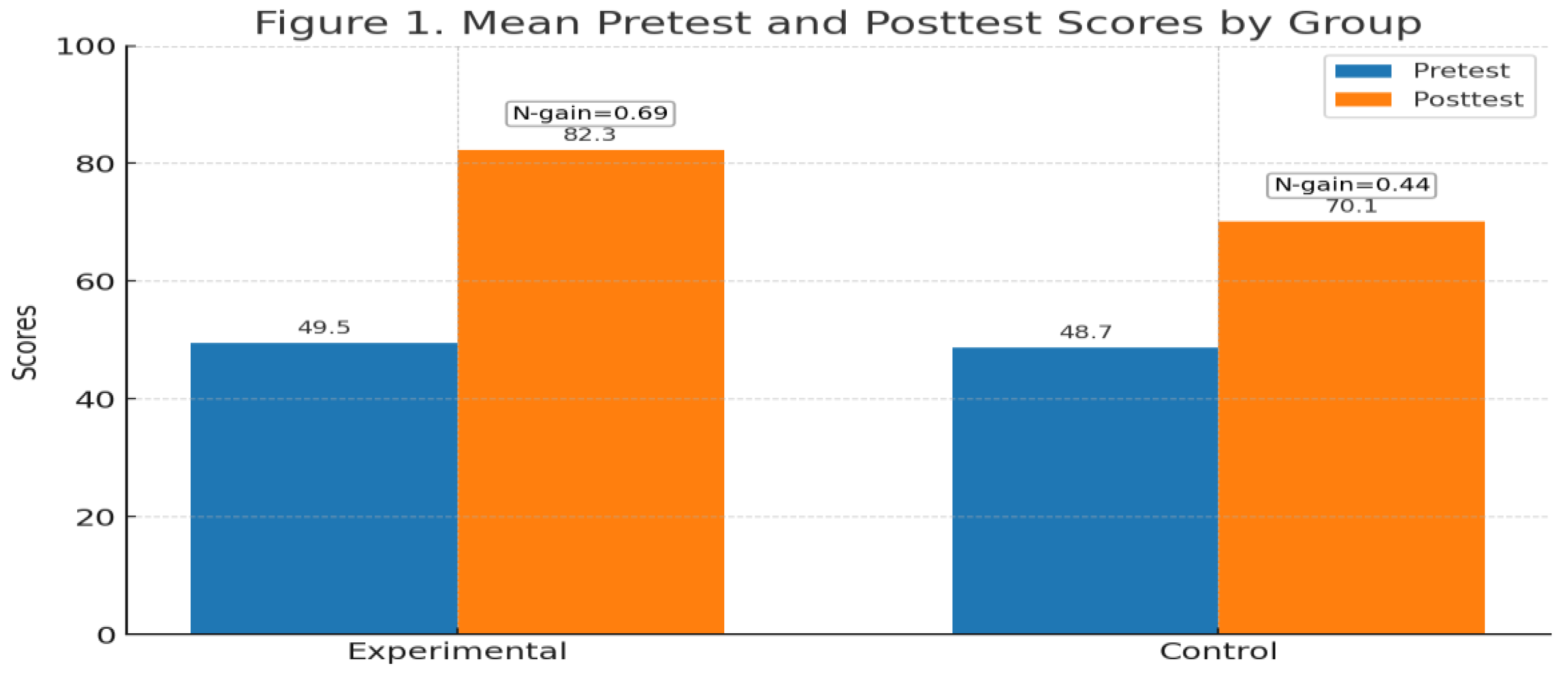

Table 1.
Mean Pretest and Posttest Scores and Normalized Gain (N-Gain).
| GROUP | PRETEST | POSTTEST | N-GAIN |
| Experimental | 49.5 | 82.3 | 0.69 |
| Control | 48.7 | 70.1 | 0.44 |
Disclaimer/Publisher’s Note: The statements, opinions and data contained in all publications are solely those of the individual author(s) and contributor(s) and not of MDPI and/or the editor(s). MDPI and/or the editor(s) disclaim responsibility for any injury to people or property resulting from any ideas, methods, instructions or products referred to in the content. |
© 2025 by the authors. Licensee MDPI, Basel, Switzerland. This article is an open access article distributed under the terms and conditions of the Creative Commons Attribution (CC BY) license (http://creativecommons.org/licenses/by/4.0/).
Copyright: This open access article is published under a Creative Commons CC BY 4.0 license, which permit the free download, distribution, and reuse, provided that the author and preprint are cited in any reuse.