

Submitted:
18 October 2025
Posted:
20 October 2025
You are already at the latest version
Abstract
E-commerce for agricultural products serves as a critical link connecting smallholders with markets; however, technological barriers and market uncertainties during its transitional phase have led to low participation rates among farmers, creating a key bottleneck for industrial upgrading. The social learning mechanisms inherent in rural communities may influence farmers’ decisions by reshaping risk attitudes—a pathway that has not been sufficiently empirically examined. Based on social learning theory and risk attitude theory, this study uses survey data from 327 peach farmers in Qingdao, Shandong Province, to construct an analytical framework of “social learning – risk attitude – decision behavior.” Employing the Heckman two-stage model, IV-Probit, and mediation effect models, we systematically investigate the mechanisms through which these core factors affect farmers’ participation in e-commerce. The results indicate that social learning—through observational and reinforcement dimensions—significantly enhances both the decision and extent of e-commerce participation. Risk attitude plays a fully mediating role: social learning indirectly promotes participation by increasing farmers’ risk preference. Furthermore, individual and environmental characteristics such as gender, age, and logistics accessibility significantly influence participation decisions. Heterogeneity analysis reveals that the marginal effect of social learning is stronger among farmers in less developed areas and those not participating in cooperatives. These findings uncover the micro-level decision-making mechanisms behind e-commerce adoption and provide empirical support for constructing diversified rural learning systems, implementing differentiated risk education, and designing targeted training programs.
Keywords:
social learning
; risk attitudes
; rural households
; E-Commerce of Agricultural Products
; Participation in E-Commerce Activities
1. Introduction
E-commerce, with its ability to transcend spatial and temporal boundaries and its advanced capacity for information integration, has fundamentally reshaped the distribution models of agricultural products. In agricultural markets, e-commerce platforms substantially reduce transaction costs and mitigate information asymmetry by effectively integrating supply and demand information and shortening distribution chains [1]. The application of big data analytics enables the precise alignment of production with market demand, while the development of cold chain logistics expands both the geographical reach and the preservation capability of agricultural products, thereby improving circulation efficiency and resource allocation. Moreover, through the promotion of standardization and brand-oriented operations, e-commerce enhances the value-added potential and market competitiveness of agricultural products, collectively contributing to the optimization of operational efficiency and the overall performance of agricultural markets.
Over the past decade, a series of policy documents have systematically outlined and strategically advanced the development of rural e-commerce. The 2023 No. 1 Central Document explicitly emphasized accelerating the expansion of rural e-commerce, supporting the online marketing of agricultural products, and facilitating their flow from rural areas to urban markets. It further underscored the need to strengthen rural express delivery and logistics systems—particularly cold chain logistics infrastructure—to ensure the efficient circulation of agricultural products. In addition, the document promoted the digital transformation of agriculture by leveraging advanced technologies such as big data and artificial intelligence to optimize agricultural supply chains. The adoption of e-commerce for agricultural products is thus a collective outcome shaped by the participation of multiple stakeholders. Government policy support, coupled with the development of information and logistics infrastructure, serves as an essential external driver encouraging farmers to engage in e-commerce practices [2,3,4].
Throughout this process, technological advancement and marketization have passively drawn rural households into a high-risk and highly competitive environment, thereby indirectly increasing the entry threshold for their participation in e-commerce. This transformation requires farmers to acquire more real-time market information, specialized knowledge, and practical operational skills. Meanwhile, the institutional rules established by e-commerce platforms have created implicit barriers to market entry for smallholders, rendering continuous capital investment a necessary condition for sustained participation in competition. When short-term returns fail to meet expectations, these farmers face the risk of capital chain disruption and a consequent loss of operational sustainability. During the transitional stage of agricultural e-commerce development, such high-risk and high-cost participation mechanisms have led to suboptimal engagement among farmers. Guided by rational self-interest and the pursuit of benefit maximization, many farmers demonstrate limited motivation to adopt e-commerce practices, resulting in relatively low participation rates [5,6]. Therefore, how to effectively promote rural households’ engagement in agricultural e-commerce and enhance their participation remains a critical challenge for e-commerce platforms.
The participation behavior of rural households in e-commerce largely determines the developmental trajectory of agricultural e-commerce and constitutes one of its key constraining factors. Consequently, exploring effective ways to promote rural households’ engagement in agricultural e-commerce from multiple perspectives has become a central focus of scholarly inquiry. A defining characteristic of rural society is that farmers operate within relatively stable, acquaintance-based social networks, which offer abundant formal and informal channels for information exchange and learning. Within these networks, social learning facilitates the diffusion of knowledge across local village communities [7]. The dissemination of new technologies occurs not only through individual adoption practices but also through interpersonal exchanges of experiential knowledge among neighbors [8]. Through such social learning processes—such as observing peers’ business behaviors and sharing market information—farmers continuously revise their initial perceptions of risks and returns. This cognitive updating significantly reshapes their risk attitudes, which in turn influence their actual participation decisions. Furthermore, risk attitude is widely recognized as a critical determinant of farmers’ behavioral choices and technology adoption [9]. Accordingly, this study integrates social learning and risk attitude into the analytical framework for examining rural households’ participation behavior in agricultural e-commerce.
While existing research predominantly focuses on single dimensions such as social learning or risk attitudes to statically examine rural households’ decision-making regarding e-commerce participation in agricultural products, this paper adopts a theoretical framework from behavioral economics. Employing a dynamic perspective, it systematically investigates the synergistic influence mechanism of social learning processes and risk attitudes on farmers’ e-commerce participation decisions, incorporating both external environmental factors and internal psychological factors of individuals.
To address the aforementioned research questions, this study selected peach farmers in Qingdao, Shandong Province as the research subjects and conducted both online and offline questionnaire surveys to collect data. The findings reveal a significant and prominent impact of social learning on farmers’ e-commerce participation behavior in agricultural products, explore the mediating role played by risk attitudes, and examine the differential effects of geographical context and organizational participation on farmers’ e-commerce engagement. This research not only contributes to the existing literature on farmers’ e-commerce participation behavior but also offers valuable insights for enhancing the penetration and application level of rural e-commerce.
2. Materials and Methods
2.1. Literature Review
2.1.1. Social Learning
Social learning is defined as individual learning, which involves the behavior of gathering information and absorbing knowledge, representing a continuous and dynamic process of understanding and internalizing innovations. Since such learning often occurs within social contexts, it is inevitably influenced and shaped by social norms [10]. In essence, social learning constitutes learning activities carried out by rural households under socially oriented behaviors, serving as a key external driving force affecting their behavioral patterns [11]. Guo pointed out that social learning refers to the agricultural-related learning practices conducted by farmers through various means in informal educational settings [12].These learning activities play a crucial role in enabling farmers to acquire, accumulate, and apply knowledge and skills in agricultural production. Social learning functions as a fundamental mechanism that facilitates the efficient transmission and transfer of norms, skills, and complex cultural information among individuals, thereby promoting coordination and alignment within groups [13].
Social learning among rural households can be categorized into several forms: individuals actively seeking information through mass media, experience sharing among farmers, subtle influences from the surrounding environment, and participation in specialized training. Through these channels, farmers gradually encounter and gain an understanding of rural e-commerce, forming a preliminary perception of it. Based on a systematic review of existing research findings, supplemented by field surveys and in-depth interviews with peach farmers, and considering the current realities of rural development, this study defines social learning as follows: a socialized cognitive process through which agricultural producers (exemplified by peach farmers) embedded in social contexts acquire, absorb, and internalize knowledge and skills related to agricultural product e-commerce via informal learning methods.
Grounded in the rural social context and consistent with the practical conditions of agricultural regions, this study categorizes social learning into two dimensions: observational learning and reinforcement learning [14,15]. Observational learning refers to the process through which farmers acquire knowledge by observing and communicating with relatives, friends, and neighbors; engaging in experience-sharing with e-commerce demonstration households; and learning from successful cases disseminated through mass media. Through observing the behaviors and outcomes of others, farmers gain initial exposure to and understanding of rural e-commerce. However, transforming such observation into actual decision-making involves further stages of cognitive processing and risk evaluation. Reinforcement learning, in contrast, refers to the process whereby farmers adjust and replicate their behavioral patterns based on prior actions and corresponding outcomes, primarily through the reinforcing effects of previous experiences, such as participation in training programs.
Against the backdrop of building a learning society, the concept of lifelong learning has been widely embraced, and this enthusiasm for learning has also permeated rural communities. Although rural areas face certain limitations in accessing formal education and specialized training resources, the closely-knit social networks enable farmers to often acquire abundant social learning opportunities through informal channels. Research by Conley and Udry revealed the specific mechanisms of social learning among rural households [16]. They found that farmers proactively observe and emulate the successful practices of neighboring farmers in agricultural production, particularly the application of new technologies, and such learning behaviors significantly influence their production and operational decisions. Munshi proposed that farmers’ willingness to adopt new technologies and their criteria for judgment are deeply shaped by social interactions, which facilitate knowledge transfer and experience sharing [17]. Although this form of learning, based on daily interactions and experience sharing, is less systematic than formal education, its impact on farmers’ cognitive patterns and behavioral decisions is profound and enduring. Within the unique social structure and cultural context of rural areas, social learning has become an instrumental pathway for farmers to acquire knowledge, shape attitudes, and inform behaviors, and its influence should not be overlooked.
Building on the foundational framework of social learning theory and integrating the contextual realities and behavioral characteristics of rural society in China, this study systematically reviews previous research to categorize social learning into distinct dimensions. Specifically, the social learning pathways of rural households are divided into two dimensions: observational learning and reinforcement learning. This classification not only aligns with traditional social learning theory but also incorporates the influence of modern information technology on farmers’ learning methods, thereby refining the analytical framework for examining the impact of social learning on their e-commerce participation behavior.
2.1.2. Social Learning
In 1960, American scholar Bruner first proposed the theoretical framework of risk attitudes, a concept later incorporated into the domain of psychological research. The formation of an individual’s risk attitudes is evidently influenced by multiple factors. From the perspective of the decision-maker’s personal circumstances, elements such as personal traits and intrinsic values form the foundation of risk attitudes. Meanwhile, the decision-maker’s assessment of future expectations regarding events also significantly shapes their risk attitudes. Empirical studies in psychological behaviorism have confirmed that when facing different situations, individuals develop specific risk attitudes based on their evaluation of potential outcomes, thereby leading to noticeable differences in their behaviors.
Current research indicates that risk attitude, as a key psychological variable in the decision-making processes of rural households, exerts a significant influence on their production and operational behaviors. According to expected utility theory, farmers’ risk attitudes can be classified into three types: risk-averse, risk-seeking, and risk-neutral [18,19]. From the perspective of experimental economics, individual differences in risk perception and risk-bearing capacity give rise to heterogeneous risk attitudes during decision-making [20]. These variations in risk attitudes subsequently lead to differences in farmers’ behavioral decisions: risk-seeking farmers tend to pursue options with higher expected returns accompanied by greater risks and are more inclined to engage in innovative activities or adopt new technologies [21]. In contrast, risk-averse farmers, when confronted with uncertainty, prefer safer alternatives with relatively lower expected returns and exhibit inhibition toward innovative behaviors and new technology adoption [22]. Farmers with a risk-neutral attitude occupy an intermediate position between risk-seeking and risk-averse types, demonstrating neither conservatism nor aggressiveness in their decision-making processes [23].
In this study, risk attitudes are defined as the dimension of risk propensity displayed by farmers (exemplified by peach farmers) during their decision-making process regarding participation in agricultural product e-commerce. Drawing on methodologies from relevant studies for measuring risk attitudes, this research categorizes risk attitudes into five levels: “highly risk-averse”, “relatively risk-averse”, “neutral”, “relatively risk-seeking”, and “highly risk-seeking” [24].
2.1.3. Rural Households’ E-Commerce Participation Behavior in Agricultural Products
In the era of the digital economy, the decision-making process of rural households regarding e-commerce participation exhibits distinct phased characteristics. This process begins with the cognition and understanding of the e-commerce model, evolves into participation intention through rational evaluation, and ultimately translates into actual e-commerce participation behavior. From an economic perspective, e-commerce platforms provide farmers with new avenues to break through the limitations of traditional sales channels. By eliminating information barriers and optimizing supply chain management, they significantly reduce transaction costs, thereby enhancing the added value and market competitiveness of agricultural products and generating considerable economic benefits for farmers. Professional and systematic e-commerce skills training can help farmers acquire modern operational skills such as online marketing and data analysis, while also enhancing their market awareness and innovative thinking. This demonstrates that e-commerce skills training not only assists farmers in better conducting e-commerce operations but also lays a crucial foundation for expanding diversified employment channels and achieving sustainable development [25]. Farmers’ participation in e-commerce is itself an innovation and entrepreneurial behavior, as well as an adoption of new technologies.
Drawing on the conceptual definition of e-commerce participation behavior among apple growers by Yan, this study defines rural households’ e-commerce participation behavior as follows [26]: the activities through which farmers engage in the sales of agricultural products via diversified channels, including mainstream third-party e-commerce platforms (such as JD.com, Taobao, Pinduoduo, and Suning.com), short-video communication platforms (including Douyin, Kuaishou, and Huoshan), social networking platforms (such as WeChat, QQ, Weibo, and Xiaohongshu), as well as other means leveraging the internet or mobile terminal devices. This definition not only encompasses sales models on traditional e-commerce platforms but also incorporates innovative forms such as social e-commerce and live-streaming e-commerce, thereby more comprehensively reflecting the diverse pathways through which rural households participate in e-commerce within the context of the digital economy.
2.2. Hypotheses Development
2.2.1. Social Learning’s Impact on E-Commerce Adoption
Existing research indicates that the market penetration of rural e-commerce during its transitional development phase is closely related to the characteristics of rural society. Kinship, marriage, and geographical ties form a unique reciprocal social network among relatives, friends, and neighbors [27]. The acquaintance-based social networks distinctive to rural communities provide natural channels for the dissemination of e-commerce knowledge, enabling experience sharing, information exchange, and social learning through interactions with relatives and neighbors [28]. Farmers’ decision-making behaviors are influenced not only by their existing knowledge and experience but also by the practical actions of their peer farmers [29]. Through observational learning, farmers gauge the decision-making tendencies of their peers [30]. By interacting with experienced e-commerce practitioners, farmers engage in observational learning within informal knowledge transmission networks, facilitating experience exchange and technical guidance. This enables them to quickly acquire essential skills such as online store operation, product packaging, and digital marketing, gradually accumulating the expertise needed for e-commerce activities and ultimately participating in e-commerce sales models [15].
In modern information society, mass media serve as vital channels for knowledge dissemination and play an irreplaceable role in the process of social learning. Observational learning via mass media allows farmers to overcome spatiotemporal constraints and access extensive learning resources at low cost, significantly reducing both the economic and time investments required for learning. Leveraging mobile internet technology, farmers can conveniently access various agricultural e-commerce platforms, online training courses, and professional forums, systematically acquiring practical skills such as online store management and digital marketing techniques. This enables them to more accurately understand market demand fluctuations and develop sustainable business strategies. Such digital learning modes not only enhance the efficiency of social learning but also promote experience sharing through interactive communication features. Farmers can promptly observe industry trends and learn from best-practice demonstrations, thereby increasing their participation in agricultural product e-commerce and deepening their level of involvement.
Reinforcement learning is a behavior-shaping mechanism that refers to the psychological process through which individuals continuously adjust their behavioral patterns via interactions between experiential learning and external interventions. Specifically, when an individual repeatedly engages in a certain behavior within a specific social context and receives positive feedback, this behavioral pattern becomes reinforced through cognitive mechanisms, ultimately forming a stable behavioral attitude [31]. Specialized training serves as a key external driving factor that enhances farmers’ cognitive understanding of specific production and operational behaviors and effectively alters their adoption of new technologies through reinforcement learning processes. Zhang emphasized that systematic specialized training plays a critical role in improving farmers’ participation in e-commerce [11]. Through comparative analysis, Luo found that farmers who received specialized training demonstrated superior performance in online store operational efficiency, marketing strategy application, and risk prevention awareness compared to untrained groups [32]. Therefore, the reinforcement learning effects of specialized training not only enhance the efficiency of farmers’ e-commerce learning but also, through knowledge internalization and skill transfer, contribute to a substantial increase in their level of e-commerce participation [11].
The higher the frequency of observational learning and reinforcement learning among farmers, and the broader their learning channels and scope, the stronger their social learning capacity becomes. This enables them to acquire timely technical support and market information, more systematically understand and evaluate the multiple economic benefits of e-commerce participation—such as expanding market channels and increasing comprehensive income—and enhance their ability to accurately predict the long-term development potential and risk-return characteristics of agricultural product e-commerce. These factors collectively provide critical reference points for their decision-making regarding participation in agricultural product e-commerce. Based on this, the following hypotheses are proposed:
H1. Social learning has a significant positive impact on rural households’ e-commerce participation behavior in agricultural products.
H1a. Social learning has a significant positive impact on rural households’ decision-making regarding e-commerce participation in agricultural products.
H1b. Social learning has a significant positive impact on the extent of rural households’ participation in e-commerce of agricultural products.
2.2.2. The Mediating Effect of Risk Attitudes
The deep integration of the internet and traditional agriculture has given rise to agricultural product e-commerce as an innovative business model. Rural households’ decision-making regarding participation in e-commerce profoundly reflects their behavioral choices in innovation adoption. Research indicates that risk attitudes are a key factor influencing farmers’ choices in innovative behaviors [33]. Luo and Lin et al. proposed that in agricultural management decisions, farmers not only pursue profit maximization but also weigh risk factors [32]. As farmers accumulate knowledge and gain practical experience, their cognitive biases and perceived risks related to new technology applications significantly decrease, leading to a deeper understanding of operational processes and potential risks. Through social learning, they not only gain greater confidence in participating in agricultural product e-commerce but also modify their risk attitudes, shifting from passive risk avoidance to active acceptance, thereby promoting their engagement in e-commerce [34]. By sharing experiences and exchanging information among themselves, social learning helps farmers preemptively identify potential risks in technology application and reduce perceptions of uncertainty. This not only compensates for the shortcomings of formal risk protection systems and alters farmers’ risk attitudes but also enhances their willingness to adopt technologies, providing crucial support for their sustained use of new technologies.
Through social learning as a critical pathway, farmer e-commerce entrepreneurs can acquire multidimensional resources essential to the entrepreneurial process, including market information, human resources, and emotional support. The accumulation of these resources provides a certain degree of risk buffering mechanism, enhances farmers’ risk preference, thereby reducing their risk perception toward e-commerce entrepreneurship and strengthening their expectation of entrepreneurial success [35]. By facilitating knowledge transfer and experience sharing, social learning enables farmers to better understand e-commerce operational models, increases their risk preference level, and consequently raises their willingness and likelihood of engaging in agricultural product e-commerce. Furthermore, social learning supplies farmers with strategies and methods to cope with uncertain risks, effectively mitigating potential short-term disruptions to household production and daily life during the e-commerce entrepreneurship process. This risk buffering effect not only enhances the household’s overall risk-bearing capacity but also strengthens farmers’ confidence and stability in e-commerce decision-making [36].
Rural households’ e-commerce participation behavior in agricultural products is influenced by their risk attitudes, which play a mediating role between social learning and their e-commerce engagement. When farmers exhibit a higher degree of risk preference, their willingness and initiative to innovate increase, thereby promoting their participation in agricultural product e-commerce sales. Furthermore, through social learning activities, farmers enhance their awareness and control capabilities over operational risks, which in turn elevates their risk preference level and positively influences their e-commerce participation behavior. Based on this, the following hypotheses are proposed:
H2. The higher the degree of risk preference among rural households, the greater their likelihood of participating in agricultural product e-commerce.
H3. Social learning enhances the level of risk preference among rural households, thereby promoting their engagement in agricultural product e-commerce.
Based on the literature review and proposed hypotheses, we have developed the following conceptual model to analyze the mechanisms of influence among social learning, risk attitudes, and smallholders’ participation behavior in agricultural product e-commerce (Figure 1).
2.3. Methodology
2.3.1. Model Specification
Generally speaking, rural households’ e-commerce participation behavior in agricultural products can be divided into two stages: the participation decision and the participation extent. Therefore, this study first incorporates the participation decision into the analytical framework of the level of social learning, and specifies the probability estimation model (Equation 1) as follows:
Probit(part _di ) = α0 + α1 Sociali + α2 Xi + εi
Among them, α0 is the intercept term, and i denotes the identification number of valid survey respondents. The explained variable, par _di represents the e-commerce participation decision of respondent i. The core explanatory variable, Sociali, indicates the level of social learning of respondent i. Xᵢ refers to a set of control variables at the individual level that may influence the participation decision, including gender, age (ageᵢ), education level (educᵢ), number of household members (fnumᵢ), logistics accessibility in the region (convᵢ), and income level (Incomeᵢ). α1 is the coefficient representing the impact of social learning level on e-commerce participation decisions, with the magnitude and sign of the coefficient reflecting the degree and direction of the influence. εᵢ represents unobservable random effects at the individual level for respondent i, and is thus included as the random disturbance term.
Considering potential endogeneity issues such as bidirectional causality between social learning and farmers’ e-commerce participation behavior, measurement errors, and omitted variables, this study employs an instrumental variable (IV) approach in conjunction with the above model. The analysis is conducted using an IV-Probit model, with the highest education level of parents (Parent_educᵢ) selected as the instrumental variable for social learning. The regression model (Equation 2) is specified as follows:
IVProbit (part _di) = α0 +α1 (Sociali = Parent _ educi) +α2Xi +εi
Building upon the e-commerce participation decision, this study further examines the impact of the level of social learning on the extent of e-commerce participation. To mitigate potential sample selection bias, the Heckman two-stage method is employed. The sample selection model (Equation 3) is specified as follows:
H (part _li) = b0 + b1Sociali (part _di = a0 + a1Sociali + a2Xi + εi) + b2Xi + εi
Among them, b0 represents the intercept term, and the explained variable part_lᵢ denotes the extent of e-commerce participation of respondent i. b1 is the coefficient capturing the effect of the level of social learning on the extent of e-commerce participation, with its magnitude and sign indicating the degree and direction of the influence, respectively. Model (3) is employed to estimate the linear regression results regarding the impact of social learning on the extent of e-commerce participation. Meanwhile, the instrumental variable Parent_educᵢ is also incorporated into the second-stage regression to control for endogeneity issues.
Based on the theoretical analysis presented earlier, social learning may influence e-commerce participation through the mediating role of risk attitudes. To examine the plausibility of this mediating mechanism, this study adopts the testing procedure proposed by Wen Zhonglin (2014) to construct a mediation effect model. On the basis of the fundamental econometric model, risk attitude (Risk) is incorporated as a mediating variable into the same analytical framework alongside social learning and rural households’ e-commerce participation in agricultural products. The regression equations are established as follows:
Part _li = δ0 +δ1 Sociali +δ2 Xi + εi
Riski = δ0 +δ1 Sociali +δ2 Xi + εi
Part _li = δ0 +δ1 Sociali +δ2 Riski +δ3 Xi + εi
Among these, Riskᵢ represents the mediating variable, risk attitude, and δ₁ denotes the coefficient of the mediating effect. The definitions of all other variables and coefficients remain consistent with those specified in Model (1).
2.3.2. Variable Definitions
The e-commerce participation behavior of rural households in agricultural products serves as the explained variable in this study, which comprises two sequential processes: the decision to participate in e-commerce and the extent of e-commerce participation. The decision to participate is a binary variable, reflecting whether a household engages in agricultural product e-commerce (coded as 1) or not (coded as 0). The extent of participation is a continuous variable, measured by the ratio of e-commerce sales volume to total sales volume [37]. This study utilizes survey-based indicators to assess these variables, including part_d for e-commerce participation decision and part_l for e-commerce participation extent. part_d is a binary variable where a value of 0 indicates that the respondent does not engage in e-commerce sales, while a value of 1 indicates participation. When the participation decision equals 1, part_l represents the proportion of sales generated through e-commerce relative to the household’s total sales volume.
The core explanatory variable in this study is social learning, which is operationalized through two dimensions—observational learning and reinforcement learning—using five measurement items designed and selected for this purpose (response options: “1 = Very infrequent; 2 = Relatively infrequent; 3 = Neutral; 4 = Relatively frequent; 5 = Very frequent”).

Table 1.
Social learning measurement items.
| Social learning | Measurement items |
|
Observational learning |
How often do you communicate with relatives, friends, and neighbors about agricultural product e-commerce? How often do you communicate with major e-commerce operators about agricultural product e-commerce? How often do you communicate with e-commerce promoters about agricultural product e-commerce? How often do you learn about agricultural product e-commerce through the Internet, TV, and radio? |
| Reinforcement learning | How often do you learn about agricultural product e-commerce by attending professional e-commerce training? |
Source: Authors’ proposal.
Level of Social Learning (Social):This study employs survey-based data to calculate respondents’ social learning indicators using the entropy method across two dimensions. The resulting value reflects the extent of the respondent’s social learning, with higher values indicating a greater extent. As the indicators obtained from both dimensions are positive, they were standardized using the following method:
Xin represents the learning extent of individual i in the n-th dimension, where n takes values of 1 and 2, denoting observational learning and reinforcement learning respectively. XMAXn and XMINn indicate the maximum and minimum values of the indicators in the n-th dimension. After standardization, the weights are derived by calculating the coefficient of variation to integrate the four indicators of the observational learning dimension. Finally, the computational weights for both dimensions are set equally to 1/2 and a weighted aggregation is performed to obtain the social learning index.
The mediating variable in this study is risk attitude. Drawing on the risk attitude measurement method developed by Chen et al., the following question was included in the survey questionnaire: “Which of the following five scenarios would you be willing to choose? “Specific measurement items and their corresponding value assignments are presented in Table 2: Risk Attitude Measurement Items [38].
This study selected the following control variables to mitigate potential confounding effects on rural households’ participation in agricultural product e-commerce: gender, age, education level (educ), number of family members (fnum), logistics accessibility (conv), and income level (Income).
2.3.3. Sample Selection and Data Sources
This study collected the data required for empirical analysis through a questionnaire survey. During the questionnaire design phase, based on the core variables and research hypotheses derived from the theoretical framework established earlier, and drawing on key references, the scale items were rigorously developed and refined. After multiple rounds of careful revision, the final version of the questionnaire was completed.
To enhance the reliability of the research data, a preliminary online survey was conducted during the early stage of the study. Based on the findings from this pilot survey, the questionnaire was subsequently revised and refined. The research participants were selected as peach farmers in Qingdao, Shandong Province, and the survey was administered through both online and offline channels to facilitate efficient and comprehensive data collection. For offline data collection, the study employed on-site visits, whereby researchers conducted face-to-face interviews with farmers directly within fresh peach orchards, ensuring the authenticity and reliability of the collected data. In the online data collection process, digital tools such as WeChat mini-programs, Wenjuanxing (a professional online survey platform), and WeChat official accounts were utilized for targeted questionnaire distribution, taking into account the characteristics of the research subjects. Leveraging the social network of the academic supervisor’s team and integrating academic resources, the survey was further disseminated through diverse new media platforms, including Xiaohongshu, Douyin, and Weibo. Additionally, by participating in professional communication communities for peach farmers, industry groups for fresh peach sales, and fan groups of well-known bloggers in the peach sector, the research samples were precisely identified, thereby improving the representativeness and coverage of the sample. To ensure high-quality data collection, an incentive mechanism was implemented, providing respondents with appropriate remuneration upon questionnaire completion. Ultimately, the survey was conducted among peach farmers in Qingdao, Shandong Province, resulting in 379 distributed questionnaires, of which 327 were valid, yielding an effective response rate of 86.27%.
3. Analysis and Results
3.1. Social Learning’s Impact on E-Commerce Adoption
Table 3 presents the benchmark regression results examining the impact of Social Learning on rural households’ participation in agricultural e-commerce. Specifically, Model (1) reports the effect of Social Learning on the decision to participate in e-commerce activities. Model (2) presents the results of the impact of Social Learning on participation decisions, accounting for potential endogeneity through the use of instrumental variables. Models (3) and (4) respectively display the effects of Social Learning on the intensity of participation in e-commerce activities, estimated using the Heckman two-stage model—which incorporates instrumental variables while addressing selection bias—and the ordinary least squares (OLS) model.
Based on the regression results of Probit Model (1), Social Learning exerts a significant positive effect on the decision to participate in e-commerce activities. The estimated coefficient is positive and statistically significant at the 1% level. Ceteris paribus, a 1% increase in the level of Social Learning corresponds to a 13.27% increase in the probability of deciding to participate in e-commerce activities. In Model (2), which employs the IV-Probit model with instrumental variables, the regression results for the fitted values of Social Learning on participation decisions remain largely consistent. Moreover, the Wald test statistic for the instrumental variable (parental education) is 438.96, with a p-value below 0.01, indicating strong exogeneity. Ceteris paribus, a 1% increase in Social Learning is associated with a 10.30% increase in the probability of deciding to participate in e-commerce activities. The smaller coefficient relative to Model (1) suggests that, after addressing endogeneity, the effect of Social Learning on participation decision-making may have been previously overestimated.
According to the regression results of the Heckman two-step model (3), Social Learning also exerts a significant positive impact on the degree of Participation in E-Commerce Activities, which has passed the 1% significance level test. The regression coefficient of the instrumental variable is positive and significant, indicating that the instrumental variable has a certain degree of correlation. The IMR (Inverse Mills Ratio) value and Rho value of the model are significantly positive, suggesting the existence of certain selection bias. Therefore, it is reasonable to use the Heckman two-step model to eliminate such selection bias. Ceteris paribus, for every 1% increase in the level of Social Learning, the degree of Participation in E-Commerce Activities increases by 0.49% accordingly. After excluding non-decision samples, the OLS model was used for processing, and the main regression results remained largely consistent. This indicates that the result analysis of Model (3) has a certain degree of rationality.
In addition, the regression results of the control variables in Models (1) and (3) show that gender has a significant impact on the behavior of Participation in E-Commerce Activities. Specifically, before making the decision, female respondents are more negative than male respondents towards the behavior of Participation in E-Commerce Activities; however, after respondents have decided to engage in e-commerce, females exert a more positive impact on the degree of Participation in E-Commerce Activities. This may be because females’ risk preference is generally weaker than that of males, making them more passive in the decision-making of Participation in E-Commerce Activities. When engaging in e-commerce brings benefits, their risk preference will increase, prompting them to enhance the degree of Participation in E-Commerce Activities. Age also follows a similar path of influence: the older the respondents are, the more conservative their Risk Attitudes tend to be. Thus, in Model (1), age has a significantly negative effect on the decision-making of Participation in E-Commerce Activities. Regarding the decision-making behavior, neither the respondents’ educational level nor the number of family members has a significant impact; whereas for the degree of participation, an increase in the number of family members significantly inhibits the degree of Participation in E-Commerce Activities.
As indicated by the regression results, income level and logistics convenience, as indicators for examining physical capital and infrastructure, have exerted a significant positive impact on overall Participation in E-Commerce Activities, which confirms the findings of previous studies and the theoretical analysis in this paper. Specifically, an increase in physical capital enhances rural households’ level of investment in e-commerce and their risk resistance capacity, thereby leading to an improvement in their comprehensive income. Moreover, the improvement of infrastructure level can generally enhance the cognitive level and practical ability of rural households in the region from dimensions such as logistics development, network coverage, and knowledge popularization, thus exerting a positive impact on their behavior of Participation in E-Commerce Activities.
Subsequent research further conducted regression analyses on the four dimensions under the theoretical framework of Social Learning, namely role model demonstration, interpersonal communication, mass media, and reinforcement learning, to systematically examine their impact intensity on the decision-making of Participation in E-Commerce Activities (a dichotomous variable) and the degree of participation (a continuous variable). The results show that the explanatory power of mass media and interpersonal communication for the two types of dependent variables is significantly higher than that of role model demonstration and reinforcement learning. This finding provides quantitative evidence for clarifying the mechanism path of Social Learning in the behavior of Participation in E-Commerce Activities.
Table 4 presents the results of the binary logit regression (with the dependent variable part_d) and the linear regression (with the dependent variable part_l). Interpersonal communication (5.578*) and mass media (6.768**) have a significantly positive impact on part_d, and the coefficient of the latter is larger; their impacts on part_l are 0.073** and 0.074** respectively, with similar degrees. Role model demonstration and reinforcement learning have mostly no significant impact on the two dependent variables. Among the control variables, logistics convenience (conv) has a highly significant impact on the two dependent variables (9.361** and 0.107**); the number of family members (fnum) has a marginally significant negative impact on part_l (-0.016*); and gender has a marginally significant positive impact on part_d (4.083*). It can be concluded that among the four dimensions of Social Learning, mass media and interpersonal communication have the greatest impact on the decision-making of Participation in E-Commerce Activities, with mass media having a stronger impact; among the four dimensions of Social Learning, mass media and interpersonal communication also have the greatest impact on the degree of Participation in E-Commerce Activities, and their impacts are almost equivalent.
3.2. Robustness Test
To enhance the robustness of the aforementioned conclusions, this paper conducts robustness tests by means of replacing regression models, performing winsorization on variables, and adding potentially omitted control variables, among other methods.
In this study, the Probit model was adopted as the benchmark model for the decision-making of Participation in E-Commerce Activities. When dealing with binary dependent variables, this model exhibits good fitting effect and strong explanatory power. To verify the robustness of the regression results, this paper further employs the Logit model for robustness testing. If the regression results are consistent with those of the benchmark model, the robustness of the empirical results can be further confirmed.
Since economic data often contain outliers, and in particular, the distribution of variables such as income level may show a significant right-skewed feature, this paper performs winsorization on continuous variables to reduce the potential impact of extreme values on the regression results and mitigate the interference of outliers on parameter estimation. Specifically, this paper conducts winsorization on the data at the 5% upper and lower quantiles of the variables.
In the above analysis, the regression model of this paper has already included control variables such as individual gender and age. However, for the behavior of Rural Households’ Participation in E-Commerce of Agricultural Products, the years of farming in the planting industry and the planting area of crops of the research subjects are also potential influencing factors. This is because as the years of farming in the industry increase and the planting area expands, the research subjects’ perception of Risk Attitudes will also change. Therefore, this paper adds two variables, namely years of farming and planting area, to the research model for regression analysis.
As can be seen from the robustness test results in Table 5, after replacing the regression model, performing winsorization, and supplementing variables, the level of Social Learning still has a significant positive impact on Rural Households’ Participation in E-Commerce of Agricultural Products. This proves that the previous empirical results are relatively reliable, and the research conclusions remain unchanged.
3.3. Heterogeneity Test
Due to differences in rural households’ organizational participation, there are variations in their mastery of information resources and other aspects, which affect their information decision-making and Risk Attitudes, and further influence their behavior of Participation in E-Commerce Activities. Therefore, this paper classifies organizational participation into two categories based on whether rural households have joined cooperatives or industry associations, so as to examine the heterogeneous impact. From the regression results of groupings by organizational participation, among the research subjects who have joined cooperatives or industry associations, the impact effect and significance of Social Learning on Participation in E-Commerce Activities are different from those of the research subjects who have not joined. For the research subjects who have not joined cooperatives or industry associations, an improvement in the level of Social Learning leads to a stronger and more significant promotion in the decision-making of Participation in E-Commerce Activities and a deepening of the degree of Participation in E-Commerce Activities. However, in terms of the explanatory power of the model, for the research subjects with organizational participation (i.e., participants), the goodness-of-fit R² of the regression model is 0.746, which is higher than the R² value of 0.643 for non-participants. A plausible explanation is that rural households participating in cooperatives or industry associations tend to form a strong path dependence on existing planting and sales models. This dependence mainly stems from the fact that agricultural cooperatives and industry associations in China usually have mature supply and marketing networks and stable cooperation models, which can provide rural households with relatively reliable market channels and risk guarantee mechanisms. In this context, although e-commerce platforms, as an emerging sales channel, have advantages such as wide market coverage and high transaction efficiency, their attractiveness to rural households is relatively limited. Even if Social Learning improves rural households’ cognition and willingness to participate in e-commerce, its actual impact on rural households’ behavior may still be weaker than the effect of traditional channels.
This phenomenon is consistent with the path dependence theory, which states that inertial behavioral patterns formed by individuals or organizations in long-term practice will have a significant impact on their subsequent decision-making. In addition, the collective action characteristics of cooperatives and industry associations may also, to a certain extent, inhibit individual rural households’ independent exploration and willingness to participate in e-commerce platforms. Therefore, in the process of promoting the development of E-Commerce of Agricultural Products in the future, attention should be paid to collaborative cooperation with traditional cooperatives and industry associations. By integrating resources and optimizing the benefit distribution mechanism, rural households should be gradually guided to transition from traditional channels to e-commerce platforms, thereby enhancing the sustainability and effectiveness of Participation in E-Commerce Activities.
Table 6.
Regression results of groupings by organizational participation.
| Participation in cooperatives or industry associations | Yes | No |
| Social | 0.6488** | 0.7493*** |
| Control variables | (0.2711) Yes | (0.0650) Yes |
| Control for individual effects | Yes | Yes |
| R2 | 0.746 | 0.643 |
Note: ***, **, and * indicate significance at the 1%, 5%, and 10% levels, respectively. Robust standard errors are in parentheses. Source: Authors’ proposal.
3.4. The Mediating Effect of Risk Attitudes
Based on the established mediation effect model, this paper conducts a mechanism test on the path through which Social Learning affects Rural Households’ Participation in E-Commerce of Agricultural Products via Risk Attitudes. Meanwhile, due to model constraints, this paper only uses the decision-making of Participation in E-Commerce Activities to characterize e-commerce participation. Among them, Model (1) is an OLS regression model examining the impact of Social Learning on e-commerce participation; Model (2) is an OLS regression model investigating the impact of Social Learning on Risk Attitudes; and Model (3) is a regression model incorporating the Risk Attitudes variable (Risk) on the basis of Model (1). The test results are presented in Table 7.
In Model (2), the impact of the level of Social Learning on Risk Attitudes is positive and significant at the 1% level. This indicates that an improvement in the level of Social Learning can correspondingly enhance the research subjects’ level of risk preference. This finding is consistent with the social learning theory: rural households, through Social Learning, understand and assess the risks in Participation in E-Commerce Activities, enhance their risk-bearing capacity, and thus improve their level of risk preference. Through the mechanisms of interaction and information sharing within social networks, rural households can more comprehensively acquire and integrate risk information related to E-Commerce of Agricultural Products, thereby optimizing their cognitive and evaluative abilities regarding risk factors. The Social Learning process not only provides rural households with diversified risk response strategies and experience reference but also, through the group demonstration effect and knowledge spillover effect, reduces their perception of uncertainty in e-commerce participation, thereby further enhancing their risk-bearing capacity and improving their level of risk preference. This improvement in risk perception and transformation of Risk Attitudes directly promote the enhancement of rural households’ level of risk preference, making them more inclined to accept and participate in E-Commerce of Agricultural Products. This conclusion echoes the research findings of WANG H [39].
In Model (3), the impact of Risk Attitudes on the degree of Participation in E-Commerce Activities is also positive and significant at the 1% level, indicating that an increase in the level of risk preference can significantly promote rural households to engage more deeply in E-Commerce of Agricultural Products. This result is consistent with the risk decision-making theory: rural households with a preference for risk are more inclined to try new sales channels and technologies, thus participating more actively in e-commerce activities. In Model (3), which incorporates both the independent and dependent variables, the regression coefficient of the level of Social Learning is lower than that in Model (1). Meanwhile, the regression coefficient of Risk Attitudes is positive and significant, indicating the existence of a partial mediation effect. The results of the mechanism test verify the aforementioned theoretical analysis.
4. Discussion
4.1. Research Conclusions
Based on the combination of theoretical and empirical analyses, this paper explores and examines the impacts of Social Learning and Risk Attitudes on Rural Households’ behavior of Participation in E-Commerce of Agricultural Products. The specific research conclusions are as follows:
Social Learning has a significant positive impact on Rural Households’ behavior of Participation in E-Commerce Activities. Under the framework of Social Learning, neighborhood communication learning, mass media learning, and professional training learning all exert a positive promotional effect on Rural Households’ decision-making of and degree of Participation in E-Commerce of Agricultural Products. Rural households carry out observational learning through three key subjects: the practical behaviors of peer farmers affect their decision-making tendencies through the herd effect; the successful demonstration of e-commerce leading households provides replicable business models; and the professional guidance of promotion staff effectively reduces policy cognitive risks. Meanwhile, the multi-level learning network constructed by mass media significantly improves the efficiency of knowledge acquisition. In terms of reinforcement learning, systematic professional training, through structured curriculum design, promotes the internalization of e-commerce knowledge and skill transfer, forming a positive reinforcement cycle of “cognition-behavior-feedback”.
Risk Attitudes also have a positive correlation with Rural Households’ behavior of Participation in E-Commerce Activities. The degree of Rural Households’ risk preference has a significant impact on their behavior of participating in agricultural product e-commerce, and this impact is mainly reflected in the positive correlation between Risk Attitudes and innovative behavior. Rural households with a higher degree of risk preference have stronger innovation awareness and adventurous spirit; they are more willing to accept new things and can tolerate higher uncertainty. Emerging business models like e-commerce involve multiple uncertainties in operation, such as market fluctuations, technical thresholds, and operational risks. This characteristic exactly matches the behavioral characteristics of rural households with a strong risk preference, thereby stimulating their willingness to participate and increasing the probability of their Participation in E-Commerce of Agricultural Products.
Social Learning can affect Rural Households’ behavior of Participation in E-Commerce of Agricultural Products by enhancing their degree of risk preference. Through the dissemination of successful experiences and professional knowledge support, Social Learning helps rural households establish a rational cognitive framework for agricultural product e-commerce, enabling them to objectively evaluate the potential risks and benefits of e-commerce participation. This reduces their excessive risk aversion psychology and gradually enhances their risk preference. Additionally, the Social Learning process can improve rural households’ e-commerce operational skills and market operation capabilities; the accumulation of such capabilities directly strengthens their confidence in e-commerce participation, further enhances their risk preference, and thus makes them more inclined to accept innovative business models with certain risks.
4.2. Suggestions
Based on the findings of this study, strategic recommendations are proposed to enhance rural e-commerce participation from multiple perspectives—targeting farmers, e-commerce platforms, and the government—to stimulate initiative, improve adoption levels, and unlock developmental potential.
Efforts should focus on building a rural learning society and improving diversified learning mechanisms. Village-level organizations should establish regular learning platforms, facilitate experience-sharing activities, and enhance the capacity of leading farmers to leverage their demonstrative role. Differentiated communication strategies should be adopted, emphasizing interaction with key figures and innovative formats such as online meetings to promote knowledge exchange.
Learning channels for farmers should be expanded through the establishment of rural libraries with relevant technical and marketing materials, digital skill courses, and e-commerce demonstration bases in villages with distinctive products or tourism resources. Mutual-aid learning mechanisms and regular thematic events led by successful e-commerce practitioners should be encouraged to strengthen practical understanding and application.
Accelerating the construction of digital infrastructure—such as 5G-enabled smart agriculture applications, intelligent cold chain logistics, and e-commerce service platforms—will reduce entry barriers and boost farmers’ confidence in e-commerce engagement. In line with the 2023 No. 1 Central Document’s emphasis on strengthening cold chain logistics and digital transformation, we recommend local governments integrate “digital supply chain finance” platforms into e-commerce ecosystems. These platforms can provide working capital support for smallholders based on real-time transaction data, mitigating liquidity constraints during the transition to e-commerce.
Risk awareness must be enhanced through tailored education programs that help farmers understand operational risks, prevent online fraud, and interpret market fluctuations. Government should improve price regulation mechanisms and disseminate real-time market information to mitigate risks. We further propose the implementation of a national “Rural E-commerce Risk Education Program,” which could integrate with existing vocational training systems to deliver scenario-based learning modules on financial risks, contract compliance, and consumer protection—directly supporting the policy goal of enhancing farmers’ resilience as outlined in the 2023 national strategy.
Finally, the e-commerce training system should be optimized in both scale and quality. Training must be differentiated based on farmers’ digital literacy and needs, involve multiple stakeholders such as industry associations and platforms, and combine online and offline formats with systematic curricula to improve digital skills and self-learning capabilities. To operationalize the digital talent development goals set forth in national policies, we suggest introducing subsidies for platform-certified advanced operational training and incentivizing e-commerce service providers to offer localized, ongoing coaching rather than one-time sessions.
4.3. Limitations and Future Directions
While this study offers insights into the influence of social learning and risk attitudes on farmers’ e-commerce participation, several aspects reflect opportunities for further scholarly refinement. Concerning the research scope, the empirical focus on peach growers within Qingdao, Shandong—a region with distinctive logistics, policy, and market characteristics—limits the extrapolation of findings to other agricultural sectors or geographic contexts, particularly where product perishability, resource availability, and infrastructure conditions differ.
With respect to methodology, the measurement of social learning, though built upon established references and preliminary surveys, may not fully encompass increasingly relevant digital learning channels (e.g., short videos and live streaming), which could affect the precision of social learning’s role in e-commerce adoption.
From a conceptual perspective, the emphasis on subjective dimensions—such as social learning and risk attitudes—leaves room for integration with objective factors, including resource endowments, production scale, and policy supports, which may interact with cognitive factors in shaping decision-making.
Future studies could extend generalizability through cross-regional and multi-product comparisons, refine the measurement model of social learning to incorporate evolving digital media forms, and adopt integrated frameworks that account for both perceptual and contextual determinants of e-commerce behavior. Complementary qualitative inquiries could also help uncover nuanced aspects of farmer decision-making in real-world settings.
Author Contributions
Conceptualization, Jiaxiang Hu and Jiayi Liu; methodology, Jiayi Liu; software, Jiayi Liu and Yanghe Liu; validation, Jiaxiang Hu, Jiayi Liu and Yanghe Liu; formal analysis, Jiayi Liu and Yanghe Liu; investigation, Jiayi Liu and Yanghe Liu; resources, Jiaxiang Hu, Jiayi Liu and Yanghe Liu; data curation, Jiayi Liu; writing—original draft preparation, Jiayi Liu and Yanghe Liu; writing—review and editing,Jiaxiang Hu, Jiayi Liu and Yanghe Liu; visualization, Jiaxiang Hu and Jiayi Liu; supervision, Jiaxiang Hu and Jiayi Liu; project administration, Jiaxiang Hu; funding acquisition, Jiaxiang Hu. All authors have read and agreed to the published version of the manuscript.
Funding
This work was partially supported by the Priority Academic Program Development of Jiangsu Higher Education Institutions (PAPD).
Informed Consent Statement
Informed consent was obtained from all subjects involved in the study.
Data Availability Statement
The datasets generated and analyzed during this study are not publicly available due to privacy and ethical restrictions but may be available from the corresponding author upon reasonable request.
Acknowledgments
The authors would like to express our sincere gratitude to all the farmers who participated in the interviews and supported this study.During the preparation of this work, the author(s) used ChatGPT to improve the readability and language fluency of the manuscript. The authors have reviewed and edited the output and take full responsibility for the content of this publication.
Conflicts of Interest
The authors declare no conflicts of interest. The funders had no role in the design of the study; in the collection, analyses, or interpretation of data; in the writing of the manuscript; or in the decision to publish the results.
References
- Zhang, D.S.; Xu, J.X. Analysis of the Development Path of Digital Economy Promoting Agricultural Product Markets. Reform Open. 2025, 1, 1–7+16.
- Li, X.K.; Guo, H.D.; Jin, S.Q.; Ma, W.L.; Zeng, Y.W. Do Farmers Gain Internet Dividends from E-Commerce Adoption? Evidence from China. Food Policy. 2021, 101, 102024. [CrossRef]
- Liu, M.; Min, S.; Ma, W.; Liu, T. The Adoption and Impact of E-Commerce in Rural China: Application of an Endogenous Switching Regression Model. J. Rural Stud. 2021, 83, 106–116. [CrossRef]
- Wang, X.D.; Yu, P.J.; Liao, Q. E-Commerce Technology Adoption and Investment Decisions by Large-Scale Rural Specialized Households: An Empirical Study Based on the Heckman Model. J. Xi’an Univ. Financ. Econ. 2021, 34, 69–80.
- He, Q.L.; Wang, Q.R.; Li, Q.Y.; et al. Evolutionary Game Analysis of Farmers’ Green Production Behavior Based on Consumers’ Green Preference. Manag. Rev. 2025, 37, 239–252.
- Zhang, L.; Luo, B.L. The Logic of Agricultural Reduction: An Analytical Framework. Issues Agric. Econ. 2022, (4), 15–26.
- Glaeser, E.L.; Kallal, H.; Scheinkman, J.; Shleifer, A. Growth in Cities. J. Polit. Econ. 1992, 100, 1126–1152.
- Foster, A.D.; Rosenzweig, M.R. Learning by Doing and Learning from Others: Human Capital and Technical Change in Agriculture. J. Polit. Econ. 1998, 106, 1176–1209. [CrossRef]
- Luo, M.Z.; Lin, Y.C.; Qiu, H.L. Risk Preference, Training Participation and Farmers’ Adoption of New Technologies: An Empirical Test Based on Survey Data of 1817 Farmers in Henan Province. J. Arid Land Resour. Environ. 2021, 35, 43–48.
- Bandura, A.; Adams, N.E.; Beyer, J. Cognitive Processes Mediating Behavioral Change. J. Pers. Soc. Psychol. 1977, 35, 125–139.
- Zhang, K.J.; Yin, C.B.; Chien, H.P. Expected Perception, Social Learning and Rice Farmers’ Green Production Behavior: Based on Survey Data of 867 Farmers in Anhui and Hubei. J. Agro-For. Econ. Manag. 2021, 20, 29–41.
- Guo, Q.H.; Li, S.P.; Nan, L. Social Learning, Social Networks and Pesticide Reduction: Empirical Evidence from Rural Household Micro-Data. J. Arid Zone Res. Environ. 2020, 34, 39–45.
- Meng, X.W.; Oishi, J.; Onishi, M.; Sakaguchi, M.; Yabushita, S.; Kanakogi, Y. People Copy Success More Than Failure in Social Learning. SAGE Open 2024, 14, 1–11. [CrossRef]
- Bandura, A.; Watts, R.E. Self-Efficacy in Changing Societies; Cambridge University Press: Cambridge, UK, 1999.
- Wang, Y.F. Research on Social Learning, Transaction Costs and Farmers’ Multi-Stage Decision-Making in E-Commerce Participation. Ph.D. Thesis, Shenyang Agricultural University, Shenyang, China, 2024.
- Conley, T.G.; Udry, C.R. Learning About a New Technology: Pineapple in Ghana. Economic Growth Center Discussion Paper No. 817, Yale University: New Haven, CT, USA, 2002. [CrossRef]
- Munshi, K. Social Learning in a Heterogeneous Population: Technology Diffusion in the Indian Green Revolution. J. Dev. Econ. 2004, 73, 185–213. [CrossRef]
- Xing, D.W.; Li, J. Risk Perception, Risk Attitude, and Income Insurance Enrollment Behavior of Garlic Farmers: A Survey of 678 Garlic Farmers in Pizhou, Jiangsu Province. Chin. J. Agric. Resour. Reg. Plan. 2025, 1–17.
- Shang, Y.; Xiong, T.; Li, C.G. Risk Perception, Risk Attitude, and Farmers’ Willingness to Adopt Risk Management Tools: Examples of Agricultural Insurance and ‘Insurance + Futures’. China Rural Surv. 2020, 52–72.
- Luo, M.Z.; Lei, X.K. Non-Agricultural Employment Experience, Risk Preference and New Professional Farmers’ Adoption of Production Technology. J. Jiangsu Univ. (Soc. Sci. Ed.) 2022, 24, 44–56.
- Cai, J. Risk Preference, External Information Failure, and Pesticide Exposure Behavior. Chin. Popul. Resour. Environ. 2014, 24, 135–140.
- Mao, H.; Zhou, L.; Ying, R.Y. Analysis of Risk Preference and Farmers’ Technology Adoption Behavior: A Re-Examination from the Perspective of Contract Farming. Chin. Rural Econ. 2018, 74–89.
- Liu, H.W. Study on the Impact of Risk Perception and Risk Preference on Farmers’ Forest Insurance Purchase Behavior. Master’s Thesis, Shenyang Agricultural University, Shenyang, China, 2021.
- Chen, C.; Wang, Y.; Zhai, Q.Q. Risk Preference, Risk Perception, and Peach Farmers’ Chemical Fertilizer and Pesticide Application Behavior. J. Agro-For. Econ. Manag. 2019, 18, 472–480.
- Li, X.Q. Study on the Impact of Social Learning on Farmers’ Willingness and Behavior of Soil Pollution Prevention. Master’s Thesis, Northwest A&F University, Yangling, Shaanxi, China, 2019.
- Yan, B.B.; Liu, T.J.; Sun, X.L. The Impact of Social Learning on Farmers’ Adoption of Agricultural Product E-Commerce: Based on the Mediating Role of E-Commerce Cognition and the Moderating Role of Government Support. J. Northwest A&F Univ. (Soc. Sci. Ed.) 2022, 22, 97–108.
- Zhang, Q.Q.; Guo, H.D.; Yang, X.S. Social Network, Entrepreneurial Learning and Farmers’ E-Commerce Entrepreneurial Performance. J. Agro-For. Econ. Manag. 2024, 23, 179–186.
- Tang, L.Q.; Zhou, J.; Liu, J. Research on Farmers’ E-Commerce Channel Selection Behavior and Its Influencing Factors: Based on a Survey of Facility Strawberry Industry in Liaoning Province. J. Agro-For. Econ. Manag. 2019, 18, 636–644.
- Yang, W.Z. Herd Behavior of Farmers in Rural Land Management Right Transfer: Based on Survey Data of Farmers in Jiaxing, Zhejiang. Chin. Rural Econ. 2015, 38–51+82.
- Wu, Y.F.; Wu, Z.Y. Village Social Capital, Interaction and New Rural Endowment Insurance Participation Behavior. Popul. Econ. 2011, 62–68.
- Tang, W.H.; Yang, M.P. A Brief Comment on Bandura’s Social Learning Theory. J. Tianjin Norm. Univ. (Soc. Sci.) 1996, 30–35.
- Luo, M.Z.; Lin, Y.C.; Qiu, H.L. Risk Preference, Training Participation and Farmers’ Adoption of New Technologies: An Empirical Test Based on Survey Data of 1817 Farmers in Henan Province. J. Arid Land Resour. Environ. 2021, 35, 43–48.
- Kitchell, S. Corporate Culture, Environmental Adaptation, and Innovation Adoption: A Qualitative/Quantitative Approach. J. Acad. Mark. Sci. 1995, 23, 195–205. [CrossRef]
- Tan, Y.F.; Lu, Q. The Impact of Risk Aversion and Social Learning on Farmers’ Adoption of Modern Irrigation Technology: An Empirical Analysis Based on Heckman Sample Selection Model. Resour. Environ. Yangtze Basin 2021, 30, 234–245.
- Zhang, R.H.; Zhu, L.; Zhao, K. The Impact of Neighborhood Effect on Farmers’ Grain Production Trusteeship: Empirical Evidence from 617 Wheat Growers in Zhoukou City, Henan Province. Res. Econ. Manag. 2023, 44, 75-92.
- Gao, G.F.; Deng, Y. Research on the Neighborhood Effect in Farmers’ Decision-Making Regarding Agricultural Product E-commerce Adoption. Price Theory Pract. 2023, 103–108.
- Yang, J.L.; Wu, C.L. Digital Literacy, E-Commerce Cognition and Farmers’ E-Commerce Participation Behavior: Based on 528 Survey Data in Hunan and Guangdong. J. Hunan Agric. Univ. (Soc. Sci.) 2023, 24, 23-34.
- Chen, C.; Wang, Y.; Zhai, Q.Q. Risk Preference, Risk Perception, and Peach Farmers’ Chemical Fertilizer and Pesticide Application Behavior. J. Agro-For. Econ. Manag. 2019, 18, 472-480.
- Wang, H. American Agricultural Economics Association Annual Meeting. In Proceedings of the American Agricultural Economics Association Annual Meeting, Orlando, FL, USA, 27–29 July 2008.
Figure 1.
Conceptual model. Source: Authors’ proposal.
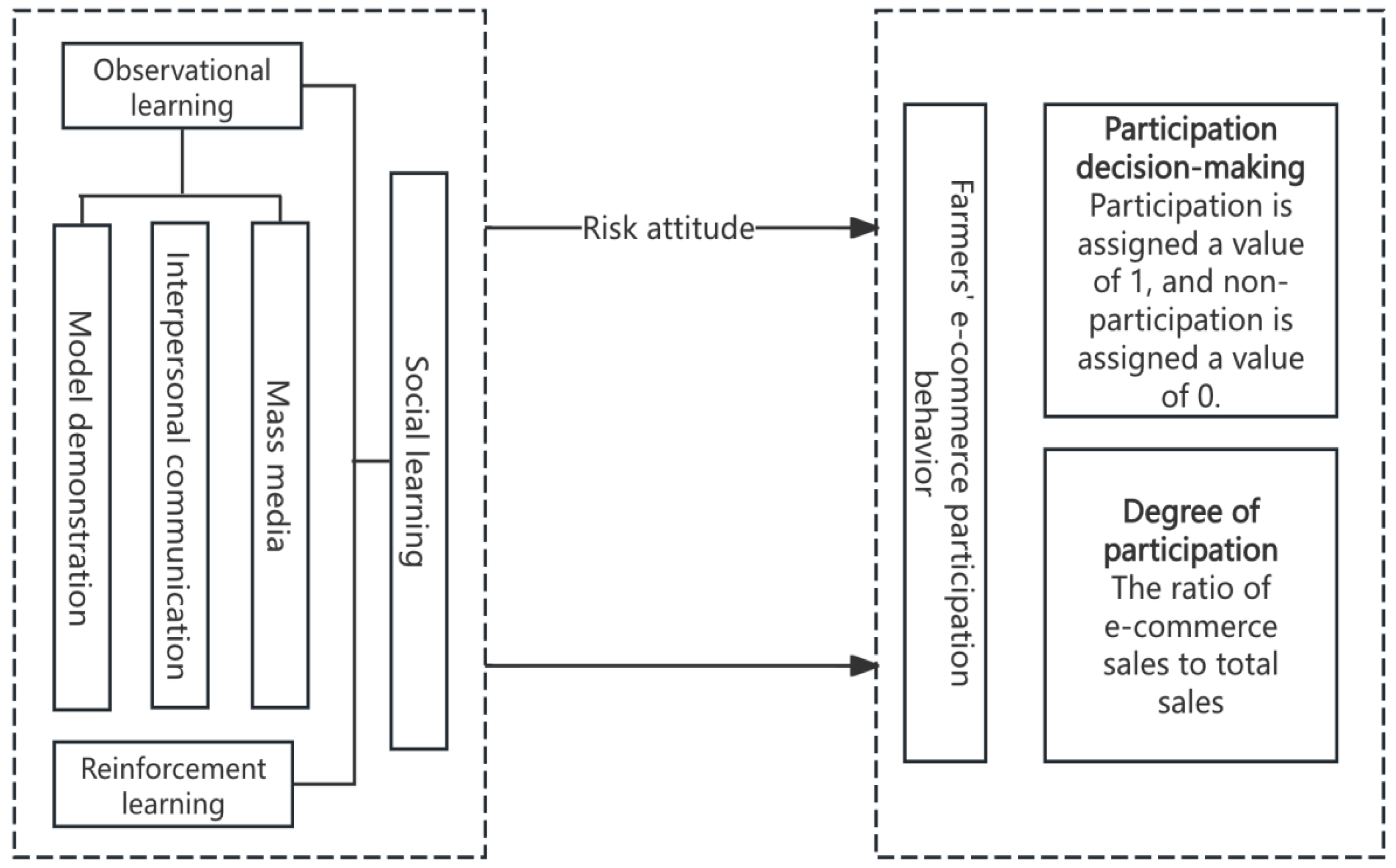
Table 2.
Risk attitude measurement items.
| Risk attitude | Measurement items | Assignment |
| Extremely risk-avers | Certainly getting 1,000 CNY | 1 |
| Relatively risk-averse | A 50% chance of getting 900 CNY, and a 50% chance of getting 1,600 CNY |
2 |
| Risk neutral | A 50% chance of getting 800 CNY, and a 50% chance of getting 2,000 CNY |
3 |
| Relatively risk-preferring | A 50% chance of getting 400 CNY, and a 50% chance of getting 3,000 CNY |
4 |
| Strongly risk-preferring | A 50% chance of getting 0 CNY, and a 50% chance of getting 4,000 CNY |
5 |
Source: Authors’ proposal.
Table 3.
Benchmark regression results.
| Variable | (1) Part-d | (2) Part-d | (3) Part-l | (4) Part-l |
| Social | 13.2714*** | 10.3064*** | 0.4946*** | 0.4318*** |
|
gender |
(1.8298) | (0.8770) | (0.0947) | (0. 1053) |
| 1.1985*** | 0.2497 | -0.0719*** | -0.0707*** | |
| (0.3019) | (0. 1665) | (0.0237) | (0.0255) | |
| age | -0.0446*** | 0.0337*** | 0.0025 | 0.0032* |
| (0.0163) | (0.0084) | (0.0019) | (0.0018) | |
| educ | 0.1419 | -0.3069** | -0.0172 | -0.0232 |
| fnum | (0.2808) | (0. 1309) | (0.0263) | (0.0288) |
| -0.1764 | -0.0364 | -0.0213** | -0.0188* | |
| Income | (0. 1127) | (0.0526) | (0.0105) | (0.0106) |
| 0.1097*** | -0.0303 | 0.0074** | 0.0066* | |
| conv | (0.0339) | (0.0196) | (0.0034) | (0.0037) |
| 3.3000*** | 0.4693*** | 0.0501 | 0.0211 | |
|
Parent-educ |
(0.5498) | (0.2914) | (0.0461) | (0.0340) |
| — | — | 1.4701*** | — | |
| — | — | (0.3965) | — | |
| Sample size | 327 | 327 | 327 | 124 |
| R2 | 0.784 | — | — | 0.3533 |
| Model | Probit | IV-Probit | Heckman-twostep | OLS |
| Constant term | -23.5345*** | -9.2827*** | -0.1501 | 0.0252 |
| (3.5474) | (1.8961) | (0.2694) | (0.2063) |
Note: ***, **, and * indicate significance at the 1%, 5%, and 10% levels, respectively. Robust standard errors are in parentheses. Source: Authors’ proposal.
Table 4.
Comparison of the impact degrees of the four dimensions of social learning.
| Variable | (1) part_d |
(2) Part_l |
| Model demonstration | 0.192 | 0.003 |
| (0.769) | (0.010) | |
| Interpersonal communication |
5.578* | 0.073** |
| (2.239) | (0.013) | |
| Mass media |
6.768** | 0.074** |
| (2.319) | (0.014) | |
| Reinforcement learning |
-0.994 | 0.013 |
| (0.808) | (0.008) | |
| gender | 4.083* | -0.003 |
| (1.828) | (0.014) | |
| age | -0.094 | 0.000 |
| (0.066) | (0.001) | |
| educ | 0.065 | -0.003 |
| (0.874) | (0.014) | |
| fnum | -0.468 | -0.016* |
| (0.595) | (0.006) | |
| conv | 9.361** | 0.107** |
| (2.589) | (0.011) | |
| income | 0.074 | 0.002 |
| (0.143) | (0.002) | |
| cons | -81.651** | -0.772** |
| (22.721) | (0.093) |
Note: ***, **, and * indicate significance at the 1%, 5%, and 10% levels, respectively. Robust standard errors are in parentheses. Source: Authors’ proposal.
Table 5.
Results of the robustness test.
| Variable | (1) Part-d: Replacing the Logit model |
(2) Part-l:Winsorization |
(3) Part-d:Supplementary variables |
(4) Part-l:Supplementary variables |
| Social | 23.8359*** | 0.0649*** | 13.6482*** | 0.5488*** |
| (3.837) | (0.0810) | (3.0603) | (0. 1096) | |
| Years of planting | 0.0260 (0.0369) | -0.0015 (0.0018) | ||
| Planting area | — | — | 0.2632 (0. 1762) | 0.0352*** (0.0124) |
| Control variables | Yes | Yes | Yes | Yes |
| Control for individual effects | Yes | Yes | Yes | Yes |
| Sample size | 327 | 244 | 327 | 327 |
| R2 | 0.788 | 0.601 | — | — |
Note: ***, **, and * indicate significance at the 1%, 5%, and 10% levels, respectively. Robust standard errors are in parentheses. Source: Authors’ proposal.
Table 7.
Results of the mechanism test.
| Variable | (1)Part-l | (2)Risk | (3)Part-l |
| Social | 0.7314*** | 4.4297*** | 0.4576*** |
| Risk | (0.0649) | (0.3653) | (0.0844) |
| — | — | 0.0617*** | |
| Control variables | Yes | Yes | (0.0128) Yes |
| Control for individual effects | Yes | Yes | Yes |
| R2 | 0.625 | 0.585 | 0.668 |
Note: ***, **, and * indicate significance at the 1%, 5%, and 10% levels, respectively. Robust standard errors are in parentheses. Source: Authors’ proposal.
Disclaimer/Publisher’s Note: The statements, opinions and data contained in all publications are solely those of the individual author(s) and contributor(s) and not of MDPI and/or the editor(s). MDPI and/or the editor(s) disclaim responsibility for any injury to people or property resulting from any ideas, methods, instructions or products referred to in the content. |
© 2025 by the authors. Licensee MDPI, Basel, Switzerland. This article is an open access article distributed under the terms and conditions of the Creative Commons Attribution (CC BY) license (http://creativecommons.org/licenses/by/4.0/).
Copyright: This open access article is published under a Creative Commons CC BY 4.0 license, which permit the free download, distribution, and reuse, provided that the author and preprint are cited in any reuse.


