

Submitted:
16 October 2025
Posted:
17 October 2025
Read the latest preprint version here
Abstract
Fish consumption has well-publicised health benefits but, in the United Kingdom, present-day consumption is limited to a narrow range of species. The history of fish consumption remains under-examined yet could provide insights as to why British consumers ended up with such a restricted palette. Using a domestic magazine published over the past century, I examine the prominence of different fish species in published recipes, with the aim to glean insights into changing societal tastes. Sub-sampling of issues published from 1923-2025 provided 1190 fish recipes containing 66 species or species categories. The most frequently mentioned were salmon (n=207), prawns (n=205), haddock (n=112), anchovy (n=108), cod (n=96) and tuna (n=81). Of these, salmon, prawns, anchovy and haddock remained consistently visible throughout the time series. In contrast, mentions of herring, sole and oyster declined while the frequency of tuna and cod mentions increased. While the total number of species per decade did not change over time, fewer species began to dominate published fish recipes from the 1970s, and the composition of species differed significantly in latter decades. These findings suggest that, while some species have a long record of cultural visibility, associated with persistent consumer preferences, the present domination of British cuisine by a narrow range of fish species has limited historical precedence. While sources prevent an explanation of the drivers of change, the timings suggest both market and ecological drivers played a role in the occurrence of fish species within British recipes. Future research should explore whether these patterns persist across a broader selection of sources and determine the relationship between the visibility of fish in published recipes and the strength of consumer preference.
Keywords:
archival research
; domestic cookery
; fish consumption
; food culture
; seafood
1. Introduction
Fish and shellfish provide vital micronutrients and protein to billions of people around the world, but the quantities of fish consumed per capita is uneven (FAO 2024). Despite rapid increases in global fish production over the past century, many nations do not consume enough fish per capita to meet healthy eating guidelines (Harrison et al. 2023; Willett et al. 2019). In the United Kingdom, the average consumption of fish per capita does not meet national health guidance (Harrison et al. 2023; Thurstan and Roberts 2014), while consumers predominately purchase a narrow range of species known as the ‘Big Five’ (Future Foundation 2014; Tetley 2016). The ‘Big Five’ are comprised of cod (Gadus morhua), haddock (Melanogrammus aeglefinus), salmon (Salmo salar), prawns/shrimp (multiple species including Crangon and Panaeus spp.) and tuna (Thunnus and Katsuwonus spp.). Archaeological and historical sources demonstrate that cod, salmon and haddock have been a part of the British diet for centuries (Harland et al. 2016; Locker 2016), but these are now mostly imported or, in the case of salmon, sourced from aquaculture operations. Tuna, shrimp and prawn products are almost entirely imported (Harrison et al. 2023; Heard et al. 2025). Meanwhile, many fish and shellfish sourced in British waters are exported to markets abroad (Löfstedt et al. 2025).
Information on fish consumption trends exist at national and regional scales. In the United Kingdom these include consumer (e.g. Kantar 2025; Seafish 2018), retail/marketing (e.g. Future Foundation 2014), and government commissioned surveys (e.g. the National Food Survey, now Family Food statistics; Defra 2017). Over a century of fishery landings and import/export data additionally provide indirect evidence of long-term fish consumption trends. These suggest that British consumers historically failed to meet recommended levels of fish consumption, except for a few years post-World War II when fish protein temporarily replaced the more heavily rationed terrestrial protein supplies (Harrison et al. 2023; Thurstan and Roberts 2014).
Increasing research into the drivers and barriers of fish consumption has occurred in recent years (e.g. Boase et al. 2019; Govzman et al. 2021; Rathnayaka et al. 2025). Demand for fish is known to differ across countries and cultures and is driven by multiple factors. Within the United Kingdom, taste and income level play an important role in the quantity of fish and the choice of fish products consumed at home (Govzman et al. 2021; Rathnayaka 2025), as does the presence of children in a household, age, occupation, and the convenience, familiarity with, and price of the product (Garibay-Yayen and Willer 2025a; Menozzi 2020; Supartini et al. 2018). The visibility of products through, for example, in-store and online displays, sampling opportunities, and promotions, has also been found to positively influence purchasing choice, although our understanding of how such strategies affect the purchase of fish products is more limited (Garibay-Yayen and Willer 2025b; Lawley et al. 2016). Cookery columns, marketing campaigns, government interventions, and celebrity chefs also influence what food products people are exposed to, although our understanding of their influence on consumption preference and choices is also lacking (Garnett et al. 2015; Proesmans et al. 2022; Wilcox 2024).
An under-developed area of research is when and why contemporary patterns of fish consumption developed and to what extent the past influences consumption choices today (Chaloner 1966; Franklin 1997; Rude 2025). Datasets on consumer purchasing behaviour are typically collated over short timescales (e.g. Future Foundation 2014) or, where longer-term datasets exist, details of the fish products consumed are not highly resolved (e.g. Defra 2017). Knowledge of how fish consumption has shifted across generations, and to what extent consumption norms and traditions passed down from older generations, or how habits ingrained in early life influence consumption choices, remains far more limited (Carstairs et al. 2017a,b; Walker et al. 2025).
Recipes have been published in book form for centuries (Notaker 2017) and became a feature of domestic magazines and newspapers, typically within women’s pages, from the 19th century onwards (Warde 1997). These sources function as a link to past and present domestic spheres and the people (often women or domestic workers) who played a crucial role in determining consumption choices, both of which are largely invisible within formal historical records (Andrews et al. 2023; Bishop 2023). Scholars have argued that cookery columns and books are (were) created not only to provide helpful and practical information to the reader (Rude 2025; Warde 1997), but that they also set societal standards and aspirations in the performative act of preparing and presenting food (Andersson and Eriksson 2022; McKie and Wood 1992). These sources, therefore, while they may propagate an idealised version of reality, are likely to reflect the prevalent attitudes and practices of their readership at the time of publication (Barnes 2019; Kitch 2018). The study of these columns can thus illuminate past food cultures and changing societal tastes, for example, consumption norms, traditions and attitudes associated with food (e.g. Keating and Mac Con Iomaire 2018). Supporting this, a study of New Zealand cookbooks published in the mid-20th century showed that the content of these books reflected national concerns and changes in emphasis around nutrition during the same period (Mitchell 2008). A study by Eidner et al. (2013) showed that the calorific content of popular recipes in a series of Danish cookbooks, published throughout the 20th century, increased alongside rates of obesity in the Danish population.
The fish species most frequently represented within menus or recipes are likely to be those that are readily available, species that consumers prefer the taste of, and/or are associated with culinary traditions. Changes in the frequency of species representation may be associated with changes in their availability due to ecological and environmental drivers (Jones 2008; Ng and Cheung 2022; Rude 2025; Van Houten et al 2013). For example, changes to the fish species listed in Hawaiian restaurant menus reflected changes in regional fishery landings and hence availability of fish over the same 50-year period (Van Houten et al 2013). Alternatively, changes in the representation of species can be the result of shifting consumer demand driven by political, societal or cultural events (Levin and Dufault 2011). For example, the consumption of rare or higher trophic-level fish species can become viewed as a symbol of wealth or high social status (Fabinyi 2012), or conversely, consumption of certain fish products may be viewed as symbols of lower social status (e.g. the British working class’s long association with fried fish and chips; Walton 1992). Ecological and social drivers also interact, as was the case with the eastern oyster (Crassotrea virginica) in the USA, which became less prevalent in published recipes during the 20th century due a combination of overharvesting and pollution scares. Both harvesting and pollution pressures influenced the availability and price of oysters and consumer perceptions, but in complex ways dependent on the method by which oysters were processed and sold, and who was consuming them (Rude 2025). Analysis of the changing prices of fish on restaurant menus has also highlighted the complex links between consumer demand and resource availability (Jones 2008).
While cookery columns and the recipes they published cannot directly inform us of what people were eating in the past, they illuminate the species and products that readers were exposed to via editorial and writers’ choices. The writers of these columns expected readers to have access to these species (or to aspire to access these species) and anticipated their readers would be interested in and willing to buy, cook and consume these species. Their representation in cookery columns is thus likely to reflect societal norms and traditions around fish consumption, while changes observed may reflect changing consumer preferences, species declines or reduced availability, and/or the introduction of new species or products.
Here, I investigate patterns in the representation of different fish species within recipes published in a British domestic magazine over a period of one-hundred years. In analysing the frequency of occurrence of fish species in published recipes, I aim to uncover trends in their representation through time and thus changes in the rates of exposure of past readers of this column to different fish species. Analysis of these recipes will generate insights into historical preferences and thus support the generation of testable hypotheses that seek to uncover historical and intergenerational trends in fish consumption, an underexplored area of research.
I hypothesise that changes in the occurrence of fish species in published recipes will shift from a greater number of species that were historically sourced from national fleet landings, to being dominated by fewer, imported species, namely, ‘the Big Five’.
2. Methods
2.1. Research Context and Sources
Cookery books containing recipes and explanations for how to prepare, cook and present food products have been published for centuries, but many of these exist in isolation or were published only sporadically. In contrast, cookery and domestic columns in newspapers and magazines published recipes on a semi-regular basis. The 19th century was a period of technological and social transformation in Britain: education became increasingly available, and literacy standards among women and the working class improved (Warde 1997). The aspirational lower and middle classes became important consumers of print media, with some newspapers publishing sections marketed specifically at women and/or domestic staff, which included recipe suggestions. Towards the end of the 19th century increasing quantities of print media started to be produced for the domestic sphere, and newspapers and magazines dedicated to home life, including cookery, proliferated.
The serial ‘British Good Housekeeping’ was first published in 1922 on a rolling monthly basis, following the format of its United States namesake. Today, the serial continues to publish monthly issues as ‘Good Housekeeping UK’. The serial was originally aimed at middle-class housewives, and included recipes, explanations and tips relating to cookery and other domestic chores, product advertisements and reviews. Digitised copies of British Good Housekeeping (hereafter named ‘Good Housekeeping’) published from 1922-2025 were sourced through the Proquest (2025) and the PressReader (2025) databases.
2.2. Data Extraction
Beginning in the 1920s, issues published in three consecutive years of each decade were searched, specifically the years ending in -3, -4 and -5. An exception was made for the 1940s, as the years 1945-6 were missing from the archive. Instead, recipes from 1947-1949 were collated. Issues published from 2003-05 were unable to be accessed and hence this decade was not included in the analysis.
To search Good Housekeeping UK issues available from the Proquest database (1922-2005), the following search string was applied, with searches taking place between 9-27 September 2025.
((fish OR seafood OR shellfish OR anchovy OR “Arbroath smokie” OR bass OR bream OR brill OR bloater OR carp OR catfish OR cod OR coley OR conger OR crab OR crawfish OR crayfish OR dogfish OR dory OR eel OR flounder OR grayling OR gurnard OR gurnet OR haddock OR herring OR hoki OR kedgeree OR kipper OR lobster OR mackerel OR megrim OR “mock turtle” OR monkfish OR mullet OR mussels OR octopus OR oyster OR perch OR pike OR pilchard OR plaice OR pollock OR pollack OR prawn OR roach OR salmon OR saithe OR sardine OR scallop OR “scotch woodcock” OR shrimp OR skate OR smelt OR sole OR “solomon gundy” OR sprat OR stargazy OR “starry gazy” OR sturgeon OR squid OR swordfish OR tench OR tilapia OR trout OR turbot OR tuna OR tunny OR whitebait OR whiting) AND (recipe OR ingredient)).
Due to differences in database search capability, the issues extracted from the PressReader database (Dec 2022-November 2025, the latest issue to be published at the time of data extraction) were read in full.
Recipes that named fish, shellfish, or fish parts as an ingredient or as a viable substitution, were extracted for analysis. Species occurrence was recorded when a fish species was named as an ingredient or as a suitable substitution, thus creating a presence-absence species matrix.
2.3. Data Analysis
To analyse changes in species representation through time, the frequency of occurrence was compared across decades by calculating the proportion of recipes containing each species per decade. Interdecadal differences in the composition of represented species were analysed using the following measures: (a) species richness (with rarefaction applied to standardize richness to the smallest sample size among decades), (b) Simpson’s Diversity Index (1 – D; range 0-1) was calculated using all species mentions per decade as a denominator, with higher values indicating a more even distribution of species across recipes, and (c) permutational multivariate analysis of variance (PERMANOVA; 999 unrestricted permutations) based on Bray–Curtis dissimilarities. For (a) and (b), statistical significance was tested using linear regression analysis. For (c) non-metric multidimensional scaling was performed to assess the overall structure of the community data and to calculate dissimilarities. Pairwise comparisons between decades identified which decades differed significantly, with p-values adjusted for multiple comparisons using the Bonferroni correction.
All analyses were carried out in R version 4.5.1 (R Core Team 2025). Simpson’s index was calculated using the diversity function in the ‘vegan’ package (Oksanen et al. 2025). Rarefied richness was calculated using the rarefy function from the ‘vegan’ package, using the number of recipes per decade as the sampling unit. Permutational multivariate analysis of variance was calculated using the adonis2 function in the ‘vegan’ package (Oksanen et al. 2025). The R package “ggplot2” was used for figure creation (Wickham 2016).
3. Results
Thirty years of magazine issues published between 1923 and 2025 were sampled, from which, 1,190 recipes containing fish or shellfish were extracted, equating to a mean of 40 published fish recipes year-1, or 3.3 recipes issue-1. The greatest number of recipes containing fish (n = 180) were published in the 2000s, with the lowest number (n = 63) published in the 1940s (Table 1). On average, each recipe mentioned 1.3 species (range: 1-10), either as listed ingredients or recommended as substitutions. The total number of species mentioned per decade ranged from 19-36 species. Throughout the timeseries 66 species were identified, nearly half of which (n=29) were initially mentioned in the first decade of publication (Table 1).
The species with the most frequent mentions throughout the time series were salmon (n recipes=207; % recipes=17%), prawns (n=205; 17%), haddock (n=112; 9%), anchovy (multiple species from the Engraulidae family) (n=108; 9%), cod (n=96; 8%) and tuna (n=81; 7%). Species groups that were more frequently mentioned in earlier decades but then declined included sole (most likely Solea solea, but could include species from the Soleidae, Pleuronectidae and Scophthalmidae families), herring (Clupea harengus) and oyster (Ostrea or Crassostrea spp.) (Figure 1).
The ‘Big Five’ species groups (salmon, prawns and shrimp, cod, haddock and tuna) were represented throughout the time series but became more dominant (>60% of species mentions) from the 1970s onwards (Figure 2a). In contrast, flatfish mentions declined throughout the time series (Figure 2b). Forage fish displayed differing trends among species, with anchovies maintaining a frequent presence in recipes through time, and mackerel (Scomber scombrus) exhibiting an increasing frequency, in contrast to herring (Figure 2c). In terms of shellfish occurrence, mussels (Mytilus edulis) increased in frequency whereas oysters declined (Figure 2d).
Rarefied species richness showed a declining, but non-significant, trend over time (linear regression β = -0.063 ± 0.030 species per decade, t₈ = -2.09, p = 0.071; Figure 3a). The linear model explained 35% of the variation in richness (R² = 0.35, adjusted R² = 0.27), suggesting most of the variation came from within-decade rather than across decade variability. In contrast, Simpson’s Diversity showed a statistically significant declining trend (β = -0.00067 ± 0.00022, t₈ = -3.03, p = 0.016; Figure 3b) while the linear model explained 53% of the variation (R² = 0.53, adjusted R2 = 0.48). Non-metric multidimensional scaling ordination revealed a statistically significant separation of community composition among decades (PERMANOVA: F₉,₁₁₈₀ = 5.98, R² = 0.044, p = 0.001). Pairwise tests indicated significant differences in species composition among multiple decades (Table S1, Appendix A), suggesting that species assemblages changed over time. After Bonferroni correction, early decades (1920s–1930s) were shown to differ significantly from later decades (1970s–2000s; adjusted p ≤ 0.045), while the post-war decades (1940/1950) were also quite distinct in terms of their species composition. In contrast, adjacent decades were rarely significantly different from each other after correction (Table S1).
4. Discussion
There is increasing interest in promoting consumption patterns that support human health and environmental sustainability, while ensuring food security for a growing global population in an era of rapid climate change (Garcia et al. 2020; Springmann et al. 2021; Stentiford et al. 2020). Fish products are considered healthy sources of protein and provide essential micronutrients (Golden et al. 2021; Hicks et al. 2019), but concerns remain for the sustainability of fish stocks that are poorly managed or caught/cultured using methods that physically disturb habitats (Chávez et al. 2019; Hiddink et al. 2017). In the United Kingdom, a narrow range of species dominates consumer purchases (Tetley 2016). These species are mostly imported or sourced using industrialised production or non-selective fishing methods, with associated environmental impacts. For example, shrimp aquaculture is a major source of mangrove deforestation and coastal pollution in the tropics (Thomas et al. 2017; Wang et al. 2020), while demersal trawl fisheries for cod, haddock and prawns can generate high levels of bycatch (Larsen et al. 2021).
The drivers behind fish consumption are many and complex. Consumption patterns are driven by individual preferences, cultural norms, and systemic factors that control the availability, accessibility and exposure of consumers to fish products (Richter and Klöckner 2017). The publication of recipes with magazines, books or online media is also embedded within, responds to, and drives cultural and counter-cultural norms and expression (Barnes 2019; Floyd and Forster 2003; Forster 2023). While published recipes cannot tell us what people were eating in the past, they are indicative of past cultures and provide a window into the fish species that readers were exposed to via this medium, while the longevity of these publications allows us to explore trends in the representation and visibility of fish products beyond living memory (Franklin 1997; Harland et al. 2016; Locker 2016; Rude 2025).
This research sub-sampled fish recipes published within a British domestic magazine over the course of the past century. The findings present evidence of significant changes in the composition and frequency of fish species represented over time. From the 1920s to the 1960s, except for prawns and shrimp, few fish species dominated the sampled recipes (Figure 1). A shift was observed from the 1970s onwards, at which point fewer species began to dominate fish recipes. The species that dominate recipes in more recent years reflect those most frequently consumed in the UK today (the ‘Big Five’) (Figure 1). However, the observed decline of species richness and diversity in recipes (Figure 3) was not simply due to the increasing domination of a few species, but also because species such as sole, oyster and herring, which were prominently featured in the early decades, were rarely mentioned or disappeared entirely from recipes in later decades (Figure 2).
The loss of oysters and herring follows declines in these species and fisheries in regional waters (Coull 1988; Thurstan et al. 2024), but as oysters and herring remain available for consumption via imported or farmed products, we cannot state that the decline in representation was driven simply by ecological change. In contrast, the representation of species such as cod and haddock, which have also declined in home waters, was maintained. The availability of these species is due to an increased reliance upon imports since the 1970s (Harrison et al. 2023; Heard et al. 2025), hence their continued representation within recipes reflects long-standing and persistent consumer preferences for these traditionally consumed species, not ecological trends.
During the post-World War II years people relied on fish as a protein source during rationing and so more fish was consumed (Harrison et al. 2023), but rates of consumption swiftly declined once rationing was halted (Franklin 1997). As such it has been proposed that the British simply do not like, and have possibly never liked, fish (Franklin 1997). However, while the post-War period is an outlier in terms of fish quantities consumed, the representation of a wide range of fish species in recipes occurred from the beginning of the time series and persisted until the 1960s. This change suggests that today’s narrow consumer preferences have limited historical precedence and presents an intriguing possibility that present-day consumption patterns may not be as highly ingrained or as inflexible as is often assumed. Further research is thus required to uncover the historical events that underlie present-day patterns of consumption and apply these lessons to current consumption challenges.
These sources present certain limitations in terms of their analysis and interpretation. The extent to which historical representation of fish species within these columns mirrored consumption trends requires further research. Additionally, drivers of change cannot be derived from these sources alone. It must also be recognised that any published serial reflects their intended readership, which in this case is (was) British, female and middle-class. Therefore, a single source cannot represent the full strata of a society. The potential drivers behind changes in the cultural representation of fish species in the British context have been discussed, but real-world changes in the availability of species can also be masked when recipes reflect societal aspirations rather than product availability (Rude 2025), if species are sourced from further afield (Kirby 2004), or are replaced by different species using the same name. For example, the description ‘prawns’ in British recipes can refer to multiple species, from cold-water prawns caught in wild-capture fisheries to those produced by tropical aquaculture operations.
Unlike restaurant menus, which are often assumed to reflect the local availability of species (e.g. Ng and Cheung 2022; Van Houten et al. 2013), cookery columns within magazines and newspapers are generally directed at a much wider readership. This necessarily masks regional and societal variation but also presents us with a broad view of the cultural acceptability and availability of species to the public. The findings of this study thus lay the groundwork for future research that seeks to expand these analyses to a wider selection of sources and determine the relationship between the cultural visibility of fish species within published recipes and the strength and persistence of consumer preference.
5. Conclusions
This study found that the narrow range of fish species preferentially consumed within the United Kingdom since the 1970s is reflected in concurrently published recipes. In contrast, early and mid-20th century recipes illustrate a broader and more even representation of fish species, which suggests that consumer preferences for a limited number of species are only recently culturally ingrained. This raises questions as to the extent to which the cultural visibility of species within popular media drives consumer preferences and vice versa. It also raises questions about the historical drivers and plasticity of present-day domestic food choices, research into which could help provide answers to the complex challenge of promoting sustainable fish consumption choices.
Declaration of generative AI and AI-assisted technologies in the manuscript preparation process
During the preparation of this work the author used ChatGPT to fault find and streamline R code generated for statistical testing. After using this tool, the author reviewed and edited the content as needed and takes full responsibility for the content of the published article.
Supplementary Materials
The following supporting information can be downloaded at the website of this paper posted on Preprints.org.
Acknowledgements
This research did not receive any specific grant from funding agencies in the public, commercial, or not-for-profit sectors. The author thanks Lee Raby for helpful suggestions during analysis and writing of the manuscript.
References
- Andersson, H.; Eriksson, G. The masculinization of domestic cooking: a historical study of Swedish cookbooks for men. NORMa: NORMA: International Journal for Masculinity Studies 2022, 17, 252–269. [CrossRef]
- Andrews, M.; Lomas, J.; Muggeridge, A. Homes, food and domesticity: rethinking the housewife in twentieth century Britain. Women's Hist. Rev. 2023, 33, 451–456. [CrossRef]
- Barnes, L. Change of Diet: Recipes Seasoned with Social History. J. Mag. Media 2019, 20, 1–13. [CrossRef]
- Bishop, S.Z. Using women’s memories of food in intercultural households to locate female agency and evolving cultural identities in Leicester, England, 1960–1995. Women's Hist. Rev. 2023, 33, 535–553. [CrossRef]
- Boase, N.J.; White, M.P.; Gaze, W.H.; Redshaw, C.H. Why don't the British eat locally harvested shellfish? The role of misconceptions and knowledge gaps. Appetite 2019, 143, 104352. [CrossRef]
- Carstairs, S.A.; Craig, L.C.; Marais, D.; Kiezebrink, K. Factors influencing mothers' decisions on whether to provide seafood during early years’ feeding: A qualitative study. Appetite 2017, 108, 277–287. [CrossRef]
- Carstairs, S.A.; Marais, D.; Craig, L.C.; Kiezebrink, K. How important are the influencing factors to the decision on whether to provide seafood in infant and young child feeding?. Appetite 2017, 117, 224–233. [CrossRef]
- Chaloner WH (1966) Trends in fish consumption. In: Barker TC, McKenzie JC, Yudkin J (Eds) Our Changing Fare: Two Hundred Years of British Food Habits. Macgibbon and Kee, London, pp. 94-114.
- Chávez, C.; Dresdner, J.; Figueroa, Y.; Quiroga, M. Main issues and challenges for sustainable development of salmon farming in Chile: a socio-economic perspective. Rev. Aquac. 2019, 11, 403–421. [CrossRef]
- Coull JR (1988) The North Sea herring fishery in the twentieth century. Ocean Yearbook Online 7, 115-131.
- Defra (2017) Family Food 2015: a National Statistics publication. Department for Environment, Food and Rural Affairs, London. 48 pp.
- Eidner, M.B.; Lund, A.-S.Q.; Harboe, B.S.; Clemmensen, I.H. Calories and portion sizes in recipes throughout 100 years: An overlooked factor in the development of overweight and obesity?. Scand. J. Public Heal. 2013, 41, 839–845. [CrossRef]
- Fabinyi, M. Historical, cultural and social perspectives on luxury seafood consumption in China. Environ. Conserv. 2011, 39, 83–92. [CrossRef]
- FAO (2024) The state of world fisheries and aquaculture. Food and Agriculture Organisation of the United Nations, Rome. 264 pp.
- Floyd J, Forster L (2003) The Recipe Reader: Narratives - Contexts - Traditions (1st ed). Routledge, Taylor & Francis Group, London. 257 pp.
- Forster L (2023) The cookbook as a responsive form. Food and Foodways 31, 242–250.
- Franklin, A. An unpopular food? The distaste for fish and the decline of fish consumption in Britain. Food Foodways 1997, 7, 227–264. [CrossRef]
- Future Foundation (2014) Our future with fish: investigating consumer attitudes, behaviours and motivations. Sainsbury’s Supermarkets Ltd, London.
- Garcia, S.N.; Osburn, B.I.; Jay-Russell, M.T. One Health for Food Safety, Food Security, and Sustainable Food Production. Front. Sustain. Food Syst. 2020, 4. [CrossRef]
- Garibay-Yayen JBB, Willer D (2025a) Patterns, barriers, and drivers to the consumption of under-loved seafood species and parts in the United Kingdom. Appetite 214, 108196. [CrossRef]
- Garibay-Yayen JBB, Willer D (2025b) Exploring the representation of seafood species and parts in the online landscape. Journal of Foodservice Business Research 1–28. [CrossRef]
- Garnett T, Mathewson S, Angelides P, Borthwick F (2015) Policies and actions to shift eating patterns: What works? A review of the evidence of the effectiveness of interventions aimed at shifting diets in more sustainable and healthy directions. Food Climate Research Network, Environmental Change Institute & The Oxford Martin Programme. Chatham House, The Royal Institute of International Affairs. 85 pp.
- Golden, C.D.; Koehn, J.Z.; Shepon, A.; Passarelli, S.; Free, C.M.; Viana, D.F.; Matthey, H.; Eurich, J.G.; Gephart, J.A.; Fluet-Chouinard, E.; et al. Aquatic foods to nourish nations. Nature 2021, 598, 315–320. [CrossRef]
- Good Housekeeping, British ed (1922-2025, various dates). Hearst Magazines UK, London. Last accessed 01 October 2025. https://www.proquest.com and https://www.pressreader.com/.
- Govzman, S.; Looby, S.; Wang, X.; Butler, F.; Gibney, E.R.; Timon, C.M. A systematic review of the determinants of seafood consumption. Br. J. Nutr. 2020, 126, 66–80. [CrossRef]
- Harland JF, Jones AKG, Orton DC, Barrett JH (2016) Fishing and fish trade in medieval York: the zooarchaeological evidence. In: Barrett JH, Orton DC (Eds) Cod and herring: the archaeology and history of medieval sea fishing. Oxbow Books, Oxford, pp.172-204.
- Harrison, L.O.J.; Engelhard, G.H.; Thurstan, R.H.; Sturrock, A.M. Widening mismatch between UK seafood production and consumer demand: a 120-year perspective. Rev. Fish Biol. Fish. 2023, 33, 1387–1408. [CrossRef]
- Heard ZFJ, Roberts CM, Thurstan RH (2025) The UK’s expanding global reach for seafood over 120-years. Reviews in Fish Biology and Fisheries 35, 943–961. [CrossRef]
- Hiddink, J.G.; Jennings, S.; Sciberras, M.; Szostek, C.L.; Hughes, K.M.; Ellis, N.; Rijnsdorp, A.D.; McConnaughey, R.A.; Mazor, T.; Hilborn, R.; et al. Global analysis of depletion and recovery of seabed biota after bottom trawling disturbance. Proc. Natl. Acad. Sci. 2017, 114, 8301–8306. [CrossRef]
- Hicks, C.C.; Cohen, P.J.; Graham, N.A.J.; Nash, K.L.; Allison, E.H.; D’Lima, C.; Mills, D.J.; Roscher, M.; Thilsted, S.H.; Thorne-Lyman, A.L.; et al. Harnessing global fisheries to tackle micronutrient deficiencies. Nature 2019, 574, 95–98. [CrossRef]
- Jones GA (2008) ‘Quite the choiciest protein dish’: the costs of consuming seafood in American restaurants, 1850-2006. In: Starkey DJ, Holm P, Barnard M (Eds) Oceans Past: management insights from the History of Marine Animal Populations. EarthScan Research Editions, pp. 47-76.
- Kantar (2025) Consumer panel for food, beverages and household products. Last accessed 01 October 2025. https://market.worldpanelbynumerator.com/en/About-us.
- Keating M, Mac Con Iomaire M (2018) Tradition and novelty: food representations in Irish Women’s magazines 1922–73. Food, Culture & Society 21, 488-504. [CrossRef]
- Kirby, M.X. Fishing down the coast: Historical expansion and collapse of oyster fisheries along continental margins. Proc. Natl. Acad. Sci. 2004, 101, 13096–13099. [CrossRef]
- Kitch C (2015) Theory and methods of analysis: models for understanding magazines. In: Abrahamson D, Prior-Miller MR (Eds.) The Routledge Handbook of Magazine Research: The Future of the Magazine Form (1st ed.). Routledge, pp. 9-21.
- Larsen, R.B.; Herrmann, B.; Brčić, J.; Sistiaga, M.; Cerbule, K.; Nielsen, K.N.; Jacques, N.; Lomeli, M.J.M.; Tokaç, A.; Cuende, E. Can vertical separation of species in trawls be utilized to reduce bycatch in shrimp fisheries?. PLOS ONE 2021, 16, e0249172. [CrossRef]
- Lawley, M.; Birch, D.; Johnson, L. Changing purchasing habits through non-monetary point of sale strategies: The case of Australian oysters. J. Retail. Consum. Serv. 2016, 33, 194–201. [CrossRef]
- Levin, P.S.; Dufault, A. Eating up the food web. Fish Fish. 2010, 11, 307–312. [CrossRef]
- Locker A (2016) the decline in the consumption of stored cod and herring in post-medieval and early industrialised England: a change in food culture. In: Barrett JH, Orton DC (Eds) Cod and herring: the archaeology and history of medieval sea fishing. Oxbow Books, Oxford, pp. 99-110.
- Löfstedt, A.; Scheliga, B.; Aceves-Martins, M.; de Roos, B. Seafood supply mapping reveals production and consumption mismatches and large dietary nutrient losses through exports in the United Kingdom. Nat. Food 2025, 6, 244–252. [CrossRef]
- McKie, L.J.; Wood, R.C. People′s Sources of Recipes: Some Implications for an Understanding of Food-related Behaviour. Br. Food J. 1992, 94, 12–17. [CrossRef]
- Menozzi, D.; Nguyen, T.T.; Sogari, G.; Taskov, D.; Lucas, S.; Castro-Rial, J.L.S.; Mora, C. Consumers’ Preferences and Willingness to Pay for Fish Products with Health and Environmental Labels: Evidence from Five European Countries. Nutrients 2020, 12, 2650. [CrossRef]
- Mitchell, J. New Zealand cookbooks as a reflection of nutritional knowledge, 1940–1969. Nutr. Diet. 2008, 65, 134–138. [CrossRef]
- Ng, J.-P.; Cheung, W.W.L. Signature of climate-induced changes in seafood species served in restaurants. Environ. Biol. Fishes 2022, 105, 1463–1474. [CrossRef]
- Notaker H (2017) A history of cookbooks: from kitchen to page over seven centuries. California Studies of Food and Culture. University of California Press, 400 p.
- Oksanen J, Simpson G, Blanchet F, Kindt R, Legendre P, Minchin P, O'Hara R, Solymos P, Stevens M, Szoecs E, Wagner H, Barbour M, Bedward M, Bolker B, Borcard D, Borman T, Carvalho G, Chirico M, De Caceres M, Durand S, Evangelista H, FitzJohn R, Friendly M, Furneaux B, Hannigan G, Hill M, Lahti L, Martino C, McGlinn D, Ouellette M, Ribeiro Cunha E, Smith T, Stier A, Ter Braak C, Weedon J (2025) vegan: Community Ecology Package. R package version 2.7-1. https://CRAN.R-project.org/package=vegan.
- Proesmans, V.L.J.; Vermeir, I.; de Backer, C.; Geuens, M. Food Media and Dietary Behavior in a Belgian Adult Sample: How Obtaining Information From Food Media Sources Associates With Dietary Behavior. Int. J. Public Heal. 2022, 67, 1604627. [CrossRef]
- Proquest (2025) https://www.proquest.com. Last accessed 01 October 2025.
- PressReader (2025) https://www.pressreader.com/. Last accessed 01 October 2025.
- R Core Team. R: A Language and Environment for Statistical Computing; R Foundation for Statistical Computing: Vienna, Austria, 2023. https://www.R-project.org/.
- Rathnayaka, S.D.; Revoredo-Giha, C.; de Roos, B. Demand for fish in Great Britain is driven by household income and taste. Public Health Nutr 2025, 28, 1–30. [CrossRef]
- Richter, I.G.M.; Klöckner, C.A. The Psychology of Sustainable Seafood Consumption: A Comprehensive Approach. Foods 2017, 6, 86. [CrossRef]
- Rude, E. Cookbooks and Menus as Ecological Sources: An Example of the Eastern Oyster. Environ. Hist. 2025, 30, 145–167. [CrossRef]
- Seafish (2018) State of the Nation Study: 2018 UK Report. Seafish, UK.
- Springmann, M.; A Clark, M.; Rayner, M.; Scarborough, P.; Webb, P. The global and regional costs of healthy and sustainable dietary patterns: a modelling study. Lancet Planet. Heal. 2021, 5, e797–e807. [CrossRef]
- Stentiford, G.D.; Bateman, I.J.; Hinchliffe, S.J.; Bass, D.; Hartnell, R.; Santos, E.M.; Devlin, M.J.; Feist, S.W.; Taylor, N.G.H.; Verner-Jeffreys, D.W.; et al. Sustainable aquaculture through the One Health lens. Nat. Food 2020, 1, 468–474. [CrossRef]
- Supartini, A.; Oishi, T.; Yagi, N. Changes in Fish Consumption Desire and Its Factors: A Comparison between the United Kingdom and Singapore. Foods 2018, 7, 97. [CrossRef]
- Tetley S (2016) Why the Big 5? Understanding UK seafood consumer behaviour. PhD Thesis, University of Kent, ID: 54790).
- Thurstan RH (2022) Barriers and drivers of seafood consumption in the United Kingdom. Evidence Statement. Commissioned by the Department for Environment, Food and Rural Affairs, London.
- Thurstan, R.H.; Roberts, C.M. The past and future of fish consumption: Can supplies meet healthy eating recommendations?. Mar. Pollut. Bull. 2014, 89, 5–11. [CrossRef]
- Thurstan, R.H.; McCormick, H.; Preston, J.; Ashton, E.C.; Bennema, F.P.; Cetinić, A.B.; Brown, J.H.; Cameron, T.C.; da Costa, F.; Donnan, D.W.; et al. Records reveal the vast historical extent of European oyster reef ecosystems. Nat. Sustain. 2024, 7, 1719–1729. [CrossRef]
- Thomas, N.; Lucas, R.; Bunting, P.; Hardy, A.; Rosenqvist, A.; Simard, M. Distribution and Drivers of Global Mangrove Forest Change 1996–2010. PLoS ONE 2017, 12, e0179302. [CrossRef]
- Van Houtan, K.S.; McClenachan, L.; Kittinger, J.N. Seafood menus reflect long-term ocean changes. Front. Ecol. Environ. 2013, 11, 289–290. [CrossRef]
- Walker, M.F.; Aldridge, D.C.; Willer, D.F. Drivers and barriers to fish and seafood consumption in the first 1000 days of life. npj Sci. Food 2025, 9, 1–10. [CrossRef]
- Walton JK (1992) Fish and chips and the British working class. Leicester University Press, London. 196 pp.
- Wang, J.; Beusen, A.H.W.; Liu, X.; Bouwman, A.F. Aquaculture Production is a Large, Spatially Concentrated Source of Nutrients in Chinese Freshwater and Coastal Seas. Environ. Sci. Technol. 2020, 54, 1464–1474. [CrossRef]
- Warde, A. Consumption, Food and Taste: Culinary Antinomies and Commodity Culture; SAGE Publications: Thousand Oaks, CA, United States, 1997; ISBN: .
- Wickham H (2016) ggplot2: Elegant Graphics for Data Analysis. Springer-Verlag New York.
- Wilcox M (2024) ‘For the Betterment of the Industry’: The establishment and work of the White Fish Commission, 1936–1939. The Mariner’s Mirror 110, 456–476. [CrossRef]
- Willett, W.; Rockström, J.; Loken, B.; Springmann, M.; Lang, T.; Vermeulen, S.; Garnett, T.; Tilman, D.; DeClerck, F.; Wood, A.; et al. Food in the Anthropocene: the EAT–Lancet Commission on healthy diets from sustainable food systems. Lancet, 2019, 393, 447–492. [CrossRef]
Figure 1.
Proportion of mentions per decade. The 12 most frequently mentioned species categories are listed individually, while the remaining species are listed as ‘Other’. Proportion of species mentions sums to >1 due to an average of >1 species being mentioned per recipe.
Figure 1.
Proportion of mentions per decade. The 12 most frequently mentioned species categories are listed individually, while the remaining species are listed as ‘Other’. Proportion of species mentions sums to >1 due to an average of >1 species being mentioned per recipe.
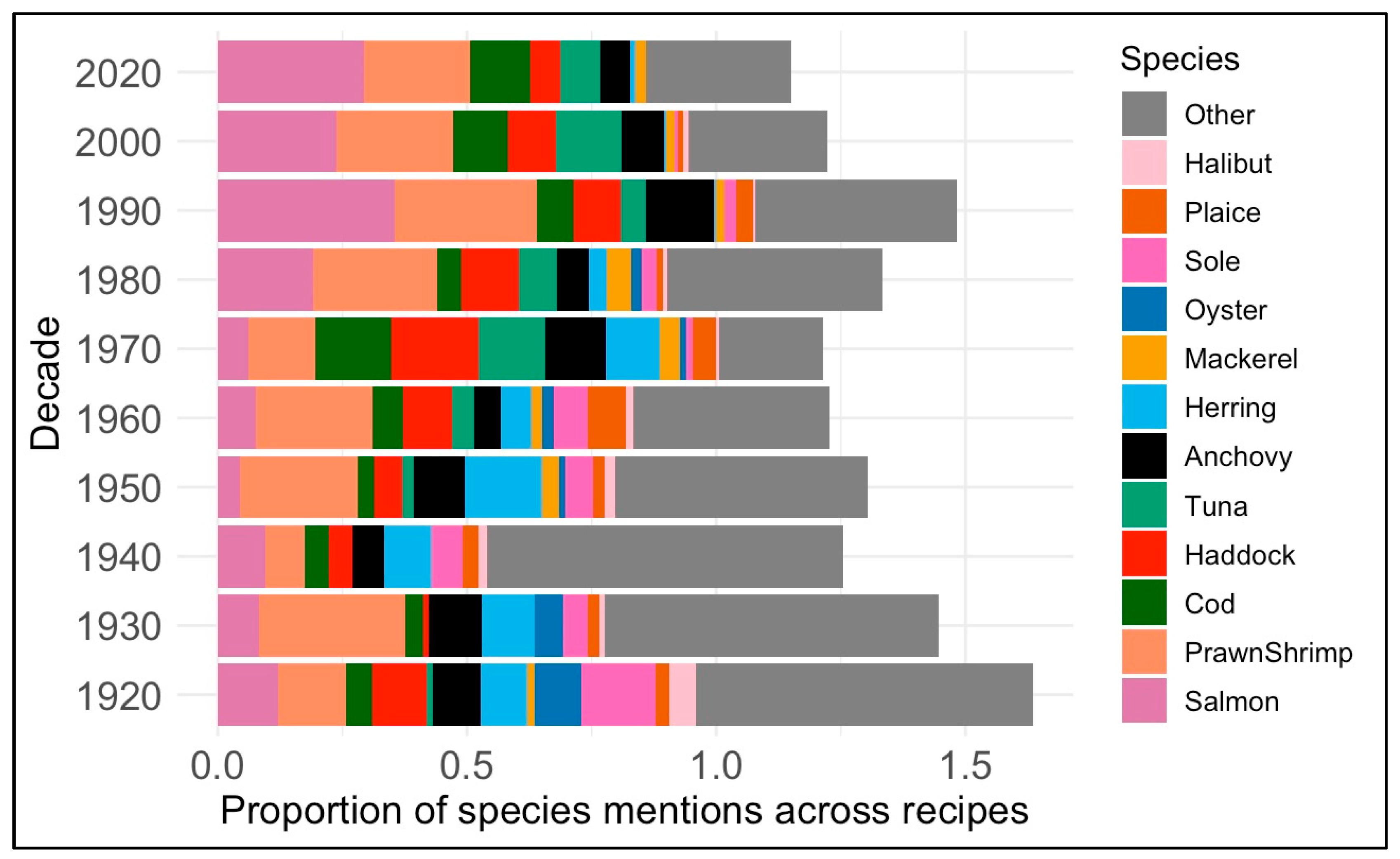
Figure 2.
Proportion of mentions by decade of 18 key species, split into the following groups: (a) Big Five, (b) Flatfish, (c) Forage Fish, (d) Shellfish & Crustacea.
Figure 2.
Proportion of mentions by decade of 18 key species, split into the following groups: (a) Big Five, (b) Flatfish, (c) Forage Fish, (d) Shellfish & Crustacea.
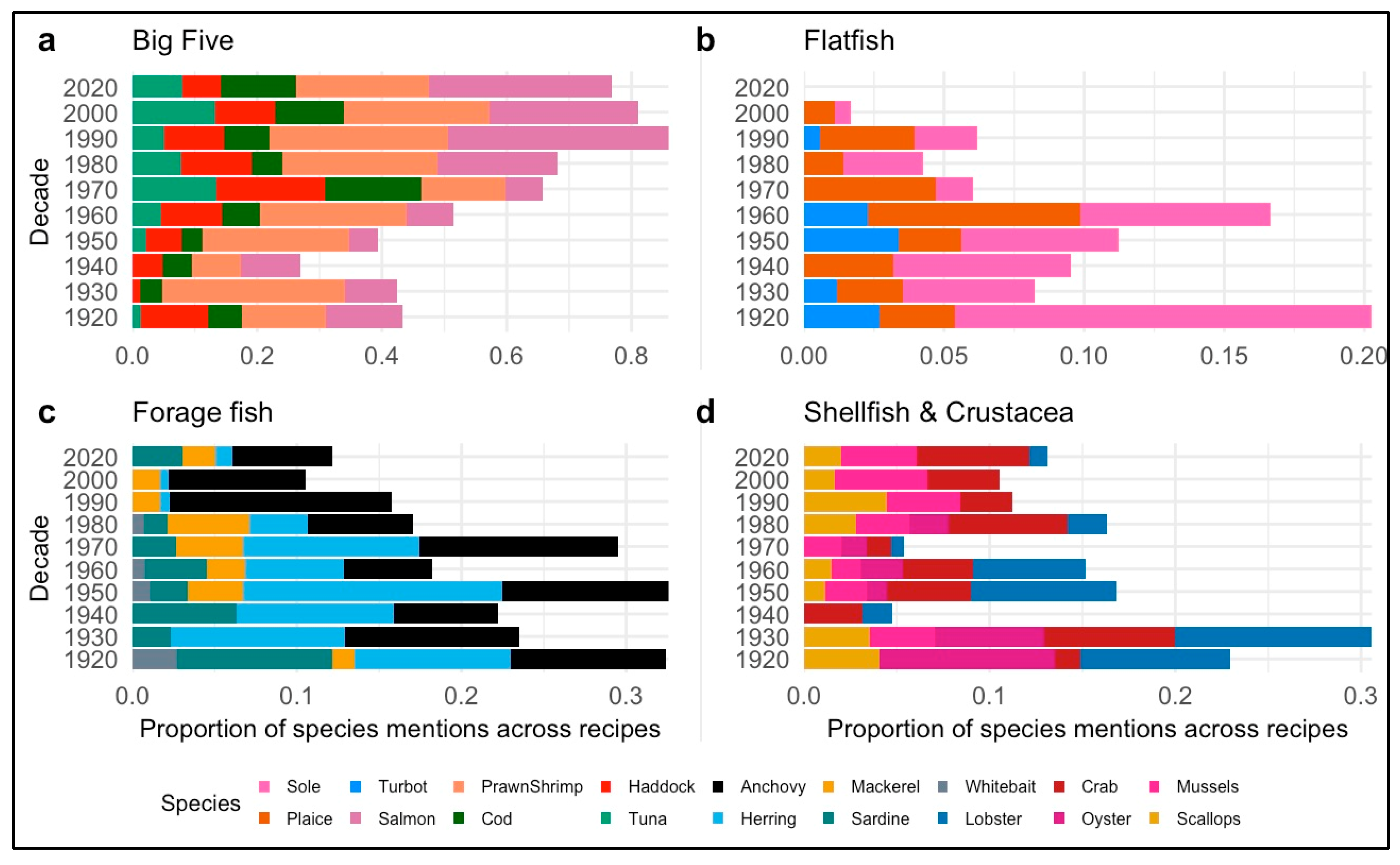
Figure 3.
(a) Rarefied species richness and (b) Simpson’s Diversity Index by decade. Showing decadal data points (blue), linear trend lines (red) and 95% confidence intervals (grey).
Figure 3.
(a) Rarefied species richness and (b) Simpson’s Diversity Index by decade. Showing decadal data points (blue), linear trend lines (red) and 95% confidence intervals (grey).
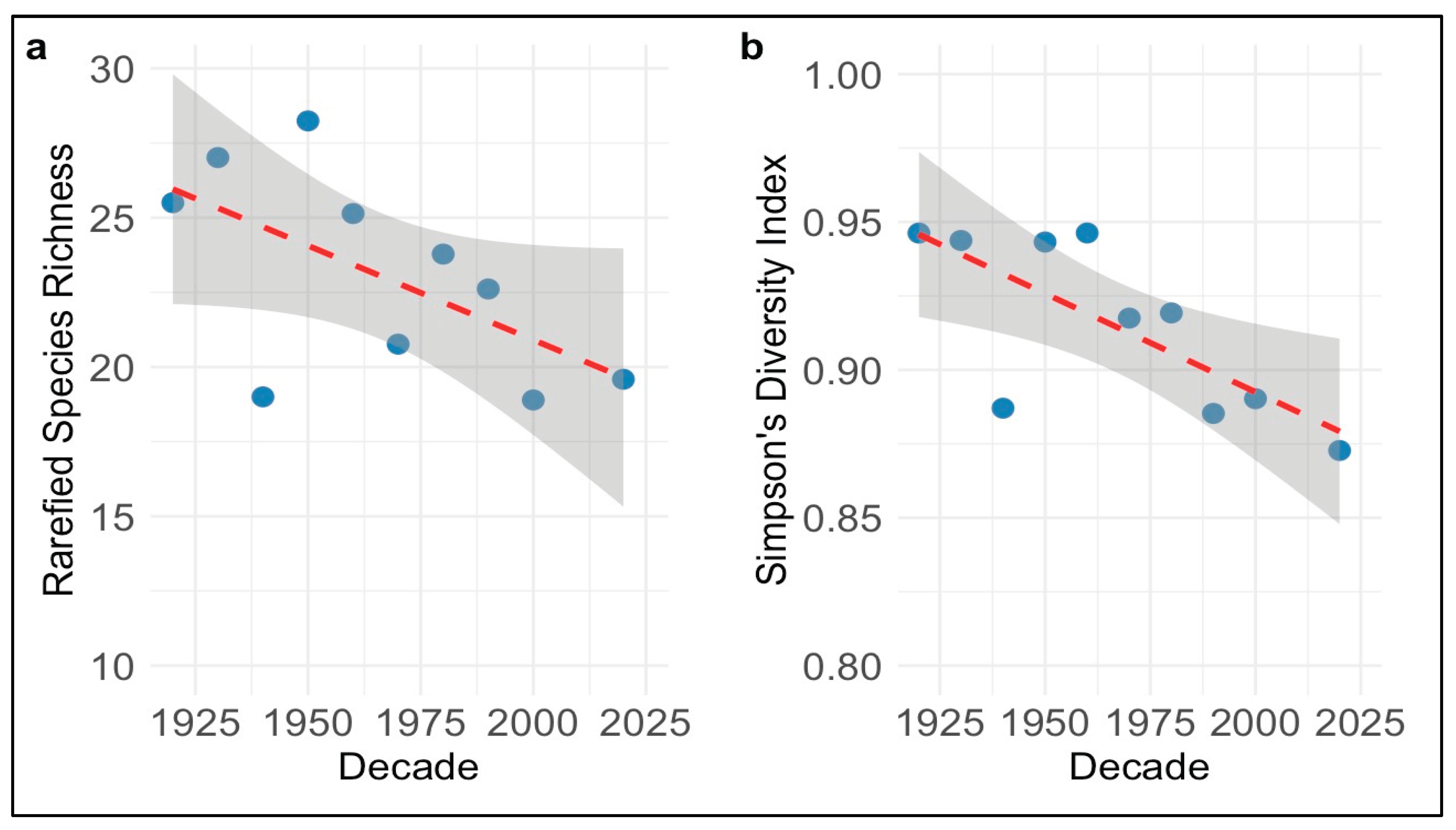

Table 1.
Number of recipes including one or more fish or shellfish species, species occurrences, total number of species, and the number of new species mentioned, per three years sampled for each decade.
Table 1.
Number of recipes including one or more fish or shellfish species, species occurrences, total number of species, and the number of new species mentioned, per three years sampled for each decade.
| Decade | N recipes | N mentions | N species | N new species |
| 1920 | 74 | 121 | 29 | 29 |
| 1930 | 85 | 123 | 31 | 9 |
| 1940 | 63 | 79 | 19 | 3 |
| 1950 | 89 | 116 | 32 | 4 |
| 1960 | 132 | 162 | 30 | 1 |
| 1970 | 149 | 181 | 27 | 4 |
| 1980 | 141 | 188 | 31 | 5 |
| 1990 | 178 | 264 | 36 | 8 |
| 2000 | 180 | 220 | 28 | 1 |
| 2020 | 99 | 114 | 23 | 2 |
| Total | 1190 | 1568 | 66 | 66 |
Disclaimer/Publisher’s Note: The statements, opinions and data contained in all publications are solely those of the individual author(s) and contributor(s) and not of MDPI and/or the editor(s). MDPI and/or the editor(s) disclaim responsibility for any injury to people or property resulting from any ideas, methods, instructions or products referred to in the content. |
© 2025 by the authors. Licensee MDPI, Basel, Switzerland. This article is an open access article distributed under the terms and conditions of the Creative Commons Attribution (CC BY) license (http://creativecommons.org/licenses/by/4.0/).
Copyright: This open access article is published under a Creative Commons CC BY 4.0 license, which permit the free download, distribution, and reuse, provided that the author and preprint are cited in any reuse.