

Submitted:
16 October 2025
Posted:
16 October 2025
You are already at the latest version
Abstract
This paper presents the synthesis of novel copper(II) metal complex with ethyl 2-(methylcarbamoyl)phenyl) carbamate and 3-methylquinazoline-2,4(1H,3H)-dione. The charac-terization of compound was conducted through various techniques, including melting point de-termination, IR, 1H NMR, and 13C NMR spectroscopy. The coordination compound was obtained after mixing water solutions of the metal salt and the ligand dissolved in DMSO and water solu-tions of NaOH, in metal-to-ligand to base ratio 1:2:2. The ligand and the metal chloride were brought in to reaction at room temperature in DMSO and H2O as solvents, respectively. We as-sume that the ligands are coordinated through N-donor atom. The results indicate the successful formation of a stable mixed-ligand Cu(II) coordination compound involving N-donor ligands. Spectroscopic data suggest that the deprotonated ligand (3-methylquinazoline-2,4(1H,3H)-dione) by using (NaOH) coordinated to metal ion as monodentate ligand through the nitrogen atom of the NH and ethyl 2-(methylcarbamoyl)phenyl) carbamate coordinated as a monodentate through the nitrogen atom of amide group.
Keywords:
mixed ligand complex
; copper(II) complexes
; anthranilic acid derivative
1. Introduction
Copper (Cu²⁺) is an essential trace element involved in key biological processes, including mitochondrial respiration, antioxidant defense, connective tissue formation, and neurotransmitter synthesis. Its redox activity enables function in enzymes such as cytochrome c oxidase, lysyl oxidase, and superoxide dismutase (SOD) [1,2]. Proper Cu²⁺ homeostasis is crucial, as deficiency leads to impaired neurodevelopment and immunity, while excess induces oxidative stress and tissue damage [3]. Disorders such as Wilson’s and Menkes diseases underscore the importance of copper regulation [4,5,6,7,8]. Ongoing clinical trials are assessing the anticancer potential of copper complexes, and significant advances have been achieved in clarifying their pharmacological properties [9,10].
Anthranilic acid (2-aminobenzoic acid) is a valuable component in polymer systems, improving solubility, stability in neutral/alkaline media, and enabling easy modification via its carboxyl group. Its use has shown benefits in corrosion resistance, electronics, solar cells, and biosensors [11]. Recently, Rio et al. presented a series of 16 anthranilic acid derivatives with different substituent [12]. Prasher and Sharma covers the therapeutic potential of anthranilic acid derivatives, surveying their biological profiles and analyzing key drug candidates [13]. It should be noted the role of anthranilic acid derivatives as pharmacophoric elements in drug discovery. Figure 1 present the structures of biological important compounds used for rational therapeutic agents. In the chapter by Ganeshpurkar et al., nucleoside and non-nucleoside RdRP inhibitors are described, based on scaffolds such as anthranilic acid, benzimidazole, indole, and others [14]. Nasr and co-workers reported various anthranilic acid analogues with potential anticancer, antimicrobial, insecticidal, antiviral, anti-inflammatory activities and other biological activities [15].
A series of metal complexes were obtained by reaction of anthranilic acid and various metal salts, including Ag(I), Cu(II), Ni(II), Co(II), Zn(II), Fe(II), Mn(II), VO(II), Al(III), Bi(III), and Cr(III) [16,17,18,19,20]. Recently, Marinova and Hristov present the synthesis and biological application of new complexes with anthranilic acid and its analogues [21]. Additionally, Tsoneva et al. discussed the structure and antibacterial and cytotoxic activities of Ni(II) and Co(II) complexes with ethyl (2-(Methylcarbamoyl)phenyl) carbamate [22].
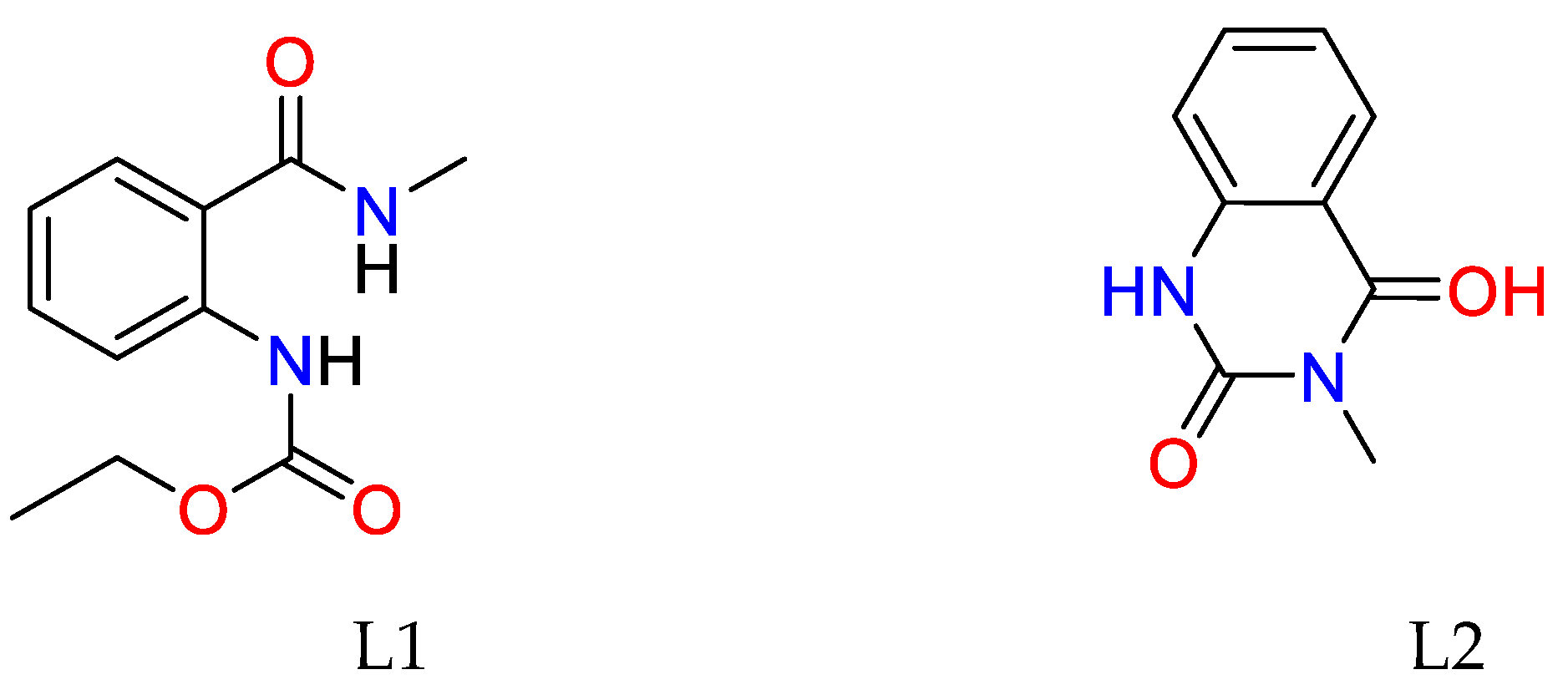
The objective of the current study is to synthesize and characterize the structure of a novel copper(II) complex of ethyl (2-(methylcarbamoyl)phenyl)carbamate and 3-methylquinazoline-2,4(1H,3H)-dione. The structures of the free ligands are given in Figure 2.
It should be noted that for the first time mixed ligand copper(II) complex of ethyl 2-(methylcarbamoyl)phenyl)carbamate and 3-methylquinazoline-2,4(1H,3H)-dione is obtained.
2. Results
2.1. Synthesis of Cu(II) complex of ethyl (2-(methylcarbamoyl)phenyl)carbamate (L1) and 3-methylquinazoline-2,4(1H,3H)-dione (L2) – general procedure
The metal complex was prepared by combining aqueous solutions of the metal salt with the ligand dissolved in DMSO and NaOH solution, using a metal-to-ligand-to-base ratio of 1:2:2. A neutral bright blue precipitate formed, which was subsequently filtered, washed repeatedly with water, and dried over CaCl₂ for two weeks. The synthesis followed a previously reported procedure [22].
2.1.1. Spectral Data of the Free Ligand and Its Copper(II) Complex
ethyl (2-(methylcarbamoyl)phenyl)carbamate (L1): white crystals, 80% yield, mp= 136-137°C [12].
IR (KBr, cm-1): 3345 (ν(N-H)), 3258 (ν(N-H, -NC(=O)O)), 3116 (ν (Csp2-H, Ph-)), 3072 (ν (Csp2-H, Ph-)), 2985 (νas(Csp3-H, CH3-)), 2951 (νas (Csp3-H, CH3-)), 2913 (νas (Csp3-H, >CH2)), 2880 (νs (Csp3-H, CH3-)), 1739 (ν(C=O)), 1664 (δ(-NH)+ ν(C=O)), 1633 (δ(-NH)+ ν(C=O)), 1605 (ν(C=C-C), Ph-), 1593 (ν(C=C-C), Ph-), 1554 (δ(-NH)), 1530 (ν (C=C-C), Ph-), 1454 (ν(C=C-C), Ph-), 1409, 1390 (δs(-CH3)), 1364 (δs(-CH3)), 1333, 1248, 1218 (νas(N-CO-O-)), 1167, 1149, 1122, 1114, 1063, 1049, 951 (νs(N-CO-O-)), 870, 849, 820, 768, 753 (γ (Csp2-H, Ph-), 721, 669, 651, 536, 510 [22].
Raman (cm-1) of L1: 2939, 1730 (C=O), 1641, 1604, 1592, 1555, 1463, 1454, 1392, 1366, 1334, 1305, 1288, 1249, 1219, 1169, 1151, 1123, 1052, 1012, 915, 849, 822, 613, 395, 364 [22].
1H-NMR: 1.24 (t, J = 7.1, 3H, CH2CH3), 2.79 (d, J = 4.4, 3H, NHCH3), 4.13 (d, J=6.8, 2H, CH2CH3), 7.07-7.11 (m, 1H, Ar), 7.49 (t, J = 7.8, 1H, Ar), 8.2 (d, J=8.3, 1H, Ar), 8.72 (broad s, 1H, CONHCH3), 10.96 (s, 1H, NHCOO) [22].
13C-NMR: 169.17, 153.38, 139.7, 132.5, 128.4, 122.17, 120.04, 119.06, 61.05, 26.69, 14.86 [22].
IR (KBr, cm-1) Cu(II) complex: 3435 (ν(OH)), 3345 (ν(NH, -C(=O)-NH-CH3)), 3188 (ν(NH, -NH-C(=O)OCH2CH3)), 3058 (ν(Csp2-H, -Ph)), 3005, 2956, 2921, 1717 (ν(C=O)), 1665 (δ(NH)+ν(C=O),-C(=O)-NH-CH3)), 1645 (δ(NH)+ν(C=O), -NH-C(=O)OCH2CH3)), 1624, 1598, 1556, 1530, 1514, 1493, 1453, 1430, 1386, 1341, 1302, 1295, 1219, 1174, 1155, 1040, 1025, 873, 837, 762, 751, 713, 693, 683, 667, 563, 534, 467, 432.
1H-NMR: 1.23*(t, 3H,) CH2CH3), 2.78*, 3.25**, 4.12*, 7.08*, 7.18**, 7.48*, 7.18**, 7.70*, 7.64**, 8.71*, 8.18*, 7.92**, 10.95*, 11.42**. (* - signals of L1 protons in the complex; **- signals of L2 protons in the complex)
13C-NMR: 169.16*, 162.64**, 153.43*, 150.82**, 139.62*, 139.76**, 132.52*, 135.32**, 128.40*, 127.72**, 122.16*, 122.89**, 120.03*, 114.14**, 119.06*, 115.52**, 61.04*, 26.69*, 27.46**, 14.86* (* - signals of L1 carbons in the complex; **- signals of L2 carbons in the complex).
3. Discussion
The structures of the metal complexes can be readily confirmed by comparing the IR spectra of the free ligands with those of the corresponding metal complexes. Selected experimental IR data (cm⁻¹) for the complex and its free ligands are presented in Table 1.

Table 1.
Selected experimental IR data (in KBr, wavenumber in cm-1) for free ligands and its copper(II) complex.
Table 1.
Selected experimental IR data (in KBr, wavenumber in cm-1) for free ligands and its copper(II) complex.
| Assignment | L1 | L2 [23] | Cu(II) |
| ν(OH) | - | 3435 | |
| ν(NH, -C(=O)-NH-CH3) | 3345 | 3345 | |
| ν(NH, -NH-C(=O)OCH2CH3) | 3258 | 3165 | 3188 |
| ν(Csp2-H, -Ph) | 3072 | 3058 | |
| ν(C=O) | 1739 | 1715 | 1717 |
| δ(NH) + ν(C=O), -C(=O)-NH-CH3) | 1664 | 1662 | 1665 |
| δ(NH) + ν(C=O), -NH-C(=O)OCH2CH3) | 1633 | 1645 |
In the IR spectrum of L1, bands at 3345 cm⁻¹ and 3258 cm⁻¹ correspond to N–H stretching vibrations. For L2, the N–H stretching band appeared at 3165 cm⁻¹ [23]. This band was shifted to higher frequencies by 23 cm⁻¹ in the copper(II) complex, indicating that the N–H group of L2 participates in coordination. The band at 3258 cm⁻¹ in the IR spectrum of the complex was absent. This fact showed that the N-donor atom of L1 participates in coordination with copper(II). In the spectra of L1 and L2, bands at 1739 cm⁻¹ and 1715 cm⁻¹ were assigned to C=O stretching vibrations. Comparison with the spectra of the complex showed a band at 1717 cm⁻¹ that remains unchanged, suggesting that the C=O groups of L2 do not coordinate with the metal ion. Additionally, a broad band at 3435 cm⁻¹ appears in the complex spectrum, confirming the presence of coordinated water molecules. These findings are consistent with previously reported mixed-ligand complexes of anthranilic acid [24].
We found that the copper complex is stable in air and moisture, and its solubility is limited. The reaction of L1 with the transition metal ion afforded a 35 % yield of a stable solid compound. The obtained complex has a bright blue colour and limited solubility in DMSO and was insoluble in water, acetone (CH3COCH3), tetrahydrofuran (THF), ethanol (C2H5OH), ethyl acetate (EtOAc), and cyclohexane. The analytical data, including the yield percentage of the complex, are presented in Table 2.
Table 2.
Analytical and physical characteristic of copper(II) complex ethyl (2-(methylcarbamoyl)phenyl)carbamate (L1) and 3-methylquinazoline-2,4(1H,3H)-dione (L2).
Table 2.
Analytical and physical characteristic of copper(II) complex ethyl (2-(methylcarbamoyl)phenyl)carbamate (L1) and 3-methylquinazoline-2,4(1H,3H)-dione (L2).
| Compound | Solubility, *limited | Melting point (°C) | Yield (%) | Colour |
| L1 | soluble in DMSO and CHCl3 | 136-137 | 80 | colorless |
| CuL | soluble in DMSO* and insoluble in H2O, THF, CH3COCH3, EtOH, EtOAc and cyclohexane | 243-245 ᵒC | 35 | bright blue |
The experimental 1H-NMR data for the copper complex and its free ligands are presented in Table 3. In the 1H-NMR spectrum of the copper(II) complex, the signal for the proton from NHCH3 group is shifted to a lower frequency by 0.01 ppm (see Table 3). The presented data is in agreement with the IR spectrum data.
Table 3.
1H-NMR data for L1, L2 and its complex with Cu(II).
| atom |
δ (1H) ppm L1 |
δ (1H) ppm L2 [25] |
δ (1H) ppm Cu(II) |
| NH(COO) |
10.96 (s) |
11.43 (s) | 10.95* 11.42** |
| NHCH3 |
8.72 (q) |
8.71* | |
| CH |
8.19 (dd) |
7.93 (d) | 8.18* 7.92** |
| CH | 7.70 (dd) | 7.64-7.66 (m) | 7.70* 7.64** |
| CH | 7.48 (ddd) | 7.17-7.21 (m) | 7.48* 7.18** |
| CH | 7.08 (ddd) | 7.17-7.21 (m) | 7.08* 7.18** |
| NHCH3 | 2.78 (d) | 3.26 (s) | 2.78* 3.25** |
| CH2 | 4.12 (q) | 4.12* | |
| CH3 | 1.23 (t) | 1.23* |
* - signals of L1 protons in the complex; **- signals of L2 protons in the complex. All signals in the complexes are broad singlets unless otherwise noted.
The 13C-NMR data for the mixed ligand complex of ethyl (2-(methylcarbamoyl)phenyl)carbamate (L1), 3-methylquinazoline-2,4(1H,3H)-dione (L2), and their metal complex are given in Table 3.
Table 3.
13C-NMR data for L1, L2 and its Cu(II) complex.
| atom |
δ (13C) ppm L1 |
δ (13C) ppm L2 [25] |
δ (13C) ppm Cu(II) |
| NH(C=O) | 169.16 | 162.6 | 169.16* 162.64** |
| NH(COO) | 153.37 | 150.8 | 153.43* 150.82** |
| C | 139.67 | 139.8 | 139.62* 139.76** |
| CH | 132.53 | 135.3 | 132.52* 135.32** |
| CH | 128.40 | 127.7 | 128.40* 127.72** |
| CH | 122.16 | 122.9 | 122.16* 122.89** |
| C | 120.03 | 114.1 | 120.03* 114.14** |
| CH | 119.05 | 115.5 | 119.06* 115.52** |
| CH2CH3 | 61.04 | - | 61.04* |
| NHCH3 | 26.68 | 27.5 | 26.69* 27.46** |
| CH2CH3 | 14.85 | - | 14.86* |
* - signals of L1 in the complex; **- signals of L2 in the complex All signals in the complex are broad singlets unless otherwise noted.
In the 13C-NMR spectrum of the copper(II) complex, the signal for the carbon from NH(C=O) group wasn’t shifted (see Table 3). In the same spectrum, the signal for the carbon from NH(COO) group wasn’t changed. Тhis is an indication that the two carbonyl groups do not coordinate with the metal ion. The presented NMR data were in agreement with the IR spectrum data.
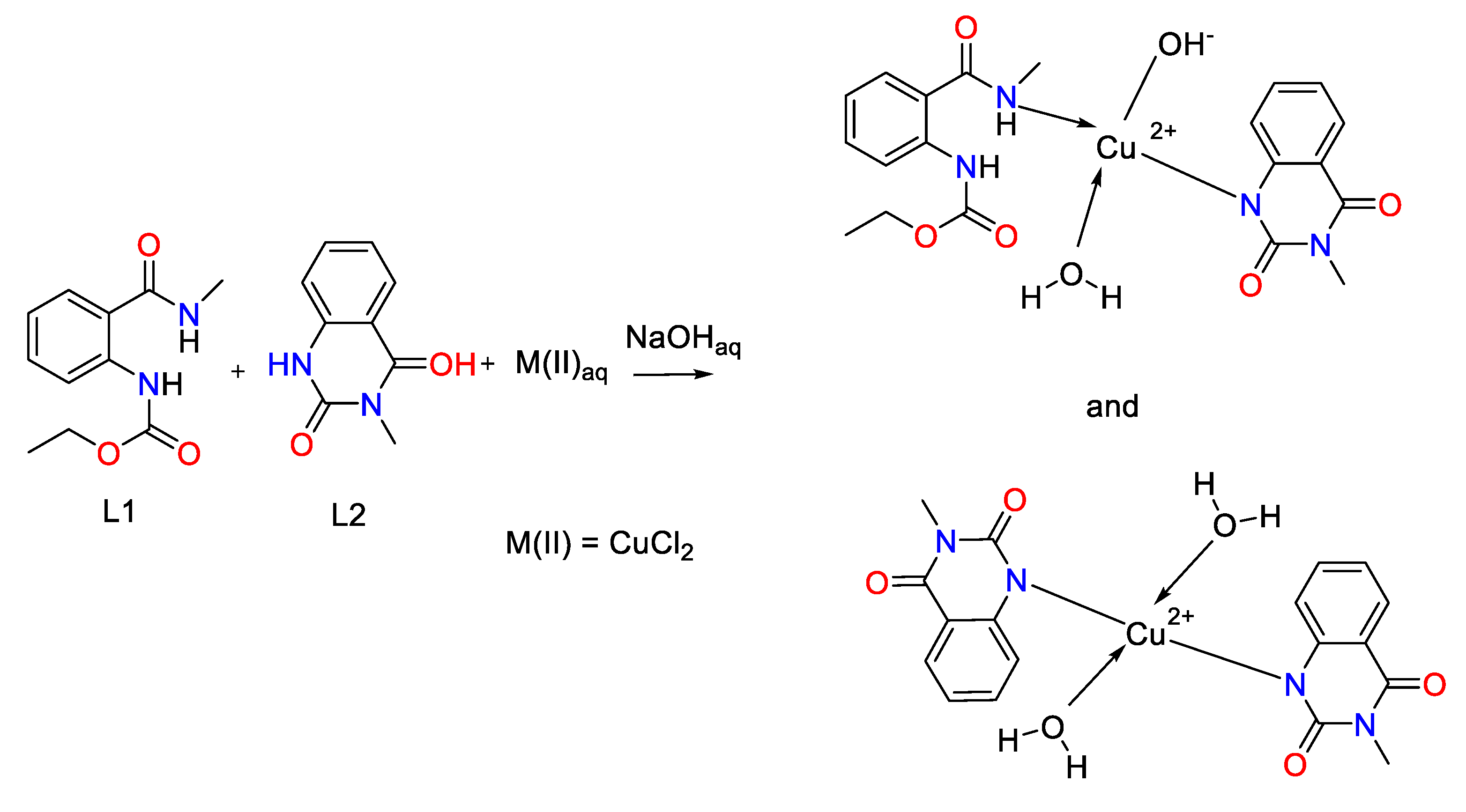
We assumed that the ligand in the complex coordinates monodentately through the N-atom (see Scheme 1). We observed a combination of two complexes for the copper(II). In the first, one hydroxyl group and one water molecule have been coordinated by the metal center, and both ligands L1 and L2 are engaged, while only ligand L2 is coordinated in the second one. Two water molecules are also linked to the Cu2+. The charge of the metal center is offset by the deprotonation of two L2. It should be mentioned that the structure of the complex probably contains two bulky ligands and two smaller ones due to steric reasons. The structures of the obtained complexes are analogous to the Pd(II) complex of N-(2-benzoyl-4,5-dimethoxyphenethyl)-2-phenylacetamide [26]. The data also align with previously reported Mn(II), Ni(II), Co(II), Cu(II), Zn(II), and Cd(II) complexes of anthranilic acid and pyridine-2-aldoxime synthesized under alkaline conditions [27]. More recently, Alwan reported the synthesis of mixed-ligand complexes of Cu(II), Ni(II), Co(II), and Zn(II) with anthranilic acid [28]. Square planar geometry was suggested for the Co(II) and Zn(II) complexes, while tetrahedral geometries were proposed for the Ni(II) and Cu(II) complexes [28]. Notably, these complexes were soluble only in DMSO and partially in hot ethanol, in agreement with our observations. Similarly, Al-Noor et al. confirmed tetrahedral geometries for Ni(II), Co(II), Fe(II), Zn(II), and Cd(II) mixed-ligand complexes containing anthranilic acid and l-alanine [29]. These complexes were insoluble in water but soluble in DMSO and DMF. In contrast to Mehta and More, who obtained the Cu(II) complex with a binuclear chelate structure [20].
4. Materials and Methods
4.1. Spectra Measurements
The free ligands ethyl (2-(methylcarbamoyl)phenyl)carbamate and 3-methylquinazoline-2,4(1H,3H)-dione is published previously [22]. The metal salts CuCl2 (Aldrich Chem) and solvents used for the synthesis of the complexes were of high purity, generally equal to A.C.S. grade and suitable for use in many laboratory and analytical applications. Melting points were measured on a Kruss M5000 melting point meter (A.Krüss Optronic GmbH, Hamburg, Germany). The IR spectra of L1 and its complex were registered in KBr pellet on a Bruker FT-IR VERTEX 70 Spectrometer from 4000 cm-1 to 400 cm-1 at a resolution of 2 cm-1 with 25 scans. The NMR spectra of the ligand were registered on a Bruker Avance II NMR spectrometer operating at 600.130 and 150.903 MHz for 1H and 13C, respectively, using the standard Bruker software. The NMR spectra of the metal complex were measured on a Bruker Avance III HD spectrometer operating at 500.130 and 125.76 MHz for 1H and 13C, respectively, using the standard Bruker software. The reaction scheme for the synthesis of the metal complex of the mixed ligand complex of ethyl (2-(methylcarbamoyl)phenyl)carbamate (L1) and 3-methylquinazoline-2,4(1H,3H)-dione (L2) with Cu(II) is given in Scheme 1.
5. Conclusions
This work presents the synthesis of a new mixed ligand complex of ethyl (2-(methylcarbamoyl)phenyl)carbamate (L1) and 3-methylquinazoline-2,4(1H,3H)-dione (L2) with Cu(II). The structure of the new complex is discussed based on melting point analysis, IR, 1H-, and 13C-NMR spectroscopy. Based on the spectral data, we suggested coordination binding site of the ligands. We assume that the ligands are coordinated through the N-donor atom monodentately.
Author Contributions
Conceptualization, P.M. and S.N.; methodology, P.M.; formal analysis, N.B. investigation, S.N.; P.M.; N.B; resources, N.B.; data curation, P.M.; writing—original draft preparation, P.M, S.N.; N. B., writing—review and editing, S.N.; P.M.; N.B.; supervision, P.M.; project administration, S.N.; funding acquisition, S.N.
Funding
This study is part of Scientific Project 466 No KP-06-H73/11 of the National Fund for Scientific Research in Bulgaria, National Program for Basic Research Projects—2023.
Acknowledgements
Research equipment of the Distributed Research Infrastructure INFRAMAT, part of the Bulgarian National Roadmap for Research Infrastructures, supported by the Bulgarian Ministry of Education and Science was used in this investigation.
Conflicts of Interest
The authors declare no conflict of interest.
References
- Linder, M.C.; Hazegh-Azam, M. Copper biochemistry and molecular biology. Am J Clin Nutr. 1996, 63(5), 797S–811S. [Google Scholar] [CrossRef] [PubMed]
- Khalid, H.; Hanif, M.; Hashmi, M.A.; Mahmood, T.; Ayub, K.; Monim-Ul-Mehboob, M. Copper complexes of bioactive ligands with superoxide dismutase activity. Mini Rev. Med. Chem. 2013, 13, 1944–1956. [Google Scholar] [CrossRef]
- Yang, S.; Li, Y.; Zhou, L.; Wang, X.; Liu, L.; Wu, M. Copper homeostasis and cuproptosis in atherosclerosis: metabolism, mechanisms and potential therapeutic strategies. Cell Death Discov. 2024, 10(1), 25. [Google Scholar] [CrossRef]
- Bandmann, O. , Weiss, K.H., Kaler, S.G. Wilson's disease and other neurological copper disorders. Lancet Neurol. 2015, 14(1), 103–113. [Google Scholar] [CrossRef]
- Kaler, S.G. ATP7A-related copper transport diseases-emerging concepts and future trends. Nat Rev Neurol. 2011, 7(1), 15–29. [Google Scholar] [CrossRef] [PubMed]
- Wang, Y.; Li, D.; Xu, K.; Wang, G.; Zhang, F. Copper homeostasis and neurodegenerative diseases. Neural Regen Res. 2025, 20(11), 3124–3143. [Google Scholar] [CrossRef]
- Chen, H.; Li, D.; Zhang, H.; Zhang, M.; Lin, Y.; He, H.; Liu, A.; Shen, S.; Wang, Y.; Han, Z. Mechanisms of copper metabolism and cuproptosis: implications for liver diseases. Front. Immunol. 2025, 16, 1633711. [Google Scholar] [CrossRef]
- Pan, C.; Ji, Z.; Wang, Q.; Zhang, Z.; Wang, Z.; Li, C.; Lu, S.; Ge, P. Cuproptosis: Mechanisms, biological significance, and advances in disease treatment—A systematic review. CNS Neurosci Ther. 2024, 30, e70039. [Google Scholar] [CrossRef]
- Denoyer, D.; Clatworthy, S.A.S.; Cater, M. A. Copper Complexes in Cancer Therapy. Met Ions Life Sci. 2018, 18. [Google Scholar] [CrossRef] [PubMed]
- Vo, T.T.T. , Peng, TY., Nguyen, T.H. et al. The crosstalk between copper-induced oxidative stress and cuproptosis: a novel potential anticancer paradigm. Cell Commun Signal 2024, 22, 353. [Google Scholar] [CrossRef] [PubMed]
- McCormick, R.; Buckley, E.; Donnelly, P.J.; Gilpin, V.; McMath, R.; Smith, R.B.; Papakonstantinou, P.; Davis, J. Anthranilic Acid: A Versatile Monomer for the Design of Functional Conducting Polymer Composites. J. Compos. Sci. 2024, 8, 208. [Google Scholar] [CrossRef]
- Rio, G. F.; Silva, B. V.; Martinez, S. T.; Pinto, A. C. Anthranilic acids from isatin: an efficient, versatile and environmentally friendly method. An Acad Bras Cienc. 2015, 87(3), 1525–1529. [Google Scholar] [CrossRef]
- Prasher, P.; Sharma, M. Medicinal Chemistry of Anthranilic Acid Derivatives: A Mini Review. Drug Dev. Res. 2021, 82, 945–958. [Google Scholar] [CrossRef]
- Ganeshpurkar, A.; Gutti, G.; Singh, S.K. Chapter 1 - RNA-Dependent RNA Polymerases and Their Emerging Roles in Antiviral Therapy. Viral Polymerases Structures, Functions and Roles as Antiviral Drug Targets 2019, 1-42. [CrossRef]
- Nasr, T.M.; Aboshanab, A.M.; Abouzid, K.A.M.; Zaghary, W.A. Hands-on Synthetic Approaches and Biological Activities of Anthranilic Acid Derivatives: A Mini-Review. Egypt. J. Chem. 2023, 66, 329–343. [Google Scholar] [CrossRef]
- Nawaz, M.; Abbasi, M.W.; Tariq, M.; Graham, J.P.; Al-Hagri, A.-R.S.; Elkarim, A.A.; Mohamed, M.E.; Nissapatorn, V.; Taha, M.; Hisaindee, S. Synthesis of Metal Anthranilate Complexes: Catalytic and Antipathogenic Studies. BMC Chem. 2022, 16, 21. [Google Scholar] [CrossRef]
- Srivastava, V.K. Synthesis, characterization, and biological studies of some biometal complexes. Futur J Pharm Sci 2021, 7, 51. [Google Scholar] [CrossRef]
- Mahdi, S. H.; Karem, L. K. A. Synthesis, Spectral and Biochemical Studies of New Complexes of Mixed Ligand Schiff Base and Anthranilic Acid. Orient J Chem 2018, 34. [Google Scholar]
- Abu-Dief, A. M.; Shehata, M. R.; Hassan, A. E.; Alharbi, S.K.; Alzahrani, A. Y.A.; Abo-Dief, H. M.; Ragab M., S. Exploring, anthranilic azomethine complexes: from synthesis, spectroscopic, solution and theoretical studies to DNA interaction and biomedical prospects. J Mol. Str. 2025, 1341, 142571. [Google Scholar] [CrossRef]
- Mehta B.H.; More P.S. Synthesis, Characterization and X-Ray Diffraction Studies of Co(II), Ni(II), Cu(II) and Zn(II) Complexes with Schiff Base Derived from 5-nitrosalicylaldehyde and Anthranilic Acid. Asian J Chem. 2007, 19(5), 3581-3587. https://svv-research-data.s3.ap-south-1.amazonaws.com/140317-2009-asian%20j%20chem%20Aniket%20Pawanoji.pdf.
- Marinova, P.; Hristov, M. Synthesis and Biological Activity of Novel Complexes with Anthranilic Acid and Its Analogues. Appl. Sci. 2023, 13, 9426–9429. [Google Scholar] [CrossRef]
- Tsoneva, S.; Milusheva, M.; Burdzhiev, N.; Marinova, P.; Varbanova, E.; Tumbarski, Y.; Mihaylova, R.; Cherneva, E.; Nikolova, S. Antimicrobial Activity of Ethyl (2-(Methylcarbamoyl)phenyl) carbamate and Its Mixed Ligand Ni(II) and Co(II) Complexes. Inorganics 2025, 13, 267. [Google Scholar] [CrossRef]
- Azizian, J.; Mohammadi, A.A.; Karimi, A.R. An Efficient One-Pot Procedure for Preparation of 2,4(1H,3H)-Quinazolinediones.
- and 2-Thioxoquinazolinone Derivatives Under Microwave Irradiation. Synth. Commun. Int. J. Rapid Commun. Synth. Org. Chem.
- 2003, 33, 415–420. [CrossRef]
- Shirode, P. R. A study of mixed ligand complexes of anthranilic acidsemicarbazone and benzaldehyde with Co(II), Ni(II) and Cu(II). World Journal of Pharmaceutical Research 2018, 7, 1135–1143. [Google Scholar] [CrossRef]
- Zhang, L.; Chen, Q.; Li, L.; Ma, N.; Tian, J.; Sun, H.; Xu, Q.; Yang, Y.; Li, C. Synthesis of N-Unsubstituted and N3-Substituted.
- Quinazoline-2,4(1H,3H)-diones from o-Aminobenzamides and CO2 at Atmospheric Pressure and Room Temperature. Org. Lett. . Org. Lett.
- 2023, 25, 2471–2475. [CrossRef]
- Marinova PE, Tsoneva SH, Nikolova SA, Ivanov II, Novel complexes of n-substituted-4,5-dimethoxy-phenylethyl-2-arylketoamides with metal ions, Bulg. Chem. Commun., 2019; 51, Special issue D: 8-11.
- Oladipupo, O.E.; Ibukun, D.T.; Olalekan, T.E. Synthesis and Characterization of Mixed Ligand Dinuclear Metal(II) Complexes of Anthranilic Acid and Pyridine-2-aldoxime. Niger. J. Chem. Res. 2018, 23, 39–50. [Google Scholar]
- Alwan, A.H.M. Spectroscopic and Magnetic Study of Mixed Ligand Complexes with Divalent Transition Metals Using Azo-Azomethine Ligands. University of Thi-Qar Journal 2025, 20, 1–19. [Google Scholar] [CrossRef]
- Al-Noor, T.H.; AL-Jeboori, A.T.; Ghanim, F.H. Synthesis and characterization of the mixed ligand complexes (L-alanine and anthranilic acid) with some transition Ions. Diyala Journal For Pure Sciences 2010, 6, 103–110. [Google Scholar]
Figure 1.
Anthranilic acid derivatives as key scaffolds in rational drug design.
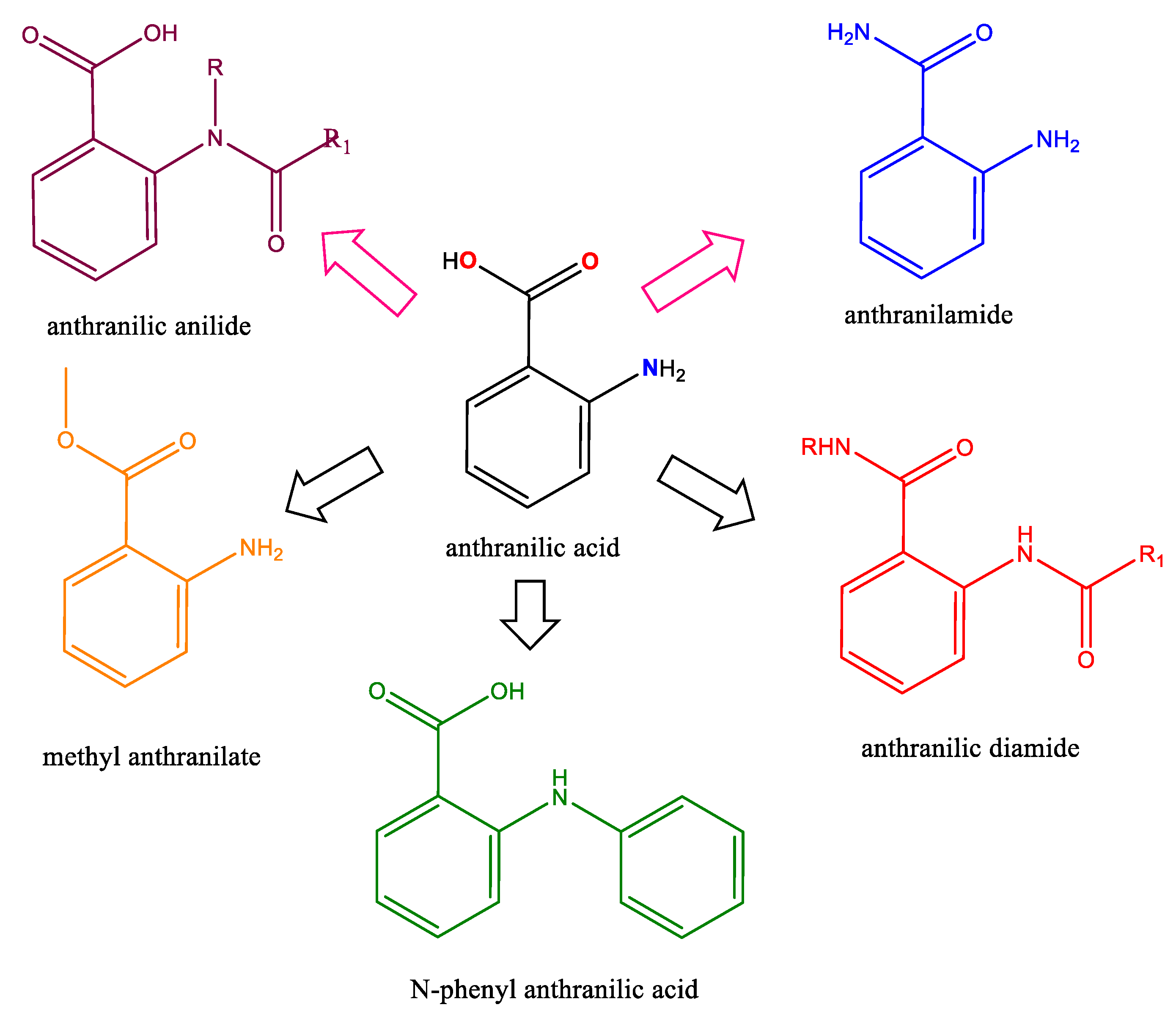
Figure 2.
Structure of ethyl (2-(methylcarbamoyl)phenyl)carbamate (L1) and 3-methylquinazoline-2,4(1H,3H)-dione (L2).
Figure 2.
Structure of ethyl (2-(methylcarbamoyl)phenyl)carbamate (L1) and 3-methylquinazoline-2,4(1H,3H)-dione (L2).
Scheme 1.
The reaction scheme for the obtain of mixed-metal complex of ethyl (2-(methylcarbamoyl)phenyl)carbamate (L1) and 3-methylquinazoline-2,4(1H,3H)-dione (L2) with Cu(II).
Scheme 1.
The reaction scheme for the obtain of mixed-metal complex of ethyl (2-(methylcarbamoyl)phenyl)carbamate (L1) and 3-methylquinazoline-2,4(1H,3H)-dione (L2) with Cu(II).
Disclaimer/Publisher’s Note: The statements, opinions and data contained in all publications are solely those of the individual author(s) and contributor(s) and not of MDPI and/or the editor(s). MDPI and/or the editor(s) disclaim responsibility for any injury to people or property resulting from any ideas, methods, instructions or products referred to in the content. |
© 2025 by the authors. Licensee MDPI, Basel, Switzerland. This article is an open access article distributed under the terms and conditions of the Creative Commons Attribution (CC BY) license (http://creativecommons.org/licenses/by/4.0/).
Copyright: This open access article is published under a Creative Commons CC BY 4.0 license, which permit the free download, distribution, and reuse, provided that the author and preprint are cited in any reuse.