

Submitted:
15 October 2025
Posted:
16 October 2025
You are already at the latest version
Abstract
People with Parkinson’s disease (PD) experience mobility impairments that impact daily functioning, yet conventional clinical assessments provide limited insight into real-world mobility. This study evaluated motor-state classification and the concurrent validity of mobility metrics derived from augmented-reality (AR) glasses against a validated markerless motion capture system (Theia3D) during gamified AR exercises. Fifteen participants with PD completed five gamified AR exercises measured with both systems. Motor-state segments included straight walking, turning, squatting and sit-to-stand/stand-to-sit transfers, from which the following mobility metrics were derived: step length, gait speed, cadence, transfer- and squat durations, squat depth, turn duration, and peak turn angular velocity. We found excellent between-systems consistency for head-position (X, Y, Z) and yaw-angle time series (ICC(c,1) > 0.932). The AR-based motor-state classification showed high accuracy, with F1-scores of 0.947–1.000. Absolute agreement with Theia3D was excellent for all mobility metrics (ICC(A,1) > 0.904), except for cadence during straight walking and peak angular velocity during turns, which were good and moderate (ICC(A,1) = 0.890, ICC(A,1) = 0.477, respectively). These results indicate that motor states and associated mobility metrics can be accurately derived during gamified AR exercises, supporting its potential for unobtrusive derivation of mobility metrics in PD during in-clinic and at-home AR neurorehabilitation exercise programs.
Keywords:
1. Introduction
2. Materials and Methods
2.1. Subjects
2.2. Experimental Setup and Procedures
2.3. Data Acquisition
2.4. Data Analysis
2.5. Motor-State Segment Classification and Derived Mobility Metrics
2.5.1. Straight Walking Segments and Gait Metrics
2.5.2. Turning Segments and Turn Metrics
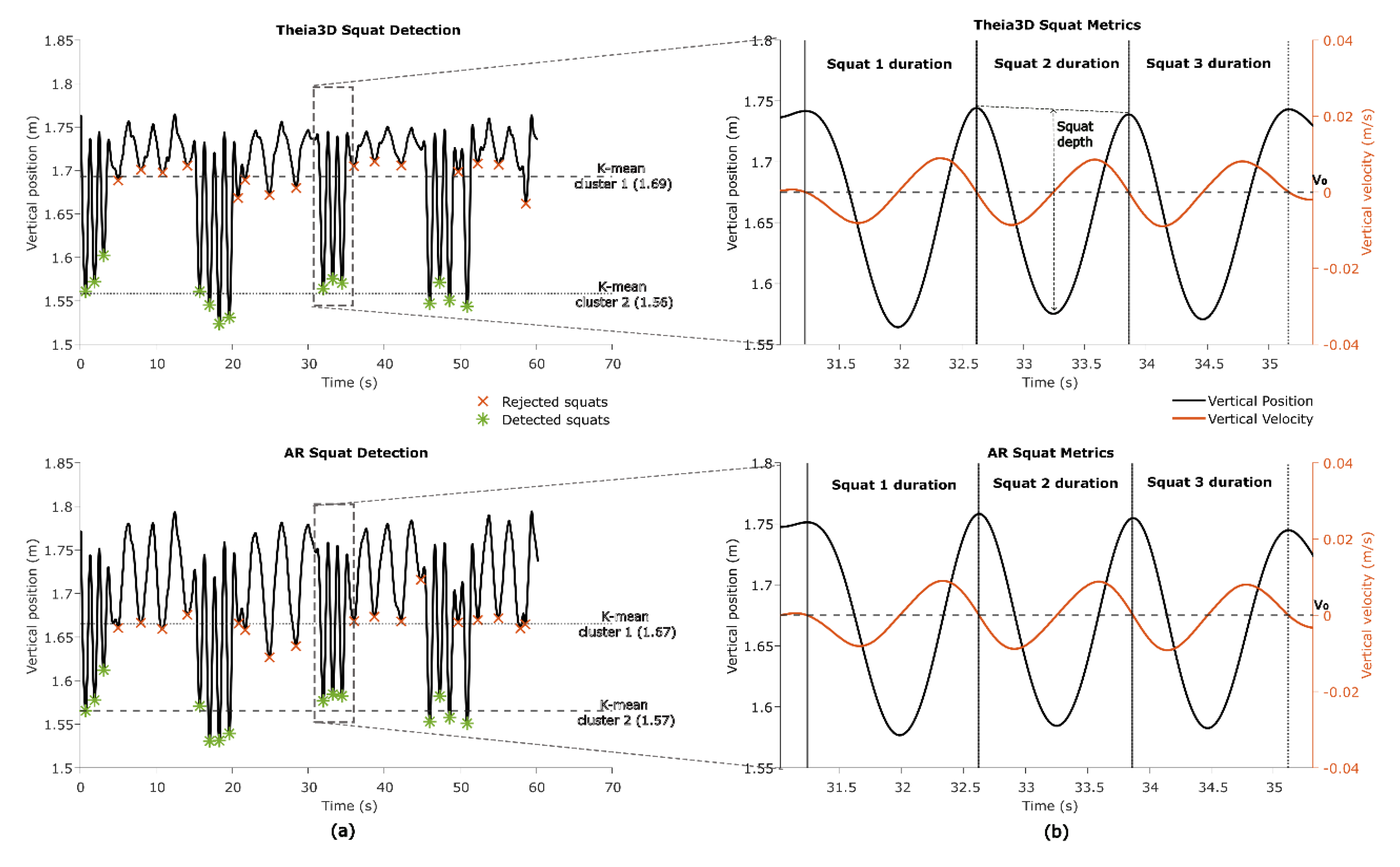
2.5.3. Squat Segments and Squat Metrics
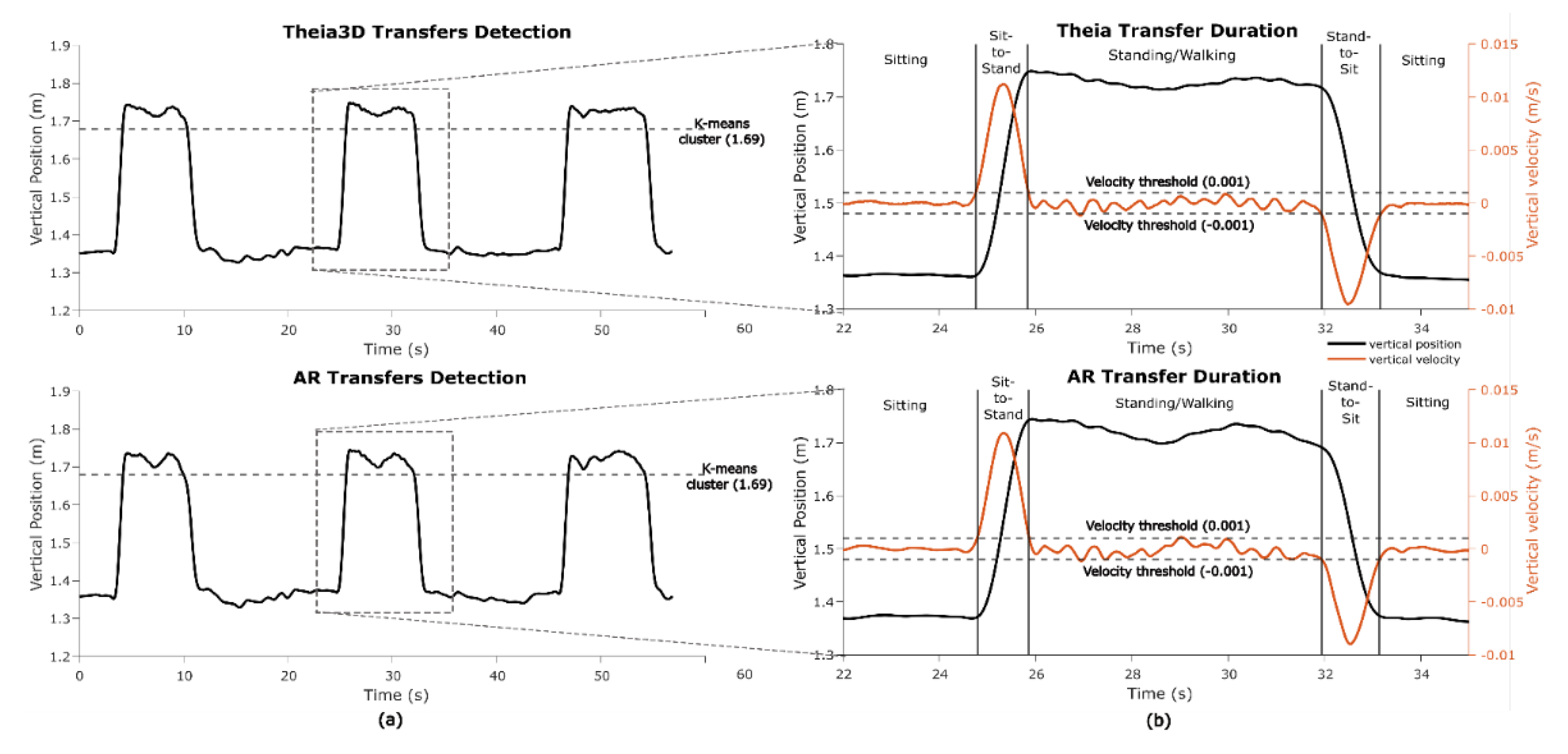
2.5.4. Transfer Detection and Transfer Metrics
2.6. Statistical Analysis
3. Results
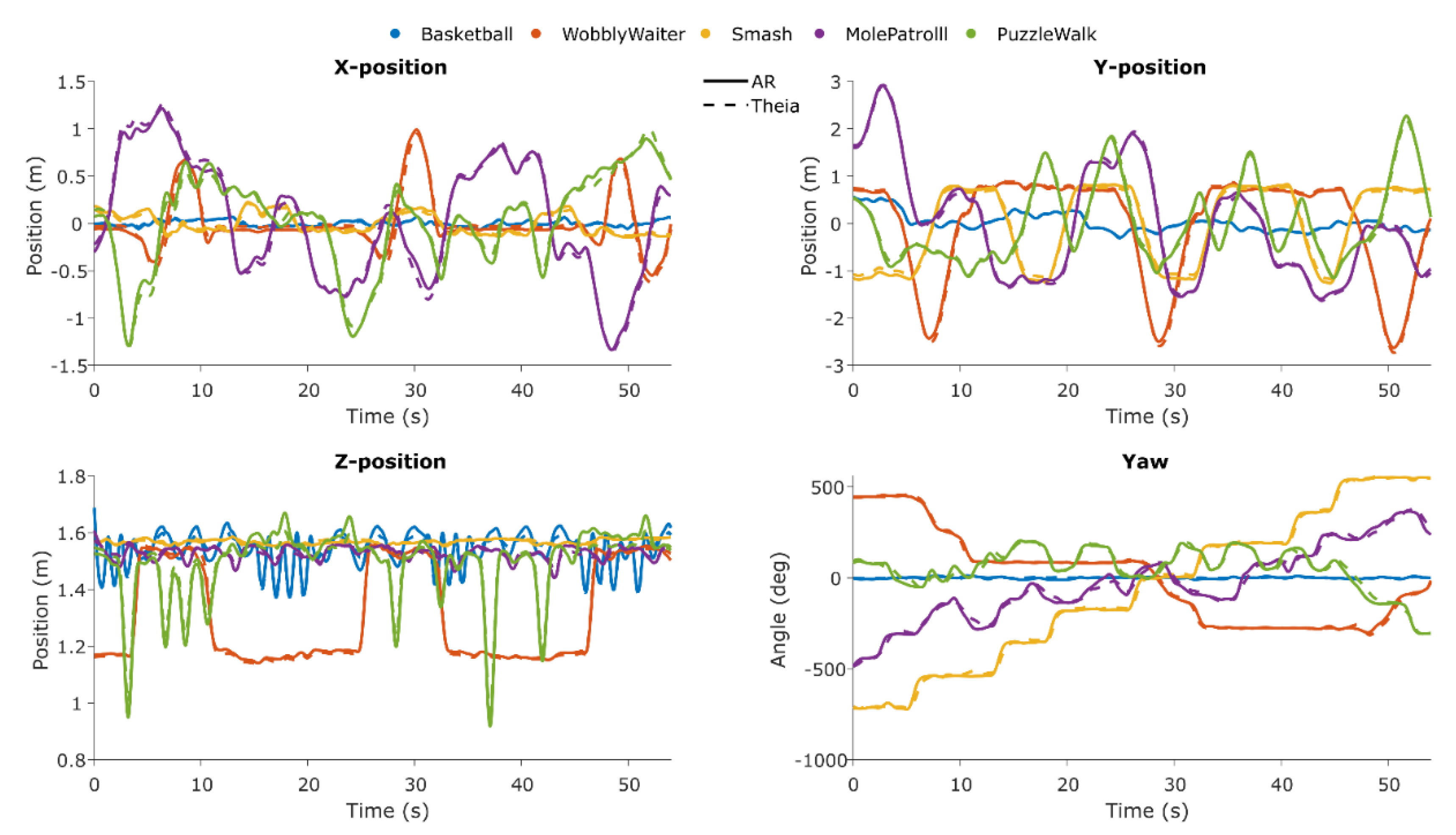
3.1. Consistency Agreement in Time Series Between Systems
3.2. Motor-State Segment Classification Statistics
3.3. Absolute Agreement in Mobility Metrics
4. Discussion
4.1. Interpretation and Comparison with Other Literature
4.1.1. Consistency Agreement in Time Series
4.1.2. Motor-State Segment Classification
4.1.3. Absolute Agreement in Mobility Metrics
4.2. Strengths and Limitations
4.3. Implications and Future Work
5. Conclusions
Supplementary Materials
Author Contributions
Funding
Institutional Review Board Statement
Informed Consent Statement
Data Availability Statement
Acknowledgments
Conflicts of Interest
References
- Gómez-Esteban, J.C.; Zarranz, J.J.; Lezcano, E.; Tijero, B.; Luna, A.; Velasco, F.; Rouco, I.; Garamendi, I. Influence of Motor Symptoms upon the Quality of Life of Patients with Parkinson’s Disease. European Neurology 2007, 57, 161–165. [Google Scholar] [CrossRef] [PubMed]
- Bouça-Machado, R.; Duarte, G.S.; Patriarca, M.; Castro Caldas, A.; Alarcão, J.; Fernandes, R.M.; Mestre, T.A.; Matias, R.; Ferreira, J.J. Measurement Instruments to Assess Functional Mobility in Parkinson's Disease: A Systematic Review. Movement Disorders Clinical Practice 2020, 7, 129–139. [Google Scholar] [CrossRef] [PubMed]
- Duncan, R.P.; Leddy, A.L.; Earhart, G.M. Five Times Sit-to-Stand Test Performance in Parkinson's Disease. Archives of Physical Medicine and Rehabilitation 2011, 92, 1431–1436. [Google Scholar] [CrossRef]
- Lindholm, B.; Nilsson, M.H.; Hansson, O.; Hagell, P. The clinical significance of 10-m walk test standardizations in Parkinson’s disease. Journal of Neurology 2018, 265, 1829–1835. [Google Scholar] [CrossRef] [PubMed]
- Nocera, J.R.; Stegemöller, E.L.; Malaty, I.A.; Okun, M.S.; Marsiske, M.; Hass, C.J. Using the Timed Up & Go Test in a Clinical Setting to Predict Falling in Parkinson's Disease. Archives of Physical Medicine and Rehabilitation 2013, 94, 1300–1305. [Google Scholar] [CrossRef]
- Böttinger, M.J.; Labudek, S.; Schoene, D.; Jansen, C.-P.; Stefanakis, M.-E.; Litz, E.; Bauer, J.M.; Becker, C.; Gordt-Oesterwind, K. “TiC-TUG”: technology in clinical practice using the instrumented timed up and go test—a scoping review. Aging Clinical and Experimental Research 2024, 36. [Google Scholar] [CrossRef]
- Warmerdam, E.; Hausdorff, J.M.; Atrsaei, A.; Zhou, Y.; Mirelman, A.; Aminian, K.; Espay, A.J.; Hansen, C.; Evers, L.J.W.; Keller, A.; et al. Long-term unsupervised mobility assessment in movement disorders. The Lancet Neurology 2020, 19, 462–470. [Google Scholar] [CrossRef]
- Kirk, C.; Packer, E.; Polhemus, A.; Maclean, M.K.; Bailey, H.; Kluge, F.; Gaßner, H.; Rochester, L.; Del Din, S.; Yarnall, A.J. A systematic review of real-world gait-related digital mobility outcomes in Parkinson’s disease. npj Digital Medicine 2025, 8. [Google Scholar] [CrossRef]
- Theodorou, C.; Velisavljevic, V.; Dyo, V.; Nonyelu, F. Visual SLAM algorithms and their application for AR, mapping, localization and wayfinding. Array 2022, 15, 100222. [Google Scholar] [CrossRef]
- Geerse, D.J.; Coolen, B.; Roerdink, M. Quantifying Spatiotemporal Gait Parameters with HoloLens in Healthy Adults and People with Parkinson’s Disease: Test-Retest Reliability, Concurrent Validity, and Face Validity. Sensors 2020, 20, 3216. [Google Scholar] [CrossRef]
- Van Bergem, J.S.; Van Doorn, P.F.; Hoogendoorn, E.M.; Geerse, D.J.; Roerdink, M. Gait and Balance Assessments with Augmented Reality Glasses in People with Parkinson’s Disease: Concurrent Validity and Test–Retest Reliability. Sensors 2024, 24, 5485. [Google Scholar] [CrossRef]
- Van Doorn, P.F.; Geerse, D.J.; Van Bergem, J.S.; Hoogendoorn, E.M.; Nyman, E.; Roerdink, M. Gait Parameters Can Be Derived Reliably and Validly from Augmented Reality Glasses in People with Parkinson’s Disease Performing 10-m Walk Tests at Comfortable and Fast Speeds. Sensors 2025, 25, 1230. [Google Scholar] [CrossRef]
- Hardeman, L.E.S.; van Benten, E.; Hoogendoorn, E.M.; van Gameren, M.; Nonnekes, J.; Roerdink, M.; Geerse, D.J. Do People With Parkinson’s Disease Find a Home-Based Augmented-Reality Gait-and-Balance Exercise Program Acceptable?: A Qualitative Approach. 2025. [Google Scholar] [CrossRef]
- Negi, A.S.; Karjagi, S.; Parisi, L.; Daley, K.W.; Abay, A.K.; Gala, A.S.; Wilkins, K.B.; Hoffman, S.L.; Ferris, M.S.; Zahed, H.; et al. Remote real time digital monitoring fills a critical gap in the management of Parkinson’s disease. npj Parkinson's Disease 2025, 11. [Google Scholar] [CrossRef] [PubMed]
- Steinmetz, J.D.; Seeher, K.M.; Schiess, N.; Nichols, E.; Cao, B.; Servili, C.; Cavallera, V.; Cousin, E.; Hagins, H.; Moberg, M.E.; et al. Global, regional, and national burden of disorders affecting the nervous system, 1990–2021: a systematic analysis for the Global Burden of Disease Study 2021. The Lancet Neurology 2024, 23, 344–381. [Google Scholar] [CrossRef] [PubMed]
- Kanko, R.M.; Laende, E.K.; Strutzenberger, G.; Brown, M.; Selbie, W.S.; Depaul, V.; Scott, S.H.; Deluzio, K.J. Assessment of spatiotemporal gait parameters using a deep learning algorithm-based markerless motion capture system. Journal of Biomechanics 2021, 122, 110414. [Google Scholar] [CrossRef] [PubMed]
- Scataglini, S.; Abts, E.; Van Bocxlaer, C.; Van Den Bussche, M.; Meletani, S.; Truijen, S. Accuracy, Validity, and Reliability of Markerless Camera-Based 3D Motion Capture Systems versus Marker-Based 3D Motion Capture Systems in Gait Analysis: A Systematic Review and Meta-Analysis. Sensors 2024, 24, 3686. [Google Scholar] [CrossRef]
- Hardeman, L.E.S.; Geerse, D.J.; Hoogendoorn, E.M.; Nonnekes, J.; Roerdink, M. Remotely prescribed, monitored, and tailored home-based gait-and-balance exergaming using augmented reality glasses: a clinical feasibility study in people with Parkinson’s disease. Frontiers in Neurology 2024, 15. [Google Scholar] [CrossRef]
- Hoogendoorn, E.M.; Geerse, D.J.; van Doorn, P.F.; van Dam, A.T.; van Hall, S.J.; Hardeman, L.E.S.; Stins, J.F.; Roerdink, M. Cueing-assisted gamified augmented-reality home rehabilitation for gait and balance in people with Parkinson's disease: feasibility and potential effectiveness in the clinical pathway. 2025. [Google Scholar] [CrossRef]
- Larsen, T.A.; Calne, S.; Calne, D.B. Assessment of Parkinson's disease. Clin Neuropharmacol 1984, 7, 165–169. [Google Scholar] [CrossRef]
- Theia Markerless Inc. Default Model Description. Available online: https://docs.theiamarkerless.com/theia3d-documentation/theia-model-description/default-model-description (accessed on 15-07-2025).
- Rawash, Y.Z.; Al-Naami, B.; Alfraihat, A.; Owida, H.A. Advanced Low-Pass Filters for Signal Processing: A Comparative Study on Gaussian, Mittag-Leffler, and Savitzky-Golay Filters. Mathematical Modelling of Engineering Problems 2024, 11, 1841–1850. [Google Scholar] [CrossRef]
- Caron-Laramée, A.; Walha, R.; Boissy, P.; Gaudreault, N.; Zelovic, N.; Lebel, K. Comparison of Three Motion Capture-Based Algorithms for Spatiotemporal Gait Characteristics: How Do Algorithms Affect Accuracy and Precision of Clinical Outcomes? Sensors 2023, 23, 2209. [Google Scholar] [CrossRef]
- Dang, D.C.; Dang, Q.K.; Chee, Y.J.; Suh, Y.S. Neck Flexion Angle Estimation during Walking. Journal of Sensors 2017, 2017, 1–9. [Google Scholar] [CrossRef]
- Shah, V.V.; Curtze, C.; Mancini, M.; Carlson-Kuhta, P.; Nutt, J.G.; Gomez, C.M.; El-Gohary, M.; Horak, F.B.; McNames, J. Inertial Sensor Algorithms to Characterize Turning in Neurological Patients With Turn Hesitations. IEEE Trans Biomed Eng 2021, 68, 2615–2625. [Google Scholar] [CrossRef] [PubMed]
- McGraw, K.O.; Wong, S.P. Forming inferences about some intraclass correlation coefficients. Psychological Methods 1996, 1, 30–46. [Google Scholar] [CrossRef]
- Koo, T.K.; Li, M.Y. A Guideline of Selecting and Reporting Intraclass Correlation Coefficients for Reliability Research. Journal of Chiropractic Medicine 2016, 15, 155–163. [Google Scholar] [CrossRef]
- Bland, J.M.; Altman, D.G. Measuring agreement in method comparison studies. Statistical Methods in Medical Research 1999, 8, 135–160. [Google Scholar] [CrossRef]
- Novak, D.; Goršič, M.; Podobnik, J.; Munih, M. Toward Real-Time Automated Detection of Turns during Gait Using Wearable Inertial Measurement Units. Sensors 2014, 14, 18800–18822. [Google Scholar] [CrossRef]
- Tasca, P.; Salis, F.; Cereatti, A. Real-world gait detection with a head-worn inertial unit and features-based machine learning. Gait & Posture 2024, 114, S41. [Google Scholar] [CrossRef]
- Zijlstra, A.; Mancini, M.; Lindemann, U.; Chiari, L.; Zijlstra, W. Sit-stand and stand-sit transitions in older adults and patients with Parkinson’s disease: event detection based on motion sensors versus force plates. Journal of NeuroEngineering and Rehabilitation 2012, 9, 75. [Google Scholar] [CrossRef]
- Pham, M.H.; Elshehabi, M.; Haertner, L.; Heger, T.; Hobert, M.A.; Faber, G.S.; Salkovic, D.; Ferreira, J.J.; Berg, D.; Sanchez-Ferro, Á.; et al. Algorithm for Turning Detection and Analysis Validated under Home-Like Conditions in Patients with Parkinson’s Disease and Older Adults using a 6 Degree-of-Freedom Inertial Measurement Unit at the Lower Back. Frontiers in Neurology 2017, 8. [Google Scholar] [CrossRef]
- El-Gohary, M.; Pearson, S.; McNames, J.; Mancini, M.; Horak, F.; Mellone, S.; Chiari, L. Continuous Monitoring of Turning in Patients with Movement Disability. Sensors 2013, 14, 356–369. [Google Scholar] [CrossRef]
- Rehman, R.Z.U.; Klocke, P.; Hryniv, S.; Galna, B.; Rochester, L.; Del Din, S.; Alcock, L. Turning Detection During Gait: Algorithm Validation and Influence of Sensor Location and Turning Characteristics in the Classification of Parkinson’s Disease. Sensors 2020, 20, 5377. [Google Scholar] [CrossRef]
- Mancini, M.; El-Gohary, M.; Pearson, S.; McNames, J.; Schlueter, H.; Nutt, J.G.; King, L.A.; Horak, F.B. Continuous monitoring of turning in Parkinson’s disease: Rehabilitation potential. NeuroRehabilitation 2015, 37, 3–10. [Google Scholar] [CrossRef]
- Boege, S.; Milne-Ives, M.; Ananthakrishnan, A.; Carroll, C.; Meinert, E. Self-Management Systems for Patients and Clinicians in Parkinson's Disease Care: A Scoping Review. J Parkinsons Dis 2024, 14, 1387–1404. [Google Scholar] [CrossRef]

| Characteristics | Mean ± SD [Range] or No. |
|---|---|
| Age (years) | 66.8 ± 6.5 [55–78] |
| Weight (kg) | 85.4 ± 7.3 [75–102] |
| Height (cm) | 180.3 ± 10.4 [164–196] |
| Sex, male/female | 11/4 |
| Time since diagnosis (years) | 7.4 ± 5.6 [2–21] |
| Modified Hoehn and Yahr [20] stage, 1/2 | 4/11 |
| Description | Theia3D pelvis value | AR head value |
|---|---|---|
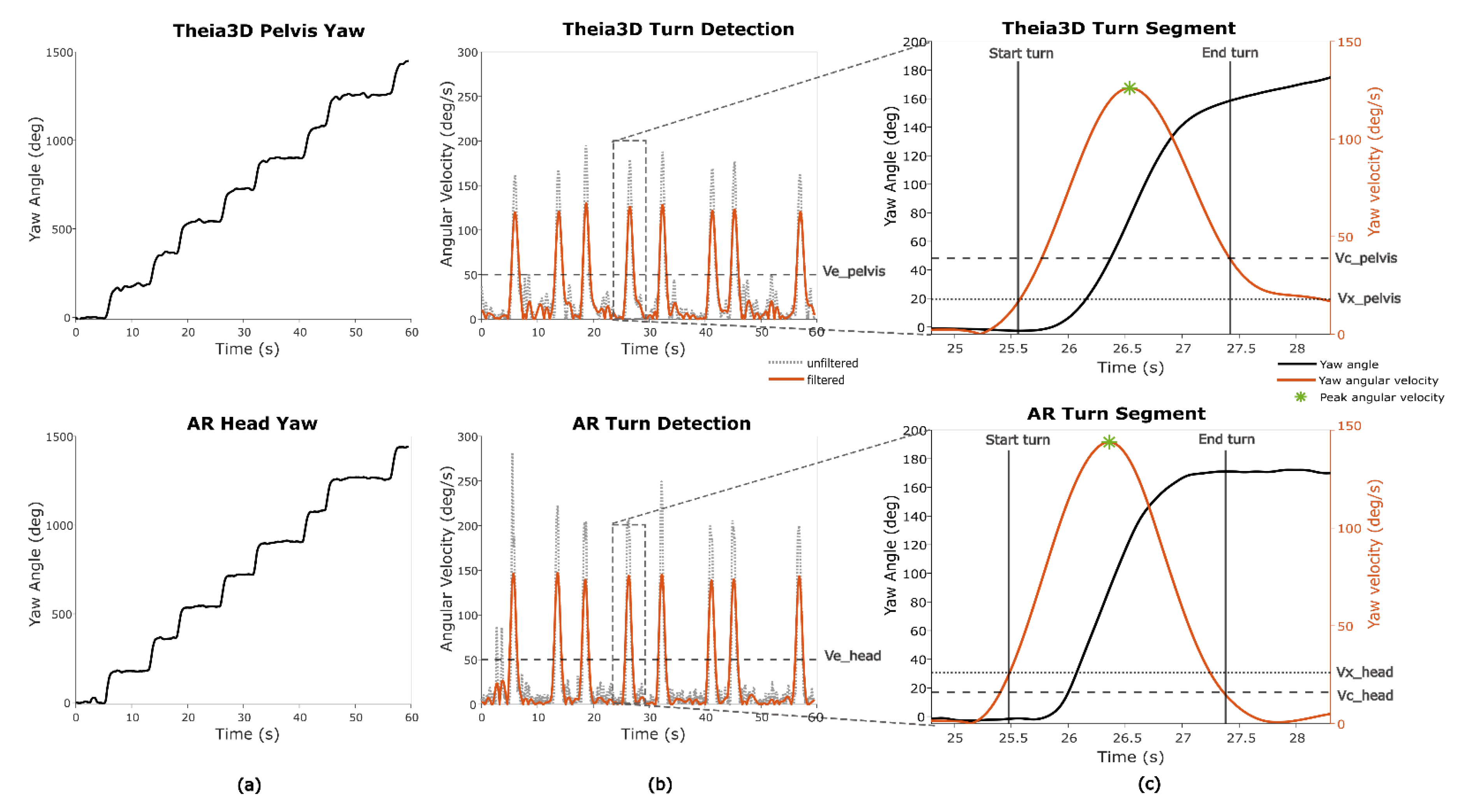
| Detection filter impulse response duration | 1.5 s | 1.5 s |
| Required depth for minima | 20 °/s | 20 °/s |
| Required velocity peak to detect turn (Ve) | 50 °/s | 50 °/s |
| Required velocity peak to detect edge (Vx) | 18 °/s | 26 °/s |
| Required velocity peak to detect edge (Vc) | 39 °/s | 16 °/s |
| Game | Value | X-position ICC(C,1) (95% CI) |
Y-position ICC(C,1) (95% CI) |
Z-position ICC(C,1) (95% CI) |
Yaw angle ICC(C,1) (95% CI) |
|---|---|---|---|---|---|
| Basketball | ICC(C,1) (95% CI) | 0.963 [0.945, 0.981] | 0.999 [0.998, 1.000] | 0.981 [0.972, 0.989] | 0.335 [0.187, 0.483] |
| RMSE (95% CI) | 0.007 [0.006, 0.009] | 0.005 [0.004, 0.006] | 0.023 [0.021, 0.025] | 5.444 [3.60, 7.28] | |
| Mole Patrolll | ICC(C,1) (95% CI) | 0.995 [0.994, 0.996] | 0.998 [0.998, 0.999] | 0.780 [0.662, 0.897] | 0.986 [0.979, 0.993] |
| RMSE (95% CI) | 0.063 [0.053, 0.072] | 0.069 [0.061, 0.077] | 0.016 [0.012, 0.020] | 20.3 [16.7, 23.9] | |
| Puzzle Walk | ICC(C,1) (95% CI) | 0.993 [0.990, 0.995] | 0.996 [0.995, 0.997] | 0.976 [0.970, 0.983] | 0.957 [0.924, 0.990] |
| RMSE (95% CI) | 0.050 [0.042, 0.058] | 0.056 [0.050, 0.061] | 0.027 [0.023, 0.030] | 21.6 [19.1, 24.0] | |
| Smash | ICC(C,1) (95% CI) | 0.932 [0.894, 0.971] | 0.996 [0.995, 0.997] | 0.736 [0.619, 0.853] | 0.997 [0.993, 1.000] |
| RMSE (95% CI) | 0.032 [0.026, 0.037] | 0.080 [0.076, 0.085] | 0.011 [0.008, 0.013] | 14.1 [11.7, 16.5] | |
| Wobbly Waiter | ICC(C,1) (95% CI) | 0.984 [0.976, 0.992] | 0.998 [0.998, 0.999] | 0.998 [0.997, 0.998] | 0.996 [0.995, 0.998] |
| RMSE (95% CI) | 0.041 [0.033, 0.050] | 0.056 [0.053, 0.060] | 0.013 [0.011, 0.015] | 12.0 [10.3, 13.7] |
| Motor state |
Theia3D segments | AR segments |
True positives |
False positives | False negatives |
Precision | Recall | F1-score | Mean overlap ± SD |
|---|---|---|---|---|---|---|---|---|---|
| Straight Walking | 130 | 134 | 125 | 5 | 9 | 0.962 | 0.933 | 0.947 | 97.1% ± 0.3% |
| Turning | 114 | 114 | 113 | 1 | 1 | 0.991 | 0.991 | 0.991 | 78.3% ± 0.9% |
| Squatting | 134 | 134 | 134 | 0 | 0 | 1.000 | 1.000 | 1.000 | 97.2% ± 0.6% |
| Sit-to-stand | 39 | 39 | 39 | 0 | 0 | 1.000 | 1.000 | 1.000 | 90.8% ± 0.4% |
| Stand-to-sit | 40 | 40 | 40 | 0 | 0 | 1.000 | 1.000 | 1.000 | 93.1% ± 0.8% |
| Motor state and mobility metric | Mean ± SD | Mean ± SD | Bias (95% Limits of Agreement) | t-Statistics or Wilcoxon signed-rank-statistics1 | ICC(A,1) |
|---|---|---|---|---|---|
| Straight walking | AR | Theia3D head | |||
| Step length (m) | 0.61 ± 0.11 | 0.60 ± 0.11 | -0.01 (-0.08 0.07) | t(14) = 0.78, p = 0.448 | 0.936 |
| Max. gait speed (m/s) | 1.66 ± 0.35 | 1.66 ± 0.35 | 0.00 (-0.03 0.03) | t(14) = -0.62, p = 0.543 | 0.999 |
| Cadence (steps/min) | 119.59 ± 14.63 | 121.24 ± 14.69 |
1.65 (-11.86 15.16) | t(14) = -0.93, p = 0.370 | 0.890 |
| Turning | AR | Theia3D pelvis | |||
| Turn duration (s) | 2.05 ± 0.22 | 2.07 ± 0.20 | 0.02 (-0.17 0.20) | t(14) = -0.69, p = 0.504 | 0.904 |
| Peak angular velocity (deg/s) |
136.98 ± 16.95 | 116.06 ± 18.24 |
-20.92 (-42.34 0.51) | t(14) = 7.41, p < 0.001 | 0.477 |
| Squatting | AR | Theia3D head | |||
| Squat duration (s) | 2.08 ± 0.57 | 2.07 ± 0.58 | -0.01 (-0.12 0.10) | t(14) = 0.82, p = 0.425 | 0.995 |
| Squat depth (m) | 0.49 ± 0.17 | 0.45 ± 0.16 | -0.04 (-0.08 0.01) | t(14) = 5.68, p < 0.001 | 0.969 |
| Transfers | AR | Theia3D head | |||
| Sit-to-stand duration (s) |
1.20 ± 0.20 | 1.21 ± 0.17 | 0.00 (-0.07 0.08) | W = 20, p = 0.146 | 0.979 |
| Stand-to-sit duration (s) |
1.57 ± 0.38 | 1.59 ± 0.41 | 0.01 (-0.15 0.18) | W = 43, p = 0.352 | 0.978 |
Disclaimer/Publisher’s Note: The statements, opinions and data contained in all publications are solely those of the individual author(s) and contributor(s) and not of MDPI and/or the editor(s). MDPI and/or the editor(s) disclaim responsibility for any injury to people or property resulting from any ideas, methods, instructions or products referred to in the content. |
© 2025 by the authors. Licensee MDPI, Basel, Switzerland. This article is an open access article distributed under the terms and conditions of the Creative Commons Attribution (CC BY) license (http://creativecommons.org/licenses/by/4.0/).