

Submitted:
30 September 2026
Posted:
01 October 2026
You are already at the latest version
Abstract
Multi-omics has emerged as an important systems-level approach for elucidating plant responses to abiotic stress. By integrating genomics, transcriptomics, proteomics, metabolomics, epigenomics, interactomics, and miRNAomics, researchers can connect genetic variation with transcriptional regulation, protein dynamics, metabolic remodeling, and physiological adaptation. This review summarizes recent advances in multi-omics studies of plant responses to major abiotic stresses, including salinity, drought, temperature extremes, heavy metals, and combined environmental stresses. Integrated analyses reveal that stress adaptation is governed by coordinated regulatory networks involving ion homeostasis, osmotic adjustment, antioxidant defense, hormone signaling, transcriptional regulation, protein quality control, and epigenetic modulation. We further compare stress-response strategies among model plants, crops, legumes, perennial trees, and horticultural species, highlighting the influence of evolutionary adaptation and breeding objectives on stress tolerance mechanisms. In addition, recent progress in artificial intelligence-assisted multi-omics analysis is discussed, particularly in data integration, regulatory-network inference, candidate-gene identification, and genotype-environment-phenotype prediction. Despite substantial progress, challenges remain in high-dimensional data integration, causal validation, spatiotemporal resolution, and the translation of molecular findings into practical crop improvement strategies. Future integration of advanced omics technologies, systems biology, bioinformatics, and precision breeding approaches will accelerate the development of climate-resilient crops and contribute to sustainable agricultural production under changing environmental conditions.
Keywords:
multi-omics
; abiotic stress
; plant stress responses
; systems biology
; epigenomics
; artificial intelligence
; crop improvement
Introduction
Adversity denotes a range of environmental factors detrimental to plant growth and survival, commonly termed stress. The physiological mechanisms enabling plants to cope with such stress are known as stress physiology. In natural settings, plants are frequently exposed to suboptimal conditions. Both biotic and abiotic stresses disrupt the balance of key growth factors, diverging from the optimal range essential for normal development. Severe stress can inflict substantial physiological damage and even lead to plant death [1].
Owing to the complexity of plant metabolic and regulatory networks, single-omics research is insufficient to fully elucidate stress response mechanisms. Comprehensive analyses integrating gene transcription, protein translation, post-translational modifications, and metabolism have become the primary focus of current plant stress research. Advancement in sequencing technologies and bioinformatics have facilitated high-throughput and sensitive analysis of plant stress responses at multiple biological levels [2].
Recent advancements have given rise to specialized fields beyond classical omics, such as miRNAomics, epigenomics, and interactomics. These fields refine our understanding by capturing post-transcriptional regulation, epigenetic modifications (e.g., DNA methylation, histone modifications), and dynamic biomolecular interactions. The integrated application of diverse omics approaches provides a comprehensive framework for decoding the complex regulatory networks governing plant stress tolerance. For example, research on maize primary metabolism combined genomics (high-density linkage mapping) and metabolomics (metabolite profiling), identifying numerous metabolite quantitative trait loci (QTLs), revealing epistatic interactions, and constructing networks linking metabolites to agronomic traits [3]. Integrating transcriptomics, metabolomics, and physiological assays, studies on rice submergence tolerance have revealed that the SUB1A-1 gene coordinates a quiescence strategy and recovery processes. This work stands as a paradigm for multi-omics integration in deciphering regulatory mechanisms. [4].
To provide an integrated overview of the conceptual framework and research scope of this review, a schematic illustration is presented in Figure 1. This figure summarizes the major omics layers involved in multi-omics analyses—including genomics, transcriptomics, proteomics, metabolomics, epigenomics, interactomics, and miRNAomics—and illustrates how their integration contributes to elucidating plant responses to diverse abiotic stresses, such as temperature stress, water stress, salinity, and heavy metal stress.
Survey Methodology
A comprehensive literature search and evaluation were performed to summarize recent advances in multi-omics research on plant responses to abiotic stress. Relevant publications were identified from major scientific databases, including Web of Science, PubMed, and Google Scholar, using combinations of keywords related to multi-omics approaches, plant stress responses, and specific abiotic stress conditions. The main search terms included “multi-omics”, “genomics”, “transcriptomics”, “proteomics”, “metabolomics”, “epigenomics”, “interactomics”, “miRNAomics”, “drought stress”, “salinity stress”, “temperature stress”, and “heavy metal stress”.
Peer-reviewed studies were selected according to their relevance to molecular regulation, physiological adaptation, and stress tolerance mechanisms in plants. To ensure broad and balanced coverage, this review incorporated research involving multiple omics technologies, diverse abiotic stress types, and different plant groups, including model plants, crops, legumes, perennial species, and horticultural plants. Studies integrating multiple omics datasets were particularly emphasized because they provide insights into the connections between genetic variation, transcriptional regulation, protein dynamics, metabolic remodeling, and stress adaptation.
The selected literature was analyzed and organized according to omics categories, stress conditions, and biological mechanisms, allowing an integrated overview of current progress, limitations, and future perspectives in plant stress-related multi-omics research.
1. Integrated Overview of Multi-Omics Approaches
1.1. Genomics
Genomics is a biological interdisciplinary field that focuses on the comprehensive study of the genome (the complete DNA collection of all genes in an organism). It mainly explores the structure, function, and evolution of the genome, and achieves precise localization and characterization of genes within the genome [5]. This field reveals, on a genome-wide and quantitative scale, the composition, organization, regulation, and interactions of genes, ultimately linking them to phenotypic outcomes [6]. It also promotes comparative genomics across species or varieties, facilitating the exploration of evolutionary relationships and functional conservation [7]. An important component of genomics is whole-genome sequencing and assembly. This process is dependent on high-throughput DNA sequencing technologies and advanced bioinformatics processes, which result in the generation of complete and annotated genomic datasets [8]. These efforts have greatly enhanced our understanding of the regulatory network of the entire genome and laid the foundation for functional genomics, genome-wide association analysis (GWAS), and molecular breeding strategies [9].
1.2. Transcriptomics
Transcriptomics aims to comprehensively study the gene expression profiles of cells at different developmental stages or under various environmental conditions (such as heat, drought stress) [10]. This field encompasses both coding and non-coding RNA molecules and involves sequencing of all RNA transcripts (transcriptome) in biological samples [11,12]. It is an important tool for elucidating cell phenotypes, regulating transcriptional activity, identifying key functional genes, and predicting the functions of unannotated genes. Common analysis methods include high-throughput techniques based on markers (such as SAGE and MPSS) [13] and hybridization-based techniques (such as DNA microarrays, which can directly detect gene expression and SNPs with high resolution) [14]. In recent years, RNA sequencing (RNA-seq) has become a powerful tool for transcriptome analysis, enabling precise quantification of gene expression and identification of SNPs, and is widely used in basic plant research, clinical diagnosis, and drug discovery [15].
1.3. Proteomics
Proteomics refers to the systematic study of the dynamic complement of all proteins expressed by the genome of a cell, tissue, or organism. This term was first proposed by Marc Wilkins [16]. Proteomics aims to elucidate their composition, abundance, modification, structure, interactions and dynamics within the organism. This field is typically divided into expression proteomics, structural proteomics, subcellular proteomics and quantitative proteomics, among others [17]. Key techniques include two-dimensional gel electrophoresis (2-DE), isotope labeling methods (such as iTRAQ) [18,19], and protein microarrays [20]. Through these methods, proteomics can deeply analyze protein expression patterns, protein-protein interactions and post-translational modifications, thereby revealing fundamental biological processes and life mechanisms. When integrated with genomics, proteomics provides crucial validation for gene expression and functional annotation, helping to confirm the role of genes in various biological contexts [19,21].
1.4. Metabolomics
Metabolites, as the final products of gene transcription and protein activities, play a crucial regulatory role in cellular signal transmission, energy transfer, and intercellular communication [22]. Metabolomics is the systematic study of the dynamic, condition-specific set of small molecules (the metabolome) within a biological system, with the aim of quantifying metabolites to understand their biological roles. The main analytical techniques include gas chromatography (GC), liquid chromatography (LC), capillary electrophoresis (CE), mass spectrometry (MS), and nuclear magnetic resonance (NMR) spectroscopy. As downstream products of genomic and proteomic processes, metabolites can directly and accurately reflect the physiological and pathological states of a biological organism more than genomics or proteomics [23]. Changes in the metabolite profile under specific environmental or stress conditions can effectively characterize the biochemical and physiological state of the organism, thereby providing precise phenotypic information [24].
1.5. Epigenomics
Epigenomics is the study of the dynamic landscape of all epigenetic modifications, which control gene expression patterns independently of the underlying DNA sequence.[25,26]. These mechanisms play a crucial role in plant gene regulation, development, and environmental responses. Research techniques include bisulfite sequencing for DNA methylation [27], ChIP-seq for histone modification [28], ATAC-seq for assessing chromatin accessibility [29], and RNA-seq for analyzing non-coding RNA [30].
1.6. Interactomics
The interactome refers to the collection of all molecular interactions within a cell, tissue, or organism, with a particular focus on protein-protein interactions (PPI), as well as protein-DNA, protein-RNA, and protein-metabolite interactions. Interactomics is a systematic study of these interactions, aiming to elucidate the dynamic networks that support cellular functions, signaling pathways, and stress responses. Research techniques include yeast two-hybrid screening [31], Co-IP [32], AP-MS [33], BiFC [34], and proximity tagging methods (such as BioID and TurboID) [35].
1.7. miRNAomics
miRNAomics focuses on microRNAs (miRNAs), which are a class of non-coding small RNAs approximately 21–24 nucleotides in length, mainly regulating gene expression at the post-transcriptional level. In plants, miRNAs play a crucial role in regulating growth and development, hormone signaling, and responses to environmental stress, and their mechanism usually involves guiding the cleavage of specific mRNAs or inhibiting their translation [36]. With the development of high-throughput sequencing technologies and bioinformatics, researchers can more efficiently identify and analyze conserved and novel miRNAs under different stress conditions [37]. Studies have shown that in plants under drought, salt, low/high temperature, and oxidative stress, miRNA expression undergoes significant changes, reflecting the way plants adapt to external pressures by adjusting their internal regulatory networks [38].
1.8. Relationship Between Omics
The response of plants to abiotic stress involves a highly coordinated network of molecular events, where different omics levels operate in an interrelated and hierarchical manner. Genes provide the template for proteins, which in turn govern cellular metabolism, ultimately yielding metabolites that constitute the final physiological phenotype. Exploring the interactions among these levels is crucial for understanding the complexity of stress responses.
The integration of transcriptome and proteome can correlate gene expression with protein abundance, revealing transcriptional and post-transcriptional regulatory information. The proteome and metabolome represent the functional output of gene expression, and integrating them with transcriptome data can more comprehensively characterize the functional pathways related to stress. Recent multi-omics integration studies have revealed the overall stress response mechanisms across species. For example, in yeast, genomics - transcriptomics - proteomics - metabolomics form a cascade, coordinating glucose sensing and fermentation growth. In salt-stressed plants, the SOS pathway demonstrates multi-omics synergy: genomic variations affect transcriptional abundance, leading to changes in protein modifications and metabolite accumulation, and involving epigenetic regulation. Time-series multi-omics further reveals the stage-specificity of stress responses. Compared with single-omics, multi-omics integration can reduce bias and bridge the genotype-phenotype gap [39,40].
2. Joint Study of Omics in Response to Abiotic Stress in Plants
2.1. Plant Response to Salt Stress
While low salt concentrations may promote seed germination, excessive salinity generally inhibits plant growth and development [41]. Multi-omics studies have revealed complex physiological and molecular adaptation strategies that enable plants to cope with saline environments. Krishnamurthy et al. investigated mangroves and demonstrated that their roots exhibit unique adaptations to high salinity. Transcriptomic analysis identified 47 upregulated salt-tolerance-related genes, including those associated with ethylene and auxin signaling pathways, whereas many ABA-related genes were downregulated. These findings suggest that ABA-independent signaling pathways also contribute significantly to salt tolerance in mangroves. Metabolomic analysis further showed that mangroves accumulate proline, betaine, and soluble sugars to alleviate salt-induced osmotic stress [42].
In wheat, functional annotation using MapMan revealed that genes involved in sucrose metabolism, including hexokinase, sucrose synthase, and cell wall-modifying enzymes, were significantly upregulated under salt stress [43]. Increased accumulation of glucose, sucrose, and fructose contributes to osmotic adjustment, carbon storage, cellular homeostasis, and reactive oxygen species (ROS) scavenging [44]. In addition, transcriptomic studies demonstrated enhanced expression of membrane-associated transport proteins, including ion channels and Na+/H+ antiporters, indicating their importance in salinity adaptation [45].
2.1.1. The Core Mechanisms and Signaling Pathways of Salt Stress Response
Integrated multi-omics studies have demonstrated that plant salt tolerance is regulated through coordinated ion homeostasis, osmotic adjustment, antioxidant defense, and transcriptional regulation. One of the central mechanisms involves activation of the SOS signaling pathway, which regulates Na+ extrusion through the plasma membrane Na+/H+ antiporter SOS1. In parallel, vacuolar NHX transporters mediate intracellular sodium compartmentalization, while HKT family proteins contribute to selective K+/Na+ transport and ionic balance maintenance.
To alleviate salt-induced osmotic and oxidative stress, plants accumulate compatible solutes such as proline, glycine betaine, sorbitol, and sucrose through the upregulation of key biosynthetic genes including P5CS and BADH. At the same time, antioxidant defense systems are enhanced through increased activities of superoxide dismutase (SOD), peroxidase (POD), ascorbate peroxidase (APX), and glutathione reductase (GR), thereby reducing ROS-mediated cellular damage.
Hormonal and transcriptional regulatory networks further coordinate salt stress adaptation. Both ABA-dependent pathways mediated by SnRK2 kinases and ABA-independent pathways involving ethylene and auxin signaling participate in stress perception and response. These signaling cascades ultimately regulate transcription factors from the bZIP, MYB, WRKY, and NAC families, which control downstream genes associated with ion transport, osmotic regulation, and antioxidant protection. Different plant species exhibit distinct adaptive strategies; for example, mangroves rely more strongly on continuous osmotic regulation and ABA-independent signaling, whereas crops such as rice and wheat primarily enhance ion compartmentalization and rapid stress-response regulation.
2.2. Response of Plants to Drought Stress
Drought stress is a major abiotic factor that negatively affects plant growth and development. Soil water deficiency disrupts cellular water balance, resulting in reduced turgor pressure, impaired membrane stability, and decreased biomass accumulation [46]. Severe dehydration can also increase membrane permeability and induce leakage of intracellular solutes, thereby affecting overall cellular homeostasis.
Overexpression of JAZ7 has been reported to enhance drought tolerance in Arabidopsis thaliana [47]. To investigate the underlying response patterns, tandem mass tag (TMT)-based quantitative proteomics combined with targeted metabolomics was conducted using JAZ7-overexpressing (OE), JAZ7-knockout (KO), and wild-type (WT) plants. Proteomic analysis identified 225 differentially abundant proteins in OE plants, many of which were associated with energy metabolism, stress defense, and general metabolic regulation. Under drought conditions, substantial proteomic differences were observed between OE plants and the KO or WT genotypes, indicating an important role of JAZ7 in drought adaptation.
Transcriptomic and metabolomic analyses of Astragalus membranaceus further demonstrated that drought-responsive molecular patterns are highly dependent on stress severity and genotype [48]. In wheat, drought stress significantly altered proteins associated with photosynthesis, metabolic regulation, and detoxification processes. Proteomic and metabolomic analyses of spring wheat showed that the Kavir cultivar was less affected by drought stress than the Bahar cultivar, with fewer metabolic pathways exhibiting significant alterations [49]. These findings provide valuable insights into the physiological and molecular basis of drought tolerance in crops.
2.2.1. The Core Mechanisms and Signaling Pathways of Drought Stress Response
Plant drought adaptation involves coordinated regulation of water retention, osmotic adjustment, antioxidant defense, and transcriptional reprogramming. One of the central drought-response pathways is mediated by abscisic acid (ABA). Drought perception induces ABA biosynthesis through activation of NCED enzymes, after which ABA is recognized by PYR/PYL receptors. This interaction suppresses PP2C phosphatases and activates SnRK2 kinases, ultimately promoting stomatal closure through regulation of anion and potassium efflux channels, including SLAC1, thereby reducing water loss.
To maintain cellular stability under dehydration, plants accumulate compatible osmolytes such as proline and betaine, while late embryogenesis abundant (LEA) proteins and dehydrins protect proteins and membrane structures against dehydration-induced damage. At the same time, drought stress enhances antioxidant defense systems through increased activities of enzymes including APX, GR, CAT, and SOD, thereby alleviating ROS-mediated oxidative injury.
Drought stress also induces extensive metabolic and transcriptional reprogramming. Reduced photosynthetic activity is accompanied by adjustments in carbon metabolism and secondary metabolite biosynthesis. Stress-responsive transcription factors, including DREB/CBF, NAC, MYB, and WRKY family proteins, regulate downstream genes involved in osmotic regulation, stress protection, and metabolic adaptation. In addition, epigenetic modifications such as histone modification and DNA methylation contribute to stress memory and facilitate more rapid responses upon recurrent drought exposure. Different plant species adopt distinct adaptation strategies; drought-tolerant genotypes often emphasize rapid stomatal regulation and antioxidant protection, whereas drought-avoidant species rely more heavily on osmotic adjustment and root system remodeling.
2.3. Response of Plants to Temperature Stress
Temperature stress, including both cold and heat extremes, is a major abiotic factor limiting plant growth, development, and agricultural productivity worldwide. Exposure to low temperatures induces physiological and molecular alterations such as membrane rigidification, reactive oxygen species (ROS) accumulation, and disruption of metabolic homeostasis [50]. In contrast, high temperatures destabilize protein structures, inhibit enzymatic activity, and impair reproductive development [51].
Multi-omics approaches have substantially improved our understanding of plant adaptation to temperature stress. Transcriptomic analysis by Guan et al. using RNA-seq in weedy and cultivated rice lines demonstrated that cold-tolerant genotypes exhibited significantly higher expression of cold-responsive genes encoding basic helix-loop-helix (bHLH) and leucine-rich repeat (LRR) proteins compared with cold-sensitive lines [52]. Cold-tolerant rice also displayed broader transcriptional regulation of genes associated with protein metabolism, post-translational modification, protein folding, and defense signaling, providing valuable targets for molecular breeding and genetic engineering aimed at improving cold tolerance.
Cold stress adaptation is primarily regulated through the ICE1-CBF-COR signaling pathway. Cold-induced calcium signaling, together with CDPK and MAPK cascades, promotes ICE1 activation and subsequent induction of CBF transcription factors, which regulate downstream cold-responsive (COR) genes. In parallel, plants maintain membrane stability through enhanced lipid unsaturation mediated by fatty acid desaturases and accumulate compatible solutes such as soluble sugars, polyamines, and proline to preserve cellular homeostasis under chilling conditions.
Plant responses to heat stress are largely coordinated through the HSF-HSP regulatory network. Temperature-induced membrane fluidity changes and chromatin remodeling activate heat shock transcription factors, particularly HSF-A1, which subsequently induce the expression of multiple heat shock proteins (HSPs). Molecular chaperones including HSP70 and HSP90 play essential roles in preventing protein aggregation and maintaining proteome stability under elevated temperatures. In addition, enhanced antioxidant activity and photosynthetic repair mechanisms contribute to protection against heat-induced oxidative damage and photoinhibition.
Overall, integrated multi-omics analyses provide comprehensive insights into the complex regulatory networks underlying plant adaptation to temperature extremes and offer an important foundation for developing climate-resilient crop varieties.
2.4. Response of Plants to Heavy Metal Stress
Rapid industrialization and urbanization have significantly increased heavy metal contamination in soils, posing serious threats to plant growth and ecosystem stability [53]. Unlike essential micronutrients such as Zn, Cu, and Mo, toxic metals including Cd, Pb, and Hg can severely disrupt plant metabolism even at low concentrations [54]. Heavy metal accumulation interferes with protein folding, membrane integrity, photosynthesis, and cellular redox homeostasis, ultimately impairing plant growth and development. Because heavy metal toxicity strongly influences protein abundance and metabolic regulation, integrated proteomic and metabolomic analyses are widely used to investigate plant responses under metal stress conditions [55].
Plants have evolved complex detoxification and tolerance mechanisms to cope with heavy metal toxicity. One important strategy involves restricting metal uptake and enhancing metal efflux through the regulation of membrane transporters. Under heavy metal stress, plants often suppress metal uptake transporters such as members of the ZIP family while enhancing the activity of heavy metal ATPases (HMAs) and other efflux-associated proteins. In addition, roots release organic acids and phenolic compounds into the rhizosphere, thereby reducing metal bioavailability through extracellular chelation.
For metals that enter plant cells, intracellular sequestration and chelation play central roles in detoxification. Vacuolar transporters including CAX and MTP proteins facilitate compartmentalization of Cd2+, Zn2+, and other ions into vacuoles, while ABC transporters contribute to intracellular metal redistribution. At the biochemical level, glutathione-derived phytochelatins (PCs) and metallothioneins (MTs) bind metal ions and reduce their cytotoxicity. Multi-omics studies further demonstrate that glutathione metabolism is strongly activated under heavy metal exposure, highlighting its importance in cellular detoxification.
Heavy metal stress also induces oxidative damage through excessive ROS accumulation. To alleviate oxidative injury, plants enhance antioxidant defense systems involving enzymes such as superoxide dismutase (SOD), catalase (CAT), and ascorbate peroxidase (APX), together with non-enzymatic antioxidants including glutathione, ascorbic acid, and flavonoids. Coordinated regulation of these detoxification pathways is mediated by transcription factors from the MYB, WRKY, and bZIP families, which control downstream genes associated with metal transport, chelation, antioxidant defense, and stress adaptation.
2.5. Response of Plants to Multiple Abiotic Stresses
Plants growing under natural environmental conditions are frequently exposed to combinations of abiotic stresses, including drought, salinity, heat, and cold, which collectively impose complex constraints on plant growth and productivity [1]. Although traditional studies have primarily focused on individual stress factors, integrated multi-omics analyses have demonstrated that plant responses to combined stresses are not simple additive effects of single-stress responses but involve unique regulatory networks and coordinated molecular reprogramming [56,57].
Transcriptomic, proteomic, and metabolomic studies have revealed extensive crosstalk among signaling pathways under combined stress conditions [58,59,60]. In particular, stress combinations induce dynamic coordination between hormonal signaling, calcium-mediated pathways, ROS signaling, and energy metabolism, resulting in distinct transcriptional and metabolic profiles compared with single-stress treatments. Key transcription factors including members of the Hsf, WRKY, and NAC families exhibit overlapping yet stress-specific regulatory patterns that contribute to broad-spectrum stress adaptation [61,62,63]. For example, HsfA2b participates not only in heat stress responses but also in the regulation of salt and drought tolerance [62]. These shared regulatory components provide promising targets for molecular breeding and gene editing strategies aimed at improving crop resilience under complex environmental conditions [64,65].
Systems biology approaches integrating multi-omics datasets further demonstrate that combined stresses trigger extensive network rewiring involving genes, proteins, metabolites, and signaling molecules [2,66]. Joint transcriptomic and metabolomic analyses have facilitated the identification of critical metabolic nodes and coordinated regulatory pathways associated with stress adaptation [48,56]. Nevertheless, the molecular mechanisms underlying synergistic and antagonistic interactions among multiple stresses remain incompletely understood. Future research combining high spatio-temporal resolution omics technologies with advanced bioinformatics and network analysis tools will contribute to a more comprehensive understanding of stress signal integration and accelerate the development of broad-spectrum stress-tolerant crops [1,2].
2.6. Stress Response Characteristics of Different Plant Groups from a Multimodal Perspective
Based on the aforementioned studies, plant groups belonging to different ecological and agricultural categories exhibit distinct molecular strategies in response to abiotic stress, reflecting the evolutionary history and adaptability of their survival strategies, as summarized in Table 1.
The model plant Arabidopsis thaliana provides a fundamental framework for elucidating stress signalling pathways. It offers advantages such as comprehensive pathway analysis, a wealth of genetic tools and systems biology approaches. These provide targets and design concepts for the genetic improvement of stress tolerance in crops. Research on major cereal crops focuses on yield stability and stress resilience during key growth stages, particularly emphasising tolerance during reproductive phases such as flowering and grain filling, which are directly linked to yield formation. Leguminous plants, such as soybeans, peanuts and chickpeas, demonstrate synergistic adaptation strategies in which stress responses are closely coupled with the symbiotic nitrogen fixation system. This involves root-nodule interactions, ion-specific responses and metabolic flexibility. Perennial forest trees and economic crops such as mangroves, tea plants and fruit trees employ long-term adaptation mechanisms centred on structural durability and persistence. These include constitutive tolerance and the accumulation of secondary metabolites, as well as a significant role for epigenetic regulation in stress memory. Studies on vegetable crops such as tomatoes, peppers, and cucumbers emphasise balancing yield with maintaining quality, covering metabolic processes related to fruit quality and preservation of appearance, as well as the trade-offs between rapid growth and stress response.
Overall, research strategies diverge notably across plant groups. Model plant studies aim to decipher system-level mechanisms, often using integrated time-series omics. Work on major crops is trait-driven and employs GWAS and QTL mapping to uncover agronomically valuable alleles from natural diversity. Exploration of wild relatives and resilient germplasm relies on comparative genomics and transcriptomics to identify adaptive genetic variation. Research on perennial species increasingly focuses on epigenetic regulation and the basis of stress memory. Understanding these group-specific approaches is key to designing precise crop improvement strategies.
3. Molecular Mechanisms and Their Translational Potential
Understanding the molecular mechanisms underlying plant responses to abiotic stress is essential for improving crop resilience and productivity through advanced breeding strategies. Many plant species have evolved complex genetic, physiological, and biochemical adaptation systems that enable survival under extreme environmental conditions. Integrated multi-omics approaches have substantially improved our understanding of these adaptive processes and provided valuable resources for translational applications in crop improvement.
Transcriptomic analyses have revealed extensive transcriptional reprogramming in plants exposed to abiotic stress [67]. However, the relatively weak correlation between transcript abundance and protein accumulation highlights the importance of proteomic approaches for understanding functional stress responses [68]. Proteomics enables the identification and quantification of stress-responsive proteins and provides direct insights into translational and post-translational regulatory mechanisms. In addition, spatial proteomics facilitates the investigation of organ-specific and subcellular stress responses, particularly in chloroplasts and mitochondria, where oxidative stress signaling and energy metabolism are tightly regulated.
Integrated transcriptomic and proteomic analyses have identified numerous candidate biomarkers and regulatory modules associated with stress tolerance. For example, comparative proteomic studies in rice under salt stress revealed increased abundance of vacuolar H+-ATPase and Na+/H+ antiporters involved in ion compartmentalization and cellular detoxification [69]. In drought-stressed maize, enhanced accumulation of heat shock proteins and chloroplast-associated protective proteins was observed under dehydration conditions [70]. These findings demonstrate that multi-omics integration can facilitate the reconstruction of stress-responsive regulatory networks and support the identification of molecular targets for marker-assisted selection, genetic engineering, and stress-resilient crop breeding.
Recent studies have further demonstrated that microRNAs and related non-coding RNAs function as important regulatory elements during abiotic stress adaptation. miRNA biogenesis and target recognition provide a basis for post-transcriptional regulation [37], and computational analyses have expanded candidate miRNA-mRNA interactions related to drought tolerance in Arabidopsis [39]. In parallel, stress tolerance is shaped by phytohormone crosstalk, chromatin modifications, and senescence-associated regulatory networks [41,71,78].
The identification of stress-responsive miRNAs and regulatory networks provides important opportunities for translational research and molecular breeding. Combined multi-omics strategies integrating transcriptomics, proteomics, metabolomics, and regulatory RNA analyses are expected to accelerate the discovery of robust biomarkers and improve precision breeding approaches for the development of climate-resilient crops.
4. Applications of AI in Plant Multi-Omics Analysis
In terms of mechanism discovery, artificial intelligence has been found to be a significant enabler in the identification of key regulatory elements and pathways. By deciphering the intricate relationships between epigenetic marks and gene expression, it is possible to distinguish genuinely functional modifications and determine their role in stress memory formation. For the extensive range of non-coding RNAs, intelligent algorithms have the capacity to predict potential targets based on sequence and expression patterns, thereby providing priority directions for functional studies. Concurrently, integrating protein structure, expression, and interaction data facilitates the inference of protein complexes likely formed under stress conditions, thereby enabling the mapping of novel signalling networks [72].
In recent years, the field of artificial intelligence has been gradually shifting from merely explaining phenomena towards the domains of prediction and design. Confronted with vast numbers of functionally unknown genes, intelligent algorithms have been shown to synthesise multiple characteristics in order to predict their potential roles in stress resistance. This, in turn, guides experimental validation priorities. At the application level, by correlating metabolome and phenotype data, key metabolic pathway targets influencing stress resistance can be identified, providing a basis for metabolic engineering. In the context of breeding, the integration of genomic variation with multi-omics information facilitates a more precise prediction of environmental adaptability across genotypes. This, in turn, aids parental selection and variety design [73,74].
5. Challenges and Future Directions
The integrated application of multi-omics technologies has revolutionized our understanding of plant responses to abiotic stress, as detailed in the preceding sections. However, this rapidly advancing field faces significant conceptual, technical, and practical challenges. Addressing these limitations is crucial for translating multi-omics insights into tangible improvements in crop resilience.
5.1. Technical and Analytical Challenges in Multi-Omics Integration
The foremost challenge lies in the integration and interpretation of high-dimensional, heterogeneous omics datasets. While the examples summarized above demonstrate successful combinations of two or three omics layers (e.g., transcriptomics with metabolomics), truly integrative analyses across four or more layers—encompassing genomics, transcriptomics, proteomics, metabolomics, and epigenomics—remain rare. The lack of standardized protocols for data generation, normalization, and annotation across different platforms and laboratories hampers comparative meta-analysis and data reuse [2]. Furthermore, the biological meaning extracted from correlation networks (e.g., linking a transcription factor’s upregulation to a metabolite’s accumulation) often requires causal validation through genetic and biochemical experiments. The functional validation of GmPAP3 [75] exemplifies the necessity of moving beyond correlation to establish mechanistic causality.
5.2. The Complexity of Spatiotemporal Dynamics and Stress Combinations
Most current multi-omics studies, including those reviewed here, provide snapshots of stress responses at a single time point or in a specific tissue. However, plant adaptation is a dynamic process. As highlighted in Section 2.8, a comprehensive understanding requires analyses across different time points and developmental stages [48,49,66,76]. Future research must employ high-resolution time-series omics to decipher the sequence of molecular events—from rapid signal perception to long-term acclimation. Equally critical is moving beyond single-stress studies. As noted in Section 3.5, plants in nature face combined stresses (e.g., drought + heat, salinity + heavy metals), and their responses are not simply additive but involve unique regulatory networks [56,57]. Designing multi-omics experiments that mimic these complex field conditions is essential for identifying robust, broad-spectrum tolerance mechanisms.
5.3. From Model Systems to Crop Diversity: A Translational Gap
A significant portion of mechanistic discovery originates from model plants like Arabidopsis thaliana (e.g., JAZ7 regulation in drought [47,59]). While indispensable for revealing core pathways, the translation of these findings into major crops is not straightforward. As comparative analysis in Section 3.6 indicates, different plant categories (e.g., cereals, legumes, perennial trees) possess lineage-specific adaptations and constraints. For instance, the ABA-independent salt tolerance mechanism in mangroves [42] may not be directly transferable to glycophytic crops. Therefore, future efforts must intensify multi-omics profiling within diverse agronomic species and their wild relatives to mine naturally occurring, favorable alleles. Integrating omics data with genome-wide association studies (GWAS) and quantitative trait locus (QTL) mapping in crops.
5.4. Elucidating the Role of Epigenetics and Long-Term Stress Memory
Epigenomic regulation is emerging as a crucial layer in stress adaptation, as seen in castor bean under salt stress [77]. However, research integrating epigenomics (DNA methylation, histone modifications) with other omics layers is still in its infancy. A major future direction is to understand how epigenetic marks mediate stress “memory”, enabling plants to respond more effectively to recurrent stress. This requires multi-omics studies across generations to track the heritability of stress-induced molecular and epigenetic changes. Furthermore, the interplay between epigenetic modifications and other regulatory molecules, such as the suggested cross-talk between miRNAs and histone methylation, needs systematic exploration.
5.5. Multi-Omics Guided Engineering of Stress-Resilient Metabolism
Multi-omics holds great promise for guiding the engineering of stress-resilient metabolism. Abiotic stress profoundly reshapes secondary metabolite profiles, which play vital roles in antioxidant defense and adaptation [78]. Integrated transcriptomic and metabolomic analyses can identify key regulatory nodes in these biosynthetic pathways. The future lies in using this systems-level information not only for marker-assisted selection but also for precision metabolic engineering. This could involve editing master transcription factors or modulating hormone signaling pathways (e.g., ABA, jasmonate) to redirect metabolic flux toward the production of protective compounds without compromising growth and yield.
Conclusions
The rapid development of multi-omics technologies has greatly advanced our understanding of the complex molecular networks underlying plant responses to abiotic stress. Integrated analyses combining genomics, transcriptomics, proteomics, metabolomics, and epigenomics provide unprecedented opportunities to uncover the dynamic regulatory mechanisms governing stress perception, signal transduction, metabolic reprogramming, and adaptive responses.
Despite substantial progress, major challenges remain in data integration, spatiotemporal resolution, functional validation, and the interpretation of complex regulatory networks under combined environmental stresses. Future research should increasingly emphasize systems biology approaches that integrate high-resolution omics technologies with advanced bioinformatics, artificial intelligence, and network modeling tools to achieve a more comprehensive understanding of plant stress adaptation.
Importantly, the translational application of multi-omics research will play a crucial role in the development of climate-resilient crops. The identification of stress-responsive genes, proteins, metabolites, and regulatory RNAs provides valuable resources for marker-assisted selection, genome editing, and precision breeding strategies. Continued integration of multi-omics technologies with crop improvement programs will contribute to sustainable agriculture and global food security under increasingly challenging environmental conditions.
References
- Pandey, P.; Irulappan, V.; Bagavathiannan, M.V.; Senthil-Kumar, M. Impact of combined abiotic and biotic stresses on plant growth and avenues for crop improvement by exploiting physio-morphological traits. Front. Plant Sci. 2017, 8, 537–544. [Google Scholar] [CrossRef] [PubMed]
- Ambrosino, L.; Colantuono, C.; Diretto, G.; Fiore, A.; Chiusano, M.L. Bioinformatics resources for plant abiotic stress responses: state of the art and opportunities in the fast evolving-omics era. Plants 2020, 9, 591. [Google Scholar] [CrossRef] [PubMed]
- Wen, W.; Li, K.; Alseekh, S.; Omranian, N.; Zhao, L.; Zhou, Y.; Xiao, Y.; Jin, M.; Yang, N.; Liu, H.; Florian, A.; Li, W.; Pan, Q.; Nikoloski, Z.; Yan, J.; Fernie, A.R. Genetic determinants of the network of primary metabolism and their relationships to plant performance in a maize recombinant inbred line population. Plant Cell 2015, 27, 1839–1856. [Google Scholar] [CrossRef] [PubMed]
- Alpuerto, J.B.; Hussain, R.M.F.; Fukao, T. The key regulator of submergence tolerance, SUB1A, promotes photosynthetic and metabolic recovery from submergence damage in rice leaves. Plant Cell Environ. 2016, 39, 672–684. [Google Scholar] [CrossRef] [PubMed]
- Abbas, Z. Bioinformatics and genomics: advancements in interdisciplinary research. Pak. J. Health Solut. 2023, 1, 48–50. [Google Scholar]
- Yang, S. The progress of systems biology. Bull. Chin. Acad. Sci. 2004, 1, 31–34. [Google Scholar] [CrossRef] [PubMed]
- International Rice Genome Sequencing Project; Sasaki, T. The map-based sequence of the rice genome. Nature 2005, 436, 793–800. [Google Scholar] [CrossRef] [PubMed]
- Ekblom, R.; Wolf, J.B. A field guide to whole-genome sequencing, assembly and annotation. Evol. Appl. 2014, 7, 1026–1042. [Google Scholar] [CrossRef] [PubMed]
- Califano, A.; Butte, A.J.; Friend, S.; Ideker, T.; Schadt, E. Leveraging models of cell regulation and GWAS data in integrative network-based association studies. Nat. Genet. 2012, 44, 841–847. [Google Scholar] [CrossRef] [PubMed]
- Bashir, K.; Matsui, A.; Rasheed, S.; Seki, M. Recent advances in the characterization of plant transcriptomes in response to drought, salinity, heat, and cold stress. F1000Research 2019, 8, F1000 Faculty Rev–658. [Google Scholar] [CrossRef] [PubMed]
- Forrest, A.R.R.; Carninci, P. Whole genome transcriptome analysis. RNA Biol. 2009, 6, 107–112. [Google Scholar] [CrossRef] [PubMed]
- Rodríguez-García, A.; Sola-Landa, A.; Barreiro, C. RNA-seq-based comparative transcriptomics: RNA preparation and bioinformatics. Methods Mol. Biol. 2017, 1645, 59–72. [Google Scholar] [CrossRef] [PubMed]
- Agarwal, P.; Parida, S.K.; Mahto, A.; Das, S.; Mathew, I.E.; Malik, N.; Tyagi, A.K. Expanding frontiers in plant transcriptomics in aid of functional genomics and molecular breeding. Biotechnol. J. 2014, 9, 1480–1492. [Google Scholar] [CrossRef] [PubMed]
- Patil, N.; Nouri, N.; McAllister, L.; Matsukaki, H.; Ryder, T. Single-nucleotide polymorphism genotyping using microarrays. Curr. Protoc. Hum. Genet. 2000, 27, 2.9.1–2.9.16. [Google Scholar] [CrossRef] [PubMed]
- Sun, H.J.; Wei, H.J. The application of RNA-seq technology in the study of the transcriptome. Chin. Foreign Med. Res. 2018, 16, 184–187. [Google Scholar]
- Yarmush, M.L.; Jayaraman, A. Advances in proteomic technologies. Annu. Rev. Biomed. Eng. 2002, 4, 349–373. [Google Scholar] [CrossRef] [PubMed]
- Christopher, J.A.; Stadler, C.; Martin, C.E.; Morgenstern, M.; Pan, Y.; Betsinger, C.N.; Rattray, D.G.; Mahdessian, D.; Gingras, A.C.; Warscheid, B.; Lehtiö, J.; Cristea, I.M.; Foster, L.J.; Emili, A.; Lilley, K.S. Subcellular proteomics. Nat. Rev. Methods Primers 2021, 1, 32. [Google Scholar] [CrossRef] [PubMed]
- Ross, P.L.; Huang, Y.N.; Marchese, J.N.; Williamson, B.; Parker, K.; Hattan, S.; Khainovski, N.; Pillai, S.; Dey, S.; Daniels, S.; Purkayastha, S.; Juhasz, P.; Martin, S.; Bartlet-Jones, M.; He, F.; Jacobson, A.; Pappin, D.J. Multiplexed protein quantitation in Saccharomyces cerevisiae using amine-reactive isobaric tagging reagents. Mol. Cell. Proteom. 2004, 3, 1154–1169. [Google Scholar] [CrossRef] [PubMed]
- Zhang, H.Y.; Lei, G.; Zhou, H.W.; He, C.; Liao, J.L.; Huang, Y.J. Quantitative iTRAQ-based proteomic analysis of rice grains to assess high night temperature stress. Proteomics 2017, 17, 1600365. [Google Scholar] [CrossRef] [PubMed]
- Chandra, H.; Reddy, P.J.; Srivastava, S. Protein microarrays and novel detection platforms. Expert Rev. Proteom. 2011, 8, 61–79. [Google Scholar] [CrossRef] [PubMed]
- Chitteti, B.R.; Peng, Z. Proteome and phosphoproteome differential expression under salinity stress in rice (Oryza sativa) roots. J. Proteome Res. 2007, 6, 1718–1727. [Google Scholar] [CrossRef] [PubMed]
- Milanesi, R.; Coccetti, P.; Tripodi, F. The regulatory role of key metabolites in the control of cell signaling. Biomolecules 2020, 10(6), 862. [Google Scholar] [CrossRef] [PubMed]
- Lankadurai, B. P.; Nagato, E. G.; Simpson, M. J. Environmental metabolomics: an emerging approach to study organism responses to environmental stressors. Environ. Rev. 2013, 21(3), 180–205. [Google Scholar] [CrossRef]
- Goodacre, R. Metabolic profiling: pathways in discovery. Drug Discov. Today 2004, 9, 260–261. [Google Scholar] [CrossRef] [PubMed]
- Gibney, E. R.; Nolan, C. M. Epigenetics and gene expression. Heredity 2010, 105(1), 4–13. [Google Scholar] [CrossRef] [PubMed]
- Bure, I. V.; Nemtsova, M. V.; Kuznetsova, E. B. Histone modifications and non-coding RNAs: mutual epigenetic regulation and role in pathogenesis. Int. J. Mol. Sci. 2022, 23(10), 5801. [Google Scholar] [CrossRef] [PubMed]
- Moore, L.D.; Le, T.; Fan, G. DNA methylation and its basic function. Neuropsychopharmacology 2012, 38, 23–38. [Google Scholar] [CrossRef] [PubMed]
- Hino, S.; Sato, T.; Nakao, M. Chromatin immunoprecipitation sequencing (ChIP-seq) for detecting histone modifications and modifiers. In Epigenomics: Methods and Protocols; Springer US: New York, NY, 2022; pp. 55–64. [Google Scholar]
- Buenrostro, J. D.; Wu, B.; Chang, H. Y.; Greenleaf, W. J. ATAC-seq: a method for assaying chromatin accessibility genome-wide. Curr. Protoc. Mol. Biol. 2015, 109(1), 21–29. [Google Scholar] [CrossRef] [PubMed]
- Ilott, N. E.; Ponting, C. P. Predicting long non-coding RNAs using RNA sequencing. Methods 2013, 63(1), 50–59. [Google Scholar] [CrossRef] [PubMed]
- Maple, J.; Møller, S. G. Yeast two-hybrid screening. Methods Mol. Biol. 2007, 362, 207–223. [Google Scholar] [CrossRef] [PubMed]
- Lin, J. S.; Lai, E. M. Protein-protein interactions: co-immunoprecipitation. Methods Mol. Biol. 2017, 1615, 211–219. [Google Scholar] [CrossRef] [PubMed]
- Gnanasekaran, P.; Pappu, H. R. Affinity purification-mass spectroscopy (AP-MS) and co-immunoprecipitation (Co-IP) technique to study protein-protein interactions. Methods Mol. Biol. 2023, 2690, 81–85. [Google Scholar] [CrossRef] [PubMed]
- Shang, L.; Zhang, Y.; Liu, Y.; Jin, C.; Yuan, Y.; Tian, C.; Ni, M.; Bo, X.; Zhang, L.; Li, D.; He, F.; Wang, J. A yeast BiFC-seq method for genome-wide interactome mapping. Genom. Proteom. Bioinform. 2022, 20(4), 795–807. [Google Scholar] [CrossRef] [PubMed]
- May, D. G.; Scott, K. L.; Campos, A. R.; Roux, K. J. Comparative application of BioID and TurboID for protein-proximity biotinylation. Cells 2020, 9(5), 1070. [Google Scholar] [CrossRef] [PubMed]
- O’Brien, J.; Hayder, H.; Zayed, Y.; Peng, C. Overview of microRNA biogenesis, mechanisms of actions, and circulation. Front. Endocrinol. 2018, 9, 402. [Google Scholar] [CrossRef] [PubMed]
- Islam, M. T.; Ferdous, A. S.; Najnin, R. A.; Sarker, S. K.; Khan, H. High-throughput sequencing reveals diverse sets of conserved, nonconserved, and species-specific miRNAs in jute. Int. J. Genom. 2015, 2015, 125048. [Google Scholar] [CrossRef] [PubMed]
- Zhakypbek, Y.; Rakhmetullina, A.; Kamarkhan, Z.; Tursbekov, S.; Shi, Q.; Xing, F.; Pyrkova, A.; Ivashchenko, A.; Kossalbayev, B. D.; Belkozhayev, A. M. In silico analysis of miRNA-mRNA binding sites in Arabidopsis thaliana as a model for drought-tolerant plants. Plants 2025, 14(12), 1800. [Google Scholar] [CrossRef] [PubMed]
- Lan, P.; Li, W.; Schmidt, W. Complementary proteome and transcriptome profiling in phosphate-deficient Arabidopsis roots reveals multiple levels of gene regulation. Mol. Cell. Proteom. 2012, 11(11), 1156–1166. [Google Scholar] [CrossRef] [PubMed]
- Singh, P.; Choudhary, K. K.; Chaudhary, N.; Gupta, S.; Sahu, M.; Tejaswini, B.; Sarkar, S. Salt stress resilience in plants mediated through osmolyte accumulation and its crosstalk mechanism with phytohormones. Front. Plant Sci. 2022, 13, 1006617. [Google Scholar] [CrossRef] [PubMed]
- Wang, Q.; Liu, H.; Li, H.; Zhou, H.; Xi, W.; Gao, L. Effects of salt stress on physiological characteristics of Medicago sativa L., Melilotus officinalis, and foxtail millet and their applications in agricultural sustainability. In International Conference on Environmental Protection and Pollution Control; Springer Nature Switzerland: Cham, 2025; pp. 727–735. [Google Scholar]
- Krishnamurthy, P.; Mohanty, B.; Wijaya, E.; Lee, D.Y.; Lim, T.M.; Lin, Q.; Kumar, P.P. Transcriptomics analysis of salt stress tolerance in the roots of the mangrove Avicennia officinalis. Sci. Rep. 2017, 7, 10031. [Google Scholar] [CrossRef] [PubMed]
- Price, J.; Laxmi, A.; St Martin, S. K.; Jang, J. C. Global transcription profiling reveals multiple sugar signal transduction mechanisms in Arabidopsis. Plant Cell 2004, 16(8), 2128–2150. [Google Scholar] [CrossRef] [PubMed]
- Hasanuzzaman, M.; Raihan, M. R. H.; Masud, A. A. C.; Rahman, K.; Nowroz, F.; Rahman, M.; Nahar, K.; Fujita, M. Regulation of reactive oxygen species and antioxidant defense in plants under salinity. Int. J. Mol. Sci. 2021, 22(17), 9326. [Google Scholar] [CrossRef] [PubMed]
- Assaha, D. V. M.; Ueda, A.; Saneoka, H.; Al-Yahyai, R.; Yaish, M. W. The role of Na+ and K+ transporters in salt stress adaptation in glycophytes. Front. Physiol. 2017, 8, 509. [Google Scholar] [CrossRef] [PubMed]
- Qiao, M.; Hong, C.; Jiao, Y.; Hou, S.; Gao, H. Impacts of drought on photosynthesis in major food crops and the related mechanisms of plant responses to drought. Plants 2024, 13(13), 1808. [Google Scholar] [CrossRef] [PubMed]
- Yan, H.; Yoo, M.J.; Koh, J.; Liu, L.; Chen, Y.; Acikgoz, D.; Wang, Q.; Chen, S. Comparative quantitative proteomics analysis of rice (Oryza sativa L.) seed germination. J. Proteome Res. 2014, 13, 5751–5766. [Google Scholar] [PubMed]
- Jia, X.; Sun, C.; Zuo, Y.; Li, G.; Li, G.; Ren, L.; Chen, G. Integrating transcriptomics and metabolomics to characterise the response of Astragalus membranaceus Bge. var. mongolicus (Bge.) to progressive drought stress. BMC Genom. 2016, 17, 188. [Google Scholar] [CrossRef] [PubMed]
- Michaletti, A.; Naghavi, M.R.; Toorchi, M.; Zolla, L.; Rinalducci, S. Metabolomics and proteomics reveal drought-stress responses of leaf tissues from spring-wheat. Sci. Rep. 2018, 8, 5710. [Google Scholar] [CrossRef] [PubMed]
- Devireddy, A. R.; Tschaplinski, T. J.; Tuskan, G. A.; Muchero, W.; Chen, J. G. Role of reactive oxygen species and hormones in plant responses to temperature changes. Int. J. Mol. Sci. 2021, 22(16), 8843. [Google Scholar] [CrossRef] [PubMed]
- Barik, S. Evolution of protein structure and stability in global warming. Int. J. Mol. Sci. 2020, 21(24), 9662. [Google Scholar] [CrossRef] [PubMed]
- Guan, S.; Xu, Q.; Ma, D.; Zhang, W.; Xu, Z.; Zhao, M.; Guo, Z. Transcriptomics profiling in response to cold stress in cultivated rice and weedy rice. Gene 2019, 685, 96–105. [Google Scholar] [CrossRef] [PubMed]
- Das, S.; Sultana, K. W.; Ndhlala, A. R.; Mondal, M.; Chandra, I. Heavy metal pollution in the environment and its impact on health: exploring green technology for remediation. Environ. Health Insights 2023, 17, 11786302231201259. [Google Scholar] [CrossRef] [PubMed]
- Alengebawy, A.; Abdelkhalek, S. T.; Qureshi, S. R.; Wang, M. Q. Heavy metals and pesticides toxicity in agricultural soil and plants: ecological risks and human health implications. Toxics 2021, 9(3), 42. [Google Scholar] [CrossRef] [PubMed]
- Wang, J. Y. Advances in plant metabolomics under heavy metal stress. J. Green Sci. Technol. 2020, 1, 33–34. [Google Scholar]
- Zhang, W.F.; Gong, Z.H.; Wu, M.B.; Chan, H.; Yuan, Y.J.; Tang, N.; Zhang, Q.; Miao, M.J.; Chang, W.; Li, Z.; Li, Z.G.; Jin, L.; Deng, W. Integrative comparative analyses of metabolite and transcript profiles uncovers complex regulatory network in tomato (Solanum lycopersicum L.) fruit undergoing chilling injury. Sci. Rep. 2019, 9, 4470. [Google Scholar] [CrossRef] [PubMed]
- Zhou, P.; Li, Q.; Liu, G.; Xu, N.; Yang, Y.; Zeng, W.; Chen, A.; Wang, S. Integrated analysis of transcriptomic and metabolomic data reveals critical metabolic pathways involved in polyphenol biosynthesis in Nicotiana tabacum under chilling stress. Funct. Plant Biol. 2018, 46, 30–43. [Google Scholar] [CrossRef] [PubMed]
- Cui, F.; Sui, N.; Duan, G.; Liu, Y.; Han, Y.; Liu, S.; Wan, S.; Li, G. Identification of metabolites and transcripts involved in salt stress and recovery in peanut. Front. Plant Sci. 2018, 9, 217. [Google Scholar] [CrossRef] [PubMed]
- Meng, L.; Zhang, T.; Geng, S.; Scott, P.B.; Li, H.; Chen, S. Comparative proteomics and metabolomics of JAZ7-mediated drought tolerance in Arabidopsis. J. Proteom. 2019, 196, 81–91. [Google Scholar] [CrossRef] [PubMed]
- Wang, B.; Liu, C.; Zhang, D.; He, C.; Zhang, J.; Li, Z. Effects of maize organ-specific drought stress response on yields from transcriptome analysis. BMC Plant Biol. 2019, 19, 335. [Google Scholar] [CrossRef] [PubMed]
- Yu, Y.; Wang, N.; Hu, R.; Xiang, F. Genome-wide identification of soybean WRKY transcription factors in response to salt stress. SpringerPlus 2016, 5, 920. [Google Scholar] [CrossRef] [PubMed]
- Li, W. Functional analysis of rice heat shock transcription factor HsfA2b regulating the resistance to abiotic stresses. Biotechnol. Bull. 2024, 40, 90–98. [Google Scholar]
- Xiong, L.; Schumaker, K.S.; Zhu, J.K. Cell signaling during cold, drought, and salt stress. Plant Cell 2002, 14 (Suppl), 165–183. [Google Scholar] [CrossRef] [PubMed]
- Ahmed, S.; Khan, M.S.S.; Xue, S.; Islam, F.; Ikram, A.U.; Abdullah, M.; Chen, J. A comprehensive overview of omics-based approaches to enhance biotic and abiotic stress tolerance in sweet potato. Hortic. Res. 2024, 11, uhae014. [Google Scholar] [CrossRef] [PubMed]
- Sun, B.R.; Fu, C.Y.; Fan, Z.L.; Chen, Y.; Chen, W.F.; Zhang, J.; Li, C. Genomic and transcriptomic analysis reveal molecular basis of salinity tolerance in a novel strong salt-tolerant rice landrace Changmaogu. Rice 2019, 12, 99. [Google Scholar] [CrossRef] [PubMed]
- Kim, J.; Woo, H.R.; Nam, H.G. Toward systems understanding of leaf senescence: an integrated multi-omics perspective on leaf senescence research. Mol. Plant 2016, 9, 813–825. [Google Scholar] [CrossRef] [PubMed]
- Matsui, A.; Ishida, J.; Morosawa, T.; Mochizuki, Y.; Kaminuma, E.; Endo, T.A.; Okamoto, M.; Nambara, E.; Nakajima, M.; Kawashima, M.; Satou, M.; Kim, J.M.; Kobayashi, N.; Toyoda, T.; Shinozaki, K.; Seki, M. Arabidopsis transcriptome analysis under drought, cold, high-salinity and ABA treatment conditions using a tiling array. Plant Cell Physiol. 2008, 49, 1135–1149. [Google Scholar] [CrossRef] [PubMed]
- Songfeng, W.; Yunping, Z.; Fuchu, H. Progress in the comparison of transcriptome and proteome. Sheng wu hua xue yu Sheng wu wu li jin Zhan 2005, 32, 99–105. [Google Scholar]
- Gupta, B.; Huang, B. Mechanism of salinity tolerance in plants: physiological, biochemical, and molecular characterization. Int. J. Genom. 2014, 2014, 701596. [Google Scholar] [CrossRef] [PubMed]
- Cruz de Carvalho, M. H. Drought stress and reactive oxygen species: production, scavenging and signaling. Plant Signal. Behav. 2008, 3(3), 156–165. [Google Scholar] [PubMed]
- Kim, J.M.; Sasaki, T.; Ueda, M.; Sako, K.; Seki, M. Chromatin changes in response to drought, salinity, heat, and cold stresses in plants. Front. Plant Sci. 2015, 6, 114. [Google Scholar] [CrossRef] [PubMed]
- Hesami, M.; Alizadeh, M.; Jones, A. M. P.; Torkamaneh, D. Machine learning: its challenges and opportunities in plant system biology. Appl. Microbiol. Biotechnol. 2022, 106, 3507–3530. [Google Scholar] [CrossRef] [PubMed]
- Flores, J. E.; Claborne, D. M.; Weller, Z. D.; Webb-Robertson, B.-J. M.; Waters, K. M.; Bramer, L. M. Missing data in multi-omics integration: Recent advances through artificial intelligence. Front. Artif. Intell. 2023, 6, 1098308. [Google Scholar] [CrossRef] [PubMed]
- Li, R.; Li, L.; Xu, Y.; Yang, J. Machine learning meets omics: applications and perspectives. Brief. Bioinform. 2022, 23(1), bbab460. [Google Scholar] [CrossRef] [PubMed]
- Liao, H.; Wong, F.L.; Phang, T.H.; Cheung, M.Y.; Li, W.Y.F.; Shao, G.; Yan, X.; Lam, H.M. GmPAP3, a novel purple acid phosphatase-like gene in soybean induced by NaCl stress but not phosphorus deficiency. Gene 2003, 318, 103–111. [Google Scholar] [CrossRef] [PubMed]
- Pan, L.; Meng, C.; Wang, J.; Ma, X.; Fan, X.; Yang, Z.; Zhou, M.; Zhang, X. Integrated omics data of two annual ryegrass (Lolium multiflorum L.) genotypes reveals core metabolic processes under drought stress. BMC Plant Biol. 2018, 18, 26. [Google Scholar] [CrossRef] [PubMed]
- Han, B.; Xu, W.; Ahmed, N.; Yu, A.; Wang, Z.; Liu, A. Changes and associations of genomic transcription and histone methylation with salt stress in castor bean. Plant Cell Physiol. 2020, 61, 1120–1133. [Google Scholar] [CrossRef] [PubMed]
- Salam, U.; Ullah, S.; Tang, Z. H.; Elateeq, A. A.; Khan, Y.; Khan, J.; Khan, A.; Ali, S. Plant metabolomics: an overview of the role of primary and secondary metabolites against different environmental stress factors. Life 2023, 13(3), 706. [Google Scholar] [CrossRef] [PubMed]
Figure 1.
Conceptual overview of multi-omics integration in plant responses to abiotic stresses.Multiple omics layers, including genomics, transcriptomics, proteomics, metabolomics, epigenomics, interactomics, and miRNAomics, are integrated to form a comprehensive multi-omics framework that links molecular regulation with physiological outcomes.
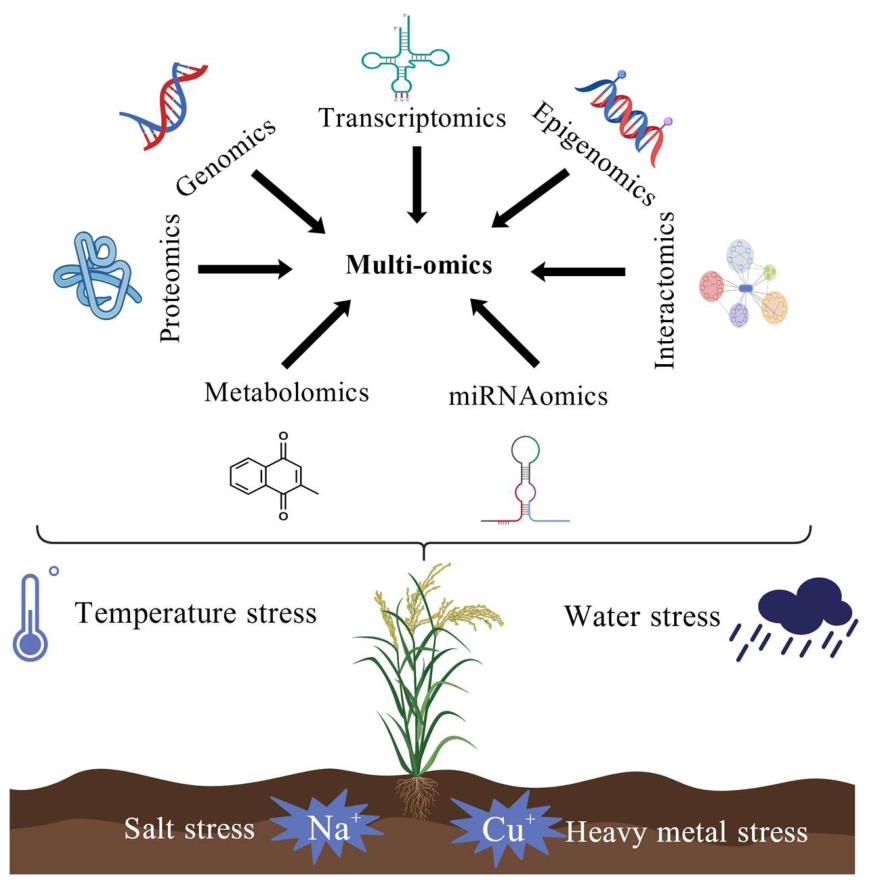

Table 1.
Comparative summary of abiotic stress response strategies, research focuses, and omics approaches across different plant categories.
Table 1.
Comparative summary of abiotic stress response strategies, research focuses, and omics approaches across different plant categories.
| Plant Category | Representative Species | Core Adaptation Strategies | Primary Research Focus | Typical Multi-omics Approaches |
|---|---|---|---|---|
| Model Plants | Arabidopsis thaliana, Nicotiana tabacum | Elucidation of conserved signaling pathways and regulatory networks. | Dissecting core signal transduction (e.g., ABA, CBF pathways) and transcriptional networks. | System-level time-series analysis: Integration of transcriptomics, proteomics, metabolomics, and epigenomics to build dynamic regulatory models. |
| Major Crops | Oryza sativa, Triticum aestivum, Zea mays | Ensuring yield stability, particularly during critical reproductive stages (flowering, grain filling). | Tolerance of yield-related traits; mining allelic variations from natural populations. | Trait-associated analysis: Linking omics data with GWAS/QTL mapping; multi-omics profiling focused on reproductive stages. |
| Legumes | Glycine max, Arachis hypogaea, Cicer arietinum | Coordinating stress responses with symbiotic nitrogen fixation. | Protection of nodule function; ion-specific toxicity (e.g., Cl⁻); rebalancing nitrogen metabolism. | Tissue-specific analysis: Comparative multi-omics of roots, nodules, and shoots; emphasis on metabolite transport. |
| Perennial Trees / Economic Crops | Avicennia officinalis, Camellia sinensis, fruit trees | Long-term, structural adaptation; stress memory and cross-seasonal tolerance. | Constitutive tolerance mechanisms; accumulation of secondary metabolites; epigenetic regulation. | Long-term stress and memory studies: Focus on epigenomics (methylation, histone modifications); multi-omics across perennial growth cycles. |
| Vegetable Crops | Solanum lycopersicum, Capsicum annuum, Cucumis sativus | Balancing stress tolerance with fruit/product quality. | Impact of stress on fruit sugar-acid metabolism and appearance; rapid response during vegetative growth. | Quality-associated analysis: Correlating metabolomics (flavor, nutrients) with transcriptomics/proteomics; stage-specific profiling during development. |
Disclaimer/Publisher’s Note: The statements, opinions and data contained in all publications are solely those of the individual author(s) and contributor(s) and not of MDPI and/or the editor(s). MDPI and/or the editor(s) disclaim responsibility for any injury to people or property resulting from any ideas, methods, instructions or products referred to in the content. |
© 2026 by the authors. Licensee MDPI, Basel, Switzerland. This article is an open access article distributed under the terms and conditions of the Creative Commons Attribution (CC BY) license (http://creativecommons.org/licenses/by/4.0/).
Copyright: This open access article is published under a Creative Commons CC BY 4.0 license, which permit the free download, distribution, and reuse, provided that the author and preprint are cited in any reuse.