

Submitted:
14 October 2025
Posted:
15 October 2025
You are already at the latest version
Preprints on COVID-19 and SARS-CoV-2
Abstract
Background/Objectives: The COVID-19 pandemic limited access to in-person physiotherapy, raising concerns about post-operative rehabilitation outcomes. This study evaluated whether a self-rehabilitation protocol with virtual consultations after a mini-open Latarjet procedure affected short-term clinical outcomes in active military personnel. Materials and Methods: We prospectively enrolled 18 patients (19 shoulders) undergoing mini-open Latarjet between May and October 2020. Patients performed a standardized self-rehabilitation protocol starting on the first post-operative day, with progressive range-of-motion (ROM) exercises added at two weeks. Pain was assessed using the Visual Analog Scale (VAS), ROM was recorded at each follow-up, complications were noted, and patient satisfaction was evaluated at 12 weeks. Results: A total of eighteen patients were prospectively enrolled in the study. At 12 weeks, mean VAS decreased from 1.2 ± 0.6 at week 1 to 0 at week 4 onward. The mean drug consumption was 2.5 ± 0.7 tablets/day only for the first week. Mean assisted forward flexion improved from 155°± 10° at week 1 to 180° in all patients by week 4. External rotation reached 60°± 5°at 4 weeks, 75°± 4° at 8 weeks, and 80°± 3°at 12 weeks, with no deficits compared to the contralateral side. Internal rotation improved to T7 level by week 8 and remained stable at week 12. No complications, recurrent instability, or graft displacements were reported. Patient satisfaction exceeded 9.5/10 in all cases. Conclusions: A self-rehabilitation protocol after mini-open Latarjet surgery yielded excellent short-term outcomes in young military patients, with full ROM recovery, high satisfaction, and no complications. Further validation of these results requires larger, rigorously controlled studies.
Keywords:
shoulder surgery
; covid-19
; self-rehabilitation
; anterior shoulder instability
; mini-open latarjet
1. Introduction
The Latarjet procedure is a surgical mini-open technique used to treat traumatic anterior shoulder instability. Even though the specific indications differ amongst surgeons, patients with anterior glenohumeral instability that are unlikely to have a successful outcome from either an arthroscopic or open anatomical Bankart repair, patients with glenoid bone loss >10% (measured in computed tomography) and ones with Hill-Sachs lesions that engage glenoid defect (off-track) are more likely to benefit from this procedure [1]. In addition, patients that underwent Latarjet procedure return to sports earlier [2,3,4] and have lower rates of recurrent instability [2,5,6,7] in comparison with the ones that had Bankart repairs. According to the literature, the rehabilitation program after the Latarjet procedure includes a period of 2-3 weeks of immobilization in a shoulder brace, followed by physiotherapy for another 3-6 weeks [8,9]. The adverse effects of delayed mobilization after shoulder surgery are underlined in the recent literature [10,11,12]. Rehabilitation typically involves a combination of exercises and therapy to help the individual regain strength, flexibility, and range of motion in the affected shoulder. This includes exercises to improve shoulder mobility and stability and activities to strengthen the shoulder and upper arm muscles.
During the COVID-19 pandemic, rehabilitation programs needed to be adapted to ensure the safety of patients and staff. This included pre-screening patients for symptoms, using personal protective equipment, implementing social distancing measures, and offering virtual or tele-rehabilitation services when appropriate.
With this study, we aimed to evaluate short-term clinical outcomes of military patients treated for anterior shoulder instability by mini-open Latarjet procedure and propose an immediate self-rehabilitation protocol and a regular consultation via video conference during the COVID-19 pandemic. We also hypothesized that this post operative approach would not compromise the return to physical activities and sports.
2. Materials and Methods
From May 2020 to October 2020, 18 patients (19 operated shoulders) underwent the mini-open Latarjet procedure in our department and were included in the study. Pre-operative planning involved X-rays (AP, Y-View, and the Bernageau view) and CT scans to evaluate the glenoid bone loss. The indications included traumatic anterior shoulder instability, glenoid bone loss >10% (measured with CT), and Hill-Sachs lesions that engage glenoid defect (off-track). Patients with neurological lesions were excluded from the study. All patients were active military personnel, less than 40 years old.
We used the same operative technique in all the patients: the same approach and equipment were used by the same experienced surgeon (AB). Patients were operated on a beach chair position under general anesthesia. A 4-5 cm incision (deltopectoral approach) was made vertically from the tip of the coracoid toward the axillary fold. The coracoacromial ligament was exposed and incised 1 cm from the coracoid attachment. The coracohumeral ligament and the pectoralis minor were released. Coracoid osteotomy was performed at the junction of the horizontal and vertical components. A parallel drill guide was used to improve the coracoid graft placement [13]. Then, the coracoid process was fixed with two 3.75mm full-threaded screws with a lag-screw way of positioning [14]. Immediately post-operatively, a shoulder brace in abduction and neutral rotation was placed in all cases. However, we encouraged the patients to perform active assisted forward flexion (AFF) exercises in five cycles and repeat them five times per day, from the first post-operative day [2]. Then, the patients were advised to add exercises for external rotation (ER) and internal rotation (IR), two weeks post-operatively, by themselves due to COVID-19 restrictions at the time.
The pain, measured with Visual Analog Scale (VAS), the consumption of painkillers, the range of motion (ROM), the possible complications, and the patient’s satisfaction were recorded at 1, 2, 4, 8, and 12 weeks postoperatively.
Twelve weeks post-operatively, the position and the healing process of the graft were evaluated by radiographic evaluation (True AP, Bernageau, Y-view).
3. Results
A total of 18 patients (19 shoulders; mean age: 28 ± 7 years; all male) were included, with a mean follow-up of 12 weeks. Table 1 summarizes the main outcomes. Mean VAS decreased from 1.2 ± 0.6 at week 1 to 0.8 ± 0.5 at week 2 and 0 at week 4 onward. Analgesic consumption was limited to the first post-operative week, with a mean of 2.5 ± 0.7 tablets/day (paracetamol + codeine). The mean assisted AFF was 155°± 10° and 170° ± 5° at 1 and 2 weeks, respectively, while during the following time intervals reached 180° in all patients. (Figure 1)
The mean ER was 60°± 5°, 75°± 4°, and 80°± 3° at 4, 8, and 12 weeks, respectively. Compared to the contralateral side, no external rotation deficit was observed post-operatively. (Figure 2 and Figure 3)
The mean IR level was L3, T7, and T7 at 4, 8, and 12 weeks, respectively (Figure 4 and Figure 5). No complications or recurrent instability were recorded. Despite the fast, active, assisted self-rehabilitation protocol, no recurrent instability, graft displacement, or other complications were observed and healing was achieved in all cases. The overall patients’ satisfaction was over 9.5/10.
4. Discussion
Mini-open Latarjet is a safe and reliable procedure that has been shown to consistently restore glenohumeral stability when used to treat instability-related glenoid soft-tissue and osseous pathology in both cadaveric biomechanical studies and clinical outcome studies [1]. Patients with glenoid bone loss and contact athletes benefit more from Latarjet procedure as they have lower failure rates and return to physical activities earlier than those with an anatomical Bankart repair [2,3,4,5,6,7]. Bankart repairs have higher complication, dislocation and subluxation rates according to the literature [15,16]. There is also no need for arthroscopic proficiency by the surgeon performing a mini-open Latarjet procedure. Other advantages of the technique are that there is adequate exposure to coracoid and glenoid defects, the avoidance of coracoclavicular ligaments and neurovascular structures damage during the osteotomy of the coracoid process, and there is no need for allografts, which decreases costs and heightens the potential for bony union with the native bone [17].
Since all our patients were army personnel, an early return to activities was crucial regarding patient satisfaction rates. All patients used a sling for the first three weeks after surgery. However, they were encouraged to perform gentle passive, active, and active-assisted shoulder range of motion exercises by themselves due to COVID-19 pandemic restrictions in Greece (May – October 2020). The self-rehabilitation protocol that we proposed was concrete and simple, and all the patients followed it without any issues. It is an exciting outcome that the absence of a physical therapist in the early post-operative stages did not impinge upon the patients’ compliance and satisfaction with the self-rehabilitation protocol that we advised. Our hypothesis that the self-rehabilitation protocol would not compromise the patients’ recovery and early return to physical activities and sports was confirmed, and it did not cause any adverse events.
Nevertheless, several considerations should be addressed. The small sample size (18 patients) and the single-center design may limit the generalizability of our findings. Also, the absence of a control group receiving standard supervised physiotherapy prevents direct comparisons between self-rehabilitation and conventional protocols. Lastly, our cohort comprised exclusively young, fit, and disciplined military personnel, a population likely to adhere strictly to rehabilitation instructions. Outcomes may differ in less motivated or older patients with comorbidities.
Future research should focus on randomized controlled trials comparing self-rehabilitation with conventional supervised physiotherapy, incorporating long-term follow-up and validated outcome measures. Such research would determine the extent to which home-based protocols can be widely adopted without diminishing safety or effectiveness.
5. Conclusions
This study demonstrates that immediate self-rehabilitation after a mini-open Latarjet procedure is safe and effective in motivated military patients, without complications or restrictions in mobility. A remarkable improvement in patients’ post-operative quality of life and eventually a full recovery was enabled in all the patients at twelve weeks.
Author Contributions
Conceptualization, A.B. and I.B.; methodology, A.B.; writing—original draft preparation, A.B. and K.B.; writing—review and editing, K.B. and A.S.; visualization, I.K. and K.V.; supervision, A.B. All authors conducted a final evaluation of the end product and agreed to the published version of the manuscript.
Funding
This research received no external funding
Institutional Review Board Statement
The study was conducted in accordance with the Declaration of Helsinki and approved by the 401 General Army Hospital of Athens Clinical Research & Ethics Committee (Ethics number: 2024-15-9, Date: 15 September 2024).
Informed Consent Statement
Written informed consent was obtained from all the participants for this paper.
Data Availability Statement
The datasets used and/or analyzed during the current study are available from the corresponding author upon reasonable request.
Conflicts of Interest
The authors declare no conflicts of interest.
References
- Mattern, O.; Young, A.; Walch, G. Open Latarjet: Tried, Tested and True. Ann. Jt. 2017, 2. [Google Scholar] [CrossRef]
- Roulet, S.; Borel, F.; Franger, G.; Liotard, J.-P.; Michelet, A.; Godenèche, A. Immediate Self-Rehabilitation after Open Latarjet Procedures Enables Recovery of Preoperative Shoulder Mobility at 3 Months. Knee Surg. Sports Traumatol. Arthrosc. Off. J. ESSKA 2019, 27, 3979–3988. [Google Scholar] [CrossRef] [PubMed]
- An, V.V.G.; Sivakumar, B.S.; Phan, K.; Trantalis, J. A Systematic Review and Meta-Analysis of Clinical and Patient-Reported Outcomes Following Two Procedures for Recurrent Traumatic Anterior Instability of the Shoulder: Latarjet Procedure vs. Bankart Repair. J. Shoulder Elbow Surg. 2016, 25, 853–863. [Google Scholar] [CrossRef] [PubMed]
- Tashjian, R.Z.; Deloach, J.; Porucznik, C.A.; Powell, A.P. Minimal Clinically Important Differences (MCID) and Patient Acceptable Symptomatic State (PASS) for Visual Analog Scales (VAS) Measuring Pain in Patients Treated for Rotator Cuff Disease. J. Shoulder Elbow Surg. 2009, 18, 927–932. [Google Scholar] [CrossRef] [PubMed]
- Cerciello, S.; Corona, K.; Morris, B.J.; Santagada, D.A.; Maccauro, G. Early Outcomes and Perioperative Complications of the Arthroscopic Latarjet Procedure: Systematic Review and Meta-Analysis. Am. J. Sports Med. 2019, 47, 2232–2241. [Google Scholar] [CrossRef] [PubMed]
- Rm, F.; B, G.; M, O.; E, B.; Nn, V.; Bj, C.; Gp, N.; Aa, R. Ninety-Day Complications Following the Latarjet Procedure. J. Shoulder Elbow Surg. 2019, 28. [Google Scholar] [CrossRef]
- Hurley, E.T.; Jamal, M.S.; Ali, Z.S.; Montgomery, C.; Pauzenberger, L.; Mullett, H. Long-Term Outcomes of the Latarjet Procedure for Anterior Shoulder Instability: A Systematic Review of Studies at 10-Year Follow-Up. J. Shoulder Elbow Surg. 2019, 28, e33–e39. [Google Scholar] [CrossRef] [PubMed]
- Abdul-Rassoul, H.; Galvin, J.W.; Curry, E.J.; Simon, J.; Li, X. Return to Sport After Surgical Treatment for Anterior Shoulder Instability: A Systematic Review. Am. J. Sports Med. 2019, 47, 1507–1515. [Google Scholar] [CrossRef] [PubMed]
- Beletsky, A.; Cancienne, J.M.; Manderle, B.J.; Mehta, N.; Wilk, K.E.; Verma, N.N. A Comparison of Physical Therapy Protocols Between Open Latarjet Coracoid Transfer and Arthroscopic Bankart Repair. Sports Health 2020, 12, 124–131. [Google Scholar] [CrossRef] [PubMed]
- Mazzocca, A.D.; Arciero, R.A.; Shea, K.P.; Apostolakos, J.M.; Solovyova, O.; Gomlinski, G.; Wojcik, K.E.; Tafuto, V.; Stock, H.; Cote, M.P. The Effect of Early Range of Motion on Quality of Life, Clinical Outcome, and Repair Integrity After Arthroscopic Rotator Cuff Repair. Arthrosc. J. Arthrosc. Relat. Surg. Off. Publ. Arthrosc. Assoc. N. Am. Int. Arthrosc. Assoc. 2017, 33, 1138–1148. [Google Scholar] [CrossRef] [PubMed]
- Mazuquin, B.F.; Wright, A.C.; Russell, S.; Monga, P.; Selfe, J.; Richards, J. Effectiveness of Early Compared with Conservative Rehabilitation for Patients Having Rotator Cuff Repair Surgery: An Overview of Systematic Reviews. Br. J. Sports Med. 2018, 52, 111–121. [Google Scholar] [CrossRef] [PubMed]
- Sonoda, Y.; Nishioka, T.; Nakajima, R.; Imai, S.; Vigers, P.; Kawasaki, T. Use of a Shoulder Abduction Brace after Arthroscopic Rotator Cuff Repair: A Study on Gait Performance and Falls. Prosthet. Orthot. Int. 2018, 42, 136–143. [Google Scholar] [CrossRef] [PubMed]
- Barth, J.; Boutsiadis, A.; Neyton, L.; Lafosse, L.; Walch, G. Can a Drill Guide Improve the Coracoid Graft Placement During the Latarjet Procedure? A Prospective Comparative Study With the Freehand Technique. Orthop. J. Sports Med. 2017, 5, 2325967117734218. [Google Scholar] [CrossRef] [PubMed]
- Boutsiadis, A.; Bampis, I.; Swan, J.; Barth, J. Best Implant Choice for Coracoid Graft Fixation during the Latarjet Procedure Depends on Patients’ Morphometric Considerations. J. Exp. Orthop. 2020, 7, 15. [Google Scholar] [CrossRef] [PubMed]
- Griesser, M.J.; Harris, J.D.; McCoy, B.W.; Hussain, W.M.; Jones, M.H.; Bishop, J.Y.; Miniaci, A. Complications and Re-Operations after Bristow-Latarjet Shoulder Stabilization: A Systematic Review. J. Shoulder Elbow Surg. 2013, 22, 286–292. [Google Scholar] [CrossRef] [PubMed]
- Rollick, N.C.; Ono, Y.; Kurji, H.M.; Nelson, A.A.; Boorman, R.S.; Thornton, G.M.; Lo, I.K. Long-Term Outcomes of the Bankart and Latarjet Repairs: A Systematic Review. Open Access J. Sports Med. 2017, 8, 97–105. [Google Scholar] [CrossRef] [PubMed]
- McHale, K.J.; Sanchez, G.; Lavery, K.P.; Rossy, W.H.; Sanchez, A.; Ferrari, M.B.; Provencher, M.T. Latarjet Technique for Treatment of Anterior Shoulder Instability With Glenoid Bone Loss. Arthrosc. Tech. 2017, 6, e791–e799. [Google Scholar] [CrossRef] [PubMed]
Figure 1.
Active forward flexion 4 weeks post-operatively.
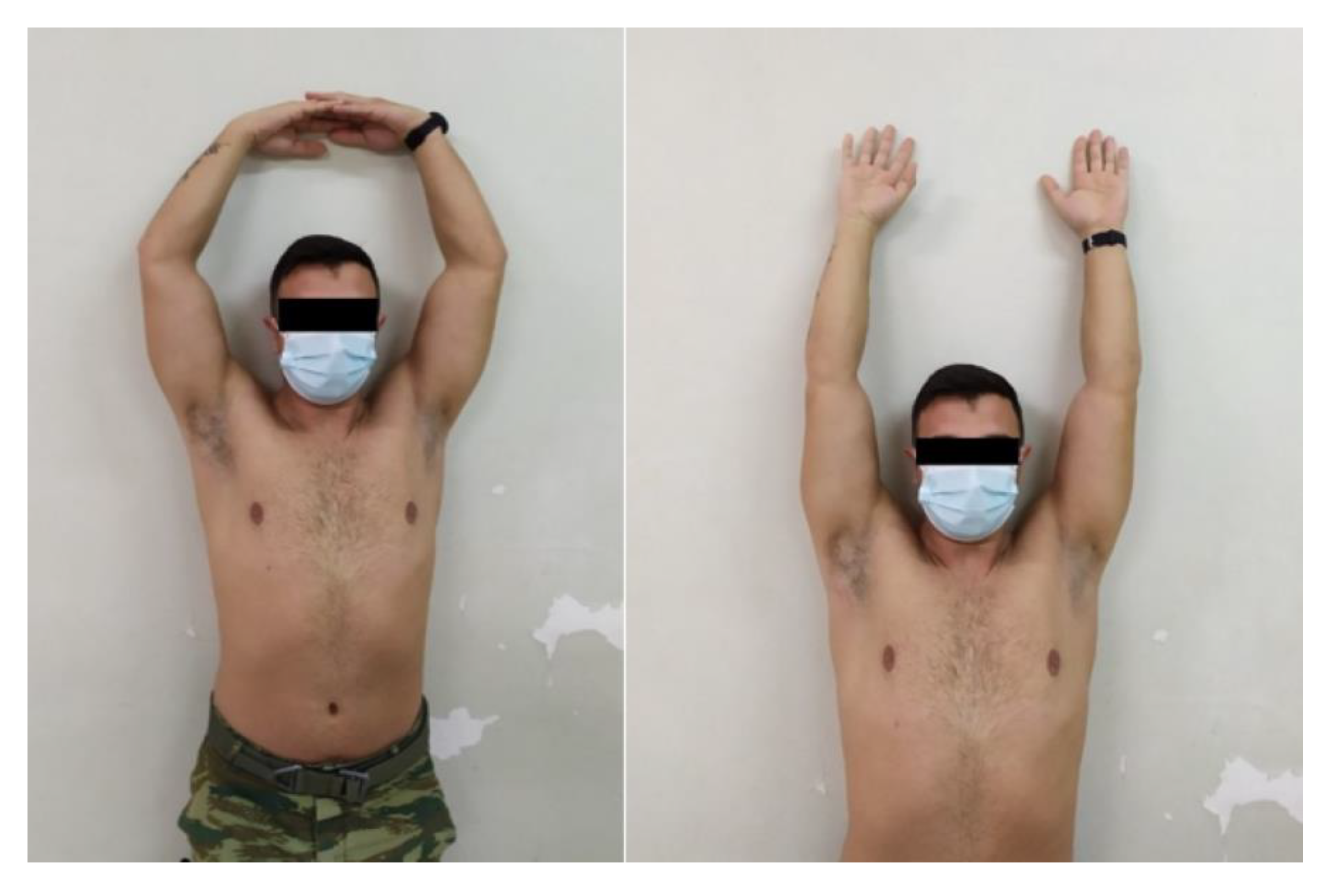
Figure 2.
External rotation 10 days post-operatively.
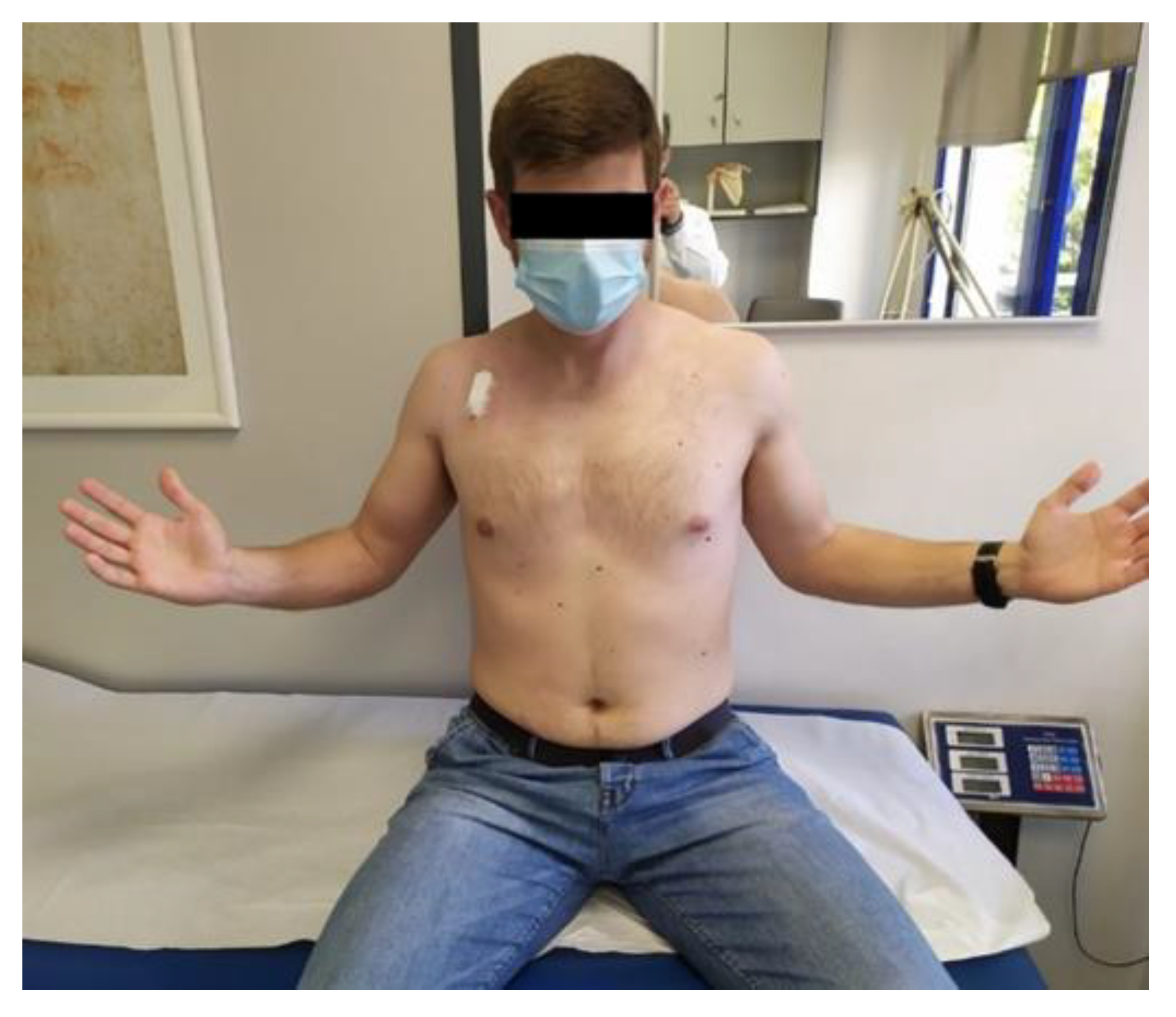
Figure 3.
External rotation 8 weeks post-operatively.
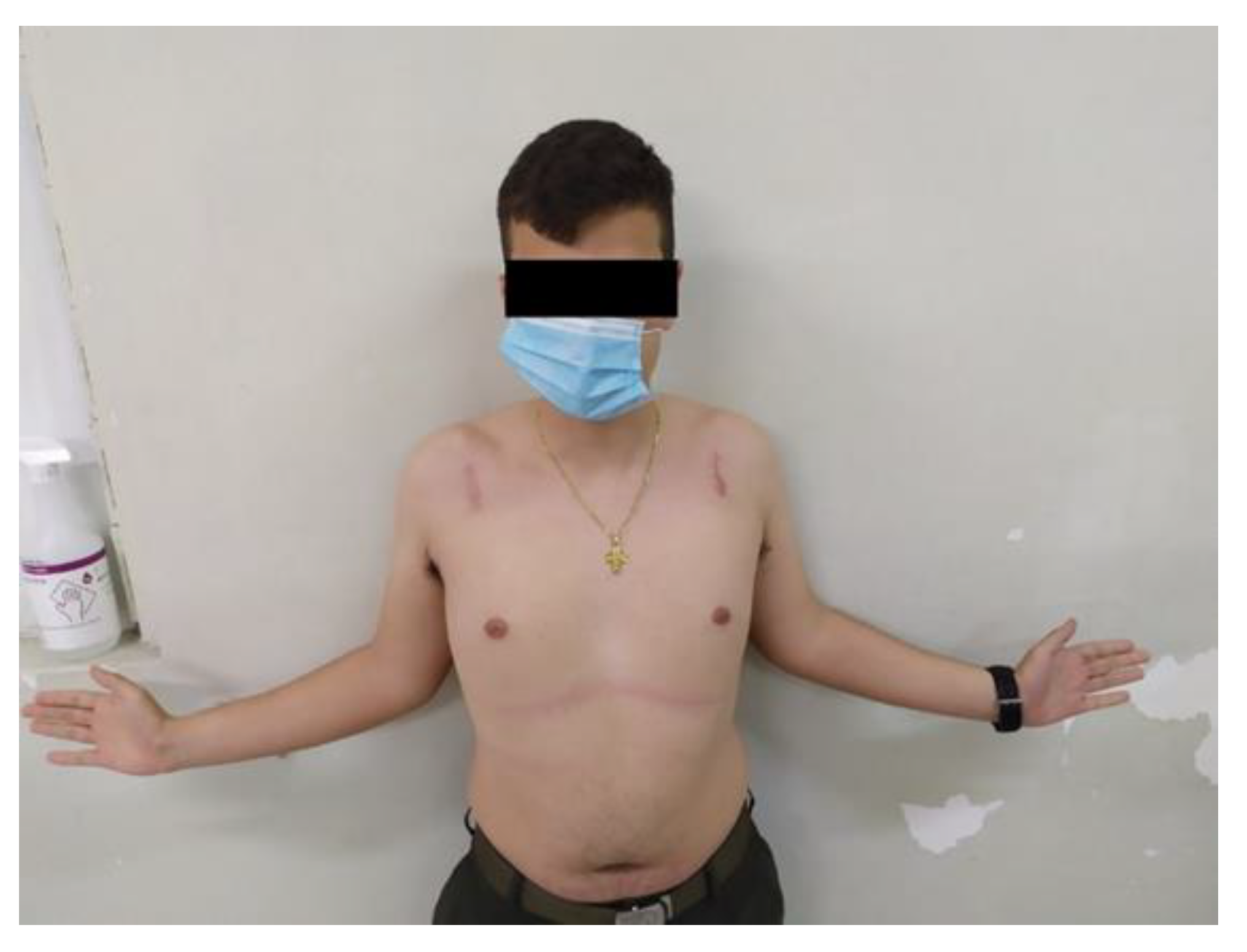
Figure 4.
Internal rotation 4 weeks post-operatively.
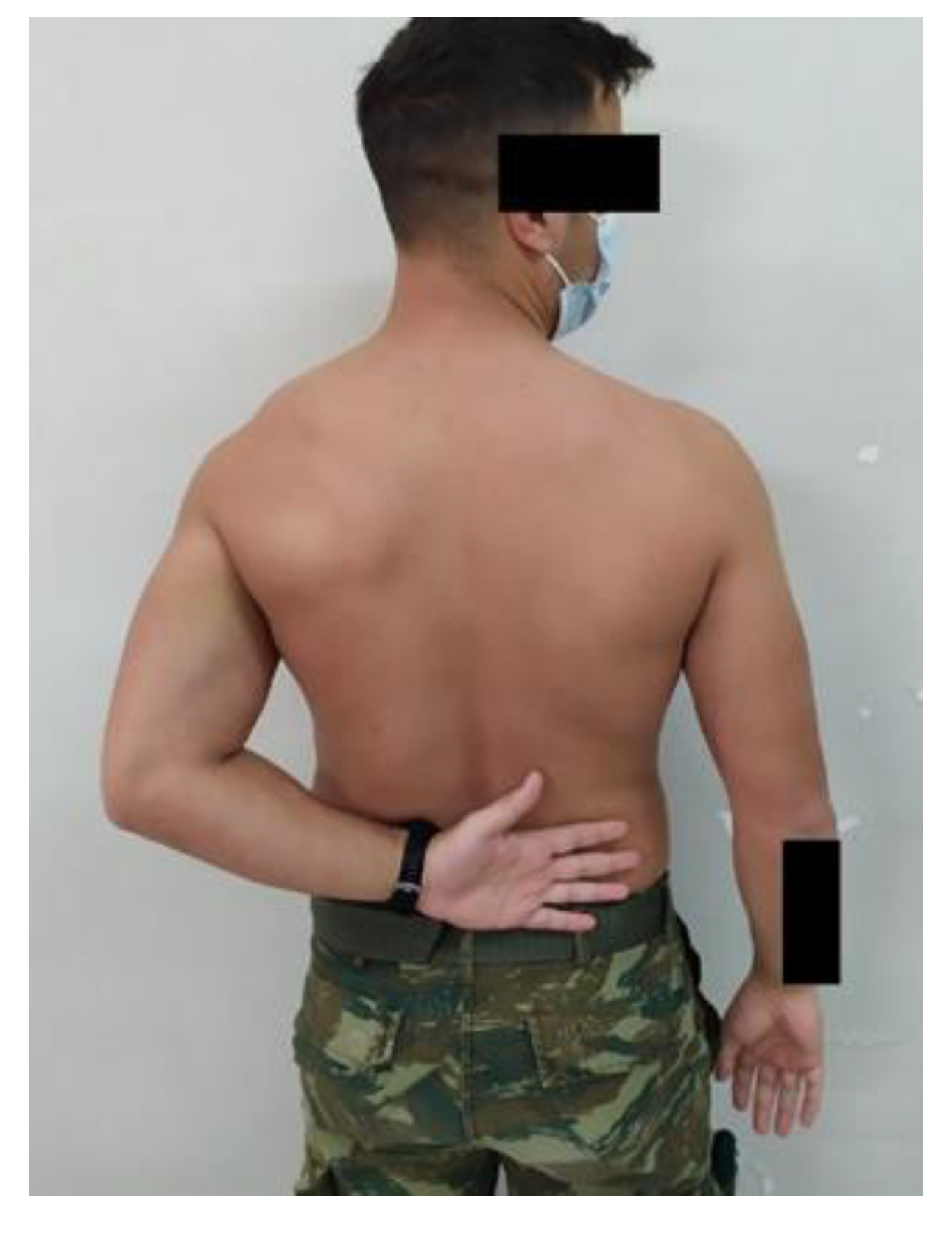
Figure 5.
Internal roration 8 weeks post-operatively.
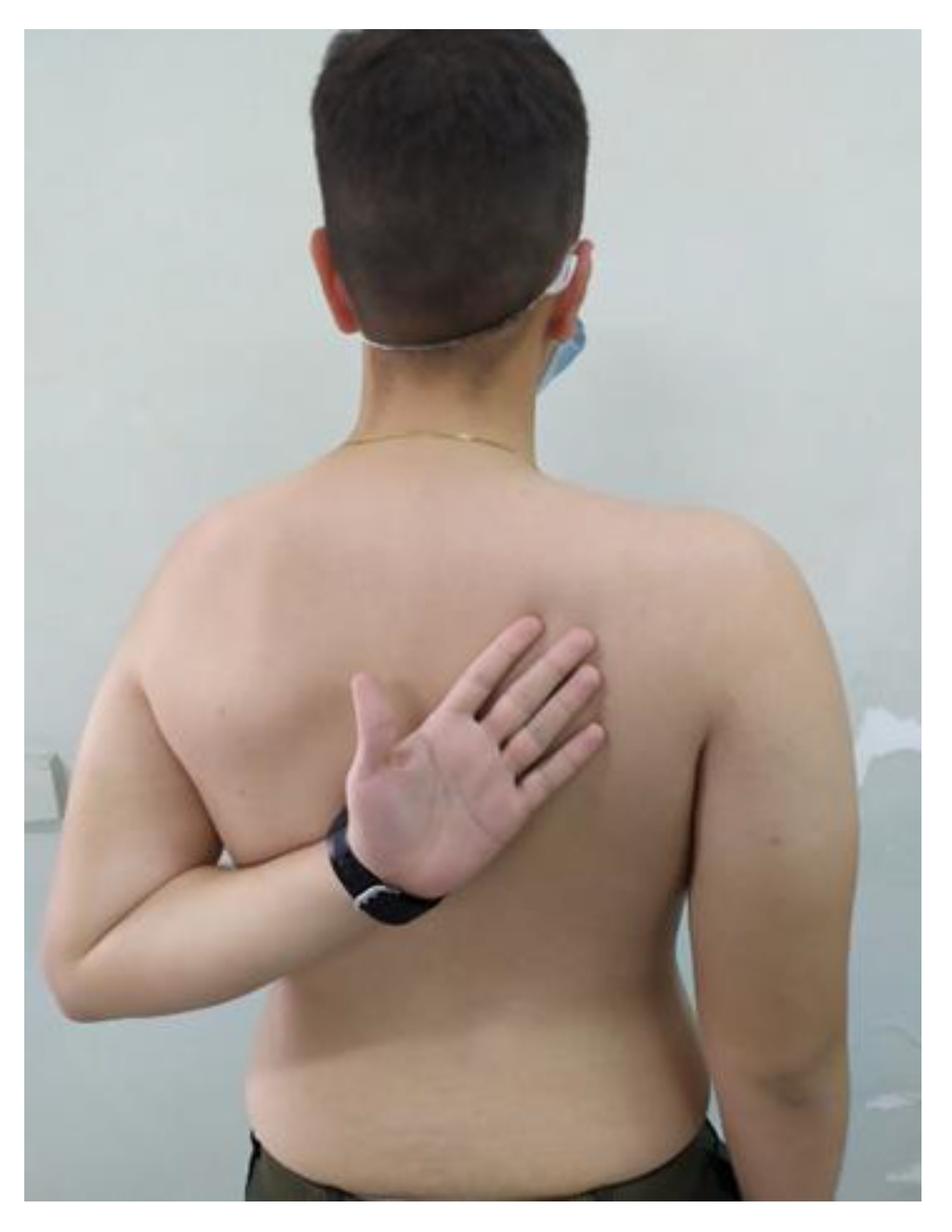

Table 1.
Clinical outcomes after mini-open Latarjet with self-rehabilitation. (Values expressed as mean ± SD where applicable.).
Table 1.
Clinical outcomes after mini-open Latarjet with self-rehabilitation. (Values expressed as mean ± SD where applicable.).
| Outcome | Week 1 | Week 2 | Week 4 | Week 8 | Week 12 |
| VAS (0–10) | 1.2 ± 0.6 | 0.8 ± 0.5 | 0 | 0 | 0 |
| Forward Flexion (°) | 155 ± 10 | 170 ± 5 | 180 | 180 | 180 |
| External Rotation (°) | - | - | 60 ± 5 | 75 ± 4 | 80 ± 3 |
| Internal Rotation Level | - | - | L3 | T7 | T7 |
| Complications | None | None | None | None | None |
| Satisfaction (0–10) | - | - | - | - | 9.5 ± 0.4 |
Disclaimer/Publisher’s Note: The statements, opinions and data contained in all publications are solely those of the individual author(s) and contributor(s) and not of MDPI and/or the editor(s). MDPI and/or the editor(s) disclaim responsibility for any injury to people or property resulting from any ideas, methods, instructions or products referred to in the content. |
© 2025 by the authors. Licensee MDPI, Basel, Switzerland. This article is an open access article distributed under the terms and conditions of the Creative Commons Attribution (CC BY) license (http://creativecommons.org/licenses/by/4.0/).
Copyright: This open access article is published under a Creative Commons CC BY 4.0 license, which permit the free download, distribution, and reuse, provided that the author and preprint are cited in any reuse.


