
Submitted:
08 October 2025
Posted:
09 October 2025
You are already at the latest version
Abstract
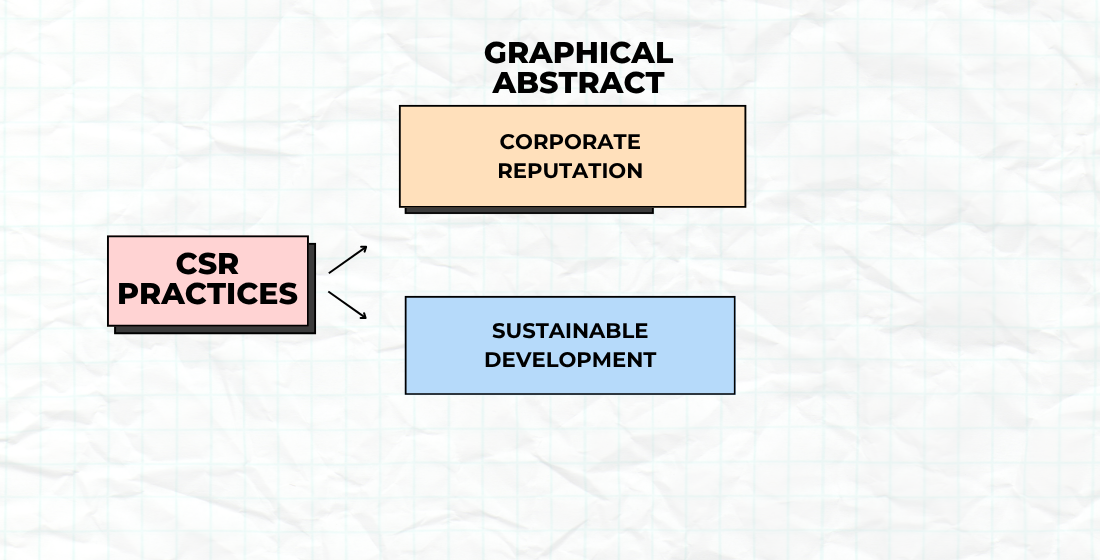
This study systematically analyzes the relationship between corporate social responsibility (CSR) and corporate reputation through a literature review of 48 selected articles published between 2014 and 2024. The findings reveal that CSR significantly influences corporate reputation across various sectors, with key emphases on social empowerment, environmental management, and disclosure transparency. Well-designed CSR programs not only enhance corporate image but also foster customer loyalty and build stakeholder trust towards sustainable development. Moreover, transparent CSR disclosures via digital media play a critical role in shaping public perceptions, particularly regarding social and environmental issues closely linked to sustainable development. This study provides practical insights for companies, regulators, and academics in developing effective CSR strategies that strengthen corporate reputation while contributing to sustainable development in the era of globalization.
Keywords:
corporate social responsibility
; corporate reputation
; CSR strategy
; systematic literature review
; sustainable development
1. Introduction
The The company’s commitment to contribute to the advancement of society is known as Corporate Social Responsibility or CSR for short. Corporate Social Responsibility is increasingly becoming a major concern in the business world because companies are not only expected to operate profitably, but also socially and environmentally responsible. CSR serves as a tactic for the business world to take part in environmental protection and community development, as well as an effort to manage and avoid negative impacts on the company [1].
In theory, the application of Corporate Social Responsibility is generally based on three main points put forward by [2], first, Voluntary where CSR is considered as a role carried out voluntarily by the company, where the company helps overcome social and environmental problems. Therefore, the company has the freedom to choose to carry out or not to carry out this role. Second, Philanthropy, In addition to being a profit institution, the company also sets aside part of its profits to carry out philanthropic activities. This activity aims to empower society and repair environmental damage caused by exploration and exploitation. Third, obligation where CSR is also seen as a form of corporate obligation to care about and overcome the increasing humanitarian and environmental crisis.
Understanding CSR includes the view that the responsibility to address social issues is not only the government’s task through public policy, but also the responsibility of companies. Companies are expected to be proactive in supporting sustainable development. Morally, CSR is rooted in the fact that companies cannot stand alone, but depend on the surrounding community. The community provides essential infrastructure such as roads, transportation, electricity, and emergency services that support the sustainability of the company. In addition, companies must also comply with the law and support its enforcement by authorities, such as the police and judges [3].
Corporate Social Responsibility is an important tool in improving the reputation of organizations, industries, and companies for the better. This is achieved through the company’s efforts to build a positive image by involving the community in various social responsibility activities [4]. CSR implementation can be carried out both internally and externally to support smooth business operations. In addition, CSR programs play an important role in supporting company activities while strengthening its positive reputation [5]. Consumers, investors, and the general public are increasingly concerned about how companies treat their communities and the environment. As this trend develops, CSR is considered to be a strategic tool that improves a company’s reputation. A good reputation can strengthen customer loyalty, facilitate access to capital, and increase the attractiveness of a company as a place to work.
Local communities or communities are one of the main stakeholders for organizations, industries, and companies. A good relationship between companies and communities is very important because the two are closely related. Public opinion has a major influence on various company activities. However, in practice, conflicts often arise between companies and the surrounding community [1]. To reduce the risk of conflict, companies need to build strong relationships and make real contributions to the community. Through corporate social responsibility or CSR, companies can achieve these goals. CSR not only helps strengthen relationships with the community but also contributes to improving the company’s reputation so that it looks more positive in the eyes of the public [6].
Amidst the complexity of the increasingly globally connected business world, attention to sustainable and responsible business practices continues to grow. One important element in this context is the disclosure of Corporate Social Responsibility (CSR) by companies. Although many studies have shown that CSR plays a role in enhancing corporate reputation, there is still debate about the extent to which CSR influences public perception and how companies can optimize the benefits of CSR initiatives. Therefore, a systematic analysis is needed to understand the role of CSR in strengthening corporate reputation in more depth. Through this exploration, this study aims to provide constructive contributions to stakeholders, regulators, and academics who want to understand sustainable business practices amidst the ever-evolving global dynamics.
Based on the research context presented, here are several relevant Research Questions (RQ) for the systematic literature review (SLR) related to the role of CSR in improving corporate reputation, as follows:
RQ 1: What is the relationship between corporate social responsibility (CSR) and corporate reputation across different sectors?
RQ 2: How effective are CSR programs in improving corporate reputation?
RQ 3: How does CSR implementation contribute to strengthening corporate reputation in sustainable development?
2. Materials and Methods
To shed light on the debate between CSR and corporate reputation, the authors conducted a systematic literature review (SLR) on the relationship between CSR disclosure and corporate reputation. A systematic literature review is a method used to identify, assess, and analyze all research relevant to a research question, a specific topic, or a phenomenon that is the focus of the study. The goal is to provide a comprehensive summary of the existing evidence on a specific topic using a systematic and transparent methodology, ensuring that the review process is unbiased and replicable [7].
This method uses a systematic approach in reviewing and presenting relevant literature, so that the results are clearer, more transparent, and replicable [8]. Through this approach, systematic literature review (SLR) enables researchers to capture the debate on how CSR disclosure affects corporate reputation, draw conclusions from existing literature, and identify relevant research gaps (Nation & Schlegelmilch, 2020). In this article, the author follows the PRISMA (Preferred Reporting Items for Systematic Reviews and Meta-Analyses) methodological steps to obtain, select, and analyze relevant studies. The literature search process was conducted through the Scopus and ScienceDirect databases, which were selected for their credibility and broad coverage.
1.1. Identification of Records
The search in this study includes English-language peer-reviewed articles from 2014 to 2024. The systematic review research begins by identifying keywords and strings taken from the initial screening of related papers. The databases used are Scopus, ScienceDirect, and Publish or Perish, selected because they have high-quality journal indexes, publish credible research, and are integrated with leading publishers, so they are considered relevant and reliable.
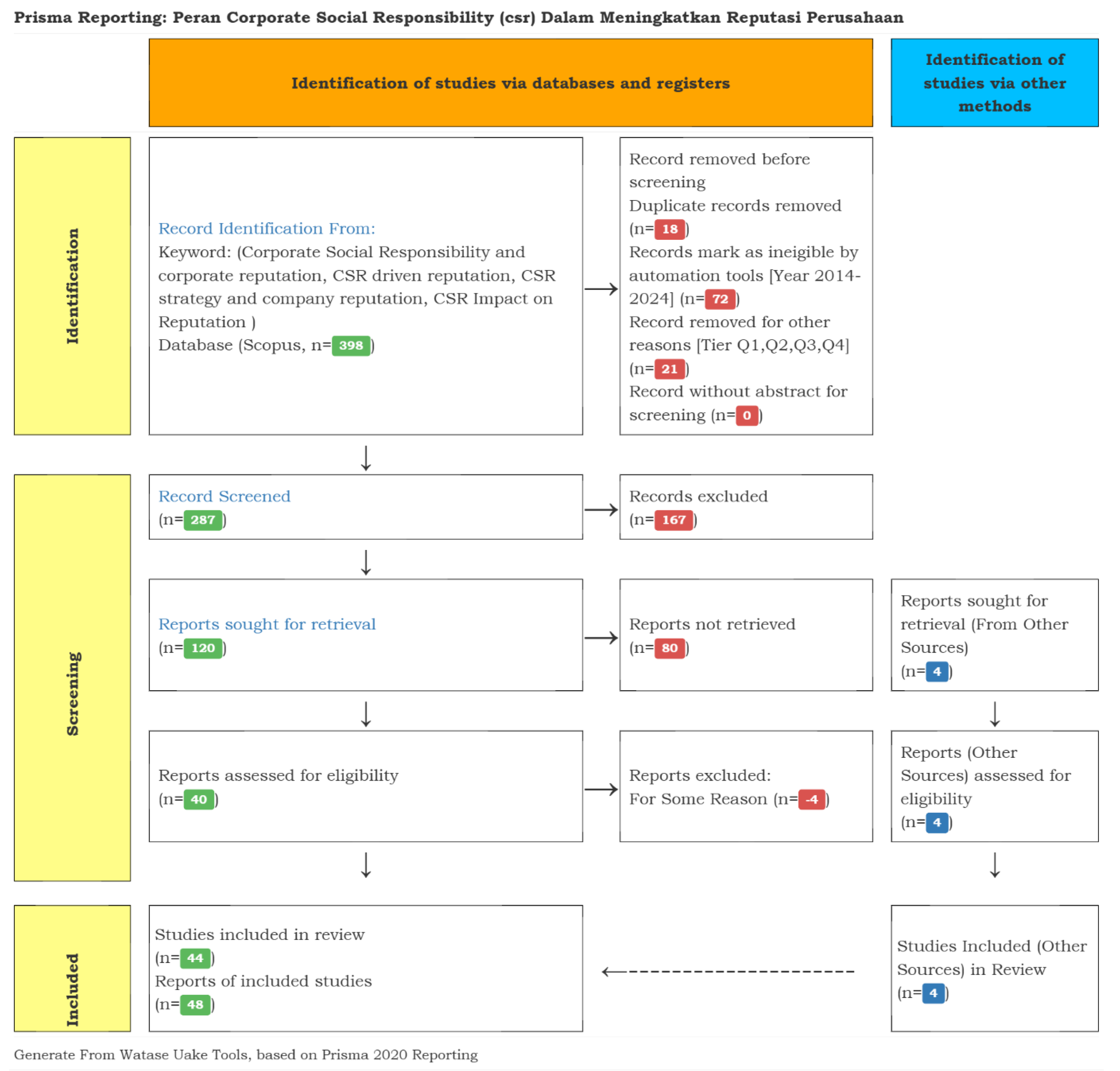
A comprehensive literature search yielded 398 articles using a combination of keywords to capture published and peer-reviewed journals. The search keywords included: “Corporate Social Responsibility” and “corporate reputation,” “CSR-driven reputation,” “Sustainability” and “corporate reputation,” “CSR strategy” and “company reputation,” and “CSR impact on reputation,” and “Suistanability Development”.
2.2. Screening Identification
In the second stage, an initial screening of 398 articles was conducted. Before applying the inclusion and exclusion criteria, duplicate articles (n = 18), articles that did not meet the publication year requirements of 2014-2024 (n = 72), articles not included in Q1, Q2, Q3, Q4 (n = 21), and articles without abstracts (n = 0) were eliminated.
After initial screening, 287 articles were reviewed using inclusion and exclusion criteria. Since the analysis focused on journal articles examining how CSR affects corporate reputation, articles that were not relevant to the topic (n = 167) were eliminated in the first stage. During the first screening, 59 articles were excluded, leaving 120 articles for further screening. Articles that were not accessible (n = 81) were eliminated. Finally, 40 articles remained for review after the articles were eliminated.
2.3. Inclusion of Records (Step 3)
Finally, the reference lists of 40 articles were evaluated. Since the number of articles was still insufficient for a systematic literature review, 8 articles from other databases were added, resulting in a total of 48 articles that could be analyzed. Basically, these articles were reviewed by two researchers and included if they met the following inclusion criteria: (1) the focus of the article was CSR, (2) the influence of corporate reputation could be inferred, and (3) the publication was written in English.
3. Results
3.1. Results
A search for articles on the impact of CSR on corporate reputation found 48 articles published in leading journals between 2014 and 2024 that focused on the impact of CSR news on corporate reputation, interest in this topic continues to increase every year.
We review these articles from different perspectives. First, we examine the title of each article. Next, we review the definition of CSR news variables and the techniques used to collect and analyze CSR news content. We also analyze the research design and methodological framework applied in the articles. Finally, to provide a big picture, we present the main findings.

Table 1.
Final Sample of the study.
| Authors | Title | Journal | Results |
| Park, 2019 | Corporate social responsibility as a determinant of corporate reputation in the airline industry | Journal of Retailing and Consumer | This study found that higher levels of economic responsibility resulted in increased customer attitudes and satisfaction. In addition, although environmental responsibility had a significant effect on customer attitudes and satisfaction, corporate reputation was significantly determined by customer attitudes and satisfaction. |
| Baraibar-Diez & Sotorrío, 2018 | The mediating effect of transparency in the relationship between corporate social responsibility and corporate reputation | Review of Business Management | The proposed model suggests that transparency mediates the path between corporate social responsibility and corporate reputation. |
| Cabrera-Luján et al., 2023 | Impact of Corporate Social Responsibility, Business Ethics and Corporate Reputation on the Retention of Users of Third-Sector Institutions | Sustainability | The results of the study show that CSR has a positive and significant influence on CR, BE on CR, CSR on RT, and CR and BE on RT. |
| Wang et al., 2021 | The Role of Corporate Social Responsibility Perceptions in Brand Equity, Brand Credibility, Brand Reputation, and Purchase Intentions | Sustainability | The results of the study indicate that consumer perceptions of a company’s CSR affect their intention to purchase the company’s brand in the future. Brand equity, brand credibility, and brand reputation mediate the impact of CSR perceptions on purchase intentions. |
| Ali et al., 2024 | Corporate Social Responsibility and Customer Loyalty in Food Chains--Mediating Role of Customer Satisfaction and Corporate Reputation | Sustainability | The results of the study show that CSR perception has a significant positive impact on customer loyalty, corporate reputation, and customer satisfaction. |
| Gálvez-Sánchez et al., 2024 | Exploring the three-dimensional effect of corporate social responsibility on brand equity, corporate reputation, and willingness to pay. A study of the fashion industry | Journal of Retailing and Consumer Services | The results of the study show that each CSR dimension makes a different contribution to the formation of BE, CR and WTP, also highlighting the value of brand credibility as a variable with an important mediating effect. |
| Bianchi et al., 2019 | The impact of perceived CSR on corporate reputation and purchase intention | European Journal of Management and Business | All direct and mediated effects in the model are significant, except for the effect of perceived CSR on affective satisfaction. Thus, the proposed causal chain is essential to understanding how perceived CSR affects purchase intention and perceived reputation. |
| Bashir, 2022 | Corporate social responsibility and financial performance - the role of corporate reputation, advertising and competition | PSU Research Review | Advertising intensity (AI) plays a significant moderating role in the CSR intensity and CR relationship |
| Ajayi & Mmutle, 2020 | Corporate reputation through strategic communication of corporate social responsibility | Corporate Communications: An International Journal | The informing strategy is also more evident in CSR communication materials than the interactive strategy. In terms of communication channels, the study found that organizations mainly use controlled channels for CSR communication. |
| Pérez-Cornejo & de Quevedo-Puente, 2023 | How corporate social responsibility mediates the relationship between corporate reputation and enterprise risk management evidence from Spain | Eurasian Business Review | The results of this study also confirm that the ERM system has a positive impact on corporate reputation through the mediation effect of CSR performance. Therefore, companies should use risk management policies to support their CSR and reputation. |
| Vuong & Bui, 2023 | The role of corporate social responsibility activities in employees’ perception of brand reputation and brand equity | Case Studies in Chemical and Environmental Engineering | The results of the study show that internal and external CSR activities increase employee satisfaction and the implementation of CSR activities supports the improvement of brand reputation and adds brand equity value. |
| Singh & Misra, 2021 | Linking Corporate Social Responsibility (CSR) and Organizational Performance the moderating effect of corporate reputation | European Research on Management and Business Economics | The research results show that CSR carried out towards external stakeholders will have an impact on organizational performance. |
| Grover et al., 2019 | Impact of corporate social responsibility on reputation--Insights from tweets on sustainable development goals by CEOs | International Journal of Information Management | The results revealed that social media influential CEOs posted 5.97 times more CSR messages on Twitter than wealthy CEOs, which in turn may result in better CR, in terms of shares and likes based on the social capital they have on Twitter. |
| García-Madariaga & Rodríguez-Rivera, 2017 | Corporate social responsibility, customer satisfaction, corporate reputation, and firm market value Evidence from the automobile industry | Spanish Journal of Marketing - ESIC | The results of the study indicate that certain CSR issues related to the company’s core business and important stakeholders can result in better company financial performance. |
| Gallardo-Vázquez et al., 2019 | Corporate Social Responsibility as an Antecedent of Innovation, Reputation, Performance, and Competitive Success A Multiple Mediation Analysis | Sustainability | The results of this study confirm that companies generally have a good orientation towards CSR and the benefits of this strategy are developing and improving the company’s reputation. |
| Mahmood & Bashir, 2020 | How does corporate social responsibility transform brand reputation into brand equity Economic and noneconomic perspectives of CSR | International Journal of Engineering Business Management | The results show that brand reputation is a significant predictor of brand equity, and its predictive power increases with the presence of CSR activities. |
| Baudot et al., 2020 | Is Corporate Tax Aggressiveness a Reputation Threat Corporate Accountability, Corporate Social Responsibility, and Corporate Tax Behavior | Journal of Business Ethics | Drawing on research on celebrity and strategic silence, the study finds that reputation may not be a well-functioning mechanism for holding companies accountable. |
| Kim, 2019 | The Process Model of Corporate Social Responsibility (CSR) Communication: CSR Communication and its Relationship with Consumers CSR Knowledge, Trust, and Corporate Reputation Perception | Journal of Business Ethics | The findings of this study indicate that the positive impact of CSR information is continuous and independent of the level of consumer identification with the company, while the positive consequences of personal relevance, transparency, and factual tone of CSR communication increase with increasing levels of identification. |
| Axjonow et al., 2018 | The Impact of Corporate Social Responsibility Disclosure on Corporate Reputation A Non-professional Stakeholder Perspective | Journal of Business Ethics | We find that, contrary to popular belief, stand-alone CSR reports do not impact a company’s reputation among non-professional stakeholders. |
| Zhu et al., 2014 | Corporate social responsibility, firm reputation, and firm performance The role of ethical leadership | Asia Pacific Journal of Management | We have two main findings. First, ethical leadership moderates its own indirect effect on corporate reputation through CSR. Ethical leadership has an indirect and positive effect on corporate reputation through CSR when ethical leadership is strong but not when it is weak. |
| Song et al., 2020 | Toward effective CSR communication in controversial industry sectors | Journal of Marketing Communications | We have two main findings. First, ethical leadership moderates its own indirect effect on corporate reputation through CSR. Ethical leadership has an indirect and positive effect on corporate reputation through CSR when ethical leadership is strong but not when it is weak. |
| Dögl & Holtbrügge, 2014 | Corporate environmental responsibility, employer reputation and employee commitment an empirical study in developing and emerging economies | The International Journal of Human | Our research results show that green strategy and culture, green technology and products, green recruitment and evaluation, and green communication have a positive influence on a company’s environmental reputation as an employer and in turn employee commitment. |
| Burke et al., 2018 | The relative impact of corporate reputation on consumer choice: beyond a halo effect | Journal of Marketing Management | The results show that corporate reputation needs more attention by marketing managers to increase preference for their products through this mechanism. |
| Vlastelica et al., 2018 | How Corporate Social Responsibility Affects Corporate Reputation Evidence from an Emerging Market | Journal of East European Management Studies | The results show that CSR items affect corporate reputation. In addition, the intensity of this relationship varies across items. Significant differences were found between citizens and specific stakeholders, as well as between different stakeholder groups. |
| Liu & Lu, 2021 | Corporate social responsibility, firm performance, and firm risk the role of firm reputation | Asia-Pacific Journal of Accounting & Economics | This study documents a significant positive relationship between CSR and corporate reputation, and finds that corporate reputation is positively related to corporate performance while negatively related to corporate risk. |
| González-Rodríguez et al., 2019 | Hotels corporate social responsibility practices, organizational culture, firm reputation, and performance | Journal of Sustainable Tourism | The proposed model is developed using stakeholder theory and general manager perceptions. According to the research results, organizational culture influences various dimensions of CSR. |
| Khuong et al., 2021 | Stakeholders and Corporate Social Responsibility (CSR) program as key sustainable development strategies to promote corporate reputation--evidence from Vietnam | Cogent Business & Management | The results of the study show that stakeholder influence not only has a significant effect on the type of CSR but also has a positive impact on the company’s reputation. |
| Komodromos & Melanthiou, 2014 | Corporate Reputation Through Strategic Corporate Social Responsibility Insights From Service Industry Companies | Journal of Promotion Management | The results reveal that CSR has a positive impact on company employees, the environment, stakeholders and the general public, and highlight that CSR is an important element for the success of organizations in the Cypriot market. |
| Lloyd-Smith & An, 2019 | Are corporate social responsibility and advertising complements or substitutes in producing firm reputation | Applied Economics | Our research results also show that advertising, a company’s own CSR activities, and CSR spillover at the industry level contribute positively to corporate reputation. |
| Rothenhoefer, 2019 | The impact of CSR on corporate reputation perceptions of the public--A configurational multi-time, multi-source perspective | Business Ethics: A European Review | Thus, the current study contributes to CSR research by investigating a powerful but under-researched stakeholder group through the lens of category diagnosticity combined with a configurational approach to analysis. |
| Odriozola & Baraibar-Diez, 2017 | Is Corporate Reputation Associated with Quality of CSR Reporting Evidence from Spain | Corporate Social Responsibility and Environmental Management | This study found that the quality of sustainability reporting increases the likelihood of having a higher corporate reputation. |
| Den Hond et al., 2014 | laying on Two Chessboards Reputation Effects between Corporate Social Responsibility (CSR) and Corporate Political Activity (CPA) | Journal of Management Studies | This study argues that there is a potential synergy between CSR and corporate political activity (CPA) that is often overlooked by companies and that recognition of this synergy will stimulate companies to align their CSR and CPA. |
| Wei et al., 2014 | Strategically manipulating social reputation by scheduling corporate social responsibility events | Journal of Public Affairs | This study shows that CSR events significantly affect social reputation in the short period after the first CSR event, and then social reputation grows slowly. |
| Fourati & Dammak, 2021 | Corporate social responsibility and financial performance International evidence of the mediating role of reputation | Corporate Social Responsibility and Environmental Management | This study shows that CR mediates the relationship between CSR and CFP: CSR has a significant and positive impact on CR and that CR has a significant and positive impact on CFP. |
| Aljumah, 2023 | Corporate social responsibility’s influence on firm risk and firm performance the mediating role of firm reputation | Corporate Social Responsibility and Environmental Management | |
| Sánchez-Torné et al., 2020 | The importance of corporate social responsibility in achieving high corporate reputation | Corporate Social Responsibility and Environmental Management | This study identified seven dimensions that influence Corporate Reputation: products and services, innovation, workplace, governance, citizenship, leadership, and performance. |
| Miras-Rodríguez et al., 2020 | Does corporate social responsibility reporting actually destroy firm reputation | Corporate Social Responsibility and Environmental Management | This study highlights that corporate reputation tends to be negatively affected by CSR reporting, which is generally identified by stakeholders as an impression management strategy (especially to obtain ‘appropriate’ levels and assurances), although the relationship between CSR reporting and corporate reputation is contingent on a company’s CSR consistency. |
| Javed et al., 2020 | The effects of corporate social responsibility on corporate reputation and firm financial performance Moderating role of responsible leadership | Corporate Social Responsibility and Environmental Management | The results of the study indicate that social responsibility initiatives for different stakeholders significantly and positively affect corporate reputation and financial performance. In addition, the direct relationship between CSR-reputation and CSR-performance is found to be negatively moderated by responsible leadership. |
| Yang & Stohl, 2020 | The (in)congruence of measures of corporate social responsibility performance and stakeholder measures of corporate social responsibility reputation | Corporate Social Responsibility and Environmental Management | This study highlights the importance of taking a multidimensional approach. Addressing the measurement issue helps to uncover the theoretical and practical relationships between CSR and corporate reputation and provides strategic guidance when planning CSR business and communication strategies. |
| Kowalczyk & Kucharska, 2020 | Corporate social responsibility practices incomes and outcomes Stakeholders pressure, culture, employee commitment, corporate reputation, and brand performance. A Polish-German cross-country study | Corporate Social Responsibility and Environmental Management | Key findings suggest that stakeholder pressure can lead to a consistent CSR-oriented system in a business environment. |
| Dell’Atti et al., 2017 | Corporate Social Responsibility Engagement as a Determinant of Bank Reputation: An Empirical Analysis | Corporate Social Responsibility and Environmental Management | The results of this study found that bank reputation is positively related to accounting performance and negatively related to leverage and risk profiles. |
| Graafland, 2018 | Does Corporate Social Responsibility Put Reputation at Risk by Inviting Activist Targeting An Empirical Test among European SMEs | Corporate Social Responsibility and Environmental Management | This study finds that CSR increases the likelihood that SMEs’ CSR will be monitored in the future by local non-governmental organizations (NGOs) and this reduces criticism of SMEs’ CSR. |
| Forcadell & Aracil, 2017 | European Banks Reputation for Corporate Social Responsibility | Corporate Social Responsibility and Environmental Management | Our research findings show that bank efforts to build CSR reputation benefit performance. However, during times of crisis, these efforts do not contribute to increased profits. |
| Abugre & Anlesinya, 2020 | Corporate social responsibility strategy and economic business value of multinational companies in emerging economies The mediating role of corporate reputation | Business Strategy & Development | This study shows that good corporate reputation significantly influences multinational companies’ strategies in combining economic responsibility and business value. |
| Asmara et al., 2023 | Does CSR affect investment efficiency The moderating role of company reputation | PSU Research Review | This study found that CSR activities focused on customers, employees, and the community have a significant impact on INE, as well as other stakeholders, and corporate reputation moderates this relationship. |
| Javed et al., 2020) | Effects of CSR-Related Media Coverage on Corporate Reputation | Corporate Reputation Review | The results show that the effect on reputation is fully mediated by CSR skepticism, and the effect on brand attitude is partially mediated by CSR skepticism. |
| Craddock et al., 2022 | Do environmental CSR practices promote corporate social performance. The mediating role of green innovation and corporate image | Cleaner and Responsible Consumption | The findings of this study indicate that corporate environmental CSR improves corporate social performance through green innovation and corporate image. |
| Singh & Misra, 2021 | Linking Corporate Social Responsibility to Corporate Reputation A Study on Understanding Behavioral Consequences | Procedia - Social and Behavioral Sciences | These results confirm not only that as an antecedent, CSR has a strong positive impact on CR but also that CR has a strong positive impact on customer, employee, and investor behavior. |
Source: Watase Uake 2024.
4. Discussion
The results of this study focus on the role of Corporate Social Responsibility (CSR) in improving corporate reputation based on a systematic analysis of the literature. CSR has become an important strategic element in the business world, considering that companies are expected to not only operate profitably but also be socially and environmentally responsible [3,9,10,11,15,53].
This study aims to explore how the implementation of CSR practices affects corporate reputation in various industries, the effectiveness of CSR programs in improving corporate image, and the impact of CSR disclosure on public perception, especially in social and environmental issues. This approach is expected to provide comprehensive insights into the relationship between CSR and corporate reputation, as well as offer practical guidance for companies in designing strategic CSR initiatives.
Through this study, it is expected to gain a deeper understanding of the dynamics of CSR, including the challenges faced and opportunities that can be utilized by companies to strengthen their reputation. These findings also provide significant contributions to stakeholders, academics, and regulators who are interested in environmentally friendly and socially responsible business approaches in the current era of globalization.
4.1. The Implementation of CSR Practices Affects the Reputation of Companies in Various Industries
Literature analysis shows that CSR implementation has a significant impact on corporate reputation, although the form and focus vary across industries. CSR can be used to build positive relationships with stakeholders, which ultimately affect public perception and consumer loyalty.
CSR implementation often focuses on reducing environmental impacts, such as waste management, energy efficiency, and the use of environmentally friendly raw materials. For example, companies that are committed to reducing carbon emissions through technological innovation tend to receive positive public assessments.
In the service sector, the company’s reputation is largely determined by customer attitudes and satisfaction (Park, 2019). To gain a positive reputation from the community, CSR in the service sector is more directed at social empowerment, such as training local communities, improving the quality of education, and supporting the community. As the CSR program at the university studied by Lujan., et al. (2022) who found that universities have developed with a focus not only on education and obtaining university degrees, but also on the important role of training that creates shared knowledge, solves social problems that contribute to the community, and by this action, ensures a good reputation.
In a study conducted by (Ali,. Et all 2021) Food Chain faced major criticism regarding its impact on health, such as its contribution to obesity and malnutrition due to the high sodium, sugar, and fat content in its products. In addition, marketing practices that target vulnerable groups, such as children, further help the image of companies in the Food Chain sector. Only a small portion of children’s products meet nutritional standards, so criticism came from various parties, including health professionals, the media, and legislators. In response, food chains began to adopt corporate social responsibility (CSR) initiatives to improve their image. CSR sends a signal that a company is socially responsible and cares about its stakeholders can provide signals that can then be interpreted by customers as signs of a positive image, which in turn will result in a positive corporate reputation (Turban, 1997)
CSR helps companies improve their reputation, especially in industries that face the risk of negative perception. For example, in the fashion industry, which produces between 2% and 8% of global carbon emissions (UNEP, 2021), CSR practices such as the use of environmentally friendly materials or product recycling programs can reduce the negative image related to environmental waste.
In the mining and energy industry based on literature [17,19,22] CSR in this sector is often associated with corporate responsibility for environmental restoration and empowerment of affected communities. Companies that are transparent in implementing CSR show a better reputation, especially in conflict-prone areas.
CSR practices that are carried out consistently can be a differentiator in the market. Companies that successfully integrate CSR into their business strategies gain a competitive advantage in attracting customers, investors, and business partners. Studies show that companies that are actively involved in philanthropic activities or sustainable development programs tend to have higher levels of customer loyalty than companies that do not engage in CSR.
Based on the findings above, CSR helps companies improve their reputation, especially in industries that face the risk of negative perception. By implementing CSR practices, companies can demonstrate their commitment to social and environmental values that are widely recognized by the public. This can increase consumer trust, attract investors who care about their desires, and strengthen relationships with stakeholders. In addition, companies that are active in CSR often get positive media exposure, which strengthens their image as responsible organizations. In the long run, a good reputation can also increase customer loyalty, expand market share, and protect the company
4.2. Effectiveness of CSR Programs in Improving Corporate Reputation
Based on literature analysis [24,25,26,27,31,35], the effectiveness of CSR programs in improving corporate image is highly dependent on strategic planning, implementation, and the program’s suitability to stakeholder needs. Well-designed and well-executed programs show a significant impact on improving the company’s overall reputation.
Corporate social responsibility (CSR) and corporate reputation are identified as relevant strategic plans in all sectors. CSR programs that involve the community directly, such as sustainability initiatives to increase customer loyalty to the company’s products or services (Bianchi and Bruno, 2017). According to literature observations(Abugre & Anlesinya, 2020; Dell’Atti et al., 2017; Den Hond et al., 2014; Graafland, 2018; Liu & Lu, 2021; Odriozola & Baraibar-Diez, 2017; Song et al., 2020; Wei et al., 2014), some researchers emphasize strategic planning that focuses on user retention, namely the ability to retain customers in the long term.
According to (Adewole, 2022) CSR can be a major force behind efforts to combat climate change, create brand loyalty, and improve financial results. Clearly, the implementation of CSR has a major impact on businesses, organizations, and associations that follow the direction of development; as a result, CSR also has a major impact on the business environment and society. Therefore, when adopted as a corporate strategy, CSR allows organizations to self-regulate actions that affect stakeholders, including the general public.
It is important to understand stakeholders’ expectations and align company activities with their interests. In this way, CSR provides benefits to all parties. CSR serves as an indirect means of communication to strengthen brand image, positive impressions make it easier for customers to recognize the brand (Zhang., et al. 2014). According to [12]. Corporate Social Responsibility CSR is not only a social activity, but also a tool to increase positive customer perception of a brand. CSR activities can help create a positive image in the minds of customers, which ultimately strengthens brand equity. For example, companies that care about social or environmental issues tend to be viewed better by their consumers.
4.3. CSR Implementation Contribute to Strengthening Corporate Reputation in Sustainable Development?
CSR disclosure has been shown to have a significant impact on public perception. Transparent, accurate, and relevant CSR literacy helps companies build a positive image in the eyes of the public, especially on social and environmental issues that are of primary concern to stakeholders. Research conducted by Cabrera-Luján et al. (2023) shows that corporate reputation is the factor that contributes most to user retention. These findings highlight the importance of considering corporate reputation as a factor that influences user retention and confirm that a reputation based on credible CSR practices can support long-term business sustainability.
The role of business in society has undergone major changes over the past few decades. The role of business is no longer limited to generating profits, but also to giving back a portion of those profits to society. CSR is an organization’s effort to improve socio-economic welfare above and beyond the motive of seeking profit, and companies that are socially responsible and serve the best interests of all their stakeholders will be better able to survive in the long term (Pradhan, 2016). In line with Epstein (2008), CSR that is oriented towards transparency, community involvement, product value, employment practices, and environmental protection not only strengthens the company’s reputation but also supports sustainable development goals (SDGs).
Corporate transparency, manifested through information disclosure, enables stakeholders to make more rational decisions (Baraibar-Diez & Sotorrío, 2018). Companies that openly disclose their CSR policies, activities, and impacts demonstrate increased public trust. Data-driven annual sustainability reports demonstrate a company’s commitment to supporting the sustainable development agenda, such as reducing carbon footprints, social inclusion, and ethical governance.
Disclosure through digital media—websites, social media, and interactive platforms—extends the reach of CSR information to a wider audience. The right CSR communication strategy can strengthen a company’s reputation both proactively and defensively (Bashir, 2022). In the context of sustainable development, digital communication allows companies to demonstrate their tangible contributions to global issues, such as climate change (SDG 13), gender equality (SDG 5), or responsible consumption and production (SDG 12). Thus, corporate reputation is not only understood as a commercial image, but also as social legitimacy that is closely related to a commitment to sustainability.
Strategic reputation management is key to maximizing the impact of CSR on corporate reputation (CR), which ultimately increases the company’s profitability while strengthening its social legitimacy. Effective CSR communication helps companies influence stakeholder perceptions, foster better relationships, and ensure business continuity in the future. CSR planning that is aligned with the principles of sustainable development makes a company’s reputation more credible and long-term oriented (Dai & Reich, 2022).
Overall, the results of this study confirm that CSR implementation not only contributes to improving the company’s reputation in a narrow sense but also within the framework of sustainable development. Companies that are able to integrate sustainability values into their CSR strategies will be more trusted, valued, and have a strong reputation in facing global challenges. Previous literature (Burke et al., 2018; González-Rodríguez et al., 2019; Grover et al., 2019; Javed et al., 2020; Kowalczyk & Kucharska, 2020; Lloyd-Smith & An, 2019) also reinforces that a good social reputation through sustainable CSR is a strategic asset for companies in establishing harmonious relationships with the community and supporting long-term business sustainability.
4.4. Influence on Perception of Social Issues
Stojanovic., et al.l (2021) wrote that corporate reputation is the main motivator for organizations that want to position themselves as social agents where companies are responsible for all groups in society, including workers, customers, suppliers, and the communities in which they operate. In today’s business world, as stated by [42], the success of an organization depends heavily on strong relationships with key stakeholders. CSR has become an effective strategic tool to build and strengthen these relationships because it influences the behavior and engagement of stakeholders and customers. Therefore, it is important for companies to design CSR strategy planning that is aligned with stakeholder expectations in order to help raise public awareness of the importance of sustainability. Companies that report contributions to social issues, such as education, health, and poverty alleviation, are more likely to be viewed as entities that care about public welfare. For example, CSR disclosures related to scholarship programs or the construction of health facilities increase positive perceptions.
4.5. Influence on Perception of Environmental Issues
Excessive exploitation of natural resources has caused global environmental damage, both in densely populated areas and in remote areas, which has a major impact on environmental and social aspects. In this case, environmental-based CSR is a key strategy for companies to build an image as an organization that cares about environmental sustainability. In the modern world, customers are increasingly aware of global issues and are pursuing a sustainable life. Therefore, it is easier for companies to gain their trust through CSR initiatives. Disclosure of environmental programs, such as the use of renewable energy, waste management, and carbon emission reduction, creates a company’s image as an entity that cares about sustainability [12]. CSR not only functions as a form of corporate self-regulation to support economic development, but also plays a role in addressing social and environmental issues. One of the strategic steps is green production [18].
5. Conclusions
This study shows that Corporate Social Responsibility (CSR) plays an important role in building and enhancing corporate reputation in various industries. CSR is not only about fulfilling social and environmental responsibilities, but also a strategic tool to create positive relationships with stakeholders, strengthen corporate image, and increase customer loyalty.
The proper implementation of CSR, including planning strategies, relevant program implementation, and transparent closing through social media and other digital platforms, has been proven to have a significant impact on public perception. Companies that are proactive in social and environmental issues tend to be viewed more positively by consumers, investors, and the general public.
The impact of CSR on corporate reputation varies across sectors. For example, in the service sector, CSR focuses on social empowerment, while in the energy and mining industry, CSR is more related to environmental restoration and empowerment of affected communities. Disclosure of CSR through mass and digital media is also key to expanding the reach of messages and creating better public perception.
References
- Bascompta M, Yousefian M, Vintró C, Sanmiquel L, Rodríguez R, Yubero MT. Sustainability Assessment in Mining: A CSR-Based Analysis Model for Social and Environmental Impact. Fudan Journal of the Humanities and Social Sciences [Internet]. 2024;(0123456789). Available from: . [CrossRef]
- Carroll AB. A Three-Dimensional Conceptual Model of Corporate Performance. [Internet]. 1979. Available from: https://www.researchgate.net/publication/303179257.
- Bianchi E, Bruno JM, Sarabia-Sanchez FJ. The impact of perceived CSR on corporate reputation and purchase intention. European Journal of Management and Business Economics. 2019 Oct 3;28(3):206–21.
- García Lara JM, García Osma B, Gazizova I, Khalilov A. Demand-driven corporate social responsibility: Symbolic versus substantive change after environmental disasters. Journal of Corporate Finance. 2025 Sep 1;94.
- He HW, Balmer JMT. A grounded theory of the corporate identity and corporate strategy dynamic: A corporate marketing perspective. Eur J Mark. 2013 Mar;47(3):401–30.
- Rothenhoefer LM. The impact of CSR on corporate reputation perceptions of the public—A configurational multi-time, multi-source perspective. Business Ethics. 2019 Apr 1;28(2):141–55.
- Almeida J, Gonçalves TC. A systematic literature review of investor behavior in the cryptocurrency markets. Vol. 37, Journal of Behavioral and Experimental Finance. Elsevier B.V.; 2023.
- Januari N. Systematic Literatur Review Dengan Metode Prisma: Dampak Teknologi Blockchain Terhadap Periklanan Digital. Jurnal Ilmiah M-Progress. 2024;14(1):1–11.
- Park E. Corporate social responsibility as a determinant of corporate reputation in the airline industry. Journal of Retailing and Consumer Services. 2019 Mar 1;47:215–21.
- Baraibar-Diez E, Sotorrío LL. O efeito mediador da transparência na relação entre responsabilidade social corporativa e reputação corporative. Revista Brasileira de Gestao de Negocios. 2018;20(1):5–21.
- Cabrera-Luján SL, Sánchez-Lima DJ, Guevara-Flores SA, Millones-Liza DY, García-Salirrosas EE, Villar-Guevara M. Impact of Corporate Social Responsibility, Business Ethics and Corporate Reputation on the Retention of Users of Third-Sector Institutions. Sustainability (Switzerland). 2023 Feb 1;15(3).
- Wang S, Liao YK, Wu WY, Lê HBK. Hypothesis the role of corporate social responsibility perceptions in brand equity, brand credibility, brand reputation, and purchase intentions. Sustainability (Switzerland). 2021 Nov 1;13(21).
- Ali W, Mahmood Z, Wilson J, Ismail H. The impact of sustainability governance attributes on comprehensive CSR reporting: A developing country setting. Corp Soc Responsib Environ Manag. 2024;31(3):1802–17.
- Gálvez-Sánchez FJ, Molina-Prados A, Molina-Moreno V, Moral-Cuadra S. Exploring the three-dimensional effect of corporate social responsibility on brand equity, corporate reputation, and willingness to pay. A study of the fashion industry. Journal of Retailing and Consumer Services. 2024 Jul 1;79.
- Bashir M. Corporate social responsibility and financial performance – the role of corporate reputation, advertising and competition. PSU Research Review. 2022 Nov 1;
- Ajayi OA, Mmutle T. Corporate reputation through strategic communication of corporate social responsibility. Corporate Communications. 2020 Jul 28;26(5):1–15.
- Pérez-Cornejo C, de Quevedo-Puente E. How corporate social responsibility mediates the relationship between corporate reputation and enterprise risk management: evidence from Spain. Eurasian Business Review. 2023 Jun 1;13(2):363–83.
- Vuong TK, Bui HM. The role of corporate social responsibility activities in employees’ perception of brand reputation and brand equity. Case Studies in Chemical and Environmental Engineering. 2023 Jun 1;7.
- Singh K, Misra M. Linking Corporate Social Responsibility (CSR) and Organizational Performance: the moderating effect of corporate reputation. European Research on Management and Business Economics. 2021 Jan 1;27(1).
- Grover P, Kar AK, Ilavarasan PV. Impact of corporate social responsibility on reputation—Insights from tweets on sustainable development goals by CEOs. Int J Inf Manage. 2019 Oct 1;48:39–52.
- García-Madariaga J, Rodríguez-Rivera F. Corporate social responsibility, customer satisfaction, corporate reputation, and firms’ market value: Evidence from the automobile industry. Spanish Journal of Marketing - ESIC. 2017 Jul 1;21:39–53.
- Gallardo-Vázquez D, Valdez-Juárez LE, Castuera-Díaz ÁM. Corporate social responsibility as an antecedent of innovation, reputation, performance, and competitive success: A multiple mediation analysis. Sustainability (Switzerland). 2019 Oct 1;11(20).
- Mahmood A, Bashir J. How does corporate social responsibility transform brand reputation into brand equity? Economic and noneconomic perspectives of CSR. International Journal of Engineering Business Management. 2020;12.
- Baudot L, Johnson JA, Roberts A, Roberts RW. Is Corporate Tax Aggressiveness a Reputation Threat? Corporate Accountability, Corporate Social Responsibility, and Corporate Tax Behavior. Journal of Business Ethics. 2020 May 1;163(2):197–215.
- Kim S. The Process Model of Corporate Social Responsibility (CSR) Communication: CSR Communication and its Relationship with Consumers’ CSR Knowledge, Trust, and Corporate Reputation Perception. Journal of Business Ethics. 2019 Feb 28;154(4):1143–59.
- Axjonow A, Ernstberger J, Pott C. The Impact of Corporate Social Responsibility Disclosure on Corporate Reputation: A Non-professional Stakeholder Perspective. Journal of Business Ethics. 2018 Aug 1;151(2):429–50.
- Zhu Y, Sun LY, Leung ASM. Corporate social responsibility, firm reputation, and firm performance: The role of ethical leadership. Asia Pacific Journal of Management. 2014 Nov 7;31(4):925–47.
- Song B, Wen J, Ferguson MA. Toward effective CSR communication in controversial industry sectors. Journal of Marketing Communications. 2020 Apr 2;26(3):243–67.
- Dögl C, Holtbrügge D. Corporate environmental responsibility, employer reputation and employee commitment: An empirical study in developed and emerging economies. International Journal of Human Resource Management. 2014 Jul;25(12):1739–62.
- Burke PF, Dowling G, Wei E. The relative impact of corporate reputation on consumer choice: beyond a halo effect. Journal of Marketing Management. 2018 Sep 2;34(13–14):1227–57.
- Vlastelica T, Kostic SC, Okanovic M, Milosavljevic M. How corporate social responsibility affects corporate reputation: Evidence from an emerging market. Journal of East European Management Studies. 2018;23(1):10–29.
- Liu M, Lu W. Corporate social responsibility, firm performance, and firm risk: the role of firm reputation. Asia-Pacific Journal of Accounting and Economics. 2021;28(5):525–45.
- González-Rodríguez MR, Martín-Samper RC, Köseoglu MA, Okumus F. Hotels’ corporate social responsibility practices, organizational culture, firm reputation, and performance. Journal of Sustainable Tourism. 2019 Mar 4;27(3):398–419.
- Khuong MN, Truong an NK, Thanh Hang TT. Stakeholders and Corporate Social Responsibility (CSR) programme as key sustainable development strategies to promote corporate reputation—evidence from vietnam. Cogent Business and Management. 2021;8(1).
- Komodromos M, Melanthiou Y. Corporate Reputation Through Strategic Corporate Social Responsibility: Insights From Service Industry Companies. Vol. 20, Journal of Promotion Management. Routledge; 2014. p. 470–80.
- Lloyd-Smith P, An H. Are corporate social responsibility and advertising complements or substitutes in producing firm reputation? Appl Econ. 2019 May 3;51(21):2275–88.
- Odriozola MD, Baraibar-Diez E. Is Corporate Reputation Associated with Quality of CSR Reporting? Evidence from Spain. Corp Soc Responsib Environ Manag. 2017 Mar 1;24(2):121–32.
- Den Hond F, Rehbein KA, de Bakker FGA, Lankveld HK Van. Playing on two chessboards: Reputation Effects between Corporate Social Responsibility (CSR) and Corporate Political Activity (CPA). Journal of Management Studies. 2014;51(5):790–813.
- Wei J, Wang Y, Zhu W. Strategically manipulating social reputation by scheduling corporate social responsibility events. J Public Aff. 2014;14(2):116–29.
- Fourati YM, Dammak M. Corporate social responsibility and financial performance: International evidence of the mediating role of reputation. Corp Soc Responsib Environ Manag. 2021 Nov 1;28(6):1749–59.
- Aljumah AI. Investigating the Impact of Blockchain Technology on Social Sustainability and the Mediating Role of Ethics and CSR. Sustainability (Switzerland). 2023;15(21).
- Sánchez-Torné I, Morán-Álvarez JC, Pérez-López JA. The importance of corporate social responsibility in achieving high corporate reputation. Corp Soc Responsib Environ Manag. 2020 Nov 1;27(6):2692–700.
- Miras-Rodríguez M del M, Bravo-Urquiza F, Escobar-Pérez B. Does corporate social responsibility reporting actually destroy firm reputation? Corp Soc Responsib Environ Manag. 2020 Jul 1;27(4):1947–57.
- Javed M, Rashid MA, Hussain G, Ali HY. The effects of corporate social responsibility on corporate reputation and firm financial performance: Moderating role of responsible leadership. Corp Soc Responsib Environ Manag. 2020 May 1;27(3):1395–409.
- Yang Y, Stohl C. The (in)congruence of measures of corporate social responsibility performance and stakeholder measures of corporate social responsibility reputation. Corp Soc Responsib Environ Manag. 2020 Mar 1;27(2):969–81.
- Kowalczyk R, Kucharska W. Corporate social responsibility practices incomes and outcomes: Stakeholders’ pressure, culture, employee commitment, corporate reputation, and brand performance. A Polish–German cross-country study. Corp Soc Responsib Environ Manag. 2020 Mar 1;27(2):595–615.
- Dell’Atti S, Trotta A, Iannuzzi AP, Demaria F. Corporate Social Responsibility Engagement as a Determinant of Bank Reputation: An Empirical Analysis. Corp Soc Responsib Environ Manag. 2017 Nov 1;24(6):589–605.
- Graafland J. Does Corporate Social Responsibility Put Reputation at Risk by Inviting Activist Targeting? An Empirical Test among European SMEs. Corp Soc Responsib Environ Manag. 2018 Jan 1;25(1):1–13.
- Forcadell FJ, Aracil E. European Banks’ Reputation for Corporate Social Responsibility. Vol. 24, Corporate Social Responsibility and Environmental Management. John Wiley and Sons Ltd.; 2017. p. 1–14.
- Abugre JB, Anlesinya A. Corporate social responsibility strategy and economic business value of multinational companies in emerging economies: The mediating role of corporate reputation. Business Strategy and Development. 2020 Mar 1;3(1):4–15.
- Asmara TTP, Murwadji T, Kartikasari, Afriana A. Corporate Social Responsibility and Cooperatives Business Sustainability in Indonesia: Legal Perspective. Sustainability (Switzerland). 2023;15(7).
- Craddock N, Spotswood F, Rumsey N, Diedrichs PC. “We should educate the public that cosmetic procedures are as safe as normal medicine”: Understanding corporate social responsibility from the perspective of the cosmetic procedures industry. Body Image. 2022 Dec 1;43:75–86.
- Ali W, Danni Y, Latif B, Kouser R, Baqader S. Corporate social responsibility and customer loyalty in food chains—mediating role of customer satisfaction and corporate reputation. Sustainability (Switzerland). 2021 Aug 2;13(16).
Disclaimer/Publisher’s Note: The statements, opinions and data contained in all publications are solely those of the individual author(s) and contributor(s) and not of MDPI and/or the editor(s). MDPI and/or the editor(s) disclaim responsibility for any injury to people or property resulting from any ideas, methods, instructions or products referred to in the content. |
© 2025 by the authors. Licensee MDPI, Basel, Switzerland. This article is an open access article distributed under the terms and conditions of the Creative Commons Attribution (CC BY) license (http://creativecommons.org/licenses/by/4.0/).
Copyright: This open access article is published under a Creative Commons CC BY 4.0 license, which permit the free download, distribution, and reuse, provided that the author and preprint are cited in any reuse.


