
Submitted:
06 October 2025
Posted:
08 October 2025
You are already at the latest version
Abstract
Braga was known as Bracara Augusta during the Roman period and artifacts recovered include ceramic building materials (CBM) with animal footprints. This study provides one of the largest samples of CBM with prints that has been analyzed. These marks offer a means to understand the environment of the tilery, the animals present, and the everyday life of those who worked and lived in the area. In this study, 152 tiles were examined with 420 prints of humans, dogs, cats, sheep, and goats. The only wild animals were represented by a few wild bird prints. The human prints included both bare foot and shoe prints. Dogs are the most common prints found and were from small and medium sized dogs. Only a few cat prints were present but help us to understand the spread of this domesticated animal. The presence of domesticated sheep and goats suggests small settlements and farms once existed near the tilery. The sheep and goats provided meat, milk, and wool for spinning and garments. The rain cycles and the presence of prints from young sheep and goats, suggest that production relating to forming and drying tiles started in the spring and ended in early fall.
Keywords:
tilery
; animal prints
; Roman period
; ceramic building materials
; Portugal
1. Introduction
Archaeological excavations in Braga, Portugal have resulted in the recovery of many Roman period artifacts. This paper describes the 152 pieces of ceramic building materials (CBM) that had 420 animal prints from humans, dogs, cats, sheep, goats, and birds. CBM include various architectural bricks and tiles.
Braga was then known as Bracara Augusta. Bracara Augusta was an important Roman city founded by the Emperor Augustus late in the 1st century BCE. The city was an important political and administrative center that helped to integrate elements of the indigenous population into the administrative staff, facilitate urban integration, and for the Romanization of the region. Between the end of the 1st century and the early 2nd century CE, Bracara Augusta was systematically populated. The indigenous elites became the urban aristocracy. Other immigrants were attracted to the area and included craftsmen, administrators, and military officers. They were responsible for the urban planning, building the infrastructure for water and sanitation, and for implementing the road system. Most of the public Roman buildings were constructed during this time period. With the extensive road and river system, Bracara Augusta was an important center in the region for importing, producing, and redistributing goods. With the Diocletian reforms in the 3rd century CE, Bracara Augusta became simple Bracara and was the capital of the province of Gallaecia. The city wall was constructed in the 3rd century and many buildings were remodeled. After the decline of Roman influence in the 5th and 6th centuries, Braccara became the capital of the Suebi Kingdom, which was absorbed by the Visigoth Kingdom in 585 CE [1,2].
Footprints on CBM are often found but are not often reported on in published papers. The study of these marks provides a unique opportunity to know what animals were in and around the tileries. They offer a glimpse of the environment of the area, human and animal interactions, and seasonality of production. The area of Braga has soils that are acidic in composition and few organic remains are found from the Roman period [3]. The study of these prints offers an alternative means to understand the animals present and everyday life at the tilery.
2. Materials and Methods
CBM were constructed by molding clay using wooden forms, letting them dry in the sun, and then firing them. It is during the drying cycle that they were subject to the animals and humans walking on them and thereby leaving their impressed footprints.
The CBM examined were from 16 different sites in Braga. Table 1 shows the sites and the number of tiles that were examined. The site with the greatest number of tiles examined was the necropolis Via XVII Avenida Liberdade with 51 pieces or 33.6 percent of the total. Largo Carlos Amarante necropolis, Carvalheiras, and Cangosta Palha necropolis had 20 to 16 pieces (13.2 to 10.5 percent of the sample). The remaining sites had only a few pieces each.
Animal marks were identified as to what animal and measurements were recorded. Measurements included length, width, and depth of the impression. Identification was occasionally complicated because the impression was not always completely clear, was not deep enough to clearly show all the pertinent print characteristics, was obscured by other footprints, or was incomplete because of fragmentation of the tile or brick. Identification as to the species was aided by several resources [4–7].
For the dog prints, the maximum length was recorded from the farthest point of the claw mark to the end of the pad. The maximum width was recorded from the farthest edge of the toe prints - medial to lateral. Dog prints, when compete enough, were also identified as to being a fore foot or a hind foot [6]. The distinguishing characteristics are in the arrangement of the toes. Figure 1 shows an example of a fore foot (on the left) and a hind foot (on the right). Fore feet have the toes more spread out and hind feet have the toes more clustered together.
A similar method of measurement was applied to the recording of the cat footprints, although for cats, no claw marks are present. Length was from the farthest toe print to the end of the pad. Width was recorded medial to lateral across the greatest distance for the toes. Cat and dog prints differ in not only the lack of claw marks for the cats, but also by the shape of the paw print (Figure 2). Cat prints are more rounded. The negative space between the toes and pad are shaped differently with the cat having a more upside down “U” shape and the dog having a more upside down “V” shape [7].
Sheep and goat prints were commonly found. These animals have a print with cloven hoofs. The gap between the two halves is one identifying characteristic. For goats, the negative space is more flared (“V” shaped) and in sheep, it is more parallel. The overall shape for a sheep hoof is more oval and in goats, especially in the shape of each half, it is more kidney-shaped [6,7]. Figure 3 shows an example of a sheep print on the left and a goat print on the right. With the sheep/goat prints, not all of the hoof print was impressed on the tiles. Often the front part of the toe was impressed and not the bottom arch. Measurements for length are from the tip of the toe to the end of the bottom arch. Width is the maximum measurement across both halves of the hoof, which generally occurs near the base for goats and nearer the center for sheep. Often there were multiple prints which overlapped, and this made identification difficult because the two parts of the cloven hoof were not easily matched.
A few prints from birds were found on these tiles. These prints were rarely complete. The bird prints did not impress into the wet tile surface well. Measurements were taken of the overall length and width. Each toe was also measured. Bird feet often have four toes with the first toe to the rear and the other three toes pointing forward. Toes are numbered starting with the rear toe as I, then numbering the forward toes as II, III, and IV. Some birds also have a metacarpal pad (Figure 4). Claws are at the end of the toes for some birds and some birds have webbing between the toes. All these characteristics were recorded when present to aid in identifying the bird. Measurements and identification were completed following the methods in published sources [4,5].
Marks and prints were also found from humans. There are a few marks that could be from hand or fingers. There are bare footprints and shoe prints. The shoe prints were identified by the hob nails. Human prints included adults and subadults. An article by Marado and Ribeiro [8] was published in 2018 with human footprints from Bracara Augusta. To be comparable to that study, the current study recorded measurements in the same manner.
3. Results
The 152 tiles and bricks examined had 420 prints from humans and other animals (Table 2). Almost half of these prints (49.5 percent) were the domestic dog. This is followed closely by sheep and goat. If sheep, goat, and those indeterminate between sheep and goat are added together, it is 172 prints or 41 percent of the sample. The remaining prints are six domestic cats, five birds, two unknown, and 27 that are or could be human.
3.1. Domestic Dog
The most common animal prints were those of the domestic dog. Many of the dog prints were overlapping. In some tiles, the positioning of the prints showed the manner of movement and that the hind feet often are over or near the fore feet when walking or trotting. Stride length varied with the shortest strides being 10 – 12 cm and the longest was 25 cm. The most common stride length was between 14 and 19 cm. Of the 208 dog prints, 77 (37 percent) were fore feet, 73 (35.1 percent) were hind feet, and 58 (27.9 percent) could not be identified as to which foot.
For the complete or near complete fore foot, they measured between 3.3 and 6.4 cm in length. The width of the fore foot is between 3.0 and 7.0 cm and the majority were between 4.0 – 5.5 cm. The length of the complete or near complete hind foot was between 4.0 and 8.0 cm. The hind foot is 2.5 to 6.0 cm in width with most in the range of 3.0 – 5.0 cm in size.
In terms of the size of the dog, there appears to be a small and a medium sized dog. Based on modern dogs, general dog sizes are classified as large, medium, small, and tiny. A medium size dog would include modern breeds such as Labradors, Beagles, and Border Collies with a footprint of 6.35 – 10.16 cm in length and 5.08 – 7.62 cm in width. Modern small dogs would include modern breeds of Pekingese, Bulldogs, and Yorkshire Terriers, and are less than 6.35 cm in length and less than 5.08 cm in width. The modern information on size of dog did not consider the difference in size of the fore and hind feet.
To estimate the size of dogs from this study, length was not used because it was often incomplete. Width was more often complete and was used to estimate size. There is a considerable amount of overlap in the size and no clear break to help distinguish between small and medium sized dogs. Using an arbitrary break point in width of 5.0 cm (± 2.5 cm) as per the modern dog size range, resulted in 34 in the small dog size, 21 were medium and there were 11 in the indeterminate range. There are many variables that affect the size of the footprint including the shrinkage of the tile while drying, gait and speed of the animal, fore and hind foot measurements, sex and age of the animal. What it does show is that there were no very small dogs and no large dogs in this group.
3.2. Domestic Cat
There are only six prints of the domestic cat that were found on three different tiles. The tiles are from the sites of Carvalheiras (CARV), Largo Carlos Amarante necropolis (Largo), and Cangosta Palha necropolis (CPA). On the tile from CPA, there is a series of four prints with a gap between the prints of about 12 cm. This is the stride length for this cat. The size of the prints varies with two from CARV and Largo that are smaller than those from CPA. The smaller prints measure 2.5 cm in length and have a width of 2.4 and 2.8 cm. The prints from CPA have two that are complete and two incomplete. The two complete prints measure 3.2 cm in length and width is 2.7 and 2.8 cms.
3.3. Domestic Sheep and Goats
Domestic sheep and goats were the second most common prints found. Some prints could not be distinguished between sheep and goat. Many of the prints were overlapping and not all of the pairs of the hoofs could be matched. Measurements were recorded for all prints, but for the summary of the size of the animals, only those where length or width was complete were utilized. Of the 74 goats, most were small and likely from young animals. The average for the prints was 3.2 cm in length and 3.9 cm in width. The mode was 3.0 cm long and 2.8 cm wide with the range of 1.6 to 4.9 cm in length and 1.6 to 5.5 cm in width. The lager prints may be from adult animals or older subadults. Of the 75 sheep prints, the average was 3.1 cm for length and 3.1 cm for width. The mode for length was 3.0 cm and was 2.7 cm for width. The range was 2.0 – 4.8 cm for length and 1.8 – 5.0 cm for width. As with the goats, most of these were young animals, but a few could have been older subadults or adults.
3.4. Birds
Only five prints from birds were found in this sample. The scarcity of bird prints may reflect the environment of the area and characteristics of the clay for the CBM. Most of the prints were not complete and were not clear as to all the characteristics that aid in identification of the bird. There were prints for two types of birds. Some were similar to the pattern for anisodactyl bird tracks [4,5]. The anisodactyl footprint has three forward toes and one to the rear. Birds with this type of track include songbirds, herons, egrets, eagles, hawks, falcons, vultures, doves, and moorhens. There were also bird tracks that appear to be those of a ‘game bird’ [4,5]. In a game bird track the first toe to the rear is greatly reduced or absent, there are three forward toes, and a metacarpal pad. Birds in this class include quail, pheasant, grouse, ptarmigan, partridge, turkey, coots, rails, cranes, plovers, and sandpipers. Of those, this is not turkey, coot, plover, or sandpiper. One bird is in the medium-size bird range and two are in the small-size bird range [4,5]. The remaining prints were not complete enough to determine the size of the bird. The medium size bird measured 7.6 cm in length and 5.5 cm in width. This was the anisodactyl bird and may be a heron or egret. The small birds measured 5.2 cm in length and 5.2 – 5.4 cm in width. These two small birds are game birds and may be pheasant, grouse, ptarmigan, or partridge.
3.5. Human Prints
Human bare feet and shoe prints were found. In addition, there were some bricks and tiles with prints that may be from hands or fingers. Many of the hand and finger marks were not clear. The shoe prints were identified by the presence of hob nail impressions. There is one shoe print that was not published in 2018 [8]. For the bare footprints, there are five that were not previously published [8]. The prints in this study are from seven different sites. Those site are:
- Granjinhos
- Carvalheiras
- Albergue
- Via XVII Av. Liberdade Necropolis
- Fujacal_J_Misericórdia
- Teatro
- Largo Carlos Amarante Necropolis
All bare foot and shoe prints were measured. The measurements shown in Table 3 is for the bare footprints and the numbers shown as 1 – 10 correspond to the measurement method used in the 2018 article [8]. Table 3 includes two from the 2018 article and two from the current study. This table shows how similar all four prints are in size. All four of these prints were made by an adult female. Figure 5 shows the print from 1995.0171 and Figure 6 shows the print from 2024.0308 from the current study.
The current study includes three partial adult bare footprints. These prints include the front portion of one foot (Figure 7). This has all five toes and part of the ball of the foot and based on the overall size is likely an adult. Two other CBM fragments had what appeared to be the heels of a bare human foot. It is not clear why only the heel was present. Based on overall size, these were also likely made by an adult. Table 4 gives the measurements for the partial human bare footprints complete enough to measure. For 1996.0649, the metatarsophalangeal area is not complete and the width of 59 mm is not comparable to the measurement on number 7 in Table 3. The maximum heel widths of 2024.0727 (1 and 2) are complete and compare with the measurements of number 10 in Table 3. Based on these measurements, the size is lightly larger than the other measured prints but is within the size range of an adult female.
In the current study, there is one possible infant or young child print. However, the print is odd in that it seems too wide for the length and the arrangement of the toes is not as expected for a normal foot. Thus this identification is not definitive, but human is the most likely animal to have created this print. A possible big toe (hallux) and two other toes are visible. The three toes showing appear too large for an infant or young child. The toes are also at odd angles relative to the heel and metatarsophalangeal area (Figure 8). Perhaps someone pressed the foot of this child into the wet clay and rolled it somewhat to get a good impression resulting in the odd shape. The measurements are maximum length of 87 mm; width at toes is 51 mm; width at heel is 41 mm.
The current study has one complete right shoe print. This and the measurements from the shoe prints from the 2018 article [8] are in Table 5. The shoe print from the current study is smaller than those reported in the 2018 article. The shoe print is very close to the size of a shoe print from the Roman site of Brigeto in Hungary [9]. The print in that study was estimated to be 210 mm in length and was estimated to be from a child 8-10 years of age. It is likely that the shoe print from the current study is also from a child of that age range. Other children’s footprints were recorded in Bracara Augusta [8].
There is a proportional relationship between foot size and stature [10–12]. The same is true for shoe print length and stature because of the correlation between shoe print length and footprint length. Table 6 gives the stature for the bare footprints and the shoe prints from the current study and from the individuals reported in the 2018 article [8]. Stature was not calculated for the subadults from Bracara Augusta. The current study used regression formulas from two different research papers. One is based on a very large sample size (6,682 men and 1,330 women). This is a modern US Army sample consisting of a mix of ethnic groups [10]. The other paper is from Pakistan with a sample of 291 individuals (145 men and 146 women) [11]. An inherent difficulty with all the studies and resulting regression formulas is that they are based on populations that are different from the Roman period peoples from Bracara Augusta. Data on stature based on foot or shoe sizes are not available for Roman period individuals. The advantage of these two studies, and particularly for the US Army sample, is the large sample sizes. This results in more robust regression formulas and is statistically advantageous for determining confidence limits. In Table 6 the ±4.9 cm is a 70 percent confidence level for the formula by Giles and Vallandigham [10].
Calculating stature using shoe print length adds more uncertainty to the calculations of stature because of various shoe styles and the fit of the shoe that complicates equating shoe print length and footprint length. The overall use of shoe length still provides a reasonably good means of determining stature even with the added complication of shoe types, because the basic premise of shoe length representing foot length and thus stature still holds true. Following the adjustment suggested in Giles and Vallandigham [10], shoe length less 2.62 cm gives an estimated foot length. This is assuming a flat shoe like a sandal or tennis shoe. This adjustment is within the adjustment noted by Dobosi [9] for the shoe print from the Roman site of Brigeto, Hungary. The foot length was then used with the same two regression formulas as the bare footprints to provide stature. The stature estimates between the two regression formulas are very similar with an average difference of 1.2 cm. Stature based on the bare footprints and shoe prints in the Bracara Augusta sample varies from 147.9 to 154.1 cm with an average stature of 151.2 cm.
4. Discussion
Animal and human prints are well known on CBM, but are not often published. Research has revealed published information for 10 sites that discuss animal and human prints. In addition, one article was published on human prints from Braga (Bracara Augusta) [8]. The published reports are from various Roman sites throughout Europe, Middle East, and British Islands and include Brigeto in Hungary [9], Cibalae in Croatia [13], Perge and Aizanoi in Turkey [14], Kefar ‘Othnay in Israel [15], Silchester in England [16], Vindolanda in England [17], Newstead in Scotland [18], Castro de Viladonga in Spain [19] and in the region of Lousada in Portugal [20]. These reports were used to compare the findings of the current study. These is one human footprint on a tile that is mentioned in an online web page, but besides being identified as human, no further information was detailed. This find is from Folkstone Roman Villa in England [21].
Domestic dogs were the most common animal found in the current study and in most of the published materials from the other sites. Dogs were the most common pet in the Roman world [22] and were commonly found during the Roman period in Portugal [23]. One of the most notable aspects of the Roman period dogs, compared with the previous Iron Age animals, was the variability in size and morphology [17,24,25]. In addition to the small and medium size dogs, the Roman period is known for the presence of a group of very small dogs and for large dogs. The very small dogs could be described as lap dogs and were usually associated with the Roman elite. The large dogs were like the Laconian and Molossian and were used for shepherding and as guard animals [26].
The only report with no dog prints was from Lousada, Portugal. However, that sample was very small with only five prints reported. For all the other sites, the most common prints were from dogs. The width of the paw prints was reported for some of these locations and ranged in size from 2.4 to 9.0 cm (Table 7). The 9.0 cm is larger than the current study, but otherwise the range of measurements is in line with the current study with a range of width from 2.5 to 7.0 cm, including both fore and hind footprints. The Roman city of Cibalae, Croatia had 18 canids, which included four medium size dogs and six large dogs [13]. No measurements or information on the criteria for assigning medium and large sizes to the dogs were detailed. At Kefar ‘Othany, Israel there were two canids with one medium size animal that may be a dog, jackal or fox and one large canid that is a possible wolf [15]. Newstead had six dog prints, but no measurements were provided.
Bracara Augusta, Calleva, and Vindolanda all had large numbers of dog prints recorded and the range in width is very similar. In general, the sizes are a normal symmetrical distribution. In the report for Calleva, Machin [16] graphed the measurements using a 2 mm and a 5 mm breakpoint. With the 2 mm graph there were five peaks and with the 5 mm graph there were three peaks. The majority of the prints from Calleva were in the 3.0 – 5.0 cm range as with the current study. Though there is variation in the size, most of these dogs would be considered small or medium in size. There does not appear to be the very small dogs, which have a print of 3.0 cm or less [17]. Though some of the measurements are in that range, and could be very small dogs, it is equally likely that these may represent young animals from the small size dogs. The only site that appears to have a large dog is at Aizanoi in Turkey. Large dogs do not seem to be common around the tilery at any of the sites.
Function and breed of the dogs are not apparent from footprints. It can be speculated that the dogs from the current study may be working dogs for livestock and also function as guard animals. Different dog morphology and coat colors were likely present based on depictions of dogs on mosaics found in Portugal [23]. From a DNA study [23], the authors estimated that dogs have been bred in Portugal for 1600 years. To have a specific breed or physical characteristics of a dog, the female needs to be kept in a controlled environment. The smallest and largest dogs may have been considered rare and valuable. If these animals were kept by the tilery workers, they may not have been allowed the same freedom of movement as the other dogs. It is also possible that these breeds were not present. Those breeds may have been beyond the socio-economic status of the tilery workers, or simply not needed in that environment.
The finding of domestic cat prints helps to inform us on the history and spread of this animal. It is believed that Egypt was the location of the first domesticated cat around 4,000 years ago. The wild ancestor of the domestic cat was in Central Europe perhaps as early as 12,000 years ago [27–29]. The island of Cyprus had cat remains, some buried with people, that dated to 9500 BCE. There is a confirmed record of domesticated cats in Greece about 480 BCE. The cat was probably in the Iberian Peninsula around 400 BCE. It is thought that the Phoenician, Etruscan, and Greek sailors brought the cat to various ports via their trading ships [27,28]. Cats were kept on board to control vermin. The Romans began to use cats to control vermin around the 4th century CE [28,29]. Romans introduced cats to northern Europe and outposts of their Empire via the Roman military. Domesticated cats were in Europe prior to the Roman period but were not common. With the spread of Roman influence and with the Roman army, cats were introduced in greater numbers. By the 10th century CE, cats were widespread [29]. Although cats may have come to Portugal on trading ships, it is most likely that it was the Roman military that brought them to Braga.
Footprints from domestic cats were found in small numbers at most of the sites, but no prints from cats were recorded at Aizanoi, Cibalae, or Newstead. Table 8 shows the five sites with the number of prints found and the range of widths for those prints. Two cat prints were recorded at Kefar ‘Othnay but no measurements were provided. Lousada had one cat print that was incomplete, but measured 3.23 cm in width. Vindolanda had 16 prints but no measurements were provided. Calleva had the greatest number of prints from cats with 27. The remaining sites had 1 to 6 prints. The range of widths varies considerably. The author for the site of Vindolanda considered the cat prints found to be from a semi-feral cat that could be Felis domesticus or Felis sylverstris. The size for F. sylverstris is typically 3.5 cm or lager and can be up to 7.5 cm in width [16,17]. The authors for Lousada considered that the cat print could be the wild cat found in Portugal, Felis sylverstris. However, they did not think it was because the habitat of this wild cat species is in areas with little to no human contact. If the cat prints at Vindolanda are the wild cat, then that would suggest that the environment around that tilery was in an area with little other human activity. Brigeto also had at least one print that was quite large, 6.1 cm, and would suggest that this too may be a wild cat. The cat prints from Bracara Augusta are some of the smallest prints. The variety in size of prints would suggest that the domestic cat varied greatly in size. It is also possible that some of the smaller prints may be from younger animals. Given the scarcity of cats until later in the Roman period, it is not unusual to have only a few cat prints found on the CBM. The few cat prints may have all been from tiles produced from later periods of construction at the site locations.
In the current study, human prints included hand and finger prints as well as bare foot and shoe prints. For the complete footprints, there were adult females and children that are around 1 year of age to about 10 years of age. No human prints, hand or foot, were reported at Perge Aizanoi, Kefar ‘Othnay, Viladonga, or Lousada. Brigeto had one finger print and two shoe prints with one being a near complete shoe print from a child 8-10 years of age. Calleva had bare foot and shoe prints. There were six bare footprints with three adults and three children. The shoe prints numbered 29 with one being a very young child, approximately 10 months old. No further information was provided on the human prints in that report.
Studies show that foot length is a good predictor of stature. The formulas developed vary and reflect the different ethnic groups studied. Each group having unique genetic and environmental factors that may be reflected in the parameters to estimate stature from foot length. Using a regression formula calculated from a specific population is the best method for establishing stature based on foot length. In the case of footprints from Bracara Augusta that is not available. This was discussed by Marado and Ribeiro [8] and is why they applied three different formulas on the bare footprint measurements. The ethnic groups from those studies were from Egypt, UK, and Slovak sources. With the consideration that geographic proximity was a proxy to biological proximity [8]. However, those formulas were generated from generally small sample sizes. The current study used formulas generated from larger sample sizes to provide more robust regression formulas. This is especially true with the US sample of mixed ethnic groups.
Looking at the range of stature for all prints, see Table 6 above, gives a range of 148 to 154 cm. Data from skeletal material from Conimbriga (Coimbra), Portugal shows that average female stature during the Iron Age was 150.5 cm (sample size of 20) and during the Roman period it increased to 151.5 cm with a sample size of four [30], appendix. Data on stature from Cardoso and Gomes [31] also have Roman period female stature of 151.5 cm, based on four femur calculations, and 153.8 cm based on five humerus calculations. These measurements compare favorably with the statures calculated in the current study.
Clays from the Prado/Ucha regions were used for ceramics in Bracara Augusta and this area may have also been a center for tile production [2]. In addition to the clay source, this area is near the Rio Cavado, which would provide water for mixing the clay for the tiles. The area of the tilery likely also included small-scale settlements and farms. The small-scale animal husbandry associated with the farms would be a manageable practice along with tile production. Sheep and goats were raised to provide for the farms subsistence needs as well as wool for spinning and garments.
It is assumed that the rainy season would not be a reasonable time to try to form and dry tiles. It is unlikely that there was any roof over the tile drying area. Braga generally has a Mediterranean climate with dry summers and mild, wet winters. From June to mid-September the weather is generally warm and dry. The rainy season begins in October and goes through February with some rain continuing through May [32]. During the Roman period there was a climatic event referred to as the Roman Warm Period or Roman Climatic Optimum, where weather was warm and humid. Temperatures were on average up to 2°C warmer than today. This was followed by a drying event which may have influenced the collapse of the Roman Empire [33], p7.
The rain cycles and the presence of prints from young sheep and goats suggests that the production relating to forming and drying tiles started in the spring. Goats typically have their kidding season in the spring. However, sheep can have their lambing season in the spring or autumn (off season lambing) [34]. If in the autumn, lambing is around the time of the start for the rainy season. The rains regenerate vegetation, which is necessary fodder for the ewes [34]. All together considering the rainy season and the lambing-kidding season, tiles could have been produced and left to dry starting in the spring, continuing through the summer, and ending in the early autumn.
It is of interest to consider what prints were not found. There were no domestic chicken, pig, cattle, horse, or donkey. The larger animals were likely kept well away from the drying areas because if they stepped on the tiles, it would likely render them unusable. There were no prints seen from rodents (mice and rats) or from rabbits (wild or domestic). It is not surprising to not find a pig print. Pigs are not easily herded and control may mean that they are kept in more confined areas.
In the current study, the only wild animals were prints from birds. This may include a heron or egret, and possibly a pheasant, grouse, ptarmigan, or partridge. If the tilery was near the Rio Cavado that may explain the presence of the heron or egret. There were no prints from other wild animals, which would suggest that wild spaces/environments were not located nearby or that there was too much human activity in the area discouraging the wild animals from entering the area. The lack of wild animals may also suggest some fencing, but if so then the fencing did not keep out the sheep, goats, or dogs. Wild animal prints were recorded at the other sites including Cibalae in Croatia, Perge and Aizanoi in Turkey, Kefar ‘Othnay in Israel, and Silchester in England. No wild animals were found at Viladonga in Spain, Lousada in Portugal, and Brigeto in Hungary.
5. Conclusions
The CBM from Bracara Augusta provides one of the largest samples of tiles with animal prints for which analysis has been completed. There were 420 animal prints on 152 tiles. The prints were primarily domesticated animals and included dog, cat, sheep and goats. The footprints reflect the animals living at the time that the tilery was in operation, as opposed to skeletal evidence, which generally reflects consumption of the animals. Organic materials are rarely found near Braga because of the acidic soils. Thus the study of these footprints offers us a rare view of the life and animals living at the tilery.
The surrounding landscape for the tilery likely included small-scale settlements and farms. Women and children were present and may have helped with the work at the tilery and likely helped with the livestock that was part of the farmstead. This small-scale animal husbandry was a manageable practice along with the tile production. The sheep and goats were raised to provide for the farm’s subsistence needs as well as some wool for spinning and garments.
It is assumed that the rainy season would not be a reasonable time to try to form and dry tiles for firing. The rain cycles and the presence of prints from young sheep and goats, suggests that production relating to forming and drying tiles started in the spring and ended in early fall. Clays from the Prado/Ucha region were used for Roman period ceramics and this area may also have been a production center for CBM. This area is near the Rio Cavado, which would provide water for mixing with the clay to form the tiles. The proximity to the river would also explain the presence of the heron or egret. The prints of the game bird would suggest some rural, open woodland, or agricultural areas where those birds are typically found. The lack of other wild animals would suggest that wild spaces/environments were not located nearby or that there was too much human activity in the area. The lack of wild animals may also suggest some fencing, but if so then the fencing did not keep out the sheep/goats.
The dog was the most common animal print and reflects the relationship of humans and dogs. Dogs were pets, working animals, and guard animals. Dogs at the tilery were small to medium in size. A few cat prints were identified and show that this animal was present in small numbers during the Roman period in Braga. The Roman military likely introduced the cat to the area. The large number of sheep/goat prints suggests that the pasture area was in close proximity to the tilery and that these animals had easy access to the drying areas. Dogs may have helped to control the sheep/goats and move them from pasture to pasture. The combination of animal husbandry and work at the tilery would have provided a living for several family groups with work providing monetary compensation and animals to provide for subsistence.
Data Availability Statement
The raw data supporting the conclusions of this article will be made available by the author on request at walth.c@yahoo.com.
Acknowledgments
This study was completed as part of the ‘Cultural Volunteering’ project of Museus e Monumentos de Portugal, EPE, at the D. Diogo de Sousa Archaeology Museum, Rua dos Bombeiros Voluntários, 4700-025 Braga, Portugal. I would like to thank the staff of the Museum (D. Diogo de Sousa) and specifically staff members Rosa Jardim, Cristina Vilas Boas Braga, Óscar Santos, Felismina Vilas Boas, and Clara Lobo.
Conflicts of Interest
This author declares no conflicts of interest.
Abbreviations
The following abbreviations are used in this manuscript:
| BCE | Before common era |
| CE | Common era |
| CBM | Ceramic building materials |
| CARV | Carvalheiras |
| Largo | Largo Carlos Amarante necropolis |
| CPA | Cangosta Palha necropolis |
| FL | Foot length |
| cm | Centimeters |
| mm | Millimeters |
| L | Left |
| R | Right |
References
- Martins, M.M. Bracara Augusta: Integration of the North-West into the Roman World. In Museu D. Diogo de Sousa Guide, edited by Isabel Silva. Institute Português de Museus, 1st Editions, 2005; pp. 56-65.
- Martins, M.R.; Abreu de Carvalho, H.P. Bracara Augusta and the Changing Rural Landscape. In Changing Landscapes: The impact of Roman towns in the Western Mediterranean, Proceedings of the International Colloquium, Castelo de Vide - Marvão, 15-17 May 2008; Edited by C. Corsi and F. Vermeulen; Ante Quem, Bologna, Italy 2010, pp. 281-298.
- Marado, L.M.; Braga, C.; Fontes, L. Bone diagenesis in Via XVII inhumations (Bracara Augusta): identification of taphonomic and environmental factors in differential skeletal preservation. Estudos do Quaternário, 2018, 18, APEQ, pp. 67-76.
- Bang, P.; Dahlstrom, P. The Tracks Signs of British and European Mammals and Birds; Collins Guide, London, England, 1974.
- Brown, R.; Ferguson, J.; Lawrence, M.; Lees, D. Tracks and Signs of the Birds of Britain and Europe: An Identification Guide; Christopher Helm, London, England, 1987.
- Yadav, N.; Kesharwani, L. Comparison of Fore and Hind Foot of Artiodactlya Species of Animals for Forensic Importance. J of Forensic Res, 11, 2020, 11, 465. [Google Scholar]
- Yadav, N.; Mishra, M.K.; Saran, V. Characterization of Pugmarks for Animal Species Identification for Forensic Importance. J Forensic Sci Criminology 2020, 8, 1–10. [Google Scholar]
- Marado, L.M.; Ribeiro, J. Biological Profile Estimation Based on Footprints and Shoeprints from Bracara Augusta Figlinae (Brick Workshops). Heritage. [CrossRef]
- Dobosi, L. Animal Footprints on Roman Tiles from Brigeto, in Dissertationes Archaeologicas ex Instituto Archaeologico, Universitatis de Rolando Eötovös nominate, Ser. 3, No. 4. Eötvös Loránd University, Institute of Archaeological Sciences, Budapest, 2016, Pages 117-134. Available online: http://dissarch.elte.hu (accessed on 15 May 2025).
- Giles, E.; Vallandigham, P.H. Height Estimation from Foot and Shoeprint Length, Journal of Forensic Sciences, 1991, 36, 1134-1151.
- Malik, A.R.; Akhter, N.; Ali, R.; Farrukh, R.; Aziz, K. A study on Estimation of Stature from Foot Length, The Professional Medical Journal, 2015, 22, 631-639.
- Wiseman, A.L.A.; De Groote, I. One size fits all? Stature estimation from footprints and the effect of substrate and speed on footprint creation. The Anatomical Record, 2022, 305, 1692–1700. [Google Scholar] [CrossRef] [PubMed]
- Hrvoje, L.; Vulie, H.; Jurak, M.; Grgoic, A.; Spirant, K. Mihelić, D.; Vuković, S. Animal Footprints on Bricks from the Roman Site of Cibalae, Croatia, Proceedings of the 5th International Scientific Meeting, Days of Veterinary Medicine, 5-7 September 2014, Ohrid, Macedonia. Mac Vet Rev, Volume 37, Supplement 1, 2014.
- Oğus, B. Animal Footprints on Roman Tiles from Perge and Aizanoi, Adalya, 2021, 24, 229-248.
- Bar-Oz, G. and Tepper, Y. Out on the Tiles. Animal Footprints from the Roman Site of Kefar ‘Othnay (Legio) Israel. Near Eastern Archaeology, 2010, 73, 244-247.
- Machin, S.L. Constructing Calleva: a multidisciplinary study of the production, distribution and consumption of ceramic building materials at the Roman town of Silchester, Hampshire. Submitted for the Degree of Doctor of Philosophy, Department of Archaeology, University of Reading, February 2018.
- Bennett, D. Life history information from tracks of domestic dogs (Canis familiaris) in ceramic building materials from a Roman bath house at Vindolanda, Northumberland, England. Archaeofauna, 2012, 21, 7–36. [Google Scholar] [CrossRef]
- Elliot, N. Animal footprints on Roman bricks from Newstead. Proc. Soc. Antiq. Scot., 1991, 121, 223–226. [Google Scholar] [CrossRef]
- Álvarez, O.C.; García-Lomas, R.G. Tégulas com Huellas de Animales em el Castro de Vilodonga, CROA, 1996, 6, 9-11.
- Sousa, L.; Nunes, M.; Gonçalves, C. Tegulae com marcas de oleiro e pegadas de animais no concelho de Lousada, Oppidum, Número 2007, 2, 57-74.
- Canterbury Archaeological Trust. Folkstone roman Villa. Available online: https://unlockingourpast.co.uk/finds/roof-tile/ (accessed on 21 May 2025).
- MacKinnon, M. “Tails” of Romanization, animals and Inequality in the Roman Mediterranean Context. In The Ancient World, edited by Arbuckle, B.; McCarty, S., University Press of Colorado, Denver, Colorado, 2015. [CrossRef]
- Pires, A.E.; Detry, C.; Fernandez-Rodriguez, C.; Valenzuela-Lamas, S.; Arruda, A.M.; Mazzorin, J; Ollivier, M.; Hänni, C.; Simões, F.; Ginja, C. Roman dogs from the Iberian Peninsula and the Maghreb – A glimpse into their morphology and genetics, Quaternary International 2017. [CrossRef]
- Colominas, L. Morphometric Variability of Roman Dogs in Hispania Tarraconensis: The Case Study of the Vila de Madrid Necropolis, Int. J. Osteoarchaeol., 26, 2016, Pages 897-905. Available online: https://www.wileyonlinelibrary.com/doi.10.1002/oa.2507 (accessed on 2 April 2025).
- Cram, L. Varieties of Dog in Roman Britain in Dogs Through Time: An Archaeological Perspective, Proceedings of the 1st ICAZ Symposium on the History of the Domestic Dog, Eighth Congress of the International Council for Archaeozoology (ICAZ98), 23-29 August 1998, Victoria, B.C., Canada. Edited by Crockford, S.J. BAR International Series 889, Oxford, England, 2000, Pages 171-180.
- Balic, M. What Pets Did the Ancient Romans Have? Available online: https://www.thecollector.com/what-perts-ancient-romans-have/ (accessed on day month year).
- Falde, N. Wild Twist in the Story of Cat Domestication, Ancient Origins, 2022. Available online: https://www.ancientorigins.net/cat-domestication-europe-0017501 (accessed on 9 January 2025).
- Mark, J.J. Cats in the Ancient World, in World History Encyclopedia. Available online: https://www.worldhistory.org/article/466/cats-in-the-ancient-world/ (accessed on 14 January 2025).
- Serpell, J.A. Domestication and history of the cat. in the Domestic Cat: The Biology of its Behavior, 3rd edition, Editor Turner, D.C., Editor Bateson, P., Cambridge University Press, England, 2014, Pages 83-100.
- Danubio, M.E. , Martella, P. and Sanna, E. Changes in stature from the Upper Paleolithic to the Medieval period in Western Europe. J Anthropol. Sci, 2017, 95, 269–280. [Google Scholar]
- Cardoso, H.F.V.; Gomes, J.E.A. Trends in Adult Stature of Peoples who Inhabited the Modern Portuguese Territory from the Mesolithic to the Late 20th Century. Int. J. Osteoarchaeol. 2008. Published online in Wiley InterScience. [CrossRef]
- Climate Data. Climate Portugal. Available online: https://en.climate-data.org/europe/portugla-250/ (accessed on 21 July 2025).
- Hu, H.M.; Michel, V.; Valensi, P.; Mii, H.S.; Starnini, E.; Zunino, M.; Shen, C. Stalagmite Inferred Climate in the Western Mediterranean during the Roman Warm Period. Climate, 10.93, 2022. [CrossRef]
- Tornero, C.; Balasse, M.; Bréhard, S.; Carrère, D.; Fiorillo, J.; Guilaine, J.; Vigne, J.; Manen, C. Early evidence of sheep lambing de-seasoning in the Western Mediterranean in the sixth millennium BCE, Science Reports, 10, 12798, 2020. [CrossRef]
Figure 1.
Dog Fore foot and Hind foot.

Figure 2.
Cat footprint.
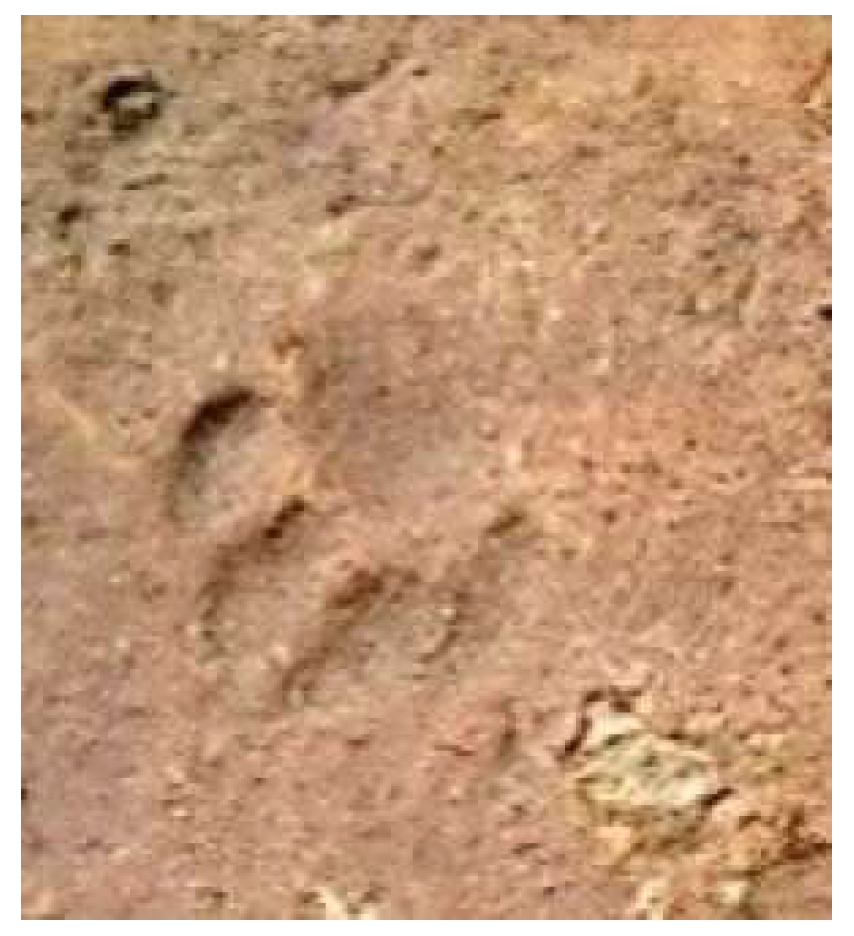
Figure 3.
Sheep footprint and Goat footprint.
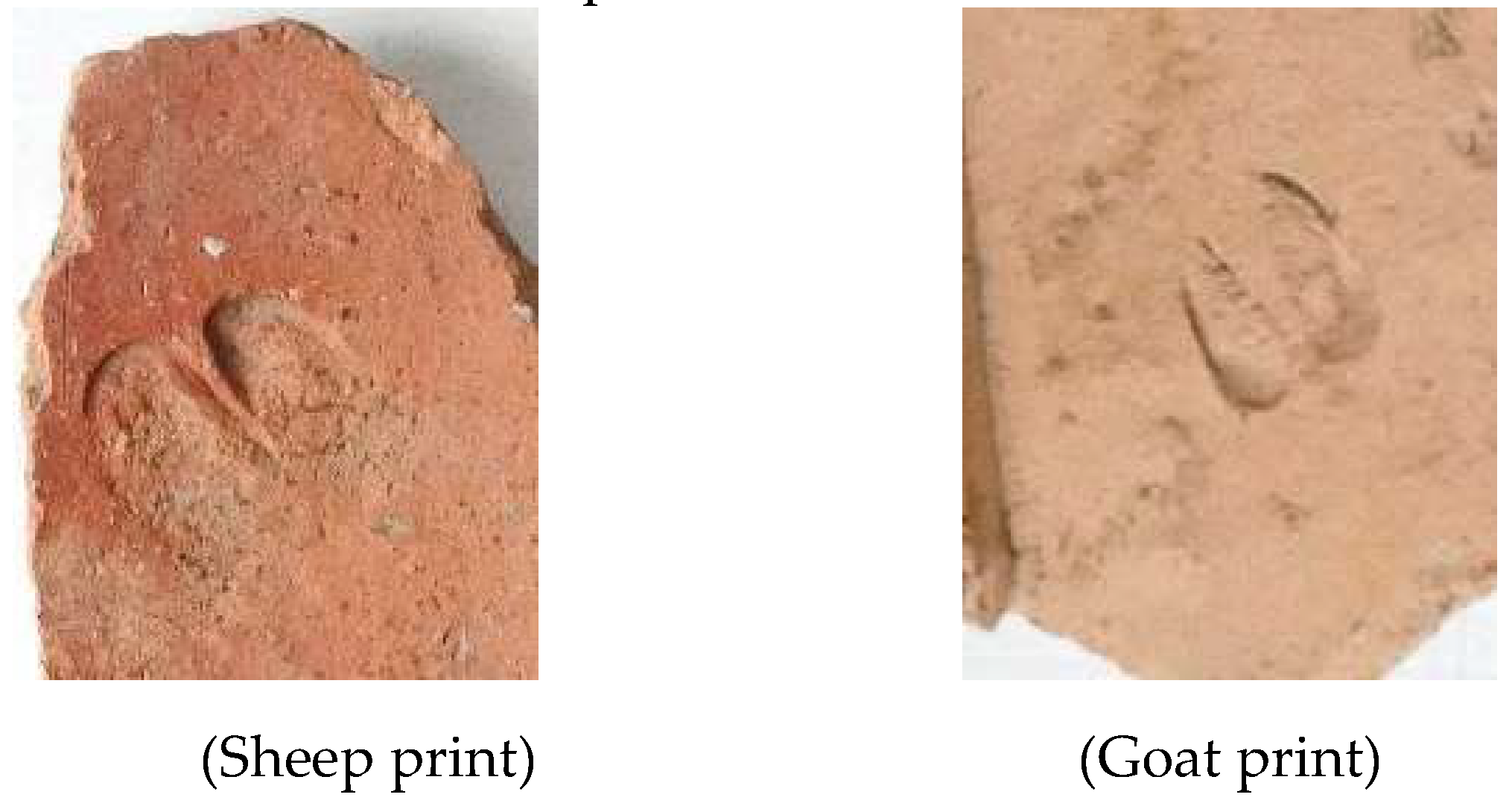
Figure 4.
Bird footprint.
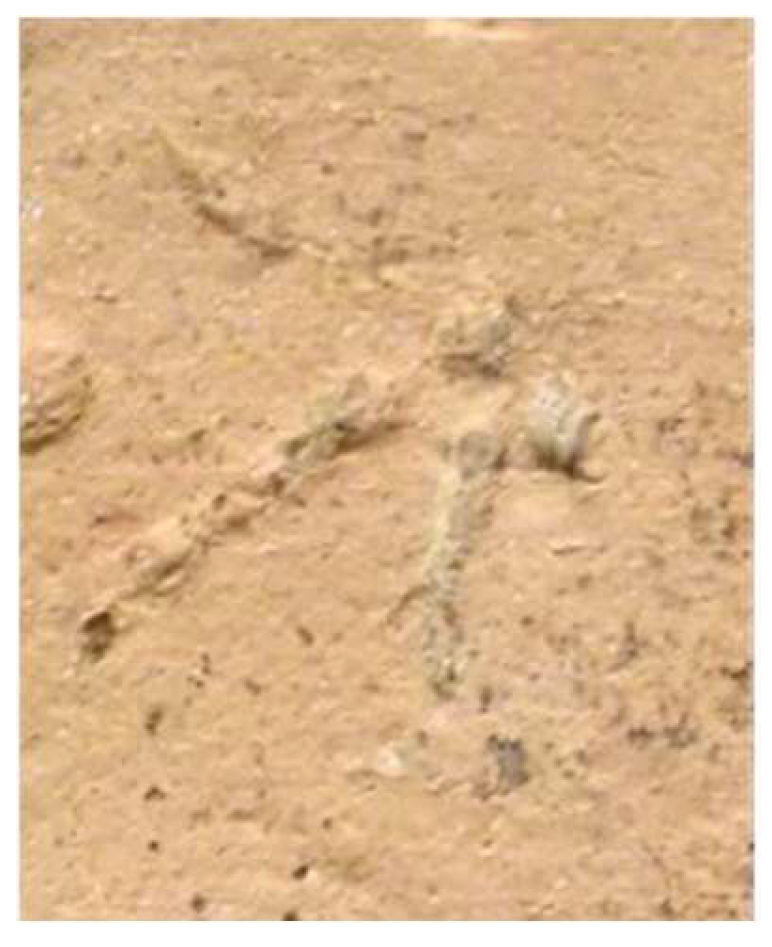
Figure 5.
Human Footprint 1995.0172.
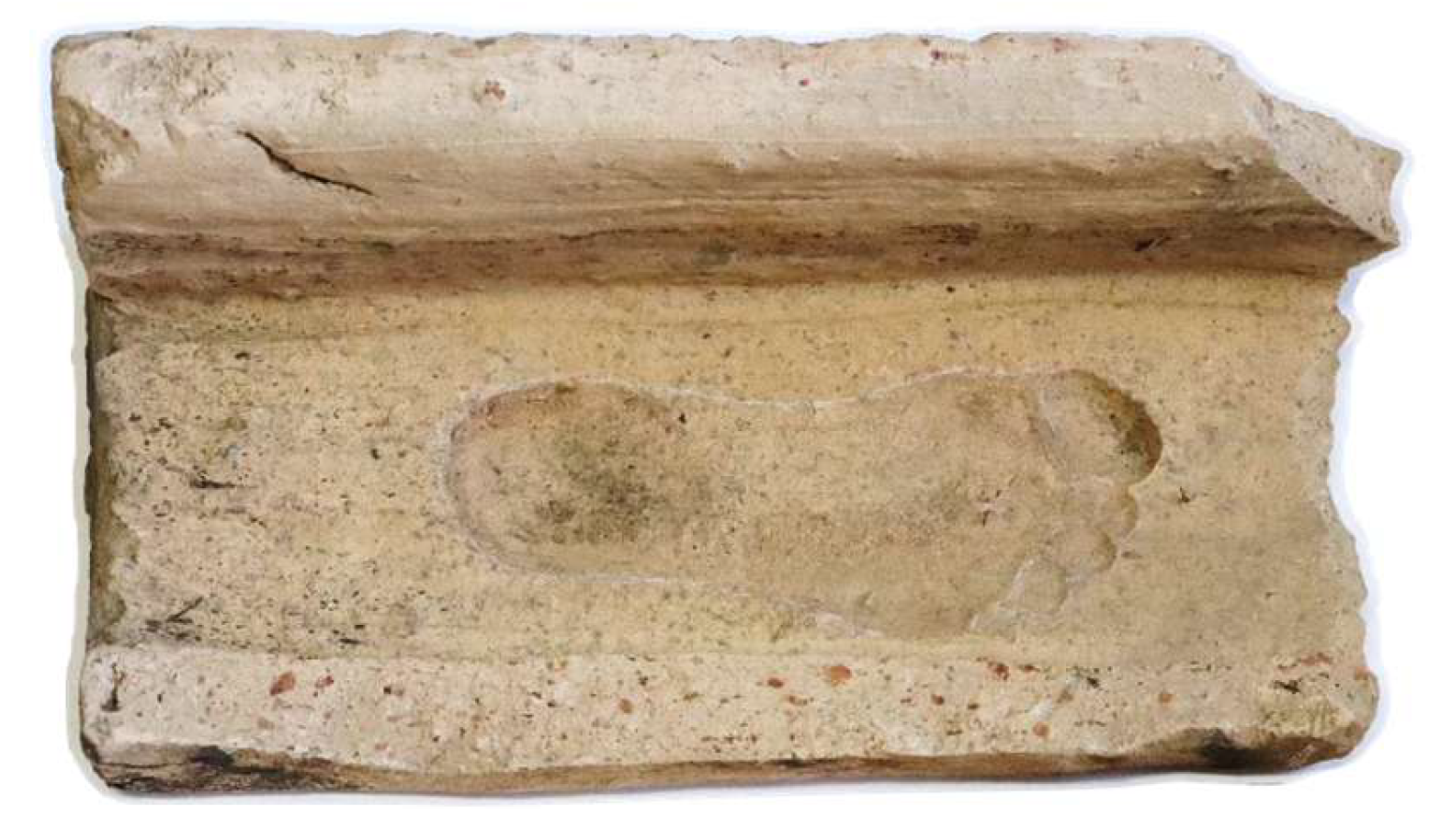
Figure 6.
Human Footprint 2024.0308.
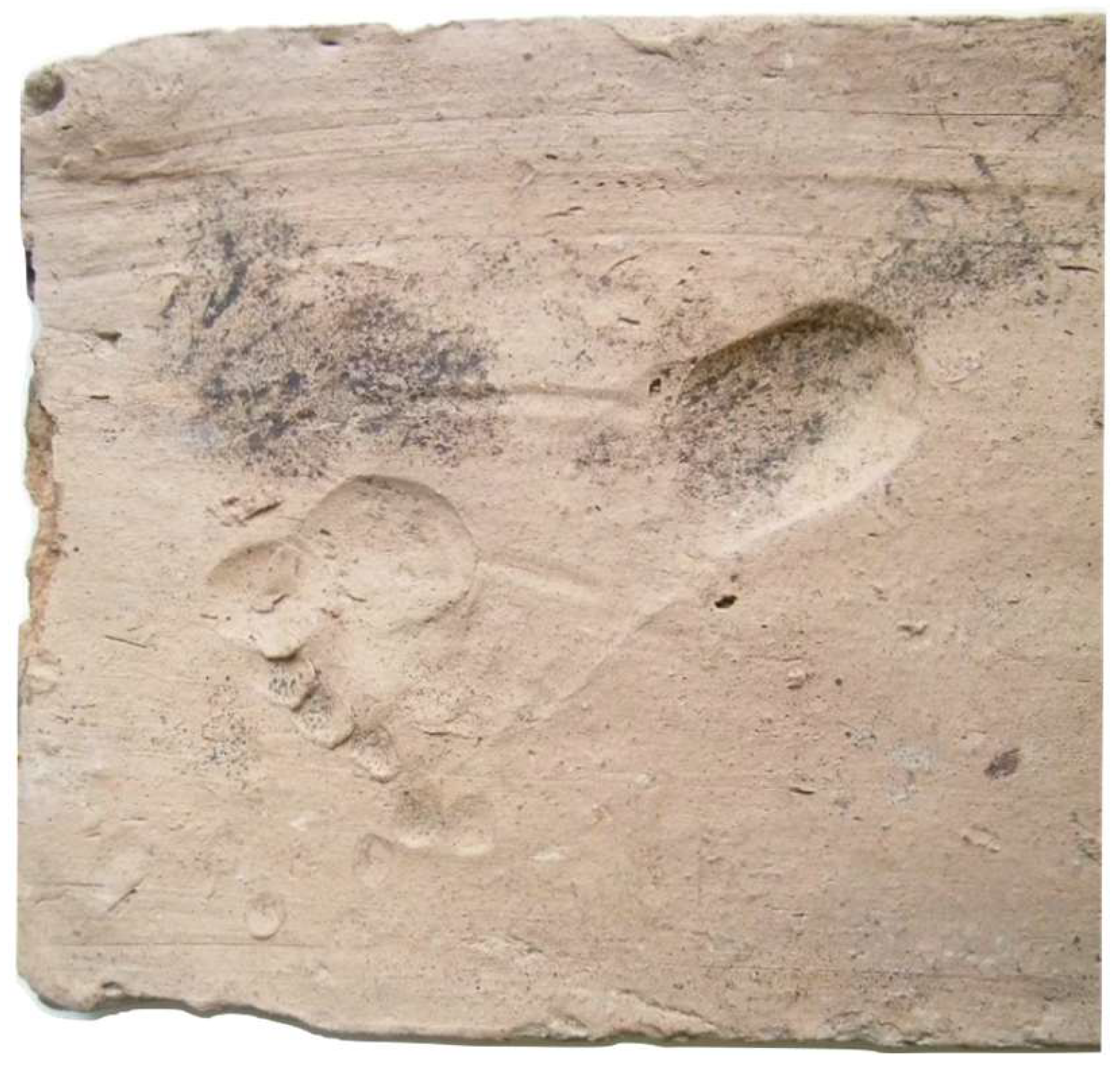
Figure 7.
Drawing of the partial human footprint 1996.0659.
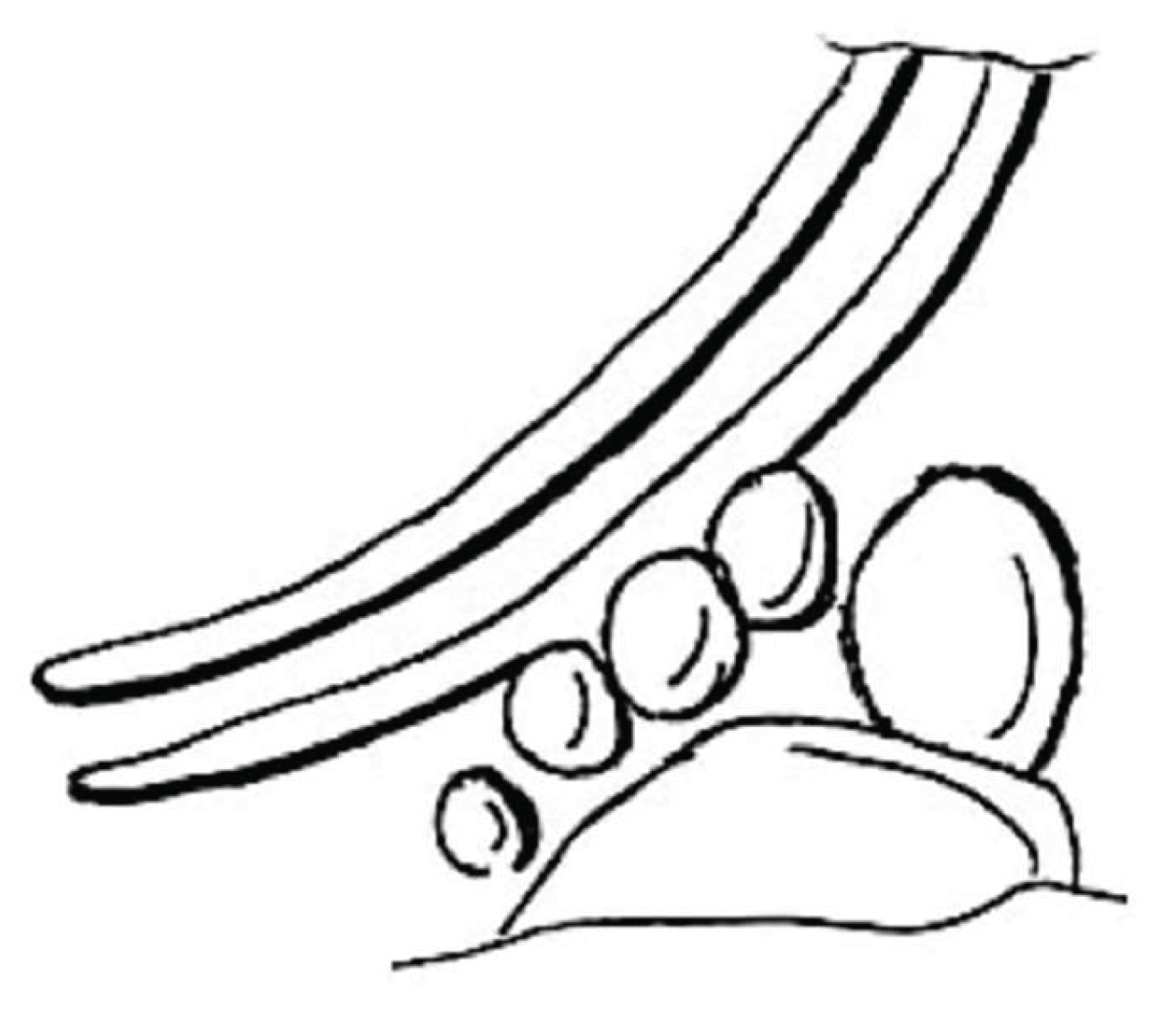
Figure 8.
Possible human infant print on tile 2024.0780.
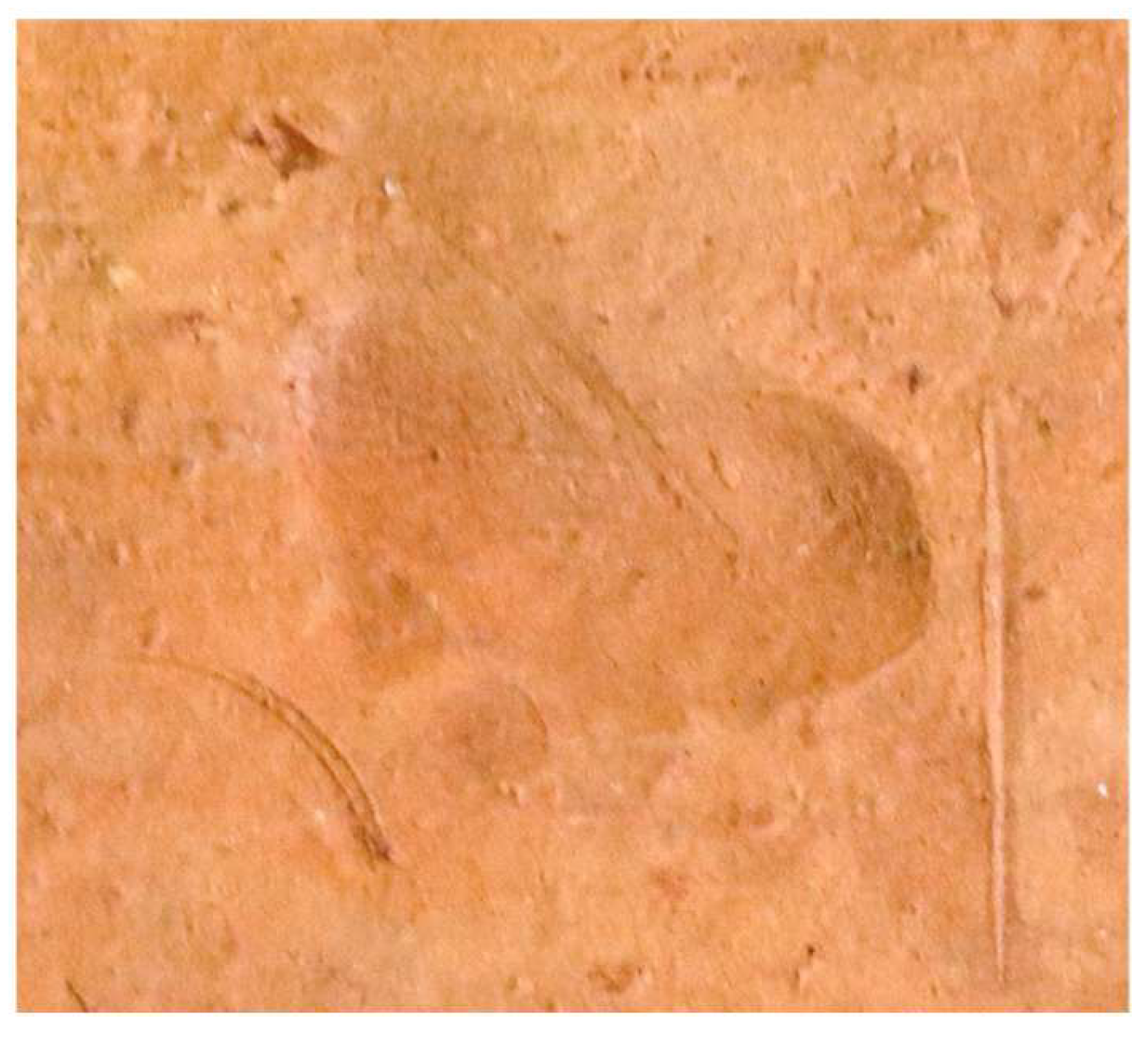

Table 1.
Number of Tiles Examined by Site.
| Site Name | Qty | Percent |
| Albergue | 2 | 1.3 |
| Cangosta Palha Necropolis | 16 | 10.5 |
| Carvalheiras | 19 | 12.5 |
| Cavalariças | 2 | 1.3 |
| Colina Cividade | 6 | 3.9 |
| Fujacal | 2 | 1.3 |
| Fujacal J_Misericordia | 6 | 3.9 |
| Granjinhow | 3 | 2.0 |
| Largo Carlos Amarante Necropolis | 20 | 13.2 |
| Largo S João Souto Frigideiras | 2 | 1.3 |
| Povoado Castro Falperra | 2 | 1.3 |
| Rua S Geraldo | 1 | 0.7 |
| S Martinho Dume Cemiterio | 5 | 3.3 |
| Teatro | 5 | 3.3 |
| Termas | 3 | 2.0 |
| Via XVII Av Liberdade Necropolis | 51 | 33.6 |
| Unspecified | 7 | 4.6 |
| TOTAL | 152 | 100 |
Table 2.
Number of Prints by Animal.
| Animal | Quanty | Percent |
| Dog | 208 | 49.5 |
| Cat | 6 | 1.4 |
| Sheep | 75 | 17.9 |
| Goat | 74 | 17.6 |
| Sheep/Goat | 23 | 5.5 |
| Bird | 5 | 1.2 |
| Human | 27 | 6.4 |
| Unknown | 2 | 0.5 |
| TOTAL | 420 | 100 |
Table 3.
Measurements of complete human bare footprints.
| 2018 Data1 | Current Data | |||
| 2001.1280 | 2004.1119 | 1995.0171 | 2024.0308 | |
| 1 | 215 | 211 | 213 | 213 |
| 2 | 209 | 207 | 206 | 208 |
| 3 | 199 | 202 | 200 | 201 |
| 4 | 185 | 192 | 188 | 194 |
| 5 | 175 | - | 173 | 177 |
| 6 | 103 | 100 | 93 | 102 |
| 7 | 85 | 87 | 84 | 87 |
| 8 | 51 | 52 | 61 | 51 |
| 9 | 46 | 51 | 46 | 51 |
| 10 | 51 | 53 | 52 | 57 |
1 Data from Marado and Ribeiro 2018, [8], p35. All data is in mm. 1. length: posterior most point of heel to anterior most point of toe 1; 2. length: posterior most point of heel to anterior most point of toe 2; 3. length: posterior most point of heel to anterior most point of toe 3; 4. length: posterior most point of heel to anterior most point of toe 4; 5. length: posterior most point of heel to anterior most point of toe 5; 6. width: medial most point of hallux to lateral most point of foot; 7. maximal metatarsophalangeal width; 8. heel width between uppermost lateral points; 9. heel width: medial concavity to lateral tubercle; 10. maximal heel width.
Table 4.
Measurements for partial human bare footprints from the current study.
| 1996.0659 | 2024.0727_1 | 2024.0727_2 | |
| Maximum Length | 42 | ||
| Maximum Width | 59 | ||
| Maximum Heel Width | 60 | 59 |
All data is in mm.
Table 5.
Measurements of complete shoe prints.
| 2018 Data1 | Current Data | |||
| 1994.0492 | R25A#1 | R25A#2 | 2023.0532 | |
| Maximum Length | 2452 | 245 | 230 | 211 |
| Maximum Width | 78 | 70 | 61 | 59 |
1 Data from Marado and Ribeiro 2018, [8], p35. 2 Data is reconstructed length. All data is in mm.
Table 6.
Stature estimates of adult bare foot and shoe prints.
| Sample Number | Print Type | FL and Est. FL |
Stature |
Regression Formulas |
| 2001.1280 | Bare foot R | 215 | 152.8 152.2 |
3.614 x FL (cm) + 75.065 ±4.90 2 88.211 + 2.93 x FL (cm) ±5.0 3 |
| 2004.1119 | Bare foot L | 211 | 151.3 150.0 |
3.614 x FL (cm) + 75.065 ±4.90 2 88.211 + 2.93 x FL (cm) ±5.0 3 |
| 1995.0171 | Bare foot R | 213 | 152.0 150.6 |
3.614 x FL (cm) + 75.065 ±4.90 2 88.211 + 2.93 x FL (cm) ±5.0 3 |
| 2024.0308 | Bare foot L | 213 | 152.0 150.6 |
3.614 x FL (cm) + 75.065 ±4.90 2 88.211 + 2.93 x FL (cm) ±5.0 3 |
| 1994.0492 4 | Shoe print L | 218.8 1 | 154.1 152.3 |
3.614 x FL (cm) + 75.065 ±4.90 2 88.211 + 2.93 x FL (cm) ±5.0 3 |
| R25A#1 4 | Shoe print R | 218.8 1 | 154.1 152.3 |
3.614 x FL (cm) + 75.065 ±4.90 2 88.211 + 2.93 x FL (cm) ±5.0 3 |
| R25A#2 4 | Shoe print L | 203.8 1 | 148.7 147.9 |
3.614 x FL (cm) + 75.065 ±4.90 2 88.211 + 2.93 x FL (cm) ±5.0 3 |
Right (R). Left (L). Foot length (FL). 1 Foot length is in mm and estimated (est.) foot length is maximum shoe print length less 2.62 cm [10]. 2 Regression formula for women [10]. 3 Regression formula for women [11]. 4 Data from Marado and Ribeiro 2018, [8], p35.
Table 7.
Sites with dog prints and range of widths recorded.
| Site | Number of Prints | Width Range (cm) | Source |
| Bracara Augusta, Braga, Portugal | 208 | 2.5 – 7.0 | Current Study |
| Calleva Atrebatum, Silchester, England | 125 | 2.4 – 7.8 | [16] |
| Brigeto, Budapest Hungary | 10 | 2.7 – 6.4 | [9] |
| Vindolanda, Northumberland, England | 265 | 2.4 – 7.0 | [17] |
| Castro de Viladonga, Spain | 9 | 3.0 – 7.0 | [19] |
| Aizanoi, Turkey | 9 | 4.8 – 9.0 | [14] |
| Perge, Turkey | 6 | 4.7 – 5.6 | [14] |
Table 8.
Sites with cat prints and range of widths recorded.
| Site | Number of Prints | Width Range (cm) | Source |
| Bracara Augusta, Braga, Portugal | 6 | 2.4 – 2.8 | Current Study |
| Calleva Atrebatum, Silchester, England | 27 | 2.1 – 4.0 | [16] |
| Brigeto, Budapest Hungary | 6 | 3.8 – 6.1 | [9] |
| Castro de Viladonga, Spain | 2 | 3.0 – 4.0 | [19] |
| Perge, Turkey | 1 | 3.15 | [14] |
Disclaimer/Publisher’s Note: The statements, opinions and data contained in all publications are solely those of the individual author(s) and contributor(s) and not of MDPI and/or the editor(s). MDPI and/or the editor(s) disclaim responsibility for any injury to people or property resulting from any ideas, methods, instructions or products referred to in the content. |
© 2025 by the authors. Licensee MDPI, Basel, Switzerland. This article is an open access article distributed under the terms and conditions of the Creative Commons Attribution (CC BY) license (http://creativecommons.org/licenses/by/4.0/).
Copyright: This open access article is published under a Creative Commons CC BY 4.0 license, which permit the free download, distribution, and reuse, provided that the author and preprint are cited in any reuse.