

Submitted:
06 October 2025
Posted:
07 October 2025
You are already at the latest version
Abstract
Design principles for creating effective e-learning environments are a crucial part of modern education systems. In addition to growing interest in effective e-learning design, there is a significant lack of educational settings specifically tailored for deaf learners. Therefore, this study presents inclusive design principles based on the initial concepts of authentic learning. Design-based research was used to develop an authentic e-learning environment for 11 deaf learners, utilizing qualitative data collection methods.
The results outlined a new and refined principal design and described techniques for creating e-learning for deaf learners. Based on the findings, 13 design principles were developed from the initial set by incorporating both theoretical and practical aspects. Additionally, the results emphasized that following the design principles of authentic learning can increase the effectiveness of e-learning; however, integrating sign language and technology tools is also a necessary factor. Therefore, the established inclusive de-sign principles can serve as guidelines for designing systems and resources for deaf ed-ucation and for educators.
Keywords:
authentic E-learning
; design-based research (DBR)
; technology tools
; deaf learner
; learning effectiveness
1. Introduction
One of the challenges in e-learning settings is the limited number of design principles available to guide teachers in preparing e-learning content. E-learning enables learners to receive education remotely and interact with teachers and their peers without the need for face-to-face communication. The flexibility of e-learning enables learners to have educational opportunities at any time and from anywhere. E-learning is a combination of online teaching materials, resources, and strategies that affect the transfer of knowledge to learners. Creating an active learning environment needs to increase learners’ motivation during the learning process [1,2]. Additionally, digital platforms like video meetings, digital discussion forums, and resources encourage learners in a variety of activities without having face-to-face attendance like a traditional classroom [3].
E-learning has become a critical part of modern educational systems, proposing both advantages and challenges. As shown in Table 1, the effectiveness of e-learning lies in accessibility and allowing learners to access teaching materials. Moreover, interactive learning settings can enhance engagement by integrating digital tools. Understanding the differences between effectiveness and ineffectiveness is essential for teachers aiming to optimize e-learning environments and ensure better outcomes for diverse learner needs.
Authentic e-learning efforts to create a meaningful learning setting by including real-world situations as teaching themes. The e-learning settings around authentic situations emphasize practical applications and also increase collaboration by incorporating problem-solving tasks. Moreover, embedding multimedia resources in authentic e-learning improves the interactivity of online learning and fosters engagement among learners [4].
1.1. Designing E-Learning
The principles for designing and developing distance learning play a key role in constructing learning settings. It also promotes the effectiveness of the learning process, helping adopt appropriate technology tools and reducing teaching challenges [10]. [11] stated that preparing active e-learning needs to be developed to encourage more learners in e-learning and to influence the effectiveness of e-learning, which also requires integrating technological tools. One of the requirements for creating e-learning environments is to enhance students' 21st-century skills, where in a language e-learning environment, principles to develop e-learning play a critical role [6]. Incorporating design principles into the e-learning setting can increase engagement among learners and involve them in learning settings. Developing distance learning by integration of design principles creates an active learning environment, which is an important element for designing remote learning instruction.
Designing e-learning settings according to real-world problems is one of the most common teaching approaches to enhance motivation among learners. The Design learning through e-learning with real-world themes that are logical to learners. Design principles for e-learning, such as clarity, consistency, and authenticity, can help students stay motivated, facilitating the learning process in a structured and meaningful way. While a few approaches are available for teaching English to deaf learners, the essential goal of tailored instructional strategies that address the needs and cultural requirements is the purpose of conducting this study.
As technology becomes more prevalent in the classroom, the demand for increasing motivation among learners in learning environments is growing [5]. This highlights the need for the integration of technology in the classroom by aiming to increase the 21st-century skills of learners [6,7]. In the field of deaf education, the technological skills needed extend beyond teacher proficiency for deaf learners to increase their digital literacy and encourage them [8]. However, the combination of technologies is not adequate for the learning setting, and a theme or subject to increase deaf learners' engagement in the lesson is required. The learning environment also needs design principles to help teachers in creating more effective and accessible teaching for learners, while fostering learners’ creativity—an essential factor of 21st-century skills.
In this respect, the current paper focuses on defining the design principles needed for designing an e-learning setting. Thus, the four phases of the design-based research (DBR) approach proposed by [9] were illustrated.
Figure 1.
Four phases of design-based research [9].
Figure 1.
Four phases of design-based research [9].
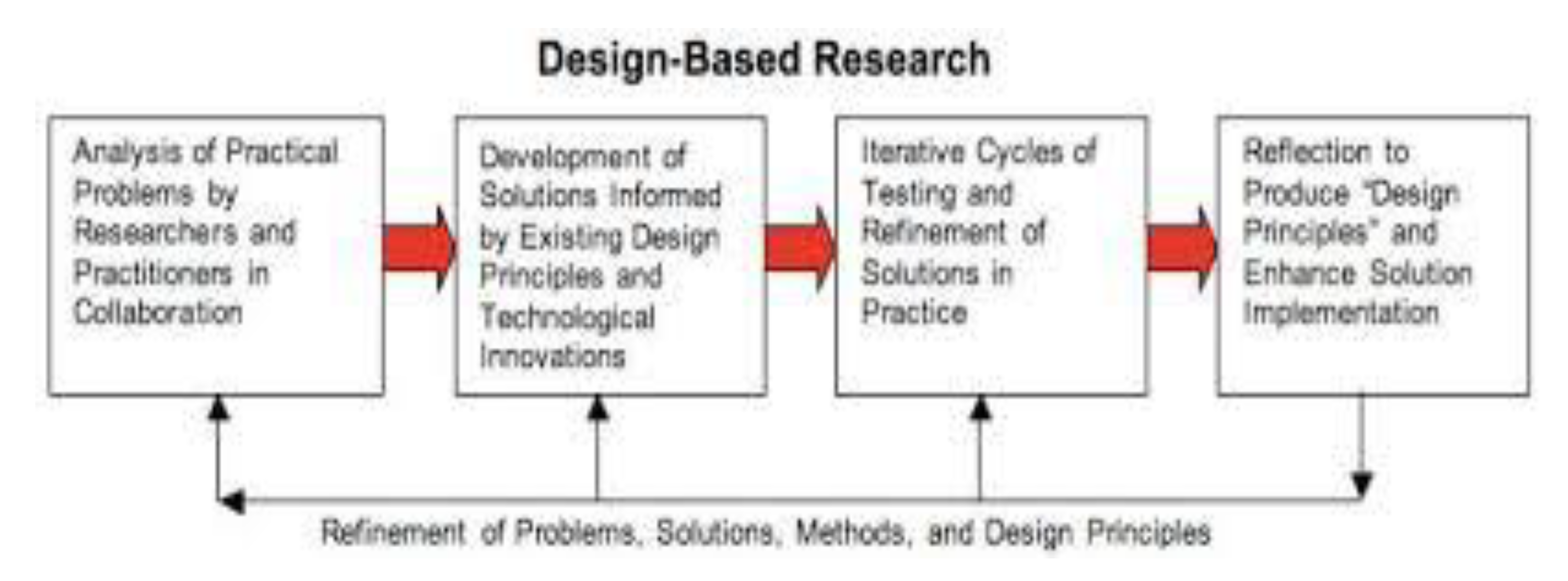
The current study contributes to DBR by articulating validated design principles and a review of the development of digital skills of deaf learners. Therefore, first, the application of DBR and the methodology are presented. Then, the results from each phase are discussed.
The e-learning designed in the present study was initially guided by nine principles of authentic e-learning [4], aiming to enable deaf learners to gain robust knowledge of their foreign language that they can transfer to their real lives. Therefore, the study aimed to investigate the following research question:
1) How do deaf adult learners engage with and respond to authentic e-learning environments designed to incorporate the principles of authentic e-learning in sign language e-learning?
2. Background
2.1. E-Learning for Deaf Learners
Despite the increasing field of e-learning, limited studies have addressed the needs of deaf learners in e-learning. Currently developing technology tools and new educational systems, e-learning has become a popular method of learning in a flexible learning system. However, the design of the e-learning environment for deaf learners needs additional strategies and factors to ensure accessibility, involvement, and full comprehension for deaf learners. Teaching through e-learning for deaf learners presents several issues and challenges, as [12] reported that integrating technology tools and innovation of e-learning becomes more prevalent in deaf educational systems. For instance, the design of e-learning for developing essential learning skills gets more attention from researchers when the aims of teaching through e-learning require increasing motivation among deaf learners. In addition, as reported by [13], e-learning for deaf learners needs to have accessibility to all teaching materials for visual needs and through sign language to encourage them to be taught. Therefore, increasing motivation is one of the vital keys to having active e-learning.
Since e-learning for deaf learners requires embedding learning settings with sign language [14,15], e-learning for deaf learners often overlooks the use of a theme with embedded materials in sign language, videos with captioning, and visual tools. However, as argued before [15], the only integration of these elements in e-learning can significantly enhance their learning experience, providing more accessible, engaging, and effective educational opportunities.
The need for all teaching materials through visual tools to be integrated into learning settings supports diverse learning models, increases engagement, and helps deaf learners make information more accessible and memorable [8]. Learning through multimodal communication in spoken and sign language can increase the reorganization of lip movements and facial mimics in an e-learning setting. However, preparing e-learning visualization of the environment raises deaf learners' success when the visual sense is the main means of transferring knowledge to deaf people [16]. Therefore, the quality of e-learning for deaf learners depends on boosting their interest in the learning process and adopting supportive and inclusive technological tools in e-learning.
[17] highlighted the importance of teaching materials and resources in more visual learning settings. Learning from visuals creates meaningful learning experiences in a meaningful way for deaf learners when factors like developing e-learning in sign language-based learning programs, increasing the teacher's use of both spoken and sign language, using supportive tools to design e-learning and tasks, and developing inclusive and accessible resources are considered in learning design. In addition, [18] stated that deaf individuals may be weaker at increasing their motivation through teaching concepts and communication in class; eager to communicate through teaching concepts, creating a user-friendly platform for communication through video calling and text increases their motivation and fosters both comprehension and retention [19].
[20] believed that factors influence deaf learners, particularly concentrating on the impact of inclusive instruction practices and available resources; however, to understand how teaching approaches could be adapted to support deaf learners, specifically in terms of modernization and digitalization learning settings, and then improving their engagement.
2.2. Authentic Learning Approach and Principles
The concept of learning from real-life situations in education dates to the sixteenth century, and it has been known as authentic learning [21]. [22] defined authentic learning as a learning process based on applying knowledge in real-world settings, which is a combination of other educational theories. The integration of real-world themes in a teaching environment prepares a more effective learning environment, where setting up a productive learning setting [23].In this respect, [24] stated that the foundation of authentic learning is constructivist theory, which asks students to analyze problems in the context of real-world scenarios and then collaborate with their peers to find a solution in simulated learning environments based on authentic tasks and problem-solving. The nature of authentic learning shifts traditional teaching techniques (teacher-centered) to modern ones (student-centered) when it drives learners to discover a simulated problem in their real-world environment and also creates the alignment between constructivism, more especially, social constructivism, and cognitivism [25].
An authentic e-learning approach and its design principles emphasize real-world relevance and active learning by creating an engaging and meaningful learning environment. [4] proposed nine design principles that can guide educators and designers in creating more dynamic and inclusive e-learning environments. An e-learning setting should:
- Provide authentic contexts that reflect the way the knowledge will be used in real life,
- Provide authentic activities,
- Provide access to expert performances and the modeling of processes,
- Provide multiple roles and perspectives,
- Support collaborative construction of knowledge,
- Promote reflection to enable abstractions to be formed,
- Promote articulation to enable tacit knowledge to be made explicit,
- Provide coaching and scaffolding by the teacher at critical times,
- Provide for authentic assessment of learning within the tasks. (p. 25)
The development of these principles and integrating technology tools in the tasks that affect educational systems makes them more accessible and interactive. These principles enable teachers to implement technology tools and resources that supply diverse learning needs and foster a more inclusive environment for enhancing learners’ engagement.
Incorporating technology into tasks poses difficulties when active learning aims to boost students' motivation [1]. As stated by [11], preparing an active e-learning setting requires technological knowledge, and integrating the essential factors into the learning setting, especially when teaching occurs through the Internet.
Creating e-learning environments requires considering elements for enhancing students' twenty-first-century skills. To this end, as suggested by [6], in an e-learning environment, principles and factors play the function of interventions by fostering a collaborative learning environment and enhancing student communication. For this reason, incorporating design principles into the learning setting that encourage learners to be involved and active is an important part of designing remote learning instruction. [6] propose a framework for authentic e-learning that could provide situations for meaningful knowledge, suggesting that authentic e-learning is meaningful and attractive; it has complexity and difficulty in reaching the answer. The result in an authentic and meaningful product that is created by learners has worth. Other principles have also been offered in successful applications of the approach, such as [2,6]. There is an urgent need to shift the theory from transferring teaching to focusing on more meaningful contexts, and thus, teachers need approaches that use teaching materials in contexts that learners will meet in real life.
2.3. Design Principles Needed for Deaf Learners
Designing effective learning settings for deaf learners requires deep planning to provide accessibility and engage them in equitable environments. Effective learning environments need a core on visual convenience and inclusive teaching methods [17]. Therefore, tailored content that values Deaf culture, visual materials and aids, and interactive elements are at the core of learning environments.
In this respect, research supports that e-learning environments for deaf learners with embedded cultural aspects, such as sign language, certainly enhance engagement and comprehension [15,26]. Embedding specific factors for creating teaching strategies might create suitable e-learning settings, when the foundation design principles won't be changed for deaf learners, who have the same level of cognitive skills as learners without difficulty hearing. It has been highlighted that most educational techniques are not different, but the tools and vehicles to transfer the knowledge are diverse [26]. Thus, preparing effective e-learning for deaf learners demands visual communication tools and interactive features that support students’ desired modes of learning. Since deaf learners often rely immensely on visual knowledge, e-learning should have high-quality Internet, videos with captions, and illustrative visual aids to enhance understanding. Videos in sign language and animated demonstrations help deaf learners to engage with the teaching materials without struggling to receive knowledge from auditory aids [16]. Visual reliability and clear design are also essential to reduce the percentage of cognitive overload, which can become a significant challenge if the interface is messy or poorly structured [8].
The critical aspect of preparing learning for deaf learners is integrating into an environment to get more benefits from social learning and having a topic for communication with their peers, which supports social constructivist principles [20]. However, integrating additional approaches such as a Bilingual-Bicultural (Bi-Bi) approach, where materials are in both sign language and written format, cannot be the only factor to increase deaf learners' motivation and encourage them in learning settings [26]. Therefore, for promoting the effectiveness of the learning setting for deaf people, approaches and design principles for preparing inclusive learning are required.
In e-learning fields, which have become an increasingly prominent system of education, accessibility for diverse deaf learners is crucial [27]. The research highlights that many online learning platforms fail to adequately address accessibility needs, which can create barriers for learners with hearing disabilities. Teachers and designers need to prioritize inclusive practices, such as adding alternative strategies, teaching tools such as text for images, providing captions for video content, and ensuring compatibility with screen readers [27]. It seems there is an urgent need to shift from focusing on just teaching to focusing on understanding, and thus, not only in face-to-face learning settings, but also in the distance learning platform like e-learning for deaf people need approaches that provide guidelines in contexts that deaf learners will meet in their real life. By implementing these accessibility features, e-learning environments can become more inclusive and effective for a broader range of learners, enhancing overall engagement and learning outcomes.
3. Research Method
The study employed a design-based research method, including 4 phases in two full iterative cycles for developing practical solutions in education. The study adopted a qualitative method to collect data for investigating the answer to the research question and reaching the main objective of the study.
Phase 1: Problem Definition
Phase 1 investigated the key issues in e-learning systems for deaf learners. Therefore, the study reviewed relevant literature and asked practitioners. This phase involved three initial tasks: (1) reviewing existing difficulties in e-learning for deaf learners, considering practitioners’ experience, and (3) forming guidelines for designing effective e-learning tailored to deaf learners. Therefore, difficulties such as the lack of face-to-face learning schools, inadequate access to e-learning, and low social interaction and communication were detected, and the need for additional factors to create interactivity for deaf participants was detected [13,28].
Phase 2: Solution Design
In Phase 2, the nine principles of authentic learning proposed by [4] were decided to be the initial design framework of e-learning. As found in the literature, authentic learning and incorporating real-world themes into learning settings increase motivation among learners and encourage them to learn [5,29]. This phase involved a draft list, a thorough literature review to identify design principles effective in e-learning for hearing learners, and to test these principles for deaf learners.
Accordingly, an e-learning setting was designed to incorporate authentic themes and tasks in the foreign language learning setting. The main theme was a fictional scenario in an authentic setting to increase communication opportunities for deaf learners through the target language vocabulary related to market items. To provide a collaborative learning setting and scaffolding opportunities, a main task and three sub-tasks were designed. The aim of using tasks in an e-learning setting is to promote active participation and increase creativity among learners.
Phase 3: Implementation and Development
Phase 3 indicated the design and implementation of e-learning for deaf learners with two iterative cycles to test its operation over 3 months, and revisions to the learning environment happened between iterations. The study used semi-structured 40-minute interviews to obtain participants’ views after getting ethical approval. The age of participants of this study was recorded between 30 and 50, and deaf Cypriot adults with two different sign languages and a foreign language. The data gathered from the qualitative part were coded following [30] by coding and categorizing the key areas of the study, including engagement, motivation, and collaborative learning.
Phase 4: Refinement of Design Principles
The final phase was the testing cycle to refine and develop design principles tailored to deaf adult learners. Some original principles were retained as they were, and others were modified or added based on participants’ feedback. Consequently, the study released the final design principles to support e-learning settings through sign language, as described in detail below. These principles can provide a comprehensive framework for future research on deaf education.
4. Description of E-Learning Design and Process
A fictional scenario about prices in supermarkets was designed to lead the learning setting into the meaningful theme, and each learner was given a role to create and fill in some part of the report. To prepare all the needs for teaching materials, pictures, videos in sign, and text formats were used for each category of supermarket items.
The project used the Google Sites platform for designing the base and primary e-learning setting. This platform has appropriate accessibility, ease of use, and features to support multimedia integration. Key features include video and visual aids to prepare tutorials and vocabulary. The integrated dictionary on the home page directs the link to the dictionary in sign language, which provides easy understanding of the meaning of the words and enables independent exploration by deaf learners. Multidevice compatibility was another advantage of using Google Sites, which can be applied to both smartphones and laptops. The platform supported both smartphones and laptops, ensuring learners could access materials at their convenience.
The study embedded social media into the website to promote interaction and community between participants. Social media tools like Facebook could help learners share their ideas and beliefs by recording videos and receiving peer feedback. This also allows communication to be both synchronous and asynchronous. The collaborative factors were applied to the design of e-learning by designing tasks to encourage active use of the foreign language and provide learners with opportunities to reflect on their progress and engage in peer-to-peer learning.
As mentioned earlier, the primary element of authentic learning is real-world relevance. To create an authentic setting, the main page was designed to mimic a supermarket environment, including stands and items like dairy, protein, bread, and more. Learners could see each item's text vocabulary and picture, then record videos by clicking on the e-tutorial pages. Google products and Padlet were used to design the tasks. The main task was based on a fictional scenario to enhance learners’ searching and problem-solving skills, with roles such as a finance officer, and the teacher overseeing as the chair of the finance department. Each sub-task was completed after a one-month learning period, with the main task finished at the end of the third month. The main task involved preparing a report on grocery inflation and proposing a solution to be presented to the Ministry of Finance. A currency converter was included in the e-learning setup to help calculate prices in different currencies. The tutorial videos, recorded by a deaf teacher, demonstrated how to use tools like Google Docs, Google Sheets, Padlet, and Google PowerPoint. These videos were shared via a Facebook page.
The e-learning experience was constructed around the main task of preparing a financial report about supermarket prices. The scenario-based task also provides scaffolding opportunities that develop learners’ skills. During three months of learning, participants completed a main task and three sub-tasks, which were key elements to designing tasks and sub-tasks:
- Using scenario: deaf learners have a role in preparing a part of a report on grocery prices and the existing inflation on the market. Designing a real-world responsibility in one role makes the learning experience more relatable.
- Completing sub-tasks to reach the main task encourages learners to pass the sub-tasks to do their final project. The subtasks allowed deaf learners to build vocabulary in a foreign language format, prepare a listing of items in Google Sheets, and discuss their results by recording videos.
- Instructional videos as tutorials for using Google Docs, Sheets, Padlet, and other technology tools in parallel with teaching the target language increased both the digital knowledge and language skills of deaf learners.
Accessibility was a vital factor in the design of e-learning, ensuring that all resources and teaching materials are available in the online learning environment, and visual guidelines for the use of resources are freely available. By integrating related videos with subtitles, the e-learning environment provides an environment at any time, making the learning experience more comfortable and without fear of losing the teaching materials. The study for this project created an authentic task-based learning setting that provided deaf learners with both technological and language practical skills in foreign sign language, motivation, and collaboration in a supportive, accessible platform.
The project involved three recognized progressive elements:
- Visual aids in teaching materials were used to design e-learning and tasks that applied to both smartphones and laptops.
- Based on authentic learning principles.
- Integrating educational technology tools into the learning environment to design the tasks.
5. Results
The main result of the current study is to develop design principles by informing both theory and practice. The nine design principles of authentic learning proposed by [4] were the initial principles of designing an e-learning setting. The result from the final phase came from the combination of the drafted list from the first phase and the output from the second phase.
Design principle 1: Based on authentic e-learning and authentic tasks [4], as a pedagogical framework.
Design Principle 2: Using a scenario-based approach for authentic task design.
Design Principle 3: Increasing scaffolding opportunity (based on the ZDP theory of Vygotsky)
Design principle 4: Integrating educational technology tools into the tasks.
Design principle 5: Integrating motivation and collaboration factors in an e-learning setting.
Design Principle 6: Designing the learning environment and tasks around deaf culture through sign language.
Accordingly, the results from the interview showed that some of the design principles (six principles of authentic learning) can remain the same as the original ones because of their suitability as guidelines; three of them can be modified, and three new principles should be added as findings from this study. Therefore, the following description is the result of this study:
Design principle 1: Authentic e-learning with real-life content increases deaf learners’ knowledge by engaging them in learning
The findings indicated that e-learning through real-life context is an effective element for deaf adult learners, which enables them to learn in a meaningful way by experiencing it in their daily life situations. Deaf learners were pleased with the real-life content in an e-learning setting by having a financial officer role. Using authentic content for learning a foreign language leads learners to find real solutions for real problems and expands their knowledge with an authentic intention. The authentic content encourages deaf learners to be active people during learning. For example, they indicated that,
“It was interesting for me; the first time I had experienced e-learning. Learning was interesting when we discussed prices that we experience in our daily life” (P6)
Design principle 2: Authentic e-learning increases motivation by using authentic scenario-based tasks in sign language
The task in an authentic learning setting is a crucial element, requiring deaf learners to go beyond different stages. Authentic tasks and sub-tasks are complex tasks that lead learners to come up with different results, and completing the main task happens by crossing sub-tasks. Using authentic scenarios to design the task provides an opportunity for deaf learners to imagine something and try to create something according to their imagination. It provides an opportunity to find a solution for that fictional scenario. This increases their communication and collaboration skills for coming up with a solution to complete the main task.
“My opinion on having a task is positive, a Task means working together, learning together, presenting our product… I learned how to prepare a list in Google Docs, Sheets, etc.. I have never had this opportunity before.” (P6)
“Having a story (scenario) for the tasks provided us with a better understanding of English. I showed the vocabulary, but I have to learn more English vocabulary. Cyprus has many British deaf people who come here for holiday; I hope I can have more communication with them.” (P2)
Design principle 3: Provides access to expert performances and the modelling of processes
The findings on this principle show that deaf learners experienced their instructor's help. The teacher assisted them in applying the new information in both language and technology to their tasks.
“The teacher taught the pronunciation of vocabulary related to supermarket items in English, his correction of our mistakes was helpful,…Yes, before, I did not know how to use Google products or how to sign in with my Gmail. He showed how I use them and how I share my recorded videos …” (P7)
Design principle 4: Provide multiple roles and perspectives
Deaf adult learners believe that the different results from participants were interesting. For example, some of them did not agree with other results to name the cheapest and most expensive supermarket. Learning from other results provides a more active learning setting, and deaf learners are more interested in teaching topics.
“Yes, we had different results. I did not agree with some of them. I had some comments, and I shared my opinion by sharing the video. I watched the video shared by P1, I totally disagreed about his information” (P4)
Design principle 5: Authentic e-learning provides the opportunity for collaboration through sign language
Collaboration is another crucial key to designing effective e-learning for deaf learners. It makes the learning process more interesting when involves them in the learning process. Deaf learners appreciated having collaboration when they completed tasks.
“Yes, she (P4) asked me about the price of… in …supermarket…we finished the final homework, yes! Its name was a task, and we presented it. It helped me to be motivated and I finished my part.” (P10)
Design principle 6: Authentic e-learning promotes reflection
Reflection, another important element in authentic e-learning for deaf learners, provides meaningful discussion on their experiences and increases deaf learners’ knowledge by getting reflection from teachers and others. The positive effect is that the learners’ knowledge is improved when they observe reflections from their peers on their products and try to update their information. As indicated by one participant:
“…we freely discussed on recorded videos and also during online meetings, I did not know the price of …item has been changed” (P2)
Design principle 7: Authentic e-learning promotes articulation
Learning through authentic learning provides articulation by involving deaf learners in real-life problem-solving. It helps learners to have deep observations on problems and share their solutions as findings.
“… (P3) asked me about ...supermarket, I asked why you bought them from there? Not good quality, and not cheap,…has better quality, and I gave the address.” (P4)
Design principle 8: Provide scaffolding opportunity
According to the participants’ views, e-learning included both Greek and Turkish sign users and provided scaffolding and coaching opportunities for both groups while completing the task and sub-tasks.
“I learned finger spelling in English first. P5 said the correct spelling of “v” is like... in English. During meetings, it helped me to learn words more than just supermarket items.” (P7)
“I learned the name of …supermarket in Greek sign language. It was interesting when the sign name of this supermarket in Turkish sign language is different” (P3)
Design principle 9: Provides for authentic assessment of learning within the tasks
Deaf adult learners enjoyed authentic assessment when they compared it with their traditional assessment in their childhood school. The main purpose of authentic assessment is to evaluate learners’ understanding and how they solve problems based on their previous knowledge and learn new ones from their peers. It also provides an opportunity for deaf adult learners to learn their strengths and weaknesses in their learning process.
“…Before this course, I thought I knew English in sign language, but too many names of fruits and vegetables are different from my L1.” (P1)
Design principle 10: Authentic e-learning increases deaf learners’ motivation through technological tools to support sign language communication
As indicated by deaf adult learners, the e-learning process was mostly satisfactory with authentic learning and tasks. The learners remarked that the tasks and using technology in tasks were helpful, and their communication through the platforms provided was effective in promoting their foreign language. They also mentioned that their motivation through this program was increased, and they learned that learning a different language, called a foreign language or a second language, is important in their real lives.
“The learning through the Internet had some difficulties that were very hard and challenging… but it helped me to learn something different”. (P3)
“I was interested to learn English. I thought English in sign language was the same as my language (TSL); however, I found a different shape of sign language. The program also gathered us from the south and north sides of Cyprus, which we had not had this experience.” (P1).
Yes, before, I did not know how to use Google products and how to sign in with my Gmail.” (P7)
Thanks to the teacher, he corrected my mistakes in spelling and helped us choose good resources on the Internet. He also recommended using one application; we uploaded videos to our Facebook group, and my friend gave some feedback on my video. It was good. I am happy to join the learning via the Internet” (P7)
An alternative effective factor in the learning process was the incorporation of technology. It caused more engagement among deaf learners and promoted collaboration during the tasks. This is an opportunity for learners to collaborate in groups to create their products. Preparing an authentic collaboration to address various task components also raises problem-solving and scaffolding factors. As previously stated in this paper, providing a platform for communication through sign language enhances the learner's proficiency in the target language. Integrating the tasks with technology in sign language promotes their proficiency in the target language and their technological knowledge.
Design principle 11: Authentic e-learning fosters a respectful Deaf culture and promotes inclusiveness in e-learning
Promoting inclusiveness in e-learning is another important factor in designing e-learning settings for deaf learners. Understanding deaf people's beliefs and their language and integrating them into the learning environment provides a more attractive learning setting for teachers. The social community of deaf people happens through sign language, and it is essential to build the learning environment according to the Deaf culture, which shows that they are respected. This enriches the learning environment by improving deaf learners’ motivation in a situated learning setting, while their experiences in real-world situations are enhanced.
“I wasn’t interested in learning English before, but my interest increased through this course when I saw that all vocabulary was shown by pictures, videos in sign language, and writing. We watched the recorded videos and commented on them” (P1)
Design principle 12: Authentic e-learning provides a flexible learning environment
A flexible learning setting through the Internet, which applies to both smartphones and laptops, allows deaf learners to access learning materials anytime and anywhere.
“I had free time in my job, and I opened the website through my smartphone, I used the dictionary to see the vocabulary in English language format.” (P8)
Design principle 13: Authentic e-learning fosters digital literacy among the deaf learners
Digital literacy is the ability to use applications and technology tools in a simple and A basic way that helps learners to be able to apply their technological knowledge to both Smartphones and laptops.
“I created Gmail, I signed in and connected to online Word through my Gmail. account….” (P8)
Therefore, according to the draft design principles, some of the design principles [4] were modified and refined. Six principles of authentic learning remained the same as the original ones because of their suitability as guidelines; three of them were modified, and the last four design principles were added after analyzing to answer the research question. They were aligned with the findings. As labelled in the first and second phases, the focus of designing learning settings for deaf learners should be through sign language communication. The study also provided a table below to illustrate how the new principles introduced in the current research are supported by findings from previous studies. This table serves as a comparative reference, showing how earlier research aligns with or contributes to the development of these new principles. By giving this information, the study highlights the strong foundation upon which the new principles are based, demonstrating their relevance, validity, and connection to existing knowledge in the field. The inclusion of these principles helps to strengthen the argument that the new design principles are not only novel but also grounded in previous scholarly work [31,32,33].
6. Discussion and Conclusion
The findings indicated that the design principles of the authentic e-learning were essentially recognized as a key aspect of learning for deaf learners. In this respect, deaf learners appreciate using a real-life situation and dealing with authentic problems. In addition, an authentic situation increased their communication and collaboration while they were completing the tasks. It also reported that learning through authentic themes boosts deaf learners’ collaboration, which is consistent with previous research [23,34]. Moreover, the results showed that the satisfaction of deaf learners was higher after the learning process through an authentic setting. Likewise, positive thoughts and their improvement were detected when technological tools were employed to design the tasks. The scaffolding opportunity during the learning process was shown during the task, and collaboration happened in their fictional role. The research employed deaf learners’ opinions to provide strong, supportive principles for designing e-learning settings when authentic learning is applied as an intervention.
Creating authentic scenarios for tasks helps improve communication skills through the target language when learners present and discuss their work freely [35]. The scaffolding approach was evident when both groups worked on correcting mistakes in their learning. Therefore, an e-learning environment centred on authentic themes is valuable and entirely achievable for deaf learners. The principles outlined here and detailed in the new guidelines will significantly assist instructors seeking to implement motivating learning environments in deaf education.
Moreover, the integration of technology tools in a sign language e-learning environment acted as a bridge between participants and the learning subject, reducing learning barriers for deaf learners. Therefore, it highlights the use of technology tools and using sign language allows equal participation and shows the importance of inclusive design principles in digital learning environments.
Design principles were used to create an e-learning setting for deaf learners who were mainly deprived of additional educational resources, such as learning technology. The associated learning tasks were implemented in two iterative cycles over three months. Design principles were refined with each cycle. However, it should be noted here that design-based research does not remove all problems and challenges but suggests a deep understanding of innovations that have an effect on improvement.
In conclusion, there is social and educational isolation for deaf learners worldwide. Preparing e-learning by adopting real-world tasks provided a sense of community, which likely had a positive emotional impact and encouraged continued participation. The research revealed that deaf learners may successfully participate in a genuine e-learning environment and that the key to effectively promoting e-learning for deaf learners is the adoption of technological tools for the creation of authentic tasks. The final phase was the release of the new design principles based on theory and practice, based on the reflections from the first three phases of this study. Authentic learning was applied in a flexible e-learning setting that was accessible through both smartphones and laptops, and authentic tasks provided the opportunity to have an active learning process for deaf adult learners to communicate via sign language.
Funding
This research received no external funding.
Conceptualization, N.N., İ.Ö., and A.F.M.; methodology, N.N., İ.Ö., and A.F.M.; software, N.N.; validation, N.N., İ.Ö. and A.F.M.; formal analysis, N.N.; investigation, N.N., İ.Ö. and A.F.M.; resources, N.N., İ.Ö. and A.F.M.; data curation, N.N.; writing—original draft preparation, N.N.; writing—review and editing, İ.Ö. and A.F.M.; visualization, N.N., İ.Ö. and A.F.M.; supervision, İ.Ö. and A.F.M. All authors have read and agreed to the published version of the manuscript.
Institutional Review Board Statement
The study was conducted by the Educational Sciences Ethics Committee at Eastern Mediterranean University, Institutional Review Board’s Ethics Committee, Approval Code: ETK00-2023-0199; Approval Date: 24 October 2023.
Informed Consent Statement
Written informed consent has been obtained from the patient(s) to publish this paper.
Data Availability Statement
The authors will make the data supporting this article’s conclusions available upon request.
Conflicts of Interest
The authors declare no conflicts of interest.
References
- Lowell, V. L., & Moore, R. L. (2020). Developing practical knowledge and skills of online instructional design students through authentic learning and real-world activities. TechTrends, 64(4), 581-590. [CrossRef]
- Gillett-Swan, J. (2017). The challenges of online learning: Supporting and engaging the isolated learner. Journal of Learning Design, 10(1), 20-30. [CrossRef]
- Bukhkalo, S., Ageicheva, А., & Komarova, O. (2018). Distance learning main trends. In Інфoрмаційні технoлoгії: наука, техніка, технoлoгія, oсвіта, здoрoв’я: тези дoпoвідей ХXVІ міжн. н-пр. кoнф. MicroCAD-2018 (pp. 16-18).
- Herrington, J., Reeves, T. C., & Oliver, R. (2010). A guide to authentic e-learning. London: Routledge.
- West, J., & Malatji, M. J. (2021). Technology Integration in Higher Education: The Use of Website Design Pedagogy to Promote Quality Teaching and Learning. Electronic Journal of e-Learning, 19(6), 629-641. [CrossRef]
- Malik, R. S. (2018). Educational challenges in the 21st century and sustainable development. Journal of Sustainable Development Education and Research, 2(1), 9-20. [CrossRef]
- Gurjar, N. (2020). Leveraging social networks for authentic learning in distance learning teacher education. TechTrends, 64(4), 666-677. [CrossRef]
- McKeown, C., & McKeown, J. (2019). Accessibility in online courses: Understanding the deaf learner. TechTrends, 63(5), 506-513. [CrossRef]
- Reeves, T. C. (2006). Design research from a technology perspective. Educationaldesign research, 1(3), 52-66.
- Willoughby, L., & Sell, C. (2024). Online videos for self-directed second language learning. [CrossRef]
- Language Learning & Technology, 28(1), 1–15.
- Bhuana, G. P., & Apriliyanti, D. L. (2021). Teachers’ encounter with online learning: Challenges and support system. Journal of English Education and Teaching, 5(1), 110-122.
- Khasawneh, M. A. S. (2021). Problems Teaching English to Deaf Students. Indonesian Journal of Creative Counseling, 1(2), 32-42.
- Aljedaani, W., Aljedaani, M., AlOmar, E. A., Mkaouer, M. W., Ludi, S., & Khalaf, Y. B. (2021). I cannot see you—the perspectives of deaf students to online learning during the COVID-19 pandemic: Saudi Arabia case study. Education Sciences, 11(11), 712. [CrossRef]
- Musyoka, M. M., & Smith, Z. Y. (2021). Mainstreamed Deaf/HH Students' Online Learning in K-12: Challenges, Opportunities, and Solutions. Curriculum Development and Online Instruction for the 21st Century, 69-89.
- Niksiar, N., Özverir, İ., & Meghdari, A. F. (2025). The Effectiveness of an Authentic E-Learning Environment for Deaf Learners. Applied Sciences (2076-3417), 15(3). [CrossRef]
- Birinci, F. G., & Saricoban, A. (2021). The effectiveness of visual materials in teaching vocabulary to deaf students of EFL. Journal of Language and Linguistic Studies, 17(1), 628-645. [CrossRef]
- Guardino, C., & Cannon, J. E. (2015). Theory, research, and practice for students who are deaf and hard of hearing with disabilities: Addressing the challenges from birth to postsecondary education. American Annals of the Deaf, 160(4), 347-355. [CrossRef]
- Atar, C., Aslan Bagci, Ö., & Bagci, H. (2021). Deaf Individuals and English Language Teaching. Turkish Online Journal of Educational Technology-TOJET, 20(4), 23-28.
- Lawyer, G. (2018). Deaf education and deaf culture: Lessons from Latin America. [CrossRef]
- Ngobeni, W. P., Maimane, J. R., & Rankhumise, M. P. (2020). The effect of limited sign language as a barrier to teaching and learning among Deaf learners in South Africa. South African Journal of Education, 40(2), 1-7. [CrossRef]
- Duman, N., & Karakas-Ozur, N. (2020). Philosophical Roots of Authentic Learning and Geography Education. Eurasian Journal of Educational Research, 90, 185-204. [CrossRef]
- Pawlina, W., & Drake, R. L. (2016). Authentic learning in anatomy: A primer on pragmatism. Anatomical sciences education, 9(1), 5-7. [CrossRef]
- Sabtiawan, W. B., Yuanita, L., & Rahayu, Y. S. (2019). Effectiveness of authentic assessment: Performances, attitudes, and prohibitive factors. Journal of Turkish Science Education, 16(2), 156-175.
- Mayo, J. A. (2010). Constructing undergraduate psychology curricula: Promoting authentic learning and assessment in the teaching of psychology. Washington, DC: American Psychological Association.
- Lockey, A., Conaghan, P., Bland, A., & Astin, F. (2021). Educational theory and its application to advanced life support courses: a narrative review. Resuscitation Plus, 5, 100053. [CrossRef]
- Csizér, K., & Kontra, E. H. (2020). Foreign language learning characteristics of deaf and severely hard-of-hearing students. The Modern Language Journal, 104(1), 233-249. [CrossRef]
- Batanero, C., de Marcos, L., Holvikivi, J., Hilera, J. R., & Otón, S. (2019). Effects of new supportive technologies for blind and deaf engineering students in online learning. IEEE Transactions on Education, 62(4), 270-277. [CrossRef]
- Rodrigues, F. M., Abreu, A. M., Holmström, I., & Mineiro, A. (2022). E-learning is a burden for the deaf and hard-of-hearing. Scientific Reports, 12(1), 9346. [CrossRef]
- Martínez-Argüelles, M. J., Plana-Erta, D., & Fitó-Bertran, À. (2023). Impact of using authentic online learning environments on students’ perceived employability. Educational technology research and development, 71(2), 605-627. [CrossRef]
- Miles, M. B., Huberman, A. M., & Saldaña, J. (2014). Qualitative data analysis: A methods sourcebook (3rd ed.). Thousand Oaks, CA: SAGE Publications.
- Wang, J., Ivrissimtzis, I., Li, Z., & Shi, L. (2024). The Impact of 2D and 3D Gamified VR on Learning American Sign Language. arXiv preprint arXiv:2405.08908.
- Taylor, K., & Yuknis, C. (2023). Universal design for learning supports distance learning for deaf students. American Annals of the Deaf, 168(3), 41-54. [CrossRef]
- Tohara, A. J. T., Shuhidan, S. M., Bahry, F. D. S., & Nordin, M. N. B. (2021). Exploring digital literacy strategies for students with special educational needs in the digital age. Turkish Journal of Computer and Mathematics Education, 12(9), 3345-3358.
- Vander Ark, T., Liebtag, E., & McClennen, N. (2020). The power of place: Authentic learning through place-based education. ASCD.
- Bhagat, K. K., & Huang, R. (2018). Improving learners’ experiences through authentic learning in a technology-rich classroom. Authentic learning through advances in technologies, 3-15.

Table 1.
The difference between the effectiveness and ineffectiveness of e-learning.
| Factor | Effectiveness of E-Learning | Ineffectiveness of E-Learning |
|---|---|---|
|
Easy access and navigation through visual |
Students can find teaching materials and resources, visual learning materials, anytime, anywhere, at their own pace. | Lack of available resources and visual structures in sign language and visual learning materials leads to learners. |
| Active learning | Prepares dynamic learners and provides student-centered and problem-centered learning settings. | The students remain passive in the classroom, and the class is teacher-centered |
| Learning resources in sign language | Provides accessibility to a wide range of learning resources, multimedia content, and interactive tools. | There are not enough resources and teaching materials. |
| Student engagement | Interactive materials such as quizzes, animations, and videos can increase engagement. | Low interaction increases feelings of isolation and reduces motivation. |
| Assessment | Offers regular assessment and feedback on learners’ products | There is no feedback, and it is difficult for learners to improve. |
| Digital literacy | Encourages learners to improve their digital literacy for using modern tools and technology. | There is a lack of digital knowledge, and the course is limited to traditional teaching methods. |
| Collaboration | Prepares projects and group activities to encourage collaboration among learners. | Lack of teamwork decreases communication quality. |
| Integrating suitable themes | Connect lessons to real-life themes for creating learning that is connected with theoretical and technological subjects. | Less effective, suitable lessons connected to real-life, and rely on traditional methods (e.g., pencil and paper, drills only). |
| 21st-century skills | Develops the critical thinking and problem-solving skills of learners in their real-life situations | Neglects the development of 21st-century skills, leaving learners unprepared for future challenges. |
Disclaimer/Publisher’s Note: The statements, opinions and data contained in all publications are solely those of the individual author(s) and contributor(s) and not of MDPI and/or the editor(s). MDPI and/or the editor(s) disclaim responsibility for any injury to people or property resulting from any ideas, methods, instructions or products referred to in the content. |
© 2025 by the authors. Licensee MDPI, Basel, Switzerland. This article is an open access article distributed under the terms and conditions of the Creative Commons Attribution (CC BY) license (http://creativecommons.org/licenses/by/4.0/).
Copyright: This open access article is published under a Creative Commons CC BY 4.0 license, which permit the free download, distribution, and reuse, provided that the author and preprint are cited in any reuse.