

Submitted:
02 October 2025
Posted:
03 October 2025
You are already at the latest version
Abstract
Background/Objectives: Abdominal aortic aneurysms (AAAs) are exceedingly rare in pediatric patients but carry a significant risk of rupture, necessitating urgent surgical repair. Postoperative pain management following open AAA repair is particularly challenging and ultrasound-guided rectus sheath blocks (RSBs) offer a targeted and lower-risk alternative for midline abdominal incisions. Methods: We present an 8-yeaer old male who underwent open infrarenal AAA repair. Multilevel bilateral ultrasound-guided RSBs were performed at T7, the umbilicus and T12 using a mixture of liposomal bupivacaine, bupivacaine, and dexamethasone. Results: Postoperative pain scores remained consistently low through postoperative day (POD) 6, with minimal opioid requirements. Functional recovery was rapid, with sitting achieved by POD 1 and ambulation by POD 2. Plasma bupivacaine concentrations remained within safe limits throughout hospitalization. Conclusions: Multilevel bilateral RSBs with liposomal bupivacaine and dexamethasone provided prolonged opioid-sparing analgesia, facilitated early mobilization, and supported enhanced recovery in this complex pediatric surgical case.
Keywords:
1. Introduction
2. Case Description
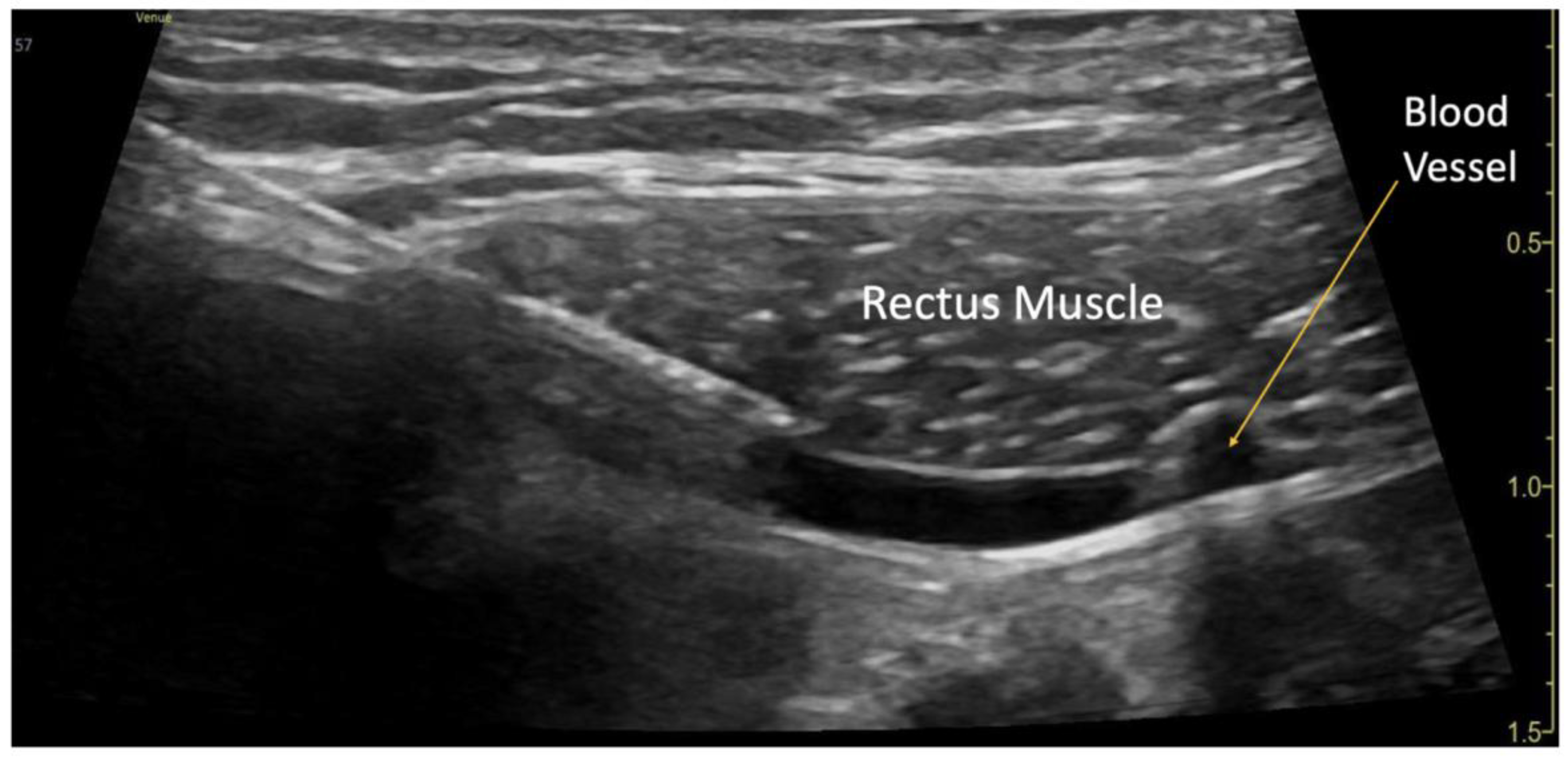
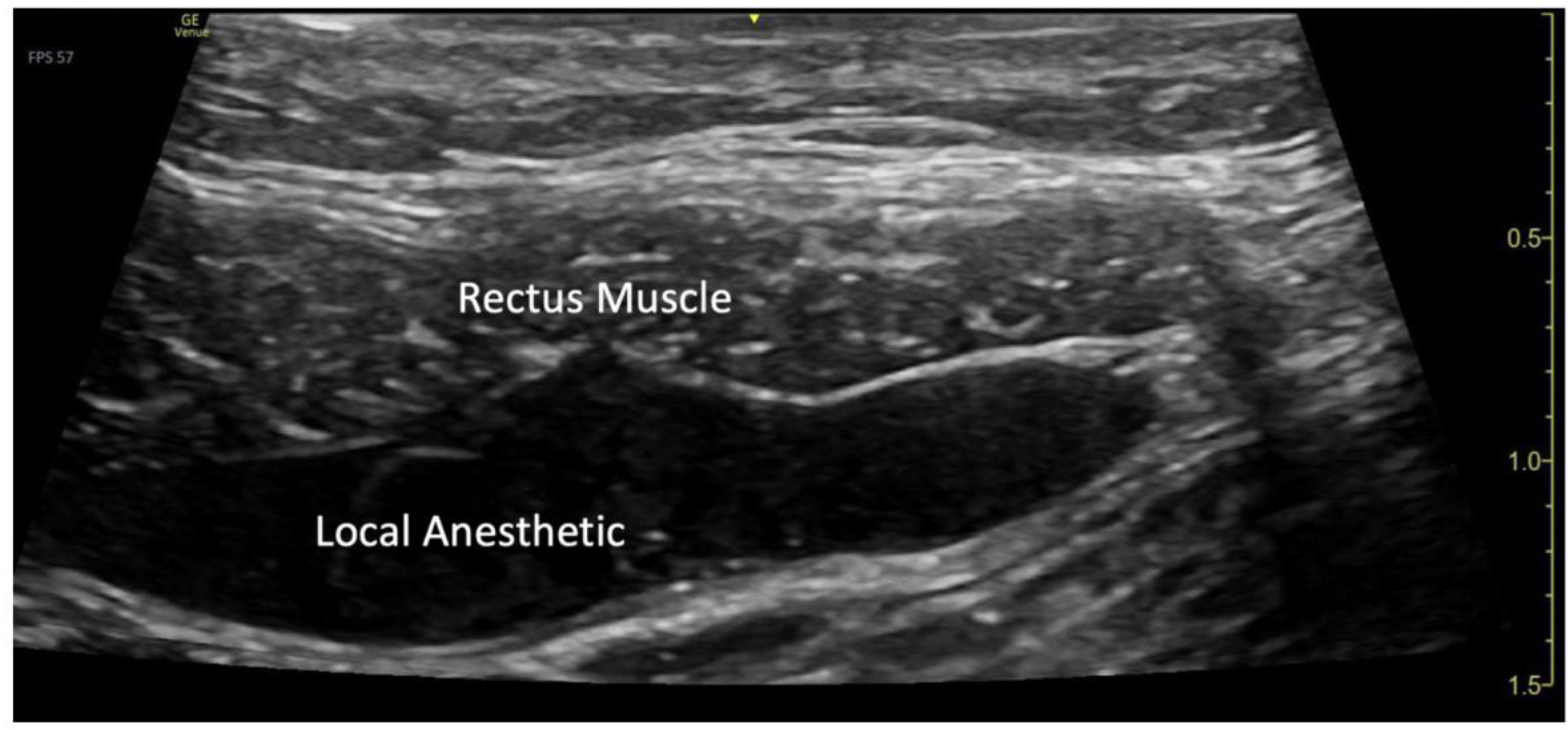
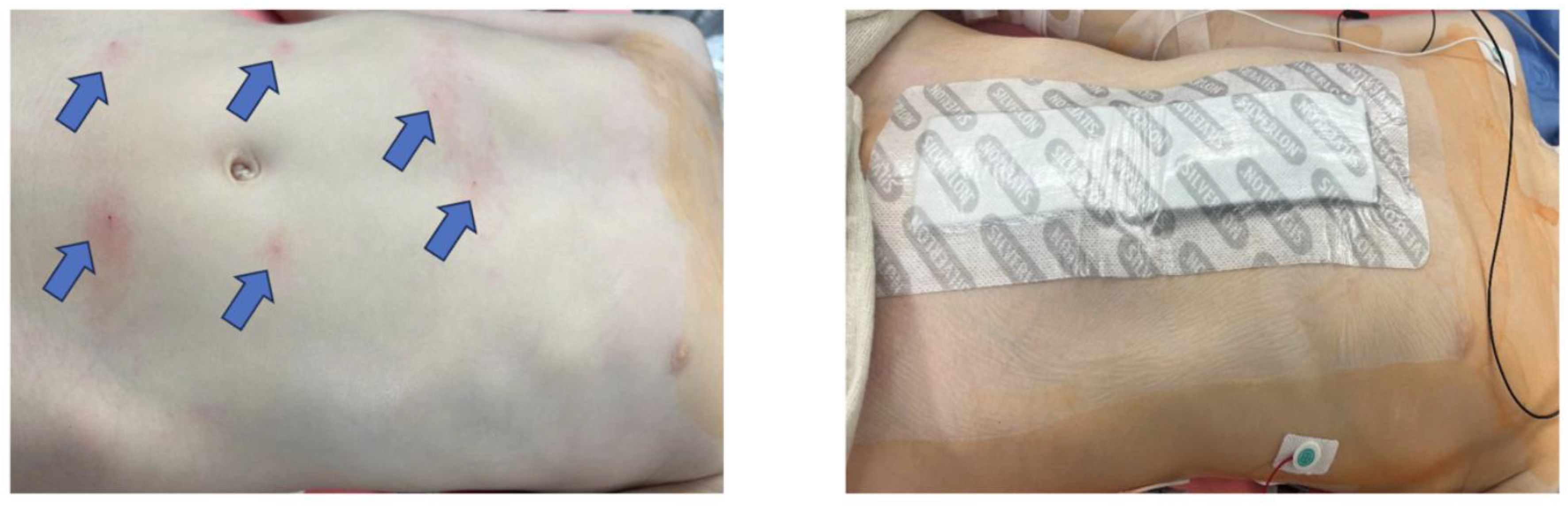

| Fentanyl (mcg/kg) |
Methadone IV (mcg/kg) | Ketamine (mg/kg) |
Hydromorphone (mcg/kg) | Acetaminophen IV or PO (mg/kg) | Ketorlac (mg/kg) | |
|---|---|---|---|---|---|---|
| Intraoperatively | 2.25 | 0.22 | 1.87 | 0 | 14.98 | 0 |
| Postoperative Day 0 | 0 | 0.11 | 0.66 | 0 | 14.98 | 0 |
| POD 1 | 0 | 0.22 | 1.14 | 5.99 | 74.9 | 0 |
| POD 2 | 0 | 0.22 | 0 | 0 | 74.9 | 0 |
| POD 3 | 0 | 0.17 | 0 | 0 | 44.94 | 1.57 |
| POD 4 | 0 | 0.06 | 0 | 3.75 | 59.92 | 2.1 |
| POD 5 | 0 | 0.06 | 0 | 0 | 29.96 | 0.52 |
| POD 6 | 0 | 0 | 0 | 0 | As needed | 0 |
| Average Pain Score/10 | Highest Pain Score/10 | Out of Bed in Chair (Y/N) | Ambulation (Y/N) | |
|---|---|---|---|---|
| Postoperative Day 0 | 0 | 0 | N | N |
| POD 1 | 0.5 | 6 | Y | N |
| POD 2 | 0.29 | 2 | Y | Y |
| POD 3 | 0.4 | 2 | Y | Y |
| POD 4 | 1 | 7 | Y | Y |
| POD 5 | 0.29 | 2 | Y | Y |
| POD 6 | 0 | 0 | Y | Y |
3. Discussion
4. Conclusions
Supplementary Materials
Author Contributions
Funding
Institutional Review Board Statement
Informed Consent Statement
Data Availability Statement
Conflicts of Interest
Abbreviations
| AAA | Abdominal aortic aneurysm |
| RSB | Rectus sheath block |
| POD | Postoperative day |
| LD | Linear dichroism |
References
- Wang, Y.; Tao, Y. , Diagnosis and treatment of congenital abdominal aortic aneurysm: a systematic review of reported cases. Orphanet J Rare Dis 2015, 10, 4. [Google Scholar] [CrossRef] [PubMed]
- Eliason, J.L.; et al. Surgical treatment of abdominal aortic aneurysms in infancy and early childhood. J Vasc Surg 2016, 64, 1252–1261. [Google Scholar] [CrossRef] [PubMed]
- Ye, C.; et al. Abdominal aorta aneurysms in children: single-center experience of six patients. Ann Thorac Surg 2012, 93, 201–205. [Google Scholar] [CrossRef] [PubMed]
- Dueppers, P.; et al. Open Repair for Abdominal Aortic Aneurysm in a Young Boy with Tuberous Sclerosis and Review of the Literature. Ann Vasc Surg 2017, 39, 286.e1–286.e5. [Google Scholar] [CrossRef] [PubMed]
- Kontopodis, N.; et al. Systematic Review With Meta-Analysis of Endovascular Versus Open Repair of Abdominal Aortic Aneurysm Repair in the Young. J Endovasc Ther 2025, 32, 276–289. [Google Scholar] [CrossRef] [PubMed]
- Byun, E.; et al. Quality-adjusted life year comparison at medium-term follow-up of endovascular versus open surgical repair for abdominal aortic aneurysm in young patients. PLoS One 2021, 16, e0260690. [Google Scholar] [CrossRef] [PubMed]
- Kontopodis, N.; et al. Endovascular vs Open Aneurysm Repair in the Young: Systematic Review and Meta-analysis. J Endovasc Ther 2015, 22, 897–904. [Google Scholar] [CrossRef] [PubMed]
- Chaikof, E.L.; et al. The Society for Vascular Surgery practice guidelines on the care of patients with an abdominal aortic aneurysm. J Vasc Surg 2018, 67, 2–77.e2. [Google Scholar] [CrossRef] [PubMed]
- Fairman, A.S.; et al. The evolution of open abdominal aortic aneurysm repair at a tertiary care center. J Vasc Surg 2020, 72, 1367–1374. [Google Scholar] [CrossRef] [PubMed]
- Yoshida, K.; et al. Pain Management in Open Abdominal Aortic Aneurysm Repair: Potential Alternatives to Epidural Anesthesia. J Cardiothorac Vasc Anesth 2025, 39, 785–791. [Google Scholar] [CrossRef] [PubMed]
- Cleary, C.; et al. Rectus Sheath Block Improves Patient Recovery Following Open Aortic Surgery. Ann Vasc Surg 2023, 97, 27–36. [Google Scholar] [PubMed]
- Hamilton, T.W.; et al. Liposomal bupivacaine infiltration at the surgical site for the management of postoperative pain. Cochrane Database Syst Rev 2017, 2, CD011419. [Google Scholar] [PubMed]
- Golembiewski, J. and Dasta, J., Evolving Role of Local Anesthetics in Managing Postsurgical Analgesia. Clin Ther 2015, 37, 1354–1371. [Google Scholar] [PubMed]
- Beiranvand, S. and Moradkhani, M.R., Bupivacaine Versus Liposomal Bupivacaine For Pain Control. Drug Res (Stuttg) 2018, 68, 365–369. [Google Scholar] [PubMed]
- Cohen, B.; et al. Incidence of adverse events attributable to bupivacaine liposome injectable suspension or plain bupivacaine for postoperative pain in pediatric surgical patients: A retrospective matched cohort analysis. Paediatr Anaesth 2019, 29, 169–174. [Google Scholar] [CrossRef] [PubMed]
- Tirotta, C.F.; et al. A multicenter study to evaluate the pharmacokinetics and safety of liposomal bupivacaine for postsurgical analgesia in pediatric patients aged 6 to less than 17 years (PLAY). J Clin Anesth 2021, 75, 110503. [Google Scholar] [CrossRef] [PubMed]
- Bonaroti, R.; Ganoza, A.; Visoiu, M. Liposomal Bupivacaine in Single-Injection Quadratus Lumborum Block for Pediatric Kidney Transplant: Case Report of a Novel Application. Pediatr Transplant 2025, 29, e70112. [Google Scholar] [PubMed]
- Visoiu, M.; Hauber, J.; Scholz, S. Single injection ultrasound-guided rectus sheath blocks for children: Distribution of injected anesthetic. Paediatr Anaesth 2019, 29, 280–285. [Google Scholar] [CrossRef] [PubMed]
Disclaimer/Publisher’s Note: The statements, opinions and data contained in all publications are solely those of the individual author(s) and contributor(s) and not of MDPI and/or the editor(s). MDPI and/or the editor(s) disclaim responsibility for any injury to people or property resulting from any ideas, methods, instructions or products referred to in the content. |
© 2025 by the authors. Licensee MDPI, Basel, Switzerland. This article is an open access article distributed under the terms and conditions of the Creative Commons Attribution (CC BY) license (http://creativecommons.org/licenses/by/4.0/).