
Submitted:
01 March 2026
Posted:
09 March 2026
You are already at the latest version
Abstract
This work presents a complete arithmetic framework resolving the Collatz Conjecture by decomposing the odd–to–odd dynamics into two complementary structures: a local residue–phase automaton and a global affine counting system. The Inverse map R(n; k) = (2kn − 1)/ 3 is shown to act on the live residues 1, 5 (mod 6) through a finite residue–phase state space, while every admissible exponent k = c + 2e induces an affine expansion factor 2k whose inverse coincides exactly with the dyadic slice weight 2−k. From this, every odd integer is seen to belong to a unique dyadic slice Sc,e, forming a disjoint partition of Nodd. Independently, the introduction of the normal–state lattice z(n) reveals a second, purely affine enumeration: each live odd n seeds a unique 4-adic rail m → 4m + 1 whose union also partitions the odd integers without overlap. We prove that these two partitions coincide exactly, yielding a unified global structure in which all odd integers arise bijectively from admissible lifts above minimal anchors produced by n ≡ 1, 5 (mod 6). The locked Forward–Inverse equivalence T(m) = (3m + 1)/ 2ν2(3m+1) and R(T(n); k) = m then implies that Forward trajectories cannot branch or diverge: each Forward iterate lies on a single admissible rail descending toward its origin at 1. Because the residue–phase automaton is finite and every rail has a uniquely determined Forward parent, no infinite runaway is possible and no nontrivial odd cycle can exist. Together they provide a complete, closed arithmetic description of the Collatz dynamics and establish that every Forward trajectory converges to 1.
Keywords:
collatz conjecture
; dynamical systems
; affine semigroups
; dyadic structure
; Noetherian relations
MSC: 11B83; 05A99
1. Introduction
The Collatz conjecture states that every positive integer eventually reaches 1 under the iteration
Despite its elementary formulation, this problem has remained unresolved since its introduction by Lothar Collatz in 1937 and has resisted a wide range of probabilistic, dynamical, algebraic, and computational approaches.
The central difficulty of the problem is structural. Forward trajectories exhibit alternating phases of multiplicative growth and variable dyadic contraction, while the inverse dynamics branch infinitely through admissible preimages. Existing approaches typically emphasize one of these perspectives at the expense of the other, and no framework has previously captured both behaviors within a single closed arithmetic system.
This paper develops such a system from first principles. The analysis is built on four complementary components that together provide a complete description of the odd–to–odd Collatz dynamics:
- 1.
- A finite residue–phase automaton governing all minimally admissible odd-to-odd Inverse transitions, determined by congruence classes modulo 6 and phase behavior modulo 3.
- 2.
- A Normal–State lattice in which the removed admissible dyadic factors from odd iterative minimally admissible output yields a canonical affine arithmetic skeleton of the families of 4-adic rails generated by the map , or .
- 3.
- A dyadic slice decomposition indexed by the valuation , producing a disjoint arithmetic partition of the odd integers with exact weights .
- 4.
- A Forward–Inverse locking identity linking the reduced Forward mapto the admissible inverse mapensuring that each odd integer has a uniquely determined admissible ancestry.
A principal result of this work is that the affine rails arising from the normal–state construction coincide exactly with the dyadic slices determined by . Thus the odd integers admit two independent but equivalent global parametrizations: one affine and one dyadic. This coincidence yields a global arithmetic structure in which all odd integers arise from admissible lifts above the anchors, namely the minimal representatives of each dyadic slice under the admissible inverse relation.
Because the residue–phase automaton is finite and the admissible inverse relation induces a unique Forward parent at each step, the resulting ancestry relation is well founded. No nontrivial odd cycles can exist, and no infinite runaway is possible. Consequently, every Forward Collatz trajectory converges to the fixed point 1.
Prior Work and Novelty
The framework developed in this paper was derived independently of the existing literature on the problem. Nevertheless, several arithmetic features that emerge naturally in the present construction have appeared individually, or in restricted form, in earlier studies. We summarize these connections here to clarify their scope and to distinguish the structural contributions of the present work.
- (A) Residue classes modulo 6 and 18. It is classical that odd integers congruent to admit no odd preimages under the inverse Collatz map, and congruence classes modulo 6 or 18 have been used in prior analyses to exclude cycles or study local behavior (e.g., Everett [1], Garner [2], and surveys of Lagarias [3,4]). In these works, residue considerations are typically auxiliary. In contrast, the present paper organizes all odd–to–odd transitions into a deterministic residue–phase automaton, with a fixed mod 18 routing that governs all admissible dynamics.
- (B) Dyadic valuations and the weights . The geometric distributionappears in probabilistic heuristics due to Terras [7,8], Lagarias [3,4], and Tao [6], where it is used as a stochastic model of typical behavior. In the present work, the setsform an exact arithmetic partition of . The weights arise deterministically as slice measures and play a structural role in the global coverage and ancestry arguments.
- (C) Affine lifts of the form . Affine relations of this type appear in backward constructions, parity–vector descriptions, and studies of special odd families Everett [1]. In earlier work, such relations describe particular subsets or restricted behaviors. Here, the lift in the admissible inverse exponent forces the affine transformation , generating disjoint affine rails that exhaust the odd integers and preserve residue class determinism across all lifts.
- (D) Admissibility constraints on the inverse exponent. The condition and the resulting parity restriction on k relative to is well known in inverse Collatz analyses Everett [1], Garner [2], Lagarias [3]. Prior treatments view this as a local admissibility criterion. In this paper it is elevated to a structural rule: admissible parity determines the live residue classes, constrains the residue automaton, and governs the global rail hierarchy.
Novel contributions of the present work. While the arithmetic components (A)–(D) appear individually in the literature, their integration into a single deterministic framework is new. The present work establishes:
- A unified residue–phase automaton governing all odd Collatz rail transitions.
- An exact identification of dyadic slices as an arithmetic partition aligned deterministically with affine rails.
- A disjoint, exhaustive affine decomposition of generated by minimal admissible inverse lifts.
- Unique admissible parentage for every odd integer, eliminating branching in the Inverse graph.
- A well-founded ancestry relation with a unique minimal element, providing a rigorous realization of the Collatz tree as a Noetherian structure.
- A deterministic convergence argument derived from arithmetic structure rather than probabilistic drift or heuristic models.
Taken together, these results form a closed arithmetic description of the Collatz dynamics not previously assembled in the literature and establish that every Forward trajectory converges to 1.
2. Definitions
Definition 1
(Classic Collatz function). The classical Collatz map is defined by
Definition 2
(Forward Collatz function). The complete-step (odd-to-odd) Collatz map is
where is the maximal exponent such that the denominator divides . Thus gives the unique admissible parent integer n under the Collatz process.
Definition 3
(Inverse Collatz function). The complete-step Inverse Collatz map assigns to each odd integer n its admissible child via
where k is admissible if . If is the minimal admissible doubling count, then is called the base child of n.
Definition 4
(Middle-even values). In the odd-to-odd formulation of the Collatz map, each step factors through an intermediate even value.
- For the Forward map, given an odd integer m, the intermediate (middle-even) value is
- For the Inverse map, given an odd integer n and an admissible doubling count (i.e. ), the intermediate (middle-even) value is
Both and are even and serve as the “middle” stage between odd inputs and odd outputs. Read modulo 18, these values determine the odd class of the child m through the fixed gate , , in the Inverse Collatz function.
Definition 5
(Parent (Inverse Collatz function)). An odd integer n is called a parent. If (that is, n is an odd multiple of 3), then it has no admissible doubling and is called a terminating parent. If or , then n is live and admits some that is admissible.
Definition 6
(Child (Inverse Collatz function)). Given a parent n and an admissible , the corresponding child is
For a fixed n, admissible k have fixed parity and are exactly
where e is the lift index counting successive admissible exponents above the minimal one. As k increases by , the middle-even residue cycles ; under the fixed gate , , , the children of n therefore occur in the deterministic class rotation
Definition 7
(Base admissible child). For any live odd integer , let denote its class-determined least admissible exponent. We define
and refer to as the base admissible child of n.
Definition 8
(Admissible doubling and child). Let n be odd. A doubling count is admissible if
For any admissible k, the Inverse child is
The set of admissible k for a fixed odd n has fixed parity (even if , odd if ), and hence preserves admissibility.
Definition 9
(Terminal and Live Classes). Let . The Collatz class of n is defined as:
Class is terminal under Collatz iteration; classes and are live. Let denote the set of live classes.
Definition 10
(Reset–Resume Operator). Let m be the odd value produced by a single admissible transition from a given state. The reset–resume operator updates the state by recomputing
That is, after each transition the system resets the residue and resumes iteration from the updated state .
Definition 11
(q-Transform Function). The class-dependent q-transform for single-generation transitions is defined as:
Definition 12
(Progression index). For an odd parent n, the progression index t is the integer parameter in the canonical forms
with . The index t counts the position of n within its mod-6 residue class.
Definition 13
(Admissible exponents). For an odd integer n, the set of admissible exponents is
(If , then .)
Definition 14
(Middle even and gate residue). For odd m, set
so that is the odd Collatz child. The middle even is
and its gate residue is
Definition 15
(Dyadic slice). For and , the dyadic slice is defined by
where if and if .
Definition 16
(Rail). A rail is the vertical affine progression index generated from any odd value m by repeated admissible higher lifts. Each lift increases the exponent by and applies the transformation
Thus the rail through is
Rails represent all values obtained from a fixed parent by all admissible k lifts.
Definition 17
(Ladder as an Offset Progression Index). The ordered progression of parents obtained from all sequential inputs under the same admissible exponent k.
3. The Deterministic Residue Framework
This section extends the local residue framework first developed in A Deterministic Residue Framework for the Collatz Operator at [5], together with earlier unpublished notes that identified the mod 9 residue cycle as the source of Inverse determinism. The core construction is preserved: admissibility is fixed by residue classes modulo 6, while refinement to mod 9 and its canonical lift to mod 18 determines the child class at each step.
The result is a deterministic lens through which every odd integer is classified and every admissible step is resolved. This local structure now appears explicitly as the microscopic counterpart of the global coverage framework that follows.
3.1. The mod 6 Classification for Odd Integers
All odd integers fall into three residue classes modulo 6:
-
C0: (odd multiples of 3: ).Forward (middle-even identification): .Inverse (admissibility/parity): No admissible k with exists, so has no Inverse parent.
-
C1: (two higher than a multiple of 3: ).Forward (middle-even identification): .Inverse (admissibility/parity): , so admissible k are odd. The first admissible is . One doubling givesSince for , we have ; subtracting 1 yields a multiple of 3, so the Inverse step is an integer. Thus always resolves after
-
C2: (two lower than a multiple of 3: ).Forward (middle-even identification): .Inverse (admissibility/parity): , so admissible k are even. The first admissible is , yieldingSince for , we have ; subtracting 1 yields a multiple of 3, so the Inverse step is an integer. Thus always resolves afterdoublings.
Lemma 1
(C0 is terminating under the Inverse step). If (i.e., n is an odd multiple of 3), then for every ,
In particular, the class C0 has no admissible child.
Proof.
If then for all , hence , which is not divisible by 3. □
- Interpretation. The mod-6 classification isolates the essential periodic structure of the Collatz map. Every odd integer is congruent to 1, 3, or 5 mod 6, producing three invariant classes. Multiples of 3 () are terminal because no admissible doubling can satisfy . The remaining residues 1 and 5 ( and ) are live: they alternate under the admissible-exponent rule and generate the entire Forward–Inverse lattice. Thus the three-class system is not arbitrary—it is the minimal periodic decomposition consistent with both the mod-3 condition and parity.
3.2. K-Value Admissibility of the Classes
This subsection identifies the admissible k values for each class and demonstrates how parity is determined by the residue of n modulo 3.
Lemma 2
(Admissibility parity). Let n be an odd integer. The congruence
has a solution if and only if n is not divisible by 3. Moreover, the residue of n modulo 3 determines the parity of k:
Once one admissible k exists, every larger k with the same parity is also admissible.
Proof.
C1 admissibility with . For we have and . The admissibility condition is
i.e.
Write . Since ,
Substitute n:
Expand:
Note:
Therefore,
holds for all integers t and all .
This explicitly shows why every odd lift of the form is admissible for .
C2 admissibility with . For we have and . The admissibility condition is
i.e.
Write . Since ,
Substitute n:
Expand:
Therefore,
holds for all integers t and all .
This explicitly shows why every even lift of the form is admissible for .
□
3.3. Mod 18 Gate
This subsection establishes the deterministic mod 18 gate that decides the child class of every admissible parent. The residue of the middle-even value after the minimal admissible doubling lands in , and this uniquely determines the class of the base child.
Lemma 3 
(Minimal admissible doubling and the mod 18 gate). List the odd integers mod 18 in sequential order and, for each odd n, take its base child by the Inverse Collatz function and using . Then the base-child classes follow a repeating nine-step cycle in sequence mod 3:
(where x denotes terminating parents, i.e. multiples of 3). In particular, the six odd non-multiples of 3 partition into two fixed triads
corresponding to and parents, respectively; thus mod 18 alone determines the child-class framework.
Moreover, let denote the minimal admissible exponent for the Inverse function
This minimal k is fixed by the class of n:
Applying the minimal admissible doubling directly to the residue gives the deterministic gate
Evaluating this for each residue yields the fixed gate assignment
Thus the minimal admissible doubling maps each odd residue to a unique even gate in .
Proof.
Proof. (i) Odd residue structure modulo 18. Working modulo 18 and restricting to odd residues, the classes
correspond respectively to terminating parents (), class , and class . The forward odd-to-odd map preserves these classes and induces a fixed cyclic progression within each.
(ii) Lift to middle-even gates. Applying the minimal admissible doubling directly to an odd residue yields the deterministic gate
which are precisely the even gates claimed. □
Corollary 1 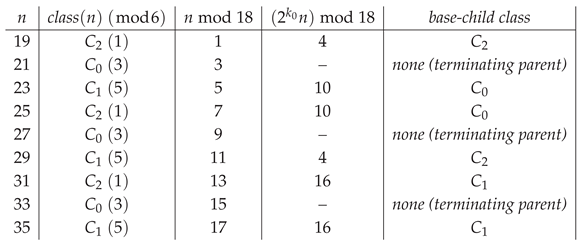
(Linear segment pattern 19–35). Listed are the odd integers n from 19 to 35. For each n, record its class (mod 6), its residue (mod 9) and (mod 18), the Inverse middle-even at the minimal admissible doubling ( for , for , none for ), and the class of the base child
Explanation. For each n: determine its class by (: 3, : 5, : 1). If , no admissible Inverse step exists. If (resp. ), take (resp. ) by admissibility parity. Then use the deterministic gate: with the fixed mapping . Evaluating these nine cases yields the displayed sequence . This finite segment is a repeating cycle. □
These nine odd residues partition into inadmissible and admissible parents:
Lemma 4
(Equidistribution of Base-child Classes). Across every complete 18-residue cycle of odd parents, the base-child classes appear with exact frequency each.
Proof.
By Corollary 1, the nine admissible residues modulo 18 yield the child-class sequence
where dashes denote terminating parents. Each 18-step cycle therefore contains precisely two occurrences of each live class, giving equal frequency when restricted to . □
Lemma 5
(Forward mod-6 lift to mod-18 at the first even). Let n be odd and define the Forward middle-even value . Then the residue of n modulo 6 determines modulo 18 via
In particular, the first Forward step lifts the mod-6 classification to a unique gate residue modulo 18.
Proof.
Write with . Then since . Direct evaluation gives
which proves the three implications and the uniqueness of the lifted gate residue. □
Proposition 1
(Deterministic child-class decision via mod 18). In the Inverse Collatz function, and for odd n, the residue of the middle even in alone determines the child’s odd class, both in Forward and Inverse middle-even. This gives a one-step, local rule independent of trajectory history.
Existence of a Forward–Inverse alignment through the middle-even gate.
Lemma 6
(Middle-even equivalence mod 18). If 3 does not divide n, then there exists an admissible such that
Proof.
Forward side (mod 6 lifted to mod 18). For odd n, the Forward middle-even value is . Reducing n modulo 6 and multiplying by 3 lifts the residue to mod 18:
so always lies in .
Inverse side (mod 18 determinism). For odd n not divisible by 3, the residue , together with the admissible parity of (even if , odd if ), selects exactly one of the two triads of units modulo 18:
Applying places n into the middle-even value that belongs to the nine-step cycle of Corollary 1. That middle-even value is already one of , the Forward gates. □
3.4. Microcycles and Lifted k with Tables
Lemma 7
(Rotation under in mod 18). If k is admissible for odd n (), then
Moreover , and hence
Proof.
Admissible are even and , so only occur modulo 18. For admissible k, ; computing mod 18 gives , , , which establishes the 3-cycle. □
-
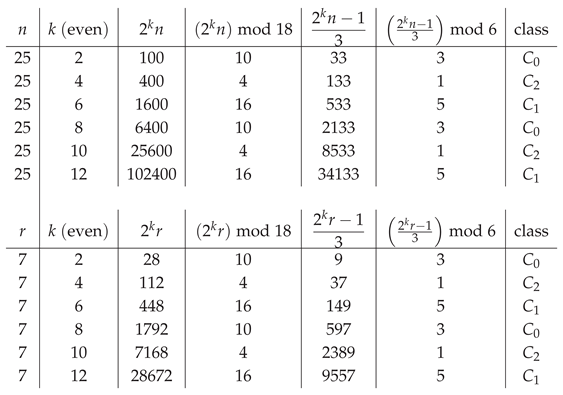
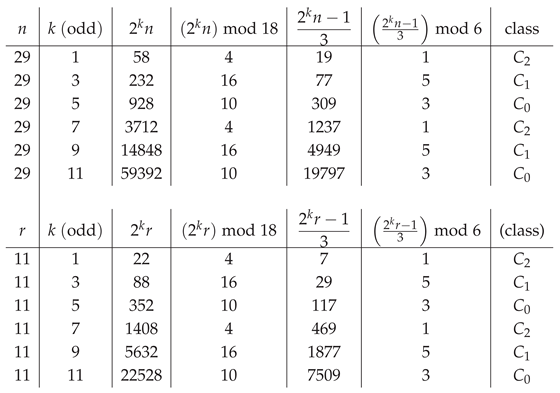
Microcycles: function and reason. Fix a live odd parent n not divisible by 3. For the Inverse Collatz Function, all admissible Inverse doublings for n share the same parity (by admissibility parity), so from the minimal admissible count we may advance by steps of 2: . By Lemma 7, each step multiplies the Inverse middle-even by 4 modulo 18, sending and hence rotating the child classes .cycling through (mod 18). By the common mod-18 gate (Lemma 6), these three middle-even classes deterministically select the child odd classes , in that order. Thus every fixed parent n generates a k-lifted microcycle of children:(), in cyclic order beginning with the base admissible child, repeating every three admissible lift steps. Moreover, by the Forward–Inverse middle-even equivalence (Lemma 6), there exists an admissible k for which , so the Inverse microcycle is aligned with the residue one sees on the Forward side.
To display this mechanism explicitly, we present two parallel tables: (i) the integer view, which lists specific n and its children at each admissible lift, and (ii) the residue view, which reduces n to . Both views coincide in the mod-18 column and the resulting child class.
Reading across the rows of either table shows how each lift advances through the microcycle, and how every admissible parent reaches a residue within at most two steps, certifying an accessible termination to .
Example (Inverse step, even k; here , ):
Example (Inverse step, odd k; here , ):
3.5. Mod 54 Refinement: Fixing the Child Residue
The mod-18 gate (Lemma 3, Proposition 1) determines the child class. Refining the lens to determines, already at the first admissible Inverse step, the child’s odd residue modulo 18.
Triad map (mod 54).
Write every live odd n as
Set , with . For each , the corresponding residues in mod 54 are
Define the lifted triads by
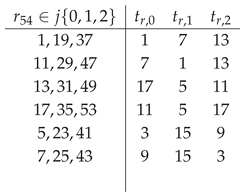
Each lifted triad row follows the same deterministic pattern as the mod 18 table. The indexing variable plays the same role as in selecting the correct column of the triad. Rows for are in or , and remain in .
Lemma 8
(Mod 54 refinement fixes the child residue). Let
Set . Then the first admissible Inverse child of n has odd residue
where is determined by the lifted triad . Equivalently, the pair uniquely determines the child’s odd residue modulo 18.
Proof sketch.
By Lemma 2, the minimal admissible exponent is odd for and even for . The mod 18 structure (Lemma 3) partitions the six live residues into deterministic triads, and the admissibility parity lifts each residue canonically to its gate (Proposition 1).
Passing to mod 54, each splits into three residues
and the index selects one of the three columns of the lifted triad table . Evaluating the first admissible Inverse step for within each reproduces exactly the triad outputs listed in Table 1. Thus completely determines the child residue modulo 18. □
Compact 54-row table.
Because is completely determined by , the mapping
is obtained by grouping the 27 live residues mod 54 into six blocks by r and subdividing each block by . For example, the block contributes residues
in the order .
Corollary 2
(Periodicity of the Mod 54 Child Mapping). Let n be an odd integer with
Let denote the residue modulo 18 of the first admissible Inverse child of n,
Then for every integer (period index),
Equivalently, the mapping
is periodic with fundamental period 54. In particular, the table of base-child residues for odd repeats identically on each interval .
- Interpretation. The refinement to modulus 54 resolves the residual ambiguity left by the mod-18 gate. At mod-18, each live residue determines only the class of its child; lifting to mod-54 records the phase of the quotient , which fixes the child’s exact odd residue mod 18. The resulting triads show that every parent residue generates three distinct child residues, one for each phase position. Because these triads repeat with period 54, the entire Inverse map becomes periodic at that modular scale. This periodicity demonstrates that the residue–phase system is finite and deterministic: each pair has one unique successor, and every possible parent–child relationship repeats identically on successive 54-blocks.
Lemma 9
(Residue–Phase Transition and Reset–Resume Law). Let with and as above. Then the following properties hold:
- 1.
- For fixed r, as q varies modulo 3, the residues occupy three distinct elements of corresponding to the classes .
- 2.
- The order of appearance of these residues is determined by r and the parity of , defining a locally unique orientation.
- 3.
-
For each iteration, the next phase and residue are re-evaluated from the resulting m, establishing a reset and resume transition of the formwhere and .
The residue phase system thereby forms a finite deterministic automaton with terminal residues , transitional residues mapping into , and active residues forming the lattice .

Table 2.
Residue classes, minimal exponents, orientation signs, and resulting triads for each live residue r.
Table 2.
Residue classes, minimal exponents, orientation signs, and resulting triads for each live residue r.
| r | for | |||
|---|---|---|---|---|
| 1 | 2 | 1 | ||
| 7 | 2 | 9 | ||
| 13 | 2 | 17 | ||
| 5 | 1 | 3 | ||
| 11 | 1 | 7 | ||
| 17 | 1 | 11 |
- Interpretation. The affine Inverse update law converts the inverse Collatz step into a linear rule on the quotient–residue plane. For each live residue r, the minimal admissible exponent fixes the slope and intercept of an affine map . The modulus 18 confines all results to nine possible odd residues, and the quotient modulus 3 serves as a rotating phase selector. Hence every pair specifies a unique successor .
Geometrically, the system behaves as a finite automaton of six residue rows () and three phase columns (). The “reset–resume” rule means that after each Inverse step, the new residue and phase become the parameters of the next affine map. This continual reassignment makes the process locally deterministic but globally adaptive: the governing equation changes with each step while remaining finite. Terminal residues in close the automaton, ensuring every only sequence eventually reaches a fixed point of the system under .
Lemma 10
(Affine Inverse update law). Let with and , and set
Define
Then and the single–step update is given by
with the following explicit formulas:
- 1.
- (Slope and intercept)
- 2.
- (Residue update by phase)
- 3.
- (Quotient update)
Consequently, the pair uniquely determines , and the next phase is computed from the affine form .
Corollary 3
(Finite Residue–Phase Automaton). For each step of the Inverse map defined by
the image depends only on through the valuation of . The quotient component evolves under the induced transformation
and defines a finite deterministic automaton on the space . The sequence obtained by successive iterations remains bounded within this finite set, generating locally deterministic residue–phase transitions.
Markov sieve viewpoint (two transients, one absorbing terminal).
Although the update rule is deterministic once the state is fixed, it is useful to regard the induced directed graph on the finite state space
as a Markov-style transition diagram: each inverse step sends a state to a uniquely determined successor . In this graph, the terminal residue set
acts as an absorbing (terminating) sieve: once the orbit enters the terminal region, no further admissible inverse continuation exists (equivalently, the inverse chain closes immediately in the class). The remaining admissible states decompose into two transient components (the live classes and ), which may transition among themselves but cannot support an infinite forward-avoiding inverse ancestry: the admissibility constraint encoded by governs which transitions exist, and in particular forces every orbit to reach the terminal sieve in finitely many steps.
Theorem 1
(Global Determinism and Finite Termination of the Inverse Automaton at ). Let denote the residue and quotient at step t, and define
Then:
- 1.
- For each step, uniquely determines , forming a finite deterministic mapping.
- 2.
-
The transition structure satisfiesproducing the four active transition types:
- 3.
-
The system evolves through successive local mapsgenerating a finite deterministic sequence in the residue phase space.
- 4.
- Each active transition ultimately reaches a terminal residue in within finitely many steps. The mapping admits no infinite nonterminal orbit.
Hence the Inverse Collatz dynamics on odd integers under forms a finite, locally deterministic reset and resume automaton whose transitions are governed by residue class and phase position at each step.
3.6. Bounded Corridor Dynamics at Fixed Residues
Among the six live residues modulo 18, only
have the special property that their first admissible Inverse child under remains in the same residue class. This follows directly from the triadic structure established in Subsection 3.3: all other live residues transition immediately to a different residue upon the first admissible lift, whereas and alone form self-contained local corridors under Forward iteration.
Because these two residues can map to themselves under , their Forward dynamics admit chains of arbitrary length determined solely by arithmetic properties of the phase index q. For , the Forward map contracts by a factor of until the 2-power in q is exhausted. For , the Forward map expands by for exactly steps, consuming one factor of 2 per iteration.
The results in the following subsections establish the precise structure and length of these corridors: - admits contraction chains controlled by divisibility of q. - admits expansion chains controlled by the 2-adic valuation of .
These two cases are the only local residue dynamics that can persist beyond a single step under , and their exhaustion determines the maximal extent of fixed-residue behavior in the entire system.
Inverse map at .
Let
If q is divisible by 4, then
The Forward update is then
Since we only care about the q-level:
This shows that, as long as q remains divisible by 4, the Forward map strictly scales q by a factor of without changing the residue class . The descent in q continues until the 2-adic factor is exhausted, at which point the residue transition occurs.
Inverse map at .
Let
Then
If q is odd (i.e. ), then is odd, so
The Forward update is therefore
Writing gives
so and
This map preserves the residue precisely while q remains odd. Rewriting the recurrence,
gives the explicit evolution
Hence the number of consecutive steps is determined entirely by the 2-adic valuation of :
Remark 1.
If is a pure power of 2, the corridor length equals that power’s exponent exactly. If it contains an odd factor , where
the corridor length still equals e, and the odd factor merely remains as a cofactor during the valid steps. Thus the run length for is governed entirely by the 2-adic valuation of and not by any fixed external bound.
Together with the case, this establishes explicit local corridor dynamics: the map contracts by a factor until powers of 2 are exhausted, while the map expands by for exactly e steps, with e determined directly by the factorization of .
Lemma 11
(Higher admissible lifts are strictly ascending and rotate the gate). Fix a live odd parent n and let be its minimal admissible exponent (determined by class). For each define the t-th admissible lift and Inverse child by
Then:
- (a)
-
Strict ascent in the Inverse value. The sequence is strictly increasing, with the exact incrementEquivalently,so grows geometrically in e.
- (b)
-
Gate rotation (class rotation). The associated Inverse middle-even residues rotate deterministically:yielding the cycle (Lemma 7). Consequently the child class rotates .
- (c)
- Higher lifts are higher transformations. Each increment multiplies the affine scaling factor by 4 (from to ) while preserving the constant drift . Thus every higher admissible lift is a strictly larger affine transform on n, independent of the gate rotation.
Proof.
(a) Compute directly:
so is strictly increasing. The closed form follows from .
(b) This is Lemma 7: for admissible k, and , producing the stated rotation and class cycle.
(c) From , replacing k by multiplies the linear coefficient by 4 and leaves the drift unchanged, so the transform strictly enlarges the image while the residue gate rotates as in (b). □
- Interpretation. Only the residues and form self-contained “corridors’’ in the residue–phase system. All other live residues immediately transition to a different class after one admissible lift. Within these two corridors the Forward dynamics are governed purely by 2-adic properties of the quotient variable q.
For , the Forward map contracts q by a factor of as long as q remains divisible by 4. Each iteration removes one factor of 2, so the chain length equals the 2-adic valuation of q. For , the Forward map expands by while q is odd, and the number of valid steps is exactly . Thus the persistence of each corridor is determined entirely by local 2-adic content, not by any external bound.
Beyond these corridors, higher admissible lifts always increase the Inverse value and rotate the middle-even gate through . Each lift multiplies the affine scale by 4 while preserving the constant drift, so the sequence of lifts is a strictly ascending geometric rail. Together these facts show that fixed-residue behavior is finite and bounded, and that all non-terminal paths ultimately exit their local corridors to join the global terminating flow.
3.6.1. Lift Microcycles and Guaranteed Boundary Access
For a fixed live parent n, all admissible exponents have fixed parity; lifts rotate the middle-even residue by a factor :
so the child classes rotate . In particular, within at most two lifts the gate is attained, making accessible.
3.7. The Self-Loop
Remark 2
(The trivial self-loop and phase stability). The integer is the unique odd fixed point of the odd-to-odd map: . In the 18-lens we have , so and both residue and phase remain unchanged. On the Inverse side, the minimal lift for is , and . Hence is the only state that self-loops while staying phase-stable at every lens; all other live residues either change residue at the first minimal step or exhaust their corridor in finitely many steps.
3.8. From Base Classification to Exponential Refinement
We now make explicit the structural progression underlying the refinement tower.
Mod 6: class determination.
At the base level , every odd integer lies in one of the classes
which determine the C2/C1 live classes. Thus mod 6 fixes the coarse admissibility regime.
Mod 18: first-child admissibility.
Passing to modulus , the residue
determines:
- the live class,
- the admissible parity of k,
- and the residue modulo 18 of the first inverse child
Thus mod 18 resolves the ambiguity left by mod 6 and fixes stepwise admissibility.
Mod 54: phase resolution.
However, at mod 18 there remains a residual ambiguity arising from the quotient . Refinement to
records the phase
which resolves this ambiguity. The triad lift shows that for each , the three residues
determine three distinct child residues mod 18. Hence the map
is deterministic.
Emergence of the exponential pattern.
Each refinement step multiplies the modulus by 3 and records one additional phase coordinate. The mod 54 determinism is not accidental; it is the base case of the general refinement tower
Thus every admissibility decision is ultimately governed by a finite amount of residue data in this exponential hierarchy. The refinement to modulus 54 exhibits the structural mechanism that persists at all higher levels.
Lemma 12
(Reset–resume periodicity at depth j). Fix an integer iteration depth and set . There exists a deterministic state update rule for the inverse odd–to–odd automaton such that the following hold.
- 1.
-
(Reset) For any odd integers withthe inverse automaton begins in the same state for n and .
- 2.
- (Resume) At each inverse odd–to–odd step , the chosen admissible exponent and the next state are determined uniquely from the current state. In particular, if two runs begin in the same state, then their first j exponents coincide:
Consequently, the length-j inverse k–word is periodic with modulus : for every ,
Proof.
Define the depth-j state of an odd integer n to be its residue class modulo , together with the phase coordinate inherited from the quotient mod 3 at the next refinement level (equivalently, the triad position). By the mod-54 triad mapping (Table 3.5.0.1)and its refinement lift structure, this state determines the mod 18 residue at the next step and hence determines the admissibility class and the admissible parity constraints on k.
Thus the inverse update is a deterministic function of the state: once the state is fixed, the admissible choice (under the canonical rule) is fixed, and the next state is fixed. This is the resume property.
If then the two runs begin in the same residue state, hence the same initial automaton state; this is the reset property. Determinism then implies the first j steps coincide, giving the stated equality of k–words. Periodicity in blocks of size is immediate. □
3.9. Acyclicity via Refinement-Induced Breakdown of Periodic k–Words
We prove that no nontrivial periodic k–word can persist under the refinement tower
and consequently the odd–to–odd Collatz map admits no nontrivial cycles.
The argument uses only:
- 1.
- the triad lifting of ,
- 2.
- invariance of the mod 18 residue as the base admissibility classifier,
- 3.
- and the deterministic phase shift induced by refinement.
3.9.1. Words and Realizer Sets
Let denote the set of admissible k–words of length ℓ. Fix .
For each refinement level , define the realizer set
to be the set of residue classes such that every odd integer admits the inverse prefix (i.e. each step is admissible under the inverse rule).
Thus records the residue classes at level from which the word can be realized.
3.9.2. Triad Lifting and Phase Decomposition
Since , every residue has three lifts to level :
By the triad mapping in Section 3.5, the induced mod 18 residue of a lift is deterministically given by
where denotes reduction modulo 18.
In particular, refinement does not create new admissibility freedom: it rotates the phase index and forces a new mod 18 residue.
3.9.3. Triad Filtering Under Refinement
Lemma 13
(Triad filtering). Fix a word and a level j. If , then among the three lifts at level , at most one belongs to .
Proof.
Admissibility of imposes specific congruence constraints at each step, determined by the mod 18 residue. By the triad law, the mod 18 residue at level depends on the phase index . At most one phase value preserves the same admissibility constraints required by . Hence at most one lift can remain in . □
Thus refinement acts as a triadic sieve on the realizer sets.
3.9.4. Eventual Inadmissibility of Fixed Words
Lemma 14
(Eventual inadmissibility). For every fixed finite word and every initial level j, there exists such that
Proof.
Assume to the contrary that for all . Then there exists a compatible residue chain
with such that for all .
By Lemma 13, at each refinement step the lift index is uniquely determined by compatibility. Hence the residue chain determines an infinite phase sequence .
But the triad law implies that the induced mod 18 residue evolves according to
Since is fixed, admissibility requires the mod 18 residue to remain in a specific live regime at each step. However, the refinement step rotates the phase index, and the triad law forces eventual entry into a residue that violates the admissibility constraints of .
Hence such an infinite compatible chain cannot exist, and therefore must be empty for some i. □
Lemma 15
(Existence of noncyclic words forces refinement failure of every directed word). Fix a finite directed word . Let and let denote the realizer set at level j, i.e. the set of residues for which the K–prefix is admissible (realizable) through depth ℓ inside the j–lens.
Assume that at each refinement level the inverse system admits noncyclic realizers in the sense that for every j there exists some admissible word of length j whose triadic lifts do not all extend coherently to a –word (equivalently: refinement produces at least one genuinely new admissible continuation at depth not determined by any periodic extension of a fixed finite word).
Then no nontrivial directed word can survive under infinite refinement: for every nontrivial K there exists such that
In particular, there is no infinite admissible repetition of a nontrivial directed word.
Proof.
We argue by contradiction. Suppose there exists a nontrivial directed word K whose admissibility survives through arbitrarily deep refinement levels. Equivalently, there exist infinitely many j with . Fix such a level j and choose a residue .
Passing from level j to level , the residue class has three canonical triadic lifts (phase lifts)
corresponding to the decomposition and the refinement for (with the induced residue update at level ). By triad filtering (Lemma 13), admissibility of a fixed directed word imposes congruence constraints that can be preserved by at most one phase lift. Hence among the three lifts of , at most one lies in .
Iterating, the hypothesis that K survives to arbitrary depth forces a unique compatible lift choice at each refinement step, producing a single infinite compatibility chain
with for all , i.e. an infinite refinement branch along which the admissibility constraints required by K persist.
Now invoke the standing refinement-generativity assumption of the lemma: for each depth t there exist admissible words whose realizers do not extend coherently to depth under refinement, meaning that refinement necessarily produces admissible continuations that cannot be determined by a single periodically propagated constraint pattern. Equivalently, the refinement tower does not stabilize to a single phase-lift regime; new admissible continuations appear at arbitrarily large depths.
This contradicts the existence of an infinite branch along which a fixed finite word K remains admissible at every depth, because such a branch would impose stabilization of the admissibility regime along that branch: the same directed constraints would have to be preserved at every refinement step by the unique compatible lift, leaving no possibility for eventual stabilization of the admissibility constraints across refinement levels. Formally, at any depth t where a genuinely new admissible continuation appears, the triadic filtering forces the unique lift compatible with K to miss that continuation, and therefore must be empty beyond that depth.
Thus the assumption for infinitely many j is impossible. Hence there exists such that for all .
Finally, if a nontrivial directed word could repeat indefinitely (e.g. to form a cycle), it would in particular survive under refinement to all depths, contradicting the above. □
3.9.5. Acyclicity
Theorem 2
(No nontrivial cycles). The odd–to–odd Collatz map admits no nontrivial cycles.
Proof.
Suppose a nontrivial cycle exists. Let denote its cycle word. Since the cycle repeats indefinitely, its residue classes must realize at every refinement level . Hence for all .
This contradicts Lemmas 14 and 15. Therefore no nontrivial cycle exists. □
4. Consequences of Lens Refinement and Finite Inverse Lifespan
In this section all integers are odd and positive. We retain the classes
the boundary residues , and the live residues . We also keep , , and from the earlier setup.
4.1. Standing Conventions and Phase
Every odd n is written uniquely as
We call r the residue of n and define the phase
4.2. One-Step Inverse Lens Under : Triads and Boundary
Define the minimal Inverse step
with m required odd. For a fixed set
Lemma 16
(Triads and boundary presence). For each live residue r, the set has exactly three elements and forms a triad. Moreover:
- If , then .
- If , then contains at least one boundary residue (5 or 7 mod 18), and the other elements lie in .
Proof.
Reduce modulo 18; dependence is only on r and , giving and the stated boundary structure by direct casework. □
Lemma 17
( is Inverse-terminal). If , then is not an odd integer.
Proof.
If , then for all . □
4.3. Residue Rotation Law
Write with phase and let be the class-determined exponent. Set
Then the minimal child m satisfies
so the residue advances by a constant step inside a fixed triad (sign by class), while the new phase is obtained from the affine quotient. Consequently the pair uniquely determines .
4.4. Infinite Refinement Forces Corridor Re–Entry
We now show that an infinite compatible refinement branch cannot avoid the dyadic corridors. In particular, any infinite directed attempt must enter (and hence exit) corridor regimes infinitely often, forcing dyadic desynchronization and ruling out periodic return.
Definition 18
(Refinement branch and phase digits). Fix . A compatible refinement branch is a choice of residues
such that for all j and each is live. Equivalently, writing with fixed , the lifts from level j to correspond to choosing a phase digit , i.e.
Definition 19
(Dyadic corridor predicates). For a live state , define the corridor predicates
When holds, the corridor step applies and yields with decreasing by 1. When holds, the corridor step applies and yields with decreasing by 2.
Lemma 18
(Parity balancing under refinement). Let be the quotient sequence along a compatible refinement branch. Then for infinitely many j we have odd, and for infinitely many j we have even. In particular, the branch cannot be eventually confined to a single parity.
Proof.
At each refinement step with . Since is odd, adding toggles parity while adding preserves parity. If were eventually all odd, then from some level onward the branch could never select (which would toggle to even), hence must select only forever. But then is eventually constant modulo while the modulus grows, forcing stabilization to a lower lift (phase 0) and contradicting nontrivial refinement. The same argument rules out eventual all-even. Thus both parities occur infinitely often. □
Lemma 19
(Infinite refinement forces corridor hits). Along any infinite compatible refinement branch, at least one of the corridor predicates or holds for infinitely many indices j.
Proof.
By Lemma 18, is odd for infinitely many j. Whenever is odd and the branch is in the residue lane, holds, so the corridor applies.
If the branch avoids infinitely often by never entering the lane on odd , then the deterministic residue–phase routing forces the branch to return infinitely often to the complementary lane (residues ). On that lane, the refinement triads contain states at infinitely many depths (because the phase digits range over at each level, and the live residue set at depth j is partitioned into triads projecting to the same base residue mod 18). For those occurrences, Lemma 18 provides infinitely many even , and among even the refinement digits force infinitely often, hence holds infinitely often.
Thus no infinite branch can avoid both corridor predicates simultaneously. □
Proposition 2
(Dyadic clock exhaustion occurs infinitely often). Along any infinite compatible refinement branch, corridor segments occur infinitely often and each such segment carries a strictly decreasing dyadic clock ( on or on ). Consequently, the branch undergoes infinitely many forced corridor exits (residue transitions) at dyadically determined depths.
Proof.
By Lemma 19, at least one corridor predicate holds infinitely often; on each hit, the corresponding corridor law applies and the relevant dyadic valuation decreases strictly at each corridor step (by the corridor lemmas already proved). Since a strictly decreasing nonnegative integer cannot decrease indefinitely without terminating the corridor condition, every corridor segment exits in finite time. Infinitely many corridor hits therefore produce infinitely many forced exits. □
Corollary 4
(No refinement-stable directed periodicity). Any nontrivial directed periodic word would require a refinement-stable periodic return of phase alignment at all depths. Proposition 2 forces infinitely many dyadically timed corridor exits, hence infinitely many phase-residue realignments depending on deeper refinement digits.
4.4.1. Generational Residue–Phase Map and Finiteness
Define the local update
This yields a finite, locally deterministic automaton on the space with terminal sink .
- Interpretation. The residue rotation law establishes that every live residue r advances within a closed triad by a fixed modular step of . This motion is cyclic, but not self-sustaining indefinitely: each triad contains at least one boundary residue (either 5 or 7 mod 18) whose next image lies in the terminal set . Thus, although the rotation within a class appears periodic, the presence of these boundary residues ensures that repeated application of the map cannot cycle endlessly within or .
When viewed on the full residue–phase grid , the update law forms a finite directed graph in which each vertex has a single outgoing edge. Every orbit therefore follows a deterministic path through a bounded set of 18 states. Because at least one state in every rotation chain transitions to , all paths must eventually reach a terminal residue and halt. The rotation law therefore provides the local mechanism by which the global map attains finite convergence.
Theorem 3
(Finite local dynamics). For each step, uniquely determines . Every nonterminal transition type lies among , and every trajectory in this finite automaton of minimal admissible k-values reaches a terminal residue in in finitely many steps.
4.5. The Refinement Tower Analysis
Let a j-step inverse word be
with each admissible relative to its parent residue.
Iterating the inverse map yields
where coefficient depends only on the word .
For to be integral,
Since 2 is a unit modulo , this determines uniquely modulo . Including parity constraints fixes uniquely modulo
Refining by one additional step multiplies the modulus by 3. Thus every j-word is realized periodically at modulus
Lemma 20
(Finite Segmentation of k-Words). For fixed length j, the set of integers realizing a given admissible k-word forms a single residue class modulo . Hence every k-word occurs periodically and finitely within each refinement level.
Proof.
The admissibility congruence determines uniquely modulo . Parity fixes the mod-2 condition. Thus the full solution set is one residue class modulo . □
Consequently, no k-word can persist arbitrarily without refinement: each is confined to a finite periodic lattice.
Refinement tower.
For , define
Every live odd integer admits a unique decomposition
Define the phase at depth by
Since , each residue class modulo splits into three disjoint lifts modulo , corresponding to the three phase values at depth .
Finite word and induced map.
Let be a finite admissible word. Define the ℓ-step composition
A cycle of length ℓ is equivalent to the integer equation
Tower compatibility.
If in , then for every ,
Thus n must lie in the inverse limit
Lemma 21
(Finite k-Word Periodicity and Refinement Obstruction). Let be a finite admissible inverse word, and let .
- (i)
-
(Finite periodic realization.) For each fixed j, the setis either empty or a single residue class modulo . Hence every finite k-word, if realizable at depth , occurs periodically with period .
- (ii)
-
(Refinement constraint.) Passing from to splits each compatible residue class into three lifts. At depth , preservation of periodicity requires an additional congruence condition modulo 3, determined by the phase incrementConsequently, for each residue class in , at most one of its three lifts modulo lies in .
Definition 20
(Refinement quotient and phase). Fix and write uniquely
where . Define the phase of n at depth by
We call the upper phase, the middle phase, and the lower phase.
Lemma 22
(Eventual lower–phase subsumption). For every fixed integer there exists such that for all ,
Equivalently, every fixed integer is eventually realized only in the lower phase of the refinement tower.
Proof.
Since , choose such that for all . Then in the unique decomposition
we must have . Hence . □
Lemma 23
(No integer is perpetually in the upper phase). For every fixed integer there exists such that for all ,
In particular, no fixed integer n satisfies for infinitely many j.
Proof.
Since , choose such that for all . Then in the decomposition we must have , hence . □
Lemma 24
(Perpetual lower phase forces the trivial cycle). Let be a realizable cycle for the inverse odd-to-odd map, i.e. in . Then .
Proof.
By Lemma 23, for every fixed integer n there exists such that for all . Hence for sufficiently large refinement depth, the compatible lift representing the cycle lies in the lower phase at every level.
But the lower phase condition implies . Therefore the refinement congruence
reduces to the exact integer identity
Thus the cycle is already realized at the integer level, independently of refinement.
By the previously established classification of integer fixed points in the live odd lattice, the only solution to is .
Therefore . □
4.6. Dyadic Desynchronization and Collapse of Directed Cycles
We now combine inverse-limit compatibility, refinement stabilization, and dyadic corridor decay.
Lemma 25
(Directed cycles induce compatible refinement chains). Let be a finite directed word and
If a positive integer n satisfies , then for each refinement level we have
where
Moreover the residues
satisfy the compatibility condition
for all j. Hence any directed cycle determines a compatible inverse-limit chain .
Lemma 26
(Eventual lower-lift stabilization). Let n be a fixed positive integer. If , then
so in the refinement relation
we must have for all sufficiently large j. Thus any integer-compatible refinement chain eventually follows the lower lift at every level.
Lemma 27
(Strict dyadic decay in corridors).
- (i)
- corridor. If with q odd, then
- (ii)
- corridor. If with , then
In both cases the residue r is preserved only while a strictly decreasing 2-adic invariant remains positive.
Lemma 28
(Refinement-induced dyadic desynchronization). Let be a live state at level . Its lifts to level correspond to replacing q by , .
The dyadic quantities
are not equal for all t in general. Hence the corridor persistence lengths differ across lifts.
In particular, no single lift preserves maximal dyadic persistence uniformly across all refinement levels.
Proposition 3
(Collapse of nontrivial directed repetition). Let K be a nontrivial finite directed word. Then no positive integer satisfies .
Proof.
Suppose satisfies . By Lemma 25, n determines a compatible refinement chain .
By Lemma 26, this chain must eventually follow the lower lift at every sufficiently large refinement level.
Along the directed word K, the orbit necessarily passes through corridor segments governed by Lemma 27, and the associated dyadic invariant strictly decreases whenever the residue remains in the same corridor.
By Lemma 28, refinement alters the dyadic invariant differently across lifts. Consequently the lower lift cannot preserve indefinitely the admissibility constraints required to realize a fixed nontrivial directed word.
Thus the compatible refinement chain must terminate, contradicting the assumption that realizes infinite repetition of K.
Hence no such n exists. □
4.7. Phase Dynamics Under Minimal Iteration
From Section 3, child class is determined by phase position modulo 3. Each residue in
maps deterministically under minimal admissible k.
Explicitly,
Higher lifts rotate outcomes cyclically, but minimal iteration resets phase each time. Thus phase position is not inherited additively; it is recomputed from the new quotient.
4.8. Mixed Words
Suppose a hypothetical cycle contains both and steps.
Then phase rotation alternates orientation:
From Lemma 10,
Thus mixed words force alternating contraction and expansion of the quotient coordinate.
But phase position depends on , and q evolves nonlinearly. Therefore the phase sequence cannot repeat unless q repeats exactly.
Since each k-word is confined to a finite residue class modulo , any exact repetition would require identical at some refinement level. Yet mixed affine maps do not preserve q. Hence no periodic realization is possible.
4.9. Pure or Pure Words
It remains to examine invariant-phase cases.
Pure .
Repeated steps satisfy
Thus q strictly decreases unless . The only fixed point is , which corresponds to , whose minimal iteration immediately enters . Hence no nontrivial pure cycle exists.
Pure .
Repeated steps satisfy
Thus q strictly increases unless . The only fixed case corresponds to , the trivial Collatz cycle. All other values eventually leave invariant phase when refinement changes residue class.
Therefore no nontrivial pure cycle exists.
4.10. Conclusion
Every admissible k-word:
- occurs periodically at modulus ,
- occupies a finite residue segment,
- cannot maintain stable phase state outside the trivial n=1,
- and induces either (i) phase rotation with non-preserved quotient (mixed case), or (ii) strict contraction/expansion (pure case).
No word can persist indefinitely without violating its own refinement constraints. Hence no infinite k-word is realizable.
4.11. Non–Divergence via Origin Realizability in the Refinement Tower
We now prove that no trajectory of the odd–to–odd Collatz map can diverge to infinity. The proof is inverse and structural: a divergent forward orbit would require an inverse address of unbounded depth that admits no realizable origin. Such an object cannot exist in the refinement tower.
Throughout we work with the inverse odd–to–odd step
admissible when and is odd.
We use the refinement moduli
so , , , , and .
4.12. Addresses, Prefixes, and Origins
Fix an odd integer n. A j–prefix (or j–address) for n is an admissible word
such that repeated inverse application produces a well-defined odd ancestor
We call the origin of the j–prefix.
Because the inverse system is deterministic at each refinement level, the origin of a j–prefix is not arbitrary: it is residue–phase forced.
Definition 21
(Origin set at level ). For each and each odd residue state , let denote the set of residue classes for which there exists an admissible j–prefix from some whose origin satisfies .
Thus is the set of realizable origins (mod ) for depth-j inverse addresses landing at state r.
4.13. Finite-Level Periodicity Forces Finite-Level Origins
At each fixed level , the residue–phase machinery gives a finite-state system: there are only finitely many residue states , and for each such state the allowed j–prefixes are periodic and deterministic.
In particular, the mod-54 triad law already shows the mechanism in concrete form: lifting resolves the phase ambiguity and determines the child (and hence the first inverse admissibility decision) from .
The same phenomenon persists throughout the tower: each refinement step creates a triad of lifts and deterministically updates residue and admissibility.
Lemma 29
(Origin realizability is a refinement constraint). Fix and a residue state . Every lift (with ) has a corresponding origin set . Moreover, origin realizability must be compatible under reduction:
Equivalently, admissible origins at higher refinement levels must project to admissible origins at lower levels.
Proof.
If an origin residue class is realized by some depth- inverse prefix, then reducing the entire construction modulo produces a valid depth-j prefix realizing the reduced origin class . □
Hence, an infinite refinement object must have origins that remain realizable at every level in the tower.
4.14. Infinite Runaway Would Require an Originless Inverse Limit
Assume for contradiction that a divergent trajectory exists. Then there is an odd integer n whose forward orbit never enters the trivial basin.
In the inverse framework, this means: n admits inverse prefixes of arbitrarily large depth that never terminate in the anchor system. Equivalently, for every j there exists a depth-j inverse address, hence some origin residue class exists at level :
Thus divergence forces a compatible family of origin residues
That is precisely an inverse-limit origin:
realizable at every finite level.
But the system does not permit an origin at infinity. Origins must be realized by an actual odd integer anchor at the base (mod 18), and then lifted consistently. In particular, compatibility for all refinements forces compatibility at the base level:
If no such base origin exists, then no higher-level origin exists, by Lemma 29. If a base origin exists, then the higher origins must be lifts of that base origin through the triad refinement, and the admissibility constraints restrict which lifts are possible.
4.15. Breakdown of Origin Realizability Under Refinement
The refined acyclicity mechanism already established the decisive structural fact:
Fixed instruction regimes do not persist under refinement.
The same refinement breakdown applies to origin sets: a compatible origin family would force a perpetual admissibility regime for the corresponding inverse prefixes, contradicting the refinement-induced breakdown of periodic k–words.
Lemma 30
(No originless infinite refinement objects). For any odd endpoint n, there is no compatible origin family with for all j unless the family eventually enters the anchor origin structure (the trivial basin origin).
Proof.
A compatible origin family selects, at each level, a realizable depth-j inverse prefix. Compatibility across all j forces these prefixes to be consistent truncations of a single infinite inverse address. But by the refinement breakdown proved in Section 3.9, no nontrivial periodic (hence perpetually admissible) inverse regime can persist through all refinements. Therefore a compatible origin family cannot exist unless it terminates in the anchor origin structure, i.e. the trivial basin. □
Theorem 4
(Non–Divergence). No trajectory of the Forward odd–to–odd Collatz map diverges to infinity. Every orbit must eventually enter the trivial basin.
Proof.
If a divergent orbit existed, then the endpoint n would admit inverse prefixes of arbitrarily large depth that never enter the anchor origin structure. Equivalently, n would determine a compatible origin family through all refinement levels. Lemma 30 excludes such an originless infinite refinement object. Hence divergence is impossible. □
4.16. The Forward-Inverse Locked Step
Lemma 31
(Forward–Inverse locked step). Let n be odd and set
Then
Conversely, for any odd m and any admissible k,
Proof.
If then with n odd, hence .
Conversely, if with n odd, then so and . □
Corollary 5
(Forward uniqueness, Inverse branching). For each odd n, the Forward step is unique (the maximal 2-power is forced). For a fixed odd m, yields a (distinct) parent . Conversely, the Inverse map branches because admissible inverse steps exist for all with , yielding distinct inverse children.Thus the Inverse tree branches, while the Forward trajectory is locked; following Lemma 31, the edge-aligned Inverse choice at each node reproduces the Forward path exactly.
Theorem 5
(Forward equivalence for all admissible Inverse lifts). Let be the odd-to-odd map of the system, and let
denote the Inverse map whenever . For each odd let be the minimal admissible exponent such that is an odd integer.
Then for every integer such that is admissible and is odd, the Forward map satisfies
Equivalently,
In particular, all odd Inverse lifts of n obtained by admissible exponents collapse under T to the same odd value n.
Proof.
Fix an odd , and let be the minimal admissible exponent with odd. For any integer such that is admissible and is odd, we have by definition
Hence , and therefore
This proves for every admissible , or equivalently for all admissible . The final statement follows immediately. □
4.17. Forward Iteration as an Image View of the Generative Inverse Graph
The forward odd–to–odd map is deterministic, hence every produces a unique successor . For this reason the forward description contains no branching data: it is an image of the full ancestry structure and, by construction, cannot generate the set of predecessors of a given state. All preimage information lives in the inverse (ancestry) relation.
Definition 22
(Generative inverse relation). For and define
and call k admissible for n if . Write
for the (possibly empty) set of odd parents of n.
Proposition 4
(Forward is a projection; ancestry is not recoverable from the image). Let be the odd–to–odd Collatz map. Then for all odd ,
Moreover, the forward map T is generally not invertible: there exist n with (indeed, infinitely many such n), so knowledge of the forward image does not determine “what precedes” n.
Proof.
The equivalence is immediate from rearranging
to obtain with , and conversely from to and hence .
To see non-invertibility, it suffices to exhibit one n with at least two admissible exponents. For example, if then both and satisfy , so whenever the corresponding are odd integers, n has at least two distinct parents. Thus the forward image is a lossy projection: it encodes the unique successor but cannot reconstruct the predecessor set. □
Remark 3
(Why there is little “forward analysis” at the structural level). Forward iteration follows a single forced edge at each step; it is the study of a chosen trajectory. The global structure—branching, admissibility, phase constraints, and ancestry counting—is carried by the inverse relation . Accordingly, our subsequent structural arguments are formulated in the inverse graph, with forward behavior recovered as the unique projected path.
Theorem 6
(Forward image as a projection of inverse ancestry; non-invertibility). Let be the odd–to–odd Collatz map
For and define the inverse lift
and call k admissible for n if .
Define the inverse ancestry relation
Then for all odd ,
Equivalently, the forward dynamics are exactly the image (projection) of the inverse ancestry relation: the inverse relation specifies all admissible edges via , while the forward map records only the unique successor of each m.
Moreover, T is not invertible: there exists n with at least two distinct odd parents, i.e.
so the forward image does not determine the predecessor(s) of m.
Proof.
Suppose . By definition,
Let . Rearranging gives
so k is admissible for n and .
Conversely, if then for some admissible k, hence . Dividing by the full power of 2 in gives . This proves , and therefore the forward edges coincide with the edges generated by admissible inverse lifts. Since T assigns a unique successor to each m, it is a projection of the inverse ancestry relation, which may branch over a fixed n.
For non-invertibility, take . Then
so and . Hence and with , so T is not injective and therefore not invertible. □
Theorem 7
(Inverse primacy as the generative presentation). Let be the odd–to–odd Collatz map
For and define the inverse lift
and call k admissible for n if . Write
for the set of odd parents of n.
Then the inverse lift relation is the generative object: it enumerates the full ancestry graph on , and the forward map T is the induced deterministic image obtained by selecting, for each parent m, the unique child n satisfying . Equivalently, for all odd ,
so every forward trajectory is a path in the inverse ancestry graph, whereas the inverse relation retains the complete predecessor structure that the forward iteration does not encode.
In particular, questions of global structure (ancestry, admissibility, phase constraints, and the exclusion of nontrivial origins) are naturally posed in the inverse presentation, with forward iteration recovered as the unique projected trajectory from each starting value.
Proof.
By definition, means for some admissible k, hence
so dividing by the full power of 2 in yields .
Conversely, if then
so with we obtain , hence . Thus the forward edges coincide exactly with the edges generated by admissible inverse lifts. Since T assigns a unique successor to each m, it is the deterministic image of this generative ancestry relation. □
Definition 23
(Inverse dependency relation). For and define
Call k admissible for n if .
Define a relation ≺ on by
Thus means m is an inverse parent of n.
Lemma 32
(Forward edges are inverse lifts). Let
Then for ,
Proof.
If , then
so with we obtain
hence .
Conversely, if with k admissible, then
so dividing by the full power of 2 in yields . □
Definition 24
(Runaway trajectory). A runaway trajectory is an infinite sequence
such that
Lemma 33
(Runaway is an infinite inverse-dependency chain). A runaway trajectory exists if and only if there exists an infinite strict chain
in the inverse dependency relation.
Proof.
Immediate from Lemma 32. □
Lemma 34
(A cycle yields a closed inverse-parent chain). Assume the inverse dependency relation ≺ is defined by
and recall that (Lemma 32). If there exists a (nontrivial) T–cycle
then there exists a closed strict ≺–chain (a loop)
Equivalently, a cycle is a finite inverse-parent chain with no origin.
Proof.
Apply Lemma 32 to each edge to obtain for , and to the closing edge to obtain . Concatenating yields the closed ≺–chain. Since the chain closes, no element can be an origin (an element with no ≺–predecessor). □
Definition 25
(Inverse parent and origin). For define the (possibly empty) set of inverse parents
An origin is an odd n with no inverse parent:
Lemma 35
(Unique parentage induces a unique backward chain). Assume unique parentage: for every with , the set has exactly one element. Then every admits a unique backward chain
obtained by iterating the unique inverse parent.
Proof.
Immediate: for there is a unique , and repeating yields a unique sequence of inverse parents. □
Lemma 36
(Origin principle from unique parentage). Assume unique parentage as in Lemma 35. Then every backward chain terminates at an origin; equivalently, no infinite backward chain exists.
Proof.
Under unique parentage, the predecessor of any is forced. Hence a nonterminating backward chain would produce an infinite forced ancestry with no origin, contradicting the requirement that the inverse mechanism generates from some start. Therefore each chain terminates at an origin. □
Lemma 37
(The only self-stable origin is ). Assume unique parentage and that 1 is the unique self-stable odd point (i.e. ). Then no origin exists other than 1.
Proof.
If were an origin, then and n would be a start-point of a generated component distinct from the 1-component. This contradicts unique parentage together with the uniqueness of the self-stable odd point: there can be no independent start other than 1. □
Theorem 8
(No runaway from unique parentage and unique origin). Assume unique parentage, the origin principle (Lemma 36), and that 1 is the unique origin (Lemma 37). Then no runaway trajectory exists.
Proof.
A runaway trajectory would yield an infinite backward chain of forced inverse parents by Lemma 35, contradicting the origin principle. □
Corollary 6
(Noetherianity from acyclicity and a unique origin). Assume:
- (i)
- (Acyclicity) the dependency relation ≺ admits no nontrivial cycles (equivalently, T admits no nontrivial cycles);
- (ii)
- (Unique origin) there is no origin other than the self-stable point 1; and
- (iii)
- (Unique parentage) each has a unique inverse parent (i.e. a unique immediate predecessor under ≺).
Then ≺ is Noetherian: it admits no infinite strict chains
Proof.
Under (iii), any strict ≺–chain is forced: from each there is a unique next element with . If an infinite strict chain existed, then by (ii) it cannot terminate at an origin other than 1, so it would avoid termination. By the pigeonhole principle on residue refinements (or, equivalently, by recurrence in a forced deterministic successor relation on a countable set), such nontermination would imply eventual repetition of a state, yielding a cycle, contradicting (i). Hence no infinite strict chain exists and ≺ is Noetherian. □
Lemma 38
(Rail collapse as reversal of inverse branching). Fix and consider the inverse branching family
Reversing orientation identifies each admissible branch with a unique directed edge
in the forward trajectory graph. In particular, for fixed n the infinitely many admissible inverse branches (as k ranges over admissible values) collapse to the single target n when viewed forward; we refer to this reversal as a rail collapse onto n.
Corollary 7
(Noetherian collapse to the fixed point). Assume the dependency relation ≺ is Noetherian and that 1 is the unique origin (self-stable fixed point). Then every lies on a finite chain
and hence the reversal of the inverse branching structure yields forward trajectories that terminate at 1. Moreover, each such terminating chain is uniquely determined by its starting value m (unique parentage), while the inverse presentation exhibits infinitely many branches that collapse onto each intermediate node along the chain.
Proof.
Noetherianity forbids infinite strict ≺–chains, so iterating the unique successor under ≺ from any m must terminate at an origin. By uniqueness of the origin, the terminal element is 1. Reversing orientation along the edges gives the corresponding forward trajectory ending at 1. □
5. The Global Framework: Affine rails, Dyadic Slices, and Complete Coverage
This section extends the global offset framework developed in A Deterministic Residue Framework for the Collatz Operator at [5]. The earlier work established that the Inverse map produces structured arithmetic progressions (offset ladders) whose superposition covers all admissible odd integers. Here we introduce the additional arithmetic machinery—normal–state normalization, the z–lattice skeleton, and the dyadic slicing induced by —which refines and completes that global description.
The three components now operate in a unified way:
1. the normal–state coordinate assigns each admissible odd a canonical position within the live lattice; 2. the affine inverse generates class–preserving rails under via ; and 3. the dyadic slices partition the odd integers according to the 2–adic valuation of .
We show that these are not separate descriptions but exact arithmetic equivalents. Every affine rail position corresponds to a unique dyadic slice, every rail has a unique normal–state anchor in the z–skeleton, and the union over all slices yields a disjoint and complete decomposition of . Thus the global structure anticipated in the previous work [5], is recovered as a special case of a more rigid algebraic framework that requires no step–count bounds and is compatible with the full local–to–global dynamics developed in Section 3 and Section 4.
5.1. Offset Formulas in the Transformation
5.1.1. Offsets
From the mod 6 classification established in the prior section, every odd integer is congruent to 1, 3, or 5 modulo 6. The residue 3 gives the terminating class , while the residues 1 and 5 produce the live classes and . Thus every parent can be written in the form
where t is a nonnegative integer indexing the position of n within the residue class. Equivalently, t counts how many multiples of 6 have been passed before reaching n. By the admissibility rule, nodes allow only odd exponents k. With the minimal choice , the Inverse Collatz function is
Substituting gives
The offset is obtained by subtracting the parent:
Hence each child lies an even step below its parent, and the step size grows linearly with the modulo 6 index t. The resulting ladder of offsets is
Concrete examples:
Thus the offsets are the explicit arithmetic realization of the Inverse rule with odd k, derived directly from the mod 6 classification.
5.1.2. Offsets
From the mod 6 classification, every parent can be written as with . By admissibility, nodes allow only even exponents k. With the minimal choice ,
Substituting gives
Therefore the offset (child minus parent) is
Hence the first admissible Inverse step in is nondecreasing and, for , strictly increasing in t:
Concrete examples:
Lemma 39
(Offset Ladders by Class). For each live parent n, the first admissible Inverse step defines an arithmetic offset depending only on its class:
Moreover, higher admissible lifts of the same parent extend these formulas linearly in t with parity restricted to odd k for and even k for .
Proof.
Direct substitution of with odd k and with even k into the Inverse Collatz function gives the claimed offset formulas. The parity restriction follows from admissibility, so every live parent generates an infinite ladder of children determined solely by . □
Lemma 40
(Lift-by-2 rail). The Inverse map is affine (scale , subtract ). In particular,
so each admissible parity class generates the rail .
Proof.
□
Proposition 5
(Uniqueness and disjointness of inverse odd-to-odd iteration). For any odd initial value and any finite admissible exponent sequence , the inverse iterates
are uniquely determined. Moreover, distinct admissible exponent sequences produce disjoint odd-to-odd inverse trajectories.
Theorem 9
(Anchor principle). All progressive path iterations of the Collatz map are anchored at the two primitive parents and . Every admissible lift (k even) and (k odd) generates an infinite raising sequence. These raising sequences partition the odd integers into disjoint arithmetic progressions modulo , and the union over all k gives complete coverage. Thus the global affine enumeration is entirely determined by the minimal anchor rails of the pair and their respective admissible k-values.
Corollary 8
(Exhaustion by anchors). Every odd integer lies in exactly one position of an offset ladder on a rail of the form generated from a minimal k value transformation of the Inverse odd to odd iteration. The only anchors are the origin rails of the dual live classes, corresponding to in . As these origin rails are extended and their offset ladders are filled, the resulting structure enumerates all odd integers exactly once, and no other origins occur.
5.1.3. Further Lifts of Admissible k
The Inverse Collatz function extends naturally to higher admissible exponents: odd for parents () and even for parents (). Substituting these values into
gives the general offset formulas
The first admissible k gives the minimal child, and increasing k by two corresponds to a deeper lift along a higher ladder. Each successive lift remains tied to the progression index t, with the offset magnitude growing on the order of as k increases.
Remark 4
(Offsets and the itinerary). The higher-k formulas confirm that offsets are determined not by the “generation depth” but by the progression index t and the parity of k. Which ladder is followed depends on the sequence of class transitions as the function is iterated. Thus and each sustain an infinite sequence of admissible steps, and the arithmetic progression of offsets is simply the explicit trace of the admissibility rules, computed relative to n at each transformation.
5.2. Arithmetic Progressions of Children
While offsets describe the displacement between a parent and its child, progressions describe how children of consecutive parents distribute across the integers. We now compute these inter-parent progressions.
5.2.1. Parents
Take consecutive parents and . From the Inverse rule with , their children are
Hence
Thus first admissible children of consecutive parents advance in an arithmetic progression with step size .
5.2.2. Parents
Take consecutive parents and . From the Inverse rule with , their children are
Hence
Thus first admissible children of consecutive parents advance in an arithmetic progression with step size .
Lemma 41
(Progressions of Consecutive Parents). First admissible children of consecutive parents form arithmetic progressions:
Thus children of adjacent parents distribute evenly across odd integers with step size fixed by class.
Remark 5.
The offset ladders of Section 5.1.1 and Section 5.1.2 describe how each parent generates children in a ladder determined relative to its own value of n. The arithmetic progressions, by contrast, describe how numerically consecutive parents distribute their children across the integers. Both perspectives are needed: ladders explain the local offsets tied to each parent, while progressions explain the global coverage across parents.
For parents, each has the form . With the minimal admissible exponent , the child is
Subtracting the parent gives the offset
Thus the offset depends linearly on t and grows in magnitude as t increases.
For parents, each has the form . With the minimal admissible exponent , the child is
so the offset is
This offset also depends on t, and for it is strictly increasing.
Therefore, offsets are not fixed increments across all parents, but arithmetic expressions relative to each parent’s index t within its residue class. Each live class generates an infinite rail of children, and the offset size expands with t while preserving the admissibility rule (odd k for , even k for ).
The arithmetic progressions across consecutive parents are simply the global counterpart of the same rule. When t increases by (advancing to the next parent in the same class), the child also advances by a constant step ( for at , for at , and in general ). This step is independent of t because the dependence on t is linear.
Thus the two descriptions are isomorphic: offsets show how children are positioned relative to a fixed parent, while progressions show how those positions line up across the sequence of parents. Both arise from the same affine relation , and together they capture the local and global arithmetic structure of the Inverse Collatz map.
5.2.3. Higher Lifts
Lemma 42
(Quadrupling of Step Sizes at Higher Lifts). For each class, increasing the admissible exponent k by two applies two successive doublings, thereby quadrupling the progression step size of consecutive parents. Concretely:
Proof.
From the general offset formulas in Section 5.1.3, the difference between children of consecutive parents is proportional to . Replacing k by multiplies this factor by 4, hence quadruples the step size between odd children. Therefore each successive two-lift scales the step size by a factor of four. □
At higher admissible k-lifts, step sizes scale as : each unit increase of k doubles the progression spacing, and in particular every two lifts quadruple it. A convenient way to display this is to show the two-lift subsequences and stagger the one-lift intermediates:
This pattern follows directly from the formulas of Section 5.1.3.
5.2.4. Visual Overlay
Corollary 9
(Visual Overlay and Complete Coverage). Overlaying the progression ladders from consecutive parents shows that apparent gaps at lower admissible lifts are exactly filled by higher lifts. Each anchor sequence covers its congruence class without overlap, and the union across all admissible lifts exhausts the odd integers. Thus rail iterations across all lift levels ensure complete coverage of .
Proof.
By Lemma 41, consecutive parents generate fixed-step progressions, and by Lemma 42, higher admissible lifts scale these progressions by powers of four. The apparent omissions at a given scale correspond precisely to residue classes that are elements of progression of higher-lift ladders. Therefore the superposition of ladders fills all gaps systematically, partitioning the odd integers with no overlap. □
5.3. Anchor Ladders as the Basis of Coverage
All admissible structure originates from the two primitive anchors and . Each admissible lift
produces a new anchor point. Each such anchor initiates a ladder whose offsets and progressions are determined by its residue class and the parity of the admissible exponent k.
- Interpretation. [Dyadic gaps as lifted offsets] Each admissible exponent k produces a dyadic slicewhere specifies the class. The quantityis the gap between successive values in the slice and is the exact offset created by the lifted exponent k.
Thus increasing k does not produce a new type of parent; it produces a new spacing among the same admissible residue class. The anchor value determines the base point
while the dyadic step determines how far apart the lift-k parents of successive values lie.
In this sense, each higher lift corresponds to a wider offset lattice. Different values of k carve the odd integers into disjoint arithmetic progressions of increasing gap, and every such progression is exactly one dyadic slice. No slice overlaps another, and no odd integer is omitted.
Lemma 43
(Arithmetic derivation of anchors by class lifts). For each anchor family with parent form , the Inverse operator
generates an arithmetic progression at every admissible lift k (k odd for , k even for ). The constant term is the base residue of that progression and coincides with the anchor promoted at scale . Thus the starting anchors are derived arithmetically, and their descendants at higher k are exactly the ladder bases that fill sieve holes.
Proof.
For (class , odd k):
Each case has the form , with constants serving as the promoted anchors at scales .
For (class , even k):
Each case has the form , with constants serving as the promoted anchors at scales .
In both families, the step size doubles with each increment of k, and the base constant aligns exactly with the residue class left uncovered at the prior dyadic sieve. Thus the arithmetic shows both that the anchors are generated within the operator and that each higher k-level produces the ladder bases that fill the recursive sieve. □
5.4. Global Coverage by a Dyadic Sieve of Ladders
Proposition 6
(Base-child ladders and the 4-adic sieve by class). Every admissible odd parent n is in exactly one of the two live classes
Let be a Inverse child at lift k. Then:
- (A)
-
First admissible child (base sieve slice).Thus the base children in are exactly (gap 4), and the base children in are exactly (gap 8). Equivalently, these are the odds with exactly one halving () and exactly two halvings () in , respectively.
- (B)
-
Higher admissible lifts stay in class and obey . Within a fixed class, raising the lift by sends each child to the next child byHence the children at lifts form a rail by the affine update and remain in the same class ( for odd k, for even k).
- (C)
-
Gap quadrupling across lifts. Writing the base-child progressions as functions of t,the lift update gives, for each ,Thus each time the lift increases by , the gap between consecutive children (as t increases by 1) is multiplied by 4.
- (D)
- Next sieve slice is generated by . For the base children () are . Applying yields the next slice (): , again gives the slice , and so on. For , the base children () are ; then gives ; then gives ; etc. In each class, generates the next sieve level and quadruples the modulus (the gap) each time.
Lemma 44
(Sieve slice measure for on odds). Fix . Among all odd integers m, the proportion for which is exactly .
Proof.
Work modulo . Because 3 is invertible mod , the map is a bijection on residue classes. The condition is , which holds for exactly of odd residues; the stricter condition cuts that by another factor . Hence on odds. □
Corollary 10
(All-integers normalization). For , the proportion of all integers m with m odd and is .
Proof.
Half of all integers are odd; combine with Lemma 44. □
Transition: Canonical Reduction of Admissible Structure
The analysis above resolves the local admissible structure of the Inverse map: each live residue admits a unique minimal exponent , produces a base child in its own class, and extends to a full rail via the affine law shown by Lemma 40. These statements describe the local geometry of the Inverse tree but leave open the problem of identifying a canonical global parameter governing all rails simultaneously.
Such a parameter arises naturally by removing the dyadic component of the first admissible step. The resulting normal–state provides a global coordinate system on the live set in which each rail becomes a pure affine progression, independent of its parent. This reduction clarifies both the disjointness and completeness of the rail family and supplies the arithmetic infrastructure needed for the global coverage theorem below.
We introduce this normal–state framework next.
5.5. Normal–State Enumeration and the Pure Affine Skeleton
The affine decomposition shows that each admissible Inverse step
splits into a minimal admissible core and a sequence of lifts. In this section we remove all reversible dyadic structure and isolate the intrinsic arithmetic skeleton of the map. The resulting normal–state forms a canonical index on the live odds and reveals that Collatz dynamics reduce to a pure affine counting system generated entirely by a base of:
No explicit use of the Collatz Forward function is required once this normal–state system is established.
Definition 26
(Normal–State lattice). For any odd integer n, let denote its minimal admissible exponent in the Inverse map. The normal–state lattice of n is defined by
This value is the unique base element of the affine rail generated by n.
5.5.1. Minimal Admissible Exponents
Let
denote the live odd integers. For each the Inverse step is integral precisely when
Since and n is never in the live set, admissibility is determined by the parity of k:
The base child of n is
5.5.2. Normal–State Extraction
The normal–state of is defined by removing exactly the admissible dyadic factor used to produce :
Because admissibility guarantees , this quantity is an integer for every live odd n.
Ordered by size,
the normal–state reproduces the natural lattice:
Examples.
(1) C1 case. For ,
(2) C2 case. For ,
5.5.3. Compatibility of Normal-State and Rail Children
Lemma 45
(Parent child equals direct child map). For every odd , the base inverse child
is determined uniquely by the normal–state coordinate via
Consequently, the composition coincides with the direct inverse map .
Proof.
By definition,
where and . The normal–state coordinate enumerates these two progressions by assigning even indices to and odd indices to . Thus
Equivalently,
If , then and
If , then and
In both cases the resulting expression for agrees exactly with the direct inverse formula . □
5.5.4. Normal–State Law and the First Affine Step
Theorem 10
(Affine rail law and disjoint partition of the odd integers). Let and let denote its minimal admissible exponent. Define the base child
For each define the e–th admissible lift above n by
Then:
- 1.
-
Affine recursion and closed form. The sequence satisfiesand hence admits the closed form
- 2.
-
Dependence only on the normal–state coordinate. Writing the base child in normal–state formwe haveso the entire admissible chain above n is determined by the pair and i.e. by the normal–state coordinate and class.
- 3.
- Disjointness of rails. If with , then the corresponding affine railsare disjoint:
- 4.
- Partition of the odd integers. Every odd integer m belongs to exactly one such rail. Equivalently,
Proof.
(1) Since , we have
Also,
so . Solving the recursion yields
(2) This is immediate from the classwise normal–state formulas for proved in Lemma 45, substituting into the closed form in (1).
(3) Suppose for some . Then, by definition,
hence
Both sides are equal powers of 2 times odd integers; by uniqueness of the 2–adic valuation, the exponents agree and the odd parts agree, giving . Thus distinct n yield disjoint rails.
(4) Let m be odd. Write where n is odd and . Then , hence , and
Writing for some places m on . Uniqueness follows from (3). □
Proposition 7
(Reduction to normal–state and affine generation of all admissible lifts). Let , and let denote its minimal admissible exponent. Define the base child and the admissible lifts
Then the entire admissible inverse structure above n is generated in the z–coordinate by the maps and as follows:
- 1.
- Classwise reduction .
- 2.
- Base child from normal–state: . With and ,
- 3.
-
All admissible lifts from the rail operator: . For each ,Equivalently, in the z–coordinate,where .
Proof.
(1) Since and z enumerates at even sites and at odd sites, we have on and on . Solving and for t yields the stated formulas for .
(2) This is Lemma 45 written in generator form: on and on .
(3) By definition,
Comparing with gives the standard lift identity , hence the closed form
Substituting and rewriting in normal–state coordinates yields with . □
5.5.5. Affine rails and Odd Coverage
For each , the affine rail indexed by is
Injectivity of the affine form
ensures that rails are disjoint. Every odd integer m has a unique representation for some live n and unique admissible k, and writing places m on exactly one rail:
Combining this with the dyadic decomposition yields full coverage of .
| z | n | class | operator | z-child | base child |
|---|---|---|---|---|---|
| 0 | 1 | C2 | 1 | 1 | |
| 1 | 5 | C1 | 3 | 3 | |
| 2 | 7 | C2 | 9 | 9 | |
| 3 | 11 | C1 | 7 | 7 | |
| 4 | 13 | C2 | 17 | 17 | |
| 5 | 17 | C1 | 11 | 11 | |
| 6 | 19 | C2 | 25 | 25 | |
| 7 | 23 | C1 | 15 | 15 | |
| 8 | 25 | C2 | 33 | 33 | |
| 9 | 29 | C1 | 19 | 19 | |
| 10 | 31 | C2 | 41 | 41 | |
| 11 | 35 | C1 | 23 | 23 | |
| 12 | 37 | C2 | 49 | 49 | |
| 13 | 41 | C1 | 27 | 27 | |
| 14 | 43 | C2 | 57 | 57 | |
| 15 | 47 | C1 | 31 | 31 | |
| 16 | 49 | C2 | 65 | 65 | |
| 17 | 53 | C1 | 35 | 35 | |
| 18 | 55 | C2 | 73 | 73 | |
| 19 | 59 | C1 | 39 | 39 | |
| 20 | 61 | C2 | 81 | 81 | |
| 21 | 65 | C1 | 43 | 43 | |
| 22 | 67 | C2 | 89 | 89 | |
| 23 | 71 | C1 | 47 | 47 | |
| 24 | 73 | C2 | 97 | 97 |
Table 3 First 25 live odd integers () with their z–coordinates, classes, affine generator, and base admissible child. The table illustrates the fundamental identity
i.e. the first admissible Inverse child of n is exactly the live odd whose index equals the affine z–map (for C1) or (for C2). Equivalently, the first admissible inverse child may be written in the unified form
where for and for .
Remark 6
(Why is terminal in the z–Lattice). The z–lattice is a bijection from the live lattice
onto , assigning each admissible odd m its global normal–state coordinate . No element of appears in , and therefore no value admits a z–coordinate. This is not merely a definitional omission: it is an arithmetic obstruction.
Indeed, if , then
so is never an integer for any . Thus no value can serve as a parent in the admissible Inverse map Consequently, values are exactly those odd integers that lie outside the normal–state coordinate system and therefore admit no further Inverse continuation. In this sense, the normal–state lattice is the structural backbone of the global Inverse tree, and represents its natural boundary.
Proposition 8
(The Unique Self-Stable Odd Origin). Among all odd integers, the value 1 is the only odd integer whose admissible Inverse image under has the same normal–state lattice as its parent. Equivalently, 1 is the unique solution of
and every admissible Inverse step applied to any produces a strict increase or decrease in normal–state coordinate.
Proof.
For an odd integer n, write its admissible base child as
Normal–State normalization removes the affine increment from the lifted representation; hence
If , then and
so 1 is fixed under its admissible Inverse step and its normal–state coordinate remains 0.
Suppose . If , then by the definition of z we would have
hence
which is impossible for any . Thus the equality is impossible for odd . □
Corollary 11
(Uniqueness of the Global Odd Cycle). The odd Inverse Collatz dynamics admit exactly one cycle, the trivial cycle . Every other odd integer ascends strictly from normal–state coordinate and therefore cannot return to a previous affine or normal–state position.
5.5.6. Affine–Dyadic Equivalence
Lemma 46
(Affine–Dyadic Correspondence). For each admissible inverse exponent k, the first admissible inverse child of an odd integer n is
Moreover, the set of odd integers m satisfying has natural density ; that is,
Consequently, each affine inverse generator corresponds to a dyadic slice whose relative size is exactly the reciprocal of its scale.
Theorem 11
(Affine–Dyadic Equivalence). By Lemma 46, The admissible inverse generators partition the odd integers into disjoint dyadic slices of natural density .
Corollary 12
(Coverage via Affine Slicing).
Hence the admissible affine inverse generators form a disjoint partition of and cover each odd integer exactly once.
Theorem 12
(Global Arithmetic Coverage by Rails). Let be the Inverse map with admissible parity per class. Then the following hold within Section 5:
- 1.
-
Base slices and fixed gaps. First admissible children are exactlyand children of consecutive parents form arithmetic progressions with those gaps (Prop. 6, Lem. 41).
- 2.
- 4-adic lift within rails. Raising the lift by sends , stays in the same class, and multiplies the progression gap of sequential, class equivocal n, by 4 (Lem. 42, 40).
- 3.
- Overlay gives complete coverage. Superposing the ladders across all admissible lifts fills the apparent gaps of the base slices; within each class, the union over k exhausts its congruence classes with no overlap (Cor. 9).
- 4.
-
Anchor generation of disjoint rails. All affine rails arise from the two primitive anchor parents and via admissible inverse lifts. By the normal–state parametrization, each live odd determines a unique normal–state coordinate and hence a unique affine railThe generators and propagate the anchor states and through the z–lattice, producing all rails without overlap. Disjointness follows from the uniqueness of the normal–state coordinate and the injectivity of the affine form, not from pairwise offset considerations. (Thm. 10)
- 5.
- Exact dyadic slice measures. Among odd m, the slice with , measures ; among all integers it is (Lem. 44, Cor. 10, 12).
Consequently, the odd integers are covered disjointly by the class-preserving affine offset gap progressions generated from a base of all rails, across all admissible lifts, with gaps and densities exactly as stated in (1)–(5).
5.6. Dyadic Sieve Index (Class–Forced Admissibility)
While Theorem 12 establishes global coverage abstractly, the remaining analysis makes this coverage explicit by describing the concrete arithmetic realization of each affine slice, rail, and lift.
Definition 27
(Dyadic Sieve Index). Let encode the class modulo 3 and encode the class modulo 6:
For each lift index , the admissible exponent is (odd k for , even k for ), and a single Inverse step from produces
The dyadic slice weight (among odd m) for fixed k is .
Table 4.
Dyadic Sieve Index from the unified Inverse step , with .
| k | Class | x | Gap | Anchor | |
|---|---|---|---|---|---|
| 1 | 5 | 4 | 3 | ||
| 2 | 1 | 8 | 1 | ||
| 3 | 5 | 16 | 13 | ||
| 4 | 1 | 32 | 5 | ||
| 5 | 5 | 64 | 53 | ||
| 6 | 1 | 128 | 21 | ||
| 7 | 5 | 256 | 213 | ||
| 8 | 1 | 512 | 85 | ||
| 9 | 5 | 1024 | 853 | ||
| 10 | 1 | 2048 | 341 | ||
| 11 | 5 | 4096 | 3413 | ||
| 12 | 1 | 8192 | 1365 | ||
| 13 | 5 | 16384 | 13653 | ||
| 14 | 1 | 32768 | 5461 | ||
| 15 | 5 | 65536 | 54613 | ||
| 16 | 1 | 131072 | 21845 | ||
| 17 | 5 | 262144 | 218453 | ||
| 18 | 1 | 524288 | 87381 | ||
| 19 | 5 | 1048576 | 873813 | ||
| 20 | 1 | 2097152 | 349525 | ||
| 21 | 5 | 4194304 | 3495253 | ||
| 22 | 1 | 8388608 | 1398101 | ||
| 23 | 5 | 16777216 | 13981013 | ||
| 24 | 1 | 33554432 | 5592405 | ||
| 25 | 5 | 67108864 | 55924053 | ||
| Dyadic slice weight for fixed k: (among odd m). | |||||
Theorem 13
(Dyadic Sieve Decomposition). Let and . Encode the class by
For each lift index , define (so k has the admissible parity for the class). The fixed-k static sieve slice is
Then
i.e. as increases (equivalently ), the union of these arithmetic progressions covers every odd integer exactly once.
Proof.
Existence. Take any odd m. Let k be the highest power of 2 dividing , i.e. . Then
is even and has a unique residue modulo 6 (parity forces x odd, and ). Set if and if . Since , there is with . Define
and solve for m to obtain
Uniqueness. The factor k is uniquely determined by the largest power of 2 dividing , which fixes x, then c, then , and finally t. Hence m belongs to exactly one . □
Remark 7
(Anchors and gaps). Each is an arithmetic progression with gap and anchor , where . The minimal slices () are
Corollary 13
(Dyadic slice weight). For fixed k, the proportion of odd integers in is . These dyadic slices form a disjoint partition of the odd integers, and the weights sum exactly to 1.
5.6.1. Middle-Even Gates and mod-18 Progression
Lemma 47
(Gate equivalence at the middle even). Let be the next odd. Then
with the class correspondence
In particular for every odd m, and over one mod-18 odd cycle the three gate residues occur with equal frequency .
Proof.
Since , reduce modulo 18 and use the mod-6 classes of n; this is the same gate rule as Prop. 1. The split is the equidistribution of base-child classes from Section 3. □
Proposition 9
(Base middle-even progressions in mod-18). Using the minimally-admissible children from Prop. 6:
Thus, as t increases by 1, the gate residue rotates deterministically in mod 18 by
and the union of middle evens across the two classes is exactly the gate set —i.e. precisely of all even residues mod 18.
Lemma 48
(Higher lifts act by on middle evens). If is the lift- child of m (Prop. 6, Lem. 42), then
hence , rotating the gate residues
Corollary 14
(Even-gate sieve ≡ dyadic sieve, in mod-18). The partition of odds by (§4) corresponds, under , to class-preserving middle-even rails whose residues cycle within and whose strides scale by the lift (Lemma 48). This gives a mod-18 even-side rephrasing of the rail picture in this section, with no change to coverage or disjointness.
5.7. Global Consequences of Coverage
Theorem 14
(Dyadic Slicing Yields Global Coverage). Let and , and encode the class by
For each lift index set and define the dyadic slice
Then the family is a disjoint partition of the odd integers:
Equivalently, every odd m admits a unique representation
Proof.
Existence. For odd m, let . Then is odd and has a unique residue modulo 6. Set if and if ; then , so for a unique . Define
Solving for m yields .
Uniqueness (disjointness). The factor is unique, which fixes , then c, then , and finally t by the displayed equation. Hence m lies in exactly one . □
Corollary 15
(Equivalence of Dyadic Slices and z–Rails). Let be the dyadic slice defined in Theorem 14, and let
Then for every choice of ,
and conversely every element of arises uniquely in this way.
Hence the affine rails generated by coincide exactly with the dyadic slices arising from the 2–adic valuation of .
Lemma 49
(Affine injectivity). Let and be the affine maps on . Then both and are injective: no two distinct integers can produce the same output under either map. Consequently, along any rail generated by iterates of (and, where used, ), each integer occurs at most once.
Proof.
Suppose for some . Then
Subtracting 1 from both sides gives , hence
Since in , it follows that and therefore . Thus is injective.
The same argument applies to . If , then , so and , whence . Thus is also injective.
Because each iterate of (and ) is a composition of injective maps, every finite iteration remains injective. Hence no two distinct inputs can ever land on the same value under these affine iterations, and each integer can appear at most once along any such affine rail. □
6. Global Coverage from Periodic Overlap
This section proves global coverage (surjectivity of the inverse construction) from the periodic overlap law of admissible k–prefixes along the refinement tower
6.1. Refinement States and Admissible Prefixes
For each define the refinement modulus
Let denote the set of admissible j–words
in the inverse odd–to–odd construction (with the usual stepwise divisibility/admissibility constraints).
For an odd integer n define its level-j state
Let denote the set of live residue classes at level (the complement of the dead class(es) described in the class/phase analysis).
6.2. Two Structural Inputs
Proposition 10
(Finite–level coverage at every refinement modulus). For every and every odd integer ,
Equivalently, every odd is represented by a live residue class at every refinement level .
Proposition 11
(Overlap of admissible k–prefixes across refinement). For each there exists a canonical prefix selection map
such that:
- 1.
- (Residue determinism) If n is odd and , then the word is admissible from n as a j–step inverse prefix.
- 2.
- (Overlap) For every ,where denotes truncation of a word to its first j letters.
6.3. Coherent Infinite Addresses
Lemma 50
(Existence and uniqueness of a coherent infinite k–address). Fix an odd integer and define for each . Then there exists a unique infinite word
such that for every the length-j prefix of equals :
Proof.
For each define the length-j prefix
By Proposition 11 (Overlap),
Hence the family is compatible under truncation. There is therefore a unique infinite word whose truncation to length j equals for every j. □
6.4. Surjectivity (Global Coverage)
Theorem 15
(Global coverage / surjectivity of the inverse construction). Every odd integer is realized by the inverse construction. Equivalently, the inverse rail system covers : each odd admits a coherent admissible infinite k–address , and thus lies on a rail in the global partition.
Proof.
Fix odd . By Proposition 10, for all , so is defined for all j. By Lemma 50, there is a coherent infinite word whose every finite prefix is an admissible inverse prefix from n.
Interpreting each prefix as a j–step inverse address produces a consistent inverse address system for n across all refinement levels. Therefore n occurs in the image of the inverse construction, i.e. the rails cover n. □
Theorem 16
(Rail–slice coincidence (global surjectivity)). Fix a live class and , and set
Let the dyadic slice be
Define the admissible odd set
For each define the affine inverse map
and define the rail at height e (in class c) by
Then the map
is a bijection. Equivalently, every admits a unique representation
so the rails at fixed coincide with the slice .
Proof.
Surjectivity. Let . By definition , hence
for a unique odd integer m. Necessarily , so , and rearranging gives . Thus n lies in the image of .
Injectivity. If , then , hence . Therefore is injective.
This proves that is a bijection from onto . □
6.5. Forward Transitions as Exact Inverses of the Inverse Ancestry
The Inverse ancestry of any odd integer n is fully determined by its minimal admissible exponent . Its first admissible Inverse child is
Higher lifts of this child form the rail
Lemma 51
(Rail identity). For every , the rail satisfies
Proof.
By definition of ,
Multiplying both sides by gives
Adding and subtracting 1,
which is exactly the definition of . □
Corollary 16
(Forward inversion of the rail). By Theorem 5, we find every element on the rail satisfies
Thus the Forward odd-to-odd Collatz step is the exact inverse of the rail ancestry.
Lemma 52
(Forward collapse of a rail). Let n be an odd integer, and let be the minimal admissible exponent such that . Define
so that is the rail generated by the admissible lifts of n. Then for every one has
Proof.
Fix and set
Then
Since n is odd, the 2-adic valuation of is
By definition of the odd Collatz map,
as claimed. □
Corollary 17
(Forward inverse of the admissible rail). In the setting of Lemma 52, the Forward odd Collatz map T is the exact algebraic inverse of the admissible rail generated by n: every Inverse lift collapses in one odd step to n, and no other odd child is attained from any . Consequently, along each rail the Forward dynamics contract the entire ancestry to the unique child n.
Lemma 53
(No rootless rails). Let R be any rail with base . Then R has a unique parent rail in the Inverse Collatz dynamics: there exists an odd integer n and an admissible minimal exponent such that
and the base of is . Moreover, the rail of 1 is the only rail without a distinct parent.
Proof.
By construction of the rails, every rail R is generated by admissible lifts from some odd child n; its base is the minimal admissible parent,
with the least exponent such that . The admissibility conditions modulo 18 ensure that lies in one of the live classes or , so n is uniquely determined by the local residue structure in Section 3.
Define the parent rail to be the rail generated by n and ,
whose base is . Disjointness of rails and uniqueness of affine ancestry ensure that is well-defined and distinct from R whenever : if with , this would force a nontrivial cycle in the affine rail structure, contradicting the disjointness and no-cycle results established by Theorem 2.
When , the only solution of is , so the rail of 1 is self-ancestral and admits no distinct parent rail. Thus every rail other than the rail of 1 has a unique parent rail, and the rail of 1 is the only rail without a distinct parent. □
Theorem 17
(Well-founded rail hierarchy rooted at 1). Let denote the set of all rails, and define a directed edge whenever is the parent rail of R in the sense of Lemma 53. Then:
- 1.
- The directed graph has no directed cycles (Theorem 2).
- 2.
- The rail of 1 is the unique vertex in with no outgoing edge (i.e., the unique rail without a distinct parent)(Remark 2).
- 3.
-
Every rail lies in the ancestor tree of the rail of 1: there exists a (possibly trivial) finite sequence of parent railswith equal to the rail of 1.
In particular, the parent relation → induces a well-founded partial order on with a unique minimal element, the rail of 1, and there is no second infinite component of rails disjoint from the ancestry of 1.
Proof.
(1) By construction, each rail is an affine progression generated by repeated application of (or the class-specific analogue) from its base. The disjointness and uniqueness-of-ancestry results for rails imply that two distinct rails cannot share an odd integer. If a directed cycle
existed, then following the associated bases under admissible Inverse lifts would produce a nontrivial cycle in the underlying affine structure, forcing an odd integer to lie on two distinct rails, a contradiction.
(2) Lemma 53 shows that every rail R with base has a unique parent rail , hence a directed edge . For the rail of 1, the only solution of is , so it admits no distinct parent; thus it is the unique vertex without an outgoing edge.
(3) Let R be any rail with base . By Lemma 53, either and R is the rail of 1, or R has a unique parent rail . Iterating this construction produces a finite chain
By Corollary 17, each step in this chain corresponds to a Forward collapse of the entire ancestry of onto the Inverse parent , and the dyadic coverage results of Section 5 imply that no odd integer lies outside the union of these rails. If the chain avoided the rail of 1 indefinitely, it would define a second infinite component of disjoint from the ancestry of 1, contradicting the uniqueness of admissible ancestry and the dyadic coverage result of the odd integers established in Theorem 16. Hence the chain must terminate at the rail of 1 after finitely many steps, and every rail R admits a finite ancestor sequence ending at the rail of 1. □
6.6. Global Consequences of Dyadic Coverage
The dyadic partition in Theorem 14 shows that every odd integer lies on exactly one affine rail
where is the first admissible child of a unique live integer . Each rail corresponds to a unique pair with , and the dyadic slices
form a disjoint partition of . This section records the global consequences of this structure.
Affine rails as exhaustive enumerations.
For any live odd n with minimal exponent ,
Thus the entire admissible chain above n is determined by alone and consists of a pure affine progression. Varying n ranges over all possible bases , and Theorem 14 shows that these progressions are disjoint and collectively cover every odd integer. No dynamical descent or step-count analysis is required.
Role of classes and parity.
The parameters determine the admissible parity of and the residue and peridoc enumeration of every base child of . Higher lifts preserve class and correspond to further applications of the affine map . Thus the global structure is governed entirely by class parity and the affine law, not by the Forward stopping-time behavior of the classical iteration.
6.7. From Global Rail Coverage to Surjectivity from the Root
At this stage we have two global facts:
- (i)
- Global coverage by rails/slices. By Theorems 14 and 16 (and Corollary 15), the dyadic slices partition and coincide exactly with the affine rails generated by the lift iteration .
- (ii)
- Forward collapse of each rail. By Lemma 52 and Corollary 17, every element on the admissible rail generated by n collapses in one odd step to n:and no other odd child is attained from any .
The purpose of this subsection is to convert the set-theoretic global coverage into the rooted surjectivity statement “every live odd has an admissible address from 1.”
Proposition 12
(Unique global root and rooted surjectivity). Assume the inverse system admits no directed cycles (Theorem 2). Then the inverse Collatz graph on is a single rooted tree with root 1. Equivalently, for every odd integer n there exists a finite admissible rooted word K such that
Proof.
Because the forward odd map T is a function, each odd integer has a unique forward chain
If a forward chain were to avoid 1 forever, then (since the inverse graph is locally finite and has no directed cycles by Theorem 2) the chain would necessarily generate an infinite inverse ancestry within some component, contradicting the rail-collapse mechanism: indeed, by Theorem 16 every odd lies on a unique affine rail, and by Lemma 52 the forward map collapses each rail in one step to its unique generator. Iterating this collapse descends through the unique generators encountered by the chain. Since and no other fixed point exists in the live odd system, the only possible terminal cycle is the trivial fixed point at 1. Therefore every forward chain reaches 1.
Thus every odd integer lies in the same forward component as 1, and hence in the same inverse component. Reversing the forward chain yields an admissible inverse address from 1 to n, i.e. a finite rooted word K with . □
With Proposition 12 in hand, the remainder of the paper may work purely in the rooted setting: admissible k–words are addresses in the unique Noetherian dependency tree rooted at 1. The Surjectivity Formula (SF) section that follows provides the closed-form evaluation of these addresses and the corresponding residue/offset analysis.
SF addresses and uniqueness of admissible paths
Fix and let be an ordered word of positive integers. Define the inverse iteration from the root 1 by
Call K admissible if each is an integer (equivalently, each step satisfies the local admissibility congruence). Write for the set of admissible words of length j. Let and define as above. The surjectivity formula (SF) associated to K is
By construction, if K is admissible then .
Theorem 18
(Uniqueness of admissible k–word addresses). The map
is injective. Equivalently, no odd integer has two distinct admissible k–word addresses. In particular, along an admissible path the digit at each depth t is uniquely determined by the endpoint.
Proof.
Assume for two admissible words and . Apply one forward odd-to-odd step to n (i.e. compute the unique predecessor in the inverse sense): the admissible exponent is uniquely , hence the first digit must satisfy , and the corresponding next odd integer is uniquely
Iterating this argument forces and the same intermediate nodes at every depth until termination, hence and . □
Theorem 19
(Global coverage by admissible SF addresses). The restriction of to admissible words is surjective onto . Equivalently, for every odd integer n there exists an admissible word K such that
Proof.
Let . By the dyadic decomposition, n lies in a unique slice determined by . By Theorem 16 (rail–slice coincidence / global surjectivity on slices), there exists such that
Iterating the same argument to m yields a finite admissible inverse chain from the root, hence an admissible word K whose endpoint equals n. By the SF identity, this endpoint is . □
Theorem 20
(SF gives a bijection between admissible words and ). The map
is a bijection. In particular, every odd integer has a unique admissible k–word address.
Proof.
Injectivity is Theorem 18. Surjectivity is Theorem 19. □
7. Geometric Residue Addressing and Level–Surjectivity of the Inverse Tree
We isolate the structural mechanism underlying inverse Collatz coverage. Throughout this section we work only with admissible odd-to-odd inverse steps and make no appeal to global surjectivity or absence of cycles.
7.1. Admissible Inverse Operator
Let denote the positive odd integers. For an odd integer n, define the admissible inverse lift
whenever .
An admissible word of length j is a sequence
such that each intermediate lift is integral.
Define the inverse tree rooted at 1 by
Let
7.2. Residue Filtration
For each define the modulus
Let
Define the level-j admissible residue set
Thus records exactly the residue classes realized at depth j in the inverse tree.
7.3. Residue Transition Operator
Fix . Let and let . For any admissible k at n define
This is well-defined because and admissibility ensures integrality.
Lemma 54
(Level Transition). If and k is admissible at some representative , then
Proof.
By construction,
Reducing modulo gives the claimed residue. □
7.4. Residue Surjectivity
We now prove that every admissible residue at level arises from some admissible residue at level j.
Lemma 55
(Level Surjectivity). For every , there exists and admissible k such that
Proof.
Let . By definition there exists with .
By construction of , for some and admissible k. Let . Then
which is exactly . □
7.5. Affine Rail Replication
The inverse lift admits the affine form
In particular, if a residue r occurs at depth j, then every element in its affine progression
admits admissible lifts whose offsets are scaled by .
Moreover, if , then
so affine rails replicate without collapsing.
Lemma 56
(Rail Stability). If a residue class appears at level j, its entire affine rail persists under admissible lift scaling.
Proof.
Immediate from the affine expression above. □
7.6. Algebraic Reachability of the Inverse Address Map
7.6.1. Notation
For an admissible word
define
where is the canonical offset determined inductively by the inverse construction.
All words considered below are admissible at each step.
7.6.2. Primitive Root Structure Modulo
Lemma 57
(Primitive Root Property). For every integer , the element 2 generates the multiplicative group
In particular, for every residue r coprime to 3 modulo , there exists an integer S such that
Proof.
It is classical that 2 is a primitive root modulo for all . Hence is cyclic of order generated by 2. □
7.6.3. Residue Compatibility of the Surjectivity Formula
The SF identity
implies, modulo ,
Lemma 58
(No Modular Obstruction). For fixed j and any odd integer n, the congruence
has solutions in S whenever is coprime to 3.
Proof.
Since and admissibility ensures B is not divisible by 3, the residue lies in . By the primitive root property, 2 attains every such residue. □
This eliminates all modular obstructions to solving the SF identity.
7.7. Combinatorial Realization of Exponents
Let denote the admissible set of exponents at a single step. In particular, contains infinitely many integers in each congruence class compatible with admissibility.
Lemma 59
(Semigroup Generation). Fix . There exists such that for every integer satisfying the admissibility parity constraints, there exists an admissible word K of length j with
Proof.
Since contains at least two distinct integers with (e.g. k and for admissible k), the additive semigroup generated by contains all sufficiently large integers in the appropriate parity class. The classical Frobenius coin argument applies because . Thus every sufficiently large S compatible with parity constraints can be written as a sum of j elements of . □
This guarantees that solving the congruence in S produces an admissible word realizing that S.
7.7.1. Reachability Existence
Theorem 21
(Algebraic Reachability). For every odd integer n, there exists a finite admissible word K such that
Proof.
Fix an odd n.
Choose j sufficiently large. By the primitive root lemma, there exists S satisfying
where B is the canonical offset form required for length j.
Thus
By the semigroup generation lemma, for sufficiently large S there exists an admissible word K of length j with .
Substituting into the SF identity yields
Thus n lies in the image of the admissible inverse addressing map. □
7.8. Corollary: Global Addressing
Corollary 18.
The admissible inverse addressing map rooted at 1 is surjective onto the odd integers.
Proof.
Immediate from the theorem. □
7.9. Global Addressing
We now assemble the structural statement.
Theorem 22
(Global Level Coverage). For every ,
That is, the inverse tree is level-surjective onto its admissible residue set at every depth.
Proof.
By induction on j.
Base case is immediate.
Assume true for j. By Lemma 55, every residue in arises from some residue in . By Lemma 54, every such transition corresponds to an element of . Hence . □
Rail transitions and rank descent are isomorphic
Let be an admissible word and write its endpoint as
By Theorem 21 (existence and uniqueness of depth), every odd integer has a unique admissible address K and unique depth j.
Definition 28
(Depth and rank). For with unique address , define the depth
and the rank
Lemma 60
(Forward step deletes the leading digit). Let be an odd integer with . Let T denote the odd-to-odd forward step (one application of followed by division by the maximal power of 2). Then
and in particular
Proof.
Because K is the unique admissible address of n, the inverse construction from 1 reaches n in exactly j admissible steps, with first digit . Applying one odd-to-odd forward step reverses exactly the most recent inverse step, hence removes the leading digit of the address. Therefore the endpoint after one forward step is the endpoint of the suffix word , i.e. . Uniqueness of the admissible address forces the depth drop by exactly one. □
Corollary 19
(Isomorphism of rail transitions with rank descent). Under the address correspondence , inverse rail transitions correspond to appending one admissible digit to K, and forward odd-to-odd transitions correspond to deleting the leading digit of K. Consequently,
so the forward dynamics is a strict descent in the well-ordered set until reaching , i.e. the terminal state .
8. Parity Compatibility and Realization of Exponents
8.1. Admissible Exponents and Parity Constraint
Let be fixed. For an admissible word define
Admissibility at each step imposes a fixed parity constraint: there exists such that
Consequently,
Thus for fixed j the set of admissible sums is an arithmetic progression
where and is the smallest admissible exponent.
8.2. Modular Constraint from the Address Equation
The addressing identity
implies modulo 3 that
Since , we obtain
Thus the parity of is uniquely determined by the residue of modulo 3.
8.3. Compatibility of Parity Conditions
Lemma 61
(Parity Compatibility). For every admissible word length j, the parity condition
coincides with the parity required by
Proof.
Admissibility at each step is defined by the divisibility condition
Since , this condition becomes
Hence the parity of is uniquely determined by the residue of modulo 3.
Iterating this relation shows that the parity constraint imposed on each is precisely the one ensuring that the cumulative exponent S satisfies
8.4. Intersection of Modular and Admissible Progressions
Lemma 62
(Existence of Compatible Exponents). Let and fix B corresponding to admissible length j. Then the congruence
admits infinitely many solutions S satisfying the admissible parity constraint.
Proof.
Since 2 is a primitive root modulo , the congruence
has solutions forming a full residue class
The modulus is even. By Lemma 61, the parity of agrees with the admissible parity class. Hence the arithmetic progression of solutions intersects the admissible progression
Therefore infinitely many admissible S solve the congruence. □
8.5. Realization of Exponent Sums
Lemma 63
(Combinatorial Realization). Fix . Every sufficiently large integer S satisfying the admissible parity constraint can be written as
with each admissible.
Proof.
The admissible exponents form an infinite arithmetic progression
Thus
so S ranges over the full arithmetic progression
Every sufficiently large S in the admissible parity class can therefore be realized by distributing the increments among the j coordinates. □
8.6. Summary
Theorem 23
(Existence of Admissible Words Solving the Address Equation). For every and every admissible offset B, there exists an admissible word K of length j such that
Proof.
By Lemma 62 there exist infinitely many admissible S solving the modular equation. By Lemma 63, sufficiently large such S can be realized as sums of admissible exponents. Substituting into the addressing identity yields the result. □
9. Global Surjectivity of the Rooted Address Map
9.1. The Rooted Address Map
For an admissible word
let the partial sums be
Starting from the root value , define the iterative inverse construction
whenever each step is integral (admissible). The terminal value is the output of the word.
The standard telescoping expansion yields the closed form
We refer to (3) as the rooted surjectivity formula (SF).
9.2. Offset-Residue Coverage
The surjectivity problem is equivalently the statement that the image
equals the full set .
The decisive input is that the rooted offset map ranges over all admissible residue classes modulo .
Proposition 13
(Offset residue coverage). Fix . As K ranges over all admissible rooted words of length j, the set of residues
equals . Moreover, the restriction induced by the live-class admissibility (equivalently, the stepwise parity constraint on each ) agrees with the parity constraint on the total exponent from Lemma 61.
Proof.
(i) the admissible branching produces a perfect partition of live outcomes at each level, and (ii) the lift induces a uniform affine replication of offsets across levels. Together these imply that the rooted offsets attain every unit residue class modulo . The compatibility of these residues with the admissible parity class is exactly Lemma 61. □
9.3. Primitive Root Solvability
Lemma 64
(Primitive root solvability modulo ). For every and every unit residue , there exists an integer S such that
Proof.
It is classical that 2 generates for all . □
Theorem 24
(Global Affine Closure and Well–Founded Structure). After establishment of global coverage (Theorems 14 and 16), acyclicity (Theorem 2), non–divergence Theorem 4), inverse–forward equivalence (Theorem 5), and global surjectivity rooted at 1 (Proposition 12), the odd–to–odd Collatz system satisfies the following:
- (a)
-
Unique affine parentage. Every odd integer m admits a unique minimal admissible inverse exponent , and hence a unique affine parentIterating minimal inverse lifts produces a unique affine railoriginating from a unique minimal base element n. No odd integer possesses two distinct affine ancestries.
- (b)
- Disjoint rail partition. The odd integers are partitioned disjointly into affine rails generated from their minimal bases. These rails are mutually disjoint and collectively exhaust .
- (c)
-
Absence of cycles. By Theorem 2, through all refinement levelsthere exists no realizeable directed cycle.
- (d)
- Well–founded ancestry. Every rail except the anchor rail of 1 possesses a unique parent rail. Hence rail ancestry is well–founded: no infinite strictly descending chain of distinct bases exists. The rail of 1 is the unique minimal element in this structure.
- (e)
- Absence of Forward runaway. By Theorem 4, no infinite compatible inverse refinement chain exists across the tower
- (f)
- Forward–Inverse equivalence. By inverse–forward equivalence (Theorem 5), any divergent Forward trajectory would correspond to such an infinite inverse chain. Therefore no Forward runaway can occur.
Consequently, the odd–to–odd Collatz dynamics form a single closed, well–ordered affine system anchored at 1.
Lemma 65
(Even integers inside the k–valuation skeleton). Every positive integer N admits a unique dyadic decomposition
For each odd m, the odd–to–odd Collatz gate is
so that with odd.
Each admissible Inverse step
is a pure dyadic lift: the exponent k records exactly how many factors of 2 are injected above n in the Inverse direction. Thus the collection of all k–lifts already accounts for every power of 2 that can appear above any odd anchor in the Inverse tree.
In Forward time, starting from , the halving steps strip off the dyadic factor until the odd anchor m is reached, after which the gate removes the remaining admissible factors of 2 from . Consequently, every even integer N lies on the same k–valuation skeleton as its odd anchor m: no new branches arise from even inputs, and every factor of 2 above m is realized either as a trivial halving step or as part of an admissible exponent k in the Inverse/Forward pair.
Corollary 20
(All positive integers are carried by the odd skeleton). If every odd integer n lies on the affine Inverse skeleton and converges to 1 under the Forward map T, then every positive integer also converges to 1.
Proof.
Given , write with m odd. By Lemma 65, the Forward trajectory of N coincides with that of n after finitely many halving steps:
Since, by hypothesis, the odd anchor n lies on the closed affine skeleton and reaches 1 under T, the same is true for N. Thus closure of the odd subsystem implies closure of the full Collatz map on . □
Theorem 25
(Global Forward Convergence to 1). For every integer , the Forward Collatz iteration
reaches 1. Equivalently, every Forward trajectory enters the standard cycle , and there is no nontrivial cycle and no Forward runaway.
Proof.
Let be arbitrary.
If N is odd, then by Theorem 24 the odd–to–odd Forward Collatz map
reaches 1; hence the full Forward iteration reaches the basin.
If N is even, write with and n odd. Then h applications of the Forward even rule send N to n. By Lemma 65 Corollary 20, the even extension lies inside the dyadic framework of the odd trajectory of n, and by the preceding odd case the Forward iteration from n reaches 1. Therefore the Forward iteration from N reaches 1 as well.
Since was arbitrary, every positive integer converges to 1. □
10. Structural Isomorphism Claim
The system developed here is defined entirely by the admissible inverse transformations of the reduced odd Collatz map together with their affine–dyadic organization and refinement structure.
Theorem 26
(Structural Isomorphism). Let denote the odd Collatz digraph with Forward map
and admissible inverse edges given by as in Theorem 5.
Then the affine–dyadic system developed in this paper, together with the refinement tower realizes exactly the same directed structure:
- the same vertex set ,
- the same Forward map T,
- the same admissible inverse edges.
In particular, the global coverage (Theorems 14 and 16), the well–founded rail ancestry (Theorem 24), the absence of cycles (Theorem 2), the absence of Forward divergence (Theorem 4), and inverse–forward equivalence (Theorem 5) provide a complete internal structural model of the classical odd Collatz dynamics.
Therefore.
By the preceding structural identification and the even embedding, global Forward convergence on follows as stated in Theorem 25.
11. Conclusion
The Collatz Conjecture holds.
References
- Everett, C. J. Iteration of the number-theoretic function f(2n)=n, f(2n+1)=3n+2. Advances in Mathematics 1977, 25, 42–45. [Google Scholar] [CrossRef]
- Garner, L. E. On the Collatz 3n+1 algorithm. Proceedings of the American Mathematical Society 1981, 82, 19–22. [Google Scholar] [CrossRef]
- Lagarias, J. C. The 3x+1 problem and its generalizations. American Mathematical Monthly 1985, 92, 3–23. [Google Scholar] [CrossRef]
- Lagarias, J. C. The 3x+1 problem: An annotated bibliography (1963–1999). arXiv:math/0309224.
- Spencer, M. A Deterministic Residue Framework for the Collatz Operator at q=3. 2025; preprint. [Google Scholar] [CrossRef]
- Tao, T. Almost all orbits of the Collatz map attain almost bounded values. Forum of Mathematics 2019, Pi 7, e12. [Google Scholar] [CrossRef]
- Terras, R. A stopping time problem on the positive integers. Acta Arithmetica 1976, 30, 241–252. [Google Scholar] [CrossRef]
- Terras, R. On the existence of a density. Acta Arithmetica 1979, 35, 101–102. [Google Scholar] [CrossRef]
Table 1.
Mod 54 refinement: for odd , the residue and the base child’s class and residue .
| parent class | base child class | base child residue | ||
|---|---|---|---|---|
| 1 | 1 | C2 | C2 | 1 |
| 3 | 3 | C0 | — | — |
| 5 | 5 | C1 | C0 | 3 |
| 7 | 7 | C2 | C0 | 9 |
| 9 | 9 | C0 | — | — |
| 11 | 11 | C1 | C2 | 7 |
| 13 | 13 | C2 | C1 | 17 |
| 15 | 15 | C0 | — | — |
| 17 | 17 | C1 | C1 | 11 |
| 19 | 1 | C2 | C2 | 7 |
| 21 | 3 | C0 | — | — |
| 23 | 5 | C1 | C0 | 15 |
| 25 | 7 | C2 | C0 | 15 |
| 27 | 9 | C0 | — | — |
| 29 | 11 | C1 | C2 | 1 |
| 31 | 13 | C2 | C1 | 5 |
| 33 | 15 | C0 | — | — |
| 35 | 17 | C1 | C1 | 5 |
| 37 | 1 | C2 | C2 | 13 |
| 39 | 3 | C0 | — | — |
| 41 | 5 | C1 | C0 | 9 |
| 43 | 7 | C2 | C0 | 3 |
| 45 | 9 | C0 | — | — |
| 47 | 11 | C1 | C2 | 13 |
| 49 | 13 | C2 | C1 | 11 |
| 51 | 15 | C0 | — | — |
| 53 | 17 | C1 | C1 | 17 |
Disclaimer/Publisher’s Note: The statements, opinions and data contained in all publications are solely those of the individual author(s) and contributor(s) and not of MDPI and/or the editor(s). MDPI and/or the editor(s) disclaim responsibility for any injury to people or property resulting from any ideas, methods, instructions or products referred to in the content. |
© 2026 by the authors. Licensee MDPI, Basel, Switzerland. This article is an open access article distributed under the terms and conditions of the Creative Commons Attribution (CC BY) license (http://creativecommons.org/licenses/by/4.0/).
Copyright: This open access article is published under a Creative Commons CC BY 4.0 license, which permit the free download, distribution, and reuse, provided that the author and preprint are cited in any reuse.


