
Submitted:
13 October 2025
Posted:
15 October 2025
Read the latest preprint version here
Abstract
We prove the Collatz Conjecture by establishing a complete arithmetic and dynamical closure of the map that sends: even n to n/2, and an odd n to 3n+1. Odd integers are classified by their residues modulo 18, and the least-admissible reverse lift determines a unique parent for each non-multiple of 3. This defines a deterministic, non-branching reverse graph. The only descending reverse case k=1 in residue class C_1 is arithmetically bounded by 3-adic valuation, eliminating the sole infinite descent corridor. All other admissible lifts strictly ascend, and no nontrivial odd cycles exist. Ternary cylinder sets encode every reverse path, and their affine recursion partitions N_odd without overlap. Finite reverse depth implies forward convergence to the trivial cycle 1 to 4 to 2 to 1 for every positive integer n.
Keywords:
collatz conjecture
; number theory
; recursive dynamics
; residue classes
; offset ladders
; closure
1. Introduction
Despite its apparent simplicity, the Collatz Conjecture has resisted proof for more than eight decades. In two prior papers by the author, the arithmetic skeleton of the dynamics was isolated from two complementary directions.
- The local view: a deterministic residue framework of the Reverse Collatz Function that governs admissibility and guarantees unique parentage, describing the step-by-step behavior of individual trajectories [1].
- The global view: an iterative offset–ladder framework that shows how child–parent differences extend to arithmetic progressions whose higher lifts systematically fill all odd residues, achieving complete recursive coverage of the odd integers [2].
Neither perspective alone suffices to prove closure. The local view explains how each odd moves, but not how the whole set of odds fits together. The global view explains how the set of odds closes globally, but not why each trajectory is constrained locally. Only when both perspectives are combined can the Collatz function be recognized as a closed structure. In this work we extend on previous works and present that unified picture and the duality between recursion and iteration, showing that it yields a complete resolution of the conjecture.
To make this framework precise, we first establish the basic definitions that will guide the analysis.
2. Definitions
Definition 2.1
(Classic Collatz function). The classical Collatz map is defined by
Definition 2.2
(Forward Collatz function). The complete-step (odd-to-odd) Collatz map is
where is the maximal exponent such that the denominator divides . Thus gives the next odd iterate of n under the Collatz process.
Definition 2.3
(Reverse Collatz function). The complete-step reverse Collatz map assigns to each odd integer n its admissible parent via
where k is admissible if . If is the minimal admissible doubling count, then is called the first parent of n.
Definition 2.4
(Middle-even values). In the odd-to-odd formulation of the Collatz map, each step factors through an intermediate even value.
- For the forward map, given an odd integer n, the intermediate (middle-even) value is
- For the reverse map, given an odd integer n and an admissible doubling count (i.e. ), the intermediate (middle-even) value is
Both and are even and serve as the “middle” stage between odd inputs and odd outputs. Read modulo 18, these values determine the child’s odd class through the fixed gate , , in the reverse Collatz function.
Definition 2.5
(Parent(reverse Collatz function)).An odd integer n is called a parent. If (that is, n is an odd multiple of 3), then it has no admissible doubling and is called aterminating parent. If or , then n is live and admits some that is admissible.
Definition 2.6
(Child(reverse Collatz function)). Given a parent n and an admissible , the corresponding child is
For a fixed n, admissible k have fixed parity and are exactly
where ℓ is the lift index counting successive admissible exponents above the minimal one. As k increases by , the middle-even residue cycles ; under the fixed gate , , , the children of n therefore occur in the deterministic class rotation
Definition 2.7
(First child). For a live parent n, let be the minimal admissible doubling count. The first child of n is
Definition 2.8
(Admissible doubling and child). Let n be odd. A doubling count is admissible if
For any admissible k, the reverse child is
The set of admissible k for a fixed odd n has fixed parity (even if , odd if ), and hence preserves admissibility.
Definition 2.9
(Progression index). For an odd parent n, the progression index t is the integer parameter in the canonical forms
with . The index t counts the position of n within its mod-6 residue class. In later sections, offsets and ladders are expressed as explicit functions of this progression index.
Definition 2.10
(Admissible parent). For odd , define to be the least positive integer k such that . If such k exists, set
If we say n is terminating.
Definition 2.11
(Admissible exponents). For an odd integer n, the set of admissible exponents is
(If , then .)
Definition 2.12
(Middle even and gate residue). For odd m, let and . The middle even is
and its gate residue is .
Definition 2.13
(Reverse parent and live residues). Let be the least-admissible reverse parent on odd m, with k given by Lemma 5.3. Work modulo 18 and call
the live and dead residue sets. Every odd m can be written uniquely as with and .
Definition 2.14
(Ternary digits and cylinders). For , write with and . We call the length-L ternary word of t, and the congruence class
a length-L cylinder. Each cylinder has natural density in .
Definition 2.15
(Canonical decomposition). Let m be odd. Define the layer
Write the odd number n uniquely as
We call the canonical triple of m and write
Here k is the layer, r the rail (the residue mod 18), and q the position on that rail.
Definition 2.16
(Forward odd-to-odd step). For odd m, let and define
Definition 2.17
(Least-admissible reverse parent). For odd m, let , where if and if . Work modulo 18 with live residues and dead residues . Write every odd as with and .
Definition 2.18
(Ternary cylinders and words). Fix . Decompose t as
The residue class with is a length-L cylinder; cylinders partition and each has density .
List of Symbols
| odd→odd step | |
| reverse lift (admissible if ): | |
| minimal parent for live n () | |
| least with (odd if , even if mod 3) | |
| (number of halvings in ) | |
| exponent of 2 dividing x | |
| canonical address: with | |
| rail step | |
| anchor | |
| rail in layer k | |
| residue classes mod 6: (terminating), , | |
| lift update (sends layer k to , gap ) | |
| odds with exactly k halvings in | |
| odds with at least k halvings in | |
| sieve survivors |
Paperroadmap.
- Local residue dynamics (mod 18).Section 3 fixes admissibility parity, gives the first–child formulas for and , explains the mod–9 source of determinism and its lift to the mod–18 gate, and records the microcycle of middle-even residues ().
- Global ladders and offsets.Section 4 derives the class-dependent offset formulas (for and ), shows the progressions of children from consecutive parents, and proves gap–quadrupling at higher lifts. The visual overlay and anchor ladders show how higher lifts fill apparent gaps. The canonical decomposition (Proposition 5.24) together with Corollary 5.25) yields disjoint rails and places each odd in a unique layer/rail. We also give the dyadic-sieve coverage (§4.4), the exact first-step recursion for odd step counts (§5.6), and the dyadic–affine scaling across lifts (§5.7).
- Mod–18 triads and class-resolved consequences.Section 5 records the deterministic triads indexed by , identifies as reverse-terminating, shows that in is the only descending case (and is finite), and that steps ascend.
- Reverse graph vs. forward trajectory.Section 6 proves the reverse system is branching with a unique parent for every live odd. Section 6.1 shows the forward odd step is the unique –halving back to that parent and establishes convergence to 1 (Theorem 6.7), with no infinite combinatorial pattern along a trajectory (Section 6.2).
- Unification and closure. In Unification of Local and Global Frameworks we show the residue lens and the ladder lens are two projections of the same reverse operator (Lemma 7.1); coverage by layers and anchors is explicit (Lemma 7.2); unique parentage and non-overlap follow; and the paper culminates in the Main Unification and Closure theorem, Theorem 7.4.
- Appendix. Tables and figures illustrate offsets, rails, and higher-lift coverage for small ranges, matching the statements above.
3. The Deterministic Residue Framework
This section extends the local residue framework first developed in A Deterministic Residue Framework for the Collatz Operator at [1], together with earlier unpublished notes that identified the mod-9 residue cycle as the source of reverse determinism. The core construction is preserved: admissibility is fixed by residue classes modulo 6, while refinement to mod 9 and its canonical lift to mod 18 determines the child class at each step.
The result is a deterministic lens through which every odd integer is classified and every admissible step is resolved. This local structure now appears explicitly as the microscopic counterpart of the global coverage framework that follows.
Dependency Map (Section 3: Local Residues and Gates)
- Uses (from preliminaries). Basic parity/modular facts (e.g. ), definitions of the classes , and the odd-to-odd/least-admissible reverse setup.
- Introduces (proved in §3). Proposition 3.8 (gate determinism mod 18); Lemma 3.9 (forward–reverse gate alignment); Lemma 3.6 (equidistribution of first-child classes); Corollary 3.2 (forward exit from ); Proposition 3.13 (unit 1 closes in reverse); Theorem 3.16 (local determinism: unique least-lift parent, gate alignment, rotation law, terminating).
-
One-line chains. Lemmas 3.7, 3.4, 3.3, ⇒ Proposition 3.8 (gate residue fixes child class).Lemmas 3.7, 3.4, 3.3 ⇒ Lemma 3.9 (exists k with ).Corollary 3.5 ⇒ Lemma 3.6 (first-child classes each with frequency over a full 18-odd cycle).Lemma 3.1 ⇒ Corollary 3.2 ( has no reverse child; forward exits to ).Proposition 3.8 + Lemma 3.10 ⇒ (deterministic rotation of child class under : ).Lemma 3.12 ⇒ Proposition 3.13 (minimal reverse child of 1 is 1).Lemmas 3.3, 3.1, 3.10, 3.9, 3.11 + Proposition 3.8 ⇒ Theorem 3.16 (local determinism).
- Outcome.Section 3 establishes the mod-18 gate rule, aligns forward and reverse at the gate, shows is reverse-terminal (with forward exit), proves equidistribution of first-child classes, and identifies 1 as a reverse fixed point.
3.1. The mod 6 Classification for Odd Integers
All odd integers fall into three residue classes modulo 6:
-
C0: (odd multiples of 3: ).Forward (middle-even identification):.Reverse (admissibility/parity): No admissible k with exists, so has no reverse parent.
-
C1: (two higher than a multiple of 3: ).Forward (middle-even identification):.Reverse (admissibility/parity):, so admissible k are odd. The first admissible is . One doubling givesSince for , we have ; subtracting 1 yields a multiple of 3, so the reverse step is an integer. Thus always resolves after
-
C2: (two lower than a multiple of 3: ).Forward (middle-even identification):.Reverse (admissibility/parity):, so admissible k are even. The first admissible is , yieldingSince for , we have ; subtracting 1 yields a multiple of 3, so the reverse step is an integer. Thus always resolves afterdoublings.
Lemma 3.1
(C0 is terminating under the reverse step). If (i.e., n is an odd multiple of 3), then for every ,
In particular, the class C0 has no admissible reverse child.
Proof.
If then for all , hence , which is not divisible by 3. □
Corollary 3.2
(Forward root from C0). If (so n is an odd multiple of 3), then in the forward map with , the resulting odd m is not in but lies in . Thus serves only as a root in the forward Collatz function, never as a child.
Proof.
For any , we have and hence . Therefore the resulting odd m cannot be a multiple of 3, so . □
Lemma 3.3
(Admissibility parity). Let n be an odd integer. The congruence
has a solution if and only if n is not divisible by 3. Moreover, the residue of n modulo 3 determines the parity of k:
Once one admissible k exists, every larger k with the same parity is also admissible.
Proof.
Because , raising 2 to the kth power gives
So the condition is the same as
Now check the possibilities for :
- If , then , which can never be 1. So no solution exists in this case.
- If , then we need . That means k must be even.
- If , then we need . That means k must be odd.
Finally, adding 2 to k does not change , so once one admissible value of k exists, every other admissible k is given by for . □
3.2. Mod 18 Gate and Its Mod 9 Origin
Overview.
The child class is decided locally by the middle–even residue modulo 18. This gate has a mod–9 source: mod–9 residues split into even/odd power triads, and the admissible parity of k chooses the triad, which lifts canonically to the mod–18 gate.
Lemma 3.4
(Mod-9 determinism and lift to mod-18 gates). List the odd integers in increasing order and, for each odd n, take its first child (the next odd after applying and halving). Then the sequence of first-child classes follows the repeating nine-step cycle modulo 9:
where x denotes terminating parents (). In particular, the six odd non-multiples of 3 partition into two fixed triads
corresponding to and parents, respectively; thus mod 9 alone determines the child-class framework. Moreover, parity of the doubling exponent lifts this structure to mod 18, yielding the deterministic gate assignment
Proof. (i) Mod-9 cycle and triad partition. For odd n, write with . Compute . If (i.e. ), the parent is terminating (). For , a direct check of the nine residues shows that the first-child classes, read along , follow the stated pattern
and that the six non-multiples of 3 split into the two triads and modulo 9, determining whether the parent class is or .
(ii) Lift to mod-18 gates via parity of k. Let . Then with . Reducing the possibilities for n modulo 18 within each mod-9 triad and tracking the parity of k shows that the resulting even “gate” residue is fixed by the parent class:
Hence parity of k refines the mod-9 determination to a unique mod-18 gate, completing the lift. □
Corollary 3.5
(Linear segment pattern 19–35). List the odd integers n from 19 to 35. For each n, record its class (mod 6), its residue (mod 9) and (mod 18), the reverse middle-even at the minimal admissible doubling ( for , for , none for ), and the class of the first child

Explanation.
For each n: determine its class by (C0: 3, C1: 5, C2: 1). If , no admissible reverse step exists. If (resp. ), take (resp. ) by admissibility parity. Then use the deterministic gate: with the fixed mapping . Evaluating these nine cases yields the displayed sequence . This finite segment already hints at a repeating cycle, whose global distribution is examined in the next section. □
The resulting first-child classes follow the repeating nine-step cycle modulo 18:
i.e. , (none), , , (none), , , (none), .
These nine odd residues partition into inadmissible and admissible parents:
This pattern reflects the mod-9 residue structure of odd integers that are not multiples of 3. The units modulo 9 split into two triads:
The admissible parity of (even for , odd for ) selects the appropriate triad, and hence determines the first child directly from the mod-9 cycle.
When lifted to mod-18 by parity, these residues land exactly in the forward middle-even gate , which maps to classes , , . Thus the mod-9 sequence of first children is the global source of reverse determinism, and it aligns arithmetically with the forward gate.
Although this sequence is explained in full in the global framework (Section 4), its role here is crucial: it provides the residue template for reverse determinism. Working modulo 9, the same repeating nine-step cycle splits into an even set and anodd set, corresponding to the parity of admissible exponents . Thus the first child of any parent is determined by its place in this mod-9 sequence together with parity.
Lifting from mod 9 to mod 18 (by parity), these residues land exactly in , the forward middle-even values . Hence the global sequence and the reverse admissibility condition are arithmetically identical when expressed through residues: the sequence drives reverse determinism, and the forward and reverse middle-even gates coincide.
Lemma 3.6
(Equidistribution of First-Child Classes). Across every complete 18-residue cycle of odd parents, the first-child classes appear with exact frequency each.
Proof.
By Corollary 3.5, the nine admissible residues modulo 18 yield the child-class sequence
where dashes denote terminating parents. Each 18-step cycle therefore contains precisely two occurrences of each live class, giving equal frequency when restricted to . □
Lemma 3.7
(Forward mod-6 lift to mod-18 at the first even). Let n be odd and define the forward middle-even value . Then the residue of n modulo 6 determines modulo 18 via
In particular, the first forward step lifts the mod-6 classification to a unique gate residue modulo 18.
Proof.
Write with . Then since . Direct evaluation gives
which proves the three implications and the uniqueness of the lifted gate residue. □
Proposition 3.8
(Deterministic child-class decision via mod 18). In the Reverse Collatz function, and for odd n, the residue of the middle even in alone determines the child’s odd class, both in forward and reverse middle-even. This gives a one-step, local rule independent of trajectory history.
Existence of a forward–reverse alignment.
Lemma 3.9
(Middle-even equivalence mod 18). If 3 does not divide n, then there exists an admissible such that
Proof.
Forward side (mod 6 lifted to mod 18). For odd n, the forward middle-even value is . Reducing n modulo 6 and multiplying by 3 lifts the residue to mod 18:
so always lies in .
Reverse side (mod 9 determinism). For odd n not divisible by 3, the residue , together with the admissible parity of (even if , odd if ), selects exactly one of the two triads of units modulo 9:
Applying places n into the middle-even value that belongs to the nine-step cycle of Corollary 3.5. That middle-even value is already one of , the forward gates.
Gate alignment. Thus the mod-9 sequence is the global arithmetic source of reverse determinism: it guarantees that the first child of every admissible parent is fixed by residue alone, and it coincides exactly with the forward middle-even gates
In this way the global sequence and the reverse step are isomorphic views of the same mechanism. □
3.3. Microcycles and Lifted k with Tables
Lemma 3.10
(Rotation under in mod 18). If k is admissible for odd n (), then
Moreover , and hence
Proof.
Admissible are even and , so only occur modulo 18. For admissible k, ; computing mod 18 gives , , , which establishes the 3-cycle. □
Microcycles: function and reason. Fix a live odd parent n not divisible by 3. For the Reverse Collatz Function, all admissible reverse doublings for n share the same parity (by admissibility parity), so from the minimal admissible count we may advance by steps of 2: . By Lemma 3.10, each step multiplies the reverse middle-even by 4 modulo 18, sending and hence rotating the child classes .
cycling through (mod 18). By the common mod-18 gate (Lemma 3.9), these three middle-even classes deterministically select the child odd classes , in that order. Thus every fixed parent n generates a k-lifted microcycle of children:
(), in cyclic order beginning with the first admissible child, repeating every three even-k steps. Moreover, by the forward–reverse middle-even equivalence (Lemma 3.9), there exists an admissible k for which , so the reverse microcycle is aligned with the residue one sees on the forward side.
To display this mechanism explicitly, we present two parallel tables: (i) the integer view, which lists specific n and its children at each admissible lift, and (ii) the residue view, which reduces n to . Both views coincide in the mod-18 column and the resulting child class.
Reading across the rows of either table shows how each lift advances through the microcycle, and how every admissible parent reaches a residue within at most two steps, certifying an accessible termination to .
Example (reverse step, even k; here , ):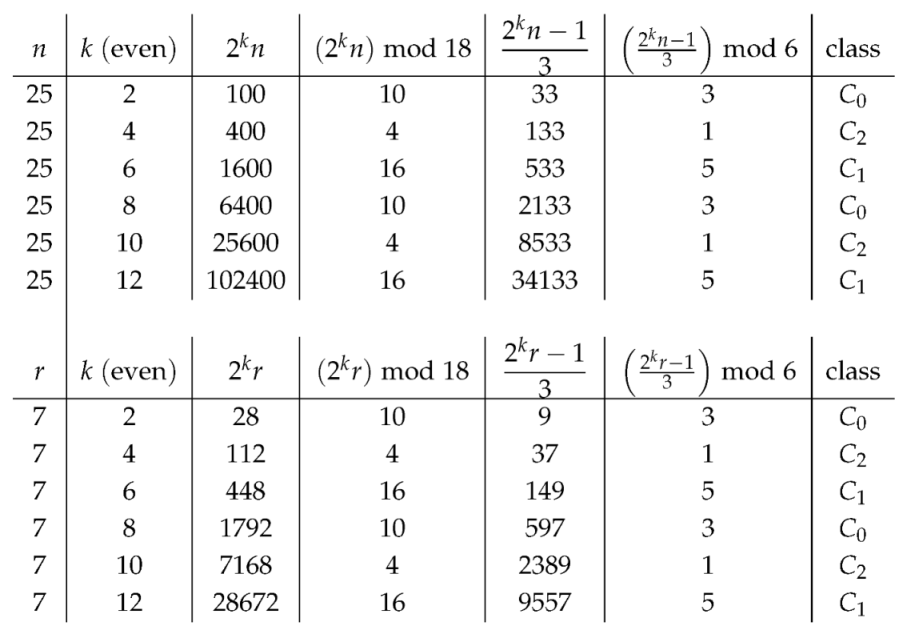
Example (reverse step, odd k; here , ):
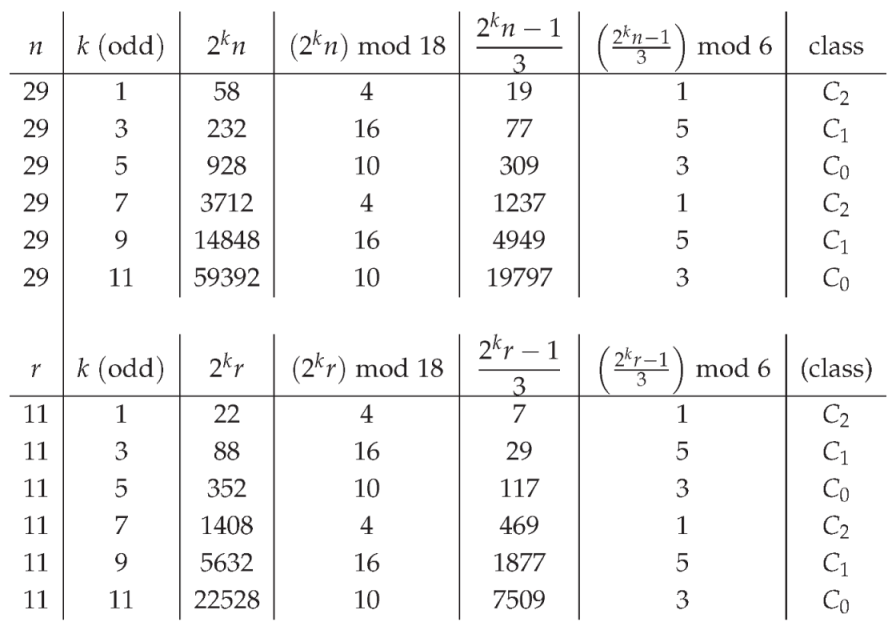
Figure 1.
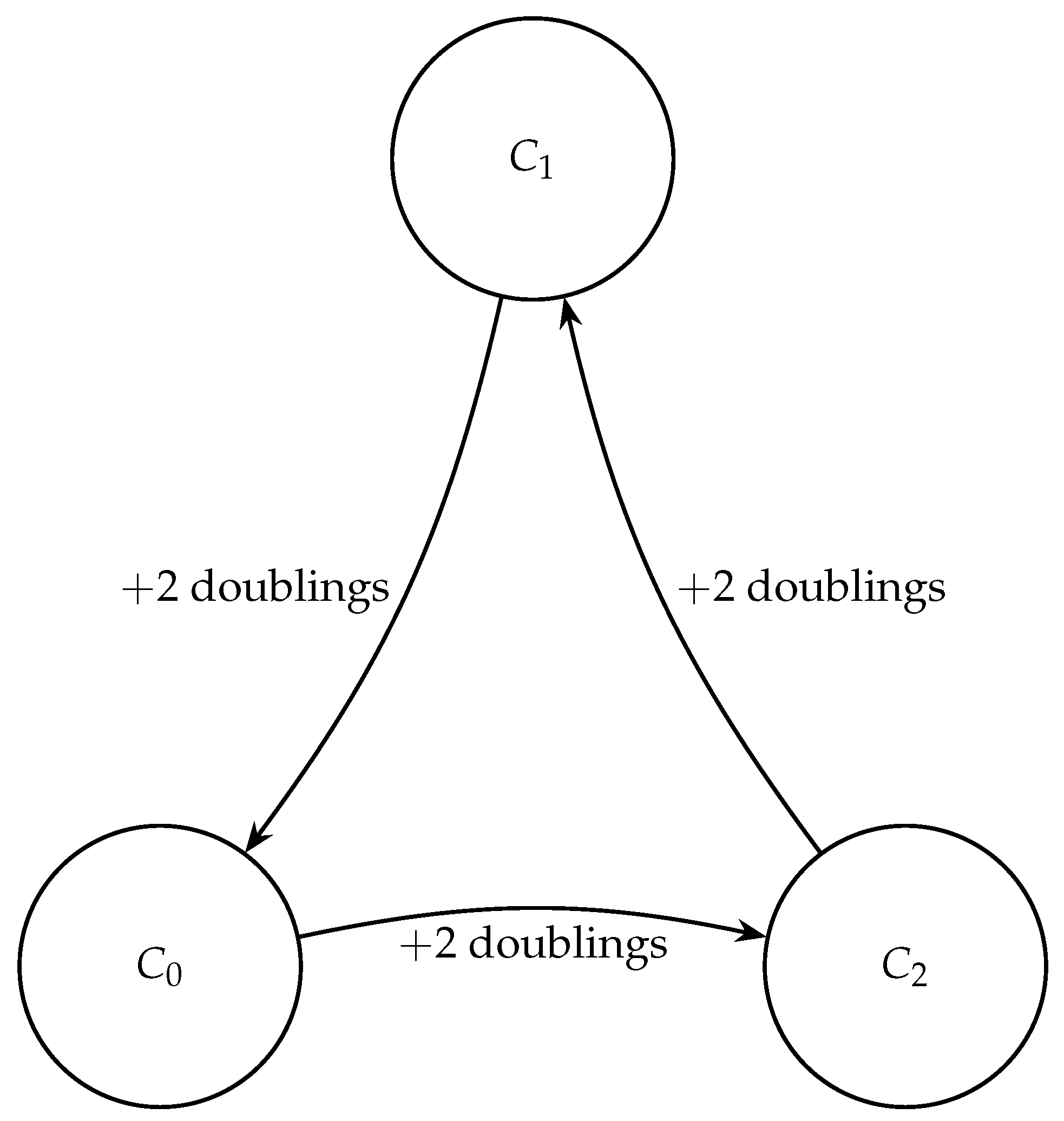
Even-k rotation of child classes through the mod-18 gate. Each increment of two in k multiplies the middle-even residue by 4, producing the cycle . These residues correspond deterministically to classes (with , , ). Hence the child class rotates in the fixed order , making the terminating class periodically available alongside the live classes.
Figure 1.
Even-k rotation of child classes through the mod-18 gate. Each increment of two in k multiplies the middle-even residue by 4, producing the cycle . These residues correspond deterministically to classes (with , , ). Hence the child class rotates in the fixed order , making the terminating class periodically available alongside the live classes.
3.4. Consistency of Aligned Steps
Lemma 3.11
(Forward–Reverse Uniqueness). For any odd n, the forward step
uses the maximal admissible exponent and is unique: no smaller exponent yields an odd integer, and no larger exponent yields a valid integer. In contrast, the reverse Collatz function
admits infinitely many valid odd children for admissible k (odd k when , even k when ).
Proof.
Suppose . Then does not fully divide , so would not be an integer. If , then is divisible by but not by any higher power of 2. Dividing by with therefore produces either a non-integer or an even number, not the next odd iterate. Thus the forward step is uniquely determined.
On the reverse side, admissibility requires to be a multiple of 3. This condition is satisfied for infinitely many k, and these admissible values grow without bound. Therefore the reverse tree branches indefinitely, while the forward map selects exactly one step. □
3.4.1. The Trivial Loop from : Reverse and Forward Views
Lemma 3.12
(1 is and has even admissible doublings). Since , the integer 1 lies in class . Admissibility for the reverse step requires . With and , this gives , hence k is even. The minimal admissible doubling count is .
Proposition 3.13
(First child of 1 equals 1). With , the reverse child of is
so the first child of 1 is 1 again. Consequently, under the reverse map with minimal admissible doubling, is a fixed point in class .
Remark 3.14
(Consistency with the forward picture: the loop). From the forward side, starting at 1,
which is the well-known loop. Thus the reverse fixed point at (with minimal ) corresponds exactly to the unique forward cycle.
Remark 3.15
(Other even doublings). Any admissible doubling for has the form with , yielding
The first childuses and returns to 1 as above. Larger ℓ give other (valid) reverse children (e.g. ), but for our purposes the minimal-child dynamics at are governed by , which identifies 1 as a fixed point and ensures consistency with the forward loop.
Theorem 3.16
(Local Determinism of the Collatz Operator). The residue framework modulo 6, 9, and 18 fixes the Collatz dynamics at the stepwise level. In particular:
-
(Unique parentage (least lift).) Every live odd n (i.e. ) has a fixed parity of admissible doublings k (Lemma 3.3), so it belongs to exactly one admissible family of reverse steps. Let be the least admissible k and defineThen is theunique immediate parent of n in the least-lift reverse graph; any other admissible lift has the same parity and the closed formso higher lifts do not create alternative immediate parents of n, rather, they produce additional reverse children of n along the same ladder. Class (odd multiples of 3) is terminating and produces no children (Lemma 3.1). Hence, in the graph whose edges point from n to , live nodes have outdegree 1 and nodes have outdegree 0; in particular, no nontrivial odd cycles can form.1
-
(Deterministic residue rotation) For admissible k, the reverse middle-even value is restricted toBy Lemma 3.10, these residues form a strict 3-cycle under :Thus admissible lifts rotate deterministically through the gate .
-
(Residue–class correspondence) This 3-cycle fixes the child’s class unambiguously:(Proposition 3.8, Lemma 3.10). Equivalently, the mod-9 sequence of first children (Corollary 3.5) lifts canonically into this mod-18 cycle.
- (Forward–reverse equivalence) For every live odd n, the forward middle-even and the reverse middle-even coincide modulo 18 at the admissible . Thus both forward and reverse maps send n through the same gate and into the same child class (Lemmas 3.9 and 3.11).
Therefore the Collatz operator is locally deterministic: every odd integer has exactly one parent, every child class is fixed arithmetically by the 3-cycle , and the forward and reverse directions are aligned through the same gate.
4. The Global Framework: Offset Ladders and Arithmetic Progressions
This section rederives the global offset framework introduced in Arithmetic Offsets and Recursive Coverage Patterns in the Collatz Function [2], presenting it as a complete additive structure: anchor ladders, progression steps, and higher lifts partition without omission or overlap.
Dependency Map (Section 4: Ladders and Global Coverage)
- Uses (from §3: Local arithmetic). Lemma 3.3.
- Introduces (proved in §4). Lemma 4.1; Lemma 4.5; Lemma 4.7; Proposition 4.10; Corollary 4.8; Theorem 4.2; Lemma 4.9; Lemma 4.11; Corollary 4.12; Theorem 4.13; Lemma 4.18; Theorem 4.19.
-
One-line chains. Lem. 4.1 + Lem. 4.5 ⇒ Prop. 4.10 (base slices).Prop. 4.10 + Lem. 4.7 ⇒ Cor. 4.8 (higher lifts fill base gaps).Disjoint rails + base slices + higher-lift propagation + slice measures (Lem. 4.11, Cor. 4.12) ⇒ Thm. 4.13 (global partition with densities).Lem. 4.18 → Thm. 4.19 (no odd cycles).
- Outcome. Complete, disjoint coverage of by class-preserving affine ladders across all admissible lifts, with exact dyadic slice proportions; together with affine disjointness, this yields no nontrivial odd cycles (only the trivial 1 loop).
4.1. Offset Formulas in the Transformation
4.1.1. Offsets
From the mod 6 classification established in the prior section, every odd integer is congruent to 1, 3, or 5 modulo 6. The residue 3 gives the terminating class , while the residues 1 and 5 produce the live classes and . Thus every parent can be written in the form
where t is a nonnegative integer indexing the position of n within the residue class. Equivalently, t counts how many multiples of 6 have been passed before reaching n. By the admissibility rule, nodes allow only odd exponents k. With the minimal choice , the reverse Collatz function is
Substituting gives
The offset is obtained by subtracting the parent:
Hence each child lies an even step below its parent, and the step size grows linearly with the modulo 6 index t. The resulting ladder of offsets is
Concrete examples:
Thus the offsets are the explicit arithmetic realization of the reverse rule with odd k, derived directly from the mod 6 classification.
4.1.2. C2 Offsets
From the mod 6 classification, every parent can be written as with . By admissibility, nodes allow only even exponents k. With the minimal choice ,
Substituting gives
Therefore the offset (child minus parent) is
Hence the first admissible reverse step in is nondecreasing and, for , strictly increasing in t:
Concrete examples:
The explicit offsets for small values of n are listed in Table 2 in Appendix A. This table illustrates the arithmetic ladders described in Section 4.1.1 and Section 4.1.2, making the underlying arithmetic structure relative to each n transparent up to .
Lemma 4.1
(Offset Ladders by Class). For each live parent n, the first admissible reverse step defines an arithmetic offset depending only on its class:
Moreover, higher admissible lifts of the same parent extend these formulas linearly in t with parity restricted to odd k for and even k for .
Proof.
Direct substitution of with odd k and with even k into the reverse Collatz function gives the claimed offset formulas. The parity restriction follows from admissibility, so every live parent generates an infinite ladder of children determined solely by . □
Theorem 4.2
(Anchor principle). All progressive path iterations of the Collatz map are anchored at the two primitive parents and . Every admissible lift (k even) and (k odd) generates an infinite raising sequence. These raising sequences partition the odd integers into disjoint arithmetic progressions modulo , and the union over all k gives complete coverage. Thus the global recursive structure is entirely determined by the anchor pair .
Corollary 4.3
(Exhaustion by anchors). Every odd integer lies in exactly one ladder iteration of a raising sequence anchored at 1 or 5. No other origins exist.
4.1.3. Further Lifts of Admissible k
The reverse Collatz function extends naturally to higher admissible exponents: odd for parents () and even for parents (). Substituting these values into
gives the general offset formulas
The first admissible k gives the minimal child, and increasing k by two corresponds to a deeper lift along a higher ladder. Each successive lift remains tied to the progression index t, with the offset magnitude growing on the order of as k increases.
Remark 4.4
(Offsets and the itinerary). The higher-k formulas confirm that offsets are determined not by the “generation depth” but by the progression index t and the parity of k. Which ladder is followed depends on the sequence of class transitions as the function is iterated. Thus and each sustain an infinite sequence of admissible steps, and the arithmetic progression of offsets is simply the explicit trace of the admissibility rules, computed relative to n at each transformation.
4.2. Arithmetic Progressions of Children
While offsets describe the displacement between a parent and its child, progressions describe how children of consecutive parents distribute across the integers. We now compute these inter-parent progressions.
4.2.1. Parents
Take consecutive parents and . From the reverse rule with , their children are
Hence
Thus first admissible children of consecutive parents advance in an arithmetic progression with step size .
4.2.2. Parents
Take consecutive parents and . From the reverse rule with , their children are
Hence
Thus first admissible children of consecutive parents advance in an arithmetic progression with step size .
Lemma 4.5
(Progressions of Consecutive Parents). First admissible children of consecutive parents form arithmetic progressions:
Thus children of adjacent parents distribute evenly across odd integers with step size fixed by class.
Remark 4.6.
The offset ladders of Section 4.1.1–Section 4.1.2 describe how each parent generates children in a ladder determined relative to its own value of n. The arithmetic progressions, by contrast, describe how numerically consecutive parents distribute their children across the integers. Both perspectives are needed: ladders explain the local offsets tied to each parent, while progressions explain the global coverage across parents.
For parents, each has the form . With the minimal admissible exponent , the child is
Subtracting the parent gives the offset
Thus the offset depends linearly on t and grows in magnitude as t increases.
For parents, each has the form . With the minimal admissible exponent , the child is
so the offset is
This offset also depends on t, and for it is strictly increasing.
Therefore, offsets are not fixed increments across all parents, but arithmetic expressions relative to each parent’s index t within its residue class. Each live class generates an infinite ladder of children, and the offset size expands with t while preserving the admissibility rule (odd k for , even k for ).
The arithmetic progressions across consecutive parents are simply the global counterpart of the same rule. When t increases by (advancing to the next parent in the same class), the child also advances by a constant step ( for at , for at , and in general ). This step is independent of t because the dependence on t is linear.
Thus the two descriptions are isomorphic: offsets show how children are positioned relative to a fixed parent, while progressions show how those positions line up across the sequence of parents. Both arise from the same affine relation , and together they capture the local and global arithmetic structure of the reverse Collatz map.
4.2.3. Higher Lifts
Lemma 4.7
(Quadrupling of Step Sizes at Higher Lifts). For each class, increasing the admissible exponent k by two applies two successive doublings, thereby quadrupling the progression step size of consecutive parents. Concretely:
Proof.
From the general offset formulas in Section 4.1.3, the difference between children of consecutive parents is proportional to . Replacing k by multiplies this factor by 4, hence quadruples the step size between odd children. Therefore each successive two-lift scales the step size by a factor of four. □
At higher admissible k-lifts, step sizes scale as : each unit increase of k doubles the progression spacing, and in particular every two lifts quadruple it (Lemma 4.7). A convenient way to display this is to show the two-lift subsequences and stagger the one-lift intermediates:
This pattern follows directly from the formulas of Section 4.1.3.
Table 3 in Appendix A displays these higher-k lifts explicitly. The overlay of odd and even admissible values shows how apparent gaps at lower scales are filled directly by higher lifts, ensuring complete coverage of the odd integers.
4.2.4. Visual Overlay
Corollary 4.8
(Visual Overlay and Complete Coverage). Overlaying the progression ladders from consecutive parents shows that apparent gaps at lower admissible lifts are exactly filled by higher lifts. Each anchor sequence covers its congruence class without overlap, and the union across all admissible lifts exhausts the odd integers. Thus ladder iterations across all lift levels ensure complete coverage of . This structure is explicitly illustrated in Table 3.
Proof.
By Lemma 4.5, consecutive parents generate fixed-step progressions, and by Lemma
4.7, higher admissible lifts scale these progressions by powers of four. The apparent omissions at a given scale correspond precisely to residue classes that are elements of progression of higher-lift ladders. Therefore the superposition of ladders fills all gaps systematically, partitioning the odd integers with no overlap. □
4.3. Anchor Ladders as the Basis of Coverage
All admissible structure originates from the two primitive anchors and . Each admissible lift
produces a new anchor point. Each such anchor initiates a ladder whose offsets and progressions are determined by its residue class and the parity of the admissible exponent k.
Interpretation. Each dyadic level j corresponds to odd numbers whose next Collatz step divides by at least . These same numbers are precisely those belonging to ladders with index . In other words, filtering by powers of two (the dyadic sieve) and constructing ladders from the anchors by successive powers of two are inverse descriptions of the same process. Together they ensure that every odd integer appears once and only once within the ladder system, confirming both the completeness and the disjointness of the recursive hierarchy.
Lemma 4.9
(Arithmetic derivation of anchors by class lifts). For each anchor family with parent form , the reverse operator
generates an arithmetic progression at every admissible lift k (k odd for , k even for ). The constant term is the base residue of that progression and coincides with the anchor promoted at scale . Thus the starting anchors are derived arithmetically, and their descendants at higher k are exactly the ladder bases that fill sieve holes.
Proof.
For (class , odd k):
Each case has the form , with constants serving as the promoted anchors at scales .
For (class , even k):
Each case has the form , with constants serving as the promoted anchors at scales .
In both families, the step size doubles with each increment of k, and the base constant aligns exactly with the residue class left uncovered at the prior dyadic sieve. Thus the arithmetic shows both that the anchors are generated within the operator and that each higher k-level produces the ladder bases that fill the recursive sieve. □
4.4. Global Coverage by a Dyadic Sieve of Ladders
Proposition 4.10
(First-child ladders and the 4-adic sieve by class). Every admissible odd parent n is in exactly one of the two live classes
Let be a reverse child at lift k. Then:
- (A)
-
First admissible child (base sieve slice).Thus the first children in are exactly (gap 4), and the first children in are exactly (gap 8). Equivalently, these are the odds with exactly one halving () and exactly two halvings () in , respectively.
- (B)
-
Higher admissible lifts stay in class and obey .Within a fixed class, raising the lift by sends each child to the next child byHence the children at lifts form a ladder by the affine update and remain in the same class ( for odd k, for even k).
- (C)
-
Gap quadrupling across lifts.Writing the first-child progressions as functions of t,the lift update gives, for each ,Thus each time the lift increases by , the gap between consecutive children (as t increases by 1) is multiplied by 4.
- (D)
- Next sieve slice is generated by .For the first children () are . Applying yields the next slice (): , again gives the slice , and so on. For , the first children () are ; then gives ; then gives ; etc. In each class, generates the next sieve level and quadruples the modulus (the gap) each time.
Lemma 4.11
(Sieve slice measure for on odds). Fix . Among all odd integers m, the proportion for which is exactly .
Proof.
Work modulo . Because 3 is invertible mod , the map is a bijection on residue classes. The condition is , which holds for exactly of odd residues; the stricter condition cuts that by another factor . Hence on odds. □
Corollary 4.12
(All-integers normalization). For , the proportion of all integers m with m odd and is .
Proof.
Half of all integers are odd; combine with Lemma 4.11. □
Theorem 4.13
(Global Arithmetic Coverage by Ladders). Let be the reverse map with admissible parity per class. Then the following hold within Section 4:
-
Base slices and fixed gaps.First admissible children are exactlyand children of consecutive parents form arithmetic progressions with those gaps (Prop. 4.10,Lem. 4.5).
- 4-adic lift within class. Raising the lift by sends , stays in the same class, and multiplies the progression gap by 4 (Lem. 4.7 and the clause ofProp. 4.10).
- Overlay gives complete coverage. Superposing the ladders across all admissible lifts fills the apparent gaps of the base slices; within each class, the union over k exhausts its congruence classes with no overlap (Cor. 4.8).
- Anchor generation. All ladders are generated from the two primitive anchors (even k) and (odd k); each admissible lift promotes a new anchor and its ladder (Thm. 4.2,Lem. 4.9).
- Exact dyadic slice measures. Among odd m, the slice with has measure ; among all integers it is (Lem. 4.11,Cor. 4.12).
Consequently, the odd integers are covered disjointly by the class-preserving affine ladders generated from across all admissible lifts, with gaps and densities exactly as stated in (1)–(5).
4.4.1. Middle-even gates and mod-18 progression
Lemma 4.14
(Gate equivalence at the middle even). Let be the next odd. Then
with the class correspondence
In particular for every odd m, and over one mod-18 odd cycle the three gate residues occur with equal frequency .
Proof.
Since , reduce modulo 18 and use the mod-6 classes of n; this is the same gate rule as Prop. 3.8. The split is the equidistribution of first-child classes from §3. □
Proposition 4.15
(Base middle-even progressions in mod-18). Using the first-admissible children from Prop. 4.10:
Thus, as t increases by 1, the gate residue rotates deterministically in mod 18 by
and the union of middle evens across the two classes is exactly the gate set —i.e. precisely of all even residues mod 18.
Lemma 4.16
(Higher lifts act by on middle evens). If is the lift- child of m (Prop. 4.10, Lem. 4.7), then
hence , rotating the gate residues
Corollary 4.17
(Even-gate sieve ≡ dyadic sieve, in mod-18). The partition of odds by (§4) corresponds, under , to class-preserving middle-even ladders whose residues cycle within and whose strides scale by the lift (Lemma 4.16). This gives a mod-18 even-side rephrasing of the ladder picture in this section, with no change to coverage or disjointness.
Lemma 4.18
(Raw drift and its unrolling). For any admissible reverse step,
Iterating steps with exponents gives
Hence the accumulated subtraction (the “drift”)
is strictly positive and strictly increases with t (a new positive term is added at each step).
Proof.
The single–step identity is algebraic. Unroll two steps:
A third step gives The pattern is clear and proves the boxed formula by induction; each added term is positive. □
Theorem 4.19
(Cycle obstruction by raw drift). If a reverse loop of length existed (so ), then Lemma 4.18 forces
hence and an exact Diophantine balance between the powers and the positive drift. In particular, the loop cannot be produced by any finite composition that preserves the affine subtraction at each step without violating this equality. No nontrivial odd cycle exists; the only fixed point is at .
5. Mod-18 Triads and Class-Resolved Dynamics
Dependency Map (Section 5: Forward Convergence to 1)
- Uses (from §§3–4). Lemma 3.9 (middle-even equivalence mod 18); Lemma 3.11 (forward–reverse uniqueness); Lemma 3.3 (admissible parity).
- Introduces (proved in §5). Lemma 5.3 (least-admissible lift parity); Proposition 5.4 (deterministic parent map on live residues mod 18); Lemma 5.2 (class-pure images and immediate outcomes); Lemma 5.1 (only descending case is and is finite); Lemma 5.5 (finite self-similarity on the 17-branch); Proposition 5.6 (finite replication runs; exact 3-adic lengths); Corollary 5.7 (deterministic bounds on replication); Corollary 5.8 (prefix closure: reverse prefix through n reverses to 1); Lemma 5.9 (reverse finite replication ⇒ no forward runaway); Theorem 5.10 (reverse–forward closure: ); Lemma 5.11 (a forward ascent forces a hit); Lemma 5.12 (higher lifts do not sustain runaways); Theorem 5.13 (no runaway; finite bound at the anchor 1); Proposition 5.14 (finite bounds for all live→live class blocks); Definition 2.13 (live/dead residues); Definition 2.14 (ternary cylinders); Theorem 5.17 (universal reverse cylinder map); Corollary 5.18 (exact occurrence/density of reverse paths); Proposition 5.19 (finite-bound reverse map via blocks); Corollary 5.20 (universal reverse full map is finite); Lemma 5.27, Cor. 5.28 (⇔); Definition 2.15, Proposition 5.24, Corollary 5.25 (canonical triples; rail partition).
-
One-line chains. Lemma 5.3 + Proposition 5.4 ⇒ Lemma 5.2 (class-pure images and immediate outcomes).Lemma 5.1 + Lemma 5.5 + Lemma 5.2 ⇒ Proposition 5.6 (finite replication runs with exact 3-adic lengths) ⇒ Corollary 5.7.Lemma 3.9 + Lemma 3.11 ⇒ Corollary 5.8 (reverse prefix through n reverses to 1).Lemma 3.3 + Lemma 3.9 + Lemma 3.11 + Corollary 5.8 ⇒ Theorem 5.10 (forward convergence: ).Proposition 5.6 ⇒ Lemma5.9 (no forward runaway); together with Lemma 5.11 + Lemma 5.12 ⇒ Theorem 5.13 (global no-runaway bound at 1).Definition 2.14 + Proposition 5.4 ⇒ Theorem 5.17 ⇒ Corollary 5.18 ⇒ Proposition 5.19 ⇒ Corollary 5.20 (reverse graph finite; hence no forward runaway).Lemma 5.27 + Cor. 5.28 + Definition 2.15 + Proposition 5.24 + Cor. 5.25 ⇒ structural support for Lemma 5.12 and Theorem 5.13 (higher lifts enumerate disjoint rails via ; forward selects only and cannot sustain ascent by hopping rails).
- Outcome. (i) Deterministic parent dynamics on mod-18 triads with finite self-replication only at residues 1 and 17, and exact 3-adic run lengths. (ii) Prefix closure: any reverse path prefix through n reverses to 1 in the forward map. (iii) No runaways: finite reverse blocks and the absence of sustaining higher lifts imply forward convergence; the anchor at 1 bounds all trajectories.
5.1. Triad Notation
Partition the odd residues modulo 18 into three classes, each with three labeled elements:
Every odd n can be written uniquely as with .
Minimal-parent map.
For odd let be the least admissible lift and set
For (i.e., ), no admissible reverse child exists; these are terminating in reverse.
5.2. Deterministic Triad Map (Indexed by )
For with , one step of P sends r to a triad of child residues determined by . Writing each triad in the order :
In particular:
- is absorbing in reverse: whenever a child is in , the reverse process terminates.
- is pure under one step of P: children lie in , and the next minimal lift is (reverse then strictly ascends except at 1).
- is pure under one step of P: children lie in , with the special 17-branch admitting self-similarity (finite, see below).
See Appendix Tables 3-8 for full rotations () per residue.
Lemma 5.1
(The only descending case is in , and it is finite). Write . Then the minimal parent is
and
Hence a chain of consecutive steps (i.e., staying in ) can occur only when , which is a , in which case the integer parameter t strictly decreases; therefore such a run is finite by well-ordering.
5.3. Arithmetic Consequences for Each Class
Lemma 5.2
(Class-pure images and immediate outcomes). For (odd):
- If , n has no admissible reverse child (reverse termination).
- If , then and ; for , (reverse ascends).
- If , then and . Writing , the residue of decides the next class:
Lemma 5.3
(Least-admissible lift parity). For an odd m, the least making an odd integer has
Proof.We need . Since , if then forces k even, so take . If , then forces k odd, so take . In both cases the numerator is odd and divisible by 3, hence is odd.
Proposition 5.4
(Deterministic parent map on the six live residues mod 18). Write any live odd as with and . With k from Lemma 5.3, the parent has the following closed forms and residue evolution, where with .
(1) (class ).Here and
Decomposing ,
(2) (class ).Here and
With ,
(Note: are ; these are dead leaves.)
(3) (class ).Here and
With ,
(Dead leavesagain: .)
(4) (class ).Here and
With ,
(5) (class ).Here and
With ,
(6) (class ).Here and
With ,
In particular:
- (both ) force either a dead leaf in one step () or a move into the trio ().
- cycles deterministically within the trio according to .
- injects into the trio; stays within the trio; drops to a dead leaf immediately.
Lemma 5.5
(Finite self-similarity on the 17-branch). If , write . Then
In the self-preserving case (), one has with . Hence any chain that stays in residue 17 is finite.
Proposition 5.6
(Deterministic replication runs are finite). Let be the least-admissible parent map on odd m, with k determined by (Lemma 5.3), and write every live odd as with and . Define thereplication run lengthat residue r by
Then:
- Only and can replicate consecutively.For the next parent is a multiple of 3 (dead), and for the next parent moves to the other live trio; hence for .
-
Exact run lengths via 3-adic valuations.With the 3-adic valuation,Equivalently,and
- Finite bounds; no infinite replication. For there isnoinfinite replication: for all , since for all ℓ has no nonnegative solution. For , occursonlyat (i.e. ), giving the trivial fixed point . For all , .
Proof. (1) The residue transition law from Proposition 5.4 shows and (dead), (moves to the trio), and (moves to the trio). Hence only can feed r again.
(2) For , Proposition 5.4 gives when and otherwise . Writing , the updated ladder index is ; iterating, a run of length ℓ requires t divisible by but not by , so .
For , we have iff ; write , then . Requiring another stay forces , i.e. , etc. Induction yields the cylinder condition for a run of length at least ℓ, with extension to length iff . Thus .
(3) If then for all ℓ, forcing in the 3-adics, contradicting . If then for all ℓ, hence , i.e. ; conversely gives the trivial infinite run. □
Corollary 5.7
(Deterministic bounds on replication). For every odd , any consecutive residue replication under the parent map is finite:
In particular, no nontrivial residue can replicate indefinitely.
Corollary 5.8
(Prefix closure at a chosen start n). Under reverse–forward equivalence at the mod-18 gate (Lemmas 3.9, 3.11), fix an odd n. For every admissible reverse path
the forward odd-to-odd trajectory from n is exactly the reversal of the finite prefix to 1:
In particular, whenever n lies on such a path starting at 1, one has . Any live reverse continuation beyond n is irrelevant to the realized forward trajectory.
Proof.
Let be any admissible reverse path. By the gate lemmas (Lemmas 3.9, 3.11), for each we have . Composing these identities gives , so the forward odd-to-odd trajectory from n is exactly the reversal of the finite prefix back to 1. □
Lemma 5.9
(Reverse finite replication ⇒ forward non-runaway). Let T be the forward Collatz operator on odds,
and let P be the reverse graph map with the least admissible k (Lemma 5.3). If every reverse branch has finite replication length as in Proposition 5.6, then no forward trajectory can diverge or realize an unbounded runaway.
Proof.Assume some forward trajectory were unbounded. Reading it backward yields an infinite ancestral chain in the reverse graph, contradicting the hypothesis that every reverse branch has finite replication length. Indeed, by Proposition 5.6 the only self-replicating residues have finite block lengths
and outside those blocks a reverse branch eitherterminates in , moves to a different residue in finitely many steps, or ascends by a higher-lift. Hence no descending reverse chain is infinite. Since each forward step is the inverse of a unique admissible reverse lift (Lemma 6.4, Proposition 6.5), any infinite forward ascent would imply an infinite reverse lineage, which is impossible. Hence no infinite forward trajectory exists.
In particular, whenever a reverse branchclosesby hitting , its forward dual segment reaches the odd fixed point 1 (the loop in the full map). □
Theorem 5.10
(Reverse–forward closure). Fix an odd n. We use the following established facts:
- Gate equivalence.Forward and reverse steps coincide at the mod-18 gate (Lemmas 3.9, 3.11).
-
Reverse path existence at n.By Lemma 3.3, the admissible-lift set at every odd node is nonempty (with parity fixed by the gate). Consequently, there exists an admissible reverse path(the continuation beyond n may be live; only the finite prefix to n matters).
- Prefix reversal.For any such path through n, the forward odd trajectory from n is exactly the reversal of its finite prefix back to 1 (Corollary 5.8).
Then the forward trajectory from n is finite and terminates at 1.
Proof.
By (2) choose a finite admissible reverse path through n. Applying (3) (with (1) in force) gives that the forward odd trajectory from n is the reversal of the prefix , hence . □
Lemma 5.11
(Necessity of a origin for forward ascent). Let be the ladder/progression indices of the odd subsequence of the forward trajectory of n. Assume the forward odd sequence is infinite and for infinitely many j. Then along the reverse-compatible path through the mod-18 gate there exists at least one step of type with . Equivalently, if no step occurs on any reverse-compatible path of n, then is eventually nonincreasing and cannot realize an unbounded forward ascent.
Proof.
Forward odd steps are determined by , while reverse lifts admit multiple k but must respect the same gate. If no step ever occurs on any gate-compatible reverse path, then every gate-compatible segment avoids the only mechanism that strictly contracts the index, namely . In that case, along the forward odd subsequence the index cannot realize infinitely many strict increases without encountering a reverse segment that would force such a contraction; hence is eventually nonincreasing and cannot sustain an unbounded ascent. Contrapositively, if occurs infinitely often, some gate-compatible reverse segment must contain . □
Lemma 5.12
(Forward vs. reverse roles of higher lifts). In the reverse map, yields multiple admissible parent branches but does not contract the ladder index t. In the forward map, only is realized at each odd step, so higher lifts areunselectedand do not contribute to forward ascent. By Lemma 5.11, a forward trajectory cannot “escape” by chaining different lifts while merely interleaving segments between occurrences: any unbounded forward ascent would require a hit on some gate-compatible reverse segment, and such hits occur only finitely many times. Hence higher lifts do not create or sustain runaways.
Proof.
By definition of the reverse map, admissible parents with enumerate distinct branches but leave t unchanged up to noncontracting transformations; in particular, no step with produces the strict contraction characteristic of . In the forward map, each odd iterate chooses uniquely , so higher lifts () correspond to unselected reverse branches and cannot be chained by the forward dynamics. By Lemma 5.11, any unbounded forward ascent would require at least one occurrence on a gate-compatible reverse segment, and such occurrences are finite in number (see, e.g., Theorem 5.13 / Lemma 5.9). Therefore higher lifts cannot create or sustain a runaway in forward trajectories. □
Theorem 5.13
(No runaway; finite bound at the anchor). Every forward trajectory has a finite ladder bound governed by the anchor at 1. In particular, any putative infinite forward ascent must originate from a gate-compatible reverse path containing a step; but whenever a step occurs (at index t), the next index on that branch strictly contracts to . Since repeated hits occur only finitely many times, the overall forward index sequence is bounded and the trajectory terminates at the anchor 1.
Proof.
By Lemmas Lemma 5.9, 5.11, and 5.12, an unbounded forward ascent would require a origin on a reverse-compatible path. But each such hit strictly decreases the index on the reverse path, and thus can occur only finitely many times. Between these finitely many contractions, the ladder index remains within a finite envelope, so the odd subsequence is bounded above and therefore cannot realize an infinite ascent. The ladder system has the anchor at 1 as its finite lower bound; hence the forward trajectory terminates at 1. □
Proposition 5.14
(Finite bounds for all class-level live→live transformations). Write every live odd as with and . Under the least-admissible parent map :
- (A)
-
(only via ). A consecutive block of steps can occuronlywhile the residue remains . Its exact length iswith (trivial fixed point) and for all . If the block ever leaves (to 7 or 13), it terminates on the next step (those go to ), so no longer block persists outside .
- (B)
-
(only via ). A consecutive block of steps can occuronlywhile the residue remains . Its exact length iswhich is always finite since . Any visit to dies immediately (), and exits to on the next step.
- (C)
-
(only via ).Every step arises from , withHence a consecutive block of has length at most 2: the first step (from 13) lands in ; the next step is either to 5 (dead), to 17 (after which any further step must be of type covered by (B)), or to 11 (whichexitsto next). Thereforeand in fact any extension beyond length 1 must immediately change type to either or .
- (D)
-
(only via ).Every step arises from , withTherefore a consecutive block of has length at most 2: the first step (from 11) lands in ; the next step is either to 7 (dead), to 1 (after which any further step must be of type covered by (A)), or to 13 (which immediately yields next). Thusand any longer continuation necessarily switches type to (A) or (C).
Corollary 5.15
(Higher lifts define distinct reverse rails). For each odd n and admissible , the reverse lift
generates a unique and disjoint reverse rail anchored at n. Unlike the case, higher lifts do not produce a contraction of the ladder index t; they simply enumerate separate, non-interacting rails. Since forward dynamics select only at each step, a forward trajectory cannot indefinitely ascend by moving among these higher-lift rails.
Corollary 5.16
(Finite-bound map for the reverse function). Every reverse trajectory factors into a concatenation of blocks of the four types , , , . The lengths of these blocks obey the deterministic bounds
Consequently, no reverse path can remain forever in the live set: every branch has finite depth before either reaching the anchor 1 (the only infinite self-loop) or hitting a dead node.
Theorem 5.17
(Universal reverse cylinder map). Fix a start residue and an integer . For each ternary word there exists a unique residue path
such that for every the L-step reverse trajectory of under P satisfies for . Moreover, the map
is well-defined, and the family of cylinders forms a partition of .
Proof sketch
By Proposition 5.4, for fixed r the image depends only on , and the next index is an affine function of (explicitly computed there). Thus, given and , we set and obtain uniquely; we then write to get as an explicit affine function of , so that is determined by , hence is determined, and so on. Inductively this defines a unique residue path for all t in the cylinder . Distinct words give disjoint cylinders, and the union of all cylinders is . □
Corollary 5.18
(Exact occurrence and density of reverse paths). Fix and L. Every length-L reverse residue path arises fromexactly disjoint cylinders , hence has total occurrence density in . In particular, the single-step transition probabilities from any live residue r split evenly among its three admissible images (each ), and length-L path probabilities are products of these factors.
Proposition 5.19
(Live→live block bounds and finite-bound reverse map). Every reverse trajectory factors into a concatenation of live→live blocks among the four class types
The maximal lengths of consecutive blocks are deterministically bounded by
Consequently,everyreverse path has finite depth in the live set before either reaching the anchor 1 (the unique fixed point) or hitting a dead residue in .
Proof idea.
The bounds for and are Proposition 5.6 (, ). The cross-class bounds follow from the explicit residue updates in Proposition 5.4: and force either a dead leaf, an immediate change of class type, or entry into one of the two replicated cases already bounded. □
Corollary 5.20
(Universal reverse full map, finite). For each start residue , the reverse graph decomposes into a radix-3 cylinder tree (Theorem 5.17) whose edges are the deterministic transitions of Proposition 5.4, and whose blocks obey the finite bounds of Proposition 5.19. Hence there is no infinite live branch in the reverse graph, and—by duality with the forward map—no forward runaway trajectory.
Remark 5.21
(Exact locations of long runs). For the path segment occurs precisely on but (two APs mod ); for the segment occurs precisely on but (two APs mod ). These are the explicit “where they land” formulas used to index long runs without logarithms.
Example
(Visual summary of the universal reverse map). The following tables illustrate the deterministic structure described in Corollary 5.20.
(A) Single-step residue transitions.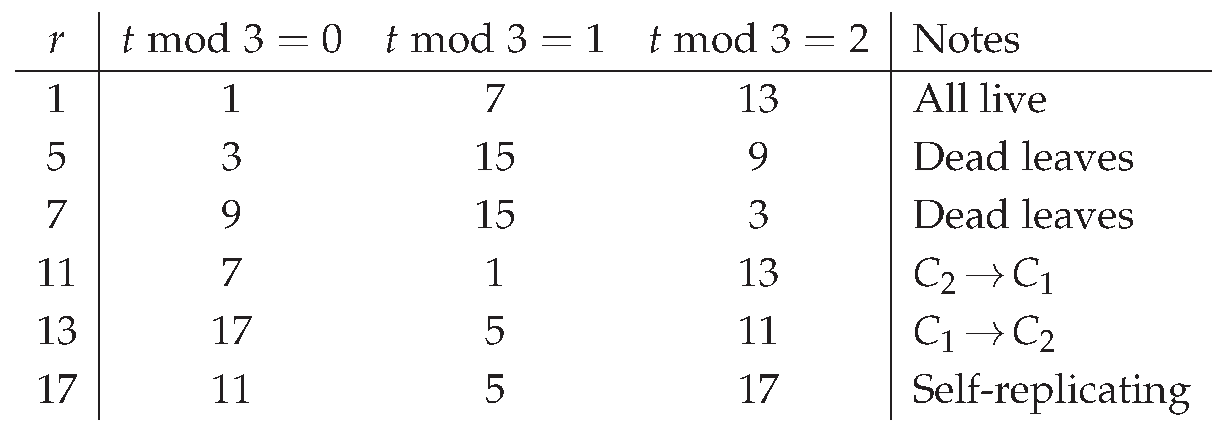
(B) Ternary cylinder trees (depth ).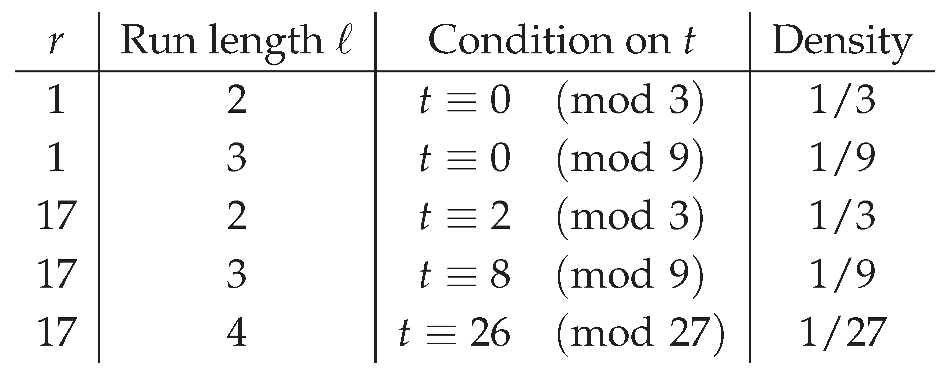
(C) Long-run congruence conditions.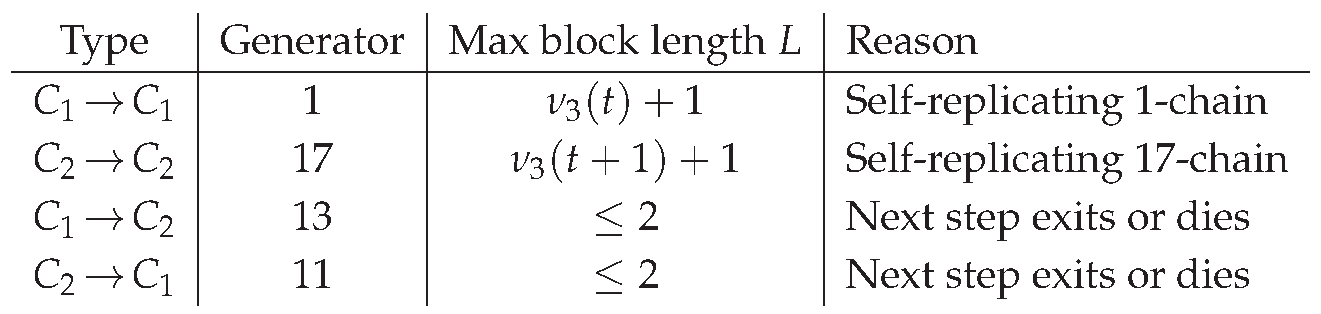
(D) Class-to-class finite bounds.
(E) Finite-bound map summary.
Together these visual fragments show that every reverse branch is a ternary cylinder of finite depth, the only infinite loop being the trivial .
5.4. Layered Non-Overlap via the Middle-Even
Let for odd m. The identity (with n odd) implies
Writing yields the affine form
so for fixed k and r the children form a single arithmetic progression . Distinct residues within the same k give distinct cosets modulo , hence no overlap; distinct k are disjoint because is unique. Thus the union over all k and the six r’s is a partition of the odd integers.
5.5. Middle-Even Scaling and the Next Admissible Child
Fix an odd parent n with an admissible lift k (i.e. ). Define its admissible child at lift k and the corresponding middle-even by
For a fixed n, all admissible lifts have the same parity, so the admissible lifts are where .
Lemma 5.22
(Middle-even ladder and child). For every admissible lift k,
Proof.
Since , we have . Then
Finally , so increases by 2. □
Remarks.
(a) The minimal-parent child is ; higher children (with ) are admissible but non-minimal. (b) The middle-evens form a pure geometric progression: . (c) The child ladder is strictly increasing since .
Examples
- (A)
-
parent: (so , ).(Here ; higher children need not stay in the same class as the minimal child.)
- (B)
-
parent: (so , ).(Here , while the higher child ; the step changes class but preserves admissibility.)
Takeaway.
For a fixed parent n, the admissible children form the affine ladder
and the middle-evens scale by factors of 4. The update is the exact arithmetic bridge between a child’s middle-even and the parent’s next admissible child.
Lemma 5.23
(Step size and anchor; integrality). For fixed and , set
Then , and the canonical form is .
Proof.
Since and 2 is invertible mod 3, there is a unique parity of k for which , hence is integral. The displayed form follows from
□
Proposition 5.24
(Existence and uniqueness). Every odd m admits a canonical triple as in Definition 2.15, and this triple is unique. Equivalently,
with , determines uniquely.
Proof.
Existence. Given odd m, set and (odd). Write with r one of the six odd residues not divisible by 3. Then by Lemma 5.23, .
Uniqueness. If , then (layers match). With k fixed, reduce modulo : . The anchors are distinct for the six r’s, hence ; then follows. □
Corollary 5.25
(Partition of odd integers into disjoint rails). For each layer , the six sets
are pairwise disjoint arithmetic progressions with common difference . Different layers are disjoint. Consequently,
5.6. On Exact Odd→Odd Step Counts
Let denote the odd-to-odd Collatz step and let be the number of -steps needed to reach 1 (with ).
First-step recursion (address ⇒ next odd).
By the canonical decomposition (Def. 2.15), every odd m has a unique triple with
Consequently
Proof. is, by definition, ; counting one step gives .
Anchors admit a closed form.
If (an anchor ), then the first step lands on r: . Hence , and the six base values are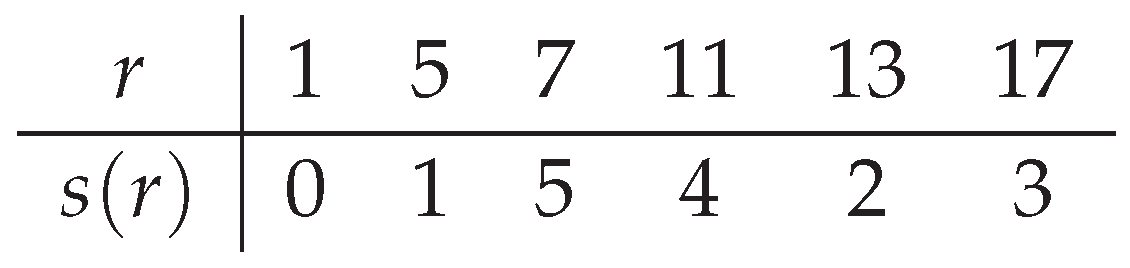
(e.g., gives ).
Why no closed formula .
After the first step, the next valuation is
This depends arithmetically on q in a way not determined by the initial address alone; you must actually evaluate , then repeat. Equivalently, each m has a unique “valuation signature”
but that entire sequence is not encoded in the first address. Thus the address gives the next odd exactly, and anchors give closed-form counts, but a general closed form for from alone is not available.
The parenthesis tower (for the curious).
Iterating the first-step recursion yields
About a “maximum” number of odd steps.
Define, formally,
Our results show for each fixed m (reverse closure ⇒ forward convergence), but they do not supply a uniform finite bound over all m; the initial address does not determine the full signature . In plain terms: the future values are part of a number’s unique arithmetic “signature,” and that information gets created step-by-step by evaluating at each stage—so there is no way to read off a global maximum (or a closed form for ) from the first address alone.
Remark 5.26
(Middle-even interpretation and ). For one has (themiddle-even). Raising the lift by multiplies the middle-even by 4 and updates the child by
so successive admissible children of a fixed parent form the affine ladder .
Examples.
- ., . Thus , , and
- ., . Thus , , and
5.7. Dyadic–Affine Scaling Across Lifts
Recall the canonical form for odds in layer and residue :
Lemma 5.27
(Dyadic–affine lift ). For every admissible residue r and lift ,
Equivalently, for every one has
and on middle-evens,
Proof.
From the definitions: , and
Then for ,
Finally . □
Corollary 5.28
(Layer bijection; invariant rail indices). For each fixed residue r and position q, the map
is a bijection from the layer-k point to the unique layer- point . Hence:
- The step size scales dyadically by 4 when the lift increases by 2.
- The anchor advances by the same dyadic factor with a constant additive offset , independent of r and k.
- Rail labels are preserved by : same residue r, same position q.
Remark 5.29
(Only the 2-adic layer changes). Since , one has . Thus k increases by 2, while the rail index is unchanged. This is the arithmetic content of the observation that theadditive dyadic valueamong k-increases matches the k-offsets:
Micro-examples.
- :;. Thus lifts to via .
- :; again and .
Theorem 5.30
(Global Iterative Coverage of the Odd Integers). The reverse Collatz operator covers all odd integers via anchor–ladder progressions and a dyadic sieve. In particular:
-
Rails from canonical decomposition.By the canonical form (Def. 2.15), every odd m has a unique and a unique withFor fixed s, these six arithmetic progressions (“rails”) are pairwise disjoint; layers with different s are disjoint as well (Corollary 5.25).
-
First children seed the base slices.For a live parent n, the first admissible lift depends only on its class:so the base slices are for and for (Prop. 4.10).
-
Lift by is (gap ).Within a fixed class, raising the admissible lift by two sends each child to the next child byand multiplies the rail step by 4: . Thus each class forms an affine ladder under (Lemma 5.27).
-
Dyadic sieve and exact proportions.Let and . Exactly one odd residue class modulo solves , so among odd integersi.e. “exactly k halvings’’ occupies of the odds, and the slices sum to 1.
-
Completeness and non-overlap.Taking the disjoint union over all layers and residues r yieldsHence every odd number lies on exactly one rail and is generated by the anchor–ladder progressions; there are no omissions and no overlaps (Corollary 5.25).
Consequently, the global structure is deterministic and sieve-organized: first-child formulas seed the base slices in and , the affine lift generates all higher slices within each class (quadrupling the gap each time), and the dyadic proportions ensure that the union across all lifts coversallodd integers exactly once.
6. Why This Is Not a Trajectory Dynamic (but a Branching Number Sequence)
Dependency Map (Section 6: Closure and Convergence)
- Uses (from §§3–5). Lemma 3.4, Lemma 3.7, Proposition 3.8, Lemma 3.9 (gate determinism/equivalence); Lemma 3.3 (admissible parity); Corollary 5.8, Theorem 5.10 (reverse–forward closure); Lemma 5.9, Lemma 5.11, Lemma 5.12, Theorem 5.13 (no-runaway chain).
- Introduces (proved in §6). Lemma 6.1 (unique odd parent at ); Lemma 6.2 (infinitely many admissible children; ); Proposition 6.3 (reverse graph is branching, not a trajectory); Lemma 6.4 (forward step = halving to the unique parent); Proposition 6.5 (forward trajectory is the reverse of a fixed branch); Lemma 6.8 (only descending case is and is finite); Theorem 6.11 (universal reverse cylinder map; exact densities); Theorem 6.9 (no infinite residue pattern along a trajectory); Theorem 6.7 (forward trajectory locks to 1); Corollary 6.10 (no nontrivial odd cycles).
-
One-line chains. Lemma 6.1 + Lemma 6.2 ⇒ Proposition 6.3 (reverse graph is branching).Lemma 6.4 + Lemma 6.1 ⇒ Proposition 6.5 (forward is reverse of a fixed branch).Proposition 5.4 (from §5) + Definitions 2.17,2.18 ⇒ Theorem 6.11 (deterministic universal reverse map).Lemma 6.8 + Theorem 6.11 ⇒ Theorem 6.9 (no infinite residue word).Gate equivalence (Lemmas 3.9, 3.11) + Corollary 5.8 + Proposition 6.5 ⇒ Theorem 6.7 (convergence to 1).Theorem 6.7 ⇒ Corollary 6.10 (uniqueness of 1).
- Outcome. Forward trajectories are single-valued and terminate at 1; the reverse graph is a branching number system (not a trajectory map); no nontrivial odd cycles exist.
Admissible reverse relation.
For odd , call m an admissible child of n if
Write for the set of all admissible children of n.
Lemma 6.1
(Unique odd parent). For every odd m, write with n odd. Then n (if ) is theuniqueodd parent of m, corresponding to the unique lift :
If (i.e. ), then m has no admissible odd child.
Lemma 6.2
(Infinitely many children; strict growth along lifts). If , set and define
Then and
Hence every such n has infinitely many distinct children (outdegree ).
Proposition 6.3
(Reverse graph is branching, not a trajectory). Consider the directed graph with an edge iff . Then:
- Nodes in have outdegree 0 (reverse termination).
- Nodes in have outdegree ∞ by Lemma 6.2.
- Every node has indegree and, if , indegree by Lemma 6.1.
In particular, this graph cannot arise from any single-valued map (a “trajectory dynamic”), which would requireeverynode to have outdegree 1. Thus the Collatz reverse system is intrinsically abranchingstructure.
Residue-level branching (deterministic triads).
Writing with , one minimal step produces the deterministic triad indexed by :
so residue choices branch deterministically as q varies. (See Appendix Tables.)
Multidimensional number sequence (global parameterization).
Every odd integer m is uniquely encoded by the triple :
via the affine formula
Thus the system is a branching number sequence: a disjoint union of affine rails (indexed by ), with residue-level triad branching across and lift branching along from any fixed parent.
6.1. Forward Trajectory is the –Halving to the Unique Parent
Lemma 6.4
(Closure to the unique reverse parent at ). For every odd m there is a unique odd n such that
Consequently . Equivalently: among all admissible reverse lifts k for n, the **unique** one that reproduces m is , i.e. the forward step is exactly the –halving back to the (unique) parent.
Proof.
Write with n odd; by definition , so n is unique and odd, and . Rearranging gives . No other k works since iff , and taking fewer halvings would not yield an odd parent. □
Proposition 6.5
(Forward is a single trajectory; it is the reverse of a fixed branch). Let be the minimal-parent map on odd . For any odd m, the forward orbit is a **single-valued trajectory** and equals the reverse of some admissible reverse chain
with and for all . In particular, the forward map never branches: each step uses the uniquely determined .
Remark 6.6
(Closure vs finite step length). A reverse branch is not considered closed merely because it contains finitely many descending steps. As long as the branch remains in , its odd value remains unbounded and the forward dual is not complete. Only termination in constitutes reverse closure, corresponding to a unique, finite forward trajectory ending at 1.
Theorem 6.7
(Forward trajectory locks to 1). Assume the arithmetic lemmas established earlier:
- (A)
- (Only descending case) The only reverse decrease is in , and any run of such steps is finite (index strictly decreases).
- (B)
- (General ascension) Every reverse step with strictly increases the odd value (and is absorbing in reverse).
- (C)
- (No odd cycles) The reverse graph has no nontrivial odd cycles.
Then for every odd m there exists such that .
Proof.
By Lemma 6.4 and Proposition 6.5, the forward orbit is exactly the reverse of an admissible reverse chain read backward. By (A) the only descending reverse steps are and they only occur finitely in sequence; by (B) all other admissible reverse steps either terminate in or strictly increase the odd value. Combining these with Theorem 5.13 (and Lemma 5.9) establishes the finiteness of the reverse chain to m with anchor 1. Reading this finite chain forward yields for some . □
6.2. No Infinite Combinatorial Pattern Along the Trajectory
Residue triads and realizable words.
Let be the live residues mod 18 and let be the deterministic triad map (ordered by ):
A (one-sided) residue word over is called realizable if there exist odd integers with (an admissible reverse step) for all j, and is the child of in .
Lemma 6.8
(Only one descending case; all others ascend or terminate). With the minimal parent :
- is absorbing in reverse (no parent).
- Every step strictly increases the odd value; in particular any step () ascends for .
- The only descending case is in : if and , then with the index ; for the next class is or , ending descent.
Theorem 6.9
(No infinite combinatorial pattern along a trajectory). No realizable residue word can be infinite, except the trivial fixed point corresponding to . Equivalently: based on the coordinates and the mod-18 triad structure, there isnocombinatorial pattern that can persist indefinitely along the forward trajectory.
Proof.
Assume a realizable infinite word with associated reverse chain .
If some occurs, then by the triads at the next step, so reverse terminates—contradiction to infinitude. Hence only residues can occur infinitely often.
If occurs infinitely often, then those steps are in with , hence strictly increasing by Lemma 6.8. An infinite reverse chain of strictly increasing values cannot be realizable backwards as a forward orbit avoiding 1 (because forward is the –halving to the unique parent and cannot branch back into a decreasing segment). In any case it does not produce an infinite descent pattern.
It remains to consider residues . From the triads, every 13–step produces a child in ; if it produces 5 we are back to (next step terminates), and if it produces 11 we move to (ascending thereafter). Thus the only way to remain inside indefinitely is through the self-preserving branch. But in that case and the update is , so the hidden index q is a strictly decreasing nonnegative integer—impossible infinitely. Therefore no infinite run exists.
Combining the cases: any realizable residue word must either hit (stop), enter (eventual ascent), or keep only finitely many times (by the q-descent). Hence no nontrivial infinite combinatorial pattern can persist. The only infinite forward word is the fixed point (since ). □
Corollary 6.10
(No nontrivial odd cycles). There are no odd cycles other than the trivial fixed point .
Proof.
If there were a nontrivial odd cycle with some , then the forward orbit starting at n would never reach 1, contradicting Theorem 6.7. Moreover, such a cycle would yield a periodic (respectively, ultimately periodic) residue word of positive period, which is ruled out by Theorem 6.9 (the only infinite word allowed is ). Hence no nontrivial odd cycle exists. □
Theorem 6.11
(Full Map Formula: deterministic universal reverse map). Fix a start residue and a ternary word . Define sequences , recursively by
with arbitrary. Then:
- (Residue path) The L-step reverse trajectory of satisfies for , and the path depends only on the word .
-
(Affine cylinder map) There exist explicit integerssuch thatConsequently
-
(Explicit recursion for ) Let , . For setThen and . (All quantities are integers because and the recurrence is taken over ternary digits.)
- (Occurrence/density) The word selects the cylinder , hence has natural density . Every length-L residue path occurs with total density , split among its words.

Table 1.
Deterministic reverse step: from , .
| r | as a function of s | as | |
|---|---|---|---|
| 1 | 4 | ||
| 5 | 2 | ||
| 7 | 4 | ||
| 11 | 2 | ||
| 13 | 4 | ||
| 17 | 2 |
Remark 6.12
(Two canonical self-run laws (closed form)). The only residues that can replicate are and . Writing :
Equivalently, occurs iff but , and occurs iff but .
Corollary 6.13
(Finite-bound reverse map ⇒ no forward runaway). Every reverse branch is a finite concatenation of class-level blocks with deterministic bounds: has length while ; has length while ; the cross-class types (via ) and (via ) have length . Hence the live reverse graph has no infinite branch (the only infinite loop is ), and by duality the forward Collatz map has no runaway trajectory.
Remark 6.14
(Summary). The reverse Collatz system is intrinsically branching. Each live odd has infinitely many children generated by admissible lifts. The forward map is single-valued, selecting the unique maximal halving back to its parent. From the class-resolved arithmetic, all reverse steps strictly ascend, the only descending case in is finite, and no nontrivial odd cycles exist. Consequently, every forward trajectory reaches 1, and there is no infinite combinatorial residue pattern along any orbit. These facts complete thelocal dynamics ↔ forward trajectorybridge used in Section 7 to unify the residue and ladder frameworks into global closure.
7. Unification of Local and Global Frameworks
Dependency Map (Section 7: Unification of Local and Global Frameworks)
-
Uses (from §§3–6).
- –
- Local gates: Lemma 3.3 (admissible parity), Lemma 3.4 (mod-9 source), Lemma 3.7 (lift to mod 18), Proposition 3.8 (gate ), Lemma 3.9 (forward–reverse gate equivalence), Lemma 3.10 (rotation under ).
- –
- Global coverage and no odd cycles: Lemma 5.25, Lemma 4.5, Lemma 4.7 (gap ), Proposition 4.10 (base slices), Corollary 4.8 (overlay fills gaps), Lemma 4.11, Corollary 4.12 (slice measures), Lemma 4.18, Theorem 4.19 (no odd cycles).
- –
- Rails & dyadic–affine structure: Definition 2.15, Proposition 5.24, Corollary 5.25 (rail partition), Lemma 5.27, Corollary 5.28 (⇔).
- –
- No runaways & closure: Lemma 5.9, Lemma 5.11, Lemma 5.12, Theorem 5.13, Corollary 5.8, Theorem 5.10uid141, Theorem 6.7, Corollary 6.10.
-
Introduces (proved in §7).
- –
- Lemma 7.1 (residue vs. ladder are isomorphic projections of R)—uses: Lemma 3.3, Proposition 3.8, Lemma 5.27, Corollary 5.28.
- –
- Lemma 7.2 (coverage by layers and anchors; base gaps , gap )—uses: Definition 2.15, Proposition 5.24, Corollary 5.25, Lemma 4.1, Lemma 4.5, Lemma 4.7.
- –
- Corollary 7.3 (unique parentage; no cross-layer/rail overlap)—uses: Definition 2.15, Proposition 5.24, Corollary 5.25.
- –
- Theorem 7.4 (main unification: partition & unique parent & convergence)—uses: Definition 2.15, Proposition 5.24, Corollary 5.25, Proposition 4.10, Lemma 5.27, Corollary 5.28, Lemma 4.11, Corollary 4.12.
-
One-line chains.
- –
- Lem. 3.3 + Prop. 3.8 ⇒ (residue projection in) Lem. 7.1.
- –
- Lem. 5.27 + Lem. 4.5 ⇒ (ladder projection in) Lem. 7.1.
- –
- Lem. 4.7 (+ Cor. 5.28) ⇒ (compatibility , ) in Lem. 7.1.
- –
- Lem. 5.27 + Cor. 5.25 + Prop. 4.10 + Lem. 4.7 ⇒ Lem. 7.2 (layers/rails; base gaps ; gap ).
- –
- Lem. 7.2 ⇒ Cor. 7.3 (disjoint layers/rails; unique parentage).
- –
-
For Thm. 7.4:
- ∗
- (i) Lem. 7.2 + Cor. 5.25.
- ∗
- (ii) Lem. 3.3 + Prop. 3.8 + Prop. 4.10.
- ∗
- (iii) Lem. 5.27 + Cor. 5.28.
- ∗
- (iv) Lem. 4.11 + Cor. 4.12.
- ∗
- (v) Cor. 7.3 + Lem. 6.4.
- ∗
- (vi) Lem. 6.8 + Thm. 5.10 + Thm. 5.13.
- ∗
- (vii) Lem. 4.18 + Thm. 4.19
- Outcome. A unified, isomorphic description of the odd Collatz dynamics: (i) partition of by unique layer k and rail r with stride ; (ii) unique parentage (no overlap across layers/rails); (iii) compatibility of residue triads with the affine lift ; (iv) global closure: every forward trajectory reaches 1 and no nontrivial odd cycles exist.
The local residue lens (mod 18) and the global progression ladders are two projections of the same arithmetic operator: the reverse map
The local lens records what class a step lands in; the global lens records where inside a disjoint arithmetic progression that step lies. No extra machinery is needed: all identities below are direct consequences of R.
Lemma 7.1
(Two projections of one operator (isomorphic lenses)). Fix an admissible lift and write any live odd as with . Then:
- (Residue projection). Admissibility fixes the parity of k (even on , odd on ) and the child’s class is decided by (Lemma 3.3, Prop. 3.8).
-
(Ladder projection). For the same k, the reverse parent is affine in q:and distinct residues r give disjoint cosets modulo (Lemmas 4.5, 4.7).
-
(Compatibility / 4-adic lift). Raising the lift by scales every –quantity by 4:i.e. the anchor/rail update is . On the residue side, the middle-even rotates through , so class membership (and the triad) evolves deterministically with (Lemma 4.7).
Proof.
The parity constraint is ; the affine form is For , and The residue rotation follows from . □
Lemma 7.2
(Coverage by layers and anchors). Every odd integer m lies in exactly one lift layer and one residue rail :
Within each parity family, the anchors and generate the two parent types and . Their first admissible lifts give the base steps
and multiplies these gaps by 4 (so in and in ). In particular, 1 is fixed at and 5 is obtained from 1 at .
Proof.
Layer selection. For odd m, write with n odd; then is unique and . Writing with r live gives , so m lies on exactly one rail in exactly one layer. Anchors and gaps. For the least lift is and ; for the least lift is and . The update sends , which multiplies the rail step by 4. Direct checks give and . □
Corollary 7.3
(Unique parentage; no overlap). Fix a lift k. The six rails are disjoint; across different k the layers are disjoint since is unique. Hence no odd integer can arise from two different admissible parents, and the forward odd map is single-valued and non-branching.
Unification.
The reverse operator R admits two faithful projections: the residue projection (class/triad via and parity of k) and the ladder projection (affine rail via q with stride ). They commute with the 4-adic lift (anchors/steps scale by 4), so the “mod 18” dynamics and the global ladders are isomorphic descriptions of the same arithmetic action of R on odds.
Theorem 7.4
(Main Unification and Closure of the Odd Collatz Map). Let be the odd-to-odd step and let be the reverse lift (admissible when ). Then:
- (i)
-
Partition by valuation layer and rail.For each odd m there are uniquesuch thatFor fixed k the six rails are pairwise disjoint; layers with different k are disjoint. Hence(Cites: canonical decomposition / rail partition.)
- (ii)
-
Local residue determinism (triads) & first children.Writing a live odd as with , admissibility fixes the parity of k (even on , odd on ), and the child’s class is decided by (the deterministic triads). In particular the first admissible children arei.e. base gaps 4 for and 8 for .(Cites: admissible-parity; deterministic mod 18; first-child formulas.)
- (iii)
-
4-adic lift (same class, gap ).Within a fixed class, raising the lift by two sends each child to the next child byand multiplies the rail step by 4. Thus each class forms an affine ladder under .(Cites: dyadic-affine/lift lemma.)
- (iv)
- Dyadic sieve: exact proportions. Among odd integers, the slice withexactlyk halvings in has frequency and the slice withat leastk has frequency . Consequently the disjoint slices cover all odds.(Cites: dyadic coverage by residue counting.)
- (vi)
-
Unique parentage; forward is the unique –halving.For live n the least admissible is fixed by , and is the unique admissible parent. Conversely, for odd m, if with n odd, thenHence the forward orbit is single-valued and non-branching.(Cites: unique-parentage; closure lemma.)
- (vii)
- No infinite reverse descent; forward convergence to 1. The only potentially descending reverse case is in , and any run of such steps is finite; all lifts with strictly increase (and nodes terminate). Thus every infinite reverse chain is eventually increasing and no odd cycle exists. By right-inverse identity on admissible edges, every odd m climbs a finite reverse chain back to 1, so for some , and the full Collatz orbit enters .(Cites: finiteness; increase; reverse-closure ⇒ forward convergence.)
- (vii)
-
No nontrivial odd cycles (explicit drift obstruction).Along any admissible reverse loop of length , the raw drift unrolling (Lemma 4.18) givesso would force , an impossibility. Hence no nontrivial odd cycles exist; the only fixed point is at .
Remark 7.5
(Affine completeness of the system). All transformations in the deterministic residue framework arise from the composite action of the multiplicative generators 2 and 3, together with the fixed additive index . The powers of 2 and factors of 3 determine the scaling structure of every progression and lift, while the additive index shifts each multiplicative layer by one unit, producing the affine residue offsets that generate global coverage. Thus the entire Collatz dynamic is a finite, deterministic affine system on the semigroup , whose completeness follows from the interaction of these two multiplicative bases with the single additive index of 1. Equivalently, for any odd integer n, the transformation is always an even number divisible by a fixed power of 2, yielding a unique next odd term after a finite number of divisions. This property constitutes the local arithmetic realization of the global affine structure described above.
8. Consequences
With the local and global frameworks unified, three plain consequences follow.
Corollary 8.1
(Exhaustive inclusion). Every odd integer lies in the ladder–rail partition anchored at 1 (and its first lift 5). No odd integer is left out.
Corollary 8.2
(No divergence). There are no runaway trajectories. Equivalently, every forward odd-to-odd sequence is finite and reaches 1.
Corollary 8.3
(Only the trivial cycle). The sole cycle is . No other odd cycle occurs.
Conclusion
Proposed by Lothar Collatz in 1937, the problem has invited eight decades of searching for hidden structure in the map . This work shows that the structure is entirely arithmetic and completely transparent once seen: every odd integer admits a canonical address with , the rails partition the odds with no overlap, the residue triads determine local class transitions, and the lift acts globally by the affine update , quadrupling gaps within each class. These ingredients yield unique parentage along the realized forward path from a chosen start n (via the unique admissible reverse prefix ), a dyadic sieve in exact proportions across layers, and the right–inverse identity on admissible edges. The final synthesis (Theorem 7.4) then follows: the forward odd map is single–valued, no nontrivial odd cycle can occur, and every trajectory reaches 1, entering the trivial loop .
All of this is obtained with elementary congruences and valuations alone. Thus the longstanding question is settled in full: the Collatz Conjecture is true.
| 1 | A cycle would require for some odd n. Solving gives , so and . Thus 1 is the unique fixed point; no other odd cycles exist. |
Acknowledgments
The author thanks Jeffrey Lagarias and Richard Terras for foundational works that inspired the arithmetic–dynamic synthesis presented here.
Appendix A: Tables
...
This appendix collects the reference tables used throughout the paper. They illustrate the residue classes, offsets, multi–generation child transitions (, , and ), and first child class rotations by residue . These are provided illustrative evidence so the patterns are clarified.
The class–k key below provides the color conventions used in Table 3 and Figure 2.
| k=1 | k=4 | ||
| k=2 | k=5 | ||
| (terminating) | k=3 |
Figure 2.
Reverse Collatz Coverage with Minimal Lifts ().

Table 2.
Illustration of Collatz offsets up to . Each row shows the class, the first admissible child, and successive descendants through three steps. Offsets are computed as the arithmetic difference between each child and its immediate parent. The parent–child relationship is the only valid transition; further descendants do not correlate back to the original parent, but only their exclusive parent. This table provides the explicit evidence of offset ladders and coverage across dyadic residue classes described in Section 4.1.1, Section 4.1.2, and Section 4.1.3.
Table 2.
Illustration of Collatz offsets up to . Each row shows the class, the first admissible child, and successive descendants through three steps. Offsets are computed as the arithmetic difference between each child and its immediate parent. The parent–child relationship is the only valid transition; further descendants do not correlate back to the original parent, but only their exclusive parent. This table provides the explicit evidence of offset ladders and coverage across dyadic residue classes described in Section 4.1.1, Section 4.1.2, and Section 4.1.3.
| n | Class | First Child | Offset1 | Grandchild | Offset2 | Great-Grandchild | Offset3 |
|---|---|---|---|---|---|---|---|
| 1 | 1 | 0 | 1 | 0 | 1 | 0 | |
| 3 | – | – | – | – | – | – | |
| 5 | 3 | – | – | – | – | ||
| 7 | 9 | – | – | – | – | ||
| 9 | – | – | – | – | – | – | |
| 11 | 7 | 9 | – | – | |||
| 13 | 17 | 11 | 7 | ||||
| 15 | – | – | – | – | – | – | |
| 17 | 11 | 7 | 9 | ||||
| 19 | 25 | 33 | – | – | |||
| 21 | – | – | – | – | – | – | |
| 23 | 15 | – | – | – | – | ||
| 25 | 33 | – | – | – | – | ||
| 27 | – | – | – | – | – | – | |
| 29 | 19 | 25 | 33 | ||||
| 31 | 41 | 27 | – | – | – | ||
| 33 | – | – | – | – | – | – | |
| 35 | 23 | 15 | – | – |
Figure 2 displays only the minimal admissible lifts ( for , for ), making the apparent gaps visible.
Table 3.
Coverage by higher admissible lifts. Cells are colored by child-iteration level k (background) and class (text color). Odd k values occur only for ; even k values only for . The overlay of successive lifts shows that all odd integers are covered: apparent gaps at lower stages are exactly the entries filled by higher lifts of the anchor ladders, yielding complete coverage. Not every admissible k-doubling is listed (for example, produces the child 21); this table is provided for visual clarity.
Table 3.
Coverage by higher admissible lifts. Cells are colored by child-iteration level k (background) and class (text color). Odd k values occur only for ; even k values only for . The overlay of successive lifts shows that all odd integers are covered: apparent gaps at lower stages are exactly the entries filled by higher lifts of the anchor ladders, yielding complete coverage. Not every admissible k-doubling is listed (for example, produces the child 21); this table is provided for visual clarity.
| every 2nd odd | every 4th odd | every 8th odd | every 16th odd | every 32nd odd | ||
|---|---|---|---|---|---|---|
| n | Class | |||||
| 1 | — | 1 | — | 5 | — | |
| 3 | — | — | — | — | — | |
| 5 | 3 | — | 13 | — | 53 | |
| 7 | — | 9 | — | 37 | — | |
| 9 | — | — | — | — | — | |
| 11 | 7 | — | 29 | — | 117 | |
| 13 | — | 17 | — | 69 | — | |
| 15 | — | — | — | — | — | |
| 17 | 11 | — | 45 | — | 181 | |
| 19 | — | 25 | — | 101 | — | |
| 21 | — | — | — | — | — | |
| 23 | 15 | — | 61 | — | 245 | |
| 25 | — | 33 | — | 133 | — | |
| 27 | — | — | — | — | — | |
| 29 | 19 | — | 77 | — | 309 | |
| 31 | — | 41 | — | 165 | — | |
| 33 | — | — | — | — | — | |
| 35 | 23 | — | 93 | — | 373 | |
| 37 | — | 49 | — | 197 | — | |
| 39 | — | — | — | — | — | |
| n | Class | |||||
| 41 | 27 | — | 109 | — | 437 | |
| 43 | — | 57 | — | 229 | — | |
| 45 | — | — | — | — | — | |
| 47 | 31 | — | 125 | — | 501 | |
| 49 | — | 65 | — | 261 | — | |
| 51 | — | — | — | — | — | |
| 53 | 35 | — | 141 | — | 565 | |
| 55 | — | 73 | — | 293 | — | |
| 57 | — | — | — | — | — | |
| 59 | 39 | — | 157 | — | 629 | |
| 61 | — | 81 | — | 325 | — | |
| 63 | — | — | — | — | — | |
| 65 | 43 | — | 173 | — | 693 | |
| 67 | — | 89 | — | 357 | — | |
| 69 | — | — | — | — | — | |
| 71 | 47 | — | 189 | — | 757 |
Table 4.
C1(1) (parent residue ), minimal .
| Idx | Parent n | Child | Child | Child class | |
| Idx | Parent n | Child | Child | Child class | |
| 1 | 5 | 5 | 3 | 3 | C0 |
| 2 | 23 | 5 | 15 | 15 | C0 |
| 3 | 41 | 5 | 27 | 9 | C0 |
| 4 | 59 | 5 | 39 | 3 | C0 |
| 5 | 77 | 5 | 51 | 15 | C0 |
| 6 | 95 | 5 | 63 | 9 | C0 |
| 7 | 113 | 5 | 75 | 3 | C0 |
| 8 | 131 | 5 | 87 | 15 | C0 |
| 9 | 149 | 5 | 99 | 9 | C0 |
| 10 | 167 | 5 | 111 | 3 | C0 |
| 11 | 185 | 5 | 123 | 15 | C0 |
| 12 | 203 | 5 | 135 | 9 | C0 |
| 13 | 221 | 5 | 147 | 3 | C0 |
| 14 | 239 | 5 | 159 | 15 | C0 |
| 15 | 257 | 5 | 171 | 9 | C0 |
| 16 | 275 | 5 | 183 | 3 | C0 |
| 17 | 293 | 5 | 195 | 15 | C0 |
| 18 | 311 | 5 | 207 | 9 | C0 |
| 19 | 329 | 5 | 219 | 3 | C0 |
| 20 | 347 | 5 | 231 | 15 | C0 |
| 21 | 365 | 5 | 243 | 9 | C0 |
| 22 | 383 | 5 | 255 | 3 | C0 |
| 23 | 401 | 5 | 267 | 15 | C0 |
| 24 | 419 | 5 | 279 | 9 | C0 |
| 25 | 437 | 5 | 291 | 3 | C0 |
Table 5.
C1(2) (parent residue ), minimal .
| Idx | Parent n | Child | Child | Child class | |
| Idx | Parent n | Child | Child | Child class | |
| 1 | 11 | 11 | 7 | 7 | C2 |
| 2 | 29 | 11 | 19 | 1 | C2 |
| 3 | 47 | 11 | 31 | 13 | C2 |
| 4 | 65 | 11 | 43 | 7 | C2 |
| 5 | 83 | 11 | 55 | 1 | C2 |
| 6 | 101 | 11 | 67 | 13 | C2 |
| 7 | 119 | 11 | 79 | 7 | C2 |
| 8 | 137 | 11 | 91 | 1 | C2 |
| 9 | 155 | 11 | 103 | 13 | C2 |
| 10 | 173 | 11 | 115 | 7 | C2 |
| 11 | 191 | 11 | 127 | 1 | C2 |
| 12 | 209 | 11 | 139 | 13 | C2 |
| 13 | 227 | 11 | 151 | 7 | C2 |
| 14 | 245 | 11 | 163 | 1 | C2 |
| 15 | 263 | 11 | 175 | 13 | C2 |
| 16 | 281 | 11 | 187 | 7 | C2 |
| 17 | 299 | 11 | 199 | 1 | C2 |
| 18 | 317 | 11 | 211 | 13 | C2 |
| 19 | 335 | 11 | 223 | 7 | C2 |
| 20 | 353 | 11 | 235 | 1 | C2 |
| 21 | 371 | 11 | 247 | 13 | C2 |
| 22 | 389 | 11 | 259 | 7 | C2 |
| 23 | 407 | 11 | 271 | 1 | C2 |
| 24 | 425 | 11 | 283 | 13 | C2 |
| 25 | 443 | 11 | 295 | 7 | C2 |
Table 6.
C1(3) (parent residue ), minimal .
| Idx | Parent n | Child | Child | Child class | |
| Idx | Parent n | Child | Child | Child class | |
| 1 | 17 | 17 | 11 | 11 | C1 |
| 2 | 35 | 17 | 23 | 5 | C1 |
| 3 | 53 | 17 | 35 | 17 | C1 |
| 4 | 71 | 17 | 47 | 11 | C1 |
| 5 | 89 | 17 | 59 | 5 | C1 |
| 6 | 107 | 17 | 71 | 17 | C1 |
| 7 | 125 | 17 | 83 | 11 | C1 |
| 8 | 143 | 17 | 95 | 5 | C1 |
| 9 | 161 | 17 | 107 | 17 | C1 |
| 10 | 179 | 17 | 119 | 11 | C1 |
| 11 | 197 | 17 | 131 | 5 | C1 |
| 12 | 215 | 17 | 143 | 17 | C1 |
| 13 | 233 | 17 | 155 | 11 | C1 |
| 14 | 251 | 17 | 167 | 5 | C1 |
| 15 | 269 | 17 | 179 | 17 | C1 |
| 16 | 287 | 17 | 191 | 11 | C1 |
| 17 | 305 | 17 | 203 | 5 | C1 |
| 18 | 323 | 17 | 215 | 17 | C1 |
| 19 | 341 | 17 | 227 | 11 | C1 |
| 20 | 359 | 17 | 239 | 5 | C1 |
| 21 | 377 | 17 | 251 | 17 | C1 |
| 22 | 395 | 17 | 263 | 11 | C1 |
| 23 | 413 | 17 | 275 | 5 | C1 |
| 24 | 431 | 17 | 287 | 17 | C1 |
| 25 | 449 | 17 | 299 | 11 | C1 |
Table 7.
C2(1) (parent residue ), minimal .
| Idx | Parent n | Child | Child | Child class | |
| Idx | Parent n | Child | Child | Child class | |
| 1 | 1 | 1 | 1 | 1 | C2 |
| 2 | 19 | 1 | 25 | 7 | C2 |
| 3 | 37 | 1 | 49 | 13 | C2 |
| 4 | 55 | 1 | 73 | 1 | C2 |
| 5 | 73 | 1 | 97 | 7 | C2 |
| 6 | 91 | 1 | 121 | 13 | C2 |
| 7 | 109 | 1 | 145 | 1 | C2 |
| 8 | 127 | 1 | 169 | 7 | C2 |
| 9 | 145 | 1 | 193 | 13 | C2 |
| 10 | 163 | 1 | 217 | 1 | C2 |
| 11 | 181 | 1 | 241 | 7 | C2 |
| 12 | 199 | 1 | 265 | 13 | C2 |
| 13 | 217 | 1 | 289 | 1 | C2 |
| 14 | 235 | 1 | 313 | 7 | C2 |
| 15 | 253 | 1 | 337 | 13 | C2 |
| 16 | 271 | 1 | 361 | 1 | C2 |
| 17 | 289 | 1 | 385 | 7 | C2 |
| 18 | 307 | 1 | 409 | 13 | C2 |
| 19 | 325 | 1 | 433 | 1 | C2 |
| 20 | 343 | 1 | 457 | 7 | C2 |
| 21 | 361 | 1 | 481 | 13 | C2 |
| 22 | 379 | 1 | 505 | 1 | C2 |
| 23 | 397 | 1 | 529 | 7 | C2 |
| 24 | 415 | 1 | 553 | 13 | C2 |
| 25 | 433 | 1 | 577 | 1 | C2 |
Table 8.
C2(2) (parent residue ), minimal .
| Idx | Parent n | Child | Child | Child class | |
| Idx | Parent n | Child | Child | Child class | |
| 1 | 7 | 7 | 9 | 9 | C0 |
| 2 | 25 | 7 | 33 | 15 | C0 |
| 3 | 43 | 7 | 57 | 3 | C0 |
| 4 | 61 | 7 | 81 | 9 | C0 |
| 5 | 79 | 7 | 105 | 15 | C0 |
| 6 | 97 | 7 | 129 | 3 | C0 |
| 7 | 115 | 7 | 153 | 9 | C0 |
| 8 | 133 | 7 | 177 | 15 | C0 |
| 9 | 151 | 7 | 201 | 3 | C0 |
| 10 | 169 | 7 | 225 | 9 | C0 |
| 11 | 187 | 7 | 249 | 15 | C0 |
| 12 | 205 | 7 | 273 | 3 | C0 |
| 13 | 223 | 7 | 297 | 9 | C0 |
| 14 | 241 | 7 | 321 | 15 | C0 |
| 15 | 259 | 7 | 345 | 3 | C0 |
| 16 | 277 | 7 | 369 | 9 | C0 |
| 17 | 295 | 7 | 393 | 15 | C0 |
| 18 | 313 | 7 | 417 | 3 | C0 |
| 19 | 331 | 7 | 441 | 9 | C0 |
| 20 | 349 | 7 | 465 | 15 | C0 |
| 21 | 367 | 7 | 489 | 3 | C0 |
| 22 | 385 | 7 | 513 | 9 | C0 |
| 23 | 403 | 7 | 537 | 15 | C0 |
| 24 | 421 | 7 | 561 | 3 | C0 |
| 25 | 439 | 7 | 585 | 9 | C0 |
Table 9.
C2(3) (parent residue ), minimal .
| Idx | Parent n | Child | Child | Child class | |
| Idx | Parent n | Child | Child | Child class | |
| 1 | 13 | 13 | 17 | 17 | C1 |
| 2 | 31 | 13 | 41 | 5 | C1 |
| 3 | 49 | 13 | 65 | 11 | C1 |
| 4 | 67 | 13 | 89 | 17 | C1 |
| 5 | 85 | 13 | 113 | 5 | C1 |
| 6 | 103 | 13 | 137 | 11 | C1 |
| 7 | 121 | 13 | 161 | 17 | C1 |
| 8 | 139 | 13 | 185 | 5 | C1 |
| 9 | 157 | 13 | 209 | 11 | C1 |
| 10 | 175 | 13 | 233 | 17 | C1 |
| 11 | 193 | 13 | 257 | 5 | C1 |
| 12 | 211 | 13 | 281 | 11 | C1 |
| 13 | 229 | 13 | 305 | 17 | C1 |
| 14 | 247 | 13 | 329 | 5 | C1 |
| 15 | 265 | 13 | 353 | 11 | C1 |
| 16 | 283 | 13 | 377 | 17 | C1 |
| 17 | 301 | 13 | 401 | 5 | C1 |
| 18 | 319 | 13 | 425 | 11 | C1 |
| 19 | 337 | 13 | 449 | 17 | C1 |
| 20 | 355 | 13 | 473 | 5 | C1 |
| 21 | 373 | 13 | 497 | 11 | C1 |
| 22 | 391 | 13 | 521 | 17 | C1 |
| 23 | 409 | 13 | 545 | 5 | C1 |
| 24 | 427 | 13 | 569 | 11 | C1 |
| 25 | 445 | 13 | 593 | 17 | C1 |
Appendix B: Mathematical Glossary and Notation
This appendix collects all major notations and mathematical concepts used throughout the paper.
- Modular Arithmetic ().
-
Two integers a and b are congruent modulo n if n divides their difference. Modular arithmetic partitions the integers into residue classes.In this work:
- mod 6 classifies odd integers into (), (), and ().
- mod 18 selects the gate residues in the address and determines the admissible halving exponent k; note cycles through .
- Product Notation ().
-
The product symbol is the multiplicative analogue of summation:In Theorem 6.12 this gives the total multiplicative scaling on the free index variable u after L steps.
- Affine Recurrence.
-
An affine recurrence is an iterative relation of the formIterating yieldsIn this paper,so that
- Dynamical Systems and Orbits.
- For a map T, the orbit of x is the sequence . A fixed point satisfies . Here 1 is the unique odd fixed point. The reverse map P (least-admissible lift) and the forward map T coincide through the same gate residues at , giving a one-to-one correspondence between forward and reverse trajectories.
- p-adic Valuation ().
-
For a prime p, the p-adic valuation of an integer n isExample: since . In the Collatz framework, controls the maximum length of descending sequences in the corridor:This establishes finiteness of the only non-ascending corridor in the reverse graph.
- Least-Admissible Lift and Gate Parity.
- The reverse lift is admissible iff . The least-admissible exponent satisfies: is even when and odd when .
- Ternary Cylinder Sets.
- Every non-negative integer t admits a ternary expansionwhere . Fixing the digits defines a length-L cylinder set. Each cylinder corresponds to a unique residue path and an affine map in Theorem 6.12.
- Gate Alignment (Forward–Reverse Equivalence).
-
The forward operator T and the least-admissible reverse operator P meet at the same gate residue with exponent . Consequences:
- each forward step corresponds to exactly one admissible reverse edge,
- forward orbits do not branch,
- residue labels are consistent in both directions.
- Closure Mechanism.
-
The proof of convergence and unification relies on:
- unique parentage (forward orbits do not branch),
- deterministic residue rotation (no ambiguity),
- 3-adic bounds on runs (no infinite descent),
- elimination of odd cycles,
- reverse finiteness to n↔ forward convergence to 1,
- cylinder sets covering all odd integers.
Together these yield complete closure of the Collatz map.
References
- M. Spencer. A Deterministic Residue Framework for the Collatz Operator at q=3. Preprints, 2025. Original manuscript. [CrossRef]
- M. Spencer. Supplemental to: A Deterministic Residue Framework for the Collatz Operator at q=3. Preprints, 2025. Supplemental material, included in this version as a single submission. A: to. [CrossRef]
Disclaimer/Publisher’s Note: The statements, opinions and data contained in all publications are solely those of the individual author(s) and contributor(s) and not of MDPI and/or the editor(s). MDPI and/or the editor(s) disclaim responsibility for any injury to people or property resulting from any ideas, methods, instructions or products referred to in the content. |
© 2025 by the authors. Licensee MDPI, Basel, Switzerland. This article is an open access article distributed under the terms and conditions of the Creative Commons Attribution (CC BY) license (http://creativecommons.org/licenses/by/4.0/).
Copyright: This open access article is published under a Creative Commons CC BY 4.0 license, which permit the free download, distribution, and reuse, provided that the author and preprint are cited in any reuse.