

Submitted:
30 September 2025
Posted:
01 October 2025
You are already at the latest version
Abstract
Lassa fever is a viral haemorrhagic fever that remains a significant public health challenge in West Africa, particularly affecting countries such as Nigeria, Sierra Leone, Guinea, and Liberia. With over 1,300 confirmed cases and more than 200 deaths reported in 2024, the disease continues to strain healthcare systems and pose a risk to vulnerable populations, including healthcare workers. Current treatment options, such as ribavirin, have limitations in efficacy and accessibility, underscoring the urgent need for an effective vaccine. Recent outbreaks of viruses such as mpox, Marburg, Zika, and dengue highlight how ecological disruptions and fragile health systems can rapidly turn localized events into global threats. These lessons reinforce the urgency of genomic surveillance, regional collaboration, and accelerated vaccine development for Lassa fever. This review explores recent advancements in Lassa fever vaccine development, highlighting the challenges and progress in this critical field.Over 30 vaccine candidates are currently in preclinical or clinical evaluation, including inactivated, live-attenuated, viral vector, and mRNA-based approaches. The most promising candidates, such as the recombinant vesicular stomatitis virus vaccine and INO-4500 DNA vaccine have entered early-phase clinical trials, demonstrating safety and immunogenicity. However, challenges such as genetic variability, long-term efficacy, and accessibility must be addressed. International initiatives, including efforts by the Coalition for Epidemic Preparedness Innovations, are accelerating vaccine development. A successful Lassa fever vaccine must ensure robust immunogenicity, long-lasting protection, and adaptability to different at-risk populations. With continued research and investment, an effective Lassa fever vaccine may soon become a reality, significantly reducing disease burden in endemic regions and mitigating future outbreaks.
Keywords:
lassa fever
; lassa virus (LASV)
; viral hemorrhagic fever
; DNA-based vaccines
; preclinical and clinical trials
; infection prevention and control (IPC)
Introduction
Lassa fever is an acute viral illness that is zoonotic in nature. It is prevalent in certain regions of West Africa, including Sierra Leone, Liberia, Guinea, and Nigeria. Countries in close proximity are also at risk, as the animal vector for the Lassa virus, known as the “multimammate rat” (Mastomys natalensis), is found throughout the area [1,2]. The disease was first identified in 1969 and derives its name from the town in Nigeria where the initial cases were reported [2]. Transmission occurs through direct contact with infected rodents, their excrement and urine. Additionally, human-to-human transmission can take place through contact with the bodily fluids of an infected individual. The onset of signs and symptoms of Lassa fever generally manifests 1-3 weeks following exposure to the virus. Symptoms are frequently mild and may be misdiagnosed as malaria, necessitating a high degree of suspicion when malaria treatment fails [3]. Common symptoms include fever, vomiting, abdominal pain, general malaise and weakness, headache, and in advanced stages, bleeding from orifices [1].
In 2018, a significant outbreak of Lassa fever was recorded, affecting 18 states in Nigeria, marking the largest outbreak in the history of the disease within the country [4,5]. As of March 2025, there have been 535 confirmed cases and over 100 fatalities [4,5,6]. The Lassa virus can be detected through reverse transcription polymerase chain reaction (RT-PCR), antibody enzyme-linked immunosorbent assay (ELISA), or antigen detection tests, with treatment involving the antiviral medication ribavirin [2]. Implementing primary prevention through vaccination could significantly reduce the increasing burden of Lassa fever in endemic regions. However, to prevent the morbidity and mortality associated with vaccine preventable diseases and their complications, and optimize control of vaccine-preventable diseases such as Lassa fever, high vaccine uptake is essential.
The global experience with other emerging and re-emerging pathogens underscores why vaccine development for Lassa fever is so critical. It is not unlikely for zoonotic pathogens to plague human health with catastrophic outcomes at both local and global levels. History shows that pathogens of animal origin will continue to cross into humans with devastating consequences. The recent re-emergence of the Oropouche virus in the western Amazon [7], much like Lassa fever, illustrates how ecological disruptions such as deforestation, climate change, and human encroachment into forest areas facilitate zoonotic spillovers. Similar patterns are evident with Nipah, avian influenza, and coronaviruses [8,9,10]. These events highlight the porous boundaries between animal reservoirs and human hosts, stressing the urgent need for genomic surveillance, cross-border collaboration, and accelerated vaccine development, not only for Lassa fever but also for other zoonotic diseases with epidemic potential. Recent outbreaks provide cautionary lessons. Mpox (formerly monkeypox), once confined to Africa, has expanded across multiple continents, showing that zoonotic diseases can quickly gain epidemic potential when surveillance and preparedness lag [11,12]. Similarly, Marburg virus, with its high fatality rate and rapid spread in under-resourced health systems, mirrors Ebola and highlights how fragile health infrastructures amplify viral threats [13,14]. Arboviruses like dengue and Zika also demonstrate the adaptability of mosquito-borne viruses: for instance, the 2024 Zika outbreak in Pune, India revealed enhanced transmissibility despite mostly mild symptoms, underscoring the risks posed by viral evolution in vulnerable groups such as pregnant women [15]. The 2017 dengue outbreak in Vietnam, driven by an evolving DENV-1 lineage, illustrated how localized outbreaks can escalate into wider epidemics [16,17]. Avian influenza strains (H5, H9) and coronaviruses further exemplify how mutations and animal reservoirs can fuel pandemics, with COVID-19 serving as the starkest reminder of the catastrophic potential of zoonotic spillovers [9,18,19]. These converging ecological, environmental, and social factors highlight the growing threat of zoonotic pathogens and reinforce the urgency of a proactive approach to Lassa fever.
Against this backdrop, Lassa fever presents unique epidemiological challenges: up to 80% of infections are asymptomatic or mild and often go unreported due to overlapping symptoms with malaria and limited access to diagnostic tools in endemic areas [20,21,22]. This silent transmission dynamic undermines conventional outbreak containment strategies, necessitating a population-wide preventive approach through immunization. Moreover, the disease places an outsized burden on healthcare systems, particularly in rural West African settings, where outbreaks recur annually and resources are constrained [4,23]. Healthcare workers, who are repeatedly exposed to infected patients in under-resourced clinical environments face a high occupational risk [24,25]. A vaccine with high uptake not only offers direct protection but also contributes to herd immunity, reducing the likelihood of nosocomial and community transmission, even among unvaccinated individuals [24]. In light of these realities, achieving widespread immunization is not merely desirable but crucial for sustainable outbreak control. The WHO’s Target Product Profile (TPP) for Lassa fever vaccines emphasizes the need for vaccines that are feasible for mass deployment in endemic areas [26]. Without high uptake, even the most efficacious vaccines will fall short of their public health potential, especially in populations where prior access to prevention and care has been limited. The success of vaccine initiatives in similar contexts such as those for Ebola and Yellow Fever demonstrates that community trust, infrastructure readiness and consistent outreach are all pivotal in achieving the uptake levels necessary to break transmission chains and reduce the Lassa fever burden over the long term.
In this perspective, we critically examine the current vaccine landscape, highlight progress in clinical development, challenges and explore strategic pathways for equitable access and real-world deployment in endemic regions.
Lassa Fever Disease Burden and Challenges
Lassa fever remains a major public health problem in West Africa, deeply affecting communities and overwhelming healthcare systems. The disease is a constant threat in countries like Nigeria, where there are outbreaks every year, claiming lives in hundreds. It is estimated that between 100,000 and 300,000 people are infected annually, resulting in approximately 5,000 deaths [27,28]. Mortality rates among hospitalized patients ranging from 15% to 20%, Nigeria accounts for a significant portion of cases, with multiple outbreaks reported annually [2]. Between 2021 and 2025, Nigeria faced recurrent Lassa fever outbreaks, with significant variations in confirmed cases and mortality rates. The Nigeria Centre for Disease Control (NCDC) weekly situation report recorded a total of 510 confirmed cases and 102 deaths in 2021, resulting in a case fatality rate (CFR) of 20%. The following year, in 2022, the outbreak intensified, with 1,067 confirmed cases and 189 deaths, leading to a slightly lower CFR of 17.7%. The situation remained critical in 2023, as the number of confirmed cases increased to 1,170, with 200 deaths, yielding a CFR of 17.1%. Despite efforts to improve surveillance and response, the burden of the disease remained high. In 2024, the outbreak persisted, with 1,309 confirmed cases and 214 deaths, translating to a CFR of 16.3%. Notably, 62% of these cases were reported from Ondo, Edo, and Bauchi states, highlighting the endemic nature of Lassa fever in these regions. By 2025, as at March 2, Nigeria had recorded 535 confirmed cases and 100 deaths, with a CFR of 18.7%. Among the fatalities was a Nigerian physician who tragically succumbed to the disease shortly after returning from the United Kingdom [1,4,5] (Figure 1). This incident underscored the occupational risks faced by healthcare workers in managing Lassa fever patients and the potential for international spread if cases are not promptly detected and contained. Over these five years, fluctuations in the annual case numbers and mortality demonstrated the continued endemicity of the virus, emphasizing the need for sustained intervention efforts, improved surveillance, and enhanced healthcare infrastructure to mitigate its impact [4,5].
The socioeconomic impact is compounded by the disease’s tendency to affect individuals in their most productive years, as well as the significant occupational risk it poses to healthcare workers through nosocomial transmission [24,25,29]. Recent outbreaks have shown an expansion into previously unaffected regions, raising concerns about geographic spread [1,5,23]. This puts additional strain on an already fragile healthcare system, with high costs for outbreak management, including isolation facilities, personal protective equipment (PPE), and diagnostic testing. Poor adherence to infection prevention and control (IPC) measures in healthcare settings also increases the risk of nosocomial transmission. Considering the limited options of treatment, ribavirin is only effective when administered in the early stage of infection; however, delayed diagnosis often makes this treatment window inaccessible in resource-limited settings. Additionally, its unavailability, narrow therapeutic window and the fact that approximately 15% of hospitalized patients die despite treatment further limit its impact hence there is a dire need for more-effective therapies [30,31]. It should also be noted that survivors of Lassa fever often face numerous long-term complications, including delirium, chronic kidney disease, and neurological issue, with hearing loss being the most common [32]. Till date, the exact mechanism of Lassa fever-related hearing loss remains unknown [33,34]. Despite these serious sequelae, no vaccine has been approved. Although vaccine candidates using viral vector and mRNA technologies are progressing in preclinical and early clinical stages, the availability of this vaccine remains a distant goal [35]
Current Lassa Fever Vaccine Candidates
The current efforts to develop a Lassa fever vaccine have embraced a variety of strategies in order to overcome the unique challenges posed by the virus. Researchers are exploring both traditional and innovative approaches, ranging from inactivated and live-attenuated vaccines to more advanced platforms such as DNA, protein subunit, viral vector, and mRNA-based vaccines [36,37]. Inactivated vaccines, which use virus particles rendered non-infectious through chemical or physical methods, offer the benefit of safety, though they sometimes require adjuvants or booster doses to stimulate a strong immune response. Live-attenuated vaccines, on the other hand, involve the use of weakened forms of the virus and have the potential to induce robust, long-lasting immunity; however, concerns about safety in immunocompromised individuals have tempered enthusiasm for this approach [36].
Preclinical studies have played a crucial role in shaping the current vaccine landscape. Early-stage research using animal models ranging from small rodents to non-human primates has provided valuable insights into the safety and immunogenicity of various candidates. These studies have been instrumental in refining vaccine constructs, with viral vector and DNA-based platforms demonstrating promising results in terms of eliciting both humoral and cellular immune responses [37]. For instance, experimental vaccines employing recombinant viral vectors have shown the ability to induce strong protective immunity in preclinical models, laying the groundwork for their subsequent testing in human subjects [38].
The transition from preclinical research to clinical evaluation is exemplified by several candidates that have now entered early-phase trials. Among these, the recombinant vesicular stomatitis virus-based vaccine (rVSVΔG-LASV-GPC), developed through collaborations led by the International AIDS Vaccine Initiative, has advanced into clinical trials where preliminary findings indicate an acceptable safety profile and encouraging immunogenicity [39,40,41,42,43]. Similarly, the INOVIO Pharmaceuticals’ DNA vaccine candidate, INO-4500, has moved into phase I trials with early results suggesting that it is well tolerated and capable of inducing robust cellular responses [44,45]. In addition to these efforts, recent initiatives backed by the Coalition for Epidemic Preparedness Innovations (CEPI) are leveraging mRNA technology, a platform that has been validated during the COVID-19 pandemic, to expedite vaccine development and enable scalable manufacturing [46,47]. Another significant candidate, MV-LASV, employs a measles virus vector to express the glycoprotein of the Lassa virus. Phase I trials for this vaccine have demonstrated strong antibody responses without notable safety issues [48,49]. The Chimpanzee Adenovirus (ChAdOx1) vector has also shown potential as a viral platform for Lassa fever vaccines. It encodes the LASV glycoprotein precursor (GPC) gene and has exhibited strong immunogenicity in animal models. A single dose of ChAdOx1-Lassa-GPC conferred complete protection to guinea pigs against lethal challenges from the Lassa virus, with minimal viral RNA detected in tissues. A prime-boost regimen further amplified antibody responses and eradicated viable virus from tissues. These findings supported the advancement of development and testing in non-human primates prior to progressing to human trials [37]. Another candidate is the Venezuelan equine encephalitis (VEEV)-based Lassa fever vaccine, which utilises replication-deficient RNA replicons, rendering it immunogenic and safe due to its non-infectious characteristics. It has provided complete protection in guinea pigs against the Lassa virus when expressing LASV GPC or NP, although it necessitated three doses for effective immunity, with additional preclinical development required before it can move forward to human trials [37]. A central focus of vaccine design is the Lassa virus glycoprotein complex (GPC), the major surface antigen and the most immunodominant target [50,51]. GPC is cleaved into GP1 and GP2, which mediate viral attachment and fusion, and most vaccine platforms, including DNA, mRNA, and viral vectors such as rVSV and Modified Vaccinia Ankara (MVA) express this antigen because neutralising antibodies against it can block viral entry [50,52,53]. Moreover, several studies have mapped CD8⁺ T-cell epitopes within the GPC and nucleoprotein, showing that survivors often mount strong T-cell responses thought to contribute to protection [54,55]. These findings support the development of vaccines incorporating well-characterized T-cell epitopes, delivered either as synthetic peptides or encoded in viral or nucleic-acid vectors, to broaden and enhance immunity against multiple Lassa virus lineages. The Table 1 below summarises vaccine candidates in clinical trial phase.
Together, these diverse approaches underscore the dynamic and multifaceted nature of the current vaccine development landscape. Although challenges remain such as optimizing immune responses and ensuring long-term safety, the convergence of traditional methods with novel technologies offers hope that an effective and widely accessible Lassa fever vaccine will eventually become a reality [37]. Continued investment in both preclinical research and early-phase clinical trials is critical, as it not only informs the design of next-generation vaccine candidates but also enhances our overall preparedness for controlling outbreaks of this debilitating disease [44,48].
Challenges in Lassa fever vaccine development
The first Phase II trial of a Lassa fever vaccine just commenced in 2024, despite the disease’s devastating impact over the past four decades [26]. Vaccine development has faced technical, regulatory, and ethical challenges. Approximately 34 vaccine candidates are currently in various stages of development (preclinical and clinical), raising hopes for a breakthrough in preventing this deadly disease [48].
The WHO’s 2017 TPP for Lassa virus (LASV) vaccines is the benchmark for assessing candidate vaccines [26]. Key criteria include:
(i) WHO-acceptable safety and reactogenicity,
(ii) an injectable single-dose regimen,
(iii) high efficacy (≥70%) in preventing infection or disease caused by LASV lineages I to IV, and
(iv) long-lasting protection (≥5 years).
As of now, no vaccine candidate has fulfilled all these requirements. One of the greatest challenges in Lassa fever vaccine development is the extensive genetic diversity of the virus, the highest among the Arenaviridae family. A total of 54 strains has been sequenced and classified into four described lineages—three found in Nigeria and the fourth in Guinea, Liberia, and Sierra Leone [59]. A universal vaccination approach may not be suitable for Lassa fever. In endemic settings where populations are impoverished and have limited access to healthcare, a single-dose vaccine would be ideal. In contrast, for high-risk populations like healthcare professionals and military staff, a multi-dose vaccination schedule may be more feasible, given their capacity to sustain consistent clinical interactions and adhere to multi-dose protocols. Additionally, this approach supports the objective of swiftly inducing and sustaining elevated antibody levels, which is essential in addressing nosocomial exposures encountered by this demographic [37].
Lassa fever vaccines fall into two broad categories: replication-competent and non-replicating vaccines, each with distinct advantages and limitations. Replication-competent vaccine contains live but weakened viruses that can replicate in the body to trigger a strong immune response, often providing long-lasting immunity with fewer doses e.g oral polio vaccine and measles vaccine while non-replicating option such as inactivated LASV preparations, virus-like particles (VLPs), peptide-based vaccines, and DNA vaccines contain killed or non-replicating components that can stimulate immune response without the risk of causing disease. These often require multiple doses or boosters for long-term protection which may not be suitable for those in endemic regions due to poor infrastructure [37]. LASV-like particles expressing GP, NP, and Z genes, though immunogenic in mice, are expected to provide minimal protective efficacy due to the absence of viral RNA’s built-in adjuvant role, which is crucial for eliciting an effective adaptive immune response. Additionally, VLPs are poor inducers of MHC-I-dependent T-cell responses and are prone to contamination with host-derived glycoproteins, posing another significant limitation [60,61].
Epitope-based strategies using LASV GPC-derived epitopes offer an alternative approach but come with safety concerns, especially in previously exposed populations, as is common in endemic regions. The reactivation of pre-existing CD8+ T-cell clones can trigger immunopathologic effects with severe consequences. Similarly, Lassa virus DNA vaccines share concerns associated with epitope-based strategies. While DNA vaccine immunogenicity can be enhanced through electroporation, this technology is not well-suited for prophylactic vaccination [61,62]. Replication-competent vaccines are best suited to antigen presentation via MHC molecules, activating the cell-mediated immunity necessary for disease prevention. This mechanism makes them more effective than their non-replicating counterparts [62]. Alphavirus replicon technology presents a promising middle ground, enabling the delivery and transduction of target genes into cells without spreading beyond initially infected cells. This approach offers a potential compromise between replication-competent and non-replicating vaccine strategies, holding promise for future vaccine development [63].
The genetic variability of LASV strains across different geographic regions necessitates multi-centre efficacy trials across endemic countries. However, this presents significant challenges in resource-limited settings, where infrastructure for clinical trials remain inadequate.
Recent Advances in Lassa Fever Vaccine Research
However, significant progress has been made in developing Lassa fever vaccines, utilizing various platforms tested in both non-human primates and humans. These platforms include recombinant viral vectors such as vesicular stomatitis virus (rVSV) and measles virus, as well as DNA and RNA-based vaccine technologies. Additionally, inactivated viruses like the rabies virus and viral vaccines modelled after the Yellow Fever 17D (YF 17D) vaccine have been investigated. The rVSV platform, notably, is being used in the ongoing IAVI Phase II clinical trial. This platform is similar to the one used in Merck’s single-dose ZEBOV (Zaire ebolavirus) vaccine, which was approved in December 2019 [64].
Innovations in Lassa fever vaccine research have leveraged new technologies, particularly viral vector vaccines, which offer several advantages over traditional subunit vaccines. These recombinant viral vectors elicit both cell-mediated and humoral immune responses, thereby enhancing their effectiveness. Furthermore, viral vectors can induce high levels of immunogenicity without requiring an adjuvant, provide long-lasting immune responses, and, in some cases, function effectively as single-dose vaccines. This approach has been successfully demonstrated with the ZEBOV vaccine, after which the IAVI Lassa fever vaccine candidate currently in Phase II trials is modelled [56,64]. In addition to viral vector vaccines, the emergence of modified mRNA vaccine technology presents new opportunities for Lassa fever vaccine development. Modified mRNA vaccines offer multiple advantages, including high immunogenicity, non-infectious properties, and the absence of viral vectors or carriers that could trigger undesirable immune responses. Also, unlike DNA-based vaccines, mRNA vaccines do not carry the risk of integrating into the host genome. However, a potential challenge with mRNA vaccines is their reduced immunogenicity, which researchers have addressed by incorporating nucleoside modifications to prevent recognition by the innate immune system [50,65,66].
The development of Lassa fever vaccines has been bolstered by extensive collaborations among international organisations, research institutes, and public-private partnerships. Key players in these efforts include the Nigeria Centre for Disease Control (NCDC), the International AIDS Vaccine Initiative (IAVI), the West Africa Lassa Fever Consortium (WALC), the Noguchi Memorial Institute for Medical Research (NMIMR), INOVIO Pharmaceuticals, the Partnership for Research on Vaccines and Infectious Diseases Liberia (PREVAIL), HJF Medical Research International in Nigeria, the Public Health Agency of Canada, and the Coalition for Epidemic Preparedness Innovations (CEPI). These partnerships have supported various clinical trials, including the ongoing Phase II VSV-GPC trial, the MS-LASV and EBS-LASV trials, and the INO-4500 trial [56,67]. These collaborative efforts have yielded several benefits, particularly in enhancing the readiness to develop and deploy vaccines against emerging Lassa virus variants with pandemic potential. Additionally, these partnerships help address issues related to vaccine accessibility and affordability, ensuring that immunisation efforts can reach remote and underserved communities. These efforts also contribute to establishing West African countries, such as Ghana and Nigeria, as potential vaccine manufacturing hubs for the region, which could improve regional health security and response capabilities [68].
Despite the absence of an approved Lassa fever vaccine, promising candidates have progressed to clinical trials. Notably, the rVSV∆G-LASV-GPC vaccine candidate is currently in Phase II trials (PACTR202210840719552), with plans to enrol over 600 healthy volunteers from Nigeria, Ghana, and Liberia [69]. These advancements mark a significant step toward the eventual deployment of a Lassa fever vaccine. While vaccines are available for some viral haemorrhagic fevers, including Yellow Fever (YF-17D), Ebola virus (ZEBOV and ERVEBO), and Argentine haemorrhagic fever (Candid #1 vaccine), most haemorrhagic viral diseases still lack effective preventive vaccines. The advancements in the research of Lassa fever vaccines underscore the essential requirement for ongoing innovation, collaboration, and financial commitment in the development of vaccines aimed at addressing these potentially fatal diseases [37].
Future Direction in Vaccine Development
The future of Lassa fever vaccine development must address not only the scientific and technical challenges but also the logistical, social, and political barriers that could hinder its widespread adoption. Lassa fever is predominantly a disease of rural communities, where healthcare infrastructure is often limited, and roads are poorly developed. These regions face significant challenges in vaccine distribution, storage, and administration. The COVID-19 pandemic highlighted the difficulties of delivering vaccines to remote areas, with many rural populations unable to access vaccines due to logistical barriers [70,71]. To overcome these challenges, innovative delivery methods must be prioritised. For instance, developing thermostable vaccines that do not require cold storage could simplify distribution in resource-limited settings. Technologies such as lyophilized (freeze-dried) formulations or nanoparticle-based delivery systems could enhance vaccine stability, making it easier to transport and store vaccines in rural areas [72,73]. Additionally, deploying mobile vaccination units or community health workers to deliver vaccines directly to rural populations could improve accessibility. Integrating Lassa fever vaccination efforts with existing public health initiatives, such as maternal and child health programs or malaria vaccination campaigns, could also increase coverage and reduce costs [74,75]. Recent regional policy momentum provides an opportunity to support these logistical strategies. At the September 2025 ECOWAS/WAHO “2nd Lassa Fever International Conference,” West African health ministers issued a joint communiqué committing to accelerate Lassa fever vaccine readiness, co-finance late-stage trials, and strengthen regulatory and laboratory capacity across member states [76]. These commitments emphasised site preparedness for candidates such as rVSVΔG-LASV-GPC, with Ghana, Nigeria, and Liberia identified as priority locations for upcoming studies [56,64,69]. Embedding such political will and financing into implementation plans could greatly enhance equitable access once a vaccine is licensed.
However, accessibility is only one part of the equation. Vaccine hesitancy, fuelled by the politicisation of pharmaceutical companies during the COVID-19 pandemic, poses a significant barrier to widespread vaccine adoption. In many rural areas, scepticism about vaccines is compounded by misinformation, cultural beliefs, and a lack of education about the benefits of immunisation [77,78]. To ensure that a Lassa fever vaccine is widely accepted, trust must be rebuilt through transparent and inclusive processes. Community engagement is critical: conference discussions also stressed the need to integrate local leaders, community advisory boards, and civil society early in vaccine roll-out, echoing lessons from Ebola vaccination efforts. Involving local leaders, healthcare workers, and community members in vaccine education campaigns can help address misconceptions and build confidence in the vaccine. Transparency in vaccine development, including clear communication about clinical trial results and independent oversight, is essential to restore public trust. Furthermore, addressing historical inequities in healthcare access is crucial. Many rural communities in West Africa have been excluded from healthcare initiatives in the past, and a Lassa fever vaccine program must prioritize equity to demonstrate a genuine commitment to improving healthcare access for marginalized populations [79].
The potency of a Lassa fever vaccine is another critical factor in its success. The WHO’s TPP for Lassa fever vaccines calls for a single-dose vaccine with ≥70% efficacy [26]. However, achieving this level of protection may be challenging due to the genetic diversity of the Lassa virus and the need for long-lasting immunity [59]. Lessons from other vaccines, such as the malaria vaccine (RTS,S/AS01), which requires multiple doses and has limited efficacy, highlight the importance of developing a highly potent vaccine for Lassa fever [80]. A successful vaccine must provide robust immunity against all major Lassa virus lineages (I-IV), which may require the inclusion of multiple antigens or the use of platforms that elicit broad immune responses, such as mRNA or viral vector vaccines [38,60]. Ensuring that the vaccine provides long-lasting protection is also essential, particularly in endemic regions where repeated exposure to the virus is likely. Additionally, the vaccine must be effective in vulnerable groups, such as healthcare workers, pregnant women, and immunocompromised individuals, who are at increased risk of severe disease [21,24].
Equitable access to the vaccine is another major concern. The COVID-19 pandemic exposed stark disparities in vaccine distribution, with rural areas in West African countries often receiving vaccines months or even years after urban areas [79]. To avoid repeating these mistakes, a Lassa fever vaccine program must prioritize equitable access from the outset. Global collaboration will be essential, partnerships between international organizations, governments, and pharmaceutical companies can ensure that vaccines are distributed fairly. Furthermore, essential insights gained from the Ebola vaccination campaigns in Africa should be taken into account. The effective ring vaccination approach employed for Ebola could be modified for Lassa fever, focusing on healthcare professionals and areas with high incidence in Nigeria such as Ondo and Edo states [23,24,81]. Community resistance observed during Ebola outbreaks indicated that top-down strategies are ineffective without local involvement [82]. The community advisory boards from the EBOVAC-Salone trial can serve as a model for the deployment of the Lassa vaccine in rural settings [83]. Initiatives such as COVAX, which aimed to provide equitable access to COVID-19 vaccines, also offer a model for future efforts. Building on the ELFIC 2025 call for sustainable financing, establishing regional manufacturing hubs and co-financing mechanisms could secure supply for endemic countries and mitigate reliance on external donors [56,76]. Ensuring that the vaccine is affordable for low-income countries is also critical. Subsidies, tiered pricing, or voluntary licensing agreements could help reduce costs and make the vaccine accessible to those who need it most.
Conclusion
Lassa fever remains a major public health threat in West Africa, causing significant morbidity, mortality, and socioeconomic burden. Despite decades of research, no licensed vaccine is yet available, and existing treatments are limited in effectiveness. The persistent challenge of genetic diversity among Lassa virus strains, regulatory complexities, and ethical considerations in vaccine trials have slowed progress. However, recent advances in vaccine research spanning inactivated, live-attenuated, DNA, viral vector, and mRNA platforms offer hope for an effective and accessible vaccine. Early-stage clinical trials, including rVSV and mRNA-based candidates, have shown promising results in inducing immune responses. Continued investment in pre-clinical research, regulatory streamlining, and collaborative global initiatives, such as those led by CEPI, are crucial for accelerating vaccine development. By addressing existing challenges and ensuring equitable access, the goal of a widely available Lassa fever vaccine is within reach, holding immense potential to reduce the burden of this deadly disease in endemic regions. Indeed, as the world prepares for future pandemics, establishing robust vaccine platforms for endemic diseases like Lassa fever is no longer optional but essential for global health security.
Author Contributions
SAS conceptualized the study, managed the project, provided resources, and contributed to writing the first draft, reviewed and edited the final draft. QOL, VO, APJ, DOI, ROO, DOO, DA and FEU contributed resources and were involved in writing the first draft, review, and final draft. All authors approved the final manuscript for submission.
Funding
No funding was received.
Availability of data and materials
No datasets were generated or analysed during the current study.
Ethics: approval and consent to participate
No ethical approval was needed as the study did not directly involve human or animal subjects.
Consent to participat
No consent was needed as the study did not directly involve human or animal subjects.
Acknowledgments
None.
Consent for publication
Not applicable.
Consent to publis
Not applicable.
Competing interests
The authors declare no competing interests.
Clinical trial number
Not applicable.
Abbreviations
| CFR – Case Fatality Rate |
| CEPI – Coalition for Epidemic Preparedness Innovations |
| DNA – Deoxyribonucleic Acid |
| ELISA – Enzyme-Linked Immunosorbent Assay |
| IPC – Infection Prevention and Control |
| LASV – Lassa Virus |
| mRNA – Messenger Ribonucleic Acid |
| NCDC – Nigeria Centre for Disease Control and Prevention |
| PCR – Polymerase Chain Reaction |
| PPE – Personal Protective Equipment |
| rVSV – Recombinant Vesicular Stomatitis Virus |
| TPP – Target Product Profile |
| VLPs – Virus-Like Particles |
| WHO – World Health Organization |
References
- Centre for Disease Control (CDC) (2025) About Lassa Fever. Available at https://www.cdc.gov/lassa-fever/about/index.htmlAccessed January 18, 2025.
- World Health Organization (WHO) (2024) Lassa fever. WHO. Available at https://www.who.int/news-room/fact-sheets/detail/lassa-fever#:~:text=Confirmation%20that%20symptoms%20are%20caused,virus%20isolation%20by%20cell%20culture.Accessed March 1, 2025.
- Mandi H, Asogun D, Ayodeji O, Azuogu BN, Camacho A, Fischer W, Fulton R, Grant DS, Günther S, Ithete N, Illori E, Jan K, Kagia C, Martens N, Menon S, Ndiaye A, Ndifon M, Nsaibirni R, Ntiri M, Oloo P, Okogbenin S, Penfold S, Sankawulo-Ricks M, Sillah M, Suykerbuyk P, Tornieporth N, Vielle NJ, Williams M, Wohl D, Xie F, Yimer S, Breugelmans JG (2025) Prospective cohort study to evaluate Lassa fever incidence, symptoms and coinfection with malaria in West Africa: the Enable Lassa Research Programme (‘ENABLE 1.5’) – study protocol. bmjph 3:e001960. [CrossRef]
- Nigeria Centre for Disease Control (2025). The collection of the Lassa fever outbreak situation reports. Available at https://ncdc.gov.ng/diseases/sitreps/?cat=5&name=An%20update%20of%20Lassa%20fever%20outbreak%20in%20Nigeria. Accessed March 1, 2025.
- Reliefweb (2024) Nigeria: Epidemic - 01-2024 - Lassa Fever Outbreak #3 (2024-03-28). Retrieved from https://reliefweb.int/report/nigeria/nigeria-epidemic-01-2024-lassa-fever-outbreak-3-2024-03-28 Accessed March 1, 2025.
- Roberts L (2018) Nigeria hit by unprecedented Lassa fever outbreak. Science 359:1201–1202. [CrossRef]
- Moreira HM, Sgorlon G, Queiroz JAS, Roca TP, Ribeiro J, Teixeira KS, Passos-Silva AM, Araújo A, Gasparelo NWF, Dos Santos ADO, Lugtenburg CAB, Roque RA, Villalobos Salcedo JM, Pereira DB, Vieira D (2024) Outbreak of Oropouche virus in frontier regions in western Amazon. Microbiol Spectr 12:e01629-23. [CrossRef]
- World Organisation for Animal Health (WOAH) (2024) The Importance of the One Health Approach in Tackling Emerging and Re-emerging Zoonotic Epidemics and Pandemics: The Animal Health Perspective. Paris: WOAH. Retrieved from https://www.woah.org/app/uploads/2024/06/oh-tackling-zoonotics-pandemics.pdf. Accessed August 27, 2025.
- Dabrera G (2024) H5 and H9 avian influenza – potential re-emergent zoonotic threats to humans. Current Opinion in Infectious Diseases 37:431–435. [CrossRef]
- Gibb R, Franklinos LHV, Redding DW, Jones KE (2020) Ecosystem perspectives are needed to manage zoonotic risks in a changing climate. BMJ m3389. [CrossRef]
- Marziano V, Guzzetta G, Longini I, Merler S (2024) Incubation period, serial interval, generation time and reproduction number of mpox clade I. http://medrxiv.org/lookup/doi/10.1101/2024.05.10.24307157.
- Karami H, Ghahdarijani FG, Abbasi A, Yaghoobizad S, Najafabadi AQ (2025) Global Outbreak of Mpox (Clade Ib): An Emerging Threat to Public Health in Iran. Iran J Public Health 54:672–674. [CrossRef]
- Changula K, Kajihara M, Mweene AS, Takada A (2014) Ebola and Marburg virus diseases in Africa: Increased risk of outbreaks in previously unaffected areas? Microbiology and Immunology 58:483–491. [CrossRef]
- Letafati A, Fakhr SSH, Najafabadi AQ, Karami N, Karami H (2025) Marburg Virus Disease: A Narrative Review. Health Science Reports 8:e70669. [CrossRef]
- Deshpande GR, Sapkal GN, Salunke A, Gunjikar R, Tadkalkar N, Shinde P, Daga N, Gopale M, Ramdasi A, Hundekar S, Lole K, Roy RR, Jenish JA, Srivastava R, Parmar S, Pawara P, Jarande K, Vidhate S, Khutwad K (2025) An outbreak of Zika virus in western India in the metropolis of Pune in the monsoon of 2024. Journal of Infection and Public Health 18:102720. [CrossRef]
- Takemura T, Nguyen CT, Pham HC, Nguyen TT, Hoang VMP, Nguyen LKH, Nabeshima T, Nguyen TTT, Le TQM, Moi ML, Morita K, Hasebe F (2022) The 2017 Dengue virus 1 outbreak in northern Vietnam was caused by a locally circulating virus group. Trop Med Health 50:3. [CrossRef]
- Nabeshima T, Ngwe Tun MM, Thuy NTT, Hang NLK, Mai LTQ, Hasebe F, Takamatsu Y, Nagasaki University Vietnam Research Group (2023) An outbreak of a novel lineage of dengue virus 2 in Vietnam in 2022. J Med Virol 95:e29255. [CrossRef]
- Ruiz-Aravena M, McKee C, Gamble A, Lunn T, Morris A, Snedden CE, Yinda CK, Port JR, Buchholz DW, Yeo YY, Faust C, Jax E, Dee L, Jones DN, Kessler MK, Falvo C, Crowley D, Bharti N, Brook CE, Aguilar HC, Peel AJ, Restif O, Schountz T, Parrish CR, Gurley ES, Lloyd-Smith JO, Hudson PJ, Munster VJ, Plowright RK (2022) Ecology, evolution and spillover of coronaviruses from bats. Nat Rev Microbiol 20:299–314. [CrossRef]
- Karami H (2025) HKU5-CoV lineage 2 (HKU5-CoV-2): A novel bat-infecting coronavirus with likely ‘spillover’ risk. New Microbes and New Infections 66:101611. [CrossRef]
- Aloke C, Obasi NA, Aja PM, Emelike CU, Egwu CO, Jeje O, Edeogu CO, Onisuru OO, Orji OU, Achilonu I (2023) Combating Lassa Fever in West African Sub-Region: Progress, Challenges, and Future Perspectives. Viruses 15:146. [CrossRef]
- Saka SA, Ojo DO, Mezu NM, Uzuegbu CO, Ighodaro O, Illoh OO, Emekolom ON, Akpa OA, Obiora EA, Muogbo AP (2025) Knowledge, perception and preventive practices of Lassa fever among mothers of under-five children in an endemic community in Edo State, Nigeria. BMC Public Health 25:837. [CrossRef]
- Asogun DA, Günther S, Akpede GO, Ihekweazu C, Zumla A (2019) Lassa Fever. Infectious Disease Clinics of North America 33:933–951. [CrossRef]
- Dalhat MM, Olayinka A, Meremikwu MM, Dan-Nwafor C, Iniobong A, Ntoimo LF, Onoh I, Mba S, Ohonsi C, Arinze C, Esu EB, Nwafor O, Oladipupo I, Onoja M, Ilori E, Okonofua F, Ochu CL, Igumbor EU, Adetifa I (2022) Epidemiological trends of Lassa fever in Nigeria, 2018–2021. PLoS ONE 17:e0279467. [CrossRef]
- Mba S, Ukponu W, Saleh M, Dan-Nwafor C, Adekanye U, Olajide L, Oyegoke A, Amao L, Oparah O, Ipadeola O, Agogo E, Ilori E, Ihekweazu C (2020) Lassa fever infection among health care workers in Nigeria, 2019. International Journal of Infectious Diseases 101:279. [CrossRef]
- Lawal QO (2024) Untold Lassa fever story: a physician’s lived experience. The Lancet Infectious Diseases 24:e277. [CrossRef]
- World Health Organisation (WHO) (2017) WHO Target Product Profile for Lassa virus Vaccine. Retrieved from https://cdn.who.int/media/docs/default-source/blue-print/lassavirusvaccinetpp.pdf?sfvrsn=e6237a1_3&download=true. Accessed March, 13, 2025.
- Aloke C, Obasi NA, Aja PM, Emelike CU, Egwu CO, Jeje O, Edeogu CO, Onisuru OO, Orji OU, Achilonu I (2023) Combating Lassa Fever in West African Sub-Region: Progress, Challenges, and Future Perspectives. Viruses 15:146. [CrossRef]
- Nigeria Centre for Disease Control (2019) Lassa fever. Available at https://ncdc.gov.ng/diseases/factsheet/47. Accessed March 1, 2025.
- Abdulkarim MA, Babale SM, Umeokonkwo CD, Bamgboye EA, Bashorun AT, Usman AA, Balogun MS (2020) Epidemiology of Lassa Fever and Factors Associated with Deaths, Bauchi State, Nigeria, 2015–2018. Emerg Infect Dis 26:799–801. [CrossRef]
- Oestereich L, Rieger T, Lüdtke A, Ruibal P, Wurr S, Pallasch E, Bockholt S, Krasemann S, Muñoz-Fontela C, Günther S (2016) Efficacy of Favipiravir Alone and in Combination With Ribavirin in a Lethal, Immunocompetent Mouse Model of Lassa Fever. J Infect Dis 213:934–938. [CrossRef]
- Salam AP, Cheng V, Edwards T, Olliaro P, Sterne J, Horby P (2021) Time to reconsider the role of ribavirin in Lassa fever. PLoS Negl Trop Dis 15:e0009522. [CrossRef]
- Saka SA, Lawal QO, Otaigbe O, Blackie FF, Ighodaro O, Odafen PI, Okogbenin S (2025) Lassa fever survivors: long-term health effects and chronic sequelae – a scoping review. BMC Infect Dis 25:823. [CrossRef]
- Saka SA, Akhigbe T, Nwosu L, Iguma-Asaka FaithI, Ojo DO (2025) Unraveling the Mechanisms of Hearing Loss in Lassa Fever: A Pathophysiological and Clinical Perspective. Asian J Res Infect Dis 16:41–46. [CrossRef]
- Saka SA (2025) The Critical Role of Otolaryngologists in Managing Lassa Fever Sequelae: A Call for Action. Journal of Otolaryngology - Head & Neck Surgery 54:19160216251326559. [CrossRef]
- Reyna R, Littlefield K, Shehu N, Makishima T, Maruyama J, Paessler S (2024) The Importance of Lassa Fever and Its Disease Management in West Africa. Viruses 16:266. [CrossRef]
- Hsiung K-C, Chiang H-J, Reinig S, Shih S-R (2024) Vaccine Strategies Against RNA Viruses: Current Advances and Future Directions. Vaccines 12:1345. [CrossRef]
- Warner BM, Safronetz D, Stein DR (2024) Current perspectives on vaccines and therapeutics for Lassa Fever. Virol J 21:320. [CrossRef]
- Travieso T, Li J, Mahesh S, Mello JDFRE, Blasi M (2022) The use of viral vectors in vaccine development. NPJ Vaccines 7:75. [CrossRef]
- Cross RW, Woolsey C, Prasad AN, Borisevich V, Agans KN, Deer DJ, Geisbert JB, Dobias NS, Fenton KA, Geisbert TW (2022) A recombinant VSV-vectored vaccine rapidly protects nonhuman primates against heterologous lethal Lassa fever. Cell Reports 40:111094. [CrossRef]
- Fathi A, Dahlke C, Addo MM (2019) Recombinant vesicular stomatitis virus vector vaccines for WHO blueprint priority pathogens. Human Vaccines & Immunotherapeutics 15:2269–2285. [CrossRef]
- Purushotham J, Lambe T, Gilbert SC (2019) Vaccine platforms for the prevention of Lassa fever. Immunology Letters 215:1–11. [CrossRef]
- Tober R, Banki Z, Egerer L, Muik A, Behmüller S, Kreppel F, Greczmiel U, Oxenius A, Von Laer D, Kimpel J (2014) VSV-GP: a Potent Viral Vaccine Vector That Boosts the Immune Response upon Repeated Applications. J Virol 88:4897–4907. [CrossRef]
- Safronetz D, Mire C, Rosenke K, Feldmann F, Haddock E, Geisbert T, Feldmann H (2015) A Recombinant Vesicular Stomatitis Virus-Based Lassa Fever Vaccine Protects Guinea Pigs and Macaques against Challenge with Geographically and Genetically Distinct Lassa Viruses. PLoS Negl Trop Dis 9:e0003736. [CrossRef]
- Sulis G, Peebles A, Basta NE (2023) Lassa fever vaccine candidates: A scoping review of vaccine clinical trials. Trop Med Int Health 28:420–431. [CrossRef]
- Andrade VM, Cashman K, Rosenke K, Wilkinson E, Josleyn N, Lynn G, Steffens J, Vantongeren S, Wells J, Schmaljohn C, Facemire P, Jiang J, Boyer J, Patel A, Feldmann F, Hanley P, Lovaglio J, White K, Feldmann H, Ramos S, Broderick KE, Humeau LM, Smith TRF (2024) The DNA-based Lassa vaccine INO-4500 confers durable protective efficacy in cynomolgus macaques against lethal Lassa fever. Commun Med 4:253. [CrossRef]
- Coalition for Epidemic Preparedness Innovations (2023) CEPI and Moderna harness mRNA technology to advance 100 Days Mission. Retrieved from https://cepi.net/cepi-and-moderna-harness-mrna-technology-advance-100-days-mission-0#:~:text=Thanks%20to%20the%20scientific%20and,pose%20global%20public%20health%20threats. Accessed March 3, 2025.
- Jeon J, Kim E (2025) Exploring Future Pandemic Preparedness Through the Development of Preventive Vaccine Platforms and the Key Roles of International Organizations in a Global Health Crisis. Vaccines (Basel) 13:56. [CrossRef]
- Isaac AB, Karolina W, Temitope AA, Anuska R, Joanne E, Deborah A, Bianca OC, Filip T, Zofia P, Oluwasegun OI, Oluwaferanmi O, Grace BT (2022) PROSPECTS OF LASSA FEVER CANDIDATE VACCINES. Afr J Infect Dis 16:46–58. [CrossRef]
- 49. Tschismarov, Roland et al. “Immunogenicity, safety, and tolerability of a recombinant measles-vectored Lassa fever vaccine: a randomised, placebo-controlled, first-in-human trial.” Lancet (London, England) vol. 401,10384 (2023): 1267-1276. doi:10.1016/S0140-6736(23)00048-X 50. Ronk AJ, Lloyd NM, Zhang M, Atyeo C, Perrett HR, Mire CE, Hastie KM, Sanders RW, Brouwer PJM, Saphire EO, Ward AB, Ksiazek TG, Alvarez Moreno JC, Thaker HM, Alter G, Himansu S, Carfi A, Bukreyev A (2023) A Lassa virus mRNA vaccine confers protection but does not require neutralizing antibody in a guinea pig model of infection. Nat Commun 14:5603. [CrossRef]
- Hallam HJ, Hallam S, Rodriguez SE, Barrett ADT, Beasley DWC, Chua A, Ksiazek TG, Milligan GN, Sathiyamoorthy V, Reece LM (2018) Baseline mapping of Lassa fever virology, epidemiology and vaccine research and development. npj Vaccines 3:11. [CrossRef]
- Omosimua RO, Prabhu S, Venkidasamy B, Adelola N, Varadharajan V, Uzoka T, Onilegbale RO, Ekwedigwe C, Fakayode H, Ashimuyu-Abdulsalam Z, Aladeitan AD, Oladipo E, Salako B, Olukosi A (2025) Evaluation of a conserved glycoprotein precursor (GPC) derived, pan-Lassa fever T cell epitope-based vaccine candidate. The Microbe 8:100526. [CrossRef]
- Murphy H, Ly H (2022) Understanding Immune Responses to Lassa Virus Infection and to Its Candidate Vaccines. Vaccines 10:1668. [CrossRef]
- Sakabe S, Hartnett JN, Ngo N, Goba A, Momoh M, Sandi JD, Kanneh L, Cubitt B, Garcia SD, Ware BC, Kotliar D, Robles-Sikisaka R, Gangavarapu K, Branco LM, Eromon P, Odia I, Ogbaini-Emovon E, Folarin O, Okogbenin S, Okokhere PO, Happi C, Sabeti PC, Andersen KG, Garry RF, De La Torre JC, Grant DS, Schieffelin JS, Oldstone MBA, Sullivan BM (2020) Identification of Common CD8+ T Cell Epitopes from Lassa Fever Survivors in Nigeria and Sierra Leone. J Virol 94:e00153-20. [CrossRef]
- Botten J, Alexander J, Pasquetto V, Sidney J, Barrowman P, Ting J, Peters B, Southwood S, Stewart B, Rodriguez-Carreno MP, Mothe B, Whitton JL, Sette A, Buchmeier MJ (2006) Identification of Protective Lassa Virus Epitopes That Are Restricted by HLA-A2. J Virol 80:8351–8361. [CrossRef]
- International AIDS Vaccine Initiative (IAVI) (2024) Participants in Nigeria vaccinated in first-ever Phase 2 Lassa fever vaccine clinical trial, sponsored by IAVI. Retrieved from https://www.iavi.org/press-release/iavi-c105-lassa-fever-vaccine-clinical-trial/. Accessed March, 13, 2025.
- Fischer RJ, Purushotham JN, Van Doremalen N, Sebastian S, Meade-White K, Cordova K, Letko M, Jeremiah Matson M, Feldmann F, Haddock E, LaCasse R, Saturday G, Lambe T, Gilbert SC, Munster VJ (2021) ChAdOx1-vectored Lassa fever vaccine elicits a robust cellular and humoral immune response and protects guinea pigs against lethal Lassa virus challenge. npj Vaccines 6:32. [CrossRef]
- National Institute of Health (2025) NIH-sponsored trial of Lassa vaccine opens. https://www.nih.gov/news-events/news-releases/nih-sponsored-trial-lassa-vaccine-opens. Accessed March 13, 2025.
- Bowen MD, Rollin PE, Ksiazek TG, Hustad HL, Bausch DG, Demby AH, Bajani MD, Peters CJ, Nichol ST (2000) Genetic Diversity among Lassa Virus Strains. J Virol 74:6992–7004. [CrossRef]
- Müller H, Fehling SK, Dorna J, Urbanowicz RA, Oestereich L, Krebs Y, Kolesnikova L, Schauflinger M, Krähling V, Magassouba N, Fichet-Calvet E, Ball JK, Kaufmann A, Bauer S, Becker S, Von Messling V, Strecker T (2020) Adjuvant formulated virus-like particles expressing native-like forms of the Lassa virus envelope surface glycoprotein are immunogenic and induce antibodies with broadly neutralizing activity. npj Vaccines 5:71. [CrossRef]
- Lukashevich IS (2012) Advanced Vaccine Candidates for Lassa Fever. Viruses 4:2514–2557. [CrossRef]
- Lukashevich IS (2013) The search for animal models for Lassa fever vaccine development. Expert Review of Vaccines 12:71–86. [CrossRef]
- Wang M, Jokinen J, Tretyakova I, Pushko P, Lukashevich IS (2018) Alphavirus vector-based replicon particles expressing multivalent cross-protective Lassa virus glycoproteins. Vaccine 36:683–690. [CrossRef]
- International AIDS Vaccine Initiative (IAVI) (2022) IAVI VSV Lassa Fever Vaccine Candidate Development Overview. Retrieved from https://cdn.who.int/media/docs/default-source/blue-print/day1_session2_4_swati-gupta_lassa-vaccine-meeting_nigeria.pdf?sfvrsn. Accessed March 13, 2025.
- Acevedo-Whitehouse K, Bruno R (2023) Potential health risks of mRNA-based vaccine therapy: A hypothesis. Medical Hypotheses 171:111015. [CrossRef]
- Hashizume M, Takashima A, Iwasaki M (2024) An mRNA-LNP-based Lassa virus vaccine induces protective immunity in mice. J Virol 98:e00578-24. [CrossRef]
- Bourner J, Salam AP, Jaspard M, Olayinka A, Fritzell C, Goncalves B, Vaillant M, Edwards T, Erameh C, Ajayi N, Ramharter M, Olliaro P, The WALC Work Package 2 Working Group (2023) The West Africa Lassa fever Consortium pre-positioned protocol for a Phase II/III adaptive, randomised, controlled, platform trial to evaluate multiple Lassa fever therapeutics. Wellcome Open Res 8:122. [CrossRef]
- Coalition for Epidemic Preparedness Innovation (CEPI) (2025) Bringing together all the pieces of the Lassa fever vaccine puzzle. Retrieved from https://cepi.net/bringing-together-all-pieces-lassa-fever-vaccine-puzzle?utm_. Accessed March 13, 2025.
- International AIDS Vaccine Initiative (IAVI) (2024) First-ever Phase 2 Lassa vaccine clinical trial now fully active across West Africa. Retrieved from https://www.iavi.org/features/iavi-c105-lassa-vaccine-clinical-trial-fully-active/?utm. Accessed March 13, 2025.
- Santangelo OE, Provenzano S, Di Martino G, Ferrara P (2024) COVID-19 Vaccination and Public Health: Addressing Global, Regional, and Within-Country Inequalities. Vaccines 12:885. [CrossRef]
- Bouderhem R (2022) Access to COVID-19 Vaccines: A New Global Approach. Vaccines 10:1795. [CrossRef]
- Schwendener RA (2014) Liposomes as vaccine delivery systems: a review of the recent advances. Therapeutic Advances in Vaccines 2:159–182. [CrossRef]
- Kaurav M, Madan J, Sudheesh MS, Pandey RS (2018) Combined adjuvant-delivery system for new generation vaccine antigens: alliance has its own advantage. Artificial Cells, Nanomedicine, and Biotechnology 46:818–831. [CrossRef]
- Immunization Agenda Immunization Agenda 2030; A global strategy to leave no one behind. Retrieved from https://www.immunizationagenda2030.org/. Accessed March 13. 2025.
- World Health Organization (WHO) (2020) Immunization Agenda 2030: A Global Strategy to Leave No One Behind. Retrieved from https://www.who.int/teams/immunization-vaccines-and-biologicals/strategies/ia2030. Accessed March 13, 2025.
- ECOWAS Health Ministers (2025) Final Communiqué: Ministerial Roundtable on Accelerating Lassa Fever Vaccine Readiness – A Strategic Moment for Regional Leadership. Lassa Fever International Conference, Abidjan. Economic Community of West African States (ECOWAS) / West African Health Organisation (WAHO). Retrieved from chrome-extension://efaidnbmnnnibpcajpcglclefindmkaj/https://media.tghn.org/medialibrary/2025/09/Communique_Ministerial_Roundtable_on_Accelerating_Lassa_Fever_Vaccine_Readiness_A_Strategic_Moment_for_Regional_Leadership_Sept_8_2025.pdf. Accessed September 15, 2025.
- Bolsen, T., & Palm, R (2022) Politicization and COVID-19 vaccine resistance in the U.S. In: Progress in Molecular Biology and Translational Science. Elsevier, pp 81–100.
- Lee SK, Sun J, Jang S, Connelly S (2022) Misinformation of COVID-19 vaccines and vaccine hesitancy. Sci Rep 12:13681. [CrossRef]
- Abu El Kheir-Mataria W, Khadr Z, El Fawal H, Chun S (2024) COVID-19 vaccine intercountry distribution inequality and its underlying factors: a combined concentration index analysis and multiple linear regression analysis. Front Public Health 12:1348088. [CrossRef]
- Sibomana O, Bukuru J, Saka SA, Uwizeyimana MG, Kihunyu AM, Obianke A, Damilare SO, Bueh LT, Agbelemoge BOG, Oveh RO (2025) Routine malaria vaccination in Africa: a step toward malaria eradication? Malar J 24:1. [CrossRef]
- Henao-Restrepo AM, Camacho A, Longini IM, Watson CH, Edmunds WJ, Egger M, Carroll MW, Dean NE, Diatta I, Doumbia M, Draguez B, Duraffour S, Enwere G, Grais R, Gunther S, Gsell P-S, Hossmann S, Watle SV, Kondé MK, Kéïta S, Kone S, Kuisma E, Levine MM, Mandal S, Mauget T, Norheim G, Riveros X, Soumah A, Trelle S, Vicari AS, Røttingen J-A, Kieny M-P (2017) Efficacy and effectiveness of an rVSV-vectored vaccine in preventing Ebola virus disease: final results from the Guinea ring vaccination, open-label, cluster-randomised trial (Ebola Ça Suffit!). The Lancet 389:505–518. [CrossRef]
- Vinck P, Pham PN, Bindu KK, Bedford J, Nilles EJ (2019) Institutional trust and misinformation in the response to the 2018–19 Ebola outbreak in North Kivu, DR Congo: a population-based survey. The Lancet Infectious Diseases 19:529–536. [CrossRef]
- Enria L, Lees S, Smout E, Mooney T, Tengbeh AF, Leigh B, Greenwood B, Watson-Jones D, Larson H (2016) Power, fairness and trust: understanding and engaging with vaccine trial participants and communities in the setting up the EBOVAC-Salone vaccine trial in Sierra Leone. BMC Public Health 16:1140. [CrossRef]
Figure 1.
Representing confirmed cases, deaths and case fatality rate (CFR) for Lassa fever in Nigeria from 2021 to 2025. The bar chart shows the number of cases and deaths, while the line graph represents the CFR. Case definitions follow the Nigeria Centre for Disease Control criteria (a confirmed case is defined as one testing positive via RT-PCR or antigen detection assay).
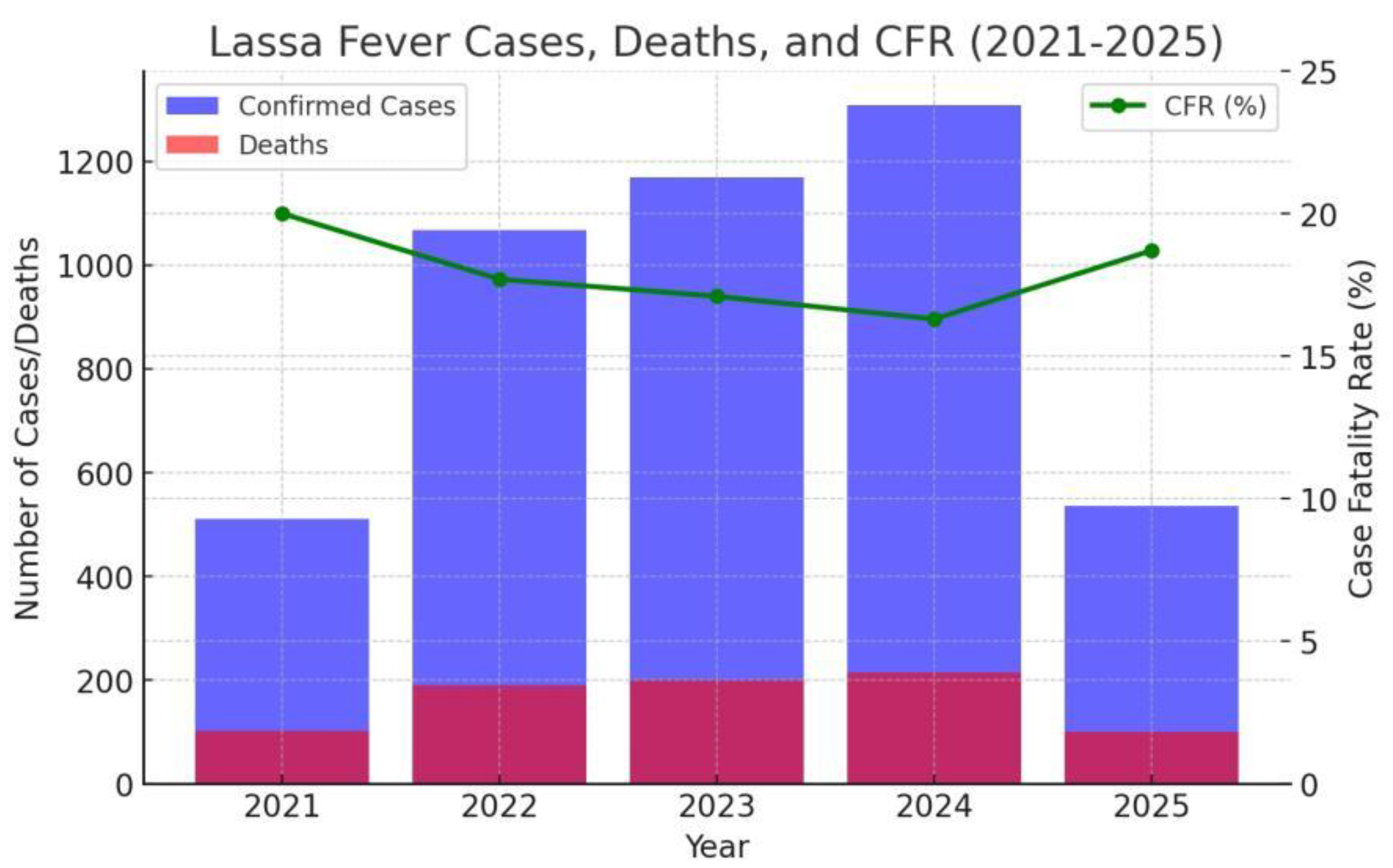

Table 1.
Summary of vaccine candidates and their current statuses (as of Masch 16, 2025).
| Vaccine candidates | Developer | Platform | Clinical trial phase/number | Trial Location | Notes |
| rVSVΔG-LASV-GPC | IAVI & Partners (CEPI, NIH, BARDA, EDCTP) | Recombinant vesicular stomatitis virus (rVSV) expressing LASV-GPC | Phase II ongoing (PACTR202210840719552) | Ghana, Liberia, Nigeria | This candidate is in phase II trials, assessing safety, tolerability, and immunogenicity in adults and children, including those living with HIV [56]. Most advanced trail; enrolling over 600 participants. |
| MV-LASV | Themis Bioscience (now part of Merck), CEPI, Institut Pasteur | Recombinant Measles virus vector | Phase I completed (NCT04055454) | Belgium | Demonstrated promising safety and immunogenicity results in initial trials [44,48,49]. |
| INO-4500 | Inovio pharmaceutical | DNA vaccine encoding LASV-GPC | Phase 1a completed (NCT03805984) Phase 1b ongoing (NCT04093076) |
United States, Ghana | Completed phase Ia trials; further development status to be confirmed [44,48]. |
| EBS-LASV | Emergent BioSolutions | VesiculoVaxTM live attenuated vector | Phase I ongoing (PACT202108781239363) | Ghana | Evaluating safety and immunogenicity in adults [44,48]. |
| ChAdOx1-Lassa-GPC | University of Oxford, CEPI, Janssen Vaccines | Chimpanzee Adenovirus (ChAdOx1) expressing LASV-GPC | Preclinical completed; Phase Ia planned | UK (Phase 1); West Africa (Planned) | Immunogenic; built on same platform as AstraZeneca COVID-19 [57]. |
| LASSARAB | Thomas Jefferson University, NIH | Inactivated Rabies Virus Vector expressing LASV-GPC | Phase 1 ongoing (NCT06546709) | USA (Maryland) | Dual-use potential for rabies and LASV; full protection in NHPs [58] |
IAVI - International AIDS Vaccine Initiative; CEPI - Coalition for Epidemic Preparedness Innovations; NIH - National Institutes of Health; BARDA - Biomedical Advanced Research and Development Authority; NHPs – Non human primates.
Disclaimer/Publisher’s Note: The statements, opinions and data contained in all publications are solely those of the individual author(s) and contributor(s) and not of MDPI and/or the editor(s). MDPI and/or the editor(s) disclaim responsibility for any injury to people or property resulting from any ideas, methods, instructions or products referred to in the content. |
© 2025 by the authors. Licensee MDPI, Basel, Switzerland. This article is an open access article distributed under the terms and conditions of the Creative Commons Attribution (CC BY) license (http://creativecommons.org/licenses/by/4.0/).
Copyright: This open access article is published under a Creative Commons CC BY 4.0 license, which permit the free download, distribution, and reuse, provided that the author and preprint are cited in any reuse.