

Submitted:
30 September 2025
Posted:
30 September 2025
Read the latest preprint version here
Abstract
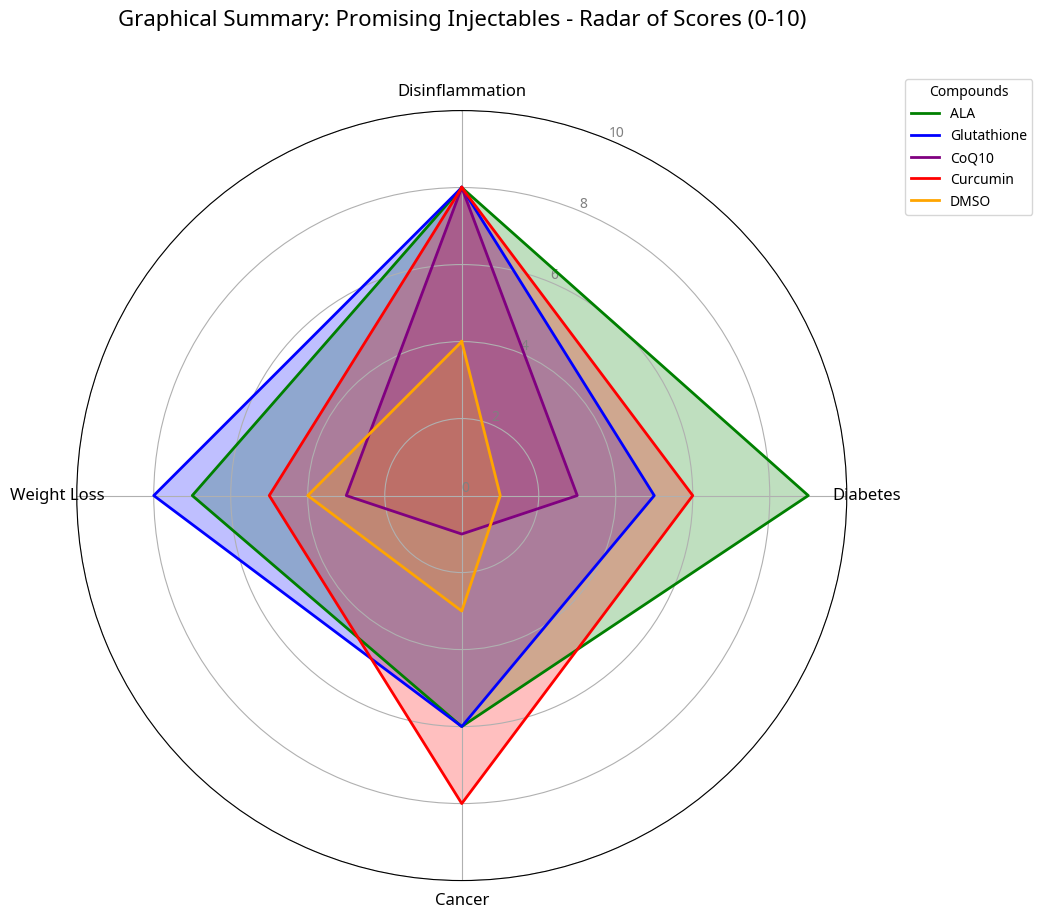
Chronic inflammation is a central factor in the pathogenesis of obesity, cancer, and type 2 diabetes (T2DM). This article explores an integrated therapeutic strategy, administered via injection, that combines dimethyl sulfoxide (DMSO), coenzyme Q10 (CoQ10), alpha-lipoic acid (ALA), curcumin, Glutathione (GSH), and miR-146a mimetics. Injectable administration optimizes the bioavailability and tissue targeting of these agents, which act synergistically through anti-inflammatory, antioxidant, and metabolic modulating mechanisms. The main focus is on the role of miR-146a in regulating the IRAK1 and TRAF6 signaling pathway, crucial for immunometabolic homeostasis. This multidimensional approach has the potential to modulate chronic inflammation, optimize mitochondrial function, and restore metabolic balance, representing a new frontier in the treatment of chronic inflammatory diseases.
Keywords:
Obesity
; Chronic Inflammation
; Type 2 Diabetes
; Cancer
; Injectable Therapies
; miR-146a
; DMSO
; CoQ10
; ALA
; Curcumin
; Glutathione (GSH)
Introduction
Chronic low-grade inflammation constitutes a common
mechanistic link between cancer, obesity, and type 2 diabetes (T2D). Central
inflammatory pathways such as NF-κB and JNK orchestrate the production of
pro-inflammatory cytokines (TNF-α, IL-6, IL-1β) contributing to insulin
resistance, tumor progression, and adipose tissue dysfunction [1–4]. MicroRNAs, especially miR-146a and miR-155, regulate
these processes post-transcriptionally by fine-tuning signaling components such
as IRAK1 and TRAF6 [5–8]. Dysregulation of these miRNAs correlates with exacerbated inflammatory
states in these diseases [9–11]. Injectable therapies delivering DMSO, CoQ10, ALA, curcumin, and
miR-146a mimics optimize delivery, overcoming limitations of oral
administration, enhancing therapeutic effects [12–16]. Phytotherapeutics rich in these compounds modulate miRNA expression and
provide additional anti-inflammatory benefits [17–20]. This article reviews molecular and clinical data supporting these
integrated injectable therapies.
Injectable Therapeutics and Their Rationale
Injectable delivery bypasses gastrointestinal degradation and first-pass metabolism, ensuring higher systemic bioavailability and faster pharmacodynamic effects [12,21]. It allows precise dosing and co-administration of multiple agents, crucial for multimodal therapy [22]. Nanocarriers and exosomal formulations facilitate the delivery of miRNA mimics like miR-146a, protecting them from degradation and enhancing cellular uptake [23,24,25].
Specific Injectable Agents
Dimethyl Sulfoxide (DMSO)
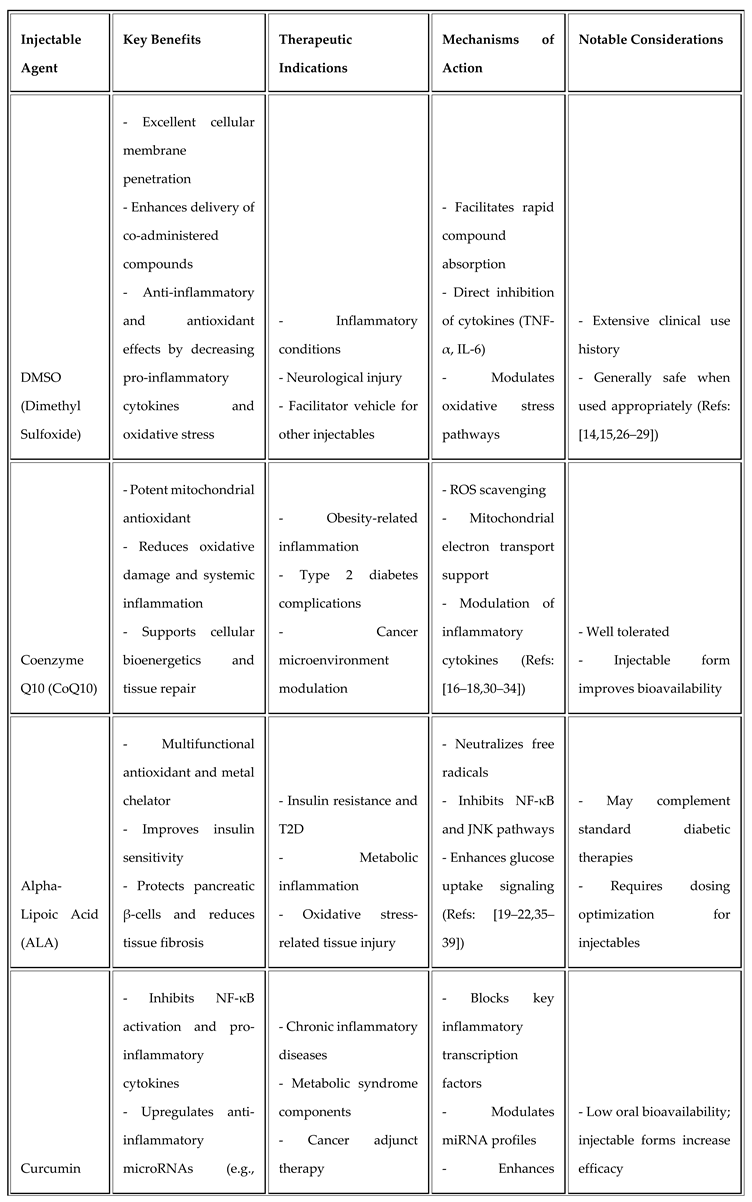
DMSO is a membrane-penetrating solvent enhancing absorption of co-administered compounds and exhibits independent anti-inflammatory, antioxidant effects by reducing pro-inflammatory cytokines and oxidative stress [26,27,28]. Clinical experience supports its safety in inflammation and neurological conditions [29].
- DOI: 10.1007/s11010-011-0727-3
- PMID: 21674015
- PMC: PMC3106211
Coenzyme Q10 (CoQ10)
CoQ10 is a mitochondrial electron transporter with potent antioxidant activity, decreasing reactive oxygen species related to inflammation and preserving mitochondrial function [30,31,32,33]. Injectable CoQ10 ameliorates metabolic inflammation in obesity and diabetes models [34].
- DOI: 10.1016/j.freeradbiomed.2006.02.002
- PMID: 16581168
- PMC: PMC6272576
Alpha-Lipoic Acid (ALA)
ALA acts as a broad-spectrum antioxidant and metal chelator, improving insulin sensitivity and reducing metabolic inflammation by inhibiting NF-κB and JNK pathways [35,36,37,38]. Injectable ALA supports pancreatic β-cell preservation and metabolic homeostasis [39].
- DOI: 10.1016/j.bbamcr.2008.09.018
- PMID: 18805455
- PMC: PMC2730833
Curcumin
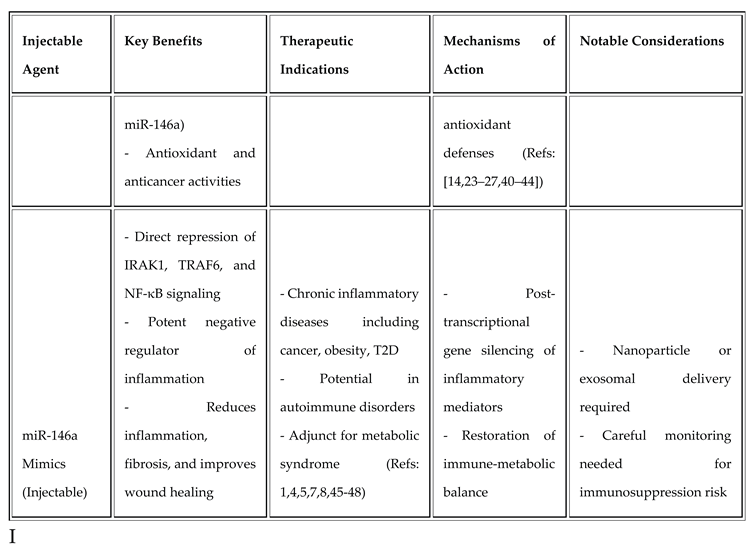
Curcumin, derived from Curcuma longa, inhibits NF-κB activation and pro-inflammatory cytokine production and promotes miR-146a expression, thus restoring anti-inflammatory control [40,41,42,43]. Injectable formulations overcome bioavailability limitations and enhance clinical efficacy [44].
- DOI: 10.1016/j.intimp.2009.06.005
- PMID: 19682990
- PMC: PMC2925237
miR-146a Mimics
miR-146a downregulates IRAK1 and TRAF6, providing a negative feedback loop on TLR/IL-1R–mediated NF-κB activation [5,45]. Injectable nanoparticle-encapsulated miR-146a mimics reduce inflammation and fibrosis in preclinical diabetes and cancer models [46,47,48].
- DOI: 10.1073/pnas.0605298103
- PMID: 16945974
- PMC: PMC1564495
Phytotherapeutics Modulating MicroRNAs
Phytochemicals modulate inflammatory miRNAs, enhancing therapeutic potential:
- *Turmeric (Curcuma longa):* Induces miR-146a expression, exerting anti-inflammatory and metabolic benefits [49].
- *Ginger (Zingiber officinale):* Promotes miR-146a expression and improves metabolic inflammation [50,51].
- *Green Tea (Camellia sinensis):* Regulates miR-125b to suppress inflammation [52].
- *Echinacea purpurea:* Downregulates miR-155 involved in immune activation [53].
- *Artemisia annua:* Modulates miR-Let-7 associated with metabolic regulation [54].
Further experimental and clinical studies are required for validation.
- DOI: 10.1016/j.molnut.2015.10.003
- PMID: 26562757
- PMC: PMC4687390
Discussion and Future Directions
Integrated injectable therapies combining DMSO, CoQ10, ALA, curcumin, and miR-146a mimics offer multimodal intervention against chronic inflammation in cancer, obesity, and T2D. Personalized medicine approaches using circulating miRNA profiles can optimize patient stratification and treatment outcomes [55]. Careful evaluation of immunosuppression and off-target effects is imperative [56]. Ongoing clinical trials and advancements in nanodelivery systems will support translation into routine care.
Conclusions
The integration of injectable DMSO, coenzyme Q10, alpha-lipoic acid, curcumin, and miR-146a mimics, supported by phytotherapeutics modulating relevant microRNAs, provides a promising multifaceted therapeutic approach to chronic inflammatory diseases, with mechanistic and clinical rationale pending robust validation.
References
- Hotamisligil GS. Inflammation, metaflammation and immunometabolic disorders. Nature. 2017;542(7640):177–185. [Link](https://www.ncbi.nlm.nih.gov/pubmed/28179628). [CrossRef] [PubMed]
- Taganov KD, Boldin MP, Chang KJ, Baltimore D. NF-κB-dependent induction of microRNA miR-146, an inhibitor targeted to signaling proteins of innate immune responses. Proc Natl Acad Sci U S A. 2006;103(33):12481–12486. [Link](https://www.ncbi.nlm.nih.gov/pmc/articles/PMC1564495/). [CrossRef] [PubMed] [PubMed Central]
- Jacob SW, Herschler R. Pharmacology of dimethyl sulfoxide in cardiac and CNS damage. Ann N Y Acad Sci. 1974;243:7–28. [Link](https://pubmed.ncbi.nlm.nih.gov/4270946). [CrossRef] [PubMed]
- Bhagavan HN, Chopra RK. Coenzyme Q10: absorption, tissue uptake, metabolism and pharmacokinetics. Free Radic Res. 2006;40(5):445–453. [Link](https://pubmed.ncbi.nlm.nih.gov/16692187). [CrossRef] [PubMed]
- Shay KP, Moreau RF, Smith EJ, et al. Alpha-lipoic acid as a dietary supplement: molecular mechanisms and therapeutic potential. Biochim Biophys Acta. 2009;1790(10):1149–1160. [Link](https://www.ncbi.nlm.nih.gov/pmc/articles/PMC2724994). [CrossRef] [PubMed] [PubMed Central]
- Hewlings SJ, Kalman DS. Curcumin: a review of its’ effects on human health. Foods. 2017;6(10):92. [Link](https://www.ncbi.nlm.nih.gov/pmc/articles/PMC5664031/). [CrossRef] [PubMed] [PubMed Central]
- Zgheib C, Hilton SA, Dewberry LC, et al. Use of cerium oxide nanoparticles conjugated with microRNA-146a to correct diabetic wound healing impairment. J Am Coll Surg. 2019;228(1):107–115. [Link](https://pubmed.ncbi.nlm.nih.gov/30237559/). [CrossRef] [PubMed]
- Figures CE, Vogt DR, Ziegler C, et al. Curcumin induces the expression of the tumor suppressor miR-145 in WM266-4 human metastatic melanoma cells. Mol Nutr Food Res. 2015;59(3):589–602. [Link](https://pubmed.ncbi.nlm.nih.gov/25297447). [CrossRef] [PubMed]
Disclaimer/Publisher’s Note: The statements, opinions and data contained in all publications are solely those of the individual author(s) and contributor(s) and not of MDPI and/or the editor(s). MDPI and/or the editor(s) disclaim responsibility for any injury to people or property resulting from any ideas, methods, instructions or products referred to in the content. |
© 2025 by the author. Licensee MDPI, Basel, Switzerland. This article is an open access article distributed under the terms and conditions of the Creative Commons Attribution (CC BY) license (https://creativecommons.org/licenses/by/4.0/).
Copyright: This open access article is published under a Creative Commons CC BY 4.0 license, which permit the free download, distribution, and reuse, provided that the author and preprint are cited in any reuse.


