
Submitted:
27 September 2025
Posted:
29 September 2025
You are already at the latest version
Abstract
Personalized news recommendation is difficult because news content does not last long, user interests change quickly, and the text is often short. To solve these problems, we present HKNR (Hybrid Knowledge-Augmented News Recommender), a single recommendation system that combines three parts: choosing candidates using LLaMA-2-7B embeddings, modeling users with graphs, and ranking with added knowledge. HKNR uses large language model embeddings to find articles with similar meanings, graph convolutional networks to learn how users behave over time, and a multi-layer ranking network that mixes article meanings with outside information like entities and topics. The system is trained using a loss that includes classification, ranking, and reconstruction. To make the system more general, we also use methods like dynamic negative sampling, embedding dropout, and gradient clipping. Tests show that HKNR works well on many evaluation measures and performs better than other common methods.
Keywords:
news recommendation
; large language models
; graph neural networks
; knowledge fusion
; multi-task learning
1. Introduction
Personalized news recommendation in fast-changing online settings is still a hard task. News content changes quickly, user interests shift fast, and user data is often limited. Because of this, traditional methods like collaborative filtering and simple neural models often do not work well. They do not fully understand the meaning of articles or follow user changes over time.
To fix this, we build HKNR. It is a hybrid system that includes three main parts: finding candidates based on meaning, modeling users with graphs, and ranking with added knowledge. First, it uses LLaMA-2-7B embeddings to understand article content and pick possible items. Then, it builds time-aware graphs from user actions, and graph neural networks are used to learn long-term preferences. This helps the system use both recent clicks and patterns in past behavior.
Next, in the ranking part, HKNR mixes article meanings with outside information like topics and entities. It does this through gated feature mixing and residual networks. The model is trained using several goals at once: classification, ranking, and reconstruction. These goals help improve accuracy and make the system more stable. By combining all these parts, HKNR connects article meaning, user modeling, and outside knowledge in one system.
2. Related Work
Graph neural networks (GNNs) are good at learning from user-item data. Gao et al.[1] looked at their use in recommendation and pointed out problems like poor scaling. Qiu et al.[2] built graphs to show user interests, but they did not include time. Wang et al.[3] fixed this by adding time-aware GNNs for short-term preferences.
Adding outside knowledge can also help. Chen et al.[4] added collaborative signals to GCNs, which helped with meaning but not with tracking user changes.Luo et al.[5] introduce Gemini-GraphQA, a novel graph QA framework that combines the Gemini LLM with graph neural encoders, a solver network for translating questions into executable graph code, retrieval-augmented generation, and an execution correctness loss to ensure syntactic and functional accuracy, yielding state-of-the-art performance on graph-structured reasoning tasks.
Some works also combine many types of data. Zhang et al.[6] used multiple graphs for social recommendation. Zhang et al.[7] used recurrent GNNs to follow user changes, but they needed a lot of data.
Gao et al.[8] used large language models to generate recommendations, but they did not include user behavior. Yu[9] proposes DynaSched-Net, a dual-network cloud scheduler that integrates a DQN-based reinforcement learning module with an LSTM-Transformer predictive model—trained via a joint loss and stabilized by experience replay and target networks—to dynamically allocate resources and outperform traditional FCFS and RR policies.
HKNR brings together meaning-based search, graph-based user modeling with time, and ranking with added knowledge. This makes it strong and able to work well in real news recommendation tasks.
3. Methodology
HKNR consists of three stages: (1) Semantic Recall, where user histories and candidate articles are embedded with LLaMA and retrieved via nearest-neighbor search; (2) Graph Encoding, in which these interactions form a heterogeneous graph processed by multi-layer GCNs with attention pooling; and (3) Knowledge-Augmented Ranking, where items are enriched with topic and entity embeddings and fused with user intent through gated attention and cross-feature interaction networks. The model is trained end-to-end on a composite loss combining pointwise accuracy, pairwise ranking and semantic reconstruction. On large-scale logs, HKNR significantly outperforms strong baselines in AUC, NDCG and Recall.
4. Overall Architecture
HKNR’s three modules—LLM-driven recall, graph-based encoding and knowledge-augmented ranking—work in sequence to balance retrieval and deep modeling. For user u and item i, the score is
where and extract user and article embeddings and holds structured knowledge. Figure 1 illustrates this pipeline.
4.1. Stage 1: LLaMA-Based Semantic Recall
Rather than BM25 or TF-IDF, we use a frozen LLaMA-2-7B to encode each article body via its final [CLS] token:
with normalization. User embedding is formed from the most recent clicks in history with exponential time decay:
where (hours) and . Candidate retrieval over millions of articles employs FAISS with product quantization. To improve robustness, we apply:
- Embedding Dropout: 10% dropout on .
- Multi-query Ensemble: add to during top-K recall.
The recall stage outputs with .
4.2. Stage 2: Graph-Based User Encoding
User interactions are represented as a temporal graph , with each node initialized by its LLaMA embedding . A two-layer GCN (hidden dim=128, ReLU) updates:
For regularization and temporal awareness, we apply edge dropout (10%), edge time bucketing, layer normalization with residual connections, and dropout (); GCN weights use weight decay. The graph is pooled via temporal attention:
where is a metadata-conditioned vector. Figure 2 illustrates this process.
4.3. Stage 3: Knowledge-Augmented Ranking Network
The ranking stage processes user-candidate pairs from the recall stage and computes final engagement probabilities . To enrich article representation, we fuse semantic embeddings with structured knowledge embeddings , which are derived from entity and topic annotations using an external taxonomy graph (e.g., IPTC Media Topics). The pipline of Knowledge-Augmented Ranking Network is show in Figure 3
Gated fusion combines and :
Cross features between user and article are:
A 3-layer residual MLP produces :
To enhance robustness:
- Auxiliary Reconstruction: .
- Dynamic Negative Sampling: Non-clicked negatives from h.
- Soft Label Smoothing: .
Optimization uses AdamW (lr=), cosine decay, batch size 1024, and early stopping on NDCG@10.
5. Loss Function
The model minimizes a weighted combination of three objectives:
with , , . Figure 4 shows their training curves.
5.1. Binary Cross-Entropy Loss
Click prediction is framed as:
with label smoothing to .
5.2. Pairwise Ranking Loss (BPR)
For ranking quality:
using negatives sampled within h.
5.3. Semantic Reconstruction Loss
To preserve fused embedding fidelity:
5.4. Optimization Details
- Gradient Clipping: norm capped at 5.0.
- Learning Rate Scheduling: cosine decay with 5-epoch warmup.
- L2 Regularization: weight decay .
6. Data Preprocessing
We apply a four-step pipeline to transform anonymized Ekstra Bladet logs—clicks, metadata, timestamps and content—into semantically aligned features for HKNR.
6.1. Session Segmentation
Sessions are split by a 30min inactivity threshold:
Sessions with fewer than two clicks are discarded.
6.2. Text Cleaning and Tokenization
HTML tags and non-letter characters are removed, punctuation is standardized, and only Danish/English letters remain. Each document is tokenized via the LLaMA pre-tokenizer:
Documents exceeding 512 tokens are truncated to the title plus first two paragraphs. Figure 5 shows the recency heatmap and a word cloud.
6.3. Temporal Feature Normalization
Each timestamp is normalized as
yielding . Entries with missing or inconsistent timestamps (<0.5%) are removed.
6.4. Training Triplet Construction
We form triplets for BPR and BCE: is a clicked article; is a non-clicked item within 48h, sampled from impressions or same-category items. Soft negatives come from users with
keeping . Figure 6 illustrates the composition.
7. Experiment Results
We compare our proposed HKNR model with several widely adopted recommendation baselines, including traditional collaborative filtering, neural matrix factorization, and modern deep learning-based architectures. The evaluation is conducted across six metrics: AUC, NDCG@10, Recall@10, MRR@10, Precision@10, and HitRate@10. Table 1 summarizes the overall performance.
7.1. Ablation Study
To verify the effectiveness of each major module in our HKNR architecture, we conduct ablation experiments by removing key components.
8. Conclusion
This paper presents HKNR, a hybrid recommendation framework that leverages LLaMA-based recall, graph-based user encoding, and knowledge-enhanced ranking for online news personalization. Experimental results on a real-world dataset demonstrate its superiority over classical and modern baselines. Each component of HKNR contributes meaningfully to the final performance, as shown in ablation analysis. Future work includes exploring multi-lingual pretraining and real-time latency optimization for deployment.
References
- Gao, C.; Zheng, Y.; Li, N.; Li, Y.; Qin, Y.; Piao, J.; Quan, Y.; Chang, J.; Jin, D.; He, X.; et al. A survey of graph neural networks for recommender systems: Challenges, methods, and directions. ACM Transactions on Recommender Systems 2023, 1, 1–51. [Google Scholar] [CrossRef]
- Qiu, Z.; Hu, Y.; Wu, X. Graph neural news recommendation with user existing and potential interest modeling. ACM Transactions on Knowledge Discovery from Data (TKDD) 2022, 16, 1–17. [Google Scholar] [CrossRef]
- Wang, L.; Jin, D. A time-sensitive graph neural network for session-based new item recommendation. Electronics 2024, 13, 223. [Google Scholar] [CrossRef]
- Chen, Y.; Yang, Y.; Wang, Y.; Bai, J.; Song, X.; King, I. Attentive knowledge-aware graph convolutional networks with collaborative guidance for personalized recommendation. In Proceedings of the 2022 IEEE 38th International Conference on Data Engineering (ICDE). IEEE; 2022; pp. 299–311. [Google Scholar]
- Luo, X.; Wang, E.; Guo, Y. Gemini-GraphQA: Integrating Language Models and Graph Encoders for Executable Graph Reasoning. In Proceedings of the 2025 Information Science Frontier Forum and the Academic Conference on Information Security and Intelligent Control (ISF). IEEE; 2025; pp. 70–74. [Google Scholar]
- Zhang, C.; Wang, Y.; Zhu, L.; Song, J.; Yin, H. Multi-graph heterogeneous interaction fusion for social recommendation. ACM Transactions on Information Systems (TOIS) 2021, 40, 1–26. [Google Scholar] [CrossRef]
- Zhang, C.Y.; Yao, Z.L.; Yao, H.Y.; Huang, F.; Chen, C.P. Dynamic representation learning via recurrent graph neural networks. IEEE Transactions on Systems, Man, and Cybernetics: Systems 2022, 53, 1284–1297. [Google Scholar] [CrossRef]
- Gao, S.; Fang, J.; Tu, Q.; Yao, Z.; Chen, Z.; Ren, P.; Ren, Z. Generative news recommendation. Proceedings of the Proceedings of the ACM Web Conference 2024 2024, 3444–3453. [Google Scholar]
- Yu, Y. Towards Intelligent Cloud Scheduling: DynaSched-Net with Reinforcement Learning and Predictive Modeling. Preprints 2025. [Google Scholar] [CrossRef]
Figure 1.
Three-stage HKNR pipeline.
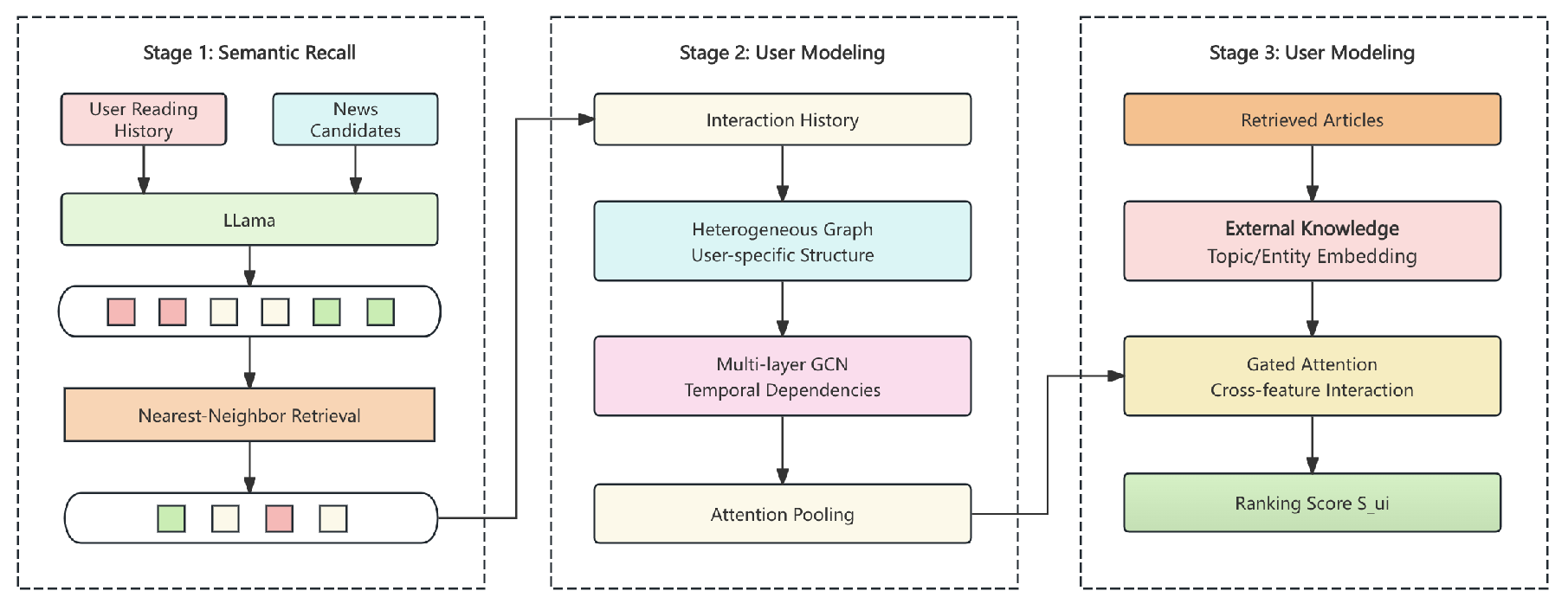
Figure 2.
Detailed architecture of Stage 2: Graph-based user encoding.
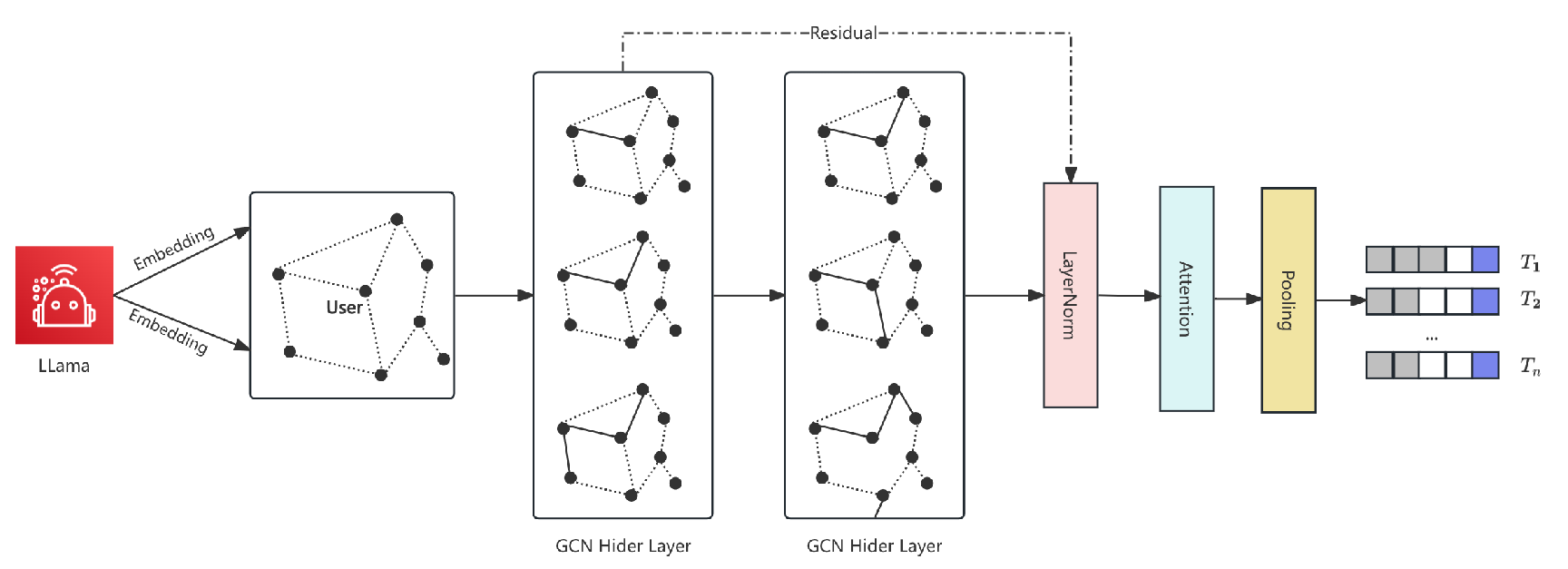
Figure 3.
The pipline of Knowledge-Augmented Ranking Network.
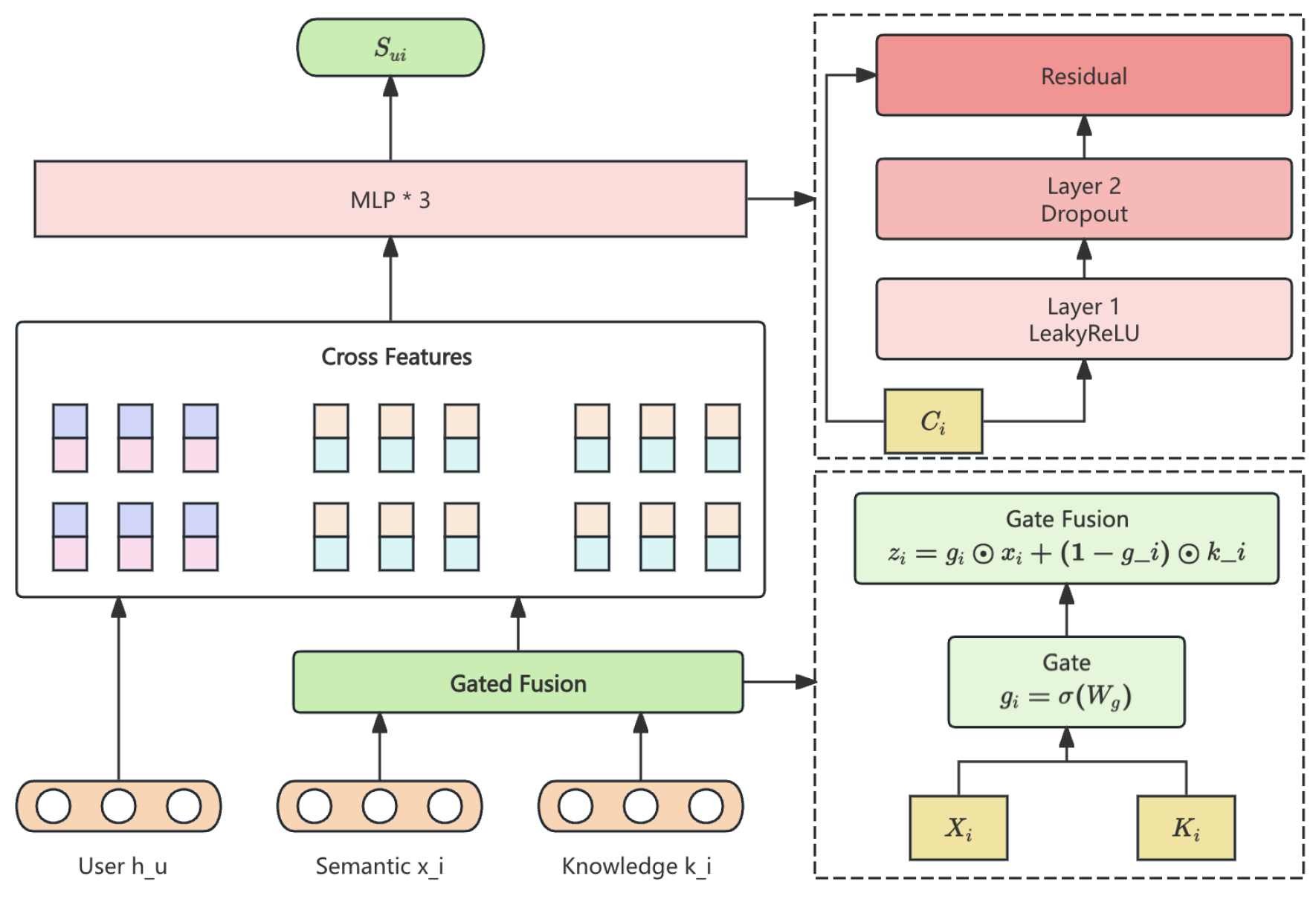
Figure 4.
Training loss evolution for BCE, BPR and reconstruction.
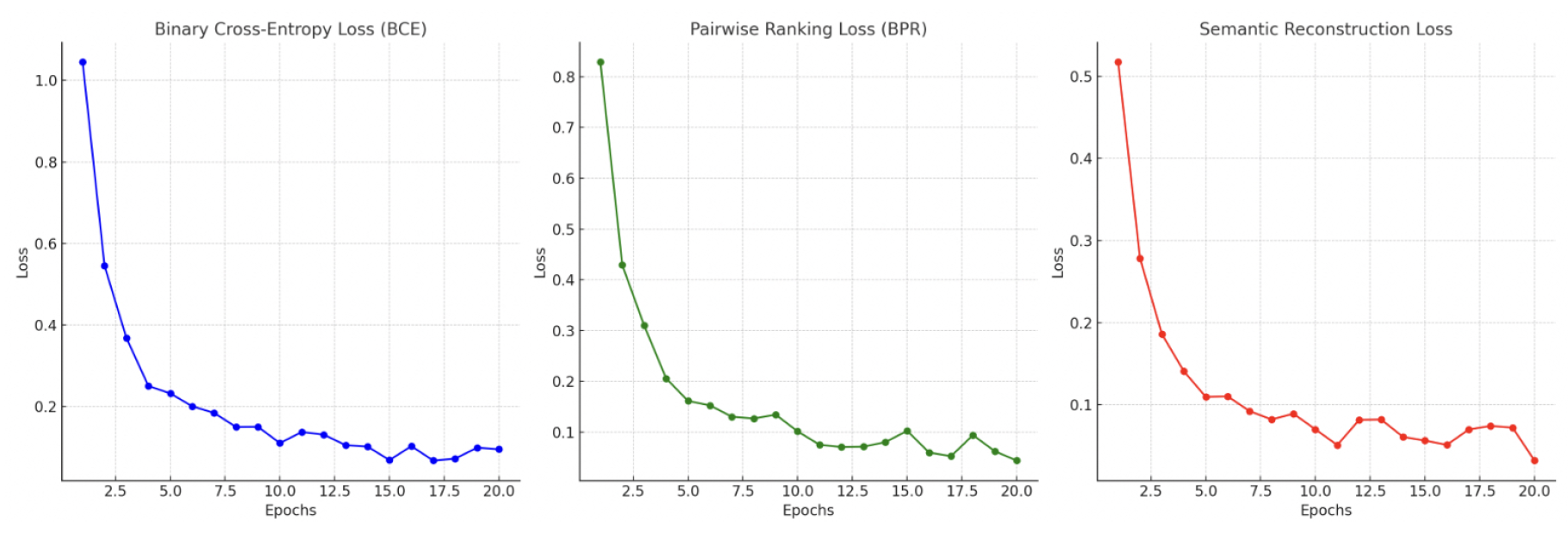
Figure 5.
Left: normalized interaction recency () heatmap. Right: word cloud after cleaning and tokenization.
Figure 5.
Left: normalized interaction recency () heatmap. Right: word cloud after cleaning and tokenization.
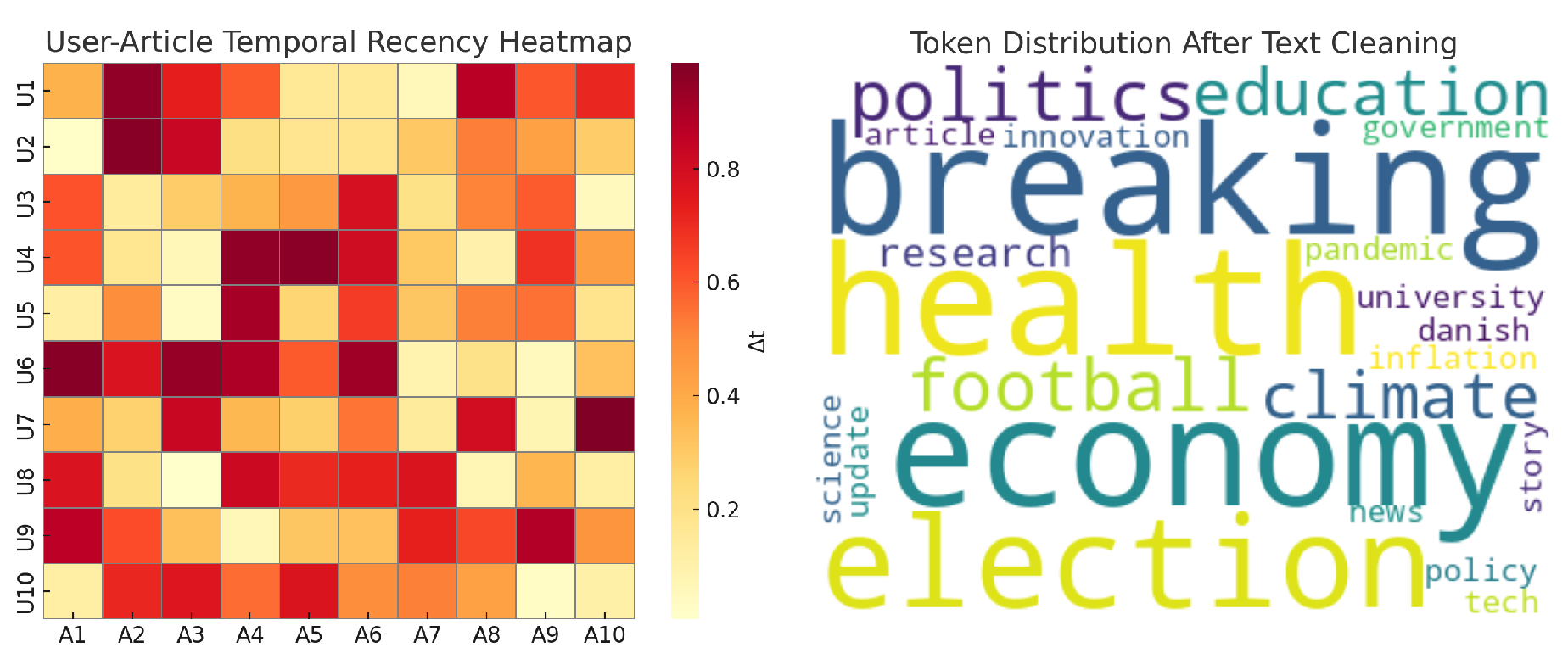
Figure 6.
Left: distribution of triplet components (positive, cold, soft negatives). Right: token length distribution after truncation.
Figure 6.
Left: distribution of triplet components (positive, cold, soft negatives). Right: token length distribution after truncation.
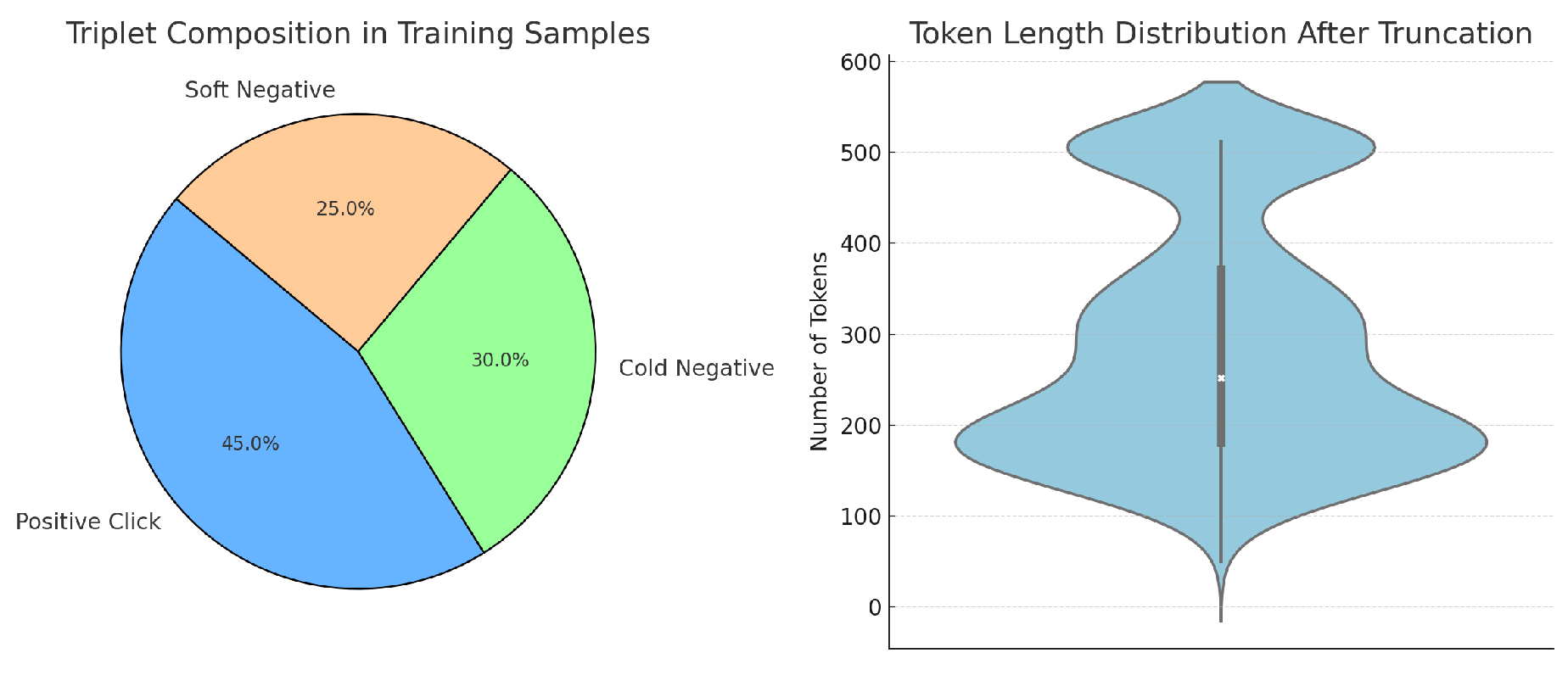
Figure 7.
Model indicator change chart.
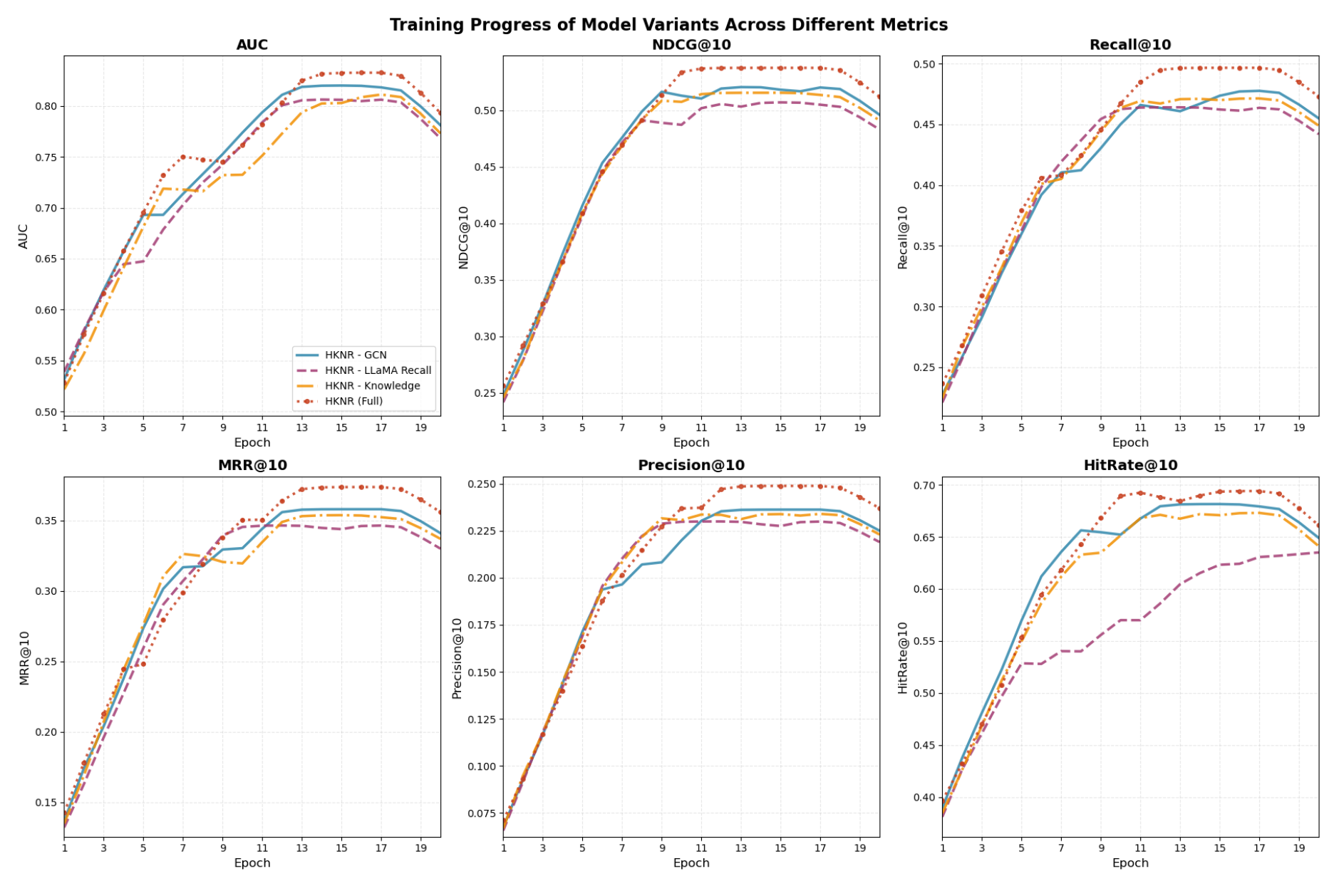

Table 1.
Overall Performance Comparison Across Multiple Metrics
| Model | AUC | NDCG@10 | Recall@10 | MRR@10 | Precision@10 | HitRate@10 |
|---|---|---|---|---|---|---|
| ItemKNN | 0.701 | 0.418 | 0.398 | 0.275 | 0.192 | 0.587 |
| BPR-MF | 0.732 | 0.447 | 0.422 | 0.295 | 0.204 | 0.604 |
| NeuMF | 0.748 | 0.462 | 0.437 | 0.312 | 0.213 | 0.616 |
| GRU4Rec | 0.762 | 0.481 | 0.452 | 0.326 | 0.219 | 0.634 |
| SASRec | 0.770 | 0.489 | 0.461 | 0.335 | 0.224 | 0.643 |
| DSSM | 0.753 | 0.454 | 0.428 | 0.308 | 0.211 | 0.615 |
| DIN | 0.774 | 0.492 | 0.465 | 0.339 | 0.227 | 0.646 |
| FPMC | 0.745 | 0.440 | 0.417 | 0.296 | 0.198 | 0.609 |
| NAML | 0.778 | 0.495 | 0.468 | 0.343 | 0.230 | 0.649 |
| HKNR (ours) | 0.793 | 0.512 | 0.473 | 0.356 | 0.237 | 0.661 |
Table 2.
Ablation Study Results on HKNR Components
| Model Variant | AUC | NDCG@10 | Recall@10 | MRR@10 | Precision@10 | HitRate@10 |
|---|---|---|---|---|---|---|
| HKNR - GCN | 0.781 | 0.496 | 0.455 | 0.341 | 0.225 | 0.649 |
| HKNR - LLaMA Recall | 0.768 | 0.483 | 0.442 | 0.330 | 0.219 | 0.635 |
| HKNR - Knowledge | 0.773 | 0.491 | 0.449 | 0.337 | 0.223 | 0.641 |
| HKNR (Full) | 0.793 | 0.512 | 0.473 | 0.356 | 0.237 | 0.661 |
Disclaimer/Publisher’s Note: The statements, opinions and data contained in all publications are solely those of the individual author(s) and contributor(s) and not of MDPI and/or the editor(s). MDPI and/or the editor(s) disclaim responsibility for any injury to people or property resulting from any ideas, methods, instructions or products referred to in the content. |
© 2025 by the authors. Licensee MDPI, Basel, Switzerland. This article is an open access article distributed under the terms and conditions of the Creative Commons Attribution (CC BY) license (http://creativecommons.org/licenses/by/4.0/).
Copyright: This open access article is published under a Creative Commons CC BY 4.0 license, which permit the free download, distribution, and reuse, provided that the author and preprint are cited in any reuse.


