

Submitted:
28 September 2025
Posted:
29 September 2025
You are already at the latest version
Abstract
Fishery anesthetics are extensively employed in aquaculture to mitigate stress and reduce mortality during handling, transportation, and processing of fish. While they enhance operational efficiency and reduce economic losses for fish merchants, the potential residual presence of these anesthetics raises concerns regarding human health risks and environmental impact. This review examines six commonly used anesthetics in aquaculture—eugenol, MS-222, benzocaine, 2-phenoxyethanol, diazepam, and quinaldine—focusing on their mechanisms of action, application risks, ecotoxicological effects, and methods for residue analysis. The objective is to promote the safe and informed application of these anesthetics, mitigate their biological toxicity, and minimize their ecological impact. Furthermore, the review provides technical insights into monitoring and managing anesthetic residues in aquaculture to ensure the safety of aquatic products and safeguard environmental health, while also supporting the development of sustainable aquaculture practices.
Keywords:
aquatic products
; fishery anesthetics
; analytical methods
; food safety
1. Introduction
Fresh aquatic products are an important source of high-quality protein and essential nutrients,playing a valuable role in a balanced human diet [1]. Owing to their desirable flavor, high nutritional value, and low cholesterol content, these products are widely consumed worldwide. With the expansion of the seafood market, however, ensuring the safety of aquatic products has become a major concern. Consumers are increasingly attentive not only to nutritional benefits but also to potential hazards such as chemical residues, contaminants, and improper handling practices.
The application of fishery anesthetics is a critical practice to mitigate stress during aquaculture operations [2]. Procedures such as transport and handling can induce intense stress, leading to injury, mortality, and compromised product quality [3]. The judicious use of anesthetics helps minimize these adverse effects, supports animal welfare, and can enhance antioxidant capacity, thereby extending shelf life [4,5]. However, the safety and efficacy of these compounds are dose-dependent. It is therefore essential to establish optimal dosage regimes and understand their physiological impacts to safeguard both fish health and consumer safety.
In many regions, the application of anesthetics is not sufficiently regulated. Dosages and withdrawal periods are often determined empirically, increasing the risk of unsafe residue levels in edible tissues. Moreover, regulatory standards for maximum residue limits (MRLs) and withdrawal periods vary significantly among countries, and some anesthetics still lack established guidelines (Table 1). These regulatory gaps underline the need for more research on rapid detection methods, residue elimination kinetics, and anesthetic efficacy.
This review provides a comprehensive analysis of commonly used fishery anesthetics, with a focus on their safety evaluation, residue detection techniques, and implications for food safety. Recent advances in residue depletion studies and analytical methodologies are highlighted, with the aim of supporting the rational and safe use of anesthetics in aquaculture. The paper also identifies current research gaps and suggests future directions to strengthen regulatory frameworks and ensure the protection of public health.
2. Overview of Fishery Anesthetics
Fishery anesthetics are chemical agents employed in aquaculture to induce sedation or temporary immobility in fish,thereby reducing stress and physical injury during operations such as transport, handling, sampling, and artificial reproduction [6,7]. By suppressing stress responses, these compounds help maintain fish welfare, lower mortality, decrease disease susceptibility, and preserve flesh quality [8]. Stress-related metabolic changes—such as lactic acid accumulation—can impair meat texture and overall product quality; anesthetic use helps mitigate these effects.
Common fishery anesthetics include tricaine methanesulfonate (MS-222), isoeugenol, eugenol, benzocaine, 2-phenoxyethanol, quinaldine, tetracaine, and bupivacaine. These substances differ in chemical properties, efficacy, and safety profiles. Depending on their solubility (water-soluble or fat-soluble), they act on the central nervous system to produce reversible sedation or anesthesia. Figure 1 illustrates their chemical structures, aiding in understanding their molecular characteristics and potential residue behavior.
Appropriate selection and dosing of anesthetics are critical not only for fish welfare but also for compliance with humane treatment standards and food safety regulations. Moving forward, a deeper exploration of the pharmacological principles of commonly used anesthetics, will help further clarify their mechanisms of action and safety profiles in aquaculture.
3. Pharmacological Actions and Safety Assessment
3.1. Eugenol
Eugenol, derived primarily from clove oil, contains 85-95% eugenol as the main active ingredient, with minor components such as methyl eugenol and isoeugenol [9,10]. It acts as an effective anesthetic by inducing temporary immobility in fish, reducing stress responses during procedures like transportation, handling, and artificial reproduction. This leads to minimized physical injuries, such as mechanical damage and scale loss, and lowers the risk of subsequent infections [7]. Additionally, eugenol decreases ammonia excretion in fish by reducing metabolic rates, which enhances water quality and lowers ammonia toxicity [11]. Eugenol also possesses antioxidant and anti-inflammatory properties that help mitigate stress responses during anesthesia [12].
Fishery anesthetics are primarily absorbed through the gills, accumulating in tissues and being eliminated via the same route [13,14]. Studies on eugenol in Pacific white shrimp revealed that, regardless of treatment duration (e.g., 300 mg L-1 for 5 minutes or 10 mg L-1 for 24 hours), residual eugenol concentrations fell below 2.5 mg kg-1 within 24.5 hours. This indicates a rapid depletion of eugenol residues, suggesting a low risk of exceeding the FAO/WHO acceptable daily intake (ADI) when shrimp are consumed [15]. Moreover, the half-life of eugenol in seabass varies with water temperature, demonstrating faster metabolism at higher temperatures (e.g., 2 hours at 20°C vs. over 4 hours at 13°C) [16]. These findings suggest that temperature control can enhance eugenol metabolism, accelerating residue elimination in fish tissues.
Although eugenol is effective as an anesthetic, it poses cytotoxic risks at high concentrations. In vitro studies have shown that eugenol can cause developmental abnormalities in zebrafish embryos, including skeletal deformities and pericardial edema, when exposed to concentrations between 0.5 and 2 mg L-1 [17]. Tao et al. also found that eugenol exposure delayed the hatching of zebrafish embryos, reduced their body length, and decreased the inflation rate of their swim bladders [18].Additionally, eugenol has been linked to cytotoxicity in various cell lines [19], including mouse fibroblasts [20], rat hepatocytes [21], and human dental pulp fibroblasts [22,23]. In vivo studies have also demonstrated its potential for oral mucosal damage in rats [24,25]. Despite these risks, studies on rats and other animals have shown no toxicity at low concentrations, further supporting its safety when used according to guidelines [26].
Eugenol has been approved as a fish anesthetic in several countries, including New Zealand, Japan, Australia, Chile, and Finland [27]. In Japan, the MRL is 50 ng mL-1, with a withdrawal period of 7 days for fish and 10 days for crustaceans [28]. The Joint FAO/WHO Expert Committee on Food Additives (JECFA) has set an acceptable daily intake (ADI) of 2.5 mg kg-1 for eugenol [29]. However, there are no established MRLs or withdrawal periods for eugenol in the United States and China. The U.S. FDA permits eugenol as a food additive at concentrations up to 1.5 g kg-1 but does not approve it for use as a fish anesthetic [30]. Given the variability in regulation across regions, it is essential to adhere to local guidelines to ensure the safety of seafood for human consumption.d mesenchymal stem cells (HASCs), indicating cytotoxic effects [31].
3.2. MS-222
MS-222 (3-aminobenzoic acid ethyl ester methanesulfonate), commonly known as tricaine, is widely used as an anesthetic for aquatic animals. It is absorbed into the bloodstream through the gills and skin and distributed throughout the body [32]. MS-222 primarily induces anesthesia by blocking sodium ion channels in muscle cells and, to a lesser extent, potassium ion channels in nerve membranes. This mechanism leads to a loss of consciousness and reduced metabolic activity [33]. The anesthetic efficacy of MS-222 depends on biological factors such as fish species, size, and environmental factors like water temperature, pH, and salinity [34]. MS-222 is preferred for its low effective dosage, rapid onset, quick recovery, and minimal side effects, making it a widely used anesthetic in fisheries worldwide [35]. Importantly, MS-222 does not accumulate in fish tissues, leaving minimal residues in muscle, ensuring its safety and effectiveness.
MS-222, initially developed as a substitute for cocaine, is the only anesthetic approved by the U.S. FDA for aquaculture, although its use is limited to specific fish families, such as Ictaluridae, Salmonidae, Esocidae, and Percidae [36]. It is absorbed and eliminated through diffusion across the gill membranes, with no involvement of unmetabolized parent compounds [37]. In fish, MS-222 is mainly metabolized via two pathways: (i) hydrolysis of the ethyl ester to yield m-aminobenzoic acid, which is subsequently N-acetylated, and (ii) N-acetylation of the parent compound followed by hydrolysis [38]. These processes predominantly occur in the liver and gills. In adult rainbow trout, MS-222 and its metabolite, ethyl-meta-acetylaminobenzoate, are excreted through the kidneys. Fish treated with MS-222 in Canada must be held in clean water for 21 days before marketing, with a mandatory 7-day waiting period [39].
Prolonged exposure to MS-222 can cause skin and respiratory irritation and, in rare cases, retinal damage [40]. While MS-222 has been shown to be toxic to certain fish species at high concentrations, its high water solubility and absence of documented human health risks support its use as a safe anesthetic when the recommended withdrawal period is followed. Studies have shown that MS-222 significantly reduces stress in fish during anesthesia, improving animal welfare during aquaculture operations [41]. However, it is essential to monitor exposure to avoid potential toxicity, especially in species with higher sensitivity .
MS-222 is approved as a fish anesthetic in several countries, including the United States, Norway, and New Zealand, with withdrawal periods of 21, 21, and 10 days, respectively, before consumption [38]. However, it is not approved in China, Spain, Greece, or France, and no official national standard methods for residue detection have been established in these countries. Despite this, MS-222 remains one of the most widely used anesthetics in global aquaculture, with established withdrawal periods and guidelines in regions where it is permitted [38]. The U.S. FDA allows its use in aquaculture with specific restrictions on fish families and requires adherence to withdrawal periods to ensure food safety.
3.3. Benzocaine
Benzocaine (ethyl p-aminobenzoate) is a widely used local anesthetic known for its rapid onset, low toxicity, stable efficacy, and prolonged effect. It works by binding to sodium ion channels, blocking nerve impulse transmission. These properties make benzocaine an ideal anesthetic for various aquatic species, including juvenile Colossoma macropomum and Aulonocara nyassae, offering a cost-effective alternative to other anesthetics [42,43].
Benzocaine is absorbed into fish and metabolized into N-acetylbenzocaine, which is then excreted through the gills, kidneys, and bile [44]. A study by Meinertz et al. on rainbow trout demonstrated that 59.2% of benzocaine residues were excreted through the gills within 3 hours, while renal elimination was slower, with only 2.7% excreted through the kidneys after three hours, and 9.0% after 24 hours. Bile also contributed to the elimination of 2.0% of the administered dose after 24 hours [45]. These findings highlight that the gills are the primary route of elimination, with the kidneys and biliary system serving secondary roles.
While benzocaine is considered safe for use in aquaculture, excessive exposure can lead to toxicity, including arrhythmias, coma, and pulmonary complications [46]. It may also cause allergic reactions, such as contact dermatitis and hypersensitivity [47]. Despite its generally low toxicity, the use of benzocaine as an aquatic anesthetic has been prohibited in several countries, mainly due to concerns about residue control and food safety. Nevertheless, genotoxicity studies have demonstrated that benzocaine does not possess genotoxic properties. [48].
Benzocaine is subject to regulatory oversight in several countries. In the United States, the FDA has set an import tolerance of 50 μg kg-1 for benzocaine residues in fish muscle, with the expectation that residue levels will diminish to minimal concentrations within 24 hours after treatment. Regulatory authorities in Australia and New Zealand have set a maximum residue limit (MRL) of 0.05 mg kg-1 in finfish, ensuring detectable residues are minimal or below the detection limit [49]. However, China has yet to establish specific regulations for the use of benzocaine in aquaculture.
3.4. 2-Phenoxyethanol
2-Phenoxyethanol is a colorless, oily liquid, soluble in water, and commonly used as a local anesthetic in aquaculture [50]. In fish, it is absorbed across the gills and skin and transported by arterial blood to the central nervous system, while excretion takes place mainly through branchial respiration. In rainbow trout, its biological half-life is approximately 30 minutes [51]. Although the exact mechanism of action remains unclear, studies suggest that it may act by expanding neuronal cell membranes [52].
While it offers low cost and strong bactericidal properties, 2-phenoxyethanol poses residue concerns, has a prolonged duration of effect, and may be harmful to fish. Compared to anesthetics like MS-222 and eugenol, its use is more restricted, and its efficacy in preserving fish during transport is lower [27]. In the U.S. and European Union, 2-phenoxyethanol is mainly used for non-food fish, aquaculture research, and sedation of ornamental fish during transport [53,54]. The compound is not approved for use in food fish, and experts including Priborsky and Velisek recommend avoiding its application in aquaculture species intended for human consumption because of legal, safety, and environmental considerations [55].
The true anesthetic mechanism of 2-phenoxyethanol in fish is still under investigation. Based on studies in other vertebrates, it is believed to inhibit neural activity in higher regions of the nervous system [56]. Side effects observed include reduced ventilation rate, heart rate, and blood oxygen partial pressure. Exposure in rainbow trout and brown trout has been linked to reductions in red blood cells and platelet counts [57].
Toxicological studies have demonstrated that 2-phenoxyethanol is neither clastogenic nor mutagenic, as evidenced by negative outcomes in the in vivo micronucleus and Ames tests [58]. However, it has been reported to cause toxicity in skin and upper airway tissues [59]. Chronic exposure across multiple species suggests that it may induce hepatotoxicity, renal toxicity, and hemolysis [60]. Notably, a study by Velisek and Svobodova found elevated alanine aminotransferase (ALT) levels in juvenile carp, indicating potential hepatotoxic effects [61].
Currently, no countries explicitly authorize the use of 2-phenoxyethanol for fish intended for human consumption. Its use in food fish is prohibited in the U.S. and the European Union, where it is restricted to non-food fish, aquaculture research, and ornamental fish sedation. Concerns over food safety, legality, and environmental impact limit its broader application in aquaculture.
3.5. Diazepam
Diazepam is a long-acting benzodiazepine sedative that acts as a positive allosteric modulator of type-A γ-aminobutyric acid receptors (GABAARs), enhancing the effect of γ-aminobutyric acid (GABA) and reducing neuronal activity [62]. It is commonly used to treat neurological disorders such as epilepsy, anxiety, and sleep disturbances. In aquaculture, diazepam reduces the metabolic rate in fish, promoting growth, alleviating stress, and improving survival rates. It also induces a schooling effect in fish when added to their feed. However, the use of diazepam at any stage can lead to its residues in fish, which are persistent and can transfer through the food chain to humans. Studies have shown that diazepam residues in freshwater fish such as Parabramis pekinensis and Carassius auratus can reach concentrations of 0.5-118.6 μg kg-1, with a detection rate as high as 26.8% [63].
The pharmacokinetics of diazepam in aquatic species has not been extensively studied. However, in mammals, diazepam is well absorbed after oral administration, reaching peak plasma concentrations within 30 to 90 minutes [64]. Its metabolism in humans is influenced by factors such as age, gender, liver disease, and genetic variations, particularly those affecting cytochrome P450 enzymes [65]. In pregnant women, diazepam rapidly crosses the placenta, and its accumulation in the fetus can lead to prolonged sedation in newborns.
The use of diazepam in aquaculture and during fish transportation is prohibited; however, residues have still been detected in animal products. A survey conducted by the Hunan Provincial Department of Agriculture identified residues above permissible limits in carp, with 4.9% of 286 samples from various species testing non-compliant [66]. These findings highlight ongoing concerns regarding human exposure through the food chain.
Diazepam residues in fish can be harmful if consumed by humans. Ingesting contaminated fish may cause symptoms such as fatigue, drowsiness, ataxia, and mental confusion. In severe cases, it may lead to coma, arrhythmias, or carcinogenic effects [67,68]. The drug's persistence in fish and its transfer through the food chain highlight the potential health risks associated with illegal use in aquaculture.
Many countries prohibit the use of diazepam in food animals. In China, this restriction was formalized by the Ministry of Agriculture through Announcement No. 193 (2002), which listed sedative-hypnotic drugs, including diazepam, as banned substances in food-producing animals. The current national standard, Maximum Residue Limits of Veterinary Drugs in Food (GB 31650-2019), further stipulates that while diazepam may be administered to non-food animals, residues are not permitted in edible animal products. Similarly, the European Union's Food and Feed Safety Law and Residue Regulation (Regulation (EC) No 470/2009) prohibit diazepam in food products, especially in raw materials like meat, dairy, and poultry [69]. The Codex Alimentarius Commission (CAC) has not set specific standards for diazepam but requires all drug residues in food to be below safe levels and proven to be safe for human consumption. Despite its prohibition, illegal use of diazepam in aquaculture may occur, leading to potential contamination of fish and seafood products. The detection of diazepam residues in such products is considered illegal, and regulatory actions are typically taken to prevent human exposure to contaminated aquatic products.
3.6. Quinaldine
Quinaldine (2-methylquinoline) has antibacterial and antipyretic properties and is widely used as a precursor for pharmaceuticals, including biocides and bactericides [70]. Since the 1950s, it has been studied as a fish anesthetic and has since been applied in fisheries for capture, transportation, sampling, and measurement [70]. At low doses, quinaldine can effectively anesthetize species such as Rohu (Labeo rohita) and Silver Carp (Hypophthalmichthys molitrix), prolonging anesthesia for up to 6 hours, reducing stress, and preventing bacterial growth, which improves survival during transport [71]. Combination strategies have also shown potential; for example, co-administration of quinaldine with diazepam significantly shortened induction time and reduced excitability in seabream compared with quinaldine alone [72].
Systematic pharmacokinetic studies of quinaldine in aquatic species are limited. Current knowledge is largely based on observations of anesthetic onset and duration, with low doses producing several hours of sedation [71]. Data on absorption, distribution, metabolism, and excretion in fish remain scarce, leaving the residue profile of quinaldine insufficiently characterized.
Research on the toxicological effects of quinaldine is also limited. Existing studies suggest that low concentrations are generally safe for fish anesthesia, but its environmental impact raises concern. Quinaldine-containing wastewater is resistant to degradation and may pose long-term ecological risks [73]. The potential for bioaccumulation in fish and subsequent risks to human consumers has not been fully evaluated, highlighting the need for further investigation.
At present, no international or national authority explicitly authorizes quinaldine for use in food fish. Its application is generally restricted to research and fish transport. Due to the lack of clear residue data, toxicological evidence, and food safety assessments, regulators remain cautious, and quinaldine is not approved for aquaculture use in species intended for human consumption.
4. Analytical Methods for Residue Detection
4.1. Instrument detection
Monitoring residual anesthetic levels in aquatic products is essential for ensuring food safety and regulatory compliance. However, detection is challenging due to the complex composition of aquatic products, which contain proteins, fats, and other components that can interfere with accurate quantification. Moreover, anesthetic residues are usually present at low concentrations, and their metabolites may exhibit toxic or pharmacological effects, necessitating highly sensitive and reliable detection methods.
The detection is further complicated by their diverse chemical properties, including volatility, solubility, and polarity. Each anesthetic requires a specific detection protocol tailored to its characteristics, necessitating flexible methodologies to account for variations in chemical behavior. Pre-treatment steps, such as extraction and purification, are crucial for minimizing interference and ensuring accurate quantification. Common pre-treatment methods include Soxhlet extraction (SE) [74], liquid-liquid extraction (LLE) [75], solid-phase extraction(SPE) [76], headspace solid-phase microextraction (HS-SPME) [77], Quick, Easy, Cheap, Effective, Rugged and Safe (QuEChERS) [78], and molecular imprinting techniques (MIT) [79]. In summary, detecting anesthetics in aquatic products requires advanced analytical instruments, coupled with complex sample preparation workflows, to ensure accuracy and sensitivity. Each method must be optimized based on the chemical properties of the anesthetic, making the process particularly challenging. Table 2 summarizes key analytical parameters for the instrumental analysis of anesthetics in aquatic products.
5.1.1. GAS chromatography (GC, GC-MS)
GC and GC-MS are widely preferred for anesthetic residue analysis due to their high sensitivity, effective separation capabilities, and precise quantification of trace anesthetics. Li et al. developed a new pretreatment method for eugenol in fish samples using the Stable Isotope Dilution Assay (SIDA) and SPE, effectively minimizing matrix effects during GC-MS analysis. The combined SIDA-SPE-GC-MS/MS approach demonstrated accuracy and precision that meet bioanalytical assay requirements. Among the evaluated techniques, Vortex-Assisted Liquid-Liquid Microextraction (VALLME) combined with HS-SPME pretreatment achieved the lowest detection limits, making it highly effective for eugenol detection [80]. Liang et al. established an HS-SPME method for eugenol extraction from fish, ensuring GC-MS stability while incorporating VALLME to reduce matrix effects and enhance sensitivity. The optimized pretreatment demonstrated good repeatability, linearity, and sensitivity, making it suitable for long-term GC-MS analysis [81]. Huang et al. were the first to employ a Multiplug Filtration Cleanup (m-PFC) method (Figure 2A), derived from QuEChERS, in combination with Gas Chromatography-Orbitrap Mass Spectrometry (Orbitrap GC-MS) for the determination of six eugenol anesthetics in aquatic products [82]. This rapid pretreatment method exhibited strong resistance to matrix interference, enabling accurate detection in large sample quantities.
For MS-222, a water-soluble anesthetic, GC can be employed for detection [83]. As shown in Figure 2B, a biocompatible PDMS fiber head extraction technique demonstrates balanced in vitro and in vivo extraction of five anesthetics from tilapia, highlighting its efficiency in complex biological matrices. This approach offers a short analysis time and prevents analyte loss due to degradation or sample storage [84].
Abreu et al. developed and compared SPME and single-drop microextraction (SDME) techniques for detecting 2-phenoxyethanol residues in fish fillets, using a central composite design (CCD) to enable accurate assessments with minimal sample volume. Both methods demonstrated good precision, with SDME achieving detection and quantification limits of 0.2 μg mL-1 and 0.62 μg mL-1, respectively, while SPME achieved limits of 0.18 and 0.56 μg mL-1. At anesthetic concentrations of 450-1050 μg mL-1, the elimination times for 2-phenoxyethanol were 12 hours for SDME and 24 hours for SPME, indicating that both techniques are feasible for residue analysis [77].
4.1.2. Liquid Chromatograph (LC or HPLC)
Unlike GC, liquid chromatography (LC) and high-performance liquid chromatography (HPLC) do not require analytes to be volatilized, making them particularly suitable for detecting non-volatile or thermally unstable anesthetics. In complex matrices such as aquatic products, HPLC offers superior precision and repeatability in quantification, establishing it as a more reliable method for quantitative analysis [85].
Scherpenisse and Bergwerff investigated various extraction columns for detecting MS-222 residues in the tissues of three fish species. Their findings revealed that the C-18 column achieved a higher fortified recovery rate, complying with FDA and Canadian standards for MS-222 [86]. For the rapid determination of diazepam and its main metabolites in fish samples, Li et al. employed primary secondary amine (PSA) and multi-walled carbon nanotubes (MWCNT) as QuEChERS sorbents, coupled with high-performance liquid chromatography-electrospray ionization-tandem mass spectrometry (HPLC-ESI-MS/MS). The study showed that PSA exhibited superior extraction efficiency than MWCNT, effectively removing interfering substances. This approach yielded excellent recovery and an acceptable relative standard deviation (RSD), with a limit of quantification (LOQ) of 2.5 μg kg-1 [67]. Xie et al. developed a stable isotope dilution assay coupled with HPLC-tandem mass spectrometry to quantify MS-222 levels in grass carp, utilizing a synthesized stable isotope-labeled Tricaine-D5 to enhance accuracy and precision. This method demonstrated high adsorption capacity for MS-222, providing a rapid and accurate approach for detecting trace levels in aquatic products [87]. In another study, Xia et al. synthesized uniform magnetic covalent organic framework (MCOF) microflowers by embedding aldehyde-functionalized Fe₃O₄ nanoparticles into a covalent organic framework (COF) under mechanical stirring at room temperature. Under optimal conditions, these MCOF microflowers exhibited rapid adsorption (10 minutes) and high extraction efficiency (over 84.02%) for eugenol anesthetic (Figure 2C). The developed MSPE-HPLC-UV method demonstrated high precision and accuracy, enabling effective quantification of three eugenol anesthetics in tilapia, shrimp, and crab samples [88].
To achieve selective recognition of diazepam, Aitor et al. used magnetic stir bars with an activated polytetrafluoroethylene (PTFE) surface, onto which a molecularly imprinted polymer (MIP) monolith was covalently bound. This MIP system enhanced extraction performance (Figure 2D). In addition, two analytical techniques have been proposed for determining diazepam in water extracts: ultra-high-performance liquid chromatography coupled with mass spectrometry (UHPLC-MS/MS) and ion mobility spectrometry (IMS). Among these, UHPLC-MS/MS demonstrated greater sensitivity, with an limit of detection (LOD) of 1.2 ng L-1, compared to IMS (LOD of 1.2 μg L-1) [89].
4.2. Rapid detection
Although the instrument exhibits high analytical accuracy, its applicability for the rapid detection of large quantities of on-site samples is limited due to labor-intensive pre-processing and substantial resource consumption, requiring specialized and costly technical personnel [90]. In contrast, rapid analytical methods for detecting fishery anesthetics offer significant advantages, including efficiency, sensitivity, and simplified pre-processing. These methods enable the rapid detection of on-site samples, addressing the limitations associated with conventional instrumental detection [91]. Immunoassay and electrochemical detection methods are currently utilized to rapidly determine anesthetic residues in fish.
4.2.1. Immunoassays
Immunoassay is a rapid analytical technique that relies on the specific binding reaction between antigens and antibodies. Immunoassay-based detection of fishery anesthetics provides rapid and sensitive screening alternatives to instrument-based methods. Common immunoassay methods include enzyme-linked immunosorbent assay (ELISA), colloidal gold immunochromatographic assay (GICA), and fluorescent immunoassay (FIA) [92].
ELISA is a versatile analytical technique capable of both qualitative and quantitative detection, relying on the immobilization of antigens or antibodies on a solid carrier, followed by colorimetric detection and analysis [93]. This technique is highly valued for its sensitivity, simplicity, minimal sample pretreatment requirements, and capacity to efficiently process large numbers of small-volume samples [94]. GICA is an innovative immunolabeling technique that utilizes colloidal gold as a tracer for labelling monoclonal antibodies [95]. In this method, a competitive reaction occurs between the target analyte in the sample and the antigen on the test line, producing visible chromogenic results that can be observed with the naked eye [96]. FIA integrates the specificity of immune responses with the sensitivity of fluorescence techniques, offering a highly effective tool for detection and analysis [97].
Lateral flow immunochromatography is a cost-effective, user-friendly, and time-efficient method that offers sufficient sensitivity, accuracy, and specificity [98,99]. For instance, Shen et al. developed a colloidal gold-based immunoassay for detecting four eugenol compounds (EUGs) in water, with a detection range of 5–100 µg mL-1 [95]. As shown in Figure 3A, the lateral flow immunochromatographic strip (LF-ICS) enables portable and rapid MS-222 detection, with visual detection and cut-off limits of 0.1 µg mL-1 and 1 µg mL-1, respectively [100]. Subsequent research by the group led to the development of a four-layer immunochromatographic assay (Qua-ICS) based on colloidal gold, which incorporated four highly sensitive monoclonal antibodies (mAbs) to simultaneously detect 11 anesthetic residues in fish within 10 minutes. The method exhibited detection ranges of 3.3–10, 11–222, 100–2000, 0.37 and 3.3, and 111–10000 µg kg-1 (Figure 3B). Quantitative analysis was performed using a portable strip reader, with detection ranges of 0.15–2.6, 6.3–677, 0.13–2.8, and 83–1245 µg kg-1 for procaine, eugenol, bupivacaine, and tetracaine, respectively. Compared to traditional single ICS methods, this multiplex ICS enables the simultaneous detection of 11 anesthetic residues within 10 minutes, providing a more comprehensive screening approach for anesthetic residues in fish [101].
GICA is primarily suitable for qualitative or semi-quantitative detection. However, for precise quantification, fluorescent immunoassays have been developed [102,103]. Integrating nanomaterials in ELISA enhances the fluorescence signals, improving detection efficiency. Ratiometric fluorescence detection further advances this technique by quantifying analytes based on the intensity ratio of emissions at two different wavelengths [104,105]. This method not only preserves the high sensitivity of fluorescence detection but also incorporates an internal calibration mechanism, effectively mitigating erroneous signals caused by external environmental factors.
For example, our group developed a monoclonal antibody specific to MS-222 and utilized manganese dioxide nanosheets to mediate fluorescence reactions, generating two distinct fluorescence signals for detecting MS-222 residues in aquatic products (Figure 3C). The resulting ratiometric fluorescence ELISA (RF-ELISA) achieved a limit of detection of 0.28 ng mL-1 in buffer, which is 376 times lower than that of conventional colorimetric ELISA. In shrimp and tilapia samples, the LODs were 2.8 ng g-1 and 5.6 ng g-1, respectively [90].
Additionally, our group developed an expandable ratiometric fluorescence sensing platform (Figure 3D). The core mechanism of this platform is based on the alkaline phosphatase (ALP)-catalyzed hydrolysis of ascorbic acid 2-phosphate (AAP), releasing ascorbic acid (AA), which inhibits the dopamine (DA)-mediated synthesis of luminescent polydopamine (PDA). Simultaneously, PDA effectively quenches the fluorescence of carbon dots (CDs), generating a distinct ratiometric fluorescence signal. This multifaceted system enables the RF sensor to achieve ultra-sensitive detection of ALP activity, with a detection limit as low as 0.01 mU L-1 for benzocaine [106]. Similarly, our group employed red-emitting gold nanoclusters (Au NCs) as fluorescence probes to quench the fluorescence of 2,3-diaminophenazine (DAP), the oxidation product of o-phenylenediamine (OPD) catalyzed by horseradish peroxidase (HRP) (Figure 3E). Utilizing broad-spectrum monoclonal antibodies against EUGs and enzyme-labeled secondary antibodies, we recently developed a ratiometric fluorescence immunoassay with sensitivity at the pg mL-1 level [107]. This approach offers a rapid and efficient screening method for eugenol-based anesthetics in aquatic products while also serving as a reference for developing immunoassays targeting other small molecule contaminants, contributing to food safety and public health.
4.2.2. Electrochemical Sensor
Electrochemical sensor leverages the electrochemical properties of target analytes to convert their chemical quantities into electrical signals [108]. As a rapid detection technology, it offers key advantages such as ease of operation, high sensitivity, and strong potential for miniaturization. Furthermore, the superior electrochemical performance of novel nanomaterials in electrode applications has accelerated advancements in electrochemical detection [109]. These attributes have contributed to its widespread application in diverse fields, including food safety and environmental monitoring.
Rafael et al. developed a batch injection analysis (BIA) system utilizing screen-printed carbon electrodes for the rapid and precise quantification of the anesthetics benzocaine and MS-222 in fresh fish fillets [110]. This method exhibits high sensitivity, enabling over 300 injections per hour, with low detection limits and excellent reproducibility. In addition, it effectively minimizes matrix interference in the samples, enhancing analytical accuracy. Regarding MS-222, Cai et al. developed a nanoporous gold (NPG) electrochemical sensor using a simple and efficient one-step corrosion method with concentrated nitric acid (Figure 4A). Their study demonstrated that the NPG sensor exhibits high sensitivity, a broad linear range, and reasonable recovery rates, along with user-friendly operation, making it well-suited for rapid on-site sample testing [111]. Moreover, as shown in Figure 4B, Shi et al. developed a platinum nanoparticle/raspberry-like SiO₂-modified glassy carbon electrode (Pt NPs@RL-SiO₂/GCE), which demonstrated excellent electrocatalytic activity for the simultaneous detection of eugenol and methyleugenol [112]. Similarly, Chen et al. constructed a chitosan-reduced graphene oxide/multimetal oxide/poly-L-lysine (CS-rGO/P2Mo17Cu/PLL) modified electrode via electrodeposition, achieving a detection limit of 0.4490 μM. This electrode demonstrated effective applicability for detecting EU residues in the kidneys, liver, and muscle tissues of freshwater bass [113] (Figure 4C).
Finally, several innovative electrochemical sensor electrodes have recently been developed for the sensitive voltammetric quantification of benzocaine. For example, Pysarevska et al. were the first to utilize a miniaturized boron-doped diamond thick film electrode as an advanced electrochemical sensor [114]. Meanwhile, Wang et al. leveraged the remarkable properties of β-cyclodextrin to fabricate a carbon black/β-CD nanocomposite electrode [115]. However, current research on the detection of fishery anesthetics remains limited, underscoring the need for further exploration in this field. Advancing the application of electrochemical sensors for the rapid detection of fishery anesthetics represents a promising direction for future research.
5. Conclusion
Fishery anesthetics such as eugenol, MS-222, and benzocaine are indispensable for reducing stress and mortality during aquaculture operations, thereby improving product quality and animal welfare. However, the lack of harmonized regulations and the potential accumulation of residues in edible tissues raise concerns for food safety, environmental health, and consumer confidence. In particular, the illegal use of sedatives such as diazepam in aquaculture has been reported, posing serious food safety risks due to their persistence, bioaccumulation, and potential transfer through the food chain. These cases highlight the urgent need for stricter monitoring and enforcement. Current detection approaches—primarily instrumental analysis and rapid screening—each have strengths and limitations, and their combined application represents an effective strategy for ensuring both accuracy and practicality in residue monitoring. Looking ahead, research should prioritize the development of eco-friendly anesthetics with low toxicity, rapid degradability, and minimal residue risks. Advancements in multi-residue detection technologies, including biosensors and point-of-care assays, will enable faster and more accessible monitoring. A One Health perspective is needed to integrate human, animal, and environmental safety considerations, while harmonized global regulatory frameworks will help reduce trade barriers and protect public health. Finally, sustainable aquaculture practices and targeted training programs for producers should be promoted to minimize anesthetic use and foster a culture of responsibility in the industry.
CRediT authorship contribution statement
- Bao-Zhu Jia: Investigation, Methodology, Writing – original draft. Xue-Ying Rui: Data curation, Investigation, Methodology, Editing the draft. Yu Wang: Writing – review & editing, Resources. Xi Zeng: Writing – review & editing. Shu-Jing Sheng: Supervision, Writing – review & editing. Bi-Jian Zeng: Conceptualization, Funding acquisition. Zhen-Lin Xu: Resources, Funding acquisition. Lin Luo: Investigation, Resources, Funding acquisition.
Declaration of Competing Interest:
The authors declare that they have no known competing financial interests or personal relationships that could have appeared to influence the work reported in this paper.
Data availability:
Data will be made available on request.
Acknowledgments
This work was supported by the Guangdong Basic and Applied Basic Research Foundation (2023A1515030011, 2021A1515012422), Guangzhou Planned Program in Science and Technology (202102021002).
References
- Zapata-Guerra, N.A.; Rueda-Gomez, D.S.; Lozano-Villegas, K.J.; Herrera-Sanchez, M.P.; Uribe-Garcia, H.F.; Rondon-Barragan, I.S. Menthol as anaesthetic for red-bellied pacu (Piaractus brachypomus) and its effect onHIF1aandGlucoRgene expression. Aquaculture Research 2020, 51, 4421-4429. [CrossRef]
- Park, I.-S. The Anesthetic Effects of Clove Oil and MS-222 on Far Eastern Catfish, Silurus asotus. Development & reproduction 2019, 23, 183-191. [CrossRef]
- Suski, C.D. Development of Carbon Dioxide Barriers to Deter Invasive Fishes: Insights and Lessons Learned from Bigheaded Carp. Fishes 2020, 5. [CrossRef]
- Atsumi, T.; Fujisawa, S.; Tonosaki, K. A comparative study of the antioxidant/prooxidant activities of eugenol and isoeugenol with various concentrations and oxidation conditions. Toxicology in Vitro 2005, 19, 1025-1033. [CrossRef]
- Gressler, L.T.; Riffel, A.P.K.; Parodi, T.V.; Saccol, E.M.H.; Koakoski, G.; da Costa, S.T.; Pavanato, M.A.; Heinzmann, B.M.; Caron, B.; Schmidt, D.; et al. Silver catfish Rhamdia quelen immersion anaesthesia with essential oil of Aloysia triphylla (L'Herit) Britton or tricaine methanesulfonate: effect on stress response and antioxidant status. Aquaculture Research 2014, 45, 1061-1072. [CrossRef]
- Priborsky, J.; Velisek, J. A Review of Three Commonly Used Fish Anesthetics. Reviews in Fisheries Science & Aquaculture 2018, 26, 417-442. [CrossRef]
- da Paz, C.A.; da Costa, B.M.P.A.; Hamoy, M.K.O.; dos Santos, M.F.; da Rocha, L.L.; da Silva Deiga, Y.; de Sousa Barbosa, A.; do Amaral, A.L.G.; Câmara, T.M.; Barbosa, G.B.; et al. Establishing a safe anesthesia concentration window for Nile tilapia (Oreochromis niloticus) (Linnaeus 1758) by monitoring cardiac activity in eugenol immersion baths. Comparative Biochemistry and Physiology Part C: Toxicology & Pharmacology 2024, 278, 109839. [CrossRef]
- Rucinque, D.S.; Ferreira, P.F.; Leme, P.R.P.; Lapa-Guimarães, J.; Viegas, E.M.M. Ocimum americanum and Lippia alba essential oils as anaesthetics for Nile tilapia: Induction, recovery of apparent unconsciousness and sensory analysis of fillets. Aquaculture 2021, 531, 735902. [CrossRef]
- Gladden, J.N.; Brainard, B.M.; Shelton, J.L.; Camus, A.C.; Divers, S.J. Evaluation of isoeugenol for anesthesia in koi carp (Cyprinus carpio). American Journal of Veterinary Research 2010, 71, 859-866. [CrossRef]
- Speare, R.; Speare, B.; Muller, R.; Bishop, P. ANESTHESIA OF TADPOLES OF THE SOUTHERN BROWN TREE FROG (LITORIA EWINGII) WITH ISOEUGENOL (AQUI-S). Journal of Zoo and Wildlife Medicine 2014, 45, 492-496. [CrossRef]
- Pattanasiri, T.; Taparhudee, W.; Suppakul, P. Acute toxicity and anaesthetic effect of clove oil and eugenol on Siamese fighting fish, Betta splendens. Aquaculture International 2017, 25, 163-175. [CrossRef]
- Hobani, Y.H.; Mohan, S.; Shaheen, E.; Abdelhaleem, A.; Faruque Ahmad, M.; Bhatia, S.; Abou-Elhamd, A.S. Gastroprotective effect of low dose Eugenol in experimental rats against ethanol induced toxicity: Involvement of antiinflammatory and antioxidant mechanism. Journal of Ethnopharmacology 2022, 289, 115055. [CrossRef]
- Tago, A.; Yokoyama, S.; Ishikawa, M.; Koshio, S. Pharmacokinetics of Eugenol in Japanese Flounder, Paralichthys olivaceus. Journal of the World Aquaculture Society 2018, 49, 780-787. [CrossRef]
- Kiessling, A.; Johansson, D.; Zahl, I.H.; Samuelsen, O.B. Pharmacokinetics, plasma cortisol and effectiveness of benzocaine, MS-222 and isoeugenol measured in individual dorsal aorta-cannulated Atlantic salmon (Salmo salar) following bath administration. Aquaculture 2009, 286, 301-308. [CrossRef]
- Tang, Y.; Zhang, H.; Yang, G.; Fang, C.; Kong, C.; Tian, L.; Huang, X. Pharmacokinetics studies of eugenol in Pacific white shrimp (Litopenaeus vannamei) after immersion bath. Bmc Veterinary Research 2022, 18. [CrossRef]
- Ke, C.; Liu, Q.; Huang, K.; Mo, M.; Chen, H.; Cheng, B. Effect of Water Temperature on the Depletion of Eugenol in Sea Bass under the Simulated Settings in Handling and Transport. Applied Sciences 2021, 11. [CrossRef]
- Priya, P.S.; Guru, A.; Meenatchi, R.; Haridevamuthu, B.; Velayutham, M.; Seenivasan, B.; Pachaiappan, R.; Rajagopal, R.; Kuppusamy, P.; Juliet, A.; et al. Syringol, a wildfire residual methoxyphenol causes cytotoxicity and teratogenicity in zebrafish model. Science of The Total Environment 2023, 864, 160968. [CrossRef]
- Tao, Y.; Du, C.; Duan, B.; Wang, W.; Guo, H.; Feng, J.; Xu, H.; Li, Y. Eugenol exposure inhibits embryonic development and swim bladder formation in zebrafish. Comparative Biochemistry and Physiology Part C: Toxicology & Pharmacology 2023, 268, 109602. [CrossRef]
- Hume, W.R. Basic Biological Sciences Effect of Eugenol on Respiration and Division in Human Pulp, Mouse Fibroblasts, and Liver Cells in vitro. Journal of Dental Research 1984, 63, 1262-1265. [CrossRef]
- Jeng, J.H.; Hahn, L.J.; Lu, E.; Wang, Y.; Kuo, M.Y.P. Eugenol Triggers Different Pathobiological Effects on Human Oral Mucosal Fibroblasts 1. Journal of Dental Research 1994, 73, 1050-1055. [CrossRef]
- Thompson, D.C.; Constantin-Teodosiu, D.; Moldéus, P. Metabolism and cytotoxicity of eugenol in isolated rat hepatocytes. Chemico-Biological Interactions 1991, 77, 137-147. [CrossRef]
- Escobar-Garcia, M.; Rodriguez-Contreras, K.; Ruiz-Rodriguez, S.; Pierdant-Perez, M.; Cerda-Cristerna, B.; Pozos-Guillen, A. Eugenol Toxicity in Human Dental Pulp Fibroblasts of Primary Teeth. Journal of Clinical Pediatric Dentistry 2016, 40, 312-318.
- Houdkova, M.; Rondevaldova, J.; Doskocil, I.; Kokoska, L. Evaluation of antibacterial potential and toxicity of plant volatile compounds using new broth microdilution volatilization method and modified MTT assay. Fitoterapia 2017, 118, 56-62. [CrossRef]
- Kasugai, S.; Hasegawa, N.; Ogura, H. Application of the MTT Colorimetric Assay to Measure Cytotoxic Effects of Phenolic Compounds on Established Rat Dental Pulp Cells. Journal of Dental Research 1991, 70, 127-130. [CrossRef]
- Chang, Y.-C.; Tai, K.-W.; Huang, F.-M.; Huang, M.-F. Cytotoxic and Nongenotoxic Effects of Phenolic Compounds in Human Pulp Cell Cultures. Journal of Endodontics 2000, 26, 440-443. [CrossRef]
- Kozam, G.; Mantell, G.M. The Effect of Eugenol on Oral Mucous Membranes. Journal of Dental Research 1978, 57, 954-957. [CrossRef]
- Ke, C.; Liu, Q.; Li, L.; Chen, J.; Wang, X.; Huang, K. Simultaneous determination of eugenol, isoeugenol and methyleugenol in fish fillet using gas chromatography coupled to tandem mass spectrometry. Journal of Chromatography B-Analytical Technologies in the Biomedical and Life Sciences 2016, 1031, 189-194. [CrossRef]
- Li, J.; Zhang, J.; Liu, Y. Optimization of solid-phase-extraction cleanup and validation of quantitative determination of eugenol in fish samples by gas chromatography-tandem mass spectrometry. Analytical and Bioanalytical Chemistry 2015, 407, 6563-6568. [CrossRef]
- Zhao, D.-H.; Ke, C.-L.; Liu, Q.; Wang, X.-F.; Wang, Q.; Li, L.-D. Elimination kinetics of eugenol in grass carp in a simulated transportation setting. Bmc Veterinary Research 2017, 13. [CrossRef]
- Mohammadi Nejad, S.; Ozgunes, H.; Basaran, N. Pharmacological and Toxicological Properties of Eugenol. Turkish journal of pharmaceutical sciences 2017, 14, 201-206. [CrossRef]
- Hu, Q.; Zhou, M.F.; Wei, S.Y. Progress on the Antimicrobial Activity Research of Clove Oil and Eugenol in the Food Antisepsis Field. Journal of Food Science 2018, 83, 1476-1483. [CrossRef]
- Carter, K.M.; Woodley, C.M.; Brown, R.S. A review of tricaine methanesulfonate for anesthesia of fish. Reviews in Fish Biology and Fisheries 2011, 21, 51-59. [CrossRef]
- Matthews, M.; Varga, Z.M. Anesthesia and Euthanasia in Zebrafish. ILAR Journal 2012, 53, 192-204. [CrossRef]
- Matsche, M.A. Evaluation of tricaine methanesulfonate (MS-222) as a surgical anesthetic for Atlantic Sturgeon Acipenser oxyrinchus oxyrinchus. Journal of Applied Ichthyology 2011, 27, 600-610. [CrossRef]
- Fraser, T.W.K.; Mayer, I.; Skjaeraasen, J.E.; Hansen, T.; Fjelldal, P.G. The effect of triploidy on the efficacy and physiological response to anesthesia with MS 222 and isoeugenol in Atlantic salmon post-smolts. Aquaculture International 2014, 22, 1347-1359. [CrossRef]
- Park, G.D.; Mitchel, J.T. Working with the US Food and Drug Administration to obtain approval of products under the Animal Rule. In Countermeasures against Chemical Threats, Laskin, J.D., Ed.; Annals of the New York Academy of Sciences; 2016; Volume 1374, pp. 10-16.
- Kolanczyk, R.C.; Fitzsimmons, P.N.; McKim, J.M.; Erickson, R.J.; Schmieder, P.K. Effects of anesthesia (tricaine methanesulfonate, MS222) on liver biotransformation in rainbow trout (Oncorhynchus mykiss). Aquatic Toxicology 2003, 64, 177-184. [CrossRef]
- Popovic, N.T.; Strunjak-Perovic, I.; Coz-Rakovac, R.; Barisic, J.; Jadan, M.; Berakovic, A.P.; Klobucar, R.S. Tricaine methane-sulfonate (MS-222) application in fish anaesthesia. Journal of Applied Ichthyology 2012, 28, 553-564. [CrossRef]
- Zou, N.; Chen, R.; Qin, Y.; Song, S.; Tang, X.; Pan, C. Comparison of pulse glow discharge-ion mobility spectrometry and liquid chromatography with tandem mass spectrometry based on multiplug filtration cleanup for the analysis of tricaine mesylate residues in fish and water. Journal of Separation Science 2016, 39, 3638-3646. [CrossRef]
- Bernstein, P.S.; Digre, K.B.; Creel, D.J. Retinal toxicity associated with occupational exposure to the fish anesthetic MS-222. American journal of ophthalmology 1997, 124, 843-844. [CrossRef]
- Rairat, T.; Chi, Y.; Hsieh, C.Y.; Liu, Y.K.; Chuchird, N.; Chou, C.C. Determination of Optimal Doses and Minimum Effective Concentrations of Tricaine Methanesulfonate, 2-Phenoxyethanol and Eugenol for Laboratory Managements in Nile Tilapia (Oreochromis niloticus). Animals 2021, 11. [CrossRef]
- Ferreira, A.L.; de Souza e Silva, W.; Neves, L.d.C.; Ferreira, N.S.; Takata, R.; Luz, R.K. Benzocaine and menthol as anesthetics for the African cichlid Aulonocara nyassae. Aquaculture International 2020, 28, 1837-1846. [CrossRef]
- Gomes, L.C.; Chippari-Gomes, A.R.; Lopes, N.P.; Roubach, R.; Araujo-Lima, C.A.R.M. Efficacy of benzocaine as an anesthetic in juvenile tambaqui Colossoma macropomum. Journal of the World Aquaculture Society 2001, 32, 426-431. [CrossRef]
- Stehly, G.R.; Meinertz, J.R.; Gingerich, W.H. Effects of temperature on the elimination of benzocaine and acetylated benzocaine residues from the edible fillet of rainbow trout (Oncorhynchus mykiss). Food additives and contaminants 2000, 17, 387-392. [CrossRef]
- Meinertz, J.R.; Gingerich, W.H.; Allen, J.L. Metabolism and elimination of benzocaine by rainbow trout, Oncorhynchus mykiss. Xenobiotica; the fate of foreign compounds in biological systems 1991, 21, 525-533. [CrossRef]
- Jiwa, N.; Ibe, U.; Beri, R. Benzocaine Spray-Induced Methemoglobinemia. American Journal of Respiratory and Critical Care Medicine 2018, 197.
- Khair-ul-Bariyah, S.; Arshad, M.; Ali, M.; Din, M.I.; Sharif, A.; Ahmed, E. Benzocaine: Review on a Drug with Unfold Potential. Mini-Reviews in Medicinal Chemistry 2020, 20, 3-11. [CrossRef]
- Brock, W.J.; Bell, T.A. The In Vitro and In Vivo Genotoxicity of Benzocaine: A Brief Communication. International Journal of Toxicology 2012, 31, 222-227. [CrossRef]
- Zealand, F.S.A.N. MAXIMUM RESIDUE LIMITS–BENZOCAINE (LOCAL ANAESTHETIC) Available online: https://www.foodstandards.gov.au/sites/default/files/food-standards-code/applications/Documents/A538_Benzocaine_FAR.pdf (accessed on.
- Svacina, P.; Priborsky, J.; Blecha, M.; Policar, T.; Velisek, J. Haematological and biochemical response of burbot (Lota lota L.) exposed to four different anaesthetics. Czech Journal of Animal Science 2016, 61, 414-420. [CrossRef]
- Imamura-Kojima, H.; Takashima, F.; Yoshida, T. Absorption, distribution and excretion of 2-phenoxyetanol in rainbow trout. Nippon Suisan Gakkaishi 1987, 53, 1339-1342. [CrossRef]
- Burka, J.F.; Hammell, K.L.; Horsberg, T.E.; Johnson, G.R.; Rainnie, D.J.; Speare, D.J. Drugs in salmonid aquaculture – A review. Journal of Veterinary Pharmacology and Therapeutics 1997, 20, 333-349. [CrossRef]
- Öğretmen, F.; Gökçek, C. Comparative Efficacy of Three Anesthetic Agents on Juvenile African Catfish, Clarias gariepinus (Burchell, 1822). Turkish Journal of Fisheries and Aquatic Sciences 2013, 13, 51-56. [CrossRef]
- Coyle, S.D.; Durborow, R.M.; Tidwell, J.H. Anesthetics in aquaculture; Southern Regional Aquaculture Center Texas: 2004; Volume 3900.
- Priborsky, J.; Velisek, J. A Review of Three Commonly Used Fish Anesthetics. Reviews in Fisheries Science & Aquaculture 2018, 26.
- Zahl, I.H.; Samuelsen, O.; Kiessling, A. Anaesthesia of farmed fish: implications for welfare. Fish Physiology and Biochemistry 2012, 38, 201-218. [CrossRef]
- Uçar, A.; Atamanalp, M. The Effects of Natural (Clove Oil) and Synthetical (2-phenoxyethanol) Anesthesia Substances on Hematology Parameters of Rainbow Trout (Oncorhynchus mykiss) and Brown Trout (Salmo trutta fario). Journal of Animal and Veterinary Advances - J ANIM VET ADV 2010, 9, 1925-1933. [CrossRef]
- Api, A.M.; Belsito, D.; Botelho, D.; Bruze, M.; Burton, G.A., Jr.; Buschmann, J.; Dagli, M.L.; Date, M.; Dekant, W.; Deodhar, C.; et al. RIFM fragrance ingredient safety assessment, 2-phenoxyethanol, CAS Registry Number 122-99-6. Food and chemical toxicology : an international journal published for the British Industrial Biological Research Association 2019, 130 Suppl 1, 110629. [CrossRef]
- Hwang, J.-h.; Jeong, H.; Jung, Y.-o.; Nam, K.T.; Lim, K.-M. Skin irritation and inhalation toxicity of biocides evaluated with reconstructed human epidermis and airway models. Food and Chemical Toxicology 2021, 150, 112064. [CrossRef]
- Troutman, J.A.; Rick, D.L.; Stuard, S.B.; Fisher, J.; Bartels, M.J. Development of a physiologically-based pharmacokinetic model of 2-phenoxyethanol and its metabolite phenoxyacetic acid in rats and humans to address toxicokinetic uncertainty in risk assessment. Regulatory Toxicology and Pharmacology 2015, 73, 530-543. [CrossRef]
- Velíšek, J.; Svobodova, Z. Anaesthesia of common carp (Cyprinus carpio L.) with 2-phenoxyethanol: acute toxicity and effects on biochemical blood profile. Acta Veterinaria Brno 2004, 73, 247-252. [CrossRef]
- Crestani, F.; Löw, K.; Keist, R.; Mandelli, M.-J.; Möhler, H.; Rudolph, U. Molecular Targets for the Myorelaxant Action of Diazepam. Molecular Pharmacology 2001, 59, 442. [CrossRef]
- Zhang, X.C.Y.L.H.Y.R.H.X.Z.X. Risk analysis and source investigation of diazepam residue in cultured freshwater fish in a region of East China. Quality and Safety of Agro-Products 2024, 52-59.
- Mandelli, M.; Tognoni, G.; Garattini, S. Clinical Pharmacokinetics of Diazepam. Clinical Pharmacokinetics 1978, 3, 72-91. [CrossRef]
- Seddon, T.; Michelle, I.; Chenery, R.J. Comparative drug metabolism of diazepam in hepatocytes isolated from man, rat, monkey and dog. Biochemical Pharmacology 1989, 38, 1657-1665. [CrossRef]
- Affairs, H.P.D.o.A.a.R. The notice on the results of the second supervision and sampling inspection of key agricultural product quality and safety. Available online: https://agri.hunan.gov.cn/agri/ztzl/c102414/c102416/202408/t20240806_33425197.html (accessed on.
- Li, J.; Zhang, J.; Liu, H.; Wu, L. A comparative study of primary secondary amino (PSA) and multi-walled carbon nanotubes (MWCNTs) as QuEChERS absorbents for the rapid determination of diazepam and its major metabolites in fish samples by high-performance liquid chromatography–electrospray ionisation–tandem mass spectrometry. Journal of the Science of Food and Agriculture 2016, 96, 555-560. [CrossRef]
- Kamble, A.; Kennady, C.J.; Badiye, A.; Kapoor, N. Detection of diazepam in spiked drink using thin-layer chromatography. JPC – Journal of Planar Chromatography – Modern TLC 2022, 35, 543-546. [CrossRef]
- Carmona Araújo, A.; Casal, R.J.; Goulão, J.; Martins, A.P. Misuse of psychoactive medicines and its consequences in the European Union – a scoping review. Journal of Substance Use 2024, 29, 629-640. [CrossRef]
- Muench, B. Quinaldine, a new anesthetic for fish. The Progressive Fish-Culturist 1958, 20, 42-44.
- Hasan, M.; Bart, A.N. Improved survival of rohu, Labeo rohita (Hamilton-Buchanan) and silver carp, Hypophthalmichthys molitrix (Valenciennes) fingerlings using low-dose quinaldine and benzocaine during transport. Aquaculture Research 2007, 38, 50-58. [CrossRef]
- Bircan-Yildirim, Y.; Genc, E.; Turan, F.; Cek, S.; Yanar, M. The anaesthetic effects of quinaldine sulphate, muscle relaxant diazepam and their combination on convict cichlid, Cichlasoma nigrofasciatum (Günther, 1867) juveniles. 2010.
- Miethling, R.; Hecht, V.; Deckwer, W.D. Microbial degradation of quinoline: Kinetic studies with Comamonas acidovorans DSM 6426. Biotechnology and bioengineering 1993, 42, 589-595. [CrossRef]
- Kildea, M.A.; Allan, G.L.; Kearney, R.E. Accumulation and clearance of the anaesthetics clove oil and AQUI-S™ from the edible tissue of silver perch (Bidyanus bidyanus). Aquaculture 2004, 232, 265-277. [CrossRef]
- Ye, L. Development and validation of a LC-MS/MS method for the determination of isoeugenol in finfish. Food Chemistry 2017, 228, 70-76. [CrossRef]
- WU, S.; OUYANG, L.; MENG, P.; HE, M.; LIN, Q.; CHEN, Y.; LIU, W.; SU, X.; DAI, M. Determination of 18 caine anesthetics in animal meat using solid phase extraction combined with ultra-performance liquid chromatography-tandem mass spectrometry. Chinese Journal of Chromatography 2023, 41, 434-442. [CrossRef]
- Abreu, D.C.P.; Botrel, B.M.C.; Bazana, M.J.F.; e Rosa, P.V.; Sales, P.F.; Marques, M.d.S.; Saczk, A.A. Development and comparative analysis of single-drop and solid-phase microextraction techniques in the residual determination of 2-phenoxyethanol in fish. Food Chemistry 2019, 270, 487-493. [CrossRef]
- Wang, M.; Qiao, Y.; Luo, Z.; Guo, E.; Ma, W.; Wang, K.; Guo, A.; Lian, K. Development of a QuEChERS combined with LC-MS/MS method for determining 24 sedatives and anesthetics in animal-derived foods. Journal of Food Composition and Analysis 2024, 127, 106000. [CrossRef]
- Sun, H.; Lai, J.-P.; Chen, F.; Zhu, D.-R. Molecularly imprinted microspheres synthesized by a simple, fast, and universal suspension polymerization for selective extraction of the topical anesthetic benzocaine in human serum and fish tissues. Analytical and Bioanalytical Chemistry 2015, 407, 1745-1752. [CrossRef]
- Li, J.C.; Liu, H.; Wang, C.Y.; Wu, L.D.; Liu, D. Determination of eugenol in fish and shrimp muscle tissue by stable isotope dilution assay and solid-phase extraction coupled gas chromatography-triple quadrupole mass spectrometry. Analytical and Bioanalytical Chemistry 2016, 408, 6537-6544. [CrossRef]
- Liang, X.; Feng, T.T.; Wu, J.H.; Du, M.; Qin, L.; Wang, Z.Y.; Xu, X.B. Vortex-Assisted Liquid-Liquid Micro-extraction Followed by Head Space Solid Phase Micro-extraction for the Determination of Eugenol in Fish Using GC-MS. Food Analytical Methods 2018, 11, 790-796. [CrossRef]
- Huang, Y.X.; Li, Q.; Zhang, Y.L.; Meng, Z.J.; Yuan, X.X.; Fan, S.F.; Zhang, Y. Determination of Six Eugenol Residues in Aquatic Products by Gas Chromatography-Orbitrap Mass Spectrometry. Journal of Food Quality 2021, 2021. [CrossRef]
- Zhao, D.-H.; Wang, Q.; Wang, X.-F.; Li, Z.-G.; Li, Y.-X.; Huang, K.; Li, L.-D. Determination of MS-222 in Water Samples by Solid-phase Extraction Coupled with Liquid Chromatography/Tandem Mass Spectrometry. Journal of Chromatographic Science 2017, 55, 813-817. [CrossRef]
- Huang, S.Y.; Xu, J.Q.; Wu, J.Y.; Hong, H.J.; Chen, G.S.; Jiang, R.F.; Zhu, F.; Liu, Y.; Ouyang, G.F. Rapid detection of five anesthetics in tilapias by in vivo solid phase microextraction coupling with gas chromatography-mass spectrometry. Talanta 2017, 168, 263-268. [CrossRef]
- Cheng, X.H.; Hochlowski, J. Current application of mass spectrometry to combinatorial chemistry. Analytical Chemistry 2002, 74, 2679-2690. [CrossRef]
- Scherpenisse, P.; Bergwerff, A.A. Determination of residues of tricaine in fish using liquid chromatography tandem mass spectrometry. Analytica Chimica Acta 2007, 586, 407-410. [CrossRef]
- Xie, C.N.; Li, Q.; Han, G.; Liu, H.; Yang, J.; Li, J.C. Stable isotope dilution assay for the accurate determination of tricaine in fish samples by HPLC-MS-MS. Biomedical Chromatography 2019, 33. [CrossRef]
- Xia, G.; Ruan, G.; Huang, Y.; Hu, H.; Yu, S.; Lai, B.; Li, Z.; Zhang, Y.; Tang, N. Highly efficient enrichment of eugenol anesthetics in aquatic products using magnetic nanospheres decorated covalent organic framework microflowers. Microchemical Journal 2023, 195, 109362. [CrossRef]
- Sorribes-Soriano, A.; Albert Esteve-Turrillas, F.; Armenta, S.; Manuel Herrero-Martínez, J. Molecularly imprinted polymer –stir bar sorptive extraction of diazepam from natural water. Microchemical Journal 2023, 186, 108354. [CrossRef]
- Liang, H.-W.; Jia, B.-Z.; Zhang, W.-F.; Wang, X.-X.; Zhou, K.; Lei, H.-T.; Xu, Z.-L.; Luo, L. Ratiometric Fluorescence Immunoassay Based on MnO2 Nanoflakes for Sensitive and Accurate Detection of Tricaine. Journal of Agricultural and Food Chemistry 2023, 71, 7575-7583. [CrossRef]
- Luo, L.; Luo, S.-Z.; Jia, B.-Z.; Zhang, W.-F.; Wang, H.; Wei, X.-Q.; Shen, Y.-D.; Lei, H.-T.; Xu, Z.-L.; Yang, J.-Y. A high-resolution colorimetric immunoassay for tyramine detection based on enzyme-enabled growth of gold nanostar coupled with smartphone readout. Food Chemistry 2022, 396, 133729. [CrossRef]
- Lin, L.; Wu, X.; Cui, G.; Song, S.; Kuang, H.; Xu, C. Colloidal Gold Immunochromatographic Strip Assay for the Detection of Azaperone in Pork and Pork Liver. Acs Omega 2020, 5, 1346-1351. [CrossRef]
- Li, C.; Zhang, Y.; Eremin, S.A.; Yakup, O.; Yao, G.; Zhang, X. Detection of kanamycin and gentamicin residues in animal-derived food using IgY antibody based ic-ELISA and FPIA. Food Chemistry 2017, 227, 48-54. [CrossRef]
- Can-Herrera, L.A.; Oliva, A.I.; Dzul-Cervantes, M.A.A.; Pacheco-Salazar, O.F.; Cervantes-Uc, J.M. Morphological and Mechanical Properties of Electrospun Polycaprolactone Scaffolds: Effect of Applied Voltage. Polymers 2021, 13. [CrossRef]
- Shen, X.; Wu, X.; Liu, L.; Kuang, H. Development of a colloidal gold immunoassay for the detection of four eugenol compounds in water. Food and Agricultural Immunology 2019, 30, 1318-1331. [CrossRef]
- Ahmed, S.; Ning, J.N.; Peng, D.P.; Chen, T.; Ahmad, I.; Ali, A.; Lei, Z.X.; Shabbir, M.A.; Cheng, G.Y.; Yuan, Z.H. Current advances in immunoassays for the detection of antibiotics residues: a review. Food and Agricultural Immunology 2020, 31, 268-290. [CrossRef]
- Maragos, C. Fluorescence Polarization Immunoassay of Mycotoxins: A Review. Toxins 2009, 1, 196-207. [CrossRef]
- Rivas, L.; de la Escosura-Muñiz, A.; Serrano, L.; Altet, L.; Francino, O.; Sánchez, A.; Merkoçi, A. Triple lines gold nanoparticle-based lateral flow assay for enhanced and simultaneous detection of Leishmania DNA and endogenous control. Nano Research 2015, 8, 3704-3714. [CrossRef]
- Guo, L.; Wu, X.; Liu, L.; Kuang, H.; Xu, C. Gold Nanoparticle-Based Paper Sensor for Simultaneous Detection of 11 Benzimidazoles by One Monoclonal Antibody. Small 2018, 14, 1701782. [CrossRef]
- Lei, X.; Xu, X.; Liu, L.; Kuang, H.; Xu, L.; Hao, C. Immunochromatographic test strip for the rapid detection of tricaine in fish samples. Food and Agricultural Immunology 2020, 31, 687-699. [CrossRef]
- Lei, X.; Xu, X.; Wang, L.; Zhou, W.; Liu, L.; Xu, L.; Kuang, H.; Xu, C. A quadruplex immunochromatographic assay for the ultrasensitive detection of 11 anesthetics. Nano Research 2023, 16, 11269-11277. [CrossRef]
- Luo, L.; Lei, H.-T.; Yang, J.-Y.; Liu, G.-L.; Sun, Y.-M.; Bai, W.-D.; Wang, H.; Shen, Y.-D.; Chen, S.; Xu, Z.-L. Development of an indirect ELISA for the determination of ethyl carbamate in Chinese rice wine. Analytica Chimica Acta 2017, 950, 162-169. [CrossRef]
- Luo, L.; Jia, B.-Z.; Wei, X.-Q.; Xiao, Z.-L.; Wang, H.; Sun, Y.-M.; Shen, Y.-D.; Lei, H.-T.; Xu, Z.-L. Development of an inner filter effect-based fluorescence immunoassay for the detection of acrylamide using 9-xanthydrol derivatization. Sensors and Actuators B: Chemical 2021, 332, 129561. [CrossRef]
- Yang, Q.; Wang, X.; Peng, H.; Arabi, M.; Li, J.; Xiong, H.; Choo, J.; Chen, L. Ratiometric fluorescence and colorimetry dual-mode assay based on manganese dioxide nanosheets for visual detection of alkaline phosphatase activity. Sensors and Actuators B: Chemical 2020, 302, 127176. [CrossRef]
- Huang, X.; Song, J.; Yung, B.C.; Huang, X.; Xiong, Y.; Chen, X. Ratiometric optical nanoprobes enable accurate molecular detection and imaging. Chemical Society Reviews 2018, 47, 2873-2920. [CrossRef]
- Lin, S.-Q.; Jia, B.-Z.; Luo, W.; Wang, H.; Lei, H.-T.; Zhang, W.-F.; Xu, Z.-L.; Luo, L. Controllable formation of polydopamine on carbon dots for ultrasensitive detection of alkaline phosphatase and ratiometric fluorescence immunoassay of benzocaine. Food Chemistry 2023, 426, 136582. [CrossRef]
- Luo, L.; He, Z.-X.; Jia, B.-Z.; Kang, R.-Y.; Zhang, W.-F.; Huang, R.-M.; Xu, Z.-L. Gold nanocluster-based ratiometric fluorescence immunoassay for broad-spectrum screening of five eugenols. Analytica Chimica Acta 2024, 1310, 342723. [CrossRef]
- Wang, J.; Xu, X.; Li, Z.; Li, M.; Qiu, B. Sensitive electrochemical detection of benzocaine based on hollow carbon nanobowl modified electrode. Journal of Electroanalytical Chemistry 2024, 952, 117893. [CrossRef]
- Mahdi, M.A.; Yousefi, S.R.; Jasim, L.S.; Salavati-Niasari, M. Green synthesis of DyBa2Fe3O7.988/DyFeO3 nanocomposites using almond extract with dual eco-friendly applications: Photocatalytic and antibacterial activities. International Journal of Hydrogen Energy 2022, 47, 14319-14330. [CrossRef]
- Felix de Lima, R.M.; de Oliveira Silva, M.D.; Felix, F.S.; Angnes, L.; Pio dos Santos, W.T.; Saczk, A.A. Determination of Benzocaine and Tricaine in Fish Fillets Using BIA with Amperometric Detection. Electroanalysis 2018, 30, 283-287. [CrossRef]
- Cai, S.; Chen, X.; Liu, J.; Wang, L.; Liu, G.; Gu, Y. Highly efficient detection of Tricaine methanesulfonate based on the nanoporous gold electrochemical sensor. Materials Letters 2021, 301. [CrossRef]
- Shi, Z.; Xia, L.; Li, G.; Hu, Y. Platinum nanoparticles-embedded raspberry-liked SiO2 for the simultaneous electrochemical determination of eugenol and methyleugenol. Microchimica Acta 2021, 188, 241. [CrossRef]
- Chen, X.; Wei, J.; Li, J.; Jiao, T.; Wang, L.; Chen, Q. Rapid detection of eugenol in perch utilizing electrochemical method by transition metal substituted polyoxometalates. Food Chemistry 2023, 426, 136584. [CrossRef]
- Pysarevska, S.; Dubenska, L.; Plotycya, S.; Švorc, Ľ. A state-of-the-art approach for facile and reliable determination of benzocaine in pharmaceuticals and biological samples based on the use of miniaturized boron-doped diamond electrochemical sensor. Sensors and Actuators B: Chemical 2018, 270, 9-17. [CrossRef]
- Wang, Z.; Yu, L.; Huang, Y.; Chen, Y.; Cao, H. Highly sensitive determination of anesthetic drug benzocaine based on hydroxypropyl-β-cyclodextrin–carbon black nanohybrids. Analytical Methods 2022, 14, 900-906. [CrossRef]
- Ghosh, D. Food safety regulations in Australia and New Zealand Food Standards. Journal of the Science of Food and Agriculture 2014, 94, 1970-1973. [CrossRef]
- Kaartinen, L. Scientific Advisory Group on Antimicrobials (SAGAM) of the Committee for Medicinal Products for Veterinary Use - Mandate and work plan. International Journal of Medical Microbiology 2006, 296, 9-10. [CrossRef]
- Raymond, C.A.; Davies, N.W.; Larkman, T. GC-MS method validation and levels of methyl eugenol in a diverse range of tea tree (Melaleuca alternifolia) oils. Analytical and Bioanalytical Chemistry 2017, 409, 1779-1787. [CrossRef]
- Wagner, E.; Arndt, R.; Hilton, B. Physiological stress responses, egg survival and sperm motility for rainbow trout broodstock anesthetized with clove oil, tricaine methanesulfonate or carbon dioxide. Aquaculture 2002, 211, 353-366. [CrossRef]
- Rafson, J.P.; Turnipseed, S.B.; Casey, C.; De Bono, A.; Madson, M.R. Analysis and Stability Study of Isoeugenol in Aquaculture Products by Headspace Solid-Phase Microextraction Coupled to Gas Chromatography–Mass Spectrometry. Journal of Agricultural and Food Chemistry 2024, 72, 14411-14418. [CrossRef]
- Haji Abdolrasouli, M.; Roostaie, A.; Abedi, H.; Mohammadiazar, S. Determination of Lorazepam and Diazepam Using Modified Nanocrystalline Cellulose for Ultrasonic-Assisted Dispersive Solid Phase Microextraction (UA-DSPME) and Gas Chromatography-Mass Spectrometry (GC-MS). Analytical Letters 2024, 57, 2085-2102. [CrossRef]
- Klimánková, E.; Riddellová, K.; Hajšlová, J.; Poustka, J.; Kolářová, J.; Kocourek, V. Development of an SPME–GC–MS/MS procedure for the monitoring of 2-phenoxyethanol in anaesthetised fish. Talanta 2008, 75, 1082-1088. [CrossRef]
- Liu, Y.; Ai, X.; Li, L.; Li, J.; Yang, H. A fast and accurate isotope dilution GC-IT-MS/MS method for determination of eugenol in different tissues of fish: Application to a depletion study in mandarin fish. Biomedical Chromatography 2018, 32, e4163. [CrossRef]
- Li, J.; Liu, H.; Yu, M.; Wu, L.; Wang, Q.; Lv, H.; Ma, B.; Song, Y. Rapid determination of tricaine mesylate residues in fish samples using modified QuEChERS and high-performance liquid chromatography-tandem mass spectrometry. Anal. Methods 2014, 6, 9124-9128. [CrossRef]
- Xie, C.; Li, Q.; Han, G.; Liu, H.; Yang, J.; Li, J. Stable isotope dilution assay for the accurate determination of tricaine in fish samples by HPLC–MS–MS. Biomedical Chromatography 2019, 33, 4512. [CrossRef]
- Shen, K.; Zou, X.; Wang, J. Simultaneous determination of the four key fluoroquinolones and two antipsychotics in fish and shrimp by LC-MS/MS. Food Additives & Contaminants: Part A 2022, 39, 678-686. [CrossRef]
- Meinertz, J.R.; Hess, K.R. Evaluation of analytical techniques to determine AQUI-S (R) 20E (eugenol) concentrations in water. Aquaculture 2014, 418, 62-66. [CrossRef]
- Mu, S.; Wang, C.; Liu, H.; Han, G.; Wu, L.; Li, J. Development and evaluation of a novelty single-step cleanup followed by HPLC-QTRAP-MS/MS for rapid analysis of tricaine, tetracaine, and bupivacaine in fish samples. Biomedical Chromatography 2021, 35, 5176. [CrossRef]
- Huang, Q.; Zhou, H.; Wu, X.; Song, C.; Zheng, J.; Lei, M.; Mu, P.; Wu, P. Simultaneous determination of the residues of anesthetics and sedatives in fish using LC-QLIT-MS/MS combined with DSPE. Food Chemistry 2023, 403, 134407. [CrossRef]
- Abad, M.O.K.; Masrournia, M.; Javid, A. Synthesis of novel MOF-on-MOF composite as a magnetic sorbent to dispersive micro solid phase extraction of benzodiazepine drugs prior to determination with HPLC-UV. Microchemical Journal 2024, 197, 109797. [CrossRef]
Figure 1.
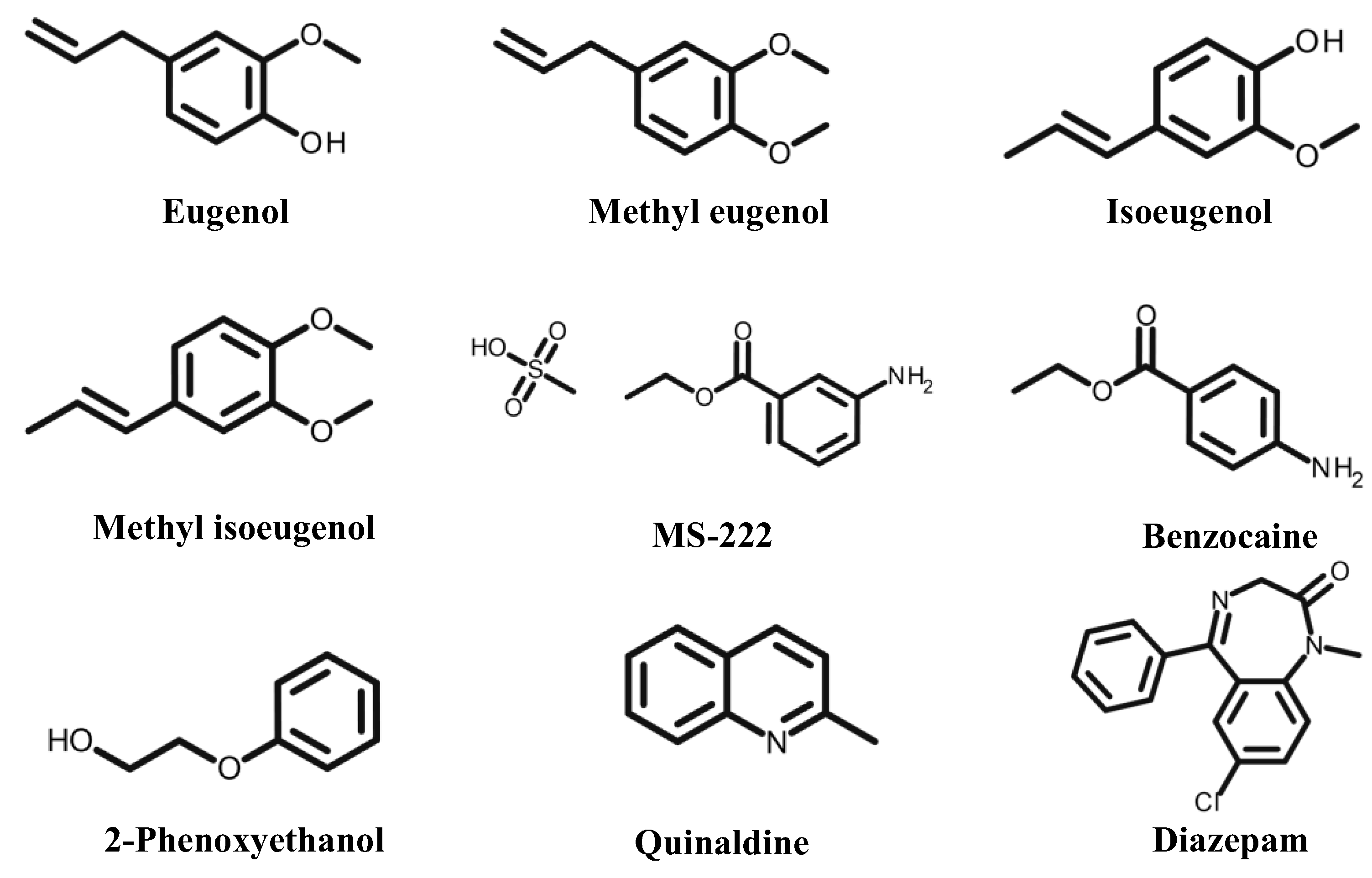
Figure 2.
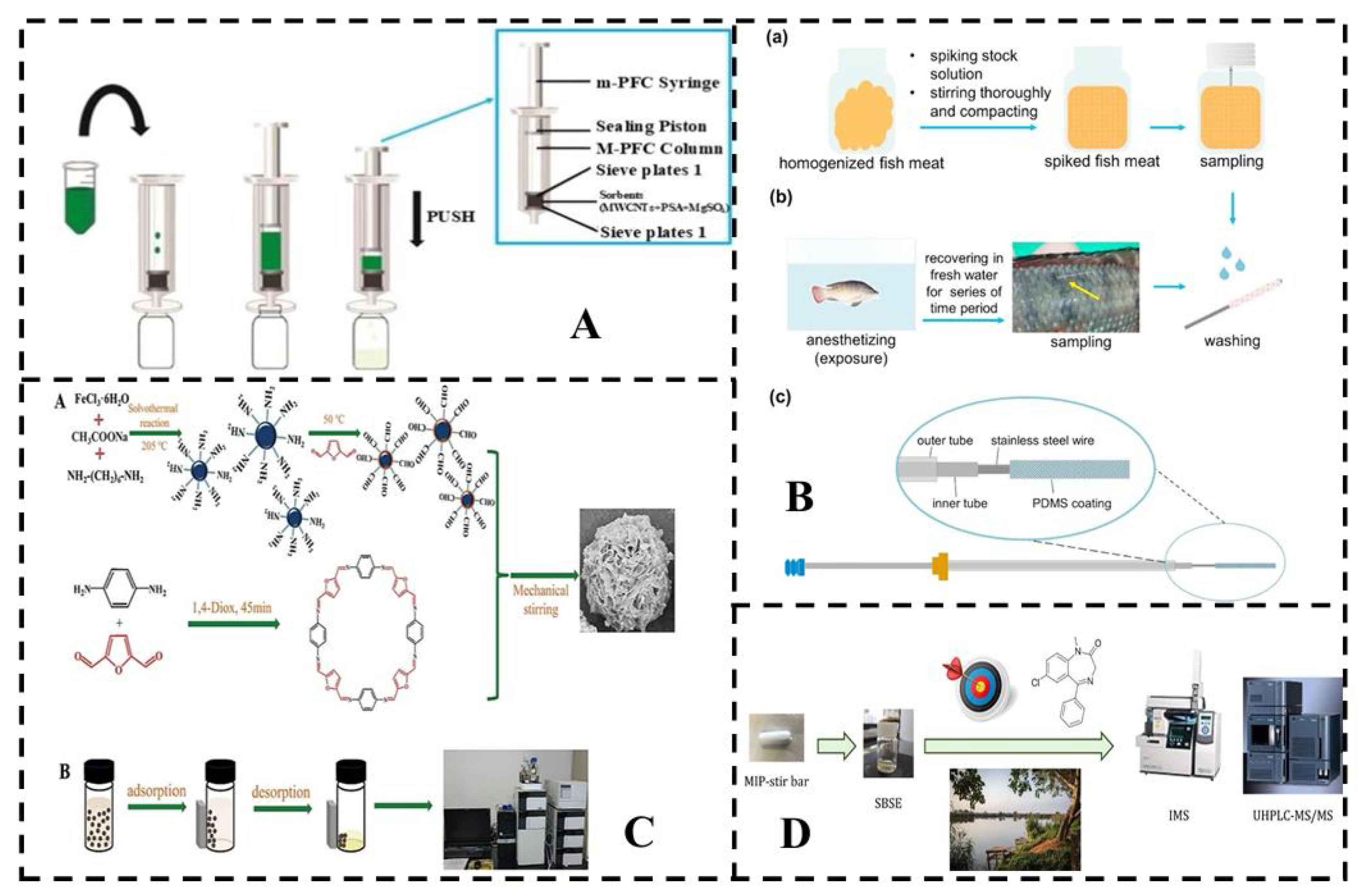
Figure 3.
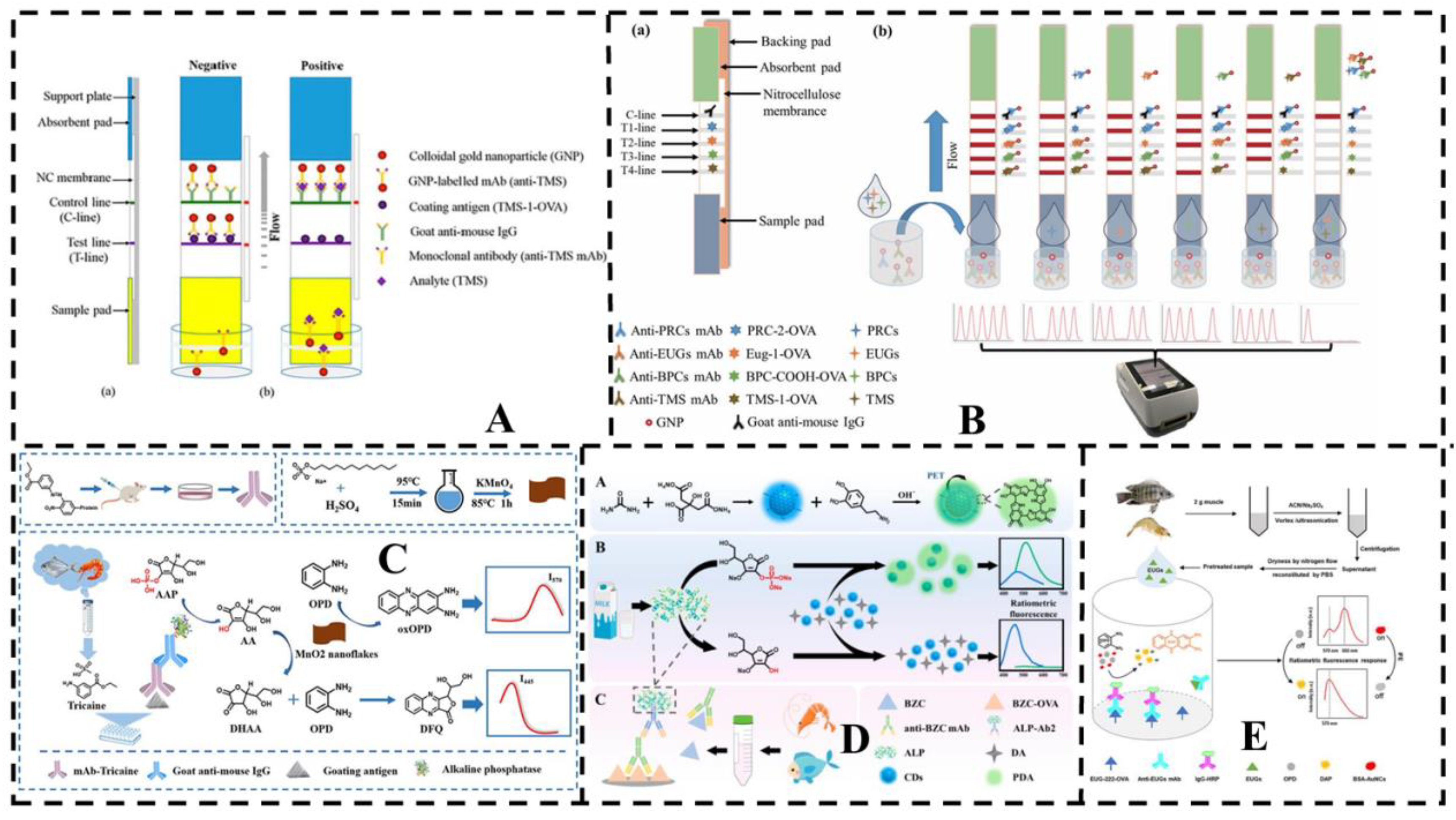
Figure 4.
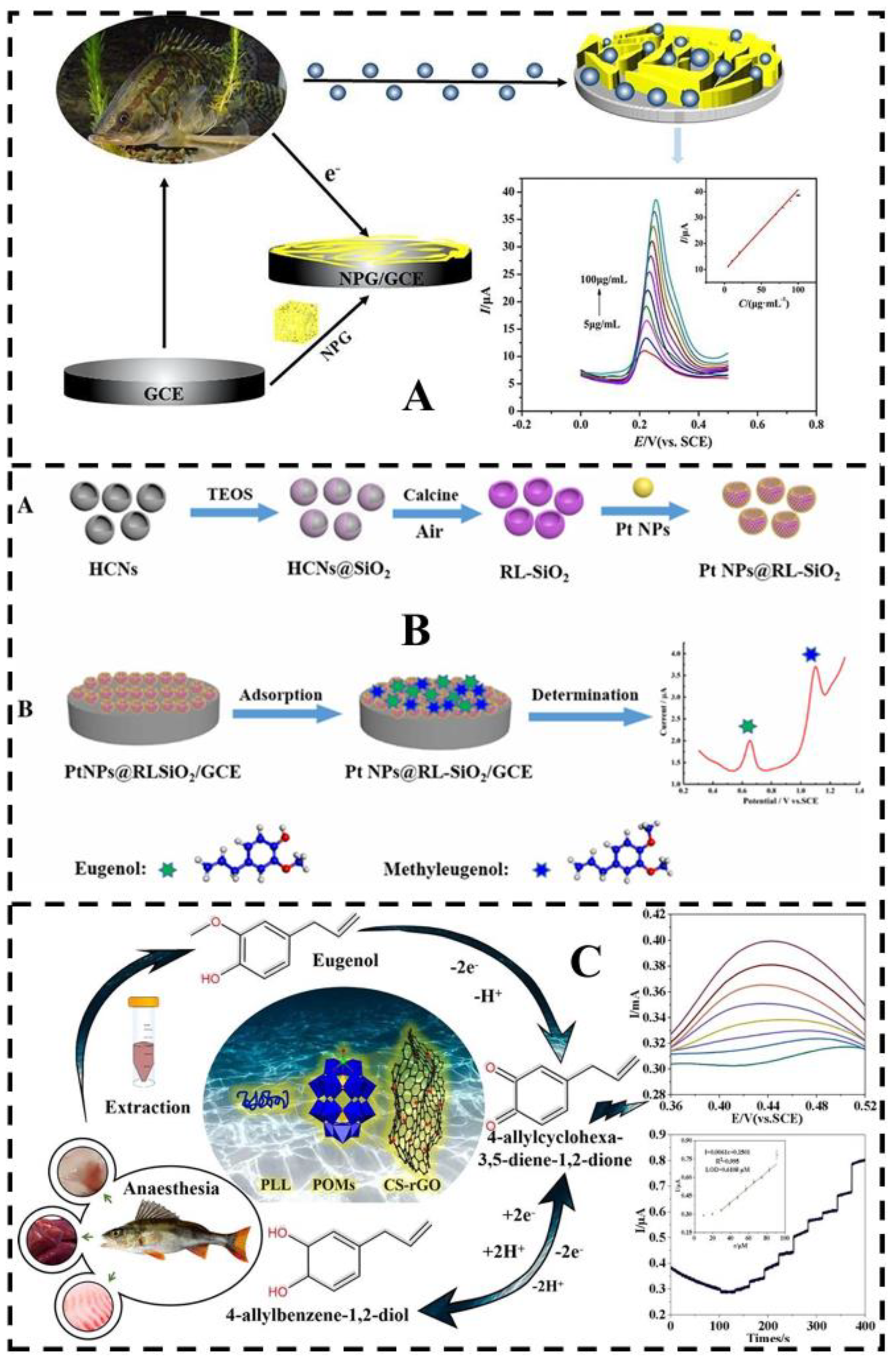

Table 1.
Withdraw period and maximum residue limit standards for different anesthetics in some countries/organization.
Table 1.
Withdraw period and maximum residue limit standards for different anesthetics in some countries/organization.
| Anesthetic | MRL | Withdrawal period | Reference | |
| Eugenol | New Zealand | 100ng mL-1 | — | [123] |
| Japan | 50ng mL-1 | 7 d | [28] | |
| Isoeugenol | European Conformity (CE) |
6mg kg-1 | — | [124] |
| AQUI-S | Australia and Chile | — | 0d | [125] |
| MS-222 | FDA | 1µg mL-1 | 21 d | [126] |
| Canada | — | 7 d | [39] | |
Table 2.
Representative analytical parameters for the analysis of anesthetics using instrumental methods in aquatic products.
Table 2.
Representative analytical parameters for the analysis of anesthetics using instrumental methods in aquatic products.
| Methods | Anesthetic | Sample | Pretreatment | Linearity | Repeatability / Reproducibility* | Detection limits | Reference |
| GC-MS | eugenol | fish back, fish belly, and fish tail | VALLME/HS-SPME | 15.0-750.0 μg kg-1 | RSD<20%, n=3 | 0.5 μg kg-1 | [81] |
| eugenol | carp muscle tissues | SPE | 5.0-500.0 μg L-1 | RSD<12%, n=6 | 2.5 μg kg-1 | [28] | |
| Isoeugenol | shrimp, tilapia, and salmon | Headspace solid-phase microextraction | 0-160 ng g-1 | RSD 5-13%, n=9 | below 15ng g-1 | [120] | |
| GC-MS/MS | diazepam | water samples | dispersive solid-phase microextraction | 10-1000 ng mL-1 | RSD=6%, n=5 | 3 ng mL-1 | [121] |
| eugenol, isoeugenol‚ and methyleugenol | groupers | SPE | 5–500μg L-1 | RSD 2.18%-15.5%, n=4 | eugenol 0.4μg kg-1, isoeugenol 1.2μg kg-1 ‚ and methyleugenol 0.2μg kg-1 | [27] | |
| 2-Phenoxyethanol | rainbow trout | SPME | 0.1-250 mg kg-1 | RSD 3%-11%, n=5 | 0.03mg kg-1 | [122] | |
| GC-IT-MS/MS | eugenol | mandarin | QuEChERS | 5-1000μg L-1 | RSD 1.82%-9.74%, n=6 | 5.0 μg /kg | [123] |
| Orbitrap GC-MS | eugenols | prawns | m-PFC column | 0.001–0.1 μg mL-1 | RSD 1.2%–7.5%, n=6 | 2-10 μg kg-1 | [82] |
| HPLC-MS/MS | MS-222 | carp and eel | QuEChERS | 2–1000 μg L-1 | RSD<6%, n=3 | 2.5μg kg-1 | [124] |
| / | SPE | 0.05-10μg L-1 | RSD<9.36%, n=5 | 0.01μg/ L | [83] | ||
| finfish | extracted with acetone using a tissue homogenizer, followed by derivatization with dansyl chloride | 2.5-40.0 ng g-1 | RSD 2.6%–8.0%, n=6 | 0.2-1μg kg-1 | [75] | ||
| marine fish and freshwater fish | isotope dilution assay | 2.0-200.0 μg L-1 | inter- and intra-assay relative standard deviations (RSD values) were 0.39-3.01 and 0.85-2.77% | 1μg kg-1 | [125] | ||
| LC-MS/MS | diazepam | fish and shrimp tissue | C18 cartridge solid-phase extraction | 0.05-5ng mL-1 | RSD<4.9%, n=3 | 0.01μg kg-1 | [126] |
| LC | AQUI-S® 20E (eugenol) | standard water containing fish feed | SPE | 5-500mg L-1 | RSD<0.7%, n=3 | 0.0011 mg L-1 | [127] |
| HPLC-QTRAP-MS/MS | tricaine, tetracaine, and bupivacaine | fish samples | QuEChERS | 1.0–50.0 μg L-1 | RSD<15%, n=3 | 2.0 μg kg-1 | [128] |
| PGD-IMS)/LC-MS/MS | MS-222 | fish-raising water samples | m-PFC | 0.005-0.2 mg L-1 | PGD-IMS RSD 6.9%–10.3%, n=5 LC-MS/MS RSD 1.3%–3.4%, n=5 |
6μg kg-1/0.6μg kg-1 | [39] |
| LC-QLIT-MS/MS | eugenol | fish samples | dispersive solid-phase extraction (DSPE) | 1–100 μg kg-1 | RSD 1.9%–8.9%, n=6 | 0.03-0.4 μg kg-1 | [129] |
| HPLC-UV | Diazepam | water samples | Dispersive micro solid phase extraction | 0.3-450 ng mL-1 | RSD 3.42-3.75%, n=3 | 0.09ng mL-1 | [130] |
Disclaimer/Publisher’s Note: The statements, opinions and data contained in all publications are solely those of the individual author(s) and contributor(s) and not of MDPI and/or the editor(s). MDPI and/or the editor(s) disclaim responsibility for any injury to people or property resulting from any ideas, methods, instructions or products referred to in the content. |
© 2025 by the authors. Licensee MDPI, Basel, Switzerland. This article is an open access article distributed under the terms and conditions of the Creative Commons Attribution (CC BY) license (http://creativecommons.org/licenses/by/4.0/).
Copyright: This open access article is published under a Creative Commons CC BY 4.0 license, which permit the free download, distribution, and reuse, provided that the author and preprint are cited in any reuse.


