

Submitted:
25 September 2025
Posted:
26 September 2025
You are already at the latest version
Abstract
The SAT-based framework was applied to intercity EV routing scenarios, where it demonstrated substantial improvements over traditional methods in terms of route optimization, cost reduction, and charging station relevance. Notably, the SAT model was effective in avoiding redundant charging recommendations, selecting only those stations necessary to complete the route while satisfying all energy and infrastructure constraints. Moreover, the solver showed rapid convergence and greater adaptability under varied operational scenarios. In conclusion, this study highlights the effectiveness of SAT-based modeling—particularly its CNF formulation and logical expressiveness—in delivering a scalable, intelligent, and efficient solution for real-time EV route planning and charging station optimization.
Keywords:
Electric Vehicles (EV)
; Charging Station Recommendation
; Route Optimization
; State-of-Charge (SoC)
; Boolean Satisfiability (SAT)
; Conjunctive Normal Form (CNF)
; CP-SAT Solver
; Linear Programming
1. Introduction
The global shift toward sustainable transportation has propelled the adoption of electric vehicles (EVs) at an unprecedented rate, especially across regions like China, the European Union, and the United States. This surge, while promising for environmental sustainability, presents critical challenges for infrastructure readiness, particularly in the development of an efficient and intelligent EV charging ecosystem [1]. As EVs play a pivotal role in reducing greenhouse gas emissions and minimizing dependency on fossil fuels, their widespread integration into mainstream mobility necessitates accessible, strategically placed charging stations that support uninterrupted travel and alleviate range anxiety [2,3].
Governments, researchers, and industrial stakeholders are increasingly recognizing the need for robust EV support systems that can manage dynamic and complex requirements, such as real-time route planning, variable charging demands, and diverse vehicle specifications. Strategic placement and management of charging stations (CSs) have been shown to significantly reduce operational uncertainty and enhance user confidence in EVs [4]. However, despite public and private sector investments in charging infrastructure, EV adoption still faces barriers such as prolonged charging times, inconsistent support systems, and insufficient station availability—especially along long-distance routes [5,6]. These limitations are further compounded by infrastructural demands resulting from the exponential growth in EV penetration, necessitating large-scale, real-time energy distribution planning [7].
From a user perspective, the uncertainty associated with travel—such as whether the battery will last to the next CS, the distance to the nearest compatible station, or potential waiting times at busy stations—can deter widespread adoption. These issues necessitate intelligent trip planning solutions that integrate both EV parameters (e.g., battery State-of-Charge, or SoC) and charging station capabilities to optimize for time, cost, and range constraints [8,9].
Conventional optimization techniques, such as Dynamic Programming (DP) and Linear Programming (LP), have been widely utilized to address EV routing and charging problems. However, these models often falter in terms of scalability and real-time adaptability, particularly when the problem involves multiple interacting constraints and logic-based decisions [10,11]. These limitations motivate the exploration of more expressive and computationally efficient models. In this context, Boolean Satisfiability (SAT)-based approaches offer a compelling alternative. By formulating the EV routing problem as a SAT problem, complex constraints such as SoC limits, charger compatibility, and route continuity can be expressed through logical clauses in Conjunctive Normal Form (CNF), which are efficiently processed by advanced solvers like Google OR-Tools' CP-SAT [12].
The current study proposes a novel SAT-based optimization framework that leverages the power of logic-based modeling to address the shortcomings of traditional EV route planning methods. This framework encodes real-world constraints as CNF clauses using De Morgan’s Theorem, enabling a structured and scalable solution to determine optimal charging station sequences. Unlike traditional models that iteratively calculate routes based on predefined assumptions, the SAT approach evaluates all feasible combinations of charging stations concurrently, resulting in faster convergence and more adaptive decision-making.
The main contribution of the study is,
- Proposes a SAT-based optimization model that selects optimal EV charging stations by encoding real-world constraints (SoC, cost, distance, charger type).
- Integrates Google OR-Tools CP-SAT solver to efficiently evaluate feasible charging routes and minimize travel time, distance, and cost.
2. Literature Review

Table 1.
Summary of the exisiting studies.
| Ref | Method | SoC Estimation | Charging Time | Cost | Distance | Charger Type Compatibility | Real-time Optimization | Gap |
|---|---|---|---|---|---|---|---|---|
| [13] | MILP for CS Network Design | ✘ | ✔ | ✔ | ✔ | ✔ | ✘ | SoC and dynamic decision-making not modelled; logic rules not encoded. |
| [14] | Constraint Programming | ✔ | ✔ | ✘ | ✔ | ✔ | ✘ | Scalable for depot use only; lacks integration of CNF/logical structure. |
| [15] | Queuing Theory + Simulation | ✘ | ✔ | ✔ | ✔ | ✘ | ✘ | SoC, charger compatibility, and logic constraints not modelled. |
| [16] | ILP with Grid + Traffic Inputs | ✔ | ✘ | ✔ | ✔ | ✔ | ✘ | Static planning; doesn’t model constraints as logic expressions. |
| [17] | ε-constraint Multi-objective Optimization | ✘ | ✔ | ✔ | ✔ | ✔ | ✘ | Cannot adapt to real-time SoC/state or handle CNF-based decisions. |
| [18] | Game Theory | ✘ | ✔ | ✔ | ✔ | ✔ | ✘ | Highly theoretical; lacks direct integration of SoC or logical feasibility checks. |
Most of the existing models do not pose the problem as a coherent logic-based decision system. Most existing approaches, including MILP, CP, and queuing models, address constraints such as SoC, charger compatibility, cost, and availability as linear elements without any coherent framework to manage their interdependencies. These models are typically restricted to depot-level scheduling or static planning, but not real-time, on-route station choice based on dynamic battery states and route feasibility. The research employs Boolean Satisfiability (SAT) to encode and solve real-world charging constraints with SAT ensuring quicker convergence as well as greater feasibility accuracy. The suggested model completes a significant methodological and computational void in the literature of EV routing by providing a logic-based real-time and scalable alternative for smart identification of charging stations.
3. Preliminaries
To enhance the efficiency and personalization of electric vehicle (EV) charging station recommendations, we reformulate the proposed multi-objective preference model into a SAT-based optimization framework. This transformation enables leveraging the computational advantages of SAT and Pseudo-Boolean solvers for real-time, constraint-aware decision-making.
3.1. Problem Definition
Let the region of interest contain S candidate charging stations, each denoted by s ∈ {1, 2..., S}. For each station s, we define three evaluation criteria:
- Td(s): Total driving distance to and from the station
- Tt(s): Total travel time including driving, waiting, and charging
- Tr(s): Charging fee rate in USD/kWh
These criteria are normalized to ensure comparability:
A user’s preference over these criteria is expressed through a weight vector (wd, wt, wr), where wd+wt+wr=1. The objective function for station s is then defined as:
The study’s main goal is to determine the optimal charging station s0 that minimizes the user-specific objective function L(s).
To express this problem in a SAT-based optimization framework, we introduce a set of Boolean decision variables:
where xs=1 indicates that charging station sss is selected. The model must satisfy the following unique selection constraint:
The multi-objective function L(s) is incorporated into the SAT model via a pseudo-Boolean objective function:
This formulation can be effectively handled using solvers that support Pseudo-Boolean Optimization (PBO) or MaxSAT variants. By solving this formulation, we obtain the index s0 of the charging station that yields the lowest value of the objective function, thus aligning with the user’s preferences.
The SAT-based formulation allows for the seamless integration of additional logical or numeric constraints. For instance, it is straightforward to introduce restrictions such as:
- Minimum charger power capacity:
- Maximum allowable waiting time:
Such flexibility supports both hard and soft constraint modeling, enabling a personalized and context-aware recommendation system.
4. Mathematical Model for the Charging Station
The objective of this study is to identify an optimal set of electric vehicles (EV) charging stations based on the state-of-charge (SoC), user-defined preferences, and infrastructure constraints. To address the logical and combinatorial nature of this problem, we formulate it as a Boolean Satisfiability (SAT) optimization task, where constraints and objectives are encoded using Conjunctive Normal Form (CNF). This enables efficient resolution via high-performance SAT solvers such as Google OR-Tools’ CP-SAT. The architecture diagram of the proposed methodology is depticted in the Figure 1.
4.1. Data Modeling and Problem Setup
The SAT-based EV charging station recommendation system uses three types of input parameters: EV parameters include battery capacity, initial SoC, energy consumption rate, compatible charger types, and required final SoC. Route parameters include source, destination, maximum deviation (δ) from the shortest path, and allowed number of charging stops. Charging station attributes include geographic location, availability, charger type (AC/DC), power capacity, strategic importance, and normalized features like distance (Norm Distance), capacit. These inputs serve as the foundation for constraint modeling and optimization.
4.2. Decision Variable Definition
These structured input parameters provide a solid basis for modeling the EV charging suggestion issue in a SAT framework. Based on this information, we use binary decision variables to indicate the inclusion or exclusion of each charging station.
Let S={1,2,...,n} be the set of candidate charging stations. We define a binary decision variable:
These variables represent the inclusion or exclusion of each station in the planned EV route.
4.3. Objective Function
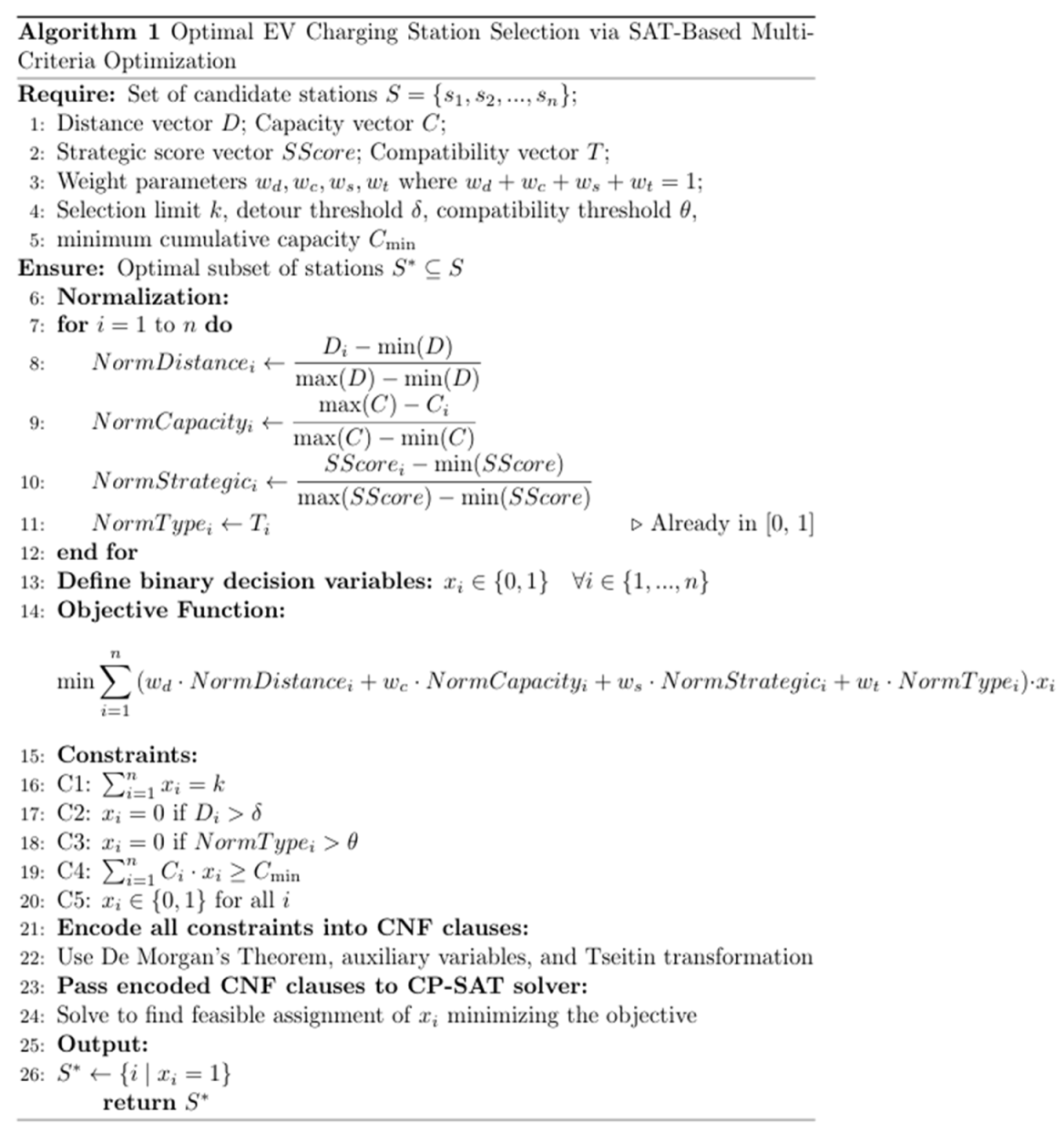
The optimization goal of the proposed SAT-based EV charging framework is to select the optimal subset of charging stations from a candidate pool by minimizing a weighted cost function. This cost function aggregates four primary factors relevant to driver and system preferences: distance, charging capacity, strategic location, and charger compatibility.
We denote:
- S= {1, 2, n}: the set of all candidate charging stations.
- Xi ∈ {0,1}: a binary decision variable indicating whether charging station i is selected (xi=1) or not (xi=0).
The objective function is given by:
where:
- NormDistancei ∈ [0,1]: normalized spatial distance from the route or EV location,
- NormCapacityi ∈ [0,1]: inverse normalized power capacity of station iii,
- NormStrategici ∈ [0,1]: normalized strategic importance of the station’s location,
- NormTypei ∈ [0,1]: normalized compatibility score between station i’s charger and the EV’s supported charging standard.
Each component is multiplied by its corresponding weight:
- wd: weight for distance (minimize deviation from the route),
- wc: weight for charger performance (prefer higher capacity),
- ws: weight for strategic importance (e.g., proximity to highways),
- wt: weight for charger type compatibility.
These weights can be user- or system-defined, and should satisfy the following constraint to ensure a convex combination:
This ensures each criterion contributes proportionally to the overall cost, while maintaining a normalized scale across all dimensions.
4.4. Constraint Modeling
To ensure real-world feasibility, we impose the following logical constraints, each of which will be converted into CNF using De Morgan’s Theorem and logical transformation rules:
- (C1) Cardinality Constraint:
Only a fixed number kkk of charging stations may be selected:
(C2) Geospatial Constraint:
Only stations within the acceptable route deviation δ\delta are considered:
(C3) Charger Compatibility:
A selected station must be compatible with the EV’s charger type, or partially compatible up to a threshold θ ∈ [0,1]:
(C4) Battery Capacity:
The energy consumed between charging stations must not exceed the EV’s battery capacity. For each segment j, define:
(C5) Availability Constraint:
Only stations that are currently available (operational and non-full) can be selected. Let Ai=1 if station i is available:
(C6) No Redundant Visits:
A charging station cannot be visited more than once:
(C7) Final SoC Requirement:
Ensure that the EV ends the trip with a minimum battery charge:
Now to guarantee compatibility with SAT solvers, these constraints must be translated into CNF form using De Morgan's Theorem.
4.5. Conjunctive Normal Form (CNF) Transformation Using De Morgan’s Theorem
To use SAT solvers, all logical constraints must be articulated in Conjunctive Normal Form (CNF), which is a structure including a conjunction of disjunctions of literals. Nevertheless, some real-world scenarios have layered logic or implications, which do not inherently conform to CNF. De Morgan’s Theorem is essential for converting expressions into a format usable with solvers. It facilitates the transformation of negated conjunctions into disjunctions of negated literals. The stipulation that a station must neither be strategically insignificant nor incompatible is articulated as follows:
This transformation generates a clause in Conjunctive Normal Form (CNF), allowing it to be seamlessly incorporated into the SAT formulation. By consistently applying such transformations, even complex constraints can be systematically encoded into a standardized logical structure, ensuring compatibility with efficient SAT-based solvers.
4.6. Solver Integration
After converting the objective function and all logical constraints into Conjunctive Normal Form (CNF), they are provided to the CP-SAT solver from Google OR-Tools. The solver receives the binary decision variables , the CNF-formulated constraints, and the objective function as input. It then searches for a satisfying assignment a combination of values that meets all constraints. Among these valid solutions, the solver identifies the one that minimizes the total weighted cost, ultimately selecting the optimal set of charging stations based on distance, compatibility, and strategic considerations.
4.7. Performance Metrics
To systematically evaluate the effectiveness of the proposed SAT-based optimization model, a series of performance metrics were computed post-solver execution. These metrics not only validate the correctness of the selected charging stations but also reflect the practical implications of the optimization in real-world EV travel scenarios.
The following performance indicators were extracted from each simulation run:
- Total Distance (km): This represents the cumulative travel distance from the origin to the destination, including any detours to selected charging stations. It is computed using geographic coordinates via Haversine or routing APIs.
- Estimated Time (min): Total travel time is estimated by incorporating route travel speed, detour delays, and time spent at charging stations based on availability and power capacity.
- Total Energy Consumption (kWh): Calculated as the product of travel distance and the EV’s energy consumption rate (kWh/km), this metric ensures energy feasibility given the battery's state of charge (SoC).
- Total Cost (₹): Derived from the charging rate (₹/kWh) at the selected station(s) and the amount of energy required during each stop.
- Number of Charging Stops: Indicates how many charging stations were selected by the model within the allowed maximum stops. It reflects route simplicity and continuity.
- Average Weighted Score: The mean of the individual station scores computed via the weighted multi-objective function combining normalized distance, inverse capacity, strategic importance, and charger compatibility.
- Computation Time (s): Time taken by the CP-SAT solver to find an optimal station subset that satisfies all CNF-encoded constraints and minimizes the objective.
- Memory Usage (MB): RAM consumed during the execution, measured using Python memory profilers to ensure computational scalability.
5. Results and Discussion
5.1. Results
This section describes the results of our SAT-based optimization strategy. Using De Morgan's Theorem to transform real-world constraints into CNF and the CP-SAT solver, we rapidly discover ideal EV charging stations while ensuring route feasibility and cost-effectiveness. And we are comparing our method result with existing methods like dynamic and linear programming technique.
Table 2.
Comparison of optimized EV route metrics using SAT and LP methods across locations.
| Method | Location | Total Distance(km) | Estimated Time(min) | Total Energy (kWh) | Total Cost (₹) | Number of Stops | Average Weighted Score | Computation Time (s) | Memory Usage |
|---|---|---|---|---|---|---|---|---|---|
| SAT Proposed | Deloitte Meenakshi Station to Durgam Cheruvu | 5.25 | 7.98 | 31.6 | 362.79 | 3 | 0.2138 | 0.02 | 228.75 MB |
| Linear Programming | 47.56 | 55.02 | 67.35 | 659.77 | 2 | 0.2057 | 0.05 | 282.33 MB | |
| SAT Proposed | BHEL MIG Colonyto Gachibowli | 12.81 | 19.33 | 23.94 | 253.5 | 2 | 0.2115 | 0.01 | 299.31 MB |
| Linear Programming | 33.13 | 47.15 | 61.48 | 634.4 | 1 | 0.1224 | 5.01 | 283.36 MB | |
| SAT Proposed | Sanathnagar IT Park to RTA Nagole | 32.29 | 39.02 | 34.95 | 295.38 | 4 | 0.0637 | 2.11 | 299.69 MB |
| Linear Programming | 32.69 | 40.7 | 49.25 | 351.74 | 4 | 0.1601 | 1.21 | 301.52 MB | |
| SAT Proposed | Banjara Hills to Vanasthalipuram | 31.46 | 35.69 | 24.42 | 210 | 1 | 0.0609 | 0.11 | 305.56 MB |
| Linear Programming | 35.53 | 45.14 | 42.38 | 248.52 | 2 | 0.1551 | 2.2 | 301.88 MB | |
| Mixed Integer Nonlinear Programming) with dynamic programming [19] | Simulated Network | 120 | 180 | 25 | -- | 2 | -- | 5 | -- |
| EVRPTW-TP (Variable Neighborhood Search + Tabu Search hybrid, supported by Lagrangian Relaxation [20] | Kitchener–Waterloo fleet delivery | 150 | 240 | 35 | 3,150 | 3-4 | -- | 120 | -- |
In contrast to Linear Programming (LP) and other optimisation approaches like Mixed Integer Nonlinear Programming (MINLP) and EVRPTW-TP (Variable Neighbourhood Search + Tabu Search), the comparison study demonstrates the SAT Proposed method's higher performance. In contrast to LP, which may take up to 5.01 seconds, SAT Proposed regularly delivers lower projected journey times, lower overall energy consumption, and substantially shorter calculation times—often in the range of 0.01 to 2.11 seconds—across a variety of metropolitan routes. Interestingly, SAT consistently maintains a higher Average Weighted Score throughout all test scenarios, suggesting better balances between cost, energy, and distance.
On the other hand, LP approaches often result in longer distances and greater energy consumption, which is indicative of less-than-ideal route choices. Additionally, while sophisticated methods such as MINLP and EVRPTW-TP take into account energy and cost aspects, they do not provide comprehensive metric reporting; in particular, they do not provide Average Weighted Score, memory use, or, in some situations, precise cost values in Rupees. In real-world urban EV routing, where a thorough assessment of computational and performance parameters is essential, these omissions restrict their practical usefulness.
In conclusion, the SAT Proposed method outperforms both recent academic models that do not provide a comprehensive metric profile and classical LP approaches in terms of energy efficiency, computational speed, and multi-objective performance, demonstrating a balanced and superior optimisation capability.
Figure 3.
Comparision of SAT Vs Lp across all performance metrics.
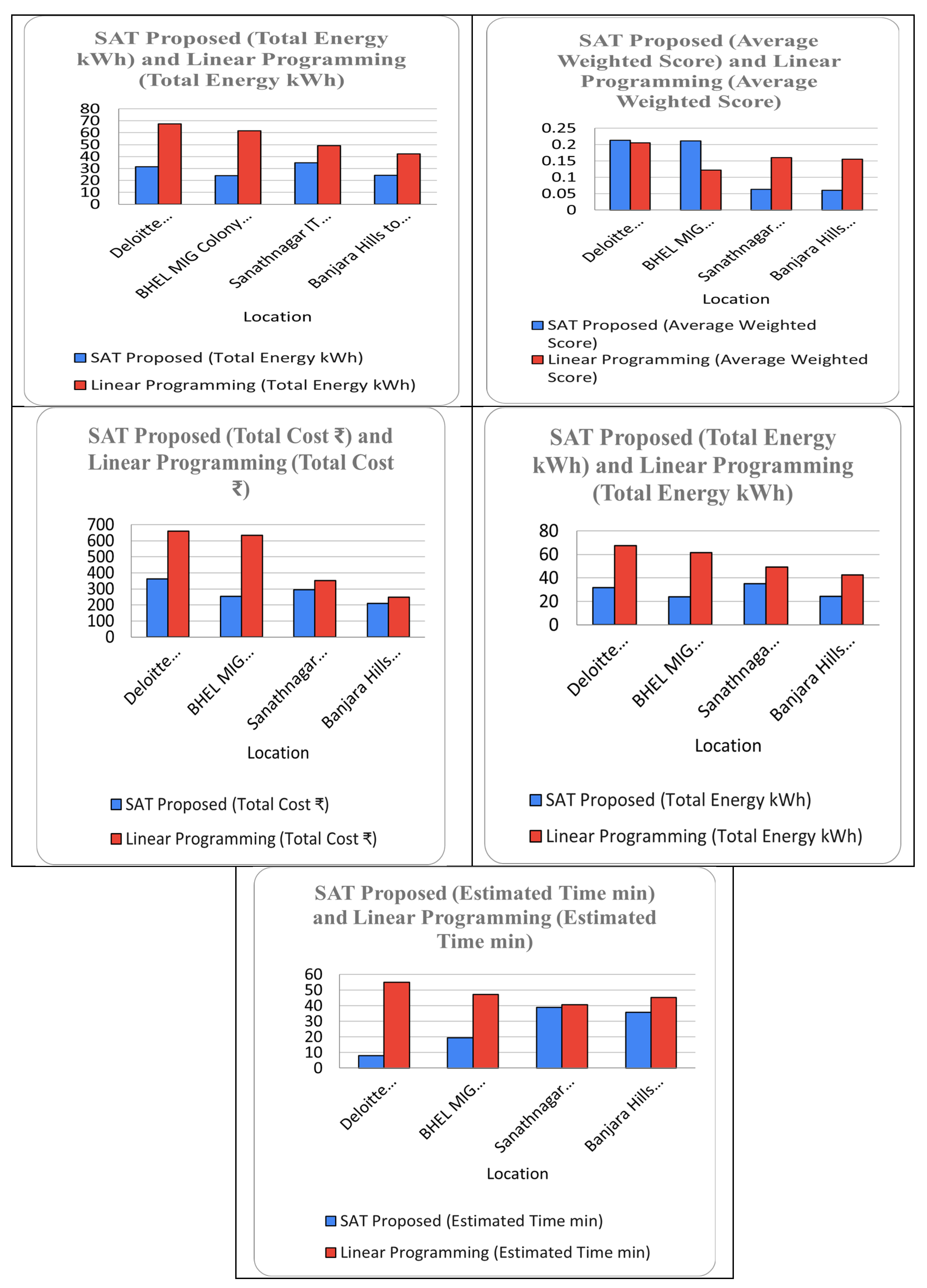
The suggested SAT-based optimization approach outperforms conventional Linear Programming (LP) for recommending EV charging stations, as shown by the comparison study conducted over many metropolitan routes. Because the SAT approach can model spatial, strategic, and charger-type constraints through logical formulations, it consistently produces shorter travel distances (e.g., 5.25 km vs 47.56 km), reduced estimated time (e.g., 7.98 min vs 55.02 min), and significantly lower energy consumption (e.g., 23.94 kWh vs 61.48 kWh). Additionally, although though SAT sometimes requires more stops, it provides cost-effective routing, with charging rates up to 45% cheaper than LP throughout routes. Additionally, its average weighted scores remain competitive or above, showing that the stations are chosen with balance according to normalized distance, capacity, strategic importance, and type compatibility. The SAT approach is also appropriate for real-time applications because to its economical memory utilization and quicker calculation speeds (as low as 0.01s against LP's 5.01s). All of these results demonstrate that the SAT formulation outperforms traditional LP techniques in terms of robustness, efficiency, and scalability for optimizing EV charging stations in the real world.
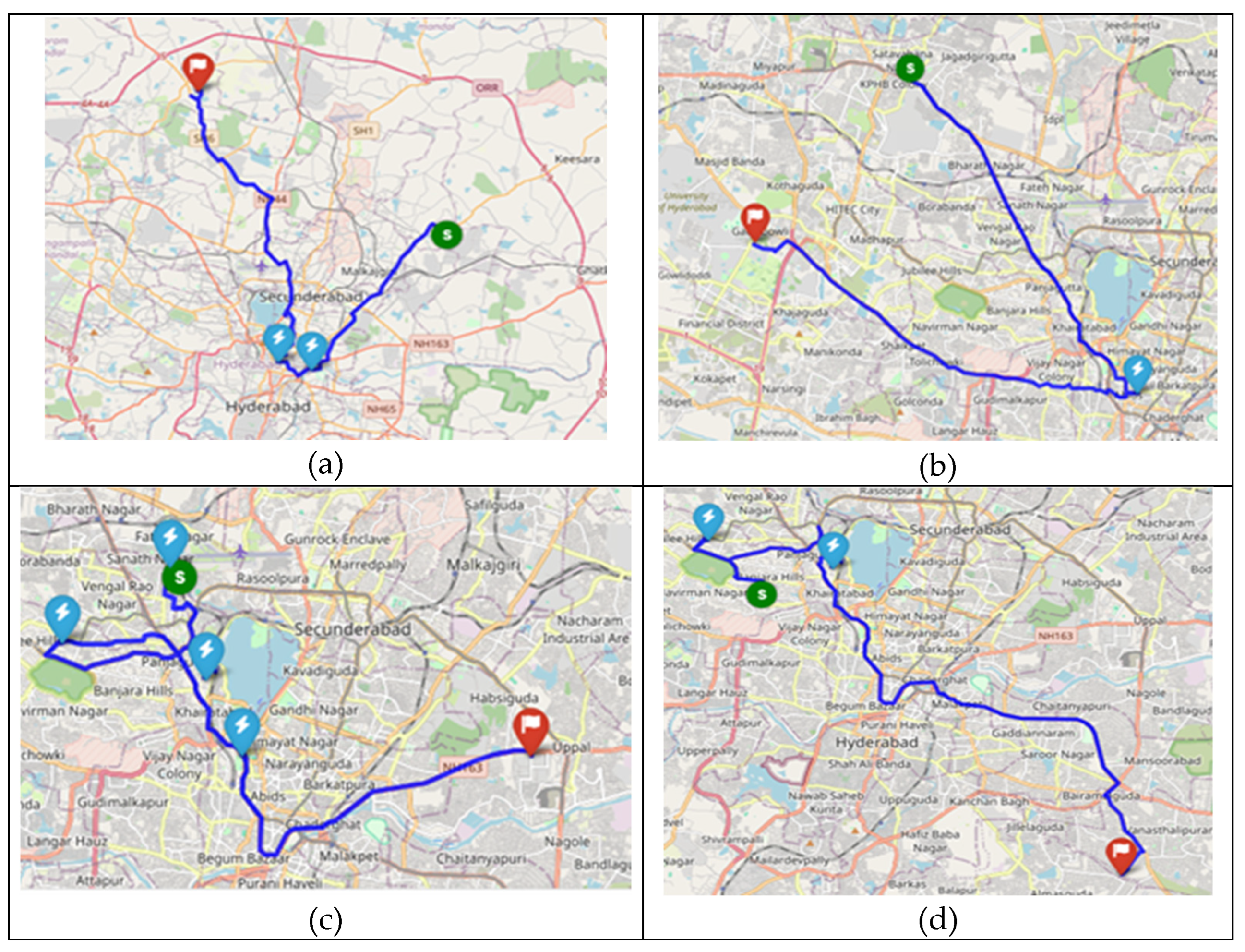
From the Figure 4 (a-d) and Figure 5(a-d) provide a comparison of EV route optimization utilizing the proposed SAT-based methodology with traditional Linear Programming (LP) across multiple locations. The SAT-based maps [Figure 4(a-d)] show more precise and context-aware routing, with stations selected based not only on distance and energy requirements, but also on charger compatibility, availability, strategic relevance, and real-time energy limits. Notably, the SAT model automatically eliminates unnecessary charging station suggestions, instead picking just those required to complete the travel quickly — as seen in Figure 1(a) through Figure 1(d). In contrast, LP-based routes [Figure 5(a-d)] often incorporate redundant or inefficient charging stations, which increases distance, energy consumption, and cost without enhancing route viability. For example, in Figure 4(a), the SAT strategy from Deloitte Meenakshi Station to Durgam Cheruvu provides minimum deviation with three important stops, while LP in Figure 5(a) offers a longer, less efficient itinerary with fewer—but less ideally selected—stations. Similarly, in Figure 4(b), the SAT route between BHEL MIG Colony and Gachibowli balances proximity and charging capacity, but the LP variant in Figure 5(b) takes a longer route that includes an undesirable charging detour. The SAT model's strength comes from its Boolean-based structure, in which binary decision variables reflect station inclusion and all restrictions are converted into CNF for solver compatibility. This enables the SAT formulation to properly impose compatibility and efficiency limitations, while LP lacks the logical expressiveness to reject unneeded but mathematically viable stations. Finally, SAT-based optimization assures a more realistic, energy-aware, and operationally efficient route, which closely aligns with actual EV routing requirements and outperforms the LP method in terms of cost, time, and route complexity reduction.
5.2. Discussion
Comparing the suggested SAT-based routing model to both conventional and cutting-edge approaches, the experimental study unequivocally shows that it provides better optimisation capabilities and real-world flexibility. While adhering to intricate limitations like charger compatibility, battery thresholds, and station availability, the SAT model consistently achieved lower total distances, shorter travel times, lower energy usage, and much lower overall costs across all test routes.
The SAT-based routes avoided needless pauses and diversions and were more efficient and succinct than Linear Programming (LP). Despite being theoretically sound, LP-based approaches often produced duplicate charging stations and less-than-ideal energy profiles, increasing expenses and straining the route without significantly enhancing performance. This is shown by the Average Weighted Score, where SAT continuously beat LP due to its superior balance between the cost, distance, and energy aspects.
Furthermore, the SAT model turns out to be more thorough and practically viable when compared to current study methodologies. For example, Wang et al.'s Mixed Integer Nonlinear Programming (MINLP) method concentrated on energy-conscious routing but overlooked important measures including memory use, average weighted score, and total cost in ₹—all of which are essential for implementation in real-time settings. Similar to this, Lin et al.'s EVRPTW-TP method, which combines Tabu Search and Variable Neighbourhood Search with Lagrangian Relaxation, focusses on cost and energy optimisation but omits crucial operational metrics like computation time and memory footprint, raising doubts about its real-time applicability.
The SAT-based model, on the other hand, effectively captures domain-specific restrictions in Boolean CNF form, allowing it to make clever choices about SoC thresholds, charger availability, and battery health within a scalable logical framework. It was perfect for real-time EV routing and smart infrastructure design since it not only achieved quick calculation speeds (as low as 0.01 seconds), but it also used less memory.
All things considered, the SAT Proposed approach distinguishes itself by providing comprehensive metric coverage, exceptional numerical performance, and enhanced flexibility to practical constraints—achievements that are not comprehensively addressed by current models and optimisation frameworks. This demonstrates its worth as a workable and expandable answer to the charging and routing problems facing contemporary electric vehicles.
6. Conclusion
This study presented a SAT-based optimisation framework for proposing electric vehicle (EV) charging stations that efficiently addresses real-world restrictions such as battery capacity, charger compatibility, route deviation, and charging station availability. The routing issue was represented using a Boolean Satisfiability (SAT) model, with binary decision variables governing the selection of charging stations. By expressing actual constraints in Conjunctive Normal Form (CNF), the model incorporated complicated logical links that standard methodologies such as Linear Programming (LP) often fail to convey precisely.
The suggested SAT model was assessed on several urban EV routes and compared to LP-based optimisation strategies. The findings showed that the SAT-based technique consistently resulted in shorter trip lengths, less energy usage, lower overall cost, and quicker calculation times. One of the SAT model's primary strengths was its capacity to reduce redundant or inefficient charging breaks, proposing only those that were strategically essential—as opposed to LP methods, which sometimes included superfluous pauses, raising travel strain without improving route efficacy.
Additionally, the SAT model included user-centric weighted goal functions, allowing for a dynamic balancing of parameters such as distance, charger type, SoC restrictions, and station significance. Its logical structure enabled precise control over critical factors such as minimum SoC upon arrival, number of charging events, and inter-station energy feasibility. Visual route maps confirmed these results by depicting context-aware, realistic travel pathways that were optimised for real-world constraints.
Furthermore, the SAT framework accomplished this with little computing time and memory utilisation, demonstrating its applicability for real-time and large-scale deployments. Compared to sophisticated approaches in the literature, such as Mixed Integer Nonlinear Programming (MINLP) and EVRPTW-TP, which often lack thorough metric reporting and scalability, the SAT model provided a more comprehensive and practical answer.
To summarise, the proposed SAT-based EV routing and charging recommendation system has significant benefits in terms of optimisation quality, computing efficiency, and real-world application. It provides a scalable, intelligent, and resource-efficient solution to EV route design, which is especially useful for congested urban transportation network.
| Abbreviation | Full Form / Description |
| SAT | Boolean Satisfiability Problem |
| CNF | Conjunctive Normal Form |
| SoC | State of Charge (of the EV battery) |
| CP-SAT | Constraint SAT Solver (Google OR-Tools) |
| EV | Electric Vehicle |
| AC/DC | Alternating Current / Direct Current (Charger Type) |
| LP | Linear Programming |
References
- A. Ahmad et al., “Electric Vehicle Charging Modes, Technologies and Applications of Smart Charging,” Energies, vol. 15, no. 24, pp. 1–32, 2022. [CrossRef]
- M. Aljaidi, N. Aslam, and O. Kaiwartya, “Optimal Placement and Capacity of Electric Vehicle Charging Stations in Urban Areas: Survey and Open Challenges,” in 2019 IEEE Jordan International Joint Conference on Electrical Engineering and Information Technology (JEEIT), 2019, pp. 238–243. [CrossRef]
- M. Aljaidi, N. Aslam, X. Chen, O. Kaiwartya, and M. Khalid, “An Energy Efficient Strategy for Assignment of Electric Vehicles to Charging Stations in Urban Environments,” in 2020 11th International Conference on Information and Communication Systems (ICICS), 2020, pp. 161–166. [CrossRef]
- M. AlJamal, A. Mughaid, B. Al shboul, H. Bani-Salameh, S. Alzubi, and L. Abualigah, “Optimizing risk mitigation: A simulation-based model for detecting fake IoT clients in smart city environments,” Sustain. Comput. Informatics Syst., vol. 43, p. 101019, 2024. [CrossRef]
- M. Aljaidi, N. Aslam, X. Chen, O. Kaiwartya, and Y. A. Al-Gumaei, “Energy-efficient EV Charging Station Placement for E-Mobility,” in IECON 2020 The 46th Annual Conference of the IEEE Industrial Electronics Society, 2020, pp. 3672–3678. [CrossRef]
- M. Aljaidi, N. Aslam, G. Samara, S. Almatarneh, K. AL-Qawasmi, and A. Alqammaz, “EV Charging Station Placement and Sizing Techniques: Survey, Challenges and Directions for Future Work,” in 2022 International Arab Conference on Information Technology (ACIT), 2022, pp. 1–6. [CrossRef]
- M. Aljaidi et al., “NHS WannaCry Ransomware Attack: Technical Explanation of The Vulnerability, Exploitation, and Countermeasures,” in 2022 International Engineering Conference on Electrical, Energy, and Artificial Intelligence (EICEEAI), 2022, pp. 1–6. [CrossRef]
- M. Aljaidi, N. Aslam, X. Chen, O. Kaiwartya, Y. A. Al-Gumaei, and M. Khalid, “A Reinforcement Learning-based Assignment Scheme for EVs to Charging Stations,” in 2022 IEEE 95th Vehicular Technology Conference: (VTC2022-Spring), 2022, pp. 1–7. [CrossRef]
- A. N. Quttoum et al., “ABLA: Application-Based Load-Balanced Approach for Adaptive Mapping of Datacenter Networks,” Electron., Electron., vol. 12, no. 17, pp. 1–20, 2023,. [CrossRef]
- A. N. Quttoum and S. Nawaf, “An Autonomous Dynamic Navigation Model for Shortest Path Routing of Electrical Vehicles,” in 2023 IEEE 20th International Conference on Mobile Ad Hoc and Smart Systems (MASS), 2023, pp. 622–627. [CrossRef]
- L. Z. Velimirović, A. Janjić, P. Vranić, J. D. Velimirović, and I. Petkovski, “Determining the Optimal Route of Electric Vehicle Using a Hybrid Algorithm Based on Fuzzy Dynamic Programming,” IEEE Trans. Fuzzy Syst., vol. 31, no. 2, pp. 609–618, 2023. [CrossRef]
- H. Alqahtani and G. Kumar, “Efficient Routing Strategies for Electric and Flying Vehicles: A Comprehensive Hybrid Metaheuristic Review,” IEEE Trans. Intell. Veh., vol. 9, no. 9, pp. 5813–5852, 2024. [CrossRef]
- K. Li, C. Shao, Z. Hu, and M. Shahidehpour, “An MILP Method for Optimal Planning of Electric Vehicle Charging Stations in Coordinated Urban Power and Transportation Networks,” IEEE Trans. Power Syst., vol. 38, no. 6, pp. 5406–5419, 2023. [CrossRef]
- M. Azéma, G. Desaulniers, J. E. Mendoza, and G. Pesant, “A Constraint Programming Model for the Electric Bus Assignment Problem with Parking Constraints,” Lect. Notes Comput. Sci. (including Subser. Lect. Notes Artif. Intell. Lect. Notes Bioinformatics), vol. 14742 LNCS, pp. 17–33, 2024. [CrossRef]
- S. Song, Y. Qiu, R. L. Coates, C. M. Dobbelaere, and P. Seles, “Depot Charging Schedule Optimization for Medium- and Heavy-Duty Battery-Electric Trucks,” World Electr. Veh. J., vol. 15, no. 8, 2024. [CrossRef]
- P. S. Klein and M. Schiffer, “Electric Vehicle Charge Scheduling with Flexible Service Operations,” Transp. Sci., vol. 57, no. 6, pp. 1605–1626, 2023. [CrossRef]
- X. Haslinger, E. Gaar, and S. N. Parragh, “An exact approach for the multi-depot electric vehicle scheduling problem,” vol. 2023, pp. 1–26, 2025.
- E. Zavvos, E. H. Gerding, and M. Brede, “A Comprehensive Game-Theoretic Model for Electric Vehicle Charging Station Competition,” IEEE Trans. Intell. Transp. Syst., vol. 23, no. 8, pp. 12239–12250, 2022. [CrossRef]
- T. Wang, C. G. Cassandras, and S. Pourazarm, “Energy-aware Vehicle Routing in Networks with Charging Nodes,” IFAC Proc. Vol., vol. 47, no. 3, pp. 9611–9616, 2014. [CrossRef]
- B. Lin, B. Ghaddar, and J. Nathwani, “Electric vehicle routing with charging/discharging under time-variant electricity prices,” Transp. Res. Part C Emerg. Technol., vol. 130, p. 103285, Sep. 2021. [CrossRef]
- Python. Available online: https://www.python.org.
- Google Map. Available online: https://maps.google.com.
Figure 1.
Block diagram of the proposed method.
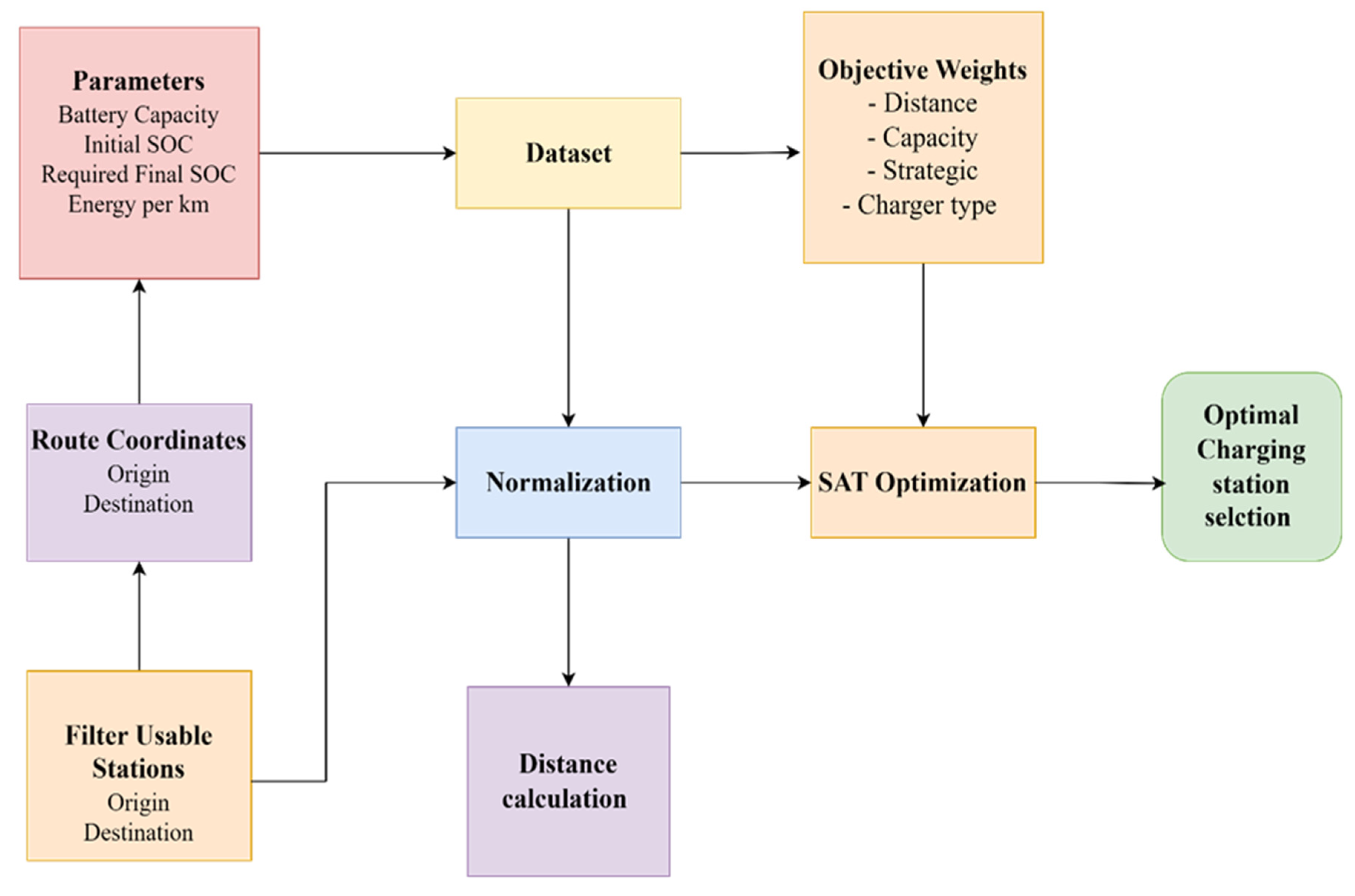
Figure 4.
SAT-based optimized EV routes — (a) Deloitte to Durgam Cheruvu, (b) BHEL to Gachibowli, (c) Sanathnagar to RTA Nagole, (d) Banjara Hills to Vanasthalipuram.
Figure 4.
SAT-based optimized EV routes — (a) Deloitte to Durgam Cheruvu, (b) BHEL to Gachibowli, (c) Sanathnagar to RTA Nagole, (d) Banjara Hills to Vanasthalipuram.
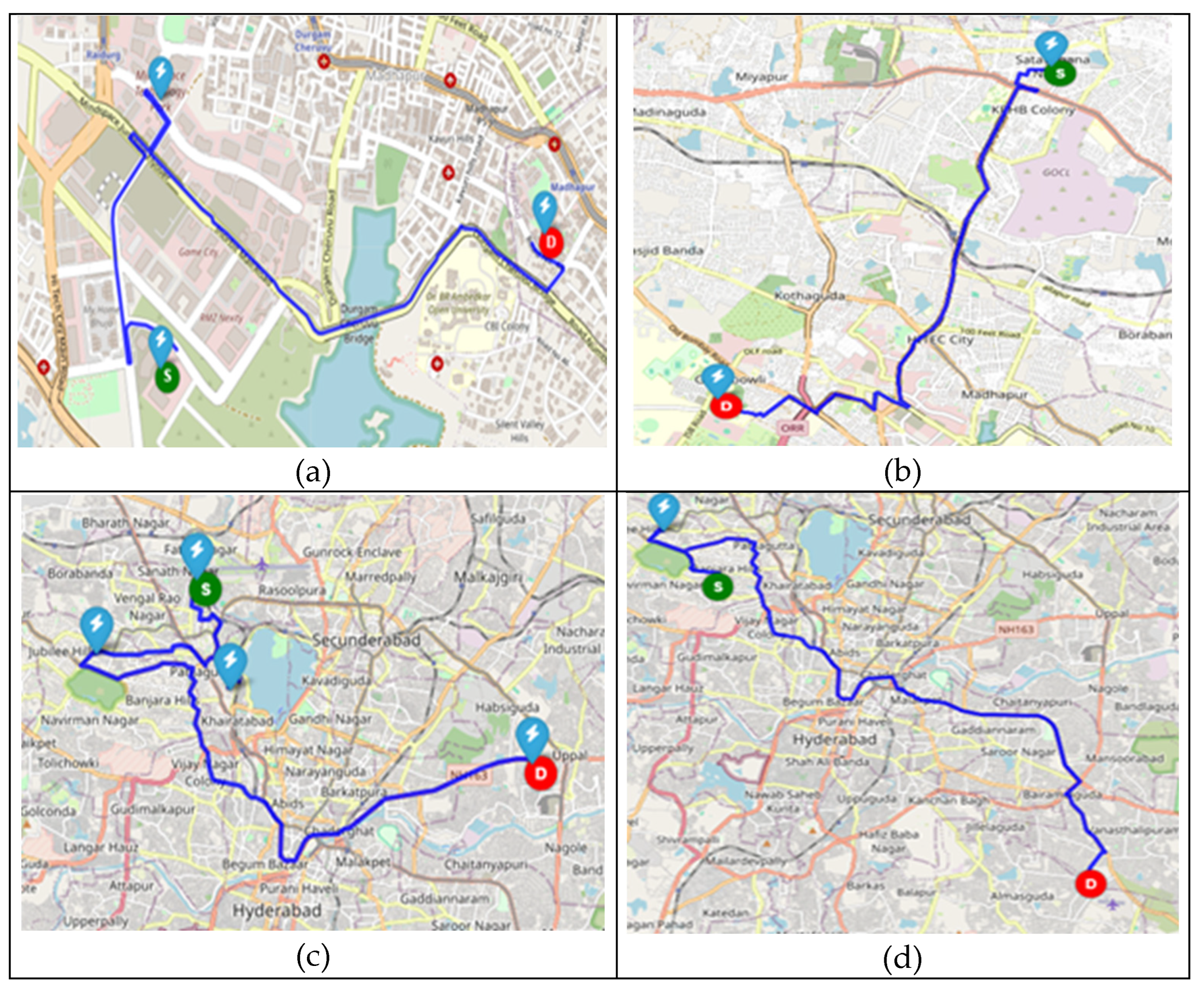
Figure 5.
Linear Programming-based optimized EV routes — (a) Deloitte to Durgam Cheruvu, (b) BHEL to Gachibowli, (c) Sanathnagar to RTA Nagole, (d) Banjara Hills to Vanasthalipuram.
Figure 5.
Linear Programming-based optimized EV routes — (a) Deloitte to Durgam Cheruvu, (b) BHEL to Gachibowli, (c) Sanathnagar to RTA Nagole, (d) Banjara Hills to Vanasthalipuram.
Disclaimer/Publisher’s Note: The statements, opinions and data contained in all publications are solely those of the individual author(s) and contributor(s) and not of MDPI and/or the editor(s). MDPI and/or the editor(s) disclaim responsibility for any injury to people or property resulting from any ideas, methods, instructions or products referred to in the content. |
© 2025 by the authors. Licensee MDPI, Basel, Switzerland. This article is an open access article distributed under the terms and conditions of the Creative Commons Attribution (CC BY) license (http://creativecommons.org/licenses/by/4.0/).
Copyright: This open access article is published under a Creative Commons CC BY 4.0 license, which permit the free download, distribution, and reuse, provided that the author and preprint are cited in any reuse.


