

Submitted:
25 September 2025
Posted:
26 September 2025
You are already at the latest version
Abstract
This study evaluated the potential of lambari (Astyanax altiparanae) as a pituitary donor for hormone-induced spawning in fish. The effectiveness of the extracted hormone was demonstrated over four consecutive years, successfully inducing spawning in captive lambari as well as in two other rheophilic species, curimbatá (Prochilodus lineatus) and tambaqui (Colossoma macropomum). When administered in the same manner as crude carp pituitary extract, a total dose of 6 mg·kg⁻¹, divided into two applications (10% + 90%), proved to be effective, since spawning was obtained in the three tested species. Under the applied management conditions, donor fish maintained a gonadosomatic index of approximately 15%, with ovaries predominantly composed of mature vitellogenic oocytes. These females exhibited basal levels of estradiol (around 0.9 ng.ml-1) and 17,20β-dihydroxy-4-pregnen-3-one (17,20β-P) (around 0.2 ng.ml-1), along with stable lhβ expression levels among different baths and between males and females. The lambari pituitary extract, when injected into females of the same species, induced a significant increase in 17,20β-P levels from approximately 0.2 to 1.0 ng·ml⁻¹. The use of lambari pituitary extract confirms that donor fish, both males and females, must be reproductively mature and in the breeding season. To our knowledge, most previous studies on extract donors are based on wild donors, making this one of the few that describe their physiological characteristics under aquaculture conditions. Low rearing densities seem to be crucial for obtaining a potent extract, although fish from the grow-out phase may also be suitable, a possibility that still requires evaluation. Our findings highlight the potential of lambari pituitary glands as a valuable alternative for hormone-induced spawning in small and medium-sized fish species, supported by their rapid maturation (4 months), low trophic level, increasing commercial production, and the prospect of using canned lambari to efficiently recover pituitary glands from fish heads.
Keywords:
reproduction
; hormonal induction
; aquaculture
; neotropical fish
1. Introduction
In 1930, Argentine scientist Bernardo Alberto Houssay was the first to demonstrate that hypophysation could induce ovulation in fish and reptiles [1]. By utilizing fresh pituitary extracts from various species, he observed that the South American freshwater fish, Cnesterodon decemmaculatus, released its eggs within one to two days after treatment. These findings had a significant impact at the time, and years later, in 1947, Dr. Houssay was awarded the Nobel Prize in Physiology and Medicine for his groundbreaking research on the role of the anterior pituitary lobe in glucose metabolism. During the 1930s in Brazil, researchers Rudolf Von Ihering and Pedro de Azevedo carried out important studies in aquaculture, focusing on fish farming and especially on the induction of spawning in Prochilodus argentus through hypophysation [2]. Although this technique has been in use for with over 93 years, it remains widely employed for hormonal induction in most fish farms that produce tropical migratory fish for aquacultural purposes [3,4].
This historical legacy underscores not only the pivotal role of hypophysation in the advancement of modern aquaculture but also its adaptability in meeting the evolving demands of the industry. A key factor contributing to its continued use is the inconsistent performance of synthetic hormone-based protocols, particularly those employing gonadotropin-releasing hormone analogues (GnRHs). These protocols have often resulted in low ovulation rates [5] and high embryo mortality [6,7,8], reinforcing the relevance of hypophysation as a reliable alternative. Despite decades of advancements in reproductive biotechnology [ ], the effects of hormonal treatments in migratory fish remain insufficiently explored. Further research is needed, particularly trials testing a broader range of doses and combinations with dopamine inhibitors, such as those employed in the LINPE protocol [11,12,13].
The use of GnRH in South American tropical rheophilic fish remains inconsistent. While tambaqui (Colossoma macropomum), the second most farmed fish species in Brazil [14], has shown some reproductive success with synthetic hormones [9,12,13], hypophysation remains the primary method for spawning induction in species such as Brycon amazonicus, Brycon hilarii, Brycon orbignyanus, and Leporinus spp., due to the lack of effective synthetic protocols [3], which also hold significant economic value. For lambari (A. altiparanae), recent studies confirm that hypophysation remains superior to GnRH-based induction, with or without dopamine inhibitors [5].
In this context, synthetic spawning protocols for South American migratory species still present challenges, such as precise dosage control, number of doses, administration intervals, and the decision of whether to use dopamine inhibitors (and, if so, which type), along with concerns about high mortality rates in early life stages. Due to these limitations, hypophysation remains indispensable [3]. Currently, carp pituitary extract (CP) is widely used in South American aquaculture; however, its high cost, uncertain origins, and excessive minimum purchase quantities limit its accessibility [15]. Given its availability, pituitary extracts obtained from locally farmed native species could serve as a viable alternative [16].
Among the species cultivated in Latin America, lambari, a highly productive,low-trophic species, with significant potential for sustainable aquaculture, plays a key role in aquaculture as live bait, as forage fish for carnivorous species, as an ornamental fish as protein source, with annual increasing production [17,18,19]. A recent patent (BR 10 2021 018330-6 A2 [20]) was registered with the National Institute of Industrial Property (INPI) for the production of lambari pituitary extract (LP) as a spawning inducer for native species. With this in mind, the present study evaluates the reproductive characteristics of pituitary extract donors from the first four LP batches and assesses their effectiveness in inducing spawning in three distinct migratory species. Importantly, the entire study compares the potential of LP with that of CP. Trials were conducted on three species of varying sizes and spawning types: (a) the small-sized lambari; (b) the small to medium-sized curimbatá (Prochilodus lineatus), which can be bred in a semi-natural system; and (c) the large-sized tambaqui, for which the stripped spawning method was applied. Additionally, the optimal period for LP collection during the reproductive season (October, November, and February) was assessed.
2. Materials and Methods
This study was approved by the Ethics Committee on Animal Use (CEUA - 012642/17) of the Faculty of Agricultural and Veterinary Sciences at São Paulo State University (Unesp), Jaboticabal Campus, São Paulo, Brazil. Sexually mature lambari individuals were used as pituitary donors. These fish were sourced from a broodstock maintained at the Aquaculture Center of Unesp (Caunesp) in Jaboticabal, São Paulo, Brazil (21°15'17''S, 48°19'20''W). Additionally, tambaqui (Colossoma macropomum) and curimba (Prochilodus lineatus) breeders used for the evaluation of reproductive performance were part of the Caunesp broodstock.
Physical and chemical parameters were monitored weekly for experiments conducted in earthen ponds to characterize pituitary donors and daily for spawning induction experiments conducted in the laboratory. Measurements were consistently taken at 7:00 a.m. Temperature and conductivity were recorded using a HI-98311 probe (Hanna Instruments), dissolved oxygen with an F-1550A oximeter (Bernauer-424 Aquaculture), and pH with a K39-0014P pH meter (Kasvi) (Table 1).
The experiments are presented below following the chronological sequence of execution. In this way, the experiments for obtaining batches of pituitary extract and the subsequent hormonal induction with the extract produced are presented alternately. Thus, experiments 1, 4, 6, and 8 are about obtaining pituitary extract and experiments 2, 3, 5, 7 and 9 are about batch efficacy testing. Throughout the study, hypophysation was standardized and tested in different species and with single or fractionated doses.
2.1. Experiment 1. Obtaining the First Batch of LP (OCT-FB and DEC-FB) and Characterization of Female Donors in October and December 2016
This experiment involved two simultaneous steps: (a) the characterization of female donors (b) the preparation of the first LP.
Males and females (n=2500) were equally and randomly distributed in 10 earthen ponds of 81 m3 (9 m x 6 m x 1.5 m) with the density of 3.08 fish/m3 (250 fishes per pound) on October 5, 2016, and remained in acclimation for 19 days (Figure 1A). The main objective was to evaluate pituitary batches collected within the species' reproductive season. Two sampling events were conducted to form the first batch of pituitaries. The first sampling occurred on October 24, 2016, where fish from five ponds were collected (OCT-FB). The second sampling occurred on December 15, 2016, involving fish from the remaining five ponds (DEC-FB) (Figure 1A). The interval between the two samplings was 52 days. Both events occurred within the species' reproductive period, which extends from October to February, as described by Cassel et al. [21].
Figure 1. Schematic representation of sampling intervals and data used to obtain the pituitary extract of Astyanax altiparanae and reproductive characterization of pituitary donors for experiments 1, 4, 6 and 8. Figures A, B, C and D represent, respectively, the way extracts from experiments 1, 4, 6 and 8 were obtained. The scissors represent the dates of collection for characterizing the donors and obtaining the extracts. A) “OCT - FB” and “DEC-FB”: October – first batch and December – first batch; B) OCT – SB: October second batch; C) NOV-TB: November - third batch and D) FEB-FB: February- fourth batch. For all experiments, females were collected for analysis of the reproductive parameters of the donors (n=5) and production of pituitary extract (n=250).
2.1.1. Analysis of Donor Reproductive Parameters
One female from each pond (five ponds: 1 female per pound) was randomly selected, transported to the laboratory, and immediately anesthetized with 100 mg/L of benzocaine (Sigma-Aldrich, Saint Louis, USA) for recording body mass (g) and total length (cm). Subsequently, blood samples were collected from the caudal vessels in heparinized syringes and then centrifuged at 1500×g for 15 min at 4ºC. The plasma obtained was stored in an ultra-freezer (-80ºC) for analysis of plasma levels of estradiol (E2) and 17.20β-dihydroxy-4-pregnen-3-one (17.20β-P). Additionally, an incision was made along the ventral region of the body in a posterior-to-anterior direction to expose the abdominal cavity for ovary removal. The ovaries were weighed to calculate the gonadosomatic index (GSI = [gonad mass/body mass] × 100) as described by Vazzoler [22], and after the ovaries were also collected and processed using routine histological embedding techniques for morphometric density analysis, following methods applied by Ariki et al. [23].
2.1.2. Quantification of Steroid Hormones by ELISA
Quantifications of plasma levels of E2 and 17.20β-P were made with Enzyme-Linked ImmunoSorbent Assay (ELISA) using a commercial kit (DRG International Inc., Springfield, NJ, USA, and Cayman Chemical Company, Ann Arbor, MI, USA, respectively) following the manufacturer's instructions. All samples were read in duplicate, and the intra- and inter-assay variability was assessed with respect to 20% as a limit of coefficient of variation as described by Roza de Abreu et al. [5] for the same species. Plate readings were performed in an Epoch2 plate reader (BioteK Instruments, Inc., Highland Park, Winooski, USA).
2.1.3. Histological and Stereological Analysis
The medial portion of the ovary was fixed in a 4% paraformaldehyde and 2% glutaraldehyde solution in 0.1M Sorensen phosphate buffer at pH 7.2 for 24 hours. After fixation, ovarian samples were dehydrated in alcoholic solution, in increasing concentration series, and soaked in glycol methacrylate (Technovit 7100/historesin), sectioned at 3.0 μm thick in a microtome equipped with a LEICA RM 2245 glass knife, and stained with hematoxylin and eosin for making histological slides.
For volumetric density analysis, a grid of 352 points of intersection was applied and counted in three fields in the medial portion of the ovary, totalling 1056 points for each female, with a 5× objective. Photomicrographs (5x objective, one field per cross-section were evaluated using a DM4000B microscope coupled to an image capture camera (LEICA Microsystems, Wetzlar, Germany). The oocyte stages of each female were classified into: previtellogenic (PV), cortical alveoli (CA), early vitellogenic with incomplete vitellogenesis and cytoplasm not filled with yolk (EV), final vitellogenic with cytoplasm filled with yolk (FV), mature vitellogenic oocyte with germinal vesicle breakdown (GVBD), atretic (AT), postovulatory follicles (POF), and interstitial tissue (IT) of according by Cassel et al. [22] for the same species. GVBD oocytes retained in the ovaries were classified according to the description proposed by Brown-Peterson et al. [24] and adopted by us [5,25].
2.1.4. LP production and Quantification of lhβ Gene Expression Levels
Fifty pituitary glands from females were collected from each pond (2 samplings x 5 ponds x 50 individuals per pound = 500 pituitaries) on the same days as the samplings carried out in the first step (2.1.1) (October, 24th, 2016) and (December, 15 th , 2016) (Figure 1A). The extraction and preservation of the pituitary to produce the extract were carried out according to Woynarovich and Horváth [26,27]. Females were euthanized using a lethal dose of benzocaine (500 mg/L - Sigma-Aldrich, Saint Louis, USA) and by severing the spinal cord at the operculum level to facilitate head removal and subsequent pituitary collection.
In both October and December, out of the 250 pituitary glands collected from females, 13 were randomly chosen and processed for gene expression analysis. Another 13 pituitaries from males were randomly collected to assess lhβ gene expression levels. The samples were preserved in RNAlater and stored at -80°C. The lhβ gene expression was then compared between males and females.
Moreover, to compare the relative gene expression levels of lhβ obtained in this study, in addition to those from the first batch, two other batches (the fourth batch of LP (FEB-FB) obtained in February 2021 (experiment 4) and (the third batch of LP obtained in November, 2019 (NOV-TB)) also had thirteen randomly collected females to compare lhβ gene expression levels.
2.1.5. Quantification of lhβ Gene Expression Levels
2.1.5.1. RNA Isolation and cDNA Synthesis
Isolation of total RNA and synthesis of cDNA from lambari pituitaries were performed according to the protocol proposed by Mechaly et al. [28]. RNA was immediately isolated using 500 uL Trizol® (Invitrogen™ USA). The isolated RNA was quantified using a Biotek Synergy H1 spectrophotometer (Biotek®, USA). All RNAs were treated with DNase I (Invitrogen™, USA) to remove any possible contamination by genomic DNA. Approximately 2 µg of RNA was then used to synthesize cDNA using Superscript II reverse transcriptase (InvitrogenTM, USA), RNaseOUT recombinant ribonuclease inhibitor (InvitrogenTM, USA) and Oligo dT universal adapter primers in a reaction volume of 20 µL according to the manufacturer's instructions.
2.1.5.1. Real-Time Polymerase Chain Reaction (RT-qPCR)
The cDNA was used as a template for RT-qPCR reactions. Expression patterns were analysed by relative quantification. The primers for the target gene (lhβ) (forward: TGCCCAAAATGCCTAGTGTTTC; reverse: TCTTGTACACCGGATCCTTGGT) and for the normaliser (ef1a) (forward: CACTGGTACCTCACAGGCTGACT; reverse: CCAGCCTCAAACTCACCAACA) were previously described [29] and deposited in the NCBI database under the accession numbers KJ544556 and KM210283, respectively. The qPCR amplification reaction contained 2 μL of diluted cDNA (1:20), 300 nM of each primer, and 5 μL of FastStart Universal SYBR Green Master (Rox) (Roche Diagnostics, Germany) in a final volume of 10 μL. The thermocycling conditions were 95°C for 10 minutes, 40 cycles at 95°C for 15 seconds and 60°C for 1 minute. At the end of the PCR cycles, the quality of the qPCR products was analysed using a dissociation curve step to confirm that only a single PCR product was amplified. Control reactions without template cDNA for each primer pair were also included in each reaction plate to ensure that there was no external DNA contamination. The amplification efficiency of each primer/target gene set was assessed by linear regression of a cDNA template dilution curve. The qPCR reactions were performed using a Step-one real-time PCR system (Applied Biosystems, USA). Relative quantification (RQ) was calculated from the delta delta Ct (Mechaly et al. [28]). Determinations were performed in duplicate for the target gene (lhβ) and normalised against the reference gene (ef1a). RQ values were calculated for each sample and the standard error of the mean (SEM) was calculated. Controls without template cDNA and melting curve analysis were used to determine the specificity of the amplification.
2.2. Experiment 2. Hormonal Induction of Lambari in a Single Dose to Test LP Viability: OCT-FB and DEC-FB
This experiment evaluated the reproductive performance of lambari females induced with a single dose of LPs obtained in Experiment 1 (OCT-FB and DEC-FB). Four groups were formed: control (0.9% saline solution), positive control (hypophysation with CP), and the OCT-FB and DEC-FB groups (hypophysation with LP collected in October and December, respectively). For hormonal induction, we used 10 L plastic spawning units (30 × 40 cm) with continuous water flow, connected to a recirculating system at 27°C. Each unit had a 0.05 mm net at the outlet for egg collection. The methodology and setup followed [5,23,30,32,33]. In each experimental spawning unit (replicate), 15 lambari individuals were allocated, consisting of 5 females (21.8 ± 4.4 g) and 10 males (12.2 ± 1.7 g), maintaining a 1:2 female-to-male ratio [30]. Each treatment included five replicates, resulting in a total of 100 females across all groups (4 groups: 2 treatments and 2 controls × 5 replicates × 5 females) (Figure 2A).
Females in the CP, OCT-FB, and DEC-FB groups received a single intraperitoneal dose of 6 mg.kg-1, as commonly used for this species [31,32], while females in the C group received a 0.9% saline solution as the vehicle. Males in all groups were induced with a 3 mg.kg-1 dose of CP at the same time as the female dose. All groups were injected with 0.04 mL.10g-1 of saline at midnight. Six females were sampled before hormonal induction as the initial group (IN). CP was obtained from commercial suppliers. Animals were monitored up to 12 hours after induction, and at the end of the experiment, one spawned and one unspawned female were collected per replicate. Females were considered spawned if they released oocytes upon gentle abdominal compression and unspawned if they retained oocytes, as confirmed by histological analysis [31]. One spawned and one unspawned female per experimental unit were randomly selected for ovary collection, GSI determination, and ovarian volumetric density analysis, following the methodology in Experiment 1.
From 3:30 am (expected spawning period) (Figure 2B), the experimental units were monitored for observation of spawning and "spawning time’ was recorded and converted into degree hours (the average water temperature multiplied by the number of hours between resolving doses and ovulation). When recorded, the total volume of each spawn was determined in each experimental unit by removing the spawning eggs from the 0.05 mm net attached to each experimental unit for egg retention. After this step, 10 mL of eggs from each unit were transferred to 6.5 L incubators (one replica per incubator). Fertility and hatching rates were determined 3 h and 9 h after the eggs were transferred to the incubators according to Ariki et al. [23]. Parameters were defined for each experimental unit for later determination of means and/or medians for experimental groups and controls. To assess reproductive performance, we calculated variables as follows:
- Latency period: hours between the resolving dose and first observed in each replicate;
- Spawning rate: number of replicates where spawn was registered / total number of replicates of each group;
- Total volume of eggs per group (mL): Sum of the volume of eggs found in all replicates of a group;
- Fertility rate (%): number of viable eggs x 100/total number of eggs collected 3h after fertilization;
- Hatching rate (%): number of hatched larvae x 100/total number of eggs 9 h after fertilization;
- GSI for spawned and unspawned females after the spawning period: this variable was calculated using a conventional equation (gonad mass/body mass) x 100) [22]. However, for spawned females, the mass of eggs released could not be computed for the gonad weight. For that reason, we only compared spawned females among themselves and not with unspawned females, following the methodology applied by Hainfellner et al. [25].
- Volume density: this analysis was performed as described in experiment 1.
2.3. Experiment 3. Hormonal Induction of Lambari with Fractioned Doses to Test the Viability of Lambari Hypophysis First Extracts: OCT-FB and DEC-FB
In this experiment, we applied the methodology from Experiment 2 with minor modifications. Experimental groups remained the same, with an additional control (CC) where females and males were handled like the other fish but not injected (Figure 2B). Females in groups the CP, OCT-FB, and DEC-FB received two intraperitoneal doses (0.6 mg. Kg-1 in the priming dose and 5.4 mg. Kg-1 in the resolving dose with an interval of 12h (10% + 90%)), while the C group received saline as the vehicle. Males from all groups were injected with 3 mg.kg-1 of CP at the same time as the females' resolving dose [23] (Figure 2B). Since the saline-injected controls (C) from Experiment 2 spawned, we added the CC control to assess whether handling alone could trigger spawning, as this species can spawn without hormonal induction, though to a lesser extent [5]. We aimed to evaluate whether manipulation could cause stress-induced spawning and how it might affect the results [30].
Hormonal induction followed the same methodology as Experiment 2, with the exception of using a fractional dosing protocol to address the low spawning rate observed, even in the positive control. Recent studies [5,23] showed improved reproductive performance with fractional doses, although previous studies [27] typically used a single dose. Since the number of spawned females per replicate varied, all females were collected to determine the fraction of spawned females, and the average egg volume per treatment was also evaluated to better understand replicate variations, adding two variables:
- Number of spawned females for replicate: number of spawned females in each replicate/ total number of females per replicate;
- Average egg volume per replicate: sum of volume eggs of all replicates/number of replicates
In experiment 3 we evaluated ovarian volumetric density in the same manner described for experiment 2 (single doses) and also included the evaluation of steroid plasma levels and quantifications of plasma levels of 17.20β-P were made with ELISA as described for experiment 1. To that one spawned and one unspawned female per replicate was randomly collected at the expected time of spawning (Figure 2B).
2.4. Experiment 4. Obtaining the Second Batch of LP (OCT-SB) in October 2018
This experiment aimed to obtain the second batch (SB) of LP and simultaneously characterize the female donors (Figure 1B).
The procedures were the same as described for experiment 1, males and females (n=2500) were equally and randomly distributed in 5 earthen ponds of 81m3 (9 m x 6 m x 1.5 m) with density of 3.08 fish/m3 (250 fishes per pound) on September 5th, 2016, and remained in acclimation for 24 days until sampling on October 15th, 2018 (Figure 1B).
We opted for that to reduce the time for obtaining the pituitary extract since analyses carried out with the first batch demonstrated similar results between OCT-FB and DEC-FB extracts. The extract obtained in this experiment was denominated OCT-SB.
2.5. Experiment 5. Hormonal Induction of Curimbatá to Test the Viability of LP Second Extract: OCT-SB
This experiment aimed to evaluate the reproductive performance of curimbatá females with the application of a fractionated dose of LP obtained in experiment 4 (OCT-SB). Therefore, we constituted three groups to be submitted to hormonal induction and to evaluate the extract effectiveness: control (0,9% saline solution (C)), positive control (hypophysation with CP and the OCT-SB (hypophysation with LP collected in October). In this case, controls without hormonal manipulation were not used, as it is known that neither curimbatá since they cannot spawn in captivity without hormonal induction [25].
For hormonal induction, we used experimental spawning units consisting of 750L water tanks in a semi-natural system closed water recirculation system at a controlled temperature and set to 27°C. In each experimental spawning unit (replicate), one curimbatá female (1426 ± 285.4 g) and two males (793.2 ± 182.1 g) were put together for the resolving dose of hypophysation to spawn in a semi-natural system. Three replicates were used per treatment (3 groups (1 treatment and 2 controls) x 3 replicates = 9 females) (Figure 3A).
Females in groups CP and OCT-FB received two doses of intramuscular injection were applied (0.6 mg. Kg-1 in the priming dose and 5.4 mg. Kg-1 in the resolving dose with an interval of 12h (10% + 90%)). Males from all groups were injected with 3 mg.kg-1 of CP at the same time as the females' resolving. All groups were injected with the same diluent volume (0.5 mL.Kg-1) at midday and midnight. The animals were monitored up to 7 hours after hormonal induction to observe spawning. When spawning was observed, the eggs were collected by siphoning and the egg volume was recorded. Subsequently, a 10 mL aliquot of each unit was placed in 6.5 L conical incubators to estimate fertilization and hatching rates as described for experiment 2. Fertility and hatching rates were measured 9 hours and 22 hours after spawning, respectively.
2.6. Experiment 6. Obtaining the Third Batch of LP (NOV-TB) in November 2019
This experiment aimed to obtain the third batch (NOV-TB) of LP and reproductive characteristics of the female donors. The procedures followed those described for experiment 1. Males and females (n=2500) were randomly distributed in five earthen ponds (81 m3; 9 m × 6 m × 1.5 m) at a density of 3.08 fish/m3 (250 fish per pound). Stocking occurred on either September 5th or October 7th, 2016, with an acclimation period of 24–25 days before sampling on October 15th or November 1st, 2018 (Figure 1C). The extract batch, obtained under similar conditions as experiments 1 and 4, was collected in a single period and denominated NOV-TB, with minor modifications detailed in Figure 1C. Breeder parameter analysis and extract preparation followed the same methodology used for other batches. In this experiment, pituitaries were collected from 10 females to analyse lhβ gene expression levels. The pituitaries were preserved in RNA later and stored in an ultra-freezer, following the methodology outlined in Sections 2.9–2.11. However, it was not possible to perform an ELISA evaluation for this group due to challenges in obtaining plasma samples.
2.7. Experiment 7. Hormonal Induction of Tambaqui to Test the Viability of LP Third Extract: NOV-TB (2019)
In this experiment, we constituted three groups to be submitted to hormonal induction and to evaluate the extract effectiveness: control (0,9% saline solution (C)), positive control (hypophysation with CP and NOV-TB (hypophysation with LP collected in November). For hormonal induction, we used experimental spawning units consisting of 750 L tanks closed water system at controlled temperature set to 27°C. Three females (4821.0 ± 1526.0 g) and nine males (3910.7 ± 1054.8 g) were kept individually in the boxes and each fish was considered as an experimental unit. Tambaqui females were submitted to strip spawning with dry fertilization routinely [34]. One female (replicate) was used in each treatment (Figure 3B).
All groups were the same diluent volume (0.5 mL. kg-1) at midday and midnight. The animals were monitored up to 10 hours after hormonal induction to observe spawning [12,35,36]. Fertilization was obtained by adding a pool of semen from three males (in the proportion of 0.5 mL of pooled semen for each 50 g of oocytes). The eggs were mixed and hydrated, and a 10 mL aliquot of each unit was placed in 6.5 L conical incubators to estimate fertilization and hatching rates as described for experiment 2.
2.8. Experiment 8. Obtaining the Fourth Batch of A. altiparane Pituitary Extract (FEB-FB) in February 2021
This experiment aimed to obtain the fourth batch (FB) of LP and characterize female donors from small farmers (Figure 3C). Lambari males (11.3 ± 5.4 g) and females (27.1 ± 8.2 g) (n=250) from a fish farm (FEB-FB) were used as pituitary donors. After acclimation, they were euthanized for pituitary extraction. Breeder characteristics were not assessed. Additionally, pituitary glands from 10 females were collected for lhβ gene expression analysis, as described in experiment 1.
2.9. Experiment 9. Hormonal Induction of Curimbatá, to Confirm the Viability of LP Fourth Extract: FEB-FB
This experiment aimed to validate the effectiveness of LP, now sourced from a different group of donor fish from aquaculture. We chose to test it again on curimbatá females (second trial) to compare the results with previous findings. The experimental design closely follows that of Experiment 5 and is illustrated in Figure 3C.
In this experiment, a single batch of LP (FEB-FB), obtained in Experiment 8, was used. Due to the limited number of breeders, only the positive control was included, as it is well established that this species does not spawn when injected with a saline solution [27]. Therefore, two groups were subjected to hormonal induction to evaluate the extract's effectiveness: Control (induced with CP) and FEB-FB (induced with LP collected in February).
For hormonal induction, we used experimental seminatural spawning units consisting of 750 L tanks within a water recirculation system, maintaining a controlled temperature of 27°C. Each spawning unit (replicate) housed one curimbatá female (1589.2 ± 252.2 g) and two males, maintaining a 1:2 female-to-male ratio. A total of three replicates were used for the CP group and four for the FEB-FB group (Figure 3C).
Hormonal induction methodology and evaluation of reproductive performance were done as described for experiment 5. Females in groups CP and FEB-TB received two doses of intramuscular injection were applied (0.6 mg. Kg-1 in the priming dose and 5.4 mg. Kg-1 in the resolving dose with an interval of 12 h (10% + 90%)). Males from all groups were induced with 3 mg. kg-1 of CP in a single dose at the time of the resolving dose in females.
2.10. Statistical Analysis of Data
The design was completely randomised, and the data were subjected to assumptions of homoscedasticity and normality by Levene and Shapiro Wilk tests, respectively. The volumetric density of oocytes and GSI were analysed by the Kruskal Wallis test. For better statistical analysis we separated spawned and unspawned females. For the analyses, Graphpad Prism 7 software was used with a significance level of α=0.05.
Experiment 1 (Characterization of donors of the first batch of extract): plasma levels of 17.20 β-P and volumetric density of oocytes were analysed by the Man U Whitney test and the plasma levels of E2 were analysed by the T test.
Experiment 2 (Reproductive performance of Lambari females with application of a single dose of LP): volumetric density and GSI of females from different groups were analyzed by Kruskal Wallis test. Spawned females were not statistically analyzed due to the low number of specimens. Reproductive performance was not analysed due to the low number of spawned replicates.
Experiment 3 (Reproductive performance of Lambari females with the application of a fractionated dose of LP): reproductive performance and volumetric density of spawned females from different experimental groups were analyzed by the Kruskal Wallis test, while for the analysis of spawned and unspawned females in the same group, they were analyzed by the Mann U Whitney Test. Levels of 17.20 β-P and GSI were analysed by ANOVA followed by Tukey HSD Test.
Experiments 4, 5, 6 and 7 were not analysed due to the low number of specimens.
Experiment 9: Reproductive performance was analysed by Tukey HSD Test.
For analysis of gene expression 2^-ΔCт values were tested for normality and homoscedasticity using the Shapiro-Wilk and Levene tests, respectively. Differences in lhβ gene expression between males and females were assessed using the Mann-Whitney test (non-parametric test for two treatments). The one-way ANOVA test (parametric test for more than two treatments) was used to test for differences in lhβ gene expression in females in different months of collection.
3. Results
3.1. Experiment 1. Obtaining the First Batch of LP (OCT-FB and DEC-FB) and Characterization of Female Donors
The average values observed for GSI and steroids are shown in Table 2. The GSI was similar between OCT-FB and DEC-FB females (p>0.05) as well as the plasma levels of E2 and 17, 20β-P (p>0.05) (Table 2). The evaluation of volume density was similar between animals sampled from both batches. We observed that for both groups, most parts of OCT-FB and DEC-FB ovaries volume density were occupied by final vitellogenic (87.8 ± 10.7%) and (85.8 ± 12.9%), respectively. The volumetric densities occupied by other oocyte types were similar between OCT-FB and DEC-FB (p>0.05). We did not observe POF nor GVBD oocytes in both treatments (data not shown).
3.1.1. lhβ Gene Expression
3.1.2. lhβ Gene Expression in Pituitaries of Males and Females of Lambari Collected in October 2016 (Experiment 1)
Lambari males and females collected in October 2016 as pituitary donors to induce spawning of their species showed a similar relative amount of lhβ (p = 0.8357), suggesting that the LP may have similar efficiency in both sexes during the reproductive period of the species (Figure 4).
3.1.3. lhβ Gene Expression in Pituitaries of Female Lambari Collected in Different Months of the Reproductive Period (Experiment 1, 6 and 8).
Lambari females collected in February (the fourth batch of LP, FEB-FB, obtained in February 2021), October (the first batch of LP, OCT-FB, obtained in October 2016), and November (the third batch of LP, NOV-TB, obtained in November 2019) as pituitary donors showed similar relative amounts of lhβ (p = 0.628). This suggests that LP may exhibit consistent efficiency across different months and batches obtained in different years during the species' reproductive period (Figure 5).
3.2. Experiment 2: Reproductive Performance of Lambari Females with Application of a Single Dose of LP Obtained in Experiment 1
Spawning was registered in all experimental groups. Ovulation occurred between 156.6 and 279.7 hours. Although treatments with pituitary extract appeared to have a shorter latency period, statistical comparisons among experimental groups were not possible due to the low number of spawning replicates. For groups C, CP and DEC-FB averages could not be calculated for reproductive performance variables since spawn was registered in a single replicate (Table 3). In all groups, fertility was above 40% and hatching rates were above 28 %, but could not be compared among groups due to the low number of spawns in the whole experiment. GSI average values ranged from 19 ± 2.2 to 23.5 ± 6.4 in spawned females and were similar among groups (p>0.05) (Table 3).
3.2.1. Histological Evaluation of Post-Spawning Ovaries of Spawned and Unspawned Lambari Females Using Single Doses
In unspawned females, final vitellogenic oocytes were observed across all groups. The volumetric density of these oocytes was higher in the IN group compared to the CP group (p < 0.05) but similar to the other groups (Table 4). GVBD oocytes retained in the ovaries post-spawning were present in all groups except the IN group. The volumetric density of GVBD oocytes in the CP group was comparable to other groups but significantly higher than in the IN group (p < 0.05) (Table 4).
The spawned females exhibited similar profiles. This was expected, as these females were collected before the experiments as baseline values. Unfortunately, due to the low number of experimental units with ovulated females, it was not possible to statistically compare the potential to induce ovulation among the different groups (Table A1).
3.3. Experiment 3. Hormonal Induction of Lambari with Fractionated Doses to Test the Viability of Itself First Pituitary Extracts: OCT-FB and DEC-FB
3.3.1. Reproductive Performance of Lambari Females with Application of a Fractionated Dose of LP (OCT-FB and DEC-FB) Obtained in Experiment 1
Ovulation was registered between 150.7 to 189.7 ± 43.7 degree-hours after resolving doses and the latency period was similar among groups (p>0.05). Spawning was registered in all groups, except for CC (Table 5). Spawning rate was similar among groups, but only in OCT_FB and DEC_FB ovulation was registered in all replicates (p>0.05) (Table 5). The number of females spawned per replicate was higher in DEC-FB than CC (p<0.05), however both were similar to the other groups (p>0.05). Egg volume per group and mean relative fecundity were similar for all groups (p>0.05). Mean fertility and hatching rates were similar among groups (p>0.05) (Table 5). The GSI was similar among unspawned females and among spawned females (p>0.05) (Table 5).
3.3.2. Histological Evaluation of Post-Spawning Ovaries of Spawned and Unspawned Lambari Females Induced with Fractionated Doses
Concerning ovaries of unspawned females, FV was the predominant germ cell type registered for all groups and the volumetric density of oocytes was similar for all groups (p>0.05) (higher than 60%). In the IN group (not induced), we observed that FV oocytes were the predominant ovary cell type (92.8 ± 1.3%) (Figure 6A,B). Concerning ovaries of spawned females, POF were observed in all groups and in similar percentages, except for CC groups where no females spawned (Figure 6A). We observed higher levels of GVBD oocytes only in the OCT-FB group, which was superior to IN and CP (p<0.05), however similar to DEC-FB (p>0.05) (Figure 6).
3.3.3. Plasma Levels of 17.20 β-P
Among spawned females, plasma levels of 17,20β-P were similar across all experimental groups (p > 0.05) (Figure 7A). Regarding plasma levels in unspawned females after the spawning period, OCT-FB and DEC-FB exhibited higher levels than IN females (p < 0.05) but were similar to the other groups (p > 0.05) (Figure 7B).
3.4. Experiment 4. Obtaining the Second Batch of LP (OCT-SB)
3.4.1. Reproductive Characteristics of Pituitary Donor Females of Lambari
The GSI, E2 and 17.20β-P plasma levels are shown (Table 2B). The volumetric density of the oocytes was mostly occupied by final vitellogenic oocytes (93.9 ± 3.2%); moreover, we did not observe either GVBD oocytes or post-ovulatory follicles (data not shown).
3.5. Experiment 5
3.5.1. Reproductive Performance of Curimbatá Females with Application of the Fractionated Dose of LP (OCT-SB) Obtained in Experiment
Ovulation was registered from 193.5 to 249.4 degree-hours. All CP and OCT-SB replicates spawned, but not females from C. The fertility rate of CP and OCT-SB was higher than 70%, however in one replicate both C and OCT-SB had a rate of 0% (Table 6). The volume of eggs released by the females varied across the different treatments, but it can be considered high, ranging from 5.7 to 13.2 L of eggs per female.
The egg volume obtained could not be compared between treatments, nor could we compare fertility and hatching rates. However, upon superficial observation of the data, the rates varied greatly and seem to be associated with some characteristics of the females rather than the treatments. It was observed that both “good” and “poor” spawning were obtained with both extracts.
3.6. Experiment 6. Obtaining the Third Batch of A. altiparane Pituitary Extract (NOV-TB) (2019)
GSI levels were comparable to the values found for the other extracts (Table 2). The volumetric density of the oocytes was mostly occupied by final vitellogenic oocytes (87.9 ± 2.5 %). We did not observe either GVBD oocytes or post-ovulatory follicles (data not shown).
3.7. Experiment 7. Reproductive Performance of Tambaqui Females with Application of the Fractionated Dose of LP (NOV-TB) (2019) Obtained in Experiment 6
Ovulation was registered from 301.3 to 315.5 degree-hours. Only CP and NOV-TB spawned. Both the female was treated with LP and the female treated with CP. The mass in grams of released eggs varied among the females but could not be statistically compared; fertility rates were above 20% with CP and 79% with LP (Table 7).
2.11. Experiment 8: Obtaining the Fourth Batch of LP (FEB-FB) in 2021
2.11.1. Reproductive Characteristics of Pituitary Donor Females of Lambari
The volumetric density of the oocytes was mostly occupied by final vitellogenic oocytes (93.9 ± 3.2%). We did not observe either GVBD oocytes or postovulatory follicles (data not shown).
2.12. Experiment 9
2.4.1. Reproductive Performance of Curimbatá Females with Application of a Fractionated Dose of LP (FEB-TB) Obtained in Experiment 8
Ovulation initiated at 197.8 to 219.3 degree-hours, there was no statistical difference between the variables analysed. The spawning rate was 3/3 for CP and for FEB-TB 4/4 (Table 8).
4. Discussion
This study demonstrated that LP can be effectively used for hormonal induction in tropical migratory fish. The results obtained, always compared to CP, show a high degree of similarity in reproductive performance. These findings provide an important alternative for the hypophysation of migratory fish bred in captivity, especially considering that the most used product, CP, has a high cost and is not always available [3,37]. Notably, LP can be produced even by small-scale farmers with proper training, making it a valuable option for inducing reproduction in small fish species like lambari, as well as in medium-sized species such as curimbatá and large species tambaqui.
Between 2016 to 2019, four batches of LP were produced, tested and found to be as effective as CP. This success may be attributed to the low stocking density used (3.08 fish/m3). This aspect can be observed through the water parameters, as the oxygen concentration remained close to 7.0 mg·L−1, and no mortality was recorded. Another factor that highlights the adequate management conditions was the reproductive characteristics of the pituitary donors. Typically, broodstock are maintained at low densities to reduce stress and preserve water quality, both of which are known to affect gamete quality negatively [3]. However, specific studies on management conditions for pituitary donors remain scarce. To address this, proportionally adapted reduced stocking densities were applied on those recommended for medium- and large-size tropical fish spawners [3,38].
The management protocol applied proved to be effective, as the GSI of females from four different batches analyzed between 2016 and 2021 remained consistent and always above 15% of body weight, indicating their maturity at the time of collection. Similar GSI values were reported in mature lambari females by Lira et al. [31] and De Jesus et al. [29]. A GSI of 15% serves as a key indicator that the females had not recently spawned. Following spawning, lambari GSI drops to approximately 4% and requires about six days to return to around 15%, maintaining this level for up to 30 days in the absence of spawning [31]. Consistent with previous studies on this species, the ovaries of mature lambari females in this study had approximately 70–80% of their volume occupied by fully vitellogenic oocytes [5,23,31], further confirming that the donor females were both suitable and mature.
In this context, estradiol is known to induce vitellogenesis in fish [45,46]. In the present study, plasma estradiol levels remained constant among lambari pituitary donors, ranging from 0.48 to 1.33 ng/mL. These values are consistent with those reported by Lira et al. [31] (~0.5 ng/mL) and Brambila-Souza et al. [30] (~0.2 to 0.35 ng/mL) for mature females. These estradiol levels confirm the mature status of the females and indicate that they had not spawned recently, which could potentially reduce their pituitary LH levels, a substance that induces spawning [41]. Lira et al. [31] demonstrated that in lambari, estradiol levels rise significantly by the sixth day after spawning, reaching a median of approximately 1.5 ng/mL. This rapid increase suggests that estradiol plays a role in facilitating a second split spawning event in the species. These findings support the idea that the estradiol levels observed in the present study are not characteristic of animals undergoing vitellogenesis, which should be associated with reduced pituitary LH content.
In the present study, 17,20β-P levels in donor animals consistently remained around 0.2 ng/mL. In contrast, lambaris injected during the study exhibited a significant increase, reaching approximately 1.0 ng/mL, which was higher than in non-injected females. These findings align with previous literature, where mature females not subjected to hormonal induction also displayed low 17,20β-P levels, around 0.2 ng/mL. Thus, similar to estradiol, the 17,20β-P values observed were characteristic of mature females but indicated they were outside the ovulation process. This is supported by evidence that induced females undergoing ovulation in this species can reach plasma 17,20β-P levels as high as 3.5 ng/mL [5]. Therefore, based on GSI values, stereological analysis of the ovaries, and the levels of gonadal steroids analyzed, we can confirm that the conditions used to maintain the broodstock for obtaining the extract were optimal.
In this regard, for the fourth batch, obtained from a local fish farmer, the stocking density was unknown but was certainly higher than the one used in this study, as the fish came from the grow-out phase. It is important to note that, given the limited literature on the management of pituitary extract donors, fish raised under fattening conditions at appropriate densities may, in some cases, serve as viable pituitary donors. This was observed in the present study with the FEB-FB extract. This finding is particularly noteworthy because, if validated, it could allow for the commercial sale of fish in slaughterhouses, repurposing the often-discarded heads for pituitary extraction, thus improving resource efficiency and productivity. This approach aligns with current welfare standards, particularly focusing on reducing the number of animals used. It is well-recognized, with classic studies showing that stress [42,43,44] and hypoxia compromise the reproductive axis [45]. This aspect needs further clarification, as it directly impacts the quality of the pituitary extract produced. Therefore, additional research is necessary to assess the viability of this approach under higher density rearing conditions.
Regarding the possibility of extending the pituitary collection period, our consistent results on steroid levels suggest that this could indeed be feasible. However, confirmation of this over time is necessary. For the widespread adoption of lambari extract, ensuring a constant supply without compromising its characteristics is crucial. Extending the collection period by a few months could be beneficial for future producers of this extract. In this context, de Jesus et al. [29] demonstrated that 17,20β-P and estradiol levels remained consistent throughout the annual reproductive cycle, with significant changes occurring primarily if females were subjected to hormonal induction. Additionally, the authors found that lhβ gene expression levels were relatively stable across the reproductive cycle, showing a slight reduction in November and January but remaining similar throughout the rest of the year. Unfortunately, the relationship between lhβ expression and LH synthesis and release in this species remains unknown, as do the fluctuations in gonadal steroid levels when the fish are kept in a natural environment. However, similar to the findings of Jesus et al. [29], the results also indicate stable patterns of LH synthesis over the long breeding season. This suggests that pituitaries could be collected over a longer period than tested in this study. The ability to collect pituitary glands continuously would further enhance the potential of this species for pituitary extract production.
Another important aspect of the present study is the possibility of collecting pituitaries from a fractional spawning fish [31]. It is generally understood that in total spawners, FSH regulates vitellogenesis, while LH controls spawning, with their peaks occurring at different times [39]. However, this is a rather generalized view, and many specific nuances can be observed in different species [40]. Typically, total spawners such as carp and salmon are used as pituitary donors because mature fish are supposed to be collected during the breeding season, when LH levels are presumed to be higher. On the other hand, although pituitary extract contains various biologically active compounds, little is known about the dynamics of LH content in fractional spawners such as lambari. The complexities and distinctions in the physiological control of total-spawning fish [2,52,53,54] and those with partial spawning [47] were already a concern of Prof. Von Inhering pioneer studies in the beginning of hypophisation technique creation; but this issue is far to be elucidate. To the best of our knowledge, this is the first specific study on the possibility of producing a pituitary extract from a freshwater fish with fractional spawning kept in captivity.
In conclusion, this study highlights a significant advantage for the production of migratory fish in Brazil and worldwide, as the use of CP remains the most popular alternative for many commercially farmed species in Latin America [48,49,50,51,52]. Moreover, the use of LP presents a valuable opportunity to enhance the production value of this species. Considering the rapid growth of lambari production in Brazil in recent years (over 130% increase, [14]), it is evident that there is sufficient supply of pituitaries from this species, which could significantly increase the value of fish heads that are typically discarded. Therefore, the use of LP could help reduce the costs associated with importing CP, while also promoting the economic viability and sustainability of small- and medium-sized fish production. In the future, depending on scalability, LP could also be applied to large-sized species such as tambaqui and its hybrids, which represent the second most cultivated fish species in Brazil.
5. Conclusions
This study demonstrated that lambari pituitary extract induced spawning with reproductive performance comparable to carp pituitary across different tropical migratory fish species. Four batches of extract produced between 2016 and 2019 consistently proved effective, with no donor mortality, stable water quality, and GSI values above 15%. The ovarian stereology and steroid profiles confirmed that donor females were mature and suitable for extract production. Estradiol and 17,20β-P levels further indicated that donors had not recently spawned, ensuring high pituitary LH content. The management protocol, particularly the use of low stocking densities, was key to maintaining donor quality. These findings validate lambari as a sustainable and efficient source of pituitary extract for aquaculture applications.
6. Patents
Batlouni, S. R., de Jesus Silva, L. M., Roza de Abreu, M. (2021). Obtenção de extrato bruto de hipófise de Astyanax altiparanae para uso na reprodução induzida de peixes (BR 10 2021 018330-6). Instituto Nacional da Propriedade Industrial (INPI), Brasil.
Author Contributions
Conceptualization, Sergio Ricardo Batlouni and Laíza Maria de Jesus-Silva; methodology, Sergio Ricardo Batlouni, Laíza Maria de Jesus-Silva, Mariana Roza de Abreu and Alejandro Sebastian Mechaly; software, Laíza Maria de Jesus-Silva and Mariana Roza de Abreu; validation, Sergio Ricardo Batlouni, Laíza Maria de Jesus-Silva, Mariana Roza de Abreu and Alejandro Sebastian Mechaly; formal analysis, Laíza Maria de Jesus-Silva and Mariana Roza de Abreu; investigation, Sergio Ricardo Batlouni, Laíza Maria de Jesus-Silva, Mariana Roza de Abreu, Rafael Yutaka Kuradomi, Daniel Guimarães Figueiredo-Ariki and Rafael Tomoda Sato; resources, Centro de Aquicultura da UNESP (CAUNESP), Fundação de Amparo à Pesquisa do Estado de São Paulo (FAPESP), and Coordenação de Aperfeiçoamento de Pessoal de Nível Superior (CAPES); data curation, Sergio Ricardo Batlouni, Laíza Maria de Jesus-Silva and Mariana Roza de Abreu; writing—original draft preparation, Laíza Maria de Jesus-Silva; writing—review and editing, Sergio Ricardo Batlouni, Laíza Maria de Jesus-Silva, Mariana Roza de Abreu, Rafael Yutaka Kuradomi, Daniel Guimarães Figueiredo-Ariki, Rafael Tomoda Sato, Marcos Lancia and Alejandro Sebastian Mechaly; visualization, Laíza Maria de Jesus-Silva and Mariana Roza de Abreu; project administration, Sergio Ricardo Batlouni and Laíza Maria de Jesus-Silva; funding acquisition, Centro de Aquicultura da UNESP (CAUNESP) and Sergio Ricardo Batlouni. All authors have read and agreed to the published version of the manuscript.
Funding
This research was funded by the Fundação de Amparo à Pesquisa do Estado de São Paulo (FAPESP), grant number 2023/10522-6 SEBRAE - PIPE - Start / Verba SEBRAE; Coordenação de Aperfeiçoamento de Pessoal de Nível Superior (CAPES) – Finance Code 001; Centro de Aquicultura da Universidade Estadual Paulista “Júlio de Mesquita Filho” (CAUNESP) – postdoctoral fellowship PROPE UNESP granted to LMJ Silva; Conselho Nacional de Desenvolvimento Científico e Tecnológico (CNPq) – Research Productivity Grant 311459/2022-6 and Universal Project, Process 311459/2022-6.
Institutional Review Board Statement
“The study was conducted in accordance with the National Council for the Control of Animal Experimentation (CONCEA) and approved by Ethics Committee on Animal Use (CEUA), by Faculty of Agricultural and Veterinary Sciences at São Paulo State University (Unesp), Jaboticabal, Campus, São Paulo, Brazil (protocol code 012642/17)” for studies involving animals.
Data Availability Statement
Data will be made available on request.
Acknowledgments
"The authors thank Luiz Fernando de Souza, Marcio Roberto Reche and Valdecir Fernandes de Lima for their technical assistance in capturing and feeding the fish used in the experiments."
Conflicts of Interest
The authors declare no conflicts of interest. The funders had no role in the design of the study; in the collection, analyses, or interpretation of data; in the writing of the manuscript; or in the decision to publish the results.
Abbreviations
The following abbreviations are used in this manuscript:
| GnRH | Gonadotropin-releasing hormone |
| CP | Carp pituitary extract |
| LP | Lambari pituitary extract |
| OUT-FB | October first batch |
| DEC-FB | December first batch |
| E2 | Estradiol |
| 17.20β-P | 17.20β-dihydroxy-4-pregnen-3-one |
| GSI | Gonadosomatic index |
| ELISA | Enzyme-Linked ImmunoSorbent Assay |
| PV | Previtellogenic |
| CA | Cortical alveoli |
| EV | Early vitellogenic |
| FV | Final vitellogenic |
| GVBD | Germinal vesicle breakdown |
| AT | Atretic |
| POF | Postovulatory follicles |
| IT | Interstitial tissue |
| FEB-FB | February fourth batch |
| NOV-TB | November third batch |
| RQ | Relative quantification |
| C | Saline-injected controls |
| IN | Initial group |
| CC | Control without injected |
| OCT-SB | October second batch |
| NOV-TB | November third batch |
Appendix A

Table A1.
Volume density in percentage occupied by the different ovarian structures for spawned lambari females (Astyanax altiparanae) in experiment 2 using single doses of hypophysation with lambari pituitary extract.
Table A1.
Volume density in percentage occupied by the different ovarian structures for spawned lambari females (Astyanax altiparanae) in experiment 2 using single doses of hypophysation with lambari pituitary extract.
| Volumetric density (%) | Groups | ||||
|---|---|---|---|---|---|
| IN | C | CP | OCT-FB | DEC-FB | |
| POF | 0 | 23 ± 25.5 | 42 | 23.9 ± 16.9 | 17.8 |
| PV | 2.2 ± 1.8 | 16.5 ± 14.1 | 20.7 | 19.3 ± 10.1 | 14.5 |
| CA | 1 ± 1.9 | 3.5 ± 5 | 14.7 | 6.7 ± 3.6 | 5.2 |
| EV | 0.2 ± 0.6 | 0.4 ± 0.5 | 2.6 | 1.8 ± 2.1 | 0 |
| FV | 92.7 ± 8.2 | 11.2 ± 15.8 | 11.5 | 15.5 ± 15.5 | 28.8 |
| GVBD | 0 | 43.8 ± 62 | 8.2 | 29.5 ± 28.2 | 33.4 |
| AT | 3.6 ± 7.6 | 1.4 ± 2 | 0 | 2.6 ± 4.1 | 0 |
*Note: Numbers represent the averaged values (± SEM) the different ovarian structures and the different ovarian structures. One female per replicate was randomly chosen for each treatment. As in some treatments, only one replica showed spawning, it was not possible to calculate means and perform statistical analyses. The absence of post-ovulatory follicles in the female from the initial group (IN) is because these fish were collected before the onset of the experiment. Abbreviations: initial group (IN), control (C), positive control (CP), A. altiparanae pituitary extract collected in October (OCT-FB), and A. altiparanae pituitary extract collected in December (DEC-FB). Ovarian structures: postovulatory follicle (POF); previtellogenic (PV); cortical alveoli (CA); early vitellogenic (EV); final vitellogenic (FV); mature vitellogenic oocyte with germinal vesicle breakdown (GVBD); atretic (AT); interstitial tissue (IT).
References
- Houssay, B.A. , 1930. Accion sexual de la hipofisis en los peces y reptiles. Revista de la Sociedad Argentina de Biología, 6, 686–688.
- Von Ihering, R. , Azevedo, P., 1934. A curimatã dos açudes nordestinos (Prochilodus argenteus). Archives of the Biological Institute, São Paulo, 5, 143–184.
- Mechaly, A.S. , Batlouni, S.R., Elisio, M., Sanches, E.A., Guzmán, J.C., García, M.M., Duncan, N., 2024a. Spawning induction for Latin American fishes. Reviews in Aquaculture, 16, 337–356. [CrossRef]
- Harvey, B. , Carolsfeld, J., 1993. Induced breeding in tropical fish culture. International Development Research Centre (IDRC), Ottawa, Canada.
- Roza de Abreu, M.R. , de Jesus Silva, L.M., Figueiredo-Ariki, D.G., Sato, R.T., Kuradomi, R.Y., Batlouni, S.R., 2022. The effect of LHRHa with and without dopamine antagonist on reproductive performance in lambari Astyanax altiparanae. Aquaculture, 550, 737883.
- Carneiro, P.C. , Mikos, J.D., 2008. Gonadotrofina coriônica humana e hormônio liberador de gonadotrofina como indutores da reprodução do jundiá. Acta Scientiarum. Animal Sciences, 30, 345–350. [CrossRef]
- Acuña, J.J.A. , Rangel, J.L.H., 2009. Effects of hypophysial extract of common carp and the analog of the GnRH on the final maturation oocyte and the spawning of cachama negra (Colossoma macropomum). Revista Científica de Veterinária, 19, 486–494.
- Ramos, R.O. , Ramos, S.M., Mendonça, J.O.J., 1997. Utilização de análogos do LHRH na indução à ovulação do matrinchã, Brycon cephalus (Günther, 1869). Boletim Técnico CEPTA 10, 1–7.
- de Moura Muniz, J.A.S. , de Almeida Catanho, M.T.J., dos Santos, A.J.G., 2008. Influência do fotoperíodo natural na reprodução induzida do tambaqui, Colossoma macropomum (Cuvier, 1818). Boletim do Instituto de Pesca 34, 205–211.
- Zohar, Y. , Zmora, N., Trudeau, V.L., Muñoz-Cueto, J.A., Golan, M., 2022. A half century of fish gonadotropin-releasing hormones: breaking paradigms. Journal of Neuroendocrinology 34, e13069. [CrossRef]
- Peter, R.E. , Lin, H.R., Van Der Kraak, G., 1988. Induced ovulation and spawning of cultured freshwater fish in China: Advances in application of GnRH analogues and dopamine antagonists. Aquaculture, 74, 1–10. [CrossRef]
- Martins, E.D.F.F. , Streit Jr, D.P., de Abreu, J.S., Corrêa-Filho, R.A.C., de Oliveira, C.A.L., Lopera-Barrero, N.M., Povh, J.A., 2017. Ovopel and carp pituitary extract for the reproductive induction of Colossoma macropomum males. Theriogenology, 98, 57-61. [CrossRef]
- Souza, F.N. , Martins, E.F.F., Filho, R.A.C.C., Abreu, J.S., Pires, L.B., Streit-Jr, D.P., Povh, J.A., 2018. Ovopel® and carp pituitary extract for induction of reproduction in Colossoma macropomum females. Animal Reproduction Science, 195, 53–57. [CrossRef]
- IBGE (Instituto Brasileiro de Geografia e Estatística), 2025. Pesquisa da Pecuária Municipal. Disponível em: https://www.ibge.gov.br/estatisticas/economicas/agricultura-e-pecuaria/9107-producao-da-pecuaria-municipal.html. Acesso em: 04 de fevereiro de 2025.
- Streit Jr, D.P. , Moraes, G.V., Ribeiro, R., Caçador, W.C., Sakaguti, E.S., Povh, J.A., Souza, E., 2003. Comparative study of hormonal induction of spermiation in piavuçu (Leporinus macrocephalus) with pituitary extract from chicken, rabbit, and carp. Acta Scientiarum. Animal Sciences, 25(2), 261–266.
- Lima, A.F. , Moro, G.V., Kirschink, L.N.G., Barroso, R.M., 2013. Reprodução, larvicultura e alevinagem de peixes. In: Rodrigues, A.P.O., Lima, A.F., Alves, A.L., Rosa, D.K., Torati, L.S., Santos, V.R.V. dos (Eds.), Piscicultura de água doce: multiplicando conhecimentos. Embrapa, Brasília, pp. 319–322.
- Fonseca, T. , Costa-Pierce, B., Valenti, W.C., 2017. Lambari aquaculture as a means for the sustainable development of rural communities in Brazil. Reviews in Fisheries Science & Aquaculture, 25, 316–330. [CrossRef]
- Fonseca, T. , Valenti, W.C., Giannetti, B.F., Gonçalves, F.H., Agostinho, F., 2022. Environmental accounting of the yellow-tail lambari aquaculture: sustainability of rural freshwater pond systems. Sustainability, 14(4), 2090. [CrossRef]
- Valenti, W.C. , Barros, H.P., Moraes-Valenti, P., Bueno, G.W., Cavalli, R.O., 2021. Aquaculture in Brazil: past, present and future. Aquaculture Reports, 19, 100611. [CrossRef]
- Batlouni, S.R., de Jesus Silva, L.M., de Abreu, M.R., 2021. Obtenção de extrato bruto de hipófise de Astyanax altiparanae para uso na reprodução induzida de peixes. Brasil, Patente de Invenção BR 10 2021 018330-6. Available at: https://www.gov.br/inpi/pt-br/servicos/patentes/busca/busca-por-patentes (accessed 5 April 2022).
- Cassel, M. , Chehade, C., Branco, G.S., Caneppele, D., Romagosa, E., Borella, M.I., 2017. Ovarian development and the reproductive profile of Lambari (Teleostei, Characidae) over one year: applications in fish farming. Theriogenology, 98, 1–15. [CrossRef]
- Vazzoler, A.E.A. de M., 1996. Biologia da reprodução de peixes teleósteos: teoria e prática. EDUEM/SBI/CNPq/Nupélia, Maringá.
- Ariki, D.G.F. , de Abreu, M.R., de Jesus Silva, L.M., Sato, R.T., Batlouni, S.R., 2023. Attempts for increasing Astyanax altiparanae spawning rates and percentage of responsive oocytes. Animal Reproduction Science, 254, 107262. [CrossRef]
- Brown-Peterson, N.J. , Wyanski, D.M., Saborido-Rey, F., Macewicz, B.J., Lowerre-Barbieri, S.K., 2011. A standardized terminology for describing reproductive development in fishes. Marine and Coastal Fisheries, 3(1), 52–70. [CrossRef]
- Hainfellner, P. , De Souza, T.G., Muñoz, M.E., Freitas, G.A., Batlouni, S.R., 2012. Spawning failure in Brycon amazonicus may be associated with ovulation and not with final oocyte maturation. Arquivos Brasileiros de Medicina Veterinária e Zootecnia, 64, 515–517. [CrossRef]
- Woynarovich, E. , Horváth, L., 1980. The artificial propagation of warm-water finfishes: a manual for extension. FAO Fisheries Technical Paper No. 201. Food and Agriculture Organization of the United Nations, Rome. ISBN 978-92-5-100999-4.
- Woynarovich, E. , Horváth, L., 1983. A propagação artificial de peixes de águas tropicais: manual de extensão. FAO, Brasília.
- Mechaly, A.S. , Tovar Bohórquez, M.O., Mechaly, A.E., Suku, E., Pérez, M.R., Giorgetti, A., Somoza, G.M., 2018. Evidence of alternative splicing as a regulatory mechanism for Kissr2 in pejerrey fish. Frontiers in Endocrinology, 9, 604. [CrossRef]
- De Jesus, L.W. , Bogerd, J., Vieceli, F.M., Branco, G.S., Camargo, M.P., Cassel, M., Borella, M.I., 2017. Gonadotropin subunits of the characiform Lambari: Molecular characterization, spatiotemporal expression and their possible role on female reproductive dysfunction in captivity. General and Comparative Endocrinology, 246, 150–163. [CrossRef]
- Brambila-Souza, G. , Mylonas, C.C., Mello, P.H., Kuradomi, R.Y., Batlouni, S.R., Tolussi, C.E., Moreira, R.G., 2019. Thermal manipulation and GnRHa therapy applied to the reproduction of lambari-do-rabo-amarelo, (Characiformes: Characidae) during the non-breeding season. General and Comparative Endocrinology, 279, 120–128. [CrossRef]
- Lira, L.V.G. , Kuradomi, R.Y., Souza, T.G., Hainfellner, P., Batlouni, S.R., 2018. Lambari ovarian maturation after spawning in water recycling systems. Boletim do Instituto de Pesca, 44, 1–10. [CrossRef]
- Sato, Y. , Sampaio, E.V., Fenerich-Verani, N., Verani, J.R., 2006. Biologia reprodutiva e reprodução induzida de duas espécies de Characidae (Osteichthyes, Characiformes) da bacia do São Francisco, Minas Gerais, Brasil. Revista Brasileira de Zoologia, 23, 267–273. [CrossRef]
- Chehade, C. , Cassel, M., Borella, M.I., 2015. Induced reproduction in a migratory teleost species by water level drawdown. Neotropical Ichthyology, 13, 205–212. [CrossRef]
- Konzen-Freitas, A. R. , Abreu, J. G., Abreu, J. S., Dantas, V. L. Q., Corrêa Filho, R. A. C., Povh, J. A., 2020. Tambaqui females (Colossoma macropomum) spawn after hormonal induction with buserelin acetate. Animal Reproduction Science 221. [CrossRef]
- Gallo, J.M. , Ribeiro, R.P., Streit-Junior, D.P., Albuquerque, D.M., Fornari, D.C., Roma, C.F.C., Guerreiro, L.R.J., 2015. Oocyte quality of tambaqui (Colossoma macropomum) during the reproductive season. Brazilian Journal of Biology, 75(2), 279–284.
- Gallo, J.M. , Rodrigues, R.B., Fornari, D.C., Povh, J.A., Ribeiro, R.P., Zhang, T., Streit Jr, D.P., 2022. Does semen quality of Colossoma macropomum change the productivity of larvae during the reproductive period? Aquaculture, 558, 738376. [CrossRef]
- Brasileiro, L.O. , Povh, J.A., Spica, L.N., Silva, T.V., Stringhetta, G.R., Teodoro, G.C., Côrrea-Filho, R.A.C., 2023. Induced reproduction of yellow-tailed lambari (Astyanax lacustris) with Ovopel® and buserelin acetate as alternatives to the protocol with carp pituitary extract. Brazilian Journal of Biology 83, e275678. [CrossRef]
- Streit-Jr, D.P. , Povh, J.A., Fornari, D.C., Galo, J.M., Guerreiro, L.R.J., Oliveira, D., Digmayer, M., Godoy, L.C., 2012. Recomendações técnicas para a reprodução do tambaqui. Embrapa Meio-Norte, Documentos, ISSN 0104-866X, 30p.
- Nagahama, Y. , Yamashita, M., 2008. Regulation of oocyte maturation in fish. Development, Growth & Differentiation, 50, S195–S219. [CrossRef]
- Clelland, E. , Peng, C., 2009. Endocrine/paracrine control of zebrafish ovarian development. Molecular and Cellular Endocrinology, 312(1–2), 42–52. [CrossRef]
- Wang, J. , Cheng, Y., Su, B., Dunham, R.A., 2025. Genome manipulation advances in selected aquaculture organisms. Reviews in Aquaculture, 17(1), e12988. [CrossRef]
- Pickering, A.D. , Pottinger, T.G., Carragher, J., Sumpter, J.P., 1987. The effects of acute and chronic stress on the levels of reproductive hormones in the plasma of mature male brown trout, Salmo trutta L. General and Comparative Endocrinology, 68(2), 249–259.
- Campbell, P.M., Pottinger, T.G., Sumpter, J.P., 1992. Stress reduces the quality of gametes produced by rainbow trout. Biology of Reproduction, 47(6), 1140-1150.
- Ganesh, C.B. , Chabbi, A., 2013. Naltrexone attenuates stress-induced suppression of LH secretion in the pituitary gland in the Cichlid fish Oreochromis mossambicus: Evidence for the opioidergic mediation of reproductive stress response. Fish Physiology and Biochemistry, 39, 627–636.
- Wen, M. , Zhu, C., Tang, Y., Zhang, H., Liu, Z., Wang, S., Liu, S., 2025. Mechanism of hypoxia tolerance improvement in hybrid fish Hefang bream. Aquaculture, 742199. [CrossRef]
- Levavi-Sivan, B. , Bogerd J., Mañanós E.L., Gómez A., Lareyre J. J. 2010. Perspectives on fish gonadotropins and their receptors. General Comparative Endocrinology, 3, 412-437. [CrossRef]
- Von Ihering, R. , 1937. A method for inducing fish to spawn. Progressive Fish-Culturist, 4(34), 15–16.
- Carolsfeld, J. , Ramos, S.M., Ormanezi, R., Gomes, J.H., Barbosa, J.M., Harvey, B., 1988. Analysis of protocols for application of an LHRH analog for induced final maturation and ovulation of female pacu (Piaractus mesopotamicus Holmberg 1887). Aquaculture, 74(1–2), 49–55.
- Paulino, M. S. , Miliorini, A. B., Murgas, L. D. S., Lima, F. S. M., Felizardo, V. O., 2011. Reproductive performance of pacu, piracanjuba and curimba induced by busereline extract. Boletim Instituto de Pesca 37 (1): 39 – 45.
- Ittzés, I. , Szabó, T., Kronbauer, E.K., Urbanyi, B., 2015. Ovulation induction in jundiá (Rhamdia quelen, Heptapteridae) using carp pituitary extract or salmon GnRH analogue combined with dopamine receptor antagonists. Aquaculture Research 46, 2924-377. [CrossRef]
- Bombardelli, R.A. , Feihrmann, A.C., Goes, M.D., Carvalho, K.I.F.S., da Silva, W.A., Garcez, J.R., Meurer, F., Cardoso, S.U., Wagner, R.L., dos Reis Goes, E.S., 2024. Diets including l-carnitine and varying oil sources regulate liver and testes fatty acids profile and interfere with sperm production in silver catfish (Rhamdia quelen). Aquaculture 589, 740952. [CrossRef]
- Zardo, É. L. , Fornari, D. C., Giora, J., Rotili, D. A., Gomes, I. C., Esquivel-Muelbert, J. R., & Streit Jr, D. P. (2021). Gonadal development period and sexual differentiation through histological analysis in Brycon orbignyanus (Valenciennes, 1850)(Characiformes: Bryconidae). Aquaculture, 539, 736636. [CrossRef]
Figure 1.
Schematic representation of sampling intervals and data used to obtain the pituitary extract of Astyanax altiparanae and reproductive characterization of pituitary donors for experiments 1, 4, 6 and 8. Figures A, B, C and D represent, respectively, the way extracts from experiments 1, 4, 6 and 8 were obtained. The scissors represent the dates of collection for characterizing the donors and obtaining the extracts. A) “OCT - FB” and “DEC-FB”: October – first batch and December – first batch; B) OCT – SB: October second batch; C) NOV-TB: November - third batch and D) FEB-FB: February- fourth batch. For all experiments, females were collected for analysis of the reproductive parameters of the donors (n=5) and production of pituitary extract (n=250).
Figure 1.
Schematic representation of sampling intervals and data used to obtain the pituitary extract of Astyanax altiparanae and reproductive characterization of pituitary donors for experiments 1, 4, 6 and 8. Figures A, B, C and D represent, respectively, the way extracts from experiments 1, 4, 6 and 8 were obtained. The scissors represent the dates of collection for characterizing the donors and obtaining the extracts. A) “OCT - FB” and “DEC-FB”: October – first batch and December – first batch; B) OCT – SB: October second batch; C) NOV-TB: November - third batch and D) FEB-FB: February- fourth batch. For all experiments, females were collected for analysis of the reproductive parameters of the donors (n=5) and production of pituitary extract (n=250).
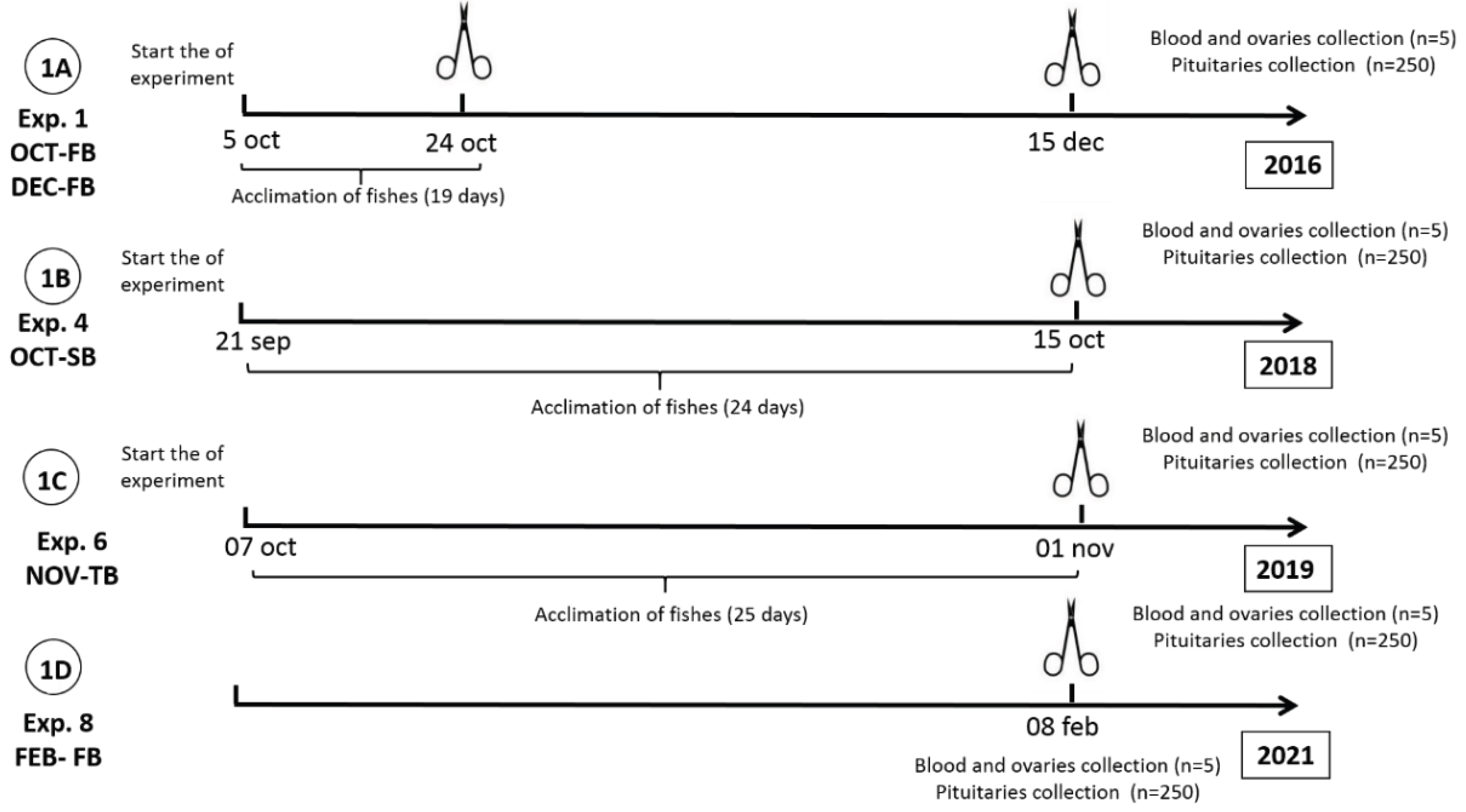
Figure 2.
Experimental designs used in experiments 2 (2A) and 3 (2B) in which Astyanax altiparanae respectively submitted to spawning with either a single (2A) or parcelled doses (2B) of A. altiparanae pituitary extract. The total doses for both experiments were 6mg.Kg-1. For experiment 2 (2A), single dose 6mg.Kg-1 and for experiment 3 (2B) was parcelled (10% + 90%) with twelve hours interval. Abbreviations: control (C), positive control (CP), control without hormonal manipulation (CC), A. altiparanae pituitary extract collected in October (OCT-FB) and A. altiparanae pituitary extract collected in December (DEC-FB).
Figure 2.
Experimental designs used in experiments 2 (2A) and 3 (2B) in which Astyanax altiparanae respectively submitted to spawning with either a single (2A) or parcelled doses (2B) of A. altiparanae pituitary extract. The total doses for both experiments were 6mg.Kg-1. For experiment 2 (2A), single dose 6mg.Kg-1 and for experiment 3 (2B) was parcelled (10% + 90%) with twelve hours interval. Abbreviations: control (C), positive control (CP), control without hormonal manipulation (CC), A. altiparanae pituitary extract collected in October (OCT-FB) and A. altiparanae pituitary extract collected in December (DEC-FB).
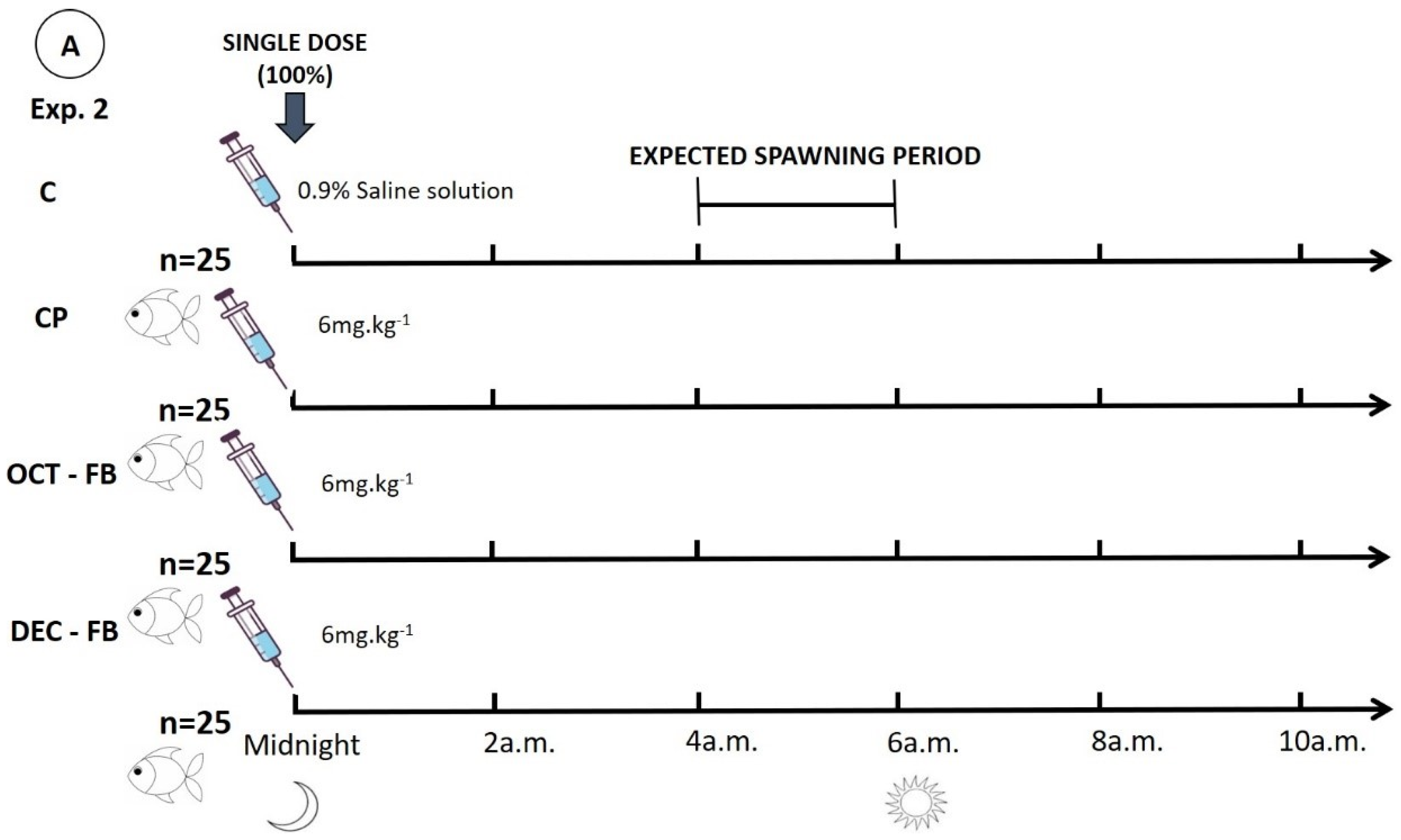
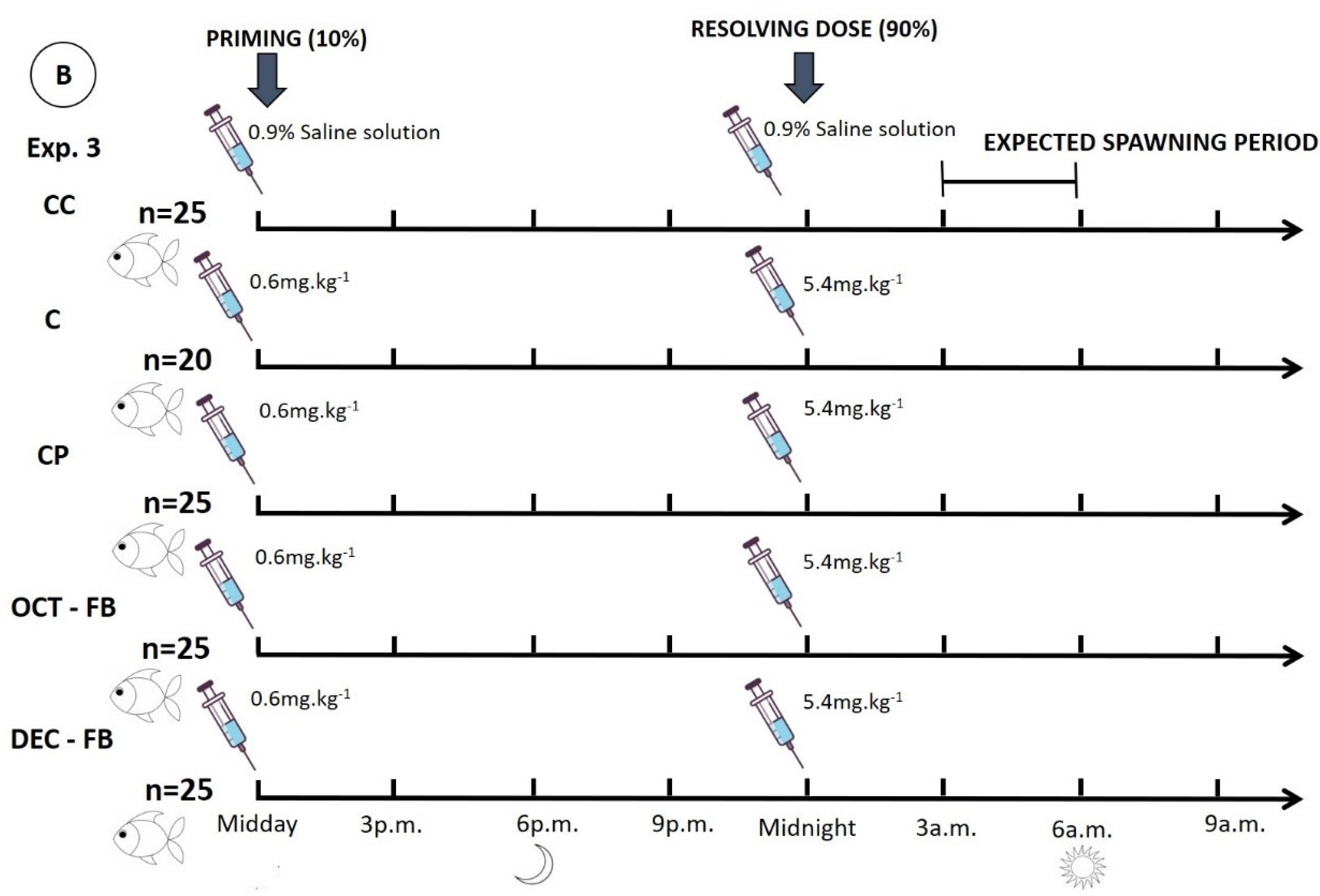
Figure 3.
Experimental design for experiments in which migratory fish species were submitted to spawning with Astyanax altiparanae pituitary extract. Figure 3A) Experiment 5: Reproductive performance in with fractionated doses of A. altiparanae pituitary extract collected in October (OCT -SB). Figure 3B) Exp. 7: Reproductive performance in with fractionated doses of A. altiparanae pituitary extract collected in November (NOV-TB). Exp. 9: Reproductive performance in with fractionated doses of A. altiparanae pituitary extract collected in February (FEB-FB). In all experiments, the animals were injected with 6mg.Kg-1 (10% + 90%) of the respective extract and the control (C) received 0.9% saline solution with twelve hours interval.
Figure 3.
Experimental design for experiments in which migratory fish species were submitted to spawning with Astyanax altiparanae pituitary extract. Figure 3A) Experiment 5: Reproductive performance in with fractionated doses of A. altiparanae pituitary extract collected in October (OCT -SB). Figure 3B) Exp. 7: Reproductive performance in with fractionated doses of A. altiparanae pituitary extract collected in November (NOV-TB). Exp. 9: Reproductive performance in with fractionated doses of A. altiparanae pituitary extract collected in February (FEB-FB). In all experiments, the animals were injected with 6mg.Kg-1 (10% + 90%) of the respective extract and the control (C) received 0.9% saline solution with twelve hours interval.
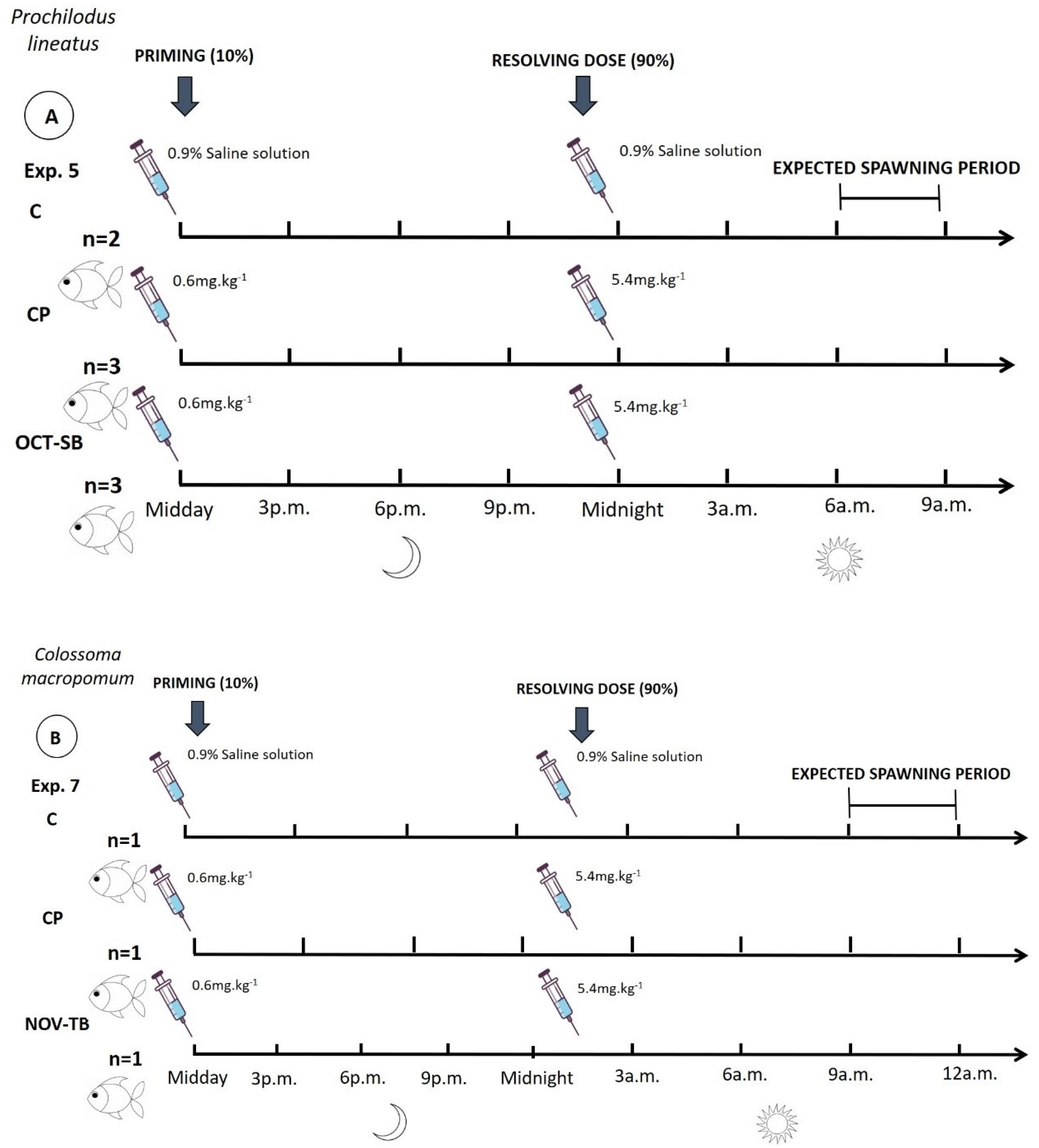
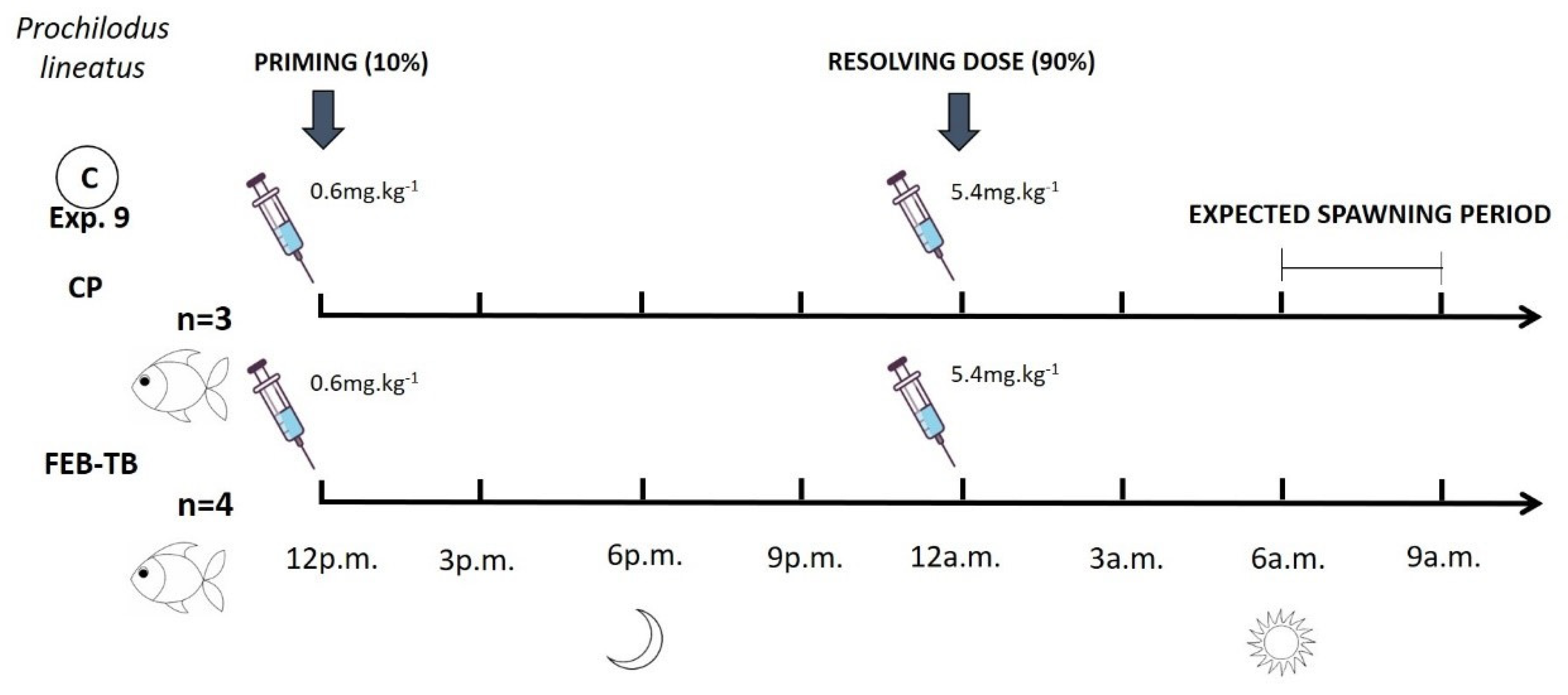
Figure 4.
Expression of lhβ in the pituitaries of female and male lambari collected in October 2016. Data were analyzed using the Mann-Whitney test, and no significant difference was found between females and males (p = 0.8357).
Figure 4.
Expression of lhβ in the pituitaries of female and male lambari collected in October 2016. Data were analyzed using the Mann-Whitney test, and no significant difference was found between females and males (p = 0.8357).
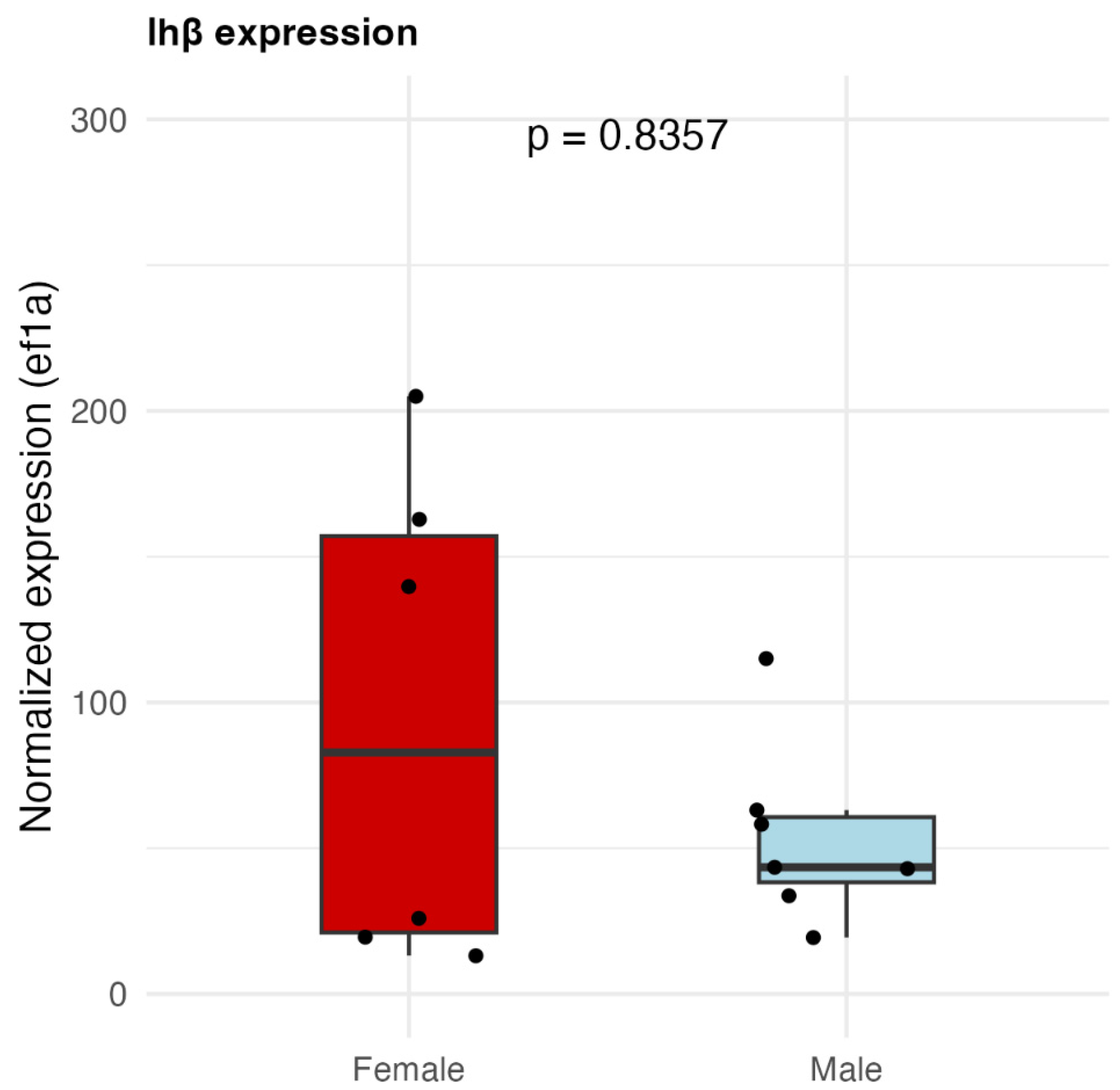
Figure 5.
Expression of LHβ in pituitaries of female lambari collected in different months of the reproductive period of the species.
Figure 5.
Expression of LHβ in pituitaries of female lambari collected in different months of the reproductive period of the species.
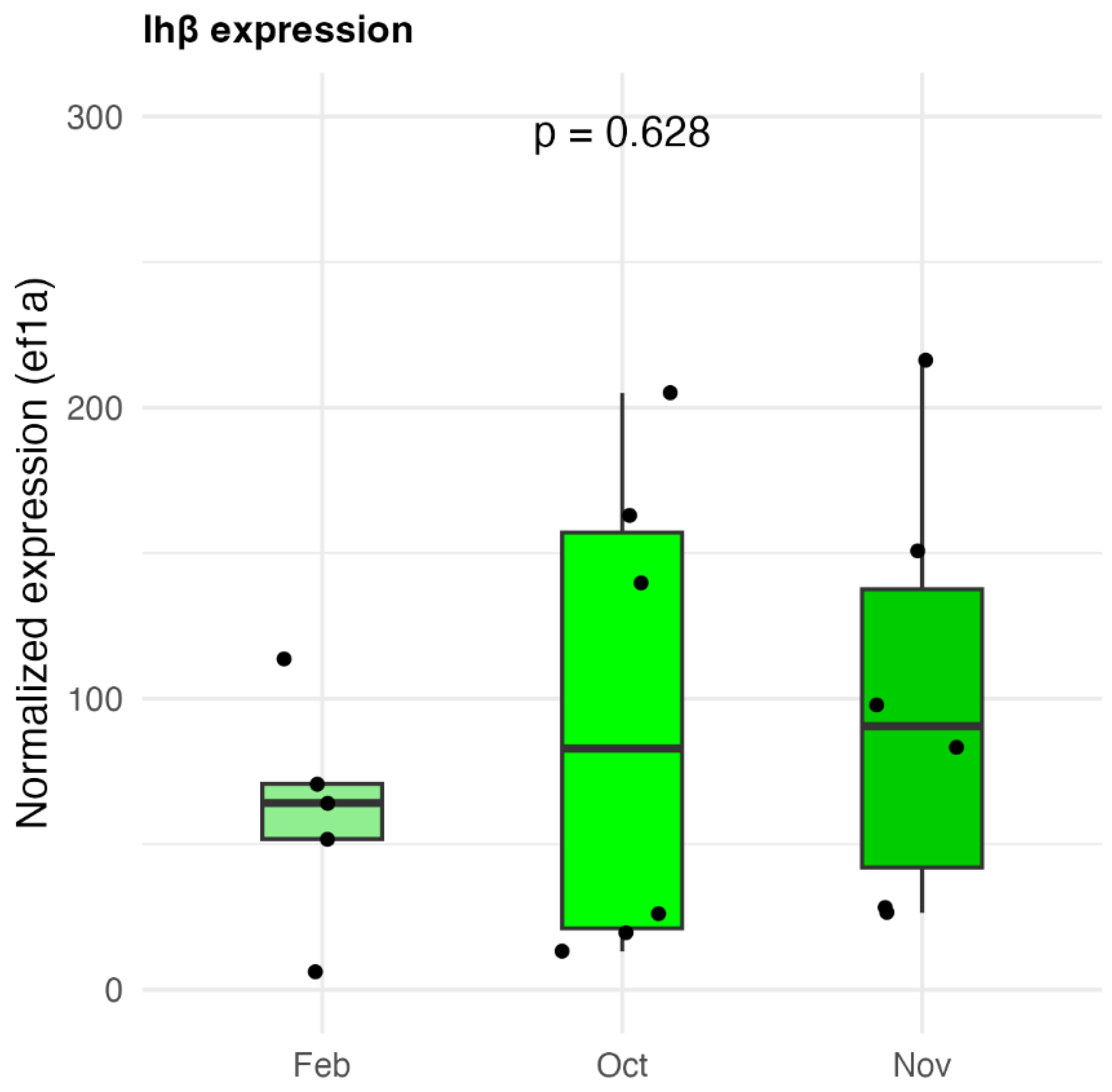
Figure 6.
Volumetric density of oocyte stages in A. altiparanae in experiment 3 submitted for induced ovulation with parcelled doses of Astyanax altiparanae pituitary extract in experiment 3. A) Spawned females; B) Females unspawned. Abbreviations: initial group (IN), control (C), positive control (CP), control without hormonal manipulation (CC), extract pituitary of A. altiparanae collected in October (OCT-FB) and pituitary extract of A. altiparanae collected in December (DEC-FB). Ovarian structures: postovulatory follicle (pof); previtellogenic (PV); cortical alveoli (CA); early vitellogenic (EV); final vitellogenic (FV); mature vitellogenic oocyte with germinal vesicle breakdown (GVBD); atretic (AT); interstitial tissue (IT). All groups were analysed by Kruskal-Wallis, equal letters did not represent a significant difference (p>0.05) and different letters represented a significant difference (p<0.05). Data were represented by median, first and third quartiles.
Figure 6.
Volumetric density of oocyte stages in A. altiparanae in experiment 3 submitted for induced ovulation with parcelled doses of Astyanax altiparanae pituitary extract in experiment 3. A) Spawned females; B) Females unspawned. Abbreviations: initial group (IN), control (C), positive control (CP), control without hormonal manipulation (CC), extract pituitary of A. altiparanae collected in October (OCT-FB) and pituitary extract of A. altiparanae collected in December (DEC-FB). Ovarian structures: postovulatory follicle (pof); previtellogenic (PV); cortical alveoli (CA); early vitellogenic (EV); final vitellogenic (FV); mature vitellogenic oocyte with germinal vesicle breakdown (GVBD); atretic (AT); interstitial tissue (IT). All groups were analysed by Kruskal-Wallis, equal letters did not represent a significant difference (p>0.05) and different letters represented a significant difference (p<0.05). Data were represented by median, first and third quartiles.
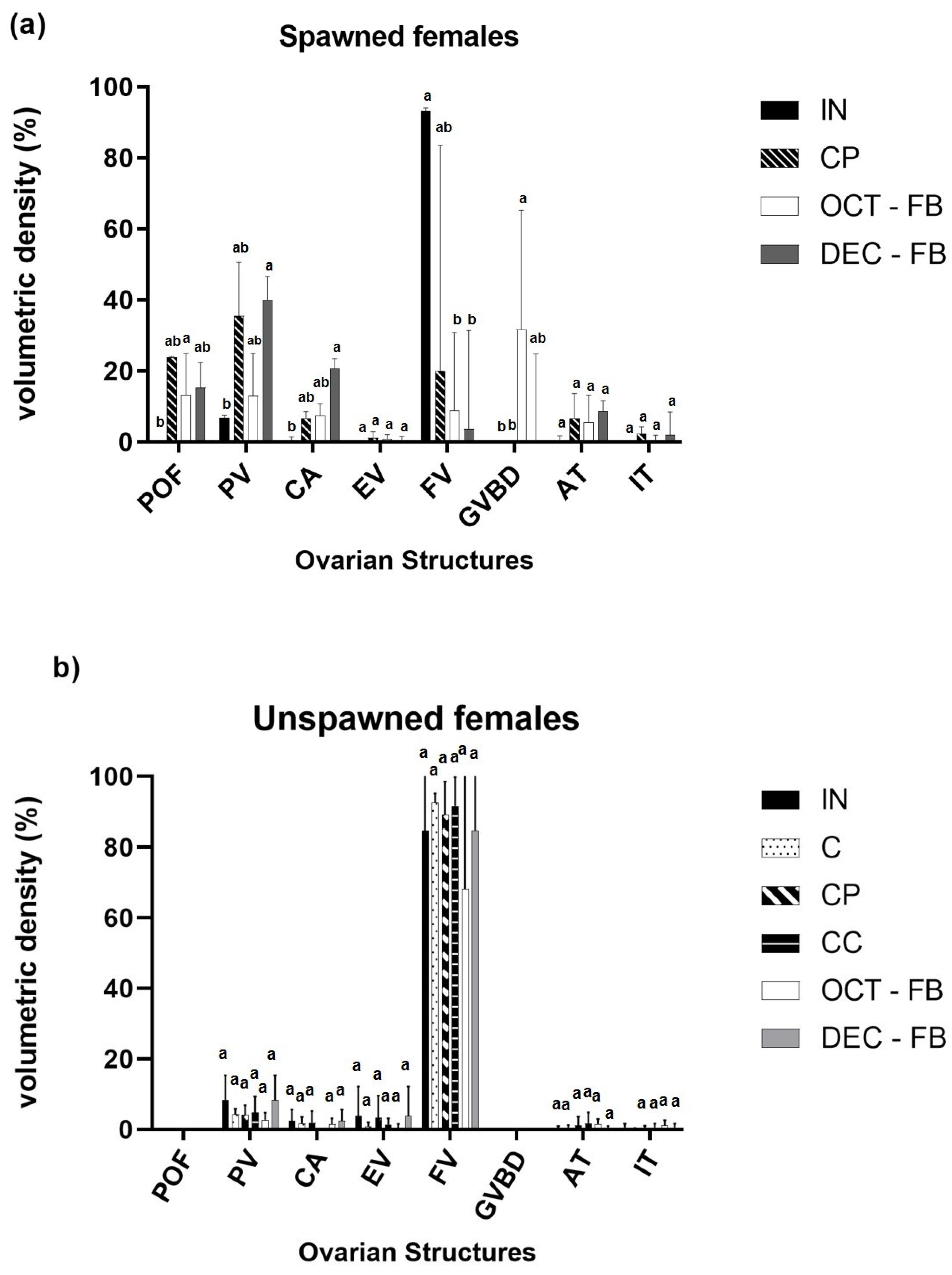
Figure 7.
Plasma levels of 17.20 β-P (ng. mL-1) in females A. altiparanae in experiment 3. A) Spawned females, groups were analysed by Kruskal Wallis test (p<0.05) and data were represented by the median, first and third quartile. B) Unspawned females, groups were analysed by One-Way ANOVA (p>0.05) followed by Tukey HSD test (p<0.05) and data were represented by mean and standard deviation. Equal letters did not represent a significant difference (p>0.05) and different letters represented a significant difference (p<0.05). Abbreviations: groups: initial (IN), control (C), positive control (CP), control without hormonal manipulation (CC), pituitary extract A. altiparanae collected in October (OCT-FB).
Figure 7.
Plasma levels of 17.20 β-P (ng. mL-1) in females A. altiparanae in experiment 3. A) Spawned females, groups were analysed by Kruskal Wallis test (p<0.05) and data were represented by the median, first and third quartile. B) Unspawned females, groups were analysed by One-Way ANOVA (p>0.05) followed by Tukey HSD test (p<0.05) and data were represented by mean and standard deviation. Equal letters did not represent a significant difference (p>0.05) and different letters represented a significant difference (p<0.05). Abbreviations: groups: initial (IN), control (C), positive control (CP), control without hormonal manipulation (CC), pituitary extract A. altiparanae collected in October (OCT-FB).
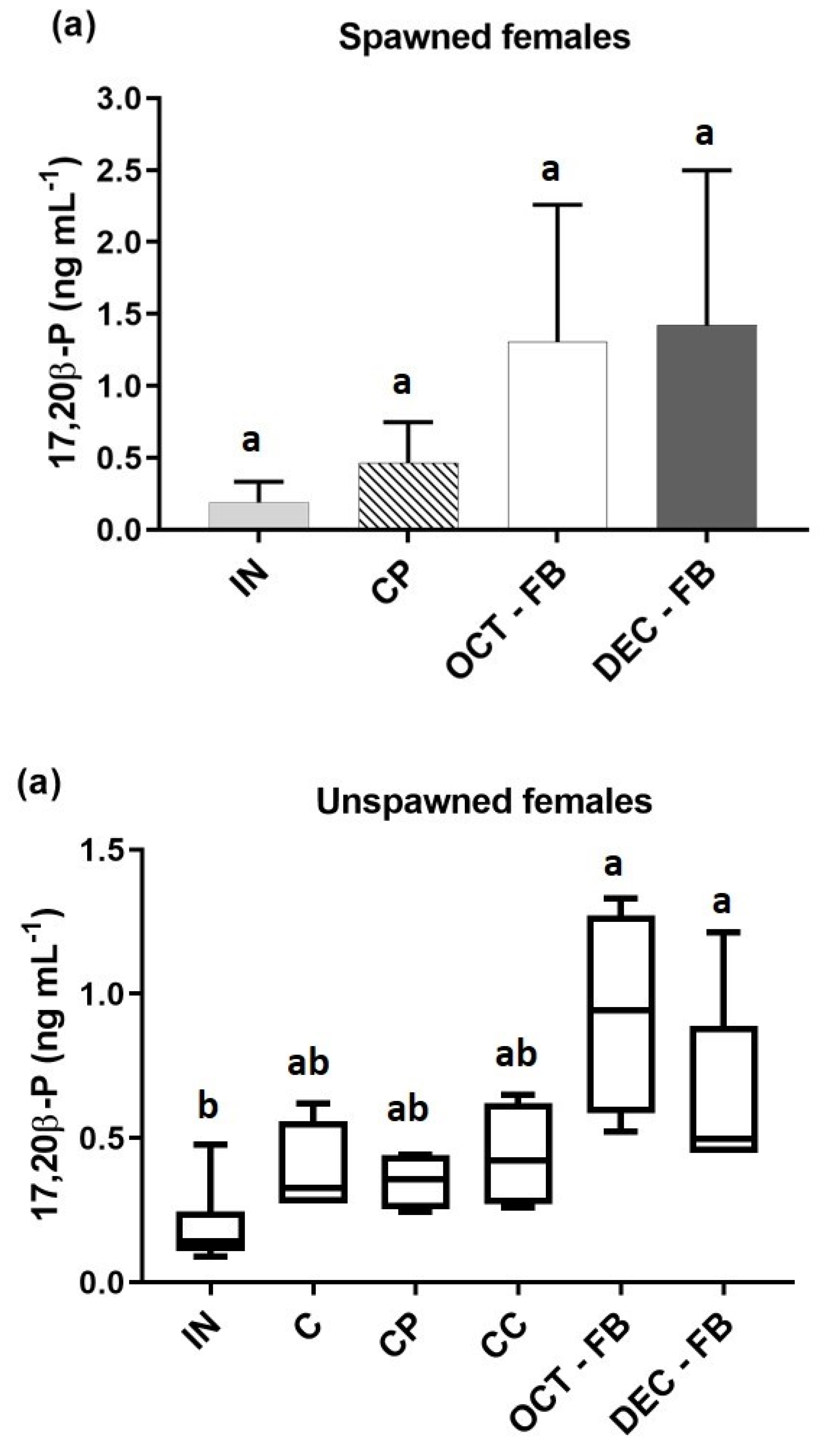
Table 1.
Physical and chemical parameters of water measured in different experiments.
| Ex | Temperature (°C) |
Conductivity (µS.cm-1) |
Oxygen (mg. L-1) |
pH |
|---|---|---|---|---|
| 1 | 23.0 ± 2.8 | 40.7 ± 2.8 | 7.3 ± 0.9 | 6.5 ± 0.1 |
| 2 | 27.0 ± 0.5 | 45.0 ± 2.8 | 8.6 ± 0.2 | 6.7 ± 0.1 |
| 3 | 26.1 ± 0.8 | 23.0 ± 0.1 | 6.3 ± 0.1 | 6.7 ± 0.2 |
| 4 | 26.0 ± 0.3 | 36.0 ± 0.2 | 7.8 ± 0.2 | 6.6 ± 0.1 |
| 5 | 22.8 ± 0.7 | 84.1 ± 4.6 | 5.8 ± 1.4 | 6.0 ± 0.1 |
| 6 7 |
26.7 ± 0.9 26.6 ± 0.3 |
50.0 ± 1.2 34.5 ± 5.2 |
7.0 ± 1.0 6.0 ± 0.5 |
6.5 ± 0.3 6.4± 1.3 |
| 9 | 26.5 ± 0.8 | 47.3 ± 3.2 | 6.8 ± 1.2 | 6.3 ± 0.4 |
Water parameters were measured weekly for ponds-based experiments aimed at characterizing pituitary donors (experiments 1, 4, 6, and 8) and dairy laboratory-based spawning induction experiments (experiments 2, 3, 5, 7, and 9) with measurements taken consistently at 7:00 am. Data were represented by mean and standard deviation. The batch of fish used in experiment 8 was obtained from a fish farm, so we were unable to monitor the physical and chemical characteristics of the water.
Table 2.
Reproductive characteristics of lambari (Astyanax altiparanae) pituitary extract donors used to produce the batches of pituitaries extract from experiments 1 and 4.
Table 2.
Reproductive characteristics of lambari (Astyanax altiparanae) pituitary extract donors used to produce the batches of pituitaries extract from experiments 1 and 4.
| Experiment / Batch | GSI (%) | E2 (ng. mL-1) | 17.20β-P (ng. mL-1) |
|---|---|---|---|
| 1 / OCT-FB 2016 | 15.7 ± 3.4a | 0.96 ± 0.27a | 0.21 ± 0.08ª |
| 1 / DEC-FB 2016 | 15.5 ± 6a | 1.33 ± 0.38a | 0.24 ± 0.09ª |
| 4 / OCT-SB 2018 | 15.37 ± 3.5 | 0.48 ± 0.15 | 0.22 ± 0.13 |
| 6/ NOV-TB 2019 | 17.5 ± 2.1 | - | - |
Data are expressed as mean and ± SD. GSI, E2 and 17.20β-P values were compared between OCT-FB and DEC-FB; equal letters mean similar values (p>0.05). GSI: gonadosomatic index; E2: levels of estradiol and 17.20β-P: 17α-20β-dihydroxy-4-pregnen-3-one. There was no statistical analysis in experiment 4. OCT-FB and DEC-FB: first batches of lambari pituitary extract, respectively obtained in October and December 2016. OCT-SB: second batch of lambari pituitary extract in October 2018. NOV-TB: third batch of lambari pituitary extract in November 2019.
Table 3.
Reproductive performance of lambari (Astyanax altiparanae) induced by a single dose of 6mg.Kg-1 of carp pituitary extract or lambari pituitary extracts (OCT -FB and DEC – FB) in experiment 2.
Table 3.
Reproductive performance of lambari (Astyanax altiparanae) induced by a single dose of 6mg.Kg-1 of carp pituitary extract or lambari pituitary extracts (OCT -FB and DEC – FB) in experiment 2.
| Reproductive performance | Groups | |||
|---|---|---|---|---|
| C | CP | OCT-FB | DEC-FB | |
| GSI – spawned | 3 | 2.8 | 5.6 ± 4.1 | 5 |
| GSI - unspawned | 19.4 ± 2.2 | 23.5 ± 6.4 | 19 ± 2.2 | 23.2 ± 3 |
| Latency period (hours) | 208.8 | 279. 7 | 169.6 ± 18.4 | 156.6 |
| Spawning rate | 1/5 | 1/5 | 2/5 | 1/5 |
| Total volume of eggs per group (mL) | 20 | 17 | 101 | 42 |
| Fertility rate (%) | 85.6 | 51.1 | 47.1 ± 5.6 | 46.1 |
| Hatching rate (%) | 97.1 | 55.3 | 28.3 ± 29.1 | 53.1 |
*Note: Values could not be compared statistically among the experimental groups due to a low number of replicates with spawning. For groups C, CP, and DEC-FB, standard deviations were not shown because the spawn was registered in a single replicate. Abbreviations: control (C), positive control (CP), lambari pituitary extract collected in October 2016 (OCT-FB) or in December 2016 (DEC-FB), GSI: index gonadosomatic.
Table 4.
Percentage of volume density occupied by different ovarian structures in unspawned lambari females (Astyanax altiparanae) in Experiment 2.
Table 4.
Percentage of volume density occupied by different ovarian structures in unspawned lambari females (Astyanax altiparanae) in Experiment 2.
| Volumetric density (%) |
Groups | ||||
|---|---|---|---|---|---|
| IN | C | CP | OCT-FB | DEC-FB | |
| POF | 0 | 0 | 0 | 0 | 0 |
| PV | 2.2 ± 1.8a | 2.4 ± 1a | 2.9 ± 1.5a | 2.8 ± 0.9a | 4.3 ± 3.4a |
| CA | 1 ± 1.9a | 0.6 ± 1.2a | 1 ± 0.7a | 2.8 ± 1.2a | 1.1 ± 1.5a |
| EV | 0.2 ± 0.6a | 0a | 1.3 ± 3a | 0.2 ± 0.4a | 0.7 ± 1.6a |
| FV | 92.7 ± 8.2a | 72.1 ± 48.1ab | 2.6 ± 3.1b | 50.7 ± 49.6ab | 60.3 ± 43.2ab |
| GVBD | 0a | 24.7 ± 49.4ab | 91.8 ± 2b | 43.3 ± 50.1ab | 33.4 ± 45.9ab |
| AT | 3.6 ± 7.6a | 0a | 0.1 ± 0.3a | 0a | 0a |
| IT | 0 | 0 | 0 | 0 | 0 |
*Note: numbers represent the averaged values (± SEM) the different ovarian structures the different ovarian structures. Equal letters did not represent a significant difference (p>0.05) and different letters represented a significant difference (p<0.05). One female per replicate was randomly chosen for each treatment. As in some treatments only one replica showed spawning, it was not possible to calculate means and perform statistical analyses. Abbreviations: initial group (IN), control (C), positive control (CP), A. altiparanae pituitary extract collected in October (OCT-FB) and A. altiparanae pituitary extract collected in December (DEC-FB). Ovarian structures: postovulatory follicle (POF); previtellogenic (PV); cortical alveoli (CA); early vitellogenic (EV); final vitellogenic (FV); mature vitellogenic oocyte with germinal vesicle breakdown (GVBD); atretic (AT); interstitial tissue (IT).
Table 5.
Reproductive performance of lambari (Astyanax altiparanae) induced with a fractionated dose of 6mg.Kg-1 (10% + 90%) of carp pituitary extract (CP) or A. altiparanae pituitary extracts (OCT -FB and DEC – FB) in experiment 3.
Table 5.
Reproductive performance of lambari (Astyanax altiparanae) induced with a fractionated dose of 6mg.Kg-1 (10% + 90%) of carp pituitary extract (CP) or A. altiparanae pituitary extracts (OCT -FB and DEC – FB) in experiment 3.
| Reproductive performance |
Groups | ||||
|---|---|---|---|---|---|
| C | CC | CP | OCT-FB | DEC-FB | |
| GSI – spawned | 8.6 ± 9.8b | - | 7.5 ± 8.6b | 5.5 ± 3.2b | 3.9 ± 1.7b |
| GSI - unspawned | 16.7 ± 4.1a | 15.4 ± 5.1a | 19.4 ± 2.9a | 19.9 ± 1.1a | 16.7 ± 5.1a |
| Latency period (hours) | 150.7a | - | 185.8 ± 43.7a | 189.7 ± 41.2a | 177.3 ± 38.4a |
| Spawning rate 1 | 2/5 | 0 | 3/5a | 5/5a | 5/5a |
| Number of spawned females for replicate2 | 0-0-0-1-1ab | 0-0-0-0-0a | 0-0-1-2-2ab | 1-1-1-2-2ab | 1-2-2-2-3b |
| Average volume of eggs per replicate (mL)3 | 20 | 0 | 24.8 ± 14.5 | 17.4 ± 10.5 | 34.1 ± 10.8 |
| Total volume of eggs per replicate (mL)4 | 20 | 0 | 74.5 | 87 | 136.5 |
| Fertilization rate (%) | 73.6a | - | 74.7 ± 11.7a | 73.6 ± 15.3a | 33.6 ± 39.5a |
| Hatching rate (%) | 70a | - | 74 ± 7.5a | 65.3 ± 20.3a | 33 ± 40.8a |
Note: 1 Spawning rate: number of replicates spawned / total number of replicates of each group. 2 Number of spawned females for replicate: The values separated by traces represent the number of females spawned per replicate. Each group had five replicates and, in each replicate, there were 5 females. 3 For this calculation, we averaged the volume of eggs found in each replicate of per group. 4 Sum of the volume of eggs found in all replicates of a group. All groups were analysed by Kruskal-Wallis, equal letters did not represent a significant difference (p>0.05) and different letters represented a significant difference (p<0.05). Data were represented by median, first and third quartiles. For statistical analysis only spawned replicates were considered. Abbreviations: control (C), carp pituitary extract (CP), control without hormonal manipulation (CC), A. altiparanae pituitary extract collected in October (OCT-FB) and A. altiparanae pituitary extract collected in December (DEC-FB), GSI: index gonadosomatic.
Table 6.
Experiment 5. Reproductive performance of curimbatá induced with a fractionated dose of 6 mg.kg-1 (10% + 90%) of carp pituitary extract (CP) or with the second batch of lambari pituitary extract obtained in October 2018 (OCT -SB).
Table 6.
Experiment 5. Reproductive performance of curimbatá induced with a fractionated dose of 6 mg.kg-1 (10% + 90%) of carp pituitary extract (CP) or with the second batch of lambari pituitary extract obtained in October 2018 (OCT -SB).
| Groups | Response to hormonal induction | Latency period (degree-hours) |
Egg volume per replicate (L) | Fertility rate (%) | Hatching rate (%) |
|---|---|---|---|---|---|
| C | Unspawned | - | - | - | - |
| C | Unspawned | - | - | - | - |
| CP | Spawned | 219.3 | 5.7 | 7 | 0 |
| CP | Spawned | 193.5 | 13.3 | 0 | 0 |
| CP | Spawned | 210.7 | 8.4 | 81.2 | 71.2 |
| OCT- SB | Spawned | 227.9 | 13.2 | 80.6 | 51 |
| OCT-SB | Spawned | 249.4 | 7.3 | 0 | 0 |
*Note: These parameters were not statistically compared. negative control (C): injected with saline solution; CP: carp pituitary extract and; OCT – SB: Lambari pituitary extract collected in October (OCT-SB) 2018.
Table 7.
Reproductive performance of tambaqui (Colossoma macropomum) induced with a fractionated dose of 6 mg.Kg-1 (10% + 90%) of carp pituitary extract (CP) or with the third batch of lambari (Astyanax altiparanae) pituitary extract produced in November 2019 (NOV-TB) in experiment 7.
Table 7.
Reproductive performance of tambaqui (Colossoma macropomum) induced with a fractionated dose of 6 mg.Kg-1 (10% + 90%) of carp pituitary extract (CP) or with the third batch of lambari (Astyanax altiparanae) pituitary extract produced in November 2019 (NOV-TB) in experiment 7.
| Reproductive performance |
Groups | ||
|---|---|---|---|
| C | CP | NOV-TB | |
| Response to hormonal induction | Unspawned | Spawned | Spawned |
| Latency period (hours) | - | 301.3 | 315.5 |
| Egg mass per replica (g) | - | 169 | 548 |
| Fertility rate (%) | - | 79 | 21.3 |
Abbreviations: control (C); carp pituitary extract; (CP) and Astyanax altiparanae pituitary extract collected in November (NOV-TB - 2019).
Table 8.
Reproductive performance of curimbatá (Prochilodus lineatus) induced with a fractionated dose of 6mg.Kg-1 (10% + 90%) of carp pituitary extract (CP) or Astyanax altiparanae pituitary extract (FEB-TB) in experiment 9.
Table 8.
Reproductive performance of curimbatá (Prochilodus lineatus) induced with a fractionated dose of 6mg.Kg-1 (10% + 90%) of carp pituitary extract (CP) or Astyanax altiparanae pituitary extract (FEB-TB) in experiment 9.
| Groups | Response to hormonal induction | Latency period (degree hours) | Egg volume per replicate (L) | Fertility rate (%) |
Hatching rate (%) |
|---|---|---|---|---|---|
| CP | Spawned | 197.8 | 21.6 | 69.8 | 58.4 |
| CP | Spawned | 197.8 | 9 | 20.1 | 10 |
| CP | Spawned | 209.8 | 7 | 21.8 | 13.7 |
| FEB-TB | Spawned | 197.8 | 10.3 | 96 | 95.1 |
| FEB-TB | Spawned | 219.3 | 19.4 | 82.2 | 73 |
| FEB-TB | Spawned | 197.8 | 16 | 24.2 | 21 |
| FEB-TB | Spawned | 197.8 | 8 | 60.2 | 49 |
Abbreviations: pituitary extract carp (CP) and Astyanax altiparanae pituitary extract collected in February (FEB-TB).
Disclaimer/Publisher’s Note: The statements, opinions and data contained in all publications are solely those of the individual author(s) and contributor(s) and not of MDPI and/or the editor(s). MDPI and/or the editor(s) disclaim responsibility for any injury to people or property resulting from any ideas, methods, instructions or products referred to in the content. |
© 2025 by the authors. Licensee MDPI, Basel, Switzerland. This article is an open access article distributed under the terms and conditions of the Creative Commons Attribution (CC BY) license (http://creativecommons.org/licenses/by/4.0/).
Copyright: This open access article is published under a Creative Commons CC BY 4.0 license, which permit the free download, distribution, and reuse, provided that the author and preprint are cited in any reuse.


