

Submitted:
24 September 2025
Posted:
25 September 2025
You are already at the latest version
Abstract
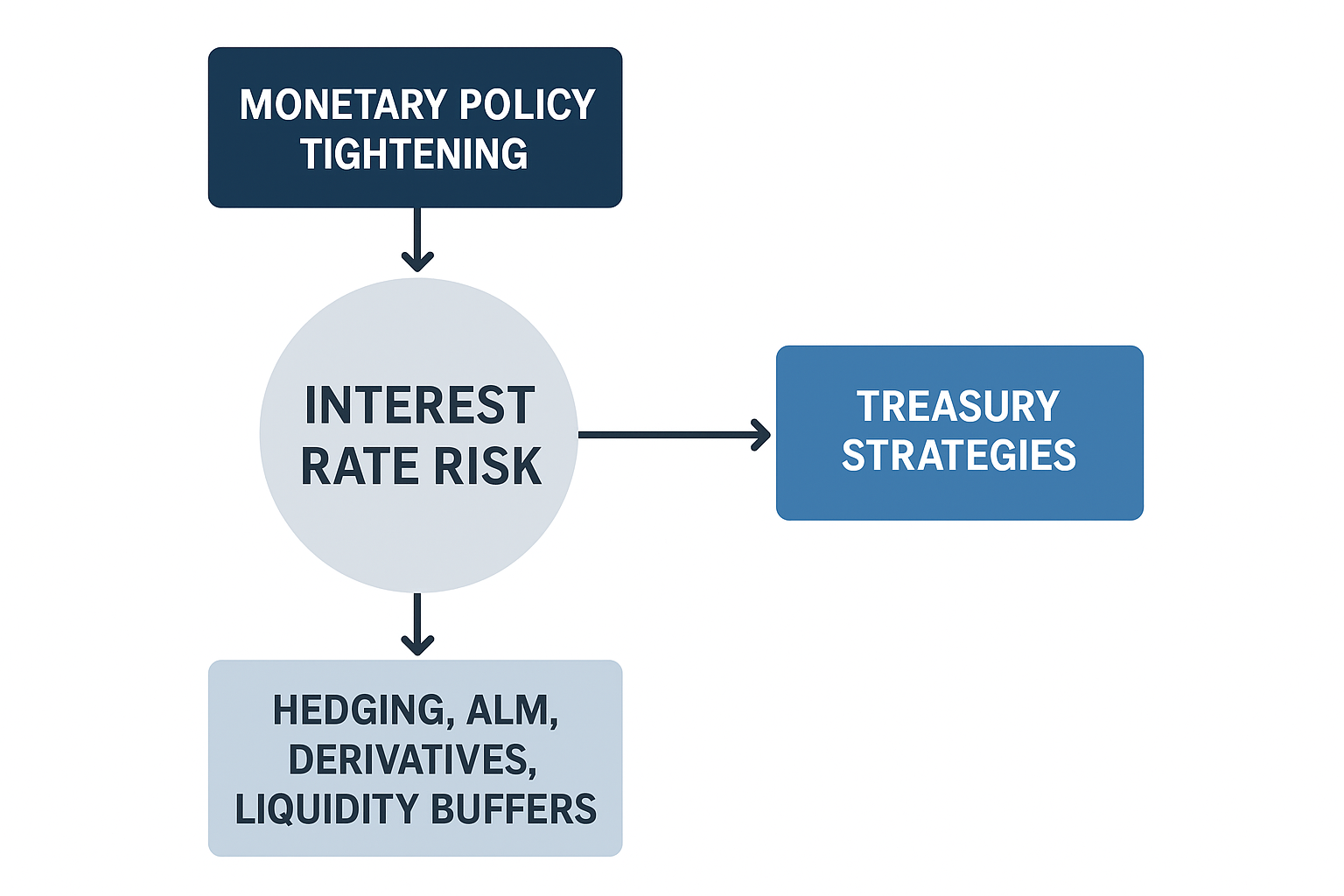
Managing interest rate risk has become increasingly critical for corporate treasuries and financial institutions in the context of tightening monetary policies. As central banks raise benchmark rates to curb inflationary pressures, treasurers face heightened exposure to volatility in funding costs, debt servicing, and investment returns. This study examines treasury strategies designed to mitigate interest rate risk, including asset–liability management, the use of derivatives such as swaps and futures, and dynamic hedging approaches. It also highlights the role of liquidity buffers, scenario analysis, and stress testing in strengthening resilience against policy shocks. By integrating both traditional financial instruments and modern risk analytics, treasuries can align their strategies with evolving market conditions while preserving financial stability. The paper contributes to the ongoing discourse on risk management by offering practical insights into how organizations can safeguard balance sheets and optimize decision-making under restrictive monetary environments.
Keywords:
Interest rate risk
; treasury management
; monetary policy tightening
; asset-liability management
; derivatives
; hedging strategies
; financial risk management
; liquidity buffers
; scenario analysis
; corporate finance
1. Introduction
1.1. Background and Context
In recent years, the global economic landscape has been shaped by an era of aggressive monetary tightening. Central banks, particularly in advanced economies, have adopted higher policy rates in response to persistent inflationary pressures and shifting growth expectations. While these interventions are designed to stabilize prices and preserve long-term economic balance, they have introduced significant challenges for corporate treasuries, financial institutions, and investors. One of the most pressing concerns is the heightened exposure to interest rate risk, which directly influences borrowing costs, debt servicing obligations, and the valuation of financial instruments. Treasury departments serve as the financial nerve centers of organizations, responsible for ensuring liquidity, optimizing funding, and safeguarding against volatility. In a tightening monetary policy environment, these functions become more complex, requiring treasurers to deploy strategies that balance risk mitigation with financial performance.
1.2. Problem Statement
Despite the extensive use of conventional tools such as interest rate swaps, forward rate agreements, and asset–liability matching, many organizations remain vulnerable to unexpected interest rate fluctuations. Monetary policy shifts often transmit unevenly across markets, complicating forecasting and strategic decision-making. This raises an important question: How can treasuries effectively mitigate interest rate risk while maintaining operational flexibility and financial resilience under restrictive monetary policies?
1.3. Objectives of the Study
This paper seeks to:
- Analyze the nature of interest rate risk in the context of monetary policy tightening.
- Evaluate treasury strategies employed to mitigate such risks.
- Examine the role of analytical tools, including scenario planning and stress testing, in improving decision-making.
- Provide practical recommendations for treasurers navigating periods of monetary contraction.
1.4. Structure of the Paper
The study begins with a review of the theoretical underpinnings of interest rate risk and prior research on treasury strategies. It then presents an analysis of key tools such as asset–liability management, derivatives, and dynamic hedging. This is followed by a discussion of analytical methods, including scenario-based models. The paper concludes with recommendations for treasurers and suggestions for future research.
2. Theoretical Framework and Literature Review
2.1. Interest Rate Risk in Corporate Treasury Functions
Interest rate risk arises from the sensitivity of a firm’s assets, liabilities, and cash flows to changes in interest rates. For treasuries, exposure manifests through three main channels: funding risk, where borrowing costs rise; investment risk, where asset values decline; and repricing risk, where mismatches in asset and liability maturities amplify volatility. Previous research in corporate finance underscores the importance of aligning treasury operations with risk management frameworks to ensure stability during volatile cycles (Hull, 2018).
2.2. Impact of Monetary Policy Tightening on Financial Markets
A tightening monetary stance typically leads to higher yields across the maturity spectrum, reduced credit availability, and increased volatility in bond and equity markets. Studies show that firms relying heavily on short-term funding face elevated refinancing risks (Bernanke & Gertler, 1995). Moreover, tightening policies often reduce risk appetite among investors, thereby increasing borrowing spreads for corporations. The combined effect underscores the necessity of robust treasury strategies to maintain liquidity and minimize financial stress.
2.3. Existing Treasury Strategies for Risk Mitigation
The literature identifies several strategies treasurers use to manage interest rate risk:
- Asset-Liability Management (ALM): Matching maturities of assets and liabilities to minimize repricing gaps.
- Derivative Instruments: Employing swaps, futures, and options to hedge against adverse movements in rates.
- Dynamic Hedging: Adjusting hedge positions in response to changing interest rate expectations.
- Liquidity Reserves: Maintaining cash or liquid assets to absorb funding shocks.
While these approaches are well-documented, their effectiveness often depends on market conditions, organizational structure, and the regulatory environment.
2.4. Research Gaps and Emerging Perspectives
Despite a substantial body of work on risk management, there is limited research on how treasuries adapt their strategies during prolonged cycles of tightening. Existing studies often focus on banking institutions, leaving a gap in understanding how non-financial corporations manage interest rate risk under similar conditions. Furthermore, the integration of advanced risk analytics, such as machine learning-based forecasting and real-time scenario analysis, remains underexplored in treasury literature. Addressing these gaps can provide more actionable insights for practitioners.
3. Methodology
3.1. Research Design
This paper adopts a qualitative analytical approach grounded in a review of academic literature, industry reports, and policy papers on treasury risk management. The emphasis is on synthesizing insights from prior studies while identifying practical strategies relevant to the current cycle of monetary tightening. Unlike empirical econometric studies, which rely on large-scale datasets, this research is conceptual in nature and focuses on the comparative evaluation of strategies treasurers employ to manage exposure to interest rate risk.
3.2. Data Sources and Collection
The analysis draws on three main categories of sources:
- Academic literature published in peer-reviewed journals in the fields of finance, economics, and risk management.
- Industry reports from organizations such as the Bank for International Settlements (BIS), International Monetary Fund (IMF), and professional treasury associations.
- Policy papers and speeches from central banks provide insights into the intended transmission of monetary tightening and its expected effects on corporate balance sheets.
These sources collectively ensure a comprehensive understanding of both the theoretical foundations and the applied dimensions of interest rate risk management.
3.3. Analytical Framework
The study employs a comparative framework to evaluate treasury strategies along three dimensions:
- Risk mitigation effectiveness: the extent to which a strategy reduces exposure to interest rate volatility.
- Liquidity impact: how the strategy affects short-term funding and cash availability.
-
Operational feasibility: the degree of complexity, cost, and expertise required for implementation.This framework allows for a structured discussion of both traditional and modern approaches to managing interest rate risk.
4. Treasury Strategies for Managing Interest Rate Risk
4.1. Asset-Liability Management Approaches
Asset-liability management (ALM) is one of the most fundamental treasury strategies. By aligning the maturities and interest rate structures of assets and liabilities, treasurers seek to minimize repricing gaps. For example, firms with floating-rate debt may choose to invest in floating-rate assets or negotiate fixed-rate borrowings to reduce asymmetry. Effective ALM also involves periodic reassessment of the balance sheet as interest rate expectations evolve.
4.2. Derivative Instruments (Swaps, Futures, Options)
Derivatives play a central role in hedging against interest rate risk. Interest rate swaps allow firms to exchange fixed-rate payments for floating-rate obligations (or vice versa), providing flexibility in managing exposure. Futures contracts can lock in borrowing or investment rates for a specified horizon, while options provide treasurers with asymmetric protection against adverse movements, albeit at a premium cost. The selection of derivatives depends on the firm’s risk appetite, cost considerations, and forecast of rate movements.
4.3. Dynamic Hedging Models
Unlike static strategies, dynamic hedging involves continuous adjustment of hedge positions in response to market developments. Treasuries may rebalance derivative exposures as interest rate forecasts shift or as macroeconomic indicators signal new policy directions. While more resource-intensive, dynamic hedging provides greater adaptability in volatile environments, reducing the likelihood of under- or over-hedging.
4.4. Liquidity Buffers and Capital Allocation
In addition to financial engineering, treasuries often rely on liquidity reserves to cushion against adverse shocks. Maintaining sufficient cash or near-cash assets ensures that organizations can absorb unexpected increases in borrowing costs without resorting to distressed funding. Similarly, prudent capital allocation, such as reducing reliance on short-term debt during tightening cycles, enhances resilience. These strategies are less sophisticated than derivative-based hedging but remain vital, especially for non-financial corporates with limited access to complex instruments.
5. Analytical Tools and Scenario-Based Risk Assessment
5.1. Stress Testing and Sensitivity Analysis
Stress testing has become a standard approach for evaluating how treasury portfolios respond under extreme but plausible interest rate movements. By simulating conditions such as sudden 200-basis-point increases, treasurers can anticipate potential liquidity gaps or capital adequacy concerns. Sensitivity analysis complements stress tests by quantifying how incremental rate changes impact key financial metrics, such as net interest income or debt servicing costs. Together, these tools provide a structured lens for assessing vulnerabilities and guiding preemptive decision-making.
5.2. Simulation Models for Policy Shock Scenarios
In practice, central bank tightening often produces ripple effects across credit spreads, exchange rates, and capital flows. Simulation models, such as Monte Carlo or scenario-based forecasting, help capture these interdependencies. By modeling a range of possible policy shock scenarios, mild, moderate, or severe, treasury teams can build contingency strategies that are both robust and adaptable. For example, firms may prepare tiered hedging plans that activate based on predefined triggers linked to yield curve changes.
5.3. Integration of Risk Analytics into Treasury Operations
The effectiveness of risk management ultimately depends on integrating analytics into day-to-day treasury decision-making. Advances in financial technology allow for real-time monitoring of exposures, automated alerts for threshold breaches, and dashboards that combine liquidity, interest rate, and counterparty risks. Embedding these analytics into treasury workflows not only improves situational awareness but also facilitates quicker, data-driven responses. This integration reflects the shift from reactive to proactive treasury management in volatile monetary environments.
6. Discussion
6.1. Effectiveness of Strategies under Tightening Monetary Policy
The strategies outlined above demonstrate varying levels of effectiveness depending on the intensity and duration of monetary tightening. Derivatives and hedging instruments provide immediate relief by stabilizing cash flows, but their success depends on timely execution and accurate forecasting of rate paths. Asset-liability management offers structural resilience, though it often requires trade-offs between flexibility and long-term commitments. Liquidity buffers prove particularly valuable when policy shifts trigger short-term market dislocations, underscoring the importance of maintaining financial agility alongside market-based hedging.
6.2. Balancing Risk, Liquidity, and Profitability
A persistent challenge for treasurers is striking the right balance between mitigating interest rate risk, preserving liquidity, and pursuing profitability. Over-hedging may protect against downside risks but can also erode margins when monetary tightening eases earlier than expected. Similarly, holding large liquidity reserves cushions against shocks but may limit returns in an environment where borrowing costs rise while investment yields lag. Therefore, treasury strategy must be calibrated to organizational priorities, whether stability, growth, or shareholder value, rather than adhering to a uniform risk model.
6.3. Practical Implications for Corporate Treasuries
For corporate treasuries, the implications are both strategic and operational. Strategically, interest rate risk management must be viewed not as a standalone exercise but as part of enterprise-wide financial planning. Operationally, treasuries require upgraded systems capable of real-time analytics and scenario modeling to keep pace with shifting policy environments. Additionally, governance frameworks must emphasize transparency, accountability, and oversight, ensuring that hedging activities serve protective purposes rather than speculative ones. These practices collectively enhance resilience in a volatile monetary landscape.
7. Conclusion and Recommendations
7.1. Summary of Findings
This paper has examined how treasurers navigate interest rate risk in the context of tightening monetary policy. Key findings highlight the utility of diverse strategies, from asset–liability management to derivatives, dynamic hedging, and liquidity buffers. Analytical tools such as stress testing and scenario simulations complement these strategies by enabling proactive responses to policy shocks.
7.2. Policy and Managerial Implications
From a policy perspective, corporate treasuries must align their practices with regulatory expectations on risk disclosure and capital adequacy. For managers, the results suggest the importance of maintaining flexibility in financial structures, investing in risk analytics, and embedding treasury strategies within broader corporate objectives. In particular, firms operating in capital-intensive sectors stand to benefit from disciplined hedging policies and robust liquidity management to withstand higher borrowing costs.
7.3. Directions for Future Research
Future research could explore the intersection between technological innovation and treasury risk management. For instance, artificial intelligence and machine learning models may improve forecasting of central bank behavior, while blockchain-based platforms could enhance transparency in derivative transactions. Moreover, comparative studies across industries or geographies may reveal differentiated approaches to interest rate risk, enriching the understanding of treasury resilience under global monetary cycles.
Funding
This research received no external funding.
Data Availability Statement
No new data were created or analyzed in this study.
Conflicts of Interest
The author declares no conflict of interest.
References
- Koffi, B. A., & Campbell, J. (2024). Optimizing treasury management in a high-inflation environment: A strategic framework for US Financial Institutions. World Journal of Advanced Research and Reviews, 24(1), 160-168. [CrossRef]
- Bank for International Settlements (BIS). (2023). Monetary policy tightening and financial stability risks. BIS Quarterly Review, September 2023.
- Borio, C., Gambacorta, L., & Hofmann, B. (2017). The influence of monetary policy on bank profitability. International Finance, 20(1), 48–63. [CrossRef]
- European Central Bank (ECB). (2022). The transmission of monetary policy in a tightening cycle. ECB Economic Bulletin, Issue 6/2022.
- Hull, J. C., & White, A. (2018). Risk management and financial institutions (5th ed.). Hoboken: John Wiley & Sons.
- Kuttner, K. N. (2018). Outside the box: Unconventional monetary policy in the great recession and beyond. Journal of Economic Perspectives, 32(4), 121–146. [CrossRef]
- Lins, K. V., Servaes, H., & Tamayo, A. (2017). Social capital, trust, and firm performance during the financial crisis. Journal of Finance, 72(4), 1785–1824. [CrossRef]
- Mishkin, F. S. (2022). Monetary policy strategy: Lessons from the crisis and beyond. Cambridge, MA: MIT Press. M: MA.
- Office of Financial Research (OFR). (2021). Interest rate risk in the U.S. financial system. Washington, DC: U.S. Department of the Treasury.
- Saunders, A., & Cornett, M. M. (2019). Financial institutions management: A risk management approach (9th ed.). New York: McGraw-Hill Education.
- Shin, H. S. (2016). Bank capital and monetary policy transmission. Journal of Financial Intermediation, 25(1), 1–29. [CrossRef]
- U.S. Federal Reserve. (2023). Monetary policy report to Congress. Board of Governors of the Federal Reserve System, July 2023.
- Vázquez, F., & Federico, P. (2015). Bank funding structures and risk: Evidence from the global financial crisis. Journal of Banking & Finance, 61, 1–14. [CrossRef]
Disclaimer/Publisher’s Note: The statements, opinions and data contained in all publications are solely those of the individual author(s) and contributor(s) and not of MDPI and/or the editor(s). MDPI and/or the editor(s) disclaim responsibility for any injury to people or property resulting from any ideas, methods, instructions or products referred to in the content. |
© 2025 by the authors. Licensee MDPI, Basel, Switzerland. This article is an open access article distributed under the terms and conditions of the Creative Commons Attribution (CC BY) license (http://creativecommons.org/licenses/by/4.0/).
Copyright: This open access article is published under a Creative Commons CC BY 4.0 license, which permit the free download, distribution, and reuse, provided that the author and preprint are cited in any reuse.


