

Submitted:
09 March 2026
Posted:
10 March 2026
Read the latest preprint version here
Abstract
Existence of global smooth solutions to the three-dimensional (3D) Navier-Stokes equations is disproved for pressure-driven flows with no-slip boundary conditions. This study is rigorously grounded in Sobolev space analysis. We show that the solution breakdown arises from regularity degeneration instead of velocity blowup. For disturbed laminar plane Poiseuille flow, the instantaneous velocity field is decomposed into a time-averaged flow and a disturbance flow, both characterized by their regularity in Sobolev spaces. When the Reynolds number is larger than the critical Reynolds number, the nonlinear interaction modifies the mean flow profile, and the disturbance amplitude grows exponentially. This amplification leads to a local cancellation between viscous terms of the mean flow and the disturbance flow, resulting in the total viscous term (i.e., the Laplacian term) vanishing locally at the critical point $(\boldsymbol{x}^*, t^*)$. The local vanishing viscous term leads to zero velocity by the elliptic operator estimate, which contradicts the non-vanishing incoming velocity, leading to formation of a singularity. This singularity induces a velocity discontinuity, which causes the $L^\infty$ -norm of the velocity gradient to diverge, violating the definition of a global smooth solution in Sobolev spaces. The analysis is strictly grounded in partial differential equations (PDE) theory, with all key steps validated by Sobolev space properties and a priori estimates.
Keywords:
Navier-Stokes equations
; Sobolev space
; regularity degeneration
; singularity
; discontinuity
; turbulence
MSC: 35A01; 35A02; 35Q30; 46E35; 76D03; 76D05
1. Introduction
The regularity of global solutions to the three-dimensional (3D) Navier-Stokes equations remains one of the most fundamental open problems in partial differential equations (PDE) and mathematical fluid mechanics (Doering 2009; Foias et al. 2004). Selected as a Millennium Prize problem by the Clay Mathematics Institute (Fefferman 2006), its solution requires knowledge and methods from disciplines including mathematics, physics, numerical computation, as well as their interdisciplinary fields. A rigorous PDE framework such as grounding analysis in functional analytic tools—most notably Sobolev spaces—can be a feasible approach if appropriate flow model is employed which is consistent with the physical flow in nature.
Early studies laid foundational groundwork: Leray (1934) established the existence of weak solutions in and conjectured finite-time singularities (FTS) in 3D turbulent flows. Ladyzhenskaya (1969) proved global smoothness for two-dimensional (2D) flows via -regularity estimates. In the past 50 years or so, mathematicians have tried to explore the regularity of solutions to the 3D Navier-Stokes equations from the weak solutions (Scheffer 1976; Cafarelli et al. 1982; Serrin 1962; Berselli and Galdi 2002). Buckmaster and Vicol (2019) demonstrated non-uniqueness of weak solutions of the 3D Navier-Stokes equations. Recently, Coiculescu and Palasek (2025) proved non-uniqueness of smooth solutions of the Navier–Stokes equations using constructed initial data from critical space. On the other hand, Tao (2016) constructed an averaged three-dimensional Navier-Stokes equations, and proposed a possible approach for the blowup solution to the Navier-Stokes equations. Robinson (2020) reviewed advances in this field and concluded that weak (finite-energy) solutions to the Navier-Stokes equations may not be unique, but exist for all time, while strong (finite-enstrophy) solutions are unique but cannot persist for all time. These studies further highlight the need for strict regularity constraints.
Exploring the regularity of the Navier-Stokes equations is essentially searching for singular points from the mathematical characteristics of the equations. According to the definition in mathematics, singularities are generally classified into two categories: one where the function is infinitely large, and the other where the function is not differentiable. In the past, most researches on the regularity of the Navier-Stokes equations focused on exploring singularities with infinite velocity or kinetic energy, while relatively less attention was paid to non-differentiable singularities. Regarding the generation of turbulence, numerical simulations have demonstrated that turbulence arises precisely due to the second type of singularity (Dou 2022; Dou 2025; Tiwari et al. 2019; Niu et al. 2024; Niu et al. 2025; Zhou et al. 2025a).
Numerical simulations and experiments confirmed that laminar-turbulent transition based on the Navier-Stokes equations depends on both the Reynolds number and the disturbances (Dou 2022; Hof et al. 2003; Khan et al. 2021), but these observations must be translated into PDE regularity conditions. Although recent work (Dou 2025) linked velocity discontinuities to the onset of turbulent transition, it lacked a rigorous Sobolev space foundation. This study fills this gap: we use Sobolev spaces to define solution regularity, derive a priori estimates for mean and disturbance flows, and prove that singularity-induced regularity breakdown contradicts global smoothness. Unlike previous studies focusing on velocity blowup singularities (Leray, 1934), this work identifies a new type of singularity caused by regularity breakdown, which directly explains the onset of turbulence in PDE frameworks.
1.1. Key Definitions and Notations (Sobolev Space Framework)
We adopt the standard notations for Sobolev spaces and function spaces in the study of partial differential equations, as established in classical references (Adams and Fournier 2003; Brezis 2011; Evans 2010).
Let be a bounded smooth domain with boundary . For a non-negative integer k, the Sobolev space is a Hilbert space consisting of all functions for which all weak partial derivatives (with multi-indices satisfying ) also belong to . The inner product on is defined by
where denotes the standard inner product on the space.
Sobolev Space : For a bounded smooth domain and integer , , equipped with the norm:
where denotes the weak partial derivative operator and is the order of the multi-index .
Local Sobolev Space : A function f belongs to if for every open subset (with indicating that is compact and contained in ).
Continuous Function Spaces : This space consists of all continuous mappings from the time interval to the Sobolev space , endowed with the supremum norm
Global Smooth Solution: A vector-valued solution to the three-dimensional Navier-Stokes equations is said to be globally smooth if there exists an integer such that
A key necessary and sufficient condition for such global smoothness is that for all , which is a direct consequence of the Sobolev embedding theorem in : , where the symbol ↪ denotes continuous embedding.
Norm Conventions:
(1) Pointwise absolute value: denotes the pointwise absolute value of a scalar- or vector-valued function f at the point .
(2) Global -norm: For , the -norm is defined by
and the essential supremum norm is given by
(3) Norm of vector-valued functions in three-dimensional spaces: For a vector-valued function on , its -norm is defined by
where the -norm of the weak derivative is given by
For the bounded smooth domain , the Sobolev spaces satisfy the natural continuous embedding for all integers : . In particular, and , meaning every function in a higher-order Sobolev space is contained in all lower-order Sobolev spaces, with the embedding operator being bounded (continuous).
2. Governing Equations and Flow Decomposition (Sobolev Regularity)
2.1. Navier-Stokes and Continuity Equations
The 3D Navier-Stokes system for incompressible flow in (no-slip boundaries , where is the width of the channel between the two plates in plane Poiseuille flow) is:
where (divergence-free, no-slip Sobolev space), (density), (kinematic viscosity), and p (pressure) belongs to (by standard PDE regularity for Navier-Stokes equations).
Here, we denote the velocity vector as and the position vector as
In this study, the plane Poiseuille flow with disturbances serves as an appropriate flow model for analyzing the solution regularity of the Navier-Stokes equations, as abundant computational and experimental data provide substantial information.
Detailed initial conditions are as follows: the initial laminar velocity field is a steady plane Poiseuille flow superposed with small-amplitude disturbances: , where ( is the unit vector in x direction) and (disturbance flow) satisfies and (small-disturbance assumption). The dynamic viscosity of the fluid is given by .
It is assumed that the disturbance amplitude is “small" relative to the mean velocity in , such that the instantaneous velocity is always kept positive in the range of laminar flow, in (except at and , where for the no-slip boundary condition, as in Figure 1).
2.2. Reynolds Number Range in Present Study
It is well-established that the Reynolds number is an important dimensionless parameter for characterizing the transition of a smooth laminar flow to turbulence. Numerical simulations with Navier-Stokes equations and experiments showed that turbulent transition depends on both the Reynolds number and the magnitude of disturbance (Jovanovic and Pashtrapanska 2004; Hof et al. 2003; Dou and Khoo 2012). Only when the Reynolds number is larger than a minimum critical value, , can turbulent transition be possible. At , the disturbance amplitude required for turbulent transition decreases with the increasing Reynolds number (Hof et al. 2003; Dou 2022).
For plane Poiseuille flow, the Reynolds number is defined as
where is the centerline velocity on the initial velocity profile, h is the half width of the channel, and is the kinematic viscosity. For plane Poiseuille flow, the critical value of the Reynolds number, , was obtained in Jovanovic and Pashtrapanska (2004, their Eq.(35) ), which agrees well with extensive experimental results (Dou 2022). The range of the Reynolds number considered in this study is .
2.3. Flow Decomposition in Sobolev Spaces
Flows described by the Navier-Stokes equations include both laminar and turbulent flows. Experiments and numerical simulations based on the Navier-Stokes equations indicate that the generation of turbulence is influenced by both the Reynolds number and the development of disturbances (Dou 2022; Hof et al. 2003). Therefore, researches on the regularity of the Navier-Stokes equations should accurately consider the impact of disturbances.
The instantaneous velocity in three-dimensional spaces is decomposed into a time-averaged flow and a disturbance flow such as , where:
Time-Averaged Flow : Defined by
with satisfying (disturbance characteristic time) and (singularity time). By the boundedness of the time-averaging integral operator on Sobolev spaces (Brezis 2011; Demengel and Demengel 2012) and the inherited regularity of , the time-averaged flow retains the same regularity as the instantaneous velocity, i.e., . Time-averaging does not enhance regularity; the integral operator preserves the existing Sobolev regularity for bounded smooth domains but does not increase the order of weak derivatives.
The mean flow is a function of time. It evolves due to the nonlinear interaction between the mean flow and the disturbance flow. It does not remain constant as in the linear stability analysis and thus it is different from the initial laminar profile, except possibly at . In such a way, we are able to keep the disturbance always being small relative to the mean flow expressed by Eq.(5).
Disturbance Flow : , which satisfies the zero-mean condition in time:
where (inherited from and ’s regularity).
Since both and belong to , and Sobolev spaces are closed under vector subtraction (Adams and Fournier 2003), the disturbance flow inherits the same regularity: .
2.4. Mathematical Justification of Decomposition:
The velocity decomposition is in the Hilbert space (Brezis 2011; Demengel and Demengel 2012).
2.4.1. Uniqueness and Linearity of the Decomposition
For a given solution and a chosen window , the decomposition is uniquely determined by the explicit formulas in Eq.(5). The mapping is a linear projection.
Formally, let us define the time-averaging operator acting on the space as:
Then and . The operator is linear and idempotent in the limit as , or for functions affine in time over .
Therefore, it is a projection operator. This establishes that, for a fixed , the decomposition represents a unique, continuous splitting of the velocity field into a “slowly varying" component (, in the range of ) and a “rapidly fluctuating" component with zero local mean (, in its complement). The uniqueness is inherent in the definition.
2.4.2. Boundedness of the Time-Averaged Flow
A crucial property for the subsequent singularity analysis is that the mean flow remains bounded both above and, importantly, bounded below away from zero as . This reflects the physical constraint of an externally imposed pressure gradient that sustains the flow.
(1). Upper Bound:
Since the solution is assumed to be smooth on , its Sobolev norm is finite for all . The time-averaging operator is a bounded linear operator from to . Therefore,
The supremum is finite because the solution is smooth on the closed interval .
Thus, we can write,
where is a positive constant.
(2). Lower Bound:
Let be the solution to the Navier-Stokes equations with a non-zero streamwise pressure gradient Let be defined as in Eq.(5). Then, there exists a positive constant , independent of t for t sufficiently close to , such that:
This is because the non-zero pressure gradient along the streamwise direction requires that there is shear of mean velocity to balance the pressure gradient, hence the mean velocity in most width of the channel is larger than zero. In fact, there exists a subset of positive measure (e.g., the core region of the flow away from viscous boundary layers) for Eq.(10). Since is positive and continuous on (due to Sobolev embedding), its positive lower bound implies that its norm is greater than or equal to this positive number on a set of positive measure.
For laminar flow, the time-averaged flow dominates the disturbance flow such that for all . Assuming contradicts the pointwise dominance of the time-averaged flow (which implies , and the -norm is embedded in the -norm for bounded domains). Thus, the only valid conclusion is:
This norm inequality is a direct consequence of the boundedness of the projection operator and Sobolev space properties, and it quantifies the dominance of the time-averaged flow over the disturbance flow for laminar flow conditions.
3. Preliminaries (Sobolev Space-Based Derivations)
3.1. Local Vanishing of the Total Viscous Term (Sobolev Linearity)
3.1.1. Disturbance Term Reaching Leads to Locally
The viscous term in the Navier-Stokes equations is (Eq.(3)), with (Laplacian, a linear elliptic operator). For with and , the linearity of and closedness of Sobolev spaces under linear operators directly imply:
In terms of Sobolev space regularity, for each term in Eq.(12), if , then .
For pressure-driven plane Poiseuille flow, the steady flow satisfies , a negative constant. Disturbances induce a disturbance field with time-dependent Laplacian . By the Sobolev embedding , is bounded and continuous in space. For sufficiently large Reynolds number , the nonlinear term amplifies , leading to:
hence and .
By continuity of ,
for all (local vanishing in Sobolev norm).
3.1.2. How Is the Disturbance Amplified?
To quantitatively prove the growth of disturbance amplitude amplified by the nonlinear convective term, we apply the Sobolev product estimate (Adams and Fournier, 2003). For the nonlinear convective term , since and , the Adams product estimate gives , where C is a positive constant independent of and . By the continuity of Sobolev norms, is equivalent to , and further equivalent to (since for vector fields). Thus, for the disturbance increase, the role of the convective term is over that of the diffusion term, then we have
When , the mean flow satisfies (a bounded constant) due to the regularity of the time-averaged flow (Galdi, 2011). This implies that the disturbance term grows proportionally to itself with a positive proportional coefficient, leading to the exponential growth of over time. Since is uniformly bounded in (as proved in the following paragraph), the amplitude of will eventually reach the magnitude of at some finite time and some position . Therefore, there exists such that , which induces the local vanishing of the composite viscous term at .
3.1.3. Proving the Boundedness of
The mean velocity denotes the time-averaged flow of the laminar plane Poiseuille flow with disturbance. Given (for the bounded smooth domain ), the Sobolev embedding theorem (Morrey’s embedding) yields a continuous embedding —a standard result in PDE for smooth bounded domains in 3D, where functions admit continuous second derivatives. Since is the second-order Laplacian of , guarantees that is continuous on . By the fundamental property that continuous functions on compact sets are bounded, —as a continuous function on the compact domain —is spatially bounded. Consequently, is spatially bounded for all considered t.
3.2. A Priori Estimate for Sobolev Spaces of Second-order Elliptic Equations
3.2.1. Vector Form of the Elliptic Operator Inequality
A priori estimate in Sobolev spaces for second-order elliptic equations was obtained by Ladyzhenskaya (1969) (as her Eq.(16) in page 18),
For any scalar function u, this equation is established for bounded smooth domain with stationary wall boundaries and no-slip boundary conditions, . Thus, it can be used in plane Poiseuille flow, but it can not be used in plane Couette flow.
The velocity vector is expressed as . The norms of the velocity vector and the norm of the Laplacian term are as follows from Eq.(2), respectively,
Applying the scalar inequality Eq.(16) to each velocity component, , we have,
The constant C does not vary for all the velocity components.
Take the square in both sides for these equations, we have,
Take the sum for above three lines, we obtain,
According to the definition of the vector norm, we re-write above equation,
Take the square root in both sides, we obtain,
where is a constant independent of , is a bounded smooth domain, (3D Navier-Stokes velocity field).
Equation (17) shows that the norm of the velocity vector is controlled by the norm of the viscous term in 3D flows. Then, when the norm of the Laplacian term tends to zero, the norm of the velocity must be zero. Finally, these discussions are only valid to pressure-driven flows with no-slip stationary boundary conditions.
3.2.2. Velocity Tending to Zero at Local Vanishing of Viscous Term
For laminar flow: and , given the inequality (17), in the following, we aim to prove that:
where (open ball centered at with radius ), i.e., , and
Key Preliminaries
(1) Localized Elliptic Estimate: Eq.(17) localizes to (standard elliptic regularity for smooth subdomains):
(2) Higher-Order Elliptic Regularity: For , if and , then (Taylor 2011, Theorem 1.3 in page 356):
(3) Sobolev Norm Monotonicity (Embedding Property): By the basic property of Sobolev embedding, for any , the -norm is bounded by the -norm (a trivial yet essential embedding)
Derivation Steps
Step 1: Bound from the Given Limit
By the Sobolev norm monotonicity (Eq.(21), derived from embedding), . Given , taking limits on both sides yields:
Step 2: Bound
Substitute Eq.(22) into Eq.(19) and take limits. Since Eq.(19) holds for all :
By non-negativity of norms:
Step 3: Bound
Substitute Eq.(24) and the given limit into Eq.(20), then take limits:
Again, by non-negativity:
Under the given condition , combined with the localized elliptic estimate from inequality Eq.(17), higher-order elliptic regularity, and Sobolev norm monotonicity (a key Sobolev embedding property), we rigorously derive Eq.(25). These results support the local regularity analysis of the 3D Navier-Stokes equations in this study.
Equation (18) is the key equation, as it encapsulates the mechanism of singularity formation in viscous flows. In Dou (2025), an axiom was proposed for pressure-driven flows based on physical intuition and observations; at that time, the underlying physical principle could not be proven. This axiom states: “The velocity of a fluid particle varies monotonically with the energy loss during its motion, and vice versa.” According to this axiom, when the energy loss of a fluid particle along the streamline approaches zero, the particle’s velocity is zero. Equation (18) exactly describes this principle in Sobolev spaces for pressure-driven flows with no-slip boundary conditions, which governs the relationship between the energy loss and the velocity magnitude.
As described in the author’s previous works (Dou, 2006; Dou, 2022; Dou, 2025), for pressure-driven flows, the energy loss per unit length along a streamline equals the drop in the total mechanical energy per unit length along that streamline, as derived from the Navier-Stokes equations. For such flows, this energy loss is equivalent to the viscous term in the momentum equation per unit mass, obtained via streamwise projection of the Navier-Stokes equations,
3.3. Key Definitions (PDE Singularity)
Definition 3.1 (Navier-Stokes Singularity): A point is a singularity if:
(1) (local vanishing of Laplacian in -norm),
(2) (non-vanishing velocity in -norm).
PDE Interpretation: This singularity is a mathematical singularity of the Navier-Stokes equations, as the solution degenerates from the Sobolev space to a subcritical regularity space for some at , resulting in , i.e.,
This violates the smoothness condition.
It should be noted that the singularity defined above is directly induced by the vanishing of the local viscous term, =0: when . At this point, the regularity of fails to be maintained in , further leading to the degeneracy of and the divergence of .
The singularity defined here is a finite-time regularity-degenerate singularity, which is different from Leray (1934)’s finite-time blowup singularity. The time is the first regularity-degenerate time. The core of the singularity in present study lies in the degeneration of the solution from to a subcritical regularity space ( and ), leading to the divergence of the norm of the velocity gradient.
Definition 3.2 (Velocity Discontinuity): A singularity induces a velocity discontinuity if:
where (Sobolev embedding ensures the limit exists).
4. Main Results and Proofs (Sobolev Space Analysis)
4.1. Main Theorem
Theorem 4.1: For 3D plane Poiseuille flow with initial data , at the condition of small initial disturbance , when , there exists a finite time and a point such that is a Navier-Stokes singularity. At the singularity, the solution degenerates to a subcritical regularity space. As , , hence the 3D Navier-Stokes equations has no global smooth solutions.
The proof of Theorem 4.1 is provided below, and the solution procedure for the 3D Navier-Stokes equations in plane Poiseuille flow is outlined in Figure 2.
4.2. Proof Process (Rigorous PDE Steps)
Step 1: Existence of Local Viscous Term Vanishing (Sobolev Solution Estimates)
(1) Regularity of velocities in laminar flow: By standard Navier-Stokes regularity theory (Ladyzhenskaya 1969), and . The nonlinear term (product estimate for Sobolev spaces: , Adams and Fournier 2003; Brezis 2011).
(2) Viscous terms in mean flow and disturbance flow cancel each other at : For large , the disturbance is amplified by the nonlinear term . As , grows, which entails the growth of . This conclusion is supported by the standard elliptic regularity estimate: . Specifically, setting in this estimate yields (Eq.(17)), indicating that the growth of is consistent with the growth of .
Since both and vary periodically in laminar flow, reaches its maximum at within a period. The time is at the phase angle to make and cancel each other ( and ), see Figure 3.
(3) Vanishing of the viscous term in Navier-Stokes equations: Since (bounded), there exists and such that as grows with time, hence . By -continuity,
For plane Poiseuille flow, according to the energy gradient theory and experimental results, the key position in the y direction to mostly amplify the disturbance occurs at (Dou 2006; Dou 2022). This should be the position of singularity to first take place , where tends to zero after sufficient time evolution.
Step 2: Velocities Mismatch Induces Singularity (Sobolev Norm Contradiction)
(1) By Eq.(18), which is the analytical result from Ladyzhenskaya’s elliptic operator estimate, implies
(2) However, for , implies (pressure-driven flow), and (laminar flow constraint). By Sobolev embedding :
(3) This contradiction ( vs. elliptic operator estimate -required ) confirms that is a Navier-Stokes singularity according to the Definition 3.1.
Step 3: Singularity Induces Velocity Discontinuity (Local Regularity Breakdown)
Velocities mismatch leads to loss of - regularity of
(1) For , , the local regularity theorem gives (by the standard elliptic regularity bootstrapping for the Navier-Stokes equations, in Ladyzhenskaya (1969)), which by Sobolev embedding in 3D implies is locally Lipschitz continuous. Thus, the left limit exists: .
(2) For , , the singularity induces regularity breakdown: . By the continuity equation , a loss of -regularity implies that the velocity field is no longer continuous at (). To restore consistency with the elliptic operator constraint, .
From above (1) and (2), we have
this satisfies the Definition 3.2.
(3) Applying Sobolev embedding theorem: By the Sobolev embedding theorem for 3D bounded smooth domains, , which implies that the first-order derivatives of are continuous if . The loss of -regularity thus leads to the discontinuity of , and consequently the discontinuity of itself.
Regularity degeneration results in velocity discontinuity
Velocity discontinuity resulted from degeneration of solution regularity can be demonstrated by observing the variation of the Sobolev regularity index.
For the vector field , the a priori estimate holds (Eq.(17)), where C is a positive constant independent of . At the critical point , we have (due to the local vanishing of the viscous term). By the continuity of Sobolev norms, (Eq.(24)), which further implies through the a priori estimate. This indicates that the regularity of at degenerates below , , rather than merely below . In other words, and .
By the classical Sobolev embedding theorem for bounded smooth domains in (page 341 in Toselli and Widlund (2005)), a vector-valued function is continuous (i.e., ) if and only if . Conversely, if , the discontinuity of requires . This continuity criterion for Sobolev spaces in establishes the link between Sobolev regularity indices and the continuity of functions on bounded smooth domains with Lipschitz boundaries (satisfied by in this study), which is also called the Morrey embedding theorem. Notably, the preliminary conclusion already encompasses the range ; combining this with the aforementioned velocity transition contradiction at confirms that the regularity of at further degrades to , which fully satisfies the Sobolev criterion for velocity discontinuity.
In conclusion, the velocity field is discontinuous at the critical point , a result that directly violates the definition of a smooth solution to the 3D Navier-Stokes equations.
Step 4: Velocity Discontinuity Causes Gradient Norm Divergence (Sobolev Embedding Inverse Inequality)
(1) The -norm of the velocity gradient is defined as:
(2) For plane Poiseuille flow, the critical gradient component is (transverse to mainstream). For and :
(3) By Step 3, for and , where is a small positive number. Substituting and into Eq.(33), we obtain
(4) Thus, by continuity,
Step 5: Contradiction with Global Smoothness (Sobolev Regularity Definition)
A global smooth solution requires , hence for all (Sobolev embedding ).
However, Step 4 shows as , violating the smoothness definition. Thus, no global smooth solution exists.
In the whole flow field, at the position of which is the location with the disturbance strongly amplified, the appearance of velocity discontinuity at the phase angle is shown in Figure 3, and here is the characteristic frequency of disturbance. For all , the laminar flow is smooth in the whole domain. At , the flow first reaches its critical condition when singularity appears at (generally at for plane Poiseuille flow, Dou 2006 and Dou 2022). Owing to the fluid inertia and the fluid viscosity, a “negative velocity spike” is generally produced at in numerical simulations and in experiments (Nishioka et al. 1975; Dou 2022; Dou 2025; Tiwari et al. 2019; Niu et al. 2024; Niu et al. 2025), rather than a strict vertical steep discontinuity (see Figure 3).
5. BKM Criterion Validation (Sobolev Space A Priori Estimates)
The above proof results can be further validated by using the Beale-Kato-Majda (BKM) criterion (Beale et al. 1984), which was firstly proposed for the Euler equations. The BKM criterion provides a rigorous PDE framework to confirm solution breakdown, grounded in Sobolev space estimates for vorticity . Although the BKM criterion is obtained for Euler equations, in later studies, it has been proved that it is also valid for the Navier-Stokes equations (Kozono and Taniuchi 2000; Zhao 2017; Gibbon et al. 2018).
5.1. Vorticity Regularity in Sobolev Spaces
For , (curl operator preserves Sobolev regularity: ).
By Sobolev embedding
5.2. BKM Criterion Application
The BKM criterion states that if the solution to the Euler equations fail to be regular past a certain time , then the vorticity must necessarily become unbounded,
and
where is the first time at which the solution cannot be extended. These formulations establish vorticity growth as the critical indicator of regularity breakdown.
The relation between the vorticity norm and the velocity gradient norm can be derived by decomposing the velocity gradient tensor, as in Gopalakrishnan et al. (2023).
From the definition of vorticity , we have , for all . Then, we obtain,
Taking the supremum over all and using the definition of -norm, for any we obtain the following equation,
where C is a positive constant depending only on . It originates from bounding the symmetric part of the velocity gradient tensor (the strain rate) via an inequality, with the resulting term being absorbed into the constant C. The above equation can be rearranged and the key inequality is derived as follows,
By the Biot–Savart law, a similar result to Eq.(40) for the velocity gradient was obtained, which is calculated by the singular integral of based on classical Calderón-Zygmund theory (Bledsoe, 2025, page 17),
where the value of is relevant to p. At the critical exponent is adopted. The critical exponent indicates the critical state of the convective term and the diffusion term reaching equilibrium. Below this index : the regularity requirements for the space are lower, the diffusion term dominates, and bounded estimates are easily obtained; Above this index : The regularity requirements for the space are higher, the amplification effect of the nonlinear term is more difficult to control.
It can be seen that Eq.(40) and Eq.(42) are similar that the norm of the velocity gradient is controlled by the norm of the vorticity.
Since the singularity at leads to as obtained in Eq.(35), then, we combine Eq.(35) and Eq.(41), and obtain,
Integrating both sides:
which exactly violates the BKM criterion. This confirms that the solution cannot be extended beyond , consistent with Theorem 4.1.
6. Discussions (PDE Theoretical Implications)
6.1. Sobolev Regularity Breakdown Leads to Solution not Extended Further
From previous discussions, it is seen that local Sobolev regularity breakdown (from to sub-) is the root cause of solution which cannot be extended further for . The Laplacian’s local vanishing in -norm implies the local velocity tending to zero at by the elliptic operator estimate, which contradicts to the non-zero incoming velocity. This creates a singularity of the Navier-Stokes equations. At , leads to the norm of the velocity degrading to from .
On the other hand, the viscous term tending to zero at the singularity is able to amplify the disturbance (Constantin and Foias 1988). There is a mechanism of “viscous term vanishing-disturbance amplification” coupling. Local vanishing of the viscous term at singularity reduces energy diffusion, preventing disturbance energy from dissipating via viscous diffusion and triggering further disturbance growth, forming a “viscous suppression-disturbance amplification” positive feedback loop.
The singularity proposed in this study is essentially different from Leray’s singularity (Leray, 1934) in terms of its mathematical nature. The Leray’s singularity is a finite-time blowup singularity, where the -norm of the solution diverges in finite time; while the singularity in this study is a regularity breakdown singularity, where the solution degenerates from to a subcritical regularity space, without relying on the blowup of the solution itself or the unboundedness of kinetic energy. This distinction extends the singularity theory of the 3D Navier-Stokes equations from the perspective of Sobolev space regularity. The singularity identified herein is compared with Leray(1934)’s singularity as shown in Table 1.
6.2. Turbulence Onset as Regularity Breakdown Spreading
The onset of turbulence is associated with the propagation of singularities, which induce a global loss of -regularity in the Navier-Stokes solution. The discontinuous velocity gradient (manifested as an infinite -norm) gives rise to large-scale vortices. This finding is consistent with PDE-based numerical simulations, which have identified singularities (spikes) at the heads of hairpin vortices and between the streamwise vortices (Schlatter et al. 2006; Niu et al. 2024; Zhou et al. 2025a). From the perspective of Sobolev space regularity, turbulence is essentially a flow state in which the Navier-Stokes solution fails to maintain global -regularity. The propagation of local singularities fragments the velocity field into discontinuous segments, where each segment retains local -regularity but cannot form a global smooth function.
Numerical simulations (Rist and Fasel 1995; Kachanov 1994; Schlatter et al. 2006; Tiwari et al. 2019; Niu et al. 2024; Zhou et al. 2025a) and experimental studies (Nishioka et al. 1975; Han et al. 2000) showed that “negative velocity spikes” appear on the temporal velocity at the critical condition of turbulent transition. It has been shown that the production of these spikes is due to the zero energy loss rate (Niu et al. 2004; Zhou et al. 2025b). Gibbon (2010) suggested that the solutions to the 3D Navier-Stokes equations are intermittent, but spikes may be the manifestation of true singularities. The present study confirms Gibbon’s suggestion that spikes are truly produced by the velocity discontinuity.
Notably, the mechanism of singularity propagation is consistent with the embedding properties of Sobolev spaces: once a singularity forms at , the loss of -regularity invalidates the local Lipschitz continuity of —a consequence of the Sobolev embedding in 3D bounded smooth domains. This loss of continuity allows the velocity discontinuity to propagate to neighboring regions, governed by the nonlinear convective term . This term transfers the regularity loss from the initial singularity to the entire flow field, ultimately leading to the irregular velocity fluctuations that are characteristic of turbulence. From a PDE-theoretic standpoint, this propagation confirms that the solution cannot be extended beyond in a global smooth manner, further reinforcing the conclusion that global smooth solutions to the 3D Navier-Stokes equations do not exist.
7. Conclusions
This study presents a rigorous PDE-theoretic proof for the non-existence of global smooth solutions to the 3D Navier-Stokes equations in pressure-driven plane Poiseuille flows with no-slip boundary conditions. The proof is grounded in Sobolev space analysis, velocity decomposition, and the elliptic operator estimate (Ladyzhenskaya 1969). The key mathematical contributions and conclusions of this work are summarized as follows:
1. Sobolev Space-Based Flow Decomposition: The instantaneous velocity in 3D spaces is successfully decomposed into a time-averaged flow and a disturbance flow, and both of them evolve with time. The uniqueness of the decomposition is demonstrated in Sobolev spaces. This decomposition lays the foundation for the local vanishing of at in the Navier-Stokes equations, which provides a key precursor to singularity formation. For laminar flow, the decomposition is guaranteed such that and the composite flow for all except on the walls. The boundedness of for all and all considered time t is proved. This makes be possible at a local point, so that .
2. Regularity Breakdown as a New Singularity Type: We identified a novel class of Navier-Stokes singularity, induced by the breakdown of Sobolev regularity (from to a subcritical regularity space, and .), which is distinct from the finite-time blowup singularity conjectured by Leray (1934). This singularity arises from a fundamental contradiction: the local vanishing of (in the -norm) conflicts with the non-vanishing of (in the -norm), leading to the velocities mismatching at (). This singularity is further validated by using the Beale-Kato-Majda (BKM) criterion. This derivation confirms that the singularity induces an infinite -norm of the velocity gradient, causing the -norm of the vorticity unbounded, which directly contradicts the definition of a global smooth solution.
3. PDE Theoretical Contributions: This work advances the study of 3D Navier-Stokes regularity by establishing a direct link between the physical onset of turbulence and the mathematical breakdown of solution regularity, providing a new PDE-theoretic framework for analyzing singularities in Navier-Stokes solutions. Unlike previous studies that focus on velocity blowup as the mechanism for solution breakdown, our analysis demonstrates that global smooth solutions fail to exist due to local regularity loss—rather than infinite velocity or kinetic energy—thereby extending the current understanding of singularity mechanisms in the 3D Navier-Stokes equations.
4 Application of Ladyzhenskaya’s elliptic operator inequality: For pressure-driven flows and no-slip boundary conditions on the stationary wall, we employ Ladyzhenskaya’s elliptic operator inequality to determine the dependency between velocity magnitude and the viscous term (Laplacian). It is found that when the viscous term vanishes, the velocity must change to zero. This provides the key clue in Sobolev spaces for identifying the regularity degeneration of solutions to the Navier-Stokes equations for pressure-driven flows.
5. Scope and Limitations: The conclusions of this study are strictly applicable to pressure-driven plane Poiseuille flows with no-slip boundary conditions. For shear-driven flows (e.g., plane Couette flow) or free-boundary flows, the classical elliptic operator estimate is not applicable. Future research will focus on extending this regularity-based singularity analysis to general bounded smooth domains.
In summary, the 3D Navier-Stokes equations for pressure-driven plane Poiseuille flows do not admit global smooth solutions. Finite-time breakdown of Sobolev regularity induces a singularity that results in a divergent -norm of the velocity gradient, violating the core requirement for global smoothness. This result provides a rigorous mathematical resolution to one of the most fundamental open questions in PDE theory and mathematical fluid mechanics, bridging functional analytic tools with physical insights to advance the theoretical understanding of the Navier-Stokes solutions.
Author Contributions
The author contributed all aspects of the study.
Funding
No external funding was received for this study.
Informed Consent Statement
This research work is performed by the author independently.
Data Availability Statement
Data supporting the findings are available from the corresponding author upon reasonable request. Code is available from the corresponding author for verification.
Acknowledgments
Thanks are due to the Computing Research Center of Zhejiang Sci-Tech University for computational support.
Conflicts of Interest
The author declares no conflict or competing interests.
References
- Adams, R. A., Fournier, J.J.F. 2003. Sobolev Spaces, 2nd Ed., Academic Press, New York.
- Beale, J.T.; Kato, T.; Majda, A. 1984. Remarks on the breakdown of smooth solutions for the 3-D Euler equations. Commun. Math. Phys. 94(1), 61–66. [CrossRef]
- Berselli, L. C.; Galdi, G. P. 2002. Regularity criteria involving the pressure for the weak solutions to the Navier-Stokes equations. Proc. Amer. Math. Soc. 130(12), 3585–3595. [CrossRef]
- Bledsoe, B. 2025. A constructive framework for global regularity in the 3D Navier-Stokes equations, Preprint, Available at SSRN. [CrossRef]
- Brezis, H. 2011. Functional Analysis, Sobolev Spaces and Partial Differential Equations, Springer, New York.
- Buckmaster, T.; Vicol, V. 2019. Nonuniqueness of weak solutions to the Navier-Stokes equation. Annals of Mathematics 189, 101–144.
- Caffarelli, L.; Kohn, R.; Nirenberg, L. 1982. Partial regularity of suitable weak solutions of the Navier-Stokes equations. Communications on Pure and Applied Mathematics 35(6), 771–831. [CrossRef]
- Coiculescu, M.P., Palasek, S. 2025. Non-uniqueness of smooth solutions of the Navier–Stokes equations from critical data. Inventiones Mathematicae, Online first. [CrossRef]
- Constantin, P., Foias, C. 1988. Navier-Stokes Equations, University of Chicago Press, Chicago.
- Demengel, F., Demengel, G. 2012. Functional Spaces for the Theory of Elliptic Partial Differential Equations, Springer, London.
- Doering, C. R. 2009. The 3D Navier-Stokes problem. Annu. Rev. Fluid Mech. 41, 109–128. [CrossRef]
- Dou, H.-S. 2006. Mechanism of flow instability and transition to turbulence. Int J Non-Linear Mech. 41(4), 512–517. [CrossRef]
- Dou, H.-S. 2022. Origin of Turbulence-Energy Gradient Theory, Springer, Singapore. https://link.springer.com/ book/10.1007/978-981-19-0087-7.
- Dou, H.-S. 2025. Singular solution of the Navier-Stokes equation for plane Poiseuille flow. Physics of Fluids 37, 084131. [CrossRef]
- Dou, H.-S., Khoo, B. C. 2012. Direct numerical simulation of turbulent transition for plane Couette flows using full Navier-Stokes equations, in Proceedings of 50th AIAA Aerospace Sciences Meeting Including the New Horizons Forum and Aerospace Exposition, 9-12 January 2012, Nashville, Tennessee, USA.
- Evans, L.C. 2010. Partial Differential Equations, 2nd Ed., American Mathematical Society, Providence, Rhode Island.
- Fefferman, C. L. 2006. Existence and smoothness of the Navier-Stokes equation. In: The Millennium Prize Problems, Carlson, J., Jaffe, A., Wiles, A., Editors, American Mathematical Society, pp. 57-67.
- Foias, C.; Manley, O.; Rosa, R.; Temam, R. 2004. Navier-Stokes Equations and Turbulence, Cambridge University Press, Cambridge, UK.
- Galdi, G. P. 2011. An Introduction to the Second Edition Mathematical Theory of the Navier-Stokes Equations (2nd edition), Springer, New York.
- Gibbon, J. D. 2010. Regularity and singularity in solutions of the three-dimensional Navier-Stokes equations. Proc. Royal Soc A 466, 2587–2604. [CrossRef]
- Gibbon, J. D.; Gupta, A.; Pal, N.; Pandit, R. 2018. The role of BKM-type theorems in 3D Euler, Navier-Stokes and Cahn–Hilliard–Navier–Stokes analysis. Physica D: Nonlinear Phenomena 376–377, 60–68.
- Gopalakrishnan, J.; Kogler, L.; Lederer, P. L.; Schöber, J. 2023. Divergence-conforming velocity and vorticity approximations for incompressible fluids obtained with minimal facet coupling. Journal of Scientific Computing 95, No.91. [CrossRef]
- Han, G.; Tumin, A.; Wygnanski, I. 2000. Laminar-turbulent transition in Poiseuille pipe flow subjected to periodic perturbation emanating from the wall, Part 2. Late stage of transition. J. Fluid Mech. 419, 1–27. [CrossRef]
- Hof, B.; Juel, A.; Mullin, T. 2003. Scaling of the turbulence transition threshold in a pipe. Phy. Rev. Lett. 91, 244502. [CrossRef]
- Jovanovic2004 Jovanovic,J., Pashtrapanska,M. 2004. On the criterion for the determination transition onset and breakdown to turbulence in wall-bounded flows. ASME Journal of Fluids Engineering 126, 626–633.
- Kachanov, Y. S. 1994. Physical mechanisms of laminar-boundary-layer transition. Annu. Rev. Fluid Mech. 26, 411–482. [CrossRef]
- Khan, H. H.; Anwer, S. F.; Hasan, N.; Sanghi, S. 2021. Laminar to turbulent transition in a finite length square duct subjected to inlet disturbance. Physics of Fluids 33, 065128. [CrossRef]
- Kozono, H.; Taniuchi, Y. 2000. Bilinear estimates in BMO and the Navier-Stokes equations. Mathematische Zeitschrift 235(1), 173–194. [CrossRef]
- Ladyzhenskaya, O. 1969. The Mathematical Theory of Viscous Incompressible Flows (2nd edition), Gordon and Breach, New York.
- Leray, J. 1934. Sur le mouvement d’un liquide visqueux emplissent l’espace. Acta Math. J. 63, 193–248. [CrossRef]
- Nishioka, M.; Iida, S.; Ichikawa, Y. 1975. An experimental investigation of the stability of plane Poiseuille flow. J. Fluid Mech. 72, 731–751. [CrossRef]
- Niu, L.; Dou, H.-S.; Zhou, C.; Xu, W. 2024. Turbulence generation in the transitional wake flow behind a sphere. Physics of Fluids 36, 034127. [CrossRef]
- Niu, L.; Dou, H.-S.; Zhou, C.; Xu, W. 2025. Solitary wave structure of transitional flow in the wake of a sphere. Physics of Fluids 37, 014111. [CrossRef]
- Rist, U.; Fasel, H. 1995. Direct numerical simulation of controlled transition in a flat-plate boundary layer. J Fluid Mech. 298, 211–248. [CrossRef]
- Robinson, JC. 2020. The Navier–Stokes regularity problem. Phil. Trans. R. Soc. A 378, 20190526. [CrossRef]
- Scheffer, V. 1976. Turbulence and Hausdorff dimension, In Turbulence and the Navier–Stokes equations, Lecture Notes in Math., 565, Springer, Berlin, 94-112.
- Schlatter, P.; Stolz, S.; Kleiser, L. 2006. Large-eddy simulation of spatial transition in plane channel flow. Journal of Turbulence 7(1), 1–24.
- Serrin, J. 1962. On the interior regularity of weak solutions of the Navier-Stokes equations. Arch. Rational Mech. Anal. 9(1), 187–195. [CrossRef]
- Tao, T. 2016. Finite time blowup for an averaged three-dimensional Navier-Stokes equation. Journal of the American Mathematical Society 29(3), 601–674. [CrossRef]
- Taylor, M. E. 2011. Partial Differential Equations I: Basic Theory, Second Ed., Springer, New York.
- Tiwari, S. S.; Bale, S.; Patwardhan, A. W.; Nandakumar, K.; Joshi, J. B. 2019. Insights into the physics of dominating frequency modes for flow past a stationary sphere: Direct numerical simulations. Physics of Fluids 31, 045108. [CrossRef]
- Toselli, A.; Widlund, O. B. 2005. Domain Decomposition Methods - Algorithms and Theory, Springer, Berlin. [CrossRef]
- Zhao, J. 2017. BKM’s criterion for the 3D nematic liquid crystal flows via two velocity components and molecular orientations. Mathematical Methods in the Applied Sciences 40(4), 871–882. [CrossRef]
- Zhou, C.; Dou, H.-S.; Niu, L.; Xu, W. 2025a. Inverse energy cascade in turbulent Taylor–Couette flows. Phys. Fluids 37, 014110. [CrossRef]
- Zhou, C.; Dou, H.-S.; Niu, L.; Xu, W. 2025b. Effect of gap width on turbulent transition in Taylor-Couette flow. Journal of Hydrodynamics 37, 294–301. [CrossRef]
Figure 1.
Schematic of initial flow profile in plane Poiseuille flow, . The origin of the coordinates is located at the centerline of the channel between the two plates, at upper wall, and at lower wall.
Figure 1.
Schematic of initial flow profile in plane Poiseuille flow, . The origin of the coordinates is located at the centerline of the channel between the two plates, at upper wall, and at lower wall.
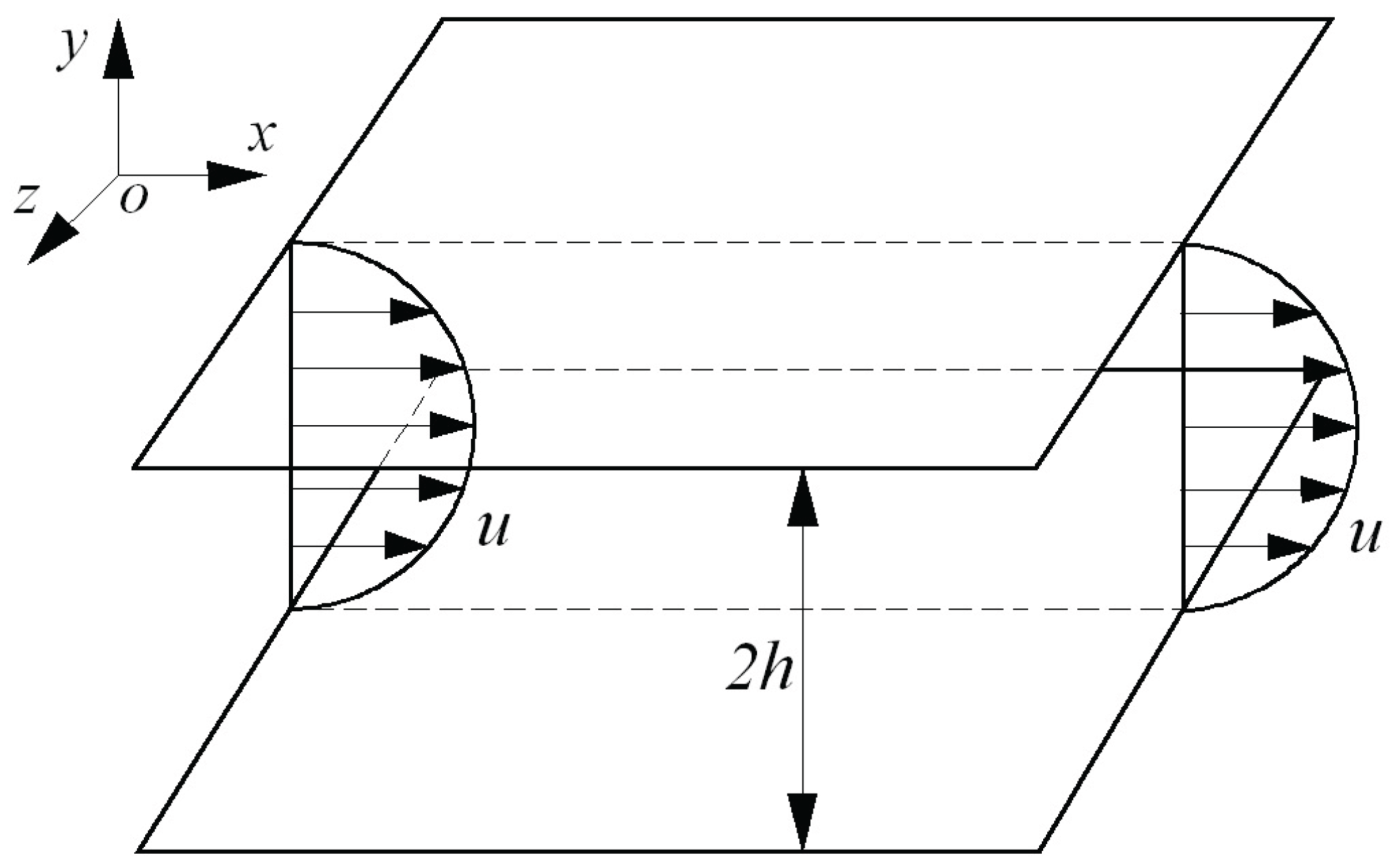
Figure 2.
Logical chain for singularity generation and regularity breaking of solutions to the 3D Navier-Stokes equations in plane Poiseuille flow.
Figure 2.
Logical chain for singularity generation and regularity breaking of solutions to the 3D Navier-Stokes equations in plane Poiseuille flow.
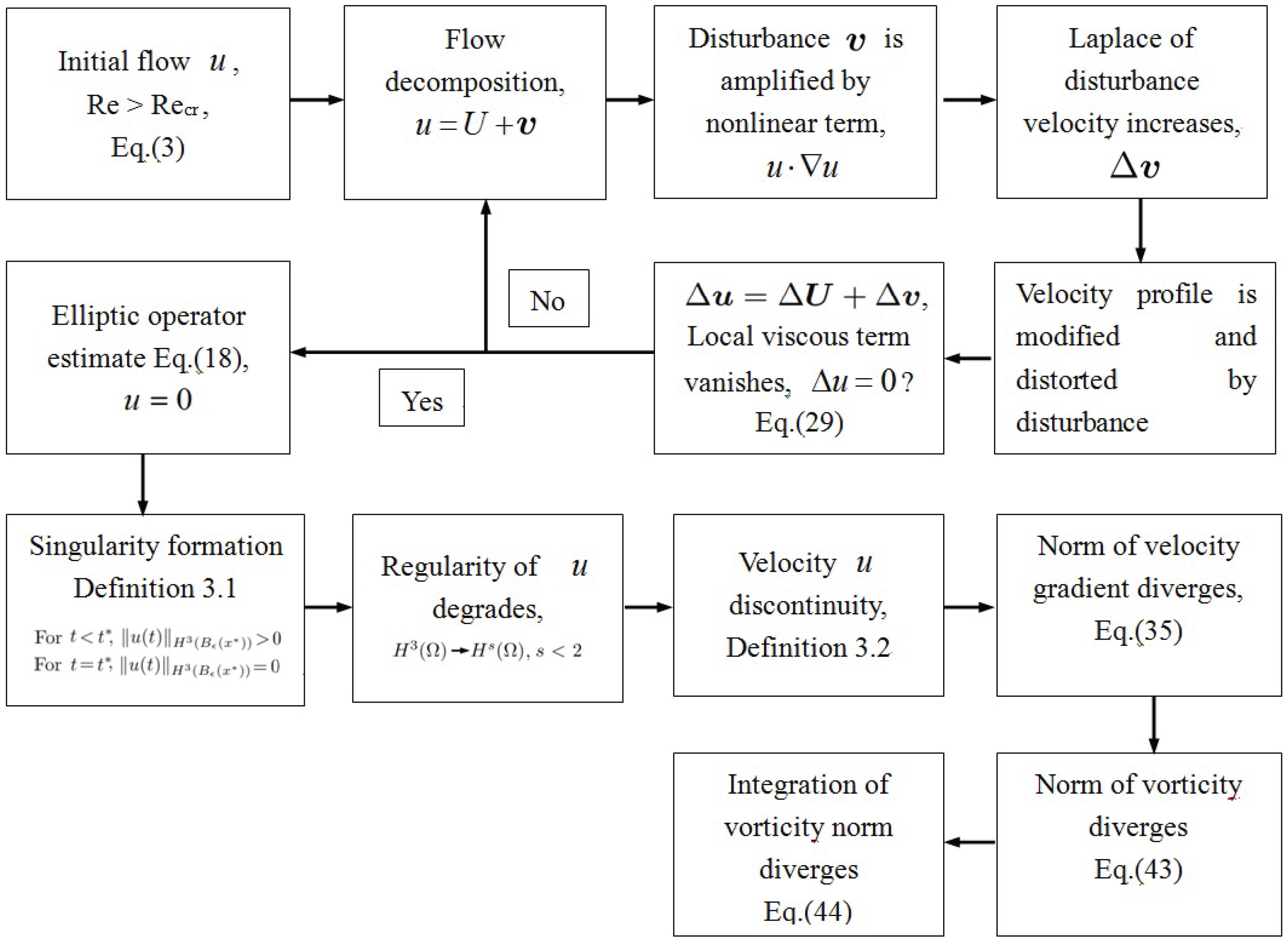
Figure 3.
Schematic of appearance of velocity discontinuity (spike) at the position of and the phase angle . All the variables at the ordinate are normalized, is the initial phase angle, and the subscript m represents the amplitude. (a) The viscous term in averaged flow; (b) The viscous term in disturbance flow; (c) The viscous term in instantaneous velocity; (d) The instantaneous velocity. Note: In the evolution of flow from the initial flow condition to the formation of velocity discontinuity, we take a two periods of phase angle variation near the critical time of singularity at , which is shown in this figure. The phase angle in the figure is the first appearance of the velocity discontinuity. For all ; At at for the first time, as shown in Eq.(14), i.e.,
Figure 3.
Schematic of appearance of velocity discontinuity (spike) at the position of and the phase angle . All the variables at the ordinate are normalized, is the initial phase angle, and the subscript m represents the amplitude. (a) The viscous term in averaged flow; (b) The viscous term in disturbance flow; (c) The viscous term in instantaneous velocity; (d) The instantaneous velocity. Note: In the evolution of flow from the initial flow condition to the formation of velocity discontinuity, we take a two periods of phase angle variation near the critical time of singularity at , which is shown in this figure. The phase angle in the figure is the first appearance of the velocity discontinuity. For all ; At at for the first time, as shown in Eq.(14), i.e.,
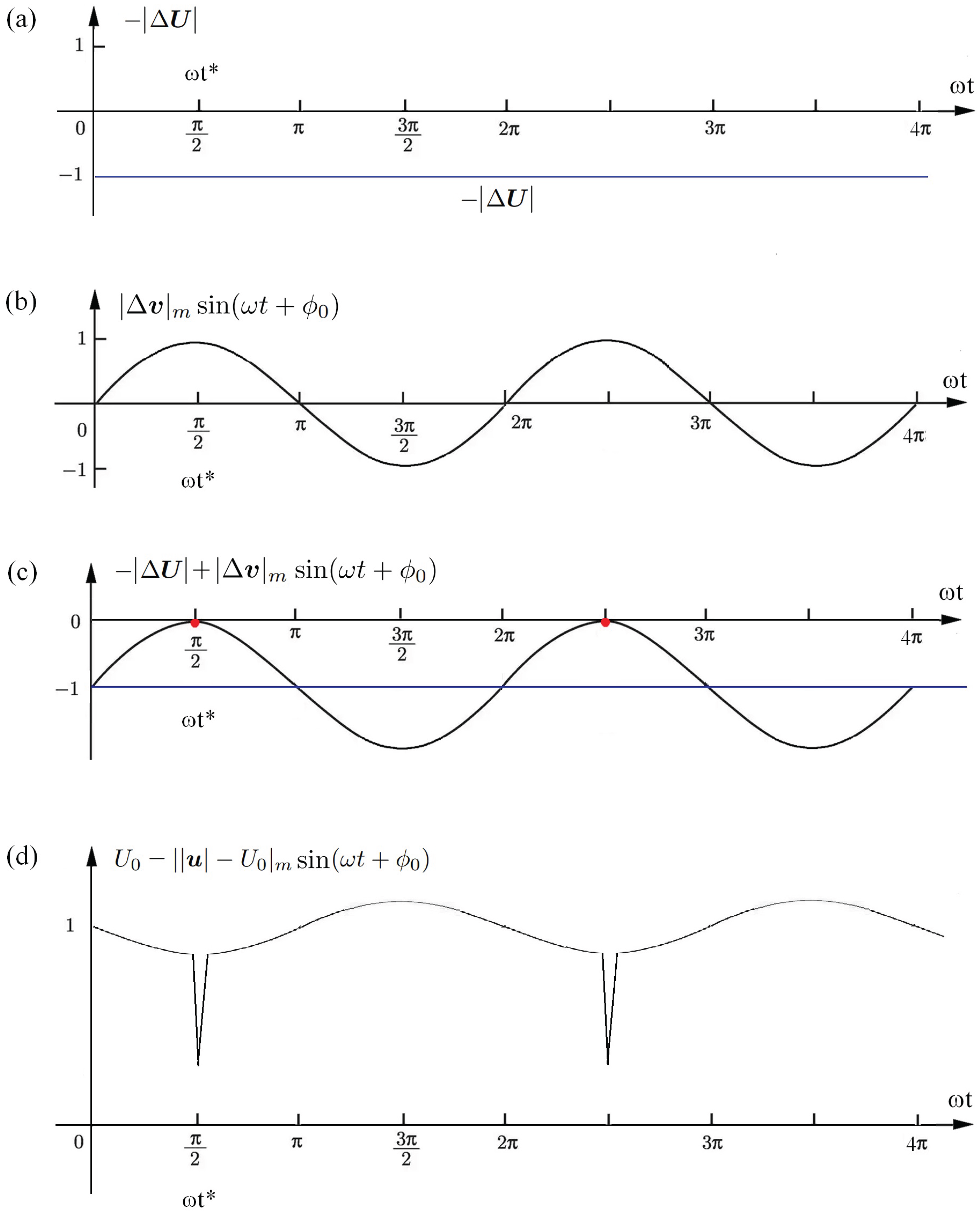

Table 1.
Comparison of two types of singularities.
| Authors | Definition | Physics | Mathematics | Real flow |
| Leray (1934) | FTS | blow up | Not found | |
| Present | Velocities mismatch | discontinuity | degenerates | Spikes |
Disclaimer/Publisher’s Note: The statements, opinions and data contained in all publications are solely those of the individual author(s) and contributor(s) and not of MDPI and/or the editor(s). MDPI and/or the editor(s) disclaim responsibility for any injury to people or property resulting from any ideas, methods, instructions or products referred to in the content. |
© 2026 by the authors. Licensee MDPI, Basel, Switzerland. This article is an open access article distributed under the terms and conditions of the Creative Commons Attribution (CC BY) license (http://creativecommons.org/licenses/by/4.0/).
Copyright: This open access article is published under a Creative Commons CC BY 4.0 license, which permit the free download, distribution, and reuse, provided that the author and preprint are cited in any reuse.


