

Submitted:
18 September 2025
Posted:
22 September 2025
You are already at the latest version
Abstract
Background Hollow posts have been introduced in clinical practice providing the possibility of injecting composite cement directly into the post. Aim of our study was to compare quartz fiber hollow posts with solid posts. Methods: 20 human teeth with straight single root canals were utilized for this study, dividing them into 2 groups with 10 elements each one restored with radiopaque quartz fiber hollow posts or radiopaque quartz fiber solid posts. 2 micro-CT (micro-computerized tomography) analyses allowed to evaluate both the presence of air voids in the cement and the different capacity of posts to penetrate until full depth into the post-space. Results: The Authors observed that hollow quartz fiber posts have shown to create a smaller volume of air voids in the cement (p< 0,05) and to better fit (p< 0,05) the post-space compared to the solid posts. Conclusion: Hollow posts can promote retention and lead to better long-term results for post-endodontic reconstructions.
Keywords:
endodontics
; fiber post
; hollow post
; micro-CT
; restoration
; quartz post
1. Introduction
Root filled teeth usually present higher risk of loss than teeth with vital pulps due to vertical and lateral masticatory forces and the subtraction of coronal and radicular tooth structure, in fact over 70% of root fractures occur in endodontically treated teeth [1,2,3,4].
In case of fracture, teeth could be forced to be extracted due to the poor prognosis of reconstructions or even the complete impossibility of recovery, resulting in the need of prosthesis or surgical procedures such as autotransplantation or implantology [5,6,7].
In order to improve long-term prognosis of endodontically treated teeth, posts of various shape and measures have been widely used in dentistry acting as retention devices for tooth reconstruction [8,9], providing retention for the core material after the loss of a large amount of dental structure and creating a root canal-post-cement monoblock biomechanically stable and homogeneous, improving restoration survival and fracture resistance [10].
In the past, the principal type of post used was metal post (cast or prefabricated), that showed high elastic modulus: in fact stainless steel or titanium were considered strong and clinically effective [11]. Traditional metallic posts have been gradually replaced by fiber posts (glass, quartz and carbon-reinforced composites) due to several advantages such as better elastic module, enhanced biocompatibility, better aesthetic, and higher corrosion resistance with a decreased number of irreparable root fractures [4,12].
Many Authors reported that metal posts seems to induce root fracture more frequently than fiber posts [4,11], probably due to the discrepancy between elastic modulus of metal (200 GPa) and dentin (42 GPa) [10,11]; on the contrary, elastic modulus of fiber posts (25–57 GPa) is closer to dentine [13]; therefore it’s clear that it is necessary to find a device with physical and mechanical features as close as possible to dentin.
Fiber posts characteristics and clinical procedures adopted, in particular length and diameter of posts and thickness of adhesive cements, strongly influence the performance of the restorations: in fact, the polymerization of the cement lead to a centripetal contraction that is one of the main reason for air voids formation [14].
The polymerization process is of great importance because the resin compounds should be activated to achieve the conversion of monomers into polymeric chains, so that variations in the levels of polymerization significantly influence the bonding of resin luting agents to root dentine. To overcome this limitation self-cured resin cements have been developed: the polymerization process start with the photoactivation and then increase by the action of self-curing catalyst within its composition, thus combining the advantages of photo and self-cured luting agents [15].
Recently, hollow posts properties have been studied; the possibility of injecting composite cement directly into the post makes post positioning and cementation contextual and the technical steps more predictable. In addition, the formation of a solid layer inside the hollow portion of the post makes the post-cement system more cohesive as it increases the contact surface. Using a hollow post combines the necessity of an adhesive cementation with the opportunity to take advantage of a widespread engineering technique. In fact, a hollow post reflects the sandwich structure: when it is stressed by mechanical forces, it results in tension in the bottom skin and in compression in the top skin, while in the central part there’s no solicitation. [16].
The aim of this study was to evaluate the presence of air voids in the luting cement using two different kinds of fiber posts, a hollow and a solid one, with the use of Micro-CT (micro-computerized tomography) that allows a 3D quantitative and qualitative evaluation of root canals preparation, in order to define if there are differences in clinical performance between these two kinds of fiber posts. The study was conducted on a a sample of 20 teeth.
Based on the aforementioned challenges and the hypothetical and potential advantages of hollow posts, this study aimed to investigate specific differences using micro-CT analysis. Our null hypotheses were formulated as follows: (1) The presence of air voids in the endodontic cement will not differ significantly between restorations using hollow quartz fiber posts and those using solid quartz fiber posts. (2) There will be no significant difference in the capacity of hollow versus solid quartz fiber posts to achieve full depth penetration within the post-space.
2. Materials and Methods
In order to evaluate the formation of air voids inside the cement, two different posts, a solid (TECH21XOP Ø12, Isasan) and a hollow post (TECHOLE size S, Isasan), luted by the same cement (NEW TECHCORE A, Isasan), were studied.(Figure 1)
20 human teeth with straight single root canals were stored for 48 hours in physiological saline solution (NaCl 0,9%) and utilized for the study; we selected only completely formed teeth with closed apex, monoradicular, without any root fractures or pathologies that could modify the outcomes of the study.
All the teeth were cut perpendicular to their long axis with a diamond disk, in order to achieve a length lower than 20 mm for each sample.
To ensure procedural consistency and eliminate inter-operator variability, all clinical procedures were performed by a single experienced operator. Endodontic treatment was performed with Ni-Ti rotary instruments (MTWO, Sweden&Martina S.p.A.) up to size 25, 0.06 taper, completed with gutta-percha warm vertical condensation. After that, dedicated post space burs were used to create the post space with 4-5 mm of gutta-percha remaining apically, and Gates Glidden drills (No.4 and 5; Dentsply Maillefer) were used to further eliminate all the remaining debris of gutta-percha attached on the dentin wall. All the specimens have gone under a first MicroCT scan at this time, so that images of the elements before and after the post cementation could be overlapped thanks to the DataViewer™ software (Figure 2).
Subsequently, all the post spaces were rinsed with 17% EDTA for 45 seconds, dried with paper points and then etched for 30 seconds using 37% phosphoric acid gel, rinsed with water for 20 seconds and gently air-dried; a total-etch dual adhesive resin (New TECHBOND DC, Isasan) was then applied using a microbrush with following drying and bond excesses removal.
Specimens were divided in 2 groups made up of 10 elements, and the posts have been luted according to the manufacturer’s recommendations:
- elements belonging to Group 1 (HP) have been restored with radiopaque quartz fiber hollow posts (TECHOLE size S, Isasan™). The cementation technique involves seating the hollow post to the full depth of the post-space. With these quartz fiber hollow posts, it is no longer necessary to first fill the canal with cement and then insert the post; instead, everything’s performed in a single step where the post simultaneously acts as the guide that carries the cement into the canal. The micro-hybrid dual-curing luting composite (NEW TECHCORE A, Isasan™) was positioned with an automixing syringe through the post itself, which comes equipped with an adapter and is connected to the mixing tip of the cement syringe followed by light curing for 40 seconds using a light-curing unit.
- elements belonging to group 2 (SP) have been restored with radiopaque quartz fiber solid posts (TECH21XOP Ø12, Isasan™). The micro-hybrid dual-curing flowable composite cement resin cement (NEW TECHCORE A, Isasan™) was positioned with an automixing syringe provided by the manufacturer. Using finger pressure (30 seconds) the endodontic post was placed to full depth and followed by light curing for 40 seconds with a light curing unit.
MICRO-CT ANALYSIS
All the specimens underwent a second micro-TC analysis. The first and the second analysis were overlapped using DataViewer™ software. Volumes obtained were studied through CTAn (Bruker CTAn Micro-CT Software, Cambridge, UK) software. The micro-CT equipment used for the analysis was a SkyScan 1176 (Bruker™) characterized by the technical specifications and features showed in Table 1.
The volume of air voids was obtained for subtraction of the filled-in portion from the total volume of the empty canals.
Two different comparative assessments have been carried on:
Statistical analysis was performed using GraphPad Prism 7.0. While a formal pre-study sample size estimation was not conducted, a total of 20 human teeth were utilized for this study, divided into 2 groups of 10 elements each To assess the normal distribution of the samples for both hypotheses (Hp1 regarding air voids and Hp2 regarding post penetration), two different normality tests were carried out: D’Agostino-Pearson omnibus test and Shapiro-Wilk test. Two different normality tests were performed to assess the distribution of our data to provide a more comprehensive and robust evaluation of normality; different normality tests are known to have varying sensitivities to different types of non-normality.
As the data for Hp1 and Hp2 did not show a normal distribution pattern, non-parametric tests were chosen for further analysis. Specifically, the Mann-Whitney U-test for unpaired samples was applied to evaluate the differences between the H (hollow post) and S (solid post) groups for both the formation of air voids in the cement (Hp1) and the ability to achieve the post-space’s most apical portion (Hp2).
Based on the observed data for air voids, and more precisely on empty spaces in the cement compared to total cement volume (Hollow Posts Mean: 0.0440, SD: 0.0274; Solid Posts Mean: 0.1734, SD: 0.0832), a power analysis revealed a Cohen’s d effect size of 2.0900. With an assumed statistical power of 80% and a significance level of 0.05, the estimated minimum sample size required per group to detect this effect was 4.
3. Results
Results have been analyzed using GraphPad Prism 7.0 software. In our study the 2 groups were formed of 10 samples each, for a total of 20 samples; 2 different normality tests have been carried out to assess the normal distribution of the samples: D’Agostino-Pearson omnibus test and Shapiro-Wilk test.
The results regarding the presence of air voids in the cement (Hp1) are reported in Table 2.
The results about the different capacity of posts to reach the full depth of post-space (Hp2) are reported in Table 3.
Data belonging to Hp1 and Hp2 didn’t show a normal distribution pattern, and were analyzed through non-parametric tests:
- Hp1: Mann-Whitney U-test showed a statistically significant difference (p=0,0007) between the H and S groups about the formation of air voids in the cement used for luting the two different kinds of posts, with hollow posts granting a better adhesion (Table 4)(Figure 5). The null hypothesis is therefore rejected.
- Hp2: Mann-Whitney U-test showed a statistically significant difference (p=0,0433) between the H and S groups about the ability to achieve the post space most apical portion (Table 5). The null hypothesis is rejected as well.
4. Discussion
Posts placed in root canals of severely decayed teeth have been universally recognised to promote a stable reconstruction of crowns [17]. Different properties like shape, lenght, construction material of posts, luting cement used for post fixation and reconstruction with or without full cuspid coverage were investigated during time to obtain the best performances from placed posts [4,17].
Various Authors affirm that restorations with composite or composite with fiber posts could be a better treatment modality for non-vital teeth respect to metal and/or ceramic posts: in fact in case of failure the possibilities of deep tooth fractures are less probably with composite or composite with fiber posts. A critical challenge to solve remains the adhesion into the root canal because of the unfavourable ovoid or non regular canal configurations, and even the dentin microstructure in the deepest part of the canal could be responsible of detachments over time [4,13].
Nevertheless, Figueiredo et al. in a meta-analysis of literature regarding the incidence of root fractures stated that there were not significant differences between metal and fiber posts [18].
In our study we evaluated the performance of a new generation of tubular posts with the possibility to inject composite luting material even in the inner part of the post system in order to better simulate the module of elasticity of the surrounding dentin.
Fiber post debonding is the most common clinical failure that can occur, often needing urgent dental treatment [19], even if several luting techniques are available [20]. Adhesion over time between fiber post, root dentine and adhesive cement is critical for the long term performance [21]. The etch-and-rinse adhesive system realizes an effective protocol for the adhesion, with resin tags and adhesive lateral branches formation in the dentin walls [22].
Iniba et al. and Generali et al. reported a significant better push-out bond strength for hollow posts respect to solid posts, confirming the favourable characteristics of this kind of posts [16,24]. Our study’s results, through micro-CT analysis, showed an average void percentage in the cement of approximately 4.4% for the hollow post (HP) group and 17.3% for the solid post (SP) group. These data are consistent with the observations of Inaba et al. (2013), who, using a similar methodology, found a five-fold lower void volume in hollow posts compared to solid ones, confirming the superiority of the internal cementation technique [16].
Other parameters useful to be evaluated for reconstructive hollow posts have been discussed in literature. Khoroushi et al. compared various cementing techniques for solid fiber posts, reporting very low void percentages (1.1%-3.5%) with techniques that allow a better control for cement injection, showing how luting technique drastically influences the outcome. Bovolato et al. stated a better compression and cutting resistance of hollow posts, and Lo Giudice et al. reported also better fracture, flexural and deflexural resistance [23,25,26].
Besides these researches targeting to mechanical properties of posts, there are only a few research regarding bubbles or voids in the root canal-post-cement system. Voids are places were no adhesion occurs and at the same time are potential area of fracture and initial separation phenomena, so a reduction of voids formation is a requirement for better seal and adhesion. Iniba et al., with a micro CT scan of lower premolar specimens, detected a number of voids 5 times lower in hollow posts respect to solid posts [16].
Another characteristic that have to be considered is that hollow posts have an anatomical shape that imply a thinner and more uniform cement layer in the coronal and middle part of root canals.
Resin cement thickness is significantly thinner in the anatomic posts respect to standardized posts, even if in the apical third of the canal there was no statistically significant difference. A thinner and more uniform cement layer is crucial. This is supported by Grandini et al., who reported that one of the major factors predisposing to void formation is the thickness of the endodontic cement, asserting that a greater thickness, especially in the coronal portion of the post, increases the tendency for post debonding. This implies that solid standardized posts necessitate a better adaptation to the canal’s shape at the margins to achieve a reduced cement thickness and therefore a lower chance of debonding [13,27].
In our sample we noted in the working phases on the H group the need to use an important force to make the cement flow through the perforated body of the post; this is due to the viscosity of the cement itself, which must flow within a cylindrical canal of restricted diameter (approximately 0.5 mm). Despite this operational difficulty, the increase in pressure within the hollow portion of the post can be considered one of the factors capable of reducing air voids incorporated by the cement, which in this manner reaches the bottom of the preparation in a more homogeneously fluid and with a reducted number of empty spots [28].
The more the post occupies the space, the more retention it gives to the core [27], hence the elements from Hollow Post group have shown a better capacity to reach the most apical part of the preparation.
Although all the canals were straight and have been prepared with the same techniques and tools, the hollow posts have shown a greater propensity to occupy the post-space entirely. Since there weren’t any coronal interferences in none of the extracted teeth, the reason for this could derive from the different cementation techniques: the traditional cementation of the fiber post is performed inserting at first the cement into the canal, but doing this the layer of cement could create a sort of buffer layer which limits its down seating. In our study, hollow posts cementation technique avoids this possibility, as cement is inserted in the post space existing through the inner cavity of the same post. This result would suggest using hollow posts as an alternative approach to single fiberglass post techniques, even though further studies are necessary.
It should be noted that while self-etch resin cements are designed to simplify the bonding procedure by integrating etching and priming, pre-etching with phosphoric acid can often improve bond strength, especially in root canals or specific areas like the coronal third, or when dealing with smear layer [29]. That’s why Authors pre-treated the dentin with 30 seconds etching with 37% orthophosphoric acid.
5. Conclusions
The hollow posts have proved to be an easy to use and performing device regarding the ability to go down into the post-space. The reduced formation of air voids inside the cement and the ability to penetrate and fill the endodontic system are factors that contribute to retention and could participate to good long-term results for post-endodontic reconstructions that require endocanalar retention. According to the results of this research, the disposal system of luting cement that uses the inner tube offered by hollow posts seems to be a key factor in reducing air voids.
Our results also confirmed that hollow posts led to a lower presence of voids inside luting cement. A of this study is that the sample size was not determined by a formal a-priori calculation. However, the sample size of 10 specimens per group is consistent with similar in vitro dental studies. Furthermore, a post-hoc power analysis demonstrated that our sample size was adequate to detect the observed differences with a statistical power of 80%, given the large effect size found for air void formation (Cohen’s d = 2.09). Nevertheless, future studies with larger samples are encouraged to confirm these findings and enhance their generalizability. Future studies with larger samples are encouraged to confirm these findings and enhance their generalizability.
Hollow posts seemed to perform better than solid posts, because of a lower presence of voids inside luting cement and between fiber post and cement. Neverthless, in vivo long-term studies are as well suggested, to include chewing force, parafunctional events, the influence of occlusion with an opposing implant, different endodontic sealing material and exposure of the restored tooth to the oral environment [30,31,32,33,34] for the comprehensiveness of the research.
Author Contributions
For research articles with several authors, a short paragraph specifying their individual contributions must be provided. The following statements should be used “Conceptualization, C.C., M.M., L.M. and A.P.; methodology, M.M. and F.S.; software, E.B. and F.S.; validation, C.C., M.M., L.M. and A.P.; formal analysis, L.M.; investigation, L.M. and F.S.; resources, C.C., L.M. and A.P.; data curation, L.M.; writing—original draft preparation, L.M.; writing—review and editing, E.B.; visualization, L.M.; supervision, C.C., A.P., L.M. and M.M.; project administration, E.B. All authors have read and agreed to the published version of the manuscript.
Funding
This research received no external funding
Institutional Review Board Statement
Not applicable since it’s an in vitro study.
Informed Consent Statement
Not applicable.
Acknowledgments
During the preparation of this manuscript, the authors used Claude AI [Claude 3.7 Sonnet version] for the purpose of English grammar correction. The authors have reviewed and edited the output and take full responsibility for the content of this publication.
Conflicts of Interest
The authors declare no conflicts of interest.
References
- Patel, S.; Bhuva, B.; Bose, R. Present status and future directions: vertical root fractures in root filled teeth. Int. Endod. J. 2022, 55 Suppl 3 (Suppl 3), 804–826. [Google Scholar] [CrossRef] [PubMed]
- Gbadebo, O.S.; Ajayi, D.M.; Oyekunle, O.O.; Shaba, P.O. Randomized clinical study comparing metallic and glass fiber post in restoration of endodontically treated teeth. Indian J. Dent. Res. 2014, 25(1), 58–63. [Google Scholar] [CrossRef] [PubMed]
- Rathke, A. , Frehse, H., & Hrusa, B. (2022). Vertical root fracture resistance and crack formation of root canal-treated teeth restored with different post-luting systems. Odontology, 110(4), 719–725. [CrossRef]
- Dietschi, D.; Duc, O.; Krejci, I.; Sadan, A. Biomechanical considerations for the restoration of endodontically treated teeth: a systematic review of the literature. Part II (Evaluation of fatigue behavior, interfaces, and in vivo studies). Quintessence Int. 2008, 39, 117–129. [Google Scholar] [PubMed]
- Maddalone, M.; Bianco, E.; Spolnik, K.J.; Mirabelli, L.; Gagliani, M.; Fabbro, M.D. Immediate Autotransplantation of Molars with Closed Apex. J. Contemp. Dent. Pract. 2022, 23(4), 453–459. [Google Scholar] [CrossRef]
- Scavia, S.; Roncucci, R.; Bianco, E.; Mirabelli, L.; Bader, A.; Maddalone, M. Vertical Bone Augmentation with GBR Pocket Technique: Surgical Procedure and Preliminary Results. J. Contemp. Dent. Pract. 2021, 22(12), 1370–1376. [Google Scholar]
- Maddalone, M.; Mirabelli, L.; Breschigliaro, S.; Baldoni, M. Radiographic Evaluation of the Bone Remodeling on Tilted Osseointegrated Implants: Follow-up at 1 Year. J. Contemp. Dent. Pract. 2020, 21(4), 463–470. [Google Scholar]
- Carvalho, M.A.; Lazari, P.C.; Gresnigt, M.; Del Bel Cury, A.A.; Magne, P. Current options concerning the endodontically-treated teeth restoration with the adhesive approach. Braz. Oral Res. 2018, 32 (suppl 1), e74. [Google Scholar] [CrossRef]
- Jardim, J.S.; Ferreira, V.M.F.; Fernandes E Oliveira, H.F.; Faé, D.S.; Lemos, C.A.A. Is the use of an intraradicular post essential for reducing failures in restoring endodontically treated teeth? A systematic review and meta-analysis. J. Dent. 1: 9, 1057. [Google Scholar] [CrossRef]
- Belli, S.; Eraslan, O.; Eskitascioglu, G.; Karbhari, V. Monoblocks in root canals: a finite elemental stress analysis study. Int. Endod. J. 2011, 44(9), 817–26. [Google Scholar] [CrossRef]
- Akkayan, B.; Gulmez, T. Resistance to fracture of root canal treated teeth restored with different post systems. J. Prosthet. Dent. 2002, 87, 431–437. [Google Scholar] [CrossRef]
- Plotino, G.; Grande, N.M.; Pameijer, C.H.; Somma, F. Influence of surface remodeling using burs on the macro and micro surface morphology of anatomically formed fiber posts. Int. Endod. J. 2008, 41, 345–355. [Google Scholar] [CrossRef]
- Grandini, S.; Goracci, C.; Monticelli, F.; Borracchini, A.; Ferrari, M. SEM evaluation of the cement layer thickness after luting two different posts. J. Adhes. Dent. 2005, 7, 235–240. [Google Scholar]
- Van Ende, A.; Van de Casteele, E.; Depypere, M.; De Munck, J.; Li, X.; Maes, F.; Wevers, M.; Van Meerbeek, B. 3D volumetric displacement and strain analysis of composite polymerization. Dent. Mater. 2015, 4, 453–461. [Google Scholar] [CrossRef] [PubMed]
- Milleding, P.; Ortengren, U.; Karlsson, S. Ceramic inlay systems: some clinical aspects. J. Oral Rehabil. 1995, 22, 571–580. [Google Scholar] [CrossRef] [PubMed]
- Inaba, Y.; Teraoka, F.; Nakagawa, M.; Imazato, S. Development of a new direct core build-up method using a hollow fiber-reinforced post. Dent. Mater. J. 2013, 32, 718–724. [Google Scholar] [CrossRef] [PubMed]
- Schwartz, R.S.; Robbins, J.W. Post placement and restoration of endodontically treated teeth: a literature review. J. Endod. 2004, 30, 289–301. [Google Scholar] [CrossRef]
- Figueiredo, F.E.; Martins-Filho, P.R.; Faria-E-Silva, A.L. Do metal post-retained restorations result in more root fractures than fiber post-retained restorations? A systematic review and meta-analysis. J. Endod. 2015, 41(3), 309–16. [Google Scholar] [CrossRef]
- Bianco, E. Dental Service in European Airports: An Analysis on Dental Care Provided by Airports Accommodating More than 20 Million Passengers. Tourism and Hospitality 2025, 6(2), 64. [Google Scholar] [CrossRef]
- Mazzoni, A.; Marchesi, G.; Cadenaro, M.; Mazzotti, G.; Di Lenarda, R.; Ferrari, M.; Breschi, L. Push-out stress for fibre posts luted using different adhesive strategies. Eur. J. Oral Sci. 2009, 117(4), 447–53. [Google Scholar] [CrossRef]
- Rathke, A.; Haj-Omer, D.; Muche, R.; Haller, B. Effectiveness of bonding fiber posts to root canals and composite core build-ups. Eur. J. Oral Sci. 2009, 117(5), 604–10. [Google Scholar] [CrossRef]
- Pashley, D.H.; Tay, F.R.; Breschi, L.; Tjäderhane, L.; Carvalho, R.M.; Carrilho, M.; Tezvergil-Mutluay, A. State of the art etch-and-rinse adhesives. Dent. Mater. 2011, 27(1), 1–16. [Google Scholar] [CrossRef]
- Khoroushi, M. , Hosseini-Aghdam, A., & Keshani, F. (2018). Effect of different cementation techniques on voids and bond strength of fiber posts. The Journal of Contemporary Dental Practice, 19(9), 1083-1089.
- Generali, L.; Veneri, F.; Forabosco, E.; Cavani, F.; Piergianni, V.; Sassatelli, P.; Checchi, V.; Pedullà, E. Push-out bond strength and SEM fractographical analysis of hollow fibre posts used with self-adhesive resin cement: a pilot study. Odontology 2024, 112(1), 158–168. [Google Scholar] [CrossRef]
- Bovolato, L.; Tonini, R.; Boschi, G.; Cavalli, G.; Salgarello, S.A. Novel hollow fiber sandwich composite post system: mechanical characteristics. Minerva Stomatol. 2020, 69(2), 63–71. [Google Scholar] [CrossRef] [PubMed]
- Lo Giudice, G.; Ferrari Cagidiaco, E.; Lo Giudice, R.; Puleio, F.; Nicita, F.; Calapaj, M. Evaluation of Mechanical Properties of a Hollow Endodontic Post by Three Point Test and SEM Analysis: A Pilot Study. Materials (Basel) 2019, 12(12), 1983. [Google Scholar] [CrossRef] [PubMed]
- Nezir, M.; Dinçtürk, B.A.; Sarı, C.; et al. Effect of fiber-reinforced direct restorative materials on the fracture resistance of endodontically treated mandibular molars restored with a conservative endodontic cavity design. Clin. Oral Invest. 2024, 28, 316. [Google Scholar] [CrossRef] [PubMed]
- Ozkan-Ata, S.; Ata, N.; Ugurlutan, R. Hyperbaric Pressure Effect On Dental Luting Cements. J. Basic Clin. Health Sci. 2023, 7, 464–70. [Google Scholar] [CrossRef]
- Viotti, F.; Silva, A.F.; Andrade, G.S.; Santos, C.F.F.; Furlan, M.; Panzarini, S.R.; et al. Effect of dentin surface treatments on bond strength of self-adhesive resin cements to intraradicular dentin: a systematic review and meta-analysis. Clin. Oral Investig. 2021, 25(5), 2527–46. [Google Scholar] [CrossRef]
- Bianco, E. Factors influencing immediate maxillary dental implant placement and bone resorption: a review of the literature and an outlook on the clinical possibilities. Dent. Med. Probl. 2016, 53(3), 408–412. [Google Scholar] [CrossRef]
- Maoddi, P.; Bianco, E.; Letizia, M.; Pollis, M.; Manfredini, D.; Maddalone, M. Correlation between a Force-Sensing Oral Appliance and Electromyography in the Detection of Tooth Contact Bruxism Events. J. Clin. Med. 2022, 11(19), 5532. [Google Scholar] [CrossRef]
- Oliveira, S.G.D.; Gomes, D.J.; Costa, M.H.N.; Sousa, E.R.; Lund, R.G. Coronal microleakage of endodontically treated teeth with intracanal post exposed to fresh human saliva. J. Appl. Oral Sci. 2013, 21(5), 403–8. [Google Scholar] [CrossRef]
- Qamar, Z.; Abdul, N.S.; Kakti, A.; et al. Effect of photosensitizers on modulating bond strength of different luting cements used for cementation of resin modified composite fiber posts. Eur. Rev. Med. Pharmacol. Sci. 2022, 26(13), 4597–4605. [Google Scholar] [CrossRef]
- Young, A. , & Tenuta, L. M. (2011). Initial erosion models. Caries research, 45 Suppl 1, 33–42. [CrossRef]
Figure 1.
Hollow post (TECHOLE size S, Isasan) and solid post TECH21XOP Ø12, Isasan.
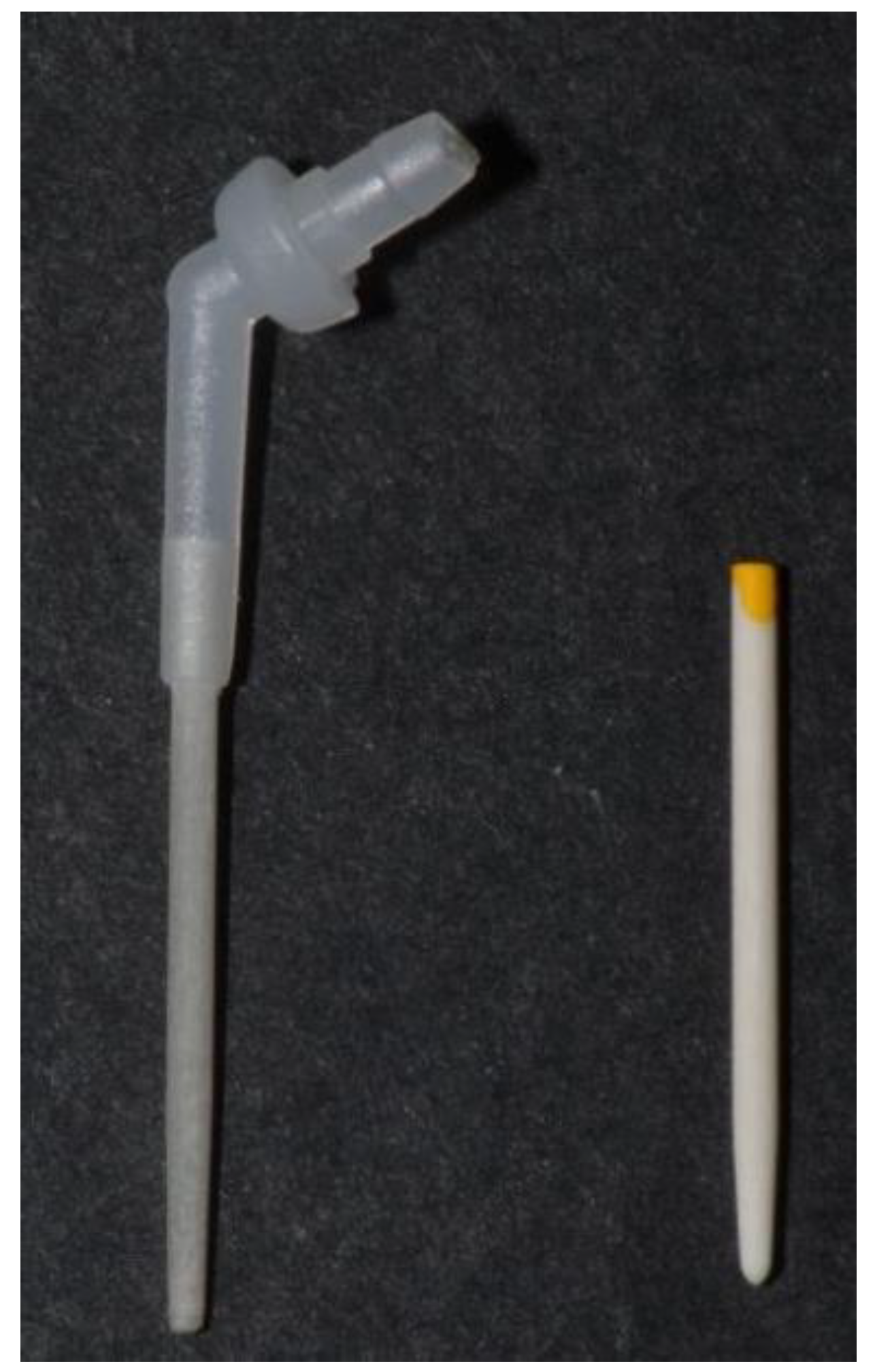
Figure 2.
Correct apical seal (blue arrow) and canalar seal (green arrow) at the CT-Scan.
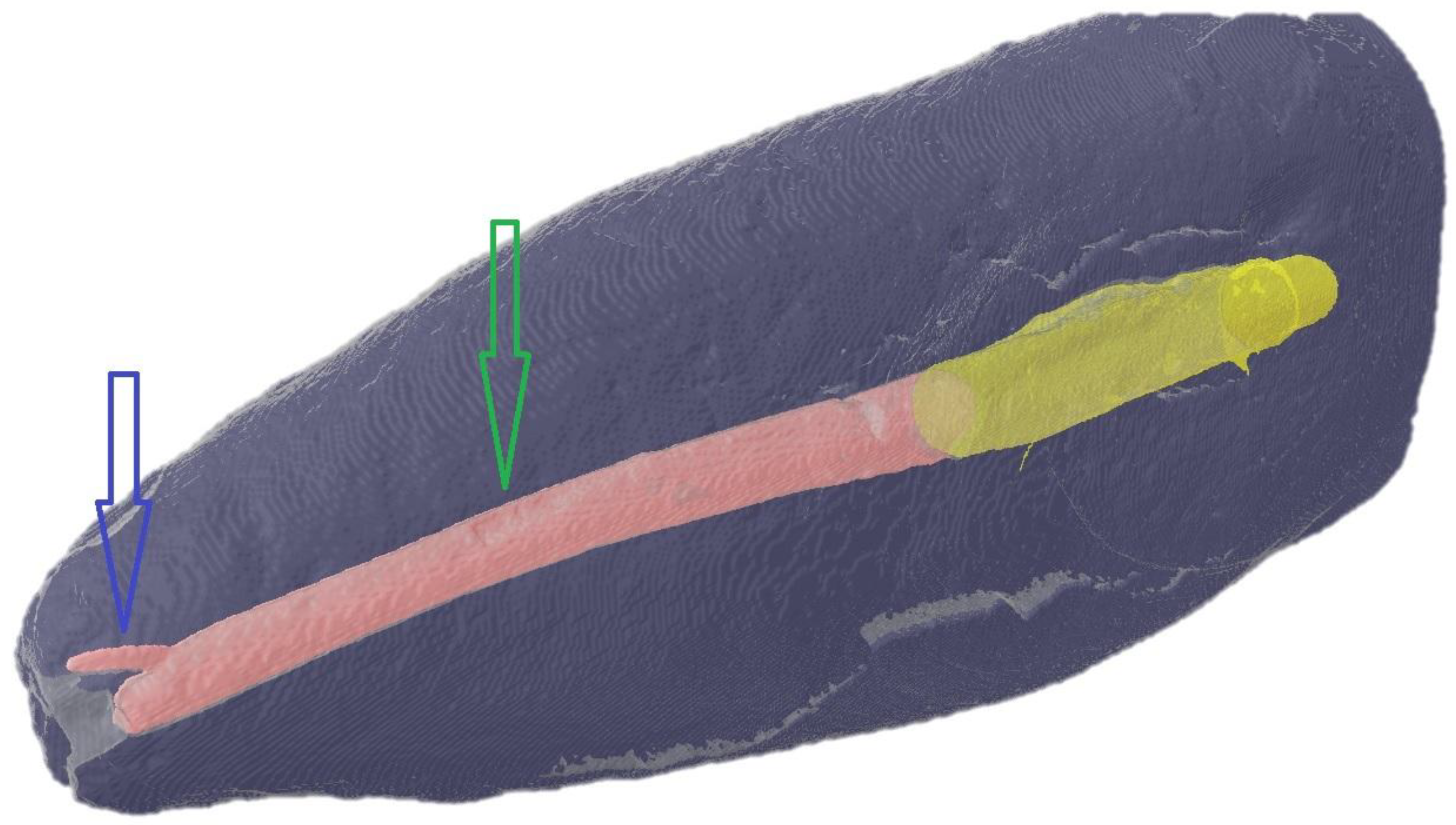
Figure 3.
Different formation of voids into the post space with solid posts on the left and hollow post on the right.
Figure 3.
Different formation of voids into the post space with solid posts on the left and hollow post on the right.
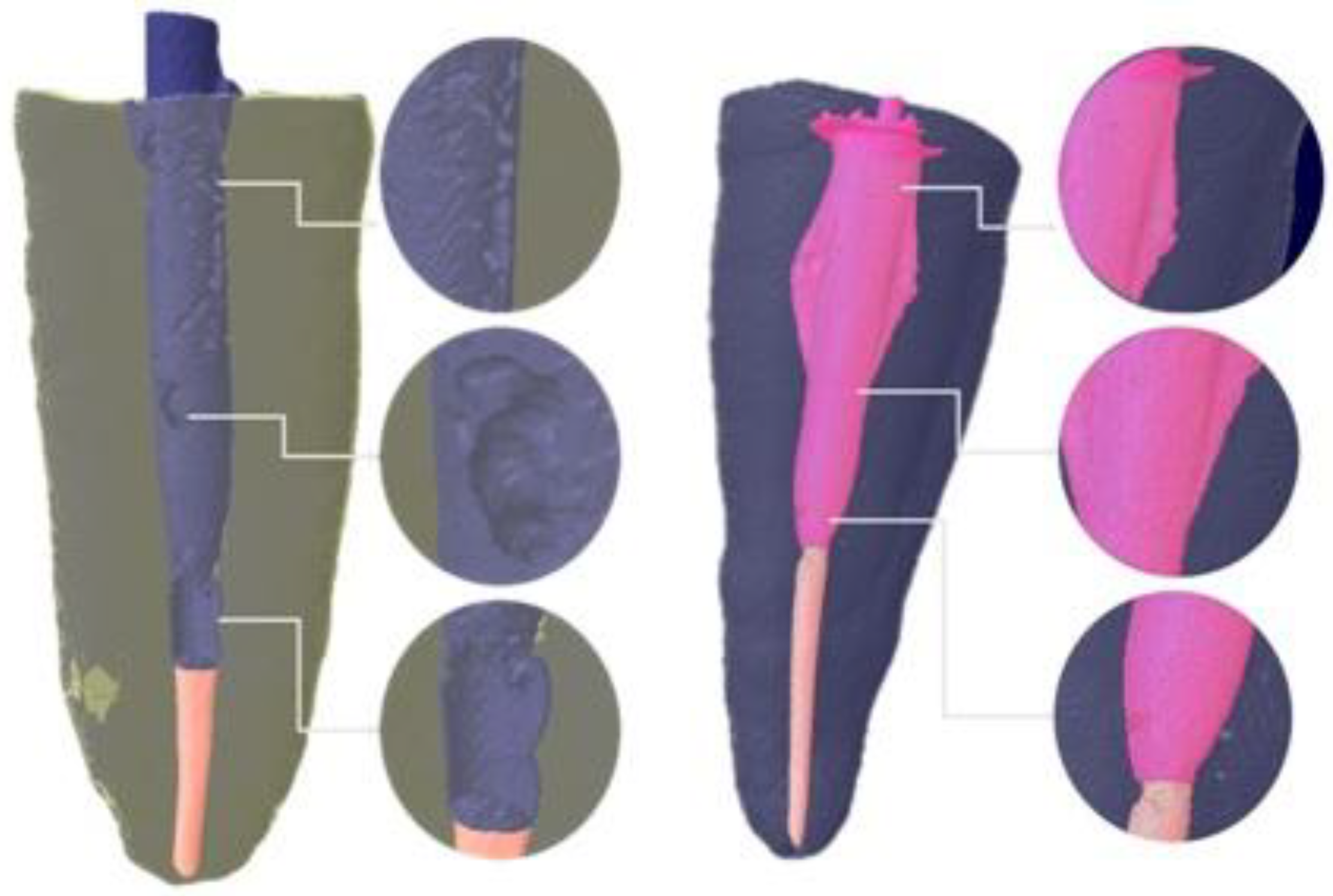
Figure 4.
Different penetration of posts: on the left a hollow post (red line indicates the portion of post space not reached by the post) and on the right a solid post (double red line indicate the portion of post space not reached by the post).
Figure 4.
Different penetration of posts: on the left a hollow post (red line indicates the portion of post space not reached by the post) and on the right a solid post (double red line indicate the portion of post space not reached by the post).
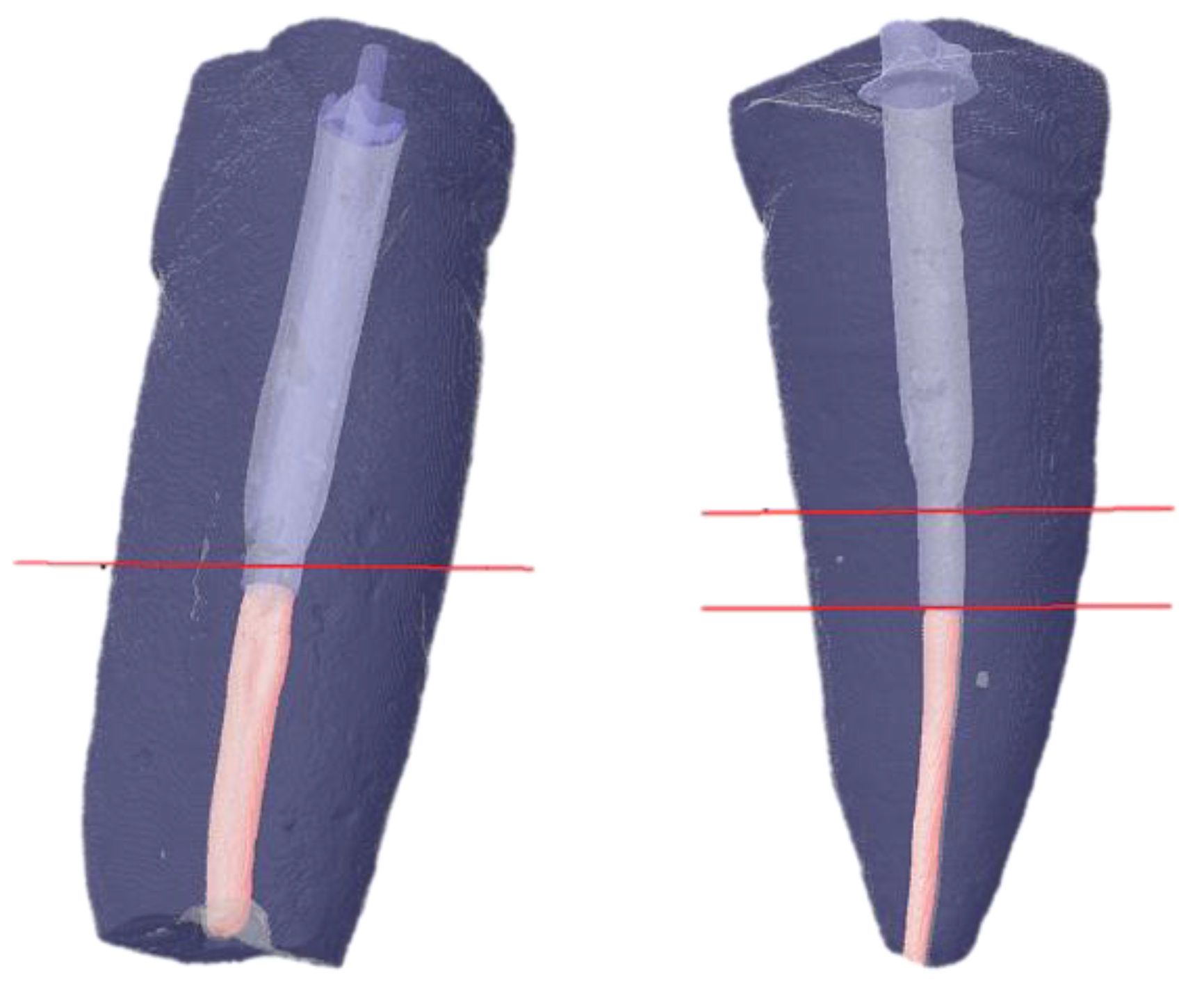
Figure 5.
Empty spaces in the cement compared to total cement volume: difference between hollow and solid posts.
Figure 5.
Empty spaces in the cement compared to total cement volume: difference between hollow and solid posts.
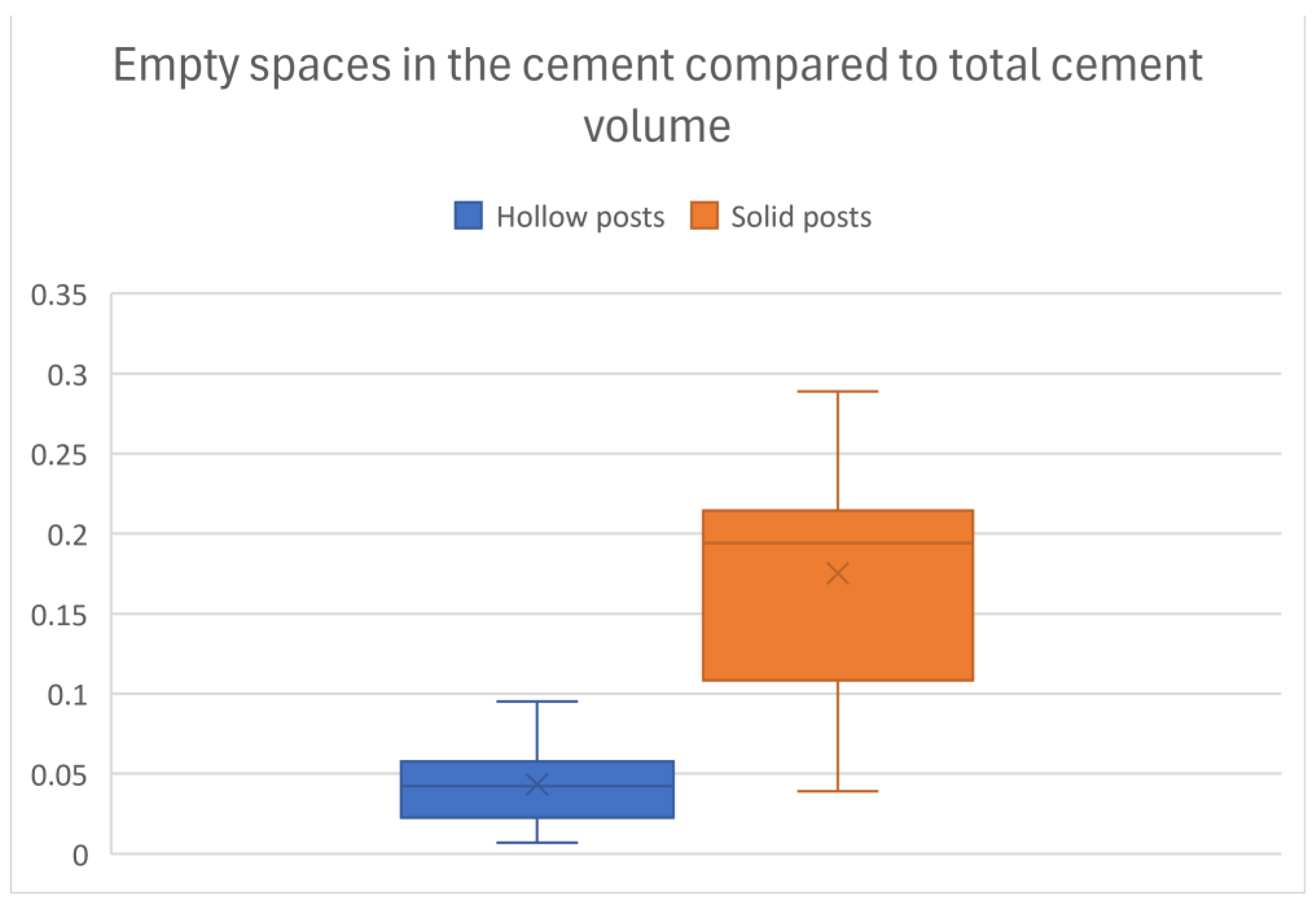

Table 1.
SkyScan 1176 (Bruker™) CT specifications and exact parameters used in the void detection process.
Table 1.
SkyScan 1176 (Bruker™) CT specifications and exact parameters used in the void detection process.
| X-ray source | sealed microfocus X-ray tube 20-90kV,25W |
|---|---|
| X-ray detector | 4000x2672pixels, 12bit, fiber optically coupled to scintillator |
| Scanning volume | 68mm diam., 20mm single scan length, 200mm scannable length |
| Spatial resolution | <9µm pixel size, <15µm low-contrast resolution (10%MTF) |
| Reconstructed slices | 8Kx8K pixels, 9µm/18µm/35µm selectable pixels size |
| Radiation safety | <1µSv/h at any point on the instrument surface during scanning |
Table 2.
Different outcome of empty spaces formation in the cement compared to total cement volume with the use of hollow posts and solid posts in shaped canals.
Table 2.
Different outcome of empty spaces formation in the cement compared to total cement volume with the use of hollow posts and solid posts in shaped canals.
| EMPTY CEMENT SPACES / EXTERNAL CEMENT VOLUME | % OF GAPS | EMPTY CEMENT SPACE | EXTERNAL CEMENT VOLUME | POST TYPE | N° |
|---|---|---|---|---|---|
| 0,0377 | 3,77% | 0,5980 | 158,300 | HP | 1 |
| 0,0227 | 2,27% | 0,2741 | 100,126 | HP | 2 |
| 0,0953 | 9,53% | 14,698 | 139,505 | HP | 3 |
| 0,0473 | 4,73% | 0,3655 | 73,448 | HP | 4 |
| 0,0424 | 4,24% | 0,1618 | 36,510 | HP | 5 |
| 0,0313 | 3,13% | 0,1150 | 35,528 | HP | 6 |
| 0,0151 | 1,51% | 0,0647 | 41,995 | HP | 7 |
| 0,0772 | 7,72% | 0,2975 | 35,559 | HP | 8 |
| 0,0576 | 5,76% | 0,2187 | 35,768 | HP | 9 |
| 0,0070 | 0,07% | 0,0317 | 44,804 | HP | 10 |
| 0,1946 | 19,46% | 14,290 | 73,413 | SP | 11 |
| 0,0391 | 3,91% | 0,2775 | 70,833 | SP | 12 |
| 0,2712 | 27,2% | 13,433 | 49,525 | SP | 13 |
| 0,2888 | 28,8% | 18,191 | 62,974 | SP | 14 |
| 0,2145 | 21,4% | 11,732 | 54,689 | SP | 15 |
| 0,1941 | 19,41% | 12,366 | 63,710 | SP | 16 |
| 0,1942 | 19,42% | 0,8721 | 44,895 | SP | 17 |
| 0,0543 | 5,43% | 0,3396 | 62,572 | SP | 18 |
| 0,1939 | 19,39% | 0,8282 | 42,698 | SP | 19 |
| 0,1085 | 10,85% | 12,342 | 113,717 | SP | 20 |
Table 3.
Different outcome of penetration of hollow posts (HP) and traditional solid posts (SP) in shaped canals.
Table 3.
Different outcome of penetration of hollow posts (HP) and traditional solid posts (SP) in shaped canals.
| POST LENGTH/POST SPACE LENGHT | POST SPACE LENGTH (mm) | POST LENGTH (mm) | POST TYPE | N° |
|---|---|---|---|---|
| 0,9826 | 7,729 | 7,595 | HP | 1 |
| 0,9923 | 8,22 | 8,157 | HP | 2 |
| 0,8838 | 7,148 | 6,318 | HP | 3 |
| 0,9595 | 9,059 | 8,693 | HP | 4 |
| 0,9393 | 8,247 | 7,747 | HP | 5 |
| 0,9199 | 8,372 | 7,702 | HP | 6 |
| 0,9841 | 8,478 | 8,344 | HP | 7 |
| 0,9635 | 8,577 | 8,264 | HP | 8 |
| 0,9575 | 8,416 | 8,059 | HP | 9 |
| 0,9877 | 7,979 | 7,881 | HP | 10 |
| 0,7615 | 8,157 | 6,212 | SP | 11 |
| 0,8150 | 8,541 | 6,961 | SP | 12 |
| 0,6459 | 8,594 | 5,551 | SP | 13 |
| 0,6097 | 7,639 | 4,658 | SP | 14 |
| 0,5285 | 8,273 | 4,373 | SP | 15 |
| 0,7116 | 8,39 | 5,971 | SP | 16 |
| 0,9858 | 7,069 | 6,696 | SP | 17 |
| 0,8528 | 8,246 | 7,033 | SP | 18 |
| 0,9529 | 7,783 | 7,417 | SP | 19 |
| 0,5663 | 8,362 | 4,736 | SP | 20 |
Table 4.
Mann Whitney test for Hp1 hypotesis.
| Mann Whitney test | |
|---|---|
| P value | 0,0007 |
| Exact or approximate p value? | Exact |
| Significantly different (p< 0.05)? | Yes |
| One- or two-tailed p value? | Two-tailed |
| Sum of ranks in column A,B | 63 , 147 |
| Mann-Whitney U | 8 |
Table 5.
Mann Whitney test for Hp2 hypotesis.
| Mann Whitney test | |
|---|---|
| p value | 0,0433 |
| Exact or approximate p value? | Exact |
| Significantly different (p < 0.05)? | Yes |
| One- or two-tailed pvalue? | Two-tailed |
| Sum of ranks in column A,B | 78 , 132 |
| Mann-Whitney U | 23 |
Disclaimer/Publisher’s Note: The statements, opinions and data contained in all publications are solely those of the individual author(s) and contributor(s) and not of MDPI and/or the editor(s). MDPI and/or the editor(s) disclaim responsibility for any injury to people or property resulting from any ideas, methods, instructions or products referred to in the content. |
© 2025 by the authors. Licensee MDPI, Basel, Switzerland. This article is an open access article distributed under the terms and conditions of the Creative Commons Attribution (CC BY) license (http://creativecommons.org/licenses/by/4.0/).
Copyright: This open access article is published under a Creative Commons CC BY 4.0 license, which permit the free download, distribution, and reuse, provided that the author and preprint are cited in any reuse.


