

Submitted:
18 September 2025
Posted:
19 September 2025
You are already at the latest version
Abstract
The aim of this work was to prepare new heterodimeric molecules containing pharmacophoric fragments of 3-cyanoquinoline/3-aminothieno[2,3-b]pyridine/3-aminothieno[2,3- b]quinoline on one side, and phenothiazine – on the other. The products were synthesized via selective S-alkylation of readily available 2-thioxo-3-cyanopyridines or -quinolines with N-(chloroacetyl)phenothiazines, followed by base-promoted Thorpe-Ziegler isomerization of the resulting N-[(3-cyanopyridin-2-ylthio)acetyl]phenothiazines. We found that both the S-alkylation and the Thorpe-Ziegler cyclization reactions, when conducted with KOH under heating, were accompanied to a significant extent by a side reaction involving the elimination of phenothiazine. Optimization of the conditions (0…5 °C, anhydrous N,N-dimethylacetamide and NaH or t-BuONa as non-nucleophilic bases) minimized the side reaction and increased the yields of the target heterodimers. The structures of the products were confirmed by IR spectroscopy, 1H and 13C DEPTQ NMR studies. It was demonstrated that the synthesized 3-aminothieno[2,3-b]pyridines can be acylated with chloroacetyl chloride in hot chloroform. The resulting chloroacetamide derivative reacts with potassium thiocyanate in DMF to form the corresponding 2-iminothiazolidin-4-one; in this process, phenothiazine elimination does not occur and the Gewald rearrangement product was not observed. The structural features and spectral characteristics of the synthesized 2-iminothiazolidin-4-one derivative were investigated by quantum chemical methods at the B3LYP-D4/def2-TZVP level. A range of drug-relevant properties were also evaluated using in silico methods, and ADMET parameters were calculated. A molecular docking study identified a number of potential protein targets for the new heterodimers, indicating the promise of these compounds for the development of novel antitumor agents.
Keywords:
phenothiazine heterodimers
; thieno[2
; 3-b]pyridines
; 3-b]quinolines
; quinoline-3-carbonitriles
; Thorpe-Ziegler cyclization
; α-thiocyanatoacetamides
; 2-iminothiazolidine-4-ones
; Gewald rearrangemen
1. Introduction
In recent years, the concept of molecular hybridization—combining two or more pharmacophore scaffolds into a single molecule—has been employed to develop pharmacological drugs with enhanced efficacy [1,2,3,4]. This approach operates on the principle that a hybrid molecule incorporates structural features from two (in the case of heterodimers) or more parent pharmacophores, each of which independently and selectively acts on distinct pharmacological targets. The inclusion of multiple pharmacophore subunits in a conjugate often leads to a synergistic effect that surpasses the combined impact of the individual compounds. These pharmacophore subunits may function independently, with different fragments binding to separate targets, or they may act simultaneously by interacting with different regions of the same target protein.
Recently, molecular hybrids have shown promise as therapeutic agents for a variety of conditions, including cancer [5,6,7,8,9,10,11,12,13,14,15], Alzheimer’s disease [16,17,18,19,20,21,22,23,24,25,26,27], malaria [28,29,30,31,32,33,34], tuberculosis [35,36,37,38,39,40,41,42], HIV [37,43,44,45,46,47,48,49], and SARS-CoV-2 [50]. They have also demonstrated efficacy against bacterial and fungal infections [51,52,53,54,55,56,57,58,59,60,61], as well as potential applications as antidiabetic drugs [62,63,64,65,66,67,68,69,70,71], anticoagulants and platelet aggregation inhibitors [72,73,74,75], analgesics [76,77,78,79,80,81], photopharmacological compounds [82], and anti-inflammatory agents [83,84,85]. Furthermore, molecular hybrids demonstrate significant potential for creating novel materials possessing photochromic and luminescent characteristics. They also show utility as reagents in fine organic synthesis, serve as high-energy-density materials, and find purpose in various other applications [86,87,88,89,90,91,92,93].
In continuation of our research on condensed S,N-heterocyclic systems [94,95,96,97,98,99,100,101,102], we aimed to investigate the possibility of obtaining new molecular hybrids combining a phenothiazine fragment on one side with either nicotinonitrile or 3-aminothieno[2,3-b]pyridine – on the other.
The choice of starting components for the synthesis of these molecular hybrids was guided by several considerations. First, phenothiazine derivatives are readily available and well-known for their broad range of practical applications. In medical practice, phenothiazine-based neuroleptics, antiemetics, and antipsychotics—such as promazine and chlorpromazine (Thorazine)—are widely used to treat mental disorders, Parkinson's disease, motion sickness, and rheumatism (Figure 1) [103,104,105]. It is noteworthy that several established drugs are, in fact, hybrid heterodimers of phenothiazine with piperidine—examples include thioridazine (Mellaril, Sonapax), periciazine (Neuleptil), and Mesoridazine (Serentil)—or with piperazine, such as fluphenazine (Prolixin), perphenazine (Trilafon), prochlorperazine (Compazine), and trifluoperazine (Stelazine) (Figure 1).
The dye methylene blue (Figure 1) is actively used in medicine, photography, analytical chemistry, and the textile industry as a blue dye. In medicine, methylene blue is used as an antiseptic for treating oral and urogenital tract infections, as an antidote for cyanide, carbon monoxide, and hydrogen sulfide poisoning, is effective in treating Alzheimer's disease, and serves in the photodynamic therapy of cancer as a potent photosensitizer that promotes photo-induced destruction of tumor cells [106,107,108,109,110,111].
Next, phenothiazines are also of interest as compounds exhibiting anticancer [112,113], antiprotozoal [113,114], fungicidal [114], and other effects. They also function as antioxidants [115], dyes and fluorophores for optoelectronics [108,116,117,118], chemosensors for the analytical determination of cations and anions [119,120,121], molecular generators of NO [122], DNA sensors [123], photocatalysts [124,125,126], among other applications.
Heterodimeric molecules based on phenothiazine have also found diverse applications (for a recent review, see [127]). Recently, hybrid molecules containing a phenothiazine fragment have been proposed as multifunctional agents for the potential treatment of neurodegenerative disease [128], cholinesterase modulators [129], acetylcholinesterase/butyrylcholinesterase inhibitors [130], antioxidants [131,132], and antitumor agents [133,134,135,136].
On the other hand, nicotinonitriles (3-cyanopyridines) and their close structural analogs such as 3-cyanoquinolines were recognized as readily available reagents for organic synthesis and exhibit a promising profile of biological activity (for reviews, see [137,138,139,140,141,142,143,144,145,146]). In recent years, hybrid molecules containing a nicotinonitrile fragment have been reported as acetylcholinesterase inhibitors [147], anticancer agents [148,149], chromophores [150], hypolipidemic and hepatoprotective agents [151,152,153], analgesics [154,155,156,157], plant growth regulators and herbicide safeners [158,159], and EGFR/BRAFV600E inhibitors [160].
Among 3-aminothieno[2,3-b]pyridines and -quinolines (for reviews, see [95,161,162,163,164,165]), numerous active molecules have also been identified. Notable examples include 3,6-diaminothieno[2,3-b]pyridines 1, recognized as dual inhibitors of Hsp90 and B-Raf [166], antiplasmodial agents [167,168,169,170], and adenosine receptor agonists [171,172]. Thienopyridine-5-carboxylic acids 2 [173] act as HIV-1 integrase inhibitors [174], IKKβ inhibitors [175], and ubiquitin C-terminal hydrolase-L1 (UCH-L1) inhibitors [176] (Figure 2).
6-Aryl-3-aminothieno[2,3-b]pyridines 3 exhibit a broad spectrum of biological activity, ranging from antimicrobial [177] to antitumor [178,179]. Structurally related thieno[2,3-b]quinolines 4 demonstrate antitumor activity [180,181,182,183] and also inhibit platelet aggregation [184]. 4,6-Disubstituted thienopyridines 5 have been described as potent IκB kinase β inhibitors [185], Pim-1 inhibitors [186], and non-competitive Epac1 inhibitors [187], while compounds 6 are active against the HIV-1 virus [188].
The potential of thienopyridines in agrochemistry is illustrated by compounds 7, which exhibit insecticidal activity against Aonidiella aurantii [189], and by azidoacetamides 8, which show a herbicide safening effect against 2,4-D in sunflower seedlings [190] (Figure 2).
Hybrid molecules bearing a thienopyridine fragment remain relatively unexplored. Reported examples include thienopyridine/coumarin heterodimers with antiacetylcholinesterase activity [191], thiazolidine/thienopyridine fungicides [192], and thieno[2,3-b]quinoline/procaine hybrid molecules that are allosteric SHP-1 activators evolved from PTP1B inhibitors [193].
According to recent reviews on the chemistry of phenothiazine heterodimers [127] and thienopyridines/thienoquinolines [164,165], along with the results of our literature search, hybrid molecules combining phenothiazine with nicotinonitrile or thienopyridine(quinoline) fragments have not been previously described.
This work presents the synthesis of such hybrid molecules and an investigation into some of their properties.
2. Results and Discussion
2.1. Synthesis
To prepare the target heterodimers, we selected a synthetic strategy involving the S-alkylation of readily available 3-cyanopyridine-2(1H)-thiones 9 with N-(chloroacetyl)phenothiazines 10. The resulting sulfides 11 can subsequently undergo Thorpe-Ziegler cyclization under basic conditions, enabling a one-pot conversion into the thienopyridine products 12 (Scheme 1).
Starting 2-thioxoazines 9 were prepared through several routes (Scheme 2). Thus, 4-aryl-2-thioxoquinolines 9a-h were synthesized by the sequential treatment of cyanothioacetamide 13 (for review, see [194]) with aromatic aldehydes and enamine 14 [195,196,197,198]. It should be noted that quinolines 9b (Ar = 3-BrC6H4) and 9e (Ar = 2,4-Cl2C6H3) have not been previously described in the literature.
Next, 2-thioxonicotinonitriles 9i-k were prepared by reacting thioamide 13 with 1,3-diketones 15 via the Guareschi–Thorpe reaction according to known procedures [199,200]. Starting pyridines 9l [201] and 9m [202] were prepared by the reaction of cyanothioacetamide 13 with sodium enolates of α-formyl ketones in the presence of AcOH (Scheme 2).
Synthesis of N-(chloroacetyl)phenothiazine 10a was achieved by acylating phenothiazine with chloroacetyl chloride [203]. A similar reaction with 3,7-dibromophenothiazine [204,205] afforded chloroacetamide 10b (Scheme 3). The structure of 3,7-dibromo-10-(chloroacetyl)phenothiazine 10b was studied by single-crystal X-ray diffraction analysis (Figure 3).
Traditionally, the reaction of 3-cyanopyridine-2(1H)-thiones 9 with alkylating agents, followed by Thorpe–Ziegler isomerization into 3-aminothieno[2,3-b]pyridines, is carried out in the presence of strong bases such as KOH, NaOH, EtONa, etc., most commonly under heating [95,161,162,163,164,165]. However, when we attempted to synthesize Thorpe-Ziegler product from thioxopyridine 9i and N-(chloroacetyl)phenothiazine 10a using KOH in MeOH, we observed an unusual behavior in this reaction. Although the expected product 12i was still isolated in a 68% yield, TLC and GC-MS analysis confirmed the formation of a significant amount of unsubstituted phenothiazine (Scheme 4).
Surprisingly, when 2-thioxoquinoline 9a was reacted with chloride 10a in the presence of KOH in MeOH, the expected heterodimer 12a was not obtained at all. Instead, the methyl ester 16a was formed in a 61% yield [206] (Scheme 4).
We propose that the probable cause is the specific nature of the N-acyl phenothiazine fragment, in which the phenothiazine moiety acts in an uncharacteristic role as a labile leaving group. This leads to the formation of a mesoionic intermediate 17, which, under the action of methanolic KOH, undergoes cleavage to form the corresponding methyl ester. Subsequent Thorpe-Ziegler cyclization lead to the formation the aforementioned ester 16. More experimental details are provided in our paper [206].
Undoubtedly, this remarkably facile elimination of the phenothiazine moiety through the formation of mesoionic species is of significant theoretical and practical interest. However, a detailed investigation of the scope and limitations of this reaction falls outside falls outside the scope of the present work and will be the subject of further studies.
Given the aforementioned challenges in synthesizing phenothiazine heterodimers 11 and 12, we opted to avoid heating as well as strongly nucleophilic solvents and bases in favor of milder reaction conditions.
We decided to conduct the S-alkylation reaction and subsequent Thorpe-Ziegler cyclization under cooling, while also employing non-nucleophilic basic catalysts and solvents. Success was achieved using the systems t-BuONa–anhydrous N,N-dimethylacetamide (DMAA) (Method A) and NaH–DMAA (Method B, Scheme 5, Table 1 and Table 2). The use of t-BuONa as a base appears preferable as it affords somewhat higher yields (Table 2).
Compounds 11 are beige or pale yellow powders, typically exhibiting poor solubility in benzene and alcohols, and limited solubility in EtOAc, acetone, methylene chloride, as well as in CDCl3 or (CD3)2SO at 25 °C. The IR spectra of heterodimers 11a–h display an intense absorption band for the conjugated cyano group at ν = 2218–2222 cm-1, along with an absorption band for the amide C=O group at ν = 1682–1686 cm-1.
Characteristic signals in the 1H NMR spectra of cyanoquinoline–phenothiazine heterodimers 11 include multiplets for the protons of four methylene groups in the range δ 1.56–1.69, 1.72–1.80, 2.09–2.65, and 2.80–2.86 ppm, and a singlet for the SCH2 protons at δ 4.39–4.42 ppm.
In the 13C NMR spectra of compounds 11, the characteristic signals of the four methylene carbons at δ 21.5–21.6, 21.5–21.8, 25.6–26.5, and 32.8–33.1 ppm, SCH2 (δ 33.5–33.7 ppm), quinoline C-3 (δ 101.2–104.5 ppm), C≡N carbon (δ 114.5–115.5 ppm), quinoline C-4a (δ 126.3–128.0 ppm), and the carbonyl group signals (δ 166.0–166.1 ppm) are observed. Phenothiazine fragment shows a characteristic set of signals for CH carbons (δ 127.25–127.28, 127.34–127.39 and 128.0 ppm), as well as signals for the C–S–C carbons at δ 132.2–132.3 ppm and C–N–C carbons at δ 138.0 ppm.
To our surprise, heterodimers 11 proved to be relatively unstable compounds. When heated above 70–100 °C for drying or melting point determination, compounds 11 undergo noticeable decomposition to form free phenothiazine (detected spectroscopically and by TLC) and products exhibiting orange fluorescence under UV light, for which we propose a mesoionic structure 17. The likely reason is the previously mentioned specific behavior of the N-(acyl)phenothiazine fragment, which acts as a mild acylating agent with phenothiazine serving as the leaving group. A detailed examination of this transformation will be the subject of further investigation.
The elimination of phenothiazine is observed to some extent even under the mild synthesis conditions we selected. For instance, the NMR spectra of the crude heterodimers 11 consistently show signals corresponding to unsubstituted phenothiazine [1H NMR – δ 8.57–8.60 ppm (NH), δ 6.66–6.99 ppm (CH Ar); 13C NMR – δ 142.1 (C–N–C), 127.6 (CH), 126.3 (CH), 121.8 (CH), 116.3 (C–S–C), 114.4 (CH)] (for example, see Figures S42, S43 in Supplementary Materials file).
Compounds 12 are yellow or yellow-brown powders, typically insoluble in benzene, alcohols, and sparingly soluble in DMSO, chloroform or DMAA.
FT-IR spectra of heterodimers 12 lack the absorption bands for a conjugated C≡N group. Instead, two absorption bands corresponding to the asymmetric and symmetric vibrations of the N–H bond of a primary amino group appeared at ν 3508-3429 cm-1 and 3356-3306 cm-1. Notably, due to conjugation, the absorption band of the amide C=O group undergoes a bathochromic shift and is observed in the range of ν 1620-1597 cm⁻¹.
The 1H NMR spectra of 3-aminothienopyridines 12 reveal a signal for primary amino group protons as a broad singlet at δ 5.86-7.64 ppm. Characteristic signals in the 13C NMR spectra of compounds 12 include the carbons of thienopyridine system: C-2 (δ 94.3-96.6 ppm), C-3a (δ 119.2-122.7 ppm), C-3 (δ 138.4-150.6 ppm), as well as amide C=O carbon (δ 164.2-164.9 ppm). The signals of phenothiazine fragment appears as four CH carbon peaks at δ 126.9-127.1, δ 127.1-127.3, δ 127.4-127.5, and δ 127.8-127.9 ppm, along with two signals for quaternary carbons: C–S–C at δ 132.3-132.4 ppm and C–N–C at δ 138.9-139.2 ppm.
As with heterodimers 11, the NMR spectra of crude thienopyridines 12 contain signals of unsubstituted phenothiazine (see, for example, Figures S45 and S46 in the Supplementary Materials file). Thienopyridines 12 can be purified by recrystallization from a large volume of a low-boiling non-nucleophilic solvent (e.g., acetone or CH2Cl2) or by re-precipitation from a solution using light petroleum.
We investigated some reactions of the new compounds. Thus, acylation of the model thienopyridine 12j with chloroacetyl chloride in hot chloroform yielded the expected α-chloroacetamide 18 in 72% yield (Scheme 6).
The reaction of chloroacetamide 18 with potassium thiocyanate is of particular interest. In 2000, Karl Gewald and co-workers reported [207] a cascade rearrangement of aromatic carboxylic acid esters bearing α-chloroacetamide substituent at ortho-position upon treatment with potassium thiocyanate in boiling alcohol (Scheme 7).
This rearrangement provides an elegant approach towards functionalized condensed pyrimidines through a sequence of steps: initial formation of nucleophilic substitution products, α-thiocyanatoacetamides 19—which undergo in situ cyclization to give pseudothiohydantoins (2-iminothiazolidin-4-ones) 20. These 2-iminothiazolidine species then undergo intramolecular cyclocondensation to form thiazolo[3,2-a]pyrimidines intermediates 21, which are then nucleophilically attacked by an EtOH molecule, resulting in thiazole ring opening and the formation of ethyl (pyrimidin-2-yl)thioacetates 22 (Scheme 7).
Later, other ortho-(α-chloroacetamido)-substituted esters of thieno[2,3-b]pyridine series 23 were successfully introduced into this reaction [208,209]. The structure of the electron-withdrawing substituent in the ortho-position relative to α-chloroacetamide fragment plays a crucial and often ambiguous role. For instance, it was noted [210] that in the case of 2-benzoyl-3-(chloroacetamido)thieno[2,3-c]pyridazine 24 the reaction with thiocyanate terminated at an earlier stage to afford the 2-iminothiazolidine 25 (Scheme 8).
Similarly, ortho-acyl-α-chloroacetanilides 26 react analogously: even under prolonged heating, the reaction progressed only to the intermediate 2-iminothiazolidin-4-ones [207]. The behavior of ortho-(chloroacetamido) carbonitriles is also ambiguous. While nitrile 27 reacts smoothly with ammonium thiocyanate in ethanol or an ethanol–dioxane mixture to form the corresponding thienopyrimidine 28 [211,212], the reaction of the structurally related thiophene-3-carbonitrile 29 in boiling acetone stops at the 2-iminothiazoline stage [213] (Scheme 8).
We found that the reaction of chloroacetamide 18 with potassium thiocyanate proceeds under prolonged heating (60–70 °C, 5 h) in DMF to give 2-iminothiazolidin-4-one 30 in a high yield (Scheme 9). Notably, we did not observe the formation of any Gewald rearrangement products such as 31.
An interesting feature of the FT-IR spectrum of compound 30 is the strong hypsochromic shift of the thiazolidinone C=O band (1720 cm-1), which is unusual for typical amide groups. For this reason, we performed quantum chemical calculations of the molecular geometry and vibrational frequencies of the IR spectrum for molecule 30 using the hybrid functional B3LYP with D4 dispersion correction in the def2-TZVP basis set.
The molecular structure of compound 30 is presented in Figure 4. As we can see, the 2-iminothiazolidinone ring is oriented nearly perpendicular to the thieno[2,3-b]pyridine fragment, with a torsion angle C=C–N–C=O of 96.3° between them.
A comparison of the calculated vibrational frequencies with experimental results is shown in Table 3. The use of corrections factors [214] significantly improves the agreement between the calculated frequencies and experimental values, reducing the mean absolute percentage error (MAPE) from 2.83% (without correction) to just 0.77% (with correction factors). Analysis of the results confirmed that the C=O stretching vibration band in the 2-iminothiazolidin-4-one fragment is indeed shifted to a higher wavenumber compared to standard values for amide groups. This shift is likely due to both incorporation of the amide group into a five-membered ring and the strong conjugation of the amide nitrogen atom with the C=N double bond.
2.2. Drug-Relevant Properties, ADMET and Docking Studies
In the context of studies on a potential biological activity of the new heterodimeric molecules, we performed in silico calculations of bioavailability parameters for structures 11, 12, 18, and 30. A preliminary analysis of the structures for compliance with C. Lipinski's "Rule of Five" (cLogP ≤ 5.0, molecular weight (MW) ≤ 500, TPSA ≤ 140 Å2) [215,216] was performed using the OSIRIS Property Explorer service [217]. The evaluated parameters included cLogP (the calculated logarithm of n-octanol/water partition coefficient, log(coctanol/cwater)), solubility (logS), Topological Polar Surface Area (TPSA), toxicological parameters – risks of side effects (mutagenic, tumorigenic, reproductive effects), drug-likeness, and the overall drug score. The obtained calculated data are presented in Table S8 (Supplementary materials file).
As we can see, the cLogP value exceeds 5.0 in all cases, with the least substituted thienopyridine heterodimers 12l and 12i showing the best values (cLogP 5.18 and 5.53, respectively). The logS value indicates low predicted solubility for the heterodimeric molecules (logS ranging from -8.66 to -10.87 for nitriles 11 and logS = -7.89 to -11.22 for thienopyridines 12), which is in agreement with experimental observations of their low solubility. At the same time, the new molecules predominantly exhibit acceptable TPSA values (< 140 Å2), suggesting a likely ability to permeat cell membranes or blood-brain barrier (BBB).
The calculated drug-likeness parameter values are relatively low for heterodimers 11 (ranging from -4.13 to -10.74), while for thieno[2,3-b]pyridines 12, 18, and 30, they vary between -3.67 and 5.77, depending on the nature of substituents in the thienopyridine component. The overall drug score values are also modest, not exceeding 0.10–0.13 for 11 and 0.10–0.39 for thieno[2,3-b]pyridines 12, 18, and 30. For all synthesized molecules, a risk of reproductive effects is predicted.
ADMET parameters were predicted using the admetSAR software package [218]. The results are summarized in Table S9 (Supplementary Materials file). High human gastrointestinal absorption (HIA) and BBB permeability are predicted for all compounds, along with inhibitory effects on cytochrome P450 isoforms CYP1A2, CYP2C19, and CYP2C9. Evaluation of potential mutagenic effects using the Ames test suggests a probable absence of such activity.
Overall, despite low solubility (logS) and cLogP values falling outside typical bioavailability criteria, the synthesized molecules may be considered as promising candidates for further screening.
To identify potential protein targets for the synthesized compounds, we performed molecular docking studies using the novel protein–ligand docking protocol GalaxySagittarius [219] on the GalaxyWeb server [220]. Initially, the 3D structures of the new compounds were optimized using molecular mechanics with the MM2 force field to refine their geometry and minimize energy. Molecular docking was conducted in “Binding compatibility prediction” and “Re-ranking using docking” modes.
Table S10 (Supplementary Materials file) presents the results of the molecular docking studies (top 10 of the best docked poses for each compound 11, 12, 18, and 30) listing the protein–ligand complexes with the lowest binding free energy ΔGbind and the highest protein–ligand interaction scores. Predicted protein targets were specified using Protein Data Bank (PDB) IDs and UniProt database identifiers. As shown in Table S10, common probable protein targets for most compounds, with ΔGbind values ranging from approximately –17 to –31 kcal/mol, are human peroxisome proliferator-activated receptor (PPAR) (PDB IDs 2zno, 8hum, 8hup), nuclear receptor ROR-gamma (PDB ID 7qp4), and the prosurvival BCL-2 family protein BCL-X(L) (PDB ID 3zln). Thus, the likely activity profile of the new heterodimers involves inhibiting the proliferation of certain cancer cell types.
3. Materials and Methods
1H, 13C and 13C DEPTQ NMR spectra were recorded in solutions of DMSO-d6 on a Bruker AVANCE-III HD instrument (at 400.40 MHz for 1H or 100.61 MHz for 13C nuclei) and JEOL JNM-ECA-400 instrument (at 399.78 MHz for 1H or 100.53 MHz for 13C nuclei). Residual solvent signals were used as internal standards, in DMSO-d6 – 2.49 ppm for 1H, and 39.50 ppm for 13C nuclei. FT-IR spectra were recorded on Bruker Vertex 70 instrument equipped with an ATR sampling module or Infraspec FSM2201 instrument (Saint-Petersburg, Russia) in KBr pellets or in Nujol mulls. Elemental analyses were carried out using a Carlo Erba 1106 Elemental Analyzer. Single crystal X-ray diffraction analyses were performed on an Agilent SuperNova, Dual, Cu at home/near, Atlas diffractometer. See Electronic Supplementary Material file for NMR, FT-IR spectral charts and X-ray analysis data. Reaction progress and purity of isolated compounds were controlled by TLC on Sorbfil-A plates (produced by Imid Ltd., Krasnodar, Russia), eluents – acetone : hexane 2 : 1, HCCl3-toluene 2:1, or ethyl acetate-light petroleum. Developed TLC plates were stained with UV-light and iodine vapors. The reagents and solvents were purchased from the commercial vendor (BioInLabs, Rostov-on-Don, Russia) and used as received.
4-Aryl-2-thioxo-1,2,5,6,7,8-hexahydroquinoline-3-carbonitriles (9a-h) (Scheme 2) were prepared according to the modified reported procedures [195,196,197,198] as follows: a mixture of cyanothioacetamide 13 [223] (2.0 g, 0.02 mol) and 0.02 mol of the corresponding aromatic aldehyde in 25 mL EtOH was stirred in the presence of catalytic amounts of morpholine (2 drops; in the case of furfural and thiophen-2-carbaldehyde we used trace amounts of triethylamine) at 25 °C for 1 h. The formation of a yellow-orange precipitate of the Knoevenagel condensation products, 3-aryl-2-cyanothioacrylamide was observed. To a resulted suspension, freshly distilled 4-(cyclohex-1-en-1-yl)morpholine 14 (3.5 mL, 0.021 mol) was added and a mixture was stirred at 25 °C for 12 h. Then a reaction mixture was treated with AcOH to adjust pH~ 7. After 5 h, a yellow precipitate of the corresponding quinoline 9 was filtered off, washed with EtOH and petroleum ether and dried at 60 °C. The resulted 3-cyanoquinoline-2(1H)-thiones 9a-h are sufficiently pure for analytical purposes and were further used without any purification.
4-(4-Chlorophenyl)-2-thioxo-1,2,5,6,7,8-hexahydroquinoline-3-carbonitrile9a was isolated as yellow powder in 34% yield. Spectral data were identical to those reported in [198].
4-(3-Bromophenyl)-2-thioxo-1,2,5,6,7,8-hexahydroquinoline-3-carbonitrile 9b. Yellow solid, yield was 4.41 g (64%).
FTIR, νmax, cm-1: 3175 (N-H); 2222 (C≡N). 1H NMR (400 MHz, DMSO-d6): 1.56-1.60 (m, 2Н, С(6)Н2), 1.65-1.69 (m, 2Н, С(7)Н2), 2.04-2.12 (m, 2Н, С(8)Н2), 2.75-2.78 (m, 2Н, С(5)Н2), 7.35 (dd, 3J = 7.8 Hz, 4J = 1.1 Hz, 1H, H Ar), 7.46-7.50 (m, 1Н, H-5 Ar), 7.60-7.61 (m, 1Н, H-2 Ar), 7.68-7.71 (m, 1Н, H Ar), 13.45 (very br. s, 1H, NH). 13C DEPTQ NMR (101 MHz, DMSO-d6): 20.3 (C-7), 21.3 (C-6), 25.2 (C-8), 27.3 (C-5), 113.8 (C-3), 116.3 (C≡N), 120.3 (C-4a), 121.9 (C-Br), 126.7* (CH Ar), 130.0* (CH Ar), 131.0* (CH Ar), 132.1* (CH Ar), 137.3 (C-1 Ar), 152.7 (C-8a), 156.0 (C-4), 175.3 (C=S). *Negatively-phased signals. Elemental Analysis: found, %: C, 55.57; H, 4.07; N, 8.28. C16H13BrN2S (M 345.26). Calculated, %: C, 55.66; H, 3.80; N, 8.11.
4-(4-Fluorophenyl)-2-thioxo-1,2,5,6,7,8-hexahydroquinoline-3-carbonitrile9c was isolated as yellow powder in 32% yield. Spectral data were identical to those reported in [197].
4-(2-Thienyl)-2-thioxo-1,2,5,6,7,8-hexahydroquinoline-3-carbonitrile 9d was isolated as yellow-orange crystals in 39% yield. Spectral data were identical to those reported in [198].
4-(2,4-Dichlorophenyl)-2-thioxo-1,2,5,6,7,8-hexahydroquinoline-3-carbonitrile 9e. Yellow solid, yield was 2.08 g (31%). FTIR, νmax, cm-1: 3173 (N-H); 2222 (C≡N). 1H NMR (400 MHz, DMSO-d6): 1.57-1.61 (m, 2Н, С(6)Н2), 1.65-1.70 (m, 2Н, С(7)Н2), 1.92-2.06 (m, 2Н, С(8)Н2), 2.74-2.85 (m, 2Н, С(5)Н2), 7.45 (d, 3J = 8.3 Hz, 1H, H-6 Ar), 7.63 (dd, 3J = 8.3 Hz, 4J = 2.0 Hz, 1H, H-5 Ar), 7.88 (d, 4J = 2.0 Hz, 1H, H-3 Ar), 14.16 (very br. s, 1H, NH). 13C DEPTQ NMR (101 MHz, DMSO-d6): 20.3 (C-7), 21.0 (C-6), 24.6 (C-8), 27.2 (C-5), 114.1 (C-3), 115.7 (C≡N), 120.5 (C-4a), 128.4* (CH Ar), 129.4* (CH Ar), 130.8* (CH Ar), 131.6 (C-Cl), 132.9 (C-Cl), 135.1 (C-1 Ar), 153.3 (C-8a), 154.0 (C-4), 175.3 (C=S). *Negatively-phased signals. Elemental Analysis: found, %: C, 57.27; H, 3.74; N, 8.30. C16H12Cl2N2S (M 335.25). Calculated, %: C, 57.32; H, 3.61; N, 8.36.
4-(4-Methylphenyl)-2-thioxo-1,2,5,6,7,8-hexahydroquinoline-3-carbonitrile 9f was isolated as yellow powder in 54 % yield. Spectral data were identical to those reported in [224].
4-(3-Nitrophenyl)-2-thioxo-1,2,5,6,7,8-hexahydroquinoline-3-carbonitrile 9g was isolated as light-yellow powder in 43 % yield. Spectral data were identical to those reported in [198].
4-(2-Furyl)-2-thioxo-1,2,5,6,7,8-hexahydroquinoline-3-carbonitrile 9h was isolated as dark yellow powder in 42 % yield. Spectral data were identical to those reported in [195].
4,6-Dimethyl-2-thioxo-1,2-dihydropyridine-3-carbonitrile 9i was prepared in 94% yield according to the known method [199].
4,5,6-Trimethyl-2-thioxo-1,2-dihydropyridine-3-carbonitrile 9j was prepared in 83% yield according to the known method [200].
5-Ethyl-4,6-dimethyl-2-thioxo-1,2-dihydropyridine-3-carbonitrile 9k was prepared in 75% yield according to the known method [200].
6-Methyl-2-thioxo-1,2-dihydropyridine-3-carbonitrile 9l was prepared in 66% yield according to the known method [201].
2-Thioxo-2,5,6,7-tetrahydro-1H-cyclopenta[b]pyridine-3-carbonitrile 9m was prepared in 50% yield according to the known method [202].
10-Chloroacetyl-10H-phenothiazine 10a was prepared in 76% yield according to the known method [203].
3,7-Dibromo-10-(chloroacetyl)phenothiazine 10b was prepared as follows: a solution of 3.1 g (8.74 mmol) of 3,7-dibromo-10H-phenothiazine (synthesized in 82% yield by bromination of phenothiazine in AcOH according to [205]) in 40 ml of chloroform was placed in a round-bottom flask, and the mixture was cooled to 0 °C. An excess of chloroacetyl chloride (2.0 ml, 25.1 mmol) was then added dropwise, and the mixture was stirred at 37 °C for 12 h. The reaction mixture was allowed to cool to ambient temperature, and chloroform was removed using a rotary evaporator. The resulting residue was treated with 50 ml of water and extracted with dichloromethane (2 × 20 ml). The organic layer was separated and dried over anhydrous calcium chloride. The extract was purified by column chromatography (eluent – light petroleum/ethyl acetate mixture, 1:3). The solvent was then removed under reduced pressure to give yellow crystals of 10b. The yield was 2.70 g (71%). FTIR, νmax, cm-1: 3082 (N-H); 3008, 2951 (C-H); 1690 (C=O); 1592, 1466 (Ar). 1H NMR (400 MHz, DMSO-d6): 4.53 (s, 2Н, ClСН2), 7.60-7.62 (m, 4Н, H Ar), 7.86 (br s, 2H, H-4, H-6 Ar). 13C DEPTQ NMR (101 MHz, DMSO-d6): 42.8 (ClCH2), 120.0 (2C, C-Br), 128.5* (2 CH Ar), 130.4* (2 CH Ar), 130.6* (2 CH Ar), 134.2 (2 C-S), 136.6 (2 C-N), 165.0 (C=O). *Negatively-phased signals. Elemental Analysis: found, %: C, 38.77; H, 1.94; N, 3.30. C14H8Br2ClNOS (M 433.54). Calculated, %: C, 38.79; H, 1.86; N, 3.23.
X-Ray studies of single crystals of 3,7-dibromo-10-(chloroacetyl)phenothiazine 10b.
Single crystals of 10b were grown from EtOAc : light petroleum (3:1). A suitable crystal was analyzed on a SuperNova, Dual, Cu at home/near, AtlasS2 diffractometer. The crystal was kept at 293(2) K during data collection. Using Olex2 [225], the structure was solved with the SHELXT structure solution program [226] using Intrinsic Phasing and refined with the SHELXL refinement package [227] using Least Squares minimisation. The crystals of 10b (C14H8Br2ClNOS, M = 433.54 g/mol) are monoclinic, space group P21/c (no. 14), a = 8.14000(10) Å, b = 13.3616(2) Å, c = 41.2690(5) Å, β = 90.0560(10)°, V = 4488.56(10) Å3, Z = 12, T = 293(2) K, μ(Cu Kα) = 9.772 mm-1, Dcalc = 1.925 g/cm3, 23363 reflections measured (6.954° ≤ 2Θ ≤ 134.146°), 7904 unique (Rint = 0.0302, Rsigma = 0.0301) which were used in all calculations. The final R1 was 0.0468 (I > 2σ(I)) and wR2 was 0.1275 (all data). A full set of crystallographic data has been deposited in the Cambridge Crystallographic Data Center (CCDC Deposition Number 2478604).
Preparation of 4-aryl-2-{[2-oxo-2-(10H-phenothiazin-10-yl)ethyl]thio}-5,6,7,8-tetra- hydroquinoline-3-carbonitriles 11a-h (Scheme 5, Table 1). General procedure. A round-bottom flask was charged with 1.75 mmol of the corresponding 3-cyanoquinoline-2(1H)-thione 9a–h and 15 ml of anhydrous N,N-dimethylacetamide (DMAA, dried over CaH2) under vigorous stirring. To the solution formed, 170 mg (1.75 mmol) of sodium tert-butoxide was added. The reaction mixture was stirred at room temperature under protection from atmospheric moisture (calcium chloride tube) for 1 h. The resulted solution of sodium salt of 9 was then cooled to 0–5 °C and treated with 485 mg (1.75 mmol) of 10-(chloroacetyl)-10H-phenothiazine 10a. Stirring was continued for 1–4 h under protection from moisture (monitored by TLC, eluent: chloroform–toluene 2:1). After the reaction was complete, the reaction mixture was poured into cold water under vigorous stirring. The precipitated solid was filtered off, dried under vacuum at room temperature, and if necessary, purified by dissolution in a large volume of CH2Cl2 at room temperature followed by re-precipitation using light petroleum.
4-(4-Сhlorophenyl)-2-{[2-oxo-2-(10H-phenothiazin-10-yl)ethyl]thio}-5,6,7,8-tetrahydroquinoline-3-carbonitrile 11a. Off-white solid, yield was 860 mg (91%). FTIR, νmax, cm-1: 2222 (C≡N); 1682 (C=O). 1H NMR (400 MHz, DMSO-d6): 1.58-1.62 (m, 2Н, С(6)Н2), 1.72-1.78 (m, 2Н, С(7)Н2), 2.27-2.30 (m, 2Н, С(5)Н2), 2.80-2.83 (m, 2Н, С(8)Н2), 4.41 (br. s, 2H, SCH2), 7.31-7.44 (m, 6H, H Ar), 7.58-7.60 (m, 4H, H Ar), 7.70-7.74 (m, 2H, H Ar). 13C DEPTQ NMR (101 MHz, DMSO-d6): 21.6 (CH2), 21.7 (CH2), 26.1 (CH2), 32.9 (CH2), 33.6 (SCH2), 103.7 (C-C≡N), 115.0 (C≡N), 126.9 (C-4a Quin**), 127.25* (2 CH PhTz**), 127.34* (4 CH PhTz), 128.0* (2 CH PhTz), 128.9* (2 CH Ar), 130.1* (2 CH Ar), 132.2 (2C-S PhTz), 133.7 (С Ar), 134.0 (С Ar), 138.0 (2C-N PhTz), 152.4 (C-4 Quin), 156.4 (C-8a Quin), 161.6 (C-2 Quin), 166.1 (C=O). *Negatively-phased signals. **Here and throughout the paper – Quin = quinoline, PhTz = Phenothiazine. Elemental Analysis: found, %: C, 66.47; H, 3.92; N, 7.60. C30H22ClN3OS2 (M 540.10). Calculated, %: C, 66.72; H, 4.11; N, 7.78.
4-(3-Bromophenyl)-2-{[2-oxo-2-(10H-phenothiazin-10-yl)ethyl]thio}-5,6,7,8-tetrahydroquinoline-3-carbonitrile 11b. Off-white solid, yield was 890 mg (87%). FTIR, νmax, cm-1: 2218 (C≡N); 1682 (C=O). 1H NMR (400 MHz, DMSO-d6): 1.58-1.64 (m, 2Н, С(6)Н2), 1.73-1.79 (m, 2Н, С(7)Н2), 2.27-2.32 (m, 2Н, С(5)Н2), 2.81-2.84 (m, 2Н, С(8)Н2), 4.41 (br. s, 2H, SCH2), 7.32-7.35 (m, 3H, H Ar), 7.41-7.50 (m, 3H, H Ar), 7.59-7.61 (m, 3H, H Ar), 7.69-7.74 (m, 3H, H Ar). 13C DEPTQ NMR (101 MHz, DMSO-d6): 21.5 (CH2), 21.7 (CH2), 26.1 (CH2), 32.9 (CH2), 33.6 (SCH2), 103.6 (C-C≡N), 115.0 (C≡N), 121.9 (C-Br), 126.9 (C-4a Quin), 127.27* (2 CH PhTz), 127.32* (4 CH PhTz), 127.4* (CH Ar), 128.0* (2 CH PhTz), 130.6* (CH Ar), 131.0* (CH Ar), 132.1* (CH Ar), 132.3 (2C-S PhTz), 137.2 (С-1 Ar), 138.0 (2C-N PhTz), 151.9 (C-4 Quin), 156.4 (C-8a Quin), 161.6 (C-2 Quin), 166.0 (C=O). *Negatively-phased signals. Elemental Analysis: found, %: C, 61.60; H, 3.84; N, 7.13. C30H22BrN3OS2 (M 584.55). Calculated, %: C, 61.64; H, 3.79; N, 7.19.
4-(4-Fluorophenyl)-2-{[2-oxo-2-(10H-phenothiazin-10-yl)ethyl]thio}-5,6,7,8-tetrahydroquinoline-3-carbonitrile 11c. White solid, yield was 834 mg (91%). FTIR, νmax, cm-1: 2222 (C≡N); 1686 (C=O). 1H NMR (400 MHz, DMSO-d6): 1.57-1.63 (m, 2Н, С(6)Н2), 1.72-1.78 (m, 2Н, С(7)Н2), 2.28-2.31 (m, 2Н, С(5)Н2), 2.80-2.84 (m, 2Н, С(8)Н2), 4.40 (br. s, 2H, SCH2), 7.31-7.36 (m, 3H, H Ar), 7.38-7.44 (m, 5H, H Ar), 7.59 (dd, 3J = 7.8 Hz, 4J = 1.2 Hz, 2H, H Ar), 7.68-7.74 (m, 2H, H Ar). 13C DEPTQ NMR (101 MHz, DMSO-d6): 21.6 (CH2), 21.8 (CH2), 26.1 (CH2), 32.9 (CH2), 33.5 (SCH2), 103.9 (C-C≡N), 115.1 (C≡N), 115.8* (d, 2JC-F = 21.6 Hz, CH-3, CH-5 Ar), 127.1 (C-4a Quin), 127.25* (2 CH PhTz), 127.34* (4 CH PhTz), 128.0* (2 CH PhTz), 130.6* (d, 3JC-F = 8.4 Hz, CH-2, CH-6 Ar), 131.2 (d, 4JC-F = 3.3 Hz, C-1 Ar), 132.2 (2C-S PhTz), 138.0 (2C-N PhTz), 152.7 (C-4 Quin), 156.4 (C-8a Quin), 161.5 (C-2 Quin), 162.4 (d, 1JC-F = -246.1 Hz, C-F), 166.1 (C=O). *Negatively-phased signals. Elemental Analysis: found, %: C, 68.74; H, 4.32; N, 8.10. C30H22FN3OS2 (M 523.64). Calculated, %: C, 68.81; H, 4.23; N, 8.02.
4-(2-Thienyl)-2-{[2-oxo-2-(10H-phenothiazin-10-yl)ethyl]thio}-5,6,7,8-tetrahydroquinoline-3-carbonitrile 11d. Off-white solid, yield was 780 mg (87%). FTIR, νmax, cm-1: 2218 (C≡N); 1686 (C=O). 1H NMR (400 MHz, DMSO-d6): 1.60-1.66 (m, 2Н, С(6)Н2), 1.73-1.77 (m, 2Н, С(7)Н2), 2.45-2.49 (m, 2Н, С(5)Н2), 2.80-2.83 (m, 2Н, С(8)Н2), 4.40 (br. s, 2H, SCH2), 7.23 (dd, 3J = 5.0 Hz, 3J = 3.7 Hz, 1H, H-4 thienyl), 7.26 (dd, 3J = 3.7 Hz, 4J = 1.4 Hz, 1H, H-3 thienyl), 7.30-7.34 (m, 2H, PhTz), 7.40-7.44 (m, 2H, PhTz), 7.59 (dd, 3J = 7.7 Hz, 4J = 1.2 Hz, 2H, PhTz), 7.68-7.73 (m, 2H, PhTz), 7.85 (dd, 3J = 5.0 Hz, 4J = 1.4 Hz, 1H, H-5 thienyl). 13C DEPTQ NMR (101 MHz, DMSO-d6): 21.5 (CH2), 21.7 (CH2), 26.4 (CH2), 32.9 (CH2), 33.7 (SCH2), 104.5 (C-C≡N), 115.0 (C≡N), 127.25* (2 CH PhTz), 127.34* (2 CH PhTz), 127.38* (2 CH PhTz), 127.8* (CH thienyl), 128.0* (2 CH PhTz), 128.0 (C-4a Quin), 129.2* (CH thienyl), 129.7* (CH thienyl), 132.2 (2C-S PhTz), 133.6 (С-2 thienyl), 138.0 (2C-N PhTz), 146.6 (C-4 Quin), 156.8 (C-8a Quin), 161.7 (C-2 Quin), 166.0 (C=O). *Negatively-phased signals. Elemental Analysis: found, %: C, 65.66; H, 4.35; N, 8.20. C28H21N3OS3 (M 511.68). Calculated, %: C, 65.73; H, 4.14; N, 8.21.
4-(2,4-Dichlorophenyl)-2-{[2-oxo-2-(10H-phenothiazin-10-yl)ethyl]thio}-5,6,7,8-tetrahydroquinoline-3-carbonitrile 11e. White solid, yield was 895 mg (89%). FTIR, νmax, cm-1: 2222 (C≡N); 1682 (C=O). 1H NMR (400 MHz, DMSO-d6): 1.59-1.66 (m, 2Н, С(6)Н2), 1.72-1.78 (m, 2Н, С(7)Н2), 2.09-2.28 (m, 2Н, С(5)Н2), 2.82-2.86 (m, 2Н, С(8)Н2), 4.42 (br. s, 2H, SCH2), 7.31-7.35 (m, 2H, H Ar), 7.41-7.44 (m, 3H, H Ar), 7.58-7.63 (m, 3H, H Ar), 7.68-7.78 (m, 2H, H Ar), 7.88 (d, 4J = 2.0 Hz, 1H, H-3 Ar). 13C DEPTQ NMR (101 MHz, DMSO-d6): 21.48 (CH2), 21.54 (CH2), 25.6 (CH2), 32.8 (CH2), 33.6 (SCH2), 103.6 (C-C≡N), 114.5 (C≡N), 127.2 (C-4a Quin), 127.28* (2 CH PhTz), 127.37* (2 CH PhTz), 127.39* (2 CH PhTz), 128.0* (2 CH PhTz), 128.3* (CH Ar), 129.4* (CH Ar), 131.4* (CH Ar), 132.2 (C-Cl, 2C-S PhTz), 132.6 (C-Cl), 135.1 (С-1 Ar), 138.0 (2C-N PhTz), 149.9 (C-4 Quin), 156.5 (C-8a Quin), 162.1 (C-2 Quin), 166.0 (C=O). *Negatively-phased signals. Elemental Analysis: found, %: C, 62.50; H, 3.90; N, 7.54. C30H21Cl2N3OS2 (M 574.54). Calculated, %: C, 62.72; H, 3.68; N, 7.31.
4-(4-Methylphenyl)-2-{[2-oxo-2-(10H-phenothiazin-10-yl)ethyl]thio}-5,6,7,8-tetrahydroquinoline-3-carbonitrile 11f. White solid, yield was 818 mg (90%). FTIR, νmax, cm-1: 2222 (C≡N); 1682 (C=O). 1H NMR (400 MHz, DMSO-d6): 1.56-1.62 (m, 2Н, С(6)Н2), 1.72-1.78 (m, 2Н, С(7)Н2), 2.29-2.32 (m, 2Н, С(5)Н2), 2.36 (s, 3H, Me), 2.80-2.83 (m, 2Н, С(8)Н2), 4.40 (br. s, 2H, SCH2), 7.19 (d, 3J = 8.0 Hz, 2H, H-3 H-5 Ar), 7.30-7.35 (m, 4H, H Ar), 7.40-7.44 (m, 2H, PhTz), 7.59 (dd, 3J = 7.7 Hz, 4J = 1.1 Hz, 2H, PhTz), 7.70-7.75 (m, 2H, PhTz). 13C DEPTQ NMR (101 MHz, DMSO-d6): 20.9* (Me), 21.6 (CH2), 21.8 (CH2), 26.2 (CH2), 32.9 (CH2), 33.5 (SCH2), 103.8 (C-C≡N), 115.2 (C≡N), 127.0 (C-4a Quin), 127.25* (2 CH PhTz**), 127.36* (4 CH PhTz), 128.0* (2 CH PhTz, 2CH Ar), 129.3* (2 CH Ar), 132.0 (C-Me), 132.1 (2C-S PhTz), 138.0 (2C-N PhTz), 138.7 (С-1 Ar), 152.8 (C-4 Quin), 156.3 (C-8a Quin), 161.3 (C-2 Quin), 166.1 (C=O). *Negatively-phased signals. Elemental Analysis: found, %: C, 71.74; H, 4.97; N, 8.11. C31H25N3OS2 (M 519.68). Calculated, %: C, 71.65; H, 4.85; N, 8.09.
4-(3-Nitrophenyl)-2-{[2-oxo-2-(10H-phenothiazin-10-yl)ethyl]thio}-5,6,7,8-tetrahydroquinoline-3-carbonitrile 11g. Yellowish solid, yield was 790 mg (82%). FTIR, νmax, cm-1: 2222 (C≡N); 1686 (C=O), 1531 (NO2 as), 1350 (NO2 symm). 1H NMR (400 MHz, DMSO-d6): 1.60-1.63 (m, 2Н, С(6)Н2), 1.73-1.79 (m, 2Н, С(7)Н2), 2.23-2.36 (m, 2Н, С(5)Н2), 2.82-2.85 (m, 2Н, С(8)Н2), 4.42 (br. s, 2H, SCH2), 7.32-7.36 (m, 2H, PhTz), 7.40-7.45 (m, 2H, PhTz), 7.60 (dd, 3J = 7.7 Hz, 4J = 1.0 Hz, 2H, PhTz), 7.72-7.74 (m, 2H, PhTz), 7.82-7.84 (m, 2H, H Ar), 8.26-8.27 (m, 1H, H Ar), 8.33-8.37 (m, 1H. H Ar). 13C DEPTQ NMR (101 MHz, DMSO-d6): 21.5 (CH2), 21.7 (CH2), 26.1 (CH2), 32.9 (CH2), 33.6 (SCH2), 103.7 (C-C≡N), 115.0 (C≡N), 123.3* (CH Ar), 124.1* (CH Ar), 127.0 (C-4a Quin), 127.28* (2 CH PhTz**), 127.34* (2 CH PhTz), 127.39* (2 CH PhTz), 128.0* (2 CH PhTz, 2CH Ar), 130.7* (CH Ar), 132.3 (2C-S PhTz), 135.1* (CH Ar), 136.4 (С-1 Ar), 138.0 (2C-N PhTz), 147.9 (C-NO2), 151.1 (C-4 Quin), 156.5 (C-8a Quin), 161.8 (C-2 Quin), 166.0 (C=O). *Negatively-phased signals. Elemental Analysis: found, %: C, 65.30; H, 4.24; N, 10.32. C30H22N4O3S2 (M 550.65). Calculated, %: C, 65.44; H, 4.03; N, 10.17.
4-(2-Furyl)-2-{[2-oxo-2-(10H-phenothiazin-10-yl)ethyl]thio}-5,6,7,8-tetrahydroquinoline-3-carbonitrile 11h. Beige solid, yield was 729 mg (84%). FTIR, νmax, cm-1: 2218 (C≡N); 1686 (C=O). 1H NMR (400 MHz, DMSO-d6): 1.63-1.69 (m, 2Н, С(6)Н2), 1.74-1.80 (m, 2Н, С(7)Н2), 2.62-2.65 (m, 2Н, С(5)Н2), 2.80-2.83 (m, 2Н, С(8)Н2), 4.39 (br. s, 2H, SCH2), 6.75 (dd, 3J = 3.4 Hz, 3J = 1.8 Hz, 1H, H-4 furyl), 7.04 (br. d, 3J = 3.4 Hz, 1H, H-3 furyl), 7.30-7.34 (m, 2H, PhTz), 7.39-7.43 (m, 2H, PhTz), 7.58 (dd, 3J = 7.7 Hz, 4J = 1.1 Hz, 2H, PhTz), 7.70-7.74 (m, 2H, PhTz), 7.99 (br. d, 3J = 1.8 Hz, 1H, H-5 furyl). 13C DEPTQ NMR (101 MHz, DMSO-d6): 21.5 (CH2), 21.8 (CH2), 26.5(CH2), 33.1 (CH2), 33.7 (SCH2), 101.2 (C-C≡N), 112.1* (CH-3 furyl), 115.4* (CH-4 furyl), 115.5 (C≡N), 126.3 (C-4a Quin), 127.25* (2 CH PhTz), 127.35* (4 CH PhTz), 128.0* (2 CH PhTz), 132.3 (2C-S PhTz), 138.0 (2C-N PhTz), 140.7 (С-2 furyl), 145.4* (CH-5 furyl), 145.9 (C-4 Quin), 157.5 (C-8a Quin), 161.9 (C-2 Quin), 166.0 (C=O). *Negatively-phased signals. Elemental Analysis: found, %: C, 67.61; H, 4.43; N, 8.65. C28H21N3O2S2 (M 495.62). Calculated, %: C, 67.86; H, 4.27; N, 8.48.
t-BuONa-promoted synthesis of phenothiazine/thieno[2,3-b]pyridine heterodimers 12 (Method A, Scheme 5, Table 2). Generalprocedure.
A 50 mL round-bottom flask was charged with 1.2 mmol of the corresponding thione 9 which then was dissolved in 10 mL of anhydrous DMAA under vigorous stirring. To the solution formed, 115 mg (1.2 mmol) of sodium tert-butoxide was added. The reaction mixture was stirred at room temperature under protection from atmospheric moisture (calcium chloride tube) for 1 h. The resulted solution of sodium salt of thione 9 was then cooled to 0–5 °C, and 1.2 mmol of the corresponding 10-(chloroacetyl)-10H-phenothiazine 10a,b was added. Stirring was continued for 2 h under protection from moisture. Next, an additional 60 mg (~0.5 equiv.) of sodium tert-butoxide was added at 0–5 °C, and the reaction mixture was stirred for another 3 h (monitored by TLC, eluent: chloroform–toluene 2:1). Upon the reaction was completed, a mixture was poured into cold water under vigorous stirring. The precipitated yellow solid of product 12 was filtered off, dried under vacuum at room temperature, and purified if necessary by recrystallization or re-precipitation from a suitable solvent (DMAA, acetone, CH2Cl2).
NaН-promoted synthesis of phenothiazine/thieno[2,3-b]pyridine heterodimers 12 (Method B, Scheme 4). Generalprocedure.
A 50 mL round-bottom flask was charged with 1.2 mmol of the corresponding thione 9 which then was dissolved in 10 mL of anhydrous DMAA under vigorous stirring. To the solution formed, 48 mg (1.2 mmol) of sodium hydride (as 60% suspension in mineral oil) was added. The reaction mixture was stirred at room temperature under protection from atmospheric moisture (calcium chloride tube) for 1 h. The resulted solution of sodium salt of thione 9 was then cooled to 0–5 °C, and 1.2 mmol of the corresponding 10-(chloroacetyl)-10H-phenothiazine 10a,b was added. Stirring was continued for 2 h under protection from moisture. Next, an additional 24 mg (~0.5 equiv.) of 60% NaH suspension was added at 0–5 °C, and the reaction mixture was stirred for another 3 h (monitored by TLC, eluent: chloroform–toluene 2:1). Upon the reaction was completed, a mixture was poured into cold water under vigorous stirring. The precipitated yellow solid of thienopyridine 12 was filtered off, dried under vacuum at room temperature, and purified if necessary by recrystallization or re-precipitation from a suitable solvent (DMAA, acetone, CH2Cl2).
(3-Amino-4-(4-chlorophenyl)-5,6,7,8-tetrahydrothieno[2,3-b]quinolin-2-yl)(10H-phenothiazin-10-yl)methanone 12a. Yellow solid, yield was 435 mg (67%, method A) and 453 mg (70%, method B). FTIR, νmax, cm-1: 3483, 3333 (NH2); 1616 (C=O). 1H NMR (400 MHz, DMSO-d6): 1.58-1.64 (m, 2Н, С(6)Н2), 1.71-1.76 (m, 2Н, С(7)Н2), 2.23-2.26 (m, 2Н, С(5)Н2), 2.85-2.87 (m, 2Н, С(8)Н2), 5.91 (br. s, 2H, NH2), 7.30-7.34 (m, 4H, PhTz), 7.38 (d, 3J = 8.0 Hz, 2H, H Ar), 7.56-7.58 (m, 2H, PhTz), 7.64 (d, 3J = 8.0 Hz, 2H, H Ar), 7.67-7.69 (m, 2H, PhTz). 13C DEPTQ NMR (101 MHz, DMSO-d6): 21.9 (CH2), 22.2 (CH2), 26.2 (CH2), 33.0 (CH2), 95.7 (C-2 ThQ**), 119.2 (C-3a ThQ), 126.7 (C-4a ThQ), 127.0* (2 CH PhTz), 127.2* (2 CH PhTz), 127.4* (2 CH PhTz), 127.8* (2 CH PhTz), 129.3* (2 CH Ar), 130.1* (2 CH Ar), 132.4 (2C-S PhTz), 133.7 (С Ar), 133.8 (С Ar), 139.0 (2C-N PhTz), 144.4 (C-3 ThQ), 150.0 (C-4 ThQ), 157.8 (C-8a ThQ), 159.4 (C-9a ThQ), 164.3 (C=O). *Negatively-phased signals. **Here and throughout the paper – ThQ = thieno[2,3-b]quinoline. Elemental Analysis: found, %: C, 66.90; H, 4.20; N, 7.69. C30H22ClN3OS2 (M 540.10). Calculated, %: C, 66.72; H, 4.11; N, 7.78.
(3-Amino-4-(3-bromophenyl)-5,6,7,8-tetrahydrothieno[2,3-b]quinolin-2-yl)(10H-phenothiazin-10-yl)methanone 12b. Yellow solid, yield was 435 mg (62%, method A) and 449 mg (64%, method B). FTIR, νmax, cm-1: 3483, 3329 (NH2); 1620 (C=O). 1H NMR (400 MHz, DMSO-d6): 1.58-1.64 (m, 2Н, С(6)Н2), 1.71-1.77 (m, 2Н, С(7)Н2), 2.21-2.32 (m, 2Н, С(5)Н2), 2.85-2.88 (m, 2Н, С(8)Н2), 5.86 (br. s, 2H, NH2), 7.29-7.39 (m, 5H, H Ar), 7.52-7.59 (m, 3H, H Ar), 7.62-7.63 (m, 1H, H Ar), 7.67-7.70 (m, 2H, H Ar), 7.77 (br.d, 3J = 8.1 Hz, 1H, H Ar). 13C DEPTQ NMR (101 MHz, DMSO-d6): 21.9 (CH2), 22.1 (CH2), 26.2 (CH2), 33.0 (CH2), 95.8 (C-2 ThQ), 119.1 (C-3a ThQ), 122.5 (C-Br), 126.6 (C-4a ThQ), 127.0* (2 CH PhTz), 127.2* (2 CH PhTz, CH Ar), 127.4* (2 CH PhTz), 127.8* (2 CH PhTz), 130.7* (CH Ar), 131.3* (CH Ar), 132.0* (CH Ar), 132.3 (2C-S PhTz), 137.2 (С-1 Ar), 139.0 (2C-N PhTz), 143.9 (C-3 ThQ), 149.8 (C-4 ThQ), 157.8 (C-8a ThQ), 159.4 (C-9a ThQ), 164.2 (C=O). *Negatively-phased signals. Elemental Analysis: found, %: C, 61.72; H, 3.96; N, 7.35. C30H22BrN3OS2 (M 584.55). Calculated, %: C, 61.64; H, 3.79; N, 7.19.
(3-Amino-4-(4-fluorophenyl)-5,6,7,8-tetrahydrothieno[2,3-b]quinolin-2-yl)(10H-phenothiazin-10-yl)methanone 12c. Yellow solid, yield was 390 mg (62%, method A) and 283 mg (45%, method B). FTIR, νmax, cm-1: 3485, 3350 (NH2); 1616 (C=O). 1H NMR (400 MHz, DMSO-d6): 1.55-1.61 (m, 2Н, С(6)Н2), 1.68-1.74 (m, 2Н, С(7)Н2), 2.21-2.25 (m, 2Н, С(5)Н2), 2.81-2.86 (m, 2Н, С(8)Н2), 5.89 (br. s, 2H, NH2), 7.29-7.39 (m, 8H, H Ar), 7.53-7.56 (m, 2H, H Ar), 7.65-7.68 (m, 2H, H Ar). 13C NMR (101 MHz, DMSO-d6): 21.4 (CH2), 21.9 (CH2), 26.2 (CH2), 33.0 (CH2), 95.5 (C-2 ThQ), 116.3 (d, 2JC-F = 21.1 Hz, CH-3, CH-5 Ar), 119.4 (C-3a ThQ), 126.9 (C-4a ThQ), 127.0 (2 CH PhTz), 127.2 (2 CH PhTz), 127.4 (2 CH PhTz), 127.8 (2 CH PhTz), 130.3 (d, 3JC-F = 7.7 Hz, CH-2, CH-6 Ar), 131.1 (C-1 Ar), 132.4 (2C-S PhTz), 139.0 (2C-N PhTz), 144.7 (C-3 ThQ), 150.2 (C-4 ThQ), 157.8 (C-8a ThQ), 159.4 (C-9a ThQ), 162.2 (d, 1JC-F = -244.4 Hz, C-F), 164.3 (C=O). Elemental Analysis: found, %: C, 68.94; H, 4.40; N, 8.13. C30H22FN3OS2 (M 523.64). Calculated, %: C, 68.81; H, 4.23; N, 8.02.
(3-Amino-4-(2-thienyl)-5,6,7,8-tetrahydrothieno[2,3-b]quinolin-2-yl)(10H-phenothiazin-10-yl)methanone 12d. Yellow solid, yield was 338 mg (55%, method A) and 227 mg (37%, method B). FTIR, νmax, cm-1: 3472, 3337 (NH2); 1616 (C=O). 1H NMR (400 MHz, DMSO-d6): 1.61-1.68 (m, 2Н, С(6)Н2), 1.72-1.78 (m, 2Н, С(7)Н2), 2.40-2.44 (m, 2Н, С(5)Н2), 2.85-2.88 (m, 2Н, С(8)Н2), 6.11 (br. s, 2H, NH2), 7.21 (br. d, 3J = 2.7 Hz, 1H, H-4 thienyl), 7.29-7.35 (m, 5H, PhTz, H-3 thienyl), 7.56-7.59 (m, 2H, PhTz), 7.68-7.70 (m, 2H, PhTz), 7.92 (br. d, 3J = 4.7 Hz, 1H, H-5 thienyl). 13C DEPTQ NMR (101 MHz, DMSO-d6): 21.9 (CH2), 22.0 (CH2), 25.9 (CH2), 32.9 (CH2), 95.9 (C-2 ThQ), 120.3 (C-3a ThQ), 127.1* (2 CH PhTz), 127.3* (2 CH PhTz), 127.4* (2 CH PhTz), 127.8* (2 CH PhTz), 128.1* (CH thienyl), 128.5* (CH thienyl), 129.0 (C-4a ThQ), 129.1* (CH thienyl), 132.4 (2C-S PhTz), 133.9 (С-2 thienyl), 138.4 (C-3 ThQ), 138.9 (2C-N PhTz), 149.9 (C-4 ThQ), 157.7 (C-8a ThQ), 159.4 (C-9a ThQ), 164.2 (C=O). *Negatively-phased signals. Elemental Analysis: found, %: C, 65.68; H, 4.30; N, 8.37. C28H21N3OS3 (M 511.68). Calculated, %: C, 65.73; H, 4.14; N, 8.21.
(3-Amino-4-(2-furyl)-5,6,7,8-tetrahydrothieno[2,3-b]quinolin-2-yl)(10H-phenothiazin-10-yl)methanone 12h. Yellow-brown solid, yield was 309 mg (52%, method A) and 339 mg (57%, method B). FTIR, νmax, cm-1: 3477, 3356 (NH2); 1620 (C=O). 1H NMR (400 MHz, DMSO-d6): 1.63-1.67 (m, 2Н, С(6)Н2), 1.74-1.78 (m, 2Н, С(7)Н2), 2.46-2.49 (m, 2Н, С(5)Н2), 2.86-2.89 (m, 2Н, С(8)Н2), 6.18 (br. s, 2H, NH2), 6.77-6.78 (m, 1H, H-4 furyl), 6.81 (br. d, 3J = 3.2 Hz, 1H, H-3 furyl), 7.29-7.35 (m, 4H, PhTz), 7.57-7.59 (m, 2H, PhTz), 7.69-7.72 (m, 2H, PhTz), 7.99-8.00 (m, 1H, H-5 furyl). 13C NMR (101 MHz, DMSO-d6): 21.9 (CH2), 22.0 (CH2), 26.0 (CH2), 32.9 (CH2), 96.6 (C-2 ThQ), 111.6 (CH-3 furyl), 112.4 (CH-4 furyl), 120.1 (C-3a ThQ), 127.1* (2 CH PhTz), 127.3* (2 CH PhTz), 127.4* (2 CH PhTz), 127.8* (2 CH PhTz), 129.0 (C-4a ThQ), 132.4 (2C-S PhTz), 133.9 (С-2 furyl), 138.9 (2C-N PhTz), 144.8 (С-3), 145.3 (CH-5 furyl), 149.4 (C-4 ThQ), 157.8 (C-8a ThQ), 159.7 (C-9a ThQ), 164.2 (C=O). Elemental Analysis: found, %: C, 67.80; H, 4.49; N, 8.62. C28H21N3O2S2 (M 495.62). Calculated, %: C, 67.86; H, 4.27; N, 8.48.
(3-Amino-4,6-dimethylthieno[2,3-b]pyridin-2-yl)(10H-phenothiazin-10-yl)methanone 12i. Yellow solid, yield was 334 mg (69%, method A) and 324 mg (67%, method B). FTIR, νmax, cm-1: 3483, 3356 (NH2); 1597 (C=O). 1H NMR (400 MHz, DMSO-d6): 2.40 (s, 3Н, СН3-6), 2.70 (s, 3Н, СН3-4), 6.97 (s, 1H, H-5 ThPy**), 7.16 (br. s, 2H, NH2), 7.29-7.36 (m, 4H, PhTz), 7.57-7.59 (m, 2H, PhTz), 7.72-7.74 (m, 2H, PhTz). 13C DEPTQ NMR (101 MHz, DMSO-d6): 20.0* (CH3-4), 23.8* (CH3-6), 95.6 (C-2 ThPy), 121.3 (C-3a ThPy), 121.7* (CH-5 ThPy), 127.0* (2 CH PhTz), 127.2* (2 CH PhTz), 127.4* (2 CH PhTz), 127.8* (2 CH PhTz), 132.3 (2C-S PhTz), 139.1 (2C-N PhTz), 144.8 (C-3 ThPy), 152.3 (C-4 ThPy), 159.6 (C-6 ThPy), 160.5 (C-7a ThPy), 164.6 (C=O). *Negatively-phased signals. **Here and throughout the paper: ThPy = thieno[2,3-b]pyridine. Elemental Analysis: found, %: C, 65.56; H, 4.32; N, 10.36. C22H17N3OS2 (M 403.52). Calculated, %: C, 65.48; H, 4.25; N, 10.41.
(3-Amino-4,5,6-trimethylthieno[2,3-b]pyridin-2-yl)(10H-phenothiazin-10-yl)methanone 12j. Yellow solid, yield was 341 mg (68%, method A) and 200 mg (40%, method B). FTIR, νmax, cm-1: 3508, 3342 (NH2); 1610 (C=O). 1H NMR (400 MHz, DMSO-d6): 2.17 (s, 3Н, СН3-5), 2.41 (s, 3Н, СН3-6), 2.64 (s, 3Н, СН3-4), 7.23 (br. s, 2H, NH2), 7.27-7.35 (m, 4H, PhTz), 7.55-7.58 (m, 2H, PhTz), 7.71-7.73 (m, 2H, PhTz). 13C DEPTQ NMR (101 MHz, DMSO-d6): 14.4* (CH3-5), 15.9* (CH3-4), 24.0* (CH3-6), 96.0 (C-2 ThPy), 121.8 (C-3a ThPy), 126.3 (C-5 ThPy), 126.9* (2 CH PhTz), 127.1* (2 CH PhTz), 127.4* (2 CH PhTz), 127.8* (2 CH PhTz), 132.3 (2C-S PhTz), 139.2 (2C-N PhTz), 142.6 (C-3 ThPy), 152.7 (C-4 ThPy), 157.4 (C-6 ThPy), 158.7 (C-7a ThPy), 164.8 (C=O). *Negatively-phased signals. Elemental Analysis: found, %: C, 66.33; H, 4.64; N, 9.88. C23H19N3OS2 (M 417.55). Calculated, %: C, 66.16; H, 4.59; N, 10.06.
(3-Amino-5-ethyl-4,6-dimethylthieno[2,3-b]pyridin-2-yl)(10H-phenothiazin-10-yl)methanone 12k. Yellow solid, yield was 352 mg (68%, method A) and 259 mg (50%, method B). FTIR, νmax, cm-1: 3497, 3325 (NH2); 1597 (C=O). 1H NMR (400 MHz, DMSO-d6): 1.02 (t, 3J = 7.3 Hz, 3H, CH2CH3), 2.45 (s, 3Н, СН3-6), 2.65-2.69 (m, 5Н, CH2CH3 and СН3-4 overlapped), 7.22 (br. s, 2H, NH2), 7.27-7.33 (m, 4H, PhTz), 7.55-7.58 (m, 2H, PhTz), 7.70-7.73 (m, 2H, PhTz). 13C DEPTQ NMR (101 MHz, DMSO-d6): 13.6* (CH3CH2), 15.3 (CH3CH2), 21.2* (CH3-4), 23.2* (CH3-6), 96.0 (C-2 ThPy), 121.4 (C-3a ThPy), 122.2 (C-5 ThPy), 127.0* (2 CH PhTz), 127.2* (2 CH PhTz), 127.5* (2 CH PhTz), 127.9* (2 CH PhTz), 132.4 (2C-S PhTz), 139.2 (2C-N PhTz), 142.5 (C-3 ThPy), 152.8 (C-4 ThPy), 157.7 (C-6 ThPy), 158.5 (C-7a ThPy), 164.9 (C=O). *Negatively-phased signals. Elemental Analysis: found, %: C, 66.70; H, 4.98; N, 9.63. C24H21N3OS2 (M 431.57). Calculated, %: C, 66.79; H, 4.90; N, 9.74.
(3-Amino-6-methylthieno[2,3-b]pyridin-2-yl)(10H-phenothiazin-10-yl)methanone12l. Yellow-brown solid, yield was 378 mg (81%, method A) and 351 mg (75%, method B). FTIR, νmax, cm-1: 3449, 3306 (NH2); 1612 (C=O). 1H NMR (400 MHz, DMSO-d6): 2.48 (s, 3Н, СН3-6), 7.24 (d, 3J = 8.3 Hz, 1H, H-5 ThPy), 7.29-7.37 (m, 4H, PhTz), 7.56-7.59 (m, 2H, PhTz), 7.64 (br. s, 2H, NH2), 7.72-7.75 (m, 2H, PhTz), 8.34 (d, 3J = 8.3 Hz, 1H, H-4 ThPy). 13C DEPTQ NMR (101 MHz, DMSO-d6): 24.2* (CH3-6), 94.3 (C-2 ThPy), 119.3* (CH-5 ThPy), 122.3 (C-3a ThPy), 127.0* (2 CH PhTz), 127.3* (2 CH PhTz), 127.4* (2 CH PhTz), 127.8* (2 CH PhTz), 131.1* (CH-4 ThPy), 132.4 (2C-S PhTz), 139.1 (2C-N PhTz), 150.6 (C-3 ThPy), 159.8 (C-6 ThPy), 160.2 (C-7a ThPy), 164.3 (C=O). *Negatively-phased signals. Elemental Analysis: found, %: C, 64.93; H, 4.03; N, 10.72. C21H15N3OS2 (M 389.49). Calculated, %: C, 64.76; H, 3.88; N, 10.79.
(3-Amino-6,7-dihydro-5H-cyclopenta[b]thieno[3,2-e]pyridin-2-yl)(10H-phenothiazin-10-yl)methanone 12m. Yellow-brown solid, yield was 399 mg (80%, method A) and 359 mg (72%, method B). FTIR, νmax, cm-1: 3429, 3310 (NH2); 1601 (C=O). 1H NMR (400 MHz, DMSO-d6): 2.05-2.08 (m, 2Н, С(6)Н2), 2.89-2.92 (m, 4Н, С(5)Н2, С(7)Н2), 7.29-7.35 (m, 4H, PhTz), 7.55-7.59 (m, 4H, PhTz, NH2), 7.72-7.74 (m, 2H, PhTz), 8.24 (s, 1H, H-4 ThPy). 13C DEPTQ NMR (101 MHz, DMSO-d6): 23.2 (CH2-6), 29.6 (CH2-5), 33.6 (CH2-7), 94.6 (C-2 ThPy), 122.7 (C-3a ThPy), 126.2* (CH-4 ThPy), 126.9* (2 CH PhTz), 127.3* (2 CH PhTz), 127.4* (2 CH PhTz), 127.8* (2 CH PhTz), 132.3 (2C-S PhTz), 133.1 (C-4a ThPy), 139.1 (2C-N PhTz), 150.5 (C-3 ThPy), 158.7 (C-8a ThPy), 164.4 (C=O), 168.4 (C-7a ThPy). *Negatively-phased signals. Elemental Analysis: found, %: C, 66.42; H, 4.23; N, 10.06. C23H17N3OS2 (M 415.53). Calculated, %: C, 66.48; H, 4.12; N, 10.11.
(3-Amino-4,6-dimethylthieno[2,3-b]pyridin-2-yl)(3,7-dibromo-10H-phenothiazin-10-yl)methanone 12n. Yellow solid, yield was 525 mg (78%, method A) and 377 mg (56%, method B). FTIR, νmax, cm-1: 3452, 3337 (NH2); 1601 (C=O). 1H NMR (400 MHz, DMSO-d6): 2.41 (s, 3Н, СН3-6), 2.69 (s, 3Н, СН3-4), 6.98 (s, 1H, H-5 ThPy), 7.24 (br. s, 2H, NH2), 7.52 (dd, 3J = 8.7 Hz, 3J = 2.0 Hz, 2H, H-2 H-8 PhTz), 7.65 (d, 3J = 8.7 Hz, 2H, H-1 H-9 PhTz), 7.83 (d, 3J = 2.0 Hz, 2H, H-4 H-6 PhTz). 13C NMR (101 MHz, DMSO-d6): 20.1 (CH3-4), 23.8 (CH3-6), 94.7 (C-2 ThPy), 119.3 (2C, C-Br), 121.3 (C-3a ThPy), 121.9 (CH-5 ThPy), 128.5 (2 CH PhTz), 130.2 (2 CH PhTz), 130.5 (2 CH PhTz), 134.0 (2C-S PhTz), 138.3 (2C-N PhTz), 145.1 (C-3 ThPy), 152.9 (C-4 ThPy), 159.9 (C-6 ThPy), 160.5 (C-7a ThPy), 164.4 (C=O). Elemental Analysis: found, %: C, 47.30; H, 3.01; N, 7.69. C22H15Br2N3OS2 (M 561.31). Calculated, %: C, 47.08; H, 2.69; N, 7.49.
2-Сhloro-N-[4,6-dimethyl-2-(10H-phenothiazine-10-carbonyl)thieno[2,3-b]pyridin-3-yl]acetamide 18. A 50 mL round-bottom flask equipped with a reflux condenser and a calcium chloride tube, was charged with 340 mg (0.84 mmol) of (3-amino-4,6-dimethylthieno[2,3- b]pyridin-2-yl)(10H-phenothiazin-10-yl)methanone 12i and 20 mL of anhydrous chloroform. Then 0.1 mL (1.26 mmol) of chloroacetyl chloride was added to the resulting heterogeneous mixture. A mixture was then stirred under reflux for 3 h. Then chloroform was partially evaporated under vacuum, and the residue was treated with 20 mL of light petroleum. The solid was subsequently treated with an aqueous solution of NaHCO3, filtered off, washed with aqueous EtOH and petroleum ether, and dried under vacuum at ambient temperature. Off-white solid, yield was 290 mg (72%). FTIR, νmax, cm-1: 3143 (N–H); 1709, 1659 (2 C=O). 1H NMR (400 MHz, DMSO-d6): 2.46 (s, 3Н, СН3-6), 2.65 (s, 3Н, СН3-4), 4.43 (s, 2H, ClCH2), 7.11 (s, 1H, H-5 ThPy), 7.28-7.30 (m, 4H, PhTz), 7.59-7.61 (m, 2H, PhTz), 7.80-7.82 (m, 2H, PhTz), 10.47 (br. s, 1H, C(O)NH). 13C DEPTQ NMR (101 MHz, DMSO-d6): 18.9* (CH3-4), 23.7* (CH3-6), 42.9 (CH2Cl), 122.9* (CH-5 ThPy), 124.8 (C-3a ThPy), 125.4 (C-2 ThPy), 127.1* (2 CH PhTz), 127.3* (4 CH PhTz), 127.7* (2 CH PhTz), 130.5 (C-3 ThPy), 131.7 (2C-S PhTz), 137.9 (2C-N PhTz), 144.1 (C-4 ThPy), 158.1 (C-6 ThPy), 158.3 (C-7a ThPy), 160.3 (C=O), 166.0 (C=O). *Negatively-phased signals. Elemental Analysis: found, %: C, 60.00; H, 3.89; N, 8.81. C24H18ClN3O2S2 (M 480.00). Calculated, %: C, 60.06; H, 3.78; N, 8.75.
3-{4,6-Dimethyl-2-(10H-phenothiazine-10-carbonyl)thieno[2,3-b]pyridin-3-yl}-2-iminothiazolidin-4-one 30. A vial was charged with 240 mg (0.5 mmol) of chloroacetamide 18, anhydrous DMF (5 mL) and an excess (100 mg, 1.03 mmol) of potassium thiocyanate. The resulted solution was vigorously stirred at 60 °C for 5 h. The reaction mixture was then cooled and diluted with cold water. The precipitate solid was filtered off after 12 h and dried under vacuum at 25 °C. Off-white solid, yield was 214 mg (85%). FTIR, νmax, cm-1: 3294 (N–H); 1720, 1659 (2 C=O), 1624 (C=N) (See also Table 3). 1H NMR (400 MHz, DMSO-d6): 2.42 (s, 3Н, СН3), 2.49 (s, 3Н, СН3, overlapped with the signal of DMSO), 4.42 (AB-pattern, 2J = 17.4 Hz, 2H, SCH2), 7.17 (s, 1H, H-5 ThPy), 7.30-7.34 (m, 4H, PhTz), 7.61-7.64 (m, 2H, PhTz), 7.75-7.77 (m, 2H, PhTz), 9.66 (s, 1H, C=NH). 13C DEPTQ NMR (101 MHz, DMSO-d6): 17.5* (CH3-4), 23.8* (CH3-6), 37.8 (CH2S), 123.1* (CH-5 ThPy), 125.0 (C-2 ThPy), 127.0* (2 CH PhTz), 127.5* (2 CH PhTz), 127.7* (2 CH PhTz), 127.9* (2 CH PhTz), 129.3 (C-3a ThPy), 129.8 (C-3 ThPy), 131.8 (2C-S PhTz), 137.7 (2C-N PhTz), 143.2 (C-4 ThPy), 157.9 (C-6 ThPy), 158.3 (C-7a ThPy), 158.8 (C=NH), 159.0 (C=O), 171.9 (C=O thiazolidone). *Negatively-phased signals. Elemental Analysis: found, %: C, 59.70; H 3.71; N 11.08. C25H18N4O2S3 (M 502.63). Calculated, %: C, 59.74; H, 3.61; N, 11.15.
Quantum chemical studies.
Quantum-chemical calculations of molecular geometry and vibrational frequencies were performed using the ORCA 6.0.1 software package [228,229]. These calculations employed the well-established hybrid functional B3LYP [230,231] with the D4 dispersion correction [232] in the def2-TZVP basis set [233]. A comparison of the calculated vibrational frequencies with experimental data was made using correction factors (0.9673 for high-frequency modes (>1800 cm-1) and 0.979 for lower-frequency modes (<1800 cm-1)) [214]. Molecular structures and vibrational frequencies were visualized using the ChemCraft 1.8 program. All calculations were performed following a preliminary search for the most stable conformers using the GOAT algorithm [234] with the semi-empirical GFN2-XTB method [235].
4. Conclusions
Thus, we have developed a method for preparation of new heterodimeric molecules bearing the pharmacophoric fragments of 3-cyanoquinoline/ 3-aminothieno[2,3-b]pyridine (-quinoline) and phenothiazine. The proposed method is based on the S-alkylation reaction of readily available 2-thioxopyridine-3-carbonitriles or 2-thioxoquinoline-3-carbonitriles with N-(chloroacetyl)phenothiazines, followed by Thorpe–Ziegler cyclization.
We found that the both reactions are accompanied by a previously unreported side reaction involving the elimination of the phenothiazine fragment. Under standard synthesis conditions (aqueous KOH, MeOH, or DMF), this side process reduces the yield and contaminates the products with unsubstituted phenothiazine. This phenothiazine elimination side reaction was minimized by carrying out the reaction under mild conditions (0–5 °C) and avoiding the use of nucleophilic bases and solvents (NaH or tert-BuONa, anhydrous DMAA).
We also demonstrated that the resulting heterodimeric 3-aminothienopyridines undergo acylation at the amino group. However, it was found that the reaction of resulted (3-chloroacetamido-4,6-dimethylthieno[2,3-b]pyridin-2-yl)(10H-phenothiazin- 10-yl)methanone with potassium thiocyanate does not lead to phenothiazine elimination and the formation of the Gewald rearrangement product. The structure and spectral data of the reaction product, 3-{4,6-dimethyl-2-(10H-phenothiazine-10-carbonyl) thieno[2,3-b]pyridin-3-yl}-2-iminothiazolidin-4-one, were studied using quantum chemical methods at B3LYP-D4/def2-TZVP level of theory.
We also performed in silico studies of drug-relevant properties and ADMET parameters which revealed that, in most cases, the prepared heterodimers do not meet the criteria for peroral bioavailability, primarily due to low solubility, which is consistent with experimental observations. Nevertheless, blind molecular docking of new compounds revealed the potential for further screening to identify new molecules with antitumor activity.
Supplementary Materials
The following supporting information can be downloaded at the website of this paper posted on Preprints.org.
Author Contributions
V.V.D. – conceptualization, supervision, investigation (synthesis), data analysis, funding acquisition, writing (original draft, review and editing); Vl. K. K. – investigation (synthesis); V.K.K. – investigation (synthesis), docking studies, funding acquisition; E.S.D. – investigation (synthesis); I.V.Y. – data analysis, calculations; Y.V.D. – data analysis, calculations; A.V.B. – software, quantum-chemical studies, writing (original draft); D.S.B. – investigation (synthesis); D.Y.L. – investigation (synthesis), data analysis; N.A.A. – X-ray studies, data analysis; I.V.A. – supervision, data analysis. All authors have read and agreed to the published version of the manuscript.
Funding
The research is carried out with the financial support of the Kuban Science Foundation in the framework of the scientific project N-24.1/30 “Phenothiazine-based heterodimeric molecules: synthesis, properties and estimation of pharmacological potential”.
Data Availability Statement
File Electronic Supplementary Material.pdf containing X ray data, 1H and 13C DEPTQ NMR, FTIR spectral charts (Figures S1–S70, Tables S1–S10).
Acknowledgments
The studies were performed using the equipment of the scientific and educational center “Diagnostics of the Structure and Properties of Nanomaterials” of Kuban State University, Krasnodar, Russia.
Conflicts of Interest
The authors declare no conflict of interest.
References
- Soltan, O. M.; Shoman, M. E.; Abdel-Aziz, S. A.; Narumi, A.; Konno, H.; Abdel-Aziz, M. Molecular hybrids: a five-year survey on structures of multiple targeted hybrids of protein kinase inhibitors for cancer therapy. Eur. J. Med. Chem. 2021, 225, paper 113768. [CrossRef]
- Singh, A. K.; Kumar, A.; Singh, H.; Sonawane, P.; Paliwal, H.; Thareja, S.; Pathak, P.; Grishina, M.; Jaremko, M.; Emwas, A. H.; Yadav, J. P.; Verma, A.; Khalilullah, H.; Kumar, P. Concept of hybrid drugs and recent advancements in anticancer hybrids. Pharmaceuticals. 2022, 15, paper 1071. [CrossRef]
- Alkhzem, A. H.; Woodman, T. J.; Blagbrough, I. S. Design and synthesis of hybrid compounds as novel drugs and medicines. RSC Adv. 2022, 12, 19470–19484.
- Bérubé, G. An overview of molecular hybrids in drug discovery. Expert Opin. Drug Discov. 2016, 11, 281–305.
- Szumilak, M.; Wiktorowska-Owczarek, A.; Stanczak, A. Hybrid drugs—a strategy for overcoming anticancer drug resistance? Molecules 2021, 26, paper 2601. [CrossRef]
- Dong, G.; Jiang, Y.; Zhang, F.; Zhu, F.; Liu, J.; Xu, Z. Recent updates on 1,2,3-, 1,2,4-, and 1,3,5-triazine hybrids (2017–present): the anticancer activity, structure–activity relationships, and mechanisms of action. Arch. Pharm. 2023, 356, paper e2200479.
- Xu, Z.; Zhao, S. J.; Liu, Y. 1,2,3-Triazole-containing hybrids as potential anticancer agents: current developments, action mechanisms and structure-activity relationships. Eur. J. Med. Chem. 2019, 183, paper 111700. [CrossRef]
- Shagufta; Ahmad, I. Therapeutic significance of molecular hybrids for breast cancer research and treatment. RSC Med. Chem. 2022, 14, 218–238.
- Shalini; Kumar, V. Have molecular hybrids delivered effective anti-cancer treatments and what should future drug discovery focus on? Expert Opin. Drug Discov. 2021, 16, 335–363.
- Wang, J.; Shi, Y. Recent Updates on Anticancer Activity of Betulin and Betulinic Acid Hybrids (A Review). Russ. J. Gen. Chem. 2023, 93, 610–627.
- de Sena Murteira Pinheiro, P.; Franco, L. S.; Montagnoli, T. L.; Fraga, C. A. M. Molecular hybridization: a powerful tool for multitarget drug discovery. Expert Opin. Drug Discov. 2024, 19, 451–470. [CrossRef]
- Peter, S.; Alven, S.; Maseko, R. B.; Aderibigbe, B. A. Doxorubicin-based hybrid compounds as potential anticancer agents: a Review. Molecules. 2022, 27, paper 4478.
- Alam, M. M. 1,2,3-Triazole hybrids as anticancer agents: a review. Arch. Pharm. 2022, 355, paper 2100158. [CrossRef]
- Wang, S.; Qian, S.; Wang, S.; Zou, Y. Recent advances on pyrazole-pyrimidine/fused pyrimidine hybrids with anticancer potential (a review). Russ. J. Gen. Chem. 2023, 93, 2090–2112.
- Nakypova, S.; Smolobochkin, A.; Rizbayeva, T.; Turmanov, R.; Gazizov, A.; Akylbekov, N.; Zhapparbergenov, R.; Narmanova, R.; Ibadullayeva, S.; Zalaltdinova, A.; Syzdykbayev, M.; Voronina, J.; Lyubina, A.; Voloshina, A.; Klimanova, E.; Sashenkova, T.; Mishchenko, D.; Burilov, A. Taurine-based hybrid drugs as potential anticancer therapeutic agents: in vitro, in vivo evaluations. Pharmaceuticals. 2025, 18, 1056.
- Singh, M.; Kaur, M.; Chadha, N.; Silakari, O. Hybrids: a new paradigm to treat Alzheimer’s disease. Mol. Divers. 2016, 20, 271–297. [CrossRef]
- Khudina, O. G.; Grishchenko, M. V.; Makhaeva, G. F.; Kovaleva, N. V.; Boltneva, N. P.; Rudakova, E. V.; Lushchekina, S. V.; Shchegolkov, E. V.; Borisevich, S. S.; Burgart, Y. V.; Saloutin, V. I.; Charushin, V. N. Conjugates of amiridine and thiouracil derivatives as effective inhibitors of butyrylcholinesterase with the potential to block β-amyloid aggregation. Arch. Pharm. 2024, 357, paper 2300447.
- Hatami, M.; Basri, Z.; Sakhvidi, B. K.; Mortazavi, M. Thiadiazole – a promising structure in design and development of Anti-Alzheimer agents. Int. Immunopharmacol. 2023, 118, paper 110027.
- Bubley, A.; Erofeev, A.; Gorelkin, P.; Beloglazkina, E.; Majouga, A.; Krasnovskaya, O. Tacrine-based hybrids: past, present, and future. Int. J. Mol. Sci. 2023, 24, paper 1717.
- Makhaeva, G. F.; Kovaleva, N. V.; Rudakova, E. V.; Boltneva, N. P.; Lushchekina, S. V.; Astakhova, T. Y.; Timokhina, E. N.; Serkov, I. V.; Proshin, A. N.; Soldatova, Y. V.; Poletaeva, D. A.; Faingold, I. I.; Mumyatova, V. A.; Terentiev, A. A.; Radchenko, E. V.; Palyulin, V. A.; Bachurin, S. O.; Richardson, R. J. Combining experimental and computational methods to produce conjugates of anticholinesterase and antioxidant pharmacophores with linker chemistries affecting biological activities related to treatment of Alzheimer’s disease. Molecules. 2024, 29, paper 321.
- Pathak, C.; Kabra, U. D. A Comprehensive Review of multi-target directed ligands in the treatment of Alzheimer’s disease. Bioorg. Chem. 2024, 144, paper 107152.
- Litus, E. A.; Shevelyova, M. P.; Vologzhannikova, A. A.; Deryusheva, E. I.; Chaplygina, A. V.; Rastrygina, V. A.; Machulin, A. V.; Alikova, V. D.; Nazipova, A. A.; Permyakova, M. E.; Dotsenko, V. V.; Permyakov, S. E.; Nemashkalova, E. L. Interaction between glucagon-like peptide 1 and its analogs with amyloid-β peptide affects its fibrillation and cytotoxicity. Int. J. Mol. Sci. 2025, 26, paper 4095. [CrossRef]
- Jana, A.; Bhattacharjee, A.; Das, S. S.; Srivastava, A.; Choudhury, A.; Bhattacharjee, R.; De, S.; Perveen, A.; Iqbal, D.; Gupta, P. K.; Jha, S. K.; Ojha, S.; Singh, S. K.; Ruokolainen, J.; Jha, N. K.; Kesari, K. K.; Ashraf, G. M. Molecular insights into therapeutic potentials of hybrid compounds targeting Alzheimer’s disease. Mol. Neurobiol. 2022, 59, 3512–3528.
- Makhaeva, G. F.; Grishchenko, M. V.; Kovaleva, N. V.; Boltneva, N. P.; Rudakova, E. V.; Astakhova, T. Y.; Timokhina, E. N.; Pronkin, P. G.; Lushchekina, S. V.; Khudina, O. G.; Zhilina, E. F.; Shchegolkov, E. V.; Lapshina, M. A.; Dubrovskaya, E. S.; Radchenko, E. V.; Palyulin, V. A.; Burgart, Y. V.; Saloutin, V. I.; Charushin, V. N.; Richardson, R. J. Conjugates of amiridine and salicylic derivatives as promising multifunctional CNS agents for potential treatment of Alzheimer's Disease. Arch. Pharm. 2025, 358, paper e2400819.
- Makhaeva, G. F.; Kovaleva, N. V.; Rudakova, E. V.; Boltneva, N. P.; Grishchenko, M. V.; Lushchekina, S. V.; Astakhova, T. Y.; Serebryakova, O. G.; Timokhina, E. N.; Zhilina, E. F.; Shchegolkov, E. V.; Ulitko, M. V.; Radchenko, E. V.; Palyulin, V. A.; Burgart, Y. V.; Saloutin, V. I.; Bachurin, S. O.; Richardson, R. J. Conjugates of tacrine and salicylic acid derivatives as new promising multitarget agents for Alzheimer’s disease. Int. J. Mol. Sci. 2023, 24, paper 2285. [CrossRef]
- Elkina, N. A.; Grishchenko, M. V.; Shchegolkov, E. V.; Makhaeva, G. F.; Kovaleva, N. V.; Rudakova, E. V.; Boltneva, N. P.; Lushchekina, S. V.; Astakhova, T. Y.; Radchenko, E. V.; Palyulin, V. A.; Zhilina, E. F.; Perminova, A. N.; Lapshin, L. S.; Burgart, Y. V.; Saloutin, V. I.; Richardson, R. J. New multifunctional agents for potential Alzheimer’s disease Treatment Based on tacrine conjugates with 2-arylhydrazinylidene-1,3-diketones. Biomolecules. 2022, 12, paper 1551. [CrossRef]
- Grishchenko, M. V.; Makhaeva, G. F.; Burgart, Y. V.; Rudakova, E. V.; Boltneva, N. P.; Kovaleva, N. V.; Serebryakova, O. G.; Lushchekina, S. V.; Astakhova, T. Y.; Zhilina, E. F.; Shchegolkov, E. V.; Richardson, R. J.; Saloutin, V. I. Conjugates of tacrine with salicylamide as promising multitarget agents for Alzheimer's disease. ChemMedChem. 2022, 17, paper e202200080.
- Abdul Rahaman, T. A.; Rajendra, T. N.; Suhas, K. P.; Ippagunta, S. K.; Chaudhary, S. 1,2,4,5-Tetraoxane derivatives/hybrids as potent antimalarial endoperoxides: chronological advancements, structure−activity relationship (SAR) studies and future perspectives. Med. Res. Rev. 2024, 44, 2266–2290.
- Robert, A.; Paloque, L.; Augereau, J. M.; Nardella, F.; Nguyen, M.; Meunier, B.; Benoit-Vical, F. Hybrid Molecules As Efficient drugs against multidrug-resistant malaria parasites. ChemMedChem. 2025, 20, paper e202500086. [CrossRef]
- Peter, S.; Jama, S.; Alven, S.; Aderibigbe, B. A. Artemisinin and derivatives-based hybrid compounds: promising therapeutics for the treatment of cancer and malaria. Molecules. 2021, 26, paper 7521.
- Ferreira, V. F.; Graciano, I. A.; de Carvalho, A. S.; de Carvalho da Silva, F. 1,2,3-Triazole- and quinoline-based hybrids with potent antiplasmodial activity. Med. Chem. 2022, 18, 521–535. [CrossRef]
- Vinindwa, B.; Dziwornu, G. A.; Masamba, W. Synthesis and Evaluation of chalcone-quinoline based molecular hybrids as potential anti-malarial agents. Molecules. 2021, 26, paper 4093.
- Pacheco, P. A. F.; Santos, M. M. M. Recent Progress in the development of indole-based compounds active against malaria, trypanosomiasis and leishmaniasis. Molecules. 2022, 27, paper 319.
- Ravindar, L.; Hasbullah, S. A.; Rakesh, K. P.; Raheem, S.; Ismail, N.; Ling, L. Y.; Hassan, N. I. Pyridine and pyrimidine hybrids as privileged scaffolds in antimalarial drug discovery: a recent development. Bioorg. Med. Chem. Lett. 2024, 114, paper 129992.
- Mehta, K.; Khambete, M.; Abhyankar, A.; Omri, A. Anti-Tuberculosis Mur Inhibitors: structural insights and the way ahead for development of novel agents. Pharmaceuticals. 2023, 16, 377.
- Hegde, V.; Bhat, R. M.; Budagumpi, S.; Adimule, V.; Keri, R. S. Quinoline hybrid derivatives as effective structural motifs in the treatment of tuberculosis: emphasis on structure-activity relationships. Tuberculosis. 2024, 149, paper 102573.
- Leite, D. I.; de Castro Bazan Moura, S.; da Conceição Avelino Dias, M.; Costa, C. C. P.; Machado, G. P.; Pimentel, L. C. F.; Branco, F. S. C.; Moreira, R.; Bastos, M. M.; Boechat, N. A Review of the development of multitarget molecules against HIV-TB coinfection pathogens. Molecules. 2023, 28, paper 3342.
- Mishra, S.; Kumar, G.; Singh, P. Isoniazid hybrids as potential antitubercular agents. ChemistrySelect. 2024, 9, paper e202402933.
- Owais, M.; Kumar, A.; Hasan, S. M.; Singh, K.; Azad, I.; Hussain, A.; Suvaiv; Akil, M. Quinoline derivatives as promising scaffolds for antitubercular activity: a comprehensive review. Mini-Rev. Med. Chem. 2024, 24, 1238–1251. [CrossRef]
- Reddy, D. S.; Kongot, M.; Kumar, A. Coumarin hybrid derivatives as promising leads to treat tuberculosis: recent developments and critical aspects of structural design to exhibit anti-tubercular activity. Tuberculosis. 2021, 127, paper 102050.
- Montana, M.; Montero, V.; Khoumeri, O.; Vanelle, P. Quinoxaline moiety: a potential scaffold against Mycobacterium Tuberculosis. Molecules. 2021, 26, paper 4742.
- Alghamdi, S.; Qusty, N. F.; Atwah, B.; Alhindi, Z.; Alatawy, R.; Verma, S.; Asif, M. Isoniazid analogs and their biological activities as antitubercular agents (A Review). Russ. J. Gen. Chem. 2024, 94, 2101–2141. [CrossRef]
- Liman, W.; Ait Lahcen, N.; Oubahmane, M.; Hdoufane, I.; Cherqaoui, D.; Daoud, R.; El Allali, A. Hybrid molecules as potential drugs for the treatment of HIV: Design and Applications. Pharmaceuticals. 2022, 15, paper 1092.
- Starosotnikov, A. M.; Bastrakov, M. A. Recent Developments in the Synthesis of HIV-1 integrase strand transfer inhibitors incorporating pyridine moiety. Int. J. Mol. Sci. 2023, 24, paper 9314.
- Chen, Q.; Wu, C.; Zhu, J.; Li, E.; Xu, Z. Therapeutic potential of indole derivatives as Anti-HIV Agents: a Mini-Review. Curr. Top. Med. Chem. 2022, 22, 993–1008.
- Feng, L. S.; Zheng, M. J.; Zhao, F.; Liu, D. 1,2,3-Triazole hybrids with anti-HIV-1 activity. Arch. Pharm. 2021, 354, paper 2000163.
- Suleiman, M.; Almalki, F. A.; Ben Hadda, T.; Kawsar, S. M. A.; Chander, S.; Murugesan, S.; Bhat, A. R.; Bogoyavlenskiy, A.; Jamalis, J. Recent Progress in Synthesis, POM Analyses and SAR of coumarin-hybrids as potential Anti-HIV Agents—A Mini Review. Pharmaceuticals. 2023, 16, 1538.
- Deng, C.; Yan, H.; Wang, J.; Liu, B.; Liu, K.; Shi, Y. The Anti-HIV potential of imidazole, oxazole and thiazole hybrids: a mini-review. Arab. J. Chem. 2022, 15, paper 104242.
- Zhang, L.; Wei, F.; Zhang, J.; Liu, C.; López-Carrobles, N.; Liu, X.; Menéndez-Arias, L.; Zhan, P. Current medicinal chemistry strategies in the discovery of novel HIV-1 ribonuclease h inhibitors. Eur. J. Med. Chem. 2022, 243, paper 114760. [CrossRef]
- Navacchia, M. L.; Cinti, C.; Marchesi, E.; Perrone, D. Insights into SARS-CoV-2: Small-Molecule Hybrids for COVID-19 Treatment. Molecules. 2024, 29, paper 5403.
- Lungu, I. A.; Moldovan, O. L.; Biriș, V.; Rusu, A. Fluoroquinolones hybrid molecules as promising antibacterial agents in the fight against antibacterial resistance. Pharmaceutics. 2022, 14, 1749.
- Belakhov, V. V. Polyfunctional drugs: search, development, use in medical practice, and environmental aspects of preparation and application (A Review). Russ. J. Gen. Chem. 2022, 92, 3030–3055.
- Gao, J.; Hou, H.; Gao, F. Current scenario of quinolone hybrids with potential antibacterial activity against ESKAPE Pathogens. Eur. J. Med. Chem. 2023, 247, paper 115026.
- Smolobochkin, A.; Gazizov, A.; Appazov, N.; Sinyashin, O.; Burilov, A. Progress in the stereoselective synthesis methods of pyrrolidine-containing drugs and their precursors. Int. J. Mol. Sci. 2024, 25, paper 11158. [CrossRef]
- Chugunova, E.; Gibadullina, E.; Matylitsky, K.; Bazarbayev, B.; Neganova, M.; Volcho, K.; Rogachev, A.; Akylbekov, N.; Nguyen, H. B. T.; Voloshina, A.; Lyubina, A.; Amerhanova, S.; Syakaev, V.; Burilov, A.; Appazov, N.; Zhanakov, M.; Kuhn, L.; Sinyashin, O.; Alabugin, I. Diverse biological activity of benzofuroxan/sterically hindered phenols hybrids. Pharmaceuticals. 2023, 16, paper 499.
- Marinescu, M. Benzimidazole-triazole hybrids as antimicrobial and antiviral agents: a systematic review. Antibiotics. 2023, 12, paper 1220.
- Patel, K. B.; Kumari, P. A Review: structure-activity relationship and antibacterial activities of quinoline based hybrids. J. Mol. Struct. 2022, 1268, paper 133634.
- Volynkina, I. A.; Bychkova, E. N.; Karakchieva, A. O.; Tikhomirov, A. S.; Zatonsky, G. V.; Solovieva, S. E.; Martynov, M. M.; Grammatikova, N. E.; Tereshchenkov, A. G.; Paleskava, A.; Konevega, A. L.; Sergiev, P. V.; Dontsova, O. A.; Osterman, I. A.; Shchekotikhin, A. E.; Tevyashova, A. N. Hybrid molecules of azithromycin with chloramphenicol and metronidazole: synthesis and study of antibacterial properties. Pharmaceuticals. 2024, 17, 187. [CrossRef]
- Wang, L. P.; Tu, Y.; Tian, W. Current scenario of pleuromutilin derivatives with antibacterial potential (A Review). Russ. J. Gen. Chem. 2023, 93, S908–S927.
- Levshin, I. B.; Simonov, A. Y.; Panov, A. A.; Grammatikova, N. E.; Alexandrov, A. I.; Ghazy, E. S. M. O.; Ivlev, V. A.; Agaphonov, M. O.; Mantsyzov, A. B.; Polshakov, V. I. Synthesis and biological evaluation of a series of new hybrid amide derivatives of triazole and thiazolidine-2,4-dione. Pharmaceuticals. 2024, 17, paper 723.
- Khwaza, V.; Aderibigbe, B. A. Antifungal activities of natural products and their hybrid molecules. Pharmaceutics. 2023, 15, paper 2673. [CrossRef]
- Gharge, S.; Alegaon, S. G. Recent studies of nitrogen and sulfur containing heterocyclic analogues as novel antidiabetic agents: a Review. Chem. Biodivers. 2024, 21, paper e202301738.
- Fallah, Z.; Tajbakhsh, M.; Alikhani, M.; Larijani, B.; Faramarzi, M. A.; Hamedifar, H.; Mohammadi-Khanaposhtani, M.; Mahdavi, M. A Review on synthesis, mechanism of action, and structure-activity relationships of 1,2,3-triazole-based α-glucosidase inhibitors as promising anti-diabetic agents. J. Mol. Struct. 2022, 1255, paper 132469.
- Chawla, G.; Pradhan, T.; Gupta, O. An insight into the combat strategies for the treatment of type 2 Diabetes Mellitus. Mini-Rev. Med. Chem. 2024, 24, 403–430.
- Sharma, J.; Kaushal, R. Nitrogen Containing Heterocyclic Chalcone Hybrids and Their Biological Potential (A Review). Russ. J. Gen. Chem. 2024, 94, 1794–1814. [CrossRef]
- Trifonov, R. E.; Ostrovskii, V. A. Tetrazoles and related heterocycles as promising synthetic antidiabetic agents. Int. J. Mol. Sci. 2023, 24, 17190.
- Tretyakova, E.; Smirnova, I.; Kazakova, O.; Nguyen, H. T. T.; Shevchenko, A.; Sokolova, E.; Babkov, D.; Spasov, A. New molecules of diterpene origin with inhibitory properties toward A-Glucosidase. Int. J. Mol. Sci. 2022, 23, 13535. [CrossRef]
- Huneif, M. A.; Mahnashi, M. H.; Jan, M. S.; Shah, M.; Almedhesh, S. A.; Alqahtani, S. M.; Alzahrani, M. J.; Ayaz, M.; Ullah, F.; Rashid, U.; Sadiq, A. New succinimide–thiazolidinedione hybrids as multitarget antidiabetic agents: design, synthesis, bioevaluation, and molecular modelling studies. Molecules. 2023, 28, 1207.
- Mohammad, B. D.; Baig, M. S.; Bhandari, N.; Siddiqui, F. A.; Khan, S. L.; Ahmad, Z.; Khan, F. S.; Tagde, P.; Jeandet, P. Heterocyclic compounds as dipeptidyl peptidase-IV inhibitors with special emphasis on oxadiazoles as potent anti-diabetic agents. Molecules. 2022, 27, 6001.
- Farwa, U.; Raza, M. A. Heterocyclic compounds as a magic bullet for diabetes mellitus: a Review. RSC Adv. 2022, 12, 22951–22973.
- Khator, R.; Monga, V. Recent advances in the synthesis and medicinal perspective of pyrazole-based α-amylase inhibitors as antidiabetic agents. Future Med. Chem. 2024, 16, 173–195.
- Ramsis, T. M.; Ebrahim, M. A.; Fayed, E. A. Synthetic coumarin derivatives with anticoagulation and antiplatelet aggregation inhibitory effects. Med. Chem. Res. 2023, 32, 2269–2278.
- Spasov, A. A.; Fedorova, O. V.; Rasputin, N. A.; Ovchinnikova, I. G.; Ishmetova, R. I.; Ignatenko, N. K.; Gorbunov, E. B.; Sadykhov, G. A.; Kucheryavenko, A. F.; Gaidukova, K. A.; Sirotenko, V. S.; Rusinov, G. L.; Verbitskiy, E. V.; Charushin, V. N. Novel substituted azoloazines with anticoagulant activity. Int. J. Mol. Sci. 2023, 24, paper 15581.
- Bhagat, P. P.; Bansode, T. N. Coumarin derivatives: pioneering new frontiers in biological applications. Curr. Org. Chem. 2025, 29, 794–813. [CrossRef]
- Skoptsova, A. A.; Geronikaki, A.; Novichikhina, N. P.; Sulimov, A. V.; Ilin, I. S.; Sulimov, V. B.; Bykov, G. A.; Podoplelova, N. A.; Pyankov, O. V.; Shikhaliev, K. S. Design, synthesis, and evaluation of new hybrid derivatives of 5,6-dihydro-4h-pyrrolo[3,2,1-ij]quinolin-2(1H)-one as potential dual inhibitors of blood coagulation factors Xa and XIa. Molecules. 2024, 29, 373.
- Kouznetsov, V. V. Exploring acetaminophen prodrugs and hybrids: a Review. RSC Adv. 2024, 14, 9691–9715. [CrossRef]
- Laev, S. S.; Salakhutdinov, N. F. New small-molecule analgesics. Curr. Med. Chem. 2021, 28, 6234–6273.
- Belyaeva, E. R.; Myasoedova, Y. V.; Ishmuratova, N. M.; Ishmuratov, G. Y. Synthesis and biological activity of N-Acylhydrazones. Russ. J. Bioorg. Chem. 2022, 48, 1123–1150.
- Cheremnykh, K.; Bryzgalov, A.; Baev, D.; Borisov, S.; Sotnikova, Y.; Savelyev, V.; Tolstikova, T.; Sagdullaev, S.; Shults, E. Synthesis, pharmacological evaluation, and molecular modeling of lappaconitine–1,5-benzodiazepine hybrids. Molecules. 2023, 28, paper 4234. [CrossRef]
- Zayed, M. F. Medicinal chemistry of quinazolines as analgesic and anti-inflammatory agents. ChemEngineering. 2022, 6, paper 94.
- Baramaki, I.; Altıntop, M. D.; Arslan, R.; Alyu Altınok, F.; Özdemir, A.; Dallali, I.; Hasan, A.; Bektaş Türkmen, N. Design, synthesis, and in vivo evaluation of a new series of indole-chalcone hybrids as analgesic and anti-inflammatory agents. ACS Omega. 2024, 9, 12175–12183.
- Ryazantsev, M. N.; Strashkov, D. M.; Nikolaev, D. M.; Shtyrov, A. A.; Panov, M. S. Photopharmacological compounds based on azobenzenes and azoheteroarenes: principles of molecular design, molecular modelling, and synthesis. Russ. Chem. Rev. 2021, 90, 868–893.
- da Cruz, R. M. D.; Mendonça-Junior, F. J. B.; de Mélo, N. B.; Scotti, L.; de Araújo, R. S. A.; de Almeida, R. N.; de Moura, R. O. Thiophene-based compounds with potential anti-inflammatory activity. Pharmaceuticals. 2021, 14, 692.
- Ahmadi, M.; Bekeschus, S.; Weltmann, K. D.; von Woedtke, T.; Wende, K. Non-Steroidal anti-inflammatory drugs: recent advances in the use of synthetic COX-2 inhibitors. RSC Med. Chem. 2022, 13, 471–496.
- Bian, M.; Ma, Q.; Wu, Y.; Du, H.; Guo-hua, G. Small molecule compounds with good anti-inflammatory activity reported in the literature from 01/2009 to 05/2021: a Review. J. Enzyme Inhib. Medicinal Chem. 2021, 36, 2139–2159.
- Wu, Y.; Zhu, Y.; Yao, C.; Zhan, J.; Wu, P.; Han, Z.; Zuo, J.; Feng, H.; Qian, Z. Recent advances in small-molecule fluorescent photoswitches with photochromism in diverse states. J. Mater. Chem. C. 2023, 11, 15393–15411.
- Khuzin, A. A.; Tuktarov, A. R.; Venidiktova, O. V.; Barachevsky, V. A.; Mullagaliev, I. N.; Salikhov, T. R.; Salikhov, R. B.; Khalilov, L. M.; Khuzina, L. L.; Dzhemilev, U. M. Hybrid molecules based on fullerene C60 and dithienylethenes. synthesis and photochromic properties. optically controlled organic field-effect transistors. Photochem. Photobiol. 2022, 98, 815–822.
- Khuzin, A. A.; Galimov, D. I.; Khuzina, L. L. Photochromic and luminescent properties of a salt of a hybrid molecule based on C60 fullerene and spiropyran—a promising approach to the creation of anticancer drugs. Molecules. 2023, 28, 1107.
- Stoikov, I. I.; Antipin, I. S.; Burilov, V. A.; Kurbangalieva, A. R.; Rostovskii, N. V.; Pankova, A. S.; Balova, I. A.; Remizov, Y. O.; Pevzner, L. M.; Petrov, M. L.; Vasilyev, A. V.; Averin, A. D.; Beletskaya, I. P.; Nenajdenko, V. G.; Beloglazkina, E. K.; Gromov, S. P.; Karlov, S. S.; Magdesieva, T. V.; Prishchenko, A. A.; Popkov, S. V.; Terent’ev, A. O.; Tsaplin, G. V.; Kustova, T. P.; Kochetova, L. B.; Magdalinova, N. A.; Krasnokutskaya, E. A.; Nyuchev, A. V.; Kuznetsova, Y. L.; Fedorov, A. Y.; Egorova, A. Y.; Grinev, V. S.; Sorokin, V. V.; Ovchinnikov, K. L.; Kofanov, E. R.; Kolobov, A. V.; Rusinov, V. L.; Zyryanov, G. V.; Nosov, E. V.; Bakulev, V. A.; Belskaya, N. P.; Berezkina, T. V.; Obydennov, D. L.; Sosnovskikh, V. Y.; Bakhtin, S. G.; Baranova, O. V.; Doroshkevich, V. S.; Raskildina, G. Z.; Sultanova, R. M.; Zlotskii, S. S.; Dyachenko, V. D.; Dyachenko, I. V.; Fisyuk, A. S.; Konshin, V. V.; Dotsenko, V. V.; Ivleva, E. A.; Reznikov, A. N.; Klimochkin, Y. N.; Aksenov, D. A.; Aksenov, N. A.; Aksenov, A. V.; Burmistrov, V. V.; Butov, G. M.; Novakov, I. A.; Shikhaliev, K. S.; Stolpovskaya, N. V.; Medvedev, S. M.; Kandalintseva, N. V.; Prosenko, O. I.; Menshchikova, E. B.; Golovanov, A. A.; Khashirova, S. Y. Organic Chemistry in Russian Universities. Achievements of Recent Years. Russ. J. Org. Chem. 2024, 60, 1361–1584.
- Charushin, V. N.; Verbitskiy, E. V.; Chupakhin, O. N.; Vorobyeva, D. V.; Gribanov, P. S.; Osipov, S. N.; Ivanov, A. V.; Martynovskaya, S. V.; Sagitova, E. F.; Dyachenko, V. D.; Dyachenko, I. V.; Krivokolylsko, S. G.; Dotsenko, V. V.; Aksenov, A. V.; Aksenov, D. A.; Aksenov, N. A.; Larin, A. A.; Fershtat, L. L.; Muzalevskiy, V. M.; Nenajdenko, V. G.; Gulevskaya, A. V.; Pozharskii, A. F.; Filatova, E. A.; Belyaeva, K. V.; Trofimov, B. A.; Balova, I. A.; Danilkina, N. A.; Govdi, A. I.; Tikhomirov, A. S.; Shchekotikhin, A. E.; Novikov, M. S.; Rostovskii, N. V.; Khlebnikov, A. F.; Klimochkin, Y. N.; Leonova, M. V.; Tkachenko, I. M.; Mamedov, V. A. O.; Mamedova, V. L.; Zhukova, N. A.; Semenov, V. E.; Sinyashin, O. G.; Borshchev, O. V.; Luponosov, Y. N.; Ponomarenko, S. A.; Fisyuk, A. S.; Kostyuchenko, A. S.; Ilkin, V. G.; Beryozkina, T. V.; Bakulev, V. A.; Gazizov, A. S.; Zagidullin, A. A.; Karasik, A. A.; Kukushkin, M. E.; Beloglazkina, E. K.; Golantsov, N. E.; Festa, A. A.; Voskresenskii, L. G.; Moshkin, V. S.; Buev, E. M.; Sosnovskikh, V. Y.; Mironova, I. A.; Postnikov, P. S.; Zhdankin, V. V.; Yusubov, M. S. O.; Yaremenko, I. A.; Vil', V. A.; Krylov, I. B.; Terent'ev, A. O.; Gorbunova, Y. G.; Martynov, A. G.; Tsivadze, A. Y.; Stuzhin, P. A.; Ivanova, S. S.; Koifman, O. I.; Burov, O. N.; Kletskii, M. E.; Kurbatov, S. V.; Yarovaya, O. I.; Volcho, K. P.; Salakhutdinov, N. F.; Panova, M. A.; Burgart, Y. V.; Saloutin, V. I.; Sitdikova, A. R.; Shchegravina, E. S.; Fedorov, A. Y. The chemistry of heterocycles in the 21st Century. Russ. Chem. Rev. 2024, 93, RCR5125.
- Larin, A. A.; Fershtat, L. L. Energetic Heterocyclic N-Oxides: synthesis and performance. Mendeleev Commun. 2022, 32, 703–713. [CrossRef]
- Shaferov, A. V.; Ananyev, I. V.; Monogarov, K. A.; Fomenkov, I. V.; Pivkina, A. N.; Fershtat, L. L. Energetic methylene-bridged furoxan-triazole/tetrazole hybrids. ChemPlusChem. 2024, 89, e202400496.
- Muravyev, N. V.; Fershtat, L.; Zhang, Q. Synthesis, design and development of energetic materials: quo vadis?. Chem. Eng. J. 2024, 486, 150410.
- Dotsenko, V. V.; Frolov, K. A.; Krivokolysko, S. G. Synthesis of partially hydrogenated 1,3,5-thiadiazines by Mannich reaction. Chem. Heterocycl. Compd. 2015, 51, 109–127.
- Dotsenko, V. V.; Buryi, D. S.; Lukina, D. Y.; Krivokolysko, S. G. Recent advances in the chemistry of thieno[2,3-b]pyridines. 1. Methods of synthesis of thieno[2,3-b]pyridines. Russ. Chem. Bull. 2020, 69, 1829–1858.
- Dotsenko, V. V.; Frolov, K. A.; Chigorina, E. A.; Khrustaleva, A. N.; Bibik, E. Y.; Krivokolysko, S. G. New possibilities of the Mannich reaction in the synthesis of N-, S,N-, and Se,N-Heterocycles. Russ. Chem. Bull. 2019, 68, 691–707.
- Stroganova, T. A.; Vasilin, V. K.; Dotsenko, V. V.; Aksenov, N. A.; Morozov, P. G.; Vassiliev, P. M.; Volynkin, V. A.; Krapivin, G. D. Unusual oxidative dimerization in the 3-aminothieno[2,3-b]pyridine-2-carboxamide series. ACS Omega. 2021, 6, 14030–14048.
- Dotsenko, V. V.; Muraviev, V. S.; Lukina, D. Y.; Strelkov, V. D.; Aksenov, N. A.; Aksenova, I. V.; Krapivin, G. D.; Dyadyuchenko, L. V. Reaction of 3-amino-4,6-diarylthieno[2,3-b]pyridine-2-carboxamides with ninhydrin. Russ. J. Gen. Chem. 2020, 90, 948–960. [CrossRef]
- Dotsenko, V. V.; Lukina, D. Y.; Buryi, D. S.; Strelkov, V. D.; Aksenov, N. A.; Aksenova, I. V. Synthesis of new polycyclic compounds containing thieno[2′,3′:5,6]pyrimido[2,1-a]isoindole fragment. Russ. J. Gen. Chem. 2021, 91, 1292–1296.
- Dotsenko, V. V.; Rudenko, S. V.; Lukina, D. Y.; Smirnova, A. K.; Krivokolysko, S. G.; Temerdashev, A. Z.; Harutyunyan, A. S.; Paronikyan, E. G.; Aksenov, N. A.; Aksenova, I. V. Synthesis of 2,2-dimethyl-2,3-dihydropyrido[3′,2′: 4,5]thieno[3,2-d]pyrimidin-4(1H)-ones by reaction of 3-aminothieno[2,3-b]pyridine- 2-carboxamides with acetone. Russ. J. Gen. Chem. 2025, 95, 1236–1247.
- Pakholka, N. A.; Dotsenko, V. V.; Churakov, A. V.; Krivokolysko, S. G. Synthesis, Structure, and bromination of 3-(arylamino)-2-(4-arylthiazol-2-yl)acrylonitriles. Russ. J. Gen. Chem. 2025, 95, 1210–1224.
- Dotsenko, V. V.; Bespalov, A. V.; Sinotsko, A. E.; Temerdashev, A. Z.; Vasilin, V. K.; Varzieva, E. A.; Strelkov, V. D.; Aksenov, N. A.; Aksenova, I. V. 6-Amino-4-aryl-7-phenyl-3-(phenylimino)-4,7-dihydro-3H-[1,2]dithiolo[3,4-b]pyridine-5-carboxamides: synthesis, biological activity, quantum chemical studies and in silico docking studies. Int. J. Mol. Sci. 2024, 25, 769. [CrossRef]
- Mosnaim, A. D.; Ranade, V. V.; Wolf, M. E.; Puente, J.; Antonieta Valenzuela, M. Phenothiazine molecule provides the basic chemical structure for various classes of pharmacotherapeutic agents. Am. J. Ther. 2006, 13, 261–273.
- Ohlow, M. J.; Moosmann, B. Phenothiazine: the seven lives of pharmacology's first lead structure. Drug Discov. Today. 2011, 16, 119–131.
- Zaharia, C. A. Phenothiazine-based dopamine D2 antagonists for the treatment of schizophrenia (Chapter 5). In Bioactive Heterocyclic Compound Classes: Pharmaceuticals, 1st Edition Dinges, J., Lamberth, C., Eds. Wiley: Hoboken, New Jersey, U.S., 2012, pp. 65–79.
- Wainwright, M. The development of phenothiazinium photosensitisers. Photodiagnosis Photodyn. Ther. 2005, 2, 263–272. [CrossRef]
- Medina, D. X.; Caccamo, A.; Oddo, S. Methylene Blue reduces aβ levels and rescues early cognitive deficit by increasing proteasome activity. Brain Pathol. 2011, 21, 140–149.
- Padnya, P. L.; Khadieva, A. I.; Stoikov, I. I. Current achievements and perspectives in synthesis and applications of 3,7-disubstituted phenothiazines as Methylene Blue analogues. Dyes Pigments. 2023, 208, 110806.
- Oz, M.; Lorke, D. E.; Petroianu, G. A. Methylene Blue and Alzheimer's Disease. Biochem. Pharmacol. 2009, 78, 927–932.
- Seitkazina, A.; Yang, J. K.; Kim, S. Clinical effectiveness and prospects of Methylene Blue: a Systematic Review. Precis. Future Medicine. 2022, 6, 193–208.
- Taldaev, A.; Terekhov, R.; Nikitin, I.; Melnik, E.; Kuzina, V.; Klochko, M.; Reshetov, I.; Shiryaev, A.; Loschenov, V.; Ramenskaya, G. Methylene Blue in anticancer photodynamic therapy: systematic review of preclinical studies. Front. Pharmacol. 2023, 14, paper 1264961. [CrossRef]
- Kumar, A.; Vigato, C.; Boschi, D.; Lolli, M. L.; Kumar, D. Phenothiazines as anti-cancer agents: SAR Overview and Synthetic Strategies. Eur. J. Med. Chem. 2023, 254, paper 115337.
- González-González, A.; Vazquez-Jimenez, L. K.; Paz-González, A. D.; Bolognesi, M. L.; Rivera, G. Recent advances in the medicinal chemistry of phenothiazines, new anticancer and antiprotozoal agents. Curr. Med. Chem. 2021, 28, 7910–7936.
- Babalola, B. A.; Malik, M.; Sharma, L.; Olowokere, O.; Folajimi, O. Exploring the therapeutic potential of phenothiazine derivatives in medicinal chemistry. Results Chem. 2024, 8, 101565.
- Voronova, O.; Zhuravkov, S.; Korotkova, E.; Artamonov, A.; Plotnikov, E. Antioxidant properties of new phenothiazine derivatives. Antioxidants. 2022, 11, paper 1371.
- El-Sedik, M. S.; Mohamed, M. B. I.; Abdel-Aziz, M. S.; Aysha, T. S. Synthesis of New D–Π–A phenothiazine-based fluorescent dyes: aggregation induced emission and antibacterial activity. J. Fluoresc. 2024, 35, 3119–3130.
- Khan, F.; Misra, R. Recent advances in the development of phenothiazine and its fluorescent derivatives for optoelectronic applications. J. Mater. Chem. C. 2023, 11, 2786–2825.
- Xu, Z.; Yang, Y.; Liu, J.; Zhang, Y.; Zhang, H.; Zhang, M. X. Asymmetric Phenothiazine derivatives modified with diphenylamine and carbazole: photophysical properties and hypochlorite sensing. Spectrochim. Acta Part A: Mol. Biomol. Spectrosc. 2025, 340, paper 126346. [CrossRef]
- Ilakiyalakshmi, M.; Dhanasekaran, K.; Napoleon, A. A. A Review on recent development of phenothiazine-based chromogenic and fluorogenic sensors for the detection of cations, anions, and neutral analytes. Top. Curr. Chem. 2024, 382, article number 29.
- Ilakiyalakshmi, M.; Arumugam Napoleon, A. Phenothiazine-derived fluorescent chemosensor: a versatile platform enabling swift cyanide ion detection and its multifaceted utility in paper strips, environmental water, food samples and living cells. J. Photochem. Photobiol. A: Chem. 2024, 447, 115213.
- Li, Y.; Zhou, C.; Li, J.; Sun, J. A New phenothiazine-based fluorescent sensor for detection of cyanide. Biosensors. 2024, 14, 51.
- Serkov, I. V.; Proshin, A. N.; Ustinov, A. K.; Bachurin, S. O. Phenothiazine derivatives containing a NO-generating fragment. Russ. Chem. Bull. 2022, 71, 2757–2760.
- Malanina, A. N.; Kuzin, Y. I.; Padnya, P. L.; Ivanov, A. N.; Stoikov, I. I.; Evtugyn, G. A. Cationic and anionic phenothiazine derivatives: electrochemical behavior and application in DNA sensor development. Analyst. 2025, 150, 2087–2100.
- Kononov, A. I.; Strekalova, S. O.; Budnikova, Y. H. Electrochemical and photochemical functionalization of phenothiazines towards the synthesis of N-Aryl phenothiazines: recent updates and prospects. Eur. J. Org. Chem. 2025, 28, e202401472.
- Dumur, F. Recent advances on visible light phenothiazine-based photoinitiators of polymerization. Eur. Polym. J. 2022, 165, 110999.
- Hölter, N.; Rendel, N. H.; Spierling, L.; Kwiatkowski, A.; Kleinmans, R.; Daniliuc, C. G.; Wenger, O. S.; Glorius, F. Phenothiazine sulfoxides as active photocatalysts for the synthesis of γ-lactones. J. Am. Chem. Soc. 2025, 147, 12908–12916. [CrossRef]
- Posso, M. C.; Domingues, F. C.; Ferreira, S.; Silvestre, S. Development of phenothiazine hybrids with potential medicinal interest: a Review. Molecules. 2022, 27, paper 276.
- Bachurin, S. O.; Shevtsova, E. F.; Makhaeva, G. F.; Aksinenko, A. Y.; Grigoriev, V. V.; Goreva, T. V.; Epishina, T. A.; Kovaleva, N. V.; Boltneva, N. P.; Lushchekina, S. V.; Rudakova, E. V.; Vinogradova, D. V.; Shevtsov, P. N.; Pushkareva, E. A.; Dubova, L. G.; Serkova, T. P.; Veselov, I. M.; Fisenko, V. P.; Richardson, R. J. Conjugates of Methylene Blue With cycloalkaneindoles as new multifunctional agents for potential treatment of neurodegenerative disease. Int. J. Mol. Sci. 2022, 23, 13925. [CrossRef]
- Kisla, M. M.; Yaman, M.; Zengin-Karadayi, F.; Korkmaz, B.; Bayazeid, O.; Kumar, A.; Peravali, R.; Gunes, D.; Tiryaki, R. S.; Gelinci, E.; Cakan-Akdogan, G.; Ates-Alagoz, Z.; Konu, O. Synthesis and structure of novel phenothiazine derivatives, and compound prioritization via in silico target search and screening for cytotoxic and cholinesterase modulatory activities in liver cancer cells and in Vivo in Zebrafish. ACS Omega. 2024, 9, 30594–30614.
- Gorecki, L.; Uliassi, E.; Bartolini, M.; Janockova, J.; Hrabinova, M.; Hepnarova, V.; Prchal, L.; Muckova, L.; Pejchal, J.; Karasova, J. Z.; Mezeiova, E.; Benkova, M.; Kobrlova, T.; Soukup, O.; Petralla, S.; Monti, B.; Korabecny, J.; Bolognesi, M. L. Phenothiazine-tacrine heterodimers: pursuing multitarget directed approach in Alzheimer’s disease. ACS Chem. Neurosci. 2021, 12, 1698–1715.
- Carocci, A.; Barbarossa, A.; Leuci, R.; Carrieri, A.; Brunetti, L.; Laghezza, A.; Catto, M.; Limongelli, F.; Chaves, S.; Tortorella, P.; Altomare, C. D.; Santos, M. A.; Loiodice, F.; Piemontese, L. Novel phenothiazine/donepezil-like hybrids endowed with antioxidant activity for a multi-target approach to the therapy of Alzheimer’s disease. Antioxidants. 2022, 11, 1631.
- Spivak, A. Y.; Nedopekina, D. A.; Davletshin, E. V.; Khalitova, R. R. Efficient and practical synthesis of a novel lipophilic phenothiazine derivative with an α-tocopherol isoprenoid side chain. Russ. J. Gen. Chem. 2025, 95, 1494–1500. [CrossRef]
- Cibotaru, S.; Sandu, A. I.; Nicolescu, A.; Marin, L. Antitumor activity of PEGylated and TEGylated phenothiazine derivatives: Structure–Activity Relationship. Int. J. Mol. Sci. 2023, 24, 5449.
- Iniyaval, S.; Saravanan, V.; Mai, C. W.; Ramalingan, C. Tetrazolopyrimidine-tethered phenothiazine molecular hybrids: synthesis, biological and molecular docking studies. New J. Chem. 2024, 48, 13384–13396. [CrossRef]
- Doddagaddavalli, M. A.; Bhat, S. S.; Seetharamappa, J. Characterization, crystal structure, anticancer and antioxidant activity of novel N-(2-oxo-2-(10H-phenothiazin-10-yl) ethyl)piperidine-1-carboxamide. J. Struct. Chem. 2023, 64, 131–141.
- Sarhan, M. O.; Haffez, H.; Elsayed, N. A.; El-Haggar, R. S.; Zaghary, W. A. New phenothiazine conjugates as apoptosis inducing agents: design, synthesis, in-vitro anti-cancer screening and 131I-radiolabeling for in-vivo evaluation. Bioorg. Chem. 2023, 141, 106924.
- Litvinov, V.P. The chemistry of 3-cyanopyridine-2 (1H)-chalcogenones. Russ. Chem. Rev. 2006, 75, 577–599.
- Litvinov, V.P. Partially hydrogenated pyridinechalcogenones. Russ. Chem. Bull. 1998, 47, 2053–2073.
- Litvinov, V.P.; Krivokolysko, S.G., Dyachenko, V.D. Synthesis and properties of 3-cyanopyridine-2(1H)-chalcogenones. Review. Chem. Heterocycl. Compd. 1999, 35, 509–540.
- Gouda, M.A.; Berghot, M.A.; Abd El Ghani, G.E.; Khalil, A.E.G.M. Chemistry of 2-amino-3-cyanopyridines. Synth. Commun. 2014, 44, 297–330.
- Salem, M.A.; Helel, M.H.; Gouda, M.A.; Ammar, Y.A.; El-Gaby, M.S.A. Overview on the synthetic routes to nicotine nitriles. Synth. Commun. 2018, 48, 345–374.
- Gouda, M.A.; Hussein, B.H.; Helal, M.H.; Salem, M.A. A Review: Synthesis and medicinal importance of nicotinonitriles and their analogous. J. Heterocycl. Chem. 2018, 55, 1524–1553.
- Gouda, M.A.; Attia, E.; Helal, M.H.; Salem, M.A. Recent progress on nicotinonitrile scaffold-based anticancer, antitumor, and antimicrobial agents: A literature review. J. Heterocycl. Chem. 2018, 55, 2224–2250. [CrossRef]
- Hassan, H.; Hisham, M.; Osman, M.; Hayallah, A. Nicotinonitrile as an essential scaffold in medicinal chemistry: an updated review. J. Adv. Biomed. & Pharm. Sci. 2023, 6, 1–11.
- Anwer, K. E.; Sayed, G. H. Synthesis and reactions of 2-amino-3-cyanopyridine derivatives (A Review). Russ. J. Org. Chem. 2024, 60, 2170–2227. [CrossRef]
- Khlus, A. V.; Egorov, D. M. Synthetic approaches to 2-aminopyridine-3-carbonitriles (A Review). Russ. J. Org. Chem. 2025, 61, 195–211.
- Mekky, A. E. M.; Sanad, S. M. H. [3+2] Cycloaddition Synthesis of new (nicotinonitrile-chromene)-based bis(pyrazole) hybrids as potential acetylcholinesterase inhibitors. J. Heterocycl. Chem. 2023, 60, 156–160. [CrossRef]
- Ashmawy, F. O.; Gomha, S. M.; Abdallah, M. A.; Zaki, M. E. A.; Al-Hussain, S. A.; El-desouky, M. A. Synthesis, in vitro evaluation and molecular docking studies of novel thiophenyl thiazolyl-pyridine hybrids as potential anticancer agents. Molecules. 2023, 28, 4270.
- Ali, S. S.; Nafie, M. S.; Farag, H. A.; Amer, A. M. Anticancer potential of nicotinonitrile derivatives as PIM-1 kinase inhibitors through apoptosis: in vitro and in vivo studies. Med. Chem. Res. 2025, 34, 1074–1088.
- Bardasov, I. N.; Ievlev, M. Y.; Chunikhin, S. S.; Alekseeva, A. U.; Ershov, O. V. Synthesis and photophysical properties of novel nicotinonitrile-based chromophores of 1,4-diarylbuta-1,3-diene series. Dyes Pigments. 2023, 217, 111432.
- Ketova, E. S.; Myazina, A. V.; Bibik, E. Y.; Krivokolysko, S. G. New compounds with a dihydropyridine framework as promising hypolipidemic and hepatoprotective agents. Res. Results Pharmacol. 2024, 10, 61–71.
- Tilchenko, D. A.; Bibik, E. Y.; Dotsenko, V. V.; Krivokolysko, S. G.; Frolov, K. A.; Aksenov, N. A.; Aksenova, I. V. Synthesis and hypoglycemic activity of new nicotinonitrile-furan molecular hybrids. Russ. J. Bioorg. Chem. 2024, 50, 554–570.
- Dotsenko, V. V.; Krivokolysko, B. S.; Bibik, E. Y.; Frolov, K. A.; Aksenov, N. A.; Aksenova, I. V.; Krivokolysko, S. G. Synthesis and in vivo evaluation of hepatoprotective effects of novel sulfur-containing 1,4-dihydropyridines and 1,2,3,4-tetrahydropyridines. Curr. Bioact. Compd. 2023, 19, e171022210054.
- Krivokolysko, D. S.; Dotsenko, V. V.; Bibik, E. Y.; Samokish, A. A.; Venidiktova, Y. S.; Frolov, K. A.; Krivokolysko, S. G.; Vasilin, V. K.; Pankov, A. A.; Aksenov, N. A.; Aksenova, I. V. New 4-(2-furyl)-1,4-dihydronicotinonitriles and 1,4,5,6-tetrahydronicotinonitriles: synthesis, structure, and analgesic activity. Russ. J. Gen. Chem. 2021, 91, 1646–1660. [CrossRef]
- Krivokolysko, D. S.; Dotsenko, V. V.; Bibik, E. Y.; Myazina, A. V.; Krivokolysko, S. G.; Vasilin, V. K.; Pankov, A. A.; Aksenov, N. A.; Aksenova, I. V. Synthesis, structure, and analgesic activity of 4-(5-cyano-{4-(fur-2-yl)-1,4- dihydropyridin-3-yl}carboxamido)benzoic acids ethyl esters. Russ. J. Gen. Chem. 2021, 91, 2588–2605. [CrossRef]
- Krivokolysko, D. S.; Dotsenko, V. V.; Bibik, E. Y.; Samokish, A. A.; Venidiktova, Y. S.; Frolov, K. A.; Krivokolysko, S. G.; Pankov, A. A.; Aksenov, N. A.; Aksenova, I. V. New hybrid molecules based on sulfur-containing nicotinonitriles: synthesis, analgesic activity in acetic acid-induced writhing test, and molecular docking studies. Russ. J. Bioorg. Chem. 2022, 48, 628–635.
- Bibik, I. V.; Bibik, E. Y.; Pankov, A. A.; Frolov, K. A.; Dotsenko, V. V.; Krivokolysko, S. G. Study of anti-inflammatory and antinociceptive properties of new derivatives of condensed 3-aminothieno[2,3-b]pyridines and 1,4-dihydropyridines. Acta Biomed. Sci. 2023, 8, 220–233.
- Dotsenko, V. V.; Jassim, N. T.; Temerdashev, A. Z.; Abdul-Hussein, Z. R.; Aksenov, N. A.; Aksenova, I. V. New 6′-amino-5′-cyano-2-oxo-1,2-dihydro-1′H-spiro[indole-3,4′-pyridine]-3′-carboxamides: synthesis, reactions, molecular docking studies and biological activity. Molecules. 2023, 28, 3161.
- Dyadyuchenko, L. V.; Dmitrieva, I. G.; Aksenov, N. A.; Dotsenko, V. V. Synthesis, structure, and biological activity of 2,6-diazido-4-methylnicotinonitrile derivatives. Chem. Heterocycl. Compd. 2018, 54, 964–970. [CrossRef]
- Al-Wahaibi, L. H.; Abou-Zied, H. A.; Hisham, M.; Beshr, E. A. M.; Youssif, B. G. M.; Bräse, S.; Hayallah, A. M.; Abdel-Aziz, M. Design, synthesis, and biological evaluation of novel 3-cyanopyridone/pyrazoline hybrids as potential apoptotic antiproliferative agents targeting EGFR/BRAFV600E inhibitory pathways. Molecules. 2023, 28, 6586.
- Litvinov, V. P.; Dotsenko, V. V.; Krivokolysko, S. G. Thienopyridines: synthesis, properties, and biological activity. Russ. Chem. Bull. 2005, 54, 864–904.
- Litvinov, V. P.; Dotsenko, V. V.; Krivokolysko, S. G. The chemistry of thienopyridines. Adv. Heterocycl. Chem. 2007, 93, 117–178.
- El-Sayed, H. A. Heterocyclization of ethyl 3-amino-4,6-dimethylthieno[2,3-b]pyridine-2-carboxylate (Review). J. Iran. Chem. Soc. 2014, 11, 131–145. [CrossRef]
- Salem, M. A.; Abu-Hashem, A. A.; Abdelgawad, A. A. M.; Gouda, M. A. Synthesis and reactivity of thieno[2,3-b]quinoline derivatives (part II). J. Heterocycl. Chem. 2021, 58, 1705–1740.
- Shaw, R.; Tewari, R.; Yadav, M.; Pandey, E.; Tripathi, K.; Rani, J.; Althagafi, I.; Pratap, R. Recent advancements in the synthesis of fused thienopyridines and their therapeutic applications. Eur. J. Med. Chem. Rep. 2024, 12, 100185.
- Anighoro, A.; Pinzi, L.; Marverti, G.; Bajorath, J.; Rastelli, G. Heat Shock Protein 90 and Serine/Threonine Kinase B-Raf Inhibitors have overlapping chemical space. RSC Adv. 2017, 7, 31069–31074.
- Masch, A.; Kunick, C. Selective Inhibitors of Plasmodium Falciparum Glycogen Synthase-3 (PfGSK-3): new antimalarial agents? Biochim. et Biophys. Acta (BBA) - Proteins Proteom. 2015, 1854, 1644–1649.
- Schweda, S. I.; Alder, A.; Gilberger, T.; Kunick, C. 4-Arylthieno[2,3-b]pyridine-2-carboxamides are a new class of antiplasmodial agents. Molecules. 2020, 25, 3187.
- Masch, A.; Nasereddin, A.; Alder, A.; Bird, M. J.; Schweda, S. I.; Preu, L.; Doerig, C.; Dzikowski, R.; Gilberger, T. W.; Kunick, C. Structure–Activity Relationships in a series of antiplasmodial thieno[2,3-b]pyridines. Malar. J. 2019, 18, paper 89.
- Fugel, W.; Oberholzer, A. E.; Gschloessl, B.; Dzikowski, R.; Pressburger, N.; Preu, L.; Pearl, L. H.; Baratte, B.; Ratin, M.; Okun, I.; Doerig, C.; Kruggel, S.; Lemcke, T.; Meijer, L.; Kunick, C. 3,6-Diamino-4-(2- halophenyl)-2-benzoylthieno[2,3-b]pyridine-5-carbonitriles are selective inhibitors of Plasmodium Falciparum glycogen synthase kinase-3. J. Med. Chem. 2013, 56, 264–275.
- Nkomba, G.; Terre’Blanche, G.; Janse van Rensburg, H. D.; Legoabe, L. J. Design, synthesis and evaluation of amino-3,5-dicyanopyridines and thieno[2,3-b]pyridines as ligands of adenosine A1 Receptors for the potential treatment of epilepsy. Med. Chem. Res. 2022, 31, 1277–1297.
- Betti, M.; Catarzi, D.; Varano, F.; Falsini, M.; Varani, K.; Vincenzi, F.; Dal Ben, D.; Lambertucci, C.; Colotta, V. The aminopyridine-3,5-dicarbonitrile core for the design of new non-nucleoside-like agonists of the human adenosine A2B Receptor. Eur. J. Med. Chem. 2018, 150, 127–139.
- Dotsenko, V. V.; Krivokolysko, S. G.; Chernega, A. N.; Litvinov, V. P. Anilinomethylidene derivatives of cyclic 1,3-dicarbonyl compounds in the synthesis of new sulfur-containing pyridines and quinolines. Russ. Chem. Bull. 2002, 51, 1556–1561.
- Dayam, R.; Al-Mawsawi, L. Q.; Zawahir, Z.; Witvrouw, M.; Debyser, Z.; Neamati, N. Quinolone 3-Carboxylic Acid Pharmacophore: Design of Second Generation HIV-1 Integrase Inhibitors. J. Med. Chem. 2008, 51, 1136–1144.
- Nagarajan, S.; Doddareddy, M.; Choo, H.; Cho, Y. S.; Oh, K. S.; Lee, B. H.; Pae, A. N. IKKβ Inhibitors Identification Part I: Homology Model Assisted Structure Based Virtual Screening. Bioorg. Med. Chem. 2009, 17, 2759–2766.
- Mermerian, A. H.; Case, A.; Stein, R. L.; Cuny, G. D. Structure–Activity relationship, kinetic mechanism, and selectivity for a new class of ubiquitin c-terminal hydrolase-L1 (UCH-L1) inhibitors. Bioorg. Med. Chem. Lett. 2007, 17, 3729–3732.
- Sorci, L.; Pan, Y.; Eyobo, Y.; Rodionova, I.; Huang, N.; Kurnasov, O.; Zhong, S.; MacKerell, A. D.; Zhang, H.; Osterman, A. L. Targeting NAD biosynthesis in bacterial pathogens: structure-based development of inhibitors of nicotinate mononucleotide adenylyltransferase NadD. Chem. Biol. 2009, 16, 849–861.
- Xu, Y.; Zheng, R.; Zhou, Y.; Peng, F.; Lin, H.; Bu, Q.; Mao, Y.; Yu, L.; Yang, L.; Yang, S.; Zhao, Y. Small molecular anticancer agent SKLB703 induces apoptosis in human hepatocellular carcinoma cells via the mitochondrial apoptotic pathway in vitro and inhibits tumor growth in vivo. Cancer Lett. 2011, 313, 44–53. [CrossRef]
- Nikkhoo, A. R.; Miri, R.; Arianpour, N.; Firuzi, O.; Ebadi, A.; Salarian, A. A. Cytotoxic activity assessment and C-Src Tyrosine kinase docking simulation of thieno[2,3-b] pyridine-based derivatives. Med. Chem. Res. 2014, 23, 1225–1233.
- Leung, E.; Hung, J. M.; Barker, D.; Reynisson, J. The effect of a thieno[2,3-b]pyridine PLC-γ inhibitor on the proliferation, morphology, migration and cell cycle of breast cancer cells. Med. Chem. Commun. 2013, 5, 99–106.
- Arabshahi, H. J.; Leung, E.; Barker, D.; Reynisson, J. The development of thieno[2,3-b]pyridine analogues as anticancer agents applying in silico methods. MedChemComm. 2014, 5, 186.
- Zafar, A.; Pilkington, L.; Haverkate, N.; van Rensburg, M.; Leung, E.; Kumara, S.; Denny, W.; Barker, D.; Alsuraifi, A.; Hoskins, C.; Reynisson, J. Investigation into improving the aqueous solubility of the thieno[2,3-b]pyridine anti-proliferative agents. Molecules. 2018, 23, 145.
- Arabshahi, H. J.; van Rensburg, M.; Pilkington, L. I.; Jeon, C. Y.; Song, M.; Gridel, L. M.; Leung, E.; Barker, D.; Vuica-Ross, M.; Volcho, K. P.; Zakharenko, A. L.; Lavrik, O. I.; Reynisson, J. A Synthesis, in silico, in vitro and in vivo study of thieno[2,3-b]pyridine anticancer analogues. MedChemComm. 2015, 6, 1987–1997.
- Binsaleh, N. K.; Wigley, C. A.; Whitehead, K. A.; van Rensburg, M.; Reynisson, J.; Pilkington, L. I.; Barker, D.; Jones, S.; Dempsey-Hibbert, N. C. Thieno[2,3-b]pyridine derivatives are potent anti-platelet drugs, inhibiting platelet activation, aggregation and showing synergy with aspirin. Eur. J. Med. Chem. 2018, 143, 1997–2004. [CrossRef]
- Wu, J. P.; Fleck, R.; Brickwood, J.; Capolino, A.; Catron, K.; Chen, Z.; Cywin, C.; Emeigh, J.; Foerst, M.; Ginn, J.; Hrapchak, M.; Hickey, E.; Hao, M. H.; Kashem, M.; Li, J.; Liu, W.; Morwick, T.; Nelson, R.; Marshall, D.; Martin, L.; Nemoto, P.; Potocki, I.; Liuzzi, M.; Peet, G. W.; Scouten, E.; Stefany, D.; Turner, M.; Weldon, S.; Zimmitti, C.; Spero, D.; Kelly, T. A. The discovery of thienopyridine analogues as potent IκB kinase β inhibitors. Part II. Bioorg. Med. Chem. Lett. 2009, 19, 5547–5551.
- Mekky, A. E. M.; Sanad, S. M. H.; Said, A. Y.; Elneairy, M. A. A. Synthesis, cytotoxicity, in-vitro antibacterial screening and in-silico study of novel thieno[2,3-b]pyridines as potential pim-1 inhibitors. Synth. Commun. 2020, 50, 2376–2389.
- Laudette, M.; Coluccia, A.; Sainte-Marie, Y.; Solari, A.; Fazal, L.; Sicard, P.; Silvestri, R.; Mialet-Perez, J.; Pons, S.; Ghaleh, B.; Blondeau, J. P.; Lezoualc’h, F. Identification of a pharmacological inhibitor of Epac1 that protects the heart against acute and chronic models of cardiac stress. Cardiovasc. Res. 2019, 115, 1766–1777.
- Li, X. D.; Liu, L.; Cheng, L. Identification of thienopyridine carboxamides as selective binders of HIV-1 trans activation response (TAR) and Rev Response Element (RRE) RNAs. Org. Biomol. Chem. 2018, 16, 9191–9196.
- Bakhite, E. A.; Gad, M. A.; Khamies, E.; Thagfan, F. A.; Mohamed, R. A. E. H.; Bakry, M. M. S. Exploration of some thieno[2,3-b]pyridines, thieno[3,2-d]pyrimidinones, and thieno[3,2-d][1,2,3]triazinones as insecticidal agents against Aonidiella Aurantii. Russ. J. Bioorg. Chem. 2025, 51, 816–826.
- Dotsenko, V.V.; Buryi, D.S.; Lukina, D.Y.; Stolyarova, A.N.; Aksenov, N.A.; Aksenova, I.V.; Strelkov, V.D.; Dyadyuchenko, L.V. Substituted N-(thieno[2,3-b]pyridine-3-yl)acetamides: Synthesis, reactions, and biological activity. Monatsh. Chem. 2019, 150, 1973–1985.
- Sanad, S. M. H.; Mekky, A. E. M. Ultrasound-mediated synthesis of new (piperazine-chromene)-linked bis(thieno[2,3-b]pyridine) hybrids as potential anti-acetylcholinesterase. ChemistrySelect. 2022, 7, e202203020.
- Alenazi, N. A.; Alharbi, H.; Fawzi Qarah, A.; Alsoliemy, A.; Abualnaja, M. M.; Karkashan, A.; Abbas, B.; El-Metwaly, N. M. New thieno[2,3-b]pyridine-based compounds: synthesis, molecular modelling, antibacterial and antifungal activities. Arab. J. Chem. 2023, 16, 105226. [CrossRef]
- Xu, L.; Mu, X.; Liu, M.; Wang, Z.; Shen, C.; Mu, Q.; Feng, B.; Xu, Y.; Hou, T.; Gao, L.; Jiang, H.; Li, J.; Zhou, Y.; Wang, W. Novel Thieno[2,3-b]quinoline-procaine hybrid molecules: a new class of allosteric SHP-1 activators evolved from PTP1B Inhibitors. Chin. Chem. Lett. 2023, 34, 108063. [CrossRef]
- Dyachenko, V. D.; Dyachenko, I. V.; Nenajdenko, V. G. Cyanothioacetamide: a polyfunctional reagent with broad synthetic utility. Russ. Chem. Rev. 2018, 87, 1.
- Sharanin, Yu. A.; Rodinovskaya, L. A.; Litvinov, V. P.; Promonenkov, V. K.; Mortikov, V. Yu.; Shestopalov, A. M. Reactions of arylidenecyanothioacetamides with carbonyl compounds and their enamines. J. Org. Chem. USSR (Engl. Transl.), 1985, 21, 619–620.
- Sharanin, Y. A.; Litvinov, V. P.; Shestopalov, A. M.; Nesterov, V. N.; Struchkov, Y. T.; Shklover, V. E.; Promonenkov, V. K.; Mortikov, V. Y. Structure of 4-amino-6-phenyl-5-cyano-2-cyclohexanespiro-1,3-dithia-4-cyclohexene and its recyclization to 5,6-tetramethylene-4-phenyl-3-cyano-2[1H]Pyridinethione. Bull. Acad. Sci. USSR Div. Chem. Sci. 1985, 34, 1619–1625. [CrossRef]
- Litvinov, V. P.; Promonenkov, V. K.; Sharanin, Y. A.; Shestopalov, A. M.; Rodinovskaya, L. A.; Mortikov, V. Y.; Bogdanov, V. S. Condensed pyridines communication 3. Arylidenethio(seleno)acetamides in the synthesis of 4-aryl-3-cyano- 2[1H]pyridinethiones and 4-aryl-3-cyano-2[1H]pyridineselenones. Bull. Acad. Sci. USSR Div. Chem. Sci. 1985, 34, 1940–1947.
- Kindop, V. K.; Bespalov, A. V.; Dotsenko, V. V.; Strelkov, V. D.; Lukina, D. Yu.; Baichurin, R. I.; Paronikyan, E. G.; Harutyunyan, A. S.; Ovcharov, S. N.; Aksenov N. A.; Aksenova, I. V. Synthesis and structural characterization of 2-iminothiazoline/quinoline and 2-iminothiazoline/thieno[2,3-b]quinoline molecular hybrids with herbicide safening properties. Tetrahedron, 2025, 134889.
- Narushyavichus, É. V.; Garalene, V. N.; Krauze, A. A.; Dubur, G. Ya. Cardiotropic activity of pyridin-2(1H)-ones. Pharm. Chem. J. 1989, 23, 983–986.
- Frolova, N. G.; Zav'yalova, V. K.; Litvinov, V. P. Synthesis of 4,5,6-trisubstituted 3-cyanopyridine-2(1H)-thiones based on α-substituted β-diketones. Russ. Chem. Bull. 1996, 45, 2578–2580.
- Hussain, B. A.; Attia, A. M.; Elgemeie, G. E. H. Synthesis of N-glycosylated pyridiines as new antimetabolite agents. Nucleosides Nucleotides. 1999, 18, 2335–2343.
- Rodinovskaya, L. A.; Belukhina, E. V.; Shestopalov, A. M.; Litvinov, V. P. Regioselective synthesis of 5,6-polymethylene-3-cyanopyridine-2(1H)-thiones and fused heterocycles based on them. Russ. Chem. Bull. 1994, 43, 449–457. [CrossRef]
- Marcu, A.; Schurigt, U.; Müller, K.; Moll, H.; Krauth-Siegel, R. L.; Prinz, H. Inhibitory effect of phenothiazine- and phenoxazine-derived chloroacetamides on Leishmania Major growth and Trypanosoma Brucei trypanothione reductase. Eur. J. Med. Chem. 2016, 108, 436–443.
- Khelwati, H.; van Geelen, L.; Kalscheuer, R.; Müller, T. J. J. Synthesis, electronic, and antibacterial properties of 3,7-di(hetero)aryl-substituted phenothiazinyl N-propyl trimethylammonium salts. Molecules 2024, 29, paper 2126.
- Nizi, M. G.; Desantis, J.; Nakatani, Y.; Massari, S.; Mazzarella, M. A.; Shetye, G.; Sabatini, S.; Barreca, M. L.; Manfroni, G.; Felicetti, T.; Rushton-Green, R.; Hards, K.; Latacz, G.; Satała, G.; Bojarski, A. J.; Cecchetti, V.; Kolář, M. H.; Handzlik, J.; Cook, G. M.; Franzblau, S. G.; Tabarrini, O. Antitubercular polyhalogenated phenothiazines and phenoselenazine with reduced binding to CNS Receptors. Eur. J. Med. Chem. 2020, 201, 112420.
- Kindop, Vl. K.; Kindop, V. K.; Dotsenko, V. V. ; Lukina, D. Yu.; Aksenov, N. А.; Aksenova, I. V. The unexpected result of the Thorpe-Ziegler heterocyclization of N-[(3-cyanoquinolin-2-yl)thio]acetylphenothiazines promoted by KOH–CH3OH. Russ. Chem. Bull. 2025, accepted.
- Gruner, M.; Rehwald, M.; Eckert, K.; Gewald, K. New syntheses of 2-alkylthio-4-oxo-3,4-dihydroquinazolines, 2-alkylthio- quinazolines, as well as their hetero analogues. Heterocycles 2000, 53, 2363-2377. [CrossRef]
- Zaki, R. M.; Kamal El-Dean, A. M.; Radwan, S. M.; Ammar, M. A. Efficient synthesis, reactions and anti-inflammatory evaluation of novel cyclopenta[d]thieno[2,3-b]pyridines and their related heterocycles. Russ. J. Bioorg. Chem. 2022, 48, S121–S135.
- Zaki, R. M.; Radwan, S. M.; El-Dean, A. M. K. Synthesis and reactions of 1-amino-5-morpholin-4-yl- 6,7,8,9-tetrahydrothieno[2,3-c]isoquinoline. J. Chin. Chem. Soc. 2011, 58, 544–554.
- El-Mariah, F. Thieno[2,3-c]pyridazine derivatives: synthesis and antimicrobial activity. Phosphorus Sulfur Silicon Relat. Elem. 2008, 183, 2795–2806.
- Regal, M. K. A.; Rafat, E. H.; El-Sattar, N. E. A. A. Synthesis, characterization, and dyeing performance of some azo thienopyridine and thienopyrimidine dyes based on wool and nylon. J. Heterocycl. Chem. 2020, 57, 1173–1182. [CrossRef]
- Abu El-Azm, F. S. M.; Ali, A. T.; Hekal, M. H. Facile synthesis and anticancer activity of novel 4-aminothieno[2,3-d]pyrimidines and triazolothienopyrimidines. Org. Prep. Proced. Int. 2019, 51, 507–520.
- Saravanan, G.; Selvaraju, R.; Nagarajan, S. Synthesis of novel 2-iminothiazolidin-4-ones. Synth. Commun. 2012, 42, 3361–3367.
- Tikhonov, D. S.; Gordiy, I.; Iakovlev, D. A.; Gorislav, A. A.; Kalinin, M. A.; Nikolenko, S. A.; Malaskeevich, K. M.; Yureva, K.; Matsokin, N. A.; Schnell, M. Harmonic scale factors of fundamental transitions for dispersion-corrected quantum chemical methods. ChemPhysChem. 2024, 25, e202400547.
- Lipinski, C. A. Lead- and drug-like compounds: the rule-of-five revolution. Drug Discov. Today: Technol. 2004, 1, 337–341. [CrossRef]
- Lipinski, C. A.; Lombardo, F.; Dominy, B. W.; Feeney, P. J. Experimental and Computational approaches to estimate solubility and permeability in drug discovery and development settings. Adv. Drug Deliv. Rev. 2012, 64, 4–17.
- Sander, T. OSIRIS Property Explorer. Avail. URL: http://www.organic-chemistry.org/prog/peo/. Idorsia Pharmaceuticals Ltd, Switzerland.
- Gu, Y.; Yu, Z.; Wang, Y.; Chen, L.; Lou, C.; Yang, C.; Li, W.; Liu, G.; Tang, Y. AdmetSAR3.0: a comprehensive platform for exploration, prediction and optimization of chemical ADMET properties. Nucl. Acids Res. 2024, 52, W432–W438.
- GalaxyWEB. Avail. URL: http://galaxy.seoklab.org/index.html. A web server for protein structure prediction, refinement, and related methods. Computational Biology Lab, Department of Chemistry, Seoul National University, S. Korea.
- Yang, J.; Kwon, S.; Bae, S. H.; Park, K. M.; Yoon, C.; Lee, J. H.; Seok, C. GalaxySagittarius: structure- and similarity-based prediction of protein targets for druglike compounds. J. Chem. Inf. Model. 2020, 60, 3246–3254.
- Pettersen, E. F.; Goddard, T. D.; Huang, C. C.; Couch, G. S.; Greenblatt, D. M.; Meng, E. C.; Ferrin, T. E. UCSF Chimera—a visualization system for exploratory research and analysis. J. Comput. Chem. 2004, 25, 1605–1612. [CrossRef]
- UCSF Chimera. Available URL: https://www.rbvi.ucsf.edu/chimera/. Visualization system for exploratory research and analysis developed by the Resource for Biocomputing, Visualization, and Informatics at the University of California, San Francisco, US.
- Dotsenko, V. V.; Krivokolysko, S. G.; Polovinko, V. V.; Litvinov, V. P. On the regioselectivity of the reaction of cyanothioacetamide with 2-acetylcyclohexanone, 2-acetylcyclopentanone, and 2-acetyl-1-(morpholin-4-yl)-1-cycloalkenes. Chem. Heterocycl. Compd. 2012, 48, 309–319.
- Sharanin, Yu. A.; Shestopalov, A. M.; Promonenkov, V. K.; Rodinovskaya, L. A. Cyclization of nitriles. X. Enamino nitriles of the 1,3-dithia-4-cyclohexene series and their recyclization to derivatives of pyridine and thiazole. J. Org. Chem. USSR (Engl. Transl.), 1984, 20, 1402-1415.
- Dolomanov, O. V.; Bourhis, L. J.; Gildea, R. J.; Howard, J. A. K.; Puschmann, H. OLEX2: a complete structure solution, refinement and analysis program. J. Appl. Crystallogr. 2009, 42, 339–341.
- Sheldrick, G. M. A Short History of SHELX. Acta Crystallogr. Sect. A. 2008, 64, 112–122. [CrossRef]
- Sheldrick, G. M. Crystal structure refinement with SHELXL. Acta Crystallogr. Sect. C. 2015, 71, 3–8.
- Neese, F. The ORCA Program System. WIREs Comput. Mol. Sci. 2012, 2, 1. 73–78.
- Neese, F. Software Update: the ORCA Program System—Version 6.0. WIREs Comput. Mol. Sci. 2025, 15, e70019. [CrossRef]
- Becke, A. D. Density-functional exchange-energy approximation with correct asymptotic behavior. Phys. Rev. A. 2002, 38, 3098–3100.
- Lee, C.; Yang, W.; Parr, R. G. Development of the Colle-Salvetti correlation-energy formula into a functional of the electron density. Phys. Rev. B. 2002, 37, 785–789.
- Grimme, S.; Antony, J.; Ehrlich, S.; Krieg, H. A Consistent and accurate ab initio parametrization of density functional dispersion correction (DFT-D) for the 94 elements H-Pu. J. Chem. Phys. 2010, 132, 154104.
- Weigend, F.; Ahlrichs, R. Balanced basis sets of split valence, triple zeta valence and quadruple zeta valence quality for H to Rn: Design and Assessment of Accuracy. Phys. Chem. Chem. Phys. 2005, 7, 3297. [CrossRef]
- de Souza, B. GOAT: a Global Optimization Algorithm for molecules and atomic clusters. Angew. Chem. Int. Ed. 2025, 64, e202500393.
- Bannwarth, C.; Ehlert, S.; Grimme, S. GFN2-XTB—An Accurate and broadly parametrized self-consistent tight-binding quantum chemical method with multipole electrostatics and density-dependent dispersion contributions. J. Chem. Theory Comput. 2019, 15, 1652–1671. [CrossRef]
Figure 1.
Biologically active phenothiazines.
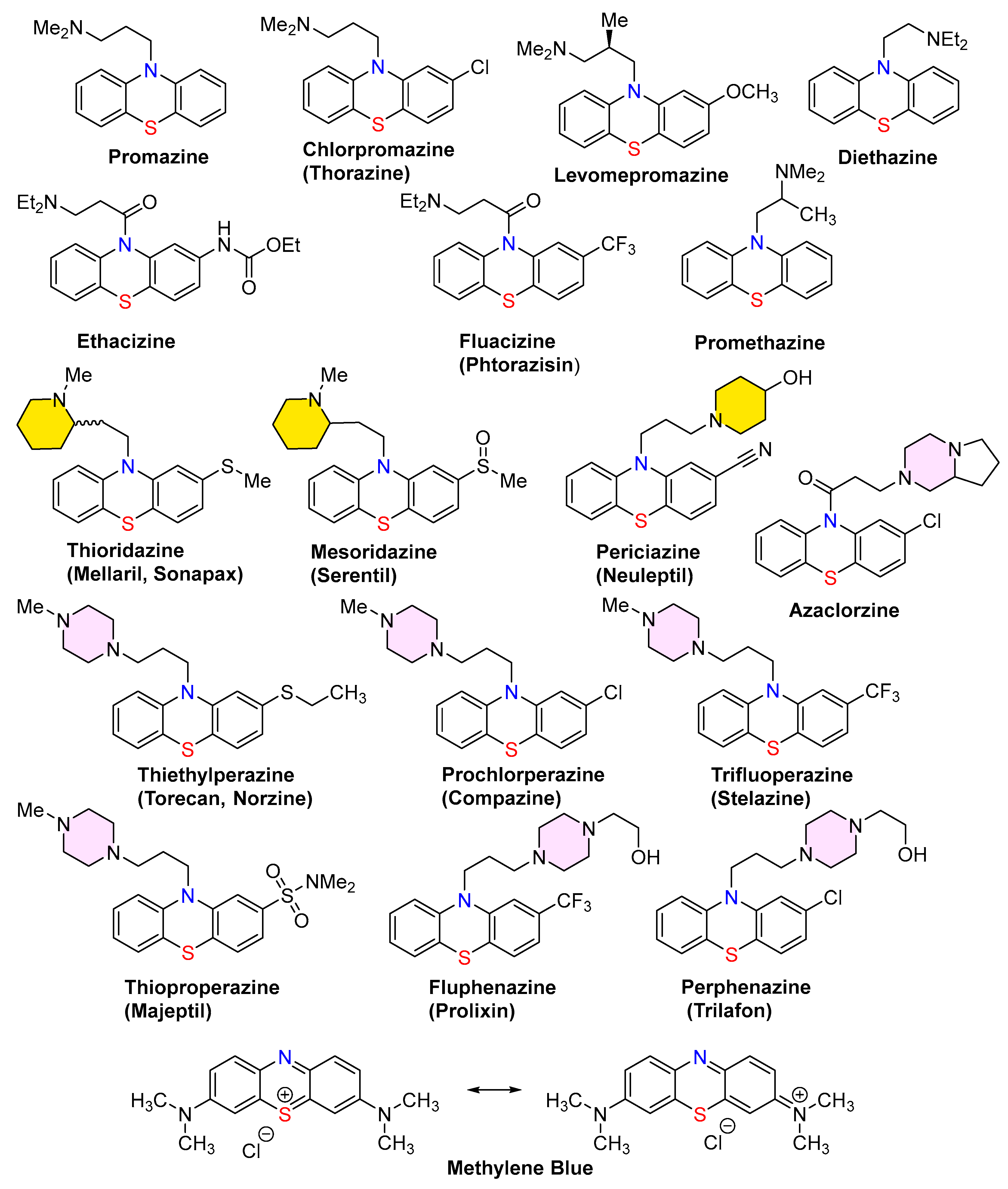
Figure 2.
Biologically active 3-aminothieno[2,3-b]pyridines.
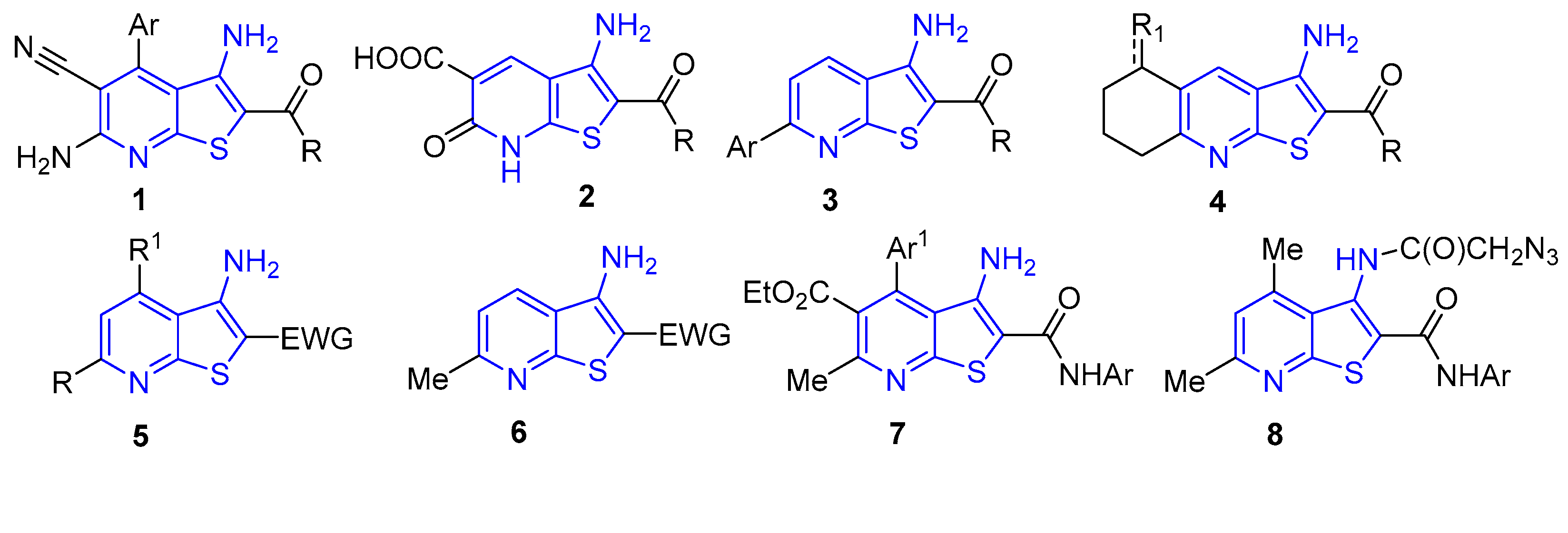
Scheme 1.
Synthesis strategy for nicotinonitrile – phenothiazine and thieno[2,3-b]pyridine – phenothiazine heterodimers.
Scheme 1.
Synthesis strategy for nicotinonitrile – phenothiazine and thieno[2,3-b]pyridine – phenothiazine heterodimers.
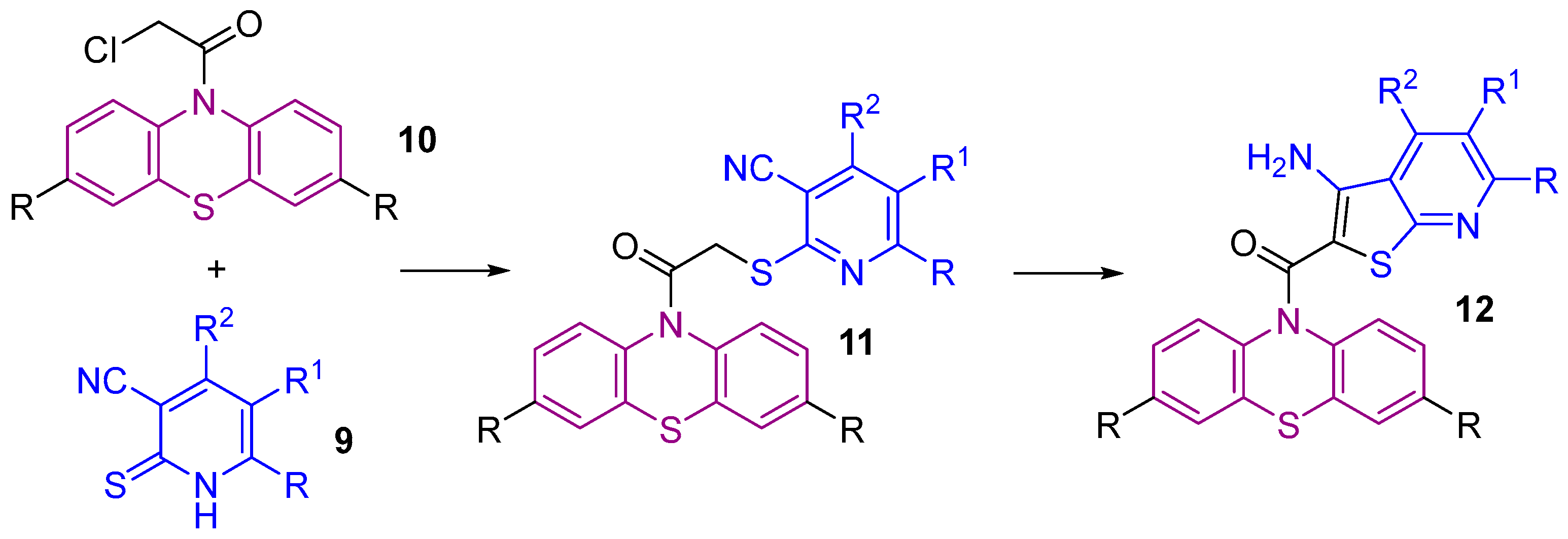
Scheme 2.
Preparation of starting 2-thioxoquinolines and 2-thioxopyridines 9a-m.
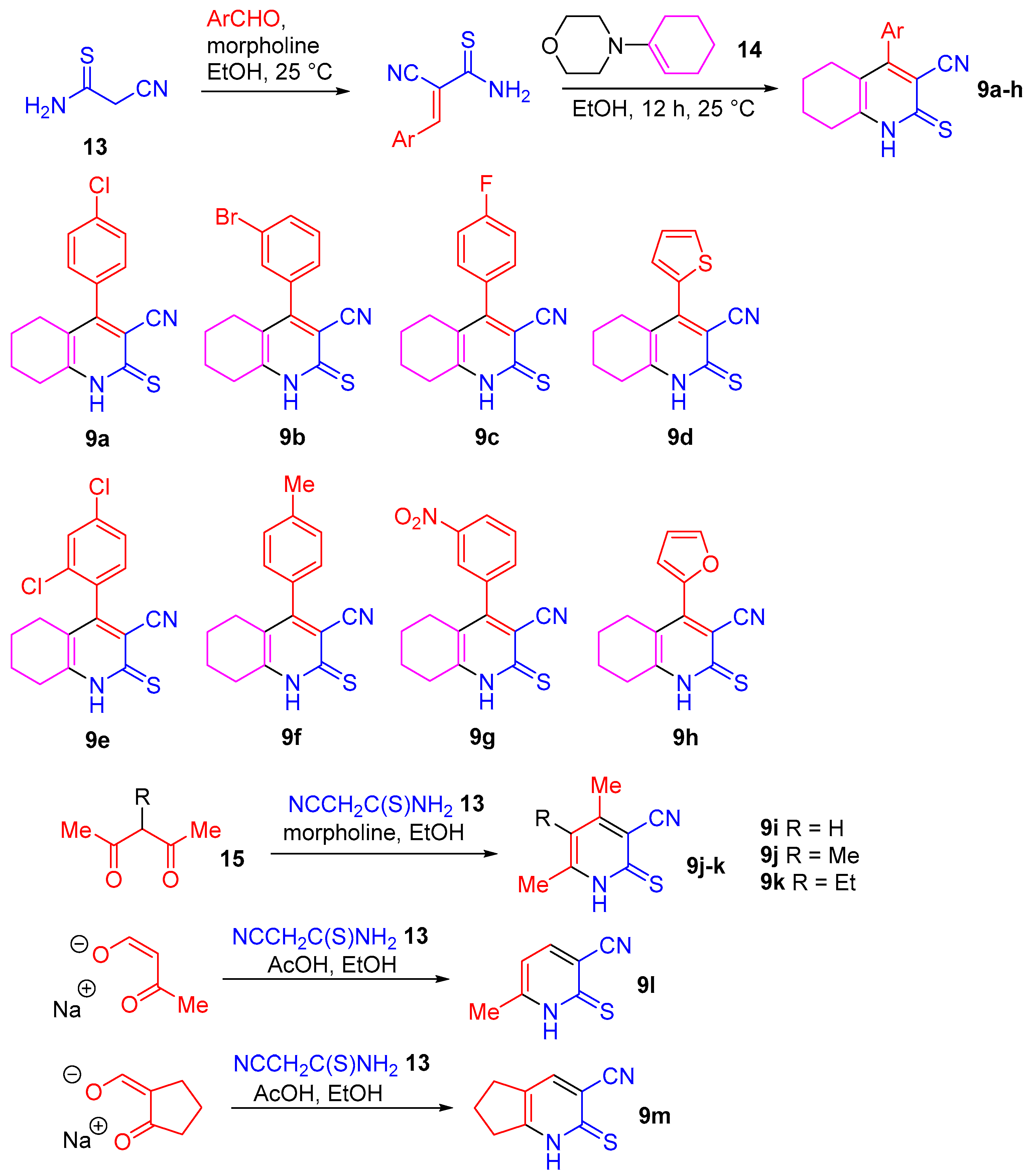
Scheme 3.
Scheme 3. Synthesis of starting chloroacetyl phenothiazines 10a,b.
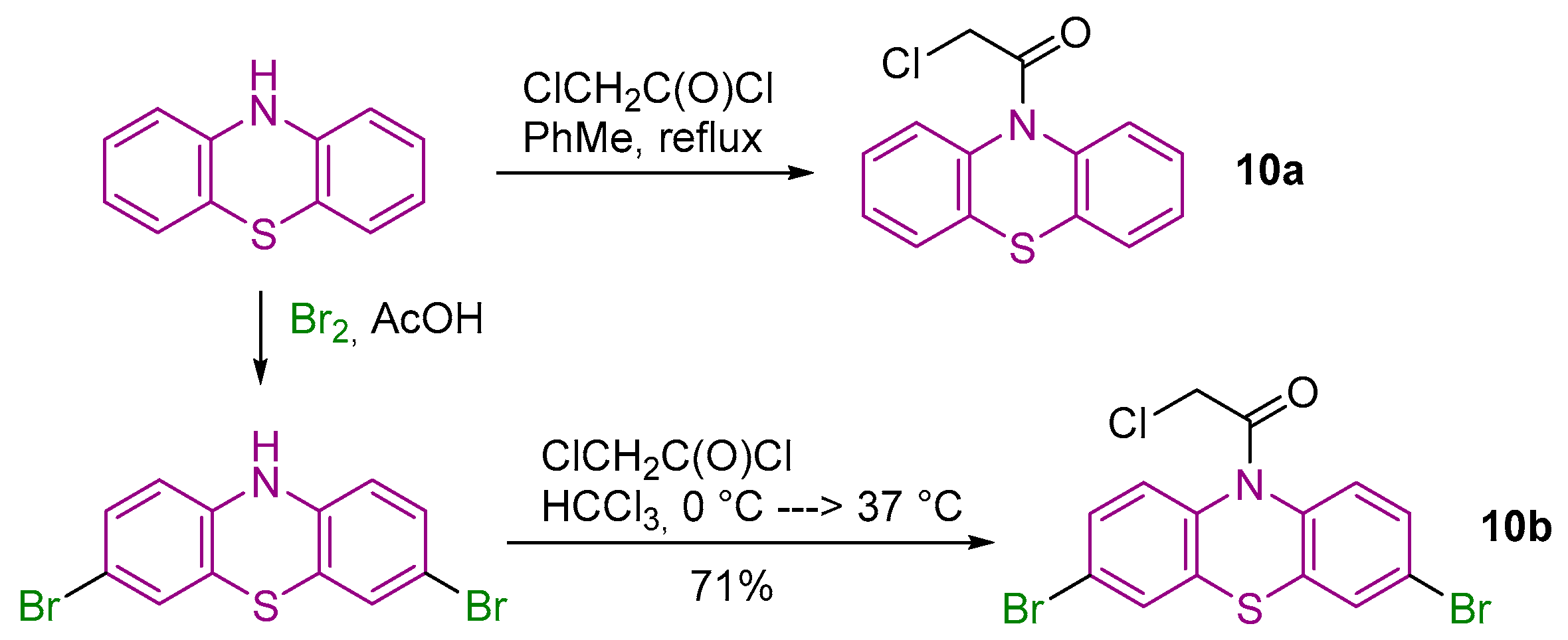
Figure 3.
ORTEP drawing of X-ray structure for 3,7-dibromo-10-(chloroacetyl)phenothiazine 10b with numbering system (not the IUPAC standard) and ellipsoids with 50% probability (CCDC deposition number 2478604).
Figure 3.
ORTEP drawing of X-ray structure for 3,7-dibromo-10-(chloroacetyl)phenothiazine 10b with numbering system (not the IUPAC standard) and ellipsoids with 50% probability (CCDC deposition number 2478604).
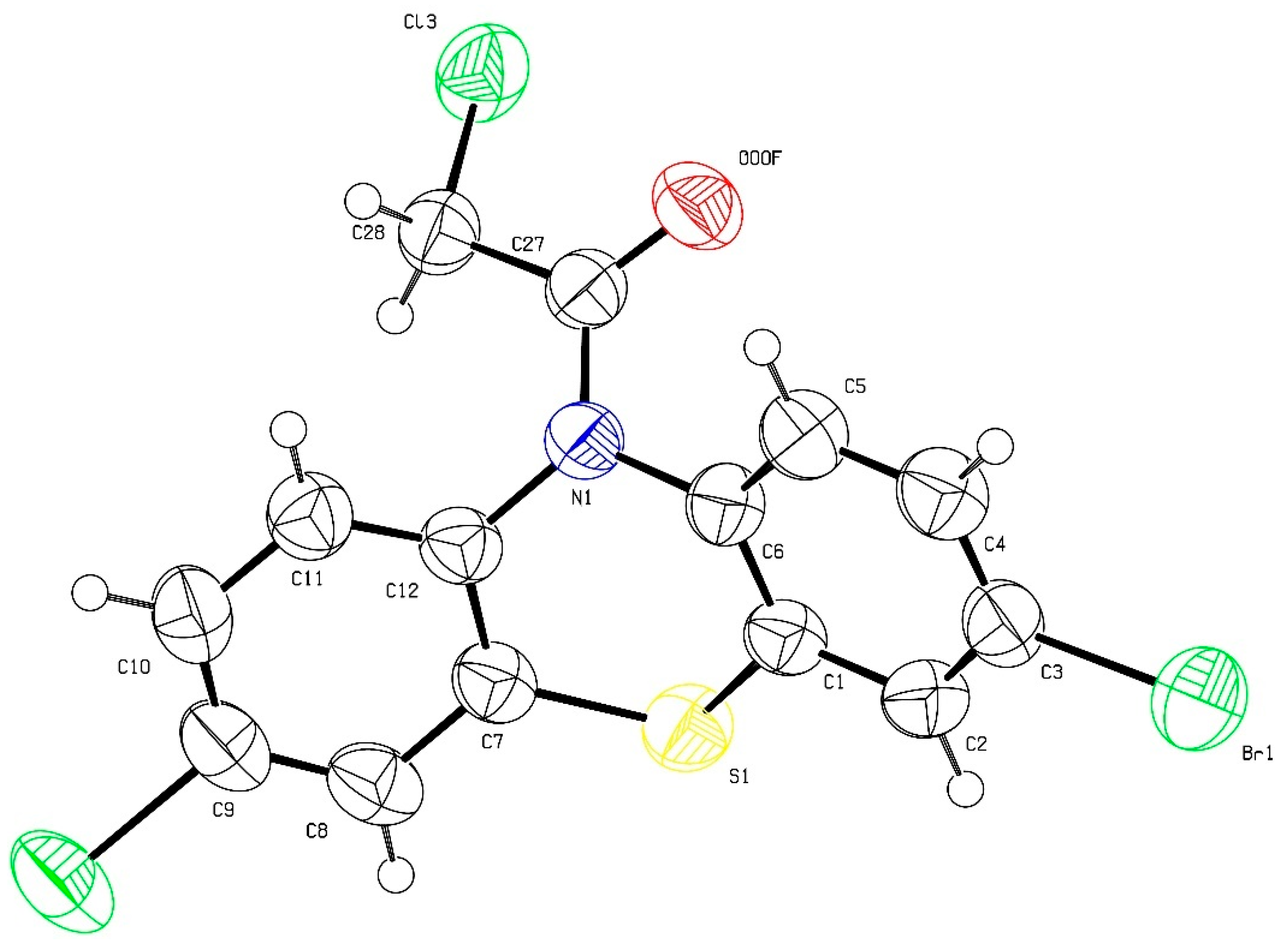
Scheme 4.
KOH/MeOH-promoted Thorpe-Ziegler reaction with 10-(chloroacetyl) phenothiazines 10.
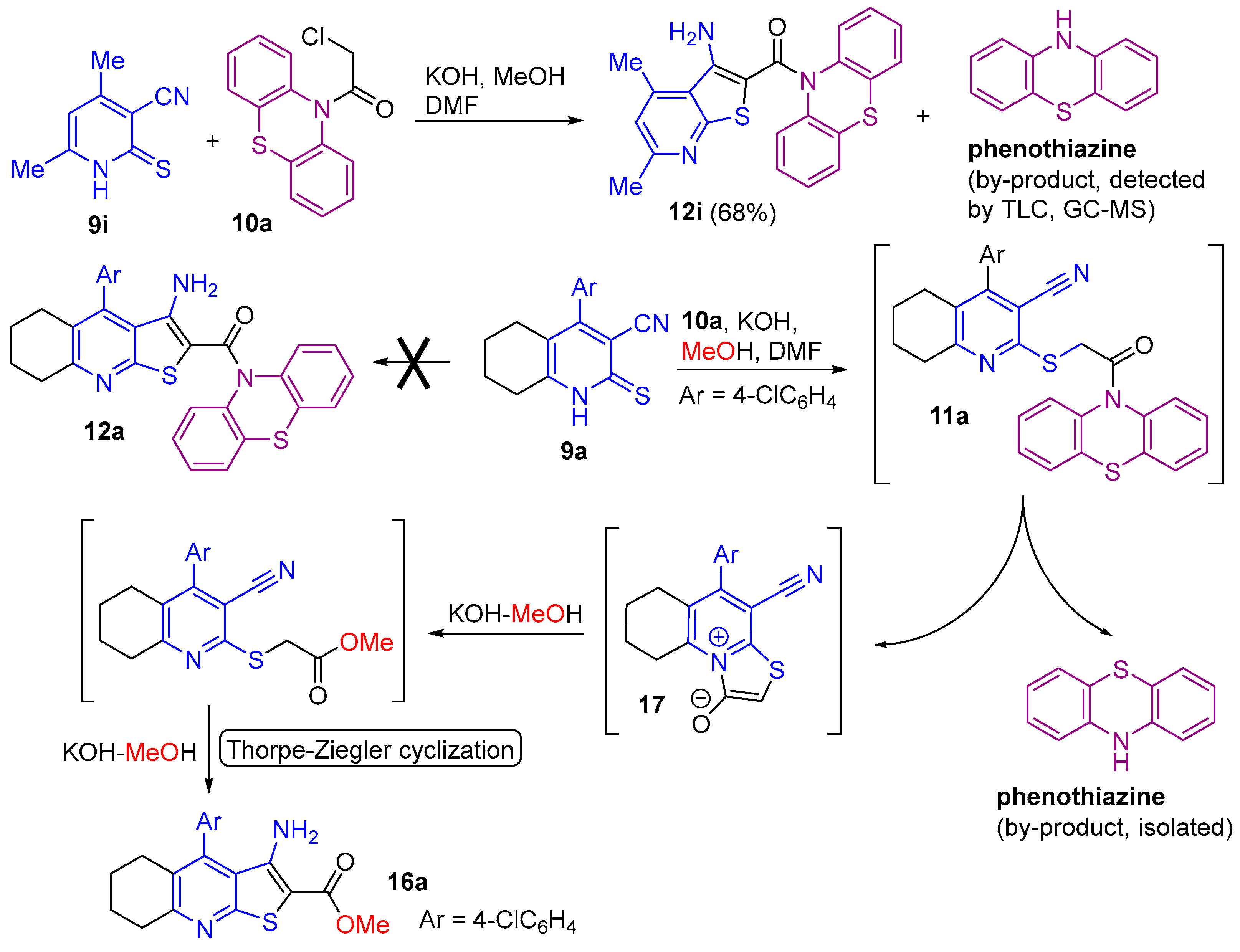
Scheme 5.
Synthesis of nicotinonitrile–phenothiazine heterodimers 11 and thieno[2,3- b]pyridine–phenothiazine heterodimers 12.
Scheme 5.
Synthesis of nicotinonitrile–phenothiazine heterodimers 11 and thieno[2,3- b]pyridine–phenothiazine heterodimers 12.
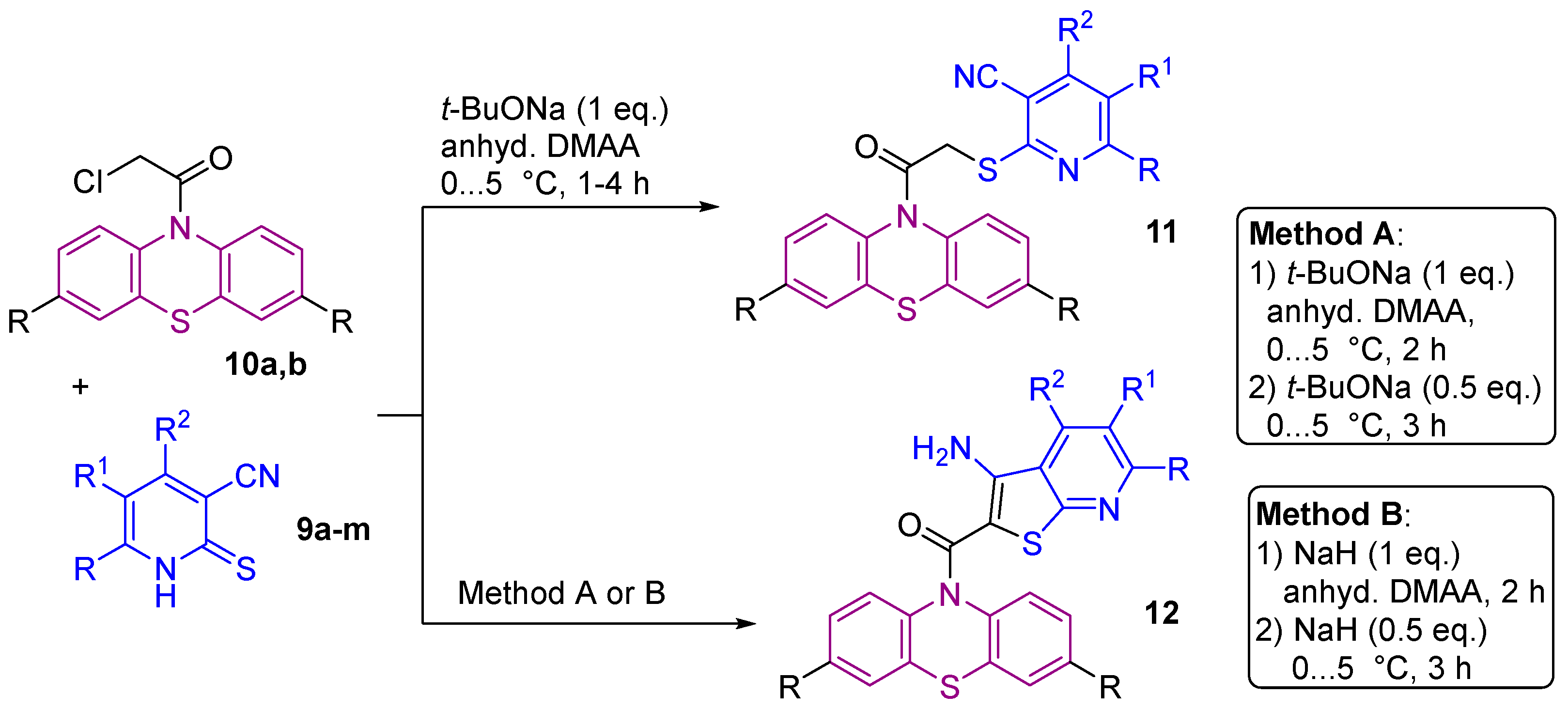
Scheme 6.
Synthesis of chloroacetamide 18.
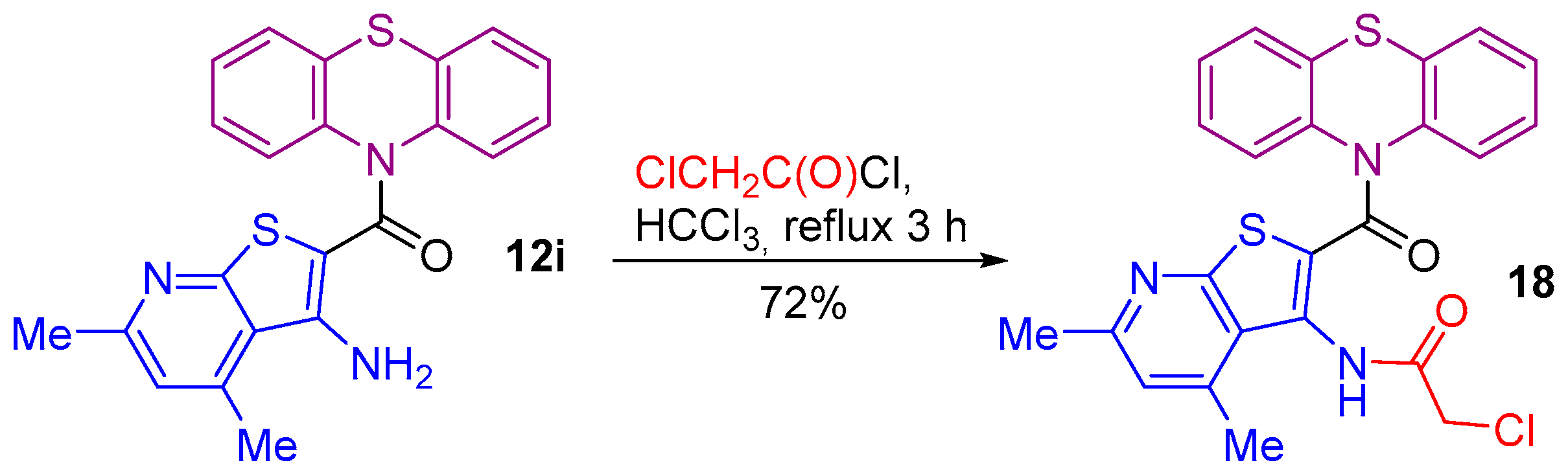
Scheme 7.
The Gewald rearrangement of ortho-(chloroacetamido) carboxylates to ring-fused pyrimidines 22 [207].
Scheme 7.
The Gewald rearrangement of ortho-(chloroacetamido) carboxylates to ring-fused pyrimidines 22 [207].
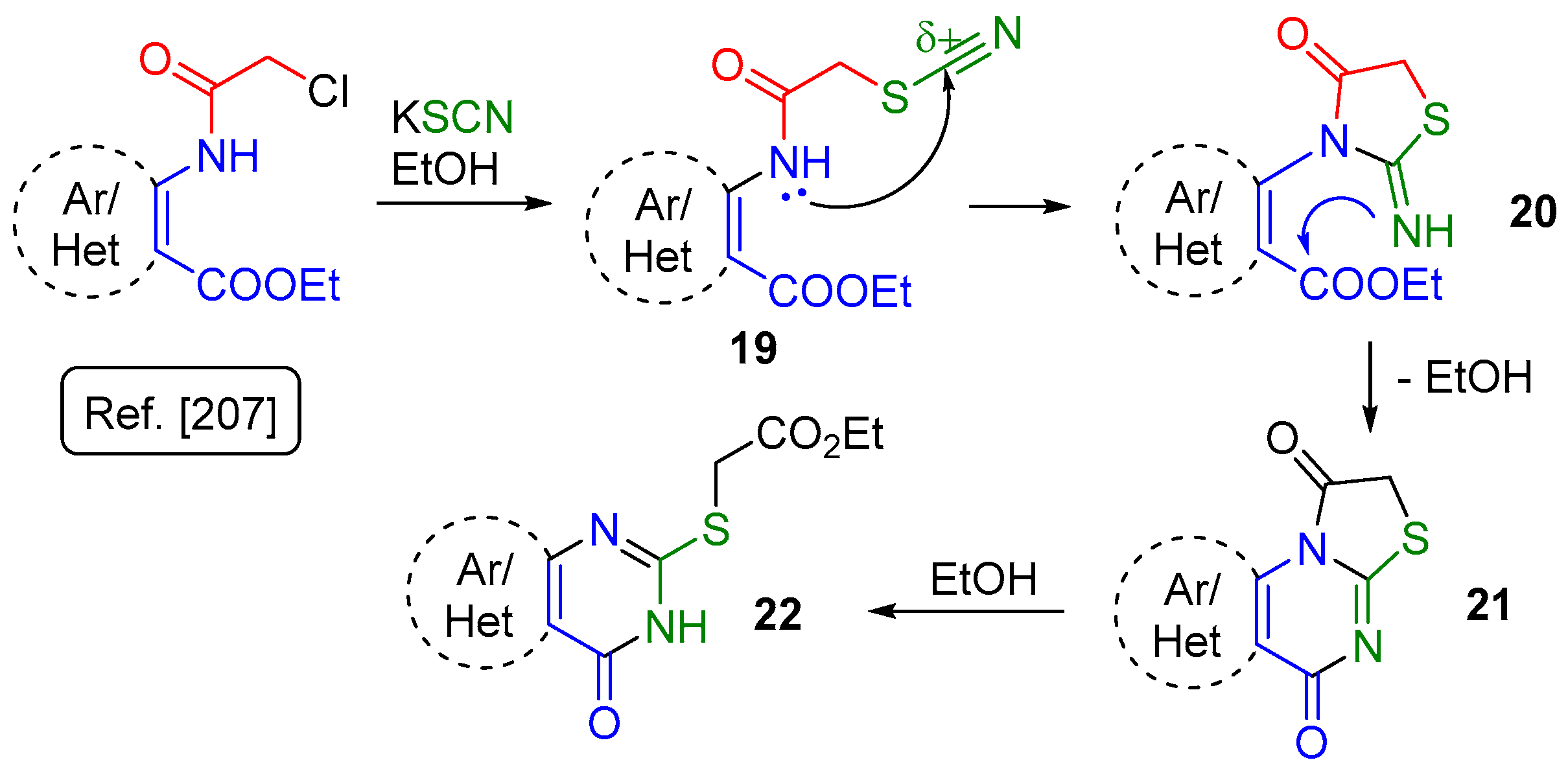
Scheme 8.
Different pathways for the reaction of ortho-substituted α-chloroacetamides with thiocyanates.
Scheme 8.
Different pathways for the reaction of ortho-substituted α-chloroacetamides with thiocyanates.
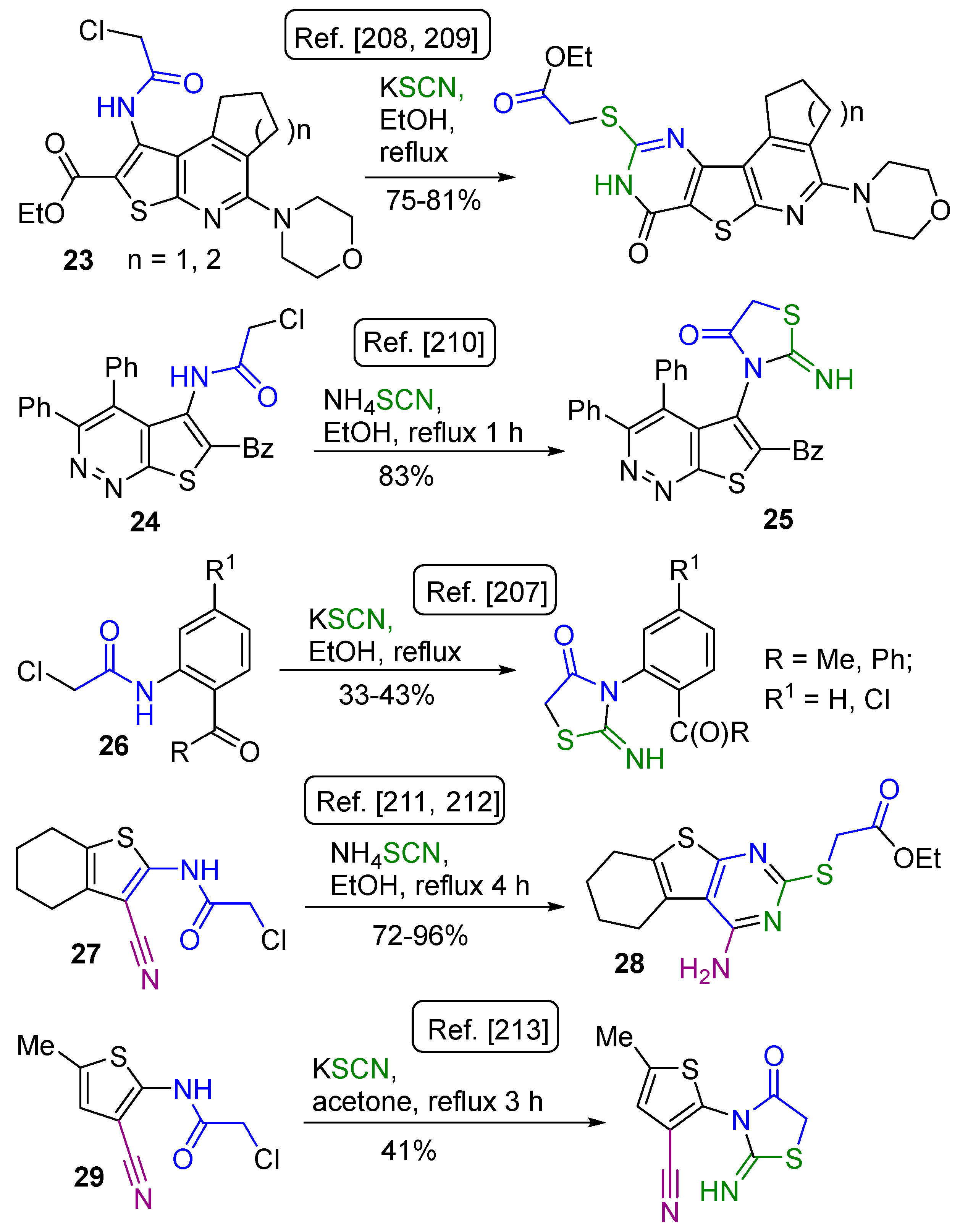
Scheme 9.
The reaction of chloroacetamide 18 with potassium thiocyanate.
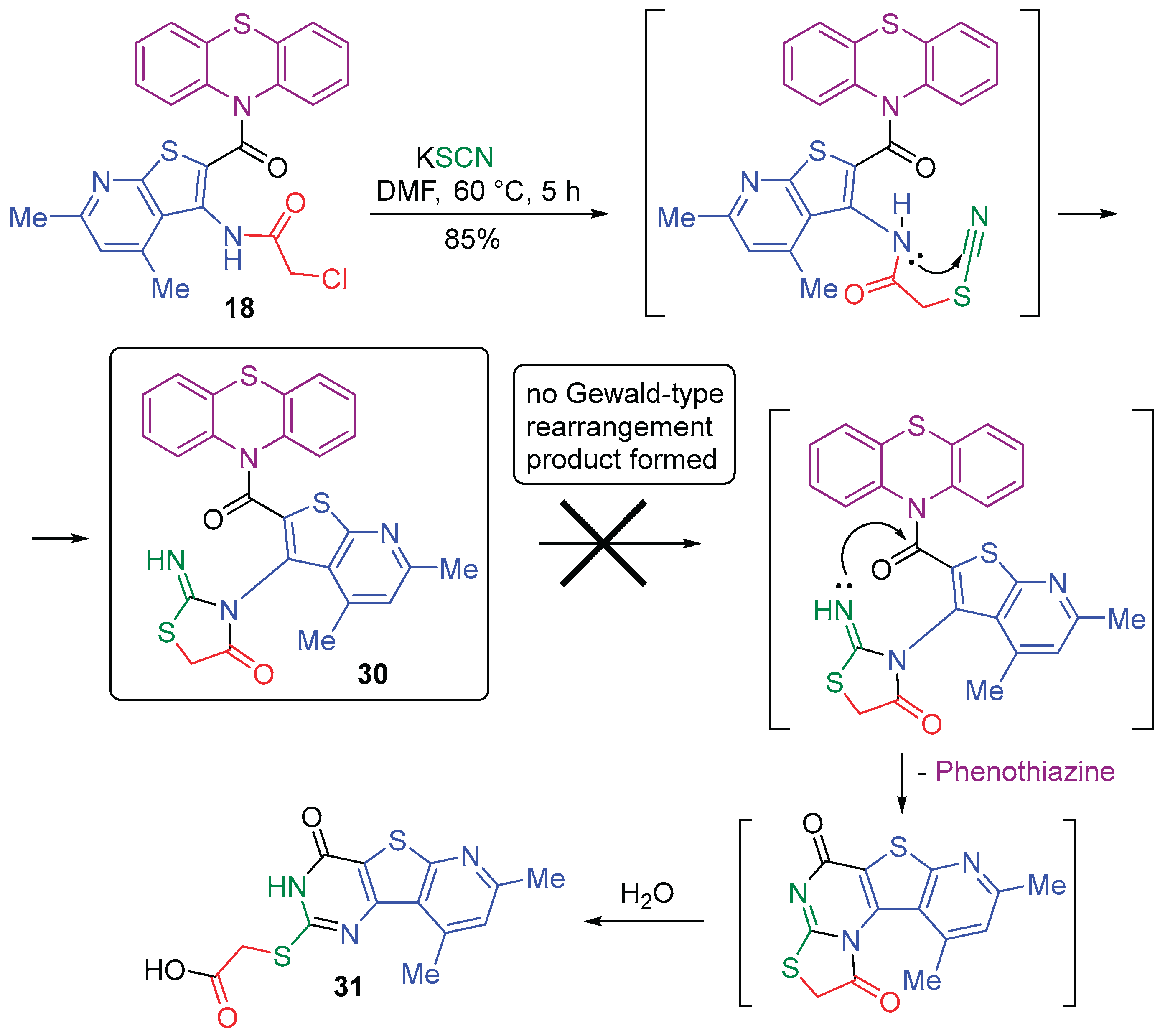
Figure 4.
The optimized molecular structure of compound 30 calculated at the B3LYP-D4/def2-TZVP level of theory.
Figure 4.
The optimized molecular structure of compound 30 calculated at the B3LYP-D4/def2-TZVP level of theory.
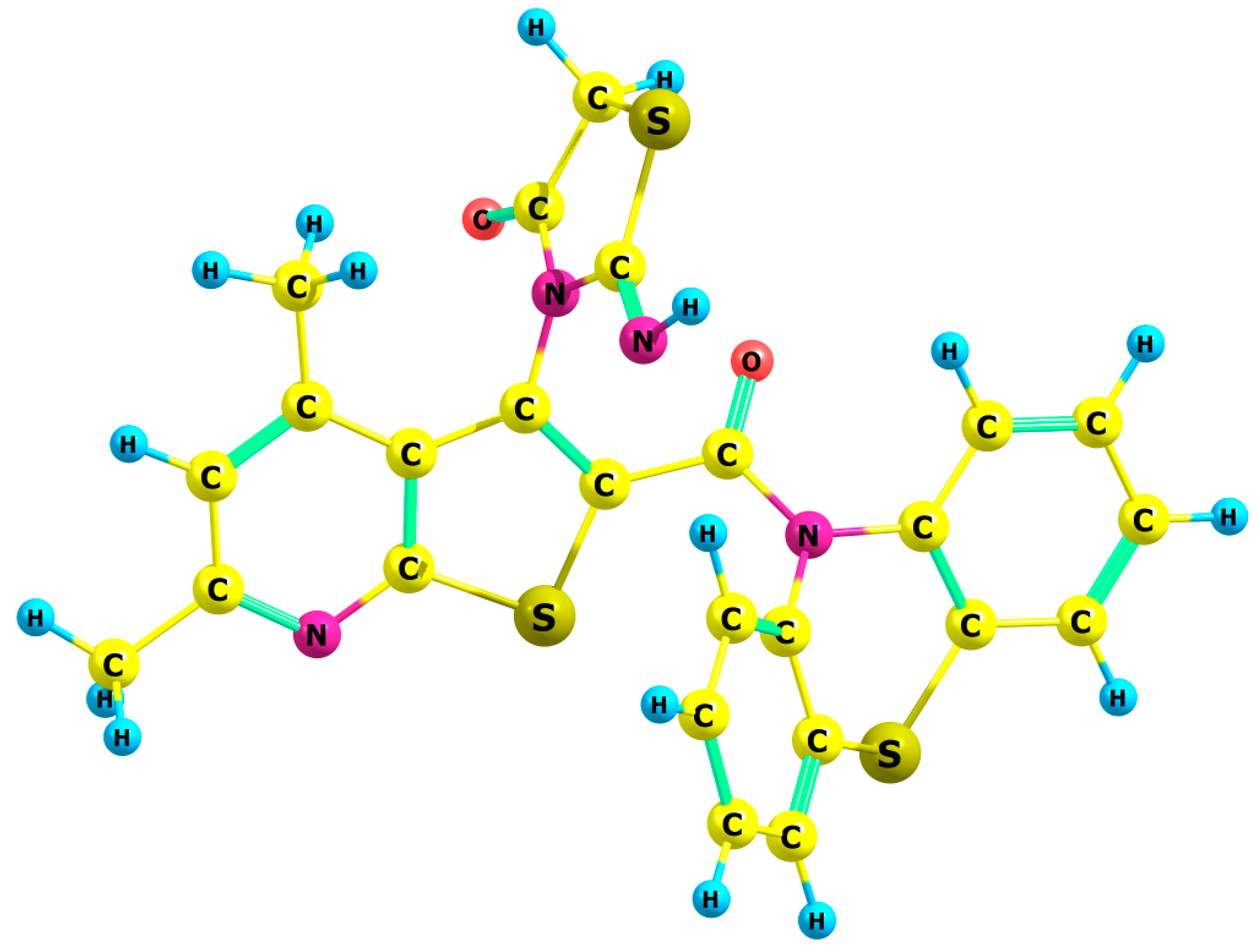
Figure 5.
Predicted structure of the protein–ligand complex between compound 11c and PPAR (PDB ID 2zno) (left), and predicted structure of the protein-ligand complex between compound 11d and the BCL-2 family protein BCL-X(L) (PDB ID 3zln) (right).
Figure 5.
Predicted structure of the protein–ligand complex between compound 11c and PPAR (PDB ID 2zno) (left), and predicted structure of the protein-ligand complex between compound 11d and the BCL-2 family protein BCL-X(L) (PDB ID 3zln) (right).
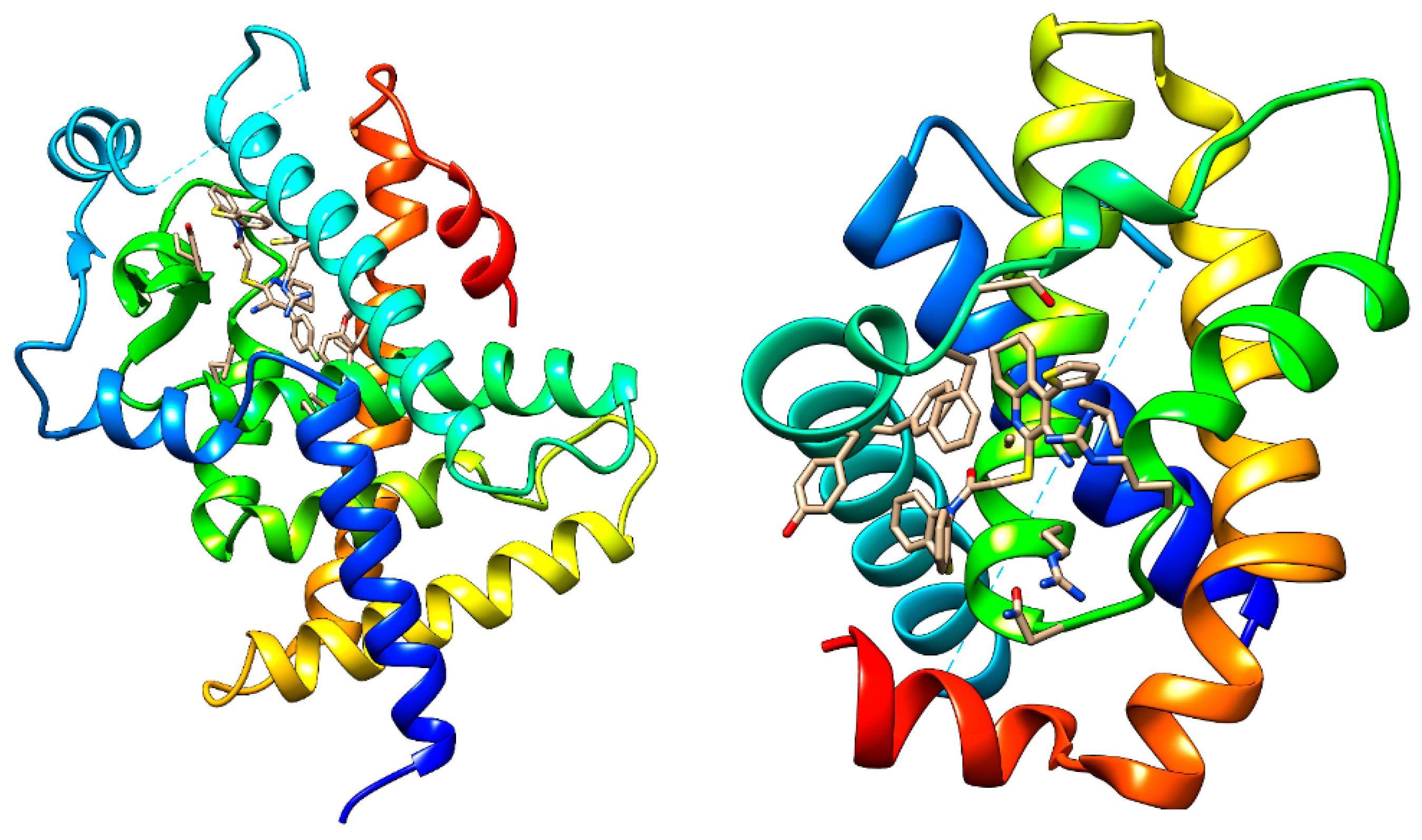
Figure 6.
Predicted structure of the protein–ligand complex between compound 12h and the PPAR-γ receptor (PDB ID 8hup) (left), and predicted structure of the protein–ligand complex between compound 30 and the BCL-2 protein (PDB ID 3zln) (right).
Figure 6.
Predicted structure of the protein–ligand complex between compound 12h and the PPAR-γ receptor (PDB ID 8hup) (left), and predicted structure of the protein–ligand complex between compound 30 and the BCL-2 protein (PDB ID 3zln) (right).
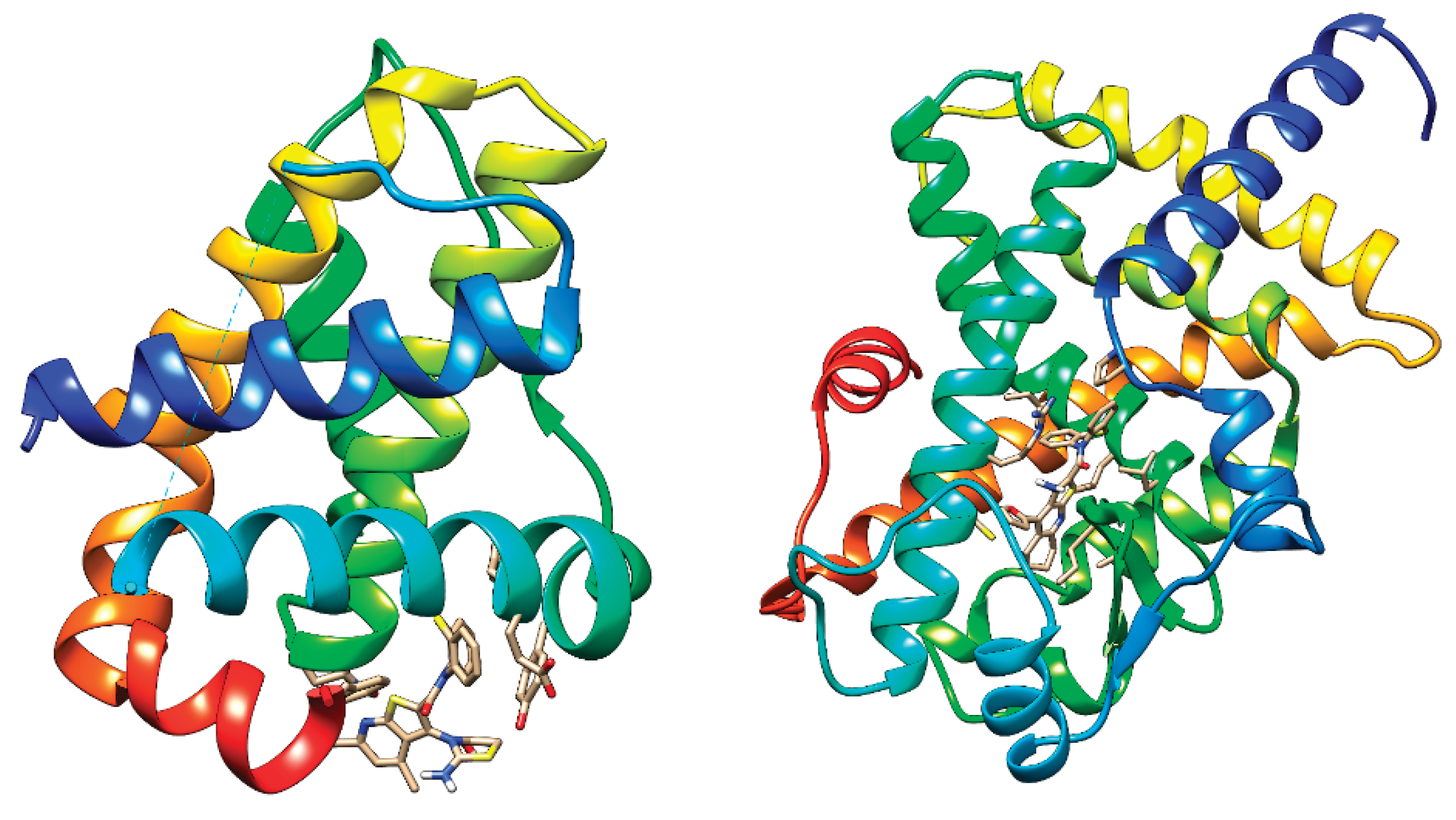

Table 1.
Table 1. Structure and yields of nicotinonitrile–phenothiazine heterodimers 11a-h.
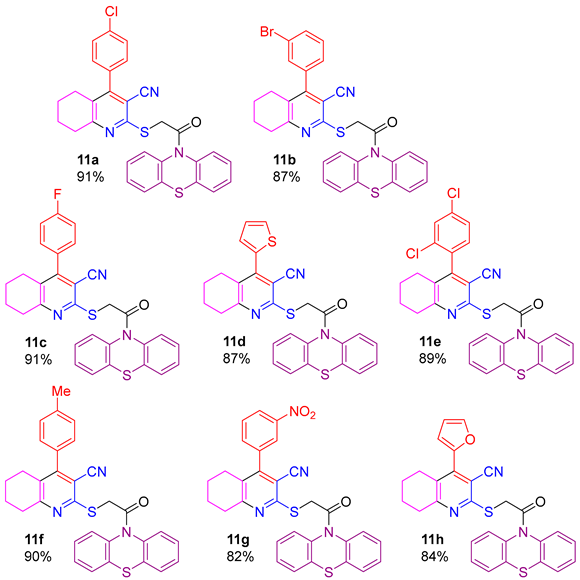 |
Table 2.
Structure and yields of thieno[2,3-b]pyridine(thieno[2,3-b]quinoline)–phenothiazine heterodimers 12 (the method of preparation—A or B—is indicated in parentheses).
Table 2.
Structure and yields of thieno[2,3-b]pyridine(thieno[2,3-b]quinoline)–phenothiazine heterodimers 12 (the method of preparation—A or B—is indicated in parentheses).
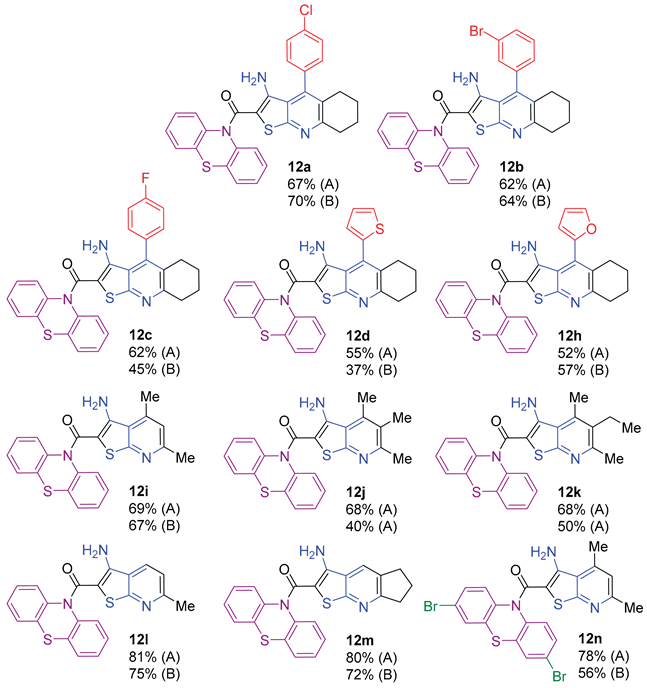 |
Table 3.
Comparison of experimental vibrational frequencies with the results of quantum-chemical calculation for compound 30 (calculated at B3LYP-D4/def2-TZVP level of theory).
Table 3.
Comparison of experimental vibrational frequencies with the results of quantum-chemical calculation for compound 30 (calculated at B3LYP-D4/def2-TZVP level of theory).
| Vibrations | Experimental bands, cm-1 | Calculated vibrational frequencies, сm-1 | |
| No correction factors | With correction factors* | ||
| ν N-H | 3294 | 3503 | 3388 |
| ν C-H(Ar) | 3063 | 3196 | 3091 |
| νas CH3 | 2978 | 3113 | 3011 |
| νs CH3 | 2935 | 3037 | 2938 |
| ν C=O thiazolidinone | 1720 | 1805 | 1746 |
| ν C=O (amide I) | 1659 | 1701 | 1665 |
| ν C=N | 1624 | 1672 | 1637 |
| ν C-C(Ar) ThPy | 1585 | 1622 | 1588 |
| ν C-C(Ar) ThPy | 1555 | 1596 | 1562 |
| ν C-C(Ar) ThPy | 1524 | 1558 | 1525 |
| ν C-C(Ar) + δ C-H(Ar) PhTz | 1458 | 1502 | 1470 |
| ν C-N + δ CH3 | 1396 | 1423 | 1393 |
| skeletal | 1331 | 1367 | 1338 |
| skeletal | 1261 | 1299 | 1272 |
| skeletal | 1211 | 1233 | 1207 |
| δ N-H + δ C-H(Ar) | 1126 | 1169 | 1144 |
| δ C-H(Ar) | 1030 | 1060 | 1038 |
| skeletal | 918 | 938 | 918 |
| skeletal | 895 | 907 | 888 |
| ν C-S PhTz | 868 | 878 | 860 |
| δ N-H | 787 | 795 | 778 |
| δ C-H(Ar) | 764 | 777 | 761 |
| skeletal | 725 | 738 | 723 |
| skeletal | 613 | 633 | 620 |
| МАPЕ**, % | - | 2.83 | 0.77 |
*The correction factors were 0.9673 for high frequency vibrations (>1800 cm-1) and 0.979 for low frequency vibrations (<1800 cm-1) according to [214]. **MAPE stands for Mean Absolute Percentage Error.
Disclaimer/Publisher’s Note: The statements, opinions and data contained in all publications are solely those of the individual author(s) and contributor(s) and not of MDPI and/or the editor(s). MDPI and/or the editor(s) disclaim responsibility for any injury to people or property resulting from any ideas, methods, instructions or products referred to in the content. |
© 2025 by the authors. Licensee MDPI, Basel, Switzerland. This article is an open access article distributed under the terms and conditions of the Creative Commons Attribution (CC BY) license (http://creativecommons.org/licenses/by/4.0/).
Copyright: This open access article is published under a Creative Commons CC BY 4.0 license, which permit the free download, distribution, and reuse, provided that the author and preprint are cited in any reuse.


